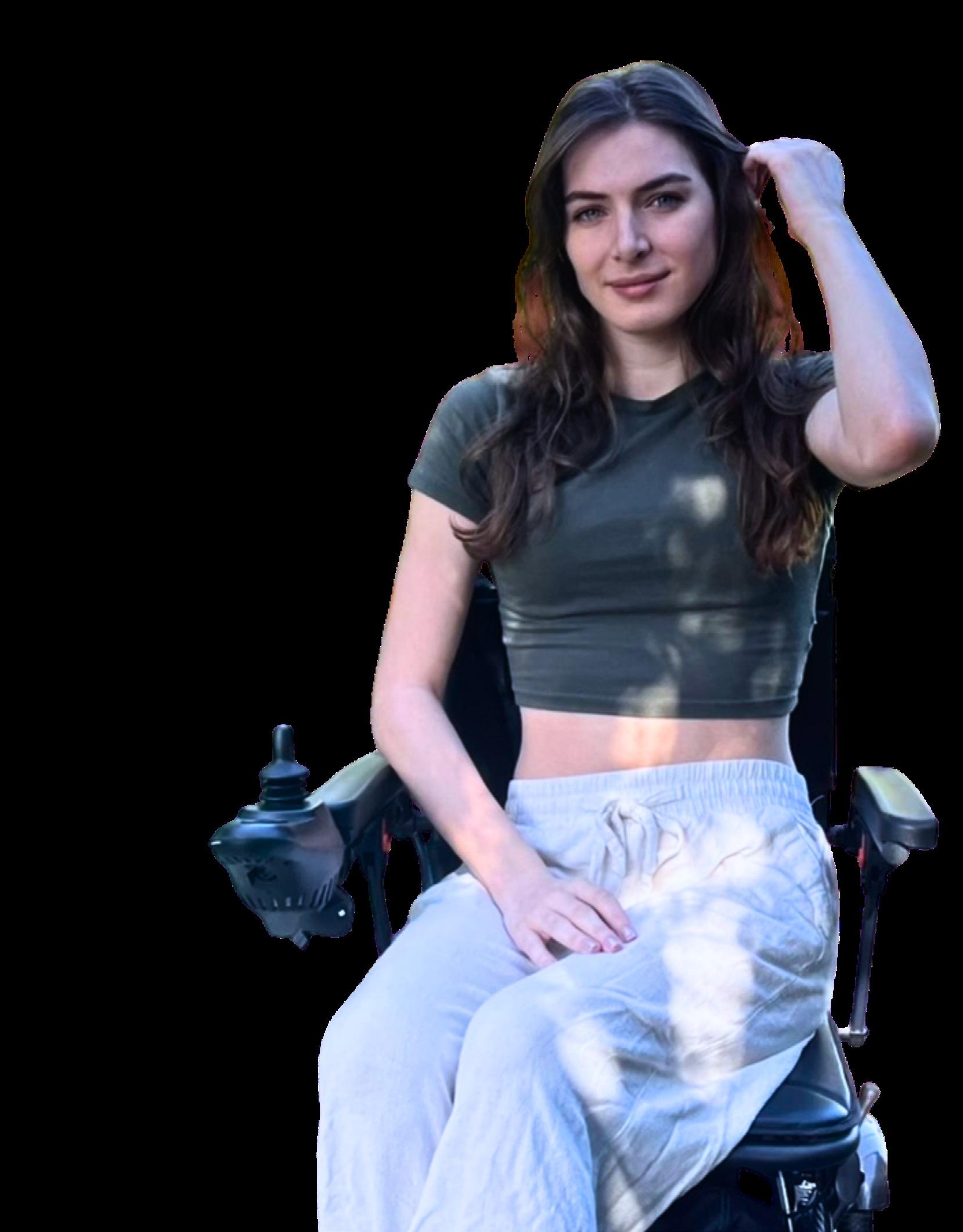
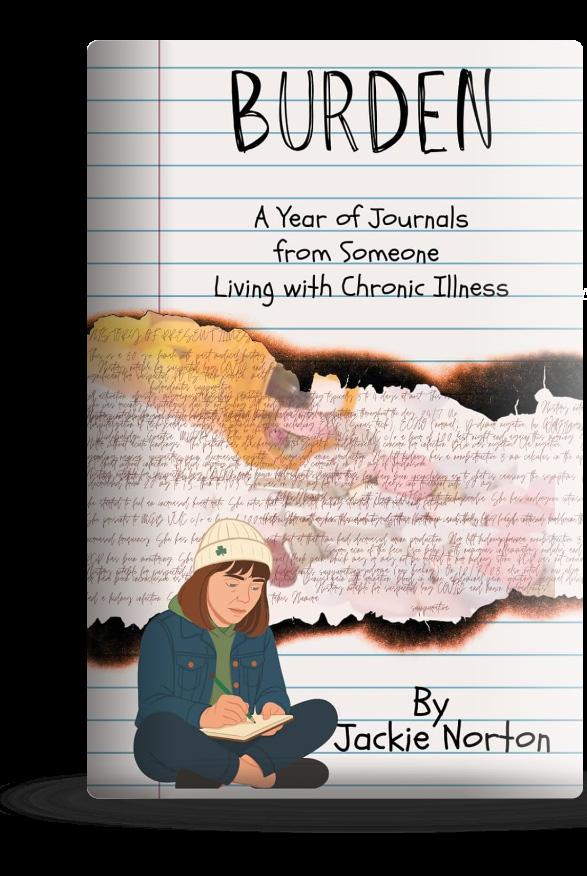
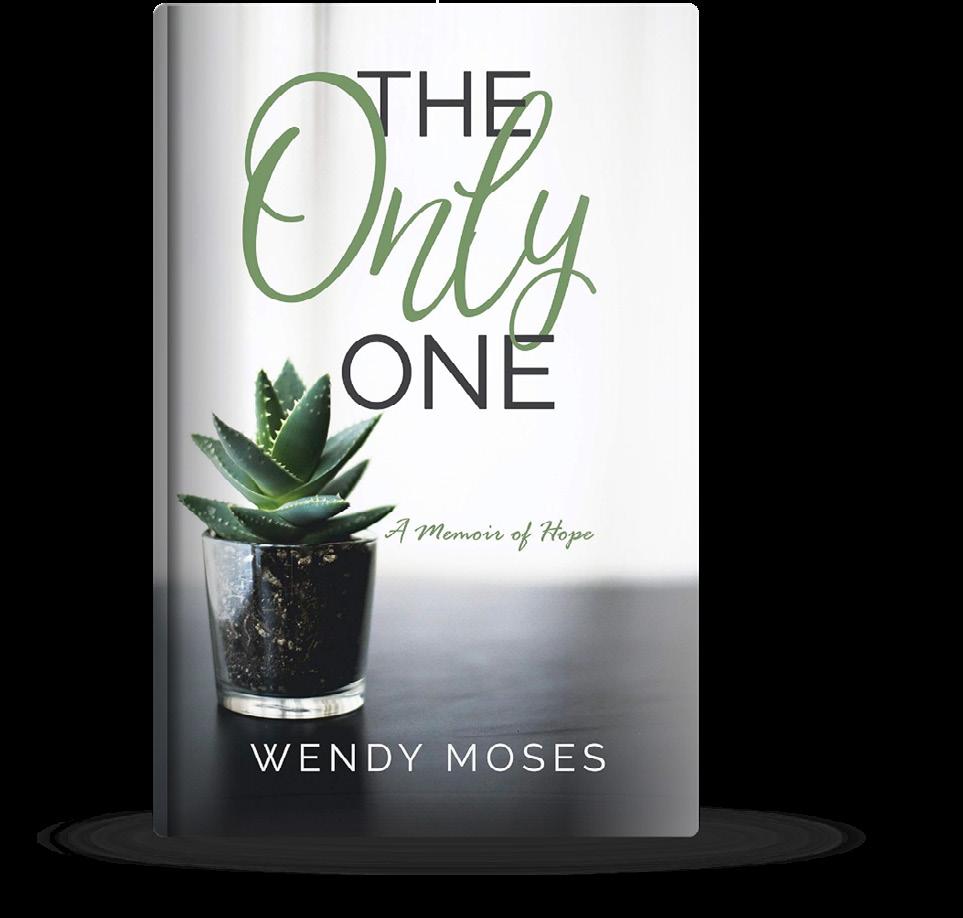
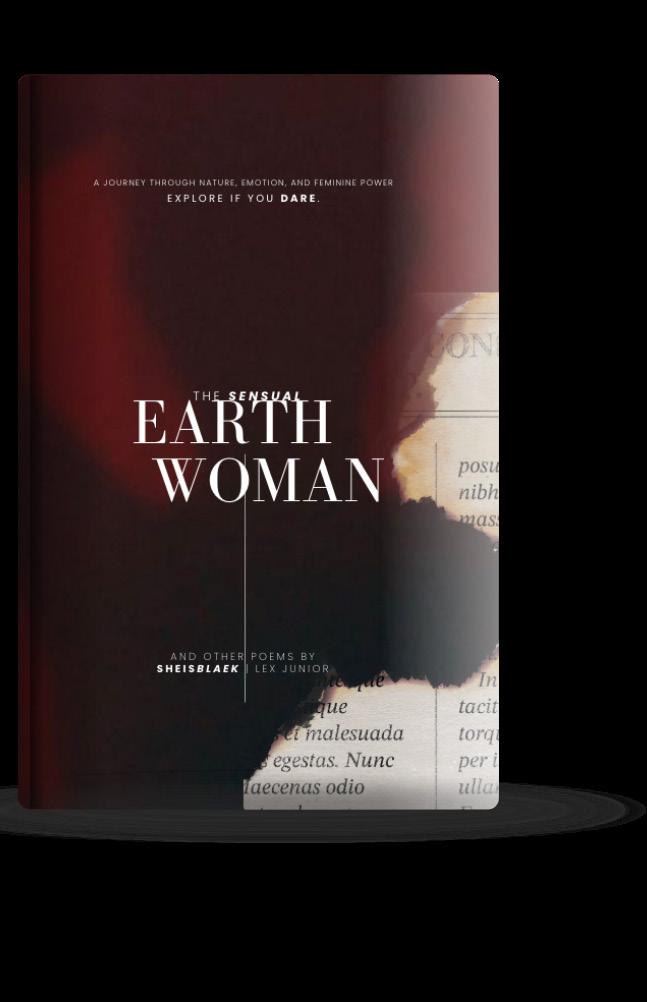
Liz Zonarich is a graphic designer and illustrator based in Boston. For her, chronic illnesses are personal, motivating her to make a difference. As a graduate of the Master of Science in Media, Medicine, and Health program at Harvard Medical School, she loves to convey health messaging through storytelling and visuals. Her background is in graphic design, public health, and art history. Her favorite ways to cope are mailing letters to friends, reading, illustrating, and rewatching Pride & Prejudice (2005) for the millionth time.
K. Hamilton is a writer, born and raised in Philadelphia. They have a background in English Literature and Education, and has lived with both mental and physical conditions for a large portion of their life. Their favorite ways to cope are gardening, gaming, making things for friends, playing heavy metal too loud, and reading.
COPE MAGAZINE is a place for storytelling. Every work published is a creative and personal story, and should not be taken as medical advice.
letter from the editor
DEAR READERS,
Welcome to our second volume of COPE MAGAZINE. It’s been so beautiful to watch this creative community of storytellers grow. The continued interest and support for this project has been so fulfilling and motivational for me.
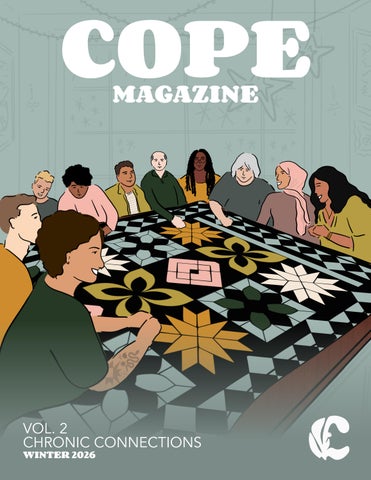
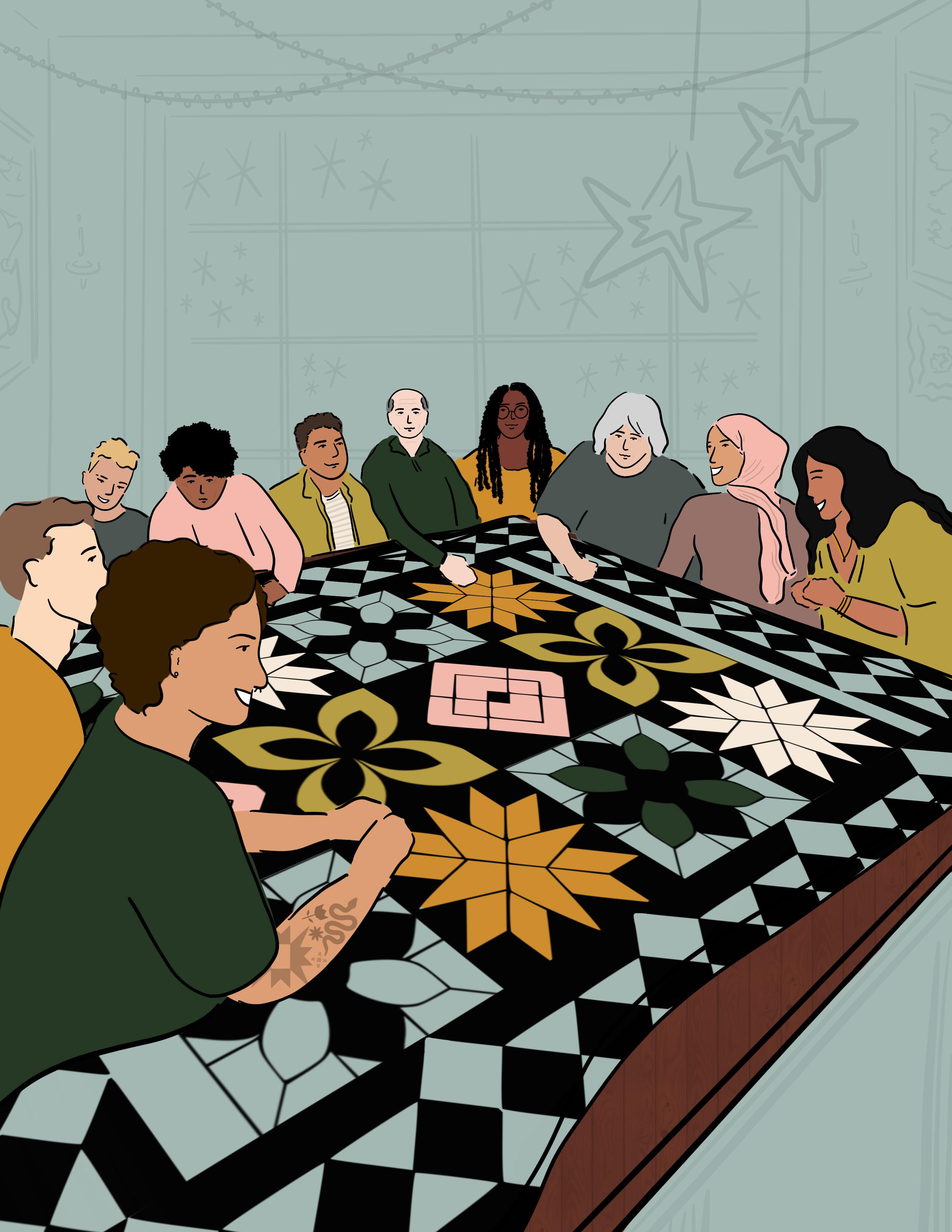
While pondering the second issue’s theme, I thought about the impending winter holidays. It’s a chaotic and busy time, not just because of all the celebrations but how much time we spend with others. Living with chronic illness(es) is complex enough, but it also heavily shapes our relationships, with friends, family, lovers, and peers. It can be difficult to articulate these dynamics, but in this issue I wanted us to explore this important aspect of our lives. These relationships are deeply woven into our experience, good and bad. So, when coming up with a visual theme, I decided upon quilts. These patterned blankets often tell stories and have been known to symbolize love, comfort, and resilience. Throughout the four chapters, we’ll journey together with isolation/loneliness, support systems, romantic relationships, and shine some light on some fellow authors from the chronic illness community. I hope through this issue that you’ll be able to find comfort through these stories, but also take time to think about what relationships are most valuable to you? Who supports you? Who makes you laugh? Who makes you feel loved? Are there any relationships in your life you need to reevaluate? How do these relationships make you feel about yourself? This magazine has become its own square woven into the fabric of my quilt, and for that I’ll be forever grateful.
WARMLY,
Isolation, Loneliness, and Being Left Behind Chapter 1
Shkrshhh…! by Swan Melloh
You were hastily planning your hurried departure, my diagnosis a contamination to your aura. You intended on hiding this painstaking exodus by claiming to understand abandonment.
But you were translucent, the ghosts of our friendship visibly shrinking into the hollows of your entrails.
I still saw tiny pieces of shared memories scattered on the vast ground between us, for a while, until I forgot about overnight rain and bare feet dangling in cool ponds of easeful summer.
My body held me hostage anyway, with the rough scrape on the matchbox, the spark catching past the strike.
No explanation reached you, your bones were made of denial and fear, yet you blamed this estrangement on me.
Just for Now by Lexie Collins
With chronic illness and severe fatigue, I have had to become very comfortable with being alone a lot of the time. My grandma and husband are really great, but unfortunately, with my age, a lot of my friends, even others struggling with chronic illnesses, don’t understand why I can’t do what they can. So, I have slowly come to have less and less friends over time. I don’t feel any ill will or blame toward them for it, but I do feel that it’s not talked about enough how isolating chronic illness can become.
The Monsters We Hide by Debra Lowe
Somewhere in time, our collective American culture – and indeed most cultures worldwide – decided that the best way to handle fear is to ignore it. As if we could all shove any discomfort or difficult situation under a metaphorical rug and it would simply stay there. It’s an understandable reaction. Fear is not easy to look in the eye. But it’s folly to believe that closing your eyes to ugly realities can keep you protected.
Our tender human psyche is like a perpetual child, refusing to look under the bed for the creature lurking there –because seeing it would surely will it into reality. One of the most terrifying shadows in all the world is death and all that accompanies it: illness, disease, disability. The world reacts to these things like that frightened child – pretending the monsters don’t exist. We hide. We dismiss what’s too difficult to face. Because to really look at illness and disability brings us to the truth that life can change in an instant. The only thing keeping those shadows from our own lives is a stroke of fate. Disability and disease are only one heartbeat away for anyone at any moment in time. This great fear shapes so many of my relationships. It also fuels my own need to hide the beast—to tuck away the demon others would rather not see. If I do let it show, it must be in bite-size pieces: a gentle mention of my most
benign symptoms, a small joke about a little difficulty I face. I can never reveal the full creature in its entirety, or I’m met with uncomfortable silence and quiet reproach. Even when I try to ease people in, showing that this life is not as frightening as they imagine, it still causes some to slowly exit my world. The irony is that the truth – the real truth – is often far less scary than what we allow ourselves to believe.
That’s what I wish people understood the most. I face challenges every day, but I do face them. And with every tear I shed or angry shout I make because of those challenges, a seed of beauty grows too. My life is beautiful and messy and frightening, just like everyone else’s.
So I continue to search for my tribe. The ones unafraid to look under the bed, to face the shadows, and realize there were never any real monsters at all.
Author’s Note:
“The Monsters We Hide” explores how society’s fear of illness, disability, and mortality shapes the way we connect with one another. Rather than writing about relationships in a traditional sense, I wanted to examine the quiet psychology behind them. The way fear and avoidance create distance, and how acceptance can bring us closer to our shared humanity and forge meaningful relationships.
The Door is Locked by Tilly Morris
The door is locked. I am scared to let them in. So I lock the door and walk away. Scared I will be too muchOr not enough.
Scared that they don’t know how bad it can really get, Scared that they will see the truth and run.
So maybe if I lock the door first, it’s easier? Maybe if I shut everyone out, I will be safe? But I know I won’t.
I want to be held and lovedNot because of my hurt, But despite it. Loved for who I am, Not what I endure
But I am the one that keeps running And there’s no where left to go. You can’t outrun your shadowIt always knows the way home.
I just want to be enough for someone. And for my self.
Becoming the Patient
by Grace Picard
Chronic illness is embodying and all encompassing. It becomes not only your world, but the glasses you need to see. It changes how you think and feel, how you experience empathy, and who you see in a crowd.
I was sitting in a group of other psychotherapists, listening to a coworker presentation about a client. The presenting therapist described a client who struggled with showing up to therapy due to a myriad of complex mental and physical health issues. The therapist explained feeling burnt out, unsure how to connect with this client. One of my coworkers said that her endometriosis pain stemmed from the tension of a neglectful mother festering in her womb. Another said her delayed gastric emptying was mirroring her therapeutic process – slowly and painfully sitting deep in her body. One of the others shared a “study” about how chronic pain is emotional, it’s all in your head.
The presenting therapist went deeper, sharing more and more about this client’s experiences of being gaslit by doctors, of being so beaten down she became fixated on the concept of pleasure. Someone suggested perhaps more discussion around body liberation could be helpful, “for her self esteem issues.” My coworkers concluded the
presenting therapist had a lot to manage, that she (the therapist) was burdened by the insight she had to hold, that the client would understand in time.
The more they spoke about this client, the more and more I found myself feeling further and further from my colleagues. For the first time, I looked at my Zoom square and noticed how pale my face was; looking down I saw how tight my hands were squeezed together. “These are good people,” I thought, “therapists I respect, how could they get so much wrong? How could they not see?”
Are you doing a workout?
It sounds like you’re anxious
Are you in pain sweetie?
That’s really rare, I doubt you have that Good news! Tests came back normal
Have you tried exercise?
It’s all in your head
I wanted to say something. I almost did, my eyes locked on the screen while I picked at the skin of my thumb. 12:46. 12:49.
What I wanted to ask was if any of them knew that the client wasn’t a puzzle to solve, but a constellation in a sky of mystery. Ask if they had read the 2022 SSA Report on Selected Heritable Disorders of Connective Tissue and Disability, which highlights the need for mental health providers to screen for connective tissue disorders due to misdiagnosis. I actually just wanted to scream that gastroparesis feels like magma ebbing and flowing through your digestive tract so how could they possibly focus on body liberation while she (me?) was burning alive from the inside out? But I didn’t. I couldn’t. I was small, and sick, and no longer a therapist, because they were no longer my coworkers.
High heart rate alert
Why do you think you needed to be seen?
Increase exercise
No follow up required
Becoming the patient has changed me. It’s taken away the bliss that ableism provides. As I watched the faces disappear from the Zoom screen, as all our squares dwindled to one, I felt alone and disconnected. Meeting has ended. My coworkers, people I know, therapists I respect, versions of myself before illness. Who I will never be again?
Do you know what Ehlers Danlos Syndrome is?
If there was a textbook you’d be in it
Haven’t you suffered enough?
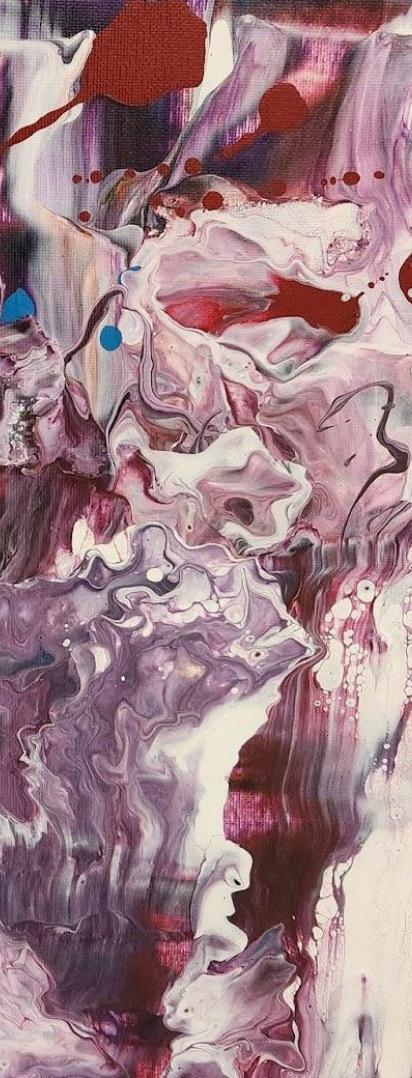
Between You and Me
by Ally Meisner
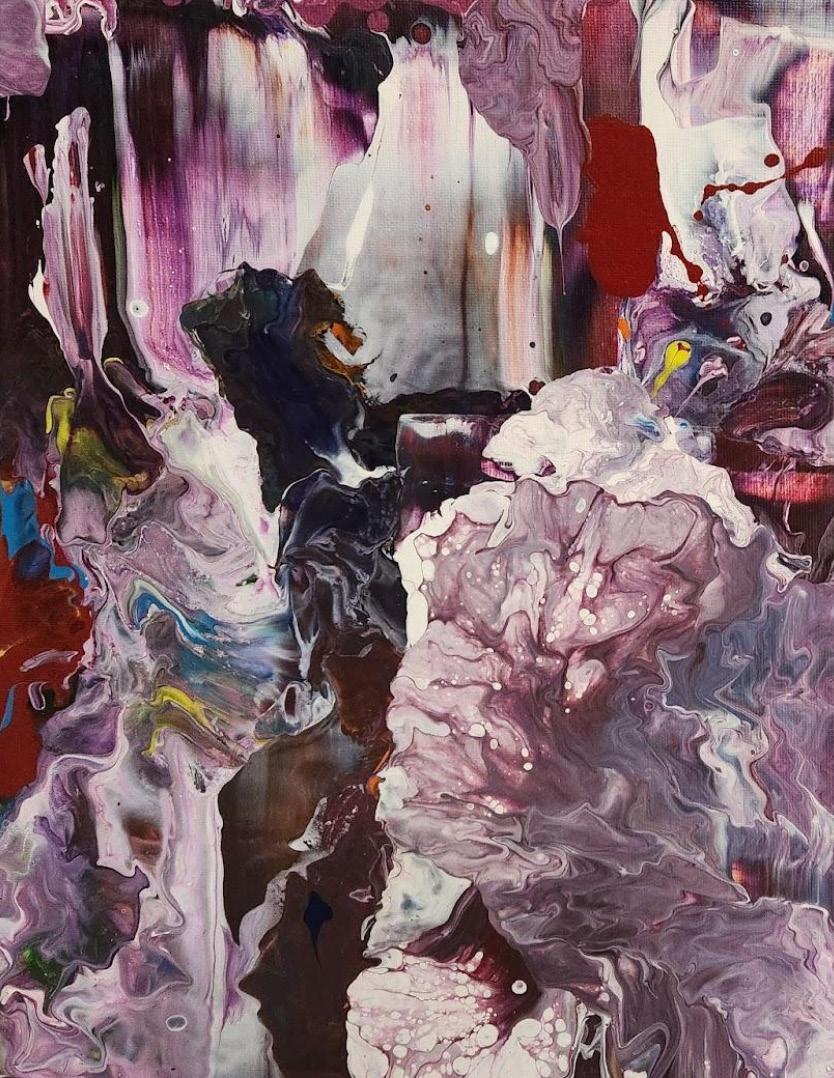
Fluid art made with acrylic paint and pouring mediums
This painting explores the grief that accompanies chronic illness and disability, emphasizing the loss of one’s former self, and the pain of being misunderstood or dismissed by friends, family, or even the healthcare system as a whole. Using fluid art as the medium, this piece conveys how grief and disability are messy, unpredictable, and unique to each individual who suffers from chronic illness. The colors and textures within this piece, such as blues for sadness, reds for anger, and blurred sections for the overlapping stages of grief, symbolize the complex emotions experienced. The main silhouette represents isolation and loss, while the red balloons in the corner represent releasing anger, and finding freedom through acceptance and visibility in hopes that others will begin to see and recognize the experiences of being chronically ill.
The Toymaker’s Wreck
by Justin Nightshade
When the Toymaker created me, I fear he may have ran out of parts. In place of a beating heart, What was shoved in is something sharp, Twisted and hollow and wretched in its entirety. The lungs I were given were picked up from a pile Of spare parts that were never meant to be used. Their insides are coated with a dust and grime that is not fit To be put inside a body.
The brain I was given is nothing more than paltry stuffing, Coated with tar and molded Into what could pass as the right shape. The hands that were made were carved Haphazardly.
Only correct in that the joints fit together. They do not work the way I want them to And I still find myself Trying to sand the splinters down
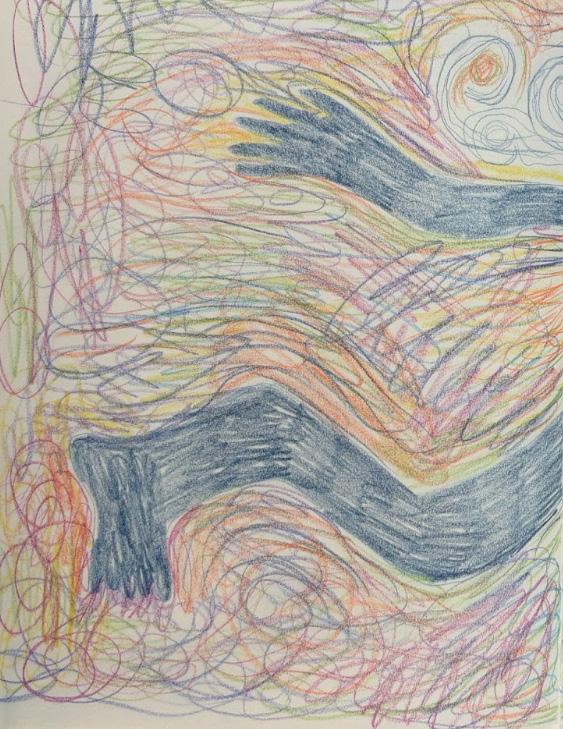
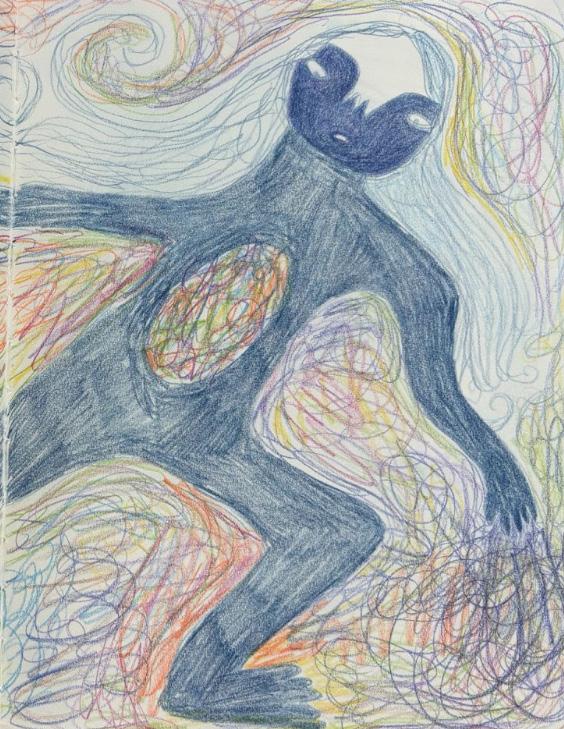
Moving Without Fear
by Sage Madans
Colored pencil on paper
On days when my pain restricts me to my bed or makes being on my feet impossible, I like to draw bodies in motion, moving in the ways I wish that I could. This piece was drawn on a particularly grief-heavy day, where I wanted to move big and free, without fear of the consequences.
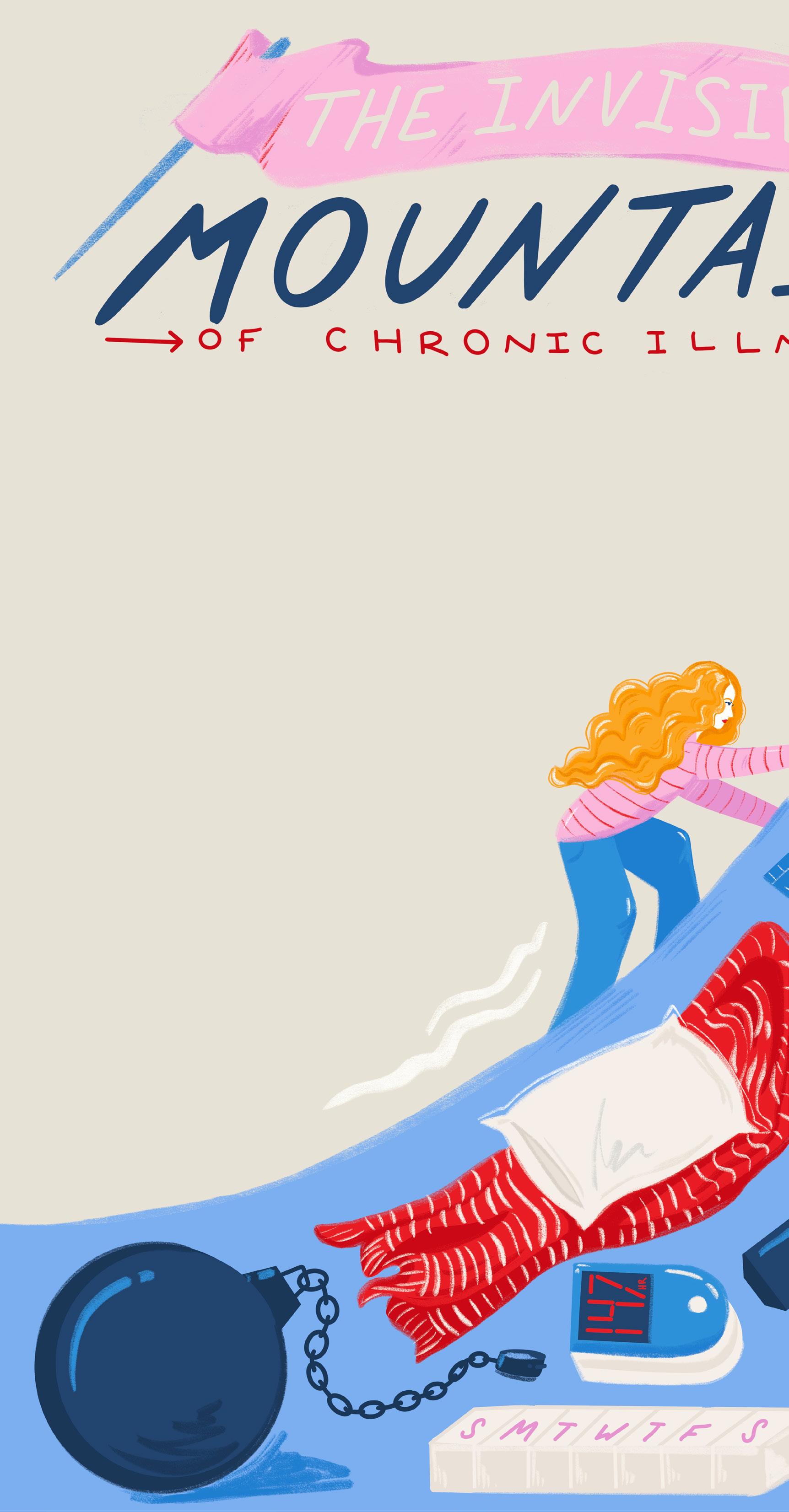
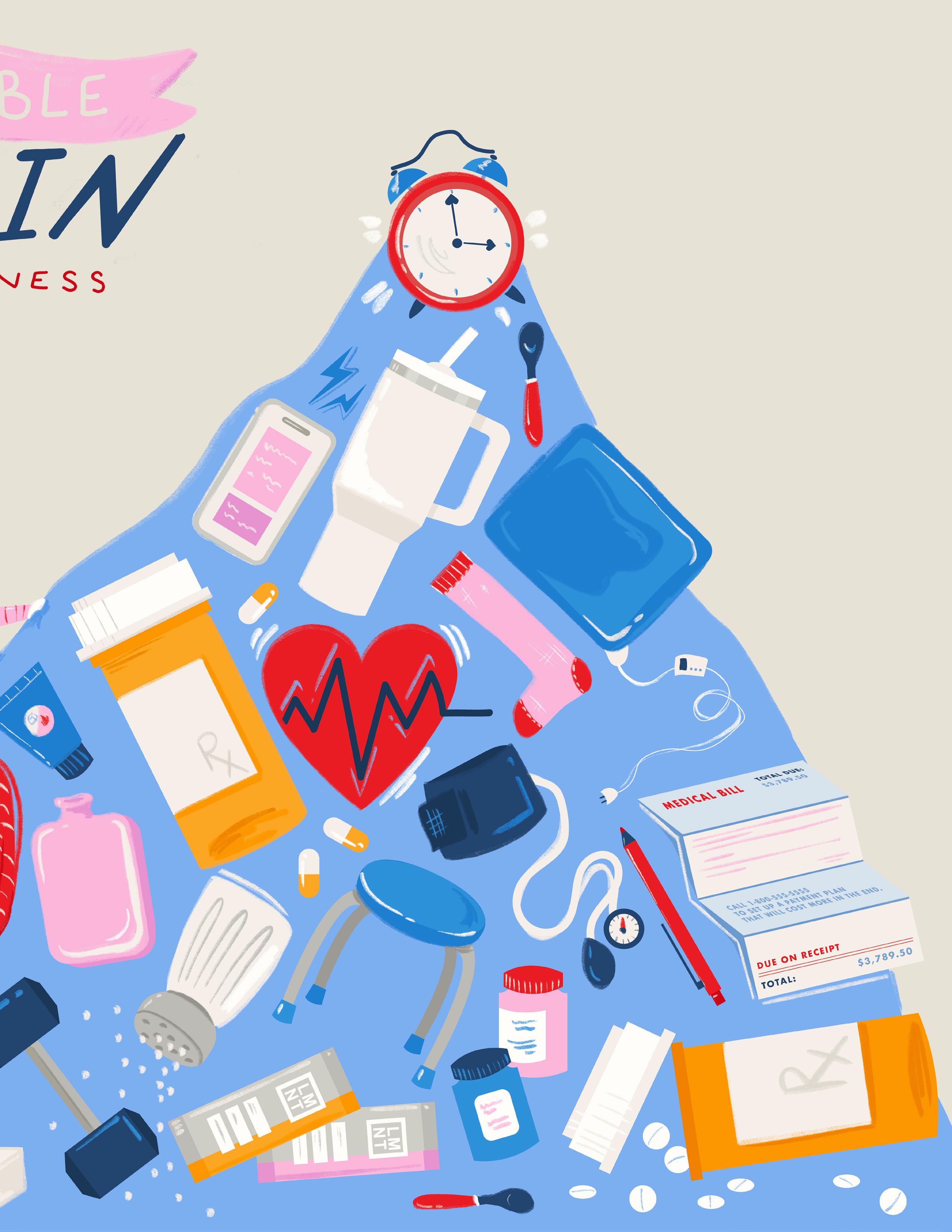
The Invisible Mountain: Living with Chronic Illness
by Halie Jost
My family didn’t mean to dismiss me as dramatic. My doctors didn’t mean to pass me off as anxious. It’s not my husband’s fault that his over-optimism encouraged me to think everything was fine when it wasn’t.
No one means to make you feel crazy. But that’s where you end up—sitting alone, exhausted, dizzy, heart racing, vision blurred, thinking: Is this normal? How is this normal? How is everyone else making it all look so easy?
You start to wonder if you’re imagining it. If you’re weak. If you just can’t handle life like everyone else can. You tell yourself to push through. Be better. Try harder.
But every restart, every new plan crumbles before it begins. Your body keeps betraying you.
You begin to fear how your body will react. That fear eats at you, and your world shrinks. You cut down your life to the smallest, safest version of it, desperate for control. But safety doesn’t come. And the harder you try to fix things, the further you fall.
You end up in a place where you’re scared to take a shower, and brushing your hair leaves you winded. Where standing feels like stepping off a ledge and panic seizes you without reason. Sleep offers no relief; you wake up more tired than the night before. Your vision swims. Your head pounds. Nausea always lingers in the background. You learn to hide the tremors in your hands, and smile through the blackouts. You hold your breath, trying to quiet a body that always feels on the edge of collapse – but it never seems to listen. Bit by bit, it strips you down until you feel like nothing more than an echo.
Eventually, you break. You can’t pretend anymore, and through the pounding beat in your ears a thought breaks through…this isn’t you. In that moment, you stop blaming and start searching.
That search soon becomes a fight. You battle to be seen. To be heard. To be tested. You track every symptom and deep dive into research. You’re met with eye rolls, worried well codes, and sexist condescension. You’re poked and prodded and sent from specialist to specialist, pushing them to take you seriously. You solve your own case and hold their hands while they catch up. And after far too long, you finally get proof.
A diagnosis: Postural Orthostatic
Tachycardia Syndrome — POTS.
So what does that mean? It means the constant tachycardia, blackouts, nausea, migraines, night sweats, brain fog, chest pains, tremors, ear ringing, vision problems, heat intolerance, crushing fatigue and debilitating panic was, surprisingly, not normal.
It’s a strange relief. You want to yell it from the rooftops: I’M NOT INSANE—I’M BROKEN. And then it hits you: Shit. I’m broken. And it’s forever. No cure. No going back. Just management.
But this kind of broken doesn’t generate much sympathy. It’s not urgent or visible. It’s not dramatic enough to hold attention. People don’t know what to say. They try, but it doesn’t land. It’s too complex to sum up quickly. Too ongoing. Too invisible.
They want to help. They really do. But they don’t know how.
And you can’t blame them. Chronic illness is a downer. Plus, you look fine. You never mentioned it before. So how could this thing you’ve been silently drowning in for years suddenly exist to them now?
It’s not easy to convince someone that you’re not pretending to be sick, it’s just that all this time, you’ve been pretending to be well.
So, you go back to hiding it. You keep it to yourself. You work hard—so hard— to get stable. You build new routines. Medications. Diets. Schedules. Skills. You adapt. You start to make progress. It feels huge. You feel nearly alive again. You want to scream it: I FEEL ALMOST NORMAL.
But no one seems to notice. To them, your mountain is invisible. They never saw you fall off, and now that you’ve climbed
halfway back up, they don’t understand what the fuss is about. It all looks the same.
The worst part? You have to keep climbing. Every day. Because if you stop, you slide back down the mountain. Sometimes, even when you do everything right, you still get pushed off. Because for you, things like standing, moving, breathing, sleeping—things that are automatic for others—require effort and thought.
Heart rate, blood pressure, heat, salt, spoons…these worries that spin constantly in your mind never cross someone healthy’s thoughts. Chronic illness is funny that way. You carry it every second, while everyone else forgets it in an instant.
It makes you jealous. Of course it does. But you learn to swallow that down too—before someone reminds you how lucky you are it’s “not worse.” As if you don’t hate yourself for that already. As if you don’t constantly question whether your “sick” is “sick enough.”
This storm is always brewing inside of you. Physical symptoms. Emotional guilt. Mental shame. Some days are calm. Some, a full-blown typhoon. The only consistency is never knowing which it will be.
It’s easy to get lost. Easier to get lonely. But you don’t want to be alone. You desperately want to be seen, to be understood. You hope the diagnosis will help. You hope the label will make people believe you.
It doesn’t.
You get two looks: fragile or dramatic. Then come the unsolicited solutions. The comparisons. The minimizing. You end up feeling worse than before you opened your mouth.
So you stop. Again. You smile. You
say, “I’m fine, thanks.” It’s easier than explaining. Easier than disappointment. But not everyone gets it wrong. A few rare souls say exactly what you need to hear: “I’m sorry. Is there anything I can do?”
That’s it. That’s all you truly need. To ask how you are, then sit in the awkward silence with you knowing there isn’t a solution.
If you find those people, hold on tight. And if you can’t—find a therapist. A good one. A good one who will help you stop seeking validation from others and start offering it to yourself.
Because here’s the truth:
You don’t need to prove your pain. You don’t need to justify your choices. You don’t need permission to slow down. What you’re going through is real, even if no one else can see it.
Some days, it’s hard to remember that. Days like today. Maybe that’s why I’m writing this. As a reminder. As a plea. As proof.
And maybe, also, as a request:
When someone tells you they’re struggling—believe them. Even if they look fine. Even if they smiled yesterday. Even if you don’t understand.
Because they may have climbed an invisible mountain just to stand beside you today.
Chronically Young by Veda
They say “you look fine” like that’s supposed to mean I am. Like pain has to bleed to be believed. Like the tremor in my hands and the dark under my eyes are just part of being a teenage girl.
I’ve learned to list my symptoms like roll call in a class no one wants to attend—fatigue, nausea, dizziness, pain. They nod, scribble, and send me home with another bottle, another bill, another “we’ll run a few more tests.” Sometimes they don’t believe me—say it’s “just anxiety,” like I haven’t memorized the rhythm of hospital monitors or the taste of metal from IV lines. I start to doubt myself too. Maybe I am crazy. Maybe this ache is all in my head—until the tests come back and their faces fall into pity.
That’s when I wish they were right. Bad news hits harder when you’re young.
When your friends are worrying about grades, and you’re worrying about scans, when your planner isn’t filled with homework, but with appointment times and lab codes. You learn the art of pretending. You smile through blood draws, laugh through exhaustion, make jokes about needles so no one else will cry. It feels like being robbed in slow motion—of normal, of carefree, of teenage. Every “why me?” echoes louder at night. Every dream gets replaced by the reality of hospital ceilings and fluorescent lights that never sleep.
My grades fall like leaves in October, each one a reminder that I’m slipping further from the life I’m supposed to have. School says they “understand,” but they don’t— they can’t.
How do you explain that your brain is too fogged with pain to remember equations, too heavy with fear to focus on words? Every second is another test. Blood, scans, questions, waiting. I’m tired of being a puzzle no one can solve.
Tired of the word “resilient,” when what I really feel is broken and borrowed.
I used to think healing was a finish line—now I know it’s a mirage. Some days I just want to wake up and not feel like a medical mystery. I want to be late for class, not late for another appointment. I want to be a teenager, not a case file.
And yet— through the pain, the doubt, the bills, I still whisper to myself, in the quiet between results: “You’re still here. You’re still here. Even when they don’t believe you. Even when you barely do.”
Loud
by Miranda Fedor
The thoughts depression forces me to have make it hard to think and speak, which I depicted in my image. It especially makes it hard to be open with family and friends. I feel though, at the same time, I have grown and strengthened some friendships through the shared experiences of depression. I am extremely lucky to have the support I do that helps me push forward.
Feature
Creating Connection When your World Shrinks
by Megan Menetrier
Around two and a half years ago, my life as I knew it fell apart after I caught a COVID infection that set off a cascade of health issues, with the neuroimmune illness Myalgic Encephalomyelitis (ME/CFS) debilitating me the most. Over a relatively short period, I went from being in a fast-tracked graduate program for Clinical Mental Health Counseling, with a robust social life, engaging in singing and songwriting, and being involved in various recreational activities such as aerial yoga, to needing to use a wheelchair to get around and becoming housebound from illness. This is the lived experience of numerous individuals, with many more severe than I.
The connections I made in the years leading up to my illness largely fell away as isolation grew. While I am immensely grateful for the support from those in my life who continue to show up for me, this is one of those things that you can’t truly understand unless you’ve experienced it yourself.
Naturally, being thrown into the depths of disability and severe chronic illness was a depressing and alienating experience. Through the first year and a half or so of my illness, I felt that I was living on hold, and that it was just a matter of time until everything returned to normal. I realized for my well-being, I had to shift my outlook from “my life is on pause” to “this is what my life looks like right now, and I am living it.” While this mindset shift had no impact on my physical state (if anything, I’ve had setbacks since), it’s played an integral part in regaining a sense of wholeness when I felt my identity had collapsed.
With that shift, I also stopped caring as much about the thoughts that others may have about me that I cannot control. And while there is much grief surrounding how my life used to look, I’ve learned to let go of the old me and embrace the new me, whatever that may look like.
This shift in mindset led to me emerging from a two-year social media hiatus, sharing publicly about my health issues for the first time. From this, I felt encouraged to post in an online ME/CFS group that I was looking to make connections with others who understand. The response to that post was more than I anticipated, highlighting just how many others long for what I do: belonging, community, and understanding. With an energy-limiting condition like ME/CFS, this is very hard to find. From my post, I had the idea to bring people from the online group together for a virtual movie streaming night. From there, the idea for Connect with ME was born.
Connect with ME
I started Connect with ME to offer ways for those of us with this illness to come together within our capacities. I live with moderate-severe ME/CFS, so I know personally what it is like to not be able to engage socially and yearn for connection with others. I am grateful I have had cognitive improvements largely due to a medication called LDN. Cognitively, I fall more in the moderate category of ME/ CFS, but physically am currently severe. I am so thankful for the improvements in my cognitive functioning for allowing me to me to start this community.
Living with ME/CFS means being in constant negotiation with your body. Every action comes with a cost, and going past your energy limits can lead to post-exertional neuro-
immune exhaustion (also referred to as PENE or PEM), a worsening of symptoms that can last days, weeks or cause setbacks lasting months to years. Because of this, accessibility is absolutely essential if we want any way to connect.
I started Connect with ME in the beginning of October 2025, so at the time of writing this, it is still fairly new. In my experience so far running this community, I’ve learned being in a space with others with ME/ CFS is invaluable. In these spaces, what is unsaid is understood. Living in a society with an often stigmatized illness which is isolating in itself, safe spaces where we can find pockets of joy in our lives and connect with others who understand without setting back our health is so needed.
The events that have been hosted so far range from live events such as movie streams with ambiance breaks to lower stimulation events such as corest sessions with gentle rain sounds, to at-your-own-pace events and digital post-card exchanges (where you can submit just one sentence if able).
Community input from others with ME/ CFS has been integral to the planning process for ways to connect and will continue to be as I strive to make this community as accessible to various severities of this illness as possible. In addition to events, there has also been an effort to highlight community
members in need of mutual aid as well as the formation of a moderated online chat forum and the sharing of resources.
Collaboration with others has been a highlight of running Connect with ME, and I see it being the backbone of this community. It has been amazing to see how quickly people have come together to offer their limited energy toward building something together that we can enjoy. I am enormously grateful to all those who have come forward offering to collaborate on events, volunteering to build and moderate an online chat forum, and suggesting ideas for future directions. I envision Connect with ME growing to the scale of forming collaborations with existing ME/CFS support organizations to help spread this community further to those who may need it. I also see it expanding into the realm of patient advocacy, which is so crucial for this illness. There are many living with severe to very/extremely severe ME/ CFS who aren’t able to participate in events. It is vital to me and to many others in our community to be a voice for the voiceless who cannot advocate for themselves and have limited to no capacity to engage in online communities.
For now, as my energy allows, I will continue to strive to provide accessible spaces for those of us living with ME/ CFS to be in community together.
Friends, Family, & Support Systems Chapter 2
There are days my body feels like a stranger I live with. She’s unpredictable, sometimes loud, sometimes silent, often misunderstood. Fibromyalgia rings through my muscles like static; IC takes its turn demanding attention, reminding me that my control over this vessel is mostly an illusion.
Before illness, I used to think love was shown through movement; through doing, showing up, taking care, staying busy. I was the friend who could always be counted on, the one who kept saying yes. Now, I have to measure every yes like it costs me something, because it does.
When I cancel plans, I feel a flicker of shame that I’ve learned to name and release. It’s not laziness. It’s preservation. My body asks for gentleness, and I’m learning to listen. That listening has reshaped how I connect to others. My family and friends, they’ve had to learn it too.
There’s an unspoken grief in these dynamics, a quiet loss of the old me. But beneath that grief, there’s growth. Relationships have become more honest, stripped of performance. I no longer pretend to be fine to make others comfortable. There’s freedom in that vulnerability, in allowing the people I love to see me in all my forms: the soft, the tired, the healing, the divine. And in that space between my body and me, where pain meets peace, I find something sacred. A new rhythm of being. A quieter kind of joy. A softer version of love that doesn’t need to be loud to be real.
For a long time, I thought healing was a solitary thing. That I had to figure out my body’s language alone, that strength meant silence, that acceptance meant keeping it together. But isolation wears differently when you live in chronic pain. It starts to feel like another symptom.
I realized how deeply I’ve been craving recognition. The kind that doesn’t require translation. You don’t have to explain why you’re tired after doing nothing, why you cancel plans last minute, why some days feel like walking through water. They just get it.
When I connect with others who live in bodies like mine, I feel closer to the universe itself. We’re all still learning how to bloom despite the breaking. Healing isn’t always recovery. Sometimes it’s just remembering that you’re not alone. That there are people who see you, not as broken, but as becoming.
And that, in itself, feels like a kind of miracle.
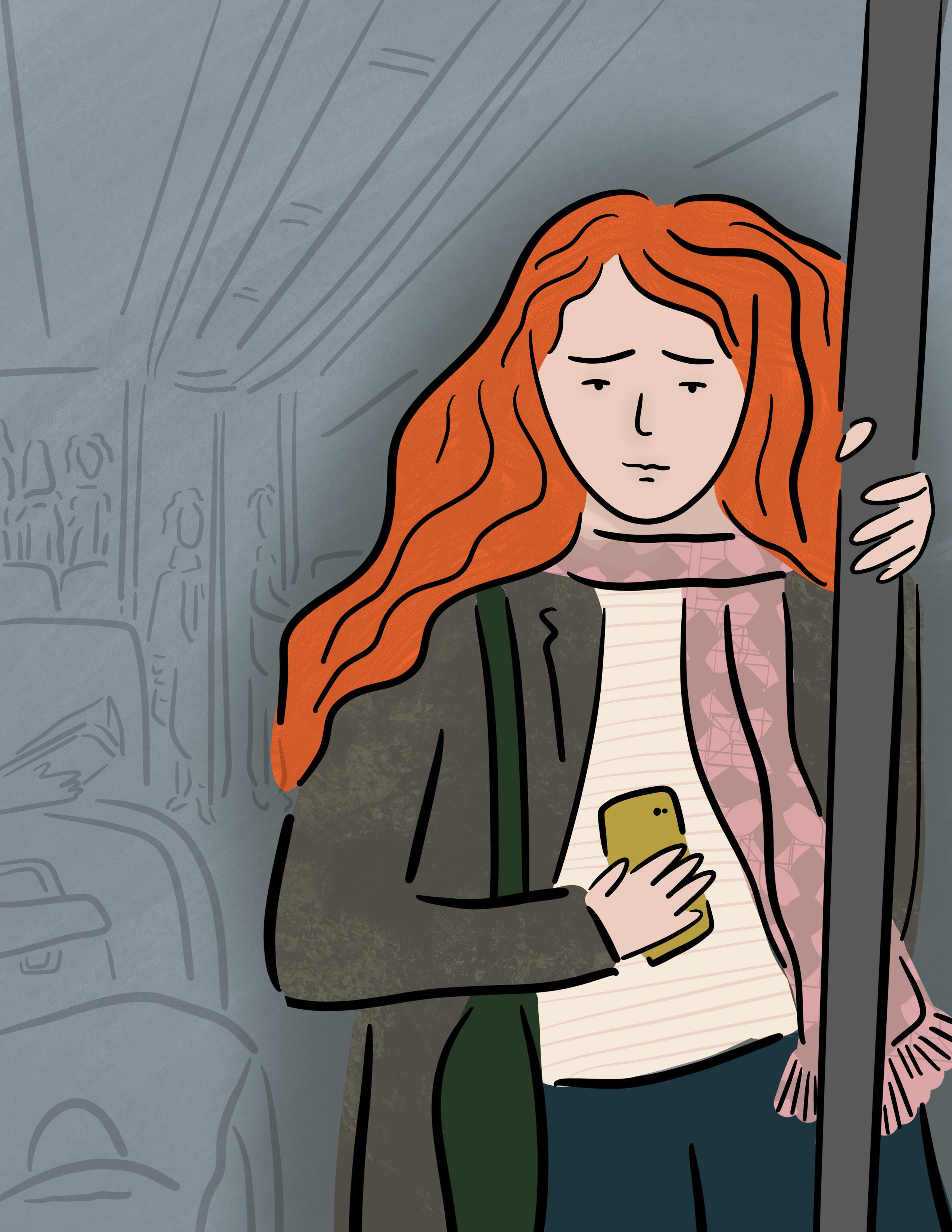
Changing Tracks by Kee
The train is busy, as it always tends to be. Day or night, rain or shine; it didn’t make a difference.
Standing room only, not an empty seat in sight for weary travelers to rest. Forced to stand packed in like sardines, surrounded by strangers all desperate to get home. The air hums with scattered conversations. Jaded office workers sharing their strife, commuting regulars exchanging hushed pleasantries with somewhat familiar faces. The voices never raise higher than a whisper, but the surrounding murmurs vibrate through the air at a frequency that elevates blood pressure and makes hair stand on end.
The buzz is interrupted by periodic announcements. It’s garbled nonsense, mostly. The train’s outdated PA system makes every other word sound like bad feedback, and the rest aren’t enunciated nearly enough. Even without headphones providing some background music, it would be impossible to understand. Pausing the familiar, comforting notes makes no difference and leads to a less than ideal experience.
Glancing out one of the many windows provides no further clarification. The sky outside is darkened by storm clouds, not a single star managing to break through the gloom. The accompanying rain hits the thick glass with startling ferocity and effectively blurs the world outside. The nondescript buildings and highways may as well be a world away, not just a train track’s length. The distant warmth of the yellow lights are no match for the harsh fluorescents within the train.
The sudden, lurching movements of the train are second only to the rapid motions of the frazzled individual standing no more than a finger’s length away. They haven’t seemed to stop moving since boarding, constantly fiddling with frizzy hair or rumpled clothing, only to make it worse with another pass of their hand moments later. Another frantic check of their watch ends with a startling elbow to the ribs, leaving no other option but to collide briefly with the passenger on the other side.
A muttered apology and a quick look towards the second unintentional victim reveals they are unbothered. Their despondent expression doesn’t so much as shift under their drawn hood, a simple shrug given in response.
“Oh, I’m so sorry, I didn’t mean to bump into you!” The assailant rushes out
in a single breath. “I just had to check the time again, the train is behind schedule and I just have to make it to my stop on time. I can’t be late, I’ll be in so much trouble if I’m late!”
“Just get off a stop early,” the glum passenger sighs, the pre-rehearsed acquiesce interrupted before it can begin. Seemingly finished, they further hunch their shoulders and shove hidden hands deeper into the pocket on the front of their worn-out sweatshirt.
“But then I’ll have no idea where I am! I’ve never used a different stop before, I’ll get lost and then I’ll still be late!” Another shrug shifts the dark fabric that shrouds them. “Aren’t you worried that the train is running late?”
“Not really. Doesn’t really matter whether I get to my stop or not.”
“Don’t you have somewhere you need to be?”
“Not anywhere they’ll miss me.”
“That’s rather bleak.”
“That’s rather intense.”
“Will you at least help me figure out a different stop to get off at?” Shrug. The rapid exchange brings the underlying buzz and unease to a fever pitch.
A situation that started as three strangers forced to co-exist in a cramped space has quickly escalated to a personality clash, with an innocent bystander shoved in the
middle and forced to endure the fallout.
With physical retreat virtually impossible, the only option left is to search for a distraction. Perhaps different music will help drown out the noise. Phone grasped like a lifeline, a simple touch is all that’s needed to illuminate the screen once more. Instead of the desired sanctity of a well-curated playlist, another jarring reality surfaces: the homepage is filled with individual icons, all boasting a large number of unanswered notifications in glaring red.
Hovering an uncertain finger over one of the typically welcomed alerts, a more pressing notification pops up. Battery: 10%. Not nearly enough to last the rest of the commute and to have power reserved in case of an emergency. With a defeated sigh, the music is reluctantly silenced and the icons are once again put out of sight, but not out of mind.
Head hanging low to avoid being dragged back into the fray with errant eye contact, the only option left is to try and weather the storm long enough to finally reach the desired destination.
“Hey,” a kinder voice breaks through the uncomfortable tension. Looking towards the source reveals a vaguely familiar, friendly seeming face offering a small wave with a warm smile. “A seat just opened up, it’s yours if you want it.”
Untangling from the arguing passengers proves harder than it should be. A jittery movement to dodge here, a stagnant limb to trip over there; breaking through the cramped space and moving towards the only available seat is worth the struggle.
While not comfortable by any standards, there is instant relief in being able to sit once more and have even a semblance of room to move around in. It may not be a significant amount of distance, but the seat feels significantly removed from the crowd and the noise and the conflicts. A safe haven in the midst of the daily commuting turmoil. A grateful nod is exchanged before worried eyes alight once more on the flashing signs of the train car and the landmarks racing by outside.
“Don’t worry, we’re only a few stops away,” the gentle voice interjects once more. Questioning, guarded eyes hesitantly meet softened ones. “I’ve seen you around before, we get off at the same station. I’ll let you know when we get there.”
A stuttered deep breath fills deprived lungs, the weight lifting further and allowing tense shoulders to finally relax.
“Thank you.”
Hannah
by Madison K. Myer
When sickness shows up— uninvited, unannounced, like that one friend who never knocks— it doesn’t just mess with your body. It rewrites your circle. Some people go silent. You text them updates, and the read receipts stare back like ghosts. And you tell yourself, it’s okay. Maybe they just don’t know what to say. Maybe they’re scared too. But then—
there are the ones who stay. Not with grand speeches or perfect words, but with soup, the kind of soup your mom would make when you felt sick as a child. With rides.
With “I’m outside, no need to talk if you don’t want to.”
With a call at at 2 a.m., Their voice coming through the line, hitting you right in the chest, for the first time someone is listening to your cries. It’s awkward at first.
Everyone’s learning a new language— the language of patience, of pain, laughing anyway, even though we both know the reality of the situation. And yeah, some friends fade out. You grieve that quietly, in between doctor visits and the countless reruns of shows you have seen a thousand times.
But the ones who stay? They grow roots inside you. They learn your silences. They can look deeply in your face and see that all the light in your eyes fade away. They hold space without needing to fill it. And you realize— friendship isn’t about who’s there when things are easy.
It’s who’s still cracking jokes when life gets weird and heavy and dark Because those ones— they evolve with you. And that?
That’s love, in its realest form.
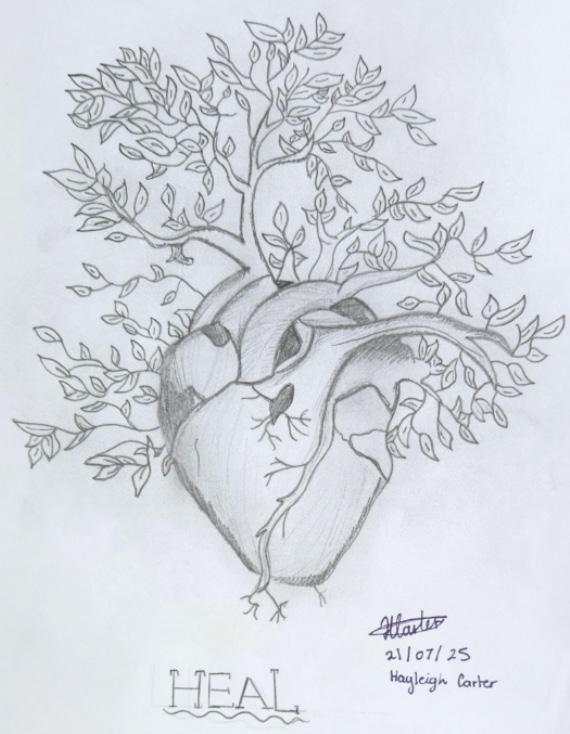
Heal Your Heart
by Hayleigh Carter
Pencil on paper
This artwork shows how the human heart can go through so much hurt and pain. However, it can always come out the other side with growth, love, and positivity. We ride a rollercoaster daily and go through so much, it is important to remember that each branch shows a connection to someone or something that we find love, joy, and happiness in as we ourselves heal and find who we are.
Being the 1 in 100,000 by Miko
I have lived only 15 years and I have spent many of those years with the eye doctor. When I was in kindergarten, I loved reading. But there was something different when reading the left page, so I had to move the book until it was in front of my right eye. Odd right?
Turns out, I have Morning Glory Syndrome in my left eye. No one ever knows what that is, and even some eye doctors have to be told what it is. Morning Glory Syndrome is when the optic disc is forming wrong, much resembling the shape of the morning glory flower. My optic nerve is also not fully developed.
When I was younger, I had most of the vision in my left eye; now, at 15, I have almost none. I am medically blind and only have one usable eye. It may not seem so bad, but it can feel impossible. My left side has reduced motor skills. On the hardest days, I can’t see my left side if it’s at certain angles. Once it’s out of sight, my brain forgets to send signals and it’s impossible to do stuff sometimes. eye has to work so hard, it causes extreme headaches that make me nauseous and unable to get out of bed. On my worst days, not even medicine helps and using my eyes just makes it worse.
When I’m in public, I can’t see people and often run into things. It’s all embarrassing. But even worse, I have no depth perception. I try to grab something and miss it 3 or 4 times because I can’t tell quite the depth or location of it. I run into things because I can’t see how close to my left side it is. Trying to drive is hard when you can’t figure out quite how far away the car in front of you is, or trying to change lanes and trying to see your left side and having to turn your body 180 degrees just to see the left side.
But during the years and many appointments with my doctors, I have learned different tricks to help figure out how far away something is from me. I learned that there’s specific angles on the car mirror that make it possible to see part of the left without turning as much. I have adapted to not being ashamed of using my hands or other aids to feel what’s on my left before I complete an action. Also, taking the time to learn how to ask for help when days are bad and I can’t do it on my own. That was the hardest for me to learn.
About 2.6 in every 100,000 people have Morning Glory Syndrome, so you could say I’m special. But being special comes with downfalls because it’s rarely ever seen by doctors. When I’m at the eye doctor, they want to bring in every other eye doctor to see what it looks like. When I was in the hospital for my eye, they wanted to see what my Morning Glory Syndrome was; they cared more about that than trying to help me as a patient. Any eye doctor makes me feel like an experiment or a lab rat because they care more about seeing my disability than helping me with it. When I was in the emergency room, the doctor told me they have only seen 3 cases before and, “you’re lucky to be so special.”
Sometimes, I don’t feel lucky though. Unfortunately, I have developed some mental health issues as a result of my disability’s impact on my life. I often run into people or things, causing me to get so anxious about going out that I started to isolate myself. People don’t understand that I can’t help it, and I have been yelled at a million times for it. I got really depressed when the headaches first started, because I felt like I was broken and could not do normal things as a result of my headaches. During my freshman year of high school, I would have such bad headaches that I would puke in the school bathroom from the pain, but I refused to go home. I have since gotten help, and decided to start seeing a therapist who has helped me cope with who I am and what I have become. For me, part of why my life is so amazing is because my family has done everything to help me get through the worst parts, always believing my symptoms. My therapist is teaching me the 54321 method to help calm my anxiety. My friends are doing everything they can to help me cope. You need to find a community who will support you for who you are and not kick you when you’re down.
In the end, I have some advice for everyone: don’t let someone who does not know your struggles get you down for accommodating yourself and fighting to have the best life possible. Anyone struggling with any type of chronic conditions or illness, I want you to know you are the strongest people out there and that while there may be bad days, I promise there’s going to be good days ahead, so keep going. Lastly, I hope that Morning Glory Syndrome can get more representation, as it is so unknown and very underresearched.
And as a Black woman, that “me too” hits different. I lost years before my diagnosis because my pain wasn’t taken seriously. I had to learn to be my own loudest advocate in the exam room, which is exhausting when you’re just trying to survive the day. In my endometriosis community, we share that unspoken understanding. We can vent about the unique pressure of having to be “strong” all the time while our bodies are falling apart on the inside. With them, I don’t have to be strong. I can just be honest. After 19 procedures, you start to feel like a ghost in your own life. You miss parties, you cancel plans, and you grieve the person you used to be. With my friends who don’t have chronic illness, I sometimes feel like I’m just a list of problems. But with my community, I can text “I’m in a flare and feeling really low,” and the responses aren’t pity; they’re “I’m so sorry, what can I do?” or “Remember to hydrate, here’s my heating pad trick,” or just a simple, “I get it. This sucks.” They celebrate the small wins with me, like a full night’s sleep or a pain free afternoon, because they know those aren’t small things – they’re miracles. So, for me, this community is what keeps me from drowning in it all. These women are the evidence that I can endure, because look at them, they are enduring too. We’re passing each other strength like a baton in a relay race nobody signed up for. The 19 surgeries are a part of my story, but they aren’t the whole story. The other part is the network of incredible, resilient people who remind me that I am seen, I am believed, and I am not alone.
Lost and Found by
Jackie Norton
I was coming home from a hypnotherapy session, trying anything I could at that moment to bring me back to the normal life I had before all of this, when the loneliness struck. I walked into my room, a place I’d been forced to spend all my time lately, and sat down on the floor. The silence was too loud for my Type A personality. Before I became chronically ill, I would be out every weekend, going to the movies, having dinner, or attending parties with my friends. Now, my days were filled with doom-scrolling on Instagram, watching as said friends lived their lives without me. Even though my body was falling apart, I was still trying to grab onto the invisible life raft, hoping I could get pulled back onto shore. But the sad reality was, there was no one from my old life on the shore to help pull me back in. I was left out to sea.
I sent a message to a friend I had met a while ago through the app Discord. I hadn’t been on in a few years, only keeping in contact with him and catching up from time to time. I told him about this new feeling of loneliness I was experiencing, and he told me about a new server of a band we both like that he was active in, and how great the people seemed to be there. He sent me an invite, and I accepted. I was suddenly thrust into a place with seven thousand members, the messages coming in every few seconds of inside jokes, memes, and friendship. I felt intimidated. How was I supposed to fit into this vast sea of people who already had deep connections? I decided I was going to leave when someone invited me to the listening party of the band’s new album. An immediate life raft thrown by a stranger. I took it.
I soon became close with a handful of the members. We even created our own private server that we still use today. It seemed that all of these people were going through something in their lives and needed the extra connections we provided to one another. Very quickly, we had our own inside jokes, memes, and friendship to the point where half of them flew from different countries to come to my wedding. Instead of going out to dinners and going to the movies, it turned into online game nights, latenight Uno, chatting until 2 a.m., listening to music together, and planning future trips to meet up, all from the comfort of my bed. An accessible community.
I thought that because of my new illness, I would never be able to fit into society like I had before, and maybe loneliness had to become a friend before it became an enemy. It turns out, I could still have connections and a social life, it just looked a little different than what I had before. And that’s okay.
One morning, my mother told me that when she woke up one night, she heard me laughing in my room and thought to herself, “Jackie’s laughing again, how great.”
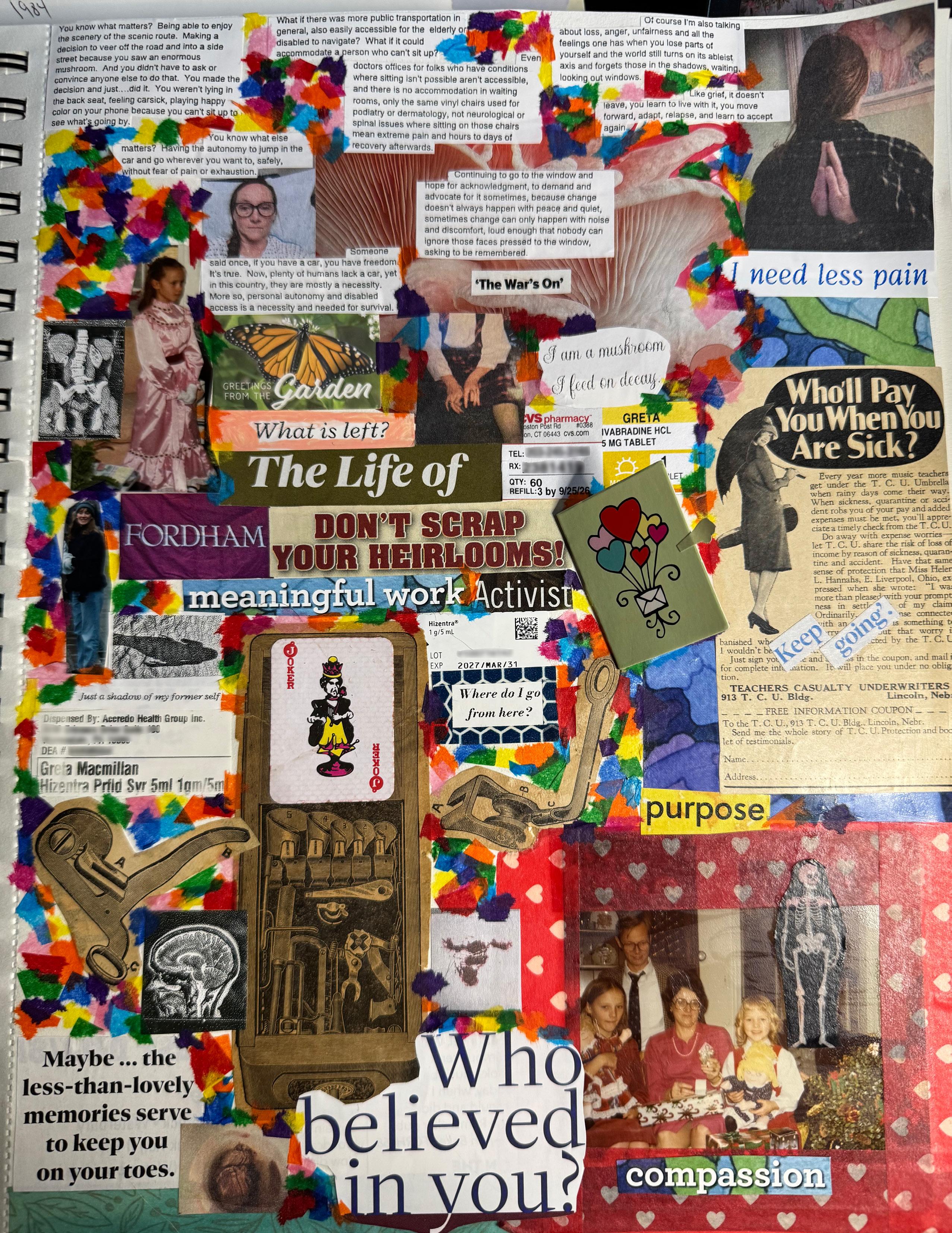
What is the meaning of this?
by Greta MacMillan
Collage made of paper, Mod Podge, photos, and poetry
This collage is about my place in this world while experiencing chronic illness as a parent and creative person. It shows my journey through life, the questions I have about how to feel that I can move forward despite my limitations, and what that might look like.
Navigating End-Stage Cancer with Dignity
by Ismail Kazem, M.D.
“Cancer
is a word, not a sentence.”
-John Diamond
Most cancers in advanced stages are incurable – short of a miracle. The diagnosis of advanced stage cancer presents a challenge both to the patient as well as to the oncologist. The task of the oncologist is to gently present the problem as well as the solution.
The emotional impact on the patient and family should not be underestimated. Explaining the difference between a serious versus a hopeless situation is important. Effectively managed advanced stage cancer can result in a long, comfortable life. The wisdom is to do our best, hope for the best, but to accept the outcome.
Fear and negligence are the most common barriers to early diagnosis. They result in denial or overlooking warning signs. Realizing the seriousness of advanced stage cancer may lead the patient to feel a sense of guilt. It is therefore important to ease that feeling, to overcome its negativity. Talking about the prognosis in cold, statistical numbers serves no purpose. What is relevant is the incentive to undergo effective treatment in terms of getting better, by containing the progress of the disease. The response to the treatment would vary from person to person and from one type of cancer to another, but the objective is similar: to stop progression, to reduce the bulk of the disease, and to achieve a comfortable life, as long as possible.
In treating advanced stage cancer, chemotherapy and immunotherapy play an important part. This is because of the nature of advanced stage cancer involving local, regional, and distant spread, requiring a systemic approach to control the disease. After a remission is achieved, consolidation radiation treatments or even local surgery may be needed. This rigorous treatment needs acceptance by the patient and family as it proceeds from cycle to cycle. To be able to cope, the need for supportive and symptomatic treatment should be addressed.
Although cure may not be achieved, improvement and longer survival are attainable. Changes in treatment, with addition or substitution of one or more drugs, is proposed as the response and toxicity is monitored. With the availability of new pharmaceutical agents, consideration for enrolling in a clinical trial may be proposed. Going through the phases of the treatment, many patients find purpose in enduring the inconvenience and the side effects, as they sail with hope and stamina. Parents may look forward to witnessing the graduation of their children. Grandparents may await the birth of a grandchild or the wedding of another. Having a purpose can miraculously provide strength and motivation.
My Heroes Are Always There When Needed
by Emilia Rantanen
When I feel pain, I am scared to show that to the people who have not been my life for years. I have a small group of friends and family who are my biggest supporters, but I still feel ashamed that I have these pains on a daily basis.
My mom has been my number one health caregiver. For years, she has been doing a lot for my physical and mental health. Physically, she has been cooking food and cleaning my room when I was too exhausted because of the pain. Mentally, she had been trying to get me better doctors, medication and help from therapists. She is the most caring person in the world. Of course, she is also a nurse in a hospital, so it makes sense. She was with me through all the steps to getting diagnosed with chronic tension headaches and migraines. Without her, I am not sure how I could have found healthy ways to cope with my illness.
Because of her work, I think our relationship changed. When the headaches started to become a daily problem, she would always ask me, “how are you doing?” It felt like she meant, “what is your pain on a scale from one to ten?”
For years, it was the routine for me and my mom, asking the daily pain scale and what to do about it. She gave me advice, and I felt like someone was always checking me. I felt like my mom is still my own at-home nurse, and she thinks I am a patient.
Sometimes, I was frustrated that my siblings got attention about themselves and I thought my mom only saw my illness, not me behind it. Yes,
Nowadays, our relationship is changing again; I don’t have so many days that I’m sick like before. I suffer headaches, but I can manage those a bit better. Also because I have been living alone for over a year, and got a boyfriend at the same time.
Now, I feel like both my mom and my boyfriend are trying too much to help me. I just want to feel that I can handle all of this on my own. They help me if I need help, but they can also step back if I want to feel more powerful and do it myself.
Right now, I feel like I have a good network of people who are helping me cope with my illness. At the same time, I feel that setting boundaries is hard but necessary, especially in a still-new relationship.
boyfriend is only a boyfriend, not a fulltime caregiver. Six months ago, that was the case because I was in pain all the time. He did all the cooking, and while it was a nice gesture, it felt like I was helpless. Luckily, the situation wasn’t long – only two weeks – but I am not sure what to do if there are going to be times that I’m disabled for months. It would be ideal to not have to worry about our relationship being different when I have pain, but really I can’t help it.
I know my mom and my boyfriend are trying and helping all the time. I am lucky to have them in my life. Right now, I am not sure how I could live without any help from them.
names along to the tune of a Christmas song. Scott, Danny, Karen, Mark, Helena, Sarah, Pem and Zach.
“Hey Em!” Karen says, as she loads a salad mix on her plate.
I smile back, wishing her Merry Christmas as politely and quickly as possible, before shifting my focus back onto the food tray. I scoop out two shells, before realizing I’ve already placed two on my plate.
Hmpf.
I didn’t realize I did that already. I put the spoon back, as smoothly as possible.
It’s alright, automatic habit, not to worry. Clear the face, just move on.
“Need any help?” Karen asked as she deftly scooped shells before moving around me.
It takes me a beat longer to realize Karen is waiting for me to answer.
“Oh no, thanks.”
I scoot out quickly, settling for my plate at hand rather than more time in line. Ignoring the Aunts and Uncles table, I move to the smaller room, looking for an empty seat.
“Em!” my cousin calls, “come sit here, we’ll make space!”
After 10 minutes of eating, my plate looks unchanged. After 15 minutes, I manage to properly position my very festive napkin over my extremely festive paper plate to disguise my untouched food. At 16 minutes, I make my escape. At 17, I’m stuck at the garbage can, answering the same questions my aunt asked me last month, and at 20, I’ve found myself hiding out in the bathroom.
You’ve got someone starts up a search party for you. I know I’m lucky. Lucky to have a family and people to spend the holidays with. I’m grateful to have such a large support system, people who ask and care about my health. But, as I stare at myself in the
bathroom mirror, as the moment builds up, as I think about it all, I hear that tiny voice whisper from within.
But maybe they don’t. Where were they when I couldn’t drive?
Or when I was hospitalized; pick a time, any time?
Where were any of them days after any one of my seizures happened when I was holding on by a thread?
If only they actually saw what you looked like.
Then, they would really get it. If
What They Learned from Watching Me Fall: A true story about how chronic illness reshapes motherhood and
family roles
by Stephanie L. Bade
By the time my youngest was twelve, all three of my children had learned a language none of us meant to speak.
My older two were raised in what I call the in-between—those early years when my life shifted from a steady rhythm to something with a different pulse. At first it was small: half-finished glasses of water, oddly packed lunches of mismatched snacks thrown together through brain fog and fatigue, dizzy spells that turned ordinary days strange. I kept calling it a phase, a run of bad luck, a little dizzy today. But phases don’t rearrange furniture in your life. They don’t teach your daughter to answer to the sound of your voice when you call her name with a tone that means now—the tone that had her sprinting across the house, fetching ice, and counting my breaths out loud because she’s learned that numbers were a bridge back to calm.
She learned to open pill bottles, check a pulse, and hold space without panic. There were nights she tucked her brother in while I lay on the bathroom floor finding the ceiling again. She grew practical and tender in the same breath, the way children do when the world asks too much, and they say yes anyway.
My middle child was too young then to understand the mechanics of it all, but he understood kindness. He watched how his sister moved, how the phone could be a lifeline, how the tone of a voice could be a siren—and he became fluent in small mercies. He learned to bring me a blanket before I asked. He learned that quiet can be a gift. He grew into a patient, generous adult; the sort of person who says, “I’ve got it” and means it.
By the time my youngest came along, the illness had a name—Postural Orthostatic Tachycardia Syndrome—and our household had a map. We knew where to sit, what to carry, how to pause before the world blurred. He’d grown up in a family trained to pivot, but he hadn’t seen the part that feels like a cliff—the moment the body shuts off like a light.
The day he saved me, I was trying to give him a memory that belonged to all of them. It was one of those bright afternoons when sunlight filtered through the trees and the air buzzed with late-summer heat. We drove to the Metroparks, to the creek with the shale bed and small waterfall I’d taken his siblings to when they were little. I wanted that day for him—to match his childhood to theirs, to stitch something ordinary into a life that had learned to bargain with the calendar.
We walked the trail, conversation easy. He was already smiling when the waterfall
came into view on the other side of a small foot bridge, sneakers half-off, excitement loud as the water. The shale shimmered beneath the current—beautiful, slippery, unforgiving. We stepped out—careful, laughing. I pointed to the spot where his brother and sister once used the rocks as their own personal water slide. He splashed like he’d invented it. He was all limbs and laughter and the kind of happiness that looks like a trampoline inside a child. And then—because the body always calls its own cues—I slipped.
It wasn’t dramatic. No dramatic fall ever feels dramatic; it feels stupid, the way missing a step feels stupid, the way slick feels like I knew better and I am better than this. One second, I was upright; the next, I was landing on the hard edge of my tailbone, the shock bright enough to taste. The back of my head kissed stone—less a crack than a hard knock—and I heard his laugh turn into a question: You okay?
I laughed first, that old reflex where you beat pain to the punchline. “Watch that first step, it’s a doozy,” I joked.
I sat on the bank, pretending to scroll through photos, trying to anchor myself to something light, but pain has its own weather. It rolled in behind my eyes, joined by the familiar rush of heat and dizziness. My heart began its drumbeat; my vision pulsed at the edges. The fall had woken up the part of my body that measures blood and decides badly. I opened my mouth to call his name, to warn him—“I don’t feel right”—but the words never made it out. The world released me, everything went dark. I fell forward, face first, into the shallow water.
When I hit, the rock met my lip, splitting it open. The shale grazed my
forehead and scuffed my eyebrows raw. My body folded into the creek, halfsubmerged, my hair spreading in the
When the world returned, it came back in fragments: cold water against my back, the taste of blood and stone in my mouth, a scream tearing through the air. It was his scream—my son’s voice—raw and terrified, shouting “Oh my God! Oh my God! Somebody help!” It’s a sound no mother ever wants to hear, a sound that wakes something ancient in you, even before your eyes open.
Then another voice—steady, unfamiliar, female—close beside me.
When I opened my eyes, I was lying in the lap of a stranger. Her jeans were soaked, her hands under my shoulders, holding me upright so the water wouldn’t take me again. My hair was matted with mud, creek water running down my cheeks, my lip burning. “I have POTS,” was all I
The stranger’s voice was calm. “You’re okay, sweetheart. Stay with me.”
And there was my son standing behind her, trembling and crying, holding my phone. Later, I’d find a picture—an accidental selfie he took when he picked up the phone from the water, not realizing the camera was already on when he attempted to dial 911, his own wide eyes caught in
He’d rolled me over. He’d called for help. He’d done everything right, even while his own voice shook with panic. I
can never forget the first thing I heard was his scream and the first thing I felt was the weight of his fear. It stays with me daily, sometimes echoing in my head.
As one stranger called 911, another took my phone from my son’s trembling hands and managed to reach my husband at work. My son had tried first, but couldn’t get through. When the stranger explained what had happened, my husband immediately began working with emergency dispatch, trying to reach the paramedics and police for updates as they made their way to us. Though he was miles away, he was part of the rescue—communicating, coordinating, doing anything he could to bridge the distance until he knew we were safe.
The second I could sit up, I called my son to me. He dropped beside me on the bank and I pulled him close, both of us trembling. “I’m okay,” I whispered into his hair. “You did everything right.” I wasn’t worried about my body—I was worried about his heart.
After the paramedics cleared me, my mother came to pick us up. At home, I washed away the mud and blood, but not the memory of his face when he thought I was gone. Later, when my mother picked up my husband, she drove us all back to the park to retrieve our car.
The air had shifted by then—cooler, quieter. The adrenaline had drained, leaving space for the ache. My husband and I decided we needed to face the scene together, to help our son make sense of what had happened.
We walked slowly down the path, our boy between us. We stopped just short of the bridge, close enough to see the scene where it all unfolded hours before. This was where our son froze, “I don’t want to go back there,” he whispered.
“That’s okay,” I said. “We’ll only go as far as you can.”
We stopped short of the water’s edge and sat on the bank. I told him again how brave he’d been, how his quick thinking had saved me. “That’s why I call you my hero,” I said. He looked down at the creek and finally let the day catch up to him. “I thought you were dead,” he said. “I was so scared—and mad because you scared me.”
We told him it was okay to feel it all. He cried and screamed, hurling a few rocks into the creek, each weep and splash releasing some of what he carried. Then we held him until his breathing slowed and the evening softened around us.
I haven’t gone back to that exact spot again. Maybe someday. For now, it’s enough to know the water that nearly took me also gave me a mirror reflecting back the strength of the children I raised.
When I look at my youngest now, I still see the boy who laughs too loud and runs too fast—but also the one who kept his head when the world tilted. And it wasn’t lost on me that this was almost a rite of passage in our family. Not one I ever would have chosen, but one life handed each of my children in its own way. My daughter learned early to run toward
my voice; my middle child learned calm between her urgency and my limits; and now my youngest had faced his moment too—the instant when fear meets grace and love must act before thought.
As much as this illness has taken from me, it has shaped them in ways that humble me daily. They have inherited a resilience I could never have taught through words— only through endurance, compassion, and the kind of love that keeps showing up even when it’s scared. They know how to stay steady in the storm, how to move toward pain instead of away from it, how to look fear in the eye and still reach out a hand.
That day in the creek, my son brought me back. But in truth, all of my children have been bringing me back for years—in laughter, in patience, in the thousand small ways they’ve learned to live alongside something unpredictable and still find joy. What they’ve learned from watching me fall isn’t just how to catch me, but how to rise after their own stumbles. How to keep loving in uncertainty. How to stay when things get hard.
I used to think my illness only reshaped my life. Now, I see it rewrote the story of us all—not as tragedy, but as testament. Because though my body is the one that falters, it’s through their strength that we all continue to stand.
The Things That Know Us Best by Emmett Lockwood
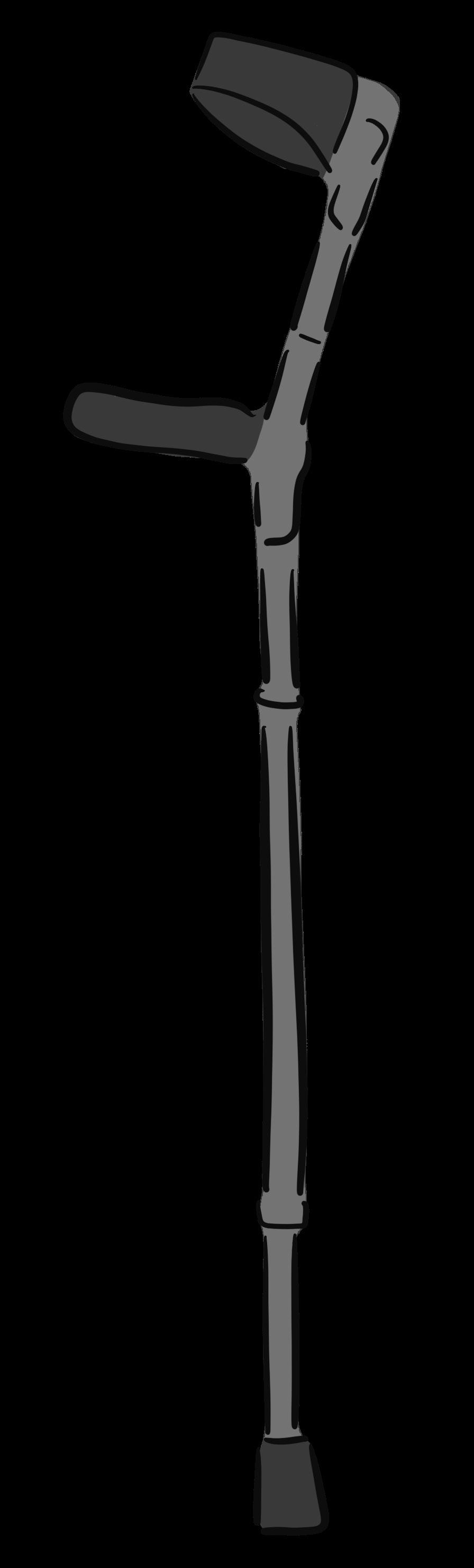
One of the deepest relationships I have in my life is with my forearm crutch. The worn down handle where my thumb will pick at the silicone cover when I am stressed about running late, the dinged up black paint on the aluminum body from years of being set precariously against the sides of tables and buses, and the worn down spot in the padding where I anchor my elbow when using my right hand to unlock my apartment door are all signs of a life well lived. These dings, scratches, picked apart covers, and worn down spots are the patina of my life over the past three years, across four cities and two countries. They are the patina of spending time with the people I love, in the places I love, even if the people are over the computer and the space is within the four walls of my apartment.
Receiving my forearm crutch in early Fall of 2023, for me, marks a newfound sense of freedom. To be sure, my forearm crutch was not my first mobility device – for a year prior I had been using a cane bought from Amazon after a recommendation from my rheumatologist to limit my steadily increasing number of falls – but my crutches had been introduced into my life after my physical therapist noticed I
was routinely dislocating my thumb on the handle of my cane and recommended a crutch that would put the weight onto my forearm rather than any of my joints. I was able to walk for longer, plan less breaks into my movement, and see more things with my forearm crutch by my side.
Receiving my forearm crutch also made me more visibly disabled. Where my cane could be folded down into my backpack or written off by people at the grocery store as just peculiar young people fashion, my forearm crutch is ever present. So, I spend part of my life negotiating space with my forearm crutch, whether it is apologizing to folks who tried to squeeze by, not noticing that to change my elbow placement I would have to take a step back or else they were going to knock me down, or trying to discretely shimmy my forearm crutch under the seat in front of me on planes, because I live in fear of the damage it could encounter in the overhead bins.
My forearm crutch is what has allowed me to pursue a full-time master’s degree, to work in the United States Senate, to take a fun trip to an amusement park without having to budget energy for weeks before and after, and to take the risk of going on icy walks through the brutal winters of the
upper Midwest to visit friends who couldn’t make the wintery trek. Yet, it seems to most outside viewers that my forearm crutch is a sign that something devastatingly awful has happened. I get looks of pity when navigating through the metro, or when I extend my arm to reach a can of beans on the top shelves at the grocery store. If I had a nickel for every time a stranger or acquaintance has looked me up and down before asking “what happened?”...well let’s say I would have a steady stream of income and more than enough to pay off my student loans. I often look at them, see the worried curiosity in their eyes, and reply that I have a genetic joint disability. This is just enough information to let them know my crutch will most likely ever present in our interactions without feeling the need to divulge my personal medical record, or lead them through the string of symptoms. It is not that I am not willing to spell out the full extent of how my disability disables me, but as someone with limited energy, it is tiring to lay out my body for medical inspection, like a cadaver for the poking and prodding of interested students every time I get asked about my crutch. I am not alone in the sentimentality of my mobility aid; I know friends who have vanity license plates for their wheelchairs, decked out their canes in stickers, or spent time finding just the right color and look of a shower chair. Our mobility aids are part of us and our deepest confidants. In the Summer of 2024, as a member of the 2024 American Association of People with Disabilities (AAPD) Summer internship cohort, I got to witness a showing of the Disability Reference Collection from the Smithsonian American History Museum. Perched over my laptop thousands of miles away, as a virtual intern in Madison, Wisconsin, I was engrossed in each and every artifact. A communication board from the 1970s with swear words added, worn down with the words used the most; the wheelchair of Disability Rights activist and Independent Living Movement pioneer Ed Roberts with a reclining seat, a headlight, a portable back, and a bumper sticker; a plethora of leg prosthetics. I would never know the stories these items had seen or how they had wheeled, traveled with, and walked alongside those who utilized them, but in each of these items I saw the patina of chronically ill and disabled people making things work in a world that has never been built for us. I saw the wear and tear of the daily navigation of an ableist society within a disabled body built into these objects, and then I looked at my own crutch. My fiercest companion, my true ride-or-die is made of plastic, aluminum, and some screws. It made me sentimental to think: if only my crutch could talk, what would it say about how much of my life it has seen, how many friends it has met, the first dates it has been on, the places it has been, and all the places it has left to go.
To Present Friends
by Erik West
It started with falling over. A slip, a stumble, a crack as hands met pavement. I wore the bruises as badges of martyrdom, I wanted sympathy for my battle wounds. I told myself, at the same time, it wasn’t anything much; just my hypermobility acting up.
My then-husband did not agree. “You need to get a cane,” he told me. I might be projecting back the tone of annoyance I think I remember hearing in his voice. Maybe, at the time, the worry was genuine. I got the cane, but I stayed in denial.
I was in denial of my health crumbling; I was in denial of our marriage crumbling too. The two decayed together. There was more to our marriage crumbling than just my health and its consequences, but those health effects I suffered made no inconsequential part. I was depressed; I wasn’t romantic; I lost my sex drive.
My husband had expectations of me. He wanted me to be like he was — outgoing, spontaneous, a party person. I could not manage it, and not just
for the sake of my illness. I’ve always been a homebody, even before I got sick. It wasn’t in my nature. Looking back on our relationship, I think I made him unhappy as much as he made me. We were mismatched.
Our marriage ended in November of 2024; not legally, but emotionally. In September 2025, an MRI led to my diagnosis of Multiple Sclerosis. Finally, I had an answer to all the health difficulties I had been experiencing — though not one I liked. The diagnosis was a terribly emotional one.
I felt bad about myself upon being diagnosed. I still do. I might say it in prettier words, but the sentiment would be the same. The bigger words that come to mind would be “internalized ableism.” I feel, often, like a burden, and my ex-husband did not help that. But my friends do.
Right now, as I write, I’m coming to the end of a vacation to Paris and London with my best friend. All the trip, I have been tired and I have been slow; I have struggled to walk at times. I have felt like a burden, like I was ruining my friend’s experience of this wonderful trip.
My friend has not allowed me to feel like a burden; has been supportive, physically and mentally, offering me both kindness and a hand to lean on when I could not get on or off a metro train on my own.
My other dear friend, my childhood best friend in Australia, has offered just as much support. Not so much physical, but endless necessary kindness and understanding; she struggles with chronic illness herself.
Feeling supported, feeling understood. These things are so crucial to overcoming the pernicious internalized ableism that seizes me like an emotional poison. After becoming disabled, I find I can no longer stand on my own, and I do not mean this as a pun on my newfound lack of mobility. I find myself relying more greatly on the kindness and patience of friends and of my mother.
I can’t always give back in the same way I am given to. But I’ve found that has to be okay with me. I give back what I can, when I can.
In conclusion, community with those willing to give me grace, kindness, and understanding is the absolute key to navigating and surviving a vicious degenerative disease. I did not always have this community I’ve come to rely on. I got sicker when I was lacking it — when I was far from home, far from friends, and in a bad relationship. I credit my improvement since my worst flare at the end of last year to proper diagnosis and medication — but also to the environment I build with the people around me.
The Only Scary Thing About Halloween is My Chronic Illness
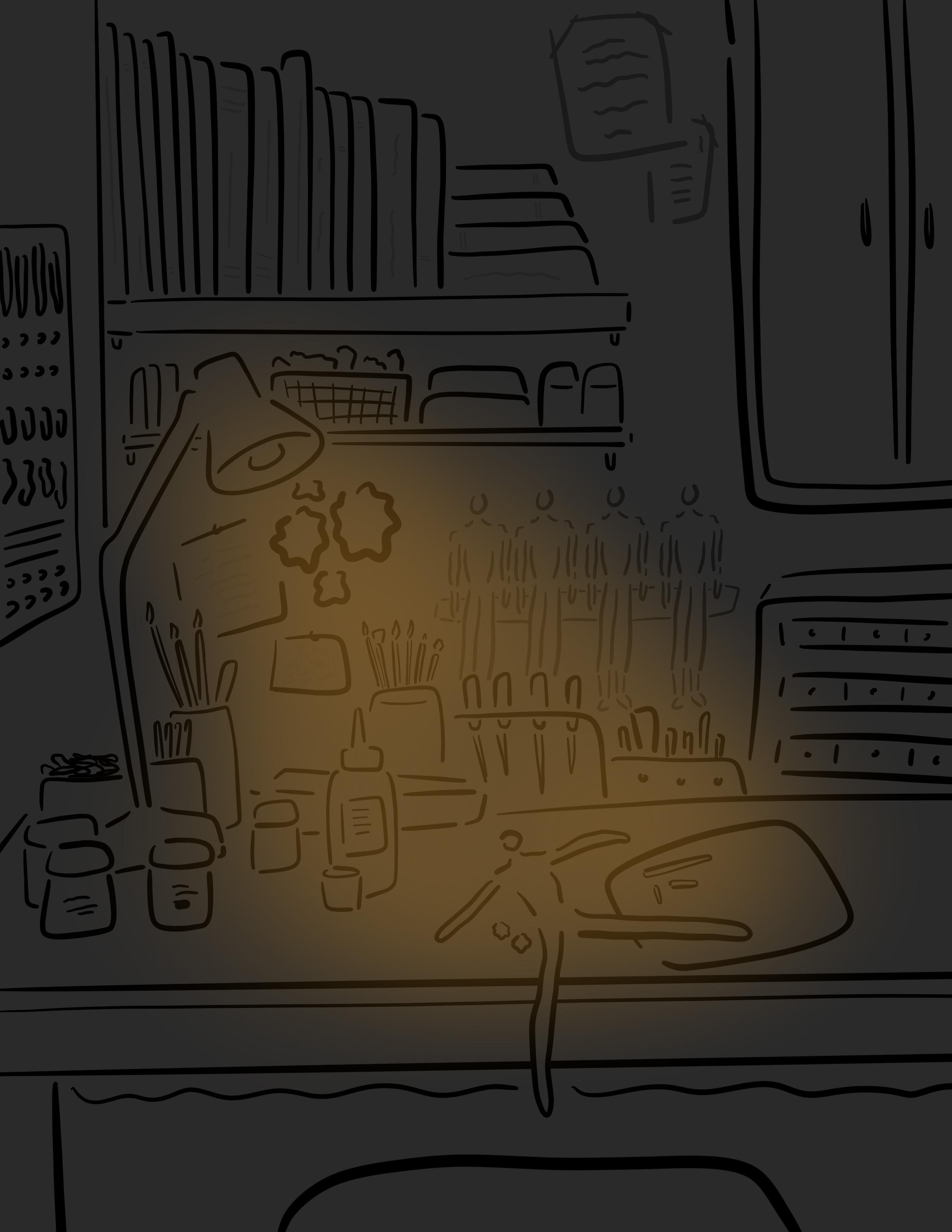
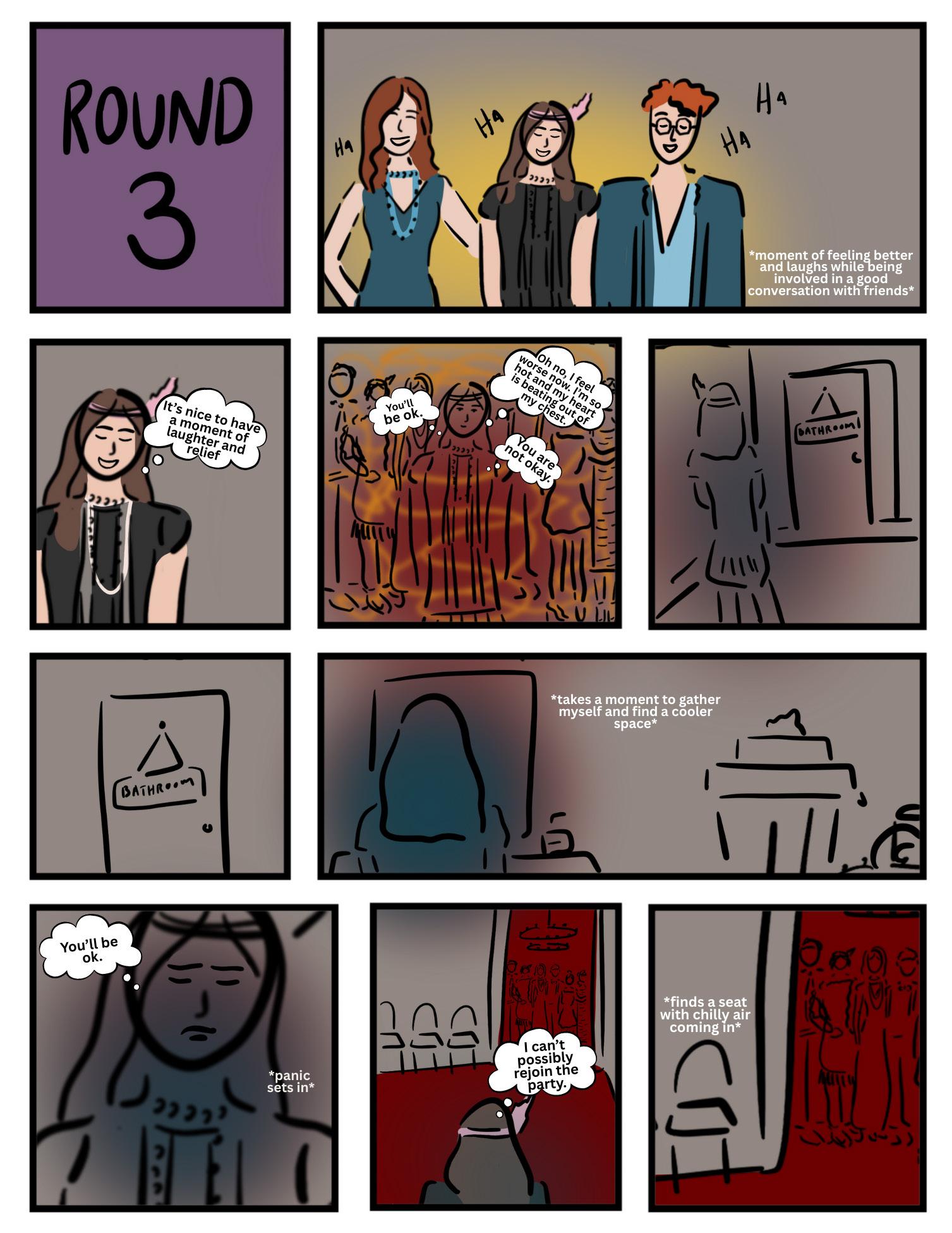
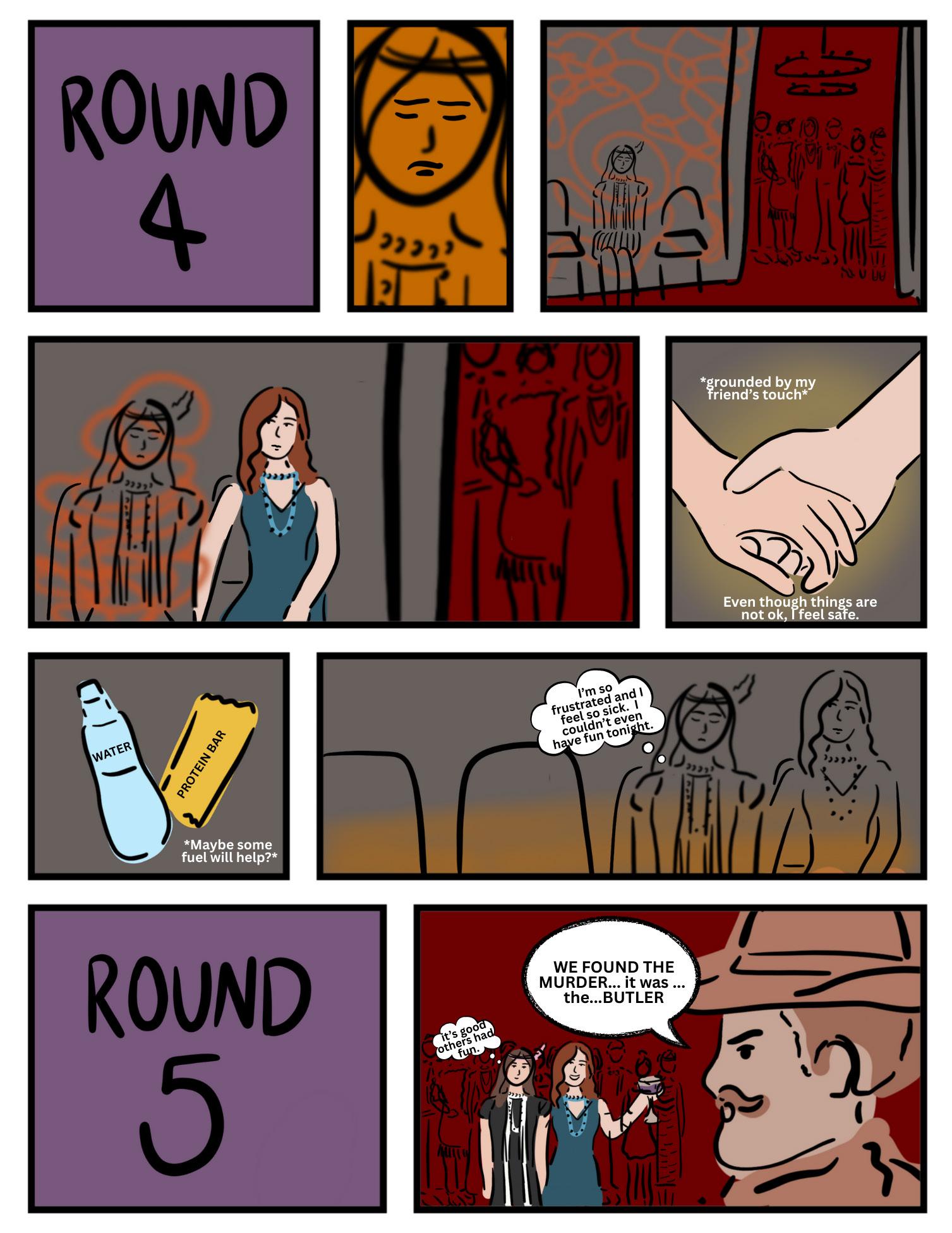
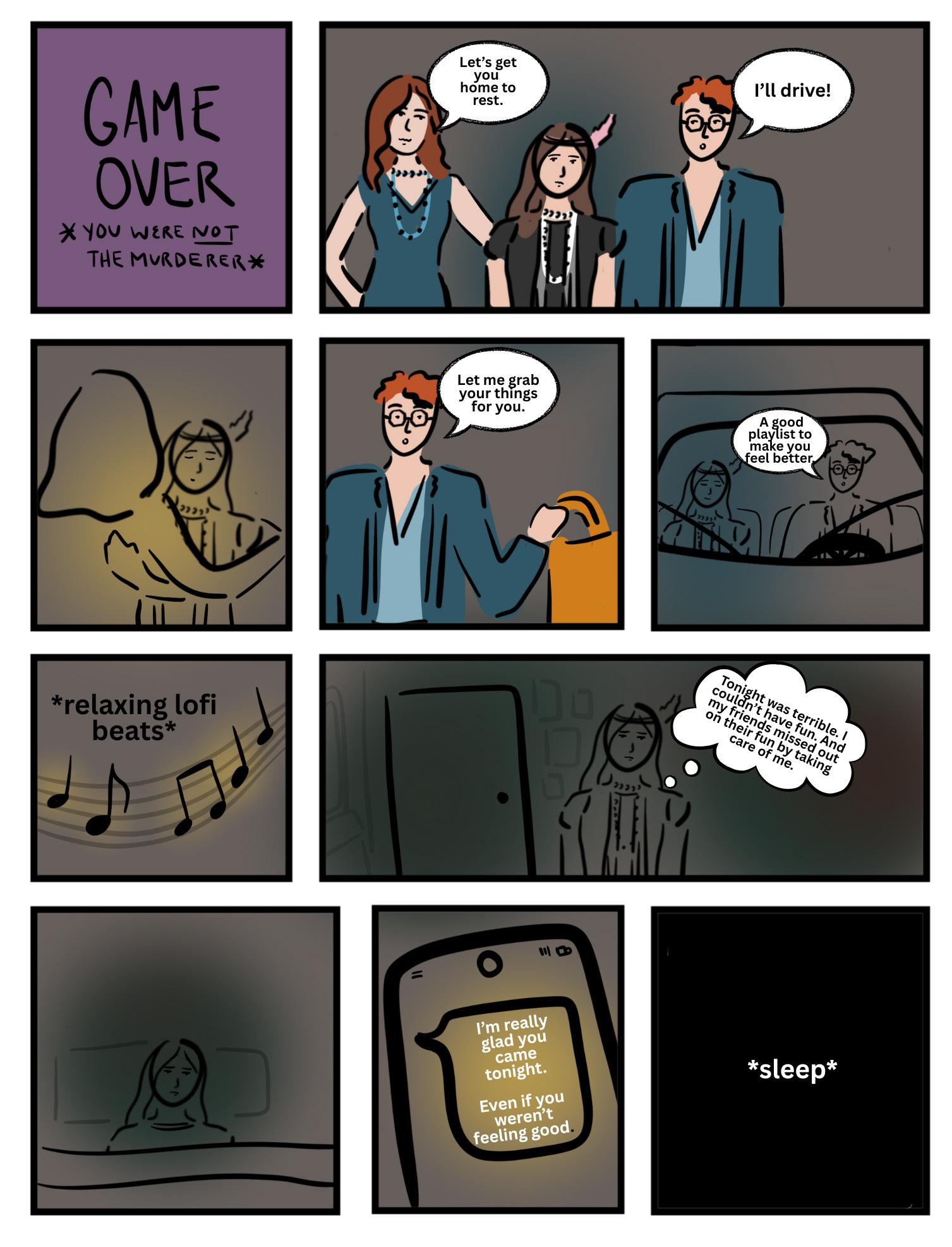
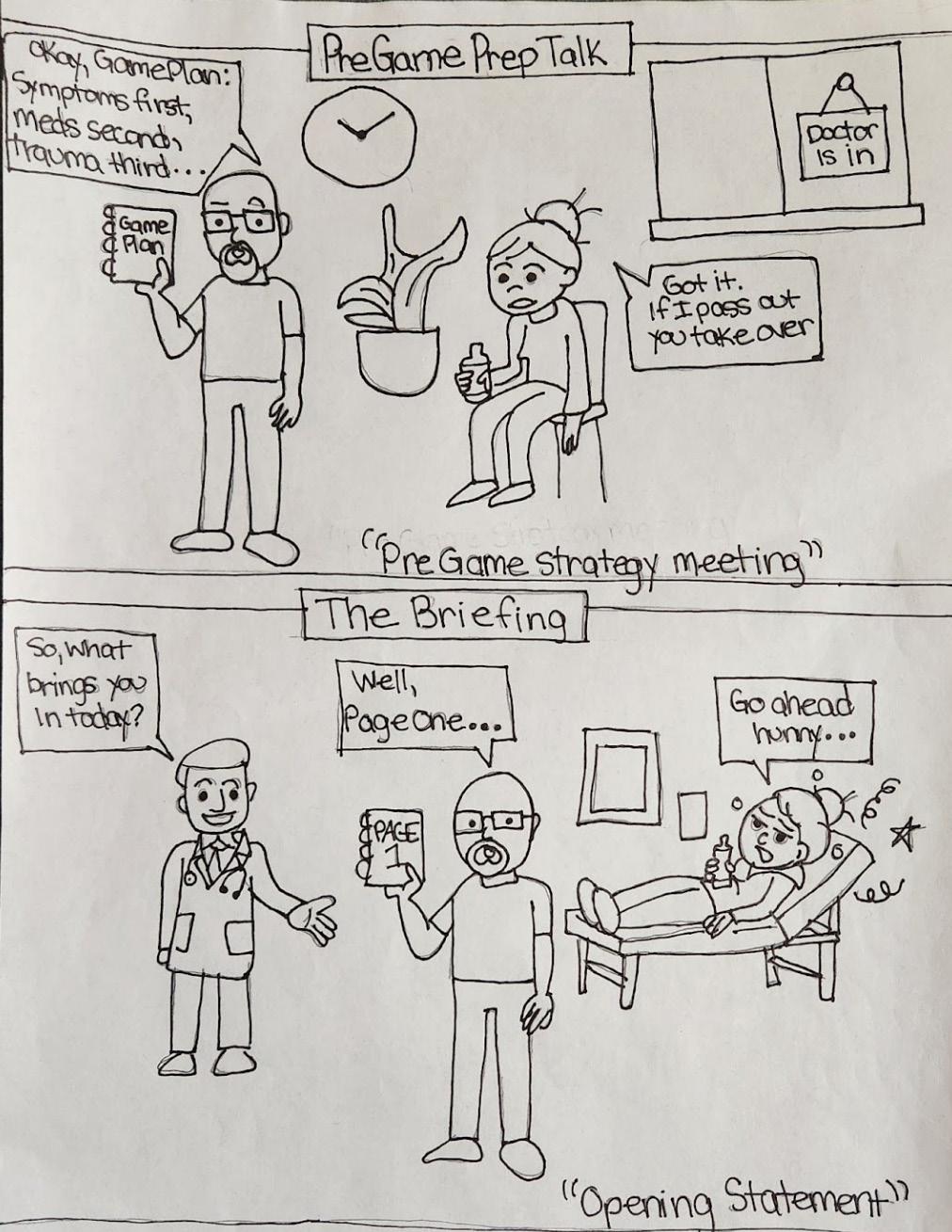
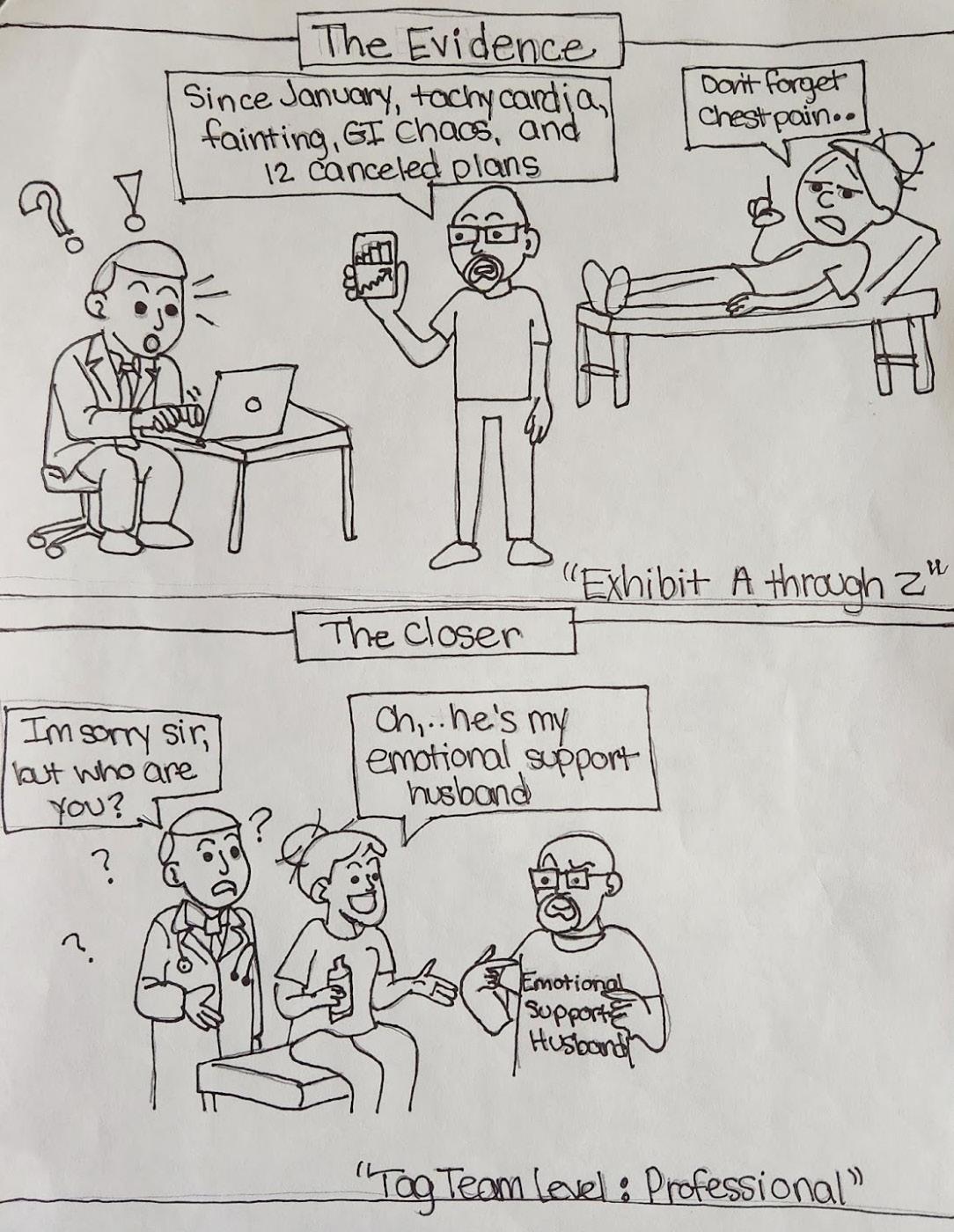
by Liz Zonarich
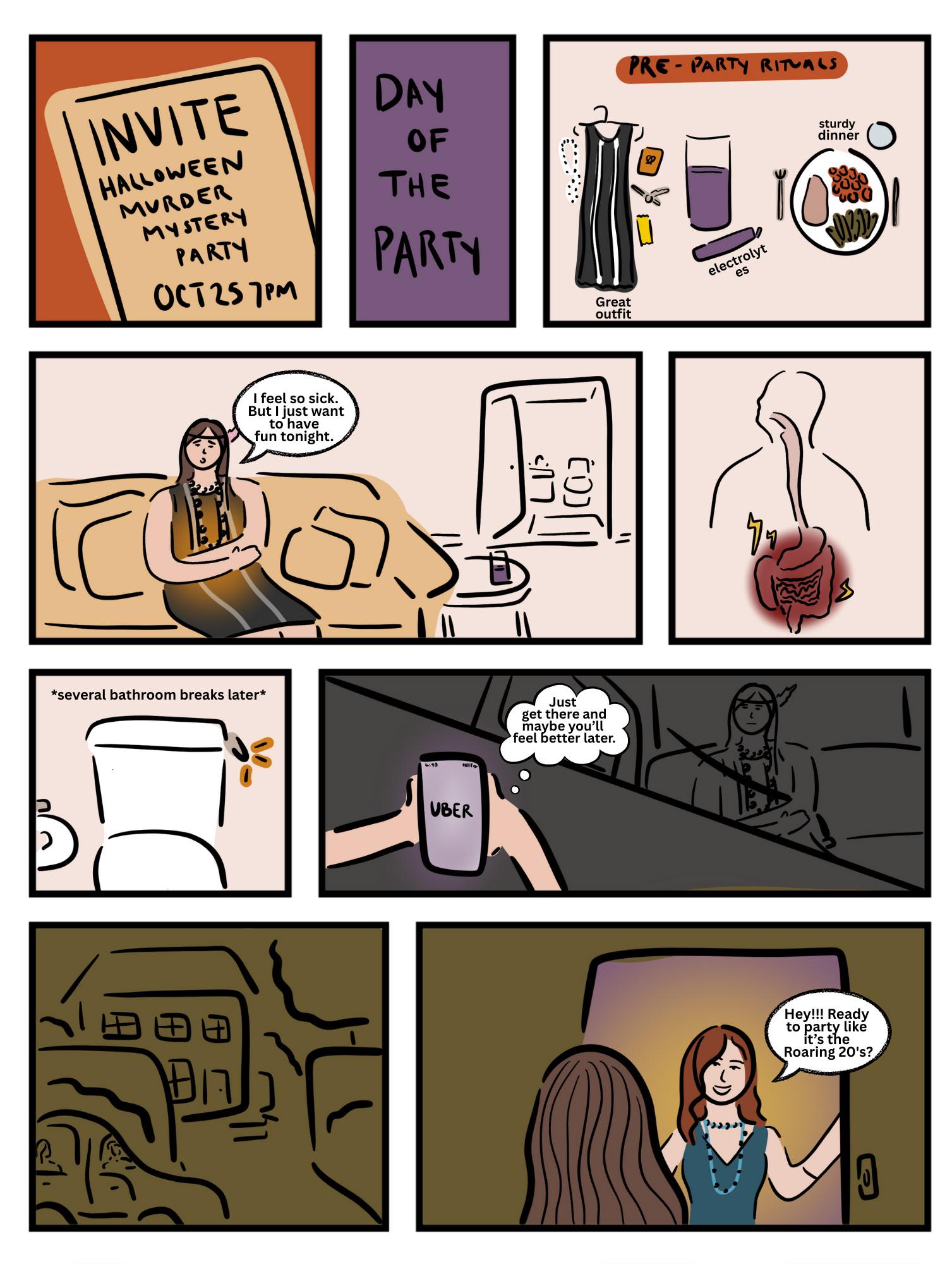
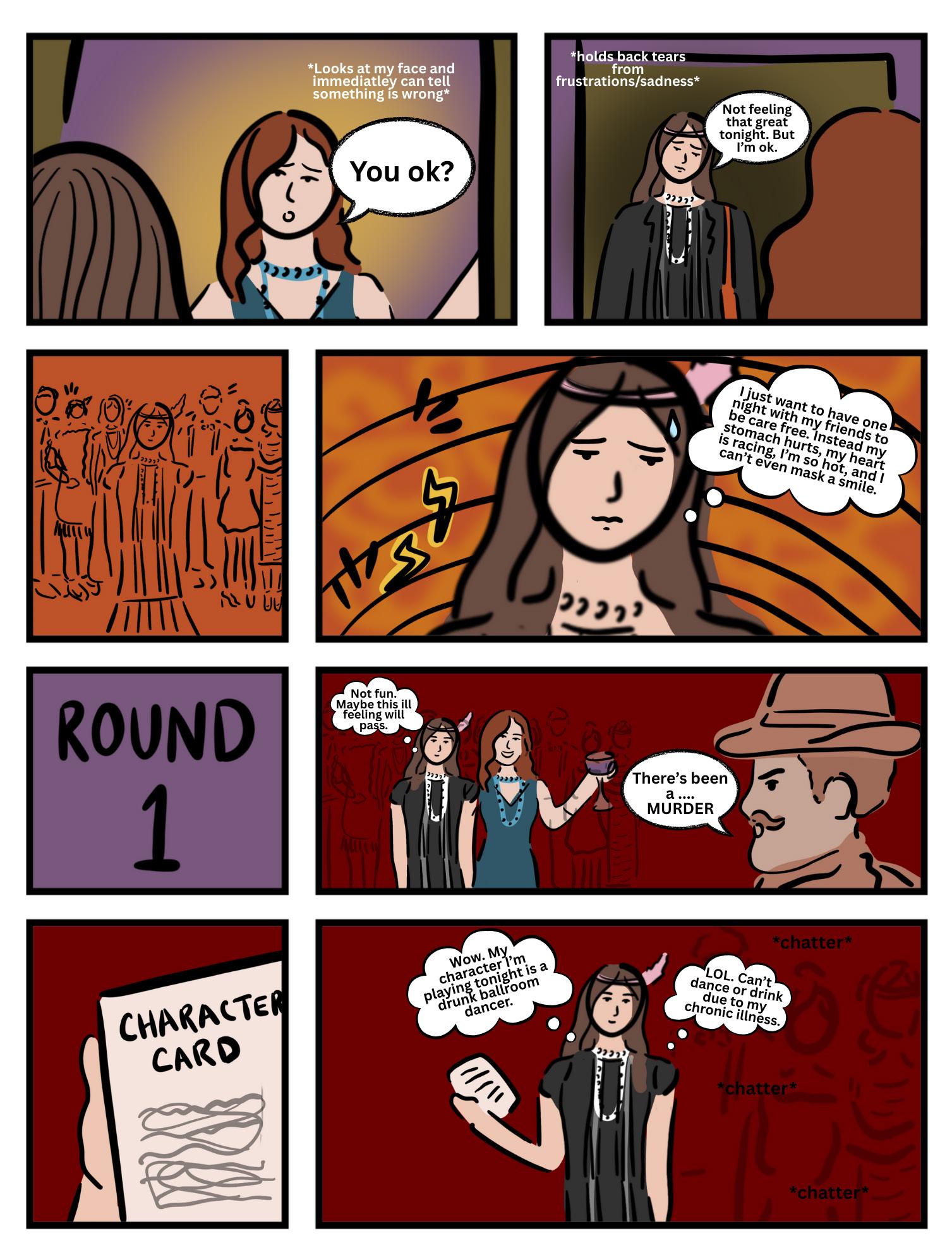
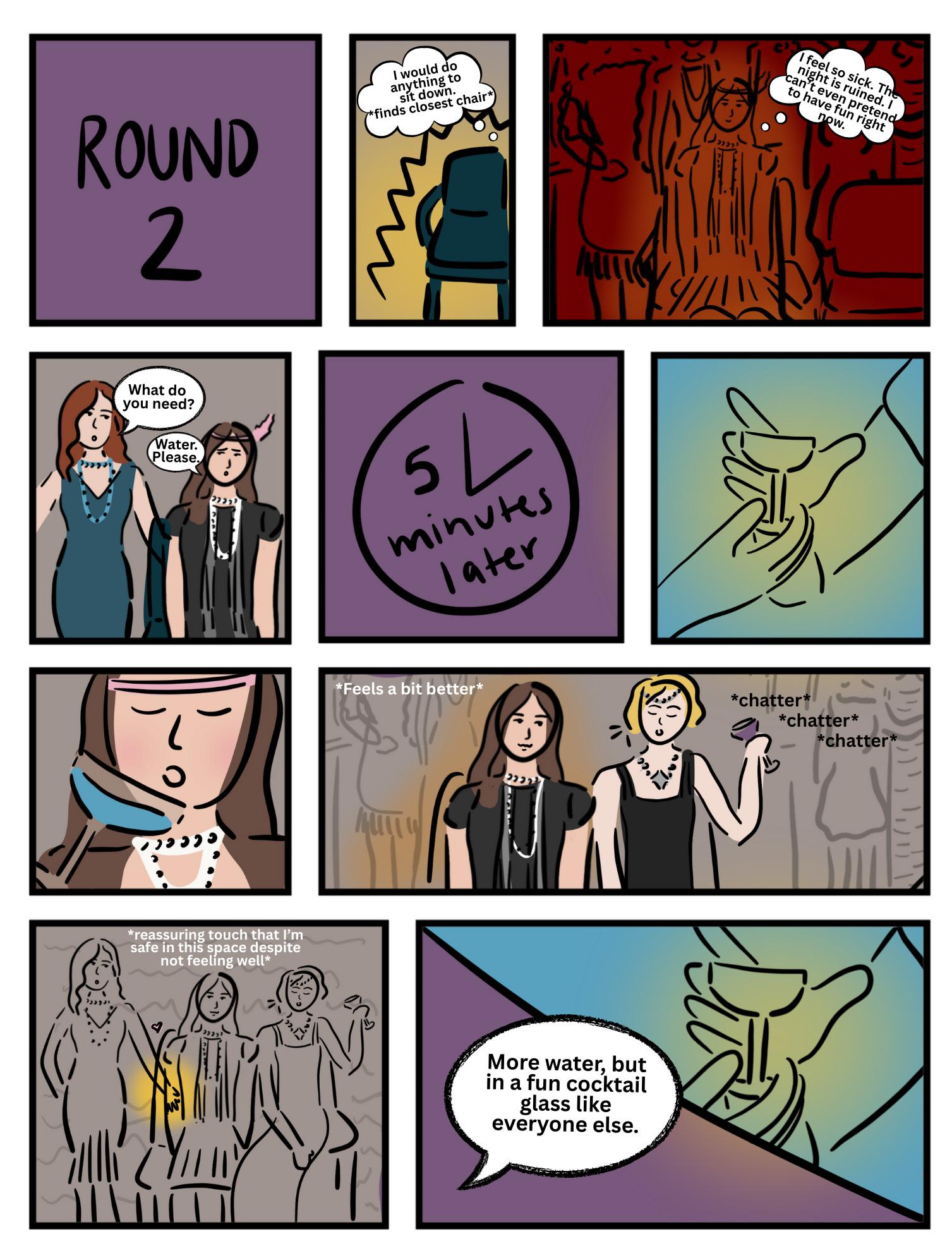
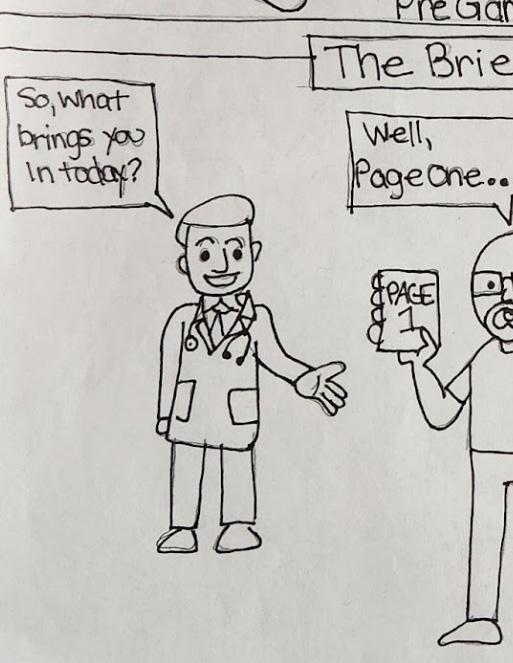
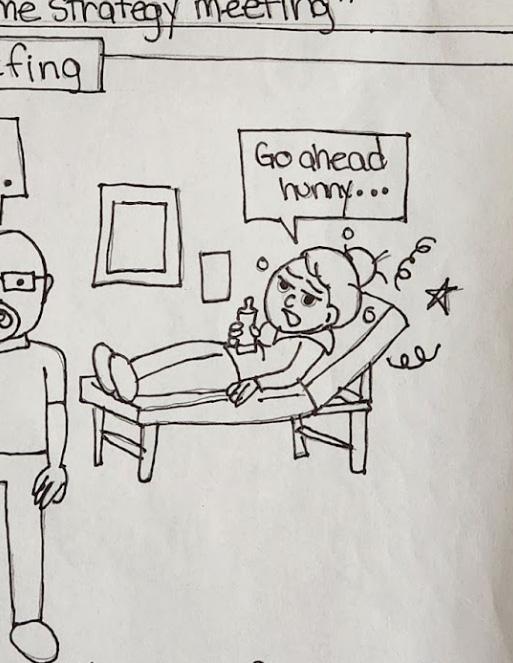
I’ve never particularly liked Halloween, growing up I was too fatigued to run from house to house. And have too sensitive of a stomach to binge eat candy, not to mention I hate anything that’s scary. I’ve grown to enjoy Halloween with my friends over the past few years. However, this last Halloween I pushed through a flare, and had a very bad night both physically and mentally. I look back on this evening as one of the most difficult moments of 2025. I remember how frustrated and panicked I was. But I also see how supported and loved I am.
Want to make a comic? Download a template here!
When people think of traumatic brain injury, they often imagine a single, dramatic event... but mine didn’t happen that way. My injury developed over two years of sustained abuse, leaving me with a cumulative traumatic brain injury that changed everything about how I
Trauma doesn’t just wound the body; it reshapes relationships. After my injury, many connections faded. Some friends didn’t understand why I struggled to keep up or why I seemed “different.” Others simply didn’t know what to say. It was painful to lose relationships that felt
rhythm of my life and walked beside me through frustration and fatigue. In the process, I discovered that real connection isn’t measured by how often someone shows up, but by how deeply they care when they do.
That lesson became the foundation of my advocacy work. My journey led me to create Breaking the Glass Ceiling: Improving Quality of Life for People with Disabilities, a platform focused on helping people with disabilities access gainful employment and live independently. My experience navigating invisible disabilities and the long process of recovery showed me just how many barriers exist not because people lack ability, but because systems lack understanding.
Through partnerships with organizations like The Utah Regional Leadership Education in Neurodevelopmental Disabilities or URLEND Program and Common Ground Outdoor Adventures, I’ve worked to expand accessibility and awareness, helping others find opportunities that allow them to thrive. But the heart of Breaking the Glass Ceiling isn’t just policy. It’s people. It’s about building communities where individuals are seen for their potential, not their limitations.
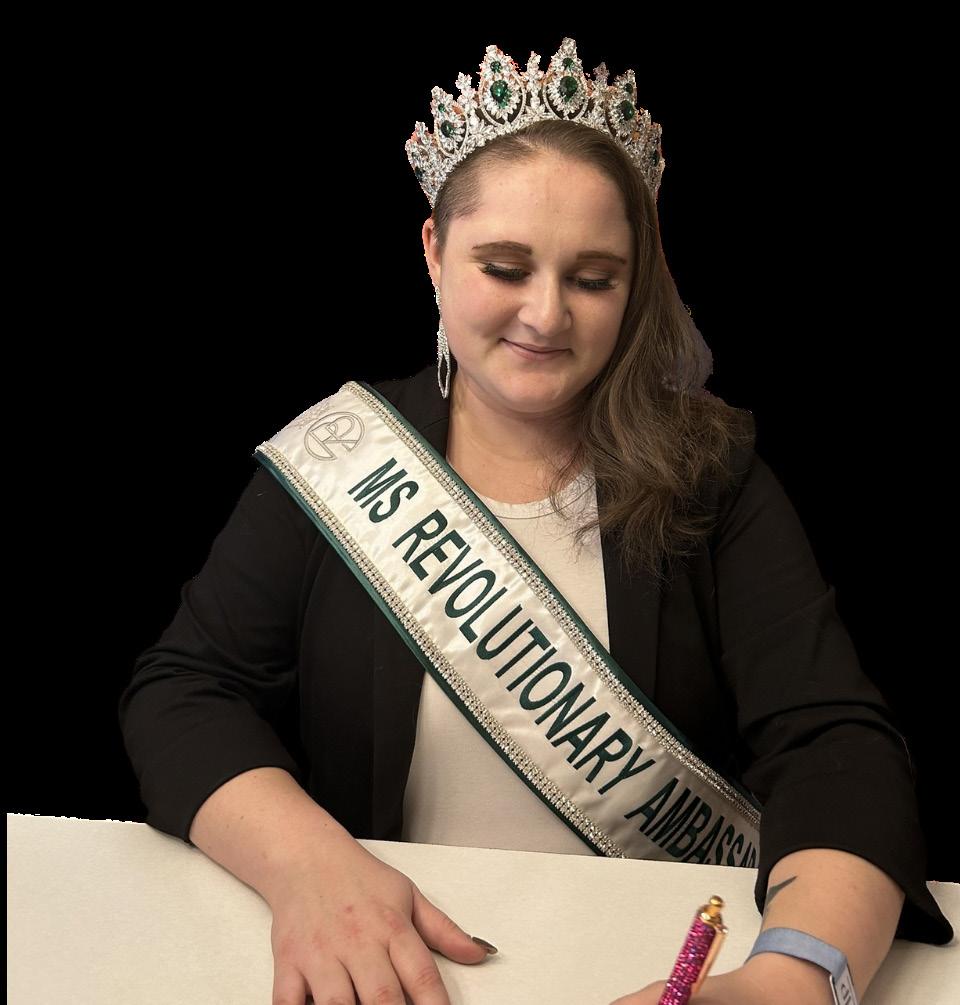
The Revolutionary Pageant system has given me a platform to share that message with authenticity and purpose. As Ms. Revolutionary Ambassador International, I use my title to spark conversations about inclusion, advocacy, and healing. The theme Chronic Connections perfectly describes what my life has become: a web of relationships that grew stronger through adversity. Recovery from a traumatic brain injury taught me that independence doesn’t
mean doing everything alone. It means having the courage to communicate your needs and the wisdom to let others help. Boundaries became my way of building trust, not barriers to keep people out, but bridges that showed them how to love me better. Those who respected my boundaries became part of my healing; those who didn’t simply faded away. Relearning how to live also meant rediscovering my purpose. During the hardest moments of recovery, I questioned whether I could ever return to school or succeed academically. But with perseverance, community support, and adaptive strategies, I found my way back. This December, I’ll graduate with my Master of Human Resources degree! This is a milestone that once felt impossible, and that achievement isn’t just a personal victory; it’s proof of what can happen when resilience meets connection.
Living with a chronic condition and the lasting effects of a brain injury means navigating a world that doesn’t always accommodate you. But I’ve learned that inclusion begins with empathy, the willingness to slow down, listen, and meet people where they are. Whether it’s a friend who offers patience, a professor who allows flexibility, or an employer who provides accommodation, those small acts of understanding can change a life.
Today, my crown represents more than a title; it’s a symbol of every person who helped me stand up again. It’s made of trust rebuilt, friendships renewed, and courage reclaimed. My traumatic brain injury reshaped my life, but it also revealed my purpose: to show others that no matter how broken the past may feel, rebuilding is always possible. Especially when we don’t have to rebuild alone.
Romantic Relationships and How They Change Chapter 3
How I Deal With the Pain of Existence by Anubis
How do you tell the people you love that your quality of life has been destroyed? It is not an easy topic to think about as the person in pain, and having to tell others about my pain feels impossible. But I have never existed without pain.
That all of your goals, hopes, and aspirations have to be dramatically reduced? Because my reality crumbled around me, slowly revealing how damaged my foundation is, I have had to deal with answering, “how do I ask for help?”
It took my memory failing to ask for help from my family, which happened around a full year after I became bedbound. I live my life within a few hundred square feet and cannot leave
the house unless absolutely medically necessary. This shift from being a completely functioning member of society to now happened so quickly that it is hard to wrap my mind around. I have been sick my whole life, and it’s something that was considered part of my personality.
I can’t help but feel somewhat cheated that my body is not functioning anywhere near what my friends’ and family’s are. It’s unfair that I do not have the same access to community because I have to physically isolate myself from society to stay safe. I feel so alone because I am losing so many people, because I am no longer able to carry the emotional weight of the relationship.
When I was hospitalized for my mental health in 2023, I lost my (at the time) fiancee. We had been together for 3 years and I was planning on a future with her. But, I ended up losing that relationship because my health was too much weight for her to help with. She refused to get herself help and I could not live like that anymore, so I turned my life upside down again in 6 months, and moved back to Tennassee from Washington. I got back in contact with some friends from high school that I was isolated from, and got back in contact with my now partner–we had been introduced through my ex.
My current partner, Makaria, is the most kind and generous person that I have the pleasure of being around. She has never once made me feel less than because of my disability, and has always been willing to meet me where I am at when it comes to my symptoms.
She and I started hanging out again when I was still able to hold down a 40 hour work week and had underlying health issues, slowly starting to get worse till
where I am at today. I cannot even drive anymore, had my car repossessed, and would be dead if not for the support from my family and friends.
Because I am so young, I am having a very hard time getting my disabilities to be taken seriously. I have had many providers only listen to me because I have proof of my issues through my partner. It has been invaluable to have someone who is willing to help with my basic life tasks with no question.
I was very uncomfortable asking for help in the beginning of our relationship, because all prior experiences have taught me that if I asked for help, it would be held against me. It has taken years of unpacking trauma, but I can solidly say that I can ask for help now. I know it’s not a sign of weakness, and I know that I did everything that I needed to to be exactly where I am today.
My future is nowhere near a law degree or being the politician I wanted to be, but talking about my story and sharing it makes me feel less alone. I feel so much less alone when I see other people who are chronically ill and/or disabled share their stories. On the other hand, when we share our story, it opens us up to people telling us we are lying again; I have faced those allegations all my life and I have a large amount of evidence showing how I slowly became more disabled over the years I have been alive.
I have faced challenges that should have killed me, and honestly did kill parts of me, but I am who I am today because the past versions of myself got me here. I am incredibly grateful to my own resilience through the hardship that comes with being disabled and not finding out until too late for intervention.
Too Pretty To Be Paralysed
by Georgia Knox
Abbie blinked open her eyes and stared at the wall while the information she needed from her brain slowly, very slowly, filtered into her consciousness. Morning, must be Sunday? Migraine. Home in bed. Thirsty. Alone.
She rolled onto her back, noticing the heaviness and ache in her limbs. She tried squeezing her hands into fists to check her strength, only to find her fingers didn’t quite feel attached somehow and her hands were floppy. She tried to smile to check if she could, but the left corner of her mouth stubbornly refused to lift as much as the right. Ugh, she gurgled.
Abbie rolled her head to the side to check her bedside table for water. An empty cup taunted her. Nobody was coming to fill it. Her apartment was quiet, just a few birds could be heard singing to each other in a tree somewhere beyond the window.
A tear escaped and rolled down the side of her face and she wondered if she could survive off the moisture from her own tears if she caught them with her tongue. She needed
her meds, she needed ice, she needed water. All seemed far too tall an ask, but reminding herself that it would all just get worse if she didn’t try to drag herself to the kitchen to get what she needed, she began the laborious process of getting out of bed. When she was finally sitting on the edge of her bed, she squinted at the light coming through the window and saw it was another beautiful day outside. People would be headed to the beach, to beer gardens, to picnics in parks; they’d be out walking and riding and laughing. They’d be living.
She felt wobbly and took small, careful steps all the way to the kitchen. Once stocked with all she needed, she settled on the couch. She turned on Gilmore Girls and listened to it as she drifted back to sleep, her eyes covered by the tea towel wrapped around an ice pack on her head. When she woke up, she could tell by the orange light filtering through the window that it was late afternoon. The TV was stuck on a screen that asked judgementally if she was still there. I guess so, she thought, although she didn’t feel very present. She felt like she was trapped somewhere in the depths of her own body, like she had shrunk and was walking around in one of her own organs shouting desperately, hoping someone would hear her and let her out. But nobody was coming. She wouldn’t drag anyone away from the sunshine just to help her. She was alone and she’d have to find a way out herself.
She turned the TV off and felt the strength had returned to her arm. The thumping in her head had faded, and she was left with what unjustly felt like a hangover. Her mouth was dry and her stomach gurgled with nausea. She thought
back to the last thing she ate, and was reminded by the dirty plate on the coffee table that her last meal was over 24 hours ago. Despite the nausea, an intense craving for salt was clouding her thoughts. She wouldn’t be able to think clearly until she had some, so she ventured back to the kitchen and grabbed a bag of chips from the pantry cupboard. She stood with the pantry door open and inhaled half the family-sized bag (never intended to be shared with family), enjoying the feeling of her tongue puckering. Crumbs fell all over her t-shirt, the floor, and back into the bag. With her craving temporarily satisfied, she padded to the bathroom to complete her ablutions. When she caught sight of herself in the vanity cupboard mirror, she laughed out loud. Some of her hair was still held together with a lackey, but most of it had fallen loose and even bent at right angles. Crumbs stuck to her chin and dotted her black shirt like dandruff. Or was that dandruff? She flicked whatever it was off her shoulder.
Showered and feeling more human again, Abbie pottered around the house, tidying up and getting things ready for another week of work. She managed to turn the scant items in her fridge into a simple salad she could take for lunch, and put a load of washing on. After half an hour, she was knackered again and flopped onto the couch to order Thai food and browse the dating apps. Maybe a shag lined up for later in the week would take the edge off the gross unfairness of spending such a gorgeous weekend unconscious.
She matched with a few people, one sent her a message.
“Hey, how’s your Sunday?” he said. Simple, normal. Abbie thought about being honest. What would he say if she
said she’d been temporarily a little bit paralysed, but she was okay now and had some noodles on the way? Dating with a disability was a bit like trying to find a job with a disability. Better to hold off on the specifics until they know you a little better, or you’d be thrown in the too-hard basket right from the start.
Abbie felt psychologically sore and cantankerous. Sometimes, she’d be filled with self-compassion and acceptance after a migraine attack. This time, she wanted to
burn everything to the ground. Swings and roundabouts.
“I was a bit paralysed for a while this morning lol but all good now.” Yeah, work with that, she smirked. The three dots bounced around for quite some time.
“Um, what?”
“I have a health thing lol. I get a bit paralysed every now and then. Like in my face and hands and stuff.” It felt good to tell someone like she was stating the weather forecast.
“That’s hectic, have you been to the doctors?”
Have I been to the doctors? You. fucking. moron.
“Yeah, there’s not a lot they can do about it.”
“What is it? I’ve never heard of being randomly temporarily paralysed. Are you fucking with me?”
“Migraine.”
“What the fuck? Nah surely not, that’s like a bad headache, you should see
a specialist cos maybe you have a brain tumour or something.”
“I have seen a specialist, it’s migraines.”
“Whaaat? Nooo that sucks haha. You’re too pretty to be paralysed lol xx”
Abbie closed the app, put her phone down, and stared at the blank TV. She picked up a cushion and threw it across the room at the wall. With her strength returned, she went to fill up a glass of water and get into bed again.
Doctor Appointment Tag Team
by Stephanie L. Bade
Doctor Appointment Tag Team is a humorous comic that captures the dynamic between a chronically ill patient and their ultra-prepared partner during a doctor’s visit. While the patient battles exhaustion and brain fog, their partner confidently steps in—armed with a symptom tracker, notebook, and unwavering focus—to make sure nothing gets missed. Together, they turn a routine appointment into a full-blown tag team effort blending love, advocacy, and comic relief in the chaos of chronic illness care.
Their Loss, My Gain: An exploration of Relationships and Chronic Illness
by Remington Steele-Caleñe
My complex chronic illnesses and disabilities have pushed me to the edge. Since I left college a burnt-out shell of a person in 2017, I have been crashing and burning my way in and out of people’s lives. Unfortunately, I have also been pushed by the strong current of time to the edge of my loved ones’ capacity for care, the edge of what is possible or even accessible medically due to my circumstances as a generationally low-income person, the edge of every single job or career I had plans for. I have seen the borders of my hopes, dreams, wishes, desires, and far worse, the edge of sanity.
I hadn’t realized it that I was struggling with chronic symptoms (migraines, light sensitivity, chronic fatigue, depression, anxiety, etc.) which, at the time, were mild enough that I doubted my own physical experience. Instead, I pushed full steam ahead in
the name of not being perceived as lazy, of wanting to gain financial independence, to be able to live my life on my terms, and a lot of pride in my own accomplishments. I can already hear the laughter of chronic illness wisdom that rings in my mind as I write this out. The person I was in 2017 is most definitely not the person I am today in 2025. I still had not accepted that I had any limitations in my life that were, and always would be, outside of my control. I conflated militant and punishing discipline with productivity, flow, and success. I knew something was off, but it was beyond my scope of understanding at the time.
It was during this season of youthful naivety regarding my future that I met my first husband, N. At the time, it was one of my more authentic connections. N was the first person I met after college that I was honest about being bisexual and also taking Lexapro for anxiety. Those were really big things for me to share with others; that was the major reason I had tense conflict with my family of origin. On that first date to an old bookstore-turned-restaurant in Anaheim, over Bulgogi tacos and a Moscow mule, I looked this stranger in the eye and said my piece. He was accepting of both things at the time. Things would, of course, change.
During our relationship, N and I would have conflicts over my relationship to work. To be clear, I had been working and getting paid in some capacity since I was 13 years old, a nanny to a family of three kids under 3. I was coming up on almost a decade of work history and I was tired. I had just turned 21. N had only started working during college and I just didn’t want to listen to a straight white man telling me what to do to be successful. Their strategies for success are not transferrable through
multiple intersections of marginalization. The main issue was that I didn’t have the energy to deal with office politics and micromanaging supervisors. I was squarely in my job hopping era, and that scared N. I was experiencing some of those same themes and cycles of self-abandonment, people-pleasing, and generally just trying to avoid conflict. These were the same issues I had first found repugnant in my family, but this time I saw it reflected in my employers and, horrifically, with my partner.
That year that I was married—May 2019-2020—I experienced what I then called a severe depressive episode, but I now think it was one of my first real experiences with the edges of my physical capacity. Living with N also highlighted my neurodivergence and gave him concrete reasons to bully me like my family had done. Just like I had with my family, I tried to do everything in my power to help him understand my experience.
The only good things to come of that were:
1. My cat Ophelia
2. My ADHD diagnosis
3. My divorce
Instead of approaching conflict with curiosity, N simply advised me to push through the misery and pain of a crappy job on the way to climbing the ladder to a better position. He set a rule that I had to stay in a job at least one year before finding a new one. He would not support me otherwise. That was the moment I knew I had to leave, but I needed a job to be able to leave him.
I found a low-paying office admin role in a Physical Therapy office, owned and
operated by an angry boomer man who only hired women in his practice so that he could underpay, overwork, and overall harvest labor from them. On top of that, he would yell, hoot, and holler at employees from long stretches of time when he was cross at them. I remember standing, petrified, in front of this older man who was my boss, absolutely unleashing all his anger on me because I made a filing mistake while still in training. He yelled in my face for 15 minutes. When it ended, I made a decision to never again just stand there and take blatant abuse. Even with these facts, N was against me quitting, but eventually relented and said it was my choice, that I had the right to do what is best for me. But really, the thing that did it was seeing how distressed I was. Because of course, no one believes you when you calmly state your concerns, they really only listen when you are screaming, crying, throwing up levels of dysregulation.
However, this freedom came at a steep cost mentally, emotionally, physically, socially, and spiritually. Everything in my life was falling apart. I think of that summer as an atomic one. I figured as long as things were going to be chaotic, then it was the perfect time to start over. And start over I did! As a queer, nonbinary, agnostic, and solo-polyamorous divorcee.
During the divorce proceedings in 2020, I lost the first high-paying job I had landed as a Technical Editor. In all fairness, I lost the job due to circumstances out of
my control, but at the time, I internalized it as a personal failure because I didn’t have access to ADHD medication. I lost the job the first week of December. That year I filed taxes and I made around $43,000, the most I had ever made and I have yet to recover financially from it. This definitely has held me back from pursuing serious relationships. It is hard to feel attractive and worthy of a beautiful and healthy relationship when you are constantly in crisis. So, I dated on and off since my divorce was finalized in 2021. For the most part, these encounters have been brief and casual/low or no commitment, as I often discount myself as an undesirable and quite a burdensome partner. This was a painful lesson to learn (and unlearn) about relationships and what happens to them when someone is too sick to show up as they have in the past. Most days, I can only see myself and my experiences through my eyes. I see all the hopes and dreams deferred; I see all the ways I can no longer contribute to any relationship in an equal and transactional exchange.
In February 2022, I was admitted to the psych ward while I had three partners— one local person, and a long-distance couple I knew from my time in California. The hospitalization was a result of health providers dismissing and discounting my pain due to my weight and age. Up until that time, I had never experienced chronic pain so intense and unrelenting. I had no real education or experience in pain
management, and I was still trying to be a good roommate and pay all my bills on time. I lost sleep to the pain, and I lost my sanity to the lack of sleep for a while. None of my three relationships survived my month-long stay.
By the time I was adjusted enough to the medication to reach out to my partners, I came to the horrible understanding that there were no calls, nor would there ever be, with those people; there was no support, there was no help. It was so devastating because I was in such a vulnerable position, I needed help and support from the people who I was in deeply intimate relationships with. It felt horrible to know that in reality, these people cared far more about how I made them feel than anything else. When I was not around to perform these “duties” as a good partner, well, there was no one to pick up the mantle. I was not surprised that it happened, I had already been aware of the high statistical probability that most women and nonbinary people are abandoned by their partners at higher rates after a diagnosis. That information did not help the pain of abandonment and betrayal I felt. But actually, those bad experiences with N or with the three people I dated right after my divorce aren’t reflective of my entire experience with relationships as a chronically ill person.
In the years since then, I have accomplished much, including:
1. Becoming spiritually autonomous.
2. Exploring, accepting, and enjoying my
life as a queer and complex person.
3. The chance to show up as authentically myself, and no one will ever convince me otherwise
It’s been my experience that because queer and polyamorous/ethical nonmonogamy/kink circles include other people who are also at the social edges, there is some level of understanding there, which is crucial for building safe and boundaried connections. The truth is, I have come across so many good people who meet the world and myself with curiosity and patience. My community values bodily autonomy, the right to say no and recuse myself of any situation, no questions asked. In this time, I have come to taste all that I craved growing up. And yet, it is not without a seemingly insurmountable amount of grief and loss.
So there is a bittersweetness to it all. I am in a better place overall, but it has come at the cost of my health, my productivity, my career, my old goals and aspirations, old friends and places. So much loss. But there is so much to be gained intangibly. Through all the struggles, I persist and survive, I find ways to continue to grow and evolve knowing I am safe to change as much as I want; the true people who love and support me, they don’t love me for what I can do or be for them. They relish in watching me thrive, and the excitement is in the unfolding of life. And therein lies the medicine, bitter at the beginning with all the loss, but turning to a healing moment of opportunities never even imagined.
I get diagnosed with ADHD like every other white lady on TikTok, though it takes a year to get pills because the doctor thinks I’m, well–depressed.
And I am, because who the fuck is adjusted at a time like this?
But the Wellbutrin (“the happy, horny, skinny pill” a friend gleefully informs) makes me want to eat myself into a coma and never wake up. The psychiatrist relents and my brain goes quiet. I learn how to mourn the life that might have been. Funny things happen when you get a diagnosis. Your walls, the ones you spent such care in constructing, fall away. What remains?
The trembling core no one saw in the first place: raw, exposed. What does a cornered animal do?
The animal inside me is feral, lashing out at even the hand that feeds, loves, comforts. I hear myself hate my husband with my words, knowing they mean nothing but the heat of the moment. Heat of my making. I’m so cold inside. I want to feel something. This isn’t fair.
In therapy with someone new, just as the leaves change. She tells me that neurodiversity is a chronic illness, that my rage is trying to help me cope.
I tell her that I’m fine, just tired all the time. Unsettled, unfair. I don’t want to be this way forever. No one else should be expected
to carry me.
“Did you ask if he minded the weight?”
I don’t want to be a burden.
“That’s not what I asked. Does he mind the weight?”
I’m so unpleasant to be around.
“That’s not what I asked. Does he mind the weight?”
What if I’m never okay?
“That’s not what I asked. Does he mind the weight?”
I don’t want to be sick.
Apparently, that’s the crux of the issue. I’m trying to push him away, handle this illness on my own. She tells me there’s a time to be alone, a time to ask for help, and a time to let someone who knows you better than you know yourself give you what they think you need.
“Other people are allowed to be right.”
We disagree on this for now, but I’m willing to be persuaded, willing to believe that when I ask: “Does it bother you that my brain isn’t normal? That I can be mean, but I’m working on being better?
That I feel how much you love me? That you make me want to be kinder to us both? That I’m trying?” that he’ll tell me the truth.
Disability and Marriage: The Beauty of True Commitment
by K. & L. Hicks
The following is a from a recording of the conversation between my wife and myself, in getting her thoughts of the nature of our relationship and its evolution in terms of care needs and how we’ve had to navigate these changes in the last three years of our six relationship, and the first two years of our marriage. My wife doesn’t see writing as a strong suit and struggles to articulate her thoughts that way, so I figured it best to just record her natural responses to the prompts and thoughts as the disabled person in our relationship. I wanted to foreground her thoughts first over mine as her caregiver to highlight the realities of what we deal with in terms of navigating a lot of need changes, fears and expectations in our relationship and all the possibilities within that.
This recording started with us in the car, just having a conversation in the way we have hundreds of time over the course of our relationship, this time on the way home from after-dark grocery shopping and sitting way too long idling the driveway. I wanted it to be an intimate look at how we feel and a truthful reflection of our life with little to no editorial flare. So sit in our backseat, with the soft sound of the A/C and the road noise from the easy 11 miles on the interstate, and hopefully you’ll see and feel how we feel when it comes to love, life and disability.
Want to listen to the audio interview?
K: Alright, so *scuffles with the radio and the A/C blower with a slight turn to the other in the passenger seat.* There’s a magazine called Cope magazine and tomorrow is their deadline for potential stories articles et cetera, and I think the prompt for this month’s magazine will be the nature of relationships when you are disabled. In just like how they work, how to feel about them, how it evolves over the course of time. So uh, what are just your general thoughts? Feelings, concerns, worries? about being disabled and in a relationship. Just… the kind of things you think about. Anything, everything.
L: I always kinda worry about losing the dynamic or aspects of our relationship that made us special, because I am no longer able to be the person you first fell in love with. She mulls over the thought.
I can’t really do the things I once enjoyed. I think one of the things we both really appreciated about our relationship at many points in our relationship was that we were able to be our own independent people, with passions…with own individual passions and talents and we had full functioning lives independent of each other, and that is no longer the case. The blinker clicks on and off as we change lanes.
K: Do you feel like that would have been any different if you weren’t disabled?
L: Yes.
K: Even objectively over the last three years?
L: I…still think that a lot of our life revolves around you taking care of me…and me trying to take care of myself as well. It’s not reciprocal. When we first started dating…it was like a give and take. I do things for you, you do things for me…and it wasn’t because either of us needed the other to do those things for the other. Now, you do things for me and I try to do things for you, but I need you to do those things for me. The same is not necessarily the case for you. And yes, I do think I try very hard to take care of you in the ways in which I can, and try to meet your needs in whatever way, whenever I can, but I also understand… Like this isn’t what you signed up for when you started dating me. Hell, this isn’t what you signed up for when you married me.
K: Ehhhhhhhhhhmm, That’s not exactly true.
I had an inkling some level of care was needed. But obviously it was no where near the level it is now. I think even at the impetus of our relationship I sensed enough to know that you did need help with…some things. Even just in terms of understanding the nature of being able doing things for yourself, or the logic of how you went about things. It’s why I would offer help, like the first time I did your hair.
L: But there’s a difference between someone understanding something-
K: That’s true.
L: -and needing someone to bathe them. Or needing someone to push them so they can move around the world.
K: That’s fair.
L: It’s one thing to have you advocate for me and talk on the phone, it’s another thing of needing you to advocate for me because people are not listening to me
K: Mm. Do you think in any capacity… Has it made our relationship stronger? Like, is there any positive impact?
L: Uh…I mean yes?…I think I’ve grown a deeper respect for the level of assertiveness you have. And I’m often…in awe of when you say this is going to be figured out like I don’t ever have to question if my needs will get met, or if you say ‘Imma figure this out. I don’t know how, but imma figure this out’ I know that it will [be.] Which as a person who has so much of life feels like things are not certain and I don’t know I’ve always been like a fly by the seat of my pants kinda girl and I’m okay with that in a lot of respects, but as I get older I feel less inclined to do that because it doesn’t exactly work in my favor.
K: No, it doesn’t. *The giggle bubbles in with the clicking of the blinker again.*
Which is what I’ve been trying to tell you! You can not just keep being like ‘it’ll be okay, i’ll figure it out’ Like nooo, you have to be actionable now!
L: But like that served me well for most of my life.
K: I think it served you well enough, until you reached the point it no longer could. Because based on what I know, see and know [about you] and what I have researched about the issues at hand, I think you’ve always been disabled, whether you knew it or not. Whether anyone else around you understands it. Now, was it enough for you to be able to get by, yes. It was enough for you to be able to get by until. Because…essentially it was okay enough, but your body was still struggling, still deteriorating until it no longer is enough to get by. Based on you saying things like ‘Well i’ve always been clumsy’, ‘I’ve always struggled with this,’ ‘I’ve always had the learning curve for this.’ If we think you have things like EDS and POTS based on what we’ve seen and that you were on homebound in school, you’ve always been disabled. Even if it was for chronic stress back then, if you’re so stressed that your brain is making you pass out, what do you think that is doing to your body? Look at what just the stress of grad school did to me for only three years. But such extended and prolonged stress for you?…I don’t think you understand that your body has been deteriorating because of it and what you were doing was not enough to mitigate it because you didn’t know any better, if that makes sense.
It doesn’t give you any recourse to know that you have to move differently [with your disabilities] if you don’t have the tools or awareness to move differently. That’s been the learning curve or adjustment for you, in having to understand the need
to make new boundaries in certain kinds of ways. Or learning how to move in a more methodical way when you’ve never had the routine to do so before, let alone now [when your symptoms are so advanced] that it is absolutely necessary [now].
L: I guess, but one thing I’ve always been concerned about, whether is it logical or not, and I’ve seen this sentiment echoed by other disabled people online, where you’re worried that one day that your partner will just…wake up and will have had enough. Because like, it is a lot, and… not everyone is cut out for taking care of another person, that’s not themselves, that’s not a child and especially like as you age what potentially this person is going to need of you is only going to increase, not decrease. And I don’t know, sometimes I worry…will you grow to resent me, grow to resent the life that we are building…?
K: If I haven’t resented you yet, I don’t think I will. *She shifts to turn more fully to the passenger seat crossing her arms.* I think the difference comes in like, at least to me as someone who’s had to go into disabled spaces to learn and try to change my mindset around the things that are required of me, or even when I am frustrated about things, I know I have to keep a level head about it? For me it’s an instance of the same philosophy I’ve had over the entirety of our relationship, which just kinda speaks more to the nature of it now: the mental and emotional shift that is required of me to learn to navigate this is driven by my want to be with you. Above all else, I like and desire the qualities of you as a person. And thus our relationship has been built on those things. And just because it requires us to function differently in the world in a way in which isn’t inherently desirable for the level of effort that most people are willing to put in doesn’t mean we can’t have a good and strong relationship. I think that’s a problem for a lot of people because for most it doesn’t align with the romanticized view that society has on relationships [is what fuels the fear of a disabled person’s partner leaving them] I think that’s what gets in the way of anybody having a deeper, more meaningful relationship. There’s a lot of socialized and expected ideas about what they think relationships should be over building one with them as stronger partners and people. And then it’s furthered by objectifying and idealizing the concept of having a partner in the eyes of people around them. Most of the time this is because people are trying to meet and uphold societal benchmarks and these heteronormative romanticized ideals, whether it emotional, physical, whichever, over what it means to be a partner or spouse in a relationship. I think often times it’s all of these things that people place on their partners and themselves when building their relationships: that you should have this kind of man/woman, be this kind of person, you should have this kind of sex, this kind of passion or romantic gestures, be aesthetically lovey-dovey, or otherwise it is not a desirable relationship. That includes the level of dependence necessary on your partner when you’re disabled and can’t otherwise meet those romanticized ideals. You have to let that go, because reality for most people doesn’t actually map onto that, but especially so when you’re disabled. And that’s hard, especially when you have no one around you or a cultural-community touchstone for what a disabled relationship looks like or could be. But like, are there times where it is frustrating? Yes. Are there times where it gets tiring having to figure out? Yes. Are there times in which because we’re in the learning curve of figuring out how to manage everything that it’s been a burden of doing so? Yes! But the same reason in which I don’t wake up in the morning and say I want to leave is because
I don’t to leave you, I want to leave the hardship of having growing pains of learning to deal with this, which does require us to grow and get better as people and as a couple navigating it together.
L: I mean I am forever grateful that I have you as my partner because I don’t…Well I do think I would have figured it out to some capacity, life would have moved on…with or without you in my life. But I do not think that I would be as happy as I am now, I don’t think I would be as secure as I am now, and I don’t think I would have as many of the answers so I do. I didn’t have you in my life.
K: Do you think you would have ever finished your degree and gone back for this second one if I wasn’t here?
L: I don’t know, probably not.
I am grateful that I have a partner that creates space for me to fall apart and say hey, okay, let us get some glue and piece our life back together. And sometimes that means it’s you putting the glue and piecing together and sometimes it’s you handing me the glue and saying okay, now you can piece yourself together. And I’m grateful for that. Because while various people in my life have tried to help and have been helpful to varying degrees, I don’t think I’ve ever had someone in my life that’s ever advocated for me and believed me whole heartedly when I’ve said I’m in pain or I’m in discomfort. Or that something is wrong. Like there’s always been caveats, or a level of disbelief. People’ll be like…kinda the way when you’re playing with your child and they’re humoring them, but they don’t actually take them seriously in the way in which I need. That’s been my reality in having people help me deal with this.
K: I mean I’m definitely not humoring you, but I’m also not gonna bullshit you either. Like I believe what you tell me because I’m actually watching you deteriorate before my eyes.
L: But like even before I was deteriorating, like…there were days where I was just texting you and I’m just like ‘I am in pain, I am dying.’
K: I mean I believed what you were saying, ‘cause I don’t think you’d be telling if you weren’t. It’s obvious that you are.
L: Yeah but you didn’t try to downplay it
K: Oh.
L: A lot of people wouldn’t believe me, wouldn’t believe how bad it was.
K: I think I believed you because i’d seen the difference. Think about how many hours of time I spent around you, that we spent together, I would know when something was different because there was a fair amount of time when you weren’t having those issues
when we first started dating. Hours on end, I have no reason to not believe you.
I think if you’re choosing to enter into a relationship with someone who is disabled or progressing in a certain way in that disability it’s your responsibility to believe them and do the internal and external work to understand what that means for you and your relationship and if you’re okay with that. But I also think the ways in which we treat the concept of disability and love in our culture is part of the problem. Like you see this happens when men leave their wives when they’re sick cuz they don’t want to deal with the inconvenience and it even happens in movies. Like I’m pretty sure there’s a scene like that in that movie with Anne Hathaway and Jake Gyllenhaal where she has early on-set Parkinson’s and they go to a support conference for Parkinson’s and an older man advises him to leave her while he’s still young. There’s a content creator I follow who’s been documenting her need for wheelchair now and one of the questions she answered was dealing with people, including friends and family who have asked why her husband is still with her, as she’s getting the new car her husband bought for her so that it’s more accessible for her to drive. This is a real thing that happens! Like this concept of asking people why they would still be with their partners after becoming disabled or being disabled from the start is baffling to me, especially because you could get sick or hurt at any time.
L: That’s the ‘In sickness’ part of the vow.
K: But the sickness part, i think most people do not understand what they could mean. Like think about how bitchy people get about colds or the reason there’s so much of our culture that makes jokes about PMS-ing. No one fundamentally understands what it’s like to be disabled. Literally. It is why the movie is that way. Being disabled is literally able-bodied people’s worst fear. Like people are weird about food allergies, what do think that means for having literally moved through life in a completely foreign way.
L: But that’s not my worst fear.
K: Baby…for able bodied people, who have no issues and have never had issues, being disabled is their worst fear. It’s exactly why that movie and book Me Before You, where Sam Claffin wants to have assisted suicide because he can’t imagine being a tetraplegic after an accident. Like even though Emelia Clarke’s character has only ever known him as a disabled person and they clearly both really love each other he does it anyway! because he literally can’t see a way for him to be happy with her because he is not able-bodied. And this is considered a romantic drama! And they have clear chemistry! So the allure of the movie or book is that it’s this romantic tragedy that they can’t be together except he’s just disabled, not dying. It’s really cute and really annoying because they completely position it like there’s no way to have a fulfilling life or romance with someone who cares for you because of a disability and care needs. Except! The entire movie is built around cute romantic gestures between them, including a romantic get away and his character still says he’s gonna go through with the procedure because he’s upset he can’t be with her the way a ‘normal man’ would. That is why there was so much backlash to the movie and book and the author
couldn’t figure out why people thought she was sending a negative message and yet people ask stuff like this or think you should leave your partner.
L: Like, I think that you still love me
K: Yeah!
L: Even though
K: Like do I get annoyed with you sometimes? Sure! But I’d probably be more annoyed with you if you were able bodied and doing dumb shit. *I can’t keep a straight face as the words dissolve into giggles.*
K: I like you as a person!
L: But also me being disabled is not why you’re frustrated with me.
K: No! I’m more just frustrated with life and the difficulties of living in this world.
L: Like you’re frustrated with me because -starts laughing- I’m a messy person. -more laughter- Like I don’t always pick shit up! I use logic that doesn’t make sense to your little autistic brain sometimes.
K: IT REALLY DOESN’T! But I’m glad that we can giggle and laugh about it because I think that says a lot right?
L: But me using a wheelchair or walking weird or not having as much energy as I used to…
K & L: IS NOT THE REASON FOR FRUSTRATION.
K: Like it’s not the thing that takes away from you as a partner or from the relationship. L: It means we just do different things! So we watch more movies and tv shows
K: Yeah!
L: We stay home more.
K: Right, and I’m just also not really in the habit of being a super crazy out there person. Like even if there are things that I want to do, 1) there’s a way to do it I promise. There are disabled people that live in whatever place you are going to go visit, and yeah it may mean we have to figure out a different way to do it, okay fine, great.
L: Also we have more sex now -K’s stunned laughter in the background- than we did when we both considered me to be able bodied.
K: -More embarrassed giggles- yep, okay. There ya go, ya heard it here first folks. uhm, yeah…
L: Now what that looks like is a little different
K: yeah it’s different.
L: Drastically different. But I also think that sometimes people need others to think back and recalibrate what they consider sex to be.
K: Yeah I think that’s what it is , I think a lot of people do things based on what they think sex should be and do not or cannot think about sex beyond some very simplified and rigid socialized boxes. And don’t have a working idea of anything beyond very sanitized, very prescriptive and romanticized ideas around sex and how it should be. Even outside of a heteronormative construct, queer people can do this too in terms of having rigid thoughts and beliefs and what they think their partners should be doing based on how they are socialized in their communities. And I don’t mean kinky vs vanilla stuff, just in terms of doing things intimately and fulfillingly with your partner.
K: If you are not-- Stooppp, stop being weird! -my wife kept trying to poke my legs across the console while I was trying to form a thought- Stop it, I’m trying to have a serious conversation.
L: I am too. *proceeds to throw me the cutest pout but does stop trying to distract me*
K: You are not thinking about sex type of thing that take work and understanding between two people and you’re only operating from romanticized ideas what sex should be over what works for you two specifically then no it’s going to difficult to feel like what are doing is good or satisfying when you’re trying to compare it what it should over what it could be. There’s nothing wrong with good old fashion vanilla missionary sex, the problem is how are you approaching sex as something between the two of you as people and partners.
L: I think the root comes down to are you doing things that your partner wants and likes. And, are you engaging with your partner as a partner and not as a sex object.
K: That’s the kicker.
L: Like I care who you are in and out of my bed and I would still want you to be my partner and live a life with you regardless of if you said tomorrow we are never having sex again.
K: Okay this is how I’m gonna tie it back to disability: my wanting to be with you in a relationship doesn’t hinge on the potential of what you can give me as a romanticized romantic partner like good sex or looking aesthetically pleasing. My staying with you in the potential of our relationship and future together is completely deconstructed from
those societal expectations or desirabilities. Regardless of all the flack and criticisms we have received in the past, for years now…I want to be with you because I fundamentally believe and stand on the quality of what you bring to my life as a person in relation to me as a person. It’s been battletested. Like starting our relationship right before the pandemic really solidified that for me.
L: How I knew that our relationship would be okay as my body started to do all kinds of weird things was because of the way I could rest in the knowledge of how you handled our relationship and handled me as an ace person. Because a lot of the same qualities that are needed in a partner who is engaging in a romantic relationship with a person who is ace are the same qualities needed [for disability]. You have to be patient, you have to think about things in a way that is outside of the norm [for romantic and sexual relationships].
K: Mm
L: You have to think about the world in a lot of different ways with a level of nuance and consideration and you have to think about things you yourself and what you’re okay with but what is my partner okay with and respect it. There is a lot of talking and understanding that has to happen beyond just what queer folk have to do because yeah queer folk have to talk about sex and what it’s going to specifically be like for them there’s still a level of mutual understanding of what the mechanics and end goals are going to be. But for me, I am ace and you are my first sapphic partner, so there’s levels to what we have to have a lot of discussions about for so many things and what various forms of intimacy looks like.
K: So intimacy for disability has to be approached the same way of deciding it for yourselves. You have to recalibrate what sex looks like for you, beyond the general ideas people typically have.
L: I just want to be with a person who acknowledges when I am in pain, who cheers for me when I’m having successes and comforts me when I am in low points. If I can have that we can figure anything else out.
K: I hope I’ve done that.
L: Yes! And I try to do the same for you. When someone asks me what I am to you I want them to see me as your biggest cheerleader and the person who is always there to comfort you. And who can make you smile even when you want to cry, and if people say those things about me I’m more than happy.
K: I actually think that another big part of disabled, queer, just differing relationships outside of the norm, is thinking about outward perceptions of a couple that causes problems.
L: That’s been the biggest issue against our relationships and some of it is this weird balance of am I doing what works and is right for me and us as a couple or am I wrong and other people don’t understand it.
The Bookshelf Chapter 4
A
collection of
books written by members of the chronic illness community
Dream Accomplished: A Story of Cancer, A Mother’s Love & Taylor Swift
by Elizabeth Gross
“You have cancer.” Those words changed my life. After I heard them, all I could think was, “My daughter’s only 8.” It just overwhelmed me. “How many dreams would I be able to help her make come true?” A true story of a mother’s cancer journey and the things that keep us going.
Paperback/Ebook on Amazon, Kindle Unlimited, or directly through author by DM on Instagram @lotsoflifeonalittlelot
*All profits from book sales are donated to help others with cancer or chronic illness
Burden: A Year of Journals from Someone
by
Living With Chronic Illness
Jackie Norton
After being diagnosed with long covid, POTS, dysautonomia, and more illnesses, I journaled my everyday experiences. A behind-the-scenes look into the life of someone with a new chronic condition and disability, and how it changes everything.
By the age of twelve, Wendy Moses had been diagnosed with three life-threatening diseases. Cushing’s Syndrome, a neuroendocrine tumor, and multiple endocrine neoplasia plagued her body. Because no doctor had ever seen a case like hers before, she was given less than six months to live. Suddenly, her childhood was filled with tests, scans, and appointments while multiple doctors tried anything and everything to save her life. This is a story of fear, pain, dishonesty, and solitude.This is also a story filled with love, comfort, and peace. But most of all, this is a story of hope.
Paperback on Amazon
The Woman, The Love, The
Death
by Mattie Page
This evocative three-part poetry collection dissects early womanhood, relationships, and loss. The question, “Is it worth it to love, if loss is inevitable?” is vaguely asked and answered. No matter how this collection finds you, we hope you find empathy, imperfection, and room for growth throughout its pages.
All major retailers, as paperback and ebook, Kindle Unlimited
The Sensual Earth Woman by Lex Junior
A powerful yet nurturing force, deeply connected to the rhythms of nature. In this immersive journey, we explore the sensual and intimate bond between woman and earth, celebrating the raw energy, grace, and strength that define the essence of femininity. Through poetic prose, we delve into the Earth Woman’s connection to the land, her body, and her spirit, all while embracing the cycles of life, love, and renewal.
Buy here
COPE MAGAZINE
COPE MAGAZINE is a creative magazine for the chronic illness community. We’re a collection of personal essays, comics, poems, art, photography, and more.
Buy through Mixam
Moss Manor by Chyna Rain
The manor was meant to be a refuge, a quiet place where Adelaide could keep her promises and paint. Instead, it became something else: a place of silence, shadows, and unanswered questions. Something still clings to her, something she cannot name. When two men—one bound to her past, the other holding a fragile hope for the future—begin to pull her in opposite directions, Adelaide must face what she tried to flee.
Amazon in all formats, Kindle Unlimited
The Last Dragon Rider by Evvie Marie
On the eve of her twentieth birthday, Princess Aurelia is destined for more than the throne; she is fated to tame a dragon. But when she unseals an ancient prison hidden deep within the mountains, she does not find a mindless beast. She finds Tanwen, a dragon shifter cursed to take the form of a monster, a warrior betrayed by love, and the last hope of a kingdom on the brink of war.
All formats on Amazon, Kindle Unlimited Hardback/Paperback Barnes & Noble
Ravishing by Eshani Surya
When a friend introduces Kashmira to Evolvoir, a beauty product that changes users’ features, she is quickly hooked on how it allows her to erase the triggers of her grief. At Evolvoir’s corporate offices, Kashmira’s estranged brother Nikhil sees the product as an opportunity, but is quickly mired in corporate complicity as reports surface of the product causing severe pain and persistent symptoms in some users. Kashmira is hospitalized and must negotiate the constraints of her new reality, while Nikhil uncovers a vicious truth that will force him to decide where his loyalties lie. A coming-of-age story of two Indian American siblings, providing an illuminating portrait of the complexities of growing up brown, chronic illness, and our relationship to ourselves.
All major retailers, as hardcover and ebook
A Lot of People Live in This
House
by Bailey Merlin
A couple looking for a fresh start. A house full of warmhearted eccentrics. A pandemic that will transform them all. A book about grief, loss, and what happens when a villager finds their village.
Paperback on Amazon or baileymerlin.com for signed copies
Mommy’s Spoon Jar by
Sam Stuckey
How do you explain to children that you are sick and are never going to get better? Mommy’s Spoon Jar is a hand drawn and painted visual representation of the Spoon Theory of chronic illness geared toward small children.
Amazon for paperback, Barnes & Noble for hardback
Yumi And Monster by
Kam Redlawsk
Little Yumi loves to run, jump, and play. But all this changes when a mysterious monster quietly appears, just as Yumi’s body begins to feel slow and weak. Afraid and unsure, Yumi does her best to avoid Monster. It takes an unforgettable journey through the snowy woods for Yumi to understand what Monster wants and for Yumi to learn to embrace a new kind of life.
kamredlawsk.com / instagram.com/ kamredlawsk
All major retailers for hardback
Authors From the Bookshelf
in order of appearance
Lex Junior
hopeful. You can find her enjoying life via linktr.ee/imalotsoflifer
Jackie Norton
Jackie Norton started writing to share her experiences about chronic illness & disability. She is currently enrolled in university studying creative writing. She lives in Salem, Massachusetts with her husband and two cats.
Wendy Moses
Wendy Moses is a young adult advocate for those with rare and chronic illnesses. I bring honesty, compassion, and hope to the table.
Mattie Paige
Mattie Paige spent her formative years reading evocative and heartbreaking stories from her school’s library. Upon moving to the big city to receive her BS in Psychology, Mattie grew to feel most alive when she wrote. Lo-and-behold, her debut poetry collection, “The Woman, The Love, The Death” was published in 2025. When not writing or studying, you can find Mattie with a coffee in her hand, a romance book on her E-reader, and her husband and dog cuddled beside her.
Lex Junior is a writer, advocate, and multifaceted creator who has navigated the complexities of endometriosis and interstitial cystitis since 2009. Her work is deeply informed by her personal journey over the years that has allowed her to express and expose the various elements of herself.
Chyna Rain
Chyna Rain is a multidisciplinary artist, educator, and creative entrepreneur with a lifelong passion for creating. Her journey as an artist evolved further after being diagnosed with a chronic illness, using her work as both expression and exploration of resilience, identity, and beauty in imperfection. Through painting, handmade paint production, and community-focused projects, she continues to merge creativity with connection, building spaces that inspire and empower others.
Evvie Marie
Evvie Marie writes romantasy that feels a little like hope and a little like rebellion. Living with chronic illness shapes her stories with honesty, heart, and a reminder that soft doesn’t mean weak.
Eshani Surya
Eshani Surya is the author of RAVISHING, recently out from Roxane Gay Books/Grove Atlantic. A disabled South Asian writer, Eshani is a 2025 Publishers Weekly Writer to Watch, a 2023 Finalist for the A.C. Bose Grant for South Asian Speculative Literature, a 2022 Asian Women Writer’s Workshop mentee, a 2022 Kenyon Review Writer’s Workshop scholarship recipient, and a 2021 Mae Fellowship recipient. Her short stories and essays have appeared in The Rumpus, DIAGRAM, [PANK], Catapult, and Joyland, among others, and she holds an MFA from the University of Arizona in Tucson. Find her online at @eshanisurya or at http://eshanisurya.com.
Bailey Merlin
Bailey Merlin is a professional bisexual and author. She is the founder of the Bi+ Book Gang, co-host of Bisexual Killjoy, and board member at the Bisexual Resource Center. She lives in an intentional community in Boston, MA.
Sam Stuckey
Sam Stuckey is a teacher, photographer, and now first time author and illustrator. She was inspired to write by her two young boys, and wanting to explain her chronic illness to them in a way they could understand and use to communicate.
Kam Redlawsk
Kam Redlawsk is a multi-award-winning disabled industrial designer, artist, rare
contributers in order of appearance
Swan Melloh (she/her)
I am a poet based in the northwest of Germany, where I also work as a teacher. My writing is rooted in a queer and neurodivergent ground, working through themes of belonging and the layered intersections of identity. My often feminist voice is influenced by my chronic illness and trauma survival. My poems delve into the delicate balance between self-compassion and self-criticism.
Lexie Collins
IG @sambitchard
Lexie Collins is a multimedia artist and small business owner, mainly specializing in sculpture, painting, and fashion.
Debra Lowe
IG & TikTok @DebraLoweStories
Debra Lowe’s writing centers on transformation, vulnerability, and the unseen threads that connect people. Her work is about exploring what it means to live honestly within a fragile body and a complicated world.
Tilly Morris
TikTok @Chronically_Tilly
I am a 22 year old with chronic pain who is navigating the world without a handbook or guide. I’m learning how to navigate all types of relationships and opening up to those around me, learning how to let them in.
Grace Picard
IG @rootedjoypsychotherapy rooted-joy.com
Grace is a disabled, queer, cis-woman who works as a psychotherapist in Philadelphia, specializing in attachment, relational, and medical trauma. She owns her own practice that specializes in providing queer and chronically ill folx a safe place to work through trauma and reimagine wellness.
Ally Meisner
IG & TikTok @socialwork.ally
Hi! I’m Ally Meisner, a second-year graduate student studying trauma social work! Living with multiple chronic illnesses myself, it has become my mission to raise awareness and fight for this community!
Justin Nightshade
Justin is a 20 year old artist and author. He writes about how his chronic illness has affected and impacted his life.
Sage Madans
@sicksolace
Sage is a queer, chronically ill artist and writer based in Portland, OR. Their work explores themes of illness, grief, queerness, and collective care.
Halie Jost
@byhaliejost
Halie Jost is an illustrator from Buffalo, NY.
Veda
@hersecretblogss
I’m Veda Gries, a teenage poet who turns pain into poetry. Writing became my way of surviving—the place I go when my body hurts too much to move and my mind feels too heavy to hold. Living with both mental and physical health struggles, including chronic illness, has shaped the way I see the world—raw, fragile, and endlessly human. My poems are pieces of the moments I’ve survived: the nights that felt endless, the quiet bravery of still being here, and the beauty that can exist even in suffering. Through my words, I hope to make others feel a little less alone in their own darkness.
Miranda Fedor
IG just.keep.clicking
Miranda is a photographer and videographer from Bellefonte, PA. She focuses primarily on nature photography. Photography is a coping skill she utilizes to help navigate her thoughts.
Megan Menetrier
@connect_with_mecfs
Megan Menetrier lives with ME/CFS and is the creator of Connect with ME. Her work focuses on accessibility, mutual care, and creating spaces for low-pressure connection.
Madeline Maioho
@Madelinemaioho
Madeline is a writer and MSW student who draws inspiration from personal growth, resilience, and human connection. Her work explores themes of healing, identity, and the transformative power of empathy in everyday life. Through her studies and creative expression, she aims to highlight the importance of understanding, compassion, and shared experience in both personal and professional spaces.
Kee
Kee is a chronically anxious and depressed educator, residing just outside of Philadelphia. Her favorite way to cope is by escaping into imaginary worlds, whether that be through reading, writing, having movie marathons with friends, or playing way too many rpg video games.
Madison K. Myers
IG @maddie.myer
Hi, my name is Madison Myer, and I am from Lake Placid, NY. I’m a special education teacher, outdoor educator, and lifelong adventurer. When I’m not guiding students through the classroom or the wilderness, I write books, short films, scripts, and movies exploring stories that celebrate resilience, connection, and the unexpected moments that shape us. I’m passionate about storytelling that inspires, challenges, and leaves a little room for wonder.
Hayleigh Carter
@rare.life24
Hayleigh is a 23 year old from Australia who struggles with 15 complex chronic illness, disability, and mental health conditions. Through this, she has learned and found that connection is key, both with those around you in real life and those online (through her online presence).
Miko
I’m Miko! I’m 15, and I have IBS-D, IBS-C, and Morning Glory Syndrome. I try really hard to spread awareness of Morning Glory Syndrome because it is so rare. I live in North Carolina and I hope to have an impact on the chronic conditions community one day.
Lex B./SheIsBlaek
Instagram: @theblaekstudio
Snapchat: @thelexjr
TikTok: @hiblaek
I am a writer and advocate who has navigated the complexities of endometriosis and interstitial cystitis since 2009. My work is deeply informed by my personal journey through countless procedures and the profound need for community, especially among black women with chronic illness. I use my voice to translate private pain into public understanding, and to champion the stories that are too often dismissed.
Jackie Norton
@jackieenorton
Jackie Norton is a newly published author of her book, “Burden: A Year of Journals From Someone Living with Chronic Illness”. She started writing in order to share her journey with chronic illness and bring awareness to the cause. She is currently enrolled in university for creative writing, and lives in Salem, MA.
Greta MacMillan
Chronically ill, dry humored, neurodivergent, queer, parent of 3, therapist, nature nerd, writer, crafter, and picture taker.
Ismail Kazem, M.D.
I am a retired academic radiation oncologist. Throughout my career, I treated and counseled cancer patients, as well as taught and mentored medical students, nurses, and physicians.
Emilia Rantanen
I’m a 21 year old girl from Finland living with chronic tension headaches and migraines. Right now, I am studying journalism in university and my dream is to be a journalist one day.
Emily Borsetti
Emily Borsetti is a lifelong reader and writer, a library professional, and was recently diagnosed with epilepsy.
Stephanie L. Bade
Tik Tok: DizzyQueenB @stephhaspots
Stephanie L. Bade is a writer, advocate, and mother living with chronic illness. She uses storytelling to bring awareness, connection, and compassion to the chronic illness community—both through her published work and her honest, often humorous reflections on TikTok. Through her essays and poetry, she aims to illuminate the strength, humor, and humanity found in life with chronic illness.
Taylor Riggins
Taylor Riggins has been living with multiple illnesses since 2020. Writing poetry has become a way to process the struggles and small victories of everyday life.
Emmett Lockwood
Emmett Lockwood is a graduate student in Critical Disability Studies at York University in Toronto. Lockwood completed his B.A. in Political Science and Gender and Women’s Studies at the University of WisconsinMadison in 2025. Lockwood is a mixed white and Pimicikamak Cree individual whose research and writing are grounded in transgender, queer, crip, chronically ill, and disabled lived experience.
Erik West
Substack: @asclepiusrising
Erik West is an Australian-American Classics graduate student. On the side, he writes historical fiction.
Anna Willtrout Turner
@annawilltrout
@msrevolutionaryambassador
Anna Willtrout Turner is the reigning Ms. Revolutionary Ambassador International 2026 and the founder of “Breaking the Glass Ceiling: Improving Quality of Life for People with Disabilities.” She will graduate in December with her Master of Human Resources degree and continues to advocate for inclusion, accessibility, and equitable employment for people with disabilities and chronic conditions.
Anubis
tiktok @a.artmisray
Anubis was born and raised in the United States of America and learned the hard way about how much to expect from friends and people that they care about. Anubis has many different disabilities that make it painful to do anything, but art brings them joy, and that little bit of joy can be accommodated by 5-15 minute limitations with extensive breaks between.
Georgia Knox
@gknox_
Georgia Knox is a creative living in Naarm/ Melbourne, Australia. She likes to explore the concepts of place, absurdism, corn chips, disability, and in particular, the intersection of all four. Previous work includes a roving children’s story for the City of Perth, a few plays, short stories, and touring in the UK as a children’s performer. She’s currently writing a novel.
Remington Steele-Caleñe
@the.intersectional.human
Remington is a multi-passionate creative who lives and deals with chronic pain (yet to be attributed to any one diagnosis), fatigue, and a silly autonomic nervous system (emphasis on the NERVOUS), among a myriad of other issues. Fae are seeking to reclaim their voice, power, and presence in the world as a queer, non-binary, fat, Colombian-American, mostly homebound human navigating a barrage of one unprecedented time after another.
Bailey Merlin
@bamaram_merlin
Bailey Merlin is a professional bisexual, author of A Lot of People Live in This House, co-host of the podcast Bisexual Killjoy, founder of the Bi+ Book Gang, and editor of Bi All Accounts: An Anthology of Bisexual+ Voices. She holds an MFA in fiction and a SM in Media, Medicine, and Health. Her writing and activism investigate the intersection of community and health, especially as it pertains to bi+ populations.
K & L Hicks
K and L are a married sapphic couple living in South Carolina. After getting a masters degree in English, K and her wife have been married two years and navigating the onset of Chronic illness just after starting to live together and finding a new (adaptive) life in marriage. Even with all the ups and downs they find plenty of time for concerts, lengthy video essays with dinner and too many books for their bookshelves.
Your purchase directly supports essential operational costs, including:
- Hosting platform fees
- Domain name registration and maintenance
- Accessible PDF magazine flip book service (ISSU)
- Printing costs from Mixam
We believe in being transparent about pricing. Every purchase makes a real difference in keeping COPE MAGAZINE alive and accessible to our community. Thank you for supporting independent publishing.
Our friends at the Long Covid Collective have launched a new Pen Pal Program connecting people with chronic illness through snail mail. Letters, postcards, drawings, anything you want to send. A chance to make a real connection and receive something in the mail that isn’t a bill or a medical form. Open worldwide.
longcovidcollective.org
FAQs are available on the site, or you can email penpal@longcovidcollective.org