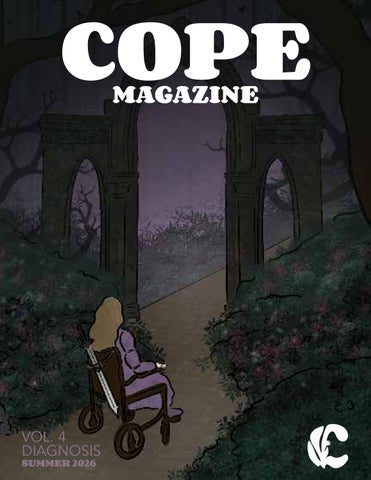
COPE MAGAZINE
VOL. 4 DIAGNOSIS SUMMER 2026
1
editor-in-chief
fiction editor
Liz Zonarich is a graphic designer and illustrator based in Boston. For her, chronic illnesses are personal, motivating her to make a difference. As a graduate of the Master of Science in Media, Medicine, and Health program at Harvard Medical School, she loves to convey health messaging through storytelling and visuals. Her background is in graphic design, public health, and art history. Her favorite ways to cope are mailing letters to friends, reading, illustrating, and rewatching Pride & Prejudice (2005) for the millionth time.
K. Hamilton is a writer, born and raised in Philadelphia, PA. They have a background in English Literature and Education, and has lived with both mental and physical conditions for a large portion of their life. Their favorite ways to cope are gaming, rooting for all Philly sports teams, playing heavy metal too loud, annoying their dogs (Salem and Oreo), and reading.
COPE MAGAZINE is a place for storytelling. Every work published is a creative and personal story, and should not be taken as medical advice.
letter from the editor DEAR READERS, Summer is supposed to be an easy kind of magic; the season that comes prepackaged with bucket lists, sun-soaked laughter, and a good tan as proof you were out living. But for me, the last few years have made summer synonymous with endurance. The season doesn’t just slow me down; it stirs up symptoms, triggers flares, and depletes me both mentally and physically. With a recently new diagnosis added to the mix, my tolerance for an unusually hot summer has been non-existent. Most days, I end up perched by the window looking down at the busy street as people flipflop their way to a sunny hot afternoon adventure. I feel like Rapunzel: stuck in my own ivory tower, compression socks on, and a braid down my back, not because of an evil stepmother, but because of the wicked summer sun. That said, I don’t want to pretend everything’s bleak. There have been bright spots. I’ve just had to work harder than most to find them – to carve out a version of summer that’s actually livable for me. That’s part of why this issue leans darker and moodier than usual. Because honestly, sunshine, beaches, and mermaids are overrated. When I read everyone’s stories, I didn’t picture idealized summer days…I pictured warriors wearily supporting themselves with their swords, damsels choosing rest instead of distress, and witches making their own kind of magic. I’ve always had a weird relationship with fairy tales. Most of them were about “virtuous” characters getting happy, beautiful, healthy endings because they were deemed “good.” And you know who were portrayed as the villains? The disabled characters, often using mobility aids or have “visible” differences, whatever the hell that’s supposed to mean. I recently read Disfigured by Amanda Leduc (which I highly recommend), a book that explores the intersection of disability and fairytales along with her own personal narrative. It inspired me to think about ways to reclaim fairytales to celebrate our own bodies in this issue. What if princesses promenaded with a rollator? What if a lady-in-waiting took the elevator instead of the narrow spiraling stairs? What if the queen used a shower chair as she got ready for the day? What if adventure and laughter lived in the hidden corners of a magical castle that made room for anyone and declared everyone worthy? Imagine if fairy tales put disabled characters at the center of the narrative for reasons other than being haggard or evil? How might that have reshaped the way we saw ourselves? And the way society learned to see and treat us? Would we have grown up with disabled heroes as symbols of resilience, fighting battles that never seem to end? With protagonists worthy of love, not pity? With people who make their own magic, carving out lives that fit their own bodies and needs? And when it comes to diagnosis, maybe that’s the truth we all return to: we’re each living our own tale, learning the plot as we go. With that in mind, I’ll leave you to wander through incredible tales shared by some truly extraordinary creatives in the pages of Volume 4: Diagnosis.
WARMLY,
LIZ
table of contents 10 The Big Reveal by Wendy Kennar
14 Diagnosis Chutes and Ladders by K Hall 16 Notes for the appointment by Stacey Bolter 18 Art is in the eye of the hands by Dana Halliwell 20 One Tic at a Time by Gretchen Gales 24 How to Get Diagnosed with Crohn’s by Marissa Anne 27 Sick by Alex Fendrich 27 Dumb question, Doc by Emma Maravetz Bohman 28 Roller Coaster by Emily Borsetti 32 it was not in ur head, 2025 by Angie Carolina 33 Patient Responsibility by Stephanie Silenti 34 Life, Liberty, and the Pursuit of Healthcare by AG Lonicera 36 22 years by Sam Brogden Payne 38 (Gas)lighting the Path to Diagnosis by Sandra Thom-Jones 42 Into The Blue(s) by Ann Fischer 43 While I Wait For Results of My Spinal MRI by Courtney Edwards 44 My Snowball Fight by Debra Jo Myers 48 A deathless mourning by Cinderspeare 50 Before and After by Denise Schnieders 52 Bald Heads and Capes by Mara Lovelock 54 Point by Anya Thompson 55 “From my rotting body…” by Anya Thompson 56 Once It Begins by Eric Barr 57 The Journey Behind the Label by Sophia Feng 58 antibody image by Hollie Anderson
60 Diagnosis Unwanted by Natalie Harveld 62 Differential by Samantha Lucia 64 The Diagnosis by Glenn Jenkins 66 How Many Diagnoses Can You Fit Into One Body? by Christine Obst 68 Awaiting the Verdict by Louis Faber 69 Waiting Room by ratmilk 70 Your Pain has a Credibility Problem by Sarah Vilela 74 I Persist - Despite, Despite, Despite by Mira Gaitanis 76 Reggie’s Toe by Barbara Boughton 78 The Apathetic Oath by Nathan A. Smith 79 Broken by DJ Dixon 80 ENDO Issue 2: Gaslight, Neglect, Ignore by jelliebabiesart 89 Coloring by Trystan Popish 90 Tell Me When It Feels Sharp by Julia Burns 92 Flares by Ro Stastny 94 An Apple A Day by Makena Metz 95 Suicidal Algebra by Will Falk 96 Gravity by Nathan A. Smith 98 Diagnosis or Curse? by Alycia Corpiel 100 Transfloration collection by Jacelyn Yap 102 Diagnosis by Natasha Abell-Cwietkow 104 Introduction: There’s Something Wrong in my Veins by Kelsey Shirley 108 Resilience to failure- a year (ish) post diagnosis by Zoe Newson 110 You Got Your Color Back by Zoe Schumacher 112 Pain Journal No. 1 by Emma MacLean 116 Diagnosis: What’s the big deal? by Annemarie Jutel 120 Features 138 Contributers
The Big Reveal by Wendy Kennar
The appointment was set for early morning so I could make it to my fourth grade classroom before the school bell. I took this as a good sign. No doctor would deliver heartbreaking news and then expect me to go teach a room full of nine- and ten-year olds. Whatever Dr. W had to tell me couldn’t be that bad. That’s what I kept telling myself, because that’s what I needed to believe. The first time we met with Dr. W, I brought the documentation I had from all my previous appointments and tests. The search for a diagnosis had started with my primary care physician and in over a year’s time, I met with a vascular surgeon, geneticist, neurologist, rheumatologist, and ophthalmologist (because, I was told, certain types of cancers show up in your eyes). Each specialist put me through their own battery of tests in an attempt to determine what was wrong with my left leg. I had slides from my muscle biopsy, as well as reports from my MRIs, CT scans, X-rays, and ultrasounds.
At each appointment, I tried to describe my pain and discomfort — I walked slower because it felt as if invisible weights were attached to me, slowing me down. My leg felt heavy, as if my then-three-year-old son, Ryan, was sitting on it, and it hurt as if a hammer had repeatedly whacked my leg. My left calf often felt hard and tight, as if frozen in a perpetual almost-charley-horse state. My left leg was super sensitive — an errant Frisbee during my students’ P.E. time had me biting my lip and holding back tears.
“I reviewed all the labs and notes from the other doctor visits — everything,” he began.
The longer it took to get answers, the more frightened I became. Surely it, whatever it would eventually be, must be bad if I wasn’t easily diagnosed. I felt like a medical anomaly, a riddle no one could solve, and in the meanwhile, I was having an increasingly difficult time living my life.
We asked questions. How did this happen? Could it have been prevented? Dr. W informed us that no one really knows the how’s and why’s of the disease (like many diseases). Despite being told I now lived with an incurable, life-long illness, we left Dr. W’s office feeling jubilant and grateful. I wasn’t dying, or at least, I wasn’t dying any time soon. It wasn’t cancer or multiple sclerosis or muscular dystrophy, as other doctors had suggested and tested for. In the parking lot, Paul and I hugged tightly, before heading off to work.
Dr. W told us my mystery illness was an autoimmune disease called Undifferentiated Connective Tissue Disease (UCTD). He said the disease had overlapping symptoms of lupus, rheumatoid arthritis, and myositis. I’d get started on medication to treat the symptoms. Because, as Dr. W explained, all you can do with autoimmune diseases is treat the symptoms.
At our first appointment, Dr. W had examined me, asked questions, and ordered more blood work. On Diagnosis Day, Paul and I held hands as we sat in Dr. W’s office, waiting for him to walk in and tell me what was wrong with me. As we waited, I looked around the room, noticing the family photos, “It’s going to be okay,” we said. And we the framed awards and diplomas, and the believed it. bookcases full of books — many written by Dr. W. I walked into school believing I could handle this and everything would be okay. Since Paul reached over and gently kissed me on childhood, I’d been living with asthma. the lips. It was managed with periodic use of my inhaler. Nothing life changing. I thought this “We’re finally going to get some answers,” autoimmune disease would work the same he said. “You’re going to start feeling better.” way. Sitting in that office that morning, I believed That evening, I looked at Ryan with him. appreciation and gratitude. I would be around to watch him grow up. I was hopeful Dr. W walked in slowly, sat down, and got we’d soon be going on our long leisurely down to business. walks again.
11
I truly believed the worst was now behind us. I received a diagnosis and assumed I’d easily learn to live with this chronic condition. I’d take some medication and get better. My condition (I didn’t even refer to it as a disease at first) would just settle in the background of the more important details in my life — my son, my husband, my family, my students.
I chuckled. “I’ve always dared to be different, so I guess this fits.”
But since then, I’ve changed my mind. I don’t want a rare condition most people have never heard of. If I’m destined to live with a chronic medical condition, then I’d prefer it to be familiar; a disease doctors understand and know how to treat. Maybe even a disease with its own awareness month Since then, I’ve learned that a diagnosis isn’t or magnetic ribbon I can attach to my car. the answer. It is merely an answer, a name or label for something that up until that point I wish Paul and I had more time together hadn’t yet been identified. than the quick hug and kiss we shared in the parking lot before we each headed to Many things, in fact, haven’t changed work. I wish we could have taken some time since receiving my diagnosis. I still to celebrate the fact that the mystery of my experience symptoms that no doctor fully illness was solved, while also acknowledging understands. I’m still subjected to a battery we were now in uncharted territory. An of tests, including periodic blood and urine autoimmune disease. Chronic illness. samples to check the long-term effects of Chronic pain. What did we know about any my medications. And I still have a lot of of that? Nothing. unanswered questions. How will the disease progress? Will this overlapping UCTD I wish Paul and I had requested the day off eventually morph into a more distinct disease from our jobs. Just a day to spend together, such as rheumatoid arthritis or lupus? quiet and contemplative, maybe taking a drive down to our favorite beach spot and The worry, the confusion, the frustration, and going for a walk as we held hands and the fear didn’t disappear with a diagnosis. watched the waves steadily rolling up onto the sand. Asking questions out loud — On Diagnosis Day, Dr. W said something that How would this diagnosis impact us on a didn’t fully register at the time. Before we daily basis? Would the insurance cover the left his office he said, “UCTD is rare. No one regular follow-up appointments that would will know what you’re talking about if you now become a part of my schedule? Does say you have UCTD. So, if you want to walk having a diagnosis and taking this specific around and call it ‘The Kennar,’ you can.” medication mean I would start feeling better and the pain would finally go away? We didn’t know it then but a label, a diagnosis, isn’t always the definitive answer we hoped it would be.
SUMMER 2026 | VOL 4
13
Diagnosis Chutes and Ladders by K Hall
Digital Illustration Getting diagnosed can feel like a game of chutes and ladders, sometimes we go “up a ladder” and have a win. Other times we “fall down a chute” and get another set back.
SUMMER 2026 | VOL 4
15
Notes for the appointment by Stacey Bolter
Notes for the appointment Neuropathic pain (too clinical) • Mention mood, mention ^agony and discomfort •
What did I do to deserve these symptoms Cause this agony Worsen my symptoms, What can I do not to Exacerbate the symptoms?
Did I make them worse?
(Ask them to show I’m relentless and receptive) • ^Would it help if I implemented breathing? Yoga and walking? Power posed and screamed into the vacuum? Would it help Could you • Is there help/another I could speak to about the way My body aches until sunset? And wastes away, watching all the versions That I once was Displayed across on my phone screen Laughing with friends Opening bottles, drying eyes, swaying about, sharing moments, living. Is this living now? • Ask about herbal remedies • Book a follow-up
.
17
Art is in the eye of the hands by Dana Halliwell
Photography I have chronic hand pain and the decline happened quickly. I’m still in the process of getting a diagnosis of a rare hand disorder. I’ve always been creative and had many outlets, suddenly I couldn’t draw or even brush my teeth on worse days. I took this collection of photos as a way of finding beauty in my hands again.
SUMMER 2026 | VOL 4
One Tic at a Time by Gretchen Gales
I can begrudgingly thank my ex-boyfriend for one thing: aggravating me enough to lead to my Tourette’s diagnosis. In the spring of 2018, I brought him along to my School of Education practicum ceremony, featuring video footage of all of the candidates. I was nervous, waiting to see if I did “the thing.” Surprise, surprise: I did “the thing,” over and over again. Squirming, shifting, sniffling, snorting, and so much more. I watched the video footage and wanted to disintegrate. As I cried in the car afterwards, he had the audacity to say, “Maybe you have Tourette’s.” I looked up, tears streaming down my eyes and fury in my face. “Seriously? That’s what you have to say about this?” To me, it sounded completely absurd and downright insensitive. It was also not the first time something absurd and unhelpful came from his mouth. But this time, there was evidence. “You know that lady at church that sits near our row? She mentioned you reminded her of her daughter, who has Tourette’s.” “And how is that?” I growled. Nothing about what I was doing could be related to Tourette’s. I would be cursing and shouting. I would be giving innocents the finger. He gave more reasons, including what his mother had observed. She had experience working with children with disabilities. Paranoia gave in. I googled it. The diagnostic criteria was an exact match of my experience. As it turned out, if the body kept the score, mine was screaming.
SUMMER 2026 | VOL 4
I searched through old records, called old doctors. Waited on hold. Explained that yes, I did really need those records from 2004. I knew I had been diagnosed with chronic motor tic disorder. But at no point in time was it explained to me that it was just a version of Tourette’s without verbal tics. As it would turn out, many people diagnosed with Tourette’s and tic disorders in the 90’s and early 00’s were told that they would grow out of their tics. Why? I truly don’t know. Maybe for a sense of hope to parents or for children to simply “push through” their diagnosis. It would eventually disappear. I, like many others, discovered the opposite. Brittany Wolf (@_britneywolf on Instagram), a Tourette Syndrome advocate with Tourette’s herself, wrote on May 16th, 2026 that, “There are MANY adults with Tourette Syndrome as it is a lifelong disorder. But, there are still doctors who don’t think that adults have Tourette Syndrome and/or are telling kids that they’ll grow out of it when that hasn’t been the case for a lot of us—me included.” And so a month after my 22nd birthday, I confirmed with a neurologist specializing in movement disorders what I already knew: I had Tourette’s. Tarot is one of my favorite self-reflection tools. The diagnosis was a juggle between two cards for me: 1. The Tower: The card everyone thinks Death is—a complete dismantling of life as we knew it, removing the false barriers between fantasy and reality, destruction at its core. 2. The Star: The card of hope after all else fails, the one directly after the Tower, the resurrection after a massacre of ego.
21
The diagnosis brought grief and power, clarity and fog, destruction and renewal. It became clear that the medication prescribed to me for my anxiety and tic disorder was waning, and I would need something new. I panicked. Zoloft had lasted 18 years. What if nothing else worked?
because I didn’t know it was an option. I assumed it was up to me to manage and keep private. At first, a simple, “I have Tourette’s” seemed to suffice and brought me some relief, like I was admitting to a crime I did and lifting the guilt off my shoulders. Reactions largely depended on whether the person had manners or a savior complex. It ranged from prayer, to concern, to horror, to laughter, to surprising acceptance. Reactions, too, are like a box of chocolates.
To my relief, the new medication worked wonders. But the maximum I have had for each new medication since seems to range from four to five years. I worry about the final expiration date, if there is an end of options. Sometimes, I simply don’t mention it at all unless it is particularly bad that day or I I fret regularly about how long I will be know I’ll be seeing a person again. I made able to manage it, if it will get worse. If it it a point when I was a high school English gets worse, how worse will it get? Where teacher to introduce myself as having does it stop on the worsening scale? And Tourette’s. I believed it was important for if it kept getting worse, how would I go students to see and understand someone about telling people? I had gone this long with Tourette’s as having a place in the world without an explanation for what I did. without apology. It went well. Sometimes an occasional snicker or joke, but I would It also begs the question of how honest is win them over easily within a few weeks. too honest? Where is the line between more than capable and needing help? I didn’t When I transitioned to special education know how to ask for accommodations. in a middle school, the overall attitude I didn’t know how to express my needs towards disability was different. I felt SUMMER 2026 | VOL 4
that I could not authentically express predicted. I do not know what next week my disability; I was no longer seen as an will bring, especially not what the rest authority, but as a sidekick. In education, of my life will look like. I have the special education role is often seen patterns I can notice and as “lesser” or as a “helper teacher” predict in advance of what than an equal, essential professional may cause me issues. I in the room. I was already at a can only take each day disadvantage, and I felt the need one tic at a time. to suppress my tics to not be seen as a further distraction or a burden in the room. After all, so many of the students I worked with directly already had that burden placed on them. I would spend planning periods in my office in the dark, trying to undo the damage of the bright fluorescent lights and held-in tics. My muscles would hurt and carry the burden for the rest of the day. Only deeptissue massages and yoga could reverse what I had done, but took time to take full effect. My biggest burden still remained: being “othered” and suppressed due to the nature of my role. As I got used to my responsibilities and learned how to manage more of my stress, my tics lessened, but were still there. I wondered what would come next. Through mindfulness practices, I am forced to embrace the “today” and “right now” as opposed to the “what if.” Journaling and reading positive horoscopes reminds me that each day is different.
There is no clean “ending” to this essay, mostly because the dynamic nature of Tourette’s cannot be 23
How to Get Diagnosed with Crohn’s by Marissa Anne
Digital Media (a photo of college ruled paper, Indesign for font, Procreate for digital embellishments) This is a visual hybrid explanation of my story getting diagnosed with Crohn’s Disease and what I learned (trusting myself and my body) from the process. I was really young at the time, and it was my first major chronic illness, so it had a big impact on how I dealt with doctors moving forward. I wanted to put it in sort of a “visual checklist” format on a piece of notebook paper like “here’s all the steps you take,” even though they are obviously specific to my one particular story.
SUMMER 2026 | VOL 4
25
Sick
by Alex Fendrich My final attempt to heal involves a middle-aged man. He’s wearing a white lab coat and oval-shaped glasses, a stethoscope wrapped around his neck like a gold medal. He towers over me while I sit, trying not to crinkle the tissue paper on the exam table. Doc clears his throat. What we found is highly un-us-u-al. We don’t see this type of illness in people like you. We’re going to run the tests again. My face breaks into a smile. I watch as Doc takes a step back, his forehead wrinkling into a fleshy accordion. I begin to laugh. A breathy, slow chuckle at first. Doc shakes his head, and my giggles turn into loud, obnoxious snorts. Then I’m grabbing the edge of the table, unable to contain myself. People like me! Without medical degrees and above-average MCAT scores and citations in medical journals. People like me, who’ve spent hours under the same unflattering LED light, staring at charts that remind us to wash our hands, as if that would solve all our problems! People like me, who await the click-clack of oxfords to stop in front of their exam rooms and dole out life-sentences. Whose bodies are made of proteins that were supposed to go one way, but instead go another. Whose imaging documents molecules that poke holes into our tissues, turning pink and grey matter into blocks of swiss cheese. No. Doc. You don’t have to run another test. People like me know the truth before he does. People like me— we’re medical anomalies. SUMMER 2026 | VOL 4
Dumb question, Doc by Emma Maravetz Bohman
Digital Collage “Dumb question, Doc” is a portrayal of the frustration and anger that comes with the process of getting a diagnosis – or not getting one. Officially getting a diagnosis can take years, and some doctors can outwardly refuse to perform tests that are requested by their patients. In personal experience, trying to get a diagnosis and help have been met with belittlement, sarcastic comments, and disrespect. Being resilient, standing up for yourself, and not taking no for an answer are unfortunately part of the process sometimes. 27
Roller Coaster by Emily Borsetti
“Can I still ride roller coasters?” He looked confused. “Will you be strapped in?” “On a roller coaster?” Now I was the one who looked confused. “Yeah, I’ll be strapped in.” “Then yes, you should be fine.” I received at least four additional guarantees during that appointment with my new epileptologist that I should be fine. Yes, I did just experience two dramatic and damaging tonic-clonic seizures, but I should be fine. Yes, I’ll simply remain on seizure medication prescribed by the hospital staff; I should be fine.
No, nothing is wrong with me; I should sleep punctuated with nosebleeds and be fine. nightmares. When I got older, it somehow got worse. Migraines took me out for Yes, months earlier, when my husband days; I shrank myself into a tiny ball when found me disoriented and paranoid, every inch of my skin was on fire, while my unable to recognize him as I laid on the head threatened to explode, but never floor covered in my own blood, that may did. I almost always wished it would. If it have been a seizure, but really, I should finally burst, would I have less pain? be fine. In high school, nausea and vomiting. On In fact, he said by the end of our 20-minute my first day of school, I ran out of biology appointment, he was sure I was more class, spewing vomit through my hands, than fine; I was just experiencing psycho- right on my new sneakers and maybe a somatic seizures. Was there something few of my classmates. I twisted an ankle going on in my personal life? Have I seen sophomore year; it needed surgery, and a psychologist yet? the recovery became a four-year process. Throughout it all, I was a star student, Like the good patient I was, I simply a camp counselor, a model citizen, an nodded my head and let him know I adorable girl, and then a beautiful young was already seeing a psychiatrist and woman. Therefore, I was fine. therapist. No matter what doctor my mom brought My psychiatrist agreed. Seizures don’t me to, no matter what symptoms I just start happening, you know. It feels described, no matter how hard I tried like these are psycho-somatic. Let’s work to express the absolute exhaustion and on your anxiety. fatigue my body and brain felt, doctors met me with the same diagnosis. I was fine. And like the good patient I was, I simply All to be expected for a girl experiencing accepted the prescription for increased hormonal changes. Zoloft and scheduled my three-month follow-up. In my twenties, I spent the first years on my own health insurance seeking out Here’s the thing — and we all know where migraine specialists, only to receive the this is going right? — I was most definitely same diagnosis. I was fine. In my midnot fine. First, I’ve never been fine or thirties, I was hospitalized three times good or in tip-top shape at any point for consecutive tonic-clonic seizures. My in my life. I’ve always had something: brain literally shut off, my entire nervous Asthma that sent me to the ER as a baby; system malfunctioned, my lips turned allergy attacks that made me look like a blue, my memory gone. Suddenly, I had creature from a horror movie, pale-faced entire chunks of my life missing. I was with dark rings around my eyes; terrible brought to the hospital from work; I had 29
seizures that only stopped when Ativan was administered. I woke up to my mom, then to my husband, trying to speak to to watch me lose the ability to breathe, me. I couldn’t respond. And not once but because he had to do it twice that was I anything other than fine. day. He had already called the ambulance to our house earlier that morning. I fell “Yes, obviously she had a terrible fall, in the bathroom, started seizing against and she doesn’t remember anything at the door, trapping myself inside, with the moment, but overall, she’s fine.” him unable to help. He could only watch through a small crack and pray I didn’t “No, we don’t know why this happened, hurt myself too much. nothing showed up on her EEG, MRI, CT scan, EKG and bloodwork. She’s fine.” He explained all this to my doctor, who visited my hospital bed for 20 minutes, And like the good patient I was, stuck only to be told that the problem lies with in a haze in a hospital bed with needles me. Grown women are not diagnosed and monitors, pumped with medication, with epilepsy late in life. The video proves I accepted it. nothing. The symptoms, the diligent tracking of triggers, the repetitive seizures It was during my third hospitalization that mean nothing. “She’s fine,” my doctor my husband showed my epileptologist— said. the one who asked if I would be strapped in on a roller coaster—a video of me While he said that, another doctor in the during a seizure. With the true diligence room, a female cardiologist, whispered of a caretaker, that man stood over me to me, “I’m 36 and was just diagnosed while he watched my brain and body with epilepsy. Keep going.” snap, and recorded me. It’s not an easy task to actually do that. And like the good patient I am, I did. I left the hospital already googling Not only because I thrash and my more specialists—OK, I wasn’t actually extremities seize, not only because he has googling yet, because I can’t function for days after seizures, but you get what I mean. I kept going.
SUMMER 2026 | VOL 4
You know that build-up that happens before a doctor’s appointment? I think we all experience it, but the feelings for each of us vary. For me, it was always anticipation before an appointment. I would wait so long to see someone, my anticipation growing the entire time. Would this be the doctor who understood me? The one who listened to my symptoms, ran tests, and found something? I needed, now more than ever, someone to agree with me; to the intense déjà vu I experienced, she understand that I wasn’t fine. nodded along knowingly, all while typing and asking for more. Like the good patient I am, I arrived early to my next appointment, with my Which side of your body do you experience paperwork already completed, a printed that numbness? Ever experience a rollerlist of symptoms since childhood, an coaster sensation in your stomach? Do accompanying list of neurologists I had you get suddenly angry or confused? How seen, my recent hospital records and does this change during menstruation? one recorded seizure. I first met with the epileptologist’s nurse practitioner who Question after question. It was more spoke with me for an hour and a half. I than caring; it was understanding. And never experienced anything like this—all when that doctor walked in the room and my appointments, all the doctors I’ve ever shook my hand, do you know what his seen, none of them ever wanted so much first words were? detail. Not only that, but when I tried to describe my increasingly growing list of “Emily, I want you to know you’re not fine. strange symptoms, she didn’t dismiss me You have epilepsy. You probably always as hormonal. When I tried to describe had it, and we’re here to help.” Like the good patient I am, I exhaled so I wouldn’t cry, and thanked him.
31
it was not in ur head, 2025 by Angie Carolina
Fabric and Cross-stitch This piece was actually stitched and sewn right after having received my diagnosis. It took 5 years to get diagnosed and countless disappointing doctor’s visits that discredited what I was experiencing. I felt nothing but immense relief to know that the past 5 years were not actually just in my head.
Patient Responsibility by Stephanie Silenti
Diagnosed with a heaping side of You may need to leave your job. a beat a scoff of disbelief You have to prioritize your health they say. As if that job isn’t the source of the health insurance that pays for the prescriptions they just wrote. As if that job doesn’t pay the bills for these very appointments that tomorrow insurance will deny. You may need to leave your job they say again. As if I’m not already doing the stress math. As if taking care of your health in this country won’t cost you everything else. As if this country wants us to be well and healthy and free.
33
Life, Liberty, and the Pursuit of Healthcare by AG Lonicera
In my life I have seen many, many doctors. I’ve only been taken seriously by two. Which is why it took nearly two years for me to get diagnosed with fibromyalgia. It is almost comical that Fibro Awareness Day, May 12th, happened to be the same day this month I took my life-saving migraine injection. But that is another story for another time, my friends. I only have so much space. The Past I’m not exaggerating when I say that grad school gave me a neurological disorder. It certainly triggered what was lying in wait for me, like a very clear trap that I walked into like an idiot who acted like my health insurance coverage would last forever. Like most of my stories, it starts with a headache. Literally. When I went to Scotland for grad school, I had hoped I left my cluster headaches, migraines, and persistent headache disorder behind. But alas, it travelled with me across the Atlantic. I didn’t have access to my beloved Emgality injection. Which meant that by November 2024, I had at least one type of headache every single day. There is only so much an extension can do to make school with chronic pain any easier. So off to the NHS doctor I went. Where, unbeknownst to me, I was prescribed an SSRI for my headaches. A medication that isn’t made in the US and I am absolutely not supposed to take. This, the stress of school, no access to good counseling, and the anxiety of watching my community suffer through the beginning of the second Trump term from afar settled into my body. I genuinely believe something about last winter broke me. I went from walking miles every day to not making it from my bed to my desk. I kept re-spraining old injuries. The headaches barely went away, but then more and more brain
fog rolled in. Shooting pain whipped up and down my legs and into my hips. I’d wake up all night on fire. I’d have to get up, stretch for ten minutes, and swallow down ibuprofen if I wanted a chance at falling back asleep. Every step felt like I had weights strapped to my legs.
magical treatment that will make it all go away. I feel this weird disability imposter syndrome. It’s an artifact from my early migraine/cluster/ headache days. I have good days, so I shouldn’t complain. I can still walk, even when it’s hard. No, I don’t need to pursue mobility aids because ‘I’m not disabled enough’. And sure, I know those are bad thoughts haunting But, like so many of us with chronic pain, I me like phantoms. But they’re still there. tried to push through. I’ll keep the lights on, maybe that will scare The Present them away. I still wake up in the middle of the night, but now I know why. My rheumatologist (and new best friend, although he doesn’t know that last bit) and I went through the gamut of testing for every autoimmune disease under the sun. Fibromyalgia is found through a ‘ruling out’ system. Therefore, on April 29th, I was officially diagnosed with fibromyalgia. It’s a pretty sinister deal, all things considered. It’s neurological, yet still lives in the world of autoimmune illnesses. It could be caused by trauma or triggered by stress. But all in all, the easiest way to describe it is my nervous system is the wild west. Pain is amped up and placed where there isn’t a tangible cause. But the pain and the extreme fatigue are still there and very real.
The Future I want to say I am hoping for the best. And I think I am.
But I am also exhausted. I’m tired of being tired; of bracing for each new step. I want to throw a tantrum and lock myself in my room and make the world wait for me to feel better. Because it isn’t fair. It sucks and it’s really, unbearably hard some days. But then there are days that are beautiful and pain-free where, for a moment, I forget how I might feel tomorrow. But that’s the thing about chronic pain, isn’t it? It forces folks living with it to slow down. To give ourselves grace that we may not have before. If anything good can come out of this, I think it has made me learn exactly Against all odds, I secured a job with health who I am. I know what I can handle and it’s insurance a month before I’ll be kicked off my more than I thought before. I am gentler with family’s plan. I spent eight months sending myself now. I go slow. I take breaks. cover letter after cover letter, hoping for work. But honestly? I was just grasping for the care When I began this essay, I wanted to be I need. I took a job in a field I hate just so I more poetic. I wanted to make my words feel can go to the doctor and get the medication I beautiful, but it didn’t come out right. But require to live. It was heartbreaking to realize none of this is beautiful, I guess. At least not that so many of us have to give up so much of to me. It’s all raw and harsh and painful. I don’t ourselves just for the care that should be free know if I could or should even try to dress it up and accessible to everyone. with imagery, at least not for this essay. I guess what I hope comes out of this is that anyone My friend told me that a diagnosis is the worst out there with any type of chronic illness, pain, type of relief and I have to agree. It doesn’t or disability feels a little less alone. And maybe really change much. There isn’t a cure or through writing this, I can as well.
35
22 years
by Sam Brogden Payne
Collage, watercolor, colored pencil My preschool teacher caught that something was wrong when I couldn’t lift a cup of water at age 4, but I wasn’t diagnosed with Ehlers-Danlos Syndrome until I was 26. 22 years isn’t just my diagnostic delay, it’s the average delay for people with hEDS. This work is an attempt to represent the deep rage I feel not only about my own story, but about the hundreds of others just like it.
(Gas)lighting the Path to Diagnosis by Sandra Thom-Jones
2002 I had always suffered from headaches. From the time I was a child my life had been punctuated by headaches. Migraines, tension headaches, just regular old school ‘headaches’. But these were different. A severe, throbbing headache that I woke up with every morning. Moving made the symptoms worse, and coughing, sneezing or bending forward made my head feel like it would split open. I went to the doctor, trying to articulate both my pain and my fear. Something was wrong. The doctor looked at me, in the way that doctors look at you when they have already decided that you are a hypochondriac, and pronounced that “It’s probably a migraine.” I explained that I had experienced migraines since I was a teenager, and my migraines didn’t feel like this. After unsuccessfully trying to persuade me that it was an ‘atypical migraine’, he concluded that it was probably just stress. I should drink more water and find ways to relax. The headaches continued, increasing in both frequency and intensity. I went back to the doctor. He suggested I try meditation, lying in a dark room, deep breathing. After the third visit, when he offered me a referral to a psychologist, I stopped going back. Then, I started to lose my eyesight. The optometrist referred me to an ophthalmologist. After doing all of the usual tests of my eyesight, including one where I had to stare into a machine and click buttons every time I saw a flashing light in my peripheral
vision (a test which I apparently failed badly), he looked into the back of my eyes with a bright light. With a gentle, concerned voice he explained to me that there was something unusual behind my eyes and that he was referring me for a CT scan. I said that I was about to fly to Perth the next day to visit my family and I would take care of it when I returned in two weeks. He said this wasn’t an option and he was getting me in to have the scan the following morning. Suddenly I had gone from a hypochondriac who was imagining my headaches to someone who wasn’t allowed to get on a plane. The following afternoon I was back in the ophthalmologist’s office. Fortunately, the CT scan had shown that it was not a brain tumour (which was apparently the worst-case scenario that he had feared). However, he suspected that it was a condition called idiopathic intracranial hypertension, an excess of cerebrospinal fluid that causes pressure around the brain. The ophthalmologist referred me to a neurologist, who is apparently the specialist that can diagnose and treat this condition. Five days later, I was sitting across the desk from a neurologist. He did not have the concerned voice or gentle manner of the ophthalmologist. On the contrary, he made it very clear he did not think it at all likely that I had intracranial hypertension as, in his view, I didn’t fit the ‘patient profile’. Given that the condition, although rare, is associated with being female, aged 20-45, and overweight, this seemed to be based solely on the fact that I was (at the time) underweight for my height. He explained to me that the diagnostic test for this condition was a lumbar puncture, not something any of us would choose to undergo unnecessarily, but the only way of making a definitive diagnosis. I suggested that since he was so sure that wasn’t what it was, perhaps we could skip the lumbar puncture
altogether. However, he said that since the ophthalmologist had suggested it, he felt obligated to go ahead with the test. He was so sceptical, in fact, that on the referral form he explicitly wrote “ophthalmologist suspects IIH, but I don’t think so.” The lumbar puncture was as horrible as I had anticipated it would be, and I felt dreadful for 48 hours afterwards. However, much to my surprise, by the third day I felt pretty good. In fact, for the first time in almost a year I didn’t have a headache. A week later, I was sitting across the desk from the neurologist as he shuffled through his notes. He looked up at me and said, “I suppose you’re going to tell me that your headaches have gone now?” I replied, quite delighted, that in fact it had. He explained that the test had conclusively proven that I did indeed have intracranial hypertension. There was no apology in his tone. No sympathy. Just irritation that my reality contradicted his perceptions. He went through my treatment options with me; a lifetime of medication or surgery (a shunt or a stent in my brain). For those who are wondering, I went with the medication and regular checks with the ophthalmologist. 2010 I couldn’t say exactly when I first noticed that the pain in my stomach had become a regular fixture in my life. A pain that escalated in intensity with the consumption of even the smallest amount of food. For a while, I put it down to ‘something I ate’ or ‘a bug that’s going around’ but at some point, I realised that this had been going on for several months and was impacting my life. I started documenting my symptoms in preparation for the questions I expected the doctor to ask. I went to see the doctor, armed with my detailed notes listing the frequency, extent, duration and precursors to the pain (and
39
with my husband for moral and practical support). The doctor listened, asked a few questions, diagnosed indigestion, and wrote down the names of some over-the-counter antacids. I tried to explain that we had tried that approach; that the pain was intense, debilitating, and impacting my ability to eat. She looked at me and smiled, explaining that pain medication was likely to make my symptoms worse. I wasn’t looking for pain medication. I was looking for a diagnosis. Over the next four years, I was a frequent visitor to the medical practice, seeing a variety of different doctors who came and went, and being offered a range of different medications for ‘indigestion’. Some of them even did a cursory physical examination, pressing on my stomach and looking at me sceptically when I squealed in pain. I also lost one-fifth of my body weight, earning compliments from colleagues and increasing concern from my family. I began to internalise the not-so-subtle inference from the string of doctors I had seen that I was a hypochondriac and was imagining the pain. Then, in 2014 during a celebration at work, I collapsed in the office kitchen, the pain in my stomach so overwhelming that I could not stand. I could barely breathe. As I lay there, I had flashbacks to 10-year-old me complaining for months of abdominal pain that the doctors kept telling my parents was ‘school anxiety’ until I collapsed on the floor and was rushed to the hospital, where they diagnosed nephritis and warned my parents of likely kidney damage.
with acute pancreatitis, and another four weeks recovering at home. Over the next year, I had three more attacks, countless blood tests and exploratory surgeries, and spent more time in bed than at work. I also received repeated lectures on how to reduce my risk of recurrences: cut down on alcohol consumption (I don’t drink alcohol), cut down on red meat (I am a vegetarian), cut down on take-out foods (I don’t eat take-out). Another year and two more acute attacks later, they finally diagnosed idiopathic chronic pancreatitis, and concluded that the acute episodes – along with the resulting damage to my pancreas and liver – were the result of me ‘ignoring’ my symptoms for such a long time. I am now on a very carefully controlled diet, a regimen of pancreatic enzymes, and a range of other medications to control flare-ups. Since that time, I have been diagnosed with several other medical conditions, each with clear clinical markers, and each taking several years from onset to diagnosis. Throughout this journey I have experienced constant dismissal, disregard, and disrespect from the medical system. I am a woman, and I am autistic, so my capacity to understand my own experience is inherently suspect. Each diagnosis has finally arisen following a medical crisis brought on by the cumulative impact; each delayed diagnosis has resulted in systemic damage to my body, to my emotional wellbeing, and to my self-confidence. I do not know whether all these diagnoses are connected by some underlying systemic condition, but I am increasingly reluctant to engage with the medical system to ask that question.
Forty years later, not much has changed. For the first time, the doctor took my ‘stomach ache’ seriously, ordering urgent blood tests and sending me to the hospital when the The path to diagnosis winds through the hazy results came in. I spent two weeks in hospital glow of a thousand gaslights.
SUMMER 2026 | VOL 4
Into the Blue(s) by Ann Fischer Photography (Intentional Camera Movement) For the last few years, I’ve been drawn to figures that are alone in one way or another. I’ve been lucky enough to have most (not all) of the people in my life support me in various ways since my diagnosis (ME/CFS) but I still feel very much alone in this new version of my life. I think this photo speaks to that feeling. And of course the colour blue is symbolic of ‘the blues.’
While I Wait for My Spinal MRI Results by Courtney Edwards
Let me hold last year’s dandelions, squished in my six-year-old’s hands. Let me pick the damp Oregon grass at my ten-year-old’s soccer game. Let me feel those two soft pats— my toddler’s dimpled hands on my back. And with every stinging IV syringe, let me feel my husband’s hand in mine on a Seaside-Daisied drive. The nurse whispers lo siento for another burning blood-draw, and I pluck memories with rushed exactness as paralysis grasps more skin—in this hospital room, barren as the beige Sonoran. Even after I am numb, will I still recall the warm cheek of her pumpkin-patch sunflower, his glacial fireweed, my snow bridal roses, our Northwest trillium? Outside, papel picado flitter geometrically above tiendas in every shade of celebration: marigold, poppy, iris, fuchsia– I recall every color. I wish I could touch
each one.
43
My Snowball Fight by Debra Jo Myers
“Life is what happens while you are busy making other plans.” -John Lennon Like the lacy ice crystals that branch out to form a flake of snow, a disease is splintering into fragments inside me creating my snowflake. They are unique, mesmerizing, stunning, and beautiful. I am a snowflake now, but I certainly don’t feel like I fit any of those descriptors. They’re nature’s artistry. It began on a day I will never forget. You know those days. Graduation day, your wedding day, the day your child is born. But it wasn’t a day like that. Everything changed for me that day. It was in February, when all it did was snow. The woman I worked hard to become melted away. Suddenly, there was a sharp pain in the middle of my back that felt like I was being stabbed with a knife. I’ve never actually been stabbed, but that had to be what it felt like. When I started to stand up, my right foot was numb. I still wonder what would have happened if I hadn’t made the choice to stop at an urgent care facility before work. That doctor sent me to the local hospital for a CAT scan, blood work, and x-rays. Nothing was conclusive, so they moved me to a bigger
SUMMER 2026 | VOL 4
hospital. Fear built up inside of me when to progress, but we will try to manage your the ER doctor insisted I go by ambulance. condition.” Was this an emergency?! I couldn’t get words to come out of my After waiting twelve hours in another ER, mouth. No cure? Progress? Isn’t it the they took me for an MRI that revealed a disease that puts you in a wheelchair? large tumor on my spine that led to a spinal No one in my family had this. Then I tap. I begged anyone and everyone to tell remembered Papa. Most of my life, I me what was happening. The nurses said remember his hands and feet were curled. I had to wait for the neurologist. A nerve He couldn’t hold a spoon or wear shoes. doctor, of course, that made sense. I was a He wouldn’t go to the doctor. Maybe Papa nervous wreck. had MS. We won’t ever know. I had butterflies when I saw the doctor with his round glasses and clipboard coming into the room. I already knew there was something terribly wrong. He had the worst bedside manner. He looked at me stone-faced when he just spewed it out. I had a mass of inflammation on my spinal cord. My nervous system was attacking itself. The myelin on the nerve endings was being eaten away by the disease, causing the nerves to splinter sending mixed signals from my brain to the rest of my body. He compared it to spark plugs in a car fizzling out. The mass was clouding my spinal cord, so the extent of the damage wouldn’t be known for weeks until it cleared. “It’s Primary Progressive Multiple Sclerosis (PPMS), the worst kind. We don’t know what causes it. Could be hereditary. Looking at your body scans, I’d say you’ve had it for decades. There is no cure. It will continue
The doctor said I’ve had this monster inside my body for decades and didn’t even know it! I’d rather not have known it. I asked more questions. Was there treatment or medication to slow it down? Can I return to work? Would the feeling come back in my foot? Each time he answered no. “MS patients are snowflakes. None alike. There are no specific treatments that work for every patient. Millions live with it.” I had no idea. At fifty-two, and in my lifetime, I knew no one who had MS. I left there and for days, I didn’t want to get out of bed because it meant I had to face my new reality; this snowstorm that churned inside me. I thought, “Who cares if I get up or how I look?” No one was coming over. I had nowhere to go. I suddenly felt self-conscious and lost self-esteem when I used to ooze it. I couldn’t look at myself as attractive and forget feeling sexy. I used to 45
like me, my body, and my energy. All of that blew away like the snow. I looked in the mirror. I looked the same. No one would know anything was wrong with me. “Life is a journey that must be traveled no matter how bad the roads and accommodations.” -Oliver Goldsmith Who wants to spend the rest of their days with someone who’s sitting down? As many times as my sweet husband told me how much he loved me no matter what, I was aware this was the ‘no matter what’ part. He couldn’t have expected something this drastic. Now I wouldn’t be able to walk more than ten feet. I used to cook, clean, and shop. Now my husband would have to do all of that for me. It wasn’t fair to him. It wasn’t what he’d signed on for. Missing who I was, I spiraled into five steps of grief. Denial, then anger, and then bargaining. I got stuck on number four–depression. I began avoiding leaving the house or talking to anyone. I genuinely wanted to be invisible. I couldn’t move on to number five. Acceptance. This condition was not one I thought I could ever accept, not completely. “Multiple Sclerosis is the worst tattoo, because you’re stuck with it forever, but no one can see it to admire it.” -Christina Applegate I wondered how people would treat me. As I shared the news with family, they were sympathetic. My adult children preferred to keep our relationships the same as they were pre-MS. I liked that approach. My oldest daughter told me not to expect her to look at me any differently. She reminded me of what I’d overcome in the past and said I was too motivated to sit back and let this come at me without fighting it. In her always humorous way, she said “You, a snowflake? You can’t be because I hate snow. And I love you.” Friends had no idea what PPMS was. I didn’t seem any different to them, and I felt like they doubted me. I became accustomed to telling everyone who asked that I was feeling fine, whatever fine means, when I usually wasn’t. Strangers looked at me and didn’t see it at all. A man asked me who I bribed to get a handicap license plate. I burst into tears. It happened again when a friend said it must not be that bad, because I didn’t look like I was sick. “You’ve got a good husband and family to be grateful for,” “Be happy it wasn’t worse,”
SUMMER 2026 | VOL 4
or “God has blessed you with a new path to follow.” Honestly, none of it helped. When I woke up every morning, I wasn’t thinking about being blessed; I was thinking I had an incurable disease. A year after my diagnosis, my husband insisted we find another neurologist. He didn’t feel like the one we had was invested in helping me. It was the best choice we made. My new doctor put together a cocktail of medications to relieve my pain, calm my nerves, and slow my progression significantly. She didn’t just manage my condition, she gave me her time, and gave me hope. I reported the neurologist who first treated me to his superiors. After the year I went through with him, I had to warn others that he hadn’t given me compassion or respect. He didn’t listen when I tried to explain what I was experiencing from the medication he put me on. He never fully explained my test results, and my appointments with him lasted fifteen minutes at the most. The first drugs he had given me caused horrible side effects causing me sixty days of detoxification while my symptoms and pain grew. There could be dozens of his patients, like me, who had the same experience. “In times of drastic change, it is the learners who inherit the future.” -Eric Hoffer I was being called a survivor, strong, and brave. I wish I could have seen myself in that way. When I felt overwhelmed remembering who I used to be, I began trying to pack all of those feelings into an internal snowball and throw it as far as I could. I couldn’t jump on the trampoline, ride the roller coaster, or play basketball with my grandkids. But they found ways we could have fun together: rejuvenating old board games, painting funny pictures, watching movies, and telling them the stories of my childhood. And yes, I told them about this monster inside of me so they could understand. They range in age from 3-23. The message they all got is that ‘Nana’ is different, but still ‘Nana.’ My broken body, my disease. Mine. I try to remember all I’ve done, put away what I can’t do anymore, and focus on what I can do now. I had to find a way to start again. I had to dig deep for resilience and let go of my fear. No longer am I a melting snowflake, but a strong one that can emerge and survive any snowstorm. In my writing, I’ve found an outlet and a purpose. And anytime I feel my snowflake falling, I gather more like me. Snowflakes don’t have to be invisible and won’t be if they’re packed together. Let it snow, and we can have a snowball fight together!
47
A deathless mourning by Cinderspeare
Digital art made with the IBIS paint app In this piece, I tried to show how the child I was before my diagnosis is held in a higher regard or more nostalgic light than who I am now. The picture of me as a young girl is prominent, highlighted by shining light, while the current me is in a hospital bed in the dark beneath it. It’s sad to know that my family misses that girl more than they want to help me. They want that girl back, but I will never be that girl again because my disability has changed my life.
SUMMER 2026 | VOL 4
Before and After by Denise Schnieders
There is a version of me that existed before diagnosis. She exists almost like a distant relative now. Familiar enough that I recognize her immediately, but far enough away that I sometimes wonder if I imagined her entirely. Before multiple sclerosis, life moved in a straight line. Not an easy line, not a perfect line, but one that made sense. You grow up. You make plans. You become things. Teacher. Wife. Mother. Coach. Friend. You assume your body is a silent partner in all of it. You do not wake up every morning negotiating with it. Then one day, without permission, your life splits cleanly in two. Before. After. People talk about diagnosis like it is a moment, but it is not. It is a demolition followed by a slow reconstruction while everyone around you continues living as though the building is still standing. I remember the strange numbness of those early days after hearing the words multiple sclerosis. It felt almost inappropriate that the world continued moving. People laughed in waiting rooms. Traffic lights changed. Grocery stores restocked shelves. Somewhere, someone worried about what to make for dinner while I sat there trying to understand how my own immune system had declared war on me. The hardest part was not even fear. Fear is obvious. Fear announces itself loudly. The hardest part was grief. Grief for a person who was technically still alive. No one prepares you for that kind of mourning. You grieve the body you trusted. You grieve spontaneity. You grieve certainty. You grieve the version of yourself
SUMMER 2026 | VOL 4
who made plans without calculating energy More compassionate. expenditure, weather, stress, sleep, infection risk, recovery time, or whether your legs would Less careless with time. cooperate that day. Less impressed by superficial things. And yet, oddly enough, you also grieve innocence. More honest. Before diagnosis, I believed hard work could solve almost anything. Push harder. Stay positive. Get organized. Be resilient. Chronic illness humbles that thinking quickly. Sometimes your body does not care how motivated you are. Sometimes determination does not stop lesions. Sometimes rest is the bravest thing you accomplish all day.
Before diagnosis, I thought courage looked loud. I thought brave people were fearless people. After diagnosis, I learned courage is often quiet. It looks like taking medication you are terrified of. Showing up anyway.
There is also an invisible loneliness that arrives after diagnosis. Relearning your body. People often think support means saying, “You’re Starting over repeatedly. so strong,” but strength can become its own prison. The stronger people believe you are, the Laughing during neurology appointments. less permission you have to fall apart honestly. Planning for the future while simultaneously So you become fluent in performing wellness. understanding nothing is guaranteed. “I’m okay.” “Just tired.”
It looks like building a meaningful life inside uncertainty instead of waiting for certainty to arrive.
“It’s not too bad.”
I still miss the girl from “before” sometimes. I miss the ease she carried. I miss the assumption Meanwhile, you are privately recalculating your that tomorrow would cooperate with her plans. entire life. But I also respect the woman from “after.” I think that is when the “before” version of me finally disappeared. Not during diagnosis. She survived the moment life split in two and Not during MRIs. Not during medications or kept going anyway. appointments. She disappeared the moment I realized I could never unknow what vulnerability And maybe that is what diagnosis really does. It feels like. introduces you to a version of yourself you never planned to meet. Once you understand that health is temporary, you move through the world differently. Not the untouched version. But here is the complicated truth no one tells you: The tested one. the “after” version of yourself is not only loss. The one who learns that a life can break apart She is more aware. and still remain beautiful.
51
Bald Heads and Capes by Mara Lovelock I made the mistake of googling it most deadly form 5-10 years the heavy words settled to the bottom of my stomach I am no longer afraid of death but it feels particularly cruel to have to leave my son without a mother The Buddha says life is suffering You suffer more than some, my husband says Maybe that means I’m close to enlightenment! I say I tell him I want him to move on he says, Don’t worry about me I can go on The Golden Bachelor he has jokes, too We start to tell our friends, family my mother-in-law wails we DoorDash Coldstone and play the Nintendo Switch he bought to distract us I buy my two-year-old children’s books about mommies that fight cancer with bald heads and capes
SUMMER 2026 | VOL 4
I finally get in to see the oncologist you aren’t going anywhere, he says glibly In the hall my husband breaks down sobbing falls into my arms while I stare at the vitals station I drive around devouring the formative albums of my youth Blood on the Tracks Blue Album Jagged Little Pill– bidding farewell We plan a wildflower hike but end up in urgent care for our son’s first asthma attack Juggling second opinions insurance inanity and finding any preschool without a waitlist for our soon to be childcareless child eats away at our life as we know it Procedures loom: PET Scan Bone Marrow Biopsy Endoscopy Double Port Placement I’m told of chimeric monoclonal antibodies– foreign mouse juice to administer with the chemo that will save my life
and likely leave me with kidney damage infertility heart problems some other cancer I will have sores in my mouth red urine sensitive eyes bone pain and obviously vomiting and hair loss– though people keep saying chemo is not as bad as it used to be The biopsies and tests reveal Stage IV 33% of my body is not mine lymph nodes stomach spleen bone marrow all under attack I have to choose between chemo lite or chemo–oh-that-kind-of-chemo– the kind that will take me to the brink and back but will give me more time before I have to do this all over again Meanwhile the bottle brush blooms blood red the hawks circle we take our son to buy his first backpack
53
Point
by Anya Thompson
Ceramic and acrylic paint As part of my EDS and hypermobility disorder, I’ve had chronic foot pain for a huge portion of my life. The idea of feet flexing to the point of being beautiful but still cognizant of the pain and brutality of trying to achieve that beauty is a concept I have always connected to myself.
SUMMER 2026 | VOL 4
“From my rotting body…” by Anya Thompson
Oil paint and mixed media on canvas This work is named for the Edvard Munch quote: “From my rotting body, flowers shall grow and I am in them, and that is eternity.” My childhood was filled with bloodwork, getting poked and prodded to try to figure out what was wrong with me. Coupled with being diagnosed with OCD and intense intrusive thoughts, this work is not just a singular expression of my body. For me, as the answers have come clearer with a diagnosis, this work has helped me see the beauty in my pain. My chronic pain is valid and something that is always there. My rotting body, but there is always good that grows from the decay. 55
Once It Begins by Eric Barr
By age fifty, I’d never seen an emergency room. No stitches, no broken bones; I still had my tonsils and my appendix. My identity was built upon this “medical virginity.” At age fifty-two, I lost it to a bicycle. A sharp corner, a slide, and suddenly I was sprawled on the pavement. When I gathered the courage to look, my right foot was hanging off my leg, pointing in the wrong direction. As the EMTs loaded me onto the gurney, one remarked, “You’ll need surgery to get both feet pointing the same way.” I can’t, I thought. I knew a broken leg wouldn’t kill me, but I feared this first intervention would be the beginning of my undoing. Ten years later, my doctor confirmed it. A congenital heart defect finally caught up with me. My heart’s steady “lub-dub” had become a serious “lub-dub-squish.” “It’s time to fix your leaky heart valve. It’s dangerous for a man your age. You need surgery before it’s too late.” “I don’t want heart surgery,” I said. “It’s not what you want,” he replied. “It’s what you need. Now.” I was immediately scheduled for open heart surgery to replace my aortic valve. After the surgery the surgeon said, “Lucky we got there in time. You had an aneurism on your aorta; it was ready to blow. That would have been the end of you. So, we’ve replaced the valve and patched your aorta.” I knew it. Once they cut me open to fix my leg, my interior balance had been disrupted and, from then on, it was going to be surgeons wanting to put their hands inside me until I was dead or there was nothing left to fix. One year later, it was discovered that I had developed a life-threatening infection on the new heart valve. A piece of the infection broke off, went to my brain, and caused a stroke. From then on, I would be in hospitals and doctors’ offices almost every day until the end of my life for check-ups, evaluations, and testing. Two years later, after I was fully recovered, I saw my cardiologist. He walked into my room with a fat file. Smiling, he said, “Finally. I think we made it. Everything looks good. They have done every test on you, except for an autopsy.”
SUMMER 2026 | VOL 4
The Journey Behind by Sophia Feng
Grief. Burden. How I felt Regarding my New diagnosis. “Rheumatic Heart Disease.” A label I did not want. Showing a brave face despite pain, I felt alone and invisible. Unsure of the ways my future would change. Figured out how to balance life with illness: Appointments, medications, new limitations, Things that I thought I would never have to consider. But what struck me the most, was the lack of support networks. Everywhere that I looked, I saw only medical jargon. And that made me want to reject my diagnosis more. Then, symptoms worsened, but I began to realize, That I had the power to change my narrative. I began to work with my chronic illness, Instead of trying to work against it. I got involved with advocacy, and was able to find support. It was easier to talk About diagnosis. With time, I had learned: That with illness, We always Fight with Strength.
57
antibody image by Hollie Anderson
clay and paint on wood panel In this series, Anderson paints interpretations of antibodies associated with recent diagnoses to study the process of psychological healing and acceptance, along with an attempt to find physical strength through the art-making process. As rheumatoid arthritis made grasping a paintbrush increasingly difficult, these works were created using her hands rather than traditional tools. This adaptation became an embodied act of negotiating a changing relationship with her body, as well as an effort to accept new limitations and possibilities within artistic practice. Through this process, the paintings reflect her experience and ongoing work of living with chronic illness where grief, resilience, and adaptation coexist.
TPO
RF
TGO 59
Diagnosis Unwanted by Natalie Harveld
When I first heard the words post-traumatic stress disorder, I remember thinking: that’s impossible. PTSD belonged to soldiers, to war zones, to things dramatic enough to justify the acronym. I felt almost embarrassed by it, as though I had somehow failed a threshold of suffering required to deserve the diagnosis. My immediate reaction was disbelief followed very quickly by shame. “Great,” I thought, “Now I’m officially broken. People will think I’m weak, unstable, attention-seeking. Worse, they just might not believe me at all.” The diagnosis itself came quickly because I was considered high risk, so in many ways I was fortunate. There were appointments, assessments, and conversations that forced me to articulate things I was trying to suppress and minimise. The speed of the process was helpful practically, but emotionally it still felt destabilising. Having something formally titled made it feel more real. Therefore at first, I resisted the label intensely. I didn’t want it attached to me. I worried it would change how people perceived me, or even how I perceived myself. Over time, though, my feelings towards it shifted. I realised the diagnosis itself hadn’t changed me at all; it had simply given language to experiences already happening inside my body and mind. The panic, hyper-vigilance, exhaustion, intrusive thoughts: they existed before anyone wrote them down. One of the hardest parts was my relationship with my body afterwards. I understood, intellectually, that my nervous system was responding to trauma, but emotionally I felt angry at my body for reacting the way it did. It felt unpredictable and unsafe to inhabit at times. The diagnosis brought understanding, but not immediate peace. What helped most was access to appropriate therapy. Once I understood what PTSD actually was, I became better able to recognise triggers, understand my responses, and develop ways to support myself rather than simply fearing what was happening. The diagnosis gave shape to something chaotic. I still carry shame about it sometimes, which is probably why I haven’t found much of a community around the diagnosis itself, but I have become more passionate about helping others feel less isolated by theirs. I think one of the most important things I would want recently diagnosed people to know is that you do not owe your diagnosis to anyone. You do not have to disclose it publicly or reshape your identity around it. A diagnosis does not alter your worth, your personality, or the reality of who you already were before hearing the words. I appreciate that for many people, a diagnosis can feel validating or relieving. For me, though, it has mainly been unwanted, and if you do feel the same, just know that I no longer see it as something that diminishes me, and hopefully you too will come to learn that your diagnosis will never diminish you.
Differential by Samantha Lucia
Photography with chromatic aberration and film grain. Years in the corridor. The body knows but is not believed. The dismissal accumulates until it bends the light, until your own perception begins to refract. This is the delirium they hand you in place of a diagnosis.
SUMMER 2026 | VOL 4
The Diagnosis by Glenn Jenkins
Diagnosis was like a carnival ride. When I first heard it, I was nineteen in prison. I was acting strangely. I was screaming about a pillow. I was taken to medical, wherefrom, I was taken to a hospital. A correctional officer kept poking fun at me. I just kept with staring into his eyes. At some point, filled with Thorazine, doing mind graffiti, I was led to a room. It was unfeeling, sacred quietness, cuffed, such a wonderful feeling while manic. A most beautiful demon approached. She had big and wide eyes, draped in all white. She looked me square in the eyes, filled with judgement.
She said: “You’re bipolar.” And she turned around, I could hear her back, and she walked away. I did not know what in God’s name was stated. I knew something in me was alien from me. I was taken back to the yard a few days later. I met with a psychiatrist—this guy! He starts in with the scare tactics. “You must take this medicine.” Did I say I was stubborn? Nevertheless, I took the medicine and it made me feel like an ocean was in my brain. I was on a level three yard. I could not be floating. So, I told the psych I would take it, but I never did. Mania is a slick entity. It pops up when it desires to. I was one year into a relationship, with a newborn. Mania said—now is the time. O how I was treated! Life as it implodes. I roamed familiar streets. I was filled with energy. I met unique people. I loved. I disappeared. I eventually found myself in more trouble. I was sentenced to a mental health program. I was manic in and out of consciousness. I could not understand why it kept striking. Eventually, after strenuous efforts, I was placed on medicine that worked, at least calming down the mania. Years would pass. I would be reunited with a daughter. I would remain sad, such highs and lows, such cadence and arts, to have a gift, to feel silenced.
65
How Many Diagnoses Can You Fit Into One Body? by Christine Obst
I was diagnosed with lupus when I was 31. I was living in Los Angeles at the time and showed up at my doctor’s office with a rash the size of a dime on my face. After swimming in a pool at a friend’s house, I swore I had ringworm. After the doc ran some blood tests, he left this voicemail at my apartment: “Hi Christine, it’s Doctor blah blah. Yeah, your test came back positive for lupus, but no big deal. I’m headed to Greece for vacation, and we’ll talk when I get back.” My first reaction was complete confusion. Little did Doctor blah blah know that a coworker/friend’s mother had died from lupus at 72. Imagine my heart in my throat as I could hear it pounding in my temples and ears. When I moved back to Philadelphia from LA, I went to see a new doctor and told him of the discovery in California. He ran some blood work and proceeded to say, “Nope, don’t see it, I think you have more of a ‘chronic fatigue syndrome’.” Just for reference for those of you who watched The Golden Girls: in one episode Dorothy goes through a ring of doctors, then she finally gets diagnosed with Chronic Fatigue Syndrome (I guess it was the safest disease they could come up with that wouldn’t shock their 1980’s audience). At one point, I had pneumonia for the third time in a year and could not get in to see my regular doctor, but the nurse was able to set me up with his partner. He looked through my file and asked me if I ever had rheumatologic blood work done. Of course, I didn’t know what that was and replied, “I don’t think so.”
SUMMER 2026 | VOL 4
According to my file, it was evident that I did from that, right?” I had to reel myself in and not have these tests done. Long story short, just ‘do me’ as they say. he ran the tests along with an MRI of my brain, which showed high ANA and RNA numbers. I had to learn to say no and relinquish my fear of missing out, but most importantly, The MRI showed a lesion in my right brain matter. The report stated, “Least likely MS, I had to redefine my idea of a “good time.” most likely Lupus.” He sent my results and People thought I looked good, so how could reports over to a local rheumatologist. I met I possibly be so sick? Lupus is one of those with him and found him to be snide and aloof. invisible illnesses. You can’t see our scars because they are embedded in our muscles, He proceeded to tell me that I only had 6 our tissue, and our bones. People think there are magic pills that heal, so why complain? I points of the 11 for lupus and he needed all 11 for diagnosis. He then told me had to let go of anger and resentment. that I probably had fibromyalgia, The first thing I did was decrease but “we all know that’s a bullshit diagnosis.” I went immediately my friend group. Those who had stopped inviting me to the back to my regular doctor and party were the first to go. Don’t told him to give me the best, get me wrong, I still maintain which he did. My current rheumatologist is wonderful contact, but from a distance; and yes, I forgive them for and told me he only their lack of understanding. needed one point of lupus to diagnose. The bad news I tried exercises and stretches was yet to come, though. that would help with pain. I After his tests he told me I took yoga classes and painting had lupus, rheumatoid arthritis, classes to see what new hobby fibromyalgia, osteoporosis, and I could get into. What was so later on, Long Covid. wonderful was this disease helped me When I look back on receiving those find my way back to writing. Writing is the diagnoses, I remember how calm I was one thing I can do that helps me with anxiety, because I didn’t have cancer. Our society is depression, and even pain. I now look forward conditioned in such a way that if you don’t to going to bed and reading a good book, have cancer, you don’t have any problems. then waking up in the morning and writing a When I started to research and investigate my few paragraphs for the memoir I am working illnesses, I got angry, which wasn’t helpful for on. In a way, I have lupus to thank for that, as it my conditions. allowed me to see the joy in my surroundings. I still must work on it, because I still have When you realize you have a life-threatening those angry moments, those expectation illness, and it’s not cancer, there are things moments, but I’m closer to being mindful of you need to let go of. For me, I had to let go my surroundings, telling people I love them, of my expectations of others. You tell people and creating work I can be proud of. We are you have autoimmune disease with this look not here forever, and with my illness I’ve lost on your face of dread. Their reactions range years; I want to go out having known I created, from: “What’s lupus?” to “But you can’t die loved, and discovered joy on my terms.
67
Awaiting the Verdict by Louis Faber
This must be how a defendant feels, culpable or not, it hardly matters, waiting for the jury to return with its verdict. Minutes drag, any sound beyond the door of the jury room sends a dagger of fear deep into the defendant’s heart. He cannot help but wonder if the jury will return and solemnly tell him to go on living his life as it was before his arrest and trial, or will they deliver the news that some long portion of the life he had remaining is now gone, like that. My jury now is the radiologist who will read my scans, then my testimony in the court of cancer and render his verdict, and all I can do is wait, fear and wonder.
SUMMER 2026 | VOL 4
Waiting Room by ratmilk
Acrylic paint on canvas This painting represents the limbo feeling of being in the process of getting diagnosed. Sitting in small, sterile rooms, waiting for something to happen, biding your time. Feeling watched and perceived in all the wrong ways.
69
Your Pain has a Credibility Problem by Sarah Vilela
Being chronically ill is dealing with a specific and particular kind of grief that nobody names. You are not grieving a person. You are grieving the version of yourself that could stay out all night without paying the price for weeks afterwards. The one who was fun and spontaneous. The one who didn’t have to think about it. It’s laughing along uncomfortably when people say you’re the grandma in the friend group, as if it’s a choice for you. I have been sick, in one way or another, for as long as I can remember. As a small child, I seemed to always have ear infections. As a young teenager things got significantly worse – the development of vertigo, extreme sensitivity in my ears, excessive ear wax production, and the constant, (maddening) build-up of pressure in my head. Think going on a plane and needing to pop your ears, but all the time. I genuinely stumbled through my five years of high school in a lot of pain and bewilderment as every specialist told me that “some ear drops should fix that right up.” Spoiler alert: they did not. There is something particularly cruel about being a teenage girl in pain and having every doctor look through you.
SUMMER 2026 | VOL 4
I just knew that I left every appointment feeling smaller than when I walked in, clutching a prescription for something that wouldn’t work, being sent back into my life as if the problem was one of attitude rather than anatomy. The drama queen. The hypochondriac.
many things about my body I couldn’t control. It wasn’t until I was covered in stress-induced eczema and started losing my hair that I had no choice but to confront it. My mum found a yoga therapist. We’d spend half the session talking, half in guided meditation and yoga. I left every session feeling happy and relieved and weirdly rested.
When I left home and moved from New Zealand The girl who just needed to manage her stress to Ireland, my ear problems had become a better. new set of rules I just lived inside: I couldn’t go swimming, I couldn’t ride a bike, I needed Being chronically ill is learning early that your to make sure I never ran out of anti-nausea medication, I needed to stock up on painkillers pain has a credibility problem. before going on a plane. My first panic attack happened at school. I hid them because I wanted to feel more in control of Being chronically ill is the list of things you just my body. A panic attack is the definition of being don’t do anymore, so normalised you forget they’re losses. out of control, and there were already so In Dublin, I could barely afford my essential visits to the microsuction clinic every two months, let alone specialist appointments. Chronic illness is expensive in a way that compounds quietly. It isn’t one big cost. It is the relentless accumulation of small ones – the prescriptions, the consultations, the treatments that don’t work, the travel to appointments, the days of work you miss. It is keeping money in a savings account you are not allowed to touch in case you need it for health costs, watching your peers spend their equivalent on deposits and holidays and futures, understanding that your future has a different shape. It wasn’t until I moved to London and was able to use private health insurance through work that I found some sort of resolution. Within the first twenty minutes of my appointment with a new doctor, not only did I feel validated and taken seriously, I also had three diagnoses. BPPV, a Eustachian disorder, and chronic ear infections. Three new diagnoses in twenty minutes after over a decade of being told it was probably nothing.
71
eardrum that I felt extreme pain and started to hear ringing that I asked him to stop. Tears slowly running down my face, he looked at me and rolled his eyes. “What is it?” “I’ve just never had it hurt that much,” I replied, trying not to sound like I was crying even though I was visibly crying.
He performed the Epley Manoeuvre on me, and after that, all of my vertigo He waved his hand. “Oh there’s only a little bit symptoms were gone. Completely. left, come on, it’s nearly over.” I dug my fingers Gone. After eight years. into my hand (not realising I was breaking skin) to try and distract myself from the pain. Let’s sit with that for just a moment. Eight years of vertigo, of unreliable balance, of knocking I sat there dumbfounded afterwards. I felt myself out on the bathroom sink. Eight years of violated. He prescribed me a nasal spray I had being told some ear drops should sort it. And it already tried twice, and I nodded away, putting took one doctor (one doctor who listened) half on the bravest face I could muster. “Thank you,” an hour to fix it. I said as I walked out. This is what it means to be a woman in a healthcare system that is not designed with you in mind; the research on this is not subtle. Women wait longer in emergency rooms. Women’s pain is more frequently dismissed, minimised, or attributed to anxiety. We have been conditioned so thoroughly to doubt ourselves, to be grateful for whatever scraps of attention we receive, that we leave appointments saying thank you to doctors who have just hurt us.
Why the fuck did I thank that man? As soon as I was on the street, I started crying properly; that kind of crying where your chest is heaving, you’re straining to get enough air in your lungs, and there’s a drip from your chin that is a mixture of snot and tears. I called my best friend Maeve and could barely get the words out. “That was horrible, it was so painful, it’s not meant to be like that.”
In 2024 I tried a new ear specialist. Sadly, the A week later, still finding blood in my ear canal, nerves I felt before the appointment were once I saw my general practitioner. After looking in again justified. my ear, he confirmed what I had suspected: the specialist had perforated my eardrum and He dismissed my concerns before he’d finished scraped off a lot of skin in my ear canal, leaving hearing them. He had me perched on the edge it a scabbing mess of dried blood and pus. He of the patient bed, feet dangling, not wearing prescribed me painkillers and antibiotics, and gloves, tools laid out on a non-sterile surface. topped up my prescription of Sertraline – an It felt as though a toddler was waving a knife antidepressant I’d started taking earlier that around in my ear canal. I have had my ears year to help manage the anxiety I was having cleaned out countless times (at least four times surrounding my health and the everyday dread a year since I was twelve) so I know what it is when I woke up. meant to feel like. It was not meant to feel like this. Medication is another whole aspect of being chronically ill. Having to buy a pill organizer It was when he put the metal tool against my at the age of 25 because you are taking too
SUMMER 2026 | VOL 4
many different drugs to stay on top of them. Keeping notes on how you react to each one, because although they may help one aspect of your wellbeing, the side effects may cost you somewhere else. I learned that more brutally than ever when I developed a cyst in my ear canal in early 2025. The steroids they prescribed cleared it, but plunged me into a depression so specific and sudden it scared me. My corresponding note: if I ever have to take that drug again, I need my best people around me. Being chronically ill is not knowing if you’re too sick to love or to have a reliable partner. If I can hardly cope with this, how could someone else do it by choice? It’s worrying you’re too sick to have children. It’s turning up to the family function and dodging not just the questions about whether you’ve got a partner yet, but also:
They know to look for it. I didn’t ask them to learn that. They just did. That’s the other cost nobody mentions. The cost to the people who love you, who learn the signals, who quietly adjust their plans, who meet you at the door when you call from the street crying. The way chronic illness spreads outward. The way it asks things of people who never signed up for it either.
I know this doesn’t get better in a straight line. My hearing aids will need to be continually reprogrammed as my hearing worsens. My pain may get worse before it gets anything resembling easier. I have made a kind of peace with that – not a cheerful peace, not a tidy one, but a real one. And I have learned that the peace isn’t permanent either. Some days the grief “Did you get your ears sorted?” returns, fresh and specific. A friend mentions a spontaneous night out, or I watch someone “Can’t you just get a surgery to fix that?” swim in the sea, and I feel it all over again. The mourning for the version of myself I never fully “So what is it that’s actually wrong with your got to be. I’ve stopped expecting that to stop. ears?” It’s part of the deal. Or even just the simple “how are you” and What I have, though, is knowledge I earned replying with “yeah good thanks, and you?” the hard way. I know how to read a room, a while a searing pain shoots through your ear. prescription, and a doctor’s body language. I know exactly what my body needs and when Things that don’t go away inevitably fluctuate. it needs it. I know how to fight for myself in It’s trying to keep the wave of pain more of a systems that were not built for me. I know now gentle squiggle rather than peaks and pits; just that fighting is not the same as being difficult. trying to make it tolerable. I’m not fixed. I was never going to be fixed. Every now and then I have an absolute meltdown. But now I have good doctors, a pharmacist I cry and I feel so sorry for myself. I take all my who knows my name, a pill box I actually use, supplements, I drink my herbal teas, I take my and people who know what the bad days look medicine, I eat unprocessed whole foods, I get like. The person I’ve become, she wasn’t who I fresh air and exercise most days. What more do planned to be. But she’s who I am. She knows you want me to do? What more can I do? her own body intimately. She knows who she can call from the street, crying, and who will The tremor in my hand that started after my meet her at the door. concussion in 2022 still appears when my pain is bad - a dead giveaway to my friends and She misses the girl she was, but she’s not waiting family that I’m actually putting on a brave face. for her anymore.
73
I Persist - Despite, Despite, Despite by Mira Gaitanis
Procreate digital drawing software on iPad. This is a digital art vent sketch that I made to channel my experience with chronic pain. The text reads, “Even so, I persist. I exist. I hope. I dream. The pain lingers. But I have community. Home leads me to hope. Ever onwards. Every upwards. I remain.” The red scribbles and warped textures are visual representations of what my fibromyalgia feels like on a day to day basis, and the red elements emphasize the pain in the pressure points.
SUMMER 2026 | VOL 4
Reggie’s Toe
by Barbara Boughton Reggie Feste takes his place, staring at the mole on his toe, obsessed with it, turning his foot this way and that in his favorite Birkenstocks, his eyes boring into the growth like a surgeon’s knife. Reggie is obsessed with that mole, as he stands in the bleakest place on Earth, a hospital ER at 11 pm on a Sunday night in northern California. Now he is at the front desk, facing the male nurse who sticks a thermometer in Reggie’s mouth, winds a blood pressure cuff around his arm, and points casually at the familiar poster behind him. “What is your pain like: 0 to 10?” and Reggie tries to focus, tries to express his come-and-go pain and dizziness, not just in words but numbers. How ridiculous these little people are, thinking that they could help sum up his life, particularly on this day, the worst of days, the anniversary of his father’s death a year before. The pain cuts through his pelvis repeatedly until he is almost bent over double and he gasps out “eight.” He has had the runs all day. Then he is in one of the curtained rooms and the nurse sticks two plastic cups into his hand. “Go ahead and pee,” she says, “and give us a stool sample.” She points out the bathroom in exasperation. “We’ll test for infections.” He almost falls as he tries to push open the bathroom door, and the nurses at the desk behind him look up but do nothing. He is the saddest of men, a dweller in the nightmarish kingdom of the sick. The ones who never get well. He has been in the bowels of this hospital again and again, and still the answer is always the same. “Good news Reggie, nothing wrong.” “Your bloodwork is normal.” It is his fault, they seem to say, his lifestyle, his diet, his imaginings; the result of a restless and untidy mind.
SUMMER 2026 | VOL 4
The doctors here have heard his perpetual list of woes numerous times. The skin rashes, his troublesome bowels, the angry redness at his knee where, three years ago, they found a blood clot in his vein. He pictures it now, a tiny clot still there somehow, despite the medicine he takes, the clot ready to become giant or to burst, to travel to his lungs where it could very well still his breathing. Can they not understand him, the language he speaks, the tongue of the suffering? He knows absolutely that something is wrong with his body. He can smell it on him, the malodorous scent of unwashed hair and skin, ugly and foul.
“I know,” the young doctor says. “Some of our staff are out sick, people are quitting, and we don’t have enough nurses. Our medical system is broken. But the truth is, you would not get a different answer from any other hospital.” He rises to a sitting position in the bed, his face reddening to the color of beets. His rage must be evident, for the doctor leaves the room hurriedly. In the cubicle next to him, a homeless man is trying to get admitted. The doctors argue with him. Everyone can tell he needs a place to sleep for the night. He argues that he needs to be seen by a psychiatrist and although he does have schizophrenia, the doctor is unmoved, noting that his symptoms seem controlled. “You are taking a bed here from someone who really needs it,” she says angrily.
If he were richer, better looking or more confident, they would believe him; he is sure of it. But instead, he is Reggie the loser, a man with selfesteem the size of a pea, a tall gangly fellow who walks with his shoulders hunched forward, his body apologizing for its very existence. He wears a perpetual frown, moving haltingly through life, Reggie closes his eyes, trying to shut it all out. always self-deprecating when he speaks. He hears an odd screaming noise and his face is wet. He realizes his mouth is open, wide open, Reggie is not a stupid man; he has a talent for and the screams are his. analysis, so he has researched his symptoms exhaustively, but to no avail. A doctor and nurse He has to grip the bars surrounding his bed to come and go, and they tell him his tests are quiet down. Finally, they discharge him. He can’t normal; no fever, no infection, and a strong and wait to get home, because his favorite snack is healthy heartbeat. waiting for him. A big jar of black licorice, which he has been indulging in all day. After he gets He lies back on the gurney and watches the mole dressed, he looks up “black licorice” on his cell on his toe. He wonders if he should take a scissor phone. Google is such a fount of information. to it when he gets home. The doctor arrives, Eating too much black licorice over an extended young and pretty, and smiles wanly at him. “We period of time can be dangerous, he learns, even cannot find a reason for your symptoms, although cause a heart attack. One sign of over-indulgence we’ve run numerous tests. But come back if the in black licorice is diarrhea. The doctors never pains get worse,” she says. asked him about his diet. “What time is it?” he growls, then turns to the side and realizes the big clock on the wall says 4 He walks out of his cubicle in disgust and stomps am. “I got here at 11 pm. It’s now almost 4 am. I out of the ER. He sees himself emptying the big had to wait hours to hear this,” he complains. tub of black licorice into the trash at home. Maybe he will, and maybe he won’t. He is disconsolate and filled with self-pity. He opens the door into the bracing night air, glimpses the pinpricks of light in the dark sky. He doesn’t notice the pain in his pelvis or the mole on his toe. Just for the moment, he leaves this forsaken place and his symptoms behind.
77
The Apathetic Oath by Nathan A. Smith
My toe fell off. “We ran tests,” said the doctor. “Everything looks normal.” Then my foot fell off. “You seem depressed,” said the doctor. “These happy pills will make you feel better.” Both my legs fell off. “Missing legs are really just in your head,” said the doctor. “Have you seen a psychiatrist?” My finger fell off. “I don’t know what else to tell you,” said the doctor. “Have you tried medication or acupuncture?” Then my hand fell off. “Now you’re just faking it for attention,” said the doctor. “You’re a druggie looking for a high.” Both my arms fell off. I laid in bed, unable to move. “Some patients just don’t want to get better.”
Broken by DJ Dixon
Will the crow ever fly On his broken wing? Soar up in the sky, Not care for a thing? Or will he fall deep Down to despair? Not to cheep Or to chirp down there. Maybe he will caw, Sob and cry. Slash out and claw Forgetting the sky. Forgetting his life, His love, his motion. Clouded by strife Plagued by old passion. Will the crow cure The ache of his wing? To soar once more Fly over and sing. Or will he wallow alone With a wing so thrawn? Solemnly left to moan With no fowl to call upon.
ENDO Issue 2: Gaslight, Neglect, Ignore by jelliebabiesart
Digital artwork - procreate This is the second issue in my web comic series ENDO. This issue explores themes surrounding medical negligence and my struggle to get an endometriosis diagnosis through a collection of conversations I had with doctors over the course of 8 years.
Like this artist’s work? Scan the QR code to read their first issue of the comic “ENDO” about early experiences of endometriosis.
Coloring
by Trystan Popish When you are diagnosed with juvenile diabetes— juvenile, as though you are just immature at diabetes and not its young victim— they give you a coloring book featuring Pink Panther. He’s been diagnosed, too, and he learns how to do his insulin shots alongside you. In the pages of the book, it’s his body that is carved into chunks, perfect little rectangles divvied up and numbered, his stomach, arms, legs, and buttocks blocked off into all the spots that are perfect for a needle to be inserted under the skin. The little squares that will bleed and leak the insulin he just put in. The little pieces of his broken flesh that will be marked and scarred. The little boxes where bruises will blossom, a bouquet changing from purple to yellow upon his smooth pink cartoon hide.
Tell Me When It Feels Sharp by Julia Burns
This was the fifth gynecologist office I’d been to over the course of a year. For months, I switched between pills, creams, ointments, pessaries, suppositories, and tried a diet that eliminated sugar, root vegetables, and smoked meat in attempts to calm my symptoms of what I described as, “Broken Pussy Syndrome.” Yes, trying to have hetero sex was like inserting an XL tampon made of fiberglass, but even worse was the relentless burning itch. My inflamed vulva was so hot and angry that even the friction of a pair of cotton panties was too much to bear. In the winter, I wore long skirts and maxi dresses with thigh-high wool socks underneath. On really cold days, I would wear pantyhose with the crotch cut out. In the summer, I flirted with shorter hems hoping that a rogue gust of wind in a public park wouldn’t get me put on a watch list. For months, I was tested and treated for yeast infections even though results continued to come back negative. A pathologist confused the agitated skin from my vulvar biopsy with HPV. Results continued to be incorrect or inconclusive: Nothing Found. I started to believe what many doctors were telling me: Maybe it is all in my head. “Tell me when it feels sharp.”
SUMMER 2026 | VOL 4
The gynecologist moved an innocent fluffy cotton swab around my vulva. I was in disbelief that the same apparatus I use to clean my ears and gently pop pimples would elicit such acute pain. She dabbed the Q-tip around different pressure points near my vaginal opening—it was like playing Duck Duck Goose except the Goose was poking me with a steak knife. She told me I have vulvodynia vestibulitis. Vulvodynia is an umbrella term for chronic, unexplained pain in the vulva. Because there is no traceable organic cause that would indicate the presence of a problem, the condition leaves many doctors stumped, which leads to misdiagnosis, dismissal, and emotional distress. Vestibulodynia is a highly specific, localized form of vulvodynia where pain is strictly confined to the vestibule, a.k.a. the area surrounding the vaginal opening. The doctor described the condition as a neurological command to the nerves in the area to register any touch as painful. She said that these nerves are often “turned on” as a response to a localized bodily trauma as a way for the brain to tell the body, “Don’t do that again—I really didn’t like that!” I was referred to the only vulvar specialist on the West Coast, who is the embodiment of Ms. Frizzle in a white lab coat and cat-eye glasses. One time, I ran into her in the frozen aisle of Trader Joe’s and she exclaimed, “I’ve seen your vulva!” It’s not a HIPAA violation because I said hello first. She prescribed me localized numbing cream that is made from the same ingredients as a popular SSRI, so my pussy was effectively put on anti-depressants. I also started seeing a physical therapist who would medically finger me on Tuesday mornings. Oh, and lesbian sex; I tried that too, and am now celebrating one year of marriage with my wife. And while these methods are helpful, the most valuable thing I gained from my diagnosis was a community: Reddit forums, social media friends, a cohort from a clinical trial that keeps in touch. I’ve found spaces to share pain and grief, tips and tricks, and words of encouragement. Now, as I prepare my body for IVF and pregnancy, I am leaning on this community as much as I did when I first received my diagnosis 10 years ago.
91
Flares
by Ro Stastny Digital illustration using Adobe Fresco A visual depiction of my recent physical experience navigating new chronic and autoimmune disease diagnoses. A flare often appears in one or two points, then seemingly multiplies. Sometimes I can’t pinpoint exactly where the pain is originating from, and a lot of my symptoms have yet to lead to concrete answers or solutions. The winding tangled mess of limbs and guts intertwining and inflamed, with the flaring hot spots reminiscent of road flares in the dark.
SUMMER 2026 | VOL 4
An Apple A Day by Makena Metz
I am afraid of being diagnosed; biblical, but not knowing is worse. If the unexplainable is kept unexplained, then fear does not rear its head like a snake looking for a mouse to eat. My doctor pretends to be an oracle, one who casts the runes, reads the smoke, consults the charts; tells me everything shall be fine. I can’t believe in mysticism, force positivity into a black hole where expectations disappear like serpents in the grass. “It will be okay” is the antithesis of hope – my feelings are complicated, just like my disease.
Suicidal Algebra by Will Falk
Psychiatric offices like post-Vatican II confessionals. Psychiatrists, newest priests of the oldest god: the human psyche. “Psyche” means both soul and butterfly in ancient Greek. Who scrapes the bright scales from soul and butterfly wings? My first appointment after my first suicide attempt. All I can recall is something a nun told me once: “If you enter a confessional booth with 10 sins and only confess 9, you exit with 11.” Dr. or Father O’Connor, doesn’t matter which, asks me: “Did you want to die when you crushed those pills, snorted a few, and swallowed all the rest? Do you want to die now?” “Of course not,” I reply. He cannot see my dustless wings. Dr. or Father O’Connor relaxes and sighs in relief. I exit his office, wingless, with 11 sins and a new prescription.
95
Gravity
by Nathan A. Smith Watercolor and acrylic paint We were twin stars orbiting each other — until my bright star collapsed into a black hole of chronic illness. The weight of physical loss, financial strain, and medical battles caused crushing guilt as my diagnosis stripped away not just my health, but my wife’s joy and freedom. This painting represents a powerful shift in my perspective in that I am not the black hole — my illness is. We are still those twin stars, bound by a light-bond, struggling together against the inevitable, insatiable, and inescapable gravity.
SUMMER 2026 | VOL 4
Diagnosis or Curse? by Alycia Corpiel
I was diagnosed with Myalgic Encephalomyelitis (ME/CFS) in 2023, but it was far from a relief for me. Though I was desperate to get a diagnosis for years, this upended my world and everything in it. I really thought that once I figured out what was making me so sick, we could treat it, and I could at least manage my symptoms. Being diagnosed with an incurable, untreatable illness that has received very little research was definitely not on my 2023 bingo card. It took a lot to get to the diagnosis. I have been sick since 2007, ranging from mild to severe. I mostly ignored it and pushed through, or just rested on the days I was unwell. However, I became severe in 2021 to the point that this was not something I could ignore anymore. At the time, I was living in my home state of Florida. I went to major hospitals all over the state to find a diagnosis, but no one could tell me anything. Years went by with no answers, at least no answers that made any sense. Inflation was booming, and my husband could not support us on his salary anymore. The house was a mess, and I went for full days without being able to eat because my husband was working multiple jobs to keep us afloat. I could not get any social services because I did not have a diagnosis that qualified, despite
being mostly bed-bound. We decided to leave our state to move to Oregon, but with post-exertional malaise from the move, we could only get as far as Indiana. When we reached Indianapolis, I was sicker than ever before. The plan was I would rest for a week, then get on the road again, but that plan changed drastically. The day before we were set to leave, I went to the ER. The doctors ran a ton of tests, gave me pain meds, and told me I was in no condition to travel. They got me in to see a rheumatologist the next week, which is a miracle. She ran tests that I had never had done in Florida and reviewed all of my symptoms, past tests, and doctor visits. The tests came back “normal” but she recognized evidence of post-exertional malaise and called me to let me know that I had ME/CFS. I did the worst thing you could do with that news that night and watched the documentary Unrest. I have seen horror movies, but there is not a movie in the world that scared me more than that one. I joined a support group online and did more research on the disease. All I could do was try to manage my symptoms as best as possible and stay in bed. I found out that any kind of exertion would make me sicker. I had to stop traveling. I had to settle in Indianapolis for good (luckily, the health care and social services are good for now). I had to stop socializing. I had to reduce how much TV I watched or books I read. I had to stay in bed. I had to avoid any physical activity. I had to stop worrying, which is an insane thing to ask a homeless person with complex PTSD to do when they are stuck in a city they know nothing about. Always the overachiever, I listened to almost none of this advice and started searching for the social services I needed immediately. I worried every day. When I was not researching, I read books and made art. After my first year in Indianapolis, I started writing a book about my journey and wrote it in a way that is super accessible for almost everyone. I applied for gallery shows around the city to show my art. I submitted my book to libraries around the world. I never slowed down; I just shifted how I exerted myself. This was not a good thing. I am still trying to learn how to slow down, how to pace, as they say. I am really bad at it. I am at a worse baseline now than when I arrived in this city almost three years ago. However, my social services and medical team are stellar. I have stable housing. My husband takes excellent care of me. It is my own fault because I do not know how to just rest. I am scared every day that one day I will not be able to get out of bed on my own ever again. I am terrified my fatigue will take away my ability to move, to talk, to read, to eat fully. If and probably when that happens, I will only have myself to blame. But who am I to really know? 99
Transfloration by Jacelyn Yap
Digital Art I got diagnosed with glaucoma right after my birthday last year. The eyedrops are not working. Let’s keep trying, the doctor says. I don’t want to go blind, I haven’t discovered the artist I want to be, I haven’t made the art I want to make. Top Left: LTNPRST (previously seen in Radar Poetry) Top Right: Visual Field Bottom Left: Optic Nerve (previously seen in Sine Theta Magazine) Bottom Right: Intraocular Pressure
SUMMER 2026 | VOL 4
Diagnosis
by Natasha Abell-Cwietkow “Can you walk?” He shouts through the crowded room at the girl sitting alone in the wheelchair. I cannot speak for the sobs. He steps closer. “Can you walk?” I look to the person left of me who is glaring. I glance to the person ahead of me who looks away quickly. He steps closer. Takes the handles of the chair. Pulls me backwards. “Can you get on the bed?” Accusatory. “Why don’t I have your notes?” Suspiciously. “We can’t help you.” Heartbreakingly. My face is wet from tears. My trousers are wet from being unaided. “Can you pick me up?” I cry into the telephone at 4am to my Mother who only arrived home at 11pm. I cannot get myself out of the hospital. I sit. I cry. I stay. “Can you pick me up?” I have to say again. Her disbelief blocking the signal between us. I have dragged myself to the cold pavement. It is raining.
“He couldn’t help.” Resigned. “They can’t help.” Distraught. “Why can’t they help?” Desperate. My being is aching from the pain. My soul is shattered from the appointments. “Can you walk?” She whispers at my side, on the drive in the dark. She holds out a hand. It has always been there. “Can you walk?” She lowers herself, gathering my limbs before helping me out. She takes her time. She has always been there. “I know why you can’t walk.” The words splinter in my ears in the room I have been in so many times before. The world has stopped spinning. There is hope. “We think we know what it is.” There is a chance in the air, it is lingering above her head upon her neck. It is suffocating. It is existing. “There is no cure.” The words crack like a whip onto my pained back. It is not a chance in the air suffocating me. It is resignation. “Is this it?” Spluttering. “Will it only get worse?” Begging. “Will I ever have control again?” Pleading. “Can you walk?” “No.”
Introduction: There’s Something Wrong in my Veins
by Kelsey Shirley Scanography using a flatbed scanner to scan and distort objects and imagery Created using copies of CT imaging I had done of the veins in my head and neck that came back abnormal, but in a way I didn’t really understand, had a lot of uncertainty about, and felt really squeamish and uncomfortable researching. I distorted those images and scanned them with roses and found text, aiming to capture my uncertainty.
SUMMER 2026 | VOL 4
105
SUMMER 2026 | VOL 4
107
Resilience to Failure: A Year(ish) Post-Diagnosis
by Zoe Newson
Diagnosis felt like a threat and a release rolled into one. A word that carried significant weight. The anticipation of an event that might result in truth (or maybe more acknowledgement.) Diagnosis is a scientific definition, and I really do not want to be defined by my illness. I was diagnosed with Ankylosing Spondylitis (AS) in July 2025, a full year and a half after I had started experiencing chronic pain. AS is an autoimmune inflammatory disease that affects your spine and joints. For a long time, I never thought the diagnosis would come – I am sure anyone with a chronic illness understands how the rigmarole of tests, scans, and specialist appointments feels endless when there is no direct answer. Whilst medical professionals are trying to figure out what is wrong, you face a constant wave of inner threats– “What if the tests don’t show anything and then they don’t believe me?” An internal conflict between imposter syndrome and the need to advocate for yourself is exhausting to someone on their best day, let alone someone experiencing chronic pain. Throughout the period of experiencing extreme pain, I internalised almost everything that came alongside this. I now recognise it as a state of intense survival mode. But truly, at the time, I felt those around me didn’t believe me or understand any level of what I was going through (with my internal monologue also screaming “nor should you expect them too!”). I felt like I had to push through my normal day to day life so I never appeared to be a liability or incapable–which, in hindsight, only made me more ill. I was alone when I received my diagnosis, but now, reflecting on it, it was a blur and not something I think anyone should go through alone. A medical professional tells you how your life will look, what long term medication they recommend, and, of course, our favourite loaded phrase “some side effects to consider are…” This is heavy stuff, and that’s okay to recognise. I felt so overwhelmed in that windowless room, I never thought to ask, “is this medication my only option,” or “what does progressive disease actually mean and look like?” Overwhelm and lack of capacity for processing is inevitable when you’re experiencing such high levels of pain; I do think more guidance and support is needed at the diagnosis stage. I want to make it clear, I am only just starting to understand these feelings now, almost a year later. Any physical pain comes hand in hand with mental struggle (and in most cases, trauma), and in my experience I often feel very out of control of my body, and that is truly a scary and confronting experience. The more I speak with people with chronic diseases, the more I understand this is a common theme–so why is there not more support and follow up at the diagnosis stage? It is treated at a medical and physical level only (which of course I can understand, their main concern is to find the root cause of your physical pain). My key learning here is don’t feel like you’re alone and recognise where people can help you (even at a small level)–having someone taking notes or asking questions in appointments is definitely one of them! For me, diagnosis was clarified by a genetic test confirming I carry the HLA-B27 gene. I constantly reflect on how my diagnosis journey could have been less painful if I had known I was the carrier of the
heredatory gene (for context here, they will only test you for the gene if you start experiencing certain symptoms, so this is not as easy a road as it sounds). Never during that immediate postdiagnosis stage did I allow enough space for myself to feel angry or sad (my Mum may disagree, as I phoned her at least once a day crying, but I do think this was more a reflection of my mental state whilst dealing with months of pain). A journal entry from that August reads, “Definitely floating again, I feel numb and in survival mode.” Survival is truly the word that sticks out to me alongside my diagnosis at this stage. With the level of physical pain I was dealing with (and now I recognise I was also depressed), clarification of why I was in pain almost meant nothing.
I am learning since diagnosis how to pace (which everyone who knows me will tell you I am not very good at). Maybe a diagnosis and the progression of a chronic disease is a practice of compromise. But again, what the fuck. Why me? What if I don’t want to compromise? And there it is–resistance and anger towards the lack of control that comes along with the diagnosis of chronic disease. My life changed without my say, my body changed without my input, my brain thinks differently even though I try to resist it. Diagnosis can help day to day with medication, therapies, physio, etc., but the overall picture does not change–your life has changed out of your control. The diagnosis has only confirmed what that invisible illness is in writing.
Diagnosis is a really hard and confusing time. Normally phrased as a positive thing, like the start of understanding how to recover, or how a lot of people around me phrased it, “starting to be on your way up!”–this can be, in part, true. But diagnosis can only change certain factors (some big, like medication). The crux of it is that they are telling you how your life has changed, and I would like to put in writing (and scream out loud): that’s really fucking shit and let’s stop pretending its not!
Coming up to nearly a year of diagnosis, I want to reflect on my resilience to failure. I do truly feel my body has failed me. Anyone with AS will know it is a consistent rollercoaster of good and bad days which, in truth, is depleting. Whilst I do still feel resistance and anger towards my body’s limitations, I do want to have the drive to build resilience to ensure this disease does not define who I am. With focus on rehabilitation, therapy, and educating myself on how to move forward with this new version of me, I do still have hope and ambition for my future.
One thing I have repeatedly written and spoken about is not recognising myself anymore; feeling completely different in both my body and mind. A journal entry from July reads, “I feel like I have lost myself. Everyday is a struggle on repeat and I am just trying to get through.” I refer to the start of 2025 particularly as the time when my life flipped like a switch. Being in a state of survival meant I completely lost my identity and felt an immense level of grief for the person I used to be. Almost a year on from my diagnosis, I have only started to emerge from a constant state of survival, which is great. Looking at myself in the mirror (even as I write this), I just don’t recognise myself–experiencing your body turn against you is a form of grief I do not wish upon anyone. A disease based around inflammation can change your body significantly, taking medication that has side effects only heightens this. Mentally, experiencing consistent chronic fatigue, my brain thinks very differently.
Diagnosis has been complicated for me. I know many who experience chronic illness will understand the loneliness and feeling that the world is waiting out there for you, and yet there seem to be consistent barriers. I am only one year into a life-long illness, and only now do I feel like I am starting the process. Chronic disease can freeze you for long periods of time, and I hope anyone reading that is going through this knows: it looks different for everyone, but universally we all feel like its endless and, frankly, fucking disappointing. For friends and family around someone who has a chronic disease, please listen and show compassion; this can go a long way. And for those who have been diagnosed: I hope you find the strength to learn how to love this new version of yourself. I still grieve who I used to be and the ways my body fails me, but I am learning that both grief and acceptance can exist at once.
109
You Got Your Color Back by Zoe Schumacher
Embroidery on Canvas This work depicts the scars I earned from surgeries in a joyful color palette. My kidney transplant injected life and vibrant color back into my body. This work is for all who endure what is not often seen by an unknowing eye.
SUMMER 2026 | VOL 4
Pain Journal No. 1 by Emma MacLean
A quilt made of muslin, cotton batting, and thread In Pain Journal No. 1, I explore the ways in which illness moved me outside of time and typical linear narratives. Wellness is an ongoing and unfinished project for me. I used to believe that sickness and wellness were diametrically opposed, but I understand now that they flow back and forth and within each other. For me, diagnosis was a step in the right direction, but as the final line of this piece says “it is just the beginning…”
113
transcript of Pain Journal No. 1 I have found that doctors are not huge fans of non-linear narratives of illness. I try not to take that personally, can’t say I love them myself. So it is confusing to be back in a doctor’s (not the same doctor) office (not the same office) ten years later, complaining of a condition I thought I had under control. I am having headaches everyday. Not every hour of every day, but close to it. My doctor tells me again that my emergency meds are most effective when taken at the onset of a headache. What does that mean? I ask. When it is starting. She says. It feels like it is always happening. You just said it wasn’t always happening, not every hour. It is not happening every hour, but it has no clear beginning. I know that I have led her to missing the point, so I try: can I consider morning the beginning even if I went to bed with the headache the night before? Sure. It is agreed that mornings can be the beginning (even if we know that is a lie). Time tends to be hard to nail down when you live with chronic pain. When you are in it, it is hard to remember what it is like on the other side. It’s 3:47, I’m sitting at my desk wishing for 5 because at 2:12, when I realized I have been staring at my computer with my brows for the better part of the day (or maybe 15 minutes), I decided this headache wasn’t worth wasting sick time on. What if I get a migraine? And then really need the sick time? I have a migraine. But what if it gets worse than this? It is. It won’t. It’s Wednesday. It’s the 11th. It’s the 23rd. It’s Wednesday. It’s Tuesday morning. It’s the beginning. On this we can agree. But I won’t because one of the side effects of being in this much pain this much of the time is that I’m disagreeable. It’s the summer before I start college and I’m in the doctor’s office because my joints ache. It’s the summer before I start college and I can’t get this tuning fork test right because I am so desperate to please this doctor that I don’t trust my own senses. When I close my eyes I do fine. It’s the summer before I start college and I’m sitting on that crinkly paper while a doctor–new to me and maybe new to SUMMER 2026 | VOL 4
this–botches a spinal tap. Multiple times. The pain shoots down my legs which are semi stuck to the crinkly paper. This is a normal reaction to the, I guess, now normalized action of her messing up. If that is meant to reassure me, it does not. I shift again in my office chair. It’s 3:48. I’m something of a reluctant time traveler. At the onset of a migraine I am here and I am every other worst case scenario I have lived through. I ask Siri is dread a symptom of migraines? And she brings me up articles on bread and migraines and later an impending sense of doom. It is strange to be in many moments. Very uncomfortable. My hips hurt from sitting too long in this waiting room. Sometimes I have vivid memories of things I’m not quite sure happened. I’m still in the waiting room. I am now waiting in another room. My ankles are crossed and tucked under me. I am small and trying to appear smaller and weak and nonthreatening because threatened doctors don’t provide good care. My headaches (head space aches) and I am so tired. I breathe in and out. I am elsewhere. I have neatly folded my clothes on the exam room chair, like I am getting ready for a trip. Once, I tossed my clothes haphazardly on the chair, as I rehearsed what I would say to this doctor, shoving my unruly symptoms into a neat (and I hoped pleasing) narrative, and when the doctor finally arrived she scolded me for my unfolded jeans. I have always had headaches. They are worse now than they used to be, but I don’t know when they got worse. I am in 10th grade sitting in a writing class. I have had this headache for 22 hours. That seems like a lot of hours. I am turning 28, it is my birthday. I have not had a headache in 37 hours. That seems like a lot of hours. It’s Tuesday February 23rd and I’m deciding whether or not to take my emergency headache meds. I am afraid that if I ask for another refill she will insist that I come in to see her. I do not want to go back to the waiting room. Last time I was feeling better and not feeling better, the headaches have improved and the migraines were worse. And I could tell she didn’t understand why I was asking more questions and laughed, called me weird and suggested I try yoga. And I’m back, a teenager trying to not to get reprimanded for my messy clothes while my head pounds. It’s just the beginning 115
What’s the big deal with diagnosis? by Annemarie Jutel
Most of us want a diagnosis for what ails us. It is supposed to be the ticket to explanation, treatment, and prognosis. Sometimes it is, and sometimes, it’s only a ticket on a one-way trip of frustration, stigmatisation, and psychosomatisation (Can’t figure out what it is? It must be in your head!). Yet most of us still want a medical diagnosis, even when medicine doesn’t have much to offer. What is diagnosis? It would be oversimplifying to think of diagnosis as simply the name for a disease. Diseases don’t come to us pre-labeled. They come, they get recognised as things, and then learned folk decide what to call them. They decide the criteria that “count” and then they formalise both the names and the criteria. Diagnosis is a category, and is part of a classification system. Long Covid might be our most recent example. From long haul COVID to the International Classification of Disease’s “UO9.9 Post COVID-19 condition, unspecified” there were debates, discussions, and finally consensus about what could be classified, what could be on the drop-down menu on medical record systems, and how people’s suffering could be officially recorded as part of their biography. Not that anyone was offering a helpful treatment, explaining why this was happening, or offering a glimpse into the future. However, it’s helpful to be able to use this diagnosis, despite the obvious lack of clinical utility. For the greater good, the person thus diagnosed becomes a case; they are countable. Counting opens
SUMMER 2026 | VOL 4
Diagnosis is a classification system.
117
the way for deploying science. It allows us But we still want a diagnosis, even with all to generalise and figure out what works. this fraught and unsatisfactory medicine. We can experiment on a broad scale and test treatments for alleviating what has What good is it? been classified as X or Y. Diagnosis is fabulous shorthand! Rather But a diagnosis is never just straight forward than having to say, “I had a mild viral science. It will always depend on power, infection with a coronavirus after which I politics, and influence. Is fibromyalgia a have experienced overwhelming fatigue genetic disorder? A post-viral syndrome? and an inability to engage in the normal A neurological one? As we look for activities of an active life” (29 words), one explanations, and indeed hope to land one, can just say, “I have long covid’ (4 words). it’s clear that different schools of scientific Everyone knows what you mean. It tells a thought have different weight as decisions story that makes a lot of sense. get made. Some are influenced by profit And it legitimises your suffering. If you (supported by the pharmaceutical industry, can’t get out of bed or go to work, you who may have a particular product that have a reason which is validated by a works on one diagnostic configuration and powerful profession. A diagnosis gives an not another), and other by social prestige explanation for why you aren’t fulfilling all (from distinguished research centres or of your social roles. from powerful countries). But, extremely importantly and completely non-clinically, it gives you an identity and allows you to connect with communities of support. Like this publication, it brings people together who may have otherwise been neglected and abandoned. As a community, there are ways of sharing information, solutions and ideas. It provides a space for activism. It provides ways for understanding and finding wellbeing despite illness. The irony of this, however, is that people are compelled to use a biomedical vocabulary to unite, when it is precisely a medical failure (not understanding the pathophysiology of the problem and being unable to provide the concurrent remedy) which is at the heart of the need for community. I don’t need community when I have pneumonia, for example. There is a clear pathway, a clear explanation, a clear treatment. It is Diagnosis is a professional agreement. when there isn’t all of that that I do. SUMMER 2026 | VOL 4
Diagnosis isn’t everything Could we imagine medicine, or even health, without diagnosis? We would gain (and lose!) a lot. We could be an individual, rather than a case. We could recognise our idiosyncrasies as much as our similarities. Who wants to be synecdochely transformed into our condition? “She’s the migraine I saw last week.” “They’re another chronic pain patient!” We like to be known for our unique selves and presentations.
We need to get the balance between generalisation and idiosyncrasy right.
But, diagnosis is not only shorthand, it’s a shortcut. Who wouldn’t want the proven remedy for the given condition (at least in a first instance)? Diagnosis offers us that and it matters. So, let’s not throw the baby out with the bathwater! Concluding thoughts Diagnosis is part of the biomedical vocabulary that dominates contemporary society. That’s in part because of the prestige associated with the profession of medicine. Yet, in chronic conditions, diagnosis often highlights the limitations of this profession. Maybe we should try other vocabularies. Not only would it give medicine less social power, it might also open the way to other ways of thinking about suffering. Being “bone weary” does not in any way lessen the weight of fatigue, but it describes it in different ways. I won’t give up on medicine, nor, however, will I give in. 119
Feature
TwinsCoast2Coast: Two Sisters, One Journey, Countless Reasons to Hope “MS changed our bodies, but it never changed our purpose.” Our Story Began Before MS Advocacy didn’t begin with our diagnosis—it began with our mother. When we were 13 years old, our mom was diagnosed with cancer. Watching her face every treatment with extraordinary grace taught us that courage isn’t the absence of fear—it’s choosing to love, give, and keep moving forward despite it. Around that same time, we began modeling for local department stores in Tampa, Florida. Through junior boards connected with those events, we learned the true meaning of giving back. We helped organize fundraisers, volunteered our time, and watched communities unite around people facing life’s greatest challenges. Those experiences became our first classroom in advocacy. We didn’t know then that those lessons would prepare us for our own journey.
SUMMER 2026 | VOL 4
The First Signs Looking back, our bodies had been whispering to us long before anyone had an answer. As teenagers we loved playing tennis, taking long walks with our dogs, and spending time outdoors, but we never seemed to have the same stamina as everyone else, along with having severe pain in our legs and severe tingling. We would visit our pediatrician with an answer of “we only have growing pains.” Yes, this was in the 80s when not a lot was known about multiple sclerosis. We both developed mononucleosis during our junior year of high school and became extremely ill. Terry developed mono again during her freshman year of college and was hospitalized in the ICU. Before anyone called Tamara, she already knew something was wrong. She couldn’t explain it. She simply felt it. The next morning our mother confirmed Terry had been admitted to intensive care. Some call it coincidence. We simply call it being identical twins or twin telepathy. Our bond has always been difficult to explain, but impossible to deny. When MS Entered Our Lives Following our mother’s passing in 1992, Terry experienced optic neuritis. While flying on an airplane, Terry looked out the window as she noticed dark spots floating across her vision. She thought it was fascinating. Instead, it was one of the earliest signs of multiple sclerosis. After years of unanswered questions, tingling, deep muscle pain, fatigue, and vision changes, Terry met a doctor in Atlanta. As a pioneer in neurological care, who helped bring one of the first MRI machines to a hospital in Amanda, Georgia, he recognized what others had missed. Following a spinal tap, Terry received her diagnosis in 1996 and began treatment with Avonex. For the first time, everything made sense. A Twin’s Diagnosis Several years later, Tamara’s life changed forever. While carrying her newborn daughter and toddler downstairs, one of her arms suddenly became weak. Her husband, Stephen, a radiologist, arranged for an MRI. When Tamara walked into the reading room, she looked at Stephen’s face. She didn’t need anyone to say a word. She already knew. Now both identical twins were living with multiple sclerosis. It wasn’t the future either of us imagined. But it became the future we would face together. Living Life Anyway MS changed our careers. MS changed how we traveled. MS changed how we raised our children. But MS never changed our purpose. Terry built a successful residential construction company before
121
ht) rry (rig e T d n )a ra (left
ies.
as bab
Tama
Tamara
(left) an
d Terry
. ber
he
mC
ry Ter
nd
(ri
)a ght
e ’s (l
ra ma
Ta
o ft) m
Ha ryl
Terry (left) and Tamara (right)
SUMMER 2026 | VOL 4
at 5 years old.
(right)
as you
ng chil
dren.
transitioning into medical marketing. Tamara loved helping families find their dream homes as a real estate professional in Northern California before mobility challenges required her to step away. Like so many people living with chronic illness, we learned that pivoting is not failing. Sometimes it’s simply finding another way to continue serving others. Motherhood Was Always Bigger Than MS Our children never measured us by what we couldn’t do. They measured us by how much we loved them. Terry became known as the scooter mom—volunteering at Greater Atlanta Christian School, serving as Patron of the Arts, chaperoning Disney trips, supporting theater productions, dance competitions, and every opportunity to be present. Tamara filled her home with laughter, sleepovers, softball games, tennis matches, and family gatherings. Our children learned something we hope stays with them forever: People may live with disabilities. But they never lose their ability to love. Greatest Gift Being an identical twin is like having a built-in psychologist, best friend, cheerleader, and truth-teller all wrapped into one. There is no judgment, no pretending, and no need to explain what you’re feeling. Somehow, the other one already knows. When Terry was diagnosed with MS, neither of us imagined Tamara would one day receive the same diagnosis. We certainly never imagined we would both progress to secondary progressive MS and eventually become quadriplegic. It is a journey we would never wish on anyone—yet we cannot imagine walking it without each other. I still remember the afternoon Terry sat in the driver’s seat outside the grocery store, staring at the keys in her hand after realizing she could no longer trust her legs. Tamara climbed into the passenger seat, closed the door, and said, “I’ll drive.” Terry cried all the way home, and Tamara cried with her, one hand on the console, the other on the steering wheel, both of us grieving the same loss and somehow carrying it together. As the disease slowly changed from invisible symptoms to visible disability, we became one another’s safe place. On the mornings when one of us could not lift an arm to scratch an itch or shift in bed, the other would talk the caregiver through every small step, counting out loud like we were children again learning to ride a bike. We gave each other permission to grieve, but we also reminded each other to keep living. Distance never diminished our bond. FaceTime became our front porch, our therapy session, and often our greatest source of laughter. Sometimes we needed advice. Sometimes we needed silence. Most often, we simply needed someone who truly understood. Living with MS has taught us that courage doesn’t always look like standing tall. Sometimes courage is answering the phone, sharing your fears, borrowing hope from someone who loves you, and believing that tomorrow can still be beautiful. Being identical twins doesn’t mean we have all the answers. It simply means that through every setback, every milestone, and every season of life, neither of us has ever had to face MS alone. We have learned to find joy in small things—a shared joke, a good day, a voice on the other end of the line—and to
123
keep looking for light, even when the road feels long.That has been one of God’s greatest gifts: a sister who keeps reminding me that hope is still here, and that there is still beauty waiting just ahead. A New Chapter: TwinsCoast2Coast When the world slowed down during the COVID-19 pandemic, we realized something important: our advocacy didn’t have to stop—it simply needed a new home. In 2020, we created TwinsCoast2Coast with one goal: to inspire, educate, and encourage people living with chronic illnesses, especially multiple sclerosis. We wanted people to see two sisters living full, joyful lives despite the challenges of progressive MS. If our story could help just one person feel less afraid after hearing the words, “You have multiple sclerosis,” then sharing our journey would be worth it. What we never expected was how much we would learn. Social media has become one of the greatest classrooms of our lives. Every day we learn from people living with MS around the world. Through reels, stories, podcasts, comments, and direct messages, we’ve laughed together, cried together, celebrated victories, and encouraged one another through setbacks. We’ve discovered that every person has something valuable to teach, no matter where they are on their MS journey. One of the greatest gifts social media has given us is friendship. One of our favorites is Audra Shepherd, whose humor reminds us that laughter truly is powerful medicine. Audra has an incredible gift for finding comedy in the everyday realities of living with disability, and she leaves people smiling while reminding them they are never alone. Having Audra as a guest on our podcast was such a joy, and we are grateful that our friendship has continued to grow. We’ve also been deeply inspired by David Osmond. His unwavering faith, strength, devotion to his family, and genuine compassion for others continue to encourage everyone around him. Hearing the early release of his beautiful new song for people living with multiple sclerosis at the 2026 Race to Erase MS Gala was a moment we’ll never forget. His music is a reminder that hope has the power to heal hearts, even when it cannot yet heal disease. Another person who has profoundly influenced us is our dear friend Nancy Davis, founder of Race to Erase MS. Nancy has transformed her own MS diagnosis into a worldwide movement of hope, research, and determination. Her educational posts, tireless advocacy, and unwavering commitment to funding research inspire us every day. We are honored to call her our friend and grateful for the example she continues to set for the entire MS community. Social media has also shown us the incredible kindness that exists in the world.After Terry’s fall at Los Angeles International Airport, which resulted in a concussion and a small brain injury, we were overwhelmed by the thousands of messages, prayers, and words of encouragement we received. Friends, followers, researchers, physicians, and people we had never met reached out simply to let us know they were thinking about us. During a frightening time, those messages reminded us that compassion can travel thousands of miles with the touch of a button. We’ve also developed a deep appreciation for professional communities such as LinkedIn, where researchers, neurologists, rehabilitation specialists, and biotechnology leaders openly share exciting developments in multiple sclerosis research. Reading about advances in remyelination, neuroprotection, rehabilitation, and emerging therapies fills us with genuine hope. The possibility that damaged myelin
SUMMER 2026 | VOL 4
may someday be repaired is no longer just a dream—it is an area of extraordinary scientific progress, and we are inspired every day by the brilliant minds working toward that future. Perhaps the greatest lesson we’ve learned is that social media is at its very best when it creates connection. It reminds us that no matter where we live, we belong to one extraordinary MS community. Through our podcast, social media, speaking engagements, and advocacy work, we have the privilege of learning just as much as we teach. Every conversation broadens our perspective. Every story strengthens our compassion. Every new friendship reminds us why we started TwinsCoast2Coast in the first place. Our hope has always been simple: To make one person feel less alone. What we’ve discovered is that in helping others feel connected, we have found an even greater sense of connection ourselves. That may be social media’s greatest gift. Advocacy Today Today, Terry proudly serves on the Board of Trustees for the National MS Society’s Georgia Chapter, mentors’ new leaders, serves on governance, advocates with legislators, and works to improve accessibility and disability policy. Together, we helped launch the MSAA Women of Action Fashion Show in Atlanta, creating another opportunity to raise awareness, celebrate resilience, and fund critical research. We also continue supporting Race to Erase MS alongside our dear friend Nancy Davis. Her extraordinary leadership over the past 33 years has inspired us to dream even bigger about what advocacy can accomplish. What Advocacy Means to Us Many people hear the word advocacy and immediately think of fundraising or speaking at events. For us, advocacy is much more personal. It means listening before speaking. It means answering a message from someone newly diagnosed because they’re scared. It means celebrating someone else’s victory as if it were our own. It means helping families find hope when they feel overwhelmed. Advocacy is not something we do. It is who we are. Advocacy is love with a purpose. Hope with a voice. Compassion in action. The People Who Carry Us None of this happens alone. Our father, David, has been our steady foundation—a quiet strength whose unwavering love has carried our family through every season. Terry’s husband, Allen, and Tamara’s husband, Stephen, have never allowed us to feel limited by our diagnosis. They make us laugh, encourage our dreams, navigate accessible travel, load our 350-pound power wheelchairs into adapted vans, and remind us that joy is often found in the simplest moments.
125
Terry an
d Tamar
a with th
The
eir great
twi
est supp
ns w
ith
ort syste
the
m, their
ir fa
the
family.
r, D
avid
.
Tamara (left) and Terry (right) with their mother, Cheryl.
at Terry
MS orgia
re
ith P
w Walk
nich.
el Fe
acha
tR siden
a, Ge
tlant
the A
Tamara (left) and Terry (right) at the
Terry w it
h Natio
nal MS
Society
GA Le
SUMMER 2026 | VOL 4
adersh
ip Kick
off, 20
26.
Race to Erase MS Gala in 2026.
Our children—Rachel, Hannah, Cheryl, and Allie—have given us one of life’s greatest gifts: the privilege of watching them grow into compassionate, resilient adults who have never stopped believing in their moms. I’ve learned that allowing caregivers, family, and friends to help doesn’t diminish your independence. Instead, it allows you to continue living a full and meaningful life. Our Greatest Joy People often ask us what brings us the most happiness. The answer is simple: helping someone else. Whether it’s speaking with someone newly diagnosed, mentoring an advocate, collaborating with researchers, working with legislators, or simply replying to a late-night message on social media, we want every person affected by MS to know there is hope. We believe breakthroughs are coming. We believe today’s research will become tomorrow’s treatments. And we believe no one should ever face MS alone. Advocacy is the heartbeat of our lives. It is love in action. It is hope with a voice. It is choosing, every single day, to light someone else’s path—even while walking your own. How We Cope People often ask us, “How do you cope?” The honest answer is that coping isn’t something you figure out overnight. It changes as your life changes. When Terry was diagnosed in 1996, one of the hardest parts wasn’t hearing the words “You have multiple sclerosis.” It was watching the look on our father’s face. Only four years earlier, he had lost the love of his life—our mother—to cancer. Now he was sitting beside one of his daughters as she began a journey with a chronic neurological disease. We knew his heart was breaking, even if he rarely showed it. As daughters, our first instinct was to protect him. When Tamara was diagnosed just a few years later, that feeling became even stronger. We weren’t only trying to process our own emotions—we were trying to shield our father from ours. We worried about the weight he carried and the fear he quietly held inside. Looking back, there was guilt. There was sadness. There were moments when we wondered why our family had to face so much illness in one lifetime. But over the years, we learned something important. The people who love you don’t want to be protected from the truth. They simply want to walk through it with you. Today, our dad still asks how we’re feeling. He notices when our voices sound tired. He worries when we’re sick. And we’ve learned that allowing him to care for us is one of the greatest gifts we can give him. Love isn’t about protecting one another from every hardship—it’s about facing those hardships together.
127
We have learned to cope by allowing ourselves to be vulnerable. For many years, we tried to be the strong ones. Now we know that strength also means saying, “Today is hard.” It means admitting that we are scared sometimes. It means grieving the abilities we’ve lost while still believing there is joy ahead. Today, both of us are quadriplegic. We rely on caregivers every day to help us get out of bed, get dressed, transfer into our wheelchairs, prepare meals, drive us to appointments, and help us accomplish countless everyday tasks. Accepting that level of help wasn’t easy. Like many people living with progressive MS, we had to grieve our independence before we could redefine it. Eventually, we realized something beautiful: Accepting help isn’t giving up. It’s allowing others the privilege of loving you. Another way we cope is by staying curious. Every single day, one of us reminds the other, “Learn one new thing today.” Sometimes it’s reading the latest MS research. Sometimes it’s learning about disability legislation or adaptive technology. Sometimes it’s simply sharing something interesting that makes us both laugh. Learning keeps our minds active. Hope keeps our hearts active. We also cope by staying busy with purpose. Advocacy gives our pain meaning. Serving on nonprofit boards, mentoring someone newly diagnosed, working with researchers, speaking at conferences, answering messages on social media, and helping improve accessibility remind us that although MS has taken so much from us, it has also given us the opportunity to help others. We cope through laughter. People are often surprised by how much we laugh together. We laugh when caregivers accidentally mix us up. We laugh over childhood memories, family stories, and the everyday moments that remind us we are sisters before we are patients. Humor doesn’t diminish hardship. It helps us carry it. We cope by celebrating what we can still do instead of mourning only what we cannot. We travel. We attend galas. We enjoy time with our families. We love our dogs. We celebrate birthdays, anniversaries, graduations, and quiet dinners with friends. Joy doesn’t erase suffering. It lives alongside it. One of the greatest lessons we’ve learned has been as mothers. As our disease progressed, we worried about our children. Would they become afraid? Would they feel burdened? Would they spend their lives worrying about us? Like every parent, we wanted to protect them. Instead, they became some of our greatest teachers. They learned compassion. They learned resilience. They learned that strength isn’t measured by physical ability but by how we treat one another. Watching them grow into remarkable adults has replaced much of our fear with overwhelming gratitude. Perhaps the greatest gift we’ve been given is each other. There is comfort in having an identical twin who never needs an explanation. When one of us is discouraged, the other somehow knows. When one of us loses hope, the other quietly lends hers until it returns. That kind of love has carried us through more than thirty years with MS. If there is one thing we hope every reader understands, it is this: Coping doesn’t mean you stop feeling afraid. Coping doesn’t mean you never cry. Coping doesn’t mean every day is easy. Coping means choosing, again and again, to meet fear with faith, uncertainty with purpose, and loss with love.
SUMMER 2026 | VOL 4
Some days we are incredibly brave. Other days we borrow courage from our family, our friends, our caregivers, our physicians, and from each other. And we’ve learned that borrowed courage is still courage. Multiple sclerosis has changed the way we live. It has never changed the way we love. Every morning we wake up with the same decision before us: We can allow MS to write the story... Or we can pick up the pen ourselves. Thirty years later, we are still writing a story filled with hope, purpose, advocacy, laughter, and love. And that, more than anything else, is how we cope. Advocacy Is Love in Action Advocacy is standing beside another person until they realize they are not standing alone. When our family moved to Atlanta in the early 1990s, our mother was very ill. We became involved with fundraising fashion shows benefiting the American Cancer Society, recruiting models, organizing events, and helping raise money for research. Giving back to a cause that had touched our family gave us purpose during one of life’s most difficult seasons. Whether we are speaking at conferences, mentoring someone newly diagnosed, working with researchers, serving nonprofit organizations, or helping shape disability policy, we remain committed to making the path a little easier for the next person. Research has never been more promising. Hope has never been stronger. And if there is one message we hope readers take away, it is this: Multiple sclerosis may change your path, but it never has to change your purpose. For us, advocacy is more than volunteering. It is love put into action. It is hope shared out loud. It is taking one person’s hand and reminding them, “You may have MS, but you will never walk this journey alone.”
Follow the twins on Instagram & listen to their podcast! 129
Feature
The Long Covid Collective Can you give a brief introduction about LCC? LCC was founded in 2024 after a group of long haulers found each other through a local Facebook group. All of us were craving connection and support amid a medical and social system that had nothing to offer us. So, we turned to those who understood us best: each other. Some of us realized that we were the community’s best hope for support, so we created a group dedicated to just that. What initially began as a smallscale virtual community support and service program has evolved into a global chronic illness network that hosts virtual programs and groups and provides educational tools and resources, chronic illness-friendly engagement and creative opportunities, and representation as we re-build our lives in mind, body, and soul. What’s the mission of the LCC? Our core mission is to serve the long covid and chronic illness community in body, mind, and spirit. After developing our chronic illness, our everyday lives were taken away from us – our communities, our routines, our careers and our passions. At LCC we want to help people get their lives back - in a new way that suits their current ability. Through offering a variety of holistic connection, movement, creative, and collaborative programs and opportunities, we hope to help those living with chronic illness rebuild their lives and foster new meaning alongside a community that understands and supports them. How did you come together to develop LCC? Or What was missing in your community that sparked you to start the LCC? Everything was missing. There were few to no support groups, no counseling, none of the support systems provided for other severe illnesses.
SUMMER 2026 | VOL 4
What networks/programs do you offer? Our organization offers a series of holistic programs designed to cater to all aspects of life: Our Community Network is where we provide our connection meetings, groups, and platforms. It includes all our virtual community events, weekly support groups, and social media channels for our members to engage, forge meaningful friendships, and remember that they are not alone in their journey. Additionally, our resources page offers a variety of educational pamphlets and materials that our members can share with their communities to help spread awareness and better foster beneficial support for long haulers. Our Creative network hosts a variety of creative projects that foster artistic collaboration and share our stories and experiences as chronic illness survivors. Through sponsorships, funding, publicity, and collaboration opportunities, the Collective hosts this network as a safe space for creatives to express their experiences through art. This network features our Long Covid photo-documentary project, “Long COVID: The Full Picture,” an initiative in partnership with photographer Virginia Hernandez where we combine visual art with written stories and video to document and share the lived experiences of our community. This is a project close to our hearts because it was part of the reason the LCC was born and what encouraged us to expand our offerings. In addition to its role as an outlet for long haulers to express themselves through art, this project will serve as an educational awareness initiative for the broader community on the real-life impacts of this disease. We plan to host an in-person gallery showing next year and release a BTS documentary. Lastly, our new podcast series, “The After” showcases founder and member stories, medical experts, and LCC partners to educate our community and the public about the multi-facetted layers of life with chronic illness. We are in the process of launching our new Health & Wellness Network, where we will offer a chronic-illness friendly recipe index, sustainable movement and wellness video channels, and an index of chronic-illness friendly service providers for our community.
Why do you think community is so vital for people living with Long Covid? Community is so important to the chronic illness community because it is the first thing we lose when we get sick - and the aspect of life that we miss the most. For most people, developing a chronic illness drastically changes who we can see, what activities we can engage in, and many of us quickly realize who we can rely on. Many are left with no one who can understand and support them. This is extremely isolating and can make just getting through the day feel like an insurmountable task. We hope to make up for this by creating a welcoming and empathetic community of people who all understand the complexity of what we’re going through and who we can turn to for support. Our mission in this is simple – to remind every member that they are not alone. If you could speak directly to someone newly diagnosed with Long Covid, what would you want them to know about why Long Covid Collective exists and how it can help them? We would tell them that we know this is scary, but that they are not alone and there is a growing community of people in their same situation that are ready to listen, validate, and support them in any way we can. We hope to help them take away any fear or shame in discussing their experience, and provide them with pathways to healing and growth in their individual journey. While chronic illness is among the most difficult things one can experience in life, we have all found it to be also one of the most meaningful. We cannot choose what happens to us, but we can choose how we face it. We may never have our old lives back, but we can make a new life that is just as meaningful. We are here to support you on that journey.
How can we find you?
Website: www.longcovidcollective.org Email: longcovidcollective@gmail.com Instagram: @longcovidcollective Photodoc Instagram: @longcovid_photodoc BlueSky: @longcovidcollect.bsky.social Facebook: Long Covid Collective YouTube: Long Covid Collective Spotify: “The After” Long Covid Collective Podcast
Feature
Long COVID: The Full Picture
Long COVID: The Full Picture is a documentary photography project that explores the human experience of living with long COVID through intimate portraiture and personal storytelling. The project was born from a simple, but urgent, realization: while millions of people continue to live with the lasting effects of COVID-19, their stories are increasingly erased from public conversation. This work seeks to make the invisible visible by capturing resilience, grief, identity, hope, and the many ways life is reshaped by chronic illness. The inspiration for the project came from my longtime close friend and Long Covid Collective co-founder, Maggie. After witnessing the profound changes long COVID brought to her life, we collaborated on a portrait session that gave her a cathartic way to process and communicate an experience that often felt difficult to put into words. We realized during her session that photography could be a broader avenue to create validation, spark conversation, and help others feel seen. What began as a single photoshoot grew into a larger documentary project featuring people from diverse backgrounds, each sharing their own lived experience through images and personal narratives. Today, Long COVID: The Full Picture is both an artistic and advocacy initiative of the Long Covid Collective. Through exhibitions, storytelling, and community engagement, the project aims to foster understanding, reduce stigma, and preserve an important chapter in our collective history. At its heart, the project is about reminding people living with Long COVID that they are not alone, and inviting the public to see the human stories behind a condition that continues to affect millions.
How to support the project We are excited to announce that Long COVID: The Full Picture will make its public debut as an exhibition and fundraising event in Spring 2027. Through a partnership with the University of Texas Project Advance program, a multidisciplinary team of undergraduate students will work alongside the Long Covid Collective to help plan and execute the exhibition and fundraising campaign, with the goal of creating a powerful public experience that raises awareness of Long COVID, fosters connection and understanding, and supports the Collective’s ongoing advocacy, education, and community programs.
zeffy.com/en-US/donation-form/9158e940-375c41ed-9b14-3beabaa1b642
To donate or sponsor the exhibit, please contact us directly at longcovidcollective@gmail.com or visit the Long Covid Collective donation page: https://www.
More links to support! https://www.longcovidcollective.org/creative https://www.instagram.com/longcovid_photodoc
Virginia Hernandez is an award-winning photographer based in Austin, Texas. As the artist behind Long COVID: The Full Picture, her portrait work amplifies lived experiences and fosters empathy through visual storytelling, exploring the intersection of storytelling, identity, and human connection. Website: virginiahernandez.com Instagram: @virginia.hernandezphoto
Community spotlight
SUMMER 2026 | VOL 4
Community spotlight
The Chronic Pain Project (CPP) is a Portland-based nonprofit organization that brings individuals who experience chronic pain together in a community centered around transforming that pain into visual art. CPP’s mission is to create space for visibility and community, and give the broader public a deeper understanding of what it is to live with what is often invisible pain. CPP hosts in-person art exhibitions in galleries and community spaces, as well as creative hands-on workshops with accommodations provided. CPP also offers special events online and in person such as community dialogues, meditation evenings, and monthly gatherings to share art while connecting with others who live with chronic pain. The Chronic Pain Project’s events and programs are generally free and open to everyone. Anyone with chronic pain can submit their work to participate in our non-juried exhibits, which are also featured in our online gallery. CPP’s website and newsletters offer many opportunities to get involved, whether as an artist, a participant, a volunteer, or simply a regular visitor to the page of resources and media recommendations on our site. We are thrilled to serve the chronic pain community and bring together people looking for a space where their experiences are valued and validated. Ways to get involved: Website: www.chronicpainproject.org Instagram: @ChronicPainProjectpdx YouTube: youtube.com/@chronic-pain-project
NEWS What to share your story? SUBMISSIONS for our summer issue are now OPEN until Sep. 20, 2026 Find us on our new website name: www.copemagazine.com Want a print copy? Buy one through our website.
contributers in order of appearance
Wendy Kennar (she/her) IG: @wendykennar
Gretchen Gales (she/her) @writinggales
Wendy Kennar writes personal nonfiction about her experiences with disability, chronic illness, and chronic pain. She writes to make “invisible” disabilities visible and to connect with other spoonies. Sign up for her weekly blog at www.wendykennar.com.
Gretchen Gales is a writer, educator, and if the mood strikes, artist. She is the executive editor for Quail Bell Magazine. Gretchen’s chapbook Agora (Alien Buddha Press, 2023) is available now.
K Hall (she/her) Facebook: @HallCreativeStudios K Hall is a Michigan native who loves animals and the outdoors. She loves photography and creating art with her husband for their studio.
Stacey Bolter Stacey Bolter is an MA English student and a poetry enthusiast. Inspired by nature and the adaptation of the self, she has been published in The Tonic Review and Homeric Magazine.
Dana Halliwell (she/her) TikTok and IG: @Dyslexicdayna takemetotheconfetticlub@gmail.com
I’m a content creator and founder of The Confetti Club CIC. We support mobility aid users with mobility aid personalisation via commissioning disabled artists to create work that we print on to vinyl. I’m also a commercial photographer, but my heart is in inclusion and access for the community.
SUMMER 2026 | VOL 4
Marissa Anne (she/they) IG: @misstablescraps Marissa Anne is a multimedia artist and poet who likes to hide in liminal spaces provided by the internet. Her work is forthcoming or has appeared in FLARE Magazine, the engine (idling, Chat Log Lit, and a couple zines. Check out their art on IG.
Alex Fendrich (she/her) @fendric_lamar Alex Fendrich is a writer and educator living in New York City. Her work has appeared on Spondylitis.org and as a monthly column called “The Recalibrated Compass” for ankylosingspondylitisnews.com. She’s currently pursuing an MFA at the Brooklyn Writer’s Foundry. When she’s not writing about health, grief, and rare diseases, you can usually find her strolling the blocks of the Lower East Side.
Emma Maravetz Bohman Emma Maravetz Bohman is a multidisciplinary artist with a specialized interest in digital collage. She uses color, opacity, and scale to emphasize the emotions within her pieces. Maravetz Bohman’s work explores visual textures, the coexistence between shapes and text, and the harmony of literal and figurative imagery.
Emily Borsetti
Emily Borsetti was diagnosed with epilepsy at age 35 and looks forward to the day she can celebrate a seizure-free year. In the meantime, she continues to pursue what she loves: reading and writing. Emily is now sharing her personal work at www. emilyborsetti.com.
Angie Carolina (she/her) IG and TikTok: @angiecarolinaart Angie Carolina is a multidisciplinary artist based in Texas. In her work, she aims to use vivid imagery and symbolism to make sense of her place in the world. She enjoys experimenting with various mediums ranging from watercolor to fiber arts!
Stephanie Silenti (she/her) IG: @stephanie.silenti Stephanie Silenti believes that sharing our stories can bring healing and build community. She holds a BA in English from UMass Amherst, an MS in Publishing from NYU, and is finishing an MFA in Creative Nonfiction and Narrative Medicine from Bay Path University. Stephanie currently resides on the ancestral lands of the Nipmuc and Pennacook Nations in central New England.
AG Lonicera (she/her) IG: @aglonicera.writes AG Lonicera is a Midwest-based author, artist, and avid cross stitcher. She uses these mediums to explore disability and represent the chronic pain community. She hopes you all find peace and healing in your own journeys.
Sam Brogden Payne (they/them) @waitingroom.arts Sam is a Brooklyn-based multimedia artist living with Ehlers-Danlos Syndrome and Long Covid, which disabled them in 2023. Waiting Room Arts is their attempt to translate the invisible parts of living with chronic illness into something visible and tangible, an invitation to able-bodied people to sit with the discomfort of navigating chronic illness. Sam is also a grad student and should probably be writing their dissertation right now.
Sandra Thom-Jones IG: @sandra_thomjones_au_author Facebook: @Autistic Professor Sandra Thom-Jones is an autistic author, researcher, and advocate living in Melbourne, Australia. Her non-fiction books include Growing in to Autism, Autistics in Academia, and Autistics at Work. Her short stories and poetry highlight discrimination, prejudice, and the power of the underestimated.
Ann Fischer (she/her) I am a photographer and a memoir writer living in an arts community in Toronto. My work has been published in literary magazines, both online and in print, and exhibited in galleries throughout Ontario.
Courtney Edwards (she/her) @pnw.courtney Courtney Edwards is an English teacher and photographer from Portland, OR. Her work has been published by The West Trade Review, Pile Press, The New Zealand Poetry Society, Sonora Review, Suspended Magazine, and Wild Roof Journal. Courtney enjoys traveling, exploring the PNW with her husband and three children, playing the piano, and helping to bring sea otters back to Oregon through the Elakha Alliance.
139
Debra Jo Myers Debra became a published author in first grade in Children’s Digest; she jokes it took her fifty years to publish again. Debra lives in the “Circus Capital of the World” housing an amateur circus. She performed for ten years, becoming a trapeze highflyer. She is married with five children and nine grandchildren. She is in community theater as a board member, actress, and director. Diagnosed with Primary Progressive Multiple Sclerosis (PPMS) in 2016, it was writing that brought her back from depression. She has had stories in online magazines and on the blog of a best-selling author. She has published three full-length novels. Debra is now working on a book of self-reflecting short stories titled Cake Crumbs.
Cinderspeare (she/they) IG and TikTok: @cinderspeare Cinder was diagnosed with psychogenic non epileptic seizures at 15. She continues to make art, trying to use her abilities all she can.
Denise Schnieders @msdopaminedressed Denise is a wife, mother, teacher, and coach that lives with multiple sclerosis. She was diagnosed in March 2024, and quickly began working in advocacy with the National MS Society. She uses dopamine dressing to make getting out of bed on the hard days a little bit easier.
Mara Lovelock (she/her) Instagram: @maralovelockpoetry Mara Lovelock (she/her) is an emerging poet whose work explores trauma, illness, domestic life, queer desire, nature, and mindfulness. She facilitates a community mindfulness and meditation group, and is at work on a memoir-in-poems manuscript. Her poem “The Hypnotist” was featured as a poem of the day for Gnashing Teeth Publishing. She lives in Santa Clara, CA with her husband and 4-year-old son.
SUMMER 2026 | VOL 4
Anya Thompson (she/her) @anyathompsonart Anya Thompson is an artist and art historian living in Sacramento, CA. She has her B.A. in studio art and an M.A. in art history. Her art practice is usually multimedia with body horror or grotesque undertones in an effort to explore the dichotomy of life and decay.
Eric Barr Eric Barr is an educator, performer, writer, and theatre director. He taught acting and directing at the University of California, and led the creation of UCR’s MFA in creative writing and writing for the performing arts. He was the Artistic Director of the Porthouse Theatre in Ohio, worked as an acting coach with the National Theatre of the Deaf, and taught movement for actors at the Stella Adler Conservatory of acting in Los Angeles. He has written plays, screenplays, short stories and poetry. His work has been published in a number of literary journals; his poetry chapbook “Striking Back” was published by Arroyo Secco Press in 2025. Since surviving a series of strokes, Barr has written a one-man show about his surgeries, hospitalizations, and rehab. His podcasts on stroke recovery, video of his one man show, and documentary can be found at http:// www.apieceofmymind.net.
Sophia Feng I have been living with rheumatic heart disease for the past five years, and since then I have been involved in advocacy to help patients like me establish a healthcare system that adequately serves us. In my free time, I enjoy crocheting, making jewelry, and other crafts.
Hollie Anderson (she/her) @hollie.anderson.art
Christine Obst (she/her) IG: @phonybologna13
Hollie Anderson is a Utah-based artist whose drawing and painting practice explores the intersections of identity, embodiment, and the mind-body connection. Through somatic experiencing and haptic markmaking processes, she uses art as a means of investigating the relationship between creativity and lived bodily experience. Her work has been published in Touchstones Magazine of Literature and Art, Women United Art Magazine, exhibited in solo and group exhibitions, and presented as artbased research on identity and embodiment at UCUR conferences.
Christine Obst is a Philadelphia writer, mental health professional, and professor of psychology in Bucks County, PA. A long journey with lupus, fibromyalgia, rheumatoid arthritis, osteoporosis and now, Long Covid have made life challenging for her. Although these challenges prevent her from working full-time, they have not diminished her need to create and live a life on her terms.
Natalie Harveld IG: @natalieharveldpoetry
Louis Faber is a poet and writer. His work has appeared in The MacGuffin, Cantos, Alchemy Spoon (UK), Meniscus and Arena Magazine (Australia), New Feathers Anthology, Dreich (Scotland), Prosetrics, Erothanatos (Greece), Defenestration, Atlanta Review, Glimpse, Rattle, Cold Mountain Review, Eureka Literary Magazine, Borderlands: the Texas Poetry Review, Midnight Mind, Pearl, Midstream, European Judaism, The South Carolina Review, and Worcester Review, among many others, and has been twice nominated for a Pushcart Prize and twice for a Best of the Web.
Natalie Harveld is a writer and educator in the UK. She spends most of her time stepping over laundry piles and thinking about metaphors whilst someone asks her for toast.
Samantha Lucia (she/her) @iamsamanthalulu Samantha Lucia (she/her) is a queer photographer and writer living in the American South. Her diagnoses are extensive, and her patience for being told to drink more water is not.
Glenn Jenkins (he/him) Glenn Jenkins has an MFA in Creative Writing from a private university in Los Angeles, CA. He was diagnosed with Bipolar I Disorder in his early teens. He expresses his experiences in the form of prose and poetry.
Louis Faber (he/him) Bluesky: @anoldwriter.bsky.com Substack: @theoldwriter
ratmilk (he/him) @r4tm1lk4rt I’m ratmilk! My name is Jackson and I’m a disabled, queer artist based in Leeds.
Sarah Vilela (she/her) IG, TikTok, Substack: @bysarahvilela Sarah is a Kiwi-Portuguese artist and writer based just outside Lisbon. Through painting and words, she captures the magic of women, intimacy, and the small, luminous moments that make ordinary life feel enchanted. Her work is a love letter to softness, strength, and the quiet theatre of being human.
141
Mira Gaitanis (she/her) @mira.gaitanis and @arim.viola
Ro Stastny (she/her) IG: @rostastny
A multimedia artist with a passion for exploring the disability experience. Mira has low vision and chronic pain, and was born at 26 weeks as a micro-preemie. She hopes her art can build bridges of understanding across difference.
Ro Stastny is an illustrator, artist, and writer based in the Pacific Northwest. She drinks her coffee black and her whiskey neat.
Makena Metz (she/her) @makenametz Makena Metz is a writer/songwriter for the
Barbara Boughton (she/her) page, screen, and stage. She has an MFA in Barbara Boughton is a retired medical and healthcare journalist, who has been diagnosed with several chronic illnesses in the last few years. This short story grew out of her experiences as a patient in the ER. She lives in Oakland, CA.
DJ Dixon (she/they) DJ is a young, aspiring poet based in southwest England. Her works are mainly autobiographical, as she views poetry as her escape from the busyness all around her.
Jelliebabiesart (she/they/he) @jelliebabiesart and @jelliebabiesart_
Creative Writing and an MA in English from Chapman University. Find her work on social media and check out makenametz.com.
Will Falk Facebook: @willfalk35 IG: @will_falk35 Will Falk is a poet, attorney, and community organizer. He writes poems while traveling across the US to offer free legal services to communities fighting against extractive projects like mines, pipelines, and clear-cuts. His first poetry collection is When I Set the Sweetgrass Down (Wayfarer Books, 2023).
Nathan A. Smith
jelliebabiesart is a multimedia artist that focuses on themes of living with endometriosis, portraiture, and nature through an animated realism style.
Nathan A. Smith is a musician, poet, and artist living with complex chronic illness in the Pacific Northwest United States.
Trystan Popish (she/her) IG: @poppetpoet
Alycia Corpiel (she/her) IG: @AlyciaTakesIndy
Trystan Popish is a poet and essayist from Colorado, where she lives with her husband, their toddler, diabetes, depression, two dogs, and two hairless guinea pigs. Find her at trystanpopish.com.
Alycia is a disabled author, artist, and disability justice activist in Indianapolis, IN. Her main disability is severe Myalgic Encephalomyelitis (ME/CFS) with comorbidities. Alycia is able to cope through her art, helping others, and raising awareness to disability issues.
Julia Burns @refried_queen Julia Burns is a writer, comedian, and crossword puzzle enthusiast. She earned her master’s degree in Professional Health Communication from the University of San Francisco, and now lives in Portland, Oregon with her wife.
SUMMER 2026 | VOL 4
Jacelyn Yap (she/her) IG: @jacelyn.makes.stuff Jacelyn (she/her) is a self-taught visual artist who ditched engineering to make art because of a comic she read. Her artworks and photography have been published by the Commonwealth Foundation’s adda, Chestnut Review, and more. She can be found at https://jacelyn.myportfolio.com and on Instagram.
Natasha Abell-Cwietkow (she/her) @hushtallulah
Natasha Abell-Cwietkow is a writer from a small village outside of Hereford. As of 2026, she has three publishing credits to her name: two in physical poetry anthologies and one in an online literary journal. She also writes children’s picture books that centre around SEN and neurodivergent perspectives, drawing on lived experience and a commitment to accessible, empathetic storytelling.
Kelsey Shirley (she/her) IG: @ksureartsart_ Kelsey Shirley is a bed-based artist who explores themes of illness and the warping of time, memory, and identity that come alongside it. After becoming profoundly disabled with Myalgic Encephalomyelitis (ME/CFS), Kelsey lost the ability to make art for years and only recently has her health improved enough to create again. For the last year, she has been exploring scanography as an accessible method of making; scanning the objects around her on a flatbed scanner and making distortions that reflect her lived experience.
Zoe Newson (she/her) @_zoenewson__ Hi! I am Zoe, and I am an interior designer living in London. I was diagnosed with Ankylosing Spondylitis in 2025, and I am only at the start of understanding how to educate myself on living with a chronic disease.
Zoe Schumacher (she/her) @zoeschu.art Zoe Schumacher is an artist and organ donation advocate based in Kansas, whose work aims to capture life with chronic illness. After being diagnosed with End Stage Renal Disease at the age of twenty, Schumacher’s love for art became her modality for advocacy and sharing hope.
Emma MacLean (she/her) IG: emmamakesit Emma MacLean is a quilter and textile artist based in Seabrook, NH. Her work focuses on making the invisible visible – whether that be time, illness, or pain. As a disabled artist, Emma works in primarily historically feminine and domestic crafts, such as embroidery and quilting. Her work is inspired by the many women in her lineage who made art, but would never call themselves an artist.
Annemarie Jutel (she/her) Annemarie Jutel is Professor Emerita at Te Herenga Waka (Victoria University of Wellington, NZ) specializing in the sociology of diagnosis. Her books include: Putting a Name to It: Diagnosis in Contemporary Society, Diagnosis: Truths and Tales, The Sociology of Diagnosis: A Brief Guide, and her first graphic novel, The Tear Bottle: A Graphic Story of Love and Things.
143
@cope_magazine copemagazine.com