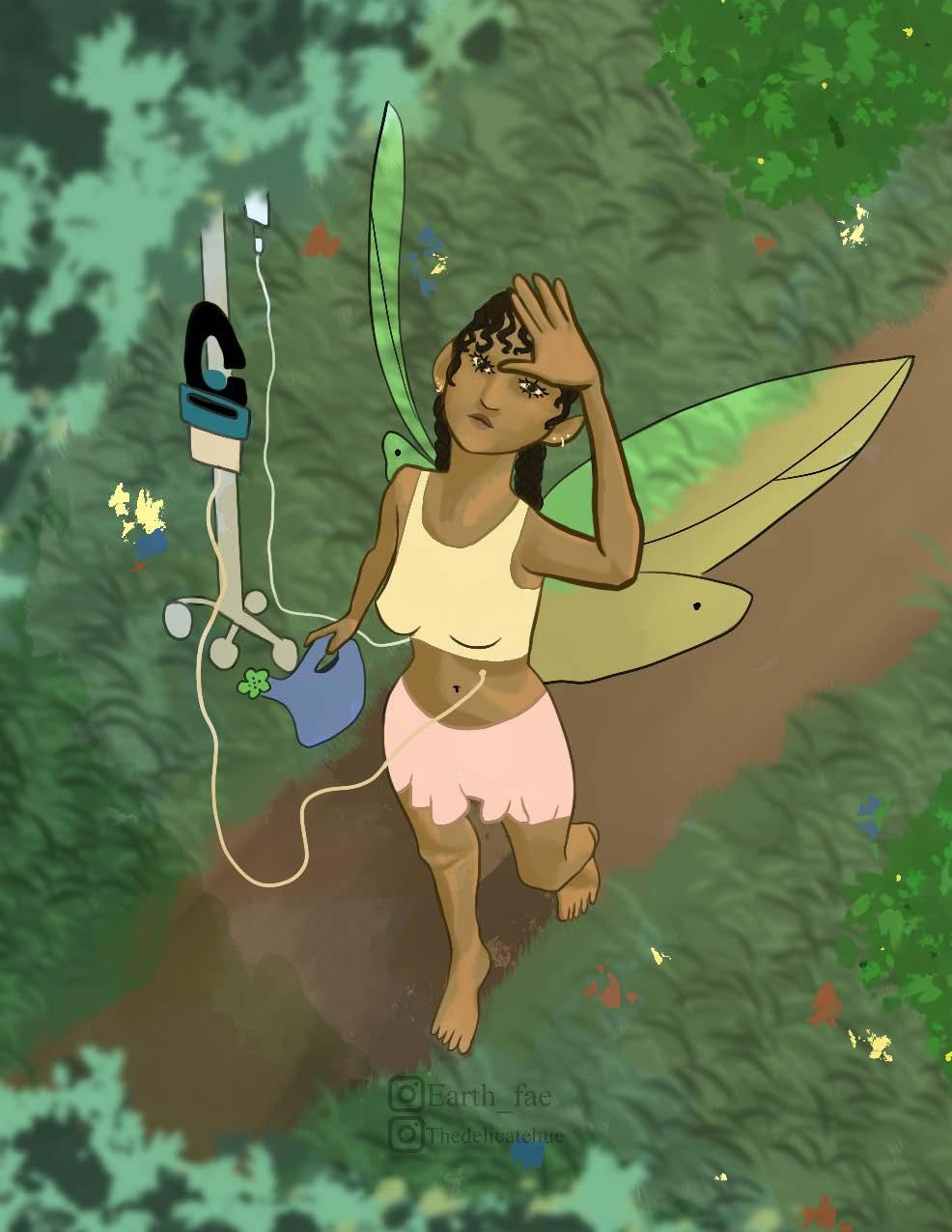
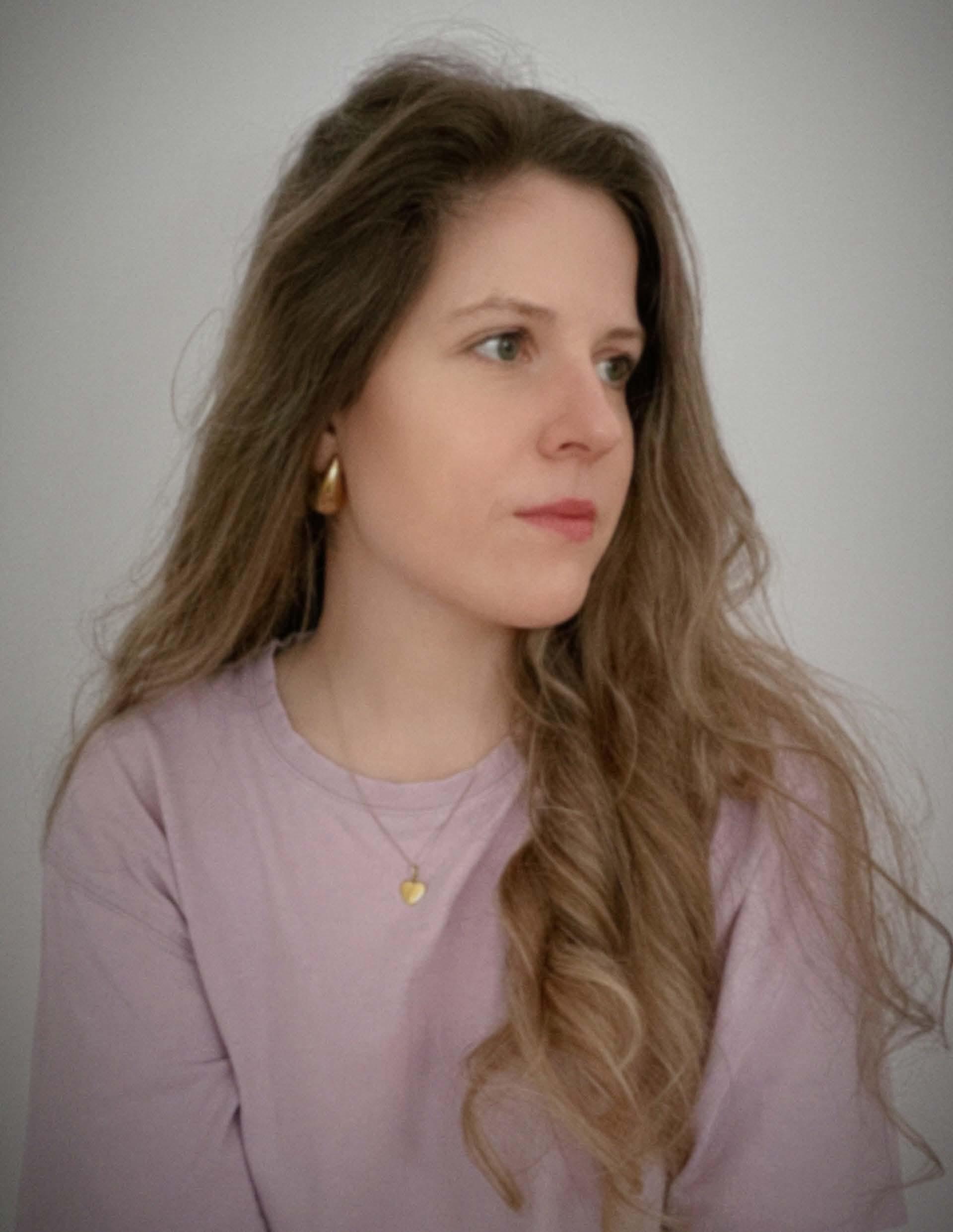
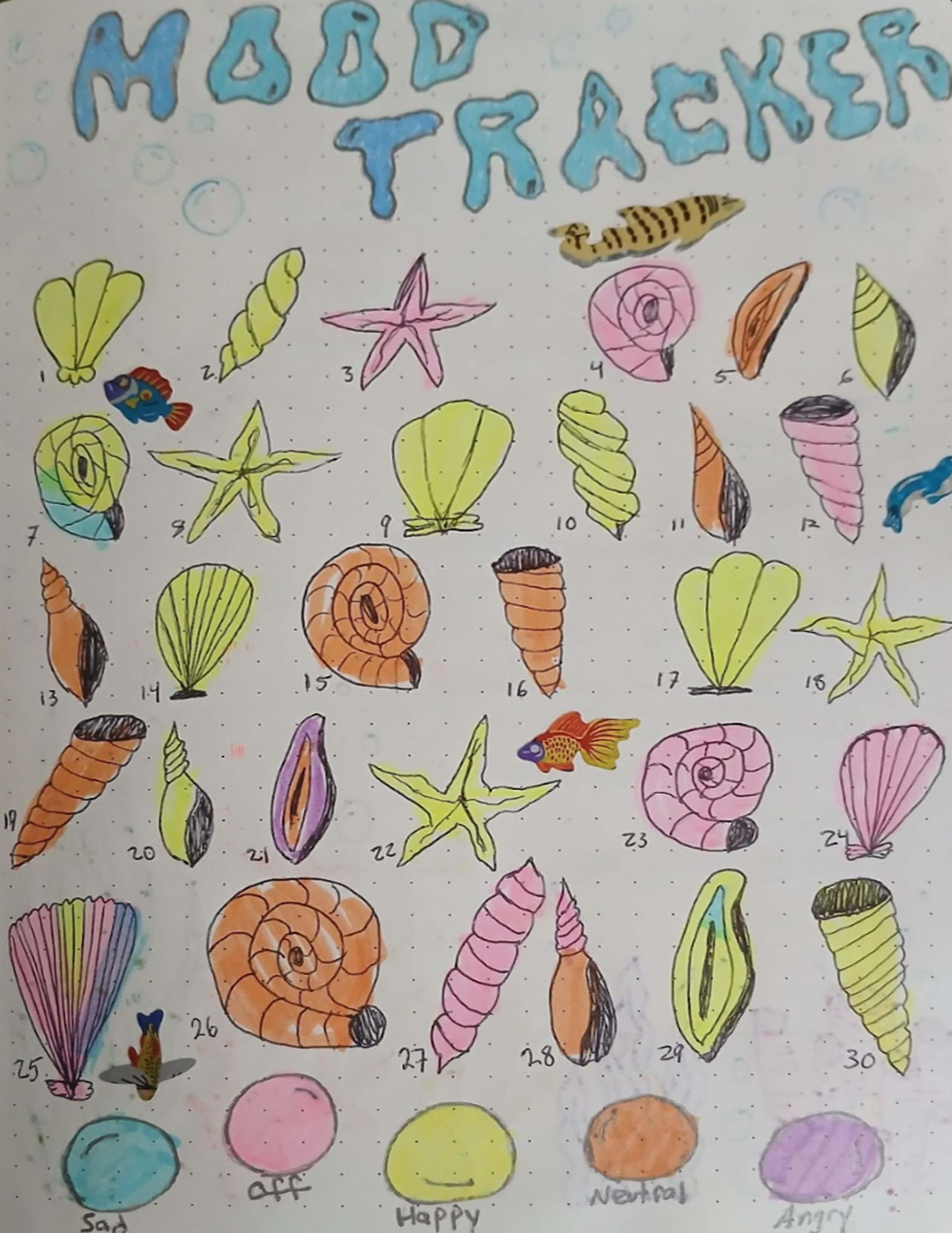
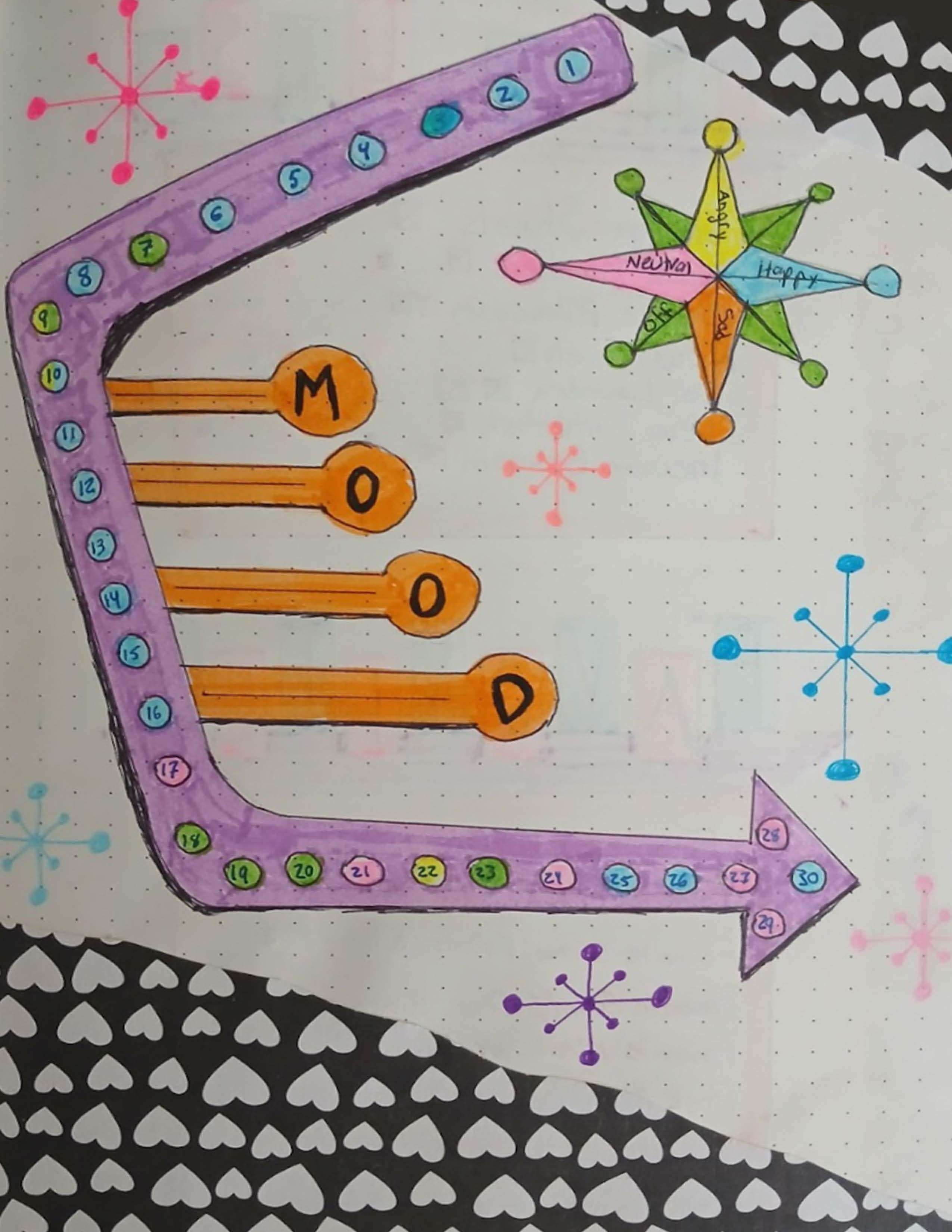
Liz Zonarich is a graphic designer and illustrator based in Boston. For her, chronic illnesses are personal, motivating her to make a difference. As a graduate of the Master of Science in Media, Medicine, and Health program at Harvard Medical School, she loves to convey health messaging through storytelling and visuals. Her background is in graphic design, public health, and art history. Her favorite ways to cope are mailing letters to friends, reading, illustrating, and rewatching Pride & Prejudice (2005) for the millionth time.
fiction editor
K. Hamilton is a writer, born and raised in Philadelphia. They have a background in English Literature and Education, and has lived with both mental and physical conditions for a large portion of their life. Their favorite ways to cope are gardening, gaming, making things for friends, playing heavy metal too loud, and reading.
Jenn is a gay teacher in Philadelphia, born in New Jersey. Just trying to channel her love for history, poetry, and knowledge into Gen Alpha. She’s cycled through multiple therapists and had enough hospital visits to know a thing or two about the importance of coping. Her favorite ways to cope are blasting music in her ears, painting, writing some poems, playing Stardew Valley, and cuddling her cats.
COPE MAGAZINE is a place for storytelling. Every work published is a creative and personal story, and should not be taken as medical advice.
letter from the editor
DEAR READERS,
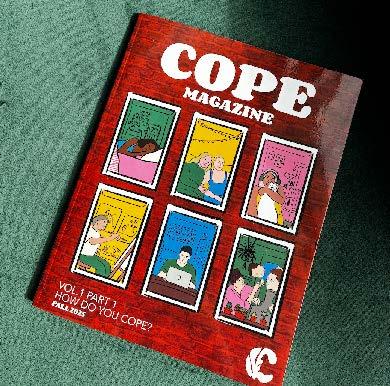
Hello again! Welcome back to COPE MAGAZINE. In our last issue, we launched the magazine with Volume 1, Part 1, and now we’re back to share another round of amazing stories, art, poems, and music in Part 2. Before getting into it, we want to sincerely thank everyone for supporting this magazine. The response has been truly heartwarming. Your interest and engagement shows how vital it is to cultivate a creative space for the chronic illness community.
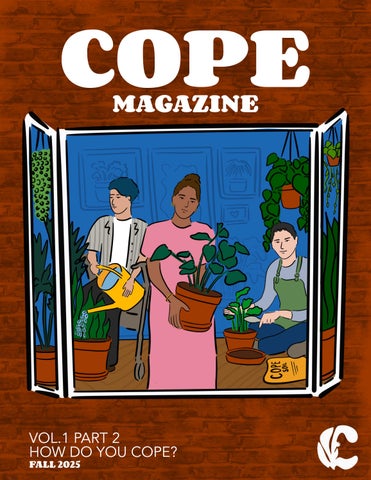
Volume 1, Part 2 continues to explore the theme, “How do you cope?”
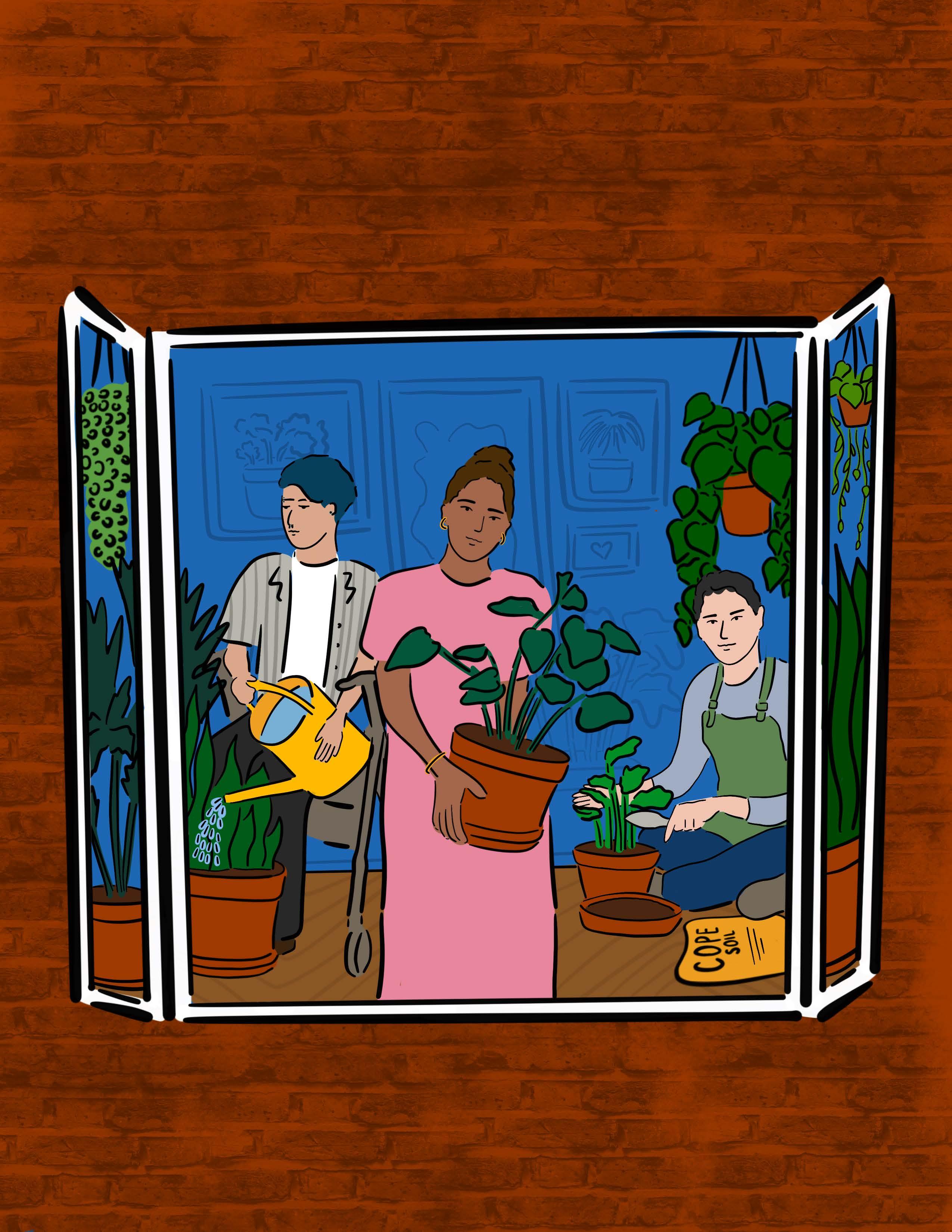
While reading submissions, I noticed a botanical theme that wove these particular stories together. I have a strong love for plants, with many throughout my home. They keep me company and constantly remind me about the process of growth, which is something I’ve been reflecting on lately.
A year ago, I saved a limp looking philodendron from the local grocery story. I didn’t have any high hopes for the plant other than to help it turn green again. When I brought it home, I cleaned it up and placed it on my bookshelf. I watered it every week and watched it grow little by little. There were periods when it would go limp again, requiring more water than usual or needing some more sunlight. It even survived a case of spider mites. Today, this plant spans the entirety of three bookcases with new leaves and branches that latch onto anything in reach. It still has periods where it looks unwell, but over time I’ve become more attuned with its needs.
I think that plants relate particularly well to the chronic illness community. We are all unique, just like every plant’s unique leaf patterns. We require care. We go through cycles and have to make constant adjustments. And most importantly, we need to allow ourselves to grow at our own pace, despite the setbacks and seasons experienced.
Part 2 goes beyond “How do we cope?” by more deeply exploring how we try to thrive, while experiencing setbacks and our quiet perseverance of growth, despite it all. This collection of works feels like a garden of our tales that we’re so glad to be able to share it with you all. It’s just the beginning of COPE MAGAZINE… so, stay connected to see how we grow.
WARMLY,
table of contents
THE STORIES
08 The Sacred Act of Rest / My Bed is My Sanctuary by Jenna Borrelli
14 I Can’t Get up to Change the Cd Right Now. Whatever, I Guess I’ll Listen to This Song Forever by Sammi Bechard
16 A Sunken City by Alek Ferguson
18 Chronically Cooking by Chef Sweetz
20 Apple Juice by D. Austin
22 Unspoken by Debra Lowe
26 A Life Rewritten By Illness by Halie Paige
28 Procedures and Protocols by Emilie Delaye
30 Silent Out Loud by Brittany Wilson-Thompson
32 A Stroke of Becoming: A Personal Journey of Stroke Recovery and Personal Rebirth After a Stroke at 27 by Maria Rising
36 The Weight She Carries by Stephanie L Bade
38 Day after Day by Ally Meisner
40 Trusting in Transience by Paige Veta
42 Walk with Me? by Emma Foley 44 Keep Going by Jaden Heck 46 Still Blooming by Paola
48 Dysautonomia Essentials by Halie Jost
50 Life As It Is. by A. Shalom
52 Overcoming the Odds by Ben Jeszka
54 As She has Always Done Before... by Cal Petty
56 Invisible and Isolated by Zoey Bandhauer
58 Lucky by Christina Quiambao
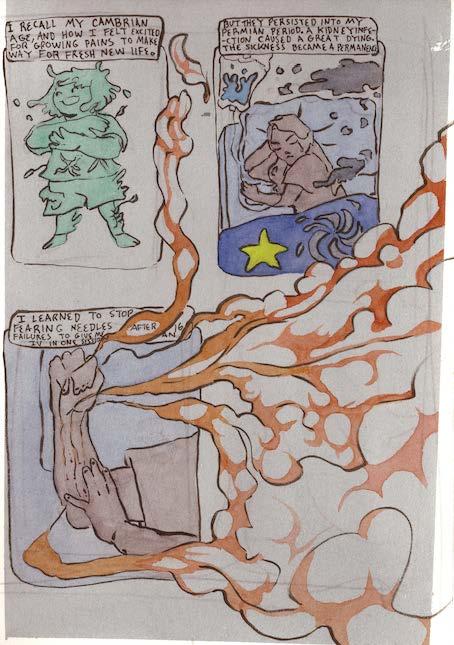
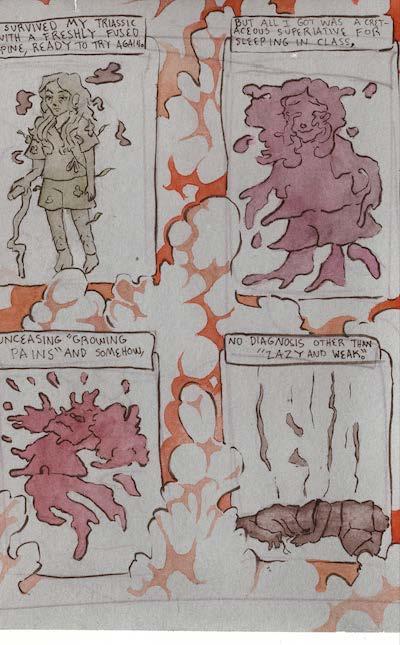
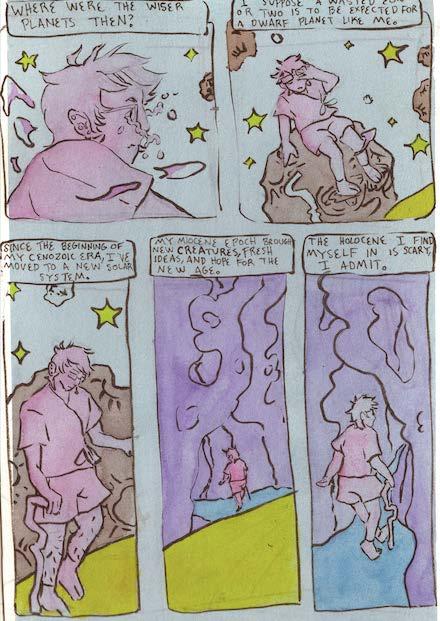
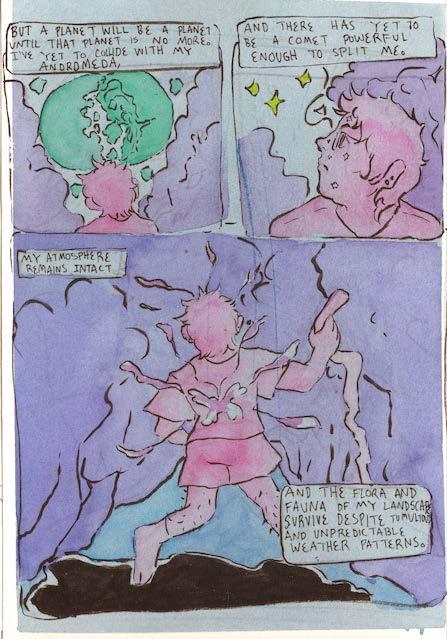
60 Climbing out of the Sputnik Planitia by Pluto
70 Coping Through Deconstruction and Self-Compassion by Sharla Wilson
72 Tending to Life by Faerie
74 What Chronic Illness Took and Gave Me by Lexi O
76 The Title by Lauren Mann
78 Chronic Alienation by Heather Sandison
72 Redirect the Bee, Abundantly by Kate Rehurek
72 I am Fine by K Hall
72 Invisible Pain by Sarah Swinford
72 We’re Delicate Flowers in Bloom by Marissa Nieto
FEATURES
86 What Remains When the Body No Longer Keeps Up? How the Piano Helps Me Cope with my Chronic Illnesses by Jenny Grobosch
94 Symptom Trackers A Tool for Agency by Claire B. Bushby
98 Mood Trackers by Anonymous ACTIVITIES
98 Come find some suprises...
102 Authors, poets, artists, and a musician
The Sacred Act of Rest / My Bed is My Sanctuary
by Jenna Borrelli
Everyone needs rest. It helps us digest our food, absorb new information in our brains, and reset ourselves for each new day. We biologically have circadian rhythms that remind us to go to sleep every night so we can wake up the next morning and start our days out fresh, ready to take on the world.
For those of us with chronic illness, rest becomes so much more than an occasional nap or our sleep patterns. In my personal experience, rest has become a way of living. I intentionally live my life with rest in mind.
When I started experiencing regular flare ups from my Hashimoto’s and burnout from my mental health, I had no choice but to rest. But as I needed more and more time in my days and weeks to rest, I started to feel guilt and shame around these activities.
We’re conditioned to believe in productivity over everything else
Many of us are conditioned from birth to believe that being productive is our ticket to being accepted, accoladed, and having worth in the world. While it is important as individuals to find ways to help make the world a better place, and to also fill our own cups with activities and work that is fulfilling, there is so much more to life than being a productive person. We are not robots, we are human beings. Many folks with chronic illness are unable to work, must work reduced hours, or have a difficult time committing 40 hours a week (or more) to working. On top of work, we have chores, social time, families, personal projects, and general LIFE to juggle. Plus we have the stress of being a human being in very uncertain and volatile times in modern history.
Simply put – it is already exhausting being a human. Adding chronic illness on top of every day human life adds an additional stress and risk of exhaustion.
Chronic fatigue is the symptom I experience most frequently with my own health journey. It is an already frustrating state of being, but becomes incredibly challenging when trying to follow my dreams, create art, spend time with my community, work on my career, keep my house tidy, and everything else required to live my life.
But one of the greatest ways I have learned to cope is to simply learn to listen to my body and honor my need to rest. Even when it’s inconvenient. Even when it’s for a long time. Even when it occurs every single day.
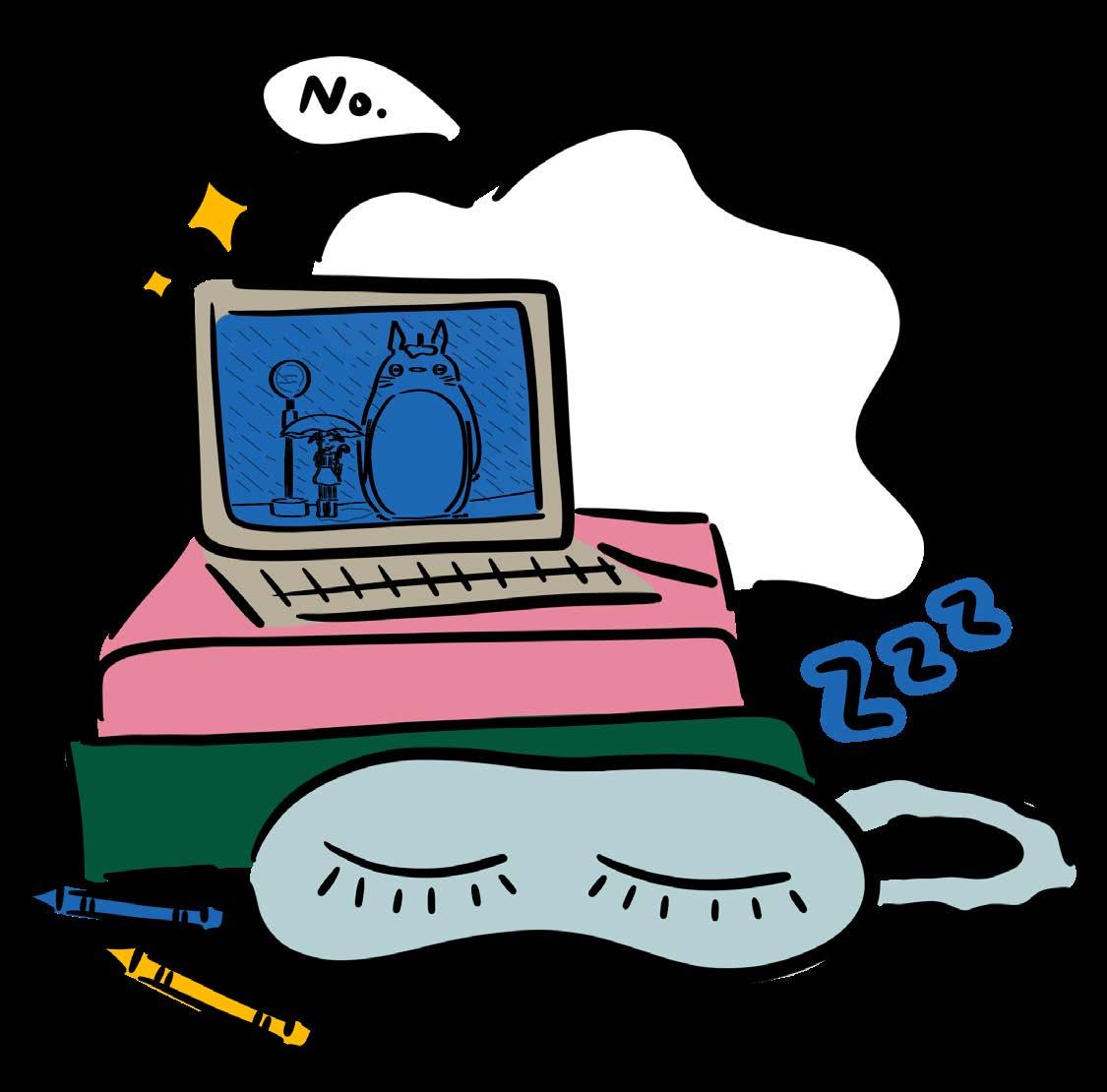
Rest is beyond just focusing on getting quality sleep. It’s prioritizing nervous system regulation. It’s finding time every single day to just be comfortable doing little to nothing – which includes limiting screen time during periods of rest.
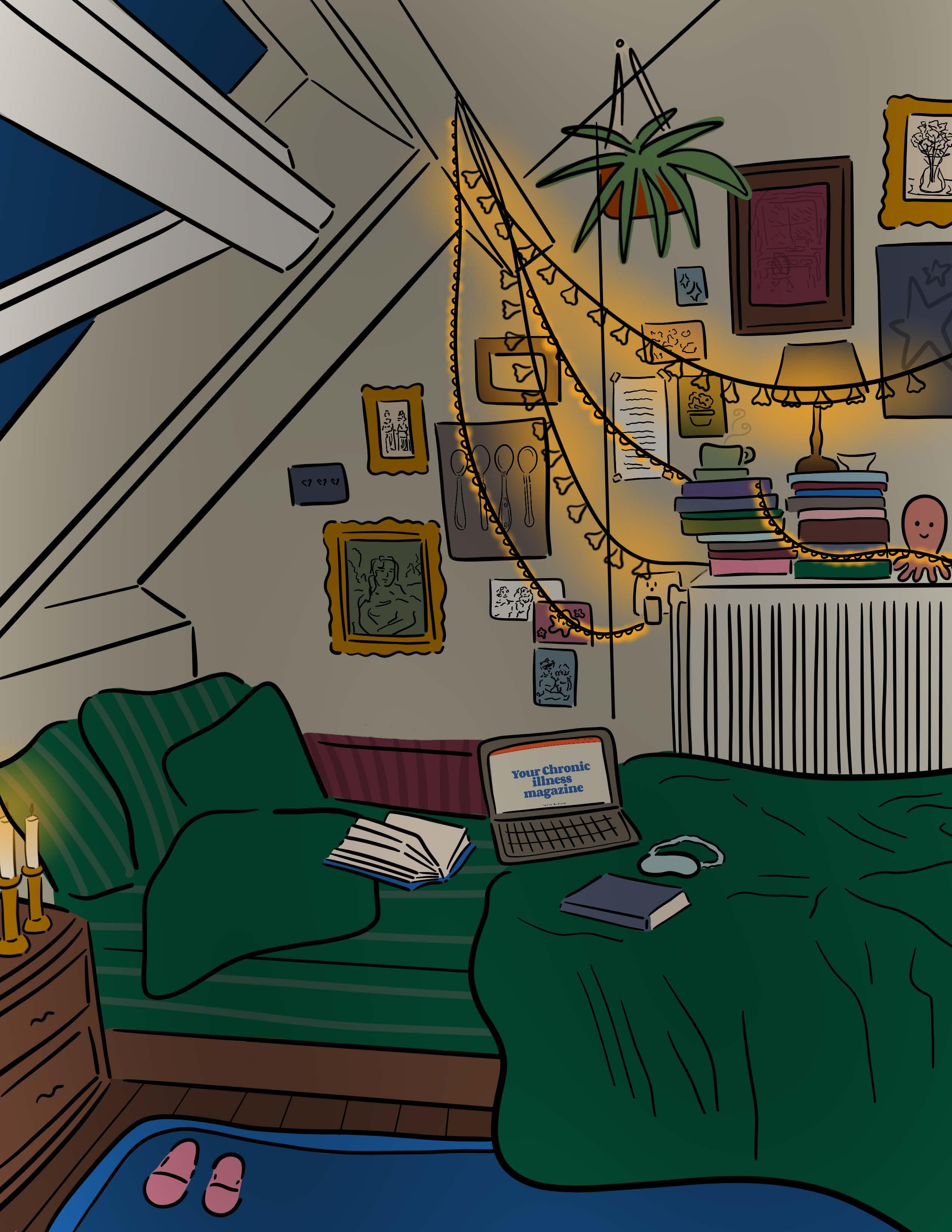
My bed is my sanctuary
Where and how do I rest the best? I have learned to turn my bedroom and my bed into a sanctuary. My bed is my safe space. And I absolutely LOVE lying down. I love taking naps in the middle of the day, I love day dreaming, I love spending time just rolling around; maybe with a book, maybe with a phone, or maybe even with my lover.
When I first started experiencing chronic fatigue, it was hard for me to honor my need for rest. I would override the desire by drinking excessive caffeine, maxing out my daily schedule, or by letting coworkers book meetings over my down time when working at home. Presently, I put blocks in my calendar, keep my social and personal schedules manageable, and make sure every single day I am prioritizing my rest.
By learning to make rest a daily practice, I stopped feeling guilty about needing it in my life. I learned that by resting on a regular basis, I was better able to cope
with the experiences of chronic illness and fatigue.
I also learned by resting; it changed the way I thought about productivity in my life. Instead of trying to pour my energy into everything and everyone, I learned to be very selective and intentional with how I used my energy. At first, it was hard to say no; then it became something very sacred and affirming.
In fact, rest became so essential to me, I wanted all the important people in my life to prioritize it, too. And as I became more devoted to my daily rest, I really began to notice the way people around me talked about their own rest and productivity journeys. Many people have also internalized the belief that they don’t deserve rest if they’re not productive, so by discussing my restful life with others, I have found this as an eye opening experience for those resistant to slowing down and lying down.
“I’ll sleep when I’m dead” is one of my most hated phrases. It benefits from the idea that every ounce of our lives should be spent doing something. I believe having regular rest in my life actually allows me to enjoy things more when I am choosing to be active or productive.
How to make your bed a sanctuary
Some ways to rest:
• Take a nap
• Go to bed early
• Eat nourishing and easy to digest foods
• Spend time away from your phone
• Day dream
• Read a book
• Lie in the grass like a lizard
• Cozy up with one of your comfort shows
• Jot down random thoughts & ideas
• Doodle or draw in a comforting way
• Say no to what doesn’t serve you
• Meditate & breathe deep
• Roll around in your bed
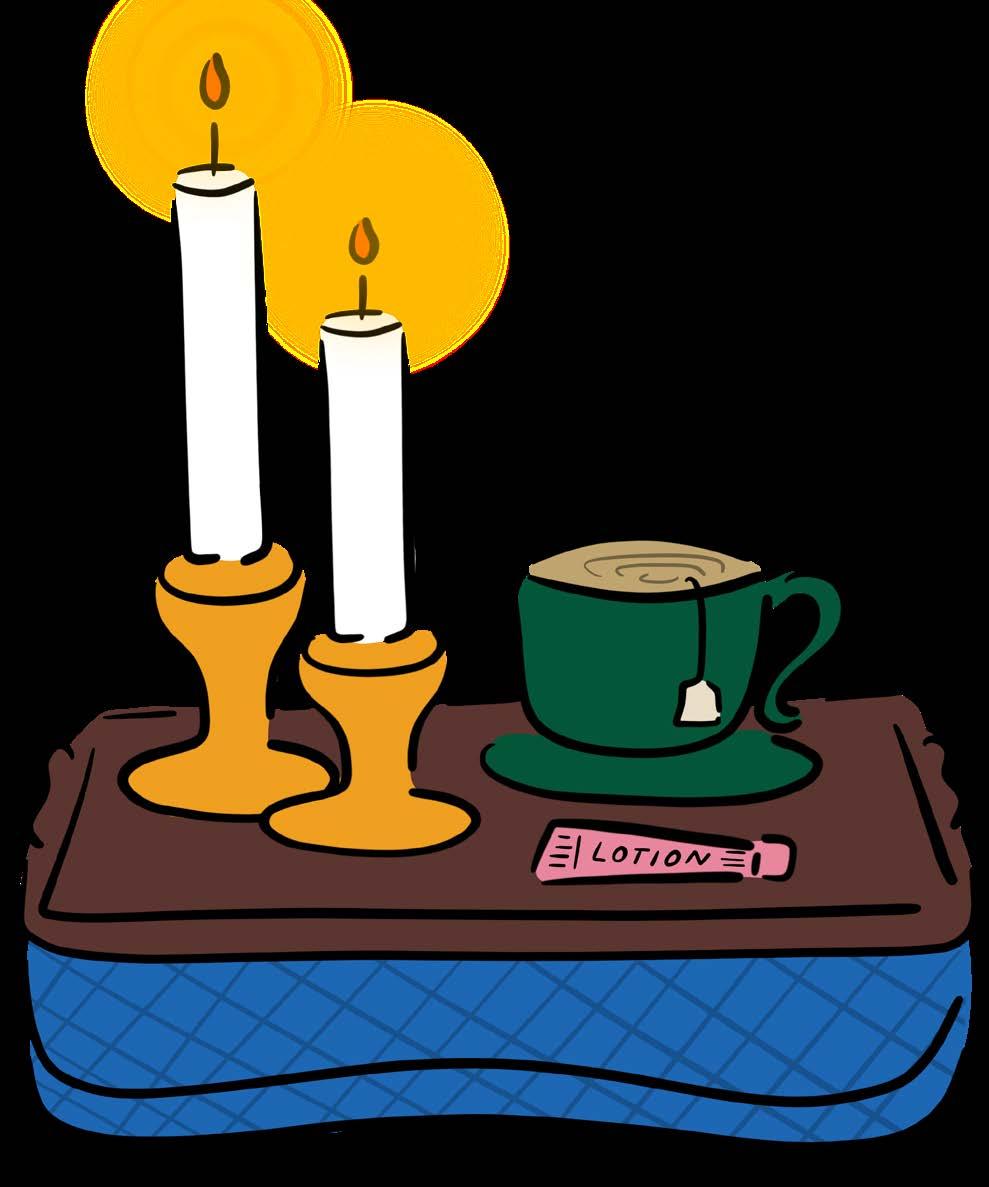
Most of the rest I prioritize occurs in my bed. As mentioned already, I absolutely love my bed and consider it a sanctuary. I have cozy, luxurious blankets, a comfortable king mattress, mountains of pillows, and a bedside stand with pillow sprays and lotions to help set the mood. There is something so sensual and special about sipping a gorgeous cup of calming team while spending time in bed. I love how the tea warms me up from the inside while my blankets keep me
warm on the outside.
I recently bought a vintage, baby teal night gown with delicate lace trimming. Something about this dress really amps up the feelings of dreaminess and joy when I spend time in bed. After a day of working I enter my room, enrobe myself in my silky, flowy night gown and collapse into my bed to seek refuge in my sheets.
A note on productivity
In order to turn your bed into a sanctuary consider the following:
• Do you like the way your bed feels? Do you like the colors of your sheets, pillows, and blankets?
• Do you have a way to set the mood and engage your senses? Do you have special candles, oils, lotions, or teas to indulge in while resting?
• Do you find yourself enjoying your time of rest or do you feel guilty/stressed/ sad? What kinds of shifts in your beliefs can you take to allow yourself to fall fully in love with rest, even if it’s because of chronic illness?
I like to remind people that being in a restful state is productive. It’s good for our mind, bodies, and souls. It helps us be more creative. It helps us become kinder to ourselves and to the people around us. It allows us to create space between the bustle of modern society. Often, when I have to make decisions or come up with creative solutions, I like to consult my bed first.
I actually don’t mind if someone calls me lazy. I like being lazy! There’s something so punk rock, anti-capitlist about not giving a fuck about my output. Of course, I still have professional and creative goals, but I do them on my own time and because I truly want to.
When you start prioritizing rest, you realize how much stuff you did because you thought you needed to, not because you really wanted to. A restful life is a life of clarity and freedom.
On day dreaming
When is the last time you really let yourself day dream? When you day dream, where does your mind take you? What do you think about in this state of being? As an artist, day dreaming is such a special part of my creative journey. Even when I am not trying to solve problems, day dreaming is a playground where I can explore ideas and spaces from the comfort of my bed.
A reminder on mindsets
Chronic illness isn’t fun, we know that. But it doesn’t mean we can’t make coping with the illness a fulfilling experience. By reframing my relationship with rest, I learn to look forward to it, instead of dreading it as a symptom of chronic fatigue. The only way to enjoy rest is to be consistent in letting yourself do it. It took me several years to rest without guilt, and now it has become a lifestyle for me. Everything I do, every choice I make, everywhere I go, I incorporate this principle - can I find time to rest?
Affirmations for Rest
• It is safe for me to rest
• I deserve rest regardless of what I have done in any given day
• Rest is productive
• Rest is my birthright
• I’ll sleep when I desire it
• I don’t have to ask for permission to prioritize rest
• Rest is an act of devotion
• My bed is my sanctuary
I Can’t Get Up to Change the Cd Right Now. Whatever, I
Guess I’ll Listen to This Song Forever.
by Sammi Bechard
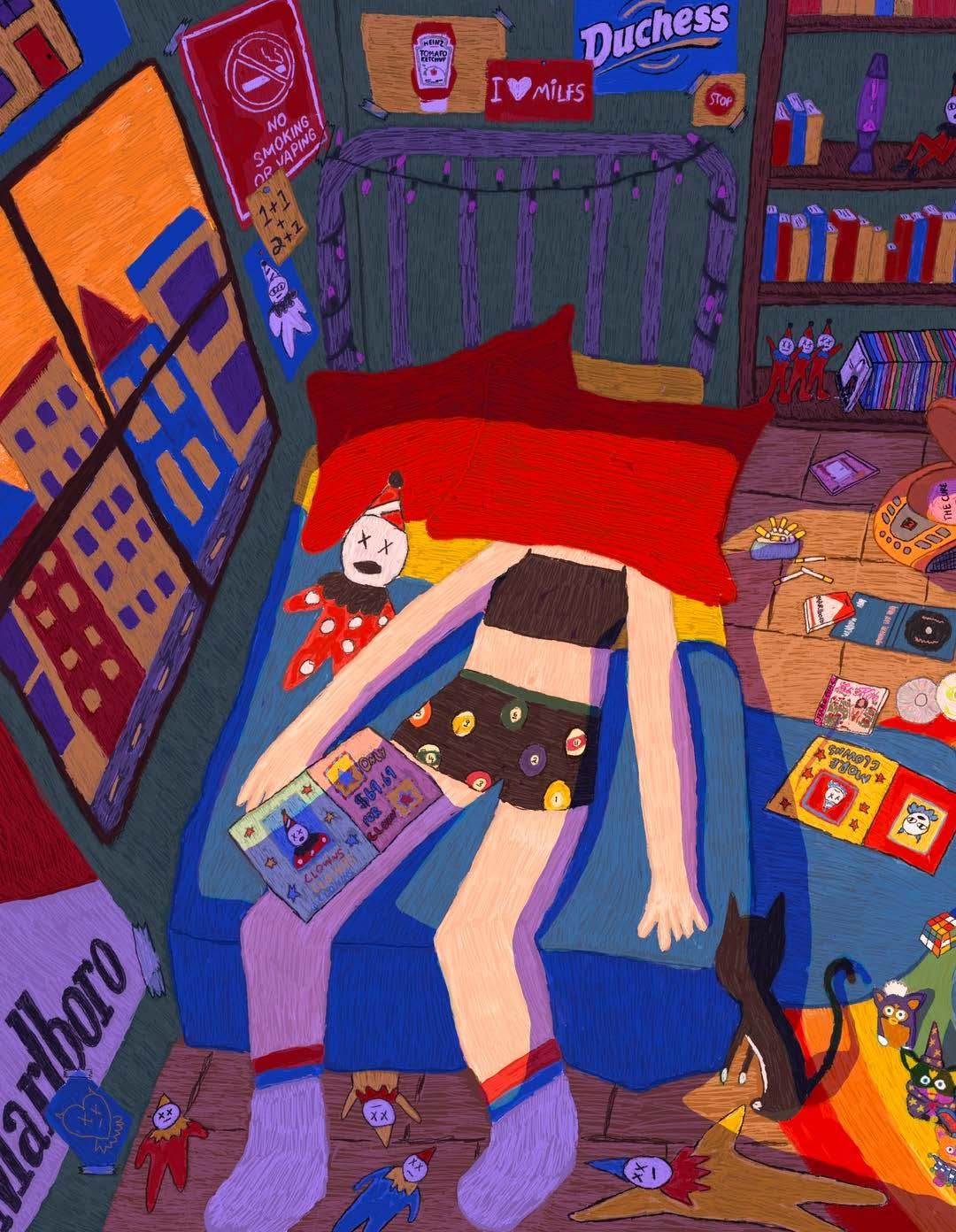
My illustration is about dealing with the emotional and physical effects of chronic illness. The person, sunken in their bed, lies still, thinking about what they could be doing. They feel stuck in every way possible. Their brain is on a loop spinning like the cd they can’t turn off.
A Sunken City by Alek Ferguson
Sometimes the pain comes in Like rain through an open window.
Except you’ve closed every window you can find And the water is filling up so fast You think you might drown in it.
This is what it is like to have chronic pain, Unexpected in its intensity and timing, But, like the rain, you know it is inevitable.
It’s a force of nature you can’t control, Only manage your own response to it.
Some days, the flood can be contained. Others, all you can do is let it wash over you And hope you can hold your breath Long enough to make it to the other side.
What I yearn to learn is how to breathe underwater. Make the most of my pain and flare ups, Still live in spite of them And through them, Find beauty in the painful moments.
The act of creation is this for me. Poetry, painting, dancing even, Has been my refuge from the storm of life That threatens to drown me in pain, Sending me over the edge and into oblivion.
And again, I return
To poetry, to painting, to nature, to movement,
Searching for something outside myself
To give meaning to my darkest days
And most manic nights.
Finding my solace because without one I am adrift
On a sea of human emotion,
Clutching to the familiarity of pain, of hurt, of sadness,
But yearning for a more fulfilling life,
One where I can feel happy emotions
Without worrying that the mania Is creeping its way back in.
Stay up all night without the terror
Of not knowing when I’ll sleep again.
Knowing that every emotional interaction
May tip the scales from “doing okay most of the time”
To “oh gods, no. I haven’t slept in three days”
And depression so bad I can’t find the motivation to feed myself.
And again I return to creation. Creations of my body and mind
Are more apt to remind me why I matter,
Why my existence is important to preserve,
Why I like being alive and want to keep it that way.
So my walls are plastered with my paintings,
And my computer full of my poetry
And I dabble in combining the two. Creating a blend of emotions in a bottle,
Because it is my pleasure to evoke emotion in others.
It makes me feel less alone to know that
With a few words and some pigment on paper, I can make someone feel something.
Deep and longing,
Or shallow and fleeting, That emotion was my doing.
With emotion as the end goal,
You must think in multiple dimensions. You want to reach their hearts, their souls
In whatever ways are needed to feel something
Beyond apathy, beyond indifference.
Your goal becomes making them feel.
When you succeed,
A part of you now lives within them
As the memory of feeling that way,
Of the thing you created inducing Feelings within them.
Good or bad, it is no matter.
Chronically Cooking by Chef Sweetz
I don’t cook despite my chronic illnesses – I cook through them.
I live with Crohn’s Disease, scalp and body Psoriasis, and a few other diagnoses that make my medical chart look like a CVS receipt. On my worst days, my body doesn’t feel like mine. There’s sharp pain, intense fatigue, bloating, swelling, brain fog so thick I forget what I was saying mid-sentence – and let’s not even talk about bathroom emergencies. Emotionally, those days feel heavy. Like grief and frustration rolled into one. There’s sadness for the version of me that could bounce through 14-hour shifts in a commercial kitchen, and anger that no one else can see what my body is battling. Mentally, it’s a tug-of-war between pushing through and honoring my limits.
Cooking became one of my most powerful coping tools. It grounds me when everything else feels chaotic. I used to cook for guests, clients, and fine-dining critics. Now, I cook for my gut, my peace, and my healing. I batchcook when I have energy, keep soft foods prepped for flare days, and I always keep ingredients that are gentle on my stomach. Sometimes cooking is creative therapy. Sometimes it’s just “make the toast and go lie down.” Either way, it counts.
I’ve had to reinvent my relationship with my body. I used to push it past the brink. I thought being strong meant showing up no matter what. But Crohn’s has humbled me. It taught me that strength sometimes looks like resting, canceling, or slowing down. I’ve learned to treat my body less like a machine and more like a partner – one that’s been through hell, but still shows up for me in its own way.
Support looks different for me. It’s mostly just me and my partner – my one constant, my anchor. When the pain is too loud or I feel like I’m falling apart, they hold space for me. Whether it’s grabbing my meds, reminding me to eat, or just being there when I need to cry without talking, they show up. And sometimes, that’s all I have.
But I’ve also had to learn how to support myself. On the days I feel
completely alone, I lean on music, writing, warm showers, and moments of quiet that remind me I’m still here. My online community helps too – strangers who understand the ache behind “I’m tired” without needing an explanation. It’s not a village, but it’s something. And it gets me through.
TikTok became a space for me to tell the truth about this life – where I could laugh, vent, and connect with people who get it. I created a series called “If Chronic Illness Were a Cookie” because honestly, sometimes cookies explain it better than doctors do. I also write mini cookbooks. It started as a way to adapt recipes I love to what my body could tolerate. Now, it’s turned into a project that helps others find joy and flavor again – even when they’re flaring.
If I could tell someone new to the chronic illness community one thing, it’s this: you are not lazy, broken, or alone. Your body may be unpredictable, but you are not weak for needing rest, softness, or help. Create your own definition of coping. Celebrate the small wins. You are doing more than enough.
So how do I cope? I rest. I rage. I cook. I cry. I create. I chronically, imperfectly, beautifully continue.
This is what surviving looks like. This is Chronically Cooking.
Apple Juice
by D. Austin
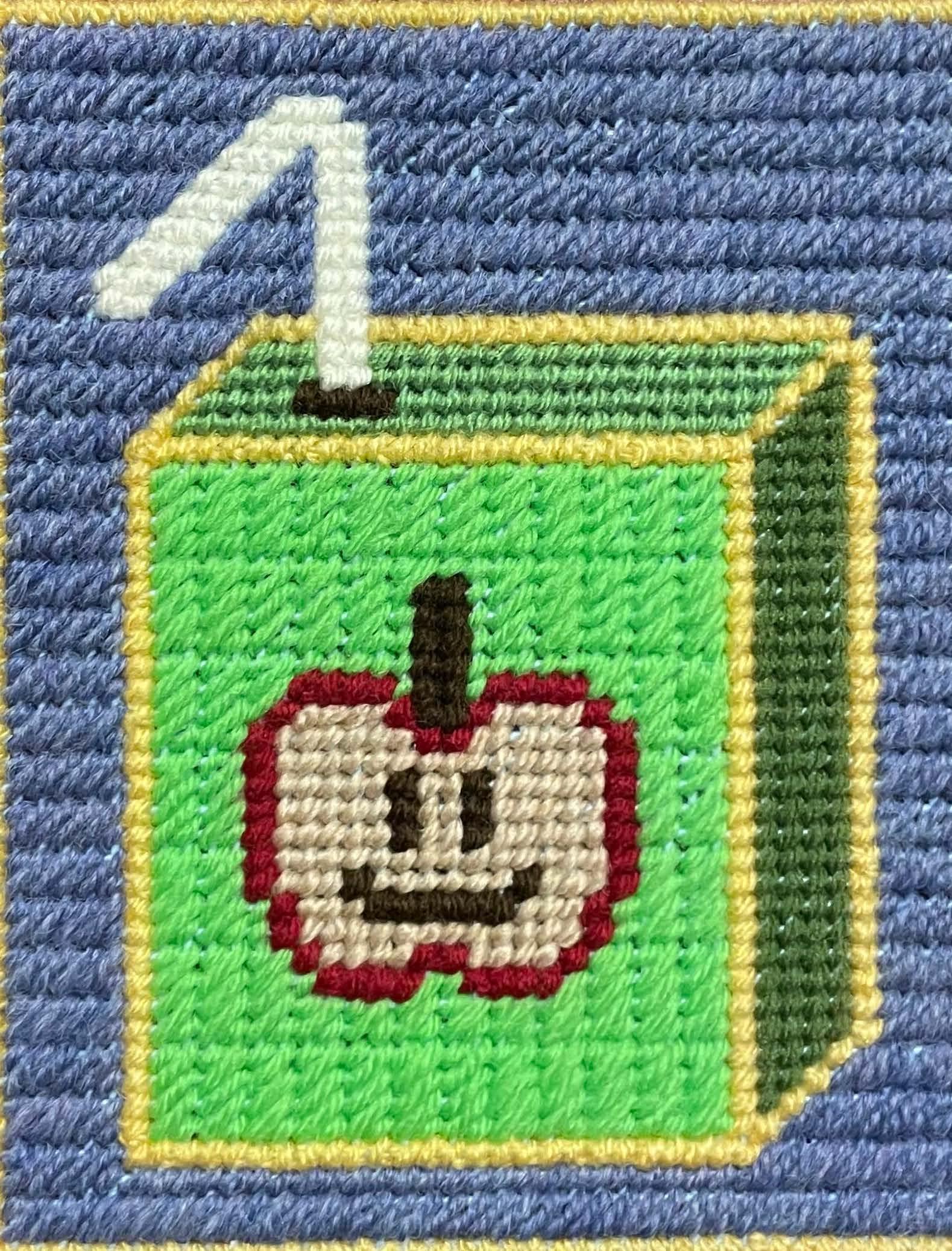
As a Type 1 Diabetic, I experience low blood sugar events that are draining, scary, and can be lifethreatening. A common treatment for low blood sugar is apple juice, and over time I have developed a negative association with it. In an attempt to flip that association, this piece is an appreciation of the life saving medicine that is apple juice, with many hours going into stitching and reflection.
Unspoken by Debra Lowe
The year is 2593.
Humans have evolved to communicate telepathically. Spoken words are now rare, used only by the one-percent born with a gene mutation that prevents telepathic access. You happen to be one of those few.
Your condition is so rare that you’ve grown up a bit isolated. Other children didn’t understand why you couldn’t speak with your mind. They were often frightened by the sounds you made—spoken words that made people cringe and turn away. You’re lucky, though. Your mother learned how to speak out loud to communicate with you. Your father tried, but never practiced enough to be fluent. Still, he tries.
On your 18th birthday, you receive a gift that changes everything: your first Tele-device — a handheld digital telepathy interpreter. It opens up your world — or at least, it should. For the first time, you can communicate directly with people outside your immediate family. You know your parents must have saved for months, maybe years, to afford this.
The device fits into your palm. When you power it on, it emits a soft chime and glows with gentle, rhythmic light. It begins working instantly. You point it toward your mother and ask her to communicate telepathically. Her face lights up as the device scrolls her words on a screen and vocalizes them aloud: “I love you.” You type, “I love you too,” and send it back to her. She smiles through tears. Your Aunt Clara rushes over, already crying, as the device interprets: “You are just so inspirational. I never thought you’d even make it to your 18th birthday.”
She sobs harder, placing both of her hands on either side of your face. The device keeps translating: “You even know how to take care of yourself — just like a normal person! I’m so proud of you.”
You smile and send, “Thank you,” on your new gift, even though her words sting. Non-telepathy isn’t fatal, and of course you can take care of yourself. But you let the moment pass.
Clara walks away, still crying. The device catches more words as she leaves: “Now she can get married and have a family!”
That one hurts more than you expected. Plenty of non-telepaths have relationships. They find ways to communicate, just like everyone else does.
You’re still processing everything when two of your cousins approach, staring but saying nothing. It’s a bit awkward, and it’s clear they don’t know how to treat you or talk to you — even with the new gadget in your hand. You just nod politely. Your cousin June rushes over next, eyes wide. She’s always been kind to you, and you feel hope rise again.
“Oh my gosh,” she says through the device. “I can’t believe I get to talk directly to you!”
She hugs you, then adds, “I sent you that picture of the supplement my friend recommended. Her aunt regained her telepathy after just a month. The secret is oregano oil and turmeric from Spain. It’s specific to your condition.”
You sigh. June always means well, but she never listens. She always thinks a “cure” is just one miracle herb or exercise plan away. It’s exhausting pretending like you haven’t already heard and tried it all over the last decade. You say “Thank you,” and that’s enough to satisfy her for the moment. She excitedly waves to your mother, and no doubt tells her about the new cure she is sure will work for you.
You turn back to the device, adjusting settings, when you hear it interpret something not meant for you: “She wouldn’t need that thing if she just tried harder. Her parents coddled her. That’s why she’s not motivated to learn telepathy.”
You look up. Uncle Bob. Of course. Smug and confident in his ignorance.
You power down the device. Your head aches. You quietly excuse yourself from your own party. In your room, you open your messages. One stands out: a communication from Wells, Conner & Friedman, the law firm where you recently interviewed for an internship.
You had borrowed a Tele-device from the ADA Tech Collective to complete the interview. The meeting went well. You felt seen. Understood.
You open the message, hopeful. “We really enjoyed having you in the office,” it reads. “You would be a great asset to many legal firms. However, we’re afraid your communication difficulties would be too disruptive for the fast pace of our office. We wish you the best.”
You close the message and sit in silence. So much hope. So many roadblocks.
But you know what to do next.
You turn on your meditation music and close your eyes. You recite your affirmations aloud. Your mantras. The words don’t solve everything, but they ground you. With the music still playing, you rise and move to the easel by the window. You squeeze paint onto your palette — colors that match the emotion in your chest. You mix them carefully, then bring brush to canvas. Bold strokes. Strong shapes. You create something new from the pain and grit and hope still tangled inside
This is how you cope. This is how you make sense of a world that wasn’t built with you in mind.
You have a small circle of friends and family who truly get it. They don’t pity you. They don’t treat you like you’re broken. They just see
you. And that makes all the difference.
Some days, your art and the kind words of someone who loves you are all that make life bearable.
Especially on days like this — when you thought you’d finally be understood, only to realize how deeply misunderstood you still are. On days like the one at the supermarket, when the customer service desk refused to help because you couldn’t communicate “the right way.”
On days like the one at the doctor’s office, when a medical professional told you the problem was all in your head.
These are the days when your difference is raw. Real. Unavoidable.
And yet — you continue.You create.You cope. You survive.
Epilogue:
This story is a metaphor for what it feels like to live with a communication disability and chronic illness in a world that isn’t designed for bodies like mine.
In a world that prizes convenience and sameness, being different can feel like a punishment. But I’ve learned to hold space for my differences. To create beauty from them. To advocate not just for myself, but for others like me who are still learning how to be heard.
I live with a rare connective tissue disorder that affects everything from my joints to my digestion, to my ability to hear and my ability to speak clearly. I’ve spent most of my life trying to “translate” myself for others — medical professionals, coworkers, even family members — just to be seen or taken seriously.
Like the character in the story, I use tools, creativity, and inner resilience to cope. I paint. I write. I advocate. I meditate. I find comfort in the people who don’t flinch when I speak in ways they don’t expect. And sometimes, on the hardest days, what gets me through is a brush, a blank canvas, and the knowledge that I’m not alone.
A Life Rewritten by Illness
by Halie Paige
It’s hard to think that no matter what I’ve done in life, my illness has always been there.
When I was 5, I had a tumor growing inside my tiny body. I went to my first day of kindergarten not knowing that cancer would soon take over my entire life. When I was 12, sitting in church, I was desperately trying to push away the immense pressure behind my eyes, thinking it was just a normal headache. I didn’t know I’d later be diagnosed with a neurological condition that would, once again, take over my entire life.
When I was 16, I discovered a true love for running. I pushed my body in ways I never knew I could, and I loved it. For once, I felt in control. I was running FAST and FAR. I was the best on the team. Even though some miles felt uncomfortable – my lungs burning, my feet aching, my muscles sore – it was a discomfort I chose. And I was amazing at it. I was in control.
I started getting letters in the mail from college teams asking me to visit their programs. I had dreams of running in college and taking it even further. Until, one day, it all came to a sudden halt. I had stress fractures in both legs and had to immediately stop running and start rehab. Those stress fractures were a direct result of the cancer treatment I went through at 5 years old.
I still remember getting the call from my doctor in the parking lot of my high school after I had just finished a sprint workout on the track. I had ice wrapped around my shins when I got the news.I was heart broken. I knew all of this was because of the intense chemo and radiation my body endured as a child. My dreams of running in college were crushed. And that’s a heartbreak I don’t think I’ll ever overcome.
It’s been 7 years. I haven’t run since then. I’ve gotten sicker. And part of me worries I’ll only get sicker as time goes on.
I’m 23 now. My life is filled with doctor’s appointments, lab tests, and hours spent researching my conditions to learn how to help myself. My days are consumed by my sickness. But today, I’ve found power in sharing my story. In connecting with people who understand what it’s like to feel invisible while living with an invisible illness.
My life is not what I thought it would be. But it’s beautiful in ways I never could have imagined.
Procedures
Procedures and Protocols by Emilie Delaye
Procedures and protocols.
Procedures and protocols.
Over and over and over again. And I get it – I really do.
Most of the time, I love procedures and protocols.
I love knowing that whatever I’m doing, I’m doing safely. I want to protect myself – and others – from unnecessary harm. But something feels off here.
Very off.
There are people rushing around, following orders, following “procedures and protocols.”
But they’re not necessarily doing the right thing –they’re just doing what the protocol says.
Ask why, and the answer is always:
“Oh, protocol says this…procedure says that.”
Procedures and protocols.
For the protection of who?
Because it can’t be me.
Not as I lay here, day three in the hospital, My arms and hands are covered in needle marks. The inside of my elbows rubbed raw.
and Procedures and Procedures and Procedures and Procedures and Procedures and Procedures and Procedures and Procedures and Procedures and Procedures and
A line runs to my heart –maybe infected, maybe not. (That’s all the protocol will let them tell us.)
Another line in my arm.
Strapped to a machine all day, every day. Want to go to the bathroom? Stretch? Then I have to drag a pole beside me. A heart monitor taped to my chest. A gown that makes my skin itch. And here they come again. They need more blood.
But my arms don’t even look like arms anymore –just things. Things that hurt. Ask any question, and you’re met with confusion that loops right back to:
Procedures. Protocols. This place is hell.
A business.
Built on money.
Built on procedures and protocols. But what about people? What about their bodies, their minds –their souls?
Procedures and protocols. Are dangerous. When the humans behind them forget judgement, forget compassion, forget understanding. Procedures. Protocols.
Patients, please be careful. Just because it is “procedure and protocol” doesn’t mean it will protect you. It sure as hell didn’t protect me.
Protocols
and Protocols and Protocols and Protocols and Protocols and Protocols and Protocols and Protocols and Protocols and Protocols and Protocols and
Silent Out Loud
by Brittany Wilson-Thompson
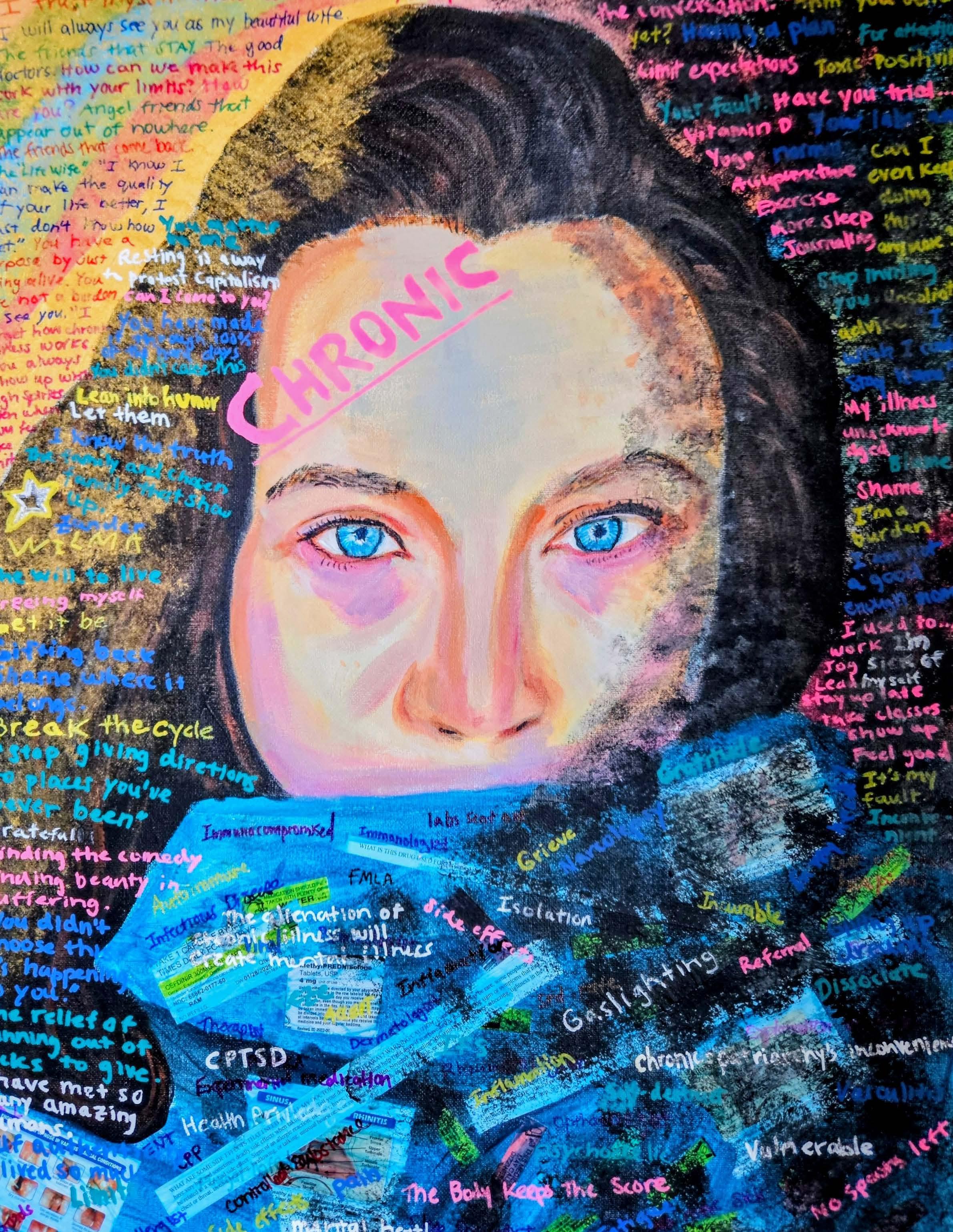
Far too often, the emotional pain of not being seen or believed is much worse than physical pain. ”Your Labs are Normal” is an acrylic self-portrait inspired by my isolation, self-doubt, and decades of suffering from sinus and autoimmune diseases. It’s a declaration of “I told you so” and an unapologetic display of the carnage that remains from years of gaslighting. I hope my painting will help others feel seen, and encourage curiosity and conversation about the experience of those living with chronic illness. One of the kindest things you can do for someone who is essentially sick forever is to tell them, chronically, that you actually see them.
A Stroke of Becoming:
A Personal Journey of Stroke Recovery and Personal Rebirth After a Stroke at 27
by Maria Rising
It happened in an instant — my vision zoomed out like a camera pulling back from a scene. One moment, I was on the couch working late, trying to submit a grant for the dream job I had just landed. It was the Sunday after Thanksgiving. I was home alone on my couch. Next, I couldn’t move.
I couldn’t move. I couldn’t speak. My mind was fully there, but my body had gone silent. It was as if I’d fallen into a well inside myself — terrified, trapped, and still somehow aware. I used all my strength to inch my hand across the couch and press the emergency call button on my iPhone. Time dissolved.
I don’t know if minutes or hours passed, but suddenly my small living room was full of shouting responders. Firefighters. Police. EMTs. They asked me to smile, to lift my arms, to say my name. I couldn’t do any of it.
They carried me out like a doll and loaded me into the ambulance. I remember one paramedic — their kindness, their hand in mine — and the sound of my own crying.
At the hospital, I lay alone in a hallway. No one spoke to me. No one told me what was happening. I
couldn’t move, couldn’t respond, and I felt utterly invisible — like my humanity had been temporarily erased.
By morning, they discharged me. They said I was “probably just tired” or maybe I’d had a migraine. I still couldn’t walk right or speak clearly. I went home, scared and broken.
Later that day, a neurologist ordered an emergency MRI. The results were swift and brutal: I had suffered a stroke. And it was too late to reverse it.
The Collapse: The Year of Unknowing
For the next year, I lived inside a cloud of fear. No one could tell me why it happened. I was 27. Healthy. No obvious cause. Every day, I woke up wondering if I would die in my sleep. My energy was gone. My vision stayed blurry and disoriented. Even swallowing became dangerous. I couldn’t trust my own body. Everything — even water — felt like a threat.
And yet, despite the fear, the bigger emotion that rose to the surface surprised me: gratitude.
The Awakening: Reconnection, Not Recovery
For the first six months, I couldn’t read or text due to vision damage. But I could talk. I called people. I listened. I had long, winding conversations with people I hadn’t connected with in years. I told them I missed them. I told them I loved them. I felt joy again — not in the doing, but in the being.
Lying in that ambulance, then alone in a hospital hallway, I didn’t think about my job. I didn’t think about that grant. I thought about Europe. I thought about my best friend. I thought about the last time I told someone I loved them. In those terrifying moments, the only thing I wanted was connection —
The things that once defined me vanished. And, strangely, I didn’t miss
I learned to sit outside and just breathe. I spent hours in my garden. I began propagating plants and watching them change. It felt familiar. I was changing too. Not healing linearly, but shifting into someone softer, slower, deeper.
I started creating. I tried watercolor, built living planters, and made wall art that grew with the seasons. Everything I touched became something alive — just like me.
The Becoming: Career Collapse & Identity Rise
Eventually, the job I had worked so hard for let me go. My employer doubted my capacity post-stroke. I was devastated. It felt like losing the last piece of my “before” life. But by then, I had already begun to reshape what mattered.
From that rupture, The Rising Project was born — a consulting firm where I help others with grant writing, research, and professional development. But more than that, I help people grow — because I finally know what it means to grow from nothing, from uncertainty,
from ground zero.
In the quiet aftermath, I didn’t just build a business — I built a life. One rooted in growth, healing, and creativity.
I turned to the natural world, not just for comfort, but for inspiration. My garden became my grounding space — I began propagating plants, designing living art, and creating planters that grow and change just like I did. This personal ritual of care turned into public creativity. I started sharing that journey — the messiness, the beauty, the literal growing pains — through The Rising Project (@therisingproject) on Tiktok, my consulting and creative brand.
I also became a storyteller — of my stroke recovery, of life with a chronic illness, and more recently, of healing with horses and the medication journey that changed my relationship with my body again. I created @tirzepatidetales on Tiktok as a space to hold all of that: chronic illness, hormone healing, joy, struggle, transformation, and what it means to come home to yourself in new ways, again and again.
Now, I am not just a grant consultant. I am a plant artist. A wellness creator. A woman in love with growing things — plants, projects, people, and myself.
The People: My Circle of Survival
I wasn’t alone. My friends surrounded me with love, care, and constant presence. For months, I wasn’t allowed to be alone — not out of pity, but out of love and vigilance. I didn’t realize how deeply held I was until I needed them most.
Medical professionals became my family. An ER doctor refused to give up on my case, even when others did. He called everyone he knew, and finally, the cause was found: a hole in my heart. I was rushed into surgery. My cardiologist now plays volleyball with me. My occupational therapist was at my wedding. These aren’t just providers. They’re people who saw me when I didn’t recognize myself.
The Advice I Wish I’d Heard
To anyone facing chronic illness or a sudden health rupture: Let yourself change. Let yourself fall apart. And when you begin again — because you will — let it be slow, and let it be yours. You don’t owe anyone your old self. You get to become someone entirely new. And that version of you? Might just be the best thing that ever happened to you.
I lost the future I had planned. But in doing so, I found the future I was made for.
The Weight She Carries
by Stephanie L. Bade
She holds it in the curve of her spine
In the small hush before dawn
When the house breathes softly
Expecting her to rise, to give, to go
To be the light in every room she steps into.
She carries the weight of soft apologies
Of shouldering one more ask, one more need
Of folding laundry with trembling hands
Of smiling so the world keeps turning
Without fear it might crack if it saw her break
She learns the art of quietness
Swallowing the hours she spends in hidden rooms
Blinking away the stars dancing behind her eyes
Swallowing questions she dares not voice
Invisible battles, invisible bruises
She is gaslit by the gods of white coats
By the soft concern that vanishes when the tests return normal
By the silence of friends who say “You look fine”, “You’re so strong”
She is a battlefield in a mother’s skin
In a wife’s kiss, in a daughter’s laugh
Each step a negotiation between gravity and a heart begging for relief
Between living for others
And fighting to stay alive herself
One day, she believes,
This weight will lift like the morning fog
And the sun will return to her bones
And she will dance in the kitchen without fear of falling
She will sing without a whisper of pain
She will live in a body that does not betray
And the world will see her finally –
Not as the weight she carried
But as the woman who carried it
So quietly, so fiercely
She made the impossible look…ordinary
I’m collapsed in this cold, hard bed, feeling the needles stab through my back, hoping to seize the last few minutes of my sleepless night before my alarm goes off. A simple “beep, beep, beep” sends an ear-piercing noise through my head, making my skull feel like it will crack open. Grimacing, I roll over and turn off the brutal sound. As my heart races, I am overcome with a massive amount of pain covering every inch of my body. I am simply a piece of wood that is beaten by a hammer and gauged by nails. This is the harsh reality of chronic illness. Each year, the pain haunts me. Each year, the symptoms multiply. Each year, the more I realize how broken the healthcare system is.
As I wobble out of bed and get dressed, I nearly break down in tears as the stabbing and aching pain tries to diminish all my plans for the day. I head downstairs slowly, pausing after each step to regain my balance. I rub my sore shoulder from running into the doorframe. In advance, I plug my nose, as the smell of breakfast makes me nauseous. Unable to eat, I get ready for school.
I begin gasping for air as I walk through the school hallway as my backpack weighs me down. Approaching class with my head lowered, I quietly take my seat. This is when the adventure begins. I sit through class; one moment I am there, the next I am convincing myself not to pass out. I go through every moment unprepared. I go through every moment living it as if it were my last. I go through every moment hoping that just maybe, just maybe, today, it will show some mercy. Yet I always find myself disappointed as the ruthless pain tackles me. In Biology, the migraine forces me to close one eye as the light appears to be ten times brighter and the teacher’s voice is amplified.
In Psychology, I begin to rub my elbow as the nerves continue to misfire and bruise. And in Anatomy, I curl up in my chair like a dog in his bed, yet mine is afflicted by the stabbing chest pain and inflamed ribs.
By the time I come home from school, the fatigue is so consuming that I am left with no choice but to crawl up the stairs. I gather myself together before starting my endless hours of homework. Feeling utterly defeated as the sun sets, I take my last set of pills and try to sleep in preparation for the next day’s obstacles that I must overcome.
Not knowing what my life in the next five minutes or five seconds might look like is terrifying. Chronic illness controls my entire life. It dictates what I can or cannot do, and manipulates me to become yet another victim. Ultimately, however, my struggle has made me who I am. Chronic illness strips you from your quality of life, but this has only taught me to never take anything for granted. Encountering new obstacles has taught me patience. I have learned happiness, determination, empathy, and an immense appreciation for each moment that I am alive. I fight to get what I need done and have yet to allow my pain to define me. My journey has blessed me with an experience that allows me to jump into the realm of advocacy and has given me the ability to use my story to help others feel less alone.
Trusting inTransience by Paige Veta
A mantra to repeat when the end feels too far away.
It’ll take how long it takes
Don’t rush, just get it right
It’ll take how long it takes
End of the tunnel, see the light
It’ll take how long it takes
Let it be; no more fight
It’ll take how long it takes Out of mind, out of sight
It’ll take how long it takes It will be okay, you will be alright.
Walk With Me?
by Emma Foley
I’ve struggled with chronic illness since I was about seven years old, and because of that, I practically grew up in the doctor’s office. I wanted nothing more than to feel normal – to not be sick, to fit in and keep up. For most of my life, I hid what I was going through. I brushed things off, pushed through the pain, and kept quiet even around the people closest to me. But in the past few years, I’ve started to open up. And I’ve learned that being truly seen is one of the most beautiful feelings in the world.
Keep Going by Jaden Heck
Have a chronic illness? Welcome to the club, you are not alone! It’s going to be overwhelming at first, and you will have endless information thrown at you by doctors who don’t fully understand what you’re going through, saying you don’t look sick. Unfortunately, that’s just the tip of the iceberg.
It’s really important to find coping skills that work for you personally, and over time, I’ve found some things that really work! I love using art as a form of therapy. Scribbling when I’m upset, using bright colors to create something I want to escape into, or my favorite, paint how you feel! I love sharing my paintings and creations with other people and hope that they can resonate with them too. I also developed a mindset where I view POTS/hEDS/cPTSD as a figure or “thing” in my head, and just yell at it (a mirror helps sometimes). I found it really helps deflect the feeling of your illness controlling you or taking over. Some of my favorite things to say are “Really? Not today” or “Oh come on, that’s all you got?” Having chronic illnesses tends to bring on a dark sense of humor, and humor can be one of the most helpful coping mechanisms. Some things I wish someone told me in the beginning: Stand up for yourself, not all illnesses are visible! It may feel like your whole life has changed before your eyes. Give yourself time to adjust. Be your own advocate, you know your body best! Never hesitate to ask for a different doctor or medical professional if you are uncomfortable for any reason – you deserve to get the best care. There will be days where you just don’t have it in you to do anything – whether that’s emotionally or physically, and that’s okay! You will learn one day to love who you see in the mirror: a warrior. Rely on your loved ones, build a support system to surround you. Remind yourself daily that you are human and can only do what you can, you are stronger than you think you’re capable of, and your diagnosis will never define you. You have a life full of light and countless opportunities ahead of you, and these illnesses will never change that.
Still Blooming by Paola
For years, I wore a bright smile while silently breaking inside. I was 11 years old when doctors first started searching for answers, but even today I don’t have a clear diagnosis for the autoimmune disease that started it all; only a body that demands relentless care. The journey has been filled with doctors, hospital stays, restrictive diets, and invisible symptoms that took over my life 18 years ago. I couldn’t finish high school on time, and returning to school took years. Now, at 29, I’m working toward my BBA degree while balancing work in project management and the realities of chronic illness. In therapy, I learned how good I became at masking my emotions, pretending I was strong just to make others comfortable. That’s why, if I could speak to my 16 year old self, I would tell her it’s okay to cry. It’s okay to feel scared and to feel angry. She didn’t have to carry so much
Flowers are part of what keeps me going. They remind me of the women who have never left my side: my mom, my grandma, my great aunt, and my aunts. They have shown up with meals, research, recipes, phone calls, and significant financial help to support my expensive treatment. Their presence and support have given me a second chance at life. I’ve been lifted by many others too: friends, strangers, people who prayed, visited, or ran errands when I couldn’t – they all root my story. Like them, flowers are gentle but rooted, vibrant but resilient. And like them, I continue to bloom even in difficult seasons, choosing to move forward with softness, strength, and the will to keep going.
Dysautonomia Essentials
by Halie Jost
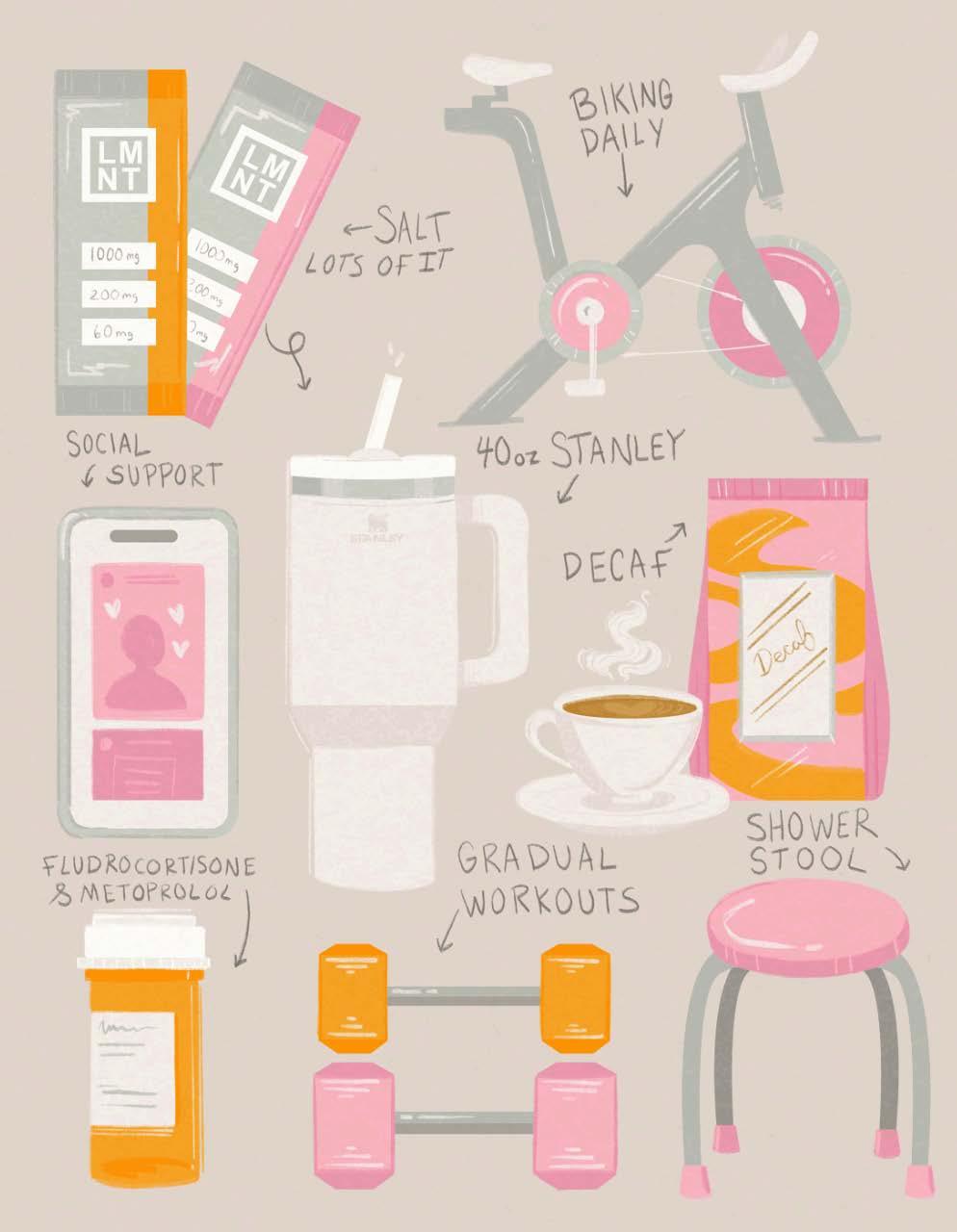
My toolkit for managing Dysautonomia.
Life as it is.
by A. Shalom
in this world, we don’t pay with dollars. we pay with spoons. each of us wakes up with a visible number of spoons floating above our heads. not silver ones. not the kind that clink in teacups. but like the heart meter in a video game. or lives. or chances. and we spend them— just to exist. each task is a transaction.
getting out of bed? that’s one spoon. showering? two. cooking a meal from scratch? four. ordering in? Just one. leaving the house? four spoons and a deep breath. pretending you’re okay when you’re not? that’ll cost more than you can afford. people watch your spoons drop in real time— but not everyone understands. some hoard theirs. some flaunt theirs. some don’t even realise they’ve never had to count. me? i ration mine. like limited-edition goods. like the last bus one has to catch. like childhood stickers i was too afraid to use. like the last seat on the bus when i’m too tired to stand. i spend them slowly. quietly. sometimes recklessly— just to feel a little more human. on good days, i have nine. on bad days, maybe two. and on the worst days, i take out a spoon i don’t have— and go into debt with my body. there’s no bank to borrow from. only fatigue collecting interest. and on the days when i have nothing left, i watch the sky shift its colours for free. i let the light pour over me like mercy. and I remind myself: i am not lazy. i am not broken. i am budgeting my survival in a world that keeps charging full price. but here’s what I’ve learned in this spoon-spent life: peace isn’t found in having more spoons than others. it’s found in knowing where to spend the ones you have. so if i don’t reply, if i cancel again, if i seem distant— please know: i’m just down to my last spoon.
Elizabeth Hospital in Birmingham. I would then be told after a day of further testing I had 2 autoimmune diseases of the liver and bowel, PSC and UC, and I needed 2 life saving surgeries, a liver transplant and a colectomy. This would be difficult though, as when they were trying to stop the internal bleeding, a piece of glue had attached itself to my heart, so a lot of planning and discussion would be needed. Eventually, the glue would go away and I was on the transplant waiting list. Nearly 2 years later, in April 2024, I had my life-saving liver surgery, and then 8 months later, in December 2024, I would have my colectomy done too.
During my journey, the hardest thing to stay on top of was the mental side of things. Being on the transplant waiting list is hard, especially when you know the longer you wait, the more chance you potentially have of dying. Keeping busy when you can and keeping your mind active are key. Having a chronic illness is exhausting, so not every day is possible, and that’s okay. Don’t be too hard on yourself if you need a day of doing nothing, if that’s what your body needs. I always tried to tell myself as well that getting upset and frustrated wasn’t going to change the facts of what was happening, so to do my best to just not think about it, and get on with as normal a life as possible. Easier said than done, I know, but it worked for me and may work for others.
Exercise was my outlet, mainly walking and swimming. If I was doing either of those, I could switch off and almost forget what was happening. Finding that outlet for yourself will help you immensely, so try as many things as you can until you find your peace.
Finding a support group helped me massively, and there are so many for all the chronic illnesses. I joined the British Liver Trust Zoom calls, and through those I found some of my best friends, who I speak to daily. In my opinion, the best support is people who are going through the same thing as you because they can understand and relate, and also offer help and advice if needed.
If anyone could take anything from my journey, it would be that no matter how dark and how bad it gets, it can get better. It’s going to feel impossible at times, but listen to your body and the experts, and between you all you will come out of the other side stronger than ever. The post-chronic illness life is very different, but it’s incredible and feels like the fresh start we never thought we would get. It’s a long road, but it’s worth it.
To someone who is new to the chronic illness community, my advice would be to find people like you. Ask any and all questions you can think of; no question is a bad question if it gives you peace of mind. Avoid Google as much as you can, because everyone’s journey is different, and Google always generalises and jumps to the worst. The most important advice I can give is to still live as best a life as you can, be patient and kind to yourself on your bad days, do something that brings you joy on your good days, and take every day as it comes; eventually you’ll be looking back on the other side of it seeing everything you overcome.
As She Has Always done before…
by Cal Petty
Then she stopped, looked around her, and took several deep breaths.
On her last breath out, she instead let out a scream.
A scream from so deep inside of her that it shook the earth.
A scream so powerful, she fell to her knees. When the last bit of air had left her lungs, she wiped the tears from her eyes, rose to her feet, and began again once more.
As she has always done before...
Invisible and Isolated
by Zoey Bandhauer
I created this painting to cope with the physical and mental trauma I endured while seeking treatment for chronic pain due to hypermobile joint subluxations in my shoulder. After years of trying to minimize my pain, I was presented with the opportunity to try dry needling. I was told it would help. The doctor put several pins in between my shoulder blades and hooked me to a TENS unit to electrically stimulate my muscles, then he turned it on and left the room. I was on level four, a mild level of stimulation, so he wasn’t worried about leaving me; shortly after he left, I experienced physical pain that changed my life. I had a panic attack on the table and was only noticed by my father who came with me, who immediately found the doctor to stop the treatment. I could see in his face and hear in his voice that he didn’t believe me, my doctor thought I was overreacting. I remember him scoffing. I left his office with chronic pain now amplified to near-unbearable levels and a new physical and mental trauma. I had never felt so isolated and invisible.
Lucky
by Christina Quiambao
Lucky.
I was always told I was lucky.
I was born with butterfly wing-shaped ears on both sides. In my culture, it was a sign of spiritual transformation, of new beginnings. Because of this oddity, I have often been regarded as having good luck.
When I was diagnosed with Lupus Nephritis on June 19, 2025, I didn’t believe I was.
What was supposed to be an ER visit for a stomach flu led to an official diagnosis of Systemic Lupus Erythematosus. It turns out I had been exhibiting symptoms of SLE for the past 5 years without even knowing. I had always been sick, but not to this extent.
I started to notice that my body had grown weaker postCOVID-19 pandemic. My lymph nodes would become so inflamed that they would feel painful when I was moving my neck. My hands and feet would go so cold that they would often go numb. My fatigue was so bad that even over 14 hours worth of rest wasn’t enough to regain my energy. When my immune system started to attack my kidneys, it became the final piece
of the puzzle that led to my diagnosis of lupus.
All of my laboratory results showed positive markers; there was no denying it. I didn’t feel lucky. I felt as if my life was ripped out of me.
After a week-long stay at the hospital and a renal biopsy, I was completely bedridden.
I lost all hope. I felt emptied physically, mentally, emotionally, and spiritually.
There were nights when I hoped my heart would just give out or that I would just stop breathing entirely. I prayed to God to just end it all. I just wanted the pain to stop.
Lucky. I surely didn’t feel lucky. I always took care of my health. I would get myself checked if I didn’t feel right. I took my medications as prescribed. I made sure to consume well-balanced meals. I never had any vices.
Yet, my body failed me. I wasn’t lucky. There’s no way that I was.
A month after I was diagnosed, my doctor explained the biopsy results. Class IV Lupus with 100% crescents, which indicates severe kidney damage caused by my autoimmune condition.
“You’re very lucky, Christina,” she said.
How was I lucky?
“It’s rapidly spreading, but it’s all new, which means it’s reversible. There’s no permanent damage,” she continued.
Ah. There it was. Lucky.
She explained that some patients had to undergo chemotherapy despite having lower percentages of crescents due to the severity of their cases. But I was lucky, because early detection and intervention saved me from what could have been irreversible damage to my organs. I was lucky that I had great health insurance to cover the costs of all procedures, treatments and medications that would save me from kidney failure. I was lucky that my family convinced me to go to the ER since I wasn’t getting any better from the medications prescribed for the stomach flu. I was so lucky. This is how I cope, why I decided to stay alive. I’ve gone and still am going through hell, but, for some reason, I was lucky at every turn. So many near misses where I was supposed to have unknowingly caused so much damage to my body or lost my life, but I didn’t. All the luck I’ve had so far shows me that it’s not my time yet; there must be something I have yet to do. Maybe continue contributing to the world of journalism or simply be a good daughter/sibling to my family, who showed love and care at the lowest point in my life. I don’t know yet.
I have no clue what my purpose is, but I am certain this luck is one of the things I’m holding onto to keep on surviving.
And with these butterfly wingshaped ears, I too will welcome a new beginning.
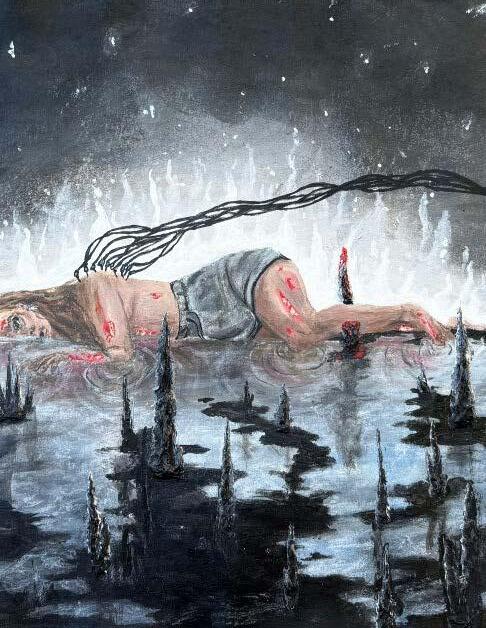
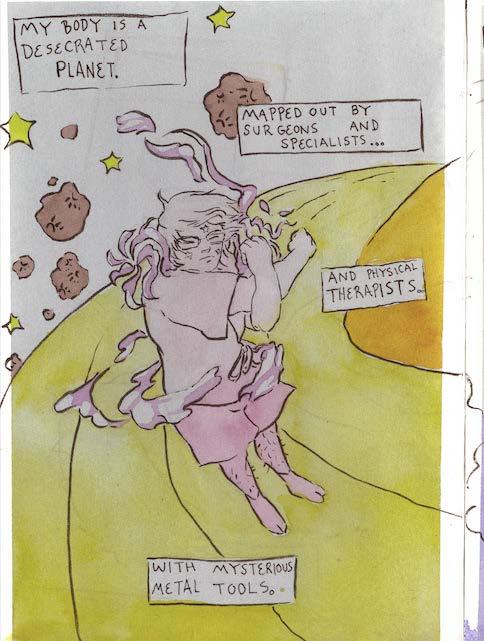
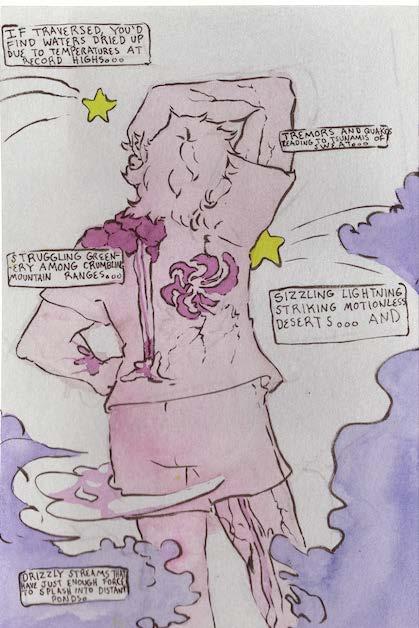
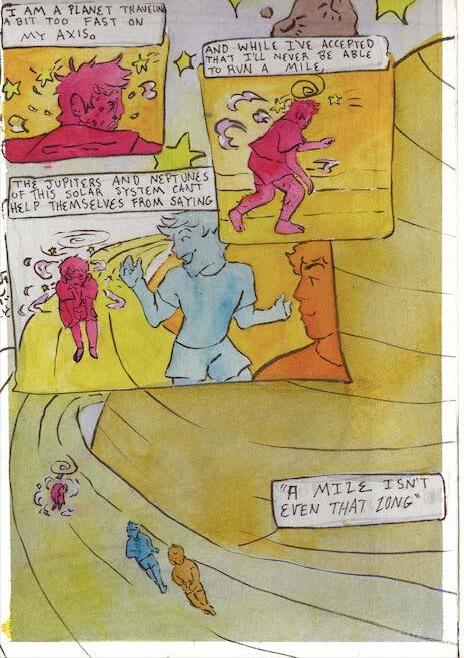
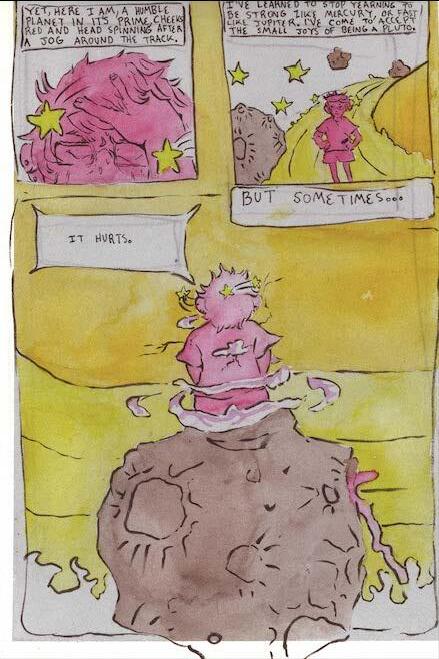
Climbing out of the Sputnik Planitia by Pluto
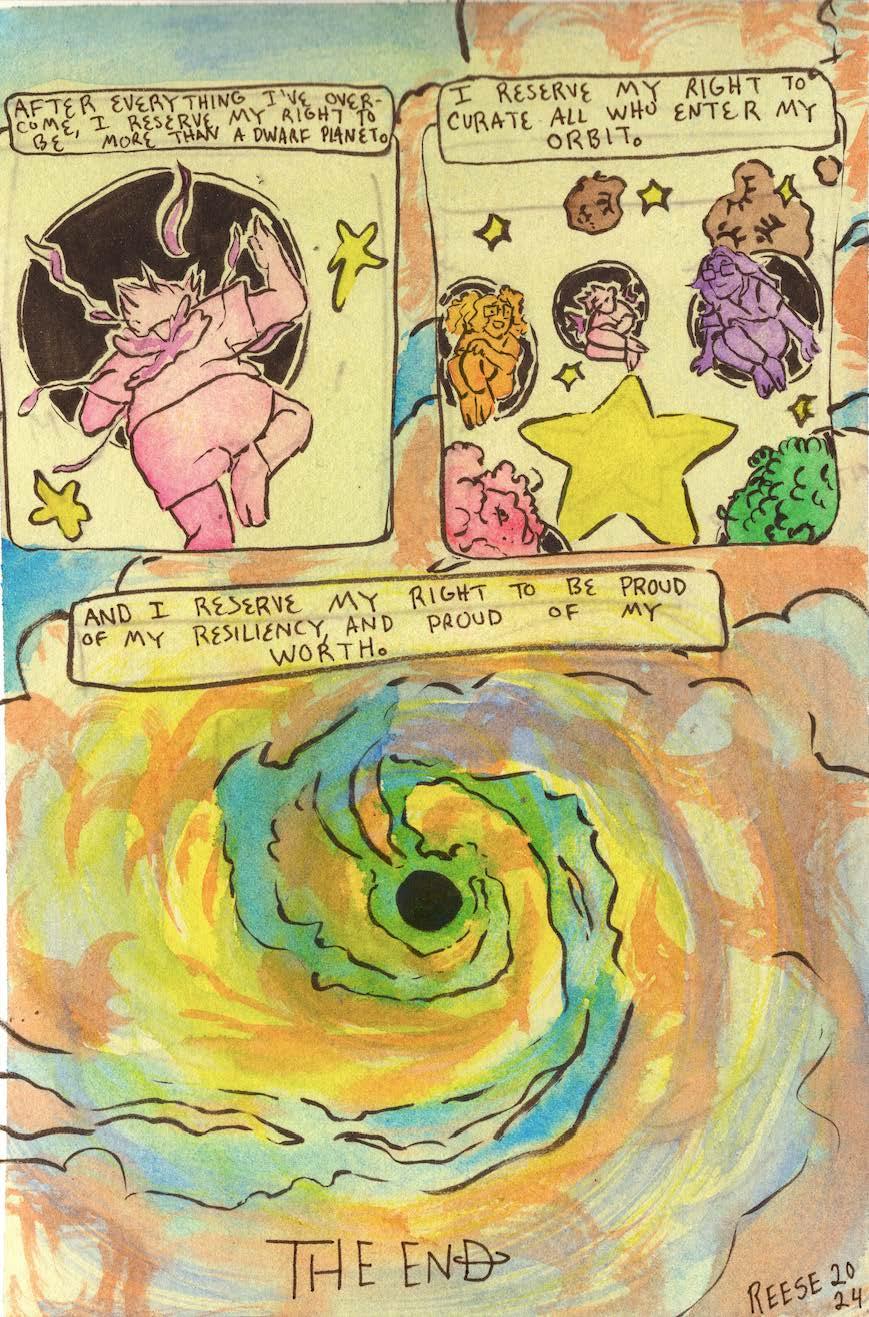
Last year, I had the privilege to be a part of a specialized group physical therapy for people with hypermobility. This course taught me how to manage my symptoms better than any doctor or online resource, and genuinely changed my perspective of myself and my life ahead of me. At the end of the course, we were instructed to write our future selves a letter to be mailed back a year later. I decided to make my letter a short comic because I am a foolish artist fueled by hubris. This comic is a little bit about the trauma of growing up in constant pain and not knowing why, a little bit of a paleontology nerd flex, and a little bit about how I’ve accepted myself as a disabled person. Also, this comic was made right before I decided to pick the middle name Pluto!
Coping DeconstructionThroughand Self-Compassion
by Sharla Wilson
“I just have energy to expend, and you can’t exactly leave the house,” my exhusband once explained to me. In his eyes, I was no longer fun, and this became his reason for not wanting to spend time together. He had a robust life to live, and mine had seemingly screeched to a halt.
In September 2021, at the age of 38, one day I was fine, and the next, I went to stand up and couldn’t walk. A herniated disc would go on to calcify to my nerve root, causing extensive nerve damage and CRPS (Complex Regional Pain Syndrome), would get misdiagnosed a multitude of times. During the next two years, I would experience countless failed injections, endless rounds of physical therapy, a bevy of medications, and three surgeries before the doctors finally got it right.
During this process, we discovered that I am also autistic. I was formally diagnosed in January of 2024, and due to a lifetime of masking my autism and traumatizing my nervous system in the process, I ended up with three chronic illnesses in tow. Dysautonomia, Hypermobile Spectrum Disorder, and Mast Cell Activation Syndrome. Suspicions of Ehlers-Danlos Syndrome also prompted the order of genetic testing, which comes complete with a 10-month-long waiting list. While some of these illnesses are comorbid with autism in general, and not the direct result of trauma and masking, the more dysregulated my nervous system becomes, the higher my pain levels soar. Connective tissue, as it turns out, is connective.
In just three years, every single aspect of my life had changed. My expansive world had now been narrowed and confined to the inside of waiting rooms and doctors’ offices. As my physical health continued to deteriorate, my free time was no longer free; it was spent recovering, filling out paperwork, and attempting to gain control of my spiraling mental health. What was once accessible was now out of reach. I mourned for countless experiences I may never have. I grieved even for the activities that previously held no interest to me. Run a marathon? Me? Now that I couldn’t and may never be able to, I yearned for an able body to torture in the name of endurance, fortitude, and triumph.
As the common phrase goes, “health is wealth,” and I was now flat broke in more ways than one. So, how did I cope? For several years, I didn’t; I merely compartmentalized and prioritized my most pressing and immediate needs. When chronic illness and disability merge with or create trauma, it can often become difficult to see a future beyond next week’s doctor appointments.
Riddled with internalized ableism, shame overran my thought patterns and informed my actions. I would find myself pushing beyond my physical or mental limitations some days simply because I felt like I should. The voice that told me this was not my own, but one deeply embedded in our society for centuries. It was the same voice that told me I am not of value unless I am producing. The one that says rest is earned, and working yourself into burnout is the only option. I began to first cope by giving myself grace and compassion as I unpacked nearly four decades of debilitating and harmful systems. With this great learning and unlearning came a neurodivergent-affirming therapist who would give me a new lease on life. The therapist and I started small, working on tiny ways I could make my microscopic world feel large again. I needed to gain back some semblance of autonomy through something that felt degrading and dehumanizing daily. When I couldn’t get down the stairs, I would spend time sitting outside on a 3’x5’ deck, just to be able to feel sunlight on my skin again. To be able to fill up my own water, I purchased a lanyard-style
cup holder that kept my hands free for my walker. After that, I bought what felt like the Cadillac of rollators, complete with pockets and a storage seat. I could now move from room to room with little assistance. Slowly, we found ways to infuse my existence with dignity. As time moved forward without me, each day felt like a replica of the one before. A year would pass in what seemed like a week to my deconditioned body. Without novelty, my world remained dull and listless. The next step of coping would prove to be the most difficult– find my joy again. My life didn’t look anything like I wanted it to look, but it was still happening, with or without my happiness present. I needed to find a way to laugh again, to play, to elicit the childlike wonderment and creativity that once fueled my passion. I needed to connect with others who are also autistic and chronically ill. I needed community.
On a random day in March of 2025, I opened up my TikTok account and began to post. “Act like you belong here,” I told myself. Bile rose up in my throat as I hit record that first time. My hands shook, my heart raced, my voice quivered, but I began to tell my story. Post by post, comment by comment, one person at a time, my little community grew, and with it, my world began to finally expand.
I cope because I am no longer alone. Thousands share a similar story, and through speaking our truth, we light the dark path for others.
Tending to Life
by Faerie
Being able to grow plants brings life into my heart. Chronic illness and disability is very difficult. My entire world is controlled by my illnesses but gardening brings peace and joy that I don’t typically feel.
What Chronic Illness Took and Gave Me
by Lexi O.
I’m 22 years old, and last year, I was diagnosed with a chronic illness called Postural Orthostatic Tachycardia Syndrome, also known as POTS. In the span of a few months, my life unraveled. Everything I once knew about myself, my body, and my future suddenly changed. When I finally received my diagnosis, I cried out of relief. After months of confusion, pain, and constant disruptions to my daily life, I finally had a name for what was happening. But I
The physical symptoms are relentless. My heart beats erratically. My blood pressure swings like a pendulum. My limbs go numb. Even the smallest tasks like brushing my teeth, sitting up, and turning over in bed can feel impossible.
And yet, to most people, I “look fine.” I hear, “But you’re so young, “ You look healthy!” from well meaning strangers, while internally, it feels like my body is short circuiting. This disconnect is one of the most isolating parts of living with an invisible illness.
life I had and the person I was. There’s guilt for the plans I cancel and the help I need. Anger at my own body. Fear of an uncertain future. And then there’s shame. Shame for not being able to do “normal” things. Shame for no longer being the joyful, outgoing girl I once was, but someone who often stays home because she’s too tired or in too much pain.
fog makes it hard to concentrate. Words disappear mid-sentence. I worry constantly about money, relationships, and whether this is my new normal. I question my worth when I’m not productive. I battle thoughts of laziness, exaggeration, and failure just for being
cope.Coping is no longer about “fixing” myself. It’s about adapting. I pace myself — sometimes by the minute. I use a shower stool. I stash snacks
wins.
Emotionally, I’ve learned to rest without guilt. I practice mindfulness. I listen to my body. I remind myself that healing isn’t linear. I’ve redefined strength. It’s not in how much I can lift, it’s in how fiercely I keep showing up for myself, even when it hurts the most. Support has become everything to me. My circle is smaller now, but it’s stronger. I lean on a few close friends, my family, and the online chronic illness community. These are the people
The Title by Lauren
Mann
All my life
I sought out a title To call my own.
Could I be called…
Pretty? Intelligent? Philanthropic?
Sarcastic? Popular? Comedic?
Kind? Considerate? Talented?
Would I be called…
The best friend? The coworker? The poet? The girl friend? The traveler? The boss?
The daughter? The artist? The aunt?
The wife? The mother? The homemaker?
All my life
I sought out a title To call my own.
But it wasn’t
Until I received the diagnosis That I no longer Wanted a title And just wanted to be me.
Chronic Alienation by Heather Sandison
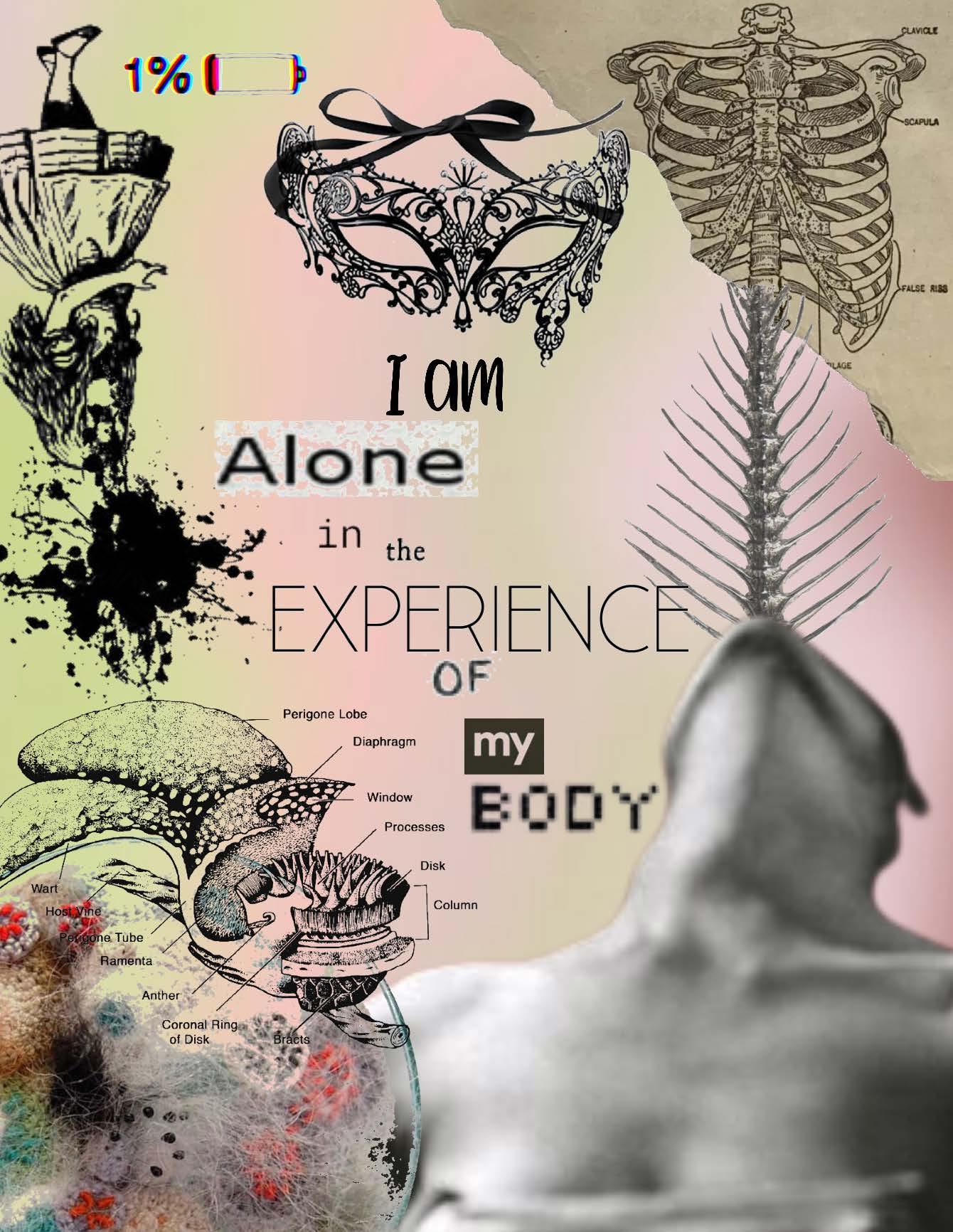
Digital collages created on shopify.io using various pieces created during different hospital visits and in bed 2024-2024. I layer various images in a purposefully chaotic and overwhelming way to create “eyesore art”. I got so tired of being told to make conventionally appealing art, and of trying to channel my ugly overwhelming disability feelings into a pretty picture. So I just gave up on the entire concept and lent into it being overstimulating and confusing, because I don’t feel understood by most people anyway. Each piece is a visual journal that I “write” in about an hour. The whole image tells extremely private stories but because the visual language is my own, I am able to obfuscate myself from the viewer and yet still offer a glimpse into my experience. For example, TV static, screen cracks, glitches, or computer errors always represent seizures as I see my brain error coding, resetting, or quite literally switching itself off and back on again. It’s an extremely satisfying and therapeutic process, and because its digital I can do it in bed as opposed to my physical art supplies.
Redirect the Bee, Abundantly
by Kate Rehurek
The word chronic is not taught on a chalkboard with your ABC’s, it’s not taught when you first learn how to apply a bandaid. It is not openly taught or required to be taught, but it is something I have found myself explaining over and over again to adults and children alike. Chronic means forever. It does not “go away,” I found myself repeating through the years. This concept, for some reason, is extremely difficult for the healthy person to grasp. Why would they have to worry about what a word means when it usually doesn’t apply to them?
Trying to understand this word, and what it meant for me as a child, was also difficult. With an already skewed view in a brain that is trying to develop, coming to the conclusion of “forever sick” was challenging and didn’t seem fair. I have never known a healthy body or had the chance to have one; I came out of the womb already sick. From chronic eczema, to spending my days in kindergarten fighting off sicknesses, and spending time on breathing machines to try to fight extreme allergies, it is safe to say that my childhood was stolen from me. The amount of time that I spent in doctor’s offices is uncountable. The amount of tests, blood draws, research, medication, and just time spent trying to figure out what’s going on is something that I think everyone with a chronic illness relates to. It can be beyond exhausting, challenging, and humiliating.
wrong with me. I feel like I’m constantly being poked and prodded at, being looked at and treated like a project to fix. That within itself is beyond humiliating; I feel I cannot just exist the way I am. I did not choose for my chronic illnesses
defining factor of my life. It’s exhausting to try to explain your diagnosis count to people, or what is “wrong with you” to the average person. Bringing up your illnesses is never comfortable, and sometimes you feel you have to comfort the person that you’re telling. It’s not very socially acceptable to explain the constant decomposition of your body to someone. I’ve always had something
Imposter syndrome with chronic illness is very real. The absolute fear that sunk into me as a child, that I would be replaced in everything I did just because I was sicker than the other children, has carried into adulthood. I have had to work double with my health, and then some, just to fit in and earn my spot in the hive. “If I don’t show up to this, they’ll think I’m just not putting in enough work.” “If I don’t do well on this assignment, then I’ll look like I’m just using my chronic illnesses as an excuse.” “If I don’t participate, then I look lazy, even though I need to rest.” The buzzing of needing to be exceptional, to be the best at everything I do, is still something I struggle with. I’ve been called a “little worker bee” before, and I am fearful that if I don’t work hard, I will be kicked out of the hive. I fear that everyone that has their symptoms become the ruling factor of their life understands; sometimes you can’t prevent the flare ups and the rest days, no matter what you do. Even if you’ve done “everything right” for your body and mind, there are still days where you
can’t buzz along any longer. You stop making noise, and you have to crawl to continue.
It is a duality of a blessing and a curse to have some of my symptoms so explicitly visible on my body. Sometimes, there are certain individuals who seem to give more grace because my suffering is “visible.” How horrid is that? What if I didn’t have the markings that I do now? Chronic illnesses should not be treated as less just because you can’t see it.
With the decomposition and the infections, the doctors think that the best explanation for what is happening to me is a root issue of the infection held in my diagnosis of Lyme disease. This has created the thinning of my skin, which appears to look like long, stretched-out marks across my body. At first, you would think the color and look of a stretch mark, but not in size. They have currently swallowed my skin, making it look like someone carved it out into me. I used to be able to cover them just with a t-shirt and shorts, but the marks have grown tremendously in the last two years and show no sign of stopping. It’s a free-for-all for someone to lock onto and stare at. I am a sight to see in a swimsuit; something out of a freak circus, to some people’s eyes. My stripes look a little different than the usual.
The staring is something I haven’t gotten used to, despite people doing it since I was a little one. You would have thought I would have, since I’m in the eyes of people all the time. As I’ve gotten older, the damage to what’s
happening to the infection inside of me is more and more visible. People are not kind, people are ignorant. The average person usually swats bees too, so it’s not saying much.
My symptoms are physical and mental, making the day-to-day a whole struggle within itself. From chronic pain, to migraines, muscle tension, loss of hearing and speaking, brain fog and inflammation, coughing, throwing up, numbness, my markings splitting open, pussing, bleeding…I could go on and on, describing each symptom and the toll that it takes on my life. This has put such a strain on self-love, as I see my body as the enemy from my brain. It takes a toll on my mood, and is a whole job within itself to keep up with. I was forced to become very organized and accountable at an early age, because if I did not, my symptoms could crash into hospitalization.
I was blessed to have a mind for research. I am grateful to be at a university where I can explore, develop, and create into the world of an English degree, and a minor in Digital Humanities. These two fields together in my undergraduate years have created a mixed, digital and physical creative space that’s been a coping mechanism for me to lock into. I’ve found something other than my illnesses and weaknesses to focus on through academia, helping shape a purpose beyond the scary fact that I will be like this the rest of my life. Sure, some of my diseases and illnesses may go dormant, but chronic is chronic. It’s a forever dance that I’ll have to completely accept as part of myself in
the hive. Since I’ve found things that work for me, I want to share and create this space to share with you too, because no one deserves such suffering.
Something I’ve found that works exceptionally well is distractions. Some breathing exercises or meditations that I’ve been recommended for chronic pain makes everything worse, not better, due to the fact that you’re trying to be “in your body.” Covering up the pain doesn’t work for me, but redirecting my focus and what I’m paying attention to does. If you haven’t looked into what A.S.M.R. (autonomous sensory meridian response) is, I highly suggest it. It provides forms of visual and audio destressors. There are thousands upon thousands of these types of videos, ranging from talking, no talking, keyboard clicks, specific hand sounds, messing with the audio and visuals, etc. As someone who hates chewing and mouth sounds, I have opted towards the sounds of no talking and watch hand visuals, or listen to book-turning pages. This helps my nervous system focus on a different response to the things I’m exposing it to rather than focusing on creating more pain. It’s not a fix-all cure, and sometimes it doesn’t work at all, but it’s done me fairly better than trying to diminish. Redirecting seems to help a lot.
me. Sometimes, the buzzing of never being good enough is the symptom, where I’m kept up with the moon to contribute to the hive, just wanting to fit in. A worker bee that can’t do the one thing that it’s supposed to – to keep up with everyone. Redirect the bee, abundantly.
Redirecting your mental attention, as someone who overthinks and hyperfixates, is critical. I have had late nights where my symptoms swallow
I mean abundantly, too. When the symptom of insomnia, planning, and micromanaging every single part of your life, because it’s the only thing you can control, gives way to learning how to manage your body. If it’s on a physical sheet of paper or a note in your device, try your best to treat it as a brain-dump; your brain can rest since you aren’t holding onto and trying to remember everything. Specifically for me, I have a physical calendar so I can keep track of everything for myself. I take what’s in that and keep a loose digital calendar with my events and meetings (I share an Apple Calendar with my family members to see when my meetings cross over with my brother’s schooling or fencing tournaments), so I understand what I need to get done through the day. I write down to-dos for the mornings sometimes to have everything prepped in case of brain fog or a pain flare bad enough I can’t focus. I have a digital notes app on my device that’s organized and hyperlinked, with everything from assignments due to the next personal project I have, even my grocery list and the names of products I currently use in case I forget.
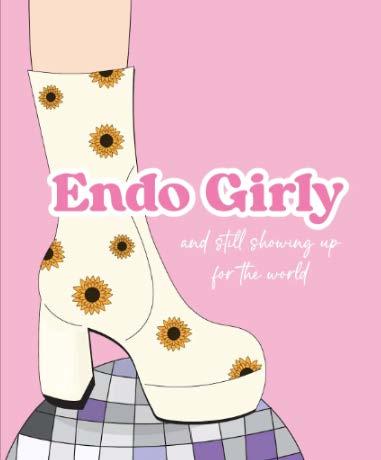
Endo Girly
Cassie Stevens
Living with both Endometriosis and PMDD has profoundly shaped my artistic journey. Through my work, I aim to create empowering visual narratives for individuals navigating chronic illness, while also expressing the deep frustration with healthcare systems that often dismiss, underacknowledge, and gaslight women. Each piece is a testament to the immense power and bravery of women who, despite their conditions and the challenges of the medical system, continually show up for themselves and face each day with unwavering strength. My colourful and empowering designs are a celebration of their resilience, created so that every woman can feel seen, heard, and appreciated.
I am Fine K Hall
Usually we like to cover everything up, the hurt, the sadness, the isolation, and the generally overwhelming feelings and tell the world that we are “fine.” However, we need to start sharing how we really feel in order to cope and start to heal.
We’re Delicate Flowers in Bloom
by Marissa Nieto
I was diagnosed with Crohn’s Disease in the summer of 2024, and my life hasn’t been the same since. As much as I’ve always loved exploring and connecting with others through food and travel, I now have to set boundaries for myself — physically, emotionally, and socially — to honor what my body needs.
I love photographing scenic landscapes and plants, especially flowers. There’s something so transformative about them that makes me think we’re just like flowers ourselves. We go through different phases — some not so great, and some where we’re thriving, glowing, and in full bloom. I like to think of us as delicate human beings who deserve to be handled with care, no matter what season we’re in.
My advice to anyone navigating life with a chronic illness is this: try to enjoy every moment, love yourself, and be gentle with yourself. It takes a lot of patience to walk this path, but finding creative outlets that make you feel whole and happy can bring light into the darkest moments. (Bonus points if you have a supportive community around you.) And if you don’t yet — I’m sending you mine. As you read this, I’m manifesting love and healing your way.
Features
What Remains When the Body No Longer Keeps Up?
How the Piano Helps Me Cope with my Chronic Illnesses
by Jenny Grobosch
I sit at the piano. My vision is a little blurry, I feel the dizziness and my slightly unsteady hands. Still, I manage to dive into another world for about fifteen minutes. A world of music. I forget what’s around me and just play. I live with ME/CFS and POTS, two chronic illnesses that have changed my life in every way. These days, I spend most of my time at home, often in bed. I can no longer work as an architect. My social life is very limited, and even the smallest everyday tasks have become difficult. Sometimes it feels like the illness has taken away all my freedom.
I turned to music because I needed something that would remain. Something I could one day look back on. While everything on the outside seems to stand still, I wanted to create something that feels alive.
As a child, I took piano lessons for a few years. I learned to play classical pieces from sheet music. At some point, I stopped. Many years later, during the pandemic, I found my way back to the piano. I played pieces I liked, just for myself. But as my illness progressed, reading music became too exhausting. I couldn’t concentrate anymore, and I lacked the energy. I wasn’t able
Listen to Jenny’s music here
to play the way I used to, so I started teaching myself to play freely.
At first, it was just a few notes. Then came small patterns I played over and over again. One day, they turned into a complete piece. Then another. I never planned to compose. It just happened.
When I sit at the piano today, I feel like so much more than someone who is sick. I can shape something, make decisions, create. In a life where so much is no longer in my control, this means a lot. Music gives me back a feeling of stability. It helps me feel less powerless.
But it’s more than that. At the piano, I find a language for things I often can’t express with words. Pain, exhaustion, loneliness, fear — it all finds its way into the music. I let out what’s moving inside me. And while I play, the heaviness sometimes turns into
something beautiful. Something that lasts.
Often, I can only play for a few minutes. But even those short moments mean a lot to me. They give my day some structure. They are small points of light. Something to look forward to. Something that brings meaning. The piano has become a steady part of my life, even though I often don’t have the strength to play as regularly or deeply as I’d like to. Still, I’m proud of everything I’ve created so far, even if it happened step by step.
Each of my pieces tells a story. Many reflect the themes that come with illness: loss, hope, invisibility, new beginnings. One of these pieces is Still Here. Since becoming chronically ill, I’ve often felt like I’ve slowly disappeared from the outside world. No job to go to, rarely enough energy to meet friends, and most of the time I’m not
able to leave the house. When you can no longer function the way you used to, it’s easy to feel like you’re becoming invisible.
This isn’t just my story. Many people living with invisible illnesses know what it feels like to be overlooked. When the body no longer cooperates, daily routines fall away. Social connections become fragile. And gradually, you begin to feel unseen.
Still Here is my response to that feeling. A quiet but clear reminder that we’re still here. We live, we feel, we create. Even if our lives look different now. Even if we are no longer visible in the way we once were.
This piece is for everyone who has felt themselves left behind and unseen. For everyone who wonders if they’re still part of this world. I hope that this song helps make us just a little more visible again. And reminds us, and others, that
we still belong.
I share my music in the hope that it reaches others who feel the same. Maybe they hear themselves in my melodies. Maybe they feel a little less alone.
That connection is something truly special. I get messages from people who say my music touched them, gave them comfort, or made them feel seen. That moves me deeply. It creates a sense of belonging, even among people who have never met.
Sometimes I wonder what my life would have been like if I hadn’t gotten sick. But I know that question won’t help me. So I try not to get lost in what could have been. I focus on what is still possible. And even if that’s not much sometimes — it’s not nothing. Music doesn’t heal me. But it holds me. And sometimes, that’s enough.
Symptom Trackers A Tool for Agency
by Claire B. Bushby
Here are a couple of examples of my Symptom Trackers. I use these to record variations in my symptoms and explore potential links to things like foods, medication changes, environmental factors, or stress. I change the variables each month depending on what I’m curious about or need to keep an eye on. For example: Does my energy drop after eating gluten? Do I notice a pain flare-up around that time too? This process helps me cope. When I can observe patterns and identify even small factors I can control, it gives me a sense of agency. That’s especially important when I’m being bounced between appointments, hearing different opinions from different doctors—none of whom are living in my body.
by Anonymous Mood Trackers
As someone who has struggled with mental health conditions for over 15 years, keeping track of how I am doing on a day-to-day basis is important. Seeing a visual representation of where I am and how I am doing allows me to track trends. Those trends in my mental state help me recognize when I am headed for a significant low, and while I can’t just stop having mental health issues, I can use the warning signs as a time to set myself up to get through a rough period. I can warn the people close to me so they know I need to be checked on occasionally; I can try to get ahead on chores or larger tasks before I lose the ability to do them; I can remove things from my environment that will be harmful in the wrong headspace. Keeping this visual record allows me to maintain a level of stability in the storm I can see coming.
Activities
Maze
Find your way through the garden...
contributers
in order of appearance
Jenna Borrelli
IG & TikTok @jenna.borrelli.life
Jenna Borrelli (she/her) is an artist, somatic hypnotherapist, and burnout recovery coach. Her life’s mission is to help people live more restful and creative lives. She resides in Chicago with her three cats, and partner Michael – whose bed has become her own.
Sammi Bechard
IG @sambitchard
I’m a disabled trans artist discovering new limitations to my body. I have always been the strong friend, so transitioning into the person with a chronic illness and accommodations is difficult. I’ve been working hard to accept my limitations and recognize I am still strong. Art has always been an outlet for me, and I’m thankful to have it during this journey of my life.
Alek Ferguson
IG @kingofthefey
Alek Ferguson started writing as a kid and rarely stopped. His writing style switched from primarily fanfiction to poetry during his senior year of college, many of which are inspired by his chronic physical and mental illnesses, and coping through the rough times to find joy in creation.
Chef Sweetz
IG, TikTok, lemon8, snapchat @flavorzbysweetz
Chef Sweetz is a former executive chef living with Crohn’s Disease and other chronic illnesses. She creates mini cookbooks and content that blend humor, food, and real-life advocacy for the chronic illness community.
D. Austin
TikTok @frogsona
D. Austin is a self taught fiber and textile artist based in North Carolina. Their art is an amalgamation of lived experiences guiding the subject, and sustainability influencing what materials are used.
Debra Lowe
IG & TikTok @debralowestories
Debra Lowe is a storyteller of strange truths, soft rebellions, and beautiful messes. She writes fiction shaped by her lived experience with chronic illness and disability.
Halie Paige
IG & TikTok @haliepaige_
Halie Paige is a chronic illness advocate and content creator who was diagnosed with cancer at age 5, and has lived with invisible illness ever since. Through storytelling and community-building, she shares the raw realities of chronic illness to help others feel seen, supported, and less alone.
Emilie Delaye
@chronicallysickwithstyle @edelaye
Emilie Delaye is a passionate advocate for the chronic illness community, using her platform Chronically Sick with Style to raise awareness, challenge stigma, and share the everyday realities of living with conditions like Lyme disease, Ehlers-Danlos syndrome (EDS), and POTS. Through storytelling, curated resources, and honest content, Emilie empowers others to speak up, seek support, and find strength in vulnerability. She is also pursuing a graduate degree in Fashion and Apparel Studies, working to create more inclusive and adaptive solutions in the fashion industry for people living with chronic illness.
Brittany WilsonThompson
Brittany Wilson-Thompson is a self-taught artist living in Missoula, Montana. Painting has become a tool that helps her cope while living with chronic illness. She wants her art to help others in the chronic illness community to feel less alone, and create more conversation around chronic illness.
Maria Rising
@tirzepatidetales on @therisingproject / @mariarising42 & @tirzepatidetale
Maria Rising is a research strategist, grant writing consultant, and college application specialist with over a decade of experience in higher education, nonprofit leadership, and program design. As the founder of The Rising Project, she supports organizations, students, and professionals in navigating funding, growth, and storytelling with clarity and purpose. She also is a content creator on wellness, plants, and chronic illness
Stephanie L. Bade Tiktok @DizzyQueenB @steph_has_pots
Stephanie L. Bade is a 43-year-old wife and mother of three living with multiple chronic illnesses, including POTS, Fibromyalgia, Type 2 Diabetes, chronic pain, and chronic fatigue. A former healthcare worker turned advocate, she now uses writing and social media to raise awareness, validate invisible struggles, and
Ally Meisner @socialwork.ally
Hi! I am Ally Meisner, currently a second-year graduate student studying trauma social work. I have multiple chronic illnesses myself and am diving into the world of advocacy.
Paige Veta
IG @paigee.veta
Paige is a chronic illness warrior who has degrees in Psychology, Cognitive Science, and Integrated Arts from Case Western Reserve University. She has published research around Communication and Psychology, as well as impacts of spirituality on chronic illness. She is a motivational speaker who focuses on the concept of “choosing optimism” and helping others impact their mindsets in challenging situations as well.
Emma Foley
Emma Foley is a rising senior at NYU studying Applied Psychology, with a deep passion for photography. She has been shooting since 2016, focusing on street and portrait photography.
Jaden Heck
IG @jjheckk
TikTok @jjsarttherapy
Etsy JJsArtTherapy
I’ve had POTS for over half my life, and was born with Hypermobile EDS but didn’t get diagnosed until 18. Sometimes, the feelings of giving up surface, but we have the opportunity everyday to say no to the pain and yes to life. Keep going.
Paola
IG @paolapenate
Paola is a Project Management Coordinator and BBA student, balancing her career and studies while managing several chronic illnesses. She loves finding comfort in flowers and simple daily moments. Through sharing her experience, she hopes to inspire and uplift others living with chronic illness.
Halie Jost
@byhaliejost
Hi my name is Halie Jost. I’m a digital illustrator from Buffalo, NY, sharing what it’s like living with chronic illness through my art.
A. Shalom
@beyondblankpages
A. Shalom lives with Fibromyalgia and writes about the daily dance between pain, pacing, and peace. She is the author of Slow Burn, a poetic diary available on Amazon, written to be a soft place to land for anyone quietly hurting.
Ben Jeszka
IG @ life_afterthelist
My journey from the unknown illnesses, to near death experiences, and now over the mountain to the best I’ve ever felt. My story, as best as I can put it.
Cal Petty
TikTok @calbeth_
Cal, 24 years old. I have POTS, MCAS, Gastroparesis, ASD, ADHD, Narcolepsy, and HSD. I have been sick for over 8 years. I am a tubie due to gastroparesis. I am a preschool teacher, which is my pure passion. Writing is my most important coping mechanism when it comes to dealing with all things chronic illness.
Zoey Bandhauer
IG @medusa_media
Tiktok @medusamedia_
I am 20 years old, and I am the founder and owner of my creative business, Medusa Media. I live with multiple chronic conditions including AMPS, POTS, and undiagnosed HEDS (currently labeled generic hypermobility disorder). Creating art has always been my biggest passion, allowing me to explore and cope with everything life gives us in raw and tangible ways.
Christina Quiambao
IG @tinaneninonu
TikTok @love.lupus
Christina Quiambao is an editor for an international news organization based in Abu Dhabi, UAE. She was diagnosed with SLE in June 2025. She’s hoping to meet people in the chronic illness community as she navigates this newly-diagnosed condition.
Pluto
@melatoninmom, @dogsthebrand, @plutoliketheplanet
Pluto is a trans, disabled artist from the northshore of Massachusetts. He’s a regular organizer at the Shoe Bones Collective in Salem, and can be found at your local queer craft fair selling mildly vulgar linocut printed patches. When Pluto grows up he wants to publish at least one of the graphic novels brewing in his head and see a world where every politician is replaced with a very small cat.
Sharla Wilson
TikTok @ohithoughtitwascharlotte
I am a 42-year-old late-diagnosed, highmasking Autistic adult with ADHD and multiple chronic illnesses. Discovering and deconstructing the harmful systems that inform how I view myself and the world around me would prove to be the most critical step in coping with my disabilities. Through community and using my voice, I am able to find joy again, and through storytelling, I help light a once lonely and dark path for others by showing them that they are never alone.
IG- earth_fae TikTok- earth.fae
YouTube- earthfae lemon 8- earth.fae
Faerie Disabled artist and content creator
Lexi O
Lexi is a 22 year old former athlete turned chronic illness advocate living with POTS. Through writing and connection, she aims to support others in the chronic illness community and challenge the idea that worth is measured by productivity.
Lauren Mann
TikTok @lauren_danielle
Lauren lives with many mental health and chronic health diagnoses. She is primarily what they call a zebra in the medical world. Lauren was diagnosed with the rare disease, Common Variable Immuno Deficiency (CVID), in January 2025.
Heather Sandison
I’m a young artist, recently diagnosed with ankylosing spondylitis arthritis and absent seizures after years of terrible doctors. I’ve dealt with chronic pain and mental health issues my whole life and use art to process it.
Kate Rehurek
IG @katerehurek
Kate Rehurek is an undergraduate student at Concordia University Texas, studying a B.A. in English, as well as a minor in Digital Humanities. As a woman in the humanities and STEM disciplines due to her degree mixing the two, Kate works hand-in-hand with creative works, academic research, TEI/XML encoding, and other subjects in multi-disciplinary studies. With Kate’s work as an intern, she has worked closely on a digital, open-access version of The Countess of Montgomery’s Urania underneath Professor Jo McIntosh, and has helped create and open a Digital Humanities Lab at Concordia University Texas (DH@CTX).
K Hall
K Hall is from Michigan and recently graduated from Western Michigan University. She enjoys photography and different forms of art.
Sarah Swinford
@BadLittleArts
I am a Chicago based mixed media artist creating work with mostly inherited, donated, and thrifted materials. My work seeks to make something new out of long forgotten parts.
Marissa Nieto
IG @filmsby.marissa / tiktok @films.
I’m Marissa Nieto, a multidisciplinary Latina designer residing in the quiet suburbs of the Inland Empire, CA. As a creative individual who seeks inspiration through exploration, I face daily challenges due to Crohn’s Disease — a condition that often limits my ability to do what I love most.
Jenny Grobosch
@jennygrobosch
Jenny Grobosch is a piano composer living with ME/CFS and POTS. Through her music, she expresses the challenges and hopes of living with invisible conditions, creating pieces that offer comfort and connection to others facing similar journeys. Her work is available on all major streaming platforms.
Claire
IG @filmsby.marissa / tiktok @films.
Claire B. Bushby is a multidisciplinary artist and curator based in Boorloo (Perth, Western Australia), living and creating at the intersection of disability, queerness, and ecological care. She lives with metastatic breast cancer, which has profoundly shaped her relationship to time, the body, and creative practice.