A Guide to AI Prompting

How to Create Effective Prompts and Use AI Tools to Enhance Your Workflow
Tom Meehan, CFI
How to Create Effective Prompts and Use AI Tools to Enhance Your Workflow
Tom Meehan, CFI

Prompting is how you direct AI to think, act, and produce results. It goes beyond asking questions. It is about giving clear, structured instructions that guide outcomes.
AI performance depends on how well it is directed.
Clear prompts lead to more accurate outputs, faster insights, and better decisions.
Where It Creates Value
Reduces manual effort
Accelerates analysis and reporting
Improves communication
Standardizes workflows

In This Guide, You’ll Learn
How to structure effective prompts
How to improve and refine outputs
How to use AI to build productivity systems
Every effective prompt includes four key elements:
1. Role
Who should AI act as?
(Analyst, Investigator, Executive, Operator)
2. Task
What needs to be done?
3. Context
What background or constraints matter?
4. Output
What should the result look like?
Example
Basic Prompt: Summarize this report
Structured Prompt:
Act as a security analyst. Summarize this report for executive leadership in 5 bullet points and highlight key risks.
Best Practices
Be clear and specific
Provide relevant context
Define the format of the output
Set constraints (length, tone, structure)
Refine prompts based on results
Use this structure when crafting your prompt:
Examples:
Role
Analyst Investigator
Project Manager
Writer
Strategist
Task
Analyze information
Draft communications
Build reports and summaries
Create presentations
Generate ideas
Format
Bullet summaries
Reports
Slide content
Tables
Action plans
AI becomes significantly more powerful when used to design repeatable workflows.

Youareaproductivitycoachhelpingmedesignapersonalizeddailysystem.Before recommendinganything,askmeafocusedsetofquestionstounderstand:
After gathering my answers, create a practical daily system that includes:
Keep recommendations minimal and realistic I should be able to start tomorrow Avoid generic advice If I mention a tool I already use, build around it rather than replacing it
My top 1–3 goals right now (professional and personal)
My typical workday hours, structure, and energy peaks/lows
My biggest friction points where I lose time or momentum
Tools I'm already using (calendar, task manager, notes, etc.)
Whether I need help with planning, execution, or both
1.A morning routine or planning ritual (under 15 minutes)
2.A time-blocking or prioritization method matched to my workload
3.A simple end-of-day review habit
Designapersonalizeddailyproductivityroutineformebasedonthefollowingcontext:
Work style: [remote / office / hybrid]
Start time & available hours: [eg, 8am–5pm, with school pickup at 3pm]
Work type: [eg, deep focus tasks like writing/coding vs meetings-heavy vs mixed]
Energy pattern: [morning person / afternoon peak / inconsistent]
Biggest productivity challenge: [e.g., context switching, procrastination, no clear end to workday]
Tools I use: [e.g., Notion, Outlook, paper planner]
Structure the routine with:
1.A morning planning ritual (under 15 minutes) to set priorities for the day
2.2–3 deep work blocks with realistic durations based on my energy pattern
3.Break types and timing (not just "take a break" specify what kind and how long)
4.A midday reset if applicable
5.A shutdown ritual that creates a hard stop and protects personal time
Format it as a sample day timeline (e.g., 8:00–8:15: Morning planning...) and include a brief rationale for each block. Flag any elements that should be adjusted if it's a high-meeting day vs. a deep-work day. DesignMyDailyProductivityRoutine(BuiltforHowIActuallyWork)
Youareastrategicproductivityadvisor.Ineedhelpprioritizingmytasklistusingastructured framework.
My Task List: [paste tasks here include any relevant context like deadlines, dependencies, or stakeholders]
My Current Context:
Role/Function: [e.g., sales lead, founder, ops manager]
Time horizon: [e.g., today, this week, this sprint]
Available time: [e.g., 4 focused hours today]
Top goal right now: [e.g., close Q2 revenue, ship product launch]
Evaluate each task across these four dimensions:
How significantly does this move my top goal forward? (1–5) Urgency
Is there a real deadline or consequence if delayed? (1–5)
Effort
Dependencies
How much time/energy does this require? (1 = low, 5 = high)
Does anything else unblock or get blocked by this task?
Then:
1.Assign each task a priority tier: P1 – Do Now / P2 – Schedule / P3 – Delegate / P4 – Drop
2.Suggest a recommended sequence for today or this week
3 Flag any tasks that look like urgency traps (feel urgent but have low impact)
4 Identify any tasks I should consider dropping or delegating entirely
5 If tasks are vague, ask me a clarifying question before scoring them
Format the output as a ranked table followed by a brief written rationale for the top 3 priorities
Youareaproductivitycoachandsystemsanalyst.Yourgoalistodiagnosetherootcausesof myproductivityproblems notjustsurfacesymptoms anddeliveraprioritizedactionplan.
Phase1:IntakeInterview
Ask me 8–10 targeted questions across these dimensions (ask them conversationally, 2–3 at a time, not all at once:
Work structure (planning, prioritization, task management)
Environment (workspace, tools, interruptions, notifications)
Energy & biology (sleep, focus windows, energy levels)
Mindset & motivation (procrastination, perfectionism, avoidance)
Output quality (busy vs. meaningful progress)
Commitments (meetings, async vs. reactive work)
Phase2:Diagnosis
After gathering enough information, identify:
Top 3 bottlenecks
Focus on highest-leverage constraints
Explain why each is limiting me
Hidden patterns
Call out anything I may not be noticing
Root cause classification
Label each issue as: structural, behavioral, or environmental
Phase3:ActionPlan
For each bottleneck, provide:
A specific, actionable fix (no generic advice)
Effort level: Low / Medium / High
Expected impact: Low / Medium / High
A quick win I can implement today
OutputFormat
Present the final plan as a prioritized table, sorted by highest impact-to-effort ratio.
Ineedapersonalizedlow-energyproductivityplanfordayswhenI'mmentallyorphysically depleted(illness,burnout,lowmotivation,poorsleep,etc.).
My context:
Role/work type: [e.g., remote knowledge worker, student, freelancer]
Top 3 non-negotiable responsibilities: [e.g., respond to urgent emails, meet a deadline, care for kids]
Typical "full energy" daily workload: [brief description]
Please provide:
1 A tiered task framework a "minimum viable day" (must-dos), a "decent day" (if energy allows), and an "off day" (bare survival mode)
2 Specific criteria for deciding which tier applies when I wake up
3 3–5 low-friction rituals or micro-habits that protect momentum without draining me further
4 A short script or self-talk phrase I can use to overcome the guilt of doing less
5.One re-entry strategy for getting back to full productivity the following day
Keep advice practical and specific avoid generic wellness platitudes.
IwanttobuildapersonalFocusProtectionSystem aconcretesetofrulesIactuallyfollow, notgenericadvice.
My context:
Role/work type: [e.g., executive, developer, writer]
Biggest focus killers: [e.g., Slack, meetings, context-switching, phone]
Work style: [e.g., deep work blocks, reactive/on-call, hybrid]
Tools I use: [e.g., Outlook, Teams, iPhone, Mac]
Create a tiered ruleset across three domains:
1.Digital Rules — specific settings, app configs, notification policies, and communication norms (include exact steps where possible)
2.Environment Rules physical workspace, people boundaries, scheduling structures, and sensory controls
3 Mindset Rules decision frameworks, self-interruption patterns, recovery protocols when focus breaks
For each rule:
State the rule clearly as a commitment ("I will " or "I never ")
Explain the specific cognitive or behavioral mechanism it protects Rate implementation effort (Low / Medium / High)
Flag any rules that require buy-in from others (manager, team, family)
Prioritize rules with the highest impact-to-effort ratio. End with a "Start Here" shortlist of the 3 rules I should implement this week.
Youareaproductivitysystemsarchitect.Designapersonalized30-dayproductivity transformationplanfora[role/profession]whostrugglesmostwith[biggestfrictionpoint:e.g., taskoverload,distraction,procrastination,poorplanning]anduses[keytools:e.g.,Notion, Outlook,paper,iPhone].
Structure the plan across four weekly themes Week 1: Foundation & Audit, Week 2: Systems & Control, Week 3: Optimization & Refinement, Week 4: Automation & Sustainability and for each week provide:
A 2–3 sentence theme rationale explaining the "why" behind that week's focus 3–5 daily habits, each completable in under 20 minutes, with the exact trigger (when), action (what), and expected outcome (why it matters)
One weekly keystone habit a single higher-leverage practice (30–60 min) done once that anchors the week
A week-end self-assessment with 3 specific yes/no questions to measure whether the week's system is working
One common failure mode for that week and how to recover from it
End the plan with a Day 31 Protocol a 45-minute monthly reset ritual that reviews, prunes, and evolves the system going forward.
Format each week as a clear section. Use plain, direct language no motivational fluff. Prioritize consistency over intensity.
Youareaproductivityandperformancecoachspecializingincognitiveenergyoptimization. Basedonmyinputsbelow,buildmeapersonalizeddailyenergymanagementplanthat maximizesoutputqualitybyaligningmyworkdemandswithmynaturalenergyrhythms.
My inputs:
Typical wake time & sleep time: [e.g., 6:30am / 10:30pm]
Chronotype (if known): [Morning person / Night owl / Neutral]
Work hours: [e.g., 8am–6pm]
Key roles/responsibilities: [e.g., strategic planning, client calls, writing, admin]
Known energy peaks or crashes: [e.g., "I crash hard after lunch around 2pm"]
Commitments I can't move: [e.g., "team standup at 9am, school pickup at 3:30pm"]
Current biggest time waster: [e.g., reactive email/Slack]
What to build:
1.Energy Map — Divide my day into labeled blocks:
�� Peak / High-Focus — Deep cognitive work (strategy, writing, complex problem-solving, creative work)
�� Trough / Low-Focus Administrative tasks, routine email, data entry, scheduling
�� Recovery / Recharge Breaks, movement, meals, light social interaction
2 Work Assignment Matrix For each energy state, provide a specific list of task types best suited to it, plus examples from my role
3 Transition Rituals Suggest brief (2–5 min) rituals to signal the brain when shifting between energy states (eg, peak → trough)
4 Protection Rules Give me 3–5 rules to defend my peak energy windows from meetings, notifications, and interruptions
5.Weekly Calibration Prompt End with a short weekly self-review question set so I can refine the plan over time based on what's actually working.
Format the output as a visual daily schedule (table or time-blocked layout), followed by each of the five sections above. Be specific, not generic tailor every recommendation to the inputs I provided.
Youareaproductivitysystemsexpertspecializingindeepworkoptimizationandbehavioral design.
Context I'll provide:
My role: [job title / type of work]
Primary work environment: [home office / open office / hybrid / travel]
Tools I use daily: [apps, devices, communication platforms]
My biggest complaints about my focus: [describe in 2–3 sentences]
Hours I need for deep, uninterrupted work per day: [X hours]
Your task:
1 Distraction Audit Based on my context, identify my top 5 most likely workflow distractions For each, explain why it's disruptive at a neurological/behavioral level (not just surface-level)
2 Elimination Playbook For each distraction, provide:
A hard rule (a non-negotiable boundary or policy)
A system or workflow to enforce it automatically
An environmental control (physical space, setup, or cues)
A digital control (apps, settings, automations, or blockers)
A fallback protocol for when the system breaks down
3.Implementation Roadmap Sequence the changes by effort vs. impact. Tell me what to implement today, what to build out this week, and what to design as a long-term system.
4.Accountability Layer Suggest one simple way to track whether each control is working, without adding more complexity to my day.
Format: Use a table for the distraction/rule/system overview, followed by expanded detail for each item. Be specific avoid generic advice like "silence your phone." Give me exact settings, specific app names, and precise scripts or rules I can act on immediately.
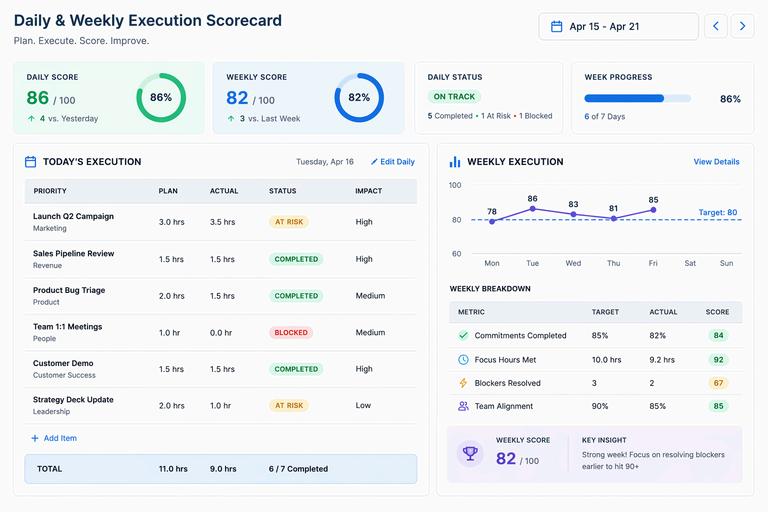
Thescorecardshouldhelpaprofessionaltrackoperationaldisciplineacrossthreedimensions: consistency(didIshowup),completion(didIfinishwhatIstarted),andfocus(didIworkonthe rightthings).
Functional requirements:
Allow the user to log scores or check off metrics for each day of the current week
Automatically calculate daily scores and a rolling weekly summary
Display a at-a-glance status indicator (e.g. green/yellow/red or a numeric score) for each day and for the week overall
Persist state across sessions using localStorage
Metrics to include (at minimum):
Daily priorities completed (e.g. top 3 tasks done: yes/partial/no)
Deep work blocks protected (number or yes/no)
Reactive/distraction time kept under threshold (yes/no)
End-of-day review completed (checkbox)
Weekly: % of days where all priorities were completed
UX requirements:
Clean, minimal layout scannable in under 10 seconds
Mobile-friendly
Current day should be highlighted
Weekly trend should be visible without scrolling
Stretch goals:
Allow the user to customize metric names and targets
Add a simple weekly reflection/notes field
Show a streak counter for consecutive high-performance days
Strong results come from refining outputs step by step.
Adjusttone,clarity,oraudience
Convertintoslides,reports, orsummaries
Expand
Convert into presentation slides
Pro Tips for Better Results
Provide examples of what you want
Ask AI what information is missing
Break complex tasks into steps
Request multiple versions Review and validate outputs
Tom Meehan, CFI is a globally recognized thought leader, speaker, author, and podcast host with deep expertise in Loss Prevention, Retail Technology, Cybersecurity, IoT, AI, Risk Management, and FinTech.
As the CEO of CONTROLTEK, a global leader in Tamper-Evident Packaging, EAS, and RFID technology, Tom is driving innovation and delivering cuttingedge solutions that protect assets and enhance operational efficiency across industries.
As Seen In: