Grantley Hall, a hidden gem in the heart of North Yorkshire, marries 17th-century Palladian grandeur with modern-day opulence in a stunning riverside setting. Since its award-winning transformation, it has redefined the countryside retreat, offering an elite wellness sanctuary, Michelin-starred dining, and a vibrant late-night scene that brings a touch of Mayfair to the Dales.
Dive into our world of unparalleled access, where every moment feels extraordinary WARM WELCOME
Welcome to the Spring/Summer 2026 edition of Dream Escape magazine, your guide to the extraordinary beauty and rich culture of the UK and Ireland. We are dedicated to the curation of exceptional travel experiences, and we invite you to discover the very best of the Spring & Summer seasons.
Uncover the elevated re-opening of the Scottish Hotel, Cromlix, and the blend of adventure and holistic wellness at Gleneagles. Explore our Social Calendar of cultural gatherings, including major art and fashion exhibitions. This season, we celebrate both the innovators and
the timeless treasures of our lands. Delve into Ireland's storied cellars for curated tastings, explore the art of Alfriston, and meet visionary designer Russell Sage.
For gourmands, we talk to acclaimed chef Merlin LabronJohnson and explore a world of elevated dining. This edition is filled with inspiration for every discerning traveller, from the hidden history of a prestigious London address, No 6 St James's Street, to a visual tour of Grand Houses & Gardens: Ireland in bloom.
Whether you dream of an unforgettable hotel stay or insights from our Head of Curated Elite Travel, our team is dedicated to meticulously arranging every detail.
David & Holly
DAVID TOBIN & HOLLY MACKIE
Dream Escape Founders
CHAPTER HIGHLIGHTS start your journey here
Chapter One
ARTS & CULTURE
A curated guide to the season's most stylish cultural gatherings, from major art and fashion exhibitions to the launch of an iconic hotel's new wellness era, and a look at historic British landmarks
Chapter Two
DESTINATIONS & FINE LIVING
Explore the best of British and Irish destinations, from the picturesque English countryside to the storied cellars of Ireland's finest estates, and meet the visionary designer shaping luxury interiors.
Chapter Three
CULINARY & LUXURY TRAVEL
Meet the people and discover the places creating next-level luxury experiences, from acclaimed chefs and travel experts to grand houses and hotel stays offering the truly extraordinary.
Chapter One ARTS & CULTURE
p.10
People & Places
Discover the elevated re-opening of the Scottish estate Cromlix, glimpse a rare chance to view the priceless Tyndale New Testament at St Paul's Cathedral, and the launch of Dream Event.
p.14
Where Adventure Meets Stillness
A Holistic Escape at Gleneagles: Explore Gleneagles' 'Glorious Playground' with exhilarating country pursuits like the Highland Cow Experience and new water sports, complemented by the pioneering, holistic wellness of The Spa.
p.18
Social Calendar: Celebrate each gathering with style and spirit
A curated guide to the season's most stylish cultural gatherings, from major fashion exhibitions (Queen Elizabeth II, Schiaparelli) and royal celebrations to landmark art shows (William Blake, Frida Kahlo) across the UK and Ireland.
Chapter Two
DESTINATIONS & FINE LIVING
p.33
In Good Spirits, Ireland's storied cellars Discover Ireland's most memorable places to sip, with curated wine and whiskey tastings in the historic cellars and grand bars of esteemed hotels and castles like Adare Manor, Cashel Palace, and Ashford Castle. p44
Destination Focus The Art Of Alfriston Explore the art, charm, and unspoilt countryside of Alfriston, East Sussex, from its historic medieval High Street, The Star hotel, and independent shops to its bucolic walking routes and connections to the Bloomsbury Group.
p.54
Meet the artist: Russell Sage
The Somerset-born designer reveals how Scotland's landscapes, legends, and craftspeople shape his exuberant and eccentric hotel interiors, focusing on the art of storytelling at The Fife Arms, Glenmorangie House, and Ardbeg House.
p.60
The secrets of No 6 St James’s Street Discover the hidden history and exclusive appeal of a prestigious address in London’s St James’s Street.
Chapter Three
CULINARY & LUXURY TRAVEL
p.70
Meet the chef: Merlin Labron-Johnson
An exclusive interview with acclaimed chef Merlin LabronJohnson about his culinary philosophy and latest gastronomic ventures.
p.82
Grand Houses & Gardens: Ireland in bloom
A visual tour of Ireland's most magnificent stately homes and their beautiful gardens during the spring and summer bloom.
p.88
Hotel stays offering extraordinary experiences
Highlights a selection of exclusive hotel stays that promise truly extraordinary and unforgettable guest experiences.
p.99
Meet our Head of Curated Elite Travel
An introduction to Dream Escape's, Karen Darlow, offering insight into bespoke and extraordinary travel experiences.
MEET
LEADERSHIP
David Tobin
OWNER & CEO david@dreamescape.co.uk
Holly Mackie OWNER holly@dreamescape.co.uk
Sally Maitland EXECUTIVE PERSONAL ASSISTANT smaitland@dreamescape.co.uk
FINANCE
Gordon Donald DIRECTOR OF FINANCE gordon@dreamescape.co.uk
Finlay Mann FINANCE EXECUTIVE finlay@dreamescape.co.uk finance@dreamescape.co.uk
MARKETING
Sue Morris
ASSOCIATE DIRECTOR HEAD OF MARKETING sue@dreamescape.co.uk
Sarah Butler MARKETING MANAGER sarah@dreamescape.co.uk
CURATED TRAVEL
Kirsty Hoskins
ASSOCIATE DIRECTOR HEAD OF CURATED TRAVEL kirsty@dreamescape.co.uk
Susie Little SENIOR CURATED TRAVEL DESIGNER susie@dreamescape.co.uk
Michael Davis CURATED TRAVEL DESIGNER michael@dreamescape.co.uk
Karen Darlow HEAD OF CURATED ELITE TRAVEL karen@dreamescape.co.uk
PRODUCT & PARTNERSHIPS
Louise Murray ASSOCIATE DIRECTOR HEAD OF PRODUCT & PARTNERSHIPS louise@dreamescape.co.uk
DREAM EVENT
Karen Murray HEAD OF EVENTS kmurray@dream-event.co.uk
Uilah Guedes
EVENTS ASSISTANT uilah@dream-event.co.uk
dreamescape.co.uk
@Dreamescapeltd
@Dreamescape-o3u
@Dream-escape-int
@DreamEscapeLtd
DREAM ESCAPE MAGAZINE
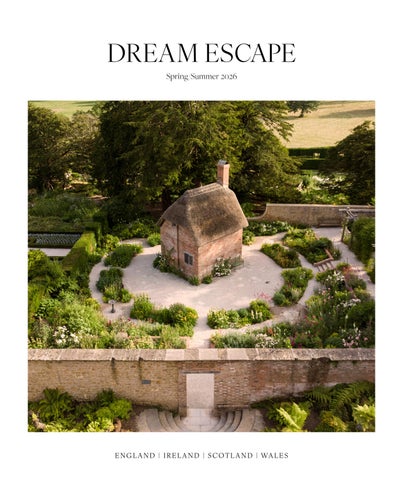
Front cover image: Nestled in the heart of Somerset, the Gardener’s Cottage at The Newt offers a moment of pure beauty and exclusive access to one of Britain's most storied estates. It is one of ten hand-picked escapes in our Extraordinary Experiences collection, defining the true essence of the UK from countryside to coast, page 48.
Jessica Way
PROJECT MANAGER & PUBLISHER
jessica.way@contistamedia.co.uk
Adrian Wilkinson
DIGITAL PUBLISHER & DISTRIBUTION MANAGER digital@contistamedia.co.uk
01489 660 680 contistamedia.co.uk
Pictured above: Park Hotel Kenmare has unveiled its new look following a meticulous refurbishment, welcoming a new era of 5-star luxury in County Kerry. The beautifully restored hotel offers a collection of luxurious rooms and suites, acclaimed dining venues and elegant bars, alongside an enticing collection of grand spaces, cosy corners and hidden nooks to be discovered, a serene spa, outdoor pursuits centre, and a charming drawing room.
Cromlix
PEOPLE & PLACES
An exciting new chapter is unfolding at Cromlix. The beloved Scottish estate, closing this spring for a transformative renovation, is set to re-open its doors this summer as an elevated retreat, enhancing every aspect of the guest experience.
Guests can look forward to a completely reimagined culinary offering, featuring a new, larger restaurant for relaxed dining, showcasing fine Scottish produce, and an intimate fine dining
experience – and the stunning Glasshouse is being re-imagined as a beautiful space for afternoon tea and private celebrations.
The estate will welcome guests back with new bedrooms and a dedicated wellbeing cottage nestled within the serene grounds. For those seeking unique experiences, the summer reopening will also feature activities including stargazing on the Lochan, mindful walks, and foraging. Plus, look out for luxurious new extras, including Cromlix’s own range of dry robes.
St Paul's Cathedral
In 2026, the iconic St Paul's Cathedral will celebrate a monumental 500th anniversary: the printing of Tyndale's New Testament. This is no ordinary historical moment; Tyndale's work was the very first holy book printed in English, a linguistic and cultural landmark, and St Paul’s is the proud custodian of one of only three remaining copies in the world.
As a national treasure and a masterpiece of English Baroque architecture, the Cathedral already stands at the heart of the nation’s defining
moments. The Cathedral you see today, the fifth on this site, was designed by Sir Christopher Wren in the late 17th century and continues to inspire visitors from around the world with its grandeur, rich heritage, and spiritual significance.
Dream Escape will arrange for you to visit on the special Triforium Tour, where you will have the chance to view this priceless Tyndale New Testament - an unmissable and truly rare and inspiring opportunity with a profound piece of history within the awe-inspiring walls.
Discover the art of event planning with Dream Event’s tailored itineraries
What does 20 years of crafting the impossible look like? In November 2025, it was a flickering fire in the Great Hall of the 300-year-old Aldourie Castle. To celebrate our 20th anniversary, Dream Escape hosted an exclusive showcase on this private 500-acre estate. From family-style feasts to sunrise yoga and starlit sauna gatherings, we immersed VIP partners in the absolute best of the Scottish Highlands. This wasn't just a celebration – it was a masterclass by Dream Event, our new division dedicated to transforming corporate gatherings into storied, once-in-a-lifetime experiences across the UK and Ireland.
Dream Event curates thoughtful corporate and private events defined by precision, creativity, and a deep understanding of each client's vision. From conferences and incentive programmes to awards dinners, product launches, and bespoke celebrations, every experience is crafted with strategic insight and meticulous execution.
The Art of Curated Events
Find out more about elevating your event beyond the expected by visiting dream-event.co.uk
WHERE ADVENTURE MEETS STILLNESS
A HOLISTIC ESCAPE AT GLENEAGLES
Nestled in the heart of Perthshire, beneath the majestic Ochil Hills, Gleneagles invites the discerning traveller to an extraordinary escape. Discover a seamless blend of exhilarating country pursuits and luxurious, pioneering wellness, forging an authentic Scottish adventure.
Words: Jessica Way
Since opening its gilded doors in June 1924, Gleneagles has reigned as one of the UK's most iconic hotels and purveyors of heritage pursuits. For over a century, this 'Glorious Playground' has remained the must-go destination for those seeking unparalleled fun and adventure amidst one of the most luxurious and scenic settings imaginable. Every guest, from the youngest explorer to the most seasoned traveller, is catered to with activities that promise a healthy dose of invigorating Highland air, now enhanced by new pursuits centred on recreation and revitalisation.
Countryside Adventures: Connecting with the Wild Heart of Scotland
Head into the rolling Perthshire hills for the captivating Highland Cow Experience. This immersive, off-road adventure, conducted in one of Gleneagles’ legendary Land Rover Defenders, brings you face-to-face with Scotland’s most beloved animals – the hardy Highland cattle, or 'coos.' An expert guide will share fascinating insights into the history of this iconic breed as you traverse charming farmsteads and rugged terrain. For those seeking quiet contemplation, the Walks & Picnics offering is a perfect antidote to modern life. The pristine lochs, heather-covered moors, and rugged coastline of Scotland are ideal for reconnecting with nature. Venture out on foot or in an intrepid four-byfour, spotting deer and eagles, before enjoying
a luxurious picnic in a secluded, perfect spot. Driving across Gleneagles' 850 acres is also taking a bold step forward: The Munro, an all-electric 4x4 built in Scotland, represents the future of off-road adventure. Weighing 2.8 tons, this beast challenges drivers to engage with the terrain in a more tactile way, offering an exhilarating emissions-free experience.
A New Era of Wellness: The Holistic Ecosystem
The launch of the Gleneagles Sporting Club heralds a new epoch of sophisticated pursuits. Upgraded equestrian facilities, including a state-of-the-art indoor arena, join two indoor tennis courts, three padel courts, and a dynamic climbing and bouldering wall. Offering private tuition with some of Scotland’s finest coaches,
the club also features a courtside members’ lounge inspired by the crisp whites and casual sophistication of classic vintage tennis clubs. This complements the estate’s repertoire of more than 50 country pursuits, ensuring every guest can perfect their skills. Overlooking the stunning Ochil Hills, the new Water Sports Activities at Frandy allow guests to explore the water by canoe or kayak, fish from the bank, or indulge in the new sauna space – complete with a cold-water dip for the brave at heart.
Long before it became a cultural phenomenon, wellness was central to Gleneagles’ allure. Today, the pioneering Spa continues this legacy, harnessing the power of its tranquil surroundings. It is a space where restorative treatments, working with innovative, science-led brands, are as effective as they are
luxurious. Central partners include Dr. Barbara Sturm, renowned for her anti-inflammatory ethos, and Seabody, a Irish biotech wellness brand with a background in molecular biology. Crucially, the spa is not an isolated offering, but the centrepiece of a holistic ecosystem that extends across the estate – from adaptogen teas in the Spa Café and personal training in the health club to nourishing menus and invigorating outdoor pursuits through the beautiful hills of Perthshire.
With such a captivating world of adventure and stillness on offer, let us help you take the first step into your ultimate escape.
To find out more about your ultimate escape, please visit the Gleneagles website, gleneagles.com and contact the Dream Escape team at enquiries@dreamescape.co.uk
SOCIAL calendar
Celebrate each gathering with style and spirit.
Words: Melanie Abrams
WILLIAM BLAKE: THE AGE OF ROMANTIC FANTASY
National Gallery of Ireland, Dublin
16 April 2026 – 19 July 2026
There’s a powerful start to Spring – as William Blake’s electric prints and paintings are showcased at the National Gallery of Ireland in Dublin from 16 April. His fantastical visions of pumped-up creatures, dramatic biblical scenes, dark literary takes and other works show why he is a key figure of 18thcentury British Romanticism and Gothicism. Cases in point: tormented Cain fleeing the scene as Adam and grief-stricken Eve find their son, Abel’s body (pictured) or his frightened
mythical goddess, Enitharmon, surrounded by witches, an owl and a bat. Whilst his spirit, known as Ghost of a Flea, gazes at a cup for blood-drinking a little too eagerly, with his tongue hanging out. Born in 1757, Blake became an engraver’s apprentice in 1772 before enrolling at the Royal Academy of Arts seven years later.
He even engraved his own books and poems with etchings from his First Book of Urizen , published in 1794, on display. See his work alongside his British and Irish contemporaries, from George Romney’s romantic figures like Lady Hamilton to Cork-born James Barry’s dramatic depiction of Satan meeting Sin and Death at the Gates of Hell.
CONSTABLE 250
Gainsborough, Turner and Constable, Gainsborough’s House, Sudbury and Christchurch Museum, Ipswich
Gainsborough’s House 25 April 2026 - 11 October 2026
Christchurch Museum until 28 February 2027
Head to Suffolk to celebrate the 250th birthday of local boy, John Constable (1776-1837), who immortalised his birthplace near the River Stour in his poetic landscape paintings. Start at Gainsborough’s House from 25 April, where Constable’s landscapes are hung alongside those by Thomas Gainsborough and other contemporaries. Whilst in Ipswich, Christchurch Mansion has a year of Constable exhibitions. See new sculptures by his great-great-great-granddaughter, Sasha Constable (until 14 June). Then, his iconic Hay Wain reunited with its preparatory sketches (from 11 July to 4 October).
LUCIAN FREUD: DRAWING INTO PAINTING
National Portrait Gallery, London
To 4 May 2026
Lucian Freud’s works on paper feature at London’s National Portrait Gallery to 4 May. 12 are newly acquired by the gallery from the 20th-century artist’s estate. Like an etching of his daughter, fashion designer, Bella Freud. See his creative process and working methods as drawings and preparatory studies are shown alongside finished paintings. A highlight is Girl in Bed (pictured), depicting writer Lady Caroline Blackwood in a Parisian hotel, where she and Freud stayed after eloping.
HENRY MOORE: SHELTER DRAWINGS
Henry Moore Studios & Garden, Perry Green 1 April 2026 - 1 November 2026
There’s a new space to visit at Henry Moore’s vast 70-acre Hertfordshire estate, which houses his home, six studios and a vast garden, dotted with his simplified abstract sculptures. Opening on April 1, the Sheep Field Barn has been transformed into a gallery and learning space and will house two new displays. One will explore his life and work from 1922 to 1984 through diaries, letters, wood and stone carvings and more, and the other will show his drawings of Londoners huddled in tube tunnels, as they shelter from the Blitz in 1940-1 during the Second World War (until 1 November). Called his Shelter Drawings, these works gained Moore his recognition.
The King’s Gallery, Buckingham Palace, London 10 April – 18 October 2026
Known for wearing colourful coats and matching hats, and carrying Launer handbags, Queen Elizabeth II had an impeccable style. Now visitors to the King’s Gallery at Buckingham Palace in London can delve through her extensive wardrobe. On show will be clothes, jewellery, hats, handbags, and more that she wore throughout her life, on and off duty. Indeed, this wardrobe is one of the largest and most important surviving collections of 20th-century British fashion, with the exhibition marking what would have been her 100th birthday on 21 April. (The Queen opened the gallery in 2002).
Highlights include her white satin Norman Hartnell wedding dress, embroidered with hundreds of seed pearls and tiny beads. Whilst less familiar pieces include the stylish, clear plastic raincoat by Hardy Amies from the 1960s. Discover design sketches, fabric samples and handwritten notes that reveal the late Queen’s close involvement in the creation of this wardrobe.
VANBRUGH’S TERCENTENNARY
Castle Howard, York
30 May 2026 – 31 May 2026
It’s the year to visit some of Britain’s most ornate country houses from May. Each month, a different stately home celebrates the 300th anniversary of its architect, Sir John Vanbrugh, who lived from 1664 to 1726. Kicking off the exhibitions, lectures, and more is Castle Howard in York from 30 to 31 May, to Stowe House and Gardens in Buckingham on 1 and 2 August.
THE EDWARDIANS: AGE OF ELEGANCE
The King’s Gallery, Palace of Holyroodhouse, Edinburgh
To 6 December 2026
A sparkling exhibition arrives in Edinburgh. On display are the possessions of two style-setting royal couples of the early 20th century: Edward VII and Queen Alexandra, and their son, George V, and his wife, Queen Mary. (George V is the paternal great-grandfather of King Charles III.) Highlights include Edward VII’s Fabergé cigarette case with its wraparound diamond-accented snake.
EDINBURGH TARTAN PARADE
Royal Mile, Edinburgh
9 May 2026
The place to be at 1pm on 9 May 2026 is Edinburgh’s Royal Mile as the Lord Provost of the city sets off a lively parade to the Mound precinct adjacent to The National Art Gallery. Around 2500 tartan-clad people will be marching, including drummers, bag pipers and highland flingers. Spot the Officers of the Court of Lord Lyon in their colourful livery.
Catwalk shows have created some momentous cultural moments, like the bevvy of Supermodels, Linda Evangelista, Cindy Crawford, Naomi Campbell and Christy Turlington, walking arm-in-arm down the Versace runway in 1991, singing along to George Michael’s then hit, Freedom (pictured). The models had lip-synced to the song in its music video, which was heavily aired on MTV, so they demonstrated the combined power of fashion, music and television at the time. Now the V&A Dundee is unpicking catwalk history from its origins in the
1900s as parades in private salons to today’s mega productions with Rihanna, Nicole Kidman and other A-listers filling the front rows. Called Catwalk. The Art of the Fashion Show: Discover how different designers approached their runways. Take Coco Chanel, who went for dramatic effect in the 1950s. She sent her models down the mirrored staircase of her Rue Cambon apartment into her salon. Whilst Gaby Aghion broke tradition, presenting her early 1958 Chloé collection in an artists’ hotspot, Café de Flore on Paris’s Left Bank. A fashion show’s production will be examined from the creative show invitations to the set designs. Like Karl Lagerfeld’s supermarket staging for Chanel in 2014. Collection pieces will be there too.
BRUEGEL TO REMBRANDT: DRAWING LIFE, SKETCHING WONDER
Compton Verney, Warwickshire
To 28 June 2026
Revel in this fresh perspective of Rembrandt, Rubens and other Old Masters from the 16th and 17thcentury Flemish and Dutch Golden Age. As 64 lively, intimate drawings are on show to 28 June at Compton Verney, an art gallery in an 18thcentury mansion in Warwickshire. Many of these drawings are rarely on display. There are preparatory studies, sketches from life, and some drawings that show the artist's growing interest in realistic subjects. Consider Adriaen van Ostade’s colourful pen-and-ink drawing of an inn’s interior, where lively characters drink, smoke, play cards, and enjoy themselves. See the versatile materials used from the pen and ink to red chalk, black stone, scattered gouache and more. Case in point: the anonymous drawing of Saint Michael defeating the rebel angels (pictured), which includes brushwork in brown and grey ink, a brown and grey wash, pink watercolour and white gouache highlights, as well as pen and ink. Masterpieces include Pieter Bruegel the Elder’s detailed drawing of Prudence, part of a famous series depicting the Seven Virtues and an early example of his depictions of peasant life. Around a 20-minute drive from Shakespeare’s Stratford-uponAvon, stay nearby at Mallory Court Country House Hotel and Spa with its smart restaurant.
Marilyn Monroe remains the blonde bombshell. Not just because of her ever-popular films like Some Like It Hot, but also thanks to the photos and other artworks of hers that were made during her lifetime and since. Now some of these works are on show at London’s National Portrait Gallery from 4 June, coinciding with what would have been her 100th birthday on 1 June.
HOUSE OF STORIES: TALES FROM THE CHATSWORTH LIBRARY
Chatsworth House, Bakewell, Derbyshire
To 4 October 2026
For stellar literary finds, visit Chatsworth House, where letters and other treasures from its 500-yearold library are dotted around its rooms until 4 October. Look for the manuscript fragment from A Chaucer Canterbury Tale, written around 1387 and a first edition of Jane Austen’s Pride & Prejudice. After all, the house has represented the book’s Pemberley estate on film.
GWEN JOHN: STRANGE BEAUTIES
National Museum Cardiff
To 28 June 2026
Don’t miss this landmark display at the National Museum of Cardiff in Wales. It showcases the poetic paintings, sketchbooks and more of 20th-century Welsh artist, Gwen John. Born in 1876 to 1936, she became known for her muted portraits, still lifes and interiors. Older sister to painter Augustus John and model and mistress to the sculptor of The Thinker, Auguste Rodin, John was largely overlooked during her life. But recent exhibitions and a re-evaluation of female artists have catapulted her reputation. “As an independent woman living and working as an artist in the early 20th century, Gwen John was a trailblazer,” explains Dr Kath Davies, director of collections and research at the museum.
FRIDA: THE MAKING OF AN ICON
Tate Modern, London
25 June 2026 – 3 January 2027
With flowers in her braided hair, thick unibrow and full skirts, Frida Kahlo is one of the most recognisable artists. Born in 1907, she lived until 1954. Now, Tate Modern is showing how she constructed her iconic image through her art: Frida: The Making of an Icon exhibition, displaying 30 paintings by Frida alongside around 200 works by others inspired by her. Like the self-portrait by the Cuban American performer and sculptor, Ana Mendieta, who lived from 1948 to 1985. (A retrospective of Mendieta’s work will open at the gallery on 17 July). Kahlo’s works include one of her earliest self-portraits – with a red velvet dress, sent to a former lover to show what he was missing. It worked - as they reunited for a short time afterwards. There’s also a small, intense portrait of her by her husband, the painter and muralist, Diego Rivera, whom she married twice, a la Liz Taylor and Richard Burton. Experience more of Kahlo’s national culture at the gallery’s Level 6 bar and restaurant, where tasty local dishes by Mexican chef Santiago Lastra will be on the menu. For those who can’t wait until June, savour Lastra’s lobster to langoustine tacos and other modern Mexican dishes on his seven-course menu at his KOL restaurant in London’s Marylebone.
FROM REMBRANDT TO MATISSE: A CELEBRATION OF EUROPEAN PRINTS AND DRAWINGS
National Gallery of Ireland, Dublin
To 8 November 2026
If the show at Compton Verney has whetted the appetite to see more sketches, head to Dublin, where the city’s National Gallery of Ireland displays drawings, prints, watercolours, as well as photographs from the 17th to the 20th century and beyond. Indeed, the gallery holds a strong collection of prints. A search of its online collection turned up 4,128 examples. Take Rembrandt’s theatrical self-portrait in a flat cap and embroidered dress from around 1642. Then there’s a coquettish lithograph by Matisse from 1927 of a ballet dancer’s reflection in a mirror and an intimate 1964 Picasso lithograph of the artist and his model, acquired in 2016.
Hotfoot to Norfolk this month for the Royal Horticultural Society’s newest flower show. Set in the gardens of Sandringham Estate, the King and Queen’s private country retreat, green-fingered Charles III has collaborated with a designer on one of the gardens.
Start the day in style with a champagne breakfast at the show’s Delphinium Restaurant.
ROYAL OPENINGS
Buckingham Palace, London and Banqueting House, London
9 July 2026 – 27 September 2026
3 August 2026 – 20 September 2026
Peek into Buckingham Palace, the King’s official residence and working royal palace. Experience the sumptuous rooms where the King and the royal family greet guests on State and other official occasions, as well as the East Wing room where the family gathers to step onto the balcony. For more royal history, stroll to the 17th-century Banqueting Hall along Whitehall, which is opening this summer after renovations. Built for King James I and VI of Scotland, the ceremony to restore Charles II to the throne was held here, 11 years after his father, Charles I, was executed outside.
SCHIAPARELLI: FASHION BECOMES ART
V&A South Kensington, London
To 8 November 2026
As Schiaparelli’s creative director, Daniel Roseberry sent a scorpion-tailed bustier and a jacket accented with organza spikes down the haute couture runway in January, it’s little wonder the V&A is showcasing the maison’s artistry. At last. As this is Britain’s first exhibition on the Surrealist fashion house, spanning its invention by Elsa Schiaparelli in 1927 through her lobster dress glory days in the 1930s to her retirement in 1954 and beyond, including the modern maison under Roseberry. Over 200 objects will tell the story of her house, including clothes, jewellery, and perfume. Highlights include her evening dress and veil, which seem torn but, on closer look, are printed by Salvador Dali, with the rips cut out and lined in magenta and pink.
LOOKING AHEAD
East meets West at Compton Verney from 19 September to 21 February 2027 as Kashmir-born, London-based artist, Raqib Shaw kicks off autumn’s art season with a typically vibrant exhibition. Marvel at his intricate fantastical paintings and discover how they are enamelled with a needle-sharp porcupine quill, and accented with glitter, crystals, feathers and more.
A quintessential calendar of world-class sport, floral artistry, and timeless pageantry.
• RHS Chelsea Flower Show 19-23 May 2026
Step into a world where horticulture meets high fashion. As the fragrance of prize-winning blooms fills the London air, the Royal Hospital grounds transform into a breathtaking tapestry of cutting-edge design and rare floral wonders – the ultimate spring pilgrimage for those seeking botanical inspiration.
• Royal Ascot 16–20 June 202
Witness the pinnacle of pageantry where world-class sporting prowess meets sartorial elegance. From the thundering hooves on the hallowed turf to the sculptural millinery of the Royal Enclosure, this is a quintessentially British spectacle and the most glamorous date on the racing calendar.
• Henley Royal Regatta 30 June – 5 July 2026
Experience the rhythmic pulse of the Thames at the world’s most prestigious rowing event. Amidst the clink of Pimm’s glasses and the flash of rowing blades, Henley offers a timeless riverside celebration of summer heritage, refined socialising, and sporting excellence.
• Goodwood Festival of Speed 9–12 July 2026
An adrenaline-fuelled garden party set against the Duke of Richmond’s rolling estate. This intoxicating mix of heritage and horsepower allows you to witness legendary racing machines and the future of automotive engineering take flight up the iconic Hillclimb.
• The Royal Edinburgh Military Tattoo of Speed 7–29 August 2026
As dusk falls over the ancient ramparts of Edinburgh Castle, the air stirs with the haunting skirl of the pipes. This stirring performance of military precision, music, and dance is a profound display of Scottish soul and international culture against a historic silhouette.
From old stone vaults to grand hotel bars, Ireland offers memorable places to sip fine wine and savour local spirits, hear the tales behind each bottle, and see how land, craft and character end up in the glass.
Words: Melanie May
Across the Emerald Isle, in candlelit rooms beneath centuries-old houses, beside open fires in grand drawing rooms and in historic hotel bars, rare wines and exceptional whiskeys are poured with context and care. In a country famed for storytelling and the gift of the gab, tastings unfold as relaxed exchanges, guided by those who know the bottles best. Many of Ireland’s most memorable places to stay - and sip - are castles, manors, and great houses, where the stories in the glass run as deep as those in the walls.
Cashel Palace, County Tipperary
Sitting beneath the Rock of Cashel, a remarkable collection of medieval buildings that once served as the seat of ancient Irish kings, Cashel Palace is a lovingly restored Palladian manor and one of Ireland’s most distinguished hotels. Working hand in hand with nearby Tipperary Boutique Distillery, the hotel has created its own pot-still whiskey from locally grown barley, matured in first-fill Oloroso sherry casks. The result is a richly layered spirit, with notes of dried fruit, dark chocolate, figs and warm spice. Alongside it sits Cashel Palace 172 Gin, a brighter but equally rooted expression of place. Crafted with botanicals from the area and gently infused with mulberries, it nods to the hotel's walled garden, which contains Ireland's reputedly oldest mulberry trees and descendants of the original hop plants used by Richard Guinness to brew the first "Guinness". In beautifully appointed rooms by open fires, or in the red brick wine cellar, private tastings give a deeper understanding of flavour, cask ageing and regional character, delivered at an unhurried pace that suits both the setting and the spirit in your glass .
Adare Manor, County Limerick
Located along the River Maigue in Ireland’s southwest, Adare Manor is a vast neo-Gothic manor house whose turrets, gargoyles, and decorative stone and wood carvings feel closer to a European palace than a country hotel. That grandeur continues in the manor’s impressive wine cellar. Hidden behind heavy doors and accessible only by appointment with the Head Sommelier, the space is softly lit and lined with thousands of bottles from the world’s most revered vineyards. More than 700 labels are represented, from rising producers to historic estates, with a collection that includes exceptional and rare vintages such as Château d’Yquem 1961. Tastings here are personalised to your palate and pleasure, whether you enjoy exploring the sensory foundations of wine, want to learn how to compare Old World and New World styles, or would like to indulge in a Burgundy selection rarely seen outside private collections. The appeal here lies in access to prestigious bottles, brilliant guidance, and a cellar experience that feels personal rather than performative
Ballyfin Demesne, County Laois
In the green heart of Ireland, about 90 minutes from Dublin, Ballyfin Demesne sits hidden among the foothills of the Slieve Bloom Mountains. This is not a hotel in the usual sense, but a fully restored Regency mansion set within a vast estate of lakes, woodland and gardens; a place repeatedly named among the finest hotels in the world. The house was built in the 1820s for an aristocratic family who believed beauty was worth any cost, and every corner still reflects that philosophy. Marble fireplaces, hand-painted ceilings and vast reception rooms create the feeling of being a guest in a stately home rather than a traditional resort. That sense of hospitality continues below stairs in Ballyfin’s stonevaulted cellar. By candlelight, the sommelier draws corks and shares stories among rows of ageing bottles. Tastings might explore the elegance of Burgundy, the legacy of the “Wine Geese” - Irish families who influenced European wine making - or carefully chosen whiskeys that express the depth and diversity of Ireland’s signature spirit. These splendid journeys feel both personal and entirely in keeping with Ballyfin’s grand yet gracious character.
The Shelbourne, Dublin Opened in 1824 overlooking St Stephen’s Green, The Shelbourne has long been woven into Dublin’s social, cultural, and political lifethe Irish Constitution was drafted here in 1922. Its rooms have hosted generations of writers, statesmen, royalty and superstar guests, who usually end up in the hotel’s Horseshoe Bar, which remains one of the city’s most atmospheric places to raise a glass. In here, the Shelbourne celebrates Ireland’s distilling traditions, which became popular in Dublin around the same time the hotel opened. As you relax into the red leather banquette seating and soak in the convivial atmosphere, resident sommeliers will guide you on tastings from a handpicked selection of independently sourced Irish whiskeys. You’ll discover how to discern the unique aromas, flavours and textures that distinguish each pour, and you’ll get to try rare, premium, and historically significant bottles, including specially selected casks that express a connection to Irish heritage. It is an immersive, cultural experience in craft and character, bridging modern Ireland’s whiskey revival with the traditions that first made the city famous
Lough Eske Castle, County Donegal
County Donegal feels like a glimpse into Ireland of yore. This is a land of mountain passes, Atlantic cliffs, and glacial lakes, where the scenery is raw, dramatic and refreshingly uncrowded. Lough Eske Castle sits at the foot of the Bluestack Mountains on the shores of the ‘Lake of Fishes’, its turrets and stone walls wrapped in woodland. Inside, the mood shifts from rugged to richly comforting. Fires glow in stone hearths, heavy drapes soften ancient walls, and the aptly named Donegal Suites weave the work of artisans into tweed, glass, and handcrafted details that root the stay firmly in place. Donegal’s makers are also celebrated in the castle’s vaulted Whiskey Cellar, which holds bottles of the county’s distinctive, coastal-influenced whiskeys, such as Silkie at Sliabh Liag and small-batch releases from Crolly Distillery. Guided through a thoughtful tasting, guests explore how Atlantic air, turf, and careful cask ageing ensure that with each sip, you never feel far removed from the landscape around you. These spirits are designed to be savoured amid the glow of a peat fire whilst telling stories about your day as the rain strikes against the castle’s stained-glass windows
Ashford Castle, County Mayo
On Ireland’s west coast, where limestone hills drop towards the waters of Lough Corrib, Ashford Castle rises from a sweep of forest like something lifted from a medieval manuscript. Parts of the estate date back to the 13th century, and over generations it grew into a grand country residence, later owned by the Guinness family, before becoming one of Ireland’s most storied castle hotels. The sense of heritage deepens in the castle’s Wine Cellars, which lie within old stone passageways that once served as working tunnels. With their ambient lighting and low, stone ceilings, the cellars feel intimate and immediately special. The castle’s sommeliers draw from a collection of over 5,500 bottles that spans classic European regions and leading New World estates, alongside rare and older vintages, and sought-after bottles from revered producers such as Château Cheval Blanc and Château Pétrus. Tastings can be shaped around a theme or place, or paired with a dinner underneath the atmospheric arches. It’s an experience that suits both serious collectors and the simply curious, all within walls that contain as much history as the castle above.
DESTINATION FOCUS
THE ART OF ALFRISTON
At the foot of the South Downs, nestled in unspoilt Sussex countryside, Alfriston is a picture-perfect English village. Yet with a carefully curated mix of stylish, independent businesses, world-class art and a wealth of unforgettable experiences close at hand, its appeal extends well beyond its postcard beauty.
Words: Sophie Farrah
In the heart of East Sussex, on the edge of the South Downs, sits Alfriston, widely regarded as one of England’s most beautiful villages. A near-perfect distillation of the English countryside at its most charming, its higgledy-piggledy medieval High Street is lined with intriguing shops, welcoming cafés and a thoughtfully curated mix of antique emporiums and creative ventures. It’s an ideal base for vineyard hopping, seaside excursions, world-class art and long, bucolic walks if, that is, you can tear yourself away from the many delights of the village itself.
Approximately sixty miles south of London, Alfriston is nestled in the valley of the River Cuckmere, which gently winds its way through a patchwork of meadows en route to the English Channel. At the heart of the village sits the Tye, a historic green and a scene of almost cinematic perfection. A backdrop for summer fêtes and artisan markets, it’s also home to St Andrew’s Church, a beautiful Grade I-listed building of such stature that it is often referred to as the ‘cathedral of the South Downs’. Built in the 1370s, many of its original features remain intact, including a magnificent wooden spire that rises elegantly above the village rooftops.
Adjacent to the church is the Clergy House, a fairytale 15th-century timber-framed building and the first ever property saved by the National
Trust. With its idyllic setting and views across the River Cuckmere, its mixed cottage garden is a delight throughout the year, with Arts and Crafts-style garden rooms and an orchard of old and rare apple trees. Together, these lovely landmarks form a textbook portrait of the quintessential English village.
At Alfriston’s centre sits The Star. Formerly part of Charles Forte’s hotel empire, it remains in the family, now under the stewardship of motherand-daughter hotel and design duo Olga and Alex Polizzi. It’s the third property in the supremely elegant Polizzi Collection, alongside the chic seaside style of Hotel Tresanton in Cornwall and the quiet, emerald-hued stillness of Hotel Endsleigh in the Devon countryside.
The Star itself is a historic, timber-beamed building that has stood at the heart of the village since the 15th century. It was built by the Abbot
of Battle Abbey as a hostel for monks and pilgrims travelling between the Abbey and nearby Chichester Cathedral. While its comforts have evolved considerably over the centuries, fascinating traces of its colourful past remain, including original wooden beams, open fireplaces and an intriguing ‘sanctuary post’.
The Polizzis’ signature aesthetic runs throughout the building, seen in thoughtful lighting, unexpected objects, beautiful artwork and meticulous attention to detail. Walls are adorned with sculpture and paintings of varying styles, layered alongside characterful antiques and abundant fresh flowers. A discreet, residentsonly library is well stocked with books and curios, while a wood-panelled enclave provides everything a guest might need for countryside capers, from smart wellington boots and raincoats to cosy blankets and chic Panama hats. Outside,
a picturesque courtyard garden, dotted with hotpink camellias, elegant furniture and ivy-wrapped statues, makes an ideal setting for a glass of rosé in the warmer months.
The hotel’s 29 bedrooms are all luxuriously appointed, with the recently unveiled Forte Suite the preferred choice for Dream Escape guests. The first to feature a separate sitting area, it perfectly showcases the Polizzis’ aptitude for creating interiors that feel both elegant and deeply comfortable. Old English grandeur meets modern
Italian flair, with bold patterns and sumptuous fabrics coming together in confident harmony.
In 2025, the Polizzis expanded their presence in the village with the acquisition of the building adjacent to The Star, now home to Collection Polizzi. This beautifully curated shop presents a considered array of stylish, handcrafted pieces spanning homeware, jewellery, fashion and accessories, making it hard to leave empty-handed.
Alfriston’s High Street provides further temptation, with a rich mix of independent shops
IMAGES PREVIOUS PAGE: GARDEN AT CHARLESTON IN FIRLE; THE NATIONAL TRUST CLERGY HOUSE. OPPOSITE PAGE: THE STAR HOTEL, ALFRISTON; ALEX POLIZZI. THIS PAGE; THE STAR HOTEL, ALFRISTON GARDEN, INTERIORS AND EXTERIOR
run by welcoming owners, intermingled with chocolate box cottages framed by rambling roses. Exceptional antique emporiums offer the thrill of uncovering a piece of history to take home, while contemporary, design-led spaces are stocked with carefully chosen modern treasures. Objet Trouvé is not to be missed, its fascinating, gallery-like interior brimming with distinctive objets d’art, meticulously sourced curiosities and pieces created by the talented owners themselves. Vintage fashion store The Dressing Room is a treasure trove of one-off
finds, while Much Ado Books, widely regarded as one of the finest independent bookshops in the country, is another highlight, its two floors filled with new releases alongside vintage, antiquarian and second-hand finds, with a friendly and knowledgeable team on hand to offer personalised recommendations.
For walkers, Alfriston is perfectly placed. Paths unfurl in every direction, across valleys, along riverbanks and up onto the Downs. The Star provides a selection of routes in handy pocket-
PICTURED ABOVE: EMMETT & WHITE ANTIQUES & INTERIORS, ALFRISTON, ALFRISTON; ST ANDREW'S CHURCH DESCRIBED AS THE CATHEDRAL OF THE SOUTH DOWNS ON THE TYE AT ALFRISTON; CROSS HOUSE GEORGIAN MARKET SQUARE BUILDING ON ALFRISTON HIGH STREET
sized guides, and Dream Escape particularly recommends the walk to Lullington Church, one of the smallest in England.
Another rewarding route leads to Rathfinny Wine Estate, one of England’s most impressive vineyards and wineries. This invigorating, hourlong circuit winds through glorious countryside rich with wildlife, before opening onto sweeping views across the vines and out to sea, where walking efforts are rewarded with a glass of Rathfinny’s award-winning ‘Sussex sparkling’.
For a little pampering after all that exertion, Dream Escape suggests a visit to the lavish spa at local boutique hotel, The Alfriston. Here, a steam room, sauna, expert GAIA treatments and a serene heated outdoor pool set within a walled garden offer deep restoration, perfectly framed by far-reaching countryside views. Part of The Signet Collection, this stylish new hotel combines luxury with playful charm. Upstairs, there are 38 individually styled bedrooms brimming with bold colours, upcycled treasures, and huge roll top baths.
PICTURED ABOVE: WINE TASTING AT RATHFINNY VINEYARD; LULLINGTON CHURCH; OUTDOOR SWIMMING POOL AT THE ALFRISTON HOTEL
Beyond the village, Dream Escape organises bespoke tours that offer exclusive access to some of the area’s most remarkable properties, including private visits and after-hours experiences. The surrounding countryside offers rich opportunity for cultural and historic exploration, much of it connected to the Bloomsbury Group, the influential group of writers, artists and thinkers who lived and worked in London during the early 20th century and spent significant time in East Sussex.
Charleston remains an exquisite testament to Bloomsbury creativity. Once the country home of Vanessa Bell and Duncan Grant, it offers a rare insight into their decorative vision within a domestic setting, representing the culmination of more than sixty years of artistic collaboration.
The breathtaking murals at Berwick Church, painted during the Second World War by Duncan Grant, Vanessa Bell and her son Quentin Bell, are also not to be missed.
PICTURED BELOW: CHARLESTON IN FIRLE. OPPOSITE PAGE: INTERIORS AT CHARLESTON IN FIRLE; FIRLE PLACE
Nearby, Farleys House and Gallery was once a meeting place for some of the key figures of 20th-century art. The former home of Lee Miller and Roland Penrose, this captivating Georgian farmhouse welcomed Pablo Picasso and other artistic luminaries. Today, it can be explored at leisure alongside its beautifully landscaped sculpture garden. The magnificent historic residences of Firle Place and Glynde Place are also within easy reach, both offering the chance to step back in time while immersed in beautiful countryside.
Of the nearby towns, Lewes is beautifully preserved and full of character, with interesting shops and antiques climbing the steep hill towards the castle that crowns the town. Towards Alfriston, the beach at
Cuckmere Haven offers dramatic views of the Seven Sisters, a series of iconic chalk cliffs rising sharply from sea to sky, and among the most striking coastal landscapes in the country.
Back in the village, there is no shortage of places to eat well. The colourful 1554 Brasserie at The Alfriston hotel serves locally sourced dishes with views across its pretty lawn, while the lively bar and sunlit Orangery make a lovely spot for a cocktail. At The Star, Italian-inspired dishes celebrate seasonality and exceptional local produce. The fresh pasta is not to be missed, and the hotel’s traditional afternoon tea is another indulgent highlight, best enjoyed beneath the historic beamed ceiling of the dining room.
Next door, welcoming wine shop and laid back restaurant Poco serves authentic
Italian flavours using local ingredients, making it an ideal choice for a relaxed lunch. Further along the High Street, Wingrove House is a thoughtfully refurbished colonial-style house with airy verandas, a candlelit bar and a modern British brasserie overlooking the Tye. For dinner, Rathfinny is another excellent choice, where the vineyard’s Flint Barns serves comforting, unfussy cooking paired with the estate’s impressive English wines. After dinner, Alfriston offers a choice of cosy, characterful pubs, each well suited to a nightcap or two. And then, it is time for bed. With little more than the distant hoot of an owl to disturb the night, sleep comes easily, with thoughts of what tomorrow might bring in this captivating, creative English village, set between Downs, river and sea.
PICTURED OPPOSITE: LEWES CASTLE; FIFTEENTH CENTURY BOOKSHOP, LEWES HIGH STREET; VIEW OF CUCKMERE HAVEN AND THE SEVEN SISTERS. PICTURED BELOW: GLYNDEBOURNE
DREAM ESCAPE’S TOP EXPERIENCES while staying in Alfriston
• An unmissable highlight is Glyndebourne , the Christie family’s world-famous opera house, just ten miles from Alfriston and long regarded as one of the most distinguished fixtures on the cultural calendar. Guests dress for the occasion, picnics are laid with silverware and candelabras, and music of the highest calibre unfolds against a backdrop of rolling parkland. This summer’s dazzling productions include Puccini’s Tosca , Monteverdi’s L'Orfeo , and more.
• Charleston Farmhouse hosts a rich programme of events throughout the year, most notably the Charleston Festival . Held each May, the festival brings together artists, writers and thinkers to explore art, literature and ideas, echoing the conversations once held around the Charleston dining table.
• At The Star, a series of special retreats offer Dream Escape guests a deeper insight into the local area. From 13–25 May 2026, Alex Polizzi will host regular ‘Ramblers Retreats’, guiding guests on walks through the beautiful countryside around Alfriston. The ‘Historic Houses Retreat’ includes private visits to exceptional local properties, including an exclusive tour of Olga Polizzi’s own Jacobean home and gardens. In spring, the ‘Garden Retreat’ celebrates the season in bloom, with highlights including a private visit to the renowned tulip festival at Arundel Castle.
• Rathfinny Wine Estate is a beautiful, familyowned vineyard dedicated to producing outstanding sparkling wines. Here, Dream Escape organise private tours and tastings. Experiences begin with a walk through the vines to learn about the estate’s viticulture, followed by behind-the-scenes access to the state-of-the-art winery and a guided tasting of Rathfinny’s acclaimed wines, including its celebrated ‘Sussex sparkling’.
MEET THE ARTIST
RUSSELL SAGE
The Somerset-born designer reveals how Scotland’s landscapes, legends and craftspeople shape his exuberant and eccentric hotel interiors. It’s all about the art of storytelling at The Fife Arms, Glenmorangie House and Ardbeg House.
Words: Jane Knight
You’ve done three big hotel projects in Scotland in the last six years. What is it about the country that attracts you?
I’m a boy from Somerset – I grew up in a pub just south of Bath – but there’s something about Scotland. I love being there, I love the people. I just feel like it’s a spiritual home for me; I don’t know why. But you know, there are so many incredible people there, they make so many things and so much has happened there; I’m constantly inspired by the country.
Where do you get your ideas and to what extent are you influenced by fashion?
It’s all about storytelling but telling stories in better ways, drawing in the history of a building and its sense of place. In the past, hotels might have said that all their bedrooms were named after kings, with
a print of a different king in each room. We go into much more detail.
I do whatever it takes not to be in fashion. I’m not on the circuit and I don’t know other interior designers. If someone from my team shows me an Instagram image as inspiration, I tell them not to do it; somebody else will use that image. For me, it’s all about finding that original story and creating magic in a place. I do, though, have quite a Victorian gothic tendency, which you can really see at the Fife Arms.
What’s the story you wanted to portray with the Fife Arms near Braemar, which you designed for the Swiss gallerists Iwan and Manuela Wirth?
As well as having 16,000 hand-picked antiques and artworks by Picasso, Freud and the former Prince Charles, among others, the Fife is all about extraordinary people in Scotland. It’s a Victorian hotel – Queen Victoria loved Scotland – and we
sourced her sketch of a stag that John Brown had shot less than a mile from the hotel, reframed it and put it in the bar. It’s a central part of the story. There’s a room dedicated for bridges because there was a Victorian bridge architect whose story we told by getting a collection of 100 old fashioned wooden triangles used by draftsmen and covering the ceiling in them. There’s so much history in the hotel; we worked with two historians from the Edinburgh museum to verify everything. And we really went to town on the corridors, which are often an unloved bit of hotels. We got some beautiful carved pillars from a house in Edinburgh and some big glass cases which we filled with items that tell stories.
What was the inspiration for Glenmorangie House in the Highlands, your first hotel for the luxury goods group LVMH? That was a funny project as so much of it happened during lockdown. I didn’t get to meet the client until we were installing everything. Instead, we had online meetings in which they spent a lot of time describing the flavours of whisky and Glenmorangie (there’s an adjoining distillery). Then we wanted to have a visual retelling of that story.
I particularly love the gold living room with its red furniture because it was a sort of breakthrough moment working with the client. I said: ‘I really want to have gold walls as you’re talking a lot about barley
fields and I want to create that lovely summer’s glow.’ Then I added that I wanted to do the ceiling gold as well, plus half the woodwork. And then I said I’d add a lovely blood red sort of colour like the poppies in the barley fields. They said: ‘Go for it.’
Did that make things easier when you started working on Ardbeg House, another LVMH property with its own whisky distillery on the island of Islay?
Yes, it meant we could really hit the ground running. When I had a crazy idea like hanging a fishing boat from the roof of the bar, I could tell them without wondering how they’d take it. For the first time in my life, I had a client who kept saying ‘I think you need to turn up the volume a bit’. The result is bonkers. There’s something really unique about an island that’s almost entirely a whisky community.
I’ve tried to tap into some of the island’s tall tales, such as the Islay-Gator, the legend of a monster that lives in a bog. It inspired my favourite room there, Monster, which is the sum result of all the
bravery in the other rooms. It has an Emperor bed – there’s no point in having a room called Monster without a bed leaving a bit of an impression – made from several beds, bits of old church panelling and pews with great big ball feet and metal pieces hanging off the top a bit like kelp, roots or octopus tentacles. It’s made by people who are really at the top of what they do, including a phenomenal carpenter and metal worker.
How many craftspeople do you work with in addition to people sourcing antique and items for the hotels?
As well as about 40 people on the payroll at Russell Sage Design, I have another 30 or 40 craftspeople I work with regularly – carpenters, wallpaper makers, metal workers and so on. I’ve got five people full time on antiques, running the warehouse. We find huge volumes of things that we don’t necessarily know what we’re going to use for. At any one time, I’ve probably got 10,000 pieces of furniture in four warehouses in Somerset. And I’m constantly sourcing products; I haven’t had a holiday in 24 years, though it feels I’m on holiday all the time.
One of the crafts you like to honour in your hotels is knitting. How did that come about?
Yes, it all started with the Fife Arms and a team of ladies called
the Deeside Knitwits who knit for charity. The year we were there, they were knitting red squirrels. So we bought them all and hid them around the hotel. Then with Glenmorangie House, there’s a room that’s completely over the top like a sort of French patisserie with loads of floral wallpaper and knitted cakes (it was really unlike LVMH but they loved it). We have a core group of knitters, and at Ardbeg House, we got some of the locals from the WI (Women’s Institute) to knit crabs, which are dotted around the room called The Wee Beastie.
What are you working on now? We have a few exciting things in the pipeline. We’re currently overseeing a sophisticated refurbishment of the iconic Dukes London in Mayfair, but we’re also working on a lovely little project for Luss Estates, owned by the Colquhoun family for centuries, which should be ready in the summer. The Loch Lomond Arms is by the water and is a modest coaching inn with just 15 bedrooms; it’s set in the tiny village of Luss. But it packs a really big punch because there aren’t that many inns that come with 45,000 acres, where you can have an amazing adventure. It makes it rather fun together with the family’s extraordinary history. One family member apparently had a pet tiger with him while he fought in the trenches. We’re going to tell that story."
THE secrets OF NO 6 ST
JAMES’S STREET
Which hat style sells more than any other?
Which writer famously couldn’t pay his bill, and which style does one milliner love the most?
Words: Jade Beer
There’s every chance you may miss No 6 as you march down St James’s Street towards The Mall and Buckingham Palace.
Sandwiched between two grander buildings that dwarf this five-storey listed townhouse is the home of Lock & Co., the oldest hatmaker in the world and the oldest shop in London.
But to call it a hat shop is to truly understate the treasures that await behind its green lacquered door. Founded in 1676, the business was originally on the opposite side of the road but relocated to No 6 in 1765, and to what was considered the sunnier side of the street. Fast forward to 2026 and Lock & Co.’s 350th anniversary year, and that early pursuit of perfection is still imbued in the fabric of the building and the craftsmanship that still exists there today.
What’s more, it’s still working. Last year, 13,000 orders came through this tiny Mayfair shop. The Gill flat cap sold over 600 times, its French Beret over 250 times.
Pictured below: Part of the 350th Anniversary collection, Lock & Co. Hatters bestselling Gill Flat Cap, has been reimagined into a vintage green and blue Donegal tweed and finished with a commemorative anniversary label and silk lining.
“As you step inside No 6, the very first thing you’ll notice is the scent, think of musk, leather, tobacco and coffee, scents that have been baked into our walls for centuries.”
‘As you step inside No 6, the very first thing you’ll notice is the scent,’ says Valeria Cristiano, client relationship and events manager. ‘Think of musk, leather, tobacco and coffee, scents that have been baked into our walls for centuries. We’ve tried to bottle it but it’s impossible to replicate. Then you’ll see the famous clock.’
The rare antique long case clock Valeria is referring to dates back to 1720 and nods to the building once being the home of a clockmaker. It’s one of the earliest examples of its kind and still works to this day, chiming on the hour and keeping time over the milliners. The building
also has a rare ‘coffin’ staircase, one of the last remaining in existence and so named for its very narrow and steep design that allowed the deceased to be moved between floors. Make your way to the basement and you’ll see the hole left when a WWII bomb dropped on the shop in 1940 and mercifully failed to explode.
It’s the way the past presses tightly up against the future that makes Lock & Co. so special, that and its relaxed ‘no appointment necessary’ approach. Whether you are buying a hat or not, you are welcome to enter its heritage room where you can see the ledger of hats bought by
Horatia Black Bicorn
A playful yet impeccably crafted statement, this black lace–overlaid crinoline bicorn is finished with a galloon bow and silk rose, blending historic reference with modern elegance. Inspired by Lock icon and famed historic figure Admiral Lord Horatio Nelson, the design reimagines traditional naval regalia through a fashion-forward lens.
"Channel your inner fashionista in this fun and wearable Bicorn inspired by Admiral Nelson's naval regalia."
Awon Golding, Head Millinery Designer
PICTURED FIRST PAGE: MODELS WEAR 350 GILL CAP, HIS AND HERS. PREVIOUS PAGE: MODERN DAY SHOP EXTERIOR; HATS FROM THE SPRING/SUMMER 2026 LOCK COUTURE BY AWON GOLDING COLLECTION SPRING/SUMMER 2026; THE FAMOUS CLOCK. OPPOSITE PAGE: OSCAR WILDE IN HIS FEDERO; HISTORIC EXTERIOR PHOTOGRAPH; WINSTON CHURCHILL ON HIS WEDDING DAY WEARING THE TOP HAT; MILLINER AT WORK; THE CHEQUE THAT WAS SENT TO SETTLE OSCAR WILDE'S BILL; MILLINER'S WORKING SPACE. NEXT PAGE: MODEL WEARS 350 GILL CAP; THE EMBROIDERED REMEMBRANCE POPPIES; WALL OF SIGNATURES ON THE HEAD SHAPES OF FAMOUS PATRONS THAT WOULD HAVE BEEN MADE WITH THE CONFORMATEUR, THE CONFORMATEUR; MODEL WEARS THE BELVEDERE
Sir Winston Churchill, including the silk top hat he wore for his wedding day in 1908. You can also read about how in 1882, Lock & Co. sold a black Fedora to Oscar Wilde. Later in life, Wilde was unable to pay his final hat bill due to his incarceration in Pentonville and Wandsworth prisons. Following an article in The Times in 2000, one of Wilde's fans sent Lock & Co. a cheque for £3.30 to settle his account over 100 years later which you can also see.
Meanwhile three floors above, Awon Golding, Lock & Co.’s head millinery designer, is creating
the latest collection of hats we’ll see worn across the British season as well as a limited-edition anniversary collection with one hat released every month of this year. Tina Graham, Millinery Manager has worked with the business for over 20 years, and sits alongside Isabel Ager, an apprentice milliner and a recent graduate in hand embroidery from the Royal College of Needlework, sharing all the expertise that she has amassed. This is everything from how to block a hat (done using a hand-crafted block of oak wood over which the fabric is stretched, moulded and pinned); how to
Last year Isabel made her own creative mark with her hand embroidered Remembrance poppy brooches. Each one took twelve hours to make and sold for £500 each. “It was exactly the nod to craftsmanship and heritage that Lock & Co. stands for.”
steam and stiffen a hat to ensure there are no ripples visible in the fabric and the importance of wearing a thimble, ‘the milliner’s best friend’, at all times!
‘Making a beautiful hat is a physical process,’ says Isabel ‘I don’t think people realise how much strength you need to mould the fabric into shape. A new block is coated with five layers of varnish making it incredibly hard to push pins into. You’ve got to be very strong to get them through the fabric. You then need all your strength to get the hat back off without damaging it. It’s a workout!’
As well as absorbing all the expertise around her, last year Isabel made her own creative mark
with her hand embroidered Remembrance poppy brooches. Each one took twelve hours to make and sold for £500 each. ‘It was exactly the nod to craftsmanship and heritage that Lock & Co. stands for,’ she says. ‘These pieces will last a lifetime.’
And if she could own any hat in the Lock & Co. collection, which one would it be? ‘The Belvedere,’ she says. ‘It’s what we call a felt Percher as it sits quite upright on the head, with a 3D ridged ribbon wrapped around it. It’s quite a simple shape but looks dramatic once you’re wearing it.’
Historic hat making techniques are preserved and celebrated. There are believed to be only twelve ‘conformateurs’ still being used around the world in hat making and three of them are at Lock & Co. This mechanical brass device dates back to 1852 and once placed on the head, allows the team to produce an exact paper replica of your head shape and size (in less than 15 minutes) and therefore a hat (typically a hard one like a Bowler or Top Hat) that fits you perfectly. Seeing this piece of fashion history might be fascinating enough, until your eyes scan the walls of the heritage room and find the paper head shapes for, among others, Queen Elizabeth II, made in 1953 to help create the fitments for her Coronation Crown. Aside from Her Majesty’s, you’ll also find those for King Charles, Princess Diana, Charlie Chaplin, Sir Gary Oldman (who famously played
Winston Churchill in Darkest Hour) and several Hollywood legends.
Buy a Lock & Co. hat today and it comes with a lifetime warranty. Find an old trilby in the attic that your grandfather once wore, and it can be repaired and reshaped to fit you perfectly. Even if your beloved hat was not bought from Lock & Co., they will still bring it back to life.
‘We’re very conscious of longevity and want to be respectful of our impact on the environment,’ adds Valeria. ‘These can be ornamental pieces with huge sentimental value as our hats are often worn across generations of the same family. You will find a cobbler on every other street corner in London, but we are the only people who look after hats in this way, and we do it for everybody.’
And today? What do customers want from a hat and its maker in 2026? ‘There’s no doubt
STEP INTO THE WORLD OF GLENMORANGIE
Moments from our Highland Distillery where we dream up our delicious whiskies, lies Glenmorangie House –a boutique hotel like no other.
We welcome you into Glenmorangie’s wonderful world, nestled in rolling barley fields by the rugged coastline of the Moray Firth. Unwind in technicolour bedrooms inspired by our single malt’s flavours. Forage in the secret garden for cocktail ingredients. Gaze at the stars after dinner over a dram.
people really want to support British heritage brands,’ says Jessica Turley, the shop’s Assistant Manager. ‘I see how visibly impressed they are when they step into the shop and realise the history they’re surrounded by. Having such a significant anniversary this year will only amplify this. Every day I see how customers are drawn to the classic shapes like our Panama hats, but whatever your preference, we will find a hat that fits you and suits you. Height and face shape are important considerations but ultimately, it’s about what you’re drawn to. Anyone can be a hat wearer. Personally, I’d choose the classic knitted wool Chloe Beret with its chic pom pom. It’s very wearable if you’re not used to hats.’
‘We have so many hats and customers simply love our beautiful hat boxes for storage, along with owning a little slice of the history and craftsmanship we are known for.’
DREAM ESCAPE’S CONNECTIONS
Three royal warrants later...
“Lock & Co.'s 350-year journey is truly inspiring, a testament to how tradition can be perfectly preserved and celebrated. Walking into No. 6 St James’s Street is like stepping into a haven where the scent of musk and leather tells a story of 350 years of dedication. In a fast-paced world, Lock & Co. remains a testament to enduring craftsmanship, offering everything from £25,000 bespoke Panamas to accessible, quality pieces starting at £95. It is a place where heritage and a slice of perfection are open to all. A beautiful hat is the perfect accessory to ‘top’ off an outfit for any occasion. Follow in the footsteps of royalty and socialites as you enter their historic premises. You aren't just purchasing exquisitely crafted millinery; you are buying into a tradition that stretches back centuries.”
Deep in the Somerset countryside, Merlin Labron-Johnson’s Michelin-starred Osip combines hyperlocal ingredients, meticulous cooking and serene interiors to create an exquisite experience shaped by land and season.
Words: Sophie Farrah
Housed within the humble walls of a 17th-century coaching inn, tucked away on a winding country lane in rural Somerset, lies what has recently been widely hailed as the best restaurant in the UK. Muddy tractors rumble past, cows graze lazily in a neighbouring field, and a faint whiff of apples and woodsmoke lingers in the air. It’s not exactly what one might expect from a dining destination of such acclaim, which is precisely what makes it so compelling. This is Osip: a Michelin-starred fine dining restaurant with rooms, created by chef Merlin Labron-Johnson.
Like many chefs, Merlin’s fascination with food started early.
“I have a distinct memory from when I was 15, in my school’s kitchen, washing up and peeling potatoes in exchange for free school lunches,” he recalls.
“I was so fortunate to work with a great cook from the very beginning, our school cook, and it’s something I’m grateful to have continued doing throughout my career.”
At 16, Merlin left school for the professional kitchens of Europe. He later settled in London, earning his first Michelin star at just 24, but soon began to crave a deeper connection to the land and a more holistic approach to cooking. Somerset offered both.
“After working in London for so long, and so intensely, I wanted to return to the countryside, which is where I grew up,” says Merlin.
“Somerset made great sense as it meant that I would have access to some of the world's best produce right on my doorstep.”
In 2019, Merlin opened Osip on the high street in Bruton, a quaint Somerset town known for attracting a food-loving, design-conscious
crowd. His ingredient-led menus, rooted firmly in seasonality and a strong sense of place, quickly garnered critical acclaim. Osip earned a Michelin star that same year, followed by a Michelin green star in 2023 – an accolade that highlights restaurants at the forefront of the industry when it comes to their sustainable practices.
“I've always had an innate love for the outdoors and respect for what nature provides. When I first started working in kitchens there wasn't much love for produce or provenance,” Merlin explains.
“I have to credit the late Skye Gyngell as one of the people who opened my eyes to the farmto-table movement in the UK. This was really a transformative shift and groundbreaking at the time. Once you view produce through that lens, it's very hard to see it any other way.”
In 2024, Merlin relocated his restaurant to a carefully restored 17th-century coaching inn on
the outskirts of the same town, complete with guest bedrooms and its own land. A striking monochrome sign outside offers the only hint that something special lies within, aside from a softly flaming brazier beside an unassuming wooden door. Step inside, and rustic, rural Somerset fades away, replaced by Merlin’s impeccably curated world.
The aesthetic is clean, modern, and pleasingly uncluttered, yet remains cosy, comfortable, and deeply serene. Osip takes its name from Osip Mandelstam, a Russian poet of the Soviet era. Mandelstam’s work is celebrated for its commitment to clarity of expression and precision of form, two principles that sit at the heart of the Osip experience and are reflected throughout the tasteful interiors. Concrete floors are softened by hessian rugs and sand-coloured sofas, while original architectural features such as uneven lime-plastered
Rooted in the rhythms of Somerset, where farming and fine dining exist in perfect harmony.
walls, low ceilings, and a charmingly wonky winding staircase lend character and a sense of history. Contemporary ceramics, dried flowers, and mid-century furniture sit comfortably alongside.
Upstairs, five equally considered bedrooms draw inspiration from the surrounding landscape. Exposed beams, smooth oak flooring, and locally crafted furniture, some made from trees felled within a ten-mile radius, create a luxurious minimalist aesthetic with a strong sense of place and a pleasing handcrafted tactility.
“I was very lucky to work with Johnny Smith (of hospitality group Smith & Willis) when it came to designing the bedrooms at Osip. We were inspired by the original building, taking cues from what it gave to us, and we didn’t want to impose anything upon it,” Merlin explains.
“This sense of harmony with place is something we truly value - be it in the kitchen,
the rooms, or the reception. This was all intentional, and we hope that the space encourages contemplation and a downshift in pace.”
Outside, a defining part of Osip’s identity lies in its intimate connection to the land. During the spring and summer months, guests are invited to join guided farm tours that offer a gentle yet enlightening immersion into the local landscape, often revealing ingredients that appear on the menu. Guided by biodynamic principles and the natural rhythms of the seasons, approximately 85 percent of the produce used in the kitchen is grown by Osip itself, while the entire team, from kitchen to front of house, takes part in a gardening rota.
“I grew up in the countryside; in the same small Devonshire village that’s home to Riverford Organic Farm. Being surrounded by this environment from a young age meant that I developed a deep connection to organic farming.
Lockdown then allowed me to slow down, take stock, and in many ways return to my literal and metaphorical roots,” Merlin explains.
“I’m drawn to the calmness and considered nature of farming, as well as the patience that the changing seasons teach. These lessons can only truly be learned through working with the land.”
Back at Osip, dinner begins in the sitting room, which is home to a beautiful walnut bar and a crackling wood-burning stove. A fig leaf negroni is essential. Made with Campari infused with fig leaves from the garden, it is a deliciously bold, herbaceous concoction garnished with a single, laser-cut disc of fig leaf. A rugged ingredient transformed into something immaculate. A small detail, but one that perfectly sets the tone.
The dining room is breathtaking. A handful of white linen-covered tables face the open kitchen, backed by floor-to-ceiling glass that frames
panoramic views of the gardens and countryside beyond. Here, every sense is immersed in the surrounding landscape.
Osip’s tasting menu evolves constantly, dictated entirely by what the land provides. Predominantly home-grown produce forms its backbone, supported by exceptional seafood and locally reared meat. The menu follows a loose seasonal progression, gradually building in richness and depth.
A plate of raw vegetables often opens the meal. It may sound simple, but at Osip it is exceptional in both flavour and presentation. Bright slices of purple carrot, pink radish, and vivid green cucamelon circle a smooth dollop of house-smoked ricotta, topped with local Caerphilly pesto and a scattering of freshly picked herbs and petals.
“The ability to harvest produce and serve it in a restaurant on the same day is unique to certain
Transformative farm-to-table journey, elevating humble vegetables into immaculate works of culinary and visual art
parts of the country, and Somerset is one of those places,” says Merlin.
“The produce from our farms is one of my main sources of inspiration. Our own vegetables, coupled with produce from local suppliers such as Westcombe Dairy, mean that we never fail to find ingredients that both excite and facilitate our vision.”
The ten or so courses that follow demonstrate the same almost obsessive attention to detail, with each dish carefully presented by Merlin, head chef Ciaran Brennan, or a member of the attentive front-of-house team.
During Dream Escape's recent stay, just some of the many highlights included a perfectly tempura’d parsnip balanced on a chunky ceramic plinth, resting on black garlic aioli and dusted with togarashi. Alongside it, a deeply comforting broth made from roasted celeriac and smoked tea
delivered an umami-rich depth of flavour. A meaty cep mushroom, foraged earlier that day, arrived floating in a yeasty parsnip foam, with sweet onion and cep marmalade concealed beneath. An exceptional brioche made with fermented potatoes accompanied a quenelle of butter dusted with salty cep powder, while butter-soft cubes of monkfish were brined, then braised with koji, drizzled in a smooth whey sauce and paired with silky slices of Roscoff onion.
The lobster course was a visual spectacle matched by its flavours; several cloud-like dishes arrived, each bearing different parts of the lobster, cooked in different ways: tartare with elderflower vinaigrette, chunky tail with Thai basil and fermented carrot, and the succulent claw paired with a pumpkin satay sauce. It was sweet, spicy and utterly delicious.
Dessert began with a silky pumpkin sorbet,
followed by creamy rice pudding with marigold sabayon and a burnt butter cracker dusted with fig leaf powder. The cheese course proved equally memorable: a generous slice of toasted malt loaf soaked in local cider brandy, topped with oozing Bath Soft Cheese. Throughout the evening, the theatre of the kitchen remains captivating, with even the cleandown a spectacle to behold.
The meal’s final flourish is best enjoyed back beside the fire: precise petits fours, including jewellike blackberry and sea buckthorn pâte de fruits and sesame madeleines with white chocolate and tahini, paired with a 20-year-old Somerset cider brandy that delivers smooth, apple-laced warmth.
Breakfast is just as impressive. Artfully arranged in the dining room overlooking the gardens and rolling fields beyond, Osip’s morning offering is inspired by old French auberges and includes farm honey, buckwheat granola, hot-smoked trout, fresh local cheeses, and more. It’s a carefully considered spread that eases you gently into the day.
“I’ve always wanted to create a space that felt holistic - not just a busy restaurant churning out covers at the cost of calmness,” Merlin explains.
“We wanted to create a guesthouse that feels like a home, and a place that’s not just for dinner, but somewhere you can have a restorative stay.”
Stepping back out onto the winding country lane less than a day later, it feels as though one has been immersed in Merlin’s world for far longer. Osip feels deeply personal, and that’s because it is. Every bite and every detail is part of a carefully curated and meticulously crafted experience that invites you to slow down and truly taste where you are. This quiet corner of the countryside may be the last place you would expect to find something quite so exceptional, yet here it is
GRAND HOUSES & GARDENS
Ireland in bloom
Spring and summer are when Ireland’s grand houses and gardens come into their own, and long, light-filled evenings allow ample time to revel in the season's pleasures – a horticultural journey through Ireland at this time of year provides something rather special.
Words: Melanie May
POWERSCOURT ESTATE
Co. Wicklow
County Wicklow is a painterly region of heathery hills, lush lowlands, beautifully bleak moorlands and centuries-old forests. This wild scenery frames a rich collection of historic demesnes, earning the county its title as the “Garden of Ireland”. Within this romantic setting lies the Powerscourt Estate, home to a grand Palladian mansion and one of the finest formal gardens in Europe. Guests can stay at the Powerscourt Hotel, which offers views of the valleys and mountains.
The gardens were shaped mainly in the 19th century by Mervyn Wingfield, the 7th Viscount Powerscourt, who travelled widely across Europe studying Italian, French and German garden design. He returned with a love of classical form, creating the terraces, balustrades and formal planting that still define the estate today. Stone steps descend through clipped hedges and statues, while lower paths lead into the Japanese Garden, where winding walkways, reflective pools and delicate planting create a quieter mood. Elsewhere on the estate, Ireland’s highest waterfall pours through woodland, its mist bearing the fragrance of moss and wildflowers.
THE MERRION HOTEL
Dublin
Dublin’s Georgian districts reflect a period when the city expanded beyond its medieval core into a more spacious and graceful capital. Wide streets replaced crowded lanes, and terraces of redbrick residences with decorative doors and wrought-iron railings rose around private parks and squares. Within this refined setting lies The Merrion Hotel, made up of four magnificent Grade I listed townhouses. Behind the façades is an elegant interior, complemented by two private period gardens for guests to enjoy. Suites look out across the lawns and flowerbeds, while the gardens themselves present a restful space in the heart of the city.
Renowned Irish landscape architect Jim Reynolds shaped the gardens to reflect the symmetry and restraint of 18th-century Dublin. Box-edged parterres, upright yews and classical statuary create a sense of order, while arches of roses, honeysuckle and clematis lead into a larger garden centred on a long reflecting pool. Water slips gently over pale pebbles, playing with the light and creating a soft, serene soundtrack, while the fragrance of nicotiana, mock orange, viburnum, lilac and osmanthus drifts through the air. There are also discreet recesses that offer shaded seating for unhurried moments, whether for morning coffee, afternoon tea or losing yourself in a book. This celebrated afternoon tradition now has a new cultural flourish: The Merrion has partnered with the neighbouring Royal Irish Academy of Music (RIAM) to host a series of weekend piano performances with classical pieces by composers like Beethoven and Mozart in the hotel’s elegant drawing rooms.
ASHFORD CASTLE
Co. Mayo
Set on the edge of Lough Corrib, Ashford Castle sits among dense woodland, open parkland and designed gardens, and over the centuries has grown into a patchwork of walled plots, lakeside lawns, forest trails, and gently rising hills. Guests staying at the castle can enjoy exclusive tours with resident guides who enjoy sharing the stories behind the planting, from the Guinness-era kitchen gardens to the quieter corners where wildflowers carpet the woodland edges.
Strolling around, you’ll stumble upon gardens that feed both the eye and the table. Lavender and climbing roses add scent and colour to stone walls that shelter rows of crops. Apple trees and berry bushes mark the passing seasons while dahlias, foxgloves and sweet peas bring bursts of bright blooms. Early mornings carry mist from the lake and birdsong from the trees, as you accompany naturalists on walks to learn about the local biodiversity. You can also head for the hills with the estate’s resident wolfhounds and red setters. Their affectionate enthusiasm will leave you with a smile on your face and a sense of having experienced something truly memorable and unmistakably Irish.
DROMOLAND CASTLE
Co. Clare
Tall trees line the approach to Dromoland Castle, their branches parting to reveal a grey-stone stronghold beside a shimmering lake. Built in the 16th century, it was once the seat of the direct descendants of Brian Boru, the legendary High King of Ireland. That royal lineage still echoes through the towers, turrets and richly layered interiors.
Staying within the castle allows guests to experience this storied setting at an unhurried pace. A VIP garden tour leads across lawns that slope gently towards the water, where swans glide across the surface, and mature trees frame the scene, their
roots gripping land cared for over generations.
Beyond the open grounds, the walled gardens offer a more secluded setting. Red brick walls, some dating back to the Elizabethan era, shelter colourful beds of roses and seasonal blooms, while a long water feature draws the eye through the space with pleasing symmetry inspired by Italian Renaissance design.
Woodland paths reveal lighter, more whimsical corners too, from the Lily Pond to the curious Hermit’s Grotto and the Temple of Mercury. For a final flourish, guests can take to the lake in a rowing boat, drifting across the water for perfect views back to the castle.
CARTON HOUSE
Co. Kildare
Kildare is a county of history, horses and horticulture, where open plains and winding rivers lead towards some of Ireland’s most storied estates, including Carton House. Once home to the Dukes of Leinster, the 18th-century Palladian mansion is now a luxury hotel, with handsome guest rooms in the historic house and in the modern Garden Wing that curves around a series of formal gardens.
On a private guided walk, guests follow riverside paths past the ivy-clad Shell Cottage, black limestone bridges, and the 500-year-old Tyrconnell Tower. Ancient oak, ash and beech surround the trails, sheltering
soft meadows where deer, hares and foxes move quietly through the grass. It feels like a walk through an Irish legend, where woodland, water and wildlife share their secrets.
In contrast to the untamed parkland, Carton’s formal gardens feel calm and cultivated. Neatly clipped hedges frame sweeping lawns and sculpted topiary lines the paths while rose beds spill soft colour and perfume into the space. In earlier centuries, this was a splendid setting for high society, where conversation, courtship and constitutional walks filled the afternoons. Today, it retains its status as a grand getaway, where you can wander at ease beneath trees that have stood for generations.
BALLYMALOE HOUSE Co. Cork
A mild maritime climate and the warming influence of the Gulf Stream give East Cork ideal conditions for gardens, orchards, and pasture to flourish. In this fertile corner, the land has long shaped life at Ballymaloe House, a celebrated country hotel and restaurant owned and run by the Allen family, Ireland’s most influential food dynasty.
The estate unfolds in ribbons of rolling hills with still ponds that mirror the sky, and hedgerows resonant with birdsong. Every experience is personalised to your pace and preferences, with ample time to explore. On guided walks with Head Gardener Mags Coughlan, you’ll wander through walled gardens where neat vegetable plots, fragrant herb beds, and fruit trees supply the celebrated kitchen. In spring, blossom brightens the orchard; in summer, sweet peas and rosemary scent the air, while bees float gently between the blooms.
For a change of pace, electric bikes offer an effortless way to roam the countryside, passing fields of colourful wildflowers before arriving at a secluded coastal spot to enjoy a gourmet picnic, lightly seasoned by the briny ocean air, and deeply connected to the land.
HOTEL STAYS OFFERING
EXTRAORDINARY EXPERIENCES
From coastlines to countryside, skies to sea, our hand-picked accommodation collection is chosen to perfectly mirror your needs - and these ten experiences define the essence of the UK through moments of beauty and exclusive access.
Words: Sophie Farrah
1Wild Wellness
In the heart of Royal Deeside, The Fife Arms is widely regarded as one of Britain’s most compelling hotels, known for its extraordinary interiors and exceptional art collection, which includes works by Picasso and Freud, alongside a programme of experiences rooted in its Highland setting. Among the most remarkable is a full-day ‘wild wellness’ journey that unfolds deep in the rugged landscape surrounding Braemar. The experience explores how physical and mental wellbeing can be nurtured by connecting with nature. The day begins with a guided walk through ancient Scots pine forest, followed by a visit to a secluded royal lunch hut and a stunning walk to a hidden waterfall and Victorian bridge. It culminates with an invigorating wild swim in the river, balanced by time spent unwinding in a wood-fired sauna set up on the riverbank. Back at the hotel, restorative treatments using aromatic botanicals and local seaweed await, delivered in serene treatment rooms designed for deep relaxation.
2Take to the Sky
Arriving at Newhall Mains is an experience in itself, especially when you land directly on its private airfield, the only one of its kind at a UK hotel. Nestled in the heart of the Cromarty Firth, the hotel’s private grass strip measures 630 metres and lies just eight nautical miles north-west of Inverness Airport, with smooth, level terrain, clear approaches, and accommodating airspace. Views stretch across the barley fields and rolling hills of the Black Isle, and the sense of adventure continues long after the initial landing. Scenic flights can be arranged aboard the hotel’s own PC-12 aircraft, offering unforgettable views across the Scottish Highlands. Guests can soar over Loch Ness and Ben Nevis, stop for lunch on the Isle of Skye, or admire the famous Glenfinnan Viaduct from the air, famed for its role in the Harry Potter films. Despite all its thrilling possibilities, Newhall Mains remains reassuringly grounded, a family-owned retreat where rare access and aviation adventure are delivered with warmth and ease.
3Art in Motion
With a passion for colour, craftsmanship, and storytelling, Firmdale’s luxurious hotels are designed to inspire and delight. In the heart of central London, its properties encompass modern English style, personalised service, and acute attention to detail. For guests drawn to the interiors, the hotel’s exclusive Private Art Walk offers a deeper engagement with Firmdale’s eclectic art collection through an intimate, expertly guided experience. Led by Willow Kemp, daughter of founder and creative director Kit Kemp, the walk explores the fascinating stories behind each piece, alongside the themes and unexpected narratives that run throughout the spaces. Highlights range from Sir Tony Cragg’s striking bronze sculpture created for the courtyard at Ham Yard Hotel in Soho, to works by the Bloomsbury Group at Charlotte Street Hotel in nearby Fitzrovia. Throughout the walk, Willow shares practical advice on how to find and collect art, as well as her top tips for displaying pieces at home. Visits to some of the surrounding area’s leading galleries can also be arranged, offering an excellent starting point for those considering building their own collection. The experience concludes with a leisurely lunch or Champagne afternoon tea, making for a cultured and convivial way to spend an afternoon immersed in art and ideas.
4
Island Hopping
At Glenapp Castle, one of Scotland’s most luxurious castle hotels, guests are invited to venture beyond its five-star comforts and into a world of thrilling exploration. Its Hebridean Sea Safari is a five-day, four-night journey of a lifetime, beginning on the Ayrshire coast. Led by an experienced crew and joined by an onboard marine biologist, days are spent navigating awe-inspiring islands, sea lochs, and rugged headlands, with frequent sightings of seabirds, seals, and dolphins along the way. Ashore, discoveries include ancient monastic sites, hidden castle gardens, and remote whisky distilleries, while travel is by sleek private boat, weaving through caves, narrow channels, and dramatic coastlines. Days may include a five-star picnic laid out on a remote sandy beach, with Highland cattle and wild goats looking on, or lunch at a local inn overlooking a sparkling sea loch. Evenings deliver a compelling contrast of adventure and indulgence, with candlelit dinners prepared by a private chef using the finest Scottish coastal produce, including local venison, lobster, scallops, and sea bass. Accommodation is luxury island glamping, with spacious tents and beautifully appointed beds. As night falls, guests drift to sleep on a completely unspoilt island, wrapped in silence, starlight, and the signature comfort of Glenapp Castle.
Navigate emerald waters by day and sleep in five-star wilderness by night.
5Into the Blue
In the heart of Connemara in County Galway, Ballynahinch Castle Hotel is one of Ireland’s finest luxury castle hotels. A member of Relais & Châteaux, this distinguished historic property sits within a private 700-acre estate of rivers, woodland, and winding walks, overlooking its celebrated salmon fishery with the Twelve Bens rising dramatically beyond. For those inclined to explore beyond the estate, private boat trips from the picturesque village of Roundstone, just ten minutes away can be arranged. A half-day exploration of the turquoise blue Roundstone Bay reveals the ancient island of Inishlacken, with dolphins and seals frequent companions along the way. Pleasures ashore are unapologetically indulgent: freshly shucked oysters served with a perfectly poured pint of Guinness, or a fresh lobster picnic on the sandbar beach of Inishlacken Island, a truly unique dining experience defined by exceptional produce, fine wine, and expansive Atlantic views.
6
Pedal Power
Set on Bath’s most iconic crescent, The Royal Crescent Hotel & Spa is steeped in Regency grandeur and timeless elegance. Staying here feels like a return to a bygone era, and few experiences capture that spirit more vividly than the hotel’s Penny Farthing cycling tour. Guests are invited to step back into Victorian times with a private, guided introduction to the art of riding this most distinctive of bicycles. Expert instruction is provided by Alberto Bona, a distinguished rider and member of the Penny Farthing Club, who guides guests through mounting, riding, and dismounting with confidence. Once mastered, the experience unfolds as a relaxed and scenic ride through Bath’s UNESCOlisted streets, passing Queen Square, the iconic arches of Pulteney Bridge, the Abbey, and the ancient Roman Baths, before this remarkable journey draws gently to a close.
Polo, Perfected
A polo experience at Coworth Park is not merely a sporting activity but an immersion into one of Britain’s most elegant and quintessentially British traditions. Set within 240 acres of immaculate parkland on the edge of Ascot, this deeply luxurious Dorchester Collection country house hotel offers privileged access to the on-site Guards Polo Academy. Here, complete novices and seasoned riders alike are guided by professional coaches, with experiences
ranging from private lessons to halfand full-day masterclasses, tailored with exquisite precision. For those who prefer to observe, summer polo matches unfold just beyond the terrace, where unrivalled field-side hospitality pairs chilled Champagne with uninterrupted views of the thrilling play. Whether mounted or spectating, guests are welcomed into a rarefied world where sport, society, and the beauty of the countryside meet. It is, quite simply, polo at its most polished.
8Sail Away
In the elegant seaside village of St Mawes, Hotel Tresanton sits gracefully above the water, a collection of whitewashed buildings beautifully designed by Olga Polizzi. Once a yacht club, Tresanton today feels relaxed yet incredibly luxurious, with a distinctly Mediterranean spirit that sits effortlessly on the Cornish coast. Just below the hotel lies its chic beach club and, moored just beyond, the hotel’s own Italian sailing yacht, Pinuccia. In the warmer months, this elegant vessel can be privately chartered, with Tresanton’s skipper leading leisurely sails across Falmouth Bay and into the serene estuaries of the Helford and Fal, widely regarded as some of the finest and most sheltered sailing waters in Britain. Sunlit days unfold with fresh picnics and invigorating dips, but the most coveted voyage is at first light. Departing during ‘the golden hour’, just after sunrise and before the village stirs, guests are greeted by still water, soft light, fresh coffee, and Bucks Fizz, returning in time for a leisurely breakfast on the hotel terrace overlooking the waves.
Sunrise voyages and picnic lunches aboard the elegant Pinuccia
9 Plot to Plate
Tucked within the West Country’s green and pleasant countryside, The Newt in Somerset is an impeccably designed country estate, celebrated for its magnificent gardens, restorative spa, and distinctive approach to food. At the heart of its culinary philosophy is a deep connection to the land, from cyder pressed from apples grown in the estate’s ancient orchards to farm-tofork menus shaped by the seasons. The estate’s Gardener & Chef experience brings this philosophy vividly to life. The day begins in the Wildflower Meadow, where guests meet the gardeners and chef before travelling to the Market Garden at the estate’s Avalon Farm. Here, ingredients are harvested by hand, picked alongside those who cultivate and tend the beds. With trugs filled to the brim, guests return to the main gardens to create inventive and delectable dishes with the chef, cooking their own produce over open fire and culminating in an indulgent lunch shaped entirely by what has been gathered that day. A true feast for all the senses.
10
Dressed for Dinner
Long admired as one of the most lavish Regency mansions in Ireland, luxury hotel Ballyfin is a spectacularly well-preserved house that pairs architectural splendour with impeccable service and warm Irish hospitality. With a cinematic backdrop unlike any other, Ballyfin’s unique and immersive costume experience invites guests to step quite literally into the world of a period drama. Drawing from an exceptional collection of exquisite period costumes, courtesy of the Lyric Opera of Chicago, widely regarded as one of the world’s leading opera companies, guests are welcomed into a specially designed costume room to select and don historically inspired attire. Once transformed, the evening unfolds in fittingly grand style, with a formal banquet and curated entertainment designed to evoke the elegance of a bygone era. This is a rare opportunity to inhabit history, brought to life with extraordinary attention to detail.
EAT, SLEEP, AND DRINK ARDBEG
Just a short hop from the single malt whisky Distillery on the Isle of Islay, this world-class whisky and hospitality experience immerses you in the flavours and legends of Ardbeg’s island home.
Choose from 12 striking suites and bedrooms, each blending playful detail with Ardbeg’s own brand of luxury.
Dine in our boldly themed Signature Restaurant or unwind in the revived Islay Bar—both serving exceptional Scottish food and drink with an unmistakable Ardbeggian twist. Enjoy handdived scallops, inventive dishes infused with Ardbeg, and rare drams found only on Islay.
To find out more and book your stay
We design tailor-made journeys across the UK and Ireland that reveal the true character of each country, with every experience shaped with care, insight, and precision. We connect travellers to private worlds that offer a richer understanding of each destination. Open doors to exclusive experiences, locations, and opportunities, curating moments that feel personal, meaningful, and memorable. For luxury travel advisors, Dream Escape is a dependable, collaborative partner delivering thoughtfully curated journeys that resonate long after they end.
SPOTLIGHT ON KAREN DARLOW
Head
of Curated Elite Travel
With more than a decade at Dream Escape, Karen Darlow has become one of the company’s most trusted custodians of the client experience. As Head of Curated Elite Travel, she brings deep institutional knowledge together with an exceptional dedication to detail and discretion. Based in London, Karen leads one of the company’s most clientfocused functions, quietly shaping the journeys of the world’s most discerning travellers. Her unique path into luxury travel – armed with a First-Class Honours degree in Criminology and years of hospitality management – gives her a nuanced understanding of people, allowing her to operate with precision under pressure.
Affectionately known as the ‘Detail Ninja,’ Karen specialises in bespoke travel for UHNW and VIP clients, coordinating behind-the-scenes logistics so that even the most intricate itineraries appear effortless. Whether it is arranging a favourite drink to appear upon arrival or curating a welcome gift that reflects a client’s specific interests, Karen ensures that luxury lives in the smallest details.
Outside the office, Karen is a busy mother of two, a role that has further sharpened her adaptability and empathy. Whether she is balancing family life or orchestrating oncein-a-lifetime journeys, her approach remains grounded in genuine care and a commitment to Dream Escape’s uncompromising gold standard. For Karen, true success is found in the quiet intelligence of a perfectly crafted trip where the client feels completely understood. Ready to create something extraordinary? Get in touch with Karen now to discuss your next experience. karen@dreamescape.co.uk
Scan to connect with the world of Dream Escape
“For me, true luxury is when a journey feels entirely effortless and personal – as if it were created for one person only – because I’ve ensured the client is completely understood without ever having to ask for a thing.”