Flanders today december 12, 201 2
news
6
business
Erkenningsnummer P708816
#260
2
f r e e n e w s w e e k ly
7
science & education
May flowers
Stepping up
The National Botanic Garden of Belgium has been transferred to Flanders
World leaders come to the capital for Vito’s first Sustainable Development Summit
4
w w w. f l a n d e r s t o d ay. e u
7
9
living
13
arts
14
agenda
Reviving a tradition De Klok jump-started Flanders’ advocaat revival and awaits you now at Christmas markets 11
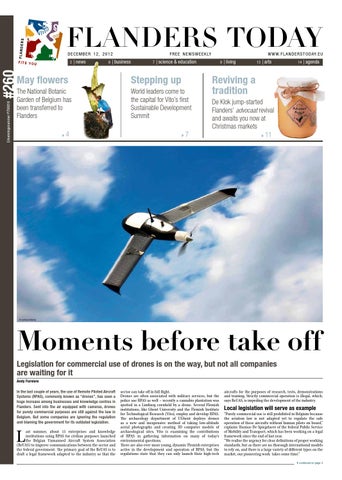
© courtesy Gatewing
Moments before take off Legislation for commercial use of drones is on the way, but not all companies are waiting for it Andy Furniere
In the last couple of years, the use of Remote Piloted Aircraft Systems (RPAS), commonly known as “drones”, has seen a huge increase among businesses and knowledge centres in Flanders. Sent into the air equipped with cameras, drones for purely commercial purposes are still against the law in Belgium. But some companies are ignoring the regulation and blaming the government for its outdated legislation.
L
ast summer, about 15 enterprises and knowledge institutions using RPAS for civilian purposes launched the Belgian Unmanned Aircraft System Association (BeUAS) to improve communications between the sector and the federal government. The primary goal of the BeUAS is to draft a legal framework adapted to the industry so that the
sector can take off in full flight. Drones are often associated with military services, but the police use RPAS as well – recently a cannabis plantation was spotted in a Limburg cornfield by a drone. Several Flemish institutions, like Ghent University and the Flemish Institute for Technological Research (Vito), employ and develop RPAS. The archaeology department of UGhent deploys drones as a new and inexpensive method of taking low-altitude aerial photographs and creating 3D computer models of archaeological sites. Vito is examining the contributions of RPAS in gathering information on many of today’s environmental questions. There are also ever-more young, dynamic Flemish enterprises active in the development and operation of RPAS, but the regulations state that they can only launch their high-tech
aircrafts for the purposes of research, tests, demonstrations and training. Strictly commercial operation is illegal, which, says BeUAS, is impeding the development of the industry.
Local legislation will serve as example “Purely commercial use is still prohibited in Belgium because the aviation law is not adapted yet to regulate the safe operation of these aircrafts without human pilots on board,” explains Thomas De Spiegelaere of the federal Public Service of Mobility and Transport, which has been working on a legal framework since the end of last year. “We realise the urgency for clear definitions of proper working standards, but as there are no thorough international models to rely on, and there is a large variety of different types on the market, our pioneering work takes some time.” ``continued on page 3