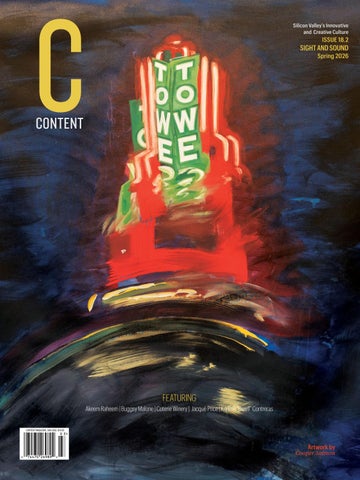
C
Silicon Valley’s Innovative and Creative Culture
ISSUE 18.2
SIGHT AND SOUND
Spring 2026
CONTENT
FEATURING Akeem Raheem | Buggsy Malone | Coterie Winery | Jacqué Price | Karime “Dawll” Contreras CONTENT MAGAZINE, SAN JOSE $14.95
Artwork by
Cooper Salmon
C
CONTENT ISSUE 18.2
“Sight and Sound” Spring 2026
Cultivator Daniel Garcia Editors Amani Hamed, Danae Stahlnecker Elizabeth Sullivan, Grace Olivieri Katherine Hypes, Katie Shiver Samantha Hull Photographers Arabela Espinoza, Alex Knowbody Cyntia Apps, Marietta Asemwota Miguel Ozuna, Stan Olszewski
Developer David E. Valdespino Jr. Writers Allegra Bick-Maurischat, Bree Karpavage Christopher Phan, Danae Stahlnecker Esther Young, Dr. Jonathan Fung John Holleman, Joshua Hascall Nikoo Parsizadeh, Samantha Hull Sendy Tapia, Taran Escobar-Ausman Troy Ewers, William E. Jeske Interns Maceo Inoue, Nhi Tran
Publisher SVCREATES
The idea for an issue called “Sight and Sound” came to me in 2013, during my second year producing CONTENT (issue 5.1). My goal was to focus more on the image makers and sound artists in our region. I realized I was subconsciously defaulting to painters and designers, so I wanted to challenge myself to make space for actors, athletes, filmmakers, and photographers.
The mission of CONTENT has always been to be eclectic. Creatives and audiences often get stuck in their own silos simply because they aren’t aware of what else is out there, and I wanted to use different disciplines to bridge that gap. With this 14th edition of “Sight and Sound,” I think we’ve really achieved that. This issue continues that diverse mix, and the artists featured on these pages reflect that variety. I’d like to highlight one artist in particular: Mauricio Rodriguez. I met Mauricio at a genARTS Silicon Valley meet-up and portfolio review (where I also met Natalia Drachinskaya). Even though he hadn’t presented this collection before and was a bit nervous about sharing it, I was blown away by the beauty and depth of his work. His compositions perfectly capture the heartbeat of “Sight and Sound.” By exploring the physicality of sound and imagining what it looks like through analog typing and printing, he creates a beautiful blend of old and new—bringing sound to sight. We hope you enjoy his work and the other talented creators featured in this, our 74th issue. Enjoy, Daniel Garcia
THE CULTIVATOR IN THIS ISSUE Santa Clara County Supervisors | Jonathan Crow | William Johnston Bohrer | Natalia Drachinskaya To participate in CONTENT MAGAZINE: daniel@content-magazine.com Membership & sponsorship information available by contacting david@content-magazine.com
501(c)(3)
CONTENT MAGAZINE is a quarterly publication about the innovative and creative culture of Silicon Valley, published by
.
Create. Imagine. Play. Discover what’s waiting for you at Montalvo Arts Center montalvoarts.org
Woody De Othello, seeing both sides (2024) Collection of Montalvo Arts Center, Gift of the Lipman Family Foundation Photo by Paul Gallo
HOMETOWN HEROES
Imelda ImeldaLepe Lepe Evening EveningSwim Swim
Celebrating Celebratingthe thespirit spiritof ofSan SanJosé, José,Hometown HometownHeroes Heroesisisaadynamic dynamicexhibition exhibitionfeaturing featuring 44 44sports-themed sports-themedphotographs photographsby by25 25local localphotographers—both photographers—bothprofessional professionaland and amateur. amateur.On Onview viewJanuary Januarythrough throughJuly July2026 2026on onmonitors monitorsthroughout throughoutCity CityHall, Hall,the the exhibition exhibitionshines shinesaaspotlight spotlighton onthe theathletes, athletes,teams, teams,and andcommunity communitystories storiesthat thatmake make San SanJosé Joséaatrue truesports sportscity. city.
Hugo HugoMeza Meza InInHer HerElement Element
BrittanyBradley Bradley Brittany ParkDay Day Park
AmyKing King Amy FrenzyCelebration Celebration Frenzy
CONTENT SIGHT AND SOUND 18.2.
Spring 2026 San Jose, California
CULTURE 10 Santa Clara County Supervisors: Sylvia Arenas, Betty Duong Otto Lee, Susan Ellenberg and Margaret Abe-Koga SIGHT 22 Photography Students, SJSU Photo 125 28 Artist & Photographer, Buggsy Malone 34 Muralist & Tattoo Artist, Karime “Dawll” Contreras 38 Painter, Jonathan Crow 44 Painter, Jacqué Price 50 Graffiti Artist, Akeem Raheem 56 Visual Artist, Natalia Drachinskaya 62 Painter, Cooper Salmon
Buggsy Malone, pg. 28
SOUND 70 Composer, Mauricio Rodriguez 76 Rapper, Joe Fresco 80 Sound Designer, George Psarras 84 Musician, William Johnston Bohrer TASTE 88 Coterie Winery, Kyle Loudon
Natalia Drachinskaya, pg. 56
92 Contributors
All materials in CONTENT MAGAZINE are protected by United States copyright law and may not be reproduced, distributed, transmitted, displayed, published, broadcast, or modified in any way without the prior written consent of Silicon Valley Creates, or in the case of third party materials, the owner of that content. You may not alter or remove any trademark, copyright or other notice from copies of this content. For further information, or to participate in the production or distribution, please contact us at editor@content-magazine.com.
Dawll, pg. 34 CONTENT MAGAZINE is made possible in part by funding from the County of Santa Clara.
Mauricio Rodriguez, pg. 70
» » » » » »
2026
Santa Clara County Supervisors S e r v i n g t h e p u b lic w i t h p o lic y a n d p a s s i o n Written by Danae Stahlnecker Artwork by Natalia Drachinskaya bos.santaclaracounty.gov Instagram countyofsantaclara
10 Sight and Sound 18.2
I
n Santa Clara County, five nonpartisan, publicly elected officials work to ensure that county governance functions effectively while serving the general public. They make policy decisions, approve budgets, and oversee the daily operations of county departments. They lead ground-breaking initiatives for public health, economic development, and social services. They sit at the nexus of state and local government, working to make the county a safer, healthier home for its 1.9 million residents. They are the county’s Board of Supervisors, and they represent you. County supervisors are elected every four years, with a limit of three consecutive terms. Since CONTENT’s 2019 feature on the Board of Supervisors, four of the five positions have welcomed new representatives. District 4’s incumbent supervisor, Susan Ellenberg, remains, but she is now joined by Sylvia Arenas (D1), Betty Duong (D2), Otto Lee (D3), and Margaret Abe-Koga (D5). As of the 2024 election, the board reached a notable milestone: being majority women for the second time since the ’80s and majority Asian-American for the firsttime ever. These changes parallel another recent county change. In 2022, district maps were redrawn as part of a regular process to adjust district boundaries according to census data every 10 years. Despite all these changes, the mission of the board remains steadfast: serve the people. In a county with over 80 departments and agencies, this can show up in many ways, but mostly the county acts as a social safety network for a wide range of resident needs. Much of that work supports our most vulnerable neighbors, including but not limited to children and families, lowincome households, older adults, veterans, and marginalized populations like immigrants and the
LGBTQ community. But county services are here to help everyone—from home owners to unhoused individuals, small business owners to everyday consumers. Through Santa Clara Valley Healthcare, you can access routine and emergency health services. You can seek help through the county’s Crisis and Suicide Prevention Lifeline and substance use treatment services. The Office of Supportive Housing will help you find shelter, whether that’s a warming/cooling center in extreme weather or long-term affordable housing. You can enjoy local parks, improved roads, the preservation of historic landmarks, and new housing and businesses because of the county’s oversight of land use and development. The county library gives you access to not only books and media, but also to educational programs and employment resources. County departments handle public safety, emergency response services, Child and Adult Protective Services, and reentry resources for formerly incarcerated individuals. They manage voting and elections, offer financial assistance, distribute food, and help property owners with value assessments and tax issues. They process and archive records of births, deaths, and marriages. They even have a Division of Weights and Measures that makes sure when you buy something you’re charged the right price and receive the right amount. At the top of this all is the Board of Supervisors, whose policy and budget decisions have wide-ranging impacts. The profiles that follow highlight each supervisor’s priorities and passions. Read on to see what causes they’re committed to, what they love about their districts, and who they are behind the political screen. C
11
Instagram: sylvia_arenas
Sylvia Arenas
D1
WORKING IN POLITICS wasn’t the plan for Sylvia Arenas. A self-proclaimed introvert, she didn’t think she had the right personality for it. Experience with adversity changed her mind. Before local government, Sylvia worked for the First 5 Association of California, helping kids and families access resources during the critical years of early childhood development. She witnessed—and experienced in her own family—how difficult it was for Latino parents to receive services. A friend of hers who was already in politics encouraged her to get involved at the policy level. At the same time, she was studying for her master’s in public administration and pregnant with her second child. The convergence of circumstances helped her fall in love with the idea of “changing the rules for our families.” She says, “You change the rules, you change the game and you change the outcomes for folks.” Since then, she’s served as a school board member for Evergreen Elementary School District, as a San Jose city council member, and, now, as county supervisor for District 1. Serving families remains at the heart of her work. Since stepping into office in January 2023, Sylvia and her team have pushed for reform to child welfare services, protected nine million dollars for service providers from budget cuts, and led an ad hoc committee to investigate issues of county responsiveness to reports of suspected child abuse. They’ve also developed the Latino Health Assessment, started working to address and prevent gender-based violence, and improved housing for local farm workers. She’s concerned about the current statistics in public safety and the overrepresentation of Latinos in need. She wants to reduce that need: “That’s ultimately what I’m pursuing: generational change for our community.” Sylvia now sees that her culture and background do make her a good fit for the job. She says, “I think my culture, the Mexican culture, that looks at the greater good and the communal good,
12 Sight and Sound 18.2
blending with the American culture [of individualism] is the right combination that allows me to serve.” Sylvia and her team consider themselves, first and foremost, as public servants— here to serve the community. Just as the city council improves city infrastructure like roads and parks, she says the county is concerned with the infrastructure of human lives and helping people thrive. For Sylvia, that work is done not only through policy, but also through exposure and education. Becoming a supervisor meant representing an industry she wasn’t familiar with: agriculture and agritourism. Learning what District 1 has to offer in terms of wineries and farms helped her better appreciate San Jose’s history as the Valley of Heart’s Delight—and inspired her to establish an office of economic development. She hopes to spread that appreciation for local culture and commerce by funding events like Open Streets: Morgan Hill and Gilroy’s La Ofrenda Festival. It’s all about bringing people together, having fun, and lifting up the community’s positive attributes—like the artisanal crafts she likes to buy for herself from local artists. Whatever form it takes, Sylvia’s work is focused on bringing systemic change. She says, “It’s about shifting the culture within the system. I identify as a disrupter. I don’t see that as something negative.” When she’s not in public service mode, she’s in mom mode, making the most of her time with family and friends. C 12
“Dance should be for everyone. Creating partnerships and highlighting waacking through these channels can help broaden the audience for this art form.” -Alice Hur
“That’s ultimately what I’m pursuing: generational change for our community.” 13 Sight and Sound 18.2
13
“Dance should be for everyone. Creating partnerships and highlighting waacking through these channels can help broaden the audience for this art form.”
“I’m not trying to make this a healthier place. I’m trying to make it the healthiest place. Not safer but safest.” -Alice Hur
14 Sight and Sound 18.2
Instagram: bettyforsupervisor
Betty Duong
D2
“TEN MONTHS FEELS LIKE TEN MINUTES and ten years,” says Supervisor Betty Duong, reflecting on her time in office through the fall of 2025. Betty took over for District 2 in December 2024, replacing Cindy Chavez and becoming the first Vietnamese American supervisor in Santa Clara County. Although the time feels short, Betty and her team have already advanced significant changes. District 2 covers Downtown, East Side, Southside, and several historic areas in San Jose, including Japantown, Little Saigon, Little Italy, and Little Portugal. It’s historically the most low-income district and the one most disparately impacted across all health, safety, and wellness measures. It’s also where Betty grew up. Her history as a resident and public service worker means she sees not only the struggle, but also the beauty, power, and sense of community in District 2. “We are an action-packed district,” she says. “This is the district of movement making, of resilience.” She describes everything that’s a part of the district: hustle culture, trends and influencers, hot new restaurants, block parties and tailgates, artists, community activists, immigrant communities, strong neighborhood associations, and people just trying to support themselves and their families. She says, “Each [neighborhood] is highly individual with their own history, but they all come together to be this incredible tapestry of values.” Betty’s mission is to advance equity here. She says, “I’m not trying to make this a healthier place. I’m trying to make it the healthiest place. Not safer but safest.” She notes that when you fix things where there’s the greatest need, you can fix them anywhere else. Her focus is on the interconnected issues of public safety, health and wellness, and housing security with special attention to mental health, employment, and early intervention programs. She celebrates a recent success of closing the gaps between the county and city interim shelter systems. Once separate, the systems now are developing
coordinated entryway hotlines that will help city and county staff better collaborate to get people sheltered more reliably and quickly. Other initiatives include an all-day women’s policy and leadership summit, support for business associations and multi-generational business owners to promote economic development, and an experimental approach to addressing public safety issues around St. James Park. Betty acknowledges her fellow supervisors as important allies. “I’m so honored to serve with them. They feel the full weight of their decisions,” she says. “Our decisions form partnerships that help situations before it becomes a problem.” She’s also proud of meeting with nearly everyone who’s reached out to her office, since her approach is founded on listening to community voices. “I really put myself out there for folks because I want people to know I’m a real person,” she says. “I want them to feel like I’m Betty next door who happens to be a supervisor.” Her parents came to San Jose through a county program for refugees, and her family relied on county programs to get by. So representing others who need these same services is deeply personal to her. She says, “This is a labor of love. I hope I never get comfortable with the moniker of supervisor. That slight discomfort means I’m still rooted.” Staying rooted helps her keep an eye on building a better world for her kids. And when she needs a break, she takes time to be with them and to indulge in her favorite hobbies: sci-fi and monster movies, arts and crafts, and sports like dodgeball, table tennis, and pickleball. C 15
Otto Lee
D3
Instagram: ottoleed3
SUPERVISOR OTTO LEE HAS SERVED the public in various capacities for close to 30 years. He joined the US Navy right out of college and was part of the Navy Reserves for 20 years. When he moved to Sunnyvale in 2000, he joined the Sunnyvale Planning Commission until he was elected to city council, where he served from 2003 to 2011 with one term as mayor. Then in 2020, he became District 3’s county supervisor. For Otto, the joy of service is engaging with the public. He says, “The work we do is extremely rewarding, especially when you can see the impact and how it affects people.” In his role as a supervisor, Otto prioritizes practical initiatives that help a wide range of people. Environmental sustainability, the housing crisis, fair wages, healthcare, and gun buyback programs are just some of the social issues he’s worked to address with his fellow supervisors. By declaring mental health and substance abuse a public crisis, the county was able to increase the number of beds available for treatment. Otto supported the purchase and renovation of the Homeless Veterans Emergency Housing Facility in Alum Rock, so unhoused veterans now have a safe place to stay. And keeping the county hospitals running means critical services can literally save lives. “We’re the ones who have the ability to decide how to spend the funding,” Otto says of the board’s work that leads to these positive outcomes. “[We’re affecting] things you can see on the ground, and that’s something I find extremely rewarding.” Otto sees this work as especially critical right now. “It’s truly mind-boggling to see what we are going through right now because I don’t think this country has experienced anything like this from the federal administration,” he says. To combat a culture of division, he urges us to recognize our individual
16 Sight and Sound 18.2
power and stand together. “It’s important to realize you don’t have to be something very special to make change,” he says. “We all have our special way to help people in our community using the resources we have.” Otto believes one of those ways is art. He recalls a recent visit with his daughters to the Banksy Museum in Barcelona: “To understand the story of Banksy is truly phenomenal. We don’t really know [who Banksy is], but the work is truly impactful, highlighting the issues of the world.” His appreciation for art activism leads to supporting artists in the Bay by sponsoring events, funding public art at new constructions, and simply engaging with local artists. “We need to continue to show our talent and have expression through the turmoil we’re going through. We need to highlight to the world what’s going on,” he says. Otto’s going to take his own advice. An amateur photographer, he loves to travel and capture different cultures and perspectives. He hopes to continue this with his family and says with a laugh, “Maybe I’ll do a photo exhibit someday.” C
“Dance should be for everyone. Creating partnerships and highlighting waacking through these channels can help broaden the audience for this art form.”
“The work we do is extremely rewarding, especially when you can see the impact and how it affects people.” -Alice Hur
17
“Dance should be for everyone. Creating partnerships and highlighting waacking through thesethere’s channels canofhelp broaden “I really believe a lot interrelation, the audience for this art form.”
and you really need to be pressing all the buttons in a system to create a sustained impact.” -Alice Hur
18 Sight and Sound 18.2
Instagram: supellenberg
Susan Ellenberg
D4
COMING UP ON THE LAST YEAR of her second term as District 4’s county supervisor, Susan Ellenberg is here to have a positive impact. County government is the social safety net, and her role is to weave that net to improve people’s lives. She says of her mission, “I think about people with the least access to resources and the least political and economic power, and I think: How can the work of my office help to even out some of the vast inequalities?” If she had to narrow down the list, she’d say her top priorities are publicly funded childcare, public health, criminal justice reform, and homelessness prevention. She also holds a special interest in supporting older adults and the LGBTQ community, particularly trans youth. Her predecessor, Ken Yeager, led the creation of the county’s Office of LGBTQ Affairs, and she wants to continue and build on that legacy. For older adults, she sees a need to make our community more accessible and less isolating. But really, she says, everything is connected. “I really believe there’s a lot of interrelation, and you really need to be pressing all the buttons in a system to create a sustained impact.” With seven years under her belt, Susan has already strengthened county resources. She garnered board support to invest a total of $25 million in childcare through facility grants and a workforce apprenticeship program. She was a key voice in the county’s decision to declare a public health crisis in mental health and substance use disorders. Making these a top priority led to strategic planning and the development of goals that also act as an accountability checklist. She’s an advocate for pilot programs like guaranteed income for families at risk of losing their housing and for formerly incarcerated individuals reintegrating into society. She also encouraged the development of the Caregiver Returnship Program aimed at helping mid-
career professionals return to work after a gap in employment. In the arts world, she seeks county partnerships that make art accessible, use art as an outlet for creative expression, and bring beauty to public spaces. Susan believes many of the challenges we face right now are rooted in lack of trust and communication. She says, “The more we can encourage and support spaces and reasons for people to come together, the healthier we can be.” Fortunately for her, District 4 is very civically engaged with many strong neighborhood and businesses associations. Susan says, “That means there’s a lot of opportunity to connect with residents and a lot of very vocal folks holding me accountable, asking questions, and wanting answers. That’s really a delight for me.” As a former teacher, Susan loves when people are engaged in county government because it gives her the chance to educate and inform. She says, “I want people to know I truly love the work, love county government, love talking about it. I want so much for residents to understand how much we do and how much impact we have, whether or not they ever need resources from the county.” Susan plans to be on the ballot one more time in 2026 for a hopeful third and final term. In the meantime, she’ll keep on serving her constituents and appreciating what her district has to offer. Look for her hiking in the hills, hosting office hours at local farmers markets, and reading picture books to little ones at the library. C 19
Instagram: supervisorabekoga
Margaret Abe-Koga
D5
“MY NORTH STAR is that I strive to ensure that everyone— regardless of their background—has a voice in our community,” says Margaret Abe-Koga. The child of immigrants, Margaret is all too familiar with what it means to not be heard. She witnessed the discrimination her parents faced and how language barriers kept them from getting help because they didn’t know what resources were available. Part of her job now is to break down those barriers for others. One way she does that is by facilitating gatherings, whether that’s know-your-rights sessions, community hikes, or even just answering phones and getting back to people right away. “I look at my job as being a connector of folks in the community,” she says. These connections help her see where the need is. Margaret represents the largest district in the county, covering nine of 15 cities. It’s a lot to oversee, so it’s important for her to hear from people directly. So far, Margaret’s priorities have been financial sustainability, affordable housing, climate change, regional transportation, and public safety. Margaret’s first term as District 5’s supervisor began in January 2025. She brings with her lessons and ideas from her time as mayor of Mountain View, both in 2009 during the great recession and again in 2020 during the Covid-19 pandemic. These past initiatives included increasing minimum wage, piloting guaranteed basic income programs, and introducing a rental assistance program. “I really believe in empowering people to empower themselves,” says Margaret. “It goes back to my belief that the best way to provide support is direct financial assistance.” What this may look like in the county going forward remains to be seen, as the board faces a challenging time of federal funding cuts. However, Margaret sees hope in even the small wins. Earlier this year, Margaret’s office learned that many mixed status families didn’t have or couldn’t afford passports. So she worked with the county to partner with Fenwick & West, 20 Sight and Sound 18.2
a Mountain View law firm, and help over 30 families fill out passport applications, with the county paying the fees. She says, “It’s a small example, but it’s these types of things that really do make an impact on people’s lives. That’s what I love about local government—it’s really grassroots, hands-on, and you can make a big impact on the community.” Margaret notes that work like this can only happen with collaboration and compromise. Supervisors are in nonpartisan positions, and there’s a lot of gray area to navigate in their decision making. To move things forward, she strives to find common ground. “That means being open-minded and being willing to listen to all sides,” she says. After all, at the end of the day, her goal is to make government accessible to everyone, not just to some. She adds, “I never planned to run for political office. When I had my first daughter, a light bulb turned on. It’s not just about me; it’s about their future, the young people and the next generation.” Outside of the office, Margaret finds common ground with others through her hobbies and personal experiences. As a cancer survivor, she’s mindful of health and enjoys exercise, such as practicing kendo and running half-marathons. She is also a Giants and 49ers fan, dabbles in watercolor and oil painting, and has a deep love for live music—especially BTS and K-pop groups. C
“Dance should be for everyone. Creating partnerships and highlighting waacking through these channels can help broaden the audience for this art form.”
“That’s what I love about local government— it’s really grassroots, hands-on, and you can make a big impact on the community.” -Alice Hur
21
22 Sight and Sound 18.2
SJSU Photo 125 S
an José State University’s “Photo 125” is a beginning fashion photography class taught by Professor Jonathan Fung. The course introduces students to beauty, fashion advertising, and fashion editorial. Students use digital and film cameras, strobe and location lighting, and digital image processing.
Students research the fashion industry and learn to tell a story through clothing and accessories and working directly with models. They are encouraged to build a production team that includes make-up and hair, and a clothing stylist. Assignments develop technical, aesthetic, and communication skills to help students succeed as artists. They research, create pre-production, and pitch their concepts for each shooting assignment as they would for a professional client. Class critiques are an important part of the learning process that help each student grow and improve their skills. For this fashion editorial assignment, students submitted their work to
CONTENT MAGAZINE. Six students were selected for this issue. This is a valuable
opportunity for San Jose State University photography, art, and design students to have their work published in CONTENT MAGAZINE. This experience has taught them professionalism, how to deliver quality work on a deadline, and how to problem solve unexpected challenges. C
Written by Dr. Jonathan Fung photo.sjsu.edu
23
Ethan Santos Ethan is a photographer, filmmaker, and creative director capturing cinematic lifestyle stories that highlight connection, growth, and everyday beauty through powerful visuals. Instagram: ethnsantos 24 Sight and Sound 18.2
Adriana Fernandez Adriana is a South Bay photographer passionate about storytelling. She loves working with colors and emotions. Instagram: aferrn 25
Luis Aponte Luis is a Bay Area sports, commercial, and portrait photographer who crafts compelling narratives that reveal the true essence of his subjects. Instagram: luisaponte.jpg (Top Left and Page 22) Tracy Tam Born in the Philippines, Bay Area-based photographer Tracy captures culture and portraiture through a thoughtful lens, guided by her enduring connection to nature. Instagram: tracy.arw (Left) Charlize Morrison Charlize is a photographer, born and raised in the Bay Area, who specializes in capturing bold, modern, and elegant fashion photography. Instagram: bycharlize (Above) 26 Sight and Sound 18.2
Khuong T Ngo Khuong is a fashion photographer shooting identity, texture, and light with curiosity and care. He is always chasing the next unexpected frame. Instagram: bilyz204 27
28 Sight and Sound 18.2
Buggsy Malone P Healing Through Art
Written by Troy Ewers
eople find a lot of ways to heal themselves after traumatic experiences. Some turn to drugs and alcohol, some read books, some choose to play pick-up basketball with their friends once a week—but for some people, their healing comes from their art and creativity. Buggsy Malone, a photographic artist, has found not only a way to heal himself with his art, but also a way to give others facing similar situations an outlet to heal themselves through artistic expression. Born in Georgia, Filipino by heritage, and adopted into a non-Filipino family, Buggsy grew up disconnected from his cultural roots. He says he felt like he was “genuinely the outsider” everywhere he was, but that being raised in a military household gave him something to hold on to: a code of ethics that he upheld even when he was young. His father served in the Army Air Corps and later worked with the civil service at Robins Air Force Base. They lived all over the world: Buggsy started kindergarten in Thailand, spent middle school in Holland, and finished high school across Germany and England. “That upbringing shaped how I view culture—with deep respect, empathy, and curiosity,” Buggsy explains, while also joking about how his prom was in a European castle. Through photography and art, Buggsy learned to process trauma, reflect on identity, and reconnect with where he came from. His ongoing project, The Beauty of Culture, is not just about showcasing cultural diversity, it’s about reclaiming his own heritage while celebrating the stories of others. He documents respectfully, with consent, and always seeks to share not just what he sees, but what he feels.
Photography by Alex Knowbody buggsymalone.com Instagram buggsy_malone_13 29
The Day Begins, 2017, digital print, 23”x20”
The trauma Buggsy had to process that unlocked this side of his creativity came from 15 years of military service. He originally joined the army for the college money but then became a full service member. Buggsy described the mentality he developed after his service as a “combat mentality,” but even with that mentality, he found a balance through art. “I’m a combat veteran, but with my camera I keep my balance,” Buggsy says. When Buggsy got out of the military, he got a degree in graphic design, which he proclaims brought him back to being creative. “Graphic design gave me structure on how to lay out a message, how to guide the eye, how to take an idea and shape it. That knowledge led to a professional partnership in Oakland with my brother, Abba Yahudah, doing branding together through our company, GOT Brand Solutions. He’d create, and I would bring it into form digitally. It worked because it was rooted in both respect and skill.” Buggsy later moved from Oakland to San Jose, and it was in San Jose that he realized he wanted to capture culture. While doing photography, Buggsy still maintained a love of painting and painted pieces inspired by legends like Billie Holiday, Miles Davis, and Tupac, but it was painting other people’s photos that made him really want to take photography seriously because he wanted to capture culture on the front lines. Capturing Indigenous culture, Hispanic culture, and his own Filipino culture through his photography, Buggsy found out in real time he wasn’t just capturing culture—he was putting a spotlight on cultures that in many ways have been overlooked. “Family is not just blood,” he says. “Hearing people in these cultures say ‘we need you’ means something. It means someFolklorico Amor, 2019, digital print, 32”x20”
30 Sight and Sound 18.2
“Hearing people in these cultures say ‘we need you’ means something. It means something from your family I guess, but hearing it from the community was a huge thing.”
“I like the consequence of needing to do things you can’t undo in quite the same way.” –Julie Meridian 31
Dolores, 2025, digital print, 20”x32” 32 Sight and Sound 18.2
Ancestor in Flight, 2022, digital print, 32”x20”
Redtail Headshot, 2025, digital print, 20”x32”
thing from your family I guess, but hearing it from the community was a huge thing.” Buggsy has a focus on community through his art, because that community appreciated his art. But creativity wasn’t just an outlet for these communities, it was also an outlet for Buggsy as the work helped him heal his own traumas. “Most people’s outlets are therapeutic, and my outlet is art and art is my prescription,” he proclaims, sharing that this approach has helped him heal more than just medication has. This mantra inspired him to launch Help Veterans Heal, an art-based organization that gives other veterans a platform to express themselves and process their traumas through art therapy. Buggsy took the last year off to focus on his health after being affected by a sudden health scare. After this incident, Buggsy realized his family and the community he serves are what keep him going with his art. His return to the art community was a month-long residency at the Mexican Heritage Plaza, where he showcased his photography and paintings in a gallery. For a person who felt like he was an outsider growing up, Buggsy was welcomed back to the place where he was very much at home—being an artist. Buggsy’s commitment to community, art, and healing has now overlapped into everything he does—and he loves it! “I can’t live without overlap,” he says. Whether it’s taking photos of lowriders on Cinco De Mayo in the East Side of San Jose or having his paintings displayed in a gallery for everyone to see, Buggsy’s focus on giving people, especially veterans, an outlet to heal through pure artistic expression continues to be a spark of inspiration to many creators in the Bay Area. “If everyone expressed their one true love, the world would be a better place,” Buggsy says. What he calls conscious love is his mission statement that he shares with other veterans, young artists, and disenfranchised people who need that little push to pursue their passion and heal themselves through art. C
33
34 Sight and Sound 18.2
Dollmaker with a Needle
DAW L L Karime Contreras
R
Written by Sendy Tapia Photography by Arabela Espinoza Instagram d4wlll dawll.artistry
emember staying up late to finish that one project? The long-winded paper due the next day, the final touches on a friend’s cake, the last stitches on a must-have outfit, or that art piece haunting the corner of your imagination? Karime Contreras, known creatively as “Dawll,” remembers such projects as if they were yesterday. “During the height of the pandemic, I stayed up all night trying to perfect my dolls,” she says. Pages upon pages of drafts scattered across her room, a creative chaos resembling a toy factory boardroom, each sketch a step closer to the perfect doll. Delicate, defiant, and unmistakably hers. The dolls stare back like tiny self-portraits—soft yet strong, painted in pinks and browns that radiate the same feminine energy as Bratz, Barbie, or Monster High dolls. “People used to think dolls were fragile,” she explains. “But I always saw them as powerful. They hold stories, emotions, memories.” Dawll has always been drawn to art. Her early drawings caught the attention of an art teacher who encouraged her to skip the beginner course and take AP Art instead. That recognition became a turning point. After being exposed to popsurrealist artist Mark Ryden and Superflat pioneer Takashi Murakami, she began to refine her style—one that embraced softness as strength. “They’ve always been a part of me,” she shares. “The dolls are my girls. My world.” Long, flawless locks. A nose as cute as a button. Glossy, plump lips and an aesthetic steeped in innergirl-world energy—just one glance is enough to take anyone back to the first doll they ever received. They are the embodiment of girlhood nostalgia mixed with contemporary fashion trends and an empowering reminder that softness and strength can be a plural reality. “I’m a pretty introverted person, but when it comes to my dolls, I want to put them out there,” she gleams. “I want everyone to come talk to me about my dolls.” After sharing her work with friends and family, she decided to post her dolls online. The positive feedback only fueled the 35
36 Sight and Sound 18.2
visionary dollmaker. Not long after, she received a message from someone interested in buying a print—someone who, unbeknownst to her, would later open the door to one of the most gatekept creative industries in the world: tattooing. Although her tattoo apprenticeship was a positive experience, she confirms that the rumors of misogyny in tattooing are true. Dawll recalls walk-in clients saying things like, “Oh, I don’t want to be tattooed by a girl,” or, “She only gets booked because she’s dolled up.” Those comments didn’t discourage her; instead, they fueled her determination to earn respect through ink and needle. “Someone can look really well put together and be really, really, talented,” Dawll emphasizes. “Both things can be true.” In solidarity and love, Dawll’s first tattoo client was her mother. “That’s how much she loves and supports me,” she recalls. “She was like, ‘You can practice on me. You can do it.’ And I remember, I didn’t even have a stencil!” Now, Dawll estimates that 98 percent of her clients are women—women who power through tattoo sessions with little to no breaks, even as she gently checks in on them. She dreams of working in a studio where people can come for tattoos, nails, piercings, lashes, and, most importantly, community. In both her dream parlor and her doll designs, Dawll is redefining what feminine power looks like. “I have a lot of love for women,” she affirms. “I just really want to highlight the beauty in women— beauty and struggle, beauty and literally anything.” In challenging gendered scripts that label women as “too soft” or “too much,” Dawll’s dolls serve as alter egos that fully embrace authenticity in all its forms. Her tunnel vision of selfbelief and obsession in bringing her vision to life has kept her consistently grounded and creatively disciplined for the past five years. Some of the dolls are reflections of herself; others are inspired by the energies of the women she meets. Each one is an avatar of emotion, community, and representation, embodying the faith she holds in her own creative journey. “You have to be a little delusional,” she laughs. “You have to believe in yourself so much that people think you’re crazy. That’s the only way dreams happen.” From sharing prints with her future apprenticeship mentor to being invited to paint at the county fair by art collectives in the community, like 1Culture and Together We Create, the doors of artistic opportunity keep appearing for this dollmaker. On the pink-hued horizon, Dawll is manifesting new possibilities: more live paintings, more galleries, more tattoos—and always, more dolls. “Somebody told me that my dolls could be the next Labubu,” she smiles. “And I was like, yeah, I’d love that. It’s a long way to go, but that’s definitely the vision.” C 37
J O N A T H A N CROW W
H
E
R
E
N O S TA L G I A MEETS
A R T,
POLITICS,
AND
THE
SELF
Written by Nikoo Parsizadeh Photography by Stan Olszewski jonathan-crow.com Instagram jonathancrowart
38 Sight and Sound 18.2
39
When Jonathan Crow paints, he’s not so much painting a canvas as mapping the strange intersections of raw art, politics, and the individual self. His San Jose studio, cluttered with sketches and portraits, is part newsroom, part gallery, and fully a room to call his own sanctuary. With deep roots in filmmaking and journalism, Jonathan has reframed painting to a means of storytelling, as visual as it is philosophical.
Jonathan’s own artistic trajectory never took a straight line. Professionally trained initially as a filmmaker and having received his MFA, he learned to observe people, their habits, and their contradictions. That balance of structure vs. spontaneity governs all that Jonathan does. From drawing historical subjects to vintage timelines, Jonathan approaches his work with emotions, memories, and curiosity. His Veeptopus series,
which paired octopus heads with vice presidents, was simultaneously artistic and pointedly political. Jonathan uses emotions as a means of getting people to look at something they wouldn’t normally look at—to make them laugh and then make them think. Despite all his wit, Jonathan’s work is grounded in something deeply introspective. He describes his process as meditative and compulsive, a constant balancing act be-
Woman and Five Cars, 2025, oil on canvas, 72”x48”
Enrique’s Cart , 2025, oil on canvas, 40”x30” 40 Sight and Sound 18.2
tween what he wants to say and what he ultimately can bring himself to say. After attending a handful of workshops and further teaching himself, Jonathan started oil painting and really loved the sensuality of it—the fact that he could push the paint around the canvas until he got what he wanted. Jonathan thinks to create a work that feels like you is to really understand yourself. He says, “To create a work that feels like you, you need to give yourself enough headspace to let that voice be audible, because if there’s too much noise
in your life, you won’t hear it at all.” He asserts this is particularly true for working artists. Jonathan points out the trust fund artist cliché, but he’s candid about the realities of work, time, and even inspiration. He says, “Be selfish with your time. Be selfish with your life. You have to be a little self-absorbed and selfish to be an artist. If you’re always giving your time to other people, you’re just not going to have the time for your views.” To Jonathan, selfishness isn’t ego, it’s concentration. Creativity, as he sees it, needs isolation, a sort
of internal quietude whereby something real has a chance to occur. Jobs, relationships, obligations—these can all overpower that inner signal if you’re not watchful. And yet, he does not sensationalize art as a sanctuary. Jonathan is rooted by his nostalgia. He speaks about his work with equal candor and irony, even criticizing himself in the process, but he never idealizes art as flight. Jonathan grounds himself with his vision. He approaches his work with as much seriousness as with emotions, seeking the perfect stroke of 41
“I think if it’s just pure politics, then it’s not art. It’s an agitprop or something like that. It can be artistic, but it ages very quickly.”
That House with the Bunting , 2025, oil on canvas, 30”x30”
brush in his own process. “I don’t like putting too many words into things,” he says. “Partially because I work as a writer. I mean, the words are usually poor substitutes for the real thing. They’re the finger pointing at the moon, not actually the moon.” That line between his emotions, ideas, and self-examinations gives his work its vitality. Jonathan’s paintings often speak about political or cultural themes, but they’re never didactic. He wants 42 Sight and Sound 18.2
Backyard Pool , 2024, oil on canvas, 30”x30”
people to feel, not know. He says, “I think if it’s just pure politics, then it’s not art. It’s an agitprop or something like that. It can be artistic, but it ages very quickly. Once the circumstance around it dies or goes away, then it kind of loses its impact. But if you get that feeling underneath, that’s something else.” Growing up, Jonathan often struggled with defining his cultural identity. While friends created work that addressed their heritage,
Chuck and Cindy +2 , 2025, oil on canvas, 30”x30”
he couldn’t help but feel inbetween with a so-called “default culture” that lacked history. As an artist and filmmaker today, he is attracted to the uncertain landscape of America. He believes that culture is no longer defined by a single center, but by many voices coming together in a larger, evolving narrative. This evolution, however uncomfortable to many, fascinates him and permeates his paintings and films, an exploration of belonging, history,
Pacific St , 2023, oil on csanvas, 20”x20”
and the uncomfortable process of change. Jonathan’s current documentary project is an expression of the same curiosity. Focused on the Mussel Slough Tragedy of the 1880s and a forgotten California involving settlers and the railroad, it unravels myths of ownership in America. The story, buried for so long in his family’s history, has been reshaped by fiction and bias, and he intends to reclaim its truth. To him, it’s a metaphor for America
itself: a nation born of high ideals and profound contradictions, a land both inspiring and haunted by its past. With this work, he wrestles with the tension between progress and guilt, privilege and reconciliation. In art and in teaching, Jonathan prefers honesty to comfort. He believes art needs to provoke honest responses, even discomfort or outrage, because truth is rarely comfortable. His counsel to artists is straightforward yet pro-
found: guard your time, your space, and your voice. His oeuvre, from documentary filmmaking and painting to teaching filmmaking at Stanford Continuing Education, is a testament to his commitment to listening to himself amidst the noise, a silent rebellion against distraction and conformity. C
43
J
acqué
Price
44 Sight and Sound 18.2
Color blocks. Big strokes. Contrasting color.
D
eeply inspired by the human condition, Jacqué Price works from a place of emotion and how art evokes feelings in the viewer. Her intention is to give people a connection to her work through joy and a sense of playfulness—both feel-good attributes that contribute to overall human health and well-being. Jacqué says she achieves this by creating from her heart. “That energy always comes through; people can feel it, and they want to take it home with them,” she says. Jacqué paints in both acrylics and oil, abstract in style and driven by her mood of the day. “There’s a playfulness in abstract painting and something strange that feels good,” Jacqué describes. Her color-blocked landscapes and Quirky Birds, a series of paintings depicting snowy egrets in awkward positions, are signature subjects in her work. She gravitates towards painting mountains and open vistas that “encompass a feeling of freedom but are also challenging and transformational,” she says. There
are many stories inside her paintings and every person who sees them likely has a different interpretation and experience with the work. Her signature color blocking with contrasting colors is recognizable and inviting. She believes that when colors meet up next to each other, they evoke a feeling and these feelings are a direct tie to the human experience. “I want to create this balance with my work that’s joyful and playful but also elegant— bridging that is the challenge.” Her Quirky Birds came about during a major turning point in her life. As she was shifting from living in Tahoe and owning a gallery to new horizons in San Jose and Santa Cruz, birds became an inspiring subject to paint. She first painted more realistic birds in flight, herons, cranes, and geese—all symbols of freedom and space. Playing around one day, she explored quirky outlines of birds filled with blocks of color. “I just wanted to see it,” remembers Jacqué, “and I didn’t really care how it turned out.” The outcome was Ed. “He was just so cute! He was just standWritten by Bree Karpavage Photography by Daniel Garcia jacquepriceart.com Instagram jacquepriceart
45
48 Sight and Sound 18.2
The Shape of Peace , 2024, acrylic on canvas, 48”x48”
“
Her next series, Sleeping Giants, is brewing. She aims to connect forms in mountains with figures as a way to spark emotions and find the connection between her different bodies of work. She hopes this process will be slow and thought provoking. “I want to make sure I’m finding sustainable rhythms in my practice—joining the freedom of craziness with the grounding of intentionality. I want to exhaust this new concept that I’m excited about and allow it to evolve into where I go next,” she says. “Next” for Jacqué feels limitless. Her recent first-time showing during the Santa Cruz County’s Open Studios Art Tour brought her closer
I want to create this balance with my work that’s joyful and playful but also elegant— bridging that is the challenge.
”
to the Santa Cruz community of not only art lovers but also artists, filling Jacqué with gratitude and excitement for her future in what still feels like a new place. Jacqué hopes to connect further through her new series of workshops for beginners in her studio, creating informed experiences that help give artists the building blocks for crafting a meaningful art practice. She also has two exhibitions scheduled in 2026 at Piper J Gallery and Ridgeline Gallery in Truckee. “I feel like I’ve just dipped my toes into something truly special here in Santa Cruz, and I’m looking forward to continuing to build connections and dive deeper into this vibrant creative ecosystem… sharing the alchemy behind my process and watching pieces find new homes all felt like a joyful affirmation of why I paint.” C 49
Akeem Raheem Written by Joshua Hascall Photography by Cyntia Apps akeemraheemdream.com Instagram akeemraheem 50 Sight and Sound 18.2
When Akeem Raheem paints, you can sense the hum of the city. The hiss of aerosol through a nozzle, the thumping bass from a passing car, and the shockwaves of a culture that shaped generations pulse through his work. His canvases feel alive with rhythm because he always remembers that art and culture are inseparable. For Akeem, hip-hop has always been more than music—it’s a culture. “I want my paintings to remind people that hip-hop wasn’t just something you listened to; it was something you saw,” he said. Adding, “A lot of your favorite music had visual things that came with it. We had album covers and they’d be iconic. We’ve lost physical albums.” Through portraits of artists like Notorious B.I.G. (Biggie), MF DOOM, and Humpty Hump, Akeem connects his memories to the heartbeat of hip-hop that still drives culture today. “I want my work to be graffiti at heart but also to have that pop feel, something people could take home. People want something positive to hold onto,” said Akeem. That conviction runs through his paintings, including one of his best-known works, Keep Your Head Up, which frames Tupac Shakur in a powerful and affirming stained-glass motif. “That’s my favorite version of Tupac, before Death Row Records. Before his spiral downwards,” said Akeem. Another piece, titled Today Was a Good Day and featuring Ice Cube, captures the essence of the mid-1990s when hip-hop was at its peak. Akeem grew up between Detroit and California. Detroit gave him grit, and California gave him sunshine. His upbringing shaped a unique style, where the metallic edges of the city glow with sun-drenched warmth. During those formative years, he discovered hip-hop’s visual world through film. “Two noteworthy movies for me were Beat Street and Breakin’ 2: Electric Boogaloo. Those movies were based around break dancers, but everything about those movies visually was like graffiti art, on the walls everywhere and vibrant colors. The type of visual expression stuck with me,” he said. Akeem realized that hip-hop’s soul wasn’t confined to music. It lived in murals, movement, and in the people who made it thrive. Studying sociology and history at San José State University deepened his understanding of how culture forms. Akeem shared, “I’m a big history buff, and it’s interesting to me to see groups of people form culture. History and sociology fit together in a way. It kind of explains mankind to me and how and why people operate.” His art career began almost by accident at a friend’s day party in Oakland, where his art table turned into the party’s unofficial photo booth. People took
Bringing It Back and Moving It For ward
51
Stevie, 2025, spray paint and paint pen, 24”x36”
52 Sight and Sound 18.2
“Being an artist and creating art in a society where we’re largely a consumer culture, where
Sinner, 2025 spray paint and paint pen, 24”x30”
people don’t make things anymore. It makes me feel truly lucky to have something I can call mine.” 53
Creation, 2024, spray paint and paint pen, 24”x30”
54 Sight and Sound 18.2
Humpty Hump, 2025, spray paint and paint pen, 24”x36”
pictures and tagged him on social media, and before long his name was circulating through Oakland’s art scene. Soon he was showing at First Fridays on Telegraph Avenue and selling work through a vintage shop in downtown Oakland. Momentum built quickly as small shows evolved into full installations, and in 2019 Akeem landed a temporary storefront in San Francisco’s Haight-Ashbury district. “It felt like I had my own gallery,” he said. “Half the people who came through weren’t even from the US. That’s when I realized how far it could reach.” Even as his audience grew, Akeem stayed grounded. “Being an artist and creating art in a society where we’re largely a consumer culture, where people don’t make things anymore, it makes me feel truly lucky to have something I can call mine,” he said. “The art is mine; I make it, and it’s something that belongs to me, and it comes out of me. It allows me to feel like my work will transcend me.” Today his canvases fill popular Bay Area cafés, pop-ups, and galleries, but they still carry the raw energy of a freeway underpass. Akeem’s paintings bridge the gap between street and pop art, between nostalgia and renewal, and between what hip-hop was and where it might go next. The vivid colors of his iconic portraits carry the past forward for new generations who keep the culture alive. A recent meeting with artist Emory Douglas, the creative force behind the Black Panther Party’s iconic posters and flyers, reshaped the purpose of Akeem’s art. He shared, “It influenced me. It made me feel that art can be a part of a bigger movement. The pharaohs didn’t make all of the inscriptions, art, and artifacts that we find in Egypt. An artist made those things. It clicked with me that every idea needs a visual component to go with it.” What matters most to Akeem now is using his art to spread positivity. “I’ve had people tell me that we’re living through some tough times,” Akeem reflected, adding, “I want my art to be a ray of sunshine. I’d like my work to be that bright spot in a person’s life, or their home, or their consciousness.” C 55
Portrait of Unknown, 2024, paper on board, 13”x17” 56 Sight and Sound 18.2
NATALIA DRACHINSKAYA Reconstructing Personal and Collective Memory
into an Act of Resiliency and Strength
Written by Samantha Hull Photography by Daniel Garcia drachinskaya.com Instagram drachinskaya
“I want to answer the question of why people have such a short memory about the past,” explains Natalia (Nata) Drachinskaya, an artist and recent immigrant to the United States and Silicon Valley. Nata’s art practice explores her Russian identity and personal history, what it means to be Russian, and how the atrocities of her country’s past and present have impacted creativity, individuality, and artistic expression. Critical to her artistic mission statement is the belief that the artist’s responsibility is to speak to sensitive topics of the past and present and influence others to critically think about issues that face society, “The mission of the artist is to speak about sensitive and important issues. Every artist has this privilege,” Nata shares. She adds, “Art can make changes in people, and it’s the theory of small actions together, that can make positive changes.” Growing up in the USSR, Nata always wanted to be an artist. Her mother, frightened that her daughter would end up a desolate, starving creative, discouraged her artistic impulses. Setting art aside, Nata completed her bachelor’s in economics and pursued a career in marketing, where she learned English working with international brands and ultimately falling in love with the language. Marketing allowed Nata to embrace her love of communication, now vital to her artistic practice. After the birth of her first child, Nata quit her marketing career and dedicated herself to motherhood. It was during this era that she discovered photography, first as a mode to document family life. She quickly fell in love with the medium, recognizing a familiar draw. She recalls, “For me, photography was an act of communication.” Nata leaned in to her newfound love of photography, reading multiple books, taking online classes, and after five years of self-taught dedication, teaching. Her artistic practice evolved to portraiture, documentary, and street photography. Her artistic endeavors flourished as Nata enrolled in the Institute of Contemporary Art in Moscow, a two-year program where she continued to explore photography and other mediums such as sculpture, performance, mixed media installations, and collages. During this time, Nata’s practice explored her personal history and how lived experiences impact our understanding of personal and collective memory. At this point, Nata had a
“I believe in art that has some meaning behind it. It can be pleasing, aesthetically beautiful, but if you know the story, if you know what’s underneath– that makes you feel, remember, and think–you’re in dialogue with the art.”
57
studio, a robust art career in Moscow, until everything changed on February 24, 2022 when Russia invaded Ukraine. “The invasion was an ending point of one life and a starting point for the other life,” exclaims Nata. Two weeks after the invasion, Nata, her husband, two children, and dog left the country, first living in Armenia, then the United Arab Emirates before settling in Santa Clara, California. During this time, Nata’s artistic practice shifted from photography to paper collages, a medium that furthered her exploration of her family’s history and what it means to be Russian. Nata reflects on that time, “After the Ukraine invasion, something died inside of me. I had assumed that for me, this act of communicating through the lens and image required inner energy and resources. And all of our moving, the catastrophe itself, it took a lot of my inner energy, so I didn’t have anything to share. But you will see that my art is based on photography.” 58 Sight and Sound 18.2
After settling in Santa Clara, Nata continued a self-publishing project she started in Moscow, a photobook titled Binom, which traces the double life of her father, a mathematician and cryptographer for the Soviet KGB, who committed suicide in 2001. The project began as a personal journey to cope with family trauma, with Nata searching through her father’s personal and recently declassified government photo archive. Noticing a doubleness—her father on one hand and a secretive military agent on the other—inspired Nata to deepen her understanding of this double life her father lived. She shares, “After the invasion, I realized it wasn’t about the suicide anymore. It was about this doubleness. It’s about the doubleness that was in one person. It was in me and my family members, too, because we knew that these two opposites existed.” Binom is the recipient of the French LUMA Rencontres Dummy Book Award, an international award given to one artist to profes-
Above: Binom, photobook cover and page 17.
59
60 Sight and Sound 18.2
Opposite page: Top left: Portrait of Eugenia Berkovich, a political prisoner in Russia now, 2024, paper on board, 18”x24” Top Right: Portrait of Svetlana Petriychuk, a political prisoner in Russia now, 2024, paper on board, 18”x24” Bottom: Sakhalin, a labour camp in Sakhalin, part of GULAG camps system, 2025, paper on board, 18”x24”
sionally publish their photobook project. This award shocked Nata in two ways: “I thought I was done. And that was such a signal from the art world–you’re not done. Second, I was very frightened because my book is about the KGB and the secret life of my father. So this prize made me visible.” This visibility and vulnerability that Nata has shared and been rewarded by the world further demonstrates the important impact art can make, shedding light on personal history to enact change. She states, “I believe that history should be learned, not from the book point of view, but from the personal point of view. When you know the story of people, families, and you put those stories into context, you see much more.” Putting stories into context is integral to Nata’s practice. In particular, her paper collage project, Broken Lives, explore the silenced lives of those imprisoned in the USSR’s GULAG labor camps, including her great-grandfather who was imprisoned twice, once for attending a book club about Indian philosophy. Taking archival material from camp photographs and her great-grandfather’s court documents, Nata creates collages from the files, using her background as a photographer to compose each piece. Central to all of her work is the personal story behind the historical event in hopes that the viewer is inspired to critically think about our past. “I think the most important thing a human can do is critical thinking. Critical thinking is critical for me,” Nata proclaims. Researching, unpacking, and discovering aspects of her personal history and how it informs her collective understanding of what it means to be Russian is a theme Nata
continues to explore. Her concrete sculptural series, Transformers, contain module pieces that can be repositioned, demonstrating that the different fragments of our lives can be rearranged and transformed; even through hard times, you can rise above and find inner strength. What’s it to be Russian continues Nata’s exploration of identity, both personally and in society, and how her artistic practice is a rejection of Soviet propaganda to remain complacent. Nata explains, “When you live in a state of propaganda, you live in a state of compromises. They’re very, very small, tiny compromises. But millimeter by millimeter, in several years, you realize you have a gap–how did I get here? Maybe art can do the opposite– millimeter by millimeter.” As an artist, speaking truth to power, history, and the forgotten stories of millions who dared to think differently and rebel against authoritarian and totalitarian regimes is critical to making the changes necessary to live in a peaceful society. For Nata, being an artist is a privilege, and the ability for her to use her voice, especially now that she lives in America, is a blessing that does not go unnoticed. Her artwork is indebted to personal memory, the resilience of her loved ones, and her own courage to speak up in the face of violence and human suffering: “I believe in art that has some meaning behind it. It can be pleasing, aesthetically beautiful, but if you know the story, if you know what’s underneath–that makes you feel, remember, and think–you’re in dialogue with the art.” C
61
“I challenge the idea that a disability is an inherent negative and that people with disabilities are not capable of living full and rich lives.” 62 Sight and Sound 18.2
CoopEr SalMon Challenging the Perception of Visual Disabilities Using Art
O
Written by Taran Escobar-Ausman Photography by Daniel Garcia coopersalmon.com Instagram coopersalmonart
ur interpretation of and relationship to visual art starts with the eyes. They create meaning from the hidden languages of light, color, and form. How our eyes interpret meaning and emotion from light and form have fascinated scholars throughout history. The study of eyes tracking different elements of architecture reaches back to the Greek scholar Procopius of Caesarea in the sixth century CE. In 1859, Berthold Riehl, a cultural history professor in Munich, believed the human eye changes the way it sees the natural world over time. Present-day ophthalmologists break down eye movements when tracking artwork into fixations (eye stops) and saccades (eye shifts), which helps us understand how we take in stimuli to be processed by the brain. For instance, when observing abstract art, our eyes spend more time in saccade moments rather than fixated ones. The eyes are a symphony of motion, interpreting the waves of light into meaning and perspective for not only the beholder, but the creator as well. This relationship between the eyes and interpretation plays a pivotal role in the work of painter Cooper Salmon, who’s cartoonish portrayal of everyday life explores the emotional, political, and physical experience of living with a degenerative eye disease. As his work becomes increasingly abstract, he invites viewers to question assumptions about disabilities and to reflect on limitations as creative forces that strengthen our inner world rather than subtract from it. 63
Can you tell us about your journey as an artist? I started my storytelling journey as a kid with theater, where I performed and acted out stories on stage. Then, as a teenager, I found painting and redirected my efforts of storytelling toward making pictures. I studied painting and drawing at Sacramento City College where I found some excellent teachers to guide me. From there, I transferred to California College of the Arts where I earned my BFA and then my MFA at Stanford University. In between, I took a job in Memphis, Tennessee, where I was a middle school art teacher. In that role, I tried to teach twelve-year-old’s semiotics in the form of memes and emojis. I can’t say for certain how much of an impact it had on them, but the effect of trying to make art production accessible through symbols and icons (e.g., a letter “c” can be an ear, an “o” can be an eye), started to ear worm its way into my own work and greatly impacted the cartoonish style for which I am now known. Cartoons are a useful shorthand for expressing emotional gestures, and now I use them as a vehicle to tell my story through an ever-expanding catalogue of emotional tableaus drawn from scenes in my life and deeply felt emotions connected to my visual disability. Where do you draw inspiration from? I draw inspiration from the history of western painting, from my lived experience (i.e., how my fluctuating vision affects how I move through the world), and from speculating about the future of my painting practice as my vision continues to erode. Marking time and sense perception are important themes in my work as I use my paintings to meditate on how I live my life through my body and reach out toward the world via the five senses. I look to artists like Claude Monet, who developed age-related cataracts in the second half of his life and whose work charts his declining vision as it grew blurrier and his ability to distinguish between colors diminished. In his last years, he had to read the names of the paint on the tubes in order to tell them apart. In my case, I have experienced cataracts as a result of the genetic progressive eye disease I live with, retinitis pigmentosa (RP). Can you tell us more about living with RP and how it informs your work? RP is a variable collection of experiences, but the core symptoms include night blindness, cataracts, and macular degeneration, sometimes called “tunnel vision” depending on the stage of progression. I first noticed my RP when I was eleven where I realized I don’t see the way other people see at night. You can think about it as your “camping dark” is my “regular dark.” Now, RP is the greatest source of inspiration of my work. One way to view my paintings is as a visual diary, a collection of thoughts, feelings, and reflections on the limits of my body. That may appear to be a romantic notion, so it is also useful to point out the political dimension of my work, wherein I challenge the idea that a disability is an inherent negative and that people with disabilities are not capable of living full and rich lives. Instead, I use it as a creative constraint that forces me to creatively problem solve and communicate to my audience how painting and vision can lead to a generative discussion about the act of seeing and divergent ways of accessing the world through our bodies. I make paintings that chart the changes in my vision as it becomes more abstract and that illustrate my experience of sight from my point of view. I also make paintings about my inner landscape with rich imaginative and colorful scenes that quote and remix disability-related motifs and art historical compositions. In short, I make paintings about eyeballs.
64 Sight and Sound 18.2
Surrender, 2025, acrylic on canvas, 70”x65”
65
Optic Nerve, 2025, acrylic and chalk pastel on canvas, 72”x96”
66 Sight and Sound 18.2
Unraveling, 2025, acrylic and chalk pastel on canvas, 96”x72”
67
“One way to view my paintings is as a visual diary, a collection of thoughts, feelings, and reflections on the limits of my body.” Head, 2025, acrylic and latex on canvas, 96”x72”
68 Sight and Sound 18.2
Thought Vessel, 2023, acrylic on canvas, 48”x64”
Opt, 2023, acrylic on canvas, 48”x24”
What has been the general reaction to your work as it relates to RP? The reaction to my work is a great question. Generally, people come with questions and curiosity when they notice all the eyeballs that populate my work. I try my best to explain, but I can’t quite put my experience into words. That is why my paintings need to exist. They are abstractions about the reality of my vision. My latest series of paintings, which I have taken to calling Night Paintings, are a means of making my particular experience of vision legible to other people, and they’re proving to be a big challenge. On a technical level, they require a degree of subtlety to differentiate color and value in low light, where I have previously been accustomed to painting bright and colorful cartoons. The other challenge is capturing motion and the disorientation of moving through the world at night as someone with night blindness, using a still image as a creative constraint. So I’ve been wrestling with that lately in the studio. What have been the challenges of being an artist navigating the changes in your vision? As far as being an artist more generally and navigating changes in vision, the two go hand in hand. I have let go of driving, bicycling, and in a few more years may have to relinquish painting as well. My disability is gradually eclipsing all aspects of my life and is a reality I am reckoning with daily. I’ve started using a cane and literally reach out to other people more for help, whereas I used to enjoy complete autonomy. I share this not to elicit pity, but to share that there is actually something profound in reaching out to other people. I am moving away from a life of independence, typical of most artists, in favor of a kind of interdependence with the people in my life who are willing to help me, and who recognize the value I bring in sharing my experience. How has your art helped you through your journey with RP and formed your relation to the changing visual world? I would say that the artwork I have been developing in the last few years has been the most intentional exercise in making meaning out of loss I have ever undertaken. A big part of that is holding space for the deeply felt emotions tied up in being a visual artist who is losing his vision. My paintings and drawings meditate on the larger question I have been mulling over: What will my life after sight be like? My identity has been tied to the activity of painting for decades at this point, and at the same time I recognize my life will go on after I lose the last of my vision. And knowing that, my task now is to go as far as I can in painting with what I have left. You are currently in residency at the Headlands Center for the Arts. Yes, I’m currently in residence at the Headlands Center for the Arts. It’s an incredible place—the studios are massive and open to the surrounding landscape, and the environment is really supportive of deep focus. Residencies like this are primarily about process, so while there isn’t a formal exhibition during the residency itself, we do have open studios later in the season where visitors can see works in progress and talk with the artists. Artist residencies are opportunities for artists to have committed time and space to research and produce work for exhibitions, community art projects, and push the scope of their work with ambitious experimentation. C 69
MAURICIO RODRIGUEZ Mauricio Rodriguez redefines the musical score as visual representation, experimental movement, and embodied sound.
In a small but neatly kept second-floor studio in Palo Alto, the mechanics of a rare musical typewriter punctuate the suburban quiet with sharp taps and clacks. These are strange and largely unfamiliar noises in Silicon Valley, drawing a distinct contrast to the soft and muted ticks of the MacBook keyboard positioned next to this old, antiquated typewriter. Yet the man sitting between them seems not only comfortable, but also invigorated by the contrast of these two machines. In his studio, the boundaries between body and instrument, music and pictorial gesture, and ancient and contemporary quickly blur into a creative world that is bold, exciting, and entirely his own. Composer Mauricio Rodriguez has spent years exploring and redefining the boundaries of what a musical score has been, is, and can be, moving beyond traditional musical compositions to incorporate choreography, digital interactions, and visual interpretations in his work. His pieces are often unrehearsed and presented as real-time collaborations between body, instrument, composer, performer, and even computer. “The score can be found within the body, right?” Rodriguez offers with a rhetorical shrug.
Written by Allegra Bick-Maurischat Photography by Miguel Ozuna
The Mexico City–born composer began his musical journey early, and with the conventional tools of a musician: Pencil, paper, and piano formed the basics of his training. As a child, his creative impulses would (and still do) originate from dreams, manifesting as ideas and sounds that compelled him to intently scrawl into a musical diary of sorts. Even at a young age, he sensed there was always something more to tackle, creatively speaking: “Imagination, at a very subconscious level, is doing some of the job for you. But the real challenge is how to translate that into reality using the right technologies.” Formally educated as a musician and composer, Rodriguez earned his doctor of musical arts in composition from Stanford University and both a master of arts in sonology and bachelor of arts in composition at the Royal Conservatory at The Hague in the Netherlands. His traditional chamber and orchestral works are frequently played across the United States and Europe, and in 2016, he was named as a fellow for Mexico’s National Endowment for the Arts. He’s been an adjunct lecturer at numerous universities throughout the greater Bay Area, while also conducting research and continuing to compose and perform. Currently, Rodriguez teaches both music theory and music technology at the Community School of Music and Arts, as well as piano performance at San José City College.
mauricio-rodriguez.com
(Background artwork)
Sono-Transitions , 2025, black ink ribbon on paper, 17”x11” 70 Sight and Sound 18.2
“The score isn’t just a static document—it’s idea, body, action, interaction. Every physical mark comes back to sound.” 71
Atavic Impulse , 2024, colored ink ribbon on paper, 14”x17”
(Ghosted over image on these pages)
Tyscore 45 , 2020, colored ink ribbon on paper, 12”x12” 72 Sight and Sound 18.2
It was at The Hague where he realized that computer programming could be an asset in his toolbox as a composer. A deep dive into computer-assisted composition (CAC) came next, as he explored what technology and music could do in tandem. This reached a crescendo after Rodriguez successfully developed an A.I. model that could, in essence, compose music as himself. What followed was a feeling of “digital disillusionment.” He realized he had to return to the basics as his point of entry, to realign musical composition with the physicality of making. This breakthrough first began around 2018 when a friend gifted him with an old and rare mechanical device called an Olympia SG-3 (essentially, a musical typewriter) outfitted with keys, each with a different musical symbol in place of letters. Every touch of the human hand yields a literal and physical notation of music—no need for digital transcription technologies. He soon fell in love with the physicality of this tool, which he now “plays” as a musical instrument, composing in real time along to percussive, mechanical sounds. The result of these collaborations between man and machine appear almost as topographical renderings of sounds and gestures that are printed on paper through each painstaking, meditative keystroke. They are blueprints for sound, or “tyscores” as he calls them, visually abstract, but still fully playable as music. A single page may take 10,000 strokes of the typewriter to complete, and the making is slow, physical, “like building something.” “A symbol holds musical energy, and I love that tension between sound and image, between symbol and gesture,” he offers. “For me, it’s all one language.” For Rodriguez, a musical score transcends beyond that which the performer reads. His work has expanded to incorporate print scrolls that take up pictorial and physical space, depicting annotated gestures and spatial movements which musicians “act out,” and recent collaborations include musicians reacting to notation, emitted in real time from gestures and sounds made by Rodriguez’s new instrument, the Olympia SG-3. This highly experimental work falls somewhere within the elusive and ever-evolving intersection of human biology, mechanical action, Stonewave , 2024, colored ink ribbon on paper, 11"x14"
73
and digital logic models. In one project, each blink of a performer’s eye can be detected in real time by a computer program, triggering a piano sequence that then plays for the viewer. Future iterations of this, as he imagines them, might prompt pre-determined sounds through a microscopic detector temporarily embedded within a performer’s physical body. “Just imagine performing a piano with your esophagus,” Rodriguez offers excitedly. He draws heavy inspiration from radical and experimental works of the 1960s and ’70s—pieces that blurred the lines between visual art and live performance amidst a movement founded upon an ethos of shock and boundary pushing—but his unique approach to composition functions within a more contemporary framework. As an artist working at the far reaches of art and technology, he considers both context and collaboration quite seriously. In fact, this is one of Rodriguez’s primary artistic concerns, because public performance (and the role of the audience) remains a crucial element to his work, whether manifested as visual representations of the score, or as experiential offerings that the spectator must witness. He envisions future exhibitions where folks are invited to experience, rather than hear, a score evolve in real time, both visually, sonically, and spatially, where the boundaries between audience and performer fade and the score may become shared territory.
Primal Formations , 2024, colored ink ribbon on paper, 14”x11” 74 Sight and Sound 18.2
Organum , 2020, black ink ribbon on paper, 14”x17”
(Ghosted over image on these pages)
Protocodex Alpha , 2025, colored ink ribbon on paper, 14”x17”
Friends, colleagues, and collaborators have summarized his steadfast commitment to authenticity, process, and experimentation in a single word: uncompromising. “Authenticity and discomfort—they go together,” he states. As for the next step in his creative journey? Rodriguez explains that everything is transitional right now. He is currently teaching, composing, and traveling, but one thing that remains constant is his commitment to expanding the notion of what a musical score can be, how it can be experienced in the body, and what limits it may (or may not) present within the confines of present technologies: “The score isn’t just a static document—it’s idea, body, action, interaction. Every physical mark comes back to sound.” Back within the confines of his unassuming studio, a floor-to-ceiling bookshelf holds a diverse collection: Writings on music theory, computer science, and sound-based poems sit comfortably alongside a copy of the I Ching and other philosophical texts. Inhabiting a selfdescribed “monastic” solitude for creation, Rodriguez can be found embracing the smell of ink and the sound of type-setting, keystroke by keystroke—and that’s just as much the current project as any public performance. C 75
JOE Fresco
CARRYING THE TORCH: HOW JOE FRESCO KEEPS THE BAY AREA’S FUNK MOVEMENT ALIVE AND FRESH THROUGH HIS MUSICAL EVOLUTION.
I
n San Jose on a Friday night in the late ’90s, the Eastridge bus line pulsed with energy, clubgoers ready to start their weekend with the hyphy movement in full swing. Down on White Road, Joseph Jamerson, known to many as rapper Joe Fresco, cruised behind the wheel, looking for whatever the night might bring. Joe was not just coasting through town; the tracks he created carried the city’s energy with funk-driven sounds, with every moment and journey of his life woven into them. Growing up, Joe moved around San Jose. However, he always found his stomping grounds to be the east side of the city. Music was a constant presence in his life, and he usually listened to
76 Sight and Sound 18.2
the music his parents played. Whether he was cleaning, getting ready to go out, or hanging at a house party, music surrounded him. “I grew up on funk, oldies—one of my parents’ number one go-tos was Parliament-Funkadelic and Bootsy Collins,” Joe remembered. Rap wasn’t a big part of Joe’s household growing up. He first discovered it through MTV and his mom’s friend’s son, Bruce. But it was spending time outside, watching locals breaking and listening to his classmates’ Sony Walkmans that shaped his introduction to the scene. Joe’s musical journey kicked off at the 1994 Moose Lodge Talent Show in the East Side of San Jose. His friend Tobe asked Joe and a friend
Written by Christopher Phan Images provided by Joe Fresco Photography by @AlexViisuals Instagram jiggyjoefresco
77
“I’m not rich; I’m living okay. I make music for the common guy—the one who might have a nice car and a decent spot to lay his head, people who are just trying to make it.” 78 Sight and Sound 18.2
to enter, and all they had to do was write verses to a beat Tobe would bring. Although they didn’t win the competition, they were awarded second place for their performance, pushing Joe to continue creating music. That experience was just the start. “After I started giving it more practice, I noticed I was kind of good at it. Even when I was young, people would say I was dope,” Joe recalled. Soon after, Joe— who originally started his career as Meko McAfee in 1995—teamed up with Tobe (Yung T) and their friends Bryson (Bry Bry Da Hustla), Steve (Da Heathen), and the late Hayman (Greedy Black) to form Self-Made Hustlaz. “We pushed each other to try to make the dopest tracks. You know, as a rapper, it’s a sport,” Joe reflected. Together, they channeled their upbringings and the raw energy of their hometown into every song. As he continued to evolve, Joe moved to Los Angeles and adopted the name Joe Fresco. Inspired by his love of fashion and style, he blended his first name with the Spanish word for “fresh.” This new chapter brought new connections, including Black C, the cofounder of San Francisco’s hip-hop group RBL Posse (Ruthless by Law). After Joe reached out on Instagram to express his respect, Black C and Joe struck up a dynamic partnership. “I say luck, but whatever is meant to be is meant to be—and I think this was meant to be,” Joe reflected. He kept the momentum going, sending beats tailored to Black C’s style, one of them being “Make it Funky,” a track so good that Black C insisted on including it on his album The Black Album. The track became a standout, showcas-
ing Joe’s rapping abilities and introducing his funk-infused style to a new audience. After the album’s release, Joe continued sending beats to Black C. Their collaboration grew, evolving from plans for an EP to Ruthless, a full-length joint album that proved their first interaction was more than just chance. Settling into Los Angeles, Joe refined his sound by blending LA’s gangsta funk with the Bay Area influences that shaped him. This fusion shaped his Make America Player Again (MAPA) series, a twist on Donald Trump’s slogan. “The guys I grew up with all wanted to look good, be funny in their own way, and were easy people to get along with. We all need some coolness right now, we need to be players again,” Joe explained. This movement led to the MAPA Crew, a rap collective featuring Joe, Sean Mack, CzarNicholas, Shang Manson, and Debe Dollaz, all focused on bringing authentic and fresh energy to their tracks. Although Joe no longer lives in San Jose and now resides in Atlanta, Georgia, each city has added a new dimension to his sound. “I’m always going to approach you like a Bay Area cat,” Joe emphasized. “The situations I’ve been in, the people I’ve been around—how we talk, how we interact—it was always from a Bay Area perspective.” With a new creative space, Joe can capture ideas whenever inspiration strikes and take breaks when writer’s block hits, unlocking a new level of artistic freedom. “I’m not rich; I’m living okay. I make music for the common guy—the one who might have a nice car and a decent spot to lay his head, people who are just trying to make it.” C 79
GEORGE PSARRAS Silicon Valley veteran actor * has téchni sto aíma.
Written by William E. Jeske Photography by Marietta Asemwota georgepsarras.com Instagram gtpsarras 80 Sight and Sound 18.2
*art in the blood
“The unvarnished truth of the actor’s journey: the hustle, the freelance, the yes’s, the no’s, the no’s, the no’s, the no’s, the no’s.” Victor Aquino 81
A
ll the world’s a stage and everyone merely a player, and local actor George Psarras has nurtured a career with inestimable exits and entrances. The 43-year-old has played dozens of roles for stage and a few for the screen. He lent his voice to a police elf in an animated urban fantasy and accompanies his twin brother playing traditional Greek music. Now, he’s determined to manifest his rendition of a Sherlock Holmes story into a one-man touring show. With a professional musician for a twin brother and a supportive father who encouraged his alacrity for theater, George echoes Holmes’s quip, “Art in the blood is liable to take the strangest forms.” The strange forms of George’s first act opened after studying theater at Foothill College and College of San Mateo. He then studied music at San Francisco State. With credentials and experience secured, George could have pursued showbiz in Hollywood but instead entrenched himself in Bay Area theater because “[his] family’s here.” He’s composed music professionally since 1998 and played stage roles since 2006. In 2011, he became the resident sound designer for City Lights Theater Company of San Jose. That’s how his second act began—with the classic dilemma of a midlife crisis. “I sort of had an identity crisis on whether I wanted to be a musician or an actor, and sound design was a way to bridge that,” George says. “So I sort of fell into it. I went to the Foothill Theater Conservatory, studied there, and did some sound for some plays, and I’m like, ‘Oh, this could be a thing.’ Then, I got involved with the City Lights Theater Company, and they were looking for a sound designer. I was a first-time sound designer right out of the gate, and I was not good the first time out,” George admits humbly. “But I learned; I got better.” “It was another creative outlet, a way to stay working between acting gigs, creating soundscapes and sometimes writing and curating new music, and crafting elements along with a lighting designer and a director...I’ve been able to do it consistently.” He accomplishes all of this from only a Macintosh running Pro Tools and Qlab. “I would love to have a studio like Hans Zimmer in a bungalow in the hills and record to my heart’s content, but it’s all remote,” he says. George has designed sound and composed music for more than 60 productions with City Lights Theater Company. “I try 82 Sight and Sound 18.2
to never recycle cues or music unless it’s been five or ten years in between stuff. I try to never repeat myself. That’s the goal.” Experienced playing fictional characters, he’s also adept at speaking before student actors at his former schools when invited to talk shop. “[I’m compelled to tell them] the unvarnished truth of the actor’s journey: the hustle, the freelance, the yes’s, the no’s, the no’s, the no’s, the no’s, the no’s.” His third act has seen screen credits in television and movies. He recorded some “scratch tracks” in 2016 for dialogue that would ultimately go to Chris Pratt’s character in Pixar’s animated urban fantasy Onward. The producers called George back to record an hour’s worth of lines, some of which made the cut for the character Officer Avel. This year he starred in two movies, both featuring Billy Zane and Jon Heder: Waltzing with Brando and Tapawingo, in which his twin brother, Paul, also co-starred. “It’s sort of a spiritual successor to Napoleon Dynamite,” he explains. George, fluent in Greek, admits he hasn’t had a dream role. His ultimate dream is to produce a full-cast adaptation of Sir Arthur Conan Doyle’s “The Adventure of the Greek Interpreter,” then tour a one-man version of the show. “We did a reading of it—a workshop—at City Lights a couple years ago. We just had a closed reading with these wonderful actors and friends who gave me some really valuable feedback,” George says. Though Holmes is timeless, George is very aware of time’s passage. “When you have so many irons in the fire, you’re trying to stay in the art, which I feel very fortunate to do. The plant only grows when you water it. I can either spend time pushing my original music, or trying more sound design, or being a theater actor or film actor, which is what I’m focusing on now. There’s a certain biological clock ticking.” C 83
He met vocalist Ren Geisick at West Valley College and began accompanying her on guitar, forming their duo, the Anachronistics. He also took classes at California Jazz Conservatory. To keep his stylistic toolkit sharp, Will has worked out how to deliver salsa, jazz, reggae, funk, gospel, and country lines on bass. “If I didn’t…I would not be able to support myself,” he says. But when it comes to his own sound as a bandleader and songwriter, Will leans deep into his passion for ’70s retro soul. He is determined to build on the miraculous
“I feel like I’m his superband as proof that his vision for progressing the art ’70s retro soul is possible. Noting the recent form itself.” wave of retro soul bands as an aesthetic, he achievements of Stevie Wonder on the album Songs in the Key of Life and presents
says, “All these guys are just recently converted indie-rock guys that never listened to soul a day in their lives.” On the contrary, “I feel like I’m progressing the art form itself.” And William Johnston’s Extravagant Superband is every bit necessary, and marvelous, as a superband. Three years into playing gospel at church, Will was spellbound by the sound of the Leslie organ. When he plays on stage facing the congregation, his head is right against the speaker cabinet. Inside that old machine, those spinning horns whiz right above his head, slowing and speeding up to create the Doppler effect that is iconic in jazz and gospel. Inspired by ’60s funk band The Meters, 86 Sight and Sound 18.2
Will was determined to get the Leslie organ listen to soul music or R&B [here],” he says. sound alongside that of a clavinet–an in- Moreover, the high cost of living and scarstrument similar to an electric harpsichord. city of high-density housing prevents more “I’m like, I need two keyboard instruments full-time musicians from calling the South because I need the rhythm guitar space Bay home. “The only people that can afford filled, but I just need to do ‘chink, chink,’ to live here…Music is just a thing they do then someone else needs to do the Clavinet on the side,” he adds. The frequent comproparts and organs to sustain,” he explains. mise, he notes, is the upkeep of their craft, He continues, “And then I need all the back- and their motivation to negotiate market up vocals because one person can’t sing a rate gigs if they make income elsewhere. separate line by themselves, so I need two And for Will, as a professional musician, people. But they’re locked into their thing, that hurts his bottom line. and sometimes I need a third part.”
“I should not be here as a musician, with
Combined with the percussion he wants the type of music I make,” he says. “I exist and specific parts for guitar, bass, and saxo- here despite San Jose.” But here, he is accesphone, the recipe may look extravagant, but sible to his music students, most of whom it’s correct to him as someone who grew up are in the Peninsula and the South Bay. He listening to Earth, Wind & Fire (a 17-piece makes it a point to tell his students what band). “I don’t need it to be anything else they won’t hear from institutions. other than what it is,” he says. “This is that era—this is that artistic thrust.”
With the release of his EP Flesh and Blood, Will plans to take on more roles as
The hurdles created by metropolitan a creative producer–advising arrangements, structure and economic paradoxes frus- scoring soundtracks, and facilitating the trate his day-to-day balance as a working creation of music that inspires him back. C musician in the South Bay. “People don’t 87
Written by John Holleman Photography by Daniel Garcia coteriewinery.com 885 West Julian Street San Jose, California 95126 88 Sight and Sound 18.2
C o t e r i e W i ner y Kyle Loudon r e k a m e n i W San Jose’s Neighborhood Winery In a city better known for startups than Syrah, Coterie has become downtown San Jose’s neighborhood winery. Tucked behind the SAP Center near the historic Alameda District, the modest warehouse could easily pass for a café. The tasting room is also the working winery—after harvest, everything from berry to bottle happens here. Founded in 2007 by Kyle and Shala Loudon, Coterie is an antidote to Silicon Valley’s obsession with speed and scale. Here, success is measured with patience, craft, and connection. Kyle is the winemaker and Shala is the events manager. Both leaving tech careers behind, Kyle and Shala started Coterie small and grew it naturally. Over the years, word of mouth more than marketing built their network of wine club members and neighborhood regulars. Most of the wines at Coterie are singlevineyard designations. They source their grapes from premier sites around California through strong relationships with growers developed over time, in some cases going back 20 years. Among several sites and varietals, Kyle sources Pinot Noir from Bob Hartmann’s Las Nietas Vineyard in the Santa Cruz Mountains, Syrah from Kirk Williams’ Highlands Ranch in the Santa Lucia Highlands, and Sauvignon Blanc from Steve Dutton’s Matthew’s Station vineyard in the Russian River Valley. As Kyle explains, making single-vineyard wines is a
way of “honoring the people and places behind the fruit.” Each of these sites is uniquely suited for the varietals grown there because of their terroir–the particular combination of climate, soil, topography, and weather. “When you put a vineyard on the label,” Loudon explains, “you know that’s exactly what’s in that bottle. It really speaks to the place where these grapes grew up.” Even within one varietal, like Pinot Noir, you can get significant variation in Coterie wines by location. Pinot from Tondre Grapefield in Santa Lucia Highlands will express more earth and spice, Catie’s Corner in Russian River will have more crisp and ripe red fruit, and the cooler elevation of Las Nietas in Santa Cruz Mountains will present more floral and herb notes. Same grape, different locations. With so much care put into getting great fruit from prime locations, Kyle’s winemaking philosophy is to get out of the way as much as possible and let the grapes be the star. Kyle intervenes only when necessary, curating rather than composing. As he puts it, “We’re more about the things we aren’t doing than the things we do.” Despite many winemaking tools at his disposal, his technique is minimal and gentle. Fermentations start with naturally occurring yeasts. He uses smaller barrels for ambient heat dissipation rather than forced cooling.
89
90 Sight and Sound 18.2
“There are very slight imperfections which make vinyl records sound really good compared to a digital recording.”
Wines are clarified by allowing gravity to do what filtering would rush. The result isn’t perfection but character. “There are very slight imperfections,” he says, “which make vinyl records sound really good compared to a digital recording.” Each bottle captures not just where, but also when. Every vintage is a reflection of that year’s rhythm, such as whether it was “a frenetic harvest like 2017 or a more meandering one like 2023.” Kyle swears you can taste this in the glass. From time to time, Coterie has hosted vertical tastings to show how comparing vintages from the same vineyard reveals how weather and time rewrite familiar notes. If the winemaking is quiet and individualized, the hospitality side is lively and communal. On warmer Friday evenings, locals gather at the winery for food truck pop-ups like Tlaxiaco’s wood fired pizzas, Barya Kitchen’s Filipino-American cuisine, and Sam’s Chowder Mobile—all paired with Coterie’s portfolio of wines. In the past, Coterie has also partnered with Bay Area icons like Cowgirl Creamery and participated in Outstanding in the Field events, connecting with Bay Area folks who appreciate great food and wine. Wine club members return for curated tastings and hosted dinners that Shala plans for them. The community built up around the wine is the point. For Kyle, wine should bring people together. “I don’t know too many people who take a bottle of wine and go in the corner. If they enjoy it, they want to share it with other people.” Each connection, from grower to guest, is another layer in the wine’s story. There’s something comfortable and understated about both Coterie’s winery and winemaker. You won’t find scores or medals plastered on Coterie’s bottles, and they’ve not chased reviews. Loudon trusts that his wines can speak for themselves and that drinkers can trust their own palates. “It’s good if you like it,” he says simply. Coterie Winery is a reminder that wine is local and that some of the most enduring and wonderful things in life are made slowly and meant to be shared. C 91
CONTRIBUTORS The production of CONTENT MAGAZINE would not be possible without the talented writers, editors, graphic artists, and photographers who contribute to each issue. We thank you and are proud to provide a publication to display your work. We are also thankful for the sponsors and readers who have supported this magazine through sponsorships and memberships. Be a part of the CONTENT community.
Contact us at: editor@content-magazine.com
ARABELA ESPINOZA Arabela is a San Jose–based creative photographer working across portrait, street, and commercial product photography. She’s passionate about community, education, and helping photographers grow creatively and professionally.
JOHN HOLLEMAN John Holleman is a South Bay–based designer and writer with WSET Level 3 certification who writes about local producers and the belief that the best wines are those that bring people together.
ELIZABETH SULLIVAN Elizabeth is a copyeditor and poet with an MFA from the University of Washington. She lives with her husband and numerous bees, chickens, and goats, and is fond of making and eating cheese washed down with a moderate amount of mead.
CHRISTOPHER PHAN Christopher is a writer and creative passionate about music and the arts. He is dedicated to telling impactful stories that celebrate local culture and connect people through creative expression.
ALLEGRA BICK-MAURISCHAT Allegra is a San Jose-born visual artist, educator, and multi-talented creative. Her work investigates history and ephemera while considering the importance of visual documentation, reproduction, and the act of looking.
Instagram: chr1sphan
Instagram: allegrajanebmstudio
Instagram: arabelaespinoza
COVER ART Untitled, 2025, acrylic and latex on canvas, 72”x66” by Cooper Salmon. Cooper creates cartoonish, figurative paintings exploring how retinitis pigmentosa shapes his vision through simultaneous layers of blurry and sharp focus. Interview on page 62.
AMANI HAMED Amani is an award-winning journalist and freelance writer based in San Jose. Amani writes and photographs news and arts and culture stories for print and online publications.
MIGUEL OZUNA Miguel is a storyteller, photographer, father, husband, brother, son, and community member who has a passion for being a modern-day time traveler, freezing time so that it can be relived by anyone who chooses. Instagram: _MiguelOzuna
C 92 Sight and Sound 18.2
ALLIANA LILI YANG 14-year-old classical vocal sensation
Echoes of Love: From Baroque to Broadway SAT, APRIL 11TH | 7-8:30PM
CURA Contemporary 17395 Monterey Road Morgan Hill, CA 408.778.1800 CURACONTEMPORARY.COM
Scan here to purchase tickets:
CURA PERFORMANCE SERIES 2026
CITY LIGHTS THEATER: INNOVATIVE. INTIMATE. INSPIRING. dial m for murder
anthropology
Adapted by Jeffrey Hatcher From the original by Frederick Knott
By Lauren Gunderson
RIDE THE CYCLONE Book, music and lyrics by Jacob Richmond and Brooke Maxwell
concert series
ESCAPE INTO THE STORY. 529 S. Second Street, Downtown San Jose
CLTC.ORG
CARRIE ANN PLANK Join us for the opening receptions of 2 solo exhibitions Sat, March 7 | 4-6PM
JYLIAN GUSTLIN
MARCH 7TH APRIL 26TH
CURA Contemporary 17395 Monterey Road Morgan Hill, CA 95037
Learn more about exhibition programming:
curacontemporary.com curacontemporary@gmail.com
DISCOVER THE MAGIC OF GLASS works/san josé’s community art auction! march 6 to april 4, 2026 exhibit hours: fridays 12-6 saturdays sundays 12-4 auction gala april 4, 6pm 38 south 2nd street preview and register: www.workssanjose.org find us on ig and fb: @workssanjose build your collection and support local artists! works/san josé is your community art space. works is member and volunteer supported, and is funded, in part, by a grant from city of san josé office of cultural affairs, by sv creates, in partnership with the county of santa clara, and eternally by the ray ashley trust. ad and photo by joe miller’s company
Classes for all Skill Levels, Summer Camps, Teambuilding Events, & More! TO LEARN MORE, VISIT US ONLINE AT
www.BAGI.org BAGI is partially funded by the San Jose Office of Cultural Affairs and supported by SVCreates, in partnership with the County of Santa Clara.
ektor garcia: loose ends In a materials-based practice that draws on handcraft traditions and a DIY sensibility, ektor garcia subtly challenges hierarchies of gendered and racialized labor while undermining notions of static identity. This is the artist’s first solo museum exhibition in his home state of California.
SAN JOSE MUSEUM OF ART 110 SOUTH MARKET STREET SJMUSART.ORG/EKTOR
Museum admission is always FREE for youth, students, and teachers Installation view of ektor garcia: loose ends on view at the San José Museum of Art, October 17, 2025–June 7, 2026. Photo by Glen Cheriton.
Art meets fine dining in a new architectural landmark. verarestaurant.com | 17395 Monterey Road, Morgan Hill, CA
UN CRE BRI AT D IV LED ITY
FILM & CREATIVITY FESTIVAL | CINEQUEST.ORG
MARCH 10-22
SAN JOSE & MOUNTAIN VIEW
LINEUP & TIX NOW LIVE!
SILICON VALLEY’S
INNOVATIVE & CREATIVE
CULTURE made in san jose, ca Est. 2012
NEXT ISSUE
Perform 18.3 Next
Pick-Up Party
Friday, May 15, 2026 West Valley College
SAN JOSE 2026
WWW.CONTENT-MAGAZINE.COM social media: contentmag
ANNUAL MEMBERSHIP- $42.00 SINGLE ISSUE- $14.95
SUPPORT
www.content-magazine.com