C
Silicon Valley’s Innovative and Creative Culture
ISSUE 18.3
PERFORM
Summer 2026
CONTENT
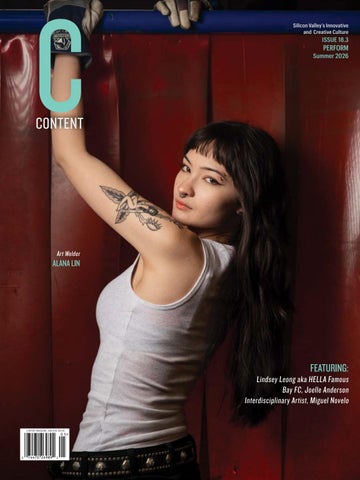
Art Welder
ALANA LIN
FEATURING: Lindsey Leong aka HELLA Famous Bay FC, Joelle Anderson Interdisciplinary Artist, Miguel Novelo
CONTENT MAGAZINE, SAN JOSE $14.95
540 Ramona St Palo Alto | Tues – Sat | 11– 6 pm pamelawalshgallery.com | info@pamelawalshgallery.com
CONTENT PERFORM 18.3.
Summer 2026 San Jose, California
CULTURE 10 Crossthread, Danny Coggins Haley Bayuga Graff Morgan Ruiz Sherrise Sexton 14 West Valley College, Cilker School of Art and Design Dean: Shannon Mirabelli-Lopez Administrative Specialist: Kristen Garcia Department Chairs: Mitra Fabian, Lou De La Rosa, and Anthony Murray 18 Cilker School of Art and Design Student Alumni, Amani Jordan (Studio Arts) Camille Sherman (Voice Performance) Hanna Nakaishi Reyes (Fashion Design)
Christian Vela, pg. 64
ART AND DESIGN 24 Artist and Quiet Giant Design, Ian Young 28 Art Welder, Alana Lin 32 Painter, Hargun M. Mann 38 Interdisciplinary Artist, Miguel Novelo PERFORM 44 Bay FC, Joelle Anderson 48 2026 San Jose Creative Ambassadors, Jorge “J.Duh” Camacho Los Panaderos Tricia Creason-Valencia 56 Spoken Word Artist and Community Organizer, Lindsey Leong aka HELLA Famous 60 Children’s Musical Theater, Kikau Alvaro 64 San Jose Jazz, Christian Vela
Lindsey Leong, pg. 56
68 Contributors
All materials in CONTENT MAGAZINE are protected by United States copyright law and may not be reproduced, distributed, transmitted, displayed, published, broadcast, or modified in any way without the prior written consent of Silicon Valley Creates, or in the case of third party materials, the owner of that content. You may not alter or remove any trademark, copyright or other notice from copies of this content. For further information, or to participate in the production or distribution, please contact us at editor@content-magazine.com.
Joelle Anderson, pg. 44 CONTENT MAGAZINE is made possible in part by funding from the County of Santa Clara.
Ian Young, pg. 24
th
issue
1 4 ye ar s of t elling the stories of south bay creatives
Morgan Ruiz | Sherrise Sexton | Danny Coggins | Haley Bayuga Graff (from left to right) 10 Perform 18.3
"
There were a lot of times where I could have been doing God knows what,” says Danny Coggins, co-founder of Crossthread. “But instead I was like, I’m gonna go take a train to Berkeley and volunteer at Gilman.” Crossthread, a San Jose–based organization creating safe spaces for music and art, is modeled after Gilman 924—the East Bay’s intentionally all-ages venue for alternative music and art. Since 1986, Gilman has booked independent bands for shows run mostly by volunteers. “[I’d] be the last one to leave and then take the train home and pass out.” The other co-founders of Crossthread—Haley Bayuga Graff, Sherrise Sexton, and Morgan Ruiz—share a similar story. All of them grew up going to shows, eventually amassing the connections and know-how to throw their own. “We’ve all been deeply involved in the music scene since we were like, 14,” Haley shares. They began playing in their first band at 15 and threw their first acoustic show in their parents’ backyard. Then, while in Seattle for college, they organized shows for Black Lodge—another underground punk venue kept affordable and all-ages friendly. Back home, they booked for San Jose Rock Shop and Chromatic Coffee at their original location on Stevens Creek Boulevard. Shortly after the pandemic, the hardcore scene exploded in the South Bay. Bands like Sunami, Gulch, and DRAIN—hailing from San Jose and Santa Cruz—spiked in their followings and made the South Bay a touring hotspot. “A lot of young kids got inspired because they were like, ‘these are huge bands coming out of my backyard. I can start a band,’ ” Danny recalls. DIY shows surged, creatively using ephemeral spaces like warehouses and empty lots. Just as before, these events required finessing around neighbors and noise complaints. But now the demand was two-fold, with so much energy and nowhere to play. At the time, Danny was booking shows with R’N’RG, a Santa Cruz– based music promoter for hardcore, punk, and metal bands. The lack of open space was a tired complaint in the scene. In the summer of 2023, these friends—who knew each other from shows and music sharing group chats—decided to do something about it. “When something gets cross threaded,
Written by Esther Young Photography by Alex Knowbody crossthreadsj.org Instagram crossthread_sj 11
Sin Against Sin, R’N’RG & Crossthread Presents, February 22, 2026, Open San José
you tightened it in a way that it shouldn’t have been tightened. And I always applied that imagery to somebody who finds the punk scene and alternative scene in general, because it’s kids who feel like they don’t fit in.” Armed with a name, Crossthread began applying for LLC, then dissolved it for 501(c) application. They received their non-profit status in 2024 and partnered with other promoters like Lapse of Memory, Heavy Lemon, Ineffable DIY, and Asian Man Records to organize shows for touring and local bands alike. But a central tenet of their mission is harm reduction—they won’t book shows that are 21plus or priced as if at a major venue. At every Crossthread event, be it a concert or vendor fair, you can find resource tables lined with testing strips, overdose reversal tools, hygiene products, and safety pamphlets. “Our median demographic is probably, like, 17-year-olds,” Danny estimates. “When you create something where kids are enthused and motivated to do things…it gives them a conduit for their energy and their emotions. And if you provide something like that in a space that isn’t centered around drugs and alcohol,” he adds, “it puts the focus back on their passions.” As more young people get inspired to apply themselves to a creative passion—whether starting their own band or organizing events with their friends— 12 Perform 18.3
the more these opportunities need to be accessible. And that’s another Crossthread principle. Currently, the team is searching for a physical property, one they can operate similarly to Gilman. Though other community-centered organizations like CreaTV grant them deep rental discounts for their impactful events at Open San José, going through a third party limits their full vision, where anyone can get on their calendar to organize a safe and creative community event. This property will become an accessible space for all forms of alternative art, housing about 400 and facilitating skill building. “A group of our friends got their start volunteering at sound at Gilman,” Danny shares. “Some of them now do it touring internationally.” “That’s exactly why we exist,” Haley adds. “There’s so many natural consequences in this world…and we’re just trying to be like, ‘oh, that’s okay…you’re learning.’ ” This is scenebuilding at its core. In a world where ticket sales are inflated, “community engagement” gets distilled to virtue-signaling language for funding, and presenters vie for the laudability of booking major acts, Crossthread aims to facilitate the ecosystem that allowed DIY punk to thrive in the first place—by capping costs, decentralizing power, and enabling the community to care for what it loves. C
“
WHEN SOMETHING GETS CROSS-THREADED, YOU TIGHTENED IT IN A WAY THAT IT SHOULDN’T HAVE BEEN TIGHTENED. AND I ALWAYS APPLIED THAT IMAGERY TO SOMEBODY WHO FINDS THE PUNK SCENE AND ALTERNATIVE SCENE IN GENERAL, BECAUSE IT’S KIDS WHO FEEL LIKE THEY DON’T FIT IN. – Danny Coggins
13
The
CILKER
School of Art and Design
Written by David Valdespino Jr. Photography by Daniel Garcia Instagram westvalleycollege wvccilkersoad
14 Perform 18.3
Anthony Murray, Chair, Design and Architecture Department | Mitra Fabian, Chair, Art Department | Lou De La Rosa, Chair, Performing Arts Department | Shannon Mirabelli-Lopez, Dean, Art and Design | Kristen Garcia, Administrative Specialist. (from left to right) 15
“I think creating a culture of art and design within an institution is really important for its success. People have to like and respect it. They have to understand its role, not just in the institution, but in society.” -Shannon Mirabelli-Lopez
C
reative education can carry a reputation for high price tags and private institutions. Those notions assume that world-class must be synonymous with inaccessible. The Cilker School of Art and Design at West Valley College is working to dismantle that reputation from the inside out. The year 2026 marks a double milestone for the school: celebrating the 10th anniversary of its founding and the fifth anniversary of the Cilker Grad EXPO. Shannon Mirabelli-Lopez has served as Dean since 2021. The school’s vision, however, traces back further: it was faculty—including professors Diane Hurd and Chris Cryer— who advocated for the school’s current form, prior to Shannon’s tenure. Shannon explains: “West Valley did not have a dean or school structure. It was actually the faculty in art and design that wanted to be accredited by the National Association of Schools of Art and Design, which is rare for a community college.” Today, the school is led by Dean Shannon Mirabelli-Lopez and supported by Administrative Specialist Kristen Garcia, with a leadership team of department chairs, including Lou De La Rosa for Performing Arts, Mitra Fabian for Visual Arts, and Anthony Murray for Design and Architecture. When Shannon arrived, her goal was to merge her industry experience with the platform in place at West Valley. She recognized Cilker’s faculty as “some of the most dedicated and talented educators [she had] ever met.” Shannon herself came from a deep background in fashion history and education, having worked at the Metropolitan Museum of
16 Perform 18.3
Art’s Costume Institute, Pratt Institute, and Parsons School of Design, and having taught at the Academy of Art and New York University (NYU). Emphasizing Cilker’s strengths, Shannon shares, “I’m a creative collaborator, but I’m also really good at enabling creative people, which is, I feel like, what I do as a dean, right? I’m good at creating environments for creative people to do what they do best and not worry about the details.” Under the current dean and chair leadership, the school offers specialized, hands-on programs that set a higher bar at an accessible cost, preparing students to apply their creative education in the real world. The school’s annual Grad EXPO, now in its fifth year, is designed to be a launch pad where students can showcase their work to the community. Looking back, Shannon emphasizes, “I think I’m most proud of the culture that I’ve created. I think creating a culture of art and design within an institution is really important for its success. People have to like and respect it. They have to understand its role, not just in the institution, but in society.” The Cilker School of Art and Design continues to set itself apart by expanding industry-relevant programs. Recent highlights include introducing curatorial studies and digital art and illustration certificates, launching an industrial design degree in fall 2026, and developing new digital music and performing arts centers, broadening the school’s impact in the creative industries. These following profiles of Cilker School of Art and Design alumni demonstrate the impact of accessible, top-tier creative education. C
“Our priority is to continue expanding opportunities and fostering interdisciplinary collaboration, so our students can excel in an everevolving visual landscape.” -Mitra Fabian
“What really sold me was attending the Expo. Seeing the work in person—and more importantly, feeling the energy and support around the students—made it clear this place is something special.” -Anthony Murray
“Many of us have often said that the performing arts at West Valley College is Silicon Valley’s best-kept secret, but it’s beginning to feel as if the cat’s out of the bag. And it’s about time!” -Lou De La Rosa
“The best part of the Art and Design EXPO is seeing the community’s outpouring of support and their genuine interest and engagement with our graduates’ work.” -Kristen Garcia
17
AMANI JORDAN Painting a Path Forward
18 Perform 18.3
Untitled, 2024, acrylic on canvas
Untitled, 2025, oil on canvas
“MY PROFESSORS PROVIDED THE SUPPORT FOR ME TO GROW INTO THE ARTIST I AM TODAY.” – Amani Jordan
ACalifornia, whose creative practice is inspired by 20th-cen-
mani Jordan is a multidisciplinary artist from San Jose,
Untitled, 2022, acrylic on Masonite Instagram _amanijordan_
tury Fauvism, which uses intense, non-naturalistic color to express emotion rather than describe reality. She pairs this approach with her own multicultural background, using oil and acrylic paints to reference the colors of textiles from Mexican and African cultures. Her paintings exaggerate saturation and hue to create expressive compositions that explore themes of identity, family, and cultural richness. Before painting, Jordan was interested in fashion design and kept sketchbooks full of design concepts. Driven to improve those sketches, Jordan overcame the discouragement of a counselor who suggested exploring interests beyond art. She began teaching herself, eventually enrolled in a beginner drawing class, and then advanced to earn high marks in an AP art studio course. It was collaboration with fellow artists and her instructor’s guidance that solidified Jordan’s commitment to pursue art in college. Jordan graduated from the West Valley College Cilker School of Art and Design in 2025, earning associate degrees in both studio arts and liberal arts and humanities, before transferring to the University of California, Santa Barbara, where she is currently continuing her undergraduate studies in visual art. She credits her professors at West Valley with supporting her growth as an artist and inspiring her toward a career in the classroom. Jordan is now pursuing a path in art education, aiming to keep the arts alive for students as a painting professor. C 19
CAMILLE
SHERMAN Lustrous Tone and Fearless Theatrical Commitment 20 Perform 18.3
La Traviata, 2018, opera, Portland Opera, Portland, Oregon
Gallantry, 2020, opera, Portland Opera, Portland, Oregon
“MY DEVOTION TO MY WORK AND THE HONORING OF MY JOURNEY IS THE MOTOR THAT HAS CONTINUED TO PUSH ME.”– Camille Sherman M both sides of the Atlantic with a voice that marries lusezzo-soprano Camille Sherman captivates audiences on
Roméo et Juliette, 2019, opera. Pensacola Opera, Pensacola, Florida Portrait photography by Lukas Anton Top left photography by Cory Weaver Top right photography by Kate Szrom Bottom left photography by Meg Burke camillesherman.com Instagram csherms
trous tone to fearless theatrical commitment. Currently an ensemble artist at Hessisches Staatstheater Wiesbaden, she has brought roles like Rosina in Il barbiere di Siviglia and Dorabella in Così fan tutte to life on the international stage. Yet, the road to the opera house began with a redirection in the South Bay. In 2011, Sherman faced her first true artistic heartbreak. She was unable to join her twin sister at their dream school, the Berklee College of Music, so she regrouped at West Valley College. At the time, she felt lost. Yet, that pivotal year in the voice performance program shifted her focus from vocal jazz to classical vocal performance. With the encouragement of instructors like Lou De La Rosa, she transitioned to the Boston Conservatory at Berklee and eventually the San Francisco Conservatory of Music. Reflecting on her growth, Sherman admits that early on, she might have practiced only to prepare for performances, but her path from West Valley to various conservatories, through years of navigating setbacks and rejections, has deepened her perspective. As she begins to break through into a major career, she has internalized the difference between discipline and devotion. “My devotion to my work and the honoring of my journey is the motor that has continued to push me,” she says. Now performing on world-class stages from Switzerland to Quebec, Sherman views her early uncertainty as the foundation for her success. C 21
HANNA NAKAISHI REYES Pivot to Fashion
22 Perform 18.3
Adornment of Nocturne: Bunny, 2025
Adornment of Nocturne: Bunny, 2025, Annual Cilker School of Art and Design Graduate Fashion Design Student Fashion Show, West Valley College
“THE TIMING WAS PERFECT TO GO BACK TO
SCHOOL AND FINALLY PURSUE SOMETHING
THAT I WAS PASSIONATE ABOUT.”– Hanna Nakaishi Reyes Hhas always known her dream was to create high fashion.
anna Nakaishi Reyes is an aspiring apparel designer who
While her initial start in fashion merchandising at Cañada College didn’t feel like the right fit, she explored other avenues in teaching, data analytics, and real estate escrow. While working as an escrow assistant, Hanna began to question her path, wondering why she was attempting to climb a corporate ladder that didn’t align with her passions. She started seeking opportunities to return to fashion and discovered West Valley’s fashion design program. When she was laid off from her escrow position in the summer of 2022, she saw it as the perfect time to return to school and finally pursue the dream she had been passionate about. After many sleepless nights and with the support of the professors at West Valley, Hanna learned how to make fashion illustrations, a suit from scratch, and eventually a full collection. She found deep inspiration in the opulent ornamentation of Gothic architecture. This aesthetic, combined with her desire to create more diverse clothing options for masculinepresenting people outside of the classic suit, became the foundation for her senior collection. Since graduating in May 2025, Hanna has remained focused on the industry as she navigates the transition into a new career. Between attending weddings and a trip to the Louvre Couture Exhibit in Paris, she continues to refine her eye for fashion while seeking her next opportunity to work in the field. C
Top left and bottom right photography by Jenny Tang and Cheryle Custer Top right photography by Dan Fenstermacher LinkedIn hanna-reyes
Adornment of Nocturne: DV, 2025 23
WORK W
hen it comes to art, what is the most important observation to make—the intention of the artist, the art itself, or the critic viewing the art? With a philosophical concept at its core, this question teases one of the five artworks in the series “X” / The Five Questions of the Unknown, painted by Ian Young. Before this series sprang to life, before the murals appeared across San Jose, and before his designs appeared on local brands and community organizations, Ian showed signs of artistic talent that inevitably hinted at a career rooted in creativity. His preschool teacher was the first to notice, telling his mother that he had an unusual ability to capture things accurately in his drawings. These were the seeds of a path beginning to sprout, and Ian has spent the better part of four decades following it. Ian’s path from Colorado Springs to San Jose to Southern California and back again wasn’t linear. He moved to
Written by Sendy Tapia Photography by Marietta Asemwota quietgiantdesign.com Instagram quietgiantdesign 24 Perform 18.3
25
SoCal specifically to study graphic design, which is also where he began painting seriously. One instructor framed typography in a way that stuck with Ian: “You’re drawing with paint.” That click catalyzed exploration across mediums, studying artists whose work resonated with him, absorbing techniques and a style that blends precision with expressive elements. The 15 years he spent in Southern California taught him more than aesthetics. Working in entertainment and corporate design, he encountered a world where creative people could be simultaneously essential and invisible. The work moved. The artist didn’t. “There are different categories in art,” Ian explains. “Street art, fine art, low art, high art.” For him, the distinction lies in how the work engages the viewer. For the acquisitive agencies, art is exploitable and the artist is dispensable. When Ian moved back to San Jose, he found his footing through community. One of his first major projects was a large mural at The Barbers Inc, marking his first large-scale public artwork in the area. The project quickly led to more commissions through word of mouth, including another mural at the restaurant Más Loco Cantina. Business owners who saw his work began exploring his online portfolio and soon realized he also specialized in graphic design and branding. The San Jose African American Community Service Agency commissioned him next, and it’s there that one of the most formative moments of his career took place. Inside the agency, Ian created artwork inspired by the Serenity Prayer, along with a portrait honoring activist and scholar Angela Davis. When Davis visited the center for the unveiling, Ian found himself reflecting on what he might ask someone whose life had shaped so many conversations around justice and activism.
BLVCK LEGVCY, 2024, acrylic on canvas 26 Perform 18.3
SERENITY, 2022, acrylic on canvas
“I’m using something God trusted me with.” – Ian Young
“What can I ask her to take with me for the rest of my life?” he wondered. Her answer centered on collaboration. “That really stuck with me,” Ian says. “Anything meaningful she did came from working with others.” Ian took that seriously. The realization led him to examine his own creative community. Today, he believes that purpose is often shaped by the people surrounding you. “My collective purpose will be meaningful because of who I’m around,” he explains. Ian also continues working with the San Jose African American Community Service Agency, with a new mural to honor the center’s founder planned for the exterior. Sustainability, for Ian, has also come from an unexpected source: barbering. He picked up the skill during school to pay for books and art supplies, not realizing the resilience he was building. Later in his corporate career, the anxiety of perpetual looming layoffs met its match. When the day arrived, his clippers ensured his autonomy and a big steppa opportunity. Balancing both creative pursuits requires structure. Ian schedules dedicated days for barbering and separate days for art, grounding this balance with the learned power of when to say no. When a project doesn’t align with his values, he’ll pass it along to another creative who may be better aligned, reciprocating opportunity with community. “Show up with the mindset of treating people how you want to be treated,” he says simply. Today, Ian operates out of a private space where curiosity lives in the neighboring rooms belonging to tattoo artists—a fitting adjacency for someone whose work lives at the intersection of craft, permanence, and identity. His business, Quiet Giant Design, reflects years of this evolution.
“It used to be called ValiantHumility,” Ian says. “But one day I said it out loud during an interview and something switched. I realized it just wasn’t it,” he recalls. He needed something that reflected both quiet focus and creative strength. Something clever, minimal, straight to the point. Quiet. Giant. Design. Three words that tell you everything about how he operates: with purposeful presence. For Ian, the ability to help others refine their ideas through design remains one of the most rewarding parts of his career. “I feel like it’s a gift from God,” he says. “I’m using something God trusted me with.” That perspective helps him stay grounded even when deadlines pile up. Ask Ian about his style and he’ll tell you something interesting: he only recently realized he had one. The confirmation came when people started commissioning his work. That’s the moment a style stops being something you’re searching for and becomes something others can see. Ian continues exploring new creative directions, particularly blending photorealism with abstract backgrounds in his paintings—grounding hyper-detailed figures against expressive backgrounds and letting the tension do the talking. While design and barbering remain his primary work, painting remains closest to his heart. His advice to other creatives is characteristically anchored: stay malleable, stay teachable. Let other artists fuel you without losing your own thread. Most importantly, he says, remember to practice gratitude. Seventeen years in, the quiet giant is still evolving. And the work—the murals, the brands, and the paintings that reward a second and third look—is only getting louder. C 27
28 Perform 18.3
AL ANA LIN
WELDING CONNECTIONS W
hen people imagine a welder, they likely imagine a man welding steel beams at a construction site— which is not statistically inaccurate. According to the US Department of Labor, women make up only five percent of the labor force, and college student Alana Lin is one of them. Alana is a selfdescribed “hot welder near you” who creates whimsical metal sculptures, and more young women are being inspired to pick up torches because of her. Alana started welding during her junior year at Del Mar High School. While in high school, she enrolled in the Metals Technology program at Silicon Valley Career Technical Education (SVCTE), where she earned elective credits toward her high school diploma. She chose welding to explore a new medium and didn’t expect to be so drawn to the craft. SVCTE is a trade school for adult learners to earn certifications, but their high school program offers handson courses that meet UC admission requirements and prepare students for college and future careers. Most students who enroll in the metals technology courses do so to learn welding as a trade for future employment, but not Alana. She was one of the first students at the school who pursued welding artisti-
cally, and because there was no precedent, there was also little artistic direction, but she had fun experimenting on her own. Alana quickly fell in love as she unlocked the possibilities of working with different types of welds, shapes, and materials. “I love just messing around and making things out of random scrap metal that we would get from old job sites,” she says. For example, she discovered that certain types of metal change colors depending on the length of exposure to the torch. Alana progressed quickly, and her instructor supported her growth. He encouraged her to enter the SkillsUSA Welding Competition, where she submitted a metal Venus flytrap studded with sharp nails and a dainty spider on one of its leaves. She won gold at both regional and state competitions.
Written by Yvonne Phan Photography by Daniel Garcia Instagram tranqui1forest 29
Tiě Lóng, 2024, carbon steel and silicon bronze, 18”x12”x18”
Venus Flytrap, 2023, carbon steel, 18”x12”x18” 30 Perform 18.3
“You DON’T have to fit into the box. You don’t HAVE TO be someone you’re NOT to make some FLAMES.”
– Alana Lin
One year later, Alana earned three additional TIG (Tungsten Inert Gas) welding certifications and improved her skills, this time incorporating new materials like rusted metal and a laser-cut piece. She represented California at Nationals and placed sixth overall. Her sculpture, a friendly dragon perched on a building, represents her Asian American heritage and showcases her precise welding skills and lightheartedness. “He’s kind of sassy,” she adds. “I went to competition and everyone’s like, ‘He’s got that sassy arm!’ ” But being a young Asian American woman in a maledominated field has its setbacks. Alana has felt the pressure of representing women welders and being the face of SVCTE. “My competition photos are plastered all over the school,” she laughs. She uses social media to share her work and build commu n i t y around female welders. When she receives messages from aspiring female welders asking her for advice on how to get started, she feels better knowing that she has made a difference in the field. She hopes to continue inspiring other youth to
pursue their artistic interests. “You don’t have to fit into the box,” says Alana. “You don’t have to be someone you’re not to make some flames.” Alana plans to transfer to a four-year university to pursue engineering and design while continuing artistic welding in her own future studio. She also plans to teach and help close the gender gap in welding, where female instructors are rare. Her advocacy for the trades is shaped by personal experience. She believes that more high school graduates should explore trade school, even though it’s not the “default” for students in the Bay Area (where half of adults over 25 hold a bachelor’s degree). “Trade school can be really interesting for handson learners, but people don’t think of it. It’s not always presented as an option,” she says. Alana also wants to expand upon her own art: Her tallest piece is a 6-foot iris plant commissioned by the Wildflower Boutique Motel in Mendocino County, but she wants her pieces to take up more space in different ways, perhaps with movement or with fire. C 31
The Golden Hourof Making
HARGUN M. MANN F
or Hargun Mahal Mann, whose work is rich, complex, and question-based, painting is not merely about representing something before the eyes. It seems more akin to an excavation, with watercolors unraveled, ink pressed, and a journey between memory and myth. What makes Hargun special is not merely what she represents, but how she represents it with a sense of rigor, with each series beginning with a question that she cannot help but ask. Hargun’s academic training is rooted in India, where she completed her BFA and MFA in applied art from the Government College of Arts. Within the boundaries of academic training, Hargun always leaned towards emotional, philosophical exploration rather than commercial success. She worked briefly in freelance and applied art, but the desire for a more intimate, personal visual language proved stronger. Migration was part of her development. Years spent in Kenya, Botswana, and South Africa broadened her language with materials, especially with handmade ceramics. Her work with ceramics provided her with a sense of what was physical and tactile, which she still relies upon in her painting, the idea that surface is something made, something constructed, and something created. When Hargun moved to California, the years she spent here provided the space for 32 Perform 18.3
contemplation and ongoing experimentation in the studio. Morning pages, spontaneous sketches, and visual journals became the foundation for her practice. Hargun also teaches art to elementary school students in Palo Alto, where she constantly learns from young minds and their fearless art process. Juggling motherhood with teaching contributes to the flow of her art practice Hargun’s inspiration comes from her female bonds and friendships, particularly her mother and grandmothers, and understanding the myriad lives of women around her. Hargun’s search about her own lineage revealed a family tree that dated back to the 18th century, with only men’s names listed. She remarks: “I have a family tree, and there are no women’s names, no mothers, daughters, grandmothers in it. This sparked an investigation into the erasure of history, which is what sparked the work that I’m doing now.” The project evolved into a series of sculptural masks, each of which was cast from Hargun’s own face and displayed as if they were stand-ins for nameless ancestors. The work was confrontational, and while Hargun is quick to defend her use of that word, she also acknowledges that conversely, “there is a lot of violence in silence.” Her work is very engaged with the current moment and is a response to conditions as they exist today. When COVID-19 came
Written by Nikoo Parsizadeh Photography by Cyntia Apps Instagram: storiestoldanduntold
33
Pandoras Bag, 2025, ink, watercolor, and gouache, 26”x30”
34 Perform 18.3
“Discipline is essential, but so is play. Without play, there is no growth.” – Hargun M. Mann
Detail of All That She Carried, 2024, ink and watercolor on watercolor paper, 14”x20” 35
Above: Hairoil, 2024, ink and watercolor on handmade paper, 26”x35” Below: The body that holds me, 2024, ink, graphite, watercolor on bristol paper, 12”x18”
36 Perform 18.3
along, she made The Baggage We Carry, a series of watercolors that explore the idea of isolation and the invisible burdens that we carry inside of ourselves. The use of asemic script, which she has explored at great length, is an emotional release valve, and she has used it as a visual way of expressing grief, worry, and longing that is not possible with regular words. “My art projects start from an emotional response or a question, and then they go into a phase of intention and ultimately all of my art boils down to intuition.” This approach came into sharp relief when dealing with her grandmother’s death, as Hargun assembled pages of wordless marks as a form of personal grieving. Rather than relating the narrative of loss, she chose to use gesture as a means of message. Hargun has navigated stories she knows well, such as Pandora, fairy tales, and traditional cautionary tales, and reinterpreted them as stories of empowered women. At the same time, she experiments with cyanotypes, embracing the unpredictable dance between the sunlight and chemicals. For Hargun, the process of experimenting is a continuation, a different path by which she wants to find out how matter and meaning intersect. Structure is the underlying component in all that Hargun creates. She wakes up before dawn, what she calls her “golden time” or the “time before the day gets away from me.” The routine is intentional. Play, however, is just as important; “Discipline is essential, but so is play. Without play, there is no growth.” Migration, too, runs through Hargun’s work, not as a scene, but as an idea. Displacement isn’t depicted, but it’s embedded in the process through the layering–the switching between words and images, and the organic changes that occur as the mind shifts from reading to drawing to creating the final piece– each layer punctuated by loss and adaptation, a metaphor for moving through different places and cultures. Hargun’s work also focuses on collaborations with other artists. Her work is part of a series called Huq: I seek no favor, led by Ashima Yadava about promoting bodily autonomy and women’s rights. Earlier this year, she also collaborated with another artist Mark Powers in creating a handmade art book, which was about creating a series of mandala paintings and drawings, pulling ideas from our daily lives as well as popular culture. She has other ongoing international projects with poets and artists. Essentially, Hargun’s practice inhabits the complex zone between archive and intuition, memory and resistance. “My work is a regurgitation of the world I inhabit, what I read, what I witness, what unsettles me.” From a child’s need to make marks out of a sense of urgency to a body of work that is thoroughly researched and meditative, the journey has been from interrogating the narratives to rewriting the script, if need be. C 37
38 Perform 18.3
M
iguel Novelo sits down at a small table centered within the second-floor kitchenette above the studio he shares with fellow San Francisco Art Institute alumni, Melanie Piech. Pulling a veritable library out of his bag and laying each book out on the table—we’re talking nearly a dozen well-loved paperbacks with titles such as Death, Design, Data and Slow Technology Reader—he declares simply, “Reading is great.” Thinking is just as important to Novelo as the making. Objects, too, have a part to play in the thoughtful, interdisciplinary world building Novelo engages in. The large studio is stacked with objects, many of them recent additions to an already impressive collection, amassed from his time as a recent artist-in-residence at the Recology San Francisco Artist in Residence (AIR) Program. Old computer monitors, cables, MDF panels, metal-fabrication tools, rocks of varying shapes and sizes, boxes with odds and ends, old drawings—along with an impressive library of books—make up this collection. But as an installation and video-oriented artist, Novelo’s work is about so much more than the objects that appear in his work; it’s about the experiences they can conjure within any given place.
“Most things actually start with a drawing,” Novelo says, his voice measured, almost reverent. “I draw a lot just for me. I research, I find ideas through knowledge, of course, but primarily it starts through the experience [of drawing].” The immersive, genre-bending work that results from these initial drawings presents as anything but strictly visual, making his creative process as an interdisciplinary artist, educator, and researcher all the more intriguing. He describes a piece recently shown as part of SF Art Week, in which multiple speakers, projectors, and lights converted a single room into an immersive soundscape featuring bats emerging from a cave. “If you’re quiet,” he explains, “you can hear the bats…six minutes of them coming up [to the entrance of the cave]. They actually help each other on their way up!” But you can only hear if you’re quiet. He designed the audio and visual playback to respond to the audience in real time, and if there is sufficient noise and movement to cause sonic disturbance, the video fades to a glowing red and a sub-tone drowns out the bat soundscape. The piece, Vórtice-en-la-zonasilencio, alludes to ideas of presence, participation, observation, and more overtly, the disruptive impact our human presence can have on the
Written by Allegra Bick-Maurischat Photography by Marietta Asemwota miguelnovelo.com Instagram xmiguelnovelo 39
“Don’t byte da hand that feeds u”, 2022, still image of Unreal Engine game, with motion control 40 Perform 18.3
eennin lwa ysbbee a a ys w l e a inte ’vv e I tere “I’ n i g h thingss “ reste t w m m st d in ow oov ed ho v e h i et together. Peop n
le, ogether. Pe s o und ople sound,, li lig , gh , t r e htt,, e , chnol her t a h t t e e a w we chn ogy. olog y. o of f e i itt ex ts alon N onne No exis ists alo e.” ne.” – Miguel Novelo
Impacto (still), 2026, interactive documentary
natural world. “I wanted people to understand that their presence matters,” he says, “that listening is an action.” These are the primary considerations that appear to form the core of Novelo’s life and work. Born and raised in Yucatán, Mexico, Novelo, it seems, was always paying attention to how different systems, environments, and events shape and inform human experience— and vice versa. His father, a veterinarian, often had a young and eager Miguel at his side, observing—and even helping—with animal dissections, for example, which were a completely normalized occurrence. “I’ve always been interested in how things move together,” he says. “People, sound, light, weather, technology. None of it exists alone.” Scientific thinking and an interest in technology, unsurprisingly, came before artmaking for Novelo. After his undergraduate work at the San Francisco Art Institute, he went on to earn an MFA from Stanford University, where he currently lectures. “I’m fascinated by science. I thought Stanford could
be a place to really do research and create knowledge. That access to minds is what led me to Stanford.” Beyond these scientific curiosities, Novelo’s early creative life unfolded through film. As a co-founder of the Campeche Film Festival, along with his sister, Erika, Novelo learned very quickly how films and communal experiences can shift conditionally, how these conditions can be controlled, and to what degree. “It really shaped how I think about media. Control, and the illusion of control, became important to me,” he says. As lead producer, technology director, and programmer for the festival, he was responsible for the entire audience experience, and it was a pivotal moment for him in realizing what he wanted to do next creatively. “That whole experience was media making. I wanted to make things more interactive, to control the full experience. Technology was the way to do that. Who makes technology? Silicon Valley. That’s when I decided to go to San Francisco.” 41
Impacto (still), 2022-2026 CNC MDF carved sculpture, video projection, 2.1 sound, custom software Film is co-produced by Pata de Perro films
In Novelo’s more recent work, there is a noticeable bent towards full experiential immersion, including several pieces produced at his residency with Recology, where he immersed himself in systems of discard, reuse, and regeneration. But again, materials themselves are secondary. “Technology just allows me to translate something,” he explains. “The experience comes first.” Case in point: For Novelo’s upcoming solo exhibition at the ICA San José, INFRAMUNDO, he’s building out an environment that blends generative visuals and spatialized sound w ith hammocks and projections that encourage visitors to slow down. “I just tested one of the
42 Perform 18.3
pieces by projecting it on my ceiling,” he says. “I fell asleep inside of a thunderstorm. I realized, this is it!” When pressed to describe his body of work in simple terms, he pauses, then laughs. “I usually say I make interactive videos and films,” he says. “Like video games, but more like movies you can talk to.” And many projects certainly do carry a sense of social purpose. He thinks and talks a lot about accessibility: the how and the why behind audiences entering into the spaces he creates. “Accessibility matters to me. I think about different senses, different attention spans. Someone who spends two seconds with the work. Someone who wants to take it apart and look behind it. I’ve been that person.” He may be working with
“I wanted people to unde rstand t their p a resence matters, th stening is an action.“ that li
anted p w eople to u I “ nde h e t i t r tha rstand “I wanted people top un rdeersstan dce m en a h t th that eilripsre atte , matters, t s e e nc rs t a e n c in g n is n tio ste .“ a an action that li ing is n. “
[sueños del inframundo] chaacmol, 2026, still, procedural animation
tools and technologies many can’t understand fully, but he wants his installations to be accessible, to foster connections. “We need to start bridging things, not separating things,” he says, reflecting on both the research-based and creative collaborations he’s had in Russia, Mexico, and the United States. As someone who has only been living and working in the US for a decade, this is personal for him. It is lived experience. Navigating art school and institutions like Stanford University after spending his life in Yucatán, Mexico, he has deftly learned to navigate between two worlds, with the core of both remaining intact in his work. “I am always exploring relationships,” he says, “the ones we have with the environment, with each other, with our histories.”
Novelo clearly grapples with big ideas. Art making seems to be his way of thinking through them. He intelligently, but ever playfully, invites audiences into shared systems of feeling and experience, and in a moment when digital tools often distance us from one another, his installations insist on quite the opposite. Through his work, one has the feeling that just as technology becomes increasingly formidable, it can—if treated with intention—help us feel more attuned to one another and the world around us. His work seems to invite the audience to both notice and feel that which we are already a part of. “It’s about all these little connection points that create the bigger picture,” he says with a shrug. “Maybe that’s what art can do.” C 43
Joelle Anderson For Joelle Anderson, coming back to San Jose means more than soccer. It’s a chance to be the visible example she rarely had growing up.
Written by Brandon Roos Photography by Arabela Espinoza Instagram joelle.andersonn
44 Perform 18.3
I
n mid-March, 31 minutes into the first game of Bay FC’s third season, Joelle Anderson slotted home a goal that would prove to be the game winner. It marked a major shift: the team’s first win after a 15-game losing streak that stretched back to June 2025. Only 90 minutes into the season, Joelle is already shining brightly, showing why she’s become a consistent presence in the lineup. Not bad for someone still adjusting to a new role at center back after spending most of her career in attack-focused roles. Her being left-footed, combined with her offensive mindset, has provided solid defensive anticipation and calm, precise passing in a position not often known for its ball handling. She’s also a model ambassador, regularly appearing at community events because she believes those face-to-face interactions are critical moments for the Bay Area’s next generation of soccer talent. Joelle Anderson is living her childhood dream—and in San Jose, she’s becoming the role model she rarely got to glimpse in person. While playing with the Houston Dash, the San Jose–bred soccer standout mentioned to her GM that she was interested in joining the Bay Area’s expansion NWSL franchise. She didn’t think much of it until December 12, 2023, when she got a call with some fastmoving news. “My GM called me 30 minutes before [the trade], and I was with my mom. When she called me back and said, ‘You’re going home,’ there were so many emotions. I think my mom and I just started crying,” she recalls. She hasn’t strayed far from her roots, settling back on the city’s south side. When asked about her formative years, playing sports is the first thing that comes to mind. “As little as I can remember, I always had a ball in my hand or a ball at my feet,” she says. “We were always active growing up. I would get pushed around all the time playing with my brothers in the backyard,” she adds, noting both her parents were high school athletes. Inspired by US Women’s National Team legend Mia Hamm (Joelle wore the number 9 for much of her early career in honor of the former player), Joelle developed both a love for soccer and the belief that going pro was possible. “I looked to Mia Hamm growing up. She was one of the women that really inspired me to want to be a professional soccer player,”
45
“As little as I
can remember, I always had a ball in my hand or a ball at my feet.” – Joelle Anderson
she says. “I started playing when I was five years old. I think I knew from a really young age that’s all I really wanted to do, and I just set my mind on that.” At age nine, she joined regional club powerhouse De Anza Force, a key proving ground for elite youth talent. Her coaching staff provided the blueprint for what it would take to elevate her play to college and beyond. “I got really, really technical at a really young age, which I think helped me throughout my career,” she notes. Witnessing teammates getting recruited to top programs like the University of North Carolina and Stanford, she saw firsthand what was possible. “I was surrounded by so many amazing players who allowed me to be the best version of myself on the field. I think that translated going into high school, just going out there and playing free.” Her relentless work ethic made her unstoppable at Harker, where she scored an astonishing 101 goals and won team MVP all three years she played. She was voted into the school’s Athletic Hall of Fame in 2023. At Pepperdine, Joelle earned all-West Coast Conference hon46 Perform 18.3
ors in every season of her five-year collegiate career. Prior to her redshirt senior year, she was drafted by the Houston Dash, where she made her NWSL debut in 2021 and played her first two years as a pro. Asked how she was able to realize her childhood dream, Joelle points to her environment: “I think I was just surrounded by a culture that allowed me to get better every single day.” In late 2023, she headed back to the Bay in advance of Bay FC’s first season as a club. Playing for a brand-new team comes with both excitement and pressure, especially in a region with a deep soccer history. “There’s definitely pressure, because you want to come out showing everyone that this is the Bay Area—this is Bay Area soccer; this is who we are,” she says. “It’s so cool to finally be a part of the pro sports scene in the Bay Area, because I’ve looked up to all those other teams growing up.” At only 27, Joelle is, surprisingly, a seasoned vet on Bay FC’s young roster. After laughing at the assertion, she does note that she sees an importance in how she upholds standards and mentors younger players ad-
justing to professional soccer. It’s an especially important role with new coaching staff taking the reins this past off-season. “I try to show them, on and off the field, how Bay FC operates and works,” she explains. “We’re trying to win championships, I think just keeping those standards at a high level every single day, and competing, coming in with a positive attitude and being resilient.” Beyond the pitch, Joelle Anderson embraces her role as a club ambassador, frequently attending Bay FC soccer clinics. She credits her time at Pepperdine with shaping her belief that small moments with young athletes can make a lasting difference. “I think giving back to the community that gave so much to me is so important,” she says, “just going out and being that role model for young boys and girls who strive to hopefully be in the position that I am one day, and showing them that it is possible.” Faith has taken on a deeper role in her life in recent years. Joelle says her grandmother helped strengthen that foundation, starting with one-on-one Bible studies. Back in San Jose, that practice continues each week at her best friend’s house, with her grandmother joining via FaceTime. It’s a routine that keeps her centered. “[My grandma’s] been one of the most important parts of my journey, just being that mentor for me and showing me that faith comes before all,” she says. “I think that’s really helped me in my professional career, because
it’s so easy to get sucked into the noise and all the opinions of other people. It’s the most important part of my life, for sure.” Joelle sees clearly what this present moment means, not just for Bay FC but for women’s sports in America. In a career built on doing the often-unseen work, she now finds purpose in something bigger: being an example for the young boys and girls that flock to PayPal Park to see the team play. “Growing up, we didn’t have too many role models in the Bay Area for soccer. We had FC Gold Pride, but soccer hadn’t grown as much as it has now. It’s so cool that I get to come home and be that role model for all those little girls growing up right now.” C 47
48 Perform 18.3
SJ CREATIVE AMBASSADORS
A traveling art gallery. Community fandango parties. Multidisciplinary storytelling workshops. These projects by the 2026 San José Creative Ambassadors—visual artist Jorge “J.Duh” Camacho, musicians and dancers Sharon and Tanya Benitez, and filmmaker Tricia Creason-Valencia— represent a range of artistic practices that mirror the city’s cultural diversity, ingenuity, and energy. Deeply immersed in the local community, these individuals bring a deep love of San Jose to their Ambassadorships. Launched in 2018 by the City of San José Office of Cultural Affairs, the Creative Ambassador
program connects art to the everyday lives of San Jose residents. Creative Ambassadors are selected for a yearlong term through a competitive panel process that considers their artistic practice, community engagement experience, and plan for a hands-on, participatory Creative Expression project. By designing opportunities for the public to create together, they encourage people to feel more bonded to their communities, neighborhoods, and each other—generating civic participation, empathy, and joy across the city.
Written by Jessica Kwong Photography by Daniel Garcia Instagram sjculture
49
LOS PANADEROS
IMPROVISING JOY TOGETHER ON THE DANCE FLOOR 50 Perform 18.3
“NOT JUST EXISTENCE, BUT ACTUALLY HAPPILY LIVING. WHAT BETTER WAY TO DO THAT THAN THE MUSIC AND DANCE PARTY?” - SHARON BENITEZ
“MUSIC AND THE ARTS SHOULD BE A UNIVERSAL RIGHT, BUT THEY’RE NOT AT THIS POINT, WHICH IS TRAGIC. ANY WAY THAT WE CAN HELP BRING MUSIC AND JOYFUL NOISE WILL HELP OUT.” - TANYA BENITEZ A fandango party is synonymous with improvisation: participants devise footwork, lyrics, and interactions with their partner on the tarima (Spanish for “platform”), all while creating communities, both ephemeral and enduring. This ethos of playful co-creation animates dancers, musicians, and sisters Sharon and Tanya Benitez. Raised in San Jose and trained in both Western classical and Mexican folk traditions, their musical collective, Los Panaderos, melds Bay Area rock and jazz influences with elements of son huasteco and son mariachero. Their business, La Casita de las Artes, teaches music and dance, with lessons ranging from the recorder to rock, mariachi, and son jarocho, a style of folk music that blends Spanish, African, and Indigenous influences. Their dance company, La Mezcla, fuses tap, Mexican folk dance, and Afro-Caribbean traditions, living up to its name: “the mix.” Growing up, the sisters were nourished by rich, locally-based music and dance offerings, including an early childhood program at San José State University, programs in their public schools, and groups like Folklórico Nacional
Mexicano, Vivace Youth Chorus, and Children’s Musical Theatre. Tanya, a multi-instrumentalist, recognizes, “We were always fortunate enough to do everything for free. That is something that not very many people can say.” Tanya adds, “Music and the arts should be a universal right, but they’re not at this point, which is tragic. Any way that we can help bring music and joyful noise will help out.” Now, their Creative Expression project, Fandango For All: Tradición Viva, Comunidad Unida, presents five free fandangos that include workshops in dance, music, poetry, and songwriting. Reflecting San Jose’s diversity, the fandangos welcome all ages, genders, and backgrounds, as well as all instruments, including those not traditionally represented at fandangos. Sharon stresses that these community celebrations are vital acts of resistance, promoting not just existence but actual happy living: “What better way to do that than the music and dance party?” C
Performance Photos by Azules Design Studio casitadelasartes.org Instagram los_panaderos 51
J.DUH
UNEARTHING THE ARTIST IN ANYONE 52 Perform 18.3
Basketball Court, 2021. Photo by Jennifer Gonzalez
Above and Bottom Right: Pop-Up Box, 2026, San Jose Creative Ambassador Project. Photo by Alex Knowbody
“IT’S A WIN TO HAVE PEOPLE CONTINUE TO FIGHT AND BE CREATIVE IN WHATEVER WAY THAT THEY’RE CAPABLE OF DOING.” - J.DUH Art director, designer, and muralist Jorge “J.Duh” Camacho is wrestling with a problem. He shares, “If you were to ask the random everyday person when the last time they visited an art gallery was, you’d have answers all over the place: ‘I’ve never been to one,’ ‘I haven’t been to one in years,’ or ‘I only visit galleries when I’m traveling.’ ” J.Duh is trying to change those answers to this month, last week, and today. So why not bring an art gallery directly to the places where people already live, work, and hang out? J.Duh’s Creative Expression project, Pop-Up Box, transports local artists’ work in a U-Haul truck to parks, block parties, corporate campuses, retirement homes, and beyond. J.Duh and his art are everywhere around town. You might walk by his murals in downtown San Jose, notice his hand-painted signs for local businesses like Voyager Craft Coffee, or catch his designs for the San Jose Day fes-
tival, where he serves as the co-director. He is quick to make space for other artists to create and participate, a practice rooted in his DIY origins in the local graffiti, skateboarding, and hardcore scenes. When curating art shows for spaces like San Jose Day, clothing brand and creative hub Cukui, Empire Seven Studios, or Pop-Up Box, J. Duh says, “We try our best to include not just the heavy hitters. [Maybe] your grandma’s a retired oil painter—let’s get her out there.” By showcasing art at unexpected locations, J.Duh hopes Pop-Up Box will initiate newcomers to San Jose’s artistic community and beckon potential or dormant creatives to add their own art to the gallery: “It’s a win to have people continue to fight and be creative in whatever way that they’re capable of doing,” J. Duh says. He adds, “If I could sell the art scene and expose more people to it, then that’s a win for everybody.” C
jduhdesigns.com Instagram j.duh 53
TRICIA CREASON-VALENCIA
SELF-ACTUALIZATION AND COLLECTIVE HEALING THROUGH STORYTELLING 54 Perform 18.3
I Am We Are: Poems, 2026. Photo by Tricia Creason-Valencia
“THE MORE WE CLARIFY AND EXAMINE WHO WE ARE, WITH OUR MULTIPLE AND OVERLAPPING IDENTITIES, THE STRONGER WE FEEL IN BEING OURSELVES.” - TRICIA CREASON-VALENCIA Tricia Creason-Valencia wants you to name your fears. She leads an ongoing workshop, inspired by the WNYC podcast 10 Things That Scare Me, where participants write a list of their fears, add details to them as they read them aloud, and record an audio of the performance. Through expression, creation, and exchange, it’s a powerful experience of people processing their emotions together. Throughout her career, as a community organizer advancing women’s issues, to becoming a teacher and an Emmy-nominated documentary filmmaker, Tricia has focused on empowering women, people of color, and other historically underrepresented groups to tell their own stories. Tricia says, “I use filmmaking and my own creative work as a tool for empathy. That empathy then leads to an impetus toward working for social justice, building stronger communities.” Last year, Tricia and her business partner, Farran Tabrizi, converted a Victorian home in downtown San Jose into PowerHouse—a
coworking space, event venue, and podcasting and media production studio for women+ creatives. Now, PowerHouse incubates new collaborations and serves as the hub for all of Tricia’s creative endeavors. The launch of PowerHouse coincides with Tricia’s Creative Expression project, I Am / We Are: Our Stories Connect Us, a series of multidisciplinary storytelling workshops that has included healing for activists through poetry and collage with muralist Elba Raquel, poetry writing around music and identity with DJ Dulce Fernandez, and a panel about women in media production at History San José. Tricia explains the I Am aspect: “The more we clarify and examine who we are, with our multiple and overlapping identities, the stronger we feel in being ourselves.” And We Are means that when we share our stories with each other, “We identify with each other. We see ourselves in other people’s stories. We connect, and that leads to collective healing.” C
tricia-speaks.com Instagram flacafilms powerhouse_sj 55
LINDSEY LEONG AKA
HELLA FAMOUS
L
Written by Amani Hamed Photography by Stephanie Barajas hellafamous.com Instagram hellafamous11 56 Perform 18.3
indsey Leong brings a youthful exuberance and optimism that run counter to cynicism and hopelessness. The spoken-word artist and second-generation San Josean seems much younger than her years, and in a moment inundated with fake-fame seekers, her character is genuine in the extreme. While the accomplished artist and mutual aid organizer may lack viral metrics or influencer clout, among South Bay activists and storytellers, Leong is known as ‘HELLA Famous.’ Leong, a third generation Chinese American, oozes enthusiasm for her hometown and describes herself as hav-
ing been a “shy kid,” and “an introvert.” Deeply moved to work for social justice at a young age, Leong joined grassroots nonprofit Californians for Justice and became a youth activist at just 17. She assisted in campaigns to halt the use of the California High School Exit Exam or CAHSEE. Passing the test became a graduation requirement in 2006, and many challenged the validity and efficacy of the test, noting that most students negatively affected by a failing test score were immigrants, students of color, or students from underserved schools.
Already steeped in Bay Area hip-hop culture before stepping into activism, Leong
“
What if humanity was the capital?
„
/ What if the
fulfillment of our potential was the money? – Lindsey Leong
entered the Bay Area poetry scene, also attending the National Hip-Hop Political Convention in Newark, New Jersey, right after high school. She then attended San José City College and then San José State University (SJSU), where she graduated with a major in social sciences and a minor in Asian studies. Combining art and activism, Leong became a fixture at Cito, the longest-running open mic in San Jose, later becoming the only woman to ever host it. Cito evolved into Cito.FAME.Us, and the name “HELLA Famous” came from what Leong says was an inside joke among Cito.FAME. Us regulars. “People would go up to the mic, and we would yell ‘you’re hella famous!’,” she recalled. HELLA Famous began not as a pseudonym, but as the name of a movement centering community and curating art and poetry in the name of service. Leong transitioned to
showcases dedicated to fundraising, spending money of her own to raise thousands of dollars for direct community support and mutual aid. “Name a nonprofit in the South Bay; I’ve probably worked with it,” Leong says. Recalling Langston Hughes and Zora Neale Hurston while shouting out the late Nipsey Hussle, Leong laces “fuck Google” and “buy back the Bay” into spoken word pieces. Leong says an oft-repeated refrain from people who appreciate her work is “when are you going to make HELLA Famous a nonprofit?” But Leong is wary of the commodification and corporatization of mutual aid work and art. In her spoken word piece, “What if Feminism was the $?,” Leong envisions a world “past money” in the city that continuously births technocratic dystopia and gentrification. “It seems to me that capitalism has outlived its usefulness. She waxes, “It’s time to engage in com-
57
“
The love you make / is equal to the community and selflove you cultivate.
„
58 Perform 18.3
munity storytelling, a process of changemaking. / What if humanity was the capital? / What if the fulfillment of our potential was the money? / What if feminism moved us past the money, post the money?” Leong says she bears no ill will towards transplants or tech workers but saw the devastation of mass layoffs and foreclosures in the aftermath of the 2008 housing crisis and the subsequent tech boom. “It just gets more and more unbalanced,” she says. In a corporate plane that prioritizes tech but not teachers, surveillance but not service, where are those not beholden to Meta and Google and Apple destined to go? Leong became more against using established and corporatized channels to mutual aid after bearing witness to the summer of 2020, when “the world was on fire in support of Black life.” That same year, a wave of anti-Asian hate crimes swept the bay during the COVID-19 pandemic shutdown. Stuck inside, she thrived in refocusing on the “art” in “artivism.” Leong pivoted away from fundraisers but stays true to the HELLA Famous ethos. Though she hopes to expand HELLA Famous, Leong says, “I’m definitely not changing the mission of content matters and community first.” Next, Leong is headed further into academic life. Recently accepted to San Francisco State University and now pursuing a graduate degree in ethnic studies, it will mark the first time in over 15 years Leong has been a student, but she’s still no stranger to a classroom. She’s been a guest lecturer and alumni panelist at San José City College and SJSU, collaborating lately with friend and mentor Dr. Apryl Berney on the Blasian Bay Archive + Digital Mapping Project. In the tradition of Bay Area grind culture, she’s not going to stop moving or making it look good. “Reparations with this money. / Like flashing lights on these stages, / What if HELLA Famous was contagious? / The love you make / is equal to the community and self-love you cultivate.” C 59
KIKAU ALVARO 60 Perform 18.3
WE ARE ALL COLLABORATORS
F
Written by Danae Stahlnecker Photography by Stan Olszewski Performance photos by Branden Keller; courtesy of Children’s Musical Theater San Jose Instagram kikautown cmtsj
or Kikau Alvaro, theater has always been about immersion. From being drawn into the story as an audience member to engaging in deep collaboration as a co-creator, immersion allows Kikau to both be his true self and explore the breadth of humanity. It also inspires his whole approach to performing arts: make every participant a part of the process—a philosophy that fuels his return to his hometown theater scene as the new artistic director of Children’s Musical Theater San Jose (CMT). Kikau discovered a fascination with acting at a young age thanks to performing in church plays. “I really thrived on the idea that I was playing Joseph or that I could put my feet into someone else’s shoes and find the humanity of this character that I’m playing,” he recalls. “I saw the role of being one of the Three Wise Men or whatever in those yearly plays as my opportunity [to feel] the most seen and the most like I belonged.” At around 10 years old, he saw a CMT production of Peter Pan. Theater magic stoked the subtle flame in his heart once he saw kids soaring through the air against a set piece that seemed like a real ship which had journeyed here from Neverland. He realized others shared the same passion. He says, “I was just sort of like: ‘This is a thing? What I saw as a little secret of mine can be done on such a wide scale and to the delight of many?’ It was all these curiosities that added up to that sense of, ‘Okay, I’m just going to jump in, and we’re going to see if I can really do it.’ ” 61
Indeed, he could. He went from performing in humble church and community center shows to originating roles in new musicals and holding leadership positions at multiple universities. From coast to coast, he’s had a successful career acting, directing, choreographing, and teaching. He’s worked on everything from friends’ obscure projects to major productions at regional theaters and even worked on several CMT shows from 2003 to 2013. Between the hit musicals and the experimental new works, though, Kikau finds himself drawn to immersive theater that blurs the line between audience and stage, performer and participant. It’s this genre of dramatic experience that’s at the root of his full-circle journey to now steering the ship that first inspired his artistic flight. “I think that my core [mission] statement would be about being incredibly collaborative and radically inclusive,” he says. He believes that anybody who is in the room can and should be a participant in the experience. He cites projects like Masquerade and Cats: The Jellicle Ball as poignant examples of how reimagining familiar stories through new, immersive lenses can extend the reach of theater’s impact. While he’s not about to turn CMT’s productions into a walk-through haunted mansion or ’80s ballroom, he is committed to exploring and expanding how the company approaches collaboration for everyone involved, especially the youth. CMT casts every child who auditions. This often means multiple casts with large ensembles, so it can be easy to get lost as an individual. For Kikau, that makes it all the more important to foster mindful collaboration—especially because he knows it works. He says, “I’ve seen it spark [people] to go: ‘Oh, I can be an active collaborator with you in this room even though the script says something and my own anxieties say something else and my parents say something else. I can be here and
62 Perform 18.3
“I REALLY THRIVED ON THE IDEA... THAT I COULD PUT MY FEET INTO SOMEONE ELSE’S SHOES AND FIND THE HUMANITY OF THIS CHARACTER THAT I’M PLAYING.” – Kikau Alvaro
present and collaborative.’ ” Building that openness, resilience, and confidence carries into the rest of their lives—at school, in hobbies, or even many years later in their careers. But, Kikau points out, such collaboration can’t happen without inclusion. In some ways, theater is seen as an elite art form. After all, not everyone will make it big on stage or on screen. Financial barriers alone can make it hard for some people to attend a play, let alone pursue an arts career. At the same time, Kikau knows theater is a place where people can be seen and try new things. “I truly believe anyone can do it,” he says. “Your skill set may not be in line with the needs of a particular role, but there’s something in this experience that you can get out of it.” As a queer Hawaiian Filipino man and the only artsy one in a sports-centered family, he sees himself and CMT’s role in his life as a testament to his own belief. Now, as the new artistic director, he says, “I see [this role] as a sort of next step, the continual mentorship of people...who might still think they can’t do it or can’t participate.” While Kikau works behind the scenes to expand CMT’s national recognition and align their educational programs with an evolving world, he invites you—yes, you—to get involved. C 63
A L E V N A I S TI
COMING HOME:
CHR
AND THE SOUND OF SAN JOSE
F
Written by JP Cutler Photography by Daniel Garcia sanjosejazz.org Instagram sanjosejazz 64 Perform 18.3
or Christian Vela, music has always been more than performance. It is a living tradition—an intricate collaboration between artists, audiences, curators, technicians, and the spaces that bring them together. After more than 20 years behind the scenes in touring, theater production, and SFJAZZ, Vela now helps shape the future of San Jose Jazz in his hometown. As the organization’s associate artistic director and production manager, he now helps lead one of the Bay Area’s most vital cultural events: the annual San Jose Jazz Summer Fest. The new role represents something deeper than a career milestone—it connects the streets that shaped him with the music he now curates. Born and raised in East San Jose, Vela grew up surrounded by the cultural diversity that still defines the city today. “San Jose is a uniquely powerful festival city because it sits at the intersection of cultures and creativity,” he says. “You feel that openness in the audience.” Long before stepping into arts leadership, Vela experienced music from the stage. At 16, he picked up a guitar and began touring the country with a band, Firme. What began as youthful adventure quickly became an education in how live music works. “We were traveling with nine or ten people,” he recalls. “I was the tour manager, the musician, and part of the crew all at once.” That early immersion in touring life sparked a fascination with the work behind the music. Over time, his path shifted from performing to producing concerts, and the skills he developed in theater tech and live production eventually led him to one of the country’s most influential jazz institutions. In 2012, a seemingly casual visit changed everything. Vela was at San Francisco’s Symphony Hall when members of the SFJAZZ production team invited him to tour their soon-to-open performance center across the street. “It ended up changing my life,” he says. Vela joined SFJAZZ as the organization opened its groundbreaking Hayes Valley facility, helping build the production infrastructure behind more than 400-plus shows a year over the next decade. “It was like the university of a lifetime,” Vela says. “The volume of performances and the caliber of artists was extraordinary.”
65
66 Perform 18.3
“I’M STANDING ON THE SHOULDERS OF GIANTS. BRUCE BUILT SOMETHING REALLY SPECIAL HERE.” – Christian Vela
The residency format at SFJAZZ created an environment where artists stayed for multiple nights. “You’re spending a week with each artist—rehearsals, sound checks, performances,” he explains. “You get to know the musicians, their families, their kids. Those relationships become incredibly meaningful.” During those years, Vela worked with artists across the global spectrum of jazz and soul—from acclaimed Cuban piano master Chucho Valdés and Mexican singer Lila Downs to funk and soul icons Lee Fields, Chicano Batman, and Fishbone. He also helped produce large-scale institutional events, including the SFJAZZ Gala. “I love big production values,” Vela says. “I thrive with the challenge of bringing ambitious artistic ideas to life on stage.” Even as his career expanded across the Bay Area’s cultural landscape, including a stint as COO of Presidio Theatre, San Jose Jazz remained a familiar presence in his heart. For the past four years, Vela has come to serve as production manager for San Jose Jazz Summer Fest, coordinating technical operations across the festival’s many stages. Summer Fest itself reflects the cultural rhythm of the city. Audiences can take in a Latin tropical dance set plus a show in the SJZ Break Room before witnessing an A-list headliner on the main stage. “That range mirrors the way people here live and listen,” Vela says.
“Globally influenced, locally grounded, and very community oriented.” Now stepping into a larger leadership role, Vela is helping guide the artistic vision of the festival while continuing to oversee the technical precision that makes it possible. His curatorial philosophy embraces jazz as both heritage and evolution. Vela often points to saxophonist Joshua Redman’s description of music as “tradition in transition.” “That idea really resonates with me,” he says. “Jazz is a gift that America gave to the world. And now the world is giving us the next evolution of jazz.” As he enters his expanded role, Vela remains deeply mindful of the legacy built by longtime Artistic and Festival Director Bruce Labadie and the San Jose Jazz team. “I’m standing on the shoulders of giants,” he says. “Bruce built something really special here.” But if Vela’s career has taught him anything, it is that the magic of music rarely happens in isolation. It is built through collaboration—between artists, crews, curators, and communities who gather around a shared experience. “This isn’t a festival people just attend,” Vela says. “It’s one they feel incredibly connected to.” For a musician who has long called San Jose home, returning now feels natural. The stages may be bigger, but the mission remains the same: bringing people together through music. C 67
CONTRIBUTORS The production of CONTENT MAGAZINE would not be possible without the talented writers, editors, graphic artists, and photographers who contribute to each issue. We thank you and are proud to provide a publication to display your work. We are also thankful for the sponsors and readers who have supported this magazine through sponsorships and memberships. Be a part of the CONTENT community.
Contact us at: editor@content-magazine.com
BRANDON ROOS Brandon is a writer and DJ native to San Jose’s Berryessa neighborhood. His favorite pastime is hate-watching the San Jose Earthquakes.
JESSICA KWONG Jessica is a writer and painter driven by belief in the life-affirming power of art. She is grateful that every second she spends making art is a second she is not scrolling on her phone.
Instagram: brandiathan Instagram: jesworld.inc
STEPHANIE BARAJAS Stephanie is a San Jose-based Mexican immigrant, performer, photographer, and arts administrator. She holds a BA in Theatre from USC and is a proud alum of the NALAC Leadership Institute and the Multicultural Arts Leadership Institute.
TRINH MAI GARCIA Trinh is a Bay Area–based illustrator and graphic designer, originally from Vietnam, with a love for storytelling, colorful design, drawing, and good boba.
JP CUTLER Founder of JP Cutler Media, he guides chefs, CPG brands, musicians, filmmakers, and music festivals through authentic storytelling, partnerships, and cultural strategy.
Instagram: trixiedestyle
Instagram: jpcutlermedia
DAVID E VALDESPINO JR As of April 1, 2026, David has taken over as executive editor of CONTENT, succeeding retiring founder and Cultivator Daniel Garcia. Outside the magazine, David is also a DJ and singer/songwriter.
MARIETTA ASEMWOTA Marietta is a photographer specializing in capturing authentic and joyful moments. She loves deep conversations and is passionate about life, laughter, and building community.
Instagram: thedaveed | contentmag
Instagram: ettamedia
Instagram: stephroars
COVER IMAGE Alana Lin, art welder, shot by CONTENT Founder and Cultivator, Daniel Garcia. Read about Alana’s welding career on page 31.
C 68 Perform 18.3
works for poets and writers! join us the second tuesday of every month at 7pm for well-red, presented by works and poetry center san josé. readings start with an open mic followed by featured readers. follow @workssanjose and @poetrycentersanjose for lineups and schedules. join us 7pm at works on the second wednesdays of february, may, august, and november for flash fiction forum, a curated reading of short fiction writers. follow @flashfictionforum for full details. and watch for special poetry events works hosts, like world poetry day festival and yuki teiki haiku readings! works/san josé 38 south 2nd street see what’s up and how to participate: workssanjose.org ig, fb: @workssanjose
Reawakening
Jun 12, 2026 – Jan 3, 202 Muwekma Ohlone Culture an Connection in Pur uit of Recognition
CITY LIGHTS THEATER:
INNOVATIVE. INTIMATE. INSPIRING.
Jul 10, 2026 – ov 2 , 2026 Reciprocit of an , ea, an the Muwekma Ohlone ri e r ut the modern-day Mu ekma Ohlone through photographs, stories, and more. Lea n abo
ESCAPE INTO THE STORY. 529 S. Second Street, Downtown San Jose
CLTC.ORG
OPENING RECEPTION FRIDAY, JUNE 5 | 7 PM
Featuring Artist Charlene Tan June 5 - September 4, 2026 Across the ocean, memory gathers slowly. Pressed by time, shaped by care, they become pearls. This exhibition explores memory, migration, and the quiet labor of cultural continuity. Interwoven between the Philippines and the United States.
Chopsticks Alley Art Gallery Open San Jose 38 S. 2nd Street San Jose, CA 95113 Guided Tours Available
Gallery Hours: Fri 1 – 6 pm First Fri 1 – 9 pm Sat 12 – 4 pm
RSVP: CHARTAN.EVENTBRITE .COM CHOPSTICKSALLEYART.ORG Funded in part by: Applied Materials, Asian American Arts Alliance, Makahakama Foundation, Packard Foundation, Silicon Valley Community Foundation, and SVCREATES, in partnership with the County of Santa Clara
Create. Imagine. Play. Discover what’s waiting for you at Montalvo Arts Center
montalvoarts.org
Woody De Othello, seeing both sides (2024) Collection of Montalvo Arts Center Gift of the Lipman Family Foundation Photo by Paul Gallo
Motherboards ⋅ On view April 10, 2026 – January 10, 2027
SAN JOSE MUSEUM OF ART
t t r r A A
110 South Market Street ⋅ sjmusart.org/motherboards ⋅ Free for youth 17 and under, college students, and teachers
Artwork: Cara Romero, Gikendaaso (detail), 2022. Archival fine art photograph, 40 × 55 inches. Courtesy of the artist.
TELLS TELLS OUR OUR STORY STORY
Ria Krishnan Painter & Educator @riakrishnanfineart
PACIFICARTLEAGUE.ORG PACIFICARTLEAGUE.ORG
exhibitions | exhibitions | art art workshops workshops || events events curacontemporary.com | 17395 Monterey Road, Morgan Hill, CA | (408) 778-1800
S UPPO RT STO RIE S T H AT MAT T ER
LIGHTS, CAMERA, TAKE ACTION! CELEBRATION
September 17
CREATV SAN JOSÉ 38 South Second St., San José
6 pm- 9 pm
Join us at CreaTV for a hands-on evening of media and technology. Celebrate San José stories, community media, and creative voices.
408-295-8815
hello@creatvsj.org
www.creatvsj.org
SILICON VALLEY’S
INNOVATIVE & CREATIVE
CULTURE made in san jose, ca Est. 2012
NEXT ISSUE
Profiles 18.4 Next
Pick-Up Party & Daniel Garcia Retirement Celebration
Thurs, Aug. 27, 2026 San Jose Museum of Art
SAN JOSE 2026
WWW.CONTENT-MAGAZINE.COM social media: contentmag
ANNUAL MEMBERSHIP- $42.00 SINGLE ISSUE- $14.95
SUPPORT
www.content-magazine.com