Issue 30
This thing we call the art world can feel rigid and exclusionary, a notion that contradicts why many of us turned to art in the first place: to find a space that is free from expectations or rules. The artist in her studio is having a kind of private rebellion for one, breaking from the rampant speed of modern life to sit within the unknown.
In this issue, Allison Noelle Conner considers the idea of “the spill” in relation to the work of several artists. She writes that “conjuring the properties of water, the spill connotes a sense of liberty, an inability to be confined or controlled.” The spill is an insistence on expansion and movement. Later this issue, in an interview with Yves B. Golden, artist Amia Yokoyama puts different language to this idea, explain ing her selfhood as something fluid, or as she says, “an abstraction”— another bold refusal against nameability and knowability.
The pursuit of the unknowable was a central focus for Kaari Upson, as Isabella Miller discusses in her review of the late artist’s work. Miller writes that for Upson, “the self is not a stable, fixed entity.” Upson’s disconnect with her own essential mystery led her to dive into other people’s stories with voracity—for Upson, the search for the unknown became a way toward intimate connectivity.
To lean into the spill, to step outside of dominant structures, we must trust that another world is possible. The organizations highlighted in Julie Weitz’s article work to refuse inequitable systems by prioritizing mutual care
and taking active steps to reimagine communities in which they want to live. This kind of forward-looking takes on-the-ground work, a notion that artist Andrea Bowers, covered by Jessica Simmons this issue, knows well—Bowers uses her artwork and community involvement to insist that change is possible if we all fight together to make it so.
Here, the idea of the spill becomes revolutionary—the spill is a refusal to conform, a denial of rigid systems, and a pathway into another mode of being. If the spill is a reimagining, let it be an abstract one that allows us the grace and the space to shift and remake ourselves one drop at a time.
Lindsay Preston Zappas Founder & Editor-in-ChiefThe Photographs of Clifford Prince King, Shikeith, and Paul Mpagi Sepuya Allison Noelle Conner 18
An Ethos of Resistance Jessica Simmons-Reid 26 Lumbung in Los Angeles
Weitz
Yves B. Golden
Featuring: Diane Williams, Heather Rasmussen, and Mimi Lauter
Photos: Paloma Dooley
Kaari Upson at Sprüth Magers –Isabella Miller
Nadia Lee Cohen at Jeffrey Deitch –Erin F. O’Leary
Wendy Park at Various Small Fires –Neyat Yohannes
Paul McCarthy at Hauser & Wirth –Janelle Zara
L.A. Memo: Chicana/o Art from 1972–1989 at LA Plaza de Cultura y Artes –Rosa Tyhurst (L.A. in Venice, Italy)
Kelly Akashi at Barbati Gallery –Vanessa Holyoak

Los Angeles Distribution:
Atwater Village/ Silver Lake/Echo Park
Marta 1545 W. Sunset Blvd.
Larder 3908 De Longpre Ave.
No Moon LA 3137 Glendale Blvd.
Smart Objects 1828 W. Sunset Blvd.
Tyler Park Presents 4043 W. Sunset Blvd.
Umico Printing and Framing 3101 Glendale Blvd.
Chinatown/Boyle Heights Bel Ami 709 N. Hill St. #105
Charlie James 969 Chung King Rd.
FOYER-LA 970 N. Broadway St. #204
Human Resources 410 Cottage Home St.
LACA 709 N. Hill St. #104
NOON Projects 951 Chung King Rd.
Parrasch Heijnen Gallery 1326 S. Boyle Ave.
Sebastian Gladstone 944 Chung King Rd.
SOLDES 510 Bernard St.
Tierra del Sol Gallery 945 Chung King Rd.
The Fulcrum 727 N. Broadway #205
Wönzimer Gallery 341-B S. Ave. 17
Culver City/West Adams Anat Ebgi 2660 S. La Cienega Blvd.
Arcana Books 8675 W. Washington Blvd.
Blum & Poe 2727 S. La Cienega Blvd.
George Billis Gallery 2716 S. La Cienega Blvd.
Hashimoto Contemporary 2754 S. La Cienega Blvd., Suite B
Philip Martin Gallery 2712 S. La Cienega Blvd.
Shoshana Wayne Gallery 5247 W. Adams Blvd.
the Landing 5118 W. Jefferson Blvd.
The Wende Museum 10808 Culver Blvd.
Thinkspace Projects 4217 W. Jefferson Blvd.
Downtown Ace Hotel DTLA 929 S. Broadway
Artbook @ Hauser & Wirth 917 E. 3rd St.
Baert Gallery 1923 S. Santa Fe Ave.
Canary Test 526 E. 12th St., Unit C
Château Shatto 1206 Maple Ave. #1030
Cirrus Gallery 2011 S. Santa Fe Ave.
François Ghebaly 2245 E. Washington Blvd.
GAVLAK 1700 S. Santa Fe Ave. #440
ICA LA 1717 E. 7th St.
in lieu 1206 Maple Ave., Suite 903
JOAN 1206 Maple Ave. #715
Luis De Jesus Los Angeles 1110 Mateo St.
MOCA Grand Avenue 250 S. Grand Ave.
Monte Vista Projects 1206 Maple Ave. #523
Murmurs 1411 Newton St.
Nicodim Gallery
1700 S. Santa Fe Ave. #160
Night Gallery 2276 E. 16th St.
Over the Influence 833 E. 3rd St.
Patricia Sweetow Gallery 1700 S. Santa Fe Ave. #351
Royale Projects 432 S. Alameda St.
The Box 805 Traction Ave.
Track 16 1206 Maple Ave. #1005
Vielmetter Los Angeles 1700 S. Santa Fe Ave. #101
Wilding Cran Gallery 1700 S. Santa Fe Ave. #460
Eagle Rock/Cypress Park BOZOMAG 815 Cresthaven Dr.
Gattopardo 2626 N. Figueroa St., Unit C
la BEAST gallery 831 Cypress Ave.
OXY ARTS 4757 York Blvd.
Historic South Central/ Long Beach Angels Gate Cultural Center 3601 S. Gaffey St.
Long Beach City College 4901 E. Carson St.
SELA Art Center 4350 E. Gage Ave., Unit C
South Gate Museum and Art Gallery 8680 California Ave.
Sow & Tailor
Torrance Art Museum 3320 Civic Center Dr.
USC Fisher Museum of Art 823 W. Exposition Blvd.
Hollywood/Melrose albertz benda 8260 Marmont Ln.
Bridge Projects 6820 Santa Monica Blvd.
Diane Rosenstein 831 N. Highland Ave.
Harper’s Gallery 8115 Melrose Ave.
Helen J Gallery 929 Cole Ave.
Lauren Powell Projects 5225 Hollywood Blvd.
MAK Center for Art and Architecture 835 N. Kings Rd.
Make Room Los Angeles 5119 Melrose Ave.
Matthew Brown Los Angeles 633 N. La Brea Ave., Suite 101
Meliksetian | Briggs 313 N. Fairfax Ave.
Moskowitz Bayse 743 N. La Brea Ave.
Nino Mier Gallery 1107 Greenacre Ave.
Nonaka-Hill 720 N. Highland Ave.
Rele Gallery LA 8215 Melrose Ave.
Sean Kelly 1357 N. Highland Ave.
Shulamit Nazarian 616 N. La Brea Ave.
Simchowitz 8255 Beverly Blvd.
STARS 1659 N. El Centro Ave.
Steve Turner 6830 Santa Monica Blvd.
Stroll Garden 7380 Beverly Blvd.
Tanya Bonakdar Gallery 1010 N. Highland Ave.
The Hole 844 N. La Brea Ave.
The LODGE 1024 N. Western Ave.
Various Small Fires 812 Highland Ave.
MacArthur Park/Pico-Union as-is.la 1133 Venice Blvd.
Commonwealth & Council 3006 W. 7th St. #220
Hannah Hoffman 2504 W. 7th St., 2nd Floor
New Low 705 S. Rampart Blvd.
O-Town House 672 S. Lafayette Park Pl. The Poetic Research Bureau 2220 Beverly Blvd.
Mid-City Chris Sharp Gallery 4650 W. Washington Blvd.
Harkawik 1819 3rd Ave.
Hunter Shaw Fine Art 5513 W. Pico Blvd.
Lowell Ryan Projects 4619 W. Washington Blvd.
Matter Studio Gallery 5080 W. Pico Blvd.
OCHI 3301 W. Washington Blvd.
Park View / Paul Soto 2271 W. Washington Blvd. r d f a 3209 W. Washington Blvd.
Mid-Wilshire 1301 PE 6150 Wilshire Blvd.
Anat Ebgi 6150 Wilshire Blvd.
Craft Contemporary 5814 Wilshire Blvd.
David Kordansky Gallery 5130 W. Edgewood Pl.
Hamzianpour & Kia 5225 Wilshire Blvd., Suite 212
One Trick Pony 1051 S. Fairfax Ave.
Pace 1201 S. La Brea Ave.
Praz-Delavallade 6150 Wilshire Blvd.
SPRÜTH MAGERS 5900 Wilshire Blvd.
Pasadena/Glendale ArtCenter College of Design 1700 Lida St.
Feminist Center for Creative Work 1800 S. Brand Blvd., Suite 111
Junior High 603 S. Brand Blvd.
The Armory Center for the Arts 145 N. Raymond Ave.
The Pit 918 Ruberta Ave.
Office Space Burbank 1431 N. Lincoln St.
Westside 18th Street Arts 3026 Airport Ave.
Del Vaz Projects 259 19th St.
Five Car Garage
L.A. Louver 45 N. Venice Blvd.
L E M A X I M U M 2525 Lincoln Blvd.
Laband Art Gallery at LMU 1 Loyola Marymount University Dr.
Marshall Contemporary 2525 Michigan Ave. #A6
Paradise Framing 3626 W. Slauson Ave.
Von Lintel 2525 Michigan Ave., Unit A7
Westwood/Beverly Hills CLEARING
M+B 612 N. Almont Dr.
UTA Artist Space 403 Foothill Rd.
Non-L.A.
Art & Bodega (Claremont, CA)
BEST PRACTICE (San Diego, CA)
Bread & Salt (San Diego, CA)
Beverly’s (New York, NY)
Bortolami Gallery (New York, NY)
Buffalo Institute for Contemporary Art (Buffalo, NY)
DOCUMENT (Chicago, IL)
Et al. (San Francisco, CA)
Left Field (Los Osos, CA)
Minnesota Street Project (San Francisco, CA)
Mrs. (Queens, NY)
OCHI (Ketchum, ID)
Office Space (Salt Lake City, UT)
Oolong Gallery (Solana Beach, CA)
Santa Barbara City College (Santa Barbara, CA)
The Print Party (Pittsburgh, PA)
University Art Galleries, UC Irvine (Irvine, CA)
Verge Center for the Arts (Sacramento, CA)
Wattis Institute for Contemporary Art (San Francisco, CA)
Bard College, Center for Curatorial Studies Library (Annandale-on-Hudson, NY)
CalArts (Valencia, CA)
Center for the Arts, Wesleyan University (Middletown, CT)
Charlotte Street Foundation (Kansas City, MO)
Cranbrook Academy of Art (Bloomfield Hills, MI)
Getty Research Institute (Los Angeles, CA)
Los Angeles Contemporary Archive (Los Angeles, CA)
Los Angeles County Museum of Art, Research Library (Los Angeles, CA)
Marpha Foundation (Marpha, Nepal)
Maryland Institute College of Art, The Decker Library (Baltimore, MD)
Midway Contemporary Art (Minneapolis, MN)
Museum of Contemporary Art Santa Barbara, Emerging Leaders in the Arts (Santa Barbara, CA)
Northwest Nazarene University (Nampa, ID)
NYS College of Ceramics at Alfred University, Scholes Library (Alfred, NY)
Pepperdine University (Malibu, CA)
Point Loma Nazarene University (San Diego, CA)
Room Project (Detroit, MI)
School of the Art Institute of Chicago, John M. Flaxman Library (Chicago, IL)
Skowhegan Archives (New York, NY)
Sotheby’s Institute of Art (New York, NY)
Telfair Museum (Savannah, GA)
The Baltimore Museum of Art Library & Archives (Baltimore, MD)
The Metropolitan Museum of Art, Thomas J. Watson Library (New York, NY)
University of Pennsylvania (Philadelphia, PA) University of San Diego (San Diego, CA)
USC Fisher Museum of Art (Los Angeles, CA) Walker Art Center (Minneapolis, MN)
Whitney Museum of American Art, Frances Mulhall Achilles Library (New York, NY) Yale University Library (New Haven, CT)
Contemporary Art Review Los Angeles
is a quarterly magazine, online art journal, and podcast committed to being an active source for critical dialogue in and around Los Angeles’ art community. Carla acts as a centralized space for art writing that is bold, honest, approachable, and focused on the here and now.
Lindsay Preston Zappas
Contributing Editor
Catherine Wagley
Managing Editor
Erin F. O’Leary
Editorial & Administrative Assistant
Alitzah Oros
Graphic Designer
Satoru Nihei
Copy Editors
Erin F. O’Leary
CJ Salapare
Jonathan Velardi
Translator
Edita.us
Color Separations
Echelon, Los Angeles
Submissions
For submission guidelines, please visit contemporaryartreview.la/submissions.
For general inquiries, contact us at office@contemporaryartreview.la.
For ad inquiries and rates, contact ads@contemporaryartreview.la.
W.A.G.E.
Carla pays writers’ fees in accordance with the payment guidelines established by W.A.G.E. in its certification program.
All content © the writers and Contemporary Art Review Los Angeles (Carla).
Social Media
Instagram: @contemporaryartreview.la
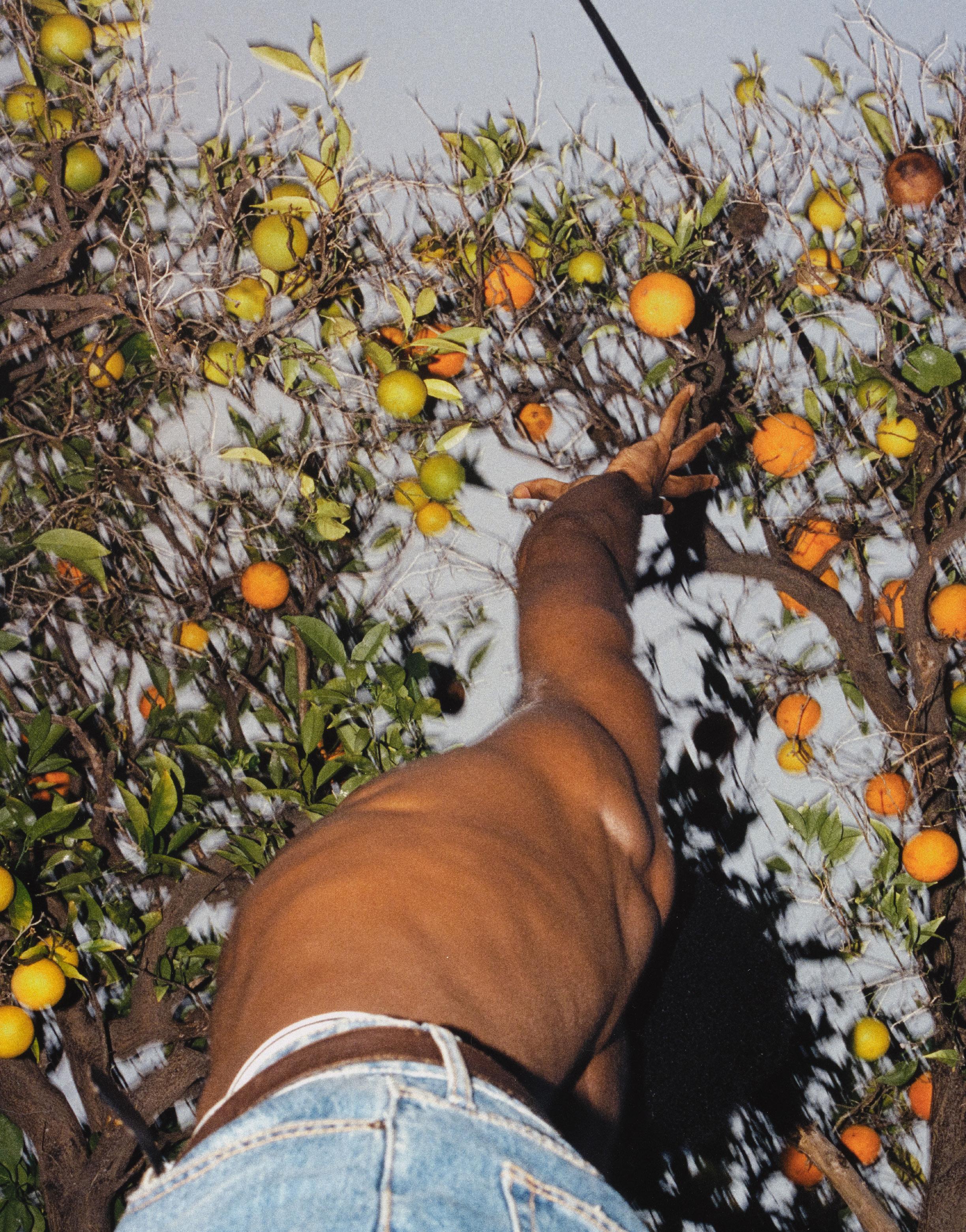
Clifford Prince King, Beneath Our Orange Tree (detail) (2020). Archival pigment print on Canson Rag Photographique
310GSM, 48 × 32 inches. Edition 1 of 5, 2AP. Image courtesy of the artist and STARS, Los Angeles.
Lindsay Preston Zappas is an L.A.-based artist, writer, and the founder and editor-in-chief of Carla. She is an arts correspondent for KCRW and visiting faculty at Harvey Mudd College. She received her MFA from Cranbrook Academy of Art and attended Skowhegan School of Painting and Sculpture in 2013. Recent solo exhibitions include those at the Buffalo Institute for Contemporary Art (Buffalo, NY), Ochi Projects (Los Angeles), and City Limits (Oakland).
Catherine Wagley writes about art and visual culture in Los Angeles.
Erin F. O’Leary writes about and makes photographs in Los Angeles.
Alitzah Oros is an art historian currently based in Los Angeles. Her writing explores the relationship between performance art and environmental activism in Latin America and the Caribbean.
Satoru Nihei is a graphic designer.
CJ Salapare is an arts worker from Long Beach. He currently works in New York.
Jonathan Velardi is a social media and marketing consultant. He advises cultural institutions, museums, and landmarks on effective strategy, analysis, and accessibility connected to evolving online behavioral landscapes. Select accounts include the Huntington Library, the Institute of Contemporary Art, Los Angeles (ICA LA), and the Glass House.
Reader-supported donations and contributions help us maintain W.A.G.E. certified rates. To make a tax-deductable donation, visit shop.contemporaryartreview.la/donate
Become a member of Club Carla to support our work and gain access to exclusive events, programs, and merch. To learn more, visit contemporaryartreview.la/membership.
Order a one-year subscription to Carla (four issues) for only $22 at shop.contemporaryartreview.la.

Clifford Prince King, Between Us Quickly (detail) (2019). Archival pigment print on Canson Rag Photographique 310GSM, 30 × 20 inches. Edition 1 of 5, 2AP. Image courtesy of the artist and STARS, Los Angeles.

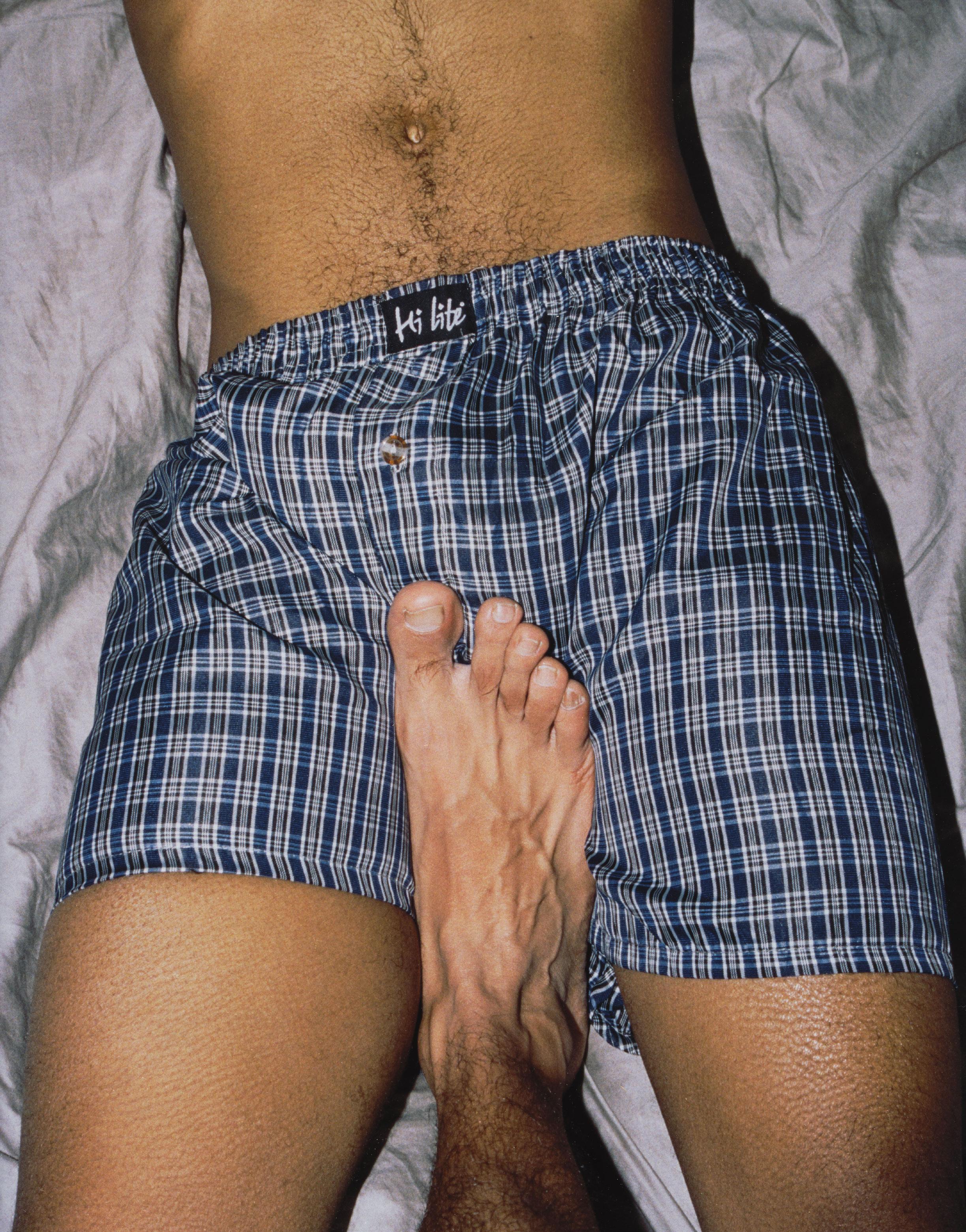
Clifford Prince King’s photographs touch me like scenes from a half-remembered film. In Hi-Lite (2017), a young man, dressed only in plaid, cobalt blue boxers, spreads himself out expectantly on a bed while someone's foot nudges the soft bulge of his crotch. The image is cropped tightly: an excerpt of a torso, thighs, a leg, and a sprinkle of hair that meanders up a thigh. In V (2022), a portrait framed by a raspberry red drape, another shirtless man—with eyes drifting downwards and black hair parted into chunky twists—looks away from the camera, quietly refusing the unspoken demands of traditional portraiture. Sitting with King’s clipped torsos and averted gazes is an exercise in disorientation, leading me to adjust my expectations of what a portrait should do and show. His images propel a montage of sensations, pulling me closer to the tender parts of myself. A self-taught artist, King often works with friends, lovers, and those in his creative community—their scenes muddling the lines between candid and staged.
King’s focus on his friends and lovers echoes, in particular, the work of two other contemporary photo graphers, Shikeith and Paul Mpagi Sepuya. The three artists are broadly linked by their focus on the textures of queer Black intimacies, building upon the legacies of artists like filmmaker Marlon Riggs, who created art devoted to Black men loving Black men during a period marked by its omnipresent
homophobia, racism, and puritanism— his experimental documentary Tongues Untied (1989) unspools as a freewheeling journey into the emotional landscapes of the Black gay community. In contrast to King’s poetic reveries of queer Black men in the midst of domestic scenes, Sepuya photographs in a studio environ ment and employs collage elements and mirrors, exploring the questions that bloom when two or more bodies merge with the tools of the photographic medium. Across photography, installa tion, film, and sculpture, Shikeith’s work captures Black figures in moments of ecstasy, prayer, possession, and speculation, their bare skin dotted with sweat or blue pigment like a physical manifestation of psychic longing. The work of these three artists pushes past the limits of portraiture, reimagin ing the genre as a site of co-creation that involves not only the artists but their subjects and viewers.
I’ve noticed that profiles on King, Sepuya, and Shikeith often applaud their work as an expansion of Black masculinity through their challenging of traditional representation. Headlines often recycle a similar narrative: i-D announces that King “celebrate[s] the beauty of queer Black masculinity”;¹ NPR writes that Shikeith “Showcas[es] A Different Side Of Black Manhood”;² and AnOther says that Sepuya is “Capturing Queer Masculinity.”³ Shikeith points out: “We all get the same head line… I always joke about it with my friends. We’re making so many different kinds of things and we just get boxed in, and it’s so frustrating.”⁴ As the artist laments, these readings tend to minimize the elements beyond identity in each artist’s work, glossing over discussions of how, for example, abstraction oper ates aesthetically or formally within their photographs, or how their methods upend myths around the objectivity of the camera. Understanding their work solely through the frame of repre sentation traps these artists in stagnant conversations that treat identity as a box to check, draining the specificities and creative artistry from their work. For me, beyond a conversation around identity and representation, each artist offers
Allison Noelle Connera different entry point into visibility, embracing strategies of concealment that seem at odds with the desire to be seen.
In RASPBERRY BLOW, King’s second solo exhibition at STARS in Hollywood, which closed in early September, figures were blurred, backs turned. A face peeked out from a crevice between two doors. Viewing the photographs was like being dropped into a scenario that was still in the process of unfurling, leaving me to gather a loose narrative between what was shown and what was left obscure. In a conversation with Sepuya (himself a friend and collaborator of King) hosted by the Robert Giard Foundation earlier this year, King touched upon anonymity, noting that in one sense, the impulse to conceal derives from an instinct to protect oneself. It is an act of safety. He added that, within his photographs, anonymity also allows space for others to step in, inviting them to use their imagination and experiences to fill in the mysteries posed by the images.⁵ King’s unwillingness to fully expose his subjects evokes Martinican philosopher and poet Édouard Glissant’s demand for the right to opacity, a counter against hegemonic efforts to categorize and dominate.⁶ Opacity refuses our culture’s transactional impulses, forcing us to look deeply. It also pulls into focus the limits of visibility and representation, and how a surface fidelity to these concepts can lead us to reinforce the very binaries that we wish to escape.
Shikeith’s figures seem to thrive in this opaque state, moved by spirits that are invisible and ever-present. Born and raised in Philadelphia, Shikeith credits his grandmother as a monumen tal creative influence. Through her, he developed an appreciation for the uncanny aspects of living, where haunt ings and spiritual revelations collide.⁷
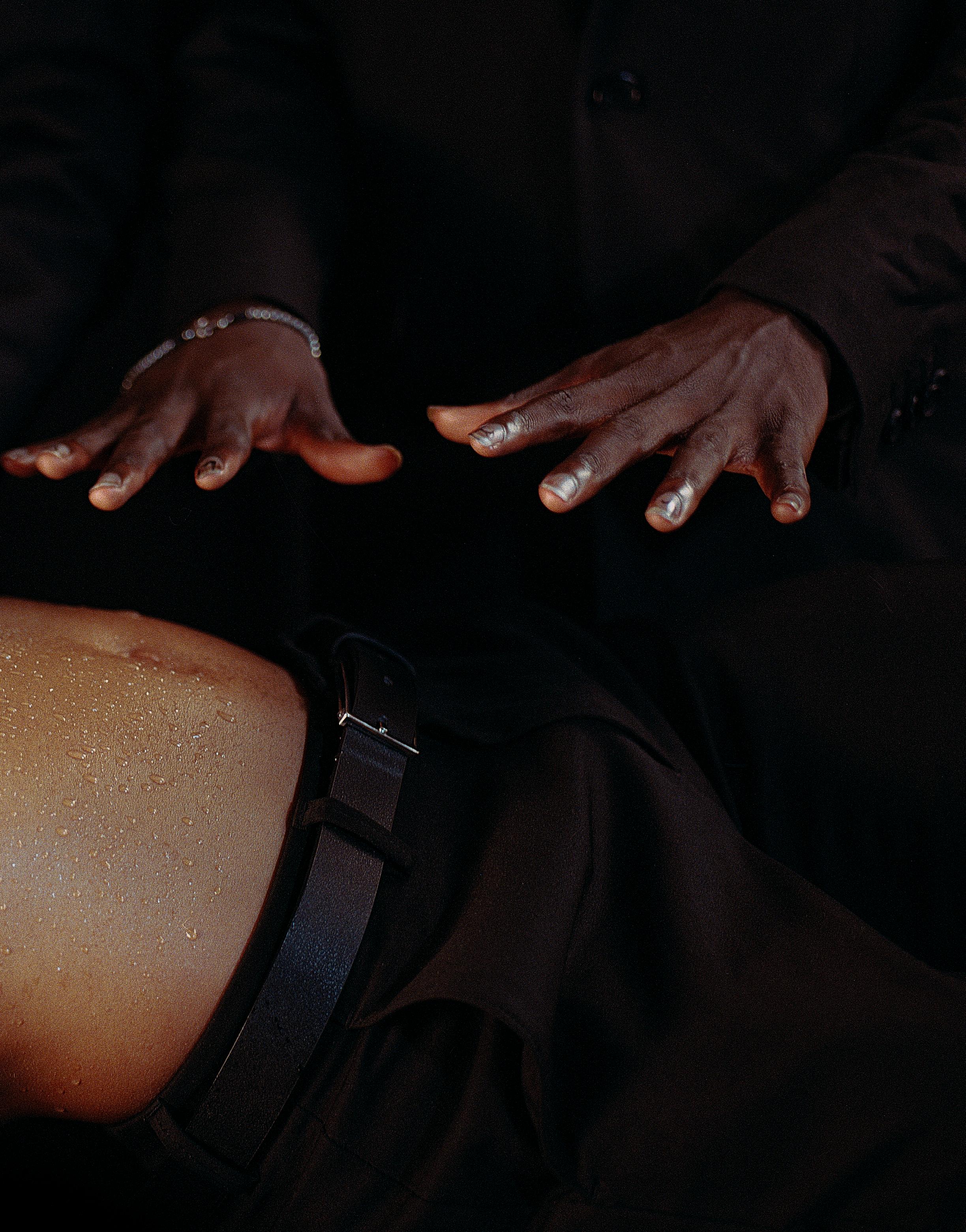
In O’ my body, make of me always a man who questions! (2020), a shirtless man arches backward, his sweaty torso floa ting beneath the outstretched hands of two men dressed in black suits. The scene is all limbs, an exercise in elision —the omissions allow us to tune into
the unseen energies conjured by the movement of hands and other body parts. Shikeith makes a language from these invisible forces, spinning ghostly tales of transcendence. Visiting Hours (2022) depicts a man sleeping on a sparse bed, his face nestled into the crook of his arm. The scene is bathed in a darkness made potent through the use of chiaroscuro lighting. A shrouded figure cloaked in a white sheet holds the man like a wounded lover. “Eyes—those proverbial windows to the soul—are always closed, down cast, or cropped out,” Zoë Hopkins writes of his work in Artforum. “Their inner life eludes our sight.”⁸
In a conversation with i-D, Shikeith explains that he sees visibility as a starting point, rather than a destina tion, for photography: “‘The medium also lends itself to other possibilities outside of these direct representations to something that’s more abstract and happening beneath what we see.’”⁹ In making this claim, the artist reveals how photography’s overemphasis on visibility can lead us away from the opaque forces that characterize living. Shikeith’s portraits center these abstractions of the mind, body, and soul. In an Aperture profile, the multimedia artist describes how the word “spill” guides his artistic vision, describing the spill as a “‘queer shape.’”¹⁰ Conjuring the properties of water, a spill connotes a sense of liberty, an inability to be confined or controlled. I see similarities between opacity and spill. Both express a desire for a mode of being that defies efforts to label. Like opacity, the spill buckles against calls for order and cohesion, tracing these concepts back to their colonial origins. As Teju Cole notes in his essay on the links between the history of photography and the spread of European imperialism, “photography during the colonial rule imaged the world in order to study, profit from and own it.”¹¹ Embracing the spill opens up new approaches to image-making. Instead of studying their subjects, King and Shikeith enter a dialogue with them—a mutual exchange that transforms both subject and photographer.
Clifford Prince King, Hi-Lite (detail) (2017). Archival inkjet print on Canson Rag Photographique 310GSM, 30 × 20 inches. Edition 1 of 5, 2AP. Image courtesy of the artist and STARS, Los Angeles.

Shikeith, O’ my body, make of me always a man who questions! (detail) (2020). Archival inkjet print on Canson Infinity Platine. © Shikeith. Image courtesy of the artist and Yossi Milo Gallery, New York.
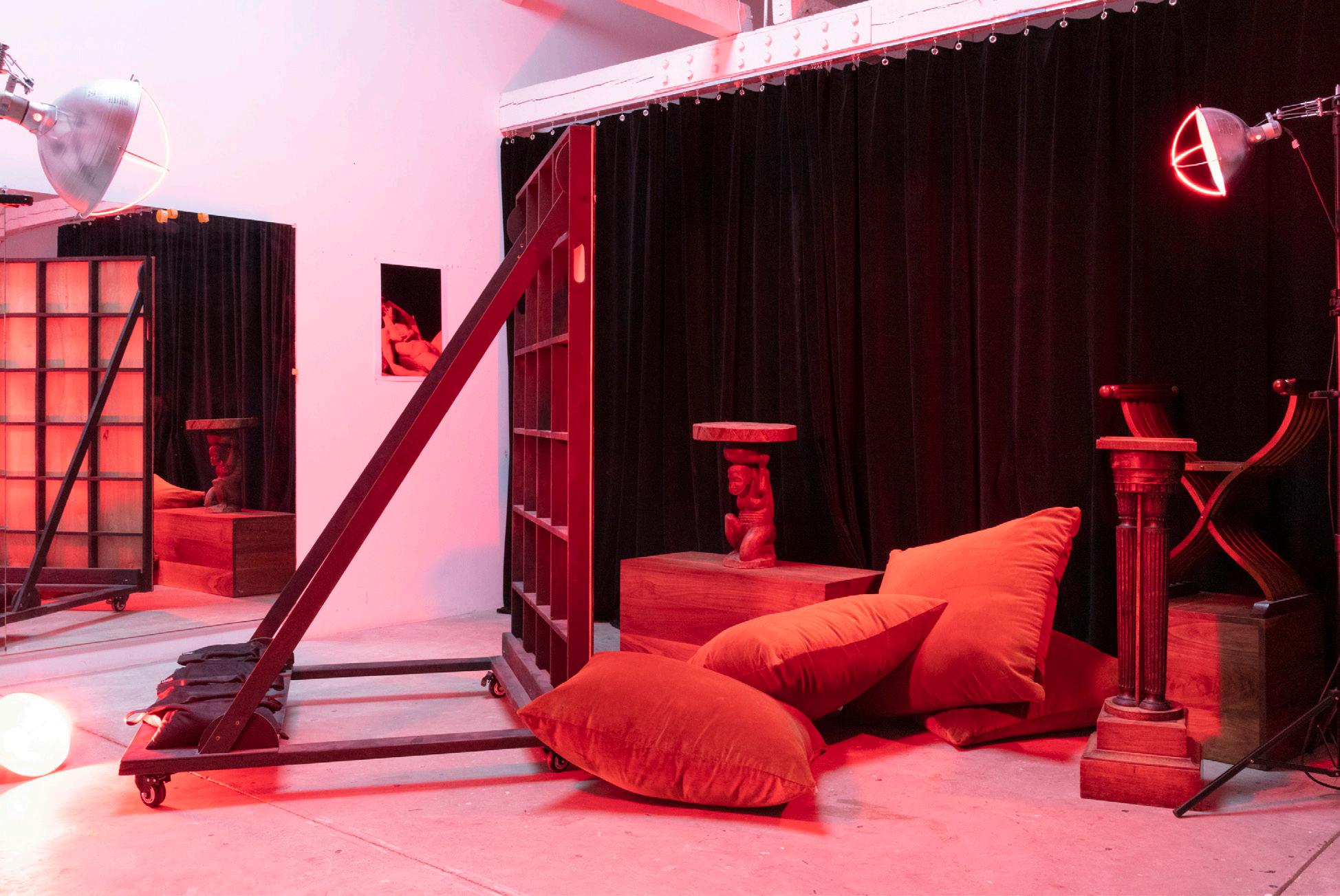
Like King and Shikeith, Sepuya turns away from the photographic impulse to dissect and profit. Born and raised in Southern California, Sepuya pulls apart the mechanics of photography and the artist studio— composing his frames with smudged mirrors, velvet drapes, tripods, lighting equipment, intertwined figures, test prints, and hands pressing camera shutters. (Though, in his recent Daylight Studio [2021–ongoing] series, he some times empties the frame of all figures, honing his gaze on the props and materials of the studio—rugs, pedestals, cushions—a sly reimagining of the elements of early portrait photography.)
His pictures interrogate the relationship between subject and photographer, both of whom are often present in the picture. For Dark Room Studio Mirror (2021–22), a suite of images included in his recently-closed solo exhibition at Vielmetter Los Angeles, Sepuya photographed friends and lovers in his studio, lighting the scenes only with red safelights. The images were each exposed for a few seconds, warping the models into foggy apparitions. Sepuya’s Dark Room Studio Mirror (0X5A5668) (2021) shows two men bathed in red light and positioned in front of a camera and tripod, their movements a spillage of kneeling, bend ing, and gazing. The images look into a mirror on which fingerprints and other smears from past models and visitors are visible, adding another layer of ghostly cloudiness. What remains is the thrum of forms, a snapshot of the quixotic modes of relation and being that underlie all interactions. Sepuya’s portraits recover the portrait studio as a site of queer sociality, where the boundaries between creative, platonic, and erotic are in constant flux. As he notes in an interview with Elephant, “That convergence…has a lot to offer when exploring photo graphy as a medium of construction and desire, of looking and knowing we are being looked at.”¹² For Sepuya, the spill extends to the medium itself, a way of pulling apart the embedded power dynamics of photography.
It’s exciting to see artists who are actively resisting the extractive demands of visibility, especially against the pres sure to define oneself in terms that are legible and marketable. Though I am granted intimate proximity to these artists’ loved ones through their images, it is an intimacy that hinges on the assertion of the subject’s privacy and on the acceptance of an ongoing recalibration between divulging and withdrawing. As King said in an inter view with Ebony: “Sometimes that ‘thing’ you've been looking for for so long is right in front of you. By being present and looking deeper, you can find it.”¹³ While their practices deviate in key ways, King, Shikeith, and Sepuya embrace concealment as a different mode of seeing and being—one that, to borrow the words of Hilton Als, “let[s] the mess come in.”¹⁴ This mess, like the blurs and smears in Sepuya’s images, brings us closer to the imperceptible and perceptible forces that exist within ourselves and between others, a bound lessness that spills over all of us.
Allison Noelle Conner's writing has appeared in Artsy, Art in America, Hyperallergic, East of Borneo, and elsewhere. Born in South Florida, she is based in Los Angeles.
1. Juliana Ukiomogbe, “These photos celebrate the beauty of queer Black masculinity,” i-D, January 21, 2021, https://i-d.vice.com/en/article/n7vk4w/clifford-princekings-photography-celebrates-the-beauty-of-queerblack-masculinity.
2. Priska Neely, “‘#Blackmendream’: Showcasing A Different Side of Black Manhood,” NPR, December 14, 2014, https://www.npr.org/2014/12/14/370415400/blackmendream-showcasing-a-different-side-of-blackmanhood.
3. André Wheeler, “In the Studio, in the Nude: An Artist Capturing Queer Masculinity,” AnOther, October 12, 2018, https://www.anothermag.com/art-photography/11247/ in-the-studio-in-the-nude-an-artist-capturing-queermasculinity.
4. “Emil Wilbekin, What Does It Mean To Be A Young, Black Queer Artist Right Now?” New York Times, September 16, 2022, https://www.nytimes.com/2022/ 09/16/t-magazine/black-queer-artists.html.
5. “Clifford Prince King in conversation with Paul Mpagi Sepuya,” Robert Giard Foundation, 16:50–17:55, February 18, 2022, https://www.youtube.com/ watch?v=OhwkCaTjaWY.
6. Éduoard Glissant, Poetics of Relation, translated by Betsey Wing, University of Michigan, 2010.
7. Tiana Reid, “Shikeith’s Black Uncanny,” Aperture, Spring 2022, https://issues.aperture.org/article/2022/01/01/ shikeiths-black-uncanny.
8. Zoë Hopkins, “Shikeith at Yossi Milo Gallery,” Artforum, September 28, 2022, https://www.artforum.com/picks/ shikeith-88600.
9. Miss Rosen, “Shikeith’s spiritual photographs of Black masculinity,” i-D, June 13, 2022, https://i-d.vice.com/en/ article/dy7g4y/shikeith.
10. Reid.
11. Teju Cole, “When The Camera Was a Weapon of Imperialism. (And When It Still Is.),” The New York Times, February 6, 2019, https://www.nytimes.com/2019/02/06/ magazine/when-the-camera-was-a-weapon-ofimperialism-and-when-it-still-is.html.
12. Charlotte Janson, “Paul Mpagi Sepuya Brings A Fresh Gaze to the Male Nude,” Elephant Art, August 19, 2019, https://elephant.art/paul-mpagi-sepuya-mapplethorpethe-male-gaze/.
13. Marielle Bobo, “Clifford Prince King’s Tender Portraits of Black Intimacy,” Ebony, July 1, 2022, https://www. ebony.com/clifford-prince-kings-tender-portraits-ofblack-intimacy/.
14. Emma Brockes, “Hilton Als: ‘I had this terrible need to confess, and I still do it. It’s a bid to be loved,” The Guardian, February 2, 2018, https://www.theguardian.com/ books/2018/feb/02/hilton-als-interview-pulitzer-prizecriticism-white-girls.
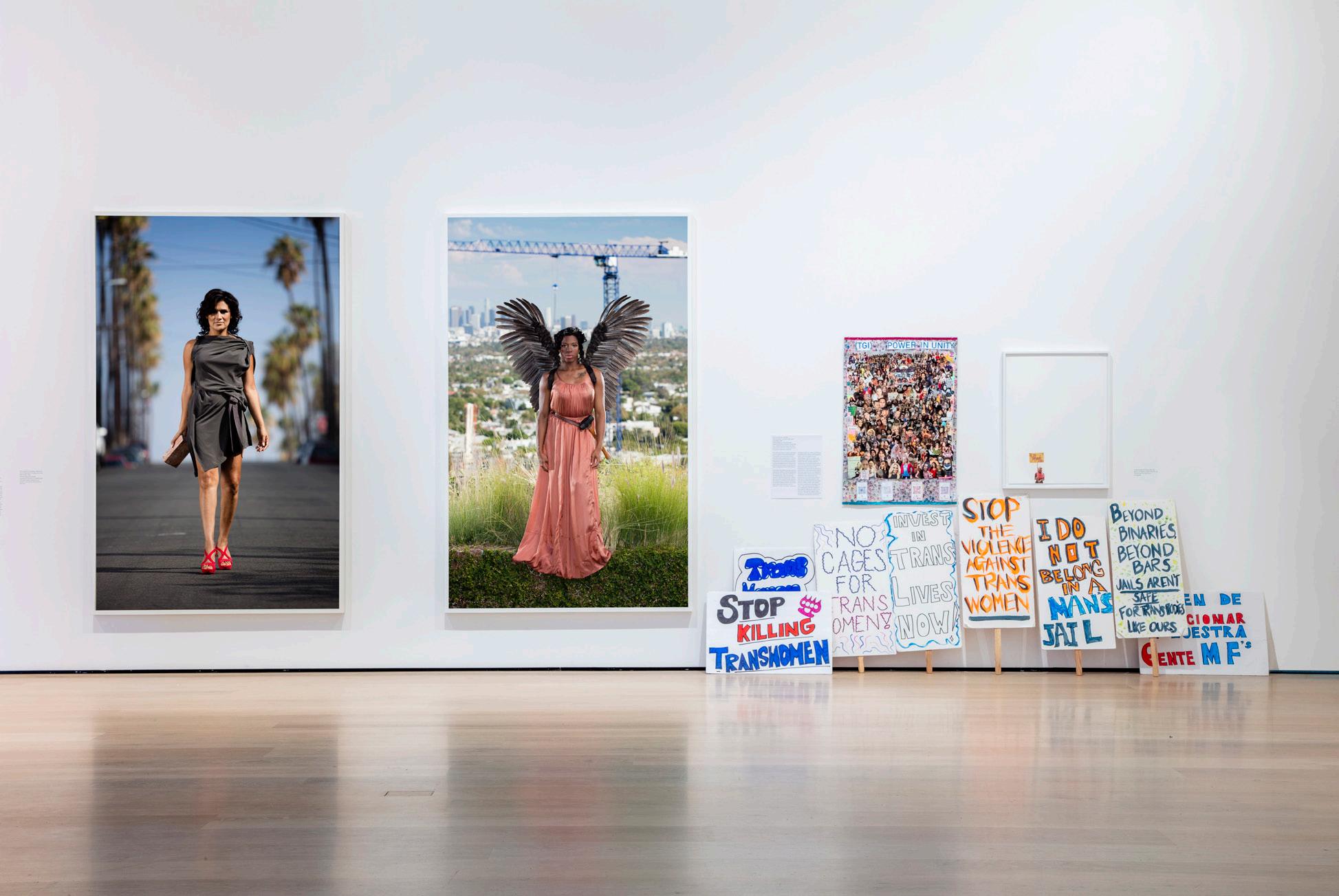
Beginning in 1964, almost a decade before the 1973 passage of Roe v. Wade, a group of Bay Area women collectively known as “The Army of Three” (Rowena Gurner, Patricia Maginnis, and Lana Phelan Khan) clandestinely distributed resources to people seeking access to abortion care.¹ At the time, letterwriting functioned as the de facto method of delivering this illicit informa tion; as a result, The Army of Three received a steady deluge of handwritten pleas from women desperate to exert their reproductive autonomy. (Of all the unending barriers to abortion access, and in light of the virality of information today, the notion that a pregnant person’s fate could be inharmoniously tied to the fickle reliability of snail mail seems particularly egregious.) As such, the sheer urgency voiced within these letters is uniquely cutting.
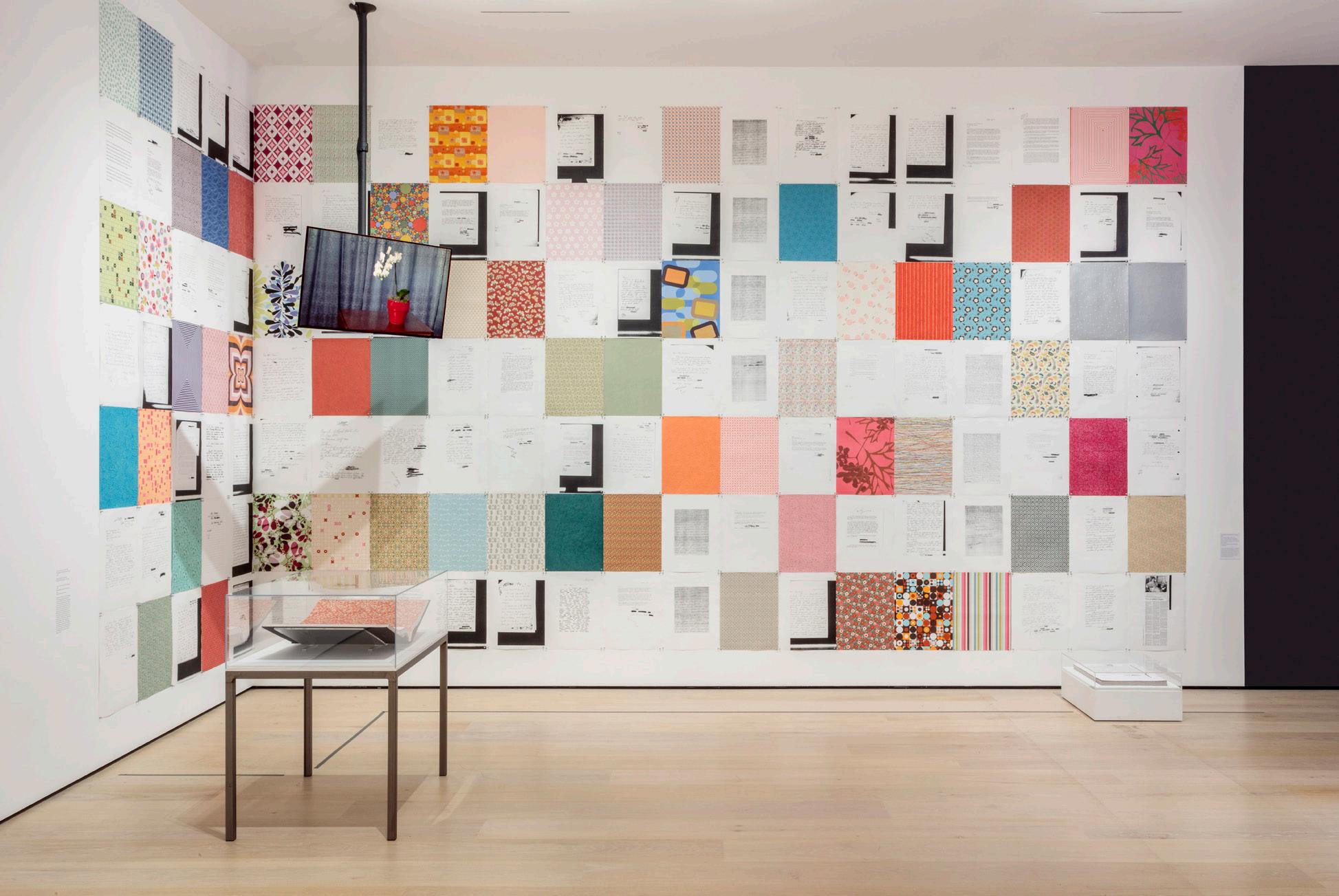
Andrea Bowers, whose work has long plumbed the methodologies of social justice movements, culls from this archive for a series of works entitled Letters to an Army of Three (2005) (works that, crucially, predate both the Trump era and the cataclysmic collapse of Roe). She displays the gathered correspondence, which she learned of during a visit with Maginnis,² at the meeting point of two walls, with the printed letters emanating outward from the crux like an open book. A single-channel video of various people carefully reciting the contents of specific letters plays on a monitor suspended from the ceiling above; underneath, a large-scale book of additional correspondence sits splayed open on a plinth.
In Bowers’ eponymous retrospec tive at the Hammer Museum, which
closed on September 4th, this install ation occupied a large gallery space close to the beginning of the thematically organized exhibition. The aforementioned video’s first person recitations of the letters softly reverb erated throughout the adjacent galleries, their resonant pleas plying attentive viewers to listen and bear witness. Lacking in expository commentary or overt artistic intervention, these works, like others across the exhibition, recall strictly summational displays of historical or anthropological evidence, a seemingly intentional conceptual tactic. By directly centering these narra tives and omitting the presence of her own voice—the penultimate marker of artistic authorship—Bowers demon strates the quiet art of empathetic witnessing, eschewing a more theatrical, egocentric performance of solidarity. In Bowers’ work, bearing witness—both as an act and an idea—can be read as its own uniquely textured creative modality. Through her earnest engage ment with the pedagogies of protest and resistance (an area of research and focus that spans nearly three decades), she carves out an ethics of empathy and action from a materially robust and conceptually rigorous creative practice. In doing so, she demonstrates the ways in which an artistic ethos can enliven an activist one, and vice versa.
In a series of drawings entitled Make My Story Count, Letters to Planned Parenthood (2011), this act of witnessing becomes devotional. Bowers painstakingly recreates hand written testimonials penned by women who received treatment at Planned Parenthood Los Angeles, dutifully rendering the heft, loop, and cadence of each individual letter with convincing photorealism. Here, drawing functions as a meditative performance of embodi ment—a pilgrimage, of sorts—wherein the artist not only witnesses but also physically absorbs and retraces the lived narratives of another. These atten tive, laborious gestures function as both political and artistic acts, positing the often-hermetic practice of drawing as a democratically minded device
Jessica Simmons-Reid
for enacting solidarity and kindling resistance. As a capstone, Bowers donated the entire proceeds from the drawings back to Planned Parenthood Los Angeles.
While not a historical discipline, activism by nature deals with the history of progress, even if that progress veers into perilous terrain. An activist, then, can be conjured as a chronicler who testifies to and transcribes this forward-looking, albeit mercurial, conception of history. As an artist with activist tendencies (or the inverse), Bowers dabbles in the work of a histo rian, gathering and collating evidence and preserving intimate narratives that may otherwise remain unspoken. By tethering her work to the task of resistance, she allows her objects to vigorously engage in the complex sociopolitical ecosystem that exists beyond the periphery of a closed, art-centric discourse. The darkly serendipitous timing of her Hammer retrospective underscored this idea: on June 24, five days after the exhibi tion’s opening, the Supreme Court overturned Roe v. Wade, decimating the constitutional right to abortion. This swiveling contextual framework imbued Bowers’ work with augmented layers of meaning: Letters to an Army of Three and Make My Story Count were no longer cautious remnants of a dismal past, but rather troubling harbingers of a malignant future. For a viewer, this real-time shift demonstrated the slippery precarity of progress, pointing to the continual malleability of historical perspective and illustrating how a swift change in social temperature can often augur something more dystopian than emancipatory.
Created in 2020 and rife with complexity in 2022, Bowers’ colossal drawing of Kamala Harris crystallizes this deviation in political tenor. Rendered in the allegorical style of a 17th century French illustration, the wall-sized drawing depicts the now-Vice President, then Presidential candidate, as the Greek goddess Athena, feminist warrior of women’s rights. Harris’ viral soundbite
from Brett Kavanaugh’s 2018 confirma tion hearing, a pivotal moment from her tenure as senator, valiantly adorns her shield: “Can you think of any laws that give government the power to make decisions about the male body?”³
At the time, Harris was lauded as a feminist icon for her frank line of questioning—a satisfying, performative jostle with patriarchal authority that neither swayed the outcome of the hearings nor resulted in any substantial policy change. Now, in the wake of the collapse of Roe, after being widely criticized for her performance in several lamentable interviews, Harris’ political potency on the issue has, to a certain degree, disintegrated. In this newfound context, the drawing adopts a tone of political farce, even tragedy, its initial exuberance rendered bittersweet. A more insidious truth lurks beneath: even a well-equipped, would-be warrior—a woman whose ascension to power was fueled, in part, by her fierce advocacy for reproductive autonomy—cannot shield herself from the blunt forces of systemic patriarchy. Hinting at the uncanny ability of Bowers’ drawings to perpetually morph and bloom in meaning, art historian Julia Bryan-Wilson observes that, for Bowers, “drawing is multitemporal and operates within many tenses at once, [connecting] her body —present in the act of making—with the bodies of history and with specula tive viewers.”⁴ This engagement with the body is a crucial precept of Bowers’ work and activism. Referencing this, her large-scale sculptural work Soft Blockade (Feminist Barricade) (2004), a reaction to her research on and participation in numerous acts of civil disobedience, speaks to the nonviolent practice of using one’s body to protect or block access to another person or site, effectively creating a human shield. The sculpture—a massive, intricately woven panel of fabric and thread suspended from the lanky framework of a metal fence—reads as a geometric minimalist wall with undulating striations of violet, cerulean, indigo, and plum. White stitching

resembling the interlocking matrix of a chain-link fence blankets the work’s quilted surface, reinforcing the idea that here, a blockade serves to both weave and dissever. The intensity of labor that this sculpture entails suggests the careful, collective steward ship of an object, or cause, that dwarfs any singular body, a nod not only to the cooperative tenets of activism but also to the communal, feminist roots of quilt-making. The work, much like the Make My Story Count drawings, is also distinctly reverential: through the physical, creative labor of her own body, Bowers erects a soft monument to those who have used their bodies as forms of resistance, both past and future. While Soft Blockade specifically references techniques deployed by anti-nuclear protesters in the 1960s and ’70s, viewing this Bush-era work in a post-Roe context sharply reconfigured my interpretation of it. Conceiving of a blockade as a barrier to access, I noticed that the lilting stitching of the chain-link fence forms resembled the grim, harrowing motif of a twisted coat hanger—one of the more brutal emblems of draconian abortion bans. In this context, the body—specifically the womb itself—becomes a barrier from total personal liberation: an inti mate, vulnerable organ forced to mime as its own soft blockade, a tool of dominion wielded from the inside out.
This observation extends beyond the subjugation befalling only those who have uteruses to encompass any form of oppression through which the body itself is compromised, including workers, people of color, LGBTQIA+ people, and immigrants— all of whom have been a focus of Bowers’ work and advocacy. It also extends to the protection of the environment, itself composed of natural bodies vulnerable to pillage and persecution. In this vein, the project of liberation begins with ennobling the autonomous sanctity of the body, an emancipatory persuasion that encompasses all living beings.
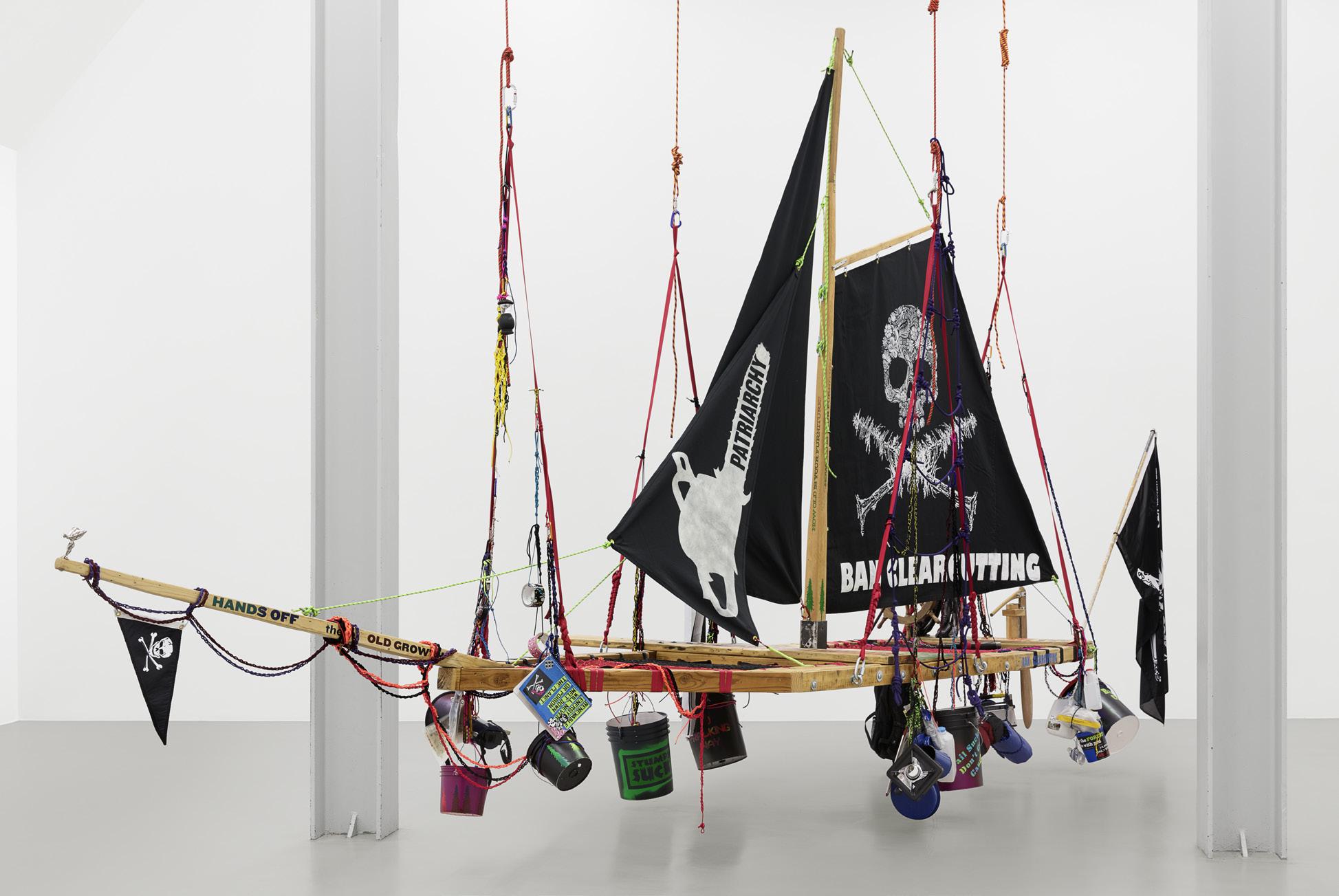
Bowers’ monumental sculpture Radical Feminist Pirate Ship Tree Sitting
Platform (2013) asserts this notion as a utopian vision for the future. Built from a mélange of objects culled from environmental protest practices, the work reconstructs a tree sitting platform, a stage for disobedience typically held aloft in the canopy and continu ously occupied by activists who anoint their bodies as soft blockades to protect old-growth forests from decimation by logging,⁵ a practice that Bowers has engaged in since the ’90s. At the Hammer, Bowers’ sculpture reimagined the visual language of the platform as a self-sufficient feminist pirate ship, suspended from the ceiling and adorned with flags, ropes, hardware, books, and painted slogans. While a stage represents a stationary construct of theater—a site from which to bear witness—a ship is a self-contained, moveable vessel, a sovereign body capable of navigating the turbulence at its bow.
Here, Bowers’ conception of piracy refutes the trope of the villainous marauder and instead points to a vision of productive usurpation, wherein conscientious pirates forge paths of liberation. Ultimately, we can interpret this meticulously-crafted assemblage as a reconstruction of our collective relationship to the surrounding world— an anti-biblical arc designed to preserve only the most redemptive qualities of humanity. As a body capable of cradling the bodies of others, it also functions as an allegorical expression of a provi dential future wherein communal bonds not only resist the throes of patriarchal violence but also coexist under a shared tenet of human tenderness. In an appropriate synopsis of her work and activism, Bowers adorns the plank of the ship (the threshold between what remains and what has been cast off) with a reflective creed by poet and essayist Adrienne Rich, a line decisively implicates the viewer as an active participant—or pirate—in her project of dissent: “try telling yourself / you are not accountable / to the life of your tribe / the breath of your planet.”⁶

Jessica Simmons-Reid (MFA, School of the Art Institute of Chicago; BA, Brown University) is an artist and writer based in Los Angeles and Joshua Tree. She’s interested in the interstitial space between the language of abstraction and the abstraction of language, as well as the intermingling of poetry and politics. She has contributed essays and reviews to Carla and Artforum, among others.
1. Pat Maginnis. “The Army of Three,” accessed October 16, 2022, http://www.patmaginnis.org/index. php/the-army-of-three/.
2. Brooke Kellaway, “Letters to an Army of Three: Andrea Bowers on Abortion, Then and Now.” Walker Art Center, December 3, 2012, https://walkerart.org/magazine/ andrea-bowers-patricia-maginnis-abortion.
3. “Supreme Court Nominee Brett Kavanaugh Confirmation Hearing, Day 2, Part 5.” C-SPAN video, 2:04:50. September 5, 2018. https://www.c-span.org/ video/?449705-15/supreme-court-nominee-brettkavanaugh-confirmation-hearing-day-2-part-5.
4. Julia Bryan-Wilson, “Andrea Bowers: Drawn Toward Feminism,” in Andrea Bowers (New York, NY: DelMonico Books, 2021), 59–65.
5. Drew Philp, “America’s tree sitters risk lives on the front line.” The Guardian, May 26, 2018, https://www. theguardian.com/environment/2018/may/26/ tree-sitters-appalachian-oil-pipeline-virginia-west.
6. Adrienne Rich, “North American Time,” EPortfolios@ Macaulay, 1983, accessed October 30, 2022, https:// eportfolios.macaulay.cuny.edu/smonte10/files/2010/08/ North-American-Time.pdf.
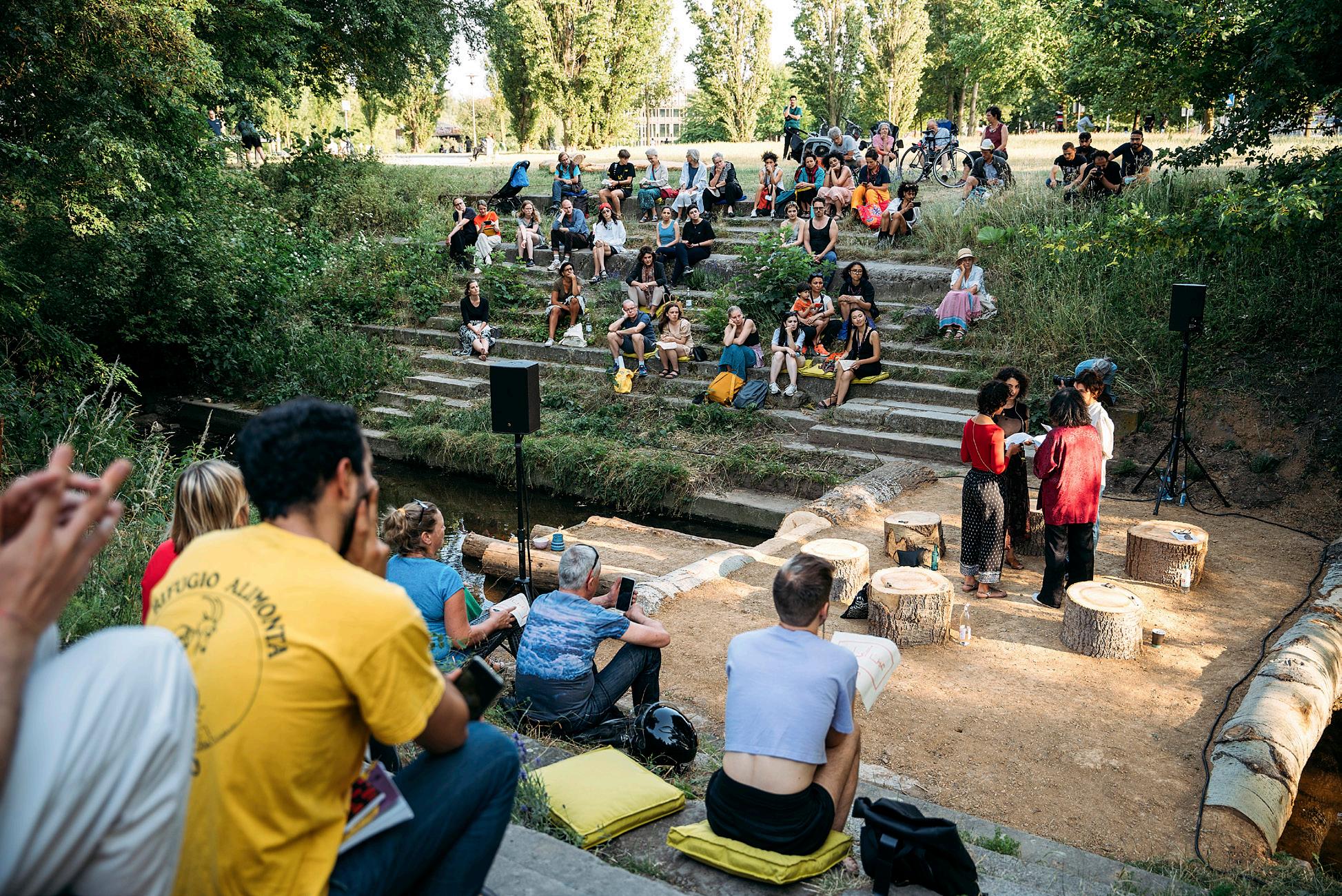
 Top: Jatiwangi art Factory, New Rural Agenda Summit (2022). Conference at documenta fifteen, Fridericianum, Kassel, June 21, 2022. Image courtesy of the artists and documenta.
Photo: Martha Friedel.
Bottom: Jumana Emil Abboud, My Other Half (2022). Performance with Yasmine Haj, Anna Sherbany, and Mounya Elbakay at documenta fifteen; Nordstadtpark, Kassel, Germany, June 19, 2022. Image courtesy of the artists and documenta.
Top: Jatiwangi art Factory, New Rural Agenda Summit (2022). Conference at documenta fifteen, Fridericianum, Kassel, June 21, 2022. Image courtesy of the artists and documenta.
Photo: Martha Friedel.
Bottom: Jumana Emil Abboud, My Other Half (2022). Performance with Yasmine Haj, Anna Sherbany, and Mounya Elbakay at documenta fifteen; Nordstadtpark, Kassel, Germany, June 19, 2022. Image courtesy of the artists and documenta.
This year’s edition of documenta, the city-wide international art exhibition that occurs in Kassel, Germany, every five years, was an expansive and inclu sive reimagining of what art, and the world, could be. Predominantly featuring art collectives from Asia, Africa, and the Middle East, the exhibi tion implemented new practices and terminologies around collectivity, like the concept of the harvest, which was used to describe reflecting, listen ing, and recording one’s perspective as an active participant in group discus sions and meetings.¹ Experiencing documenta fifteen was like traveling through a vast ecosystem of art commu nities, each made up of diverse creative practices and histories. Throughout the exhibition, visitors could, for instance, prepare and share a meal in an outdoor kitchen by Britto Arts Trust, a Bangladesh-based art collective whose contribution was devoted to food politics. On the same day, they could also watch videos of conversa tions with asylum seekers in Denmark in a living room environment set up by the Copenhagen-based collective Trampoline House.
Curated by the Jakarta-based art collective ruangrupa, documenta fifteen was centered around the idea of “lumbung,” an Indonesian term for a communal rice barn. The curators invited 14 community-oriented collec tives to develop the methods of lumbung, and those groups, in turn, invited others to participate in the exhibition. In the two years leading up to this summer’s opening, lumbung members and artists held regular online “majelises,” or assemblies. The attendees used this time to discuss their ideas for collaborating and sharing resources during the 100 days of the exhibition.
Organizing such a diversity of constituents during a global pandemic is an accomplishment in and of itself, and, given the total over haul of documenta’s institutional structure, growing pains were to be expected. Several months before the opening of the exhibition, ruangrupa was accused of being sympathetic to the Boycott, Divestment and Sanctions movement against Israel, (which is widely viewed in Germany as antisemitic²) due largely to the inclusion of the Palestian-collective the Question of Funding.³ These claims intensified days after the opening of the exhibition over the inclusion, and quick removal, of a mural titled People’s Justice (2002) by the Indonesian collective Taring Padi.⁴ While the German media riled up the controversy,⁵ ruangrupa pushed back against curatorial expectations of complete autonomy, pointing instead to their roles as stewards of a collabora tive process, and moreover, to the shifts in meaning that occur when artists’ practices (and diverse cultural backgrounds) are translated into a European context. In a speech delivered on July 6, Ade Darmawan, founding director of ruangrupa, emphasized the impor tance of collaboration even when it leads to unexpected consequences, stating that, “The curatorial approach and responsibility in the lumbung lies in this collectivity. We see this as a political endeavor, where collective agency, decision making and gover nance presents an alternative to forms of authoritarianism.”⁶ Collectivity can be a messy process, but it is vital to building more equitable systems.
The lumbung establishes an alternative economy to distribute resources, resist authoritarian powers, and anchor itself in the local values of its members. The inclusion of the lumbung model in documenta fifteen points to the growing international interest in non-hierarchical structures of organizing and resource-sharing. It represents both a global movement and a concentrated set of local efforts to redistribute power within their respec tive communities in service of artists.
Julie WeitzHere in Los Angeles, vast dispari ties of wealth are constantly on display: just ride the public transportation system, browse the real estate listings in your neighborhood, or drive by the temporary settlements of the unhoused. Still, it is challenging to understand the specific impact of this extreme economic imbalance on the L.A. artist communities. Life in this city is undoubtedly precarious for artists, particularly for those who lack the financial security of a full-time teaching gig, a viable market for their practice, or generational wealth. If an artist’s viability must depend on an economic system that solely benefits the privileged few to the detriment of the rest, then it is easy to presume that Los Angeles will eventually lose those of us who cannot afford to live here.
Working against such a dismal fate, several organizations in Los Angeles have emerged in recent years to offer more sustainable models for supporting Angelenos outside of the conventional art market and institutional structures. Their work invokes the lumbung model, as they utilize their core values, education, advocacy, and collectivity to counteract the historical and contemporary inequities that afflict this city while advocating for community care and resources. Groups like the Los Angeles Artist Census (LAAC), Los Angeles Tenants Union (LATU), and the Tongva Taraxat Paxaavxa Conservancy (TTPC) collectively organize, share knowledge, and advocate for individuals through volunteer networks, communitydriven initiatives, and a shared ethos of reciprocity. Their efforts not only highlight the need for alternative and reparative structures in this city, but also reflect the broader international movements toward more collective models of support.
LAAC influences community thought and public policy by weaponiz ing bureaucratic language and instrumentalizing conventional methods of data collection. As a grassroots
research initiative, the project asserts that the economic and social challenges faced by artists in Los Angeles County are not only quantifiable, but that the data collected about artists can also inform actions that may better their lives. Using a generative model similar to the lumbung majelises, the organiza tion initiated its project by hosting a public gathering at the performance space NAVEL in 2019, inviting artists to gather and illuminate the issues that directly impacted their lives. In the months that followed, several of the artists worked together to determine the questions included in an artist census that would be widely circulated in an attempt to collect data that would help quantify the average working artist’s financial reality. In February 2020, LAAC launched its first census, distributed through social media, news letters, the census team’s network, and with the help of several local arts organizations. They recently published their findings in a 20-page newspaper; the results from the 2,371 artists who responded are at once staggering and unsurprising.
Among the disappointing data points, the report states that roughly 95% of respondents earn less than the L.A. County living wage ($19.35 per hour) through their art practice, with trans and nonbinary respondents more likely to report lower earnings than cis female and cis male artists; 87% of respondents lack gallery representation; one-third of respondents do not have a studio. For those with studios, the average monthly rent is $623.70, an untenable financial strain when, accord ing to LAAC, of artists who went without a basic necessity to to a lack of funds in 2019, 28% went without housing. While the numbers reveal what some of us may already know from experience, according to LAAC, the data is more than just statistical evidence. It serves as the building block for influencing public policy and increasing sources of funding: organizations like the Center for Cultural Innovation and the City of Los Angeles Department of Cultural Affairs have reached out to LAAC
about its work.⁷ As the organization’s founder, Tatiana Vahan, succinctly put it: “Data is a way to turn the lights on in the room.”⁸ For arts organizations and local governments that have trouble understanding the specific inequities faced by the city’s artists, LAAC’s work makes inaction inexcusable.
Accountability is a precept of lumbung, and exposing imbalances of power helps improve the overall health of our art ecosystem. In L.A., where housing insecurity is a concern for many artists, groups like the LATU have stepped up to resist the rampant speculation in the real estate market. Focusing on collectivity, education, and relationship building, LATU empowers renters—a group that makes up the majority of residents in this city—to advocate for themselves in the face of eviction or landlord harassment. The organization first emerged as part of the antigentrification movement in 2015 to address the diverse housing crises across the city. Since then, LATU has
formed over a dozen chapters across Los Angeles County, from Canoga Park to the South Bay, facilitating work shops and hosting bimonthly meetings where neighbors can socialize and learn from one another. All of their communi cation is fully bilingual in Spanish and English, and they offer free guides for renters engaging in conflict resolution and negotiating cash-for-keys agreements.⁹ LATU’s model of mutual collaboration and community care resonates so clearly with the spirit of lumbung that they would have easily fit in as one of the collectives that staged educational sessions and information-sharing during the 100 days of documenta fifteen.
While LAAC and LATU respond to systemic inequities directly, TTPC looks to destabilize settler colonialism from the ground up. Inhabiting the first parcel of rematriated¹⁰ Indigenous land in the Los Angeles area, TTPC cultivates shared space for members to come together, grow native plants, and practice ceremonies on an acre
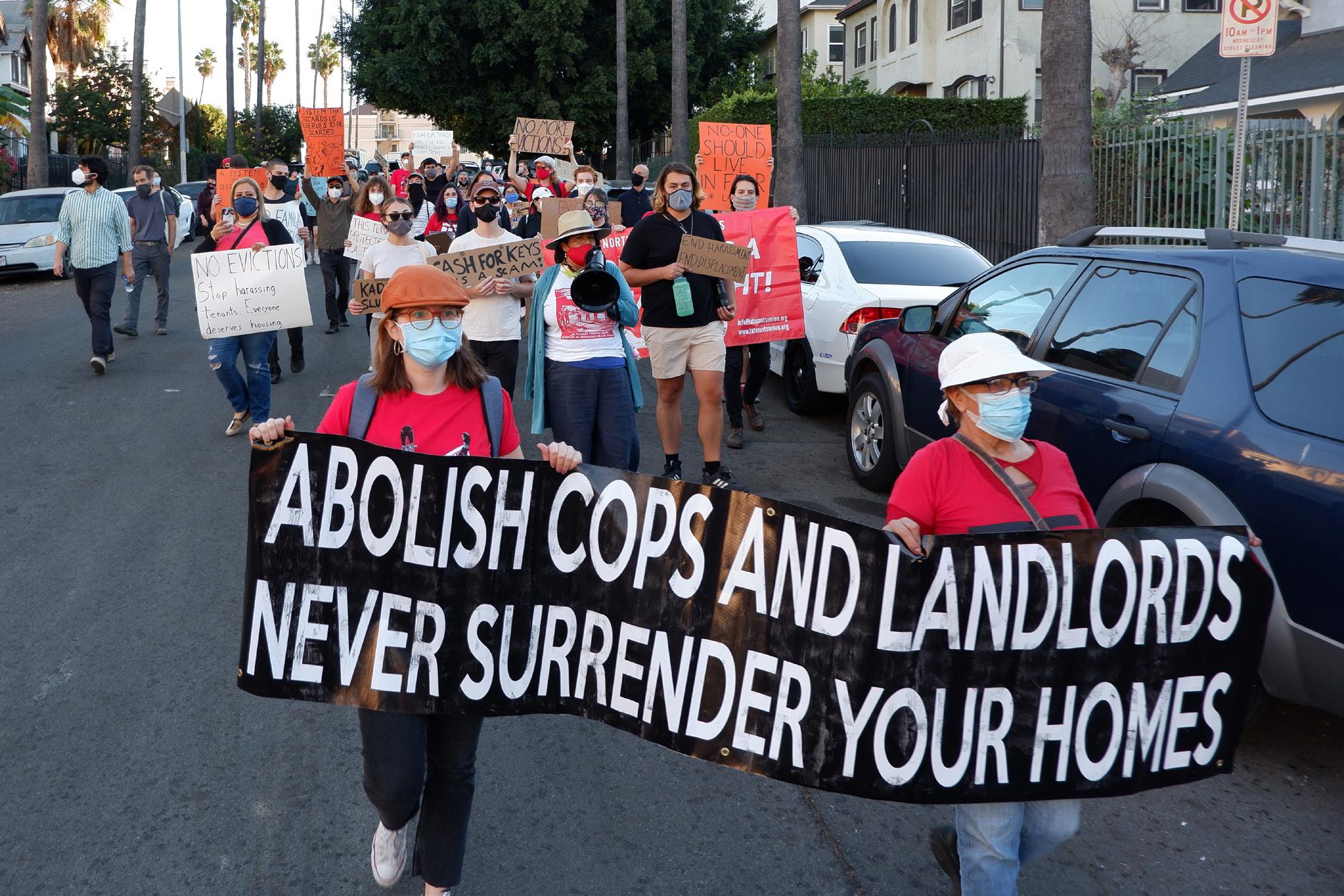
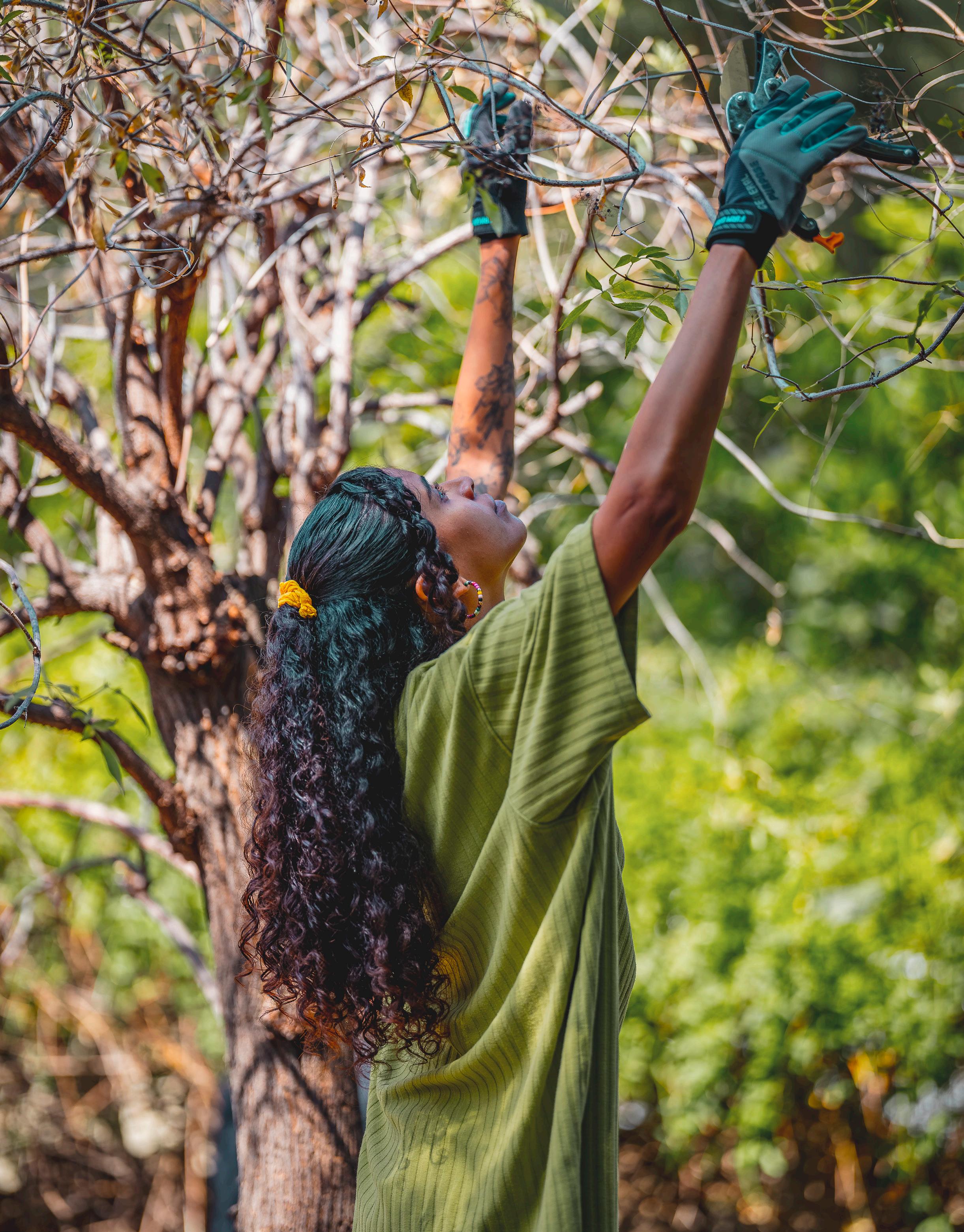 Image courtesy of the Tongva Taraxat Paxaavxa Conservancy. Photo: Kenneth Lopez.
of Tongva land in Altadena. The property was donated to the organization this year by Sharon Alexander, who, upon learning that the group hoped to obtain ancestral land,¹¹ decided to gift her grandparent’s Altadena home to TTPC rather than profit from its sale.¹² After two centuries of European settlement, TTPC’s reclamation of land is the most direct example of decolonization we’ve had in Los Angeles—for TTPC, the act of gathering for ceremony no longer involves a bureaucratic process of obtaining permission. As TTPC coordinator Samantha MoralesJohnson recently put it: “We shouldn’t have to ask anything but the plants for permission to gather.”¹³ This fall, TTPC will launch its first artist residency, hosting an Indigenous artist and their family in one of the homes on the property, and in the future, they plan to renovate the second home for Indigenous elders to live in.
In truth, the reparative models practiced by groups like LAAC, LATU, and TTPC are the exceptions to the capitalist systems that dominate broader Los Angeles. My experience at documenta fifteen inspired me to examine how local organizations fit into global movements of collectivity—by decentering the individual artist, restructuring the distribution of resources, and inventing new systems of management, the exhibition proposed an overhaul to the model offered by European art institutions. Back in Los Angeles, the communal spirit of the lumbung has generally proven hard to find. Imagine if the assemblies held by the lumbung members were replicated in Los Angeles, the constituents of our communities gathered together to prioritize all artists’ well-being. But the settler colonial mindset weighs heavily upon us, and the California dream is often an individualistic conquest of space. We have a long way to go before those in power—in Los Angeles and elsewhere—take seriously the consequences of their actions. In the meantime, organizations like LAAC, LATU, and TTPC are on the ground, already working toward a more collaborative and equitable future.
1. “Harvesters and harvesting practice at documenta fifteen,” documenta, May 25, 2022, https://documentafifteen.de/en/news/harvesters-and-harvesting-practiceat-documenta-fifteen/.
2. Alex Marshall, “Furor Over Documenta Highlights a Widening Chasm in Germany.” The New York Times, August 6, 2022, https://www.nytimes.com/2022/08/06/ arts/design/documenta-antisemitism.html.
3. Alex Greenberger, “Documenta’s Anti-Semitism Controversy, Explained: How a German Art Show Became the Year’s Most Contentious Exhibition,” ARTnews, July 22, 2022, https://www.artnews.com/ art-news/news/what-is-documenta-15-antisemitismcontroversy-1234635001/.
4. For an in-depth reflection on the controversies of antisemitism at documenta fifteen, see: Eyal Weizman, “In Kassel,” London Review of Books, Vol. 44 No. 15, August 4, 2022, www.lrb.co.uk/the-paper/v44/n15/ eyal-weizman/in-kassel.
5. “New antisemitism scandal at Germany’s documenta art exhibition.” Deutsche Weller, July 28, 2022, https:// www.dw.com/en/new-antisemitism-scandal-atgermanys-documenta-art-exhibition/a-62632478.
6. Speech By Ade Darmawan (ruangrupa) in the Committee on Culture and Media, German Bundestag speech, July 6, 2022, https://documenta-fifteen.de/en/ news/speech-by-ade-darmawan-ruangrupa-in-thecommittee-on-culture-and-media-german-bundestagjuly-6-2022/.
7. Tatiana Vahan in conversation with the author, August 2022.
8. Vahan.
9. Buyouts in which the landlord pays the tenant cash in exchange for voluntary vacation of the property and termination of the lease.
10. “What is Rematriation?” Sogorea Te’ Land Trust, accessed October 28, 2022, https://sogoreate-landtrust. org/what-is-rematriation/.
11. Jonah Valdez, “After nearly 200 years, the Tongva community has land in Los Angeles County,” Los Angeles Times, October 10, 2022, https://www.latimes.com/ california/story/2022-10-10/after-nearly-200-years-thetongva-community-has-land-in-los-angeles-county.
12. Jessica P. Ogilvie, “Why a Property Worth Millions was Returned to the Tongva Tribe,” LAist, October 10, 2022, https://laist.com/news/la-history/why-a-propertyworth-millions-was-returned-to-tongva-tribe.
13. Samantha Morales-Johnson in conversation with the author, August 2022.
“I have recently learned about Planaria, a small animal species that self-reproduces and regenerates. You cut off a piece of these simple creatures and they grow a new piece all-together. Once the piece has been cut off there is an electric charge which goes out in the shape of what is to be regrown, this diagram is then filled by the fat of regenerating tissue—do you hear what this means? Until we can conceive the shape of what has not yet been we cannot fill it. Until we can feel beyond what we have been given what we have been given, what we have found, what we have been told is right and so forth, until we can feel a need and desire for what does not exist, how can we decide over a future or even think of providing it? This is the function of poetry. This is the function of dreaming. Our ideas follow our needs and desires, our ideas follow vision.”
–Audre Lorde¹During a recent conversation, I was read the above quote by Amia Yokoyama, a sculptor, animator, and friend. Throughout our friendship, I’ve been awed by her sense of scope and by her thirst to observe and understand the depths and heights of the universe. This is clear in what she makes and how she makes it. While Amia works within a cohesive language of form and color, she intersperses nuanced personal reflections and dialogue into her exhibitions, constantly keeping me
guessing what might show up next. She recently created a series of untitled holographic works—Untitled (green) Ed 1 (2022) pictures a holo graphic cluster of her familiar, fluid ceramic figures. The image is lined with a thumby and elaborate ceramic frame that resembles fossilized plant matter. I am struck by the juxtaposi tion between what is clearly there— the weight of the frame, its textures and scale—and what appears, but what is not quite present. As much of her work takes either the form of sculpture or video animation, the medium of the hologram—a kind of screen that cradles an image of a physical sculpture—feels like a perfect marriage between these two mediums. It acts as an inquiry into a more immaterial place, seeking a connection to worlds beyond the one we all share here and now.
Yokoyama’s new hologram works allowed me to approach some of my favorite of her previous works with fresh eyes—namely, her 2020 installation at the Brand Library & Art Center, Initial Conditions, a twochannel animation featuring objects that wriggle and remake themselves in a kind of alien non-space. With these revelations in mind, we picked up on our ongoing conversation about hybrid materiality, the theory of the holographic universe, and how to imagine new possibilities.
Yves B. Golden: As I understand it, your sculptural work comes from a lot of research—from religious iconography to scientific quandaries—while also reflecting and refracting your past and present experiences. Where do you typically start in the studio?
Amia Yokoyama: I definitely think about religious iconography, but addi tionally, cosmology, and mythology. What could be called “real science” as well as science fiction [both] influence my work, partially because I think something that they have in common is the way they attempt to explain what seems to be unexplainable. Within those attempts to try to explain, there’s
Yves B. Golden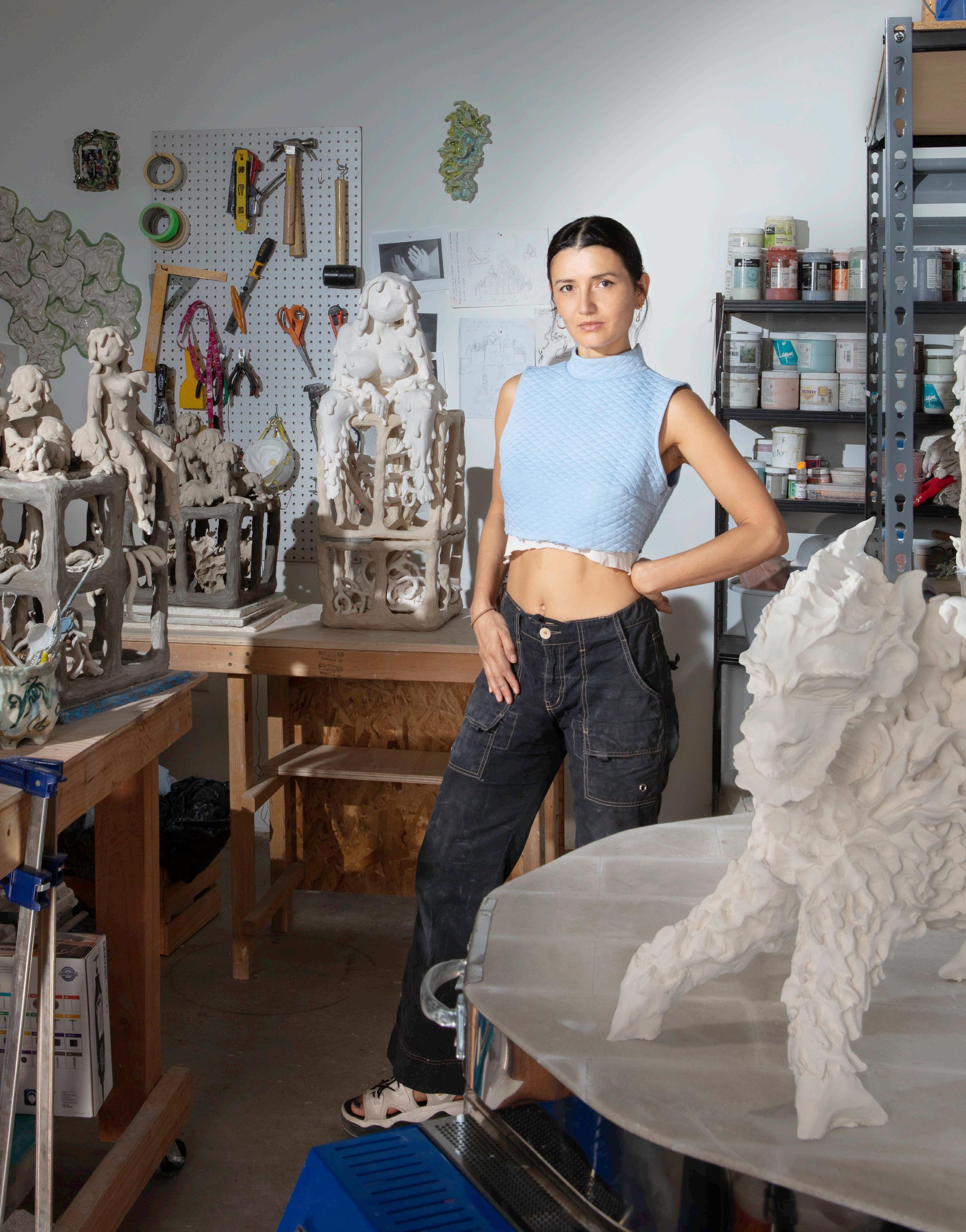
a lot of falling short, a lot of failure. There [are] a lot of breaking points in that space that I find to be fertile ground for my practice.
YBG: What propelled the leap to holograms?
AY: The two main branches of my practice have always been ceramicbased sculpture and animation. Then there’s the stop motion and 3-D CGI animation—working within three dimensions but in a digital space. When I began making [video] work, I was interested in how the 3-dimensional physical sculptures, for example, [can] be uploaded into the digital plane, and how imagery from the digital plane can be exported out. I am interested in this pushing and pulling back and forth through two very different manifestations of 3-dimensional being. Holograms are this “futuristic” technology from the 1940s that embodied the potential to achieve the impossible—albeit an illusion.² [It was] like a photographic fad, I guess you could say. It’s related to photography in that it is a print, and there is a captur ing of an image happening. Holograms are a way to capture 3-dimensional space on a 2-dimensional surface, and in animation, I’m constantly in that sort of language, [thinking about] how to describe 3-dimensional space or to fully [flesh out a] 3-dimensional world within a 2-dimensional surface like a screen or a projection. With this tech nology, rather than capturing a singular light field, we are capturing an entire light field of a 3-D object and basically communicating or recording that higher dimensional information onto a 2-dimensional surface.
YBG: What is higher dimensional information?
AY: So, 2-dimensional information is confined to a plane, a screen, or a 2-dimensional surface, while 3-dimensional information is up, down, left, right. Then, 4-dimensional concepts are where things get extra freaky.
YBG: For sure. So when you mentioned that you digitize all your sculptures, you said that the programs you use allow you to think in new ways about scale and more. How else does that process of archiving your work impact making new work?
AY: Essentially, every sculpture that I make I scan with basic 3-D scanning technology. What happens when I scan the object is this “wow” factor. Like, oh my gosh, I just captured this 3-dimensional thing in the digital sphere! Additionally, there’s all the places where the software kind of fails to capture it and glitches out. It can’t quite capture reality as we perceive it. The software brain has to invent what would go there, filling in its own blanks. I like pushing software into a place where it fails. These moments of failure become liberated spaces for us to flourish. When I transfer something from the physical to the digital, I can play with the scale or the other basic things you can change within a digital anima tion software. When you open it up, you have scale, position, rotation, and opacity—those are the basic building blocks for how to manipulate an image or an object digitally. So, by increasing the scale or the rotation, or even the opacity, I can go inside and explore the interior spaces of these sculptures. And in some ways, they can become entire landscapes or entire worlds within themselves.
YBG: This process feels so collaborative and spontaneous. It’s so resourceful. Do you think that working at the margins of technological, but also scientific, error evidences something larger about how you perceive the world and what’s possible? Observable? You take the sculptures back into the digital realm and now you’re into holograms. There just seems to be something driving this exploration further.
AY: I’m playing with a lot of materials and technologies, but also [with] theories like the [principle of the] holographic universe. This is the theory that our
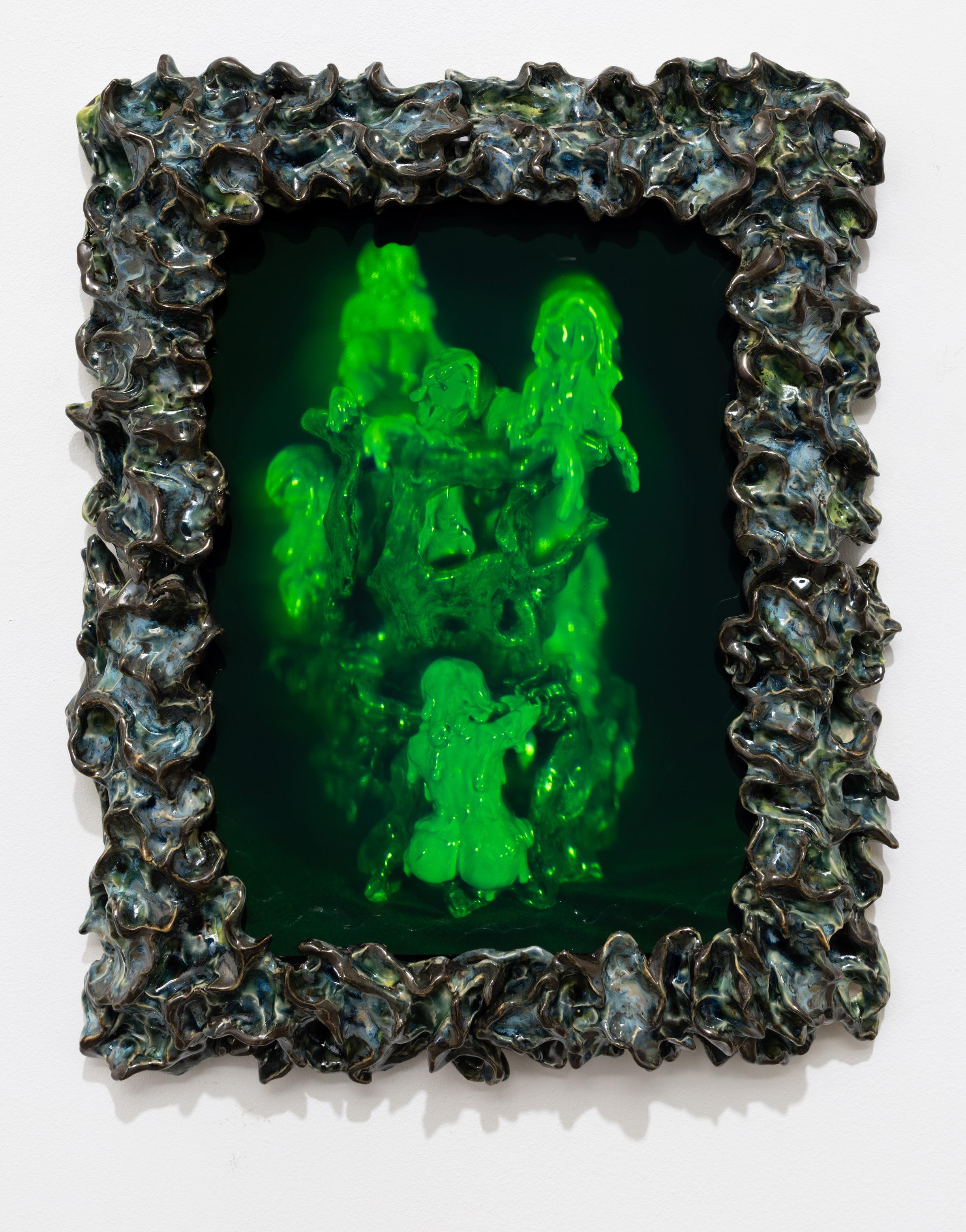 Amia Yokoyama, Untitled (green) Ed 1 (2022). Ceramic, glass, holographic print, wood, and epoxy, 24 × 19 × 4 inches. Image courtesy of the artist and Sebastian Gladstone.
Amia Yokoyama, Initial Conditions (video stills) (2018). 2-channel video with CGI and stop-motion animation, 4 minutes and 55 seconds. Images courtesy of the artist and Sebastian Gladstone.
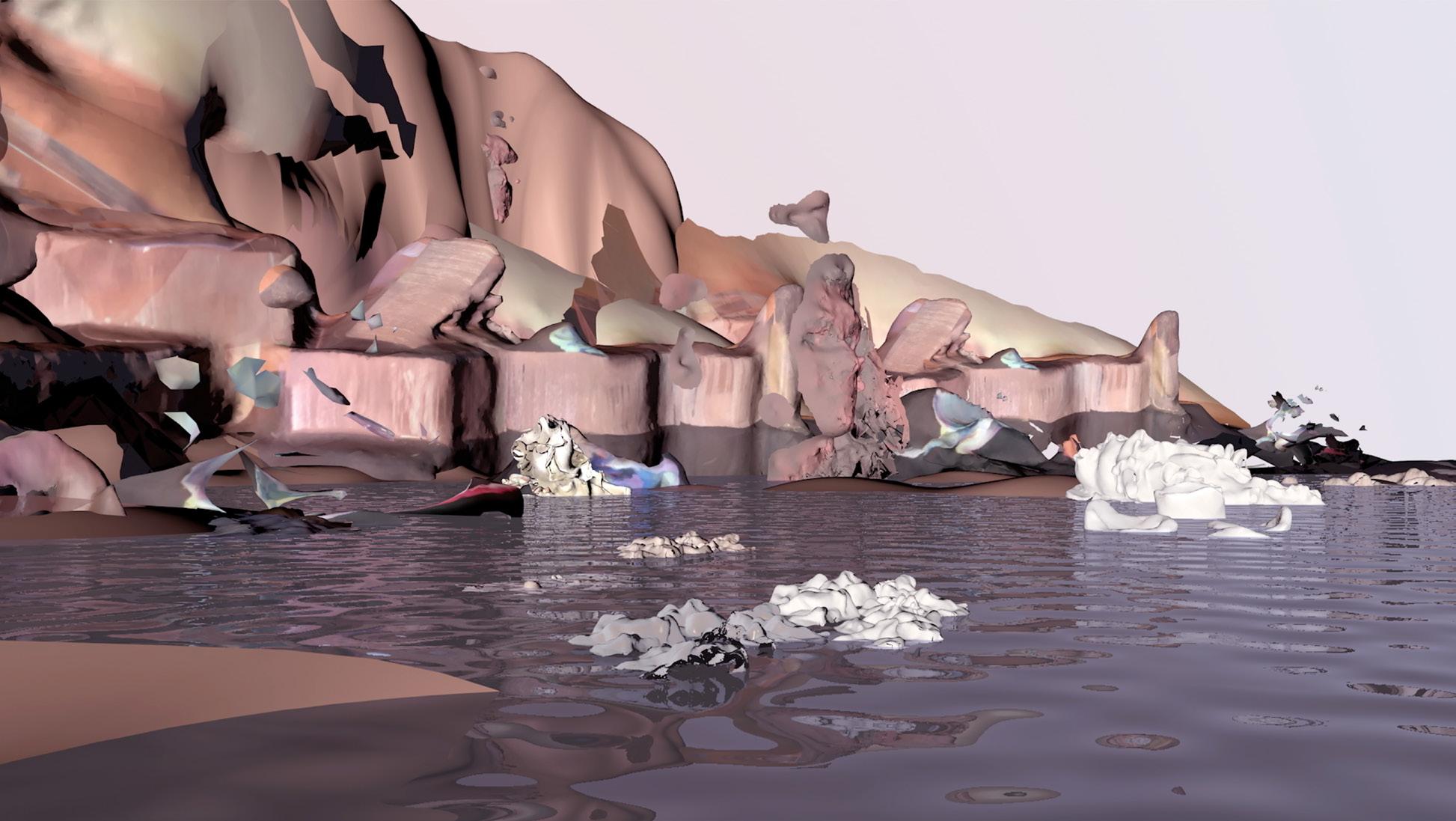
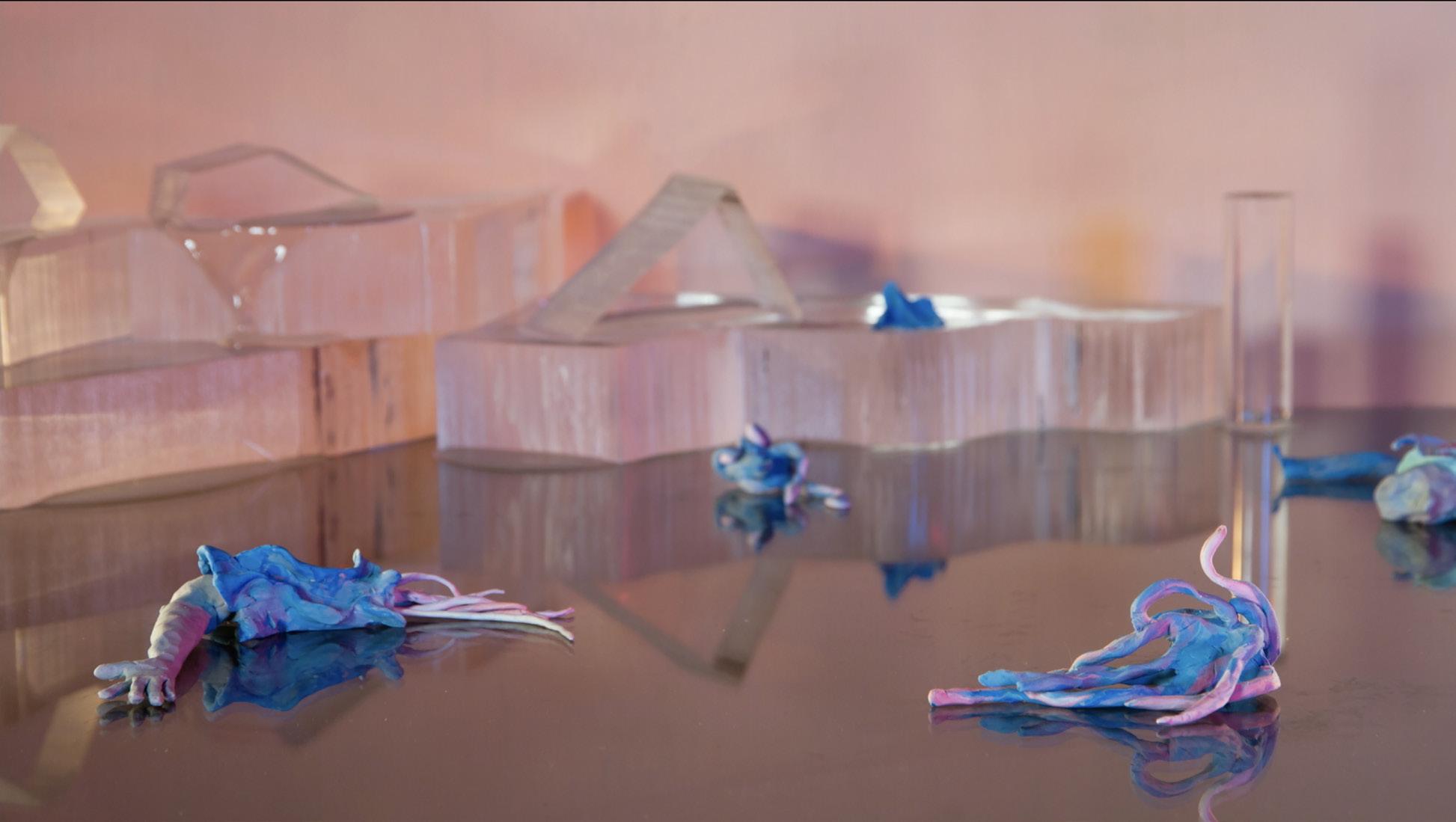
reality, as we can perceive it, is a projec tion from a lower dimension. Like I said, a hologram captures the full light field of a physical object and embeds it into a 2-D surface. The theory of the holographic universe is saying that this is actually happening, and that this very well may be what our world is—what we are experiencing as three dimensions is actually a projection or recording from [another] dimension. I love playing in these spaces that attempt to explain something so, so, so big. So, yes, imagin ing beyond this dimension and creating these worlds in my art influences how I interact with everything.
The world can feel like so much more and sometimes feels like so much less than what it is giving.
YBG: Now there’s a fridge magnet!
AY: Right?! I love when science [gives us] a really poetic way of describing something huge. There’s that kind of breakdown of hierarchies where feelings, perceptions, quantum physics, etcetera—they’re all happening at the same time. They’re intertwined.
YBG: In what ways do your reproductions of the self or your experiences go beyond the figure?
AY: The figures [in my work] represent a human and are hyper-feminized, but they actually behave more like a fungus or a virus. They are these kind of borderless, or semi-solid, oozing beings. They seduce their prey, absorb, and destroy human beings by feeding on their bodily fluids. Then they repro duce in aromantic ways. It’s similar to the way a virus can multiply and take over, or the way a fungus can grow on the surface of a decaying body. I also use some animals and icono graphy from different Japanese myths. I incorporate this and weave it into inter net myths. I enjoy remixing or almost collaging different levels of mythologies or fictions with reality in my sculptures.
YBG: I love how your figures mirror natural functions at their most abstract level, because when I look
at them, I see something very extreme and primordial in the glazing and the textures. There are no real hierarchies between the organic and technological parts of your practice. Specifically, with the oozing femme figures, you’re playing with what their bodies signify—like a shorthand. On a surface level, they’re just fetishy, but adding this layer of the macrophage-like life cycles they have—or their colors or textural qualities—makes them so superficially inviting, and also very dangerous.
AY: Right! Another thing I feel ties the holograms to these slime girl figures is [their] cellular qualit[y]. Also, similar to mythology and tradition, the more mythology reproduces itself by being told over and over and over, the more potential there is for it to change and evolve slightly. If a hologram is fragmented or broken up into little pieces, each piece will hold the image of the whole object. The best example is like if when you shatter a mirror, you could still see a full reflection in each piece, just smaller.
YBG: I want to go back to something that you said just now about your sculptures, about their bodies, the oozing boundlessness…
AY: The fluid’s not really one thing in particular, but it can be. It is evading being named at all times, and it embod ies this kind of unstable, ever-changing abstraction that we’re all made up of, or that I feel made up of.
YBG: Is the fluid we’re talking about the “gender” fluid?
AY: The femmes I create are made of something that performs selfregeneration. There [are] many of them and they are literally multiplying as I make them. They’re growing out of themselves, cloning themselves. Sometimes, there might be a clump of them together, and that mass equals the same scale as a singular
38
one in another sculpture. Their selfregenerative properties are what I really like about them. On a cellular level, they can absorb another body, and this is where they get their vital life force from. It’s like osmosis, a macrophage, or a planaria.
YBG: It seems like there’s such a play in your work and in how you think about wholeness. We spoke about how the whole is composed of many singulars and this idea of the shard of a hologram being able to codify the whole image, the entire light field of an object. I can tell you’re toying a lot with this macro-to-micro lens. You’re always bouncing from the whole to the parts and back again.
AY: Yes! The original attraction to holograms came from the fact that they are physical objects that embody functions of the digital: a 3-dimensional thing that you can see but is not there. I love that they encode light in such a way that they can be fractured and each piece still contains information of the whole—so, thinking about a whole or a truth that cannot be destroyed through breaking or fracturing. I love a process that can assemble and disassemble and assemble again.
I feel like a huge part of my prac tice is me just wanting to sharpen my tools of imagination. In Audre Lorde’s quote, and in talking about the planaria, she describes wanting us to imagine deeper, to project what isn’t there so that it can be possible. We need imagination and we need vision and we need dreaming and we need poetry in order to fulfill anything, in order to build anything new.
Yves B. Golden is a multidisciplinary artist, writer, DJ, and organizer. Her work explores visibility, dignity, and the sacred bond that exists between memory and physical objects. In May 2020, Yves co-founded the Herbal Mutual Aid Network, an expanding nonprofit initiative working to bring care and resources to Black, Trans, Indigenous, and Disabled individuals.
Amia Yokoyama is a multimedia Los Angelesbased artist who works with experimental animation, video, sculpture, and installation. The imagery in Yokoyama’s work stems from her speculation about the future and exploration of the duality between wonder and horror. Yokoyama seeks to ensure that her work evokes a playful, otherworldly feeling while creating a style that is suggestive of the future and the past.
1. Audre Lorde, “Black Women’s Poetry Seminar, Session 3, May 10, 1984,” in Audre Lorde: Dream of Europe: Selected Seminars and Interviews: 1984-1992, ed. Mayra A. Castro Rodríguez and Dagmar Schultz (Chicago: Kenning Editions, 2020), 33–34.
2. “History of Holography,” Holography, accessed October 16, 2022, http://www.holography.ru/histeng.htm.
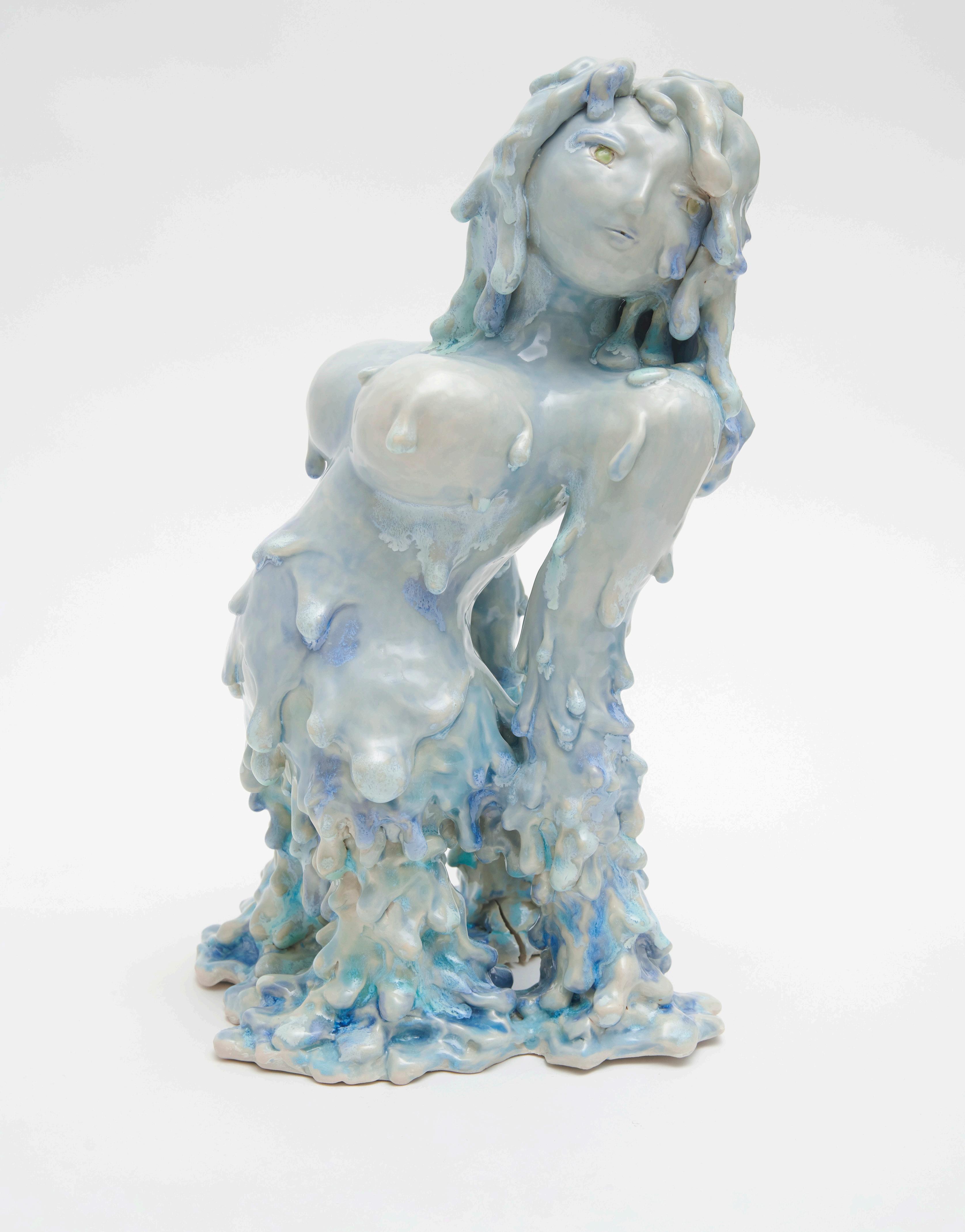 Amia Yokoyama, Meaningless Before this Ecstasy (2021). Porcelain and glaze, 17 × 9 × 11 inches. Image courtesy of the artist and Sebastian Gladstone.
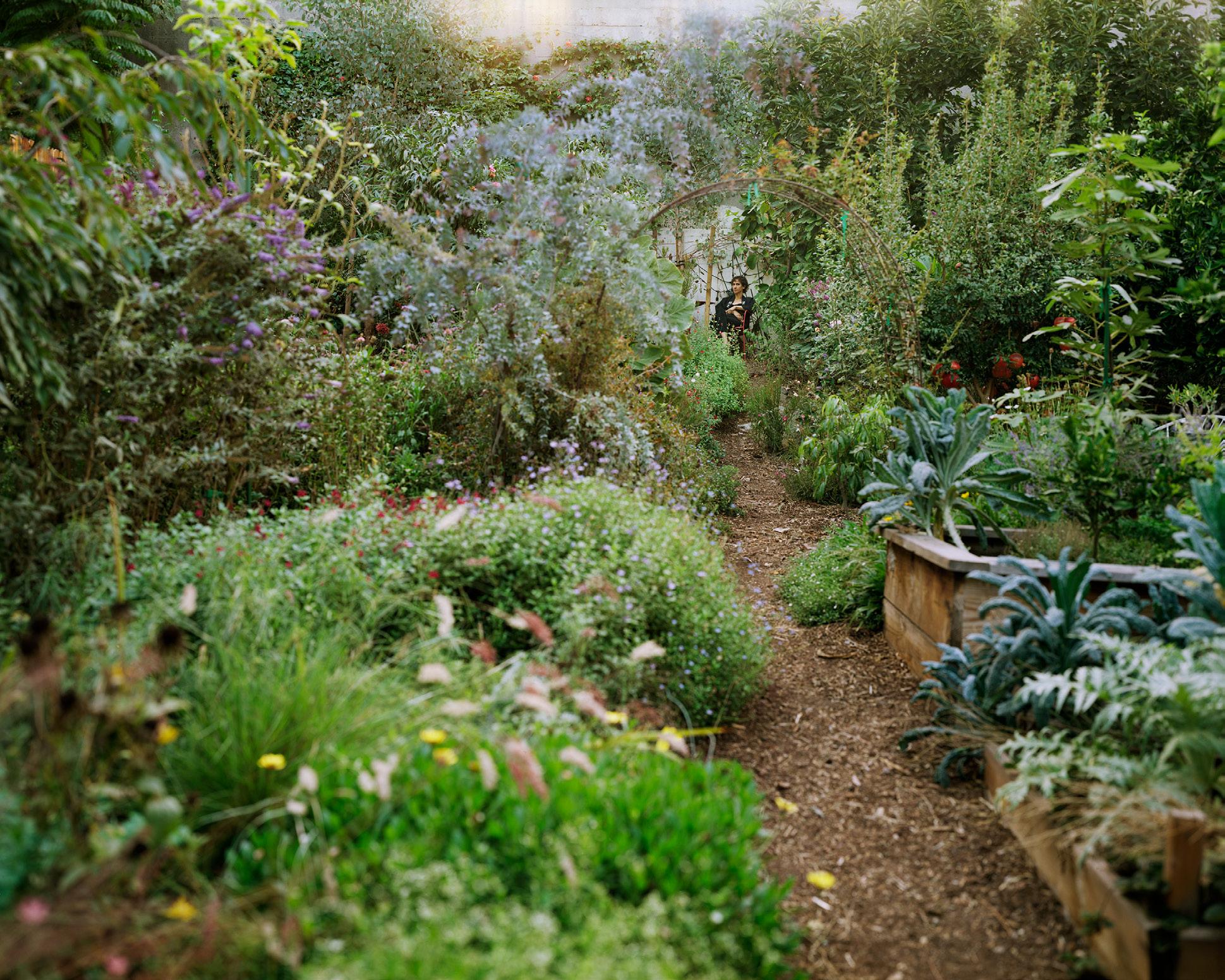
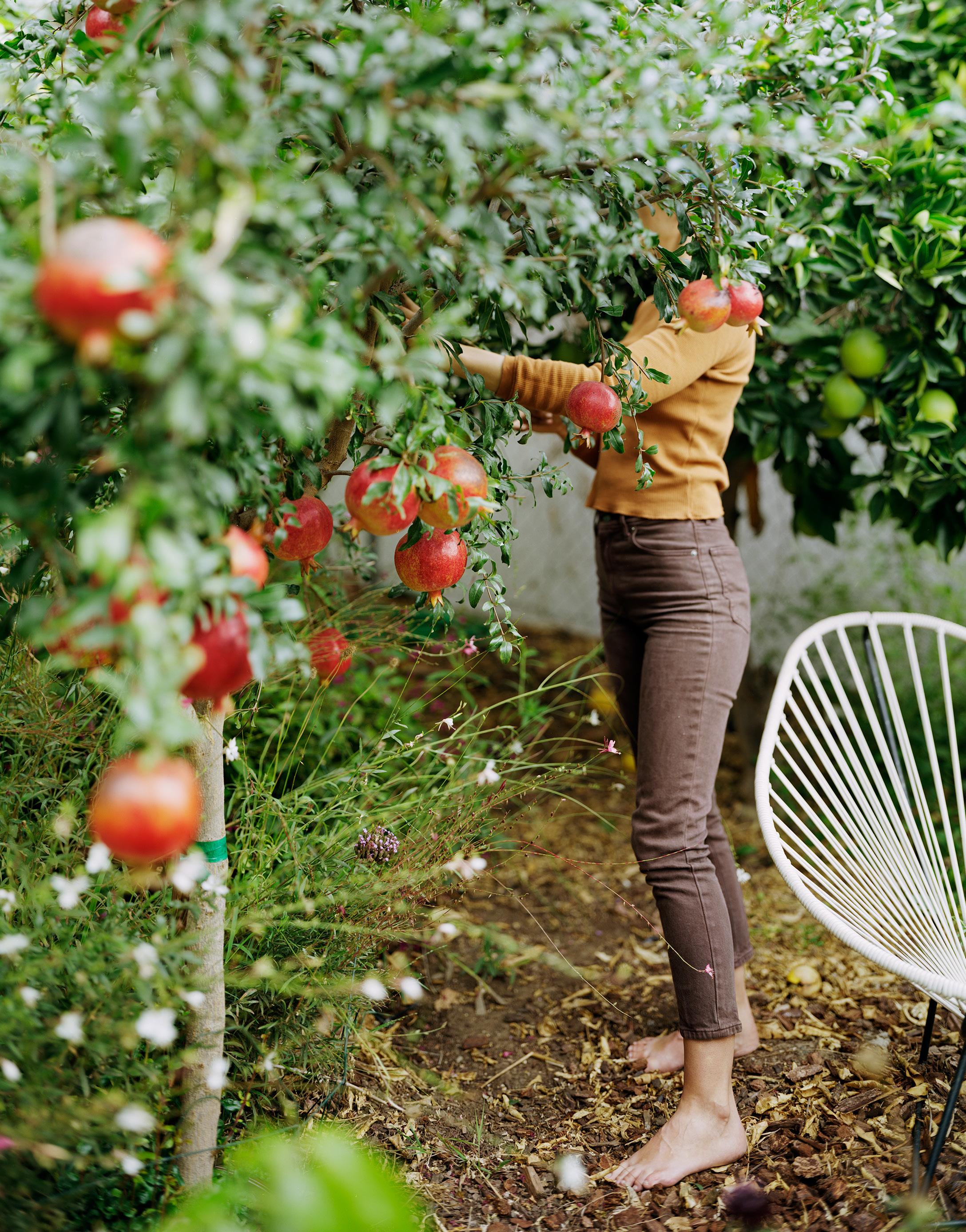
Many of us find respite in nature. For many living in the city of Los Angeles, the lure of retreating to nature and finding a restorative connection with the earth is strong. The urban landscape is harsh; it literally paves over the natural world. To garden in L.A. is to return to our essential connection with the land, to insist upon its vitality in the face of drought, climate change, and the ever-expanding development of the earth. And, gardens, of course, offer sustenance—in an expensive city like L.A., filled as it is with food deserts, gardens can act not only as reliable sources of food, but also of other medicinal, spiritual, and cultural materials. Like personal estuaries, gardens are where the private stream of domestic life meets the powerful tide of all that is out-of-doors.
The next year of Carla will feature photographs of L.A.-based artists in their gardens, the images becoming a record of the changing seasons. In cities especially, gardens manifest in many forms—in backyards, in community spaces, in coffee tins on a windowsill. This series will celebrate
the variety of creative ways that arts commu nities in L.A. build gardens in support of their lives and artistic practices. We begin the series with artists Diane Williams, Heather Rasmussen, and Mimi Lauter, all of whom retreat to their gardens to find connection and tactile knowledge, the garden becoming a collaborator in their practices and a site to gather with family and friends.
However tended, gardens are in constant evolution—always blooming, retracting, dying, and being reborn. The artist gardener models an embrace of this cycle and a deep care for site, space, and community.
Especially as it pertains to this project, we at Carla would like to acknowledge that Los Angeles sits on the traditional, ancestral, and unceded territory of the Gabrieleno/Tongva peoples—the original caretakers of this land.
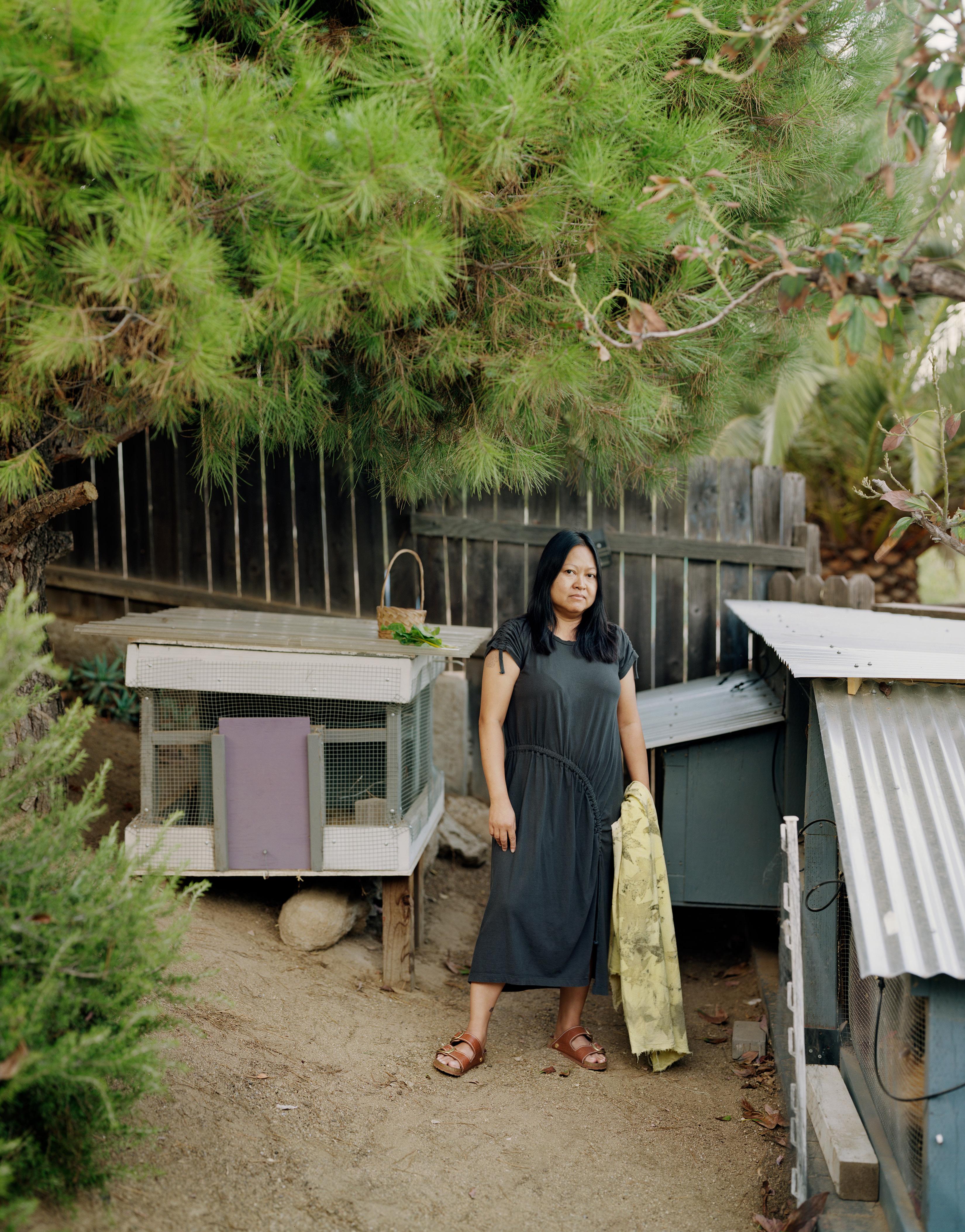
In addition to a series of raised beds, vegetable plants, and four fluffy chickens, Diane Williams’ garden includes plants like hibiscus and indigo, which she uses alongside the conifer ous tree needles that fall from neighboring trees to make natural dyes using pre-colonial Filipinx dye methods. She utilizes these dyes in her textile work, approaching harvesting and dye-making with a spirit of open exploration. For Williams, the garden is not a pristine or precious space, but something alive and active that invites participation and play.
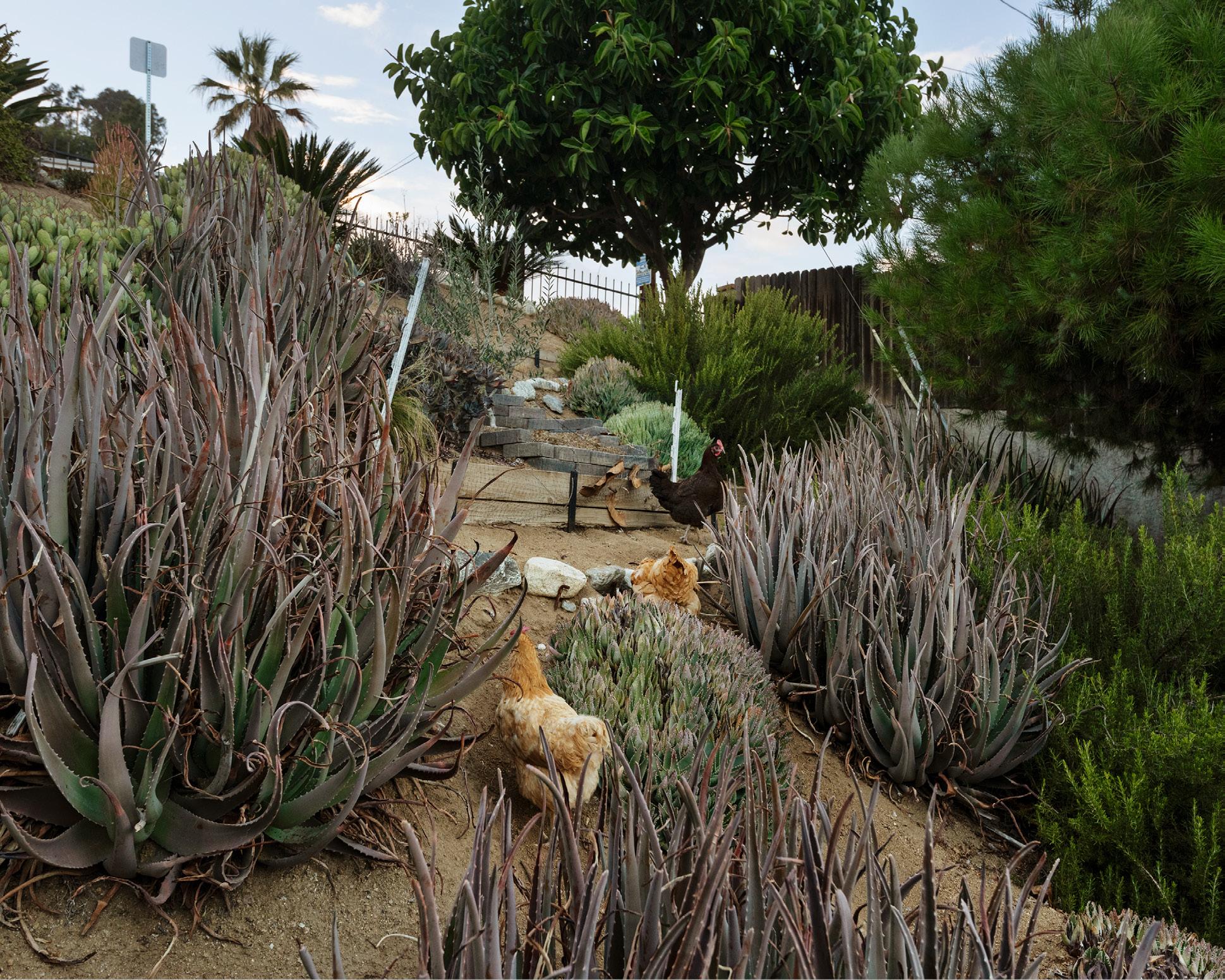
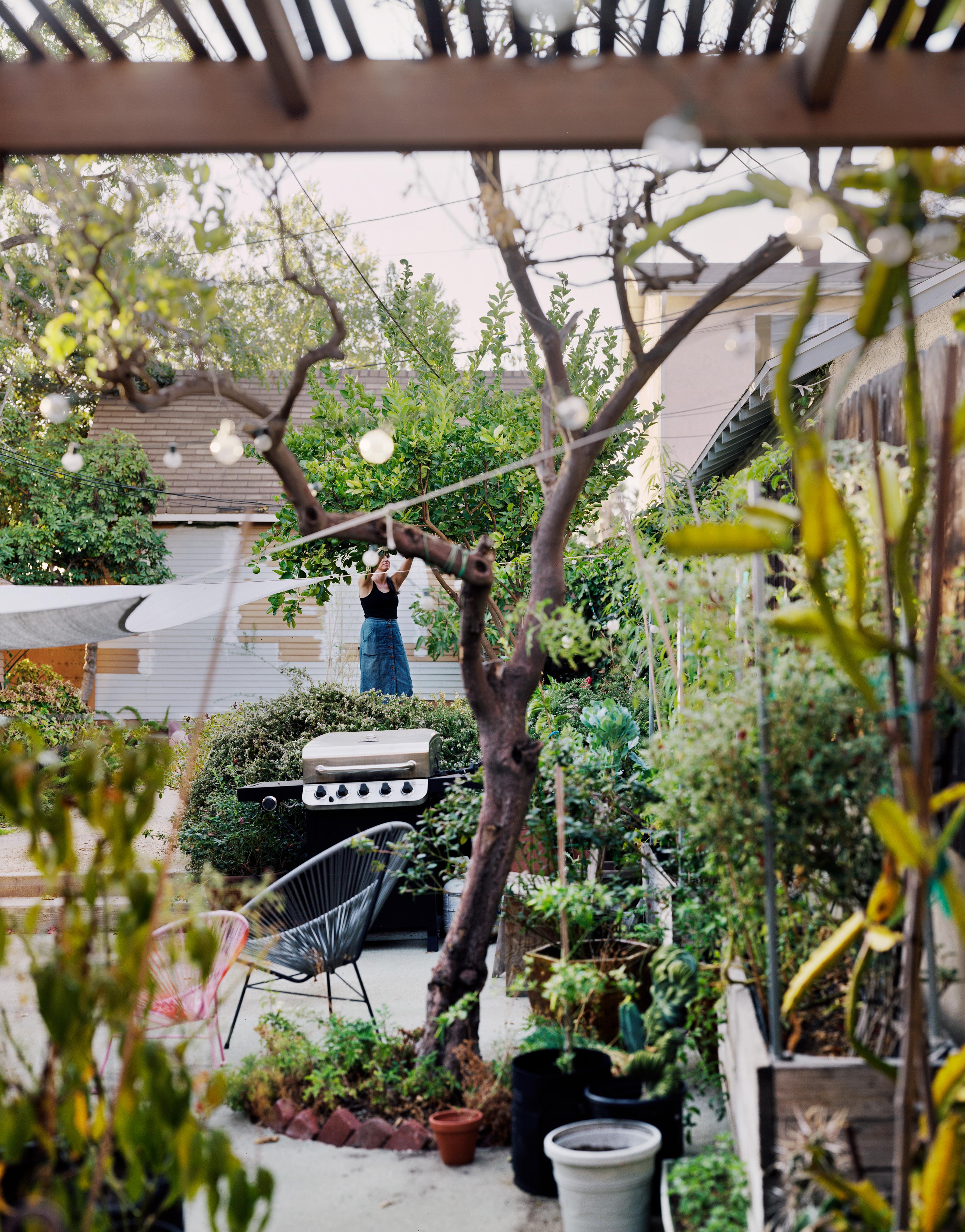
Heather Rasmussen began her garden slowly. With plant cuttings gifted by friends, family, and neighbors, her garden has grown and evolved in a loose, improvisational manner— built over time from offerings from her community. Other plants were adopted from friends who moved away or were rescued from the sidewalk during her neighborhood walks. For Rasmussen too, the garden makes its way directly into her studio: she utilizes long-neck squashes from her father’s garden in her photographs, bending her body around their organic forms.

For Mimi Lauter, the garden is itself a painterly composition —one that is constantly evolving with the changing of light and the shifting of season. Lauter considers the tending and planning of her garden to be similar to making a painting— a splash of purple and lavender in one corner contrast a bloom of yellow in another. Reds and pinks swim together in a mono chromatic daub. It is not only the intentional placement of various colors and textures, but the carefully-orchestrated timing—the growth, peaks, and death of each plant—that become a form of mark-making. As one plant is finishing for the season, another is just starting to rise, in a crafted ebb and flow.
August 4–October 15, 2022
In a 2017 conversation with Paul McCarthy, Kaari Upson disclosed the phrase that best encapsulates her fascina tion with the indeterminate, sometimes sickening facets of other people’s lives: “some body else’s yuck.”¹ Though cut short by the artist’s tragic death from cancer in 2021, Upson’s career was built around her power to “[witness] somebody else’s nothingness” and to fill it—through research, self-reflection, and imagina tion.² Her recent exhibition never, never ever, never in my life, never in all my born days, never in all my life, never revealed that, for Upson, the “yuck” is precisely where the most perplexing and generative aspects of identity reside. The exhibition’s paintings, drawings, videos, sculptures, and installation —all completed in the final years of her life—foreground Upson’s conception that the self is not a stable, fixed entity, but is rather found in the non-matter that exists on the abject borderline between states, between individuals, between what is felt and what is articulated, and ultimately, between life and death.
Upson is best known for The Larry Project (2005–12), a seven-year-long project that reconstructed the life of an eccentric and menacing missing neighbor of her parents through his aban doned belongings. Through her work, Upson began to incorporate some of Larry into her sense of self, her memories
fusing with the conception of her subject. Though Upson moved away from this project in 2012, her predilection for blurring others’ experiences with her own persisted. The life-sized installation Kris’s Dollhouse (2017–19), included in the recent Sprüth Magers show, is based on a dollhouse made by a friend’s mother. Dollhouses typically tickle a maternal desire to recreate the well-known security of the home as a space for pleasant reverie. But in Upson’s macabre enlargement of the object, the fireplace is burnt out and the walls are the splotchy gray of a cirrhotic liver.
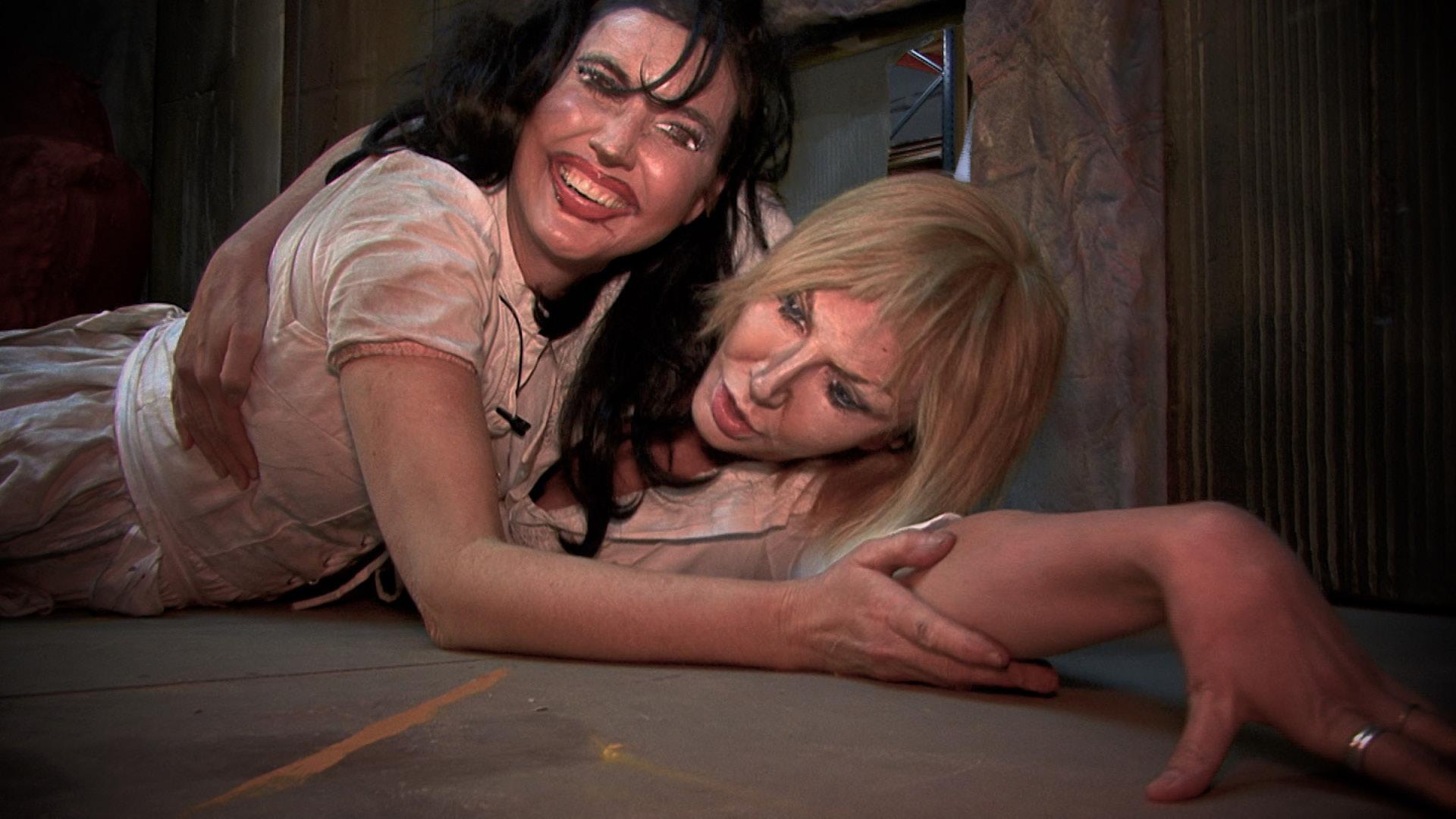
The installation, moreover, served as a set for a series of perverse videos. In Alex’s House (2019), Upson and Kristina (Kris) Perchetti, her friend and collaborator, shuffle around the netherworldly doll house dressed like bloodied, dirtied caricatures of house wives. Down and out, with eyes wide shut and eyeballs painted on their closed eyelids, Upson halfheartedly moves objects around the space as she describes a certain “plain tract home” in Las Vegas (which also belonged to Perchetti). In other shots, they limp in tandem around the space, echoing phrases as if possessed, seeming to speak without meaning as they recite banal details of Kris’ life. The characters’ outfits, their bizarre movements, and their overlapping dialogue suggest a more sinister experi ence of the home than what can be expressed through speech—one that is now shared between multiple people. Despite the video’s deeply unsettling atmosphere, Upson retains the amusement of playing pretend, as the characters’ bodies and their
corresponding environment are turned into vehicles for a disturbing performance —freighted, perhaps, with trauma, but buoyed by humor. Language functions like a kind of game in Upson’s text-based paintings, doing more to impart the deep obscurity of the self than to offer declarative truths about it. The exhibition featured a series of monumental blackand-white drawings that dwarfed viewers in dense clouds of text. Having func tioned like notepads for the artist, the works form concrete, poetic ruminations on what it means, philosophically and experientially, to inhabit a body and mind. “WANT TO BE GOD?” Upson writes in bubble letters that resemble a large intestine. Though the self, for Upson, was ultimately unknowable, its mystery elicited from her a powerful drive to signify or represent it, however incompletely. The products of this drive, most clearly visible in the fragments of language in her drawings, evoke what I might call the conspiratorial sublime: the conflicting feelings of horror and wonder that arise from the endless ways one might try to pin down an ultimately unanswerable question.
“WHAT OVERIDENTIFICATION WITH INCONGRUOUS FANTASY” she scrawls else where, pointing to the narrative excesses and inco herencies that arise when trying to understand oneself —but which never resolve into a totalizing concept or truth.
For Upson, there never really was a core self to divulge. Instead, her investigations of the grime and grit of interior ity opened up the mechanisms for how identification might function in a more protean,
Isabella MillerTop: Kaari Upson, Alex’s House (video still) (2019). HD video with color and sound, 5:46 minutes. One of three videos in the installation Kris’s Dollhouse (2017–19). © The Art Trust created under Kaari Upson Trust. Image courtesy of Sprüth Magers.
Bottom: Kaari Upson, Untitled (2015–21). Graphite and ink on paper, 102.5 × 209 inches.
Photo: Ed Mumford. Image courtesy of Sprüth Magers.
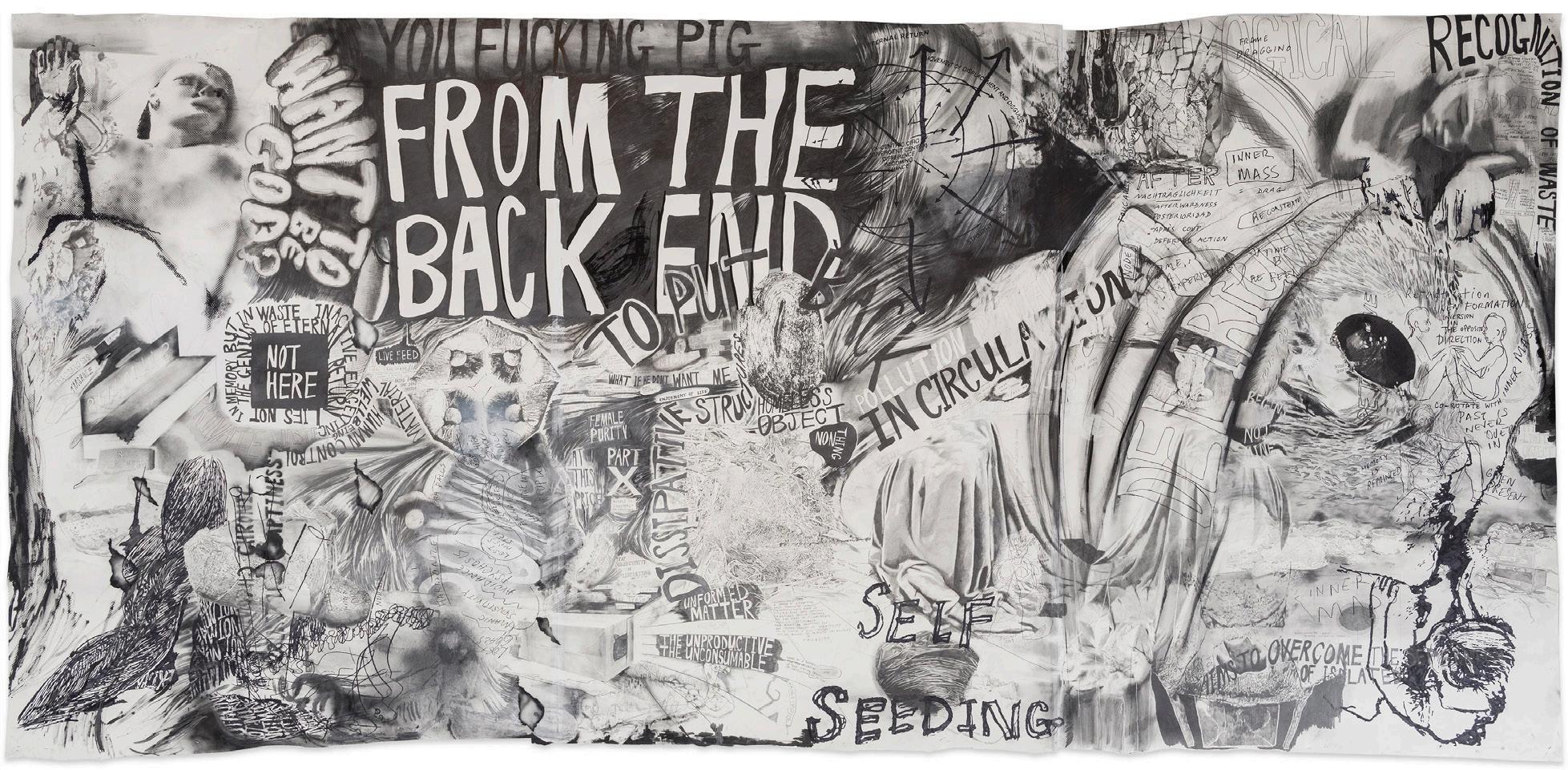
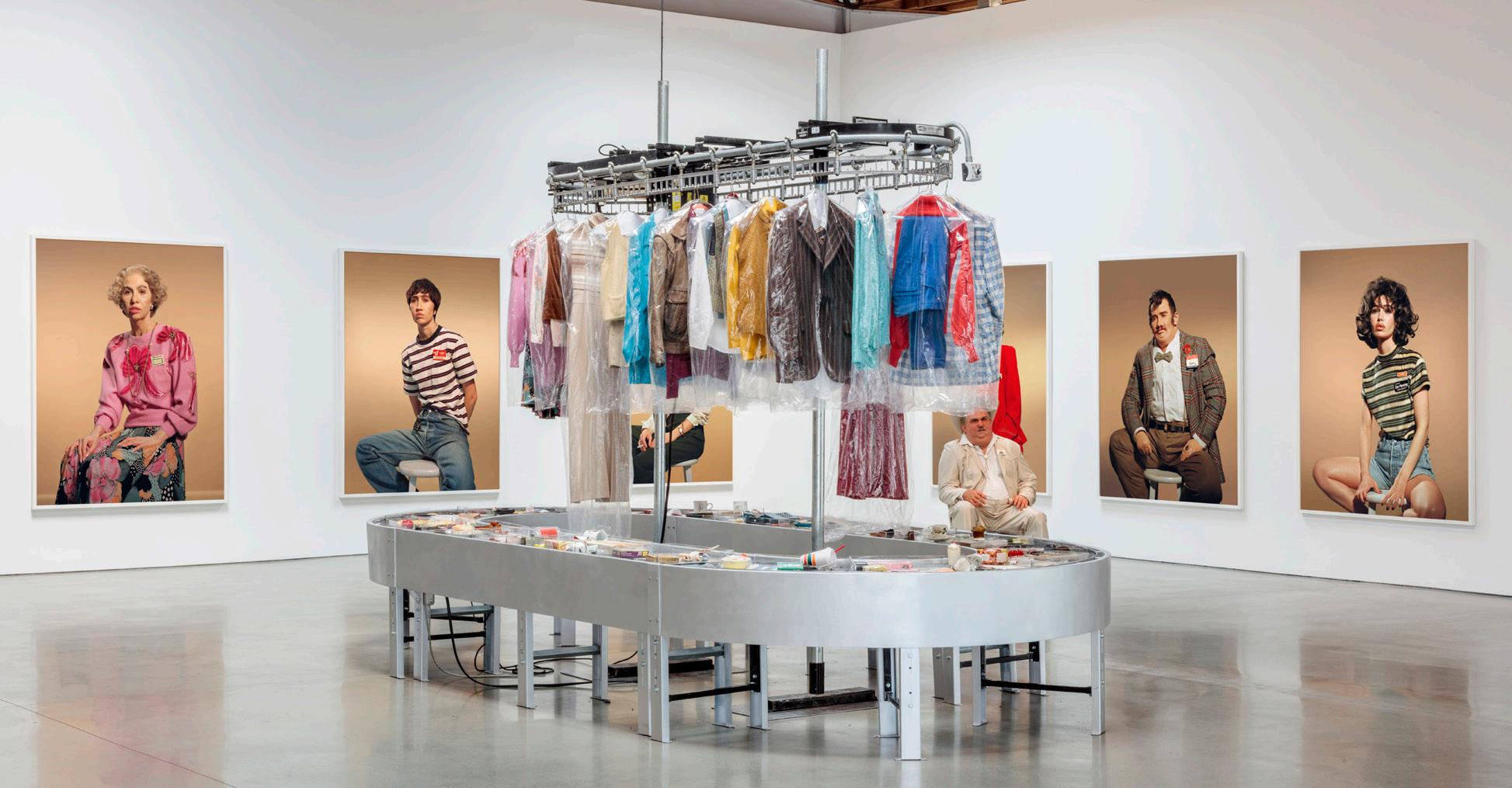
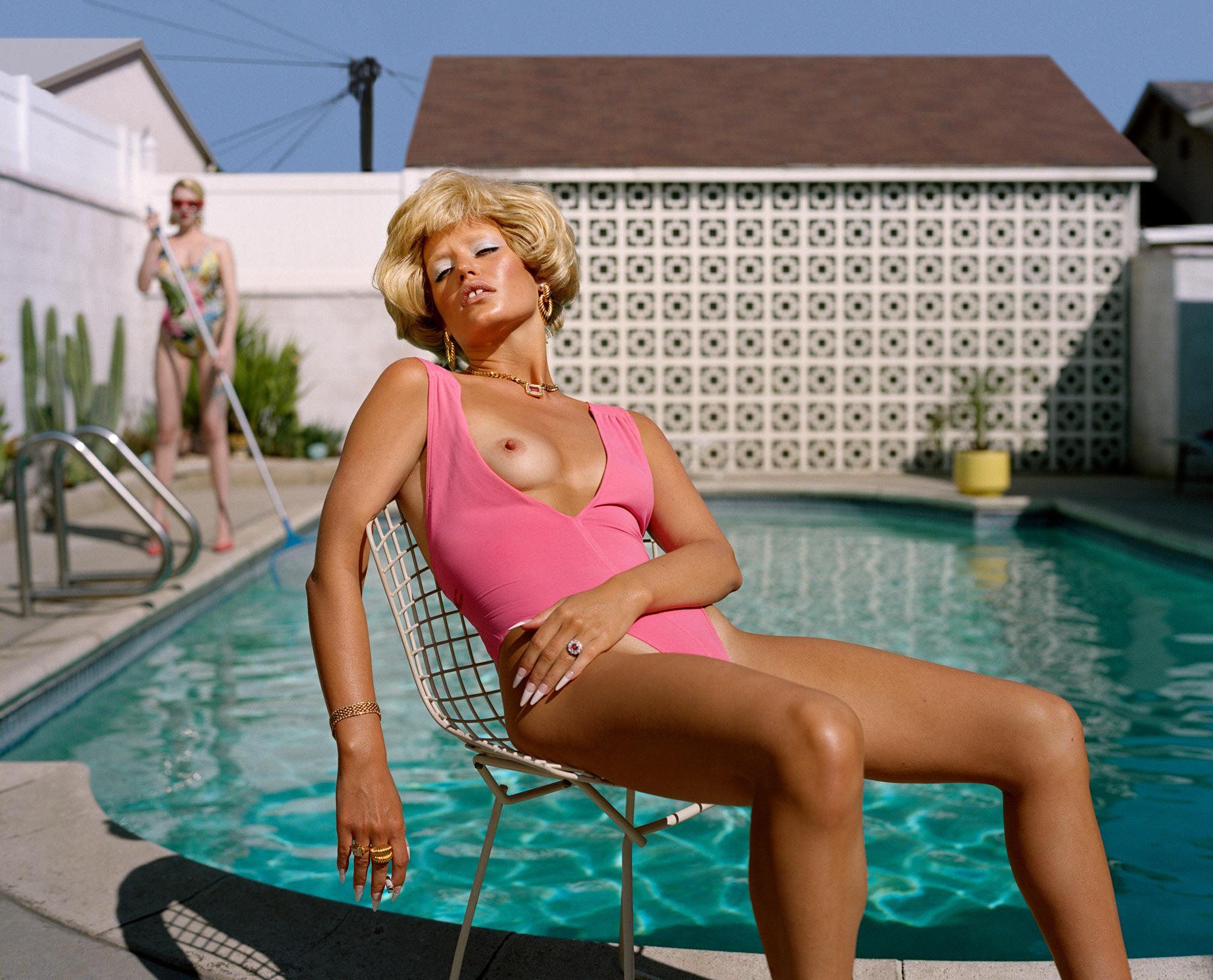
diffuse manner. In a series of wall reliefs made with urethane, resin, and other materials, all titled (Portrait) Vain German (2020–21), faces emerge from the works’ bruised surfaces like death masks. A contemporary collo quialism teaches us that to “unmask” someone is to reveal the truth about a person. But the mask is also an avatar of the self that touches both what is within and what is with out, an instrument that annuls the lines dividing the living and the dead, the visible and the obscene. Upson under stood that in these capacities, the mask might act as an inter loper in the borderlands, comprising the obscure landscape of one’s own “yuck.”
1. Paul McCarthy, “Interview with Kaari Upson,” in Kaari Upson: Good Thing You Are Not Alone, ed. Margot Norton (New York: New Museum, 2017), 25.
2. McCarthy, 25.
For the duration of Nadia Lee Cohen’s exhibition, HELLO, My Name Is, an elliptic, motorized dry cleaning rack and airport conveyor belt squeaked and clacked along at the center of the gallery. Fifteen bins rotated around the belt, each carrying an odd, unappealing collection of vintage items—cologne, motel keys, pantyliners, Sun-In, and a Ziploc bag containing two slices of bacon. Most importantly, each bin held a thrifted nametag, assigning each group of “belongings” to one of the 15 photographic portraits hung around the room. Jeff is a Nixon supporter;
Wanda has her period; nearly everyone smokes.
With the help of Hollywoodgrade prosthetics and costuming, Cohen trans formed into each of the 33 total characters in the portrait series (also titled HELLO, My Name Is). She collected the nametags that inspired the portraits at thrift stores and flea markets—pinned to each of the characters’ chests, the nametags also identify their place of employment (among them Pizza Hut, Arby’s, and Payless). These nametags, though, once belonged to real working-class people, who remain unknown to Cohen. She has appropriated and then reimagined their identities in painstaking, unflattering detail, spending time in a makeup chair to articulate details of their imagined physicality—their weight, wrinkles, blemishes, and perspiring skin. In making this work, Cohen inhabited the bodies of an imagined working class, creating high-production photos that masquerade as quick mall or yearbook portraits, the figures all posed on a wooden stool before the same fawncolored backdrop.
These portraits are a far cry from those in Cohen’s series Women (2016–21), on view in the second gallery, which mostly features recognizable, high-profile women from Cohen’s circle (Cohen has both modeled for and photographed major commercial campaigns¹). Among the famous faces are model Georgia May Jagger, of-the-moment actress Alexa Demie, and popstar Charli XCX. They are depicted with all the pageantry of Cohen’s editorial campaigns
Jagger’s portrait in particular could have been lifted from Cohen’s recent campaign for Kim Kardashian’s shape wear line, SKIMS. The subjects in Women are pictured midaction on full, cinematic sets: glistening and partially nude, they often recline by the pool, professionally lit and accented by background extras. That is to say: they are built out, and their worlds are built out around them. The elevated photographic treatment of women with real-world status makes the divide between this group and Cohen’s imagined working class in HELLO, My Name Is all the more glaring. Exhibited together, these bodies of work seem oblivious to class dynamics. They reinforce the cheap, easy tropes of visual hierarchy—and not because the artist was underscoring how photography, like society, is far less than democratized. In fact, there is little indication that Cohen intended for these works to comment on class at all.
Deeper in the galleries, a grid of videos featuring Cohen as 24 of the characters in the HELLO, My Name Is series purported to reveal “the intimate stories and truths behind each character.”² But the display effectively blended them into a chorus. The short videos all played at once, the characters each miming speech while a separate, loop ing audio track rotated only a few seconds of their quippy dialogue at a time—“It’s all upfront with me. Except there’s just as much behind!” says Big Kat, patting her hips.
The videos, like the images, became more about spectacle than “intimate truths,” their interest hinging on the knowl
Erin F. O’Learyedge or recognition of the fact that the characters are all Cohen.
The press release boasts that “in sharp contrast to the Facetune, filters, and Photoshop self-portraits of social media, Cohen adds lines and double-chins and love handles to her subjects[,] color ing in the pain and loss and heartbreak of their lives.”³
Big Kat and Jeff have swollen, fleshy fingers and fake doublechins; Jackie has a pronounced prosthetic nose and high, penciled brows; Brenda and Teena’s skin is painted with blemishes. This body of work was made in 2021, the same year that Cohen and her father appeared in all Gucci on the cover of the luxury fashion magazine Numéro Berlin,⁴ underscoring the fact that Cohen is punching down, involving herself in revealing the (imagined) vulnerabilities of others while not implicating herself in any capacity, disavowing a critical position in the process.⁵
This is where Cohen’s approach to the character self-portrait fails to achieve what artists like Gillian Wearing, Nikki S. Lee, Genevieve Gaignard, Tommy Kha, and earlier, Claude Cahun, have done in this genre. These photographers have used their bodies to investigate and express inti mate and urgent ideas (or cultural assumptions) about their identities as they relate to gender, family, diaspora, and race. In her 2003 series Album, Wearing employed fabrication experts to create silicone masks used to reconstruct old family photos, becoming not only her family members but also becoming herself again
as a toddler and teen. In Projects (1998–2001), Lee literally embedded and lived amongst various subcultural groups, transforming her appearance, dress, and mannerisms in an attempt to assimilate—but the images are also about her own identity as a South Korean woman living in the U.S., about never quite fitting in. By contrast, Cohen creates caricatures, mostly because she lacks a real stake in the matter.
Cohen has insisted that her photographic world “doesn’t reside in the same world that we live in,” and is “a much freer place to live.”⁶ But both of the bodies of work on view seem to replicate the stark inequities of our own world: Cohen populates her imagined world by co-opting the identities of real people who have undoubtedly experienced the struggles of exploitative capitalism and systemic classism, racism, and sexism. As the show came to a close in August, the gallery shared a goofy, eight-minute video about the exhibition, co-written by Cohen, on Instagram.⁷ An actor in costume as Cohen’s “Jeff,” narrates the satirical gallery tour. The post made the working class into a punchline, describing Jeff as “one of Arby’s four part-time managers.”⁸ Neither the PR video nor the work itself aims its critique at the systems of power and inequity that govern our lives (or the role that photography can play in reinforcing them)—and, as a result, both are ultimately more painful than satirical. For Cohen to occupy a body malleable and unmarked enough that it can serve as a “blank slate” is a privilege
of mobility that necessitates certain structural advantages (beauty, wealth, whiteness, et al.). Unfortunately, she exercises that power to imagine a world that merely replicates the deep inequities of our own—a project only possible in the absence of empathy and regard for the profound stakes of photographic representation.
1. Cohen, undoubtedly, has a strong editorial eye, but her images are also derivative, perhaps most of the photographs of Larry Sultan and Philip-Lorca diCorcia—Richie, Brooklyn, New York (2020) is a dead ringer for diCorcia’s Marilyn; 28 Years Old; Las Vegas, Nevada; $30 (1990–92).
2. HELLO, My Name Is, press release, Jeffrey Deitch, 2022, https://deitch.com/ los-angeles/exhibitions/nadia-leecohen-hello-my-name-is.
3. HELLO, My Name Is.
4. NUMÉRO & NUMÉRO HOMME BERLIN (@numeroberlin), “NUMÉRO BERLIN / THE „ALTER“ ISSUE — / GET YOUR COPY ! / Models @nadialeelee with her dad,” December 10, 2021, https:// www.instagram.com/p/CXUEjxqsWb2/.
5. To be sure, Cohen does appear as herself in the show—just once across the two groups of photographs on view. In Nadia, North Hollywood, Los Angeles (2020), included in Women, she is glamorously made up, sporting big hair and small red panties.
6. Jyni Ong, “Nadia Lee Cohen on how she became Nadia Lee Cohen,” March 8, 2019, https://www.itsnicethat.com/ features/nadia-lee-cohen-photographyinternational-womens-day-080319.
7. Jeffrey Deitch (@jeffreydeitchgallery), “NEW! Explore Nadia Lee Cohen’s ‘Hello, My Name is’ exhibition via @nowness with host Jeff,” Instagram, August 17, 2022, https://www.instagram.com/p/ ChXf6CfF7bR/.
8. “Culture Catcher,” August 17, 2022, produced by Fabien Colas and Malcolm Duncan, video, 8:09, https://www. nowness.com/story/culture-catcher.
August 6–September 10, 2022
For Wendy Park, it was the soothing scent of her mother’s Tiger Balm, the memory of her father’s nightcap (Crown Royal with three ice cubes), and the ambient sound of the Korean nightly news. For me, it was my mother stealing away for a piece of dark chocolate as my dad dozed on the couch while watching Antiques Roadshow. In the exhibition OFF THE CLOCK, Park took great care in rendering the relished rituals of rest that her parents looked forward to at the end of each workday. There’s an almost cinematic quality to the way that Park suffuses the familiar routines of L.A.’s immigrant working class with unexpected luxury—her references to objects of ’90s childhood nostalgia mirror the trappings of my upbringing as the daugh ter of working class Eritrean immigrants. Many of Park’s early memories center around labor, and the objects in her paintings—even the trinkets that she associates with rest— are inescapably tied to work and commerce. What does it look like when our most potent memories, of those intimate, in-between moments shared with loved ones in domestic spaces, are mediated by labor? Park takes these fleet ing occasions and stretches them out on canvas to present a new, inspired way of reconcil ing with the working class experience.
In these large-scale compositions, deep ever greens and reds give way to pastel pinks and purples, the hues at once garish and banal. Park’s paintings have a precise and realistic, yet highly graphic, quality to them—unmistakable renderings of Crayola markers, a Shin Ramyun container, and a pair of dark-wash Levi’s are met with the playful, collage-like 2-dimensionality of colorful storybook illustra tions in which perspectives warp and each element feels compositionally grounded. The Sony remote in the foreground of Off the Clock (all works 2022) feels larger than life, pointing perhaps to the irresistible pull of an evening on the couch after a long work day. Her vibrant palette and rounded shapes suggest a kind of ’90s-era nostalgia (a Gak-green color appears in several works, a speckled, fuschia linoleum in others) that make personal reflection irresistible to a viewer of a certain age.
Heart Apples and Hangers is an affectionate blend of the ever-present ephemera of working life and the just-asubiquitous tenderness of home. Three apple wedges loosely resembling hearts wait to be eaten on a plate that rests atop a table strewn with clothes hangers. The snack feels representative of the sweet slivers of respite that cut through the relentlessness of making ends meet. Time waits for no one, and yet, a parent who manages to stop the clock long enough to present their child with a little treat feels emblematic of the familiar, perseverant spirit of leisure that is safe guarded against the otherwise
labored existence of immigrant life in this country.
Park’s paintings celebrate the particular brand of immi grant resourcefulness that long predates the phrase “zero waste,” a practical duty to reuse almost anything that is brought into immigrant homes. In Crown Royal Supplies, the regal purple drawstring bag once containing her father’s Crown Royal has been repurposed as a school supply pouch—Crayola crayons and markers, pencils, and a pink eraser tumble out of their new home. In Poker Story, a giant cardboard box and a thin slab of unfinished wood become an outdoor game table. In Lemon Soju, a cinder block stacked with soju and lemons makes for an elegant bar. The pink-tiled backdrop makes the ordinary translucent green bottle pop, giving it the star quality of a glossy magazine ad and transforming the cinder block into a worthy pedestal— a testament to Park’s painterly treatment of otherwise discardable things. Growing up, before my mom left for the diner where she waitressed, she would leave missives for me and my sisters on the back of restaurant slips with old orders for Grand Slams and over-easy eggs scrawled on the other side. Metal cookie tins became sewing kits; empty glass tomato sauce jars became containers for clarified butter.
Working class life has been a recurring theme in Park’s previous paintings, with a special focus on the Southern California swap meet—the commerce culture was a big part of her childhood. She continued to play with these subjects across many
Neyat Yohannesof the paintings in OFF THE CLOCK. A closer inspection of Lemon Soju reveals a tiny neon orange price tag. The repurposed box in Poker Story is spackled with price stickers, too. Levis Inventory shows folded blue and black itera tions of the popular denim jeans hung beside an L.A. swap meet mainstay: a white cotton Pro Club heavyweight T-shirt. In the upper corner of the painting, an oversized placard reads “$6.99. ” Park has said that as a child, her father’s workplace (the swap meet) “became her playground.”¹ I imagine her on adventures through racks of clothes as she patiently waited for her dad’s shift to end, not unlike the way I’d once sat at the diner counter, daydreaming over a plate of fries and a raspberry iced tea as I waited for my mom to clock out.
First-gen kids with working-class parents often lament the disproportionate degree to which our parents’ identities—and thus our memories—were shaped by labor. Park acknowledges this reality, but shifts her focus. Instead, she honors the treasured moments when the authentic, most relaxed versions of our parents would come out and sit for a spell between shifts. This romantic and revelatory approach invites sweet reminiscing about heart-shaped fruit and dark chocolate stashes. It manages to zero in on these provisional pleasures and offers a new lens through which we can mine our most formative memories.
1. Wendy Park, “About,” artist’s statement, accessed October 5, 2022, https://www. wendypark.co/about-2.


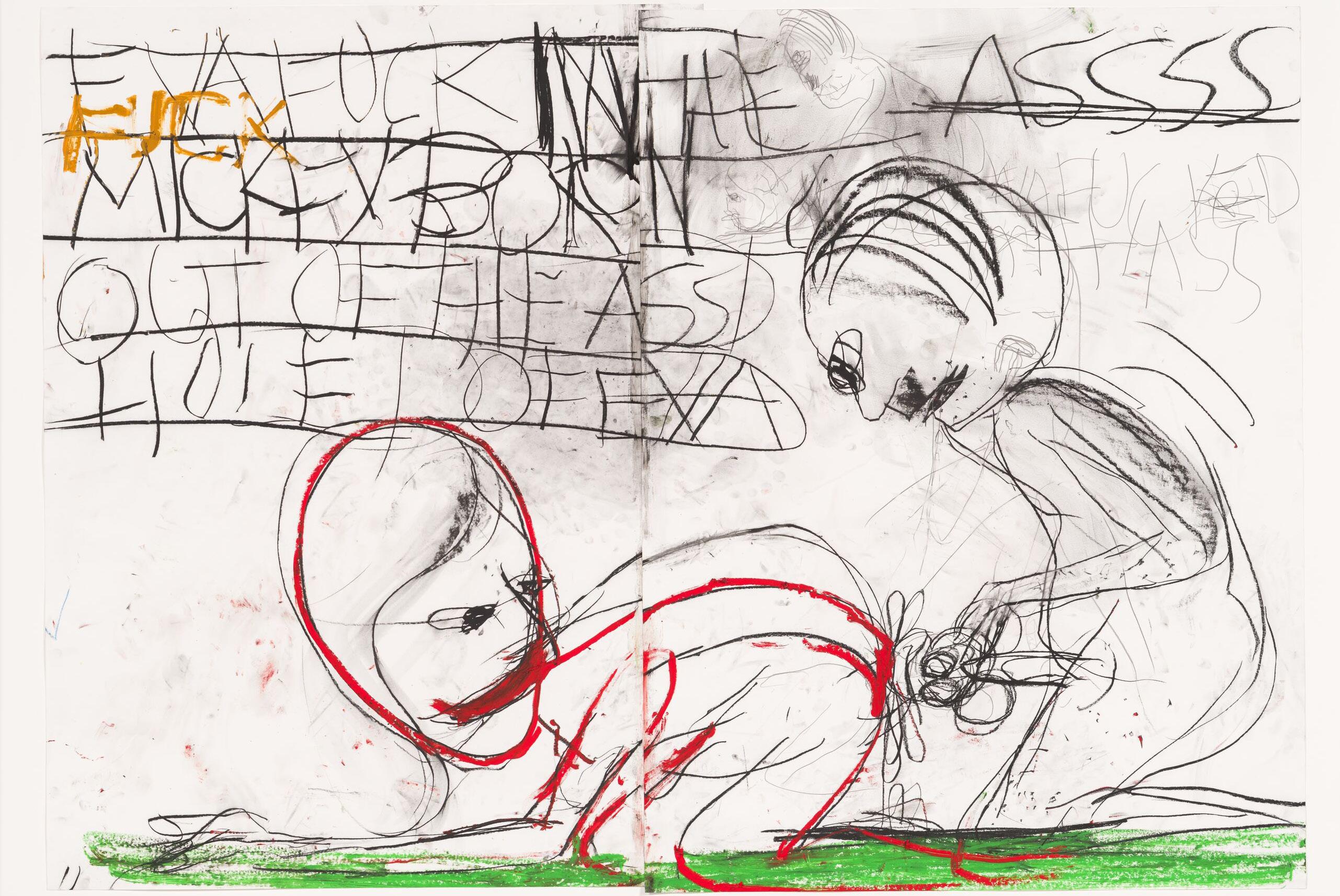
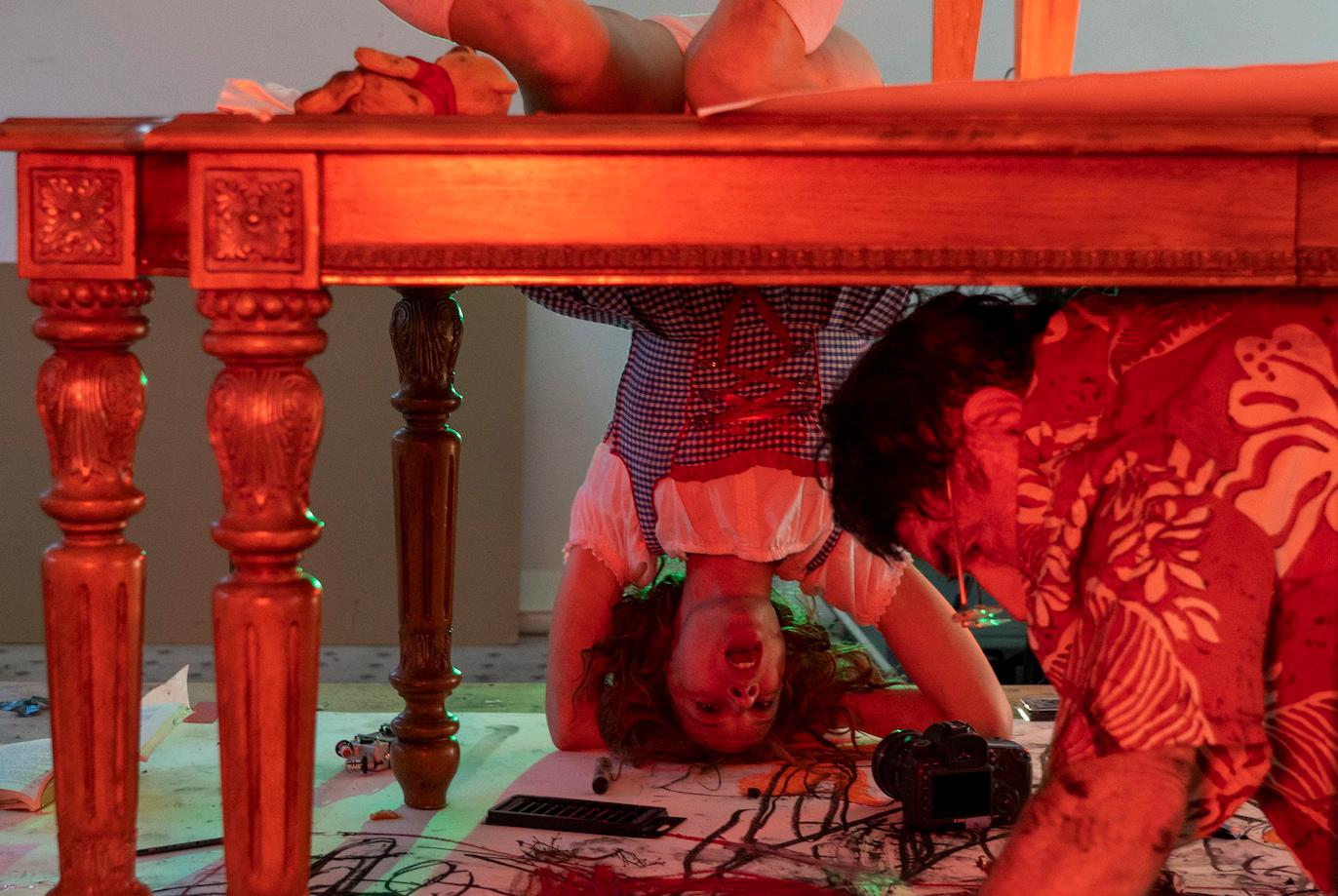 Bottom: Paul McCarthy, A&E Drawing Session (performance still) (2021). © Paul McCarthy. Image courtesy of the artist and Hauser & Wirth. Photo: Alex Stevens.
The “A&E” in Hauser & Wirth’s recent exhibition, ‘Paul McCarthy. A&E Drawings A&E Drawing Session 2021
With Lilith Stangenberg,’ stands, in part, for Adolf Hitler and his wife Eva Braun¹—two figures represented across the large-scale drawings in beautifully deranged, gestural scrawls of smudged charcoal highlighted with colorful oil stick. Works like A&E, ASSSS, Santa Anita session (2020) set the prevail ing mood, depicting Hitler using his penis to insert a miniature Mickey Mouse into Braun’s anus. In case there was any uncertainty, the artist clarifies the scene in writing: “EVA FUCK IN THE ASSSS.” McCarthy, now 77, produced these drawings during a series of taped performances with 34-yearold German actor and longtime collaborator Lilith Stangenberg; A&E evolved from NV Night Vater (2019–), their ongoing film series loosely based on the 1974 Nazi S&M thriller The Night Porter. Tucked upstairs in the gallery mezza nine, one two-channel video featured a fake-mustached McCarthy mostly naked from the waist down, playing Adolf opposite Stangenberg’s Eva, who was mostly naked from the waist up. Wedged clumsily between a stack of tables in a white studio, McCarthy crawls on his hands and knees, grunting and swearing as he scribbles, drifting in and out of aware ness of Stangenberg’s body.
She strips down from a Halloween-quality dirndl to white stockings and panties, grinding against the drawings while scoring the scene with random obscenities: “My father fucks me in the nostrils!” The scene continues for a full hour and 45 minutes, the effect less provocative than it is tedious. The coarse, guttural aimlessness is classic McCarthy, rehashing the fivedecade-old formula we’ve seen many times before. McCarthy’s distinguished practice of abject spectacle emerged in the early 1960s, a descendant of avant-garde movements in action painting, Happenings, and nonnarrative filmmaking. Akin to the shitting and pissing of Viennese Actionists, McCarthy’s depravity-laden films, drawings, and installa tions are often products of dissociative, costumed performances that earned his place in the canon by diving into the nightmarish depths where the mind is loath to go. “He makes plain the dysfunct ionalism of the American dream,”² New Museum director Lisa Phillips wrote of McCarthy in 2000. Often, that involves him sticking dicks in things: the jar of mayonnaise in Sailor’s Meat (Sailor’s Delight) (1975), or the tree in his installation The Garden (1991–92). Since the turn of the century, the artist’s work has bloomed into big-budget productions of more explicit, higher-definition depictions of sexual violence —just as belief in the American Dream has fallen into precipitous decline. His latest and largest works take aim at vintage American ideals as they once existed in the entertainment industry, ratcheting up the
libidinous underbellies of Disney fairytales and Hollywood Westerns in grotesque reinterpretations. His latest Hitler project, according to the press release, is an exploration of fascism and “the current political climate,”³ although it doesn’t feel very current at all. Today, the threat of fascism looms amid a constellation of bad actors and the simultaneous erosion of our civil rights. By contrast, the symbolic Hitler embodies a naive reflex to pin society’s undoing onto a singular bogeyman—in other words, reductive, dated, low-hanging fruit.
The political incisiveness of McCarthy sticking his dick in things might be wildly overstated, but critics tend to undersell the personal—that is, the distinctly 20th century, European-American male perspective deftly captured in his work. Where art history tells us that sexual violence in the work of his female contemporaries is about a particularly female experi ence, for example, rape in McCarthy’s work is about America. These generalized readings elide an evident guilt, nostalgia, and kink for a bygone Germanic heritage. (Across McCarthy’s oeuvre, see: recurring references to Snow White and Heidi, or Stangenberg reading aloud from a German-language copy of Venus in Furs.) His portrayals of Walt Disney, Hitler, and many other figures consistently return to the specific narcissistic archetype of male privilege, an ideal vehicle to indulge in the deep est, darkest toxic schoolboy taboos: shouting “shit” and “fuck” at beautiful naked women; mixing ketchup and
Janelle Zarachocolate syrup into repulsive concoctions; beating and raping; or clandestinely urinating in someone’s soup. Exploring the full range of the human condition is not a bad thing; it is art’s highest function. Like the late Viennese Actionist Hermann Nitsch, who sought catharsis through blood-and-guts spectacle,⁴ McCarthy momentarily sheds the repression of the so-called “degenerate” impulses in his performances, creating a safe space to enjoy and examine unique proclivities. (He’s described this as “venting.”⁵) An important distinction between McCarthy and Nitsch’s work, however, is that while Nitsch’s primary concern was his audience’s experience, McCarthy has said that he is “not trying to satisfy an audience,” but that his “responsibility is to the ideas.”⁶ At the heart of McCarthy’s practice is the exploration of power—not just through the powerful figures he portrays, but the power instilled in an artist who has accumulated great wealth and esteem for inserting his penis where it’s not wanted. With the art world’s blessing, McCarthy occupies an insu lated space of great privilege, where the American Dream seems to be alive and well, and fascism is not a real threat, but a kink. From the outside looking in, this space looks like great fun: its occupants freely go where society says not to, regardless of how many of us might say, “please don’t.”
1. For McCarthy, the “A&E” also alludes to Adam and Eve & Arts and Entertainment.
2. Lisa Phillips, “Introduction,” Paul McCarthy (New York: New Museum of Contemporary Art, Ostfildern-Ruit, and Hatje Cantz Publishers, 2000).
3. Hauser & Wirth, “Paul McCarthy A&E Drawings A&E Drawing Session 2021 With Lilith Stangenberg,” press release, 2022, https://vip-hauserwirth.com/ gallery-exhibitions/paul-mccarthy-aedrawingsae-drawing-session-2021withlilith-stangenberg/.
4. Hermann Nitsch, “Herman Nitsch talks about his work at Massimo De Carlo in London,” interview with Alex Jovanovich, Artforum, May 15, 2018, https://www.artforum.com/interviews/ hermann-nitsch-talks-about-his-workat-massimo-de-carlo-in-london-75363.
5. Kristine Stiles, “INTERVIEW: Paul McCarthy: ‘My work refers to my private, forgotten or repressed memories. I recognize them as existing, but I am not sure how they relate to me. Are they specifically my trauma, or someone else’s?’” ARTSPACE, August 6, 2020, https://www.artspace.com/magazine/ interviews_features/qa/interview-paulmccarthy-my-work-refers-to-myprivate-forgotten-or-repressedmemories-i-56624.
6. “Paul McCarthy in ‘Transformation,’” Art21 video, 18:06, October 21, 2009, https://art21.org/watch/art-in-thetwenty-first-century/s5/paul-mccarthyin-transformation-segment.
Images can be sites of resis tance. I was reminded of this at a recent visit to LA Plaza de Cultura y Artes, where the group exhibition, L.A. Memo: Chicana/o Art from 1972-1989, brought together 31 artists who sought to subvert and critique the expanding media culture of the ’60s and express cultural pride. The works were primarily drawn from the collection of community healthcare provider AltaMed, which concentrates its holdings on Chicanx artists,¹ resulting in a slightly hemmedin vision. Since the exhibition
drew from a corporate collection, some of the more experimental, conceptual, and collaborative practices of the era—for instance, the photographs of Laura Aguilar, Kathy Vargas, and Ricardo Valverde; the genredefying paintings of Yolanda López, René Yañez, and Charles “Chaz” Bojorquez; or the pioneering performance and installation work of artists like Edmundo “Mundo” Meza—were notably absent, ultimately offering a somewhat neater and teleological story of Chicanx resistance. Despite its circumscribed focus, L.A. Memo highlighted the impact that these artists have had on the city and its art discourse, and, in turn, the impressions the city left on them.
The works in the exhibition were loosely grouped into two categories: media critique and Chicanx identity. In the first gallery, artists took aim at mainstream media, comment ing on the lack of cultural representation in advertising and Hollywood. In Pillow Talk (1979–80), Patssi Valdez imagined the female Latinx icons she yearned for, but wasn’t seeing in the glossy magazines of the time, by inserting her friend Betty Salas into a fashion spread pastiche. Wearing a strapless, skintight bodysuit, long gloves, and heart-shaped sunglasses, Salas lounges nonchalantly on plush yellow cushions. Other works address a Hollywood interpretation of Los Angeles: Teddy Sandoval’s mixed-media works explore the physical ideals perpetuated by the film industry; Joey Terrill’s paint ings reimagine storyboard music titles as queer love narratives; and in Linda Vallejo’s video Take a Bite
Rosa Tyhurst
60
(1977–2017), the artist hijacks Warhol-esque screentests in a melee of color and gestural markings.
AltaMed Curatorial Assistant Rafael Barrientos Martínez, who guest curated the show, focused the exhibition on the years following the 1970 National Chicano Moratorium, a demonstration led by Chicanx activists in protest of the disproportion ately high number of Latinx individuals who were sent to fight, and ultimately die, in the Vietnam War.² While the Chicanx community was fighting for civil rights and representation, their stories remained absent from main stream media; L.A. Memo’s first gallery succinctly, albeit safely, articulated both the explosion of activism and its subsequent silencing. Harry Gamboa Jr.’s photograph Iris Crisis (1982) depicts his body obliterated by pieces of white tape. In the image, he is a blank canvas, his identity invisible. Only one work in this gallery directly addressed the war: Roberto Gutierrez’s Madness in Vietnam (1987), a haunting oil pastel self-portrait. The artist’s eyes are wide, his brow is furrowed, and his hair stands on end. Staring out from behind a metal window, he appears to scream and gasp for breath, invoking the grim reality of PTSD suffered by many individuals in Gutierrez’s community. The drawing is one of the few in the exhibition that is not part of the AltaMed Art Collection, which, given how few works in the show, at least on the surface, grapple with overtly controversial issues, I can only speculate is due to its scope and objective.
The Chicano Moratorium
provided a curatorial frame work for the exhibition, yet, in artwork form, references to the Vietnam War were scant. The second gallery moved away from media critique to explore a sense of place. Many artists explored ideas of indigenismo, a belief that counters the dominance of colonial influence, by making work that honors their Indigenous cultural heritage and a connection to the land. A notable shift from the first gallery, these works looked at how the Chicanx community developed personal and collective iden tity within their relationships to visual traditions from what are today the American Southwest and Northern Mexico. Carlos Almaraz’s L.A. Memo (1980), from which the exhibition took its title, fuses an exported ideology of Los Angeles—palm trees, sunshine, and glamor—with his experiences as a Chicanx man. Swirling together in a jumble of oil pastels, Almaraz’s scene suggests that these parallel identities are not mutually exclusive, but equally important aspects of his personhood. Nearby, Arturo Urista’s Welcome to Aztlan (1987) laid out a map of the original homeland in Aztec migration stories—a place where the regions that now sit on either side of the U.S./ Mexico border were not separated by arbitrary demarcations and where inhabitants could travel freely. The themes of this gallery felt in contrast to those of the first, revering and reaching toward the land, while looking back on cultural histories, rather than using contempo rary culture as a framework. The different camps are an
affecting combination across the show, and work to expli cate the variety of approaches adopted by Chicanx artists of the time. This tension was well articulated by Randy Kennedy in 2011, who wrote that for Gamboa, “the best way to exercise artistic freedom and express solidarity with the Mexican-American cause was, paradoxically, to run screaming from most MexicanAmerican art.”³ A founding member of the influential Chicanx performance collective Asco, Gamboa and his peers wanted to distinguish themselves from the stereotypes imposed by mainstream culture. Meanwhile, others, like Lujan and Urista, embraced cultural iconography as a pathway toward inclusion. While L.A. Memo attempted to flesh out these histories, it was at times limited by the curatorial constraint of its provenance— the AltaMed Art Collection. Collection shows will always be affected by an institution’s overarching aims and themes: As part of their holistic approach to healthcare, AltaMed places art throughout their service sites. These are usually clinical spaces that are open to the public and in which the artworks are not closely attended, so, understandably, practicality would influence the works collected —often meaning that they are domestically scaled, on paper, and under glass. Inevitably, curating from a collection leads to a partisan approach, and the ambitions of L.A. Memo felt limited by the practical concerns of the collection. Nevertheless, the exhibition produced a welcome
presentation of the core ideas and ideologies most urgent to Chicanx artists in this specific era of L.A.’s history, a time marked by a multifaceted and complex vision of what it meant to be Chicanx.
1. Teena Apeles, “AltaMed Enriches the Lives of Its Patients through Art,” KCET, November 5, 2018, https://www.kcet. org/shows/artbound/altamed-enrichesthe-lives-of-its-patients-through-art.
2. Louis Sahagun, “How an East L.A. protest gave voice to the Chicago movement,” The Los Angeles Times, August 23, 2020, https://www.latimes. com/projects/chicano-moratorium/ east-la-protest-gave-voice-chicanomovement/.
3. Randy Kennedy, “Chicano Pioneers,” New York Times, August 25, 2011, https:// www.nytimes.com/2011/08/28/arts/ design/works-by-asco-at-the-losangeles-museum.html.
April 20–August 14, 2022
Last spring, Los Angeles-based artist Kelly Akashi traveled to Venice, Italy, and its neighbor ing island Murano to produce a new body of work for Life Forms, the inaugural summer exhibition at Barbati Gallery. Situated inside the Palazzo Lezze, the space offered a cooling refuge in the heart of the baking Campo Santo Stefano. Murano is renowned for its innovative role in the history of European glass making, and Akashi worked with the local glassblowing community to produce some of the handblown glass sculp tures included in her exhibition. The sinuous, meandering forms of these sculptures take advan tage of glass’s ability to molt, curl, and mimic the natural
world, particularly the vibrant biodiversity of its flora.
Akashi’s sculptures place human beings within the context of these nonhuman agents, implying a cohabiting and leveling of lifeforms— in the artist’s work, hands and figures coexist with plant-inspired iconography, coalescing into a system of support and interdepen dence. This notion is paralleled by her partnerships with local artisans—within a community of glassblowers in which knowledge-sharing is a tenet, teamwork is indispensable, and collaboration is intrinsic. By following the medium of glass to one of its historic epicenters, Akashi’s show works to undermine the idea of “mastery,” instead embrac ing humility and curiosity by seeking ongoing nourish ment from process, material, and community.
Modeled after the Palazzo’s floor, the slab of terrazzo included in Floret (all works 2022) aptly modeled Akashi’s collaborative prowess.
The hefty, elevated slab became a table that supported five handblown glass objects produced with the aid of master glassblower Matteo Tagliapietra. They incorpo rated techniques that are traditional to Murano glassblowing, such as murine and merletto, to create unique patterns based on plant cell specimens. In a nod to Venice’s famed boating culture and canal-lined architecture, local boating rope tethered these spherical “florets” together into a cross-pollinated ecosystem of forms.
On the dimly-lit first floor, Akashi literally draped the human form with florals. The Palazzo’s foyer was flanked
on either side by wall-mounted bronze casts of the artist’s hands—a motif she returns to frequently across her oeuvre—holding shapely glass bulbs like floating offerings (Life Forms). At the center of the space, a relief of a human body was draped in knit bronze, like a bespoke weighted blanket. Titled Heirloom, the bronze blanket was constructed from an intricate and layered process: Akashi cast the blanket using hand-crocheted flowers and “knit” the form together through meticulous welding. The piece recalls Ana Mendieta’s Siluetas (1973–80), a series of earthworks in which the artist imprinted her body into various natural landscapes, their hollow silhouettes sometimes filled with fire, water, or flowers. In Heirloom, the human form is inseparable from its floral shroud— the bronze flowers contour the body, whose defining human characteristics are hidden from view.
On the gallery’s upper level, sparse scenes through out each of the light-filled rooms further imagined human connections to the nonhuman world while also engaging in collaborations with the built environment. Tucked into a shelf in a small room was April 2022 - Scarpa Graveyard; Murano (Matteo); Buona Pasqua Giudecca; Pearl, a bronze cast of the artist’s hand delicately holding materials culled from various areas in Venice: a cloth leaf, a green and black glass flower, a single white pearl, and pieces of rocks and broken-off edifices laid atop one another like geological strata. The bronze hand functions as a vessel for items gleaned
Vanessa Holyoakfrom the city, creating an unas suming archive that inflects Akashi’s experience with local cultural memory. Contrasting the built environment with the natural world thus high lights human intervention in nature on a city-wide scale.
Glass is, in some ways, the ultimate teacher—we can bend it to our will, but the final results are beyond our control, mirroring our attempts to control nature. This illusion of control is becoming increas ingly apparent in the context of the Anthropocene, in which hyperobjects of our creation, like climate change, exert forces that threaten to wreak havoc on both natural and manmade spaces. In this way, Akashi’s recent works hinge on disparate yet intercon nected forms of collaborative knowledge. Turning to tradition to participate in a communal lineage of craft, while also gleaning insight from the vast intelligence of the natural world, Life Forms took shape as a timely feat of collaboration. Thus, these collaborations—between humans and across species— are now all the more essential, as we belatedly recognize that ours is a shared world, shaped by the same forces, entwined by a collective fate.
Kelly Akashi, Life Forms (2022). Handblown glass and lost-wax cast bronze, 18.25 × 9 × 6.75 inches. Image courtesy of the artist and Barbati Gallery.
Paloma Dooley (b. New York, NY, 1993) lives and works in Los Angeles, where she shoots exhibition and documentary photography for artists, galleries, and museums. She earned a BA in Photography from Bard College in 2015 and completed a month-long residency at the Vermont Studio Center in 2016. Her work has been included in publications and shows at home and abroad.
Mimi Lauter (b. 1982, San Francisco, CA) is a Los Angeles-based artist who—working with oil pastels and soft pastels on paper as well as oil on canvas and linen—uses her oeuvre as a springboard for deeper reflection on painting as a theatrical space in which to present imagery, form, and narrative. Suspended somewhere between still-life and landscape, between the internal and external worlds, Lauter’s works position themselves as spiritual experiences.
Heather Rasmussen is an artist living and working in Los Angeles. Rasmussen received her MFA at CalArts and her BFA at UC Irvine. She choreographs scenes for photographs, sculptures, and videos using her body, plaster casts of her legs and feet, oddly-shaped vegeta bles, and other possessions loaded with personal and historical meaning. Rasmussen’s work can be found in the permanent collections of the Art Institute of Chicago and the Los Angeles County Museum of Art.
Diane Williams is a Filipinx interdisciplinary artist. Her work has been featured in Artforum, Hyperallergic, Los Angeles Magazine, CBS, KPCC, LAist, LA Weekly, Artillery, and KPFK. Select exhibitions include the Armory Center for the Arts, 18th Street Arts Center, HR, MOAH, UTA, College of the Canyons, Cerritos College, RAFFMA, CSUSD, Children's Museum New York, Berkeley Art Center, and SFAC. Williams earned her MFA at USC.
Isabella Miller lives and works in Los Angeles.
Erin F. O’Leary is a writer, editor, and photographer from the Midwest and raised in Maine. A graduate of Bard College, she has lived in Los Angeles since 2018, where she writes about photography and image culture.
Neyat Yohannes is a freelance writer based in Los Angeles. Her work has appeared in Criterion’s Current, Mubi Notebook, Bright Wall/Dark Room, Bitch, KQED Arts, cléo journal, Playboy, and Chicago Review of Books, among other publications. In a past life, she wrote tardy slips for late students.
Janelle Zara is a Los Angeles-based freelance journalist and the author of Becoming an Architect, a title in Simon & Schuster’s Masters at Work series. You can find her work in a variety of publications focusing on art, design, and architecture, including The Guardian, T Magazine, Artnet, and many others. Her favorite In-N-Out location is the one outside LAX.
Rosa Tyhurst lives and works in the U.K. and is the curator of exhibitions at Nottingham Contemporary. She has previously held positions at Spike Island, Bristol; Fondazione Sandretto Re Rebaudengo, Turin; KADIST, San Francisco; and the de Young Museum, San Francisco. Her writing has been published in Art Monthly, Elephant, and Hyperallergic, as well as in artist publications.
Vanessa Holyoak is an interdisciplinary writer and artist based in Los Angeles. Her art writing focuses on installation, sculpture, and image-based practices. She holds a dual MFA in Photography & Media and Creative Writing from the California Institute of the Arts and is a PhD candidate in Comparative Media and Culture at USC. Her criticism has appeared in art-agenda, BOMB, East of Borneo, and Hyperallergic, among other publications.
Eso que llamamos el mundo del arte puede parecer rígido y elitista, una noción que contradice la razón por la que muchos de nosotros nos acercamos al arte en primera instancia: encontrar un espacio que es libre de expectativas o reglas. El artista en su estudio tiene una especie de rebelión privada para uno, rompiendo con la semilla rampante de la vida moderna para asentarse en lo desconocido. En este número, Allison Noelle Conner considera la idea de “el derrame” en relación con el trabajo de varios artistas. Escribe cómo, “al evocar las propiedades del agua, un derrame connota una sensación de libertad, una incapacidad para ser confinado o controlado”. El derrame es una insistencia en expansión y movimiento. Más adelante en este número, en una entrevista con Yves B. Golden, la artista Amia Yokohama pone un lenguaje diferente a esta idea, explicando su individualidad como algo fluido o, como ella dice, “una abstracción” —otro audaz rechazo contra el ser nombrado y conocido.
La búsqueda de lo incognoscible era un punto central para Kaari Upson, como comenta Isabella Miller en su reseña de la obra de la difunta artista. Miller escribe que para Upson “el yo no es una entidad estable
y fija”. La desconexión de Upson con su propio misterio esencial la llevó a sumergirse en las historias de otras personas con voracidad —para Upson, la búsqueda de lo desconocido se convirtió en una vía hacia la conectividad íntima.
Para asomarse al derrame, para salir de las estructuras dominantes, debemos confiar en que otro mundo es posible. Las organizaciones destacadas en el artículo de Julie Weitz trabajan para rechazar los sistemas injustos dando priori dad al cuidado mutuo y tomando medidas activas para reimaginar las comunidades en las que quieren vivir. Este tipo de visión de futuro requiere un trabajo sobre el terreno, una noción que la artista Andrea Bowers, de la que habla Jessica Simmons en este número, conoce bien —Bowers utiliza su obra de arte y su participación en la comuni dad para insistir en que el cambio es posible si todos luchamos juntos para conseguirlo.
En este caso, la idea del derrame se vuelve revolucio naria —el derrame es un rechazo al conformismo, una negación de los sistemas rígidos y un camino hacia otro modo de ser—. Si el derrame es una reimaginación, que sea una abstracción que nos permita la gracia y el espacio para cambiar y rehacernos a nosotros mismos gota a gota.
Preston Zappas Fundadora y Editora JefeLas fotografías de Clifford Prince King me llegan como escenas de una película a medio recordar. En Hi-Lite (2017), un joven, vestido tan solo con unos bóxers azul cobalto a cuadros, se extiende expectante en una cama mientras el pie de otro acaricia el suave bulto de su entrepierna. La imagen está muy recortada: un fragmento de un torso, muslos, una pierna y un mechón de pelo que asciende por un muslo. En V (2022), un retrato enmarcado por una cortina de color rojo frambuesa, otro hombre sin camisa —con los ojos desviados hacia abajo y el pelo negro dividido en gruesos mechones— aparta la mirada de la cámara, rechazando en silencio las exigencias tácitas del retrato tradicional. Sentarse con los torsos recorta dos y las miradas desviadas de King supone un ejercicio de desorientación que me lleva a ajustar mis expectativas sobre lo que debe hacer y mostrar un retrato. Sus imágenes generan un montaje de sensaciones que me acercan a las partes más sensibles de mí mismo. Artista autodidacta, King trabaja a menudo con amigos, amantes y personas de su comunidad creativa, en escenas que confun den los límites entre lo sincero y lo escenificado.
El hincapié de King en sus amigos y amantes se hace eco, en particular, del trabajo de otros dos fotógrafos contemporáneos, Paul Mpagi Sepuya y Shikeith. Los tres artistas comparten su
enfoque en las texturas de las intimidades de los negros queer, construyendo sobre el legado de artistas como el cineasta Marlon Riggs, quien desarrolló un arte dedicado a los hombres negros que amaban a otros hombres negros durante un período marcado por la omni presente homofobia, el racismo y el puritanismo —su documental experimental Tongues Untied (1989) se desenvuelve como un viaje libre hacia los paisajes emocionales de la comunidad gay negra—. En contraste con las ensoñaciones poéticas de King sobre hombres negros queer en medio de escenas domésticas, Sepuya fotografía en un entorno de estudio y emplea elementos de collage y espejos, explorando las interro gantes que florecen cuando dos o más cuerpos se fusionan con las herramientas del medio fotográfico. A través de la fotografía, la instalación, el cine y la escultura, la obra de Shikeith capta figuras negras en momentos de éxtasis, oración, posesión y especulación, sus pieles desnudas punteadas de sudor o pigmento azul en una manifestación física del anhelo psíquico. El trabajo de estos tres artistas va más allá de los límites del retrato, reimaginando el género como un lugar de cocreación que involucra no solo a los artistas, sino también a sus sujetos y a los espectadores. He podido observar que los perfiles de King, Sepuya y Shikeith suelen aplaudir su trabajo como una expansión de la masculinidad negra a través de su desafío a la representación tradicional. Con frecuencia los titulares reciclan una narra tiva similar: i D anuncia que King “celebra la belleza de la masculinidad negra queer”¹; NPR escribe que Shikeith “muestra un lado diferente de la hombría negra”²; y AnOther dice que
Sepuya está “capturando la masculinidad queer”³. Shikeith señala: “Todos recibimos el mismo titular... Siempre bromeo sobre ello con mis amigos. Creamos tantos tipos de cosas diferentes y nos encasillan, y es muy frustrante”⁴. Como lamenta el artista, estas lecturas tienden a minimizar los elementos que van más allá de la identidad en la obra de cada artista, pasando por alto las discusiones sobre cómo, por ejemplo, la abstracción opera estética o formalmente dentro de sus fotografías, o cómo sus métodos ponen patas arriba los mitos en torno a la objetividad de la cámara. Entender su trabajo únicamente a través del marco de la repre sentación atrapa a estos artistas en conversaciones estancadas que tratan la identidad como una casilla a rellenar, drenando de su obra la especificidad y el sentido artístico creativo.
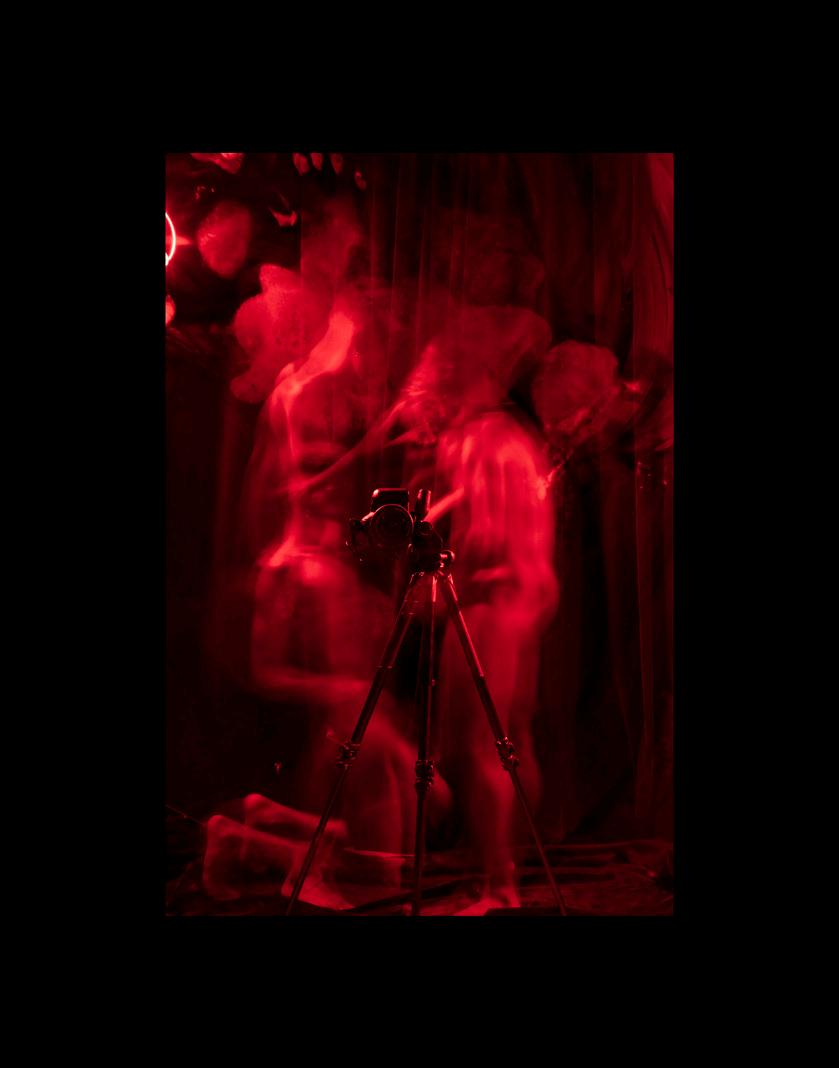
Para mí, más allá de una conver sación en torno a la identidad
y la representación, cada artista ofrece un punto de entrada diferente a la visibilidad, abrazando estrategias de disimulo que parecen estar en desacuerdo con el deseo de ser visto.
En RASPBERRY BLOW [SOPLO DE FRAMBUESA], la segunda exposición en solitario de King en STARS, Hollywood, clausurada a principios de septiembre, las figuras aparecían borrosas, dando la espalda. Un rostro se asomaba desde una grieta entre dos puertas. Ver las fotografías era como ser arrojado a un escenario que todavía estaba en proceso de desarrollarse, dejándome la tarea de recopilar una narra tiva imprecisa entre lo que se mostraba y lo que quedaba oculto. En una conversación con Sepuya (amigo y colaborador de King) organizada por la Robert Giard Foundation (Fundación Robert Giard) a principios de este año, King se refirió al anonimato, señalando que, en cierto sentido, el impulso de ocultar deriva
de un instinto de autoprotección. Es un acto de seguridad. Añadió que, dentro de sus fotografías, el anonimato también deja espacio para que otros partici pen, invitándoles a hacer uso de su imaginación y sus experien cias para completar los misterios que plantean las imágenes⁵.
La reticencia de King a exponer completamente a sus personajes evoca la reivindicación del filósofo y poeta martiniqués Édouard Glissant sobre el derecho a la opacidad, una contrapartida a los esfuerzos hegemónicos por categorizar y dominar⁶. La opacidad rechaza los impulsos transaccionales de nuestra cultura, obligándonos a mirar en profundidad. También pone de relieve los límites de la visibilidad y la representación, y cómo una fidelidad superficial a estos conceptos puede llevar nos a reforzar los mismos conceptos binarios de los que queremos escapar.
Las figuras de Shikeith parecen prosperar en este estado opaco, movidas por espíritus que son a la vez invisibles y constantes. Nacido y criado en Philadelphia, Shikeith atribuye a su abuela una influencia creativa monumental. A través de ella, desarrolló una aprecia ción por los aspectos extraños de la vida, donde los fantasmas y las revelaciones espirituales colisionan⁷. En O’ my body, make of me always a man who questions! [¡Oh, mi cuerpo, haz de mí siempre un hombre que cuestione!] (2020), un hombre sin camisa se arquea hacia atrás, su torso sudoroso flotando bajo las manos extendidas de dos hombres vestidos con trajes negros. La escena es todo extremidades, un ejercicio de elisión: las omisiones nos permiten sintonizar con las energías invisibles conjuradas por el movimiento de las manos y otras partes del cuerpo.
Shikeith crea un lenguaje a partir de estas fuerzas invisibles, hilando historias fantasmales de trascendencia. Visiting Hours [Horas de visita] (2022) retrata a un hombre durmiendo sobre una cama estrecha, con el rostro hundido en el hueco de su brazo. La escena está bañada en una oscuridad que se hace más intensa gracias al uso de la iluminación en claroscuro.
Una figura amortajada, envuelta en una sábana blanca, sostiene al hombre como a un amante herido. “Los ojos —esas proverbiales ventanas del alma— están siempre cerrados, caídos o recortados”, escribe Zoë Hopkins sobre su obra en Artforum. “Su vida interior elude nuestra mirada”⁸. En una conversación con i D, Shikeith explica que concibe la visibilidad como un punto de partida, más que como un destino, para la fotografía: “‘El medio también se presta a otras posibilidades fuera de estas representaciones directas, a algo que es más abstracto y que está sucediendo por debajo de lo que vemos’”⁹. Al hacer esta afirmación, el artista revela cómo el énfasis excesivo de la fotografía en la visibilidad puede alejarnos de las fuerzas opacas que caracterizan la vida. Los retratos de Shikeith centran estas abstracciones de la mente, el cuerpo y el alma. En un perfil de Aperture, el artista multimedia describe cómo la palabra “derrame” guía su visión artística, describiendo el derrame como una “‘forma queer’”¹⁰. Al evocar las propiedades del agua, un derrame connota una sensación de libertad, una incapacidad para ser confinado o controlado. Veo similitudes entre la opacidad y el derrame. Ambos expresan el deseo de una forma de ser que desafía los esfuerzos por etiquetar. Al igual que la opaci dad, el derrame se resiste a los
llamamientos al orden y la cohesión, remontando estos conceptos a sus orígenes coloniales. Como señala Teju Cole en su ensayo sobre los vínculos entre la historia de la fotografía y la expansión del imperialismo europeo, “la fotografía durante el dominio colonial capturó al mundo para estudiarlo, beneficiarse de él y poseerlo”¹¹. Abrazar el derrame abre nuevos enfoques para la creación de imágenes. En lugar de estudiar a sus sujetos, King y Shikeith entablan un diálogo con ellos, un intercambio mutuo que transforma tanto al sujeto como al fotógrafo.
Al igual que King y Shikeith, Sepuya se aleja del impulso fotográfico de diseccionar y sacar provecho. Nacido y criado en el sur de California, Sepuya desmonta los mecanismos de la fotografía y del estudio artístico, componiendo sus encuadres con espejos empaña dos, cortinas de terciopelo, trípodes, equipos de iluminación, figuras entrelazadas, impre siones de prueba y manos que presionan los obturadores de las cámaras. (Aunque en su reciente serie Daylight Studio [Estudio diurno] [2021en curso] suele vaciar el encuadre de todas las figuras, afinando su mirada sobre el atrezo y los materiales del estudio —alfombras, pedestales, cojines—, en una astuta reimaginación de los elementos de la temprana fotografía de retrato). Sus fotografías cues tionan la relación entre el sujeto y el fotógrafo, ambos presentes a menudo en la imagen. Para Dark Room Studio Mirror [Espejo del cuarto oscuro del estudio] (2021 22), un conjunto de imágenes incluidas en su exposición en solitario recientemente clausurada en Vielmetter Los Angeles, Sepuya fotografió a amigos y amantes en su estudio, iluminando las escenas
únicamente con luces de seguridad rojas. Cada una de las imágenes se expuso durante unos breves segundos, transformando a los modelos en apariciones nebulosas.
La obra Dark Room Studio Mirror (0X5A5668) (2021) de Sepuya muestra a dos hombres bañados en luz roja y colocados frente a una cámara y un trípode, cuyos movimientos son una combi nación de arrodillarse, agacharse y fijar la mirada. Las imágenes se observan en un espejo en el que son visibles las huellas dactilares y otras marcas deja das por modelos y visitantes anteriores, añadiendo otra capa de nubosidad fantasmal. Lo que queda es el rumor de las formas, una instantánea de los modos quijotescos de relación y de ser que subyacen a todas las interacciones. Las fotografías de Sepuya recuperan el estudio de retratos como un lugar de socialidad queer, donde los límites entre lo creativo, lo platónico y lo erótico se encuentran en constante fluctuación. Como señala en una entrevista para Elephant: “Esa convergencia... tiene mucho que ofrecer a la hora de explorar la fotografía como medio de construcción y deseo, de mirar y saber que somos mirados”¹². Para Sepuya, el derrame se extiende al propio medio, una forma de desmontar las dinámicas de poder arraigadas en la fotografía. Es emocionante ver a artistas que se resisten activamente a las exigencias extractivas de la visibilidad, especialmente contra la presión de autodefinirse en términos legibles y comercializables. Aunque se me concede una proximidad íntima con los seres queridos de estos artistas a través de sus imágenes, es una intimidad que pivota
sobre la afirmación de la privacidad del sujeto y sobre la aceptación de una recalibración continua entre la divul gación y la retirada. Como dijo King en una entrevista para Ebony: “A veces esa ‘cosa’ que has estado buscando durante tanto tiempo está justo delante de ti. Estando presente y mirando más profundamente, puedes encontrarla”¹³. Aunque sus prácticas se desvían en aspectos clave, King, Sepuya y Shikeith abrazan la ocultación como una forma diferente de ver y de ser, una que, tomando prestadas las palabras de Hilton Als, “deja entrar el desorden”¹⁴. Este desorden, al igual que los difuminados y los manchones de las imágenes de Sepuya, nos acerca a las fuerzas percep tibles e imperceptibles que existen dentro de nosotros mismos y entre los demás, una infinidad que se derrama sobre todos nosotros. Consulte la página 90 para ver las notas a pie de página.
A comienzos de 1964, casi una década antes de la aprobación de Roe v. Wade en 1973, un grupo de mujeres de la zona de la bahía conocidas colectiva mente como “El Ejército de las Tres” (Rowena Gurner, Patricia Maginnis y Lana Phelan Khan) distribuyeron clandestinamente recursos a las personas que buscaban acceso a los servicios de aborto¹. En aquella época, el envío de cartas era el método de acción para distribuir esta información ilícita; como resultado, El Ejército de las Tres recibía una avalancha constante de peticiones manuscritas de mujeres desesperadas por ejercer su autonomía reproduc tiva. (De todas las interminables barreras al acceso al aborto,
y a la luz de la viralidad de la información hoy en día, la noción de que el destino de una persona embarazada podría estar inarmónicamente ligado a la voluble fiabilidad del correo postal parece particularmente atroz). Por ello, la urgencia expresada en estas cartas es especialmente aguda.
Andrea Bowers, cuyo trabajo ha explorado durante mucho tiempo las metodologías de los movimientos de justicia social, extrae de este archivo una serie de obras tituladas Letters to an Army of Three [Cartas a un ejército de tres] (2005) (obras que, crucialmente, son anteriores tanto a la era Trump como al cataclismo del colapso de Roe). Expone la correspondencia reunida —de la que se enteró durante una visita a Maginnis²— en el punto de encuentro de dos paredes, con las cartas impresas emergiendo de la esquina como un libro abierto. Un video de un solo canal en el que se ve a varias personas recitando cuidadosamente el contenido de determinadas cartas se reproduce en un monitor suspendido del techo; debajo, un libro a gran escala con correspondencia adicional se encuentra abierto sobre un podio.
En la retrospectiva homónima de Bowers en el Museo Hammer, que se clausuró el 4 de septiembre, esta insta lación ocupó un gran espacio de la galería cerca del comienzo de la exposición organizada temáticamente. Las menciona das recitaciones en primera persona de las cartas en el video reverberaban suavemente por las galerías adyacentes, con sus resonantes súplicas incitando a los espectadores atentos a escuchar y dar testimonio. Al carecer de comentarios expositivos o de intervenciones
artísticas manifiestas, estas obras, y otras de la exposición, emplean un despliegue estricta mente informativo de pruebas históricas o antropológicas, una táctica conceptual aparen temente intencionada. Al centrar directamente estos relatos y omitir la presencia de su propia voz —el penúltimo marcador de la autoría artística— Bowers demuestra el arte silencioso del testimonio empático, evitando una representación más teatral y egocéntrica de la solidaridad. En la obra de Bowers, tanto el acto como la idea de dar testimonio pueden leerse como modali dades creativas de textura única. A través de su sincero compromiso con las pedagogías de protesta y resistencia (un área de investigación y enfoque que abarca casi tres décadas), ella esculpe una ética de empatía y acción a partir de una práctica creativa materialmente robusta y conceptualmente rigurosa. Al hacerlo, demuestra cómo un ethos artístico puede dar vida a uno activista, y viceversa.
En una serie de dibujos titulada Make My Story Count, Letters to Planned Parenthood [Haz que mi historia
cuente, cartas a Planned Parenthood] (2011), este acto de testimonio se convirtió en devoción. Bowers recreó minuciosamente los testimonios escritos a mano por las mujeres que recibieron tratamiento en Planned Parenthood (Paternidad Planificada) en Los Angeles, reproduciendo fielmente el peso, el ritmo y la cadencia de cada carta con un fotorrealismo convincente. En este caso, el dibujo funciona como una actuación meditativa de encarnación —una especie de peregrinaje— en la que el artista no solo es testigo, sino que también absorbe físicamente y repasa los relatos vividos por otros. Los gestos atentos y laboriosos funcionan como actos políticos y artísticos, planteando la práctica a menudo hermética del dibujo como un dispositivo de mentalidad democrática para promulgar la solidaridad y fomentar la resistencia. Como colofón, Bowers donó la totali dad de los ingresos de los dibujos a Planned Parenthood en Los Angeles.
Aunque no es una disci plina histórica, el activismo se ocupa por naturaleza de la historia del progreso, aunque
ese progreso se desvíe hacia un terreno peligroso. Un activista, por tanto, puede ser considerado como un cronista que atestigua y transcribe esta concepción de la historia con visión de futuro, aunque sea mercurial. Como artista con tendencias activistas (o a la inversa), Bowers se sumerge en el trabajo de un historiador, reuniendo y cote jando pruebas y preservando relatos íntimos que de otro modo podrían permanecer ocultos. Al vincular su trabajo a la tarea de la resistencia, permite que sus objetos se involucren vigorosa mente en el complejo ecosistema sociopolítico que existe más allá de la periferia de un discurso cerrado y centrado en el arte. La oscura coincidencia de su retrospectiva en la Hammer subraya esta idea: el 24 de junio, cinco días después de la inauguración de la exposición, el Tribunal Supremo anuló el caso Roe v. Wade, anulando así el derecho constitucional al aborto. Este marco contextual giratorio imprimió a la obra de Bowers capas de significado aumentadas: Letters to an Army of Three y Make My Story Count ya no eran cautelosos vestigios de un pasado sombrío, sino perturbadores presagios de un futuro maligno. Para un espectador, este cambio en tiempo real demostraba la resbalosa precariedad del progreso, señalando la continua maleabilidad de la perspectiva histórica e ilustrando cómo un rápido cambio de tempera tura social puede a menudo augurar algo más distópico que emancipador.
Creado en 2020 y rebosante de complejidad en 2022, el colosal dibujo de Bowers de Kamala Harris cristaliza este cambio de tenor político. Realizado en el estilo alegórico de una ilustración francesa del siglo XVII, el dibujo del
tamaño de una pared representa a la ahora vicepresidenta, entonces candidata presidencial, como la diosa griega Atenea, una guerrera feminista de los derechos de las mujeres. La frase sonora viral de Harris en la audiencia de confirmación de Brett Kavanaugh en 2018, un momento crucial de su mandato como senadora, adorna valientemente su escudo: “¿Puedes pensar en alguna ley que otorgue al gobierno el poder de tomar decisiones sobre el cuerpo masculino?”³. En aquel momento, Harris fue alabada como un icono feminista por su franca línea de interpelación, un satisfactorio y performativo choque con la autoridad patriar cal que no influyó en el resultado de las audiencias ni dio lugar a ningún cambio político sustan cial. Ahora, tras el colapso de Roe, y después de haber sido ampliamente criticada por su actuación en varias desafortuna das entrevistas, la potencia política de Harris en este tema se ha desintegrado en cierta medida. En este nuevo contexto, el dibujo adopta un tono de farsa política, incluso de tragedia, su exuberancia inicial se vuelve agridulce. Una verdad más insidiosa se esconde detrás: incluso una guerrera bien equipada —una mujer cuyo ascenso al poder fue impulsado, en parte, por su feroz defensa de la autonomía reproductiva— no puede protegerse de las contundentes fuerzas del sistema patriarcal.
Haciendo alusión a la misteriosa capacidad de los dibujos de Bowers para transformarse y florecer en significado de forma permanente, la historiadora del arte Julia BryanWilson señala que, para Bowers, “el dibujo es multitemporal y opera en muchos tiempos a la vez, [conectando] su cuerpo —presente en el acto
de crear— con los cuerpos de la historia y con los especta dores especulativos”⁴. El cuerpo y sus compromisos son premisas cruciales de la obra y el activismo de Bowers. La obra escultórica a gran escala de Bowers, Soft Blockade (Feminist Barricade) [Bloqueo blando (Barricada feminista)] (2004), una reacción a su investigación y participación en numerosos actos de desobediencia civil, habla de la práctica no violenta de utilizar el propio cuerpo para proteger o bloquear el acceso a otra persona o lugar, creando efectivamente un escudo humano. La escultura —un enorme e intrincado panel de tela e hilo suspendido del espigado armazón de una valla metálica— se lee como un muro geométrico minimalista con estrías ondulantes de color cobalto, cerúleo, índigo y ciruela. Unas puntadas blancas que se asemejan a la matriz entrelazada de una valla metálica cubren la superficie acolchada de la obra, reforzando la idea de que un bloqueo sirve tanto para tejer como para descoser. La intensidad del trabajo que supone la creación de esta escultura sugiere la adminis tración cuidadosa y colectiva de un objeto, o de una causa, que empequeñece cualquier cuerpo singular, un recono cimiento no solo a los principios cooperativos del activismo, sino también a las raíces comunales y feministas de la confección de colchas. La obra, al igual que los dibujos de Make My Story Count, es también claramente reverencial: a través del trabajo físico y creativo de su propio cuerpo, Bowers erige un suave monumento a aquellos que han utilizado sus cuerpos como formas de resistencia tanto en el pasado como en el futuro. Aunque Soft Blockade hace referencia específicamente a las técnicas desplegadas por
los manifestantes antinucleares de los años 60 y 70, ver la obra de la época de Bush en un contexto post Roe reconfiguró claramente mi interpretación. Al concebir el bloqueo como una barrera de acceso, me di cuenta de que las formas de los eslabones de la cadena se asemejan al motivo sombrío y desgarrador de un colgador retorcido —uno de los emblemas más brutales de las prohibiciones draconianas del aborto—. En este contexto, el cuerpo —específicamente el propio útero— se convierte en una barrera para la liberación personal total: un órgano íntimo y vulnerable que se ve obligado a mimetizarse como su propio y suave bloqueo, una herra mienta de dominio que se maneja desde dentro hacia fuera. Esta observación se extiende más allá de la subyu gación que recae únicamente sobre quienes tienen útero para abarcar cualquier forma de opresión a través de la cual los cuerpos se ven comprometi dos, incluidos los derechos de los trabajadores, la gente de color, las personas LGBTQIA+ y los inmigrantes —todos los cuales han sido un objetivo del trabajo y la defensa de Bowers—. También se extiende a la protección del medio am biente, compuesto a su vez por cuerpos naturales vulnerables al saqueo y la persecución. En este sentido, el proyecto de liberación empieza por enno blecer la santidad autónoma de los cuerpos, una persuasión emancipadora que abarca a todos los seres vivos.
La monumental escultura de Bowers Radical Feminist Pirate Ship Tree Sitting Platform [Plataforma para sentarse en el árbol del barco pirata feminista radical] (2013) afirma esta noción como una visión utópica del futuro. Construida a partir de
una mezcla de objetos extraídos de las prácticas de protesta medioambiental, la obra reconstruye una plataforma para sentarse en un árbol (un esce nario para la desobediencia que normalmente se mantiene en lo alto de la copa de los árboles y que es ocupado continuamente por activistas que ungen sus cuerpos como bloqueos blandos para proteger los bosques antiguos de la diezma por la tala⁵ —una prác tica que Bowers ha llevado a cabo desde los años 90—).
En la Hammer, la escultura de Bowers reimaginó el lenguaje visual de la plataforma como un barco pirata feminista autosuficiente, suspendido del techo y adornado con banderas, cuerdas, herrajes, libros y lemas pintados. Mientras que un escenario representa una construcción teatral inmóvil —un lugar desde el cual dar testimonio—, el barco es una nave autónoma y móvil, un cuerpo soberano capaz de navegar por las turbulencias de su proa. En este caso, la concepción de Bowers de la piratería rechaza el tema del merodeador villano y, en su lugar, apunta a una visión de la usurpación productiva, en la que los piratas concienzu dos forjan caminos de liberación. En última instancia, podemos interpretar este conjunto meticulosamente elaborado como una reconstrucción de nuestra relación colectiva con el mundo circundante, un arco antibíblico diseñado para preservar únicamente las cualidades más redentoras de la humanidad. Como cuerpo capaz de acunar los cuerpos de los demás, también funciona como expresión alegórica de un futuro providencial en el que los lazos comunitarios no solo resisten los embates de la violencia patriarcal,
sino que también coexisten bajo un principio compartido de ternura humana. En una sinopsis apropiada de su trabajo y activismo, Bowers adorna el tablado del barco (el umbral entre lo que permanece y lo que se ha desechado) con un credo reflexivo de la poeta y ensayista Adrienne Rich.
La línea implica decisivamente al espectador como participante activo —o pirata— en su proyecto de disidencia: “intenta decirte a ti mismo / que no eres responsable / de la vida de tu tribu / del aliento de tu planeta”⁶. Consulte la página 90 para ver las notas a pie de página.
La edición de este año de docu menta, la exposición internacional de arte que se celebra por toda la ciudad de Kassel (Alemania) cada cinco años, fue una reimaginación amplia e inclusiva de lo que puede ser el arte y el mundo. La exposición, en la que participaron principalmente colectivos artísticos de Asia, África y Oriente Medio, llevó a cabo nuevas prácticas y terminologías en torno a la colectividad, como el concepto de cosecha, usado para describir el proceso artístico de reflexión, escucha y registro de la propia perspec tiva como participante activo en las discusiones y reuniones de grupo¹. Experimentar la documenta fifteen fue como viajar a través de un vasto ecosistema de comunidades artísticas, cada una de ellas formada por diversas prácticas e historias creativas. A lo largo de la exposición, los visitantes podían, por ejemplo, preparar y compartir una comida en una cocina al aire libre de Britto Arts Trust, un colectivo artístico
con sede en Bangladesh cuya contribución estaba dedicada a la política alimentaria. Ese mismo día también pudieron ver videos de conversaciones con solicitantes de asilo en Dinamarca en una sala de estar montada por el colectivo Trampoline House con base en Copenhague.
Comisariada por el colectivo artístico ruangrupa, con sede en Yakarta, la docu menta fifteen giró en torno a la idea de “lumbung”, término indonesio que designa un granero de arroz comunal. Los comisarios invitaron a 14 colectivos orientados a la comunidad a desarrollar los métodos del lumbung, y esos grupos, a su vez, invitaron a otros a participar en la exposición. En los dos años que precedieron a la inaugura ción de este verano, los miem bros de los lumbung y los artistas celebraron regularmente “majelises” o asambleas online. Los asistentes aprovecharon este tiempo para debatir sus ideas de colaboración y compartir recursos durante los 100 días de la exposición.
Organizar tal diversidad de componentes durante una pandemia mundial es un logro en sí mismo, y, dada la revisión total de la estructura institucional de la documenta, era de esperar que aumentarían las dificultades. Varios meses antes de la inauguración de la exposición, ruan grupa fue acusada de simpatizar con el movimiento de Boycott, Divestment and Sanctions (Boicot, Desinversiones y Sanciones) contra Israel (que en Alemania se considera ampliamente antisemita²), debido en gran parte a la inclusión del colectivo palestiano The Question of Funding (La Cuestión de la Inversión)³. Estas reclamaciones se intensificaron días después de la inauguración de la exposición por la inclusión,
y rápida retirada, de un mural titulado People’s Justice (Justicia Popular) (2002) del colectivo indonesio Taring Padi⁴. Mientras los medios de comunicación alemanes intensificaban la controversia⁵, ruangrupa se oponía a las expectativas de completa autonomía por parte de los comisarios, señalando en cambio su papel como administradores de un proceso de colaboración y, además, los cambios de significado que se producen cuando las prácticas de los artistas (y sus diversos orígenes culturales) se trasladan a un contexto europeo. En un discurso pronunciado el 6 de julio, Ade Darmawan, director fundador de ruangrupa, hizo hincapié en la importancia de la colabo ración, incluso cuando conduce a consecuencias inesperadas, afirmando que “el enfoque curatorial y la responsabilidad en el lumbung reside en esta colectividad. Lo vemos como un esfuerzo político, en el que la agencia colectiva, la toma de decisiones y la gobernanza presentan una alternativa a las formas de autoritarismo”⁶. La colectividad puede ser un proceso desordenado, pero es vital para construir sistemas más equitativos. El lumbung establece una economía alterna tiva para distribuir recursos, resistir a los poderes autoritarios y anclarse en los valores locales de sus miembros. La inclusión del modelo lumbung en la documenta fifteen señala el creciente interés internacional por las estructuras no jerárquicas de organización y reparto de recursos. Representa tanto un movimiento global como un conjunto concentrado de esfuerzos locales para redistribuir el poder dentro de sus respectivas comunidades al servicio de los artistas.
Aquí, en Los Angeles, las enormes disparidades de riqueza están constantemente a la vista: basta con viajar en el sistema de transporte público, mirar los listados inmobiliarios de tu barrio o pasar por los asentamientos temporales de los sintecho.
Aun así, es difícil entender el impacto específico de este desequilibrio económico extremo en la comunidad de artistas de Los Angeles. La vida en esta ciudad es, sin duda, precaria para los artistas, especialmente para aquellos que carecen de la seguridad financiera de un trabajo docente a tiempo completo, de un mercado viable para su práctica o de una fortuna heredada. Si la viabilidad de un artista debe depender de un sistema económico que solo beneficia a unos pocos privilegiados en detrimento del resto, es fácil suponer que Los
Angeles acabará perdiendo a los que no podemos permitirnos vivir aquí.
Trabajando en contra de un destino tan sombrío, varias organizaciones de Los Angeles han surgido en los últimos años para ofrecer modelos más sostenibles de apoyo a los angelinos fuera del mercado del arte convencional y de las estructuras institucionales. Su trabajo invoca el modelo lumbung, ya que utilizan sus valores fundamentales, la educación, la defensa y la colectividad para contrarrestar las desigualdades históricas y contemporáneas que afligen a esta ciudad, al tiempo que abogan por la atención y los recursos comunitarios. Grupos como el Los Angeles Artist Census (LAAC, Censo de Artistas de Los Angeles), el Los Angeles Tenants Union (LATU, Sindicato de Inquilinos
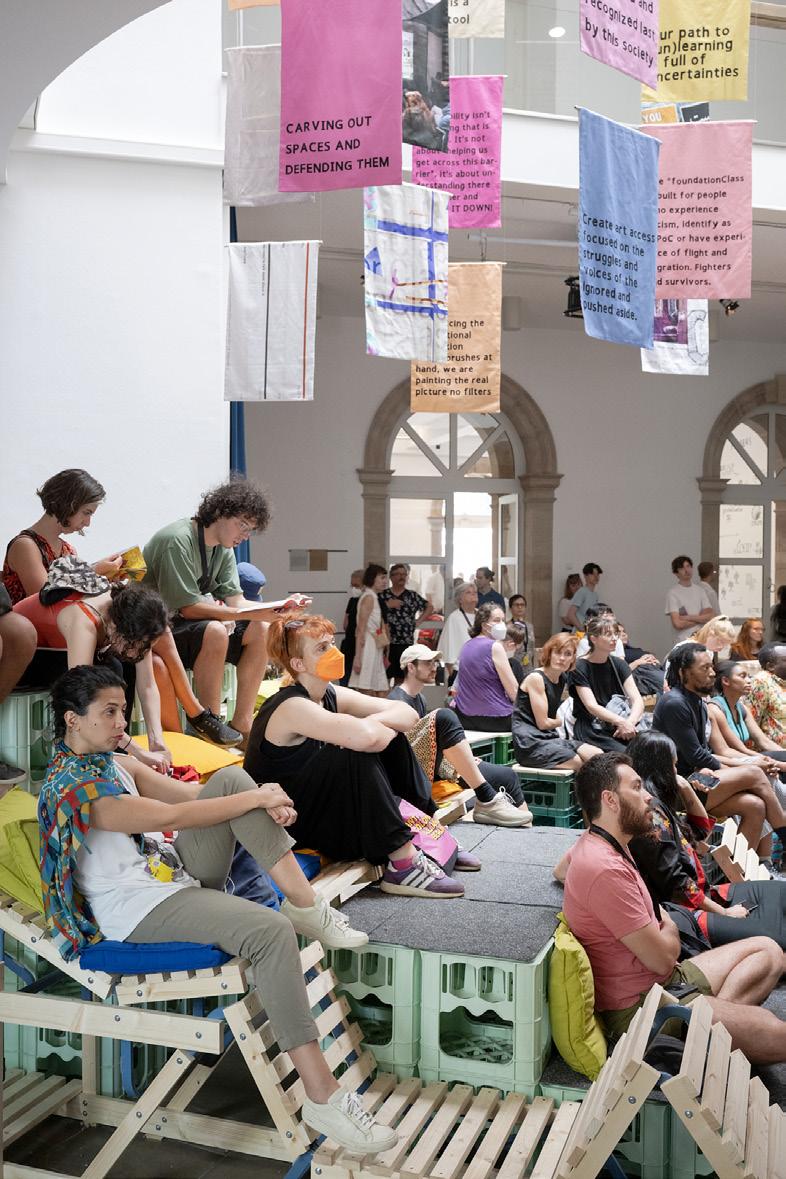
de Los Angeles) y la Tongva Taraxat Paxaavxa Conservancy (TTPC, Conservación Tongva Taraxat Paxaavxa) organizan colectivamente, comparten conocimientos y defienden a las personas a través de redes de voluntarios, iniciativas impulsadas por la comunidad y un espíritu de reciprocidad. Sus esfuerzos no solo ponen de manifiesto la necesidad de estructuras alternativas y reparadoras en esta ciudad, sino que también reflejan el movimiento internacional más amplio hacia modelos de apoyo más colectivos. El LAAC influye en el pensamiento de la comunidad y en las políticas públicas al convertir en un arma el lenguaje burocrático e instrumentalizar los métodos convencionales de recogida de datos. Como iniciativa de investigación de base, el proyecto afirma que los retos económicos y sociales a los que se enfrentan los artistas en el condado de Los Angeles no solo son cuantificables, sino que los datos recogidos sobre los artistas también pueden informar de acciones que pueden mejorar sus vidas. Utilizando un modelo generativo similar al de los lumbung majelises, la organización inició su proyecto organizando una reunión pública en el espacio de performances NAVEL en 2019, invitando a los artistas a reunirse e iluminar los problemas que impactan directamente en sus vidas. En los meses siguientes, varios de los artistas trabajaron juntos para determinar las preguntas a incluir en un censo de artistas que se difundiría ampliamente en un intento de recopilar datos que ayudaran a cuantificar la realidad financiera del artista trabajador medio. En febrero de 2020 el LAAC lanzó su primer censo, distribuido a través de
las redes sociales, los boletines informativos, la red del equipo del censo y con la ayuda de varias organizaciones artísticas locales. Recientemente publicaron sus conclusiones en un periódico de 20 páginas; los resultados de los 2371 artistas que respondieron son a la vez asombrosos y nada sorprendentes.
Entre los datos decepcio nantes, el informe afirma que aproximadamente el 95 % de los encuestados ganan menos del salario digno del condado de Los Angeles (19,35 dólares por hora) a través de su práctica artística, siendo los encuestados trans y no binarios más propen sos a informar de ingresos más bajos que los artistas cis femeninos y cis masculinos; el 87 % de los encuestados carecen de representación en la galería; y un tercio de los encuestados no tienen un estudio. Para los que tienen un estudio, el alquiler mensual medio es de 623,70 dólares, un esfuerzo financiero insostenible cuando, según el LAAC, el 28 % de los artistas se quedaron sin vivienda en 2019 por falta de fondos. Aunque las cifras revelan lo que algunos de nosotros ya sabemos por experiencia, según LAAC, los datos son algo más que una evidencia estadística. Sirve como bloque de construcción para influir en las políticas públicas y aumentar las fuentes de financiación: organizaciones como el Center for Cultural Innovation (Centro de Innovación Cultural) y el City of Los Angeles Department of Cultural Affairs (Departamento de Asuntos Culturales de la Ciudad de Los Angeles) se han puesto en contacto con LAAC en relación con sus datos⁷. Como dice la fundadora de la organización, Tatiana Vahan, de forma sucinta: “Los datos son una
forma de encender las luces de la habitación”⁸. Para las organizaciones artísticas y los gobiernos locales que tienen problemas para entender las desigualdades específicas a las que se enfrentan los artistas de la ciudad, el trabajo de LAAC hace que la inacción sea inexcusable.
La responsabilidad es un precepto del lumbung, y exponer los desequilibrios de poder ayuda a mejorar la salud general de nuestro ecosistema artístico. En Los Angeles, donde la inseguridad de la vivienda es una preocupación para muchos artistas, grupos como la LATU han dado un paso adelante para resistir la especulación desenfrenada del mercado inmobiliario. Centrándose en la colectividad, la educación y la creación de relaciones, la LATU capacita a los inquilinos —grupo que constituye la mayoría de los residentes en esta ciudad— para defenderse ante el desahucio o el acoso del propietario. La organización surgió por primera vez como parte del movimiento contra la gentrificación en 2015 para hacer frente a las diversas crisis de vivienda en toda la ciudad. Desde entonces, LATU ha formado más de una docena de sucursales en todo el condado de Los Angeles, desde Canoga Park hasta South Bay, facilitando talleres y organi zando reuniones bimestrales en las que los vecinos pueden socializar y aprender unos de otros. Toda su comunicación es totalmente bilingüe en español e inglés y ofrecen guías gratuitas para los inquilinos que participan en la resolución de conflictos y en la negociación de acuerdos de cash-for-keys⁹. El modelo de colaboración mutua y cuidado de la comunidad de LATU resuena tan claramente con
el espíritu del lumbung que habría encajado fácilmente como uno de los colectivos que organizaron sesiones educativas y de intercambio de información durante los 100 días de documenta fifteen.
Mientras que LAAC y LATU responden directamente a las desigualdades sistémicas, TTPC busca desestabilizar los asentamientos desde la base. Practicando en la primera parcela de tierra indígena devuelta¹⁰ en el área de Los Angeles, TTPC cultiva un espacio compartido para que los miem bros se reúnan, cultiven plantas nativas y practiquen ceremonias en un acre de tierra tongva en Altadena. La propiedad fue donada a la organización este año por Sharon Alexander, quien, al enterarse de que el grupo esperaba obtener tierras ancestrales¹¹, decidió donar la casa de sus abuelos en Altadena a TTPC en lugar de beneficiarse de su venta¹². Tras dos siglos de asentamiento europeo, la recuperación de tierras por parte de TTPC es el ejemplo más directo de descolonización que hemos tenido en Los Angeles —para TTPC, el acto de reunirse para celebrar una ceremonia ya no implica un proceso burocrático de obtención de permiso—. Como dijo reciente mente la coordinadora del TTPC, Samantha MoralesJohnson: “No deberíamos tener que pedir permiso para reunirnos más que a las plantas”¹³. Este otoño, TTPC pondrá en marcha su primera residencia artística, acogiendo a un artista indígena y a su familia en una de las casas de la propiedad y, en el futuro, planean renovar la segunda casa para que vivan los ancianos indígenas.
En realidad, los modelos reparadores practicados por
grupos como LAAC, LATU y TTPC son las excepciones a los sistemas capitalistas que dominan la ciudad de Los Angeles. Mi experiencia en la documenta fifteen me inspiró a examinar cómo encajan las organizaciones locales en los movimientos globales de colectividad —al descentralizar al artista individual, reestructurar la distribución de recursos e inventar nuevos sistemas de gestión, la exposición propuso una revisión del modelo ofrecido por las instituciones artísticas europeas—. De vuelta a Los Angeles, el espíritu comunitario del lumbung ha resultado generalmente difícil de encontrar. Imaginemos que las asambleas celebradas por los miembros del lumbung se reprodujeran en Los Angeles, los integrantes de nuestras comunidades reunidos para dar prioridad al bienestar de todos los artistas. Pero la mentalidad colonialista pesa mucho sobre nosotros, y el sueño californiano suele ser una conquista individualista del espacio. A pesar de la impor tante labor de las organizaciones mencionadas y de otros colectivos similares que construyen modelos reparadores en Los Angeles, nos queda un largo camino por recorrer antes de que los gobernantes se tomen en serio las consecuencias de sus actos. Mientras tanto, organizaciones como LAAC, LATU y TTPC están sobre el terreno, trabajando ya por un futuro más colaborativo y equitativo. Consulte la página 90 para ver las notas a pie de página.
“Recientemente he conocido la planaria, una pequeña especie animal que se autorreproduce y regenera. Le cortas un trozo a estas sencillas criaturas y les crece un trozo nuevo al completo. Una vez cortado el trozo hay una carga eléctrica que sale en forma de lo que va a volver a crecer, este diagrama se rellena con la grasa del tejido que se regenera, ¿saben lo que significa esto? Hasta que no podamos concebir la forma de lo que aún no ha sido no podremos llenarlo. Hasta que no podamos sentir más allá de lo que nos han dado, de lo que hemos encontrado, lo que nos han dicho que es correcto, etc., hasta que no podamos sentir la necesi dad y el deseo hacia lo que no existe, ¿cómo podre mos decidir sobre un futuro o incluso pensar en proporcio narlo? Esta es la función de la poesía. Esta es la función del sueño. Nuestras ideas siguen nuestras necesidades y deseos, nuestras ideas siguen la visión”.
–Audre Lorde¹
Durante una conversación reciente me leyeron la mencio nada cita de Amia Yokoyama, escultora, ilustradora y amiga. A lo largo de nuestra amistad, me ha asombrado su sentido del alcance y su sed de observar y comprender la profundidad y la magnitud del universo. Esto es evidente en lo que hace y en cómo lo hace. Aunque Amia se mueve dentro de un lenguaje cohesivo de forma y color, intercala en sus exposiciones
reflexiones y diálogos personales llenos de matices, que me mantienen constantemente expectante sobre lo que puede aparecer a continuación. Recientemente ha creado una serie de obras holográficas sin título: Untitled (green) Ed 1 [Sin título (verde) Ed 1] (2022), que muestra una agrupación holográfica de sus conocidas y fluidas figuras de cerámica. La imagen se reviste de un marco de cerámica pulido y elaborado que se asemeja a la materia vegetal fosilizada. Me impacta la yuxtaposición entre lo que está claramente ahí —el peso del marco, sus texturas y su escala— y lo que aparenta, sin estar del todo presente. Dado que gran parte de su obra adopta la forma de escultura o de animación por video, el medio del holograma —una especie de pantalla que alberga la imagen de una escultura física— funciona como un matrimonio perfecto entre estos dos medios. Actúa como interrogante hacia un lugar más inmaterial, en busca de una conexión con mundos que van más allá del que todos compartimos aquí y ahora.
Las nuevas obras de hologramas de Yokoyama me permitieron acercarme a algunas de mis obras favoritas de su producción anterior con ojos nuevos, como su instalación de 2020 en la Brand Library & Art Center, Initial Conditions [Condiciones iniciales], una animación de dos canales compuesta por objetos que se retuercen y rehacen en una especie de no espacio descono cido. Con estas revelaciones en mente, retomamos nuestra conversación en curso sobre la materialidad híbrida, la teoría del universo holográfico y cómo imaginar nuevas posibilidades.
Yves B Golden: Según tengo entendido, su obra escultórica surge de una intensa investigación —desde la iconografía religiosa hasta los dilemas científicos—, al tiempo que refleja y refracta sus experien cias pasadas y presentes. ¿Por dónde suele empezar en el estudio?
Amia Yokoyama: Definitivamente pienso en la iconografía religiosa, pero también en la cosmología y la mitología. Tanto lo que podría denominarse “ciencia verdadera” como la ciencia ficción influyen en mi trabajo, en parte porque creo que algo que tienen en común es la forma en que tratan de ofrecer una explicación a lo que parece inexplicable. Dentro de esos intentos por explicar, hay muchas deficiencias, muchos fracasos. Son muchos los puntos de ruptura dentro de ese espacio que considero un terreno fértil para mi práctica.
YBG: ¿Qué impulsó el salto a los hologramas?
AY: Las dos ramas principales de mi práctica siempre han sido la escultura basada en la
cerámica y la animación. También está el stop motion y la animación CGI en 3D, que consiste en trabajar en tres dimensiones pero en un espacio digital. Cuando empecé a realizar trabajos [de video], me interesaba el modo en que las esculturas físicas tridimensio nales, por ejemplo, [pueden] cargarse en el plano digital, y cómo la imaginería del plano digital puede ser exportada. Me interesa este ir y venir a través de dos manifestaciones muy diferentes del ser tridimensional.
Los hologramas son esa tecnología “futurista” de los años 40 que encarnaba el potencial para alcanzar lo imposible, aunque fuera una ilusión². [Era] como una moda fotográfica, podría decirse. Se relaciona con la fotografía en el sentido de que es una impresión, y se produce la captura de una imagen. Los hologramas son una forma de capturar el espacio tridimensional sobre una superficie bidimensional, y en la animación me muevo constantemente dentro de ese tipo de lenguaje, [pensando en] cómo describir el espacio tridimensional o un mundo
Amia Yokoyama, Bound up it always came undone [Atado siempre se deshizo] (2022). Porcelana y esmalte, 17 × 14 × 24 pulgadas. Imagen por cortesía del artista y de Sebastian Gladstone.
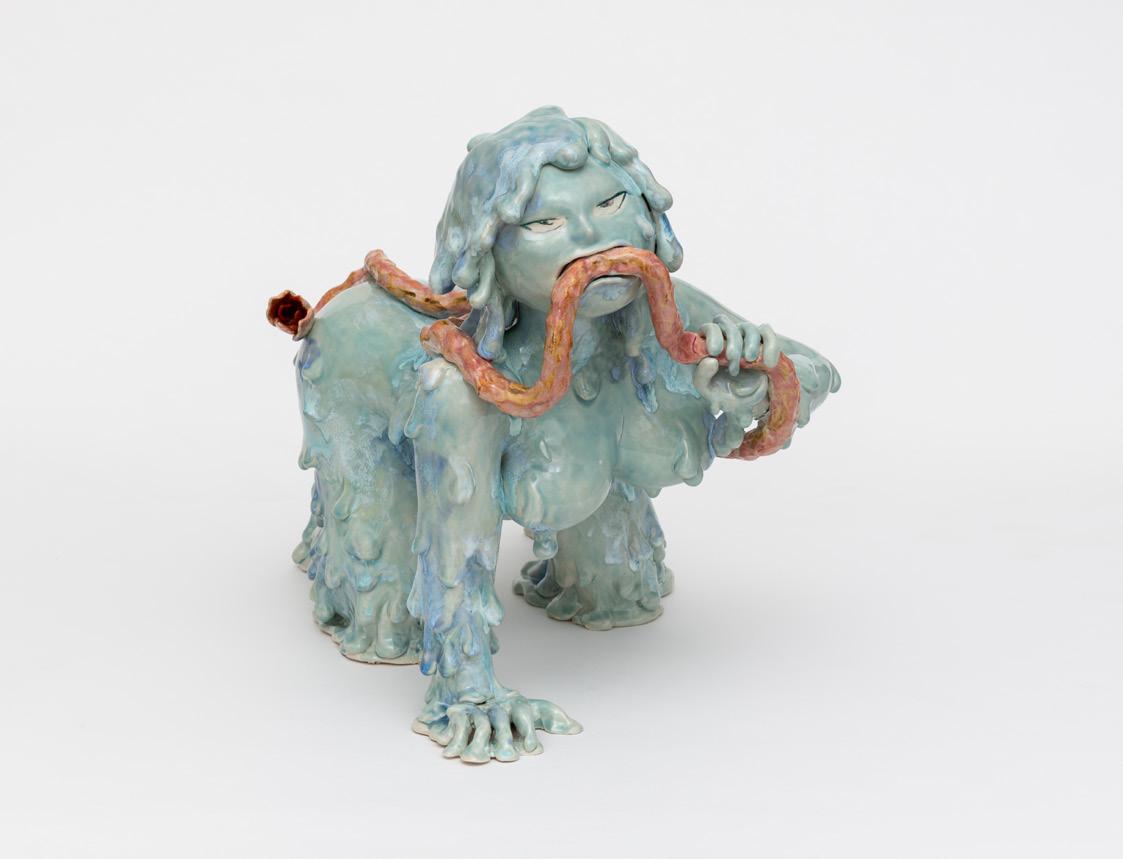
tridimensional completo dentro de una superficie bidimensional como lo es una pantalla o una proyección. Con esta tecnología, en lugar de capturar un campo de luz singular, capturamos el campo de luz de un objeto tridimensional en su totalidad y, básicamente, comunicamos o grabamos esa información dimensional superior en una superficie bidimensional.
YBG: ¿Qué es la información dimensional superior?
AY: O sea, la información bidimensional se limita a un plano, una pantalla o una superficie bidimensional, mientras que la información tridimensional es arriba, abajo, izquierda, derecha. Luego, es en los conceptos de 4 dimensiones donde las cosas se vuelven todavía más extrañas.
YBG: Por supuesto. Cuando ha mencionado que digitaliza todas sus esculturas, ha dicho que los programas que utiliza le permiten pensar en nuevas formas de escala y demás. ¿De qué otra forma influye ese proceso de archivado en la creación de nuevas obras?
AY: Básicamente, todas las esculturas que hago las escaneo con tecnología básica de esca neado 3D. Lo que sucede cuando escaneo el objeto es este factor “wow”. Como: ¡oh, Dios mío, acabo de capturar esta cosa tridimensional en la esfera digital! Además, están todos los lugares en los que el software fracasa a la hora de captarlo y provoca fallos. No puede captar la realidad tal y como la percibi mos. El cerebro del software tiene que inventar lo que podría ir allí, rellenando sus propios espacios en blanco. Me gusta hacer que el software llegue a un lugar en el que falla. Estos momentos
de fracaso se convierten en espacios liberados para que nosotros florezcamos. Cuando transfiero algo desde lo físico a lo digital, puedo jugar con la escala o con otros aspectos básicos que uno puede cambiar dentro de un software de animación digital. Cuando lo abres, tienes la escala, la posición, la rotación y la opacidad, que son los elementos básicos para manipular una imagen o un objeto digitalmente.
Así, al aumentar la escala o la rotación, o incluso la opaci dad, puedo entrar y explorar los espacios interiores de estas esculturas. Y, en cierto modo, pueden convertirse en paisajes enteros o en mundos enteros en sí mismos.
YBG: Este proceso parece tan colaborativo y espontáneo. Es muy ingenioso. ¿Cree que trabajar en los márgenes del error tecnológico, pero también científico, evidencia algo más vasto sobre su forma de percibir el mundo y lo que es posible?
¿Lo que se puede observar? Lleva las esculturas al ámbito digital y ahora se dedica a los hologramas. Parece como si hubiera algo que impulsara esta exploración.
AY: Estoy jugando con muchos materiales y tecnologías, pero también [con] teorías como el [principio del] universo holográfico. Esta teoría sostiene que nuestra realidad, tal y como la percibimos, es una proyección de una dimensión inferior. Como he dicho, un holograma capta todo el campo de luz de un objeto físico y lo incorpora a una superficie bidimensional. La teoría del universo holográfico nos dice que esto está ocurriendo realmente, y que es muy posible que esto sea nuestro mundo: lo
que experimentamos como tres dimensiones es en realidad una proyección o grabación de [otra] dimensión. Me encanta jugar en estos espacios que intentan explicar algo tan tan tan grande. Así que, sí, imaginar más allá de esta dimensión y crear estos mundos en mi arte influye en la manera en que interactúo con todo.
El mundo puede parecer mucho más y a veces parece mucho menos de lo que está dando.
YBG: ¡Eso sí que es un imán de nevera!
AY: ¡¿A que sí?! Me encanta cuando la ciencia [nos da] una forma realmente poética de describir algo enorme. Es una especie de ruptura de jerarquías en la que los sentimientos, las percepciones, la física cuántica, etc., suceden simultáneamente. Están entrelazados.
YBG: ¿De qué manera sus reproducciones del yo o sus experiencias van más allá de la figura?
AY: Las figuras [en mi obra] representan a un humano y están hiperfeminizadas, pero en realidad se comportan más como un hongo o un virus. Son una especie de seres sin fronteras, o semisólidos, que rezuman. Seducen a sus presas, absorben y destruyen a los seres humanos al alimentarse de sus fluidos corporales. Luego se reproducen con medios aromáticos. Es similar a la forma en que un virus puede multiplicarse y tomar el control, o la forma en que un hongo puede crecer en la superficie de un cuerpo en descomposición. También utilizo algunos animales e iconografía de diferentes mitos japoneses. Lo incorporo
y lo entrelazo con los mitos de Internet. Me gusta remezclar o casi crear un collage entre diferentes niveles de mitologías o ficciones y la realidad en mis esculturas.
YBG: Me encanta cómo sus figuras imitan las funciones naturales en su nivel más abstracto, porque, cuando las miro, veo algo muy extremo y primordial en el esmalte y las texturas. No existen verdaderas jerarquías entre la parte orgánica y la tecnológica de su obra. En concreto, con las figuras femeninas rezumantes, juega con lo que significan sus cuerpos, como si se tratase de una taquigrafía. A nivel superficial, son simple mente fetiches, pero el añadir esta capa de ciclos vitales similares a los de los macró fagos —o sus colores o cualidades de textura— las hace tan atractivas superficialmente, y también muy peligrosas.
AY: ¡Cierto! Otra cosa que creo que vincula los hologramas con estas figuras de chicas fangosas es [su] cualidad celular. Además, al igual que la mitología y la tradición, cuanto más se reproduce la mitología al ser contada una y otra vez, más potencial alcanza para cambiar y evolucionar ligeramente. Si se fragmenta un holograma o se rompe en pequeños trozos, cada pieza contendrá la imagen del objeto completo. La mejor forma de ejemplificarlo sería lo que ocurre cuando rompes un espejo, y sigues viendo un reflejo completo en cada trozo, solo que más pequeño.
YBG: Me gustaría volver a algo que acaba de decir sobre sus esculturas, sobre sus cuerpos, la inagotable fluidez...
AY: En realidad, el fluido no es una cosa en particular, pero puede serlo. Evade ser nombrado en todo momento, y encarna esta especie de abstracción inestable y siempre cambiante de la que todos estamos compuestos, o de la que yo me siento compuesta.
YBG: ¿El fluido del que hablamos es el “género” fluido?
AY: Las féminas que creo están hechas de algo que se autorregenera. Son muchas y literal mente están multiplicándose a medida que las hago. Crecen a partir de sí mismas, se clonan. A veces, puede haber un grupo de ellas juntas, y esa masa equivale a la misma escala de una sola en otra escultura. Lo que más me gusta de ellas son sus propiedades autorregenerativas. A nivel celular, pueden absorber otro cuerpo, y es de ahí de donde obtienen su fuerza vital. Es como la ósmosis, un macrófago o una planaria.
YBG: Parece que haya un juego en su trabajo y en su forma de pensar sobre la totalidad. Hablamos de cómo el todo está compuesto de muchas singularidades y de esta idea de que el fragmento de un holograma puede codificar toda la imagen, todo el campo de luz de un objeto. Me doy cuenta de que está jugando mucho con esta lente macro a micro. Siempre pasa del todo a las partes y viceversa.
AY: ¡Sí! La atracción original por los hologramas vino del hecho de que son objetos físicos que encarnan funciones de lo digital: una cosa tridimensional que puedes ver pero que no está ahí. Me encanta que codifiquen
la luz de tal manera que puedan fracturarse y que cada pieza siga conteniendo información del conjunto, es decir, pensar en un todo o en una verdad que no pueda destruirse me diante la rotura o la fractura. Me encanta un proceso que permita ensamblar y desensamblar y volver a ensamblar.
Siento que una gran parte de mi actividad consiste en querer afinar mis herramientas de imaginación. En la cita de Audre Lorde, cuando habla de la planaria, describe que quiere que imaginemos más profundamente, que proyecte mos lo que no existe para que sea posible. Necesitamos imaginación y necesitamos visión y necesitamos soñar y necesitamos poesía para realizar cualquier cosa, para construir cualquier cosa nueva. Consulte la página 90 para ver las notas a pie de página.
Muchos de nosotros encontra mos refugio en la naturaleza. Y para quienes viven en la ciudad de Los Angeles, el atractivo de retirarse a la naturaleza para encontrar una conexión reparadora con la tierra es poderoso. El paisaje urbano es duro; literalmente, es pavimento sobre el mundo natural. Cultivar un jardín en Los Angeles es volver a nuestra conexión esencial con la tierra, insistir en su vitalidad frente a la sequía, el cambio climático y el desarrollo sin límite de la tierra. Y, por supuesto, los jardines ofrecen sustento: en una ciudad cara como Los Angeles, plagada de desiertos alimentarios, los jardines pueden actuar no solo como fuentes fiables de alimento, sino también de otros bienes medicinales, espirituales y culturales.
Los números de Carla para el próximo año presentarán fotografías de artistas residentes en Los Angeles en sus jardines, convirtiendo las imágenes en un registro de los cambios de estación. Especialmente en las ciudades, los jardines se manifiestan de muchas formas: en patios traseros, en espacios comunitarios, en latas de café sobre el alféizar de una ventana. Esta serie celebrará la variedad de formas creativas en que la comunidad de artistas de Los Angeles construye jardines para mejorar su vida y apoyar su práctica artística. Comenzamos la serie con las artistas Diane Williams, Heather Rasmussen y Mimi Lauter; todas ellas se retiran a sus jardines para encontrar conexión y conocimiento táctil, convirtiéndose el jardín en un elemento colaborador de sus prácticas y en un lugar de encuentro con la familia y los amigos. A modo de estuarios personales, los jardines son el lugar donde la corriente privada de la vida doméstica se encuentra con la poderosa marea de todo lo que está al aire libre.
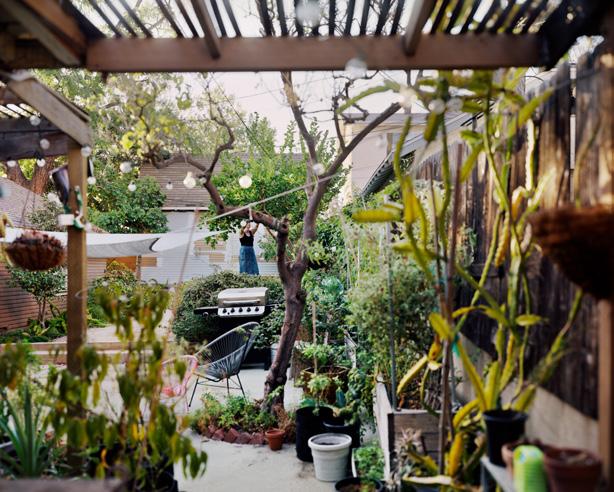
Por muy cuidados que estén, los jardines están en constante evolución: siempre están floreciendo, retrayéndose, muriendo y renaciendo. El artista jardinero representa un modelo de aceptación de este ciclo y de profundo afecto por el lugar, el entorno y la comunidad.
Concretamente, en lo que respecta a este proyecto, en Carla nos gustaría señalar que Los Angeles se asienta en el territorio tradicional, ancestral y no cedido de los pueblos gabrieleno/tongva, los cuidadores originales de esta tierra.
Además de una serie de parterres elevados, plantas hortícolas y cuatro esponjosas gallinas, el jardín de Diane Williams incluye plantas como el hibisco y el índigo, que emplea junto con las agujas de coníferas que caen de los árboles vecinos para fabricar tintes naturales utilizando métodos de tintura filipinos precoloniales. Hace uso de estos tintes en su trabajo textil, abordando la recolección y la elaboración de tintes con un espíritu abierto a la exploración. Para Williams, el jardín no es un espacio prístino o precioso, sino algo vivo y activo que invita a participar y jugar.
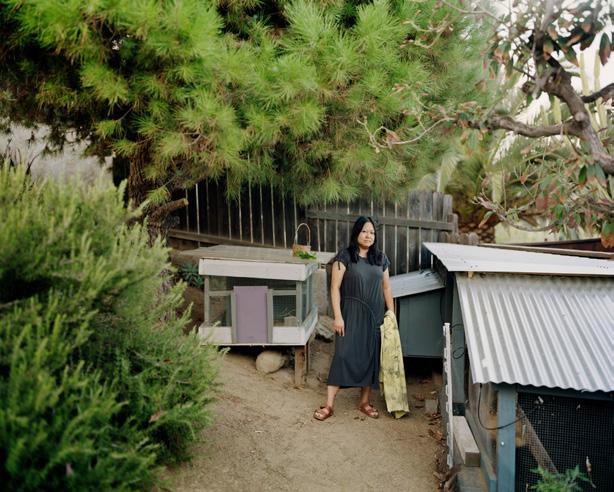
nado de manera informal e improvisada, a partir de los obsequios de su comunidad. Otras plantas fueron adoptadas de amigos que se mudaron o rescatadas de la acera durante sus paseos por el barrio. También para Heather, el jardín se introduce directamente en su estudio: utiliza los calabacines de cuello largo del jardín de su padre en sus fotografías, plegando su cuerpo en torno a sus formas orgánicas.
Heather Rasmussen comenzó su jardín lentamente. Con esquejes de plantas regalados por amigos, familiares y vecinos, su jardín ha crecido y evolucio
Para Mimi Lauter, el jardín es en sí mismo una composición pictórica que evoluciona constantemente con los cambios de luz y el paso de las estaciones. Lauter entiende que el cuidado y la planificación de su jardín se asemeja a la realización de un cuadro: una salpicadura de púrpura y lavanda en un rincón contrasta con una floración de amarillo en otro. Los rojos y los rosas nadan juntos en una mancha monocromática. No se trata solo de la disposición intencionada de varios colores y texturas, sino de la sincroni zación cuidadosamente orquestada —el crecimiento, los picos y la muerte de cada planta— que se convierte en una manera de señalar los momentos. Cuando una planta está termi nando la temporada, otra está empezando a crecer, en un flujo y reflujo diseñado artesanalmente.
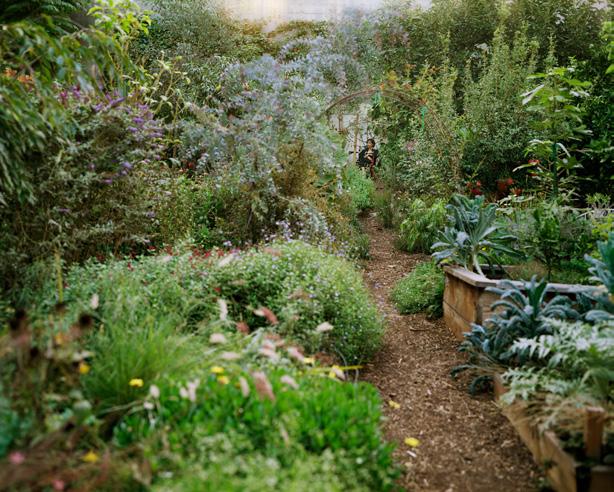
4 de agosto–15 de octubre de 2022
En una conversación de 2017 con Paul McCarthy, Kaari Upson divulgó la frase que mejor resume su fascinación por las facetas indeterminadas, a veces enfermizas, de la vida de otras personas: “las ruinas del otro”¹. Aunque se vio truncada por la trágica muerte de la artista a causa del cáncer en 2021, la carrera de Upson se construyó en torno a su poder para “ser testigo de la nada de otra persona” y de llenarla —a través de la investigación, la autorre flexión y la imaginación—². Su reciente exposición never, never ever, never in my life, never in all my born days, never in all my life, never [nunca, nunca jamás, nunca en mi vida, nunca en todos mis días de nacido, nunca en toda mi vida, nunca] reveló que, para Upson, el “asco” es precisamente donde residen los aspectos más desconcertantes y generativos de la identidad. Las pinturas, los dibujos, los videos, las esculturas y las instalaciones de la exposición —todos ellos realizados en los últimos años de su vida— destacan la concepción de Upson de que el yo no es una entidad estable y fija, sino que se encuentra en la no materia que existe en la abyecta frontera entre estados, entre individuos, entre lo que se siente y lo que se articula y, en última instancia, entre la vida y la muerte. Upson es más conocido por The Larry Project [El proyecto de Larry] (2005 12), un proyecto de siete años de duración que reconstruyó la vida de un excén
trico y amenazante vecino desaparecido de los padres de Upson a través de sus pertenencias abandonadas.
A través de su obra, Upson comenzó a incorporar parte de Larry a su sentido del yo, sus recuerdos se fundieron con la concepción de su sujeto.
Aunque Upson se alejó de este proyecto en 2012, su predilección por difuminar las experiencias de otros con las suyas propias persistió. La instalación de tamaño natural Kris’s Dollhouse [La casa de muñecas de Kris] (2017 19), incluida en la reciente exposición de Sprüth Magers, se basa en una casa de muñecas hecha por la madre de una amiga. Las casas de muñecas suelen hacer referencia al deseo materno de recrear la conocida seguridad del hogar como espacio de agradable ensueño. Pero en la macabra ampliación del objeto de Upson, la chimenea está quemada y las paredes tienen el gris moteado de un hígado cirrótico.
La instalación, además, sirvió de escenario para una serie de videos perversos. En Alex’s House [La casa de Alex] (2019), Upson y Kristina (Kris) Perchatti, su amiga y colaboradora, se pasean por la casa de muñecas de un mundo nórdico vestidas como caricaturas ensangrentadas y sucias de amas de casa. Abatidas, con los ojos bien cerrados y los globos oculares pintados en sus párpados cerrados, Upson mueve sin entusiasmo objetos por el espacio mientras describe cierta “casa de obra sencilla” en Las Vegas (que también pertenecía a Kris). En otros planos, cojean en tándem por el espacio, haciéndose eco del diálogo del primer personaje como si estu vieran poseídos, y parecen hablar sin sentido mientras recitan detalles banales de la vida de Kris. La vestimenta de los perso najes, sus extraños movimientos y sus diálogos superpuestos sugieren una experiencia más siniestra de la casa que la que
Kaari Upson, Portrait (Vain German) [Retrato (Vain German)] (2020–21). Uretano, resina, resina de agua, pigmento, fibra de vidrio y aluminio, 29.25 × 23.5 × 2.25 pulgadas. © The Art Trust creado por Kaari Upson Trust. Imagen por cortesía de Sprüth Magers. Foto: Ed Mumford.
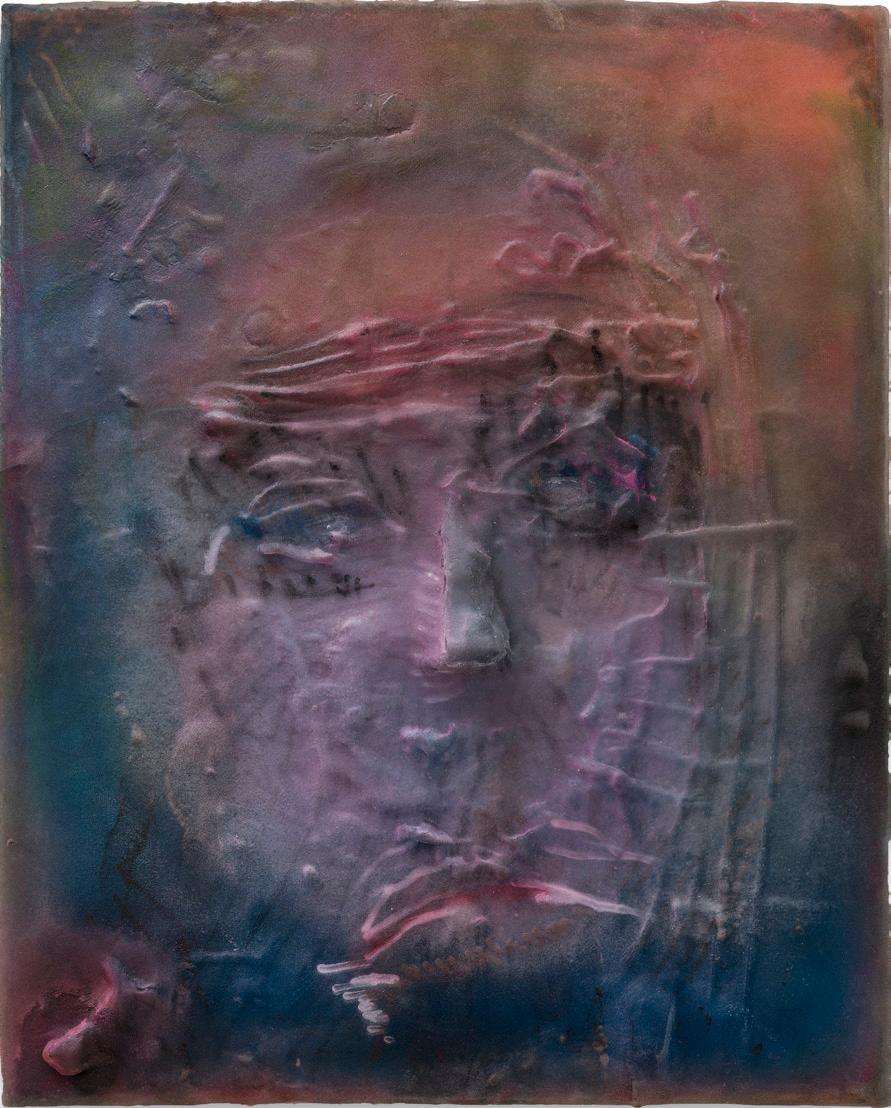
puede expresarse a través del habla, una experiencia que ahora comparten varias personas. A pesar de la atmósfera profundamente inquietante del video, Upson mantiene la diversión de jugar a fingir, ya que los cuerpos de los personajes y su entorno correspondiente se convierten en vehículos para una actuación inquietante —cargada, quizás, de trauma, pero animada por el humor.
El lenguaje funciona como una especie de juego en las pinturas de Upson basadas en el texto, que hace más por transmitir la profunda oscuridad del ser que por ofrecer verdades declarativas sobre él. La exposición presentaba una serie de monumentales dibujos en blanco y negro que empequeñecían al espectador entre densas nubes de texto. Habiendo servido casi como diarios para el artista, las obras forman cavilaciones poéticas concretas sobre lo que significa, filosófica y empírica mente, habitar un cuerpo y una mente. “¿QUIERES SER DIOS?”, Upson escribe en letras de burbuja que se asemejan a un intestino grueso. Aunque el yo, para Upson, era en última instancia desconocido, su misterio suscitó en ella un poderoso impulso para signifi carlo o representarlo, aunque fuera de forma incompleta. Los productos de este impulso, más claramente visibles en los fragmentos de lenguaje de sus dibujos, evocan lo que yo podría llamar lo sublime conspirativo: los sentimientos contradictorios de horror y asombro que surgen de las infinitas maneras en que uno puede intentar precisar una pregunta que en última instancia no tiene respuesta. “QUÉ SOBREIDENTIFICACIÓN CON LA FANTASÍA INCONGRUENTE”, garabatea en otro lugar, señalando los excesos narrativos
y las incoherencias que surgen al tratar de entenderse a sí mismo —pero que nunca se resuelven en un concepto o verdad totalizadores.
Para Upson, nunca hubo realmente un núcleo del yo que divulgar. En su lugar, sus investigaciones sobre la sucie dad y el polvo de la interioridad abrieron los mecanismos para que la identificación pudiera funcionar de una manera más proteica y difusa. En una serie de relieves murales realizados con uretano, resina y otros materiales, todos ellos titulados (Portrait) Vain German [(Retrato) Vain German] (2020 21), los rostros emergen de las superficies magulladas de las obras como máscaras de muerte. Un coloquialismo contemporá neo nos enseña que “desenmas carar” a alguien es revelar la verdad sobre una persona. Pero la máscara es también un avatar del yo que toca tanto lo que está dentro como lo que está fuera, un instrumento que anula las líneas que dividen a los vivos y a los muertos, a lo visible y a lo obsceno. Upson entendió que, en estas capacidades, la máscara podría actuar como un intruso en las tierras fronterizas, comprendiendo el oscuro paisaje de la propia “ruina”. Consulte la página 90 para ver las notas a pie de página.
galería. Quince cubos rotaban sobre la cinta, cada uno de ellos con una extraña y poco atractiva colección de artículos vintage: colonia, llaves de motel, proteje slip, Sun-In y una bolsa Ziploc con dos lonchas de bacon. Lo que es más importante, cada cubo mostraba una etiqueta de identificación de segunda mano que asignaba cada grupo de “pertenencias” a uno de los 15 retratos fotográficos colgados en la sala. Jeff apoya a Nixon; Wanda tiene la regla; casi todos fuman.
Con la ayuda de prótesis y disfraces propios de Hollywood, Cohen se transformó en cada uno de los 33 personajes de la serie de retratos (también titulada HELLO, My Name Is). Recogió en tiendas de segunda mano y mercadillos las etiquetas con los nombres que inspiraron los retratos. Las etiquetas, prendidas del pecho de cada uno de los personajes, también identifican su lugar de trabajo (entre ellos, Pizza Hut, Arby’s y Payless). Sin embargo, estas etiquetas pertenecieron en su día a personas reales de la clase trabajadora, que Cohen no conocía. Se ha apropiado de sus identidades y luego las ha reimaginado con un detalle minucioso y poco favorecedor, pasando tiempo en una silla de maquillaje para plasmar detalles de su físico imaginado: su peso, sus arrugas, sus manchas y su piel sudorosa. Habitó los cuerpos de una clase trabajadora imaginada, creando fotos de elevada producción que se hacen pasar por retratos rápidos de centro comercial o de anuario, con todas las figuras posando en un taburete de madera ante el mismo telón de fondo de color leonado.
Estos retratos, en conjunto, están muy lejos de los de la serie Women [Mujeres] (2016 21) de Cohen, expuesta en la segunda
galería, que en su mayoría muestra a mujeres reconocibles y de alto perfil del círculo de Cohen (Cohen ha modelado y fotografiado importantes campañas comerciales)¹. Entre los rostros famosos están la modelo Georgia May Jagger, la actriz del momento Alexa Demie y la estrella del pop Charli XCX. Se las representa con toda la pompa de las campañas editoriales de Cohen (el retrato de Jagger, en particular, podría haberse extraído de la reciente campaña de Cohen para la línea de ropa moldeadora de Kim Kardashian, SKIMS).
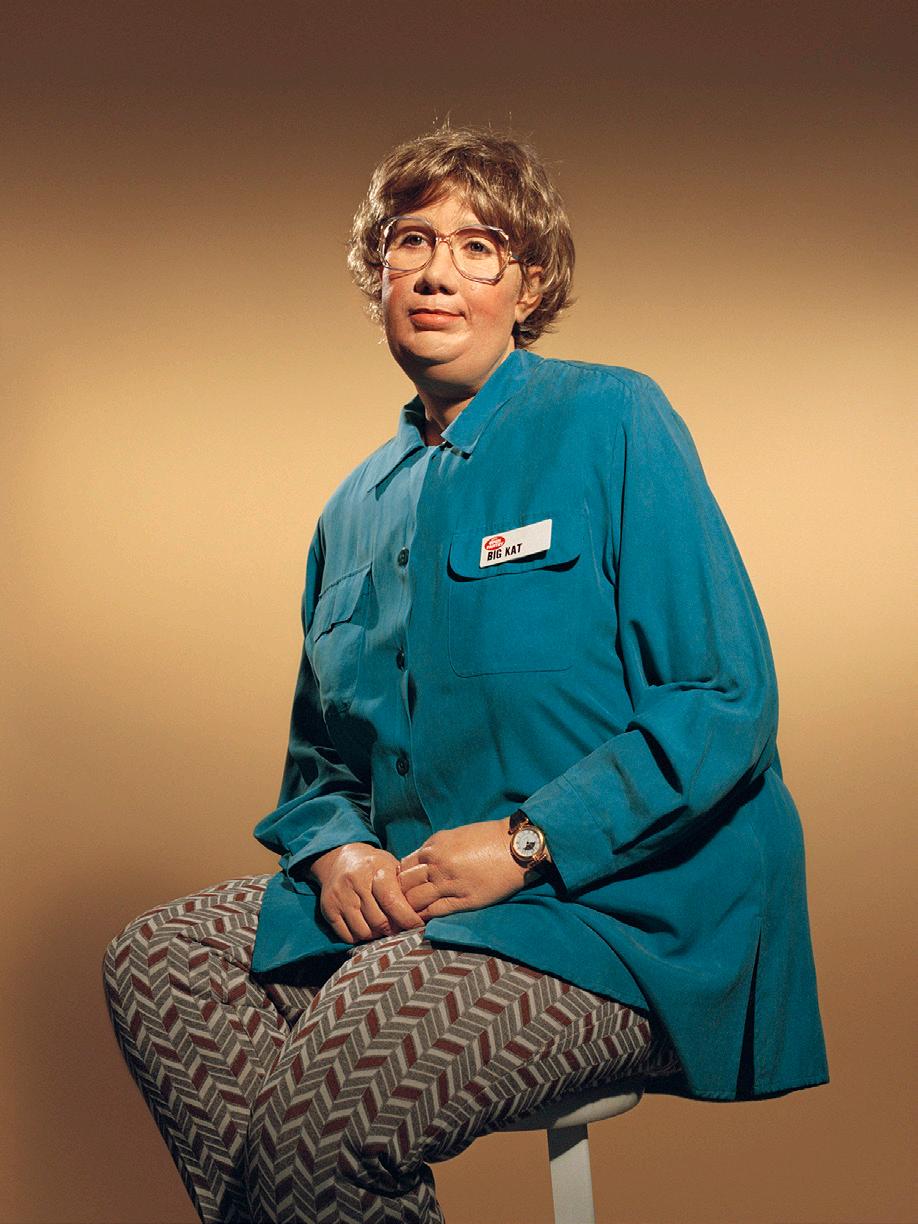
Los personajes de Women son retratados en plena acción en platós cinematográficos repletos: relucientes y parcial mente desnudas, a menudo se reclinan junto a la piscina, iluminadas profesionalmente y acentuadas por los extras del fondo. El estatus real de las mujeres, unido a los elaborados mundos que se construyen a su alrededor, hace que la división entre este grupo y la clase trabajadora imaginada por Cohen en HELLO, My Name Is sea aún más flagrante. Expuestas juntas, estas obras parecen ajenas a la dinámica de clases. Refuerzan los tropos fáciles y baratos de la jerarquía visual, y no porque la artista esté subrayando cómo la fotografía, al igual que la sociedad, se encuentra lejos de estar democratizada.
Más al fondo de las galerías, una parrilla de videos con Cohen en la piel de 24 de los personajes de la serie HELLO, My Name Is se proponía revelar “las historias y verdades íntimas de cada personaje”². Sin embargo, el montaje los fusionaba en un coro de manera efectiva. Los videos cortos se reproducen todos simultánea mente, y los personajes simula ban un discurso mientras una
pista de audio separada, en bucle, reproducía apenas unos segundos de su diálogo jocoso cada vez: “Todo es directo conmigo ¡salvo que también hay mucho por detrás!”, dice Big Kat, dándose palmaditas en las caderas. Los videos, al igual que las imágenes, se convirtieron más en un espectáculo que en “verdades íntimas”, su interés depende del conocimiento o reconocimiento del hecho de que todos los personajes son Cohen.
El comunicado de prensa alardea de que “en agudo contraste con el Facetune, los filtros y los autorretratos de Photoshop de las redes sociales, Cohen añade líneas y papada y michelines a sus personajes[,] coloreando el dolor y la pérdida y el desamor de sus vidas”³. Big Kat y Jeff tienen los dedos hinchados y carnosos y una papada falsa;
Jackie tiene una pronunciada nariz protésica y cejas altas perfiladas con lápiz; la piel de Brenda y Teena está pintada con manchas. Este conjunto de obras se realizó en 2021, el mismo año en que Cohen y su padre aparecieron vestidos de Gucci en la portada de la revista de moda de lujo Numéro Berlin⁴, lo que subraya el hecho de que Cohen está atacando hacia abajo, involucrándose en la revelación de las vulnerabilidades (imaginadas) de los demás al tiempo que no se implica de ninguna manera, renegando de una posición crítica en el proceso.
Aquí es donde la aproximación de Cohen al autorretrato del personaje no consigue lo que artistas como Gillian Wearing, Nikki S. Lee, Genevieve Gaignard, Tommy Kha y, anteriormente, Claude Cahun han alcanzado en este género. Estos fotógrafos
han utilizado sus cuerpos para investigar y expresar ideas íntimas y urgentes (o premisas culturales) sobre sus identidades en relación con el género, la familia, la diáspora y la raza. En su serie de 2003, Album [Álbum], Wearing empleó a expertos en fabricación para crear máscaras de silicona que utilizó para reconstruir viejas fotos familiares, convirtién dose no solo en los miembros de su familia, sino también en ella misma de niña y adoles cente. En Projects [Proyectos] (1998 2001), Lee se integró y vivió literalmente entre varios grupos subculturales, transfor mando su aspecto, su vestimenta y sus modales en un intento de asimilación, pero las imágenes también tratan sobre su propia identidad como mujer surcoreana que vive en Estados Unidos, sobre el hecho de no encajar nunca realmente. Por el contrario, Cohen crea caricaturas, sobre todo porque carece de un verdadero interés en el asunto⁵.
Cohen ha insistido en que su mundo fotográfico “no reside en el mismo mundo en el que vivimos” y es “un lugar mucho más libre en el que vivir”⁶. Sin embargo, los dos conjuntos de obras expuestas parecen reproducir las crudas desigual dades de nuestro propio mundo: Cohen puebla su mundo imaginario adoptando las identidades de personas reales que, sin duda, han experimentado las luchas del capitalismo explotador y el clasismo, el racismo y el sexismo sistémicos. Cuando la exposición llegó a su fin en agosto, la galería Jeffrey Deitch compartió en Instagram un video disparatado de ocho minutos sobre la exposición, coescrito por Cohen⁷. Un actor disfrazado del “Jeff” de Cohen narra el recorrido satírico de la galería.
El post convirtió a la clase trabajadora en un chiste, descri biendo a Jeff como “uno de los cuatro gerentes a tiempo parcial de Arby’s”⁸. Ni el video de relaciones públicas ni la obra en sí dirigen su crítica contra los sistemas de poder y desigualdad que rigen nuestras vidas (o el papel que la fotografía puede desempeñar para refor zarlos) y, como resultado, ambos son en última instancia más dolorosos que satíricos. El hecho de que Cohen ocupe un cuerpo lo suficientemente maleable y sin marcas como para servir de “pizarra en blanco” es un privilegio de movilidad que requiere ciertas ventajas estructurales (belleza, riqueza, blancura, etc.). Desgraciada mente, ejerce ese poder para imaginar un mundo que no hace más que reproducir las profundas desigualdades del nuestro, un proyecto que solo es posible en ausencia de empatía y consideración por los profundos retos de la representación fotográfica. Consulte las páginas 94–95 para ver las notas a pie de página.
Para Wendy Park, era el relajante aroma del bálsamo de tigre de su madre, el recuerdo de la copa nocturna de su padre (Crown Royal con tres cubitos de hielo) y el sonido ambiente del noticiero nocturno coreano. Para mí, era mi madre escabulléndose a por un trozo de chocolate negro mientras mi padre dormitaba en el sofá viendo Antiques Roadshow. En la exposición OFF THE CLOCK [FUERA DE
HORARIO], Park puso especial esmero en representar los ansiados rituales de descanso que sus padres aguardaban al final de cada jornada laboral. Hay una cualidad casi cinematográfica en la manera en que Park impregna de un lujo inesperado las rutinas familiares de la clase trabajadora inmigrante de Los Angeles: sus referencias a los objetos de la nostalgia de la infancia en los 90 son un reflejo de los aspectos de mi educación como hija de inmigrantes eritreos de clase trabajadora. Muchos de los primeros recuerdos de Park se centran en el trabajo, y los objetos de sus cuadros —incluso las baratijas que asocia con el descanso— están ineludiblemente ligados al mundo laboral y al comercio. ¿Qué implica que nuestros recuerdos más potentes, los de esos momentos íntimos e intermedios compartidos con los seres queridos en espacios domésticos, estén condicionados por el trabajo? Park recoge estas ocasiones fugaces y las plasma sobre el lienzo para presentar una nueva e inspirada forma de reconciliarse con la experiencia de la clase trabajadora.
En estas composiciones a gran escala, rojos y verdes profundos dan paso a rosas y morados pastel, tonos que son a la vez chillones y banales. Los cuadros de Park tienen una factura precisa y realista, si bien muy gráfica: la representación inconfundible de los rotuladores Crayola, un recipiente de Shin Ramyun y un par de Levi’s oscuros se enfrenta a una bidimensionalidad juguetona, similar a la del collage, propia de las coloridas ilustra ciones de los libros de cuentos, en las que las perspectivas se deforman y cada elemento adquiere un sentido compositivo.
El mando a distancia de Sony que aparece en primer plano en Off the Clock (todas las obras de 2022) parece más grande que la vida misma, apuntando quizás a la irresistible atracción de una tarde en el sofá después de un largo día de trabajo. Su paleta vibrante y sus formas redondeadas insinúan una especie de nostalgia de los años 90 (un color verde gak aparece en varias obras, un linóleo fucsia moteado en otras) que hace de la reflexión personal algo irresistible para un espectador de cierta edad.
Heart Apples and Hangers [Corazones de manzana y perchas] es una mezcla afectuosa de la constante fugacidad de la vida laboral y de la ternura igualmente omnipresente del hogar. Tres trozos de manzana que recuerdan vagamente a corazones esperan a ser comidos en un plato que descansa sobre una mesa llena de perchas. El tentempié parece representar los dulces momentos de respiro que interrumpen la implacable tarea de llegar a fin de mes.
El tiempo no se detiene por nadie y, sin embargo, un padre que se las apaña para pausar el reloj durante el tiempo suficiente para obsequiar a su hijo con un pequeño capricho se siente como un emblema del espíritu familiar y perseverante del ocio que se salvaguarda frente a la existencia, por lo demás laboriosa, de la vida de los inmigrantes en este país.
Los cuadros de Park celebran esa particular forma de ingenio de los inmigrantes que es muy anterior a la máxima “cero desperdicio”, el deber práctico de reutilizar casi todo lo que entra en los hogares de los inmigrantes. En Crown Royal Supplies [Materiales de Crown Royal], la regia bolsa púrpura con cordón que en su día contenía el Crown Royal de su padre ha sido reconvertida en un estuche para material escolar: ceras y rotuladores Crayola, lápices y una goma de borrar rosa surgen de su nuevo hogar. En Poker Story [Cuento del póker], una caja de cartón gigante y una fina plancha de
madera sin tratar se convierten en una mesa de juego al aire libre. En Lemon Soju [Soju de limón], un bloque de hormigón lleno de soju y limones forma un elegante bar. El fondo de baldosas rosas hace destacar la ordinaria botella verde translúcida, confiriéndole la categoría de estrella en un brillante anuncio de revista y transformando el bloque de hormigón en un digno pedes tal, un testimonio del tratamiento pictórico que Park da a cosas que de otro modo serían desechables. De pequeña, antes de ir a la cafetería en la que traba jaba como camarera, mi madre solía dejar notas para mis hermanas y para mí escritas en el reverso de las órdenes de Grand Slams y huevos estrellados. Las latas metálicas de galletas se convertían en kits de costura; los botes de cristal vacíos de salsa de tomate se transformaban en recipientes para la mantequilla clarificada.
La vida de la clase trabaja dora ha sido un tema recurrente en la obra de Park, con un énfasis especial en los bazares del sur de California. Es claro que la cultura del comercio fue importante durante su infancia. En muchos de los cuadros de OFF THE CLOCK ha seguido jugando con estos temas. Una inspección más detallada de Lemon Soju revela una pequeña pegatina de color naranja de neón con el precio. La caja reutilizada de Poker Story también está llena de pegatinas con los precios. Levi’s Inventory [El inventario de Levi’s] muestra versiones dobladas de los populares vaqueros en azul y negro, que aparecen colgadas junto a un pilar de las ferias de intercambio de Los Angeles: una camiseta blanca de algodón Pro Club gruesa. En la esquina superior del cuadro un cartel
Wendy Park, Tiger Balm Register
[Registro de bálsamo del tigre] (2022). Acrílico sobre lienzo, 72 × 60 pulgadas. Imagen por cortesía de la artista y de Various Small Fires, Los Angeles / Dallas / Seúl.
Foto: Edgar Cruz.

de dimensiones considerables dice “6,99 dólares”. Park ha comentado que, de niña, el lugar de trabajo de su padre (la feria de intercambio) “se convirtió en su patio de recreo”¹. Me la imagino corriendo aventuras entre los percheros de ropa mientras espera pacientemente a que termine el turno de su padre, de forma parecida a como yo me senté una vez ante la barra de la cafetería, soñando despierta frente a un plato de patatas fritas y un té helado de frambuesa esperando a que mi madre fichara.
Los niños de primera generación con padres de clase trabajadora solemos lamentar el grado desproporcionado en que las identidades de nues tros padres —y, por tanto, nuestros recuerdos— se vieron moldeados por el trabajo. Park reconoce esta realidad, pero cambia su enfoque. Para contrarrestar, rinde homenaje a los preciados momentos en los que las versiones más auténticas y relajadas de nuestros padres salían a la calle y se sentaban un ratito entre sus turnos de trabajo. Este enfoque romántico y revelador invita a recordar con ternura la fruta en forma de corazón y las reservas de chocolate negro. Consigue resaltar estos placeres efímeros y ofrece una nueva lente a través de la cual podemos extraer nuestros recuerdos más formativos.
Consulte la página 91 para ver la nota a pie de página.
Las siglas “A&E” de la reciente exposición de Hauser & Wirth, ‘Paul McCarthy. A&E Drawings A&E Drawing Session 2021 With Lilith Stangenberg’ [Paul McCarthy. Dibujos de A&E Sesión de dibujos de A&E 2021 con Lilith Stangeberg], significan, en parte, Adolf Hitler y su esposa Eva Braun¹ —dos figuras representadas mediante dibujos a gran escala en garabatos gestuales bellamente desquiciados de carboncillo emborro nado y resaltados con coloridos óleos—. Obras como A&E, ASSSS, Santa Anita session [A&E, ASSSS, Sesión de Santa Anita] (2020) establecen el estado de ánimo imperante, representando a Hitler utilizando su pene para introducir un Mickey Mouse en miniatura en el ano de Braun. Por si hubiera alguna duda, el artista aclara la escena por escrito: “EVA FUCK IN THE ASSSS” [EVA COGIDA POR EL CULOOOO].
McCarthy, que ahora tiene 77 años, realizó estos dibujos durante una serie de performances grabadas con Lilith Stangenberg, actriz alemana de 34 años y colabora dora suya desde hace mucho tiempo —A&E evolucionó a partir de NV Night Vater [VN Vater Nocturno] (2019), una serie de películas en desarrollo basada vagamente en el thriller nazi sadomasoquista de 1974 The Night Porter [El portero de noche]—. Escondido en el entresuelo de la galería, un video de dos canales mostraba a un McCarthy con bigote falso, casi desnudo de Janelle Zara
cintura para abajo, interpretando a Adolf frente a la Eva de Stangenberg, que estaba casi desnuda de cintura para arriba. Colocado torpemente entre una pila de mesas en un estudio blanco, McCarthy se arrastra sobre las manos y las rodillas, gruñendo y maldiciendo mientras garabatea, entrando y saliendo de la consciencia del cuerpo de Stangenberg. Ella se despoja de un disfraz de Blancanieves típico de Halloween y se pone medias y bragas blancas, y se revuelve contra los dibujos mientras puntúa la escena con obscenidades aleatorias: “¡Mi padre me coge por las fosas nasales!”. La escena se prolonga durante una hora y 45 minutos, con un efecto menos provocativo que tedioso. La tosca y gutural falta de objetivo es un clásico de McCarthy —quien repite la fórmula de hace cinco décadas que ya hemos visto muchas veces.
La distinguida práctica del espectáculo abyecto de McCarthy surgió a finales de la década de 1960, descendiente de los movimientos vanguardistas de la pintura de acción, los happenings y el cine no narrativo. Al igual que las cagadas y meadas de los accionistas vieneses, las películas, dibujos e instalaciones cargadas de depravación de McCarthy son a menudo producto de actuaciones disocia das y disfrazadas. Se ha ganado su lugar en el canon buceando en las profundidades de la pesadilla donde la mente se resiste a ir². “Pone de manifiesto el disfuncionalismo del sueño americano”, escribió la directora del New Museum, Lisa Phillips, sobre McCarthy en 2000. A menudo, eso implica que meta pollas en las cosas: el tarro de mayonesa de Sailor’s Meat (Sailor’s Delight) [Carne de
marinero (Delicia de marinero)] (1975), o el árbol de su instalación The Garden [El jardín] (1991 92).
Desde el cambio de siglo, la obra del artista ha florecido en producciones de gran presu puesto que incluyen representaciones más explícitas y de mayor definición de la violencia sexual, justo cuando la creencia en el sueño americano ha caído en un precipitado declive. Sus obras más recientes y de mayor envergadura apuntan a los ideales americanos de antaño en la industria del entretenimiento, elevando los bajos fondos libidinosos de los cuentos de hadas de Disney y los westerns de Hollywood en grotescas reinterpretaciones. Su último proyecto sobre Hitler, según la nota de prensa, es una exploración del fascismo y “el clima político actual”³, aunque no se siente muy actual.
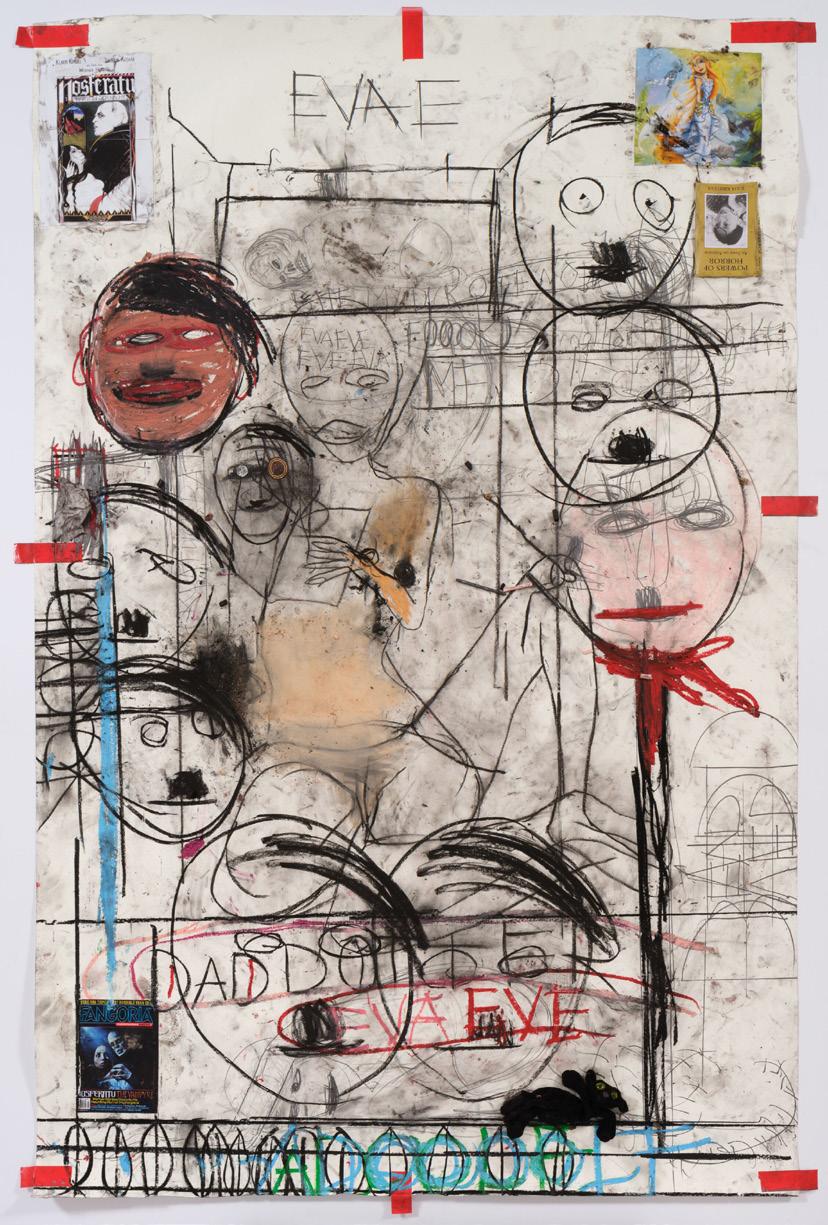
Hoy en día, la amenaza del fascismo se cierne en medio de una constelación de malos actores y la erosión simultánea de nuestros derechos civiles.
Por el contrario, el Hitler simbólico encarna un reflejo ingenuo de fijar la perdición de la sociedad en un solo hombre malo; en otras palabras, una objetivo fácil y anticuado.
La incisividad política de McCarthy al meter la pija en las cosas puede ser exagerada, pero los críticos tienden a subestimar lo personal —es decir, la perspectiva masculina europea estadounidense distin tiva del siglo XX, hábilmente capturada en su obra—. Mientras que la historia del arte nos dice que la violencia sexual en la obra de sus contemporáneas se refiere a una experiencia particular mente femenina, por ejemplo,
la violación en la obra de McCarthy se refiere a America Estas lecturas generalizadas eluden una evidente culpa, nostalgia y perversión respecto a una herencia germánica pasada. (En toda la obra de McCarthy, véanse las referencias recurrentes a Blancanieves y Heidi, o a Stangenberg leyendo en voz alta un ejemplar en alemán de Venus in Furs [La Venus en pieles]). Sus representa ciones de Walt Disney, Hitler y muchas otras figuras vuelven constantemente al arquetipo narcisista específico del privile gio masculino. Allí, el artista encuentra un vehículo ideal para entregarse a los más profundos y oscuros tabúes escolares tóxicos: gritar “mierda” y “joder” a hermosas mujeres desnudas; mezclar ketchup y sirope de chocolate en brebajes repulsivos; golpear y violar; orinar clandes tinamente en la sopa de alguien. Explorar toda la gama de la condición humana no es algo malo: es la función más elevada del arte. Al igual que el difunto accionista vienés Hermann Nitsch, que buscaba la catarsis a través del espectáculo de sangre y vísceras⁴, McCarthy se desprende momentáneamente de la represión de los llamados impulsos “degenerados” en sus actuaciones, creando un espacio seguro para disfrutar y examinar proclividades únicas. (Él ha descrito esto como “desahogo”⁵). Sin embargo, una distinción importante entre el trabajo de McCarthy y el de Nitsch es que, mientras que la principal preocupación de Nitsch era la experiencia de su público, McCarthy ha dicho que “no intenta satisfacer a un público”. Y añadió: “Mi responsabilidad es con las ideas”⁶. En el centro de la prác tica de McCarthy se encuentra la exploración del poder —no
Lápiz,
solo a través de las figuras poderosas que retrata, sino también del poder infundido en un artista que ha acumulado gran riqueza y estima por introducir su pene donde no siempre se quiere—. Con la bendición del mundo del arte, McCarthy parece ocupar un espacio aislado de gran privilegio, donde el sueño americano parece estar vivo y en buena salud y el fascismo no es una amenaza real, sino un fetichismo. Mirando de fuera a dentro, este espacio parece muy divertido: sus ocupantes van libremente donde la socie dad dice que no, sin importar cuántos de nosotros digamos “por favor, no”. Consulte la página 91 para ver las notas a pie de página.
L.A. Memo: Chicana/o Art from 1972-1989 [Memo de Los Angeles: Arte Chicana/o de 1972-1989]
18 de marzo–14 de agosto de 2022
Las imágenes pueden ser espacios de resistencia. Esto me lo recordó una reciente visita a LA Plaza de Cultura y Artes, donde la exposición colectiva L.A. Memo: Chicana/o Art from 1972-1989 reunía a 31 artistas que buscaban subvertir y criticar la cultura mediática en expansión de los años 60 y expresar su orgullo cultural. Las obras procedían principal mente de la colección del proveedor de servicios sanitarios comunitarios AltaMed, que
concentra sus fondos en artistas chicanxs¹, lo que da lugar a una visión ligeramente limitada. Dado que la exposición procedía de una colección corporativa, algunas de las prácticas más experimentales, conceptuales y colaborativas de la época —por ejemplo, las fotografías de Laura Aguilar, Kathy Vargas y Ricardo Valverde; las pinturas que desafían los géneros de Yolanda López, René Yañez y Charles “Chaz” Bojorquez; o el trabajo pionero de performance e instalación de artistas como Edmundo “Mundo” Meza— estuvieron notablemente ausentes, ofreciendo en última instancia una historia algo más ordenada y teleológica de la resistencia chicanx. A pesar de su enfoque circunscrito, L.A. Memo destacó el impacto que estos artistas han tenido en la ciudad y en su discurso artístico y, a su vez, la huella que la ciudad ha dejado en ellos.
Las obras de la exposición se agruparon en dos categorías: crítica a los medios de comuni cación e identidad chicana. En la primera galería, los artistas apuntaban a los medios de comunicación convencionales, comentando la falta de representación cultural en la publicidad y en Hollywood. En Pillow Talk [Charla de almohada] (1979-80), Patssi Valdez imaginó los iconos femeninos latinos que anhelaba, pero que no veía en las revistas de moda de la época, insertando a su amiga Betty Salas en un pastiche de moda. Con un body sin tirantes y ceñido, guantes largos y gafas de sol en forma de corazón, Salas descansa despreocupadamente sobre lujosos cojines amarillos. Otras obras abordan una interpre tación hollywoodiense de Los Angeles: las obras de técnica mixta de Teddy Sandoval exploran los ideales físicos
perpetuados por la industria del cine; las pinturas de Joey Terrill reimaginan los títulos musicales de los guiones gráficos como narraciones de amor queer; y en el video Take a Bite [Mordida] (1977-2017) de Linda Vallejo, la artista secuestra pantallas al estilo de Warhol en un tumulto de colores y marcas gestuales.
El asistente curatorial de AltaMed, Rafael Barrientos Martínez, quien fue curador invitado de la muestra, enfocó la exposición en los años poste riores a la Moratoria Nacional Chicana de 1970, una manifes tación liderada por activistas chicanxs en protesta por el número desproporcionadamente alto de latinos que fueron enviados a pelear, y finalmente a morir, en la guerra de Vietnam². Mientras la comunidad chicanx luchaba por los derechos civiles y la representación, sus historias permanecían ausentes de los medios de comunicación convencionales; la primera galería de L.A. Memo articulaba de forma sucinta, aunque segura, tanto la explosión del activismo como su posterior silenciamiento. La fotografía Iris Crisis [La crisis de Iris] (1982) de Harry Gamboa Jr. muestra su cuerpo borrado por trozos de cinta blanca. En la imagen, él es un lienzo en blanco, su identidad es invisible. Solo una obra de esta galería abordaba directamente la guerra: Madness in Vietnam [Locura en Vietnam] (1987) de Roberto Gutiérrez, un inquietante autorretrato al óleo. El artista tiene los ojos muy abiertos, el ceño fruncido y los pelos de punta. Mirando por detrás de una ventana metálica, parece gritar y jadear, invocando la sombría realidad de TEPT (Trastorno de Estrés Postraumático) que sufren muchas personas de su comuni
dad. El dibujo es uno de los pocos de la exposición que no forma parte de la colección de arte AltaMed, lo cual, dado que pocas obras de la muestra, al menos en apariencia, abordan temas abiertamente controvertidos, solo puedo especular que se debe a su alcance y objetivo. The Chicano Moratorium proporcionó un marco curatorial para la exposición, pero, en forma de obras de arte, las referencias a la guerra de Vietnam fueron escasas.
La segunda galería se aleja de la crítica a los medios de comunicación para explorar el sentido del lugar. Muchos artistas exploraron las ideas de indigenismo, una creencia que contrarresta el dominio de la influencia colonial, realizando obras que honran su herencia cultural indígena y una conexión con la tierra. Con un cambio notable con respecto a la primera galería, estas obras analizan cómo la comunidad chicanx desarrolló su identidad personal y colectiva dentro de sus relaciones con las tradiciones visuales de lo que hoy es el suroeste de Estados Unidos y el norte de México. L.A. Memo (1980) de Carlos Almaraz,
de la que la exposición tomó su título, fusiona una ideología exportada de Los Angeles —palmeras, sol y glamour— con sus experiencias como hombre chicanx. La escena de Almaraz, que se mezcla en un revoltijo de pasteles al óleo, sugiere que estas identidades paralelas no se excluyen mutuamente, sino que son aspectos igualmente importantes de su personalidad. Cerca de allí, Welcome to Aztlan [Bienvenidos a Aztlan] (1987), de Arturo Urista, traza un mapa de la patria original en las historias de migración azteca, un lugar en el que las regiones que ahora se encuentran a ambos lados de la frontera entre Estados Unidos y México no estaban separadas por demarcaciones arbitrarias y donde los habitantes podían viajar libremente. Los temas de esta galería contrastaban con los de la primera, reveren ciando y tendiendo la mano a la tierra, mientras se recordaba las historias culturales, en lugar de utilizar la cultura contemporánea como marco referencial. Los diferentes campos son una combinación que afecta a toda la muestra, y funcionan para explicar la variedad de enfoques adoptados por los artistas
Carlos Almaraz, L.A. Memo [Memo de Los Angeles] (1980). Pastel sobre papel. AltaMed Art Collection. Imagen cortesía del artista y de LA Plaza de Cultura y Artes.
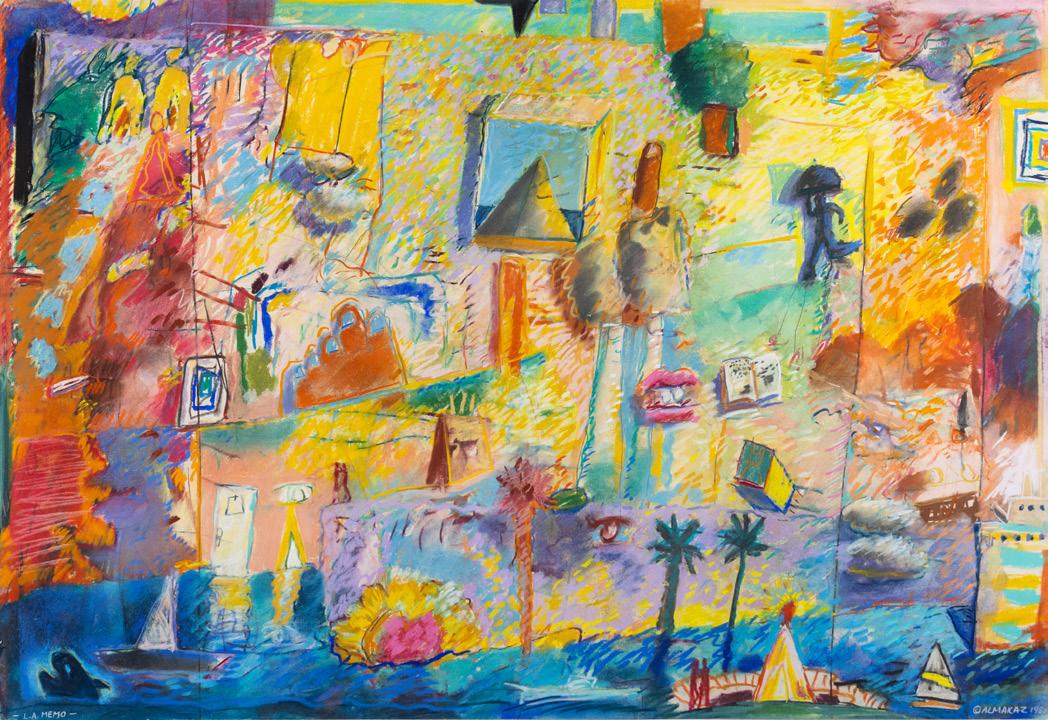
chicanx de la época. Esta tensión fue bien articulada por Randy Kennedy en 2011, quien escribió que, para Gamboa, “la mejor manera de ejercer la libertad artística y expresar la solidaridad con la causa mexicanonorteamericana era, paradójicamente, huir a gritos de la mayoría del arte mexicanonorteamericano”³. Miembro fundador del influyente colectivo de performance chicanx Asco, Gamboa y sus compañeros querían distinguirse de los estereotipos impuestos por la cultura dominante. Mientras tanto, otros, como Luján y Urista, abrazaron la iconografía cultural como un camino hacia la inclusión.
Aunque L.A. Memo intentó dar cuerpo a estas historias, en ocasiones se vio limitado por la restricción curatorial de su procedencia —la Colección de Arte AltaMed—. Las exposiciones de la colección siempre se verán afectadas por los objetivos y temas generales de una institución: como parte de su enfoque holístico de la asistencia sanitaria, AltaMed coloca obras de arte en sus centros de servicio. Por lo general, se trata de espacios clínicos abiertos al público en los que las obras de arte no son atendidas de cerca, por lo que, comprensiblemente, la funcionalidad influirá en las obras que se coloquen —lo que a menudo significa que son de escala doméstica, en papel y bajo vidrio—. Inevitablemente, organizar una exposición a partir de una colección conduce a un enfoque partidista, y las ambiciones de L.A. Memo fueron limitadas por las preocupaciones prácticas de la colección. No obstante, la exposición ha sido una buena presentación de las ideas e ideologías más urgentes para los artistas chicanx
en esta época específica de la historia de Los Angeles, una época marcada por una visión multifacética y compleja de lo que significaba ser chicanx.
Consulte la página 91 para ver las notas a pie de página.
20 de abril–14 de agosto de 2022
La primavera pasada la artista Kelly Akashi, afincada en Los Angeles, viajó a Venecia, Italia, y a su isla contigua, Murano, para realizar una nueva obra para Life Forms [Formas de vida], la exposición inaugural de verano de Barbati Gallery. Situada en el interior del Palazzo Lezze, el espacio ofrecía un refrescante refugio en el corazón del abrasa dor Campo Santo Stefano. Murano es un lugar conocido por su papel innovador en la historia de la fabricación de vidrio europea, y Akashi trabajó con fabricantes de vidrio soplado de la comunidad para producir las esculturas de vidrio soplado incluidas en su exposición.
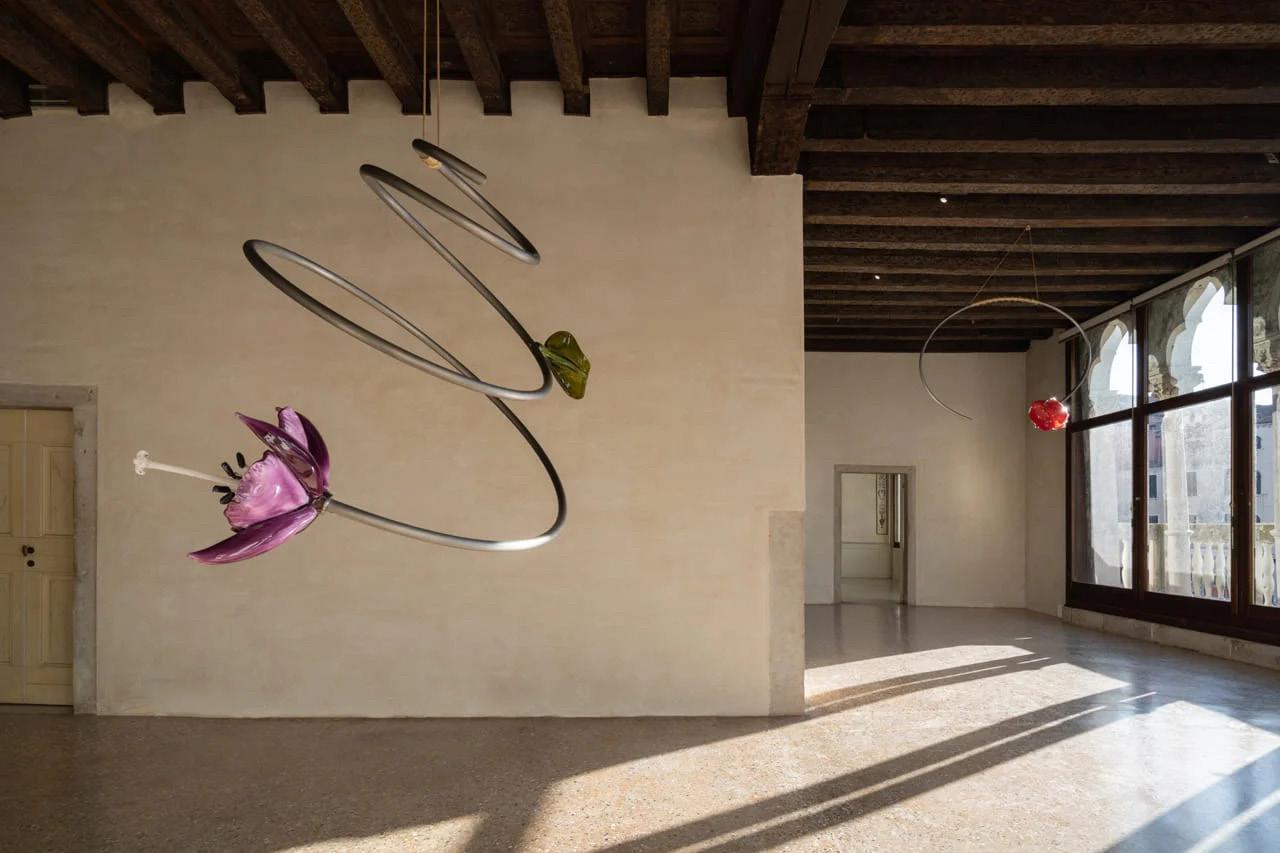
Las formas sinuosas y serpenteantes de estas esculturas aprovechan la capacidad del vidrio para mudar, enroscarse e imitar el mundo natural, especialmente la vibrante biodiversidad de su flora.
Las esculturas de Akashi sitúan a los seres humanos en el contexto de estos agentes no humanos, lo que implica una cohabitación y un equilibrio de las formas de vida —en la obra de la artista, las manos y las figuras coexisten con la iconografía inspirada en las plantas, formando un sistema de apoyo e interdependencia—.
Esta noción es paralela a sus asociaciones con artesanos locales —dentro de una comunidad de sopladores de vidrio en la que el intercambio de conocimientos es un principio, el trabajo en equipo es indispensable y la colaboración es intrínseca—. Siguiendo el medio del vidrio hasta uno de sus epicentros históricos, la exposición de Akashi trabaja para socavar la idea de “maestría”, abrazando en su lugar la humil dad y la curiosidad al buscar el alimento continuo del proceso, el material y la comunidad.
Modelada a partir del suelo del Palazzo, la losa de terrazo incluida en Floret (todas las obras de 2022) modelaba acertadamente la destreza colaborativa de Akashi. La pesada y elevada losa se convirtió en una mesa que soportaba cinco objetos de vidrio soplado realizados con la ayuda del maestro sopla dor de vidrio Matteo Tagliapietra. Incorporaron técnicas tradicio nales del soplado de vidrio de Murano, como la murina y el merletto, para crear patrones únicos basados en especímenes de células vegetales. En un gesto de alusión a la famosa cultura náutica de Venecia
y a la arquitectura de los canales, la cuerda de los barcos locales unió estos “floretes” esféricos en un ecosistema de formas polinizadas.
En la tenue primera planta Akashi cubrió, literalmente, la forma humana con flores. El vestíbulo del Palazzo estaba flanqueado a ambos lados por moldes de bronce montados en la pared de las manos de la artista —un motivo al que vuelve con frecuencia en su obra— que sostenían unas formidables bombillas de cristal como ofrendas flotantes (Life Forms) En el centro del espacio, un relieve de un cuerpo humano estaba envuelto en bronce tejido, como una manta con peso hecha a medida. Titulada Heirloom [Reliquia], la manta de bronce se construyó a partir de un proceso intrincado y por capas: Akashi fundió la manta con flores de crochet y “tejió” la forma mediante una meticulosa soldadura. La pieza recuerda a las Siluetas (1973 80) de Ana Mendieta, una serie de obras de tierra en las que la artista imprimía su cuerpo en diversos paisajes naturales, sus siluetas huecas a veces llenas de fuego, agua o flores. En Heirloom, la forma humana es inseparable
de su envoltorio floral —las flores de bronce contornean el cuerpo, cuyas características humanas definitorias quedan ocultas a la vista.
En el nivel superior de la galería, las escasas escenas repartidas por las luminosas salas imaginaban aún más las conexiones humanas con el mundo no humano, al mismo tiempo que colaboraban con el entorno construido.
En un estante de una pequeña sala se encontraba April 2022Scarpa Graveyard; Murano (Matteo); Buona Pasqua Giudecca; Pearl [Abril de 2022Cementerio de zapatos; Murano (Matteo); Feliz pascua, Giudecca], un molde de bronce de la mano del artista soste niendo delicadamente materiales extraídos de varias zonas de Venecia: una pieza de tela, una flor de cristal verde y negro, una única perla blanca y trozos de rocas y edificios rotos colocados unos encima de otros como estratos geológicos. La mano de bronce funciona como un recipiente para los objetos recogidos en la ciudad, creando un archivo sin preten siones que infiere la experiencia de Akashi con la memoria cultural local. El contraste entre el entorno construido y el mundo natural pone de manifiesto la intervención humana en la naturaleza a escala urbana.
El vidrio es, en cierto modo, el maestro por excelencia —podemos someterlo a nuestra voluntad, pero los resultados finales están fuera de nuestro control, reflejando nuestros intentos de controlar la naturaleza—. Esta ilusión de control es cada vez más evidente en el contexto del Antropoceno, en el que los hiperobjetos de nuestra creación, como el cambio climático, ejercen fuerzas que amenazan
con causar estragos tanto en los espacios naturales como en los artificiales. De este modo, las obras recientes de Akashi giran en torno a formas dispares pero interconectadas de conocimiento colaborativo. Recurriendo a la tradición para participar en un linaje comunitario de la artesanía, y al mismo tiempo recogiendo información de la vasta inteligen cia del mundo natural, Life Forms tomó forma como una oportuna hazaña de colaboración. Así, estas colaboraciones —entre humanos y entre especies— son ahora más esenciales, ya que reconocemos tardíamente que el nuestro es un mundo compartido, moldeado por las mismas fuerzas, entrelazado por un destino colectivo.
1. Juliana Ukiomogbe, “These photos celebrate the beauty of queer Black masculinity”, i-D, 21 de enero de 2021, https://i d.vice.com/en/article/n7vk4w/ clifford prince kings photography celebrates the beauty of queer black masculinity.
2. Priska Neely, “‘#Blackmendream’: Showcasing A Different Side of Black Manhood”, NPR, 14 de diciembre de 2014, https://www.npr.org/2014/12/14/370415400 / blackmendream showcasing a different side of black manhood.
3. André Wheeler, “In the Studio, in the Nude: An Artist Capturing Queer Masculinity”, AnOther, 12 de octubre de 2018, https://www. anothermag.com/art photography/11247/ in the studio in the nude an artist capturing queer masculinity.
4. “Emil Wilbekin, What Does It Mean To Be A Young, Black Queer Artist Right Now?”, New York Times, 16 de septiembre de 2022, https:// www.nytimes.com/2022/09/16/t magazine/ black queer artists.html.
5. “Clifford Prince King in conversation with Paul Mpagi Sepuya”, Robert Giard Foundation, 16:50 17:55, 18 de febrero de 2022, https://www.youtube.com/ watch?v=OhwkCaTjaWY.
6. Éduoard Glissant, Poetics of Relation, traducción de Betsey Wing (Michigan: University of Michigan, 2010).
7. Tiana Reid, “Shikeith’s Black Uncanny”, Aperture, primavera de 2022, https://issues. aperture.org/article/2022/01/01/shikeiths black uncanny.
8. Zoë Hopkins, “Shikeith at Yossi Milo Gallery”, Artforum, 28 de septiembre de 2022, https://www.artforum.com/picks/shikeith 88600.
9. Miss Rosen, “Shikeith’s spiritual photographs of Black masculinity”, i-D, 13 de junio de 2022, https://i d.vice.com/en/ article/dy7g4y/shikeith.
10. Reid.
11. Teju Cole, “When The Camera Was a Weapon of Imperialism. (And When It Still Is.)”, The New York Times, 6 de febrero de 2019, https://www.nytimes.com/2019/02/06/ magazine/when the camera was a weapon of imperialism and when it still is.html.
12. Charlotte Janson, “Paul Mpagi Sepuya Brings A Fresh Gaze to the Male Nude”, Elephant Art, 19 de agosto de 2019, https:// elephant.art/paul mpagi sepuya mapplethorpe the male gaze/.
13. Marielle Bobo, “Clifford Prince King’s Tender Portraits of Black Intimacy”, Ebony, 1 de julio de 2022, https://www.ebony.com/ clifford prince kings tender portraits of black intimacy/.
14. Emma Brockes, “Hilton Als: ‘I had this terrible need to confess, and I still do it. It’s a bid to be loved’”, The Guardian, 2 de febrero de 2018, https://www.theguardian.com/ books/2018/feb/02/hilton als interview pulitzer prize criticism white girls.
1. Pat Maginnis, “The Army of Three”, consultado el 16 de octubre de 2022, http:// www.patmaginnis.org/index.php/ the army of three/.
2. Brooke Kellaway, “Letters to an Army of Three: Andrea Bowers on Abortion, Then and Now”, Walker Art Center, 3 de diciembre de 2012, https://walkerart.org/magazine/ andrea bowers patricia maginnis abortion.
3. “Supreme Court Nominee Brett Kavanaugh Confirmation Hearing, Day 2, Part 5”, C SPAN video, 2:04:50, 5 de septiembre de 2018, https://www.c span.org/video/ ?449705 15/supreme court nominee brett kavanaugh confirmation hearing day 2 part 5.
4. Julia Bryan Wilson, “Andrea Bowers: Drawn Toward Feminism”, en Andrea Bowers (New York, NY: DelMonico Books, 2021), 59–65.
5. Drew Philp, “America’s tree sitters risk lives on the front line”, The Guardian, 26 de mayo de 2018, https://www.theguardian.com/ environment/2018/may/26/tree sitters appalachian oil pipeline virginia west.
6. Adrienne Rich, “North American Time”, EPortfolios@Macaulay, 1983, consultado el 30 de octubre de 2022, https://eportfolios. macaulay.cuny.edu/smonte10/files/2010/ 08/North American Time.pdf.
1. “Harvesters and harvesting practice at documenta fifteen”, documenta, 25 de mayo de 2022, https://documenta fifteen.de/en/ news/harvesters and harvesting practice at documenta fifteen/.
2. Alex Marshall, “Furor Over Documenta Highlights a Widening Chasm in Germany”, The New York Times, 6 de agosto de 2022, https://www.nytimes.com/2022/08/06/ arts/design/documenta antisemitism.html.
3. Alex Greenberger, “La controversia antisemita de Documenta, explicada: How a German Art Show Became the Year’s Most Contentious Exhibition”, ARTnews, 22 de julio de 2022, https://www.artnews.com/ art news/news/what is documenta 15 antisemitism controversy 1234635001/.
4. Para una reflexión en profundidad sobre las polémicas del antisemitismo en la documenta fifteen, véase: Eyal Weizman, “In Kassel”, London Review of Books, Vol. 44 nº 15, 4 de agosto de 2022, www.lrb.co.uk/ the paper/v44/n15/eyal weizman/in kassel.
5. “Nuevo escándalo de antisemitismo en la exposición de arte documenta de Alemania”, Deutsche Weller, 28 de julio de 2022, https:// www.dw.com/en/new antisemitism scandal at germanys documenta art exhibition/a 62632478.
6. Discurso de Ade Darmawan (ruangrupa) en la Comisión de Cultura y Medios de Comunicación, discurso del Bundestag alemán, 6 de julio de 2022, https:// documenta fifteen.de/en/news/speech by ade darmawan ruangrupa in the
committee on culture and media german bundestag july 6 2022/.
7. Tatiana Vahan en conversación con el autor, agosto de 2022.
8. Vahan.
9. Compra en la que el propietario paga al inquilino dinero en efectivo a cambio de que abandone voluntariamente la vivienda y resuelva el contrato de arrendamiento.
10. “What is Rematriation?”, Sogorea Te’ Land Trust, consultado el 28 de octubre de 2022, https://sogoreate landtrust.org/what is rematriation/.
11. Jonah Valdez, “After nearly 200 years, the Tongva community has land in Los Angeles County”, Los Angeles Times, 10 de octubre de 2022, https://www.latimes.com/ california/story/2022 10 10/after nearly 200 years the tongva community has land in los angeles county.
12. Jessica P. Ogilvie, “Why a Property Worth Millions was Returned to the Tongva Tribe”, LAist, 10 de octubre de 2022, https://laist. com/news/la history/why a property worth millions was returned to tongva tribe.
13. Samantha Morales Johnson en conversación con el autor, agosto de 2022.
1. Audre Lorde, “Black Women’s Poetry Seminar, Session 3, May 10, 1984”, en Audre Lorde: Dream of Europe: Selected Seminars and Interviews: 1984-1992, ed. Mayra A. Castro Rodríguez y Dagmar Schultz (Chicago: Kenning Editions, 2020), 33–34.
2. “History of Holography”, Holography, consultado el 16 de octubre de 2022, http:// www.holography.ru/histeng.htm.
1. Paul McCarthy, “Interview with Kaari Upson”, en Kaari Upson: Good Thing You Are Not Alone, ed. Margot Norton (New York: New Museum, 2017), 25.
2. McCarthy, 25.
1. No cabe duda de que Cohen tiene un gran ojo editorial, pero sus imágenes también son derivativas, tal vez la mayoría de las fotografías de Larry Sultan y Philip Lorca diCorcia —Richie, Brooklyn, New York (2020)— son una copia exacta de Marilyn; 28 Years Old; Las Vegas, Nevada; $30 (1990–92) de diCorcia.
2. HELLO, My Name Is, comunicado de prensa, Jeffrey Deitch, 2022, https://deitch. com/los angeles/exhibitions/nadia lee cohen hello my name is.
3. HELLO, My Name Is
4. NUMÉRO & NUMÉRO HOMME BERLIN (@numeroberlin), “NUMÉRO BERLIN /
THE „ALTER“ ISSUE — / GET YOUR COPY ! / Models @nadialeelee with her dad”, 10 de diciembre de 2021, https://www.instagram. com/p/CXUEjxqsWb2/.
5. Es necesario apuntar, Cohen misma aparece en el espectáculo –tan solo una vez en los dos grupos de fotografías expuestos. En Nadia, North Hollywood, Los Angeles (2020), que está incluido en Women, su maquillaje es glamuroso, luce su largo cabello y unas pequeñas bragas rojas.
6. Jyni Ong, “Nadia Lee Cohen on how she became Nadia Lee Cohen”, 8 de marzo de 2019, https://www.itsnicethat.com/features/ nadia-lee-cohen-photography-internationalwomens-day-080319.
7. Jeffrey Deitch (@jeffreydeitchgallery), “NEW! Explore Nadia Lee Cohen’s ‘Hello, My Name is’ exhibition via @nowness with host Jeff”, Instagram, 17 de agosto de 2022, https://www.instagram.com/p/ ChXf6CfF7bR/.
8. “Culture Catcher”, 17 de agosto de 2022, producido por Fabien Colas y Malcolm Duncan, video, 8:09, https://www.nowness. com/story/culture-catcher.
1. Wendy Park, “About”, declaración de la artista, consultada el 5 de octubre de 2022, https://www.wendypark.co/about-2.
1. Para McCarthy, el “A&E” también alude a Adán y Eva y a Artes y Espectáculos.
2. Lisa Phillips, “Introduction”, Paul McCarthy (New York: New Museum of Contemporary Art, Ostfildern-Ruit, y Hatje Cantz Publishers, 2000).
3. Hauser & Wirth, “Paul McCarthy A&E Drawings A&E Drawing Session 2021 With Lilith Stangenberg”, comunicado de prensa, 2022, https://vip-hauserwirth.com/galleryexhibitions/paul-mccarthy-ae-drawingsaedrawing-session-2021with-lilithstangenberg/.
4. Hermann Nitsch, “Herman Nitsch talks about his work at Massimo De Carlo in London”, entrevista con Alex Jovanovich, Artforum, 15 de mayo de 2018, https://www. artforum.com/interviews/hermann-nitschtalks-about-his-work-at-massimo-de-carloin-london-75363.
5. Kristine Stiles, “INTERVIEW: Paul McCarthy: ‘My work refers to my private, forgotten or repressed memories. I recognize them as existing, but I am not sure how they relate to me. Are they specifically my trauma, or someone else’s?’”, ARTSPACE, 6 de agosto de 2020, https://www.artspace.com/ magazine/interviews_features/qa/interviewpaul-mccarthy-my-work-refers-to-myprivate-forgotten-or-repressedmemories-i-56624.
6. “Paul McCarthy in ‘Transformation’”, video de Art21, 18:06, 21 de octubre, https://art21.
org/watch/art-in-the-twenty-first-century/ s5/paul-mccarthy-in-transformationsegment/.
Chicana/o
from 1972-1989
1. Teena Apeles, “AltaMed Enriches the Lives of Its Patients through Art”, KCET, 5 de noviembre de 2018, https://www.kcet.org/ shows/artbound/altamed-enriches-thelives-of-its-patients-through-art.
2. Louis Sahagun, “How an East L.A. protest gave voice to the Chicago movement”, The Los Angeles Times, 23 de agosto de 2020, https://www.latimes.com/projects/ chicano-moratorium/east-la-protest-gavevoice-chicano-movement/.
3. Randy Kennedy, “Chicano Pioneers”, New York Times, 5 de agosto de 2011, https://www.nytimes.com/2011/08/28/ arts/design/works-by-asco-at-the-losangeles-museum.html.
91
Allison Noelle Conner ha publicado en Artsy, Art in America, Hyperallergic, East of Borneo y otras. Nació en South Florida, se encuentra afincada en Los Angeles.
Jessica Simmons Reid (maestría en Bellas Artes, School of the Art Institute of Chicago; licenciada en Artes, Brown University) es una artista y escritora afincada en Los Angeles y Joshua Tree. Se interesa por el espacio intersticial entre el lenguaje de la abstracción y la abstracción del lenguaje, así como por la mezcla de poesía y política. Ha colaborado con ensayos y críticas en Carla y Artforum, entre otros.
Julie Weitz es una artista transdisciplinar cuyas obras, fundamentalmente en narrativa, incluyen actuaciones en directo y multimedia, fotografía, dibujo e instala ciones. Su modelo de trabajo muy colaborativo incluye líderes espirituales, activistas, poetas, coreógrafos y músicos, y con frecuencia se basa en su herencia como judía queer, asquenazí y diaspórica.
Yves B. Golden es una artista multidisciplinar, escritora, DJ y organizadora cultural en la comunidad. Su trabajo explora la visibilidad, la dignidad y el vínculo sagrado que existe entre la memoria y los objetos físicos. En mayo de 2020, Yves cofundó la Herbal Mutual Aid Network [Red de Ayuda Mutua de Hierbas], una inicia tiva sin ánimo de lucro en expansión que trabaja para llevar atención y recursos a personas negras, trans, indígenas y discapacitadas.
Amia Yokoyama es una artista multimedia afincada en Los Angeles que trabaja con animación experimen tal, video, escultura e instalación. Las imágenes de la obra de Yokoyama surgen de su especulación sobre el futuro y la exploración de la dualidad entre la maravilla y el horror. Yokoyama trata de que su obra evoque una sensación juguetona y de otro mundo, al tiempo que crea un estilo que sugiere el futuro y el pasado.
Autor del ensayo fotográfico y artistas destacados Paloma Dooley (nacida en New York, 1993) vive y trabaja en Los Angeles, donde realiza fotografías de exposiciones y documentales para artistas, galerías y museos. Se licenció en Photography en Bard en 2015 y realizó una residencia de un mes en el Vermont Studio Center en 2016. Su trabajo ha sido incluido en publica ciones y exposiciones en EUA y en el extranjero.
Mimi Lauter (nacida en 1982 en San Francisco, CA) es una artista afincada en Los Angeles que trabaja con pasteles al óleo y pasteles blandos sobre papel, así como con óleos sobre lienzo y lino, y utiliza su obra como trampolín para una reflexión más profunda sobre la pintura como espacio teatral en el que presentar imágenes, formas y narrativas. Suspendidas en algún lugar entre la naturaleza muerta y el paisaje, entre el mundo interior y el exterior, las obras de Lauter se posicionan como experiencias espirituales.
Heather Rasmussen es una artista que vive y trabaja en Los Angeles. Rasmussen obtuvo su máster en Bellas Artes en CalArts y su licenciatura en UC Irvine. Desarrolla coreografías de escenas para fotografías, esculturas y videos utilizando su cuerpo, moldes de yeso de sus piernas y pies, verduras de formas extrañas y otras posesiones cargadas de significado personal e histórico. La obra de Rasmussen se encuentra en las colecciones permanentes del Art Institute of Chicago y del Los Angeles County Museum of Art.
Diane Williams es una artista interdisciplinar filipinx. Su obra ha aparecido en Artforum, Hyperallergic, Los Angeles Magazine, CBS, KPCC, LAist, LA Weekly, Artillery y KPFK. Entre las exposiciones seleccionadas se encuentran el Armory Center for the Arts, el 18º Street Arts Center, HR, MOAH, UTA, College of the Canyons, Cerritos College, RAFFMA, CSUSD, Children's Museum New York, Berkeley Art Center y SFAC. Williams obtuvo su MFA en la USC.
Contribuyentes de reseña Isabella Miller vive y trabaja en Los Angeles.
Erin F. O’Leary es una escritora, editora y fotógrafa del Midwest y criada en Maine. Se graduó en el Bard College; vive en Los Angeles desde 2018, donde escribe sobre fotografía y cultura de la imagen.
Neyat Yohannes es una escritora afincada en Los Angeles. Entre otras, publica en Current de Criterion, Mubi Notebook, Bright Wall/Dark Room, KQED Arts, cléo journal, Playboy y Chicago Review of Books En otra vida se dedicaba a escribir boletines de retraso a estudiantes que llegaban tarde.
Janelle Zara es una periodista independiente afincada en Los Angeles y autora de Becoming an Architect, un título de la serie Masters at Work de Simon & Schuster. Puede encontrar su trabajo en diversas publicaciones centradas en el arte, el diseño y la arquitectura, como The Guardian, T Magazine, Artnet y muchas otras. Su local favorito de In n Out es el que se encuentra a las afueras del aeropuerto de Los Angeles.
Rosa Tyhurst vive y trabaja en el Reino Unido y es comisaria de exposiciones en Nottingham Contemporary. Anteriormente ha ocupado puestos en Spike Island, Bristol; Fondazione Sandretto Re Rebaudengo, Turín; KADIST, San Francisco; y el De Young Museum, San Francisco. Sus escritos se han publicado en Art Monthly, Elephant e Hyperallergic, así como en publicaciones de artistas.
Vanessa Holyoak es una escritora y artista interdisci plinar afincada en Los Angeles. Sus escritos artísticos se centran en las instalaciones, la escultura y en prácticas con imágenes. Posee un máster dual en Photography & Media y Creative Writing del California Institute of the Arts y es doctoranda en Comparative Media and Culture en la USC. Ha publicado críticas en art agenda, BOMB, East of Borneo y Hyperallergic, entre otras publicaciones.
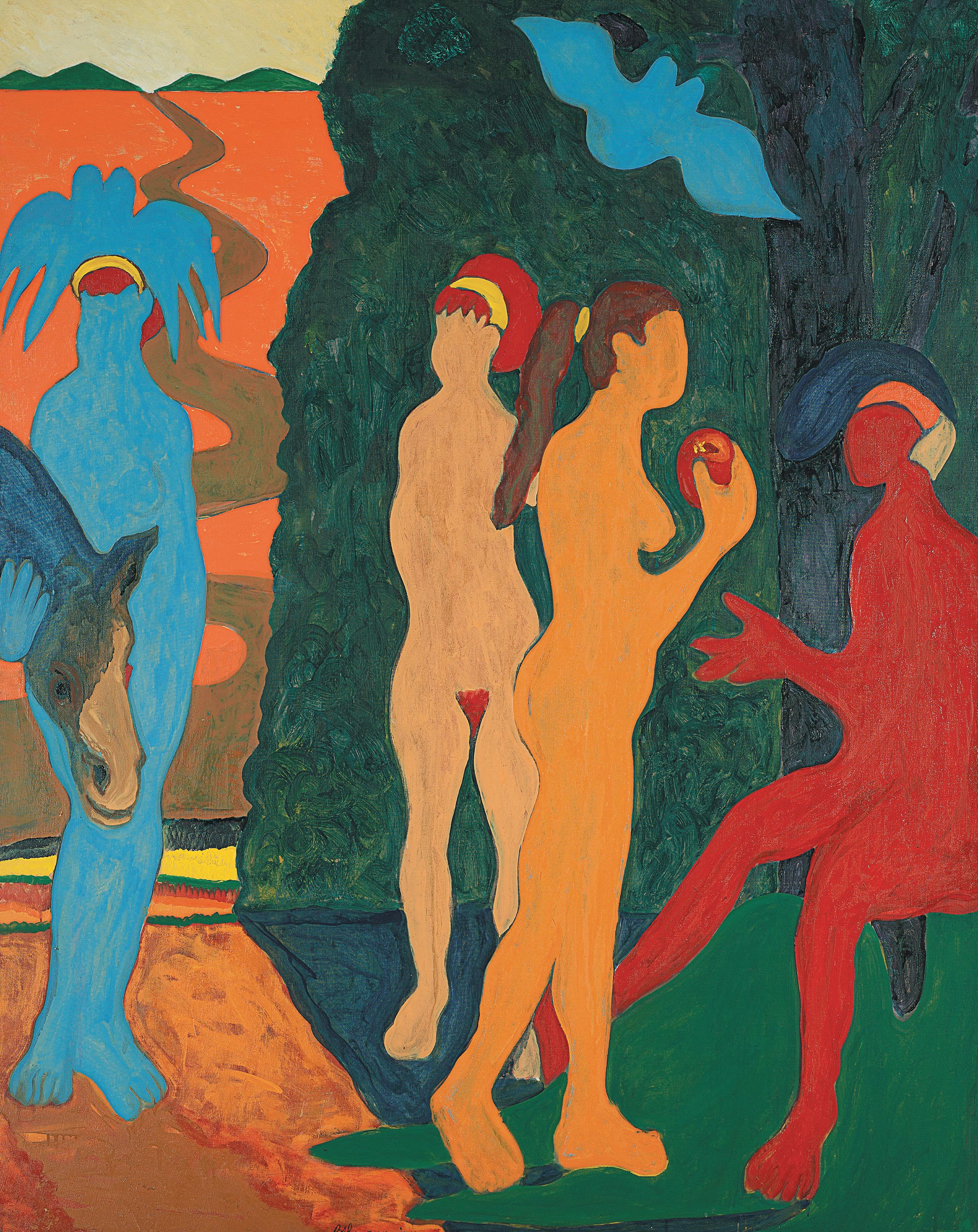
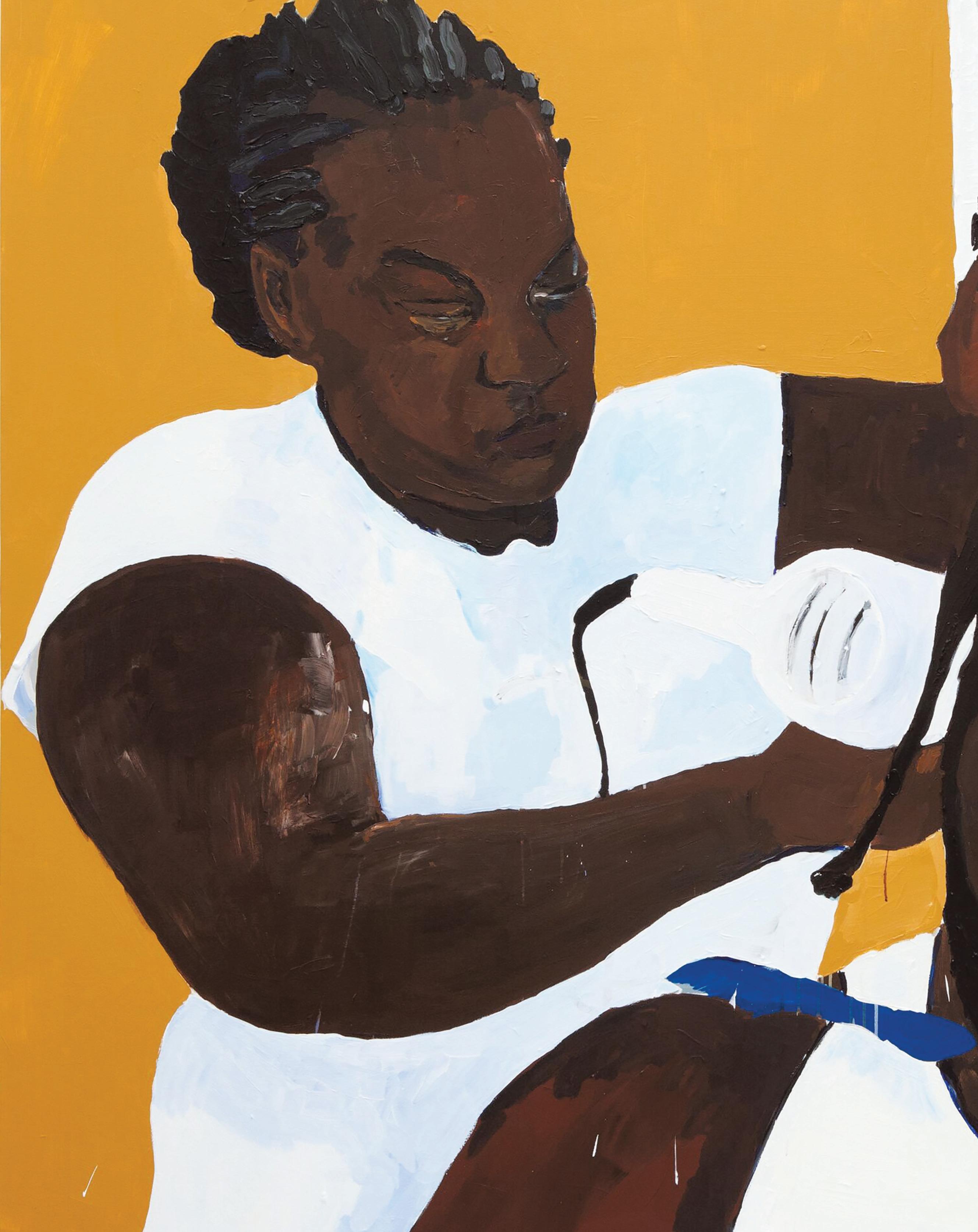
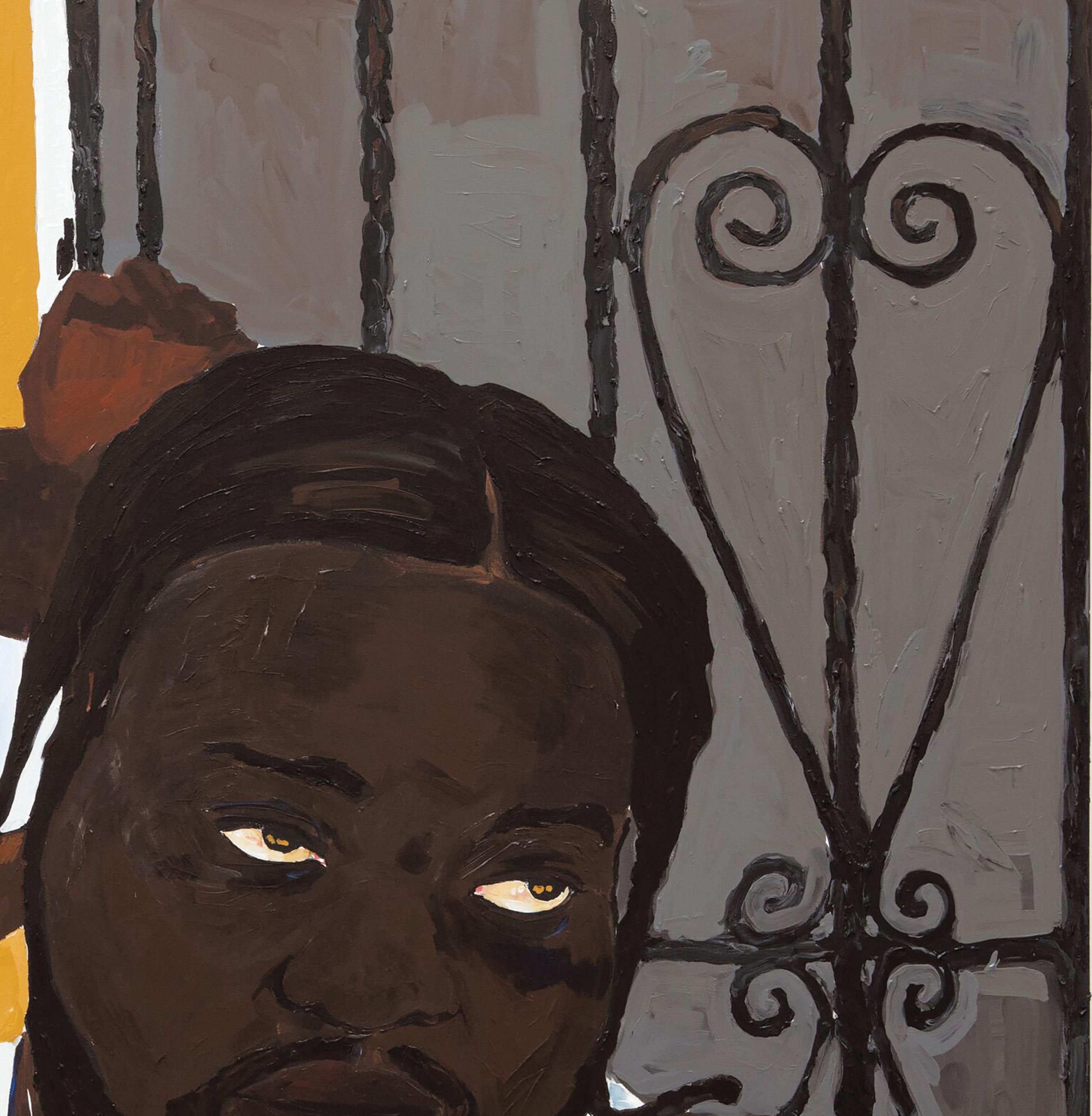 Image: Henry Taylor, Gettin it Done , 2016, © Henry Taylor, courtesy the artist and Hauser & Wirth
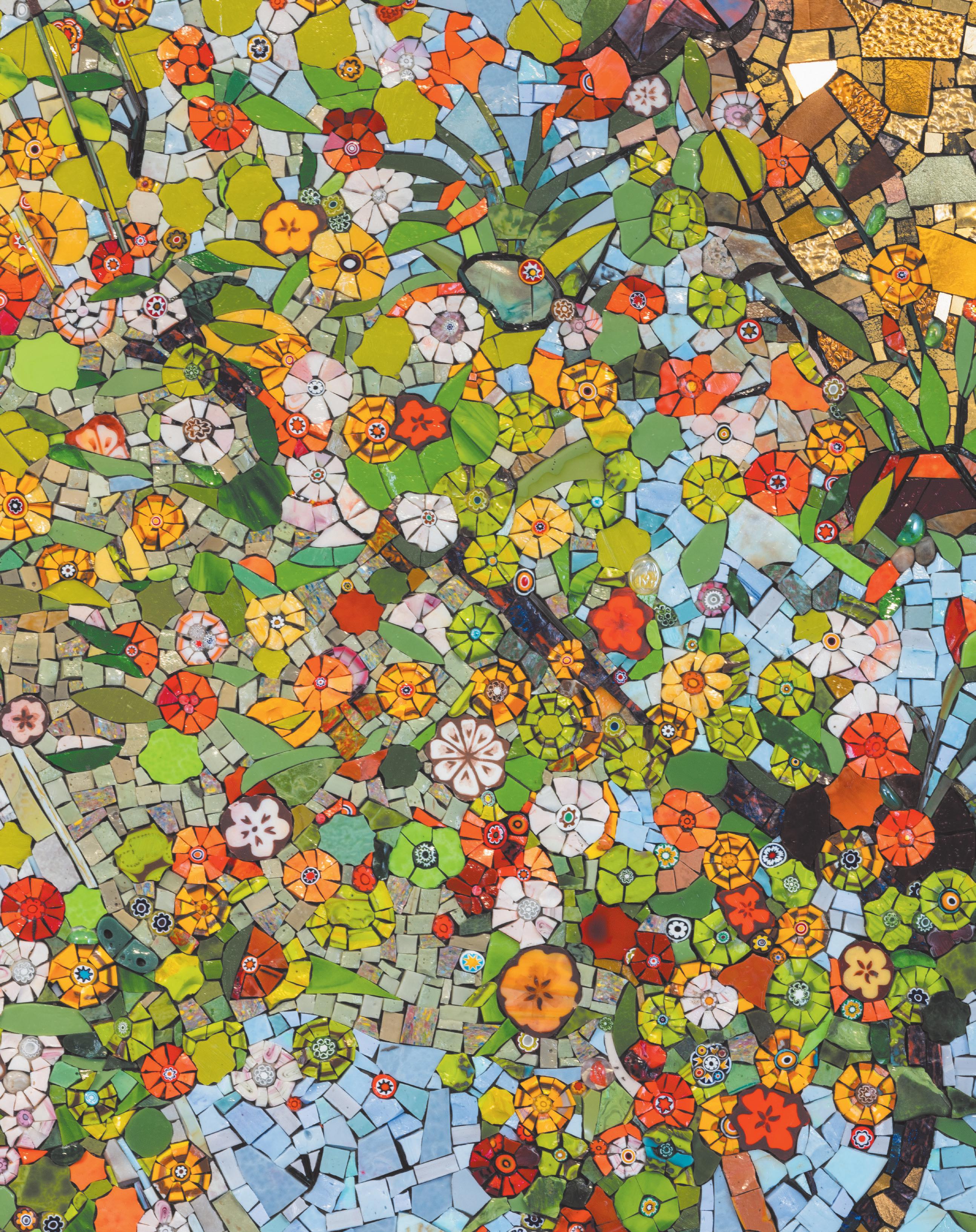





Wishful inking, 2022
Multi-color screenprint/collage prints with leafed elements, collaged to museum board, based upon The Mad Hatter’s Tea Party from Lewis Caroll’s Alice’s Adventures in Wonderland Editions of 60
Hatter, 2022 18 x16" (45.7 x 40.6 cm)



Wishful inking, 2022 28 x 48 ½" (71.7 x 123.2 cm)
Rabbit, 2022 16 x13 " (40.6 x 33 cm)
Duke, 2022 18 x14" (45.7 x 35.6 cm)
gemini g.e.l.


8365 Melrose Avenue Los Angeles, California 90069 323.651.0513 editions @ geminigel.com geminigel.com

Los Angeles
Nancy Holt
Locating Perception
October 2022 – January 2023
Anne Imhof
February – April 2023
New York
Louise Lawler
NOT ENOUGH TO SEE
November – December 2022
Berlin
Reinhard Mucha
Kasse beim Fahrer
November 2022 – January 2023
Thomas Ruff d.o.pe. November 2022 – January 2023
London
Anne Imhof
Avatar II September – December 2022


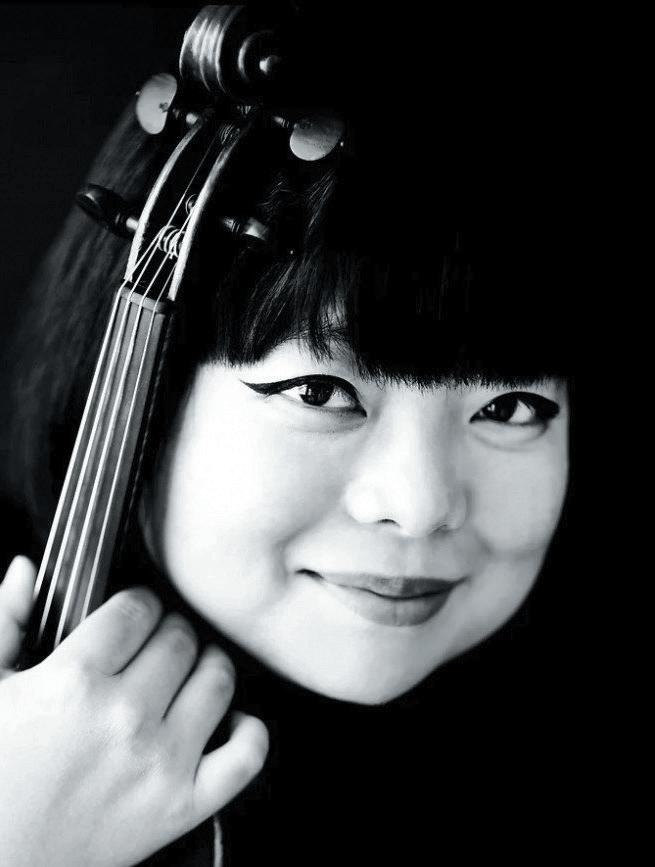
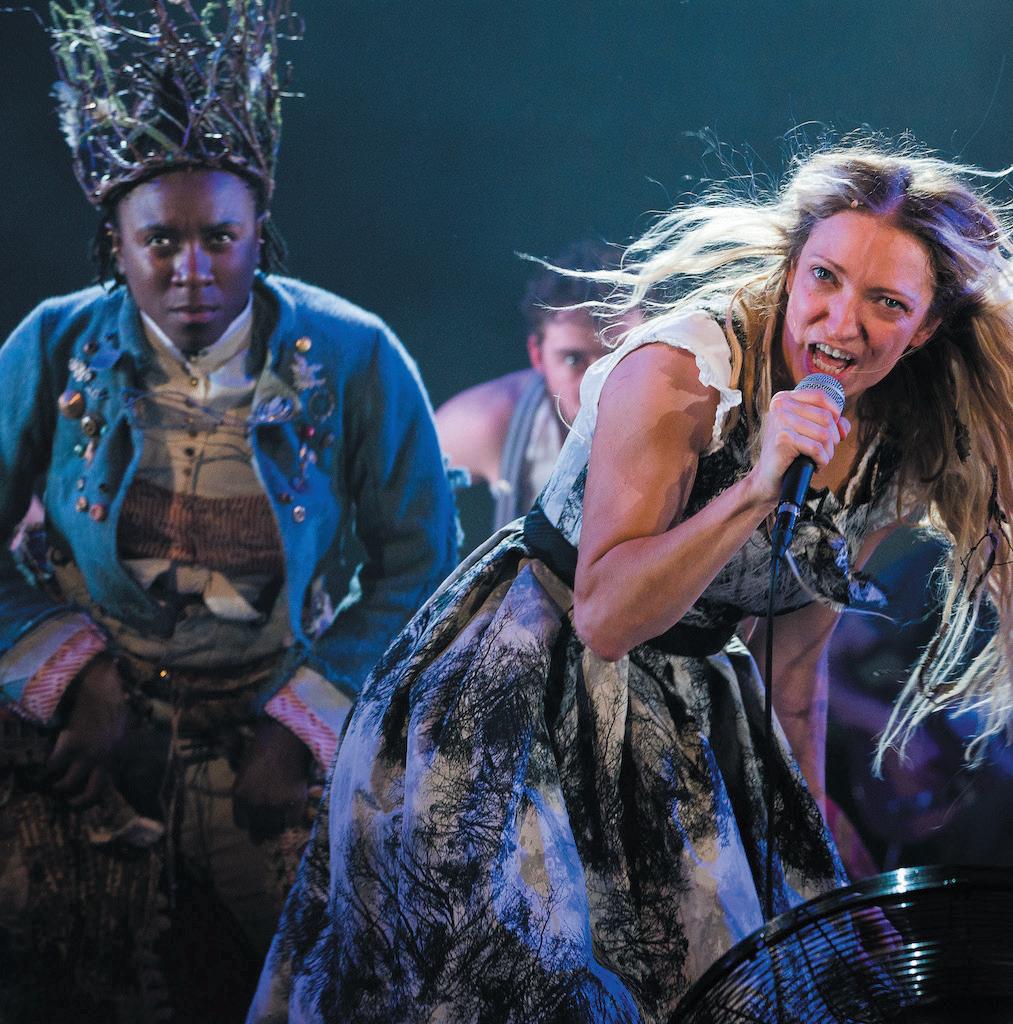
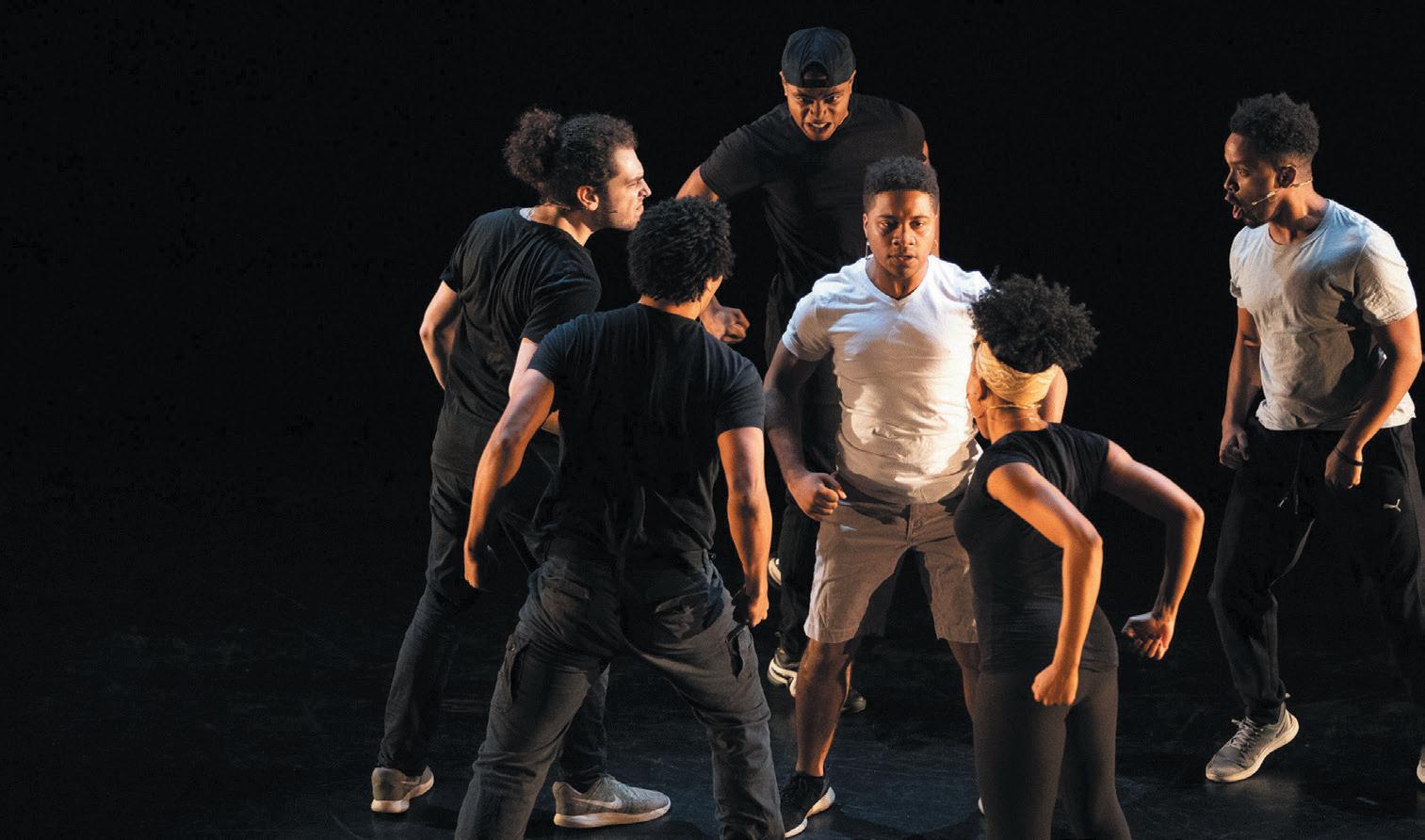
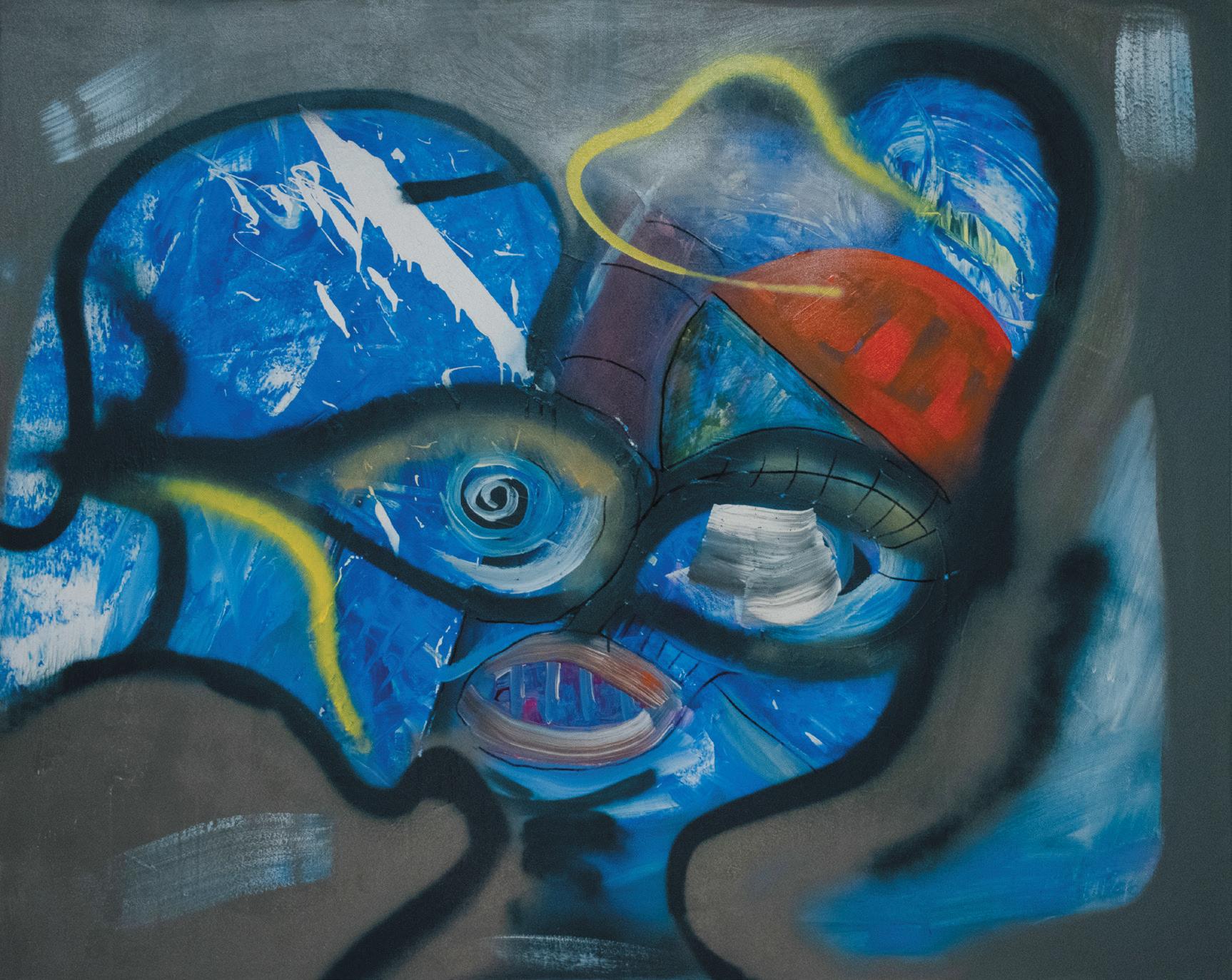
"Being based in Japan, we are spoiled with regards to the quality of framing; Paradise Framing provided frames of the quality we expect but seldom find abroad; and, of equal importance, the rental plan that they provide offered us a risk-free option without any sacrifice in the quality of our presentation - on the contrary, the excellent quality of the rental frames contributed greatly to our overall presentation. This flexibility is unparalleled and a first for us to experience - we look forward to working with Paradise on future projects in Los Angeles.”

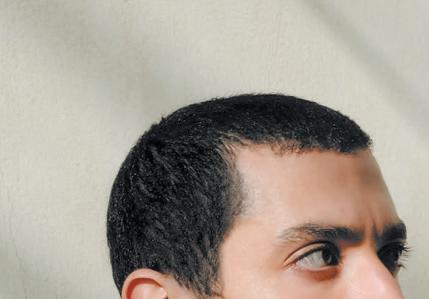


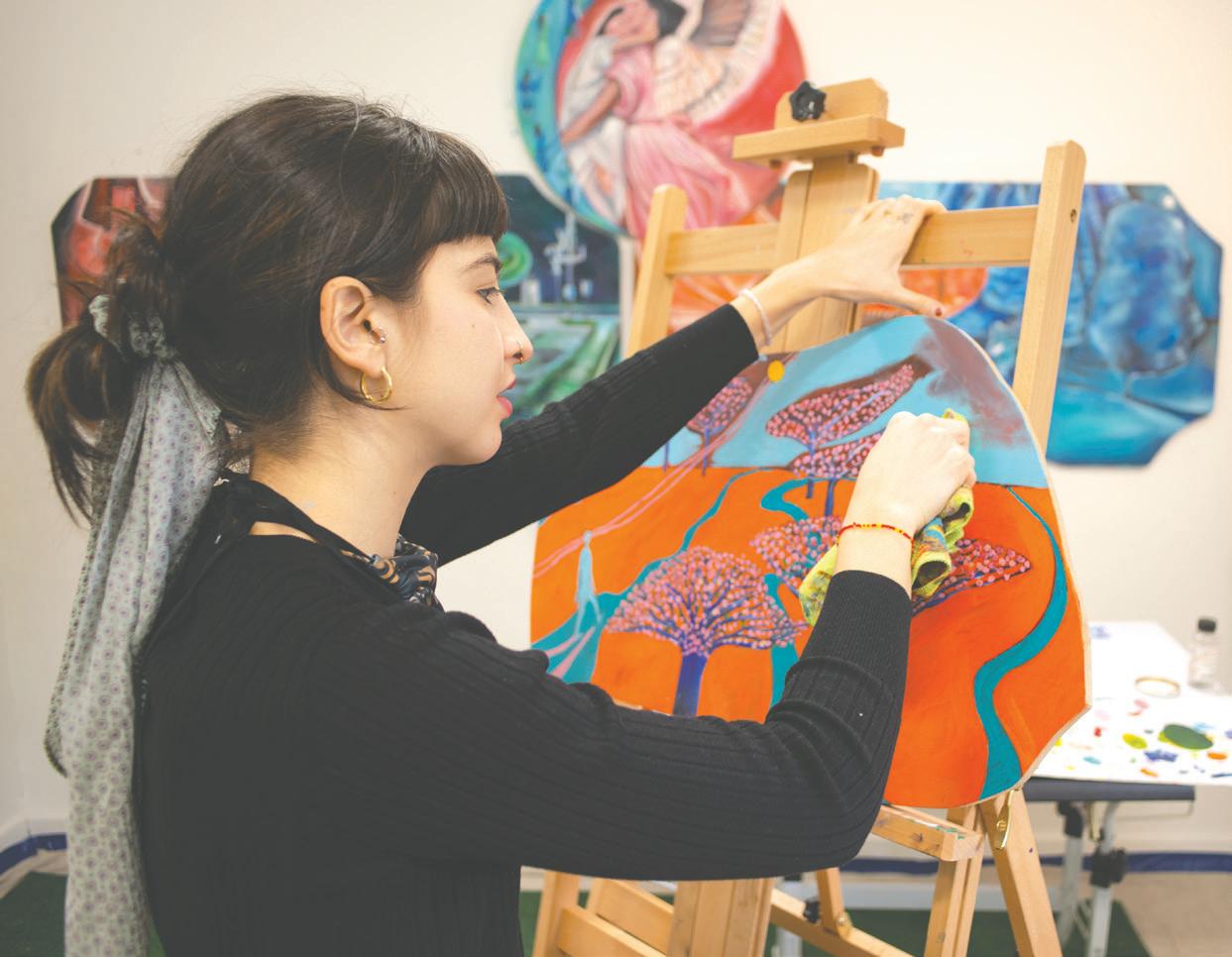
 From left to right: Cydney Camp (MFA Painting 2023), Vanessa Spollen (MFA Painting 2023). Photos: Ish Isnael (MFA Photography 2020)
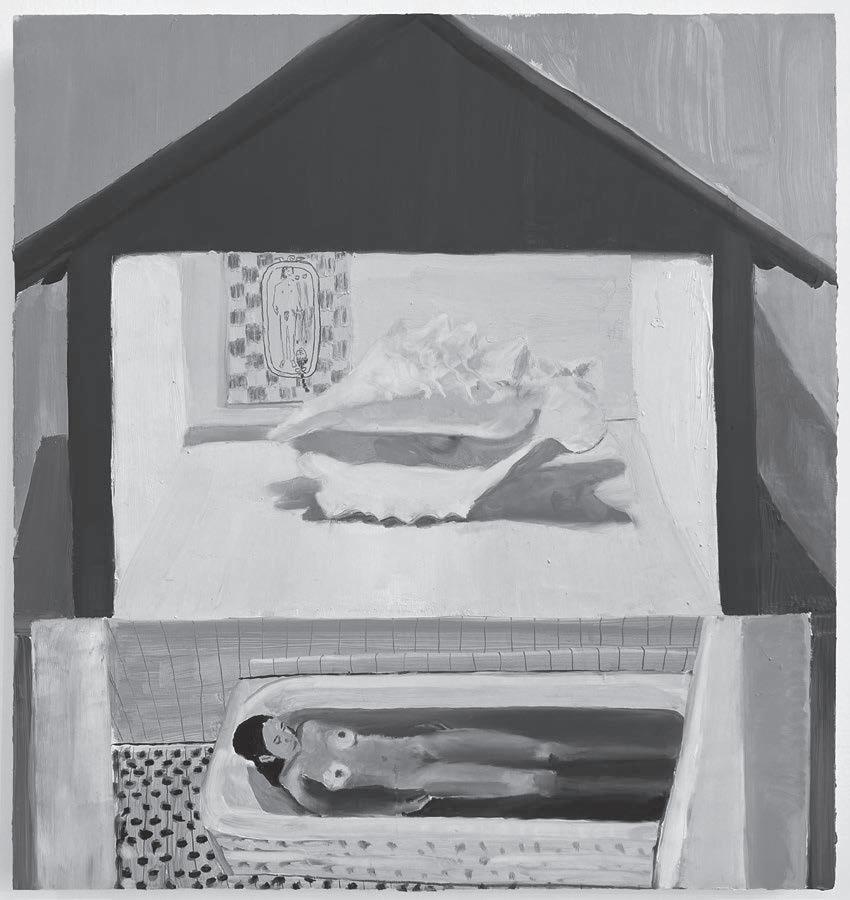


Intersect Palm Springs is an art and design fair that brings together a dynamic mix of modern and contemporary galleries, and is activated by timely and original programming.
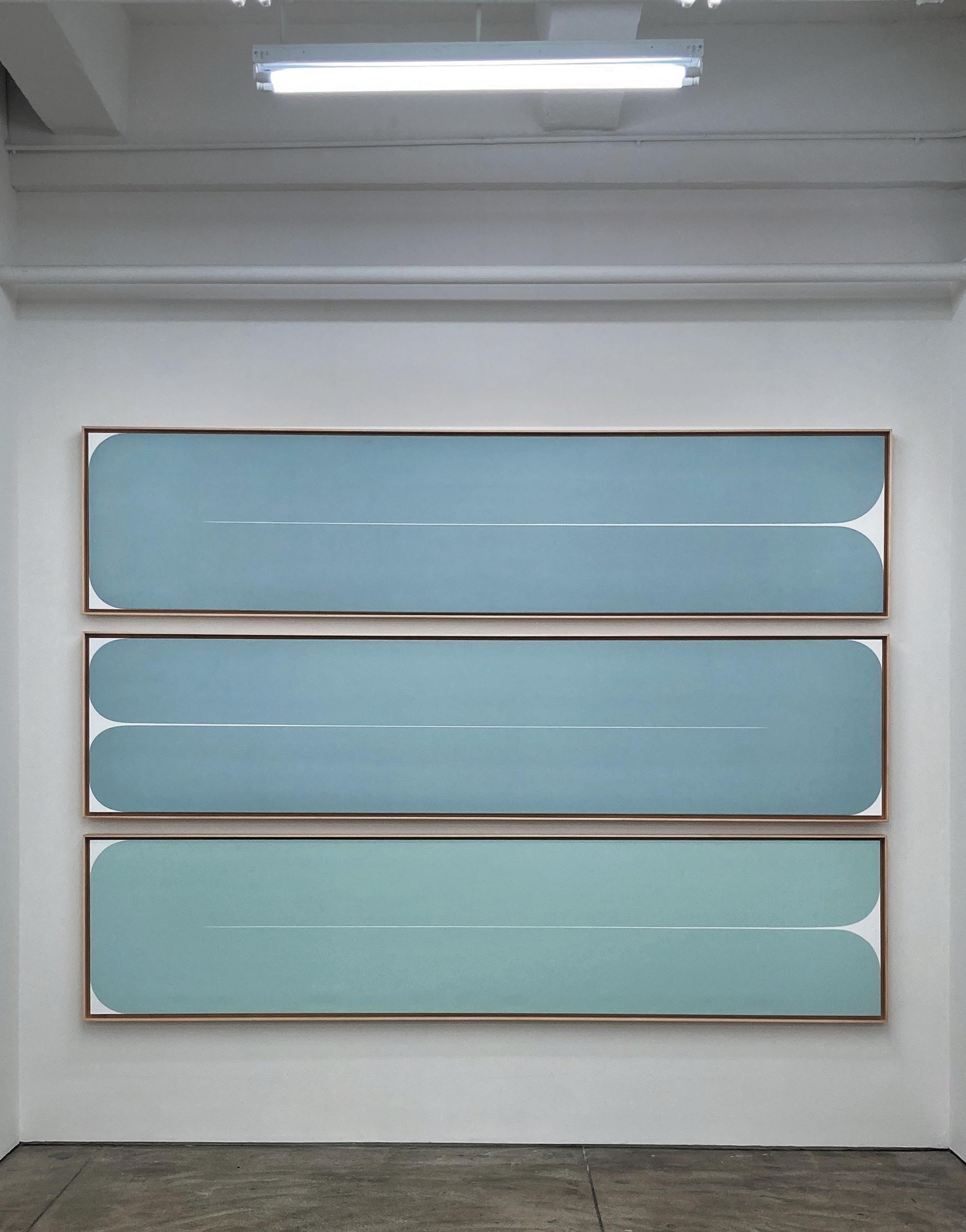
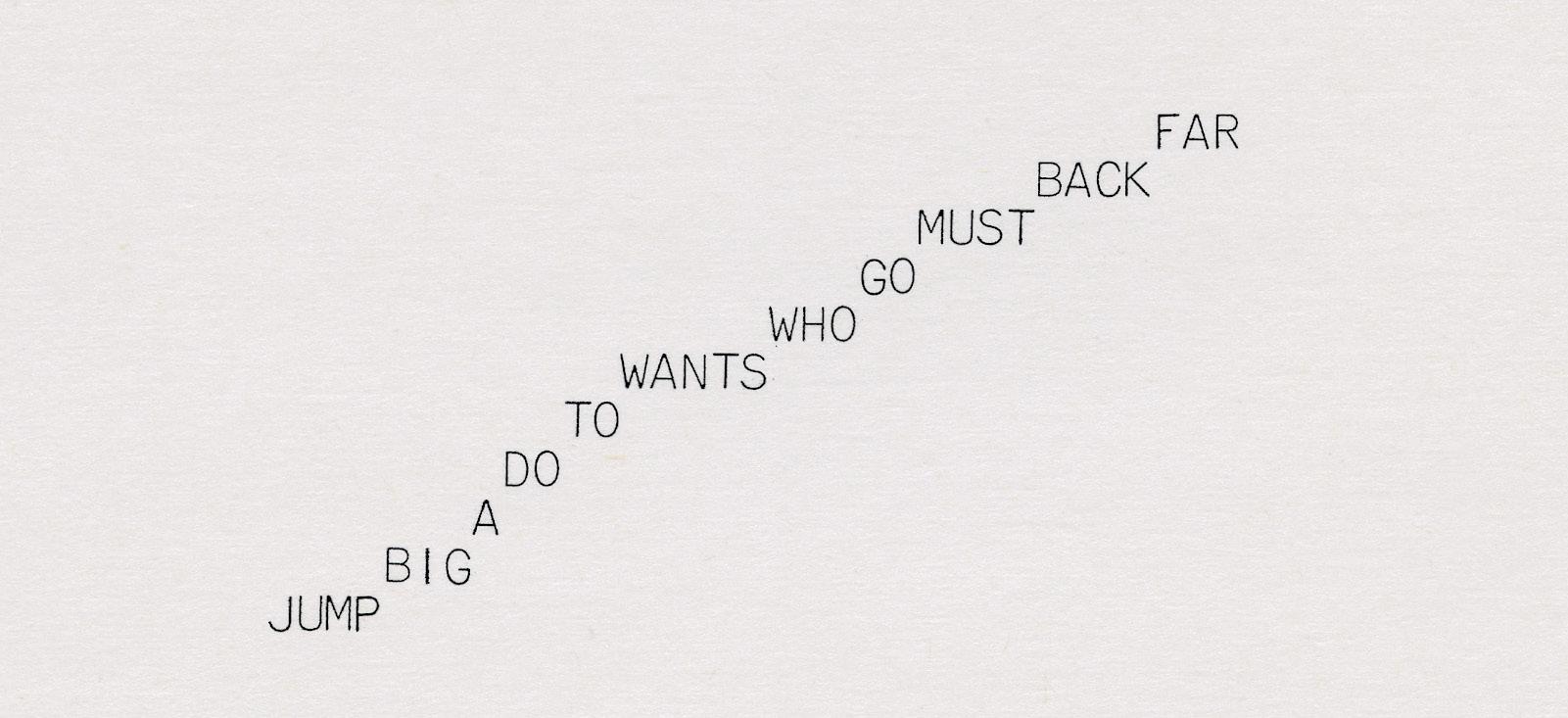



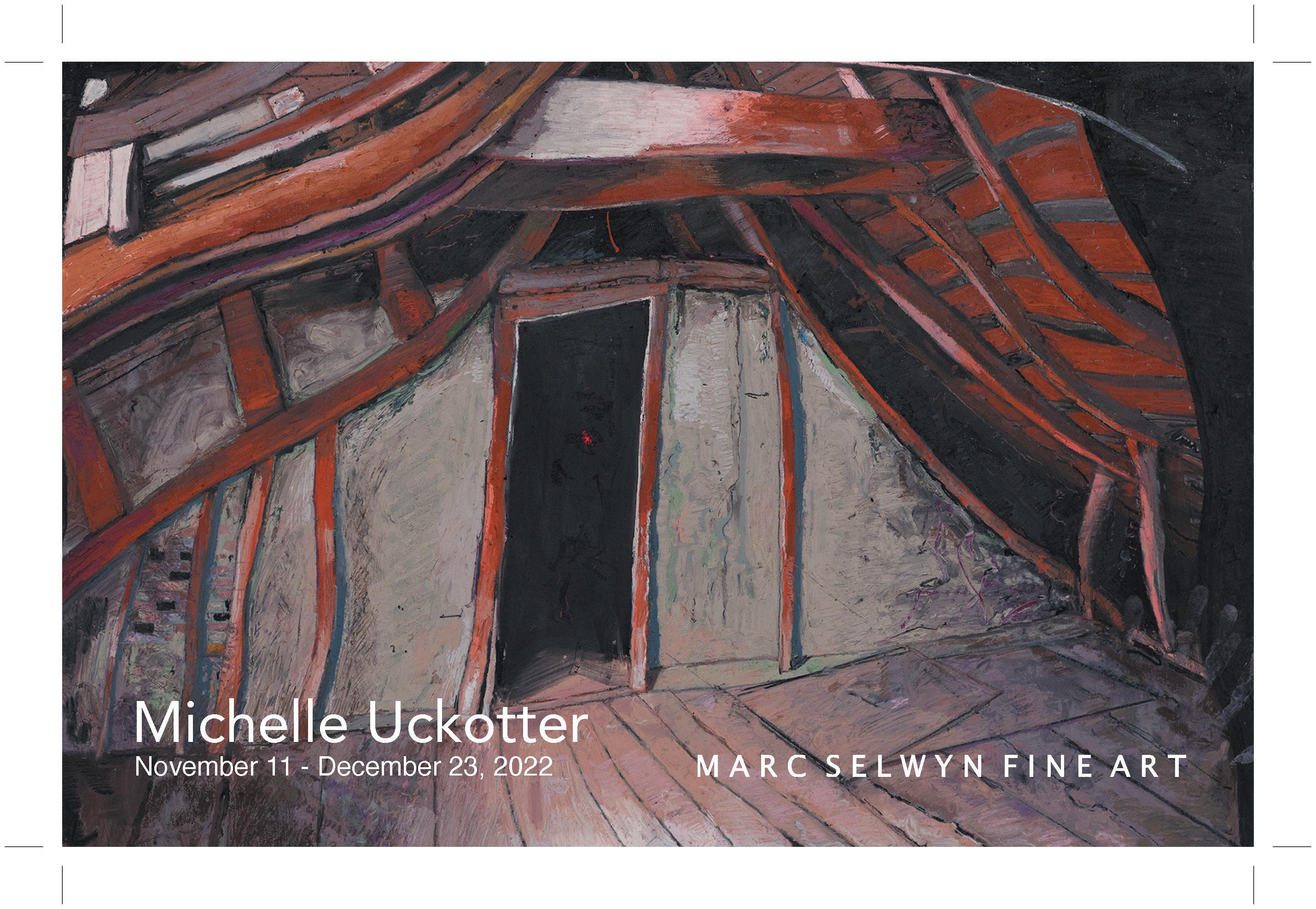
November 13, 2022 to March 12, 2023


A living homage to the history of Mail Art and a recognition of its ongoing resonance Generously supported by the Institut für Auslandsbeziehungen (IFA), Germany and the Andy Warhol Foundation for the Visual Arts The Wende Museum • 10808 Culver Blvd, Culver City, CA • 90230
 Ruth Wolf-Rehfeldt
Far back must go who wants to do a big jump (Wörter series), mid-1970s Original typewriting Courtesy of the artists, The Mail Art Archive of Ruth Wolf-Rehfeldt and Robert Rehfeldt and ChertLüdde
Ruth Wolf-Rehfeldt
Far back must go who wants to do a big jump (Wörter series), mid-1970s Original typewriting Courtesy of the artists, The Mail Art Archive of Ruth Wolf-Rehfeldt and Robert Rehfeldt and ChertLüdde