WEDNESDAY, OCTOBER 15, 2025
WEDNESDAY, OCTOBER 15, 2025
By John Oliver
The federal government shutdown has reached its fourteenth day with no resolution in sight, as negotiations in Washington remain deadlocked. The impasse is beginning to reverberate far beyond the Beltway, sending ripples through local governments across the country—including Josephine County, where a prolonged disruption of federal funding could have significant and lasting consequences for public services, employees, and the regional economy.
At the center of the political stalemate is a disagreement over healthcare funding. Specifically, lawmakers remain divided on whether to extend tax credits that help millions of Americans afford health insurance through the Affordable Care Act marketplace. These subsidies are set to expire at the end of the year. Democrats are demanding the extension as a condition for supporting any spending measure, while Republicans have resisted tying healthcare policy to broader government funding. This deadlock has halted the passage of a budget bill, leading to the current shutdown.
The Senate is scheduled to vote this evening on a House-passed funding bill, marking the eighth attempt to end the stalemate. Because the legislation requires a 60-vote threshold, Re-

publican leaders will need Democratic support to advance the measure. So far, neither side has indicated a willingness to compromise, leaving the federal workforce and state and local governments in limbo.
The immediate national effects are already visible. Hundreds of thousands of federal employees are furloughed or working without pay. Essential functions such as military operations, air traffic control, and border security are continuing through emergency measures, but many other federal services have slowed or halted entirely. National parks are closed or minimally staffed,
regulatory agencies are operating at reduced capacity, and federal courts are preparing for delays as their funding reserves begin to dwindle.
The White House has also warned that additional layoffs are expected if the shutdown continues, raising further concerns about the government’s ability to provide services.
For Josephine County, the situation is not just a distant political standoff. The county, like most local governments, relies on a steady flow of federal funding to support a range of programs, from public safety and emergency services to infrastructure and social services. While many of these
funds are disbursed through state agencies, the federal shutdown can disrupt or freeze payments at the source, creating cascading financial challenges.
One of the most immediate concerns is the flow of federal payments in and out of the county. If the shutdown persists, incoming federal funds could stall, delaying reimbursements and grant payments for critical programs. Outgoing payments tied to federal grants may also be frozen, affecting contractors, partner organizations, and local employees whose positions are funded through federal dollars. Departments that rely on pass-through funding, such as health services, housing programs, and emergency management, could face operational shortfalls within weeks.
Josephine County’s public safety operations, which have historically depended on a combination of local, state, and federal funding, are particularly vulnerable. Federal grants support law enforcement programs, disaster preparedness, and emergency communications systems. A prolonged shutdown could slow or halt the transfer of these funds, forcing county officials to either dip into reserves, delay projects, or temporarily suspend certain operations.
• see JOSEPHINE, page 3
Student’s Complaint Against Grants Pass High Coach Raises Broader Questions About Oversight
By John Oliver
Originally reported by Vehement Media, a formal complaint filed by a Grants Pass High School student has drawn significant attention to the conduct of teacher and coach Matthew Kennedy. The allegations depict a troubling pattern of harassment, retaliation, and abuse of authority within the school’s athletic program. Filed through official district channels, the complaint details a series of incidents that have left the student feeling unsafe and has prompted broader concerns about oversight and accountability in Oregon’s public education system.
The conflict began shortly after the student voluntarily left the football team on September 12, 2025. According to the complaint, Kennedy responded by attempting to block the student from participating in any other sports, despite the absence of any official rule supporting such a decision. Athletic Director Robert Lingo ultimately overturned this action, allowing the student to continue involvement in other athletic programs such as wrestling. The decision made clear that Kennedy’s attempt to enforce an additional penalty was personal rather than procedural.
Ten days later, on September 22, at approximately 5:15 p.m., Kennedy confronted the student near the wrestling mat room. The complaint alleges that Kennedy demanded the student remove

clothing bearing football team insignia because they were no longer part of the team. The student was reportedly at a water fountain with their back turned when the encounter began, describing it as intimidating and without justification. This incident, according to the complaint, reflected a personal vendetta rather than any school policy.
The situation escalated when Kennedy, aware that the student had filed complaints about his behavior, entered the student’s classroom and retold the hallway incident aloud to another teacher, speaking loudly enough for the entire class to hear. This public retelling, unrelated to any legitimate classroom purpose, left the student embarrassed and fearful of further retaliation. The complaint frames this third incident as a deliberate act of humiliation.
The formal complaint cites a range of potential policy and legal violations, including Oregon Administrative Rules governing educator conduct. These rules require respect for individual dignity, equitable treatment, and adherence to ethical standards. It references OAR 584-020-0010 on
individual dignity, OAR 584-020-0030 on respectful human relations, and OAR 584-020-0040 on misconduct. The allegations also invoke Grants Pass School District policies, which mandate professional and caring staff interactions, adherence to civil rights protections under Title VI, Title IX, ADA, and Section 504, and consistent rule enforcement outlined in both the district and high school handbooks. District Board Policies KL and KL-AR, covering discrimination and harassment, are also cited as potentially applicable to the case.
The complaint goes further than recounting personal grievances. It calls for specific actions from the district, including the confirmation of the complaint, release of hallway camera footage from outside the mat room, and a prompt in-person meeting with administrators. The student is urging district officials to intervene quickly to address what they see as unchecked misconduct that could affect other students if left unaddressed. These demands underscore a larger theme: whether the district has sufficient mechanisms in place to hold coaches and educators accountable when they step outside their professional boundaries.
The allegations against Kennedy are particularly significant because they involve a first-year head coach. If the claims are substantiated, they highlight vulnerabilities in the oversight of athletic programs, where coaches often wield significant authority over students’ extracurricular opportunities. Cases like this raise questions about whether existing oversight systems are robust enough to detect and address abuses of power early, before they escalate.
The Grants Pass School District has yet to make a public statement on the matter. It remains
unclear whether internal investigations are underway or whether Kennedy has faced any disciplinary measures at this stage. The student’s filing has the potential to set a precedent for how similar cases are handled in the future, both locally and possibly statewide, if state education officials become involved through the Teacher Standards and Practices Commission (TSPC), which oversees educator ethics in Oregon.
Beyond the individual case, the situation is likely to resonate with parents, students, and educators across Oregon. It raises broader questions about how much authority individual coaches should wield, how grievances are processed within schools, and whether student protections are adequately enforced. If mishandled, the case could erode trust between students and staff, especially within athletic programs where participation often hinges on the discretion of a single coach.
As the complaint moves through official channels, the outcome may determine not only the resolution of this particular conflict but also set a tone for future oversight in school athletics. For now, the student is seeking transparency and swift administrative action, while the district faces mounting pressure to demonstrate that student safety and dignity remain top priorities.




By John Oliver
Oregon residents had until Tuesday, October 14, 2025, to register in order to receive a ballot for the upcoming November 4 Special Election. State officials are emphasizing the importance of participation, noting that while special elections often receive less attention than statewide or federal contests, the issues on these ballots frequently have a direct and lasting impact on local communities.
This year’s special election gives more than one million eligible voters across Oregon the opportunity to weigh in on a wide range of measures. These include proposals to improve school facilities, changes to local tax rates, and levies that affect funding for essential community services such as public safety, libraries, parks, and recreation programs. For example, school districts in Lake Oswego and West Linn-Wilsonville are asking voters to consider bond measures to enhance the safety and security of classrooms

and other facilities. In Medford, voters will decide whether to increase the transient lodging tax, which funds tourism-related initiatives and local projects. Numerous counties will also vote on levies that shape how local tax dollars are spent to maintain and improve community infrastructure.
Not every county in Oregon will hold a special election. Only voters in areas with eligible measures will receive a ballot. Counties participating in the November special election include Baker, Clackamas, Columbia, Coos, Jackson, Klamath, Lane, Lincoln, Linn, Marion, Morrow, Multnomah, Polk, Umatilla, Union, Washington, and Yamhill. Oregon residents who wish to register can do so online at OregonVotes.gov/register or by completing a paper registration form and returning it to their county elections office. To register, individuals must be U.S. citizens, Oregon residents, and at least 16 years old. However, to cast a ballot in this election, they must be 18 years old by Election Day. Those already registered are encouraged to verify and update their information using the state’s My Vote tool, particularly if they have recently moved or changed their mailing address.
County clerks will begin mailing ballots on October 15. Voters are encouraged to complete
By John Oliver
their ballots early to avoid delays. Ballots must be received by county elections offices or official drop boxes no later than 8 p.m. on November 4. Due to recent changes within the United States Postal Service, officials recommend mailing ballots by October 30 to ensure they arrive on time. After that date, voters should either hand-deliver their ballots to a local post office and request a manual postmark no later than November 4 or use an official drop box before the 8 p.m. deadline on Election Day. A list of secure drop box locations is available at OregonVotes.gov. Oregon election officials are urging eligible residents to take action now. By participating in local measures and community decisions, voters help shape the policies that affect everyday life — from schools and safety to public spaces and local tax structures. The November Special Election represents another opportunity for Oregonians to make their voices heard at the local level.
When Josephine County Commissioner Andreas Blech announced that the Board of County Commissioners would assume control of all public records requests, the move was framed as a step toward greater efficiency and effectiveness. Months later, the reality tells a very different story. What was presented as an administrative improvement has, in practice, become a near-total blackout on access to public information—one that affects newspapers, private citizens, and watchdog groups alike.
Under Oregon law, counties must acknowledge a public records request within five business days and either provide the records or a reasonable estimated completion date within fifteen. Instead, requesters are receiving perfunctory responses on the final day of the acknowledgment period, often stating that the county is “still determining custody” of the records. What follows is an extended silence that can stretch for weeks or months, with no resolution and no fulfillment.
This newspaper has experienced the pattern repeatedly. The Grants Pass Daily Courier has as
well. Even private citizens, asked to submit their own requests to test the system, report identical treatment. Whether the request concerns financial records, correspondence, or investigations into the commissioners themselves, the outcome is the same: delays, deferrals, and ultimately, nothing.
The legal framework is clear. Oregon Revised Statutes Chapter 192 establishes strict timelines for government bodies to respond. Repeated failure to acknowledge or fulfill requests violates those provisions and undermines the public’s right to know. Beyond the state requirements, the pattern raises serious questions about whether the commissioners are deliberately using procedural control to obstruct scrutiny of their actions.
Commissioner Blech’s assumption of oversight has not increased transparency; it has effectively buried it. This mirrors the behavior of his predecessor, former Commissioner John West, whose tenure was marked by similar stonewalling tactics. The public records law provides remedies through district attorney petitions and court actions, including financial penalties, but enforce-
ment has so far been absent. State and federal oversight bodies have not intervened, leaving a vacuum in which local officials can ignore their legal duties without consequence.
What many Josephine County residents may not realize is that they have concrete legal options to hold the county accountable. In Oregon, including Josephine County, private citizens have the legal right to sue a public body if it fails to comply with the Oregon Public Records Law (ORS 192.311–192.478). The law sets clear response deadlines: five business days to acknowledge a request and fifteen business days total to complete it or lawfully extend the timeline. If those deadlines are missed or the county provides vague, repetitive responses without resolution, that can be treated as a constructive denial under the law.
Before filing suit, residents can petition the Josephine County District Attorney to review the denial or failure to respond. If the DA denies the petition or fails to act within seven days, or if the county ignores a DA order to release the records, citizens can then file suit in Josephine County Cir-
cuit Court under ORS 192.431. The law favors disclosure—the burden is on the county to prove why it withheld the records. If the citizen prevails, the court can compel immediate disclosure, award attorney fees and litigation costs, and even impose civil penalties for willful violations. Practically speaking, citizens and journalists have standing to sue when the county ignores statutory deadlines, repeatedly delays without lawful justification, or fails to comply with a DA order. Lawsuits are not only a viable legal remedy—they may be the only language the county understands. If enough citizens challenge the county’s practices in court, it may finally force a cultural shift toward compliance with transparency laws.
Transparency is not optional in government; it is a legal obligation. By transforming public records access into a bureaucratic abyss, Josephine County’s leadership has eroded one of the fundamental checks on its power. The tools to fight back exist. It is now up to residents to use them, because without accountability, the cycle of obstruction will continue unchecked.
From page 1
Another area of potential impact is infrastructure. Road maintenance, bridge repairs, and transportation projects often rely on federal transportation funds that flow through the state. If those payments are delayed, county public works departments may have to postpone scheduled projects or cover costs temporarily, which could strain local budgets. Even short delays can have a compounding effect, especially for small jurisdictions that operate on tight margins.
Social services are also at risk. Programs that provide housing assistance, food support, and community development funds rely on predictable federal payments. If those funds are delayed, vulnerable
populations—including seniors, low-income families, and individuals experiencing homelessness—may experience disruptions in essential services. Nonprofit partners and contractors who administer these programs could be left waiting for payments, forcing them to scale back services or operate at a loss.
The effects may not be immediate across every department. Some federally funded programs receive allocations in advance or maintain small reserve balances that allow them to operate for a few weeks during interruptions. However, if the shutdown extends into multiple weeks or months, those reserves will run out. At that point, county government may face difficult decisions, including temporary
layoffs, service reductions, or reallocation of general fund dollars to cover critical gaps.
Local businesses and the broader economy could also feel the ripple effects. Contractors that rely on federal payments may face cash flow disruptions, while reduced spending by furloughed federal workers and delayed public projects can dampen economic activity in the region. This is especially relevant in rural counties like Josephine, where economic diversification is limited and public sector dollars often circulate widely through local communities.
County officials are monitoring the situation closely, but with no clear timeline for a resolution
in Washington, there is little they can do to prevent the financial shockwaves that may follow if the stalemate continues. The longer the shutdown lasts, the greater the uncertainty becomes—not just for federal employees, but for local governments and the communities they serve.
As Day 14 comes to a close with Congress still divided, the stakes are growing higher for communities like Josephine County. What began as a political standoff in the nation’s capital is quickly becoming a financial and operational challenge at the local level, with both immediate disruptions and longer-term consequences looming if federal funding pipelines remain frozen.

Advertise with The Grants Pass Tribune!
Stand with us in defending freedom of the press and the 1st Amendment! The Grants Pass Tribune is facing political persecution, with lawsuits aimed at silencing our bold investigative journalism. We remain committed to uncovering the truth and keeping our community informed like never before.
Show
By John Oliver
The Pentagon has issued a directive requiring reporters covering the Department of Defense to sign restrictive new rules by Tuesday or risk losing their press credentials by Wednesday. The ultimatum has triggered near-universal rejection from news organizations across the country, setting up a high-stakes confrontation over press freedoms and government transparency.
At the heart of the dispute is a new policy backed by Defense Secretary Pete Hegseth, which critics say would fundamentally alter the way journalists interact with Pentagon officials. The policy would restrict reporters from seeking information that has not been pre-approved for release and threatens punitive action against Pentagon employees who speak without authorization. According to the Pentagon Press Association, the organization representing defense beat reporters, the changes amount to a gag order on government employees and create a climate of fear around sharing information that is essential to public oversight.
If enforced, the policy could lead to the removal of dozens of seasoned journalists from the Pentagon beat, cutting off one of the most important avenues for independent reporting on U.S. military operations, national security decisions, and defense spending. The Pentagon press corps has long served as a vital check on executive power, regularly breaking stories about military misconduct, strategic shifts, budgetary decisions, and battlefield realities that are often shielded from the public view. By

making access contingent upon signing rules that effectively limit unsanctioned reporting, the Defense Department is testing the boundaries of press freedom in a way that could reverberate far beyond the Pentagon itself.
The First Amendment guarantees that the press operates independently of government control, allowing journalists to question, investigate, and report without fear of government retaliation. By tying press credentials to compliance with speech restrictions, critics argue that the Pentagon may be skirting dangerously close to infringing on those constitutional protections. The move is not merely a bureaucratic reshuffling of press rules; it could establish a precedent where government access is conditional on journalists accepting limits to their
ability to investigate freely.
The consequences could be felt across the broader U.S. media landscape. If major federal agencies begin to impose similar rules, the traditional model of independent journalism could shift toward a controlled-access system where only pre-approved narratives are disseminated. This would fundamentally reshape the relationship between the press and the government, transforming watchdog reporting into managed messaging. Journalists would be forced to choose between maintaining their independence or retaining the access necessary to do their jobs effectively.
Such a development would have profound implications for national security reporting, investigative journalism, and democratic ac-

countability. Reporters covering defense and intelligence often rely on background conversations, leaks, and off-the-record confirmations to expose wrongdoing or bring critical policy decisions to light. Restricting those interactions would not only limit the public’s right to know but also shield the government from scrutiny during moments of national importance.
The Pentagon’s stance is particularly significant because of its size, power, and influence. As one of the largest bureaucracies in the world, it controls vast resources and military operations that span the globe. The journalists who cover this beat act as an essential link between the military establishment and the American public. If their ability to report is constrained, the effects will ripple through newsrooms nationwide, affecting how the public understands matters of war, defense strategy, spending priorities, and the lives of service members.
This clash between the Pentagon and the press corps is more than a procedural disagreement; it is a test case for the resilience of First Amendment protections in an era of tightening government control and growing political pressure on the media. How this standoff is resolved could influence not only the immediate future of defense reporting but also the broader norms that govern press freedom in the United States. If journalists are forced to choose between access and independence, the very foundation of free and open reporting on matters of national importance could be at stake.

















Tired of doing everything "right" and still feeling exhausted, bloated, and stuck?
At Elysian Women's Wellness, we specialize in helping women 35–55 balance their hormones, heal their metabolism, and lose stubborn weight without crash diets or two-hour workouts.
We use our Metabolic Optimization Method to help you feel like you again.
• Functional & traditional lab work
• Sustainable weight loss
• Hormone-friendly exercise & nutrition
• Expert support & accountability
By John Oliver
The U.S. Supreme Court has declined to review the massive $1.4 billion defamation judgment against Alex Jones, the far-right media personality and conspiracy theorist known for promoting false claims about the 2012 Sandy Hook Elementary School massacre. This decision leaves intact the rulings of lower courts, effectively finalizing one of the largest defamation awards in U.S. history.
Jones rose to national notoriety through his media platform, Infowars, where he repeatedly claimed that the mass shooting in Newtown, Connecticut, was staged and that the grieving parents were “crisis actors.” The shooting left 20 first-graders and six educators dead, shocking the nation and spurring intense debates on gun control and school safety. His baseless allegations led to years of harassment and threats against the victims’ families, prompting multiple families to file defamation lawsuits in both Texas and Connecticut.
In 2022, courts in both states issued judgments totaling $1.4 billion against Jones after finding that he had defamed the families and intentionally inflicted emotional distress. The trials were notable

not only for the scale of the damages but also for Jones’s conduct during proceedings. He frequently used the trials as platforms to attack the plaintiffs and the legal system, despite having already lost by default after failing to comply with discovery orders.
Jones appealed the judgments, claiming that his speech was protected by the First Amendment. Lower courts rejected these arguments, ruling that defamation is not shielded by free speech protections, particularly when demonstrably false
statements cause real harm. By refusing to take up the case, the Supreme Court has allowed those lower court decisions to stand, effectively ending Jones’s legal avenues for overturning the judgment through the U.S. judicial system.
The financial implications for Jones are immense. He has already filed for bankruptcy, and courts have been navigating the complex process of determining how his assets can be used to satisfy the enormous judgment. The families have argued that Jones has sought to shield significant
By Ellen Ward Authorities in Torrance, California
are investigating a violent attack at a local educational facility that left three staff members injured and led to the discovery of two explosive devices. The incident occurred early Monday morning at the Switzer Learning Center, a specialized school that serves students with learning and behavioral challenges.
According to the Torrance Police Department, the attack took place around 8:15 a.m. when a former student allegedly entered the campus and carried out a stabbing assault. Investigators report that three staff members were stabbed, while a fourth was targeted but managed to avoid injury. After the assault, the suspect fled the scene, prompting an immediate law enforcement response.
Emergency personnel and local officers quickly secured the area, initiating a search for the suspect while ensuring the safety of students and faculty on campus. The injured staff members were transported to nearby medical facilities for treatment. At last report, their conditions were described as stable, and none of the injuries appeared to be life-threatening.

During the subsequent investigation, law enforcement officials discovered two pipe bombs that the suspect is believed to have planted prior to the attack. Specialized bomb squad units were called in to neutralize and remove the devices. The discovery prompted additional security measures, including the temporary lockdown of the surrounding area to ensure that no further threats were present.
The suspect was later apprehended by police without further incident. Authorities have not yet released the individual's name, as the investigation is ongoing and formal charges are pending. Detectives are working to determine the suspect’s motives, how the weapons were brought onto the
campus, and whether there were any warning signs leading up to the attack.
The Switzer Learning Center has been cooperating closely with law enforcement during the investigation. The school temporarily suspended classes to allow authorities to conduct a thorough sweep of the grounds and ensure the campus was safe for the return of students and staff. Counselors and crisis response teams have been made available to assist the school community in the aftermath of the attack.
Torrance Police have indicated that the suspect will likely face multiple felony charges, including assault with a deadly weapon, attempted murder, and possession of explosive devices. Federal authorities may also become involved due to the presence of pipe bombs on a school campus, which could result in additional charges under federal law.
The investigation remains active, with law enforcement urging anyone who may have information about the suspect’s actions leading up to the attack to come forward. Officials are also reviewing security footage and interviewing witnesses as they work to piece together the full sequence of events.
portions of his wealth through his media company and affiliated entities. Bankruptcy proceedings are ongoing, with key questions still unresolved regarding how much of the judgment will ultimately be collectible.
The Supreme Court’s decision also carries broader significance for defamation law and media accountability in the digital era. Jones’s campaigns of misinformation predated the current social media misinformation battles but became emblematic of how false narratives can inflict real-world harm. Legal experts suggest the outcome reinforces that deliberate lies targeting private individuals are subject to severe legal consequences, even when the speaker operates in a politically charged or media-driven environment.
With this decision, the legal saga surrounding Jones reaches a decisive point. The judgment stands as a landmark case on the limits of protected speech and the accountability of media figures who knowingly spread falsehoods. It also provides a measure of closure for the Sandy Hook families, who have spent more than a decade countering lies about the worst day of their lives.


The BCC Weekly - Taking the “Blind” out of the BCC
By: Jay Meredith, CPA Investigative Journalist
Last month, Commissioners Chris Barnett and Ron Smith made a vote on an issue in front of the Board of County Commissioners (BCC) that in my opinion was the equivalent of turning down millions of “free” revenue for Josephine County law enforcement programs and instead opted for what could be millions of added expenses for the county. But before I dive into the details, be aware that this week’s BCC Weekly is more of an op-ed opinion piece and I have a big personal dog in the fight (conflict of interest) in reporting on this topic.
I’ve been following the BCC very closely ever since 2012 when the County lost a significant amount of federal timber replacement dollars (SRS funds) that used to provide a big part of support for County law enforcement and justice programs. I was one of several people that helped start a nonprofit dedicated to getting the County law enforcement programs back on their feet.
In the years to follow, Josephine County outside the City of Grants Pass had less law enforcement than many third-world countries. Until 2017 when County voters finally approved a levy for the adult jail and juvenile justice operations, our law enforcement financial crisis was severe. Many different ideas and solutions were studied, and one of the most popular ideas in the eyes of voters was to get back to making better use of our plentiful natural resources (think both timber and mineral resources). Many locals understand our timber history, but this is when I learned much more about our vast local mineral resources and teamed up with a local expert in this arena with a goal of supporting county law enforcement.
Before timber was big business, the local economic landscape was dominated by the mining industry. The vast majority of the membership of the Commercial Club, the predecessor to the Chamber of Commerce over 100 years ago, were involved in the mining industry in some form or fashion. Many of our local lands, both public and privately owned, are misclassified as timber/forestry properties when they are really mineral properties or have significant dual-use potential in both timber and mineral resources.
Josephine County has significant revenue-earning potential from our mineral resources, just as it has significant potential in timber. While former Commissioner John West started the ball rolling on selling many of the County timber properties (without assessing mineral potential), Josephine County still owns a large amount of “timber” properties, many of which started as patented mineral properties rather than timber properties. While there is a potential to earn revenue from federally managed properties, today’s subject is how to make better use of our county owned “timber” properties.
In the 1980s, an ordinance was approved by the County and added into the

County Code to govern the process of doing a mineral exploration permit or mining lease on County-owned timber lands. County staff may have expertise in timber operations, but the County needs an outside private party with industry expertise in order to develop mineral resources that may be on County owned properties. Without going into too much detail, the ordinance states that for any applicant that gets approval from the County for a mineral exploration permit, if they spend time and money and find a high-quality mineral deposit during the period they hold an exploration permit from the County, the County shall grant them a longer-term mining lease.
It doesn’t say may, the ordinance says shall. This is very intentional, because no mineral development company would spend time and money developing the mineral resources on a property without the guarantee of long-term access to the property if they find a valuable mineral reserve. In fact, in this industry usually lands are leased out for many years into the future before significant exploration even begins on a property.
One of my business partners and founder of American Mineral Research (a company we created about 10 years ago) who has decades of local experience in mineral research, first tried to do a mineral exploration permit on a specific County-owned property back in 2008. In the years following his application, former Commissioner Simon Hare blocked his application citing a need to update the ordinance. The ordinance requires a decision by the County on any application, and the BCC led by Commissioner Hare at the time, ignored the ordinance requirements. And in the end, no changes were made to the ordinance.
So, we tried again in 2019, submitting
an application for a mineral exploration permit on a County-owned property that has a history of mineral development activity about 30 years ago. There is a literal gold mine that partially goes under a section on the western end of the property. Close to $3 million was spent drilling this property a little over 30 years ago, and a significant gold reserve was found on this end of the property. Due to lower commodity prices 30 years ago, a project didn’t move forward at the time, but this is a perfect small business opportunity today that could benefit both the County and the developer. We knew at the time of our application a significant mineral reserve existed on this property, but we needed to do some of our own exploration and research work on the property.
All the way back to our 2019 application we stated our intention in doing this project was to help the County earn extra revenues for County law enforcement programs. So in May 2020 after a couple hearings by the BCC, we were approved for a 3-year mineral exploration permit. While we were slowed down significantly by Covid in the 2 years to follow our permit approval, we found very promising results when we explored this property. There is, without any doubt, a very high-quality gold deposit on this County owned property, which by the County ordinance should guarantee us a long-term mining lease on the property.
But shortly after we were approved for the exploration permit in 2020, the shenanigans by both County officials and a neighboring mining company began. We uncovered evidence that a neighboring mining company was illegally mining underneath this County property for several years before we were approved for the permit. We reported this to County Counsel Wally Hicks and a
Sheriff deputy, as the theft of gold ore was likely in the hundreds of thousands or maybe even over $1 million by this point. Under Wally’s direction, a comprehensive investigation never happened. This was likely the biggest theft from the County in the history of Josephine County, and for some reason Wally didn’t feel it needed to be pursued in great detail.
We had to force a more formal investigation a few years later when we decided for sure that we were going to seek a longer-term mining lease on the property. But by then, the thief literally was able to cover their tracks. During the three years we held an exploration permit, we heard from sources that County Commissioners and County officials had more meetings with the neighboring mining company who was illegally mining under the property than they held with us, the one party who had a legal permit to be working this property. And the County’s Forestry Director along with former Commissioners John West and Herman Baertschiger treated us very poorly during the three years we held a permit. It seemed as if their goal was to prevent us from doing this project, which is extremely concerning given the County’s Forestry Director Dave Streeter had a friendly relationship with a representative of the neighboring mining company who was illegally mining on this property before we secured the permit. Public records requests showed that Dave Streeter and the individual illegally mining under this County property exchanged text messages somewhat regularly.
We tried to get an extension on our 3-year permit due to all the delays we experienced during Covid. The BCC, led by former Commissioners John West and Herman Baertschiger along with Wally Hicks, tried to illegally force us to pay new permit fees that were not even built into the County’s fee schedule. Due to the illegal and uncertain nature of the fees they were trying to force on us for the permit extension, we had no choice but to withdraw the permit extension request and file a formal application for a mining lease under the terms of the County ordinance.
We turned in over 200 pages of geology information, a notice of mineral discovery, and a mining lease application which proved beyond any doubt that there is a very high-quality gold reserve on this County property. We voluntarily offered to pay a higher than market royalty to the county on any production we would have during the course of the lease, which would have generated millions of revenues to the County to help support County law enforcement programs. The lease and other fees we would have paid would have resulted in no cost to the County for managing the lease, and the County would earn millions to help support County law enforcement.
After just about every commissioner who has run for office in the last decade
By John Oliver
Grants Pass has officially gained a new hotspot for Sunday football fans, and it’s making a bold statement—literally—in screen size, with approximately 450 inches of screen! The newly opened Code 4 Bar & Restaurant has transformed the former Herb’s location into a modern dining and entertainment destination, and at the heart of this transformation is one of the biggest televisions in town.
Upon entering, the restaurant immediately feels like a hybrid between a classic local diner and a Scottsdale-style sports venue. The front of the establishment offers a more traditional dining atmosphere, with booths and counter seating reminiscent of a family eatery. It’s perfect for anyone wanting a relaxed meal away from the noise of the game. But walk a little farther toward the back, and the experience changes dramatically.
Behind the main dining area lies a massive banquet-style room, large enough to host a few hundred guests comfortably. Here, mounted prominently on the wall, is a jaw-dropping 450-inch television that dominates the space. Its sheer size and crisp resolution make it feel less like watching a game and more like being transported onto the field itself. This area is fully equipped for sports viewing, complete with a full bar, table service, and plenty of room to mingle, cheer, and celebrate every touchdown.
Code 4 has gone beyond simply setting up a TV and calling it a day. The team has curated an atmosphere designed for both game day excitement and special occasions. The banquet room is available for private reservations, making it an ideal venue for birthday parties, corporate gatherings, or any event where a lit-
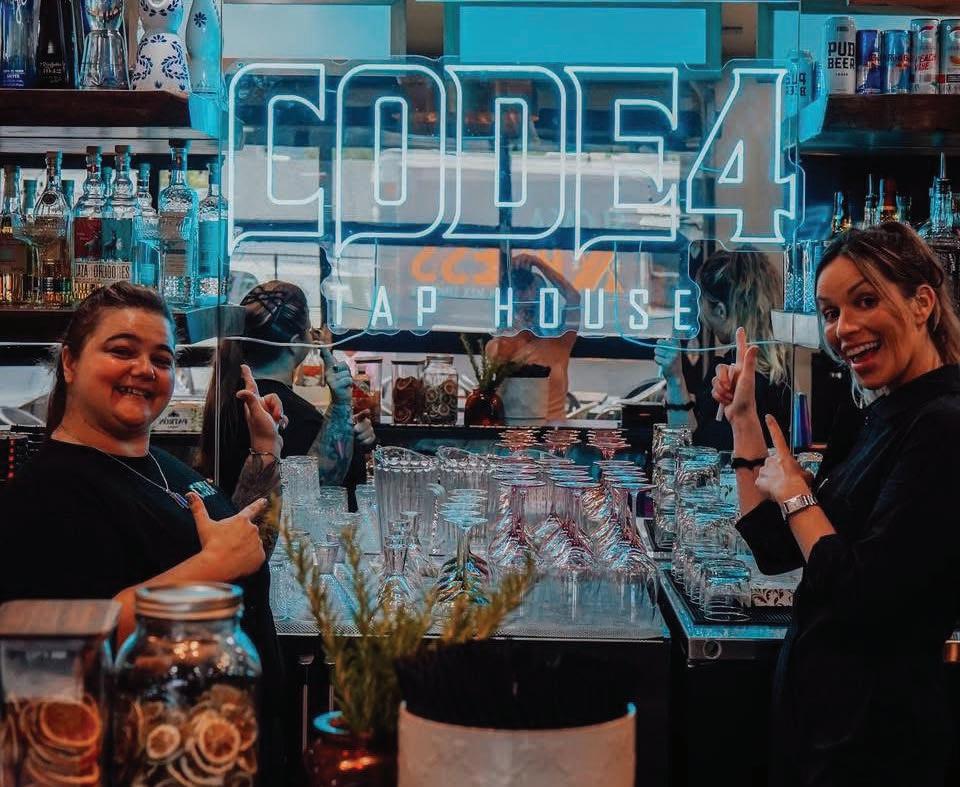
tle extra entertainment is welcome. Live DJs often enhance the experience during brunches and football Sundays, giving the space an energetic and upscale vibe rarely found in smaller towns.
Of course, the sports experience would be incomplete without quality food, and Code 4 lives up to expectations. As part of the Flores group’s growing local portfolio, the menu features dishes that balance bar favorites with elevated flavors. Whether fans are dropping in for a Sunday morning brunch, staying through the afternoon games, or booking the space for a playoff party, they can count on a consistent mix of good food and vibrant energy.
This strategic combination of traditional diner charm and high-end sports entertainment makes Code 4 unique in the Grants Pass area. It fills a gap for residents who want to watch big games in a communal setting without driving to larger cities. The television alone is a conversation piece, but paired with the restaurant’s thoughtful layout and hospitality, it becomes a centerpiece for the community.
For football fans, Code 4 has raised the bar—literally and figuratively. Whether it’s a casual brunch, a rowdy Sunday with friends, or a special private event, Grants Pass finally has a place where the game isn’t just on—it’s larger than life.
By Ellen Ward
The People’s Action Towards Housing (PATH) coalition is preparing for its upcoming General Meeting, set to take place on Tuesday, October 28, from 3:00 p.m. to 5:00 p.m. at the Grants Pass City Council Chambers. The event is open to the public and aims to bring together local organizations, community members, and partners working to address housing and related challenges in Josephine County.
The meeting will run until 4:30 p.m., followed by a dedicated networking session through 5:00 p.m., giving attendees an opportunity to connect and collaborate on shared goals. PATH meetings have become a regular forum for exchanging ideas, sharing updates, and strengthening partnerships among groups working on homelessness, recovery, and community well-being in the Grants Pass area.
This month’s featured speaker will be Chris Goldman, Community Center Director of the Rogue Recovery Center.

Goldman will highlight the organization’s recovery support program, which plays an important role in helping individuals navigate their journey toward stability and independence. The program provides structured assistance and resources for people in recovery, offering pathways to sustained personal and community health.
In addition to the featured presentation, PATH will share recent developments





and upcoming activities, while community partners will have the chance to provide updates on their ongoing efforts. The coalition often uses these meetings to align strategies, identify areas for collaboration, and mobilize local support for a range of housing and social service initiatives.
Attendees are also encouraged to bring non-perishable food donations to support the Josephine County Food Bank. A collection box will be available at the meeting, and all contributions will go toward supporting families in need as the colder months approach.
The organization encourages residents, advocates, service providers, and anyone interested in making a difference to attend the meeting and participate. It’s an opportunity not only to learn more about local programs and initiatives but also to get involved in practical ways that support the broader community.
More information about PATH and its initiatives is available at pathofjoco.org


Posting Date October 13, 2025
Posting October 13, 2025

By Ellen Ward
Across the United States, patients are facing unprecedented delays in accessing medical care. Whether you are covered by private insurance, Medicare, Medicaid, or the Veterans Health Administration, the reality is increasingly the same: appointments are backed up for months, sometimes stretching to a year. This growing problem is affecting everyone—not just seniors. Families with children, working adults, and veterans alike are encountering a system strained well beyond capacity, leaving many unsure where to turn when medical needs can’t wait.
The causes of these delays are complex. Physician shortages, administrative backlogs, post-pandemic patient surges, and the increasing demand for specialized care have created a perfect storm. In many regions, including Southern Oregon, the number of available primary care providers has not kept pace with population growth. Large healthcare systems such as Asante face staffing challenges that mirror national trends, while veterans relying on the VA often encounter multiple layers of approval before seeing a specialist. Even those with excellent insur-
ance find themselves jumping through bureaucratic hoops, only to wait months for a follow-up.
In the face of these realities, understanding practical options can make the difference between receiving timely help and feeling stuck in limbo. For immediate but non-life-threatening issues, urgent care clinics remain one of the most accessible choices. Many clinics offer same-day walk-in services for acute illnesses, minor injuries, or sudden medical concerns. While they are not a substitute for ongoing primary care, urgent care centers can bridge gaps when your regular doctor’s office cannot schedule you quickly.
Telemedicine has also emerged as a valuable tool for bypassing some delays. Virtual visits can address many routine health issues, including prescription refills, follow-up questions, and even some diagnostic consultations. Many insurance plans now cover telehealth visits at reduced costs, and independent telemedicine platforms often provide care on short notice for a flat fee. For individuals in rural areas of Southern Oregon, this can significantly reduce the burden of travel and waiting time.

Community health centers and retail clinics are another option. Federally Qualified Health Centers (FQHCs), for example, often offer sliding-scale fees based on income and can sometimes provide faster access to basic services, vaccinations, and chronic disease management. Pharmacies with in-house clinics may provide vaccinations, screenings, and limited urgent care services without the long scheduling delays seen in hospital systems.
For emergencies, the emergency room remains the appropriate choice—but using it for non-urgent needs can further strain the system. Instead, patients facing long waits for specialists might consider asking their primary care provider to place them on cancellation lists. Many offices will contact patients who can come in on short notice when another appointment opens, dramatically cutting down wait times for those able to be flexible.
Beyond individual strategies, there are ways to address the systemic issues fueling these delays. Patients can write to hospital administrators, state legislators, and members of Congress to demand action on physician shortages and administrative inefficiencies. Local advocacy can push for expanding residency programs, incentivizing rural practice, and streamlining referral systems. Communities that organize and make their voices heard are often the ones that see policy shifts first.
While the current situation can be discouraging, understanding the landscape and taking proactive steps can help individuals navigate these extended wait times more effectively. Southern Oregonians, like Americans everywhere, are facing a healthcare system under stress—but with informed action and community pressure, change is possible.












has claimed they support law enforcement and most claim to support better use of our natural resources in Josephine County, you would think our lease application would be an attractive proposal for County officials. But instead of embracing this significant opportunity, former County Commissioners John West and Herman Baertschiger refused to even bring our application forward for an official hearing and decision of the BCC as required by County Code.
In fact, rather than making a decision on our May 2023 mining lease application, in October 2024 former Commissioner John West arranged a vote of the BCC to just sell this County property before they even decided on our lease application…highly illegal according to the terms of the County code that guaranteed us a lease. Commissioner West, facing a recall, made several false statements to the media about the status of our mining lease application because he didn’t want us to be able to do the project.
Moving forward to early 2025, we had some hope that the three new Commissioners would follow the County law (ordinance) that requires the County to hold a hearing on our mining lease application and make a decision according to the terms of the County Code. Despite County staff telling the 2025 Commissioners there was a pending mining lease application, the new BCC also refused to follow the County Code requirements. We had no choice but to bring a lawsuit against the County just to force the County to follow its own laws and act on our mining lease application.
County Counsel Wally Hicks threw up all kinds of ridiculous legal arguments as to why we shouldn’t be granted a lease and why the County hasn’t acted on our lawful mining lease application. Several of Wally’s
legal arguments were issues that were settled years ago when we were first approved for the mineral exploration permit, but Wally argued them anyway. Every single argument Wally made had absolutely no merit, and he knew it, therefore the day before we were set to go to court he settled the lawsuit in our favor and agreed to have the County hold a public hearing on our lease application as the law requires. But by now, we were delayed by two years due to the County’s illegal refusal to follow the code.
After one public hearing in August 2025 and a second meeting with us and the BCC in September, Commissioners Ron Smith and Andreas Blech appeared poised to do the right thing and follow the code requirements in acting on our lease application.
Commissioner Chris Barnett was negative the whole time, because after all he’s good buddies with former Commissioner John West who was illegally trying to stop us. County Legal Counsel Wally Hicks resigned from representing the County in this case immediately after our August presentation to the BCC, likely because he’s conflicted in this case. But Wally has not stated the reasons for his resignation from the case. Wally Hicks is a big part of why we have damages against the County in this case.
American Mineral Research offered a couple different lease proposals that would have generated between about $6 million and $10 million of revenues to Josephine County during the life of the lease and mineral development project. And we used a conservative market price of $2000 per ounce of gold in our revenue assumptions. With gold market prices closer to $4000 per ounce as we sit today, the actual amount of revenues to Josephine County could be twice these conservative estimates if gold
prices remain closer to today’s market prices. We also warned the County that we would continue to pursue this in the legal arena if our lease application was denied and that we would seek millions of dollars of damages if our lease application was illegally denied.
Here is a near verbatim transcript of Commissioner Ron Smith’s comments and actions in recent meetings.
BCC Meeting on September 17, 2025: Commissioner Ron Smith – “So, so here's, here's my basic opinion of this whole thing. We're looking at 70 acres. It probably has a value of something like $200,000, which really doesn't mean much for the county because there's no timber left on it.
• So what are we haggling about here?
• I mean, is there an opportunity here to actually bring some significant revenue to the county?
• I mean, I mean, what in the world that could happen. I mean, as long as we're indemnified, sure ensure that we're not going to be liable for anything.
• What do we as a county, what problem do we have?
• I kind of I'm sitting here thinking, you know, it's sort of like other properties that we're… we don't want to do that [was he referring to the library lease here?]
• We don't want to sell this property, even though that's the value of the property.
• We don't want to sell it because it's them.
• It has nothing to do with the property or nothing to do with the value.
• So, I'm kind of sitting here wondering what do we have to lose?”
BCC Meeting on September 23, 2025: Commissioner Chris Barnett makes a mo-

tion to DENY the application. Ron Smith votes yes to deny, Barnett votes yes to deny, Andreas Blech votes no on denial.
In the end, Commissioners Ron Smith and Chris Barnett made a decision that may end up costing the County millions in lost revenues and millions in additional legal expenses. They ignored what the County Code says are the requirements to get a mining lease, because there is no doubt that our application met all these requirements to be guaranteed a lease.
As we promised, we will in fact continue to pursue this in the legal arena. As legal cases can always be settled out of court, Commissioners Ron Smith and Chris Barnett may have one final chance to do the right thing before it ends up literally costing the County millions.
The moral of this story here is the importance of electing the right people to the top spots in County government. There are many decisions and actions they face that if they make the wrong decision, it will cost the taxpayers millions.
Earlier this year, Commissioner Andreas Blech presided over the firing of two department heads right after last year’s commissioners were found to have bullied and retaliated against them according to an internal investigation by a third party. This was another decision that has a potential to incur millions in legal costs. And considering it was an attorney in Wally Hicks’ legal office that announced the results of the internal investigation…where is Wally Hicks when the BCC takes actions that don’t follow the law? As BOLI cases filed by these former County Directors are reportedly pending, we taxpayers can look forward to some very expensive lawsuits against Josephine County after BOLI weighs in.