
WEDNESDAY, MARCH 18, 2026
WEDNESDAY, MARCH 18, 2026
By John Oliver
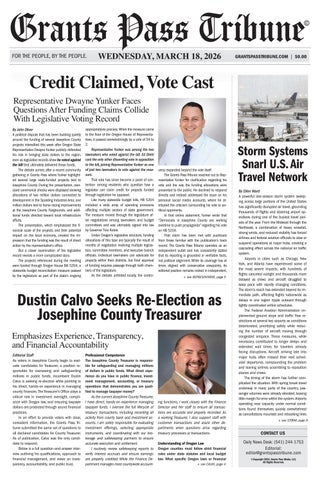
A political dispute that has been building quietly around the funding of several Josephine County projects intensified this week after Oregon State Representative Dwayne Yunker publicly defended his role in bringing state dollars to the region, even as legislative records show he voted against the bill that ultimately delivered those funds.
The debate comes after a recent community gathering in Grants Pass where Yunker highlighted several large state-funded projects tied to Josephine County. During the presentation, oversized ceremonial checks were displayed showing allocations of two million dollars connected to development in the Spalding Industrial Area, one million dollars tied to horse racing improvements at the Josephine County Fairgrounds, and additional funds directed toward local infrastructure efforts.
The presentation, which emphasized the financial scale of the projects and their potential impact on the local economy, created the impression that the funding was the result of direct action by the representative’s office.
But a closer examination of the legislative record reveals a more complicated story.
The projects referenced during the meeting were funded through Oregon House Bill 5204, a statewide budget reconciliation measure passed by the legislature as part of the state’s ongoing
appropriations process. When the measure came to the floor of the Oregon House of Representatives, it passed overwhelmingly by a vote of 54 to 2.
Representative Yunker was among the two lawmakers who voted against the bill. Ed Diehl cast the only other dissenting vote in opposition to the bill, joining Representative Yunker as one of just two lawmakers to vote against the measure.
That vote has since become a point of contention among residents who question how a legislator can claim credit for projects funded through legislation he opposed.
Like many statewide budget bills, HB 5204 included a wide array of spending provisions affecting multiple sectors of state government. The measure moved through the legislature after negotiations among lawmakers and budget committees and was ultimately signed into law by Governor Tina Kotek.
Under Oregon’s legislative structure, funding allocations of this type are typically the result of months of negotiation involving multiple legislators, committee members, and executive branch officials. Individual lawmakers can advocate for projects within their districts, but final approval of funding requires passage through both chambers of the legislature.
As the debate unfolded locally, the contro-
versy expanded beyond the vote itself.
The Grants Pass Tribune reached out to Representative Yunker for clarification regarding his vote and the way the funding allocations were presented to the public. He declined to respond directly and instead addressed the issue on his personal social media accounts, where he attributed the criticism surrounding his vote to political opponents.
In that online statement, Yunker wrote that “Democrats in Josephine County are working overtime to push propaganda” regarding his vote on HB 5204.
That claim has been met with pushback from those familiar with the publication’s track record. The Grants Pass Tribune operates as an independent outlet and has consistently stated that its reporting is grounded in verifiable facts, not political alignment. While its coverage has at times aligned with conservative viewpoints, its editorial position remains rooted in independent,
• see REPRESENTATIVE, page 5
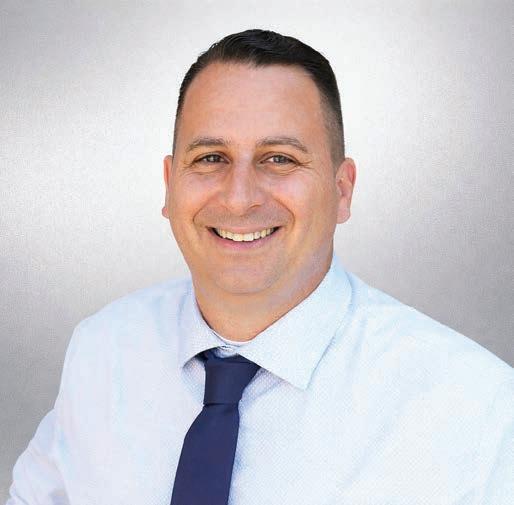
As voters in Josephine County begin to evaluate candidates for Treasurer, a position responsible for overseeing and safeguarding millions in public funds, incumbent Dustin Calvo is seeking re-election while pointing to his direct, hands-on experience in managing county finances. The Treasurer’s Office plays a critical role in investment oversight, compliance with Oregon law, and ensuring taxpayer dollars are protected through sound financial practices.
In an effort to provide voters with clear, consistent information, the Grants Pass Tribune submitted the same set of questions to all declared candidates for County Treasurer. As of publication, Calvo was the only candidate to respond.
Below is a full question-and-answer interview outlining his qualifications, approach to financial management, and views on transparency, accountability, and public trust.
The Josephine County Treasurer is responsible for safeguarding and managing millions of dollars in public funds. What direct experience do you have in public finance, investment management, accounting, or treasury operations that demonstrates you are qualified to manage taxpayer money?
As the current Josephine County Treasurer, I have direct, hands-on experience managing taxpayer funds. I oversee the full lifecycle of treasury transactions, including recording all activity from county bank and investment accounts. I am solely responsible for evaluating investment offerings, selecting appropriate instruments, and coordinating with our brokerage and safekeeping partners to ensure accurate execution and settlement.
I routinely review safekeeping reports to verify interest accruals and ensure earnings are properly credited. While the Finance Department manages most countywide account-
ing functions, I work closely with the Finance Director and her staff to ensure all transactions are accurate and properly recorded. As a working Treasurer, I also support staff with customer transactions and assist other departments when questions arise regarding treasury processes or transactions.
Understanding
Oregon counties must follow strict financial rules under state statutes and local budget law. What specific Oregon laws or financial

By Ellen Ward
A powerful late-season storm system sweeping across large portions of the United States has significantly disrupted air travel, grounding thousands of flights and straining airport operations during one of the busiest travel periods of the year. From the Midwest through the Northeast, a combination of heavy snowfall, strong winds, and reduced visibility has forced airlines and federal aviation officials to slow or suspend operations at major hubs, creating a cascading effect across the national air traffic system.
Airports in cities such as Chicago, New York, and Atlanta have experienced some of the most severe impacts, with hundreds of flights canceled outright and thousands more delayed as crews and aircraft struggled to keep pace with rapidly changing conditions. The storm’s reach has extended beyond its immediate path, affecting flights nationwide as delays in one region ripple outward through tightly coordinated airline schedules.
The Federal Aviation Administration implemented ground stops and traffic flow restrictions at several key airports as conditions deteriorated, prioritizing safety while reducing the number of aircraft moving through congested airspace. These measures, while necessary, contributed to longer delays and extended wait times for travelers already facing disruptions. Aircraft arriving late into major hubs often missed their next scheduled departures, compounding the problem and leaving airlines scrambling to reposition planes and crews.
The timing of the storm has further complicated the situation. With spring break travel underway in many parts of the country, passenger volumes were already elevated, leaving little margin for error within the system. Airports operating near capacity under normal conditions found themselves quickly overwhelmed as cancellations mounted and rebooking lines

Editorial Staff
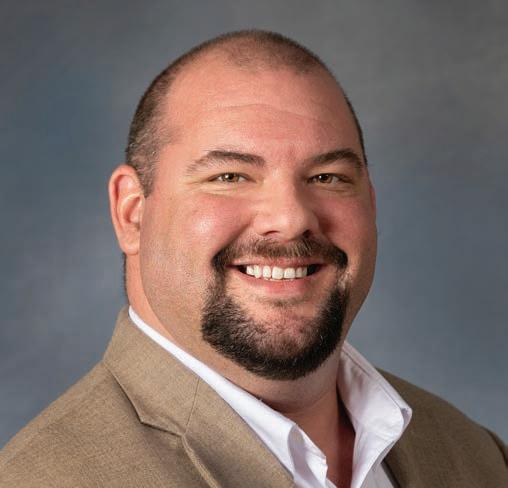
In a race increasingly defined by public frustration and calls for accountability, Josephine County Commissioner candidate Cory Wilson is centering his campaign on a single idea he believes has been missing from local government in recent years, trust. Drawing from his background as a small business owner rather than a career politician, Wilson presents himself as a candidate grounded in real-world experience, focused on transparency, fiscal responsibility, and long-term economic stability. While his responses depart slightly from the Tribune’s standard questionnaire format, they offer a candid and unfiltered look at how he views the role of county leadership and the path forward for Josephine County.
What is the central platform of your campaign?
The primary issue that motivated me to run for Josephine County Commissioner is trust, trust that the people elected to represent Josephine County are doing so for all citizens, not just themselves or their friends. My top three priorities are government transparency, economic growth, and public safety.
Public trust in county government has been strained in recent years.
Transparency is used so often and practiced so little that it has become a hollow word. I intend to earn back the trust of Josephine County residents through meaningful communication. Our community deserves more notice on key issues than a single newspaper ad or a notice on a bulletin board. Critical votes should occur during business sessions with ample time for public comment. Furthermore, I will advocate for remote business sessions so that our rural residents do not always have to bear the burden of travel to have their voices heard.
County commissioners oversee millions of taxpayer dollars and shape the county budget.
Every taxpayer dollar should be accounted for. I will fight for budget reports that are actu-

ally easy to read, you deserve to know where your money goes. I will also oppose needless administrative growth; we should always look for ways to help without immediately adding more payroll. By conducting regular audits of every department, we can cut waste, stop redundant services, and keep your government lean.
Hiring practices within county government have been the subject of public debate.
Nepotism has no place in government. The best person for the job should be the one who is hired. I support blind hiring processes, mixed interview panels, and bans on hiring immediate family members of any elected official or department head.
How do you believe the current and previous Boards of Commissioners have performed?
I am not here to bad-mouth anyone; however, it has often seemed that former Boards prioritized their political allies over the will of the majority.
Commissioners frequently influence policy affecting land use, rural development, and economic growth.
I truly believe we cannot rely solely on being a retirement and tourist destination forever.
We need to grow. I want to focus on bringing new industries to our area by developing ‘ready-
to-build’ sites along our main transit corridors where industry already exists. At the same time, we need to support our small-scale farmers by making agri-tourism more accessible and easier to manage.
I am also a strong supporter of opening up the forests through selective, science-based thinning. This approach creates local jobs and timber revenue while addressing what I see as the number one threat to our region, catastrophic wildfires. At the same time, we should continue exploring responsible land uses that maintain the county’s rural character. High-density housing should remain within established urban growth boundaries.
I will always prioritize our groundwater. Economic growth is not worth it if it ruins a neighbor’s well. Any large project needs to prove it has a sustainable water plan before it ever breaks ground.
Political divisions and accusations of political bullying have become common topics in county government.
This is a three-member board, and the reality is you cannot get anything done alone. Disagreements are going to happen, that is part of the job. When they do, I am going to stick to the facts and the data. I am not going to let my pride, or the need to have the ‘best’ idea in the room, get in the way of doing what is actually right for our community.
County commissioners often serve as the bridge between citizens and government departments.
The first step to being represented is actually knowing what is going on. The county needs a better way to keep the community informed and help everyone understand the issues we are facing. We also need to give residents more time to respond. Letting someone speak for three minutes and then voting immediately does not give the Board time to actually digest that input.
And we need to get out of Grants Pass every
once in a while. Why should someone from Cave Junction or Wolf Creek always have to bear the burden of traveling to us? We should be holding meetings in those communities, too.
Josephine County faces ongoing challenges related to housing, infrastructure, public safety, and economic opportunity.
I believe economic growth is the foundation for solving many of our ongoing challenges. By attracting family-wage jobs, we can naturally grow our tax base, providing the funding we need for infrastructure and public safety without placing the entire burden on current residents through tax hikes.
Leadership matters as much as policy. I will be the first to tell you, I do not have a background in corporate boardrooms or high-level government. My experience comes from running small businesses with ten employees or fewer, learning the hard way through trial, error, and honest work. I am going to make mistakes, but I promise I will own them. What I bring to the table is mutual respect, an open mind, and a genuine passion for making Josephine County a better place for all of us.
Bonus Question – Ethics, Accountability, and Public Trust
Corruption has no place in our government. Public offices exist to serve everyone, not to provide personal gain for a few. I will be the first to publicly address misconduct and will always be transparent about potential conflicts of interest. As your commissioner, my loyalty will be to the residents of Josephine County, not to any one-person, special interest, or political party.
Although Wilson’s changed his questions, his answers reflect a campaign built on restoring credibility in county leadership while pushing for practical, measurable improvements in how government operates. His emphasis on transparency, fiscal discipline, and balanced growth adds another voice to a race that continues to draw sharp attention from voters across Josephine County.













From page 1
regulations govern how a county treasurer may hold, invest, and distribute public funds, and how will you ensure compliance with those laws?
Oregon statutes provide clear direction for how public funds must be held, invested, and distributed:
ORS 294.035 defines the investment vehicles permitted for public funds and forms the basis of the County’s Investment Policy. As the County’s Investment Officer, I draft, maintain, and administer this policy. Any changes must be reviewed and approved by the State Short Term Fund Board.
ORS 295.002 and ORS 295.008 require that public funds be deposited only in qualified depositories approved by the State Treasurer, and that these institutions collateralize public deposits at levels set by the state.
ORS 311.390 and ORS 311.395 govern the distribution of collected property taxes and related investment interest to the appropriate funds and taxing districts, including required timelines.
Under my leadership, the Treasurer’s Office is compliant with these statutes. Continued compliance is ensured through ongoing review of laws, policies, and internal processes.
Investment Responsibility
County funds are often invested to generate returns while protecting the principal. What investment strategies would you support, and how would you balance risk, liquidity, and return when managing public funds?
I support investment strategies that ad-
here to the County Investment Policy and all applicable state laws. I work with multiple brokerage partners and the Local Government Investment Pool to structure an investment portfolio that balances liquidity, safety, and reasonable return.
Compliance with policy and statute ensures responsible risk management and protects public funds. Investments in impermissible or high-risk instruments, such as equities, precious metals, or futures, would be inappropriate for public funds and place them at high risk.
The Treasurer’s Office must remain independent from political pressure. If a commissioner, department head, or political ally attempted to influence financial decisions or investments for political reasons, how would you respond?
The protection and proper management of public funds are things I take very seriously.
Safeguarding public funds requires independence from political pressure. Financial decisions or investment actions driven by political motives may not reflect the best interests of the county or its citizens and can expose public funds to unnecessary risk.
While I am always willing to listen to input from commissioners, department heads, or community members, the final responsibility rests with me. I base decisions on law, policy, and the financial interests of the county, not on political considerations.

If you discovered irregularities suggesting fraud, embezzlement, or misuse of county funds within the Treasurer’s Office or another department, what investigative steps would you take before taking further action?
If I identified irregularities suggesting fraud, embezzlement, or misuse of funds, I would begin with an initial review of financial records in coordination with the Finance Department to determine whether a credible issue exists. If concerns are substantiated, access for any involved individuals would be immediately restricted and they would be placed on administrative leave.
A full audit of the affected accounts would then be initiated, involving an independent third-party auditing firm. This process should occur promptly to limit financial exposure, preserve evidence, and support potential recovery efforts.
If credible evidence of criminal activity within county government came to your attention, would you report it to state investigators, law enforcement, or federal authorities? What would your reporting process be?
Yes, I would report credible evidence of criminal activity. Criminal conduct has no place in county government. My first step would be to notify local law enforcement, followed by determining whether state or federal agencies should also be involved based on the nature of the misconduct.
Josephine County politics has faced accusations of insider influence and cronyism. How would you ensure that hiring decisions, financial contracts, or banking relationships within the Treasurer’s Office are based strictly on merit and law rather than personal or political relationships?
Hiring decisions in the Treasurer’s Office are based on qualifications and merit. Applications are evaluated objectively, and the most qualified candidates are invited to interview. Interview panels include the Treasurer, treasury staff, and neutral participants such as HR or outside department managers to ensure fairness and eliminate bias. Final selection is based on combined scoring from all panel members.
Financial contracts and banking relationships are governed by county administrative policies and state law. Adhering strictly to these requirements ensures transparency, fairness, and protection against favoritism or undue influence.
Many citizens feel that financial decisions in government happen behind closed doors. What specific measures would you take to ensure that county financial records, reports, and investment decisions remain transparent and accessible to the public?
I fully support and comply with Oregon’s public records laws. Whenever possible, I proactively publish information on the Trea-
sury and Tax webpage so citizens can access financial data without submitting a formal request. I am currently reviewing opportunities to expand the amount of information available online to further increase transparency. Government exists to serve the public, and the public deserves access to financial information to the fullest extent allowed by law.”
If a close political ally, campaign supporter, or fellow elected official became the subject of a financial misconduct investigation involving county funds, would you treat that situation differently? Why or why not?
“I would not treat an investigation differently based on personal or political relationships. In my prior career, I conducted an internal investigation involving a colleague I considered a friend. I set aside personal feelings and evaluated the facts objectively. The same principle applies in county government: all individuals are entitled to the presumption of innocence, and all investigations must be impartial, consistent, and grounded in evidence.”
What internal auditing systems, financial checks, or third-party reviews would you implement to detect potential corruption or financial mismanagement before it becomes a public scandal?
The county maintains strong internal checks and balances between the Finance Department and the Treasurer’s Office. Within Treasury, funds are handled under dual control or secondary review to prevent errors or misconduct. Additionally, an external auditor conducts semi-annual reviews to ensure internal controls are functioning effectively. These layers of oversight help detect issues early and protect public funds.
If exposing corruption within county government placed your political career or relationships at risk, would you still pursue it? What obligation does a County Treasurer have to the public when confronted with wrongdoing inside government?
Doing what is right cannot depend on personal or political consequences. Integrity is fundamental to public service. If confronted with corruption, the County Treasurer has an obligation to act decisively, report wrongdoing, and protect the public interest, even if doing so risks political relationships or career impacts. The public must be able to trust that their Treasurer will uphold the law and safeguard taxpayer funds under all circumstances.
As the Treasurer’s race continues to take shape, voter attention is likely to focus not only on experience and policy positions, but also on responsiveness and willingness to engage with the public. With only one candidate having provided direct answers to these questions so far, the broader comparison voters often rely on remains incomplete, at least for now.
From page 1
issue-based reporting rather than party affiliation.
The exchange reflects a broader pattern that has become increasingly common in modern political communication, where elected officials respond to criticism through social media rather than through direct engagement with traditional news outlets.
In his online explanation, Yunker argued that the projects tied to Josephine County were the result of earlier advocacy efforts that took place long before the final legislative vote.
He maintained that legislators must formally submit capital construction requests and advocate for those projects through the legislative process in order for them to be considered for funding. According to his statement, those requests moved through his office and were advanced as part of negotiations surrounding the state budget.
Yunker also described HB 5204 as what he called a “Christmas tree bill,” a legislative term often used to describe large spending packages that include a wide range of unrelated provisions.
According to his statement, he opposed several components of the broader bill, including funding connected to refugee assistance programs, immigration legal services, climate initiatives, the Legislative Equity Office, and re-
productive health programs.
Yunker argued that the inclusion of those items forced lawmakers into a position where supporting local projects required accepting policy provisions they fundamentally opposed. In his statement, he wrote that he was unwilling to compromise his political principles in order to support the entire package, even though it included projects he had previously advocated for within Josephine County.
The representative pointed out separate votes he cast in favor of other measures, including Oregon Senate Bill 1601 and Oregon Senate Bill 5702, which he said also provided funding support for projects affecting the region.
While Representative Yunker has publicly stated his support for Senate Bill 1601 and Senate Bill 5702, the practical impact of those votes on Josephine County and the broader Southern Oregon region appears limited. Senate Bill 1601 functions primarily as a budget stabilization measure, redirecting existing transportation funds to prevent deeper shortfalls within the Oregon Department of Transportation. It does not allocate new funding for local projects, nor does it deliver targeted investment to rural communities like Grants Pass. In fact, by shifting funds away from smaller infrastructure and community-based trans-
portation programs, the bill may reduce access to the very funding streams that rural regions often depend on to secure improvements.
Those explanations have done little to quiet the debate locally.
Senate Bill 5702, while broader in scope, offers only potential rather than guaranteed benefit. The measure establishes funding capacity for statewide capital projects, including housing and infrastructure, but distributes those resources through a competitive and discretionary process. As a result, no specific allocation is directed to Josephine County unless local projects are submitted, approved, and prioritized at the state level. Taken together, it is fair to say that while support for these bills may reflect participation in statewide fiscal decision-making, their passage alone does not translate into immediate or measurable gains for Southern Oregon.
For many residents, the issue isn’t about whether a legislator can oppose parts of a larger spending bill. It’s about how that vote is explained afterward. In this case, Representative Dwayne Yunker voted no, yet has also taken credit for supporting the outcome. That contradiction has left some questioning whether his statements are misleading the public in Josephine County.
State budget allocations involve a multi-lay-
ered process that includes fiscal analysis, committee review, negotiations between legislative leaders, and final votes in both chambers. The resulting appropriations draw from statewide tax revenue and are implemented through state agencies once the legislation is signed into law.
Because of that process, individual legislators rarely act alone in securing funding for regional projects.
Advocacy at the district level can play an important role in bringing local needs to the attention of state officials. But the approval of those funds ultimately depends on the collective decisions of dozens of lawmakers and the broader structure of the state budget.
For Josephine County voters, the current controversy highlights the complexities of state government budgeting and the ways those complexities are communicated to the public.
With election season approaching, the discussion surrounding Representative Yunker’s vote and his subsequent defense of it has become part of a larger conversation about transparency, accountability, and how elected officials represent their actions to the communities they serve.
Whether voters accept the representative’s explanation or view the situation differently may ultimately shape the political conversation in Josephine County in the months ahead.
By Ellen Ward
A major shift within the United States national security apparatus unfolded this week as the director of the National Counterterrorism Center stepped down amid escalating tensions and ongoing military operations involving Iran. The resignation marks the first departure of a senior intelligence official tied directly to the administration’s decision to enter into open conflict, raising new questions about internal consensus, intelligence assessments, and the broader direction of U.S. foreign policy.
The departing official had been responsible for overseeing the nation’s primary hub for analyzing and coordinating intelligence related to terrorism threats. In that role, the position carries significant influence in shaping how threats are interpreted and communicated to policymakers. The decision to resign at this stage of the conflict signals a fundamental disagreement not only over strategy, but also over the underlying justification for military action.
At the center of the dispute is the issue of whether Iran posed an immediate and credible threat to the United States at the time military operations were initiated. According to multiple reports, internal intelligence assessments did not uniformly support the conclusion that such a threat existed. This divergence appears to have contributed to growing tension between intelligence officials and policymakers, particularly

those advocating for a more aggressive posture in the region.
The resignation is notable in part because the official was widely viewed as aligned with the administration’s broader political outlook, particularly its emphasis on limiting foreign military entanglements. That alignment makes the departure more significant, as it reflects not opposition from outside critics, but disagreement from within the administration’s own ranks. It underscores an emerging divide between those who support intervention and those who remain skeptical of expanding U.S. involvement in another prolonged conflict in the Middle East.
The timing of the resignation coincides with a rapidly intensifying conflict that has already begun to reshape geopolitical dynamics. Military operations involving U.S. and allied forces have
targeted key Iranian infrastructure and leadership elements, prompting retaliation from Iran. One of the most consequential responses has been disruption in the Strait of Hormuz, a critical global shipping route for oil. This development has sent ripples through international energy markets and heightened concerns about economic instability tied to the conflict.
Beyond the immediate military and economic implications, the situation has also drawn attention to the process by which decisions of this magnitude are made. Questions have emerged about how intelligence is evaluated and presented, and whether dissenting views within the national security community are given sufficient consideration. The resignation brings those concerns into sharper focus, suggesting that disagreements may have been more substantial
than previously understood.
Political reaction has been swift and divided. Critics of the conflict have pointed to the resignation as evidence that the case for war may have been overstated or inadequately supported by intelligence. Supporters of the administration, on the other hand, have framed the departure as a difference in judgment rather than a fundamental flaw in policy. The debate reflects broader national divisions over the role of the United States in global conflicts and the threshold for military intervention.
The departure also raises practical questions about continuity and leadership within the intelligence community at a critical moment. The National Counterterrorism Center plays a key role in coordinating threat analysis across multiple agencies, and any disruption in leadership during an active conflict introduces an additional layer of complexity to an already volatile situation.
As the conflict continues to evolve, the resignation stands as a pivotal moment that may influence both public perception and policy direction. It highlights the challenges of navigating intelligence, politics, and military strategy in real time, particularly when the stakes involve not only national security but also global stability. Whether this development leads to increased scrutiny, policy recalibration, or further internal divisions remains to be seen, but its significance is unlikely to diminish in the weeks ahead.
Editorial Staff
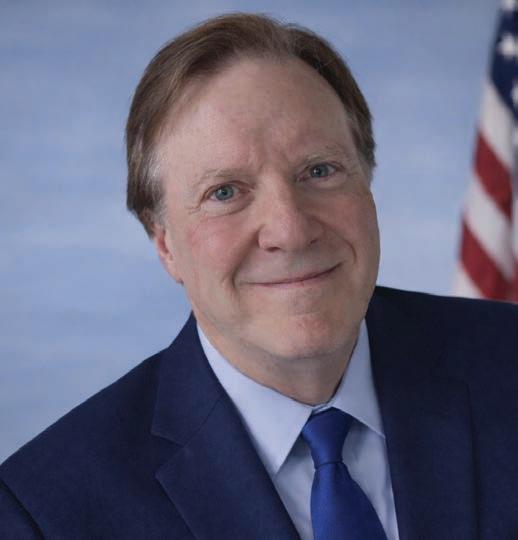
A new candidate has officially entered the race for Josephine County Commissioner, bringing forward a platform centered on restoring trust in local government, improving transparency, and preparing the county for long-term economic change. Tracy Thompson, a nine-year resident of Josephine County with a background in international business and government advisory work, says his decision to run comes from growing concerns over leadership, accountability, and the direction of county governance.
Below are Thompson’s full responses to the Grants Pass Tribune candidate questionnaire.
What is the central platform of your campaign? What specific issues motivated you to run for Josephine County Commissioner, and what are the top three priorities you would pursue if elected?
The main issue that motivated me to run is the gross abuse of office by essentially every Commission I have seen since arriving here nine years ago.
My top three are restoring confidence that the government represents all the people, not just the monied and well connected. Second is economic development that will prepare our County for the AI and automation wave that is coming. We need more non-automatable jobs, because many low-skilled desk jobs are going away. This needs to integrate schools, training
programs, and local businesses.
Third, use our natural resources to address more energy independence as other counties have done. We have the most sunshine west of the Cascades, and we need to use it.
Public trust in county government has been strained in recent years. What steps would you take to restore transparency, professionalism, and public confidence in the Josephine County Board of Commissioners?
First and foremost, civility. Government is supposed to be a place where ideas can be explored and implemented to serve the people of the community. Agreement is not always necessary, but civility and respect are.
No backroom deals, no crony hires, and no

toeing the party line. I follow a utilitarian approach, the most good for the most people.
County commissioners oversee millions of taxpayer dollars and shape the county budget. What principles will guide your budgeting decisions, and how will you ensure fiscal responsibility while maintaining essential services for residents?
This is the one area where business and government have something in common, fiscal responsibility. The taxes imposed by government are an extraction from unwilling participants, and those funds need to be managed responsibly.
My first step would be to implement efficiency programs with existing staff. There is room for a minimum efficiency increase of 25 percent that will also make our County government more responsive to the needs of the community.
Hiring practices within county government have been the subject of public debate. If elected, will you commit to avoiding the hiring of close friends, family members, or political allies for county positions, and what safeguards would you support to ensure merit-based hiring?
This is precisely the type of cronyism I called out in a public BCC meeting. Spending public funds for a good ol’ boy hire is immoral and potentially illegal.
We don’t want second-tier candidates. We must expect more, and qualifications need to be vetted before a hire is made.
How do you believe the current and previous Boards of Commissioners have performed? What decisions or actions do you believe were handled well, and what would you have done differently?
If I thought they were effective, I wouldn’t be running.
Bad faith negotiations with respect to the Pipe Fork issue, sweetheart deals like the Sportsman’s Park sale, and the below-value sale of the Flying Lark to a non-tax generating organization are just a few examples of bad financial and covert dealings that need to have bright lights shone on them.
Commissioners frequently influence policy affecting land use, rural development, and economic growth. What is your vision for responsible economic development in Josephine County, and how would you balance growth with protection of the county’s rural character and natural resources?
This is certainly challenging because private property rights and community interest are often at odds.
As economic growth is top of mind, I believe we can use our natural resources to increase energy independence like other counties. Utilizing sunshine and biomass, we can become a net generator contributing to our General Fund.
I am also opposed to clear-cutting because if we want to attract eco-tourists, scarred hillsides are not a great look.
We also have two airports that are underperforming assets. We should be attracting drone builders or developing an airframe and powerplant training program. We need more Political divisions and accusations of political bullying have become common topics in county government. How would you work with fellow commissioners, staff, and community members who strongly disagree with you?
Government is about debate and discus-
sion, and compromise is essential.
After 30 years in international business, I have negotiated hundreds of contracts where it is about give and take. You have to find where you agree first, build momentum, and then work on the harder issues.
Too often, these roles are treated like personality contests instead of competency roles. County commissioners often serve as the bridge between citizens and government departments. How would you ensure that residents feel heard and represented, particularly those who believe county leadership has ignored their concerns?
I always ask, what do you think?
As a scientist, you can only make decisions when you have enough of the right information. The more data, the better informed your decision.
I often talk with people I disagree with, but their perspective is no less valuable.
Josephine County faces ongoing challenges related to housing, infrastructure, public safety, and economic opportunity. Which of these issues deserves the most urgent attention, and what practical steps would you take in your first year in office?
To separate those misses the bigger picture. Poverty, homelessness, and public safety are all tied together.
With no economic opportunity, you get increased poverty, which leads to homelessness and increased crime. In my view, we need to address homelessness first.
I would like to see us use land resources to build tiny home communities. This creates jobs and may present an opportunity to export solutions to other communities. It also addresses seniors being priced out of housing.
There is substantial federal funding available, so it would not burden the current budget.” Leadership matters as much as policy. What qualities make you the right person to serve as a Josephine County Commissioner, and how will your leadership style differ from what voters have seen in recent years?
I have worked for decades leading teams with direct authority, but more importantly in matrix-management structures where I had to lead large projects without direct authority.
You can only lead the willing, so my approach is to be as inspirational as possible. While I do not believe in consensus management, I do expect participation in discussions so all perspectives are evaluated.
Bonus Question – Ethics, Accountability, and Public Trust
In my 40 years, I have never had any ethical or accountability issues in either the private sector or my work with state and national governments.
I managed a 12 million dollar investment portfolio for a government research institute and advised on a 400 million dollar research and development fund.
I am always motivated by doing the right thing, even when it means putting personal views second.
As the Grants Pass Tribune continues its candidate interview series, voters will have the opportunity to hear directly from those seeking public office in Josephine County, providing insight into their priorities, leadership styles, and vision for the future of the community.

By John Oliver
A formal request submitted to the Oregon Secretary of State is drawing attention to the intersection of election oversight, legal accountability, and public trust, following allegations of potential violations of Oregon election law involving two individuals connected to the state legislature.
On March 15, 2026, William H. Minnix filed an Elections Division Investigation Request with the Secretary of State’s office, asking for a review of actions involving Representative Ed Diehl and Jodie Fleck, who serves in dual roles as Constituent Services Manager to Representative Rick Lewis and Legislative Assistant to Representative Diehl. The nature of the alleged violations was not detailed in the initial filing, but the request signals concerns significant enough to warrant formal review at the state level.
One day later, Minnix submitted a follow-up letter directly to Secretary of State Tobias Read, raising an additional issue that could complicate how the matter is handled. Minnix is currently the plaintiff in a federal lawsuit, Minnix v. Read, pending before the United States District Court for the District of Oregon. In that case, Secretary Read is named as a defendant in his official capacity, creating what Minnix describes as a potential conflict of interest in overseeing the Elections Division complaint.
In his letter, Minnix formally requested that the Secretary of State appoint indepen-
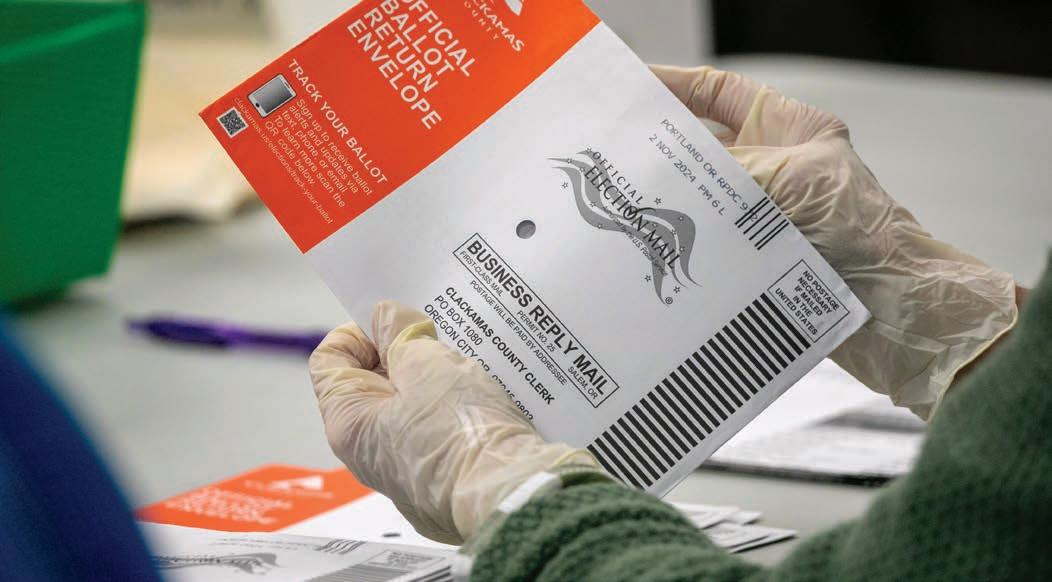
dent counsel or designate an outside investigative authority to handle the complaint. He emphasized that the request is rooted not in criticism of the Elections Division itself, but in the need to preserve the integrity of the process. “This request is made to avoid any actual or perceived conflict of interest and to preserve the integrity and impartiality of the investigative process,” Minnix wrote.
The letter outlines a concern about maintaining public confidence in government institutions, particularly when overlapping legal and administrative responsibilities could create the appearance of bias. Minnix noted that Oregon law and established principles of public administration support the use of independent review mechanisms when impartiality might reasonably be questioned.
“The existence of pending federal litigation involving the Office of the Secretary of State creates a situation in which the appointment of independent counsel would help ensure transparency and public confidence in the investigative process,” he stated. Minnix further clarified that his request should not be interpreted as a challenge to the professionalism or competence of the Elections Division staff. Instead, he framed the request as a precautionary step intended to remove any doubt about the fairness of the investigation and to ensure that all findings are viewed as credible and unbiased by the public.
In addition to seeking independent oversight, Minnix also invoked whistleblower protections under both Oregon and federal law.
He formally notified the Secretary of State’s office that he is asserting those protections in connection with the information provided in his complaint. The letter requests that any investigation be conducted with safeguards in place to prevent retaliation or reprisals.
“I respectfully place the Office of the Secretary of State on notice that I am asserting whistleblower protections under applicable Oregon and federal law,” Minnix wrote, adding that he expects appropriate measures to be taken to protect his rights as a reporting party.
The Secretary of State’s office has not yet publicly responded to the request or indicated whether independent counsel will be appointed. It also remains unclear how the Elections Division will proceed while the federal case involving Minnix and the Secretary of State is still active.
The situation highlights the complex legal and ethical considerations that can arise when election oversight responsibilities intersect with active litigation. At its core, the issue centers on ensuring that investigations into potential election law violations are conducted in a manner that is both impartial and perceived as such by the public.
As Oregon continues to navigate questions surrounding election integrity and accountability, the outcome of this request could set an important precedent for how similar conflicts are addressed in the future.
From page 1
grew. Travelers attempting to reroute faced limited options, as available seats on alternate flights filled quickly.
Weather-related disruptions of this scale highlight the interconnected nature of the U.S. aviation network. Even regions unaffected by severe weather have experienced delays as inbound aircraft failed to arrive on time or crews exceeded federally mandated duty limits. West Coast airports, including those in California and the Pacific Northwest, have reported secondary delays tied to disruptions originating thousands of miles away.
Airlines have responded by issuing travel waivers, allowing passengers to rebook without penalty in affected regions. However, the volume of impacted travelers has made recovery uneven, with some passengers waiting extended periods for new itineraries. In many cases, overnight delays have forced travelers to remain in terminals or seek

last-minute accommodations as airlines work to restore normal operations.
Meteorologists note that late-winter storm systems can be particularly disruptive due to their intensity and unpredictability. Rapid shifts in temperature and precipitation can lead to changing runway conditions, while high winds create additional hazards
for takeoffs and landings. These factors often require airports to temporarily halt operations or reduce traffic, even if conditions improve within hours.
While aviation systems are designed with flexibility to absorb routine disruptions, events of this magnitude expose the limits of that resilience. The combination of high pas-
senger demand, tightly scheduled aircraft rotations, and weather-related constraints creates a scenario where recovery can take several days, even after skies begin to clear.
As the storm system moves eastward and conditions gradually improve, airlines and airport authorities are working to stabilize operations. Even so, lingering delays are expected as backlogs are cleared and normal scheduling resumes. Travelers in the coming days may continue to encounter disruptions, particularly on routes connecting through heavily impacted hubs.
The latest wave of cancellations underscores the vulnerability of modern air travel to severe weather events. Despite advances in forecasting and logistics, the system remains highly dependent on stable conditions to function efficiently. When those conditions break down, the effects are felt quickly and broadly, turning a single storm into a nationwide travel disruption.



By Ellen Ward
Walk down any grocery aisle and the word “milk” appears everywhere, stamped across cartons made from almonds, oats, and coconuts. The packaging suggests familiarity, a simple swap for traditional dairy. Yet behind the branding lies a quieter reality that many consumers rarely examine. These products may pour, foam, and blend like milk, but their actual composition tells a very different story, one that begins with a surprising imbalance between water and the ingredient on the label.
At their core, plant-based milks are not milk in the biological sense. Traditional milk is produced by mammals and naturally contains protein, fat, carbohydrates, and micronutrients in a relatively balanced form. Almond, oat, and coconut beverages, by contrast, are manufactured liquids created by extracting a small portion of plant material and suspending it in a much larger volume of water. The numbers behind that process are where the biggest misconceptions begin.
Almond milk offers perhaps the clearest example. Despite the imagery of whole nuts on packaging, most commercial almond milk contains approximately ninety-five to ninety-eight percent water. The almond content itself typically falls between two and five percent of the final product. After soaking and blending, the mixture is strained, removing much of the solid material that would otherwise contribute fiber and density. What remains is a diluted liquid that is then fortified with calcium, vitamin D, and other nutrients, while stabilizers are added to prevent separation. The result is a beverage that carries the name of almonds but contains only a small fraction of the nut itself.

Oat milk, often marketed for its creamy texture and naturally sweet flavor, follows a similar pattern, though with slightly higher solids content. Most oat milk products contain roughly eighty-five to ninety-five percent water, with oats making up about five to fifteen percent of the mixture. During production, enzymes break down oat starches into sugars, which contributes to its mild sweetness. Oils are frequently added to improve mouthfeel, and like almond milk, the beverage is fortified and stabilized. While oat milk may contain more source material than almond milk, it is still overwhelmingly water-based.
Coconut milk, when sold as a beverage in cartons, can be even more diluted than many
consumers expect. Unlike the thick canned version used in cooking, carton coconut milk is formulated to be light and drinkable. It typically contains about ninety to ninety-seven percent water, with coconut extract ranging from roughly three to ten percent, and often closer to the lower end depending on the brand. The extraction process begins with grated coconut flesh mixed with water and pressed to release its liquid, which is then diluted further. Stabilizers and added nutrients complete the formulation, bringing it in line with other plant-based options on the shelf.
These percentages reveal a consistent pattern across all three products. Despite different sources and processing techniques, the dom-
inant ingredient is water, often comprising the vast majority of what is consumed. The plant component, whether almonds, oats, or coconut, represents a relatively small share of the final beverage. This reality has led some critics to describe plant-based milks as little more than flavored water, though that characterization, while blunt, underscores an important point about composition.
The use of the term “milk” for these products remains a subject of debate, yet it continues to be permitted in the United States based on consumer understanding that these are alternatives rather than direct equivalents to dairy. From a functional standpoint, they serve similar roles in cooking and daily use. Nutritionally, however, they often rely on fortification to approximate the vitamins and minerals naturally present in dairy milk.
For individuals focused on health and wellness, the takeaway is not necessarily to avoid these beverages, but to understand them clearly. Almond, oat, and coconut milks are engineered products, designed for taste, texture, and convenience. They can fit into a balanced diet, particularly for those with dietary restrictions or preferences, but they are not nutritionally identical to traditional milk and should not be assumed to be.
In the end, the label on the carton tells only part of the story. What appears to be a simple plant-based alternative is, in reality, a carefully processed mixture dominated by water, with a modest contribution from the ingredient that gives it its name. Understanding those proportions allows consumers to make more informed choices, cutting through the marketing and seeing these products for what they truly are.


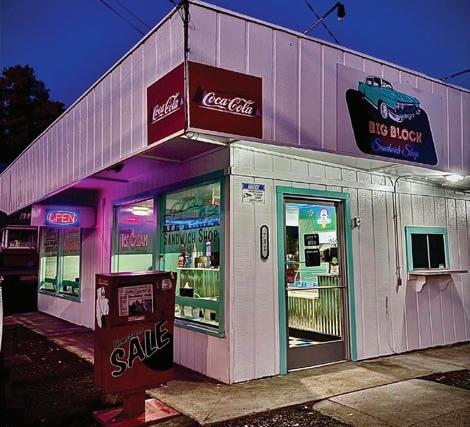
By Nik Martin, Local Food Critic Stop number 17 on the cheese trail brought me straight to Big Block Sandwich Shop, and let me tell you, this one didn’t just meet expectations, it leaned into them hard and came out swinging.
Tucked into a familiar stretch of Grants Pass, Big Block has been quietly building a reputation for bold, no-nonsense sandwiches that don’t try to be fancy, they just try to be good. And more often than not, they hit that mark.
This particular creation starts with an Italian roll that strikes the right balance, sturdy enough to hold everything together, yet soft enough to not get in the way. What’s inside is where things really start to come alive. The shredded beef is the backbone here, tender to the point where it practically falls apart on contact, rich,
savory, and clearly given the time it deserves.
Layered into that is a combination that might raise an eyebrow at first, cream cheese and sharp cheddar. But instead of clashing, they work together in a way that feels intentional. The cream cheese brings a smooth, mellow texture, while the sharp cheddar cuts through with just enough bite to keep things interesting.
Then comes the wildcard, a sweet, creamy sauce that ties the whole thing together. It doesn’t overpower, it complements. There’s a subtle Southern comfort food vibe running through the entire sandwich, like something you’d expect to find in a roadside stop somewhere off a long stretch of highway, except this one is right here in Grants Pass.
What stands out most is the creativity.
This isn’t just throwing ingredients together and hoping for the best. There’s thought behind it, balance, texture, flavor, all working in sync. It’s another reminder that the local sandwich scene is evolving, and places like Big Block are helping push it forward.
Bottom line, this one crushed. Not because it tried to reinvent the wheel, but because it understood exactly what it wanted to be and executed it well. If this is where stop 17 lands, the rest of the trail has a lot to live up to.
City of Grants Pass
A temporary but significant traffic disruption is now underway in Grants Pass as a section of Willow Lane has closed to accommodate underground utility installation. The closure, which began March 16, 2026, is scheduled to remain in effect through April 6, 2026, impacting a key connector between Elmer Nelson Drive and Redwood Highway.
During this period, Willow Lane will be fully closed to through traffic along the affected stretch. Access to Redwood Highway from Willow Lane has been suspended entirely, requiring motorists to seek alternate routes. Local access will remain available only from the Elmer Nelson side, limiting entry and exit options for residents and businesses in the immediate area.
The project is part of ongoing infra-
structure improvements aimed at upgrading underground utility systems. While these improvements are necessary to support long-term service reliability and future development, the short-term effects are expected to create inconvenience for drivers who regularly rely on this corridor.
Detours have been established to help redirect traffic around the closure zone, though increased congestion on nearby roads is likely as drivers adjust to the temporary changes. Commuters are encouraged to plan ahead, allow additional travel time, and avoid the area when possible to minimize delays.
Of particular note, emergency vehicles will not be permitted to pass through the closed portion of Willow Lane during the construction period. This restriction underscores the importance of clear detour routes and may require emergency
services to adjust response paths within this part of the city.
Local officials and project coordinators emphasize that the closure is necessary to safely complete the underground work, which typically involves trenching, pipe installation, and system connections beneath the roadway. Such projects require full road closures to ensure worker safety and prevent damage to newly installed infrastructure.
Residents seeking additional information about the project or its impacts can contact Pilot Rock at 541-7794916. As the project progresses, updates may be provided regarding any changes to the timeline or access conditions.
While the closure presents temporary challenges, it reflects ongoing efforts to maintain and improve essential infrastructure within the Grants Pass area.
5 DAY OUTLOOK
SOURCE: WEATHER.COM
WEDNESDAY THURSDAY FRIDAY





March 16,
Posting March 16, 2026