WEDNESDAY, JUNE 17, 2026
WEDNESDAY, JUNE 17, 2026
County Agenda Signals
Major Administrative Moves
By John Oliver
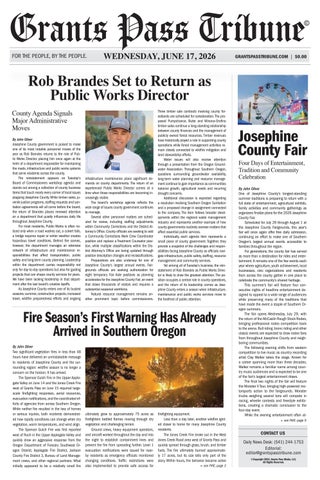
Josephine County government is poised to make one of its most notable personnel moves of the year as Rob Brandes returns to the role of Public Works Director, placing him once again at the helm of a department responsible for maintaining the roads, infrastructure and public works systems that serve residents across the county.
The reinstatement appears on Tuesday's Board of Commissioners workshop agenda and stands out among a collection of county business items that touch nearly every corner of local issues plaguing Josephine County. While timber sales, juvenile justice programs, staffing requests and sanitation agreements will all come before the board, the return of Brandes places renewed attention on a department that quietly influences daily life throughout Josephine County.
For most residents, Public Works is often noticed only when a road washes out, a culvert fails, a bridge requires repair or winter weather creates hazardous travel conditions. Behind the scenes, however, the department manages an extensive network of infrastructure and maintenance responsibilities that affect transportation, public safety and long-term county planning. Leadership within the department carries responsibility not only for day-to-day operations but also for guiding projects that can shape county services for years. We have been lacking leadership in that department after the last board’s creative layoffs.
As Josephine County enters one of its busiest seasons; summer, construction projects, increased travel, wildfire preparedness efforts and ongoing
infrastructure maintenance place significant demands on county departments. The return of an experienced Public Works Director comes at a time when those responsibilities are becoming increasingly visible.
The board's workshop agenda reflects the wide range of issues county government continues to manage.
Several other personnel matters are scheduled for review, including staffing adjustments within Community Corrections and the District Attorney's Office. County officials are seeking to add a Community Corrections Work Crew Coordinator position and replace a Treatment Counselor position, while multiple classifications within the District Attorney's Office are being updated through position description changes and reclassifications.
Preparations are also underway for one of Josephine County's largest annual events. Fairgrounds officials are seeking authorization for eight temporary Fair Aide positions as planning accelerates for the Josephine County Fair, an event that draws thousands of visitors and requires a substantial seasonal workforce.
Natural resource management remains another prominent topic before commissioners.
Three timber sale contracts involving county forestlands are scheduled for consideration. The proposed Pumpchance, Butte and Winona-Orofino timber sales continue a long-standing relationship between county finances and the management of publicly owned forest resources. Timber revenues have historically played a role in supporting county operations while forest management activities remain closely connected to wildfire mitigation and land stewardship efforts.
Water issues will also receive attention through a presentation from the Oregon Groundwater Association. Throughout Southern Oregon, questions surrounding groundwater availability, long-term water planning and resource management continue to gain importance as communities balance growth, agricultural needs and recurring drought concerns.
Additional discussion is expected regarding a resolution involving Southern Oregon Sanitation and a proposed change in assignment connected to the company. The item follows broader developments within the regional waste management industry and represents another example of how county governments routinely oversee matters that affect essential public services.
Individually, each agenda item represents a small piece of county government. Together, they provide a snapshot of the challenges and responsibilities facing Josephine County as officials navigate infrastructure, public safety, staffing, resource management and community services.
Yet among all of Tuesday's business, the reinstatement of Rob Brandes as Public Works Director is likely to draw the greatest attention. The position occupies a central role in county operations, and the return of its leadership comes as Josephine County enters a season when infrastructure, maintenance and public works services move to the forefront of public attention.
By John Oliver
Two significant vegetation fires in less than 48 hours have delivered an unmistakable message to residents of Josephine County and the surrounding region: wildfire season is no longer a concern on the horizon. It has arrived.
The Spencer Gulch Fire in the Upper Applegate Valley on June 14 and the Jones Creek Fire west of Grants Pass on June 15 required largescale firefighting responses, aerial resources, evacuation notifications, and the coordinated efforts of agencies from across Southern Oregon. While neither fire resulted in the loss of homes or serious injuries, both incidents demonstrated how rapidly conditions can change when dry vegetation, warm temperatures, and wind align.
The Spencer Gulch Fire was first reported west of Ruch in the Upper Applegate Valley and quickly drew an aggressive response from the Oregon Department of Forestry Southwest Oregon District, Applegate Fire District, Jackson County Fire District 3, Bureau of Land Management crews, and other regional partners. What initially appeared to be a relatively small fire
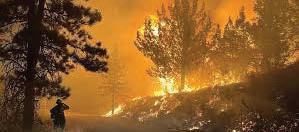
ultimately grew to approximately 75 acres as firefighters battled flames moving through dry vegetation and challenging terrain.
Ground crews, heavy equipment operators, and aircraft worked throughout the day and into the night to establish containment lines and prevent the fire from spreading further. Level 1 evacuation notifications were issued for nearby residents as emergency officials monitored changing conditions. Traffic restrictions were also implemented to provide safe access for
firefighting equipment.
Less than a day later, another wildfire ignited closer to home for many Josephine County residents.
The Jones Creek Fire broke out in the West Jones Creek Road area west of Grants Pass and quickly spread through grass, brush, and timber fuels. The fire ultimately burned approximately 17 acres, but its size tells only part of the story. Within hours, fire behavior became active
• see FIRE, page 3

By John Oliver
One of Josephine County’s longest-standing summer traditions is preparing to return with a full slate of entertainment, agricultural exhibits, family activities and community gatherings as organizers finalize plans for the 2026 Josephine County Fair.
Scheduled for July 29 through August 1 at the Josephine County Fairgrounds, this year’s fair will once again offer free daily admission, continuing an effort to make one of Southern Oregon’s largest annual events accessible to families throughout the region.
For generations, the county fair has served as more than a destination for rides and entertainment. It remains one of the few events each year where agriculture, youth achievement, local businesses, civic organizations and residents from across the county gather in one place to celebrate the community’s shared heritage.
This summer’s fair will feature four consecutive nights of headline entertainment designed to appeal to a wide range of audiences while preserving many of the traditions that have made the event a staple of Southern Oregon summers.
The fair opens Wednesday, July 29, with the return of the McCaslin Rough Stock Rodeo, bringing professional rodeo competition back to the arena. Bull riding, bronc riding and other classic events are expected to draw rodeo fans from throughout Josephine County and neighboring communities.
The following evening shifts from western competition to live music as country recording artist Clay Walker takes the stage. Known for a career spanning more than three decades, Walker remains a familiar name among country music audiences and is expected to be one of the fair’s largest entertainment draws.
The final two nights of the fair will feature the Monster X Tour, bringing high-powered motorsports action to the fairgrounds. Monster trucks weighing several tons will compete in racing, wheelie contests and freestyle exhibitions, creating a dramatic conclusion to the four-day event.
While the evening entertainment often at-
• see FAIR, page 9

By Ellen Ward
For generations, discussions about public education in Oregon have often focused on one central issue: funding. This year, that conversation is expanding beyond the size of school budgets and moving toward a broader question of results. Alongside the largest state investment ever directed toward Oregon's K-12 public school system, a new framework is being put in place that will place greater emphasis on student performance, attendance, literacy achievement, and graduation outcomes.
The changes are expected to affect every school district across the state, from the Portland metropolitan area to the smallest rural communities in Southern, Central, and Eastern Oregon. School administrators, teachers, and local education leaders are now reviewing how the new expectations may shape future operations, planning, and reporting.
The record funding package arrives during a period when schools continue to address challenges that have emerged over the past several years. Many districts have reported concerns about student attendance, reading proficiency, mathematics performance, and ensuring students remain on track to graduate. While each community faces its own unique circumstances, education leaders throughout Oregon increasingly agree that long-term improvement requires both financial support and measurable progress.
Under the new system, state education officials will focus on several key indicators that are considered strong predictors of student success. These include overall attendance rates, attendance among younger elementary students, third-grade reading proficiency, eighth-grade mathematics achievement, ninth-grade prog-

ress toward graduation, four-year graduation rates, and five-year completion rates.
The goal is to provide a clearer picture of how students are progressing throughout their academic careers rather than waiting until graduation to determine whether interventions are needed. Education experts have long identified early literacy, consistent attendance, and middle school mathematics achievement as important benchmarks that can influence future academic success.
Among the areas receiving the greatest attention is student attendance. Schools throughout Oregon have experienced significant increases in chronic absenteeism in recent years. Students who miss substantial amounts of instructional time often face greater challenges academically and are more likely to struggle with graduation requirements later in their educational journey. As a result, districts are expected to place increased focus on attendance initiatives and strategies designed to keep stu-
dents engaged in the classroom.
The changes extend beyond statewide measurements. Individual school districts will also be expected to establish local goals that reflect the specific needs of their students and communities. Depending on the district, those goals may focus on science achievement, career and technical education participation, dual-credit opportunities, Advanced Placement coursework, multilingual learner success, or workforce readiness programs.
For parents and taxpayers, the new approach is expected to provide greater transparency regarding school performance. Communities will likely see more detailed reporting about how schools are progressing toward established goals and where improvement efforts are being concentrated. Supporters of the changes believe clearer reporting will help families better understand how educational investments are translating into student outcomes.
State education officials will also have ex-
From page 1
enough to prompt a Level 3 "Go Now" evacuation notice for nearby homes while aircraft and multiple firefighting agencies rushed to contain the growing threat.
Firefighters succeeded in holding containment lines and stopping the fire before it could expand into a much larger incident. By evening, evacuation levels were reduced and crews transitioned into mop-up operations. The outcome was positive, but the speed at which the fire developed provided a stark reminder of how quickly a routine summer afternoon can become an emergency.
The two fires reveal a common reality facing our region in 2026; vegetation across Oregon is drying earlier than many residents would like to see.
Fire danger levels were elevated to Moderate across Jackson and Josephine counties on June 11, affecting approximately 1.8 million acres of public and private lands. Fire officials cited warmer temperatures, below-normal moisture levels, drying fuels, and increasing wildfire potential throughout the region.
Those conditions are now visible across the landscape surrounding Grants Pass. Hillsides that remained green only weeks ago are beginning to cure. Roadside grasses have turned brown. Brush fields and timber understories are steadily losing moisture as summer approaches.
The recent fires also reinforce a point repeatedly emphasized by fire agencies: human-caused ignitions remain among the greatest wildfire threats during the early part of fire sea-
son. Many wildfires begin not from lightning, but from everyday activities that produce sparks or open flames. Mowing dry grass during the hottest part of the day, dragging chains behind trailers, operating equipment in cured vegetation, improperly extinguished campfires, and careless use of fireworks can all create conditions for a wildfire to start.
For residents, the lesson from Spencer Gulch and Jones Creek is not one of panic but preparation.
Defensible space around homes remains one of the most effective tools available to property owners. Clearing dry vegetation near structures, trimming overhanging branches, maintaining access routes, and keeping emergency plans updated can significantly improve safety during a wildfire event. Residents are also encouraged to stay informed through local emergency notification systems and monitor changing fire conditions throughout the summer.
The firefighters who responded to both incidents prevented what could have become far more destructive events. Their success, however, should not be mistaken for immunity from future fires.
Southern Oregon has entered the season when a single spark can become a community emergency. The back-to-back fires at Spencer Gulch and Jones Creek served as an early warning that the landscape is drying, conditions are changing, and wildfire awareness must become part of daily life once again.
Summer has only begun, and the first wake-up call has already arrived.
panded authority to monitor performance and provide support to districts facing ongoing challenges. Rather than serving solely as a reporting system, the framework is intended to identify areas where additional assistance may be needed and help districts develop strategies for improvement.
The transition may present unique challenges for some rural districts, including many in Southern Oregon. Smaller school systems often operate with fewer administrative resources while serving students across large geographic areas. Education leaders throughout the region will be closely watching how the accountability requirements are implemented and whether additional support becomes available to help districts meet the new expectations.
For communities across Oregon, the changes signal a shift in how educational success is measured. Funding remains an essential part of the equation, but the focus is increasingly moving toward outcomes that families can see and understand. Attendance, literacy, mathematics achievement, graduation rates, and student preparedness are expected to become central benchmarks in evaluating the effectiveness of Oregon's public education system.
As districts begin adapting to the new requirements, the coming years will provide a clearer understanding of whether historic investments combined with stronger accountability measures can improve student achievement and create greater opportunities for Oregon's next generation. For families, educators, and communities alike, the ultimate measure of success will be found not in budget documents or performance reports, but in the achievements of students in classrooms across the state.


By Ellen Ward
Diplomatic efforts to transform a fragile ceasefire between the United States and Iran into a lasting regional agreement encountered a significant challenge Tuesday as competing demands over southern Lebanon exposed one of the most difficult unresolved issues facing negotiators.
The latest development came after Iran’s top diplomat indicated that any long-term arrangement intended to formally conclude recent hostilities would require the withdrawal of Israeli forces from portions of southern Lebanon. The position immediately highlighted a growing divide between the parties involved, as Israeli leaders have repeatedly stated that they do not intend to relinquish control of areas they consider vital to national security.
The disagreement places Lebanon at the center of a broader diplomatic effort that extends well beyond the recent confrontation between Washington and Tehran. While public attention has largely focused on direct tensions involving the United States, Iran, and Israel, developments along the Israeli-Lebanese border have increasingly become intertwined with negotiations aimed at preventing a wider regional conflict.
The tentative agreement under discussion is believed to include provisions designed to halt direct military confrontations, reduce the risk of attacks against international shipping routes, and establish a framework for future diplomatic engagement between the United States and Iran. The arrangement has also been viewed as an opportunity to reduce tensions that have threatened energy markets

and raised concerns among governments throughout the Middle East, Europe, and Asia. Despite those broader objectives, the status of southern Lebanon remains unresolved.
Israeli military operations in the region intensified during recent fighting involving Hezbollah, the Iranian-backed political and military organization that has long maintained a significant presence in Lebanon. Israeli officials have argued that maintaining military positions in strategic areas is necessary to prevent future attacks against communities in northern Israel and to ensure that armed groups cannot quickly reestablish operational capabilities near the border.
Iran, however, has continued to portray the presence of Israeli forces inside Lebanese territory as incompatible with a durable regional settlement. Iranian officials have linked the future stability of the ceasefire to developments in Lebanon, signaling that the issue carries substantial weight in Tehran’s calcula-
tions regarding any broader agreement.
The dispute reflects the complicated nature of modern Middle Eastern diplomacy, where multiple conflicts often overlap and influence one another. While negotiations may be framed around a specific confrontation, regional alliances and longstanding security disputes frequently become part of the discussion. In this case, events in Lebanon have become closely connected to efforts aimed at reducing tensions between the United States and Iran.
The uncertainty surrounding the agreement has been compounded by the absence of publicly released details regarding its final terms. Governments involved in the negotiations have provided only limited information about the structure of the proposed arrangement, leaving analysts and observers attempting to determine which provisions have been formally accepted and which remain under negotiation.
That lack of clarity has produced differing interpretations regarding whether Lebanon is a central component of the agreement or a separate issue that could be addressed through future diplomatic channels. Regardless of how the negotiations are structured, recent statements from officials suggest that developments along the Israeli-Lebanese border could play a decisive role in determining whether the broader ceasefire framework ultimately survives.
Regional leaders continue to monitor the situation closely as governments work to prevent a return to large-scale military operations. The prospect of renewed fighting remains a concern due to the involvement of multiple armed groups, competing national interests, and the strategic importance of key transportation and energy corridors throughout the Middle East.
For now, diplomats appear focused on preserving momentum generated by the tentative ceasefire while attempting to bridge substantial differences between the parties. Whether those efforts succeed may depend largely on finding a path forward in Lebanon, where territorial control, national security concerns, and regional alliances have converged into one of the most consequential issues facing negotiators.
As discussions continue, the future of the broader agreement remains uncertain. What has become increasingly clear is that any lasting settlement will require solutions not only to the immediate conflict but also to the interconnected disputes that have shaped Middle Eastern politics for decades.
By Bryce Robinson
A powerful earthquake beneath the waters of the Caribbean Sea delivered an unexpected jolt to millions of people Monday afternoon, shaking communities across Cuba and sending tremors far beyond the island nation’s shores.
The magnitude 6.1 earthquake struck approximately 65 miles off Cuba’s northwestern coast, creating a wave of concern across portions of the Caribbean, Mexico, and the southeastern United States. While no widespread destruction or loss of life had been reported as of Tuesday, the event quickly became one of the most discussed seismic incidents in the region in recent years due to the extraordinary distance over which the shaking was felt.
Residents throughout western Cuba reported buildings swaying, household items rattling, and brief moments of uncertainty as the ground moved beneath them. In Havana and surrounding communities, many people stepped outdoors as a precaution while authorities began evaluating infrastructure and monitoring for potential aftershocks.
The earthquake’s effects extended well beyond Cuba. Reports of shaking surfaced

throughout Florida, including Miami, Tampa, Orlando, and other communities hundreds of miles from the epicenter. Across the Gulf of Mexico, residents in Mexico’s Yucatán Peninsula also described feeling vibrations as seismic waves traveled through the region.
Scientists said the earthquake’s relatively shallow depth played a significant role in how far the shaking was able to travel. Earthquakes that occur closer to the Earth’s surface often transmit energy more efficiently, increasing the
likelihood that distant populations will feel the event. Geological conditions beneath portions of Florida also helped carry the seismic waves farther than many residents might expect from an earthquake occurring outside the United States.
For many Floridians, the event represented an unusual experience. The state is not commonly associated with earthquake activity, and reports quickly emerged of office buildings swaying, windows rattling, and residents contacting local authorities to determine whether what they felt was, in fact, an earthquake.
Emergency management officials monitored the situation throughout the afternoon, but no tsunami warnings were issued. Seismic experts determined that the characteristics of the earthquake were unlikely to generate a dangerous ocean surge, easing one of the primary concerns that often follows significant offshore earthquakes.
The event has also drawn attention from historians and geologists because of its rarity. According to seismic records examined by researchers, earthquakes of this magnitude are uncommon in the waters west of Cuba. Some experts have described the quake as among the
strongest recorded in that particular area since detailed modern recordkeeping began. Historical data indicate that larger earthquakes have occurred elsewhere in Cuba, particularly in the eastern portion of the island, but western Cuba experiences significant seismic events far less frequently.
Although the immediate threat appears to have passed, scientists caution that aftershocks are likely in the coming days and weeks. These smaller earthquakes commonly follow larger seismic events as underground fault systems adjust to the movement that occurred during the main quake. Most aftershocks are considerably weaker, but some can still be strong enough to be felt by nearby populations.
For residents across Cuba, Mexico, and the southeastern United States, Monday’s earthquake offered an unexpected lesson in the reach of natural forces. A tremor originating beneath the Caribbean Sea was capable of crossing international borders and hundreds of miles of ocean, reminding millions that the movements occurring deep beneath the Earth’s surface often connect communities far beyond the immediate impact zone.

By Ellen Ward
Almost six years after COVID-19 upended daily life across Oregon and the nation, many people have long since moved on from masks, testing lines, and quarantine guidelines. Yet for some residents, one of the pandemic's most unusual symptoms never fully disappeared.
Loss of smell and taste became one of the defining hallmarks of COVID-19 infection during the early years of the pandemic. For many, the symptom lasted only a few weeks. Others spent months waiting for familiar scents and flavors to return. A smaller group entered a much longer chapter, living year after year with foods that tasted muted, meals that felt incomplete, and a world that seemed strangely absent of many of the smells that most people rarely stop to appreciate.
What researchers have learned in the years since is that recovery does not always follow a predictable schedule.
Medical studies tracking long COVID patients have found that while most people regain much or all of their smell and taste within the first year or two after infection, a percentage continue experiencing sensory changes for much longer. Some report partial recovery. Others describe distorted smells that make familiar scents seem unusual or unpleasant. A growing number have reported something else entirely: improvement arriving years after they believed recovery had stopped.
That finding is reshaping what physicians understand about post-viral smell loss.
The human sense of smell depends on specialized nerve cells located inside the nasal cavity. Unlike many other nerve cells

throughout the body, these sensory receptors have the ability to regenerate. Researchers believe COVID-19 can disrupt this system in several ways, including inflammation, damage to supporting cells, and interference with communication between the nose and the brain. In some individuals, the repair process appears to take far longer than originally anticipated.
The result can be a recovery timeline measured not in weeks or months, but in years.
Because smell and taste are closely connected, many people notice the return
of flavor before they fully recognize changes in smell. Foods begin tasting more complete. Coffee develops a stronger aroma. Fresh-cut grass becomes noticeable again. Garlic, onions, citrus fruits, flowers, smoke, and perfumes gradually become easier to detect. The changes are often subtle at first, arriving so slowly that they can be overlooked until a familiar scent suddenly stands out after years of absence.
For those who contracted COVID-19 more than once, the picture can become even more complicated. Multiple infections may affect individuals differently, making
recovery timelines difficult to predict. Some people experience setbacks after a second illness, while others continue to improve despite repeated exposure.
Researchers caution that smell and taste recovery is rarely an all-or-nothing event. Improvement does not necessarily mean a return to pre-pandemic sensory function. Many long COVID patients report regaining portions of what was lost while still noticing differences compared with their abilities before infection. Others continue experiencing fluctuations, with some days better than others.
Health experts also note that reduced smell carries practical concerns beyond enjoyment of food. The ability to detect smoke, spoiled food, natural gas leaks, and chemical fumes remains an important safety function. Anyone living with diminished smell should continue taking appropriate precautions, including maintaining working smoke and carbon monoxide detectors.
As scientists continue studying long COVID, one lesson has become increasingly clear: recovery timelines are often longer and more individualized than early assumptions suggested.
For those who lost part of their sensory world during the pandemic and are only now beginning to notice small changes, their experience is not unique. While late improvement may not be the most common outcome, it has become an increasingly recognized part of the long COVID story.
The pandemic's immediate crisis may be years behind us, but for some people, the body's recovery process appears to still be underway.
By Bryce Robinson
For many Southern Oregon residents, the house is clean, the floors have been vacuumed, the dusting has been done, there are no pets in the home, and yet a stubborn, dirty smell still seems to hang in the air.
This week’s high pollen levels may be the likely reason.
During heavy pollen periods, outdoor particles do not stay outside. They move into homes on shoes, clothing, hair, window screens, open doors, air vents, and even through normal household airflow. Once inside, pollen can settle into carpets, curtains, upholstered furniture, bedding, closets, and HVAC filters. The result can be a stale, dusty, earthy odor that feels like dirt even when the house itself has been cleaned.
In Southern Oregon, late spring and early summer can bring some of the strongest pollen conditions of the season. Grass pollen, tree pollen, and other airborne particles can collect quickly, especially during dry stretches when dust and pollen remain suspended in

the air longer. When the wind picks up, those particles travel farther and cling to almost everything they touch.
For homeowners who keep cleaning but still notice the smell, the issue may not be poor housekeeping. Vacuuming can remove surface debris, but pollen can work its way into carpet fibers, rugs, fabric furniture, and air returns. Dusting hard surfaces may help
briefly, but the odor can return once air begins circulating again.
The HVAC system can also make the problem worse. When filters are full or vents have collected pollen and dust, the system can push that stale smell from room to room.
A home may smell clean after windows are opened, only for the odor to return once the house is closed and the air system begins
running again.
Carpets are another common place where pollen lingers. Even without pets, carpet acts like a filter for the home. Every step can release trapped particles back into the air. Older carpet and padding may hold years of dust, pollen, and outdoor residue, creating a smell that ordinary vacuuming cannot fully remove.
During high pollen weeks, residents may find better results by changing HVAC filters more often, wiping window sills and screens, washing bedding, cleaning curtains or fabric surfaces, and using a vacuum with a clean filter. Shoes left at the door can also reduce the amount of pollen tracked inside.
The smell may be frustrating, but it is not unusual. In many clean homes, the odor is simply the outside air leaving its mark indoors. When pollen levels are high across Southern Oregon, that faint dirty smell may not be dirt at all. It may be the season itself, settling into the house one invisible particle at a time.



By Ellen Ward
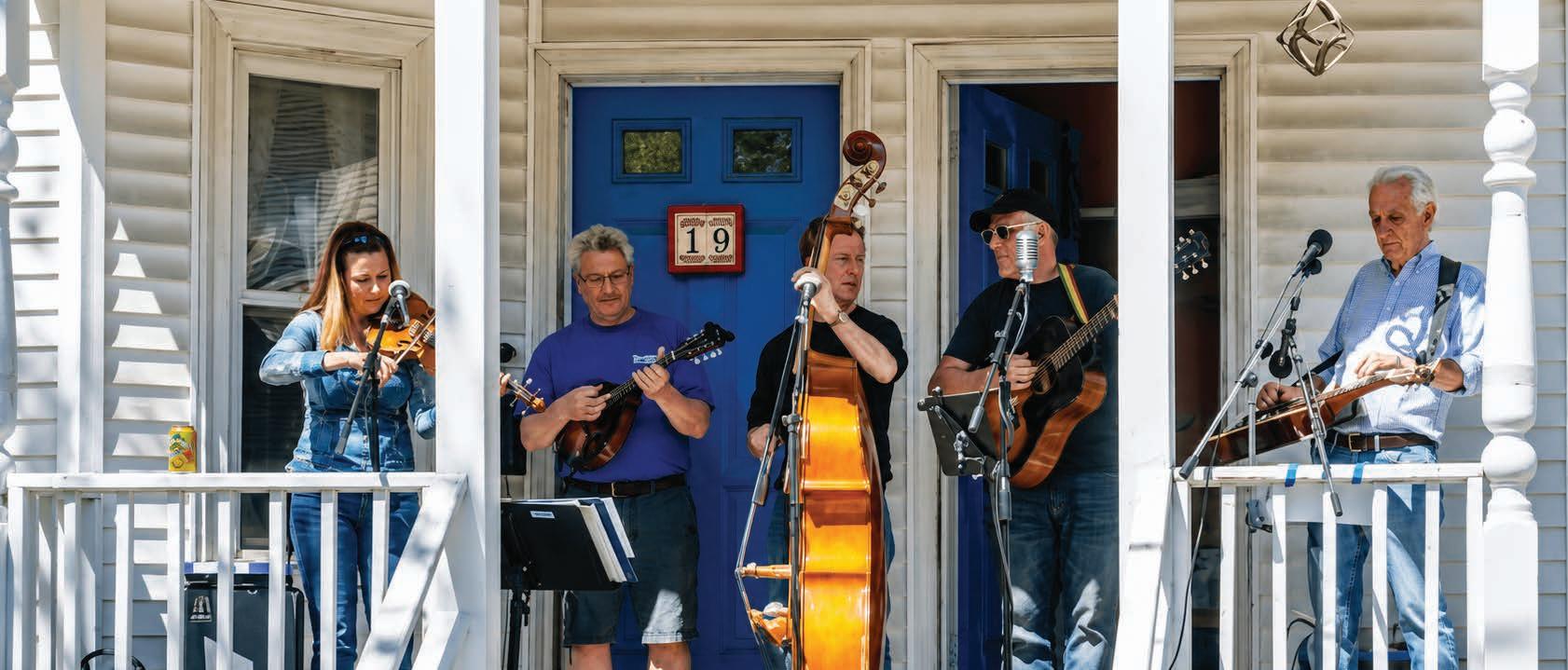
By midmorning on June 20, barricades will replace traffic along several streets in northwest Grants Pass. Lawn chairs will begin appearing along sidewalks. Families will arrive carrying folding chairs and cold drinks. Musicians will tune instruments on front porches where neighbors normally spend quiet evenings, and for a few hours, one of the city’s oldest residential neighborhoods will become the center of one of its most anticipated summer traditions.
Porchfest returns Saturday, June 20, bringing live music, local vendors, community organizations and thousands of visitors into the neighborhood surrounding Fourth Street, Washington Boulevard, Evelyn Avenue, Manzanita Avenue and Lawnridge Avenue.
The annual event has carved out a unique place on the local calendar by doing something few festivals attempt. Rather than gathering crowds around a large stage, Porchfest spreads the experience throughout an entire neighborhood. Performers play from residential porches while visitors move from block to block, discovering music, meeting neighbors and exploring an area of Grants Pass that becomes something entirely different for one afternoon each year.
The transformation begins before the first notes are played.
Beginning at approximately 10:30 a.m., portions of Fourth Street between A Street and Evelyn Avenue, Washington Boulevard between Evelyn Avenue and Savage Street, Evelyn Avenue between Washington Boulevard and Lawnridge Avenue, Manzanita Avenue between Hawthorne Avenue and Washington Boulevard, and Lawnridge Avenue between Savage Street and Evelyn Avenue will close to through traffic. The closures are expected to remain in place until approximately 3:30 p.m. Emergency vehicles will continue to have access throughout the event.
For longtime residents, the sight has become familiar. Streets that ordinarily carry neighborhood traffic become pathways filled with pedestrians. Front yards become gathering places. Conversations drift between blocks while music carries through the trees and across front lawns.
Organized by Rogue Gateway Rotary, Porchfest serves as both a community celebration and a fundraiser supporting local youth programs. The event has grown steadily over the years, drawing visitors not only from Grants Pass but from communities throughout Southern Oregon. Local businesses, food vendors, artisans and
nonprofit organizations are also expected to participate, creating an event that extends well beyond music alone.
What continues to set Porchfest apart is its setting. The event does not rely on large venues, grandstands or ticketed seating. Instead, it turns everyday spaces into places where residents and visitors can gather. A front porch becomes a stage. A sidewalk becomes a viewing area. A residential street becomes a corridor connecting performances, conversations and community activity.
As summer gets underway across Josephine County, Porchfest arrives at a time when community events begin filling calendars throughout the region. Yet few offer a setting quite like this one. For several hours, the neighborhood itself becomes part of the attraction, providing a backdrop that cannot be recreated in a park, fairground or auditorium.
When the final performance ends and the streets reopen later that afternoon, the neighborhood will gradually return to normal. The chairs will disappear, the crowds will head home and traffic will once again move through the area. Until then, one corner of Grants Pass will belong to music, conversation and a tradition that continues to draw people back year after year.
From page 1
tracts the largest crowds, fair officials emphasize that the fair experience extends far beyond the grandstand attractions. Throughout the event, visitors will have opportunities to explore livestock barns, agricultural exhibits, youth projects and community displays that highlight the work of local students, ranchers, farmers and organizations. Carnival rides, games, food vendors and family activities will once again fill the fairgrounds, creating an atmosphere that blends entertainment with community engagement.
Additional attractions scheduled throughout the fair include nightly perfor-
mances on the fair concert stage, daily Barnyard Races and Power’s Circus, all offered as part of the fair experience.
“The Josephine County Fair is about bringing our community together and creating affordable family fun for everyone,” said Recreation Director Tamra Martin. “With free admission and a packed lineup of entertainment, we’re excited to welcome families from across the region to celebrate with us.”
Families from throughout Josephine County, neighboring Southern Oregon communities and Northern California traditionally attend the annual event, contributing to both the local economy and the fair’s long-
5 DAY OUTLOOK
SOURCE: WEATHER.COM
WEDNESDAY


standing role as a regional destination.
As July approaches, anticipation is building for four days that will once again combine entertainment, agriculture, food, competition and community spirit under one roof. For many local residents, the fair remains a summer tradition measured not only by headline performers and attractions, but by reunions with friends, support for local youth programs and the opportunity to celebrate the unique character of Josephine County.
Additional schedules, ticket information for featured events and fair updates will be released by organizers in the coming weeks.

By Nik Martin, Local Foodie
Southern Oregon’s smash burger trend continues to gain momentum, and Casablanca has joined the conversation with a burger that manages to deliver both flavor and value in a market where diners are often forced to choose between the two.
My latest lunch stop took me to Casablanca to try its Western Bacon Smash Burger, a menu item that immediately caught my attention. Built around two Kobe beef smash patties and topped with crispy bacon, melted cheese, crunchy onion straws, house-made barbecue sauce, and served on a fresh homemade bun, the burger arrives looking every bit as satisfying as it sounds.
The first thing that stood out was the bun. Too often, even a well-built burger can be undermined by bread that is either too dense or falls apart halfway through the meal. That was not the case here. Casablanca’s homemade bun held everything together while remaining soft and fresh, creating a balance that allowed the ingredients to shine without overwhelming the burger itself. It was the kind of detail that can easily be overlooked but ultimately plays a major role in the overall experience.
The Kobe beef smash patties were prepared exactly as smash burger fans hope to find them. Each patty carried a nicely devel-

oped crust on the outside while retaining plenty of moisture inside. The result was a burger with both texture and flavor in every bite. The beef remained the centerpiece throughout, never getting lost beneath the toppings.
The supporting ingredients worked together well. The bacon added a smoky, savory element, while the onion straws contributed a satisfying crunch that contrasted nicely with the softness of the bun. The house-made barbecue sauce brought a touch of sweetness without overpowering the rest of the burger,
creating the familiar flavor profile that has made western-style burgers a longtime favorite across the country.
What impressed me most was the balance. Nothing felt excessive. The barbecue sauce was present without becoming messy, the bacon complemented rather than dominated, and the onion straws added texture without turning the burger into a pile of toppings. Every ingredient served a purpose, resulting in a burger that felt thoughtfully assembled rather than simply stacked high.

The fries provided a solid companion to the meal, rounding out a lunch that felt complete without being overly heavy. More importantly, the entire meal came with a price tag that is becoming increasingly difficult to find.
The Western Bacon Smash Burger, paired with fries, cost just $15. At a time when many burger restaurants are charging significantly more for comparable meals, Casablanca offers a combination of quality and affordability that deserves recognition. Diners are receiving a substantial meal without feeling the sting that often accompanies eating out today.
As smash burgers continue to appear on menus throughout Southern Oregon, Casablanca has positioned itself as a worthy contender. The restaurant's take on the popular burger style delivers the crispy edges, juicy beef, balanced toppings, and satisfying flavor combination that fans are looking for while maintaining a price point that remains accessible.
For anyone searching for their next burger stop, Casablanca’s Western Bacon Smash Burger is a meal that earns a place on the list. It is a straightforward, well-executed burger that focuses on doing the fundamentals right—and sometimes that is exactly what makes a meal memorable.













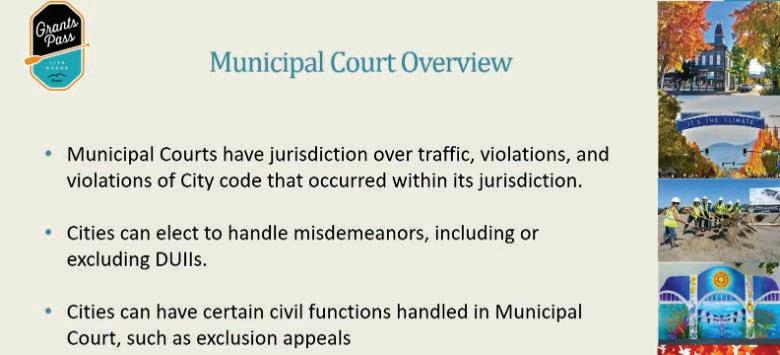
ACCORDING TO A CITY COUNCIL WORKSHOP presentation made by the Grants Pass City Attorney last Monday June 15, there are only two larger cities in the entire state of Oregon that are legally allowed to have a municipal court but don’t have one in place. One is Grants Pass and the other is Gresham.
If the discussion moves forward, this workshop was just the first in what would likely be several City Council discussions about the pros and cons of starting a muni court once again in Grants Pass. The Grants Pass City Charter already allows a muni court and the appointment of a judge, and decades ago the City probably did have a muni court at some point.
In what was more than 10 years ago at this point, Grants Pass informally looked into the potential of reforming a city municipal court. The bottom line is that City revenues would increase, but operating costs would also increase, leaving the City with close to a breakeven proposal from a financial perspective. Right now, the City merely receives its share of violation fines such as traffic tickets once they are settled and paid through the state court system.
The preliminary high-level overview of the current feasibility of a muni court in Grants Pass looks similar from a financial perspective. But only if the municipal court focuses on violations and not also misdemeanor charges. If the City’s new municipal court would also prosecute lower-level crimes such as trespasses and other misdemeanors, it appears the net cost to the city would likely increase significantly.
Many Grants Pass City Council members appear to want to be able to prosecute lower-level crimes to the greatest extent possible, because various limitations in our county District Attorney’s office and County adult jail operation have
By Jay Meredith, CPA Investigative Journalist
limited the amount of lower-level crimes that can be prosecuted. The desire to prosecute all levels of crimes is an honorable one to hold people accountable for all manners of bad behavior, but it also appears would be a costly one.
We’ll have more details on just how costly in the near future. The City Council voted to direct staff to gather more specific information about how costly it would be to prosecute misdemeanors through a city municipal court. This cost detail would include more information about the projected cost of staff and judges to run the muni court, the cost of attorneys to handle the cases, potential net revenues from prosecuting different types of cases, and potentially even the cost of the City renting jail beds for municipal court use.
In a related discussion on Monday, City Council member Indra Nicholas pressed Mayor Clint Scherf to schedule a discussion of the creation of an exclusion zone as soon as possible. This has been an item pending discussion by the City Council for some time. Exclusion zones allow city law enforcement agencies to temporarily ban individuals who commit certain crimes or nuisance offenses from entering defined commercial or downtown areas of a city.
Given what will likely be a very costly proposal for a Grants Pass municipal court that prosecutes misdemeanors, in my opinion the Grants Pass City Council should try to get solid answers to the following questions before considering moving forward with the creation of a municipal court in Grants Pass:
1) Should an exclusion zone be created before the creation of a municipal court to study the impact of such an exclusion zone first?
2) Will the creation of a municipal court in Grants Pass allow police officers to arrest or cite individuals at different levels than exist today without the muni court?
3) Given the legal and other resource limitations at the Josephine County jail, would the creation of a municipal court affect who can be arrested and taken to jail? Would it affect who can stay in jail for an alleged misdemeanor compared to limitations in place today?
4) There are widespread reported shortages of defense attorneys and prosecutors. Is it feasible for a new Grants Pass muni court to prosecute misdemeanors in this environment?


Posting June 15, 2026
Editorial By John Oliver
For generations, economists, politicians, bankers, investors and ordinary citizens have debated one of the most fundamental questions in modern society: what is money actually worth?
The answer appears simple. A dollar is a dollar. Ten dollars is ten one-dollar bills. A hundred dollars is a hundred one-dollar bills. The numbers do not change. The currency itself does not suddenly become larger, smaller or physically different from one year to the next.
Yet the purchasing power attached to that same dollar changes constantly.
A cup of coffee that once cost a quarter now costs several dollars. A family home that once sold for tens of thousands of dollars now often sells for hundreds of thousands or even millions. Groceries, fuel, insurance, healthcare, education and nearly every other necessity of life have climbed in price over the decades.
The dollar itself did not change. Society changed around it.
This contradiction sits at the center of one of the oldest economic debates in human history. If money is intended to serve as a stable measurement of value, why does the value measured by that money constantly move?
The modern explanation is inflation. Economists describe inflation as the gradual increase in prices across an economy over time. Central banks monitor it. Governments track it. Financial markets react to it. Entire industries are built around forecasting it.
Yet for many people outside academic economics, inflation often feels less like an economic principle and more like a symptom of a system that never solved its most basic problem.
Throughout history, civilizations have searched for reliable ways to measure value. Gold, silver, copper, grain and other commodities have all served as forms of money. The objective was simple: create a unit of exchange that peo-

ple could trust tomorrow just as much as they trusted it today.
What followed was centuries of experimentation, monetary reform, currency debasement, financial crises and political intervention.
Modern economies eventually moved away from currencies backed directly by precious metals and toward fiat money, a system in which currency derives its value from government authority, economic productivity and public confidence rather than a fixed commodity.
That shift provided governments and central banks with greater flexibility during wars, recessions, financial panics and economic emergencies. It also created a reality in which the money supply can expand, contract and respond to changing economic conditions. Some argue that such flexibility helps prevent deeper economic collapses. Critics argue that it creates conditions in which purchasing power can steadily erode over time.
The debate remains unresolved.
What makes the discussion particularly frustrating for many citizens is that inflation often feels detached from common sense. Most


people understand that a gallon of milk remains a gallon of milk and a loaf of bread remains a loaf of bread. When prices rise dramatically while incomes struggle to keep pace, the explanation can feel unsatisfying.
Part of that frustration stems from the fact that inflation is not caused by a single factor. Government spending, monetary policy, supply shortages, labor costs, energy prices, global conflicts, transportation disruptions, consumer demand and market speculation can all influence prices simultaneously.
A drought can increase food costs. A war can raise fuel prices. A housing shortage can drive up rent. An expanding money supply can increase the amount of currency competing for the same goods and services.
The result is a system in which value is constantly being recalculated.
Critics of modern monetary systems frequently point to a larger question. If inflation has been debated for centuries and its consequences are widely understood, why has no permanent solution emerged?
The answer may lie in the complexity of bal-
ancing stability and flexibility. A completely fixed monetary system could create its own problems during economic shocks, while a highly flexible system risks reducing long-term purchasing power. Policymakers, economists and financial institutions continue to wrestle with this tradeoff, often reaching different conclusions.
Meanwhile, the public experiences the practical consequences.
Families notice it at grocery stores. Retirees see it in the value of their savings. Workers feel it when wages fail to match rising costs. Businesses confront it through increasing expenses and uncertainty.
The conversation ultimately extends beyond economics and enters the realm of trust.
Money functions because people collectively agree that it has value. The paper itself is not inherently valuable. The digital numbers displayed in bank accounts possess no intrinsic worth. Their power comes from confidence, acceptance and belief in the system that supports them.
That reality can be unsettling. It means that money is not merely a financial instrument but also a social agreement.
The enduring question is whether society has created the best possible version of that agreement.
After centuries of monetary experimentation, recurring inflation, financial crises and economic restructuring, there remains no universal consensus. What does remain is a persistent observation shared by people across political, geographic and economic boundaries: the dollar itself may still be a dollar, but what that dollar can accomplish continues to change.
Whether that represents an unavoidable feature of modern economies or evidence of a problem humanity has yet to solve remains one of the most important economic questions of our time.