
WEDNESDAY, JULY 9, 2025
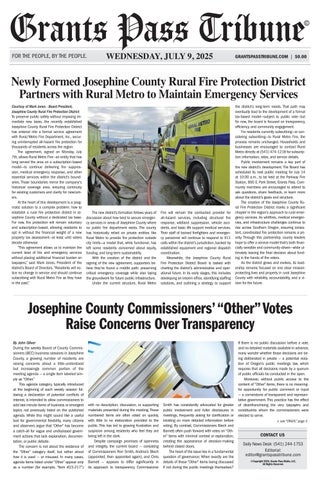
WEDNESDAY, JULY 9, 2025
Courtesy of Mark Jones - Board President, Josephine County Rural Fire Protection District
To preserve public safety without imposing immediate new taxes, the recently established Josephine County Rural Fire Protection District has entered into a formal service agreement with Rural/Metro Fire Department, Inc., securing uninterrupted all-hazard fire protection for thousands of residents across the region.
The agreement, signed on Monday, July 7th, allows Rural Metro Fire—an entity that has long served the area on a subscription-based model—to continue delivering fire suppression, medical emergency response, and other essential services within the district’s boundaries. Those boundaries mirror the company's historical coverage area, ensuring continuity for existing customers and clarity for newcomers.
At the heart of this development is a pragmatic solution to a complex problem: how to establish a rural fire protection district in Josephine County without a dedicated tax base. For now, fire protection will remain voluntary and subscription-based, allowing residents to opt in without the financial weight of a new property tax assessment—at least until voters decide otherwise.
“This agreement allows us to maintain the current level of fire and emergency services without placing additional financial burden on taxpayers,” said Mark Jones, President of the district’s Board of Directors. “Residents will notice no change in service and should continue subscribing with Rural Metro Fire as they have in the past.”

The new district’s formation follows years of discussion about how best to secure emergency services in areas of Josephine County where no public fire department exists. The county has historically relied on private entities like Rural Metro to provide fire protection outside city limits—a model that, while functional, has left some residents concerned about equity, funding, and long-term sustainability.
With the creation of the district and the signing of the new agreement, supporters believe they've found a middle path: preserving critical emergency coverage while also laying the groundwork for future public infrastructure.
Under the current structure, Rural Metro
Fire will remain the contracted provider for all-hazard services, including structural fire response, wildland suppression, vehicle accidents, and basic life support medical services. Their staff of trained firefighters and emergency personnel will continue to respond to 911 calls within the district's jurisdiction, backed by established equipment and regional dispatch coordination.
Meanwhile, the Josephine County Rural Fire Protection District Board is tasked with charting the district’s administrative and operational future. In its early stages, this includes developing an interim office, identifying staffing solutions, and outlining a strategy to support
the district’s long-term needs. That path may eventually lead to the development of a formal tax-based model—subject to public vote—but for now, the board is focused on transparency, efficiency, and community engagement.
For residents currently subscribing—or considering subscribing—to Rural Metro Fire, the process remains unchanged. Households and businesses are encouraged to contact Rural Metro directly at (541) 474-1218 for subscription information, rates, and service details.
Public involvement remains a key part of the new district’s development. The Board has scheduled its next public meeting for July 14 at 10:00 a.m., to be held at the Parkway Fire Station, 800 E. Park Street, Grants Pass. Community members are encouraged to attend to ask questions, share feedback, or learn more about the district’s goals and structure.
The creation of the Josephine County Rural Fire Protection District marks a significant chapter in the region’s approach to rural emergency services. As wildfires, medical emergencies, and infrastructure challenges continue to rise across Southern Oregon, ensuring consistent, coordinated fire protection remains a priority. Through this partnership, county leaders hope to offer a service model that’s both financially sensible and community-driven—while ultimately leaving the final decision about funding in the hands of the voters.
As the district grows and evolves, its leadership remains focused on one clear mission: protecting lives and property in rural Josephine County with reliability, accountability, and a vision for the future.
By John Oliver
During the weekly Board of County Commissioners (BCC) business sessions in Josephine County, a growing number of residents are raising concerns about a little-understood but increasingly common portion of the meeting agenda — a single item labeled simply as “Other.”
This agenda category, typically introduced at the beginning of each weekly session following a declaration of potential conflicts of interest, is intended to allow commissioners to add last-minute items of business or emergent topics not previously listed on the published agenda. While this might sound like a useful tool for governmental flexibility, many citizens and observers argue that “Other” has become a catch-all for vague and undisclosed government actions that lack explanation, documentation, or public debate.
The concern is not about the existence of the “Other” category itself, but rather about how it is used — or misused. In many cases, agenda items listed under “Other” appear only as a number (for example, “Item #23-217”)

with no description, discussion, or supporting materials presented during the meeting. These numbered items are often voted on quickly, with little to no elaboration provided to the public. This has led to growing frustration and suspicion among residents who feel they are being left in the dark.
Despite campaign promises of openness and integrity, the current board — consisting of Commissioners Ron Smith, Andrea’s Blech (appointed, then appointed again), and Chris Barnett — appears to differ significantly in its approach to transparency. Commissioner
Smith has consistently advocated for greater public involvement and fuller disclosures in meetings, frequently asking for clarification or insisting on more detailed information before voting. By contrast, Commissioners Blech and Barnett often push forward with votes on “Other” items with minimal context or explanation, creating the appearance of decision-making behind closed doors.
The heart of the issue lies in a fundamental question of governance: When exactly are the details of these “Other” items being discussed if not during the public meetings themselves?
If there is no public discussion before a vote, and no detailed materials available in advance, many wonder whether those decisions are being deliberated in private — a potential violation of Oregon’s public meetings law, which requires that all decisions made by a quorum of public officials be conducted in the open. Moreover, without public access to the content of “Other” items, there is no meaningful opportunity for public comment or input — a cornerstone of transparent and representative government. This practice has the effect of disenfranchising the very taxpayers and constituents whom the commissioners were elected to serve.
• see “OTHER,” page 3




By John Oliver
President Donald J. Trump has received another nomination for the Nobel Peace Prize, this time from Israeli Prime Minister Benjamin Netanyahu, who formally recommended the U.S. leader to the Nobel Committee. The announcement came Monday as Netanyahu personally handed Trump a letter outlining the nomination and his reasoning for endorsing the sitting U.S. president for one of the most prestigious honors in international diplomacy.
The Nobel Peace Prize, awarded annually by the Norwegian Nobel Committee, recognizes individuals or organizations that have made significant contributions to peace efforts around the world. Netanyahu’s nomination of President Trump centers on his role in brokering the Abraham Accords—agreements that normalized diplomatic relations between Israel and several Arab nations, including the United Arab Emirates, Bahrain, Sudan, and Morocco.
The accords, which were signed during Trump’s previous term, are now receiving renewed international attention under his current leadership. Supporters argue the agreements mark a historic turning point in Middle East diplomacy, with long-standing adversaries establishing formal cooperation in areas such as trade, tourism, and security. They credit President Trump’s administration with taking an unconventional but effective approach to diplomacy that bypassed decades of stagnation in the region.

Prime Minister Netanyahu's decision to endorse Trump is seen as a strong reaffirmation of the significance of the Abraham Accords, especially amid ongoing regional tensions. The nomination positions Trump once again at the center of global conversations about diplomacy and conflict resolution.
President Trump has been nominated for the Nobel Peace Prize several times in the past, but this latest nomination, coming from a sitting world leader with direct ties to the peace process in question, carries notable weight. While the Nobel Committee does not release the names of nominees for 50 years, nominators such as heads of state often publicize their submissions.
Under Nobel rules, qualified individuals including elected officials, academ-
ics, and peace organizations may submit nominations by the annual deadline in January. Each year, hundreds of individuals and entities from around the world are nominated for the Peace Prize, and the selection process is conducted in private by the Norwegian Nobel Committee, with the final decision announced in October.
Though the Abraham Accords did not directly resolve the Israeli-Palestinian conflict, supporters of the nomination emphasize that the agreements reduced hostilities between Israel and the broader Arab world. They argue that the realignment has contributed to greater regional stability and opened the door to future peace negotiations that once seemed unlikely.
Critics, however, continue to question the depth and longevity of the accords,
suggesting they were motivated more by strategic interests than by a genuine pursuit of peace. Some also argue that the accords do not reflect comprehensive conflict resolution, and that the most critical regional tensions remain unresolved.
Nevertheless, the nomination renews attention on President Trump’s broader foreign policy agenda, including his approaches to North Korea, NATO, and China, as well as his administration's withdrawal from and renegotiation of international agreements. With a second term underway, Trump’s administration appears poised to re-engage with many of these global flashpoints while continuing to promote what it views as pragmatic, deal-oriented diplomacy.
As the Nobel Committee reviews this year’s nominations, President Trump’s name now returns to the shortlist of figures whose actions on the international stage are being formally considered for global recognition. The nomination also underscores the close diplomatic relationship between the United States and Israel, and the ongoing impact of Trump’s Middle East policy.
Whether or not President Trump ultimately receives the Nobel Peace Prize, the renewed nomination places a spotlight once again on his controversial and consequential approach to global diplomacy, and raises broader questions about how the world defines and rewards efforts toward peace in an increasingly complex international landscape.
From page 1
Transparency is not merely a campaign buzzword; it is a legal and ethical obligation. Voters elected these officials based in part on their promises of openness, honesty, and accessibility. When commissioners conduct public business with cryptic agenda labels and silent votes, it undermines public trust and accountability.
Some critics argue that Commissioners
Blech and Barnett treat the county government as if it were a private enterprise — where decisions are made internally, and the public is informed only on a need-to-know basis. But county government is not a business, and its leaders are not CEOs. They are public servants, entrusted with the responsibility of making decisions transparently, in full view of the public they represent.
As it stands, the frequent use of the “Other” category without proper explanation raises legitimate questions about procedural integrity. Citizens have a right to know what is being discussed, debated, and voted on. If matters are being discussed outside of public view, or if decisions are being made in advance of meetings, it suggests a breakdown in ethical governance and possi-


bly even legal compliance.
Moving forward, residents of Josephine County deserve clarity and consistency. At the very least, the board should publish full descriptions of all “Other” items before any votes are held and allow for public comment when appropriate. Otherwise, the board risks losing not only credibility but also the trust of the people it was elected to serve.


By Ellen Ward
When was the last time you actually sat down in a dark theater, popcorn in hand, to watch a movie on the big screen? For many Americans, that once-cherished tradition has become increasingly rare. Across the country, movie theaters are struggling to survive. Bankruptcies are becoming more frequent, and closures of long-standing local cinemas are hitting communities large and small. The culprit? A rapidly changing entertainment landscape dominated by streaming services and at-home viewing options that continue to grow in popularity.
Over the past decade, how we consume media has changed dramatically. Services like Netflix, Hulu, Amazon Prime, Disney+, and others have revolutionized the way we access films, offering instant access to thousands of titles—many of which premiere on the same day as their theatrical releases. This shift was accelerated during the COVID-19 pandemic, when theaters were forced to shut down while streaming platforms thrived. Now, even though theaters have reopened, many Americans never returned.
Ticket prices haven't helped the situation. In Southern Oregon, the average cost for a family of four to attend a movie—including tickets, snacks, and drinks—can easily exceed $75. A tub of popcorn and two sodas alone can run over $25 at many locations. In contrast, renting a new release from home for $5.99, while preparing your own snacks from the kitchen, seems far more economical and comfortable. Add in today’s massive home entertainment screens—some 85 inches or more—
and the movie-going experience once exclusive to theaters can now be duplicated in the living room. Theaters argue that what they offer is more than just a screen and a seat. They point to the immersive experience: surround sound, the size of the screen, the communal reaction of an audience, and the tradition itself. For blockbuster films with stunning visuals and action sequences, theaters do still offer a unique presentation. There is something to be said for watching a high-octane thriller or emotional drama in a dark room where your phone is off and your attention is focused solely on the story unfolding in front of you.
However, for many families facing economic pressure, practicality trumps nostalgia. With inflation driving up the cost of living and entertainment budgets shrinking, going out to the movies feels more like a luxury than a casual night out. Even loyalty programs and matinee discounts aren't enough to draw large crowds consistently. Movie attendance is down nearly 40% compared to pre-pandemic levels, according to national industry reports.
Some theaters are adapting by transforming into multi-purpose entertainment hubs. They've added luxury recliners, full-service dining, alcohol bars, and even live performances to diversify revenue streams. Others are hosting classic film nights, local filmmaker showcases, or private event rentals. Still, the shift in consumer behavior appears irreversible for many smaller operations without the backing of a national chain or investment partners.
Streaming services aren't slowing down either. Increasingly, major studios are choosing to release

their films directly to digital platforms, bypassing traditional theaters entirely. The idea of waiting three months for a theatrical run to end before seeing a film at home feels like a relic of the past.
Theaters are not gone yet—but they are evolving, or in some cases, fading into memory. Whether the movie theater becomes a rare novelty or reclaims its role as a cultural mainstay will depend largely on whether Americans find renewed value in the shared cinematic experience. For now, it’s a toss-up. Technology has brought Hollywood to our homes, and unless the industry finds a new way to dazzle and delight, more theater screens may soon go dark for good.
Only time will tell if the curtain is slowly closing on one of America's favorite pastimes.
A Grants Pass man was taken into custody Sunday night following a violent domestic disturbance in Roseburg that resulted in multiple serious charges, including assault, kidnapping, and methamphetamine possession. The incident, initially reported by Roseburg Radio KQEN, unfolded in the 2700 block of Northwest Stewart Parkway and involved a disturbing call to police from concerned residents.
At approximately 10:40 p.m., Roseburg Police officers responded to the scene after a caller reported a heated altercation between a man and a woman. According to the report, one of the witnesses could hear the woman pleading to be let go, raising immediate concerns about her safety. When officers arrived, they located the two individuals involved. The man, identified as 37-year-old Jamie Sharp of Grants Pass, denied that any incident had taken place.
However, the woman at the scene told police a different story. She claimed that Sharp had punched her in the face, choked her, and threatened to take her to an isolated location where “no one would hear her scream.” Based on her statements, witness accounts, and the overall circumstances, law enforcement determined there was sufficient cause to take action.
Officers also learned that Sharp was on

active probation. His probation officer, once notified of the incident, confirmed that Sharp was in violation of the terms of his supervision for failing to report as required and requested his immediate detainment. Police arrested Sharp without incident and transported him to the Douglas County Jail.
In addition to the probation violation, Sharp now faces a series of charges including fourth-degree assault, strangulation, menacing, second-degree kidnapping, and unlawful possession of methamphetamine. Authorities confirmed he is being held without bail due to the nature of the charges and his probation status.
The arrest has prompted broader com-
munity concern about domestic violence and the continued role of bystanders in intervening through timely 911 calls. Law enforcement officials acknowledged that the quick action by nearby residents may have prevented the situation from escalating further. Their decision to report the disturbance gave officers the ability to step in and protect the victim from additional harm.
As the investigation continues, law enforcement officials have not ruled out the possibility of further charges. They are urging anyone with knowledge of Sharp’s activities, particularly any past incidents of domestic violence or drug involvement, to contact the Roseburg Police Department to assist with the ongoing case.
Jamie Sharp is expected to appear before a judge later this week for arraignment. Prosecutors are preparing formal charges while the victim receives care and support services. The case remains active, and updates will be provided as new information becomes available.
This incident highlights the dangers of intimate partner violence and underscores the importance of community vigilance. In this case, it was the voices of concerned neighbors that made all the difference. Their decision to speak up allowed law enforcement to intervene before the situation turned deadly.
This article includes original reporting by Roseburg Radio KQEN.





Advertise with The Grants Pass Tribune!
Stand with us in defending freedom of the press and the 1st Amendment! The Grants Pass Tribune is facing political persecution, with lawsuits aimed at silencing our bold investigative journalism. We remain committed to uncovering the truth and keeping our community informed like never before.
Show
By: Jay Meredith, CPA Investigative Journalist
I’ve spent close to half of my 25-year professional career working in accounting/finance in the private sector and half was 12 years working in the Finance Department of the City of Grants Pass. The 10 years from 2010 to 2020 I had the pleasure of serving as the City Finance Director. In addition to all those City Council meetings, I’ve also watched or listened to just about every meeting of the Josephine BCC (Board of County Commissioners) since 2012. I can’t count the number of times I heard an elected official or member of the public say that government should be run more efficient, like the private sector.
In some ways, I agree with that. In many ways, I strongly disagree.
When I first started with the City of Grants Pass in 2008, I was somewhat frustrated about how long it took to get projects done or to get certain approvals to do a project. The public bidding or RFP process can be especially cumbersome.
I quickly learned there are good reasons why government can’t and shouldn’t always move like private businesses. For one, many things government agencies do affect all people and businesses in that jurisdiction. On the flip side, a private business decision often only affects a small handful of stakeholders.
And unfortunately, many of the rules government has to follow and the reams of paper that make up operating policies and laws that government officials have to follow are in place because of corrupt practices of old. Historical accounts of bribes, gifts, crony hiring and crony contracting practices litter news articles from many decades ago. And unfortunately, in the last two years these types of reports have started to surface again in relation to Josephine County in our local media.
Why all of a sudden are we seeing these sorts of reports and allegations again in Josephine County government? In my opinion, it’s partially because we’ve elected or given power to certain individuals that only have private business experience. For example, recalled former Commissioner John West and 2025 BCC Chair Andreas Blech (appointed to fill the remainder of Commissioner West’s term) both had extensive private business experience but no government work experience when they became a commissioner. And they both at times have treated Josephine County like their own privately owned business.
It’s common for elected officials to focus on areas that they understand and know, or that they think they know, especially when they believe they are an expert in this area. Million-dollar contracts can be passed easily without any discussion while a 45-minute debate ensues about the best way to replace a lawnmower.
It’s especially dangerous when just one government official is given authority to approve a wide range of contracts or decisions without checks and balances from another government official. And in my opinion, the BCC has entered the danger zone several times in the last two years by assuming one government official is an expert in a particular topic and trusting without verifying.
I’ll list a few prime examples seen in Josephine County this year and last year. And then in coming weeks there will be several examples of how the BCC or other county officials have chosen

to ignore the policies, procedures, and laws that have been put in place to help avoid corruption or fast-tracked decisions that bypass the larger number of government stakeholders.
When Commissioner John West came into office in early 2023, he quickly became the liaison to County Forestry and by extension the County Mining Advisory Committee (MAC). West has had many businesses in both forestry and mining, so this made sense.
At one point in 2024 I heard West proclaim, “if it was up to me I would sell every timber property the County owns in Josephine County and buy timber properties closer to the coast of Oregon.” Several times the MAC, I, and others have tried to show the BCC that on some County-owned timber properties there is many times more value in the mineral deposits than there is in the timber. The MAC even passed an official BCC recommendation to consider mineral development potential before selling any forestry properties.
A local company that I partially own and help manage called American Mineral Research even used the County Code (County Law) provisions to get a mineral exploration permit on a 76-acre piece of County owned timber property that had a historical gold mine on one side of the property.
To keep a long story short, during the course of mineral exploration work, trying to renew our permit, and then applying for a mining lease that in our opinion the County is legally obligated by the code to approve, Commissioner West seemed to do everything in his power to stop us from doing this code-authorized activity. West even used illegal actions to stop us, in our opinion, since he didn’t follow the County code in the administration of our lease application and in other ways.
Despite the millions in royalties and lease revenues the County could eventually earn from this single County-owned forestry property, West was on a mission and he was not to be swayed by facts. Several years ago, the County-owned forestry portfolio stood at almost 30,000 acres. This single 76-acre property could still grow timber and has the potential to generate several new jobs along with tens of millions of economic activity through its mineral development.
The BCC tried to make American Mineral Research pay illegal (unauthorized) permit fees in 2023, and then eventually refused to give us a public hearing and make a decision on our mining lease application in a way that the County Code says is required. Two years went by before the County agreed to review and act on our mining
lease application, and we had to sue the County recently just to get them to follow their own code laws.
Rather than act on the mining lease application, former Commissioner West (BCC Chair in 2024) arranged a vote of the commissioners in October 2024 to just sell this forestry property at the next property auction. We’ve earned a right to lease this property per the County Code, and rather than follow the code, Commissioners West and Baertschiger didn’t like that code and instead chose to try and sell the property out from under us.
And it took a costly lawsuit just to make them follow the County Code. Just last week, the day before the County was to appear in court to answer to this lawsuit, they settled and agreed to give us the public hearing and make the decision on our lease application that they should have made two years ago. They are now required to have the public hearing and make the decision before the end of August.
In the meantime, West spearheaded the sale of many forestry properties out in the Williams area towards the end of 2024, without any discussion of potential mineral values whatsoever (contrary to official recommendations of the County Mining Advisory Committee). And then, without approval of the BCC, earlier in 2025 the County Forestry Director purchased $6 million worth of forestry properties in the Astoria Oregon area which is almost a 5-hour drive from here. The BCC didn’t even get to vote on this potential purchase, because they gave the Forestry Director the authority to make forestry property purchases without approval from the BCC. That’s right…we just witnessed a $6 million County property purchase without even a discussion by the BCC.
Shortly after Andreas Blech was reappointed to a Commissioner seat after the John West recall to serve the remainder of West’s term, he asked and the two other new commissioners Ron Smith and Chris Barnett gave BCC Chair Andreas Blech the sole authority to make any personnel restructuring decisions that he saw fit without the other two commissioners having to discuss or approve anything. Blech moved quickly, as private business leaders often do. And another long story made short, in my opinion some of the costliest personnel decisions the County has ever made were made during the two-month stretch that Blech had this total authority. And the County will be fighting related lawsuits for years to come, largely due to no checks and balances.
And for the final example this week, during
the time of ultimate personnel power of BCC Chair Blech, the Airports Director was essentially pushed out and a new Airports Manager (alleged to be friends with BCC Chair Andreas Blech) was quickly appointed to the job a couple months ago. Last week the BCC unanimously passed an Order to give the Airports Manager almost complete authority to do anything as it relates to Airport properties and Airport operations. The Airports Manager can now unilaterally approve leases, apply for permits, land use applications, MOUs for the management and operation of the two airports, and a long list of other duties the Manager now has without the BCC needing to vote on them.
While purchasing authority may not have changed, the Airports Manager can now execute just about any other kind of agreement related to airports operations. There should be guard rails for the authority of any single County official, particularly when it comes to the leasing of County lands. On my first quick skim through Airports policies, I don’t see anything that would prevent the Airports Manager from entering into a lease with someone that wanted to lease a hangar or other airport property for any period of 99 years or less. In fact, one older airports policy makes reference to an allowance for negotiations with airport tenants and airport users. If the Airports Manager really has been friends with BCC Chair Andreas Blech since long before he was appointed as the Manager, what’s to stop BCC Chair Andreas Blech from seeking a custom 99-year fixed price lease on the airports hangar he already owns and leases today, or a similar 99-year fixed price lease on other airport properties as a favor to mutual friends?
This is not to say that it would ever be attempted, but after appointing an Airports Manager quickly without doing a typical hiring and recruiting process and then giving that manager the ultimate authority to execute a wide range of legal agreements that would be binding to the County, this does not look good on the surface. Checks and balances, or in the accounting arena “internal controls” should always be in place that prevent any one person in an organization from doing crony favors or even misappropriating assets without a second person in the loop that would notice the action. No single department director, manager, or even commissioner should be able to legally bind the county when the purchase, sale, or total lease price exceeds a certain dollar amount. The decision should always go to the full BCC over a certain dollar amount.
The current price by which the full BCC has to approve a purchase contract is $25,000 or more. If this is the right dollar amount (many cities and counties use higher numbers such as $50,000), then I say County policies should be revised so that no single County official can approve of any contract when the total exceeds this $25,000 amount.
Let’s also not forget the two-month reign of sole personnel authority by BCC Chair Andreas Blech earlier this year when he attempted to appoint IT/ Emergency Management Director Michael Sellers to a newly created job of Director of Operations for a total proposed salary and benefit package of $388,000 per year. Sellers was not qualified or experienced for this specific job, and the compensation package being negotiated was way higher than even the highest paid County Manager among
• Continued on page 8
At Elysian Women's Wellness, we specialize in helping women 35–55 balance their hormones, heal their metabolism, and lose stubborn weight without crash diets or two-hour workouts.
We use our Metabolic Optimization Method to help you feel like you again.
• Functional & traditional lab work
• Sustainable weight loss
• Hormone-friendly exercise & nutrition
• Expert support & accountability















The City of Grants Pass, in collaboration with the Oregon Department of Transportation (ODOT), is launching a new phase of its Utility Box Art Project and is currently calling for local artists, students, and creative teams to submit designs for public art installations. The project seeks to continue its mission of turning ordinary traffic control boxes into vibrant, eye-catching works of art that enrich the community and beautify public spaces.
Now in its latest installment, the Utility Box Art Project is a creative initiative that transforms pole-mounted utility boxes throughout Grants Pass into visual landmarks. The aim is to promote a lively and engaging city atmosphere through art that is family-friendly, nature-inspired, and accessible to all ages. Designs should reflect elements of wildlife, animals, plants, and the natural environment while helping deter graffiti and promote civic pride.
The artwork selected will be printed as vinyl wraps and applied to utility boxes located throughout the city. All four sides and the top of each utility box must be covered in the submitted designs. The City of Grants Pass will provide all necessary materials for the installation process, and selected artists will receive a stipend of $350 for each completed box.
In keeping with the spirit of community collaboration, the project is supported by a number of local and state partners, including the Thursday Rotary Club, ODOT, and the Josephine County Cultural Coalition. Oversight for the selection process and overall project direction is handled by the City’s Committee on Public Art (CoPA), with final approvals from both the City Council and ODOT.
Artists interested in participating must submit a comprehensive application package that includes a color conceptual design showing the artwork layout for the utility box, a written artist

statement, a resume or recommendation letter (for students), and examples of previous work. Youth entries are encouraged and may include a written paragraph about their design inspiration in place of formal application components. All artwork must be original, and entries that include offensive content, political or religious references, copyrighted images, or AI-generated art will not be considered.
All submitted art must be suitable for public display in a wide variety of community spaces. While the project encourages bold designs and colors for visibility, the content must remain appropriate and accessible to all segments of the population. Artists are also reminded that once selected, the work becomes the property of the City of Grants Pass, with a waiver of artist rights included in the signed agreement. For artists under 18, a parent or guardian signature is required.
This year’s available boxes are all pole-mounted types, each in various neighborhoods around the city. A map of box locations is available through the city for artists to determine the placement and influence of their design choices. Site preparation and installation of the
artwork must be completed within 45 days of final approval. Artists may submit more than one design proposal and are encouraged to tailor their concepts to the neighborhoods where the boxes are located.
Completed application packages must be received by the City of Grants Pass no later than 5:00 p.m. on August 15, 2025. Submissions can be sent by email to Dana Pearce, Economic Development Specialist, at dpearce@grantspassoregon.gov with the subject line “Art Box Project,” or by mail to City Hall at 101 NW A Street, Grants Pass, OR 97526.
After the application deadline, CoPA will review all entries and select five finalists, who may be invited for interviews either in person or via teleconference. Final selections will be forwarded to the City Council and ODOT for final approval. All applicants will be notified of their status following the review process.
The Utility Box Art Project continues to serve as a celebration of local talent and creativity while encouraging civic engagement and public appreciation for the arts. For more information or questions, artists can contact Dana Pearce at (541) 450-6071.


5 DAY OUTLOOK SOURCE: WEATHER.COM









Posting Date
7, 2025
Posting