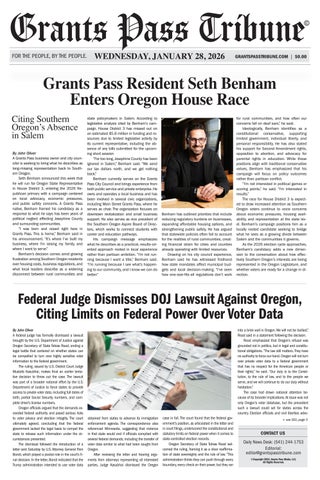
Grants Pass Tribune - Wed. January 28, 2026

Page 1


WEDNESDAY, JANUARY 28, 2026

Grants Pass Resident Seth Benham Enters Oregon House Race

Citing Southern Oregon’s Absence in Salem

A Grants Pass business owner and city councilor is seeking to bring what he describes as long-missing representation back to Southern Oregon.

Seth Benham announced this week that he will run for Oregon State Representative in House District 3, entering the 2026 Republican primary with a campaign centered on local advocacy, economic pressures, and public safety concerns. A Grants Pass native, Benham framed his candidacy as a response to what he says has been years of political neglect affecting Josephine County and surrounding communities.

“I was born and raised right here in Grants Pass. This is home,” Benham said in his announcement. “It’s where I’ve built my business, where I’m raising my family, and where I want to serve.”

Benham’s decision comes amid growing frustration among Southern Oregon residents over housing costs, business regulations, and what local leaders describe as a widening disconnect between rural communities and

state policymakers in Salem. According to legislative analysis cited by Benham’s campaign, House District 3 has missed out on an estimated $5.8 million in funding and resources due to limited legislative activity by its current representative, including the absence of any bills submitted for the upcoming short session

“For too long, Josephine County has been ignored in Salem,” Benham said. “We send our tax dollars north, and we get nothing back.”

Benham currently serves on the Grants Pass City Council and brings experience from both public service and private enterprise. He owns and operates a local business and has been involved in several civic organizations, including Main Street Grants Pass, where he serves as chair. The organization focuses on downtown revitalization and small business support. He also serves as vice president of the Southern Oregon Aspire Board of Directors, which works to connect students with career and education pathways.

His campaign message emphasizes what he describes as a practical, results-oriented approach rooted in local experience rather than partisan ambition. “I’m not running because I want a title,” Benham said. “I’m running because I see what’s happening to our community, and I know we can do better.”

Benham has outlined priorities that include reducing regulatory burdens on businesses, expanding affordable housing options, and strengthening public safety. He has argued that statewide policies often fail to account for the realities of rural communities, creating financial strain for cities and counties already operating with limited resources.

Drawing on his city council experience, Benham said he has witnessed firsthand how state mandates affect municipal budgets and local decision-making. “I’ve seen how one-size-fits-all regulations don’t work

for rural communities, and how often our concerns fall on deaf ears,” he said.

Ideologically, Benham identifies as a constitutional conservative, supporting limited government, individual liberty, and personal responsibility. He has also stated his support for Second Amendment rights, opposition to abortion, and advocacy for parental rights in education. While these positions align with traditional conservative values, Benham has emphasized that his campaign will focus on policy outcomes rather than partisan conflict.

“I’m not interested in political games or scoring points,” he said. “I’m interested in results.”

The race for House District 3 is expected to draw increased attention as Southern Oregon voters continue to voice concerns about economic pressures, housing availability, and representation at the state level. Benham’s campaign positions him as a locally rooted candidate seeking to bridge what he sees as a growing divide between Salem and the communities it governs.

As the 2026 election cycle approaches, Benham’s candidacy adds a new dimension to the conversation about how effectively Southern Oregon’s interests are being represented in the Oregon Legislature, and whether voters are ready for a change in direction.

Federal Judge Dismisses DOJ Lawsuit Against Oregon, Citing Limits on Federal Power Over Voter Data

A federal judge has formally dismissed a lawsuit brought by the U.S. Department of Justice against Oregon Secretary of State Tobias Read, ending a legal battle that centered on whether states can be compelled to turn over highly sensitive voter information to the federal government.

The ruling, issued by U.S. District Court Judge Mustafa Kasubhai, makes final an earlier tentative decision to throw out the case. The lawsuit was part of a broader national effort by the U.S. Department of Justice to force states to provide access to private voter data, including full dates of birth, partial Social Security numbers, and complete driver’s license numbers.

Oregon officials argued that the demands exceeded federal authority and posed serious risks to voter privacy and election integrity. The court ultimately agreed, concluding that the federal government lacked the legal basis to compel the state to release such information under the circumstances presented.

The dismissal followed the introduction of a letter sent Saturday by U.S. Attorney General Pam Bondi, which played a pivotal role in the court’s final decision. In the letter, Bondi indicated that the Trump administration intended to use voter data

obtained from states to advance its immigration enforcement agenda. The correspondence also referenced Minnesota, suggesting that violence in that state would end if officials complied with several federal demands, including the transfer of voter data similar to what had been sought from Oregon.

After reviewing the letter and hearing arguments from attorneys representing all interested parties, Judge Kasubhai dismissed the Oregon

case in full. The court found that the federal government’s position, as articulated in the letter and in court filings, underscored the constitutional and statutory limits on federal power when it comes to state-controlled election records.

Oregon Secretary of State Tobias Read welcomed the ruling, framing it as a clear reaffirmation of state sovereignty and the rule of law. “This administration thinks they can push through every boundary, every check on their power, but they ran

into a brick wall in Oregon. We will not be bullied,” Read said in a statement following the decision. Read emphasized that Oregon’s refusal was grounded not in politics, but in legal and constitutional obligations. “The law still matters. They have no authority to force our hand. Oregon will not turn over private voter data to a federal government that has no respect for the American people or their rights,” he said. “Our duty is to the Constitution, to the rule of law, and to the people we serve, and we will continue to do our duty without hesitation.”

The case had drawn national attention because of its broader implications. At issue was not only Oregon’s voter database, but the precedent such a lawsuit could set for states across the country. Election officials and civil liberties advo-

• see DOJ, page 5

Crowded Republican Field Emerges in Oregon’s 2026 Governor’s Race as Primary Takes Shape

With the 2026 election cycle officially underway, Oregon’s race for governor is beginning to take form, at least on the Republican side of the ballot. A preliminary review of candidate filings with the Oregon Secretary of State shows a crowded and unusually diverse field of twelve Republican candidates who have qualified for the primary election. While several names are familiar to voters, many others remain largely unknown, highlighting an early and unsettled phase of the contest.

At the center of the field is Christine Drazan, the most recognizable candidate in the race. Drazan previously served multiple terms in the Oregon House of Representatives and rose to the role of House Minority Leader before becoming the Republican nominee for governor in 2022. That race, which ended in a narrow loss to Democratic Governor Tina Kotek, elevated her profile statewide and positioned her as an experienced contender returning for a second attempt. Her early entry into the 2026 race suggests an effort to consolidate support before the field narrows.

Another candidate with established government experience is Danielle Bethell, a Marion County commissioner and business owner. Bethell’s campaign draws on her background in local government and private enterprise, with an emphasis on public safety, taxation, wildfire response, and government efficiency. Her candidacy has also attracted attention

due to ethics-related scrutiny tied to her county role, an issue that may influence how voters assess her leadership credentials as the campaign develops.

State legislative experience is also represented by Ed Diehl, an engineer and entrepreneur who served in the Oregon House of Representatives. Diehl has built a reputation around fiscal policy, small business advocacy, and criticism of state tax and fee structures. His presence in the field adds a policy-focused legislative voice to the race, particularly on economic and regulatory issues.

Among the less traditional candidates is Kyle M. Duyck, whose background includes genomics research and agriculture rather than elected office. Duyck’s entry reflects a broader trend of outsider candidates seeking executive office by emphasizing professional expertise and dissatisfaction with established political systems. While his statewide recognition is limited, his candidacy adds a distinct

profile to an otherwise conventional political lineup.

The remaining candidates on the Republican primary ballot include David Medina, Robert Neuman, Brad T. Peters, Matthew Piatt, Paul J. Romero Jr, DeAngelo Leroy Turner, Martin Ward, and Tim O. Youker. Each has completed the filing process and qualified for the primary, yet as of now, most have little public campaign infrastructure, media presence, or clearly articulated policy platforms available to voters.

This imbalance in visibility underscores the early and exploratory nature of the race. Oregon’s Republican gubernatorial primary has often functioned as a winnowing process in which lesser-known candidates test support before the electorate consolidates around one or two frontrunners. Fundraising reports, endorsements, and public appearances over the coming months are expected to clarify which campaigns gain traction and

which quietly fade.

The broader political context also shapes the significance of this field. Oregon has not elected a Republican governor in decades, and the Democratic incumbent is widely expected to seek re-election. That reality raises the stakes of the Republican primary, as party voters will ultimately be tasked with choosing not only a nominee but a candidate capable of appealing beyond the party base in a challenging statewide environment.

For now, the 2026 Republican gubernatorial race remains defined more by its size than its substance. As campaigns move from filings to forums, and from paperwork to policy, voters will begin to see which candidates are prepared to translate ambition into a viable statewide bid. This early snapshot offers a preliminary look at a contest that is still very much in formation, with its final shape yet to be determined.

LETTER FROM EDITOR:

The Barometric Pressure Just Dropped

You know that moment right before a storm breaks, when the air changes and your body notices before your brain does? That’s where Grants Pass is sitting right now. I’m writing this sick as a dog, flu-ridden, fueled by stubbornness and bad daytime television, and even through all that I can feel it. Something snapped loose in the last 24 hours. The tension. The dread. The constant low-grade tone of civic insanity that’s been rattling this county like a loose bolt on a politically owned logging truck.

The climate changed. Not the weather. The climate.

People are lighter. Messages are different. The tone has shifted from clenched teeth to cautious optimism. And the most telling sign of all? The quiet ones are speaking again. The people who stayed silent because silence felt safer are suddenly realizing the ground beneath them is solid. When accountability finally shows up, fear loses its leverage.

Let’s get something straight, right out of the gate. The recall worked. Full stop! Voters did exactly what voters are supposed to do when an elected official forgets who they work for. Ballots were cast. Numbers were counted. The decision was made. A resignation letter dropped two days before certification doesn’t rewrite that reality, no matter how clever the timing or how dra-

matic the exit. History is not fooled by paperwork gymnastics.

The office is empty. The spotlight is off. The noise machine has shut down.

And with it comes something this county has been craving whether people realized it or not: the return of adult supervision in government. Not perfection. Not utopia. Just normal, civilized, rule-based governance where meetings aren’t hostage situations and public service doesn’t feel like a reality show audition. The kind of boring that lets communities actually function.

What’s happening right now isn’t about one man leaving office. It’s about an entire

county remembering that participation is not symbolic. It’s mechanical. You pull the lever, the gears turn. Ignore the lever, and someone else steers the machine. Josephine County pulled the lever.

That matters more than any resignation letter ever could.

And yes, this is a day to smile. If that offends someone’s sense of permanent outrage, they can clutch their pearls elsewhere. Celebration doesn’t mean complacency. It means acknowledging that effort produced results. That civic engagement didn’t disappear into a void. That the system, when pressed hard enough and watched closely

enough, still responds.

Make no mistake, the work doesn’t stop here. Power doesn’t suddenly become virtuous because one chair is empty. Vigilance is still the admission price for democracy. But today, vigilance doesn’t feel like dragging a boulder uphill alone. It feels shared. It feels lighter. It feels possible.

There will be time again for investigations, scrutiny, and hard questions. That’s part of the job, and it isn’t going anywhere. But today earns a pause. A breath. A moment to look around and realize that community action actually bent the arc, even if just a little.

So, enjoy this edition. Let it be lighter. Let it be human. Let it acknowledge that for once, the good guys didn’t just yell into the void. They organized, showed up, voted, and changed the course of their local government.

If that doesn’t lift your spirits, I’m open to alternative morale-boosting strategies, though courthouse rooftop dancing in my underwear may require a permit.

Stay engaged. Stay watchful. Stay stubborn.

But today, allow yourself this much: the pressure dropped, the air moved, and Josephine County reminded itself what civic power looks like when it’s actually used.

TikTok Settlement Halts Teen Addiction Lawsuit as Broader Social Media Trial Moves Forward

A closely watched lawsuit accusing TikTok of fueling addiction among teenage users has been resolved just as it was poised to go before a jury, marking a significant but limited development in a much larger legal battle confronting the social media industry.

The case centered on a 19-year-old California woman, identified in court filings as K.G.M., who alleged that she became compulsively dependent on social media platforms during her teenage years. Her lawsuit claimed that design features commonly used by popular apps encouraged prolonged use, contributing to serious mental health consequences as she grew older. Jury selection in the case was scheduled to begin this week, but proceedings were halted after TikTok reached an agreement in principle to settle.

According to reporting by Reuters, the settlement was confirmed by the plaintiff’s attorney shortly before trial preparations were set to begin. The financial terms and specific conditions of the agreement have not been disclosed, and TikTok has not publicly commented on the resolution. The settlement applies only to this individual lawsuit and does not represent an admission of wrongdoing.

The allegations in the case focused less on specific videos and more on how social media platforms are designed to keep users engaged. The plaintiff argued that features such as infinite scrolling, personalized recommendation algorithms, and frequent notifications were intentionally engineered to maximize time spent

DOJ Lawsuit Against Oregon Dismissed

From page 1

cates warned that granting federal access to sensitive personal information could chill voter participation, increase the risk of data breaches, and undermine public trust in elections.

By dismissing the lawsuit, the court effectively closed the door on the federal government’s attempt to obtain Oregon’s voter data through this legal pathway. Legal observers note that the decision reinforces long-standing principles that states retain primary authority over the administration of elections and the protection of voter records, absent clear and lawful congressional mandates.

While the federal government may still pursue other avenues to advance its policy goals, the Oregon ruling sends a clear signal that courts are prepared to scrutinize efforts that blur the line between federal enforcement priorities and state-controlled election systems. For now, Oregon’s voter data remains under state control, and the legal boundaries governing its use have been reaffirmed by the federal judiciary.

on the app, particularly among adolescents. The lawsuit claimed that these mechanisms contributed to dependency-like behaviors that persisted into adulthood, coinciding with emotional distress and other mental health challenges.

While TikTok’s settlement removes it from this particular courtroom battle, it does not end the wider legal scrutiny facing the social media industry. The lawsuit involving K.G.M. is part of a broader, consolidated case in California that includes claims against several major technology companies. Other defendants, including companies behind popular photo-sharing and video platforms, remain scheduled to proceed

to trial. Legal experts have described the case as a potential bellwether that could influence how future claims against social media companies are handled nationwide.

What makes this litigation notable is its emphasis on product design rather than user-generated content. Traditionally, technology companies have relied on federal legal protections that shield platforms from liability for content posted by users. Plaintiffs in these cases are attempting to bypass those defenses by arguing that the harm arises from how the platforms themselves function and encourage behavior, rather than from any individual post or video.

The timing of TikTok’s settlement has drawn attention because it occurred just before jurors were to be selected. Such last-minute resolutions are not uncommon in high-stakes civil litigation, particularly when companies face the uncertainty of a public trial that could expose internal research, corporate communications, or executive testimony. However, the decision does not resolve the central legal questions at issue, which will continue to be tested as the remaining defendants move forward in court.

Beyond the courtroom, the case reflects a broader national debate over the relationship between social media use and youth mental health. Lawmakers, parents, educators, and medical professionals have increasingly questioned whether existing safeguards are sufficient to protect younger users. In response, social media companies have highlighted parental controls, time management tools, and content moderation efforts, while maintaining that no single platform can be blamed for complex mental health outcomes.

For now, TikTok’s settlement brings closure to one young woman’s lawsuit while leaving the larger legal and societal questions unresolved. As trials against other technology companies continue, courts will be asked to determine whether the design of social media platforms can legally be considered harmful in the same way as other regulated products. The outcome could shape not only future lawsuits but also how digital platforms are built, marketed, and regulated in the years ahead.

SUPPORT FREE SPEECH

Advertise with The Grants Pass Tribune!

Show

The BCC Weekly - Taking the “Blind” out of the BCC

Kardashians and fairies, wooo hooo THE BCC WEEKLY

I have been saying for years that the political environment in Josephine County was ripe for a TV reality show. No script writers to write fake plots would be needed, because here in Josephine County the truth is stranger and more interesting than fiction. The thoughts of a true JoCo reality show have been more common in the last two years and reached a boiling point in 2025.

Had a camera been following around our local political villains and heroes in the last week, they would have documented a variety of additional crazy actions. Commissioner Chris Barnett scheduled additional meetings of the BCC last week knowing there would not be a quorum as Ron Smith announced a vacation until after the recall vote was to be certified. Watching the most recent Weekly Business Session, Chris Barnett’s behavior was so unprofessional towards both some members of the public and fellow commissioner Ron Smith that many were simply embarrassed for the County.

Then there was an incident on Thursday January 22nd where the public was locked out of a scheduled public meeting. The agenda for the meeting showed that it was to take place in the BCC Conference room like most BCC meetings. And yet, Barnett locked out all members of the public, seemingly because he was concerned about safety and a man who has been very critical of Barnett in recent weeks and months. Allegedly, Barnett’s comments were so inappropriate when that man was trying to get into the conference room for the meeting that the incident ended up with a Police Report to the GP Police by the member of the public who was locked out of the public meeting.

Certain folks that watch activities of our local elected officials and public safety programs found out about the alleged improper activity last Thursday and reported such informally on Facebook discussion groups. Then came the Misinformation Fairies post by Barnett pictured here, a Facebook reaction by Barnett that characterized his time in the BCC office last year. Over the last year, I observed that anyone that crossed Barnett’s path that he didn’t like, Barnett then went about to attack that person on his group of Facebook “news” pages, most of which he created early last year after serving as a County Commissioner for about 2 months.

The Facebook post, shown here, implied that his fellow County Commissioner Ron Smith, Commissioner Smith’s wife, and Mark Kelsey who runs some popular Facebook scanner chat groups, were “Misinformation Fairies.” And in typical Chris Barnett fashion, he didn’t even state what the “misinformation” really was. And then to top it off, he implied people are follow-

ing and stalking him like the famous Kardashians.

Then the BCC meeting scheduled for Friday, January 23rd was cancelled. And then Chris Barnett resigned as a Commissioner the following Monday effective 8am on Monday, January 26th. Claiming “safety” concerns, Barnett felt the need to resign a few days before the recall vote was scheduled to be certified.

Again, in typical Chris Barnett fashion, he spun his resignation as good news. The following Facebook post which accompanied his resignation video stated, “You may see me on another ballot soon,” implying that Barnett may run for another elected position soon. Then…”Let’s move forward to great things! Wooo hoooo.”

If you’ve been following this dramatic reality show for longer than a year or two, you know a major villain from previous seasons also exited the shadows again last week. John West, recalled from his County Commissioner seat by close to 62% of voters in December 2024, last week filed to run for this same position again (Commissioner seat #1) in the 2026 elections. And then this week, previous County Commissioner Simon Hare filed to run in the 2026 elections for Barnett’s seat, County Commissioner position #2.

If you’re new to this reality show, Simon Hare served 8 years as County Commissioner from 2011 to 2018. And Simon Hare is close political allies with John West. And Chris Barnett was John West’s real estate agent for 15 years before winning his election to County Commissioner in November 2024. These three men are all related in the political arena.

While I could write several books about previous seasons of this reality show, here are some of the highlights as they relate to these three past County Commissioners:

Simon Hare – Elected to Commissioner in 2010 and thought the County’s law enforcement financial challenges could be overcome without a new property tax levy. Hare completely changed his tune in 2012 after realizing the County’s financial realities, but it was too late. Hare oversaw having to lay off almost two thirds of the Sheriff office staff and the shutdown of the County’s Juvenile Justice shelter and detention housing programs. The County’s Law Enforcement and Justice programs were in a severe financial crisis from 2012 through 2017, most years Hare was in office. Circa 2014 Hare (in my opinion through his actions) helped fast-track a major mining project permit in the Sunny Valley area that happened to be co-owned by none other than later recalled Commissioner John West.

John West – Won election to Commissioner in November 2022 and recall petition filed against him after approximately 18 months in office. West was

Continued on page 11 >>>

TAKE A BREAK

Posting January 26, 2026

voted out of office by nearly 62% of voters in December 2024. The major reasons for West’s recall were “ignoring the will of the people,” decisions that cost the County millions in lost revenue or increased costs, and a “pattern of unethical and illegal behavior.” In my opinion, West’s voting records contributed to the defunding of the voter-approved 4H/Extension Service District, attacked the voter-approved Josephine Community Library District, taking some General Fund money away from the Sheriff’s office budget right after voters approved a new Law Enforcement Services District, and other actions that upset many citizens of Josephine County. The Sheriff promised 27 new staff members with the approval of the new Law Enforcement District in November 2023, but due to the anti-voter actions of John West and Herman Baertschiger, the Sheriff only got 5 new positions in the first year of the new district. During budget hearings in 2024, John West himself lobbied for only 3 new positions in the Sheriff’s office that first year of the new

BCC - continued

district.

Watchers of the 2025 season of this reality show also know that John West brought civil lawsuits against four separate citizens (including me personally) who appear to have done nothing more than use their constitutional rights to advocate for his recall. West also brought a costly lawsuit against the County Clerk for the method of verifying recall petition signatures, when the Clerk did nothing other than follow the state law in signature verification. Of the two cases that have actually been argued in court based on merit, West generally lost both of them at the lower court level and West has appealed both. The 2026 season of this show will have many more court appearances by West.

Chris Barnett – Won election to Commissioner in November 2024 and recall petition filed against him in August 2025. Barnett was voted out of office by nearly 62% of voters in January 2026. In the eyes of Barnett’s many critics, Barnett was described to have set many fires to which he later

claimed to take credit in putting out. Barnett was the equivalent of one of the main villains in the 2025 season of this reality show, and the recall petition language documented some of the major concerns of critics. As of the date of Barnett’s resignation as Commissioner this week, Barnett had at least 17 internal investigations pending (most relating to abuse and harassment of citizens on social media), at least one BOLI claim outstanding, and several outstanding complaints submitted to the Oregon Government Ethics Commission and Oregon Secretary of State Elections Division. Barnett is also under criminal investigation today by the state Department of Justice. That’s a lot for just 12 months in office as Commissioner.

And now many of the villains from previous seasons of this reality show have filed to run for office again or are threatening to run for another office soon. I’m sensing that Josephine County voters are tired of this crazy reality show, but only time will tell that for sure.

FOOTNOTE

Recall Certified Today as Barnett’s Resignation Precedes Final Vote Record

Josephine County election officials are scheduled today to certify the results of the recent recall election involving former County Commissioner Chris Barnett, completing the final administrative step required under Oregon election law. The certification will formally record the outcome of the voter-approved recall, even though Barnett resigned from office two days earlier.

In the Josephine County special election held January 6, 2026, a total of 19,246 residents cast ballots in the recall contest, with 19,224 votes officially tallied. Of those counted, 12,101 voters, 62.95% voted to recall Barnett, while 7,123 voters, or 37.05% voted against the recall.

The resignation, submitted effective immediately on January 26, created a vacancy in Commissioner Position 2 before the recall process reached certification. Under Oregon law, a resignation by an elected official is a unilateral act that vacates the office upon delivery to the appropriate authority. Acceptance is not required, and the resignation stands independently of any election outcome.

As a result, Barnett’s departure from

office occurred through vacancy law rather than recall law. While the recall election has already been conducted and will now be officially certified, the certification itself does not determine the status of an office that has already been vacated. Instead, it serves to finalize the public record of the election and confirm the will of voters.

Adding to confusion among his supporters, Barnett’s public statements on social media differed from the explanation provided in his formal resignation letter. In the letter, Barnett stated that his decision was based on unresolved safety concerns related to county facilities and public meetings, asserting that those concerns had been raised through internal channels. The letter also emphasized that the resignation should not be interpreted as an admission of wrongdoing or a waiver of legal rights. However, it did not cite specific findings, completed investigations, or formal determinations by county authorities that substantiated those claims.

Regardless of the rationale offered, the legal effect of the resignation is unchanged. Once the vacancy was created, the county’s authority shifted to the statutory process for filling an empty commis-

GRANTS PASS WEATHER

5 DAY OUTLOOK

SOURCE: WEATHER.COM

sioner seat. That process is not contingent on recall certification, recounts, or potential election challenges.

Today’s certification does not reinstate authority, reopen the office, or alter the vacancy created by the resignation. Oregon election law requires certification to proceed even when circumstances change after ballots are cast, including resignation or disqualification. The election record must be completed as a matter of law.

With certification occurring today, two parallel outcomes are now finalized. The recall election will be formally recorded, confirming voter intent. Separately, the resignation has already determined that Barnett no longer holds the office.

For Josephine County, the result is procedural clarity. The recall concludes administratively today, while the vacancy created earlier this week remains in effect. The county may now move forward with the next steps required to fill the seat, without uncertainty over authority or timing.

What remains is transition, not dispute. The recall will be certified as required, and the office will remain vacant until filled according to law.

Turn static files into dynamic content formats.

Create a flipbook
Issuu converts static files into: digital portfolios, online yearbooks, online catalogs, digital photo albums and more. Sign up and create your flipbook.
Grants Pass Tribune - Wed. January 28, 2026 by Grants Pass Tribune - Issuu