

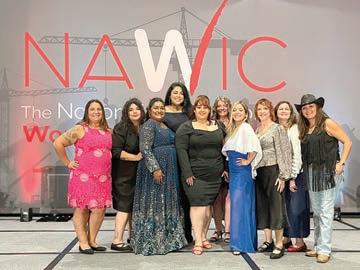


ince 1960, the National Association of Women In Construction (NAWIC) has been celebrating women in the construction industry the first week of March. Known nationwide as WIC Week®, the week amplifies the contributions and achievements of women in construction and related fields, educate the public and industry peers about the opportunities available to women, and inspire the next generation of builders, engineers, and tradespeople.
This year’s theme is Level Up Build Strong. The Austin Chapter, which was chartered in 1958, has inperson activities planned for the entire week MondaySaturday where all are invited to network, tour a jobsite, learn, volunteer, and build to support our communities, careers, and futures. It has been posting WIC Week® annually since it launched.
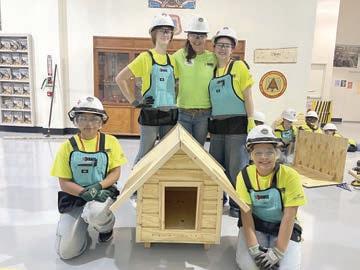
“Women account for 11.2-15% of the US construction workforce, representing roughly 1.34 million workers,” says NAWIC Immediate Past President Jolsna Thomas. “Women continue to be underrepresented in the skilled trades (approximately 43%). We work to encourage current and future workers to pursue careers in construction with our scholarship program, professional development, education, and youth outreach activities like Block Kids, UT Girl Day, Camp NAWIC, and school outreach programs.”
With more than 100 members, the Austin NAWIC Chapter is one of the largest in the country. Last year, it won national awards for marketing, professional development & education, and diversity, equity, and inclusion, and

Sprovide quarterly volunteering. They’ve grown their youth outreach efforts to ensure that the next generation of workers are educated about the opportunities in construction and have expanded their scholarships to include both academic and trades programs and will be giving over $60k in scholarships.
“According to the National Center for Construction Education & Research’s Construction Workforce Age Progression, nearly 25% of the construction workforce is over age 55, and it is estimated that 41% of the construction workforce will retire by 2031,” adds Thomas. “The need for younger and diverse workers is critical to fill this gap. Women account for over 50% of the workforce and are a natural fit for the construction industry whose workers can multitask and perform roles on and off the jobsite.”
NAWIC launched Block Kids as a national program targeting elementary school-aged children. Locally, the Austin chapter expanded their programming to include UT Girl Day and launched Camp NAWIC, a no cost to attendees weeklong, hands-on construction camp for middle and high school-aged girls and non-binary students, where their members and women in the construction industry teach campers to build. “Our members and friends teach concrete, mechanical, electrical, carpentry, and painting. The campers learn to build both virtually through Meta Quest 2s and in real life,” states Thomas.
The Chapter’s expanded its scholarship program beyond 2- and 4-year-bound students to registered apprentices through the establishment of their Trades

Scholarship program, which complements their Academic Scholarship program.
Filling gaps in the construction industry, women are entering into every role, both on and off the jobsite, from skilled trade people, safety, project management, procurement, preconstruction and estimating, marketing, legal, human resources, logistics, building information modeling, prefabrication, accounting, and much more. They work with the tools that build our future and our communities’ infrastructure.
Focusing on workforce development, mentorships, and career accessibility to students seeking a career in construction, the NAWIC Austin Chapter hosts monthly meetings on professional development and education, as well as a community outreach or other networking event. Annually they host WIC Week in March, Camp NAWIC in the Summer, two fundraisers to benefit their scholarship programs - Clay Shoot in April and Golf Tournament in September, monthly safety shares, and regularly partner with the national association to share webinars for members. They also host a variety of committees for members to get engaged with the organization, network with others in the industry, and share their experiences with students.
NAWIC Austin is the recipient of the Institute for Leadership in Capital Projects (I-LinCP)’s Innovator of the Year award. The chapter was recognized last month for the continued efforts to empower women to be successful members of the construction industry. – cwr
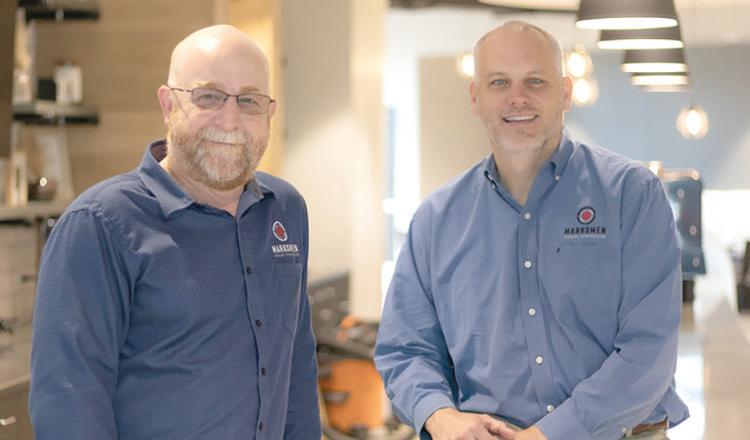
After years of leading K-12 projects for another prominent general contractor, Mark Baublit longed to start a business in the trade he loved, but with a faith-filled mission. His brotherin-law, Butch Dixon, who had a successful career in banking, shared a similar vision and in 2014, the two came together to start Marksmen General Contractors.
Baublit, his wife, Mandy, and Dixon began to redefine the construction experience by executing every project with excellence combined with accuracy, clarity, and integrity, with a spirit of gratitude and service while honoring God in everything they do.
“We’re not just a come build a building kind of contractor,” says Director of Marketing and Business Development Garret McCullough, “Our goal is to amaze every client, every time.”
After a short period of time, Marksmen Project Executive Paul Lacasse joined the Baublits and Dixon, and today, is Marksmen’s longest tenured employee. The four continued laying footprints for several years, and by 2019, the company had grown to a team of 20. Today, Marksmen’s team is 47 employees strong. Its leadership team consists of CEO Mark Baublit, Director of Employee Development Mandy Baublit, Executive VP Butch Dixon, CFO Adam Hudec , President Eric Stirm, Director of
Operations Chris Galan, and Director of Marketing and Business Development Garrett McCullough.
In the construction industry, projects can be large, complex undertakings in which the market, industry, or situation can result in a significant, unsatisfied demand, perfectly positioned for a new solution. Marksmen General Contractors’ mission is to provide that solution. They approach everything with a straightforward yet powerful philosophy: plan with precision, communicate with clarity, and execute with excellence. “These principles aren’t just steps,” McCullough clarifies. “They are the foundation of how we redefine the construction experience. Every department, every project, every time reflects our commitment to accuracy, transparency, and unmatched craftsmanship. It is how we amaze every client, every time.
“We are a purpose-driven company. We don’t exist to solely turn a profit or build a cool building. Our purpose is deeper than that - honor God through our work by doing everything to the best of our ability with a spirit of gratitude and heart of service.“
Specializing in the K-12 education projects, civic and municipal projects to include city work and emergency service districts such as fire stations, libraries,

Texas Construction Association (TCA) would like to give a warm shoutout to VP Patrick Finnegan who is celebrating 12 years – and counting! “I’m proud to celebrate 12 years of serving the members of the Texas Construction Association. I’m especially grateful for our incredible staff whose dedication and hard work make our impact possible every day.”


museums, etc., and projects in the religious sector. Marksmen also performs work in the private/commercial sector and has taken its first steps into the higher education sector after being awarded a contract with UTSA.
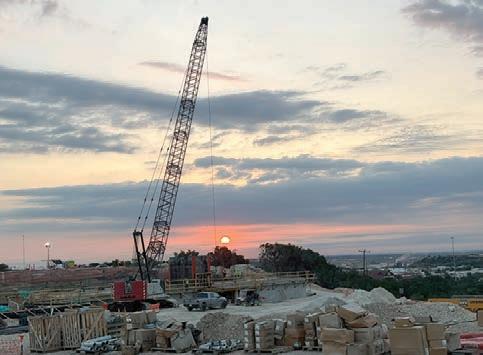
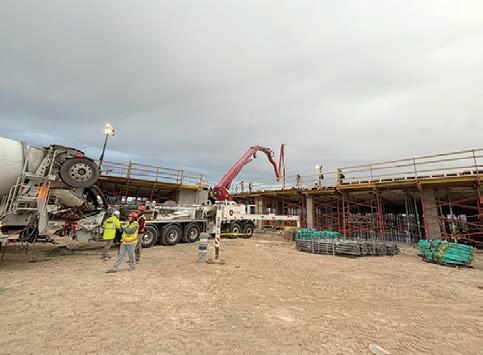
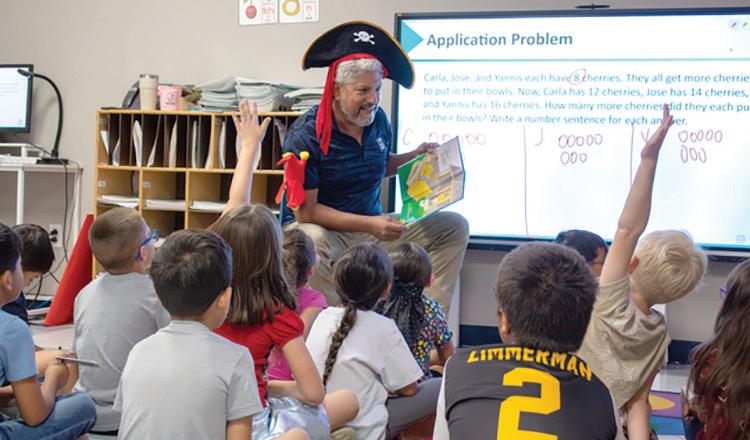
Among their many projects within the company’s short history is a current project in Lytle, two fire stations, and a football field. The Lytle project, $20 million primary school expansion, playground upgrades, and a transportation facility, is in line to be one of their most memorable project. Part of the primary school addition required tearing down an existing wall with windows that children would look out of to watch the ongoing construction. After the wall was torn down, a temporary wall was installed, but with no windows. Known as the pirates, the Marksmen team surprised the children by putting portholes in the wall over the weekend and drew a pirate ship around the portholes. “The kids love it. The teachers are engaged with it,” says McCullough. “This project should be a burden on that campus because due the disruption the construction work is causing, but instead it’s turned into a blessing and we are just so grateful to have that community engaged and welcoming.”
Another memorable project was completed in August of 2025, in which
Marksmen constructed a football field for a Christian school in Castle Hills. “What made this project unforgettable,” states McCullough, “Before this school got this field, they were basically practicing in the dirt. That team went to a state championship for private schools without a field. Funding for private schools is very different than that of public schools, so we worked with them through a pretty extended preconstruction process, trying to get everything in budget for them.”
Additionally, speaking of memorable projects, there are two Bexar County fire stations. Bexar County ESD No. 2 (BxCESD2) was awarded as an ISO Class 1 rating on Dec. 1, 2021. This is the best rating a fire department can achieve and is held by fewer than one percent of the nearly 46,000 rated fire departments and communities in the United States. Only 74 out of 2,800 fire departments in Texas are rated at an ISO Class 1. One of the buildings renovated on the Bexar County ESD No. 2 campus was originally built by the firefighters themselves.
Headquartered in San Antonio, Marksmen General Contractors serves San Antonio and its surrounding areas. Focusing on a 60-mile radius around San Antonio, Marksmen has performed work in Lytle, Poteet, Wimberley, and is currently performing work in Kerrville. -cwr

Tanner Mathews is not one to chase attention. He would rather be on a jobsite before sunrise, checking grade, lining things out, and making sure the crew has what they need.
At 27 years old, Mathews started Kennys Construction Services with two guys, a truck, and rented equipment. No investors, no safety net, just experience, relationships, and the belief that if you treat people right, and do solid work, the phone will keep ringing.
Today, the company runs crews across the country building artificial turf fields, training facilities, and landscape projects – with jobs as far as Herkimer, NY. But it did not start here.
Mathews was born and raised in Missouri City, TX. Baseball and fishing filled most of his early years. It was the kind of place where kids stayed outside until dark and learned responsibility early.
He went to Elkins High School before graduating from Wimberley High School. After a year and a half of community college, Mathews made a decision that shaped everything after that.
“College was not for me. I wanted to work.”
And he did. Before turf and construction, Mathews worked in restaurants, plumbing, and cabinet manufacturing. Restaurants taught him speed and pressure. Plumbing taught him problem-solving. Cabinet manufacturing taught him precision.
“In cabinets, if you are off even a little, it shows. Construction’s the same way.”
Every job taught discipline. Learning what to do and what not to do.
Before starting his own company, Mathews worked for other contractors in the artificial turf industry. He learned sales, operations, logistics, and crew management. He also learned leadership lessons the hard way. “I learned how to treat people, and I learned how not to treat people.”
When Mathews launched Kennys Construction Services in October 2023, he knew exactly what kind of company he wanted to build:
• Take care of the crew.
• Pay people fairly.
• Do not cut corners.
• Do what you said you were going to do. No drama. No excuses.
When Kennys Construction Services started, there was no fleet of equipment
- just a truck, two employees, and rentals. Today, the company has 12 employees, owns its own skid steer and trailers, and travels nationwide building athletic facilities and artificial turf systems.
Artificial turf is its main focus, but what Mathews really sells is execution. He is not interested in being the loudest contractor in the room. He is interested in being the one who finishes on schedule and gets called back.
Kennys Construction Services is not

built on marketing talk. It is built on reputation. Its mission is simple –“Provide a top-quality playing surface at a fair price.” No inflated promises. No shortcuts. Just clean grades, tight seams, straight lines, and fields that perform the way they are supposed to.
Mathews is honest about what it takes to start your own business. “You are going to sacrifice. You are going to work long days. You are going to miss things. That is part of building something.”
Like many others who have taken the leap of faith to start their own business, Mathews seeks advice from his mentor and long-time friend, Eddy Fry, owner of Green Haven Landscape and Irrigation. “Eddy has been a great inspiration to me and guided me in getting my business started. Whenever I have a business related question, I go to him for advice and guidance.”
While the company is thriving, Mathews is not at the stage where he

can step away, at least not yet. “We’re getting there, but we’re not there yet.” Growth has come through long hours, travel, and staying involved with details.
Not married, Mathews met his fiancée, Lynda, when he was 21 years old while working at The Salt Lick. She was a server there. They have been together ever since.
When he gets time, Mathews fishes, usually with his dad. “My dad is my best friend.”
Mathews wants people to know that at the end of the day, he does not overcomplicate it. “We leave no stone unturned. If we say we are going to build it, we will build it right. We want to bring people’s visions to life.”
In an industry where shortcuts are common and talk is cheap, Tanner Mathews is building something steady through hard work, straight answers, and work that holds up long after the crew leaves the jobsite. -cwr
Cokinos | Young knows Austin construction and commercial real estate law – it’s what we do. With over 100 of the nation’s most knowledgeable legal professionals, we’ll guide your disputes and transactions and back you every step of the way. We are renowned for our experience and success across commercial, industrial, pipeline, offshore, heavy highway, civil, and residential sectors. For over 30 years, clients have depended on us across Central Texas. Savvy. Tough. Dedicated. And Austin to our core. That’s Cokinos.
COKINOS | YOUNG
Las Cimas IV, 900 S. Capital of Texas Hwy, Suite 425 Austin, Texas 78746
512-476-1080 CokinosLaw.com





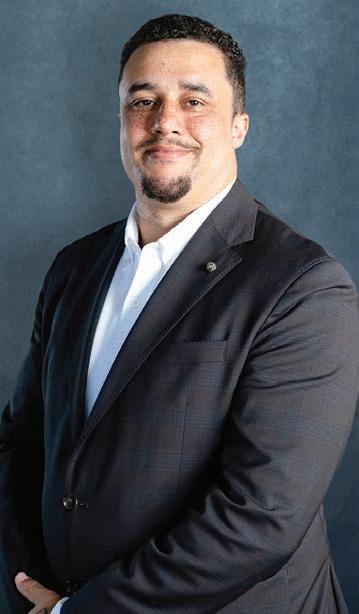
Austin-based construction AI company, BuildPass , has appointed Kirkland (Kirk) Audain as Head of Sales (North America), strengthening its U.S. leadership team as the business scales across the domestic building sector.
Audain has extensive experience leading sales teams across SaaS and technology-driven platforms. Prior to joining BuildPass, he held roles at GoDaddy and its subsidiary Main Street Hub, as well as at Surefire Local and Forward , where he focused on scaling sales functions in competitive markets.
BuildPass co-founder and Chief Executive Officer, Matt Perrott , said Audain’s experience will support the company’s next phase of U.S. growth, while offering transferrable sales knowledge that can benefit the company’s global operations, including Australia where it was founded.
“Kirk is a seasoned sales leader with a strong track record of establishing high-performance teams that scale alongside a product.”
“As demand for construction technology continues to accelerate in the U.S., his expertise will play a key role in helping more contractors quickly understand and adopt BuildPass on site.”
“We are excited to have him leading our North American sales efforts as we continue to grow our customer base and local presence.”
This latest senior executive appointment follows a period of strong momentum for BuildPass, which launched its U.S. headquarters in Austin, Texas, in mid-2025 and signed its 1,000th customer globally in January 2026.
Commenting on his new role, Audain said he was impressed by BuildPass’ focus on delivering AI systems that drive tangible benefits for construction teams, as well as the company’s rapid local growth.
“I am very excited to be joining BuildPass and helping more U.S.
contractors with the adoption of technologies that genuinely improve how their projects run.”
“Labor shortages and housing delivery requirements are placing significant strain on the industry. As such, general contractors and construction professionals must innovate if they are to navigate these challenges and stay competitive.”
“Productivity-boosting digital tools like BuildPass empower contractors to do more with less and will underpin how modern construction gets done.”
In addition to Audain’s signing, BuildPass has made a further 16 hires across operations, sales, customer success and marketing since its U.S. launch.
Co-founded in 2021 by Matt Perrott and Chief Technology Officer, Aaron Vanston, BuildPass now employs 58 staff across the United States and Asia-Pacific.
The company is considering its next funding round with high-profile investors in 2026 following a USD $5 million capital raise in 2024. Leading venture capitalists including PrestonWerner Ventures, Recursive Ventures, Horizon VC, Massive Tech Ventures and Carthona Capital have invested in BuildPass.
Austin Transit Partnership (ATP), the local government corporation charged with implementing Austin’s first light rail system, has selected Austin Rail Constructors (ARC) as the construction contractor for Austin Light Rail, marking another major step toward beginning construction in 2027.
The ATP Board’s approval of ARC enables ATP to begin pre-construction activities and advance final design for Austin Light Rail under the first phase of what will be a multibillion-dollar contract.
“This is a big, important milestone for Austin Light Rail,” ATP CEO Greg Canally said. “ATP is highly focused on delivering this much needed mobility investment for Austin, and with this contract now in place, we are on track to begin construction in 2027. Not only is Austin getting this major transit project, but we are also creating thousands of jobs and economic opportunity here in Texas.”
ARC—a joint venture between nationally and locally recognized firms Stacy Witbeck and Sundt Construction —will help shape and build the design and construction of nearly every aspect of the system, including the transitway, tracks, systems, stations, bridges, traffic signals, utilities, drainage structures and streetscape improvements.
The selected team is composed of industry leaders with extensive local, national and international experience delivering complex transit and infrastructure projects, including McKalla Station, Austin-Bergstrom International Airport and national rail projects in Arizona, Hawaii and Utah. The selection demonstrates ATP’s commitment to economic development in Texas, with several Texas-based contractors represented within ARC’s subcontractor team.

“Austin Rail Constructors is ready to deliver light rail for Austin,” Austin Rail Constructors Project Manager Armando Tiscareño, said. “We’re bringing together the best local builders and designers alongside international experts. We have a flexible and collaborative approach to this complex project in the heart of Austin, while creating significant opportunities for local employment and business growth. We’re committed to building the world-class light rail system Austin deserves.”
ARC was identified as the highest-ranked firm following a rigorous, competitive procurement process that evaluated elements including firms’ experience, personnel qualifications, technical approach and design innovation.
ATP completed the procurement in approximately one year, faster than many comparable mega projects nationwide. Prior to issuing formal solicitations, ATP engaged industry through a Request for Information

process, including feedback on contracting documents, to encourage strong competition. ATP also structured the procurement process to encourage early coordination between major firms and local businesses, hosting Connect & Build industry networking events to foster opportunities for small and local businesses to participate in one of the largest infrastructure investments in the region’s history.
As design advances and construction are authorized, ARC will competitively bid portions of the work, creating opportunities for local and statewide businesses, including subcontractors, material suppliers, specialty contractors and small businesses.
“Austin is building the transportation system our growing city demands,” Austin Mayor Kirk Watson said. “Selecting a construction partner is a major step forward in delivering the voter-mandated transit system and will provide infrastructure careers for thousands in our region. This milestone reflects real progress toward improving mobility, supporting long-term affordability and strengthening our economy.”
The design-build model ATP has chosen to employ brings the final construction partner on board sooner in the project with the goal of earlier alignment, preventing costly change orders and future construction delays. In the coming year, ATP will work with ARC, providing current designs and feedback collected from the community. ARC will incorporate that input on scope, schedule, cost, constructability and design innovation for the project.
Austin’s first light rail system will feature 15 stations along a nearly 10-mile alignment and consist of allelectric trains running every 5–10 minutes throughout most of the day. Austin Light Rail is designed to be fully expandable for future extensions.





Since 1981, Ken Milam has been guiding fishing trips for striped bass on Lake Buchanan in the Texas Hill Country.
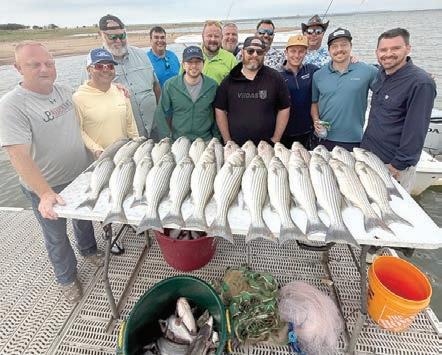
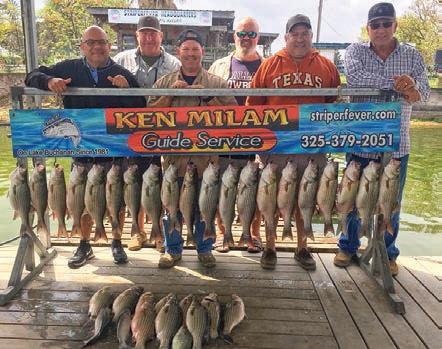
Every spring, there’s a narrow stretch of time when the Hill Country lakes shift from quiet winter water to fullscale production mode. March and April aren’t just strong months for fishing—they’re the two most dependable, highoutput windows of the entire year. Anyone who enjoys ending a long week with a cooler full of fillets knows this is the moment to plan around. This is the window you circle on the calendar and refuse to let slip by, because once it closes, you won’t see conditions like this again until next year.
As the water warms, blue catfish kick into a feeding pattern that almost feels unreal. They roam constantly, feed aggressively, and hammer baits with the kind of force that makes you check your drag twice. This is the season when the big blues show up in groups rather than as the occasional surprise. The action stays steady, the fish stay hungry, and the results speak for themselves. It’s the closest thing to guaranteed meathaul fishing you’ll see all year, and it only lasts for a short time before conditions shift again and the fish spread out.
At the same time, the striped bass family is running its own spring operation. Striper, hybrids, and white bass all push into their seasonal patterns, feeding with urgency and stacking up in predictable places. The bite is fast, chaotic, and
electric—exactly the kind of fishing that wipes away jobsite stress and reminds you why being outdoors matters. When these fish fire up, it feels like the whole lake comes alive at once, and every rod on the boat has a chance to bend.
But here’s the truth construction folks understand better than anyone: timing is everything. Miss a weather window, miss a delivery, miss a pour—everything shifts. Fishing works the same way. March and April are prime time, and once they’re gone, they’re gone. The bite doesn’t pause for anyone who hesitates, and guides fill their calendars quickly once word gets out that the spring run has started. Waiting too long is the easiest way to miss the best fishing of the year.
If you want in on the action, now is the moment to lock in your date. The crews who book early are the ones who end up with full coolers, great stories, and the kind of spring memories that last long after the season ends. Grab your crew, pick a day, and get your trip on the books while the lakes are heating up. March and April only come once a year, and they bring the kind of fishing that makes you glad you didn’t wait. This is the season you don’t want to look back on and say, “We should’ve gone.” Book now, show up ready, and let’s make a serious meat haul while the bite is at its peak.


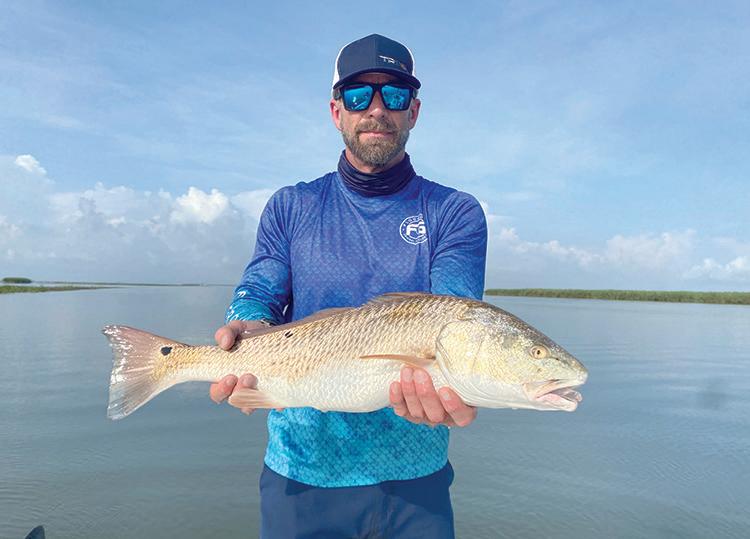
Spring along the Texas Mid-Coast — Matagorda to Port O’Connor down through Rockport and Aransas Pass — is shaping up to be a strong redfish season in 2026. As water temperatures climb through the 60s and bait returns to the bays, redfish are sliding out of their winter patterns and spreading across marsh drains, shorelines and shallow grass flats.
For anglers willing to play the wind and watch the tides, this spring should offer steady slot-red action and increasing topwater opportunities as we move deeper into April and May.






he Texas Parks and Wildlife Commission approved more than $7.85 million in local park grants, to help create and enhance outdoor recreational opportunities in central Texas.
These competitive grants are allocated to local government entities on a 50/50 reimbursement match basis. Once funded, the sites must remain a parkland in perpetuity, properly maintained and open to the public. Fifty community parks statewide will gain nature trails, native landscaping, playgrounds, splash pads, sports fields, kayak launches, piers and other park amenities. The commission, which administers the local park grants program for Texas, awarded grants to projects in various categories based on community population and scope.
The grant awards are listed alphabetically below by region:
The City of Castroville received a $469,367 nonurban outdoor grant for improvements at Lion’s Parks. The project includes an inclusive playground, triplebay swing shade, a sensory wave seat and a walkway.
The City of Gatesville received a $150,000 small community grant for phase two improvements to Gatesville Sports Complex. The project will include the installation of sports lighting.
The City of Glen Rose received a $750,000 nonurban outdoor grant for renovation of Glen Rose Soccer Park. The project includes walking trail reconstruction with solar lighting, playground rehabilitation with shade, soccer field rehabilitation, spectator shade, a pickleball court with solar lighting, installation and

Ieffluent and storm runoff irrigation supply lines for the existing irrigation system and signage.
The City of Kyle received a $750,000 non-urban outdoor grant for phase one renovations at Steeplechase Park. The project elements include a 12foot multi-modal trail with lighting, disc golf, sports courts, a pedestrian bridge, site amenities, interpretive and wayfinding signage and trail markers, native landscaping, and creek restoration.
The City of Leon Valley received a $725,852 nonurban outdoor grant for renovations at Leon Valley Forest Oaks Pool Renovation. The project includes pool renovations, landscaping and irrigation.
The City of Liberty Hill received a $750,000 nonurban outdoor grant for improvements at Heart of the Park. The project includes land acquisition, trails and shared use pathways, site amenities, shade structures, educational and interpretive signage, native trees with drip irrigation, and open green space/practice field.
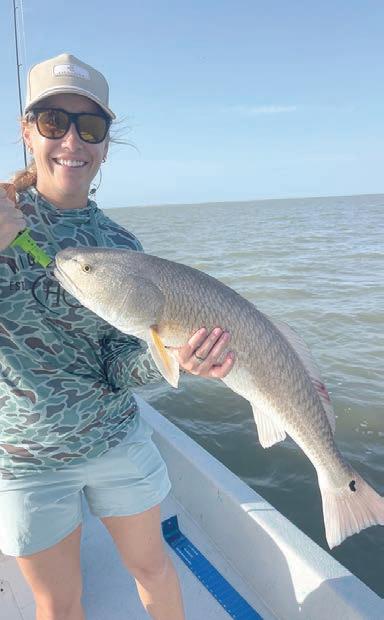
f you haven’t been fishing all winter it’s a good time to call up your boat mechanic and get it in for yearly maintenance. If you’re looking for a great boat shop, the guys and gals over at Rockport Marine are my go-to whenever I have any trouble. We should be seeing the water finally make its way back in.
Consistent medium to high water marks after a winter of low water will move these fish. Lots of red fish, drum and trout moving back into
Marble Falls Parks and Recreation received a $750,000 non-urban outdoor grant for enhancements at Westside Park. The project will include a renovated restroom, an inclusive playground with surfacing and fencing, native landscaping, trails, site amenities, park signage and a covered basketball court.
McClennan County received a $551,535 non-urban outdoor grant for improvements at Tradinghouse Lake Park. The project includes standard and ADA accessible picnic sites, and trails at Park 1A; picnic sites, trailhead and trails, rest areas, RV pads and a dump station, a security fence with a solar powered gate, sand volleyball courts and an ADA/inclusive playground at Park 1B.
The City of New Braunfels received a $700,890 non-urban outdoor grant for neighborhood park on Coll Street. The project includes utilities, a pavilion, accessible playground and walkways, shade, a rain garden, drinking fountain, picnic tables, interpretive and park signage, native trees and landscaping, and irrigation.
The City of San Antonio received a $1.5 million urban outdoor grant for improvements to Pearsall Park. The project includes a bike track, lighting, shade structures and construction of a track perimeter.
The City of Wimberley received a $750,000 nonurban outdoor grant for improvements at Blue Hole Regional Park. The project will include a playground, parking, amphitheater/gathering space, native landscaping, trails, shade, rainwater catchment, lighting, signage and site amenities.
the flats full time. Same with the bait. As the early spring winds start to pick up, the flats will line up with the wind. I like to stay on the lookout for long shorelines with bait up and down it. Blown in by the wind, you can work it for a long time just spotting fish up skinny or if you know small groups are working back and forth just staying put and making sure the bait is where it needs to be. Reefs up north should start seeing fish making their way back onto
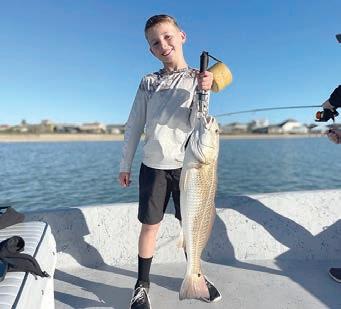
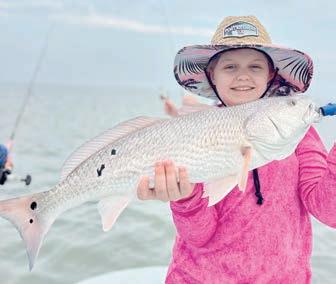
them as well. Same game on them, working up and down them until you find the fish. For the waders, be on the hunt for the same bait lining shorelines, don’t be afraid to throw some wild colors on windy days.
Overcast days I always want a big top water especially with bait busting and heavy wind. I want the sow trout up skinny to be thinking she’s missing a big hurt meal. As always, stay safe out there and tight lines!




pring is here and in full swing across the great state of Texas — and that means it’s time for the spawn! The weather has been a little bipolar lately, but water temperatures are steadily rising, and many species are spawning earlier than “normal.”
Bass are spawning in the backs of pockets around hardwoods and hard bottom areas. We’ve been having success throwing a green pumpkin Texas-rigged Brush Hog with a 3/16- to 1/2-ounce weight, flipping it to hardwoods in 3 to 5 feet of water.
White bass are running upriver to spawn, and crappie are moving shallow onto rocky banks. Spoons, small swimbaits, and jigs have all been producing.
Lake level is 44 feet low, with water temps ranging from 63 to 67 degrees.
Bass are staging on points, foundations, and drains as they move toward protected pockets for the prespawn. Some have already pushed up and begun spawning on pea gravel banks and other firm substrates.

area
Green pumpkin soft plastics on a Texas rig, bluegill-colored spinnerbaits, and crankbaits have been the go-to baits.
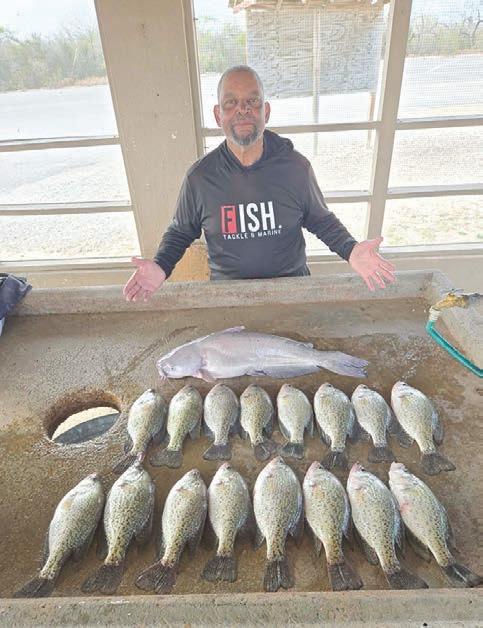
Crappie are spread across all three stages of the spawn. I’ve recently found them shallow on hard-bottom banks and near stick-ups actively spawning. Others are holding on brush piles and standing timber nearby, either preparing to move up or coming off the beds. A 1/8-ounce jig head paired with a dark shad-profile bait (1.75” to 3”, depending on their mood) has been working best when fishing brush and rocky banks.
Calaveras Lake
Catfish are spawning on hard bottom areas and can be caught on cut bait such as shad and tilapia. Punch bait like “Unicorn Shit” has also been producing well on flats and baited holes. Focus on rocky structure adjacent to flats.
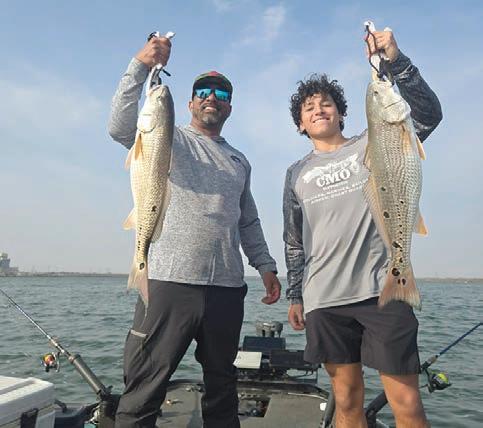
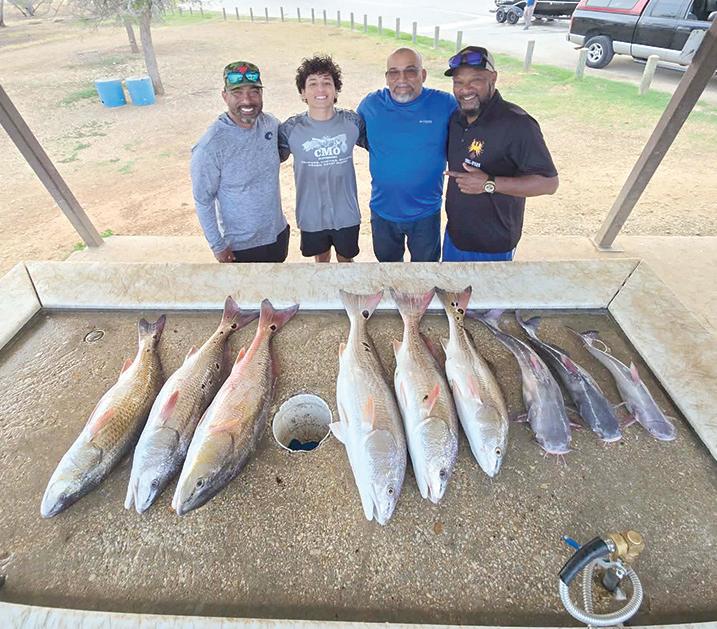
Redfish have started moving from the discharge area into the main lake. They’re being caught trolling swimbaits, crankbaits, and lipless traps, or casting from points using Fishbites or shrimp fished on the bottom.




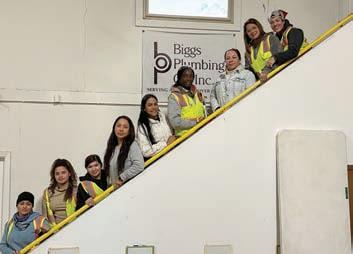
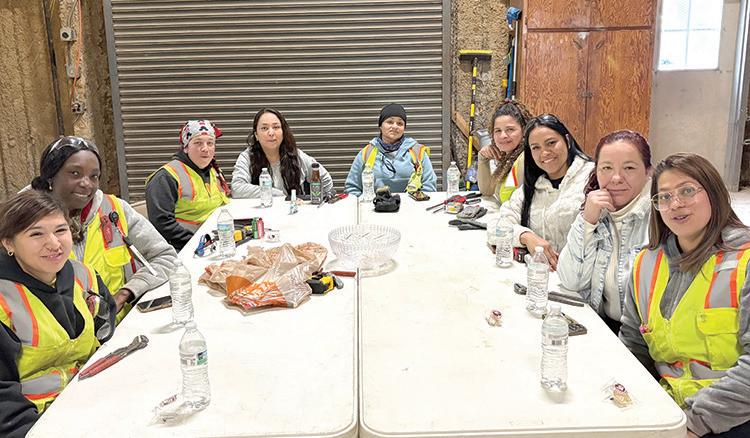
n honor of National Women in Construction Week (NAWIC) Biggs Plumbing Company would like to recognize their
and
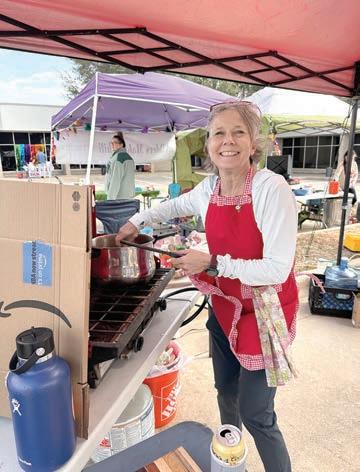
On Feb. 21, teams competed in the 2026 Greater Austin Contractors & Engineers Association (ACEA) Chili Cook-Off. Member companies put together their best chili recipes to see who could win the coveted 1st place trophy in the Chili Contest. Members’ coworkers and families came out in support of their teams. There were games, activities, face painting, and more. ACEA’s annual Chili Cook-Off is a great way for members to get to know one another and participate in a little friendly competition. Thank you to the member companies who participated and sponsors who supported the event. Photos courtesy of Sara Sturtevant




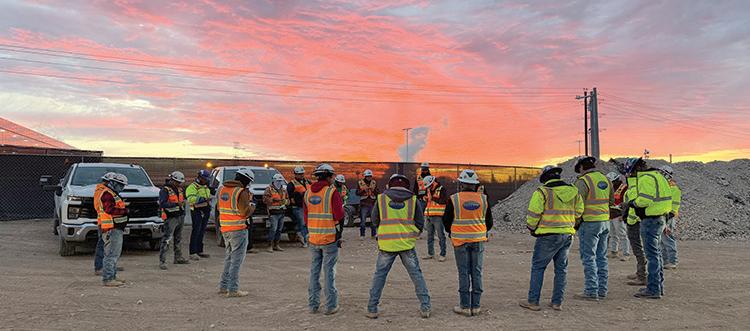
HEI Civil, a leading heavy civil construction company, is proud to announce that its Texas Division achieved 650,000 work hours without a Lost Time Incident (LTI). This significant milestone reflects the team’s daily commitment to their most important critical success factor, Safety, and the dedication of every team member, supervisor, superintendent and project team across the company.
Reaching 650,000 hours without an LTI is a direct result of the organization’s proactive safety culture. It reflects the diligent efforts of every team member to identify hazards, adhere to strict safety protocols and look after their colleagues’ well-being. This milestone is not just a statistical achievement but a testament to a daily commitment to ensuring every team member returns home safely every day.
HEI Texas’s safety department partners closely with the operations department to expand field training opportunities across all projects and crews. Their upcoming training sessions are focused on taskspecific hazards, trench safety, confined
space entry and crew engagement, ensuring every team has the knowledge and tools needed to continuously work safely and efficiently.
“Reaching 650,000 hours without a Lost Time Incident is a remarkable achievement that speaks volumes about our team’s dedication,” said JJ Arriasola, Safety Manager of HEI Civil’s Texas Division. “Safety guides every decision we makenot because it’s required, but because it’s who we are. This milestone is proof of what a strong safety culture can achieve when every person on the team genuinely looks out for one another. Everyone’s diligence and teamwork made this possible - that’s what a true safety culture looks like.”
Looking ahead, HEI Civil’s Texas Division remains dedicated to building upon this momentum. This milestone is viewed as a new baseline rather than the finish line for the division. The safety team continues to increase its field audit presence to continue strengthening hazard identification, accountability and jobsite standards. At HEI Civil, Safety is always the number one priority.


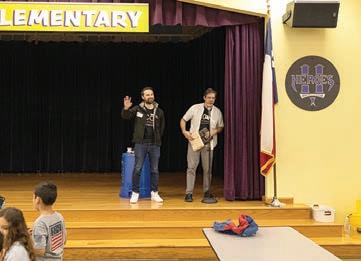
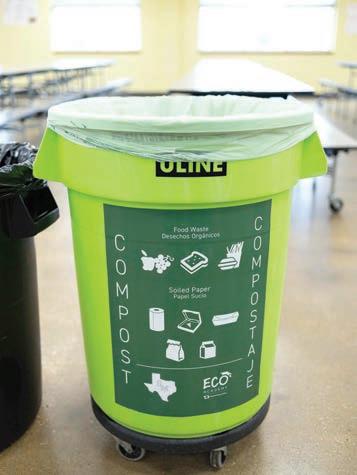
Texas Disposal Systems (TDS), in partnership with Keep Texas Beautiful (KTB) and Keep San Marcos Beautiful (KSMB), is proud to support the launch of a compostable tray pilot program at Hernandez Elementary School, in San Marcos, TX, through the $5,000 Eco Warrior Grant. In partnership with Keep Texas Beautiful (KTB), Eco Academy awarded its first Eco Warrior Grant to Keep San Marcos Beautiful (KSMB) in September 2025.
The compostable tray pilot program officially launched, January 2026. The program replaces all the styrofoam trays in the cafeteria with compostable trays that can be composted after being used. Making this change will reduce the amount of waste going into the landfill as the previous polystyrene lunch trays are a single-use landfill item that cannot be recycled or composted and represent the largest amount of waste (by volume) from school cafeterias.
This program is designed to replace traditional single-use materials and model sustainable practices across all schools. The TDS Eco Academy team was on-site during the launch of this initiative to support implementation and provide hands-on waste education for students and staff.
“As part of this launch, our Eco Academy team is excited to support students and staff as they adopt more



sustainable practices,” said Greg Behl, Sustainability and Diversion Coordinator at Texas Disposal Systems. “This compostable tray pilot shows what’s possible when schools are equipped with the right tools, education, and community partnerships.”
The Eco Warrior Grant program provides schools with funding and resources to strengthen recycling, composting, and environmental education efforts, while encouraging students to take an active role in sustainability on their campuses. The Hernandez Elementary pilot is one of several initiatives supported by TDS Eco Academy during the 2025–2026 school year.
“TDS’ Eco Academy has been essential to the successful rollout of this compostable tray pilot program,” says Cherise Hanf, Assistant Principal at Hernandez Elementary School. “By switching from styrofoam trays to compostable trays, we’re going to have less trash, and we are showing the students that we’re taking initiative, and hopefully that will guide them in the future to take sustainable initiatives.”
In addition to the Eco Warrior Grant program, TDS Eco Academy launched the Green Leaders Network, a collaborative platform connecting educators and advocates advancing environmental education throughout the region.

Adolfson & Peterson
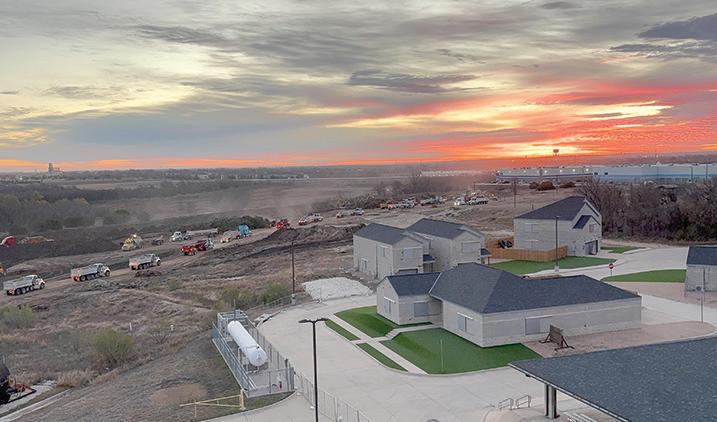
Construction (AP), a national, family-owned construction management and contracting company, started construction on an expansion project for the City of Round Rock on its existing public safety facility in support of the city’s fire and police departments.
Located at 2801 N. Mays St., the Round Rock Public Safety Training Center construction will include expansion to the main administration building, a new stand-alone classroom building, police and fire equipment storage, an emergency vehicle operations course, a heavy-duty skills pad area, an observation tower and a backup emergency generator. The project is slated for completion in early 2027.
“AP recognizes the significance of this expansion for the City of Round Rock and its residents, and we take this assignment very seriously,” said Eric Churchill , Vice President of Central Texas. “The improvements planned will provide much-needed educational and practical training opportunities for the fire and police departments to help bolster the quality of the city’s first responders.”
The 6,602 square-foot main building expansion will add over 6,000
square feet of meeting room space and additional room for fire training personnel. A new 4,700 square-foot classroom building will consist of two classrooms, with restrooms, storage and a kitchenette. An additional skills pad will provide a dedicated space for the fire department to conduct extrication exercises.
The Round Rock Public Safety Training Center Enhancement Phase 2 Project was approved in a 2023 bond election. The training center, which first opened in 2018, serves both the city’s fire and police departments and features classrooms, an indoor tactical firing range, defensive tactics area, scenario-training structures (including a five-story burn tower), outdoor skills pads and specialized props such as a fuel-spill site.
The building’s original architect, Brinkley Sargent Wiginton Architects, designed the project expansion.
AP’s Central Texas office recently broke ground on two Austin ISD high schools, and Heritage Oaks Dental Office in Marble Falls, along with the recently completed expansion of the Emergency Room at San Antonio’s Methodist Landmark Hospital and Round Rock’s Sunrise Commerce Center.
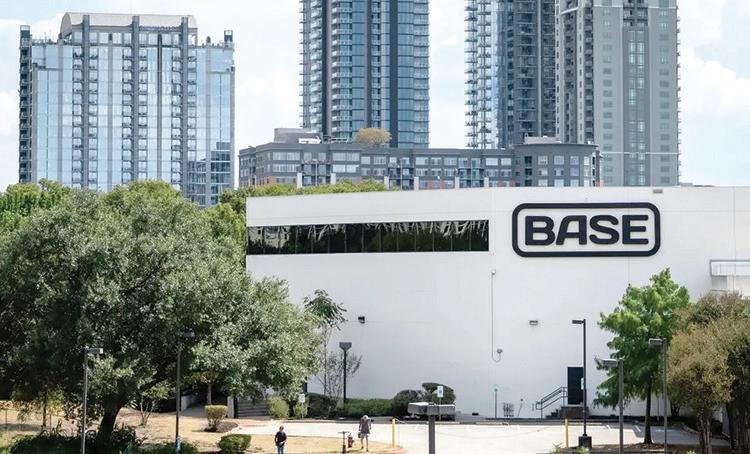
Base Power, an Austin-based energy technology company focused on residential power plans and battery-backup systems, is planning a major expansion in Central Texas with a proposed manufacturing facility near Austin-Bergstrom International Airport.
The company is seeking City of Austin approval and economicdevelopment incentives to develop a new approximately 486,000-squarefoot manufacturing and operations facility at 8001 Metropolis Drive, just east of the airport. The project represents an estimated $265 million capital investment and would significantly expand Base Power’s manufacturing footprint in Austin.
Preliminary plans call for a largescale industrial facility designed to support battery assembly, powerelectronics manufacturing, testing, warehousing, and office functions. Site development is expected to include utility upgrades, loading infrastructure, and specialized electrical systems to support advanced energy manufacturing.
Base Power has not yet publicly named a general contractor, architect, or engineering team. Construction
delivery method and final design are still under review and will be determined following city approvals. If incentives are approved, construction could begin as early as late 2026, pending permitting and final site planning.
The project is expected to create approximately 500 full-time jobs over a 10-year period. City documents indicate the development is tied to a proposed incentive package valued at up to $4.85 million over 10 years, contingent on job creation benchmarks, wage requirements, and long-term operational commitments.
Once complete, the facility would support production of battery systems and power electronics used in Base Power’s distributed energy network, which pairs fixed-rate residential electricity plans with home battery installations to improve grid reliability and provide backup power during outages.
The proposed facility would be among the largest advanced-energy manufacturing projects announced in the Austin metro area in recent years and reflects continued investment in Central Texas as a hub for energy infrastructure and technology manufacturing.
Mary C. Haskin
PHOTOGRAPHY
Specializing



John Simmang CRM/CIC The Nitsche Group Insurance Agency
the world of commercial insurance, your past is often your prologue. But for business owners who have suffered a string of claims (or maybe just one catastrophic auto claim in today’s environment)—that prologue can feel more like a prison sentence.
When loss runs turn red, premiums skyrocket. In today’s “hard market”— where insurers are already risk-averse and prices are high—a bad claims history can lead to non-renewals or quotes that threaten your bottom line.
But this doesn’t have to be the case: A bad history doesn’t always equal a bad future.
If you can prove that you have learned from your losses and “rehabilitated” your risk profile, you can negotiate better terms. This isn’t about luck; it is about leverage. It requires a three-pronged strategy: aggressive Loss Control, strategic Risk Management, and a narrative-driven Communication plan that turns your business from a “high risk” into a “reformed partner.”
But how do you accomplish this?
Part I: Loss Control – Stop the Bleeding
Before you can ask for a better price, you must stop the leaks. Underwriters are data-driven but also logical. They want to see physical evidence that the past accidents cannot (or at least are unlikely to) happen again.
1. The “Post-Mortem” Analysis
You cannot fix what you don’t understand. For every claim in the last five years, conduct a ruthless “post-mortem.”
• Audit your Loss Runs: Request your currently valued loss runs from your broker. Review them for errors. Are there old claims still listed as “Open” with money reserved for them? If a claim is settled, ensure the carrier closes it so the reserve amount drops to the final paid amount. Underwriters include the reserves when valuing the loss.
• Root Cause Analysis: Don’t just say “driver hit a pole.” Ask why. Was he tired? Was the route poorly planned? Was the vehicle maintenance skipped?
• Frequency vs. Severity: Underwriters fear frequency more than severity. A $1M fire is often seen as a fluke. Ten $10,000 slip-and-falls indicate a systemic management failure. Identify your patterns. Frequency scares underwriters more than severity because it implies a cultural problem.
Be honest. This is not the place to “sugar-coat”. The underwriters are wary of those who cannot accept blame and are very adept at “reading between the lines”.
2. Invest in “Hard” Controls
“Soft” controls are policies (e.g., “We tell drivers to be safe”). “Hard” controls are physical or technological barriers to
loss. Underwriters love hard controls because they work even when people are tired or lazy.
• Telematics: If you have a fleet, install dash cams and GPS trackers. Data showing a 90% reduction in hard braking events is gold for negotiation. But even if you don’t currently have telematics, you might as well start embracing them. In my opinion, mandatory telematics (in order to even get insurance), is less than five years away.
• Water Mitigation: Water damage is a leading cause of property loss. Install automatic shut-off valves and leak detectors.
• Cyber Hygiene: Implement MultiFactor Authentication (MFA) immediately. It is no longer optional for reasonable cyber pricing.
3. The “Receipts” Strategy
Keep receipts for everything. Did you fix that uneven sidewalk? Save the invoice. Did you install a new fire suppression system? Take photos. You are building a defense case for your business.
Pro Tip: Create a “Safety CapEx” folder. Every time you spend money on safety (cameras, training, gear), save the proof. This dollar figure proves you are putting your money where your mouth is.
The Win: Being able to show the underwriter that you fixed the root cause is 10X more potent than just telling them you addressed the symptom.
Part II: Risk Management – The Cultural Shift
Loss control is about things; Risk Management is about culture. This is how you prove to an insurer that your management team is no longer asleep at the wheel.
1. The Contractual Firewall
Half of your risk might not even be yours. Review every contract with vendors, subcontractors, and landlords.
• Risk Transfer: Ensure you are transferring risk downstream. If a subcontractor causes a fire, their insurance should pay, not yours.
• Certificate Management: rigidly track Certificates of Insurance (COIs) from your vendors. If you can’t prove your subs are insured, the underwriter assumes they aren’t—and charges you for it.
2. The “Return to Work” (RTW) Program
Workers’ Comp costs are driven by how long an employee is out of work.
• Create “Light Duty” Roles: Have a pre-written list of jobs (filing, answering phones, inventory) that an injured worker can do.
• The Math: Getting an employee back to work at 80% wages often costs less than the hike in your “Experience Mod” if they stay home for months.
Establish a safety committee that meets monthly. Keep minutes. It sounds bureaucratic, but it is gold. Submitting “12 months of Safety Committee Meeting Minutes” to an underwriter proves you are actively managing risk, not just hoping for the best.
Part III: Communication – Selling the “Reformed” You
This is where most businesses fail. They let their broker send a generic application and a messy pile of loss runs to the insurer. The underwriter looks at the bad numbers, stamps “Decline,” and moves on.
YOU MUST CONTROL THE NARRATIVE. You need to market your business like a high-value asset, not a distressed property.
1. The “Narrative”
Do not rely on standard insurance forms. Create a “Narrative” or “ Risk Resume “ that sits on top of your application. This document should tell your story, and the story of your rehabilitation.
What goes in a Narrative?
• Your Operations: What you do, where, and how. Are there any growth/ downsizing plans? This is not the place to sell what you CAN do, but what you actually do. You may also want to include what you refuse to do, and possibly why. This sets the stage in the underwriter’s mind. You want to put your best foot forward. Make sure you include your website. They will find it and review it. You need to review it first to make sure it is accurate. If they see things you don’t do, 9 times out of 10, it will be something that will put a bad taste in their mouth, and it is hard to overcome that first impression.
• Your Background: What is the history of the business and the ownership? How did you get where you are today? What qualifies you to do what you do?
• The “Mea Culpa”: Acknowledge the bad year or series of years. “In 2023, we experienced higher-than-average losses due to...” Be specific. Address larger claims individually. Address patterns (rear-end collisions, back injuries, etc). The more you lay it out for them, the more they understand that you know what has happened, that it is controllable, and you are doing things to keep past claims from recurring in the future.
The Pivot: “Since then, we have implemented...” List your Hard Controls and Cultural Shifts. This is where you outline updated hiring practices, training, driver controls, etc. Anything you are doing to control losses, tell them about it. Here again, the more you lay it out for them, the more they understand that you know what has happened, that it is controllable, and that you are doing things to prevent past claims from recurring, the better. Be specific. Don’t say, “We will hold more safety meetings.” This is vague, and what they are used to seeing. Say something like, “We implemented a mandatory pre-shift vehicle inspection checklist on mobile tablets. Since Q1, we have caught 14 mechanical issues before they caused accidents.” Something like this is specific and measurable – and this one also happens to be tech-enabled, which underwriters like.
• The Investment: “We have invested
$X,000 in safety upgrades.” “We have hired a safety manager, and here is his/ her resume.”
• The Overall Result: “In the last 6 months, our incident rate has dropped by Y%.” “In the last 6 months, we have had no rear-end collisions, where we were having one every 30 to 45 days before.” It may seem redundant to tell them when the data shows it, but as one of my mentors taught me, “If you do the underwriters’ job for them, you are more likely to get a ‘Yes’.”
2. Managing Your Broker
Your broker is your defense attorney. If they aren’t fighting for you, helping you do these things, showing you the narrative they have written for you, FIRE THEM.
• The Strategy Session: Meet 6-7 months before renewal. Do not wait until the last minute. When an account has a tough claims history in today’s market, the underwriter needs the submission in their hands at least 120 days before renewal. In today’s market, it is going to take a compelling narrative and several phone calls to the underwriter to make sure it stays on top of their stack and keeps positive thoughts in the underwriter’s head.
• The “Market Check”: Ask your broker specifically: “Which carriers are you approaching? What is the story you are telling them about our losses?” You may be talking to several brokers, but if an underwriter sees the duplicate submission from several brokers, they know you are “blasted out to the market,” and that isn’t viewed favorably. Pick a broker or two, but make sure they don’t approach the same markets. If they don’t tell a consistent story, your real story is not credible.
• The Direct Pitch: For large accounts, ask if you can present your rehabilitation story directly to the underwriter on a call. Hearing a passionate business owner explain their safety turnaround can sway a decisionmaker in ways a paper form cannot. The underwriter will also be able to “create a relationship” with you. This is the place to be cool, calm, and collected. Knowledge is also a great asset on these types of calls. If you need your safety person on the call, do so. The underwriters don’t expect you to know everything; they just need to see you have firm control over it.
3. The “Fluke” Narrative
If you had one massive claim (e.g., a tornado hit your factory), frame it as a “Shock Loss.” Emphasize that this was an Act of God, not a failure of management. If you have high frequency (lots of small claims), frame it as a “Legacy Issue” that has been corrected by new management or new protocols.
Insurance is a financial instrument, but underwriting is a human process. Underwriters want to write good business. They want to find a reason to say “yes” to you, but your claims history gives them a reason to say “no.” Your job is to give them the ammunition they need to defend your account to their bosses. By combining rigorous loss control with a compelling rehabilitation story, you turn your insurance renewal from a bill that threatens your bottom line into a negotiation you can survive – and over time - win.

Crystal Sunbury Real Estate Industry Senior Analyst RSM US LLP
Las Vegas, NV
The push for more attainable housing will continue to reshape the market in 2026 and beyond despite the challenges facing homebuilders and multifamily developers.
We expect 2026 will be a turning point for multifamily housing, with stronger rental growth and declining vacancy rates. Last year multifamily showed signs of a supply-and-demand rebalance due to resilient rental demand—driven by limited affordability in the single-family sector—and a decline in multifamily completions.
Developers, meanwhile, should make the most of this opportunity by embracing innovation and appealing to a customer base looking to enter the market.
As for single-family, 2026 is not expected to improve much from 2025 as affordability challenges persist.
How we got here
Affordability is not a new concern in this industry. Demand during the COVID-19 pandemic pushed housing prices and rental rates to record highs across the U.S. due to interest rate cuts and migration from congested metropolitan areas.
But the postpandemic period left the housing market with significant volatility and uncertainty that continue to worsen. Buyers were sidelined by affordability issues and an oversupply of multifamily housing, which created an imbalance that led to a sharp decline in rental growth.
Housing construction, which could not keep up with the demand five years ago, suddenly came to a screeching halt as higher interest rates made housing less attainable for buyers. Simultaneously, the wave of multifamily projects started during the pandemic created an oversupply, particularly in Sun Belt markets.
As inflation hit record highs, the Federal Reserve responded with one of the most aggressive monetary policy tightening cycles in history.
This led to a sharp increase in mortgage rates, which intimidated buyers and left renters with limited affordable options.
Despite only modest price growth since the pandemic era, higher-for-longer mortgage rates combined with limited income growth notably affected affordability— particularly in the first-time homebuyer segment, where many chose multifamily and build-to-rent alternatives over single-family homes.
Housing affordability and homebuyer behavior
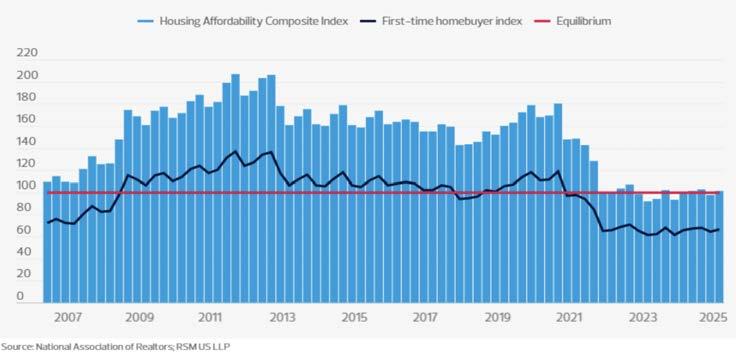
Development forecast sunnier for multifamily than single-family
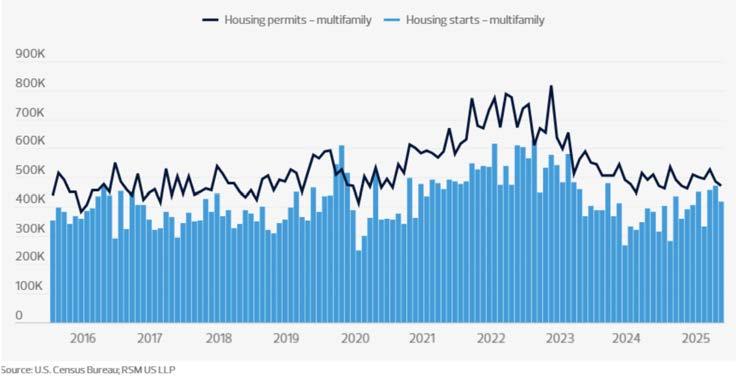
Multifamily development saw an uptick in 2025, with starts up 13.9% year over year in August, according to the U.S. Census Bureau. However, permit data pulled back in recent months, with permits down 7.3% in August compared to the same period in 2024.
Recent improvements in financing conditions and moderating material costs, albeit affected by tariff uncertainty, could help create a brighter landscape for multifamily development. Recovery in this sector will not be uniform since several large Sun Belt markets remain oversupplied despite seeing a decrease in new construction deliveries.
Multifamily housing permits and starts
Justin C. Rorick
Attorney Cokinos Young San Antonio, TX
a significant victory for contractors navigating complex multi-party disputes, the Texas Business Court recently affirmed its jurisdiction over third-party claims in a high-stakes construction litigation. The ruling in Cadence McShane Construction Company, LLC v. Ryan BBBlockhouse Creek, LLC, No. 25-BC03B-0002, marks an important development in how jurisdictional thresholds are applied under the newly established Business Court system. This decision not only reinforces the court’s role in handling intricate commercial matters but also provides a roadmap for general contractors to consolidate related claims efficiently. As counsel for the prevailing party, Cadence McShane Construction Company LLC (CMC), we delve into the case’s background, key legal battles, the court’s reasoning, and the broader implications for the construction industry and complex commercial litigation in Texas.
Case Background: A Multifaceted Construction Dispute
The litigation stems from the development of a 347-unit apartment complex in Leander, Texas, known as the Blockhouse Creek project. CMC, serving as the general contractor, entered into a Prime Contract with the property owner, Ryan BB-Blockhouse Creek, LLC (Ryan). The project involved a network of subcontracts with 18 specialized subcontractors, each governed by a uniform subcontract agreement that incorporated the terms of the Prime Contract.
Tensions escalated in February 2025 when CMC filed suit against Ryan, alleging wrongful termination and non-payment for work performed. Ryan countered with claims of project mismanagement and various construction defects, including but not limited to improper installation of roofs, window systems, stucco, and balconies. These allegations implicated not only CMC but also its subcontractors. In response, CMC brought third-party claims against the 18 subcontractors, seeking indemnification and contribution based on the interconnected contracts.
The case was filed directly in the Third Division of the Texas Business Court, leveraging the court’s specialized jurisdiction over business-related disputes. However, Ryan challenged this venue through a plea to the jurisdiction, arguing that the third-party claims did not independently meet the Business Court’s jurisdictional requirements and could not be aggregated to satisfy the amount in controversy threshold under Texas Government Code Section 25A.004(d)(1).
Key Legal Issues: Interpreting “Qualified Transactions” and Aggregation of Claims
At the heart of the dispute was the interpretation of Texas Government Code § 25A.004, which outlines the Business Court’s supplemental jurisdiction. Specifically, subsection (d)(1) grants jurisdiction over claims arising out of a “qualified transaction” if the amount in controversy exceeds $10 million. Section 25A was recently amended to lower the amount in controversy to $5 million in cases filed after September 1, 2025 (excluding interest, exemplary damages, penalties, and attorneys’ fees).
Ryan vigorously argued that each third-party claim against the subcontractors was separate and distinct, lacking a unified “qualified transaction,” because Ryan terminated CMC and assumed the subcontracts. They argued that aggregation was impermissible, as the claims did not form a single, cohesive dispute. CMC, on the other hand, asserted that all claims (original, counter, and thirdparty) arose from “one construction project carried out through a network of related contracts.” This interconnectedness, CMC argued, qualified the entire litigation as a series of related transactions under the statute.
The timing of the case added another layer of complexity. The Texas Legislature’s House Bill 40 (HB40), effective September 1, 2025 (the same piece of legislation which amended the qualified transaction threshold from $10 million to $5 million), amended Section 25A.004 to explicitly define a “qualified transaction” as including a “series of related transactions.” Additionally, new subsection (i) clarified that the amount in controversy for jurisdictional purposes is “the total amount of all joined parties’ claims.” These amendments bolstered CMC’s position, emphasizing the Legislature’s intent to allow aggregation in multifaceted disputes.
The Court’s Ruling: A Win for Consolidated Jurisdiction
In a decisive order, the Business Court denied Ryan’s plea to the jurisdiction, upholding its authority over the third-party claims. The court adopted CMC’s framing, concluding that the claims collectively arose from a qualified transaction involving a single construction project and its web of related contracts. As such, it was unnecessary to evaluate each third-party claim’s amount in controversy individually, as the aggregate value of the joined claims satisfied the threshold.

In 2008, while living in west Texas, Michelle
Bermes, began building homes for a local builder. It is there that he discovered his passion for building homes.
“He just loved it and was very passionate about it,” says Michelle. “I, too, got really involved in it. I was just amazed by the process, the layout of materials, how the whole house is built.”
Josh wanted to builder nicer, more custom home builds. So in 2011, Michelle and Josh started our own company, JGB Homes. They started together with Josh in charge of managing the subs and suppliers, while Michelle focused on the homeowners and choosing their selections and everything in between.
“As we built more homes, the more I was involved with the homeowners, their selections and really began understanding how design choices can affect the function of your home from the design to the budget. Coming from an accounting background, it is really easy for me to understand job costing, budgeting, making smart decisions and keeping everything on track.”
Michelle’s commitment to their growing business sparked a desire to further understand the needs of their clients by earning her real estate license. “I wanted to have an even broader
perspective of not just building homes, but the land, the market value, how to do contracts, the whole full life cycle of a property and home.”
After years of visiting family in the Texas Hill Country, floating the river and going to outdoor concerts, they began to realize what a dream it would be to build homes in the beautiful Texas Hill Country. So in 2015, the Bermes relocated to the Texas Hill Country, changed their company name to Grace Lane Homes and began building custom homes in the Texas Hill Country.
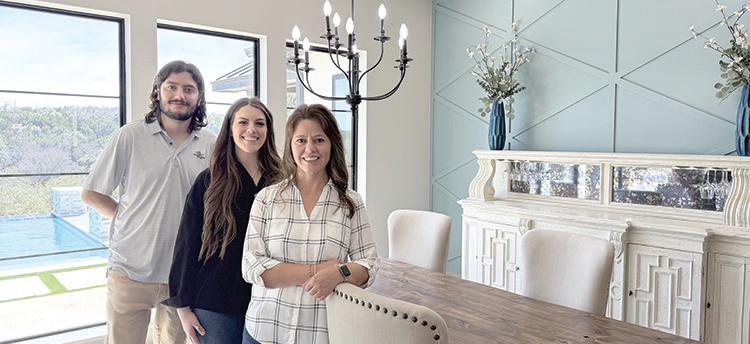
Today, Michelle is joined by her daughter, Daisy Grace, and son, Bronson Lane Bermes to help carry on the legacy that Josh Bermes started. “It’s very important to me especially because it is a way for us to honor their dad. We started this all together and we continue his legacy together because this was his passion as well as mine. That’s how I got into construction and that’s how Grace Lane Homes was started.”
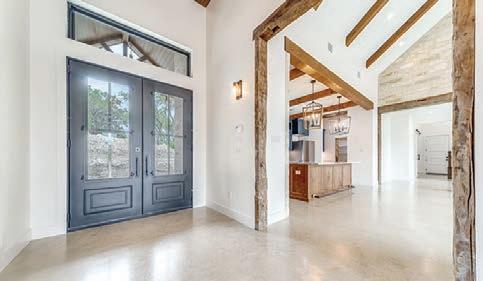
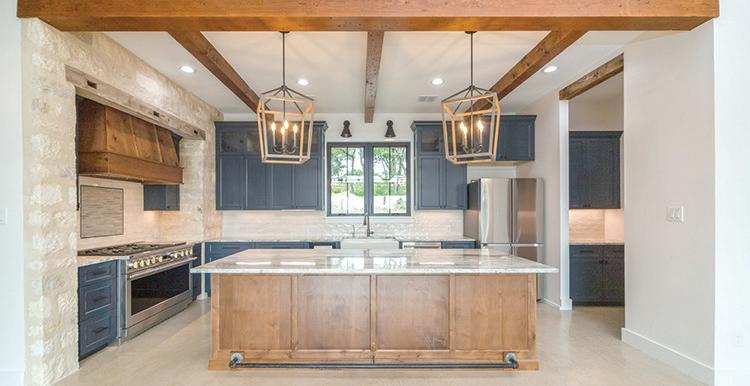
Truly a custom home builder, Grace Lane Homes takes every detail of the homeowner into consideration from elevators for a disabled family member to special living quarters and air conditioning needs for clients with special needs to building a focal point around a beloved family heirloom table
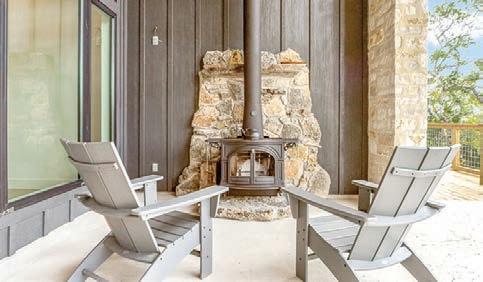
or a large animal mount.
“We put a lot of focus on the client,” Michelle explains. “That’s why we stay small as a company. We do about six homes a year, because I want to have that connection with the homeowner. I don’t want them to deal with two or three different project managers, designers and all that. I’m the point of contact at all times. I tell my homeowners, ‘I don’t want you to go to bed worrying something. Text me. It doesn’t matter what time. Just know that open communication is there once you go to bed, laying in peace and not stressed about something.’ That’s the connection that is really special to me and that’s how I want to keep it.”
Maintaining that personal touch also means maintaining a select list of specialty contractors. Grace Lane Homes has a preferred list of subcontractors that work regularly with Michelle. “I’m a hands-on custom home builder. I want to be known for my attention to detail. I’m very approachable. And, I’m deeply involved in every phase of building a home from the very beginning to planning to budgeting to the construction and doing the interior selections.
“I have framers, concrete, electricians, plumbers, HVAC, drywall,
painters, flooring, insulation, custom cabinet builder, tile – everything that goes into a home. They understand my standards and quality. They understand what I expect for communication and reliability. It’s a pretty good working relationship. It’s very rare that I have to go find another subcontractor. Having said that, I do try to keep two plumbers and two electricians on hand in case their schedules backlogged.”
Building homes within a 100-mile radius of Canyon Lake where it is headquartered, the custom home builders provides everything a homeowner could possibly to build their home. From property/land/lot selection to home design working with architects and engineers to land preparation, tree clearing, earth cuts, pre-construction planning, and construction management throughout the whole build, and the final orientation and delivery of the home. Additionally, Grace Lane Homes recently added a new selection to their homes. It is called “Right Size Custom Homes” which pretty much lets homeowners who appreciate craftsmanship and efficiency know, luxury doesn’t depend on size. It’s thoughtful design, great quality, and great craftmanship without sacrificing comfort, style, functionality. -cwr



Higher interest rates continued to suppress demand and keep out aspiring buyers. Although material inflation moderated, its lingering effects coupled with tariff uncertainty continued to drive up building costs and squeeze margins.
A recent easing in interest rates brightened builder confidence, which increased by five points in October to 37—the highest reading since April—according to the National Association of Homebuilders. This suggests that while sentiment is still negative (below 50), conditions are improving.
Notably, the sales expectation index jumped nine points to 54, indicating that builders feel optimistic about future conditions in the home sale market.
Labor issues, tariffs affecting builders
Builders and multifamily developers faced significant headwinds in 2025 despite improving sentiment, including consumer affordability challenges, material price inflation, labor shortages and a higher cost of capital.
While material price growth is moderating and interest rates are showing a gradual decline, the effects of higher tariffs are likely to result in higher material costs—creating further uncertainty in the construction landscape.
The shortage of skilled workers will continue to affect the cost and availability of labor, which could result in construction delays, higher labor costs and slower future growth.
Gauging the housing market
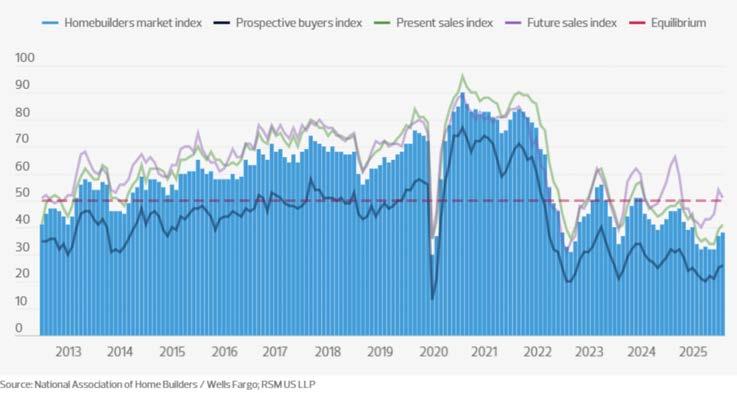
A recent study by the National Association of Home Builders estimated the annual economic impact to the construction industry to be $10.8 billion annually due to longer construction times associated with the skilled labor shortage in the U.S.
This study also estimated that the labor shortage added 1.98 months to incremental construction time, with smaller builders experiencing even more delays.
Focus on attainability and innovation
As the single-family and multifamily construction industries look to capitalize on opportunities, attainability should be developers’ primary focus.
Continuing to offer incentives, including rate buydowns, and providing smaller and more affordable housing options are strategies developers could consider to attract more buyers.
Embracing innovative building practices can also help developers increase market share and stay competitive. Leveraging modular construction, AI-driven project management and sustainability-focused designs will help reshape cost structures and tenant expectations—while providing a competitive advantage.
The ruling highlighted the practical realities of construction litigation, where defects and delays often involve multiple parties under interdependent agreements. By rejecting Ryan’s narrow interpretation, the court prevented the fragmentation of disputes, which could otherwise force parallel proceedings in different venues, which would be inefficient and costly for all involved and fly in the face of the intention behind the creation of the business courts, which is to attract companies to Texas by providing efficiency and predictability in complex commercial litigation disputes.
Notably, the decision referenced the recent HB40 amendments, interpreting them as confirmatory of the aggregation approach. This alignment with legislative updates underscores the Business Court’s role as a forward-looking forum for resolving complex business matters.
Implications for Contractors and the Texas Business Court
This jurisdictional victory has farreaching implications for the construction sector in Texas. First and foremost, it empowers contractors like CMC to bring comprehensive actions in the Business Court, even when individual claims fall below monetary thresholds. By allowing aggregation, the ruling facilitates the resolution of large-scale projects’ disputes in a single, specialized venue equipped with judges experienced in commercial law.
For property owners and developers, the decision signals potential challenges in contesting jurisdiction, particularly in projects with layered subcontracting. It may encourage more strategic forum selection, with parties opting for the
Business Court’s expertise over traditional district courts.
Broader still, this case exemplifies the evolving landscape of Texas’ judicial system. Established to handle highvalue business disputes, the Business Court is proving itself in complex construction matters, which often involve intricate contractual networks and significant economic stakes. As more cases test its boundaries, we anticipate a uniform approach emerging favoring predictability, efficiency, and aggregation.
Contractors should take note: When drafting agreements, emphasize the interrelated nature of project contracts to strengthen jurisdictional arguments and perhaps incorporate consent to the Business Court’s jurisdiction. Additionally, staying abreast of legislative tweaks, such as those in HB40, is crucial for leveraging the Business Court’s advantages before a dispute even arises.
In conclusion, this decision is a testament to the efficacy of Texas’ Business Court in promoting efficient and predictable justice. For CMC, it paves the way for a merits-based resolution of the underlying claims. As the construction industry continues to grapple with rising complexities, from supply chain disruptions to defect litigation, this ruling offers a playbook for asserting jurisdiction in multi-party battles.
As a special thank you, trial counsel Stephanie O’Rourke and Tracy Glenn were both pivotal in securing this landmark victory. Their expertise in navigating the intricacies of construction litigation and the Texas Business Court system exemplifies the highest standards of legal excellence.
Mar. 26: Top Guns & Shotguns Clay Shoot, 8am-3pm, Capital City Clays, 8707 Lindell Lane,
Greater Austin Contractors & Engineers Association
Mar. 6: Coffee Chat-North, 7:30-9:30am, BGE, 101 W. Louis Henna Blvd., Ste. 400, Austin
Mar. 12: Luncheon, 11:30am-1pm, Norris Conference Center
Mar. 20: Coffee Chat-South, 7:30-9:30am, BGE, 1701 Directors Blvd., Ste. 1000, Austin
Mar. 27:
Council
Mar. 17: Lunch & Learn, ABC Supply, 6251 Rittiman Rd., San Antonio
Central Texas Subcontractors Association
Mar. 25: Board Meeting, 11am-1pm
Mar. 26: Dinner Meeting, Check website for details coming soon.

Mar. 27: Volunteer Care Day, 9am-12pm, Baptist Community Center Mission