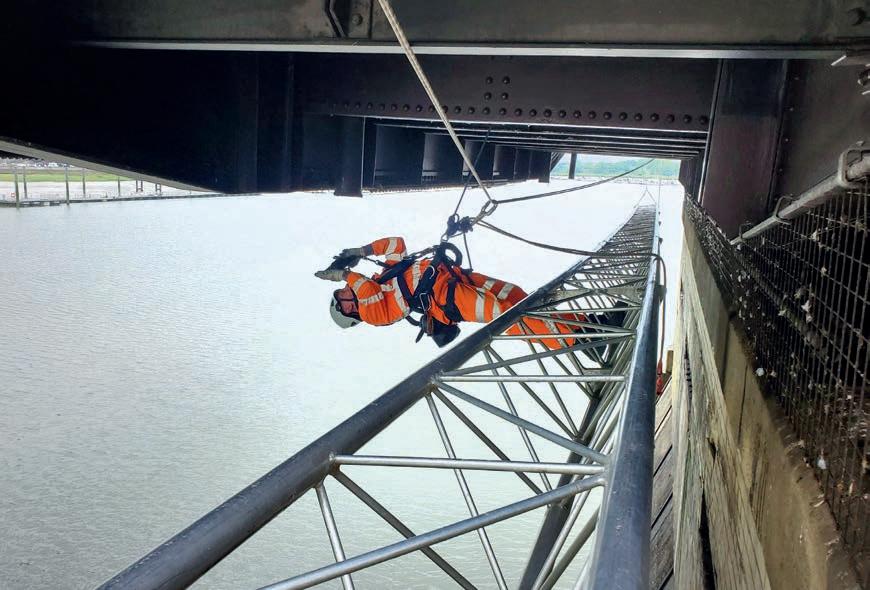
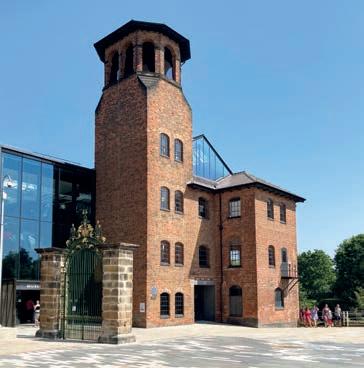
Bridge inspectors used skilled rope access techniques to conduct a detailed survey of the Grade II-listed Rochester Old Bridge. Rope access specialist company Up and Under and sister company CAN Structures, both part of the RSK Group, carried out the inspections as part of a six-year contract with the Rochester Bridge Trust to monitor its assets.
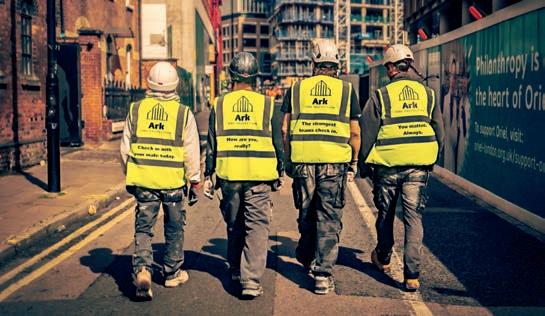
‘The strongest teams check in’ Fire protection company Ark and Bowmer + Kirkland rolled out high-visibility jackets across their sites featuring messages to help raise awareness of mental health issues in construction. The initiative aims to highlight the importance of creating open conversations around mental health and serves as a visual reminder of the challenges everyone, including construction workers, can face.
National Maritime Museum’s roof upgrade
Willmott Dixon Interiors completed a £12.3m refurbishment of the National Maritime Museum’s Ocean Court in Greenwich, London, with an extensive upgrade to its iconic glazed roof. The project included installing more than 2,550 sq m of solar-protective glazing and Barrisol membrane, resolving long-standing issues with water ingress, solar heat gain and acoustic performance at the Grade I-listed building.
Blenheim Palace’s clock tower restoration
Blenheim Palace has begun a seven-week restoration programme on the 18th-century clock tower located at the entrance to the UNESCO Site’s Great Courtyard. The clock is considered the finest surviving example of the craftsmanship of clockmaker Langley Bradley. The project is being led by Chris Monaghan, clerk of works in the Blenheim Palace built heritage team, and Carmen Alvarez, Blenheim Palace’s collections manager.
Mike Reader MP talks to CM about housing targets, MMC – and wrestling (p18-22)
Bespoke gantry system for HS2 TBMs removal
Dutch heavy lifting company Mammoet worked with tunnel boring machine (TBM) manufacturer Herrenknecht and HS2 tunnels main contractor, Skanska Costain Strabag joint venture, to design and assemble a custom gantry system to lift four TBMs weighing almost 900 tonnes each. This solution enabled the removal of each of the TBMs as a single piece and reduced dismantling operations within the shaft by bringing lift operations to the surface, mitigating risk.
Gleeds sets Guinness World Record
Construction consultancy Gleeds marked its 150th anniversary teaming up with kite surfer Jake Scrace and stuntman Chey Anich to set a new Guinness World Record. The extreme sports pros reached almost 500m over The Needles at the Isle of Wight to claim the accolade for ‘Highest Kite Surf Tow-up’ ever recorded. Scrace, a carpenter who specialises in building ‘tiny homes’, had previously made headlines by kite surfing over both Worthing and Brighton piers.
Half of construction SMEs report losses or lower profits
Findings from the latest SME State of Trade Survey show that acute skills shortages and rising costs are disrupting delivery and impacting profits
A total of 49% of SME builders in the UK reported lower-than-expected profits or losses in the first half of 2025, according to a joint report by the Federation of Master Builders (FMB) and the Chartered Institute of Building (CIOB). Although the industry is showing “strong signs of recovery” after a
challenging end to 2024, acute skills shortages and rising costs driven by materials prices and wages continue to disrupt delivery and squeeze profits, the latest SME State of Trade Survey found.
Of the 458 FMB and CIOB members surveyed, 75% saw increased material costs and 67% reported rising wages
The survey found that almost two-thirds of construction SMEs are being affected by a lack of skilled tradespeople and salaries. This is having an impact on growth, with one in four saying their business may be on the path to going bust, said the report.
Despite this gloom, more than half (51%) of firms have a positive outlook for the second half of the year. Additionally, construction SMEs also saw strong growth in workloads, enquiries and employment, led by housebuilding and maintenance.
Skills shortages
The survey also found that almost two-thirds (61%) of construction SMEs are being affected by a lack of skilled tradespeople.
According to respondents, the most difficult trades to hire are carpenters (33%), roofers (32%), plumbers/HVAC (28%), general labourers (29%), and bricklayers (28%).
The survey found that, due to these skills shortages, 49% of employers have experienced job delays, while 23% have faced job cancellations.
Continued cost increases and squeezed margins also appear to be impacting potential employment opportunities. Around one-third (34%) of employers said they are restricting recruitment, and just over one in five (22%) are making staff redundant.
Despite the challenging outlook across the labour market, 39% of firms have increased the size of their workforce –up from 17% in Q4 2024. In addition, just 13% of employers reported a decrease in staff numbers. ●
CIOB Aspire launched to champion early careers in construction
Institute wants to encourage young people aged 14-19 to look at built environment careers. By Nadine Buddoo
The Chartered Institute of Building (CIOB) has launched CIOB Aspire
– a new initiative designed to inspire and support people who are considering a career in construction.
CIOB Aspire is open to individuals aged 14 to 19, as well as those interested in a career change, looking to take their first steps in the industry.
A new digital space has been created to signpost to useful resources and websites, including:
● Information on the range of roles in construction, apprenticeships, CIOB accredited courses and where to get started
● Industry insights including blogs and videos from some of CIOB’s Tomorrow’s Leaders community
● Links to support finding early
career opportunities through CIOB Jobs or CIOB company members
● Information for CIOB members, parents, employers and educators on how to support a career in construction
● Useful website links for CIOB partners and other organisations working in the early careers space.
CIOB will add more information to the digital platform over the coming months, including new marketing resources aimed at students, educators, parents and employers.
Collaborative approach
As well as the digital resources, CIOB is also teaming up with partners and organisations already working in the early careers space to provide opportunities for this
CIOB Aspire aims to engage with young people who are interested in construction careers
Inspiring and educating individuals around the broad range of opportunities and career paths available is of utmost importance
Sophie
Cox, CIOB
audience, and will continue to explore further partnerships. CIOB members and industry professionals in the UK and Northern Ireland can sign up as construction ambassadors through the STEM Ambassador Scheme, providing a safe platform to connect with educators and 14- to 19-year-olds in schools and colleges.
Sophie Cox, product owner – Tomorrow’s Leaders at CIOB, said: “Inspiring and educating individuals around the broad range of opportunities and career paths available is of utmost importance, while at the same time challenging some of the misconceptions that exist.
“We are delighted to be launching CIOB Aspire, which aims to do just that.”
Engaging with the next generation
Earlier this year, as part of the focus on early careers, CIOB relaunched its Think Construction Toolkit, comprising lesson plans, interactive activities and presentation templates to support construction ambassadors and teachers engaging with 14- to 19-year-olds. Over-18s can sign up to access the toolkit at ciob.org.
In July, CIOB signed up as a partner for Open Doors 2026. Delivered by Build UK from 23-28 March, the event will help to showcase the range of careers available in the construction industry. ●
BSI publishes ‘landmark’ inclusive PPE standard
New standard follows CIOB and CM campaign #PPEthatfits, launched in 2023 under then president Sandi Rhys Jones
The British Standards Institution (BSI) has announced the launch of a new standard for inclusive PPE.
The standard – Provision of Inclusive PPE (BS 30417:2025) – aims to help support organisations or individuals involved in the purchase, provision or use of PPE.
Earlier this year, BSI opened a public consultation to allow all stakeholders, including end users and technical experts, to provide feedback on its draft standard.
Through the consultation process, BSI has refined the standard to ensure it is relevant, clear and technically accurate.
BS 30417 offers a framework to help employers, employees, procurement teams and health and safety professionals ensure that PPE:
● Provides the expected protection and safety for everyone who needs it.
● Fits every worker, regardless of gender, disability, or cultural considerations.
● Is selected and procured with inclusivity in mind.
‘A statement of values’ Sara Gibbs, standards development manager at BSI, said the new standard represents a “landmark moment for the construction sector and beyond”.
“For too long, protective equipment has been designed around the average – a model that excludes many and compromises safety,” she explained.
“BS 30417 aims to address this critical gap by ensuring that PPE must fit the individual, regardless of gender, body shape, age, or ability.
“This standard is more than a technical
This standard is more than a technical document; it’s a statement of values. It reinforces the principle that everyone deserves protection that is not just available, but appropriate Sara Gibbs, BSI
document; it’s a statement of values. It reinforces the principle that everyone deserves protection that is not just available, but appropriate.
“Poorly fitting PPE is more than a discomfort; it’s a safety risk. BS 30417 confronts the outdated ‘one-sizefits-all’ mindset and brings equity, inclusivity and dignity to the forefront of workplace safety.”
The release of the standard coincided with National Inclusion Week (15-21 September) which, Gibbs said, underscores “a powerful message that inclusion and safety are inseparable, and both must be prioritised”.
BSI is currently planning a parliamentary launch, backed by growing government interest and the support of Kirsteen Sullivan MP, to highlight the national importance of the new standard.
Gibbs added: “This milestone would not have been possible without the relentless work of the Chartered Institute of Building (CIOB) and its impactful #PPEthatfits campaign.
“What began as a call for change has become a movement, now enshrined in a British standard.”
CIOB campaign
#PPEthatfits was launched in 2023 to help address inequalities in the provision of PPE across the construction industry.
The campaign was spearheaded by former CIOB president Sandi Rhys Jones.
“This isn’t about pink hard hats or extra-small hi-viz, it is about fundamental safety – something that is essential for an industry to demonstrate that it truly cares about attracting and keeping the people it needs,” said Rhys Jones.
“It is also about more than construction and it is particularly rewarding that the process so ably driven by BSI has engaged with other industries and sectors.”
CIOB is expected to publish a Technical Information Sheet later this year that will help support members and the wider industry in adopting the new inclusive PPE standard. ●
For more information about the #PPEthatfits campaign and CIOB’s global directory of inclusive PPE suppliers, visit www.ppethatfits.com.
Off-grid: how energy infrastructure impacts construction projects
Contractors must engage with grid operators early to avoid delays in their developments, writes Barrett Harris
Among the several challenges facing UK construction, getting a quick connection to the electricity grid is fast becoming another hurdle to overcome. Recent soaring demand for connections has put the grid under significant pressure, with backlogs leading to long wait times.
Over the past decade, installed generating capacity in the UK has consistently risen, driven by the expansion of offshore wind, solar and battery storage. By contrast, the highest level of electricity
demand that was successfully supplied by major power producers (peak demand) remained relatively flat, due to efficiency gains and changing consumption patterns. The result is a system that, on paper, has more capacity than demand (see chart, top right).
However, capacity type and location matter as much as the headline totals. Renewable generation is concentrated in specific regions, such as Scotland for wind and the south of England for solar.
Construction projects that depend on secure and high-voltage
connections, like large industrial facilities or data centres, often face delays if local grid reinforcements lag behind the pace of new connections. This mismatch means that even with sufficient national capacity, local shortages can restrict development.
The most pressing challenge is the lengthening grid connection queue. Developers seeking to connect new power plants, battery storage or demand-intensive projects must apply for a grid connection agreement.
The volume of these applications has surged. In September 2023, 549
GW of projects held agreements according to Ofgem’s Connection Action Plan report. Energy Networks Association data show this had grown to 889 GW by June 2025.
Long timelines
This dramatic rise reflects both the surge of renewable proposals, many benefiting from expedited Department for Energy Security and Net Zero (DESNZ) planning consent and the growing interest in electrification of transport, housing and other sectors.
The following chart (below, right) illustrates the sharp 563.3%
Recent soaring demand for connections has put the grid under significant pressure, with backlogs leading to long wait times
increase in granted renewable planning applications between 2020 Q2 and 2025 Q2, leading to a combined capacity of 110.2 GW.
For construction projects, the implication is clear: even if planning consent is secured, the lack of a timely grid connection can put projects on hold for years. Some developers now face connection dates well into the 2030s.
For the construction industry, grid constraints bring delays, cost pressures and shifting priorities. Projects can be held up for years awaiting substations or transmission upgrades, while grid reinforcement costs often run into tens of millions of pounds. Some developments are redesigned to lower peak demand through on‑site generation or storage.
However, reforms are under way. Ofgem and the National Energy System Operator are working to remove inactive ‘zombie’ projects and prioritise those ready to build, while grid reinforcement programmes ramp up. But timelines remain long.
As a result, energy infrastructure is now a core strategic consideration. Developers and contractors must engage with grid operators early, secure realistic connection dates and integrate energy resilience into designs from the outset.
As the UK moves toward net zero, the synchronisation of DESNZ’s planning momentum with the physical readiness of the grid will determine not only continuity of energy supply, but also how quickly new industries can scale and the communities that support them can be established.
Barrett Harris is a senior economic analyst at Turner & Townsend.
Gigawatts (GW) n Coal n Nuclear n Oil n Wind, wave, solar and hydro n Gas n Other sources
Why CPD is essential to foster public trust in the construction industry
Institute members must be up to date with the latest regulations to ensure the highest standards in the built environment, writes Eddie Tuttle
In the coming weeks, CIOB’s policy and public affairs team will review the outcomes of party conference season, which is currently in full swing.
We’ll also examine a forthcoming government white paper, which will look at the role of professional bodies in the built environment following two of the recommendations in the Grenfell Tower Inquiry Phase Two report into the regulation of professional bodies.
Reflecting on what this means for CIOB, I always start with our role as a public interest body. From our foundations almost 200 years ago, a public interest philosophy has been central to what we do.
The interesting question this raises is: how do we maintain and deliver on our public interest role in an ever-changing industry?
One of the most visible ways in which we do this is by requiring members to undertake continuous professional development (CPD) every year, while also being clear with them that it is a requirement –and a commitment – from the very start of their journey with us.
What is less visible is that we do regularly remove members, after the appropriate governance due process, if they fail to keep up with CPD requirements.
When it comes up in conversation, I quote our director of education and standards, Ros Thorpe,
There’s no doubt it is in all our interests to ensure the right standards are set
Eddie Tuttle CIOB
who uses the analogy of the medical profession: if you had an appointment with a doctor who qualified 20 years ago but hadn’t done any training since then, how would you feel? I have always felt that the case for ensuring you are up to date with new legislation and industry innovations is crystal clear.
But this is not just about having a CPD programme in place – it is also about the professions being able to adapt to deliver what is needed in the industry.
The case for ensuring you are up to date with new legislation is clear, says Eddie Tuttle
With an update to our CPD policy a couple of years ago, CIOB is now able to prioritise certain subjects, something that has also been pursued by other professional bodies. Specifically, as of January this year, all CIOB members are required to undertake CPD focused on the whole life safety of built assets, to remain up to date with the latest developments and regional regulations.
There’s no doubt it is in all our interests to ensure the right standards are set and, perhaps just as importantly, that we stay true to our ethos of seeing those standards upheld, across our membership and across the breadth of the professions that make up this incredible industry. This must be at the heart of our mission to ensure that the public can trust implicitly that the highest standards are met in what we create as an industry. ● Eddie Tuttle is CIOB’s director of policy, research and public affairs.
Eddie Tuttle CIOB
The realities of cladding remediation
Facade specialist Kris Zakrzewski MCIOB reports from the front line of construction’s most complex projects
Cladding remediation on higher-risk buildings (HRB) is one of the greatest challenges facing the industry today.
As a senior project manager working on facades, I witness firsthand how these schemes place pressure on every stage of delivery. Delays often begin long before work starts, and once on site, the reality of rebuilding facades while residents remain in their homes adds another layer of complexity.
A demanding regulatory backdrop
The regulatory landscape is tough. By 2029, all unsafe buildings must be made safe, yet progress is slow. Billions have been committed, but disputes over liability continue to stall projects.
Residents are at the heart of these projects, and their experience cannot be overlooked
Kris Zakrzewski MCIOB
Many buildings remain unidentified or unfunded, with costs expected to exceed £22bn. By the time schemes reach delivery teams like ours, it may already have faced years of delay and frustration.
Clients face enforcement deadlines, but procurement, surveys and funding rarely keep pace.
Conflicting advice from consultants and intrusive investigations exposing hidden defects only add more revisions, uncertainty and mistrust.
Gateway bottlenecks
Delays at Gateway 2, managed by the Building Safety Regulator, are a major concern. At Envoy Projects, we have already gained insights into this by going through the Gateway 2 application process.
Although meant to take around 12 weeks, decisions frequently exceed the 20-week mark – and some projects wait nearly a year – disrupting timelines and costs. The problem lies on both sides: the regulator is still building capacity, while about one in five industry submissions fail validation due to unclear or incomplete information.
Even after clearing Gateway 2, the final hurdle – Gateway 3 – presents fresh risks. This is the last approval required for HRB works.
Early evidence does not inspire confidence. Only 7 out of 40 projects that applied in 2024 have actually received this approval. The goal of Gateway 3 makes perfect sense: it ensures what was planned is truly what was built, with full compliance.
On-site realities
Once work on site begins, the challenges continue. The technical complexity of cladding remediation requires that every elevation must be carefully deconstructed,
inspected and rebuilt to comply with standards and regulations. In many cases, we uncover historic defects that were hidden until the old systems are stripped away, demanding redesign. Any change must follow strict procedures outlined in the legislation.
This can pose an additional challenge where projects are government-funded and must meet strict approval procedures from both the funders and the BSR.
Working on occupied buildings brings significant challenges. Scaffolding, mast climbers, cradles and weather conditions all create risks that must be carefully managed. Unlike standard construction sites, access and fire escape routes must be maintained at all times, with minimal disruption to residents.
Cladding remediation is also highly weather-sensitive. Because the building is occupied, it must remain weather-tight at all times. To protect residents, temporary fire alarms should be installed and ideally linked to the existing building system or the waking watch, ensuring clear and reliable safety throughout the works.
Residents at the heart
Residents themselves are at the heart of these projects, and their experience cannot be overlooked. Building trust through clear, empathetic communication becomes as critical as installing compliant materials. A project that fails to keep residents informed risks losing their cooperation, which can quickly derail progress. ●
Kris Zakrzewski MCIOB is senior project manager with facade specialist Envoy Projects, a Colorminium company.
Kris Zakrzewski MCIOB
Why McAlpine is rethinking quality control
The construction industry should effectively utilise non-compliance reports if it wants to improve its approach to quality control, writes Tony Smith
The Building Safety Act has significantly altered the landscape for quality control compliance. Its obligations represent a clear shift away from previous practices, and rightly so, given the paramount importance it places on safety.
Yet the construction industry still needs comprehensive reform of its approach to quality control, especially in its use of non-conformance reports (NCRs). With greater scrutiny from the Act, contractors too often fail to engage meaningfully with problems encountered on site.
A typical situation where an NCR would arise is where reinforced
concrete is poured, only for the as-built survey to show that one edge is out of positional tolerance. An NCR guides the project team to assess the impact on finished works, and then tracks the implementation of a remedial strategy.
Some site teams, averse to using NCRs, may opt for their own remedial works, such as cutting out and recasting the affected section of concrete. If this is done without following the NCR process, and avoiding the required involvement of the structural engineer and architect, further issues are likely to arise.
should help to drive more efficient construction practices, argues
Cultural progression in construction
Every effort can be made to reach a hypothetical 0.0% margin of error, but the standard cannot be flawless every time. What matters is ensuring that, when problems arise, they are dealt with quickly and constructively – and this requires a cultural change. We have seen in health and safety that appropriate responses can be undertaken. The same diligence must be extended to NCRs to ensure lasting change, and a shift away from the ‘anti-mistake’ mindset is step one. From that cultural change must follow proactive accountability and greater care. Substantial effort goes into build programmes, but when aberrations arise, failure to manage the risks can cause a domino effect. By deviating from agreed plans after an NCR issue, remedial costs can spiral, more issues will arise and uncertainty will spread.
Mistakes, once identified, must be actioned quickly, and NCRs are invaluable to this effect. Judicious decision-making must occur at each stage, with identifying why it went wrong the key question, rather than what went wrong.
Industry improvement also depends on collaborative learning and information sharing. Too often, problems raised by one NCR are siloed and never revisited. Out of sight, out of mind is not sustainable: conducting root cause analyses, kept on file for future reference, can help ensure mistakes aren’t repeated.
Tony Smith Sir Robert McAlpine
NCRs
Tony Smith
Quality must preside over quantity: 10 excellent inspections will achieve far more than 100 poor ones
The next step forward
With this in mind, Sir Robert McAlpine is working to improve outcomes with peer reviews across our 'Quality Build Sure Community'. The initiative aims to increase performance across every element of the technical cycle: competence; learning; culture; compliance; and process.
There is more industry data than ever, but peer reviews go beyond surface metrics to monitor the quality of assurance processes. Quality must preside over quantity: 10 excellent inspections will achieve far more than 100 poor ones.
Reviews are conducted every six months, similar to internal auditing, but by peers rather than formal auditors, with the aim of guiding culture in the right direction. Good and bad practice can be addressed, and this personal approach builds engagement with project teams, explaining the ‘what’, ‘why’ and ‘how’ to execute processes effectively.
The Building Safety Act has raised the bar for quality control, but lasting progress depends on how effectively we use tools like NCRs. By embracing a culture that treats mistakes as opportunities for improvement, fostering shared learning, and applying proactive peer review, NCRs become not just a record of past issues, but a driver of safer, more efficient construction practices. ● Tony Smith is head of technical compliance at Sir Robert McAlpine.
Feedback
A selection of readers’ comments about news and issues in the industry from across the CIOB community and social media
CM
City of London Corporation exec appointed CIOB vice president
The Chartered Institute of Building has appointed Ola Obadara FCIOB, group director for property projects at the City of London Corporation, as its vice president for the 2025/26 term.
Keem Kehinde
Huge congratulations on your recent achievement! Your dedication, resilience and hard work have truly paid off, and it’s incredibly inspiring to witness your success. You’ve set a brilliant example and I couldn’t be prouder of you. Wishing you even more wins and milestones ahead. Keep shining!
Saul Humphrey FCIOB, CIOB’s Senior Vice President
Ola will be absolutely great! Just who we need to continue CIOB’s journey.
CM People:
Campaign to address suicide risk in Welsh construction industry CITB launched a campaign with NHS Wales Suicide Prevention to support construction workers in Wales.
Laurie Palmer MCIOB
As an industry, we need to ask why are we making our people so depressed: is it a lack of realistic targets? Poor leadership? No safe places to talk? We could all just ask our teams if they are OK each day and that would be a good start.
CM People:
CITB funding changes: CEO defends ‘quick and decisive’ action CITB CEO, Tim Balcon, spoke to CM People about the body’s changes to its grants and funding system.
Deian Hopkin
It may be time to consider the purpose of the CITB and try to understand where it would best serve the construction industry. This may not be wholesale training for the entire industry and maybe it should focus on pathway programmes, which include monitoring training for those who want to come into construction.
As one who benefited from the CITB training programme in my teens, I was very grateful for the support; however, as my career developed, I found their services less necessary and the burden of training fell to my employer, where potentially it should be. It is plain to see that the industry is declining and core skills are diminishing, so the entry end is where the focus needs to be.
Share your views on the latest industry issues by posting comments online at www.construction management.co.uk or by emailing the editor at construction-management@ atompublishing.co.uk
Ola Obadara has been a CIOB member since 2003 and an institute fellow since 2021
1.
5.
‘1.5 million homes is completely achievable – but they
must be good quality’
Former Mace director Mike Reader MP has quickly made his mark in Parliament since last year’s election and chairs the newly formed APPG for Excellence in the Built Environment. He talks to Will Mann about housing targets, MMC, a mooted construction GCSE – and wrestling
Construction professionals are known for cramming a lot into their day – and Mike Reader seems to have brought that with him to Westminster. Since being elected as MP for Northampton South at the July 2024 general election, the former Mace director has been appointed business champion for construction and chair of no less than five All-Party Parliamentary Groups (APPGs).
These include, perhaps unsurprisingly, Excellence in the Built Environment and Infrastructure. But what about – wrestling? Reader laughs. “It’s a group of MPs who are passionate about professional wrestling. We’re promoting safety in the industry, while championing wrestling as a positive, family-friendly form of entertainment. And maybe one day we’ll even bring WrestleMania to the UK.”
The built environment will certainly give him plenty of other issues to, ahem, wrestle with. His to-do list includes public procurement, helping SMEs, promoting modern methods of construction (MMC), building safety, skills, and of course, accelerating housing delivery.
1.5 million quality homes
The Labour government has set a target of delivering 1.5 million quality homes by 2029 and this is the subject of the first inquiry for the APPG for Excellence in the Built Environment, Reader says.
“Pace of delivery is important, but it must not come at the expense of quality,” he says. We’ve had an excellent response: over 40 written submissions from contractors, trade bodies, professional institutions and MMC providers, plus three oral evidence sessions. Our commissioner panel is cross-party
The Building Safety Regulator’s approach has often been quite adversarial, based on the industry feedback I’ve had Mike Reader MP
and includes industry voices like Mark Robinson from Scape.
“This isn’t just about the quality of the housing product itself. It’s also about the quality of place – do these homes create communities rather than isolated housing developments, how do they promote sustainable travel, connect with green spaces?”
That report will come out in October. The next APPG inquiry is likely to focus on the Building Safety Regulator (BSR), Reader says.
“The BSR is a critical part of ensuring safety and quality, but there are concerns about how it currently operates,” he says.
“Developers report that schemes get stuck in the gateway process and that delay affects financing, investor confidence and the ability to let homes.”
Is that early teething problems or does something need to change in the process?
PHOTOGRAPHY: JULIE KIM
Frameworks made sense at first. But they’ve become barriers to SMEs, reduced competition, and pushed up prices
Mike Reader MP
“I think the process does need to change,” replies Reader. “The BSR’s approach has often been quite adversarial, based on the industry feedback I’ve had.
“One example has been highlighted to us of three mid-rise buildings, each with the same design, but different cladding colours. They were assessed by
Mike Reader:
‘Culture change is about clarity, consistency and collaboration across the entire sector’
three different people at the BSR and one was approved, one was denied and for one more information was requested. It’s inconsistent. That inconsistency undermines trust in the regulatory system and adds unnecessary cost and time to development.
“The focus of our inquiry will be on promoting collaboration. The regulator should work with industry to ensure safe, high-quality outcomes.”
More broadly, Reader believes the government needs to “accelerate regulatory certainty”.
“For example, the consultation on construction products reform has closed now,” he says. “I’d
encourage the government to get the results out quickly, because it is causing more uncertainty in the product sector.”
On the industry side, how does Reader feel that construction has responded to Dame Judith Hackitt’s call for a culture change post Grenfell?
“Slowly,” says Reader. “And it’s not just about industry culture –clients and councils must change as well.
“Culture change is about clarity, consistency and collaboration across the entire sector –regulators, clients and contractors all need to work together.”
Public procurement challenges
Reader spoke about the positive role clients can have at this year’s CIOB client champions event. But with HS2 shining an unwelcome spotlight on public procurement, does it need to change?
“Yes, I think it does,” Reader replies. “I’m already in discussions with ministers about this.
“One big issue is the way major programmes are bundled up and handed to tier one contractors or consultants. That centralises projects, pushes up costs and creates very long supply chains. I’d like to see more ‘de-bundling’ so SMEs can get involved directly.
“I was disappointed to see the number of SMEs working with Network Rail has gone down. They’ve moved towards large, multi-trade packages that only the big players can bid for. The SMEs end up as subcontractors further down the chain. It’s easier for clients, but it’s not better.”
Frameworks are another issue, he continues. “They made sense at first, but 15 years later, they’ve become barriers to SMEs, reduced competition and pushed up prices. It’s a huge overhead for the industry too. When I was at Mace, we had whole teams just bidding for frameworks.”
There are good examples of public procurement though, Reader says. “East West Rail’s alliancing model, with Network Rail,
Some of the CITB levy could be redirected to fund a national advertising campaign, promoting careers in construction
Mike Reader MP
contractors and consultants all working together, has delivered really positive outcomes: biodiversity gains, complex engineering on time, and safe delivery.
“With the right client team, stability in leadership, proper risk-sharing and a collaborative environment, you can achieve great results.”
Mandating MMC
Reader feels that procurement is also “key” to promoting MMC, which he sees as “a fantastic delivery model, particularly for repeatable products”.
“There’s a role for the Department for Business and Trade through the industrial strategy, providing funding and R&D support, especially for smaller businesses who can’t afford the upfront investment. We see this in other industries. Large food and drink manufacturers I’ve visited are highly automated, but smaller firms still rely on manual labour.
Mike Reader believes the government needs to ‘accelerate regulatory certainty’
“It’s the same in construction. Major players like Laing O’Rourke can invest in facilities, but smaller businesses need government support. If the public sector commits to a pipeline of MMC projects, that assurance helps everyone in the supply chain invest and grow.
“There’s scope for government to mandate MMC in certain sectors. For example, Homes England could require developers to explain why they aren’t using MMC if they want funding.
“Firms like Vistry are already driving this, because they’ve got the scale and they’ve made it standard practice. That’s key. If leadership says, ‘This is the way we build, unless there’s a good reason not to’, then you get the pipeline to support investment and efficiency. It doesn’t work everywhere – you need space for deliveries, it’s harder on uneven sites – but in most cases it speeds up housing delivery.
“And with more institutional investors like Lloyds buying bulk housing for private rental, speed really matters. Combined with MMC, that investment has doubled delivery rates on some sites. The result is more homes, more quickly, for people who need them.”
MMC is one of several issues which Labour must focus on, Reader believes, if the 1.5 million homes target is to be achieved, along with planning, better access to finance for SMEs to diversify the supplier base – and skills.
“The homes target is completely achievable – but we must recognise we have a national crisis in terms of skills. And not just for housing, also the hospitals and energy infrastructure we need to build.”
A GCSE in the built environment is vital. By the time you’re talking to young people at 16, it’s almost too late Mike Reader MP
The recruitment challenge
“I tell the story about how I’d go into schools as the liaison lead for Pick Everard 15 years ago and tell them we’ve got a shortage of bricklayers and quantity surveyors – join the industry and you can see the world, earn a decent salary,” Reader explains. “The kids were always interested. But here we are today and people are still giving the exact same talk.
“Government investment in construction skills bootcamps, technical colleges, apprenticeships are important. But there’s more to do. I think a GCSE in the built environment is vital. By the time you’re talking to young people at 16, it’s almost too late. Wales has already introduced a GCSE in construction and the built environment and we should have the same nationally.”
Reader notes that “pretty much every firm” he knows goes into schools, talking about careers in construction, the whole spectrum of skills and roles on offer.
“But it’s not moving the needle,” he says. “One idea I’d like to see is a
national recruitment campaign for construction on TV – just like the armed forces does. Why not have that for construction? Instead of hundreds of companies running their own campaigns.
“Some of the CITB levy could be redirected to fund a national advertising campaign.”
Government commitment to construction Reader makes clear that the government has placed construction at the heart of its growth strategy.
“It’s a pro building, pro growth government and we have the expertise inside Parliament to champion change effectively,” he says. “We have stability and genuine expertise at ministerial level. The housing minister has been in post for more than a year – it’s been a while since you could say that – so they get to understand the sector deeply and work on meaningful reforms.
Away from policy, Reader plans to use his parliamentary privilege to support the next generation through graduate and apprentice tours of the Palace of Westminster.
“We can arrange behind-thescenes tours, often including colleagues from the construction team working on the estate,” he says. “Parliament is a UNESCO World Heritage Site, with a live building project in progress, an inspiring space to talk to young people about the industry.
“For any construction firm that wants to encourage or reward their apprentices or graduates, I encourage them to get in touch – it’s a real privilege to be able to offer this.” ●
CV: Mike Reader
● Since July 2024: Member of Parliament (Labour), Northampton South; chair of APPGs on International Trade and Investment, Food and Drink, Infrastructure, Excellence in the Built Environment, Wrestling; business champion for construction.
● 2017-24: Mace. Work winning director; head of strategic pursuits.
● 2007-17: Pick Everard. Various roles including national director, head of bids, framework coordinator.
The steel super sheds: inside the booming logistics sector
The rapid rise of internet shopping has led to growing demand for distribution warehouses, which in turn are getting bigger and quicker to build. Martin Cooper reports on structural steelwork’s largest UK market
Warehouses of more than one million sq ft are not uncommon these days 1m
Online retail has more than doubled in the past decade. And thanks to the increasing volume of goods that come to us via deliveries from companies like Amazon, there has been a boom in the construction of logistics centres over the past decade.
These ‘super sheds’, typically constructed with steel frames, are also growing in size, with warehouses of more than one million sq ft not uncommon these days.
Structural steelwork has traditionally dominated the singlestorey warehouses market, and during 2024, it had a 94.1% market share. According to the annual survey commissioned by Steel for Life and the British Constructional Steelwork Association (BCSA), and conducted by independent market research consultant Construction Markets, this important sector accounts for almost 50% of the overall UK structural steelwork market by tonnage.
Steel’s attributes, including costeffectiveness, adaptability and its contribution to the circular economy through reuse and recycling, are all factors that continue to be valued by developers, contractors, designers and building users.
Size is everything
One design feature that stands out in this sector is the growth in size of the warehouses over the past 30 years. Where once a structure exceeding 200m in length was considered a giant, portal-framed distribution centres are today commonly over 300m long, with internal spans exceeding 35m in length.
The large spans, which create the all-important open-plan areas needed for distribution centres, are usually created with a series of roof rafters. For ease of transportation, spans over 25m long will usually have rafters fabricated and delivered to site in two sections, which are then bolted together during the erection process to form the overall length.
The rafters are supported by columns, arranged in a regular pattern along the building’s perimeter, while internally, they can be set out in a hit-and-miss configuration, whereby every second member is omitted to create even more column-free space.
Developers want to maximise the footprint and available space of their sites, and so distribution centres have also become higher. In the past, designers would have settled for a height of 12m, but today the standard is 15m, while 18m and even 21m clearances are regularly built.
Large
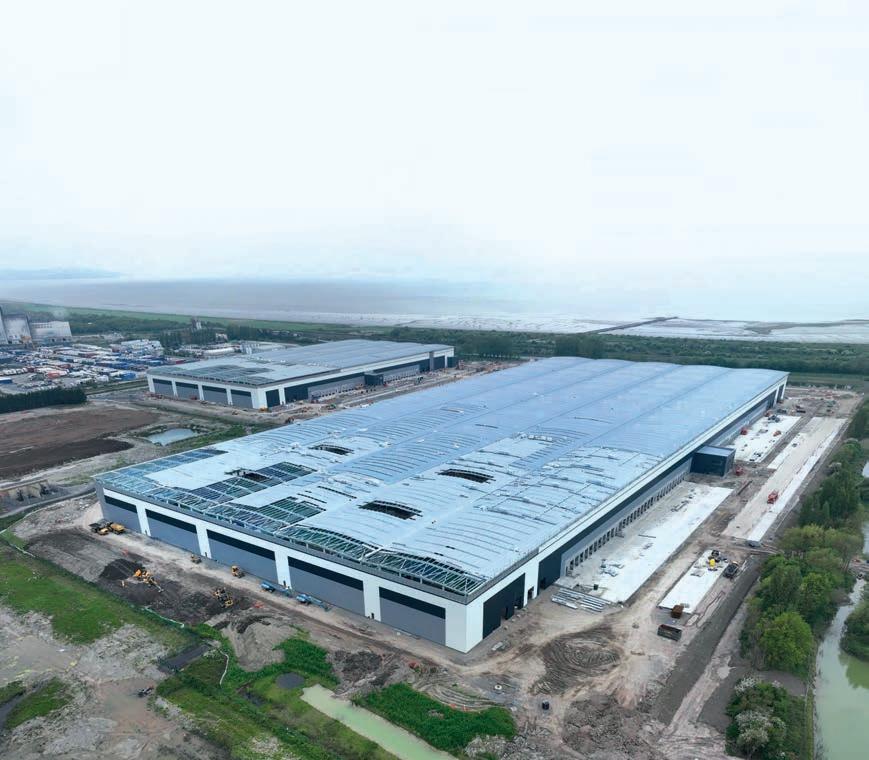
The UK’s largest distribution centre is the Amazon fulfilment centre in Tilbury, with a floor space of two million sq ft
But how much bigger can distribution centres get?
It’s all about economics and cost, according to Caunton Engineering sales director Ian Oliver. “The overall building can be as long as a client wants, but internally, portal-framed structures are only efficient with spans of up to around 40m,” he says.
“Anything longer than that and the design moves into a more bespoke realm and the roof would have to be formed with trusses, which are heavier than single rafters and require more steelwork.”
The UK’s largest distribution centre is the Amazon fulfilment centre in Tilbury, which contains pretty much everything any household would want. The centre has a floor space of 185,806 sq m (two million sq ft).
The ‘golden logistics triangle’
Being close to the major port facilities on the River Thames has obvious benefits for the online retailer. But Essex is not the most favoured location for distribution centres. That accolade goes to the East Midlands and an area dubbed the ‘golden logistics triangle’.
Encompassing parts of Leicestershire, Northamptonshire and Warwickshire, the area has excellent transportation links, being close to the M1 and M6 motorways. This strategic location, in the centre of the country, allows goods to be transported to anywhere in the UK within hours, while the A14 also links the triangle with Felixstowe, the UK’s largest and busiest container port.
Far left: Construction of a Panattoni distribution hub in Doncaster
steel trusses were used to build the Guala Closures factory in Scotland
The triangle is home to an array of warehouse parks, including Magna Park Lutterworth, which is said to be the UK’s first and Europe’s largest dedicated distribution location.
Developed by GLP, as its flagship park, it is home to 29 different occupiers, including Toyota, BT, Asda Walmart, Amazon, DHL and Britvic.
It is a private estate and offers a fully managed, dedicated logistics park environment with 24/7 access, 24-hour security and a controlled HGV circulation.
The park, which is divided into north and south areas, is continuing to expand and, currently, Winvic
with
Construction is building the largest speculative unit GLP has developed to date. Known as MPN 761, the steel-framed 70,699 sq m distribution centre, which is due to complete this summer, features six 30m-wide spans, has an 18m clear height to haunch, and includes a three-storey office and two transport hubs.
Peter Baird, senior construction manager at GLP, says: “The next important phase of development at Magna Park North is a testament to our confidence in the resilience of the UK logistics market and the strategic importance of the Midlands in particular. We are delivering a
best-in-class mega-distribution unit with occupier demand, technological advancements and environmental, social and governance principles at its core.”
Net zero at Magna Park
To this end, a number of sustainability initiatives are in place as the project has been designed to achieve net-zero carbon in construction and a BREEAM Outstanding rating.
“We have partnered with a carbon-neutral subcontractor for the earthworks package and have set up an on-site batching plant for
Panattoni Park Sittingbourne is another huge warehouse development
around 650,000 sq ft of floor space
The overall building can be as long as a client wants, but internally, portal-framed structures are only efficient with spans of up to around 40m
Ian Oliver, Caunton Engineering
all the required ready-mix concrete,” explains Winvic project manager Charlie Caldicott.
“This has the environmental benefit of cutting down on truck movements in the local area.”
Work started on site in June 2024, with an enabling earthworks package and the installation of pad foundations, in readiness for the steel frame erection.
Speed is of the essence for all construction projects, and distribution schemes are no exception. Developers want the buildings up and ready as soon as possible, which is one of the most important reasons for using a steel-framed option.
Proving how quick and efficient a steel erection package can be, using up to four 70 tonne-capacity mobile cranes, the 384m-long structure, requiring 2,470 tonnes of steelwork, was installed in just 11 weeks.
Elsewhere in the Triangle at Magna Park Corby, VolkerFitzpatrick, working with Severfield, has recently completed two portal-framed warehouses, with a combined floor area equivalent to more
Companies like Amazon have driven a boom in the construction of logistics centres
than 20 football pitches, while next to East Midlands Airport and incorporating its own rail freight terminal, SEGRO’s logistics park has plans for further expansion.
As well as Tilbury, UK’s other ports also offer strategic and desirable locations for distribution centres.
With nearby major international docks and rail freight facilities, as well as being close to both the M4 and M5 motorways, Avonmouth near Bristol has become a prime location.
A short distance from the River Severn, developer Panattoni recently constructed one of the UK’s largest-ever speculative developments. The scheme, known as Panattoni Park Avonmouth, consists of two 17m-high units; one offering 37,718 sq m of floor space and a much larger warehouse, measuring 425m by 188m, providing 82,727 sq m.
Working on a design-and-build contract for the now defunct main contractor ISG, Severfield fabricated, supplied and erected 4,900 tonnes of steel for the project.
Ensuring a cost-effective and sustainable approach, the company says that all the steel sections used were engineered to be as efficient as possible.
Sustainability was at the heart of the project as both warehouses achieved a BREEAM Excellent rating and an EPC rating of A. They also benefit from roof-mounted solar PVs, rooflights and EV charging points.
Trusses offer industrial solution While distribution centres are predominantly designed as portalframed structures, when the building has an industrial or manufacturing use or the span exceeds 40m, steel roof trusses are invariably used to create the internal open-plan space. Trusses can form larger spans and are also rigid and robust enough for large equipment items to be supported from their underside. One of the biggest examples of this design is the SeAH Wind facility being built on the south bank of the River Tees. Standing 40m high and measuring 800m
The ‘golden logistics triangle’ encompasses parts of Leicestershire, Northamptonshire and Warwickshire, and has excellent transportation links, being close to the M1 and M6 motorways
in length, on completion the £450m manufacturing plant will be the world’s biggest monopile (foundations used for offshore wind farms) factory and the first of its kind in the UK.
With a maximum width of 210m, the structure has four spans at its widest point, but just one single span for nearly half of its length.
Panattoni Park Avonmouth is a speculative warehouse development
On completion, the £450m SeAH Wind facility will be the world’s biggest monopile factory
A series of large steel trusses, forming a significant portion of the 35,000 tonnes of steelwork supplied by British Steel and erected by Severfield, create the roof of the factory.
A similar steel arrangement was used to build the Guala Closures factory at Gartcosh in Scotland. The company, one of the world’s largest manufacturers of bottle tops, required a building with wide open-plan areas for its production machinery.
The steel frame, which measures 180m by 120m, has perimeter columns spaced at 7.5m centres. These columns support a series of trusses that form the building’s five spans.
“The project was always going to be a steel structure because of the required large open spans, but there was a design discussion about whether to go for a portal frame or use trusses,” explains Hector Munro, managing director of consulting engineer Grossart Associates.
“In the end, trusses were the favoured choice as they create the spans, while also providing the support for internal cranes and space for services within their depth.”
Working on behalf of main contractor Luddon Construction, Walter Watson erected the structural steelwork for the project in a 10-week programme. ●
Kilnbridge covers all angles with Triangle Bridge
Multi-disciplinary contractor Kilnbridge had to prefabricate a new triangle-shaped bridge before floating it by barge to a site in east London and assembling the structure. CM reports on a complex operation
When the new Bridgewater Triangle Bridge was unveiled in Stratford in August, it marked far more than just the completion of another smart infrastructure project in the busy east London suburb.
For main contractor Kilnbridge, awarded the construction contract last year, it was the culmination of a multidisciplinary effort that tested the limits of engineering precision, construction ingenuity and collaboration across every corner of the business.
The story began with the ageing 1930s structure the new bridge was destined to replace.
Decades of service had left the original reinforced concrete crossing inadequate for Stratford's fastevolving landscape. Replacing it required not only removing the old, but doing so while protecting the environment and keeping essential services running.
That task was anything but straightforward. “We had to come up with new and innovative ideas to take this bridge out,” recalls Conor Hogan, project manager with Kilnbridge. “The environmental aspect meant ensuring no demolition debris
entered the river. It was a significant research and development effort.”
Complex demolition in tight windows
The demolition programme was restricted to a fixed winter closure window specified by the Canal and River Trust. Missing it would have delayed the project by up to nine months. Complicating matters further, asbestos was discovered during the temporary bridge construction, requiring specialist removal without disrupting progress.
Kilnbridge deployed a mix of high-spec plant to execute the removal safely and efficiently. Brokk 400 robotic machines with breaker attachments were used to break out sections of the bridge decks, while 20-tonne excavators handled the heavier demolition.
For the beams and piles, WS30 wire saws were deployed, with marine divers installing pulleys underwater to allow cutting below bed level. Every cut was meticulously planned, bridge sections lifted were taken away by barge and waste management carefully controlled.
The total volume of waste
The complexity of the geometry is unusual and unlike most structures that we build Paul Watson, Kilnbridge
removed was significant, with recycling and reuse data still under final review, but the strategy was always geared toward minimising landfill and maximising recovery.
For Hogan, this was where Kilnbridge's holistic capability shone: “This project uses nearly every part of our business: demolition, marine works, reinforced concrete, steel fabrication, waste management, lifting, temporary works design.”
Keeping Stratford connected
Before demolition could proceed, a temporary bridge had to be installed to carry live utilities: gas, water, electricity and district heating. This essential lifeline ensured services remained uninterrupted during the works.
The prefabricated utility bridge, installed ahead of schedule, bridged the gap while giving Kilnbridge the freedom to focus on the main programme. Its dimensions and load capacity were designed specifically for the utility networks, demonstrating the project's complexity even in its temporary phases.
Floating the Triangle Bridge into position
With the old bridge cleared, attention turned to the new
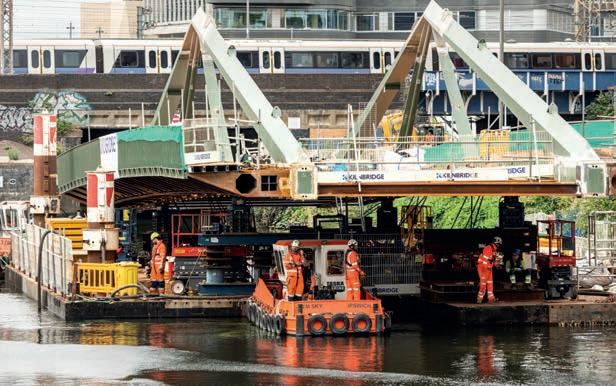
structure: a striking design by William Matthews Associates, working closely with the London Legacy Development Corporation (LLDC) and developers Ballymore. At 44 metres in length and 12.5 metres wide, the new bridge required 322 tonnes of structural steel at installation. The most substantial elements were the main plate girder bottom chords, each 22 metres long and weighing 20 tonnes. Delivered in two halves, they were lifted into place with precision.
In total, the bridge was fabricated into 233 assemblies. To reduce time spent on the constrained site, the main footway was prefabricated into four 20-metre-long modules at K FAB, Kilnbridge's own steel fabrication facility in Northampton.
These were transported to site and bolted into place using tension control bolts, allowing each module to be installed in a single day.
Having in-house fabrication capability gave Kilnbridge a critical edge. “[It] meant we managed the production risks,” says Hogan. “That's a huge benefit in terms of time and control.”
Welding precision
Perhaps the most technically demanding element was the welding of the top chords and roadway hangers. These were fabricated from S460 high-strength steel, a material rarely used in bridge projects of this type. S460 was specified by the designers to allow for slimmer, more elegant hangers,
Project: Bridgewater Triangle Bridge, Stratford
l Client: Ballymore & London Legacy Development Corporation (LLDC)
l Main contractor: Kilnbridge
l Architect: William Matthews Associates
l Start date: September 2024
l End date: Bridge lift completed in August, associated works continue on site
achieving both structural efficiency and architectural intent.
But this material introduced new challenges. Unlike conventional S355 steel, S460 required preheating to around 150°C and the use of ceramic heat pads to maintain that temperature during welding. This controlled process was vital to prevent rapid cooling and hardening, which could lead to brittle fractures. Supplied in K2 subgrade, the steel offered excellent resistance to low-temperature fracture, but only if strict quality procedures were followed.
“It's very intricate,” says Kilnbridge's technical lead for fabrication, Paul Watson. “The complexity of the geometry is unusual and unlike most structures that we build.
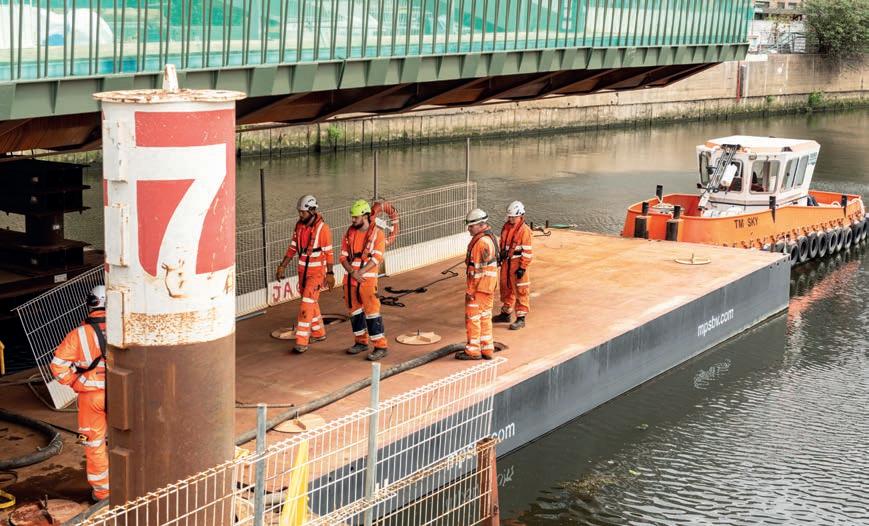
Works to disconnect temporary assembly pontoons
Length in metres of the Triangle Bridge Triangle Bridge in numbers 322 Tonnes of structural steel at installation
150°C
Preheating temperature of the S460 highstrength steel used
“Fabricating a tapering pentagonal top chord requires a strong technical ability and careful planning. You've got to thread pieces through each other and weld internally and externally. Just planning how to make something like this is a challenge in itself.”
Intricate welds sometimes took up to a week per linear metre, with constant correction and straightening to counteract heat warping. Many welds resembled additive manufacturing in their intricacy.
The design team carried out detailed stress analysis and specified a FAT 56 quantified service category to meet fatigue requirements in line with Series 1800 of the Design Manual for Roads and Bridges (DMRB).
“This decision, made in close collaboration with the contractor, ensured compliance while avoiding unnecessary over-specification,” says Watson. “It delivered best value for the client and streamlined the testing process, reducing
Number of assemblies the bridge was fabricated into
programme time, all while maintaining full compliance with Execution Class 3 under EN 1090-2.”
Marine-based methodology
One of the project's defining characteristics was its marine-based construction method.
With the site hemmed in by narrow roads and no space for large cranes, conventional lifting approaches were impossible. The solution was to assemble the bridge on a pontoon, float it into position and jack it down onto its abutments.
This complex manoeuvre drew on Kilnbridge's previous marine experience and required bespoke lifting beams, reinforced modules and carefully designed formwork. The precision of prefabrication meant there was no trial assembly, tolerances had to be right first time.
“We had to make the design work in practice, not just on paper,” says Watson. “There was a robust feedback loop
This is a landmark project for Kilnbridge. It’s really complex and showcases everything we can do all in one place
Ben White, Kilnbridge
CV: Conor Hogan, Kilnbridge
l Triangle Bridge project manager Conor Hogan began his career as a junior engineer and land surveyor with Ncwsurveys in 2012 before moving to Murphy Geospatial.
l He went on to gain site management and engineering experience with Oliver Connell and Son and John Sisk and Son, before joining J Coffey Group as a site engineer in 2017.
The constrained site meant use of a pontoon was the most practical solution
l In 2019, Conor joined Kilnbridge as a senior engineer, progressing to project manager in 2021.
between design intent and construction reality.”
Ben White, Kilnbridge's head of engineering, feels the Triangle Bridge is a flagship project not only for its engineering but also because of how it showcases the company's integrated model, including demolition, marine works, reinforced concrete, steel fabrication, waste management, lifting and temporary works design.
“This is a landmark project for Kilnbridge,” he says. “It's really complex and showcases everything we can do all in one place.”
The Triangle Bridge is also a landmark for Stratford, its sleek architectural form now part of the area's ongoing regeneration, helping to connect communities more effectively. l
What you will learn in this CPD
The legislative context of physical security in construction projects
The risks of late-stage planning
Practical guidance for embedding security into the early design stage
CPD: Planning for physical security in construction projects
This CPD explains how construction professionals can better integrate physical security measures from the outset of a project. By
Richard Ellis FCIOB
Physical security refers to the use of integrated, built-in measures to protect people, assets and infrastructure from hostile threats such as forced entry, terrorism or the use of vehicles as weapons.
Examples include crash-rated bollards, hostile vehicle mitigation (HVM) systems, perimeter fencing, reinforced access points and controlled entry zones. These elements are designed not just to deter and delay attacks, but to protect the public and reduce harm in the event of an incident.
Physical security has become a critical component in the design and delivery of public infrastructure, particularly in light of emerging legislative duties and an evolving threat landscape that includes terrorism and the increasing use of vehicles as weapons.
Yet in many construction projects, security is often treated as a relatively small procurement package within the overall project scope. As a result, it may not receive the level of early consideration it truly requires.
This late-stage approach can increase costs and risks, introduce technical complications and reduce overall integration quality, potentially undermining stakeholder confidence and the long-term effectiveness of security measures.
The implications of late-stage security integration
Physical security, such as HVM, perimeter barriers and street-level protective measures, is frequently addressed toward the final stages of project delivery. Typically procured alongside landscaping or street furniture, these packages are sometimes viewed as non-critical and, as a result, deprioritised in procurement and planning schedules.
However, effective physical security is far more complex than the installation of bollards or fences. It requires early coordination across multiple disciplines, including structural and civil engineering, utilities planning, architectural design and procurement.
Delaying this coordination can introduce a range of costly, technical and reputational risks, such as:
Delaying this coordination [of security integration] can introduce a range of costly, technical and reputational risks
l Increased cost: late-stage design changes can eliminate value engineering opportunities and result in costly rework. Ill-considered substitutions may also compromise performance or aesthetics.
l Programme risk: many certified HVM products have long lead times due to bespoke design and manufacture. Without adequate planning and a clear lead-in period, late procurement can disrupt the construction programme.
l Engineering and substructure constraints: below-ground services, bridge decks, suspended slabs, movement joints and sitespecific loading restrictions must all be assessed early. Accurate topographical surveys and validated utility data, ideally supported by trial holes, are essential to inform safe and buildable solutions.
l Compromised public realm: security measures added late may clash with architectural intent, clutter public spaces or create visual disruption.
l Over or misspecification: without an early-stage Vehicle Dynamics Assessment (VDA),
there’s a risk of selecting products with unnecessarily high impact ratings, leading to increased costs and deeper foundations than are needed, or conversely, choosing insufficiently rated systems that compromise safety.
l Poor value engineering decisions: choosing the cheapest option without understanding performance
Effective physical security is far more complex than the installation of bollards
implications can undermine security certification, durability or site suitability. Best value means selecting products that are appropriate, effective and aligned with long-term operational needs, not simply the lowest upfront cost.
l Installation and compliance risks: HVM systems must be installed strictly following the manufacturer’s
design, specification, and installation method statement (MS). Competent installation is critical to ensuring certified performance.
l Lack of training and technical knowledge: early engagement with a reputable HVM supplier provides access to product training, education and bespoke design support, helping the project team select the right
solution for site constraints, threat levels and visual goals.
l System suitability and foundation considerations: not all sites can accommodate deepmounted or automatic systems.
Shallow-mount or surface-fixed options may be more appropriate where ground conditions, services or slab depths are limiting. These challenges are especially pronounced on retrofit or refurbishment projects, where existing site conditions are often less predictable and difficult to verify in advance. Early engagement, proper data collection and proactive supplier collaboration are essential to minimising risk, delivering best value and ensuring security measures perform as intended.
Relevant legislation and technical standards
Security-related responsibilities in construction are governed by a range of standards, best practice guidance and legislation. These frameworks should be consulted during the early design and planning stages to ensure both compliance and suitability.
Core standards and frameworks for physical security
l BSI PAS 68, IWA 14-1 & ISO 22343-1: the international standards for impact-tested vehicle security barriers. The ISO 22343 standard is the most recent; products will be tested to this standard going forward (from 2023 onwards). These standards set out performance classifications for barrier systems subjected to vehicle impact.
l BSI PAS 69, IWA 14-2 & ISO 22343-2: guidance on the design, layout and deployment of vehicle security barriers. Still commonly referenced for urban design
coordination and barrier positioning.
l Vehicle Dynamic Assessments (VDAs): site-specific analysis used to assess likely impact threats, vehicle approach speeds and required standoff distances. VDA assessment should be undertaken by an RSES security advisor and/or appropriately qualified consultant.
l ISO 31000 & SABRE Risk Management Frameworks: used to guide threat-based decisionmaking, relevant for the early stages of HVM planning and selection, as well as guiding the implementation of schemes. Compliance and procurement references
l Secured by Design: UK Police guidance promoting crime prevention through environmental design. Frequently referenced in public realm and infrastructure projects.
l NPSA (formerly CPNI) Catalogue: government-maintained
register of tested and approved security products.
l PSSA membership and RSES certification: indicators of competence for security consultants, specifiers, manufacturers, installers and contractors working with protective measures.
Legislative and regulatory drivers
l Protect Duty (Martyn’s Law): proposed legislation (standard and enhanced) requiring publicly accessible locations (PALs) to assess and mitigate terrorism threats. While not yet in force, it is already shaping procurement decisions for event venues, public spaces and transport hubs.
l Building Safety Act 2022: introduces the requirement for a digital ‘golden thread’ of safety-related decisions and documentation from RIBA Stage 1. Physical security measures,
Physical security is a critical component in the design of public infrastructure
Coordinating security into project planning
For physical security to be effectively integrated, it must be addressed from RIBA Stage 1 onwards. Early engagement allows construction professionals to coordinate with security engineers, architects, civil contractors and manufacturers to design solutions that are:
l Appropriate for purpose, based on defined threat levels
l Structurally feasible, with loadings and installation depths coordinated with foundation works
l Visually consistent with the public realm design intent
particularly those affecting public interface and structural safety, should be documented accordingly.
l Construction (Design and Management) Regulations 2015 (CDM): dutyholders must ensure that the installation of security products does not introduce health and safety risks, especially where temporary works, excavation or service diversions are involved.
l Equality Act 2010: physical security measures installed in the public realm must not create physical barriers or exclude users with disabilities. Designers must ensure inclusive access is maintained.
l Manual for Streets/Local authority public realm guidance: where bollards, barriers or furniture are placed in shared or pedestrianised spaces, they must comply with local streetscape and accessibility guidance to avoid obstruction, clutter or design inconsistency.
l Compatible with surrounding infrastructure, access routes and street furniture
l Pedestrian-friendly, maintaining permeability and movement through spaces while avoiding excessive clutter or pinch points
l Inclusive by design, ensuring compliance with the Equality Act 2010 and providing safe, unobstructed access for all users, including those with mobility impairments.
On retrofit projects, early-stage site surveys and trial hole digs are essential to identify the topography of the area and constraints such as underground services, utility covers, suspended slabs and adjacent structures.
This information informs appropriate product selection and avoids unnecessary rework. On new-build schemes, the opportunity exists to incorporate security measures into civils and substructure works, simplifying delivery and reducing long-term risk.
The evolving threat landscape
Physical security planning is shaped by an evolving threat landscape. Vehicle-as-a-weapon attacks remain a concern for public infrastructure, transport hubs and pedestrianised zones.
While such events may be infrequent, the impact of a single hostile incident can be catastrophic. A prolonged absence of high-profile attacks may lead to complacency, but risk assessments must continue to account for evolving threats and emerging attack methodologies.
Design and construction professionals have a duty to ensure that protective measures are proportionate, contextually appropriate and integrated with the intended use of the site. In
The former main entrance road was removed and replaced by an open atrium-style space
Case study: Paddington Station
ATG Access was engaged from the earliest design stages of Paddington Station’s major refurbishment to develop HVM and protection against accidental vehicular impact.
The project team worked closely across disciplines to integrate protective measures with the station’s complex structural and architectural requirements. The overall design followed a fixed rectangular grid scheme, which guided the placement and geometry of streetlevel elements, including protective infrastructure.
To align with these constraints, ATG Access developed custom-designed rectangular bollards and impact-tested them to meet the required standards. Shallow foundations were used to avoid clashes with belowground services, simplifying
installation and minimising disruption. These measures were integrated into key zones throughout the public realm to provide effective security without compromising the site’s aesthetics.
Vehicle constraint cells
As part of the redesign, the former main entrance road was removed and replaced by an open atrium-style space. This created a new risk as vehicles transacting through this space were at risk of falling into the open lower levels of the lower station. To mitigate this, ATG Access was able to develop and embed vehicle constraint cells into the substructure of benches positioned around the space. These solutions absorb impact energy while preserving the visual openness of the design. Within the station itself, a number of structural columns were identified as vulnerable to accidental vehicle impact. These columns were complicated by the fact that they included drainage elements, requiring tailored protection without disrupting their function. Energyabsorbing column guards with shallow foundations were developed and installed to address this risk without compromising aesthetics or space.
The Paddington scheme demonstrates how early-stage engagement enables tailored engineering solutions to be aligned with both structural and architectural constraints. In this case, engaging physical security specialists from the concept stage allowed the team to meet multiple assurance and programme requirements without incurring delays or costly redesigns.
Failure to apply this level of professional judgement can compromise public safety and expose clients and duty holders to significant legal, financial and reputational consequences
the built environment, this means balancing functionality, aesthetics and public safety with legal and operational requirements.
Importantly, best value does not mean choosing the cheapest option; it means selecting solutions that offer proven performance, long-term durability and compatibility with the site’s overall design and risk profile. Failure to apply this level of professional judgement can compromise public safety and expose clients and duty holders to significant legal, financial and reputational consequences.
Key takeaways for construction professionals
Successfully integrating physical security into public infrastructure requires early and informed involvement from construction professionals. Where multiple stakeholders are involved, a clear decision-making structure must be established to prevent procurement and project delivery delays. Security measures, particularly HVM systems, must not be treated as off-the-shelf components added late in the process. Early collaboration with accredited security manufacturers and consultants is essential to ensure the right solutions are selected, correctly specified and properly installed. Look for indicators of competence such as compliance
with internationally recognised impact test certification, which help distinguish organisations with the necessary expertise, product performance and compliance.
Not all suppliers offer products that meet the required threat level or provide advice grounded in real-world operational needs, making third-party validation even more important.
By engaging qualified partners from the outset, asking informed questions around threats, certification and competence, and ensuring coordination across disciplines, construction professionals can support security strategies that are technically robust, cost-effective and sensitive to the architectural and operational context. ● Richard Ellis FCIOB is the managing director of HVM and physical security solutions company ATG Access.
HVM systems must be strictly installed to the manufacturer’s design
CPD Questions
1) Which of the following is a key purpose of a Vehicle Dynamics Assessment (VDA)?
a) To determine the visual consistency of barriers with the public realm
b) To assess likely vehicle impact threats and required standoff distances
c) To ensure security products are installed in compliance with method statements
2) Which piece of proposed UK legislation requires publicly accessible locations to assess and mitigate terrorism threats?
a) Protect Duty (Martyn’s Law)
b) Building Safety Act 2022
c) Equality Act 2010
3) What is the main benefit of engaging HVM suppliers early in a project?
a) They can reduce the need for compliance with local authority guidance
b) They guarantee that the cheapest product options are available
c) They provide training, design support and help select site-appropriate solutions
4) At what stage of the RIBA Plan of Work should physical security ideally be integrated into construction projects?
a) Stage 1 (Preparation and Brief)
b) Stage 4 (Technical Design)
c) Stage 6 (Handover and Close Out)
5) Why is accurate utility data and the use of trial holes important when planning HVM installation?
a) They reduce the need for supplier engagement during design
b) They ensure below-ground services and structural constraints are understood early
c) They allow over-specification of foundations to guarantee maximum protection
To test yourself on the questions above, go to www.construction management.co.uk/cpd-modules
Claire Burrows Brabners LLP
‘Our scaffolding has collapsed.
What are the legal implications?’
This month’s contract clinic centres on a refurb job where the scaffolding has blown down. Claire Burrows provides guidance on the legal implications
THE QUESTION
The scaffolding on a mill refurbishment project we’re working on near Leeds has collapsed in recent high winds, injuring a member of the public and causing damage to both our project and a neighbouring building. What action do we need to take to minimise legal costs?
THE ANSWER
For any construction business, this kind of incident is a legal, financial and reputational crisis. So, what steps should be taken to manage the fallout and minimise legal costs?
The immediate priority is safety. Emergency services should be contacted, and the injured party must receive medical attention. The site must be secured to prevent further harm and preserve evidence.
Next, document the scene thoroughly. Capture photographs of the collapse and surrounding damage, gather witness statements and record site conditions, including weather and any relevant activity. This information will be vital for legal defence and insurance claims.
Legal reporting obligations
Under the Reporting of Injuries, Diseases and Dangerous Occurrences Regulations 2013 (RIDDOR), this incident must be reported to the Health and Safety Executive (HSE). Injuries to members of the public caused by work-related accidents are reportable.
Scaffold collapses may also qualify as dangerous occurrences, particularly if a substantial part of a scaffold more than five metres high collapses or a working platform falls.
Failure to report promptly is a criminal offence and can result in prosecution and fines.
Notify insurers and seek legal advice
Most construction firms carry Contractors All Risk and Public Liability Insurance, which should cover property damage and thirdparty injury. Legal expenses cover may also be included for defending HSE investigations or prosecutions. However, as health and safety offences are criminal in nature, fines following conviction are not insurable.
Scaffolding collapses are rare but high-impact events with potentially severe consequences
Importantly, policyholders are free to appoint their own solicitor, not just those on the insurer’s panel. Engaging a specialist with experience in health and safety defence can be critical.
Policies typically require notification “as soon as possible” (ideally within 48 hours), and failure to comply may result in denial of cover or reduced compensation. Provide a detailed incident report, supporting documentation and contact details for those involved. Loss adjusters will likely be appointed, so cooperate fully, but always take legal advice before signing documents or making formal statements.
Preventing future incidents
Conduct a thorough internal investigation to determine the root cause of the collapse. This should be led by a competent person and follow HSE guidance, examining structural failure, erection methods and environmental factors such as wind loading.
Key questions include:
l Was the scaffolding erected and inspected according to regulations?
Question for contract clinic? Email construction-management@atompublishing.co.uk
l Were weather risks properly assessed and mitigated?
l Were workers and subcontractors competent and adequately supervised?
l Legal advisors can support this process and, where appropriate, investigations may be conducted under legal privilege, meaning findings are not disclosable to
third parties, including the HSE. This allows for a candid review and supports meaningful improvements.
Communication and reputation management
Incidents like this often attract media attention. In conjunction with PR and legal teams, it may be appropriate to prepare a clear,
When scaffolding has collapsed, the immediate priority is safety
factual statement acknowledging the incident and outlining the steps being taken. Transparency builds trust, but avoid speculation or assigning blame.
All employees and subcontractors should be instructed not to comment and to refer any media enquiries to a designated spokesperson.
Conclusion
Scaffolding collapses are rare but high-impact events with potentially severe consequences, especially when members of the public are involved. By responding swiftly, reporting correctly, engaging legal and insurance professionals and investigating thoroughly, construction firms can minimise costs and embed stronger safety and compliance protocols.
Ultimately, protecting your workforce, the public, and your business is best achieved through proactive, not reactive, risk management. l Claire Burrows is a partner at Brabners LLP, specialising in regulatory compliance.
Digital Construction Awards 2026: could you win an Oscar?
There’s a month left to enter the Digital Construction Awards 2026. The deadline to compete for an industry Oscar is 31 October
The Digital Construction Awards 2026 celebrate best practice and reward innovation in the application of BIM, information management and digital technology in the built and managed environments. The shortlisted entrants will be revealed on
12 January 2026. The trophies will be awarded to the winners at a gala dinner in front of 400-plus of the sector’s leading lights on 18 March 2026 at the Marriott Grosvenor Square in London.
Partners for the Awards are the Chartered Institute of Building, Digital Construction Week,
Construction Management and Digital Construction Plus.
There are 16 categories in total, meaning wherever you are in the supply chain, there will be a category to suit you. We have continued to refine entry requirements in response to feedback from entrants and our judges.
2025’s digital construction Oscar winners: will you be on stage next year as a winner?
The trophies will be awarded to the winners at a gala dinner in front of 400-plus of the sector’s leading lights on 18 March 2026 at the Marriott Grosvenor Square in London
The full list of categories is:
l Digital Construction Project of the Year
l Digital Contractor of the Year
l Digital Consultancy of the Year
l Digital Team of the Year
l Digital Collaboration of the Year
l Digital Rising Star of the Year
l Digital Construction Champion of the Year
l Best Application of Technology
l Product Innovation of the Year
l Information Management
Best Practice
l Delivering Sustainability with Digital Innovation
l Asset Management Best Practice
l Digital Innovation in Health, Safety and Wellbeing
l Digital Innovation in Productivity
l Best Use of AI
l Design Innovation
Karolina Orecchini, event director, Digital Construction Week
The winners will be revealed in front of more than 400 guests
This year’s winners included Alconex Infrastructure and Solutions (named Digital Contractor of the Year), Laing O’Rourke (which won Digital Innovation in Health, Safety and Wellbeing), and McLaren Construction (which won Digital Team of the Year). The Belfast Grand Central Station secured the prestigious Digital Construction Project of the Year. You can remind yourself of all the winners and why they won by reading the September issue of CM. l
To find out more about the Awards, head to digitalconstructionawards.co.uk.
To become an Awards sponsor, email Karolina Orecchini at korecchini@divcom.co.uk.
For entry queries, email Justin Stanton at justin.stanton @atompublishing.co.uk.
10 tips for a compelling entry
To improve your chances of winning an industry Oscar, read and observe the following tips
1 Study the criteria closely. You cannot resubmit an entry from the 2025 event. Your entry must focus on work carried out in the UK or work for the benefit of the UK industry.
2 Make sure you’re entering the correct category.
3 Review who won last year and read about their winning entries to understand what caught the judges’ attention last year.
4 The entry form sets out the story that your entry needs to tell. Answer the questions and provide the information requested.
5 Take the time to draft a formal entry rather than simply uploading
content from marketing collateral: your entry will be all the better for this.
6 Use clear, plain English.
7 Jargon: construction is awash with it, but please avoid using too much of it in your entry.
8 Be mindful that, as experienced and knowledgeable as the judges are, they may not have heard of your firm or project before. Provide the necessary context.
9 In most categories, the outcome of the work that your entry focuses scores double in the judging phase, so make sure you share detailed results of your work.
10 Get a colleague to proof your entry before you submit it.
The Jenner way: how the group thrives on challenging projects
From Europe’s largest concrete roof in 1936 to a multi-storey suspended skate park in 2022, chartered company Jenner Group has a 150-year history of tackling complex projects. Nicky Roger reports
Whether it’s delivering an affordable housing complex on a tight budget or creating feats of engineering with concrete, Jenner Group relishes challenges.
Starting life as decorators and builders, regional contractor Jenner Group is celebrating 150 years in business, a milestone the company says is the product of good management, a positive attitude and a desire to provide clients with best value and exceptional service.
These core values have seen the company grow into an awardwinning 160-people-strong business and become the largest and longest-standing regional contractor in Kent, with a group structure that encompasses many disciplines.
Diversification isn’t something new. In the early days, the drive to explore different skills and markets saw the company turn their hand to coffin-making at one point.
From its early roots, Jenner was never one to shy away from the complicated. In 1936 the company secured a contract to build the Folkestone Rotunda development, which housed the Palace of Amusements and Boating Pool, and was famous for being Europe’s largest clear-span, self-supporting reinforced concrete roof structure. The concrete was batched on site and the roof was poured in one continuous operation that took 24 hours to complete.
Today the company is still drawn to the complicated, having recently completed Shoreline, a development of 60 apartments, 20 interconnecting townhouses and four duplexes – a project that marks the initial phase of an ambitious 1,000-unit masterplan for Folkestone seafront and harbour. Serendipitously, Shoreline is built on the old rotunda site, so is something of a homecoming for Jenner. Requiring more than 200 piles, driven 27 metres deep, featuring a mix of convex and concave curves and facing the English Channel, and therefore subject to the best and worst of British weather, it’s a project that would test the best. The finished result shows refined craftsmanship with attention to detail.
In contrast is F51. Located a stone’s throw from Shoreline, F51 is the world’s first multi-storey skate park and another complex scheme. A feat of engineering – the first floor features a two-metre thick suspended concrete skate bowl – it comprises three floors of skating and the third tallest climbing wall in the south-east of England. The building also grows out of the site, increasing in size as it rises: a huge parallelogram that cantilevers up and out towards the sky. Jenner installed 485 bespoke facade panels – all while working under Covid restrictions. Both of these schemes owe much of their success to two experienced project managers, both members of the CIOB.
Jenner Group is celebrating 150 years in business
A family ethos and peoplefocused culture are intrinsic to our present and future Martin Sandall
F51 is located a stone’s throw from Shoreline It is the world’s first multi-storey skate park
Core to this culture is the value that being a CIOB member company brings and the support this offers to our staff through information sharing, best practice, mentoring and training
Martin Sandall
Nigel Griffiths, responsible for F51, was shortlisted as a finalist in CIOB’s Construction Manager of the Year Awards in the Public and Leisure category in 2022. Later that same year Chris Page, who managed the complex Shoreline development, was crowned Community Champion at the national Leading Lights award as part of the Considerate Contractors scheme mid-way through construction.
While Jenner doesn’t shy away from the complex, its core work sits firmly within private and affordable housing, care, education, health and community sectors. However, its problem-solving approach is something that is paying dividends across these other sectors.
We’ve built a team that can deliver the highly complex and take this experience and use it to add value to projects that, while more straightforward on the surface, have their own intrinsic challenges,” commented Martin Sandall, Jenner Group’s managing director.
“Often, we need to apply an element of value engineering. It’s a case of how we can deliver high-quality projects while meeting a client’s budget and without any compromise or diminishing of architectural intent. This experience of delivering the complex, problem solving, looking at different materials and techniques, and using technology to provide
Shoreline in Folkestone is built on the old rotunda site
on-site efficiencies really helps in these situations.”
This value-led approach means Jenner looks closely at how it delivers projects and its supply chain, and has led to the company investing in the creation and acquisition of several businesses.
In the past few years, its former General Works division has rebranded to become Park Farm Construction, sitting alongside existing businesses of Park Farm Glazing and Park Farm Joinery. In addition, the acquisition of plumbing and heating contractor, Reina, and the creation of Park Farm Civils, a new subsidiary that will focus on the delivery groundworks services, has provided additional in-house resources and skills.
“Our business operations are far removed from those back in 1875 when trading commenced, but we do continue to strengthen, grow, adapt and capitalise on the market just as the business did back then,” continued Sandall. “A key aspect
of that is looking at opportunities to diversify our services with the introduction of a number of specialist businesses, that can not only support Jenner (Contractors) but also work independently for other main contractors.”
“Relationships and reputation are everything, and an embedded family ethos and people-focused culture, that has witnessed the business handed from trusted leader to leader are intrinsic to our present day, and most importantly to our future.
“Core to this culture is the value that being a CIOB member company brings and the support this offers to our staff through information sharing, best practice, mentoring and training. As a respected chartered building company, this affiliation is paramount to preserving our strong reputation and the respect we have gained over the years. Conducting our business with professionalism and integrity at its core will always be the Jenner way.” ●
BIMplus is now CM Digital
In response to the increasing focus on information management and digitalisation among digital construction professionals, BIMplus has rebranded as CM Digital.
The same award-winning BIMplus editorial team will be creating the same high quality content, including interviews, project case studies, and news about the latest digital construction developments.
CIOB regional student competition welcomes new hubs
Construction students will be competing against each other in two new CIOB Student Challenges
Trades apprentices get hands-on at Lichfield centre
This seasoned CIOB event sees teams from various regional universities pitted against each other in a day spent working on a brief that is then presented to a judging panel of industry representatives, university staff and sponsors.
This month sees two inaugural events: one in the Midlands & Eastern region on the 5th and another in Yorkshire & Humber on the 8th.
“We are thrilled about the potential benefits it will bring to our educational institutions, employers and, most importantly, students,” says Susie Kearns, member services and events co-ordinator at the Midlands & Eastern Region Hub.
“The CIOB Regional Student Challenge aims to engage students, identify future leaders and provide important links with industry representatives. These events, in other areas of the country, have not only been enjoyable and rewarding, but have also led to the recruitment of many talented students as full-time employees.”
The Midlands & Eastern event takes place at ARU Chelmsford and will see teams of 4-6 students studying at Level 4 and above.
The topic is Tackling a Global Housing Crisis. Prizes include site visits, two separate week’s
Construction professionals can take a tour of the NHBC Multi-Skill Training Hub in Lichfield next month and see how the facility prepares trades apprentices for working on an active site.
Focusing on the trades that are in the greatest demand for building houses, the hub is funded in partnership with the CITB, with land provided by Barratt/ Redrow, and is designed to replicate
These events, in other areas of the country, have not only been enjoyable and rewarding, but have also led to the recruitment of many talented students as full-time employees
Susie Kearns
work experience with Bowmer & Kirkland and Willmott Dixon for the ‘stand-out’ students and Amazon vouchers for each student in the first and second place team.
The Yorkshire & Humber Student Challenge is also being run as the first of its kind in the region. It will be held at the University Campus North Lincolnshire in Scunthorpe.
“The university is relatively new to running construction-based courses and, by hosting it there, we are hoping to give them and their students exposure to industry professionals in CIOB,” says Maggie Simmons from the hub. The students will discover the brief on the day.
The one-day event is sponsored by Henry Boot Construction (Gold), Total Training and Development and British Steel (Silver) and Hays Recruitment Construction Department (Bronze).
The North West Student Challenge will take place on 5 November. ●
site conditions while allowing learning in a safe environment.
NHBC became a registered apprenticeship provider in 2020 and opened its first training hub for bricklaying in Lichfield in May 2021. CIOB members and non-members will tour the hub led by technical trainer Leigh Jakeman MCIOB. The visit takes place on 24 November.
NHBC to host tour of its training hub
Experts to get granular on retrofit in East Midlands
The East Midlands retrofit sector faces both challenges and opportunities, and Collaborative Conversations East Midlands 2025 is set to tackle them head-on
Industry
bodies publish guide on product safety
New publication signposts industry best practice
A free guide aimed at improving the safety of buildings has been published by CIOB and other professional bodies.
The publication, titled Guide to Products Critical to Safe Construction, provides designers, specifiers and installers with the information they need to make informed decisions about construction products and includes examples and case studies to
Taking place at Derby’s Museum of Making on 5 November and hosted by professional bodies – CIOB, ICE, LI, RIBA, RICS and RTPI – the event will bring together experts to discuss procurement, community retrofit, place-based approaches and how to measure project outcomes.
Mike Siebert, gateway manager at Nottingham Trent University, will chair the session, joined by industry leaders including Steve Kemp of OpenPlan, Rebecca Reynolds of Equans UK & Ireland, Codrina Cretu of Nesta and Adam McPartland of Glancy Nicholls Architects. The half-day event combines a panel debate, audience discussion and Q&A. ● Register via www.ciob.org/events
signpost industry best practice, such as the Code for Construction Product Information.
Paul Nash, chair of CIOB’s Quality Implementation Group, said: “The public inquiry into the Grenfell Tower fire exposed a construction product regulatory regime that was failing to ensure that the products used in buildings, whether separately or part of a system, were safe.
“Following on from the findings of the Building a Safer Future Report and the Independent Review of Product Testing and Certification, the inquiry recommended that further action was needed to better regulate the manufacturing, testing and supply of products in the UK.
“In February 2025, the government published a
Construction Product Reform Green Paper that sets out its proposals to deliver a system that guarantees safe products, safely used.
“It is against this backdrop that CIOB, together with other professional bodies, has developed this Guide to Products Critical to Safe Construction to ensure the buildings we create, and the products we use in those buildings, are safe for those who use them, now and in the future.”
The guide was published in collaboration with the Construction Products Association [CPA], Code for Construction Product Information [CCPI], Institution of Structural Engineers [IStructE] and Royal Institute of British Architects [RIBA].
CIOB apprentice of the month:
Liam Major, assistant site manager, Croudace Homes
How do you feel the apprenticeship has prepared you for a career in the industry?
Doing the apprenticeship work while you’re employed gives you a good understanding of what goes into each role. Having real-world opportunities while you’re learning gives you a better understanding of what you’re trying to achieve from it all and how you can use those skills in the workplace. It also gives you a good foundation of work and shows you exactly what technical skills you need.
What are your future career ambitions?
In the short term, I’d like to run a phase of the site I’m currently on, then become the site manager of the phase myself so that I can then have a better understanding of how the overall project works. Then use what I’ve learnt to have the responsibility of running further sites. I’d like to be able to keep progressing, keep taking on new roles, new responsibilities and being able to have more of an input into how the company functions.
How do you think we can make the construction industry inclusive for all employees?
By having everybody included in different projects. Whether you’re an apprentice or you’re new to a role or you’ve been in there a long time, people from different backgrounds always benefit the industry because everybody’s had a different experience in life. Collaborating with everyone gives a better outcome.
What would be your dream project to work on in the future?
My dream project would be a large site where there are lots of different things going on. These days sustainability is quite high on the list, so having all the new technologies coming into a project and making sure houses are somewhere people would like to live and that they’ve got nice, clean, open spaces are vital.
Passionate and active: two new CIOB client champions
Renshaw and Bennion recognised for their work
Two CIOB members have become the latest CIOB client champions: Leigh Renshaw FCIOB, responsible engineer and associate director for construction at AstraZeneca; and Jack Bennion MCIOB, designer at Redrow North West.
CIOB seeks experts for Sector Led Group for Quantity Surveying
This collaborative initiative aimed at shaping standards will include client-side, contractor-side and dispute resolution competencies
Experienced UK-based quantity surveying professionals are invited to submit expressions of interest to join CIOB’s Sector Led Group for Quantity Surveying, a collaborative initiative aimed at shaping and advancing standards of competence across the discipline.
This group will bring together industry representation to define and promote best practices relating to the role, function and specialisms within quantity surveying.
The scope of the group focuses on competence in building safety across the built environment, encompassing all stages of the RIBA Plan of Work. It includes clientside, contractor-side and dispute resolution competencies, with an
emphasis on collaboration and shared learning. This initiative goes beyond responding to legislation –it is fundamentally about keeping people safe.
As part of a wider network of Sector Led Groups, this team will work closely with others and report regularly to the Industry Competence Steering Group (ICSG), which falls under the Building Safety Regulator.
The group will meet four times a year virtually and this is a voluntary role. Reasonable expenses will be covered by CIOB. ● For further information on how to apply, contact Ros Thorpe, director of education and standards, at rthorpe@ciob.org.
This group will bring together industry representation to define and promote best practices
CIOB Client Champions are recognised for delivering excellence in their particular sector and who give up their time and expertise to help create resources that will benefit less experienced clients, end-users and society at large.
Renshaw has more than 25 years of experience in the industry, working in multiple contractor and client-side roles. AstraZeneca is a global pharmaceutical company and, as CIOB Client Champion, Renshaw aims to create a bridge between the life-sciences sector, global construction organisations and the wider built environment, raising the profile of construction and myth-busting around commercial challenges, modern professionalism and neurodiversity.
He is an advocate for demonstrable competence, CPD, strict adherence and traceability to process, and the development and mentoring of a diverse talent pipeline throughout STEM, life-sciences, academia and the construction Industry.
Bennion is a passionate advocate for the future of the built environment. After graduating from Nottingham Trent University with a BSc (Hons) in Architectural Technology, he joined Redrow’s graduate scheme in 2018, specialising in design within the technical team.
He earned his chartership at 25, became the youngest CIOB Vice-Chair at 26 and was a finalist for the CIOB’s Rising Star award.
From left: Leigh Renshaw FCIOB and Jack Bennion MCIOB
Derby’s Friar Gate: tour the progress on regen project
CIOB is offering an exclusive site visit to Friar Gate Goods Yard in Derby City Centre
Hosted by M Lambe Construction, Groundworks & Civil Engineering, the tour on 9 October will explore one of Derby’s most ambitious regeneration projects and discover how a Grade II-listed landmark is being transformed into a new community.
The historic goods yard built in the 1870s was derelict for more than 50 years and is being
It is being transformed into a mixed-use development of 227 two- and three-bedroom townhouse and a four-storey apartment building with 49 contemporary apartments
redeveloped by Wavensmere Homes. It is being transformed into a mixed-use development of 227 two- and three-bedroom townhouse and a four-storey apartment building with 49 contemporary apartments. The Bonded Warehouse and Engine House will be turned into a space for shops, restaurants, offices and a gym. All homes will benefit from air-source heat pumps, solar PV panels and EV charging. Attendees will hear first-hand about the project’s progress and challenges and see how sustainability and innovation are shaping this landmark development. ● For further details, visit www.ciob.org/events
One to watch
Aimee Shann
FCIOB,
quality manager, Wates
What made you choose to follow a career in construction?
I was drawn to it because of its constant evolution and the opportunity to make a real impact. Whether it is a building where people live, work, learn or relax, construction touches everyone’s lives. I loved the idea of being part of something that shapes communities.
You have achieved Fellowship at 30 – the youngest ever! What drives you? What does FCIOB mean for your career?
I have always been motivated by the chance to challenge myself and raise standards. Fellowship demonstrates capability and provides a platform to influence change and support the next generation of professionals. It is already opening doors to new opportunities and expanding my network across the industry.
What are your career ambitions?
I am passionate about quality and business improvement, with a focus on supporting site teams in delivering high standards efficiently. I understand the pressures of day-to-day site management and aim to make quality processes more intuitive and less burdensome, ensuring we build to the highest standards while maintaining robust records. My ambition is to influence
how quality is understood and embedded across the industry, championing smarter practices that reduce defects and improve quality for clients and end users. Long-term, I aspire to take on a leadership role.
What industry trends are you excited about?
The rise of digital tools, AI and emerging technologies is incredibly exciting. These innovations are transforming how we work and make data-driven decisions. It is an exciting time to be part of the industry, especially as we start to see these tools integrated into everyday operations.
How do you spend your spare time?
Outside of work I enjoy pilates and yoga, which give me space to reset and reflect. I love travelling and exploring new places. I am the vice-chair of the West Yorkshire CIOB committee, which allows me to give back to the industry and stay connected to the wider construction community.
Friar Gate Goods Yard will offer a mixed-use space. Image: Wavensmere Homes
Value judgement
Jalpesh Patel, industry development manager – infrastructure at Bluebeam, on why smarter estimating makes a stronger industry
Construction is notorious for its low profit margins, leaving contractors with little room for error. With such fine lines, firms are under pressure to reduce risk.
Accurate estimating is essential to profitable construction. Done well, it highlights potential problems and gives project managers time to develop mitigation strategies. Done poorly, it can push projects to a loss.
But estimating is not just about cost savings. The Procurement Act 2023 shifts the focus onto delivering social and economic value via ‘the most advantageous tender’ rather than ‘the most economically advantageous tender’.
This is where technology can make a difference. Digital tools are not only helping estimators work with greater accuracy, but they are also making the process faster, more transparent and more efficient.
Moving beyond spreadsheets
Traditional estimating methods have their place, but for complex projects with multiple stakeholders, they can’t always keep up. Manual take-offs and isolated spreadsheets create bottlenecks, limit collaboration and introduce risk. In today’s environment, a missed detail can mean lost work and impact profit margins.
Digital platforms such as Bluebeam enable estimators to work directly from project PDFs, taking precise measurements, exporting data instantly into familiar formats and overlaying revisions to spot changes in seconds. This doesn’t just save time, but also ensures every estimate is based on reliable, real-time information.
For example, Burmor Construction used Bluebeam Revu from the start of its Elliott Road residential development. The team developed the initial bill of quantities for the scheme to help them accurately price
the job. The software provided huge time savings, making the process of measuring the different elements of the project simple. It also helped make work with the client more efficient. “Presenting our plans in a live environment using Revu and marking them up collaboratively was very easy,”
Sam Harwin, senior quantity surveyor at Burmor, explained. “It’s also great for our relationship with the client because it makes everything clear.”
Boosting automation
However, spreadsheets remain an important part of the quantity estimation process as stakeholders on the client side often want to examine information in a familiar format. Automatic exporting between documents is the optimal way to create spreadsheets. In this way, the estimates calculated from the PDF plan can be sent to a spreadsheet without manual intervention. This saves time and ensures accuracy.
In recent years, digital document management tools have gained momentum among contractors. These businesses are experiencing positive effects throughout their operations, particularly with quantity estimation processes and tender preparation.
As automation becomes more sophisticated, many of these digital processes are now being augmented by AI, too. ●
A practical guide for change
To help the industry adapt, Bluebeam and CIOB have developed a comprehensive Estimating and Costing eBook. It covers best practices from the CIOB Code of Estimating Practice, explores how technology can improve accuracy at every stage and includes real-world examples of firms achieving measurable gains.
From refining preliminary budgets to preparing competitive bid estimates, the guide offers actionable outcomes to protect margins and succeed in a value-driven market. You can download the guide at bit.ly/bluebeam-estimating
In association with
2025
Diary dates
Highlights of the CIOB Calendar for the coming month
Embodied Carbon in Construction: Why Supply Chains Hold the Key
8 October 12-1pm, online
This webinar will explore why collaboration of the entire supply chain is vital for achieving net zero emissions by 2050. It will begin with an introduction to embodied carbon in construction from the author of the CIOB Guide to Embodied Carbon in the Built Environment, and will then explore why the supply chain holds the key to getting to grips with this complex issue. Register at CIOB Events
CIOB in Scotland Awards/ Gala Lunch
10 October 1-6pm, Glasgow
Join CIOB for an afternoon of
CONSTRUCTION MANAGEMENT
fine food and drink, first-class entertainment and networking and celebrating the best of the best in the built environment in Scotland through our CIOB in Scotland Awards. Sponsored by Peace Recruitment and Training LMS, this event also recognises those who achieved MCIOB or FCIOB designation this year.
Contact: wmarshall@ciob.org.uk
EDI Event: A Day of EDI with CIOB 16 October 2025, online
A Day of EDI with CIOB will explore the benefits D&I brings to everyone. Various D&I experts will discuss the value of EDI, explore examples of best practice and hear updates about CIOB’s EDI work. There will be various sessions throughout the day for you to join. Register at CIOB Events
Competency, Risk & Resilience in the Built Environment 16 October 3-6.45pm, Portsmouth
As our industry faces increasing scrutiny from regulators and the public, the pressure to deliver safe, decent and sustainable homes has never been greater. Yet, the gap between expectations and delivery – driven by funding constraints and a shortage of skilled professionals – poses real
Switchboard: +44 (0)20 7490 5595
Editor: Will Mann will.mann@atompublishing.co.uk
Deputy editor: Cristina Lago cristina.lago@atompublishing.co.uk
Production editor: Mary Ann Haslam
Art editor: Heather Rugeley
Community editor: Nicky Roger nicky.roger@atompublishing.co.uk
Advertising manager: Dave Smith david.smith@atompublishing.co.uk
Key account manager: Tom Peardon
tom.peardon@atompublishing.co.uk
Credit control: Eva Rugeley eva@atompublishing.co.uk
Managing director: Stephen Quirke stephen@atompublishing.co.uk
risks. When competency is lacking, the consequences can be severe: injuries, fatalities and long-term reputational damage.
This CPD event offers a unique opportunity to:
l Gain insights from leading University of Portsmouth academics on risk perception and organisational resilience
l Learn from Rockwool’s fire-safety innovations and their new global centre of excellence
l Explore mentoring and CIOB membership pathways.
Contact: ghawkes@ciob.org
Transforming the Built Environment: The Role of AI in Construction
21 October 10am-2pm, ARU Chelmsford
Artificial Intelligence (AI) is revolutionising the construction industry, driving efficiency, sustainability and innovation. However, as AI adoption grows, so do the ethical and regulatory challenges.
This discussion will explore how AI is shaping the future of construction, balancing technological advancement with responsible implementation. Featuring expert presentations from Harrison O’ Hara, Anthony Crowley and Kiran Sable, plus
Circulation: Net average 30,842
Audit period: July 2022 to June 2023
Subscriptions: To subscribe or for enquiries, please contact: Subscription team: Tel: 01293 312160 Or go online at: https://constructionmanagement. imbmsubscriptions.com
Or write to us at the address below: Construction Management
Published for the Chartered Institute of Building by Atom Media Partners, 26-27 Bedford Square, London United Kingdom. WC1B 3HP construction-management@ atompublishing.co.uk
opportunities for Q&A and networking, this event is ideal for professionals seeking to stay ahead in a rapidly evolving sector. Lunch will be provided following the presentations. Register at CIOB events
Site visit: The Docking Station, Chatham 22 October 4-5.30pm
The Docking Station is a new facility for Medway and for creative industries in the South East, developed by the University of Kent, iCCi, Medway Council and the Chatham Historic Dockyard Trust. It will provide industrystandard production technologies, including virtual production and motion capture facilities for local businesses, students and communities in Medway and the region.
The project includes restoration works to the historic Section House, a scheduled monument, and the construction of a new digital studio building.
Baxall has been appointed by the University of Kent to manage the design team on a Design & Build PCSA contract.
Contact: blawrence@ciob.org.uk
For a full list of events and to register visit www.ciob.org/events.
Construction Management is published monthly by Atom Media Partners. The contents of this magazine are copyright. Reproduction in part or in full is forbidden without permission of the editor. The opinions expressed by writers of signed articles (even with pseudonyms) and letters appearing in the magazine are those of their respective authors, and neither CIOB, Atom Media Partners nor Construction Management is responsible for these opinions or statements. The editor will give careful consideration to material submitted – articles, photographs, drawings and so on – but does not undertake responsibility for damage or their safe return. Printed by Precision Colour Printing. All rights in the magazine, including copyright, content and design, are owned by CIOB and/or Atom Media Partners. ISSN 2755 8649