
CONSTRUCTION MANAGEMENT




04 News in pictures
06 News: CIOB Annual Review reveals membership growth; construction sector’s reaction to the King’s Speech
08 News: BSR urges industry to call out rogue operators
10 Data: Nitesh Patel on green skills shortage and net-zero targets
12 Victoria Hills, CIOB Why now is the time to contribute to the professionalism debate
14 Brett King, Procore What the digital ‘golden thread’ should look like
15 Feedback: Readers’ views Roundtable
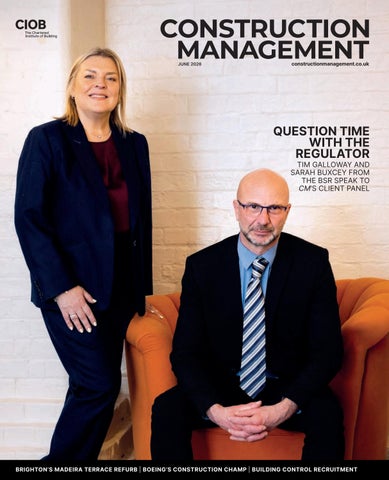
18 Question time with BSR The regulator’s Tim Galloway and Sarah Buxcey got together with operators of higher-risk buildings to talk safety and culture change
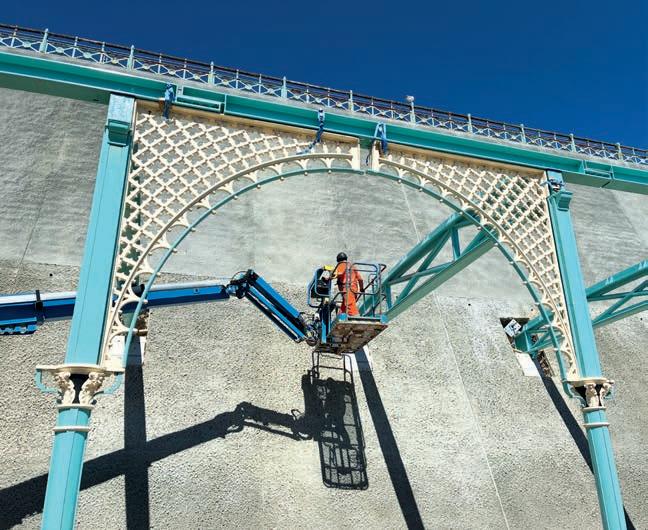
26 Madeira Terrace, Brighton JT Mackley & Co on how it is renovating the Victorian-era icon
38 Project leader profile
Legendre’s Bart Ciurla takes the hot seat in a new series where CM interviews project managers
32 Boeing’s Mark Beck reveals the surprising things about working across different cultures
34 The MCIOBs utilising AI to improve workflows
42 Handling a Gateway 2 delay
44 Local authorities’ building control recruitment crisis Community
48 The latest news and updates from CIOB hubs and members
Diary dates
58 Highlights of June

London Stadium’s steel structure spring clean
Rope access inspectors have scaled London Stadium’s 30m-high roof to clean and survey its steel structure. The job involved a team of six rope access specialists and six elevated platform technicians from structural services contractor CAN, part of the RSK Group, who inspected the former Olympic Stadium’s steel roof framework.
Costain’s 3D-printed, low-carbon concrete sleepers
Costain, alongside A E Yates, has partnered with Hyperion Robotics to deliver 90 3D-printed pipe support bases or sleepers. Costain says the sleepers will be up to 10 times stronger than traditional structures, despite being up to 60% lighter due to a thin, reinforced base design. The project is part of the Northern Endurance Partnership, which is developing onshore and offshore infrastructure needed to transport CO2 from carbon capture projects across Teesside to secure storage under the North Sea.

Mike Clegg from JT Mackley on restoring the Victorian-era Madeira Terrace in Brighton, p26


University of Salford’s acoustics lab hits a high note
A new acoustics research, testing and teaching facility at the University of Salford, delivered by Morgan Sindall, has reached its topping out milestone.
The new facility incorporates a vast triple-height space with vibration-isolating foundations and extra-dense concrete walls, creating several idealised acoustic environments insulated from external noise.
London Eye gets new cranes in night-time upgrade project
Two new cranes have been installed on the London Eye to support the ongoing maintenance and engineering work on the iconic Thames-side tourist attraction.
The installation was carried out over five nights while the 135m-high observation wheel remained operational.
School badger sett finds a new home
The dark and warm void below a classroom block at a junior school in Watford became the perfect home for a family of badgers. However, the tunnels they formed damaged the drainage network, undermining the school’s foundations.
Ground engineering firm Mainmark, working alongside Natural England, successfully relocated the badgers to an artificial sett within the school grounds.
Brent Cross Town development sees first calcined clay concrete use
Midgard has used calcined clay concrete to construct a permanent suspended slab in a build-to-rent building at the Brent Cross Town development in London.
In total, 30% of the cement in the concrete mix was replaced with calcined clay, resulting in a 10% embodied carbon saving compared with equivalent concrete mixes previously used at the project.
Capital Concrete provided concrete made with calcined clay from LKAB Minerals, which utilises damaged waste bricks, helping to promote sustainability and support the circular economy.



CIOB reported an 80% rise in TechCIOB members, with the institute’s full membership totalling 50,826
CIOB hails membership growth and expanding industry reach
The institute highlighted growing international expansion, investment in skills and professional standards in its latest annual review
The Chartered Institute of Building (CIOB) has reported strong membership growth, expanding digital services and increasing influence across the built environment sector as it delivered against the ambitions set out in its 2023-2028 corporate plan.
In its latest annual review, the institute highlighted growing international reach, investment in skills and professional standards and a widening role in shaping policy around building safety, sustainability and workforce development.
CIOB membership stood at 50,826 at the end of 2025, including 9,292 members outside the UK and Ireland. The organisation also reported an 80% rise in TechCIOB membership numbers, alongside the continued roll-out
of its digital badging programme. Another significant development during the year was the integration of the Institute of Roofing into CIOB.
Skills and workforce development remained a major focus throughout the year. CIOB launched new research into perceptions of construction careers among young people and parents, with the findings helping to shape its new Aspire programme aimed at 14- to 19-year-olds and career changers.
The organisation also expanded its apprenticeship and training activity through the CIOB Academy.
More than 250,000 people used the Academy platform during 2025, while apprenticeship learner numbers rose from 19 to 75.
The annual review also
That survey [on attitudes towards a career in construction] has provided useful data on where to focus our energy to get more people into the industry Victoria Hills, CIOB
CIOB Annual Review shows growing influence across the sector

highlighted CIOB’s growing policy influence around building safety following the implementation of the Building Safety Act. During 2025, the institute launched a new Principal Designer Certification Scheme and continued to develop competency frameworks linked to the postGrenfell regulatory environment.
Mental health and wellbeing also remained a key priority. CIOB Assist provided more than £63,000 in financial support and £10,000 in mental health support to members and their families.
CIOB said its sustainability agenda continued to gather momentum, with a global network of 50 Sustainability Ambassadors, expanded CPD provision and ongoing engagement with governments on climate and retrofit policy.
The organisation also reported growing public reach, with its publications attracting around 1.6 million online readers worldwide and more than one billion media impressions generated during 2025.
Looking ahead, CIOB said future plans include expanding digital skills and AI training, growing client engagement initiatives and launching new mentoring and career development programmes to support the next generation of construction professionals.
CIOB chief executive Victoria Hills said 2025 was successful in delivering against the body’s 20232028 corporate plan.
Highlighting the institute’s survey to gather data on attitudes towards a career in construction, she said:
“That survey has provided useful data on where to focus our energy to get more people into the industry. It was repeated this year and will continue in directing our work to tackle this ongoing industry issue.”
CIOB welcomes building safety measures in King’s Speech, but urges stronger regulation
Construction sector acknowledges proposals of Building Safety Remediation Bill and Late Payment Bill despite lack of measures relating to the single construction regulator
The forthcoming legislative year was laid out last month, as the King delivered his annual speech to parliament, revealing the Labour government’s proposed new laws and measures.
Two key pieces of legislation – the Building Safety Remediation Bill and the Late Payment Bill – will have been noted by the construction sector.
The former introduces fixed timeframes for remediation on high-risk buildings.
Its ratification was welcomed by CIOB, with CEO Victoria Hills saying she hoped it would lead to further progress around building safety. “While a Construction Regulator Bill was not mentioned in the King’s Speech, we expect to see proposals come forward as part of the government’s wider legislative programme following the Grenfell Tower Inquiry. CIOB has long called for clearer accountability and a stronger regulatory framework for both construction and building safety.”
The Late Payment Bill, meanwhile, will be a relief for smaller businesses affected by slow remittance from clients. “It is encouraging to see continued action on late payments, which continue to put huge pressure on SMEs across construction,” Hills said.
Figures show the industry has experienced the highest number of insolvencies in any 12-month period.
The government has missed an opportunity to demonstrate real progress on this agenda, instead leaving uncertainty around… critical reforms
Chris
Williamson,
RIBA

Further response from professional bodies
The Royal Institute of British Architects also expressed disappointment that the King’s Speech did not include legislation relating to a single construction regulator.
RIBA president Chris Williamson said: “While the announcement of forthcoming bills on EU alignment and bolstering social housing delivery are positive, it’s frustrating to see no legislative measures relating to the single construction regulator.
“The government has missed an opportunity to demonstrate real progress on this agenda, instead leaving uncertainty around how and when critical reforms will be delivered.”
Williamson said RIBA had recently published its own proposals for reform, including restricting certain safety-critical work to suitably competent chartered professionals and establishing a Built Environment Council to oversee the system.
“This is about creating a more transparent regulatory framework for public protection,
and we look forward to working with government to see it realised,” he added.
Meanwhile, the Royal Institution of Chartered Surveyors welcomed the prominence given to the built and natural environment in the legislative programme.
RICS said proposals linked to major infrastructure projects, including the Civil Aviation Bill, Highways (Financing) Bill and Northern Powerhouse Rail Bill, had the potential to support economic growth and improve outcomes for communities across the UK.
The Institution also backed further action on unsafe cladding and leasehold reform, but stressed that delivery would require close collaboration between government and industry.
“Delivering on these ambitions will require close collaboration between government and industry, as well as the professional expertise needed to turn policy into practical outcomes,” RICS said in a statement. ●
CIOB responded to the King’s Speech, which announced key construction legislation

Tell us about rogue operators, Building Safety Regulator urges
BSR wants industry to call out bad actors and encourages clients to take a lead on competence, writes Will Mann
The Building Safety Regulator (BSR) has urged the built environment sector to share intelligence on rogue operators, amid continuing concerns over industry competence and the quality of higher-risk buildings (HRBs).
Speaking at a CM building safety roundtable, attended by several major HRB asset owners, deputy director of the BSR Tim Galloway said: “If you are aware of a rogue operator, tell us. Industry participants are a key source of intelligence. While we may not always be able to act, information from people in the sector is extremely valuable.
“There are formal routes for residents to raise concerns and mechanisms for complaints against building inspectors and approvers, but direct communication from industry is also important. Don’t underestimate the value of simply raising an issue with us.”
His comments came in response to a question from Scott Ramage, head of facilities at care home operator Riverstone Living, who said: “There are many building owners who haven’t even registered HRBs or are behind on adopting the legislation. How do we ensure they are identified and held to account?”
If you are aware of a rogue operator, tell us. Industry participants are a key source of intelligence
Tim Galloway, Building Safety Regulator
Also at the roundtable was CIOB past president and member of the Building Advisory Committee Paul Nash, who warned that significant defects were still being found in recently completed buildings nine years after the Grenfell Tower fire.
“Last year’s injunction served by the BSR against a student accommodation developer highlighted serious defects in a building that had been presented for approval,” Nash said. “That raises fundamental cultural questions – how such a building could be considered acceptable.”
Asked if any high-profile prosecutions of building owners were likely, Sarah Buxcey, deputy director of operations at the BSR, replied: “Case law will continue to develop over time, helping to further define standards and expectations.”
Competence questions
Ramage also questioned the lack of a clear competence framework for those responsible for managing buildings in operation.
Galloway noted that the Industry Competence Committee has just published Setting Expectations on Competence Management to provide guidance in this area, but encouraged clients to take a lead.
“Organisations like yours [Riverstone] are likely already ahead of the curve and may be setting standards in practice,” he said.
“Rather than waiting for the regulator, organisations can take the initiative, develop their own frameworks and contribute to cultural change.” ● Turn to page 18 for the full roundtable discussion.
Deputy director of the BSR Tim Galloway


Why tackling the green skills shortage is key to meeting net-zero targets
The UK needs alignment across upskilling, education and future signposting to address the green skills gap and meet net-zero targets, writes Nitesh Patel

In the race to reach net zero by 2050, few sectors are as crucial as construction to achieving the UK’s target. There is a long list of building projects to meet, where clients are increasingly attaching greater importance to their netzero commitments.
Some initial insights from the forthcoming Turner & Townsend 2026 Global Construction Market Intelligence report reveal that in eight out of nine regions, the biggest constraining factor in delivering projects is the shortage of greencollar labour across much of the UK. Closing the green skills gap requires coordinated action across
three fronts: workforce upskilling, education reform, and long-term demand signalling.
The Office for National Statistics (ONS) defines green collar jobs as “employment in an activity that contributes to protecting or restoring the environment, including those that mitigate or adapt to climate change”.
For the built sector, these workers are crucial to improving not only the environmental performance of the current stock of assets, but also for new construction.
The ONS estimates there were 652,100 full-time equivalent (FTE) employees in green jobs in the UK in 2024, up from 510,100 FTEs in 2015. These numbers will grow as we transition towards net zero.
Although data is not available showing how many of these workers are in construction, the sector is expected to account for a substantial proportion, such as in the energyefficient products group and repairs. The sector faces the dual challenge of upskilling its current workforce while attracting new talent.
According to research by Places for People, an additional 230,000 skilled workers will be needed for retrofitting by 2030, 30,000 for green energy installations, and green construction requires digital and AI skills, focusing on building information modelling, energy simulation, data analytics, and sustainability compliance.
DESNZ and industry are tackling
the green skills gap through the Clean Energy Jobs Plan and the Energy Skills Passport, designed to transition workers into net-zero roles, adding 420,000 workers to the clean energy sector by 2030. Key strategies include investing in vocational training, expanding green apprenticeships, and establishing partnerships to align education with renewable sector demands.
To support this demand, new training schemes have been announced. These include the Engineering Skills Package with an investment of £100m, five Clean Energy Technical Excellence Colleges (TECs) to specialise in training skilled clean energy workers, £625m Construction Skills Package to deliver up to 60,000 additional skilled construction workers and the Growth and Skills Levy.
From an industry approach to training or upskilling, the NHS is setting a standard. The NHS Estates & Facilities apprenticeships are aligned to delivering greener hospitals with a workforce capable of sustaining them.
Programmes such as the New Hospital Programme (NHP) can stimulate local green jobs, strengthen supply chains and create long-term career pathways by embedding skills development. The focus is on building contractor and supply chain capability early, particularly with local firms, by embedding skills development at the planning and pre-construction stage. This ensures that, by the time schemes move into delivery and then operation, the skills required to operate, maintain and decarbonise the estate are already established locally.
The scale of the NHP is used to signal long-term demand for green, digital and estates skills, giving industry and individuals confidence to invest in training and career development that extends beyond a single project.
The UK’s ageing stock of housing and commercial buildings is a significant contributor to emission levels. The Department of Energy Security and Net Zero (DESNZ) estimates the building sector was responsible for 22% of the UK’s total
The construction sector faces the dual challenge of upskilling its current workforce while attracting new talent
greenhouse gas (GHG) emissions in 2025, up from 19% in 2015; with residential buildings accounting for 16% and commercial buildings 4% of that share.
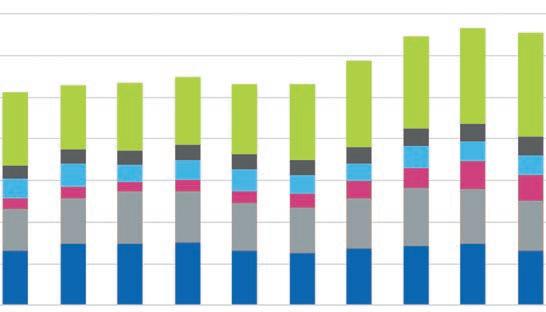
When looking at building emissions alone, 67% is from housing, while the commercial and public sectors account for a further 27% (see figure 2). These three sectors are the focus of efforts to reduce future emissions.
Some 80% of the homes and buildings in 2050 will be the ones we are living and working in today, making retrofitting of existing building stock essential to meet net-zero targets. The built environment is a major source of carbon emissions, both in its production and the overall building lifecycle. In housing and commercial buildings, over 60% of the emissions are produced by heating, predominantly via fossil fuel boilers.
The UK government has unveiled a £15bn plan to retrofit up to 5 million homes by 2030 to improve energy efficiency. The target is 450,000 heat pump installations per year by 2030. This may be achievable if workers in related trades are upskilled. For commercial properties, an upward shift in the Energy Performance Certificate (EPC) rating has been proposed from a current E to at least a C. This means landlords will need to carry out necessary structural or system upgrades in the coming years.
Without decisive action, the UK risks not just missing its net-zero targets but creating a structural bottleneck in one of its most critical sectors. The transition to a low-carbon built environment will not be constrained by ambition or capital, but by people.
Nitesh Patel is lead economist at Turner & Townsend.
The building sector was responsible for 22% of the UK’s total greenhouse gas (GHG) emissions in 2025
1. Employment in green industries, top five activities
n Energy efficient products group - includes roles linked to generating energy from renewable sources eg wind turbine technician
n Renewable energy group - includes roles that improve energy efficiency
in homes, buildings, transport, and industrial systems eg heat pump installer
Number of FTE workers
n Environmental charities
n Waste
n Repairs
n Others
2. Breakdown of total UK and building sector GHG emissions 2025
UK Emissions
n Buildings
n Electricity supply
n Fuel supply
n Domestic transport
n Industry
n Agriculture
n Waste
n
n
SOURCE: DEPARTMENT FOR ENERGY SECURITY AND NET ZERO


Our golden opportunity
Now is the time for CIOB and its members to have influence over the conversation around professionalism, says CEO Victoria Hills
Many members will be aware that in the coming months and years, we are expecting a greater spotlight on the professions.
CIOB as an organisation is, quite rightly, focused on professional standards and competency, and we are keen to contribute to the professionalism debate.
In a non-regulated sector, this scrutiny presents a wealth of opportunities for CIOB to influence how professionalism is seen and how it is actually delivered, which I describe as a “golden trilogy”: APC, CPD, C and D.
We start with the entry point into membership for CIOB (and other professional bodies): the APC or assessment of professional competence.
Members might recognise that, for CIOB, our Professional Review
is a key part of that process. Right from the start, we set the standard and make it clear that competence is critical – a member must demonstrate competence in their role in order to be awarded TechCIOB, MCIOB or FCIOB membership.
Occasional misconception
There’s still the occasional misconception that you can be awarded membership and then develop your competence on the job. Our pathways support those working towards membership and looking to understand how to demonstrate competence, but if you are a CIOB member, it is because you are competent.
This leads to the next element: CPD. While we expect a level of competence in order to become a member, we also expect – and seek
CIOB expects a level of competence in order to achieve membership
This is an opportunity to highlight both the magnificent work that our members do and how CIOB plays its part in supporting and enabling that
Victoria Hills, CIOB
a commitment to – a deepening of skills and consolidation of professional experience through formal and informal learning.
A commitment to lifelong learning is particularly important in a constantly evolving industry, where new technologies can emerge to provide solutions to age-old problems.
Finally, our approach to C and D – conduct and discipline – is robust. In short, if you do not abide by the rules, including keeping up with your CPD, you could be removed from membership.
It’s not just important to reflect on this because of the UK government’s consultation on the future of the professions (yet to be published at the time of writing, but expected imminently). As CIOB approaches its 200th anniversary, we have the opportunity, and even a responsibility, to reflect on what we were set up to do all those years ago and re-centre our role as a trusted professional body in a much bigger and vastly more complex construction landscape than our founders ever imagined.
This is an opportunity to highlight both the magnificent work that our members do and how CIOB plays its part in supporting and enabling that. Professionalism is an inherent part of this and maintaining public confidence in both the professions and our great industry. At CIOB, we are ready to make the most of this golden opportunity. ● Victoria Hills is CEO of CIOB.
Victoria Hills CIOB



The golden thread is becoming a golden burden
The built environment should stop regarding the golden thread as a document exercise and treat it as the legislation intended: a reliable, living picture of building safety, says Brett King
The irony wasn’t lost on me during a roundtable discussion with the Building Safety Regulator, organised by CM, CIOB and Procore (see page 18).
As well as the regulator, several major industry clients were present, and we spent much of the conversation talking about digitisation, the golden thread and improving the flow of information across the lifecycle of higher-risk buildings.
Yet when questions were raised around structured data, AI and how technology could support the regulator itself, the room suddenly became far less certain.
That tension matters because the industry is currently being asked to deliver a digital golden thread without a sufficiently clear and consistent definition of what “good” actually looks like in practice.
The real challenge facing the industry is not simply whether information exists. In many cases, it already does. The problem is that information sits across multiple organisations, systems, consultants, contractors, spreadsheets, PDFs, inboxes and disconnected handovers.
The result is that huge amounts of effort are now going into rebuilding evidence packs during gateway submissions and safety case reviews.
Across the industry, teams are second guessing expectations. Contractors are recreating information retrospectively. Asset operators are chasing records years after projects completed. Meanwhile, regulators themselves are managing growing volumes of inconsistent documentation while under pressure to
Across the industry, teams are second guessing expectations. Contractors are recreating information retrospectively. Asset operators are chasing records years after projects completed
Brett King, Procore
improve approval timelines. The concern is that we are trying to scale a fundamentally manual and inconsistent process.
This is where the conversation around technology needs to mature. The answer is not simply “more software”. Nor is it digitising bad habits by turning paper into PDFs and calling it transformation.
More consistency needed
The opportunity is to create more consistency in how information is structured, connected, governed and evidenced across the lifecycle of a building. Because once information becomes structured and traceable, technology starts becoming genuinely useful.
Technology providers can help create the structure, consistency and traceability the industry is currently missing, but only if the sector aligns around clearer expectations of what a digital golden thread should actually contain.
That is why the next stage of the Building Safety Act cannot simply be about compliance. It must be about alignment – alignment between regulators, clients, contractors, operators and technology providers on what good information actually looks like. If we get that right, we reduce duplication, uncertainty and rework across the entire system.
And, perhaps most importantly, we stop treating the golden thread as a document exercise and start treating it as what it was always supposed to be: a reliable, living picture of building safety. ● Brett King is director of industry transformation at Procore. He previously spent 15 years working in major contractors.
Brett King Procore
Feedback
A selection of readers’ comments about news and issues in the industry from across the CIOB community and social media

CM
‘Managing health like we manage safety’
Silvia Navarro’s article urged the government to deliver a properly funded, sector-focused strategy to combat the sector’s issues around mental health.
Fatigue, pressure and distraction do not just affect people, they affect decisions, productivity, quality and, ultimately, cost
Jennie Armstrong
CM
Environmental principles in school design standards
In an interview with CM, the Department for Education’s Richard Taylor said the new design standards for school buildings are based on three environmental principles: healthy and productive spaces, reducing emissions and nature-based solutions.
Dr Claire Handby
It’s one of the reasons I volunteer on a multi-academy board trust as a trustee –to support when the built assets in our
Jennie Armstrong
Mental health in construction is not just a wellbeing issue, it is a programme delivery risk. Fatigue, pressure and distraction do not just affect people, they affect decisions, productivity, quality and, ultimately, cost.
Until we start managing health like we manage safety – anticipating risk, designing it out where possible, controlling it through the programme – we will continue to treat the systems rather than the cause.
The government can do more, the industry can do more, and employers need to do a lot more.
schools need to evolve with the support of the construction industry.
CM
Don’t forget concealed works
In his article for CM, Stephen Hawes said that avoiding checks on concealed work doesn’t always save time.
John Hendry
This approach is laudable, with many MCs already using proprietary software to capture this information, but due to the sheer volume of the items that need to be recorded or
reconciled, it has now become so unwieldy and time-consuming for site teams that, inevitably, items are misrecorded or missed entirely.
If data capture is so vitally important, then every subcontractor should have dedicated onsite, full-time quality managers trained in capturing the correct info.
Sadly, in my experience, this doesn’t happen, and all too often is left to the already overloaded managers onsite.
CM
Construction can give people a chance
Off the back of Fair Chance Week, an initiative that aims to raise awareness about the employment barriers faced by those with criminal records, Lyndsey Gallagher, CEO of Gallagher, said the construction sector is uniquely placed to benefit from fair chance hiring.
Dave Ford FCIOB
Personally, I think this is something the industry should take seriously. Construction has always been an industry that gave people opportunities to rebuild their lives, develop skills and create long-term careers.
At a time when we continue to talk about labour shortages, it makes little sense to ignore people who are willing to work, learn and contribute.
Of course, there have to be safeguards, proper support and the right environments in place. Not every role will be suitable and employers still have responsibilities to manage risk properly.
But I also think that too many people get written off permanently because of mistakes they made earlier in life.
Some of the hardest-working and most talented people I’ve worked with in construction have come from difficult backgrounds and simply needed someone to give them a chance.
The industry talks a lot about skills shortages. Part of the solution may also involve rethinking where we are prepared to look for talent.
Share your views on the latest industry issues by posting comments online at www.constructionmanagement.co.uk or by emailing the editor at constructionmanagement@atompublishing.co.uk


Question time with the regulator
The Building Safety Regulator (BSR) became a standalone body reporting into the government at the start of this year. Early signs are that the move has been positive, with approval timelines shortening and engagement between regulator and industry improving. CM, CIOB and Procore brought together Tim Galloway and Sarah Buxcey from the regulator with several major operators of higher-risk buildings to discuss expectations, good and bad practice, the golden thread and culture change
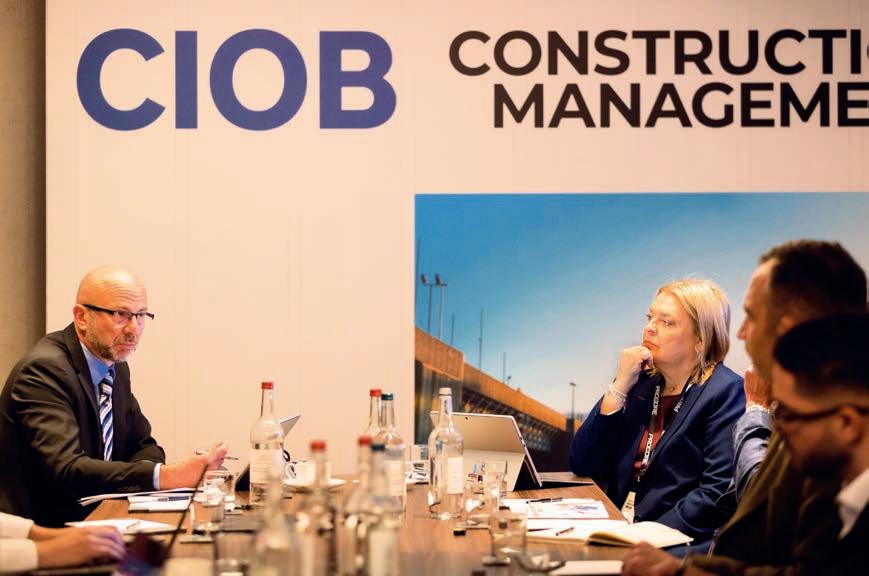
Tim Galloway and Sarah Buxcey from The Building Safety Regulator
Our discussion began with Tim Galloway describing the four-year journey of the BSR, its strategy and ambition to change industry culture.
Sarah Buxcey explained the role of the occupied buildings function, the feedback received from dutyholders and plans to evolve the building assessment regime.
Tim Galloway: I’ve been involved with the BSR since 2020, I was involved in its design and I’m aware of where some of the things we’ve done haven’t worked as intended.
But we have made progress. Our monthly data shows improvements in speed of approvals. We’re taking learning from our innovation unit that focuses on new builds and seeing what can be applied to remediation applications and other building work in existing higher-risk buildings.
One thing to emphasise is that learning and experience in the industry should not be focused solely on higher-risk buildings. HRBs are a small part of both the building stock and overall construction activity. Duties for clients, principal contractors and principal designers apply across all building work.
We wouldn’t want to end up in a situation where we have very good residential buildings over seven storeys, but everything else is not to the same standard.
The regime is not yet mature, but it will get there. If we look at the regime for occupational health and safety, it took decades to mature. What we want to do is accelerate that journey for the new regime in building safety and standards. While the regulator can improve processing times and meet statutory deadlines, what will really drive sustained improvement is cultural change in the industry. There are organisations that are driving progress, particularly around competence, and others that need to step forward, demonstrate what good looks like and support everyone. Ultimately, we want a culture where doing the right thing is simply “how we do things around here”. That means, for example, someone installing fire stopping choosing to use the correct product – even late on a Friday afternoon when they want to go home – rather than taking shortcuts.
Sarah Buxcey: I lead the occupied buildings function, including the delivery of the building assessment regime, plus the investigation and enforcement teams. From our experience so far, and from feedback from stakeholders, we think the building assessment regime is now at a point where it needs to evolve.
Fundamentally, protecting residents through a continuous focus on fire and structural
Learning and experience in the industry should not be focused solely on higher-risk buildings. HRBs are a small part of both the building stock and overall construction activity Tim Galloway, Building Safety Regulator









Linda Duke Building safety manager, UPP
Paul Nash CIOB past president and member of Building Advisory Committee
Jess Oliver Regional director, Catalyst
Sarah Buxcey Deputy director of operations, Building Safety Regulator
Ismail Alsayed Head of building safety legislation, compliance and delivery, Clarion Housing Group
Brett King Director of industry transformation, EMEA, Procore
Tim Galloway Deputy director regime development and regulatory support, Building Safety Regulator
Laura Bryant Senior director, operational risk management and health and safety, Europe, Greystar
Scott Ramage Head of facilities, Riverstone Living
The discussion panel

We want dutyholders to have clear points of contact and access to support so we can work together effectively
Sarah Buxcey, Building Safety Regulator
safety risk is key. We have a responsibility to ensure standards and expectations are clear, and to support dutyholders in delivering their responsibilities.
From a delivery perspective, we’ve identified several challenges. Resident feedback indicates that the regime can sometimes lead to additional or unforeseen costs, alongside some complexity in
navigating property transactions and insurance.
For dutyholders, particularly principal accountable persons, there were areas where they were not fully prepared at the start of the regime. This has been especially challenging for resident management companies, which often lack the governance structures and expertise needed.
Some dutyholders may not have always been fully clear on the requirements for assessing fire and structural risks, with some uncertainty around the distinction between surveys and risk assessments, as well as what constitutes sufficient evidence to demonstrate compliance.
Jess Oliver, second right, from Catalyst, pointed out that ‘obtaining information for existing buildings’ is proving challenging
That said, engagement from dutyholders has generally been positive. The issue is not a lack of willingness, but the need for clearer expectations and better-quality submissions.
We need to ensure that we, as the regulator, have the right resources and communication channels. We want dutyholders to have clear points of contact and access to support so we can work together effectively.
So, the regime will evolve, but nothing changes immediately – we will continue to assess buildings currently in the system and work with industry to ensure the regime operates as intended under the Building Safety Act.
At this point, we invited our panel of HRB asset operators to put their questions to the regulator and discussed the responses.
Linda Duke: One of the requirements of the building safety regime is to demonstrate effective resident engagement, but our residents are students who are only in the buildings for nine months. Could there be clearer or sectorspecific guidance to help us meet that requirement?
Tim Galloway: There are three points I’d make. First, your engagement strategy should be proportionate and realistic. You may need to accept that residents won’t be highly engaged, but you could focus on key moments – such as when building work affects their safety – and ensure they are informed and can contribute.
Second, on sector-specific guidance, my usual view is that those best placed to write it are the people working in that sector. Regulators will write in regulatory language, whereas providers understand the practical realities and communication styles that resonate.
Third, there is an opportunity for providers to collaborate and define what good looks like in your sector. We would support and encourage that kind of work.
Sarah Buxcey: From a delivery perspective, we would be looking for evidence of your engagement strategy – how residents are inducted, how they raise concerns and how communication works.
We recognise the high turnover in student accommodation, so clarity and accessibility of information are
key. We receive a large number of complaints that could have been dealt with earlier by dutyholders, so improving that communication is important.
Paul Nash: The Construction Leadership Council (CLC) has worked with industry and the regulator to develop and publish specific guidance for the gateway process. This is an approach that could be adopted by other sectors, such as student accommodation, to develop best practice guidance on resident engagement.

The CLC has worked with industry and the regulator to develop and publish specific guidance for the gateway process. This is an approach that could be adopted by other sectors
Paul Nash, former CIOB president
Laura Bryant: Firstly, I want to say thank you. The cultural change and collaboration with the regulator have been significant in recent months, and having a named contact at the Building Safety Regulator for Gateway 2 applications has made a real difference.
As new developments move from Gateway 2 towards completion at Gateway 3, how is the building safety regulator preparing? What can we learn from Gateway 2 to make Gateway 3 efficient, allowing people to move into their homes smoothly?
Tim Galloway: There haven’t yet been many Gateway 3 cases fully under the new regime. Early experience has mostly involved transitional buildings, where information from earlier stages was incomplete.
In some cases, we effectively ran Gateway 2 and Gateway 3 in parallel.
We are now working with the CLC on case studies – looking at real buildings that have gone through Gateway 2 and exploring how Gateway 3 could operate. The key point is not to treat Gateway 3 as a single event. It is part of a continuous process – from design through construction to completion.
Brett King from Procore and Linda Duke from UPP
That means managing change control, maintaining records and building a clear “golden thread” of information.
Laura Bryant: Greystar is working hard with its partners to be prepared for Gateway 3; does the building safety regulator think it’s getting the right level of engagement from the principal contractors?
Tim Galloway: I know there has been criticism by some in the industry of the “as built” information they have received. Clients play a crucial role here. They need to set expectations
and demand the right standards and information from contractors. There will also be pressure from funders and insurers. That could drive change beyond HRBs.
Brett King: From a technology perspective, platforms like Procore can already help clients structure and organise information for Gateway 2 and Gateway 3 submissions and get it ready for regulator review. However, organisations still often end up double handling information between platforms and submission systems.
The bigger opportunity for the industry is how technology
providers and the regulator can work together to create a more seamless flow of structured information across the process. How can we support the regulator on that journey?
Sarah Buxcey: Regulators are continuing to refine how best to use technology. Ensuring data integrity and auditability is critical. We are continuing to develop our digital strategy and ensure, changes are considered carefully. While guidance is evolving, there is an ongoing focus on enhancing its accessibility and consistency.
Tim Galloway and Sarah Buxcey answered questions from operators of HRBs
The bigger opportunity for the industry is how technology providers and the regulator can work together to create a more seamless flow of structured information across the process Brett King, Procore
Ismail Alsayed: I have two interlinked questions. The first relates to the tranche model published by the BSR. I appreciate it has been in place for some time, but do you see that changing over the next 6-12 months?
The second is also about Gateway 3. Is there an opportunity for alignment between Gateway 3 and building assessment certificates? If a building has already been through the gateway process, you would expect the information to be there, which should make the building assessment process more straightforward.
Sarah Buxcey: The tranching model and policy remain in place for now, and the obligations on dutyholders have not changed. However, we are considering what a future, more risk-based prioritisation approach might look like.
We’re still at an early stage, but we are looking at questions such as: what are the key risks, where does our intelligence come from and how do we ensure proportionality in how buildings are brought into the system?
We fully recognise that organisations like yours are planning years ahead and setting budgets, so the sooner we can provide clarity, the better.
Tim Galloway: On your second question, it’s reasonable to expect that you’re not asked to provide information we already hold. However, there are internal challenges, particularly with digital systems, which limit our ability to do that seamlessly. In time, buildings that go through Gateway 3 will come into the building assessment regime, but we’re not there yet.
We must also avoid a situation where organisations think they don’t need to actively manage building safety unless prompted by the regulator.
The analogy I often use is vehicle MOTs. If MOTs were abolished tomorrow, you would still need to maintain your car – check the tyres, brakes, lights.
Similarly, building safety management should be ongoing, regardless of regulatory timelines.
Sarah Buxcey: It’s important to remember that the regime is broader than the certificate itself. In some cases, the focus has become the certificate rather than the ongoing responsibility for building safety.
In terms of the link between Gateways 1, 2 and 3 and occupation, from a delivery perspective we operate as one team. Although there are challenges with systems, we do work closely across the lifecycle of a building.

Developing competence
A question on the competency of building safety managers highlighted a significant omission from the Building Safety Act
Scott Ramage:
My question is about competence. There are competency frameworks for construction roles and some guidance around types of works, but there isn’t a clear framework for those managing buildings in operation. What are the BSR’s thoughts on developing competence in that space?
Tim Galloway: The Industry Competence Committee (ICC) has just published Setting Expectations on Competence Management which provides guidance on this. Organisations like yours are likely already ahead of the curve and may be setting standards in practice. Leadership is important here. Rather than waiting for the regulator, organisations can take the initiative, develop their own frameworks, and contribute to cultural change.
Paul Nash: There is still a competency gap when it comes to building safety management. The Building Safety Bill included a duty to appoint a Building Safety Manager, but this did not carry over into the Act. However, the BSI did publish PAS 8673, which sets out the competence requirements for anyone undertaking this role and some organisations are appointing individuals to perform the function. I also think that the requirement to demonstrate organisational capability and how to do this is not well understood and further guidance is needed.
Tim Galloway: Competence is also key – not just initial training, but ongoing professional development. People may believe they are competent based on past experience, but without continuous learning, their knowledge becomes outdated.
Scott Ramage (right) of Riverstone and Jess Oliver from Catalyst
Developers and consultants who were involved in design and construction often refuse to provide information, citing lack of contractual obligation – or charge significant fees Jess Oliver, Catalyst
Jess Oliver: I support clients through Gateway 2 and 3 and help accountable persons with safety case reports. One key issue is that obtaining information for existing buildings is a major challenge. Developers and consultants who were involved in design and construction often refuse to provide information, citing lack of contractual obligation – or charge significant fees. We know the information exists, but we can’t access it. This creates difficulties when responding to BSR requests for evidence.
Tim Galloway: The starting point is to assess what information you already have and identify any gaps. The key question is whether those gaps are critical to managing the building safely. If they are, you may need to obtain the information from original sources or undertake surveys to establish it.
A structured narrative approach can also help – explaining what is known, what is missing and how risks are being managed. In some cases, even if you know who holds the information, you may not be able to obtain it and will need to generate it independently.
Sarah Buxcey: We can take that away – your point about information not being available –and look into it. ●
Rogue operators and enforcement
One of the concerns raised in the discussion was the continuing submission of unsafe buildings into the gateway process. Asset operators asked when enforcement action against rogue operators could be expected
Paul Nash:
It’s important to remember why we are doing this. Last year’s injunction served by the regulator against a student accommodation developer highlighted serious defects in a building that had been presented for approval. That raises fundamental cultural questions – how such a building could be considered acceptable.
Another concern is that while the regulator is identifying issues in HRBs, there are likely many buildings outside that scope that are not being scrutinised to the same degree. Some recently completed buildings are already being found non-compliant during safety case assessments. That raises questions about the effectiveness of previous building control processes.
Brett King:
From a technology perspective, the defect issues that the regulator has flagged in buildings to date are exactly where digital tools, such as image recognition, could help identify problems quickly.
Jess Oliver: We recently inspected a building where all access panels had been installed incorrectly, compromising compartmentation throughout. The building had been signed off, with all documentation in place, but the installation did not meet manufacturer guidance.
Scott Ramage: There are many rogue operators – building owners who haven’t even registered HRBs or are behind on adopting the legislation. How do we ensure they are identified and held to account?
Tim Galloway: If you are aware of a rogue operator, tell us. Industry participants are a key source of intelligence. While we may not always be able to act, information from people in the sector is extremely valuable. There are formal routes for residents to raise concerns, and mechanisms for complaints against building inspectors and approvers, but direct
communication from industry is also important. Don’t underestimate the value of simply raising an issue with us.
Paul Nash: It may take a high-profile prosecution to reinforce that message.
Sarah Buxcey: Case law will continue to develop over time, helping to further define standards and expectations. As a relatively new regulator, our enforcement activity is focused and proportionate, supported by reliable intelligence to ensure resources are directed where they can have the greatest impact.
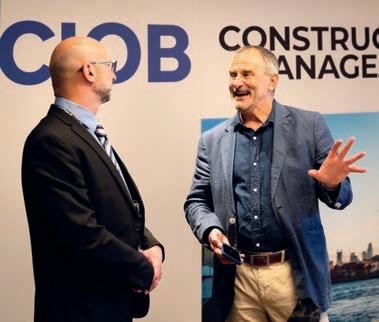
Former CIOB president Paul Nash converses with Tim Galloway of the Building Safety Regulator at the roundtable

BIMplus is now CM Digital
In response to the increasing focus on information management and digitalisation among digital construction professionals, BIMplus has rebranded as CM Digital.
The same award-winning BIMplus editorial team will be creating the same high quality content, including interviews, project case studies, and news about the latest digital construction developments.
www.constructionmanagement.co.uk/digital-construction



Restoring Brighton’s cast iron icon
It’s believed to be the longest cast iron structure in Europe. Kristina Smith visits the Victorian-era Madeira Terrace in Brighton, where a painstaking heritage project is under way
Outside Brighton’s outdoor beachside swimming pool, Sea Lanes, two people are pointing to something across the road, chatting intently. It is the first section of a rejuvenated Victorian cast iron structure, Phase One of the ambitious Madeira Terrace Restoration project.
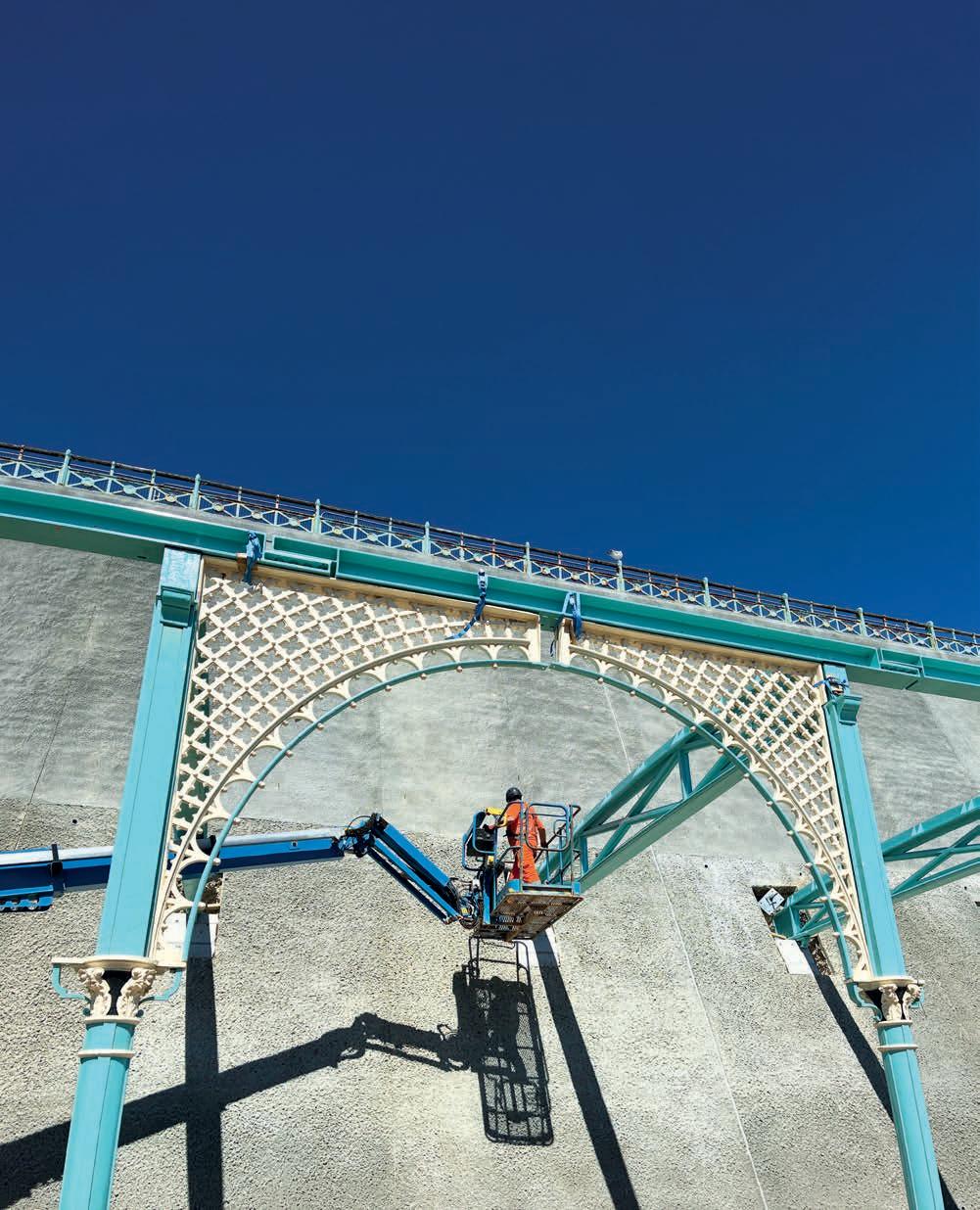
Designed to provide a covered promenade and a walkway on its deck, the terrace stretches for 151 arches – or 865m – along the east end of the city’s seafront. Supported on the cliff face at the back, and on columns at the front, the deck sits halfway down the cliff with Marine Parade, the A259, above and Madeira Drive and Brighton Beach below.
Contractor JT Mackley & Co has the £12.1m contract to restore 28 arches between the Madeira Shelter Hall, home to music venue and nightclub Concorde 2, and the Royal Crescent steps. The project includes works to the east cliff wall, the installation of a new lift and a new staircase by Concorde 2.
The restoration of the Grade II*-listed structure is a painstaking process, driven by a heritage-first approach. Mackley must carefully dismantle the structure, sending each of the 26 pieces that make up each bay to a specialist foundry to be cleaned, inspected, repaired where necessary, and repainted before being returned and assembled in their original position – with a rigorous testing regime woven in.
One of the restored cast iron arches in the Madeira Terrace
Much of Madeira Terrace is fenced off currently

It’s been a collaborative approach. We have been fortunate to have JT Mackley on the project because they have been proactive in engaging with the design
Keith Brownrigg, AtkinsRéalis
“We are working with a material that there isn’t a huge amount of knowledge about out there,” says Brighton & Hove City Council’s programme manager Ian Graham. “How do we garner that knowledge and that expertise? And how do we apply modern design standards? That has been the big technical challenge for us.”
Mackley, which started on site in October 2024, is a civil engineering contractor, which specialises in coastal projects. It has a track record with cast iron structures, delivering the maintenance contract for Worthing Pier and having worked on Eastbourne and Brighton Piers.
But this is a one-off. “It is totally different from anything I have done before,” says Mackley’s contracts manager Mike Clegg, who has almost 40 years’ experience across varied civil engineering projects. “Everything is a learning curve. It’s about finding the best way to do it and then getting it done.”
Although the project is being delivered under a traditional form of contract, JCT Standard Building
Contract Without Quantities, Mackley and the design team have worked together to refine many of the details, explains Keith Brownrigg, senior project manager for AtkinsRéalis, which is project manager for the scheme.
“It’s been a collaborative approach. We have been fortunate to have JT Mackley on the project because they have been proactive in engaging with the design, challenging the design team, ensuring that what’s getting built is suitable.”
A unique structure
Believed to be the longest cast iron structure of its kind in Europe – possibly in the world – Madeira Terrace was built in two sections, between 1889 and 1897. Becoming progressively unsafe due to the deteriorating condition of the structure, the whole area has been behind a security fence since 2015.
The length being restored under Phase One sits within the older section, with that portion chosen to optimise movement between Marine Parade and the beachfront,
JT MACKLEY
Contractor JT
Mackley & Co has the £12.1m contract to restore 28 arches

explains the council’s project manager Abigail Hone.
“With the design team, which came on board in early 2020, we were looking at the hinterland of the Terrace, and what was happening development wise on the sea side,” they say. “We looked at how people get here, what were the dominant pedestrian routes.”
The striking new lift, designed to acknowledge, but not mimic, the Victorian Madeira Shelter Hall lift – in need of costly repairs and not in use –is a vital part of the scheme, opening up access to the seafront for people using mobility scooters and prams.
“Accessibility is hugely important to Historic England,” notes Graham.
“Without the lift, we probably wouldn’t have got their investment.”
Historic England has provided £750,000 funding towards the restoration, with £500,000 coming from a 2017 crowd-funding campaign, boasting backers including Fat Boy Slim, Suzy Eddie Izzard and Damon Hill. The council allocated over £10m including £300,000 from a carbon neutral fund – justified by the extensive reuse of the cast iron. Original plans for Phase One encompassed 40 arches and the refurbishment of Royal Crescent steps, but inflationary pressures forced the council to reduce the scope, says Graham.
A retained section of the Green Wall, showing the cast iron corbels
We are working with a material that there isn’t a huge amount of knowledge about Ian Graham, Brighton & Hove City Council
Mackley’s contract includes works to stabilise the original east cliff wall, reinforced by the Victorians in the 1830s with a mixture of stone, brick and render, a Brighton-specific material known as bungaroosh. This became the Green Wall – much loved by local residents – after the Victorians introduced Japanese Spindle plants in 1872, pre-dating the Terrace.
One section of the Green Wall in Phase One has remained intact, without works to the bungaroosh; an experiment, explains Graham. The rejuvenated sections will be greened with new plants, grown from the base of the wall onto trellises fixed to the new concrete face.
Careful disassembly
Mackley started on site in November 2024, removing asbestos from joints in the wall and deck, taking down most of the Japanese Spindles and other plants that had colonised the wall and clearing the site. The site compound is small, with most materials stored offsite.
Having removed lead paint from the joints in the cast iron structure, Mackley began the careful dismantling of the arches in February 2025. Cast Iron Welding Services (CIWS), the foundry tasked with restoring the cast iron elements, were on site to advise the team who were all direct Mackley employees, to ensure close control of the delicate operation, says Clegg.
CIWS had carried out earlier investigative works on the cast iron for the Council, although the choice of foundry was left to Mackley. “On visiting them and seeing that they had a good understanding of the project and of what was involved, I took the decision to work with them,” says Clegg.
Starting with the careful munching of the concrete deck, from the middle outwards to limit vibration in the cast iron, the dismantling process saw Mackley’s team label, measure, weigh and test every element with a magnet – as some have been replaced by aluminium over the years. All information is recorded on an app developed within the Procore platform.
The initial assumption was that some of the cast iron pieces will require no repair work at all, others will have cracks that CIWS will repair using gas fusion welding, a few may need recasting altogether. With its knowledge of cast iron, and of this particular structure, CIWS agreed to a fixed price contract.
“The main pressure on price for them is the balance between recasting and repair,” comments Graham. Recasting requires raw material and far higher temperatures, whereas repair requires skilled work that is labour intensive.
The worst case so far, says Clegg, was one of the spandrels, which had 26 breaks in it. With a few elements yet to be processed, none had
needed recasting by mid-April, a process which takes 26 weeks and hence could yet have a knock-on effect to the overall programme.
After CIWS receive the cast iron elements at their Coalville facility, they grit blast each item, spray them with white paint, check measurements and mark up where repair is needed. Looking at a photo of one of the masks that sit either side of the keystone – believed to be Aphrodite and Poseidon – the metal could have been cast yesterday.
It’s hard to believe these are the same pieces on view in the existing structure. Hone explains that it is the wrought iron bolts that have rusted and expanded, causing fractures in some elements as well as extensive staining. Layers of paint – up to 28 in places – further distort the shapes and lines.
Structural engineer HOP has had the difficult task of proving CIWS’ confidence in the cast iron. They have worked collaboratively with conservation engineers The Morton Partnership and Mann Williams to develop a robust testing regime.
“HOP has had to build a unique structural model and prove by first principles that it stands up,” says Dave Mills, regional director at AtkinsRéalis. The deployment of innovative techniques, such as the non-intrusive dynamic testing, have proved invaluable in identifying issues and building confidence in the original century old cast iron.
The main pressure on price for [foundry firm] CIWS is the balance between recasting and repair
Ian Graham, Brighton & Hove City Council

Madeira Terrace Restoration Phase One
l Client: Brighton & Hove City Council
l Project manager: AtkinsRéalis
l Architect: Purcell
l Civil, and structural engineer: HOP
l Conservation Engineers: The Morton Partnership
l M&E design: Stantec
l Landscape architects: Landscape Projects
l Cost consultant: MGAC
l Business planning: Fourth Street
l Contractor: JT Mackley & Co
l Construction cost at tender award: £12.1m
l Form of contract: JCT Standard Building Contract Without Quantities
l On site: November 2024 to Winter 2026
Main subcontractors
l Cast Iron restoration: Cast Iron Welding Services (CIWS)
l Cast Iron Load Testing –Mann Williams
l Piling: Green Piling
l Sprayed Concrete: Shotcrete Services
l Brickwork: K & T
l Copper roofing: Eco Roofing
l Lift: Lift Design
l Mechanical and electrical: Simpson Electrical
l New Cast Iron: FSE
l Concrete Works: WestConn
One of the restored masks

In a process that has evolved, all the items undergo dynamic testing, with some subject to compression and tensile testing. Before they can be re-erected live load testing takes place; elements for the first six bays have been fully tested, explains Clegg, moving to 50%, 20% and 15% as the project progresses.
“The testing regime has been more intensive than we expected to prove we can safely reuse,” says Graham. “It’s tricky… we have got to get it right, but it’s getting that balance.”
Surprises
There have been plenty of other issues to be addressed at monthly meetings with the design team, and Mackley’s six-person in-house technical services team has fed into the process.
Super-hard flints in the bungaroosh mean that coring
through it has been impossible. The project team has had to devise new ways of installing steel bars into the cliff wall, and new ways to validate their capacity. Some of these will support the new terrace deck, some will hold trellises and some are for a reinforcing mesh below new layers of structural concrete.
The surprising resilience of the bungaroosh and the decision to pin rather than remove historic repairs has led to welcome savings. With a point cloud survey, Mackley discovered that the original wall had receded less than expected. Working with contractor Shotcrete Services, the new approach required less sprayed concrete.
Mackley also discovered, during dismantling, that the cast iron corbels set into the cliff to support the structure were not as the original Victorian drawings suggest; they
have an additional fin that sticks into the wall, which meant that Mackley had to adapt the installation sequence.
Re-erecting the first of the rejuvenated bays has also added to the ‘lesson learned’ list. The introduction of new steel elements – the front beam and a key stone on which the masks will be hung –caused tolerance headaches for Mackley.
“The columns are not straight; they are like bananas. But we don’t know which way they bend until we are erecting them, so the spandrels don’t quite align,” explains Clegg. The solution has been to elongate the bolt holes in the new steel beams.
Mills notes that the designers have devised details to separate cast iron and steel at joints, to avoid any risk of bi-metallic corrosion. “We are building back better,” says Graham.
The terraces stretch 151 arches along the east end of the city’s seafront
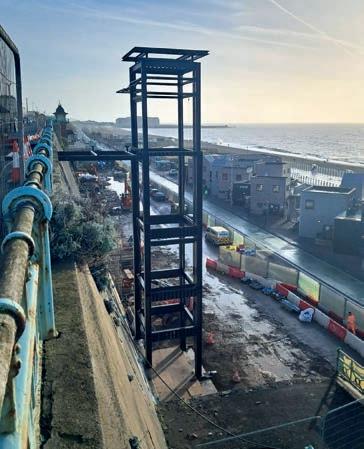
Given the complexities of restoring the Victorian structure, it is perhaps surprising to learn that the construction of the lift shaft has caused the most co-ordination headaches. “It has been one of the most complex parts, design wise,” says Hone.
Clad in four types of brick – two red, a black glazed header and glass – which have been laid with lime mortar, the shaft is a steel-framed structure founded on continuous flight auger (CFA) piles with the lift operated by a pneumatic ram housed in a plant room at the lowest level. Steel lintels, clad with brick slips, transfer the load from the brick wall to the steel frame at four points.
“Getting the steel frame, brickwork, lift, heritage, mechanical and electrical parties all to talk to each other and get everything coordinated has been a real
challenge,” says Mills. “It has been an iterative process; you solve one problem and create another.”
By mid-April, the lift shaft structure was well advanced with the brickwork almost complete and a bridge between the lift and pavement at the upper level in place. The copper roof installation was about to start, followed by the windows a few weeks later and the fitting of the lift set to begin early summer 2026.
Cost control
The biggest challenge on the project, say Hone, has been “controlling the costs. We are in that place, as a local authority, where we just don’t have the luxury of throwing more money at it.”
There have been some savings on the job. For instance, Mackley proposed an off-the-shelf kerb rather than a heritage one, which come with a lower capital cost and a lower maintenance cost.
However, there will be some difficult conversations to come. “We are currently assessing the variations associated with the contract at this time,” says Graham.
Even more of a vexing problem is how the restoration of the remaining arches, and associated access, will be funded. This is a matter which comes in part under the remit of the newly formed Seafront Development Board, a group of private and public sector professionals developing a vision for the seafront which includes ways to attract much needed investment.
The many discoveries and lessons from Phase One will reduce some risks and drive some efficiencies on future phases. And this first section, when completed, will demonstrate the value of this heritage structure to Brighton & Hove, and beyond. ●
It is totally different from anything I have done before. Everything is a learning curve
Mike Clegg, JT Mackley & Co
CV:
Mike Clegg, contracts manager, JT Mackley & Co
Partly inspired by his older sister studying civil engineering, Mike Clegg took an aptitude test at 16 with the CITB and was offered a management course at Bircham Newton. JT Mackley sponsored him through an ONC and then employed him while he completed an HNC.
Progressing from chain boy to site manager by his early 20s, Clegg spent nine years with Mackley followed by several career moves – “the opportunities came along” – and management roles in projects and frameworks across rail, airports, water, highways and sea defences.
In August 2023, another call from a recruitment agency led him back to Mackley.
“I enjoy mechanical ideas, turning drawings into something that works,” says Clegg. “I could not be doing a job where I was working in an office every day.”

The new lift shaft during construction
High flyer: Mark Beck on building with Boeing
Construction is fraught in any setting, but it can be extra tricky when your supply chains are rooted in unfamiliar cultures around the globe. Rod Sweet speaks to CIOB’s latest client champion, Mark Beck, from aerospace giant Boeing

If you ever hear somebody in India say, ‘We’ll get back to you’, that means no.”
Mark Beck is giving me a quick tutorial on courtesy in the huge and varied region he’s responsible for as Boeing’s global leader of real estate and facilities in India and Asia Pacific. His job is to oversee new offices, warehouses, hangars and manufacturing facilities
from hubs in India, Singapore and Australia, where he’s called Queensland home since 2024.
“It’s kind of changed the way I look at how things are getting built. In the UK and Europe, it can all be the same because people have got a similar sort of mindset. But it’s amazing the differences between India and China and Japan and Australia. It’s unreal.
“So, India, I find quite hierarchical.
Mark Beck’s role involves overseeing hangars and manufacturing facilities in Asia Pacific
They’re very conscious of people on more senior levels and they don’t want to offend, so they find it hard to say no.
“If you’re in a meeting in Japan, you do not interrupt. You do not interrupt the other person at all because that starts breaking down trust and people go really quiet. The sensitivity around losing face is a very real thing.
“And in Australia, being such an
isolated country, Australians like to be very independent. Everything’s about the relationship. If you’re not in with the in crowd, it’s a tough crowd, so you’ve really got to work hard at that.
“In places like Japan and China, you’re always going to be seen as the outsider regardless – even if you’re in a senior position, so you’ve got to be very respectful of that kind of thing.”
Come a long way Beck has been on two types of journey: one is physical and the other is his developing sense of how best to do his job.
The first journey took him from the UK to Brisbane. In 2017, he started working in the UK for CBRE as an associate director on the Boeing account before joining Boeing in 2019 as UK & EMEA project and construction management leader.
Then in 2023, he and his wife started planning a move to Australia to be closer to his wife’s family. Fortunately, his counterpart in the Asia Pacific region was moving home to the US, so there was a place still warm for him. He’s since been promoted to his current role.
The second journey is ongoing: achieving a deeper appreciation for what works in the business of project delivery, wherever you happen to be.
“I’ve done construction for a long time. I started in the 90s, when people were still banging tables,” he said. Now, he tries hard to listen.
That served him well in Australia,
where the team he inherited had issues that needed working out over 18 months.
“You can’t go in throwing your weight around because everybody is so different. Instead, I think listening to what people have to say is really important, and then coming back with real, tangible solutions. That’s what builds trust and, once you get that trust, people feel they’re being heard, and everybody starts working towards the common goal.
“That’s what I found is best. It’s certainly helped me in my career. I think my skill set is about building really good teams. I’m probably one of the more stupid ones on the team, but I’ve got excellent people who know what they’re doing and it helps everybody.”
Emotional intelligence in construction?
This second journey has also led him to do a master’s degree in construction project management at the University of Liverpool.
His dissertation, which was due just weeks away from when we spoke, has raised eyebrows. It’s on the development of emotional intelligence in construction.
“It’s a tough one because a lot of people have actually laughed at the title, saying ‘emotion’, ‘intelligence’ and ‘construction’ are three words you don’t often hear in the same sentence,” he said.
“But I had decided before I
It’s amazing how little research there is on emotional intelligence in construction. There’s lots of stuff about emotional intelligence in all business sectors, but hardly anything in construction
Mark Beck, Boeing


Mark Beck: CV
l Aug 2024 – present: Region leader – APAC (Real Estate, Planning, Project & Construction Management), Boeing
l Sep 2019 – Aug 2024: Region leader – UK & EMEA (Project & Construction Management), Boeing
l Nov 2017 – Sep 2019: Associate director, CBRE
l Jul 2016 – Nov 2017: Associate director, JAC Group
l May 2015 – Jul 2016: Senior project manager, JAC Group
l Jan 2012 – Apr 2015: Senior project manager (Property Services Group), BSkyB
l Sep 2006 – Dec 2011: Project manager, Meronden Designs
l Jun 2001 – Aug 2006: Project manager, Alternative Plans
l Jan 2000 – Mar 2001: Project manager, Southern Sun Hotels & Resorts
went into the masters that that’s what I wanted to write on anyway, mostly because I was doing a lot of reading about the failure rates in construction projects with delays and cost overruns, and I was quite surprised by the figures. So I thought, well, what needs to be different? And that’s really what sparked my interest in all of that.
“It’s amazing how little research there is on emotional intelligence in construction. There’s lots of stuff about emotional intelligence in all business sectors, but hardly anything in construction. So that’s been the challenge.” l

The MCIOBs using AI to develop their own software
There are digital entrepreneurs emerging in CIOB’s membership. CM talks to Steve McKenna MCIOB, who used AI to build his own construction management software, and Amien Bohwaish MCIOB about his health and safety compliance tool
You’re a leading SME contractor and want to improve your construction management systems, but you can’t afford enterprise-level software from the big software developers. So what do you do? If you’re Steve McKenna MCIOB, director of chartered contractor Gemstone, you use AI to build your own construction management software.
With no coding background, McKenna used Claude Code to develop Construction AI – a production-grade, multi-tenant SaaS application comprising more than 700,000 lines of code, 186 database tables with row-level security, 596 API routes, and 60-plus AI-powered tools spanning 22 modules (from drawings management and tender analysis to
CIOB members are utilising AI to improve workflows
cost control, contract administration and programme tracking).
He launched Construction AI into the marketplace just less than two months ago. He has already secured nearly 20 customers and will be exhibiting at Digital Construction Week in June.
McKenna started in construction at the age of 16, training at the CITB’s Bircham Newton base some 30 years
ago. He trained as a civil engineer with Balfour Beatty, before becoming a QS. His career highlights include working on the White City Westfield development, being involved in the construction of a Tesla factory in Germany and working for ISG. In 2019, he set up Gemstone.
CM Digital caught up with him to find out more.
CM Digital: What drove you to develop Construction AI?
Steve McKenna: There are some great construction management platforms out there, like Procore or Aconex, but they’re serving the bigger contractors. Where I was two to three years ago, I couldn’t afford those enterprise solutions. Thus, Construction AI makes enterpriselevel software available to SME contractors at an affordable price.
Gemstone was growing and we started to implement management systems to be structured and organised with our documents and communications with clients.
It was late 2024, and I began implementing some simple AI tools, such as a spelling and grammar checker, a toolbox talks generator, and tools that could help the team prepare RAMs – that sort of thing.
We were having some success with it and it just kept on growing and growing. In early 2025, I


incorporated Construction AI and continued building AI tools. AI was improving and it snowballed. Then we launched the business earlier this year.
The thought process was: “What holds us up in our business? What can we improve? What would free up more time for us?”
The main areas of focus were creating project programmes, creating RAMs and tender processes: from getting an inquiry into the business, how do we manage that process? How do we get it out to supply chains to price, and then, once we get the pricing back, how do we standardise it and just make the whole process efficient? Those were the key pain points that we addressed first.
How technical are you? Have you coded in the past?
I’ve always been keen to adopt technology in the business. I’ve seen the value in it. I’m kind of techie, but not techie to the extent that I can design and build software. As AI improved, the process became easier, and I basically followed the foundations of how you build a building: get the core right and then, as you build it out, you follow the same principles all the way through.
Once you’ve got the set-up right and it’s working, it’s just a case of
As AI improved, the process became easier, and I basically followed the foundations of how you build a building: get the core right and then, as you build it out, you follow the same principles all the way through Steve McKenna
adding little building blocks and building it out, and maintaining quality control throughout the process as well.
Early on, I tried to find a co-founder who was more techie than me, but that didn’t work out.
Before I touched any code, I spent a lot of time designing the architecture first, probably a good two or three months. After I started to get some success with the AI tools I was creating, I sketched out the plan and how I wanted it to all look – the framework – then I designed and wrote specs for each section, and iterated with the AI. Once I was settled on a spec, it went into production in the AI. That was followed by recursive testing.
You didn’t just build the platform with AI, did you? AI is embedded throughout.
Construction AI is built with AI throughout the product, rather than an AI process strapped on. For example, if you upload a specification into the application, it chunks the document into small sections, no more than 2,000 words, stores them in a database, and then that’s semantically retrievable by the AI agent.
We’ve built a full knowledge base [which includes the likes of UK contract structures, CDM regulations, building element classifications and building regulations] that the AI also
Cost value reconciliation in Construction AI
We’ve built a full knowledge base, which includes the likes of UK contract structures, CDM regulations, building element classifications and building regulations, that the AI looks into Steve McKenna MCIOB
looks into. So if it’s building a [project] programme, for example, we’ve got a full suite of documentation for the AI to reference. When it gets a prompt from the user, it will check that knowledge base and then structure the program accordingly, using best practice.
What’s the pricing structure?
It’s £100 a month per seat. So, for a smaller contractor with one or two employees, it’s quite affordable compared to an enterprise solution.
We’ve already got 20 customers on board, some with three or four seats. The launch has gone well, so we’ve recruited a product manager, who’s reaching out to our customers and supporting them through the onboarding process, which isn’t too tricky. The platform is quite straightforward and intuitive to use.
What’s next?
We’re carrying out some development work to make the tendering process a bit more fluent for estimating.
We’re working with the customers to fine-tune the platform, within reason, to suit their needs.
Because we’re agile, we can be flexible and work with them to make it work for them.
I know how hard it is [as an SME contractor] – you don’t get much time and you’re always chasing your tail. We want to help SMEs manage their processes better. ● Construction AI will be at Digital Construction Week on 3-4 June.
Self-developed software simplifies H&S compliance recording
Frustrated by the paperwork involved with health and safety compliance, Amien Bohwaish MCIOB built his own software to simplify the process
Having spent the past decade as site engineer, manager and now senior construction assurance manager for HS2, Bohwaish created TruSite AI as dedicated software for compliance and health and safety, and not simply an add-on.
While there are many apps and software programmes coming on to the market to simplify paperwork and allow easy capture of data on site, Bohwaish said they tended to treat compliance and H&S as extras. Yet this is an important area of work with many regulations and standards that have to be met and so requires a dedicated tool.
“When there are no incidents, everybody is relaxed. But when an incident happens, that’s when questions start getting asked and the microscopes get brought out.
The AI is helping to reduce hours of laborious work
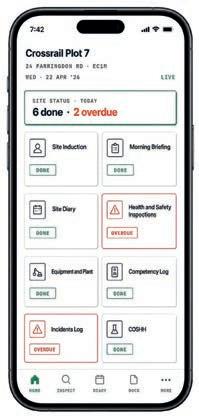
“A lot of the time what I find is when an incident occurs, upon inspection, upon looking through all the documentations in place… on many occasions, we end up finding out that one of those many documentations is either missing or it’s not been completed.”
The increased sophistication of LLMs helped Bohwaish realise his ambition with TruSite AI. The AI translates and filters voice notes, photos and site data into automated workflows, reducing hours of laborious work into a few minutes.
Designed for construction staff With compliance and H&S, there are several steps that need to be completed: remember the task, carry it out, record it properly, and also file it correctly. But this can be time-consuming.
Bohwaish aimed to create software that was easy for people working on site to use that did not require any technological expertise, that could take voice notes and transcribe them into the required paperwork, and would show at a glance what needed doing.
When there is missing information and documents, it makes handover at the end of a project “very, very tough” and could mean having to dig through years of paperwork, he said. This could result in reduced accuracy and sometimes even the loss of key data due through having to backtrack.
TruSite AI has a simplified main interface with eight different categories – site induction, morning briefing, site diary, H&S inspections, competency log, equipment and plant, incidents log, and COSHH. Bohwaish said the latter is often omitted from more generic applications.
Bohwaish added: “This is a compliance site construction

When there are no incidents, everybody is relaxed. But when an incident happens, that’s when questions start getting asked Amien Bohwaish MCIOB
software that is easy to use, and done for the people that are building, that are busy on site and have so many things to do. Rather than, becoming a software that you need to adapt and learn, it is something that is quite easily usable.
“Everything is done in a way that it’s just a click of a button; AI is doing the laborious work, the boring work that is populating certain sections. The supervisor or managers are able to review and input key information – it just makes their life easy, which makes, essentially, compliance easy. It makes it hard not to be compliant on sites because of how straightforward this is.”
There are two colour codes, red and green, with green meaning the task is up to date and red meaning it still needs to be done. The TruSite AI software also takes all of the logged and required data, including any incidents or near misses, and combines this with legislation and guidance to help create a weekly ToolBox Talk.
TruSite AI will be at Digital Construction Week in June.
CONSTRUCTION MANAGEMENT

30,842*
46,000 Email newsletters reaching CIOB members and other
makers

The Legendre PM thriving on complex London refurb jobs
This month, CM starts a new series of interviews profiling the construction project leaders delivering the industry’s most challenging jobs. First up, Bart Ciurla from Legendre talks about his work delivering complex refurbishments in central London
Tell us about your most recent project. What were the biggest technical challenges and how did you approach them?
My last project was Shorts Gardens, a £23m ‘cut and carve’ mixed-use scheme in London’s Covent Garden, which I was involved with from tender stage.
This project included refurbishment of two buildings totalling 3,700 m2 The first had to be converted into office space, with a two-storey extension on the top. The 7.5-metrehigh basement below was split into two levels for restaurant use. The second building was converted into four high-end apartments, along
Shorts Gardens, a former warehouse, during the refurbishment
with commercial space on a mezzanine floor. Facade retention was part of the works. There were several local factors that made the project challenging, including an Elizabeth Line tunnel running under the site, which had to be monitored even out-of-hours for movement.

In construction, issues are inevitable, whether design issues, programme delays, or unforeseen site conditions. What makes the difference is how quickly and effectively you respond Bart Ciurla, Legendre
We used tiltmeters to monitor the crown of the tunnel. What was very important was to plan our work so we did not change the load above the crown significantly during the project.
We also had a surveyor go into the tunnel, once a week for 50 weeks to measure physically for any movement. Each survey only took 30 minutes, but they take 20 weeks to plan ahead with Transport for London, because of the safety considerations. We completed the project without any movement issues.
Additionally, the site was surrounded by local shops, pubs, a hotel, offices, many private residents and narrow streets, with multiple party walls, making the whole project logistically extremely challenging.
What are the key skills and experience you need for this kind of project?
As a project manager on central London office refurbishments, it is essential to have a thorough understanding of all stakeholders: residents, office occupants or commercial tenants.
At Shorts Gardens, many of the neighbours were leased offices, where tenants often book meeting space at short notice. We would typically have a two-week ‘look ahead’ meeting with these office stakeholders so we could plan our noisy works schedule and adapt the programme if necessary. So strong communication skills are crucial for this.
We used an app called Publiq that can be used to share communications with the local community, where users can see progress of the project, any new upcoming works, give feedback about the scheme and get in touch. Another key skill is the ability to adapt quickly to change. At Legendre, we can be more flexible in reacting to changes because we self-deliver some work packages. On Shorts Gardens, we completed the M&E using self-delivery, which gave us greater control of the programme – always an advantage when refurbishing existing buildings.
As a project manager, how have you found it getting to grips with big industry issues like building safety and competency?
The construction industry is constantly evolving and it is essential to stay up to date with new regulations and industry changes. Legendre supports its employees in continuing professional development and, in line with this, I have completed the CIOB Principal Contractor Competency Certification Scheme (PCCCS), including the Higher-Risk Buildings (HRB) module.
The PCCCS developed my knowledge of how to manage project risks, from design through to site execution. This is beyond just reviewing drawings or running site safety briefings. It’s about joining up

l Legendre UK: Project manager, Oct 2021 – present; senior site manager, Jan 2021 – Oct 2021
l Wates Group: Site manager, Apr 2018 – Jan 2021
l Bouygues UK: Site manager, Feb 2017 –Apr 2018; civil works manager, Aug 2015 – Jan 2017; assistant site manager, Aug 2011 – Jul 2015
Education
l 2010-2014: Bachelor of Science (BSc), Construction Engineering, Loughborough University
decisions across disciplines, so risks don’t fall through the cracks. It took six months and I can tell you it was pretty demanding, particular the HRB details. My next project was due to be a HRB, which is why I completed that module, though as it turns out I’m now going to be on a different job. But Legendre as a business and myself from a professional perspective thought it important to understand HRBs and the Building Safety Act.
One thing that stood out about the HRB module was how much more design work and stakeholder engagement there is early on, because of the Gateway approval process. Obviously on other schemes, you tend to design as you go along. But with HRBs, you cannot risk
PROJECT LEADER PROFILE
CV: Bart Ciurla MCIOB
Being open about risks or uncertainties doesn’t show weakness; it demonstrates leadership and professionalism
Bart Ciurla, Legendre
building anything that the regulator may decide is non-compliant.
At Legendre, we are now trying to apply that same principle when we are pricing, bidding, procuring and designing non-HRB schemes, making sure we have planned everything to the ‘nth degree’ before we start building.
Tell us about an innovation you’ve seen or used recently that really excites you.
On my previous project, we used a digital tool called Oculo. This involved using a 360-degree camera mounted on a helmet to scan the site during daily walkthroughs. The captured data was then uploaded to Oculo’s cloud-based platform.
This approach allowed the team to document site progress several times a week, providing immediate access to up-to-date site conditions. It also enabled more effective coordination with subcontractors and allowed for accurate comparisons between as-built conditions and the project models. In addition, the comprehensive photographic records serve as a valuable reference, in the event of any disputes.
What’s the best piece of advice you’ve been given that has helped you as a construction project manager?
“Problems don’t get better with time, only bigger. Deal with them early.”
In construction, issues are inevitable whether it’s design

clashes, programme delays, or unforeseen site conditions. What makes the difference is how quickly and effectively you respond. Addressing challenges early allows you to maintain control, minimise cost and programme impacts, and build trust with stakeholders.
This advice has shaped the way I manage projects day-to-day. It has reinforced the importance of proactive communication, early risk identification and not avoiding difficult conversations. Engaging with subcontractors, consultants, and clients at the first sign of an issue often leads to more practical and collaborative solutions.
It also ties closely to another key principle: transparency. Being open about risks or uncertainties doesn’t
show weakness; it demonstrates leadership and professionalism. Teams perform better when there is clarity and honesty.
What made you want to be a CIOB member and how has it helped you?
I wanted to align myself with a recognised professional body that promotes high standards within the construction industry. As the sector continues to evolve, particularly with an increased focus on safety, compliance and professionalism, I wanted to demonstrate my commitment to continuous development and best practice. Membership has enhanced my professional credibility, both internally within my organisation and externally with clients and stakeholders. Being associated with CIOB provides reassurance that I operate to a recognised standard and adhere to industry ethics and competence. This has been particularly valuable when working on complex refurbishment projects in central London, where trust and professionalism are key.
Finally, what got you into construction and where do you see your career going next?
I’m from Poland originally; I came here 20 years ago and I am the fourthgeneration builder in my family. My great-grandfather had a brickwork company, my grandfather had a drainage groundworks company, my father had a carpentry company. And now I’m in the industry too. It’s very much in the family, it’s what I wanted to do and I love it because construction is always changing. It has changed so much in the years I’ve worked in the industry and I’m sure there will be more change ahead. ●
Bart Ciurla’s Shorts Gardens project on completion
Bart Ciurla’s last project, Shorts Gardens, was a £23m ‘cut and carve’ mixeduse scheme
CONSTRUCTION MANAGEMENT
Brought to you by
CPD

Take CM’s latest CPDs
l Sustainable roofing
l How to manage ethical employment practices
l Improving design and building efficiencies
l Managing highways surface water
l Avoiding common roof defects
l Managing occupational health risks in archaeology
l Automated, mastless machine control
l Roof glazing – more than glass
l How to deliver cleaner power to construction sites
l Mechanical ventilation’s role in improving indoor air quality
l Solar PV in pitched roofing applications
l Managing biodiversity on construction sites
l Head protection in construction
l Timber and the circular economy
l Drainage pumps – construction, climate change and consultancy
Keep up to date with the latest Construction Management CPDs in our dedicated online channel: constructionmanagement.co.uk/cpd-modules

Syed Muzaffar Decipher
‘Gateway 2 is delaying our project. Who bears the risk?’
This month’s Contract Clinic question comes from a developer with a high-rise residential scheme held up in the Building Safety Regulator approvals system. Syed Muzaffar explains how contract law may treat such a delay
THE QUESTION
We are a developer of a 22-storey residential building in London. We appointed our contractor on a design and build contract, and the programme assumed construction would start within three months of planning consent. Our Gateway 2 application was submitted to the Building Safety Regulator (BSR) eight months ago. It was initially rejected, resubmitted and we are still waiting for approval.
Our contractor is claiming the delay is our risk and is seeking an extension of time and additional preliminaries costs. Are they right?
THE ANSWER
This is a problem that is becoming increasingly common across the residential sector, and one that many developers and contractors are encountering for the first time without the contractual and programme framework to deal with it properly.
The short answer is that the outcome will depend largely on what your contract says, what your agreed programme assumed and who holds design responsibility.
What Gateway 2 actually requires
Under the Building Safety Act 2022, no construction work may commence on a higher-risk building (HRB) – defined as any building over 18 metres or seven storeys with at least two residential units – until the Building Safety Regulator (BSR) has granted building control approval.
The BSR has a statutory review period of 12 weeks, but in practice the average approval time has been running at closer to 31 weeks, according to recent data from the BSR, with an approval rate of 48%.
If the BSR issues a Further Information Notice during review, the statutory clock pauses entirely. This is not a minor administrative step. It is a hard regulatory stop.
Who is responsible for the delay?
The first question is: whose design is it? Under a design and build contract, the contractor typically holds design responsibility. If the Gateway 2 application was rejected because the design was non-compliant due to incomplete fire stopping details, uncoordinated facade specifications or missing product test certificates, then
If the BSR issues a Further Information Notice during review, the statutory clock pauses entirely
Syed Muzaffar, Decipher
that is likely to be treated as a contractor-caused delay. In that scenario, the contractor would have no entitlement to an extension of time and could face liability for liquidated damages.
However, if the application was competently prepared and the delay is solely attributable to the BSR’s own review process, the position is less clear. Most standard JCT contracts include a Relevant Event for delays caused by the exercise of statutory powers, but whether BSR regulatory processing falls squarely within that provision or whether it is a risk the contractor should have priced is precisely the kind of question that is heading towards adjudication across the industry right now.
What should you do?
First, review your programme baseline. If the contract programme made no realistic allowance for a Gateway 2 approval period, which is common in contracts entered before the new regime was well understood, you may have a baseline dispute before you even get to causation.
Second, interrogate the rejection. Was the application rejected due


The programme and cost consequences of Gateway 2 delays are significant and the contractual mechanisms in most standard forms were not written with this regime in mind
Syed
Muzaffar, Decipher
to design deficiencies within the contractor’s scope, or was it rejected for reasons outside anyone’s control? The answer to that question will significantly affect entitlement.
Third, check your change control obligations. Any design amendments made in response to the BSR’s requisitions must be managed through a formal change control process. Undocumented changes could compromise your position and create further regulatory exposure down the line.
Finally, do not wait for a dispute to crystallise (defined by a claim or assertion made by one party being rejected, ignored or not admitted by the other party and a clear dispute arises). The programme and cost consequences of Gateway 2 delays are significant and the contractual mechanisms in most standard forms were not written with this regime in mind.
Early legal and delay analysis advice, combined with transparent dialogue between the parties, is far more likely to produce a workable outcome than entrenched positions once the project is already months behind schedule. ●
Syed Muzaffar is a director at Decipher.
Mind the gap: the building control recruitment crisis facing UK councils
Local authority building control teams are facing a perfect storm of rising demand, tighter regulation and a shrinking talent pool. Nicky Roger explores how the profession is meeting recruitment and retention challenges
Local authority building control teams are under unprecedented strain.
Just as demand for their services rises – driven by housing targets and a tougher regulatory regime – councils across the UK are struggling to recruit and retain the professionals needed to deliver them.
The result is a widening gap between capacity and demand, one that industry leaders warn could take years to close.
The roots of the current crisis lie in the sweeping reforms introduced in England and Wales by the Building Safety Act. Building control professionals must now register as competent practitioners, with defined levels of responsibility and a requirement to revalidate every four years.
The changes have been widely welcomed as a necessary step to improve standards and rebuild trust. But they have also exposed – and intensified – longstanding weaknesses in the workforce pipeline.
As Lorna Stimpson, chief executive of Local Authority Building Control (LABC), has consistently highlighted, the sector entered this period of reform with too few people and too little investment in training.
A profession hollowed out –and rebuilding
For many in the sector, today’s shortages are the result of decisions made decades ago.
“There was a long period where there wasn’t really a formal pathway into the profession,” says Emily Bowman MCIOB, registered building inspector and building control team leader at East Suffolk Council. “People either fell into it or came through more general surveying routes.”
That gap in structured training created a “lost generation” of professionals – and a workforce now heavily weighted towards those nearing retirement.
LABC has spent the past decade trying to rebuild that pipeline.
In 2017, it partnered with the University of Wolverhampton to develop a dedicated building control degree. A year later, it launched Level 4 and Level 5 diplomas, secured approval as a CIOB training provider, and introduced a building control apprenticeship.
By 2019, the degree apprenticeship welcomed more than 100 students in its first intake –a significant step in restoring a clear entry route into the profession.
“Building control used to have its
There was a long period where there wasn’t really a formal pathway into the profession Emily Bowman MCIOB
own degree, then it got subsumed into building surveying,” Stimpson told Construction Management. “Now that degree qualification is back – it gives more self-respect for the profession.”
A shrinking workforce
Despite these efforts, the introduction of mandatory registration has accelerated workforce losses.
“Once the competency framework came in, a lot of experienced people decided they weren’t going to go through that process,” says Chris Allen MCIOB, registered building inspector at Solihull Council. “Some were probably reluctant to change, but there was also fear – people hadn’t sat exams for years.”
The result has been a loss of highly experienced professionals at the very moment they are most needed.
Allen recalls colleagues leaving the sector entirely. “One of my colleagues left and set up on his own. That’s happening across the board.”
Bowman has seen similar patterns. “The average age was around 50 to 55. A lot of people chose early retirement rather than go through validation.”
Industry estimates suggest that while between 5,000 and 6,000 registered building inspectors are needed, current numbers are closer to 2,500.
Recruitment without candidates
For local authorities, the challenge is not simply competition – it is a lack of available people. “We can advertise multiple times a year,” says Bowman. “But we never get applications from fully qualified inspectors. Only trainees.”
Geography can make the problem even more acute. Rural and coastal councils are often recruiting from


a limited pool, with little success regardless of salary levels. “You can say ‘pay more’, but if the people don’t exist, it doesn’t solve the problem,” she adds.
Even in more urban authorities, demand far outstrips supply.
“I’m getting messages daily from recruiters,” says Allen. “The demand is huge.”
That demand is fuelling intense competition across the sector.
Private firms and consultancies are offering significantly higher salaries – in some cases exceeding £100,000 for higher competency roles –alongside incentives such as signing bonuses and flexible working.
“It’s hard not to look at those figures,” Allen admits. “But there’s usually a trade-off.”
New roles are also emerging outside statutory building control. Building regulations consultants, for example, advise design teams without needing to register with the regulator. “That’s become attractive,” Allen says. “You’re using your knowledge without the same level of responsibility.”
For local authorities, the result is a constant struggle to retain staff.
“You’ve got a bucket with a hole in it,” Bowman says. “You’re training people, but they’re leaving just as quickly.”
At the same time, the pathway
Building control is facing a recruitment and retention challenge
to becoming fully operational has become more demanding. Trainees must now register from day one, complete structured learning, build a portfolio of evidence and pass a competency assessment before working independently – a process that can take several years.
“You can’t just bring someone in and let them learn on the job anymore,” Bowman says.
The introduction of tiered competency levels has also reshaped workloads, with fewer inspectors qualified to work on complex projects.
The reforms are also reshaping relationships across the
In 2023, LABC secured more than £20m in government funding to recruit 110 trainee surveyors

construction process. “We can’t tell people what to do anymore,” Allen explains. “The responsibility now sits with the designer and contractor.”
While this aligns with the intent of the new regime, it is taking time to embed – particularly among smaller firms. “There’s a culture change needed,” he says. “Some understand it, others are still adjusting.”
Scotland: a different system, familiar issues
North of the border, the regulatory framework differs, but workforce pressures remain. Under the Building (Scotland) Act 2003, the system is based on “building standards” rather than building control, with greater emphasis on guidance and flexibility.
“It’s a different approach,” says Alasdair Murray, building standards manager at Highland Council. “If you follow the guidance, you’re deemed to comply – but you can take alternative routes.”
Scotland has so far avoided the same level of regulatory burden,
although competency assessment schemes are being introduced. However, the underlying issue is the same: decades of underinvestment.
“In the late 90s, we stopped recruiting trainees,” Murray says. “Since then, the pool of qualified surveyors has been getting smaller.”
However, signs of progress can be seen across the UK. In 2023, LABC secured more than £20m in government funding to recruit 110 trainee surveyors, attracting over 1,000 applications. These recruits – along with others entering the profession – will have their competence validated through LABC’s Building Safety Competence Foundation.
“We’re seeing different people come into the role,” LABC CEO Stimpson explains. “Of the 110 trainees, 29% were female and 66% were embarking on second careers.”
That shift could prove significant in broadening the profession’s appeal and resilience. Local authorities are also increasingly
There’s a culture change needed. Some understand it, others are still adjusting
Chris Allen MCIOB
focused on “growing their own” talent through apprenticeships and graduate schemes.
“We knew we couldn’t recruit experienced people, so we had to invest in trainees,” Murray says. Since 2018 Highland Council has taken on 14 graduate apprentices. Although 10 replaced existing staff and needed further mentoring, the council is now seeing the fruits of that investment.”
No quick fix
The building control recruitment crisis is complex, structural and long in the making. There are encouraging signs: clearer training routes, increased funding, and a more diverse intake of new entrants. But the gap between supply and demand remains significant.
For local authorities, the path forward is clear but challenging: sustained investment in people, a focus on retention and a longterm commitment to rebuilding the profession.
“There is a massive skills gap and no easy overnight solution,” says Bowman. “But it is a fantastic career and all we can do is keep training people and making it a really good career prospect.”
Murray agrees. “There is a recruitment issue because of the lack of qualified surveyors, but if we all put in the effort and resources, invest in young people, in training, make use of these fantastic programmes that universities are providing and that government supports, then in five or 10 years we’ll be in a much better position.”
The building control recruitment crisis is complex

CIOB Community

CIOB Midlands: Competence and delivering sustainability safely
Speakers at Half Day CPD event discussed critical challenges in construction
Strong engagement and open discussion defined the CIOB Midlands Half Day CPD event, Build Safe. Build Smart. Build Sustainable, which brought together practitioners from across the sector to focus on two critical challenges: strengthening building safety competence and delivering sustainability without increasing risk. The first session explored the difference between competence and capability. It was chaired by

L-R: Dr Monica Mateo-Garcia, Charlie Law, Martin Milner and Mark Harris
Paul Gandy opened the event
Mark Johnston, director of Cube Construction Consultants and CIOB Nottingham Hub vice chair, alongside panel members Pete Dawber, chartered building engineer and consultant; Alasdair Mealey, technical leader building safety at Laing O’Rourke; David Vanderson, architect and principal director at Weedon Architects; and Deborah Ritchie, partner at Knights.
A clear message emerged that competence is no longer a tick-box exercise. It must combine skills, knowledge, experience and behaviours, and be actively managed as a live, ongoing process.
Sustainability without compromising safety
The second session, chaired by Amanda Williams, CIOB head of environmental sustainability, focused on how to deliver
A clear message emerged that competence is no longer a tick-box exercise. It must combine skills, knowledge, experience and behaviours
sustainability without compromising safety. She was joined by Charlie Law, sustainability director at Timber Development UK, Mark Harris from the Green Roofing Organisation, Dr Monica Mateo-Garcia from Birmingham City University, and Martin Milner of Milner Associates and a technical consultant for the Structural Timber Association. Timber prompted significant discussion; while combustible, it was widely recognised as a wellunderstood material that can be used safely when properly designed and managed.
However, speakers emphasised that these benefits must be balanced with robust safety considerations. Low-carbon solutions can introduce new risks if not carefully managed, from fire hazards associated with emerging technologies to issues around moisture, overheating and maintenance. The importance of a holistic, early-stage approach was reinforced, ensuring the right expertise is involved from the outset to avoid unintended consequences. Overall, the event reflected a positive shift in industry mindset. The key message was clear: competence must be actively managed and evidenced, culture and leadership are critical to improving outcomes, and safety and sustainability must be considered together from the very beginning. ● The event was sponsored by Careys.
CIOB
CIOB
New Cambridge Hub chair to encourage innovative thinking
Sushil Patel MCIOB, associate director at WT Partnership, begins his committee role next month. He tells CM about his career journey and involvement with CIOB
What prompted you to get involved with CIOB locally?
It was a desire to play a more active role in shaping the built environment here in Cambridge. Becoming chartered with CIOB was a proud moment, and I realised I could be doing more to utilise that membership not just for my own development, but to support the wider industry. Getting involved locally felt like the right way to contribute, connect with others and add value to the community I work in.
What are you currently working on? What challenges and opportunities is it presenting?
I’m currently working in programme and project management with two major clients. For Royal Mail, I’ve supported their national fleet decarbonisation programme and, more recently, I’ve been working with a global tech company on its building operating systems to ensure new builds and FM upgrades meet its smart‑building compliance standards. The main challenges are communication across large frameworks, maintaining strong governance and keeping all stakeholders consistently informed – but these also create opportunities to streamline processes, strengthen collaboration and add real value to each programme.
Tell us about has your career journey: highs and lows?
My career journey has taken me
from starting out as a document controller to becoming an associate director in project and programme management, giving me a front‑row view of how much the construction sector has evolved. One of the biggest highs has been gaining my chartered status with CIOB; it’s a major milestone and a real validation of my commitment to professional project management. There have been lows as well, particularly being made redundant during both recessions. Those experiences were challenging, but they’ve made me far more resilient, adaptable and focused.
What’s next?
Next, I’ll be stepping into the role of chair of the Cambridge Hub in July, something I’m genuinely proud of. I believe I may be the first Asian chair in the hub’s history, which makes the achievement even more meaningful. Looking ahead, mentoring is a key priority for me. I want to support emerging professionals and help strengthen the next generation of project managers and construction leaders. I’m also keen to champion innovation within the sector, particularly around smarter, more sustainable ways of delivering projects.
Policy, funding and capability in focus
Retrofit event highlighted need for alignment

Industry leaders gathered at ARU Peterborough in April for Retrofit Reality Check, a discussion examining whether the UK’s current retrofit frameworks are enabling quality delivery – or adding further complexity to an already pressured sector.
With the retrofit agenda accelerating, funding models shifting and the Warm Homes Plan reshaping expectations, speakers explored the gap between policy ambition and on‑the‑ground delivery.
CIOB’s Amanda Williams (above) opened the session, followed by Professor John Edwards on non‑domestic retrofit challenges under PAS 2038.

Ben How, head of retrofit and sustainability at Frankham Group, explored PAS 2030:2023 compliance in practice, while Nick Miles, director of commerce and product Innovation at EWI Pro, outlined policy and funding pressures via the APPG for Future Homes, Skills and Innovation.
Steve Bertasso, associate professor at NMITE, closed by addressing the growing skills gap, adoption challenges, rising costs impacting deep retrofit delivery and sustainability oriented solutions.
The second part of the session saw the speakers joined by Guy Price, managing director at Retrofit Design Services, Alice Monty, sustainability director with Equans, and Samuel Longkat Bentu, technical lead at Greenstorm for a lively panel discussion.
The event succeeded in moving beyond theory, offering a space for honest debate and highlighting the urgent need for clearer alignment between policy, funding and capability.
Sushil Patel will chair the CIOB Cambridge Hub from July
CIOB North East Student Challenge impresses judges
challenge not only provided students with an immersive, real‑world project experience, but also strengthened the vital link between education and the construction industry.

The 2026 CIOB North East Student Challenge, hosted for the second consecutive year by Gateshead College, brought together teams from Hartlepool College, Middlesbrough College and Gateshead College for a full day of industry‑aligned learning, pressure‑tested teamwork and high‑quality competition.
With sponsorship and support from GMI Construction, this year’s Hartlepool College triumphs, Gateshead innovates and rising leaders shine in a standout year for emerging construction talent
The challenge set students a demanding construction scenario designed to reflect modern industry realities. Working in teams of five or six, participants were tasked with developing solutions to a complex, obstacle‑rich construction project, requiring them to balance feasibility, technical judgment, leadership and communication.
Throughout the day, a panel of industry professionals observed the teams’ progress, offering insight and assessing how well each group could operate amid tight deadlines and evolving requirements, mirroring the challenges found in live project environments.

Creativity was recognised through the Innovation Award, which went to a Gateshead College team for their bold approach to the brief
CIOB members in Rugby took a behind-the-scenes tour of Stepnell’s school build in Rugby in April
The Hartlepool College winning team
The Innovation Award went to Gateshead College
Hartlepool College took home the top accolade, impressing judges with their organised methodology, clear presentation and strong grasp of the project’s constraints.
Creativity was recognised through the Innovation Award, which went to a Gateshead College team for their bold and forward‑thinking approach to the brief.
Two exceptional students earned recognition for their leadership performance across the challenge.
Houlton Primary school is a landmark education project that is setting new benchmarks in sustainable design and construction.
Attendees saw first-hand how low-carbon design choices are being brought together to create a modern learning environment.
Key highlights included a low-carbon CLT structure, complemented by timber features and natural finishes,
alongside high-performance composite windows designed to enhance energy efficiency. The building is also equipped with Air Source Heat Pumps, providing efficient, low-carbon heating and supporting longterm sustainability goals. The build is due for completion by September.
For CIOB site visits in the Cambridge and Northampton areas, please contact skearns@ciob.org.
Dan Peverley from Hartlepool College was praised for his calm command, team focus and ability to make steady, well‑judged decisions under pressure, while Isobel Wilson from Middlesbrough College was recognised for her clarity of communication, confidence and strategic thinking.
Beyond the competition’s outcomes, the 2026 event highlighted just how valuable these experiences are for learners aged 16-19. Students engaged directly with sector professionals, gaining exposure to career pathways, professional membership routes and industry expectations. ●
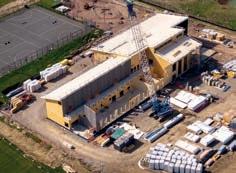
Houlton Primary school is being built to Passivhaus standards
CIOB CIOB
Manchester Hub chair’s successful two-year tenure draws to a close
Leigh Renshaw FCIOB, associate director construction with Astra Zeneca, has been an active CIOB member since 2013

Leigh Renshaw FCIOB has completed his two year-long tenure as chair of the Manchester Hub, stepping down from the role at the end of this month.
Renshaw, associate director construction with Astra Zeneca and a CIOB client champion, is a great advocate for neurodiversity and was nominated for the CIOB EDI Award. He is an active CIOB member since securing chartership in 2013, having taken part in many CPD/Initiatives during his time as chair and has made a great impact.
“I have always seen MCIOB as my greatest professional achievement and I finally got there via the old-school student, ACIOB, ICIOB, degree and formal interview pathway,” he said.
“Fellowship always seemed out of reach, but when I saw applications for the Manchester Committee, I thought that may be a great way to progress towards FCIOB.”
Cross-committee collaboration, skills-gap, talent pipeline and EDI were the key objectives under his tenure, Renshaw said, citing the past two years as “the most rewarding of
my career”. Fellowship aspirations were originally a primary objective of signing up to the hub, Renshaw admits, but says “the networks, friendships and career opportunities have truly come out on top”.
Remembering other key highlights in his time in the committee, Renshaw points to the Cape Town and Belfast Members Forums, the friendships created, hub links to academia and the wealth of reference visits across Manchester.
“Looking back, I am incredibly proud that our steering committee delivered over 35 initiatives, including 14 SMART goals, five webinars, five reference visits, 10 sessions with academia, nine super-region joint ventures, and many, many more.
“Leaving the committee will be strange at first, but Rob Gutteredge will continue to steer us in the right direction, and my work with CIOB will continue with my CIOB ClientChampion role under Linda Stevens and Ayo Allu FCIOB.”
Bee Younis from the hub said it is “difficult to put into words the impact that Leigh has had, not only on the Manchester Hub, but on everyone fortunate enough to work alongside him”.
“His legacy is one of dedication, innovation and community and, while he may be stepping away from the committee, his influence will be felt for many years to come.” ●
CIOB Apprentice of the Month
Alexandra Coates, National Highways

What originally made you decide to start a construction apprenticeship?
I started working with National Highways as a commercial assistant, and a lot of my role was working with quantity surveyors and commercial managers. I was helping to assess monthly applications for payment and dealing with contractors, so I wanted to learn more about it and maybe become a QS as well. I was told the best way to do that was through an apprenticeship alongside college, so that’s why I applied. My manager was really supportive and allowed me one day off a week to attend college, which happened to be on a Friday.
What lesson – technical or personal – has stayed with you the most?
I think Unit 4 was one of the most surprising, because it covered diversity, equality and ethical standards in construction. During the lesson, some students shared their personal experiences of working in the industry, and some of the stories – you wouldn’t think those things still happen today. For example, women’s toilets being used as storage, or apprentices having pranks played on them and being sent out for things that don’t exist. It was quite eye-opening. But I think it’s really important that it’s included, because everyone on
the course is a future professional. If people are aware these things are happening, they can help fix them when they’re in positions of responsibility.
How important is attitude compared to skill when you first start out?
I’d say attitude is more important, because the course starts completely from scratch. We learnt what the industry is, what the role of a QS is and how to produce schedules and take-offs from drawings. You don’t need a lot of experience – people come from all sorts of different backgrounds – but you do need the attitude to want to learn and progress in your career.
How do you think technology is changing the construction industry? My tutor said when he first started, everything was done with pen and paper, measuring on site. Now you can have drones flying over a site measuring everything, and you can create drawings on a computer in minutes.
So it’s changing things really quickly. But at the same time, I don’t think AI is going to take over anytime soon. But technology can help with the more repetitive tasks, like finding patterns or pulling information out of large contracts.
What are your next goals now that you’ve completed your apprenticeship? It took me about two years to finish, so I think I’ll take a bit of a break now. It can be quite stressful balancing deadlines for college and work in the same week. After that, I’ll look at continuing my education – maybe going to university next year.


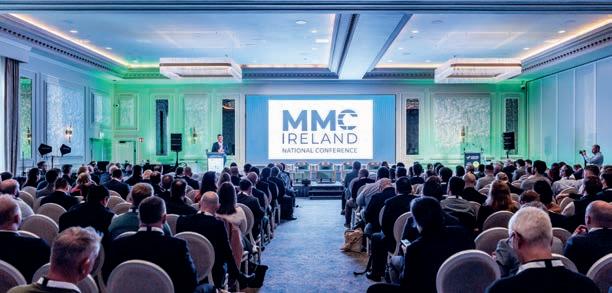
Procurement, pipeline and new skills taking centre stage
MMC Ireland National Conference homed in on key themes
The fourth annual MMC Ireland National Conference brought together more than 400 delegates from across Ireland’s construction, manufacturing, policy and research communities.
With CIOB as a partner, the event was chaired by Darren Richards of Cogent Consulting, and provided a timely snapshot of a sector transitioning from innovation to implementation.
A clear and consistent message emerged throughout the day: while significant progress has been made in advancing MMC across Ireland, the next phase will require greater coordination, standardisation and investment in skills to enable delivery at scale.
Government, leadership and sector alignment
Strong government engagement underscored the importance of MMC in addressing Ireland’s housing
crisis. Contributions from Minister James Browne and Minister Marian Harkin highlighted the central role of industrialised construction in delivering the volume, quality and sustainability of housing required. Key themes included the need for procurement reform, pipeline certainty and stronger collaboration between public sector clients and industry.
Encouragingly, both ministers acknowledged that the Irish MMC sector is now aligned with national housing ambitions, signalling a shift from policy intent to practical delivery.
Housing delivery and standardisation
Housing was at the centre of discussions throughout the conference. Ireland faces significant pressure to deliver homes at scale while maintaining design quality, affordability and sustainability. Speakers widely agreed that traditional construction methods alone will not meet these demands.
More than 400 professionals came together at the conference
Strong government engagement underscored the importance of MMC in addressing Ireland’s housing crisis
Instead, MMC and industrialised construction are increasingly seen as essential to improving productivity and delivery certainty. However, scaling these approaches requires a balance between standardisation and architectural quality – a theme that resonated across multiple sessions.
Learning
from UK experience
The conference also reflected on lessons learned from the UK’s MMC journey, particularly the challenges associated with over-reliance on volumetric modular systems. Ireland is increasingly adopting a more balanced approach, favouring panelised systems that offer greater flexibility and scalability for housing delivery.
A recurring theme throughout the day was the importance of procurement reform and pipeline certainty. Without consistent demand, manufacturers face significant risk in scaling production. Interactive audience polling reinforced these priorities, identifying procurement reform, workforce development and regulatory clarity as key areas for action.
The MMC Ireland National Conference 2026 demonstrated a sector gaining confidence and maturity. And as the industry looks ahead to 2027, the message is clear: the foundations are in place, but the next phase will be defined by the ability to deliver at scale. ● For more details, visit www.mmcireland.ie
CIOB appoints five new trustees
Fellows from across the industry join the board on 24 June
CIOB has confirmed the appointment of five new trustees to its board following the conclusion of its 2026 recruitment process.
In a statement, the institute said its Nominations Committee had completed the selection process and that the outcomes had been formally ratified by the Board of Trustees.
The 2026 intake included four vacancies for elected trustees and one additional position to be filled through selection. However, CIOB confirmed that no election was required this year after only four candidates met or exceeded the assessment threshold needed to progress to the election stage.
Under the organisation’s Bye-Law 65(d), where the number of eligible candidates matches the number of vacancies, those candidates are automatically deemed elected without a vote.
The decision to proceed on this basis was approved by the Board of Trustees in February.
Dayle Bayliss, Michael Loizias, Duan Van der Merwe and Paul Vega will formally join the board as elected trustees at the close of the organisation’s annual general meeting on 24 June.
Bayliss is a consultant; Loizias is co-founder and chief product officer with StoneRise Technology; Van der Merwe is director with Delta Consulting;
and Vega is a pre-construction manager with Winvic.
The Nominations Committee also continued its recruitment process to identify an additional trustee to strengthen the Board’s overall skills mix.
Acting under Bye-Law 67, it recommended Shu-Ling Lu for appointment following a skills audit and further discussions around board composition.
Her appointment was subsequently ratified by the Board of Trustees in April , with her term also set to begin at the close of the AGM in June.
All decisions relating to the appointments were formally recorded at the Board of Trustees meeting held on 29 April.
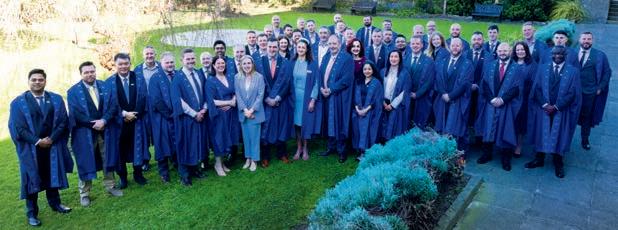
Ireland hosts CIOB graduate ceremony
More than 140 attendees witnessed 45 graduates
The CIOB held its ROI Graduation ceremony on 24 April at The Law Society of Ireland, Dublin. Over 140 attendees were present to witness 45 graduates from Republic of Ireland, Northern Ireland, UK (Manchester, North Yorkshire, Durham and Cheshire), and Malaysia. The Northern Ireland Committee
chair Yvonne Conway FCIOB and vicechair Duane Mccreadie FCIOB also celebrated their Fellowship with us.
CIOB gradutes with dignitaries at The Law Society, Dublin
CIOB Wales Student Challenge relaunches online
VIP guests included the CEO Victoria Hills, CIOB trustee Jonathan Payne FCIOB, ROI committee chair Dermot Fitzgerald MCIOB, who also acted as the master of ceremonies, and vice-chair Lisa Brennan MCIOB. ● Format

CIOB Wales successfully relaunched its annual Student Challenge this year, piloting a new online format that enabled wider participation across Wales.
Teams of students from both Further Education (FE) and Higher Education (HE) institutions were invited to compete against their peers to become local challenge winners. Each team consisted of up to four members, all studying at the same academic level. Participants were challenged to respond to the theme Tackling a Global Housing Crisis, developing a strategy or methodology capable of addressing this issue on a global scale. Submissions were required to demonstrate alignment with the CIOB Corporate Plan core themes of quality and safety, environmental sustainability and addressing skills gaps.
Teams were also encouraged to reference the United Nations Sustainable Development Goals.
Following careful consideration by the judging panel, the winning submission was awarded to Nia Alm, Samuel Chen, Kieran Rees, and Rhys Cosker of the University of Wales Trinity Saint David. A Highly Commended accolade was also presented to Andrew Middleton from the University of South Wales.
Both recipients were invited as guests of Tomorrow’s Leaders Wales to attend the Construction Cymru Wales Conference in Swansea. Their awards were formally presented by CIOB Wales chair, Wyn Harries FCIOB, in front of industry colleagues, recognising the high standard of innovation, sustainability, and strategic thinking demonstrated through their submissions.
The winning team from University of Wales Trinity Saint David

Starting off on the right foot
Resilience, networking and running are among the events and activities lined up for the rest of 2026
As we rapidly approach the second half of the year, CIOB continues to hold different events and activities globally, designed to help members fulfil their CPD commitments, keep up with policy changes and current trends and meet with their industry peers.
It can also be beneficial to collaborating organisations interested in sharing their knowledge, giving them the opportunity to demonstrate their expertise and to enhance their industry profile with CIOB members and the CIOB community.
Many conferences planned for the second half of the year are themed around resilience, from business resilience to building resilience. There are also activities designed to support mental health and wellbeing.
Tailored sponsorship packages are available, and listed below are some of
the core events that potential partner organisations may want to support.
CIOB Company & Client Forum –24 September, London
After the success of the inaugural event in 2025, CIOB Chartered Company Members and CIOB Client representatives will attend a conference and networking event designed to support businesses and business resilience.
Building Resilience: Construction in an uncertain world – CIOB Sustainability Conference, 14 October, virtual
The built environment industry must prepare for a future defined by more intense and frequent climate-related challenges, which will determine what, where and how we build. From extreme weather events to rising temperatures, our teams, buildings and infrastructure
It can also be beneficial to collaborating organisations interested in sharing their knowledge, giving them the opportunity to demonstrate their expertise and enhance their industry profile
will be (and already are) at increasing risk. This virtual conference will explore how we must adapt and prepare to meet the critical challenge of ensuring our buildings, infrastructure and communities are ready for an uncertain future by urgently embedding climate resilience into practice and changing the way we design, build, retrofit and operate our buildings to make both the industry and our built environment more resilient.
CIOB Walk Run Club
The CIOB Global 5k Run/Walk is a CIOB worldwide wellbeing initiative designed to bring together CIOB members and our global community. Delivered in agreement with ParkRun, participants can join at any ParkRun location worldwide, making it both globally accessible and locally inclusive. This cumulates in a CIOB Walk Run day on 3 October raising money for CIOB Assist. Position your company as a driver of positive workforce culture and align with a recognised, evidence-based health initiative, and champion wellbeing across your global teams.
CIOB Tomorrows’ Leaders
Support CIOB members and aspiring future professionals by working with CIOB to help develop pathways and learning opportunities for the future. These include supporting the Tomorrows’ Leaders Student Challenge or sponsoring a Tomorrows’ Leaders webinar or activity. ● To speak to the CIOB Corporate Partnership Team, or for more information on any of these events, visit www.ciob.org/sponsorships or email sponsorship@ciob.org.uk.





2026
Diary dates
Highlights of the CIOB Calendar for the coming month
The Building Safety Act: What You Need to Know Now 10 June, 9am-12.15pm, Ipswich Legal, Design & CDM experts share practical insights, compliance essentials and real-world collaboration strategies.
Colin Jones from HCR Law will deliver the legal presentation, outlining the key framework, duties and compliance responsibilities under the act. This will be complemented by a joint presentation from LSI Architects and Pentaco, exploring the importance of collaboration between consultant and contractor.
Charles Cowling, a CDM specialist from Concertus, will provide further practical insight into how these regulations are applied on projects. Contact: scatherall@ciob.org



Passive Design, Construction and Cooling for a Hotter Planet 15 June, 1pm-2pm, online
Led by Toby Pear of Article 25, this CPD webinar will explore the role of passive design in addressing the challenges of a hotter planet. Pear will draw on professional experience to share valuable insights into the principles of passive design, sustainable construction practices and innovative cooling approaches suited to diverse environments. Attendees will gain an understanding of how thoughtful design can significantly enhance building performance, resilience, and occupant wellbeing.
Contact: zlamani@ciob.org
Building for the Future
16 June, 9am-12pm, Ashton Gate Stadium, Bristol
This joint event between YTKO, CIOB and RICS will bring together experts on policy and legal changes, which will impact the construction sector and wider built environment in 2026.
Attendees will also have the opportunity to find out about funding, supply chain and training support across the West of England. In particular, this event will include details on low-carbon construction and will promote the Retrofit West initiative, a funded
Switchboard: +44 (0)20 7490 5595
Editor: Will Mann
will.mann@atompublishing.co.uk
Managing editor: Mark Glover mark.glover@atompublishing.co.uk
Production editor: Mary Ann Haslam
Art editor: Heather Rugeley
Community editor: Nicky Roger
nicky.roger@atompublishing.co.uk
Advertising manager: Dave Smith
david.smith@atompublishing.co.uk
Credit control: Eva Rugeley
eva@atompublishing.co.uk
Managing director: Stephen Quirke
stephen@atompublishing.co.uk
Circulation: Net average 30,842
scheme to help homeowners reduce their energy costs and build the supply chain for environmental technology installations.
Contact: navent@ciob.org.uk
Wellbeing in Construction
18 June, 12pm-1pm, DoubleTree by Hilton Glasgow
A session with Reiki teacher Chia Yen Oh, who specialises in transforming high-pressure construction environments into less stressed, focused and productive workplaces, reducing absenteeism whilst boosting morale and performance.
Contact: wmarshall@ciob.org.uk
Business Resilience for Construction Companies
18 June, 5.30pm-7.30pm, Manchester
This session will explore how businesses can anticipate risk, adapt to change and build resilience in a complex and uncertain environment.
This session will be led by Dr Tim Whitehill Hon. Research Fellow at LJMU, Faculty of Society & Culture, BSc MBA DBA MIO & Co-CEO Save Construction Initiative.
It is joint with CIOB and Save Construction Intitiave and open to all, but a great opportunity for Chartered Company Members to come together and find out how
Audit period: July 2022 to June 2023
Subscriptions: To subscribe or for enquiries, please contact: Subscription team: Tel: 01293 312160 Or go online at: https://constructionmanagement. imbmsubscriptions.com
Or write to us at the address below: Construction Management Published for the Chartered Institute of Building by Atom Media Partners, 26-27 Bedford Square, London United Kingdom. WC1B 3HP construction-management@ atompublishing.co.uk
to maintain success in a volatile market. We shall be in the Winter Gardens room at WSP, 8 First St, Manchester M15 4RP. This event is FREE. Places are limited and booking is required.
RIS:ES Coombe Valley Hospital –site visit
25 June, 2pm-4pm, Bexhill-on-Sea
Kier has been appointed by the Sussex Partnership NHS Foundation Trust to deliver a new £60m 54-bed acute inpatient mental health hospital in Bexhill as part of its Re-designing Inpatient Services in East Sussex (RIS:ES) Programme. This is the first step in the RIS:ES Programme, which is aimed at providing all mental health inpatient services across East Sussex on a single site.
The 57,393 sq ft facility will provide high-quality inpatient services for adults and will replace outdated services currently provided in the Department of Psychiatry at Eastbourne District General Hospital. There will be three 18-bed wards, surrounded by attractive and therapeutic landscaped green space. Contact: blawrence@ciob.org.uk
For a full list of events and to register visit www.ciob.org/events.
Construction Management is published monthly by Atom Media Partners. The contents of this magazine are copyright. Reproduction in part or in full is forbidden without permission of the editor. The opinions expressed by writers of signed articles (even with pseudonyms) and letters appearing in the magazine are those of their respective authors, and neither CIOB, Atom Media Partners nor Construction Management is responsible for these opinions or statements. The editor will give careful consideration to material submitted – articles, photographs, drawings and so on – but does not undertake responsibility for damage or their safe return. Printed by Precision Colour Printing. All rights in the magazine, including copyright, content and design, are owned by CIOB and/or Atom Media Partners. ISSN 2755 8649