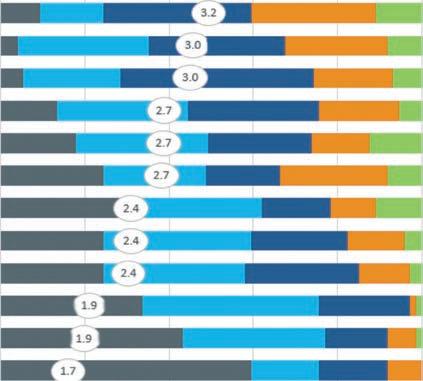
Why an uncertain outlook for the year ahead is fuelling construction’s confidence crisis
back on key themes
over the past 12 months
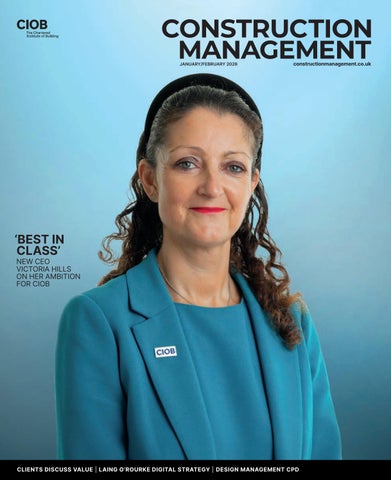
new CIOB CEO shares her vision for the institute
professionals reveal what they look for from contractors and suppliers
Alconbury is being redeveloped into a new community
Highlands church ceiling gets a touch-up
Painting conservators from Historic Environment Scotland are helping to conserve the unique ceiling at St Mary’s Church in Grandtully, Perthshire. The ceiling was first painted in the 1600s and is divided into roundels and arches, with various coats of arms, saints and proverbs within them.
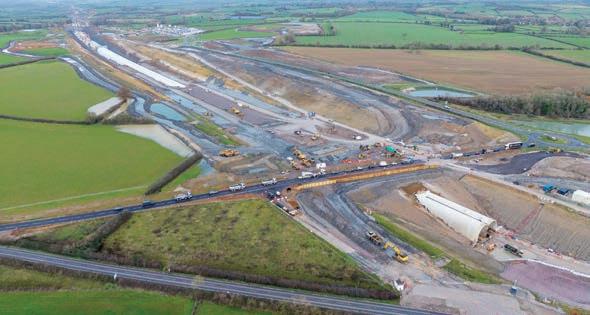
HS2’s longest ‘green’ tunnel takes shape
Construction of HS2’s Greatworth tunnel is progressing following the realignment of a local road, freeing up space for the next phase of excavations. Set to stretch for 2.7km, the so-called ‘green’ tunnel will be landscaped on top and designed to blend into the countryside near Greatworth, West Northamptonshire.
New CIOB CEO Victoria Hills shares her ambition with CM, p14
Thames drilling unlocks vital data
A jack-up barge stationed on the River Thames has enabled drilling investigations beside the Palace of Westminster as part of a wider restoration and renewal programme. Structural Soils engineering teams drilled 14 boreholes to depths of up to 74.5m into the Thames riverbed to map geological conditions ahead of planned construction works at the Houses of Parliament.
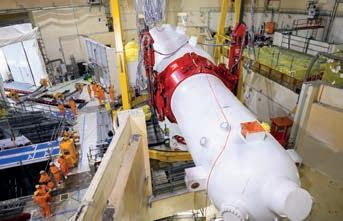
Innovation accelerates nuclear decommissioning
Mammoet, commissioned by Framatome, has supported the removal of four steam generators from a nuclear power plant in Germany. The team of nuclear experts and engineers developed a ‘rip and ship’ solution that enabled the steam generators to be removed from the reactor building in one piece, thereby accelerating the decommissioning process.
Breedon funds new pedestrian crossing
Construction materials provider Breedon has donated more than 180 tonnes of asphalt for a new pedestrian crossing, which will help improve road safety near a community centre and school in Edlington, Doncaster. Design and project management for the new crossing was carried out by ECB Design Group, with the materials laid by Thomas Bow.
Enduring legacy of Shackleton’s Antarctic expedition
RSK Falkland Islands is assisting the South Georgia Heritage Trust with preparation works to stabilise and protect the Manager’s Villa at Stromness Whaling Station. The site, on the sub-Antarctic island of South Georgia, is of historic significance due to its link to the polar explorer Sir Ernest Shackleton and his ship Endurance.
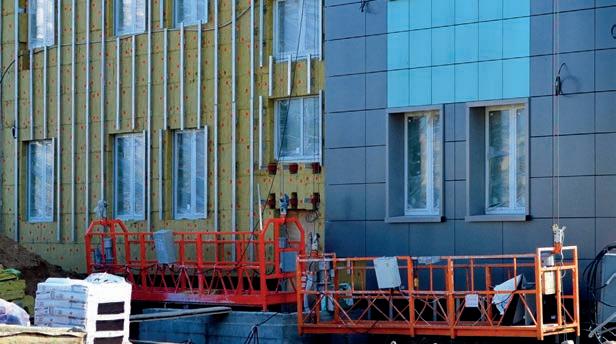
A cross-party report has raised concerns over delayed BSR approvals for new and existing high-rise buildings
‘Unacceptable’ BSR delays threaten 1.5m homes target
House of Lords committee makes wide-ranging criticisms of Building Safety Regulator, referencing evidence supplied by CIOB and others during industry consultation
Delays caused by the Building Safety Regulator’s (BSR) approval processes are leaving residents in unsafe buildings and increasing costs for leaseholders, a crossparty House of Lords committee has warned.
The Industry and Regulators Committee’s report, The Building Safety Regulator: Building a better regulator, published in December, also warns that the delays mean the government is in danger of missing its target to build 1.5 million new homes by 2029.
The report states that while high-rise buildings represent a minority of the housing stock in England, they are essential to deliver new housing in large cities.
The
scale of the delays caused by the BSR has stretched far beyond the regulator’s statutory timelines for building control decisions
Baroness Taylor of Bolton
“These delays have hampered the delivery of the new homes that the country needs, slowing progress towards the government’s target of building 1.5 million new homes in this Parliament,” the report adds.
“Other factors, such as skills and planning, are also a constraint, but resolving the unacceptable delays caused by the BSR will be a necessary, if not sufficient, condition of meeting the target.”
The committee’s recommendations
The committee is urging the BSR to give greater guidance to its multidisciplinary teams (MDTs) on how compliance with the building regulations should be
evidenced and assessed to ensure greater consistency.
Allocating the same MDTs to similar buildings or projects built by the same organisation could improve efficiency and consistency, the report says.
The recommendations also call for the government to remove smaller works from the BSR’s building control approval processes, or introduce a streamlined approval process for them.
The committee added that the government should provide longterm funding for the training of new building and fire inspectors to help alleviate workforce constraints.
Commenting on the findings, Baroness Taylor of Bolton, chair of the committee, said: “The tragic loss of 72 lives at the Grenfell Tower fire laid bare the urgent need to reform building safety regulation in England, particularly for high-rise buildings. The introduction of the Building Safety Regulator was a necessary and welcome step.
“However, the scale of the delays caused by the BSR has stretched far beyond the regulator’s statutory timelines for building control decisions. This is unacceptable.” ●
CIOB evidence supplied to report
Evidence from CIOB regarding delays in BSR approvals is referenced throughout the report.
According to CIOB, the BSR’s building control delays will not be “the major roadblock or primary influencing factor” in new homes not being delivered in England, as most will be delivered through low-rise developments.
However, CIOB argued, delays in BSR approvals will be one of the factors that will prevent cities meeting their individual targets –a concern echoed by several other witnesses who provided evidence to the committee.
Andrew
MP expressed his passion for apprenticeships
Apprenticeships ‘key to delivering government housing pledges’
Andrew Pakes MP, co-chair of the Apprenticeships APPG, delivered the message at a CIOB Houses of Parliament event
Construction apprenticeships must sit at the heart of government plans to tackle housing shortages, according to Andrew Pakes MP, co-chair of the All Party Parliamentary Group on Apprenticeships.
Speaking at a CIOB Houses of Parliament event which he sponsored, Pakes said construction apprenticeships “change lives and strengthen communities” and are essential to building the workforce needed to deliver safe, sustainable homes.
“Getting apprenticeships, skills and standards right in construction must be a core priority for Government if we are serious about delivering the housing, growth and opportunities this country deserves,” he added.
His message comes after repeated warnings that labour shortages remain one of the biggest barriers to meet the Labour Government’s ambitious target of building 1.5 million homes this parliament.
Apprentices and early-career professionals attended the CIOB event to share first-hand accounts of joining the industry, describing both the challenges they faced and the support that helped them succeed.
“Meeting CIOB members and apprentices and Tomorrow’s Leaders shows how investing in skills not only opens doors for individuals, but also builds the workforce our construction sector needs to deliver safe, sustainable
Apprenticeships change lives and strengthen communities, giving people the skills and confidence they need to get on in life
Andrew Pakes MP
homes and infrastructure,” said Pakes. “I am deeply passionate about apprenticeships because they change lives and strengthen communities, giving people the skills and confidence they need to get on in life.”
The cross-party gathering brought together MPs and peers with leaders from across the built environment, and included CIOB president Paul Gandy, Lord Andrew Mawson, a cross-bench peer who has led community regeneration projects, and Will Forster MP, a member of the Commons Housing, Communities and Local Government Committee.
Eddie Tuttle, CIOB director of policy, external affairs and research, said engagement with Parliament remained essential heading into 2026.
“2025 has been a busy year for us at CIOB and the wider construction industry but there remains much to do as we move into 2026,” he said.
“Engaging with policymakers in Parliament is important as it enables us to connect them with our members who are working on the front line of the industry day in day out, and can talk with authority on the challenges they face and what they’d like to see change.
“Many of Government’s priorities including the ambitious housebuilding targets, rely on our industry so it’s vital that issues including skills shortages, procurement practices and building safety are given due attention and policy support.” ●
Pakes
From policy to delivery: can construction rise to the 2026 challenge?
The uncertain outlook for the year ahead is fuelling construction’s confidence crisis, writes Nitesh Patel
For construction, 2025 was expected to be a big year and it has been pivotal for UK infrastructure, with government commitments setting the stage for transformative change. Planning reforms and the government’s industrial, infrastructure and housing strategies are central to boosting growth.
In the November budget, while light on big-ticket announcements, the chancellor did reveal new funding for the Lower Thames Crossing, alongside the backing for nuclear at Sizewell and at
Wylfa, and for the DLR extension to Thamesmead.
The 10 Year Infrastructure Strategy marked the UK’s first comprehensive long-term plan for infrastructure. It brings together economic infrastructure, such as transport, energy, water and wastewater, digital and flood risk management, with housing and social infrastructure, including hospitals, schools and colleges, and prisons and courts.
Over the next decade, the government has committed at least £725bn in funding. This certainty will enable both
government and industry to plan further ahead, driving more effective project delivery.
To deliver on this vision, the Planning and Infrastructure Bill introduced in March aims to streamline the delivery of new homes and critical infrastructure across England. It also gives ministers the authority to prevent local councils from blocking new housing developments.
At its core, the bill sets an ambitious target: 1.5 million new homes in England by 2029. However, significant concerns remain about the industry’s capacity
to meet the surge in demand. While materials price inflation has eased, rising wages growth and regulatory compliance continue to drive costs up, further squeezing margins. Labour shortages have been a persistent challenge in recent years, and our contractor survey highlights skilled labour as the single biggest barrier to delivery, ranking even above cost pressures. Industry estimates indicate that the UK will need to recruit an additional 239,000 construction workers over the next five years to meet demand. In March 2025, the government pledged £600m to
The Planning and Infrastructure Bill has set a target of 1.5 million new homes in England by 2029
1.5m
The record number of construction insolvencies since 2021 has heightened supply chain vulnerabilities
train up to 60,000 skilled workers by 2029. While this still leaves a shortfall, it represents a step in the right direction. However, tighter visa rules for skilled workers raise the risk of further labour shortages and project delays, both of which inevitably drive up costs.
Adding to these pressures, the record number of construction insolvencies since 2021 has heightened supply chain vulnerabilities and created further uncertainty around project delivery. Greater clarity on funding should help stabilise the market and give contractors confidence to commit.
The wider economic environment also poses many challenges. Growth has slowed, and consumer price inflation picked up in 2025 due to higher utility costs, keeping interest rates elevated for longer.
Inflation is expected to ease this year, paving the way for bank rate cuts that should stimulate activity. Forecasts suggest output could grow by 2.8% in 2026, up from 1.5% so far in 2025. Combined with a loosening labour market, stabilising material prices, and government reforms, these factors should improve project viability over the medium term.
Construction is facing a confidence crisis. Conflicting signals from the government have made businesses hesitant. Delivering Labour’s vision, of 1.5 million homes and major infrastructure projects depends on a strong, confident construction sector.
The tax-raising measures announced in the budget must translate into tangible infrastructure investment. Without this, key projects risk competing for limited resources, driving up costs and constraining growth.
Nitesh Patel is a lead economist at Turner & Townsend.
Lack of confidence in the market to invest in new projects
Too many contractors chasing too few projects
Government red tape, bureaucracy, delayed approvals
Companies going insolvent within your supply chain
Excessive lead times
Political instability
The market is oversupplied
e.g. too many vacancy
apartments and office space
Low workplace productivity, inefficient and outdated work practices
Difficulties accessing credit
Average rating among respondents
Delivering on CIOB’s key themes
CIOB policy chief Eddie Tuttle reflects on a busy 12 months across the built environment sector
Working in collaboration across the industry, collectively trying to tackle the big issues that face us all, 2025 has seen us and our sister professional bodies continue work to support professionalising the industry.
We have consistently made the case for a focus on quality, safety and competence and, looking back at 2025, here are a couple of the highlights that focused minds on the need for professionalism and quality.
In August, we published a new technical information sheet, titled Guide to Products Critical to Safe Construction. Free to members, the aim is to provide designers, specifiers and installers with the information they need to make
sound decisions when selecting crucial products and systems.
We hosted our fourth annual Sir James Wates lecture in September, with Mark Farmer delivering a talk that examined one of the industry’s emerging big issues: the potential impact of AI, with both opportunities for increased productivity and risks in losing experience and the human element.
Most recently, we hosted a parliamentary reception, presided over by CIOB president Paul Gandy.
Paul’s speech highlighted some of the successes we’ve had working in partnership, mentioning parliamentarians, industry bodies, employers – and giving a well-deserved shoutout to our
Safety and quality were key themes at CIOB over the past year
It is heartening to look back on how much we achieved over the past year. We are growing, both in terms of membership and our impact and influence Eddie Tuttle, CIOB
Tomorrows’ Leaders community. As he said, it was an opportunity for MPs and “for industry leaders to meet the Tomorrows’ Leaders who will one day take their place”.
Significant achievements
There was also mention of how we’re delivering on our key themes, the first among them being safety and quality. Paul talked about the launch of the Principal Designer Competency Certification Scheme, which builds on the success of the Principal Contractor Scheme. He also discussed our part in procurement reform, with chartered members in Northern Ireland now being formally recognised in public sector procurement.
Our work to tackle the ‘skills challenge’ was advanced with the launch of Aspire, an initiative for 14- to 19-year-olds and career changers, helping to provide clear pathways into the sector.
Finally, there was our focus on sustainability and retrofit, with our Sustainable Construction conference, practical guidance on the UN Sustainable Development Goals and work across all the home nations to promote retrofit as a national priority. It is heartening to look back on how much we achieved over the past year. We are growing, both in terms of membership and our impact and influence, so I am very much looking forward to what 2026 may bring! ● Eddie Tuttle is director of policy, research and public affairs at CIOB.
Eddie Tuttle CIOB
Feedback
A selection of readers’ comments about news and issues in the industry from across the CIOB community and social media
CM
Call for workforce reforms to tackle construction skills crisis
A report from the Centre for Social Justice has warned that without radical reforms, construction risks falling short of the government’s 1.5m homes target.
Roy Anderson
Instead of employers wanting modular workers (ie kitchen fitters) or wanting people who can do first fix and the like, train apprentices the traditional way to be able to cover all
Government housing targets are a bitter lemon
Gleeds’ Richard Steer sets out why he believes the government’s 1.5m homes target now appears “wildly optimistic”.
Mac1
Mike Reader MP is still suggesting that this target is achievable, whilst also saying:
aspects of their trades, be it brickwork, plastering etc. Ensure companies only employ fully trained workers by more stringent use of the CSCS cards, perhaps even using a registration system such as the Gas Safe or NICEIC.
“This isn’t just about the quality of the housing product itself. It’s also about the quality of place – do these homes create communities rather than isolated housing developments, how do they promote sustainable travel, connect with green spaces?” Well not really. Developers always quote “sustainable developments” as a sales pitch, but in reality they fall way short.
The built environment is tackling a construction skills crisis
CM
We are united against ‘dumbing down’ of apprenticeships
Instead of employers wanting modular workers, train apprentices the traditional way to be able to cover all aspects of their trades
Roy Anderson
Helen Hewitt, CEO of the British Woodworking Federation, explains why industry leaders are coming together in response to the government’s proposed apprenticeship reforms.
David Fitchie
More and more, I see a worrying lack of skills and knowledge on construction sites. Many tradespeople do not fully understand the regulations or how to apply them in practice. Members of design teams often lack insight into good design, effective supervision of contractors or even the motivation to check work onsite – leaving the responsibility to already overstretched building control departments. Let’s hope things improve, but I’m not holding my breath.
CM
What happens if your registered building control approver becomes insolvent?
Following the collapse of Assent, Trowers’ Tim Hillier and Olivia Jenkins outline the options available after a building control body ceases trading.
Gabriel
There [are] also those initial notices for non high-rise buildings where the BSR is not involved. With all the new regulation, if the building control body goes under, a new application is needed and this sounds like “unregulated business” despite [whether] they are registered or not. The new system falls short here.
Share your views on the latest industry issues by posting comments online at www.constructionmanagement.co.uk or by emailing the editor at construction-management@ atompublishing.co.uk
‘Best in class’: new CIOB CEO Victoria Hills outlines her ambition
It’s the start of a new era at CIOB as Victoria Hills takes over as CEO, joining from the Royal Town Planning Institute. She tells Will Mann the three main reasons she was drawn to the role
Dr Victoria Hills takes up her role as CIOB CEO on 2 January 2026 believing a “golden opportunity” lies ahead for construction – and the institute.
She elaborates: “The UK government clearly has a major growth agenda, and it’s ‘rolled the pitch’ through legislation like the Planning and Infrastructure Bill. Now, it’s all about delivery – which is where construction comes in, and CIOB and its members can be part of this story.”
This opportunity to shape the growth agenda through construction was one of three major reasons that attracted Hills to the CIOB top job, after a career working in leaderships roles across the built environment sector, most recently as CEO of the Royal Town Planning Institute (RTPI).
The second reason, she says, is the global nature of CIOB’s membership and international growth potential. “The World Economic Forum has identified construction as one of the top five fastest-growing job categories
There are thousands working in construction who do not belong to any professional body. Now is the moment to address that
Victoria Hills, CIOB
over the coming decade,” she says. “There is enormous growth potential worldwide, shaped by the 2030 Sustainable Development Goals. CIOB can lead the professionalism conversation globally.
“Which brings me to the third reason I saw CIOB as the right place to be: the increasing focus on professional standards and regulation. At the RTPI, I led a self-regulated professional body, so I understand the model.
Construction is also currently a non-regulated sector, which presents a huge opportunity for CIOB to shape how professionalism is defined and delivered.”
Policy goals
Hills joins CIOB having built a reputation for policy expertise in her previous roles. So what areas will she prioritise?
“One thing I found very effective at the RTPI is being very clear about what our policy priorities actually are. Who do we want to influence – governments, international organisations or standards bodies? Where can we add value? The policy team already has a strong foundation, but clarity about our goals is important.
“Once we know what we want to influence and why, then we can work out how. In some cases, it will make perfect sense to join with the
Victoria Hills was formerly CEO of the Royal Town Planning Institute
Construction Leadership Council (CLC), or with other trade bodies and groups. In other areas, CIOB will lead, and those will be our campaigns.”
Timing is also important. Hills adds: “There are moments when people are desperate to get research out. The instinct is understandable. But sometimes you have to sit back and wait until the right political moment – the Budget, party conference, a legislative milestone.
“Where I think I can add value is linking our research and knowledge base and expertise to a clear prioritised agenda and then identifying what CIOB should lead on and when collaboration makes more sense.”
Skills crisis
Hills will spend some time looking “under the bonnet” before deciding on policy priorities, but she says one area that stands out “immediately” is skills.
“As an outsider looking in, what I see is decades of investment in construction skills – time, money and effort,” she says. “Yet everyone is telling me there is still a construction skills crisis. If I’d just landed from Mars, I would ask: ‘do we need to do something differently?’
“I don’t know what the answer is yet, but CIOB should be part of that conversation. Can we keep spending public money the same
200
CIOB is well run and capable of regulating its members, with a proven track record spanning nearly 200 years
way if the outcomes haven’t changed? Those are the kinds of questions I want to explore.
“Skills are central to delivery. If planning reforms are in place, if the Chancellor unlocks funding, we can’t then say – ‘Sorry, there’s nobody to build it,’ nor can we expect that issuing more visas for overseas workers will provide the answer.
“Also, if there is a skills crisis, why are we losing half the people coming out of construction colleges? I don’t mean CIOB – we as an industry are losing them. At a minimum, we should understand why. Public money is funding training, yet attrition is high. What’s happening?”
Building safety and regulation
In the autumn, the government published its prospectus for a single construction regulator. So how does the new CEO think the built environment professions will be affected?
“My initial view, in relation to CIOB, is that this is a wellestablished, well-respected organisation,” Hills says. “It is well run and capable of regulating its members, with a proven track record spanning nearly 200 years. CIOB is a trusted global brand, known for its high professional standards.
“There is what I call a ‘golden trilogy’: entry into membership, through an excellent assessment
Construction managers are the linchpins that hold everything together –sustainability, technology, safety, design, developing skills and bringing through the next
generation Victoria Hills, CIOB
process; ensuring ongoing competence, through CPD; and conduct and discipline, meaning we will not tolerate poor standards. If someone fails to keep up professionally, or behaves inappropriately, they are out.”
Hills sees an opportunity to bring everyone in construction to a common standard, which she describes as “long overdue”.
“There are thousands working in construction who do not belong to any professional body,” she continues. “Now is the moment to address that. Of course, the context is difficult – no one would ever wish for the circumstances around Grenfell – but we are where we are. Organisations like CIOB must act as partners in providing assurance, confirming our members’ professional competence.
“With the regulator’s prospectus published, we need to work with others: the Construction Industry Council, CLC and more. But CIOB should not sit in the background; we must be visible. We have the entry standards, the maintenance of competence, and the disciplinary procedures when people fall short.
Digitising the industry
One area where CIOB has taken a lead, notably in last year’s publication of its AI playbook, is digital construction – and Hills sees this as another “major opportunity” for the institute.
“I see how many AI products already exist to support construction site operations – and that’s great,” she says. “There’s a real opportunity to deliver the productivity dividend we’ve been searching for.
“But what’s missing are standards: what good looks like, how AI should be used ethically, what behaviours are appropriate and how AI contributes to outcomes. CIOB could develop global AI standards for construction. We could draw on our AI playbook and evolve it into something formal. In construction management, CIOB is uniquely placed to shape that future.”
She also believes CIOB leads the way in harnessing digital technologies to deliver better outcomes for members.
Victoria Hills believes the opportunity to professionalise the built environment is ‘enormous’
“This is also a growth opportunity for CIOB: bringing more construction professionals into the membership. We have roughly 51,000 members. We can grow that and at the same time bring more of the industry up to our professional standards.”
“I don’t see any other organisation doing this with the same authenticity,” she says. “Since the pandemic, a sense of professional community has become more important than ever. CIOB’s role is to deliver that sense of connection, togetherness and relevance – whether members are in the UK or anywhere else.
“Digital capability will help us provide the resources that allow members to deliver on safety,
CIOB could develop global AI standards for construction, drawing on our AI playbook. In construction management, CIOB is uniquely placed to shape that future Victoria Hills, CIOB
sustainability, design, diversity –and stay current in their careers. That is how we’ll deliver value quickly and efficiently. Face-to-face engagement plays a role too. People like coming together physically – as long as it’s meaningful – but they need digital access day to day.”
Membership message
Hills notes that the “CIOB membership is a broad church” and sees opportunities to grow the membership and bring in other built environment professionals “by showing that CIOB has a compelling story and inviting them to join”.
To construction managers –the biggest caucus in the CIOB membership – her message is that there is “huge potential” ahead.
“The opportunity to professionalise the sector is enormous,” she says. “Government wants it, CIOB wants it and members already embody it through assessment and CPD. If we get this right, there are major opportunities, domestically and internationally.
“Construction managers are the linchpins that hold everything together – sustainability, technology, safety, design, developing skills and bringing through the next generation.
“If there is one overarching ambition I have for CIOB,” she continues, “it is to be best in class. I feel CIOB is already the voice in this space – construction management – but hasn’t always
received the recognition it deserves. Other voices in the built environment have been louder. Bringing CIOB into the broader arena – particularly with government – and helping it find its voice is going to be exciting.
“We need greater recognition for the important work our members do. Other professions often receive the credit for delivering places and infrastructure. Construction managers do critically important work and don’t always receive the recognition they should. That must change.”
Next corporate plan
Hills arrives at CIOB midway through the current five-year CIOB corporate plan, which runs to 2028. She expects the three themes of quality and safety, environmental sustainability and skills will continue shaping CIOB’s activities, but says that conversations with members will likely begin this year about what lies beyond 2028.
“That next strategy is important – it will take us toward our 200th anniversary in 2034,” she notes.
“We also have a major milestone before that: the 50th anniversary of our Royal Charter in 2030. These anniversaries matter. They reinforce our public purpose; we don’t exist to grow membership or sell training for its own sake.
“We do those things to influence better outcomes. And that public purpose will guide how we shape the future strategy.” ●
CV: Victoria Hills
● 2018-2025 – CEO, Royal Town Planning Institute
● 2014-2018 – CEO, Old Oak and Park Royal Development Corporation
● 2009-2014 – Head of transport, Greater London Authority
● 2007-2009 – Chief of staff, Greater London Authority
● 1997-2007 – Various senior planning and transport roles at local authorities and Transport for London Education
● 1997 – MSc Transport Planning, University College London
● 1996 – BA (Hons) Geography, University of Bristol
BIMplus is now CM Digital
In response to the increasing focus on information management and digitalisation among digital construction professionals, BIMplus has rebranded as CM Digital.
The same award-winning BIMplus editorial team will be creating the same high quality content, including interviews, project case studies, and news about the latest digital construction developments.
How do construction clients drive value from supply chains?
The Institute of Asset Management and the Chartered Institute of Building brought together a group of client-side professionals to find out what they look for from contractors and suppliers. Will Mann chaired the discussion
Ursula Bryan: Today’s conversation brings together a diverse and experienced group of client-side professionals from across the built environment, to discuss a topic that is central to both the IAM and CIOB: how we drive value.
Strengthening alignment across the value chain is vital to achieving better societal outcomes, such as sustainability and resilience, and taking advantage of major opportunities like digital transformation.
By sharing experiences, insights, examples and lessons learned, we can explore what really works and identify where we can do better to drive performance and long-term value. We can learn from each other and move the conversation forward.
Will Mann: What is the most important benchmark for your organisation when working with contractors and suppliers, and how do you measure their performance?
Terry Gray: Historically, cost and compliance – health and safety, environment, quality – have dominated. But in the past 10-15 years, expectations have widened to include innovation, sustainability, social value and community impact. As a supply chain partner, adding value in these areas is
essential in a tough market. We assess suppliers against our core values – respect, excellence, integrity, collaboration and innovation – both at the start and end of engagements.
Julie Blight: As we’re a public-sector organisation, value for money is crucial. Collaborative working is essential because the hospital must stay operational throughout any construction. Whether extensions or refurbishments, we need contractors who can work with us and innovate so we maintain operations. We have strict deadlines, such as winter pressures, and we can’t afford overruns in time or budget.
Jason Glasson: It’s difficult to pick just one measure, but for National Highways the key thread is safety. We are absolutely focused on safety for customers, our staff and our supply chain. Supplier performance is measured through accident frequency rates and RIDDOR-reportable incidents. We scrutinise and challenge suppliers to continually reduce incident rates and aim for zero harm.
Derek Cuthbertson: Quality control is our most important benchmark. While health and safety is rightly seen as a fundamental priority across the industry, we view quality
While health and safety is rightly seen as a fundamental priority across the industry, we view quality control as the most impactful measure of success
control as the most impactful measure of success. It encompasses not only safe working practices, but also the standard of workmanship, compliance with specifications, programme delivery, and ultimately, end user satisfaction.
We operate within frameworks with rigorous pre-vetting and are supported by consultants. We measure performance through design governance, project delivery processes, site inspections, adherence to scope and stakeholder feedback, and track KPIs monthly with quarterly reviews to ensure accountability and lessons learned.
Dan Hollas: After the Grenfell Tower fire and our investigations into external wall systems, quality and our ability to determine it has become a big focus. It is clear many buildings were delivered on time and on cost but not at the right quality. As part of that quality focus, we also have to look at competence – of ourselves as a client, our professional services consultants, and contractors.
Will Mann: What innovations do you look for from contractors and suppliers and how are these encouraged?
Leigh Renshaw: We’ve set extremely ambitious sustainability targets for our supply chain. We’re
The discussion panel
Dan Hollas Director of building safety, Clarion Housing Group
Derek Cuthbertson Lead programme manager, Royal Mail
John Green Senior asset strategy manager, Anglian Water
Jason Glasson Head of asset management development, National Highways
Leigh Renshaw Responsible engineer and associate director for construction, AstraZeneca
Julie Blight Property and contracts manager, Royal Devon University Healthcare NHS Foundation Trust
Terry Gray Project commercial director, Ferrovial Construction UK and Ireland
Simon Edwards Asset management director, Wessex Water
Ursula Bryan CEO, Institute of Asset Management
Derek Cuthbertson, Royal Mail
working with retrofit approaches, MMC and modularisation to reduce environmental impact. Our campus hosts 5,000 people and is now 98% decarbonised – achievable only with support from SMEs, environmental specialists, and engineering and construction partners.
We’ve removed four to five hundred tonnes of CO₂ equivalent by installing ammonia chillers rather than F-gas systems. We’re also backing a green gas initiative, sponsoring development of a biomethane plant in the UK that pumps green gas into the grid for our use.
To encourage innovation, we build these requirements directly into contracts and our RFP (request for proposal) processes, prioritising suppliers who share our sustainability values.
Julie Blight: Being part of the NHS, we are committed to the 2030 Net Zero target for suppliers. But with budgets extremely tight, most of what we deliver is refurbishment and small extensions, so recycling materials becomes essential. We rely on local supply chains and labour to reduce carbon from transport.
In new builds, we try to incorporate the ability to connect to future district heating networks,
Awaab’s Law has just come into effect so we’re also looking to our suppliers for innovations that will help us achieve compliance
Dan Hollas, Clarion Housing
although NHS requirements don’t always align well with district heating infrastructure.
We are exploring MMC –prefabricated toilets and bathrooms that minimise dust, noise and disruption, and provide quicker turnaround. But it does rely on contractors being able to bring forward innovation, which is difficult under current financial constraints.
Dan Hollas: Our own information management is essential; the better the data we provide to consultants and contractors, the more innovative their solutions can be.
When we’re managing combustible wall system remediation projects, we make sure sustainability is embedded into the solution. We require the use of software so we can track all materials removed from the building, measure recycling rates and set targets for the next project.
It’s an evolving process as the regulatory framework changes.
Awaab’s Law has just come into effect so we’re also looking to our suppliers for innovations that will help us achieve compliance.
Simon Edwards: My organisation wants to minimise environmental and community impact while maximising returns. But we’re also tied to very traditional, prescriptive standards, which limits innovation.
Prescriptive standards specify how something must be done, which blocks technological progress. That might have worked when technology moved slowly, but now solutions become outdated almost before they’re installed. The challenge is shifting from a cautious, traditional construction mindset to one more like IT, where fast iteration is normal.
Derek Cuthbertson: At Royal Mail, data analytics is a major focus; we
use estate data to improve asset management and understand life cycles better, which helps us prioritise investment and maintenance with limited budgets. We expect consultants and supply chain partners to bring low-carbon options for all projects. But one of the biggest internal blockers is the attitude of “that’s not in the specification”. We tackle this by presenting clear and evidence-based summaries of the benefits of new methods, helping people become comfortable with alternatives.
John Green: We’ve achieved major cuts to embodied carbon in our newly built assets over the years, but it is getting harder to find those savings.
I want to emphasise a broader idea of value, using the six capitals framework: environmental, social, manufactured, people, intellectual and financial. When partners think through those lenses, new opportunities arise.
Examples include placing electrical panels on the north wall of kiosks to reduce overheating risk, positioning standby generators away from neighbours to reduce noise, and restoring ground to improve biodiversity after works. Small changes, but significant positive impacts.
Jason Glasson: Internally, we run R&D programmes, but we also have an extensive supplier engagement council and run innovation competitions. These give SMEs visibility and allow them to showcase solutions. Winning ideas can receive National Highways sponsorship to become market-ready.
A recent example is an AI tool that analyses customer reactions to roadworks – identifying patterns of frustration from social media and other channels. By spotting pain
points early, we can resolve them and reduce customer concerns.
Terry Gray: Clients increasingly emphasise reductions in embedded carbon, renewable energy, and cutting diesel use by shifting to grid power or solar. On the supply chain side, we’re seeing advances like the use of drones for surveys and confined-space inspections.
On our contract delivering National Grid’s Grain to Tilbury project, part of The Great Grid Upgrade, we have introduced a major innovation in the form of Herrenknecht’s Vertical Shaft-Sinking Machine. It excavates to 40m-60m without requiring anyone to enter the excavation area. Traditionally, people had to work at the bottom of the shaft, so this is a major safety advancement.
Will Mann: What are the most common frustrations you have with contractors and suppliers?
Dan Hollas: Lack of collaboration. When I think about our least successful project – a small under-£200k suppression-system installation – the breakdown in the relationship between us and the contractor was severe.
Once trust is broken, it’s very hard to recover. It didn’t help that the contractor installed the system to the wrong British Standard, meaning it had to be ripped out and done again. The process took years and became contractual.
We have a supplier engagement council and run innovation competitions. Winning ideas can receive National Highways sponsorship to become market-ready Jason Glasson, National Highways
In contrast, our most successful project involved a difficult 1960s tower block with unforeseen framing issues. Because we had trust, competence and a shared understanding from the start, we solved the problems collaboratively and arrived at a really positive solution.
Derek Cuthbertson: Lack of adequate progress updates. As a client, you’re not always on site, and in live operational environments, poor communication has major impacts. When communication is infrequent or vague, it then becomes difficult to manage expectations, mitigate risks, or make informed decisions.
Late change requests are another issue, especially when they lead to extra cost that could have been avoided with better planning.
Pricing transparency is a recurring problem: variations often come with
insufficient breakdowns and vague terms like ‘cost included’, which hides detail and makes it hard to assess value or challenge assumptions. We also see challenges around the experience and capability of site management teams. Strong leadership on site is essential to maintain programme, manage the supply chain, and uphold quality standards. Unfortunately, industrywide skills gaps are apparent Leigh Renshaw: In one word: inconsistency. As a pharmaceutical business, we rely heavily on our supply partners. Yet the same contractor can deliver project A well and project B poorly. We see inconsistent adherence to standards and processes, often due to variable skills and experience. Because getting products to patients is critical, sometimes we have to bring in extra suppliers or internal resources to supplement underperforming contractors.
Julie Blight: It’s a long list, unfortunately. With live hospitals –particularly older sites – car parking is always a challenge. Site compounds often compete with patient and staff parking. At inner-city or small community hospitals in deprived areas, contractors sometimes arrive in very expensive cars and assume they can take over large parts of the site, including disabled bays. Better communication would avoid this. Hospital grounds also include mental health units and vulnerable patients. Visitors may have received bad news, or patients may still be recovering from anaesthesia for several hours. Their behaviour and needs can be unpredictable, and contractors don’t always appreciate the sensitivities of the environment. Simple actions – like not running a concrete mixer or angle-grinder
At small community hospitals in deprived areas, contractors sometimes arrive in very expensive cars and assume they can take over large parts of the site, including disabled bays
Julie Blight, Royal Devon University Healthcare NHS Foundation Trust
outside theatre windows – make a huge difference to surgeons and clinical teams. Often we can solve issues easily, such as by arranging alternative parking through the wider public estate, but we can only do that when communication happens at the right time.
Jason Glasson: I’d highlight the importance of seeing the bigger picture. The end goal is not simply creating an asset; it’s the service the asset provides. At project close, good asset information is essential. Historically, drawings would be boxed up and forgotten. Today it’s digital, but it still requires rigour at the end of the project – a time when teams are often moving on. Poor handover data affects how well we can manage assets in the long term. Will Mann: What one thing would you change to improve collaboration between clients, contractors and the wider supply chain?
John Green: When clients and delivery partners genuinely share a common purpose,
collaboration flows from the top and permeates downwards.
One of the most collaborative projects I worked on was the relocation of Cambridge’s sewage works, funded by government because of the development potential of the existing site. We were working with several contractors to design an entirely new sewage treatment works – something we rarely build from scratch now.
The team embraced innovative technologies, new site-organisation methods and our six-capitals approach. It was incredibly collaborative, with everyone aligned and “rowing in the same direction”. Commercial models that incentivise that mindset are worth exploring.
Jason Glasson: National Highways has created a Supplier Development System – an online tool open to any supplier interested in working with us. It sets out our behaviours, values and expectations, effectively explaining what a good supplier looks like.
When we finish a successful contract, we reflect on why it worked: what made that contractor a partner we enjoyed working with? That learning is now shared openly.
Collaboration is central to how we invest time with our supply chain partners. Clear expectations help build long-term relationships and ensure that when a supplier wins a tender, we look forward to working with them.
Leigh Renshaw: Money runs through everything. I would like to see a broader assessment of value – moving away from siloed thinking and lowest-price wins.
Alliance frameworks with gain/ pain share have been among the most successful projects I’ve seen because everyone shares both the
risks and the rewards. We should give suppliers space to bring their skills and innovation without being constrained by overly conservative commercial pressures.
Julie Blight: Successful projects are those where contractor and client truly embrace partnership working. Shared desks in the site office means we operate as one team. We can manage expectations on both sides, coordinate disruptions and advise the best timing for activities. Joint onboarding is also beneficial – adding information about how the hospital operates, the clinical sensitivities and site-specific risks strengthen health and safety understanding and prevents a “them and us” culture. When done well, partnership working delivers better value for money for the NHS.
Derek Cuthbertson: One thing I would change is increasing faceto-face engagement. Since Covid, we haven’t found the right balance; digital tools help, but nothing replaces boots on the ground. We risk losing personal connection, trust and shared understanding.
I set key milestones to ensure site presence at the right times. Frameworks also help bring contractors on the journey through negotiated tenders and collaborative working. But we must rebalance digital and in-person engagement – it is essential for progress, quality and relationships.
Simon Edwards: I believe there’s a bigger question about how we bring together the worlds of construction delivery, project management and asset management into one cohesive model. Once we develop common line-of-sight and a shared mission, we’ll start to move forward. The more difficult part will be how we incentivise, motivate and reward people within that model. ●
Mace’s Piccadilly makeover uses 77%
recycled steel
Helping 30 Duke Street St James’s to fully embrace the circular economy, more than three-quarters of its structural frame is reclaimed steelwork, making it the largest steel reuse project for a commercial office in the UK to date. Martin Cooper reports
Located in the heart of London’s West End, sustainability has taken centre stage in the design and construction of a steel-framed commercial scheme at 30 Duke Street St James’s.
Replacing two buildings (50 Jermyn Street and French Railways House, which fronted Piccadilly), the new eight-storey development will have its main entrance on Duke Street, the thoroughfare that connects the two aforementioned roads.
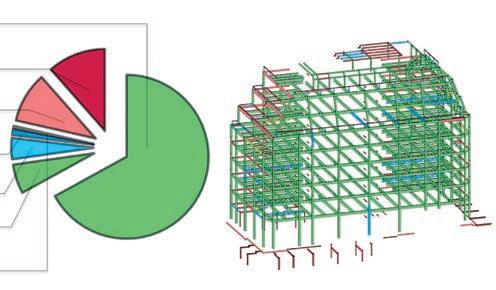
As well as aiming to achieve BREEAM ‘Outstanding’ and WELL Platinum accreditations, this project’s credentials are boosted by the fact that approximately 77% of its structural frame consists of reclaimed steel, obtained from a number of different sources.
By far, the largest portion of this total (67% or 375t), was sourced from the demolition of City Place House, which is another London scheme within developer GPE’s portfolio (see box on page 29).
Reclaiming and reusing materials is all about making good use of what is available. With that in mind, a small quantity of steel (3t, which previously formed a plant deck) was also salvaged from the demolition of the concrete-framed French Railways House.
The remainder of the project’s steel frame contains material from Cleveland Steel and European
Metal Recycling’s (EMR) stock of reclaimed steelwork, as well as a quantity of new sections.
“There is a significant carbon saving associated with using steel, as it also lends itself to prefabrication, which reduces the amount of work needed on site. The reclaimed steel approach has achieved an impressive embodied carbon saving of 744t CO2e,” says Mace operations director Sal Capotosto.
Steelwork is not the only reused material on the project, there is also a significant quantity of reclaimed aluminium as well as Portland stone, which will be used on the building’s facade.
Adding to the circular economy and helping to record all of the materials used, this scheme is one of the first projects to make use of a pioneering new concept known as materials passports.
These digital data sets, describe characteristics of materials and components, giving them value for present use, recovery and future reuse. In this way, the project is designed as a storage bank where materials are held for future reuse and recovery.
“Early on, the client bought into the idea of the passports,” says Capotosto. “They were the real driver behind the collaboration we needed from many of our team members and supply chain to make this project’s reuse philosophy work.”
67% or 375t was sourced from the demolition of City Place House, another London scheme
30 Duke Street St James’s, London
l Main client: GPE
l Architect: Make Architects
l Main contractor: Mace
l Structural engineer: Elliott Wood
l Steelwork contractor: William Hare
l Steel tonnage: 559t
The project has a busy location on Piccadilly Steel erection on Duke Street St James’s
There is a significant carbon saving associated with using steel, as it also lends itself to prefabrication, which reduces the amount of work needed on site
Sal Capotosto, Mace
The new steelwork sections for the project amounted to approximately 54t and were fabricated, supplied and erected by William Hare as part of the overall steelwork package. The company also installed 64t of new bolted connections within the main frame and refabricated all of the reclaimed material, once it had been repurposed.
Many of the reclaimed beams were too long for this scheme’s design and had to be cut to length, while some column sections were spliced together (up to three in some locations) to form the required sectional height.
Bespoke openings were also cut into the previously solid beam sections, re-fabricating them
Sources of the reused steel on the project
l 67% (375 tonnes)
Reclaimed steel from donor building
l 11.5%, (64 tonnes)
New connections
l 10% (56 tonnes)
New sections
l 1%, (6 tonnes)
Recovered from Cleveland Steel
l 4% (23 tonnes)
Reclaimed from Cleveland Steel
l 6% (32 tonnes)
EMR Reclaimed steel
l 0.5% (3 tonnes)
Reclaimed from French Railways House
into cellular members that accommodate the building services within their depth.
William Hare project director Simon Bourne says: “This project is a brilliant example of how innovation and collaboration can drive meaningful change in the built environment. We’re proud to have contributed to a scheme that not only redefines sustainable construction but also delivers tangible carbon savings through the reuse of structural steel.”
In addition to the many sustainable benefits, the use of steelwork has also allowed the design to create the open-plan office floorplates the client wanted.
This has primarily been achieved by positioning the stability-giving concrete core, which contains lifts and staircases, in an off-set location along the building’s western party wall.
In many commercial buildings, the core is often placed in a central position, but on this project, that would have eaten up too much valuable floor space.
From the offset core, the steel beams, which span up to 13m-long, radiate outwards to the north, east and south elevations, forming columnfree internal areas on every floor.
The long span internal beams support metal decking and a concrete topping, forming a composite flooring solution for every level.
Overall, the steel frame starts at ground floor and sits atop a concrete ground floor slab and a single-storey basement, which has been retained from the previous scheme.
In the completed building, the basement and ground floor will
house retail units, while also accommodating the main entrance lobby and reception.
The ground floor is a double-height space throughout, creating plenty of flexibility. This is highlighted by the fact that one retail unit comes replete with a steel-framed mezzanine level.
From the first floor upwards, the building consists entirely of office spaces, with terraces wrapping around the southern elevation on the uppermost three levels.
Up to and including level five, the building is clad with precast panels, which were prefabricated offsite, while the upper floors feature a mansard with dormer windows, which is a nod to the surrounding architectural landscape. The mansards, which are framed with steel, arrived on site as complete units, reducing the number of crane lifts required for the steel programme.
GPE executive director Dan Nicholson, says: “This is a brilliant opportunity for us to create best-inclass office and retail spaces in the heart of St James’s.
“Sustainability is at the core of the development, and we are setting a precedent for London by reusing structural steelwork.” ● 30 Duke Street St James’s is due to complete this summer.
Long-span internal beams form composite flooring for every level
Donor building provides reused steel
The demolition of City Place House is providing 1,800t of steelwork for other developments
GPE says it is committed to reducing the carbon footprint of its developments and is engaged in reclaiming and reusing steelwork wherever possible.
The demolition of the 1990s-built City Place House, located a short distance from London’s Moorgate Station, provided 1,800t of salvaged steelwork.
“The existing steel frame included long-span beams without penetrations, making it an ideal opportunity for reuse,” explains Arup project engineer Jamie Page.
This project is a brilliant example of how innovation and collaboration can drive meaningful change in the built environment
Simon Bourne, William Hare
As well as reusing some of this material on the Duke Street St James’s project, around 80t was incorporated into the steel frame of 2 Aldermanbury Square, (a 13-storey office block built on the site of City House Place) with the remainder being stored for future use.
“To facilitate this sustainable and circular economy approach, the demolition process was planned and executed to allow for the steelwork to be removed at maximum length without damage.”
William Hare subsequently refabricated the steelwork into trimmers, which have been erected around the main core and risers at 2 Aldermanbury Square, as well as beams and columns to form its rooftop plant deck.
The mansard roof is framed with steel
Morgan Sindall flies high with RAF base school development
RAF Alconbury is being redeveloped into a new Cambridgeshire community with its Education Campus, featuring two steel-framed schools, at the heart of its design. By
Martin Cooper
To help tackle the nation’s chronic housing shortage, plans have been drawn up to build 12 new towns across the UK, with the Government determined to start work on at least three during this Parliament.
Similar to Clement Attlee’s post-war housing schemes, which saw the birth of Crawley, Basildon and Harlow, the new towns would each have up to 10,000 homes with an ambition for that to include a minimum of 40% affordable housing.
In a similar move, a new community with more than 6,000 homes is taking off from the site of RAF Alconbury in Cambridgeshire.
Known as Alconbury Weald, the new town is being developed by Urban&Civic, who purchased the former MOD land, including the runway, in 2009. Outside of the development, a parcel of land remains as the military base, used by the US Air Force for non-flying operations.
As well as housing, Alconbury Weald will also have schools, industrial and office spaces, community and leisure facilities, shops and a health centre. Included within the infrastructure being built to serve the scheme, there is also a reserved plot for a possible railway station.
Set in the heart of the growing development and complementing the current primary school provision, two steel-framed schools will form the Education Campus; Prestley
20m-long Westok beams form the doubleheight sports hall
The steel design supports precast flooring planks
Alconbury Weald Church Academy, Cambridgeshire
l Main client: Cambridgeshire
County Council
l Architect: R H Partnership
Architects
l Main contractor: Morgan Sindall
Construction
l Structural engineer: Sweco
l Steelwork contractor: AC
Bacon Engineering
l Steel tonnage: 450t
We had a few periods when our lifting operations had to stop, due to wind, but otherwise we’ve had no challenges with the erection Martin Whitehead, AC Bacon Engineering
Wood Academy SEND School and Alconbury Weald Church Academy Secondary School.
The SEND School was completed in 2024 by Morgan Sindall Construction (with AC Bacon Engineering fabricating and erecting the steelwork) and now the two companies are working together again on the secondary school.
Cambridgeshire County Council is delivering the school in line with its aspirations for sustainability, energy efficiency and best practice design.
In response to this, the school incorporates effective passive design measures through the adoption of a fabric first approach, followed by the use of low-carbon energy sources in the form of air source heat pumps. Energy demand is then further reduced using zero
carbon energy generators in the form of solar photovoltaic (PV) panels located at roof level.
The efficient design includes a steel frame that supports precast flooring planks; a solution chosen for its speed, structural and thermal mass qualities and associated lower emissions, according to Morgan Sindall senior project manager Gareth Harris.
“The underside of the planks and M&E services will remain exposed in areas of the completed building, allowing the floors to absorb heat during the day and dissipate it at night, in line with the MEP design strategy for the scheme.”
Consisting of a three-storey main block and a separate sports hall, Alconbury Weald Church Academy will initially cater for 600 pupils as a 4 Form of Entry (4FE) secondary school. However, there is flexibility with the project’s design to facilitate a potential future expansion to an 8FE/1,200 pupil school, when required.
The main block is T-shaped on plan, with the vertical wing accommodating a triple-height dining hall and a
Steel tonnage used on the project
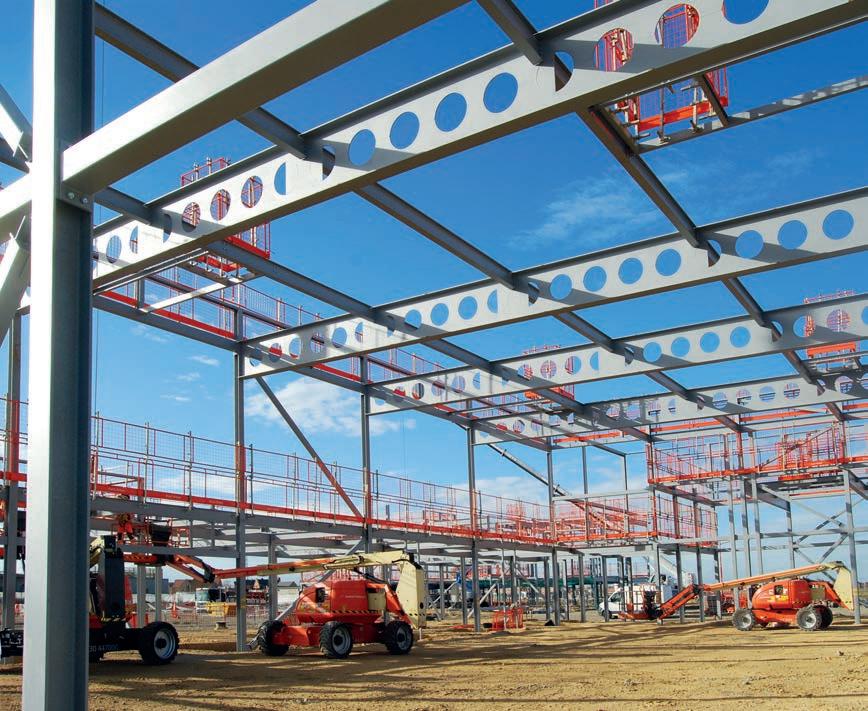
The double-height main hall/drama studio is formed with a series of 15m-long Westok beams
The precast flooring solution was also used as it efficiently formed the required spans and allowed the classrooms and other facilities to be column-free Filipe Henriques, Sweco
kitchen. The future expansion of the school would see this wing extended to provide additional steel-framed accommodation.
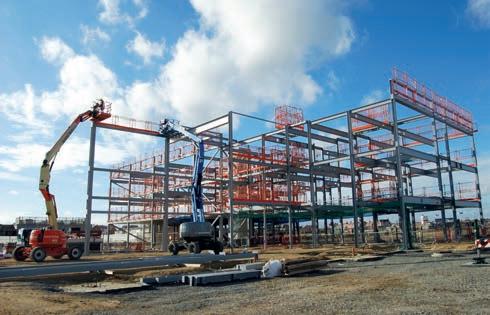
Aside from its flexibility, another benefit of using the steel-framed option has been its speed of construction. The 450t of steelwork that forms the main block and sports hall were erected in a seven-week programme.
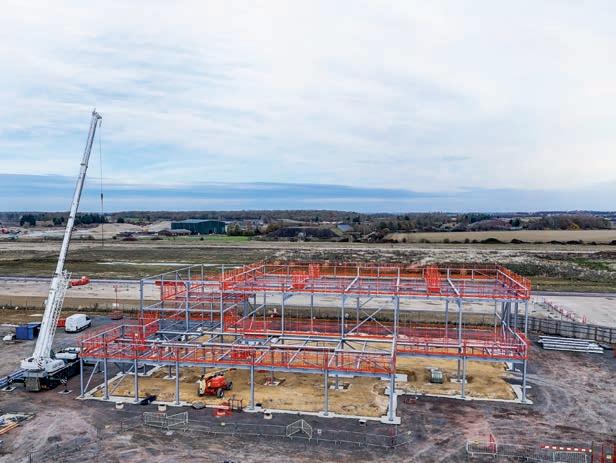
Given the site is a former airfield, with few trees and little shelter, the construction is open to the elements and in particular the wind.
“We had a few periods when our lifting operations had to stop, due to wind, but otherwise we’ve had no challenges with the erection. We had the site pretty much to ourselves, which gave us plenty of space for materials to be stored,” says AC Bacon Engineering project manager Martin Whitehead.
Prior to the steelwork erection starting, the school’s brownfield plot underwent a remediation programme, followed by the installation of vibro-stone columns and pad foundations for the main block and sports hall.
CGI showing the completed secondary school
Being a former airfield, the site is in an exposed location
Using its own mobile cranes, AC Bacon erected the steel frame of the main block in four phases. Once each phase was complete, the area was handed over to the concrete contractor, who installed the precast planks, stairs and lift shaft.
“As well as its thermal mass attributes, the precast flooring solution was also used as it efficiently formed the required spans and allowed the classrooms and other facilities to be column-free,” says Sweco senior engineer Filipe Henriques.
Much of the main block features columns spaced at 7.2m centres, with internal members positioned within a central corridor that separates the building’s two rows of classrooms.
The exception to this column spacing is the aforementioned dining hall that has 9m-long spans and a double-height main hall/drama studio, which is formed with a series of 15m-long Westok beams.
The main block’s frame derives its stability from bracing, which is predominantly located around the stairwells and the lift shaft. With no cross-bracing within internal
walls, further flexibility has been designed into the steel frame, whereby classrooms could be enlarged, if required, with the removal of partitions.
The adjacent sports hall adopts a similar design approach, with cross bracing located around the perimeter walls to provide stability. This structure has two parts: a double-height four-court sports hall, formed with a series of 20m-long Westok beams and a lower section that wraps around two elevations. The lower part of the building will accommodate changing rooms, a multi-use activity studio and plant spaces.
Councillor Bryony Goodliffe, chair of the Children and Young People Committee at Cambridgeshire County Council, says: “We want to ensure all children and young people in Cambridgeshire have opportunities to thrive. I’m delighted that the Academy is set to provide those opportunities to the current and future residents of the new community.”
Alconbury Weald Church Academy is due to open in September 2027. ●
Master Quantity Surveying Skills Online
Bite-size learning modules for Bill of Quantity Production
kmh-quantitysurveying.co.uk
12 Individual Modules
Reduce Level Excavation
Trench Fill Foundations
Pad Foundations
Reinforced Foundations
Basement
Underpinning
Masonry
Ground Floors
Upper Floors
Roofs
External Works
Drainage
What you will learn in this CPD
How BS 7000-4 aligns with PMP principles
When and how short agile cycles can stabilise design work
How organisations can embed design management
CPD: Design management guidance and governance
In this CPD, Zacharias Fotos explores how the Project Management Professional framework, supported by elements of agile thinking, can give BS 7000-4 operational form
The 2024 edition of BS 7000-4: 2024 Managing Design in Construction offers the UK’s most complete framework yet for design management.
The challenge lies in translating the document into practice. BS 7000-4 sets out what good design management should look like, but contractors and developers also require supporting templates, training and integration with project controls.
The 2024 edition supersedes the 2013 version, updating terminology, clarifying interfaces with information management standards such as ISO 19650 and expanding its guidance on strategy, assurance and competence. It shifts emphasis from describing best practice to defining governance expectations, establishing design management as a core project-control discipline rather than an administrative layer.
This CPD explores how the Project Management Professional (PMP®) framework, supported by elements of agile thinking, can give BS 7000-4 operational form. Together they turn the standard from a static
reference into a living governance system, balancing structure with adaptability to manage complexity, compliance and change. Although agile frameworks originated in software development, their principles of iteration, transparency and feedback loops are increasingly relevant to construction design management.
From framework to system –translating BS 7000-4 through PMP Thinking BS 7000-4:2024 organises design management around the themes of strategy, briefing, coordination, change and assurance. The document defines what should be managed but deliberately avoids prescribing how each element is implemented or measured. Here, the PMP methodology provides the connective tissue, translating principle into process.
Strategy establishes purpose, authority and roles. PMP applies a Project Charter and Design Management Plan to define responsibilities, interfaces and decision authority.
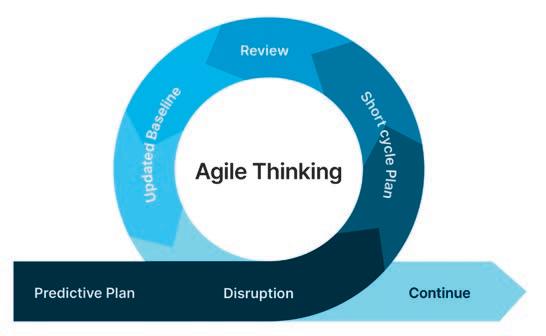
Implenting the agile thinking cycle within a predictive plan
Although agile frameworks originated in software development, their principles of iteration, transparency and feedback loops are increasingly relevant to construction design management
Briefing defines outcomes and success criteria. PMP converts these into a Scope Baseline and Work Breakdown Structure (WBS), turning intent into measurable deliverables. Coordination manages interfaces and communication. A RACI Matrix and Communications Plan manage communication through the Common Data Environment (CDE) and align with the project programme. Change governs how design evolution is assessed and recorded. PMP uses a Change Log and Integrated Risk Register to preserve traceability and manage risk. Assurance provides review, verification and learning. Quality Audits and Lessons-Learned Registers close the loop and embed continuous improvement.
Through this alignment, BS 7000-4 becomes more than a checklist. It functions as an operating framework for managing information, accountability and value. The standard defines the what; PMP defines the how. Applied consistently, this structure transforms design management from an individual skillset into a trainable, auditable company capability.
When certainty breaks – adaptive design management in practice Construction projects are by nature predictive systems, progressing through sequential “waterfall” stages. This approach works
well when certainty is high, but struggles when disruption enters the picture. New legislation, funding changes or unknown unknowns can quickly destabilise even the best-planned programme.
When that happens, design management needs a response framework, not a full reset. Agile thinking becomes valuable precisely because it introduces short, goal-driven cycles that stabilise momentum while uncertainty is resolved. The “updated baseline” represents a plan formally reviewed through change control once disruption is assessed.
These adaptive loops replace lengthy design freezes with focused, time-boxed reviews that surface risk early and rebuild alignment quickly.
An agile mindset reflects structured adaptability, maintaining control through transparency while remaining flexible as parameters shift.
Regulation and governance –external drivers
New regulatory expectations demand traceable, reviewable design decisions; BS 7000-4:2024 links design management to accountability and assurance. The standard bridges regulation and information management, turning statutory duties into auditable processes.
These obligations are reinforced by a network of aligned standards: l Building Safety Act 2022
Agile thinking becomes valuable precisely because it introduces short, goaldriven cycles that stabilise momentum while uncertainty is resolved
formalises dutyholder roles; BS 7000-4 provides the governance model that evidences compliance.
l BS 8536-1: 2022 defines outcome-based briefing, reinforcing the strategy and briefing themes.
l ISO 19650 sets out information management processes; BS 7000-4 defines the decision and approval framework that governs them.
l ISO 9000 & ISO 9001 underpin assurance through quality management principles, documented procedures and continuous improvement.
Together, these form a unified ecosystem: ISO standards manage information and quality; BS 7000-4 manages decisions.
The 2024 update reinforces this link with guidance on competence, record-keeping and assurance, reflecting the shift toward auditable control.
Organisational application – building a design management system
The greater opportunity lies beyond the project level. To realise the intent of BS 7000-4, firms should treat design management as an organisational system, comparable to quality management.
Leading UK contractors demonstrate that embedding design management company-wide – not project by project – delivers benefits beyond coordination.
At Mount Anvil, design management has been formalised through standardised procedures,
integrated digital workflows, competency development and measurable performance metrics that define success criteria across projects. This framework enables rapid mobilisation, measurable risk reduction and accountability at every design stage; reflecting BS 7000-4’s aim to make governance repeatable and auditable.
Key components of a design management system include:
l Policy – a corporate policy referencing BS 7000-4, BS 8536 and ISO 19650, defining accountability for design governance.
l Templates – standardised Design-Management Plans, scope registers and coordination matrices for repeatable workflows.
l Training – integrate design management modules within PMP or project-controls training to align language across disciplines.
l KPIs – track design-change response time, coordination cycle duration and readiness of compliance evidence.
l Learning Loop – capture lessons learned and design risk data centrally, for reuse on future projects.
Emerging technology firms are developing AI-enabled design governance tools that automatically cross-check documentation for compliance and coordination. These systems extend BS 7000-4 principles into the digital realm,
shifting assurance from a manual exercise to a continuous, data-driven process.
Embedding these elements institutionalises design management as a repeatable governance discipline. Each project then refines the framework, strengthening company-wide learning.
Habits and mindsets
Embedding BS 7000-4 depends as much onculture as on process. The following habits express that balance.
1. Keep the scope living. Reconfirm scope after each material change or client decision. Though counterintuitive in a fixedbaseline culture, revisiting scope intentionally prevents drift and cost through controlled adaptation.
2. Switch to short cycles when uncertainty hits. When disruption arises, shorten planning horizons. Use brief design cycles targeting critical interfaces, ending each with a review before returning to the predictive plan.
3. Record rationale, not just results. Much rework stems from lost reasoning. Capture a concise “why” for every key decision, linking it to risk, regulation or value delivered, and feed this back into continuous learning cycles for future stages or projects.
These habits thrive only within a supportive company culture – one that rewards openness, iteration and learning rather than blame.
Friary Park is a three-phase regeneration transforming a 1980s housing estate in the London Borough of Ealing into 1,345 new homes
1,345
Case study – adaptive design governance at Friary Park
Friary Park is a three-phase regeneration transforming a 1980s housing estate in the London Borough of Ealing into 1,345 new homes.
During RIBA Stage 4, the Mayor of London issued a planning fire-safety statement requiring a second staircase in new residential buildings over 30 metres. This mid-stage regulatory change disrupted the design programme and required the re-sequencing of multiple packages, creating significant coordination challenges across the wider design team.
Rather than pausing to rebuild and freeze a new master programme, the technical team adopted an
adaptive management plan:
A focused scope baseline captured only the design packages affected by the staircase and firestrategy updates. Each discipline created a short-term work-breakdown structure (WBS) defining responsibilities and coordination milestones within two- to three-week cycles. Weekly design sprints targeted the most critical interfaces, fire, structure and MEPH, concluding with short reviews to confirm progress and realign dependencies. Additionally, clear weekly multi-discipline meetings led by the technical team kept alignment and confidence.
This adaptive approach preserved alignment with the original strategy and briefing objectives, allowing the project to absorb disruption without shifting the planned handover date. RFIs were integrated within each sprint rather than accumulating as backlog. By communicating the adaptive plan openly, the team reduced uncertainty, restored confidence and maintained programme momentum despite external change.
In high-risk environments, control is sustained not by rigidity but by responsiveness, and by communicating that responsiveness clearly. Structured adaptability preserves certainty of intent while flexing execution.
Friary Park Development in Acton, London
Together they create structured adaptability: discipline to plan, flexibility to adjust.
Conclusion – from guidance to governance
BS 7000-4: 2024 redefines design management as a controllable, value-based discipline. Yet widespread adoption requires cultural readiness as much as methodological clarity.
The transition from guidance to governance depends on both methodology and mindset.
By integrating PMP governance tools – scope control, WBS,
Glossary
● Predictive (waterfall) management – sequential delivery providing high certainty but limited flexibility.
● Agile framework – a collaborative and adaptive approach that manages work through short feedback cycles, transparency and continuous learning to respond effectively to change.
● Work breakdown structure (WBS) – hierarchical decomposition of deliverables and work into manageable components.
change management and assurance – within its framework, organisations can convert BS 7000-4 into a living system of accountability.
When predictive planning meets disruption, adaptive loops maintain progress, provided leadership cultivates transparency, collaboration and learning.
The future of design management lies with organisations that combine clarity, consistency and adaptive intelligence to manage complexity with confidence. ●
Zacharias Fotos MCIOB PMP® ARB is senior technical coordinator at Mount Anvil.
Leadership cultivates transparency, collaboration and learning
CPD Questions
1) What primary shift does BS 7000-4:2024 propose for design management?
a) Administrative support function
b) Core project-control discipline with defined governance
c) Purely digital modelling activity
2) How does PMP methodology strengthen the practical application of BS 7000-4?
a) By replacing all elements of the standard
b) By translating its themes into structured tools such as the scope baseline, WBS, change log and assurance reviews
c) By focusing only on design programme
3) When should Agile techniques be introduced in design management?
a) From day one on every project b) Only during commissioning
c) When uncertainty disrupts the predictive plan, stabilising delivery through short cycles
4) Which pairing correctly links standards and governance?
a) ISO 19650 manages approvals, BS 7000-4 manages file naming b) ISO 19650 manages information flow; BS 7000-4 defines the decision framework
c) BS 8536 manages the CDE, ISO 9001 sets client briefing
5) What is the organisational advantage of applying PMP thinking to BS 7000-4?
● Scope baseline – the approved scope statement, WBS and WBS dictionary used to measure performance.
● RACI matrix – a responsibilityassignment chart that clarifies who is Responsible, Accountable, Consulted and Informed.
● Project charter – a document formally authorising a project or phase, defining objectives, key stakeholders, authority and success criteria.
a) Replaces all professional judgement
b) Turns the standard into policy, templates and KPIs, creating repeatable governance
c) Eliminates the need for audits or reviews
To test yourself on the questions above, go to www.construction management.co.uk/cpd-modules
Laing O’Rourke: showcasing end-to-end digital delivery
Attending Laing O’Rourke’s Digital Expo in Manchester allowed CM to pick the brains of Paul Drayton, the contractor’s head of digital – Europe. He talks to Justin Stanton about MMC, digital non-negotiables and digital’s role
Laing O’Rourke took over Aviva Studios in Manchester to stage its Digital Expo for staff and clients
What have Coldplay, Shaun The Sheep, David Hockney and Laing O’Rourke got in common? They have all headlined exhibition and performance spaces at Aviva Studios in Manchester. The first three on that list make sense, but what about Laing O’Rourke?
Having built and handed over the Aviva Studios venue to client Factory International in 2023, the contractor returned to the site as the main attraction for one day in September 2025, staging its Digital Expo. The event, for 400 people (the contractor’s staff, clients and its digital supply chain – plus this journalist), was a mini-exhibition/ conference. It was conceived by Paul Drayton, head of digital – Europe at Laing O’Rourke, and delivered by members of his team.
There are more than 200 people in Laing O’Rourke’s digital team, including digital engineers, information managers, those involved in broader digital adoption and developments, plus those working for the contractor’s specialist arms such as Select Plant Hire and Expanded. “We take digital seriously – you can’t do it off the side of your desk,” Drayton tells CM.
“We’ve got 30 live projects, all in different phases, and it’s impossible for everyone to know everything that everyone’s doing. How do we make the very best
of what’s possible accessible to every project? Part of it is having a forum of project leaders sharing and learning from each other. If we can do it on one project in Laing O’Rourke, we can do it on every project in Laing O’Rourke.” Hence the idea of the expo: show staff outside of the digital team what technologies and processes they could be using and what the benefits are.
On stage, there were case studies of technology in action on specific Laing O’Rourke projects and panel discussions with suppliers and clients. Guest speakers were drawn from the likes of Heathrow, the University of Oxford, EDF, Everton, the University of Exeter, National Grid, Rolls Royce SMR and the New University Hospital Monklands. Among the 20-plus exhibitors were the likes of Aecom, Autodesk, BDP, Bentley Systems, Glider, Leica Geosystems and WSP.
Industrialised construction
Between panel sessions, CM tours the expo with Drayton as guide. He’s a passionate advocate for digital and it seems like he’s been practising digital construction all his career, even though he only joined the construction industry three years ago when he took his current post at Laing O’Rourke. But Drayton has experience in construction of another sort: overseeing the build of
warships and nuclear submarines for a decade and a half. Given Laing O’Rourke’s ambitions for MMC and industrialised construction methods, Drayton’s appointment was eminently sensible.
“A minimum of 70% of each of our projects must be delivered offsite,” he explains. “It’s one of the non-negotiables. Our operating model is absolutely here to stay, and it’s a fundamental part of our relationship with our chosen design partners. We’re taking the design and we’re working with the design partners to mature it. We’re feeding it into the factory, where we have CAD to CAM [computer-aided manufacture – ed.].”
Delivering on Rolls Royce SMR’s plans requires an end-to-end, digitally enabled solution – and that’s exactly what Laing O’Rourke is driving through its ‘Industrialised Construction Platform’. “We’re excited about the opportunity to co-develop this platform with Rolls Royce SMR, building on the unique capability we’ve already developed and deployed in off-site manufacturing and digital design,” Drayton says.
He emphasises that, while the SMR programme focuses on repeatability, off-site delivery doesn’t mean the end of uniqueness or bespoke design: “Architects like to design. Engineers like to design. We often treat projects as one-offs,
Architects like to design. Engineers like to design. We often treat projects as one-offs, but now we have an opportunity to standardise the invisible and customise the visible Paul Drayton, Laing O'Rourke
but now we have an opportunity to standardise the invisible and customise the visible. The New Hospital Programme is the obvious driver for this approach.”
Digital non-negotiables
As we continue to tour the expo, Drayton returns to the subject of non-negotiables: “We have digital standards within the business, and a host of those are non-negotiables. They need to show up on every project that we deliver, because we know that they will provide us with certainty, they will provide us with safety, and it’s the right way to do it.”
For example, now mandated on all Laing O’Rourke projects are immersive mission control rooms, which take the BIM cave to the next level. Present at the expo were such rooms from Immersive Interactive and Juice Immersive. Laing O’Rourke is using the interactivewall-to-interactive-wall technology not only for site inductions, but 4D rehearsals and look-ahead meetings.
At New University Hospital Monklands, Drayton reveals that the immersive space was used for design reviews with the hospital staff. “Rather than clinicians looking at a piece of paper and really not having a clue what they’re looking at, we put them in the immersive room with plans at one-to-one scale. We rolled beds and chairs
The Digital Expo was conceived by Paul Drayton
Next halo digital project?
While Hinkley Point C is ongoing, it’s fair to say that the new Everton Stadium was a halo digital project for Laing O’Rourke – an exemplar of the technologies and processes that can be implemented and what can be achieved.
CM asks Drayton what he thinks the contractor’s next halo
digital project will be. He muses on the answer, adopting a wider lens: “The biggest pull I see is in healthcare with the New Hospital Programme and the digital hospital. I think there will be a massive step forward in digital, not just in the way that we deliver projects, but in the
way that we operate hospitals. What you and I think of as a digital twin, and what a construction and a FM company or department think of as a digital twin, is about 10% of what the New Hospital Programme or the NHS think of as a digital hospital.
“If, as a sector, we manage to achieve the aspirations of the New Hospital Programme, I think that’s going to be the pathfinder, because it’s truly linking design with manufacture with operations. That’s end-toend thinking – and that’s where I want to get to.”
in so the clinicians could check everything was in the right place for them. As a result, we made fundamental changes in the model before anything had gone to print, before anything had been signed off.”
The role of digital
Of course, there’s always room to test new technology and processes even if introducing them is “like changing the wheel on a moving car”. Drayton says: “Sometimes we hold fire on new technology and
Our purpose is to serve projects. We’re not here to do digital for the sake of digital. We’re here to make the boat go faster
Paul Drayton, Laing O'Rourke
introduce it at the start of the next project. There are things where we can push the boundary. We try to do that in a controlled way, so we’re not just having five different people trying five different bits of tech. We’re doing it in a controlled way. If it’s going to succeed, we’re going to succeed fast; if it’s going to fail, and we’re going to need to learn, we do that equally quickly.”
For Laing O’Rourke, digital is a means to end – and perhaps more than one end. “Our purpose is to
serve projects. We’re not here to do digital for the sake of digital.
We’re here to make the boat go faster,” Drayton declares. “And all of these [digital] tools are a key part of making the boat go faster, doing it safer and,” he pauses for effect, “making it enjoyable and fun as well.”
As CM’s tour finishes, Drayton concludes: “I’ve got 200-plus digital staff – I don’t necessarily need any more: I need the thousands of our colleagues to be comfortable and confident using the tools.” ●
The new Everton Stadium was an exemplar of the digital methods used
‘We’re worried our adjudicator is biased’
January’s contract clinic question comes from a project director worried that an adjudicator assigned to her firm’s case is biased and unpredictable. Paul Woodley weighs up the options
THE QUESTION
We’ve reached a dispute and have heard that the adjudicator assigned to make a decision on the case is notoriously biased and unpredictable – is there anything we can do to avoid them being allowed to continue on our case?
THE ANSWER
This is not uncommon, however in many instances, the fear is based on perceived issues, anecdotal evidence or rumours – all of which can be dangerous.
Let’s unpack the situation and potential options available, along with practical steps you can take to give yourself the best chance of fairness.
You are not alone. Construction adjudication is designed to be quick and adjudicators must act impartially. This, however, does not stop stories of bias circulating among colleagues and professional circles. Many of the rumours are exaggerated, but some are not, and since adjudication can determine large interim payments, your anxiety is understandable.
Can you stop an adjudicator if you don’t like their reputation? In short: no, not usually. The
alternative dispute resolution system is designed intentionally to keep things moving. Courts and commentators regularly remind us that it is meant to be rough and ready, and fast paced.
What this means in practice is that you rarely have an opportunity to ‘switch out’ adjudicators simply because you have heard worrying things about their past appointments.
That being said, there are situations where concerns regarding fairness would become something more concrete.
When your concerns actually matter
There are two pathways where your concerns can matter; the first being jurisdiction (think power to act) and then second being natural justice (think impartiality).
If the adjudicator was not appointed correctly, the notice has not been issued properly, or the dispute is not within the scope of The Construction Act, you could reserve your position. Formal legal advice would be prudent at this point. It is almost always better to do this early if you genuinely have partiality concerns.
Some of the triggers you could look for include:
Consider acting early, reserving your rights, watch the process carefully and document everything Paul Woodley, DeSimone
l The wrong appointing body is used (check the contract).
l The dispute has not been ‘crystalised’. This is when one party has raised an issue, and the other party has either rejected it or failed to respond within a reasonable timeframe.
l The adjudicator has been appointed under the wrong contract clause.
l Multiple disputes packed into one referral.
You may have a foothold if you spot one of these.
Regarding ‘natural justice’, your worries, or the rumours you have heard need to tie to specific behaviours to become relevant. For example, if an adjudicator is not allowing you to respond properly, relying on without prejudice or privileged information, or even providing very unclear reasoning such that the losing party is unable to follow the logic. If you spot any of these, again, you may have a foothold.
So, what can you do now?
Here are some practical ideas for project teams almost like a clam checklist for when you hear a name that drops your stomach.
Reserve your rights. This sounds dramatic, but it is routine. Take
Paul Woodley DeSimone
Question for contract clinic? Email construction-management@atompublishing.co.uk
legal advice on how to write to the other party and state you are taking part without prejudice to any jurisdictional or fairness concerns. Double check the basics. Was the adjudicator appointed using the correct body? Was the contract clause followed properly? Has the dispute actually crystalised? These should be factual, procedural considerations, not personal ones. Watch out for privileged material. Ever since AZ v BY [2023], this has become a significant issue. If the other side sneaks it in, log it carefully.
Keep good records. Ensure you record any procedural unevenness, for example if you were refused extensions of time, but the other side was not, key defences have not been acknowledged, or you were denied a chance to respond to late evidence. This turns the focus from ‘I don’t like this adjudicator’ to ‘here is what actually happened’. Prepare early for enforcement. Realistically speaking, your strongest moment to raise a fairness issue is likely at the enforcement stage, after the decision, and once your concerns turn out to have been valid.
Construction adjudication is designed to be quick and adjudicators must act impartially
The uncomfortable truth
You rarely get to remove a rumoured ‘biased’ adjudicator at the outset of the process. The reassuring part, however, is that if anything material does happen during the process that raises fair concerns, the law does provide routes to challenge. Consider acting early, reserving your rights, watch the process carefully and document everything. Adjudication is fast, but fairness still matters, and you are not powerless in the face of genuine bias. ● Paul Woodley is a consultant at DeSimone.
Wates on what construction employers want
James Saunders, chief people officer at Wates Group, tells CM People that the battle for the best talent in construction is stronger than ever
When reviewing a CV or meeting candidates, what traits or behaviours make someone stand out immediately?
For me, it’s all about impact. A CV that goes beyond listing responsibilities and actually shows measurable achievements really grabs attention because it tells us the candidate can deliver results.
Flexibility is another big one. People who can solve problems and adapt quickly demonstrate curiosity and a willingness to learn – qualities that matter hugely in our industry.
Teamwork is non-negotiable; construction is all about collaboration, so evidence of working well with others is essential. And finally, passion. When someone genuinely cares about what they do and their values align with ours, that makes a lasting impression.
Does a candidate’s membership with a professional body make a difference? Why?
It can, yes – but it’s not the only factor. Membership often signals that someone values ethics, compliance and best practice within their field. It also shows they’re proactive about staying current and improving their skills.
That said, we weigh practical experience, cultural fit and adaptability just as heavily. Those things often make the real difference day to day.
What’s your view on candidates who have followed non-traditional routes into construction – career changers or ex-Armed Forces, for example?
I’m very positive about these candidates because they bring so much to the table. People from different backgrounds often bring transferable skills, such as leadership, resilience and problem solving, which are invaluable on complex projects. Making a big career change or transitioning from the Armed Forces shows adaptability and a willingness to learn, which are traits we value highly.
Many non-traditional candidates, especially those from the military, demonstrate exceptional discipline, reliability and a commitment to high standards – qualities that align perfectly with our industry’s demands. And finally, diversity of thought matters. Different experiences spark innovation and help us challenge assumptions, which strengthens our business.
What are the most difficult roles to recruit for at the moment? Why do you think that is?
Right now, quantity surveyors and design managers are the toughest roles to fill because demand is high and supply is low, and we’re competing with other big names in the sector. Operational site roles can also be challenging, particularly in remote locations
People from different backgrounds often bring transferable skills, such as leadership, resilience and problem solving, which are invaluable on complex projects
James Saunders, Wates Group
where labour shortages and salary competitiveness come into play. Then there are specialist roles in areas such as renewables, sustainability, health and safety, and energy. These candidates are often happy where they are and competition for the few who are open to moving is fierce.
What evidence of ‘work readiness’ do you like to see from graduates or apprentices?
For graduates and apprentices, it’s less about technical knowledge and more about mindset. Reliability and professionalism are key –simple things like punctuality, preparedness and clear communication go a long way. Hands-on experience through internships, site visits or project work shows they understand the realities of construction. Teamwork and communication skills are essential because construction is collaborative. A willingness to learn is also critical. Technical skills can be taught, but curiosity and adaptability are priceless.
Looking ahead three to five years, what new roles or capabilities do you expect to emerge in your business, or the wider sector, that candidates should be preparing for?
James Saunders, chief people officer at Wates Group
Digital integration and automation will continue to grow,
Reliability and professionalism are key – simple things like punctuality, preparedness and clear communication go a long way James Saunders, Wates Group
and sustainability will remain a huge focus. For leadership roles, we’ll need people who can manage complex logistics and drive performance through positive culture change. Problem solving, collaboration and adaptability will always be critical.
What’s great about Wates as an employer?
The impact we have in the UK is something I’m really proud of. Our purpose – reimagining places for people to thrive – isn’t just words; it’s something our teams live every day.
Since joining the company in May 2025, I’ve seen first-hand that our people make Wates a great place to work. We offer a wide range of career opportunities across five businesses, as well as our central functions, which means real variety for learning and growth.
We invest heavily in learning and development because we want thriving people. And we’re committed to building a workforce that reflects UK society. It’s not always easy in roles that require physical presence, but we’re pushing for better – from sector-leading family leave policies to being one of the first construction companies to support flexible working, even on site. ● Are you looking for top construction talent? Want to get ahead of the competition? Contact Sophie Holland at CIOB Jobs.
CIOB Community
Scotland celebrates the best of construction at awards event
Talented professionals from across Scotland’s construction industry were recognised and celebrated at the annual Chartered Institute of Building (CIOB) Awards, held at the DoubleTree by Hilton in central Glasgow in October.
Scores of industry professionals gathered for the glittering ceremony, which honoured individuals and teams making outstanding contributions to Scotland’s built environment.
Among the evening’s top honours, Rachael Topping of Morgan Sindall was named winner of the Rising Star Award, recognising her exceptional early-career achievements.
Lynne McKay, CIOB’s regional manager for Scotland, said: “We’re
incredibly proud to celebrate the outstanding achievements of Scotland’s construction professionals.
“Every winner and finalist has demonstrated remarkable skill, innovation and dedication – qualities that drive our industry forward and shape Scotland’s built environment for the better.
The awards are open to CIOB members and non-members Industry professionals were celebrated for their skills and hard work
Every winner and finalist has demonstrated skill, innovation and dedication – qualities that… shape Scotland’s built environment for the better
“Congratulations to all those recognised this year for their significant contributions, and a huge thank you to our sponsors for helping shape this incredible event.”
The Scottish Power Energy Networks team behind the redevelopment of the former Hunterston B nuclear power station took home the Team Award, while Sharon Barrie of Highland Council received the Open Recognition Award for her significant contributions to the Scottish construction sector.
Other award winners included: l Extra Mile Award:
Paul Dabrera, Morgan Sindall l Graduate Award: Tom Lacey, Tilbury Douglas l Sustainability Award: Elizabeth Halliday, Morgan Sindall
The CIOB Awards in Scotland is an annual celebration that recognises the incredible work carried out by construction professionals across the country.
The awards are open to both CIOB members and non-members, highlighting the world's largest professional body for construction management and leadership’s commitment to promoting excellence across the industry.
This year’s event was proudly sponsored by Peace Recruitment and Training LMS, with judging carried out by CIOB Corporate Members who bring specialist knowledge of construction management, including past award winners. l
Glittering ceremony was held in October in Glasgow
CIOB apprentice of the month
Sam Martin, of Morgan Sindall
CIOB conference sets the tone for growth in North East
Sector urged to think beyond ‘bricks and mortar’
Construction professionals in the North East were challenged to embrace their role in driving social value, sustainability and innovation earlier this month (November) when CIOB President Paul Gandy FCIOB delivered the keynote presentation at CIOB’s inaugural North East Construction Conference.
Held at Glasshouse International Centre for Music in Gateshead, the event brought together leading professionals, innovators and decision-makers for a day of insight, debate and collaboration –underscoring the region’s growing influence in shaping the future of UK construction.
Gandy urged the sector to “think beyond bricks and mortar” and was joined by others on the day showing how the region is playing a pivotal role in shaping a smarter, safer and more sustainable built environment.
The event opened with a welcome from CIOB North East Chair Victoria Lane MCIOB and Michael Foster, managing director of Headline sponsor Diales, who set the tone for a day focused on ethical leadership.
Retrofit is more than a ‘nice
to have’
Dr Michael Siebert, keynote speaker at Collaborative Conversations
Panels driving change
The programme featured high-impact panels on sustainability and building safety. The Sustainability Panel explored low-carbon construction, retrofit strategies and climateconscious design, while the Building Safety Panel tackled compliance, accountability and cultural change in the wake of evolving regulations. A highlight of the day was the Outstanding Tomorrow’s Leaders presentation, celebrating emerging talent and their contributions to innovation and excellence. Their stories reinforced the CIOB’s commitment to nurturing the next generation of construction professionals. Conference sponsors were Arc Building Solutions, Specialist Building Solutions, Clementine Services, OH3 Limited, Robertson Hill Associates, Bellingham IT and TSA Riley. ●
“Retrofit is not a ‘nice to have’ option, but if we’re going to keep it central to policy-making, it must be promoted as a cost-saving and job-creating route to a sustainable growth economy – which it is.”
This was the message from Dr Michael Siebert, gateway manager at the School of Architecture, Design and the Built Environment, Nottingham Trent
Speakers at the North East Construction Conference
What was your favourite project to work on over the course of your apprenticeship? I worked on a leisure centre for just over two years, which was a difficult project, but they're often the ones that you learn the most from: the challenges of the project are the reason I enjoyed it so much.
What is the one piece of advice that you'd give to someone, enrolling onto a construction apprenticeship? I've managed to hone it down to one word and it's ‘questions’. If you have a question, you have to ask that question. The worst you can do is sit there and think ‘I don't know this’ and not say anything. So just ask questions. Ask everyone, every question as soon as it comes to your mind; everyone always wants to answer them.
A highlight of the day was the Outstanding Tomorrow’s Leaders presentation, celebrating emerging talent
University, as Chair for the recent Collaborative Conversations East Midlands event.
How do you feel like the apprenticeship has prepared you for a career in the industry? University is very good for that basic knowledge, that foundation to grow from. But when you're actually onsite in the office, properly working, that's when you get the really in-depth knowledge.
Tell us about your future career ambitions.
My short-term goal is to achieve level 6 in quantity surveying. In my last project – a £3.5m school – I was given it to run myself commercially. I’d like to get another to run myself.
The event, held at the Museum of Making in Derby, was jointly delivered by CIOB, ICE East and West Midlands, Landscape Institute East Midlands, RIBA East Midlands, the Royal Town Planning Institute and RICS. It focused on how stakeholders across the sector can
work together more effectively, with discussions covering procurement, community retrofit, place-based approaches and measuring outcomes and impact evaluation.
The open conversation was designed to identify practical steps the industry can take to collaborate more effectively, overcome barriers and seize opportunities for successful retrofit projects.
Tomorrow’s Leaders in Birmingham
Students and graduates gathered at STEAMhouse
The CIOB Tomorrow’s Leaders event returned to Birmingham recently, bringing together students, graduates and earlycareer professionals for an evening of innovation and networking at STEAMhouse. Designed to inspire the next generation, the event highlighted the innovation driving Birmingham’s built environment and the wealth of career opportunities within the sector.
The event began with a series of virtual site tours from leading firms including JRL Group, Sisk, Züblin and Torsion Group. Each short presentation offered an inside look at the digital tools and construction technologies shaping some of the UK’s most forward-thinking projects.
Attendees then took part in networking sessions with representatives from across the industry, including Quantem, ScanTech Digital, Colemans, Strabag, AtkinsRéalis, Winvic, Tilbury Douglas.
Chris Drew, chair of the CIOB Birmingham Hub, said: “The energy and enthusiasm at this year’s event was truly outstanding. It was inspiring to witness so many future professionals actively engaging with innovation and building meaningful connections with industry leaders –right here in Brum.”
Ed Wootton, managing director at Torsion Construction and Developments, added:
“We were delighted to support this year’s Tomorrow’s Leaders event. It is a great opportunity to meet passionate emerging professionals who are eager to learn more about the industry and see first-hand the exciting projects shaping our city.”
Tailored Lifestyle Group’s green award
Chartered company recognised for national sustainability leadership in London
Tailored Lifestyle Group, a CIOB chartered company, has been named Lloyds Sustainable Business of the Year 2025 at the Lloyds British Business Excellence Awards. Held at London’s Grosvenor House Hotel, the awards brought together leaders from across the UK industry to recognise organisations demonstrating excellence in delivery, governance and long-term value creation. Judges praised Tailored Lifestyle Group for its practical, scalable and evidence-based approach to sustainable development, describing the business as “a blueprint for how British companies can deliver measurable environmental and social impact while achieving commercial success”.
The construction of a lightweight, steel-framed building and weather wrap membrane of a Tailored Lifestyle Group project
Operating as an integrated land, build and housing provider, the company focuses on delivering affordable, low-carbon homes through the regeneration of brownfield land. Its construction method aims to minimise waste, embodied carbon and long-term energy demand while maintaining predictable, high-quality outcomes onsite.
The judges highlighted the organisation’s commitment to full life cycle sustainability from early design and construction management through to long-term stewardship and performance. The business also places a strong emphasis on community benefit, including skills development, local employment and wider regeneration outcomes.
Kieran Danby, director of Tailored Lifestyle Group, said the award validates the company’s approach and its commitment to doing business with purpose and creating homes that sustain both the environment and the people who live in them.
Tailored Lifestyle Group focuses on delivering affordable, low-carbon homes through the regeneration of brownfield land
Tailored Lifestyle Group continues to progress schemes across the Midlands, applying Chartered Building Company standards to ensure quality, safety, accountability and professionally managed delivery.
The Lloyds British Business Excellence Awards, supported by Lloyds Bank, celebrate leadership, innovation and sustainability across UK enterprise. ●
Contractor shares plans for regen of Coventry
CIOB members can learn more about Coventry City Centre regeneration at a site visit and presentation next month.
Demolition has begun on Coventry’s landmark £450m City Centre South project, the city’s most ambitious redevelopment in decades. Led by The Hill Group, the scheme will transform outdated
post-war buildings into a vibrant, sustainable quarter.
The first phase prioritises 200 affordable homes, reflecting Coventry City Council and West Midlands Combined Authority’s vision for an inclusive city centre.
Located five minutes from Coventry Railway Station, the development will deliver 991
homes, 8,000 sqm of commercial space and 17,000 sqm of public open space, designed by Allies and Morrison.
The event will share insight and a site visit by The Hill Group. It will be held at 45 Hertford Street, Coventry on 3 February from 10am to 11.30am. For more information, contact skearns@ciob.org.
Future leaders demonstrate skills at student challenges
We reveal the winners from the latest events from the hubs in Yorkshire and Humber and London and South East, as well as look ahead to the inaugural challenge in the East Midlands
Students from across the CIOB regions demonstrated their creativity and problem-solving skills as the CIOB regional student challenges get under way. These annual challenges aim to engage students, identify future leaders and provide important links with industry representatives. They see university students form teams to then tackle a live brief, working together to develop and present proposals to a judging panel made up of industry experts.
Challenges took place in Yorkshire and Humber, London and South East, and East Midlands.
In Yorkshire and Humber, teams took part from The University of Huddersfield, Leeds Beckett University, University Campus North Lincolnshire (UCNL) and Sheffield Hallam University. The overall winners were the team from Sheffield Hallam University, with Most Innovative Idea being won by Leeds Beckett University and the best leader going to Jan Hryckowian.
At the CIOB Tomorrow's Leaders Greater London and South East
Bright Futures Student Challenge (BFSC), the competition was based around a site, 33-35 Piccadilly, a landmark redevelopment project being delivered by Kier Construction on behalf of The Crown Estate.
After two rounds of presentations, a team from the University of Reading was announced as the winners, with the University of West London team coming a close second. Viviane Marie Zügn, from University of Westminster, was recognised as the Outstanding Student of the day and was presented with a trophy, certificate, voucher and an opportunity for two weeks of work experience with Kier Construction.
The inaugural East Midlands challenge is set to take place on 27 January at Nottingham Trent University. Teams will contain 4-6 students who will be studying at Level 4 and above; HND/HNC/ bachelors and masters’ students will be given their challenge in the morning and will present their findings in the afternoon. The topic is Tackling a Global Housing Crisis, asking teams to consider affordable and sustainable housing; improved infrastructure; community empowerment and economic development; as well as climate resilience and sustainability.
Prizes include a site visit, a week’s work experience and £50 Amazon vouchers for each student in the three winning team categories. ●
One to watch: Sonny Collins
Operations management retrofit coordinator and compliance manager at Efficient Energy Services
You started at 16 and have already made huge strides. Tell us more.
At just 20, I’ve worked across over 1,000 domestic retrofit projects through ECO4, LA FLEX, and GBIS schemes – overseeing PAS 2035 compliance, installer performance and audit quality. I currently lead quality assurance and process improvement across insulation, ventilation and fabric-first measures.
I’m passionate about improving industry standards, empowering younger professionals and creating clearer, more practical compliance processes for retrofit delivery. I’m also the founder of Clear Charge Claims, helping businesses reclaim hidden energy broker fees, and an advocate for modernising the retrofit workforce through better training and collaboration.
You feel strongly about compliance issues. Can you explain?
Retrofit compliance isn’t just about ticking boxes –it’s about creating homes that perform as designed. Across thousands of audits, I’ve seen that many failures stem not from poor intent, but from poor process.
Installers and coordinators often work in isolation, with unclear communication between assessment, design and delivery.
However, the biggest improvements come from structured collaboration and shared accountability. When assessors, designers and installers communicate throughout the project lifecycle – not just at handover – the rework rate drops dramatically. Compliance becomes an outcome, not an obstacle.
What is the challenge for retrofit?
The retrofit sector faces a major skills gap. Thousands of qualified coordinators, assessors and installers will be needed to meet government targets –yet few young people see retrofit as a viable career path.
Having entered the industry at 16, I’ve seen firsthand how rewarding it can be. From technical learning to problem-solving and helping households improve their comfort and bills – it’s a sector that gives purpose. We need stronger visibility, mentorship and structured training pathways to attract the next generation.
Auditing thousands of retrofit projects has shown me that the challenge isn’t just collecting data – it’s using it effectively. By linking assessment findings, design intent and install performance data, coordinators can identify trends early and focus resources where they’re most impactful.
Digital tools can support this, but only when teams understand the 'why' behind each metric. Smart compliance means smarter delivery – not more admin. The goal is to build a process where data drives improvement, not paperwork.
CIOB Tomorrow’s Student Challenge winners from University of Reading
n NEWS IN BRIEF
High-achieving students celebrated in Bristol
CIOB in Bristol celebrated its Tomorrow Leaders at Barbara’s Bier Haus recognising those who have gone above and beyond in their professional journeys: prizes were giving to Adegbenga Ashiru for his MCIOB presentation; the Bristol Committee award went to Stacy Weru for her MSc Construction Project Management and to Charlie Bate for his BSc Construction Project Management; and the CIOB Certificate of Excellence – for achieving the highest marks on their courses went to Tom Bush –BSc Quantity Surveying, Raina J. – MSc BIM in Design, Construction and Operation and Gulsah Meral Yildirim – MSc Construction Project Management.
Successful bid writing in Belfast
CIOB Fellow Gerard Graham hosted a Bid Writing Workshop in Belfast, bringing together professionals from across the construction sector to learn how to complete both PreQualification Questionnaires (PQQs) and Invitations to Tender (ITTs).
Attendees included representatives from main contractors, specialist subcontractors, design consultants, and students. Suzanne Hill from AI for SMEs, delivered a live demonstration of innovative bid management software.
Henry Bros starts work on £9m police station
Chartered company Henry Brothers has started work on a major refurbishment scheme at Wolverhampton Central Police Station.
The renovation on the Bilston Street site will take 16 months to complete. The station will remain open to the public throughout. The work will deliver improved victims’ facilities, provide officers with a modern workplace and safeguard the long-term future of the building.
Jenner marks 150 years of business with 150-mile fundraising walk
The walk started and ended at Jenner HQ in Folkestone
A team from CIOB chartered company Jenner has completed an ambitious 150-mile walk across Kent to commemorate its 150-year anniversary and raise funds for local volunteer-led charity, Donations with a Difference.
The walk, which began on Saturday 18 October and spanned 10 days, was a symbolic tribute to Jenner’s legacy, with each mile representing a year of the company’s existence.
Founded in 1875 by Charles Jenner in Folkestone, Jenner has grown from modest builders and decorators into Kent’s largest and longest-standing regional contractor, celebrating 150 years in 2025.
Starting and ending at Jenner HQ in its hometown of Folkestone, the route wound its way through Kent’s
towns, countryside and coastline, visiting many of the company’s past and present construction projects.
With spirits high throughout, 60 participants walked and talked, promoting both physical and mental wellbeing, in support of Donations with a Difference, a small local charity dedicated to improving physical and mental wellbeing across Kent. The walk raised almost £7,000.
Martin Sandall, managing director at Jenner, said: “Our walk was not just about celebrating Jenner’s history, it’s about making a real difference, one mile at a time.
“It was such a privilege to undertake this challenge and what it represents in Jenner, which I am so incredibly proud to lead in its 150th year and take forward for the future.”
It was such a privilege to undertake this challenge and what it represents in Jenner Martin Sandall, Jenner Group
Jenner walkers in Kent
Willmott Dixon PM leads trainee challenge to raise £30k for charity
A Willmott Dixon team member has raised almost £30,000 for a Kent-based hospice charity.
Every year each part of the Willmott Dixon business undertakes the Trainee Challenge, which involves all trainees within that section of the business giving back to the community. This year, Holly Falzon, assistant project manager, led the Willmott Dixon Construction South Trainee Challenge in support of Hospice in the Weald, a Kent-based charity that provides support to those with terminal and life-limiting conditions as well as their families.
After collaborating with the hospice, Falzon identified a need to renovate some of its charity shops to enhance spaces that play a crucial role in funding its services.
Hospice in the Weald operates more than 30 shops, which collectively sold 1.68 million items last year. To meet rising demand and increasing care costs, the hospice must raise £9m annually, with only 13% of funding coming from the government and the remaining 87% relying on community support, primarily through its shops.
The renovation works included paint and decoration, new flooring, additional storage spaces, new configuration of internal walls to maximise floor space and much more, transforming the outdated, unusable space to modern and vibrant shops to improve both customer and volunteer experience.
The results were immediate as the shop achieved a record number of sales, with customers praising the improved shopping experience within the first week of reopening.
“We were generously supported by our supply chain partner, LDC Projects, who donated materials, labour time and expertise,” says Falzon, who wanted to go further.
“I [also] collaborated with Silverhand Estate. The awardwinning vineyard generously hosted a successful fundraiser. To conclude the challenge, I organised a Clash for Care football fundraiser.”
In total, through a combination of renovation works, partnerships and events, the team contributed £28,228.45 to Hospice in the Weald.
“I am pleased we had such a positive impact on the local community and the hospice,” she says. ●
Colemans CEO joins CIOB Sustainability Advisory Panel
The group will work to support CIOB’s sustainability-focused corporate plan
Mark Coleman, chief executive of chartered company Colemans, has been appointed to the CIOB Sustainability Advisory Panel, a group shaping how the built environment responds to the climate crisis. Coleman is a longstanding member of CIOB and achieved Fellow status in 2015.
Speaking of his appointment, Coleman said: “It’s a privilege to be invited onto the CIOB’s Sustainability Advisory Panel. The environmental challenges facing our sector are complex, but they’re also a chance to rethink how we build, deconstruct and reuse more responsibly.
“At Colemans, we’re moving beyond just traditional demolition methods. Our focus on engineered deconstruction supports the circular economy, prioritising the reuse of materials over recycling, and using precision methods and innovation to cut carbon and reduce waste. It’s a more intelligent, environmentallyconscious way of working and one that better serves our clients, our communities and the planet.
“I look forward to contributing insight to the panel and continuing to push for smarter, more sustainable outcomes across the industry.”
The Sustainability Advisory Panel supports CIOB’s sustainabilityfocused corporate plan theme and acts as a forum for consultation, collaboration and strategic input. Panel members help shape policy and practice, share market insights, monitor political and industry trends, and inform long-term planning across the sector.
Its remit includes supporting circular economy principles, driving carbon reduction in the built environment and informing initiatives to promote sustainable construction.
Amanda Williams, head of environmental sustainability at CIOB, said: “We were delighted to welcome Mark to the panel in recognition of his strong commitment to the circular economy and to represent the discipline of demolition and engineered deconstruction.
“CIOB’s membership comprises professionals from a broad spectrum of specialisms and it’s important we give voices to as many as possible to ensure we’re representative and well placed to listen to and present multiple viewpoints, as well as share best practice.
“Having Mark on our advisory panel will help further our work to move sustainability higher up the built environment industry’s agenda.”
The appointment also adds to the growing sustainability expertise within Colemans.
Last year, assistant project manager, Titus Akpan, was appointed Sustainability Ambassador for the CIOB Birmingham Hub, a role focused on promoting best practice across the region and acting as a conduit between CIOB and industry.
Holly Falzon spearheaded the fundraiser
Holly Falzon collaborated with Hospice in the Weald in Kent
Opportunity knocks
How to be part of the action at CIOB 2026 events
As regular readers of Construction Management will be aware, CIOB holds a multitude of different events and activities during the year, many of which are featured in the Community pages of this very magazine. These activities are created to help CIOB members to fulfil their CPD commitments and to inspire growth, support and development for those working in the built environment.
Being involved in CIOB activities is also an ideal way for organisations to share their knowledge and demonstrate their company’s expertise to the industry. There are many exciting conferences and activities planned for this year and we have tailored sponsorship packages available for each event. The majority includes sponsorship opportunities and a platform for organisations to contribute to the event and deliver CPD to a professional and
engaged audience. We have highlighted a range of the CIOB Core activities below:
Student Festival. 4 & 5 March, virtual Now in its fifth year, this event brings together students, experts and thought leaders from around the world. It is a platform for knowledge sharing, career growth and exploring the future of the industry.
CIOB Conservation Conference.
23 April, London
The conference that has been the cornerstone of the CIOB calendar for 20 years. Delivering the latest in thought leadership for the heritage sector. This event is popular with our members and heritage experts and an ideal event for inspiring discussions, hearing expert insights and connecting with leaders who are shaping the heritage sector.
CIOB Graduation Ceremonies
Held in London three times a year, CIOB Graduation Ceremonies offer a wonderful occasion for newly qualified Members, Fellows and CIOB Chartered Companies, and their families, to celebrate their significant achievement in gaining membership to the CIOB.
CIOB Chartered Company & Client Forum.
24 September, London
CIOB Chartered Companies and CIOB Client representatives meet for a second year at this Forum event. The theme this year is Business Resilience and brings a day of learning, sharing insights and creating cross-industry collaboration, plus the opportunity for plenty of networking.
CIOB Student Challenge. Various, global
This global competition, open to students from around the world, is run at local level. 2026 sees the second year of this regional, face-to-face challenge, which welcomes participation from both college and university students. It gives the student challengers the opportunity to connect and engage with like-minded peers and industry experts, whilst competing for the top spot in the region.
Sustainability Conference.
14 October, virtual
This will be the third online sustainability conference, and will once again be a virtual conference, bringing together experts to discuss the current industry issues on the topic of environmental sustainability. There are also opportunities to create bespoke CPD Webinars and Industry Papers or feature your learning content on the CIOB Academy Sustainability or Innovation Zones. A fantastic way to show organisations specialised knowledge in their area of business. ● To speak to the CIOB Corporate Partnership Team or for more information, visit www.ciob.org/sponsorships or email sponsorship@ciob.org.uk.
2026
Diary dates
Highlights of the CIOB Calendar for the coming month
Are Your Site Conversations
Costing You More Than You Think?
20 January, 12pm-1pm, online
Rework is one of the construction industry’s most costly and persistent problems – often hidden behind tight deadlines, fragmented communication and complex subcontractor chains.
This expert panel in partnership with Kraaft will explore the real cost of rework through reallife examples – tracing how a simple miscommunication onsite escalated into a six-figure issue and what could have prevented it. We’ll unpack the human and operational factors behind rework and demonstrate how modern communication tools are transforming project delivery. Contact: njames@ciob.org.uk
Engineered Deconstruction –The Future of Demolition
15 January, 12pm-1pm, online What if demolition wasn’t about breaking things down, but about building sustainability up? This webinar with Colemans reveals how engineered deconstruction is redefining the future of demolition: cutting waste, reducing embodied carbon and unlocking real value for clients and the planet.
Speakers will be Mark Coleman FCIOB, CEO at Colemans, Titus Akpan MCIOB Assistant Project Manager, Colemans, and CIOB Sustainability Ambassador. Chaired by Amanda Williams CIOB Head of Environmental Sustainability. For further information and bookings: www.ciob.org/events
NEC vs JCT construction contracts – discussing the key differences 27 January, 6.45pm-9.30pm, Maidstone
In this panel discussion, GVE Commercial Solutions directors Matt Clark and Steve Goodwin will share insights on how each contract addresses real-world challenges. The key topics will be programming, change management and risk management.
Switchboard: +44 (0)20 7490 5595
Editor: Will Mann
will.mann@atompublishing.co.uk
Production editor: Mary Ann Haslam
Art editor: Heather Rugeley
Community editor: Nicky Roger
nicky.roger@atompublishing.co.uk
Advertising manager: Dave Smith
david.smith@atompublishing.co.uk
Credit control: Eva Rugeley
eva@atompublishing.co.uk
Managing director: Stephen Quirke
stephen@atompublishing.co.uk
Circulation: Net average 30,842
Audit period: July 2022 to June 2023
Subscriptions: To subscribe or
Drawing on live project experience and contractual expertise, the speakers will compare the strengths and weaknesses of each approach, offering practical guidance to help contractors, consultants and clients understand the different approaches to many of the key contractual processes.
A two-course meal will be served prior to the presentations.
Contact: blawrence@ciob.org.uk
Site visit: Lasdun Wall, University of East Anglia 27 January, 3.30pm-6pm, Norwich
Take a tour of with MACE Contractors of the University of East Anglia’s iconic Lasdun Wall, a Grade II-listed, mid-century architectural landmark undergoing a four-phase refurbishment.
Using advanced construction technologies and circular economy principles, the project is driving significant carbon savings and supporting UEA’s net zero goals. Contact: scatherall@ciob.org
CIOB invites members and early-career professionals to an evening of thrills, chills and career
for enquiries, please contact: Subscription team: Tel: 01293 312160 Or go online at: https://constructionmanagement. imbmsubscriptions.com
Or write to us at the address below: Construction Management Published for the Chartered Institute of Building by Atom Media Partners, 26-27 Bedford Square, London United Kingdom. WC1B 3HP construction-management@ atompublishing.co.uk
connections deep in the dark heart of Edinburgh’s past.
Step into The Edinburgh Dungeon and experience 70 minutes of live-action storytelling and eerie special effects, while mingling with fellow graduates across the built environment sector – in costume or not! Come solo or with friends. Spaces are limited.
Contact: dburns@ciob.org
Site visit: Laughton Place Conservation Works 29 January, 9.30am-11am, East Sussex
A site visit to Laughton Place, a Grade II-listed building set within a Scheduled Monument, currently undergoing a programme of conservation and repair works.
The current conservation project includes extensive roof and wall repairs, deep repointing and the introduction of hood mouldings over windows.
The tour will be led by the project Architect (Andy Burrell Architecture), the Principal Contractors (Alex Ritchie – Valley Builders Ltd), and the Masonry Specialists (Andrew Burnett – Paye Stonework & Restoration).
Contact: ghawkes@ciob.org
For a full list of events and to register visit www.ciob.org/events.
Construction Management is published monthly by Atom Media Partners. The contents of this magazine are copyright. Reproduction in part or in full is forbidden without permission of the editor. The opinions expressed by writers of signed articles (even with pseudonyms) and letters appearing in the magazine are those of their respective authors, and neither CIOB, Atom Media Partners nor Construction Management is responsible for these opinions or statements. The editor will give careful consideration to material submitted – articles, photographs, drawings and so on – but does not undertake responsibility for damage or their safe return. Printed by Precision Colour Printing. All rights in the magazine, including copyright, content and design, are owned by CIOB and/or Atom Media Partners. ISSN 2755 8649