The British Antarctic Survey (BAS) has opened the £100m Discovery Building at Rothera Research Station – the largest construction project ever undertaken by the UK in Antarctica.
The facility was delivered as part of the government-funded £670m Antarctic Infrastructure Modernisation Programme in partnership with Bam, Ramboll, Sweco, G&A Barnie Group, Turner & Townsend and Hugh Broughton Architects.
Restoring the Palace of Westminster
A Laser Doppler survey has been undertaken in the House of Lords Robing Room, part of a wider restoration and renewal programme at the Palace of Westminster.
Parliament’s Restoration and Renewal client board recently published a report outlining costed proposals for the restoration of the building and recommending the start of a £3bn, seven-year first phase of works.
AI and contractor regulation are on Ayo Allu’s agenda as he becomes chair of CIOB’s client group, p18
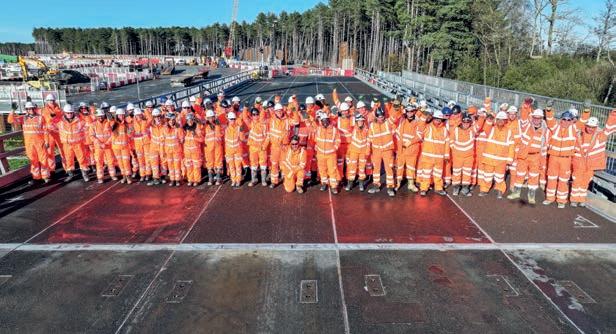
HS2 completes Coleshill viaduct decks
Engineers working on HS2’s triangular intersection outside Birmingham have completed the construction of four parallel viaduct decks.
The viaducts being built near Coleshill in Warwickshire stretch for more than 600m and form a small part of the Delta junction, a major intersection for the new high-speed railway.
Bringing London Museum to life
Vishal Beeharry (below), chief engineer at Sir Robert McAlpine, is part of the team delivering the new London Museum, which is set to open in late 2026.
The image is part of a series by photographer Jill Mead, which brings to life the £437m transformation at two Smithfield Market buildings and captures the stories of the people behind the historic restoration.
Sizewell C doubles onsite workforce
More than 2,000 people are now working on the Sizewell C project each day – double the amount of workers on site a year ago.
Over the course of construction, Sizewell C is expected to support tens of thousands of UK jobs and create 1,500 apprenticeships.
Around 8,000 people will work on site during peak construction, with a third of those coming from East Anglia.
Construction milestone for Birmingham temple
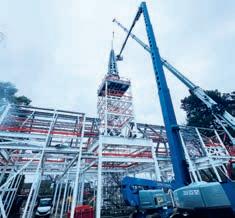
McLaren Construction Midlands and North has installed the spire for the Birmingham England Temple scheme, marking significant progress in the programme of works.
Rising to 38m from ground level, the spire is set to become a prominent addition to Birmingham’s skyline.
A total of 251.578 metric tonnes of steel will be incorporated across two buildings at the site and steel erection is now under way on the main temple building.
MCLAREN CONSTRUCTION
HS2 LTD
Percentage of those surveyed who said they do not believe careers in construction are accessible to young people
Youth sentiment on careers in construction holds firm
Research by CIOB shows young people’s attitudes towards a career in the built environment is holding steady. By
Young people continue to view construction careers positively, with sentiment largely unchanged from last year, according to a new report from the Chartered Institute of Building (CIOB). The report, Attitudes to Construction Careers, includes data from a survey by CIOB, first carried out in 2025 and then repeated in February 2026.
The findings, published to coincide with National Careers Week (2-7 March), show that two-thirds (66% 2026 and 68% 2025) of young people aged between 16 and 24 hold a positive view of construction careers, while around a third (30% 2026 and 31% 2025) would consider working in the industry.
Nadine Buddoo
However, almost half (45% in 2026 and 47% in 2025) of respondents said information about working in construction was not included in the careers advice they received while in education.
In addition, more than a quarter (26% in 2026 and 28% in 2025) of the young people surveyed said they do not believe careers in construction are accessible to young people.
Addressing the gender gap
While a high proportion of female respondents hold a positive view of construction careers, only a quarter say they are likely to pursue a career in the sector, compared with 44% of males.
It is encouraging to see there remains a lot of positivity towards construction careers, but there is clearly more to do to overcome perceptions
David Barnes, CIOB
For female respondents, physical work, working outdoors and male dominance were the top three reasons for not wanting to work in construction. Physical work was also the number one reason cited by male respondents for not pursuing a career in the industry, highlighting a lack of awareness of the varied roles available in construction.
Flexible working was the most popular feature offered by employers among both male (37%) and female (48%) respondents.
The survey also found that more than half (55%) of female respondents agree with the statement that construction is not a welcoming sector for women, while 46% of males shared this sentiment.
David Barnes, head of policy and public affairs at CIOB, said: “It is encouraging to see there remains a lot of positivity towards construction careers, but there is clearly more to do to overcome perceptions around male dominance and site-based hard labour and showcase all the other roles our industry has to offer, including those with strong foundations in digital technology, which in some cases can be primarily office-based.
“We think it is important to repeat this survey on an annual basis, to ensure we are consistently evaluating how the sector is perceived and whether government and industry programmes to bring more people into the sector are having a positive impact.
“We know there are a huge number of opportunities that exist and we want to see what else needs to be done to make it an attractive career proposition for all.” ●
CIOB modernises CPD system to strengthen professionalism and competence
Changes sit within the institute’s commitment to ‘modern professionalism’ and reflect wider scrutiny of professional competence
CIOB is introducing a new CPD Policy for members, replacing its points-based system with an hours-based model, designed to meet regulatory expectations and align more closely with other professional bodies.
Under the new system, which was formally announced at CIOB Members’ Forum on 27 January, CIOB will no longer allocate CPD “points” to specific activities. Instead, members will record learning time in hours.
CIOB members will be required to complete a minimum of 25 hours of CPD each year. Twelve of the 25 CPD hours need to focus on four core themes – professionalism; quality; health, safety and wellbeing and sustainability – with at least
There is increasing focus from government and regulators on how professions ensure people remain competent and up to date
Rosalind Thorpe, CIOB
three hours of CPD activity recorded for each theme. The remaining 13 hours can be tailored to individual development needs.
Rosalind Thorpe, CIOB director of education and standards, said the changes sit within the institute’s corporate plan commitment to “modern professionalism” and reflect wider scrutiny of professional competence across construction.
“There is increasing focus from government and regulators on how professions ensure people remain competent and up to date,” Thorpe said.
The move brings CIOB into closer alignment with other professional statutory and regulatory bodies. Thorpe said this would make the CPD process more straightforward for CIOB members holding dual or multiple memberships.
“If you are a member of two or three professional bodies, you don’t want to have different measures for each one; it’s easier for you to report in hours for all of them,” she said.
Of the 25 hours learning each year, CIOB recommends a mix of 15 hours of formal learning – such as courses, webinars or structured training – and 10 hours of informal learning, including reading, research or self-directed study. Thorpe stressed this split is guidance rather than a requirement.
“What matters is the learning itself,” she said. “If someone is undertaking a PhD, it’s entirely
reasonable for most or all of their CPD to be informal.”
Another key change is the introduction of a single reflective statement covering the year’s learning, replacing the previous requirement to reflect on each individual activity. Members will be asked to describe what they have learnt, how it has benefited them professionally and what development they plan to undertake next.
The new CIOB CPD Policy is effective from January 2026 for all CIOB members, except for those in the retired grades.
Thorpe said the overhaul is intended not only to improve compliance but to support wider cultural change in construction.
“This is about raising standards and reinforcing what it means to be a construction professional,” she added. ●
CIOB CPD changes: key points
● 25 hours’ learning per year
● 12 hours: 3 hours for each of the four core themes: professionalism; quality; health, safety and wellbeing; and sustainability
● A recommended mix of at least 15 hours’ formal learning and 10 hours’ informal learning
● A reflective account of your CPD for the year that looks backward and forward
Access the CIOB CPD Policy in full at www.ciob.org/learning/cpd-policy
CIOB champions prostate cancer awareness
To mark Prostate Cancer Awareness Month, CIOB is encouraging men across the industry to focus on their health, writes Nadine Buddoo
CIOB is supporting Prostate Cancer UK this March as part of a campaign to raise awareness of the disease.
Prostate cancer is the most common cancer in men in the UK. One in eight men will be diagnosed with the disease during their lifetime. This risk increases with age, and it is particularly high among black men, where the figure rises to one in four.
CIOB president Paul Gandy has shared his personal experience of how prostate cancer can change lives, having lost his father, uncle and a colleague to the disease.
He said the loss “brings home how fragile life can be, and how often the warning signs are missed or ignored”.
Early detection can make a significant difference – when
prostate cancer is detected early, treatment is more effective.
Commenting on CIOB’s commitment to raise awareness and encourage more men in the industry to focus on their health, Gandy said: “As a professional body, our role is not just about standards, qualifications and professionalism. It is also about people.
“We have a responsibility to care about the wellbeing of those who work in construction and the built environment.”
Taking the first step
While there is currently no national screening programme for prostate cancer in the UK, it is important for individuals,
particularly those at higher risk, to take ownership of their health.
Speaking on CIOB’s 21CC podcast, Meg Burgess, a specialist nurse at Prostate Cancer UK, said the first step for anyone who wants to be checked is to visit their GP, who might suggest a PSA test.
“There are advantages and disadvantages to the PSA test,” she explained. “It’s not as accurate as we’d like it to be, but your GP will cover those advantages and disadvantages. It’s your choice if you want to go ahead.
“Men often think that a prostate check is going to be a finger test,” Burgess added.
“That isn’t the first test, it is the PSA blood test. The rectal examination, or finger test, can be helpful for men who have got symptoms, but it’s not the necessary first step.”
‘Don’t focus on symptoms’ Burgess also highlighted the importance of individuals understanding their own risk of prostate cancer and not waiting for potential symptoms of the disease.
“Don’t focus on symptoms, focus on risk factors,” she said. “Very often, it’s urinary symptoms so men might notice that they’re peeing more frequently, having to
We have a responsibility to care about the wellbeing of those who work in construction and the built environment
Paul Gandy, CIOB
get up at night to pass urine, [but] those aren’t always symptoms of prostate cancer. They can be symptoms of a benign change or enlargement of the prostate, as well as other things.”
“If you’re waiting for symptoms of prostate cancer, you risk cancer developing,” Burgess added. “Finding prostate cancer early means that it’s much easier to treat or to monitor.”
Prostate Cancer UK has created a free and confidential online risk checker that asks a small number of straightforward questions and provides clear guidance on what to do next. While the risk checker does not provide a diagnosis, it is a useful starting point.
“If you are a man working in construction, I would strongly encourage you to use it,” Gandy said. “And if you manage teams or work alongside others, encourage them to do the same. Having that conversation, whether with a colleague, a partner or a doctor, can make all the difference.” ● Check your risk at https://prostate canceruk.org/risk-checker
CIOB president Paul Gandy emphasises how the warning signs of prostate cancer can be missed
Nick Molyneux, senior MEP manager at Mace, has first-hand experience of the importance of early diagnosis. A routine PSA blood test detected elevated levels of prostate specific antigen, which led to further checks and a biopsy.
Molyneux was diagnosed with prostate cancer which, thankfully, was found early and considered to be “low grade”.
“It was quite a worrying time,” he said. “You hear a lot about prostate cancer, but you don’t really understand the full nitty gritty of it all.”
Due to experiencing no symptoms, Molyneux would have been “none the wiser” without the routine PSA test. “If I didn’t have that blood test, I’d never know, even now. I’d be living with it,” he said.
“It is really important to get that test, especially if you’re in the higher risk category.”
In the UK, the people at highest risk of prostate cancer are men over the age of 50, those with a family history of prostate cancer, and black men.
“It’s so important to put your health first and get yourself checked,” Molyneux added. “It’s a simple blood test and it could save your life.”
Early testing saves lives
Investing in technology: the key to unlocking UK construction productivity
For construction firms under pressure to deliver more with tighter resources, smarter digital tools are no longer optional – they’re essential, says Nitesh Patel
Productivity is one of the key determinants of living standards. When it rises, workers benefit through higher wages, while businesses become more efficient, profitable and competitive.
For construction, productivity is shaped by a broad ecosystem of people across the supply chain. By historical standards, the UK construction sector has experienced something of a productivity resurgence over the past five years. Official data, which measures productivity as output per hour worked, shows that construction has outperformed the wider economy by a considerable margin.
Between Q4 2019 and Q2 2025, productivity in construction increased by 7.7%, compared with just 1.3% across the economy. Yet the longer view paints a more muted picture. From Q1 1997 to Q2 2025, construction productivity grew by only 8.4% in total, equivalent to a modest 0.1% per year. Over the same period, manufacturing managed on average annual productivity growth of 0.9%.
The sector’s recent gains have been driven, in part, by a shrinking workforce. Construction employment has fallen by 10.5% since early 2019, and total hours worked are down 6.7%. With output rising despite fewer human inputs, the industry has worked more productively,
achieving more with less. This uptick follows two decades of stagnation and decline. In the 20 years leading up to the Covid-19 pandemic, output per hour in construction fell by 2.4%. The recent improvement therefore represents a meaningful shift, though not yet a transformation.
Construction has long been a slow adopter of technologies that would significantly lift performance. A clear route forward is the wider use of modern methods of construction (MMC).
Greater standardisation of design and increased product modularisation, with more components manufactured in controlled factory environments, can
shorten delivery times and reduce costs through economies of scale.
However, accelerating MMC adoption across the industry remains a complex challenge. Scaling up requires substantial capital investment in manufacturing facilities, as well as new skills, supply chain alignment and confidence in long-term demand. Labour shortages are also constraining productivity. The reduced workforce has contributed to delays, quality issues, rising costs and pressure on margins.
The combined effects of Brexit and Covid-19 have exacerbated these shortages, with many experienced workers exiting the industry and proving difficult to replace.
The percentage increase in construction productivity between Q4 2019 and Q2 2025, compared with just 1.3% across all industry
With a diminished workforce, the onus is on firms to invest more in digital and artificial intelligence technologies to raise productivity
According to the Construction Industry Training Board, the sector will need to recruit around 239,300 additional workers between 2025-29. As Figure 2 shows, the greatest demand is expected in “other construction and building trades”, including cavity wall insulation, demolition and refurbishment, all roles essential to meeting future workload requirements.
The government has sought to support the industry by announcing, last year, a £625m training package aimed at expanding the pipeline of skilled workers. The plan includes training up to 60,000 additional construction workers by 2029, establishing 10 new building colleges and funding more than 40,000 industry placements each year. While this falls short of the estimated requirement, it nonetheless represents a step in the right direction.
Long-term visibility over project financing is equally important.
The £750bn commitment in the 10-Year Infrastructure Strategy provides much needed clarity on future investment pipelines, giving the supply chain greater confidence to invest in capacity, skills and innovation.
With a diminished workforce, the onus is on firms to invest more in digital and artificial intelligence technologies to raise productivity.
Work has already been delivered on design, safety and new materials. Now there must be a shift to improve on current processes. Innovations in modularisation can be potentially significant, especially when produced to scale. Getting this right will deliver benefits not only for the industry, but for the wider economy over the long-term. Nitesh Patel is a lead economist at Turner & Townsend.
2. Number of extra workers needed per year to 2029
Productivity measured as quarterly output per hour worked
(2019 = 100)
Taking CIOB to the next level
Two months into her role as CEO, Victoria Hills has been busy setting out her priorities for CIOB – including strengthening the institute’s policy influence
It has not been long since I arrived at CIOB and I’ve been excited to see how much great work is going on and how much we have to look forward to.
In supporting CIOB’s work in my new role, I do have some high-level priorities and goals for my first year in post and I want to share what they are with members.
A key part of my next few weeks and months will be to make sure I’m developing strong and supportive relationships with CIOB’s brilliant team, especially the senior leadership and with the trustees,
those on the presidential track and the volunteers and members who help us to deliver our objectives. It’s important to acknowledge that I am building on solid relationships that my predecessor established and I have the good fortune to start from a position of strength.
New corporate plan
Along with members, colleagues and key stakeholders, I will also kick-start a process this year to develop our new corporate plan. Many readers will know that our current corporate plan takes us to
The new CEO will be building on strong foundations at CIOB
I will be working closely with the CIOB policy and public affairs team, strengthening their influence and their advocacy of the relevant policy positions Victoria Hills, CIOB
2028, so this year we’ll look at a programme of engagement across our global community of members to identify emerging themes in the industry and how we might approach them.
Finally, and again this is building on the work the organisation has already done, I want to help take our external engagement to the next level, using CIOB’s voice effectively and having the right impact with our policy work. It feels like the right time to make our global voice louder and use it to shout more about the positive impact our members are having.
As you would expect, I will be working closely with the CIOB policy and public affairs team, along with the membership and education teams, to see where I can add value to what they do, strengthening their influence and their advocacy of the relevant policy positions. I want to be clear that all this activity includes an international focus and we will be looking at our global community and not just the domestic agenda.
None of this will happen overnight or even this year. It will be a journey, but I’m hopeful that many of you will be part of that journey because I believe we all want due recognition for the great work of our members and to carry on moving the industry forward. ● Victoria Hills is CEO of CIOB.
Victoria Hills CIOB
Feedback
A selection of readers’ comments about news and issues in the industry from across the CIOB community and social media
CM
‘Time for CIOB to challenge the status quo’
As apprenticeship reform gathers pace, CIOB’s Steve Conopo argues that competence, not quick qualifications, must remain at the heart of skills development.
Tim Jones
Aligned with the skills shortage the assessment of “competence” is the critical issue for the sector going forward. The industry has a real problem in that education and training has become a lucrative business opportunity and consequently there are those who are selling competence qualifications for cheap. This results in corners being cut and brings into question whether competence is being effectively assessed. We are about to enter an era where we will have a bunch of people who have either been ethically assessed or unethically assessed, the consequence of which is not knowing whether the person with the certificate is actually competent.
Education and training has become a lucrative business opportunity and consequently there are those who are selling competence qualifications for cheap
Tim Jones
I’ve seen it first hand and am concerned that the drive to prove competency is leading to behaviour in the sector that would lead one to question the ethics of what’s going on… Industry governance is spread across so many different bodies that pulling together a coherent approach to education and training is difficult.
CM
From call centre to CIOB fellowship: an unconventional career path
Tracey Field FCIOB explains why a traditional academic start is not the only route into a successful built environment career.
Jonathan Sullivan
Anyone who spends time in a housing association (HA) maintenance call centre will find it to be life changing. This is where reality hits theory head on. Call centre staff are often undervalued and under trained, in my opinion, and worse than that are often powerless… As a long since retired HA director, our call centre staff should have a direct line to the contractors and the power to exercise “non-performance” clauses where repeated failures occur.
CM
Just 9% of teens eye construction careers, despite interest in skilled trades
Teenagers are ditching the traditional idea of success defined by job titles, management roles and “climbing the corporate ladder”, according to new research.
Steven Boxall
I’m sure that there will be many parents and grandparents who have worked in the construction industry, but were unemployed at various times in the 1980s, 1990s and 2000s because governments used the industry as an economic regulatory, and then because overseas workers were cheaper, who would be advising youngsters in their orbit not to enter the industry. If we want more people, we have to address this.
Nicholas Everett
Just where are the manual jobs going to come from if a sizeable proportion don’t go into building? When growing up, a person needs a skill they can sell, start your own business or be self-employed. Promote modern apprenticeships or there will be no building possible in future years. Office workers can’t do it, skilled tradesmen will name their price.
Share your views on the latest industry issues by posting comments online at www.constructionmanagement.co.uk or by emailing the editor at constructionmanagement@atompublishing.co.uk
‘Clients should engage with the journey towards contractor regulation’
Building safety, client upskilling, AI and contractor regulation are on Ayo Allu’s agenda as he takes the chair of CIOB’s client steering group. Will Mann caught up with him
Will Mann: Congratulations on the new role, Ayo. As someone who has worked client-side, what do you think are the biggest issues for clients today?
Ayo Allu: Economic viability is central to every project and so clients are understandably apprehensive about the level of financial commitment necessary for a project to achieve approval. The availability of skilled labour also significantly affects costs, as does a project’s sustainability credentials.
Clients share many of the same pressures as contractors, but often feel them more keenly because they must also respond to funders and stakeholders. Long-term pipeline visibility remains a concern for clients as the ability to plan for five, 10, or even 15 years into the future is essential for stable development planning. Clients are now much more aware of the long-term management implications and costs associated with buildings. Will Mann: What examples of “good practice” would you highlight among clients?
Ayo Allu: In my view, it is “behaviours” that truly set apart good clients. Having collaborated with developers, funders, large and small organisations, the most admirable behaviours
I have seen are from clients who take ownership of the entire project life cycle, including building operation. This entails being engaged not only during the viability and initial procurement stages, such as land acquisition and planning, but also throughout the project management and delivery phases, monitoring outcomes from beginning to end.
Often, this stems from a strong interest in the final product, whether they are retaining the asset or are directly accountable for its maintenance.
A good example is a company called UPP, a provider of on-campus student accommodation. They implement an end-to-end, transparent procurement process and incorporate these principles through long-term partnerships with contractors, focusing on building safety decisions, initiating early supply chain design and verifying designer competence, long before the Building Safety Act was introduced. This behaviour was motivated by institutional funding requirements and the necessity to instil confidence in long-term asset owners, managers and funders.
Another is the Earls Court Development Company, which focuses on early engagement and strategy setting and uses highly skilled internal staff, who hold strong awareness of the practical elements of project delivery and work in
tandem with their appointed specialists to bring forward a solution. As an informed client, they recognise the importance of de-risking complex projects and take active steps to achieve it.
Will Mann: Are there are any clients you see doing interesting work in the AI and digital space?
Ayo Allu: I’ve worked with two AI companies in recent years.
Consigli AI is a Norwegian company that entered the UK market a few years ago. The pre-construction process can span several years, yet their tools, leveraging AI, showcased significant savings in time and materials used, enhanced design accuracy, and reductions in resource requirements.
Kope.AI is a software platform designed for offsite construction that integrates tangible and available construction products into digital design models. It offers automated assembly planning, material take-offs and the ability to attribute prefabricated products directly to design models. By entering various parameters, the system generates multiple compliant solutions that can be sent to an established supply chain. The benefits are accuracy, speed, enhanced quality and reduced risk to project delivery.
Any apprehension I have regarding AI lies in its effect on skills and resource allocation within the industry. If our education systems are preparing individuals for roles that are likely to be disrupted by the digital tools we are increasingly using as an industry, we open the door to social and economic
The most admirable behaviours in clients come from those who take ownership of the entire project life cycle, including building operation
Ayo Allu FCIOB
misalignment. It is crucial we understand this interface and that governments work with education providers, AI developers and industry practitioners to strategise accordingly.
Will Mann: How do you plan to build on CIOB’s client work to date that Mike Foy has led on?
Ayo Allu: The client strategy has gone from strength to strength since it was launched in March 2023, focusing on a set of umbrella themes that we frequently revisit to ensure we remain focused on what matters to the industry: project delivery; quality and safety; sustainability, net zero and whole life; contracts and procurement; and the regulatory landscape. We know the strategy is working, so we will continue our programme of engagement through round tables and promotion at client shows and in the media and online. We are also seeing real progress with embedding clients into the CIOB, which is our long-term aim.
Will Mann: What do clients get from plugging into the CIOB client strategy?
Ayo Allu: The CIOB client strategy helps to clarify an acceptable approach to standards, ethics and best practice, and offers clients resources which will enhance their own skills and enable them to take greater control of their projects.
It connects them to the expert knowledge and experience of our 39 client champions across the UK and internationally, and amplifies the client voice within the industry, which is crucial for improving shared outcomes.
● Chair of Client Steering Group, CIOB – Nov 2025-present
● Principal consultant, AAA Project Services Ltd –2024-present
● Clarion Housing Group – 2020-2024
● University Partnerships
Programme –2017-2020
● Berkeley Group –Sep 2015-Dec 2016
● Kier Group –2013-2015
● Willmott Dixon –2008-2013
● Metronet Rail (Balfour Beatty) –2007-2008
● Bouygues UK –2004-2007
It also highlights the value of appointing CIOB professionals (companies, consultancies and individual members) to projects.
Will Mann: What would you most like to hear from clients as you take on the chair role?
Ayo Allu: The building safety regulator has been in place for several years now and, despite some of the initial challenges, the majority of industry practitioners have begun to increase their focus on accountability, competence, and transparency.
I’d like to see clients actively engage in the journey towards contractor regulation, and the recent consultation for the proposal of a single regulator.
Enhancing their skills is no longer a choice; clients must collaborate with competent/accredited contractors and work together in fulfilling regulatory requirements. ●
Ayo Allu FCIOB – CV
Clients prioritise refurb, but worry about contractor quality
What issues are keeping construction clients awake at night? Will Mann reviews the findings of the 2026 Construction Management and CIOB client survey
Confidence among construction clients is broadly high at present, but work priorities are centring on reconfiguring or refurbishing existing assets.
Those were among the findings of a survey of more than 100 built environment clients carried out by Construction Management and CIOB, which provides insight into
how organisations are prioritising investment, selecting contractors and responding to new regulatory and technological pressures.
Pipelines healthy, but refurb leads way
Despite the wider backdrop of economic uncertainty and cost pressures, when asked about confidence in their work pipeline,
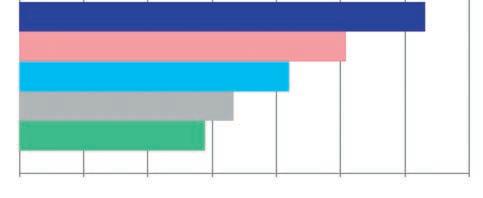
Are you confident about your work pipeline?
n Yes, we have a strong pipeline
n Neutral
n No, we are pausing or scaling back our pipeline
What are your organisation’s key priorities for your built assets over the next 5 years?
n Reconfiguring or refurbishing to meet changing needs
n Expanding or developing new facilities to support growth
n Decarbonising the built estate
n Implementing digital asset management and data-driven decision making
n Enhancing building safety
41% of respondents said they have a strong pipeline of work.
A further 38% described their position as neutral. Only 21% said they are pausing or scaling back planned activity.
Looking at clients’ top priorities, the most popular option picked by respondents was “reconfiguring or refurbishing to meet changing needs” (63%) – a reflection of both the structural changes in the economy, with the rise of homeworking and online shopping, and a general need to “mend and make do” as purse strings tighten.
But even with the recent financial uncertainty, more than half of clients (51%) said they were “expanding or developing new facilities to support growth”.
“Decarbonising the built estate” was chosen as a priority for 41%, and “implementing digital asset management and data-driven decision making” was selected by a third of respondents.
Perhaps surprisingly, only 29% said “enhancing building
safety” was a priority, though the score was slightly higher among clients who work in private and social housing (36%).
Contractor concerns
Contractor quality and workmanship shot to the top of construction industry concerns post-Grenfell – and it seems these are still very real worries among built environment clients.
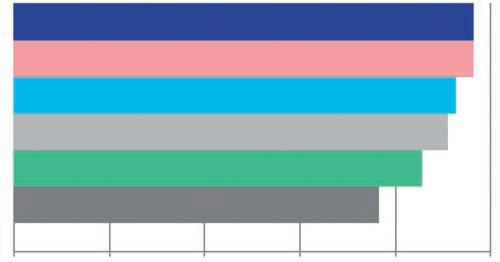
Asked, “what are your top priorities when choosing a contractor to work with?”, more than three-quarters (76%) of clients answered, “quality of construction”. Cost certainty also scored highly (72%), a consequence of the sharp rise in tender inflation, and almost half (49%) of clients said “collaboration and communication” was a key priority.
Other priorities cited when appointing a contractor were: “speed of delivery” (22%), “sustainability” (18%), “flexibility in accommodating changes” (17%), risk allocation (14%).
the full client survey report at constructionmanagement. co.uk/client-survey-2026
What are your top priorities when choosing a contractor to work with?
n Quality of construction
n Cost certainty
n Collaboration and communication
n Speed of delivery
accommodating
Only 21% said they were ‘struggling to understand all requirements of the Building Safety Act’, though this rose to 42% among clients working in social and private housing
Building safety
Following the implementation of the Building Safety Act and associated regulations, there are signs that clients are toughening up their monitoring of contractors and suppliers (see chart, p22).
Some 42% said they had “established clear accountability for dutyholders and ensure they discharge their legal responsibilities under the Act”.
Another 38% said they had “introduced tougher checks on competencies of contractors”. Almost one in five (19%) said they now “employ a clerk of works to monitor build quality”.
On information management, 29% said they “have implemented digital record-keeping and require “golden thread” information at handover”.
Although the implementation of the Building Safety Act and associated regulations has received widespread criticism,
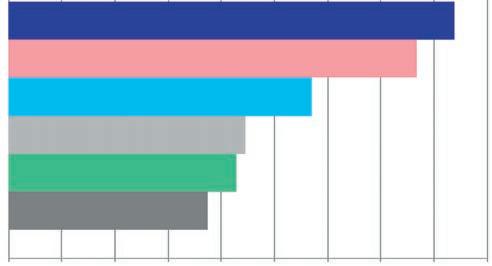
Tell us about your organisation’s sustainability priorities
n We are planning or delivering retrofit projects
n We aim for net zero carbon in operation
n We aim for net zero carbon in construction
n We are actively addressing our impact on nature
n We have policies on circular economy (eg recycling)
n We focus on reducing embodied carbon in materials and supply chain
Sustainability approaches
Decarbonisation was a priority for just under half of respondents in the survey.
Some 48% said were “planning or delivering retrofit projects” while 46% “aim for net zero carbon in construction”. Another 43% said they “have policies on circular economy (eg recycling)”, while 38% “focus on reducing embodied carbon in materials and supply chain”.
Reflecting how clients are particularly focused on whole life costs, 48% said they “aim for net zero carbon in operation”. l
About the survey and respondents Tell
the vast majority of clients responding to the survey said they had not been impacted negatively by the new postGrenfell regime.
Only 21% said they were “struggling to understand all requirements of the Building Safety Act”, though this rose to 42% among clients working
in social and private housing. Similarly, while 22% of all clients said they had “experienced challenges and/or delays due to the gateway process for approvals”, this figure increased to a sizeable 48% for those operating in housing.
n We have established clear accountability for dutyholders and ensure they discharge their legal responsibilities under the Act
n We have introduced tougher checks on competencies of our contractors
n We have implemented digital record-keeping and require “golden thread” information at handover
n We have experienced challenges and/or delays due to the gateway process for approvals
n We are struggling to understand all requirements of the Act
n We employ a clerk of works to monitor build quality
Construction Management and CIOB surveyed 115 built environment professionals working for clients during November and December 2025. The breakdown of the respondents was as follows:
l Type of client represented: industrial/warehouses 18%; infrastructure 18%; private housebuilder 15%; central government department or agency 14%; local authority 14%; healthcare 14%; retail and leisure 12%; offices 11%; universities 11%; schools and colleges 9%; housing association 7%.
l Client organisation size: 1,000+ employees 43%; 250-999 employees 12%; 50-249 employees 11%; fewer than 50 employees 33%.
l Role at client: project manager/ director 36%; consultant acting on behalf of client 14%; property or estate manager/ director 11%; professional/ technical specialist 11%; board level 10%; other 18%.
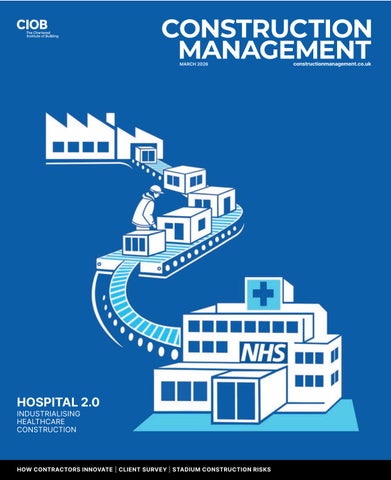
Hospital 2.0: industrialising healthcare construction
The New Hospital Programme promises more efficient delivery through industrialisation. Kristina Smith speaks to programme leads from the NHS, Mace and Turner & Townsend
In February 2025, a consortium of 10 companies led by Mace and Turner & Townsend was appointed as the programme delivery partner (PDP) for the New Hospital Programme (NHP).
The £50bn-plus programme will see 46 major hospital projects delivered between 2020, when the NHP was launched by the previous Conservative government, and the early 2040s.
Evolving as it progresses, with a Labour government “reset” in January 2025, the NHP promises a new approach to hospital delivery. Rather than each NHS Trust doing their own thing as a client, there is to be an “industrialised” approach – dubbed Hospital 2.0 – covering everything from business cases to bathroom pods.
Some six months after the PDP started work, CM caught up with three of the programme’s leaders to get a feel for what this new way of working might look like.
Darren Colderwood is director of the PDP and business unit director –resilience at Mace; Darren Laybourn, global health lead at Turner & Townsend, is head of estimating, cost management and data tools and policies; and Doug Baldock is
Hospital 2.0 is the DNA of the programme. If you break the DNA, the whole code falls down
Darren Laybourn, Turner & Townsend
executive technical services director at NHP, responsible for design, sustainability, industrialisation and digital.
With seven of the 46 hospitals already built and others under way (see box, p27), the remainder will be delivered under the new regime. Tier 1 contractors will become part of the Hospital 2.0 Alliance (H2A); 16 were shortlisted in June 2025 with dialogue underway to allocate the first 10 projects among them.
The plan is that the alliance model, based on the Institution of Civil Engineers’ Project 13, will be far less risky for contractors. “The commercial model has been set up in order to make it attractive, to balance risks sensibly; that’s a big factor in getting this up and running,” says Colderwood.
So far, that approach appears to be paying off. “We’ve attracted back into the market a significant number of contractors who had left because the risk was too great for them,” says Baldock.
The ultimate goal is better outcomes for patients. Myriad stakeholders including NHS clinicians, patient groups, various Royal Colleges, national clinical directors and NHS Estates have all fed into this standardised approach, which aims
to see optimised hospital layouts, enabled by digital technologies and assembled using several standardised components such as MEP modules, pods and cladding. Getting to this point will require a huge shift for the NHS Trusts, as well as for the construction supply chains delivering the programme. The idea is that working within the Hospital 2.0 blueprint will see tested and approved products and layouts deployed on every scheme, reducing risk and creating economies of scale. Getting Trusts to stick to that blueprint is vital, says Laybourn. “Hospital 2.0 is the DNA of the programme. If you break the DNA, the whole code falls down.”
Five years on
When the then-prime minister Boris Johnson announced NHP in 2020, the headline claims were that £20bn would be spent to build 40 hospitals by 2030. Interim delivery partner Mott MacDonald and interim commercial partner KPMG were appointed in 2021 and started working on a standardised approach, which would favour modern methods of construction and lead to economies of scale.
When the Labour government came into power, it ordered a
The £50bn-plus programme will see 46 major hospital projects delivered between 2020, when the NHP was launched by the previous Conservative government, and the early 2040s
Each wave is to be allocated £15bn of funding under the programme
strategic review of the NHP. Discussions with HM Treasury followed. As a result, hospitals containing reinforced autoclaved aerated concrete (RAAC) were prioritised, others were pushed back and delivery of the programme was organised into five-year waves, stretching out to 2040. Each wave is to be allocated £15bn of funding under the programme.
“In January, there was a reset which focused on establishing a credible and realistic time frame for delivery of all the schemes in the NHP,” explains Baldock. “With funding confirmed for the programme at that time – in waves aligned with spending reviews in each five-year period –the team has been establishing a schedule of area aligned to a cost plan for each scheme.”
At the time of the January 2025 reset, seven schemes – now dubbed Wave 0 – were under construction and six projects – Wave 1c – were under way, let under the previous ProCure 23 framework. Wave 1a, the RAAC hospitals and three more under Wave 1b will be let through H2A.
There is a desire to cut the cost to get to the optimum level. At the same time, we want to increase predictability and reduce uncertainty
Darren
CGI of a proposed NHP design: The ultimate goal for the programme is better outcomes for patients
One of the biggest tasks for Laybourn and his team has been getting to grips with costs, pinning down areas, budgets and timeframes. Back in 2021, Mott Macdonald reported that there was a goal of 20% reduction in cost and 25% reduction in time. Today, NHP is being rather more cautious about such goals.
“There is a desire to cut the cost to get to the optimum level. As a programme we are not stating a particular percentage,” says Laybourn. “Working with alliance partners and all the supply chain will allow us to establish what the optimum time is within target envelopes. At the same time, we want to increase predictability and reduce uncertainty.”
New expertise
In addition to working on costing and procurement, the PDP has been getting up to speed with the other elements of the programme, including setting up processes and its team.
As well as regular construction players, the PDP consortium has a couple of less conventional members too: beneath Mace and Turner & Townsend, Deloitte, Unipart
and Amentum sit alongside Mott MacDonald, which leads a design team of WSP, HDR, KHS and specialist healthcare designer MJ Medical.
“If you look at the scope of work and the breadth of the scope we were asked to undertake, it is very, very broad,” says Colderwood.
“It is broader than the scope that the previous interim delivery partner and the interim commercial partner covered.”
Deloitte is there for its experience in transformation, Unipart brings logistics and industrialisation expertise and Amentum is adding project management depth, says Colderwood. Having Mott MacDonald in the consortium creates continuity with the initial phases of the programme.
“Having a team with that many component parts is interesting to manage, but that’s my job,” says Colderwood.
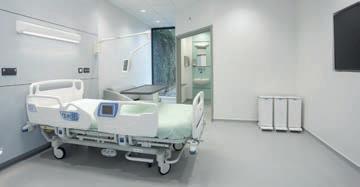
Design work has been progressing on prototypes, says Baldock, to tie down details for any aspect that is novel or different from current standards. Offsite specialist Reds10 built a prototype ensuite patient room in its manufacturing facility in Driffield, East Yorkshire, to iron out issues such
Laybourn, Turner & Townsend
The commercial model has been set up in order to make it attractive, to balance risks sensibly
Darren Colderwood, Mace
as coordination of services, clinical space around the bed, installation and maintenance space for services and constructability. All the hospitals will have individual, ensuite rooms.
“This has been a huge help, not just for technical reasons but for clinical reasons to validate our design,” says Baldock. “We are doing a series of these over the next few years, way ahead of construction, so that we derisk the programme significantly before we get to any scheme, which is fairly novel in the NHS.”
The NHP will also use a toolkit of standardised parts aimed to bring economies of scale. There are currently seven standardised components: in-room MEP modules; horizontal MEP distribution modules; risers; ensuite bathrooms; facades; partitions; and doors.
Offsite specialist Reds10’s prototype ensuite patient room
The New Hospital Programme projects
A total of 46 hospital projects will be delivered by the 2040s
Already completed (opened between 2021 and 2024)
l Hospital Northern Centre for Cancer Care
l Royal Liverpool Hospital
l Sycamore Unit at Northgate Hospital
l Brighton 3Ts Phase 1
l Greater Manchester Trauma Hospital
l Dyson cancer Care
l Midland Metropoliotan University Hospital
Wave 0 – under way
l Alumhurst Road
Children’s Mental Health Unit, Dorset (Kier Construction)
l Royal Bournemouth Hospital, Dorset (Integrated Health Projects (Vinci-Sir Robert McAlpine))
l St Ann’s Hospital, Dorset (Kier Construction)
l Dorset County Hospital, Dorchester (Tilbury Douglas)
l CEDAR Programme (Sir Robert McAlpine)
l Oriel Eye Hospital (Bougues (UK))
l National Rehabilitation Centre (Integrated Health Projects)
Wave 1a – RAAC hospitals (to be delivered through Hospital 2.0 Alliance)
l West Suffolk Hospital, Bury St Edmunds (RAAC)
£1 billion to £1.5 billion
Hinchingbrooke Hospital (RAAC) £501 million to £1 billion
l James Paget Hospital, Great Yarmouth (RAAC)
£1 billion to £1.5 billion
Queen Elizabeth Hospital, King’s Lynn
(RAAC) £1 billion to £1.5 billion
l Leighton Hospital (RAAC) £1 billion to £1.5 billion
l Airedale General Hospital (RAAC)
£1 billion to £1.5 billion
l Frimley Park Hospital (RAAC) £1 billion to £2 billion
Wave 1b (to be delivered through Hospital 2.0 Alliance)
l Milton Keynes Hospital
£500 million or less
Hillingdon Hospital, north-west London
£1 billion to £1.5 billion
l North Manchester General Hospital
£1 billion to £1.5 billion
Wave 1c (more developed schemes, being delivered under ProCure 13)
l Poole Hospital, Dorset (integrated Health Projects) £500 million or less
l Derriford Emergency Care Hospital, Plymouth (Mace-Willmott Dixon)
£500 million or less
l Cambridge Cancer Research Hospital (Laing O’Rourke) £500 million or less
l Shotley Bridge community Hospital, Durham (Tilbury Dougals) £500 million or less
l Women and Children’s Hospital, Cornwall (not yet awarded)
£500 million or less
l Brighton 3Ts Hospital (Laing O’Rourke)
£500 million or less
Wave 2
l Leeds General Infirmary
£1.5 billion to £2 billion
l Specialist Emergency Care Hospital, Sutton
£1.5 billion to £2 billion
l Whipps Cross University Hospital, north-east London
£1 billion to £1.5 billion
l Princess Alexandra Hospital, Harlow
£1.5 billion to £2 billion
l Watford General Hospital
£1.5 billion to £2 billion
l Leicester Royal Infirmary, Leicester General Hospital and Glenfield Hospital
£1 billion to £1.5 billion
l Kettering General Hospital
£1 billion to £1.5 billion
l Musgrove Park Hospital, Taunton
£501 million to £1 billion
l Torbay Hospital
£501 million to £1 billion
Wave 3
l Charing Cross Hospital and Hammersmith Hospital, London
£1.5 billion to £2 billion
l North Devon District Hospital, Barnstaple
£1 billion to £1.5 billion
l Royal Lancaster Infirmary £1 billion to £1.5 billion
l St Mary’s Hospital, north-west London
£2 billion or more
l Royal Preston Hospital
£2 billion or more
l Queen’s Medical Centre and Nottingham City Hospital £2 billion or more
l Royal Berkshire Hospital, Reading
£2 billion or more
l Hampshire Hospitals
£2 billion or more
l Eastbourne District General, Conquest Hospital and Bexhill Community Hospital
£1.5 billion to £2 billion
‘We are aiming for 80% industrialised. We want to drive repeatability to our advantage,’ says Darren Laybourn, Turner & Townsend
It has been reported that the NHP is aiming for 80% standardisation. But that isn’t quite right, says Laybourn. “This isn’t only about building more offsite, it’s about industrialisation. We are aiming for 80% industrialised. We want to drive repeatability to our advantage.”
That repeatability extends to processes too, says Baldock. “We don’t want to restrict it to just focus on products. There are business cases that are quite unwieldy. Streamlining business cases is reducing costs.”
Holding the line
The first projects to test the industrialisation scenario will be Wave 1a, the seven RAAC hospitals which will start on site in late 2027 or early 2028. For Hospital 2.0 to work, it is vital that, in designing their hospitals, the NHS Trusts stick to the industrialised approach and the standardised components.
Already there is tension in this area, says Baldock. “The biggest challenge is getting them [the trusts] to hold the line so that when they get to RIBA stages 3 and 4, we can embed the products.”
The biggest challenge is getting the trusts to hold the line so that when they get to RIBA stages 3 and 4, we can embed the products
Doug Baldock, NHP
Architects and designers working with the trusts are feeding back on how well the Hospital 2.0 methodology is being deployed on each scheme so that support can be given where necessary to keep trusts on track, says Baldock.
In parallel with developing the designs for Wave 1a, the team is also looking to optimise Wave 1c, the projects procured under the previous framework. “We are looking at how we can adapt certain aspects of Hospital 2.0, for example standardisation of room sizes and more modular construction,” says Laybourn. “Or, if they are in far-flung parts of the country, we are looking at how we can remove capacity issues and, at the same time, provide additional commercial support.”
Relationships established at this point could be important for the programme further down the line, says Laybourn. “We are trying to evolve the standing of the programme by showing the right behaviours on those projects. Those partners could be potential alliance partners.”
It’s not clear yet how far down the supply chain the alliance approach will be extended. Since competitive dialogue with the shortlisted contractors is still ongoing, this wasn’t something that Colderwood or Laybourn would discuss. A suppliers’ guide on the NHP website says that the alliance partners –tier 1 contractors – will “determine the optimal way of packaging and delivering their works, dependent on the scheme and their own delivery model”.
Some suppliers will work only within their region, whereas others might stretch across multiple regions, says Laybourn.
One of the most important tasks for the PDP will be ensuring
CGI of a proposed NHP design: NHS Trusts plan to stick to the industrialised approach and the standardised components
that supply chain members are not overstretched or the market overheated, says Baldock. A programme intelligence portal (PIP) has been developed to aggregate all the components needed across all the projects in the programme to help manage this.
The NHP recognises there will be skills shortages in certain areas. Calderwood pinpoints the East of England where programmes such as Anglian Water’s AMP8 programme of works and Sizewell C will be competing with hospital builds. The NHP will be launching a skills academy at an event in November in a bid to train and upskill the supply chain.
In another six months, there will be a lot more to say, says Calderwood. But for now, it’s about getting the foundations and behaviours in place, so that the NHP isn’t just businessas-usual contracting.
“It’s not just about the number we are building in the next few years, it’s about setting a new standard and setting a new bar,” says Laybourn. “We are going through some hard yards, but we know those hard yards will prove fruitful for the long-term sustainable future of the NHS and its assets. For me, that’s what this programme really drives towards.”
How do contractors innovate?
CM brought together several major contractors to find out how they evaluate and introduce innovative products and technologies. Will Mann chaired the discussion, organised in association with Geberit
Will Mann: What is the most important benchmark for your organisation when introducing innovation and how do you measure this?
Paul Gandy: Wearing my contractor hat, the driver has to be the bottom line. That does not always mean immediate returns, but
we must understand whether an innovation or investment will increase productivity, help win work, or importantly, de-risk what we do. R&D tax benefits are not the driver, although they are an important consequence of doing innovation properly, and essential support given the low margins in
The roundtable discussed themes including tech, sustainability and supply chain
construction. There’s recognition that payback on innovation is rarely immediate. It can take years.
Eve Bader: For SES, digital is core to our business strategy. Our objective is to make SES a digital-first business. We benchmark innovation against three questions: Will it improve project performance and
delivery? Will it create a business differentiator? And will it enable digital decision-making?
Dr Zainab Dangana: For Wates, innovation is integral to delivering value and helping customers and the business achieve net-zero targets. We identify products, put them through due diligence to confirm performance, and then pilot them on our sites. Our benchmark is the impact technologies can make – whether carbon reduction, water savings, or other measurable benefits.
Andy Lever: At Geberit, we approach innovation slightly differently because we are a manufacturer. Returns on investment matters, but many products we launch focus on improving working methods, saving time on site while improving quality and reducing risk. We’re also obsessive about
Speer
sustainability. Our long-standing eco design principle is that every product should be ecologically better than its predecessor.
Antony Corbett: Whenever we develop a product, we always consider the installer – how to make installers’ lives easier, more efficient, more productive. Our Flowfit piping product is one example, differing from traditional systems which require welding or soldering. For us, innovation is about making things easier, faster, greener and safer.
David Philp: For Bentley Systems, innovation is change that unlocks new value. The most important benchmark is whether innovation has a direct impact on the project, and whether it endures across the asset lifecycle.
Every organisation views value differently. In my contractor days it was programme, cost and
We must work with the supply chain to understand how we actually build –that then leads us to product innovation
Steffan Speer, Morgan Sindall
quality. Now we consider ESG and wider social value. We spend time understanding what value means to the client.
Colin Bell: At Kier, we’re on a journey toward being “naturally digital” – everything digitally connected. It’s hard to name one benchmark, so I think in terms of four strategic themes:
l Simplification – making work easier.
l Consistency – ensuring everyone works the same way.
l Productivity – giving people time back; innovation should turn a fivehour task into a one-hour task.
l People – improving capability. We don’t focus enough on innovation’s role in skills.
Innovation must solve problems. Define the problem, involve experts in solutions and launch innovations with strong internal support.
Metrics include client outcomes,
In association with
The discussion panel
Paul Gandy, president of CIOB; formerly CEO of the Tilbury Douglas Group
David Philp, chief value officer, Bentley Systems; chair of CIOB innovation advisory panel
Colin Bell, digital director, Kier
Steffan Speer, technical director, Morgan Sindall Construction
Eve Bader, national digital standards lead, SES
Dr Zainab Dangana, head of sustainable technology services, Wates Group; member of CIOB sustainability advisory panel
Andy Lever, managing director, Geberit UK
Antony Corbett, senior product and applications manager, Geberit UK
Steffan
of Morgan Sindall Construction considers three themes when considering new innovations
How do contractors benchmark innovation?
For Wates, our benchmark for innovation is the impact technologies can make –whether carbon reduction, water savings, or other measurable benefits
Zainab Dangana, Wates Group
Wearing my contractor hat, we must understand whether an innovation or investment will increase productivity, help win work, or de-risk what we do
Paul Gandy, Tilbury Douglas and CIOB
Innovation must solve problems. Define the problem, involve experts in solutions, and launch innovations with strong internal support. Metrics include client outcomes, repeat work, time reduction, waste reduction and better procurement
Colin Bell, Kier
We need innovations that make work easier, faster, better, greener and safer. If we cannot benchmark innovation against those measures, we should not pursue it
Steffan Speer, Morgan Sindall
Digital is core to our business. We benchmark innovation against three questions: Will it improve project performance? Will it create a business differentiator? Will it enable digital decision-making?
Eve Bader, SES
repeat work, time reduction, waste reduction and better procurement.
Steffan Speer: Morgan Sindall looks at three themes when considering new innovations.
l First is perfect delivery –delivering projects on time, with the right quality and safety, so we earn repeat work.
l Second, responsible – enhancing our people’s careers, benefiting communities and delivering wider social value.
l Third, consistency – because if we’re being consistent, then we can challenge the status quo. Even a 1% improvement matters.
Benchmarking depends on the innovation. We face skill shortages, so we need innovations that make work easier, faster, better, greener and safer. If we cannot benchmark innovation against those measures, we should not pursue it.
WM: What are the key innovation drivers – compliance, legislation,
building safety, sustainability –for your organisation?
ZD: My focus is sustainability – how we can help customers achieve their net zero targets and how we do so as a business. Legislation strongly drives this, and it changes every year, increasing complexity. For example, Biodiversity Net Gain is a new development requirement that has just been introduced.
AC: Customer needs. Our products are manufactured in Germany and Switzerland, but we must ensure they are right for the UK market. Sustainability and Environmental Product Declarations are key drivers. Our FlowFit piping system is designed to save time, energy and water. These are core considerations for product launches. Our products are also BIM-ready so can be used directly in project models, which helps our customers improve productivity at the design and construction stage.
From left: Paul Gandy, CIOB, and Andy Lever, Geberit UK
CB: I’m not sure the Building Safety Act drives innovation, but it shines a light on basic processes. When you shine that light, you see the cracks – and those cracks become opportunities for improvement and innovation.
At Kier, we are focusing on data and connected processes for meeting the golden thread requirements. This is useful not just for internal teams, but also for the regulator, so when they ask for gateway two information, we can get there quickly.
That might not sound like innovation, but it is changing how we think about auditability and regulatory compliance.
AL: From a manufacturer’s perspective, it seems the industry is hugely confused about what the Building Safety Act really means. We’ve had to think differently: innovations must now fit into a legislative framework, answer those regulatory questions and educate the market. It’s why our
products are designed to meet rigorous standards.
SS: The key driver is what our customer wants, whether that’s the supply chain or our own people, depending on where we sit in the business. From the business perspective, if we don’t innovate and think about the future, how do we stay relevant?
WM: How do contractors work with suppliers to identify new innovations and new products?
SS: A vast proportion of our work is carried out through our supply chain, and a large proportion of that work involves contractor design. If you haven’t got the design nailed down, the last 5% of design resolved on site will hurt you.
So we must work with the supply chain to understand how we actually build it – that then leads us to product innovation.
Every contractor wants early engagement. We know we can support and drive a better outcome if we’re involved earlier, but we
Paul Gandy on the impact of tech and AI
As a contractor, differentiation is key. We work heavily on construction frameworks – 90% public sector or regulated private sector. How we demonstrate added value is huge. Technology is central to that. We’ve invested in a
Eve Bader (left) of SES says upskilling is vital in digital transformation
In digital transformation, innovation influences cultural change. Upskilling is vital, taking people on the journey. They should be excited to work smarter
Eve Bader, SES
configurator that models embedded carbon in real time at RIBA Stage 1. Sitting with a customer, we can ask: are you sure about the building orientation, massing, material?
I think AI will quickly become a “business as usual” support to preparation of proposals across the industry, improving efficiency and
CB: We receive many requests to look at technologies. Often the answer is unfortunately: ‘I don’t have time today, come back in six months’ – and sometimes it never comes back.
But occasionally, someone brings something that unlocks so much.
quality in the bidding process. We’ve introduced a virtual assistant called Tilbury for managers –about 25% of our people have access. She learns fast, much faster than we do. She’s currently doing a quantity surveying and a construction management degree simultaneously. sometimes have to persuade our customers because of competition or procurement rules. We’ve got to work together on collaboration – whether it’s product, process or technology.
Dr Zainab Dangana on working with suppliers to identify innovation
This is close to my heart because my day job is helping our business identify new products.
I was involved in a research project with Wates back in 2011. One of our major retail clients was creating their first eco-learning store and needed innovative products and solutions to trial.
So we developed Wates Sustainable Technology Services to bridge the gap between clients who need solutions but don’t know where to find them, and suppliers who have them but struggle to connect.
Most products have a payback under two years – some as low as six months. They range from simple innovations like tap adapters that reduce water flow to analytical tools and materials optimisation.
We introduced watersaving products to a leading bank. They were so impressed they didn’t need a business case because it was so inexpensive. They installed the technology and rolled it out in Africa and Asia as well.
Innovation often involves multiple stakeholders with different priorities – design managers, cost managers, project managers. So we developed a decisionsupport framework. We bring everyone together and prioritise criteria collectively. This removes conflict. After that, we identify suppliers and invite them to present using a “Green Dragon’s Den” style format to raise awareness. This works brilliantly. If you tell a client what to do, they step back. If you let them lead – “what do you need?” – they engage.
In an industry working on margins of 1%, even a 0.1% improvement is a hell of a lot.
Here’s an example of innovation from shared opportunity: at HMP Five Wells in 2019, we worked with PCE using a tool called Ynomia – a component-tracking system based on MMC and concrete panels. We had a rough process, but it worked – tracking manufacture, installation, certification and so on.
We took that into 2022 for HMP Millsike, tracking 11,000 concrete panels with a 19-step process covering manufacture, quality checks, installation and delivery – all through RFID tags. From an innovation perspective, it improved quality –97% of panels arriving on site were installable. It also provided visibility –you could see where every panel was.
That changed responsibility and dynamism in how we construct. We reduced the programme significantly from that one thing.
DP: The biggest change I’ve seen in my career is how digital has enabled better collaboration within the value chain. It has moved us away from purely transactional relationships.
We’re seeing the creation of virtual organisations or virtual projects – large programmes bringing together different contractors and vendors. Digital platforms create the infrastructure for enhanced collaboration.
We’re working with Bechtel on a project to create digital twin
environments. Instead of trialling something for a year to see if it works or fails, we focus on proof-of-concept and proof-of-value. Not just “does this work technically?” but “does it deliver value for each use case?”
EB: In digital transformation, innovation influences cultural change. Our team’s skill sets are not off-the-shelf and we need a common language to connect data, integrate systems and collaborate. Upskilling is vital, taking people on the journey, not forcing change on them. They should feel excited to work smarter.
CB: When you have a client who is in the mindset of “show me how you can deliver better outcomes”, it is amazing how that acts as a real touchpaper for everyone.
PG: I spent a lot of time working with big construction management projects in London 20 years ago. Working for customers like Stanhope – if you weren’t engaging with your supply chain from the very start, selecting and working with them to innovate in methodology and product, you weren’t going to be in the game a second time.
WM: What are the barriers to innovation?
DP: One of the problems with construction is that people think at a project level. But if you look at the water sector, where they work with five-year procurement cycles (currently AMP8) and mature clients who are good at setting
We focus on proof-of-concept and proof-of-value. Not just ‘does this work technically?’ but ‘does it deliver value for each use case?’
David Philp, Bentley Systems and CIOB
their “North Stars” (major business objectives), you have five years to bring in innovation and make it stick. That’s fantastic.
We’ve developed a scale on the CIOB innovation panel, similar to NASA’s Technology Readiness Level (TRL), from 1 (basic idea) to 9 (market ready). So a supplier might have an innovation that scores high on the TRL, but does it have the relevant contract models or cultural change in place? We try to bring those two together.
PG: There is a conservatism in the industry, for good reasons. It’s driven by concern over unproven performance and historic failures, for example, asbestos was seen as the magic solution when it was introduced, also the issues that arose with concrete flat panel buildings built in the 60s and 70s.
SS: Nobody wants to be the next Blockbuster or BlackBerry. But we’re in a highly competitive market and margins are low. Another challenge is implementation –actually getting ideas sustained and adopted by everyone. People always have to come first, then process, then technology. We
Steffan Speer of Morgan Sindall Construction says implementation is one of the challenges they face
sometimes re-engineer that order so technology comes first, and that’s when problems come.
AL: From a manufacturing perspective, we see exactly what you’re saying. We bring technology innovation to the market with 150 years of track record of quality products and still it is incredibly difficult to break that barrier. We can demonstrate and test a product, but adoption still struggles.
ZD: For me, the barriers are that we put suppliers through the process, but the team is still concerned about the higher upfront cost. Often we are involved late in projects where specifications are already made. Retrofit tech or software is a quick win because you can remove it if it doesn’t work, but building materials are permanent.
Additionally, the Building Safety Act has raised liability concerns which means people ask more questions.
CB: There are other barriers we haven’t touched on – data sovereignty, government standards around where data is held, cyber
processes. We can’t just use a US product if its data is stored there. It won’t scale across projects.
PG: There is a lack of standardisation in manufacturing data, product labelling and positive description. That standardisation is the foundation we need, especially as we talk more about AI.
DP: I’ll talk about knocking down barriers. Professional bodies play an important role because they think about industry advancement. The CIOB AI Playbook is an example – consistent routes to building a strategy and taking it to market. Demonstrating use cases and benefits allows boards to see value. Challenges like AI and climate change aren’t problems one organisation can solve – we need to do this together.
EB: We all have similar challenges and are trying to innovate our business processes. It’s about people first, then process, then technology. The technology is there, but it’s only as good as the people who use it. Coming together and sharing best practices is important. ●
What you will learn in this CPD
The legal framework governing invasive non-native species (INNS) in the UK
Which strategies dominate invasive species control and their advantages and disadvantages
The tools and systems to tackle INNS as routine construction risk
CPD: Managing invasive species on construction sites
The presence of Japanese knotweed or other invasive species can cause delays and cost-overruns if not detected early on a construction project. Steve Dyke MCIOB from Churngold Construction explains the mitigation strategies to follow
Invasive non-native species (INNS) such as Japanese knotweed, Himalayan balsam and giant hogweed present a growing challenge for the construction and remediation industry.
While their ecological impact is well documented, their significance in construction project delivery is often underestimated. These plants can delay programmes, damage infrastructure, trigger legal liabilities and significantly inflate costs if not managed correctly from the outset.
According to the UK government, invasive species already cost the UK economy almost £2bn annually, with construction and development projects bearing a significant share of that burden. As developments become more constrained to brownfield sites and urban infill, the risk of encountering invasive plants increases.
Early identification and robust management planning can safeguard project timelines, protect budgets and reduce environmental risks. With increasing regulatory scrutiny and sustainability targets to meet,
it is essential that contractors, consultants, and developers bring invasive species management into project planning at the earliest stage.
Technical
challenges – hidden risks and escalating liabilities
One of the most insidious aspects of invasive species is that what appears benign above ground may belie a complex subterranean threat. Knotweed stems might be sparse, but underground the rhizome network can spread widely, often infiltrating foundations, retaining walls or utility corridors. Without
Plants like Japanese knotweed can trigger legal liabilities
timely intervention, this hidden proliferation can force work stoppages, trigger redesigns or require costly remediation.
From a cost standpoint, late detection often proves significantly more expensive than proactive action. Remediation can recur over several years, or demand full excavation, both of which carry financial and programme risks.
Additionally, reputational risk is real: failure to address invasive species can erode client trust, unsettle insurers and even provoke legal claims if contaminated material spreads beyond site boundaries.
Projects with ambitious sustainability or biodiversity net gain (BNG) targets are particularly vulnerable. If invasive species aren’t controlled, they may undermine ecological gains, derailing ESG strategies and potentially triggering noncompliance against net gain commitments.
Remediation strategies –a
dual approach
In practice, two strategies dominate invasive species control: herbicide application and excavation with soil disposal.
Herbicide treatment offers a cost-efficient solution, particularly in areas where future disruption is unlikely. A typical treatment plan begins with a mapping survey, after which a suitable herbicide such as glyphosate, triclopyr or
aminopyralid is selected depending on species, site sensitivity and environmental constraints.
Treatment often involves knapsack spraying, stem injection or cutting-and-spraying, repeated over multiple seasons, with monitoring and follow-up for two to four years. Because of the risk of off-target impact, especially near watercourses, registered practitioners must hold recognised pesticide qualifications (PA1, PA6, and in some cases, PA6AW), and applications must comply with HSE and code of practice requirements. When development timelines do not accommodate a prolonged herbicide regime, or when plant infestation is dense, excavation is often the preferred route. In such cases, contaminated soils and root material are carefully excavated under a tightly controlled
The management of species like Himalayan balsam is regulated
One of the most insidious aspects of invasive species is that what appears benign above ground may belie a complex subterranean threat
biosecurity regime. Conventional earthmoving plant, 360-degree excavators, tracked dumpers and dozers are typically used, provided their operations follow strict cleaning, transit and containment protocols. Excavated material is either contained onsite in bunds or cells, or removed to licensed landfill facilities as controlled waste. The key is not the type of machinery, but the stringent management of soil, haul routes, stockpiles and waste handling to prevent spread.
Legal and regulatory drivers
The legal framework governing invasive species in the UK requires construction professionals to treat them with the seriousness they deserve.
Under the Wildlife and Countryside Act 1981 (Schedule 9), species such as Japanese knotweed, giant hogweed and Himalayan balsam are controlled and their management is regulated.
The Infrastructure Act 2015 strengthens these obligations, empowering authorities to enforce species control orders where necessary. Alongside this, the Environment Agency’s RPS (regulatory position statement) 178 guidance provides clear protocols for correct treatment, including handling and disposal.
On a practical level, contractors must also heed their duty of care obligations to ensure that
2bn
Invasive species already cost the UK economy almost £2bn annually
Case study: Japanese knotweed remediation in Bristol
On this Churngold Construction project, although initial aboveground evidence suggested only limited growth, during excavation we uncovered extensive Japanese knotweed rhizomes, some alarmingly close to the building foundations.
To manage the risk, the Churngold site manager supervised the works throughout. Using a 360 excavator, soil was scraped back in 100mm layers and inspected after each pass, with excavations carefully enlarged wherever rhizomes were detected. Around the foundations,
the project team removed loose material by hand where required to achieve full clearance.
In total, Churngold safely removed 10.62 tonnes of contaminated soil via a licensed waste carrier to a permitted landfill, before backfilling the excavation with clean site-won material.
This project highlighted how easily invasive species can be underestimated and reinforced the importance of early surveys, meticulous supervision, and robust remediation planning in protecting both programme and structures.
contaminated soil, plant fragments or machinery do not spread invasive species beyond site boundaries. Increasingly, insurers, lenders and warranty providers demand documented evidence of invasivespecies risk assessment, mitigation and ongoing management before they will provide cover.
Embedding best practice in construction teams
Managing invasive species effectively demands that all key stakeholders, clients, consultants and contractors integrate species risk into every stage of the project.
This begins at feasibility and design: ecological or invasivespecies surveys should be commissioned early, ideally during the planning phase. These surveys typically include a desk study, a walk-over by an ecologist or specialist, species mapping and a risk assessment that informs methods, cost and planning.
Note that invasive species can be seasonal, site-specific and easily overlooked without trained eyes, so specialist expertise is important for detection.
Once species presence is confirmed, its implications should be integrated into project design. This may mean reconfiguring works to avoid deep excavation in contaminated areas, designing burial cells, capping, or using phased sequencing to minimise disturbance. In some cases, combining
Invasive species can be seasonal, site-specific and easily overlooked without trained eyes, so specialist expertise is important for detection
long-term herbicide treatment with containment may prove more sustainable than full excavation. Biosecurity measures must also be strictly enforced. Construction teams should receive toolbox talks that explain species appearance, contaminated zones, approved routes for plant movements and hands-on protocols such as how to clean plant and machinery.
Soil movement becomes high risk when contaminated material is mistakenly carried into clean zones, either on wheels, tracks or in poorly segregated heaps. This risk is mitigated through controlled haul routes, machine segregation and mechanical cleaning, scraping, pressure washing and drying, rather than reliance on detergents.
Maintaining a golden thread of information is critical: all survey data, treatment plans, logs (herbicide, excavation), method statements, disposal records and photographic evidence should be stored in a common data environment (CDE). This ensures transparency, traceability and accountability across the project lifecycle and supports future maintenance or redevelopment needs. RPS 178 requires records to be kept for two years and these records made available to the Environment Agency on request.
Training and competency
A construction workforce capable of identifying, managing and mitigating invasive species risk requires tailored
training at multiple levels. For general operatives and supervisors, short induction sessions and toolbox talks (typically 15-30 minutes) are sufficient to raise awareness. These should be updated when new species are found or when working zones change.
Herbicide applicators require formal certification: PA1 for theory, PA6 for handheld application and PA6AW if spraying near water. Courses are typically one to three days in duration, followed by an assessment.
Specialists overseeing highrisk remediation works are often ecologists or environmental professionals with Invasive Weed Group or membership of the Invasive Non-Native Specialists Association; they design strategies, supervise applications or excavations, and ensure compliance with regulatory obligations.
The road ahead – building awareness and capability
As the demands on construction increasingly align with sustainability goals, biodiversity, ESG and regulatory compliance, managing invasive species must become part of mainstream project risk management – not an afterthought.
The industry needs to equip its teams with the awareness, tools and systems to deal with INNS as routine construction risk. This means embedding invasive-species modules into CPD programmes, regular toolbox refresher training and leveraging digital platforms for tracking, reporting and transparency. By prioritising ecological diligence, construction firms not only protect their programmes and budgets but also deliver projects that stand the test of time, environmentally and structurally. ●
Steve Dyke MCIOB is environmental & remediation director at Churngold Construction.
Excavation operations must follow strict cleaning, transit and containment protocols
Giant hogweed can present issues if found on site
To test yourself on the questions above, go to www.construction management.co.uk/ cpd-modules
CPD Questions
1) Which legislation identifies Japanese knotweed as a controlled invasive species?
a) Building Safety Act 2022
b) Wildlife and Countryside Act 1981
c) Infrastructure Act 2015
2) What is the key risk of failing to detect invasive species early in site surveys?
a) Reduced biodiversity net gain reporting
b) Reduced herbicide effectiveness
c) Increased costs and project delays
3) When using herbicide applicators, under what conditions is the PA6AW certification required?
a) Near railways
b) Near water
c) Near housing
4) Under Environment Agency guidance (RPS 178), how long must records be kept?
a) 1 year b) 2 years c) 3 years
5) Why is specialist expertise important for detecting invasive species?
a) They can be seasonal, site-specific, and overlooked without trained eyes
b) Invasive species are easily visible at all times of year
c) Remediation always requires chemical treatments
Digital Construction Awards 2026: shortlists revealed
Laing O’Rourke, AtkinsRéalis and Morgan Sindall are among the big names that feature heavily on the category shortlists for the Digital Construction Awards 2026. But it’s not just about the big names, there are plenty of smaller businesses and first-time nominees on the shortlists too
aing O’Rourke either leads or features among eight shortlisted entries. Perhaps the highlight is the Stephen A. Schwarzman Centre for the Humanities at Oxford University being shortlisted for Digital Construction Project of the Year. Laing O’Rourke is also shortlisted twice in the Design Innovation category,
while Olivia Zdzylowski, a digital engineer at the contractor, has been shortlisted for Digital Rising Star of the Year.
AtkinsRéalis either leads or features among seven shortlisted entries. Its digital R&D unit is shortlisted for Digital Team of the Year, while its work at Sellafield features on the Best Application of Technology shortlist. Patrick
All the winners in 2025, but who will take the top awards in 2026?
Geragersian, a technology solutions engineer at AtkinsRéalis, is shortlisted for Digital Rising Star of the Year.
Morgan Sindall is shortlisted four times, notably for Digital Construction Project of the Year with the Molecular Sciences Building at the University of Birmingham, and for Digital Collaboration of the Year with Norfolk and Norwich
Sponsored by
Sage is sponsoring the Digital Innovation in Productivity category, nima is sponsoring the Digital Team of the Year, and Bluebeam is sponsoring Digital Collaboration of the Year
University Hospitals NHS Foundation Trust and Gamma AR.
A number of businesses secured a trio of nominations, including the Balfour Beatty Vinci JV working on HS2, Cardiff Metropolitan University, RLB Digital, and the combination of Arup and IES for their work on the zero-carbon Mynydd Isa Campus project in Flintshire.
Project of the year
Competing against Laing O’Rourke and Morgan Sindall for the title of Digital Construction Project of the Year are:
l Brook Mead Academy, LSI Architects/Wates Construction l Meridian Water, Taylor Woodrow l One Broadgate, Sir Robert McAlpine/British Land/ Focchi/Morrisroe.
The shortlist for Digital Contractor of the year features McAvoy, McLaren Construction and the Roberston Group (a first-time nominee).
Other first-time nominees include Harmony Fire with its IoT-enabled Auro fire door, J Coffey Construction in tandem with Tarmac (for their work on the Oxford Science Park project), Hoppa.ai, Drone Surveying, Limes Consultancy, Wilson James (for its predictive safe space management at Heathrow Airport), and Schindler (for its elevator shaft robot).
Alongside entrants from Laing O’Rourke and AtkinsRéalis, the
MANAGEMENT
The shortlists in full CONSTRUCTION
Asset Management
Best Practice
l Auro Door | Harmony Fire
l Digital enterprise asset management of the MoD Estate/MACS EU & Defence Infrastructure Organisation
l Digital twins for education estate management/ONE
l Transforming workforce management through digital integration/MSite
Best Use of AI
l BidLevel/ProcurePro
l District One/Ramboll
l NavLive
Digital Rising Star of the Year shortlist is completed by:
l Emine Rachel Taylor-Unlu, assistant information manager at Balfour Beatty Vinci;
l Nathan Reid, founder of Morero and project manager at Urban & Civic; and
l Mia Macfee, assistant GIS consultant at Stantec.
There is no shortlist for Digital Construction Champion of the Year as the recipient will be revealed on the night.
The winners will be revealed at the gala dinner on 18 March at the London Marriott Grosvenor Square.
Celebrate with the best You can join the shortlisted entrants by booking your seats at the awards.
The Digital Construction Awards are organised by Digital Construction Week, the Chartered Institute of Building, CM and Digital Construction Plus.
Sage is sponsoring the Digital Innovation in Productivity category, nima is sponsoring the Digital Team of the Year, and Bluebeam is sponsoring Digital Collaboration of the Year. More sponsors will be announced very soon. l
To find out more about the Awards, visit digitalconstruction awards.co.uk. To become an Awards sponsor, email Karolina Orecchini at korecchini@ divcom.co.uk.
Creative Environments/ Plymouth CAST
l Halve the Half: the no- and low-cost opportunity to reduce cost and carbon/Cardiff Metropolitan University
Best Application of Technology
l Digital estate management platform/ Danske Bank/RLB Digital l Digitising site operations at scale/Hill Group/innDex
l Halve the Half: the no- and low-cost opportunity to reduce cost and carbon/Cardiff Metropolitan University
l Kier Construction's use of Fuzor 4D construction sequencing on the Haleon Innovation Facility
l Mynydd Isa Campus - delivering net-zero in operation school campus/ Arup/IESVE
l Oxford Science Park/Tarmac/J Coffey Construction/Mace
l Powering safer sites: applying Microsoft Power Platform to transform daily briefings/Laing O'Rourke
l Reality capture at scale in response to the BSA/Morgan Sindall Construction/Oculo AI
l Transforming nuclear safety through digital integration/AtkinsRéalis/ Sellafield
l Scaling information management in the AI era/ Hoppa/AtkinsRéalis
l The Knowledge Hub
AI: redefining how Willmott Dixon wins with intelligence/Tribus Digital/ Willmott Dixon
l Transforming inspection test plans with AI/Taylor Woodrow
Delivering Sustainability with Digital Innovation
l Emidat EPD Search Tool/Emidat
l Halve the Half: the no- and low-cost opportunity to reduce cost and carbon/Cardiff Metropolitan University
l Mynydd Isa Campus
- delivering net-zero in operation school campus/ Arup/IESVE
l Oxford Science Park/Tarmac/J Coffey
Construction/Mace
l Vantage for University of Greenwich/iDEA
l WASTEie: a new language for smarter waste management/ Morgan Sindall/BIMBox/ University of Salford
Design Innovation
l BIMcollab/Laing O'Rourke
l Mynydd Isa Campus
- delivering net-zero in operation school campus/ Arup/IESVE
l Precision at scale: applying custom technology for complex
data centre coordination/Teecom l Unsurpassed clarity in hospital design/Laing O'Rourke
Digital Collaboration of the Year, sponsored by Bluebeam l AtkinsRéalis/Buckinghamshire Council/Balfour Beatty Living Places/Buckinghamshire Highways Alliance Master Programme
l Canary Wharf Group/Kadans/ Kohn Pedersen Fox Associates/ Revizto/Buro Happold/Ramboll/ One North Quay
l Digital Realty/RLB Digital/CDE Solution for EMEA Projects
l Glider Technology/MoJ/Kier/ Future Decisions/HMP Millsike: a data-driven digital twin for nextgeneration prison management
l iDEA/King's College London/ Vantage for King's College London
l Majenta Solutions/George Leslie/ From objection to acceptance: harnessing the power of 4D and digital collaboration
l Morgan Sindall Construction/ Norfolk and Norwich University Hospitals NHS Foundation Trust/Gamma AR/Improving collaboration and engagement using AR
l Persimmon Homes/ Construction Skills Certification Scheme/Competent workforce = safer sites
l United Utilities Enterprise/ IAND/Transforming supplier ecosystem management
Digital Construction Project of the Year
l Brook Mead Academy/LSI Architects/Wates Construction
l Meridian Water/Taylor Woodrow
l One Broadgate/Sir Robert McAlpine/British Land/ Focchi/Morrisroe
l The Stephen A. Schwarzman Centre for the HumanitiesOxford University/Laing O'Rourke
l University of Birmingham –Molecular Sciences Building/ University of Birmingham/ Morgan Sindall Construction/ BakerHicks
Digital Consultancy of the Year
l Drone Surveying
l Laminar Projects
l Limes Consultancy
l Majenta Solutions
l Teecom
l WiiGroup
Digital Contractor of the Year
l McAvoy
l McLaren Construction
l Robertson Group
Digital Innovation in Health, Safety and Wellbeing
l Below ground services digital lifecycle process/Laing O'Rourke
l Beyond the gate: redefining digital safety/Hammertech/BW: Workplace Experts
l Competent workforce = safer sites/Persimmon Homes/
Construction Skills Certification Scheme
l Digitising site operations at scale/Hill Group/innDex
l Predictive safe space management in a live airport environment/Wilson James/ Heathrow Airport
l Quin Pod, App and Tag/ Quintessential Design
l SafetyEngine/Ramboll
Digital Innovation in Productivity, sponsored by Sage
l Collins Construction
l Dearne Reach integrated constructed wetland/Mott MacDonald Bentley/Yorkshire Water
l Digital productivity and change management across live projects/Shape Construction/ Balfour Beatty
l Hinkley Point C workpacks: a nuclear boost for productivity/ BYLOR JV (Bouygues Travaux Publics and Laing O'Rourke)
l Project Control Plan/McLaren Construction
l Sensat deployed advanced helicopter-mounted LiDAR survey for National Grid
Digital Rising Star of the Year, sponsored by CIOB
l Emine Rachel Taylor-Unlu/ Balfour Beatty Vinci
l Nathan Reid/Morero and Urban & Civic
l Olivia Zdzylowski/Laing O'Rourke
l Mia Macfee/Stantec
l Patrick Geragersian/ AtkinsRéalis
Digital Team of the Year, sponsored by nima
l AtkinsRéalis/Digital R&D unit
l Balfour Beatty/Copilot transformation team
l Balfour Beatty Vinci/HS2 Area North BIM team IFC processing
l Bowmer & Kirkland/Digital construction team
l Heathrow Airport/Digital asset delivery
l LSI Architects/Digital technology team
l Mott MacDonald/Information management team
l SSEN Transmission/ Accelerated Strategic Transmission Investment
Digital Team
Information Management
Best Practice
l 10 Dock information management transformation –CDE managed service/Babcock International/Assystem
l Best practice across the DfE construction framework: the Alliance for Learning case study/ Mace Consult
l Bridge asset information management system/Laing O’Rourke
l DfE framework – information management tracking & validation proof of concept/XD House
l Digital building logbook/GS1
UK & GS1 Ireland/EcoWise
l Digital construction & investment/National Gas/ Premtech/Capgemini
l HS2 Area North BIM team IFC processing/Balfour Beatty Vinci
l Project Colin: rethinking the approach to documentation/ RLB Digital
l Scaling information management in the AI era/ Hoppa/AtkinsRéalis
l Making best practice inevitable in information management/ Shape Construction
Product Innovation of the Year
l Auro Door/Harmony Fire
l BidLevel/ProcurePro
l Leica TS20/Leica Geosystems
l NavLive
l Quin Pod, App and Tag/ Quintessential Design
l Revizto 5.16
l Schindler R.I.S.E
l SiteView/PlanRadar
l Skills Trawler/AtkinsRéalis
The Translink team won Project of the Year in 2025
Stephen McGuigan DWF
‘What are the legal risks on a stadium redevelopment?’
The latest contract clinic question comes from a contractor who has been invited to bid a football ground rebuild. Stephen McGuigan looks at the possible penalties
THE QUESTION
We’ve been invited to bid a redevelopment project at a historic football stadium. It is a project designed to maximise revenue, modernise facilities and retain the heritage. Please advise on the potential legal risks and how to mitigate them.
THE ANSWER
Many historic stadia sit within conservation areas or incorporate listed structures. This can prolong planning processes and prompt additional requirements, such as
Heritage Impact Assessments or specialist structural surveys.
Projects such as Everton’s new stadium, where Grade II hydraulic towers sit on site, illustrate how design solutions may require compromise or additional land acquisition.
Acquiring neighbouring parcels can add cost, but often unlocks viable redevelopment options.
Early due diligence of the site and tailoring the construction contracts to address site-specific requirements essential to identify limitations, latent defects and any expiring limitation periods that may
Contractors can dream of a winning project – but stadium jobs often end in disappointment
impact recovery against former consultants or contractors.
Project delivery strategy and contractual protections
Adopting an appropriate project delivery method can significantly reduce risk. Stadium schemes frequently involve competing pressures: tight programmes, bespoke design elements, complex interfaces and intense media and commercial scrutiny.
Whether opting for design-andbuild, construction management or management contracting, contractual
Question for contract clinic? Email construction-management@atompublishing.co.uk @
clarity is crucial. Key provisions should cover the following, to ensure they rest with the appropriate party:
● Design responsibility;
● Statutory and regulatory compliance;
● Integration of technical documents;
● Funder requirements;
● Robust dispute resolution procedures.
The Wembley Stadium project highlights the consequences of unclear drafting. In Multiplex v Honeywell, a dispute arose over extension of time provisions and whether delays set “time at large”. The case illustrates the commercial uncertainty that arises when mechanisms for instructions, variations and time adjustment are incomplete.
Appointing a suitably experienced and qualified professional team, with the requisite experience in stadium projects, can also help mitigate legal risks as it provides access to appropriate advice throughout the life cycle of the project.
It is also important to ensure that legal risks are addressed not only for the benefit of developer, but also to meet the expectations of thirdparty lenders/funders. Achieving this begins with preparing a suite of robustly drafted and “bankable” construction documents. Being proactive in preparing these can mitigate the risks of any delays associated with lender involvement.
Managing cost overruns and maximum price clauses (MPCs)
Given the high-profile nature of stadium works, employers and funders often insist on MPCs. While MPCs can provide certainty and incentivise efficient delivery, unrealistic caps can expose contractors to insolvency, particularly where employers issue
The Wembley Stadium project was plagued by contract disputes
late or ongoing design changes.
The Wembley redevelopment again provides a cautionary example: despite an agreed fixed price of £445m, downstream disputes on the steelwork packages generated disruption, delay and termination risks. MPCs should therefore include mechanisms for adjustment, and incentives for shared savings, to promote collaborative delivery.
Stakeholder engagement Stadiums form part of the cultural fabric of their communities.
Transparent communication with local residents, fans, local authorities and businesses is a worthwhile investment. Leeds United’s redevelopment of Elland Road demonstrates the power of early engagement: extensive public consultation resulted in 98% support and better alignment of transport, infrastructure and commercial goals, all of which should be reflected in the legal documentation. This reduces risk of delays caused by objections from local communities and accelerates statutory approvals.
Commitment to sustainability Modern stadium redevelopments must now demonstrate meaningful progress
Transparent communication with local residents, fans, local authorities and businesses is a worthwhile investment
Stephen McGuigan, DWF
against ESG and sustainability objectives, set out by Fifa. This encompasses low-carbon materials, efficient energy systems, biodiversity net gain and sustainable transport planning. These measures not only assist with planning approval, they also reduce lifecycle costs and enhance the long-term asset value. Bespoke clauses addressing concerns around discharging net zero obligations are becoming increasingly common. If drafted correctly, such clauses provide a clear benefit to all stakeholders. However, if the drafting gives rise to uncertainty as to what the contractor is obliged to deliver, it can give rise to disputes which can result in delays to the progress of the works.
Extra time
Redeveloping a historic stadium will be a high-profile and potentially exciting project, but only if the legal risks, together with any commercial and technical risks, are identified early and addressed holistically.
Lessons from global stadium projects show that success depends on rigorous due diligence, clear contractual frameworks, careful cost control, proactive stakeholder engagement and genuine commitment to sustainable delivery. With these steps, the project can maximise revenue while preserving the character and legacy that supporters cherish. ● Stephen McGuigan is an associate in the infrastructure, construction and energy team at law firm, DWF.
McLaughlin & Harvey on what construction employers want
Alison Reilly, group HR director at McLaughlin & Harvey, discusses recruitment challenges, emerging roles and why AI can both help and hinder candidates
How do you assess whether a candidate will be a good fit for your company culture or project teams?
Gone are the days when candidates just needed a relevant qualification or experience to be considered for a role. Now, it goes beyond being technically competent to ensuring people have the right behaviours to be a good fit for our team and projects.
This is particularly pertinent given the introduction of the Building Safety Act.
Ensuring that candidates align with our company values –We Collaborate, We Commit, We Care – is key. We’re looking for people who are prepared to work as a team and be agile and invested in delivering the highest-quality buildings and infrastructure that make an impact locally.
For senior hires, we assess whether people can lead by example, ensuring that standards and attitudes cascade throughout the team.
What common mistakes do candidates make in interviews or applications?
Recently, we’ve seen an overreliance on AI for applications. While candidates may think it’s helping them to answer the question in the best way, it doesn’t represent them as a person and can catch people out at the interview
stage. However, grammatical errors are also prevalent in CVs and there are AI tools that can be used to prevent these.
Are there any emerging roles where demand is outpacing available talent?
Digital construction and sustainability roles can be challenging to recruit at a senior level because these areas are relatively new to our industry, and there is a small pool of candidates who have built up the necessary experience.
International students are filling many of the entry-level digital roles because the uptake for courses in this discipline is lower in the UK, so there are fewer candidates available.
There’s also a lack of awareness of the different roles available within the industry that sit outside of traditional roles, such as site management, quantity surveying and engineering, but they are fundamental to project delivery. For example, there is a shortage of estimators and planners because people just haven’t considered these as opportunities.
What strategies are you using to attract candidates to these hard-to-fill roles?
We’re using a two-fold strategy to
To attract career changers and people with transferable skills into hard-to-fill roles, we need to go to a wider pool of candidates Alison Reilly, McLaughlin & Harvey
fill roles: focusing on early-career hires and developing our own talent and attracting career changers who don’t realise they have the skills to excel in a construction career.
Our young people go on rotational placements to experience different areas of the business and get exposure to positions they may not have considered.
For roles like estimators, we’re looking at people currently working in other areas, such as civil engineering and quantity surveying, who have transferable skills.
Equally, people in completely different sectors, such as accountancy, could be a great fit. It’s about encouraging people who might want to make a change to think about how their experience can apply.
What do you think the next generation of construction leaders will need that’s different from today’s workforce?
An understanding of the fact that it’s about leaving a legacy. The next generation of construction leaders should be focused on purpose and ensuring that they’re making a tangible impact. Not just in delivering a building, but through creating social value, being environmentally conscious and growing relationships within communities.
They’ll also need an awareness of how every area intertwines
across the business, whether it’s digital, sustainability or social value. It’s no longer just about focusing on your own area, but looking at how it all interfaces.
What would you change about how the recruitment process in construction typically works?
To attract career changers and people with transferable skills into hard-to-fill roles, we need to go to a wider pool of candidates and be open to people who may not be the most traditional fit on paper. This means that the best candidates don’t always come from an external agency, but from internal teams, encouraging people to think about how they could
make a difference elsewhere. At McLaughlin & Harvey, we’ve recently shifted to a more regional approach to recruitment. Where previously we focused on hiring in Scotland and Northern Ireland, meaning people have to travel to projects across the UK, we’re looking at candidates who live in the areas we consistently deliver projects in, ensuring they are visible to clients and, importantly, that they understand how to make a difference locally.
This has benefits all round, providing a better work/life balance by reducing time working away from home, increasing retention and wellbeing, and providing the most suitable project team for clients.
Alison Reilly believes there’s a lack of awareness of the different roles available within the industry
Hundreds of the best jobs in construction. Recruitment news and insight. CIOBJobs.com
Digital construction and sustainability roles can be challenging to recruit at a senior level because these areas are relatively new to our industry
Alison Reilly, McLaughlin & Harvey
What’s great about McLaughlin & Harvey as an employer?
We’re genuinely committed to ensuring and enhancing the wellbeing of our employees and supply chain because we recognise that our people are our biggest strength.
YouMatter is our health, safety and wellbeing initiative and at its core is our YouMatter Health & Wellbeing Roadshow, a custom bus that tours our sites across the UK every year, bringing vital checks to employees, subcontractors and clients.
Through the initiative, participants can access health checks, stressrelieving massage, mental health support, healthy eating advice and appointments with a nurse.
Every year, we receive great feedback that participants value the roadshow, and it really is an industryleading initiative that highlights our dedication to wellbeing.
McLaughlin & Harvey also invests in its staff through a number of graduate and apprenticeship programmes, ongoing learning and development such as ILM leadership and management qualifications, line manager e-learning modules and upskilling programmes. ● Are you looking for top construction talent? Want to get ahead of the competition? Contact Sophie Holland at CIOB Jobs.
CIOB Community
Virtual festival to bring career-boosting content for construction students
The annual event will include discussions and insider tips
The CIOB 2026 Student Festival will take place on 4 and 5 March. The virtual, two-day global event is designed for every student member of CIOB.
Launched in 2021, the festival has become an annual event that unites students, industry leaders, academics and professionals from around the world. It’s an immersive experience offering space to explore the latest trends, breakthroughs and career pathways shaping the construction industry. It includes discussions, interactive sessions and practical insights as well as career pathway opportunities, insider tips and
tools, and how to network and build sustainable career.
This year’s topics include safety and quality, greener cities and the circular economy. Speakers include Dr Victoria Hills, CIOB CEO; Steve Conopo, head of apprenticeships at CIOB; Yasmin Garcia-Sterling, lecturer, The Bartlett School of Sustainable Construction, University College London; Rohit Malhotra from AtkinsRéalis and CIOB Tomorrow’s Leaders champion; Dan Daley from Climate Solutions & Networks; Cécile Faraud from C40 Cities; and Titus Akpan from Colemans. ● Register online at CIOB events.
Construction consultancy head named in Top 100 Influential People Awards
CIOB member Kevin Osbon listed for second time in same year he receives an MBE
Founder partner of construction consultancy Focus Consultants
Kevin Osbon (below) has been named in the Top 100 Influential People 2026 Awards – for the second year running.
Osbon – a CIOB member –was first listed in the Top 100 Influential People Awards last year, believed to be one of the first representatives of the construction sector to receive the accolade.
He was also made an MBE in the King’s New Year’s Honours 2026 for services to the economy and regeneration in the East Midlands.
Osbon founded multidisciplinary consultancy Focus in 1994 from the dining room of his then home in Beeston, Nottingham, and has helped grow it to an operation employing 80 people and with an annual fee turnover of around £8m.
He said: “I’m absolutely thrilled to have retained a place in the Top 100 Influential People Awards and to be considered as one of a handful of the UK’s most successful and influential people.
“The construction sector is generally underrepresented when it comes to getting recognition so this all supports my ambition to raise the profile of the industry and help influence policy for the future.”
Focus Consultants, which still has its headquarters in Nottingham, but also now has offices in Leicester and London, provides project management, building surveying and quantity surveying, advises on sustainability, carries out business planning and
economic development research, and helps clients secure public sector grants for regeneration projects.
Osbon is a strong supporter of social value, sustainability and placemaking – and it’s for this that he has been included in the Top 100 Influential People Awards.
Previous winners of the award have included sculptor Anish Kapoor, Judge Robert Rinder, broadcaster Ben Fogle, rugby star and ultramarathon charity fundraiser Kevin Sinfield, footballer and Sports Personality of the Year Beth Mead, and Dame Sharon White, the first female CEO of John Lewis Partnership.
After receiving his MBE, Osbon has pledged to use his recognition as a platform to help bring the construction sector to the forefront.” https://top100 influentialpeople.com
Collaboration is more than a ‘nice to have’: panel to explore benefits of partnership in projects
David Porter, president of the Institution of Civil Engineers (ICE), will provide keynote address at the event in Birmingham
Delivering successful infrastructure takes more than technical brilliance and well-thumbed standards. It requires collaboration, clear communication and the ability to explain why what we build really matters. These ideas will be firmly on the agenda this month at Collaborative Conversations West Midlands: Why Collaboration is Key.
This cross-institute event will explore how working together across disciplines and institutions leads to better infrastructure outcomes and stronger public trust. Delegates will hear how bridging the gap between technical experts and non-technical audiences can raise standards and help the industry tell its story more effectively.
The keynote address will come from David Porter, president of the Institution of Civil Engineers (ICE)
Delegates will hear how bridging the gap between technical experts and non-technical audiences can raise standards
Norwich event explores relationship between materials and performance
Discussion will look into sustainable design
and director of engineering and transformation at the Department for Infrastructure. Known for championing collaboration, communication and public trust, Porter will share insights on why partnership working is no longer a “nice to have”, but an essential part of modern infrastructure delivery.
The programme will also shine a light on a new strategic combined authority initiative aimed at improving major infrastructure delivery, alongside regional project case studies that demonstrate how collaboration is not just beneficial,
Collaboration is deemed essential to modern infrastructure delivery
but often the only way projects get over the line. A panel of industry professionals will bring real-world experience from across transport, project management, commercial development and the built and natural environment.
The event will be chaired by Dr Rebecca McElliott MRICS, regeneration programme manager at Bromsgrove District Council, with a panel of speakers including Craig Wakeman (West Midlands Combined Authority), Laurence Vickers MCIOB (AtkinsRéalis), Ross Fittal (MEPC Limited) and André Gardner and Charlotte Barnes (BM3 Architecture), offering a truly multidisciplinary perspective.
Lunch is included, followed by a panel discussion and Q&A. ● Collaborative Conversations West Midlands: Why Collaboration is Key takes place on 26 March 12.30pm-2.30pm at the Royal Institution of Chartered Surveyors, Birmingham. Booking is essential and can be made via the CIOB website or by contacting gfloyd@ciob.org.uk.
Can low-impact material deliver high-performing buildings? CIOB members can explore the topic at an event in Norwich on 25 March.
Held at The Auditorium in The Forum, this will be a morning of networking and discussion on sustainable building, lowimpact materials and innovative solutions that deliver high-
performance buildings without compromising on quality, safety or sustainability. Topics include sustainable design approaches, material selection and modern performance requirements. There will also be product showcases and an interactive Q&A with speakers and suppliers. Book tickets at CIOB events.
CIOB member wins LABC excellence award
Damian Gray recognised Institute sets out priorities for Scottish and Welsh governments
Damian Gray MCIOB, project manager at Berkeley St Edward, was named Construction Specialist of the Year at LABC Building Excellence Awards held at the end of January.
The awards recognise residential projects across England and Wales that uphold the highest building standards. They include new build and social housing developments, non-residential works and public buildings that showcase best practice in industry, as well as recognise the companies and individuals ensuring safe and sustainable buildings are delivered for local communities.
The awards are judged by an independent panel of experts and include Ros Thorpe from CIOB. Other judges for 2025 came from the Construction Industry Council (CIC), the Chartered Institute of Architectural Technologists (CIAT), the National Fire Chiefs Council (NFCC), the Industry Competence Committee (ICC) and from LABC Warranty.
Emphasising the vital role of the independently judged awards scheme in signalling genuine quality in a sector that is grappling with a new building safety regime and fundamental culture change, Lorna Stimpson, CEO at LABC, said: “Rewarding excellence, competence and culture is about differentiating the good from the bad – this will help drive out the poor standards and behaviours of some actors, and signpost to the best examples others can follow.”
CIOB publishes election manifestos
Belfast event homed in on challenges in NI construction
‘Meet the CIOB’ tackled how construction demonstrates credibility, competitiveness and long-term resilience
More than 100 construction experts, employers, suppliers and students gathered in Belfast last week for the CIOB’s annual Meet CIOB event.
The Meet the CIOB 2026 event at the Europa Hotel in Belfast brought together professionals at every career stage alongside employers, educators and policy voices to focus on the issues shaping the next decade of construction in Northern Ireland.
A recurring theme throughout the day was that leadership in construction can no longer be measured by technical delivery alone. Today’s leaders must be comfortable balancing commercial and programme pressures with social value, environmental responsibility and people-focused decision-making.
The importance of clear, accessible professional pathways was also evident. For students, early-career professionals and those entering through non-traditional routes, understanding how experience, competence and learning are recognised remains critical.
The day also included a panel discussion on EDI, which brought
CIOB has published its manifestos ahead of the upcoming elections in Scotland and Wales.
The Scottish manifesto sets out three priority areas where CIOB believes action is needed from the next Scottish government. The three priorities relate to retrofitting and energy efficiency, the construction skills gap and building quality and safety.
CIOB calls for more joined-up thinking across future government
together perspectives from across education, public sector, professional bodies, social enterprise and independent accreditation.
A shared message emerged: EDI cannot sit at the margins of construction strategy. It directly affects who enters the industry, who stays, who progresses and who leads.
For Northern Ireland, where skills pressures are acute, collaboration across organisations and sectors is essential to move from intent to impact. ●
(L-R) Amanda Williams, CIOB head of environmental sustainability; Sarah Hallinan, CIOB regional manager; Jonathan Payne, CIOB trustee; Mark Harrison, CIOB head of EDI transformation; Julie Fitzsimmons, CIOB member services and events coordinator
departments to overcome ongoing issues caused by policy being developed in siloes.
Jocelyne Fleming, who leads CIOB’s policy and public affairs work in Scotland, said: “Our key priorities will go a long way toward cutting consumer energy bills and reducing rates of fuel poverty, decarbonising the built environment to meet climate targets.”
The CIOB manifesto ahead of the upcoming Welsh election sets
out five clear priority areas. These relate to retrofitting, procurement processes for public work and the construction skills gap.
David Kirby, who leads CIOB’s policy and public affairs work in Wales, said: “Our five key priorities will help construction SMEs thrive, attract more people into the sector and upgrade homes across the nation.”
Read the full Scottish and Welsh manifestos at www.ciob.org
Heritage that works: making a case for championing conservation
The conference, to be held at Hilton London Tower Bridge, will challenge the perception that conservation is inaccessible
The 2026 CIOB Conservation conference taking place in April in London will tackle the idea that conservation is elitist or specialist and instead will offer discussions showing its practical, inclusive aspects focused on real-world delivery.
The event aims to show that heritage conservation is at its strongest when it is practical, affordable and deliverable. Heritage That Works, to be held at Hilton London Tower Bridge, will reframe conservation as a sector defined not by exclusivity, but by collaboration and relevance.
The conference hopes to bring together the full ecosystem of people who make heritage projects happen – project managers, site managers, QSs, engineers, craftspeople, apprentices, graduates and specialists – many of whom have traditionally felt that conservation events were “not for them”.
The conference addresses one of the sector’s constant challenges: the
perception of conservation as elitist or inaccessible. Sessions will centre on the issues practitioners face every day, including navigating skills shortages; overcoming planning delays; working with traditional materials; learning from failures; and building collaborative teams capable of delivering complex projects.
Heritage That Works champions a shift towards relevance, value and wider engagement, ensuring that conservation is not only about protecting the past, but about enabling people across the sector to deliver better, smarter and more inclusive heritage outcomes. ●
If you are interested in sponsoring the CIOB Conservation Conference, email sponsorship@ciob.org.uk. You can experience the CIOB Conservation Conference before you commit by checking out the 2024 conference online: The Future of Heritage Conservation. Register for the 2026 event at CIOB events.
CIOB apprentice of the month
Max Rose, NG Bailey
What was your favourite project to work on during your apprenticeship?
I started my apprenticeship two years ago and, very early on, got involved with HS2, so it would definitely be that. I developed an app to enable us to track our progress across those five sites that we’ll be working on simultaneously; about 1,400 things to deliver, so tracking them was key. I’ve built on those skills and still use them today.
How do you feel like the apprenticeship has prepared you for your career?
The rigorous curriculum, learning skills, building knowledge, the End Point Assessment. But I’ve also developed great soft skills while working in a hands-on environment, which I wouldn’t have if I’d just gone to university. I wouldn’t be familiar with working as part of a team towards that goal. I’ve built some fantastic relationships with people.
CIOB Conservation Conference will demonstrate relevance of heritage work across the industry
The event aims to show that heritage conservation is at its strongest when it is practical, affordable and deliverable
What was your biggest challenge that you faced during your apprenticeship?
As I was a school leaver, my biggest challenge was handling the responsibility. A year into my apprenticeship, I was leading a project when I hadn’t got the full skill set. There’s a lot of responsibility, dealing with the client, with the project team and the consultant. But the support network helped with that pressure.
What is next in your career?
I’ve got two years left of my NG Bailey apprenticeship, so I will be continuing my role; I really enjoy it here.
One to Watch: Tasha Jawad
Tomorrow’s Leaders champion
Why did you choose a construction career? What else might you have done? on was something I discovered surprisingly late. Growing up, I bounced between wanting to be a zoologist and pursuing a more creative path. Even during university, I followed my curiosity into mechatronics engineering because I loved understanding how different disciplines fit together. It wasn’t until I stepped onto a construction site that everything clicked – the collaboration, the problemsolving, the sense of building something tangible that serves people. I realised this was the environment where all those disciplines came together with purpose. If I hadn’t entered construction, I’d probably be working in public service or a non-profit. Helping people directly has always been something that brings me genuine joy.
What are you currently enjoying about your work?
Is there any change you’d like to see in the industry?
Working recently as a project coordinator with Amelio, I loved the exposure
to such a wide variety of projects across the UK and Ireland. Every site and every challenge was different, and I enjoyed being part of teams that bring ideas into reality. Something I’d like to see more of industry-wide is a stronger culture of collaboration – shared goals, clearer communication and a more unified focus on outcomes that benefit the public.
What are your career ambitions?
My ambitions are straightforward: to continue learning, growing and contributing meaningfully to the sector. I want to keep expanding my technical and project knowledge, take on more responsibility and build a reputation as someone dependable – someone known for delivering well and working well with others.
How do you spend your spare time?
Creativity has always been a big part of my life. I’ve been drawing since childhood, and I still spend a lot of my free time on art, graphic design, or landscape photography – usually paired with a camping trip when I can manage it. Volunteering is also something I value. During university I was involved with Handy Helpers at Queen’s University Belfast, and experiences like that still shape how I choose to give back. And nothing beats time with friends and family.
Ceremony awards newly qualified professional
Congratulations to new fellows and members of CIOB, who were awarded their post-nominals at Draper’s Hall in December
Morning ceremony
Fellows
Patrick Connolly FCIOB
Richard Davidson FCIOB
Ben Fallowes FCIOB
Yew Hua Loi FCIOB
Michael Prendergast FCIOB
Aimee Shann FCIOB
Stephen Still FCIOB
Members
David Akinwamide MCIOB
Michael Boyle MCIOB
Jake Brook MCIOB
Lewis Broughton MCIOB
Michelle Carr MCIOB
Bradley Crawford MCIOB
Harry Cutting MCIOB
Luke Emeny MCIOB
Lea Fadel MCIOB
Kye Fearon MCIOB
Angana Ghosh MCIOB
Ross Gillespie MCIOB
Lucie Gresham-Hill MCIOB
Kieran Hedges MCIOB
Steven Henderson MCIOB
Sylvester Imonlaime MCIOB
Thomas Jenkins MCIOB
Michael Keating MCIOB
Thomas Lillycrop MCIOB
Shane Mackintosh MCIOB
Kenneth McConnachie MCIOB
Tayler Mitchell MCIOB
Martin Muriuki MCIOB
Kajenthiran Nadarasa MCIOB
Mkuleko Ncube MCIOB
Dinesh Patel MCIOB
Imran Khan Asef Khan
Pathan MCIOB
Mark Reynolds MCIOB
Jason Riley MCIOB
David Craig Roberts MCIOB
Luke Rudman MCIOB
Jalil Saboor MCIOB
Ian Shaw MCIOB
Colin Nicholas Smith MCIOB
Roger Thwaites MCIOB
James Western MCIOB
Jamal Williams MCIOB
Dominic Williamson MCIOB
Robert Wilson MCIOB
Ling Wong MCIOB
Olalekan Anthony
Wusu MCIOB
Chartered Environmentalist
Waseem Ahmed CEnv
Afternoon ceremony
Fellows
Shahid Abdusalam FCIOB
Iain Bell FCIOB
Andrew Dodson FCIOB
Richard Elam FCIOB
Adebola Ojo FCIOB
Andrew Ring FCIOB
Members
Ahmad Al Mousaly MCIOB
Oluwasijibomi Joshua Alofe MCIOB
Odunayo Babafemi MCIOB
Lee Baldwin MCIOB
Rosie Barnes MCIOB
Scott Bartlett MCIOB
Wendy Bass MCIOB
Geremy Britton MCIOB
Phil Brown MCIOB
Jason Cuddy MCIOB
Fabien Dagher MCIOB
Paul Dignam MCIOB
Steven Evans MCIOB
Michael Flanagan MCIOB
Damien Footsoy MCIOB
Tracey Footsoy MCIOB
Mazn Ghafoor MCIOB
Andrew Hamilton-McGinty MCIOB
Danny Hartland MCIOB
Stuart Heath MCIOB
Peter Hitchings MCIOB
Barbara Holding MCIOB
Gabriel Jaiyeola MCIOB
Harry Jenkins MCIOB
Ruqayyah Kechiche MCIOB
Ane Kilian-Venter MCIOB
Peter Kucins-Cann MCIOB
Ludwik Madej MCIOB
Charles Morris MCIOB
Neal Parker MCIOB
Nicola Phipps MCIOB
Phillip Richardson MCIOB
Florin-Cristian Savin MCIOB
Wayne Shipton MCIOB
Marc Smith MCIOB
Kelly Smith MCIOB
Robert Solmon MCIOB
Francesca Spry MCIOB
Stuart Torkington MCIOB
Steve Van Der Park MCIOB
Lucy Ann Wallace MCIOB
Peter Westwood MCIOB
Lance Saunders
Commemorative Award
Kieron Smith
Chartered company cuts through framework complexity for Thames Water
CIOB chartered company GMS has begun working with Thames Water to assist the utility firm with its asset management, the latest in a run of success for the firm.
GMS supplies specialist learning and development services for complex frameworks and contracts. It is now supplying these services to Thames Water Utilities for its AMP8 (Asset Management Period 8). This five-year period began last year and is the current regulation cycle for the UK water industry. It defines how much money water companies can spend, what outcomes they must deliver and how customers are protected.
This agreement follows on work GMS recently completed with the NHS Blood Transplant.
GMS delivered learning on NHS obligations under the NEC suite of contracts for its framework agreements with tier 1 contractors.
Towards the end of 2025, GMS concluded three months of structured face-to-face learning
The business is focused on achieving measurable improvement to our clients’ performance using experiencebased lessons
John Hayes, GMS
GMS has begun working with Thames Water
and development with contractor Coniston Ltd, focusing on JCT contracts and the Safety Act.
Development is now taking place to assist Willmott Dixon with its PPC2000 framework with the Ministry of Justice.
GMS is also retained by clients globally on the bid phase of complex projects to validate the scope, design liabilities and risk profile to assist in ensuring that offers are robust.
Clearing up contract misunderstandings
GMS was founded by CIOB Fellow John Hayes in 2017, who is also a technical author of Code of Practice for Project Management for the Built Environment.
Hayes established a service that enables stakeholders to avoid the procurement, operational and commercial difficulties that often arise from the complexity of framework agreements and contractual relationships.
Hayes explains: “One of the fundamental reasons why difficulties arise is a misunderstanding of the obligations of the parties contained in the framework agreements and the contract conditions. This problem is exacerbated by the volume of documents included in the framework agreement.
“GMS has developed, presented and tested solutions to these particular problems. The business is focused on achieving measurable improvement to our clients’ performance using experience-based
lessons and case studies.”
Hayes says the process has five key objectives:
l Business and personal improvement.
l A fuller understanding of design and scope accountabilities.
l Enhancing collaboration and teamwork by highlighting stakeholder obligations, accountabilities and responsibilities.
l Avoiding disputes and disagreements by explaining the framework in a simple, headline and focused manner.
l Improving stakeholder performance and success.
GMS’s method of working begins with the client sharing all framework agreements, contracts and supporting/supplementary documents together with any reports, additional information, data, appendices or schedules. It then prepares presentations that summarise the key operation and commercial stakeholder obligations, and rolls this out to selected staff using methods and timings that work for them.
“This is often a mixture of face-toface and remote learning,” explains Hayes. “The presentations are updated regularly to incorporate real-time recommendations by the attendees.”
GMS also prepares commercial guidance handbooks and project execution plans, which are non-binding documents that allow new and incumbent stakeholders to appreciate and understand key framework obligations. l
GMS adds utility firm to its portfolio of public sector and tier 1 contractor clients
Professionalism through partnership
New CIOB initiative offers businesses chance to position as industry experts
The Chartered Institute of Building is delighted to introduce the CIOB Corporate Partner Programme – a new initiative designed for like-minded organisations committed to making a meaningful impact on our members and the wider built environment community, while also strengthening their own brand reputation. This programme provides an ideal platform to enhance marketing activity by promoting brands and positioning your organisation as industry experts within the construction sector.
Raise your profile
CIOB Corporate Partner activities will include all the benefits from the relevant Gold Sponsorship packages and exhibitor packages associated with CIOB selected
events and activities. Additional benefits will also be provided, such as a short introductory webinar and announcements across CIOB’s social media platforms.
By supporting CIOB initiatives, and showcasing your expertise and industry influence, a CIOB Corporate Partner’s brand recognition will grow among CIOB members and the wider community.
We will take time to understand our Corporate Partners’ goals and objectives and provide a structured plan that delivers meaningful opportunities for engagement, thought leadership and collaboration with the CIOB.
Partnership activities
A Corporate Partner will be showcased as a headline sponsor at a high-profile CIOB event or activity, such as:
l CIOB Chartered Company & Client Forum
l CIOB Graduation Ceremonies
l CIOB Sustainability Conference
l Round table discussion
l Bespoke webinar or Industry Paper housed on CIOB Academy website
l Student Challenge or Student Festival
l Chartered Company Roadshows. Plus, the opportunity to exhibit at another one of our CIOB events, such as the Conservation Conference, Chartered Company & Client Forum, a Chartered Company Roadshow or a Regional Hub event.
Also included will be two tickets to attend the Conservation Conference, CIOB Chartered Company & Client Forum and the CIOB Sustainability Conference. Plus, invitations to other high-profile events.
Brand awareness
A Corporate Partner’s brand logo will be frequently displayed as event supporter at certain key CIOB events and will gain all the marketing benefits that come with being an event supporter. Branding will be displayed where appropriate on event comms and on booking websites, and will be presented across the CIOB membership, as well as reaching out to target audiences to raise awareness of our partners’ key messages.
Being a CIOB Corporate Partner will demonstrate an organisation’s alignment with CIOB’s core values of modern professionalism, and it offers opportunities to enhance a company’s marketing efforts by elevating their brand. It will in summary:
l Align an organisation with a wellrespected leading voice for the construction industry.
l Enable direct engagement with our large member base.
l Visibly link brand logos with CIOB events and campaigns.
l Give a platform to showcase Corporate Partners’ own expertise and messaging. l For further information, please contact the Corporate Partnership Team on sponsorship@ciob.org.uk
CIOB
2026
Diary dates
Highlights of the CIOB Calendar for the coming month
Maidstone Construction Professionals’ Dinner 2026
5 March, 7pm-12.30am, Tudor Park Marriott Hotel & Country Club, Bearsted
The Maidstone Annual Dinner is consistently a sold-out occasion, offering guests the chance to network with leaders from across the South East’s built environment sector in a relaxed social setting.
This year’s guest speaker is Jo Caulfield, stand-up comedian, writer and broadcaster – a regular on Have I Got News For You, The John Bishop Show or Michael McIntyre’s Comedy Roadshow, Just a Minute or Breaking The News. A table of 10 is £1,200 and individual tickets £120.
Join CIOB for this site visit led by DM Habens Ltd. The Wecock Farm (Bunting Gardens) project is a pilot scheme for Portsmouth City Council, built to the Passivhaus standard. This event will start with a 45-minute talk on the project followed by a tour of the construction site.
Contact: ghawkes@ciob.org
Brighton Seafront Arches Site Visit
12 March, 12.30pm-2.30pm, Brighton and Hove
Madeira Terrace is a Grade IIlisted 865-metre-long stretch of seafront arches and promenade on Madeira Drive in Brighton. Mackley has been appointed by Brighton & Hove City Council to undertake the first phase of the restoration.
During this second CIOB visit, visitors will see how the project has progressed. Attendees will need to wear full PPE, including steel-toe-capped boots. Hi vis jackets, helmets, goggles and gloves can be provided if needed. Please email ghawkes@ciob.org if you require this. You must bring your own boots. Contact: ghawkes@ciob.org
Switchboard: +44 (0)20 7490 5595
Editor: Will Mann will.mann@atompublishing.co.uk
Production editor: Mary Ann Haslam
Art editor: Heather Rugeley
Community editor: Nicky Roger nicky.roger@atompublishing.co.uk
Advertising manager: Dave Smith david.smith@atompublishing.co.uk
Credit control: Eva Rugeley
eva@atompublishing.co.uk
Managing director: Stephen Quirke
stephen@atompublishing.co.uk
Circulation: Net average 30,842
Audit period: July 2022 to June 2023
Subscriptions: To subscribe or
CIOB Wales Construction Cymru Conference 17 March, 12pm-6pm, Swansea Arena
In partnership with headline sponsor, Reds10, CIOB is bringing together leading experts to share insights, debate key challenges and explore the issues that matter. Discussions planned include MMC, heritage, AI and the Building Safety Act. Contact: vcoxon@ciob.org.uk
The Role of AI in the Successful Delivery of Construction Projects 20 March, 12-1pm, Online
An expert-led webinar hosted by Dr Gina Al-Talal, CIOB’s head of technical and standards development, as we explore the impact of AI on construction. There will also be a Q&A at the end of the presentation.
As the construction industry responds to growing environmental, regulatory and performance pressures, this event brings together professionals to share their insight and top tips. Topics include sustainable building approaches at design
for enquiries, please contact: Subscription team: Tel: 01293 312160 Or go online at: https://constructionmanagement. imbmsubscriptions.com
Or write to us at the address below:
Construction Management
Published for the Chartered Institute of Building by Atom Media Partners, 26-27 Bedford Square, London United Kingdom. WC1B 3HP construction-management@ atompublishing.co.uk
stage sharing expertise on material selection, heritage considerations, and modern performance requirements. The event concludes with an open Q&A session. Contact: scatherall@ciob.org
Collaborative Conversations West Midlands: Why Collaboration is Key 25 March, 12.30pm-2.30pm, Birmingham
Delegates will hear from keynote speaker Institution of Civil Engineers (ICE) President, David Porter and will also learn about a new strategic combined authority initiative to improve major infrastructure delivery, as well as hear case studies from projects in the region which, without collaboration, would simply not be possible.
Contact: gfloyd@ciob.org.uk
Digital Advancements Shaping the Future of Construction
26 March, 12.30pm-1.30pm, online
This webinar will focus on BIM digital process, 3D modelling, digital collaboration, lifecycle management and the benefits. Contact: jfitzsimmons@ciob.org.uk
For a full list of events and to register visit www.ciob.org/events.
Construction Management is published monthly by Atom Media Partners. The contents of this magazine are copyright. Reproduction in part or in full is forbidden without permission of the editor. The opinions expressed by writers of signed articles (even with pseudonyms) and letters appearing in the magazine are those of their respective authors, and neither CIOB, Atom Media Partners nor Construction Management is responsible for these opinions or statements. The editor will give careful consideration to material submitted – articles, photographs, drawings and so on – but does not undertake responsibility for damage or their safe return. Printed by Precision Colour Printing. All rights in the magazine, including copyright, content and design, are owned by CIOB and/or Atom Media Partners. ISSN 2755 8649