PACIFIC NORTHWEST EDITION
A Supplement to:
®
July 10 2016 Vol. I • No. 14
“The Nation’s Best Read Construction Newspaper… Founded in 1957.” Your Pacific Northwest Connection – Patrick Kiel – 1-877-7CEGLTD – pkiel@cegltd.com
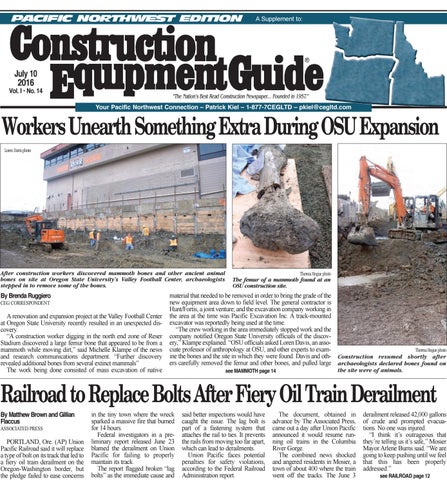
Workers Unearth Something Extra During OSU Expansion Loren Davis photo
After construction workers discovered mammoth bones and other ancient animal bones on site at Oregon State University’s Valley Football Center, archaeologists stepped in to remove some of the bones.
By Brenda Ruggiero CEG CORRESPONDENT
A renovation and expansion project at the Valley Football Center at Oregon State University recently resulted in an unexpected discovery. “A construction worker digging in the north end zone of Reser Stadium discovered a large femur bone that appeared to be from a mammoth while moving dirt,” said Michelle Klampe of the news and research communications department. “Further discovery revealed additional bones from several extinct mammals” The work being done consisted of mass excavation of native
Theresa Hogue photo
The femur of a mammoth found at an OSU construction site.
material that needed to be removed in order to bring the grade of the new equipment area down to field level. The general contractor is Hunt/Fortis, a joint venture; and the excavation company working in the area at the time was Pacific Excavation Inc. A track-mounted excavator was reportedly being used at the time. “The crew working in the area immediately stopped work and the company notified Oregon State University officials of the discovery,” Klampe explained. “OSU officials asked Loren Davis, an associate professor of anthropology at OSU, and other experts to examine the bones and the site in which they were found. Davis and others carefully removed the femur and other bones, and pulled large see MAMMOTH page 14
Theresa Hogue photo
Construction resumed shortly after archaeologists declared bones found on the site were of animals.
Railroad to Replace Bolts After Fiery Oil Train Derailment By Matthew Brown and Gillian Flaccus ASSOCIATED PRESS
PORTLAND, Ore. (AP) Union Pacific Railroad said it will replace a type of bolt on its track that led to a fiery oil train derailment on the Oregon-Washington border, but the pledge failed to ease concerns
in the tiny town where the wreck sparked a massive fire that burned for 14 hours. Federal investigators in a preliminary report released June 23 blamed the derailment on Union Pacific for failing to properly maintain its track. The report flagged broken “lag bolts’’ as the immediate cause and
said better inspections would have caught the issue. The lag bolt is part of a fastening system that attaches the rail to ties. It prevents the rails from moving too far apart, which can lead to derailments. Union Pacific faces potential penalties for safety violations, according to the Federal Railroad Administration report.
The document, obtained in advance by The Associated Press, came out a day after Union Pacific announced it would resume running oil trains in the Columbia River Gorge. The combined news shocked and angered residents in Mosier, a town of about 400 where the train went off the tracks. The June 3
derailment released 42,000 gallons of crude and prompted evacuations. No one was injured. “I think it’s outrageous that they’re telling us it’s safe,’’ Mosier Mayor Arlene Burns said. “We are going to keep pushing until we feel that this has been properly addressed.’’ see RAILROAD page 12
Page 2 • July 10, 2016 • www.constructionequipmentguide.com • Pacific Northwest Supplement • Construction Equipment Guide
Washington’s Columbia River...
Major Battle Over Oil Terminal Unfolds in Pacific Northwest By Phuong Le ASSOCIATED PRESS
SEATTLE (AP) Two companies proposing to build what would be the nation’s largest oil-by-rail marine terminal along the Columbia River in Washington see it as an opportunity to link domestic crude oil from the Midwest to a West Coast port. Critics, however, see an environmental and safety catastrophe waiting to happen, especially after a train carrying volatile Bakken crude oil derailed and burned on June 3 in Mosier, Ore., just 70 mi. (112.65 km) upriver from the project site in Vancouver, Wash. The battle over the Tesoro Savage Vancouver Energy terminal — which would handle about 360,000 barrels of crude oil a day — began to unfold June 27, when the parties started the process to make their case for or against the terminal before a state energy panel. The Energy Facility Site Evaluation Council is hearing testimony from dozens of experts and other witnesses over five weeks. It will make a recommendation to Gov. Jay Inslee, who has the final say. Vancouver Energy is expected to argue that the terminal is needed to meet fuel needs; that it satisfies the council’s criteria; that risks of oil spills or accidents at the facility are remote; and it adds economic benefits to the region. The Port of Vancouver also plans to testify in support, saying the facility is designed to be as safe as possible, there’s
need for it and it’s suitable for the industrial site. They’ll face a chorus of opposition. Tribes, environmental and community groups, the city of Vancouver and a Washington state agency will urge the panel not to recommend approval. They plan to show that it poses too great a risk to people and the environment, the dangers extend well beyond the facility to include communities along rail lines across the state, and it’s not in the public’s interest. Tesoro Corp. and Savage Cos. are proposing a $210 million terminal that would receive an average of four 11.2-mi. (18 km) long crude oil trains a day, likely traveling on tracks between Spokane and Vancouver. Oil would temporarily be stored on site and then loaded onto tankers and ships bound for West Coast refineries. “This is too risky for the state of Washington,” said Kristen Boyles, an attorney with Earthjustice representing Columbia Riverkeeper, Climate Solutions and six other groups who intervened in the proceedings to oppose the project. In briefs filed ahead of the hearing, the cities of Vancouver and Spokane, among others, say they’re concerned about the risk of oil spills and accidents as more trains cut through their communities. They question whether emergency responders would be able to handle a large fire from a derailment. “Tesoro’s proposal constitutes a clear and present threat to human life and health,” Vancouver city attorneys wrote. The council “simply has no ability to ensure the safety of Vancouver’s citizens while the equivalent of 1,667 tanker trucks of volatile crude oil per day move into and out of the
heart of the fourth largest city in Washington.” In a separate brief, the state-appointed attorney who represents the public’s interest in protecting the environment writes that oil trains moving across the state and close to or on the Columbia River “presents a continuing risk of significant environmental impacts and harm.” The consequences of the worst-case oil spill would affect the Columbia River for years to come and cause losses to salmon, birds and other natural resources, assistant attorney general Matthew Kernutt wrote. The Yakama Nation and the Confederated Tribes of the Umatilla Indian Reservation also plan to show that the project interferes with their treaty-reserved fishing rights and that a potential oil spill could have devastating consequences to salmon and other natural resources on which the tribe depends. The Washington Department of Natural Resources also is urging the council to reject the project, citing risks of blazes from increased train traffic and other concerns. Vancouver Energy said the project can be done safely and will provide jobs and tax revenue as well as reduce dependency on foreign oil. Vancouver Energy General Manager Jared Larrabee said the terminal has committed to only accept tank cars that meet or exceed DOT-117 standards, has purchased and placed oil spill response equipment along the rail corridor and taken other safety measures. (This story also can be found on Construction Equipment Guide’s website at www.constructionequipmentguide.com.)
PacWest Announces New Facility for Portland Market PacWest Machinery, the dealer in the Pacific Northwest of Volvo and other leading brands of construction equipment, announces the purchase of land and the commencement of construction on its new facility in Portland, Ore. Beginning in the first quarter of 2017, PacWest Machinery customers in the greater Portland area will be supported and serviced from the new dealership at 19255 NE Sandy Blvd., Portland, Ore., just minutes away from the company’s current location. The new 22,000 sq.-ft. (2,044 sq m) building will sit on approximately six acres and include a 10bay service center designed to accommodate a full range of equipment. There will be an expanded parts warehouse, modern showroom and state-of-the-art service capabilities. The larger facility will allow the company to stock more equipment as well as host demonstrations and training. This new location will have easy freeway access making it ideal to deliver products into Oregon and
The new 22,000 sq.-ft. (2,044 sq m) building will sit on approximately six acres and include a 10-bay service center designed to accommodate a full range of equipment.
southwest Washington. “We’re investing heavily to meet the needs of a growing customer base,” said Jolene Logue, president of PacWest Machinery. “Delivering responsive service requires that we provide our employees the tools, facilities and
training to perform at their best.” Tim Hurst, the newly-appointed PacWest general manager of the Oregon market, added “Our entire Portland team will be excited to unveil this new facility to our customers and the community. Stay tuned for our grand opening, sched-
uled for the spring of next year.” PacWest Machinery is the newest Volvo Construction Equipment dealer in North America and has responsibility for the sales, rental and aftermarket support for the full line of Volvo’s general production, road machin-
ery and compact equipment. In addition, the company supplies equipment from other quality manufacturers including Tymco, GOMACO, Etnyre, Furukawa and more. PacWest Machinery provides equipment and aftermarket services from four facilities located in Portland and Eugene, Ore., and in Seattle and Spokane, Wash., plus additional support from an extensive mobile service fleet. PacWest Machinery is owned by the Joshua Green Corporation and company management. “We are excited to see PacWest Machinery expand the infrastructure necessary to deliver exceptional customer support,” said Göran Lindgren, president, Volvo CE Region Americas. “As we continue to grow our business in North America, investments like this are critical to meeting market demand as well as providing a premium experience the customer expects.” (This story also can be found on Construction Equipment Guide’s website at www.constructionequipmentguide.com.)
Construction Equipment Guide • Pacific Northwest Supplement • www.constructionequipmentguide.com • July 10, 2016 • Page 3
Kent, WA (800) 669-2425 Rochester, WA (800) 304-4421 Spokane, WA (800) 541-0754 Boise, ID (800) 221-5211 Pocatello, ID (800) 829-4450 Billings, MT (800) 735-2589 Kalispell, MT (800) 434-4190 Missoula, MT (800) 332-1617 Eugene, OR (800) 826-9811 Portland, OR (800) 950-7779 Magadan, Russia 011-7-41326-99298 Yuzhno-Sakhalinsk, Russia 011-7-42424-69051
Page 4 • July 10, 2016 • www.constructionequipmentguide.com • Pacific Northwest Supplement • Construction Equipment Guide
Port of Toledo Better Able to Serve Oregon Fishing Fleet By Lori Tobias CEG CORRESPONDENT
Port of Toledo photo
The fishing fleet was listed by the National Oceanic and Atmospheric Administration (NOAA) as having the highest commercial fishery landings in 2014 for the West Coast, excluding Alaska, with 124 million lbs. (56 million kg) valued at $52.6 million.
Five years after reopening, the Port of Toledo in Oregon is now set to become the first port to offer a 660-ton (599 t) mobile lift between Kodiak, Alaska, and San Diego, Calif. It’s just one phase of an approximately $8 to $9 million project aimed at providing services to the fishing fleet homeported 9 mi. (14.5 km) west at the Port of Newport. “We’re home to a large distant water fleet,” said Bud Shoemake, manager of the Port of Toledo “A lot of those boats, they like to keep our money local. This allows us to keep some of the money in our community. If you look back at the growth in the industry, these guys went around and bought old gulf shrimpers and slowly changed the fleet into a real fishing machine.
“We’re providing infrastructure for a lot of these boats. We can do anything to a boat that is floating. Just having the ability to pull a boat out of the water and do the work in the environment the right way is huge.” The two ports are linked by the Yaquina River. The fishing fleet was listed by the National Oceanic and Atmospheric Administration (NOAA) as having the highest commercial fishery landings in 2014 for the West Coast, excluding Alaska, with 124 million lbs. (56 million kg) valued at $52.6 million. Analysis of personal income shows that in 2011, commercial fishing con-
tributed $179.1 million or 11.4 percent of Lincoln County, Ore.’s personal income The Port previously provided a floating dry dock allowing it to pull boats up to 60 ft. (18.2 m) in length. The new mobile lift will replace the aging dry dock and allow the Port to pull any boat up to 125-ft. (38.1 m) in length, 42 ft. (12.8 m) on the beam and weighing 660 tons (598.7 t). The lift is expected to be ready this summer. But first comes the construction work to ready the property for the new lift. The shipyard is located on 20-acres, with six acres of useable land along the Yaquina River, he said. “We’ve got a long, skinny
piece of property,” said Shoemake. “It’s nice and sheltered, compared to building right on the coast, but it has its challenges because it is long and skinny. Trying to utilize every square inch of the property is key to what we are going to be able to do long term.” The project involves three phases, including environmental mitigation work, construction of new floating piers and a wash down area. “The environmental component is huge,” Shoemake said. “When we bought the yard, we signed a consent order to do clean up in the river that was associated with havsee FISHING page 13
Port of Toledo photo
The project involves three phases, including environmental mitigation work, construction of new floating piers and a wash down area.
Port of Toledo photo
Five years after reopening, the Port of Toledo in Oregon is now set to become the first port to offer a 660-ton (599 t) mobile lift between Kodiak, Alaska, and San Diego, Calif.
Construction Equipment Guide • Pacific Northwest Supplement • www.constructionequipmentguide.com • July 10, 2016 • Page 5
4800 NE Columbia Blvd | Portland, OR 97218 (503) 282-2566 | www.feenaughty.com
Page 6 • July 10, 2016 • www.constructionequipmentguide.com • Pacific Northwest Supplement • Construction Equipment Guide
Washington Bridge for Sale...
WSDOT Makes Plans to Sell 91-Year-Old Bridge ... As Is By Adam Lynn THE NEWS TRIBUNE
PUYALLUP, Wash. (AP) Coming soon to a website near you: 91-year-old bridge for sale. As is. You haul. The state Department of Transportation is working up plans to begin advertising for the sale of the old steel-truss bridge that up until last year carried state Route 167 across the Puyallup River in the town of the same name. Plans to transfer ownership of the span to Pierce and King counties to use as a pedestrian bridge along the Foothills recreational trail have fallen through, meaning the Transportation Department must find another way to dispose of the 379-ton (344 t) bridge. The department is gathering information on the bridge’s attributes for a multimedia online ad, spokeswoman Claudia Bingham Baker said.
“When the time comes, we will consider which website makes the most sense — one of ours or an historical website — and we are already in the process of creating a video,” Bingham Baker said. “We may decide to also advertise through more traditional means such as legal or classified ads.” Price: To be determined. For last nine months, the bridge has sat like the skeleton of some great humpbacked beast on stateowned land just north of the river near the junction of state routes 167, 161 and 512 in Puyallup. A temporary fence discourages would-be vandals and thrill seekers. Plans to repurpose the old steeltruss bridge that used to carry SR 167 over the Puyallup River have failed. It currently resides behind a chain link fence along North Meridian Avenue. The Transportation Department made it known after replacing the
structurally deficient span with a new bridge in May 2015 that it wouldn’t mind transferring the worn-out version to some other entity. King and Pierce counties, seeking a way to carry the popular Foothills Trail over the White River near Buckley, gave it a sniff. But engineers determined it would be more cost-effective to just build a bridge, said Doug Williams, a spokesman for King County Department of Natural Resources and Parks. “It would have cost too much money in maintenance over the long haul to use that older span,” Williams said. King County engineers determined that painting and load-testing the old bridge over an envisioned 50-year time frame would have cost upwards of $7.5 million. The county figures it can build a bridge and maintain it over the same period for about $4 million, Williams said.
The county is lobbying for a grant to do just that and hopes to construct the bridge with enough width and support that it could carry emergency vehicles between Buckley and Enumclaw, should something happen to the state Route 410 bridge. That decision has put the Transportation Department back to square one as to what to do with the old state Route 167 span. A new industrial park is under construction adjacent to the old steel-truss SR 167 bridge. “The King/Pierce discussion was the only one that was under serious consideration,” Bingham Baker said. “We had one inquiry from a private developer, but he didn’t pursue it.” Is it really possible to sell a bridge? “WSDOT has sold pontoons of floating bridges through our surplus process, but I’m not aware of any attempts to sell a steel-truss bridge,” Bingham Baker said.
“Other states have tried to sell bridges. I’ve seen ads through Google. Don’t know if they were successful.” Indeed, a Google search turned up tons of bridges offered for sale or for free across the nation. The Missouri Department of Transportation had eight historic bridges posted on its “Free Bridges!” website. Bingham Baker said the Transportation Department has a 2019 deadline to move the old state Route 167 bridge down the line. Failure to find a willing buyer would mean curtains for the derelict span. “After that point,” she said, “if we have no one expressing interest in reusing the bridge, we will dismantle it and recycle the steel.” For more information, visit http://www.thenewstribune.com. (This story also can be found on Construction Equipment Guide’s website at www.constructionequipmentguide.com.)
Portlanders Blast EPA for Superfund Cleanup Plan By Kristena Hansen ASSOCIATED PRESS
PORTLAND, Ore. (AP) A 10-mi. (16 km) stretch of the Willamette River — the iconic body of water flowing directly through one of America’s most environmentally-conscious cities — could soon be teeming with massive equipment and crews tasked with cleaning up more than a century’s-worth of hazardous contaminants from industrial use. The federal government’s $746 millioncleanup plan for Portland Harbor was revealed, ending a 16-year wait after the polluted area gained status as a Superfund site by the U.S. Environmental Protection Agency. But the long-awaited proposal — a 30 year process that’d involve cleaning up a tiny portion of the area, while leaving the rest to recover naturally — was blasted by environmentalists and community leaders, who say it’ll take too long and won’t be enough to make the water and riverbed safe for the area’s families and wildlife. Just before the EPA’s first public hearing downtown Portland, protesters gathered urged residents to voice their opposition over the next 90 days, the window for public
“Costs dropped, but there was little actual change in the plan for cleanup, meaning the public is not informed about the true higher anticipated cost of the cleanup or the benefits that different cleanup alternatives would achieve.” Curtis Robinhold Port of Portland
comment that the EPA extended earlier that morning. “Allowing these toxins to even remain in the river, to be covered up or to be washed down into the Columbia River is unacceptable, and even more than being unacceptable, it’s a violation of human rights,” said Rose Longoria, regional superfund cleanup projects coordinator with Yakama Nation Fisheries. “And on top of that, it’s a violation of the Yakima Nation’s treaty rights.” Under the proposal, roughly 200 acres of the site’s most toxic parts would be under construction for seven years. Sediment polluted with heavy metals and various carcinogenic chemicals would be removed or cov-
ered by a man-made barrier, called dredging and capping. Less severe contamination in the remaining 2,000 or so acres would be left to recover on its own, which will take an estimated 30 years overall. EPA officials say the current proposal is much cheaper and less disruptive to the environment than some of the other options they were considering. The agency could finalize its proposal before year-end. The Port of Portland, which owns much of the land in the Superfund site, and some of the companies considered potentially responsible for the pollution and financing some costs are also opposing the project. Seven companies who’ve agreed to take
some of that responsibility — including Union Pacific Railroad, Chevron and TOC Holdings Co. — filed a legal dispute with the EPA. They criticized the plan in 22-page letter as a “rushed” decision. The letter said the end-goal isn’t achievable, “requires unnecessary treatment, and will be far more disruptive than described by EPA. Further, the cleanup will take much longer to implement than predicted by EPA and will likely cost far more than estimated by EPA.” Port of Portland officials took issue with some of the areas target for the cleanup and also the cost estimates, which they called “overly optimistic.” “While we were intrigued by the more than $600 million drop in the cost of EPA’s preferred remedy, a closer look left us perplexed,” Curtis Robinhold, Port deputy director, wrote to federal regulators. “Costs dropped, but there was little actual change in the plan for cleanup, meaning the public is not informed about the true higher anticipated cost of the cleanup or the benefits that different cleanup alternatives would achieve.” (This story also can be found on Construction Equipment Guide’s website at www.constructionequipmentguide.com.)
Construction Equipment Guide • Pacific Northwest Supplement • www.constructionequipmentguide.com • July 10, 2016 • Page 7
Need a Service Truck
SAVE THOUSANDS $$$ Buy Factory Direct $$$
11 Foot Class 5 Mechanic Trucks
11 Foot Class 6 Mechanic Trucks
14 Foot Class 7 Mechanic Trucks
6,000 - 8,000 LB Crane Rating
6,000 - 10,000 LB Crane Rating
6,000 - 14,000 LB Crane Rating
Body construction features 12 gauge Body construction features 10 gauge main cabinets, 10 gauge reinforced main cabinets, 10 gauge reinforced doors, three point locking stainless steel doors, three point locking stainless steel door handles, eight fully adjustable galva- door handles, eight fully adjustable galvanized shelves with dividers, heavy duty nized shelves with dividers, heavy duty outriggers with power in/out and power outriggers with power in/out and power up/down operation. Body rated for 45 up/down operation. Body rated for 50,000 gallon oil reservoir and filter system, foot pounds. Bodies feature a complete pressurized compartment system and wiring harness, hydraulic system with a body mounting kit. All bodies feature a 45 gallon oil reservoir and filter system, media blasted pre-paint treatment with an pressurized compartment system and epoxy base primer, a poly-urethane interbody mounting kit. All bodies feature a mediate primer, and a match chassis, media blasted pre-paint treatment with an poly-urethane topcoat system. epoxy base primer, a poly-urethane intermediate primer, and a match chassis, poly-urethane topcoat system.
Body construction features 10 gauge main cabinets, 10 gauge reinforced doors, three point locking stainless steel door handles, eight fully adjustable galvanized shelves with dividers, heavy duty outriggers with power in/out and power up/down operation. Body rated for up to 75,000 foot pounds with optional front outriggers. Bodies feature a complete wiring harness, hydraulic system with a 45 gallon oil reservoir and filter system, pressurized compartment system and body mounting kit. All bodies feature a media blasted pre-paint treatment with an epoxy base primer, a poly-urethane intermediate primer, and a match chassis, poly-urethane topcoat system.
HEAVY DUTY MECHANICS TRUCKS LLC CALL JACK HARRIMAN 844-308-9680 or Cell: 605-421-0495 Email: jchiowa@gmail.com
Page 8 • July 10, 2016 • www.constructionequipmentguide.com • Pacific Northwest Supplement • Construction Equipment Guide
Stoneway Concrete Adds Kenworth T880 to Its Fleet When Ralph Lo Priore looks at which new specification choices would likely work best for his company’s trucks, he prefers to deal in cold hard facts, not egos or emotions. “Too often people make purchasing decisions on what’s always been done before,” said Lo Priore, director of fleet assets and processes for Stoneway Concrete and its parent company, Gary Merlino Construction Co. “Instead, I like to look at what’s going to deliver the best return on investment in terms of reliability, durability, serviceability, longevity and a lower cost of operation.” Stoneway and Merlino operate a combined fleet of 150 trucks, including 85 transit mixers and 60 dump trucks from three locations — the company’s maintenance shop in Renton, Wash., a yard in south Seattle and another yard next to Ashgrove Cement in Seattle. When it came time to choose a new engine platform for Stoneway’s mixers, Lo Priore examined the data and chose the new PACCAR MX-11 engine platform with two Kenworth T880 mixer chassis for Stoneway Concrete. After those two T880s with the MX-11 proved their worth in operation, Lo Priore ordered nine more new similarly spec’d T880 mixers. “I look at, for example, the company’s maintenance data, which helps me identify issues caused by bad decisions, like equipping a truck with the wrong suspension,” Lo Priore said. Of course payload is always a major consideration, Lo Priore added. “Our customers are always wanting more yardage with fewer trucks on the job. That’s why when I looked at how many times the company sent
TruckPR photo
With a 12-yd. (11 m) capacity, the Kenworth T880 mixer with PACCAR MX-11 engine can generate an average of $315 more in daily revenue than a 10 1/2-yard mixer, according to the company.
out one more mixer to a job site with short loads of concrete to finish up the job, I knew Stoneway Concrete needed trucks with more payload capacity. “But trying to get that additional payload by going with the same 13-liter engine and looking for weight savings in other places, or going bigger with a 15-liter engine in applications other than the mixers, were just not the right options,” he said. Lo Priore also credits the new model’s
success to a decision to go with a set-back front axle and a total of seven axles, including a conventional “boost-a-load” axle, allowing for an 80,000-lb. (36,287 kg) GVW, which is allowed under Washington state’s bridge formula. Lo Priore said he saw the more typical 76,000-lb. (34,473 kg) GVW design with an 11-yd. (10 m) mixer as being “obsolete.” While many questioned those choices, Lo Priore said he felt confident they were the
right ones. That’s because with the PACCAR MX-11, the tractors and mixers realize a better horsepower-to-weight ratio and gain payload capacity, according to the company. And with the combination of the MX-11 and set-back front axle, the T880 mixers can carry 4,000 additional lbs. (1,814 kg) of payload by redistributing the weight to the pusher axle when needed. The additional payload capacity means see KENWORTH page 10
TruckPR photo
TruckPR photo
Stoneway Concrete driver Dan Leenhouts enjoys the Kenworth T880 equipped with a PACCAR MX-11 engine so much he decided to continue working for the company rather than retire in 2016 as he had planned.
Ralph Lo Priore, director of fleet assets and processes for Stoneway Concrete and its parent company, Gary Merlino Construction Co., believes he made the right choice in selecting the Kenworth T880.
Construction Equipment Guide • Pacific Northwest Supplement • www.constructionequipmentguide.com • July 10, 2016 • Page 9
WASHINGTON: Seattle, WA WA 8207 South 216th Street Kent, W Wa ashington 98032 206.762.5933 Manager: Gar y Labelle glabelle@PacWestMachiner y.com Spokane, W WA A 4030 East Trent Avenue Spokane, Washington 99202 509.534.5933 Manager: John Cushman jcushman@PacWestMachiner y.com
OREGON: Po r t l a n d , O R 13805 NE Sandy Boulevard Por tland, Oregon 97230 503.252.5933 Manager: Tim Hurst thurst@PacWestMachiner y.com Eugene, OR 1550 Ir ving Road Eugene, Oregon 97402 541.302.3762 Manager: Jake Zayas jzaayas@PacWestMachiner y.com
Some companies have you choose power or fuel efficiency. You chose both.
PacW WestMachinery.com Volvo developed the industr y’s first fuel efficiency guarantee so you never have to compromise on per formance or productivity. And with CareTr Track machine monitoring, you can focus your attention on more impor tant things — like growing your business. Contact your PacWest Machinery representative to hear how we can suppor t your growing business - smar tly.
Page 10 • July 10, 2016 • www.constructionequipmentguide.com • Pacific Northwest Supplement • Construction Equipment Guide
Kenworth T880 Offers Greater Payload, Enhanced Stability KENWORTH from page 8
the mixers can carry up to 12 yds. (11 m) of concrete per load instead of the usual 10-1/2 to 11 yds. (9.6 to 10 m) the typical 76,000lb. (34,473 kg) GVW Stoneway mixer equipped with a 13-liter engine would carry. With a 12-yd. capacity, the T880 mixer with PACCAR MX-11 engine can generate an average of $315 more in daily revenue than a 10 1/2-yd mixer, according to the company. Stoneway Concrete’s mixers typically run six days a week year-round, and as a result the T880 mixer can earn about $98,000 more in annual revenue, according to Lo Priore. The lighter engine, set-back front axle and addition of the pusher axle all changed the T880’s center of gravity, allowing McNeilus to install a wider drum, Lo Priore said. By pushing the front axle back, the drum also sits lower on the frame, which results in increased stability and reduced drum bounce, in on- or off-road conditions. “By choosing the PACCAR MX-11, we have a 400-pound lighter engine compared to a 13-liter engine, but with the same 430 horsepower,” Lo Priore added. “The MX-11 engine, with its compact graphite iron head and block, is much lighter and more durable than an engine made of gray cast iron. With the Allison 7-speed automatic transmission, it’s a perfect combination. “Allison’s dynamic shift sensing allows the transmission to automatically choose gears based on the vehicle’s weight and the road grade. So, drivers get a state-of-the-art truck that doesn’t leave them tired with aching knees and shoulders from all of the shifting they have to do in city traffic,” he said. “And the Kenworth T880 provides us the right chassis because of its design, which makes for a more comfortable work environment and offers a field of view drivers simply can’t get with the other available truck models.”
TruckPR photo
Stoneway Concrete driver Dan Leenhouts (L) and Ralph Lo Priore, director of fleet assets and processes for Stoneway Concrete and its parent company, Gary Merlino Construction Co., both like the combination of the Kenworth T880 and the PACCAR MX-11 engine.
Dan Leenhouts, who was assigned that first Kenworth T880 mixer with the PACCAR MX-11 engine in 2015, was so impressed by it, he chose to forgo his retirement in 2016 and continue working another two years for Stoneway. “The Kenworth T880 offers such a phenomenal ride,” he said. “When I first drove it, I just could not believe how quiet it is in the cab. Because the MX-11 provides good power and smooth acceleration, I find the T880 is able to keep up with the other trucks with larger engines, even lugging under load on hills. “I’m also very, very pleased with the visibility from the cab,” Leenhouts said. “The mirrors are so perfectly positioned giving me the ability to maneuver well in heavy traffic. With its sloped hood, driving the T880 is almost like driving a cabover.” Lo Priore said it wasn’t easy to get a concrete mixer equipped with a set-back front axle, an 11-liter engine, and seven axles including a pusher axle, built. After he shared data from Stoneway’s conditionsbased maintenance program, “Kenworth was the only OEM willing to try,” he added. Lo Priore credits Rick Barry, territory sales director at Kenworth Northwest and Kenworth technical engineers in making the spec happen. “Now that we’ve proven what this new spec can achieve, I take pride that there’s a lot of other companies looking very hard at whether this new specification can work for them as well as it has for us,” Lo Priore said. Kenworth Truck Company is the manufacturer of heavy and medium duty trucks and is a PACCAR company. For more information, visit www.kenworth.com. (This story also can be found on Construction Equipment Guide’s Web site at www.constructionequipmentguide.com.)
TruckPR photo TruckPR photo
Stoneway Concrete’s Kenworth T880, equipped with the PACCAR MX-11 engine, offers the company a better horsepower-to-weight ratio and gain payload capacity.
Stoneway Concrete’s Kenworth T880 features the Allison 7-speed automatic transmission. Allison’s dynamic shift sensing allows the transmission to automatically choose gears based on the vehicle’s weight and the road grade.
Construction Equipment Guide • Pacific Northwest Supplement • www.constructionequipmentguide.com • July 10, 2016 • Page 11
360-748-1182 Fax 360-748-1198 www.cascadetrader.net
AUTHORIZED DEALER Log Loaders, Excavators, Wheel Loaders, Road Builders
LOG LOADERS CAT 330B Log Loader, Recent under ............$57,500 CAT 320DFM Log Loader, 2012, low hours ........POR CAT EL300B Log Loader......................................$29,500 DOOSAN DX300LL Log Loader................................POR DOOSAN SOLAR 300 Log Loader ..................$97,500 DOOSAN DX225LL Log Loader, 10,000 hrs $137,500 DOOSAN DX225LL Logger, 3K hrs ..............$169,500 DOOSAN DX225LL Logger, fresh under ....$137,500 DOOSAN DX300LL, 2013, approx. 5000 hr $187,500 DOOSAN DX300LL Log Loader, For. Cab..$179,500 DOOSAN S300L Log Loader, recent repairs$97,500 HITACHI EX330LC Log Loader ........................$39,500 HITACHI EX370LC Log Loader, Rear Entry ..$39,500 HYUNDAI 3220 Log Loader, 3800 hrs, clean! $239,500 JOHN DEERE 2954 Log Loader, 2012, low hrs$219,500 KOBELCO SK250 Log Loader............................$59,500 KOBELCO SK210LC Log Loader ......................$65,000 KOBELCO SK210LC Log Loader ......................$59,500 KOBELCO SK350 Log Loader, '07, For. Cab $99,500 KOMATSU PC220LC-8, Jewell Pkg, Exc Cond$125,000 LINK-BELT 290LX Log Loader, For Cab, '05 $85,000 SAMSUNG 210SE Log Loader, excellent......$72,500
FELLER BUNCHERS, PROCESSORS CAT 325L Log Loader / Waratah HTH-622 $69,500 CAT 330B Log Loader/Waratah Head ..................POR DOOSAN DX300LL / Waratah HTH-623C $239,500 HAHN Harvester, HTL300, 3-axle SP ..............$19,500 JD 2554LL / Waratah HTH-622B ..................$129,900 KETO 525 Harvesting head, complete..........$14,500 KOBELCO SK210 Log Loader / Waratah HTH-622$79,500
KOMATSU PC220LC/Pierce 3348 Stroker$119,500 LINK-BELT 240X2LL / Waratah HTH622B, low hrsPOR LINK-BELT 330LX '05 / Waratah HTH-624 ..$85,000 MADILL 2800 / DENHARCO DM3500 Stroker $45,000 PRENTICE 620FB / Waratah HTH-230, Clean!$64,500 Tigercat LX870C, 5702 Disc Saw....................$169,500 TIMBCO T-445, Bar Saw, straight......................$49,500 TIMBERJACK 2618, Disc Saw, excellent ........$55,000 VALMET 921 Harvester, 965 Head..................$57,500 WARATAH HTH-622, complete ........................$34,500 WARATAH HTH-623C, New........................................POR WARATAH HTH-624 Super ................................$49,500
TOWERS & YARDERS CHRISTY Yarder, track mt ..................................$49,500 DIAMOND D425 Swing Yarder, track mt ..$575,000 KOMATSU PC300LC-6HD Yoader pkg, nice!$199,500 LANTEC SY255 Swing/Grapple Yarder ....$109,500 MADILL 171, Cat Power, Eaton Brakes ........$375,000 MADILL 171, Excavator Track Mt., excellent!........POR MADILL 071, 4-Guys, Eagle IV, complete ....$144,500 MADILL 071 Tank Mount, 3-Guys ..........................POR SKAGIT BU-94 Drums, parts only ............................POR SKAGIT BU-94 Slackline, T100HD, SP ....................POR SKAGIT BU84 Slackline, T-100HD, Trlr Mt $149,500 SKAGIT 739 Slackline T100HD, Trailer MT$149,500 THUNDERBIRD TTY-70 Track mt., Excell ..$550,000 WASHINGTON 137W Slackline, Trl. Mt., nice!$189,500
Located at Exit 79 off I-5 1380 NW State, Chehalis, WA 98532
EXCAVATOR/DOZER/GRADER/ WHEEL LOADER/SKIDDER CAT 14E Grader ......................................................$14,500 CAT 518 Cable Skidder, good runner............$17,500 CAT EL240B Excavator ........................................$19,500 CAT 966D Wheel Loader, Bucket, good tires ..$49,500 CAT 980C Wheel Loader, Rollout Bkt ............$42,500 CAT 525B, Swing Grapple ............................................POR CAT 950 Wheel Loader........................................$17,500 FIAT -Allis FR130 Wheel Loader......................$27,500 FIAT-Allis 8, SU, Winch/Arch ..................................P.O.R. GARRETT 25 Skidder, Cummins ......................$12,500 INTERNAT'L TD7E 6-way Blade, Bare Rear ..$16,500 JOHN DEERE 748H, Swing Grapple, 2010 ............POR KMC Track Skidder, Cummins, Swing Grpl ..$54,500 KOEHRING BANTAM 366 Excav., Bkt/Thumb$17,500 MOUNTAIN Logger ML150 Skidder, new tires$18,500 WAGNER L100 Log Stacker, '89, Excell ......$174,500 WAGNER L480 Log Stacker ..............................$69,500 WAGNER L90 Log Stacker..................................$29,500
CARRIAGES & MISC BOWMAN MARK V SKYCAR, 2006 ..................$39,500 DANZCO PT20 PULL-THRU Delimber..............$9,950 PRO MAC PC120 Mulching head, low hrs............POR
TRUCKS
MISCELLANEOUS
KW Dump 1973..........................................................$8,950 MOXY MT30 Articulated Dump Truck ........$37,500
OLATHE 867TG 10' Tub Grinder, recent work$54,500 TIMBER Pro 840 Forwarder, '08, clean ......$110,000
KETO • WARATAH • SOUTHSTAR • EAGLE CARRIAGES EVENINGS John Griffin 425-210-9702 • Cooper Brunoff 360-880-7534 • Rich Lennox 360-508-0192 • John Welch 360-520-2082 Mike Duch 360-880-6955 • Jim Wark 360-623-5219 • Shannon Pesicka 360-507-0542 Traci Brunoff, Sales Coordinator 360-880-7531• Office 360-748-1182
Page 12 • July 10, 2016 • www.constructionequipmentguide.com • Pacific Northwest Supplement • Construction Equipment Guide
Investigators — Broken Lag Bolts Cause of Railroad Crash RAILROAD from page 1
Advanced electronic brakes proposed by regulators but fought by the railroad industry could have made the derailment less severe, Federal Railroad Administrator Sarah Feinberg said. They could have reduced the number of cars that derailed and prevented the one that first burst into flames from being punctured, officials said. “We’re talking about upgrading a brake system that is from the Civil War era,’’ Feinberg said. “It’s not too much to ask these companies to improve their braking systems.’’ The Association of American Railroads has lobbied against new braking requirements, saying they are too unreliable and would yield too little benefit to justify a price tag topping $3 billion. Federal officials say putting new brakes just on locomotives hauling large loads of oil and other flammable liquids would cost far less, around $80 million. Union Pacific said an upgraded
braking system would not have made a difference in the Mosier derailment. The company will replace the lag bolts with spikes on curved portions of its track nationwide as part of its track renewal program, said Justin Jacobs, Union Pacific spokesman. The bolts will be replaced on 530 miles of the company’s 32,000-mile network, he said. Union Pacific inspections just three days before the derailment failed to detect any problem with the bolts, Jacobs said. Spikes will be more visible than the bolts, which lie close to the ground, nestled in gravel on the rail bed, he said. Hal Gard, rail and public transit administrator for the Oregon Department of Transportation, said he’s been told Union Pacific will start replacing the bolts in the Columbia River Gorge in August. The tank cars that broke open and burned had travelled thousands of miles from the Bakken oil
fields of North Dakota and Montana, destined for coastal refineries. A chorus of state, local and federal elected officials in Oregon has demanded a moratorium on crudeby-rail shipments until the derailment is fully understood. There are concerns the failure of the lag bolts could be a symptom of a larger, unknown problem. Oil trains have been running in the area only since 2014, state transportation officials said. There was little prior focus on failed lag bolts, and there appears to be only one other instance in which they caused a derailment, in Canada’s Alberta Province in 2012, Gard said, adding a further look is needed. “The unit trains are big and very heavy, the cars are shorter, and the oil is sloshing around inside of those cars. Are there additional strains and dynamic forces associated with that that is different?’’ he said. “Now folks are getting down and twisting and kicking them and
taking a hard look at those things.’’ Oregon Democratic Sens. Jeff Merkley and Ron Wyden asked federal rail regulators to use an emergency provision to stop oil train traffic until the derailment was better understood. Gov. Kate Brown also reiterated her call for a halt to oil train traffic. Federal rail authorities have said they don’t have the jurisdiction to ban oil trains in Oregon. At least 27 oil trains have been involved in major derailments, fires or oil spills in the United States and Canada in the past decade, according to an AP analysis of accident records. The trains travel through more than 400 counties across the United States to reach refineries on the West, East and Gulf coasts. A 2013 derailment killed 47 people when a runaway oil train from North Dakota jumped the tracks and exploded in LacMegantic, Quebec. Rail consultant and former industry regulator Steven
Ditmeyer said a series of Burlington Northern derailments in the 1990s in Washington state all involved sheared off railroad spikes. Investigators eventually determined overloaded cars, a lack of lubrication between the wheel assembly and the body of the tanker cars, and not enough gravel in the railroad bed combined to put strain on the track along curves. That strain loosened the spikes holding the rails to the rail ties and pushed the rails apart, much like the recent Oregon derailment, he said. Feinberg said tank cars that haul crude oil and other products have weight limits, but there’s been no suggestion Union Pacific’s cars exceeded them. “Whether a railroad is moving heavy cars or lighter cars, it is still their responsibility to maintain the track,’’ she said. (This story also can be found on Construction Equipment Guide’s website at www.constructionequipmentguide.com.)
Idaho, Oregon, Washington...
Serving Southern Idaho...
Doosan Adds New Dealer Emergency Funds On Way Doosan has expanded its dealer network with the addition of Barry Equipment & Rental Inc. as an authorized sales, service, parts and rental provider of Doosan construction equipment. Barry Equipment distributes Doosan crawler excavators, wheel excavators, material handlers and wheel loaders throughout southern Idaho. The dealership’s two locations are: • 2324 Caldwell Blvd., Nampa, Idaho 83651 • 465 Addison Ave. W., Twin Falls, Idaho 83301 Barry Equipment was founded in 1973, with the opening of its Twin Falls location. After years of serving the Magic Valley region of Idaho, the dealership expanded its operations this year with the addition of its Nampa location. In addition to the Doosan line, Barry Equipment also offers the Treasure Valley Bobcat compact equipment. “Our trained technicians have anywhere from 15 to 30 years of experience working on a variety of equipment and brands, and our salespeople have up to 20 years of experience,” branch manager Nick Barry said.
“We’re confident that Barry Equipment is prepared to provide its customers with the best overall experience possible.” Nick Barry Barry Equipment
“We’re confident that Barry Equipment is prepared to provide its customers with the best overall experience possible.” The dealership serves customers in the construction, general contracting, road and street repair, agriculture and homeowner markets, as well as government and municipalities. For more information, call 208/643-4147 or visit barryrental.com. (This story also can be found on Construction Equipment Guide’s website at www.constructionequipmentguide.com.)
WASHINGTON – U.S. Transportation Secretary Anthony Foxx announced the immediate availability of $2 million in Emergency Relief (ER) funds from the Federal Highway Administration (FHWA) to stabilize and repair roads damaged by heavy rains on federal lands throughout Idaho, Oregon and Washington. “Thousands of drivers use these roads each year — especially during the heavy tourism months of summer,” said Foxx. “We are committed to doing everything we can to help repair and reopen these routes quickly and safely, to support the well-being of the people and the economy in the Northwest U.S.” Over three days, heavy rains last December saturated federal roads in six National Forests, three National Parks, a National Scenic Area and two Bureau of Land Management Districts in Idaho, Oregon and Washington. Some of the areas hardest hit include the Gifford Pinchot and Idaho Panhandle National Forests, and Olympic National Park in Washington. The rain — up to 18 in. (46 cm) in certain areas, creating several 100-year runoff events — caused significant damage to
roads, such as large mud- and rockslides; roadway erosion; culvert and bridge failures; and closed multiple routes. Discovery of damage and preparing costs estimates were delayed due to high snow levels that fell shortly after the damage occurred. These ER funds will be released quickly for use in making repairs to the impacted roadways and reopening them to traffic. “These important emergency funds will make it possible for workers to make immediate repairs throughout the area,” said Federal Highway Administrator Gregory Nadeau. “We want to ensure that everyone in this large region has access to safe roads and bridges, and especially so on these federal lands roads to accommodate a busy tourism season this year.” These funds will help road crews begin repairs and restore traffic. This initial “quick release” payment includes funds to repair future, latent damages. The FHWA’s ER program provides funding for highways and bridges damaged by natural disasters or catastrophic events. (This story also can be found on Construction Equipment Guide’s website at www.constructionequipmentguide.com.)
Construction Equipment Guide • Pacific Northwest Supplement • www.constructionequipmentguide.com • July 10, 2016 • Page 13
New Lift Enhances Port of Toledo, Helps Fishing Fleet FISHING from page 4
ing a floating dry dock. The previous owners had a small floating dry dock for doing sanding and painting over the river. Getting that blasting and spray painting up off the water and on land where you can control it is huge. “The piers were all built from floating cranes. That was all done from the water for the most part. Last year, we put the design construction contract out for bid. We had four different proposals and went with Bergerson Marine out of Astoria. We were really happy with them. For the upland work, they used backhoes, bulldozers and compactors, mainly Caterpillars. We were able to get 28,000 yards of fill from the Highway 20 project. That was on Craig’s list and they delivered it free.” Except for the main water line, the Port also undergrounded some of the utilities. The new mobile lift was delivered in May. Next up is phase three, a new $3.4 million haul-out building, yet to be funded The plan for the project was adopted in 2013 and work is right on schedule, Shoemake said.
“We have a five-year build out plan,” he said. “We are right where we thought we’d be. This project is going to allow us to adequately maintain our really progressive and aggressive fishing fleet, which is what Newport really is. The next phase is for a huge building, 150-feet-long by 75-feetwide and 90-feet-tall. We’ll be able to pull the vessel inside and close the doors for a controlled environment. All but the building will be ready this summer. “What’s most important about this project is that it really helps the fishing boats that are in Depoe Bay, Newport and Toledo,” Shoemake said. “It expands the capabilities of the nearby Yaquina Boatworks. It’s really important to the marine trades vendors and to the Port itself. The boatyard has meant the expansion of our budgets as well as our employee base. We are at 15 full-time people now. It wasn’t too long ago we were at three.” (This story also can be found on Construction Equipment Guide’s Web site at www.constructionequipmentguide.com.) CEG
Contact Triad Machinery Today for More Details! OREGON Portland (503) 254-5100 • (800) 221-8512 Eugene (541) 342-7700 • (800) 342-6780 Prineville (541) 447-5293 • (888) 662-2940 www.triadmachinery.com
WASHINGTON Tacoma (253) 722-5560 • (800) 622-8876 Spokane (509) 534-1900 • (800) 945-9168
Page 14 • July 10, 2016 • www.constructionequipmentguide.com • Pacific Northwest Supplement • Construction Equipment Guide
Crews Find Mammoth Bones During Stadium Expansion MAMMOTH from page 1
piles of dirt from the site to go through later to locate additional bones.” The construction crews then moved to other areas of the project while Davis and others excavated dirt and bones from the site for later examination. Once the bones and soil were removed, crews were able to return to working on the project. “Since the find did not appear to involve humans or human artifacts, the bones are not considered part of an archaeological site,” Klampe said. “There are no special rules or regulations in Oregon governing the preservation or protection of paleontology finds.” The delay at the time was minimal and construction crews were able to get back to work at the site within a few days. “There are quite a few bones, and dozens of pieces,” said Davis. "Some of the bones are not in very good shape, but some are actually quite well preserved." Klampe noted that OSU faculty researchers are working with an outside lab to further pinpoint the age of the fossils using radiocarbon dating. Davis also pulled sediment core samples from the area where the bones were discovered, which, once analyzed, will give researchers a better sense of the environment of the earth at that time. “Shortly after the bones were discovered, dozens of students, many of them in anthropology
classes, had a chance to go through piles of dirt from the construction site to find and remove additional bone pieces,” she said. “In all, 12 bins of bones were salvaged from the project and are now being stored for preservation and research. “This spring, students in assistant professor Rebecca Terry’s Paleobiology class are taking an inventory of the bins to determine, as best they can, how many and what types of bones have been found. Terry’s students are also learning how to carefully prepare the bones for drying and long-term preservation. They have constructed plaster and foam jackets to support the bones as they dry and become preserved. Terry, a paleontologist in the College of Science’s integrative biology department, reworked the course’s curriculum to accommodate the mammoth discovery. According to Davis, the discovery of ancient mammal bones is not unusual in the Willamette Valley. She noted that the bones, including mammoth, bison, and some kind of camel or horse, were discovered in a 10-foot deep plot in an area that could once have been a bog or marsh. “Animals who were sick would often go to a body of water and die there, so it’s not unusual to find a group of bones like this,” Davis said. “We had all of these types of animals in the Willamette Valley back then.” Work on the renovation project
Theresa Hogue photo
Andrea Villalpondo (L), works with a mammoth tooth as Vanessa Yu works on another bone. Students in Rebecca Terry’s paleobiology class at Oregon State University had the rare opportunity to work with mammoth bones and other fragments found at a dig near Reser Stadium. The students created foam and plaster jackets to support the bones and prepare them for preservation.
began after the fall football season ended, and is slated for completion by the start of the 2016 home season. Approximately 37,870 sq. ft. (3,518 m) of space will be added to the facility, and 25,830 sq. ft.
(2,400 sq m) of space will be renovated. The locker room alone will be 53 yds. (48.4 m) wide, which is the entire width of the end zone. The renovated building will house nutrition/performance table for all 500 OSU student-athletes, football
Theresa Hogue photo
Theresa Hogue photo
Crews from Hunt-Fortis Construction Inc. work on the expansion of Valley Football Center at Oregon State University. On Jan. 25, 2016, bones of a mammoth and other ancient creatures were discovered.
OSU archaeologist Loren Davis was on site near Reser Stadium after mammoth bones were found during construction. Davis was there to make sure no archaeological remains were discovered, but only animal bones were found.
operations, athletic training/sports medicine and football Hall of Fame. Originally built in 1990, the Valley Football Center was the first football dedicated building in the Pac-12 (then Pac-10) Conference. About Oregon State University OSU is one of only two U.S. universities designated a land-, sea-, space- and sun-grant institution. OSU also is Oregon’s only university to hold both the Carnegie Foundation’s top designation for research institutions and its prestigious Community Engagement classification. Its more than 26,000 students come from all 50 states and more than 90 nations. OSU programs touch every county within Oregon, and its faculty teach and conduct research on issues of national and global importance. (This story also can be found on Construction Equipment Guide’s website at www.constructionequipmentguide.com.) CEG
Construction Equipment Guide • Pacific Northwest Supplement • www.constructionequipmentguide.com • July 10, 2016 • Page 15
Page 16 • July 10, 2016 • www.constructionequipmentguide.com • Pacific Northwest Supplement • Construction Equipment Guide
18060 Des Moines Memorial Dr. Seattle, WA 98148 3909 NW Fruit Valley Rd Vancouver, WA 98660