PACIFIC NORTHWEST EDITION
A Supplement to:
®
October 1 2017 Vol. II • No. 20
“The Nation’s Best Read Construction Newspaper… Founded in 1957.” Your Pacific Northwest Connection – Patrick Kiel – 1-877-7CEGLTD – pkiel@cegltd.com
Hanford Site Receives Official Shutdown Order, Begins Demo By Andrea Watts CEG CORRESPONDENT
In the west area of the Hanford Site’s Central Plateau, demolition is under way on a building that played a significant role in the United States’ weapons program history. From its production start in 1949 until its official shutdown in 1996, the Plutonium Finishing Plant (PFP) was responsible for producing two-thirds of Cold War-era’s plutonium. Once the official shutdown order was issued, the demolition of the building was certain but unlike other concrete and
Department of Energy Richland Operations Office photo
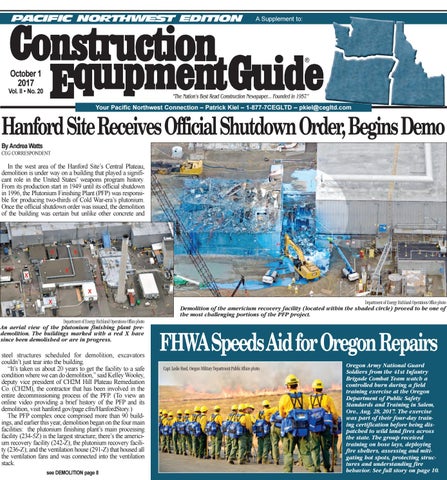
Demolition of the americium recovery facility (located within the shaded circle) proved to be one of the most challenging portions of the PFP project. Department of Energy Richland Operations Office photo
An aerial view of the plutonium finishing plant predemolition. The buildings marked with a red X have since been demolished or are in progress.
steel structures scheduled for demolition, excavators couldn’t just tear into the building. “It’s taken us about 20 years to get the facility to a safe condition where we can do demolition,” said Kelley Wooley, deputy vice president of CH2M Hill Plateau Remediation Co. (CH2M), the contractor that has been involved in the entire decommissioning process of the PFP. (To view an online video providing a brief history of the PFP and its demolition, visit hanford.gov/page.cfm/HanfordStory.) The PFP complex once comprised more than 90 buildings, and earlier this year, demolition began on the four main facilities: the plutonium finishing plant’s main processing facility (234-5Z) is the largest structure; there’s the americium recovery facility (242-Z); the plutonium recovery facility (236-Z); and the ventilation house (291-Z) that housed all the ventilation fans and was connected into the ventilation stack. see DEMOLITION page 8
FHWA Speeds Aid for Oregon Repairs Capt. Leslie Reed, Oregon Military Department Public Affairs photo
Oregon Army National Guard Soldiers from the 41st Infantry Brigade Combat Team watch a controlled burn during a field training exercise at the Oregon Department of Public Safety Standards and Training in Salem, Ore., Aug. 28, 2017. The exercise was part of their four-day training certification before being dispatched to wild land fires across the state. The group received training on hose lays, deploying fire shelters, assessing and mitigating hot spots, protecting structures and understanding fire behavior. See full story on page 10.
Page 2 • October 1, 2017 • www.constructionequipmentguide.com • Pacific Northwest Supplement • Construction Equipment Guide
Army Names 15 Companies for $540M Construction Project
National Guard/Senior Master Sgt. John Rohrer photo
U.S. Army/Cpt. Matthew Ryan, 10th Engineer Battalion photo
The U.S. Army has awarded 15 companies a $540 million contract for construction and repair projects at National Guard units in the Pacific Northwest, Alaska, Utah and California.
According to the Department of Defense, the National Guard Bureau received 28 bids for the firm-fixed-price contract.
By Emily Buenzle CEG WEB EDITOR
The U.S. Army has awarded 15 companies a $540 million contract for construction and repair projects at National Guard units in the Pacific Northwest, Alaska, Utah and California. According to the Department of Defense, the National Guard Bureau received 28 bids for the firm-fixed-price contract. Construction is expected to be completed Aug. 14, 2022, the Department of Defense said.
The companies chosen include: • AHTNA Environmental, Seatac, Wash. • Ascent and Takisaki joint venture, Rathdrum, Idaho • Bristol Prime Contractors, Anchorage, Alaska • CMEC, Post Falls, Idaho • Diversified Contractors, Klamath Falls, Ore. • Global Engineering Services, Midvale, Utah • Imperial Construction, Wapato, Wash. • National Native American Construction, Coeur D Alene, Idaho
• Ronsons Sdvosb P&L JV, Oak Harbor, Wash. • Sealaska Constructors, Seattle • Silver Mountain Construction, Bremerton, Wash. • Skytek LLC, Vancouver, Wash. • TL Peterson, Red Bluff, Calif. • Veterans Northwest Construction, Seattle • VetFed, PacificTech joint venture, Kennewick, Wash. (This story also can be found on Construction Equipment Guide’s website at www.constructionequipmentguide.com.) CEG
PPI Group Becomes Part of Topcon Solutions Store Network Topcon Positioning Group announced a new addition to the Topcon Solutions Store distribution network. PPI Group, now known as PPI Group, a Topcon Solutions Store, is the latest positioning distributor to join the network with two locations in Portland, Ore., and Kent, Wash., bringing the total to 13 locations in North America. “The addition of PPI Group to the network comes with longstanding, well-regarded customer support and business growth in the Pacific Northwest, and offers more than 90 years of experience in meeting industry professionals’ needs,” said Jamie Williamson, executive VP and general manager of the Topcon Construction and Retail Groups. “Now, joined under the Topcon Solutions Store business model, its strengths will be combined and
leveraged with the capabilities and resources of the other locations as well.” Tigue Howe, president of PPI Group, a Topcon Solutions Store, said, “PPI Group has been offering expertise to our customers since 1927 — providing comprehensive field-to-finish solutions for the industry. As technology has advanced, PPI Group has always been at the forefront with emerging products, workflows and solutions to guide our clients to the highest productivity possible. “Now, as part of the Topcon Solutions Store network, we look forward to enhancing those abilities with its comprehensive approach with even more resources over a much larger geographic area,” he said. PPI Group, a Topcon Solutions Store, will continue to represent and build on all the brands in its
(Clockwise from lower R) Jamie Williamson of Topcon; Tigue Howe, Jeff Peterson, Joan Peterson and Jean Howe of PPI Group during the signing event.
latest offering including its gold level status as a value-added reseller of Autodesk software solutions.
Williamson said, “The Topcon Solutions Store business model is dedicated to the concept of a holistic approach for exceeding the
expectations of our customers. Industry professionals can count on the Topcon Solutions Store for a local partner to address all their positioning, design, and workflow solution needs. This newest member of the network in the Pacific Northwest region elevates our ability to provide that integrated service to a larger and expanding market.” Additional Topcon Solutions Store locations include Berlin, Conn.; Carol Stream, Ill.; Indianapolis, Ind.; Annapolis Junction, Md.; Stow, Mass.; Niles, Mich.; Concord, N.H.; Saxonburg, Pa.; Waukesha, Wis.; St. Louis, Mo.; and Kansas City, Mo. For more information, visit topconsolutions.com. (This story also can be found on Construction Equipment Guide’s website at www.constructionequipmentguide.com.)
Construction Equipment Guide • Pacific Northwest Supplement • www.constructionequipmentguide.com • October 1, 2017 • Page 3
WASHINGTON: WASHINGTON: WA Seattle, WA Seattle, WA W A 8207 South 8207 South 2216th 16th SStreet treet Kent, Washington Kent, W Wa ashington 998032 8032 206.762.5933 206.762.5933 Manager: Brian Manager: G ar y LBurke abelle glabelle@PacWestMac chiner y.com bburke@PacWestMachinery.com Spokane, WA Spokane, W WA A 4030 Avenue 4030 East East TTrent rent Ave nue Spokane, Washington Spokane, Washington 999202 9202 509.534.5933 509.534.5933 Manager: Manager: JScott ohn CUpton ushman jcushman@PacWestMachiner y.com supton@PacWestMachinery.com
OREGON: OREGON: Portland, OR Po r t l a n d , O R 19255 NE Sandy Boulevard 13805 NE San dy Bo ulevard Portland, Por tland, Oregon Oregon 97230 97230 503.252.5933 503.252.5933 Manager: Hurst Manager: TTim im H urst tthurst@PacWestMachinery.com hurst@PacWestMachiner y.com Eugene, OR Eugene, O R 1550 Irving 1550 Ir ving RRoad oad Eugene, Oregon Eugene, O regon 997402 7402 541.302.3762 541.302.3762 Manager: Hurst Manager: TTim im H urst thurst@PacWestMachiner y.com thurst@PacWestMachinery.com
Some companies have you choose pow wer or fuel efficiency. y. You chose both.
PacWestMachinery.com Pac cW WestMachinery.com Volvo l de developed l d the th industry’s i d t ’ first fi t fue f ell efficiency ffi i guarantee t so you never h have ave tto compromise i on n performaance or productivity. And with CareTr eTrack machine monitorin ng, you can focus your attentio on on more important things — like growiing your business. Contact your PacWest Machinery represen ntative to hear how we can sup pport your growing business.
Page 4 • October 1, 2017 • www.constructionequipmentguide.com • Pacific Northwest Supplement • Construction Equipment Guide
Quil Ceda Creek...
Kenworth’s Renton Plant Receives Tulalip Tribes to King County Environmental Honor Build New $100M Casino Near Seattle The Kenworth Truck Company assembly plant in Renton, Wash., recently received a Gold Award presented by the King County Industrial Waste Program. Part of King County’s wastewater treatment division, the Industrial Waste Program annually honors local facilities whose business practices contribute to protecting regional water quality. Kenworth — Renton received the award for wastewater compliance covering discharge, permit, ordinance, reporting, selfThe Kenworth Truck Company assembly plant in Renton, Wash., monitoring and King County monitoring. received a Gold Award presented by the King County “We operate a comprehensive environmen- recently Industrial Waste Program. Kenworth — Renton received the award tal stewardship program that achieves excel- for wastewater compliance covering discharge, permit, ordinance, lent results. Our employees are focused on reporting, self-monitoring and King County monitoring. building quality Kenworth trucks for cusKenworth’s plants in Renton, Washington and tomers, while also keeping our environmental initiatives and goals in mind on a daily basis,” said Rod Spencer, Chillicothe, Ohio, both hold the ISO 14001:2004 certificaKenworth-Renton plant manager. “The 2016 Gold Award tion for effective environmental management systems estabfrom the King County Industrial Waste Program recognizes lished to help build Class 8 trucks in an environmentally the Kenworth-Renton plant’s successful and continuous responsible manner. Kenworth’s medium duty products are produced at the PACCAR manufacturing facility in Ste. focus in the environmental arena.” The Kenworth — Renton plant also currently holds a Best Therese, Quebec, which also holds ISO 14001:2004 status. For more information, visit www.kenworth.com. Workplace for Recycling and Waste Reduction Award pre(This story also can be found on Construction Equipment sented by King County’s Solid Waste Division in 2016 for Kenworth’s outstanding efforts to reduce, reuse and recycle. Guide’s website at www.constructionequipmentguide.com.)
EVERETT, Wash. (AP) The Tulalip Tribes plan to start construction later this year on a $100 million replacement for Quil Ceda Creek Casino north of Seattle. The Daily Herald reported Sept. 12 the 110,000-sq.-ft. casino will be built across the street from the existing casino in Tulalip. Officials said the casino will feature new entertainment and dining options, a large gambling floor and a 1,200-stall garage. Tulalip Tribes chairwoman Marie Zackuse said she sees it complementing Tulalip Resort Casino, which is located about 3 mi. north and draws visitors from across the West. Zackuse said it's time for a new facility that continues to cater to locals. Its footprint will cover about 15 acres. Zackuse said casino construction should be finished in late 2018 or early 2019. For more information, visit heraldnet.com. (This story also can be found on Construction Equipment Guide’s website at www.constructionequipmentguide.com.)
ODOT Warns Culvert Work ITD Project Provides Safety Will Slow Traffic for One Year Improvements at Intersection The Oregon Department of Transportation said motorists traveling between Reedsport on the state’s central Pacific coast and Interstate 5 should get ready for a full 12 months of stop-and-go traffic, as crews tackle a multi-phased project to repair or replace 34 culverts along Oregon 38 (Umpqua Highway). Construction in the $7.4 million project began Aug. 14 and is scheduled for completion in September 2018. During that period “as many as five different work zones may be in operation at any given time,” the agency said, while the Oregon State Police will provide additional patrols throughout the project area. The work is part of a three-year pilot program that repairs or replaces more than 150 culverts along Oregon 38 and U.S. 101 (Oregon Coast Highway) in an effort to improve drainage and fish passage, the department said. At Burchard Creek (milepost 21.5 on Oregon 38) and Grabb Creek (milepost 25.1), new bridges will be built to replace
existing box culverts. “Construction will limit highway traffic to a single lane at both locations for one year,” ODOT said. “Temporary traffic signals will be installed in late August or early September.” The project will build new box culverts at Scott Creek (milepost 25.6) and Green Creek (milepost 41.9). “Traffic at both locations will be limited to a single lane with flaggers for a period of two to three consecutive weeks. At other times, motorists can expect intermittent lane closures with flaggers,” the announcement said. The traffic signals at the bridge sites will include pedestrian push buttons, it added, and flaggers will accommodate pedestrians and bicyclists at the other work zones. The project also repairs or replaces 30 small culverts along Oregon 38 between Reedsport and Elkton and two small culverts on U.S. 101 near Winchester Bay. (This story also can be found on Construction Equipment Guide’s website at www.constructionequipmentguide.com.)
The Idaho Transportation Department will enhance safety at the intersection of Idaho Highway 72 and U.S.30 during late September and October. Crews will reconfigure the intersection to a more common, “t-type” intersection. This
traffic. ID-72 traffic will be detoured 1 mi. south to SE 2nd Avenue. Truck traffic will be detoured to U.S. 30, Interstate 84, and Sand Hollow Road. Detours will be clearly posted and also available at 511.idaho.gov. Crews will work daytime hours Monday through Saturday. The project will be completed in late October.
Langley Gulch Culvert Replacement During the same timeCrews will reconfigure the intersection to a more com- frame, ITD will replace an mon, “t-type” intersection. This will eliminate the free- aging culvert near running movement on ID-72. Langley Gulch on ID-72 near the intersection work will eliminate the free-running movement on and within the existing work zone. ID-72. For more information, visit During construction, U.S. 30 will be itd.Idaho.gov/D3. reduced to one lane with temporary traffic (This story also can be found on signals in place to control traffic. Delays of up to 15 minutes are possible. During the Construction Equipment Guide’s website at same timeframe, ID-72 will be closed to thru www.constructionequipmentguide.com.)
Construction Equipment Guide • Pacific Northwest Supplement • www.constructionequipmentguide.com • October 1, 2017 • Page 5
Kent, WA (800) 669-2425 Rochester, WA (800) 304-4421 Spokane, WA (800) 541-0754 Boise, ID (800) 221-5211 Pocatello, ID (800) 829-4450 Billings, MT (800) 735-2589 Kalispell, MT (800) 434-4190 Missoula, MT (800) 332-1617 Eugene, OR (800) 826-9811 Portland, OR (800) 950-7779 Magadan, Russia 011-7-41326-99298 Yuzhno-Sakhalinsk, Russia 011-7-42424-69051
Page 6 • October 1, 2017 • www.constructionequipmentguide.com • Pacific Northwest Supplement • Construction Equipment Guide
KeyArena Group Proposing Rapid Construction Timeline for Seattle Project SEATTLE (AP) A proposal to remodel KeyArena now has an ambitious timeline that could have it ready to house a professional franchise within three years. The timeline was laid out in a proposed memorandum of understanding between Seattle and Oak View Group. The MOU was presented to the Seattle City Council on Sept. 12, but the final version of the agreement won’t be voted on until the first week of December at the earliest. Still, the draft agreement is a significant step in the process of redeveloping the city-owned building through a privately financed project that officials believe will finally lure the NHL or NBA — or both — to Seattle. KeyArena housed the NBA’s SuperSonics until they relocated to Oklahoma City and became the Thunder. Oak View Group believes it can have the building ready by October 2020 if environmental approvals are obtained and demolition can start in October 2018. “I think the most important part of this MOU is the fact it states very clearly to the leagues that this project is going to happen, we do have a deal with the city, they can make a deal. They are very focused ultimately not only on building a new arena here and giving us the partnership and certainty in order to do that,” OVG CEO Tim Leiweke said. “But more importantly it sends a very strong message now to the NBA and to the NHL that everyone worried about, ‘Yeah will it ever get done with the city? Will they ever be able to get to the finish line? Will you ever possibly get this deal done within the politics of Seattle and the Seattle process as everyone likes to call it?’” Leiweke said. “Guess what? Game, set and match. We clearly send a message to everyone that this will get done, this will get built and we are ready now to go get one and hopefully soon, two teams.” The timeframe is sure to attract attention, including from the NHL. OVG has not hidden its intentions to be aggressive in an attempt to obtain an NHL expansion franchise soon after the arena agreement is finalized. Likewise, the NHL has not hidden its interest in Seattle, the No. 14 media market in the country and the only market in the top 25 that does not have an
WSDOT photo
Contractor crews start installing sections of the eastbound portal of the wildlife overcrossing on Interstate 90 east of Snoqualmie Pass in Washington State in this Aug. 22 photo. The Idaho Transportation Department is considering similar wildlife overcrossings among options for improvements of U.S. Highway 20 as it approaches West Yellowstone.
Seattle Partners photo
OVG’s agreement with the city could be approved as early as the week of Dec. 4.
NBA or NHL team. OVG has lined up billionaire David Bonderman and filmmaker Jerry Bruckheimer as the lead owners for a potential NHL franchise. “From our standpoint, this timeline is geared toward what we believe is the optimal timeline in order to begin to get a team or two for Seattle,” Leiweke said. The project is expected to total about $600 million and Oak View also is on the hook for another $40 million to help improve transportation in the area around Seattle Center. They also are responsible for regular facility upgrades for the life of the 39-year lease agreement. Should those upgrade requirements be met, there are two eight-year lease extensions that will be activated, and carry the entire life of the lease agreement to 55 years. In all, OVG is liable for about $168 million in capital investment upgrades on the facility during the life of the lease. The project will be financed through a mix of revenue streams. OVG also has financial backing from Madison Square Garden Entertainment. Among the other details of the MOU: • OVG will be required to pay yearly rent equal to what the city is making off KeyArena now, estimated to be $2.6 million at the start. • OVG will pay for the displacement and relocation of existing tenants on the Seattle Center campus during the con-
struction. • OVG will assume the city’s current obligation to the Seattle Storm or arrange a new deal with the WNBA team. “One of the principals that we had was the city would never go backward as far as its ability to maintain the revenues that were received through the operations of KeyArena going forward,” said Brian Surratt, the director of the Office of Economic Development for the city. “We would be partners in any deal moving forward.” The negotiations between the city and OVG have come as a similar agreement between the city and investor Chris Hansen is in its final stages. Hansen and the city agreed to an arena plan in 2012 that was contingent on Hansen acquiring an NBA team and included some public investment in a project to be constructed near Safeco Field. Hansen has since offered a completely privately financed project, but has continued to run into road blocks in getting final approvals to make his arena “shovel-ready” should an NBA team become available. Hansen’s agreement with the city expires Dec. 3, meaning OVG’s agreement with the city could be approved as early as the week of Dec. 4. (This story also can be found on Construction Equipment Guide’s website at www.constructionequipmentguide.com.)
Idaho Considers Wildlife Overpasses Near Mont. Border IDAHO FALLS, Idaho (AP) The Idaho Transportation Department is considering the construction of overpasses that would provide safe crossings for wildlife over a stretch of U.S. Highway 20 near the state’s border with Montana. The wildlife overpasses are in two of the four options the department has outlined for how it would use the $22 million slated to improve the 4-mi. stretch of highway near Island Park, the Post Register reported. The most comprehensive option calls for the construction of three wildlife overpasses with fencing along the roadway that would funnel animals into using the crossings. While the department is still evaluating the cost and probability of the options, it has held public meetings to take input from area residents. Eric Verner, project manager, said the preliminary comments from residents have placed emphasis on options that would help reduce the number of collisions between motorists and wildlife. He said 15 collisions with wildlife were reported to police during a four-year period, but the actual number of wrecks is likely higher because motorists don’t always report. This stretch of road is in an area that’s a key crossing for deer, elk and moose as well as predators, Renee Seidler said, a transportation specialist of Idaho Fish and Game. She said the roadway is detrimental to wildlife in multiple ways including dividing animal populations. While environmental groups have supported the wildlife overpasses, some groups that are rooted in conspiracy theories have led campaigns questioning the motives behind the wildlife overpasses. For more information, visit http://www.postregister.com. (This story also can be found on Construction Equipment Guide’s website at www.constructionequipmentguide.com.)
Construction Equipment Guide • Pacific Northwest Supplement • www.constructionequipmentguide.com • October 1, 2017 • Page 7
4800 NE Columbia Blvd | Portland, OR 97218 (503) 282-2566 | www.feenaughty.com
Page 8 • October 1, 2017 • www.constructionequipmentguide.com • Pacific Northwest Supplement • Construction Equipment Guide
Demolition of Hanford’s Plutonium Finishing Plant Under Way
Department of Energy Richland Operations Office photo
Department of Energy Richland Operations Office photo
More than 90 buildings comprised the plutonium finishing plant complex, but it was the four main buildings that proved to be challenging.
The demolition of the plutonium recovery facility (L) and the main processing facility (R) is still under way.
DEMOLITION from page 1
The americium recovery facility is better known as the McCluskey Room, which was named in honor of Harold McCluskey who survived a workplace accident that exposed him to americium-241 at 500 times the allowable limit. Wooley said that the first steps in the decommissioning process were doing an initial characterization of the project and shipping the on-site plutonium into safe storage. “And then in the late ‘90s, we started to decontaminate the facility to where we could start isolating the process systems and glove boxes in earnest,” he explained. A glove box was where the Hanford workers, using gloves and behind protective glass, could safely handle hazardous materials. Although certain features such as glove boxes were found throughout all four buildings, each building required its own decontamination protocols due to its specific function within the overall plutonium processing process. For example, inside the plutonium recovery facility, CH2M’s crews had to refurbish an overhead crane, which Wooley described as “quite problematic,” so they could move the pencil tanks out of the facility. In the early 2000s, CH2M’s crews focused on system deactivation and the overall decontamination phase, which Wooley said took up the bulk the time. That’s because throughout the buildings were plutonium oxide powders that are “flighty and very hard to maintain control over,” he explained. To prevent their release into the atmosphere once demolition started, a fixative was applied on all surfaces, and the type of surface determined the type of fixative was applied.
In the canyon facility housed in the plutonium recovery facility, a rubberized paint called Blue Max was used because of its flexibility. The canyon facility is where the plutonium nitrate solutions were recycled and purified before being sent elsewhere in the PFP, Wooley explained, and since the canyon is concrete, using Blue Max gave them more binding strength to hold the particulates together. Decontaminating the McCluskey Room proved to be one of the most challenging portions of the PFP, although it was only about the size of a two-car garage and two stories high. “[Our crews] went in with a full-bodied encapsulating supplied air suit,” Wooley
said. “The individuals wore anticontamination clothing inside of that suit, and they were basically in a pressurized breathing air suit on the outside with respiratory protection on the inside.” It took nearly three years to decontaminate the McCluskey room, and he proudly shared that “it was completed with no major incidents or exposure to personnel.” And this safety record holds true for the rest of the PFP decontamination work as well, Wooley added, describing the preparation work as “second to none.” An Intricate Demolition Process When it came time for the demolition work, “we looked at the complex itself [and]
Department of Energy Richland Operations Office photo
In July, a significant portion of the ventilation house was demolished. The adjacent building is colored blue because of a rubberized paint that was applied to prevent the release of plutonium oxide powders during demolition.
we broke it down for demolition into [its] four major facilities,” Wooley said, with Tom Teynor, project director of the Department of Energy, adding that each facility was then broken into zones based upon its level of contamination. “By doing a zone approach, we’re not exposing anyone to more than a category three level material at any one time,” Teynor explained. “Like any complex problem, you break it into smaller pieces until you can control it.” The plutonium recovery facility was the first building scheduled for demolition; its demolition started in November 2016 and is still under way. Next was the McCluskey Room whose demolition was finished in April 2017. Since it was the most radiological contaminated facility, and the most challenging, it was broken down into seven zones. The ventilation house came next, (an online video of its destruction is available: youtube.com/watch?v=KfVLxlIYJLI) but the demolition was stopped once it was 95 percent completed. “Because it was attached to the PFP proper, it was integral to some of the ducting so we were not going to approach that demolition until 234-5Z’s [plutonium finishing plant] demolition started in late July,” Teynor said. The demolition plutonium finishing plant’s main processing facility is still ongoing. Although the actual work to demolish the concrete and steel structures required the use of excavators and high-reach shears, equipment found on other similar work sites, and while the process of destroying the concrete buildings is standard, the PFP required its own specific demolition plan. see DEMOLITION page 10
Construction Equipment Guide • Pacific Northwest Supplement • www.constructionequipmentguide.com • October 1, 2017 • Page 9
Central Equipment Now Sells Kobleco’s Mini-Excavator Line Central Equipment will represent Kobelco USA as a mini-excavator dealer in Idaho.
Kobelco Construction Machinery USA continues to expand representation in the North American market by adding Central Equipment to its growing dealer network. Central Equipment will represent Kobelco as a mini-excavator dealership in Idaho. “We were looking to fill a void in our equipment offering and Kobelco was one of the first manufacturers that we considered,” said Tyson Bowden, general manager of Central Equipment. “Once we found out the territory was available, it was an easy decision for us to represent Kobelco given the company’s outstanding reputation in the market. We’re excited to offer our customers the reliability and value of Kobelco mini excavators.” Kobelco has long been recognized for its line of excavators. In order to continuously improve its singular product line, the team of Kobelco engineers and field experts dedicate substantial time and effort into the research and development of today’s leading technologies and machinery, according to the company. Kobelco ensures the delivery of excavators that can withstand the dayto-day rigors of demanding job sites, while providing operators with all the production and comfort features required for a profitable day’s work, according to the manufacturer. The staff of Central Equipment will be working closely with Kobelco to gain the required sales and product support training
to deliver on the Kobelco promise of customer satisfaction. Central Equipment will provide professional sales, rentals and service support on Kobelco mini-excavators from its locations in Pocatello and Jerome, Idaho, according to the company. Central Equipment is a heavy construction equipment dealership that specializes in serving the landscaping, dairy, scrap, mining
“Once we found out the territory was available, it was an easy decision for us to represent Kobelco given the company’s outstanding reputation in the market.” Tyson Bowden Central Equipment
Contact Triad Machinery Today for More Details! and general construction industries. For more information, call 281/888-8430 or visit CentralEquipment.us and KobelcoUSA.com. (This story also can be found on Construction Equipment Guide’s website at www.constructionequipmentguide.com.)
OREGON Portland (503) 254-5100 • (800) 221-8512 Eugene (541) 342-7700 • (800) 342-6780 Prineville (541) 447-5293 • (888) 662-2940
www.triadmachinery.com
WASHINGTON Tacoma (253) 722-5560 • (800) 622-8876 Spokane (509) 534-1900 • (800) 945-9168 Mt. Vernon (360) 488-3948
Page 10 • October 1, 2017 • www.constructionequipmentguide.com • Pacific Northwest Supplement • Construction Equipment Guide
Crews Take Precautions in Plutonium Plant Demolition DEMOLITION from page 8
In spite of the decontamination measures of stripping the building’s interiors and applying fixatives on every surface, there is still the risk of releasing plutonium oxides into the atmosphere, potentially exposing the crews to radiation. An “airborne radioactive area,” is how Wooley described the area surrounding the PFP’s demolition site. To minimize this radiation risk, the demolition plan included not only the sequence of how the buildings would be dismantled, but also the amount of work that could be undertaken each day. “We used an air dispersion model that determined what the potential air contamination levels of each building would be so we could manage how we go about demolishing the building and which buildings we could work on simultaneously,” Wooley explained. “And with building samples taken on a daily basis to determine the actual contamination levels, which are then fed into the model, the cut plan for each day could be increased or decreased to ensure they are within the limits of the air dispersion model.” On-the-ground efforts also are used to minimize the release of plutonium oxides. Remotely controlled aerial lifts, or “very special nesting units,” according to Wooley, applied water misting to control the dust. Large-volume water cannons, similar to those used by fire departments, also are deployed. These measures help do “realtime lockdown,” he explained. The original plan called for use of one misting unit but he said that since it worked
so well, they purchased a second unit for use on the McCluskey Room to better control the dust. To ensure that the demolition is not releasing more contamination than expected, a continuous, real-time air monitoring system is in place to sound an alarm if a potential release of plutonium oxides is greater than what the model predicted. “All these continuous air monitors are remotely monitored in a separate trailer by trained personnel,” Teynor said. “They monitor the equipment as [the measurements] came in and they provide a heads-up and can be in direct communication in real-time with the supervisor.” Equipment operators can only work within the outlined scope of work that is provided at each morning briefing. The reason for this, Teynor explained, is to “maintain the integrity of the building, the structural strength, but also as we work our way into these buildings, we’re prepared to remove the specialhandle items as necessary when they’re exposed.” And to add further complexity to the demolition work, operators had to be aware of the type of material they are working with to ensure it is separated into its appropriate waste stream. The majority of the concrete and steel, along with some ducting, is considered low-level mixed waste that is disposed of in Hanford’s on-site Environmental Restoration Disposal Facility; the other material considered transuranic is awaiting shipment to the US Department of Energy’s Waste Isolation Pilot Plant located outside of Carlsbad, N.M.
“How we distinguished between the transuranic and the low-level waste is we went through an extensive period of sampling and characterization using nondestructive assay of the entire interior of these facilities,” Teynor said. “Such that we’re able to identify those items that are transuranic and they’ve been either removed or prepared for removal during actual demolition using high-visibility paint.” This means that during each daily morning briefing, not only is the cut plan discussed but also the safety measures in place. The CH2M workers closest to demolition activities are required to wear anticontamination clothing, also referred to Anti-C, and use air-purifying respiratory protection. There also are full-time industrial hygienists who monitor the personnel, and every radiation worker is required to provide regular bodily samples to ensure they haven’t been exposed to radiation. With temperatures in eastern Washington regularly entering triple digits, heat stress is another work place hazard, and the demolition schedule has to be adjusted accordingly. “When you put people in that type of personal protective equipment, one of our biggest physical safety issues is heat stress,” Wooley said. Starting in June, they went to a tropical shift, which required a start time of 4 a.m. for the 400-plus crew. Were there challenges hiring people who were willing to work in a radiation-contaminated site? “We’ve always been able to get staffing to fill the numbers that we would need in order to keep the scope that was upcoming staffed,” Wooley
said. “It does take, as you imagine, awhile to get someone off the street to come in and get through all the trainings.” And the training is “rigorous,” he added. With the PFP being considered a clean-up operation, the site falls under OSHA’s Hazardous Waste Operations and Emergency Response Standard, and each person is required to take 40 hours of safety training. In addition, some employees have radiation worker two training and fifth-element material handling. Wooley remarked that although CH2M has handled similar demolition jobs, “this open-air demolition is one of the more challenging facilities we’ve ever tackled.” In June, more than 300 of CH2M’s crew had to take cover when the air monitoring system alarms sounded. According to a KING 5 news report on Aug. 3, 2017, a number of the employees were tested and a small number of the results came back positive for “internal exposures.” To ensure worker safety, the new deadline for completing the demolition to slab-on-grade is scheduled for later this year or early next year. Of the PFP’s demolition, “it has been a very challenging,” Teynor remarked. “Overall, we’ve had our hiccups, it’s not been perfect, but the contractor’s been very resilient in moving forward with the right mix of people and getting the work force behind them, which is hard to do when you’re working yourself out of a job.” (This story also can be found on Construction Equipment Guide’s website at www.constructionequipmentguide.com.)
CEG
FHWA Grants $1M for Repairs to Roads, Bridges Following Wildfires Federal Highway Administration (FHWA) officials announced the immediate availability of $1 million in “quick release” Emergency Relief (ER) funds to help begin repairs on roads and bridges in Oregon damaged by wildfires that began last July. “We want to help Oregon begin the repairs needed to get traffic back to normal throughout a dozen of its western counties,” said Brandye L. Hendrickson, acting Federal Highway administrator. “These ER funds are just a down payment on what we know will be additional resources to help restore traffic across the Beaver State.”
At least six wildfires have significantly impacted Oregon’s transportation system, including the Eagle Creek Fire which forced the closure of several miles of I-84 through the Columbia River Gorge. Much of that segment remains closed due to continued fire danger and ongoing emergency work to perform hazard tree removal and rock scaling. These funds will make it possible for workers to more quickly begin repairs and restoration of essential traffic throughout Coos, Curry, Deschutes, Douglas, Hood River, Jackson, Jefferson, Josephine, Lane, Linn, Marion and
Multnomah counties. The FHWA’s ER program provides funding for highways and bridges damaged by natural disasters or catastrophic events. These “quick release” ER funds are an initial installment of funds used to restore essential traffic and to limit further highway damage, which can help long-term repair work begin more quickly. For more information, visit fhwa.dot.gov/programadmin/erelief.cfm. (This story also can be found on Construction Equipment Guide’s website at www.constructionequipmentguide.com.)
Sgt. 1st Class April Davis, Oregon Military Department Public Affairs photo
Oregon Army National Guard Soldiers practice containing wild land fire during a field training exercise at the Oregon Department of Public Safety Standards and Training (DPSST) in Salem, Ore., Aug. 28, 2017. Nearly 125 Citizen-Soldiers from the 41st Infantry Brigade Combat Team volunteered to join the second iteration of personnel, also known as NG-2, activated by Gov. Kate Brown to assist with wildfires across the state of Oregon. The Oregon National Guard is currently assigned to three different fires in central and southern Oregon — the Whitewater, High Cascades Complex and Chetco Bar fires.
Construction Equipment Guide • Pacific Northwest Supplement • www.constructionequipmentguide.com • October 1, 2017 • Page 11
Efficiency & High Performance.
Page 12 • October 1, 2017 • www.constructionequipmentguide.com • Pacific Northwest Supplement • Construction Equipment Guide
The LH50M Industry material handler represents efficiency and high performance. The standard Liebherr regenerative power system assures maximum handling while, at the same time, achieving lower fuel consumption. Quiet operation with the highest payload is guaranteed by the large, sturdy undercarriage. The attachment of the machine is available in a variety of versions and is thus always optimally matched to your respective application.
18060 Des Moines Memorial Dr. Seattle, WA 98148 3909 NW Fruit Valley Rd Vancouver, WA 98660