“The

“The
By Lori Tobias CEG CORRESPONDENT
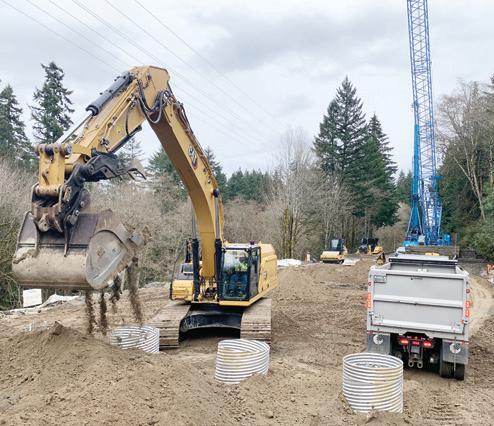
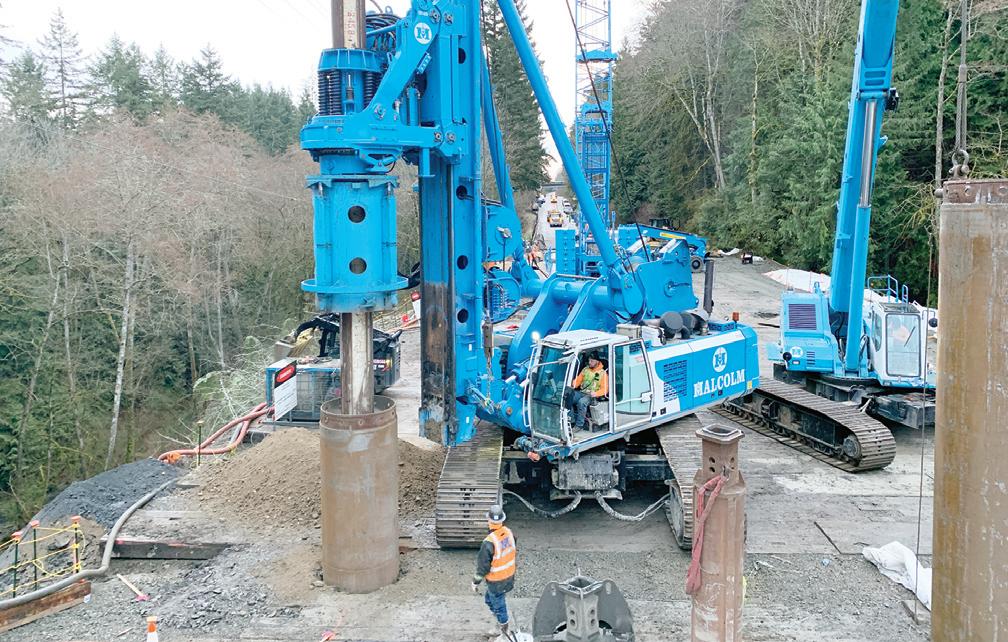
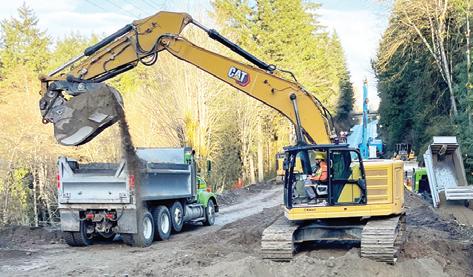
Work on the removal of three of four fish passage barriers on Washington’s North Olympic Peninsula got under way in March: The project removes and replaces outdated culverts under U.S. 101 and State Route 116 at Lees, Ennis, Tumwater and Chimacum creeks.
The $136 million project to remove the four barriers is part of an estimated $9 billion effort ongoing for nearly three decades. Many of the culverts were installed decades ago before the impact on fish was fully understood.
Kiewit is the contractor on all four projects.
The Washington State Department of Transportation (WSDOT) initially began removing the barriers in the 1990s after it developed a fish passage program. A federal court injunction in 2013 required the state to significantly increase its efforts to remove state-owned culverts that block habitat for salmon and steelhead trout by 2030.
“We have 2,000 fish barriers statewide, and about 1,000 are subjected to the injunction,” said Kim Rydholm, fish passage delivery manager. “Our initial requirement is to restore access to 90 percent of blocked habitat. The amount of habitat — not the number of barriers — requires that we have about 350 barriers to correct. As of June 2024, we have corrected 146 barriers.
“When the injunction was issued, we lined up all 1,000 barriers and added the total amount of blocked habitat to the habitat upstream of the barrier. We have to restore access to 90 percent of the blocked habitat. As we work our way down the list to less and less habitat, there are a lot of barriers in that remaining 10 percent.”
The state legislature allocated $3.95 billion for the removal project, which has already been spent. Another $5 billion is necessary to complete the plan. The injunction is specifically related to salmon and steelhead trout and requires the state to provide for passage of fish in all life cycles.
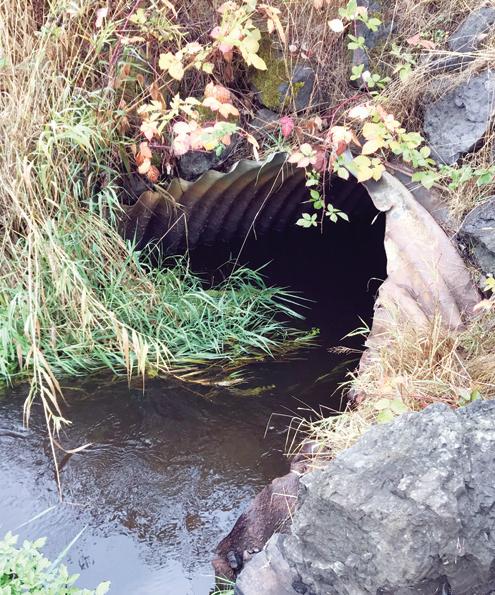
There are several reasons a culvert becomes a barrier,
Rydholm said.
“One is that the stream is too small, so the velocity of the stream increases significantly, and water is moving too fast through the culvert. It could be because the depth of the flow of the water is too shallow, or it can be that its perched, creating like a waterfall at the outlet and the fish have to jump up into the culvert.”
see FISH page 10










































Oregon’s highway system is facing ongoing challenges as the condition of many roads continues to decline, according to the Oregon Department of Transportation’s 2024 Pavement Condition Report.
The report highlights that while 87 percent of Oregon’s 18,000 lane mi. of pavement are still in fair or better condition, the quality of roads is slipping, with the percentage of “good” pavement reaching its lowest point since 2001.
The report points to a significant decline in the number of roads classified as in “good” condition. Over the past decade, the amount of pavement rated as good has decreased, and without adequate maintenance, many roads in fair condition are at risk of deteriorating into poor condition within the next few years.
ODOT’s goal is to preserve the condition of Oregon’s highways through regular maintenance. As roads age, maintenance needs become more complex and costly. Timely maintenance, such as resurfacing and crack sealing, are the most effective way to prevent roads from further deterioration and to extend their service life.
In the past 20 years, ODOT has managed to maintain a paving cycle of approximately 25 years. However, this is set to dramatically increase to a 500-year cycle by 2030. This will limit the ability to repair and preserve many roads, particularly non-interstate routes, which will see fewer repairs moving forward.
“ODOT’s structural revenue issue is forcing the agency to dramatically pull back on our pavement maintenance and preservation efforts,” said Amy Ramsdale, delivery and operations administrator. “Without additional revenue or revenue reform, the quality of Oregon’s highways will significantly decline in just a few years.”
The number of roads in poor condition has been increas-
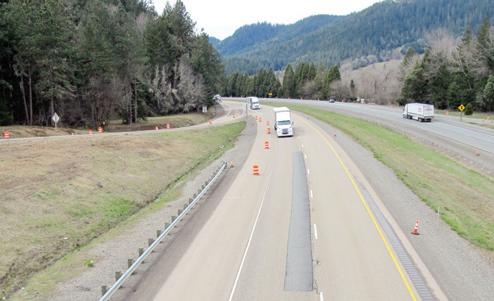
This area of Interstate 5 between Glendale (Exit 80) and Azalea (Exit 88) was last paved in 2007. It was repaved in 2023 after this photo was taken.
ing, with more expected to deteriorate in the coming years.
Asphalt roads typically last between 10 and 30 years, while concrete roads last 40 to 60 years, depending on weather and maintenance.
After 2027, non-interstate routes will receive little to no paving, affecting overall road quality.
The report emphasizes the importance of proactive maintenance to slow the deterioration of the state’s roads and prevent more costly repairs down the road.
While ODOT has managed to meet key performance goals for pavement condition in the past, the growing backlog of maintenance needs and the increasing age of the state’s roads present significant challenges in maintaining these standards in the future.
For more detailed information, visit oregon.gov/ odot/Construction/Pages/Pavement-Condition.aspx.
(Photos courtesy of Oregon Department of Transportation.)
Eight Oregon construction companies that are normally competitors are teaming up to address the industry’s high suicide rates, koin.com reported.
The Centers for Disease Control and Prevention (CDC) has reported that the construction industry’s suicide rate is one of the highest of any industry in the United States.
That CDC data revealed that male construction workers died by suicide in 2022 at a rate 75 percent higher than the general male population, oregonlive.com reported. There were an estimated 6,000 construction workers who died by suicide that year, while only approximately 1,000 were killed in job-related accidents.
Industry leaders said that to address the problem, it starts with changing how people view mental health, koin.com reported.
“We will win the challenge of mental health when we reduce the stigma, when we make reaching out for help OK,” Lines for Life CEO Dwight Holton said.
Officials from Hoffman Construction, Andersen Construction, Fortis Construction, Skanska USA Building, Lease Cruther Lewis, Turner Construction, Mortenson and R&H Construction announced on May 14, 2025, that they are partnering with Lines for Life to organize a peer group in the Construction Suicide Prevention Partnership.
Each company said it will commit to making mental health as much of a priority as physical safety on site by using a more focused approach. One strategy is through QPR training, also known as Question, Persuade, Refer, koin.com reported.
“We’re teaching supervisors, foremen and coworkers to have those conversations like, ‘Hey, how can I help? What are you thinking about hurting yourself today,’” Robert Dahl with Lease Crutcher Lewis said. “And being open about that because you’re not going to suggest that you’re going to open a door, that you can probably save their life.”
Dave Garske, a former vice president of Hoffman Construction, said there’s a “leave your problems at the door” mentality in the industry — and that mentality has prevented people from supporting each other when struggling, according to koin.com.
“That’s what we’re trying to stop. The first thing we need to do is we need to openly talk about it and talk about how this is a problem, talk about how we need to make a change, but let people know that we have people that have gone through this that are there to help,” he said.
The group launched the Construction Care Line, a free crisis and support line designed for construction workers, according to koin.com.
“The people that are answering the line are not just 988 workers, but they’ve had a little more training, and they actually have some scripts that have been studied and trained on how to speak like a construction worker,” Kristina Ewing of Andersen Construction said. “So, it gives them a little more insight on what life on a construction site is like. The specific problems they may be facing on a job site, and also helps talk to them as if it were a colleague.”
That line is available 24 hours a day at 833/444–6020 or at oregonconstructioncareline.org.
The companies said they hope to grow the group, making changes systemwide so they can shift the way business is done.
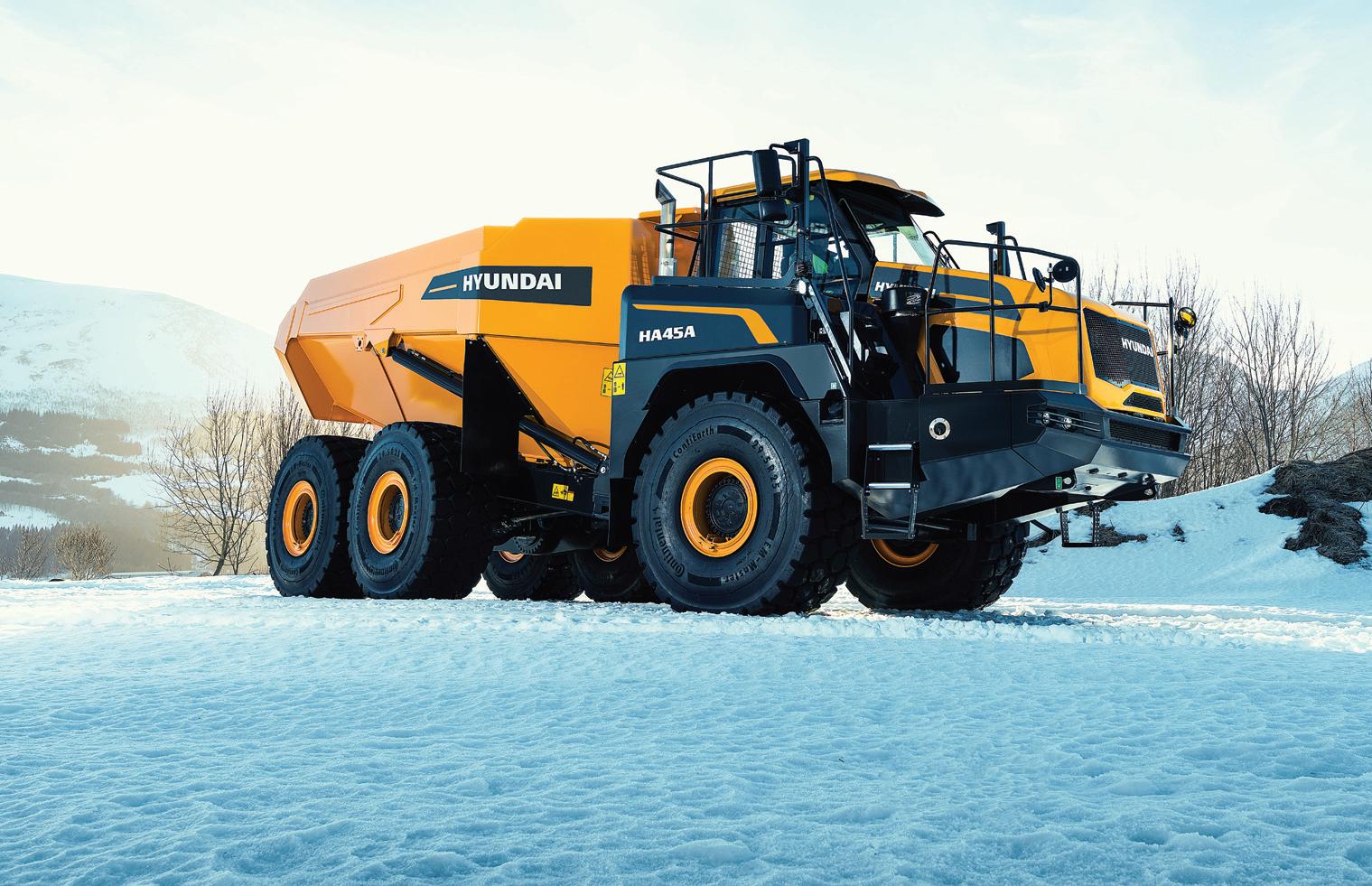



Loved for the features. Trusted for the performance.
Hyundai articulated dump trucks have the power and performance — not to mention top-notch interiors, clear sight lines and handy tech — that make life on the jobsite easier. So you can do more without feeling like longtime fans.




Work began in early May 2025 to stabilize and clear a significant rockslide that sent thousands of cubic yards of debris across both directions of State Route 11/Chuckanut Drive, closing the road on April 22, 2025, just south of milepost 10 near Blanchard Road by Bow, Wash.
Contractor crews working for the Washington State Department of Transportation are working six days a week on the emergency project to clear the highway, stabilize the slope, assess the road’s condition and make any needed repairs.
SR 11 remains closed in both directions between the
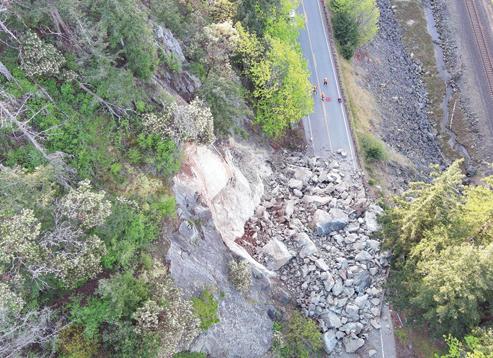
Oyster Dome trail head and Chuckanut Manor. This closure is expected to continue through June.
Stabilization efforts are under way, and WSDOT is coordinating with BNSF Railway to ensure continued safety of the tracks below the slide area.
Crews will begin by breaking down and removing the largest boulders. After some of the debris is removed, crews will blanket the road surface to protect the pavement from further damage while they work on the rock face.
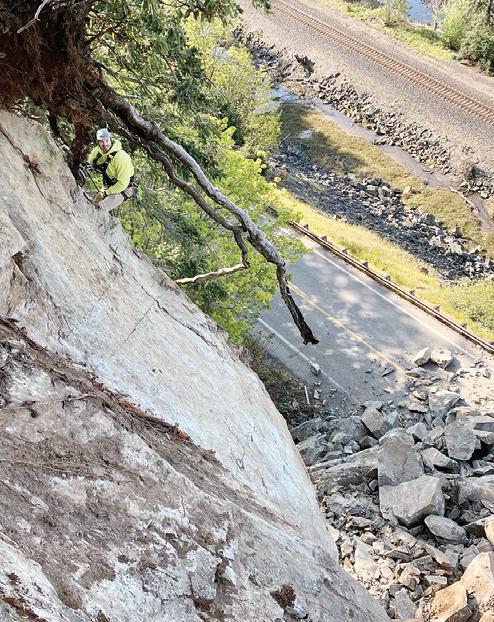
Crews who specialize in this type of work will use hand tools and compressed air to safely remove loose rock from the steep slope, working from top to bottom to reduce hazards.
Once loose debris is cleared, rock bolts will be installed to anchor and secure any remaining material. These anchors require drilling deep into the rock face, followed by grouting and tightening bolts for stability.
Once the slope is stabilized, crews will remove any remaining debris and assess damage to the roadway surface, repair the pavement and restore the guardrail before finally reopening the road.
In addition to the work at this location, crews also will complete some repairs in the vicinity of milepost 13, about 1 mile south of the Whatcom-Skagit county line, where a separate rockfall occurred in November 2024.
Once the scaling work at the current slide is complete, crews will move north and repair work will be under way at both locations.
(All photos courtesy of the Washington State Department of Transportation.)
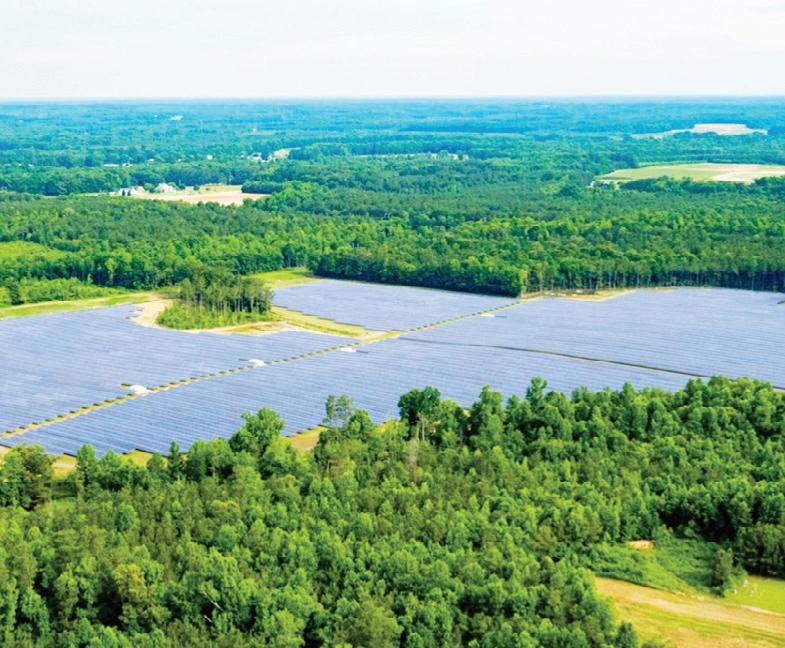
Cypress Creek Renewables, a developer, owner and operator of solar and energy storage projects, announced on May 5, 2025, the financial close and construction start of its 104MW Ostrea Solar project in Yakima County, Wash.
Once completed, Ostrea Solar will generate enough electricity to power between 15,000 and 16,000 average Washington homes annually, contributing to the region’s clean energy goals and supporting the broader transition to renewable power.
“We’re thrilled to have secured financing for Ostrea, our first project to reach this milestone in Washington State,” said Sarah Slusser, CEO of Cypress Creek Renewables. “Thanks to our strong partnerships, we’re fulfilling our commitment to the state and bringing the benefits of this project — and the ones in our pipeline — to the communities that will host them.”
Construction began in February of this year with PCL Construction’s Solar Division (PCL Solar) serving as the EPC contractor. The project is expected to create approximately 250 construction jobs and deliver an estimated $15 million in tax revenue to Yakima County over its operational lifetime.
Yakimaherald.com reported in
February that Ostrea’s plan called for 190,733 solar photovoltaic panels placed on 811 acres along State Route 24.
MUFG Bank acted as coordinating lead arranger for the construction financing of about $150 million alongside BNP Paribas, DNB Bank ASA and Santander. U.S. Bank is serving as the project’s tax equity investor.
“This transaction reinforces MUFG’s commitment to financing high-quality renewable energy assets that deliver long-term value,” said Takaki Sakai, managing director of MUFG Bank.
“Cypress Creek Renewables has demonstrated strong execution capabilities and a robust pipeline, and we’re pleased to support their continued growth with a tailored financing solution that aligns with our strategic focus on sustainable infrastructure and energy transition investments.”
Ostrea Solar is expected to reach commercial operation by mid-2026.
Cypress Creek Renewables develops, finances, owns and operates utility-scale and distributed solar and energy storage projects across the United States. It owns more than 2GW of solar and has a more than 20GW solar and storage pipeline.







Construction season is kicking off on State Highway 55, a vital link in the north-south corridor connecting Boise and Lewiston.
With Idaho’s short summer construction window and the need for warm temperatures before snowfall returns, the Idaho Transportation Department (ITD) is working on several key projects along SH 55 to maintain and improve the critical route.
Each project is part of the department’s continued commitment to enhance safety and mobility along this essential route. From bridge replacements to essential maintenance, these efforts are designed to keep Idahoans moving safely and efficiently throughout the region for many years ahead.
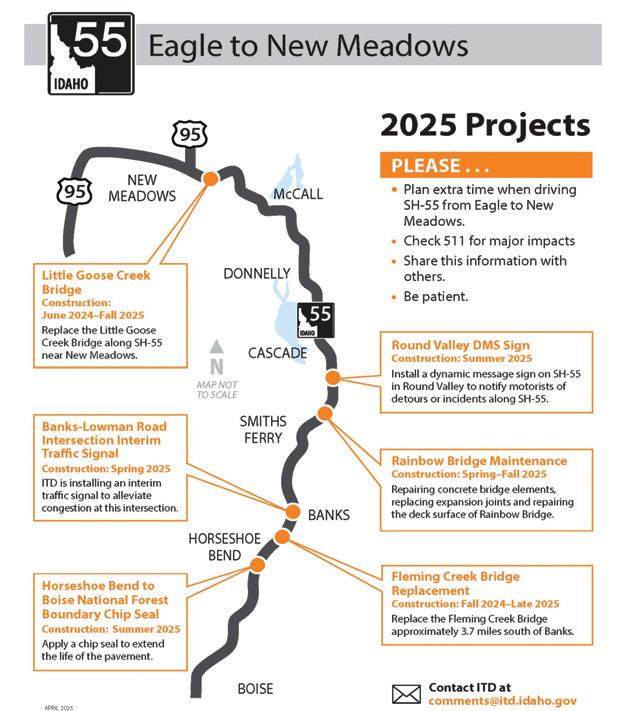
North on the map from Eagle to New Meadows, are projects this construction season: Horseshoe Bend to Boise National Forest Boundary Chip Seal (Construction: summer 2025) ITD will apply a chip seal to SH 55 between Horseshoe Bend and the Boise National Forest Boundary to extend the life of the pavement.
Fleming Creek Bridge Replacement (Construction: fall 2024 — late 2025) ITD is replacing the Fleming Creek Bridge on SH-55 approximately 4 mi. south of Banks. The project



includes a minor realignment of SH-55 to accommodate the bridge and meet current standards for roadway geometry.
Banks-Lowman Road Intersection Interim Traffic Signal (Construction: spring 2025) The new signal was activated May 5 and replaces flagging operations that had previously occurred during peak travel periods, providing a safer and more efficient solution for travelers.
Rainbow Bridge Maintenance (Construction: spring — fall 2025) ITD will repair concrete bridge elements, replace expansion joints and repair the deck surface. This maintenance is necessary to continue meeting safety and capacity standards until a new bridge is constructed in the future.
Dynamic Message Sign (Construction: summer 2025) ITD is installing a dynamic message sign on SH 55 this summer between Round Valley and Cascade. The new message board will notify motorists of detours or incidents.
Little Goose Creek Bridge (Construction: June 2024 — fall 2025) ITD is replacing the Little Goose Creek Bridge along SH 55 near New Meadows. This project has been extended due to weather, road conditions and unexpected contractor delays. Work will be completed this fall.






from page 1
The work can only take place during a certain time of year, typically summer, to lessen the impact on migrating fish. Crews started with the Tumwater project in early March. The two-lane Highway 101 is closed and a detour in place. Crews will tear out the existing culvert and replace it with an 81-ft.-long bridge. That work is expected to be finished in the fall.
Work began at Ennis and Lees Creeks just outside Port Angeles on March 9.
“The challenge for this project is the fact that U.S. 101 is really the only state road in and out of Port Angeles,” said Mark Krulish, WSDOT spokesman. “This is a really important roadway for the area. It’s a big tourist area, so keeping people moving while we’re doing this work is a real chal-
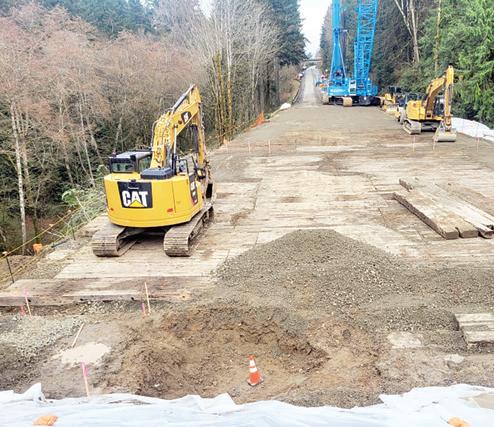
The four-lane stretch of highway will remain open with traffic shifted around the work area. The project calls for tearing out the culverts and replacing it with a 53-ft.-long span at Ennis Creek and a 39-ft.-long span at Lees Creek.
The fourth project at Chimacum Creek south of Port Townsend is set to begin this summer and calls for the closure of State Route 116 with a detour on State Route 19. There, a 74-ft.-long bridge will replace the culvert.
The state is monitoring the projects to verify that the new structures are “fish passable and function as designed,” according to the WSDOT website on the projects.
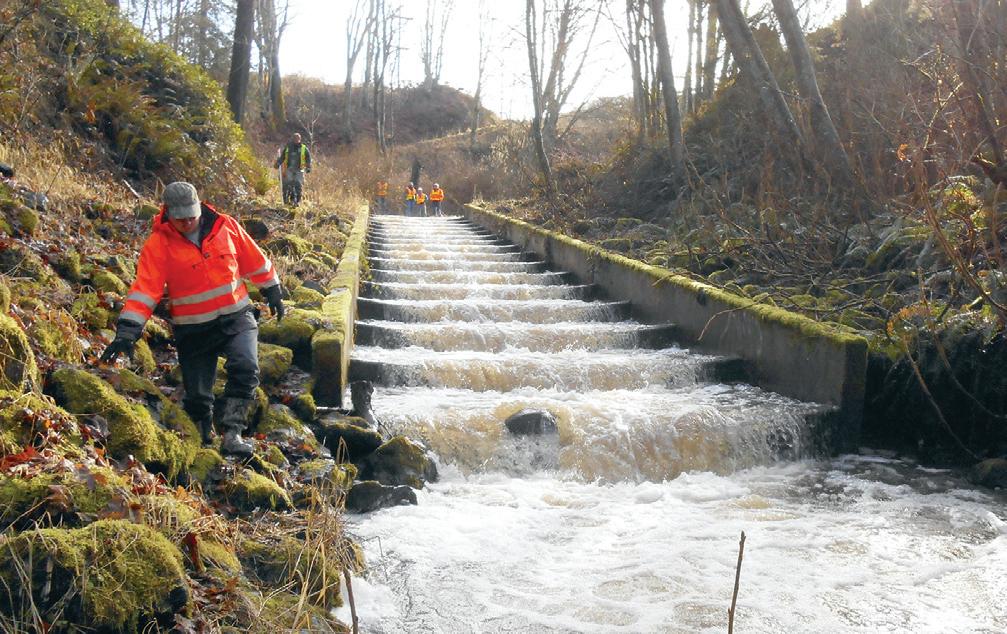
“Replacing these outdated culverts and fish ladders with new structures will open up a combined 18 miles of
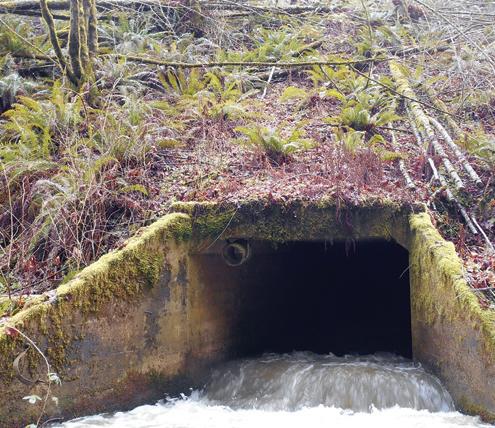
upstream habitat for salmon spawning and rearing. Also, this work will remove significant velocity barriers for migrating fish species, according to the website.
“In lieu of the concrete fish ladders, the in-stream work at all sites will incorporate natural components like logs and boulders to help stabilize the new channel, provide habitat features, and restore natural stream processes that have been disrupted since the culverts were installed when the highway was first constructed. The new culvert and the natural elements will make it easier for fish to pass through the creeks. They will slow the water and create a more natural creek environment.” CEG
(All photos courtesy of Washington State Department of Transportation.)