90 80 6
OHIO STATE EDITION
A Supplement to:
422
6 80 24
6
4
71
76
199 30 30 75
68
30 77
71 23 22 68
4
70 70
®
70
22 71
75
77
27
November 5 2016
22 74
50
50 25
Vol. XVIII • No. 23
35
52
“The Nation’s Best Read Construction Newspaper… Founded in 1957.” Your Ohio Connection: Ed Bryden, Strongsville, OH • 1-800-810-7640
Great Lakes Construction Repairs 1970s-Era Lytle Tunnel By Irwin Rapoport CEG CORRESPONDENT
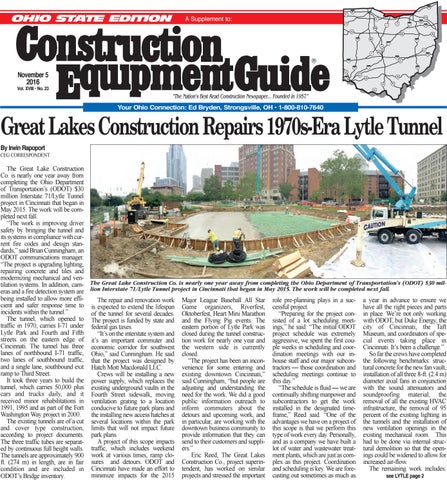
The Great Lake Construction Co. is nearly one year away from completing the Ohio Department of Transportation’s (ODOT) $30 million Interstate 71/Lytle Tunnel project in Cincinnati that began in May 2015. The work will be completed next fall. “The work is improving driver safety by bringing the tunnel and its systems in compliance with current fire codes and design standards,” said Brian Cunningham, an ODOT communications manager. “The project is upgrading lighting, repairing concrete and tiles and modernizing mechanical and ventilation systems. In addition, cameras and a fire detection system are being installed to allow more efficient and safer response time to incidents within the tunnel.” The tunnel, which opened to traffic in 1970, carries I-71 under Lytle Park and Fourth and Fifth streets on the eastern edge of Cincinnati. The tunnel has three lanes of northbound I-71 traffic, two lanes of southbound traffic, and a single lane, southbound exit ramp to Third Street. It took three years to build the tunnel, which carries 50,000 plus cars and trucks daily, and it received minor rehabilitations in 1991, 1995 and as part of the Fort Washington Way project in 2000. The existing tunnels are of a cut and cover type construction, according to project documents. The three traffic tubes are separated by continuous full height walls. The tunnels are approximately 900 ft. (274 m) in length, are in fair condition and are included in ODOT’s Bridge inventory.
The Great Lake Construction Co. is nearly one year away from completing the Ohio Department of Transportation’s (ODOT) $30 million Interstate 71/Lytle Tunnel project in Cincinnati that began in May 2015. The work will be completed next fall.
The repair and renovation work is expected to extend the lifespan of the tunnel for several decades. The project is funded by state and federal gas taxes. “It’s on the interstate system and it’s an important commuter and economic corridor for southwest Ohio,” said Cunningham. He said that the project was designed by Hatch Mott Macdonald LLC. Crews will be installing a new power supply, which replaces the existing underground vaults in the Fourth Street sidewalk, moving ventilation grating to a location conducive to future park plans and the installing new access hatches at several locations within the park limits that will not impact future park plans. A project of this scope impacts traffic, which includes weekend work at various times, ramp closures and detours. ODOT and Cincinnati have made an effort to minimize impacts for the 2015
Major League Baseball All Star Game organizers, Riverfest, Oktoberfest, Heart Mini Marathon and the Flying Pig events. The eastern portion of Lytle Park was closed during the tunnel construction work for nearly one year and the western side is currently closed. “The project has been an inconvenience for some entering and existing downtown Cincinnati,” said Cunningham, “but people are adjusting and understanding the need for the work. We did a good public information outreach to inform commuters about the detours and upcoming work, and in particular, are working with the downtown business community to provide information that they can send to their customers and suppliers.” Eric Reed, The Great Lakes Construction Co., project superintendent, has worked on similar projects and stressed the important
role pre-planning plays in a successful project. “Preparing for the project consisted of a lot scheduling meetings,” he said. “The initial ODOT project schedule was extremely aggressive, we spent the first couple weeks in scheduling and coordination meetings with our inhouse staff and our major subcontractors — those coordination and scheduling meetings continue to this day.” “The schedule is fluid — we are continually shifting manpower and subcontractors to get the work installed in the designated timeframe,” Reed said. “One of the advantages we have on a project of this scope is that we perform this type of work every day. Personally, and as a company we have built a lot of water and wastewater treatment plants, which are just as complex as this project. Coordination and scheduling is key. We are forecasting out sometimes as much as
a year in advance to ensure we have all the right pieces and parts in place. We’re not only working with ODOT, but Duke Energy, the city of Cincinnati, the Taft Museum, and coordinators of special events taking place in Cincinnati. It’s been a challenge.” So far the crews have completed the following benchmarks: structural concrete for the new fan vault, installation of all three 8-ft. (2.4 m) diameter axial fans in conjunction with the sound attenuators and soundproofing material, the removal of all the existing HVAC infrastructure, the removal of 95 percent of the existing lighting in the tunnels and the installation of new ventilation openings in the existing mechanical room. This had to be done via internal structural demolition so that the openings could be widened to allow for increased air-flow. The remaining work includes: see LYTLE page 2
Page 2 • November 5, 2016 • www.constructionequipmentguide.com • Ohio State Supplement • Construction Equipment Guide
Crews to Complete $30 Million I-71 Project Next Fall LYTLE from page 1
backfilling the eastern half of Lytle Park — to be completed at the end of November, installing the remainder of the tunnel lighting system, integration of the new SCADA system, integration of three new axial fans, powering up the switchgear and fan soft starts, installation of several isolation dampeners, completing barrier wall inside the tunnel, a new fire suppression system and installation of a closed-circuit television system. “One of the major challenges has been the coordination between the design engineer, ODOT and Great Lakes,” said Reed. “The project was originally bid four years ago as a design-build project. The plans were never completely updated and there was a lot of ambiguity that needed to be cleared up initially. A lot of the design changes and infrastructure layout had to be modified in one way or another. This required a lot of phone conferences and coordination meetings between ODOT, Hatch Mott McDonald and Great Lakes.” Reed says that solid progress is being made. “We’re in the fourth quarter,” he said. “The biggest immediate challenge is to complete the northbound tunnel in its entirety by November 20 — installing new lighting, linear heat detection systems, concrete barrier and asphalt pavement. I can only keep the 2nd Street ramp closed until November 20. After this is done, completing the southbound tunnel and ramp will be a breeze.” According to Reed, safety issues are not being taken for granted. “The biggest safety issue when working in a tunnel is that there’s nowhere to go,” said Reed. “You are separated from live traffic, where the speed limit is 45 milesper-hour but people are going 70 miles-per-hour and the only thing protecting you is a 32-inch tall concrete barrier wall. There are also some environmental concerns that we have to mitigate. Cutting concrete in an area where there is not a lot of natural airflow requires continuous air monitoring.” There are between 30 and 60 Great Lakes and subcontractor workers on site on average day.
up the lights. It’s a domino effect.” For this project, Great Lakes is using a Manitowoc 111 crane, a Link-Belt 50-ton (45.4 t) rough terrain crane, a John Deere 245 excavator, Cat skid steers, Cat miniexcavators and JLG manlifts. Dealerships that supplied the equipment include Ohio CAT and for rentals, Sunbelt Rentals. Reed has an onsite field mechanic, and rented equipment is repaired by the dealerships. Demolition equipment includes mechanical and hydraulic drilling and splitting. “We’re one of a handful of companies that own a hydraulic rock splitter, which is used to split very thick concrete,” said Reed. “They are working 20 hours a day and need continuous monitoring.” Reed expressed an appreciation for the work that went into building the tunnel. “We use a lot of techGoettle installs the lagging boards as Great Lakes excavates and removes the excess material. nology today to build tunnels and the quality of the Most of the work is done during everything falls back to work that was performed day shifts, but for the last two coordination. I meet with in the 1960s was excellent months crews have been working the subcontractors every — it’s very humbling. I 10-hour day and night shifts to Monday and we go could visualize their work complete the northbound tunnel. through material deliveries because we still do a lot of Subcontractors include: – who’s bringing in what things the same way. Glenwood Electric for electrical; and we work out a hierarWe’ve learned some Debra Kuempel for HVAC; chy of importance on what things in regards to Superior Gunite for fire proofing; facilities must be set in hydraulics and how mateJP Phillips for tile; J&B for rein- place first. Materials get rials impacts certain formforcing steel; and Journey Steel for shipped from the manufacing structures, but the way structural steel. turer right to the job site we do things is pretty A lot of specialized work is and are put up. Every submuch the same.” being performed to upgrade the contractor has a critical Crews often find mestunnel systems. path. For example, one of sages left behind on major “We’ve completed many techni- the first things we do is projects like this and on cally dense projects like this in the remove tile from certain July 20, 2015, a message past — the scope of work wasn’t sections so that the firewas found while removsurprising” said Reed, “but there’s proofers can get their a lot more intricate electrical and material up. It then has to The tunnel, which opened to traffic in 1970, ing acoustic panels next to HVAC work then what you would be painted before the elec- carries I-71 under Lytle Park and Fourth and the fans. “As we took the last find in typical ODOT project.” trical contractors can hang Fifth streets on the eastern edge of Cincinnati. panels out,” Reed said, Great Lakes expects to remove “we found a newspaper clipping 1,000 tons (907 m) of concrete, The roadway Work in Tunnel and Associated Surface shoved between one of the panels 20,000 cu. yds. (15,291 cu m) of Street Work Also Includes: and a message written on the panel soil and 27,000 sq. ft. (2, 508 sq m) • Tunnel lining repair (glazed ceramic tiles) — $2.2 million that said ‘Good luck tearing this of tile. For new construction mate• Reconstruction of the standpipe system — $700,000 job down. Don’t bid on a state job rials, it anticipates using 10,000 cu. • Replacement of tunnel lighting with LED lighting —$8.1 million or you’ll lose your ass.’ We found yds. (7,645 cu m) concrete, 20,000 • A ventilation system upgrade, including three axial fans — $4 milthat funny because the newspaper lbs. (9,071 kg) of structural steel, lion date was the exact same day we 17,000 sq. ft. (1,579 sq m) of tile, • Installation of a fire detection system — $300,000 took the panels out.” 1.6 million lbs. (725,747 kg) of • Upgrades to the electrical system to accommodate new mechan(This story also can be found reinforcing steel, and miles of new ical room and equipment — $1.2 million on Construction Equipment cable and conduit. • Supervisory control and data acquisition (SCADA) computer sysGuide’s website at www.con“I’m installing $30 million tem for gathering and analyzing real time data — $700,000 structionequipmentguide.com.) worth of work in a one-quarter of • Expansion of the mechanical room to accommodate new electriCEG an acre area,” said Reed. “The cal equipment and fans — $7.5 million work zones are 17 feet wide, so
Construction Equipment Guide • Ohio State Supplement • www.constructionequipmentguide.com • November 5, 2016 • Page 3
Highway Equipment Company 1405 Timken Place SW Canton, OH 44706 330-915-8391 Fax: 330-915-8411 www.highway-equipment.com
Attachments can n make your machine moree valuable. Allied offers a wide assortment of attachments to fit all of your makes and models of excavator, loader/backhoe, mini-excavator, skid-steer or compact track loader machines. Allied has become attached to your machines. Allied’s construction and demolition attachments are productive and dependable. State-of-the-art technology.Full product line. Competitive price and performance. Allied offers innovative, problem-solving capabilities. Commitment to product availability. Superior product support. Strong Distributor network. Most of all Allied meets and exceeds customer performance expectations. To put a high performance Allied attachment on your machine, call us at 1-800-321-1046 or visit AlliedCP.com for the name of a Distributor nearest you. We’ve become attached to your machines.
© 2015 Allied Construction Products, LLC
Highway Equipment Company
Highway Equipment Company
1405 Timken Place SW • Canton, OH 44706 330-915-8391 • Fax: 330-915-8411 www.highway-equipment.com
1405 Timken Place SW • Canton, OH 44706 330-915-8391 • Fax: 330-915-8411 www.highway-equipment.com
Page 4 • November 5, 2016 • www.constructionequipmentguide.com • Ohio State Supplement • Construction Equipment Guide
Wood • Hamilton • Stark • Henry • Greene • Knox • Franklin • Clermont • Crawford • Union • Cuyahoga • Brown • Licking • Medina •Ohio.. Williams • Harrison • Adams • Mercer • Butler • Clark • Ashtabula • Sandusky • Portage • Athens • Logan • Lake • Erie • Wyandot • Warren • Fairfield • Miami • Paulding • Darke • Muskingum • Ottawa • Holmes • Jefferson • Trumbull • Summit • Washington • Van Vert • Licking • Wood • Hamilton • Stark • Henry • Greene • Knox • Franklin • Clermont • Crawford • Union • Cuyahoga • Brown • Licking • Medina • Williams • Harrison • Adams • Mercer • Butler • Clark • Ashtabula • Sandusky • Portage • Athens • Logan • Lake
‘Buckeye State’ Highway Lettings
The Ohio State Department of Transportation received bids for transportation-related improvement projects. The following is a list of some of the projects let. Project No: 160384 Type: Four lane resurfacing. Location: CUY-Snow Road. State Estimate: $3,047,000
Contractors and Bid Amounts: • Kokosing Construction Company Inc., Columbus, Ohio — $3,145,070 • Shelly Company, Thornville, Ohio — $3,153,815 • Karvo Companies Inc., Stow, Ohio — $3,209,964 • Chagrin Valley Paving Inc., Chagrin Falls, Ohio — $3,359,627 • Barbicas Construction Company Inc., Akron, Ohio — $3,739,470
• Terrace Construction Company Inc., Cleveland, Ohio — $3,749,692 Completion Date: Sept. 30, 2017 Project No: 160392 Type: Bridge repair. Location: HAM-IR 71-01.59. State Estimate: $10,025,000 Contractors and Bid Amounts: • Kokosing Construction Company Inc., Columbus, Ohio — $9,461,811 • Great Lakes Construction Company, Hinckley, Ohio — $9,797,735 • Sunesis Construction Company, West Chester, Ohio — $10,825,262 • Complete General Construction Company, Columbus, Ohio — $11,032,568 Completion Date: Sept. 1, 2017 Project No: 160397 Type: Two lane resurfacing. Location: LOR-SR 83-17.94. State Estimate: $2,507,000 Contractors and Bid Amounts: • Karvo Companies Inc., Stow, Ohio — $2,366,810 • Chagrin Valley Paving Inc., Chagrin Falls, Ohio — $2,545,373 • Kokosing Construction Company Inc., Columbus, Ohio — $2,554,653 • Shelly Company, Thornville, Ohio — $2,677,966 • Burton Scot Contractors LLC, Newbury, Ohio — $2,834,906 • Erie Blacktop Inc., Sandusky, Ohio — $3,288,049 Completion Date: July 28, 2017 Project No: 160405 Type: Miscellaneous. Location: POR-SR 14-06.10. State Estimate: $2,274,000 Contractors and Bid Amounts: • Ruhlin Company, Sharon Center, Ohio — $1,266,765 • Dot Construction Corporation, Canfield, Ohio — $1,421,645 • Perk Company Inc., Cleveland, Ohio — $1,449,535 • Shelly & Sands Inc., Columbus, Ohio — $1,604,315 • Lockhart Concrete Company, Akron, Ohio — $2,196,858 Completion Date: Nov. 15, 2016
HUDSON 6681 Chittenden Road Hudson, OH 44236 P-330-655-5900 F-330-655-5969
www.themcleancompany.com
COLUMBUS 3155 E 17th Avenue Columbus, OH 43219 P-614-475-2880 F-614-475-0069
CINCINNATI 8131 Regal Lane West Chester, OH 45069 P-513-777-5556 F-513-777-4494
Project No: 160407 Type: Four lane resurfacing. Location: SUM-IR 77-04.05. State Estimate: $3,666,000 Contractors and Bid Amounts: • Shelly & Sands Inc., Columbus, Ohio — $3,520,053 • Northstar Asphalt Inc., North Canton, Ohio — $3,789,170 • Karvo Companies Inc., Stow, Ohio — $3,795,696 • Shelly Company, Thornville, Ohio — $4,051,791 Completion Date: Nov. 15, 2016
Construction Equipment Guide • Ohio State Supplement • www.constructionequipmentguide.com • November 5, 2016 • Page 5
Page 6 • November 5, 2016 • www.constructionequipmentguide.com • Ohio State Supplement • Construction Equipment Guide
Ohio Highway 32: A Road of Unintended Consequences By Jeremy Fugleberg THE CINCINNATI ENQUIRER
CINCINNATI (AP) Ask Meeka Mohler about her historical photos of Jim Rhodes, and she’ll wave you toward the back of Michael’s Ice Cream. There, Rhodes’ face stares out of old newspaper articles marking the one-time Ohio governor’s visits back to his hometown of Jackson and the shop, where he got his first job working for Mohler’s greatgrandfather. Nothing fancy. “He worked here cranking the peanut roaster,’’ she said. Just outside Jackson stands another Rhodes legacy, Ohio Highway 32. It’s a four-lane road he championed that now bears his name — the James A. Rhodes Appalachian Highway. The road, stitched together from a patchwork of smaller roads starting in the late-1960s, was supposed to be a path from despair to hope, a game-changer for the impoverished region of Appalachian Ohio. Some grumbled it was expensive and pointless — a highway to nowhere. But it is now a four-lane fixture, accepted with a mixture of optimism and fatalism, yet easily taken for granted. The highway, which stretches from Cincinnati to the West Virginia border, is a well-suited symbol for a region by turns forward-thinking but traditional, bighearted but insular. These days, tourists gawk their way down the scenic highway. Local officials hawk its value to prospective employers. Some companies in the area thrive due to the road, and it is a way for many local workers to get to their sometimes-distant jobs. For others, it is the fast lane to the big cities over the horizon. Some use the highway to leave for good. Roads might seem like bland public works projects, made of concrete, asphalt, gravel and dirt. But they are not. No other type of construction so mirrors the human existence, with all its paradoxes. No other piece of civil engineering so binds potential with the constraints of place. The Rhoden family murders in April, committed just off the Appalachian Highway in the Pike
County region, brought the world’s attention to this place and to this highway, the likely escape route for the killers. There are always dark counterpoints to golden dreams. Richard Vedder is still a pessimist about the Appalachian Highway. In 2000, the long-time Ohio University economics professor told a reporter the road was probably the “most desolate in Ohio’’ and had done little to develop the area’s economy. When recently reminded of his comments, he reviewed some economic data, and said he still believes what he said then. “I can’t say the highway achieved all the lofty hopes and expectations of the people who promoted it from the beginning,’’ he said. The counties along the highway still have per capita median incomes below the state average of $48,000 a year and well under the national average of $52,000. With a few exceptions, little has changed since 2000, he said. “These are counties that even today are 20 to 35 percent below the national average for income,’’ he said. “The gap is big. The gap is not narrowing.’’ Vedder isn’t the first to view the highway with disdain. While nobody organized to oppose the project, plenty of people had things to say, said Jim Henry, a historian of Pike County who writes columns in the Pike County News Watchman about the area’s history. “The farmers and local people didn’t think there’d be any need for it,’’ he said. “They thought it was just a waste of money.’’ But Blaine Beekman had something to say about that. He was on the local committee that helped promote the road. As an Appalachian Highway true believer, the now-Pike County commissioner remains convinced the highway was a boon. “I know Dick Vedder,’’ he said. “Here’s a college professor with a lot of stats, looking and hoping to bring people from $30,000 a year to maybe $50,000 a year. We want to make sure we’re keeping the $30,000 jobs. “I think it’s a difference in outlook.’’
“All kinds of things have branched out. It’s not just the highway, Route 32. It’s these other things, the infrastructure we’ve gained.’’ Blaine Beekman Pike County
The area’s truck-reliant timber industry depends on the road, Beekman said. And the junction of U.S. 23 and the Appalachian Highway is a central part of the pitch for interested businesses. Beekman pointed to the new Rural King farm supply store and distribution center that opened recently in Waverly. The highway makes it easy for people from all over the area to work and shop further away. Even Vedder, who lives to the east in Athens, acknowledges the highway opened up a larger pool of workers for a friend of his who runs a factory in Jackson, which is experiencing a strong local economy compared to the larger region. With the highway in place, people in Appalachian Ohio can work the next county over, or drive to Athens or Cincinnati for work or recreation — time-consuming or impossible before the highway was built. “Cincinnati was almost off the radar to that point, until this came through,’’ Beekman said. “Now, it’s no big deal. You go to Mount Orab, you have Skyline Chili and you drive back home. You spend an hour and it’s a nice drive.’’ Kenny Bobst is in the business of running a hardware store. That’s what it says on the sign outside anyway — Beaver Valley Hardware in Beaver. But slip inside, and just off to the side of his front counter is the real action — at a table with a mismatched set of chairs around it, a newspaper thrown over the top. This is where all the problems of the world are solved, daily. Or something like that. Lately, the oldtimers who show up talk a lot of politics. Nothing seems to be get-
ting solved on that front. But they take turns buying doughnuts on Fridays — a bipartisan gesture almost too good for Congress. “It’s a place to loaf,’’ Bobst said from behind the counter, between sales. “You’ve got to have a place to loaf in all these small towns.’’ Bobst retired in 2000 as Pike County supervisor for the Ohio Department of Transportation after a 29-year career. He knows the county’s roads, and now life as a small businessman. He, too, is pessimistic about the good the highway brought to the region. “It was supposed to have developed the community,’’ he said. “It didn’t.’’ But you can find meeting places like Bobst’s everywhere in the region if you just ask around, both along the Appalachian Highway and just off to the sides. Stop in the McDonald’s just outside of Peebles in Adams County, a few miles from the Rhoden properties. It’s not just a place to get a Big Mac. Inside, you might see a birthday party in progress, or a few older folks talking over coffee. Drive east into Pike County and stop at Tom’s Drive Thru & Grocery. Inside the store, past shelves of food, is a place where folks sit and talk, with hot food made nearby. People might take it for granted, but the highway is far more than just a road, said Beekman, the Pike County commissioner. In his eyes, the highway created an invisible shift. It simultaneously opened up the region and bound the isolated communities together. As county commissioner, he’s on the Ohio Valley Regional Development Commission, where county officials can meet together
and act as one regarding spending in the region. “All kinds of things have branched out,’’ he said. “It’s not just the highway, Route 32. It’s these other things, the infrastructure we’ve gained.’’ Back in Jackson, the photos in Michael’s Ice Cream don’t lie. Jim Rhodes never forgot Jackson or his first job. There he is in 1966 as governor, scooping up peanuts. There he is celebrating his 80th birthday party by serving ice cream cones in 1989. “Any man must hold deep respect for his roots. These are my roots,’’ he said then, as quoted in a news article on the wall. The blue, metal peanut roaster he cranked sits in the corner of the front window. It still works, but it’s powered by electricity now, not by a governor in the making. Jackson hasn’t forgotten Rhodes, either — the local boy who made good. A statue of the four-term governor stands tall and confident, mid-stride with a briefcase, across Main Street from Michael’s Ice Cream, next to the old county courthouse. It was dedicated in 2013. A plaza surrounds the statue, with plaques listing Rhodes’ accomplishments, including the Appalachian Highway. Jackson is thriving as of late, with several big employers and a retail corridor along the thoroughfare stretching from the Appalachian Highway on one side of town into Jackson’s historic downtown. But the highway’s construction decades ago brought other, less happy consequences. It diverted traffic away from the downtown, visiting swift suffering upon shops at the core of the county seat. It was a blow that hit Rhodes’ first employer hard. “It nearly killed our business,’’ Mohler said. But folks in Jackson never blamed Rhodes for how the highway throttled downtown, she said. They had a more resigned way of looking at it: Progress. Every road gets you somewhere else. Not every road gets you where you want to go. (This story also can be found on Construction Equipment Guide’s website at www.constructionequipmentguide.com.)
Construction Equipment Guide • Ohio State Supplement • www.constructionequipmentguide.com • November 5, 2016 • Page 7
To See More Machines, Please visit us online at www.bobcat-ent.com Call Brad Kent at 513-266-7761 or on our USED EQUIPMENT HOTLINE: 888.BOBCATS
2014 S650 Bobcat Loader, 1675 Hrs, Cab Heat & Air, Power 2014 S750 Bobcat Loader, Only 200 Hrs, Open ROPS, New 2009 5600 Bobcat Toolcat, 1325 Hrs, Cab, Heat & Air, CN 99863..........................................................................$29,500 Quick Tatch, CN 91813 ..................................................$37,500 Tires, CN 99481 ..............................................................$44,000
2007 T180 Bobcat Track Loader, 3000 Hrs, Cab Heat & Air, Wide Track, CN 100631 ..................................................$24,500
2014 Bobcat T750 Track Loader, 2115 Hrs, Cab Heat & Air, 2012 DL220 Doosan Wheel Loader, 600 Hrs, CN 84785 .......... 2014 DA30 Doosan Articulated Truck, 500 Hrs, CN 90330...... High Flow, 2 Spd, Joysticks, CN 100642......................$49,500 ........................................................................................$123,500 ........................................................................................$328,800
2014 DX420LC-3 Doosan Excavator, 850 Hrs, CN 90363 ........ ........................................................................................$258,880
PRE-OWNED, JOB READY EQUIPMENT NOW AVAILABLE! Parts • Sales • Service • Rental • Training Cincinnati • Mt. Orab • Hilliard • Reynoldsburg • Lexington • Louisville
3 ! , % 3 s 2 % . 4 ! , 3 s 0 ! 2 4 3 s 3 % 2 6 ) # %
DRILL ILL RIGS FOR RENT 1.800.PILE.USA -or- www.ecanet.com PITTSBURGH PO Box 306 Coraopolis, PA 15108 P 412.264.4480 F 412.264.1158
PHILADELPHIA PO Box 387 Aldan, PA 19018 P 610.626.2200 F 610.626.2245
WASHINGTON, D.C. 6300 Foxley Road Upper Marlboro, MD 20772 P 301.599.1300 F 301.599.1597
TORONTO 166 Bentworth Ave Toronto, Ontario M6A 1P7 P 416.787.4259 F 416.787.4362
EQUIPMENT CORPORATION OF AMERICA B U I L D I N G F O U N DATI O N S S I N C E 1 91 8
AUTHORIZED DEALER:
PITTSBURGH
PHILADELPHIA
WASHINGTON
D.C.
TORONTO
Page 8 • November 5, 2016 • www.constructionequipmentguide.com • Ohio State Supplement • Construction Equipment Guide