PACIFIC NORTHWEST EDITION
A Supplement to:
®
February 19 2017 Vol. II • No. 4
“The Nation’s Best Read Construction Newspaper… Founded in 1957.” Your Pacific Northwest Connection – Patrick Kiel – 1-877-7CEGLTD – pkiel@cegltd.com
WSDOT’s Been Working on the Point Defiance Railroad By Lori Tobias CEG CORRESPONDENT
When Friday rolls around, crews on the Point Defiance Bypass Project are ready to attack their job building new rail line, but when Monday arrives, it’s back to business for the railroad. It’s a tightly synchronized operation of a $150 million project that will make rail travel all that more efficient in the corridor stretching from Vancouver, B.C. to Portland, Ore. The project is part of the Washington Department of Transportation’s railroad upgrade program that features 20 projects statewide, including eight new locomotives. Thirteen of those 20 projects are completed; seven remain under construction. The funding for the massive
overhaul is being driven by a federal government $8 billion program known as Pria Section 209. “What it did was take all the lines and move those to state responsibility from Amtrak,” said David Smelser, capital program manager of the Rail, Freight and Port Division of WSDOT. “The government said ‘Hey you have a lot more responsibility so here’s some funding.’ Washington ended up with $800 million. This funding see WSDOT page 4
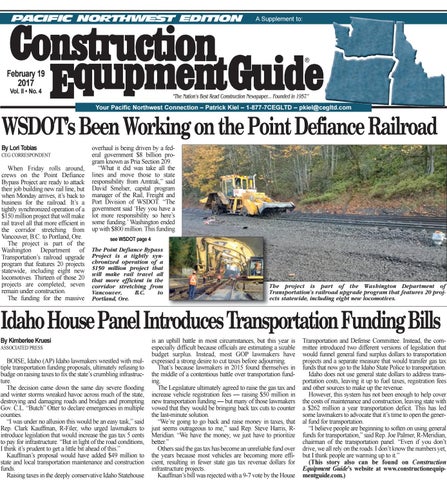
The Point Defiance Bypass Project is a tightly synchronized operation of a $150 million project that will make rail travel all that more efficient in the corridor stretching from Vancouver, B.C. to Portland, Ore.
The project is part of the Washington Department of Transportation’s railroad upgrade program that features 20 projects statewide, including eight new locomotives.
Idaho House Panel Introduces Transportation Funding Bills By Kimberlee Kruesi ASSOCIATED PRESS
BOISE, Idaho (AP) Idaho lawmakers wrestled with multiple transportation funding proposals, ultimately refusing to budge on raising taxes to fix the state’s crumbling infrastructure. The decision came down the same day severe flooding and winter storms wreaked havoc across much of the state, destroying and damaging roads and bridges and prompting Gov. C.L. “Butch” Otter to declare emergencies in multiple counties. “I was under no allusion this would be an easy task,” said Rep. Clark Kauffman, R-Filer, who urged lawmakers to introduce legislation that would increase the gas tax 5 cents to pay for infrastructure. “But in light of the road conditions, I think it’s prudent to get a little bit ahead of this.” Kauffman’s proposal would have added $49 million to state and local transportation maintenance and construction funds. Raising taxes in the deeply conservative Idaho Statehouse
is an uphill battle in most circumstances, but this year is especially difficult because officials are estimating a sizable budget surplus. Instead, most GOP lawmakers have expressed a strong desire to cut taxes before adjourning. That’s because lawmakers in 2015 found themselves in the middle of a contentious battle over transportation funding. The Legislature ultimately agreed to raise the gas tax and increase vehicle registration fees — raising $50 million in new transportation funding — but many of those lawmakers vowed that they would be bringing back tax cuts to counter the last-minute solution. “We’re going to go back and raise money in taxes, that just seems outrageous to me,” said Rep. Steve Harris, RMeridian. “We have the money, we just have to prioritize better.” Others said the gas tax has become an unreliable fund over the years because most vehicles are becoming more efficient, resulting in fewer state gas tax revenue dollars for infrastructure projects. Kauffman’s bill was rejected with a 9-7 vote by the House
Transportation and Defense Committee. Instead, the committee introduced two different versions of legislation that would funnel general fund surplus dollars to transportation projects and a separate measure that would transfer gas tax funds that now go to the Idaho State Police to transportation. Idaho does not use general state dollars to address transportation costs, leaving it up to fuel taxes, registration fees and other sources to make up the revenue. However, this system has not been enough to help cover the costs of maintenance and construction, leaving state with a $262 million a year transportation deficit. This has led some lawmakers to advocate that it’s time to open the general fund for transportation. “I believe people are beginning to soften on using general funds for transportation,” said Rep. Joe Palmer, R-Meridian, chairman of the transportation panel. “Even if you don’t drive, we all rely on the roads. I don’t know the numbers yet, but I think people are warming up to it.” (This story also can be found on Construction Equipment Guide’s website at www.constructionequipmentguide.com.)
Page 2 • February 19, 2017 • www.constructionequipmentguide.com • Pacific Northwest Supplement • Construction Equipment Guide
Debate Emerges Over What Replaces Boardman Coal Plant By Ted Sickinger THE OREGONIAN/OREGONLIVE
PORTLAND, Ore. (AP) Portland General Electric’s agreement to close its only coal-fired power plant won praise seven years ago as an environmental victory with national implications in the fight against air pollution and climate change. As the 2020 closure date approaches, though, those good feelings have largely evaporated. The coalition of environmentalists, ratepayer advocates and industry groups that once cheered PGE’s decision are now preparing for a showdown instead. They suggest the utility, in deciding how to replace the Boardman plant’s power, is stacking the deck in favor of two new gas plants it wants to build at the coal plant site, about 150 mi. (241.4 km) east of Portland. A series of decisions by the utility and state regulators later this year will determine the direction of PGE’s future power supply and its mix of green energy and fossil fuels. In comments to state regulators, a variety of stakeholders will argue that PGE is rushing into a gas-heavy future that might be good for its shareholders, but is risky for ratepayers and nearly as bad for the planet as coal. “Right now, it looks like a shell game,” said Amy Hojnowski, senior representative for the Sierra Club’s Beyond Coal Campaign. “They’re manipulating the process to get the outcome they want, which is a self-built expansion of their existing gas infrastructure at the Boardman site.” PGE said that’s nonsense. It said it’s keeping an open mind about resource choices and will let the market decide who can provide the cheapest, lowest-risk power to meet its customers needs in a competitive bidding process. But, bottom line, it said it needs to keep the lights on, and can’t do that with renewables alone, a point reinforced during the recent cold snap, when the wind wasn’t blowing and solar panels around the state were covered in snow. “We’re not putting our thumbs on the scale for any particular technology or fuel,” said Brett Sims, PGE’s director of resource strategy. “In the end, we don’t know what will bid in, but we believe there are resources beyond new gas plants.” A Gassy Future? The rush to gas is on nationally and could accelerate under a Trump administration loaded with fossil fuel advocates and promising to unleash a new wave of drilling. Utilities around the country are already building or planning scores of new gas-fired power plants and pipelines as they close older coal units, take advantage of historically low gas prices, and add more renewable resources that require backup. At first glance, that’s a climate win: gas-fired power plants emit about half the carbon dioxide as an equivalent one powered by coal. But the new plants will still generate considerable carbon dioxide for decades. Moreover, the main component of natural gas is methane, a far more potent greenhouse gas in the short run. Trump’s energy plan, posted on the White House website, said he was committed to rolling back Barack Obama’s Climate Action Plan, which had aimed to reduce methane leakage from the oil and gas industries by 45 percent by 2025. Gas-fired electricity already makes up a quarter of PGE’s energy supply today. It just opened a 440-megawatt gas plant at the Boardman site this summer. The previous year it opened Port Westward II, a dozen small gas-fired engines in Clatskanie that can flexibly incorporate renewable resources. In November, PGE unveiled its newest plan for meeting
Large cylinders in which coal is ground in preparation for burning in the main chamber of the Boardman Coal Plant.
customer demand. The study forecast a power supply shortfall of more than 800 megawatts by 2021, about what it takes to power 800,000 homes. It’s a big hole, mostly the result of the coal plant closure. PGE looked at different combinations of replacement resources, then scored them according to how they would fare under varying fuel price, carbon cost and demand growth scenarios. Filling the Shortfall PGE’s “preferred” option didn’t specify the technology or fuel type, but identified two big energy needs, the vast majority from a reliable resource that isn’t subject to the weather. Apart from hydroelectricity, which may not be available in the quantity PGE needs, or coal, that generally means natural gas. A smaller component of the identified need was renewable energy, likely from wind farms on the Columbia Plateau or in Montana. A variety of stakeholders didn’t like that result. Some complain PGE’s action plan isn’t specific enough, and that its scoring methodology was skewed to favor the gas plants it wants to build. “They’re cooking their proprietary model,” said Robert Kahn, executive director of the Northwest & Intermountain Power Producers Coalition. “It’s the ultimate black box.” PGE denies that. It said it is trying to offer maximum flexibility and will consider all resource types that meet its criteria. It also said most of the metrics it used are industry standards and required by the state’s Public Utility Commission. “It’s not dreamt up by PGE or opaque,” Sims said. Renewables advocates noted that PGE could have chosen another mix. The top options, including one with far more wind energy and less gas, scored within a few points of one another on a 100-point scale. They all met the utility’s reliability standard. “The technologies that exist today are good enough to do the job, said Rachel Shimshak, executive director of Renewable Northwest. “You just have to have a utility that’s focused on fitting them all together.” Tyler Pepple, a lawyer for the Industrial Customers of Northwest Utilities, contends PGE doesn’t need to add another wind or solar farm until 2028 or 2030, and can comply with the state’s increasingly rigorous renewable energy mandates by drawing down the massive bank of renewable energy credits it has built up. In the meantime, renewable energy
costs will fall, making compliance cheaper in 2030 and 2040. PGE said that’s not a responsible strategy. Franco Albi, manager of the utility’s integrated resource plan, said the early acquisition of renewables also allows it to take advantage of the federal production tax credit, which is set to expire for wind farms. “Every scenario we ran indicates that early action on renewables is the prudent thing to do,” Albi said. Residential ratepayer advocates also support a wait-andsee strategy. Bob Jenks, executive director of the Citizens Utility Board, said he thinks PGE ought to be pursuing fiveand 10-year hydroelectric contracts and putting off any big new investments in gas that will lock the company into fossil fuels for four decades. Sims said PGE isn’t opposed to some new hydro contracts, and will see whether the Bonneville Power Administration or other big hydroelectric suppliers offer any capacity in the company’s competitive bidding process. PGE is hoping regulators will give the nod to its action plan sometime this spring so it can get going on that process. And that’s where the critics point to more problems. A Biased Process? They say PGE has taken a number of steps to advantage the construction of new gas plants at Boardman. It overbuilt the gas pipeline and the substation for the last gas plant to accommodate more capacity. It has been buying transmission capacity that it doesn’t need today but could be used to serve the new gas plants. And it has already started the permitting process for the two new gas plants at Boardman with state regulators. Sims said it’s standard practice to overbuild pipelines and substations to provide flexibility for future expansion. He said the transmission purchases were not specifically geared to new gas plants at Boardman, and that it’s wise for the utility to start permitting the gas plants in case that is the best option in the competitive bidding. “We can’t rely on hoping that there will be all this good stuff out there when we need it in 2021,” Sims said. Regulators acknowledge there’s an inherent bias for utilities to choose their own projects. That’s how they make money and drive their stock prices. There also are risks to utilities owning all their own generation plants. Ratepayers are footing the bill for the early closure of both the Trojan nuclear plant and the coal plant in Boardman, for example. And when the parent company of the contractor building the new gas plant at Boardman went bankrupt last year, PGE had to step in and finish it, picking up about $150 million in cost overruns. If insurers don’t pay, ratepayers could get stuck with those costs, too. Since 2006, the state has required utilities to put all its resource acquisitions out for competitive bidding. But almost all those contests have been won by the utility, or a contractor building a plant for the utility. The Public Utility Commission was scheduled to start an investigation of its competitive bidding guidelines in order to encourage more diverse ownership of those resources, but the kickoff meeting got postponed. “We call it the death march,” said Kahn. “Since the guidelines have been adopted 95 percent of the resources have been self-built or bought [by the utilities]. Our members have secured 5 percent.” For more information, visit http://www.oregonlive.com. (This story also can be found on Construction Equipment Guide’s website at www.constructionequipmentguide.com.)
Construction Equipment Guide • Pacific Northwest Supplement • www.constructionequipmentguide.com • February 19, 2017 • Page 3
Kent, WA (800) 669-2425 Rochester, WA (800) 304-4421 Spokane, WA (800) 541-0754 Boise, ID (800) 221-5211 Pocatello, ID (800) 829-4450 Billings, MT (800) 735-2589 Kalispell, MT (800) 434-4190 Missoula, MT (800) 332-1617 Eugene, OR (800) 826-9811 Portland, OR (800) 950-7779 Magadan, Russia 011-7-41326-99298 Yuzhno-Sakhalinsk, Russia 011-7-42424-69051
Page 4 • February 19, 2017 • www.constructionequipmentguide.com • Pacific Northwest Supplement • Construction Equipment Guide
WSDOT Expects to Have Bypass Operational This Fall WSDOT from page 1
is all inside of Washington, all spent inside the state. Oregon also got some planning money. It strengthened our partnership with Oregon. We operate the line from Seattle to Portland jointly.” The Point Defiance Bypass Project will allow WSDOT to add two new round trips between Seattle and Portland for a total of six round trips. It will shorten travel time and improve on-time performance, Smelser said. The project routes passenger trains from BNSF Railway main lines to an inland route of existing rail line that is lightly used by freight trains. The current route requires trains to slow for curves and single line tunnels. The bypass includes 14.5 mi. (23.3 km) of new and upgraded tracks, five at grade crossings with full safety improvements. “The old rails are in the 100year-old range,” Smelser said. “Tacoma Rail services a few freight customers on that line. It’s a major upgrade to get it into condi- The funding for the massive overhaul is being driven by a federal government $8 billion program known as Pria Section 209. tion to be used by passenger rail. Crews are tearing out the goes very smoothly. I week, crews do utility work and last [open graded rocks that supold track and rebuilding think they initially take delivery of materials for the port the ties], rail and ties.” the road bed. All new ties, thought they could weekend. Construction is scheduled to be all new rail, concrete ties, build around 1500“There’s all kinds of equipment complete in the spring. The new new ballast. They’re tear1600 feet. They can’t on the job,” Smelser said. “There’s bypass will need to be tested, and ing out the old track and work on the railway the on-track equipment for laying then is expected to open to passenrebuilding the road bed, the rest of the week. rail. Excavators, dozers, graders, gers in the fall. new signals, new ditches, They have to be off trucks. It’s very similar to rebuild(This story also can be found new access road. We’re the line sometime ing roadway or a two-lane high- on Construction Equipment basically rebuilding the Monday in the morn- way. The only difference is what Guide’s website at www.conentire railroad.” ing.” you put on top. Instead of paving structionequipmentguide.com.) The project is broken The rest of the with asphalt, you put sub base, bal- CEG into five parts, with work beginning on the first two years ago. The last contract to be let was for the new station, a necessary is scheduled to be comaddition since the old sta- Construction plete in the spring. The new bypass will tion is located on the rail need to be tested, and then is expected line the state is going to to open to passengers in the fall. bypass. Construction crews rebuilding materials staged. As soon as they the lines must work around the get the shutdown window, they Tacoma Rail services. That’s will attack a piece of track. With where the weekend work comes in. their experience now they are able “They have about a 48-hour to get 1,500 to 2,000 feet done in a window to do work over the week- weekend. Their goal is to have it end, which involves removing operational on Friday, when they existing rail, ties, ballast and rail get their shut down and will start bed and building that back up with removing the existing line. new materials,” Smelser said. Sometime on Saturday, they’ll be “When they prepare for the week- rebuilding the rail bed and will end work, they have already built have it ready to go on Monday the access road and have the new morning for the freight trains. It Thirteen projects are completed; seven remain under construction.
Construction Equipment Guide • Pacific Northwest Supplement • www.constructionequipmentguide.com • February 19, 2017 • Page 5
WASHINGTON: WASHINGTON: WA Seattle, WA Seattle, WA W A 8207 South 8207 South 2216th 16th SStreet treet Kent, Washington Kent, W Wa ashington 998032 8032 206.762.5933 206.762.5933 Manager: Brian Manager: G ar y LBurke abelle glabelle@PacWestMac chiner y.com bburke@PacWestMachinery.com Spokane, WA Spokane, W WA A 4030 Avenue 4030 East East TTrent rent Ave nue Spokane, Washington Spokane, Washington 999202 9202 509.534.5933 509.534.5933 Manager: Manager: JJohn ohn CCushman ushman jcushman@PacWestMachiner y.com jcushman@PacWestMachinery.com
OREGON: OREGON: Portland, OR Po r t l a n d , O R 13805 NE Sandy Boulevard 13805 NE San dy Bo ulevard Portland, Por tland, Oregon Oregon 97230 97230 503.252.5933 503.252.5933 Manager: Hurst Manager: TTim im H urst tthurst@PacWestMachinery.com hurst@PacWestMachiner y.com Eugene, OR Eugene, O R 1550 Irving 1550 Ir ving RRoad oad Eugene, Oregon Eugene, O regon 997402 7402 541.302.3762 541.302.3762 Manager: Hurst Manager: TTim im H urst thurst@PacWestMachiner y.com thurst@PacWestMachinery.com
Some companies have you choose pow wer or fuel efficiency. y. You chose both.
PacWestMachinery.com Pac cW WestMachinery.com Volvo l de developed l d the th industry’s i d t ’ first fi t fue f ell efficiency ffi i guarantee t so you never h have ave tto compromise i on n performaance or productivity. And with CareTr eTrack machine monitorin ng, you can focus your attentio on on more important things — like growiing your business. Contact your PacWest Machinery represen ntative to hear how we can sup pport your growing business.
Page 6 • February 19, 2017 • www.constructionequipmentguide.com • Pacific Northwest Supplement • Construction Equipment Guide
Ponsse, Prinoth Partner for OnTrack RDO Vermeer Wins to Leave Gentler Forest Footprint Pinnacle Award Prinoth announced its participation in a consortium of European forestry institutes together with the leading cut-tolength forestry OEM Ponsse. The partnership aims at developing a forwarder with rubber tracks that can protect the forests and soils while improving productivity and access to weak forest grounds. Consortium members were looking to set more stringent thresholds for damages, to adopt improved operations practices and to better regulate creation of ruts and treatment. Prinoth’s Panther undercarriages, which have a ground pressure as low as 4 psi, provided the best solution to the consortium. The Panther undercarriage system is equipped with rubber tracks and a high travel large wheel/tandem that were developed to work together to provide off-road capabilities with minimal impact on the environment. This feature will help reach one of the project’s specific objectives to significantly diminish wheel rutting and soil disturbance compared to a regular wheeled-forwarder. “We have tried other products from other companies before hearing about Prinoth’s Panther but none could provide the low ground pressure or the off-road capacities that Prinoth can,” said Tommy Blom, project member. The project will comprise of Panther undercarriages assembled into a Ponsse timber forwarder. “We are quite confident that the payload capabilities in extreme off-road conditions that our undercarriage system can provide is the solution that this consortium has been looking for,” said Alessandro Ferrari, VP of sales of the tracked utility vehicles business unit at Prinoth. The Panther undercarriages also will provide speed and as such, increased productivity for businesses, according to the company. More specifically, this forwarder will allow for exceeding machine utilization rates for contractors which will, in turn, translate into a more constant wood supply not dependent of weather conditions. For Prinoth, as a manufacturer, this project means that the undercarriage expertise developed over the years will transpose to a very demanding industry like forestry. “Having such a versatile product, we know we can meet any customers’ needs. This new partnership with Ponsse and the consortium is really exciting for us and we look forward to seeing the tests’ results,” said Ferrari.
Merging Technologies from Two Different Sectors The OnTrack project will test various configurations of Prinoth’s tracked undercarriages on Ponsse timber forwarders. Forwarders are heavy terrain-going machines designed to extract large loads of timber to the nearest forest road. When soils are soft during the winter thaw or after excessive rains, both the risk of damaging the soil through compaction and rutting, as well as fuel consumption, increase considerably. “OnTrack is really an exciting project, both for Ponsse and for my engineering team as well,” said Kalle Einola, R&D manager responsible for technology, product safety and IPR at Ponsse Plc. “The basic idea behind the project is good and its implementation with a heavy-duty rubber track system is something we believe in. It is also interesting with a concept for a new forwarder that is built from readily available commercial components.” The enthusiasm is just as great from the supplier of tracked undercarriages. “OnTrack is an exciting project since it aims to combine the best off-road capabilities with minimal impact on the environment,” said Ferrari. “Contributing to potential new market sectors with new environmentally-friendly solutions is of great strategic importance to us at Prinoth,” Ferrari concluded. Prinoth’s main contributions to the OnTrack project are its knowledge and proven track technologies, which combine low ground pressure with low vibration, off-road capabilities and high-travel speeds.
OnTrack — Horizon2020 Project The purpose of the two-year project is to investigate alternative running gear in a form of a tracked chassis system that could reduce the impact of machines on forest soils, while maintaining or even improving productivity.
The Panther undercarriage system is equipped with rubber tracks and a high travel large wheel/tandem that were developed to work together to provide offroad capabilities with minimal impact on the environment.
Allowing Better Machine Utilization Rates in Milder, Wet Weather According to the companies, if successful, OnTrack will set a new environmental performance standard in forest operations, encouraging others to follow suit. “The anticipated outcomes may significantly reduce the impact of forest machines on soils, simplifying planning and allowing higher machine utilization rates for contractors, thus lowering costs and improving the environmental profile of the sector”, said Rasmus Astrup, OnTrack project coordinator at the Norwegian Institute for Bioeconomy Research (NIBIO).
A Representative Consortium In addition to Finnish Ponsse Plc and Italian Prinoth, partners include Konstholmen AB and Skogforsk in Sweden; Metsäteho Oy in Finland; LSFRI in Latvia; KWF in Germany; and Owren AS and NIBIO (coordinator) in Norway. The OnTrack concept machine will be tested in all participating countries. This H2020 Innovation Action was initiated in the fall of 2016 and it will run over a period of two years. (This story also can be found on Construction Equipment Guide’s website at www.constructionequipmentguide.com.)
(L-R back row) are Jason Andringa, Vermeer president & CEO; Ken Hugen, RDO Equipment Co. general manager of sales; Marshall Anderson, RDO Equipment Co. executive vice president; Eric Tusler, RDO Equipment Co. Fontana sales manager; Ollie Windle, RDO Equipment Co. Portland general manager; and Chris Cooper, RDO Equipment Co. COO. (L-R front row) are Bob Vermeer, chair emeritus of Vermeer board of directors; Mary Andringa, chair of Vermeer board of directors; Ryan Scott, RDO Equipment Co. regional aftermarket manager; Jeff Sobrero, RDO Equipment Co. sales manager; Steve Rosenow, Burnsville – VER general manager; Travis Gornick, Portland aftermarket manager; and Mindi VandenBosch, Vermeer continuous improvement manager.
RDO Vermeer, part of the RDO Equipment Co. network of heavy equipment dealerships, was honored with five awards at Vermeer’s annual Dealer Year End Meeting. Among the awards received was Vermeer’s top accolade, the Pinnacle Dealer Award. Vermeer Pinnacle designation is given in recognition of talents in sales and aftermarket support. The award criterion includes several select dealer metrics, such as parts, service, market share and customer satisfaction. Tony Briggs, vice president of sales and distribution at Vermeer Corporation spoke to the significance of the award, saying, “Vermeer Pinnacle dealers provide an exemplary customer experience. This award highlights dealers across the globe who consistently lead in a variety of key business performance metrics.” “Every day, our Vermeer teams work hard to take care of our customers,” Marshall Anderson, executive vice president of RDO Vermeer, said. “Being recognized by our manufacturing partner for doing that — and doing it so successfully — is incredibly rewarding for our teams.” In addition to the Pinnacle Dealer Award, RDO Vermeer received four other awards: • stores in California and Oregon were named #1 in the world for tree care, and recycling & forestry • stores in Minnesota and North Dakota were named #1 in the world for trenchless, and Vermeer parts sales. All awards were presented at the Dealer Year-End Meeting held every December in Pella, Iowa. At this annual event, Vermeer discusses the year ahead, including product plans and general info for all dealers. For more information, visit www.rdoequipment.com. (This story also can be found on Construction Equipment Guide’s website at www.constructionequipmentguide.com.)
Construction Equipment Guide • Pacific Northwest Supplement • www.constructionequipmentguide.com • February 19, 2017 • Page 7
4800 NE Columbia Blvd | Portland, OR 97218 (503) 282-2566 | www.feenaughty.com
Page 8 • February 19, 2017 • www.constructionequipmentguide.com • Pacific Northwest Supplement • Construction Equipment Guide
Bobcat Sizes Cutter Attachment for Greater Production Bobcat’s 70-in. (177.8 cm) forestry cutter is approved for use with M2-Series compact track loaders — T750, T770 and T870 — and the S850 skid-steer loader. An additional 400-lb. (181 kg) counterweight is required when using the 70-in. model with T750 and T770 compact track loaders. Approved skid-steer and compact track loaders require high-flow auxiliary hydraulics to operate the attachment. Easy to Operate Similar to the 50- and 60-in. (127 and 152 cm) models, the 70in. forestry cutter attachment is easy to operate and can efficiently turn trees and underbrush to mulch. When the attachment is tilted forward, the material is thrown against the counter combs that reduce the wood to fine mulch and provide wear protection for the rear of the housing. An optional front gate can be lowered if the operator needs finer mulch. Smooth Operation While high-flow auxiliary
hydraulics are required to operate the new 70-in. forestry cutter, the tube-style drum and spiral tooth pattern allow one tooth to engage at a time for smoother operation while using less horsepower. In addition, the forestry cutter comes standard with 2-Speed travel for increased drum torque and improved productivity. This model also features an adjustable push bar featuring three positions to accommodate the operator’s preferred setting. The gathering feature pulls brush and trees toward the center of the drum for more efficient operation. Uptime Protection The double-tipped carbide teeth efficiently rip through trees and underbrush, providing long life and uptime protection for the attachment. A low number of forestry cutter drum teeth allow operators to reduce teeth replacement costs and ensure faster knockdown of trees, according to the manufacturer.
Bobcat’s 70-in. (177.8 cm) forestry cutter is approved for use with M2-Series compact track loaders — T750, T770 and T870 — and the S850 skid-steer loader.
Safety Features A forestry applications kit must be installed on the loader to operate the forestry cutter attachment. The forestry door with ¾-in. laminated polycarbonate is necessary to operate the forestry cutter attachment, helping protect operators from flying debris and other objects.
The forestry applications kit includes the following: • Front and rear light guards: ensures branches and debris will not break lights • Hydraulic quick coupler guard: helps protect the couplers, hoses and wire harness from falling trees and branches
• Fire extinguisher: mounted in the cab for quick access in an emergency • Level II FOPS: protects the operator and cab from falling trees and objects • Muffler guard: reduces material buildup in the engine compartment and protects the tailpipe from damage • Lift cylinder debris shields: guards the lift cylinders and reduces material buildup in the engine compartment • Polycarbonate top, rear and side windows (¼ or ½ in. polycarbonate): shields the operator and maximizes visibility Additionally, the 70-in. forestry cutter is equipped with a rotor brake, which stops the attachment from full speed in 10 seconds or less when the hydraulics are deactivated. For more information, visit www.Bobcat.com. (This story also can be found on Construction Equipment Guide’s website at www.constructionequipmentguide.com.)
Peterson Pacific Announces New Distributor in Idaho
Peterson Pacific, a Eugene, Ore., based manufacturer of horizontal grinders, drum and disc chippers, blower trucks, and screens announces Goodfellow Corporation as its new distributor for its products in the states of Utah, Nevada and southern Idaho, effective Feb. 1.
Peterson Pacific, a Eugene, Ore., based manufacturer of horizontal grinders, drum and disc chippers, blower trucks, and screens announces Goodfellow Corporation as its new distributor for its products in the states of Utah, Nevada and southern Idaho, effective Feb. 1. “Goodfellow Corporation and Peterson have been partners on Terra Select screen products for more than three years, and because of the success of that partnership we are pleased to expand our relationship to include the entire Peterson product line. The experience they bring to the table as well as their dedication to their customers match Peterson’s culture and core values” said Brian Gray, director of sales. Goodfellow Corporation was established in 1960, and has seen steady growth in the aggregate crushing business. Adding environmental equipment such as the products that Peterson offers is a natural progression for the company for future growth. “Goodfellow Corporation is excited to now have access to the entire Peterson Product Line. We have represented the Terra Select trommel line for them since they became the master distributor and keep multiple sizes and units in our rental fleet. We are looking forward to getting the new grinder we have ordered in since we already have demos and rentals scheduled for it” said Doug Sites, Peterson product line manager for Goodfellow. (This story also can be found on Construction Equipment Guide’s website at www.constructionequipmentguide.com.)
Construction Equipment Guide • Pacific Northwest Supplement • www.constructionequipmentguide.com • February 19, 2017 • Page 9
POWER. SPEED. PRODUCTIVITY. WE’RE BACK AND BETTER THAN EVER. And we’re bringing the only compact track loaders specifically built for the demands of the forestry industry. We manufacture our RT-120 Forestry and RT-75 Heavy-Duty with more durability, power and performance than
R T-7 5 H D
anything else on the market. When combined with ASV’s innovative undercarriage and maximum effi ciency, these qualities mean you’ll be mulching and brush clearing faster and better than anyone else.
Contact Triad Machinery Today for More Details!
OREGON Portland (503) 254-5100 • (800) 221-8512 Eugene (541) 342-7700 • (800) 342-6780 Prineville (541) 447-5293 • (888) 662-2940
www.triadmachinery.com
WASHINGTON Tacoma (253) 722-5560 • (800) 622-8876 Spokane (509) 534-1900 • (800) 945-9168
CHOOSE ASV. YOUR TOUGHEST JOBS DON’T STAND A CHANCE. FIND OUT MORE AT: asvllc.com/more
8 0 0. 20 5.9 91 3
Page 10 • February 19, 2017 • www.constructionequipmentguide.com • Pacific Northwest Supplement • Construction Equipment Guide
Construction Equipment Guide • Pacific Northwest Supplement • www.constructionequipmentguide.com • February 19, 2017 • Page 11
IF Y YOU OU R RU UN EQU UIPMENT, T, YOU YOU UP PROB BABLY LY R RUN KUBOT K TA ALASKA ASRC Energy y Services Prudhoe Bay P. 907-659-3815
OREGON COAST DIESEL Astoria P. 503-325-15 585 CURRY MARINE Toledo Toledo P. 541-336-79 955
BLUELINE EQUIPM MENT Union Gap P. 509-248-8411
HA ATT TTON MARINE Sea attle P. 206-283-5501 2
BLUELINE EQUIPM MENT Sunnyside P. 509-839-2066
PAC CWEST MACHINERY Ken nt P. 206-762-5933 2
BLUELINE EQUIPM MENT Walla Walla P. 509-525-4550
PAC CWEST MACHINERY Spo okane P. 509-534-5933 5
GREGG’S DIESEL SERVICE S
TRI-COUNTY DIESEL MARINE RINE
MIDSTA TATE PO OWER PROD Redmond P. 541-548-67 1 548 6744 PA P ACWEST MA ACHINERY Eugene P. 541-302-37 762 PA P ACWEST MA ACHINERY Portland P. 503-252-59 933 PELICAN TRA ACTOR COMP Klamath Fallss
WASHING WA GTON BLUELINE EQ QUIPMENT George P. 509-785-2595 BLUELINE EQ QUIPMENT Pasco P. 509-544-6 6678
Visit your nea arest Pacific N Northwest Kubota Engine dealership ship to ensure performance and productiv vity with Genuine Kubota parts, en ngines and generators. Find your dealer at: www.cascadeen ngine.com
Efficiency & High Performance.
Page 12 • February 19, 2017 • www.constructionequipmentguide.com • Pacific Northwest Supplement • Construction Equipment Guide
Orion Equipment will be located at the "Outdoor Display Area" Stop by and meet the Orion Equipment Team Members!
Orion and Liebherr working hard everyday to ensure your success! The machines we will have on display:
LH50M • PR716 dozer • L566 wheel loader
The LH50M Industry material handler represents efficiency and high performance. The standard Liebherr regenerative power system assures maximum handling while, at the same time, achieving lower fuel consumption. Quiet operation with the highest payload is guaranteed by the large, sturdy undercarriage. The attachment of the machine is available in a variety of versions and is thus always optimally matched to your respective application.
18060 Des Moines Memorial Dr. Seattle, WA 98148 3909 NW Fruit Valley Rd Vancouver, WA 98660