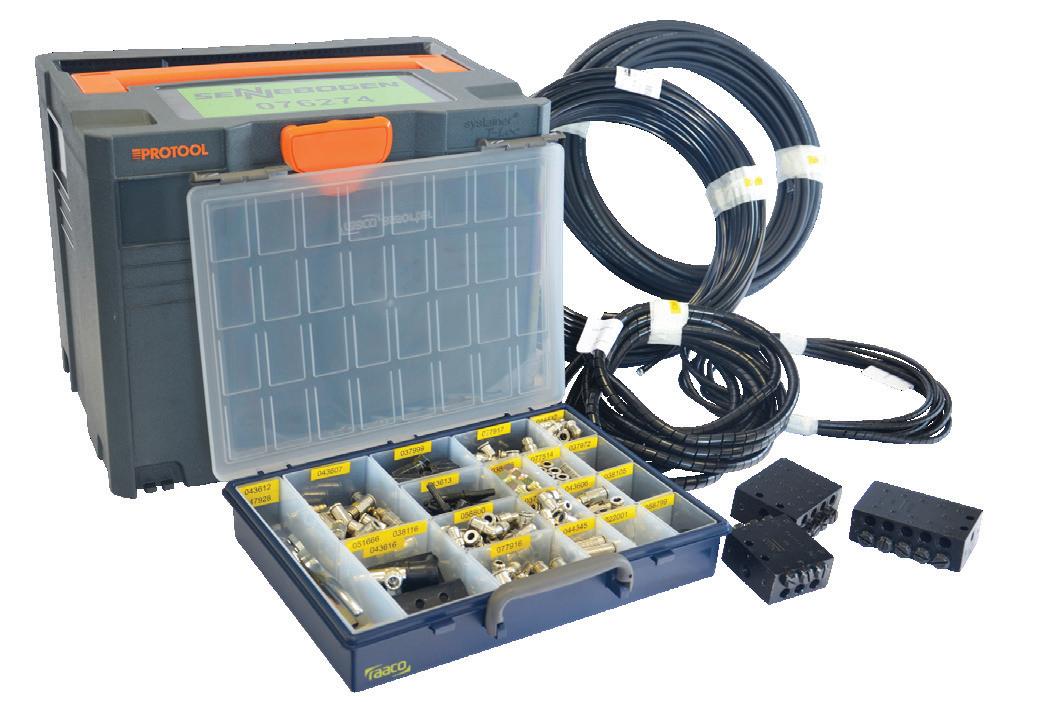
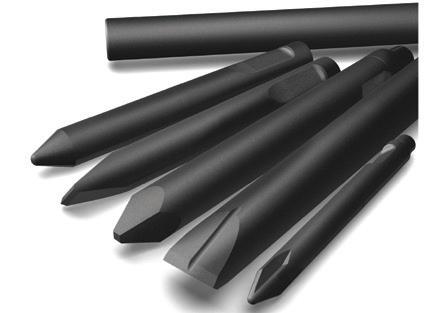
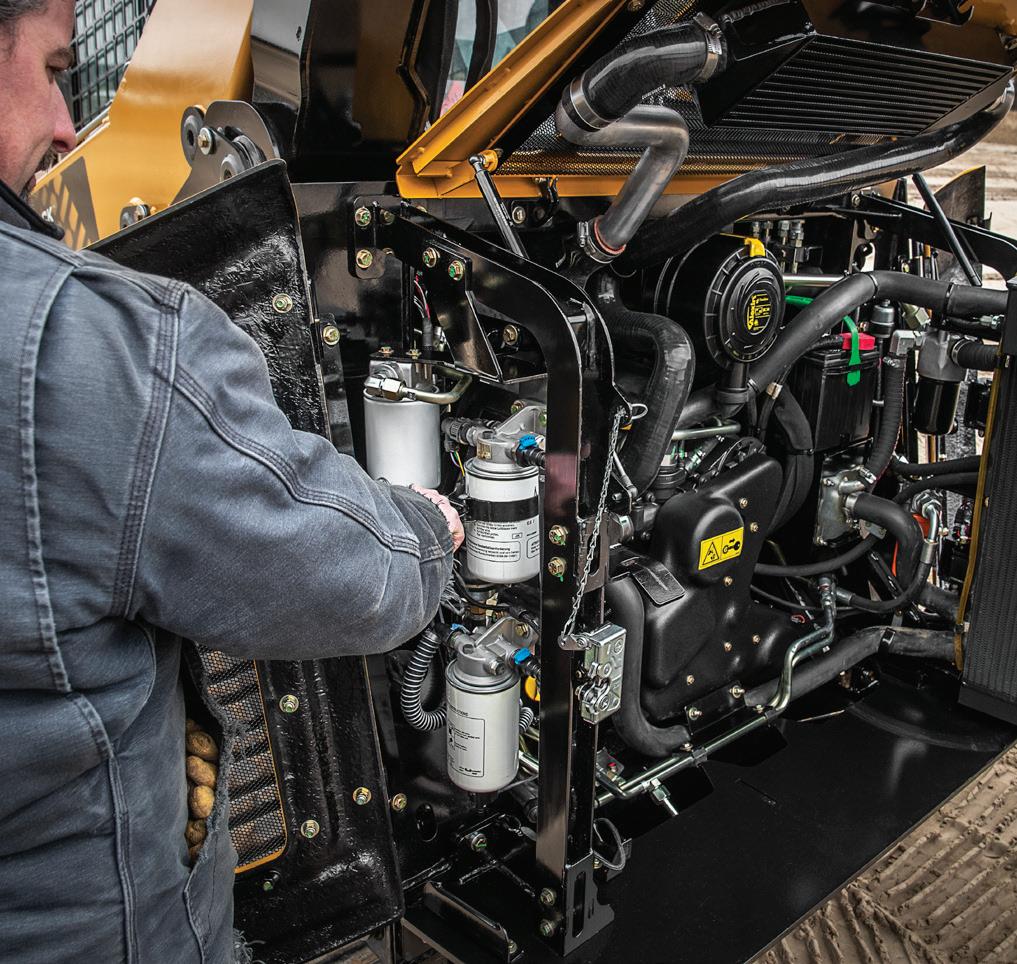
SENNEBOGEN, in keeping with their philosophy to maximize uptime, has created UPTIME Kits. Whether you are a service technician in-house or on the road, these kits have everything you need for every service, maintenance and PM task in one place. They were created to save you time and money. Managing hundreds of related service parts, from belts and nuts to O-Rings and special tools becomes easy with a single part number to order and stock.
They are:
• Easy to order and easy to stock
• Packed with job specific components and tools
• Ideal for stocking service shops and trucks
Choose from the following kits:
• Central lubrication system kits
• Preventive maintenance service kits
• O-Ring kits
• Electrical service kits
• Hydraulic service kits
And the best thing is that these kits, in stock and ready to go, are custombuilt to match your machine model and series. Count on SENNEBOGEN to meet your needs in the field or in-house. For more information on UPTIME Kits, scan the QR code.
BEYOND THE MACHINE
I virtually lose NO downtime
They have a technician come through once a month to go over every machine, front to back. If I have a situation, [they] just bring in another machine and I virtually lose no downtime… Since they have the repair parts in stock. I get the unit back quickly. Demolition Contractor, Bloomfield Hills, MI
Read more about how our “Beyond the Machine” aftersale commitment maximizes uptime for SENNEBOGEN customers with complete inventories of ready-to-ship parts in our North American warehouse.
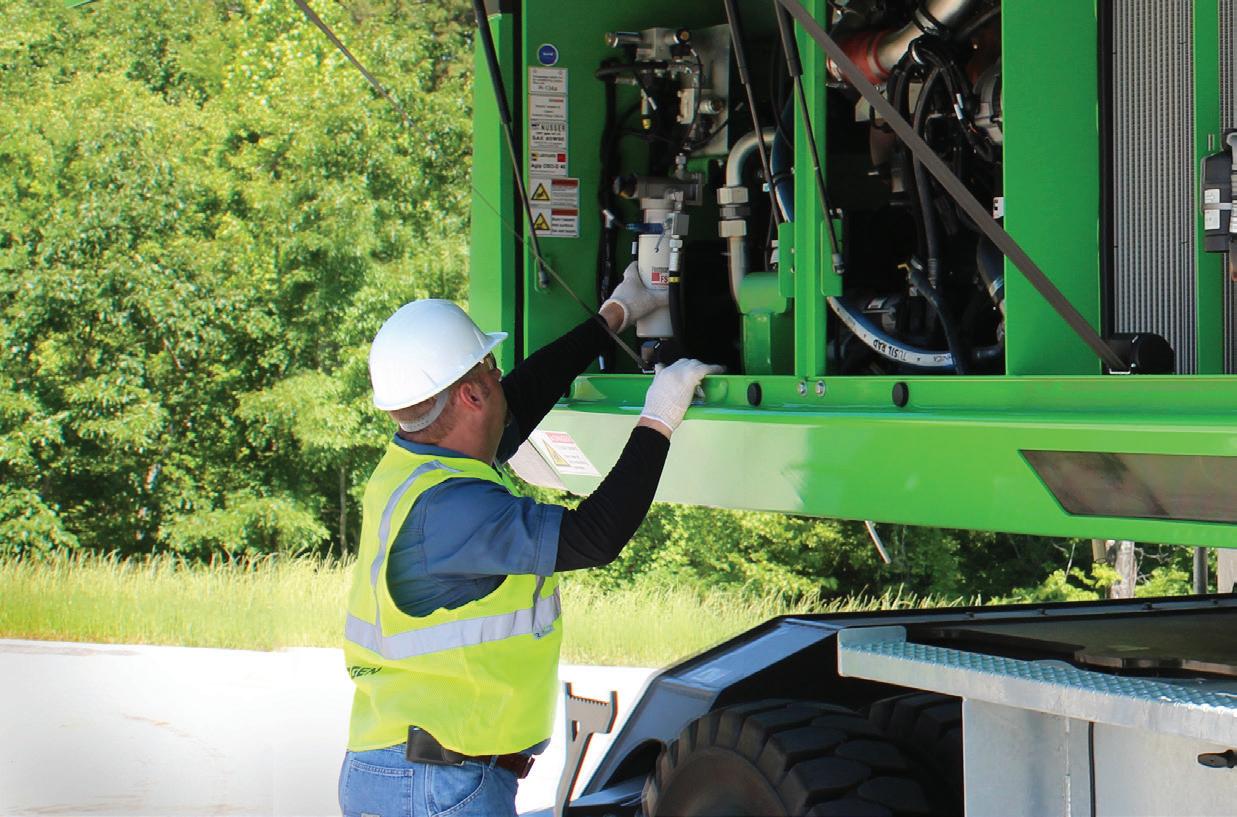
SENNEBOGEN factory-trained technicians
SENNEBOGEN is committed to leading the industry in aftersale support throughout the life of its equipment. We’re thinking “beyond the machine” to deliver dependable uptime and lower Total Cost of Ownership (TCO) for every customer.
NEI Uses New Bid-Well MT Panel, Rebar Placer in Maine
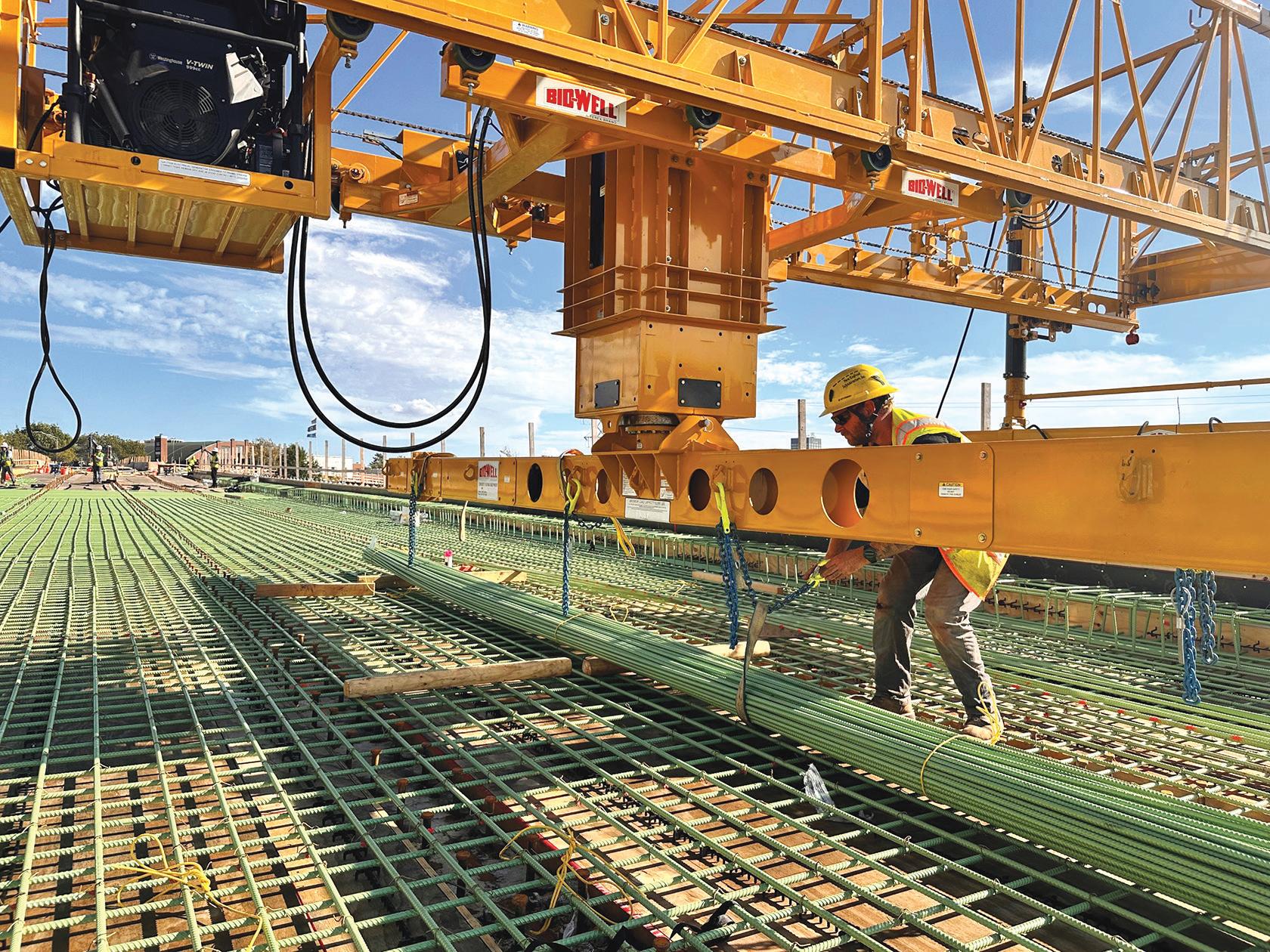
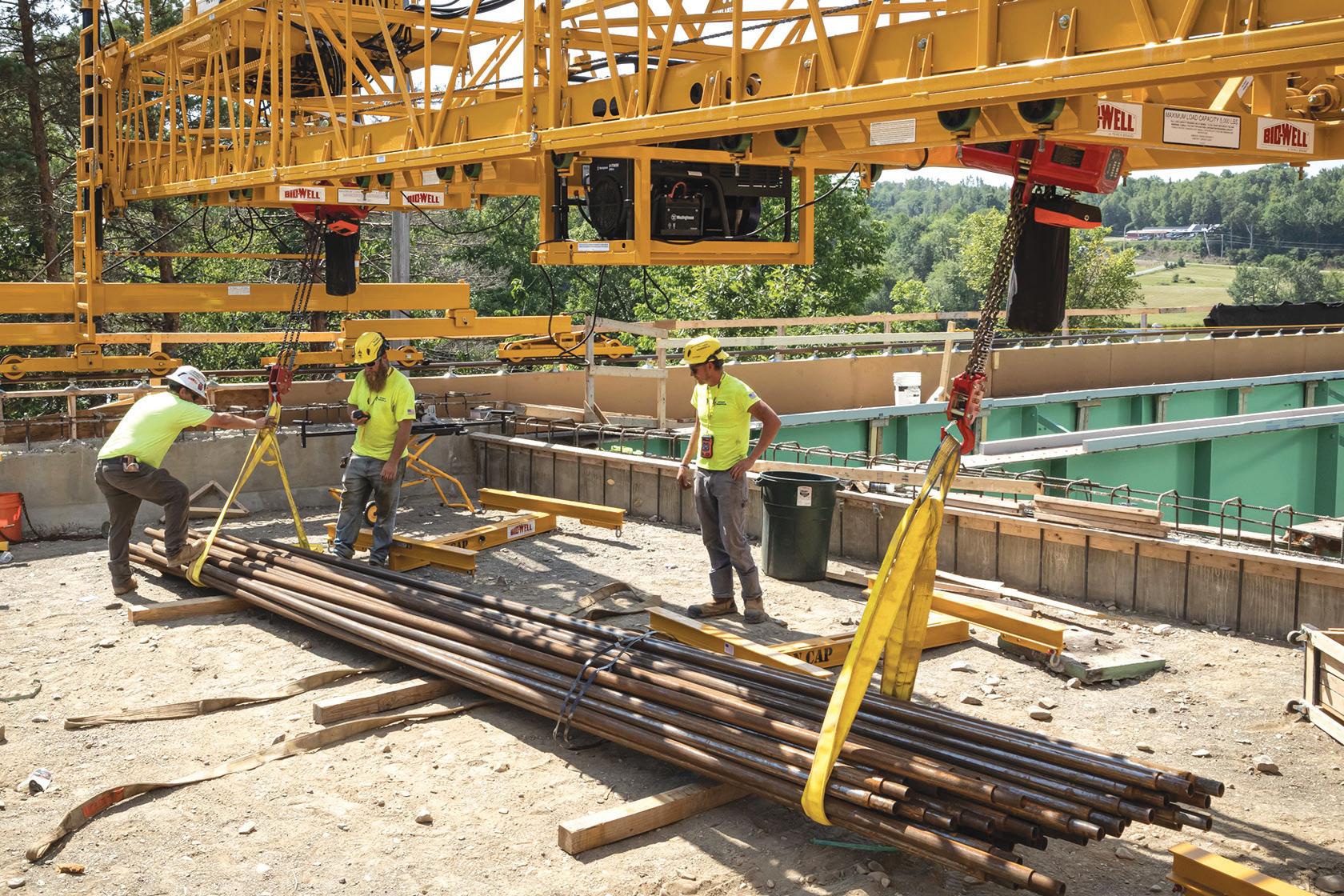
In its MT-2 configuration, the Bid-Well machine placed up to 6000-lb. rebar bundles, which saved NEI significant labor on a bridge project in Manchester, N.H.
NEI from page 1
northbound and southbound lanes of the I-95 Vaughan Daggett Memorial Bridge over the Penobscot River.
“We had the option of using either method for the two bridges over the Penobscot River, so we planned to use precast panels,” said Jared Barczak, executive project manager of NEI. “We petitioned MaineDOT to use precast panels for the 341-foot-long Route 157 bridge over I-95, and this request was approved.”
Using precast concrete panels increases deck construction efficiency. Cast-in-place requires forms to be built and then removed after the deck is placed, taking several months to complete.
“We are using cast-in-place for this bridge,” said Steve Mullins, NEI superintendent of the Amoskeag Bridge Rehabilitation project in New Hampshire. “We started deck forms at the beginning of May (2025), and we got our last placement the first week in November. We still have two to three months of stripping.”
Innovative Solution Needed
Precast panels can be placed much quicker and require less rebar material. “Because they are prestressed,” said Ben Rickson, NEI superintendent of the Medway project, “this eliminates the majority of the bottom rebar from the decks, so you’re going to see time savings there.”
At 5,000 psi and 3.5 in. thick, these precast panels weigh approximately 3,500
lbs. each. On previous projects where NEI used the panels, including the Route 157 bridge, they were able to access the bridge deck from both ends and the middle from adjacent bridges.
“Contractors typically use a large crane to set these panels, but panel weight can max out crane capacity at a couple of hundred
Bid-Well photo
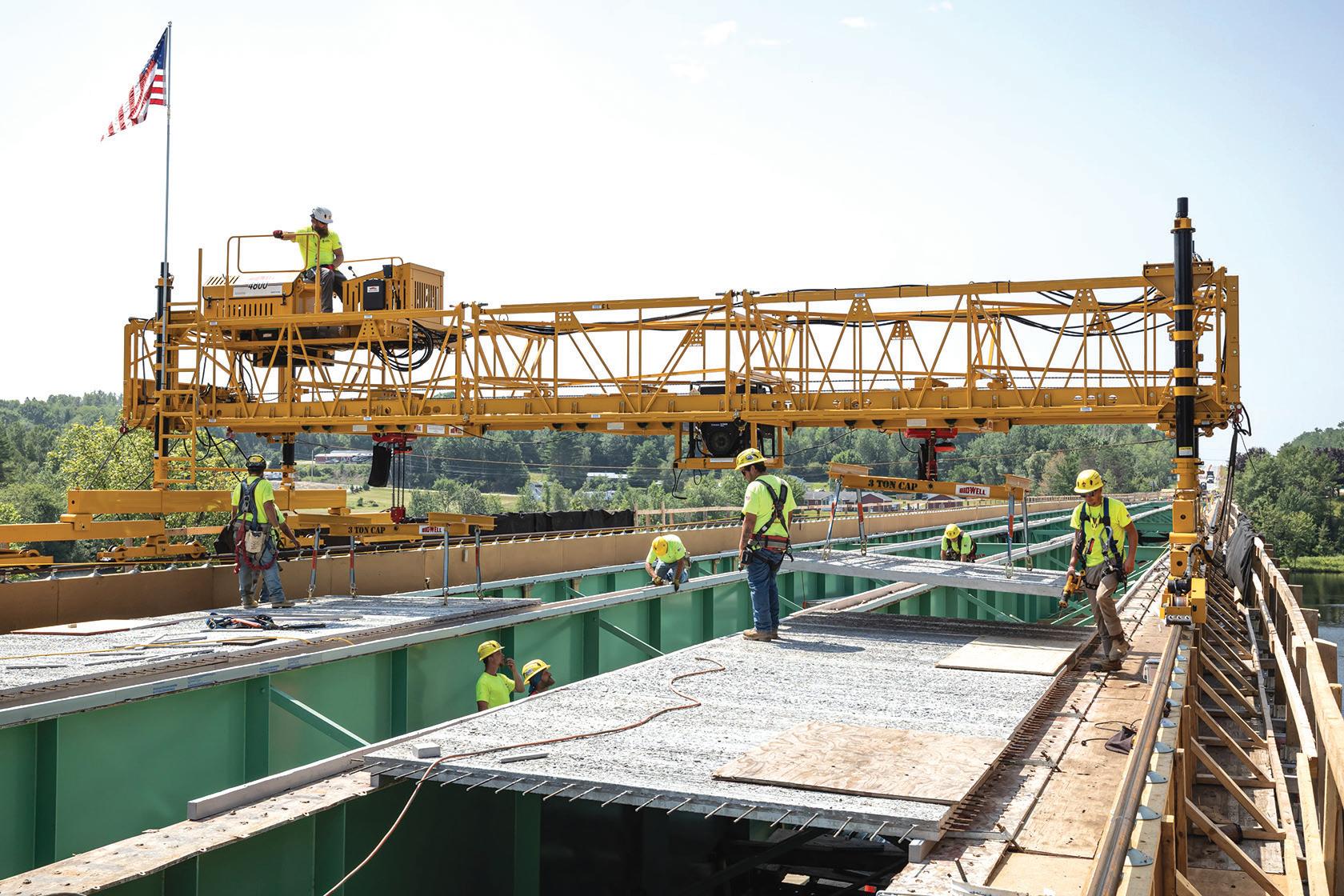
The Bid-Well MT Series is the company’s answer to the evolving material movement needs of contractors.
to reach the middle of the bridge. Initial consideration was to place the panels from a barge. However, this posed a logistical challenge fraught with expense.
“You are triple handling every panel, unloading it from the truck, getting out to the barge and then placing it with a crane,” said Barczak. “We just saw expenses with the
deck panels. In early 2024, NEI management met with Bid-Well representatives to discuss their concept.
“It was an interesting idea, as the overhang brackets, rails and paver are already there,” said Averitt (Drew) Johns, design engineer of Bid-Well. “So, it was a matter of replacing the paving carriage with something that could be used to place the panels and making sure the frame and leg system of the paver
Compact + agile = job well done.
WE’RE IN THE BUSINESS OF KEEPING YOU IN BUSINESS.
DISCOVER THE ASV GENUINE PARTS & SERVICE ADVANTAGE.
ASV Genuine Parts are specifically engineered and guaranteed to maintain the integrity of your ASV machine. They’re designed, built, tested and re-tested to ensure equipment performance and reliability always stay at an all-time high – because less downtime for your machine means more uptime for you. Contact us now to learn more!
New Machine Boosts Bridge Deck Replacement Efficiency
from page 4
paver constructed of lightweight, ultrahigh-strength steel.
“We also looked at an eight-wheel bogie system to match the wheel load of the 3600 paver NEI was using to pave the deck’s surface layer, so that would limit the need to upgrade the overhang brackets,” Johns said.
By the summer of 2024, Bid-Well engineers had finished the design, and NEI gave approval for the build. The BidWell MT-1 model was designed to deliver precise panel movement. Its stationary power unit serves as the central energy source and operational control to drive machine travel, trolley movement, elevation adjustments and any powered accessories.
Instead of a paving carriage, three contiguous material transport trollies and hoists, powered by an auxiliary generator, were placed on the truss frame.
“Each trolley is connected to the machine’s standard chain power transmission system for smooth and consistent movement across the span,” said Johns.
Rhead said, “The MT-1 design allows for up to three panels to be moved at one time, whereas a crane can only place one at a time, so this increases efficiency.”
With machine production finished, NEI management, including Barczak, traveled to South Dakota in February to see it operate.
“Bid-Well has a good engineering team, but we were impressed by the attention to detail put in this model,” said Barczak. “They not only took the added step of addressing everything we could potentially ask but also how it could be transformed to incorporate moving other materials in the future.”
It wasn’t until after the trip to South Dakota that NEI asked for the ability to move rebar bundles. However, Bid-Well had already anticipated that need and was able to have that design, the MT-2, ready for the I-95 bridge project.
“Bridge construction is more than paving, and Bid-Well is more than a paver,” said Rhead. “The MT Series is our answer to the evolving material movement needs of contractors.”
Efficient Panel Placement
NEI took delivery of the MT-1 and deployed it to the Medway site in mid-July. The 36-ft.-wide, 1,050-ft.-long bridge required 408 precast deck panels. The panels measured 3.5 in. thick and 8 ft. long, but panel width varied.
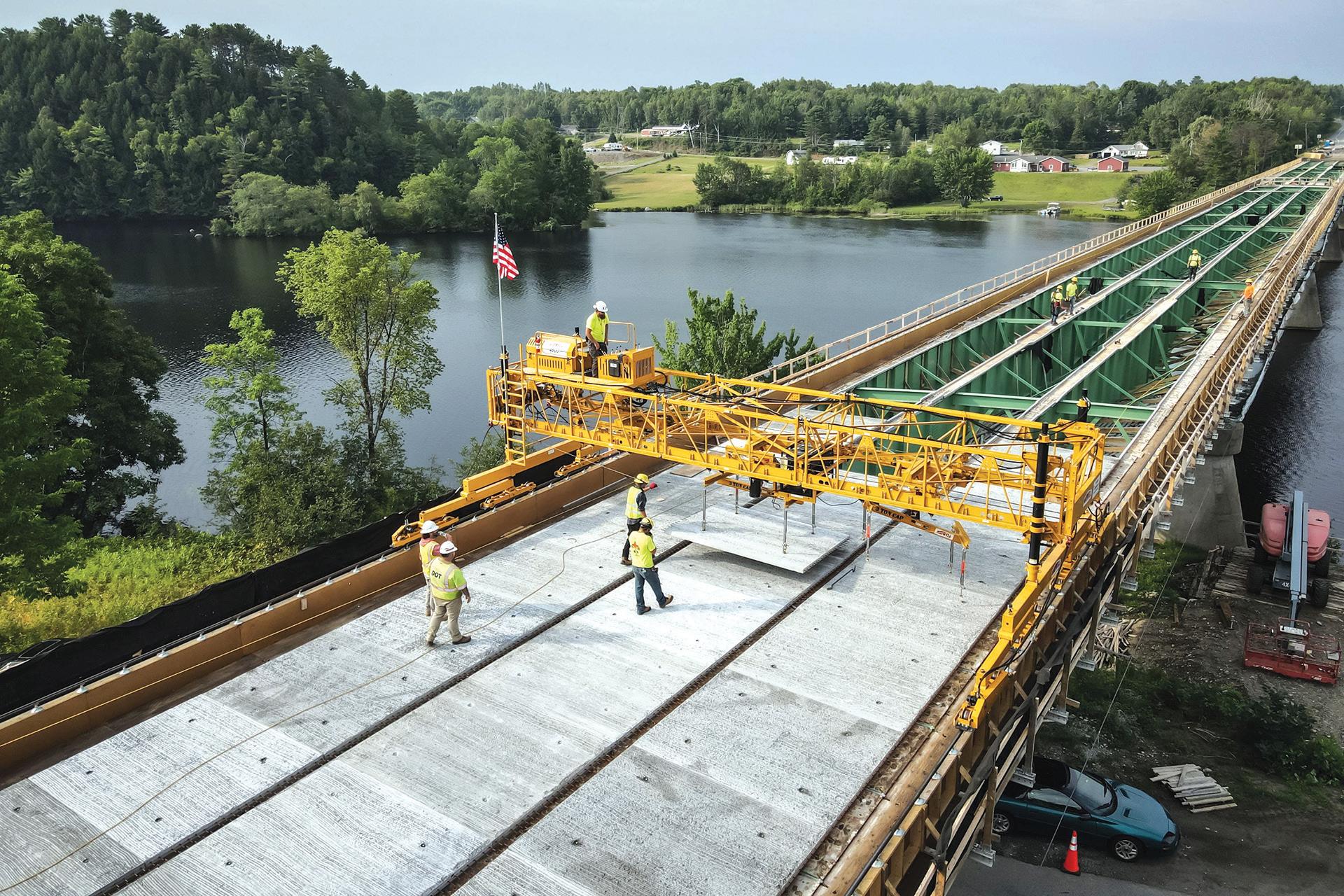
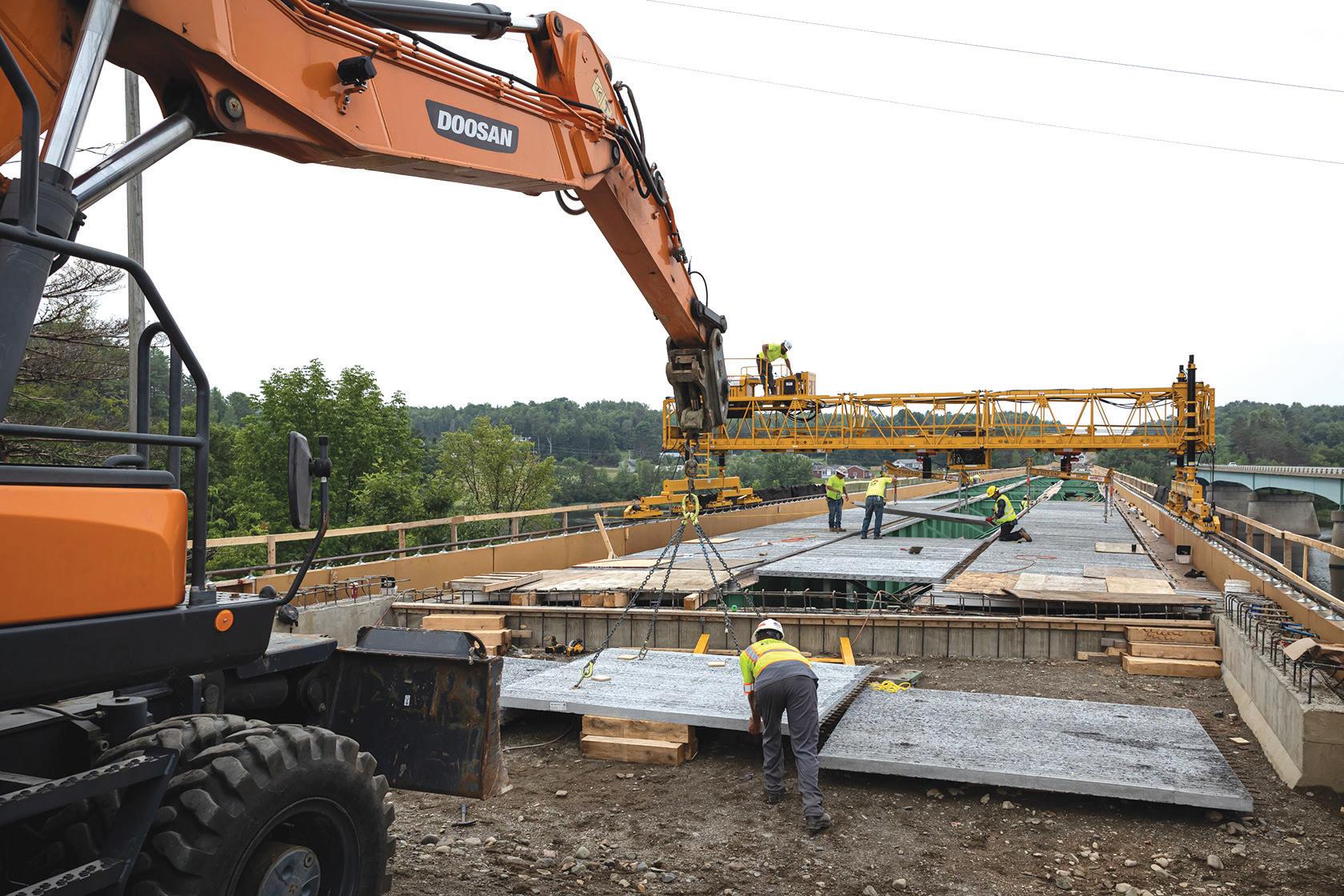
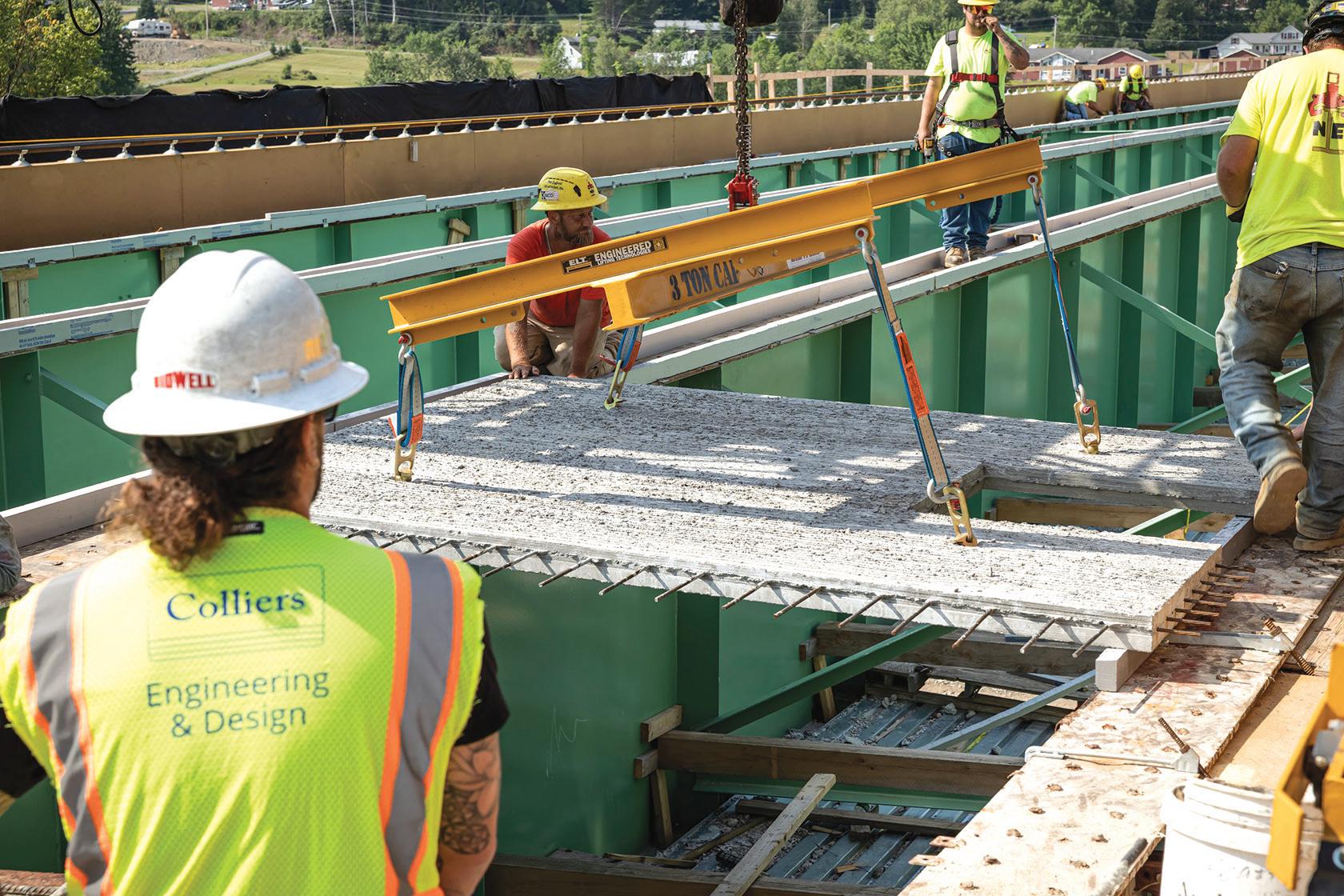
NEI and Bid-Well worked together to use a reimagined Bid-Well paver to be used as a gantry crane to place the roughly 3,500-lb. panels.
look overhead like you do with a crane.”
“As the flanges narrow, the panels get wider to maintain a 2-inch overlap,” said Rickson. “We had approximately 23 different panel types on this project.”
NEI’s MT-1 panel carrier was configured with three hoists to place up to three panels at a time. Being the first time using the machine, crews took care to ensure precise placement and crew safety. The machine backed up over the panels, in which a single panel was attached to each hoist. The panels were transported to location at a height of 12 in.
“The MT-1 is capable of 100-foot lifting heights with speeds reaching 21 feet per minute,” said Johns. “The system supports a maximum load of 15,000 pounds across three trollies and can span up to 120 feet with longer configurations available.”
One operating safety aspect stands out to Rickson.
“It’s hard for the crew to miss the panel carrier when it’s coming down the bridge,” he said. “Plus, you don’t have to
NEI’s team placed all deck panels in about three weeks, even with the first time using the machine. This solution helped to increase efficiency over the potentially more expensive barge-crane option.
“With the expense, we never really did a true comparison of one method to the other,” said Barczak. “Our consideration focused on the worth of having a second Bid-Well in our fleet. Based on the performance of the MT-1, it was worth it to order a paving carriage for the machine to have a complete single unit.”
Labor Savings in Manchester
Cast-in-place construction for the Amoskeag Bridge required significantly more rebar than in Medway. NEI moved its Bid-Well MT-1 to Manchester, N.H., and converted it to the MT-2 configuration for rebar placement required for the 645 ft. of bridge deck over the river.
“With deck panels, you are only doing one rebar mat,
Mullins. “Less rebar is brought on the bridge, and there’s less to tie, so you can stage it in advance. Here we have two layers and a little over 100 tons of rebar that had to be installed on the deck.”
NEI’s contract with its subcontractor, WWR Placement LLC of Lafayette, La., requires the rebar to be placed within 50 ft. of where it’s to be installed. Without the MT-2, Mullins estimated five to six guys for roughly four weeks to place the rebar.
“With workers carrying rebar, you have to split up every bundle, as they can only carry four or five pieces at a time,” Mullins said. “This opens up the chance of mislabeling it and putting it in the wrong place.”
In its rebar carrier configuration, “You just drop out the trollies and have the hydraulic ram to raise and lower a pivot bar that swivels 360 degrees to place the full bundle,” said Johns.
“You just flip the switch, the hydraulic ram comes down, you strap up the bundle and hit the switch again to lift the bundle,” said Mullins.
The machine can lift and place up to 6,000-lb. rebar bundles.
The flexibility provided by NEI’s new rebar carrier opened the schedules of the crew that would have been dedicated to rebar placement.
“With the rebar carrier, we spent about an hour a day with two guys moving a handful of bundles that kept the ironworkers going for a few days,” said Mullins. “Everyone was impressed with it. All around, it was a home run.”
In the end, it was Barczak that paid the ultimate compliment to the new Bid-Well innovation.
“I jokingly told the Bid-Well sales reps, ‘You know. It’s kind of boring. It does exactly what it’s supposed to do.’” And that’s saving time, money and labor for NEI.
(Article reprinted with permission from NEI and BidWell.)
Bid-Well photo
NEI used precast concrete panels for the 1,050-ft.-long I-95 Vaughan Daggett Memorial Bridge over the Penobscot River in Medway, Maine.
Bid-Well photo
N.H. Bill May Help Bridge Housing-Infrastructure Barrier
A New Hampshire bill that addresses one of the biggest barriers to developing housing went through a Senate Commerce Committee public hearing on March 31, 2026.
HB 1588, which would allow cities and towns to create special assessment districts to help build public infrastructure to support housing, was referred to the New Hampshire Senate’s Housing Committee after the hearing.
According to Ink Link, The special assessment districts would “finance public infrastructure improvements necessary for new development, including sidewalks, roads, utility extensions and water mains,” for development that’s in the approval process.
A two-thirds vote of the governing body would be required to establish the district.
“One of the biggest barriers to housing and development is not always the private project itself, it’s the cost to the public infrastructure needed to support it,” State Rep. Joe Alexander told the committee.
He said that creation of the districts would allow municipalities to expand infrastructure, with the benefiting developers bearing the cost.
“It’s a practical local option,” he said. “A fair, targeted way to finance improvements.”
Alexander introduced the bill for sponsor State Rep. Joe Sweeney, who couldn’t attend the hearing. The House passed the bill by voice vote on March 11, according to Ink Link.
Nick Taylor of Housing Action NH told the committee that his organization supports the bill.
“Infrastructure challenges are a real and big barrier to building more housing,” Taylor said. “[Housing Action] is all for putting more tools in the toolbox for municipalities.”
Taylor said that the New Hampshire
Zoning Atlas team found that only 5.6 percent of the state’s buildable land has adequate water and sewer infrastructure to support housing development, while only 12 percent has one or the other.
HB 1588 requires that assessments be levied only “against properties that receive a direct and ascertainable benefit from the improvements.”
The municipality will determine the apportionment method, which may include frontage, lot size, assessed value, number of units or other metrics.
Municipalities would be able to issue bonds for up to 20 years to finance improvements within the district. Those would be repaid from assessments levied under the new law, according to Ink Link.
“This is not a state mandate, not a tax increase, not a blank check,” Alexander
project that’s going to go forward.”
He also said it’s different from a tax increment funding (TIF) district.
“A TIF captures future growth,” Alexander said. “[HB 1588] makes growth possible in the first place.”
Taylor said his only concern is that municipalities don’t get the new special assessment district law confused with a similar one initiated by property owners.
HB 1588 is municipality-driven, to be used to support developers who are creating housing.
Taylor said legislators should “make sure the two chapters work together, so municipalities aren’t confused” about which one to use.
The bill calls for the New Hampshire Department of Business and Economic
Affairs to expand its housing infrastructure municipal grant program to allow for water, sewer and road upgrades for new housing units. It appropriates $1 for the fiscal year ending June 30, 2027, to establish the fund. The grant money helps municipalities pay administrative costs arising from establishing the districts.
The bill would take up some of the slack left by the unfunded Housing Champions program which, in the prior fiscal year, awarded $5 million in grants to cities and towns that had done the work to incentivize housing development.
$3.5 million of that money was awarded to eight municipalities that prioritized infrastructure upgrades and met certain metrics that made 2,280 more housing units possible, according to the program’s annual report.
Saraceni Joins Superior as Components Territory Mgr.
Superior Industries Inc., welcomes Joe Saraceni as territory sales manager for conveyor components in the Northeast United States.
He’ll promote, sell and support Superior’s conveyor idlers, pulleys, belt scrapers, load zone solutions and other accessories throughout New England to the Mid-Atlantic.
“Joe brings a strong sales background and a relentless work ethic,” said John Garrison, Superior’s vice president of sales and marketing. “He knows how to build strong relationships and is passionate about helping customers succeed.”
Since joining the company, Saraceni has focused on visiting customers, getting to know Superior’s distributors and working alongside team members in the field.
“I was drawn to Superior by
In his role, Saraceni will support Superior’s conveyor components distribution network, working alongside them to support dry bulk operations in industries like aggregates, energy, organics and other industrial minerals.
the people and the unique level of support behind the products,” said Saraceni. “You can find similar products in the market, but the difference is how a company stands behind it and that’s what I want to deliver to customers every day.”
Saraceni lives in upstate New York with his hard-working and professionally-accomplished wife, Teresa. They have two children and enjoy spending time on the water and in the outdoors.
For more information, visit superior-ind.com.
Shutterstock photo
HB 1588 would allow cities and towns to create special assessment districts to help build public infrastructure to support housing.
The “Teaticket Acapesket Sewer Area” (TASA) project — and expansion of the sewer network and renovation of the municipal wastewater treatment plant — in Falmouth, Mass., in wrapped up in April 2026.
Penetron Admix SB, a crystalline waterproofing admixture, was specified to protect the new concrete structures from exposure to effluent and optimize the service life of the upgraded treatment plant.
Falmouth is a coastal town of approximately 33,000 on the southwestern end of Cape Cod in Massachusetts. It’s known for its beaches, such as Falmouth Heights, across from the island of Martha’s Vineyard and the village of Woods Hole, home to several scientific organizations such as the Woods Hole Oceanographic Institution (WHOI), the Marine Biological Laboratory (MBL), the Woodwell Climate Research Center and NOAA’s Woods Hole Science Aquarium.
Falmouth’ $26.2 million “Teaticket Acapesket Sewer Area” (TASA) project connected 1,292 parcels in the Great Pond watershed and 500 parcels in the Green Pond watershed to the municipality’s wastewater treatment plant. However, before the expansion into the neighborhoods
around Great Pond could begin, the existing wastewater treatment facility (1.2 million gal. per day / MGD) in Falmouth needed to be renovated and upgraded.
“The TASA project, along with similar efforts in other Cape Cod towns, is part of a large-scale upgrade of sewage systems across the peninsula,” said Richard Farmer, eastern region sales manager of Penetron USA. “Great Pond is one of the more polluted estuaries in Falmouth, which was chosen due to the large amount of nitrogen that needs to be removed to meet state requirements and restore the estuary.”
The renovations and improvements to the wastewater treatment plant included an additional third sequencing batch reactor, replacing the plant’s sludge-thickening technology, adding more influent and sludge storage capacity and replacing the ultraviolet disinfection system, the final step in the treatment process, as well as constructing new tanks and expanding buildings.
Farmer.
Penetron Admix SB was added to almost 2,000 cu. yds. of concrete mix for the treatment tanks.
Penetron Admix SB-treated concrete is impermeable, preventing water, effluent and chemicals from penetrating into the concrete, even under the constant exposure and hydrostatic pressure encountered in a wastewater treatment plant, according to Penetron. The treated concrete is able to permanently self-heal microcracks, preventing any moisture and corrosion related damage from occurring over the service life of the concrete.
“There was a competitive bid on the
table for the TASA project, but thanks to the performance of Penetron concrete waterproofing products in similar projects, and our close relationship with Cape Cod Ready Mix, the ready-mix concrete supplier, our crystalline admixture was chosen,” said
The Penetron Group is a manufacturer of specialty construction products for concrete waterproofing, concrete repairs and floor preparation systems. The group operates through a global network, offering support to the design and construction community through its regional offices, representatives and distribution channels.
For more information, visit penetron.com.
Putnam Bridge Rehabilitation Set for 2028 Completion
BRIDGE from page 1
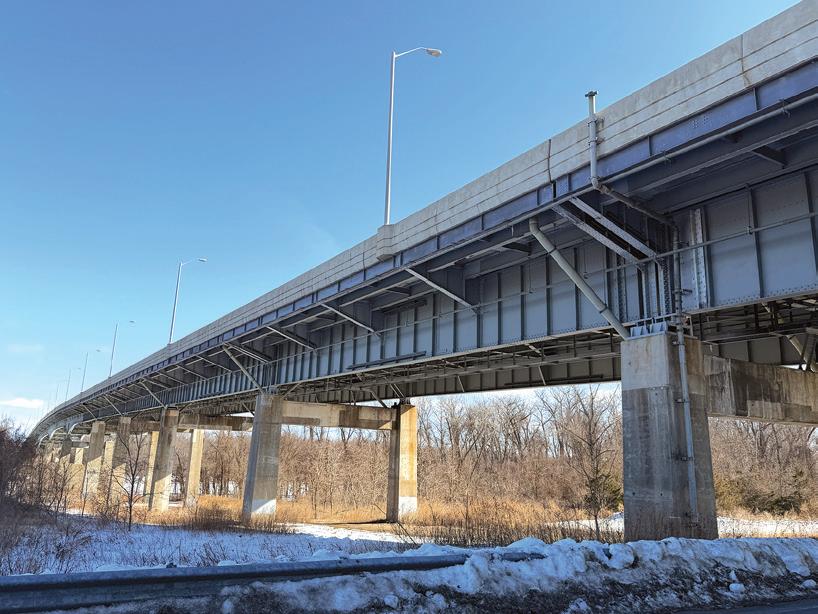
strengthening and bracing of the existing structural steel,” said CTDOT. “The project will also include deck patching and new wearing surface installation, drainage repairs, inspection catwalk removal, substructure concrete repairs and full painting of the bridge.”
The cost of the project is $48 million, which will be paid by 80 percent federal funds and 20 percent state funds.
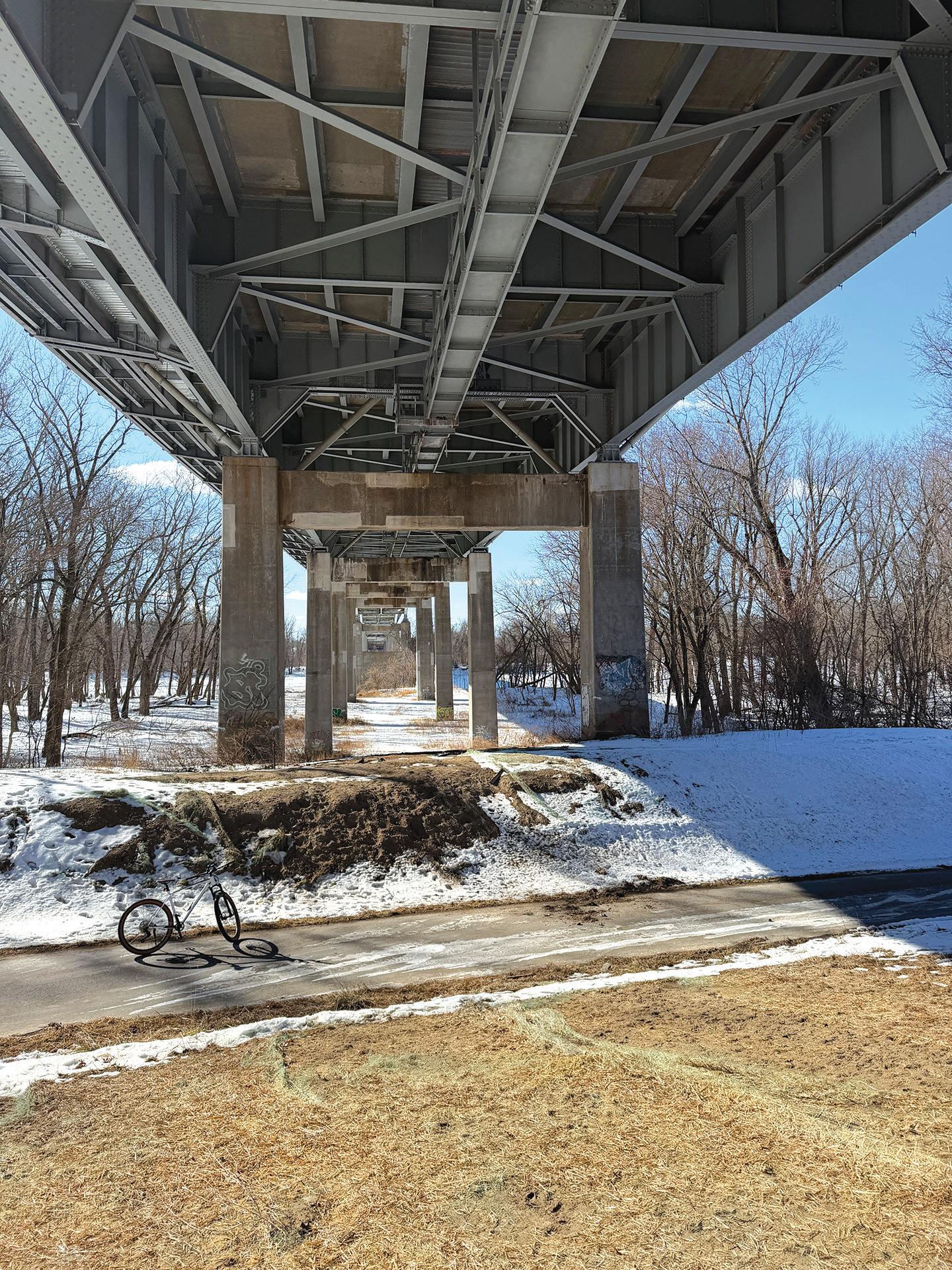
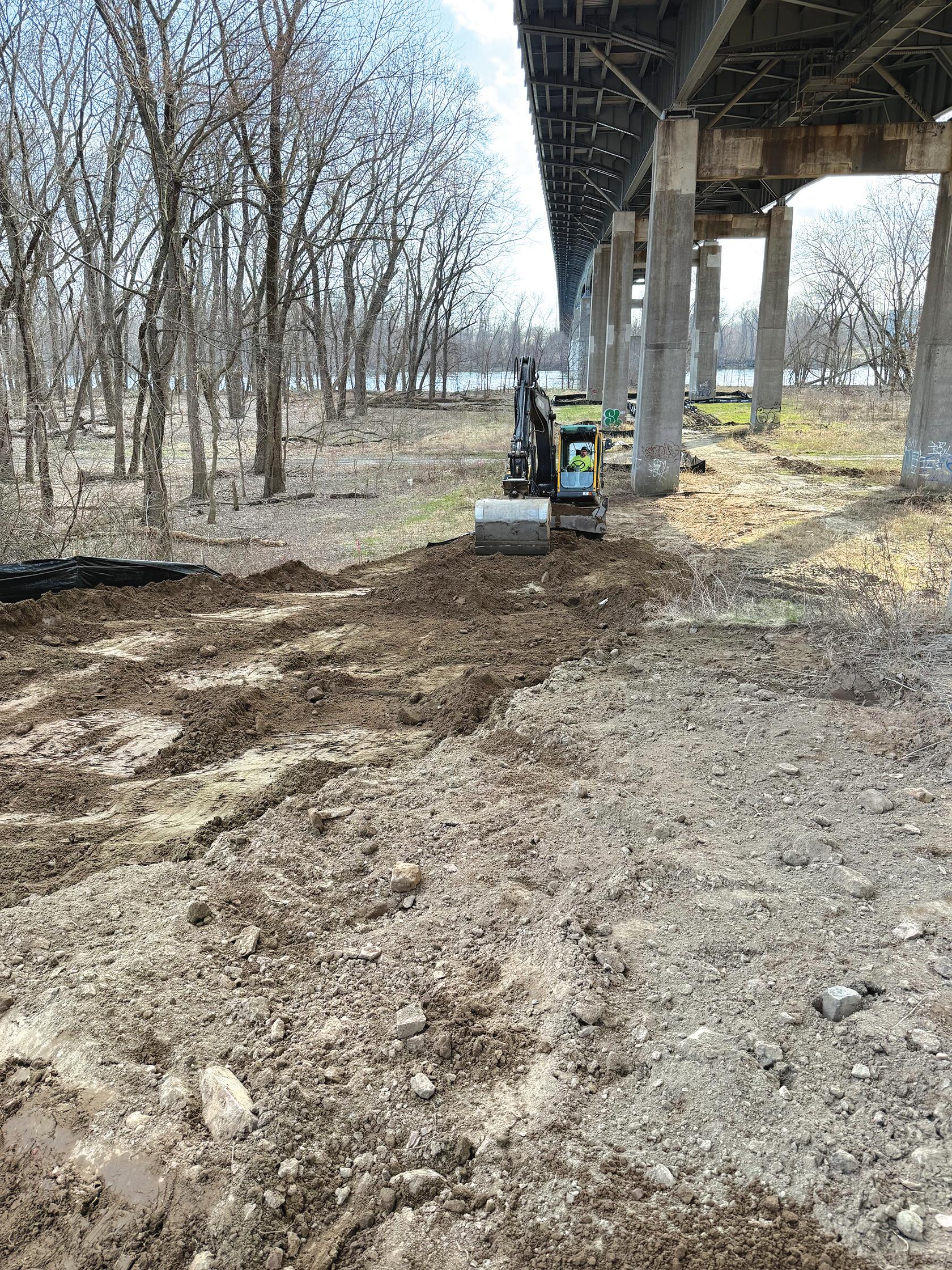
“We just started in the middle of March,” said Ryan Hawkins, ROTHA Contracting project manager. “We have constructed access roads on the east and west approaches under the bridge. We have also prepped some staging areas adjacent to the bridge. We installed E&S control, construction signs. We also installed VMS signs to post the bridge for a 20-ton weight limit during construction. Our painting subcontractor started mobilizing this week and will start installing safe span platforms starting next week.”
ing, deck patching, scupper replacement, joint repairs and PPC overlay,” said Hawkins. “Basically, year one is mostly underside steel repairs, then year two and three will be both underside repairs and deck patching.”
Over the next couple of months ROTHA’s painting subcontractor will install safe span platforms under the entire
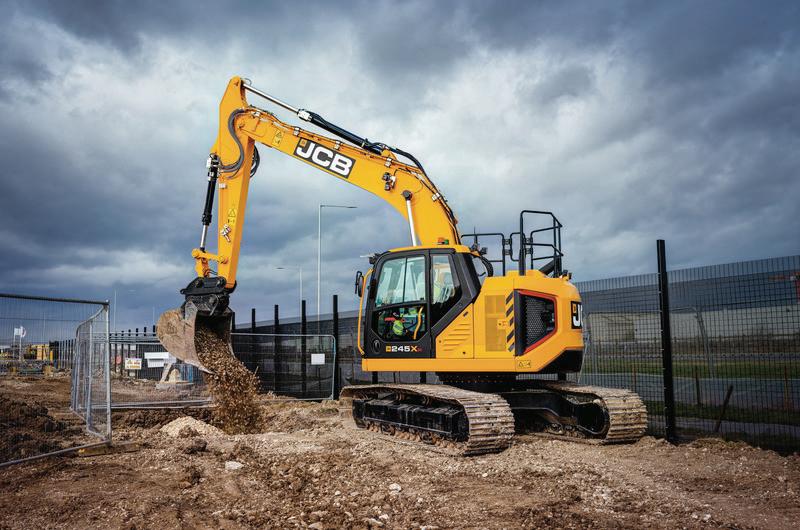
The construction equipment used for the project includes a Volvo EW160 excavator and a Volvo L60H loader, a JCB articulated truck, a Dynapac CA2500 roller, JLG 860SJ and 660SJ manlifts, a Zim mixer for deck patching and the bridge deck will be overlaid with a PPC (polyester polymer concrete) overload.
(All photos courtesy of CTDOT.)
Penetron Group photo
Skanska Promotes Mark Lootz to Vice President — Account Manager
Skanska announced the promo tion of Mark Lootz to vice president — account manager.
Within this new role, Lootz will be responsible for managing and advancing the growth of Skanska New England’s operations across the commercial, education, healthcare and sports and recreation markets, including sourcing and securing new projects while overseeing the suc cessful execution of work currently under way.
“Mark’s leadership, deep tech nical expertise and collaborative approach have made him a trusted partner to both our clients and project teams,” said Bryan Northrop, execu tive vice president — general manag er of Skanska USA Building. “Over the past 13 years, he has successfully delivered some of our region’s most complex projects, while mentoring the next generation of talent within the firm. We look forward to see ing him continue strengthening our firm’s presence in New England in
including Watermark, Two Drydock, the Brigham and Women’s Hospital Emergency Department and the Simmons University Living Learning Center. He also leads the firm’s special projects group, overseeing complex and fast-paced work across the
In addition to project leadership, Mark has played an active role in strengthening Skanska’s internal development initiatives, serving on the higher education national advisory council and contributing to the company’s core competency training program for employees entering the
Lootz also helped establish the local training committee that supports ongoing technical development across the office. With more than four decades of experience in the construction industry, Lootz brings deep technical expertise and steady leader-
For more information, visit skanska.com/.
Skanska photo Mark Lootz
www.equipmenteast.com
61 Silva Lane
Dracut, MA 01826
978-454-3320
196 Manley Street Brockton, MA 02301
508-484-5567
1474 Route 3A
Bow, NH 03304
603-410-5540
30 Birch Island Road Webster, MA 01570
508-949-0005
7 Harry’s Way Webster, MA 01570
508-949-0005
72 Olde Canal Way Gorham, ME 04038
508-949-0005
1608 John Fitch Blvd
South Windsor, CT 06074
860-288-4600 Rhode Island
508-949-0005
NEW ENGLAND SUPPLEMENT ADVERTISER INDEX
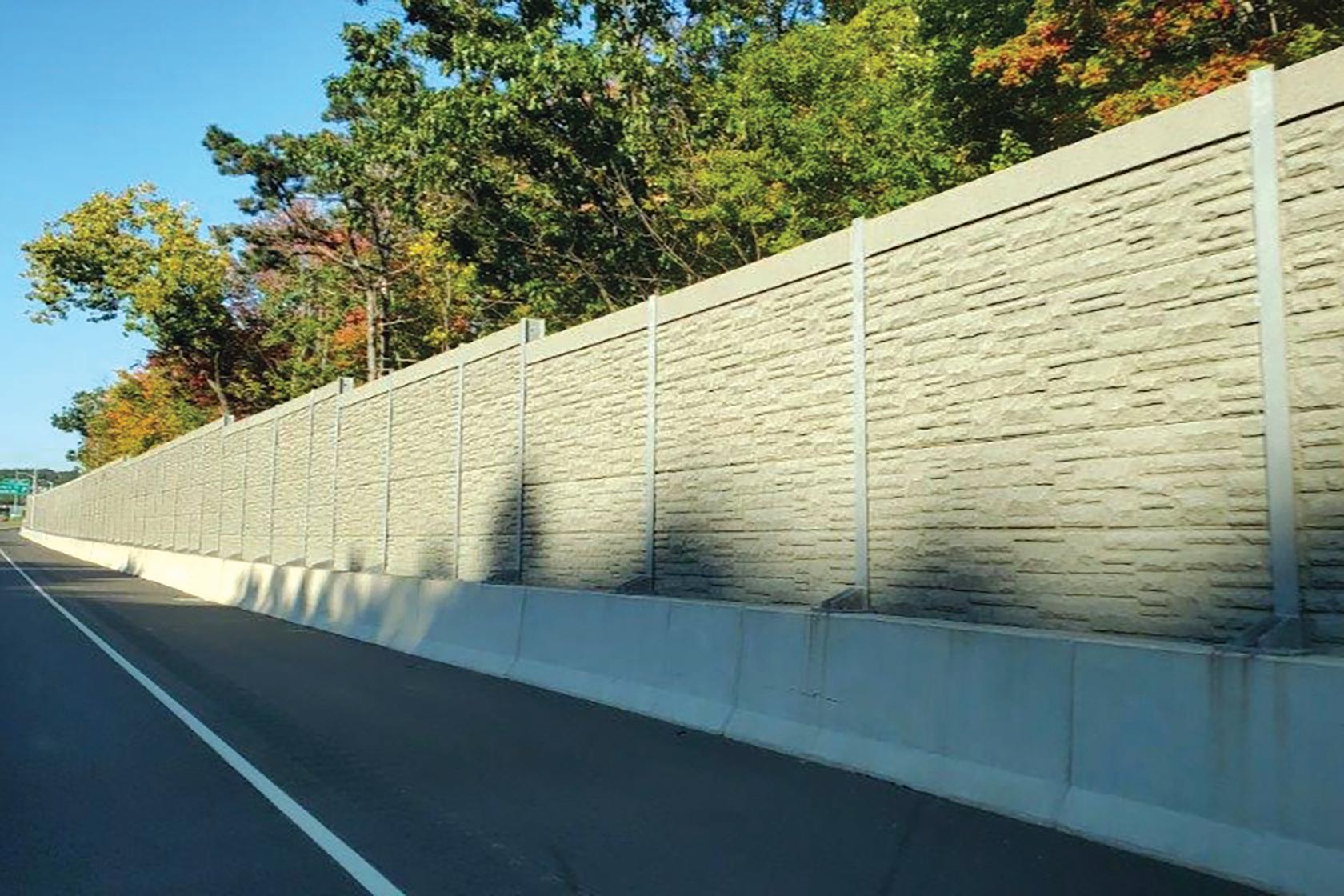
CTDOT Set to Replace Noise Barriers On I-84 Westbound
The Connecticut Department of Transportation (CTDOT) is developing plans to replace deteriorated noise barriers along their current alignments on I-84 westbound, in East Hartford.
The project involves replacement of the existing poor condition noise barriers due to significant deterioration resulting from weathering and rot, creating missing panels and compromised structural integrity at the location below.
Site 1 — Beginning at Interchange 56 (Governor Street) Westbound off-ramp and extending approximately 1,000 ft. to the east.
Site 2 — Beginning just east of the Forbes Street overpass (Bridge No. 05556) and extending approximately 5,500 ft.
The project is part of CTDOT’s conditionbased program to replace wooden noise barriers that are beyond their useful life.
The existing systems will be replaced with a new system at the same location with the same length and height. Since wooden noise barriers are no longer being installed because of their shorter design life and more extensive maintenance needs, the replacement noise barrier will be constructed of concrete or other materials that are more durable and longer lasting. The replacement noise barrier will provide noise abatement in conformance with the criteria in place when the existing system was installed.
The present schedule indicates that the design will be completed in the fall of 2028, with construction anticipated to start in the spring of 2029, assuming acceptance of the project, availability of funding, and receipt of any required right-of-way and environmental permits. This project will be undertaken with 100 percent (100 percent) state funds.