Legacy Infrastructure Leads West Interchange Project
WEST from page 1
“Though still very early in the project, the interchange and roadways look much different from every approach,” Georgia DOT deputy project manager Binita Patel told Construction Equipment Guide. “Feedback is encouraging from stakeholders and a community that’s excited to see these upgrades. This is a dynamic project, with a lot of prominent features that will define the skyline in the area.”
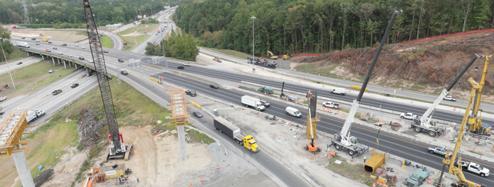
Construction is taking place in both Fulton and Cobb counties. Plans include reconstructing and widening several interstate system-to-system ramps at the I-285/I-20 interchange and adding a combination of CD/connecting lanes and auxiliary lanes along I-20 west and I-285 north of the interchange. Ongoing construction will improve traffic conditions within the I-285/I-20 West Interchange and along I20, from Factory Shoals Road to Hamilton E. Holmes Drive.
Work includes the removal of left-hand, ramp entrance and exits, improvements to horizontal and vertical alignments and construction of two-lane ramps within the interchange. Crews will build a westbound collector-distributor system, or connecting lanes, from the I-285/I-20 West Interchange to Fulton Industrial Boulevard.
Construction includes additional lanes along I-20 from Factory Shoals Road east to Hamilton E. Holmes Drive and along I-285 from MLK Jr. Drive north to Donald Lee Hollowell Parkway to accommodate interchange improvements. Crews will modify or replace bridges within the interchange and along I-20 and I-285.
Project benefits include safer ramp access, improved ramp design and new two-lane ramps that will provide more space for trucks to maintain steady speeds and reduce merging conflicts. Overall changes lessen crash risk by improving sight distance, eliminating sharp turns and offering clearer decision points for drivers.
Work began in April 2025. Legacy Infrastructure Contractors was awarded the contract to complete final design and construction, allowing this Public Private Partnership (P3) to move forward. Legacy Infrastructure Contractors LLC consists of C.W. Matthews Contracting Co. Inc. as the lead construction contractor and Infrastructure Consulting and Engineering LLC as lead engineering firm.
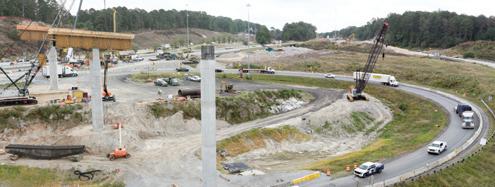
When asked by Construction Equipment Guide about recent activity at the job site, Georgia DOT P3 communications program manager Kyle Collins said, “Currently, heavy construction is under way to clear and grade portions of the project, install erosion control devices and construct bridge foundations and substructure for the major ramp bridges within the interchange. Other construction activities mainly consist of construction of temporary and permanent pavement, temporary shoring and construction of detention ponds and new drainage facilities.”
Work on I-20 westbound to I-285 southbound, I-285 northbound to I-20 westbound, I-20 over I-285, and I-285 southbound to I-20 eastbound bridges has commenced with substructure, superstructure and beam setting in variance stages of completeness.
The project calls for six bridge widenings; one deck replacement and widening; two complete bridge replacements; and a total of nine new structures.
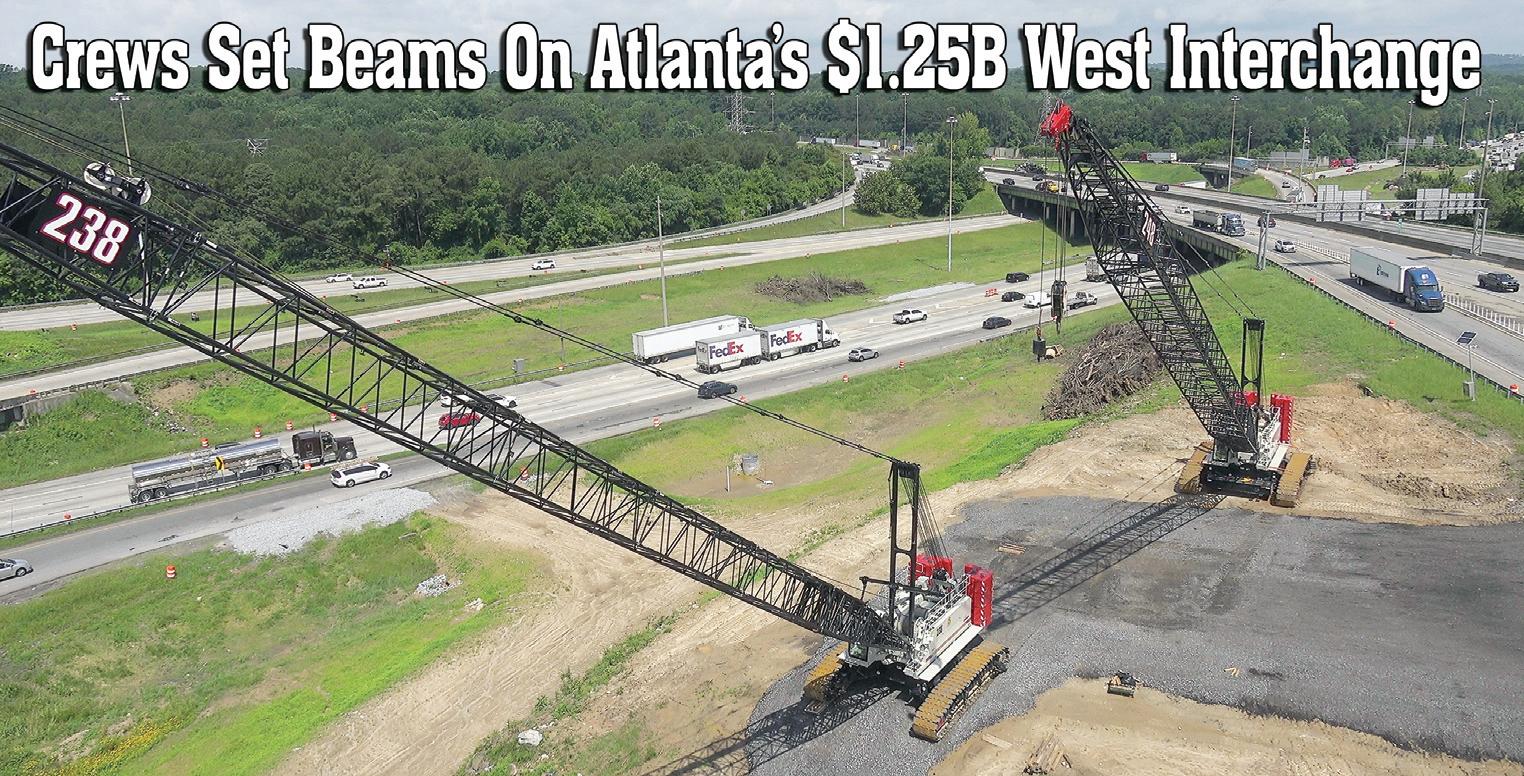
In late February, the first bridge beams were delivered and installed on the future I-20 westbound to I-285 southbound flyover ramp. Beam setting marks a major milestone, transforming completed foundations and bents into a recognizable bridge structure and signaling the shift toward deck construction.
Work is going as planned on the 2,700-ft. flyover ramp
The $1.25 billion I-285/I-20 West Interchange project will benefit the entire metro Atlanta region when it’s completed in 2030.
from I-20 westbound to I-285 southbound.
“This will remain the primary focus, with the goal of opening this new ramp to traffic in mid–2027,” said Collins. “The flyover uses massive prestressed concrete bulb tee beams, measuring between 4.5-6 ft. high and 120-165 ft. in length, and more than 127,000 lbs. each. The flyover is half a mile, 44 feet wide, with two travel lanes and large shoulders and 80 beams.”
Collins said preparing the corridor for major bridge and roadway construction requires a great deal of coordination.
“Traffic shifts create space for work zones that accommodate not only the structures to be built, but also the space needed for equipment and personnel to safely operate behind protective barriers. Strategically located access points minimize conflict between construction vehicles and the traveling public.”
All lanes must remain open during peak travel times. Overnight and limited weekend lane closures are permissible to perform work that affects motorists. Coordination with Georgia DOT’s Traffic Management Center (TMC) and advance public notices are used to encourage drivers to find alternate routes.
Maintaining traffic flow and establishing safe work zone access has, in fact, been the greatest challenge. In most circumstances, the Georgia DOT project team designed all stage one construction work to occur outside active travel lanes. The design intentionally routed the proposed ramps through the existing open interchange fields, so that work could take place during all hours of the day without affecting traffic.
Collins explained that installing drilled shafts, spread footings and driven piles within the interchange involves building the deep foundation systems that transfer the bridge’s weight safely into the ground.
“Drilled shafts are constructed by drilling large vertical holes — sometimes more than 100 feet deep — into the soil or rock, placing steel reinforcement inside and filling them with concrete to form massive underground columns.
“These are used where strong support is needed at depth, especially in tight areas such as the Interstate 285 and Interstate 20 interchange, because they can carry heavy loads from tall flyover ramps and reach stable rock layers below weaker surface soils.”
Spread footings and driven piles are installed in different ground conditions. Spread footings are shallow, wide concrete bases built where solid bedrock lies close to the surface. They distribute the bridge column’s load across a broad area and are typically quicker and more economical to construct.
Driven piles are long, slender columns that are hammered deep into the ground using specialized equipment until they reach firm soil or rock, making them suitable where surface soils are loose and bedrock is very deep. Together, these
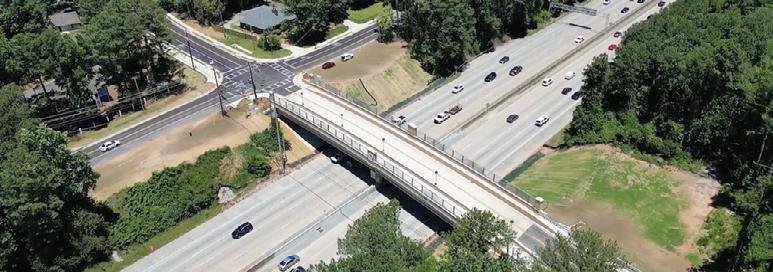
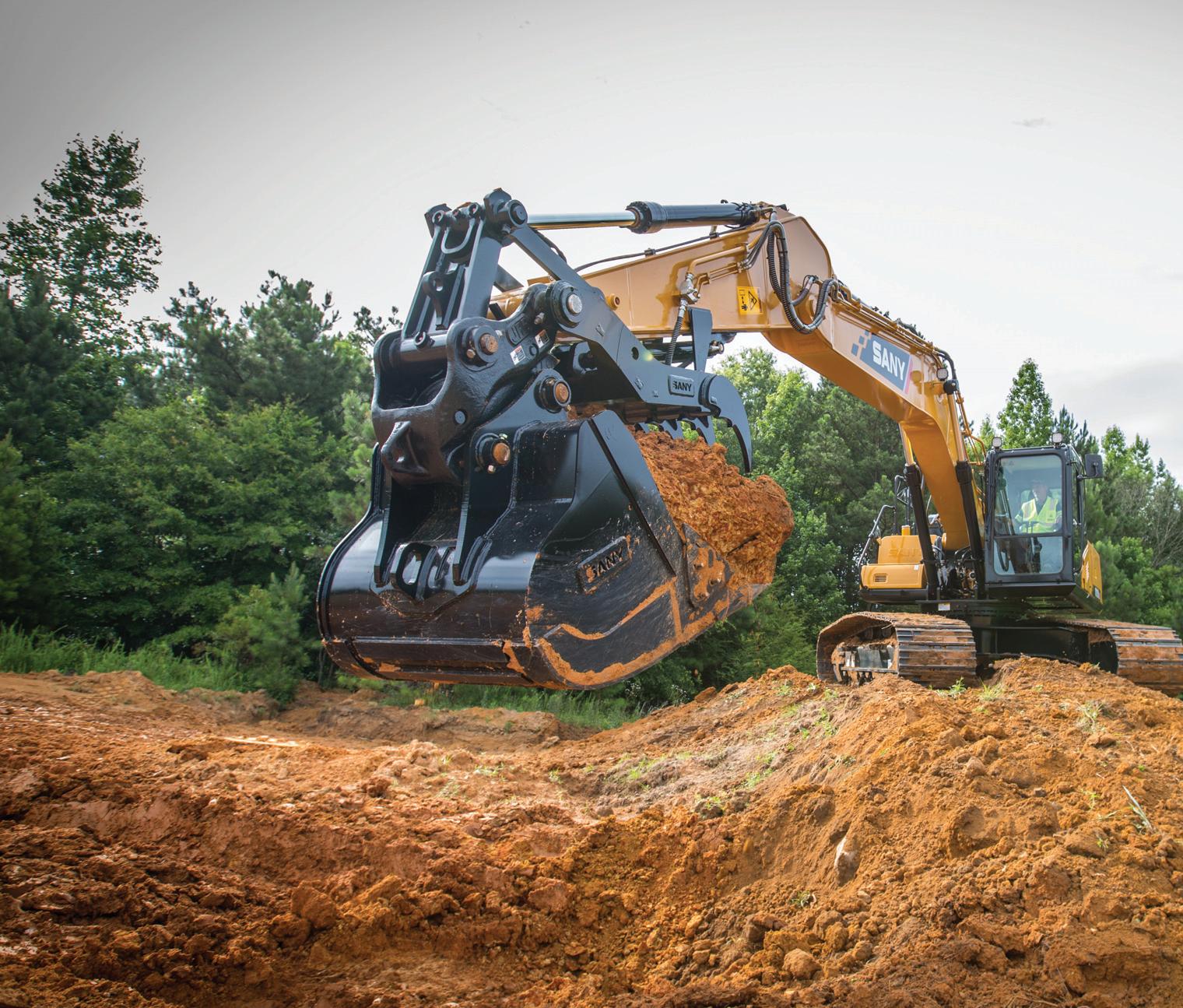
Georgia DOT photo Crawler cranes, excavators and mid-sized dozers/compactors are among the equipment being used during construction.
three foundation types ensure the bridge remains stable by matching the support method to the local soil conditions at each location of the project.
Collins said controlled blasting on the project began in mid-June 2025 to excavate rock for the new southbound Interstate 285 and eastbound Interstate 20 ramps at the I285/I-20 West Interchange.
“Blasting occurred intermittently during daylight hours under strict safety regulations. To protect drivers, crews implemented traffic pacing — a technique that temporarily slowed on I-285 northbound and southbound and I-20 eastbound and westbound within the project area. Motorists traveling through the interchange while blasting was under way experienced short delays.”
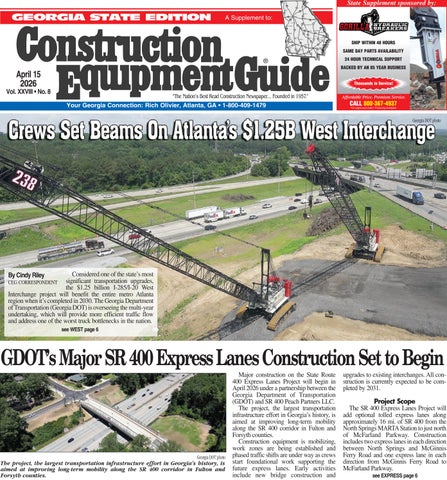
Crawler cranes, excavators and mid-sized dozers/compactors are among the equipment being used during construction. Main materials include pre-cast and cast-in-place concrete, asphalt and graded aggregate.
Patel said while crews are still in the early phases of construction, it’s been a privilege to see the new interchange advance and start to take shape.
“We have an incredible team of men and women putting safety and innovation first in their work to build a safer and more efficient travel experience for local and regional travel. We look forward to delivering a new interchange in a few short years and are lucky to be part of this monumental project.” CEG