

Irwin Rapoport
CEG CORRESPONDENT
Trinity Green LLC/Atlanta Demolition LLC expects to complete demolition of the former Wellstar Atlanta Medical Center campus by the end of 2026, bringing one of the largest demolition projects ever undertaken in downtown Atlanta to a close.
The company began work on the 2.5-million-sq.-ft. hospital complex in March 2025. The site, formerly known as Georgia Baptist, includes 11 buildings that served the community for more than 100 years before the hospital closed in November 2022 after Wellstar Health System announced the facility was operating at a multimillion-dollar loss.
Atlanta-based Integral Program Management is overseeing the project. Trinity Green/ Atlanta Demolition is serving as the prime contractor while FERMA Corp. of Newark, Calif., and Magoba LLC of Lilburn, Ga., are performing asbestos abatement and environmental remediation.
“We hold daily meetings every morning at 7 a.m. to coordinate the day’s activities,” said Barry Roberts, managing partner of Trinity Green. “Everyone is working well together.”
Demolition has cost approximately $18.5 million to date.
The property is slated for redevelopment. According to WSB-TV Atlanta, the approved concept plan includes townhomes, apartments, future health care offices, green space and improved connections to nearby streets, the Freedom Park Trail and the Atlanta Beltline. Following public concern over the loss of medical services, the city placed a temporary moratorium on redevelopment before approving the concept plan in September 2024.
see DEMOLITION page 6
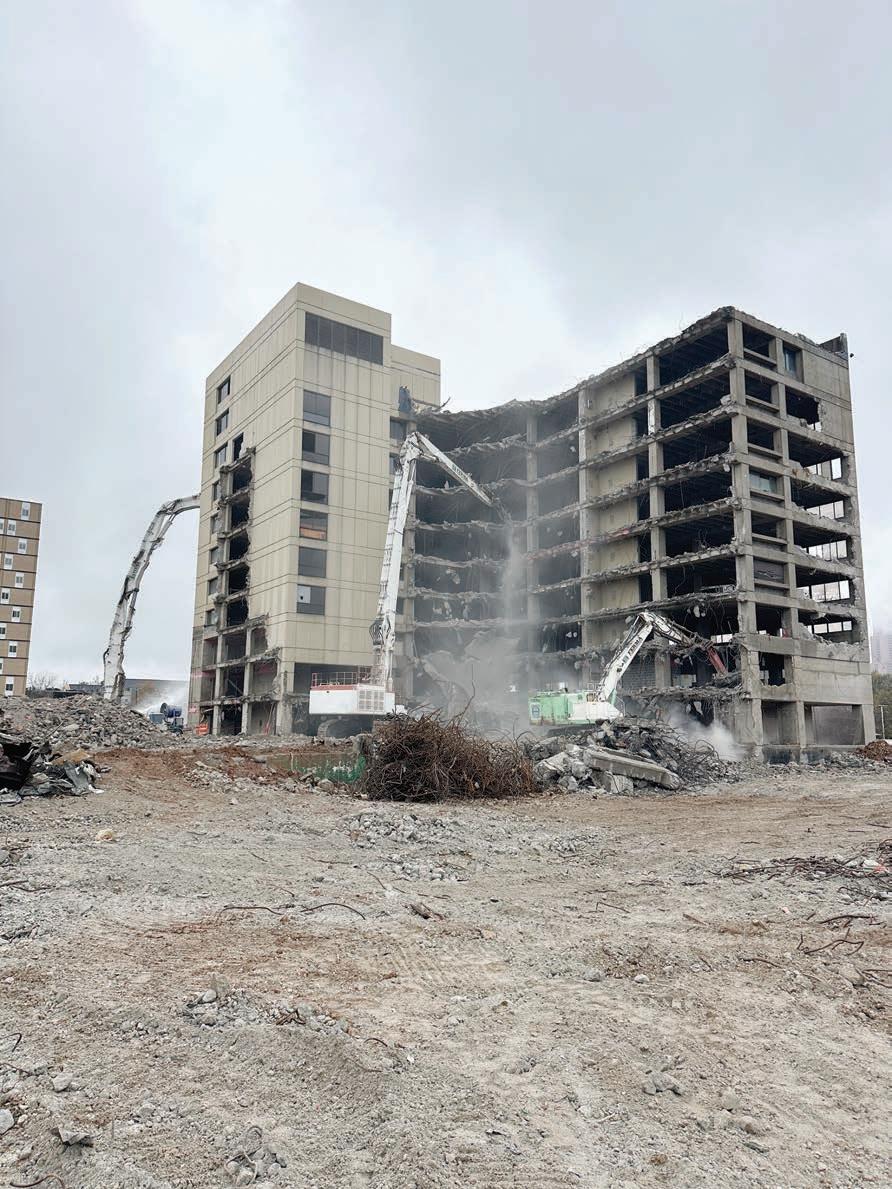
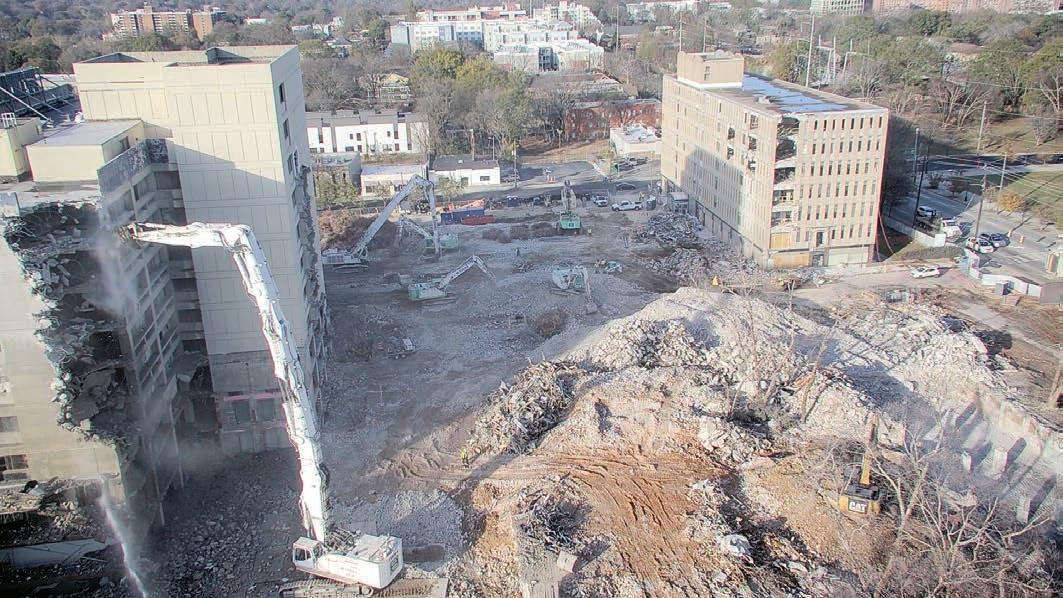
The demolition sequence begins with the high-reach excavator dismantling one side of a building while two or three support excavators sort debris and separate recyclable materials.
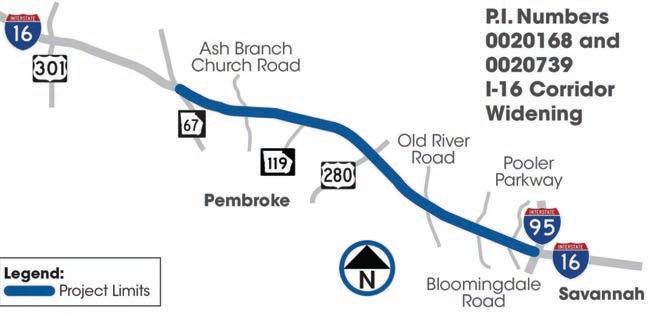
The Georgia Department of Transportation (Georgia DOT) announced Matthews-McLendon Joint Venture (MMJV)/Infrastructure Consulting & Engineering (ICE) LLC as the awarded successful proposer for the I-16 widening project from I-95 to SR 67, PI No. 0020739 at $468.35 million. As the largest design-build project in Georgia’s history, this transformative initiative represents a major investment in the state’s transportation future and underscores Georgia DOT’s commitment to delivering a safe, reliable and efficient transportation network.
Matthews-McClendon/ICE was announced as the apparent successful proposer with the highest buildable segment achieved of 17.77 mi. County.
Three qualified proposer teams were shortlisted in January 2026, and responsive proposals were submitted from two proposer teams which were opened on June 26, 2026, in a virtual bid opening event. This was only the Department’s third time using a Best Value procurement method with a


The Georgia Department of Transportation (Georgia DOT) has formally initiated the process of seeking a full National Environmental Policy Act or NEPA assignment program to take on additional environmental review responsibilities from the Federal Highway Administration through the Surface Transportation Project Delivery Program.
Once the NEPA assignment program is approved, Georgia DOT would become responsible for carrying out the NEPA and other federal environmental compliance reviews and all other applicable federal environmental laws for Georgia DOTadministered highway projects.
While Georgia DOT currently has limited NEPA review authority, the department said it “has taken great strides” to create opportunities for collaboration amongst its environmentally focused federal and state partners.
For example, in 2019, the department established the Interagency Office of Environmental Quality to strengthen coordination between agencies involved in environmental review and permitting, including partners responsible for wildlife, water resources, historic preservation, and environmental protection.
“The creation of the Interagency Office of Environmental Quality was a natural step toward pursuing NEPA assignment,” said Amber Phillips, Georgia’s state environmental administrator, in a statement.
“By strengthening coordination with our federal and state partners, developing transparent processes and fostering collaboration, we entered the application process with a strong foundation already in
while handling transportation needs with the protection of Georgia’s environmental and cultural resources for the communities we serve,” she said.
Georgia DOT noted that there are currently nine states that have full NEPA assignment programs with FHWA – Alaska, Arizona, California, Florida, Maine, Nebraska, Ohio, Texas and Utah — and the agency said those states have reported “significant benefits” from gaining broader NEPA authority,
including faster project delivery and cost savings.
“We’re pursuing NEPA assignment to reduce project delays, improve communication and provide more reliable project schedules,” said Phillips, adding that the agency also plans to use it as an “opportunity to learn from states that have already implemented the program through peer exchanges has been extremely beneficial in strengthening Georgia DOT’s application and preparing us for these additional responsibilities.”
Other state departments of transportation are also seeking to assume more NEPArelated duties. For example, the South Carolina Department of Transportation recently took its first step in pursuit of broader NEPA assignment duties, courtesy of the SCDOT Modernization Act passed by the state’s general assembly and signed by Gov. Henry McMaster — legislation that went into effect on July 1.
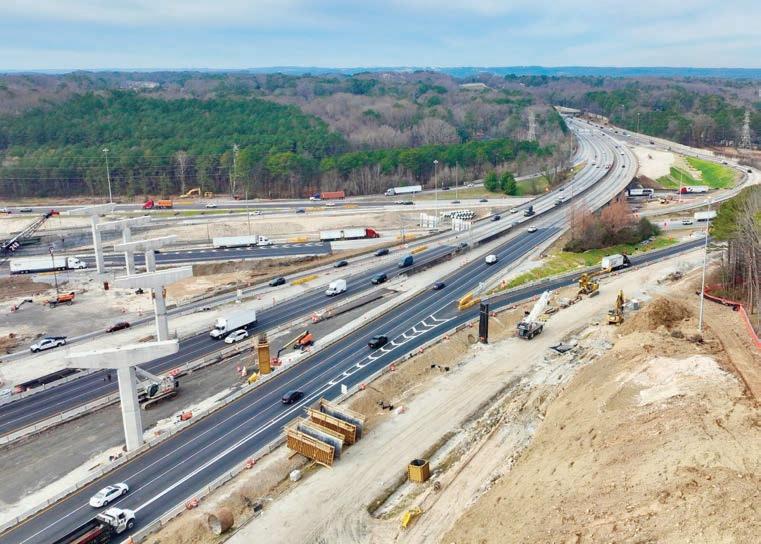
Georgia DOT photo The Georgia Department of Transportation (Georgia DOT) has formally initiated the process of seeking a full National Environmental Policy Act or NEPA assignment program.
A letter sent to FHWA by Justin Powell, SCDOT secretary, began the process of certifying SCDOT to assume FHWA’s environmental review responsibilities — and the agency anticipates a 12-to-18-month process to complete NEPA assignment certification.
North Georgia Technical College officials, community leaders, members of the Thomas T. and Bernice F. Irvin family and college supporters gathered June 16, 2026, to celebrate the groundbreaking of the new Irvin Agriculture Event Center, a project made possible through a $900,000 gift from the Thomas T. and Bernice F. Irvin Foundation.
The new event center will be located off Tech School Road on North Georgia Technical College’s Clarkesville campus and will serve as an important addition to the college’s Agriscience Complex. The facility will provide expanded opportunities for agricultural education, student activities, industry partnerships, and community events.
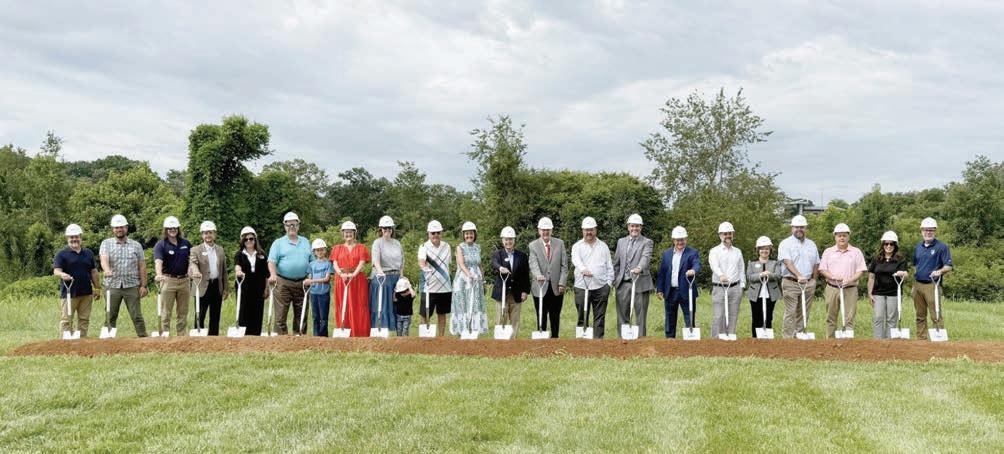
possible through a $900,000 gift from the
The center honors the legacy of Thomas T. “Tommy” Irvin, who served as Georgia’s Commissioner of Agriculture for more than four decades and was widely recognized as a champion for Georgia agriculture and rural communities. The new facility also will serve as a museum of many of the Commissioner’s memorabilia while he was in office.
“We are incredibly proud to help create a lasting tribute to our grandfather through the construction of the Irvin Agriculture Event Center,” said Chris Irvin, grandson of Tommy and Bernice Irvin and representative of the Thomas T. and Bernice F. Irvin Foundation. “My grandfather dedicated his life to supporting agriculture and the people who make it possible. It is especially meaningful that this facility will help educate and inspire future generations
of agricultural leaders while preserving his legacy for years to come.”
North Georgia Technical College President John Wilkinson said the facility will significantly enhance educational opportunities for students enrolled in agricultural programs.
“This event center represents an investment in the future of agriculture in Northeast Georgia,” Wilkinson said. “Our students will benefit from this dedicated space that supports the continued growth of our Agriscience programs. We are deeply grateful to the Thomas T. and Bernice F. Irvin Foundation and the Irvin family for their generosity and commitment to agricultural education.”
The Irvin Agriculture Event Center will complement the college’s existing Agriscience Complex and strengthen NGTC’s ability to prepare students for careers in agriculture, agribusiness, and related industries.
Construction is began following the groundbreaking ceremony.




well as in exterior structural coatings, requiring extensive environmental remediation before demolition could begin.
“The abatement work was extensive,” Roberts said. “We put the interiors under negative-pressure containments, and for the exteriors we used hydrojet technology to remove the paint and other materials.”
Air quality was monitored daily throughout the project. Roberts said One Consulting Group served as an independent environmental consultant to monitor work practices and ensure compliance with regulatory requirements.
Environmental crews worked 10-hour shifts Monday through Friday, with occasional Saturdays to meet project milestones. Workers wore full personal protective equipment throughout the abatement process.
“Once the abatement was complete, we cleaned out each structure,” Roberts said. “All the windows were removed during the interior gutting, and every building was stripped down to its shell.”
Atlanta Demolition also coordinated utility disconnects with the city and local utility providers before demolition began.
“One of the reasons we were selected was because of our reputation for coordinating with the city and the community,” Roberts said. “This has been a well-received project.”
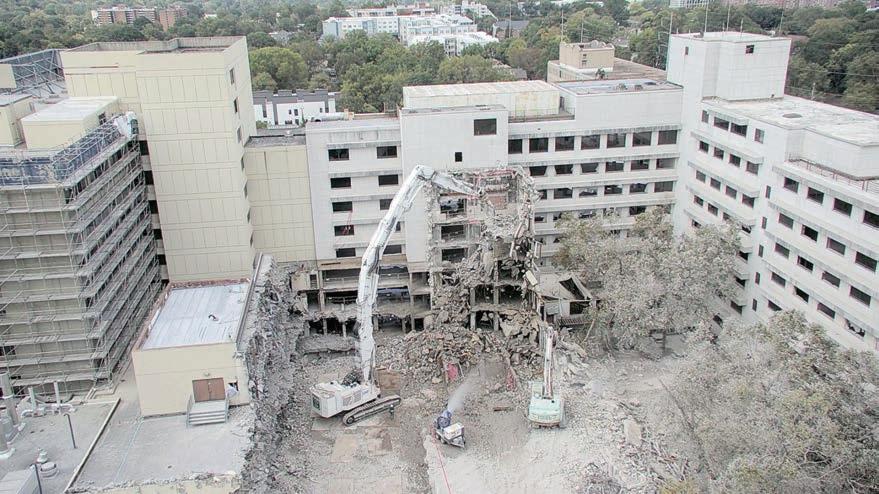
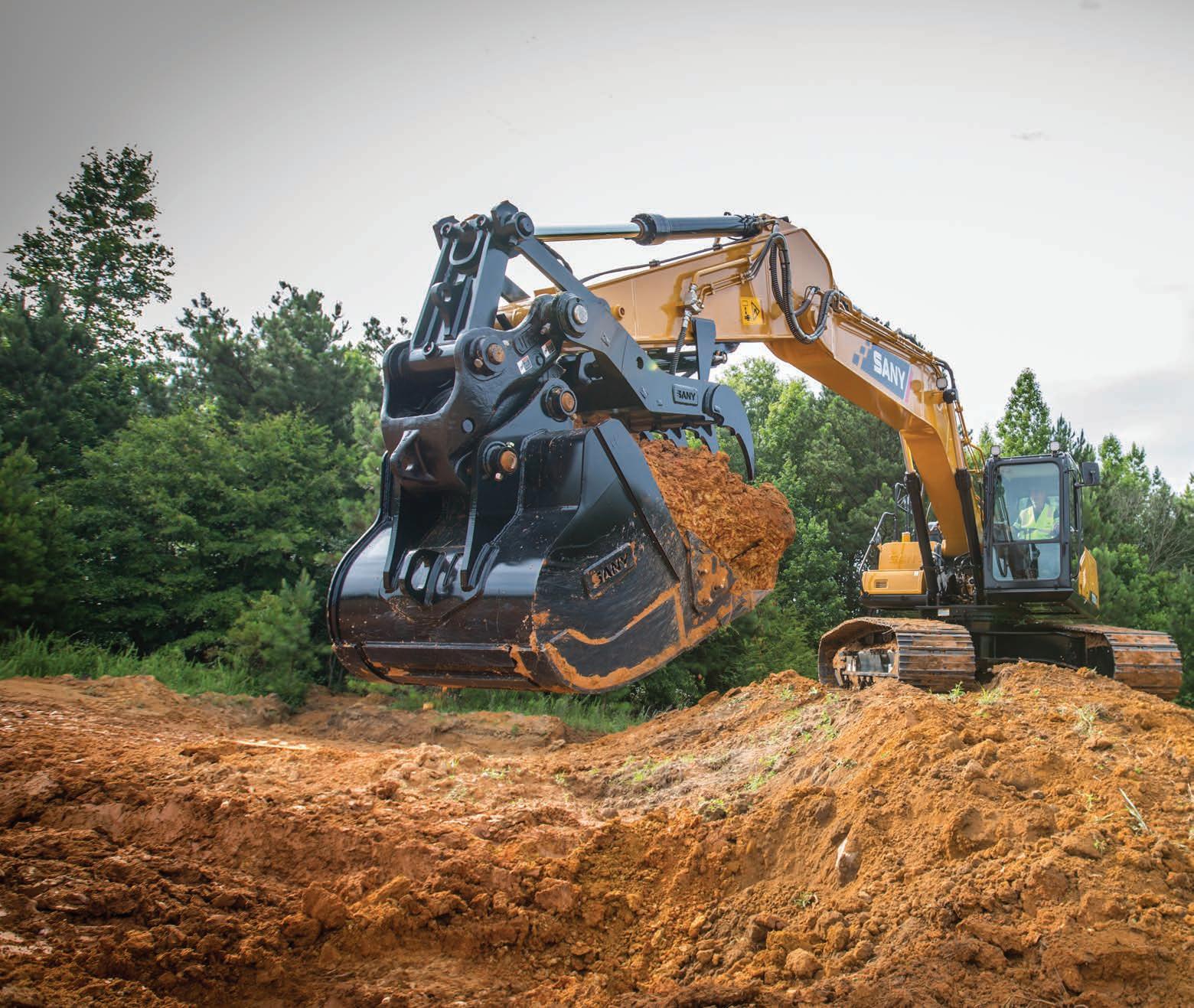
Vertical demolition relies on approximately 20 pieces of heavy equipment, including Volvo EC380 and EC350 excavators; Komatsu 360 excavators; Cat 330 excavators; skid steers; and JLG lifts.
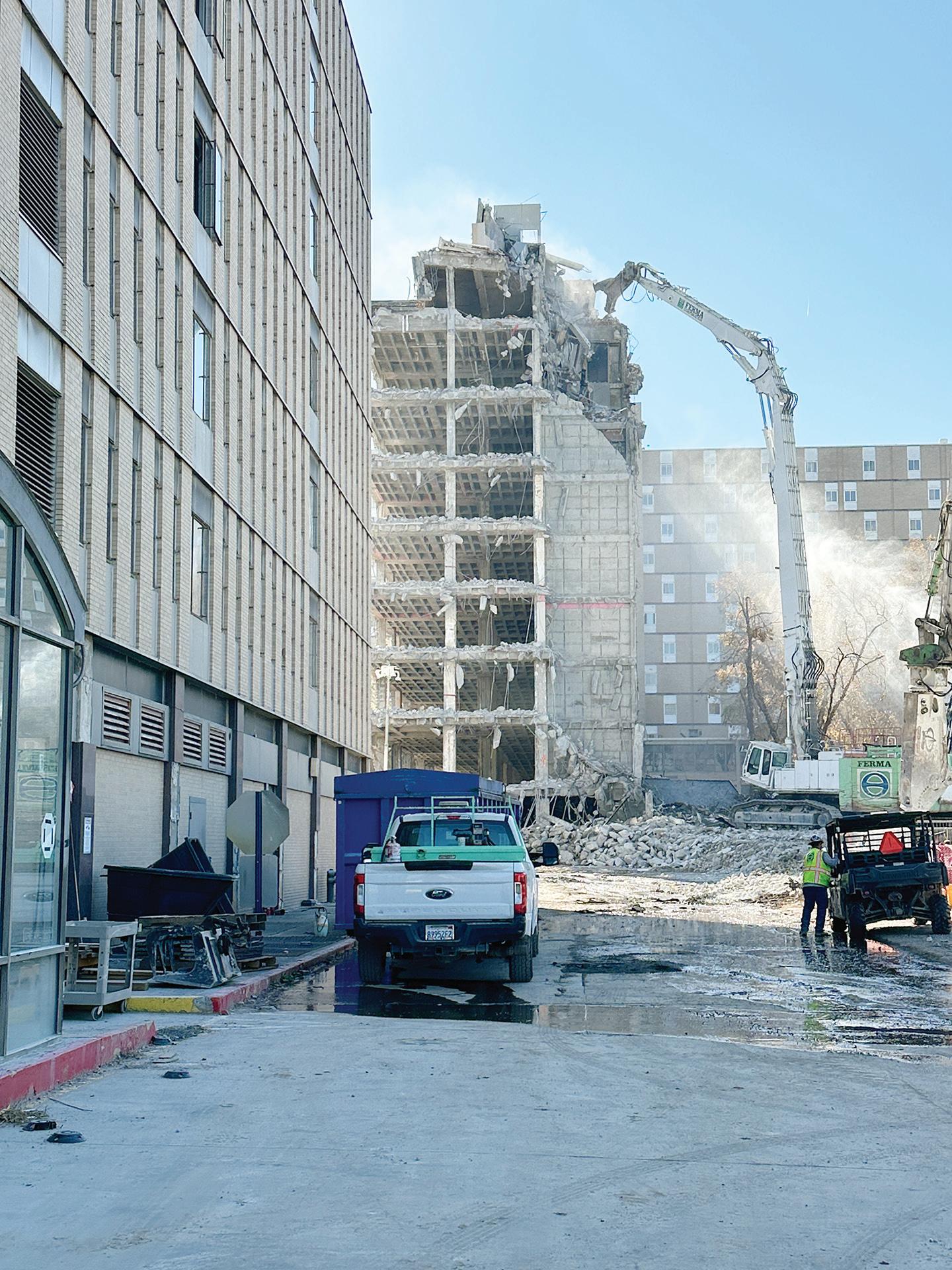
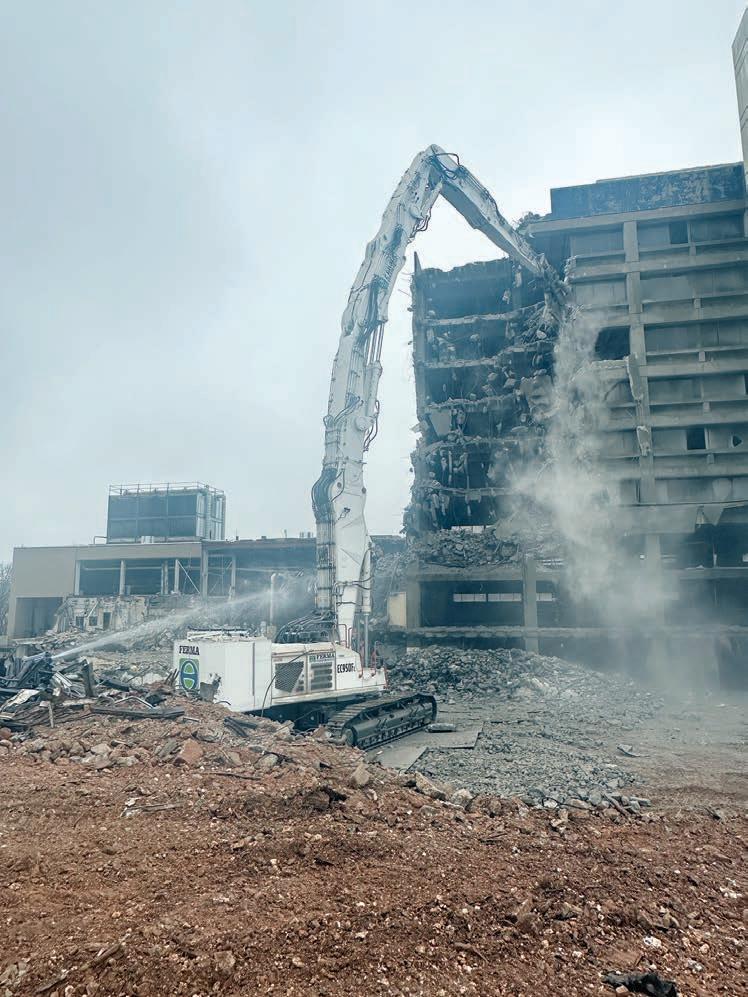
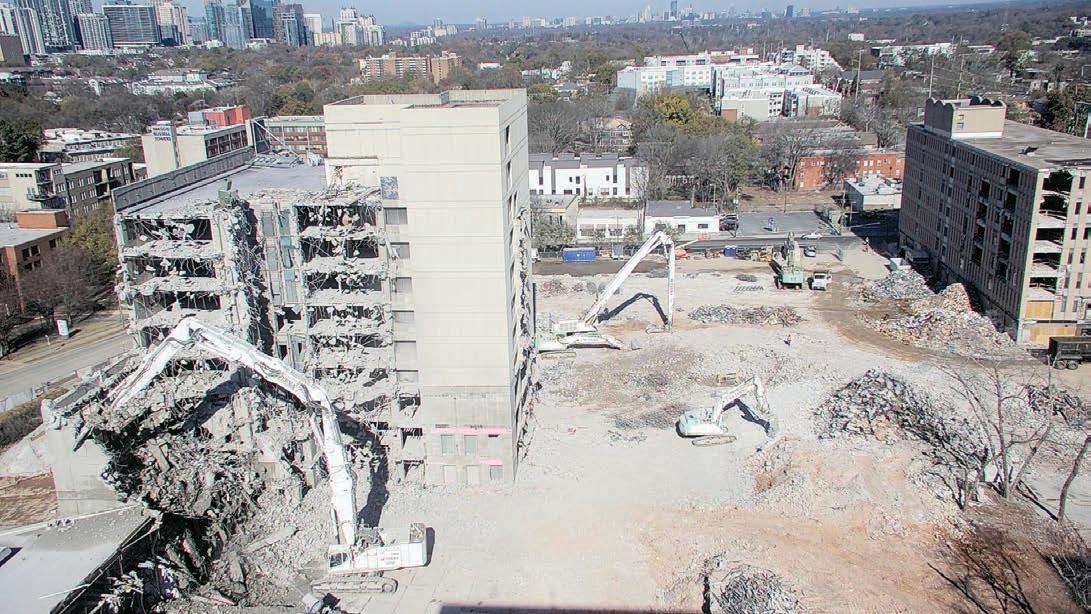
The centerpiece of the fleet is a pair of 140-ft.-reach excavators supplied by FERMA Corp. — a Volvo EC950 high-reach excavator and a Hitachi FE-115, based on a Hitachi EX1000 platform. The machines are capable of reaching the tops of the campus’s tallest buildings while smaller excavators process debris below.
The demolition sequence begins with the high-reach excavator dismantling one side of a building while two or three support excavators sort debris and separate recyclable materials.
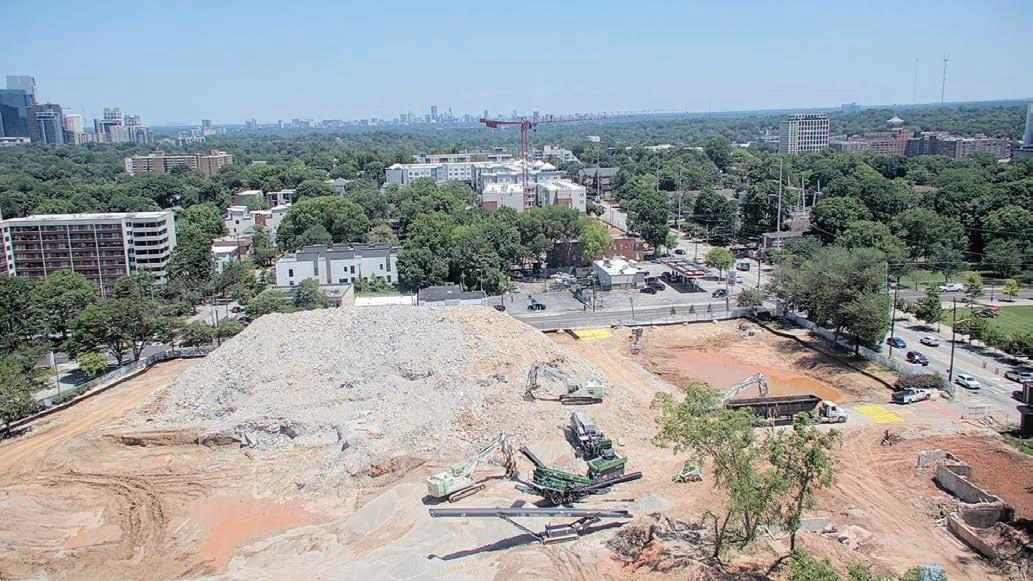
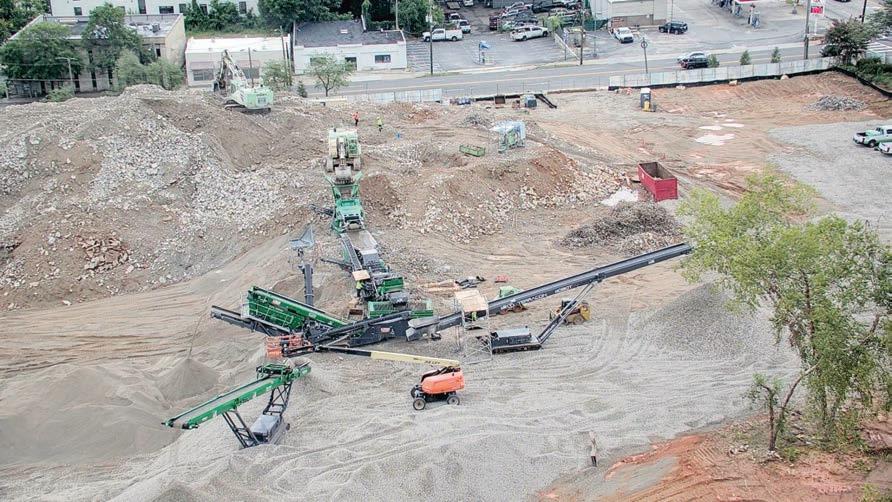
“All of the concrete is being processed and crushed into usable aggregate,” Roberts said. “Overall, we’ll probably
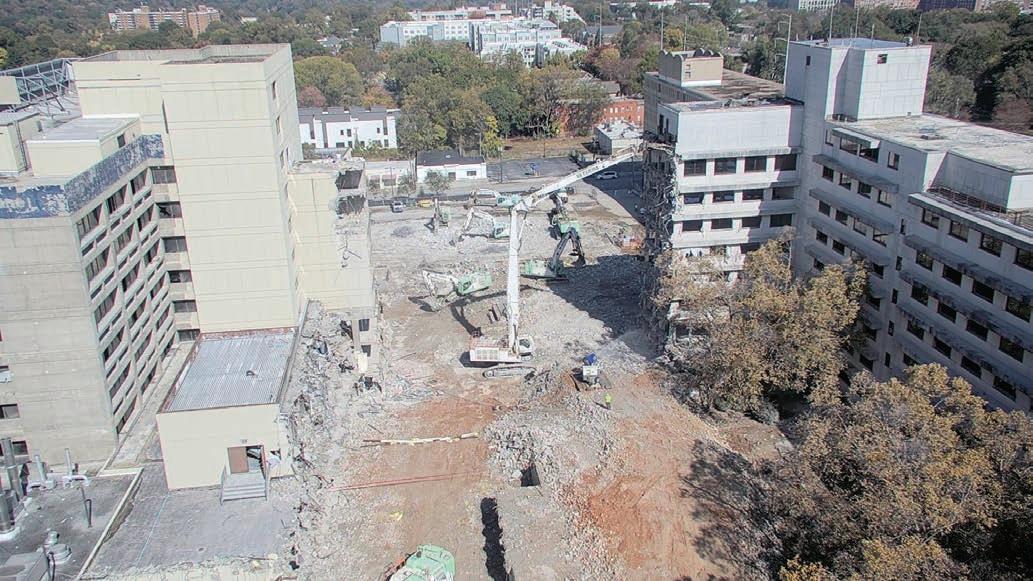
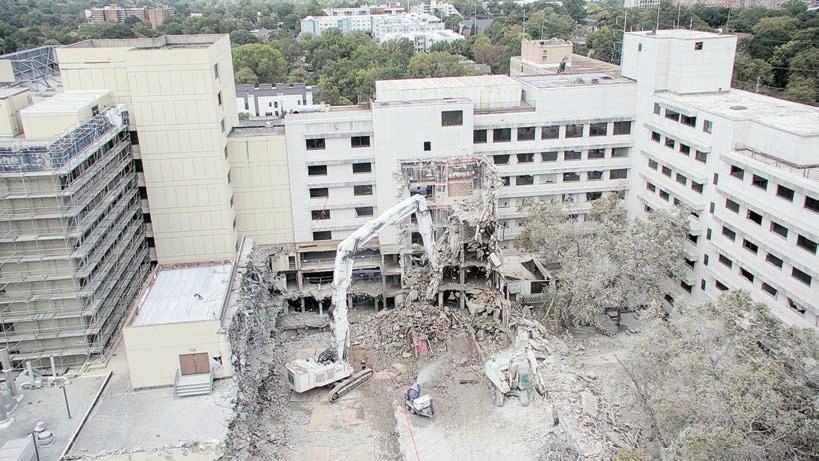







“The excavators make short work of the buildings,” Roberts said. “The time comes afterward with sorting materials and digging out the foundations. Vertical demolition is probably the shortest stage.”
Roberts emphasized that buildings are dismantled one structural bay at a time.
“We have spotters at every corner once demolition begins, and no one enters the buildings,” he said. “You bring down one structural bay, clear the area, then move to the next. At no time is the building in an unstable condition.”
Removing below-grade structures has proven more timeconsuming than bringing down the buildings themselves.
DEMOLITION from page 6 see DEMOLITION page 10
Crews also must work around major underground electrical and utility lines serving neighboring properties.
“The utility maps give us a general location,” Roberts said. “Once we approach those areas, we slow our work substantially.”
Automated dust suppression systems manufactured by HKD Blue operate throughout the site, using water atomization technology capable of projecting a fine mist more than 250 ft. to minimize airborne dust.
Once demolition is complete, dozers, wheel loaders and other equipment will be used during final site restoration.
The remaining work includes demolishing one four-story building, two five-story buildings and a six-story parking


Roberts expects concrete and reinforcing steel to account for the overwhelming majority of recycled materials.
“The vast majority of the weight of these buildings is concrete and rebar,” he said. “Some of the crushed material will be used on-site, some will go to local projects, and some may be donated or sold.”
The owner also will receive substantial salvage credits from the recycled materials, he added.
Approximately 100 workers were on-site when abatement and demolition operations overlapped. Today, about 20 demolition personnel remain active on the project.
Crews have demolished roughly 150,000 tons of concrete. Final rebar recovery totals have not yet been determined.
Roberts credited Integral Program Management, including Eric Pinckney and Channing Henderson, for helping keep the project on schedule.
“The project has progressed smoothly
because of everyone’s efforts,” he said. “We have tremendously talented crews across the board.”
Safety remains the project’s top priority. Spotters are stationed around every demolition zone, and all work is carefully coordinated before each structural section is removed.
“Safety is paramount above everything else,” Roberts said.
The demanding concrete demolition also places significant wear on equipment.
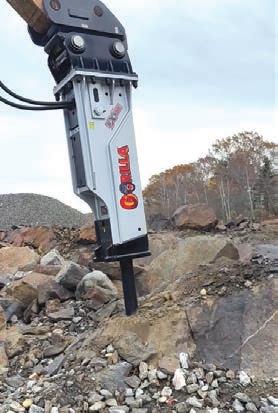
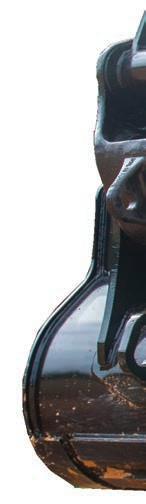
“The biggest wear items are the bucket teeth and anything that comes into contact with concrete,” Roberts said.
“Demolition also puts tremendous stress on hydraulic systems. Working in Atlanta during the summer heat makes equipment maintenance critical.”
Dedicated mechanics perform daily repairs and preventive maintenance while machines are refueled overnight. Equipment is rotated out of service as needed to minimize downtime.
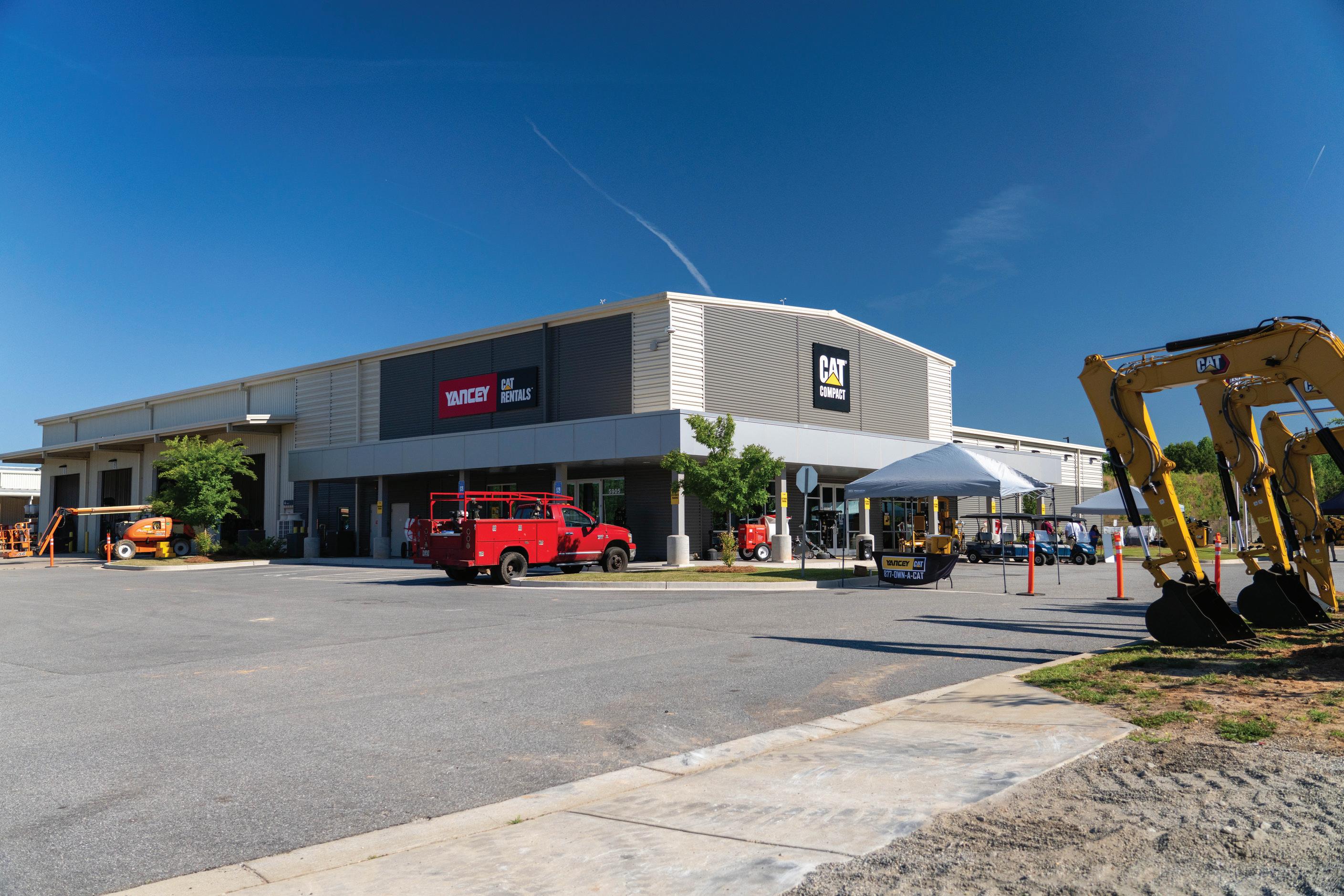
The project is supported by equipment from Corwin Equipment, Yancey CAT, Tractor & Equipment Co. and United Rentals.
“They know what we need and what we do,” Roberts said. CEG
DOT from page 1
variable scope, which allowed flexibility to get the most from the industry for such a large undertaking. Using innovation in contracting allows Georgia DOT to stretch available funding and ultimately deliver more to the traveling public.
The I-16 widening project includes the expansion of I-16 east and westbound from two to three lanes, existing pavement improvements and enhanced design to improve safety and long-term roadway performance. Along the project limits, six bridges will be replaced, and six will be widened in the following locations:
• Ogeechee River (EB and WB will be replaced)
• Little Ogeechee River (EB and WB will be widened)
• Ogeechee River Overflow 1 (EB and WB will be widened)
• Ogeechee River Overflow 2 (EB and WB will be widened)
• Ogeechee River Overflow 3 (EB and WB will be replaced)
• and Georgia Central Railway (EB and WB will be replaced)
This first phase of the project will widen approximately 17.77 mi. The project is expected to remain within the existing
interstate right-of-way to minimize impacts and reduce project costs.
As a critical corridor supporting economic development and regional mobility, the project received strong support from Gov. Brian P. Kemp and was fully funded by the state to accommodate continued growth and meet the needs of Georgia’s expanding population and economy.
“The widening of I 16 is an essential step to keep pace with the rapid growth and increasing freight activity across southeast Georgia,” said Rick O’Hara, Georgia DOT project manager. “By expanding the corridor and strengthening its infrastructure, we’re improving safety and ensuring this route continues to reliably serve the communities and industries that depend on it. We look forward to working with Matthews McClendon on delivering this important project.”
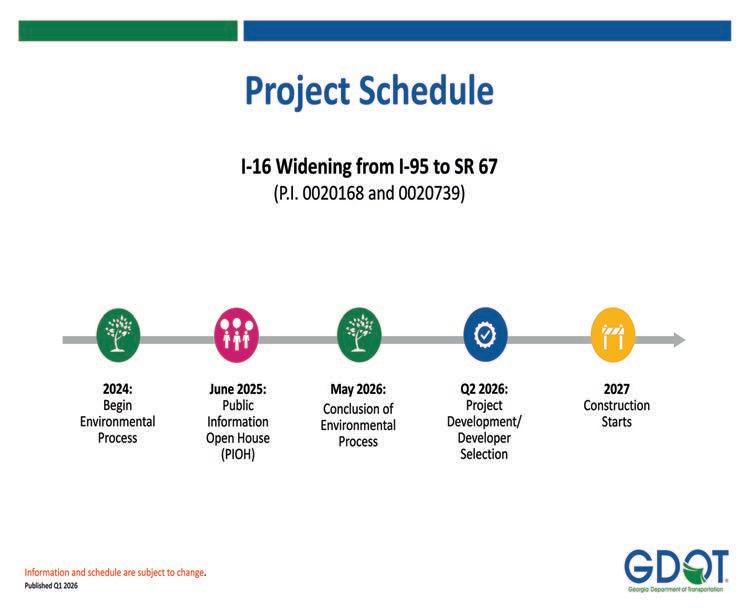
Construction is anticipated in 2027. The rest of the 32-mi. total project corridor will be delivered in phases with the same design-build approach that places design and construction under one contract to shorten schedules and reduce delays.
For more information, visit i16widening-0020168-gdot.hub.arcgis.com/.