State Supplement sponsored by:
441
59
75
Cornella 19
Rome 85 27
Athens
GEORGIA STATE EDITION
A Supplement to:
441
Atlanta
20
Madison Augusta
85
20
Griffin 1
129
Milledgeville
75
La Grange
Macon
301
185 19
16
Dublin
Swainsboro Oak Park
Columbus
Statesboro
341 441 16
Lyons Americus
Savannah
McRae
301
1
Cordele
27 82
Dorchester
341
Cuthbert
75
Albany
84
Douglas Tifton
82
95
82
Blakely
Pearson 27 84
Moultrie
19 319
Bainbridge
84
Valdosta Thomasville
®
Waycross Brunswick 82
SHIP WITHIN 48 HOURS
1 441
SAME DAY PARTS AVAILABILITY 24 HOUR TECHNICAL SUPPORT BACKED BY A 75 YEAR BUSINESS
October 6 2021
Thousands in Service!
Vol. XXIII • No. 20
“The Nation’s Best Read Construction Newspaper… Founded in 1957.” Your Georgia Connection: Rich Olivier, Atlanta, GA • 1-800-409-1479
Affordable Price. Premium Service.
CALL 800-367-4937 *On approved credit • Financing Available
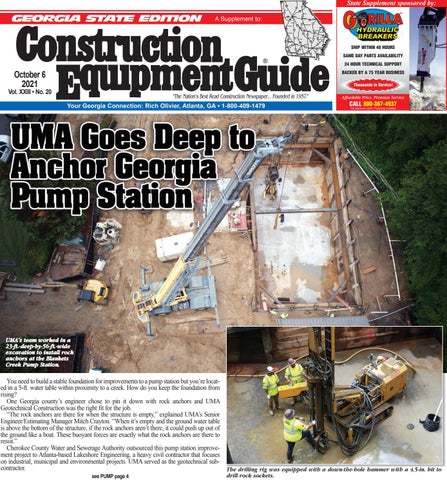
UMA’s team worked in a 23-ft.-deep-by-56-ft.-wide excavation to install rock anchors at the Blankets Creek Pump Station.
You need to build a stable foundation for improvements to a pump station but you’re located in a 5-ft. water table within proximity to a creek. How do you keep the foundation from rising? One Georgia county’s engineer chose to pin it down with rock anchors and UMA Geotechnical Construction was the right fit for the job. “The rock anchors are there for when the structure is empty,” explained UMA’s Senior Engineer/Estimating Manager Mitch Crayton. “When it’s empty and the ground water table is above the bottom of the structure, if the rock anchors aren’t there, it could push up out of the ground like a boat. These buoyant forces are exactly what the rock anchors are there to resist.” Cherokee County Water and Sewerage Authority outsourced this pump station improvement project to Atlanta-based Lakeshore Engineering, a heavy civil contractor that focuses on industrial, municipal and environmental projects. UMA served as the geotechnical subcontractor. The drilling rig was equipped with a down-the-hole hammer with a 4.5-in. bit to see PUMP page 4
drill rock sockets.
Page 2 • October 6, 2021 • www.constructionequipmentguide.com • Georgia State Supplement • Construction Equipment Guide
4240 MLK JR Drive SW Atlanta, GA 30336 770-819-6600
Construction Equipment Guide • Georgia State Supplement • www.constructionequipmentguide.com • October 6, 2021 • Page 3
Page 4 • October 6, 2021 • www.constructionequipmentguide.com • Georgia State Supplement • Construction Equipment Guide
UMA Team Calls On Beretta Drilling Rig for Pump Project
Prime contractor Lakeshore Engineering used a crane with rigging to lower the Beretta T46 drilling rig into the excavation as UMA’s team provided direction. PUMP from page 1
Located within proximity to Blankets Creek in Canton, Ga., the water table is known to fluctuate. UMA’s sole function was to install a rock anchor system to keep the pump station’s concrete slab pinned down. The components to be built on top of the slab would be a diesel engine-driven centrifugal pump and a concrete cast-in-place emergency storage tank. Working Down in Hole One of the biggest challenges for UMA’s team was working in a 23-ft.-deep-by-56-ft.-wide excavation. Lakeshore Engineering had excavated the pit and installed a soldier pile wall with wood lagging. Tied off workers accessed the pit via ladders. “We’re working in a pretty tight area compared to what we’re normally used to on highway projects,” said Crayton. “It’s not the smallest footprint we’ve worked in, but it’s a lot smaller than our usual working space.” Lakeshore Engineering installed a mud mat to provide a stable working surface for UMA’s drilling rig and to keep the work site clean. There was no air movement so air was pumped in from ground level and circulated with fans to keep workers from breathing in diesel fumes. The working area had to be dewatered also due to the proximity of Blankets Creek and a water table approximately 5 ft. below the ground. While the failure of dewatering pumps would not have been cataclysmic, the potential slow accumulation of water in the working area could have damaged equipment. One of the visual spectacles on the project was Lakeshore Engineering using a crane with rigging to lower a Beretta T46 drilling rig into the excavation as UMA’s team provided direction. “It’s a smaller machine, but we selected it for this purpose,” Crayton explained. “It doesn’t quite get the production that we’re typically used to, but it can hold its own with this smaller hole size.” UMA’s crew was seasoned and used to working together. They also were familiar with the equipment and how to rig it based on past projects. “We shut down around Christmas every year for safety
UMA conducted two lengthy performance tests to ensure that the anchors were of sufficient strength to support the pump station.
and for training,” Crayton said. “We alternate between first aid, forklift certification and crane and rigging so that everyone is safe on the job site. That’s always our number one concern.” Drilling Rock Anchors UMA was tasked with installing 24 rock anchors, evenly spaced every 10 ft. vertically and 8 ft. 8 in. horizontally. Skyline Steel supplied the anchors, which were 1-in.-diameter Grade 150 ksi DCP (double corrosion protected) bar. The owner’s representatives provided the grid layout with specific locations required to support the pump station equipment. “It was critical to make sure these [rock anchors] worked because it would be very cost prohibitive to move them,” said Crayton. “If even one failed, they would have to change reinforcing plans and the connection details of the slab foundation to the actual structure.” The Beretta was drilling a minimum 4.25-in.-diameter hole 15 ft. down to bedrock with permanent casing supplied by Star Iron Works. The drilling crew had to focus closely on ensuring that the anchors were plumb and in the exact location specified. The material was higher quality partially weathered rock, although the crew hit a high-quality bedrock in a handful of areas. The team then drilled into bedrock with a 10-ft. rock socket. “Our drillers are schooled enough to distinguish between the materials they’re drilling through,” said Crayton. “One drills a lot slower than the other and they can hear and feel the differences.” The Beretta was equipped with a down-the-hole hammer with a 4.5-in. bit to drill the rock sockets. This tooling fit perfectly inside the casing, allowing the cuttings to be extracted onto the mud mat before being plowed away with Lakeshore Engineering’s Takeuchi skid steer loader. “We drill down into a specific rock socket, place our anchors, and lock them all to that slab,” Crayton explained. “That’s how we end up with our rock anchor system.” Testing Anchor Strength, Movement UMA conducted two extensive performance tests to ensure that the anchors were of sufficient strength to support
the pump station. Movement was essential also. “These anchors are basically like high-strength rubber bands,” Crayton said, noting that the anchors are designed to move. “Anything that moves has some sort of desire to go back to where it was. When they flood this pit with water, the anchors will keep the slab and pump station from rising.” Testing requirements placed some restrictions on the schedule. UMA was only permitted to install two anchors on the first couple of days, and conduct a load test to demonstrate that capacity was achieved before installing the third. This pattern continued throughout the project. UMA was installing multiple corrosion protected anchors. The corrosion protection is granted by several components within the anchor, in addition to the grout itself. The grout was then pumped to grade until clean grout was observed. “We worked with Lakeshore closely to help speed up their construction process and get out of the way so they could finish their job,” Crayton said. “The main way we expedited our work was to lock off the anchor to a mud mat using a secondary bearing plate.” The double bearing plate system had one bearing plate locking the anchor to the mud mat and one suspended in the air to transfer the loading to the foundation. UMA was able to get all of the testing completed at one time under the initial mobilization. This permitted Lakeshore Engineering to set a bearing plate at a certain elevation and pour the structural slab without having to wait on a remobilization for final stressing. This allowed a majority of the elastic elongation to occur prior to the final placement of slab, ultimately saving the contractor time and money. Batching, Grouting to Lock in Anchors UMA grouted the rock anchors in place. The material was mixed in a batch plant on site with a specific gravity of 1.85 to 1.86. Its team is trained to check specific gravity prior to pumping, and a third-party contractor was retained to take samples and ensure quality control. This standard mix was one that UMA was accustomed to, and achieved the strength that was required on this project. The spec called for a minimum of 3,500 psi at three days and 5,000 psi at 28 days. see PUMP page 6
Construction Equipment Guide • Georgia State Supplement • www.constructionequipmentguide.com • October 6, 2021 • Page 5
Page 6 • October 6, 2021 • www.constructionequipmentguide.com • Georgia State Supplement • Construction Equipment Guide
Rock Anchor System Will Keep Pump Station Working
Once UMA installed multiple corrosion protected anchors, grout was pumped to grade until clean grout was observed. The grout used to secure the rock anchors was mixed onsite with a batch plant. PUMP from page 4
Most of UMA’s soil nail projects require larger material quantities and hole diameters, and also deeper drilling. “The crew that was doing this job came off of a year-long soil nail project so they were used to drilling 30-ft.-long, 6in. diameter holes, and four batches of grout at a time,” said Crayton. “There’s a pretty big difference between a rock anchor job and a soil nail job, and our crew adapted well to the switch.” The grout was pumped through tremie pipe to the bottom of the hole from within the casing. The casing sections were
installed with the Beretta drilling rig, which was equipped with a special adaptor. UMA was performing a duplex drilling process, which involves drilling the casing and the hole concurrently. Once rock was hit, the casing was halted, and drilling continued with the inner rod. UMA workers fed casing to the drilling rig by hand. “Normally we would use an EZ Spot UR attachment on the excavator to handle large casing sections,” Crayton said. “We had to use smaller pieces on this job because we didn’t have the real estate to put them in the pit with us.” The majority of UMA’s work on the Blankets Creek
Pump Station project was done within a week and completed on schedule. Despite the technical nature of the work, the distance between the job site in Georgia and UMA headquarters in Colfax, N.C., was the true challenge. “Making sure that everyone who needed to observe different processes was onsite during the installation and load testing was our greatest challenge,” said Crayton. “That’s generally the hardest aspect of most of our projects: the distance between the field where the actual work is done and the office where the computers are required to do the analysis.”
East-Central Ga. Receives Key Upgrade to U.S. Highway 1 Corridor Georgia’s primary north-south road corridor in the eastern part of the state is U.S. Highway 1, which will mark 100 years as a numbered roadway in 2022. And, in many places along its 2,300-mi. route from South Florida to the Canadian border, U.S. 1 is showing its age. Although it has been upgraded before in Georgia, the highway has reached operational capacity, and improvements are required to maintain ideal service for freight transport and everyday travelers, according to the Georgia Department of Transportation (GDOT). In east-central Georgia’s Jefferson County, for example, GDOT has recently taken measures to improve safety on a current two-lane roadway section of U.S. 1 that sees more than 8,000 daily drivers, 20 percent of which are piloting trucks. In early September, the state agency awarded a $46.8 million contract to E.R. Snell Contractor, based in Snellville, to perform a U.S 1 widening project in the county The job represents the fourth and final step toward a four-lane U.S. 1 roadway from the town of Wadley north to the community of Wrens. Each construction effort will be active in 2021 and encompass a 21-mi.-long
corridor when finished. Together, they will total an estimated $150 million total investment for the state. E.R. Snell will make highway improvements for 5.91-mi., stretching from the Wadley Bypass to the Louisville Bypass. In addition, the contractor will build new bridges over the Ogeechee River and its overflow south of Louisville. According to GDOT, the proposed work provides four, 12-ft. lanes with variablewidth depressed grassed medians until the typical section just north of the Ogeechee Overflow bridge transitions to a flush median that continues to south of U.S. 1/ GA 4 Business. The northern project terminus is only 0.3-mi. north of Nimrod Road. The transportation department noted that the existing bridges over the Ogeechee River and the Ogeechee River Overflow also would be widened, and parallel bridges constructed to accommodate the new lanes. Concurrently, E.R. Snell is making another of the four U.S. 1 improvement projects at the northern end of the Jefferson County corridor near Wrens. There, the construction firm will widen and reconstruct U.S. 1/GA 4 from Mennonite Church Road to GA 88 for 6.5
mi. In addition, crews will replace roadway’s bridge over Big Creek bridge and build a new parallel structure over the waterway. Both of E.R. Snell’s projects are set to be finished in mid 2024. Two Contractors Working On Remainder of U.S. 1 Another GDOT project on the U.S. 1 corridor in Jefferson County got under way in 2020 with the 2.85-mi.-long widening and reconstruction of the highway’s bypass around Louisville from north of Nimrod Road to Clarks Mill Road. C&H Paving Inc., in Thomson, was the approved bidder at $16.97 million for the project, which is due to be finished by the end of September 2022. Last spring, GDOT signed another construction contract worth $25.3 million with Reeves Construction Co., a South Carolina builder with an office in nearby Augusta, to make U.S. 1 improvements from Clarks Mill Road to Mennonite Church Road (Warrior Trail). Beginning just north of Louisville, the highway upgrades will proceed along U.S. 1 as symmetrical widening consisting of a four-lane, 14-ft. flush median with an urban
section until 1.2 mi. north of Clarks Mill Road. There, the new alignment will switch to a rural section featuring a 44-ft. grassed median. Reeves Construction is expected to have its highway upgrades completed by Aug. 31, 2024. Projects Partially Funded By COVID-19 Funds Last spring, Georgia Gov. Brian Kemp announced the availability of $277 million in Coronavirus Response and Relief Supplemental Appropriations Act 2021 (CRRSAA) funds to GDOT to fill in projected revenue gaps caused by the impacts of COVID-19. The CRRSAA was passed by Congress in December 2020. The additional monies allow GDOT flexibility to advance several key transportation improvements in predominantly rural areas in Jefferson, Jasper and Putnam counties, among others. Jefferson County’s U.S. 1 reconstruction project advanced five years on the construction delivery schedule by way of the state’s CRRSAA money. The improvements also include $3 million from Georgia’s Transportation Investment Act (TIA) fund.
Construction Equipment Guide • Georgia State Supplement • www.constructionequipmentguide.com • October 6, 2021 • Page 7
Atlanta, GA 404.696.7210 Birmingham, AL 205.841.6666 Madison, AL 256.350.0006 Mobile, AL 251.633.4020 Montgomery, AL 334.262.6642 Oxford, AL 256.832.5053 Tuscaloosa, AL 205.848.4147 Pensacola, FL 850.479.3004
Page 8 • October 6, 2021 • www.constructionequipmentguide.com • Georgia State Supplement • Construction Equipment Guide