State Supplement sponsored by:
441
59
75
Cornella 19
Rome 85 27
Athens
GEORGIA STATE EDITION
A Supplement to:
441
Atlanta
20
Madison Augusta
85
20
Griffin 1
129
Milledgeville
75
La Grange
Macon
301
185 19
16
Dublin
Swainsboro Oak Park
Columbus
Statesboro
341 441 16
Lyons Americus
Dorchester
75
Albany
84
Douglas Tifton
82
95
82
Blakely
Pearson 27 84
Moultrie
19 319
84
Bainbridge
Valdosta Thomasville
®
Waycross Brunswick 82
SHIP WITHIN 48 HOURS
1 441
SAME DAY PARTS AVAILABILITY 24 HOUR TECHNICAL SUPPORT BACKED BY A 75 YEAR BUSINESS
September 8 2021
Thousands in Service!
Vol. XXIII • No. 18
“The Nation’s Best Read Construction Newspaper… Founded in 1957.” Your Georgia Connection: Rich Olivier, Atlanta, GA • 1-800-409-1479
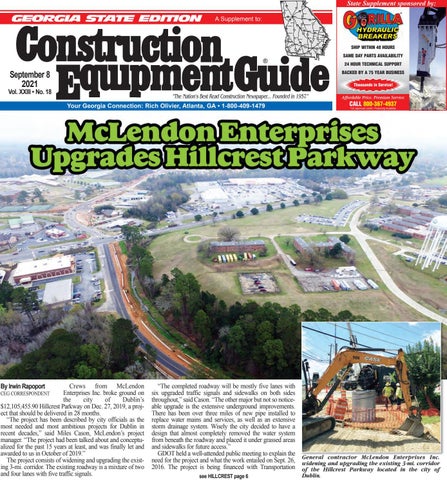
Crews from McLendon Enterprises Inc. broke ground on the city of Dublin’s $12,105,455.90 Hillcrest Parkway on Dec. 27, 2019, a project that should be delivered in 28 months. “The project has been described by city officials as the most needed and most ambitious projects for Dublin in recent decades,” said Miles Cason, McLendon’s project manager. “The project had been talked about and conceptualized for the past 15 years at least, and was finally let and awarded to us in October of 2019.” The project consists of widening and upgrading the existing 3-mi. corridor. The existing roadway is a mixture of two and four lanes with five traffic signals. CEG CORRESPONDENT
301
1 341
Cuthbert
By Irwin Rapoport
Savannah
McRae Cordele
27 82
“The completed roadway will be mostly five lanes with six upgraded traffic signals and sidewalks on both sides throughout,” said Cason. “The other major but not so noticeable upgrade is the extensive underground improvements. There has been over three miles of new pipe installed to replace water mains and services, as well as an extensive storm drainage system. Wisely the city decided to have a design that almost completely removed the water system from beneath the roadway and placed it under grassed areas and sidewalks for future access.” GDOT held a well-attended public meeting to explain the need for the project and what the work entailed on Sept. 26, 2016. The project is being financed with Transportation see HILLCREST page 6
Affordable Price. Premium Service.
CALL 800-367-4937 *On approved credit • Financing Available
General contractor McLendon Enterprises Inc. widening and upgrading the existing 3-mi. corridor of the Hillcrest Parkway located in the city of Dublin.
Page 2 • September 8, 2021 • www.constructionequipmentguide.com • Georgia State Supplement • Construction Equipment Guide
Atlanta, GA 404.696.7210 Birmingham, AL 205.841.6666 Madison, AL 256.350.0006 Mobile, AL 251.633.4020 Montgomery, AL 334.262.6642 Oxford, AL 256.832.5053 Tuscaloosa, AL 205.848.4147 Pensacola, FL 850.479.3004
Construction Equipment Guide • Georgia State Supplement • www.constructionequipmentguide.com • September 8, 2021 • Page 3
Page 4 • September 8, 2021 • www.constructionequipmentguide.com • Georgia State Supplement • Construction Equipment Guide
Give Us a Moment…
Georgia 400 Toll GPA Wants More Time to Analyze $5B Lanes Delayed by Jasper Ocean Terminal Deal With S.C. Unexpectedly High Contractor Bid
The Jasper Ocean Terminal (JOT), a long-planned $5 billion seaport expected to improve the economy of the rural South Carolina Lowcountry, is likely delayed again as Georgia officials want more time to consider whether to partner with Jasper County, S.C., on the project. The Georgia Ports Authority (GPA) had until Sept. 1 to decide whether to work with the Jasper County Council on the port, expected to be one of the world’s largest and most technologically advanced, or expand the Savannah port onto Georgia’s Hutchinson Island. Now, the deadline is likely to be Dec. 31, according to newly drafted agreements, The Center Square, a nationwide and regional online news source, reported. The JOT project is designed to be a new facility that would begin operation after the Charleston and Savannah ports reach capacity. Plans call for the terminal to be an evenly split joint venture between each of the two states’ ports authorities. GPA and South Carolina Ports Authority (SCSPA) formed the JOT Joint Project Office in 2008 to develop a bi-state owned and operated port facility in the Palmetto State, 8.5 mi. downstream from Garden City, Ga., on a 1,500-acre site widely considered to be the best remaining undeveloped port site on the East Coast. Earlier this year, as the SCSPA asked for more than $500,000 in additional funding to continue building out the Charleston ports — instead of starting work on the Jasper site — Georgia began eyeing Hutchinson Island, just across the Savannah River from downtown Savannah, as an alternative site for a new shipping terminal. In addition, GPA is pondering a plan to raise the Talmadge Bridge over the river to allow larger container ships into the Georgia port city. To keep JOT moving forward, South Carolina State Sen. Tom Davis, a Beaufort Republican, helped arrange a deal for the SCSPA to hand over its half of the agreement to Jasper County last March, according to an Aug. 24 report in The Center Square. Georgia officials, though, have not yet agreed to work with the county, the news outlet noted. Earlier in August, Paul Threlkeld, an attorney for GPA, wrote Jasper County attorney David Tedder asking for an extension. The Georgia agency “will not be prepared to officially either offer or withhold its consent,” Threlkeld wrote in the Aug. 12 letter, adding that the Sept. 1 deadline seems “arbitrary.” He added that Georgia officials are “still studying issues” related to Jasper County’s assumption of South Carolina’s rights and responsibilities. All three parties, though, are expected to agree to a Dec. 31 deadline. “I think we finally cut the Gordian knot,” Davis said about shifting ownership from his state’s ports authority to Jasper County. The senator, a tireless advocate for JOT’s development since it was first announced in 2007, noted that he has “been working on this for almost 20 years, so I would like to see things happen, but I understand things take time.” He speculated that Georgia likely had concerns about “putting faith in its competitor,” but he added that Jasper County is a “passive investor” and a “willing partner” that
wants the port and the benefits that will come from it. “This makes all the economic sense in the world,” Davis noted. “All the impediments have been addressed, and there’s a compelling case for this to move forward.”
JOT Could Be Massive Economic Driver The Washington Post recently featured the Jasper Ocean Terminal as one of 10 projects that could benefit from the $1.2 trillion federal infrastructure package that has passed the Senate. The project was notable, it said, because it would have the capacity to transfer eight million 20-ft. cargo containers a year and meet the southeast’s cargo demand through at least mid-century. The drawback, according to the Post, is that South Carolina and Georgia would need to make substantial improvements to nearby highways and rail lines that feed into the new shipping terminal. According to analyses, construction between 2025-35 would create 900 direct jobs with an estimated $81 million payroll. JOT also is projected to create one million high-paying jobs nationwide between 2040-50, according to the Post, while generating $9 billion in revenue for South Carolina and Georgia. The project’s construction, however, has been delayed repeatedly to at least 2035, with 2040 and beyond also suggested by the SCSPA, which said there will not be enough container cargo traffic to justify expansion until mid-century. Davis and other South Carolina lawmakers said SCSPA’s decision to build the new Hugh K. Leatherman Terminal in North Charleston, which doubled that port’s capacity, is what set JOT back a decade and prompted GPA to consider alternatives to the joint project. The Leatherman facility opened earlier this year. According to the JOT Project Environmental Impact Statement filed last December by the U.S. Army Corps of Engineers, the proposed terminal’s potential annual capacity, equivalent to approximately 35 years of forecast growth in containerized cargo, is large enough to meet cargo demand for the entire southeast through 2055. The shipping facility is planned to include: • A 12,500-ft.-long pile supported wharf. • A four-lane divided highway to connect to the terminal and a 210-ft.-wide berth. • A 790-ft.-wide access channel between the proposed berth and the Savannah Harbor Federal Navigation Channel. • A 2,200-ft. turning basin to accommodate the newest neo-Panamax and ultra-large container vessels. • A rail yard with double- and single-track rail to connect the terminal site to existing CSX Transportation and Norfolk Southern rail lines. • A container storage yard. • Administrative buildings and equipment service facilities. • A new rail bridge across the Back River, on the north side of Hutchinson Island near U.S. Highway 17, and across the Savannah River upstream of Georgia’s Garden City Terminal.
An effort to add toll lanes to Georgia Highway 400 in the Atlanta metro area hit a major roadblock Aug. 19 when the State Transportation Board rejected the only qualifying bid on the project. The 14-member board is governed by the Georgia Department of Transportation (GDOT). Board members agreed with the findings of an internal committee overseeing the bidding process that the bid submitted by the roadbuilding consortium MW 400 Partners was far more than the $1.7 billion GDOT had budgeted for the project. “This is a very upsetting point in the cycle,” said Kevin Abel, chair of the board’s P3 (Public-Private Partnership) Committee in speaking with Capital Beat. “[But] the project is not over – it is just going to be delayed.” The Georgia 400 project is part GDOT’s plans to relieve traffic congestion by adding a series of toll lanes across metro Atlanta. Toll lanes are already in place along Interstate 75 in Cobb and Cherokee counties, I-75 south of Atlanta, and on I-85 in DeKalb and Gwinnett counties. The plan for Georgia 400 calls for adding toll lanes to 16 mi. of the north-south highway from the North Springs MARTA station in Fulton County north to McFarland Parkway in Forsyth County. Construction was scheduled to begin late next year and be completed in 2027, Capital Beat reported. The transportation board decided to put the job out to bid as a P3 project, meaning the contractor would not only design, build and maintain the lanes but would also finance the construction. The building consortium would recover its investment by collecting the toll revenue through a 35-year agreement with GDOT. Meg Pirkle, the transportation department’s chief engineer, told board members that GDOT conducted a “robust evaluation process” only to find just one bid fit the criteria the agency had established for a successful bid. However, the bid was far higher than what GDOT had anticipated, she said. The amount of the bid could not be revealed, Pirkle added, because MW 400 Partners declared it a trade secret. She said one factor in the higher-than-expected bid was that it came in May, when the price of construction materials was especially high due to supply-chain disruptions caused by the pandemic. At a meeting shortly before the Board’s announcement, the Georgia P3 Committee recommended rejecting the bid and starting over with the procurement process. “We’re committed to seeing the project delivered,” Pirkle told Capital Beat. “But GDOT [also] is committed to being good stewards of taxpayer dollars.” She said it is uncertain how long the restart of the procurement process will delay the GA 400 project. The recent decision by the State Transportation Board also could delay other Georgia road projects, notably plans to add toll lanes along the top end of I-285 in metro Atlanta.
Construction Equipment Guide • Georgia State Supplement • www.constructionequipmentguide.com • September 8, 2021 • Page 5
Page 6 • September 8, 2021 • www.constructionequipmentguide.com • Georgia State Supplement • Construction Equipment Guide
Crews Move Much-Needed Parkway Work Forward in Dublin HILLCREST from page 1
Investment Act (TIA) funds The work zone covers the area from Industrial Boulevard to U.S. 441/SR29. The new lanes and underground infrastructure were designed by Thomas and Hutton. “The greatest design challenge was coordinating the installation of new underground facilities without impacting existing utilities,” said Cason. “The first step was locating and identifying existing facilities. McLendon worked hand in hand with city crews to pothole and identify pipelines. The information was then relayed to the designers at Thomas and Hutton, who had to work quickly to provide innovative solutions such as ‘inserta-valves’ to allow us to complete new construction without interrupting service to customers. “I’m sure the city would like to have at least a 50 year lifespan on the underground piping and would hope to go 15plus years before having to resurface the asphalt,” he added. “On sections of the existing roadway that stayed in place, we applied a 1-inch thick layer of open graded interlayer before we placed binder and topping. This layer will keep reflective cracking from happening and lengthen the lifespan of the asphalt surface.” Traffic management measures include the use of temporary barriers and enclosures, maintaining vehicular access and parking and traffic control to protect motorists and construction crews. “The city has allowed us to drop the posted speed limit to 25 mph throughout the project, which has helped tremendously,” said Cason. “This has by far been the most beneficial action with the need for such narrow clear spaces and shorter tapers for temporary lane shifts on this project.” So far, McLendon has installed more than 3 mi. of new pipes: water main, water services, sewer services and other drainage infrastructure such as reinforced concrete pipe, catch basins, manholes, 1.5 mi. of lanes and 1.9 mi. of sidewalk. “Using roadway construction equipment in such tight areas presents a challenge,” said Cason. “With an urban widening project you are faced with a different work zone each day. Most of them are adjacent to homes and businesses, as well as being extremely close to traffic. The operators have to be very skilled and aware of their surroundings at all times. We have used smaller equipment and flaggers/spotters to assist our drivers and operators with movements. I would describe the progress as being excellent,” he added. “We are now complete with most of the underground work and moved into the roadway phase of the project. This work will go much faster under the right conditions, and the average motorist will start to see vast changes in a week’s time. All of the work on the project has been daytime work. We have secured two large laydown area just off of the project right-of-way which has certainly helped us facilitate the stockpiling of materials. “The working relationship with the city and Thomas and Hutton has been great. I really can’t say enough good things about them. They have been on top of every issue, and we have resolved many complicated problems in a timely matter to say the least — problems that might have costs us weeks and months of delay on similar projects.” Road work and drainage work is being done simultaneous, and both are being closely coordinated. The construction of the new lanes required crews to excavate the existing lanes and the areas for the new lanes. “The excavation on this project has to be done very care-
McLendon has installed new pipes; water main; water services; sewer services; and other drainage infrastructure such as reinforced concrete pipe, catch basins, manholes, 1.5 mi. of lanes and 1.9 mi. of sidewalk.
fully with all of the utilities and tight working areas,” Cason. “It is certainly not a high production grading operation. The main challenge for me is ‘racing the clock’ each day. Essentially we have to close off a work area each day, perform the planned construction activities and have the area safe for reopening that night. The first step was underground utilities and drainage throughout the project. Once we had areas that were clear of underground piping, we began grading and building the widening of the new roadway with specialized crews for each process. Once we have areas with new lanes constructed on one side, we will swap traffic to those areas and repeat the process. We have tried to coordinate the grading in such a way that cut materials can be dumped directly into fill sections. With the complicated staging on this project, we have had to stockpile some material at times.”
Demolition and excavation activities are expected yield 5,000 tons of concrete and 3,500 tons of asphalt.
Key equipment for the excavation work included the use of excavators and loaders — a Cat 320D RR, a Cat 323, a Cat 306, a Komatsu 210-PC, a Komatsu WA 270, a Case 621G and a Cat D4K2. “The articulating machines and reduced or zero tail swing excavators helped out tremendously in the tighter work areas,” said Cason. With an area cleared, pipe and drainage infrastructure crews moved in. “We do use GPS for construction layout,” said Cason. “We also have several pieces of equipment with integrated GPS systems that allow our operators to build by the plans with very little staking.” For the new sections of lane being added, McLendon is using off-site vendors for both concrete and asphalt and equipment-wise, operators are using a Cat 140M2 motor grader, a Roadtec RP190 rubber tire paver and a Cat D5K bulldozer with Topcon GPS. The upgrade traffic signals will be installed towards the end of the project. Cason is assisted by Dee Mullis, Ivy Toole, Mel Cason, Mark Herndon, Chris Flowers and Kenny Allen. “Our team is great,” said Carson. “We are a mixture of seasoned veterans and young guys who want to be the next veterans. Everyone’s effort has been exceptional. This job has been time and labor intensive, the crews know this and have responded.” Peak days have had 20 McLendon and subcontractor workers on site, including: Grading for Curbing for GABC; Installation Paving for signal work and concrete paving; and Flatwork for striping. Demolition and excavation activities are expected yield 5,000 tons of concrete and 3,500 tons of asphalt. “We will recycle the concrete on-site by crushing and processing it into ‘crusher run’ gravel that will be used as surface course in the future,” said Cason. “The asphalt is taken to one of our asphalt plants where it will be processed and reused in future mixes. Recycling is a big part of the company. We have yards dedicated to stockpiling and processing materials.” New materials should include 7,000 tons of concrete, 60,000 tons of asphalt and 17,000 tons of rock. Other equipment being used includes: skid steers, boring machines, robotic trench rollers, wheeled excavators, power brooms vac trucks and an air curtain incinerator. Maintenance of equipment is an ever-present concern. “Essentially anything that stays in contact with earth,” said Cason. “Teeth on excavator buckets, cutting edges, under carriage components on tracked machines and tires are constant issues. Maintenance is done daily and repairs, replacement of worn parts are done quickly. We do have staff mechanics that will be on-site daily. The key is daily inspection and maintenance constantly staying ahead of wear and damage by keeping machines in proper working order.” McLendon purchases and rents equipment from dealerships such as Tractor and Equipment Co., Yancey Bros., Flint Equipment Co., Low Country JCB and United Rentals. “Dealerships have done a great job of delivering new equipment in a timely manner, as well as providing great support,” said Cason “Working hand-in-hand every day and understanding the unique challenges that each of us face is the key to good relations with the dealerships. Each time you are able to solve a problem together, that trust and relationship grows.” CEG
Construction Equipment Guide • Georgia State Supplement • www.constructionequipmentguide.com • September 8, 2021 • Page 7
Page 8 • September 8, 2021 • www.constructionequipmentguide.com • Georgia State Supplement • Construction Equipment Guide