State Supplement sponsored by:
441
59
75
Cornella 19
Rome 85 27
Athens
GEORGIA STATE EDITION
A Supplement to:
441
Atlanta
20
Madison Augusta
85
20
Griffin 1
129
Milledgeville
75
La Grange
Macon
301
185 19
16
Dublin
Swainsboro Oak Park
Columbus
Statesboro
341 441 16
Lyons Americus
Savannah
McRae
301
1
Cordele
27 82
Dorchester
341
Cuthbert
75
Albany
84
Douglas Tifton
82
95
82
Blakely
Pearson 27 84
Moultrie
19 319
84
Bainbridge
Valdosta Thomasville
®
Waycross Brunswick 82
SHIP WITHIN 48 HOURS
1 441
SAME DAY PARTS AVAILABILITY 24 HOUR TECHNICAL SUPPORT
February 24 2021
BACKED BY A 75 YEAR BUSINESS Thousands in Service!
Vol. XXIII • No. 4 “The Nation’s Best Read Construction Newspaper… Founded in 1957.” Your Georgia Connection: Rich Olivier, Atlanta, GA • 1-800-409-1479
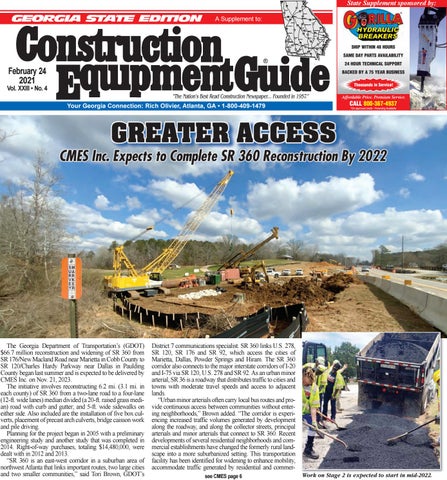
The Georgia Department of Transportation’s (GDOT) $66.7 million reconstruction and widening of SR 360 from SR 176/New Macland Road near Marietta in Cobb County to SR 120/Charles Hardy Parkway near Dallas in Paulding County began last summer and is expected to be delivered by CMES Inc. on Nov. 21, 2023. The initiative involves reconstructing 6.2 mi. (3.1 mi. in each county) of SR 360 from a two-lane road to a four-lane (12-ft. wide lanes) median divided (a 20-ft. raised grass median) road with curb and gutter; and 5-ft. wide sidewalks on either side. Also included are the installation of five box culverts, placement of precast arch culverts, bridge caisson work and pile driving. Planning for the project began in 2005 with a preliminary engineering study and another study that was completed in 2014. Right-of-way purchases, totaling $14,480,000, were dealt with in 2012 and 2013. “SR 360 is an east-west corridor in a suburban area of northwest Atlanta that links important routes, two large cities and two smaller communities,” said Tori Brown, GDOT’s
Affordable Price. Premium Service.
CALL 800-367-4937 *On approved credit • Financing Available
District 7 communications specialist. SR 360 links U.S. 278, SR 120, SR 176 and SR 92, which access the cities of Marietta, Dallas, Powder Springs and Hiram. The SR 360 corridor also connects to the major interstate corridors of I-20 and I-75 via SR 120, U.S. 278 and SR 92. As an urban minor arterial, SR 36 is a roadway that distributes traffic to cities and towns with moderate travel speeds and access to adjacent lands. “Urban minor arterials often carry local bus routes and provide continuous access between communities without entering neighborhoods,” Brown added. “The corridor is experiencing increased traffic volumes generated by development along the roadway, and along the collector streets, principal arterials and minor arterials that connect to SR 360. Recent developments of several residential neighborhoods and commercial establishments have changed the formerly rural landscape into a more suburbanized setting. This transportation facility has been identified for widening to enhance mobility, accommodate traffic generated by residential and commersee CMES page 6
Work on Stage 2 is expected to start in mid-2022.
Page 2 • February 24, 2021 • www.constructionequipmentguide.com • Georgia State Supplement • Construction Equipment Guide
Atlanta, GA 404.696.7210 Birmingham, AL 205.841.6666 Madison, AL 256.350.0006 Mobile, AL 251.633.4020 Montgomery, AL 334.262.6642 Oxford, AL 256.832.5053 Tuscaloosa, AL 205.848.4147 Pensacola, FL 850.479.3004
Construction Equipment Guide • Georgia State Supplement • www.constructionequipmentguide.com • February 24, 2021 • Page 3
Page 4 • February 24, 2021 • www.constructionequipmentguide.com • Georgia State Supplement • Construction Equipment Guide
Beltline Rail Unveils $2.5B Atlanta Beltline Transit Plan
Atlanta Beltline rendering
An early concept for how rail might function where a now-finished Eastside Trail meets Memorial Drive.
Transit advocates have a new plan to speed up construction of the Atlanta Beltline. Now they need to persuade everyone from the Metropolitan Atlanta Rapid Transit Authority (MARTA) and the Atlanta City Council to state and federal officials to get on board. The group Beltline Rail Now said its $2.5 billion plan would allow construction of the 22-mi. light rail loop in a decade. MARTA’s current plan calls for completion of just 15 mi. of the loop by the 2040s. The transit group’s plan calls for $1 billion in federal funding, plus hundreds of millions more from special assessment districts, sales taxes and tax increment financing. In a written statement, MARTA welcomed the proposal but called it “less a blueprint for funding and more a wish list.” The plan’s supporters hope it will spark a serious discussion of ways to speed construction of a project that has already been 20 years in the making and would languish for decades longer under current funding scenarios. They plan to make it an issue in this year’s Atlanta mayoral and City Council races. “This is the first [recent] era where you can run for office without ever mentioning the Beltline,” said Matthew Rao, co-chair of Beltline Rail Now. “We intend to change that,” Co-Chair Patty Durand added.
The Atlanta Beltline has been a fixture of city politics since it emerged from planner Ryan Gravel’s master’s thesis in 1999. He proposed converting abandoned rail lines circling the heart of Atlanta into a transit line and pedestrian trail network that would spark redevelopment and improve the lives of rich and poor people alike. Large sections of the trail have already been developed, and it has sparked development. But the transit — which advocates said is key to promoting affordable housing and other aspects of Gravel’s vision — exists only on paper. Two years ago, MARTA approved plans to build 15 mi. of Beltline transit with part of the proceeds from a 2016 sales tax approved by city voters. But there is no timetable for completing the full 22-mi. loop. MARTA said the sales tax money is not enough to build all the transit lines Atlanta residents say they want. Projects in the agency’s plan also include a bus rapid transit network, light rail or bus rapid transit along Campbellton Road and rail along the Clifton Corridor. But Beltline Rail Now has a plan it is confident would speed up construction. It outlines numerous funding sources, including $750 million in federal New Starts transit funding — nearly triple the amount MARTA
expects to receive for the Beltline, and $250 million in federal highway funds. Such monies can be used for transit projects, though Georgia has used them only for highway construction. Beltline Rail Now also believes Georgia should spend more state money on highway construction while using the federal funds for transit, a plan that would require support from state officials. It also advocates for hundreds of millions of dollars from local funding sources, which would pay for a new transportation improvement district along the Beltline ($400 million), new special assessment districts surrounding infill transit stations ($100 million) and an existing tax allocation district ($250 million). The group’s proposal also calls for using $150 million from Atlanta’s special local option sales tax for transportation and it notes MARTA could get $600 million in federal loans by leveraging some of the money from the 2016 sales tax. The plan cites numerous cities — including Los Angeles, Seattle and Washington, D.C. — that have used such funding sources to expand transit. In January, the Atlanta Beltline — the agency that oversees the project — announced plans for a new taxing district to pay for the completion of the trail. Beltline
Rail Now opposes that plan because it contains no funding for transit. In its statement, MARTA said it “wholeheartedly agrees” that new revenue sources are needed. “Development impact fees, parking fees and value capture are all tools that MARTA believes must be brought to the funding table,” the agency said. “Sales tax revenue is simply not enough.” But the agency said the advocates’ plan would require eliminating the Clifton Corridor and Campbellton Road transit lines to redirect resources to the Beltline. Among other things, MARTA said the proposal also “glosses over steep legislative and policy hurdles at the local, regional and state level that must be addressed in order to unlock the proposed new funding sources.” Rao and Durand acknowledged that their plan may not be the solution, but they said they will challenge naysayers to specify how they will speed up construction of the Beltline. And they will endorse or oppose candidates for city office based on their answers. “The reason we wrote this [plan] was to dispel the argument that there isn’t enough money to pay for the complete project of rail along the Beltline,” Rao said.
Construction Equipment Guide • Georgia State Supplement • www.constructionequipmentguide.com • February 24, 2021 • Page 5
SPEND WAAY LEESS
GETT WAAY MORRE
AVVAILABLE AILLABLE ON ALLL NEW CAAT® TT® CO COMP OMPPAACT EQUIPM MENT!
GRAB 0% 0 FOR 600 MONTHSS OR LEASSE $810/M MONTH
ON A NEEW CAT AT 259D 259D3 D3 COMPPAACT C TRACK LOOADER + CAT® AT® T CVVAA Flexiblee payment options and convenient onne monthly payment Cat® CV VA with 3-year/1,500-hour preventative maintenance kits 24/7 assset monitoring & expertise through Cat C ® App 3-year//1,500-hour powertrain, hydraulics, & technology protection plan Combinne offer with assocciation member disscount & save evenn more!
READY TO SPEND S LESS & GEET MORE? 800.282.1562 | www.YanceyBros.coom/getmore *Offer ffer valid v from February 1, 2021 through July 31 1, 2021 on new small and compact Cat® machines sold or leased by Yanceyy Bros. Co.. Offer ffer subjec subject to machine availability and credit approval by Cat Financial. Not all customers will qualify. Payments based on 60-month lease or loan. The off ffer ered Cat Customer Value Value Agreement A (CVA VA) includes 3 main aintenance parts kits (exception: small wheel loader includes 6 kits); TA1 equipment inspection;; Product LinkTM; and a 3-year/3,000-hour Powertrain, Hydraulics and Techn nology Equipment Protection Plan (EPP); and final drive oil only for compact track loaders and mini excavators. The maintenance parts cover the first 1,500 hours^ (estima (estimated 3 years, ^3,000 hours for small wheel loader) of machine achine utiliza utilization. The kit contains one set of parts for regular planned maintenance under norm mal operating conditions. Offer ffer excludes e additional maintenance parts, deaaler labor, wear parts, S∙O∙SSM and fluids. Payments do not include taxes, freig ght, set-up, delivery, y, document fees, inspections, additional options or attacchments. Additional terms and conditions may apply. Contact Yanc Yancey for de etails. ©2021 Caterpillar. All Rights Reserved. CAT AT, CATERPILLAR, ATERPILLAR, LE LET’S DO THE WORK, their resspective logos, “Caterpillar Corporate Yello Yellow,” the “Power Edge”” and C Cat “M Modern Hex”” tr trade dress, as well as corporate and product identity used her erein, are trademarks of Caterpillar and may not be used without permisssion.
Page 6 • February 24, 2021 • www.constructionequipmentguide.com • Georgia State Supplement • Construction Equipment Guide
CMES Leads $66.7M Reconstruction Work in Near Dallas CMES from page 1
accommodate traffic generated by residential and commercial growth, and improve access between Dallas and Marietta. The selected alternative would also correct existing operational deficiencies, improve safety and improve access to many side streets and driveways that often cause stops in traffic flow.” The new widening and reconstruction was designed by CLAYX Engineers and Consultants, which is now known as NV5. “Initially the project required placing temporary box culvert to extend the existing culvert to maintain stream flow during Stage 1 construction, but CMES submitted the field change request to tie new culvert to existing culvert during Stage 1,which is saving thousands of dollars and eliminating Stage 3 construction in that section of the project,” said Siddharth Balar, CMES’s project manager The traffic management plan is based on a single lane major road connecting Cobb and Paulding counties towards Cartersville, which necessitates active flagging. “It’s really challenging to do at a 10-to-15-foot-deep road crossing,” said Balar. CMES crews have started work on the following elements — tree clearing; grading; jack and bore; storm drainage; box culvert installation; and bridge work. The major goals for the 2021 construction season are to complete Stage 1, which consists of box culvert and precast arch culvert installation; bridge work; jack and bore operations; and the placement of a 16-in. water main. “We started the project eight months ago and there are no major challenges,” said Balar. “Several utilities have to relocate their infrastructure. Both counties have separate utility companies, which give us a total of 13 to work with, and requires major coordination. We’re making good progress. GDOT’s project is very cooperative and issues can be resolved rapidly. They appreciate our suggestions that have helped to save money for the taxpayer. It’s pretty much a day shift project and we have barriers in place to protect the workers and motorists.” Crews are preparing the new asphalt lanes on the east- and west-bound sides as per-stage requirement, with the plan to complete the Stage 1 widening in mid-2022. “We plan to start the start asphalt paving in March 2022,” said Balar. “We’ll be working on both sides simultaneously. This is a three-stage project and we’ve planned it well.” CMES is using Leica GPS equipment on the project. “It is helping us to be more productive with the underground utility and storm drainage works that are in progress,” said Balar. “We have rough cut and fill excavation that is ongoing to accommodate the underground utility, box culvert and bridge work.” The new lanes will be constructed with a 12-in. sub base, 8-in./7-in. base, 2-in. binder and a 1.5-in. topping. Key equipment for the ongoing work includes the use of cranes by one of the subcontractors and in terms of CMES, the use of Komatsu excavators and dozers and Hamm rollers. “The majority of the soil we are encountering is types B and C, as well as face rock and boulders in the certain areas of the work zone,” said Balar. “We are using 4-ton hammers that we rent from Herc to break the rock. At this point no blasting is required. There are several area rock embankments we’re using under the proposed road due to the existing soils.” Work on Stage 2 is expected to start in mid-2022 and will follow a similar process.
Work for the project includes the installation of five box culverts; placement of precast arch culverts; bridge caisson work and pile driving.
As noted, the bridge caisson work is under way. “We need to drive eight caissons,” said Balar. “We are building a 150-foot by 72-foot bridge need in two stages, which has four bents and three spans. The center span, which is 90 linear feet long, requires 10 beams in each span. Bent 1 and 4 requires us to drive to 20 10-inch by 42-inch piles. We needed to design the precast culvert bridge that is 120-feet long and 48-feet wide with an 11-foot rise, which has 30 precast segments that weigh 48,500 pounds each. They are supplied by Tindall Corporation. The design, submitted by Sastry & Associates Inc., was approved by GDOT’s bridge division. We will be driving around 1,000 linear feet of pilot hole and 1,000 linear feet of 14-inch by 89-inch piles.” The underground infrastructure component is extensive. “Designer jack and bore is being done to avoid traffic interruptions for water lines that consist of 420 linear feet of 12inch bore, 925 linear feet of 16-inch bore, 1,900 linear feet of 24-inch bore and we’re installing 16,000 linear feet of 16inch water main, 12,000 linear feet of 12-inch water main, 100 fire hydrants and other elements.” Due to existing water pond impacts, CMES will be creating rock embankment and installing dry swale infrastructure at three locations per EPD guidelines. Balar is assisted by Senior Superintendent Mehul Gajera and Assistant Superintendent Keval Goti. So far, peak days have had 50 CMES and subcontractor employees at the job site. The major subcontractors are Baldwin Paving for bridge and asphalt work; Redwick for signs; AKA Tree for tree clearing; and Tippins Contracting for water infrastructure. The amounts of material from the earth work and excava-
The major goals for the 2021 construction season are to complete stage 1, which consists of box culvert and precast arch culvert installation; bridge work; jack and bore operations; and the placement of 16-in. water main.
tion — asphalt, concrete, steel, and earth and rock — are still being tabulated, as are the amounts for new materials of asphalt, concrete and steel. Other equipment being used and to be brought in include Ditch Witch boring machines, Komatsu loaders and Cat 815 rollers. “We have very few mechanical problems,” said Balar. “When we need a mechanic, we just call for one.” CMES purchases and rents equipment from Herc Rentals, United Rentals, Tractor and Equipment Company for Komatsu machinery and Yancey Bros. Co. for Caterpillar equipment. CEG
Construction Equipment Guide • Georgia State Supplement • www.constructionequipmentguide.com • February 24, 2021 • Page 7
Page 8 • February 24, 2021 • www.constructionequipmentguide.com • Georgia State Supplement • Construction Equipment Guide