State Supplement sponsored by:
FOUR CORNERS EDITION
A Supplement to:
SHIP WITHIN 48 HOURS
®
September 6 2026 Vol. IV • No. 18
Sharon Swanson 1-760-518-4336 • sswanson@cegltd.com
SAME DAY PARTS AVAILABILITY 24 HOUR TECHNICAL SUPPORT BACKED BY AN 85 YEAR BUSINESS Thousands in Service!
“The Nation’s Best Read Construction Newspaper… Founded in 1957.” Your Four Corners Connection
Jacob Estrello 1-210-878-5650 • jestrello@cegltd.com
Affordable Price. Premium Service.
CALL 800-367-4937 *On approved credit • Financing Available
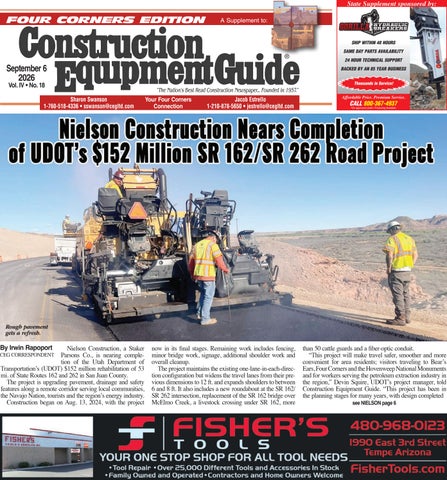
Rough pavement gets a refresh.
Nielson Construction, a Staker Parsons Co., is nearing completion of the Utah Department of Transportation’s (UDOT) $152 million rehabilitation of 53 mi. of State Routes 162 and 262 in San Juan County. The project is upgrading pavement, drainage and safety features along a remote corridor serving local communities, the Navajo Nation, tourists and the region’s energy industry. Construction began on Aug. 13, 2024, with the project
By Irwin Rapoport
CEG CORRESPONDENT
now in its final stages. Remaining work includes fencing, minor bridge work, signage, additional shoulder work and overall cleanup. The project maintains the existing one-lane-in-each-direction configuration but widens the travel lanes from their previous dimensions to 12 ft. and expands shoulders to between 6 and 8 ft. It also includes a new roundabout at the SR 162/ SR 262 intersection, replacement of the SR 162 bridge over McElmo Creek, a livestock crossing under SR 162, more
than 50 cattle guards and a fiber-optic conduit. “This project will make travel safer, smoother and more convenient for area residents; visitors traveling to Bear’s Ears, Four Corners and the Hovenweep National Monuments and for workers serving the petroleum extraction industry in the region,” Devin Squire, UDOT’s project manager, told Construction Equipment Guide. “This project has been in the planning stages for many years, with design completed see NIELSON page 6
Page 2 • September 6, 2026 • www.constructionequipmentguide.com • Four Corners States Supplement • Construction Equipment Guide
Arizona Board OKs Las Vegas, N.M., Prepares to Break Five-Year Update On Ground on Water Treatment Facility Construction Plan Arizona’s State Transportation Board announced that it approved the 2027-2031 Five-Year Transportation Facilities Construction Program, which emphasizes pavement and bridge improvements and expanding several key highways. Approved at the board’s meeting Friday, June 19, in Nogales, the 2027-2031 Five-Year Transportation Facilities Program covers $11.3 billion in work. For Greater Arizona, which encompasses areas beyond Maricopa and Pima counties, the construction program emphasizes improving highway pavement and bridge infrastructure. These projects will improve highway safety, efficiency and functionality, such as intersection improvements, updates to ports of entry and rest areas, smart technologies and new signals, signs and shoulders. The five-year program features several projects that increase the capacity or expansion of highways throughout Greater Arizona, including: widening State Route 260 east of Payson, known as the Lion Springs segment; • widening U.S. 93 at Big Jim Wash between Wickenburg and Wikieup; • constructing the James Ranch Road between State Route 80 and the new Douglas Land Port of Entry; and • improving Interstate 17 from Dugas Road at milepost 269 to milepost 275. In Maricopa County, the five-year program lists projects planned in conjunction with the Maricopa Association of Governments (MAG), including: • beginning construction of the center segment of State Route 30, which runs from Loop 303 to Loop 202 (South Mountain Freeway); • widening and making other improvements to the MiniStack Interchange east of downtown Phoenix at Interstate 10/ Loop 202/State Route 51; • and widening U.S. 60 between Ellsworth and Meridian roads. In Pima County, the five-year program lists projects planned in conjunction with the Pima Association of Governments (PAG), including: widening I-10 from Alvernon Way to Valencia Road and building ramps for the connection of future State Route 210 to I-10; and • improving the I-10 interchanges at Park Avenue and Sixth Avenue Both the Maricopa and Pima county regions have dedicated, voter-approved sales taxes for transportation that fund projects. In Maricopa County, funding comes from Proposition 479, a half-cent sales tax for regional transportation projects that voters approved in 2024. In Pima County, funding comes from RTA Next, a ballot initiative voters approved in March to extend an existing half-cent sales tax for regional transportation projects. The five-year program also includes $186.1 million for the Airport Capital Improvement Program, which provides funding in conjunction with the Federal Aviation Administration for projects to design and construct safety, security and capacity enhancements; prepare various plans and studies; and fund improvements at the Grand Canyon Airport, which ADOT operates.
New Mexico environment department and city of Las Vegas, N.M., unveiled plans for the first phase of a new city water treatment plant set for initial construction this summer, according to sourcenm.com. Plexos Group is the state’s contracted project manager, and Burns & McDonnell Engineering is the primary design and engineering firm. Drinking water issues have hampered the city’s 12,000 residents since the 2022 Hermits Peak-Calf Canyon fire. Burn scars often send a slurry of ash and debris into the Rio Gallinas, which is the city’s drinking water source, according to sourcenm.com. City officials received $98 million in federal funding in 2024 to construct the facility. After repeated flooding in 2024 that impacted water quality, combined with a complete water shutoff in January of 2025, the city entered into a joint governmental agreement with three state agencies to fast-track the new system. As part of that agreement, the state worked for months with city officials and an engineering firm to design new filtration systems; those designs were presented plans at the May 13 Las Vegas City Council meeting, sourcenm.com reported.
The first phase will install filters that better remove contaminants that wash into the river during rainstorms before the water goes through the sanitation and treatment process. The city replaced monitoring systems and water filtration pools to improve water quality while planning for the construction for the full water treatment plant continues, Las Vegas City Manager Robert Anaya told sourcemn.com. The city spent approximately $8 million on designing the new systems and on improvements, according to sourcenm. com. Las Vegas Mayor David Romero said it’ll be at least three years before the project is completed. “Everybody hopes that we can have it done yesterday, but we’re making sure we do it right the first time, and it’s tied to the appropriate design and compliance requirements that need to be in place to make it done right,” Romero told sourcemn.com. The state will continue to offer technical support for the city, Jonas Armstrong, the state environment department’s Water Protection Division director, said in a statement that the state will continue to offer technical support for the city.
ADOT Reaches Halfway Mark On I-10 Widening Project Near Tucson
The Arizona Department of Transportation announced on Aug. 13, 2026, that it has reached the halfway mark on a project to reconstruct and widen Interstate 10 between Kino Parkway and Alvernon Way southeast of downtown Tucson. This milestone comes as drivers can expect to see major changes in the coming months on the $600 million project to modernize three miles of I-10. Sundt-Jacobs is the project’s contractor On Aug. 14, ADOT permanently closed the I-10 interchange at Palo Verde Road, allowing demolition work to get under way so crews can build new travel lanes and bridges in the area. In the fall, a new interchange will open at Country Club Road. This will be a diverging diamond interchange, only the second of its kind in the Tucson area following the 2021 opening of the I-10 interchange at Houghton Road. Recent progress includes: • completing most of the pavement for the new Country Club interchange and ramp connections;
• demolition of old travel lanes along segments of I-10 so new lanes can be constructed; • Construction is well underway on new I-10 bridges over Palo Verde and Irvington roads; • bridge girders are in place for the new Kino Parkway structure over Ajo Way; • major elements are in place for the I-10 undercrossing between the North and South Kino Sports Complex; and • bridge girders are being placed over I-10 for the reconstructed Kino Parkway interchange. The I-10 reconstruction project began in June 2025 with the goals of reducing traffic delays and enhancing safety. Major project features include adding a third lane in each direction of I-10 and building two interchanges. Considered the largest highway construction project in Southern Arizona history, this improvement will: • widen I-10 to three lanes in each direction between Kino Parkway and Alvernon Way with auxiliary lanes; • reconstruct the interchange at Kino Parkway; • construct a new interchange at
Country Club Road that will provide access for traffic that uses the interchange at Palo Verde Road to allow for safer traffic movements to and from I-10; • remove the existing interchange at Palo Verde Road; • construct a new westbound onramp at the Alvernon Way interchange; and • construct an I-10 undercrossing to connect the North and South Kino Sports Complex. Throughout the project, ADOT will maintain two lanes of travel in each direction on I-10 during peak travel times while maintaining access to businesses. Construction is expected to continue through 2028. The project is the first to result from a study completed in 2020 that recommended how to best improve mobility along a roughly 10-mile stretch of I-10 from Interstate 19 to Kolb Road. The study also identified an alignment for an extension of State Route 210 (Barraza Aviation Parkway) along Alvernon Way that will connect I-10 to downtown Tucson.
Construction Equipment Guide • Four Corners States Supplement • www.constructionequipmentguide.com • September 6, 2026 • Page 3
Urenco USA Begins Work On Uranium Plant Expansion
Urenco USA rendering This rendering depicts the planned expansion of Urenco USA’s uranium enrichment facility in New Mexico.
Urenco USA celebrated in Eunice, N.M., on Aug. 18, 2026, the future expansion of the country’s only commercial uranium enrichment facility with a groundbreaking ceremony attended by U.S. Secretary of Energy Chris Wright, Urenco CEO Boris Schucht and other company leadership. In June, the company announced that it will expand the capacity of the facility by nearly 50 percent, marking a major commitment to strengthening the U.S. nuclear fuel supply chain as the country increases the use of nuclear power. This strategic, multi-billion-dollar investment will fund the construction of a new enrichment plant at Urenco USA’s National Enrichment Facility in Eunice, New Mexico, enabling the enhanced production of low enriched uranium (LEU) vital to the nation’s energy security. A contractor wasn’t named. In his remarks following the groundbreaking, Urenco’s CEO Boris Schucht said: “We’re making this substantial commitment to expand our U.S. facility to serve our U.S. customers’ needs. But this expansion also supports the U.S. Department of Energy’s goals to accelerate the deployment of new domestic capacity, strengthen the U.S. nuclear fuel supply chain, and reinvigorate the nuclear industrial base.
“It is a commercial, world-class facility developed without any public funding. Our investment will now increase to substantially more than $8 billion at the site. We are delighted to retain our customers’ trust, which has made this expansion possible.” During the expansion, Urenco will install 2.1 million separative work units (SWU) of new enrichment capacity using the company’s proven gas-centrifuge enrichment technology in 24 cascades of centrifuges, with the initial cascades starting production in 2032 and additional cascades installed through 2036. The expansion will support between 300600 U.S. jobs during the peak construction period and 70 jobs in long-term operations at the site. Urenco USA currently employs more than 500 U.S. staff and long-term contractors at the facility, which has been in commercial operation since 2010. Urenco USA operates the National Enrichment Facility, a strategic part of America’s energy infrastructure and nuclear fuel supply chain that began operations in 2010 and has the capacity to meet approximately one-third of the enrichment needs of U.S. commercial nuclear power plants. The facility has an existing annual capacity of 4.3 million SWU and has an ongoing expansion project to add 700,000 SWU of capacity that will be completed in 2027.
mobile concrete mixers designed to boost your productivity and performance on the job site.
standard features • • • • •
AP- Touch™ Auto-Stow™ Auto-Washout™ High & Low flow admix tanks with digital flow meters Sand, stone & cement bin vibrators
• • • •
Dual auger cement metering Pump master auger with IBS bearing Work platform 360° Swivel
scan to view more
Contact us to customize your volumetric concrete mixer today 4RIVERSEQUIPMENT.COM
Page 4 • September 6, 2026 • www.constructionequipmentguide.com • Four Corners States Supplement • Construction Equipment Guide
Construction Equipment Guide • Four Corners States Supplement • www.constructionequipmentguide.com • September 6, 2026 • Page 5
Page 6 • September 6, 2026 • www.constructionequipmentguide.com • Four Corners States Supplement • Construction Equipment Guide
Major Rehab the First in Decades for Both SR162, SR 262 NIELSON from page 1
eight years ago. We faced a bunch of challenges, including funding delays, COVID-19, significant inflation and rightof-way acquisition issues.” The project received a Nationally Significant Federal Lands and Tribal Projects Grant along with additional federal and state funding. The 53-mi. corridor passes through Bluff, Montezuma Creek and Aneth as well as the Navajo Nation. Average daily traffic is approximately 1,000 vehicles on SR 162 and 700 on SR 262. Long-Overdue Rehabilitation SR 162 and SR 262 were constructed in the late 1950s and had not undergone a major overhaul in more than six decades. “Decades of use left the pavement rough, lanes narrow, shoulders minimal or nonexistent and guardrails outdated,” Squire said. “The SR 162/SR 262 intersection in Montezuma Creek was also an awkward, skewed junction. This corridor had gone more than 60 years without significant investment, despite serving as the main route for residents, tribal communities, tourists and energy-industry traffic.” Ranching also influenced the project design. “Ranching has been central to life in this part of San Juan County for generations, especially for Navajo families around Aneth and Montezuma Creek,” he added. “That’s why the project installed more than 50 cattle guards and a dedicated livestock crossing under SR 162 — built specifically to keep livestock movement safe and reduce animal-vehicle collisions.” Safety improvements are a major component of the work. Crews widened narrow shoulders, replaced the skewed intersection with a roundabout, added guardrail and signage, installed protected turn lanes and improved pavement markings. Rockfall risks along canyon sections of SR 262 near Bluff were addressed through cliff cutting. Flash flooding was another major concern. The project rebuilt or improved several dozen culverts and flood-mitigation structures, including the new McElmo Creek bridge. Horrocks Engineers designed the project. “The design challenges included flash flooding issues, significant vertical design challenges, stream alteration permitting, multi-agency coordination, impacts to cultural sites and vast unchecked utility installations,” Squire said. Construction Progress Nielson Construction was awarded the contract in May 2024. By the end of 2025, approximately 70 percent of the paving was complete. The 150-ft.-long McElmo Creek bridge was completed in November 2025. Cattle guards were installed in January, guardrails were completed in April and the fiber-optic work finished in May. Roundabout lighting became operational in June and paving objectives for SR 162 and SR 262 were completed that month. Jeremy Guyman, Nielson Construction’s project manager, told Construction Equipment Guide that maintaining access along the corridor was one of the project’s biggest challenges. “The corridor serves schools, emergency services, residents, businesses and a substantial volume of heavy truck traffic, so careful coordination was essential,” Guyman said. “School access and student transportation were a particular priority. The project team worked closely with local schools to maintain access to school facilities and safely move students, parents, staff and buses through active construction
An overview view of the McElmo Creek Bridge
areas.” Multiple flagging operations also had to be coordinated. “Managing multiple flagging operations was another challenge,” he added. “At certain stages of construction, motorists could potentially encounter as many as four separate flagging operations along the corridor. Without coordination, those stops could have resulted in significant delays and frustration. Construction crews and flagging teams coordinated activities between work zones and reinforced the expectation that traffic should be kept moving safely and efficiently, with delays limited as much as practical.” Strategic staging helped Nielson keep work moving across the long corridor. Materials and equipment were positioned at multiple locations to reduce hauling distances and delivery delays. The remote location presented another challenge. Cell and internet service was unreliable across much of the corridor, so the project team used Starlink satellite internet to maintain communications. Tailoring Work to the Terrain Nielson divided the project into areas based on the amount and type of work required. Some sections required extensive excavation, grading and reconstruction, while others primarily involved shoulder widening, grading or resurfacing. “Because the work varied considerably throughout the project corridor, from significant excavation and earthwork to site preparation, paving, and more limited shoulder improvements,” Guyman said. “Excavation, site preparation and paving operations frequently occurred simultaneously at different locations. This approach allowed [us] to keep multiple portions of the project moving forward at the same
Workers install new guardrails.
time rather than completing one type of work throughout the entire corridor before beginning another.” Nielson brought a portable asphalt plant to the project area and stockpiled aggregate and asphalt materials. The operation helped provide a consistent supply of paving material. The contractor’s single-day paving record was 4,583 tons. The project generated more than 630,000 cu. yds. of earthwork and more than 200,005 tons of asphalt production for 108 lane-mi. of roadway. Approximately 15 percent of the 200,005 tons of existing asphalt removed — about 30,000 tons — was recycled. Nielson used Cat excavators ranging from 305s through 349s, D6 through D9 dozers, 930 through 980 loaders, a Cat 420 backhoe, Cat 637 scraper, 14M and 140M graders and a Cat articulated haul truck. Roundabout, Bridge The new roundabout was designed as a single-lane facility with wide shoulders to provide additional roadway width and accommodate active transportation. Its large footprint resulted from the angle at which SR 162 and SR 262 intersect. The McElmo Creek bridge was constructed on a new alignment adjacent to the existing structure. That allowed the existing bridge to remain in service through most of construction. “The replacement bridge was constructed on a new alignment adjacent to the existing bridge,” Guyman said. “This was a significant advantage because the existing bridge could remain in service through most of the construction of the replacement structure. The general construction approach began with traffic control, site preparation, excavation, environmental protection and establishment of construction access. Crews then constructed bridge foundations and abutments, placed the major structural girders, constructed the bridge deck and barriers, and completed the roadway approaches, drainage, paving and other associated improvements.” The new bridge includes reinforced concrete foundations and abutments, structural concrete girders, reinforcing steel, a reinforced concrete deck, concrete parapets and asphalt approaches. Grove 80-ton cranes lifted the prefabricated girders into position. The bridge deck was completed with a monolithic pour using high-performance concrete. The new structure also improves resistance to scour. “The old bridge was built in a way that significant scour could potentially cause unstable pilings,” Squire said. “The new bridge also meets the latest shoulder and barrier shy distance requirement.” Once the new bridge was completed, the existing structure was demolished over several days. Crews removed barriers and other ancillary components before breaking the deck into manageable sections and removing the remaining structural elements. Subcontractors on the project included H&R Excavation for earthwork, CC Enterprises for traffic control, Horizon Environment for fencing and SWPPP, W.W. Clyde for bridge construction, Straight Stripe for striping and signing, Specialized Communication Services for fiber optics and Wall Concrete and Construction for concrete work. With the major roadway, paving and bridge operations substantially complete, Nielson is focused on finishing the remaining work and preparing the upgraded corridor for full project completion. CEG (All photos courtesy of Sunrise Engineering.)
Construction Equipment Guide • Four Corners States Supplement • www.constructionequipmentguide.com • September 6, 2026 • Page 7
See how our solutions and technology can fast-track your productivity and profits.
www.foursightsolutions.com
Ariz. Infrastructure Receives ‘C’ in ASCE Report Card The Arizona Section of the American Society of Civil Engineers (ASCE) released the 2026 Report Card for Arizona’s Infrastructure on Aug. 11, 2026, assigning the state’s infrastructure a grade of “C,” the same grade Arizona received in its last infrastructure report card in 2020. A C means the infrastructure is in adequate condition and meeting current needs. However, a C may be acceptable on a school report card, but infrastructure is expected to work reliably and efficiently, not just adequately. This grade is the same as the national infrastructure grade of C in the 2025 Report Card for America’s Infrastructure. The report covers 11 infrastructure categories: aviation, bridges, dams, drinking water, energy, levees, rail, roads, stormwater, transit and wastewater. Bridges received a B+, while aviation got a B-. Energy, levees, rail, transit and wastewater all received a C. Dams, drinking water and stormwater got a C-. Roads received a D+. Eight of the 11 categories in the report have higher grades than in the national report card, and several categories boast
strong condition ratings. “Arizona has so many great attributes that draw tourists, new residents and business opportunities to our state, but we can only sustain our way of life and growth if we prioritize the infrastructure that gets us where we need to go, keeps the lights on and protects us from environmental hazards,” said Frederick Tack, ASCE Arizona section president. “Some of our most visible infrastructure networks are doing much better than national averages, but it’s important we keep making improvements to meet future demands and remember to invest in the out-of-sight, out-of-mind assets, particularly in the water sectors, that are equally important.” Arizona’ bridges received a B+ grade, the highest grade any state has received for this category and much higher than the national grade of C. Only 1.6 percent of the state’s 8,587 bridges are rated poor, well below the 6.8 percent national average. Despite advancements, Arizona has one of the lowest fuel tax rates in the nation at only 19 cents per gallon, leaving a funding gap of roughly $500 million for bridge maintenance projects by 2029. The low fuel tax revenue has led to a much larger maintenance gap for roads
(D+), resulting in 54 percent of major roads being rated in poor or mediocre condition. Aviation (B-) and transit (C) grades significantly outperform their national counterparts. The state’s 67 public-use airports are meeting capacity demands and pavement conditions improved substantially from 2018 to 2021. Funding has also increased in recent years, yet Arizona airports still face an estimated $48 million annual shortfall for capacity and maintenance expenses through 2030. Transit service is adequate in most urban regions, and investments like the 5-mi. South Central Light Rail Extension are improving connectivity. While major utilities are successfully managing growth and investing in drinking water (C-) infrastructure, the state faces mounting capacity challenges from Colorado River shortages, accelerating groundwater depletion, rapidly aging infrastructure assets and a fast-growing population. Arizona’s wastewater (C) network continues to reliably support a rapidly growing population through more than 26,000 mi. of sewer pipe and roughly 320 treatment plants, but much of the system
is aging, with an estimated 30-50 percent of collection infrastructure requiring rehabilitation within the next decade. The report includes five solutions to raise the grade. They are: Investment: Increased investment from the IIJA has begun to close the funding gap in Arizona. With the IIJA sunsetting in 2026, continued investment is needed across all sectors of infrastructure. Maintenance: With the focus on increasing capacity, Arizona’s critical systems are aging and not receiving needed maintenance to fulfill their life cycle. Maintaining existing assets should be prioritized. Innovation: Modern technology has led to new innovations and can bring much needed updates to the state’s infrastructure, such as different delivery methods, new materials and smart technology. Resilience and adaptation: Incorporating resilience and adaptation in design and maintenance of infrastructure assets is needed to keep up with growth. Geographic parity: Funding is stretched across the state, but it is especially stretched in Arizona’s rural communities. Investment and modernization of assets in rural communities is necessary to maintain safe infrastructure.
Page 8 • September 6, 2026 • www.constructionequipmentguide.com • Four Corners States Supplement • Construction Equipment Guide
Issue# 20 22 24
Closing
Publishing
September 23 October 21 November 18
October 4 November 1 November 29