






By Irwin Rapoport
CEG CORRESPONDENT
The Utah Department of Transportation’s (UDOT) $133 million, two-phase Interstate 15 Springville to Spanish Fork Interchange project will see phase 1 completed shortly, with a second phase set to start at the same time.
Sunroc Construction & Materials secured the contract for the first phase ($16.4 million), and Wadsworth Brothers Construction will construct the second phase, which is expected to finish in the summer of 2026. The project is financed by state and federal funds.
The project is constructing a new I-15 Interchange at 1600 S /2700 N and widening the road from Main Street in Spanish Fork to the Union Pacific Railroad (UPRR) Tintic Line in Springville, as well as installing a shared-use path on the north side of the widened road, building a bridge over the UPRR Sharp Line, erecting a noise wall and completing utility relocations east of the UPRR Tintic Line.

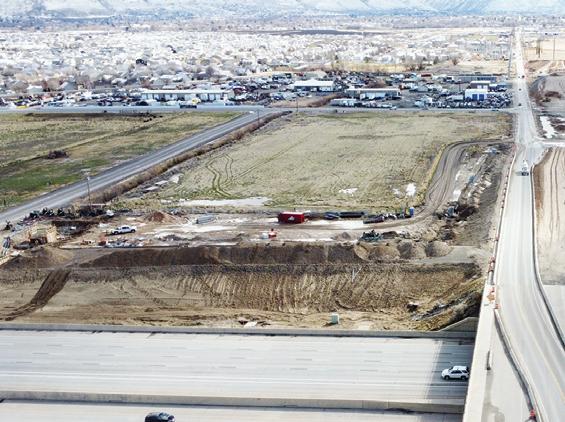


UDOT also will rename 1600 S 2700 N to Dry Creek Parkway to create continuity through the cities. “North of the new interchange is the interchange at 400 South and Springville, which gets a lot of traffic from the cities of Springville and Mapleton,” said Tryrell Edwards, district engineer for UDOT District 3. “There is no interchange that serves Mapleton very well. The interchange we are building provides more access to I-15, takes pressure off the existing one and connects I-15 to State Route 51.”
Planning for the project began in 2017.
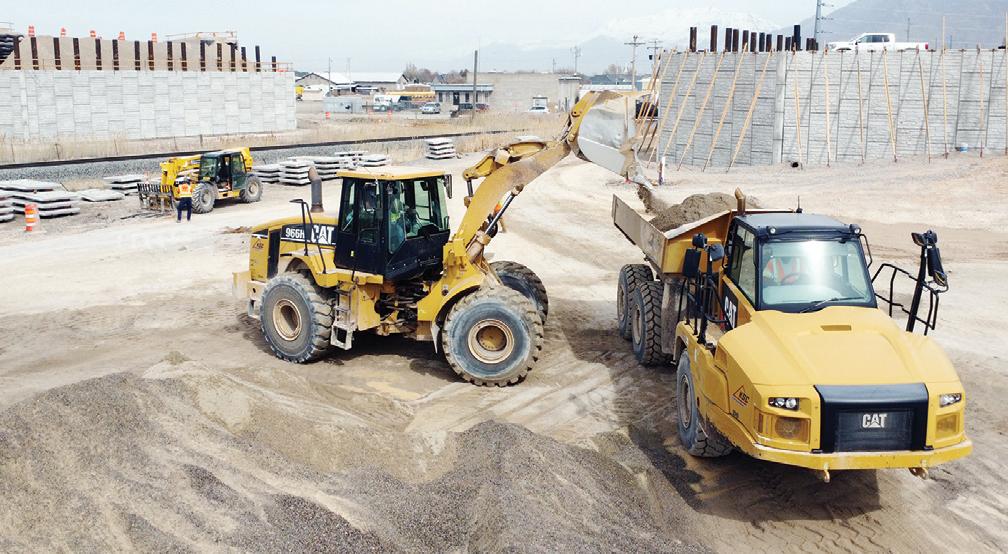
“The new interchange will be close to the U.S. 6 interchange and, in order to make this juncture work, we went through our interchange access request with the Federal Highway Administration and worked with them to develop a three-quarters interchange,” Edwards said. “We have northbound on and off ramps and, southbound, an off-ramp. Traffic that needs to exit southbound will use the U.S. 6 interchange.” Phase 1 work included the earthwork for the northbound and southbound on-ramps, which eliminated some local frontage roads, utility relocations and the relocation of some of the frontage roads.
see INTERCHANGE page 7

By Dylan McConnell 4RIVERS EQUIPMENT
Albuquerque Asphalt began setting a new standard in road construction with its work on New Mexico State Road 104.
The company is also leading the charge in sustainable, efficient paving practices.
“We’re pavers. That’s what we do,” said Jacky Spencer, general superintendent of Albuquerque Asphalt. “We do what we say. We do good work.”
Albuquerque Asphalt has long been a leader in adopting new technologies. One of its most notable achievements is introducing foamed asphalt to New Mexico — a process that wasn’t in use until the company collaborated with the department of transportation to write the state’s specifications. Since then, foamed asphalt has become a regional staple.
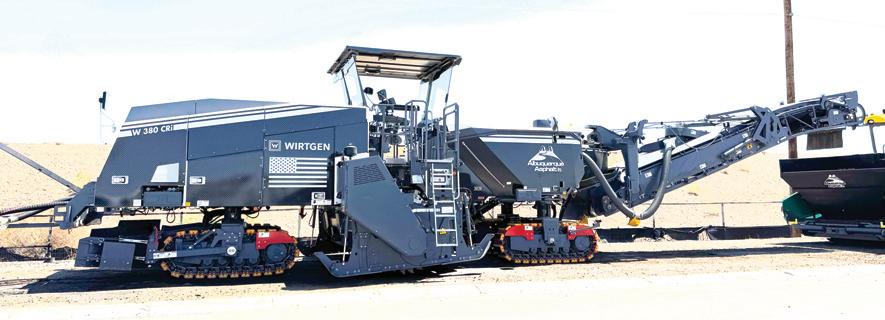
Now, the company is taking innovation further with the use of the Wirtgen W 380 CRi, which enables full-depth reclamation (FDR). This process recycles existing road materials in place, eliminating the need for traditional grading crews and significantly reducing project timelines, according to the company.
The Wirtgen W 380 CRi integrates cement and foamed asphalt directly into the roadbed, creating a continuous feed into the paver. This not only speeds up the process but also reduces the number of trucks and crews needed onsite, according to Wirtgen.
“When you’re shaving a couple of months off a job, that’s hundreds of thousands of dollars in savings,” said Collin James, branch manager of 4Rivers Equipment in Albuquerque.
The FDR process also improves road longevity. Unlike
With a goal of completing 2 mi. per day, the team expected to finish the NM 104 project in just eight days — a task that would traditionally take over a month.
“This is something new that we’ve never had out here in New Mexico,” Spencer said. “Nobody else is doing this.”
A key factor in Albuquerque Asphalt’s success is its strong relationship with 4Rivers Equipment.
“I call 4Rivers my easy button,” Spencer said. “When I need something, they make it happen.”
Whether it’s sourcing a replacement mill in the middle of the night or ensuring equipment is ready on the lot, 4Rivers’ responsiveness is critical to keeping projects on schedule.
“Nowadays, support is very, very critical,” James said.
“Guys like Collin and Jon [Valerio] go above and beyond. If I don’t talk to them five or six times a day, it’s an off day,” Spencer said.
“It probably saves 25 percent of the contract time,” said Bob Wood, Albuquerque Asphalt’s president and owner.
“We’re thinking it’s going to shave a month to a monthand-a-half off the project schedule,” Spencer said.
traditional mill-and-fill methods, which leave underlying cracks that eventually resurface, FDR pulverizes and rehabilitates up to 6 in. of the existing road, resulting in a more durable and longer-lasting surface.
This project marks Albuquerque Asphalt’s first venture into in-place recycling, and it’s already proving successful.
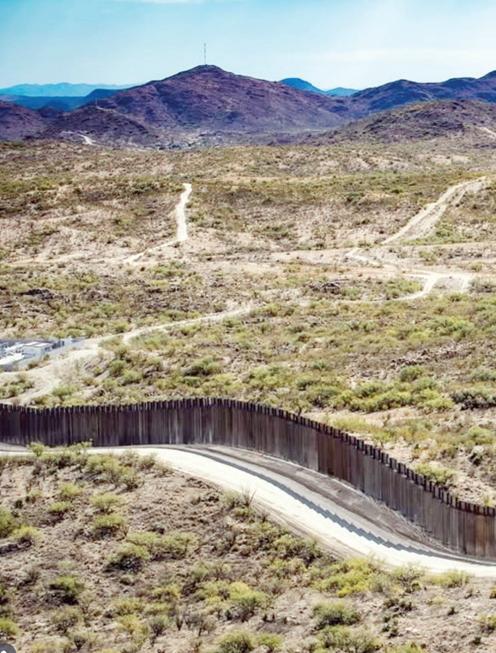
U.S. Customs and Border Protection awarded a $309,463,000 contract for border wall construction to North Dakota-based Fisher Sand & Gravel Co. over the next 30 months to construct approximately 27 mi. of new border wall in Santa Cruz County, Ariz., which is within the U.S. Border Patrol’s Tucson Sector
This contract is funded with CBP’s fiscal 2021 funds.
The construction company, which is a family business operated by Tommy Fisher, is well-known in the Southwest for border wall construction, according to azcentral.com.
Fisher Sand & Gravel received nearly $2 billion in wall contracts during the first Trump administration, building segments in Arizona, New Mexico and Texas.
The Tucson Sector is an area of high illegal entry attempts and experiences large numbers of individuals and narcotics being smuggled into the country illegally, according to the DHS. Continuing border wall construction in Tucson will support the department’s ability to impede and deny illegal border crossings and the drug and human smuggling activities of transnational criminal organizations.
In addition, Department of Homeland Security Secretary Kristi Noem said she is securing the border with a new waiver for border wall construction, ensuring expeditious construction of up to an additional 17 mi. of new border wall in Texas within the USBP’s Rio Grande Valley Sector.
This is the fifth waiver signed by
Noem for border wall construction.
DHP said in its news release that Noem’s waiver authority allows DHS to waive environmental laws including the National Environmental Policy Act — to ensure the expeditious construction of physical barriers and roads by minimizing the risk of administrative delays.
The waiver covers the RGV 02/04/10 Wall Project (approximately 9 mi. were awarded, with up to an additional 8 mi. in options) which is funded with CBP’s FY 2021 appropriations.
The contract for a portion of the wall on the US-Mexico border wall is the second during President Donald Trump’s second term. In March, Granite Construction wond a $70.3 million design-build contract for 7 mi. of wall in Hidalgo County, Texas.
Albuquerque Asphalt’s commitment to innovation, efficiency and partnership is transforming how roads are built in New Mexico. The work on NM 104 is more than just a paving project: It’s a model for the future of infrastructure.
And that bond between Albuquerque Asphalt and 4Rivers continues to strengthen.
“It’s critical to our success to have a partner like 4Rivers,” Spencer said. “They’re 110 percent with us.”





































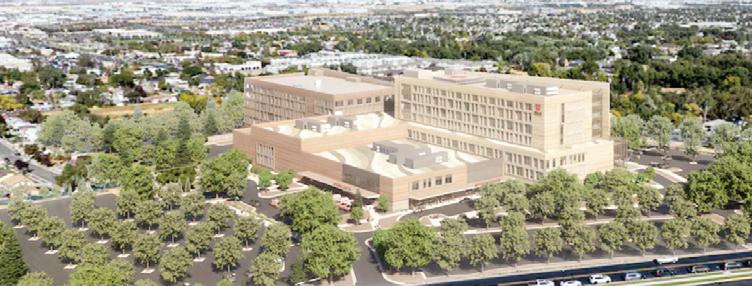
University of Utah officials and other dignitaries broke ground on June 13, 2025, on a new $885 million hospital and medical campus in West Valley City’s Centennial Park, according to sltrib.com.
Okland Construction Co. of Salt Lake City is the project’s general contractor.
Initial phases of the 800,000-sq.-ft. hospital and supporting medical offices at 3784 S. 5600 West are set to open sometime in 2028, sltrib.com reported. The facility will be the university’s first off-campus hospital in its 175-year history as well as its largest medical facility.
The 22-acre site will be called the University of Utah Eccles Health Campus and Eccles Hospital in West Valley. It will be the west side’s first sizable and integrated medical institution, offering an emergency department, 130 inpatient rooms, 200 exam rooms and support offices for nearly 50 specialties, sltrib.com reported.
Sltrib.com said the hospital will be considered a major boost to the quality of life, economic prospects and health outcomes for people living west of Interstate 15, where historic metrics reveal disadvantaged residents were long underserved for hospital care.
“Just because health care services are available does not mean that they are accessible,” Utah Lt. Gov. Deidre Henderson said, “and we are taking a huge step today in providing accessible major health care to the people on the west side of I-15, and I am so grateful.”
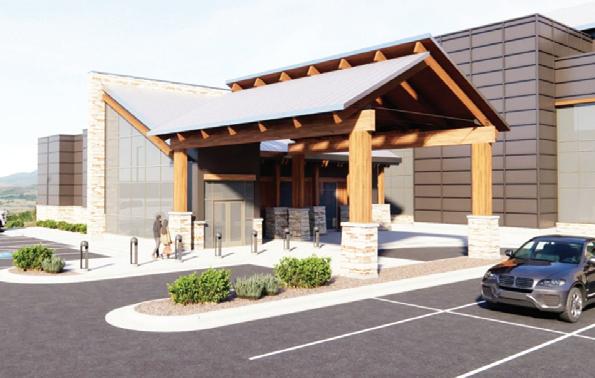
The northeast entry to the medical office building at the University of Utah Health's hospital and health campus under construction in West Valley City.
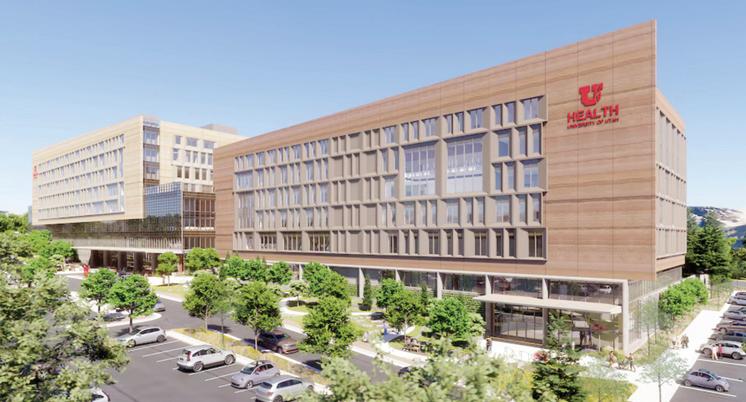
The main hospital, medical office building, parking structures and tree-lined campus will be completed sometime in 2029 or beyond. The future capacity will be more than 426,000 patients annually, according to sltrib.com.
University renderings showcase two sleekly designed earth-toned mid-rise structures with rectangular surfaces.
Both the primary hospital, with an emergency department, and the medical office building feature prominent north-facing facades and are set far back from the road.
Around those buildings are low-rise supporting structures to the south and tree-covered grounds buffering the entire site, sltrib.com reported.
Utah’s second-largest city anticipates that
the campus will create up to 2,000 new jobs and provide a regional economic boost from related commerce.
University President Taylor Randall
called the event a milestone in university history and thanked the many partners who made the hospital possible. He said it would invigorate the university, the communities it serves and the entire state, according to sltrib.com.
“We believe that, together, this project will not only save lives, it also will start educational processes to work,” Randall said, “not only in our hospital, but in the hospitals around the country, in the hospitals all around our state. It will make all of us different.”
Spence Eccles received a standing ovation at the groundbreaking ceremony. In March, the George S. and Dolores Doré Eccles Foundation announced a gift of $75 million, the largest in the charity’s 67-year history and the biggest ever given to Utah’s flagship university, for the hospital, according to sltrib.com.
(All renderings courtesy of University of Utah Health.)
Intermountain Park City Hospital in Park City, Utah, broke ground on June 12, 2025, on a major addition to its facilities that includes a cancer center, along with the expansion of the emergency department and surgical services.
These additions will help ensure the hospital can continue to meet the needs of a growing population, along with the millions of tourists who visit every year.
Construction is expected to cost approximately $40 million, according to parkrecord.com. Jacobson Construction is the general contractor, with Intermountain’s design and construction team managing the project.
“We're embarking on a groundbreaking era at Intermountain Park City Hospital that will generationally redefine cancer care
along the Wasatch Back,” said Lori Weston, president of Intermountain Park City Hospital.
“Research has shown people have better outcomes when they can receive care closer to home and this expansion will help us meet that goal.”
The new Intermountain Health cancer center will span 10,800 sq. ft. and bring vital services like medical oncology, a linear accelerator for radiation treatment and 18 infusion bays.
Previously, patients had to travel outside the Wasatch Back to receive those services, and now it’s close to home.
The new cancer center will be able to treat 90 percent of the cancer cases along the Wasatch Back and serve up to 1,500 patients annually.
Because patients no longer
must travel outside the Wasatch Back for this care, this will open appointments for cancer patients along the Wasatch Front.
“Cancer care takes a physical and mental toll on patients and having to commute nearly 100 miles roundtrip to get care only adds to an already stressful situation,” said Tawyna Bowles, an Intermountain Health oncology surgeon and senior medical director for oncology of Intermountain Health’s Canyon’s Region. “We hope this new cancer center will help ease the burden on patients and families.”
Other hospital upgrades will include an emergency department expansion of nearly 9,000 sq. ft. and will include four new trauma bays and an imaging suite with modern equipment.
Considering the significant
amount of outdoor recreation from both residents and tourists, having an emergency department that can handle additional patients is vital.
The other parts of the upgrade include the addition of new operating rooms and another two surgical rooms dedicated for gastrointestinal procedures.
INTERCHANGE from page 1
Phase 2 includes the widening of 1600 South (Drake Creek Parkway), the construction of the bridge over Union Pacific tracks and associated elements.
“This was the first digital delivery roadway project in our region,” said Edwards. “It’s been done in other areas, but it’s different for our inspectors and contractors. Wadsworth has had some experience with digital delivery. It's kind of a big shift — just the fact that it can create some complications and unforeseen consequences where you have work done by another contractor and then up by another contractor that does not see the project as phased.
“This project was phased to get work going while right-ofway purchases were being made and utility issues had to be worked through. We were trying to accelerate the schedule. We're aware that it kind of forces contractors to be flexible.”
Austin Davies, Wadsworth’s engineering project superintendent, noted that one of the challenges is the many settlement areas, groundwater and railroad lines.
“This includes the railway design and getting enough height while maintaining low profiles,” he said. “Moving all the power infrastructure was a concern as the area is a big hub for the power lines.”
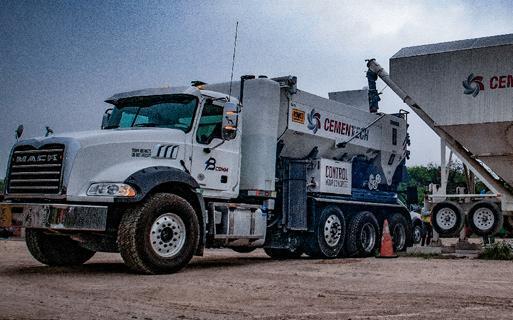
Wadsworth is using cellular concrete to replace the lightweight fill that the contract originally required.
“Wadsworth approached us, saying there is less risk if we use cellular concrete,” Edwards said.
Davies appreciates the help provided by UDOT.
“UDOT’s team has been great all the way from their district
engineer down to the chief building inspector,” he said. “They've been really good to work with. It's a good, collaborative effort, and we solve a lot of problems that come up.”
Sunroc Construction constructed the new frontage roads, from earthwork to paving, on a greenfield site. The contractor also excavated the ground and built the ramps and the tie-ins.
The asphalt-lane roadwork had excavation, site prep and paving crews operating simultaneously at one point.
“They had the same challenges that Wadsworth has — poor soil conditions and high groundwater,” Edward said. “Sunroc worked well with us. It was a bit of a challenge for them, just coming into DOT work and a digital delivery project. Before this, they worked on city projects. They worked well and were good to partner with.”
Phase 2 work is progressing well.
“Our schedule is driven by the settlement periods in our work zone, which can be up to three or four months,” Davies said. “We’re attacking that with mass fills.”
Sunroc’s earthwork operations generated approximately 500,000 cu. yds. of fill.
“We're trying to get the clock going to get the settlement periods done with so when we construct our bridge, we're ready to go,” Davies said.
Wadsworth has an earthwork crew handling the mass fills, two to three crews on drainage and storm drains and various crews moving power lines.
“Our plan of attack is to get the fills placed, build our MSE walls and get them ready for the bridge,” Davies said. “We’re hoping for a late summer start for the steel girder bridge construction, which will improve that crossing over the tracks.
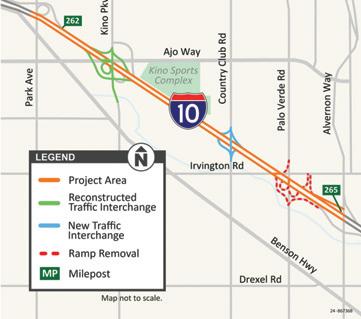
The Arizona Department of Transportation (ADOT) began a $600 million project that will widen Interstate 10 between Kino Parkway and Country Club Road, kvoa.com reported.
The project is the largest highway construction initiative in southern Arizona’s history.
The State Transportation Board awarded the design-build project to Sundt-Jacobs.
The project is designed to improve traffic flow and safety by adding lanes and constructing new interchanges, according to
Arizona Department of Transportation map
kvoa.com.
That includes expanding I-10 into three lanes in each direction between Kino Parkway and Alvernon Way. It also includes the reconstruction of the Kino Parkway interchange, construction of an I-10 undercrossing that connects the North and South Kino Sports Complex, and the construction of a new interchange at Country Club Road.
In addition, the existing Palo Verde Road interchange will be removed, while a new westbound on-ramp at Alvernon Way will be built, according to kvoa.com
This project will follow the 2020 Interstate 10 and State Route 210 Transportation Design Concept Report (DCR) that recommended improvements for a 10-mile stretch of I-10 to Kolb Road. That included extending State Route 210 along Alvernon Way to connect I-10 to downtown Tucson.
The I-10: Kino to Country Club project was programmed into the 2024-2028 FiveYear Transportation Facilities Construction Program as a Design/Build in FY 25. Construction is expected to be completed by summer 2028.
Currently, there are pretty big delays as the tracks are connected to a train depot.”
To construct the bridge, piles will be driven and filled, followed by installing walls, the pouring of reinforced footings at the tops and then the placing of the steel girders. Following these operations, a partial precast concrete deck panel system will be placed to span the gap between the girders, followed by the rebar and the deck pouring.
The deck panels are approximately 3.5 in. thick, and the deck will be approximately 5 in. thick.
Working at such heights requires a rigorous safety program.
“The beams and girders are up in the air,” said Davies, “so we had our manufacturer weld in some anchor points and bolts. We have a safety line system so that everyone can be on lanyards and tied up above the tracks. We have a bunch of safety plans that we go through should someone fall and ensure that everyone respects the plans.”
The 134,000-lb. steel beams will be lifted by and placed into position by a Kobelco 2500-2 250-ton crawler crane.
The project will use 1.1 million tons of steel, including the steel girders and rebar.
The Kenny Seng Co., the subcontractor responsible for the earthwork, is using CAT D8 dozers, smaller skid steers, rollers and track hoes. They built 1.2 mi. of road, with two lanes in each direction and a shoulder on each side.
For the bridge work, Wadsworth also is using 50-ton mobile rough-terrain cranes and 12,000 lb. capacity forklifts, track hoes and smaller equipment. CEG
(All photos courtesy of the Utah Department of Transportation.)