CALIFORNIA STATE EDITION
A Supplement to:
November 22 2020 Vol. I • No. 24
“The Nation’s Best Read Construction Newspaper… Founded in 1957.” Your California Connection – Sharon Swanson – 1-760-518-4336 – sswanson@cegltd.com
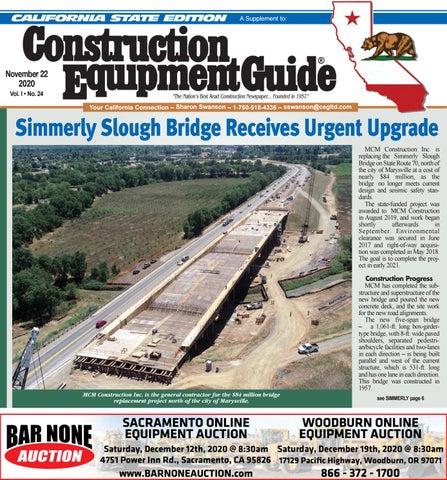
Simmerly Slough Bridge Receives Urgent Upgrade MCM Construction Inc. is replacing the Simmerly Slough Bridge on State Route 70, north of the city of Marysville at a cost of nearly $84 million, as the bridge no longer meets current design and seismic safety standards. The state-funded project was awarded to MCM Construction in August 2019, and work began shortly afterwards in September. Environmental clearance was secured in June 2017 and right-of-way acquisition was completed in May 2018. The goal is to complete the project in early 2021. Construction Progress MCM has completed the substructure and superstructure of the new bridge and poured the new concrete deck, and the site work for the new road alignments. The new five-span bridge – a 1,061-ft. long box-girdertype bridge, with 8-ft. wide paved shoulders, separated pedestrian/bicycle facilities and two-lanes in each direction – is being built parallel and west of the current structure, which is 531-ft. long and has one lane in each direction. This bridge was constructed in 1957. MCM Construction Inc. is the general contractor for the $84 million bridge replacement project north of the city of Marysville.
SACR RAMENTO ONLINE EQUIIPMENT AUCTION
see SIMMERLY page 6
WOODBURN O ONLINE EQUIPMENT A AUCTION
h, 2020 @ 8:30am Saturday, Deecember 12th, 2020 @ 8:30am Saturday, December 19th, 4751 Power Inn Rd., Sacramento, CA 95826 17129 Pacific Highway, Woodburn, odburn, OR 97071
www.BARNONEAUCTION.com
866 - 372 - 1700
Page 2 • November 22, 2020 • www.constructionequipmentguide.com • California State Supplement • Construction Equipment Guide
Construction Equipment Guide • California State Supplement • www.constructionequipmentguide.com • November 22, 2020 • Page 3
0% % FOR 60 M MONTHS WITH W ZERO DOWN* Apply 0% on Cat® Attaachments too! Becausse Beca s your o r business b siness never ne er stops, ops, we want owning new Cat® compact equipment to be simple and hassle-free. ee ee. Right now, you can take advantage ge of zero down and zero interest nterest with unmatched support upport from your local Cat dealer. Plus, th his finance rate can be appplied to attachment purchases, ases, helping you get more done for less. Just a few f of the new ways we saay, “Hello and welcome to the California Cat dealerss.”
www.hawthorrnecat.com San Diego 858-239-1120
www.holtca.com w Ceentral Northern California 8000-452-5888
www.petersoncat.com m Bay Area & Northern California, Oregon, and Southwesst Washington a 844-349-4353
www.quinncompany.com Central & Southern California 888-842-2155 2155
*Financing offers valid fro om July 1, 2020 through January 31, 2021. 0.0% interest for 600 months financing with zero down payment available only on the following new Cat machines manufactured by Caterpillar pillar Inc.: Skid Steer Loaders, Mini Excavators, Compact Track ack Loaders, Compact Wheel Loaders, Backhoe Loaders, Small Dozers, Small Wheel Loaders, and Telehand dlers. Financing, zero down, and published rate terms are on nly available through Cat Financial for customers meeting cred redit approval and subject to Cat Financial offered terms and nd conditions. Not all buyers will qualify. Higherr rates may apply for buyers with lower credit rating or lesse er qualifications. Offer available only at participating Cat dealers. Flexible payment terms available to those who qualifyy. Offer is available to customers in the USA and Canada only ly. Offer subject to machine availability. Offer may cha ange without prior notice and additional terms and condition ns may apply. Contact your Cat dealer for details. © 2020 Caterpillar. All Rights Reserved. CAT, T, CAT TERPILLAR, LET’S DO THE WORK, the eir respective logos, “Caterpillar Yellow”, the “Power Edge” and Cat “Modern Hex” trade dress as well as corporate and nd product identity used herein, are trademarks of Caterpillar ar and may not be used without permission. www w.cat.com / www.caterpillar.com
Page 4 • November 22, 2020 • www.constructionequipmentguide.com • California State Supplement • Construction Equipment Guide
Three Firms Begin Construction of UC Irvine Facility Hathaway Dinwiddie Construction Company, architecture and engineering firm HED and architecture firm The S/L/A/M Collaborative (SLAM) announced that construction is under way on a landmark, 9-acre health sciences complex at the University of California, Irvine (UCI), that promises to be a national showcase for integrative health patient care, training and research. The new facility will include a five-story, 135,111 sq.-ft. building for the Susan & Henry Samueli College of Health Sciences and the Susan Samueli Integrative Health Institute and an adjoining four-story, 77,028sq.-ft. building for the Sue & Bill Gross School of Nursing. The site is located on the corner of Bison and California avenues, adjacent to the UCI Research Park. Projected cost is $134 million and the facilities are expected to open in 2022. HED’s and SLAM’s higher education and healthcare studios brought expertise to the team. “The design is dedicated to supporting human health and the healing experience in a holistic way,” said Martha Ball, project manager of HED. “This aspect of the project mission infused our process.” Design strategies for the new buildings on the UCI campus were strongly influenced by biophilia — the human tendency to interact with other forms of life in nature — and attention to wellness at all scales. Occupant access to light, air, views of vegetation and water and other considerations, all support the overall mission of the complex and the schools. The health science complex includes a 150-seat auditorium, a central courtyard that connects with the existing Gavin Herbert Eye Institute, landscape design elements that support activities such as yoga and tai chi, a Zen garden and a 600-ft.-long wellness walk that leads to the School of Medicine’s Biomedical Research Center.
The complex is supported by major donations. Susan and Henry Samueli donated $200 million to build this first-of-its-kind college of health sciences focused on interdisciplinary integrative health. The farreaching gift — one of the largest ever to a single public university — positions UCI as a bold new leader in population health, patient care and health-related education and research. The William and Sue Gross Family Foundation committed $40 million to UCI to establish a nursing school and assist in the
Two new College of Health Sciences Complex buildings at the University of California, Irvine, now under construction, will be a showcase for integrative health patient care, training and research.
that benefits from healthcare providers that operate in synchrony to support health and wellness." “A future of wellness demands The new University of California, Irvine, facilities that we promote approaches that include the Susan & Henry Samueli College of keep our patients healthy, and Health Sciences and the Susan Samueli when they are ill, that our Integrative Health Institute the Sue & Bill Gross School of Nursing. The project is a flagship for providers work together so care is readily-accessible, cutting-edge, the future of health education. patient-focused and populationsavvy,” added Goldstein. “The integrative construction of a new building to house it. The project is a flagship for the future of health institute is co-located so all our stuhealth education. "UCI is creating a national dents incorporate its focus on the whole per'one-health' model for discovery, teaching son, even when the provider is a specialist, and healing that brings together the strengths and its commitment to finding new, effecof the disciplines of medicine, nursing, phar- tive, evidence-based practices to optimize macy and population health," said Vice well-being.” Chancellor for Health Affairs Steve About Hathaway Dinwiddie Goldstein. "These two new buildings, part of Construction our expanded health sciences campus, are Hathaway Dinwiddie celebrated its 100th designed to foster the creation of the diverse healthcare workforce of tomorrow. The year of business in California in 2011. facilities are built to enable interprofessional Hathaway Dinwiddie focuses on the education and a future of team-based care California market and is known for con-
structing many of the state's iconic buildings. About HED HED seeks creative solutions that have a positive impact for its clients, the community and the world. HED has earned a reputation for excellence in all facets of the designed and built environment, including architecture, consulting, engineering and planning services. The firm of 350 people serves clients in a broad range of markets from eight U.S. offices: Boston, Chicago, Dallas, Detroit, Los Angeles, San Diego, San Francisco and Sacramento. About S/L/A/M Collaborative The S/L/A/M Collaborative (SLAM) is a multi-disciplinary design firm with a broad range of markets including a nationally regarded higher education practice. It’s primary focus on academic medical centers and expertise in the programming and design of research and education facilities has resulted in completion of 40 health sciences projects for top tier public and private institutions.
Caltrans Awards Granite $257 Million: SR 99 Rehabilitation Granite announced recently that it has been selected by California Department of Transportation (Caltrans) as the construction manager/general contractor (CM/GC) for the $257 million State Route 99 rehabilitation from El Dorado Street to Clinton Ave project in Fresno. The first phase of this contract is the construction management portion which is valued at $3 million. The entire project is valued at $257 million. The State Route 99 rehabilitation from El Dorado Street to Clinton Ave project will reconstruct 3.2 mi. of roadway with concrete pavement and alleviate road traffic backups through downtown Fresno with improved interchange configurations, added auxiliary lanes and increased shoulder widths. The project continues the widening of State Route 99 from a previous project completed for Caltrans by Granite in
The scope of work includes the replacement or widening of six bridges and several retaining and sound walls to accommodate highway widening including an existing Union Pacific bridge.
2018. The scope of work includes the replacement or widening of six bridges and several retaining and sound walls to accommodate highway widening, including an existing Union Pacific bridge. Drainage facilities within the project will be replaced including two pumping plants. “We are honored to once again team up with Caltrans and improve transportation in Fresno,” said Granite Regional Vice President Carter Rohrbough. “Being invited to be a part of the design and planning of this project provides Granite the opportunity to bring more value to Caltrans to ultimately support our communities and their traffic needs.” The construction management portion of the contract is expected to begin by the end of 2020, with the general contractor phase of the project slated to begin in mid-2024.
Construction Equipment Guide • California State Supplement • www.constructionequipmentguide.com • November 22, 2020 • Page 5
3299 Walnut Ave Signal Hill, CA 90755
PIRTEK Long Beach
562-426-9219
4191 Power Inn Road, Suite D Sacramento, CA 95826
PIRTEK Power Inn
916-737-7777
1997 Burroughs Ave San Leandro, CA 94577
PIRTEK San Leandro
510-568-5000
San Francisco, CA
PIRTEK SFO
650-532-9200
Page 6 • November 22, 2020 • www.constructionequipmentguide.com • California State Supplement • Construction Equipment Guide
MCM Crews Build New Five-Span, Box-Girder Bridge There were only 12 cast-in driven holes (CIDH) in the foundation, which were 10 ft. in diameter and between 140 to 154 ft. deep.
SIMMERLY from page 1
There was no soil, water or utility issues that affected the job and the large work zone provided ample space to conduct operations efficiently. The general contractor built an access road from one side to the other and another up and down over the levee to access SR 70. This involved a lot of earth work, which was done by Lamon Construction Company Inc. (Yuma, Calif.) over a threemonth period, which had crews clear trees and brush. “The bridge also is experiencing scouring activity in which water has been removing sediment such as sand and rocks from around the bridge piers or abutments,” said Gilbert Mohtes-Chan, public information officer of Caltrans, District 3. “The new bridge is designed to the Caltrans Seismic Design Criteria version 1.7 for a 6.5 magnitude earthquake and a peak ground acceleration of 0.23g. The bridge is located in an area of moderate seismic risk based on the USGS hazard maps. The Draft Environmental Document was completed in December 2016, and design began in January of 2017.” The work also includes a realignment of the highway approaches leading to the
The new five-span bridge – a 1,061-ft. long box-girder-type bridge, with 8-ft. wide paved shoulders, separated pedestrian/bicycle facilities and two-lanes in each direction – is being built parallel and west of the current structure, which is 531ft. long and has one lane in each direction.
bridge. The bridge will be striped for two lanes, have sidewalks on both sides, and a concrete barrier separating the shoulder from the sidewalk and bridge railing. “The bridge was designed to span the existing levees to avoid creating weak points, thus increasing their safety in highwater events,” said Anthony English, Caltrans bridge construction engineer. “During development of the project, a shift in the proposed alignment was able to significantly lower the profile of the new bridge, saving millions of dollars due to the decrease in imported fill volumes. Subsurface conditions required the use of large diameter castin-drilled-hole concrete piles. Permanent pile casings were specified for the upper portions of the piles to mitigate caving soils. The permanent casings were later eliminated by a change order due to the contractor’s use of full-length temporary casings to install the piles.” The lifespan of the post-tensioned haunched box-girder bridge is 50 to 75 years. “The shape of the girder economizes material by increasing the depth where the stresses are highest,” said English. “As a see SIMMERLY page 10
Construction Equipment Guide • California State Supplement • www.constructionequipmentguide.com • November 22, 2020 • Page 7
NEXT ISSUE CLOSES: December 10, 2020
Page 8 • November 22, 2020 • www.constructionequipmentguide.com • California State Supplement • Construction Equipment Guide
Projects in Golden State Making Significant Progress The Road Repair and Accountability Act of 2017 (Senate Bill 1) has passed a major timeline milestone, one-fifth of the way through a promised 10-year transformation of California’s transportation network. A recent progress report presented to the California Transportation Commission shows that Caltrans, to this point, is meeting or making significant strides on key SB 1 performance targets set for pavement, bridges, drainages, its signals, signs and sensors system. But challenges remain in the pace of improvements to the bridges that Caltrans maintains, although solid progress has been made to that critical part of the State Highway System (SHS). Caltrans analyzed the condition of its major highway components as part of an annual progress report required by the CTC. In addition to the SB 1 targets, the report measured Caltrans’ performance in the same categories established in its 2018 Transportation Asset Management Plan (TAMP) that counted and assessed the condition of the highway system’s many physical components, and set objectives to preserve and improve those assets. The progress report noted that Caltrans was on track, at current and projected rates of repair and rehabilitation, to meet SB 1 performance standards for pavement overall, bridges, and culverts by the end of the 10year reporting period. The interconnected grid of electrical devices and hardware known as TMS (transportation management system) was placed on monitor status, meaning it’s still uncertain whether the pace of improvements will be enough to achieve 2027 goals. That same rating was accorded for a separate SB 1 category, pavement maintenance based on the number of pot-
A progress report noted that Caltrans was on track, at current and projected rates of repair and rehabilitation, to meet SB 1 performance standards for pavement overall, bridges and culverts by the end of the 10-year reporting period.
holes, cracks and concrete corrosion found on state routes. SB 1, which became law in 2017, requires that Caltrans upgrade 98 percent of all three classes of state highway pavement to good or fair condition by 2027. The Department also must achieve a 90 percent rating based on Level of Service (LOS) standard for pavement deficiencies. Caltrans now uses a laser-scanning system to evaluate pavement conditions as part of SB 1 and TAMP performance standards, replacing a previous method that relied on limited visual inspections. The new automated survey has already produced greater accuracy in grading road conditions than the old method of dispatching field crews for inspections. SB 1 also requires that Caltrans fix 500 bridges over and above a previous annual average number of repair projects, bring its culvert system to a 90 percent or better good or fair rating, and ensure that at least 90 percent of the TMS network is in good condition.
Caltrans’ TAMP rates the same highway categories, but uses more precise performance metrics for pavement and bridges. Based on the TAMP scale, all three classifications of highway pavement are on track to reach or exceed 2027 “good” condition goals. Caltrans’ culvert system was likewise improving at projected rates. The TMS system, as it was under the SB 1 reporting, was placed under a monitor status because of the possibility of falling short of long-term goals. Under TAMP assessment standards, however, the overall condition of Caltrans bridges and tunnels lagged behind other parts of the SHS showing improvement. The early bridge and tunnel showing earned an “action required” warning, and Caltrans has intervened by taking corrective steps to quicken the pace of planned improvements. Bridges, Tunnels High marks: Caltrans is on pace to exceed the 2027 bridge-fix goal mandated by SB 1.
The department projects that of the almost 13,200 bridges it maintains in the state, least 1,900 will undergo fixes as defined by the CTC in the 10-year reporting period. SB 1 targets commit Caltrans to repairing or rehabilitating at least additional 500 bridges through 2027, an extra 50 a year, on top of the average of 114 that were being fixed annually prior to SB 1. Under the SB 1 formula, Caltrans is required to complete a total of 1,140 bridge fixes through 2027 —but will likely reach that goal by the 2024-25 fiscal year, two years earlier than required. To earn credit as a “fix,” a bridge project must either improve the condition of the span, either from fair to good, or poor to fair/good; perform a seismic restoration that meets federal guidelines; eliminate the vulnerability to scour conditions caused by water; or address vertical clearance or load capacity issues. Challenges As measured by federal standards, the percentage of bridges rated in good condition dropped more than five points from 2017 to 2018, from 65.9 percent to 60.3 percent. Bridges that earned a fair rating from inspectors showed an almost five-point rise, from 30.8 percent in 2017 to 35.7 percent in 2018. The percentage of bridges rated in poor condition went from 3.3 percent to 4 percent in the same reporting period. Caltrans estimates that percentage of bridges rated in good condition would steadily improve through the 10-year reporting period with the help of SB 1 funding. But even at the current rate of progress, that projected improvement would still fall short of the 2027 good condition target of 83.5 percent for Caltrans-maintained bridges and tunnels.
Plans for Los Angeles-to-Las Vegas Rail Hit Speed Bump Construction of the privately-funded Brightline West passenger line between Southern California and Las Vegas in Nevada has been delayed indefinitely after a $2·4 billion bond offering failed to attract buyers. It had been hoped that construction of the electrified line designed for the 125 mph operation could start by the end of 2020, with servicers commencing by 2024. The offering was to be the seed money for starting the project, which is estimated to ultimately cost $8 billion. The reasons cited for the failure were combination of the COVID-19 pandemic and 2020 being an election year. The company indicated that plans for the project would continue to be developed. Formerly known as XpressWest, the project has been in the planning stage for more than a decade.
Brightline envisages a west coast version of its route between Miami and West Palm Beach in Florida, which is now being extended to Orlando. It is still hoped that another source of funding can be obtained, to enable initial construction to start on the High Desert Segment connecting the Victor Valley in California and Las Vegas. Stations would to be located in Las Vegas (just east of the I-15 between Blue Diamond and Warm Springs Roads, along Las Vegas Boulevard) and Victor Valley (along I-15 and Dale Evans Parkway) where the depot would also be located. The Rancho Cucamonga station would be adjacent to the existAfter a bond offering failed to attract a buyer, it is still hoped that ing Rancho Cucamonga Metrolink station, with the another source of funding can be obtained, to enable initial construc- Los Angeles Basin section of the line following the tion to start on the High Desert Segment connecting the Victor Valley existing Metrolink San Bernardino corridor to Los Angeles Union station. in California and Las Vegas.
Construction Equipment Guide • California State Supplement • www.constructionequipmentguide.com • November 22, 2020 • Page 9
Current California Construction Projects 197/199 Safe STAA Access: District 1
I-880 Between Oakland and Milpitas: District 4
SR-2 Terminus Project: District 7
The California Department of Transportation (Caltrans) has proposed improvements to State Routes 197 and 199 in Del Norte County to allow industry standard-sized trucks in compliance with the 1982 federal; Surface Transportation Assistance Act (STAA); to have access to the Northern California coast. These projects propose adjustments to State Route 197 near Ruby Van Deventer County Park (Ruby 1 and Ruby 2) and on State Route 199 near the Narrows, at Washington Curve and in the Patrick Creek area. This project would allow reclassification of the corridor as part of the national network of STAA truck routes. Presently, the width and tight curves of Routes 197 and 199 restrict passage for trucks compliant with STAA. The primary purpose of the proposed project is to improve seven spot locations on Routes 197 and 199 in Del Norte County so that two STAA trucks passing in opposite directions can be accommodated. Safety-enhancing improvements are needed to provide a roadway that is easier to maneuver for all users. These improvements also are necessary to allow safe STAA truck access, which would allow reclassification of the corridor as part of the STAA network of truck routes.
MTC is converting to express lanes the existing I-880 HOV lanes that run southbound from Hegenberger Road to Dixon Landing Road and northbound from Dixon Landing Road to Lewelling Boulevard. The conversion involves restriping lanes and installing lighting, sign structures, signs, FasTrak toll tag readers and other tolling technology, traffic monitoring video cameras, a data communications network and CHP observation areas. The project is also widening the highway in three locations to create merge lanes between the express lanes and the general purpose lanes. The project will result in 45 Express Lane mi. from Oakland to Milpitas. This project is coordinated with Caltrans and its replacement of the median barrier on I880.
The Glendale Freeway (SR-2) was originally planned and constructed in 1959 to connect with the Hollywood Freeway (U.S. 101) through the neighborhoods of Silver Lake and Echo Park. In 1962, as a result of local community opposition, the full build-out plan was rescinded and construction was terminated at the present SR-2 terminus near Glendale Boulevard and Duane Street. Since then, commuter traffic coming of and on to SR-2 has passed through the community, primarily along Glendale Boulevard and Alvarado Sreet, and has contributed to congestion. A Federal Transportation Equity Act for the 21st Century (TEA-21) and a High Priority Highway Project Authorization grant were provided to upgrade the southern terminus of SR-2 and help manage the flow of traffic and address safety concerns. The purpose of this project is to develop a balanced transportation system that better serves local and regional transportation needs through improved management of traffic flow; enhanced pedestrian and non-motorized accessibility and safety at the SR-2 terminus; and creation of a context sensitive designed community open space in the immediate vicinity.
San Jose Creek Bridge Replacement on U.S. Route 101: District 5
Burnt Junction Drapery: District 2 The California Department of Transportation (Caltrans District 2), in conjunction with Access Limited Construction, is preparing to begin work on the Burnt Junction Drapery Project on State Route 299 in Trinity County. The $7 million project will install mesh drapery systems and create enhanced rockfall catchments at two locations along SR 299: • Near Burnt Ranch, from 0.4 mi. east of Hennessey Road to 0.3 mi. west of Burnt Ranch School Road; • Near Junction City, from the Canyon Creek Bridge to 0.5 mi. west of that location. Also included in the project will be the extension or replacement of culverts systems and repair of roadway surfaces. Cap City Corridor Project: District 3 The Cap City Corridor (State Route 51 and adjacent streets) is the most congested corridor in the region. In 2016, SR 51/Cap City experienced more than 2,050,000 vehicle hours of delay at a $27.5 million cost to users and had five of the region’s top 10 bottlenecks. As the region continues to grow, conditions in the SR 51/Cap City Corridor are expected to worsen by 2035. To address the issues in the corridor and better meet the needs of drivers, transit riders, freight drivers, bicyclists, and pedestrians, Caltrans initiated the Capital City (Cap City) Corridor Project: A collaborative, interagency planning process that coordinates and prioritizes potential multimodal projects in the corridor. There is no single project that will solve all the issues. Instead, it will require a suite of short-, medium- and long-term multimodal projects with planning and funding from multiple agencies.
Caltrans proposes to replace the existing northbound and southbound San Jose Creek Bridges in the city of Goleta in Santa Barbara County on U.S. Route 101 at post mi. 21.6. Concrete on the superstructures of the existing northbound and southbound bridges contain reactive aggregate, which may compromise the structural integrity of the bridges. Both bridges also have structural deficiencies. The project would replace the existing bridges with a new single bridge structure. The new bridge will be in the same location as the existing bridge. The new bridge structure would be designed to meet current Caltrans standards that include, but not limited to: highway design standards, and seismic, safety and hydraulic standards.
Emergency Projects on State Route 74 and State Route 243: District 8 The California Department of Transportation (Caltrans) and Ames Construction continue the emergency repairs to State Routes 74 and 243 (SR’s 74 and 243) leading to the Idyllwild and Mountain Center communities. The $30 million emergency contract is replacing culverts, rebuilding slopes and roadbeds, replacing drains, scaling rock, repaving roadbeds and reinstalling guardrail and signage. The winter and spring rains of 2019 resulted in damage on both routes. As of June 5, 2019 the updated damage assessment list has increased to 58 locations on SR 74 and 37 locations on SR 243. Nineteen (19) locations have been repaired on SR 74 and six (6) locations have been repaired on SR 243. Ames Construction has expended more than 44,000 staff hours as of this week and has spent approximately $15 million on the emergency repairs.
Fresno 198 Culvert Rehabilitation: District 6
Aspen Fales Shoulder Widening Project: District 9
The California Department of Transportation (Caltrans) proposes to repair, replace or clean 82 culverts at various locations along State Route 198 from the Monterey/Fresno County line from post mi. 0.51 to post mi. 19.50, southwest of the city of Coalinga. The existing culverts are either undersized or so damaged that they will require cleaning, repair, or replacement. Specific culverts have become so clogged with material that they allow very little water to pass through. The purpose of the project is to rehabilitate 82 culverts on State Route 198 from post mi. 0.51 to post mi. 19.5 in Fresno County. The rehabilitation would repair, replace and clean culverts to address worn-out and damaged drainage facilities.
The purpose of the Aspen Fales Shoulder Widening project is to improve safety and operation along approximately 3 mi. of U.S. 395, in Mono County. Currently, this segment of highway has the non-standard design of 2 to 3 ft. shoulders. Shoulders will be widened to eight feet in order to reduce run-off-the-road collisions, the most common type of accident in the project area. Wider shoulders would give errant drivers a larger paved area in which to redirect their vehicles back onto the traveled way or to pull off the road. The California Department of Transportation (Caltrans), as assigned by the Federal Highway Administration proposes to widen shoulders to a standard design of 8 ft. along a three mile segment of U.S. 395, in Mono County.widening the northbound Lambert Road under-crossing bridge to accommodate the future truck-climbing lane project.
Page 10 • November 22, 2020 • www.constructionequipmentguide.com • California State Supplement • Construction Equipment Guide
Workers Utilize Leffer Oscillator for Cast-In Driven Holes SIMMERLY from page 6
bonus, the haunch shape allows for additional clearance over the levees.” The earth work crews used a compactor, a dozer and many dump trucks. Work on the substructure started on Nov. 3, 2019, and was completed in March 2020. There were only 12 cast-in driven holes (CIDH) in the foundation, which were 10-ft. in diameter and between 140 to 154 ft. deep. A subcontractor installed the 24-in. CDIH piles. Superstructure operations began immediately afterwards, with the falsework placed from one abutment to the other. This part of the operation went according to schedule. A Leffer 12-ft. oscillator was used to help with the 12 CIDH piles. MCM used fourway temporary oscillating casings – a casing that is in and off-side of the bridge as the pouring is under way. These type of oscillators are rarely found on the west coast. Cranes also were essential and MCM brought in three — a Liebher 895, a Liebherr 1300 and an American 275. The 895 is a digging crane and the oscillator was attached to the front of it as it was digging out the inside of the casing, using a big spherical grab and a hammer grab. The 1300 was hoisting pieces of casing as they were attached to the structure. After the oscillating casing is done, the casings were locked together. This crane also hoisted the cages, which were 109,000 lbs. each. They were long because the columns and CIDH were one piece. Most cages are around 180 ft. long and were lifted without a frame. The American crane was utilized as a tailing crane when the cages were hoisted. This was necessary as a cane was required to pick up the back end of the cages. As concrete was being poured, this crane held up the semi-pipe and then a fluid pump. Save for some concrete pours, the work is being done via day shifts. The concrete, specified by Caltrans for bridge and deck, was provided by Cemex. Some of the concrete pours for the deck were done at night during the summer due to the heat. Pours also were done at night for high volume pours between 1,500 and 1,800 cu. yds., which maximized their delivery truck capacity. These night pours eliminated concerns about traffic. The last concrete pour occurred on Oct.2. The pouring operation was based on two deck pours and three soffit pours. It took about 10 days after a pour to stress a completed section. The old bridge will be demolished after the new structure is completed, with the operation expected to begin in January. This should take approximately two weeks to complete.
Demolition MCM has submitted a demolition plan for the concrete flat bridge and it will likely be using a Cat 345 excavator with a 10,000 or
12,000 lb. breaker on it. A nearby recycling center will crush the concrete and convert it into base material. The demolition should generate about
The work also includes a realignment of the highway approaches leading to the bridge. The bridge will be striped for two lanes, have sidewalks on both sides, and a concrete barrier separating the shoulder from the sidewalk and bridge railing.
The bridge is experiencing scouring activity in which water has been removing sediment such as sand and rocks from around the bridge piers or abutments.
1,000 cu. yds. of concrete. The new bridge required the use of 9,000 cu. yds. of concrete and 3,000,000 lbs. of rebar. The new road approaches will be built following the demolition. A subcontractor placed embankment fill for the new road approaches during the first three months of the job. Future work on this element, after the bridge is completed, will partially repave the road to help with the shifting of traffic onto the bridge. Peak days have had nearly 60 construction workers on-site, including people from local and regional subcontractors. MCM is using equipment from its fleet. The company purchases and rents equipment from local and regional dealerships. Traffic management has Caltrans maintaining two lanes for traffic on the old bridge throughout construction. “Caltrans reduced the speed limit by 10 mph to 45 mph in the construction zone,” said Mohtes-Chan. “The speed reduction enhanced safety for workers and motorists in the area.” The work zone, located just outside of Marysville, provides ample space for MCM Construction to bring materials and equipment in and out of the site using access roads leading to SH 70 and local road, as well as set up lay down yards. The area will be relandscaped after the construction process is completed. CEG
Construction Equipment Guide • California State Supplement • www.constructionequipmentguide.com • November 22, 2020 • Page 11
Hawthorne Cat in Escondido Hawthorne Cat, the Cat equipment dealer in San Diego, the Hawaiian Islands and the Pacific Region, announced the opening of its new retail showroom in Escondido. The Hawthorne Escondido branch recently was remodeled with the addition of a new showroom and service capabilities. Hawthorne Cat now offers everyday consumables for Cat products such as oils, filters and grease, all in one convenient place. Customers can even rent or The Hawthorne Escondido branch is located at buy machines, get parts and pur- 1620 Mission Road, Escondido, Calif., 92029. chase safety gear and Cat branded Hours of operation are 6:30 a.m. to 5 p.m., merchandise. Monday through Friday. Coming in 2021, Hawthorne Hawthorne Cat currently has three Cat also will be expanding its services so customers can have maintenance work done branches in San Diego County, as well as an additional location for machinery and power on their Cat machines. “Experience the Hawthorne Difference rentals with a total of 10 locations throughtoday at our new retail showroom for all of out San Diego, Hawaii and Guam. The Hawthorne Escondido branch is your Cat equipment, parts, and service needs,” said Ross Farmer, corporate machin- located at 1620 Mission Road, Escondido, ery sales manager. “Customers will have a Calif., 92029. Hours of operation are 6:30 full retail experience when they walk a.m. to 5 p.m., Monday through Friday. For more information, call 760/740-2900. through the doors of our newly remodeled Escondido branch.”
Semi - Custom Rebuilt Vocational Trucks
2015 Freightliner Cascadia 125…$87,000 W003207, Cummins ISX15, 10 Speed, 450 HP
2012 International DuraStar 4300 …$46,000 W002771, 2,500 Gallon Tank, Automatic
2014 Freightliner Business Class M2 106…$60,000 W003144, New 16’ Dump Bed, 6 Speed, 250 HP
2012 FREIGHTLINER M2…$60,000 W002890, New 12’ Dump Bed, Automatic
Two locations in California to Serve You!
14635 Valley Blvd. Fontana, CA 92335
909.822.2200
10918 Shoemaker Ave. Santa Fe Springs, CA 90670
www.scottequip.com
C A L L U S T O D AY !
562.777.0775
Page 12 • November 22, 2020 • www.constructionequipmentguide.com • California State Supplement • Construction Equipment Guide
EXTRE T EME S STRE ENGT TH
Central California Power JCB 19487 Broken Ct, Shafter, CA 93263 (661) 589-2870 www.ccp-jcb.com
SoCal JCB 14675 Valley Blvd., Fontana, Ca. 92335 866-522-7225 www.socaljcb.com
QMC QMC JCB 3820 S. K Street, Tulare, CA 93274 (559) 686-1579 961 E. 3rd Street. Hanford, CA 93230 (559) 582-9393 www.quality-mc.com
N&S Tractor 1960 Highway 20 Colusa, CA 95932 (530) 458-2166 2173 Blossom Street Dos Palos, CA 93620-2313 (209) 392-2161 600 S. State Highway 59 Merced, CA 95341-6928 (209) 383-5888 1340 W. Charter Way Stockton, CA 95206 (209) 944-5500 20280 Main St. Stratford, CA 93266 (559) 947-3301
The all-new JCB X-series ex exccaavvaattors are here, delivveering the perffo ormance yo you need to get the job done and the dependability you need to drive down costs. Longer service intervals, eff fffo orrttless con o trro ol and industry-leading operaattor comffo orrtt are just parrtt of the new JCB X-series experience … backkeed by a naattionnwide dealer and n parts distribution network yo you can count on. To learn more about the new JCB X-series exca To ava vators visiit w w w.jcb.com or contact your JCB dealerr..
1215 West Glenwood Ave Turlock, CA 95380-5703 (209) 634-1777
/JCBNA
@JCBNA
w.jcb.com .jcb.com j JCBNA www
827 North Tehama St Willows, CA 95988 (530) 934-3382 3056 Colusa Highway Yuba City, CA 95993 (530) 923-7675 www.nstractor.com
5405