CALIFORNIA STATE EDITION
A Supplement to:
April 11 2021 Vol. II • No. 8
“The Nation’s Best Read Construction Newspaper… Founded in 1957.” Your California Connection – Sharon Swanson – 1-760-518-4336 – sswanson@cegltd.com
By Irwin Rapoport
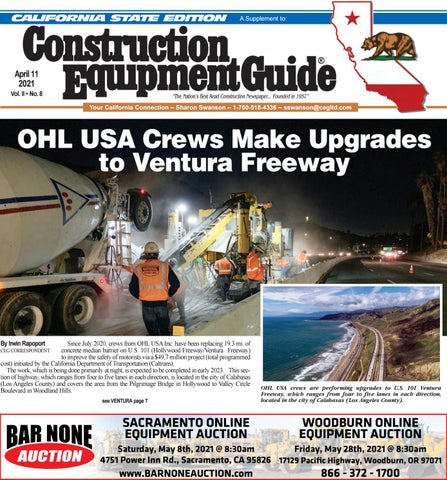
Since July 2020, crews from OHL USA Inc. have been replacing 19.3 mi. of concrete median barrier on U.S. 101 (Hollywood Freeway/Ventura Freeway) to improve the safety of motorists via a $49.7 million project (total programmed cost) initiated by the California Department of Transportation (Caltrans). The work, which is being done primarily at night, is expected to be completed in early 2023. This section of highway, which ranges from four to five lanes in each direction, is located in the city of Calabasas (Los Angeles County) and covers the area from the Pilgrimage Bridge in Hollywood to Valley Circle Boulevard in Woodland Hills. CEG CORRESPONDENT
see VENTURA page 7
SACRAMENTO ONLINE EQUIPMENT AUCTION
OHL USA crews are performing upgrades to U.S. 101 Ventura Freeway, which ranges from four to five lanes in each direction, located in the city of Calabasas (Los Angeles County).
WOODBURN ONLINE EQUIPMENT AUCTION
Friday, May 28th, 2021 @ 8:30am Saturday, May 8th, 2021 @ 8:30am 4751 Power Inn Rd., Sacramento, CA 95826 17129 Pacific Highway, Woodburn, OR 97071
www.barnoneauction.com | (866) www.BARNONEAUCTION.com 866 372 - 372- -1700 1700
Page 2 • April 11, 2021 • www.constructionequipmentguide.com • California State Supplement • Construction Equipment Guide
Fontana:
909-822-2200 •
Santa Fe Springs:
562-777-0775
NEW EQUIPMENT. Finance program Option 1: Low rate financing (0.9% for 60M) + 3 year 5,000-hour powertrain and hydraulics extended warranty
Doosan DL200
Option 2: Low rate financing (0.9% for 36M) + 5 year 7,500-hour powertrain and hydraulics extended warranty
Scott Equipment 14635 Valley Blvd. Fontana, CA 92335 909-822-2200
10918 Shoemaker Ave. Santa Fe Springs, CA 90670 562-777-0775
Construction Equipment Guide • California State Supplement • www.constructionequipmentguide.com • April 11, 2021 • Page 3
WO W ORK K SM MARTER. WO W ORK FASTER. A
And that’s only the star t of it.
SMART G GRADER BLADE
SMART DOZER BLAD DE
Experience our latest innovation … Smart S Attachments. Each new n attachment makes yoour Cat ® D3 Series Skid Stteer and Compact Track Loade ers joystick more intuitive and a more efficient intellligent machine. You can coount on your California Catt Dealers to bring you first-of--its-kind Smart Attachmen nt Technology that takes performance p and profitabillity of your company to thee next level.
» COMFORT » SMART » PERFORMANCE Contact you ur California Cat Dealer today to learn more
SINCE 1956 www w.hawthornecat.com San Diego County 800-437-4228
SINCE 1931 www w w.holtca.com Ceentral Northern California 8000-452-5888
SINCE 1936 www w.petersoncat.com Bay Area & Northern California, Oregon, and Southwest Washington 844-349-4353
© 2021 Caterpillarr.. All Rights Riights Reserved. CA ATT, CA CATERPILLAR, LET’S DO THE WORK, their respective logos, “Caterpillar Yellow”, the “Power Edge” and Cat “Modern Hex” trade dress as well as corporate and product identity used herein, are trademarks of o Caterpillar and may not be used without permission. www.cat.com / www.caterpillarr.com .com
SINCE 1919 www w.quinncompanyy.com Central tral & Southern California 888-842-2155 842-2155
Page 4 • April 11, 2021 • www.constructionequipmentguide.com • California State Supplement • Construction Equipment Guide
Local AGC Student Chapter Earns National Recognition
After the 2018 camp fire devasted Chico and surrounding communities, the Chico State Student Chapter stood up to support its community by participating in the rebuild of the Honey Run Covered Bridge Caretaker’s Home, a local iconic structure.
AGC of America has announced that the AGC Student Chapter at California State University, Chico (Chico State) was named the winner of the “Outstanding Student Chapter: Community Service Award.” The Community Service Award is granted to student chapters that epitomize supporting, engaging and benefiting the community through service. While many schools across the country applied, the work of the Chico State Student Chapter set it apart. After the 2018 camp fire devasted Chico and surrounding communities, rebuild efforts have been under way. The Chico State
The “Outstanding Student Chapter: Community Service Award” honors people who epitomize supporting, engaging and benefiting the community through service.
Student Chapter stood up to support its community by participating in the rebuild of the Honey Run Covered Bridge Caretaker’s Home, a local iconic structure. “The Chico State AGC Student Chapter is grateful for the recognition and opportunity to share a project we are passionate about,” said Colton Hansen, AGC student chapter president at Chico State. “We also want to ensure we acknowledge that this project wouldn’t have been possible without the whole Chico State Construction Management
department, local companies that sponsored us and volunteered labor and materials, the Honey Run Covered Bridge Association for funding the project and inviting us to participate, along with the host of other individuals that helped organize this project.” The Student Chapter will receive a $2,000 cash prize, four complementary student registrations and an additional $1,000 travel stipend to attend and present its winning project at AGC’s Annual Convention.
Officials Want to Use $4.1B for Rail Project Construction SACRAMENTO, Calif. (AP) Officials in charge of California's high-speed rail project want to tap $4.1 billion in bond money to finish ongoing construction in the Central Valley, completing a segment of track that is just a fraction of the Los Angeles-to-San Francisco line voters approved the money for in 2008. Project leaders presented the latest change on how to pay for the project – and what it will cost – to the California High-Speed Rail Authority's board of directors. The new use of bond money, if approved, would go toward finishing 119 mi. of track in the Central Valley. The state now expects to finish that construction by 2023, a year delay from the last proposal. The coronavirus exposed vulnerabilities in the project's funding plan, though construction is mov-
ing ahead, said Brian Kelly, the project's chief executive officer. “There's no question we were hit,” Kelly said. “But it's important to note, especially when you see the impacts of COVID-19 on the economy and jobs broadly, that this enterprise is creating jobs.” The changes to the project's business and funding plan will now go to a peer review group and state lawmakers for approval. The rail authority's board voted to advance the new business and funding plan with the understanding that it must go through multiple other reviews and public comments. Voters in 2008 approved a nearly $10 billion bond, with most of the money dedicated to ``establish high-speed train service linking Southern California counties, the Sacramento/San Joaquin Valley
and the San Francisco Bay Area.'' But rail officials now want to take most of what's left – about $4.1 billion – to finish the 119-mi. segment of track from Madera to Bakersfield. That segment will run and test trains until a larger, 171mi. track is completed for passenger service from Bakersfield to Merced. Trains aren't expected to be in service for passenger use until 2029. The bond money would be used instead of revenue from California's cap-and-trade program. Revenue from the program, generated by auctioning off credits needed to emit greenhouse gases, goes to a variety of projects, including rail. The auction revenue declined dramatically when the pandemic hit. The rail project previously
received approximately $180 million per quarter in auction money, but the program generated just $6 million for rail during the quarterly auction last May, said Brian Annis, the rail project's chief financial officer. Revenue has rebounded since then, but officials see the bond money as a more stable source for construction needs in the shortterm. The cap-and-trade money would then be tapped for future elements of the project. “If we don't obtain the [bond] funds we’ll have to slow construction,”' Annis said. Stuart Flashman, a lawyer in several cases against the project, said spending the rest of the money on the 119-mile segment of track in the Central Valley does not meet the original aims of the bond.
“Both the funding plan and the business plan continue to double down on the board’s decisions to build a part of a Central Valley segment that is still not going to be a usable segment,” Flashman said during public comment. Gov. Gavin Newsom prioritized getting a line in the Central Valley up and running, but lawmakers from both parties questioned whether a line through that part of the state made the most economic sense. Transportation analysts from Resource Systems Group, an outside group hired by the state to conduct a review, said the Central Valley line made the most economic sense. “We think an interim, electrified high speed rail system in the Valley is an important first step,” Kelly said.
Construction Equipment Guide • California State Supplement • www.constructionequipmentguide.com • April 11, 2021 • Page 5
4191 Power Inn Road, Suite D Sacramento, CA 95826
PIRTEK Power Inn 916-737-7777
1997 Burroughs Ave San Leandro, CA 94577
PIRTEK San Leandro 510-568-5000
San Francisco, CA
PIRTEK SFO 650-532-9200
Page 6 • April 11, 2021 • www.constructionequipmentguide.com • California State Supplement • Construction Equipment Guide
State Invests $491M for Transportation Improvements The California Transportation Commission (CTC) allocated $491 million to address transportation needs throughout the state. This investment, which includes $273 million generated from Senate Bill (SB) 1, the Road Repair and Accountability Act of 2017, will repair highways and bridges and improve California’s growing network of mass transit, bicycle and pedestrian routes. “These critical investments will help improve California’s transportation infrastructure now and into the future,” said Caltrans Director Toks Omishakin. “This includes improving safety and access for motorists, bicyclists and pedestrians, and planning for the long-term maintenance of these vital assets.” District 1: Eureka Projects approved include: • Approximately $11.8 million for slide repairs along U.S. 101 in Del Norte County north of the Cushing Creek Viaduct, including the construction of a ground anchor and retaining wall. • Approximately $1.7M in supports costs for the seismic retrofit of Eel River Bridge No. 10-0236 along Route 1 in Mendocino County. District 2: Redding No current project updates District 3: Marysville Projects approved include: • Sacramento County: $31.5 million was allocated for various pavement and roadside rehabilitation projects on Interstate 80 (I-80), State Route 51 (Capital City Freeway) and State Route 244 which serves as a connector between I-80 and the Capital City Freeway. Improvements also include vegetation control, the construction of maintenance vehicle pullouts and utility box relocation. State and local projects receiving funding include: • Sacramento County: $12.6 million for the American River Bridge Rehabilitation project that will remove, replace and widen the existing concrete bridge deck and add a bike path from levee to levee. • Sacramento County: $3.7 million to the City of Elk Grove for the Capital Southeast Connector Project. The project is widening the roadway and improving intersections at three locations on Kammerer Road from Rau Road to Lent Ranch Parkway. District 4: Bay Area/Oakland No current project updates.
District 5: San Luis Obispo/ Santa Barbara Projects approved include: • An $11 million allocation to rehabilitate the Garrapata Creek Bridge on Highway 1 in Monterey County with the application of an electrochemical chloride extraction and waterproofing of the structure. • A $6 million allocation to replace two bridges near the Refugio Overcrossing on U.S. 101 in Santa Barbara County. • A $5 million allocation to build a tieback wall, restore the roadway, improve drainage facilities and install permanent erosion control measures on State Route 236 near Boulder Creek in Santa Cruz County. • A $4 million allocation to rehabilitate the pavement, repair drainage systems, upgrade the median barrier and guardrail on U.S. 101 from north of Boronda Road to north of Crazy Horse Canyon Road near Salinas in Monterey County. • A $2 million allocation to replace the San Lorenzo River Bridge and the Kings Creek Bridge on State Route 9 near Boulder Creek in Santa Cruz County. District 6: Fresno/ Bakersfield Projects approved include: • Roadway Rehabilitation Project on State Route 145 in Fresno County: $6.9 million will rehabilitate pavement by grinding roadway and overlaying with rubberized asphalt from Kamm Avenue to Manning Avenue. • Traffic Management Program Repair Project in Fresno, Kern, Kings, Madera and Tulare Counties: $4.5 million will repair transportation management system (TMS) elements throughout District 6. This project will help reduce congestion and improve operational efficiency. • Bridge upgrade project on State Route 99 in Tulare County: $4.2 million will upgrade bridge railing to current standards and install approach railings at the Avenue 48 Overcrossing, the Davis Avenue Overcrossing and the Avenue 100 Overcrossing in and near Pixley in Tulare County. District 7: Los Angeles Projects approved in Los Angeles County include: • Americans with Disabilities Act (ADA) Improvements — $23.5 million: In various cities, from 1.4 mi. west of Sunland Boulevard to Base Line Road. Re-construct
curb ramps to meet ADA standards, install accessible pedestrian signals (APS) and detectable warning surface, and relocate pull boxes and traffic signal poles. District 8: San Bernardino/Riverside Projects approved in Riverside and San Bernardino counties include: • City of Calimesa/RCTC – County Line Road Transportation Corridor: In the cities of Calimesa and Yucaipa on County
Line Road, between Park Avenue and Bryant Street, the project proposes to construct four (4) single-lane and one (1) multilane roundabouts, together with street, pedestrian and bicycle improvements ($3.74 million). District 9: Bishop Projects approved in Inyo and Mono counties include: • Chain Control Turnout Improvements: In Mono County on U.S. 395 at various locations and on U.S. 6 at approximately 7 mi. north of Bishop, this project will construct two new chain control turnouts and improve several existing chain control turnouts by widening and lengthening the pavement area, installing lighting, improving signage, and constructing a median cross-over. • Pavement Rehabilitation: In Inyo County near Shoshone, 42 lane mi. of State Route 127 will be rehabilitated. The project will also replace signage along the highway. This SB 1 project will stretch from 4.6 mi.
north of State Route 178 to 7.6 mi. south of State Route 190, and from .3 mi. south of State Route 190 to the Nevada State line. District 10: Stockton Projects approved include: • A project that will construct 8,400 ft. of Class II bike lanes, 200 ft. of new sidewalks and widen 600 ft. of sidewalk in the city of Oakdale received nearly $700,000. This project will improve safety for students and other bicyclists/pedestrians. • A project that will conduct pavement rehabilitation near the Mariposa community and El Portal from East Whitlock Road to Yosemite National Park entrance received nearly $2 million. This project will increase safety for pedestrians and bicyclists, decrease congestion, decrease greenhouse gas emissions and improve public safety. • A project that will repair or replace damaged and nonfunctioning traffic management system (TMS) elements In San Joaquin, Amador, Calaveras, Merced, Mariposa, Stanislaus and Tuolumne Counties, on Routes 4, 5, 26, 33, 49, 59, 99, 104, 108, 120, 132, 140, 152 and 205 at various locations received nearly $4 million. This project will help reduce congestion and improve operational efficiency. District 11: San Diego Projects approved in San Diego and Imperial counties include: • $36.6 million to Caltrans District 11 and the San Diego Association of Governments for new service utilities, utility relocation and ancillary work as part of construction of the future Otay Mesa East Port of Entry. • $5.9 million to Caltrans District 11 and the San Diego Association of Governments for the construction of the future Otay Mesa East Port of Entry. • $7.8 million to Caltrans District 11 to convert to a recycled water system in south San Diego County from San Ysidro Boulevard to the Otay River Bridge and along State Route 905 a half-mi. east and west of Interstate 805. District 12: Orange County Projects approved include: • I-5 in Anaheim, from 0.2 mi. north of Anaheim Boulevard to Santa Ana Street. The purpose of this $2.2 million project is to enhance highway worker safety by upgrading access trails and access gates, relocating facilities away from traffic and installing features to reduce repetitive maintenance activities.
Construction Equipment Guide • California State Supplement • www.constructionequipmentguide.com • April 11, 2021 • Page 7
Cat Equipment, GOMACO Paver Vital on Highway Project
The project covers the area from the Pilgrimage Bridge in Hollywood to Valley Circle Boulevard in Woodland Hills. VENTURA from page 1
“This is a major commuter corridor that connects Ventura County to Los Angeles County,” said Jeremiah Teves, public information officer, Caltrans District 7. “It is replacing the existing concrete median barrier to improve its effectiveness and reduce median collision severity for motorists and is part of a district-wide safety goal. The increased height of the upgraded median barrier will provide glare protection from opposing traffic.” The existing median barrier is 2-ft. thick at the base, 6-in.
OHL USA has reconstructed 1.3 mi. of median barrier from Pilgrimage Avenue to Barham Boulevard. The 2021 construction season will see crews focus on the 170/101 connector to 405/101 connector.
thick at the top and 3-ft. tall. The replacement median barrier will be approximately 2-ft. thick at the base [varies in width by section] and 56-in. tall. The project was designed by Caltans Division of Design District 7. Construction Progress Thus far, OHL USA has reconstructed 1.3 mi. of median barrier from Pilgrimage Avenue to Barham Boulevard. The 2021 construction season will see crews focus their efforts from the 170/101 connector to 405/101 connector.
The project involves rebuilding portions of the highway that is a major commuter corridor connecting Ventura County to Los Angeles County.
The first step to construct a new section of barrier is to widen the base. “After removing the old barrier, the base is compacted and lean concrete is poured,” said Teves. “The new barrier is then formed and poured in place. This is a slip form barrier. The concrete takes 28 days to cure completely.” Key equipment for the demolition includes a Cat 325 excavator and a Cat 450 backhoe and breaker for the construction; and a GOMACO Commander 3 paving machine. Portable lighting units and the concrete delivery trucks have also been crucial. As crews gain experience with demolition and construction, their efficiency has increased and many challenges and problems can be anticipated. With limited time at night, which include setting up and winding down, maximizing time is second nature to the project and crews are able to transition to the next step rapidly. OHL’s management team includes Ezam Khazeni, Hector Del Rio and Arash Bahmani. For Caltrans, Kalyanakrishnan Venkataraman and Hector Cerna are vital to the project. “Team members work together with open communication and good relationship,” stated the OHL team, “and everyone is contributing to improve the workplace to safely and successfully achieve the goals.” The demolition of the old median should generate 5,544 tons of concrete and 1,240 tons of steel, with the material being sent to Sun Valley Landfill. Project Challenges “The challenges of the night work are ensuring the safety of the crew and the public,” said Teves. “Additionally, lighting also poses as a challenge for the crew. K-rail is being used to separate the construction crews from traffic and traffic cones are also being used to close adjacent lanes. CHP is present during night work. The contractor and State are partnering effectively in order to complete the project within time and budget.” Average sections slated for replacement are between two to three miles long, with crews moving from section to another. see VENTURA page 10
Page 8 • April 11, 2021 • www.constructionequipmentguide.com • California State Supplement • Construction Equipment Guide
Mowbray’s Tree Service Utilizes Sennebogen for Removals
With the cab extended, the operator has a great view of the work in front.
An army of arborists and tree care specialists have spread throughout California to clean up the debris and charred remains from this past year’s record wildfires. The recovery effort has taken a big step forward with the delivery of a new fleet of Sennebogen tree care handlers, signaling the arrival of mechanized equipment for tree removal. At the forefront of this clean-up is Mowbray’s Tree Service, which is based in San Bernardino, Calif., and manages crews throughout the state. Richard Mowbray, along with his father and grandfather before him, built their business providing vegetation and tree maintenance services for California’s largest energy utilities. This year, Mowbray’s has deployed crews of approximately 1,500 tree care workers plus up to 30 subcontractors with another 800 employees. “Utility customers represent pretty much the entirety of our business,” said Mowbray, CEO and president of the company. “We’re known for vegetation management, rightof-way maintenance and high-hazard tree removal.” A New Mechanized Service Division Mowbray’s launched a new service division dubbed Mechanized Tree Removal. This newest division of Mowbray’s is built around the capabilities of the Sennebogen tree care handlers, primarily the 718 M model. Mowbray’s is well accustomed to using specialized tree care equipment, including a fleet of 75-ft. aerial lifts, cranes and grapple trucks. But with the 718, Mowbray sees a new level of productivity and safety emerging in the industry. “As soon as I saw it, I knew that this was the future and we needed to get our hands on some of that equipment, immediately,” Mowbray recalled. His first encounter with the 718 came — at Sennebogen’s invitation — on a trip to Boston the previous November. There he met with one of the first professionals to put a 718 to work, Jason Yerke of Distinctive Tree Care. His mind was quickly made up. “As soon as we got back, I met with Robert Amadore, our asset manager, and we ordered our first one,” Mowbray said. “We started running it in January and saw what our first operator could do with it.
The operator can cut down burned out trees on the slope and lay them down safely.
Then we looked at all the work coming up in fire response and started ordering more Sennebogens.” Industry Game Changer Since then, Mowbray’s Mechanized Tree Removal fleet has grown to 11 machines with two more on delivery and the first 728 M expected to arrive in the spring of 2021. “The 718 is a good size for us,” said Mowbray. “It’s a small package, easy to move around. The 728 will give us a little more reach; we get a lot of trees that are 100-feet plus, so we’ll be getting more of those. I really like the 738 too; it’s much bigger and heavier and I know we’ll eventually have one.” Previous Sennebogen customers have said that the 718 is a “game changer” for their industry and Mowbray agreed. “We recently worked on a project to take down nine large trees around a SMUD substation; with obstacles to work around down below. The operator was able to go in there like a surgeon and piece out and dismantle the nine trees safely in a day. A competitor was there last year, using the old ways, and it took him four days to bring down two trees. Along with their productivity, the 718 and 728 (coming soon) are easy to transport quickly from site to site. Both machines are within the size and weight limits allowed to be moved on state highways without special permits. The crew can simply drive the machine onto to a flatbed trailer, lash it down, and go. Safety Above All But productivity was not the sole factor behind Mowbray’s commitment to the Sennebogen way of doing things. “The driving factor for us was reducing human exposure and providing a safer working environment. Other machines can do the work, but the Sennebogen takes the employee out of the danger zone,” Mowbray said. Mowbray is well aware of the hazards involved in tree removal, considered by many to be among the most dangerous of professions. Mowbray learned the business, literally, from the ground up. He began his career on one of his father’s ground crews and worked his way through the ranks. His last stop, before taking on the role of CEO, was as corporate director of safety.
“With this equipment, we can make the work environment safer, reduce the number of employees on the job site and we can get the job done faster than we could before,” Mowbray said. The difference, he said, is that one operator can do the work of a full crew, all from the safety of an enclosed, elevated cab. “For us to go out and take down 40 trees and get them out where some other equipment can clean it up, we might have had 10 or 15 employees out there before. Now we can do the exact same work with one person operating the Sennebogen and a climber working around the power lines, so we are down to two employees doing that much work, or more.” Optimizing Trained Personnel This new technology allows Mowbray’s to make better use of its skilled arborists and groundsmen. “It takes us a lot of years to train employees to where we feel comfortable letting them out to climb a 100-foot tree,” Mowbray said. “But we’ve taken people who have never before cut down a tree and, and within two weeks in the Sennebogen, they’re taking down 40 trees a day. “But we still have a lot of routine maintenance to do for the utilities, such as tree-trimming around the power lines,” Mowbray added. “I don’t think we’ll ever be able to do that with a big machine. So if we don’t have to put an employee up in a tree for tree removal, the 718 frees him up so we can increase our crew count for the maintenance jobs.” To help Mowbray’s get its mechanized team up to speed quickly, its first operator attended a free two-day orientation at the Sennebogen Training Center in Stanley, N.C. Since then, Sennebogen trainers have visited California to spend time with each of Mowbray’s operators. “These operators are younger guys, the video-game generation,” Mowbray said. “They run the boom like it’s an extension of their arm.” Mowbray’s is the first large tree care specialist to be equipped with Sennebogen machines, but the company’s owner is convinced that they will become a more common sight over the next few years. “We can do trees for a lower cost to the customer,” Mowbray said, “and it’s a safer environment for the operator. It saves lives, time and money. So that’s a win-win-win for everybody.”
Construction Equipment Guide • California State Supplement • www.constructionequipmentguide.com • April 11, 2021 • Page 9
NEXT ISSUE CLOSES: April 14, 2021
Page 10 • April 11, 2021 • www.constructionequipmentguide.com • California State Supplement • Construction Equipment Guide
Crews Rebuild Commuter Corridor That Connects to L.A. VENTURA from page 7
“It takes approximately two to three weeks to demolish a section and the challenge is ensuring that construction noise does not exceed allowable noise limits,” said Teves, who noted that the depth of the base of the median is approximately 2 ft. Materials are removed within one to two days. The existing barrier is broken down to small sections that can be lifted and disposed in dump trucks. The adjacent two lanes are closed on both sides for safety during demolition. At times there are different crews working on demolition and building new barrier. Peak days has many OHL and subcontractor personnel on-site. The key subcontractors are Maneri Traffic Control for traffic control; Next Century for rebars; and Payco for striping. Other equipment being used includes: an Attenuator 6265mph trucks; Ford F-750s; Case 40XT to 90XT skid steers; a JLG 12K forklift and a GVWR 2K water truck. “Vandalizing machinery is one of the challenges,” stated OHL. “Stealing Catalytic convertors or spray painting on equipment are examples of what has happened. We would contact the vendor same night with request for exchanges or to fix issues.” In the Southern California area, OHL purchases and rents equipment from Herc Rental, Savala, Quinn, United Rental and Sunbelt. “We work together [to maintain] good relationship,” stated OHL, “and giving accurate direction and communication is best way to help each other, which minimizes challenges. In terms of traffic management, some lanes may be closed in either direction or both directions simultaneously to create a safe work zone for workers and motorists. “At least one or two lanes in each direction will remain open for traffic while work is underway,” said Teves, who noted that California Highway Patrol (CHP) officers regularly patrol the area to enforce the 55 mile-per-hour speed limit. Motorists are encouraged to “Slow for the Cone Zone”
The existing median barrier is 2-ft. thick at the base, 6-in. thick at the top and 3-ft. tall. The replacement median barrier will be approximately 2-ft. thick at the base [varies in width by section] and 56-in. tall.
and be “Work Zone Alert.” To help ensure compliance, traffic fines have been doubled in construction zones. OHL is permitted to close lanes or ramps for extended periods as needed. Residents and businesses near the freeway are experiencing noise, vibrations and dust associated with the construc-
Since July 2020, crews from OHL USA Inc. have been replacing 19.3 mi. of concrete median barrier.
tion activities. “Loud noises may be heard during the demolition phase,” said Teves. “The noise will dissipate as construction progresses from each location. We are monitoring noise levels during construction to minimize the impact to local neighborhoods.” CEG
Addtional equipment being used include an Attenuator 62-65mph trucks; Ford F-750s; Case 40XT to 90XT skid steers; a JLG 12K forklift and a GVWR 2K water truck.
Construction Equipment Guide • California State Supplement • www.constructionequipmentguide.com • April 11, 2021 • Page 11
Crews Begin Burbank Blvd. Bridge Replacement Project Crews are constructing a new, modern bridge for traffic on Burbank Boulevard to cross over Interstate 5 in Burbank. The bridge is scheduled to open to traffic by late 2021, weather permitting. The greater length of the new bridge will allow crews to widen I-5 to construct carpool lanes in both directions on I-5. For motorists traveling on Burbank Boulevard over I-5, the new bridge will feature a total of 10 lanes, with five lanes in each direction — three lanes in each direction for through traffic and two lanes in each direction as turning lanes for vehicles about to enter I-5. The bridge will have a bike lane and a wide sidewalk on the south side of the bridge (next to the eastbound lanes of Burbank Boulevard). HOV lanes will be constructed on I-5. In addition, I-5 will be realigned to reduce a curve, which will increase drivers’ sight distance on the freeway and enhance safety. New I-5 on-ramps and off-ramps at Burbank Boulevard will be constructed in a “diamond interchange” pattern, and will replace loop ramps, which formerly existed
Semi - Custom Rebuilt Vocational Trucks
2010 INTERNATIONAL DURASTAR 4300 …$32,000 W002097 at this location. Pile-driving operations have begun to construct the foundation of the western abutment (end wall) of the new bridge. At the left side is the Burbank Boulevard railroad overpass. The new I-5 bridge will extend Burbank Boulevard from the railroad overpass, at left, crossing over I-5.
Two locations in California to Serve You!
14635 Valley Blvd. Fontana, CA 92335
909.822.2200
10918 Shoemaker Ave. Santa Fe Springs, CA 90670
www.scottequip.com
C A L L U S T O D AY !
562.777.0775
Page 12 • April 11, 2021 • www.constructionequipmentguide.com • California State Supplement • Construction Equipment Guide
457 | WHEEL LOADER
Central California Power JCB 19487 Broken Ct, Shafter, CA 93263 (661) 589-2870 www.ccp-jcb.com
SoCal JCB 14675 Valley Blvd., Fontana, Ca. 92335 866-522-7225 www.socaljcb.com
N&S Tractor 1960 Highway 20 Colusa, CA 95932 (530) 458-2166 2173 Blossom Street Dos Palos, CA 93620-2313 (209) 392-2161 600 S. State Highway 59 Merced, CA 95341-6928 (209) 383-5888
JCB wheel w loaders are fully ly loaded with innov innovate vate features. JCB whee wheel el loaders deliver the power power, r,, torque, orque, and payload capacity youu need for real-world d applications. With an engine that requires no DPF DPF, F,, and easy service accessibility with a sing single gle piece hood, the JCB wheell loader range saves you time and nd money money, y,, making it a must must-have must-ha haave on any job-site.
1340 W. Charter Way Stockton, CA 95206 (209) 944-5500
Learn mo more ore about JCB wheel loaders at www www.jcb.com .jcb.com or contact yourr local dealer today. todayy..
20280 Main St. Stratford, CA 93266 (559) 947-3301 1215 West Glenwood Ave Turlock, CA 95380-5703 (209) 634-1777
YOUR FAMILY OF LOCAL L JCB DEALERS
827 North Tehama St Willows, CA 95988 (530) 934-3382 3056 Colusa Highway Yuba City, CA 95993 (530) 923-7675 www.nstractor.com
/JCBNA
@JCBNA
JCBN JCBNA 4740