ARIZONA STATE EDITION
A Supplement to:
®
April 2 2017 Vol. I • No. 7
“The Nation’s Best Read Construction Newspaper… Founded in 1957.” Your Arizona Connection – Dennis Hogeboom – 1-877-7CEGLTD – dennishogeboom@cegltd.com
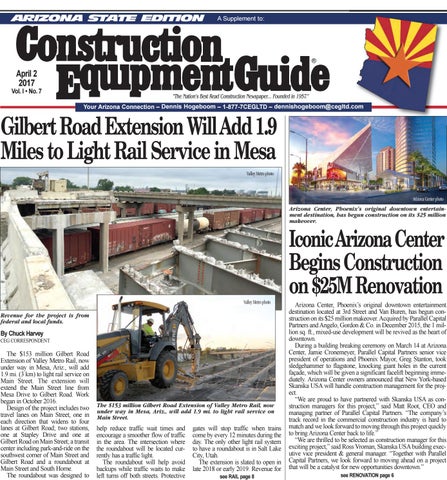
Gilbert Road Extension Will Add 1.9 Miles to Light Rail Service in Mesa Valley Metro photo
Arizona Center photo
Arizona Center, Phoenix’s original downtown entertainment destination, has begun construction on its $25 million makeover.
Iconic Arizona Center Begins Construction on $25M Renovation Valley Metro photo
gates will stop traffic when trains come by every 12 minutes during the day. The only other light rail system to have a roundabout is in Salt Lake City, Utah. The extension is slated to open in late 2018 or early 2019. Revenue for
Arizona Center, Phoenix’s original downtown entertainment destination located at 3rd Street and Van Buren, has begun construction on its $25 million makeover. Acquired by Parallel Capital Partners and Angelo, Gordon & Co. in December 2015, the 1 million sq. ft., mixed-use development will be revived as the heart of downtown. During a building breaking ceremony on March 14 at Arizona Center, Jamie Cronemeyer, Parallel Capital Partners senior vice president of operations and Phoenix Mayor, Greg Stanton, took sledgehammer to flagstone, knocking giant holes in the current façade, which will be given a significant facelift beginning immediately. Arizona Center owners announced that New York-based Skanska USA will handle construction management for the project. “We are proud to have partnered with Skanska USA as construction managers for this project,” said Matt Root, CEO and managing partner of Parallel Capital Partners. “The company’s track record in the commercial construction industry is hard to match and we look forward to moving through this project quickly to bring Arizona Center back to life.” “We are thrilled to be selected as construction manager for this exciting project,” said Ross Vroman, Skanska USA building executive vice president & general manager. “Together with Parallel Capital Partners, we look forward to moving ahead on a project that will be a catalyst for new opportunities downtown.”
see RAIL page 8
see RENOVATION page 6
Revenue for the project is from federal and local funds.
By Chuck Harvey CEG CORRESPONDENT
The $153 million Gilbert Road Extension of Valley Metro Rail, now under way in Mesa, Ariz., will add 1.9 mi. (3 km) to light rail service on Main Street. The extension will extend the Main Street line from Mesa Drive to Gilbert Road. Work began in October 2016. Design of the project includes two travel lanes on Main Street, one in each direction that widens to four lanes at Gilbert Road; two stations, one at Stapley Drive and one at Gilbert Road on Main Street; a transit center including park-and-ride on the southwest corner of Main Street and Gilbert Road and a roundabout at Main Street and South Horne. The roundabout was designed to
The $153 million Gilbert Road Extension of Valley Metro Rail, now under way in Mesa, Ariz., will add 1.9 mi. to light rail service on Main Street.
help reduce traffic wait times and encourage a smoother flow of traffic in the area. The intersection where the roundabout will be located currently has a traffic light. The roundabout will help avoid backups while traffic waits to make left turns off both streets. Protective
Page 2 • April 2, 2017 • www.constructionequipmentguide.com • Arizona State Supplement • Construction Equipment Guide
South Mountain Freeway...
Stonehenge-Like Structures Will Showcase Aesthetics “Creating mocks-ups, like these Stonehenge-like structures, is an important part of the overall design process in building an aesthetically pleasing freeway.” Joseph Salazar
ADOT
Looking a bit like a colorful Stonehenge or large-scale modern art, a series of concrete columns and walls at a west Phoenix intersection may be a little puzzling to passers-by. They’re actually mockups the Arizona Department of Transportation is using to test aesthetics, including paint colors, for the Loop 202 South Mountain Freeway. Set along the southwest corner of 59th Avenue and Washington Street, just south of where the South Mountain Freeway will connect with Interstate 10, these sample bridge piers and sound walls provide a full-scale view of the layers, depths, shapes and paint colors planned for the 22-mile-long freeway corridor. “Creating mocks-ups, like these Stonehenge-like structures, is an important part of the overall design process in building an aesthetically
pleasing freeway,” said Joseph Salazar, ADOT’s roadside development, project landscape and architecture coordinator. “By testing these different colors, patterns and shapes in advance of freeway construction, we have a better idea of what the final product will look like.” The South Mountain Freeway will feature five distinctive aesthetic character areas to complement its surroundings, help tell an area’s story and create a more appealing environment for drivers. Some patterns will evoke the area’s agricultural heritage, while others will feature desert plants and simple shapes based on native cholla and ocotillo cactuses. The South Mountain Freeway, scheduled to open by late 2019, will provide a long-planned direct link between the East Valley and West Valley and a much-needed
Arizona Department of Transportation photo
The South Mountain Freeway will feature five distinctive aesthetic character areas to complement its surroundings, help tell an area’s story and create a more appealing environment for drivers.
alternative to Interstate 10 through downtown Phoenix. Approved by Maricopa County voters in 1985 and again in 2004 as part of a comprehensive regional transportation
plan, the South Mountain Freeway will complete the Loop 202 and Loop 101 freeway system in the Valley. For more information, visit
SouthMountainFreeway.com. (This story also can be found on Construction Equipment Guide’s website at www.constructionequipmentguide.com.)
New Virtual Tour of South Mountain Freeway Now Online As the Loop South Mountain Freeway moves toward completion in late 2019, a new flyover animation reflects updated plans for the 22-mi.-long corridor. The six-and-a-half minute virtual tour of the South Mountain Freeway, the largest single freeway project in state history, is available at SouthMountainFreeway.com. It updates a 2013 video completed in conjunction with the publication of the Draft Environmental Impact Statement by the Arizona Department of Transportation and Federal Highway Administration, and before much of the final design work had been completed. Some of the key design modifications and additions highlighted in the latest video include:
• aesthetic and landscaping treatments reflecting neighboring communities • direct HOV lane access near 59th Avenue from the South Mountain Freeway to and from downtown Phoenix; • a 6-mi.-long shared-used path in Ahwatukee, located south of the freeway between 40th Street and 17th Avenue; • changes to the alignment that reduce the amount of right-of-way required; • interchange reconfigurations, including diverging diamond interchanges at Desert Foothills Parkway and 17th Avenue, moving the interchange at 51st Avenue to Estrella Drive, and realigning the freeway at 59th Avenue south of Elliot Road; • locations of sound walls to mitigate freeway noise; and
• a city of Phoenix pedestrian bridge north of Broadway Road to connect the Rio del Rey neighborhoods in Phoenix. The updated video doesn’t reflect design changes made after January. As a designbuild project, construction can start in some areas of the project while design is still being finalized elsewhere. This innovative contracting method pairs the design and construction teams to deliver a project from beginning to end. This approach is intended to save time and money by overlapping the design and construction phases. With the launch of the new video, the project webpage at SouthMountainFreeway.com has other new content, including aesthetic renderings and construction photos. The South Mountain Freeway will pro-
vide a long-planned direct link between the East Valley and West Valley and a muchneeded alternative to Interstate 10 through downtown Phoenix as it runs east and west along Pecos Road and then north and south between 55th and 63rd avenues, connecting with I-10 on each end. Approved by Maricopa County voters in 1985 and again in 2004 as part of a comprehensive regional transportation plan, the South Mountain Freeway will complete the Loop 202 and Loop 101 freeway system in the Valley. For more information, visit SouthMountainFreeway.com. (This story also can be found on Construction Equipment Guide’s website at www.constructionequipmentguide.com.)
Construction Equipment Guide • Arizona State Supplement • www.constructionequipmentguide.com • April 2, 2017 • Page 3
Want to run strong equipment m ? Run Doosan. Viisit uss today a to learn more.
Authorized Doosan Dealer
Ditch Witch of o Arizona 4028 South 36th Street | Phoenix, AZ 602.437.0351 www ditchwitchaaz com www.ditchwitchaz.com Doosan® and the Doosan logo are registered trademarks of Doosan Corp. in the United States and various other countries around the world.
Page 4 • April 2, 2017 • www.constructionequipmentguide.com • Arizona State Supplement • Construction Equipment Guide
Maricopa County DOT Honors Women in Construction
Jennifer Toth, MCDOT director and county engineer
The Maricopa County Department of Transportation joins with organizations across the county to recognize National Women in Construction Week, March 6 to 12, 2017. Nationally, women make up only 9 percent of construction workers according to the Occupational Safety and Health Administration (OSHA). The focus of Women in Construction
Elvira Seta, inspector
Week is to highlight the contributions and growing role that women make to the construction industry, as well as, raise awareness of the opportunities available for women in the industry. Roadway construction is one of the core functions of MCDOT. In honor of Women in Construction Week, we highlight a few of the many women whose contributions help MCDOT deliver a seamless transportation system through its roadway and bridge construction projects.
Annette Hatfield, materials tester and inspector
Jennifer Toth: County Engineer Jennifer Toth, MCDOT director and county engineer began her career more than 20 years ago as an engineer in training at the Arizona Department of Transportation (ADOT). She transitioned into a construction engineer role working on highway projects across the state. Eventually, she moved into project planning, project management and later administration, becoming Arizona’s state engineer. Toth joined MCDOT as
Kelly Roy, MCDOT’s Utility and Railroad Coordination branch manager
director and county engineer in 2014. Her advice to others looking to join the transportation industry — “Stay self-motivated, challenge yourself and challenge others. If you do not challenge yourself, you will not gain new knowledge that you may need in the future. Turn your challenges into learning experiences, understand what you take away from those experiences, and then pass it on.”
same job day-in, day-out. The types of projects, construction teams and project challenges are always changing. There is nothing to get bored with in construction.” Elvira Seta: Inspector Inspector Elvira Seta joined Maricopa County 15 years ago. Prior to working at the see MCDOT page 9
Lisa Ruane: Construction Engineer Lisa Ruane, construction engineer has worked in the construction industry, primarily for Departments of Transportation, for more than 35 years. She began her career with the Pennsylvania DOT in 1982. At MCDOT, she manages transportation projects through the construction process by working with MCDOT’s contractors and consultants to provide oversight for construction progress. Ruane said she appreciates that every day is different and each job brings new challenges. “It’s not the Lisa Ruane, construction engineer
Construction Equipment Guide • Arizona State Supplement • www.constructionequipmentguide.com • April 2, 2017 • Page 5
!
%
&
'
!
%
&
!
"
#$
! . / 0
!
" #$
# %&
'' ( )
*
(+
,
*
'
( , -*
'
Page 6 • April 2, 2017 • www.constructionequipmentguide.com • Arizona State Supplement • Construction Equipment Guide
Arizonans Shape ADOT’s Long-Range Transportation Plan
Arizona Center photo
The 1 million sq. ft., mixed-use development will be revived as the heart of downtown.
Building Breaking Ceremony Marks Start of Arizona Center’s Renovation RENOVATION from page 1
In addition to the construction partners being announced, Cronemeyer also announced that a boutique hotel and multi-family housing also will be added amenities at Arizona Center. Final negotiations of these partnerships are under way and will be announced soon. The addition of a hotel and multifamily housing will increase the vibrancy of Downtown making Arizona Center, once again, a true downtown destination. The architect of the project is Gensler, a global architecture, design and planning firm. The current introverted space will be opened to the surrounding streets and the urban neighborhood, creating a more interactive and spontaneous experience that connects to the existing fabric of downtown Phoenix. The 1 million-sq.-ft. multi-use project will create a 360-degree experience that communicates the unique attributes and identity of Arizona. Specific transformative elements include site furnishings, shade structures, landscape, lighting, new materials, fixtures and finishes, wayfinding and branded signage features. In addition, the current parking garage at 5th and Fillmore streets will be upgraded, and a valet parking element is being added on 3rd Street, between Van Buren and Fillmore streets.
Arizona Center photo
During a building breaking ceremony on March 14 at Arizona Center, Jamie Cronemeyer (L), Parallel Capital Partners senior vice president of operations and Phoenix Mayor, Greg Stanton, took sledgehammer to flagstone, knocking giant holes in the current façade, which will be given a significant facelift beginning immediately.
“Gensler is excited to be a part of this landmark project, which represents a major step forward in the continued revitalization of downtown Phoenix,” said Jay Silverberg, principal and design director of Gensler. “The design, inspired by the legacy of the Arizona Center itself, is aimed at creating an authentic Arizona experience, a compelling mixed-use destination, and further asserting its prominence into the urban fabric of downtown.” In addition to Gensler, Phoenix Design One is working on the interior redesign for One Arizona Center, and
Smith Group JJR is supporting development strategies for the entire property. The joint venture of Parallel Capital Partners and Angelo, Gordon & Co. paid $126 million for the 16-acre Arizona Center multi-use complex with entitlements for an additional 3.9 million sq. ft. of improvements. For more information, visit arizonacenter.com. (This story also can be found on Construction Equipment Guide’s website at www.constructionequipmentguide.com.)
Playing the part of a transportation planner isn’t always easy, especially when it comes to balancing priorities for Arizona’s highway system with the realities of limited funding. When the Arizona Department of Transportation turned to the public and stakeholders last fall to tell us what’s most important to them over the next 25 years, nearly 6,000 people statewide responded through a quick and interactive online survey. The survey allowed participants to rank six transportation priorities: preservation, expansion, safety, technology, accessibility, and maintenance and operations. They worked with a budget and determined how much of it would go toward each priority. Then they decided on trade-off scenarios that further defined priorities.
Much like real-world transportation planning, there are no right or wrong answers when it comes to ranking and funding priorities. The results show a mixed bag. Safety, expansion, and maintenance and operations ranked highest, in that order. However, when it comes to allocating funds for those priorities, expansion, preservation, and maintenance and operations got the most dollars, with safety dropping to fourth. Trade-off scenarios show participants prefer more roads (expansion), smooth roads (preservation) and connected roads (improved accessibility). Much like real-world transportation planning, there are no right or wrong answers when it comes to ranking and funding priorities. All survey results will help develop a draft update to ADOT’s Long-Range Transportation Plan, which will be available for public review later this year. The Long-Range Transportation Plan, also known as “What Moves You Arizona,” is updated every five years. While the plan isn’t project-specific, it does identify investment priorities based on current and projected transportation funding over the next 25 years. The full report detailing results, responses and ADOT’s outreach in metropolitan, rural and tribal areas is available at azdot.gov/WhatMovesYouArizona under the documents tab. It’s up to the public, policymakers and communities to tell ADOT what’s important to them throughout the long-range planning process, and to prioritize projects and funding. For more information, visit azdot.gov/WhatMovesYouArizona. (This story also can be found on Construction Equipment Guide’s website at www.constructionequipmentguide.com.)
Construction Equipment Guide • Arizona State Supplement • www.constructionequipmentguide.com • April 2, 2017 • Page 7
2240 W. Buckeye Rd. • Phoenix, AZ 85009 602-761-2525 • Fax: 602-454-8899 www.flaskajcb.com
Page 8 • April 2, 2017 • www.constructionequipmentguide.com • Arizona State Supplement • Construction Equipment Guide
Main Street Remains Open During Rail Extension Project RAIL from page 1
the project is from federal and local funds. Jacobs Engineering Group based in Pasadena, Calif., provided the final design for the project. Valley Metro trains are electrically powered using an 825-volt DC traction power system. The estimated annual operating cost for trains on Gilbert Road Extension is $2.6 million. Valley Metro provides ecofriendly public transit options to residents of greater Phoenix and Maricopa County, including the planning and operations of a regional bus system and the development and operations of 23 mi. (37 km) of light rail. In Fiscal Year 2015, total ridership for the system was 71 million passengers. Trains make 178 trips rolling east and west on Main Street in Mesa Monday through Thursday. Six light rail extensions are planned or are under construction that will create a 66-mi. (106 km) system by 2034. The next one will be the Tempe Streetcar Project, which is in the design phase. That service is expected to open in 2020. A Valuable Investment Valley Metro considers Gilbert
Metro line has generated $8.9 billion in economic development. In Mesa, extending light rail through the heart of Mesa has already seen more than $90 million in economic development along the extension to Mesa Drive, which opened in August 2015.”
Valley Metro photo
The extension is slated to open in late 2018 or early 2019.
Rail Extension and other light rail projects a valuable investment in the Valley’s future. In addition to providing the infrastructure needed to meet transportation needs, light rail can increase property values
and encourage economic development activity. The Gilbert Road project is expected to protect historic resources including businesses and historic neighborhoods along Main
Street. “Light rail is a proven catalyst for regional and local economic vitality,” said Corinne Holliday, public information specialist for Valley Metro. “The 26-mile Valley Valley Metro photo
Businesses Will Remain Open Construction zones will vary depending on construction activity and very rarely will a road be closed. The agency conducted outreach with businesses and residents prior to the project. Valley Metro will work with merchants along Main Street to make sure access to their properties remains unobstructed during the Gilbert Road Extension project. Also, signage will help direct traffic to the businesses. “It’s a priority for Valley Metro to support businesses during construction,” Holliday said. “The neighborhood and the business community is an important stakeholder throughout the construction process.” Valley Metro prepares a custom business assistance program for each new rail extension designed to best serve the specific business community in that area. Along with signage, businesses are provided with marketing and technical assistance, business counseling, loan programs and peer-to-peer forums. Valley Metro also provides its stakeholders with weekly construction updates with traffic restrictions. Joint Venture Heads Project Construction Contractor for the project is Stacy and Witbeck/Sundt, a joint venture. It is comprised of Stacy and Witbeck Inc. and Sundt Construction Inc., both of Tempe, Ariz. Stacy and Witbeck Inc. is one of America’s largest urban heavy civil contractors and one of the leading light rail, commuter rail and streetcar transit specialists. Sundt Construction Inc. is one of the nation’s largest construction companies. Stacy and Witbeck/Sundt also constructed Valley Metro Rail’s
Six light rail extensions are planned or are under construction that will create a 66-mi. (106 km) system by 2034.
see RAIL page 10
Construction Equipment Guide • Arizona State Supplement • www.constructionequipmentguide.com • April 2, 2017 • Page 9
Pros Kno Pros Kno ow! w!
®
T Those in the know w,, know Takeuchi Take euchi
Takeuchi of o ffers a wide range of compact excavatorss to help you get your tougheest tasks comppleted. PUT A TAKEUCH A HI TO WORK ON O YOUR JOBSITE AN ND EXPERIIENCE THE DIFFEREN NCE!
www.ditchwitchaz.com
4028 S 36th Street Phoenix, AZ 85040 (602) 437-0351 6975 N Camino Martin Tucson, AZ 85741 (520) 579-0261
takeuch hi us.com hi-us.com
Survey Results...
Wildlife Have Preferences for Crossing Highway ORO VALLEY, Ariz. (AP) It turns out that some types of wildlife like to go over a state highway, others tend to go under it and still others can go either way. Those are initial results of a survey of camera-monitored usage of a new $9.5 million wildlife crossing of State Route 77 near Oro Valley in northeastern Pima County. Deer overwhelmingly preferred the crossing’s overpass while javelin and bobcats preferred the underpass, with only a few going for the overpass. Roughly two-thirds of the coyotes went for the underpass while the remaining third opted for the overpass. The crossing project is a partnership of the Arizona Department of Transportation and the Regional Transportation Authority. It’s an attempt to reduce roadkill and to promote wildlife connectivity between the Santa Catalina and Tortolita mountains. (This story also can be found on Construction Equipment Guide’s website at www.constructionequipmentguide.com.)
MCDOT Honors Five of Its Own During ‘National Women in Construction Week’ MCDOT from page 4
County, Seta worked in Industrial Inspections and received her PhD in chemistry. As a MCDOT inspector, Seta oversees that MCDOT’s contractors, subcontractors and everyone involved with a roadway project is following the laws, policies and specifications of each project. She makes sure that everything is done in a safe, timely and fiscally responsible way. Seta said she loves being part of the MCDOT team because it gives her the opportunity to serve the residents of Maricopa County. “I love the feeling I get when I drive somewhere and pass one of my projects. Sometimes I just check in to see how the finished project is holding up. It makes me feel proud, being part of something very important.” Kelly Roy: Utility Coordination Branch Manager Kelly Roy, MCDOT’s Utility and Railroad Coordination branch manager began her career in the construction industry 17 years ago. At MCDOT, she manages a team of experienced professional coordinators who ensure that conflicts with utility lines on projects are resolved. Roy said the best parts of her job are learning something new every day and the relationships she builds. She enjoys the unity and the feeling of success when all partners on a
project work well together to complete projects, while serving the community. Her advice for women who are interested in joining the construction industry: “Don’t look at yourself as a ‘woman’ in the job but as part of a community of people who make a valuable contribution to transportation. Always keep a sense of humor and understand that advice from others should not be taken personally, but professionally.” Annette Hatfield: Materials Tester & Inspections Annette Hatfield, materials tester and inspector has worked in construction for 17 years, 10 of those at MCDOT. Hatfield works both in the MCDOT materials lab and out in the field to test concrete, asphalt and soils to make sure the materials used on MCDOT projects meets the County’s quality standards. Hatfield enjoys the challenge of finding the differences in materials, especially in how they are applied in different areas of the county. Hatfield encourages other women to join the industry. “Try it out. You may just like it.” (This story also can be found on Construction Equipment Guide’s website at www.constructionequipmentguide.com.)
Page 10 • April 2, 2017 • www.constructionequipmentguide.com • Arizona State Supplement • Construction Equipment Guide
$153M Rail Project Includes New Stations, Transit Center RAIL from page 8
Valley Metro photo
Northwest Extension in Phoenix, which opened earlier this year and a portion of the original 20 mi. (32 km) of light rail that opened in 2008. Patrick Fuller is the project manager of Valley Metro. Brian Mason is the resident engineer and Jennifer Donaldson is project manager of Stacy and Witbeck/Sundt. Major subcontractors working on the project include Hunter Contracting Co. of Gilbert, Ariz.; Kimbrell Electric of Glendale, Ariz.; CSW Contractors Inc. of Scottsdale, Ariz.; OPTCO Inc. of Apache Junction, Ariz.; and Insituform Technologies Inc. of Tempe, Ariz. About 200 workers will be on the Gilbert Road Rail Extension project each day during peak construction. Current, Future Work Current work on the Gilbert Road Extension includes removing the median and beginning underground utility work. Heavy equipment on site includes excavators, backhoes, loaders, asphalt concrete pavers, asphalt concrete rollers, water trucks, concrete trucks, cranes, boom lifts and dump trucks. Removed pavement is typically recycled on Valley Metro Rail projects. Valley Metro and Stacy and Witbeck/Sundt plans the following Gilbert Road Extension construction phases: • Utility relocation and street work — This phase of construction includes relocation of utilities, installing new traffic signals and constructing a new streetscape. Notifications were sent regarding temporary lane restrictions, nighttime work and occasional utility service disruptions. • Station platform and track installation — During this construction phase, major light rail infrastructure is installed. Work will primarily take place in the center of the roadway. Temporary traffic controls will be in place to ensure a smooth and safe flow of traffic. • System and station finishes — These activities will mainly occur along the tracks and in station areas. They include a transit center,
The extension will extend the Main Street line from Mesa Drive to Gilbert Road. Work began in October 2016.
operator facilities and art and architecture elements. The work will require minimal lane closures and traffic restrictions. Once complete, this work will conclude railway construction. • Train testing — Train testing is the final step before the extension opens. Testing allows for a full inspection of the system, including track and overhead wire and oper-
ator training. Noise, Dust Monitoring The contractor will monitor the noise and vibration impacts during the heavy construction phase. Reports are submitted to Valley Metro on a monthly basis to help ensure noise and vibrations are minimized in consideration of the adjacent community.
Valley Metro also received a dust control plan from the contractor in accordance with the Maricopa County Air Quality Department requirements. Planning Began in 2011 In 2011, Valley Metro initiated the Gilbert Road Extension study. It identified and evaluated various
Valley Metro photo
Valley Metro provides eco-friendly public transit options to residents of greater Phoenix and Maricopa County.
ways light rail could be placed within Main Street. In 2012, Valley Metro entered the environmental phase of the study, which included further review of design options and locations of the stations and park-and-ride. A preferred design option was adopted by the Mesa City Council in April 2013. The project’s environmental review was completed in 2014 and the final design team kicked off their efforts in August 2015. Complexity Created Challenges The scope of the work was expanded to include drainage improvements and landscape enhancements. There also were design changes including elimination of a roundabout on Main Street at Harris Drive. Removal of the roundabout allowed for additional landscaping and a continuation of the enhanced streetscape on the Main Street extension. (This story also can be found on Construction Equipment Guide’s website at www.constructionequipmentguide.com.) CEG
Construction Equipment Guide • Arizona State Supplement • www.constructionequipmentguide.com • April 2, 2017 • Page 11
Page 12 • April 2, 2017 • www.constructionequipmentguide.com • Arizona State Supplement • Construction Equipment Guide
Public Auction held the 2nd Saturday of every month. Preview Every Monday - Friday 8am - 4pm Consignments Welcome 623-936-3300 wsmauctioneers.com wsmauctionbiz@yahoo.com
Western Sales Management, Inc 1616 S 67th Ave. Phoenix, AZ 85043
Next Auction April 8, 2017
File Photo
File Photo File Photo
File Photo
File Photo
File Photo
File Photo
File Photo
File Photo
File Photo