ARIZONA STATE EDITION
A Supplement to:
®
March 5 2017 Vol. I • No. 5
“The Nation’s Best Read Construction Newspaper… Founded in 1957.” Your Arizona Connection – Dennis Hogeboom – 1-877-7CEGLTD – dennishogeboom@cegltd.com
Phase II Begins on $1.77B South Mountain Freeway By Chuck Harvey CEG CORRESPONDENT
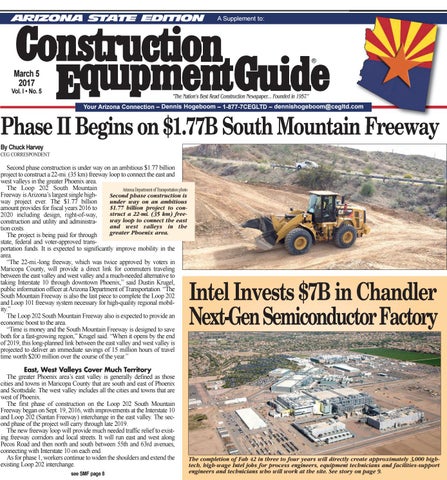
Second phase construction is under way on an ambitious $1.77 billion project to construct a 22-mi. (35 km) freeway loop to connect the east and west valleys in the greater Phoenix area. The Loop 202 South Mountain Arizona Department of Transportation photo Freeway is Arizona’s largest single highSecond phase construction is way project ever. The $1.77 billion under way on an ambitious $1.77 billion project to conamount provides for fiscal years 2016 to struct a 22-mi. (35 km) free2020 including design, right-of-way, way loop to connect the east construction and utility and administraand west valleys in the tion costs. greater Phoenix area. The project is being paid for through state, federal and voter-approved transportation funds. It is expected to significantly improve mobility in the area. “The 22-mi.-long freeway, which was twice approved by voters in Maricopa County, will provide a direct link for commuters traveling between the east valley and west valley and a much-needed alternative to taking Interstate 10 through downtown Phoenix,” said Dustin Krugel, public information officer at Arizona Department of Transportation. “The South Mountain Freeway is also the last piece to complete the Loop 202 and Loop 101 freeway system necessary for high-quality regional mobility.” The Loop 202 South Mountain Freeway also is expected to provide an economic boost to the area. “Time is money and the South Mountain Freeway is designed to save both for a fast-growing region,” Krugel said. “When it opens by the end of 2019, this long-planned link between the east valley and west valley is projected to deliver an immediate savings of 15 million hours of travel time worth $200 million over the course of the year.” East, West Valleys Cover Much Territory The greater Phoenix area’s east valley is generally defined as those cities and towns in Maricopa County that are south and east of Phoenix and Scottsdale. The west valley includes all the cities and towns that are west of Phoenix. The first phase of construction on the Loop 202 South Mountain Freeway began on Sept. 19, 2016, with improvements at the Interstate 10 and Loop 202 (Santan Freeway) interchange in the east valley. The second phase of the project will carry through late 2019. The new freeway loop will provide much needed traffic relief to existing freeway corridors and local streets. It will run east and west along Pecos Road and then north and south between 55th and 63rd avenues, connecting with Interstate 10 on each end. As for phase 1, workers continue to widen the shoulders and extend the existing Loop 202 interchange. see SMF page 8
Intel Invests $7B in Chandler Next-Gen Semiconductor Factory
The completion of Fab 42 in three to four years will directly create approximately 3,000 hightech, high-wage Intel jobs for process engineers, equipment technicians and facilities-support engineers and technicians who will work at the site. See story on page 9.
Page 2 • March 5, 2017 • www.constructionequipmentguide.com • Arizona State Supplement • Construction Equipment Guide
Reid Park Zoo Breaks Ground for Animal Health Center Continuing to be a great zoo requires a major enhancement in the health care environment for our animals. A new Animal Health Center is the cornerstone of Reid Park Zoo’s future growth. In addition to positioning Reid Park Zoo at the forefront of modern Zoo medicine, the new Animal Health Center also will teach the
veterinarians of tomorrow. Students from the University of Arizona’s new Doctor of Veterinary Medicine Education Program will have the opportunity to train in whole-life animal care by observing and assisting in the Zoo’s Health Center. Younger students from area schools also will have the chance to observe and
Reid Park Zoo photo
Exterior — remodeled existing clinic on right connects with 5,000 sq. ft. (464.5 sq m) addition.
learn at an onsite classroom. Expansions to the new approximately 9,000 sq. ft. (2,743 sq m) facility include: • a full surgical suite Reid Park Zoo photo • ICU units suitable for Classroom allows students of all ages to learn about animal health and observe procedures in treatment, surgery and lab. animals of all sizes
• diagnostic devices providing immediate results of blood work and ultrasound testing • holding areas with controlled air circulation to ensuring animals are effectively quarantined • state-of-the-art treatment
facilities allowing our skilled vet staff to give every animal the best care possible (This story also can be found on Construction Equipment Guide’s website at www.constructionequipmentguide.com.) CEG
Two ADOT Snowplows Damaged in January Storms Three Arizona Department of Transportation employees working to keep highways open in recent storms avoided serious injury when vehicles struck two ADOT snowplows in separate crashes. The drivers of the other vehicles came out fine as well. One of the plows wasn’t so lucky, however, when a semi rear-ended and severely damaged it Jan. 21 on Interstate 40 near Seligman. In addition to sending the two ADOT employees aboard to the hospital with minor injuries, the crash hindered ADOT’s efforts to clear snow and ice along that route. In the other crash, an SUV suffered serious damage Jan. 19 when it hit a snowplow clearing State Route 89A between Prescott Valley and Jerome. The plow and its operator were able to continue working, but only after losing precious time dealing with the crash. “During storms, drivers need to slow down and give plows plenty of space,” said Alvin Stump, district engineer in ADOT’s Northwest District, where both of the incidents occurred. “Plows require a large work area to remove snow.” It isn’t easy driving a snowplow on slippery roads with limited visibility, and other drivers make that job dangerous when they don’t give ADOT’s operators plenty of room to work. So respect the plow. It starts with staying at least four car lengths behind and never passing a working plow until the operator pulls over to let traffic by. Gabriel Alvarado, who has plowed Interstate 40 for 13 years out of ADOT’s Seligman operation, said he likes seeing a line of vehicles making the sensible decision to follow
I-40 snowplow crash
“During storms, drivers need to slow down and give plows plenty of space. Plows require a large work area to remove snow.” Alvin Stump Arizona Department of Transportation
his snowplow. “It’s the best possible scenario to have a plow right in front of you,” he said. But several times during a 12-hour shift a passenger vehicle or semi will make the ill-advised decision to pass Alvarado’s snowplow in an unplowed lane, raising the potential for a collision. “Sometimes it gets really, really close,” Alvarado said. Alvarado said it isn’t uncommon for him to later come upon those who’ve passed him stuck in the snow after sliding off the roadway. Other tips from ADOT’s snowplow drivers: • Never assume a snowplow operator knows you are nearby. If you can’t see the plow driver, there is a good chance the driver can’t see you. • Plowed snow can create a cloud that reduces visibility, and spreaders on trucks throw de-icing agents or sand that can damage vehicles, so stay back. • Leave space when stopping behind a snowplow. The driver might need to back up. • If approaching an oncoming snowplow, slow down and give the plow extra room. • Just because a plow has been through the area, drivers shouldn’t assume the roadway is completely clear of snow and ice. For more information, visit azdot.gov/KnowSnow. (This story also can be found on Construction Equipment Guide’s website at www.constructionequipmentguide.com.)
Construction Equipment Guide • Arizona State Supplement • www.constructionequipmentguide.com • March 5, 2017 • Page 3
!
%
&
'
!
%
&
!
"
#$
! . / 0
!
" #$
# %&
'' ( )
*
(+
,
*
'
( , -*
'
Page 4 • March 5, 2017 • www.constructionequipmentguide.com • Arizona State Supplement • Construction Equipment Guide
Interstate 11 Study: Scoping Summary Report Available Over the past year, the Arizona Department of Transportation asked the public and agencies to share their ideas, comments and concerns about the Interstate 11 environmental study from Nogales to Wickenburg. A summary of comments is now available and will help ADOT select and evaluate corridor alternatives for further study. Last summer, ADOT and the Federal Highway Administration held a 45-day scoping period as part of the National Environmental Policy Act process. ADOT received hundreds of comments from community members, tribal nations and agency representatives. The full Scoping Summary Report is now available in the Arizona section of i11study.com under the “Reports” tab. Scoping is an early and important step in the environmental review process. During scoping, the public and agencies have an opportunity to provide input, which helps determine the “scope” or range of issues to be addressed
All feedback received during the scoping process is being used by ADOT and the Federal Highway Administration as the two agencies identify potential Interstate 11 alternatives to be studied, impacts to be considered and evaluation methods to be used during the development of the Tier 1 Environmental Impact Statement. in the environmental document, also referred to as the Tier 1 Environmental Impact Statement. During scoping, ADOT and the Federal Highway Administration hosted three agency meetings and six public meetings in seven locations throughout the corridor study area. Approximately 600 people attended the June 2016 meetings. ADOT received comments from 74 agencies and tribal governments during the scoping period, and another 834 comments came in from the public. All comments received during the 45-day
scoping period are included in the appendices of the Scoping Summary Report. Agencies provided comments with similar themes about the proposed Interstate 11, including consideration of existing and proposed local and regional transportation plans; the need to study opportunities that foster economic development; and the importance of protecting environmentally sensitive resources. Some agencies stated that they prefer freeway alternatives that build upon and improve existing roadway infrastructure,
while others said they favor building an entirely new interstate freeway. The public had similar comments, along with many others. A majority of the public comments came through an online survey and comment form. Of those 657 responses, community members noted that a new freeway like Interstate 11 could address transportation concerns, such as relieving regional congestion, improving travel time and reliability, improving freight travel and reliability, and reducing bottlenecks on existing freeways. Survey results and other comments can be found within the Scoping Summary Report and on the I-11 blog: i11study.com/Arizona/blog.asp. All feedback received during the scoping process is being used by ADOT and the Federal Highway Administration as the two agencies identify potential Interstate 11 alternatives to be studied, impacts to be considered and evaluation methods to be used during the development of the Tier 1
Environmental Impact Statement. In addition to the formal scoping period, ADOT and the Federal Highway Administration have spent a lot of time during the past year meeting and talking with the public, agencies, local and tribal governments, and partners about the ongoing Interstate 11 environmental study. Each discussion is an opportunity to hear what people have to say about the proposed interstate freeway that would run border-to-border throughout Arizona. The next round of public involvement opportunities will take place in 2017, when ADOT presents a reasonable range of alternatives to be further studied. An evaluation of a “no-build” alternative, in which Interstate 11 would not be built, also will be considered. For more information, visit i11study.com. (This story also can be found on Construction Equipment Guide’s website at www.constructionequipmentguide.com.)
Phoenix...
New I-40 Sensors Help ADOT Busy 11-Mile Stretch of I-17 Address Ice Before It Forms Being Resurfaced This Spring An 11-mi. (17.7 km) stretch of Interstate 17 (Black Canyon Freeway) in Phoenix will be resurfaced with a new layer of smooth rubberized asphalt starting in mid-March. The work is part of the Arizona Department of Transportation’s $9.8 million I-17 improvement project between Peoria Avenue in north Phoenix and 19th Avenue south of the downtown area, which started last fall with sidewalk and wheelchair ramp improvements at cross-street interchanges. While drivers can look forward to a smoother ride on this stretch of I-17, the pavement-replacement work will require a series of weekend closures between March and early June. The paving is scheduled to start the weekend of March 17 to 20, when southbound I17 will be closed between Peoria Avenue and Glendale Avenue. Plans call for weekend closures to continue along southbound I17 before crews begin resurfacing the northbound side of the freeway. The schedule is
subject to change due to inclement weather. I-17 will be closed one direction at a time for approximately 3-mi. (4.8 km) stretches each weekend while the rubberized asphalt paving takes place. Drivers should consider alternate routes, including state Route 51 or Loop 101, while I-17 is closed. Travelers can expect heavy backups and delays when I-17 traffic is detoured to the freeway’s frontage roads or, in areas without frontage roads, to 19th Avenue. Closures will not be scheduled on the weekend of March 31 to April 3 when the NCAA’s Final Four college basketball events are taking place. I-17 also will remain open over the Memorial Day weekend in late May. Other work includes I-17 drainage improvements near Durango Street, new signs and concrete-barrier upgrades. For more information, visit azdot.gov. (This story also can be found on Construction Equipment Guide’s website at www.constructionequipmentguide.com.)
Sensors installed at three Interstate 40 locations west of Flagstaff are helping the Arizona Department of Transportation forecast the likelihood of ice forming and respond accordingly. The combination of freezing temperatures and moisture means ice can form overnight in Arizona’s high country. It’s an especially big challenge on I-40 between Ash Fork and Flagstaff, which is above 6,000 ft. (1,829 m) in most places and sees heavy use by commercial and passenger vehicles. “Technology can provide us with another way to keep motorists safe as they travel to Arizona’s colder regions,” said Audra Merrick, district engineer for ADOT’s North Central District. “These sensors are another tool in ADOT’s toolbox to help keep the highways clear of snow and ice during winter season.” The roadway sensors, positioned just west of Flagstaff, just west of Williams and on Ash Fork Hill, are connected to ADOT Road Weather Information System locations, which use cameras and instruments to pro-
vide the latest conditions. Each location has one sensor measuring the salt content of road surface moisture, which affects the freezing point, and another measuring the temperature of the ground underneath. A computer program combines this information with data from the Road Weather Information System and National Weather Service to forecast the likelihood of ice forming, helping ADOT determine whether to send crews out to lay deicing material. The program also can alert operators if the pavement temperature drops below a certain threshold. The data provided so far has been so helpful that ADOT plans to install sensors at additional high-country roadway locations over the next few years. The three sensors on I-40 cost $90,000 and were funded through ADOT maintenance funds. (This story also can be found on Construction Equipment Guide’s website at www.constructionequipmentguide.com.)
Construction Equipment Guide • Arizona State Supplement • www.constructionequipmentguide.com • March 5, 2017 • Page 5
Want to run strong equipment m ? Run Doosan. Viisit uss today a to learn more.
Authorized Doosan Dealer
Ditch Witch of o Arizona 4028 South 36th Street | Phoenix, AZ 602.437.0351 www ditchwitchaaz com www.ditchwitchaz.com Doosan® and the Doosan logo are registered trademarks of Doosan Corp. in the United States and various other countries around the world.
Page 6 • March 5, 2017 • www.constructionequipmentguide.com • Arizona State Supplement • Construction Equipment Guide
Joseph City...
ADOT Begins Rock-Fall Mitigation Safety Project on I-40 To protect driver safety, the Arizona Department of Transportation (ADOT) is moving a mountain on the north side of Interstate 40, about 6 mi. (9.65 km) west of Holbrook. The I-40 Rock-Fall Mitigation Safety Project began in January on westbound I-40 near Joseph City. There, decades of erosion has undermined one of the rocky
slopes that dates back to construction of the interstate in northeastern Arizona. Now it’s slowly crumbling onto the shoulder of the busy highway. While a temporary concrete barrier is preventing chunks of rocks and clay from falling into travel lanes, this safety project offers a permanent solution. The following lane restriction will be in place through March:
ADOT photo
The I-40 Rock-Fall Mitigation Safety Project began in January on westbound I-40 near Joseph City.
in the work zone. During the project, crews will use heavy equipment to break up and haul away an estimated 45,000 tons (40,823 t) of rocks, dirt and clay — enough to fill a space 4 ft. (1.2 m) deep, 900 ft. (274 m) long and 200 ft. (61 m) wide. Because work is occurring off the main highway, ADOT anticipates only minimal impacts to drivers; however, ADOT cautions motorists to drive carefully through the work zone and focus on the roadway instead of the construction activity. ADOT works to inform the public about planned highway restrictions and closures, but it’s possible that unscheduled impacts might occur because of weather or other factors. For more information, visit www.az511.gov. ADOT photo (This story also can be found Crews will use heavy equipment to break up and haul away an on Construction Equipment estimated 45,000 tons (40,823 t) of rocks, dirt and clay from this rocky slope on westbound Interstate 40, about 6 mi. (9.65 km) Guide’s website at www.constructionequipmentguide.com.) west of Holbrook.
• Westbound I-40 is narrowed to one lane at milepost 279 from 7 a.m. to 5 p.m. Monday-Friday. The lane closure will allow crews to
work safely on the north shoulder. Drivers should be prepared to merge into the left-hand travel lane and observe reduced speed limits
Arizona Lawmakers Split on Proposal for New Coyotes Arena By Bob Christie ASSOCIATED PRESS
PHOENIX (AP) Republican lawmakers from the east and west sides of metropolitan Phoenix are at odds over a proposal to fund a new arena for the Arizona Coyotes. Sen. Bob Worsley’s legislation would allow the creation of a new “community engagement district” that would keep half its sales tax revenue to fund arena construction. Worsley said he’s trying to keep the Coyotes in Arizona. Rep. Anthony Kern of Glendale strongly opposes building a new arena with taxpayer funds that would compete with Gila River Arena. The Coyotes currently play in the taxpayer-funded arena but the team and the city of Glendale have been at odds over their contract for several years, with the city cancelling the contract in 2015 then agreeing to an interim deal. Coyotes President Anthony LeBlanc, said in a statement that the team is focused on staying in metro Phoenix and “Glendale simply is no longer an option.” Developments came just days after Arizona State University announced it was pulling out of a deal to partner with the Coyotes on a new hockey arena near the university’s Tempe campus. The team and ASU had announced in November a plan to build a 19,000-seat arena to be shared by the university and the Coyotes and set a June deadline for finalizing a deal. Worsley’s legislation, Senate Bill 1474, was designed to craft a financing system to help pay what would have been the university’s share of the $400 million arena. The Coyotes
“I’m just trying to save a business that employs [more than] 1,000 people with lots of fans from leaving the state.” Sen. Bob Worsley Arizona
had said the team would pick up about half the cost. “ASU is no longer a viable site,” the Mesa lawmaker said. “It will become an agnostic location, an agnostic site bill, to give the Coyotes a chance to find the right place. They have been talking to other people as well.” The new sales taxes generated from any new arena are estimated at $20 million annually, with half kept by an arena developer to help finance the new facility, Worsley said. Kern said that the Coyotes are important for Glendale and the western Phoenix suburbs. He said the Coyotes should stay in the facility, which was built with $220 million in taxpayer funds in 2003 specifically
for the hockey team. Kern said there’s still $145 million owed on the arena. “Glendale taxpayers have built them a new stadium, Glendale taxpayers have given them multiple millions of tax dollars,” Kern said. “And I’m trying to protect the taxpayers from building them yet another arena that’s going to compete with events, concerts and a lot of other things. I don’t think the state of Arizona needs another arena.” Leblanc said the Coyotes are working to create “one of the most taxpayer-friendly arena projects in the country — an arena and surrounding development that pays for itself, that creates no new taxes and that doesn’t use a single penny of existing general fund revenue.” The Coyotes signed a new 15-year, $225 million arena lease deal with the city of Glendale in 2013, but the City Council voted to terminate the lease in 2015. The sides agreed to a restructured lease agreement last July to keep the team in Glendale for two more seasons. Worsley said he respects Kern’s passion for the issue and is trying to keep the Coyotes in Arizona because the team appears to have decided to leave Glendale. “I’m just trying to save a business that employs [more than] 1,000 people with lots of fans from leaving the state,” he said. The Arizona Senate panel agreed to advance the bill on Feb. 14, setting up a way for the Arizona Coyotes to use tax money to help build a new arena. (This story also can be found on Construction Equipment Guide’s website at www.constructionequipmentguide.com.)
Construction Equipment Guide • Arizona State Supplement • www.constructionequipmentguide.com • March 5, 2017 • Page 7
2240 W. Buckeye Rd. • Phoenix, AZ 85009 602-761-2525 • Fax: 602-454-8899 www.flaskajcb.com
Page 8 • March 5, 2017 • www.constructionequipmentguide.com • Arizona State Supplement • Construction Equipment Guide
SMF Project Includes New Interchanges at Major Crossings SMF from page 1
Because of its size, Loop 202 freeway construction is divided into four segments: I-10 Papago, between the I-10 (Papago Freeway) interchange at 59th Avenue and Lower Buckeye Road; Salt River, from Lower Buckeye Road to 51st Avenue near Estrella Drive; Center, from 51st Avenue to 32nd Lane; and Pecos Road, from 32nd Lane to the I-10 at Loop 202 (Santan Freeway) interchange. Construction will occur concurrently on multiple segments throughout the length of the project. In the first half of 2017, construction will occur in all but the center segment, where work isn’t scheduled to begin until mid-2018. Multi-Construction Company Team Working on Project To address the challenge of a massive project, Arizona Department of Transportation partnered with private developer Connect 202 Partners to design and build the freeway and maintain it for 30 years. Fluor, Granite Construction Co. and Ames Construction, together with highway maintenance services contractor, DBi Services, formed the Connect 202 Partners team that combines local, national and international highway design-build and maintenance experience to deliver this first-of-a-kind public-private partnership for the Arizona Department of Transportation. Parsons Brinckerhoff Inc., based in New York, is the lead designer of the project.
“Public-private partnerships make it possible to deliver muchneeded transportation projects on an accelerated schedule and reduce the overall cost,” Krugel said. “That allows savings to go toward other transportation projects.” Major subcontractors include: E&A Consulting Group of Omaha, Neb., for irrigation design plans; Pavement Markings Inc. of Tempe, Ariz., for temporary pavement markings; A Core Concrete Cutting of Mesa, Ariz., for demolition saw cutting; Paveco of Phoenix for temporary asphalt paving; and Southwest Concrete Paving of Phoenix for early concrete work. Crews working on the first phase of the Loop 202 South Mountain Freeway project widened the shoulders and extended the existing Loop 202 highoccupancy vehicle lanes from Pecos Road near 48th Street to the I-10 and Loop 202 interchange. Most of the initial phase of construction at the I-10 and Loop 202 interchange was completed prior to work on the mainline freeway, which began in early 2017. One lane of eastbound Pecos Road traffic traveling to eastbound Loop 202 was maintained during the initial construction phase. Completing most of the first phase of work by the end of 2016 allowed crews to start on a detour route along Pecos Road for when freeway construction is occurring on the current alignment of westbound Pecos Road. ADOT will widen the existing eastbound Pecos Road lanes to maintain twoway traffic flow during all phases
Arizona Department of Transportation photo
Crews working on the first phase of the Loop 202 South Mountain Freeway project widened the shoulders and extended the existing Loop 202 high-occupancy vehicle lanes.
Arizona Department of Transportation photo
The $1.77 billion amount provides for fiscal years 2016 to 2020 including design, right-of-way, construction and utility and administration costs.
of construction. Heavy Equipment Moves Into Construction Sites Connect 202 Partners is mobilizing equipment for work on the I10 Papago, Salt River and Pecos segments. It is using mostly new equipment to reduce maintenance downtimes and lower the level of engine noise in residential areas. Subcontractors also will be bringing equipment on site. Heavy equipment includes cranes, drilling rigs, bulldozers, excavators, scrapers and pavers. About 1 million tons (907,185 t) of asphalt and 150,000 yds. (137,160 m) of concrete will be
applied during the course of the project. Dirt will be brought in to raise highway and interchange foundation levels. Connect 202 Partners will be self-performing earthwork, drainage, bridge construction, traffic control and asphalt paving, while managing other aspects of the project. The team will contract for design and engineering support, security, hauling services, environmental cleanup, demolition, clearing operations and landscaping. They will bring in about 100 subcontractors over the next three years. The project also will feature
Arizona Department of Transportation photo
The Loop 202 South Mountain Freeway is Arizona’s largest single highway project ever.
about 1,400 crafts workers. New Traffic Interchanges Being Built Traffic interchange locations will be approximately one-mile intervals, at major street crossings. They are, Van Buren Street, Buckeye Road, Lower Buckeye Road, Broadway Road, Southern Avenue, Baseline Road, Dobbins Road, Elliot Road, Estrella Drive, 17th Avenue, Desert Foothills Parkway, 24th Street and 40th Street. Two of the interchanges are half-diverging diamond interchanges. Full diverging diamond see SMF page 10
Arizona Department of Transportation photo
Connect 202 Partners will be self-performing earthwork, drainage, bridge construction, traffic control and asphalt paving, while managing other aspects of the project.
Construction Equipment Guide • Arizona State Supplement • www.constructionequipmentguide.com • March 5, 2017 • Page 9
Pros Kno Pros Kno ow! w!
®
T Those in the know w,, know Takeuchi Take euchi
Takeuchi of o ffers a wide range of compact excavatorss to help you get your tougheest tasks comppleted. PUT A TAKEUCH A HI TO WORK ON O YOUR JOBSITE AN ND EXPERIIENCE THE DIFFEREN NCE!
www.ditchwitchaz.com
4028 S 36th Street Phoenix, AZ 85040 (602) 437-0351 6975 N Camino Martin Tucson, AZ 85741 (520) 579-0261
takeuch hi us.com hi-us.com
Intel’s Fab 42 Expects to Provide 10,000 Long-Term Jobs INTEL from page 1
Intel Corporation announced plans to invest more than $7 billion to complete Fab 42, which is expected to be the most advanced semiconductor factory in the world. The high-volume factory is in Chandler, Ariz., and is targeted to use the 7 nanometer (nm) manufacturing process. It will produce microprocessors to power data centers and hundreds of millions of smart and connected devices worldwide. The announcement was made by President Donald Trump and Intel CEO Brian Krzanich at the White House on Feb. 8. The completion of Fab 42 in three to four years will directly create approximately 3,000 high-tech, high-wage Intel jobs for process engineers, equipment technicians and facilities-support engineers and technicians who will work at the site. Combined with the indirect impact on businesses that will help support the factory’s operations, Fab 42 is expected to create more than 10,000 total long-term
jobs in Arizona. Context for the investment was outlined in an e-mail from Intel’s CEO to employees. “Intel’s business continues to grow and investment in manufacturing capacity and R&D ensures that the pace of Moore’s law continues to march on, fueling technology innovations the world loves and depends on,” said Krzanich. “This factory will help the U.S. maintain its position as the global leader in the semiconductor industry.” “Intel is a global manufacturing and technology company, yet we think of ourselves as a leading American innovation enterprise,” Krzanich added. “America has a unique combination of talent, a vibrant business environment and access to global markets, which has enabled U.S. companies like Intel to foster economic growth and innovation. Our factories support jobs — high-wage, high-tech manufacturing jobs that are the economic engines of the states where they are located.”
“America has a unique combination of talent, a vibrant business environment and access to global markets, which has enabled U.S. companies like Intel to foster economic growth and innovation.” Brian Krzanich Intel
Intel is America’s largest hightechnology capital expenditure investor ($5.1 billion in the U.S. 2015) and its third largest investor in global R&D ($12.1 billion in 20151). The majority of Intel’s manufacturing and R&D is in the United States. As a result, Intel employs more than 50,000 people in the United States, while directly supporting almost half a million other U.S. jobs across a range of industries, including semiconduc-
tor tooling, software, logistics, channels, OEMs and other manufacturers that incorporate our products into theirs. The 7 nm semiconductor manufacturing process targeted for Fab 42 will be the most advanced semiconductor process technology used in the world and represents the future of Moore’s Law. In 1968 Intel co-founder Gordon Moore predicted that computing power will become significantly more
capable and yet cost less year after year. Making a leading-edge computer chip is the most complex manufacturing process in the world, engineering magic that turns sand into semiconductors, the foundation of the knowledge economy. The chips made on the 7 nm process will power the most sophisticated computers, data centers, sensors and other high-tech devices, and enable things like artificial intelligence, more advanced cars and transportation services, breakthroughs in medical research and treatment, and more. These are areas that depend upon having the highest amount of computing power, access to the fastest networks, the most data storage, the smallest chip sizes, and other benefits that come from advancing Moore’s Law. For more information, visit intel.com. (This story also can be found on Construction Equipment Guide’s website at www.constructionequipmentguide.com.)
Page 10 • March 5, 2017 • www.constructionequipmentguide.com • Arizona State Supplement • Construction Equipment Guide
Drainage Improvement...
SMF Will Complete Loop 202, Connect ADOT Project on Communities in Greater Phoenix Area Davis Road Near Tombstone Begins SMF from page 1
interchanges are not needed at this time, Krugel said. He pointed out there are currently no connections to the south from the Gila River Indian Community. The halfdiverging diamond interchange will provide access to the Ahwatukee community north of the interchange. It is anticipated that most of the interchanges will be elevated, with the freeway’s mainline elevated over arterial cross streets. In addition to the traffic interchanges, improvements for the South Mountain Freeway will include widening I-10 from 43rd to 75th Avenues with auxiliary lanes in each direction and adding 2-mi. (3.2 km)-long access roads to improve traffic flow between 51st and 67th Avenues. The new access roads will carry two lanes of traffic in each direction parallel to I-10. When construction of the mainline freeway began early this year, all Pecos Road traffic was shifted to the eastbound lanes for a period of approximately two years. Two lanes of traffic in each direction are maintained at most times during construction, with the exception of periodic traffic restrictions at intersections with cross streets. Meanwhile, construction continues on the I-10 Papago, Salt River and Pecos segments. Once freeway construction is complete in the Pecos segment, traffic using the interim road (two lanes in each direction) will be moved to freeway lanes in the final stages of construction. The South Mountain Freeway will open to through traffic when work is complete on all segments.
Arizona Department of Transportation photo
The Arizona Department of Transportation, in conjunction with Cochise County, began work Jan. 17 to make drainage improvements on a section of Davis Road near Tombstone that requires frequent closures because of flooding. The low water crossing at approximately milepost 10 on Davis Road is part of the watershed from nearby mountains, and storm water floods the roadway, particularly during summer rains. Flooding in the area has led to several swift water rescue operations by Cochise County emergency services About 1 million tons (907,185 t) of asphalt and 150,000 yds. (137,160 m) providers. of concrete will be applied during the course of the project. The route, which connects state Route 80 and U.S. 191, is modern features including rubberized heavily used by oversize vehicles that are unable to stay on Early Construction Included asphalt and aesthetics reflecting the Interstate 10 because of several low bridges in eastern Inventory of Trees, Plants In addition to the early phase 1 con- neighboring communities. Arizona. Davis Road, in addition to serving several large struction, crews started taking inventoranches in Cochise County, is commonly used by commerTraffic Impacts ry of native plants along the Pecos Major traffic impacts are expected, cial trucks entering the state at the International Port of Entry Road right of way that could be Department of in Douglas. removed, stored, maintained and even- but Arizona The $2.95 million project will construct concrete arch cultually replanted in their permanent Transportation and Connect 202 verts to channel water beneath the roadway and prevent locations upon completion of roadway Partners will strive to keep traffic moving during construction of the South flooding, create an earthen channel, and install guardrail and segments. Salvageable plants were Mountain Freeway. They will take pre- concrete barrier, as well as preserve access gates to nearby relocated to a temporary nursery. cautions to reduce the impact of con- ranch property. struction and accommodate local trafDecades of Planning Cochise County was able to obtain federal funding from The new freeway will provide a fic. several sources to design and construct the project in a multiHowever, they advise motorists in much-needed and long sought after agency effort that included the Federal Highway alternative to Interstate 10 through the construction area to sign up for trafAdministration, ADOT, the SouthEastern Arizona alerts at downtown Phoenix. It was approved fic Governments Organization (SEAGO) and Cochise County. www.Southmountainfreeway.com, by Maricopa County voters in 1985 Before work begins on the drainage structures, ADOT will and again in 2004 as part of a compre- allow extra time, slowdown in construction work zones and plan ahead. hensive regional transportation plan. construct a short paved detour around the project area to (This story also can be found on maintain two-way traffic during the six-month project. The The South Mountain Freeway will be constructed with four lanes in each Construction Equipment Guide’s temporary roadway alignment will be constructed north of direction — three general-use lanes website at www.constructionequip- the existing road. and one HOV lane — and include mentguide.com.) CEG The detour will feature 10-ft. (3 km) travel lanes and a 35 mph speed limit. Arizona Department of Arizona Department of Brief closures of Davis Road will be required for some Transportation photo Transportation photo work, including the delivery and installation of pre-cast concrete arches that will compose the drainage culvert. ADOT will provide information in advance of restrictions that affect travel. The project will be substantially complete in mid-June 2017, followed by reseeding and permanent roadway striping. The project is scheduled be complete Aug. 1, 2017. Drivers should proceed through the work zone with caution, slow down and watch for construction personnel and equipment. For more information, visit azdot.gov. (This story also can be found on Construction Crews took inventory of native plants along the Pecos The project is being paid for through state, federal Equipment Guide’s website at www.constructionequipRoad right of way that could be removed, stored, main- and voter-approved transportation funds. It is expectmentguide.com.) tained and eventually replanted. ed to significantly improve mobility in the area.
Construction Equipment Guide • Arizona State Supplement • www.constructionequipmentguide.com • March 5, 2017 • Page 11
Page 12 • March 5, 2017 • www.constructionequipmentguide.com • Arizona State Supplement • Construction Equipment Guide
Public Auction held the 2nd Saturday of every month. Preview Every Monday - Friday 8am - 4pm Consignments Welcome 623-936-3300 wsmauctioneers.com wsmauctionbiz@yahoo.com
Western Sales Management, Inc 1616 S 67th Ave. Phoenix, AZ 85043
Next Auction March 11, 2017
File Photo
File Photo File Photo
File Photo
File Photo
File Photo
File Photo
File Photo
File Photo
File Photo