ARIZONA STATE EDITION
A Supplement to:
®
February 5 2017 Vol. I • No. 3
“The Nation’s Best Read Construction Newspaper… Founded in 1957.” Your Arizona Connection – John Harrison – 1-877-7CEGLTD – jharrison@cegltd.com
Diamond Interchange Highlights $83.2M Tucson Project By Chuck Harvey CEG CORRESPONDENT
The Arizona Department of Transportation is overseeing a project to replace the existing I-19 traffic interchange at state Route 86, also known as Ajo Way.
The Arizona Department of Transportation is overseeing a project to replace the existing I-19 traffic interchange at state Route 86, also known as Ajo Way. The new single-point urban interchange is designed to improve traffic flow and enhance safety for motorists traveling on Tucson’s southwest side. A single point urban interchange is similar in form to a diamond interchange, but has the advantage of allowing opposing left turns to proceed simultaneously by compressing the two intersections of a diamond into one single intersection over or under the free-flowing road.
The term “single point” refers to the fact that all through traffic on the arterial street, as well as the traffic turning left onto or off the
interchange, can be controlled from a single set of traffic signals. “This is the first interchange south of the junction of two impor-
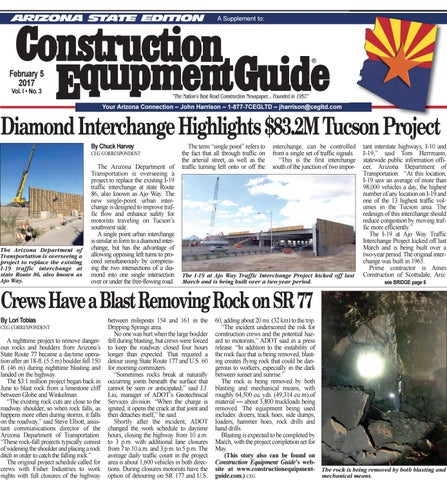
The I-19 at Ajo Way Traffic Interchange Project kicked off last March and is being built over a two-year period.
tant interstate highways, I-10 and I-19,” said Tom Herrmann, statewide public information officer, Arizona Department of Transportation. “At this location, I-19 saw an average of more than 98,000 vehicles a day, the highest number of any location on I-19 and one of the 13 highest traffic volumes in the Tucson area. The redesign of this interchange should reduce congestion by moving traffic more efficiently.” The I-19 at Ajo Way Traffic Interchange Project kicked off last March and is being built over a two-year period. The original interchange was built in 1965. Prime contractor is Ames Construction of Scottsdale, Ariz. see BRIDGE page 6
Crews Have a Blast Removing Rock on SR 77 By Lori Tobias CEG CORRESPONDENT
A nighttime project to remove dangerous rocks and boulders from Arizona’s State Route 77 became a daytime operation after an 18-ft. (5.5 m) boulder fell 150 ft. (46 m) during nighttime blasting and landed on the highway. The $3.1 million project began back in June to blast rock from a limestone cliff between Globe and Winkelman. “The existing rock cuts are close to the roadway shoulder, so when rock falls, as happens more often during storms, it falls on the roadway,” said Steve Elliott, assistant communications director of the Arizona Department of Transportation. “These rock-fall projects typically consist of widening the shoulder and placing a rock ditch in order to catch the falling rock.” The original project schedule called for crews with Fisher Industries to work nights with full closures of the highway
between mileposts 154 and 161 in the Dripping Springs area. No one was hurt when the large boulder fell during blasting, but crews were forced to keep the roadway closed four hours longer than expected. That required a detour using State Route 177 and U.S. 60 for morning commuters. “Sometimes rocks break at naturally occurring joints beneath the surface that cannot be seen or anticipated,” said J.J. Liu, manager of ADOT’s Geotechnical Services division. “When the charge is ignited, it opens the crack at that joint and then detaches itself,” he said. Shortly after the incident, ADOT changed the work schedule to daytime hours, closing the highway from 10 a.m. to 3 p.m. with additional lane closures from 7 to 10 a.m. and 3 p.m. to 5 p.m. The average daily traffic count in the project area is about 1,600 vehicles in both directions. During closures motorists have the option of detouring on SR 177 and U.S.
60, adding about 20 mi. (32 km) to the trip. “The incident underscored the risk for construction crews and the potential hazard to motorists,” ADOT said in a press release. “In addition to the instability of the rock face that is being removed, blasting creates flying rock that could be dangerous to workers, especially in the dark between sunset and sunrise.” The rock is being removed by both blasting and mechanical means, with roughly 64,500 cu. yds. (49,314 cu m) of material — about 3,800 truckloads being removed. The equipment being used includes: dozers, track hoes, side dumps, loaders, hammer hoes, rock drills and hand drills. Blasting is expected to be completed by March, with the project completion set for May. (This story also can be found on Construction Equipment Guide’s website at www.constructionequipmentguide.com.) CEG
The rock is being removed by both blasting and mechanical means.
Page 2 • February 5, 2017 • www.constructionequipmentguide.com • Arizona State Supplement • Construction Equipment Guide
Highway Improvements...
ADOT Highlights 2016 Road Projects, Gears Up for 2017 Drivers have a wider, safer U.S. 60 climbing east from Superior; a new bridge that will eliminate flooding closures on U.S. 95 near Yuma and a rehabilitated Virgin River Bridge No. 6 on Interstate 15 thanks to just some of the Arizona Department of Transportation projects completed this year in greater Arizona. More is on the way in 2017, including widening the last section of state Route 260 between Interstate 17 and Cottonwood, and starting work on a bridge carrying state Route 347 over railroad tracks in Maricopa. After months of regularly scheduled blasting closures, those using U.S. 60 between Superior and Globe now have an eastbound passing lane on the grade between Oak Flat and Devil’s Canyon (mileposts 230 to 232). Other improvements along this stretch include a wider shoulder at Devil’s Canyon and bridge improvements at Waterfall Canyon near milepost 229. The projects also removed overhanging rocks that have posed the danger of rock falling during heavy rain. This work was part of $65 million in U.S. 60 improvements that also include ongoing work to convert the last remaining two-lane roadway segment between Phoenix and Superior into fourlane divided highway (mileposts 222-227 just west of Superior) and a project that installed LED lighting in the Queen Creek Tunnel at milepost 228. Along I-15 in far northwestern Arizona, ADOT completed a $27 million rehabilitation of Virgin River Bridge No. 6 that replaced girders, decks and railings and widened the roadway at the bridge. This was the centerpiece of $50 million in upgrades that also included paving all 29 mi. (47 km) of I-15 in Arizona and repairing the decks of three other bridges in the Virgin River Gorge corridor. Until late 2016, flash floods could cause closures of U.S. 95 at Fortuna Wash near Yuma — no small problem considering that the wash lies between the city and Yuma County’s largest employer,
Yuma Proving Ground. Today, motorists using this key trade route between the United States and Mexico, cross Fortuna Wash on a $9.3 million, 600-ft. (183 m) bridge. Final work on the bridge and this stretch of U.S. 95 will continue until spring. Among other highlights in greater Arizona, ADOT completed a major project to improve mobility and safety along U.S. 89 through the Navajo Nation community of Cameron north of Flagstaff. The $36.7 million project replaced two bridges over the Little Colorado River, widened 4 mi. (6.4 km) of highway, added a roundabout at the junction with state Route 64,
Gilbert Road; extended HOV lanes by 11 mi. (17.7 km) between Gilbert and Broadway Roads; and resurfaced the roadway with rubberized asphalt. Crews completed a $74 million in Loop 101 (Pima Freeway) improvements project between Shea Boulevard and Loop 202 (Red Mountain Freeway) in the Scottsdale area. This project added new right lanes and paved 11 mi. of roadway with rubberized asphalt. Loop 303 was widened to three lanes in each direction between Grand Avenue (U.S. 60) and Happy Valley Parkway in the northwest Valley. The $30 million project was wrapped up in 2016
first half of 2017 includes setting foundations for some of the 40 bridges planned, widening eastbound lanes of Pecos Road to accommodate two-way traffic during construction, creating access roads near the freeway’s future interchange with Interstate 10 in west Phoenix and creating drainage structures. This 22-mi. (35.4 km) direct link between the East Valley and West Valley will open by late 2019. • Opening the south half of the Interstate 10/Loop 303 interchange in Goodyear by fall. The $63 million project, launched last February, will complete freeway-
More is on the way in 2017, including widening the last section of state Route 260 between Interstate 17 and Cottonwood, and starting work on a bridge carrying state Route 347 over railroad tracks in Maricopa.
and installed sidewalks and underpasses. On state Route 89 between Chino Valley and Interstate 40, ADOT completed a new $14.4 million bridge at Hell Canyon featuring 12-ft. (3.7 m) lanes and 10ft. (3 m) shoulders to better accommodate oversize loads and commercial vehicles. Replacing a nowdismantled bridge built in 1954 that no longer met state and federal design standards for larger and heavier vehicles, the new structure is 665 ft. (202.7 m) long and has four spans to carry the load. The $109 million in Loop 202 (Red Mountain Freeway) improvements between Loop 101 and Broadway Road were completed. This project added new travel lanes between Loop 101 and
with rubberized asphalt paving. Preliminary construction for the Loop 202 South Mountain Freeway began in September with improvements to the I-10/Loop 202 Santan Freeway interchange in the Ahwatukee area. State Route 51 ramps to and from Black Mountain Boulevard were opened at the Loop 101 (Pima Freeway) interchange. ADOT teamed with the city of Phoenix on this $17.8 million project to improve access in the Desert Ridge area of northeast Phoenix. 2017 Projects ADOT’s highlights for 2017 include: • Begin construction of the Loop 202 South Mountain Freeway. Work scheduled for the
to-freeway ramps and extend Loop 303 south to Van Buren Street. Loop 303 traffic will then have direct connections to and from Cotton Lane south of I-10. The north half of the I-10/Loop 303 interchange opened to traffic in August 2014. • Resurfacing an 11-mi. (17.7 km) stretch of Interstate 17 between 19th and Peoria avenues in Phoenix in spring 2017. Crews will add a new layer of smooth, durable rubberized asphalt along the Black Canyon Freeway when warmer spring weather provides the best conditions for the resurfacing work. Rubberized asphalt, which has been used on Valley freeways for several years, includes rubber from shredded recycled tires as part of the pavement’s mixture.
• Completion of the new Bell Road/Grand Avenue interchange in Surprise by spring 2017. The $42 million project started last February. Crews opened the new bridge carrying Bell Road over Grand Avenue and the parallel BNSF Railway tracks on Nov. 22. New ramps connecting Grand Avenue to and from the Bell Road bridge are scheduled for completion in time for the Cactus League baseball season in late February. • Installing Loop 202 (Santan Freeway) traffic-management technology between Ray and Broadway roads in Mesa. The project, scheduled to start by summer 2017, will add several overhead message signs, closed-circuit traffic cameras and traffic-flow sensors along the Santan Freeway. The technology allows ADOT to provide travelers with updated freeway conditions. A current ADOT Freeway Management System project along Loop 202 between Dobson and Ray roads is scheduled for completion in spring 2017. • In spring 2017, work is to begin on a project widening 9 mi. (14.5 km) of SR 260 (mileposts 209-218) to modern four-lane divided highway from Interstate 17 west to Thousand Trails Road. This $62 million project also will install seven roundabouts at major cross streets. • Late in 2017, ADOT plans to begin work on a $55 million project in Maricopa that will realign SR 347 between Desert Cedars Drive and Hathaway Avenue and create a bridge carrying the highway over Union Pacific railroad tracks where dozens of trains pass each day. A $15 million Transportation Investment Generating Economic Recovery (TIGER) grant and a $15 million local contribution have helped ADOT move forward sooner on this project than originally planned. For more information, azdot.gov. (This story also can be found on Construction Equipment Guide’s website at www.constructionequipmentguide.com.)
Construction Equipment Guide • Arizona State Supplement • www.constructionequipmentguide.com • February 5, 2017 • Page 3
Want to run strong equipment m ? Run Doosan. Viisit uss today a to learn more.
Authorized Doosan Dealer
Ditch Witch of o Arizona 4028 South 36th Street | Phoenix, AZ 602.437.0351 www ditchwitchaaz com www.ditchwitchaz.com Doosan® and the Doosan logo are registered trademarks of Doosan Corp. in the United States and various other countries around the world.
Page 4 • February 5, 2017 • www.constructionequipmentguide.com • Arizona State Supplement • Construction Equipment Guide
Skyjack Brings Winter Fun to Central Ave. in Phoenix Skyjack helped bring holiday cheer to Phoenix during the Christmas season, assisting in the setup of an ice skating rink in the center of downtown. Skyjack dealer New Western Rentals partnered with customer Red Development to build the ice rink in the middle of Central Ave. in the CityScape area. Dubbed the CitySkate rink, it is the only real outdoor ice rink in the Salt River Valley. “We have been a part of the CitySkate set up for several years now, and it is always a fun job site,” said Andrew Fox, general manager of New Western Rentals. “The Skyjack allows us to make the rink very festive and exciting.” Adding Holiday Cheer Red Development built up CityScape to be a central hub of downtown Phoenix, with Central Avenue being a popular shopping destination. Every year, the company builds an ice rink right in the middle of the street from mid-November to early January. New Western Rentals is a strong partner of Red Development, and has helped with the setup and takedown of the ice rink over the past few years. New Western Rentals used a Skyjack SJ7135 to hang electric snowflakes and other decorations about the rink. The setup
Skyjack brings festive cheers to Phoenix, setting up an ice skating rink in the center of downtown.
took three days, where crews started in the afternoon and worked until midnight every day. “The ice rink is one of my favorite jobs to work on,” added Fox. “New Western Rentals is excited to continue being a part of this annual holiday project.” Due to New Western Rental’s continuous support on the project, the ice rink has welcomed delighted skaters for Christmas celebration every year. Using its Skyjack SJ7135, the company also helped dismantle
the rice rink after the holiday season to restore the street space. The Right Machine for the Job New Western Rentals has been using Skyjack scissor lifts since the company opened in 1997. The family-operated rental business owns a fleet of 18 Skyjack machines, including a SJ7135. The SJ7135 has a high work height that makes it the perfect option to lift the heavy
electric snowflakes. With a wide extension deck, it allows up to four people on the lift at once to hang the decorations. The lift is also drivable at full height, allowing for more efficient use of time since it doesn’t need to be lowered to move to a new location for every snowflakelight. “We’ve been using Skyjack lifts ever since we got into aerial platform equipment,” said Fox. “For the ice rink and every other project we’ve worked on, the Skyjacks have been great. We wouldn’t want to use anything else.” Glendale, Ariz.-based New Western Rentals has been serving Phoenix metro area for almost 20 years. The family-owned company specializes in contractor equipment rentals, has a retail partnership with MQPower and Wacker-Neuson, and maintains a commercial contractor’s license with the Arizona Registrar of Contractors, an agency the Arizona Legislature established to ensure high-quality construction through a licensing and regulatory system. The rental company also provides onsite forklift certification through its certified training staff. (This story also can be found on Construction Equipment Guide’s website at www.constructionequipmentguide.com.)
EdR Announces Edge-of-Campus Development at ASU Tempe EdR, a developer, owner and manager of collegiate housing communities, announced it has started construction on a community adjacent to Arizona State University in Tempe in a joint agreement with Opus Development Company LLC. Located on the north edge of the ASU main campus, the project is only one block to Mill Avenue, the downtown entertainment and retail district, and two blocks to the light rail transit. The development will feature 407 residential units ranging in size from 414 sq. ft. (38.5 sq m) to more than 1,300 sq. ft. (120.8 sq m). EdR will be 90 percent owner of the $164.9 million development and manage the community upon completion in summer 2018. “This development will strengthen our position in Tempe, one of the most robust communities in Arizona, and home to one of the largest universities in the country,” said EdR Chief Executive Officer Randy Churchey. “Demand for highly amenitized communities is EdR photo on the rise in Tempe, and with our This mixed-use development under construction at Arizona State University in Tempe is adjacent to partner, Opus, EdR expects this to the school’s main campus and will feature 407 units.
be one of the top communities in the market.” The community will feature amenities such as 24-hour fitness center, yoga studio, grilling area, a dog park, club rooms, a bike storage/work room, terrace deck cabanas, technology/wi-fi throughout the buildings, and 31,000 sq. ft. (2,880 sq m) of retail space. “We’re thrilled that this vibrant, edge-of-campus rental community is under way,” said Larry Pobuda, senior vice president, general manager, Opus Development Company LLC. “We designed a mixed-use project unique to the area that allows for an active, centrally located community within walking distance to all that Tempe has to offer.” EdR owns and manages two additional communities in Tempe and Phoenix. For more information, visit www.EdRtrust.com. (This story also can be found on Construction Equipment Guide’s website at www.constructionequipmentguide.com.)
Construction Equipment Guide • Arizona State Supplement • www.constructionequipmentguide.com • February 5, 2017 • Page 5
!
%
&
'
!
%
&
!
"
#$
! . / 0
!
" #$
# %&
'' ( )
*
(+
,
*
'
( , -*
'
Page 6 • February 5, 2017 • www.constructionequipmentguide.com • Arizona State Supplement • Construction Equipment Guide
Phase II of Project Features Wider Bridge Spanning I-19 BRIDGE from page 1
The same company recently completed the replacement of the Hell Canyon Bridge on U.S. 89 north of Prescott, Ariz. The I-19 at Ajo Way project has a crew of 50 workers on the job each day from 20 to 25 subcontractors, including Pace Electrical Construction and Consolidated Rebar, both of Tucson; Trafficade; Royden Construction Co.; Case Foundation; and Consolidated Rebar, all of Phoenix. Construction is currently on schedule with phase 1 of the project is well under way with bulldozing and grading taking place. It is expected to be complete in early 2018. Phase 2 is scheduled to begin construction in fiscal year 2018 and should take 18 months to complete. Heavy equipment on site includes Cat 14 graders; Cat 966 loaders; Cat 330 excavators; Cat 621 scrapers; Mack water trucks; Xtreme Reach forklifts; and a Terex Crane. The project will require about 25,705 tons (23,319 t) of asphalt, 6,525 cu. yds. (4,988.7 cu m) of Portland Cement concrete pavement and about 13,072 cu. yds. (9,994 cu m) of concrete. Additional soil is being brought in for the project. Project Features Larger Bridge The new interchange will feature a wider, 218-ft. (66.44 m)long bridge over I-19 and a single set of signals controlling traffic entering and exiting the interstate rather than signals at multiple locations. The project also includes widening of Ajo Way from two lanes to three lanes in each direction between 16th Avenue east of I19 and the Santa Cruz River bridge west of I-19. The second phase of the project features construction of two new bridges. I-19 serves as a regional corridor connecting Nogales, Ariz. and northwestern Sonora, Mexico, with Tucson. It also provides access to much-used I-10. Ajo Way is used to access the Tohono O’odham Nation as well as a popular tourist destination of Puerto Penasco, Mexico, also known as Rocky Point.
The project will be built in two phases with phase 1 costing $54.2 million and phase 2 estimated at $29 million. Both federal and state dollars are funding the project. Phase 1 Features Multiple Improvement Projects Phase 1 of the project, now in progress and spanning a period of 23 months, includes widening 500 ft. (152.4 m) of the southbound Irvington Road off-ramp, widening Ajo Way east of I-19 and upgrading the traffic signal at 16th Avenue; constructing noise walls on both sides of I-19 between Ajo Way and the Michigan Avenue pedestrian bridge to the south; constructing a new draining basin southeast of the traffic interchange, improving drainage at the location; constructing a Julian Wash outflow channel; reconstructing Lamar
The project will be built in two phases with phase 1 costing $54.2 million and phase 2 estimated at $29 million.
The location is an important commerce corridor for commercial traffic bringing goods from Mexico into the United States.
The new interchange is designed to improve traffic flow and enhance safety for motorists traveling on Tucson’s southwest side.
Avenue west of I-19; repaving Elizabeth Drive east of I-19; and relocating utilities. The widening of the southbound Irvington Road off-ramp will provide for an additional turn lane and help prevent traffic from backing up on I-19. Phase 2 of the project, expected to require 18 months to complete, includes reconstructing and widening southbound I-19 within the project area; constructing braided ramps so southbound Ajo Way onramp to I-19 can pass over the southbound Irvington off-ramp from I-19; widening northbound I19 in order to add an auxiliary lane between Irvington Road and Ajo Way; completing of sound walls and drainage improvements, replacing the Michigan Avenue pedestrian bridge and the Santa Cruz River Bridge on Ajo Way; constructing bank protection and a new Rodeo Wash outlet of the Santa Cruz River; reconstructing and widening Ajo Way from Holiday Isle to I-19; and applying a rubberized pavement overlay on I-19 from Irvington Road to north of Ajo Way. see BRIDGE page 10
Construction Equipment Guide • Arizona State Supplement • www.constructionequipmentguide.com • February 5, 2017 • Page 7
2240 W. Buckeye Rd. • Phoenix, AZ 85009 602-761-2525 • Fax: 602-454-8899 www.flaskajcb.com
Page 8 • February 5, 2017 • www.constructionequipmentguide.com • Arizona State Supplement • Construction Equipment Guide
Technology Makes a Splash: Rotating Laser Solution Laser technology, as it applies to construction, has been around for decades and, in that time, has become increasingly refined. Today’s lasers can assist in everything from measuring elevation and distance to machine control to construction stake-out to alignment and much more. For C&R Excavating, rotating lasers have become their go-to instrument for use in one of the technology’s most basic contexts: leveling. Using such a laser, the Gilbert, Ariz.-based company ensures that every swimming pool they excavate for in the Phoenix metro area — and they do more than 200 a year — is perfectly level in advance of the trades that will follow them. An older but proven technology? Yes. Irreplaceable for C&R? An equally emphatic nod to the affirmative. Bubble Burst Founded in 1986 by Connie & Rick Kendall, C&R Excavating
has its roots in the pool cleanup business, one of the final steps in a swimming pool installation process that includes excavation, followed by plumbing, steel, electrical, shotcrete, deck, tile, cleanup and then finish. Kendall was later joined by sons Mark and Brandon, who, after several years working alongside their father, felt the company needed to head in a different direction. “Cleanup is very labor-intensive; we wanted to get into the excavation part of the pool installation process,” said Mark Kendall. “So, in 1999, my Dad sold us C&R, we purchased some equipment to begin digging pools — mostly residential projects but also some commercial work — and that’s been our focus ever since.” C&R grew to as many as 26 employees and was on pace for continued expansion when the economic downturn of 2008 hit, forcing the Kendalls to let almost the entire staff go. With just Mark,
Being level in pool excavation is key to success in that and subsequent areas of the process.
The Topcon unit provides C&R with up to 60 hours of use through its Ni-MH rechargeable battery, and can also operate on AC power if desired.
Everything from drainage to pool deck installation to placement of utilities is dependent upon C&R’s work being level.
Brandon and Rick handling excavations and Mark’s wife Jennifer doing the company’s bookkeeping, C&R struggled to keep the business afloat during the recession, a period when one install a week (versus five or six in busy times) was common. Eventually, however, things started to turn around, homebuilding in the area picked up, and the company was once again headed in the right direction. Getting Current When the Kendalls were first considering getting into the excavation side of the business, a colleague who was retiring showed them how he was doing his work at the time. While his methodology was effective, it was also sorely outdated. “He was a seasoned veteran in this industry and, for all the time he’d been excavating for pools, he used a water level,” said Mark Kendall. “It’s one of the oldest approaches to leveling, using a bucket of water, a length of hose and gravity to indicate the level condition. Because we really didn’t know of any better way to do things, we did the same — for a while. It’s a cumbersome process which forces you to constantly have to wait for water in the hose to settle down before you can get an accurate measurement.” Realizing there had to be a better way, they used a surveyor’s transit for a while, which, while it was a definite improvement over the water level, was still not the answer. That came when they spotted one of their competitors using a rotating laser. “Seeing how fast and accurate it was,” said Mark Kendall, “I turned to Brandon and said: ‘We’ve got to get a laser.’ Shortly afterward, we contacted Brad Conover, sales rep for Branco Machinery, the authorized Topcon dealer for this area and were quickly using a rotating laser. We’ve upgraded models through the years and today are using a Topcon RL-H4C rotating laser. It’s made a world of difference for us in that facet of the business.” On the Level As it is in all areas of construction, being level in pool excavation
Construction Equipment Guide • Arizona State Supplement • www.constructionequipmentguide.com • February 5, 2017 • Page 9
Helps Arizona Pool Installers Keep Pace With Growth
For C&R Excavating, rotating lasers have become their go-to instrument for use in one of the technology’s most basic contexts: leveling.
is key to success in that and subsequent areas of the process. Everything from drainage to pool deck installation to placement of utilities is dependent upon C&R’s work being level. “Most often, we work off a plan provided for us by the pool company,” said Mark Kendall. “We come on site and pound small sections of rebar spaced about 1.5 to 2-feet apart — and set back 12-inches from the layout line — around the circumference of the pool. Then, one of us will take a measuring stick to which we’ve attached the laser’s receiver and place it atop each piece of rebar for a reading. The rotating laser sends out a signal that is picked up by the receiver and a tone tells us if the bar is either high or low. We adjust it accordingly to match the pre-determined elevation and move on to the next one.” The RL-H4C, the newest laser currently in C&R’s inventory, gives them the performance they demand, providing ±10 arc-seconds of horizontal accuracy. Ensuring the laser is level, once a finicky manual process, is now
The RL-H4C, the newest laser currently in C&R’s inventory, gives them the performance they demand, providing ±10 arc-seconds of horizontal accuracy.
done automatically by the instrument itself, which offers ±5 degrees self-leveling range. Even battery life is no longer an issue. The Topcon unit provides C&R with up to 60 hours of use through its Ni-MH rechargeable battery, and can also operate on AC power if desired. Shovel-Ready Durability Though the Arizona desert seems to many to be an idyllic setting, over time, exposure to the hot, dry environment can be demanding upon both people and machinery. Brandon Kendall said the Topcon lasers, in use on every project they do — in temperatures that regularly exceed 110 degrees Fahrenheit — have never failed them over the years. “We’ve had no problem with the heat at all,” he said. “However, we have noticed that, if we set up the laser on a customer’s patio, as we normally do, any sliding glass doors will cause a reflection which can affect the signal. To counter that, we simply place something behind the unit to block the reflection. But we’ve even used the unit
in heavy rain, and it seems to be unaffected by it.” One of the characteristics of past Topcon rotating lasers that C&R really appreciated was their ability to withstand the rigors of daily jobsite use. Brandon Kendall said the team recently got a chance to see proof of that durability firsthand. “Despite having warned one of Mark’s son’s friends against leaning one of our heavy trimming shovels against a wall near the laser, he did so anyway. Of course, Murphy’s Law said it was going to fall on the laser — and it did. Even though it smashed the protective glass on one of the sides, we were blown away when we started the instrument up and it still worked perfectly. We took it in to have Branco look it over, it checked out fine, they replaced the lens and we put it back to work. That’s wellbuilt in anybody’s book.” Kendall said Branco Machinery has been a great asset, for both in getting them into laser technology and through their excellent level of support. “We haven’t had any major issues with any of the Topcon gear,” said Mark Kendall,
Today’s lasers can assist in everything from measuring elevation and distance to machine control to construction stake-out to alignment and much more.
“but Brad Conover has always been there for us, assessing our needs and handling regular service issues. They’re a good ally to have.” Going Deep With the rebar installed to the appropriate depth, C&R’s crew affixes a series of flexible form boards to them that will both offer a guide for excavation and serve as a finished grade indication for the surrounding deck material. “Accuracy in elevation is key and we get that without fail,” said Kendall. “There were times with the water level when, after hanging the boards, we’d see that a couple of the stakes were off. Something like that happening is no longer a concern with the rotating laser.” While free-form pools were once customers’ design of choice, Mark Kendall said that more than 90 percent of their work today consists of excavation for straight, rectangular pools. On a basic “playpool,” one that is about 400 sq. ft. (37 sq m) of surface area, pool depths can vary from 3-ft. to 8-ft. (.9 to 2.4 m) and occasionally
deeper. “Once we have the bars and boards in, we run a string from one side to the other which will help us verify those depths using a tape,” he said. “For example, if we know that it is a horizontal distance of 12-feet from the 4-foot depth to the 5-foot depth, we also know that, at mid-point, the depth will be 4.5 feet, and so on.” He added that, again, those figures are dependent on C&R having achieved good, reliable, level measurements early on and the rotating laser gives them that degree of confidence. “The Topcon unit is easy to use, durable, reliable and, most importantly accurate,” said Mark Kendall. “We are back to doing about 200 pools a year now, only with a very small workforce. Tools like this help us maintain that pace and remain competitive in the industry.” (This story also can be found on Construction Equipment Guide’s website at www.constructionequipmentguide.com.)
Page 10 • February 5, 2017 • www.constructionequipmentguide.com • Arizona State Supplement • Construction Equipment Guide
Pros Kno Pros Kno ow! w!
®
T Those in the know w,, know Takeuchi Take euchi
Takeuchi of o ffers a wide range of compact excavatorss to help you get your tougheest tasks comppleted. PUT A TAKEUCH A HI TO WORK ON O YOUR JOBSITE AN ND EXPERIIENCE THE DIFFEREN NCE!
www.ditchwitchaz.com
4028 S 36th Street Phoenix, AZ 85040 (602) 437-0351 6975 N Camino Martin Tucson, AZ 85741 (520) 579-0261
takeuch hi us.com hi-us.com
Crews Widen Bridge, Ajo Way to Ease Congestion in Tuscon BRIDGE from page 6
Economic Advantages The location is an important commerce corridor for commercial traffic bringing goods from Mexico into the United States. Much of the winter produce consumed in the United States enters the country at Nogales, Ariz., and follows I-19 to I-10, before being transported across the county. Arizona Department of Transportation also is working to make improvements to state Route 189, connecting the Mariposa Port of Entry in Nogales with Interstate 19. Highway improvements also tend to help retail, commercial and tourist trade. Required Ramp Closures Some roads and highway lanes within the project area have been closed briefly to allow for construction to take place. At the same time, some ramps have closed permanently so new ramps can be built. Eastbound Ajo Way onramp to southbound I-19 closed down on Sept. 25. The new ramp will be a signalized left turn west of the overpass bridge. Westbound Ajo Way onramp to northbound I-19 also was closed down on Sept. 25 and the new ramp will be a signalized left turn east of the overpass bridge. Lane restrictions have occurred on both Ajo Road and I-19. Whenever possible, work requiring lane restriction has taken place at night to minimize the impact on traffic. (This story also can be found on Construction Equipment Guide’s website at www.constructionequipmentguide.com.) CEG
Federal and state dollars are funding the project.
Construction Equipment Guide • Arizona State Supplement • www.constructionequipmentguide.com • February 5, 2017 • Page 11
Page 12 • February 5, 2017 • www.constructionequipmentguide.com • Arizona State Supplement • Construction Equipment Guide
Public Auction held the 2nd Saturday of every month. Preview Every Monday - Friday 8am - 4pm Consignments Welcome 623-936-3300 wsmauctioneers.com wsmauctionbiz@yahoo.com
Western Sales Management, Inc 1616 S 67th Ave. Phoenix, AZ 85043
Next Auction February 11, 2017
File Photo
File Photo File Photo
File Photo
File Photo
File Photo
File Photo
File Photo
File Photo
File Photo