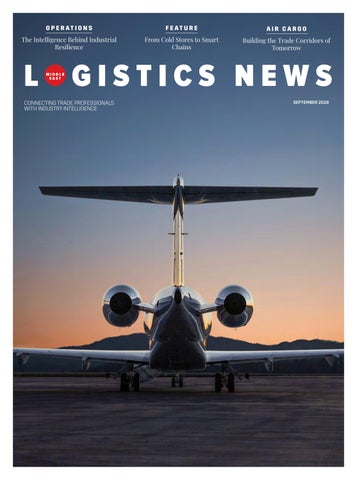
O P E R AT I O N S
F E AT U R E
AIR CARGO
The Intelligence Behind Industrial Resilience
From Cold Stores to Smart Chains
Building the Trade Corridors of Tomorrow
CONNECTING TRADE PROFESSIONALS WITH INDUSTRY INTELLIGENCE
SEPTEMBER 2026
Drive the new way. New IVECO S-Way: high technology and efficiency on all missions A wide choice of Euro III / V diesel engines, delivering class-leading power from 360 hp to 560 hp Euro III / 570 hp Euro V and superior fuel economy. 12-speed HI-TRONIX automated transmission with the most advanced technology in its category, electronic clutch and best-in-class torque-to-weight ratio. Full range of fuel-saving devices, such as anti-idling feature, EcoSwitch, Ecoroll and Smart Alternator. Top levels of comfort and safety, with a completely redesigned and reinforced cab, featuring enhanced direct visibility and enlarged cab livability.
IN THIS ISSUE
16 20 25 26
OP-ED
The Variabilisation of the Last Mile: Crowd Shipping and the GCC’s Q-Commerce Frontier Operations
The Intelligence Behind Industrial Resilience Cargo Operations
Dnata Opens Cargo Integrated Command Centre to Strengthen Dubai Operations Cover Story
The New Era of Private Aviation
32
Feature
46
Air Cargo
50
Appointment
53
From Cold Stores to Smart Chains
Building the Trade Corridors of Tomorrow
B&H Worldwide Appoints Matt Silverberg As New CEO Transport
On Track For Dubai’s Next Aviation Era
Nestled by Nestled bythe thecoast coastofofLusail Lusail sitssits thethe splendor splendor of of Raffles and Fairmont Doha, where luxury is rooted in even the Open thethe doors to to thesmallest smallestdetails. details. Open doors mesmerizing hospitality in in a a hospitalityand andmake makememories memories world world of sophistication. sophistication.
PO Box 502511 Dubai, United Arab Emirates P +971 4 4200 506 | F +971 4 4200 196 BBC Building No.10, #234, 235, 236, Dubai Media City, Al Falak Street, Dubai
BNC Media Group CEO Wissam Younane wissam@bncpublishing.net Managing Director Rabih Najm rabih@bncpublishing.net Group Publishing Director Joaquim D’Costa jo@bncpublishing.net
Editorial Editor Reeba Asghar reeba@bncpublishing.net
Art Creative Lead Christian Harb chriss@bncpublishing.net Junior Art Director Rizaldi Febrian
Advertising Commercial Director Andrea Mocay andrea@bncpublishing.net Country Manager Amjad Fakhouri amjad@bncpublishing.net
Multimedia Head of Multimedia Eduardo Buenagua Photography Joel Amparo Videography Harton Otlang
Marketing Marketing Executive Aaron Joshua Sinanbam aj@bncpublishing.net Junior Marketing Executive Elizaira Andes zaira@bncpublishing.net
For all commercial enquiries, contact jo@bncpublishing.net T +971 50 440 2706 All rights reserved © 2026. The opinions expressed are solely those of the contributors. Logistics News Middle East and its affiliated publications in the MENA region are exclusively licensed to BNC Publishing. No part of this magazine may be copied, reproduced, or transmitted in any form or by any means without prior written consent from the publisher. Printed by United Printing and Publishing | upp.ae
Images used in Logistics News Middle East are credited when necessary. Attributed use of copyrighted images with permission. All images not credited courtesy Shutterstock.
LOGISTICS NEWS ME
6 | LOGISTICS NEWS ME | SEPTEMBER 2026
@LOGISTICSNEWSME
LOGISTICS NEWS ME
WWW.CBNME.COM
Letter from Editor
A Fresh
T
Start
here is something quite special about September. It feels like a gentle reset, a chance to return, reconnect and look ahead with a little more clarity.
If you are reading this, welcome back. The summer break is behind us now, and across the region, there is a familiar sense of life returning to full speed. Offices are filling up, calendars are getting busier, conversations are picking up where they left off, and there is a renewed energy in the air. Perhaps, after a little time away, we also appreciate the simple things a little more, catching up with friends, sharing a proper conversation over coffee, and enjoying the familiar rhythm of everyday life. The first part of the year has brought its share of change, challenges and opportunities, but there is still plenty of road ahead and if there is one thing I have learnt, it is that the final months of the year have a habit of passing far more quickly than we expect. Before we know it, we will be looking back on 2026 and wondering where the time went. That makes this moment worth embracing. This September edition is our way of welcoming you back. Inside, you will find conversations with inspiring people, stories from across the region, and perspectives on the ideas, developments and opportunities that will shape the months ahead. Beyond the headlines and stories, it is really about people. It is about reconnecting with familiar faces, meeting new ones, exchanging ideas and reminding ourselves that so much of what we achieve, in business and in life, begins with a conversation. I hope the summer gave you the chance to slow down, switch off, spend time with the people who matter and perhaps see things from a slightly different perspective. Now, as we return to our routines, there is something exciting about having a blank stretch of road ahead of us.
Reeba Asghar
Editor Logistics News ME reeba@bncpublishing.net reebaasghar reeba.asgharx
So, if you are reading this with your first coffee back at your desk, between meetings, or simply taking a quiet moment for yourself, I hope you enjoy this edition.
8 | LOGISTICS NEWS ME | SEPTEMBER 2026
WWW.CBNME.COM
REGIONAL NEWS
EDECS GROUP EXPANDS STRATEGIC PARTNERSHIP WITH DP WORLD THROUGH DAR ES SALAAM PORT PROJECT EDECS Group has secured a new strategic contract from DP World to deliver major infrastructure upgrades at Terminal 1 of Dar es Salaam Port
E
DECS Group, a leading EPC contractor in the Middle East and Africa (MEA) region, has secured a strategic contract from DP World to redevelop seven operational yards at Terminal 1 of Dar es Salaam Port, operated by DP World Dar es Salaam. Construction is already progressing on site, reinforcing EDECS Group’s growing role in strategic marine and logistics infrastructure across the region. Under the project, EDECS Group is delivering the design and construction of seven dedicated cargo and materialhandling yards covering 90,000 m², together with associated gates and supporting utilities. The works include modern infrastructure upgrades, support for advanced digital yard management systems, enhanced cargo storage and handling facilities, and sustainable engineering solutions. EDECS Group is also implementing a portwide fire protection network, including areas beyond the original project scope,
alongside a high-mast lighting system designed to enhance safety, security and operational efficiency. As Tanzania’s largest and busiest port, Dar es Salaam handles more than 90% of the country’s international maritime trade and serves as a key gateway for seven landlocked countries across East and Central Africa. The port has surpassed 30 million tonnes in annual throughput, reflecting growing demand for logistics capacity and supporting Tanzania’s Vision 2050 ambition to become a leading logistics and trade hub. Terminal 1’s modernisation is already delivering results, with monthly container throughput reaching a record 46,582 TEUs in July 2026, up from 13,779 TEUs in May 2024, demonstrating significant growth in capacity and operational efficiency. Eng. Hussein El Dessouky, Chairman and Managing Director of EDECS Group, said: “We are proud to extend our partnership with DP World through the Dar es Salaam Port Modernisation Project, a development of strategic importance to Tanzania and the wider region.
“Our teams are actively progressing works on site across the project’s key operational areas, delivering the critical infrastructure required to support safer, smarter and more efficient port operations. As Dar es Salaam continues to strengthen its role as one of the region’s most important maritime gateways, EDECS is proud to contribute to a project that advances trade connectivity, supports economic growth and aligns with Tanzania’s long-term national development goals.” Martin Jacob, CEO of DP World Dar es Salaam, said: “The modernisation of the DP World terminal at Dar es Salaam Port remains central to efforts to enhance trade connectivity and logistics efficiency across East and Central Africa. Building on our relationship with EDECS Group, we are pleased to recognise the speed of execution in the civil works.” The latest award builds on EDECS Group’s proven track record in delivering complex marine, port and logistics infrastructure projects across the Middle East and Africa. With more than three decades of experience and a growing presence across strategic regional markets, the company continues to leverage its engineering expertise to deliver world-class infrastructure that supports economic development, trade facilitation and sustainable growth.
12 | LOGISTICS NEWS ME | SEPTEMBER 2026
WWW.CBNME.COM
Bahri Logistics has signed an MoU with Red Sea Global, marking the next phase of their long-standing relationship
B
ahri Logistics, the integrated logistics arm of Bahri, Saudi Arabia’s national shipping company, has signed a Memorandum of Understanding (MoU) with Red Sea Global, the developer behind the regenerative tourism destinations The Red Sea and AMAALA, to expand their existing partnership and explore new strategic logistics opportunities. As an existing Bahri Logistics client, Red Sea Global will work with the company to explore integrated logistics solutions that support its evolving operational and project requirements, as well as its Vision 2030 ambitions. THE COLLABORATION REFLECTS BAHRI LOGISTICS’ COMMITMENT TO BUILDING LONG-TERM CUSTOMER PARTNERSHIPS BY COMBINING ITS LOGISTICS CAPABILITIES, OPERATIONAL EXPERTISE AND STRATEGIC INFRASTRUCTURE TO DELIVER SUSTAINABLE VALUE.
WWW.CBNME.COM
Mohammed Alsinan, Vice President of Bahri Logistics, said: “Our relationship with Red Sea Global reflects the value of working closely with our clients to understand their evolving requirements and support their long-term ambitions. We pride ourselves on being a strategic partner across our clients’ logistics operations, and this MoU provides a framework through which we can build on our successful existing relationship, explore new logistics opportunities and develop integrated solutions that create long-term value for both organisations.” The MoU was signed during the official launch of the Bahri Logistics Bonded Zone at Jeddah Islamic Port, a strategic logistics hub offering integrated bonded storage, customs facilitation and valueadded logistics services. The Bonded Zone will strengthen Bahri Logistics’ ability to support increasingly complex supply chains, helping customers improve efficiency, enhance operational flexibility and access domestic and regional markets through one of Saudi Arabia’s key maritime gateways.
Raed Albasseet, Group Chief Environment and Sustainability Officer at Red Sea Global, said: “As we continue to develop and operate regenerative tourism destinations, efficient and resilient logistics are essential to delivering exceptional experiences at scale. We look forward to exploring integrated solutions with Bahri Logistics that create lasting value for both organisations.” The MoU also supports the objectives of Saudi Vision 2030 and the National Transport and Logistics Strategy by contributing to the development of advanced logistics infrastructure, facilitating trade, and strengthening the efficiency and resilience of supply chains across the Kingdom. Through such partnerships, Bahri Logistics continues to expand its integrated logistics capabilities, deepen its relationships with existing clients and support Saudi Arabia’s ambition to become a leading global logistics hub.
LOGISTICS NEWS ME | SEPTEMBER 2026 | 13
REGIONAL NEWS
BAHRI LOGISTICS STRENGTHENS PARTNERSHIP WITH RED SEA GLOBAL TO EXPLORE NEW LOGISTICS OPPORTUNITIES
REGIONAL NEWS
DTC AND BOLT EXPAND SMART MOBILITY NETWORK IN DUBAI Dubai’s mobility landscape is becoming more connected, with Dubai Taxi Company, Bolt and Arabia Taxi joining forces
D
ubai Taxi Company PJSC (DTC), a leading provider of comprehensive mobility solutions in the UAE, and its strategic partner Bolt, have signed a partnership agreement with Arabia Taxi, a subsidiary of Economic Group Holdings, to integrate the company’s fleet onto the Bolt platform. The partnership marks another milestone in DTC’s strategy to enhance smart mobility services and deliver a more seamless ride-hailing experience across Dubai. Under the agreement, Arabia Taxi’s fleet of 1,607 taxis will join the Bolt platform, expanding the pool of available vehicles while improving fleet utilisation and service reliability. The integration is expected to increase vehicle availability during periods of high demand, reduce estimated arrival times (ETAs) and provide customers with a faster and more convenient booking experience.
expansion of our mobility network is ultimately about delivering a better experience for our customers. By integrating Arabia Taxi’s fleet onto the Bolt platform, we are supporting this foundation. As demand for app-based mobility continues to grow, partnerships such as this reinforce our ability to scale efficiently while supporting Dubai’s vision of becoming one of the world’s smartest and most connected cities.” Rawoof Ali, Executive Director of Arabia Taxi, added: “Joining the Bolt platform through this partnership with Dubai Taxi Company marks an important milestone for Arabia Taxi. It enables our fleet and drivers to
connect with a broader customer base through a leading digital mobility platform while enhancing the efficiency of our operations. We look forward to working closely with DTC and Bolt to deliver a highquality, reliable service that meets the expectations of passengers across Dubai.” The agreement marks another step in Dubai Taxi Company’s ongoing strategy to strengthen its network across the emirate and expand its partnerships with private taxi operators. It further reinforces DTC’s position as a leading mobility provider in the UAE, while supporting Bolt’s continued growth within Dubai’s rapidly evolving ride-hailing market.
The partnership further strengthens Bolt’s growing presence within Dubai’s mobility ecosystem, while supporting DTC’s ambition to build a more connected and t e c h no l o gy - e na b l e d transportation network that meets the evolving needs of residents and visitors alike. Commenting on the partnership, Mansoor Rahma Alfalasi, Group CEO of Dubai Taxi Company, said: “At Dubai Taxi Company, every
14 | LOGISTICS NEWS ME | SEPTEMBER 2026
WWW.CBNME.COM
UBER AND BAIDU LAUNCH FULLY DRIVERLESS ROBOTAXIS IN DUBAI Baidu’s fully electric Apollo Go robotaxis are now available through Uber in selected parts of Dubai
U
ber has officially launched fully driverless Apollo Go vehicles from Baidu on its platform in Dubai, with New Horizon Luxury Transport operating the fleet. The launch marks the first phase of a multi-year strategic partnership and strengthens Dubai’s position as a testing ground for autonomous mobility, with plans to eventually scale thousands of Apollo Go vehicles across Uber’s global network. Riders booking UberX or Uber Comfort may be matched with an Apollo Go vehicle, while a dedicated ‘Autonomous’ option allows users to increase their chances of getting a robotaxi. The service initially operates in selected areas of Umm Suqeim and Jumeirah, with the operating area expected to expand in the future. “Bringing our partnership with Baidu to life is a major step forward as we expand autonomous mobility globally,” said Sarfraz Maredia, Global Head of Autonomous at Uber. “Launching in Dubai marks the first time our multipartner vision comes to life on public roads, demonstrating how combining advanced autonomous technology with our global marketplace can accelerate an electric, shared and autonomous future.” “This launch marks a meaningful milestone in our partnership with Uber,
WWW.CBNME.COM
with Dubai serving as the launchpad as the partnership grows its footprint,” said Nan Yang, Vice President of Baidu and General Manager of the Overseas Business Unit, Intelligent Driving Group. “Dubai is also the first city where we have successfully established a dual-model offering, combining self-operated and partnerbased autonomous ride-hailing services internationally. With this launch, we are excited to offer another way for riders in Dubai to enjoy the benefits of autonomous mobility.” The service will use Apollo Go’s sixthgeneration RT6, a purpose-built, fully electric robotaxi designed for driverless operation. Each vehicle can carry up to three passengers and is equipped with more than 30 sensors, enabling comprehensive environmental
perception and real-time onboard data processing. Apollo Go has deployed autonomous vehicles across 28 cities, with its fleets covering more than 350 million autonomous kilometres, including over 240 million fully driverless kilometres. Safety remains Uber’s top priority, with all autonomous vehicles required to meet its stringent Safety Guidelines before operating on the platform. The launch forms part of Uber’s broader strategy to build a hybrid transport network where autonomous vehicles and drivers operate alongside each other. With more than 30 AV partners and millions of autonomous trips completed each year, Uber aims to make transport more affordable, sustainable and accessible.
LOGISTICS NEWS ME | SEPTEMBER 2026 | 15
OP-ED
Dr Lijo John, Assistant Professor in Logistics and Supply Chain Management at Edinburgh Business School, Heriot-Watt University Dubai
Crowd Shipping Is Reshaping the GCC’s Last Mile Dr Lijo John at Heriot-Watt University Dubai, argues that crowd shipping is emerging as more than a delivery model
L
ast-mile delivery now accounts for 53% of total shipping costs globally, up from 41% in 2018, according to the Capgemini Research Institute. Nowhere is that final leg more compressed or more consequential than in the GCC, where Dubai and Riyadh rank among the world’s most active quick-commerce
16 | LOGISTICS NEWS ME | SEPTEMBER 2026
markets and 10- to 20-minute delivery has shifted from a premium offering to a consumer expectation. Crowd shipping, the use of non-dedicated, on-demand couriers to complete deliveries has become an important part of this model. It is best understood not simply as a labour innovation, but as a financial one: it converts a largely fixedcost delivery model into a variable one. The GCC’s
WWW.CBNME.COM
The Variabilisation of the Last Mile: Crowd Shipping and the GCC’s Q-Commerce Frontier
platform economy has adopted this approach rapidly, supported by dense urban markets, high smartphone p e ne t ra ti o n a nd i nc re a si n g ly sophisticated logistics infrastructure. The Economic Logic A dedicated delivery fleet is a fixed-cost asset. Vehicles, insurance, fuel contracts and salaried drivers must be maintained and sized for peak demand, even when much of that capacity sits idle. Crowd shipping reverses the equation. Delivery capacity is activated when an order exists and paid for against that order. The model becomes particularly valuable at the extremes of the demand curve, such as Ramadan evenings and national-holiday weekends in the Gulf, or Black Friday in Western markets. Operators can absorb significant spikes in order volumes without carrying the cost of that additional capacity throughout the year. For the GCC’s large population of F&B and grocery SMEs, it also provides access
to delivery infrastructure that would otherwise be expensive to build and operate independently. Why Does it Work Now? Crowd shipping itself is not new. What has changed is the technology used to match supply and demand. Regional super-apps such as Careem and Talabat use real-time assignment systems to match couriers with orders, taking into account factors such as proximity, current routes and predicted completion times. Dynamic payouts can also adjust when rider availability is
temporarily constrained in a particular area. In effect, this creates a continuously clearing spot market for the final kilometre, rather than relying solely on fixed routes and scheduled fleets. Without this matching infrastructure, crowd shipping would be little more than informal courier work at scale. The GCC’s Distinctive Institutional Model What distinguishes the Gulf’s application of crowd shipping is less the technology than the institutional structure surrounding it. Platforms typically source d e li ve ry capacity through li c e n se d thirdp a r ty l o gi s t i c s (3PL) companies, which manage recruitment, visas and vehicle compliance within frameworks established by authorities such as the RTA and MOHRE. This gives operators the flexibility of on-demand delivery while ke e p i n g t he e m p l oy me n t relationship within a regulated commercial structure rather than an informal peer-topeer model. That is a different starting point from markets where crowd
WWW.CBNME.COM
LOGISTICS NEWS ME | SEPTEMBER 2026 | 17
OP-ED
shipping developed through largely unregulated gig platforms. The UAE has also moved towards formalising independent work more broadly. Lower freelance permit costs have widened access, while unemployment and workplace-injury insurance frameworks under Federal Decree-Law No. 13 of 2022 have strengthened protections across the private sector. Extending comparable protections to platform-based delivery work would therefore represent an evolution of an existing framework rather than regulation being added after the market has already developed. Hybridisation, not Substitution The industry is increasingly moving towards a hybrid model rather than a choice between crowd and dedicated fleets. Companies are segmenting delivery according to risk, value and service requirements. A temperaturesensitive pharmaceutical shipment, for example, still requires a dedicated and accountable driver. A routine grocery top-up, by contrast, may be well suited to a crowd-sourced 3PL rider.
whether to crowdsource. It is which products, which routes and which risk profiles should use on-demand capacity. Where the Model is Being Engineered Forward Two structural challenges remain live anywhere crowd shipping operates. The first is quality control across a distributed rider network, where responsibility for loss, damage or service failures can be more difficult to establish than with a salaried fleet. The second is the “last metre” - the distance between a parked vehicle and the customer’s door. No matching algorithm can eliminate the practical difficulties of building access, parking, loading zones and vertical movement within large developments. This is where the Gulf’s investment in smart-city infrastructure could provide a structural advantage. Dubai’s integration of RTA data with deliveryrouting platforms, alongside efforts to improve curbside and building-access management, points towards the kind of public-private interoperability that
many other quick-commerce markets are still developing. The Systemic Shift The direction of travel is towards crowd shipping becoming segmented, regulated infrastructure rather than a blanket replacement for dedicated fleets. Delivery capacity will increasingly be allocated according to specific order types, routes and risk profiles, with algorithms handling much of the matching and pricing work once managed manually by dispatchers. The GCC’s advantage is that this evolution is taking place on top of an established 3PL structure and formal labour and insurance frameworks, rather than regulation being imposed retrospectively on an informal market. The result is a model in which infrastructure, technology and labour regulation can develop alongside one another. For a region pushing the boundaries of delivery speed, that alignment may prove as important as the algorithms themselves.
The strategic question for GCC operators is therefore no longer simply
18 | LOGISTICS NEWS ME | SEPTEMBER 2026
WWW.CBNME.COM
Returns darkness to the night BEGA pole-top luminaires with Dark Sky technology direct the light in a highly efficient manner only where it is required. Light pollution of the night sky is avoided. bega.com/darksky
Das gute Licht.
OPERATIONS
The Intelligence Behind Industrial Resilience Ken Naughton, President at Management Controls, examines how companies can build greater resilience into their operations, from preparing contractor workforces for sudden shocks to using real-time data to make faster decisions when conditions change
W
ith ongoing geopolitical uncertainty affecting shipping routes, energy markets and industrial supply chains, how are large operators changing the way they manage contractor workforces and operational costs to remain resilient? Geopolitical disruption may begin outside a facility, but its impact quickly becomes an execution challenge inside it. When shipping schedules shift, feedstock availability changes or energy prices move sharply, operators may need to resequence maintenance, adjust production plans, redeploy contractor crews or extend equipment rentals, often with very little notice. The strongest operators are moving away from static plans and month-end financial reporting towards a live operating picture that connects contractor presence, labour hours, equipment utilisation, work orders, approvals and contract terms. This gives leaders visibility into the cost and operational
20 | LOGISTICS NEWS ME | SEPTEMBER 2026
WWW.CBNME.COM
The Intelligence Behind Industrial Resilience
implications of a decision while there is still time to change course. They also need to know which skills are critical, which work can safely be deferred, where overtime is built and how quickly crews can be redeployed without compromising safety or quality. The objective is not to carry excess labour or cut contractors every time the market shifts. It is to scale deliberately and respond intelligently. With visibility at shift or daily level, leaders can protect critical maintenance, eliminate unnecessary expenditure and adapt quickly without creating a second operational problem inside the facility. Many companies focus on visible supply chain disruptions, but less attention is given to internal operational cost leakage. Where are industrial operators losing efficiency today, and why is contractor spending becoming a critical area of focus? Industrial companies typically monitor raw materials and energy consumption very closely. Contractor labour, however, can represent one of a facility’s largest operating costs and is still often managed through paper timesheets, disconnected systems or invoice portals that rely heavily on selfreported information. That creates a significant blind spot. Cost leakage rarely comes from one dramatic event. It accumulates through thousands of small exceptions: unnecessary overtime, idle labour or equipment, and charges that do not align with the work actually performed. Individually, these discrepancies may appear immaterial. Across multiple vendors and thousands of workers, however, they can become significant. Most cost leakage is not a fraud problem. It is a control problem. Industrial work is complex, and manual processes make it difficult for owners and contractors to apply different site and contract rules consistently. That makes contractor spending particularly important because it is large, variable and actionable.
Ken Naughton, President at Management Controls
WWW.CBNME.COM
Companies may have little control over geopolitical events or commodity prices, but they can control whether work is properly authorised, whether the right people and equipment are deployed, whether contract terms are applied accurately and whether issues are identified before an invoice arrives. Better visibility ultimately protects both sides. Owners gain greater control and confidence over
LOGISTICS NEWS ME | SEPTEMBER 2026 | 21
OPERATIONS
expenditure, while contractors can be paid accurately and on time for work they have legitimately completed. The Strait of Hormuz disruptions have highlighted the importance of agility across global industries. What lessons can logistics and industrial leaders learn about preparing their operations for sudden market shocks? A disruption may begin at a strategic level, outside the company, but the response quickly becomes tactical. Executives need to translate a market shock into a series of practical decisions: Do we change the maintenance sequence? Add a shift? Extend an equipment rental? Move skilled workers to a more critical asset? These decisions need to be made before month-end often before the impact is fully visible in financial reports. Companies also need a clear understanding of their normal crew levels, overtime rates, productivity, equipment utilisation and maintenance backlog before a crisis occurs. Without that baseline, it becomes difficult to determine whether the organisation is responding effectively or simply creating new inefficiencies. Contingency planning should therefore extend beyond alternative shipping routes and suppliers. Companies should understand the contractor skills, vendors, rental assets and contractual arrangements they would need to activate under different scenarios. They should also establish clear thresholds that trigger those actions and define who has the authority to approve them. Just as importantly, owners and contractors need access to the same, up-to-date information. Stress tests weak hand-offs. When the owner, contractor and finance team are working from different records, decisions take longer and disputes become more likely. The Strait of Hormuz is a reminder that a supply chain disruption can quickly
22 | LOGISTICS NEWS ME | SEPTEMBER 2026
WWW.CBNME.COM
The Intelligence Behind Industrial Resilience
become an operational challenge. Agility is not simply about speed; it is speed with control and control comes from knowing where you are, understanding the cost of your response and maintaining safety and reliability as conditions evolve. In a period where companies are under pressure to reduce costs, how can leaders avoid cutting in areas that protect longterm operational reliability and instead identify where true inefficiencies exist? The biggest risk during a cost-reduction cycle is assuming that all dollars are equal. Deferring maintenance, reducing supervision or losing critical skills may lower expenditure in the short term, but those decisions can ultimately lead to equipment failures, safety exposure, rework or longer outages. That is not efficient. It is simply moving cost and risk into the future. Leaders need to distinguish essential work from wasteful expenditure. Instead of asking only, “How much are we spending?”, they should be asking, “What are we getting for that spend?” And, critically, “Was the work performed in accordance with the terms we agreed?.” Answering those questions requires visibility across labour, equipment and work activity. Leaders need to understand where resources are being underutilised and where actual activity has drifted from the plan. Those are
WWW.CBNME.COM
often the areas where meaningful savings can be found without compromising execution. Technology can also apply contract rules automatically and flag transactions or activity outside agreed parameters. This allows teams to focus their time and expertise where human judgement is required, rather than manually reviewing every transaction. Cost reduction should never come at the expense of operational resilience. The smarter approach is to protect reliabilitysustaining activities — maintenance, safety and critical skills while systematically removing waste that does not add value. How is technology transforming the relationship between owners and contractors, particularly in industries where thousands of workers, multiple vendors and complex maintenance activities must be coordinated simultaneously? TECHNOLOGY IS GIVING OWNERS AND CONTRACTORS SOMETHING THEY HAVE HISTORICALLY LACKED: A SHARED, REAL-TIME VIEW OF THE WORK AS IT HAPPENS. Traditionally, an owner might receive a contractor’s timesheet or invoice and reconcile it against internal records weeks later. By then, the work is complete, memories have faded and what began as
LOGISTICS NEWS ME | SEPTEMBER 2026 | 23
OPERATIONS
resolve questions earlier and support more accurate and timely payment. AI adds another layer by identifying anomalies, benchmarking performance and highlighting patterns or blind spots that would be difficult to detect manually. But the value is not AI for AI’s sake. Its value is in helping people identify what requires attention and act on it sooner. Ultimately, the goal should be a healthier relationship between owners and contractors — not more surveillance or bureaucracy. GOOD TECHNOLOGY REMOVES ADMINISTRATIVE NOISE, CREATES CONFIDENCE IN A SHARED SET OF DATA AND ALLOWS EVERYONE TO FOCUS ON WHAT MATTERS MOST: DELIVERING THE WORK SAFELY, EFFICIENTLY AND PRODUCTIVELY. As energy prices and market conditions continue to fluctuate, how can companies improve visibility into contractor activity, workforce deployment and equipment usage to make faster operational decisions? Most companies already have much of the information they need. The challenge is that it often sits across separate systems, spreadsheets and processes. When those sources are not connected, leaders see fragments of the operation rather than the full picture. Decision-makers also need information at the pace at which the operation is moving. For labour-intensive projects involving multiple contractors, that may mean reviewing actual performance against plan every day or even every shift, rather than waiting for month-end reporting. a minor discrepancy can become hours of reconciliation or a formal dispute. A connected contractor management system can fundamentally change that workflow. Proof of presence can be captured through access-control systems or mobile data. Contract terms, rates and overtime rules can be applied automatically. Labour, equipment and material activity can be linked to work orders, approvals and enterprise systems. Exceptions can then be identified and resolved much closer to the point at which the work occurs, rather than waiting for an invoice to arrive. This becomes particularly powerful when thousands of workers and multiple vendors are operating across different sites and shifts. Site supervisors can monitor headcount, skill mix and fatigue. Commercial teams can track expenditure and contract compliance. Contractors can see what has been accepted,
24 | LOGISTICS NEWS ME | SEPTEMBER 2026
The focus should be on leading indicators such as headcount, skill mix, overtime, spend velocity, equipment utilisation, productivity, approval delays and exceptions to contract terms. The real advantage of this visibility is not simply better reporting. It creates time to act. When something begins to move away from plan, the earlier you see it, the more options you have. If overtime starts increasing today, resources can be reallocated before it becomes the new baseline. If rented equipment is sitting idle, it can be reassigned or released before unnecessary costs accumulate. In volatile markets, that ability to see, understand and act early is becoming a genuine competitive advantage. The organisations that build resilience will not necessarily be those with the lowest costs, but those with the clearest view of where their costs are going and the ability to intervene before small inefficiencies become major problems.
WWW.CBNME.COM
Dnata Opens Cargo Integrated Command Centre to Strengthen Dubai Operations
DNATA OPENS CARGO INTEGRATED COMMAND CENTRE TO STRENGTHEN DUBAI OPERATIONS The centre draws on dnata’s One Cargo cargo management system, which captures operational activities and transactions in real time the International Air Transport Association (IATA). At the same time, investment in the future expansion of DWC is expected to create additional capacity for the emirate’s long-term aviation and logistics ambitions.
Nabil Sultan Al Murr, Group Chief Executive Officer, dnata and
Turning Data into Faster Decisions At the heart of the CICC is an internally developed operational dashboard that consolidates information from across dnata’s cargo operations and refreshes every 10 seconds, giving teams a near real-time view of activity.
The dashboard draws data from dnata’s One Cargo cargo management system, which records operational activities and transactions in real time, and its Appointment and Dock Management (ADM) system, which tracks truck movements across both airports. It also integrates data from Calogi, dnata’s cargo community platform, providing visibility of landside activities and ancillary services, including last-mile delivery.
Guillaume Crozier, Chief Cargo Officer, dnata
D
nata, a leading global air and travel services provider, has upgraded its cargo control centre at Dubai International Airport (DXB) into a new Cargo Integrated Command Centre (CICC), bringing together real-time operational data, technology and decision-making capabilities to improve the coordination and performance of its cargo operations across the UAE. The CICC provides teams with a centralised view of cargo activity across DXB and Dubai World Central-Al Maktoum International (DWC), enabling them to anticipate operational requirements, allocate resources more effectively and respond quickly to changing conditions. Managing a Complex Cargo Network The centre supports an operation of significant scale. During the 2025-26 financial year, dnata handled more than one million tonnes of cargo, 189,000 flight movements and 46,000 truck movements. Its centralised view helps teams coordinate activities across both airports and identify potential bottlenecks before they affect operations. The development comes as Dubai strengthens its position as a global cargo and logistics hub. Global air cargo demand reached record levels in 2025, rising 3.4% year on year, according to
WWW.CBNME.COM
Together, these systems give CICC teams a single operational view, allowing them to monitor activity, identify emerging bottlenecks and coordinate responses across facilities and teams. Investing in Future Growth The CICC is part of dnata’s wider investment in technology and digitalisation across its Dubai cargo operations. Recent initiatives include autonomous drones for warehouse inventory processes, achieving more than 99% accuracy in shipment tracking. dnata has also developed a centralised cargo screening control room in partnership with Dubai Police, enabling six X-ray screening machines at DXB to be remotely operated and monitored from a single location. Designed to scale with demand, the CICC provides a flexible operating model to support the continued growth and increasing complexity of dnata’s cargo operations, while strengthening connectivity across the UAE’s aviation and logistics network.
LOGISTICS NEWS ME | SEPTEMBER 2026 | 25
COVER STORY
THE
NEW ERA
OF PRIVATE AVIATION
In an exclusive interview, Youssef Mouallem, Chief Business Officer at Vista, explores how technology, intelligence and changing traveller expectations are reshaping the future of private aviation
26 | LOGISTICS NEWS ME | SEPTEMBER 2026
WWW.CBNME.COM
P
rivate aviation has traditionally been viewed as an exclusive service driven by personal relationships and bespoke arrangements. How is technology changing the way customers discover, access and book private flights, and what does the future of digital-first private aviation look like? Private aviation has always been built on relationships, and that will remain a defining part of the customer experience. However, today’s customers also expect the same speed, transparency and convenience they experience across other aspects of their lives, without compromising the personalised service that makes private aviation distinctive. Technology is fundamentally reshaping how private aviation operates by bringing aircraft availability, pricing and booking together within a single, real-time ecosystem. Through XO, the world’s largest digital private aviation marketplace, Vista is giving customers a technology-enabled way to access private aviation, with real-time aircraft availability, transparent pricing and instant booking, while retaining the highly personalised service that remains central to premium aviation.
WWW.CBNME.COM
LOGISTICS NEWS ME | SEPTEMBER 2026 | 27
COVER STORY
Youssef Mouallem, Chief Business Officer at Vista
Technology is not replacing relationships; it is removing friction. By automating timeconsuming coordination and streamlining the booking journey, advisors can spend less time managing logistics and more time supporting increasingly complex travel requirements. The future of digital-first private aviation will extend well beyond simply booking a flight online. It will be increasingly intelligent, using real-time data to anticipate demand, recommend aircraft and routing options, and adapt itineraries as circumstances change. XO is positioning itself as a technologyenabled marketplace for private aviation. What challenges come with bringing a marketplace model to an industry that has historically relied on traditional booking methods, and how is technology helping create a more transparent, flexible and seamless experience for travellers? The biggest challenge is not the technology itself. Unlike many other travel sectors, private aviation has never operated around a centralised marketplace. The industry has evolved through a network of independent operators, experienced brokers and highly personalised service — all of which continue to play an important role.
We are moving beyond the digitisation of charter bookings towards a more connected, responsive and intelligent approach to global premium mobility.
28 | LOGISTICS NEWS ME | SEPTEMBER 2026
Creating a successful marketplace therefore requires far more than building a booking platform. It means connecting customers, operators and aircraft supply within a trusted, seamless digital ecosystem that delivers greater speed and transparency while complementing, rather than replacing, the relationship-led experience customers value. That is precisely what we have set out to achieve with XO. Customers benefit from greater transparency, real-time pricing, broader aircraft availability and the ability to secure a flight instantly, rather than waiting days for multiple quotations. Operators, meanwhile, gain access to aggregated global demand, automated booking workflows and opportunities to improve aircraft utilisation through a more efficient commercial model. The results demonstrate how quickly customers are embracing this approach. Following the rollout of enhanced marketplace capabilities at the beginning of 2025, XO recorded 66% growth during 2025 and continued that momentum through the first half of 2026. Conversion rates are now three times higher than through conventional
WWW.CBNME.COM
The New Era of Private Aviation
can now access more than 2,000 safety-vetted aircraft operating across approximately 60,000 routes globally, from light jets suited to short regional journeys to ultra-long-range aircraft capable of connecting continents nonstop. We are not simply digitising an existing process. We are building a more connected, transparent and efficient commercial ecosystem that creates value for customers, operators and the wider aviation industry. That is where the real transformation lies.
booking methods, while booking times have fallen from days to seconds. Through continued operator integration, the number of instantly bookable routes has expanded from around 500 to more than 11,000. Customers
WWW.CBNME.COM
Booking behaviours among affluent GCC travellers are changing, with many customers finalising travel plans much closer to departure. What does this shift reveal about the evolving expectations of luxury travellers, and how is Vista adapting to meet the demand for greater flexibility and personalisation? The biggest shift we are seeing is that luxury is increasingly being defined by flexibility rather than fixed plans. Today’s affluent travellers lead highly international lives, often balancing business commitments, family schedules and leisure across multiple countries. Rather than locking in itineraries weeks
LOGISTICS NEWS ME | SEPTEMBER 2026 | 29
COVER STORY
today’s traveller, having the freedom to change plans at the last minute is itself a form of luxury. Data, artificial intelligence and real-time intelligence are becoming increasingly important across the travel sector. How do you see these technologies transforming private aviation over the next five years, from demand forecasting and pricing to customer experience and operational efficiency? Data is becoming one of the most valuable assets in private aviation. Historically, many commercial and operational decisions have relied heavily on experience, intuition and historical patterns. Increasingly, those decisions will be informed by real-time intelligence.
in advance, many are deliberately keeping their options open until much closer to departure. Our latest summer booking data illustrates this clearly. During the peak school holiday period, 31% more flights were confirmed within 72 hours of departure compared with the previous summer, while the average booking window shortened from around 11 days to nine. This does not necessarily mean travellers are becoming more spontaneous. Instead, they are becoming more adaptable. They increasingly expect travel to fit around their lives, rather than having to organise their lives around travel. Technology is making this possible. Real-time aircraft availability, transparent pricing and instant booking give customers the confidence to make decisions much later while still securing the right aircraft. Just as importantly, technology enables complex itineraries to be adjusted as plans evolve, whether that means extending a holiday, responding to a business opportunity or adding destinations along the way. Ultimately, flexibility is emerging as one of the defining characteristics of modern luxury travel. For
30 | LOGISTICS NEWS ME | SEPTEMBER 2026
Technology is enabling s i g n i fi c a n t ly more sophisticated demand fo re c a s ti n g, a ll owi n g operators to anticipate where aircraft will be required before demand materialises. Pricing, too, will become increasingly dynamic, responding to live market conditions rather than relying solely on static models. More accurate forecasting can improve aircraft utilisation, reduce unnecessary repositioning flights and enable fleets to be deployed more efficiently; creating benefits for both operators and customers. From a customer perspective, data and AI will also make the experience increasingly personalised. Rather than simply responding to booking requests, intelligent platforms can learn travel preferences, recommend suitable aircraft and routing options, and proactively support increasingly complex international itineraries. However, technology is only one part of the equation. Premium aviation remains a relationship-driven business, and its real value comes from combining intelligent digital capabilities with deep operational expertise. Data can help us make better decisions, faster. The real advantage comes from bringing together technology, operational excellence and human expertise to deliver an experience that is
WWW.CBNME.COM
both highly efficient and personal. GCC travellers continue to show strong demand for European destinations, multi-stop itineraries and flexible travel options. What broader travel trends are you seeing emerge from the region, and what do they tell us about how highnet-worth individuals are redefining luxury mobility? The biggest trend is not simply where people are travelling, but how they are travelling. We are seeing a growing number of journeys that combine multiple objectives within a single itinerary. A customer might travel to London for business meetings, continue to the Mediterranean with family, travel onwards for a sporting or cultural event, and then return home. Business, leisure and personal priorities are increasingly being woven into one connected journey. Our global route data reflects this evolution. Alongside established routes, we are seeing strong growth across corridors connecting financial centres, investment hubs and lifestyle destinations. Abu Dhabi–London, for example, has grown by 238%, while Jeddah–Riyadh is up 269%. We are also seeing continued expansion across long-haul corridors connecting the Middle East with North America, Asia and Europe. These trends point to a broader shift towards globally distributed lifestyles. Many high-net-worth individuals no longer simply travel internationally, they live internationally, maintaining businesses, investments, homes and personal commitments across multiple markets. Luxury mobility is therefore becoming less about simply reaching a destination and more about enabling this way of life with maximum
WWW.CBNME.COM
efficiency, flexibility and control over time.
seamless connectivity and the flexibility to adapt as their plans evolve.
In this context, time itself becomes one of the most valuable luxuries. The ability to move seamlessly between markets, adapt plans and make the most of every hour is increasingly central to the premium travel experience.
At Vista, we continue to invest in our infrastructure, people and fleet to meet this changing demand. Our objective is not simply to make private aviation easier to access; it is to build a smarter, more connected aviation ecosystem that creates greater value for customers and operators alike.
As private aviation becomes increasingly connected through digital platforms, global operator networks and real-time availability, what do you believe will define the next generation of premium travel experiences, and how will companies like Vista shape that future? The next generation of premium travel will be defined by connected ecosystems rather than individual flights.
Ultimately, the companies that shape the future of premium travel will be those that can successfully bring together technology, operational excellence and global reach. The opportunity is to transform private aviation from a traditionally fragmented, relationship-led service into a truly connected global mobility platform, without losing the human expertise and personal service that have always defined the very best of the industry.
Customers will not think in terms of chartering an aircraft. They will simply expect premium mobility to be available whenever and wherever they need it, supported by real-time information, transparent pricing,
That is the future we are building towards: private aviation that is more intelligent, more accessible and more responsive to the way the world’s most globally connected travellers live and work.
LOGISTICS NEWS ME | SEPTEMBER 2026 | 31
FEATURE
FROM COLD STORES TO Smart Chains The GCC’s cold chain is evolving from temperature control to a more connected, intelligent and resilient logistics ecosystem. Words by Reeba Asghar
A
cross a region where summer temperatures can push well beyond 40°C, products ranging from fresh food and vaccines to biologics, dairy and high-value perishables must move through a supply chain in which a few degrees can determine whether a shipment reaches its destination in perfect condition or becomes a costly loss. That makes cold-chain logistics one of the least visible, yet most critical, pieces of the GCC’s rapidly evolving trade infrastructure. The market is changing quickly. Ambitions around food security, pharmaceutical manufacturing, regional distribution and cross-border trade are creating demand for increasingly sophisticated temperaturecontrolled networks. At the same time, logistics operators are confronting a more fundamental challenge: building infrastructure capable not only of coping with today’s extreme conditions, but of remaining resilient as the climate becomes hotter and operating costs continue to rise.
The stakes extend far beyond keeping goods cold.
The traditional definition of cold chain - refrigeration, insulated storage and refrigerated transport is therefore becoming too narrow.
A temperature excursion can compromise a pharmaceutical shipment. A delay can undermine food quality. An interruption in power or refrigeration can ripple through an entire distribution network. For companies operating across borders, even a small weakness at one point in the chain can undermine an otherwise highly sophisticated logistics operation.
The modern cold chain is increasingly a connected ecosystem of sensors, data, predictive analytics, intelligent refrigeration, automated facilities and real-time visibility, working alongside the physical infrastructure that keeps cargo within its required temperature range.
For this special feature, we bring together leading voices from across the GCC’s cold-chain sector to look beyond the cold store and the refrigerated truck to examine the forces reshaping the GCC’s temperature-controlled economy - from the original gaps that created today’s market to the hidden vulnerabilities that remain, the engineering challenge of extreme heat, and the technologies that could determine what comes next.
32 | LOGISTICS NEWS ME | SEPTEMBER 2026
WWW.CBNME.COM
WWW.CBNME.COM
LOGISTICS NEWS ME | SEPTEMBER 2026 | 33
FEATURE
BRENT MELVIN
That is where I believe the GCC’s next cold-chain opportunity lies: not simply more infrastructure, but betterconnected infrastructure.
GENERAL MANAGER RSA COLD CHAIN
I
dentifying the GCC’s Pharma Cold-Chain Gap The gap we identified was not simply a shortage of cold storage; it was a lack of integrated cold-chain capability.
Historically, different parts of the supply chain — warehousing, transport, customs and inventory visibility were often managed separately. This created complexity for customers and additional points of vulnerability. Our thinking was that the cold chain needed to operate as one connected system, bringing together multi-temperature capability, bonded and non-bonded storage, transport, customs facilitation and technology. The market has matured considerably since then. Coldstorage capacity alone is no longer enough. Customers increasingly expect visibility, flexibility and the ability to respond quickly when demand shifts or supply routes are disrupted. I think the competitive question has therefore shifted. It is no longer simply, how much capacity do you have? but how effectively can you use that capacity when circumstances change? For me, that is where the next stage of cold-chain development lies. Resilience is not simply about having more infrastructure; it is about having options when the original plan stops working. From Monitoring to Predicting Cold-Chain Risk in the GCC In a well-managed cold chain, the greatest exposure is often not inside the chamber, but during handovers between controlled environments. A cold store may have excellent refrigeration and monitoring, yet products still need to move through docks, receiving, staging and dispatch. In Gulf summer
34 | LOGISTICS NEWS ME | SEPTEMBER 2026
WWW.CBNME.COM
conditions, these transitions can have a significant impact. I tend to think of the cold chain as protecting time as much as temperature. The longer a product remains outside its intended environment, the greater the potential impact on quality and remaining shelf life. That makes seemingly operational issues - dock design, door management, staging discipline, vehicle scheduling and load sequencing; fundamental parts of cold-chain integrity. Technology certainly helps. Real-time temperature monitoring and alerts provide visibility, but visibility on its own doesn’t protect the product. Clear procedures and trained people are still essential to responding effectively. This transition layer remains one of the industry’s less visible vulnerabilities. While we focus heavily on refrigeration technology, some of the most effective improvements come from reducing dwell time and designing better handovers across the chain. Ultimately, the cold chain is only as strong as its leastcontrolled moment. Can Cold Chain Networks Keep Pace? I believe they can, but only if we stop thinking about the challenge purely in terms of building more infrastructure. Capacity matters, and providers need to invest ahead of demand. RSA Cold Chain has done this deliberately. We now operate three facilities in the UAE, with more than 62,000 pallet positions across multiple temperature regimes, because cold-chain infrastructure cannot be created overnight once demand has arrived. The next challenge is orchestration. You can have an excellent warehouse, transport network and customs process, but if they do not work together, the bottleneck simply shifts from one part of the supply chain to another. The priority now is greater connectivity between warehouses, transporters, ports, free zones, customs authorities and customers. Data needs to move with the product, and processes should be designed around the complete journey rather than individual stages. As food, pharmaceuticals and other temperature-sensitive sectors become more sophisticated, flexibility will be as important as scale. For food security, the conversation also needs to broaden. It is not only about where food comes from, but whether the infrastructure exists to store, move and redirect it when normal supply routes are disrupted. Engineering for Tomorrow’s Climate Extreme heat is not a seasonal inconvenience in the Gulf; it is a fundamental design constraint. It affects almost every aspect of cold-chain operations, from building envelopes and insulation to refrigeration capacity, dock design, door-open times, thermal recovery and the energy required to maintain the required environment. Economics
WWW.CBNME.COM
and engineering are therefore increasingly connected. Energy efficiency is not simply a sustainability issue; it directly affects operating costs, resilience and long-term competitiveness. At RSA Cold Chain, this has influenced our approach to ammonia-based refrigeration, insulation, operating practices and on-site solar generation. The objective is not simply to reduce energy consumption, but to maintain reliable performance under demanding external conditions. The bigger question is whether facilities are being designed around historical conditions or the operating environment we expect over the next 10 to 20 years.Our approach is to build resilience and sufficient headroom into infrastructure today, rather than designing around current peaks and retrofitting critical systems later. Designing for tomorrow’s climate does not necessarily mean installing larger refrigeration systems. It means taking a holistic approach to thermal and operational design, reducing the load on refrigeration systems in the first place. The Future of Cold Chain The industry has spent years creating visibility. I think the next challenge is turning that visibility into decisions. Real-time monitoring changes cold-chain management because exceptions can be identified while there is still time to intervene. The same applies to inventory and transport. When warehouse and transport systems are integrated, operations can see product movements as they happen rather than reconstructing events afterwards. At RSA Cold Chain, we use Infor WMS alongside transport management, real-time monitoring, delivery tracking and a Control Tower focused on exception management and analytics. The objective is to create a single operational picture rather than separate pools of information. The next major development, however, is predictive decision-making. We already generate vast amounts of data; more dashboards alone will not transform the industry. The opportunity is to identify patterns that signal a potential problem before an operating threshold is breached, whether a refrigeration issue, transport delay, inventory risk or unreliable route. A system that tells me something has gone wrong is useful. A system that tells me something is likely to go wrong, and gives the operation time to prevent it is transformational. Ultimately, the progression is from visibility to prediction and, eventually, intervention. That is where AI and increasingly intelligent logistics platforms can make a meaningful difference to cold-chain performance.
LOGISTICS NEWS ME | SEPTEMBER 2026 | 35
FEATURE
I
dentifying the GCC’s Pharma Cold-Chain Gap GWC Group was established in 2004 as a broader warehousing and logistics business in Qatar, with cold-chain capabilities becoming an increasingly important part of our offering as the business and our customers’ requirements evolved.
For us, the cold chain goes well beyond storage and transportation. We see it as strategic infrastructure for food security and healthcare resilience, which means working with customers across the entire journey of temperature-sensitive goods.
Today, the opportunity is not simply about refrigerated capacity; it is about maintaining product integrity across storage, handling, transportation, inventory, compliance and data as one connected system. In many cases, this also means taking on additional activities on our customers’ behalf, such as controlled thawing and packing, so that temperature-sensitive goods arrive at their next stage fully prepared. That is how we have built out the full cold-chain value chain at GWC Group, spanning food logistics through to highly specialised pharmaceutical operations. I believe the next stage is about making these networks even more connected, resilient and responsive as customer requirements continue to become more sophisticated.
SYED MAAZ CHIEF COMMERCIAL OFFICER GWC
36 | LOGISTICS NEWS ME | SEPTEMBER 2026
From Monitoring to Predicting Cold-Chain Risk in the GCC I see concentration risk as one of the biggest vulnerabilities. By that, I mean having too much critical cargo dependent on a particular route, gateway or mode of transport without sufficient alternatives. When a significant share of supply is concentrated through a single corridor, disruption at that point can have consequences across the entire chain, particularly for food and other temperaturesensitive commodities. Recent geopolitical disruption has made that very real. For us, business resilience meant having alternative routes and modes ready. GWC Group activated multimodal corridors combining sea, air and cross-border land routes through our regional network, helping strategic food supplies, perishables and other essential goods continue moving into Qatar and across GCC markets while maintaining the required cold-chain standards. That resilience is also underpinned by the standards and systems surrounding the movement of goods. GWC Group is FSSC 22000 certified for food storage and transport and holds Authorised Economic Operator certification from the Qatar General Authority of Customs. This WWW.CBNME.COM
supports more streamlined customs clearance and helps reduce container waiting and dwell times at port. These capabilities were enabled by relationships, regional presence and planning established well before disruption occurred. I believe that is where the industry needs to invest more: building redundancy and alternative capacity before a disruption takes place, rather than trying to create it afterwards. Can Cold Chain Networks Keep Pace? I believe they can, and strong physical infrastructure is the foundation. Qatar is a good example of the scale of investment already being made in logistics infrastructure. Hamad Port alone represents an investment of around US$7.4 billion, creating significant capacity to support the country’s trade and supplychain ambitions. The interconnectedness of ports, airports, roads, warehousing and cross-border corridors is what creates resilience at a network level. The next stage is about interoperable data, more efficient border processes, alternative corridors, common operating standards and increasingly specialised capacity for food and life sciences. Pharmaceuticals illustrate why this matters. GWC Group operates Qatar’s first MOPHlicensed and GDP-certified 3PL pharmaceutical facility, with more than 25,000 square metres of temperature-controlled, refrigerated and frozen infrastructure. More broadly, our cold-chain network provides nearly 25,000 pallet positions of temperature-controlled capacity, giving us the scale to support increasingly specialised requirements.That infrastructure is reinforced by a compliance framework that includes recent
WWW.CBNME.COM
SQAS audits of our warehousing and transport operations, ISO 22301 certification for business continuity, and GSDP pharmaceutical certifications across our facilities. The priority now is connecting assets and capabilities into networks that can absorb disruption while protecting product integrity. Engineering for Tomorrow’s Climate Extreme heat fundamentally changes both the engineering and economics of the cold chain. Higher ambient temperatures increase cooling demand, place greater pressure on refrigeration equipment and energy systems, and reduce the margin for error when goods move between controlled environments.
In the Gulf, I believe heat has to be treated as a core design assumption rather than an occasional operating condition. Facilities and fleets built today will operate for many years, so they need to be engineered for future stresses, not simply historic averages. That means considering insulation, equipment specification, preventive maintenance, energy efficiency, backup power and the disciplined management of loading and transfer points. At GWC Group, our warehouses use secondary power sources, while some designs incorporate wind-catcher principles inspired by traditional Persian engineering to improve airflow and reduce internal heat. We are also investing in green energy, including solar initiatives, as part of our broader sustainability strategy, because resilience and energy efficiency increasingly
need to be addressed together. For me, the objective is resilience with efficiency, rather than simply consuming more energy to overcome a hotter operating environment. The Future of Cold Chain For me, technology in the cold chain is ultimately about enabling better decisions. Real-time inventory visibility, GPS-enabled vehicle tracking and temperature monitoring already give our teams greater visibility across both storage and transportation. The next step is to connect more of that data and use it intelligently to improve how operations are managed. Across GWC Group, we are already applying advanced technology directly within warehouse operations. We were the first logistics company in Qatar to implement Vision Picking technology, using computer vision, cameras and augmented reality devices to support single and multi-order picking. The system provides visual instructions that help reduce human error, improve picking accuracy, enable staff to locate and select items faster, and enhance inventory visibility through real-time tracking. Since its introduction, the technology has also contributed to increased picking speed, productivity and workplace safety. We are also looking at enhancements to fleet sensors to improve the quality and frequency of operational reporting. Ultimately, I see the future of cold chain as a combination of strong physical infrastructure, connected digital systems and increasingly intelligent decisionmaking. Technology will not replace the fundamentals of good logistics, but it can make those networks significantly more visible, responsive and resilient.
LOGISTICS NEWS ME | SEPTEMBER 2026 | 37
FEATURE
THOMAS PAUL FOUNDER & MANAGING DIRECTOR CLYMET LOGISTICS
I
dentifying the GCC’s Pharma ColdChain Gap When we founded Clymet in 2022, we identified a specific gap: while the UAE had strong logistics infrastructure and capable freight forwarders, there was a clear difference between moving pharmaceutical cargo and managing a pharmaceutical cold chain.
As temperature-sensitive products became more complex and regulatory expectations increased, customers needed greater control and visibility across the entire journey, from airport and customs clearance to regulatory approvals and final delivery. Maintaining the right temperature in a warehouse or refrigerated vehicle was only part of the challenge; the real requirement was protecting product integrity at every handover. That became the opportunity for Clymet. We chose to focus exclusively on pharmaceuticals, life sciences and medical products, building our processes around GDP requirements rather than adapting a conventional logistics model to pharma. Since then, the market has matured significantly. The focus has shifted from simply having temperature-controlled equipment to qualification, validation, traceability, data visibility and documented evidence. Customers now expect the entire journey to be controlled, measurable and auditable. I believe the next stage of evolution will be towards an integrated cold-chain ecosystem, where airports, airlines, ground handlers, regulators, transporters, distributors and manufacturers exchange information seamlessly. From Monitoring to Predicting Cold-Chain Risk in the GCC The biggest vulnerability is the handover.
38 | LOGISTICS NEWS ME | SEPTEMBER 2026
A shipment can travel thousands of kilometres under controlled conditions yet still be exposed during a short transfer between aircraft and terminal, warehouse and truck, or truck and consignee. In the Gulf’s extreme heat, even a brief delay in an uncontrolled environment can have a significant impact. We need to stop viewing the cold chain as a collection of individual temperature-controlled assets. A validated truck, qualified warehouse and certified airline do not automatically create a validated end-to-end supply chain. The industry remains particularly vulnerable in the spaces between controlled environments, staging areas, loading bays, customs inspections, waiting periods and unexpected disruptions. These are often where control can be compromised, yet they can be overlooked when we focus too heavily on the performance of individual assets. There is also a critical human
WWW.CBNME.COM
element. Technology can alert you to a deviation, but it is trained people, clear responsibilities and well-defined escalation procedures that determine what happens next. For me, cold-chain quality is ultimately about CONTINUITY OF CONTROL, NOT INDIVIDUAL ISLANDS OF COMPLIANCE.THE STRONGEST SUPPLY CHAIN IS ONE WHERE CONTROL IS MAINTAINED AT EVERY STAGE, INCLUDING THE MOMENTS IN BETWEEN. Can Cold Chain Networks Keep Pace? I believe they can. The GCC has significant advantages: world-class airports and ports, strong airline networks, modern infrastructure, investment capacity and governments that recognise logistics as a strategic sector. However, the next phase cannot be achieved simply by adding more cold rooms, refrigerated vehicles or temperature-controlled facilities. As the UAE and wider GCC attract more pharmaceutical and life-sciences manufacturing, supply chains are becoming increasingly sophisticated. Manufacturers need reliable movement of APIs, raw materials and clinical supplies, controlled storage and production support, and dependable regional distribution of finished products. The next step is integration and standardisation. Regulators, customs authorities, airports, airlines, ports, logistics providers and customers need greater interoperability, with data moving ahead of the cargo wherever possible. Cross-border road transport is another significant opportunity. A more harmonised GCC framework for pharmaceutical movements could reduce border delays, limit exposure to ambient conditions and make regional distribution more predictable. The infrastructure is increasingly in place. Now we need to connect it into a single, coordinated ecosystem. Engineering for Tomorrow’s Climate Extreme heat changes almost every assumption in cold-chain logistics, affecting refrigeration capacity, insulation, energy consumption, vehicle performance, packaging and, critically, how long cargo can safely remain outside a controlled environment.
WWW.CBNME.COM
In the Gulf, we cannot design around average temperatures alone. Systems must be qualified against realistic worst-case summer conditions. At Clymet, this shapes vehicle validation, route planning, temperature monitoring, contingency planning and even operational details such as where vehicles wait before loading. There is also a significant economic impact. Maintaining +2°C to +8°C when ambient temperatures approach 50°C requires more energy and places greater stress on equipment. As temperatures rise, efficiency and sustainability will need to be engineered together. We should be designing for tomorrow’s extremes, not today’s averages, through better insulation, more efficient refrigeration, improved thermal packaging and network designs that minimise ambient exposure. Climate resilience will become a core coldchain competency. The Future of Cold Chain Digitalisation is moving cold-chain logistics from reactive monitoring towards predictive management. Real-time IoT technology now enables continuous visibility of temperature, location and other critical parameters, allowing teams to identify deviations and intervene while shipments are still in transit. At Clymet, real-time temperature and GPS visibility, supported by our control-tower approach, is becoming integral to daily operations. The real value lies in turning data into actionable intelligence. This is where I believe AI can have a transformative impact. By combining temperature, route, traffic, weather, vehicle and historical data, intelligent systems could predict potential excursions and recommend corrective action before product integrity is compromised. Over time, I believe we will move towards a digital chain of custody, where every critical event from origin to patient is timestamped, traceable and auditable. In my view, The next transformation will therefore be from monitoring to predicting, protecting and optimising the cold chain.
LOGISTICS NEWS ME | SEPTEMBER 2026 | 39
FEATURE
RAMI
YOUNES GENERAL MANAGER AND HEAD OF SALES SWISSLOG MIDDLE EAST
40 | LOGISTICS NEWS ME | SEPTEMBER 2026
I
dentifying the GCC’s Pharma Cold-Chain Gap Early projects often treated refrigeration, warehouse design and material handling as separate decisions. The result was facilities that could store chilled or frozen products, but were often difficult to scale, energy-intensive and heavily dependent on people working in demanding environments. Our role was to bring those elements together and design the facility around product flows, storage density and automation from the outset.
The opportunity has since moved from capacity creation to resilience and flexibility. Operators today need to manage faster replenishment, broader SKU ranges and multiple temperature zones, while maintaining traceability and controlling energy consumption. Food producers are serving growing domestic markets, while pharmaceutical supply chains are introducing increasingly stringent quality and compliance requirements. Swisslog’s work with Almarai, automating the picking, stacking and storage of fresh and refrigerated products, reflects this shift towards more reliable, high-volume operations. The next phase will favour facilities designed as adaptable systems, where automation and software can respond to changing demand without requiring repeated expansion or fragmented upgrades. This is particularly important in urban markets, where land is at a premium and operators need to extract greater capacity and efficiency from every square metre. WWW.CBNME.COM
From Monitoring to Predicting Cold-Chain Risk in the GCC A major operational risk sits at the handoffs between storage, picking, staging and dispatch. Every door opening, transfer or delay creates another point of exposure, while disconnected systems can make it difficult to identify an exception before product quality is compromised. The industry remains underprepared in exception management: knowing where goods are, how long they have been exposed, which orders may be at risk and how quickly the operation can respond. This operational weakness is compounded by heavy reliance on labour. Working in freezer environments is demanding, and recruitment and retention can be challenging. Processes that depend heavily on manual intervention therefore introduce both operational and safety risks. Automation can reduce these touchpoints, but equipment alone is not insufficient. Operators need a control layer that connects inventory, equipment status, environmental sensors and maintenance alerts. They also need clear response protocols and fully traceable records, particularly when handling pharmaceuticals and high-value food products. A resilient facility identifies a deviation early, isolates affected products and maintains the flow of the wider operation; rather than discovering a problem after dispatch, when the consequences are far costly to contain. Can Cold Chain Networks Keep Pace? The infrastructure being developed across the region provides a strong foundation for growth, but capacity alone does not create a dependable cold-chain network. The priority is connecting production, storage and distribution through consistent handling standards, traceability and contingency planning. A modern warehouse can operate to the highest standards, but its performance ultimately depends on whether ports, border processes, transport providers and other partners maintain the same level of control. Facility strategy also needs to become more flexible. Multitemperature automation can coordinate ambient, chilled and frozen products within a connected flow, reducing duplication and enabling operators to respond more quickly as volumes and product mixes change. High-density storage can create additional capacity without requiring additional land, while automated handling can achieve pick accuracy over 99%. That precision is important when 13% of food is lost after harvesting and before reaching consumers. The next investment cycle should therefore place greater emphasis on interoperability, local technical expertise and lifecycle support. Critical facilities also need builtin redundancy and robust recovery plans, ensuring that a single equipment failure, border delay or unexpected demand surge does not interrupt supply. The region has already invested in strong physical assets.
WWW.CBNME.COM
The next step is developing the operating model and digital infrastructure that allow those assets to function as one connected, resilient network. Engineering for Tomorrow’s Climate Gulf conditions make warehouse geometry a financial decision. A wide, low-rise freezer exposes more roof and floor area to external heat, increasing the refrigeration load throughout the day. By contrast, high-bay automated storage can provide equivalent capacity within a footprint around one-third the size of a conventional facility. Integrated design can also reduce overall building energy consumption by around 20%, including a potential 10–15% reduction in refrigeration power. Looking ahead, facilities need to be engineered around longer periods of peak heat, rather than average historical conditions. That means high-performance insulation, airtight doors and seals, minimised openings, equipment designed to operate across the full temperature range, and redundancy across critical cooling and handling systems. Controls can also play an important role by shifting energy consumption towards lower-demand periods and creating a thermal buffer ahead of the hottest hours. One costly mistake is to design the building first and then attempt to add automation later. The refrigeration specialist, operator and automation partner should model product flows, door cycles, storage density and thermal loads together before construction begins. That integrated approach helps protect both capacity and product quality, while reducing avoidable operating costs over the facility’s lifetime. The Future of Cold Chain The biggest shift is that operators can now manage environmental conditions as part of the live operational workflow, rather than simply reviewing sensor data after an incident has occurred. Connected sensors provide visibility across storage areas and equipment, while a unified software layer links this information with inventory location, order priorities, throughput and maintenance status. Teams can then clearly see the operational cause of a deviation and act before it affects a shipment. AI adds value when it turns this stream of data into practical decisions. It can forecast demand, position inventory near dispatch, identify early signs of equipment wear and optimise energy consumption in line with workload and cooling requirements. Swisslog’s SynQ platform coordinates warehouse processes and provides one view of system performance. Looking ahead, the biggest near-term impact will come from predictive orchestration, where warehouse execution software combines live IoT signals with AI to adjust work continuously. It could reroute tasks around an emerging fault, prioritise products approaching an exposure limit or schedule maintenance before a failure. That capability will improve product protection and uptime while giving managers clear evidence for every intervention.
LOGISTICS NEWS ME | SEPTEMBER 2026 | 41
FEATURE
BORIS VAN DE LAAK MANAGING DIRECTOR, COUNTRY MANAGER UAE, DHL SUPPLY CHAIN UAE
Identifying the GCC’s Pharma Cold-Chain Gap Boris van de Laak, Managing Director, Country Manager UAE, DHL Supply Chain UAE: When we look back at the early development of the GCC’s coldchain market, three major gaps stood out. First, there was a lack of suitable infrastructure, with limited capabilities to consolidate multiple users within shared, temperature-controlled environments. Second, the industry relied heavily on manual tracking processes, both for vehicle monitoring and for maintaining temperature control throughout the supply chain. Third, there was limited visibility into the consequences of cold-chain inefficiencies, making it difficult to accurately measure and monitor product loss and waste. The market has since matured significantly. Customers now place greater emphasis on validated infrastructure, real-time visibility, compliant handling and reliable temperature control. In the UAE, freezone capabilities, multimodal connectivity and increasingly sophisticated distribution networks have strengthened the ecosystem, allowing storage, crossdocking, regional distribution and visibility to work more seamlessly together. For life sciences and healthcare, the focus has shifted from simply keeping products cold to demonstrating that product integrity has been protected at every stage through validated processes and strict compliance. Mostapha Mokdad, Managing Director, DHL Supply Chain Saudi Arabia: The sector is also moving towards larger cross-border third-party logistics ecosystems, offering multi-temperature solutions across sectors and markets. In Saudi Arabia, this is closely aligned with Vision 2030 and growing investment in logistics, healthcare, food security and local manufacturing. As the Kingdom strengthens its position as a regional pharmaceutical hub, demand is increasing
42 | LOGISTICS NEWS ME | SEPTEMBER 2026
for compliant logistics infrastructure supporting pharmaceuticals, biopharmaceuticals, medical devices, clinical trials and local manufacturing. Technology is accelerating this evolution. Real-time IoT monitoring and tracking can identify thermal breaches before they compromise cargo, while expanding last-mile networks and specialised smaller vehicles are enabling more flexible distribution. Boris van de Laak, Managing Director, DHL Supply Chain UAE: We are seeing a broader industry trend: shipments are becoming smaller, colder and faster. Life sciences and healthcare companies therefore need logistics networks that can handle more complex temperature profiles, tighter timelines and greater visibility. The UAE is well positioned for this through its free zones, compliant warehousing, customs-enabled operations and regional connectivity. A strong example is DHL Supply Chain’s operation in Jebel Ali Free Zone, which has served for more than 13 years as an operational hub for a healthcare distribution corridor linking the UAE with the wider region. The operation has maintained 100% coldchain integrity and a 0% product damage rate, combining validated storage and transit, cross-
WWW.CBNME.COM
docking, re-palletisation, advanced passive packaging and continuous monitoring through GPS and data loggers. Pharmaceutical products can require different validated temperature profiles, including +2°C to +8°C and +15°C to +25°C. The UAE’s combination of free-zone infrastructure, airport and seaport connectivity, warehousing and regional road networks makes it more than an entry point; it can serve as a platform for multi-market distribution across the GCC and wider MENA region. Today, customers are increasingly seeking end-to-end healthcare supply-chain solutions spanning warehousing, distribution and multimodal freight, supported by a partner capable of orchestrating complex regional flows. DHL Supply Chain is uniquely positioned to support this transformation. Through our connected and integrated regional distribution centres, supported by multimodal transportation networks, we can orchestrate healthcare supply chains across the region, with reliability, visibility and compliance at their core. Most importantly, we put the patient first in every solution we design.
and pharmaceutical products, the GCC’s size and the geographic separation between production, storage and distribution make standardisation and control more complex. Disciplined operating procedures are therefore critical. Customers need confidence that every handover, temperature check and exception-management process is handled consistently across markets. This means connecting warehousing, transport, value-added services and last-mile distribution through a controlled, traceable operating model, supported by validated processes and full visibility.
MOSTAPHA MOKDAD MANAGING DIRECTOR, COUNTRY DHL SUPPLY CHAIN SAUDI ARABIA
From Monitoring to Predicting Cold-Chain Risk in the GCC Mostapha Mokdad, Managing Director, DHL Supply Chain Saudi Arabia: While temperature control remains fundamental, one less visible vulnerability is the limited maturity of shared transportation and distribution networks for temperaturesensitive goods. Today, much of the distribution of temperature- and humidity-sensitive retail products, particularly food, is managed through dedicated networks organised by producers. The opportunity now is to develop temperature-controlled networks that can consolidate multiple users while maintaining the required service levels and controls. As demand grows, the challenge will be balancing economies of scale with flexibility. Chilled products often require smaller, more frequent deliveries due to shorter shelf lives, shifting distribution from full truckload (FTL) towards less-than-truckload (LTL) models. This increases the need for secure transport networks, effective cross-docking and consistent processes across multiple supply-chain participants. Boris van de Laak, Managing Director, DHL Supply Chain UAE: For medical
WWW.CBNME.COM
LOGISTICS NEWS ME | SEPTEMBER 2026 | 43
FEATURE
Can Cold Chain Networks Keep Pace? Mostapha Mokdad, Managing Director, DHL Supply Chain Saudi Arabia: Building dedicated cold-chain networks is economically challenging, particularly in a country as geographically and climatically diverse as Saudi Arabia. Identifying and connecting the right partners across different regions is therefore critical to creating reliable, flexible networks that can adapt to customers’ volumes, temperature requirements and distribution footprints. In Saudi Arabia, this discussion is also closely linked to the broader transformation of healthcare and life sciences. As more pharmaceutical and healthcare companies expand in the Kingdom, and as manufacturing gradually moves closer to the market, logistics providers need to offer much more than transport capacity. They need compliant storage, reliable order fulfilment, temperature-controlled distribution, last-mile capability and the flexibility to scale quickly when new products or clinical trial activities require additional space or specialised handling.
In transportation, the focus is also shifting towards greater energy efficiency. Solutions such as solar panels on refrigerated trailer roofs demonstrate how the industry is exploring ways to support cooling performance while reducing energy consumption. Mostapha Mokdad, Managing Director, DHL Supply Chain Saudi Arabia: Warehousing technology is also evolving to improve cooling efficiency and minimise thermal shock and temperature fluctuations. Multi-layer passive and active hybrid technologies are helping strengthen temperature management and overall cold-chain protection. This is particularly important in Saudi Arabia, where geographic scale, extreme heat, increasing local production and growing biotechnology and clinical-trial activity demand resilient cold-chain networks. Ultimately, it is not simply about keeping products cold; it is about building systems that protect and demonstrate product integrity from storage and fulfilment through domestic distribution, cross-border movement and final use.
Boris van de Laak, Managing Director, Country Manager UAE, DHL Supply Chain UAE: To balance cost and operational efficiency, the region will need to continue investing in temperature-controlled facilities capable of supporting the growing ambitions around manufacturing and distribution of temperature-sensitive products. In the UAE, this is less about adding capacity alone and more about designing facilities and processes that can protect product integrity under demanding climate conditions. The country’s mature logistics infrastructure provides a strong platform for these flows, particularly where compliant warehousing, crossdocking, customs-enabled operations, value-added services and regional distribution need to work together. Particular attention should continue to be given to the design and resilience of power infrastructure within logistics campuses across the GCC, as energy reliability remains fundamental to cold-chain integrity.
The Future of Cold Chain Mostapha Mokdad, Managing Director, DHL Supply Chain Saudi Arabia: Maintaining cold-chain integrity ultimately depends on consistent execution across every stage of the supply chain. As Saudi Arabia expands its healthcare infrastructure, develops local manufacturing and strengthens its ambitions in biotechnology and clinical research, realtime visibility becomes increasingly important. More complex product profiles require stronger connectivity between facilities, vehicles, partners and customers, supported by reliable data.
Looking ahead, long-term risk assessments between warehouses and logistics facilities should also play a greater role in planning. A more strategic approach to infrastructure development will help support sustainable growth while optimising network performance and resilience. Engineering for Tomorrow’s Climate Boris van de Laak, Managing Director, DHL Supply Chain UAE: Extreme temperatures have always been a defining challenge for cold-chain logistics in the GCC, particularly during the summer, and will remain so. This makes robust infrastructure and operational resilience increasingly important, particularly in cooling technologies.
44 | LOGISTICS NEWS ME | SEPTEMBER 2026
In this environment, system connectivity is essential. Tracking and monitoring cold-chain compliance across multiple organisations enables a control-tower approach, consolidating data to ensure preventive and corrective actions are taken before disruptions occur. AI-powered analytics can further accelerate decision-making by automatically directing information and alerts to the right stakeholders, such as drivers and operators, enabling faster responses to deviations. Boris van de Laak, Managing Director, Country Manager UAE, DHL Supply Chain UAE: At the same time, technology should remain an enabler, not a substitute for operational excellence. Systems can only execute well-defined processes, while timely action on the ground remains critical. The real value of digitalisation is in helping people make better, faster decisions. In the UAE, this is particularly important, as regional hubs depend on connecting data, people, facilities and transport partners across multiple markets in real time.
WWW.CBNME.COM
AIR CARGO
Building the Trade
CORRIDORS OF TOMORROW Hamdi Osman, Founder & CEO of SolitAir, discusses why the Global South represents one of air cargo’s greatest untapped opportunities, and how smarter networks, technology and direct connectivity can help unlock its economic potential
46 | LOGISTICS NEWS ME | SEPTEMBER 2026
WWW.CBNME.COM
Building the Trade Corridors of Tomorrow
A
fter spending more than 40 years in global logistics, what is one widely accepted belief about air cargo or supply chains that you think is wrong today and why? One widely accepted belief that I increasingly challenge is that air cargo is primarily for emergency shipments, premium products or the world’s largest markets. Air freight will always play a critical role in urgent, timesensitive and high-value movements, but its role is far broader. Air cargo is an economic enabler. It connects producers with buyers, manufacturers with critical components, hospitals with essential supplies, and fast-growing markets with the wider global economy. Cargo networks should not simply respond to existing volumes; they should help create the conditions for trade to grow. There is another misconception worth challenging: that businesses are paying only for speed. Increasingly, they are
WWW.CBNME.COM
paying for certainty, knowing when cargo will move, when it will arrive and how resilient the supply chain will be when disruption occurs. The future of air cargo will not be defined by faster aircraft alone. It will be defined by smarter networks that reduce uncertainty, anticipate disruption and give businesses greater control over their supply chains. You describe SolitAir’s mission as connecting the Global South. What do business leaders in developed markets still misunderstand about the economic potential and logistics needs of these regions? They underestimate two things: the velocity of growth and the complexity of demand. The Global South is not a ‘future opportunity’ waiting to emerge. It is already a powerful engine of economic growth. Consumption is rising, manufacturing is decentralising,
LOGISTICS NEWS ME | SEPTEMBER 2026 | 47
AIR CARGO
and digital commerce is accelerating faster than infrastructure is adapting.
economic opportunities that traditional cargo networks have overlooked?
Perhaps the biggest misunderstanding is the assumption that these markets need simpler logistics solutions. In reality, they require more sophisticated solutions, not fewer.
The most underserved corridors are not necessarily those connecting the world’s largest economies. They are increasingly the connections between emerging markets themselves, particularly across the Global South.
Fragmented supply bases, multi-modal dependencies, infrastructure constraints and varying levels of connectivity create a more complex operating environment. That complexity cannot be solved by simply applying legacy logistics models.
Think of corridors such as: • Middle East ↔ South Asia • South Asia ↔ Africa • GCC ↔ secondary cities across India, Bangladesh and Pakistan • Gulf ↔ Central and East Africa
THE WINNERS WILL NOT BE THOSE THAT SIMPLY ‘ENTER’ THESE MARKETS WITH EXISTING PLAYBOOKS. THEY WILL BE THOSE THAT DESIGN NETWORKS AROUND THEM FROM THE OUTSET, TREATING THE GLOBAL SOUTH AS A PRIMARY TRADE NETWORK RATHER THAN A SECONDARY EXTENSION OF ESTABLISHED GLOBAL LANES.
These are high-growth, high-friction corridors where traditional networks often struggle because they have been built around hub-and-spoke models optimised for established flows between Europe, North America and China. SolitAir’s opportunity is to challenge that legacy routing logic by creating more direct, frequent connections between underserved city pairs.
Which trade corridors do you believe are most underserved today, and how can SolitAir unlock
The real opportunity is often not in the megahubs, but in the mid-sized cities, the places where manufacturing is expanding, SMEs are exporting and time-sensitive cargo is increasingly constrained by limited connectivity. Unlocking these corridors is about more than moving goods from A to B. It is about giving businesses access to markets, enabling regional trade and helping entire economies participate more effectively in global commerce. How do you see technologies such as AI, predictive analytics and real-time visibility reshaping cargo operations, and what role will they play in SolitAir’s growth strategy? Technology will shift air cargo from being primarily a transport industry to a decision industry and from a reactive business to a predictive one. Today, many logistics decisions are still made in response to delays, disruptions and capacity constraints after they occur. AI and predictive analytics give us the opportunity to move towards anticipatory logistics, where networks can identify risks and adjust before disruption reaches the customer.
Hamdi Osman, Founder & CEO of SolitAir
48 | LOGISTICS NEWS ME | SEPTEMBER 2026
Can we forecast demand earlier? Can we identify disruptions before they affect customers? Can we improve aircraft utilisation, routing, load planning, compliance and service communication? And, most
WWW.CBNME.COM
Building the Trade Corridors of Tomorrow
importantly, can we turn visibility from simple tracking into actionable intelligence? At SolitAir, technology is not an add-on. It is part of the operating backbone of the business. This includes: • Predictive demand shaping to position capacity before it is needed. • Real-time visibility that goes beyond tracking to provide actionable intelligence. • AI-driven routing that optimises yield, load factors and reliability simultaneously. • Agentic AI, which has the potential to become an increasingly integrated operational tool, monitoring exc e p ti o n s , recommending routing options, flagging risks and helping teams respond faster. However, in aviation, technology must operate within clear rules and strong human oversight. Safety, compliance and accountability cannot be delegated. The real opportunity is to combine the speed and intelligence of technology with the judgement and responsibility of experienced people. When you launched SolitAir, what was the one bold ambition you had that others considered too difficult or too risky and how close are you to achieving it today? When we started SolitAir, there were understandably questions about whether launching a new cargo airline in such a competitive, capitalintensive market was too risky. Could an agile new entrant really carve
WWW.CBNME.COM
out meaningful space alongside established global players? Our answer was to challenge the conventional model. Our ambition was to build a cargo airline around corridors, not aircraft. Traditionally, airlines start with the fleet and then look for demand. We flipped that model: identify underserved, high-potential trade corridors first, and then build the network and capacity specifically around those opportunities. Some viewed this as too risky because these corridors can be fragmented, less predictable and more difficult to scale using traditional industry metrics. That is precisely where the opportunity lies. Today, we are demonstrating that focus can outperform scale. A targeted, corridor-led strategy can generate stronger yields, deeper customer relationships and more relevant partnerships by solving specific problems that larger, more rigid networks may overlook. We are still early in the journey, but the foundations are strong and the economics are validating the thesis. The opportunity is not to become another global cargo giant. It is to become exceptionally good at connecting the markets that others have historically underserved. If we look ahead to 2035, what do you think air freight will look like,
and how is SolitAir positioning itself today to lead that transformation? By 2035, I believe air freight will be shaped by three fundamental shifts: Regionalisation over globalisation Supply chains will become shorter, more distributed and less dependent on single manufacturing hubs. Companies will increasingly prioritise resilience alongside efficiency. Precision over scale Success will not necessarily belong to the airline with the largest fleet. It will belong to the operator that can deploy capacity with the greatest intelligence and precision, matching aircraft, routes and capacity to real demand. Digital orchestration over physical movement The competitive advantage will increasingly come from how effectively companies predict, allocate and synchronise cargo flows, rather than simply how quickly they can move freight. SolitAir is positioning itself for this future by building a next-generation cargo airline designed around these realities: focused on intra-Global South connectivity, built for flexibility rather than rigid network structures, and powered by data to make faster and smarter decisions. In essence, we are not building an airline simply for the logistics challenges of today. We are building an airline for the supply chains of tomorrow, including the ones that have yet to fully emerge.
LOGISTICS NEWS ME | SEPTEMBER 2026 | 49
APPOINTMENT
B&H Worldwide Appoints Matt Silverberg As New CEO Silverberg brings extensive executive leadership experience across time-critical logistics, supply chain and professional services
Matt Silverberg, Chief Executive Officer of B&H Worldwide
50 | LOGISTICS NEWS ME | SEPTEMBER 2026
WWW.CBNME.COM
B&H Worldwide Appoints Matt Silverberg as New CEO
B
&H Wo r l d wi d e has appointed Matt Silverberg as C hi e f Exe c u t i ve Officer, effective i m me d i a t e ly . H e succeeds Stuart Allen, who becomes Chairman and Board Advisor after 13 years as CEO.
the ideal person to lead B&H into its next chapter. Our business has always been built on long-term customer relationships, operational excellence and a c o m mi t me n t t o delivering specialist aerospace logistics solutions across the globe. Matt shares these values and brings fresh perspectives that will help us continue to innovate, expand our capabilities a nd st re n g t he n our position as the partner of choice for the global aerospace industry.
Based in the United States, Silverberg will oversee B&H Worldwide’s global operations and growth strategy, while Allen will continue to support the company’s long-term direction and executive leadership team from Singapore. The leadership change comes as demand grows for faster, more resilient and technology-led aerospace logistics, driven by expanding global fleets and rising maintenance activity. Silverberg brings senior leadership experience across time-critical logistics, supply chain and professional services. His career includes leading both high-growth businesses and global organisations, with a track record spanning revenue growth, strategic acquisitions, business transformation and the development of international teams. Matt Silverberg, Chief Executive Officer of B&H Worldwide, said: “I am honoured to join B&H Worldwide at such an exciting point in its journey. The company has built an outstanding global reputation over nearly four decades by consistently delivering specialist logistics solutions to the aerospace industry when reliability and speed matter most. What attracted me to B&H is its customer-first culture, its exceptional people and its relentless focus on operational excellence. Together with our talented global team, I look forward to building on this strong foundation, investing in innovation, strengthening our international capabilities and creating even
greater value for our customers and partners around the world.” Following the leadership transition, Stuart Allen will continue to play an active role in shaping the company’s long-term strategy as Chairman, working closely with Silverberg and the executive leadership team to support B&H Worldwide’s continued international growth. Stuart Allen, Chairman of B&H Worldwide, said: “After leading B&H Worldwide through a period of significant growth and transformation, I am delighted to welcome Matt as our new Chief Executive Officer. His extensive leadership experience, commercial expertise and proven ability to scale international businesses make him
As Chairman, I look forward to supporting Matt and the executive team as we continue exe c u ti n g our long-term strategy and delivering sustainable growth for our customers, employees and stakeholders.” Founded in 1988, B&H Worldwide provides specialist aerospace logistics services to airlines, MROs, OEMs, defence organisations and aviation suppliers. Its services include Aircraft on Ground (AOG) logistics, time-critical transport, aerospace warehousing, inventory management, aircraft engine logistics, onboard courier services and supply chain management. With Silverberg at the helm and Allen continuing as Chairman, the company plans to build on its international network and expand its capabilities as it supports the increasingly complex logistics needs of the global aerospace industry.
Celebrating the trailblazers shaping the Middle East’s built environment—this platform spotlights bold minds, standout firms, and transformative projects across the region’s construction scene.
| OCTOBER, 30TH | DUBAI
GOLD SPONSORS
Nominate Now
FOR EDITORIAL
FOR SPONSORSHIP OPPORTUNITIES
VIBHA MEHTA
JOAQUIM D’COSTA
+971 58 6314145
+971 50 440 2706
vibha@bncpublishing.net
jo@bncpublishing.net
FACEBOOK.COM/CBNME
@CBNME
ANDREA MOCAY +971 54 502 7927 andrea@bncpublishing.net
CONSTRUCTION BUSINESS NEWS ME
WWW.CBNME.COM
On Track for Dubai’s Next Aviation Era
On Track For Dubai’s Next Aviation Era
The journey between Dubai’s two airports could soon become part of the city’s transport story, rather than a road transfer between terminals Words by Reeba Asghar
D
ubai is moving closer to creating a direct ra i l c o n n e c ti o n between its two international airports, with six international consultancy groups submitting proposals for the planned 55-kilometre Airport Express Line linking Dubai International (DXB) with Al Maktoum International Airport (DWC). The proposed line, being developed by Dubai’s Roads and Transport Authority (RTA), would
feature five stations and connect DXB in Al Garhoud with DWC in Dubai South. The latest development follows the RTA’s tender for consultancy services to study and design the project. The planned route would connect with the existing Dubai Metro Red Line at DXB before running through Al Jaddaf and along Al Khail Road towards Jumeirah Village Circle (JVC). From there, it would continue towards Al Maktoum International Airport. The proposal also includes two spur connections. One would link the proposed JVC station with Al Fardan Exchange Metro station near Emirates Golf Club, while another would branch towards Business Bay, extending the potential reach of the new line beyond a straightforward airport-to-airport connection. More Than an Airport Rail Link The Airport Express is being conceived as more than a conventional rail service between two airports. Proposed facilities at its stations could include remote airline check-in, baggage drop-off and security screening, allowing passengers to complete parts of the airport process before reaching their terminal. If delivered as proposed, the concept could further make the journey to the airport seamless while bringing airport services closer to passengers across the city. The project also comes at a pivotal point for
WWW.CBNME.COM
LOGISTICS NEWS ME | SEPTEMBER 2026 | 53
TRANSPORT
For passengers, the eventual link could offer a direct rail journey between Dubai’s two airports while connecting areas including Al Jaddaf, JVC, Business Bay and the Emirates Golf Club corridor to the wider airport network.
Dubai’s aviation strategy. Al Maktoum International is being developed as the emirate’s long-term aviation hub, with Dubai planning a gradual shift of airport operations from DXB to DWC as the new airport expands. The first phase of the expansion is targeted for completion in 2032, while the fully developed airport is planned to handle up to 260 million passengers a year by 2057. It is also planned to become the new home of Emirates. DXB is already integrated into the Dubai Metro network through the Red Line, with stations serving Terminals 1 and 3. The proposed Airport Express would therefore create a new cross-city connection between Dubai’s established aviation gateway and its future major airport. Six Groups Bid for the Project The six groups competing for the RTA’s study and design contract are Aecom/
54 | LOGISTICS NEWS ME | SEPTEMBER 2026
Surbana Jurong, AtkinsRéalis, Jacobs, Parsons/Arup, Systra/Egis and WSP. The bidders have experience across major infrastructure and transport projects in the UAE and internationally. The latest bidding stage is an important step, but the project is not yet at the construction stage. The proposed Airport Express is also separate from other rail projects being developed to serve Al Maktoum International. A separate planned extension of Dubai Metro’s Route 2020 would connect the existing network with DWC’s West Terminal, while Dubai’s wider rail expansion includes the Blue and Gold lines. Part of a Bigger Transport Shift The Airport Express forms part of a broader transformation of Dubai’s transport network as the
emirate prepares for continued population growth, expanding business districts and a major increase in aviation capacity. For Dubai, however, its significance goes beyond the journey between two terminals. As Al Maktoum International develops into the emirate’s future aviation hub, a direct rail connection with DXB could become an important part of the infrastructure linking Dubai’s present and future aviation systems. The Airport Express Line remains at the study and design stage. Its final alignment, station configuration, construction schedule, journey times, fares and opening date have yet to be confirmed by the RTA.
WWW.CBNME.COM
@AEDLERLogistikSolutions WWW.ALS.AERO info@als.aero
INNOVATIVE CAR PARK SOLUTIONS
Visit Our Website