CIRCULAR LOGISTICS
INTERVIEW
MARITIME TRADE
The Supply Chain That Comes Back Around
A New Kind of Warehouse Is Taking Shape
Guiding the Flow of Dubai’s Future
CONNECTING TRADE PROFESSIONALS WITH INDUSTRY INTELLIGENCE
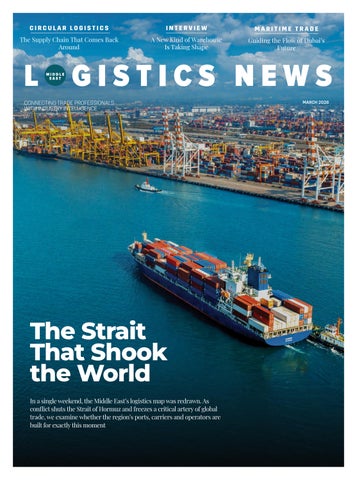
The Strait That Shook the World In a single weekend, the Middle East’s logistics map was redrawn. As conflict shuts the Strait of Hormuz and freezes a critical artery of global trade, we examine whether the region’s ports, carriers and operators are built for exactly this moment
MARCH 2026
Drive the new way. New IVECO S-Way: high technology and efficiency on all missions A wide choice of Euro III / V diesel engines, delivering class-leading power from 360 hp to 560 hp Euro III / 570 hp Euro V and superior fuel economy. 12-speed HI-TRONIX automated transmission with the most advanced technology in its category, electronic clutch and best-in-class torque-to-weight ratio. Full range of fuel-saving devices, such as anti-idling feature, EcoSwitch, Ecoroll and Smart Alternator. Top levels of comfort and safety, with a completely redesigned and reinforced cab, featuring enhanced direct visibility and enlarged cab livability.
IN THIS ISSUE
16 20 22 26 32
Expert Insight
36
Maritime Trade
Aviation
40
AI
Why SHE Is the Future of Supply Chain Operations and Trade
Getting Planes Back: How Lessors Navigate Airline Insolvencies Circular Logistics
The Supply Chain That Comes Back Around Cover Story
44
A New Kind of Warehouse Is Taking Shape
Inside Aramex’s AI-First Data Transformation Operations
Consistency Under Pressure
48
E-commerce
52
Shipping
The Strait That Shook the World Interview
Guiding the Flow of Dubai’s Future aritime Trade
From Digital Marketplaces to Next‑Generation Fulfilment Hubs
Rerouting the World
Nestled by Nestled bythe thecoast coastofofLusail Lusail sitssits thethe splendor splendor of of Raffles and Fairmont Doha, where luxury is rooted in even the Open thethe doors to to thesmallest smallestdetails. details. Open doors mesmerizing hospitality in in a a hospitalityand andmake makememories memories world world of sophistication. sophistication.
CONNECTING TRADE PROFESSIONALS WITH INDUSTRY INTELLIGENCE CONNECTING TRADE PROFESSIONALS WITH INDUSTRY INTELLIGENCE CEO Wissam Younane wissam@bncpublishing.net
SUBSCRIBE
Managing Director CEO Rabih Najm rabih@bncpublishing.net Wissam Younane wissam@bncpublishing.net
subscriptions@bncpublishing.net
Group Publishing Director Director Joaquim D’Costa jo@bncpublishing.net Rabih Najm rabih@bncpublishing.net
subscriptions@bncpublishing.net
Editor Group Publishing Director Aya Zhang aya@bncpublishing.net Joaquim D'Costa jo@bncpublishing.net Commercial Director Editor-in-Chief Andrea Mocay andrea@bncpublishing.net Vibha Mehta vibha@bncpublishing.net Digital Reporter Managing Editor Reeba Asghar reeba@bncpublishing.net Kasun Illankoon kasun@bncpublishing.net Creative Lead Design Christian Harb chriss@bncpublishing.net Christian Harb Junior Art Director Marketing Executive Rizaldi Febrian Aaron Joshua Sinanbam aj@bncpublishing.net Marketing Executive Digital Media Producer Aaron Joshua Sinanbam aj@bncpublishing.net Alexander Bungas Videographer Eduardo Buenagua
Images used in Logistics News ME are credited when necessary. Attributed use of copyrighted images with permission. All images not credited courtesy Shutterstock.
ACCESS FRESH CONTENT DAILY ON OUR WEBSITE!
cbnme.com
6 | LOGISTICS NEWS ME | MARCH 2026 6 | LOGISTICS NEWS ME | JULY 2023
SUBSCRIBE
PO Box 502511 Dubai, United Arab Emirates P +971 4 4200 506 | F +971 4 4200 196 For PO all commercial contact jo@bncpublishing.net Box 502511enquiries, Dubai, United Arab Emirates T +971 2706 P +971 4 4200 506 50 | F440 +971 4 4200 196 All rights reserved © 2025.
Opinions expressedenquiries, are solely contact those of jo@bncpublishing.net the contributors. For all commercial Logistics News ME and all subsidiary T +971 50publications 440 2706 in the MENA region are
officially licensed exclusively to BNC Publishing in the MENA region by All rights reserved 2023. Logistics News © ME. expressed solely thoseor of transmitted the contributors. No part ofOpinions this magazine mayare be reproduced in any form or LogisticsbyNews ME and all subsidiary inthe thepublisher. MENA region are any means without writtenpublications permission of officially licensed exclusively to BNC Publishing in the MENA region by Logistics News ME. Printed by United Printing and Publishing | upp.ae No part of this magazine may be reproduced or transmitted in any form or by any means without written permission of the publisher. Printed by United Printing and Publishing | upp.ae
Images used in Logistics News ME are credited when necessary. Attributed use of copyrighted images with permission. All images not credited courtesy Shutterstock.
Logistics News ME In addition to our print edition, we’re bringing Logistics News ME you allbringing sorts ofyou industry news on our web we’re all sorts @Logisticsnewsme mediums. forward to interacting @Logisticsnewsme of industryWe’re newslooking on our web with our readers on all offorward our social media and mediums. We’re looking Logistics News ME web platforms. Seeour youreaders on the on web! Logistics News ME to interacting with all of our social media and web logistcsnewsme platforms. See you on the web!
WWW.CBNME.COM WWW.CBNME.COM
L e t t e r
f r o m
E d i t o r
Behind the Scenes
W
orking in a logistics publication, you quickly learn that most of the industry’s most important work happens quietly.
What inspires me in moments like this is the quiet determination of this industry. There is a shared understanding that the world depends on these systems continuing to function.
Containers move, ships sail, trucks cross borders, aircraft land and depart. Day after day, it all continues with a kind of steady rhythm that most people never stop to think about.
Here in the Middle East, that responsibility feels particularly real. The region sits at the crossroads of global trade, where ships, cargo, and supply chains connect continents every single day.
But every so often, something happens that reminds us just how delicate that rhythm really is.
This issue of Logistics News Middle East looks at the developments shaping the sector across the region. But more than anything, it is a reminder of the people behind the movement of goods, the planners, operators, and professionals whose work keeps the world turning, often without recognition.
Over the past weeks, the industry has been watching closely as uncertainty touched one of the world’s most important trade routes. And once again, logistics professionals did what they have always done. They adapted. Routes were reconsidered, plans adjusted, and teams across the region and beyond began working behind the scenes to keep things moving.
8 | LOGISTICS NEWS ME | MARCH 2026
And perhaps that is the nature of logistics. When it works well, no one notices. But when the world needs it most, it is always there.
Aya Zhang
Editor aya@bncpublishing.net
Xiaoyue (Aya) Zhang xiaoyuezhangg
WWW.CBNME.COM
REGIONAL NEWS
ASMO AND ARCAPITA TO DEVELOP 1.4 MILLION M² LOGISTICS HUB IN SAUDI ARABIA The forward funding model highlights a long-term investment in national infrastructure and economic growth.
chain resilience by delivering a centralised, high-efficiency facility in the heart of Saudi Arabia’s energy sector. As an anchor customer, we recognise the value of ASMO’s strategic investments in logistics infrastructure, demonstrating their ambition to deliver innovative, customer-focused solutions across the supply chain,” said Sulaiman Al Rubaian, Aramco Senior Vice President of Procurement & Supply Chain Management.
A
SMO, a joint venture between Aramco and DHL Supply Chain, has partnered with Arcapita Group Holdings Limited (“Arcapita”), a global alternative investment firm, to develop a 1.4 million square meter purposebuilt logistics facility in Saudi Arabia designed to support the next phase of the Kingdom’s logistics and supply chain development. The project will be delivered through a forward funding transaction, reflecting a long-term investment in national infrastructure. Through the partnership, Arcapita will fund and retain ownership of the facility, while ASMO will develop, lease, and operate the asset under a 22-year occupational lease. The facility will include a 43,000 square meter temperature-controlled Grade-A logistics warehouse, over 3,000 square meters of offices and staff facilities, 5,300 square meters of dedicated chemical storage space, and a 1.2 million square meter open yard. The investment reflects a shared goal by the parties to develop resilient, scalable, and futureready institutional grade logistics infrastructure in the Kingdom.
12 | LOGISTICS NEWS ME | MARCH 2026
Designed for large-scale industrial operations, the facility will feature advanced warehouse and building management systems, digital integration, automated storage and retrieval systems, robotics in adherence to globally recognised sustainability standards, including photovoltaic readiness, electrical vehicle charging, and a LEED Gold certification. “This development reflects the strategic intent behind ASMO’s mandate and reaffirms its role in enabling resilient and future-ready supply chains”, said Salem Al Huraish, Chairman of ASMO. “By investing in long-term infrastructure and strategic partnerships, ASMO is supporting the Kingdom’s industrial ambitions and contributing to the development of integrated logistics capabilities that serve both national priorities and global markets.” The facility represents ASMO’s first purpose-built logistics center and forms part of four planned strategic sites underpinning ASMO’s national logistics network, aligned with the National Transport and Logistics Strategy (NTLS) under Saudi Vision 2030. Once operational, it will serve Aramco, its affiliates, and other key industrial players across the Kingdom. “ASMO’s new logistics hub at SPARK helps to strengthen Aramco’s supply
Isa Al Khalifa, Director and Head of MENA Real Estate at Arcapita, said: “This transaction builds on Arcapita’s established track record in developing and investing in Grade-A logistics and industrial assets. Combining our local expertise in Saudi Arabia with our experience in complex, forwardfunded developments, we are pleased to partner with ASMO to support the development of a purpose-built facility that supports the Kingdom’s energy and industrial sectors, while securing a high-quality asset.” Mishal Al Zughaibi, President & CEO of King Salman Energy Park (SPARK), said: “We are pleased to welcome ASMO to SPARK as part of a strategic partnership that further strengthens SPARK’s position as a premier logistics hub aligned with the Kingdom’s Vision 2030. This significant investment reflects the strong collaboration and ambition of all parties involved. SPARK’s advanced infrastructure and comprehensive services were a key factor in ASMO’s decision to establish its state-of-theart logistics center within our park.” Located within Saudi Arabia’s energy ecosystem, SPARK is strategically positioned between Dammam Seaport, Aramco’s Abqaiq facilities, and Al Hasa, enabling direct connectivity across the Kingdom’s energy and industrial network. The site supports integrated operations through modern infrastructure and digital readiness and has attracted more than 70 investors from 16 countries, with Phase One infrastructure representing a total investment of $1.6 billion.
WWW.CBNME.COM
Cargo.one is accelerating AI adoption in global logistics
C
argo.one, an AI technology provider for logistics, has acquired ocean rate platform Cargofive and launched what it describes as the industry’s first AInative operating system for multimodal freight. The platform integrates air and ocean freight data into a single system, enabling agentic workflows to operate alongside logistics teams. Backed by approximately $20 million in investment from investors including Bessemer Venture Partners, the move positions cargo.one as a key infrastructure provider for AI transformation in global logistics. The acquisition strengthens cargo.one’s rate data capabilities by adding connections to the top ten ocean carriers and access to Cargofive’s database covering four million trade lanes used by hundreds of freight forwarders worldwide. As a trusted logistics AI partner, cargo.one combines renowned technology quality, fully integrated rate data and in-house logistics expertise. Cargo.one’s AI-native operating system equips logistics companies to deploy ready-made AI agents or build custom ones using open protocols such as MCP servers. The platform also incorporates RAG-based knowledge retrieval and supervision layers to ensure reliable AI outputs, allowing human teams to maintain control while automation handles routine tasks. “Most AI projects in logistics fail to deliver ROI because they
WWW.CBNME.COM
lack access to robust, structured data,” says Moritz Claussen, Founder and Co-CEO of cargo.one. “Real returns come from unified data infrastructure operating at enterprise scale. With Cargofive, we are expanding the foundation already embedded within many of the world’s leading forwarders’ operations to encompass ocean needs, while delivering the infrastructure that allows AI to operate effectively in production.” Sebastian Cazajus, Founder and CEO of Cargofive, added: “Across the industry, forwarders are asking for integrated air and ocean solutions that eliminate data silos. Cargo. one has already set the standard in air freight. Together, we are bringing that same quality and scale to ocean freight, creating a truly multimodal operating foundation that enables agentic workflows.” “When evaluating AI partners, logistics leaders should look beyond individual features to the underlying foundation,” says Bob Goodman, Partner at Bessemer Venture Partners. “Features quickly become commoditised; what matters is having a partner with comprehensive data infrastructure and industry-specific expertise that can evolve alongside your needs. Cargo.one has built exactly that foundation for multimodal logistics.” Cargo.one’s AI-native operating system is available now. The first cargo.one customers have already been onboarded to its ocean rate management and quoting solution, with the wider cargo.one customer base set to benefit in the coming weeks.
LOGISTICS NEWS ME | MARCH 2026 | 13
REGIONAL NEWS
RTA, BAIDU, AND UBER PARTNER TO INTRODUCE AUTONOMOUS RIDE-HAILING IN DUBAI
REGIONAL NEWS
DP WORLD APPOINTS HE ESSA KAZIM AS CHAIRMAN AND YUVRAJ NARAYAN AS GROUP CEO The appointments bring together deep expertise in global finance, trade and supply chain management
D
P World has announced the appointment of His Excellency Essa Kazim as Chairman of its Board of Directors and Yuvraj Narayan as Group Chief Executive Officer, marking a significant step in the company’s continued strategic growth.
operations and global trade. Since joining DP World in 2004, he has led a series of strategic and transformational initiatives that have supported the company’s international expansion and reinforced its position as an integrated global provider of end-to-end supply chain solutions.
His Excellency Essa Kazim currently serves as Governor of the Dubai International Financial Centre and Chairman of Borse Dubai. He brings extensive expertise in financial and economic affairs, having held senior leadership roles across several key national institutions. His appointment underscores DP World’s commitment to strong governance and long-term strategic oversight.
Having served as Group Chief Financial Officer since 2005, Yuvraj has played a central role in strengthening the company’s financial resilience, operational discipline and long-term growth trajectory.
Yuvraj Narayan brings more than two decades of experience in financial management, corporate finance, supply chain
14 | LOGISTICS NEWS ME | MARCH 2026
DP World stated that the appointments align with its strategy for sustainable growth and further reinforce its role in enhancing global supply chains, while supporting Dubai’s position as a leading international hub for trade and logistics.
WWW.CBNME.COM
The project is set to enhance operational efficiency, connectivity, and industrial growth
T
he Saudi Authority for Industrial Cities and Technology Zones (MODON) has concluded an investment agreement with Medlog, the logistics arm of Mediterranean Shipping Company (MSC), to establish an integrated logistics zone in the Third Industrial City in Jeddah. The agreement was signed at the company’s headquarters in Geneva by MODON Chief Executive Officer Eng. Majed Al-Argoubi, following extensive discussions with company leaders on strengthening cooperation. The collaboration forms part of the Kingdom’s efforts to consolidate its position as a global logistics hub by developing infrastructure and enhancing the logistics services ecosystem. Under the agreement, MODON has allocated logistics facilities spanning 100,000 square metres, on which Medlog will implement a project to develop an integrated logistics zone comprising container yards and warehouses. The project carries an estimated initial investment of approximately SAR137 million, in line with the model preliminarily approved under the agreement. MODON explained that, based on initial estimates, the project aims to reach a handling capacity of around 60,000 twenty-foot equivalent units (TEUs) annually by 2038. The facility will provide integrated logistics solutions, including storage, distribution, handling and customs clearance services. MODON stated that the project represents a significant addition to
WWW.CBNME.COM
MODON affirmed that the project represents a qualitative addition to the national economy
the national economy, as it is expected to contribute around SAR44 million to gross domestic product (GDP) and create approximately 200 direct jobs, alongside the company’s gradual expansion of operations in the Kingdom. Medlog is among the world’s leading
logistics service providers, operating in more than 80 countries and managing infrastructure exceeding 8.5 million square metres. The partnership therefore represents a strategic step towards supporting the objectives of the National Transport and Logistics Strategy.
LOGISTICS NEWS ME | MARCH 2026 | 15
REGIONAL NEWS
MODON & MEDLOG PARTNER TO ESTABLISH LOGISTICS HUB IN JEDDAH
INDUSTRY INSIGHT
Why SHE Is the Future of Supply Chain Operations and Trade
From navigating organised chaos to leading data-driven logistics, women are playing a growing role in shaping the future of global trade and the transformation of supply chains.
By Dr Lijo John
16 | LOGISTICS NEWS ME | MARCH 2026
WWW.CBNME.COM
Why SHE Is the Future of Supply Chain Operations and Trade
A
s we celebrate International Women’s Day, the logistics and supply chain sectors in the Middle East and beyond are undergoing a profound transformation. Traditionally viewed as a male-dominated world of trucks and forklifts, the industry is pivoting toward a future defined by analytical precision, technological innovation, and collaborative leadership. Today, women are not just entering the field; they are orchestrating the complex networks of global trade, making an equal and increasingly vital impact on the evolution of smart ports and free zones. From Physical Labour to Analytical Power The historical male dominance of the logistics sector was primarily rooted in its physical origins, where operations involved driving trucks, moving boxes, and working on warehouse floors, where routine heavy lifting was the norm. However, as the industry enters the era of Industry 4.0, the requirements for success have shifted. The job of the future in supply chain is less about physical strength and more about being the person who makes the critical decisions that AI and robotics cannot.
Siemens and Agility, have noted that while they often started their careers accidentally, they stayed because of the high-adrenaline, nonroutine nature of the work. Progress in the GCC region has led to a dramatic shift in the acceptability of women in leadership roles. A decade ago, women in some regional contexts were barred from entering customs buildings or attending meetings in person. Today, they lead regional procurement, manage multinational logistics contracts, and oversee massive 3PL (Third-Party Logistics) operations. In the UAE and Egypt, women are spearheading the transition to sustainable modes of transport, such as cargo bikes and vehicle electrification. The Competitive Edge: Emotional Intelligence and Diversity Research suggests that diverse teams yield better results, even if they take longer to reach a consensus. Women bring a unique perspective to global trade, often acting as the primary consumers of the goods the supply chain moves. This intuitive understanding of the consequences of a failed supply chain, such as stockouts in healthcare or consumer goods, drives greater commitment and empathy in
Women are increasingly recognised for their analytical prowess and organisational skills, qualities essential for the complex orchestration of sales, marketing, and manufacturing. The rise of Smart Ports has opened new avenues for female professionals. While direct terminal operations have historically been a heavy entry point for women, the shift toward automation and data analytics has allowed them to exert significant influence through leadership, management, and operational improvement roles. The integration of Robotics and AI in warehousing and port environments is another area where women are leading. A move toward a digital twin approach enables supply chain leaders to respond more quickly to global volatility, shifting routes or ports based on realtime data, making women an ideal candidate to manage modern supply chain operations. The Middle East: Breaking Barriers in Global Trade In the Middle East, the impact of women is particularly striking as they navigate and dismantle long-standing cultural taboos. Professionals in the region, such as those at
WWW.CBNME.COM
Dr Lijo John, Assistant Professor at Heriot-Watt University Dubai
LOGISTICS NEWS ME | MARCH 2026 | 17
INDUSTRY INSIGHT
their professional roles. The key traits that empower women to succeed in this field include: • Collaborative Problem Solving: Recognising that the supply chain is a team sport where relationship building and conflict resolution are paramount. • G r i t a nd R e si li e nc e : N avi ga ti n g o r ga ni s e d chaos and maintaining a tough skin in high-pressure environments. • Strategic Transparency: The ability to tell the truth and tell it fast, ensuring that data integrity remains the foundation of decisionmaking. Mentorship vs. Sponsorship: Building the Pipeline To sustain this momentum, the industry must distinguish between mentorship and sponsorship. While a mentor provides advice and guidance, a sponsor is an advocate who uses their influence to punch above the weight class of their proteges, advocating for them in boardrooms when they are not present. In the Middle East, building a support system including family, colleagues, and professional networks like WTS (Women in Transportation) is critical for women to manage the continuous operational demands of the industry. Leading women in the region advise the next generation to know their business, know their numbers, and know themselves. Looking Ahead: A Resilient, Equal Future International Women’s Day serves as a reminder that the most successful supply chains
18 | LOGISTICS NEWS ME | MARCH 2026
are those that embrace diversity of thought. By investing in knowledge, advocating for inclusive policies, and empowering women to lead in smart ports and free zones, the Middle East is not just participating in global trade; it is defining its future. The message to aspiring female leaders is clear: Don’t
be afraid to speak up, don’t doubt yourself, and never stop learning. In the high-stakes world of global logistics, the most potent tool is no longer the forklift; it is the informed, confident, and analytical mind of the woman at the helm.
WWW.CBNME.COM
Lights the way, not the sky The Dark Sky luminaire head for the modular system bollard luminaires protects the night sky and nocturnal wildlife. Optionally available with BEGA BugSaver® technology to switch the colour temperature to an amber tone. Bollard tubes optionally available in sustainable Accoya® wood. bega.com/systembollards
8.– 13. 03. 2026
Frankfurt am Main Hall 3.0 · Stand C 91
Das gute Licht.
AVIATION
Getting Planes Back: How Lessors Navigate Airline Insolvencies When airlines face financial trouble, aircraft owners need a clear plan. From legal safeguards to operational strategies, this guide explains how lessors can act quickly to recover their planes and protect their investments in the Gulf region.
By Helen Biggin
20 | LOGISTICS NEWS ME | MARCH 2026
WWW.CBNME.COM
Getting Planes Back: How Lessors Navigate Airline Insolvencies
Introduction Whilst airline insolvencies are not an everyday occurrence, unfortunately they do happen occasionally and lessors and operators should prepare in advance for such eventualities so as to be able to move speedily to repossess their aircraft.
its titled engines are on-wing and if any high value parts are located with a MRO for maintenance.
Legal and practical steps to take preinsolvency The legal rights and remedies available to lessors and operators are set out in the relevant aircraft leases and, in respect of all GCC states (which have acceded to it), the Convention on International Interests in Mobile Equipment (the Cape Town Convention or CTC).
In terms of litigation strategy, a lessor should establish with external counsel whether it is best to exercise its CTC remedies, remedies available under domestic law, or its self-help remedies under the lease when applying for orders for repossession. This is required as different remedies are available under the lease to the CTC and because other procedural requirements specific to the CTC or local law may impact the speed and effectiveness of any court process to recover possession of the aircraft.
As soon as warning signs appear that an airline is in financial distress, a lessor should consider obtaining as much information as possible about the financial position of the airline and the condition of its assets by exercising its contractual information and inspection rights.
Legal and practical steps to take postinsolvency However, even if an airline goes into insolvency proceedings prior to termination and repossession, a lessor whose asset is located in a GCC state will have access to its contractual and CTC remedies.
The lessor should internally agree a strategy as to when it will seek to repossess its aircraft and where. For example, it should agree to a ‘line in the sand’ which if passed, will cause the lessor to terminate the lease and repossess. Ideally, this ‘line’ would be passed prior to any insolvency process starting in order to prevent the aircraft forming part of the airline’s bankruptcy estate and becoming subject to any insolvency moratorium under local law or the CTC.
When considering which CTC remedies to rely upon it is important to check exactly which insolvency provisions of the CTC have been enacted by each contracting state as these will differ. All GCC countries, with the exception of the Kingdom of Saudi Arabia, apply the CTC’s Alternative A to insolvency proceedings and specify a waiting period of 60 days.
In agreeing to this strategy, the lessor should have access to the relevant technical and legal advice necessary to ensure that its assets are preserved and that it knows when and where the best time and place to take legal action is. This involves working with a technical team to ensure that the aircraft records are complete and are in the lessor’s possession. This is critical as incomplete aircraft records can prevent a lessor from swiftly removing an aircraft from a jurisdiction, substantially impact its value and prevent a lessor from releasing the aircraft swiftly. It should also check if
WWW.CBNME.COM
for a court order requiring the airline to deliver up the aircraft). Provided that a lessor’s international interest in the aircraft has been properly registered prior to the insolvency process, under the CTC that interest will have priority and will not be treated as ranking pari passu with unsecured creditors. Finally it is important to consider if any liens apply to the aircraft (or its parts) either under the CTC or domestic law, as these have to be fully satisfied before the lessor can regain possession and remove the aircraft from the jurisdiction. Conclusion In conclusion, lessors should stay alert for signs of financial distress and plan for when, where and how their aircraft should be repossessed ahead of any insolvency. Generally speaking though, if insolvency proceedings do start in a GCC state, then subject to satisfying any liens, the lessor should be able to recover its aircraft swiftly and, at the latest, within 60 days.
Under Alternative A, an insolvent airline must either cure all defaults and agree to perform all future obligations or surrender possession to the lessor on the earlier of the end of the CTC waiting period or the date when the creditor would be entitled to possession under applicable national law. In terms of an insolvency process commenced within a GCC state (except KSA), this means that the airline must cure all defaults within 60 days of that process starting or return the aircraft to the lessor. If the airline fails to deliver up the aircraft upon the expiry of the waiting period, a lessor can exercise its IDERA and seek deregistration and export of the Aircraft (or if that is not possible, apply
Helen Biggin Partner, Vedder
LOGISTICS NEWS ME | MARCH 2026 | 21
CIRCULAR LOGISTICS
The Supply Chain That Comes Back Around Companies are finding smarter ways to move products, reuse materials, and cut waste, turning what used to be a straight line into a loop that works for business and the planet.
By Alex George
22 | LOGISTICS NEWS ME | MARCH 2026
WWW.CBNME.COM
The Supply Chain That Comes Back Around
O
ver the years, we ’ve b e e n u se d t o a linear model in supply chains - we extract something, produce something with the extract, distribute the produced, consume what was distributed, and then dispose of the remainder of the consumed. This was always what we thought as optimum as it was a good mix of cost, speed and scale. Today this model is being disrupted by factors like resource scarcity, regulatory issues, carbon emission standards, and shifting customer expectations. That’s why we are seeing the rise of a new operating model. Understanding Circular Supply Chains The difference between linear and circular supply
chain models is that linear models move downstream with a finality at the end of sale. However with circular models, it becomes multidirectional. Materials move back into the system for reuse, re-manufacturing, refurbishment, or recycling. What we would require is complete re-thinking of the network. Supply chain routes must be able to accommodate back and forth movement. Inventory management also requires expansion to include returned, repaired, and secondary market goods. Reverse Logistics’ Evolution from Cost Center to Value Engine Reverse logistics always used to be a cost center. It was always operationally burdensome as we never factored in large volumes of inventory return. In a circular
economy, this would be a big differentiator. High-performing reverse logistics systems require advance forecasting, dedicated infrastructure, and specialised processes. Return goods need to be sorted, inspected, graded, and routed to appropriate channels. That would be channels such as resale, refurbishment, parts harvesting and/or recycling. Each pathway would mean a different margin implication. We should probably view reverse logistics as value r e c ove ry management. Refurbished electronics, remanufactured industrial components, re-commerce platforms and secondary ma t e ri a l s ma r ke t s a re expanding rapidly. Logistics providers that develop expertise in managing these back-and-forth movements can offer these integrated r e c ove ry s e rvi c e s to manufacturers and retailers, strengthening long-term partnerships. Successful operators need to invest in data visibility, standardised processes, and cross-functional coordination to maintain control and profitability. Warehousing Evolves into Processing Hubs C i rc u l a r mo de l s wo u l d mean much more complex warehousing facilities. They become active processing hubs. Facilities would need to handle inspection, testing, repair and repackaging. Automated sorting systems, AI-driven quality assessment tools, and robotics can improve
Alex George, Managing Director, Al Ostad Pallet Factory
WWW.CBNME.COM
LOGISTICS NEWS ME | MARCH 2026 | 23
CIRCULAR LOGISTICS
efficiency in processing returned or recovered goods. Inventory Management in a Multi-Life-Cycle World Inventory management also becomes more sophisticated. Circular warehousing needs to keep track of different stages of inventory - new, refurbished, remanufactured and recycled goods. Real-time visibility into inventory status is critical to optimising recovery value and minimising write offs. Existing infrastructure can often be
24 | LOGISTICS NEWS ME | MARCH 2026
adapted, but long-term planning should consider dedicated circular processing zones or specialized facilities integrated into broader distribution networks.
further reduce carbon intensity. Fleet electrification, alternative fuels, and micro-fulfillment centers are also factors in reshaping lastmile logistics.
Transportation at the Core of Circular Transformation Transportation is at the root of this change. Smart network design can offset the impact of transport complexity. Carbon emissions could be seen as a cause of concern, but increased use of rail and intermodal solutions can
Integration Is the C-Suite Imperative For us C-Suite leaders, the key is integration. Circularity and decarbonisation should not be separate initiatives. Network redesign efforts can simultaneously support material recovery and
WWW.CBNME.COM
The Supply Chain That Comes Back Around
emissions reductions. There could be a clear synergy here. Packaging becomes a clear factor in circular economy efficiency. Reusable transport packaging systems, pallet pooling, standardised containers, returnable transit packaging models are expanding across industries. These systems reduce waste, lower long-term material cost, and create predictable reverse flows that can be integrated into the networks. Smart packaging technologies including embedded tracking devices and digital identifiers - enhance visibility and accountability. Reducing dimensional weight and eliminating unnecessary spaces not only cuts material, but also improves transport efficiency. The challenge lies in coordination. Reusable systems require collaboration across shippers, carriers, and customers. Standardisation and shared infrastructure are critical to scale. Circular systems are data-intensive by nature. Without end-to-end visibility, closed loop models become unmanageable. A digital passport, IoT enabled tracking, blockchain-based traceability, and advanced analytics platforms enable companies to track materials across multiple life cycles. Predictive analytics can forecast product return, estimate residual value, and optimise recovery pathways. Data capabilities become as critical as fleet capacity. Investments in digital infrastructure not only support circular objectives but also strengthen supply chain resilience. This will improve forecast accuracy, inventory control, and risk mitigation.
the producer takes on more of the responsibility, they end up having to manage more of the product beyond the point of sale. This creates a demand for integrated recovery and compliance services. Logistics companies that proactively develop circular solutions end up higher on the value chain. Rather than competing solely with cost per mile, they become strategic partners in sustainability and resilience. From a competitive advantage, you depend less on volatile raw materials, improve customer loyalty, and stronger compliance with regulations. What the Road Ahead Looks Like This change will not happen overnight. Increased capital investment will be needed along with an understanding of what it means to cross-collaborate across industries. A significant road block to this will be lack of standardisation. But the future is clear. As we find ourselves relying on more limited resources, as well as the pressure to be responsible for carbon emissions, the linear model will slowly perish. A circular model creates a framework for long-term resilience. For people high up in operations, the question is how quickly and strategically they will respond. In the future, you will see a circular model not just enable the economy, but redesign it.
You start seeing this with the rise of new business models. Product-as-aservice offering, leasing arrangements, and asset sharing platforms all require sophisticated logistics support. When
WWW.CBNME.COM
LOGISTICS NEWS ME | MARCH 2026 | 25
COVER STORY
The Strait That Shook the World In the space of a single weekend, the Middle East’s logistics landscape was upended. As conflict closes the Strait of Hormuz and freezes global trade arteries, we examine what it means for the region and whether its ports, carriers and operators are built for exactly this moment.
T
here is a phrase that has lived quietly in the vocabulary of logistics professionals for decades, invoked whenever geopolitical uncertainty builds at the edges of the world’s trading map: watch the straits. In late February 2026, the industry stopped watching and started reacting. Escalating regional tensions resulted in a dramatic curtailment of commercial traffic through the Strait of Hormuz, one of the most consequential chokepoints in global trade, triggering emergency
26 | LOGISTICS NEWS ME | MARCH 2026
responses from carriers, ports, insurers and freight operators across every continent. The numbers that underpin the Strait’s importance are, even in normal times, extraordinary. According to data published by the UN Conference on Trade and Development, the waterway is a conduit for approximately 11% of global maritime trade. Roughly one in every five barrels of the world’s oil passes through this corridor — at its narrowest,
WWW.CBNME.COM
The Strait That Shook the World
WWW.CBNME.COM
LOGISTICS NEWS ME | MARCH 2026 | 27
COVER STORY
barely 33 kilometres wide — along with more than a fifth of global liquefied natural gas exports. When it slows, the world notices. When it stops, the world feels it immediately. Carriers Sound the Alarm Within 48 hours of the situation deteriorating, every major container carrier had issued emergency notices to customers. MSC suspended all new Gulf bookings. Maersk halted vessel crossings through the Strait, suspended acceptance of reefer and dangerous cargo across the UAE, Oman, Iraq, Kuwait, Qatar, Bahrain and Saudi Arabia, and temporarily closed its UAE warehousing facilities. CMA CGM rerouted vessels around Africa’s Cape of Good Hope. Hapag-Lloyd introduced warrisk surcharges of $1,500 per TEU on standard containers, rising to $3,500 on reefer and specialist equipment, on shipments from the Upper Gulf. Air freight was equally disrupted. Emirates SkyCargo suspended flights and placed a temporary freeze on new
28 | LOGISTICS NEWS ME | MARCH 2026
bookings. FedEx announced the suspension of services across the wider Gulf region, including Bahrain, Iraq, Kuwait, Oman, Qatar, the UAE and Saudi Arabia. KLM cancelled services to Dubai, Riyadh and Dammam. Force majeure
warned that rates on directly affected corridors could double or triple in the short term. The UAE: Keeping Trade Moving For the UAE — home to Jebel Ali, the world’s largest man-
Operations were subsequently restored, but the episode underscored the very real operational risks that accompany the UAE’s position at the centre of global trade. clauses, rarely deployed and never casually, began appearing in carrier communications with an urgency that left little room for interpretation. Xeneta, the airfreight intelligence platform,
made harbour — the disruption was felt most acutely. DP World temporarily suspended terminal operations at Jebel Ali as a precautionary measure
WWW.CBNME.COM
The Strait That Shook the World
following security threats in the vicinity of the port. What followed was, in many respects, a demonstration of the resilience the country has spent years building. AD Ports Group confirmed that operations across all its port clusters — including Khalifa Port — continued without interruption, backed by activated business continuity plans. Although vessel traffic through the Strait of Hormuz has decreased, operations at Khalifa Port remain fully active. DSV, operating contract logistics facilities across the Gulf, reported that warehousing and distribution remained
WWW.CBNME.COM
operational, with teams working around disruptions to inbound flows. Across the industry, the message from regional operators was c o n si st e n t : c o n ti n ge ncy planning had been validated, not overwhelmed. Rerouting a Globalised World With the Strait of Hormuz effectively closed and Red Sea transits simultaneously suspended — a combination not witnessed at this scale in the modern containerised era — the Cape of Good Hope emerged as the only viable alternative for most carriers on East–West trades. The operational arithmetic is
unforgiving. Rerouting via the Cape adds between 10 and 14 days to transit times between Asia and Europe. Buffer inventories, already thinned by years of post-pandemic rationalisation, are not sized for an extra fortnight. Procurement teams at assembly plants across Europe and North America were placed on notice that component shortages could materialise within two to three weeks of any sustained closure. Energy and commodity markets registered the stress immediately. Brent crude climbed to $82 per barrel. Natural gas prices surged
LOGISTICS NEWS ME | MARCH 2026 | 29
COVER STORY
sharply following production disruptions and force majeure declarations on major LNG contracts. Marine insurance premiums for Gulf transits rose by 50%, with several London-based underwriters extending war-risk zones and issuing vessel-specific cancellation notices. The cost of chartering a very large crude carrier from the Gulf to China escalated sharply from already elevated levels. MSC introduced war surcharges on shipments from the Gulf and the Indian subcontinent to markets across Africa and the Indian Ocean, citing vessel congestion and increased operational risk. The Freight Forwarder’s Dilemma For freight forwarders operating in and out of the Gulf, the disruption created an immediate and deeply practical problem: how do you communicate to a client that their shipment — booked, confirmed and in many cases already on the water — may not arrive on time, may cost significantly more than agreed,
30 | LOGISTICS NEWS ME | MARCH 2026
and may need to travel a route that did not exist in the original contract? The answer, for most, was transparency at speed. Gulf-based forwarders report that customer communication teams worked around the clock in the first 72 hours of the disruption, issuing daily situation reports, renegotiating bookings and sourcing alternative capacity on air freight corridors where sea routes had become unreliable. According to industry analysts and logistics data, disruptions around the Strait of Hormuz and in Gulf airspace have sharply reduced air freight capacity on key Asia‑Europe routes and elsewhere. Capacity constraints, flight cancellations by major carriers and rerouted sea services have led to significant increases in freight rates across multiple major tradelanes. Time‑sensitive goods such as pharmaceuticals and perishables are particularly vulnerable to these bottlenecks, as companies grapple
with both constrained capacity and rising transport costs. Saudi Arabia and the Land Bridge Opportunity Every significant disruption to maritime trade through the Gulf raises the same question in the background: could a land bridge through Saudi Arabia provide a meaningful alternative corridor? The Kingdom, which has invested heavily in road and rail infrastructure under Vision 2030, sits geographically between the Arabian Gulf coast and the Red Sea port of Jeddah. In theory, cargo offloaded at Dammam or Jubail could travel overland to Jeddah and onward by sea — bypassing the Strait of Hormuz entirely. In practice, the economics and logistics of such a shift at scale remain challenging. Intermodal capacity, customs processes and the sheer volume of cargo that would need to be rerouted mean that a land bridge can complement,
WWW.CBNME.COM
The Strait That Shook the World
but not replace, the maritime corridors that the region depends on. What this disruption has done, however, is accelerate conversations that were already underway. The current crisis has added urgency to those plans. For regional logistics operators with a presence across both Gulf and Red Sea corridors, the ability to offer customers a land bridge option — even as a contingency — is rapidly becoming a meaningful competitive differentiator. What the Industry Does Next As the situation evolved through the first days of March, a cautiously more nuanced picture began to emerge. Vessel traffic, whilst severely reduced, did not cease entirely. Commercial ships operating outside the scope of the immediate restrictions began tentative transits, and shipping intelligence platforms reported incremental movement through the waterway. The situation remained fluid — and in logistics, fluidity is as much a challenge as any hard closure. Planning becomes near-impossible when the operating environment can change within hours. For the Middle East’s logistics sector, the deeper question is not how long this particular disruption lasts. It is
WWW.CBNME.COM
what this episode has confirmed about the structural character of the region’s supply chain infrastructure. The speed with which regional port operators activated continuity plans, the agility demonstrated by Gulf-based freight forwarders in rerouting cargo, and the underlying capacity of facilities like Khalifa Port and Jebel Ali to absorb and adapt: these capabilities were not assembled overnight. They are the product of deliberate investment in resilience, redundancy, technology and trained people. The shippers, freight forwarders and supply chain directors now working through the consequences of this disruption are discovering what veterans of the Red Sea crisis, the pandemic and the Ever Given blockage already know: proximity to a major chokepoint is simultaneously the industry’s greatest commercial asset and its most consequential exposure. The Strait of Hormuz has long been called the rhythm regulator of global energy trade. What early 2026 has confirmed, once again, is that when that rhythm breaks, the entire orchestra must improvise — and the regions built closest to the chokepoint had better be the ones best rehearsed for exactly that.
LOGISTICS NEWS ME | MARCH 2026 | 31
INTERVIEW
A New Kind of Warehouse Is Taking Shape Cem Gunfer, Head of Industrial and Logistics at Aldar Investment, tells us in an interview how Aldar Logistics Centres – NIP is addressing the gap in modern, Grade A warehouse space.
We are seeing strong demand from e-commerce, quickcommerce, and 3PL operators as they continue to expand capacity and shorten delivery timelines.
32 | LOGISTICS NEWS ME | MARCH 2026
WWW.CBNME.COM
A New Kind of Warehouse Is Taking Shape
Cem Gunfer, Head of Industrial and Logistics at Aldar Investment
ESG compliance, or modern high-bay racking systems. Aldar’s logistics park is purpose-built to meet these structural requirements, and its scale positions it to meaningfully address the current Grade A supply deficit. From our perspective, this is exactly where we’re investing: the next generation of Grade A, future-ready logistics hubs designed to match the UAE’s global ambitions.
A
ldar Logistics Centres – NIP’ represents a significant milestone for Aldar Investment’s industrial and logistics platform. What strategic gap in the UAE market is this development addressing? The UAE logistics market continues to see demand materially outpacing supply for institutional-grade, Grade A facilities. A significant portion of existing stock comprises legacy assets that are not configured for automation,
WWW.CBNME.COM
The project is being delivered to Grade A specifications, including 15 metre usable height, FM1 floor flatness supporting automation ready. Why was it important to commit to such high-quality technical standards, and how do these specifications translate into operational value for tenants? Higher specifications provide both economic and operational advantages by enabling sophisticated storage systems that maximise capacity and productivity. Large-scale automation and robotic solutions depend on high-grade flooring as multitier systems require secure floor loading and optimal flatness ensures robotics can perform at full potential. This translates into real P&L benefits through greater output per square metre
LOGISTICS NEWS ME | MARCH 2026 | 33
INTERVIEW
and faster fulfilment. Ultimately, logistics operators are driven by the performance of their facility and the systems it can support. The outcome Aldar focuses on is tenant experience; cleaner, faster, more efficient operations that also lower lifetime cost. With flexible unit sizes ranging from 5,300 to 66,000 sqm and advanced automation capabilities, how is the park designed to support the changing requirements of 3PL, e-commerce and retail operators? Flexibility is central to the park’s design. Units are modular and can be combined to accommodate growth within the same ecosystem, allowing tenants to scale without relocating. They are configured to support multiple operational models, including crossdocking, high-bay racking, mezzanines, and automation. This ensures operational efficiency and long-term adaptability for 3PL, e-commerce, and retail operators. It’s also consistent with how we’re building the platform more broadly: Grade A, tech-enabled hubs that can
34 | LOGISTICS NEWS ME | MARCH 2026
evolve as supply chains and automation requirements change. Phase 1 is already open for pre-leasing ahead of its June 2026 delivery. What are you seeing in terms of occupier demand, and what should prospective tenants understand about the leasing opportunity at this stage? We are seeing strong demand from e-commerce, quickcommerce, and 3PL operators as they continue to expand capacity and shorten delivery timelines. For prospective tenants, this is a strategic window to secure space. Pre-leasing at this stage allows for early access from March 2026 for fit-out works, enabling operators to be fully operational shortly after handover and well positioned ahead of the critical Q4 peak trading season. Early commitments also provide greater flexibility in unit selection and layout customisation. Our role is also to make market entry easy for international
WWW.CBNME.COM
A New Kind of Warehouse Is Taking Shape
tenants with ready-to-lease, techenabled hubs in strategic locations with the connectivity operators need. How is Aldar building a scalable, institutional grade logistics platform? Sustainable scale comes from aligning infrastructure, technology, and people from the outset. Operators succeed when their physical network evolves in step with their operational complexity. That mindset directly shapes how we are building Aldar’s industrial and logistics platform, with long-term capital, institutional governance, and
WWW.CBNME.COM
assets designed around how modern supply chains function, not just how warehouses are traditionally delivered. Looking beyond the NIP project, do you see potential to replicate this model across other parts of the UAE and wider GCC, and what role will partnerships play in Aldar’s next phase of logistics growth? Absolutely. The UAE is evolving into a regional distribution and lightmanufacturing hub, and similar structural demand drivers are emerging across the wider GCC. In many of these markets, institutionalgrade, Grade A logistics stock remains
structurally undersupplied, creating a clear opportunity to replicate and scale this model. Our ambition is to be the partner of choice for global brands looking to enter the UAE and to carry that proven model into other high-growth corridors across the region. Partnerships will be central to our next phase of growth, as supply chains become more integrated and performance-driven, collaboration is what enables faster deployment, smarter infrastructure, and the creation of long-term, institutional value.
LOGISTICS NEWS ME | MARCH 2026 | 35
MARITIME TRADE
Capt. Ibrahim Al Blooshi, Executive Director of Dubai Ports Authority
GUIDING THE FLOW OF DUBAI’S FUTURE Capt. Ibrahim Al Blooshi, Executive Director of Dubai Ports Authority, on governance, digital integration, and sustainable growth in the emirate’s maritime sector.
Dubai’s ports have long been central to the emirate’s trade success. How is the Authority evolving its governance and oversight model to support the next phase of Dubai’s economic growth? Dubai Ports Authority at the Ports, Customs and Free Zone Corporation is strengthening governance through a clear, law-based mandate that positions the Authority as the sector regulator,
36 | LOGISTICS NEWS ME | MARCH 2026
planner, and overseer supported by the legal capacity to implement strategic plans and enforce standards across ports and handling terminals. In practice, this is reflected in the Authority’s statutory powers to develop port-sector strategies and policies, issue port management regulations and conduct inspection and audit functions to ensure compliance and performance. The
WWW.CBNME.COM
Guiding the Flow of Dubai’s Future
governance framework also formalises leadership accountability covering core strategic instruments such as policies and key regulations, and an executive leadership structure responsible for implementation, monitoring and reporting. As supply chains become more technology driven, what role does the Authority play in enabling digital integration across port users and stakeholders? The Authority’s role is to enable digital integration through regulation, coordination and the establishment of operating standards that support safe, efficient, and transparent digital workflows. This includes setting requirements that promote interoperability across port users, ensuring authorised activities and processes are governed by clear rules and supporting compliance-led digitalisation. At ecosystem level, the Authority’s coordination role helps align stakeholders port operators, logistics providers, shipping lines and regulators around standardised processes and
WWW.CBNME.COM
secure information exchange, which reduces friction and improves end-to-end efficiency. With increasing focus on efficiency and turnaround times, where do you see the greatest opportunities to enhance operational performance across Dubai’s ports? The greatest opportunities are typically found in three areas, consistent with the Authority’s mandate: 1.
2.
3.
I n fra st r u c t u re a nd s u p e rst r u c t u re optimisation: improving capacity, utilisation and readiness of port assets and facilities to reduce congestion and unlock throughput. Standardised operating rules and performance-based oversight: issuing modern port regulations, reducing process variation and strengthening audit/inspection mechanisms to improve predictability, reliability and service quality. Digitisation and data-driven controls: expanding paperless processes and integrating operational data to reduce
LOGISTICS NEWS ME | MARCH 2026 | 37
MARITIME TRADE
b o t t l e ne c ks , rewo r k a nd administrative dwell time across stakeholder handoffs. The Authority works closely with local and international partners. How does this collaboration strengthen Dubai’s position within global maritime networks? This collaboration strengthens Dubai’s position by improving
38 | LOGISTICS NEWS ME | MARCH 2026
network connectivity and service consistency, enabling the adoption of best practices, attracting investment through a predictable regulatory environment and enhancing Dubai’s participation in global maritime platforms and industry initiatives. Sustainability is becoming a defining theme in maritime infrastructure. How is the Authority embedding
environmental responsibility into long term port planning? E nvi ro n me n t a l re s p o n si bi li ty can be integrated by setting sustainability-oriented requirements within regulations, ensuring that planning and development of port assets incorporate environmental considerations from the outset, and aligning operational standards with national environmental direction and
WWW.CBNME.COM
Guiding the Flow of Dubai’s Future
sectors to scale and support t he deve l o p me n t a nd expansion of trade corridors.
internationally recognised maritime decarbonisation trends.
environment that attracts international shipping and logistics actors.
Given Dubai’s broader economic diversification strategy, how do the ports contribute to enabling new sectors and trade corridors? The Authority’s objectives include strengthening the efficiency and growth of imports, exports, and re-exports, and fostering an investment-friendly
In practice, ports contribute to diversification by acting as the platform for advanced logistics, industrial and manufacturing clusters, multimodal connectivity and higher-value supply chains. By aligning regulation, infrastructure planning, and trade facilitation, ports enable emerging
Looking ahead, what strategic priorities will define the Authority’s roadmap over the coming decade? Based on the Authority’s legal mandate and the direction of national and international maritime frameworks, the most defensible priorities include: 1. G ove r n a n c e and performance oversight: stronger regulations, consistent standards, and effective audit/ inspection across the port sector. 2. Digital integration: interoperable, end-toend digital processes that reduce friction for port users and improve transparency and throughput. 3. Security and resilience: continued strengthening of security procedures, readiness, and compliance mechanisms to safeguard continuity of trade flows. 4. Sustainable, futureready infrastructure: phased development that anticipates environmental ex p e c t a t i o n s and global decarbonization direction. 5. I n v e s t m e n t and partnerships: enabling a predictable environment that attracts investment and supports structured c o ll a b o ra ti o n wi t h local and international stakeholders.
AI
INSIDE ARAMEX’S AI-FIRST DATA TRANSFORMATION Aramex is modernising its global technology infrastructure with a new data platform that creates a unified “single source of truth” across its logistics network.
40 | LOGISTICS NEWS ME | MARCH 2026
WWW.CBNME.COM
Inside Aramex’s AI-First Data Transformation
I
n the fast-moving world of global logistics, data has become as critical as the cargo itself. Recognising this shift, Aramex has taken a decisive step forward in its digital transformation journey with the deployment of a new AI-first global data foundation. Built on the infrastructure of Google Cloud, the platform introduces a unified system designed to serve as a single source of truth across Aramex’s vast international network. For a company
WWW.CBNME.COM
operating across more than 70 countries, the move marks a significant evolution in how information flows through its operations, connecting complex streams of operational data with real-time, actionable intelligence. In an industry increasingly shaped by speed, precision and visibility, the initiative is intended to strengthen Aramex’s position in the data-driven logistics landscape. By replacing its legacy systems with a modern Lakehouse architecture, the company
can process far larger volumes of information while turning that data into insights that support faster and more accurate decision-making. At the heart of the transformation lie three strategic pillars designed to optimise performance across the organisation. The first centres on high-velocity data processing. By enabling the rapid collection and analysis of operational information across global systems,
LOGISTICS NEWS ME | MARCH 2026 | 41
AI
the platform allows teams to access insights far more quickly. In practice, this means the business can respond to operational developments with greater agility, whether managing delivery flows, monitoring network performance or adjusting to changing conditions on the ground. The second pillar focuses on organisational agility. The architecture has been designed to scale efficiently as the company grows, ensuring that the platform can evolve alongside market demands and operational complexity. The third pillar is rooted in data-driven insight. Through advanced analytics delivered in real time, leadership teams are equipped with clearer visibility across the business, enabling more informed and strategic decisions at every level of the organisation. Yet the transformation extends beyond technology alone. By establishing a unified data foundation, Aramex aims to reshape the way its teams work together. From last-mile delivery operations to corporate strategy,
42 | LOGISTICS NEWS ME | MARCH 2026
departments will operate from the same consistent and reliable data set. This shared view of information is expected to strengthen operational transparency and foster greater trust in data throughout the organisation, ultimately enabling teams to collaborate more effectively and make decisions with increased confidence. The implementation itself is being delivered through a carefully managed phased rollout, designed to ensure operational resilience as the platform expands across the company’s international footprint. Importantly, the architecture has also been built with future regulatory requirements in mind. As Aramex operates across numerous jurisdictions, the system has been designed to accommodate the complex data governance and residency rules that increasingly shape global digital infrastructure. Through this investment in advanced data capabilities, Aramex is not simply modernising its systems. It is laying the groundwork for a more intelligent, responsive and transparent logistics network, one where data flows as seamlessly as the goods moving through it.
WWW.CBNME.COM
OPERATIONS
CONSISTENCY UNDER PRESSURE Captain Hussam Farrouq Suyyagh, Marine and Logistics Advisor at ADNOC Logistics & Services, shares how the organisation is embedding standardised procedures, collaborative safety frameworks and datadriven strategies.
Consistency, Collaboration and Data Captain Hussam emphasises that consistency is not simply about following procedures, it is about embedding discipline across every layer of operations. “At ADNOC Logistics & Services, consistency sits at the centre of how we operate,” he explains. “In our experience, it is often tied to critical operational moments, but it is equally shaped by consensus across the organisation. That is why we focus on embedding
44 | LOGISTICS NEWS ME | MARCH 2026
standardised procedures throughout the entire ecosystem.” Routine tasks, particularly those carried out in high-value and high-pressure environments, are executed with the same level of rigour each time. According to Captain Hussam, this disciplined approach is essential to maintaining operational reliability. Routine work, he notes, becomes a powerful driver of excellence when it is given the attention it deserves.
Familiarity with processes builds competence within the workforce, st re n g t he ni n g o p e ra ti o na l confidence and consistency. To support this, the company reinforces critical control measures, conducts regular toolbox talks and utilises real-time monitoring systems. These mechanisms ensure that routine activities are handled with the same discipline
WWW.CBNME.COM
Consistency Under Pressure
typically associated with complex or high-risk operations. Preparedness is another key pillar of the company’s operational philosophy. Captain Hussam explains that periods of heightened operational pressure are anticipated well in advance through detailed planning and drilling cycles. “We prepare for peak operational phases long before they occur,” he
WWW.CBNME.COM
says. “Through drills, simulations and scenario-based training, we ensure our teams remain ready at all times. When activity levels increase, that preparedness allows us to elevate performance without elevating risk.” Creating a Unified Framework Beyond internal operations, ADNOC L&S also places strong emphasis on alignment across its broader ecosystem of partners, contractors and service providers. Captain
Hussam highlights three principles that underpin this collaborative framework. The first is the adoption of a unified operational structure that applies to everyone involved in the company’s activities. “We operate under one integrated Health, Safety and Environment framework,” he explains. “ADNOC personnel, contractors and third-
LOGISTICS NEWS ME | MARCH 2026 | 45
OPERATIONS
party partners all work within the same structure, with the same expectations and the same minimum standards. These standards are consistent across the organisation and are nonnegotiable.” The second principle centres on shared learning and joint training. The company invests heavily in training programmes designed to ensure consistency across its workforce. All personnel operating offshore or onshore undergo the same induction processes and utilise the same reporting channels. This standardisation also supports the development of a common professional vocabulary, helping to reduce ambiguity and strengthen communication across teams. He says “we believe in coaching rather than policing.Instead of simply auditing contractors and vendors, we work closely with them to build their capabilities. Through collaboration and continuous engagement, we strengthen the entire company’s ecosystem.” Leveraging Data to Drive Smarter Decisions As the logistics sector becomes increasingly complex, data has become an essential tool in guiding operational strategy. ADNOC L&S adopts a data-driven approach when
46 | LOGISTICS NEWS ME | MARCH 2026
determining where to focus its investments and improvement initiatives. “We rely heavily on risk assessments, incident trend analysis and predictive analytics,” he says. “These insights allow us to identify where investments can deliver the greatest reduction in operational risk.” Business continuity also plays a key role in shaping decision-making. Initiatives that enhance the reliability of customer commitments or improve operational efficiency are prioritised and often fast-tracked. This ensures that improvements are implemented without disrupting operational performance, while maintaining strong alignment between management priorities and day-to-day operations. At the same time, he notes that meaningful change does not always come from large-scale programmes alone. “In logistics, particularly in offshore and marine environments, complexity is part of daily
WWW.CBNME.COM
Consistency Under Pressure
Captain Hussam Farrouq Suyyagh, Marine and Logistics Advisor at ADNOC Logistics & Services
operations,” he adds. “While major programmes remain important, we also focus on smaller improvements that can deliver measurable benefits.” These micro-improvements often require limited resources but can generate positive impact across fleets, terminals and operational systems. By c o m bi ni n g l a r ge strategic initiatives with incremental enhancements, ADNOC Logistics & Services continues to strengthen operational performance w hi l e e n s u ri n g t ha t im p rovemen ts re main scalable and sustainable.
WWW.CBNME.COM
LOGISTICS NEWS ME | MARCH 2026 | 47
E-COMMERCE
From Digital Marketplaces to Next‑Generation Fulfilment Hubs The Middle East’s e‑commerce boom is transforming logistics from a back‑office function into a strategic growth engine
48 | LOGISTICS NEWS ME | MARCH 2026
T
he Middle East’s e‑commerce boom is driving a logistics transformation unlike any seen before in the region. As online shopping accelerates, logistics infrastructure, digital platforms and fulfilment strategies are rapidly evolving to meet rising consumer expectations for speed, reliability and seamless cross‑border delivery, positioning the UAE and Saudi Arabia at the heart of a new digital trade era. A New Age of Regional E‑commerce Growth The Middle East and North Africa (MENA) e‑commerce market is expanding rapidly,
WWW.CBNME.COM
Robots on the Move
with industry projections estimating the region’s online commerce sector reaching approximately US $34.5 billion in 2024 and is expected to approach US $57.8 billion by 2029. This growth reflects not only strong consumer demand but also expanding logistics capabilities that support a globalised flow of goods. The United Arab Emirates has emerged as a central hub for cross‑border e‑commerce logistics. Advanced infrastructure, digital customs systems and strategic geolocation have helped the UAE consolidate its position as a key gateway between Asia, Africa and Europe. Reportedly, around 98% of customs transactions in Dubai can be completed electronically, significantly reducing clearance times and enhancing
WWW.CBNME.COM
shipment reliability, a key advantage for online retailers and global sellers. Cross‑Border Logistics: Turning Geography into Advantage For international brands and regional retailers alike, the UAE’s logistics ecosystem extends far beyond national borders. Its geographic location enables access to more than two‑thirds of the world’s population within an eight‑hour flight radius, supporting regional and global fulfilment strategies. Combined with some of the world’s busiest cargo facilities, such as Dubai International Airport and the seaport at Jebel Ali, this has transformed the UAE into a true regional trade and e‑commerce control tower. This integrated approach to international logistics is crucial for e‑commerce
companies aiming to balance delivery speed with cost‑efficiency, particularly for cross‑border shipments that traditionally faced long lead times and complex regulatory hurdles. Strategic Partnerships Redefine Fulfilment Models The logistics landscape is also being reshaped through strategic collaborations that connect physical infrastructure with e‑commerce platforms. In late 2025, ENOC Group and Amazon UAE announced a partnership to transform retail and delivery experiences by using ENOC’s network of convenience stores and service stations as quick‑fulfilment hubs across urban neighbourhoods. This model brings inventory closer to consumers, reducing delivery distances
LOGISTICS NEWS ME | MARCH 2026 | 49
E-COMMERCE
solutions, positioning the UAE as a key node for e‑commerce logistics excellence. Such investments underscore confidence in the Middle Eastern market’s long‑term potential and reflect a broader trend of logistics infrastructure scaling to support higher e‑commerce volumes. Innovation in Urban Delivery and Fulfilment Beyond cross‑border trade, domestic e‑commerce fulfilment is also evolving. Quick commerce, micro‑fulfilment hubs and on‑demand delivery services are reshaping the last mile, the final link between digital purchase and consumer doorstep. In Saudi Arabia, the rapid rise of hyperlocal delivery platforms is underpinned by strong digital adoption and convenience‑driven consumer behaviour, with local startups attracting significant funding and scaling delivery services across major cities.
and easing congestion, a strategy that marks a new frontier in e‑commerce logistics. These partnerships point to a broader shift in logistics strategy: rather than relying solely on traditional warehouses, e‑commerce firms are adopting hybrid fulfilment networks that include retail‑adjacent fulfilment points, micro‑hubs and last‑mile optimised distribution sites. Logistics Investment and Capacity Expansion Major global logistics players are also stepping up their investments to support e‑commerce growth in the region. DHL Group, for example, has committed significant resources towards expanding its operational footprint, including the establishment of a state‑of‑the‑art Innovation Centre in Dubai South and a 55,000 square‑metre logistics warehouse designed to power global supply chains. These facilities integrate technology, innovation and contract logistics
50 | LOGISTICS NEWS ME | MARCH 2026
These developments reflect a maturation of the logistics ecosystem, where rapid order fulfilment and nimble delivery services are increasingly essential to compete in a crowded online retail landscape. Seamless Fulfilment as the Engine of E‑commerce Growth As the Middle East continues its rapid digital transformation, e‑commerce is no longer just a market trend, it has become a catalyst for logistics innovation and regional economic growth. By combining strategic geography, state-ofthe-art infrastructure, digital customs systems, and agile fulfilment networks, the region is setting new standards in speed, reliability, and customer experience. For businesses and consumers alike, this evolution signals a future where seamless online shopping is the norm, cross-border trade is frictionless, and logistics is firmly at the heart of the Middle East’s rise as a global e‑commerce powerhouse.
WWW.CBNME.COM
SHIPPING
REROUTING THE WORLD Rising instability across key Middle Eastern corridors is reshaping global maritime trade. By Reeba Asghar
T
oday, as tensions i n t e n s i fy and airspace closures add to regional instability, some of the world’s most vi t a l ma ri ti me arteries, the Strait of Hormuz, the Bab el-Mandeb, and the Red Sea corridor are once again under
52 | LOGISTICS NEWS ME | MARCH 2026
scrutiny. For the global logistics industry, the question is no longer theoretical: how resilient are the routes that underpin modern trade? Maritime chokepoints have long been central to global trade flows. The Strait of Hormuz alone connects the Persian Gulf to the
Gulf of Oman and the Arabian Sea, and under normal conditions accounts for nearly 20% of global oil transit. The recent conflict prompted warnings that effectively halted much of the traffic through the strait as vessels anchored offshore and shipping firms paused operations. This dramatic reduction has caused
WWW.CBNME.COM
Rerouting the World
tanker traffic to tumble and sent shockwaves through energy and commodities markets. Meanwhile, threats to shipping in the Red Sea and Bab el-Mandeb Strait continue to divert cargo away from these traditional routes. Attacks on vessels and rising security risks have already reduced container
WWW.CBNME.COM
traffic sharply, with many carriers opting for the longer route around the Cape of Good Hope to maintain continuity of trade. Carrier Responses and Route Diversions Major shipping lines have acted swiftly in response to heightened risk assessments. Firms including
Maersk, Hapag-Lloyd, CMA CGM and MSC have paused operations through perilous chokepoints and rerouted vessels along safer, albeit far longer, corridors around the southern tip of Africa. This addition of thousands of nautical miles increases voyage times significantly and raises fuel costs, complicating
LOGISTICS NEWS ME | MARCH 2026 | 53
SHIPPING
schedules and reducing the overall efficiency of global liner networks.
costs, insurance, scheduling, and even broader economic resilience.
The World Shipping Council has noted that while safety remains paramount, the rerouting of services affects far more than the immediate region. Longer voyage times and network disruptions can cascade through connected trade lanes, resulting in scheduling adjustments and delays well beyond the Middle East.
For logistics leaders, the lesson is clear: resilience must be engineered, not assumed. Diversification of routes, flexible multimodal strategies, robust risk modelling, and strong stakeholder alignment are no longer optional safeguards, they are strategic necessities.
The practical consequences of these disruptions are already being felt across shipping markets. Freight and war-risk insurance premiums have surged as underwriters reassess exposure in high-risk zones. In some instances, premiums for marine insurance have risen by as much as 60%, directly impacting operating costs for carriers and, ultimately, freight buyers.
The seas remain open, but they are not immune to geopolitics. As events in the Middle East continue to unfold, the global shipping industry finds itself once again navigating not only oceans, but uncertainty itself.
Longer routes and increased costs also feed into broader economic dynamics. Delays can slow inventory replenishment, elevate landed costs for goods, and weigh on sectors that rely on just-intime inventory models. Energy markets are equally affected: with major oil transit routes in flux, tanker availability tight, and prices reacting to perceived supply insecurity, commodity volatility has intensified. A Broader Strategic Imperative What the current moment underscores is the extraordinary interdependence of global trade. Chokepoints such as the Strait of Hormuz and Bab el-Mandeb are geographic inevitabilities, but their operational stability depends on geopolitical calm. When conflict arises, the ripple effects extend beyond energy markets into freight
54 | LOGISTICS NEWS ME | MARCH 2026
WWW.CBNME.COM
@AEDLERLogistikSolutions WWW.ALS.AERO info@als.aero
INNOVATIVE CAR PARK SOLUTIONS
Visit Our Website