ECOMMERCE
The Future Shopper Is Here

CONNECTING TRADE PROFESSIONALS WITH INDUSTRY INTELLIGENCE
INDUSTRY VIEWPOINT
Runway to Resilience
ECOMMERCE
The Future Shopper Is Here
CONNECTING TRADE PROFESSIONALS WITH INDUSTRY INTELLIGENCE
INDUSTRY VIEWPOINT
Runway to Resilience
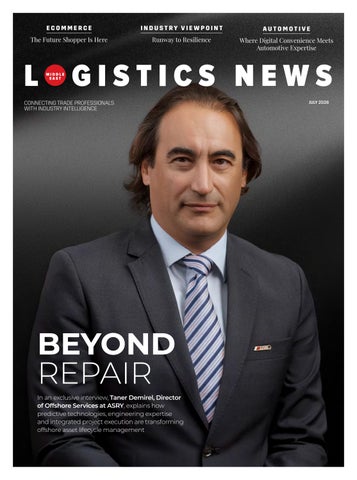
In an exclusive interview, Taner Demirel, Director of Offshore Services at ASRY, explains how predictive technologies, engineering expertise and integrated project execution are transforming offshore asset lifecycle management
AUTOMOTIVE Where Digital Convenience Meets Automotive Expertise
JULY 2026

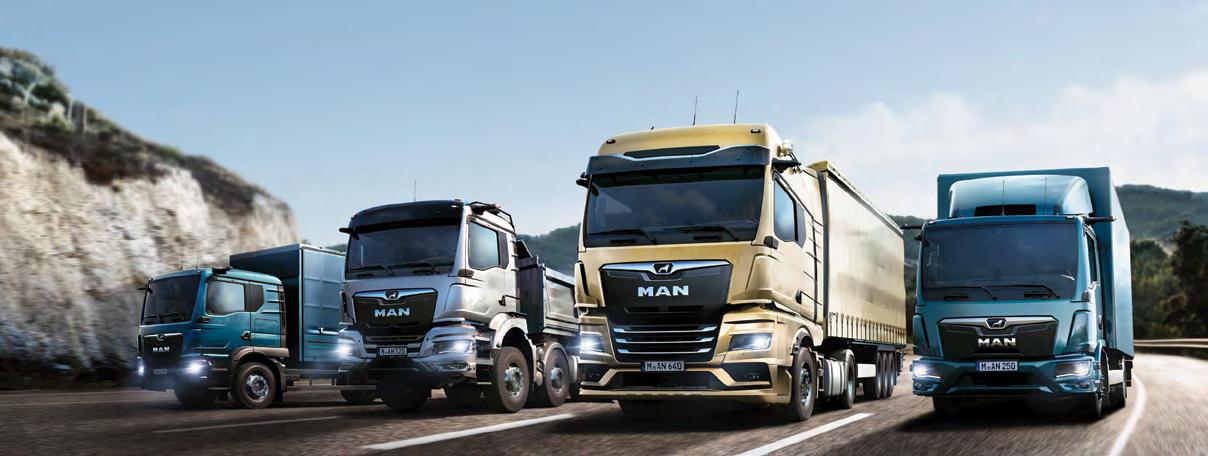
New IVECO S-Way: high technology and efficiency on all missions
A wide choice of Euro III / V diesel engines, delivering class-leading power from 360 hp to 560 hp Euro III / 570 hp Euro V and superior fuel economy. 12-speed HI-TRONIX automated transmission with the most advanced technology in its category, electronic clutch and best-in-class torque-to-weight ratio. Full range of fuel-saving devices, such as anti-idling feature, EcoSwitch, Ecoroll and Smart Alternator. Top levels of comfort and safety, with a completely redesigned and reinforced cab, featuring enhanced direct visibility and enlarged cab livability.

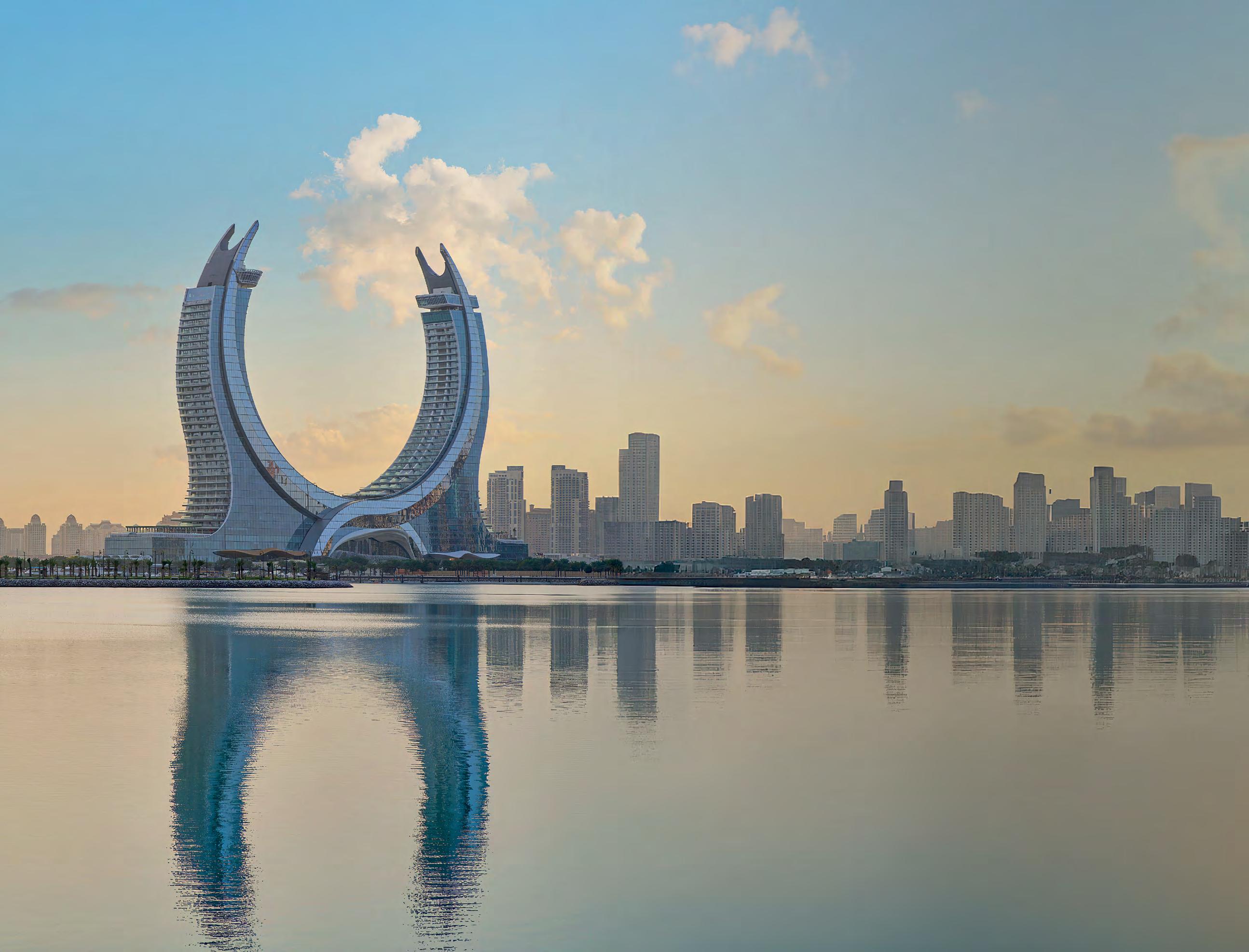
Nestled by the coast of Lusail sits the splendor of in even the smallest details. Open the doors to mesmerizing hospitality and make memories in a world of sophistication.
CEO
Wissam Younane wissam@bncpublishing.net
Managing Director
CEO
Rabih Najm rabih@bncpublishing.net
Wissam Younane wissam@bncpublishing.net
Group Publishing Director
subscriptions@bncpublishing.net
subscriptions@bncpublishing.net
Joaquim D’Costa jo@bncpublishing.net
Director Rabih Najm rabih@bncpublishing.net
Editor
Group Publishing Director
Reeba Asghar reeba@bncpublishing.net
Joaquim D'Costa jo@bncpublishing.net
Commercial Director
Editor-in-Chief
Andrea Mocay andrea@bncpublishing.net
Vibha Mehta vibha@bncpublishing.net
Country Manager
Managing Editor
Amjad Fakhouri amjad@bncpublishing.net
Kasun Illankoon kasun@bncpublishing.net
Creative Lead
PO Box 502511 Dubai, United Arab Emirates P +971 4 4200 506 | F +971 4 4200 196
For all commercial enquiries, contact jo@bncpublishing.net T +971 50 440 2706
PO Box 502511 Dubai, United Arab Emirates P +971 4 4200 506 | F +971 4 4200 196
Christian Harb chriss@bncpublishing.net
Design Christian Harb
Junior Art Director
Marketing Executive
Rizaldi Febrian
Aaron Joshua Sinanbam aj@bncpublishing.net
Marketing Executive
Digital Media Producer
Aaron Joshua Sinanbam aj@bncpublishing.net
Alexander Bungas
Videographer
Eduardo Buenagua
All rights reserved © 2026. Opinions expressed are solely those of the contributors. Logistics News ME and all subsidiary publications in the MENA region are officially licensed exclusively to BNC Publishing in the MENA region by Logistics News ME.
No part of this magazine may be reproduced or transmitted in any form or by any means without written permission of the publisher.
For all commercial enquiries, contact jo@bncpublishing.net T +971 50 440 2706 All rights reserved © 2023. Opinions expressed are solely those of the contributors. Logistics News ME and all subsidiary publications in the MENA region are o cially licensed exclusively to BNC Publishing in the MENA region by Logistics News ME.
Printed by United Printing and Publishing | upp.ae
No part of this magazine may be reproduced or transmitted in any form or by any means without written permission of the publisher.
Printed by United Printing and Publishing | upp.ae
Images used in Logistics News ME are credited when necessary. Attributed use of copyrighted images with permission. All images not credited courtesy Shutterstock.
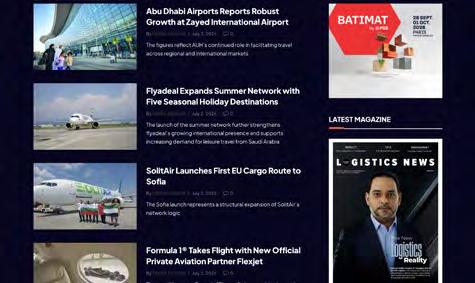
In addition to our print edition, we’re bringing you all sorts of industry news on our web mediums. We’re looking forward to interacting with our readers on all of our social media and web platforms. See you on the web!

Every month as we move forward, one thing becomes increasingly clear: progress is rarely marked by a single breakthrough. Instead, it happens in thousands of small movements; new connections being forged, smarter technologies emerging, infrastructure taking shape, and industries quietly adapting to a world that never stops changing.
That spirit of constant evolution runs through this issue. Our cover story takes us to Bahrain, where ASRY is defining how innovation and engineering are reshaping the future of offshore services. Whether it is the way we move people, goods, or ideas, the common thread is connectivity. Roads, railways, ports, and airports are no longer just pieces of infrastructure; they are the foundations of economic growth. Equally, innovations such as artificial intelligence and digitalisation are no longer concepts for the future; they are becoming part of the everyday fabric of logistics.
What I find most fascinating is that, despite the rapid pace of technological advancement, logistics remains a people-driven industry. Technology and human expertise are not competing forces; they are deeply intertwined, with innovation delivering its greatest impact when paired with the insight, experience and adaptability of the people behind it. Behind every shipment, every new route and every ambitious project are individuals solving problems, creating opportunities, and building the connections that keep our world moving.
As the GCC continues to cement its position as a global logistics hub, it is an exciting time to witness and share the stories that sit beneath that momentum, and the people and technologies working hand in hand to shape the future of the industry.

Reeba Asghar Editor Logistics News ME reeba@bncpublishing.net
reebaasghar
reeba.asgharx









































































Led by GWC Group, this integrated air-to-land model reinforces Doha’s role as a strategic regional hub
Gulf Warehousing Company Q.P.S.C. (GWC Group) , one of the region’s leading providers of cross-border and integrated supply chain solutions, has expanded its end-to-end logistics offering to include a fully operational air-to-land logistics corridor powered by the TIR system. The initiative positions Doha as a regional air-to-land redistribution hub, supporting supply chain continuity across the GCC.
Cargo arriving at Hamad International Airport is transferred into sealed vehicles and transported across borders to key regional destinations,
Setrak Khatchikian, Senior Vice President –GCC Transportation at GWC Group
enabling faster and more predictable deliveries. By allowing shipments to be redistributed from a single entry point, the model reduces reliance on disrupted traditional routes and provides a more flexible and cost-effective alternative to conventional air-to-air transport. Leveraging its regional infrastructure and TIR-certified operations, GWC Group manages the secure and efficient movement of cargo across major GCC markets, including Saudi Arabia, the United Arab Emirates, Kuwait, Oman and Bahrain.
Setrak Khatchikian, Senior Vice President – GCC Transportation at GWC Group, said: “What we have built is a commercially smarter route. GWC Group’s cross-border land freight
network enables time-sensitive cargo to move from Doha across the GCC under a single TIR document, combining the speed of air freight with the efficiency of sealed cross-border road transport. The GCC no longer has to choose between speed and cost.”
By integrating air freight with crossborder road transport, the model delivers the speed of air freight at a fraction of the cost of traditional air-to-air routing, without compromising delivery times. It provides an effective solution for transporting time-sensitive and highvalue goods, particularly in sectors such as e-commerce and pharmaceuticals, where speed, reliability and cost efficiency are critical. Supported by the TIR system, cargo moves under a single customs document and guarantee, reducing border delays, minimising reinspection requirements and improving delivery predictability across the region.
Rami Karout, Senior Manager for TIR and Transit Development at the International Road Transport Union (IRU) , said: “Qatar has demonstrated considerable agility in activating new road corridors under the TIR system to keep vital goods moving across the region. By enabling cargo to travel under a single customs document and guarantee, TIR significantly reduces border delays and enhances delivery predictability. This air-to-land model is a clear example of how TIR supports efficient, secure and scalable crossborder logistics, particularly when traditional routes are under pressure.”
Led by GWC Group, the integrated airto-land model strengthens Doha’s position as a strategic regional hub and key gateway for cargo flows into the GCC. By combining air connectivity with cross-border road transport, GWC Group provides a scalable and commercially viable solution that enhances supply chain resilience and enables the efficient redistribution of goods across regional markets.
The facility will support faster, more efficient spare parts distribution across the GCC, Africa, and beyond
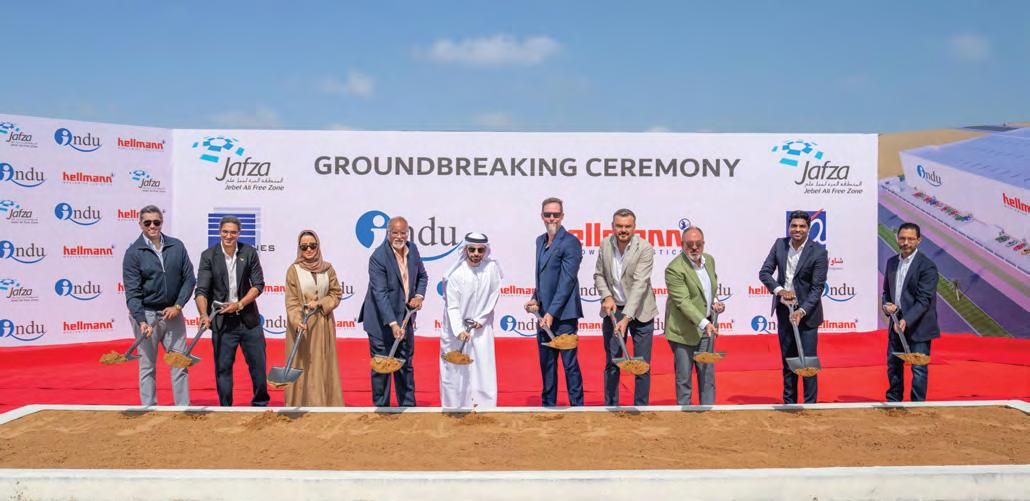
Hellmann Worldwide Logistics and INDU Group have broken ground on a new automotive logistics hub in Jafza, further reinforcing the free zone’s position as a key gateway for regional and global trade. The facility will support faster and more efficient spare parts distribution across the GCC, Africa and beyond, as demand for resilient automotive supply chains continues to rise.
Designed to manage the full spectrum of automotive spare parts logistics, the facility will combine high-density bin storage, pallet racking and specialised handling areas for oversized and bulky components. Covering nearly 300,000 sq ft, the site will provide scalable infrastructure to support efficient, high-volume distribution.
Developed by INDU Logistics, part of INDU Group, the facility will serve as
a dedicated automotive hub within Hellmann’s Middle East network.
Lee I’Ons, Regional CEO IMEA, Hellmann Worldwide Logistics, said: “The UAE is a strategically important market within our global network. By establishing this dedicated automotive hub in Jafza, we are systematically expanding our regional capabilities and creating further scalable, industryfocused infrastructure. This enables us to deliver competitive, highperformance logistics solutions for our customers and support their long-term growth.”
Abdulla Al Hashmi, Global Chief Operating Officer, Parks and Economic Zones, DP World, said: “Hellmann’s investment in Jafza reflects the rapid pace at which the automotive industry is growing across the Middle East, with customers seeking faster and more reliable access to critical spare parts
across multiple markets. By continuing to develop specialised infrastructure in Dubai, we are supporting our partners in navigating uncertainty and keeping their operations running smoothly.”
The development reflects growing demand for specialised automotive logistics infrastructure as supply chains become increasingly complex and time-sensitive. Jafza continues to play a pivotal role in enabling efficient trade flows between Europe, Asia and Africa through its integrated infrastructure and multimodal connectivity.
Jafza is home to a growing ecosystem of automotive, logistics and trading companies, supported by direct access to Jebel Ali Port and seamless multimodal connectivity. The addition of this facility further strengthens Jafza’s position as a hub for specialised, high-value supply chains.
The launch reflects Yango Group’s broader focus on applying technology to urban mobility challenges and aligns with government agendas
Yango Group, the global tech company, has expanded into public transport technology with the launch of an AIpowered management platform designed to help transport authorities and operators manage urban mobility more efficiently.
Public transport remains one of the least digitised areas of urban infrastructure, with many cities relying on fragmented systems that contribute to congestion, unreliable services and operational inefficiencies. According to the INRIX Global Traffic Scorecard, congestion increased in 62% of urban areas globally in 2025, underlining the need for smarter transport management.
The new platform combines real-time and historical mobility data with AIdriven operational tools to support
network planning, daily operations and revenue management. It enables authorities to forecast passenger demand, optimise routes and schedules, improve fleet allocation, identify network bottlenecks and monitor fare collection. According to Yango Group’s internal estimates, integrated transport solutions can reduce traffic congestion by up to 28%, lower operational costs by up to 35%, increase fare collection by up to 30%, and support up to 40% faster decisionmaking.
“We work with urban mobility every day in cities around the world, from ride-hailing and navigation to delivery and other services. This gives us a practical view of how cities move and where the challenges are. Bringing that experience into public transport is a logical step. With the platform, we want to help cities build public transport systems that are easier to manage,
more financially sustainable and more convenient for people to use, ” said Islam Abdul Karim, Regional head, Yango Group Middle East.
The platform can also be integrated into the Yango SuperApp, enabling passengers, depending on local implementation, to access multimodal journey planning, real-time vehicle tracking, digital ticketing and transport card top-ups through a single interface.
The launch reflects Yango Group’s wider commitment to addressing urban mobility challenges through technology and supports initiatives such as the Dubai 2040 Urban Master Plan, including its 20-minute city vision. As cities continue investing in smarter infrastructure, the company expects growing demand for digital solutions that make public transport more efficient, accessible and financially sustainable.

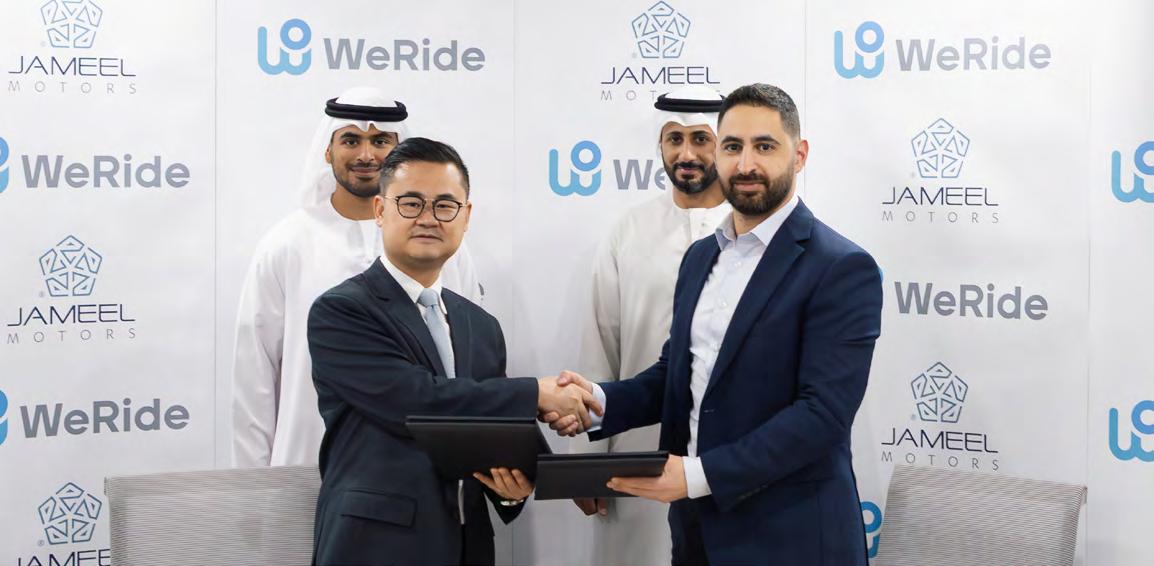
By introducing Farizon Auto electric vehicles onto public roads, Jameel Motors is helping turn strategic ambition into on-the-ground reality
Jameel Motors, a leading international mobility solutions provider and partner to some of the world’s top automotive brands, has announced a collaboration with WeRide, a global leader in autonomous driving technology, to support the expansion of autonomous mobility services in the UAE.
As part of the partnership, Jameel Motors is investing in a fleet of Farizon Auto electric vehicles, supplied through Geely Holding Group’s commercial vehicle division, to support the deployment of WeRide’s Robotaxi GXR fleet. Built on the award-winning Farizon SV platform, the Robotaxi combines advanced safety features, operational efficiency and a spacious cabin designed for urban mobility. In 2025, the Farizon SV received a five-star Euro NCAP safety rating and was named a finalist for the International Van of the Year (IVOTY) award.
Under the collaboration, WeRide provides the autonomous driving technology, while Jameel Motors invests in and supports the Robotaxi fleet. The partnership positions Jameel Motors as a key enabler of one of the world’s first commercial, city-scale driverless Robotaxi services, supporting Dubai’s ambitions for autonomous transport.
Dubai’s autonomous mobility sector has rapidly progressed from supervised trials in late 2025 to fully driverless commercial operations. Since 31 March 2026, WeRide has
been operating driverless Robotaxi services in Dubai’s Jumeirah and Umm Suqeim areas using vehicles supplied by Jameel Motors.
Drawing on more than 80 years of automotive expertise, Jameel Motors is working alongside WeRide to support fleet deployment, operational readiness and service quality, helping create the foundations for scalable, customerfocused autonomous transport across Dubai and, over time, the wider UAE.
Yousef Hussein, CEO Middle East & Levant at Jameel Motors, said: “Autonomous mobility is entering an exciting new phase in Dubai, moving from pilot programmes to full commercialisation and city-scale deployment. Through our collaboration with WeRide, Jameel Motors is proud to support the development of a scalable and reliable ecosystem that strengthens customer confidence, delivers tangible value and contributes to the UAE’s vision for the future of mobility.”
The collaboration supports Dubai’s broader autonomous transport strategy, led by the Dubai Future Foundation, which aims for 25% of all journeys in the emirate to be autonomous by 2030. With WeRide already operating close to 250 Robotaxis across the Middle East, the partnership marks another significant step towards the wider adoption of safe, efficient and sustainable autonomous transport solutions in the region.

Dr Lijo John at Edinburgh Business School, Heriot-Watt University Dubai, explains why small, specialised language models are emerging as the preferred choice
The debate surrounding Small Language Models (SLMs) versus Large Language Models (LLMs) in logistics is often reduced to a discussion about hardware: lower computing requirements, reduced costs and the ability to operate offline. That framing misses the real argument, and it leaves practitioners with a list of features rather than a decision rule. The case for SLMs rests on a sixty-yearold idea from cybernetics: W. Ross Ashby’s (1956) Law of Requisite Variety holds that a regulator can control a system only if it carries at least as much variety, as many distinct states and responses, as the disturbances that system produces. Supply chains, with their countless interactions, disruptions

and decision points, are precisely the kind of high-variety systems Ashby had in mind. Remarkably, his insight offers a practical decision rule for determining where different forms of AI belong within modern supply chain operations.
What is SLM, and how does it differ from LLM?
Large Language Models such as GPT, Claude and Gemini are trained on internet-scale corpora and designed to perform a vast range of tasks. With hundreds of billions of parameters, they are intended to be broadly capable across multiple domains. SLMs
represent a different design choice rather than simply a smaller version of the same technology. Typically built with a few hundred million to around ten billion parameters, they are finetuned on narrow, domain-specific datasets such as shipping manifests, maintenance records or customs filings. Their objective is not to perform many tasks adequately, but to perform one task exceptionally well. That narrower scope allows SLMs to run on laptops, warehouse edge servers and onboard vessel systems rather than hyperscale cloud infrastructure. In Ashby’s terms, LLMs carry a generic variety designed for almost any conversation, whereas

Dr Lijo John, Assistant Professor in Logistics and Supply Chain Management at Edinburgh Business School, Heriot-Watt University Dubai
SLMs carry a specific variety calibrated to a bounded task. The distinction is one of purpose as much as scale.
Are SLMs actually better than LLMs – and why?
The honest answer is simple: better for matched tasks, not better in general. When a task’s variety is bounded and well understood, SLMs often outperform larger models on both accuracy and speed because they are not expending capacity on capabilities the task never requires. Microsoft Research’s 2024 study of Azure’s cloud supply chain found that smaller models outperformed much larger general-
purpose models on both accuracy and execution time for a specific application-interaction task. None of this makes LLMs obsolete. It simply makes them the wrong default for narrow, repeatable and high-volume operational work.
Perhaps more clearly than in almost any other industry. Jay Galbraith’s organisational informationprocessing theory argues that firms facing high task uncertainty must either reduce the informationprocessing burden placed on any individual decisionmaker or expand their processing capacity to match it. A supply chain may appear to be one vast, highvariety system, but in reality it is a federation of narrower, locally bounded subsystems. For instance, customs clearance follows a fixed regulatory framework. Predictive maintenance relies on known sensor signatures. Warehouse slotting is driven by repeatable demand patterns. Each is a relatively lowvariety problem wearing the reputation of a highvariety system, making it an ideal candidate for SLM deployment. The exception is strategic sensing: the task of synthesising heterogeneous, unstructured signals such as geopolitical developments, social sentiment and macroeconomic indicators into a demand or risk forecast. Here, the broader contextual capabilities of LLMs provide a distinct advantage. The practical rule for supply chain leaders is therefore simple: deploy SLMs in the execution layer and reserve

LLMs, or a hybrid of the two, for the strategic sensing layer above it.
Four scenarios consistently favour SLMs over generalpurpose models because the underlying tasks are narrow, repeatable and often sensitive to privacy or latency constraints.
• Customs and trade documentation: extracting and validating data from bills of lading, certificates of origin and HS code classifications is a highly rules-based process. Document AI systems built on smaller, fine-tuned models are already reducing border delays and manual rework by identifying errors before submission.
• Predictive maintenance on fixed assets: factories and fleets are increasingly running SLMs on edge hardware to analyse vibration, thermal and acoustic sensor streams and identify failures before they occur, with reported reductions in unplanned downtime of around 25 per cent in deployed cases.
• Offline and disconnected operations: vessels at sea, oil-field technicians and remote distribution hubs cannot rely on continuous cloud connectivity. An SLM running locally on a laptop or smartphone can keep troubleshooting, diagnostics and routing decisions operational when networks are unavailable.
• Transaction-level anomaly detection: analysing procurement, trade-finance or invoicing records for fraud and compliance risks is a highly specialised pattern-recognition task. Banks already use SLMs for this purpose, and the same logic transfers directly to supplier fraud and customs-related anomaly detection.
Model size should be the last decision a supply chain leader makes, not the first. The process should begin with the task itself. If its variety is bounded, repeatable and known in advance, customs codes, sensor signatures or transaction patterns, for example, then an SLM should be fine-tuned and deployed as close as possible to where the data is generated. If the task requires synthesising unstructured signals that no organisation has fully catalogued – geopolitical risk, demand shocks or supplier sentiment, for instance – an LLM or hybrid architecture should remain in the loop. Either way, the investment that ultimately determines success lies in the orchestration layer: clear decision rights between models, shared state management and audit trails robust enough to satisfy governance requirements. Get that layer right, and small models deliver precisely the level of control Ashby’s sixty-year-old theorem predicts. Get it wrong, and a fleet of specialists becomes little more than another name for fragmented control.

BEGA pole-top luminaires with Dark Sky technology direct the light in a highly efficient manner only where it is required. Light pollution of the night sky is avoided. bega.com/darksky

Simon Ulmann, Vice President Operations & Supply Chain, IMEA, at Henkel Adhesive Technologies, shares how Henkel is leveraging technology, talent and strategic investment to stay ahead of the curve

There is a great deal of excitement around AI, but where do you believe AI is creating the most tangible value in manufacturing and supply chains today, and where is the industry still overestimating its impact?
AI is undoubtedly transformative, but it is important to separate reality from hype. Today, the most tangible value it delivers in manufacturing and supply chains lies in predictive capabilities, safety and complexity management.
We are seeing measurable returns in demand forecasting, where machine learning algorithms analyse historical data, market trends and external variables to predict demand fluctuations with a level of accuracy that traditional models struggle to achieve. On the factory floor, AI-powered vision systems are enhancing workplace safety, while predictive maintenance is helping to prevent costly downtime by identifying equipment issues before they escalate into failures.
Where the industry tends to overestimate AI is in the notion of fully autonomous decision-making. The idea of a completely self-managing, end-to-end supply chain remains some distance from reality. AI is exceptionally good at processing vast datasets and recommending actions, but it cannot replicate human judgement, empathy or the ability to navigate complex supplier relationships during periods of disruption.
I often describe AI as a powerful co-pilot rather than an autopilot. Our focus is on augmented intelligence – equipping supply chain professionals with better insights so they can make faster, smarter and more informed decisions.
If we walked into a Henkel manufacturing facility in 2035, what would look fundamentally different compared to today in terms of automation, workforce roles, and decision-making?
The most striking difference would be the seamless connectivity across the entire manufacturing ecosystem and the natural collaboration between advanced robotics and human talent. Our vision for 2035 is centred on operations that are inherently safe, agile, efficient and
sustainable. We see our facilities becoming industry-defining blueprints, combining advanced automation with high-value human expertise and leveraging scalable technologies that can be adopted across the wider manufacturing sector.
In this environment, technology becomes a key driver of operational resilience. Planning and execution will be supported by integrated, real-time data, enabling facilities to respond rapidly to changing market conditions while maintaining a strong commitment to sustainability. The future factory will not simply be more automated; it will be more intelligent, connected and adaptable.
How do you balance resilience with efficiency when both can sometimes pull organisations in different directions? This is arguably the defining supply chain challenge of our time. For decades, efficiency was the dominant objective. Just-in-Time models were designed to eliminate waste and maximise productivity. More recently, global disruptions prompted a sharp shift towards Just-in-Case strategies, leading organisations to build significant inventory buffers and tie up working capital. Neither extreme offers a sustainable long-term solution.
The answer lies in what we call “smart resilience”. It is not about holding more inventory everywhere; it is about positioning the right inventory in the right locations based on a clear understanding of risk exposure. At Henkel, we use digital twin technology to model our supply chain network and simulate disruption scenarios in seconds. This allows us to identify the most cost-effective mitigation strategies before risks materialise. We also balance resilience and efficiency through greater visibility and regionalisation. By operating on an “in the region, for the region” approach wherever possible, we reduce lead times, minimise exposure to global shipping disruptions and lower transportation costs.
Ultimately, resilience is rooted in agility. Organisations with real-time visibility across their supplier networks can operate leaner because they have the ability to

respond before disruptions reach their operations. Efficiency pays the bills, but resilience keeps the business moving. The two must work hand in hand.
What distinguishes companies that successfully transform from those that merely digitise existing processes?
The distinction is critical. Digitisation often means taking an existing process and moving it onto a screen. If a manual approval workflow is transferred from a paper form to a digital platform, the process may be faster, but the underlying inefficiency remains unchanged.
True transformation requires organisations to challenge the operating model itself. It begins by asking, “Why do we do it this way?” rather than “How can we digitise this?.”Transformational organisations use technology to eliminate unnecessary steps altogether. For example, IoTenabled systems can automatically trigger replenishment orders without the need for manual intervention,
Simon Ulmann, Vice President Operations & Supply Chain, IMEA, at Henkel Adhesive Technologies
fundamentally redesigning the process rather than simply digitising it.
The greatest differentiator, however, is culture. Organisations can invest in the most advanced technologies available, but if employees do not trust the data or feel empowered to act on it, those investments will fail to deliver their full value. The most successful transformations invest as heavily in change management, upskilling and organisational culture as they do in technology itself.
Transformation is ultimately a human endeavour enabled by digital tools.
Do you see sustainability becoming a genuine source of competitive advantage in manufacturing and supply chains, or is it increasingly becoming a baseline expectation for doing business?
At present, it is both, although the direction of travel is clear: sustainability is rapidly becoming a baseline expectation. Regulators, customers and business partners increasingly expect organisations to demonstrate measurable progress on sustainability. In the near future, companies that cannot provide transparency around carbon footprints, ethical sourcing and environmental performance may simply find themselves excluded from procurement processes. Sustainability is becoming a licence to operate.
At the same time, the way organisations pursue sustainability can create significant competitive advantages. Sustainability and operational efficiency are often closely aligned. Investments in energy-efficient manufacturing, renewable energy and water recycling not only reduce emissions but also lower long-term operating costs and provide greater protection against energy market volatility.
Within adhesive technologies, sustainability also creates opportunities for innovation. By developing solutions that support circularity and help customers achieve their own ESG objectives, sustainability moves beyond compliance and becomes a driver of commercial growth and customer value.
What are the biggest investments Henkel is making today to ensure its operations and supply chain remain competitive over the next decade?
As Henkel approaches its 150th anniversary, we recognise that long-term success depends on a continued commitment
to future-focused investment. Our priorities are centred around three pillars: digital infrastructure, sustainable operations and people.
The first is strengthening our digital backbone. This includes scaling Industry 4.0 applications, expanding our use of AI-driven analytics and standardising data architecture across our global operations. Agility is impossible when critical data remains fragmented across different systems.
The second pillar is sustainability. We are investing significantly in renewable electricity, advanced water and waste reduction technologies and site upgrades that support our journey towards carbon neutrality.
We are already seeing the results of these efforts. Our flagship sites in Kurkumbh, India, and Gebkim, Türkiye, have achieved carbon-neutral production through the adoption of high-efficiency electric systems and a transition to 100 per cent renewable electricity, eliminating direct fossil
fuel use and reducing Scope 1 and Scope 2 emissions to zero.
Most importantly, we continue to invest in people. The factory of the future demands new capabilities, and we are equipping our operators, engineers and supply chain professionals with the skills needed to thrive in an increasingly automated and data-driven environment. Technology evolves rapidly, but an adaptable workforce remains the most valuable long-term investment.
Across India, the Middle East and Africa, where do you see the most significant opportunities for industrial growth and supply chain innovation in the coming years?
The IMEA region is one of Henkel’s most dynamic growth engines, although the opportunities differ significantly across markets.
In the Middle East, rapid industrial localisation and investment in world-class infrastructure are creating compelling opportunities. Programmes such as Saudi Arabia’s Vision 2030 and the UAE’s Operation
300bn are accelerating the transition towards advanced manufacturing and highly digitised logistics ecosystems.
India offers opportunities on an extraordinary scale. The country’s manufacturing ambitions, combined with its strong digital capabilities and deep technology talent pool, make it an ideal environment for advanced analytics, AI-driven supply chain platforms and next-generation operational innovation.
In Africa, growth is being driven by a rapidly expanding and increasingly urbanised consumer base. The challenge lies in overcoming infrastructure constraints and improving distribution networks, creating significant opportunities for decentralised supply chains, mobilefirst technologies and last-mile innovation.
Across all three regions, the common thread is clear: immense potential for transformative growth, innovation and long-term industrial development.
Riaz Bharuchi explores how Keolis MHI is leveraging data-driven planning, ethical procurement, predictive analytics, and ESG principles to support reliable mobility services while contributing to Dubai’s agenda

Dubai’s D33 agenda aims to double the city’s economy and position Dubai among the world’s leading urban centers. How does your financial strategy support this vision?
At Keolis MHI, we believe financial strategy should be an enabler of growth rather than simply a function that supports day-to-day operations. As a leading public transport operator, our responsibility extends beyond managing budgets; it is about ensuring Dubai benefits from a reliable, efficient and financially sustainable transport network that underpins economic development.
Every investment we make is carefully assessed based on its ability to enhance service reliability, operational efficiency and the overall passenger experience. By maintaining predictable operating costs, optimising resources and

driving long-term value creation, we help provide the stable mobility infrastructure that supports business activity, tourism and workforce connectivity across the emirate. In that sense, sound financial management plays an important role in advancing the broader ambitions of the D33 Agenda.
In today’s global economy, resilience has become a strategic priority. What does operational resilience mean for a major transport operator, and how do you safeguard capital investments against market volatility?
For us, resilience is about ensuring continuity of service regardless of external challenges. Whether it is fluctuations in commodity prices, disruptions to global supply chains or currency volatility, our objective is to minimise any impact on operations, passengers and long-term projects.
We achieve this through rigorous financial planning, detailed scenario modelling and close collaboration with suppliers and strategic partners. By securing long-term agreements where appropriate and diversifying sourcing strategies, we reduce exposure to sudden market shifts and supply disruptions.
Ultimately, resilience is measured by what our passengers experience. They should be able to rely on our services every day without feeling the effects of wider economic uncertainty.
A transport network depends on the availability of critical parts and equipment. How has Keolis MHI approached procurement financing to maintain availability while controlling costs?
Striking the right balance is essential. Holding excessive inventory can tie up capital unnecessarily, while insufficient stock levels can introduce operational risks and affect service reliability.
Our approach combines data-driven forecasting with strategic inventory management. By analysing historical consumption patterns, asset criticality and supplier lead times, we are able to prioritise investment in components that are vital to network performance while maintaining greater flexibility for standard items.
This disciplined approach allows us to optimise working capital, improve efficiency and maintain service continuity without compromising operational excellence.
Keolis MHI has been awarded the Chartered Institute of Procurement & Supply (CIPS) Ethics Mark for consecutive years. How does ethical procurement contribute to financial performance and risk management?
Ethical procurement is intrinsically linked to long-term business performance. Strong governance and transparent
procurement practices help reduce exposure to supplier misconduct, compliance breaches, fraud and reputational risks, all of which can have significant financial consequences.
Receiving the CIPS Ethics Mark reflects the high standards we apply across our procurement activities. It provides assurance to our stakeholders, suppliers and partners that our decision-making processes are transparent, fair and aligned with internationally recognised best practices. Ethical business conduct is not simply a matter of compliance; it is a strategic advantage that strengthens operational stability, enhances stakeholder trust and contributes directly to long-term financial resilience.
How do predictive analytics and financial planning help you address supply chain challenges before they impact operations?
One of the greatest advantages of digital transformation is the ability to connect operational intelligence with financial planning in real time.
For example, when maintenance teams identify a component that is experiencing higher-thanexpected wear, our finance and procurement teams can immediately evaluate funding requirements, supplier availability and delivery schedules. This enables us to initiate procurement well before the component reaches the end of its operational lifecycle. As a result, potential disruptions can be transformed into planned maintenance activities rather than reactive interventions. This

proactive approach enhances reliability, reduces risk and helps maintain the high service standards our passengers expect.
How does Keolis MHI’s investment in digital transformation support the UAE Vision 2031 objective of building a future-ready economy?
UAE Vision 2031 places significant emphasis on innovation, productivity and the adoption of advanced technologies, and

our digital transformation strategy is closely aligned with these priorities.
We continue to invest in automation, data-driven decision-making and digital platforms that streamline both operational and financial processes. These initiatives improve efficiency, reduce administrative burdens and allow our teams to focus on strategic analysis, innovation and continuous improvement.
Beyond operational benefits, digital transformation also plays a vital role in developing future-ready skills across our workforce. By embracing technology and fostering a culture of innovation, we are contributing to the broader national objective of building a competitive, knowledge-based economy.
Sustainability has become a critical business consideration. How is Keolis MHI integrating ESG principles into financial decisionmaking?
ESG considerations are increasingly shaping how organisations evaluate
investments and create long-term value, and Keolis MHI is no exception.
When assessing projects, procurement decisions or asset lifecycle strategies, we consider not only financial returns but also environmental and social impacts. Factors such as energy efficiency, resource optimisation, waste reduction and long-term sustainability are integrated into our evaluation framework.
Sustainability and financial performance are not mutually exclusive. In many cases, environmentally responsible solutions also deliver operational efficiencies and cost savings over time. By embedding ESG principles into our decision-making processes, we can create value for both the business and the communities we serve.
The UAE has designated this year as the “Year of Family”. How does maintaining a world-class transport
system contribute to quality of life for families and communities?
Reliable public transport has a direct and meaningful impact on people’s daily lives. Every journey that runs on time, every seamless connection and every minute saved contributes to a better experience for residents and visitors alike.
From our perspective, reliability is about far more than operational performance; it is about creating value for society. When people can depend on safe, efficient and predictable transportation, they spend less time dealing with uncertainty and more time focusing on work, education, leisure and, most importantly, family life.
As a leading public transport operator, we are proud to contribute to the quality of life that makes Dubai one of the world’s most attractive places to live, work and visit. Supporting mobility ultimately means supporting communities, and that remains at the heart of everything we do.

Airports sit at the centre of global mobility, and their importance is only growing. With global passenger traffic expected to reach a record 10.2 billion passengers in 2026 according to Airports Council International, airports are being asked to handle more and bigger challenges than ever before: process passengers and baggage efficiently, maintain rigorous safety standards and accelerate progress toward energy and efficiency goals. Yet airports face a stark contrasting reality, one that includes rising operational complexity, capacity constraints, infrastructure limitations and ageing facilities pushed beyond their original design.
To meet surging demand and prepare for long-term growth, they must adopt a new approach: one centred on intelligent, connected technology that delivers precision, visibility and resilience across airside, terminal and ground operations.
“AIRPORTS HAVE LITTLE ROOM FOR INEFFICIENCY AND EVEN LESS MARGIN FOR OPERATIONAL FRICTION.”
Here are three key areas where advanced digital capabilities are already helping airports address these pressures.
Bringing Greater Precision to Aircraft Docking Gate operations are one of the most time-critical and risk-sensitive activities in an airport environment. As traffic volume rises and airfields grow more congested,
With global passenger traffic on track to hit a record 10.2 billion in 2026, Alex Cowen of Honeywell Building Automation argues that ageing infrastructure and rising operational pressure are leaving airports with little margin for error, and that connected, intelligent technology, from docking precision to power management, may be the only way to keep pace.
the limitations of traditional manual docking processes grow more evident, increasing the potential for delays, incidents and reduced throughput.
Modern visual docking and guidance tools are changing that. By providing real-time situational awareness to pilots, apron controllers and ground crews, these systems help enable safer, more predictable gate operations. They can detect potential obstacles early, reduce reliance on manual intervention and help airports maximise gate utilisation and support higher throughput without compromising safety.
This digital advancement is especially important as runway and taxiway incidents have increased in recent years in some regions. Enhanced visibility and technology-assisted safety checks help airports mitigate risks, reduce congestion and better position themselves for sustained passenger growth.
“ENHANCED VISIBILITY AND TECHNOLOGY-ASSISTED SAFETY CHECKS HELP AIRPORTS MITIGATE RISKS AND REDUCE CONGESTION.”
Orchestrating Faster, More Efficient Turnarounds
Few airport processes highlight operational complexity like aircraft turnarounds on the apron and in the terminal, or the airside movements that feed into them. Extended taxi times and aircraft idling on taxiways or at gates add to ground-level congestion, strain airside capacity and contribute to the airport’s overall environmental footprint through increased local emissions and reduced throughput during peak periods.
Dozens of teams, from baggage handlers to cleaners to maintenance crews, must synchronise within tight time windows. A delay in any step can ripple through gates, stands, schedules
and taxi flows, amplifying congestion and impacting on-time performance.
Historically, this process suffered from limited real-time transparency required to optimise performance. Today, integrated digital command platforms are changing that calculus. By aggregating data from ground operations, facilities, aircraft systems and airside movements, they deliver a unified, live view of every phase, from approach to departure.
This enhanced visibility helps airports spot bottlenecks early, deploy resources more effectively and cut idle time at gates and in movement areas. These tools help improve operational reliability in the face of capacity pressures and growing demand, helping airports maintain smooth flow without major physical expansions.
“WHEN
AIRPORTS ACHIEVE FASTER, SMOOTHER TURNAROUNDS AND FEWER DISRUPTIONS, THE ENTIRE ECOSYSTEM BENEFITS,
STARTING WITH PASSENGERS.”
Increasing Efficiency Through Smarter Power Management
Energy efficiency is no longer a distant goal, it is a core operational and regulatory imperative for airports today. A prime opportunity for emissions reduction sits in how aircraft are powered while parked at gates under airport management.
Traditionally, parked aircraft depend on auxiliary power units that generate fuel burn, noise and emissions on the apron. Many airports are shifting to cleaner options like ground power units and preconditioned air systems. The key hurdle remains consistent, effective usage across all stands.
This is where smart monitoring systems can make a measurable impact. By analysing sound signatures or sensor data, they can help confirm whether an aircraft is using onboard power
or connected to airport-supplied ground systems. Accurate, actionable data helps enable airports to monitor emissions from ground activities, optimise power delivery, enforce compliance and advance toward efficiency targets.
“ACCURATE, ACTIONABLE DATA HELPS AIRPORTS MONITOR EMISSIONS, OPTIMISE POWER DELIVERY AND ENFORCE COMPLIANCE.”
The Airport of the Future: Connected, Flexible, Resilient
Airports stand at a critical inflection point. Escalating passenger volumes, capacity constraints, ageing infrastructure demands and environmental commitments will define the years ahead. Yet with an integrated, intelligent operational backbone, airports can not only navigate these challenges, they can set the standard for the industry.
At Honeywell, we believe the future of airport operations lies in seamlessly integrated technologies, systems that bring together airside, terminal and ground functions into a unified whole. These solutions help enhance safety, strengthen resilience against congestion and disruptions, and give teams the insight needed to anticipate and address issues before they escalate. The result is a smoother experience for travellers and greater efficiency across the entire airport ecosystem.
“THE DEMANDS ON AIRPORTS ARE INTENSIFYING, BUT SO IS THE POTENTIAL.”
With smart, connected technology as the foundation, the next chapter of aviation will be shaped not by limitations but by optimised performance and possibility.

In the industrial heart of Saudi Arabia’s Eastern Province, a new joint venture is about to put steel in the ground that could reshape how goods move through one of the Kingdom’s busiest manufacturing corridors. Saudi Arabia Railways (SAR) has handed a construction contract to a partnership between OHL Arabia and Hassan Allam Construction Saudi Limited Co, tasking the pair with building the Dammam 2nd Industrial City Railway Connection Project — a rail link that promises to tighten the bond between factory floor and freight network.
On paper, the project sounds modest: a single-track railway stretching just 22.7 kilometres, threading through the Eastern Province near the Arabian Gulf. But in the logistics world, distance is rarely the point — connectivity is. This line will plug directly into Dammam’s Second Industrial City, one of the region’s most active manufacturing zones, giving factories there a direct rail gateway instead of relying solely on road haulage.
The scope handed to the joint venture is comprehensive. OHL Arabia and Hassan Allam Construction Saudi will be responsible for the full civil and railway works — earthworks, foundations,
and track infrastructure built from the ground up — alongside the signalling and telecommunications systems that will let the new line talk to the rest of SAR’s network. The companies will also coordinate the necessary interface works with the Saudi Electricity Company, ensuring the line’s power needs are folded smoothly into the wider grid.
ENGINEERING-WISE, TWO STRUCTURES
STAND OUT. A 265-METRE BRIDGE WILL CARRY THE LINE OVER HIGHWAY HW615, WHILE A 118-METRE SPAN WILL LIFT IT ACROSS THE CORRIDOR OCCUPIED BY ARAMCO’S PIPELINE NETWORK
— a reminder of just how tightly industrial infrastructure is layered across this part of the Kingdom. Neither structure is small, and both will demand careful sequencing given the live infrastructure they cross.
Industrial zones live and die by how efficiently they move materials in and finished goods out. Road transport has long carried that burden in Dammam, but rail offers something trucks cannot: scale, predictability, and lower per-tonne cost over distance.
Edited by Vibha Mehta.

By extending dedicated rail access into the Second Industrial City, SAR is betting that freight volumes here will only grow — and that the bottleneck, when it comes, will be capacity rather than demand.
That bet fits squarely within Saudi Arabia’s broader Vision 2030 ambitions, which have repeatedly singled out logistics and industrial diversification as pillars of the Kingdom’s economic future. A rail
network that reaches deeper into manufacturing hubs supports that diversification in a very literal sense: it is infrastructure built to move the products of a more industrialised, less oil-dependent economy.
The pairing of OHL Arabia and Hassan Allam is not a leap of faith — it’s a continuation of form. OHL Arabia is the Saudi arm of OHLA, the Spanish infrastructure group with decades of
heavy civil engineering experience across multiple continents. Hassan Allam Construction Saudi, meanwhile, operates under Hassan Allam Holding, an Egyptian engineering group that has quietly become one of the region’s go-to names for transit infrastructure.
That portfolio already includes Cairo Metro Line 4 and the Alexandria Raml Tram in Egypt, the monorail serving Riyadh’s King Abdullah Financial District, and the cross-border Hafeet Rail project linking Oman and the UAE. Add the Dammam connection to that list, and a pattern emerges: Hassan Allam is steadily positioning itself as a recurring contractor of choice wherever the Gulf and North Africa are laying new rail.
Contract values and a firm completion timeline have not been made public, which is typical at this early stage of a project announcement. What is clear is the intent: another physical link in Saudi Arabia’s expanding rail map, built to carry industrial freight rather than passengers, and designed to make one of the Kingdom’s key manufacturing zones a little less dependent on the road.
For an economy working hard to diversify, that kind of unglamorous, behind-the-scenes infrastructure — bridges over pipelines, signalling systems, a single track stretching less than 23 kilometres — may end up mattering more than the headlines suggest.

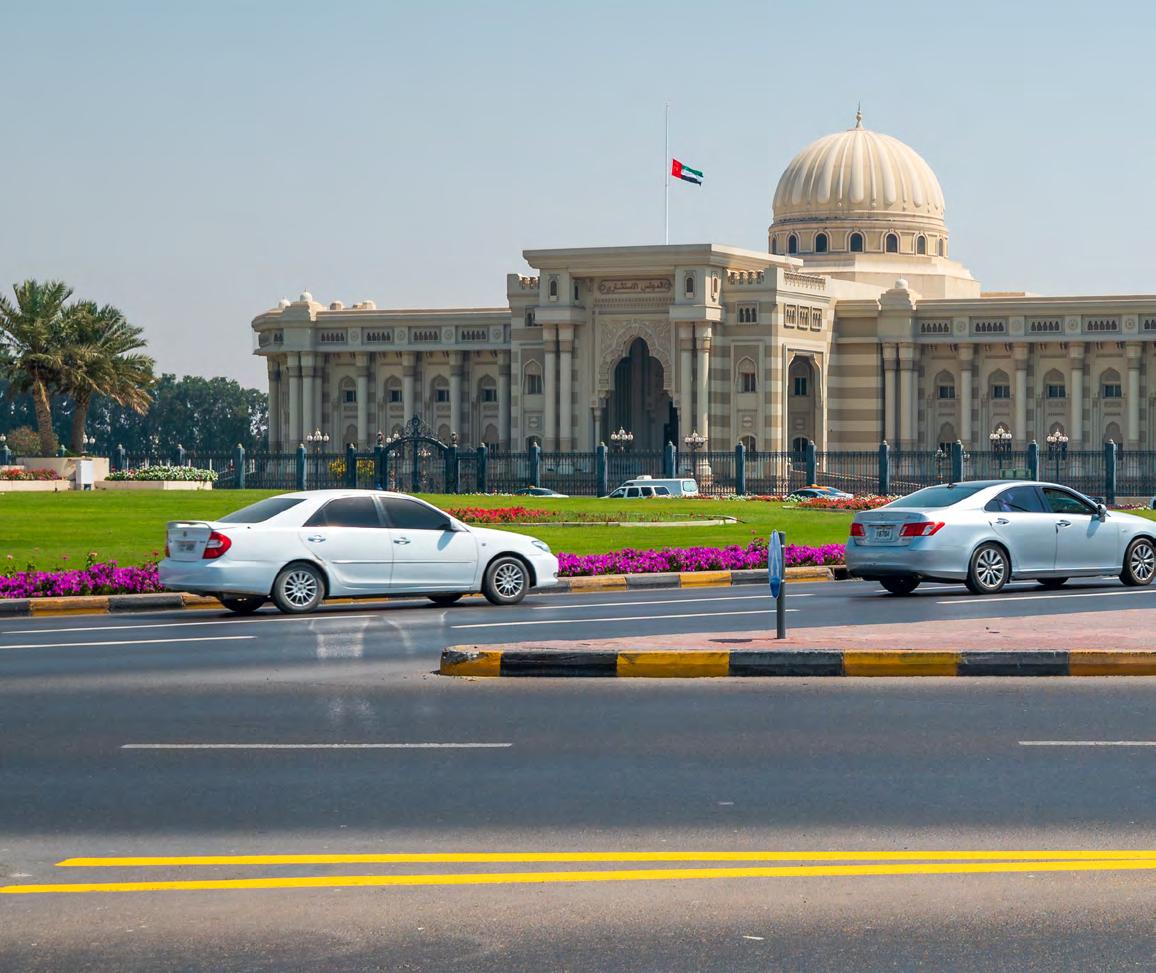
Sharjah’s latest infrastructure investment is about more than easing congestion
Words by Reeba Asghar
The drive between Sharjah and Dubai has become one of the defining routines of life in the UAE. With an ambitious Dh750 million transport overhaul, Sharjah is attempting something much bigger than reducing traffic,it is redesigning how the emirate connects, grows and competes
For anyone who has sat in bumperto-bumper traffic between Sharjah and Dubai, the daily commute has become more than an inconvenience, it’s part of everyday life. Now, Sharjah
is betting Dh750 million on changing that.
In one of the emirate’s most ambitious transport infrastructure programmes in recent years, a sweeping network of tunnels, bridges and upgraded roads is set to transform some of Sharjah’s

busiest transport corridors. The aim is clear: ease congestion, improve mobility and strengthen connectivity with Dubai as the emirate continues to grow.
Announced under the directives of His Highness Sheikh Dr Sultan bin Mohammed Al Qasimi, Supreme Council Member and Ruler of Sharjah, the project will overhaul key routes linking residential neighbourhoods and commercial districts with Dubai’s road network. The works are being delivered by the Authority for Initiatives Implementation (Mubadara) in partnership with the Sharjah Roads and Transport
Authority (SRTA) and other government entities.
At the heart of the programme is a 500-metre tunnel beneath Al Taawun Roundabout - one of the busiest gateways between Sharjah and Dubai. Designed with three lanes in each direction, the tunnel is expected to carry around 4,200 vehicles per hour each way during peak periods, offering thousands of commuters a faster route towards Al Nahda Bridge and Dubai.
The project extends far beyond a single tunnel. It includes the widening of Al Khan Street, upgrades to Al Khulafa Al Rashideen Intersection, new bridges over Industrial Streets 1, 2 and 3, and improvements to the Sheikh Mohammed bin Zayed Road interchange. Together, the upgrades are designed to create a more seamless transport network connecting Al Taawun, Al Khan and Al Buhaira with both local and federal highways.
The
significance of the investment goes beyond reducing journey times.
AS MORE PEOPLE CHOOSE TO LIVE IN SHARJAH WHILE WORKING IN DUBAI, RELIABLE TRANSPORT LINKS HAVE BECOME CENTRAL TO THE EMIRATE’S FUTURE.
Better connectivity not only makes commuting easier but also supports economic growth by improving access to jobs, businesses and essential services.
Research by the OECD and the World Bank has consistently shown that well-connected cities tend to be more productive, more competitive and more attractive places to live and invest.
For residents, the announcement has been met with cautious optimism. Construction and temporary diversions are already under way in parts of Al Taawun and Al Khan, bringing short-term disruption. Yet many commuters see the inconvenience as a worthwhile trade-off if it delivers lasting relief from years of congestion.
The economic impact could be equally significant. Improved road links will enhance access to destinations such as Expo Centre Sharjah, surrounding commercial districts and growing residential communities, while laying the groundwork for future urban development. Faster, more reliable journeys also have the potential to strengthen Sharjah’s position as one of the UAE’s leading residential hubs, offering easier access to opportunities across both emirates.
IS PROGRESSING IN PHASES, WITH THE FIRST SECTIONS OF THE UPGRADED NETWORK EXPECTED TO OPEN BY NOVEMBER 2026.
When complete, the combination of tunnels, bridges and redesigned intersections promises to do more than move traffic more efficiently—it could reshape how Sharjah connects with Dubai, supporting the emirate’s next chapter of growth and making one of the UAE’s busiest daily journeys a little easier.

Edited by Reeba Asghar
In an exclusive interview, Taner Demirel, Director of Offshore Services at ASRY, explains how predictive technologies, engineering expertise and integrated project execution are transforming offshore asset lifecycle management

What do you see as the biggest technical and commercial challenges in extending asset life while maintaining safety and profitability?
Extending the operational life of offshore assets requires a careful balance between maintaining technical integrity, ensuring safety compliance and protecting commercial performance. For rig owners, this creates a complex set of priorities where engineering decisions directly impact operational continuity and financial outcomes.
Technical Challenges: Structural Integrity & Obsolescence
• Hidden Degradation: Fatigue, accelerated corrosion and material deterioration can develop in critical, high-stress areas that are often difficult to inspect and access, such as spudcans, internal ballast tanks and major structural connections.
• System Obsolescence: Many ageing assets rely on legacy drilling, electrical and control systems where OEM support and spare parts availability are becoming increasingly limited. This often requires significant upgrades, retrofits and modernisation programmes rather than straightforward repairs.
Commercial Challenges: ROI
Predictability & Capital Risk
• Unpredictable CAPEX: Service Life Extension (SLE) programmes require substantial capital investment, but costs can increase unexpectedly when additional structural issues are discovered during surveys
• Market Volatility: Owners must also balance these investments against fluctuating market conditions, charter rates and the financial impact of unplanned downtime.
At ASRY, we address these challenges by engaging with owners from the earliest stages of a project. Our engineering and technical teams work alongside clients during tendering and pre-planning phases to develop realistic, technically feasible and commercially predictable scopes of work. By identifying high-risk areas and regulatory requirements early, we help minimise surprises, control costs and ensure assets return to operation as efficiently as possible.
What are the most common disconnects between rig owners and repair yards, and how can both sides collaborate more effectively?
The “Discovery Work” Surprise
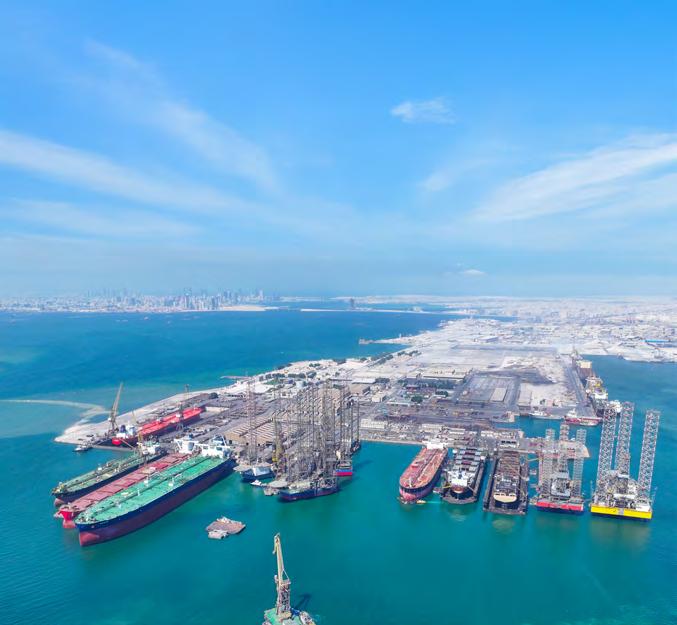
One of the most common challenges is the gap between the expected scope of work and the actual condition of the asset once inspections begin.
Rigs often arrive with a defined repair programme, but once tanks are opened or steel surfaces are prepared, hidden corrosion and structural issues can be uncovered. This can create immediate pressure on budgets and schedules.The key is early engagement. At ASRY, we mobilise experienced project and technical teams during the tendering and planning stages, often before the rig reaches the yard. This allows us to conduct early assessments, identify potential problem areas and support owners in developing a realistic, data-driven work scope.
Another challenge is supply chain coordination, particularly when owner-furnished equipment or OEM specialists are delayed. These delays can affect the critical path of a project. To overcome this, ASRY uses an Integrated Project Management Team (IPMT) approach, bringing together
owner representatives, yard teams and classification surveyors to improve communication and decision-making. Our OEM-approved workshops and in-house technical capabilities also allow us to complete many repairs internally, reducing dependency on external suppliers and helping keep projects on schedule.
Ultimately, the most successful projects are built on partnership rather than a traditional client-versus-vendor relationship.
What differentiates a yard today beyond price, and what factors most influence a client’s final decision?
Price remains important, but offshore owners are increasingly focused on overall value, certainty and risk reduction. Today, clients are looking for partners who can provide confidence that projects will be completed safely, efficiently and within predictable timelines.
Here are the key factors that differentiate a yard today and influence a client’s choice:

One of the biggest differentiators is experience. Offshore assets require specialised knowledge, and owners prefer yards with proven experience in complex rig repairs, upgrades and life extension programmes.
Owners look for a yard with specific, repeated experience in safe execution of complex offshore rig repair and upgrades rather than general ship repair. With more than 200 offshore rig projects completed, ASRY brings significant asset familiarity and an understanding of the structural and mechanical challenges associated with these assets.
Physical capability is another important factor. Offshore projects require the capacity to manage largescale work programmes while also responding quickly to unexpected discoveries.
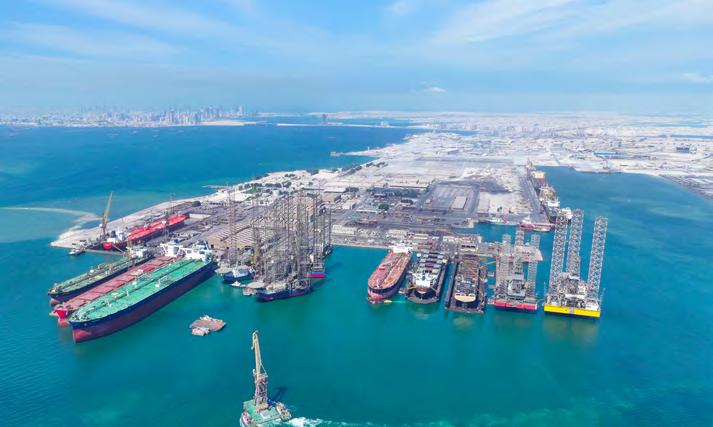
ASRY’s 500,000 DWT graving dock provides the infrastructure required to accommodate some of the largest offshore assets in operation, including major jack-up drilling rig designs.
Technical capability is equally important. Through our specialised mechanical, hydraulic and electrical workshops, supported by OEM-approved expertise, we can execute complex repairs internally and reduce reliance on external supply chains.
Ultimately, owners are not simply choosing the lowestcost option. They are selecting a partner who can reduce risk and deliver long-term value.
How do you see digital technologies, predictive maintenance and data analytics changing the way offshore assets are repaired, upgraded and managed over the next decade?
The next decade will see a major shift from reactive maintenance towards continuous, data-driven asset management. Digital technologies will allow operators and service providers to understand asset conditions in real time and make more informed decisions before failures occur.
Over the next decade, digital transformation will completely shift offshore asset management from a reactive, calendar-based model to a continuous, datadriven strategy. For jack-up rigs and offshore assets, this evolution changes how they are managed at sea and how they are repaired at the yard. Here is how these digital trends will reshape the industry and how ASRY is integrating them to maximize project predictability:
The next decade will see a major shift from reactive maintenance towards continuous, data-driven asset management. Digital technologies will allow operators and service providers to understand asset conditions in real time and make more informed decisions before failures occur.
One of the most important developments will be the adoption of digital twins, virtual representations of physical assets that are continuously updated using data from onboard monitoring systems, including vibration analysis, ultrasonic measurements and thermal monitoring. Instead of waiting for a rig to arrive at a yard before discovering issues, engineering teams will increasingly be able to analyse asset condition in advance, prepare materials, plan repairs and improve project efficiency.
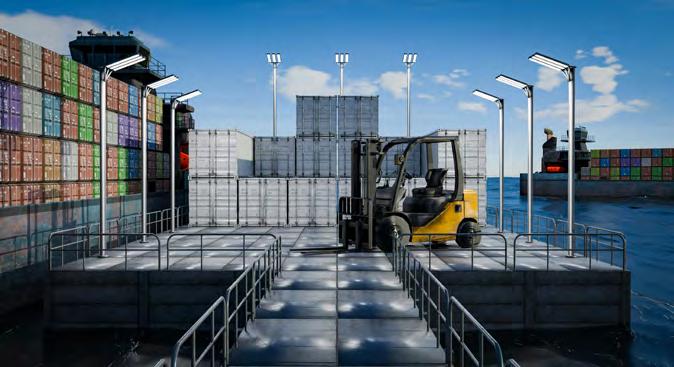
Predictive analytics will also transform the maintenance of critical systems such as jacking mechanisms, draw works, mud pumps and top drives. Real-time monitoring can identify early warning signs and allow intervention before major failures occur.
For ASRY, the future of offshore services will not only be measured by physical infrastructure, but by digital capability. By integrating data-driven insights into project execution, we can improve predictability, reduce turnaround times and help assets return to operations faster.
How do you balance the pressure for commercial performance with the need to maintain high technical standards and project execution quality?
The key is recognising that technical quality and commercial performance are not opposing objectives, they are directly connected.
• Non-Negotiable Safety and Class Boundaries: Safety and regulatory compliance must always remain non-negotiable. International standards, classification requirements and engineering best practices provide the foundation for every project. Commercial optimisation should focus on better planning, efficient procurement, improved scheduling and smarter execution without compromising structural integrity or operational safety.
• Total Cost of Ownership (TCO) Approach: Investing in quality materials, reliable components and effective maintenance strategies during a yard period can significantly reduce the risk of expensive failures during offshore operations.
• Clear Change-Management Protocols: Ensuring every decision considers both technical impact and commercial value.
As the global energy transition accelerates, how do you see the role of offshore service providers evolving over the next 10–15 years, and what opportunities do you believe will emerge beyond traditional oil and gas?
The energy transition will fundamentally redefine the role of offshore service providers.
Shipyards and marine infrastructure providers are evolving from traditional repair facilities into integrated
multi-energy hubs, supporting both existing offshore operations and emerging energy sectors.
One important area is decarbonising existing fleets and infrastructure. ASRY is supporting this transition through its solar energy project, which is expected to reach more than 44 MW across two phases and generate over 71 million kWh of clean electricity annually.
Beyond oil and gas, offshore wind represents a significant opportunity. The growth of fixed and floating offshore wind projects will require specialised fabrication capabilities, marine infrastructure and large-scale assembly facilities.
ASRY is positioning itself to support this emerging sector through strategic partnerships and its 205,000 sqm fabrication area, which provides significant potential for renewable energy-related projects.
Another important opportunity is sustainable decommissioning and recycling. As older assets reach the end of their operational lives, responsible asset lifecycle management will become increasingly important.
Through its partnership with Priya Blue, ASRY is developing environmentally responsible recycling solutions aligned with international standards.
The future belongs to organisations that can successfully balance today’s offshore requirements with tomorrow’s energy opportunities. By combining engineering excellence, digital innovation and sustainability, offshore service providers can play a central role in shaping the next generation of maritime infrastructure.
The Future Shopper Is Here

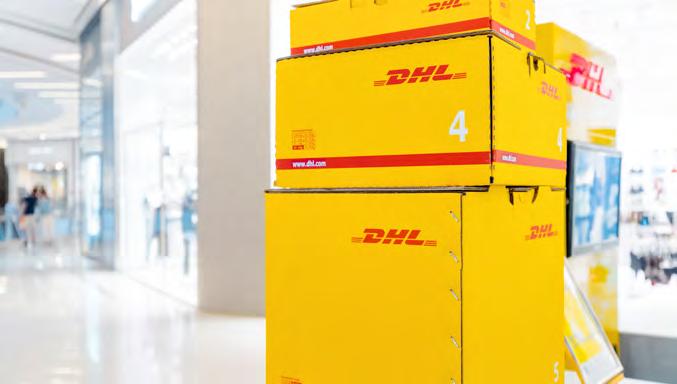
According to DHL eCommerce’s latest global research, the future of online shopping will be shaped by artificial intelligence, sustainability and the rapid rise of recommerce
Artificial intelligence could soon influence what consumers buy, sustainability is rapidly becoming a business imperative, and secondhand shopping is moving firmly into the mainstream, according to new research from DHL eCommerce. The eCommerce Trends Report 2026, based on insights from 29,000 online shoppers and 5,800 e-commerce businesses across 29 countries, including the UAE, identifies
the key trends set to reshape the retail landscape over the coming years and highlights how businesses can adapt to evolving consumer expectations.
AbdulAziz Busbate, CEO Middle East and North Africa, DHL Express, said:
“The UAE’s strength as an e-commerce market lies in the combination of a highly digital society, strong connectivity global and intraregional and a consumer base that is quick to adopt new online shopping habits. As digital platforms, flexible payment options and delivery expectations
continue to shape the market, businesses have a strong foundation for growth. For retailers in the UAE, local relevance and the ability to serve both domestic demand and crossborder opportunities will be key as e-commerce continues to evolve.”
The report reveals that the UAE is among the markets where digital commerce is evolving particularly rapidly. Over the next five years, 52% of UAE consumers expect to shop more frequently through retailer websites, while 51% anticipate greater use of
online marketplaces. Meanwhile, 47% expect to purchase more through mobile apps and 37% through AI-powered chatbots and virtual assistants.
Social commerce also plays a strong role in the UAE. According to the report, 68% of UAE shoppers have purchased through Facebook, 67% through Instagram, 57% through TikTok and 41% through YouTube. Businesses are active across the same channels, with 82% having sold through Facebook, 75% through Instagram, 73% through TikTok and 52% through YouTube. Marketplaces remain highly relevant as well, with Amazon identified as the most popular online marketplace for both UAE shoppers and businesses.
The global e-commerce market is also experiencing rapid behavioral shifts, widening an expectation gap between what modern shoppers demand and what online businesses are prepared to deliver. AI is transforming buyer habits and accelerating innovation across the e-commerce ecosystem. In doing so, it is beginning to upend traditional formats and could even lead to the disappearance of virtual storefronts. Securing consumer loyalty in this changing landscape requires moving past transactional speed to master checkout trust, payment choice, and localized delivery convenience.
Pablo Ciano,
AbdulAziz Busbate, CEO Middle East and North Africa, DHL Express

CEO of DHL eCommerce,
said: “The ability to understand and respond to customer needs has always defined success - but our new
eCommerce trend report shows that AI is now redefining that advantage at hyperspeed. Consumers can identify the best offer in milliseconds, and retailers can gain insights that allow them to instantly capitalize on changing demand. For those of us powering the delivery infrastructure behind e-commerce, AI enables new levels of speed, flexibility, and
precision. In this new era, the winners will be those who move fastest – and translate that speed into superior customer experiences.”
To help businesses navigate this rapidly evolving environment, DHL eCommerce has identified several trends that are expected to have a

significant impact on the future of online retail.
The next online shopper may not be human
Almost one-third of consumers (29%), rising to 33% among Generation Z and 36% among Millennials, say they would be comfortable allowing AI to make purchasing decisions on their behalf within the next five years. Meanwhile, 59% of businesses expect consumers to browse and shop through virtual assistants in the future.
As generative AI transforms every stage of the customer journey, from product discovery to postpurchase support, 73% of businesses anticipate increasing their use of the technology over the next five years, despite ongoing consumer concerns around privacy and trust, cited by 48% of respondents.
In the UAE, AI-assisted shopping is already gaining momentum. More than half of consumers (51%) use AI-powered chat tools when shopping online, placing the country among the leading markets surveyed. Businesses are moving
even faster, with 91% already using AI in some capacity and 84% expecting adoption to increase further over the coming years.
Out-of-home delivery becomes the new standard Consumer demand for convenience continues to drive innovation in fulfilment and delivery. One in five shoppers (20%) say faster delivery would encourage them to complete a purchase, while growing numbers are turning to out-of-home
delivery options to accommodate increasingly busy lifestyles.
In the UAE, however, home delivery remains the preferred option, with 84% of consumers favouring directto-door delivery and 73% preferring home collection for returns. Nevertheless, alternative fulfilment models are gaining traction, with 12% using parcel lockers for deliveries and 23% using them for returns. UAE consumers also demonstrate a strong appetite for premium logistics
services. Nearly two-thirds (64%) subscribe to paid delivery and returns programmes, while 73% of businesses already offer
such services and a further 24% plan to introduce them.
The report highlights a growing disconnect between consumer expectations and retailer priorities. While free delivery and returns remain among the strongest purchase drivers, 70% of shoppers also identify trust and delivery partner choice as critical factors when selecting where to shop. Similarly, 62% of consumers say they would abandon a purchase if their preferred payment method was unavailable, yet only 45% of businesses recognise this as a major cause of basket abandonment.
The home will become a sustainable side hustle
The distinction between buyer and seller is increasingly blurred as second-hand and consumer-to-consumer (C2C) commerce continues to expand. More than half of consumers globally (52%) have sold items through online marketplaces, rising to 62% among Millennials and 58% among Generation Z. Europeans currently lead C2C activity, with 57% reporting that they regularly sell products through marketplace platforms.
Sustainability is playing an increasingly important role in purchasing decisions. Nearly half of consumers (45%) say they buy second-hand or refurbished products for environmental reasons, while a further 15% would consider doing so in the future.
The report also highlights a growing shift towards circular commerce in markets such as the UAE, Saudi Arabia, India, Malaysia and Nigeria, where consumers and businesses alike are embracing more sustainable shopping habits. Millennials and medium-sized businesses are emerging as key drivers of this transition.
Looking ahead, sustainable logistics is expected to move from a competitive advantage to a baseline requirement. More than four in ten consumers (42%) believe sustainability will become a standard expectation from retailers and logistics providers within the next five years, reinforcing its growing importance across the e-commerce ecosystem.

Etihad Rail introduces a fresh way to explore the Emirates, where the changing desert, rugged mountains and coastal vistas become as memorable as the destinations themselves
Written by Reeba Asghar
There is a certain timeless appeal that belongs exclusively to rail travel.
Long before boarding passes and motorway service stations became part of modern life, trains represented discovery. They stitched together cities, opened up landscapes and transformed the journey from a necessity into an experience. Somewhere along the way, speed overtook sentiment. We became accustomed to rushing from one destination to another, rarely noticing what lay in between.
Etihad Rail brings that sense of discovery into a new era, combining the enduring appeal of rail travel with the expectations of the modern traveller.
On 30 June 2026 , the UAE began rewriting its travel story.
The launch of Etihad Rail’s first passenger service marks more than an infrastructure milestone; it signals a new chapter in how the country moves and connects.

configuration, generous legroom, charging points and Wi-Fi, while Premium Class provides a more elevated experience with a 2+1 seating layout, wider seats, additional space and a quieter cabin environment.
FOR THE FIRST TIME, RESIDENTS AND VISITORS CAN TRAVEL BETWEEN ABU DHABI AND FUJAIRAH BY RAIL IN AROUND ONE HOUR AND 45 MINUTES, TRANSFORMING A FAMILIAR ROAD JOURNEY INTO A MORE IMMERSIVE WAY TO EXPERIENCE THE EMIRATES.
Passengers can choose between two travel experiences: Comfort Class and Premium Class. Introductory fares begin from AED55 for Comfort Class and AED120 for Premium Class. Comfort Class offers spacious reclining seats in a 2+2
The experience extends beyond the seat. An onboard café offers refreshments and light meals, while large panoramic windows transform the changing scenery into part of the journey itself. From the comfort of the carriage, passengers can watch the UAE’s landscapes shift from expansive desert plains to the dramatic peaks of the Hajar Mountains and the coastline of Fujairah.
For a nation celebrated for record-breaking architecture, world-class airports and advanced road networks, the arrival of passenger rail represents a significant evolution. The

UAE has not simply introduced a railway; it has created a new way to experience its geography.
Rather than recreating the nostalgia of old-world railways, Etihad Rail presents a distinctly contemporary interpretation. Designed for today’s traveller, the trains combine comfort, connectivity and efficiency, accommodating up to 400 passengers and travelling at speeds of up to 200 kilometres per hour.
What makes the railway particularly compelling is the perspective it offers. For decades, much of the UAE has been experienced in fragments: the skylines of Abu Dhabi and Dubai, the desert landscapes viewed from highways, or weekend escapes to the eastern coast. Rail brings these destinations together, revealing the transition between them.
The route showcases the country’s natural diversity, moving through wide desert landscapes before reaching the rugged Hajar Mountains, one of the Arabian Peninsula’s oldest mountain ranges. It offers a reminder that beyond the UAE’s futuristic cities lies a landscape shaped by mountains, valleys and coastline.
The stations reflect the same forward-thinking approach.
Designed as integrated mobility hubs, they connect passengers with wider transport networks while offering facilities that make them more than simple departure points.
Yet Etihad Rail’s importance extends beyond infrastructure.
For business travellers, it offers greater predictability between economic centres. For families, it introduces a more relaxed way to travel together. For tourists, it creates a new opportunity to explore the Emirates through a different lens.
The project also reflects the UAE’s wider commitment to sustainable and connected mobility. As cities worldwide invest in smarter transport solutions, Etihad Rail represents a longterm vision for a more accessible and integrated future.
Like any major transport project, its true impact will be measured over time. Reliability, frequency and connectivity with local transport will determine how deeply it becomes embedded into everyday life.
The Abu Dhabi–Fujairah service is only the beginning. As the network expands across the Emirates, Etihad Rail has the potential to reshape commuting patterns, support tourism and strengthen links between communities. Ultimately, Etihad Rail is about more than trains. It is about creating new possibilities for how people experience the country, replacing long drives with meaningful journeys and turning travel time into time well spent.
EVERY GREAT RAILWAY HAS A DEFINING MOMENT. FOR THE UAE, 30 JUNE 2026 WILL BE REMEMBERED NOT SIMPLY AS THE DAY THE FIRST PASSENGER TRAIN DEPARTED, BUT AS THE MOMENT THE NATION EMBRACED A NEW WAY OF MOVING FORWARD.
Not only faster but more connected, more sustainable and more memorable.


Rafal Hyps, Chief Executive Officer of Sicuro Group
Rafal Hyps, Chief Executive Officer of Sicuro Group, highlights why resilience requires more than multiple suppliers or alternative routes
Many companies operating across the GCC still rely on highly concentrated supplier networks and logistics corridors. In today’s geopolitical climate, what does a truly resilient supply chain architecture look like, and where are businesses still dangerously overexposed?
A resilient supply chain begins with a clear understanding of where operational vulnerabilities exist and where potential points of failure may emerge. Most organisations have visibility of their immediate suppliers, logistics providers and key contractual relationships. However, far fewer have mapped the deeper dependencies that sit beneath those relationships. The greatest risks are often not found within the first layer of a supply chain, but further downstream, where shared infrastructure, common service providers or regional dependencies can create hidden vulnerabilities.
A business may believe it has diversified its suppliers or logistics partners, but those providers may still rely on the same port, transport route, technology platform, subcontractor or regional corridor. On paper, the organisation appears diversified; in reality, it may still be exposed to a single point of failure.
The GCC benefits from some of the world’s most advanced logistics infrastructure, with world-class ports, expanding transport networks and increasingly connected trade corridors. The opportunity for businesses is to use this infrastructure strategically by building flexibility into their operations.
The strongest organisations are those that test their assumptions before disruption occurs. If a primary logistics corridor
becomes unavailable, can an alternative route actually handle the required volume? Are customs processes, contracts, inland transportation arrangements and working capital requirements already aligned?
Companies that have not tested these scenarios are operating on assumptions. Those that have done the work are operating with confidence.
As organisations reassess GCC market entry and expansion strategies, how are leading companies balancing operational efficiency with resilience, particularly around workforce deployment, supplier diversification and contingency planning?
Historically, many organisations viewed efficiency and resilience as competing priorities. Today, that mindset is changing. The cost of disruption has become a key consideration in business decision-making, and companies are recognising that the lowest-cost option is not always the most commercially effective choice.
A supplier may offer competitive pricing under normal circumstances, but if that supplier fails during a period of disruption, the resulting costs, including delays, replacement sourcing and operational downtime can increase significantly.
We are seeing a shift towards maintaining standby capability. Some organisations are choosing to invest in alternative suppliers, logistics capacity or operational support arrangements through structured retainers, ensuring that credible alternatives remain available when needed.
Contingency planning is also becoming more sophisticated. The most mature organisations are not simply creating plans and storing them away;
they are conducting scenario-based exercises, involving key stakeholders and testing whether the people responsible for execution can respond effectively under pressure.
A plan only has value if the organisation can activate it.
How important are leadership readiness and governance clarity during a disruption, and what separates companies that recover quickly from those that struggle?
Leadership readiness and governance clarity are among the most important factors determining how effectively an organisation responds to disruption.
The difference between companies that recover quickly and those that struggle is usually determined well before the crisis occurs.
Resilient organisations typically have three things in place.
First, they have clearly defined decision-making authority. They know who has responsibility for activating alternative supply routes, accessing emergency funding, communicating with stakeholders and making critical operational decisions.
Second, they provide those individuals with the authority to act within agreed parameters. During a disruption, delays
caused by unclear approval processes can create significant operational consequences.
Third, they rehearse their response with the people who will actually manage the situation.
Many organisations have governance structures that appear effective on paper but become unclear under pressure. Decision-making can become fragmented between regional leadership, country teams, finance functions and operational departments, particularly when key decision-makers are unavailable.
Preparation creates speed. The organisations that recover fastest are usually those that have already defined their response before the disruption begins.
Many businesses assume their insurance frameworks provide adequate protection against disruption, evacuation or supply chain failure. Where is the biggest disconnect between perceived coverage and actual operational resilience?
The first step is understanding what insurance is designed to do. Insurance is a financial risk transfer mechanism. It provides financial support when certain events occur, but it does not execute a contingency plan, manage

an operational response or replace internal preparedness. The most common misunderstanding is that having insurance automatically means an organisation is protected. In reality, insurance supports the response, it does not create the response. There are three areas where this gap becomes particularly visible.
1. For business interruption, many policies are structured around physical damage triggers. However, many modern disruptions do not involve physical damage. A closed trade route, port congestion, vessel diversion or supplier failure can create significant operational and financial impact without triggering traditional coverage. Specialist trade disruption solutions may address some of these risks, but businesses must understand exactly what their policies cover and where gaps remain.
2. Security evacuation is another area where expectations can differ from reality. Policies often include specific conditions, approval requirements and defined processes. Organisations must understand the capabilities of their nominated assistance providers, including their local presence, response capacity and ability to scale during widespread disruption.
3. Supply chain risk is equally complex. Marine cargo insurance, for example, may exclude certain geopolitical risks unless additional coverage is arranged. Meanwhile, the cost of delays, storage, rerouting and increased inventory requirements may sit outside traditional coverage.
The key message is simple: insurance is one component of resilience, not resilience itself. True preparedness requires organisations to test their insurance arrangements alongside their operational plans, response teams and external partners.
In your experience, which sectors in the GCC are currently the most advanced in resilience planning, and which industries still have significant preparedness gaps?
Resilience maturity across the GCC varies less by sector and more by the depth of investment and leadership commitment behind continuity planning. The most advanced sectors are typically energy, aviation and major financial institutions. These industries have long operated within environments that demand rigorous risk management, regulatory oversight and regular testing. They have established
business continuity structures, crisis response frameworks and leadership processes designed to perform under pressure.
Across other industries, progress is continuing, but maturity levels differ. Some organisations have developed strong continuity practices, while others are still building the operational foundations required to support rapid growth and expansion. The key distinction is whether business continuity is viewed as a compliance requirement managed by one function, or as an active business discipline owned by leadership. The organisations that treat resilience as part of their culture are the ones that recover faster, with less disruption and greater confidence.
Looking ahead, how do you see the definition of business continuity evolving over the next three to five years, particularly as companies in the GCC prepare for increasingly complex geopolitical, climate and supply chain risks?
Business continuity is undergoing a fundamental transformation. Traditionally, continuity planning sat within a single department — whether risk,
operations, security or compliance. However, the complexity of modern disruption means resilience can no longer sit within one function.
The leading organisations are moving towards a crossfunctional model where commercial teams, operations, finance, HR, legal, technology and security work together. The decisions that determine whether a company recovers quickly are rarely owned by one department. They require coordinated action across the organisation.
Another major shift is alignment with regional infrastructure development. The GCC is investing heavily in systems that support long-term resilience, including logistics infrastructure, energy security, water resilience, climate adaptation and advanced regulatory frameworks.
Businesses that align their continuity strategies with these regional developments will be better positioned to respond to future challenges.
The future of resilience will belong to organisations that do not simply react to disruption, but actively design their operations to withstand it.

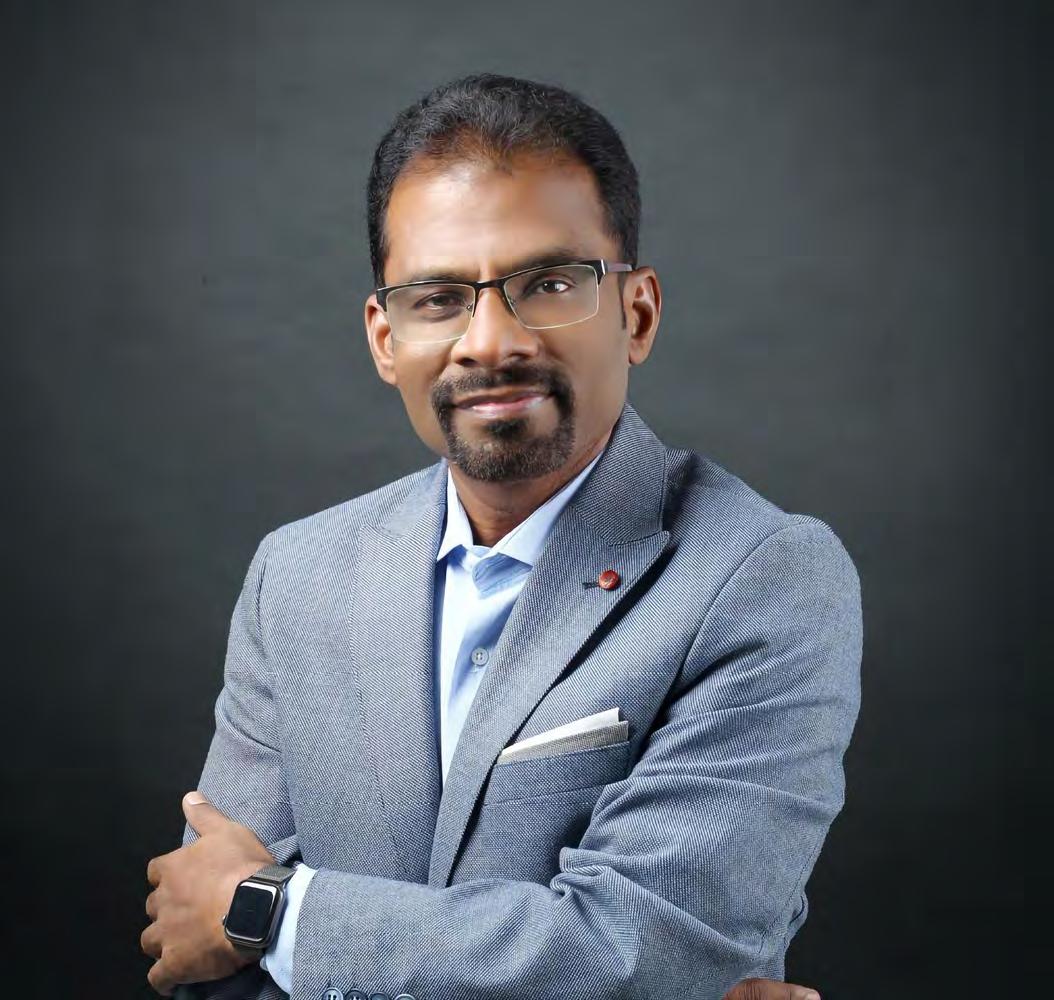
In an exclusive conversation, Prem Anand Kumar Nallasamy, Business Head of Service My Car, explores how businesses must adapt today to remain competitive in tomorrow’s mobility ecosystem
“Thank you for the opportunity. Having spent nearly 30 years in the GCC automotive industry, I’ve witnessed significant changes in vehicle technology, customer expectations, and service delivery models. What is particularly exciting today is that automotive aftersales is no longer just about repairing vehicles; it is becoming a critical enabler of mobility, operational efficiency, and business continuity. Whether for individual vehicle owners or large fleet operators, the industry is increasingly focused on maximizing uptime, leveraging digital technologies, and delivering a more connected customer experience. It is an exciting time to be part of this transformation.”


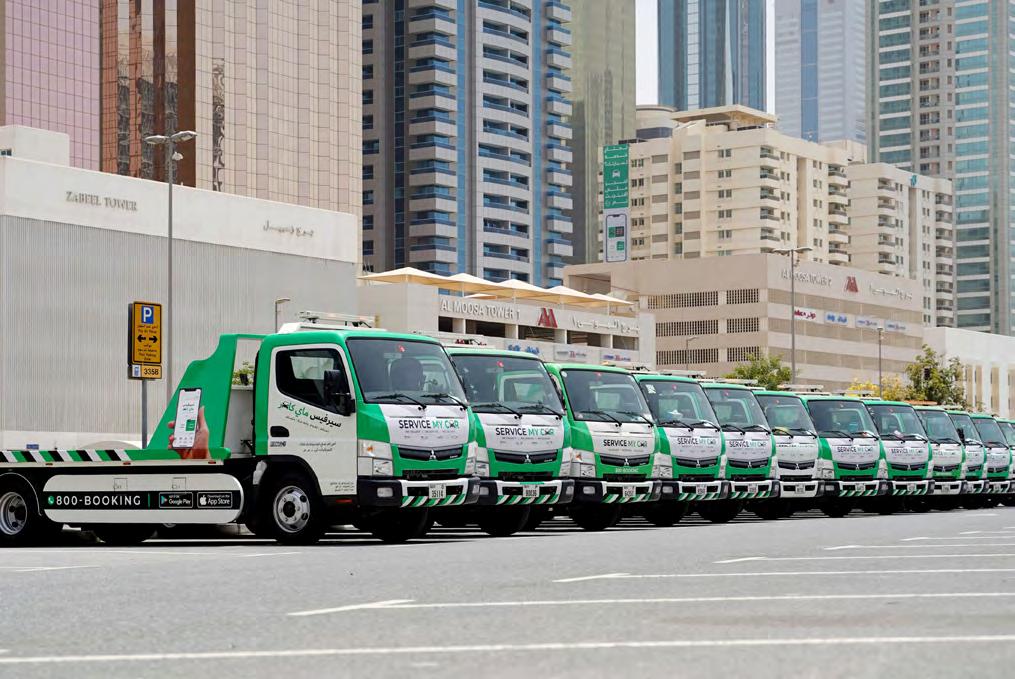
How do you see customer expectations evolving in the GCC, and what role will digitalisation play in shaping the next generation of aftersales experiences?
Customer expectations across the GCC have changed significantly over the past decade. Previously, customers were primarily focused on service quality and price. Today, they expect a much more seamless experience built around convenience, transparency, speed and complete visibility throughout the entire service journey.
The automotive aftersales industry is moving towards a digital-first model, where online booking, real-time vehicle tracking, digital inspections, paperless approvals and AI-powered service recommendations will become standard expectations rather than premium offerings.
Customers increasingly compare automotive services with the seamless digital experiences they receive from sectors such as banking, e-commerce and food delivery. This has raised the benchmark for convenience and responsiveness across industries.
At Service My Car, we have embraced this shift through digital booking platforms, live service tracking, paperless workflows and centralised customer communication. We believe the next generation of
aftersales will be defined by the ability to combine strong technical expertise with a frictionless digital customer experience.
How close is the industry to moving from reactive servicing to predictive aftersales models, and what challenges still need to be overcome?
The automotive industry has already started transitioning from reactive maintenance towards predictive servicing, but there is still significant progress to be made before it becomes the dominant model.Connected vehicles, telematics, vehicle health monitoring systems and AI-driven analytics are creating unprecedented visibility into vehicle performance. These technologies provide the foundation to identify potential issues before they become major failures, allowing businesses and customers to move from fixing problems to preventing them.
At Service My Car, we have already begun working with predictive maintenance and vehicle health monitoring solution providers to explore how data can improve fleet uptime and reduce unexpected breakdowns.
One of the biggest challenges remains data integration. Vehicle data, workshop management systems, fleet platforms and customer communication channels often
operate separately, limiting the ability to create a complete picture of vehicle health.
Another challenge is changing customer perception. Many vehicle owners still see maintenance primarily as a cost rather than an investment in reliability, safety and long-term value.
Over the next five years, predictive maintenance will become a major differentiator, particularly for logistics and fleet operators where downtime has a direct impact on productivity and profitability.
What are the biggest competitive advantages multi-brand service providers have today, and where do traditional dealer networks still hold an edge?
Multi-brand service providers are becoming increasingly attractive because they offer customers greater flexibility, convenience and value. Instead of visiting different service centres for different vehicle brands, customers can access multiple solutions through a single provider while benefiting from competitive pricing and faster turnaround times.
Digital platforms have strengthened this model even further by simplifying booking, approvals, communication and service tracking.
The combination of Service My Car’s digital platform and Auto Fix’s multi-brand workshop network reflects this evolution,
bringing together technology-driven convenience with broad technical capability.
That said, traditional dealer networks continue to maintain important advantages through direct OEM relationships, access to proprietary technical information, manufacturer training programmes and specialist expertise, particularly for warrantyrelated services and software-based repairs.
Ultimately, the future will not be defined by a competition between dealers and independent service providers. Success will depend on who can deliver the strongest combination of technical capability, customer experience, transparency and digital convenience.
As electric vehicle adoption accelerates across the GCC, how do you expect aftersales business models to evolve, and what investments should service providers be making today to remain competitive tomorrow?
As electric vehicle adoption accelerates across the GCC, the aftersales industry will experience a significant transformation. Electric vehicles have fewer moving parts and require less traditional maintenance compared with internal combustion engine vehicles, meaning service providers will need to rethink traditional revenue models.Future growth opportunities will increasingly come from areas such as battery health diagnostics, software updates, EV-specific repairs, charging infrastructure support and fleet electrification services.
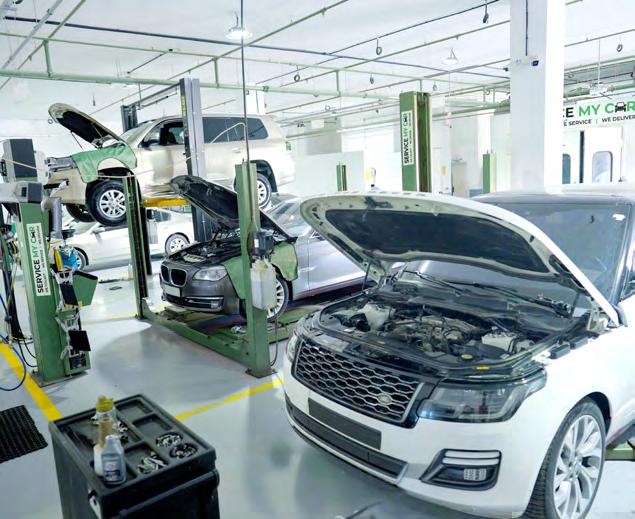
At Service My Car, we have already started strengthening our EV ecosystem through strategic partnerships, technician capability development, EV diagnostics, high-voltage safety training and collaborations such as PlusX Electric. The transition will also be particularly important for logistics operators, many of whom are expected to operate mixed fleets of electric and conventional vehicles in the coming years.
To remain competitive, service providers must invest today in technical training, EV diagnostic capabilities, charging ecosystem partnerships and digital platforms capable of supporting multiple vehicle technologies.
The independent service sector is becoming increasingly crowded across the UAE and Saudi Arabia. Beyond pricing, what will differentiate the most successful automotive service businesses over the next five years?
The most successful automotive service businesses will not necessarily be those offering the lowest prices. They will be the companies that build the
Prem Anand Kumar Nallasamy, Business Head Service My Car
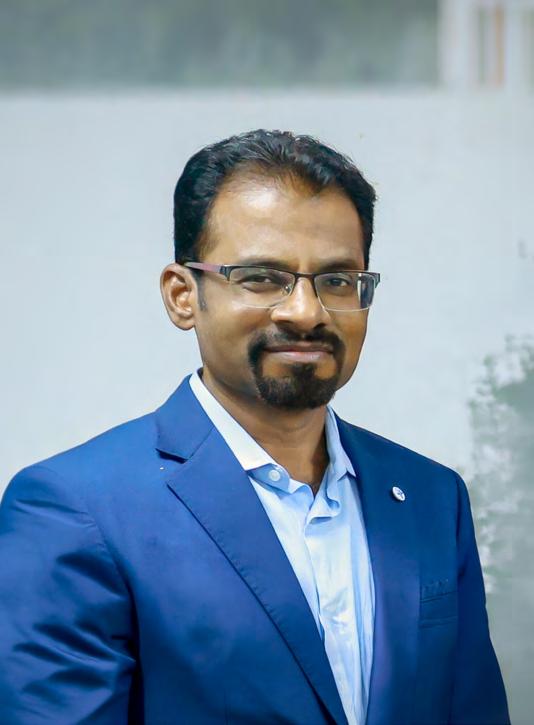
strongest levels of trust, transparency and technologydriven customer engagement.
Customers increasingly value convenience, visibility and confidence throughout the service process. Businesses that provide real-time updates, digital inspections, predictable turnaround times and consistent service quality will have a significant competitive advantage. For fleet operators, the focus is also shifting away from repair costs alone towards uptime, operational efficiency and total cost of ownership.
At Service My Car, our investments in digital customer journeys, operational transparency, service ecosystem
partnerships and fleet-focused solutions are designed around these changing expectations.
The future of automotive servicing will be shaped by companies that understand customers are not simply looking for repairs, they are looking for reliability, convenience and a better ownership experience.
If you look ahead five years, what do you think the automotive aftersales industry in the GCC will look like, and which trends are currently being underestimated?
Five years from now, I expect the GCC automotive aftersales industry to be far more connected, digital and data-driven than it is today.
We will see wider adoption of predictive maintenance, AI-assisted diagnostics, connected vehicles, digital service platforms and EV-focused support networks. Fleet operators will increasingly make maintenance decisions based on real-time vehicle data rather than traditional fixed service schedules.
One trend that I believe is currently underestimated is the rise of mobility ecosystems. Customers and businesses are moving beyond individual services and increasingly looking for integrated solutions that combine maintenance, roadside assistance, insurance, inspections, fleet analytics, vehicle lifecycle management and digital support through a single platform.
This vision closely aligns with the direction Service My Car is pursuing as we continue evolving from a servicing platform into a broader mobility ecosystem focused on maximising uptime, minimising downtime and delivering a seamless ownership experience across the GCC.
”THE FUTURE OF AUTOMOTIVE AFTERSALES IS NO LONGER ABOUT FIXING VEHICLES; IT IS ABOUT MAXIMIZING MOBILITY. THE ORGANISATIONS THAT SUCCESSFULLY COMBINE TECHNOLOGY, TRANSPARENCY, AND OPERATIONAL EXCELLENCE WILL DEFINE THE NEXT GENERATION OF MOBILITY SERVICES IN THE GCC.”