SEPTEMBER 2026
|
CBNME.COM
Visit Our Website
SUSTAINABILITY Innovation Forum& Awards
18 DESIGN WISE
THE HUMAN SIDE OF DESIGN
Three years after founding 2BK Interiors, Baylasan Kanj is championing a philosophy where emotion leads every design decision— creating homes, hospitality, healthcare and commercial spaces that prioritise how people feel as much as how they look.
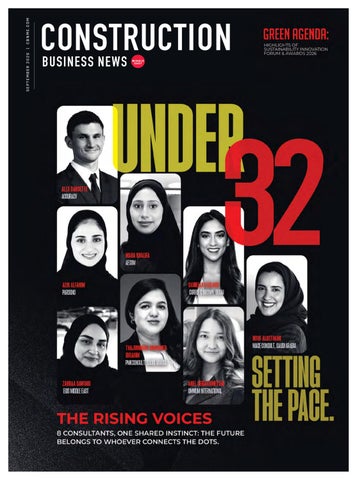
26 COVER STORY UNDER 32 SETTING THE PACE 44
SUSTAINABILITY INNOVATION FORUM & AWARDS 2026 28 56 TALKING POINT THE MASTERPLAN COMES FIRST
Designing Communities That Actually Work
22 MACHINERY
ENGINEERING SHAPED BY USE: KEEPING COMPLEXITY OUT OF THE CAB
Compact machines are becoming more capable, yet according to Cédric Durand, Chief Product Officer at Yanmar Compact Equipment, the best engineering still asks less of the operator.
24 APPOINTMENTS BUILDING THE BENCH
Dewan Architects + Engineers has restructured its leadership team, promoting Samer Touqan and appointing Jasim Al Khateb as managing directors to sharpen accountability and power the firm’s next phase of growth.
WWW.CBNME.COM
58 EXPANSION A NEW DAMASCUS RISES: INSIDE ARADA’S $7BN BET ON SYRIA’S FUTURE
UAE developer Arada has partnered with Syria’s Sovereign Fund on a $7 billion mixeduse city near central Damascus, one of the largest real estate commitments since Syria’s return to international markets.
2026
64 OP-ED TRANSPARENCY IS BECOMING THE GCC’S NEXT PRICING ADVANTAGE
For Matt Myers at Heriot-Watt University Dubai, the GCC’s next real estate advantage may come not from building faster, but from making risk easier to measure and price
66 SAFETY FIRE SAFETY IN RESTAURANTS AND COMMERCIAL KITCHENS
Commercial kitchens carry some of the highest fire risks in the built environment, driven by continuous open-flame cooking and heavy fire loads. Buğra Eren Hakkoymaz of Efectis Era Avrasya explains why grease control, detection, suppression and maintenance must work together under NFPA 96 to keep restaurants safe
62 TECHNOLOGY HOW AI IS FUELLING A MORE HUMAN-CENTRIC APPROACH TO DESIGN
From sustainability-first principles to dynamic digital modelling, AI is revolutionising design and construction and empowering architects with a more human-centric approach.
CONSTRUCTION BUSINESS NEWS ME | SEPTEMBER 2026 | 3
Make growth your next stop Corporate & Investment Banking. Global Markets. Global Banking. Transaction Services. Now is your time sc.com/cib
Dub New York
Johannesburg Standard Chartered Bank UAE is licensed by the Central Bank of the UAE
Shanghai
bai London
Singapore
PO Box 502511 Dubai, United Arab Emirates P +971 4 4200 506 | F +971 4 4200 196 BBC Building No.10, #234, 235, 236, Dubai Media City, Al Falak Street, Dubai
BNC Media Group CEO Wissam Younane wissam@bncpublishing.net Managing Director Rabih Najm rabih@bncpublishing.net Group Publishing Director Joaquim D’Costa jo@bncpublishing.net
Editorial Editor-in-Chief Vibha Mehta vibha@bncpublishing.net Editor - Special Projects Kasun Illankoon kasun@bncpublishing.net Editorial Assistant Aya Zhang aya@bncpublishing.net Digital Reporter Reeba Asghar reeba@bncpublishing.net Contributors Parvin Mansoor and Massimo Imparato
Art Creative Lead Christian Harb chriss@bncpublishing.net Junior Art Director Rizaldi Febrian
Advertising Commercial Director Andrea Mocay andrea@bncpublishing.net Country Manager - KSA Amjad Fakhouri amjad@bncpublishing.net
Multimedia Head of Multimedia Eduardo Buenagua Photography Joel Amparo Videography Harton Otlang
Marketing Marketing Executive Aaron Joshua Sinanbam aj@bncpublishing.net Junior Marketing Executive Elizaira Andes zaira@bncpublishing.net For all commercial enquiries, contact jo@bncpublishing.net T +971 50 440 2706 All rights reserved © 2026. The opinions expressed are solely those of the contributors. Construction Business News Middle East and its affiliated publications in the MENA region are exclusively licensed to BNC Publishing. No part of this magazine may be copied, reproduced, or transmitted in any form or by any means without prior written consent from the publisher. Printed by United Printing and Publishing | upp.ae
Images used in Construction Business News Middle East are credited when necessary. Attributed use of copyrighted images with permission. All images not credited courtesy Shutterstock. CBNME
@CBNME
CONSTRUCTION BUSINESS NEWS MIDDLE EAST
Your light, your choice BEGA QuickFit ® transforms standard luminaires into custom-made solutions – from bespoke finishes to tailored light temperatures and everything in between. Fast. Precise. Effortless. bega.com/quickfit
BEGA QuickFit ®
Letter from the editor
I
almost didn’t notice it happening until someone said it out loud on a call last week: my calendar has stopped looking so quiet.
For a good stretch of this year, conversations with the industry felt like they were happening in slow motion. Projects were being discussed rather than started, and every “let’s catch up next quarter” genuinely meant next quarter. Somewhere between the end of Q2 and the start of Q3, that changed. I can’t point to one single announcement or one deal that flipped the switch, but I can tell you what it feels like from where I sit: phones ringing again, inboxes filling with actual news rather than just press releases, and people ending calls with dates rather than “let’s see.” Our events calendar is the clearest evidence of it. Pillars of Real Estate Awards, the Construction Innovation Awards & Summit, landing in Dubai this October, have gone from save the dates to a genuine scramble for stage time and nominations, and for the first time in a while we are turning conversations away rather than chasing them. It is a good problem to have, and it tells me something real is moving in the market, not just in our inbox. Internally, that same pace has crept into how we work. The team has more happening between now and December than we have had stacked up in a single stretch all year: shoots to plan, panels to confirm, sponsors to lock in, and an editorial calendar that is finally fighting for space rather than begging for content. It has meant longer days and more moving parts, but it is the good kind of busy. The kind where everyone in the room is leaning forward instead of waiting to be told what’s next. What strikes me most is that this isn’t just an internal read on our own numbers. Every conversation I have had with people across the industry in the last few weeks carries the same undertone: things are moving again. Not recovered, not back to some peak, but moving, in a way that felt genuinely absent for a while. Q3 and Q4 are going to be full. I would rather that than quiet.
10 | CONSTRUCTION BUSINESS NEWS ME | SEPTEMBER 2026
Vibha Mehta
Editor-in-Chief vibha@bncpublishing.net
WWW.CBNME.COM
CBNME / REGIONAL NEWS
Imran Farooq, CEO of SAMANA Developers
THREE LAUNCHES, 630 APARTMENTS: SAMANA DEVELOPERS ACCELERATES DUBAI GROWTH The launches form part of a wider pipeline of 20 projects planned for delivery over the next 18 months
SAMANA Developers has launched three residential projects in less than one month, adding 630 new apartments across key growth areas in Dubai. SAMANA Portside, SAMANA Greenfield 2 and SAMANA South Haven mark the latest phase of SAMANA Developers’ expansion across Dubai, with the three projects spanning strategically connected and fast-developing areas of the emirate.
the company grows. “Launching three projects in less than one month is an important milestone for us, but growth has never been about numbers alone,” he said. “Behind every apartment is a person or family placing their trust in us, whether it is the home they will live in or an investment they have worked hard to make. We carry a responsibility to ensure that trust is reflected in the quality of what we build, the lifestyle we create and the long-term value we deliver.”
The launches come as Dubai continues to attract residents and international investors, supported by population growth, infrastructure investment and continued confidence in the emirate’s property market.
The three developments continue SAMANA’s focus on contemporary design and resort-style amenities, including private pools in selected apartments, alongside wellness, leisure and community facilities.
For Imran Farooq, CEO of SAMANA Developers, the pace of expansion also brings a responsibility to maintain standards as
The company has committed to launching and delivering 20 projects over the next 18 months. It says direct oversight of
12 | CONSTRUCTION BUSINESS NEWS ME | SEPTEMBER 2026
WWW.CBNME.COM
The project benefits from access to the Dubai Metro Red Line and Sheikh Zayed Road. Amenities include private pools in selected apartments, an open-air cinema and large energyefficient windows. SAMANA South Haven Located within the Dubai Industrial City and Dubai South corridor, SAMANA South Haven will feature 200 apartments ranging from studios to two-bedroom homes across a sixstorey development. Facilities will include an adult infinity pool, rooftop indoor gym and outdoor gaming arcade, with the project positioned to benefit from the continued expansion of the wider Dubai South district. Together, the three developments extend SAMANA’s presence across different residential locations and price segments while maintaining a consistent focus on location, amenities and design. Imran said the company’s approach would remain centred on maintaining control over delivery as it scales. “This is the SAMANA Promise: to create distinctive lifestyle experiences, uphold the quality our buyers expect and deliver with care and accountability,” he said. “By managing construction, procurement and the supply chain directly, we maintain close oversight at every stage and uphold that promise as we grow.” The projects also offer flexible payment structures alongside their design and amenity packages, while their locations in Dubai’s developing corridors are intended to appeal to both end-users and investors seeking longer-term opportunities. With 20 projects planned over the next 18 months, SAMANA’s latest launches represent a significant expansion of its development pipeline. The focus now will be on translating that growth into consistent delivery, quality and value as Dubai’s residential market continues to evolve. construction, procurement and the supply chain will allow it to maintain greater control over delivery as the pipeline expands. SAMANA Greenfield 2 Located in Warsan Fourth, SAMANA Greenfield 2 will comprise 304 apartments across an 18-storey mixed-use tower, including 234 one-bedroom and 70 two-bedroom homes, as well as three retail spaces. Situated near Sheikh Mohammed Bin Zayed Road, the development will feature panoramic views, technology-enabled conference rooms and a sunken seating area. SAMANA Portside SAMANA Portside, in Jebel Ali Industrial Area 2, will comprise 126 apartments across an eight-storey development, including 110 one-bedroom and 16 two-bedroom homes, alongside six retail spaces.
WWW.CBNME.COM
CONSTRUCTION BUSINESS NEWS ME | SEPTEMBER 2026 | 13
CBNME / REGIONAL NEWS
MACE SUPPORTS DELIVERY OF A NEW CULTURAL LANDMARK FOR OMAN Working within a complex design-and-build environment, Mace has played a leading role in advancing design development and strengthening programme controls to support delivery
T h e S ay y i d Ta r i k b i n Ta i m u r Cu l t u ra l Co m p l ex
M
Supporting delivery within a complex design-and-build environment, Mace has played a leading role in progressing design development, strengthening programme controls and aligning stakeholders, while overseeing several significant project milestones. These include the substantial completion of the project’s iconic canopy structural steelwork, major progress on external infrastructure and utility works, and continued advancement across internal and external finishes. ace Consult, the leading global delivery consultancy, is playing a key role in the delivery of the iconic Sayyid Tarik bin Taimur Cultural Complex in Muscat, one of Oman’s most significant cultural and community developments.
Working alongside the Ministry of Culture, Sports and Youth as Project Management Consultant since 2022, Mace provides project leadership, programme management, commercial oversight and delivery assurance, supporting efficient delivery and informed decision-making. During this time, the team has delivered significant value through robust commercial governance, proactive change management, value engineering and enhanced programme controls, driving cost efficiencies across the development.
Naveed Haque, Country Director for Oman at Mace Consult, said: “As one of Oman’s most significant cultural developments, the Sayyid Tarik bin Taimur Cultural Complex will create a destination for culture, learning and community engagement. We are proud to support the Ministry of Culture, Sports and Youth in delivering a project of such national importance. Through strong project and programme leadership, commercial management and collaboration, we are helping drive progress across the development, delivering value and supporting Oman’s 2040 vision.”
Located in Al Seeb on a 400,000-square-metre site, the cultural destination will bring together nationally significant landmarks, including the 23,000-square-metre National Library, the 22,500-square-metre National Archives and the 16,300-square-metre National Theatre, featuring 1,000-seat and 252-seat auditoriums. The development will also include the 13,165-square-metre Cultural Plaza, four facilities buildings and an 8,000-square-metre Energy & Data Centre.
Dr. Samir Al Azri, Project Director, Sayyid Tarik bin Taimur Cultural Complex, Ministry of Culture, Sports and Youth, said: “The Sayyid Tarik bin Taimur Cultural Complex stands as a testament to the Sultanate of Oman’s ongoing commitment to fostering culture, knowledge, and creativity in accordance with the objectives of Oman Vision 2040. This important project represents a strategic investment in our nation’s future and demonstrates the effective collaboration between the Ministry, project partners, and stakeholders. We thank Mace for their important contribution in supporting the successful delivery of this development, which will serve as a centre for cultural engagement for our community and future generations.”
THE COMPLEX WILL BE CENTRED AROUND AN URBAN PLAZA AND SET WITHIN LANDSCAPED GARDENS AND WATER FEATURES, COMPLEMENTED BY A DISTINCTIVE SIGNATURE CANOPY STRUCTURE.
The Sayyid Tarik bin Taimur Cultural Complex forms part of Oman’s wider ambition to strengthen its cultural infrastructure, creating new opportunities for learning, creativity and community engagement while enriching the nation’s cultural landscape.
14 | CONSTRUCTION BUSINESS NEWS ME | SEPTEMBER 2026
WWW.CBNME.COM
WWW.CBNME.COM
CONSTRUCTION BUSINESS NEWS ME | SEPTEMBER 2026 | 15
A l M a k to u m I n te r n a t i o n a l A i r p o r t i n D u b a i , U n i te d A ra b E m i ra te s ( UA E )
MHI TO DELIVER APM SYSTEM FOR DUBAI’S AL MAKTOUM INTERNATIONAL AIRPORT The APM system will connect the airport’s terminals and major facilities, meeting the travel needs of the growing number of passengers
Mitsubishi Heavy Industries, Ltd. (MHI) has received an order for an automated people mover (APM) system*1 for the first phase of the development plan for the new Al Maktoum International Airport in Dubai, United Arab Emirates (UAE). The contract from Dubai Aviation City Corporation (DACC), a Dubai government entity, was awarded to MHI as part of a three-company consortium with MHI Mobility Engineering Services L.L.C. (MHI-MESC), MHI’s subsidiary in Dubai, and Indian multinational conglomerate Larsen & Toubro Limited (L&T). The APM system to be delivered under this contract will be the world’s largest, with a length of approximately 50 km connecting nine stations, an unprecedented size for an airport APM system.*2 MHI and MHI-MESC, as the consortium leaders, will handle the design, procurement, and testing for the
165 APM vehicles and signaling system that constitute the core of the system, as well as the overall system integration. L&T will be responsible for the design, procurement, testing, and on-site construction of other subsystems. Completion is scheduled for December 2031. The development of Al Maktoum International Airport is a largescale national project by the Dubai government that aims to establish one of the world’s largest hub airports, with a target opening of 2032. The expectation for the future is for the airport to serve 260 million passengers annually, with plans for further gradual expansion. The APM system will connect the airport’s terminals and major facilities, meeting the travel needs of the growing number of passengers.
16 | CONSTRUCTION BUSINESS NEWS ME | SEPTEMBER 2026
The introduction of this system will improve passenger convenience and shorten travel times, while contributing to efficient airport operations to meet future increases in aviation demand. Previous projects in Dubai include the construction of the Dubai Metro in 2011 by a consortium led by MHI. Currently, MHI provides Operation and Maintenance (O&M) services for the Dubai Metro through its affiliate Keolis MHI Rail Management and Operation LLC.*3 Additionally, in 2012, MHI completed the APM system supporting passenger transport at Terminal 3 at the current Dubai International Airport, and continues to provide O&M services through MHI-MESC.*4 Through these projects, MHI Group continues to contribute to the operation of Dubai’s transportation infrastructure.
WWW.CBNME.COM
FLOW ACCELERATES MENA GROWTH WITH EXPANSION INTO THE UAE After DIFC licence, backed by a strengthening pipeline of opportunities, Flow is on track to launch its first communities in Dubai and Abu Dhabi during the first quarter of 2027, while continuing to pursue fresh partnerships across the UAE
F
low has announced its expansion into the United Arab Emirates following the issuance of a Commercial Licence by the Dubai International Financial Centre (DIFC), marking the next phase of the company’s regional growth.
Headquartered in the United States, Flow was established in 2021 with a $350 million investment from Andreessen Horowitz (a16z), the largest individual investment in the venture capital firm’s history. The company entered the MENA region in 2024 through the acquisition of approximately 1,000 residential units in Saudi Arabia. Since then, Flow has grown to become one of the largest owners and operators of residential real estate in the market, with a $2.5 billion portfolio comprising 8,500 residences currently under management and in development. Adam Neumann, Founder of Flow, said: “When I look at Dubai, I see so much of what Flow is about – extraordinary ambition, some of the greatest architecture in the world, and a belief that the places we create can change how people live. At Flow, our mission goes beyond buildings: it’s about creating environments that support wellness, connection and a better way of living. It’s a privilege to bring that vision to a city that has already set such a high bar, and we’re excited to play our part in carrying that ambition forward.” Arif Shah, CEO of Flow UAE, added: “The UAE has become a global benchmark for residential quality and lifestyle, making it the ideal market for Flow’s next phase of growth. We believe the future of residential real estate will be defined not only by the quality of a building, but by the quality of life it enables. By combining technology, hospitality and operational excellence, we’re helping our partners create communities where people feel happier, healthier, more connected and truly at home.” Following the issuance of its DIFC Commercial Licence, and supported by a strengthening pipeline of opportunities, Flow is on track to launch its first communities in Dubai and Abu Dhabi in the first quarter of 2027. The company is also actively pursuing new partnerships across the UAE. Salmaan Jaffery, Chief Business Development Officer at DIFC Authority, said: “Flow’s expansion into the UAE underscores DIFC’s position as the preferred platform for globally ambitious companies operating across real estate and investment sectors. We are delighted to welcome Flow to our business community, where its integrated approach to residential living brings valuable expertise to the market, and we look forward to supporting the company as it scales its platform and partnerships across the UAE.” Flow works with partners across the residential real estate ecosystem to deliver an integrated operating platform spanning branding, property management, hospitality, wellness programming and community operations. By bringing these
WWW.CBNME.COM
capabilities together under a single platform, Flow enables the creation of sought-after communities that deliver exceptional resident experiences while supporting stronger long-term asset performance. Across its portfolio, Flow has consistently delivered high occupancy, strong resident satisfaction and attractive longterm performance for its partners. With a growing pipeline of opportunities, Flow expects to open its first communities in Dubai and Abu Dhabi in the first quarter of 2027, while continuing to pursue new partnerships and opportunities across the UAE.
CONSTRUCTION BUSINESS NEWS ME | SEPTEMBER 2026 | 17
CBNME / DESIGN WISE
Baylasan Kanj, Founder of 2BK Interiors
The Human Side of
Design Three years after founding 2BK Interiors, BAYLASAN KANJ is championing a philosophy where emotion leads every design decision—creating homes, hospitality, healthcare and commercial spaces that prioritise how people feel as much as how they look.
When Baylasan Kanj founded 2BK Interiors three years ago, her ambition wasn't simply to establish another luxury interior design practice. Instead, she set out to create a studio where emotion—not aesthetics alone—drives every design decision. Over the past three years, that philosophy has shaped a diverse portfolio spanning residential, hospitality, healthcare, wellness and commercial projects across the UAE and the wider region. While each sector demands its own technical expertise, Kanj believes the foundation of every project remains remarkably consistent. "I have always believed a room has one real job, and it is not to impress you. It is to make you feel something the moment you walk in. That belief is why I started 2BK Interiors three years ago. After years of designing other people's briefs, I wanted a studio that begins every project with one question, before any material or floor plan: how does the person who lives here want to feel?" says Kanj. That people-first approach has become increasingly relevant as clients seek spaces that are both functional and emotionally meaningful. According to Kanj, today's clients expect interiors that go
18 | CONSTRUCTION BUSINESS NEWS ME | SEPTEMBER 2026
beyond visual appeal to support the way they live, work and experience their surroundings. Whether designing a private residence, restaurant, clinic or wellness destination, 2BK Interiors begins each brief by
WWW.CBNME.COM
understanding the emotional experience a space should create. The studio then translates that vision through thoughtful planning, carefully selected materials and understated detailing. Eq ua lly i m p o r t a n t i s challenging conventional ideas of luxury. Rather than equating luxury with excess or formality, Kanj believes the most sophisticated interiors are those that feel welcoming and lived in. "Luxury is often treated as something cool and untouchable, as though a space must choose between feeling expensive and feeling welcoming. I have never believed that. The most luxurious thing a room can be is welcoming. Warmth is part of the luxury, not the opposite of it," she says. As 2BK Interiors continues to grow, the studio remains committed to designing spaces that balance beauty with purpose, proving that the most memorable interiors are those that leave a lasting emotional impression long after first glance.
WWW.CBNME.COM
Villa Margham showcases 2BK Interiors' belief that luxury lies in restraint. Completed in Dubai in 2023, the 2,000sqm. family residence features clean lines, honest materials, and a timeless palette, creating a warm, sophisticated home where comfort and belonging take precedence over spectacle.
Marina Penthouse, completed in 2022, reflects 2BK Interiors' commitment to creating calm, understated living environments. Overlooking Dubai's waterfront, the residence features a soft palette of whites and blues that allows the sea views to take centre stage, creating a tranquil home designed to evoke a sense of ease and relaxation from the moment one steps inside.
CONSTRUCTION BUSINESS NEWS ME | SEPTEMBER 2026 | 19
CBNME / DESIGN WISE
With Enwat Development's two residential towers in Jumeirah Village Circle (JVC), 2BK Interiors balanced elegant design with cost efficiency and long-term value. The studio focussed on light-filled layouts, durable materials, and thoughtful detailing within a controlled budget, demonstrating that well-designed homes at scale can enhance everyday living without compromising quality or practicality.
Healthcare projects present one of 2BK Interiors' most complex design challenges, where emotional wellbeing must coexist with rigorous technical requirements. Its fertility centre in Riyadh, currently under construction, has been designed to meet world-class medical standards while creating a calming environment for patients. This humancentred approach also defines the studio's healthcare projects across Dubai, where every space is carefully planned to support both patients and the medical professionals who care for them.
20 | CONSTRUCTION BUSINESS NEWS ME | SEPTEMBER 2026
WWW.CBNME.COM
THE HUMAN SIDE OF DESIGN
FitnGlam at Yas Mall, completed in 2025, reflects 2BK Interiors' approach to designing for wellbeing and confidence. Created as a women-only fitness destination with dedicated Reformer Pilates, yoga, spin, and Hyrox studios, the space features a calm, welcoming palette and thoughtfully planned interiors that prioritise comfort, privacy, and empowerment, creating an environment where women feel confident from the moment they arrive.
Platform Grande, completed in 2026 within Grande Signature Residences in Downtown Dubai, showcases 2BK Interiors' vision for luxury wellness spaces. Designed as a premium gym, the project combines highend finishes, bespoke lighting, and carefully curated materials to create an environment where performance meets sophistication, proving that fitness spaces can be both elegant and highly functional.
WWW.CBNME.COM
CONSTRUCTION BUSINESS NEWS ME | SEPTEMBER 2026 | 21
CBNME / MACHINERY
ENGINEERING SHAPED BY USE: KEEPING COMPLEXITY OUT OF THE CAB Compact machines are becoming more capable, yet according to Cédric Durand, Chief Product Officer at Yanmar Compact Equipment, the best engineering still asks less of the operator.
A
t CSPI-EXPO 2026 in Chiba, Japan, Yanmar Compact Equipment (Yanmar CE) showcased how automation is answering the construction industry’s persistent labour shortages, presenting its ViO30-7 zero-tailswing mini excavator with blade 3D machine control, remote-operation technology and its Active Tip-over Mitigation System. The line-up reflects a broader shift towards machines that take a more active role on site, one that is also drawing regulatory attention: in Europe, the EU Machinery Regulation takes effect in January 2027, tightening safety requirements for software-enabled equipment. For Cédric Durand, Chief Product Officer at Yanmar CE, the priority is straightforward: “The question is always how a solution performs in real conditions. It has to integrate into the way people work.” That philosophy traces back to 1968, when Yanmar’s YNB300, the first diesel-powered, self-propelled mini excavator, brought mechanisation to confined spaces. It shaped the recently launched SV10, whose stability concerns, flagged during field testing in Italy, the UK and France, prompted Yanmar to delay launch and revise the undercarriage, track structure and rear counterweight. At 740mm wide, the SV10 fits through a standard doorway before expanding to 990mm for digging, a layout built around rental fleets that need to be put to work quickly. Safety features are designed to stay invisible to the operator. The Safety Joystick activates controls only on deliberate contact and locks when the seat is empty, while Active Tip-over
22 | CONSTRUCTION BUSINESS NEWS ME | SEPTEMBER 2026
Cédric Durand, Chief Product Officer at Yanmar CE
Mitigation limits commands as tipping risk rises on sloping ground. “New technologies create opportunities, but they also introduce complexity,” Cédric says. “The priority is to ensure that complexity does not sit with the operator.” Looking further ahead, Yanmar’s Force Control research, developed partly for future lunar construction with JAXA, is now being tested with customers on real jobsites. “The aim is to reduce physical strain and improve productivity, allowing work that once required several people to be completed more efficiently by a smaller team,” Cédric explains. “Technologies will continue to evolve,” he concludes, “but our measure of progress should remain practical.”
WWW.CBNME.COM
CBNME / APPOINTMENTS
Building the Bench
Dewan Architects + Engineers has restructured its leadership team, promoting Samer Touqan and appointing Jasim Al Khateb as managing directors to sharpen accountability and power the firm’s next phase of growth.
Jasim Al Khateb, Managing Director Construction Management & Supervision Division
expanding Dewan’s supervision capabilities while exploring new digital technology applications. Why Now CEO Ammar Al Assam said the restructuring reflects the pace of the firm’s growth: “As Dewan continues to grow, our leadership structure must evolve alongside the needs of our business, projects and clients. The establishment of two key revenue hubs creates clear accountability for project delivery, financial performance and client relationships, while positioning the firm for its next phase of development. Samer has made a significant contribution to Dewan’s success over many years, and Jasim brings extensive regional experience and leadership expertise to his newly established role.” Sharper Lines of Accountability By splitting design delivery from construction supervision into two dedicated hubs, Dewan is drawing a clearer line of responsibility as it pursues opportunities across both established and emerging markets, backed by continued investment in digital delivery, automation and AI.
“As Dewan continues to grow, our leadership structure must evolve alongside the needs of our business, projects and clients.” Ammar Al Assam, CEO, Dewan Architects + Engineers
Two Leadership Moves Dewan Architects + Engineers has announced two managing director appointments as part of a wider restructuring of its leadership team, designed to align the firm’s structure with its strategic growth plans and sharpen accountability across its business. The announcement, made in August 2026, comes as regional design and engineering firms expand their leadership benches to keep pace with a construction pipeline that continues to grow across the GCC. The Appointments Samer Touqan has been promoted to Managing Director of the Projects & Design Delivery Division. In his expanded role, he will oversee project delivery, financial performance and client account management, while continuing to advance design excellence and integrate digital technologies and AI into Dewan’s ways of working. Jasim Al Khateb joins as Managing Director of the newly established Construction Management & Supervision Division. He brings more than 30 years of regional experience, including senior leadership positions at Parsons and AECOM, and will focus on
24 | CONSTRUCTION BUSINESS NEWS ME | SEPTEMBER 2026
Samer Touqan, Managing Director Projects & Design Delivery Division
“The establishment of two key revenue hubs creates clear accountability for project delivery, financial performance and client relationships.” Ammar Al Assam, CEO, Dewan Architects + Engineers
WWW.CBNME.COM
26 | CONSTRUCTION BUSINESS NEWS ME | SEPTEMBER 2026
WWW.CBNME.COM
RISING VOICES: MEET THE NEXT GENERATION SHAPING CONSULTANCY Eight professionals. All under 32. All already reshaping how consultancy gets done across the UAE and Saudi Arabia
Words by: Vibha Mehta
N
one of them describes a straight line into the career they are now building. A civil engineer discovers that the problems she cares most about sit several disciplines away from where she started, and ends up advising governments on wasteto-energy strategy. A geography graduate from Durham University finds himself dissecting contractual disputes on EPC megaprojects across the Middle East and Asia. A site engineer never sets out to manage anything, until the day she starts coordinating stakeholders across a project and realises that is the job she actually wants. Across construction and infrastructure consultancy in the region, this generation is not being built to a template; it is assembling itself from wherever curiosity leads, at an age when a previous generation would barely have finished finding its footing. Some of that curiosity started long before the career did. Anel Seidakhmetova, who grew up in
WWW.CBNME.COM
Kazakhstan, still traces her path back to an early visit to Dubai, long before she had any professional reason to be there, when the sight of the world’s tallest building and its man-made islands convinced her she wanted to come back and build something of her own. Daniella Legland says she knew she wanted to work in construction from quite a young age. Maha Khalifa joined AECOM as a graduate in 2022 and was a full-time architect within two years, now helping shape a mosque on Saadiyat Island, a promotion timeline that says as much about the pace of the region as it does about her. What unites them beyond age is a shared instinct: that the value they add sits at the point where disciplines meet, not within any one of them. Zahraa Dawood credits colleagues from the UAE, Hungary, Croatia, the UK, the US, Saudi Arabia and Qatar with showing her how differently the same project can look depending on who is looking at it. Nouf Algethami, still building her own career, already mentors the Saudi graduates coming up behind her and says the responsibility of building local capability is one she and her
employer take equally seriously. Alex Dansette, who analyses disputes on large, complex EPC projects, says technical precision is only half of the job; the other half was learning to “get out of the weeds” so the argument that actually matters can be heard. They are doing all of this against Vision 2030, Qiddiya, the UAE’s gigaprojects and the built legacy of COP28, a backdrop that is compressing career timelines most industries would expect to unfold over decades. It is also why the advice repeated most often in the pages that follow is not caution but its opposite: do not wait until you feel senior enough, or old enough, to speak up. What follows are eight individual answers to the same set of questions, gathered separately and never intended to speak to one another. Read together, they sketch something closer to a job description for what consultancy in this region will look like a decade from now, written by the people who will still be working in it then.
CONSTRUCTION BUSINESS NEWS ME | SEPTEMBER 2026 | 27
MAHA KHALIFA
ARCHITECT, AECOM Maha is an Emirati architect at AECOM in Abu Dhabi. A graduate of the United Arab Emirates University with a degree in Architectural Engineering, she joined AECOM’s Graduate Programme in 2022 and advanced to a full-time architect role in 2024.
28 | CONSTRUCTION BUSINESS NEWS ME | SEPTEMBER 2026
T
ell us about your journey into the company. What first drew you to this field? My j o u r ney i n t o architecture began with a desire to combine creativity with technical problem-solving. I was fascinated by how a building evolves from an initial concept into a tangible asset that creates lasting architectural and social value, which led me to study Architectural Engineering. Joining AECOM gave me the opportunity to work on large-scale, complex projects and learn from experienced professionals across a wide range of disciplines, shaping my approach to design, teamwork and problem-solving. What projects are you currently working on, and what excites you most about them? I am currently supporting the architectural design development of the mosque on The Row Lifestyle District on Saadiyat Island in Abu Dhabi. Previously, I worked on major developments in Saudi Arabia, including Diriyah Square, which gave me valuable
WWW.CBNME.COM
experience on large-scale and technically complex schemes. What excites me most is contributing to developments that are both architecturally significant and culturally meaningful. Working across the UAE and Saudi Arabia exposes me to a wide range of requirements, disciplines and perspectives, and the multidisciplinary nature of the work is particularly rewarding, bringing together diverse expertise to balance design ambition with technical performance. One of the most fulfilling parts of my role is seeing a project evolve from concept through to delivery. What do you specialise in, and how did you find your way into it? My background is in Architectural Engineering, with experience across mixed-use, retail and commercial office developments, covering design development, technical delivery and multidisciplinary coordination. This exposure has helped me develop a balanced skill set combining design thinking with technical expertise, digital tools and effective coordination, drawn to the intersection between design, technical performance and collaboration, where ideas are translated into practical, deliverable solutions. Who or what has most influenced how you approach your work? The people I have worked with throughout my career have had the greatest influence on how I approach my work. Collaborating with experienced architects, engineers and multidisciplinary teams has reinforced the importance of teamwork and continuous learning, and shown me that the strongest solutions come from different areas of expertise working together towards shared objectives. What is the most valuable lesson you have learnt so far? Every challenge presents an opportunity for growth. I have learned the importance of being adaptable,
WWW.CBNME.COM
Embrace change, stay curious and build resilience. The consultancy industry is constantly evolving with new tools and technologies, including AI, and the next generation has an opportunity to shape how these tools are used. Stay adaptable, learn continuously and use technology positively while maintaining the creativity, collaboration and human expertise that drive successful projects. Maha Khalifa
taking ownership and approaching new situations with a mindset of continuous learning; the most meaningful development often comes from stepping outside your comfort zone. The industry is evolving rapidly, with advancements in technology, including artificial intelligence, transforming the way we design, collaborate and deliver projects, and being willing to learn and adapt is essential. Where do you see yourself, and the industry, in five years? In five years, I see myself taking on greater responsibility across design, coordination and project delivery, while broadening my experience into other aspects of delivery, including project management, to develop a more holistic understanding of how successful projects come together. I believe the industry will become even more integrated, collaborative and technology-driven, with digital tools and artificial intelligence already transforming how projects are designed and delivered. My goal is to contribute to more efficient, sustainable and innovative project delivery, helping create places that deliver long-term value for clients and communities.
CONSTRUCTION BUSINESS NEWS ME | SEPTEMBER 2026 | 29
ALYA ALFAHIM
JUNIOR URBAN DESIGNER, PARSONS Alya Alfahim is a Junior Urban Designer at Parsons based in Dubai, UAE. With a background in architecture from the American University of Sharjah, she brings experience across urban design, development management, and architectural practice. Prior to joining Parsons, Alya completed a Graduate Development Programme at Aldar Development, where she gained experience in financial analysis and project coordination. Her international exposure includes a semester abroad in collaboration with American University of Sharjah and the renowned Miralles Tagliabue EMBT studio in Barcelona. Passionate about creating thoughtful, peoplecentered urban environments, Alya is excited to be shaping sustainable and vibrant communities at Parsons.
Try to understand not only what you are working on, but also why it matters and how it contributes to the bigger picture. I would also encourage young professionals to learn from people outside their immediate discipline. Some of the most valuable lessons I’ve learned have come from working alongside people whose expertise and backgrounds were completely different from mine.” Alya Alfahim
30 | CONSTRUCTION BUSINESS NEWS ME | SEPTEMBER 2026
WWW.CBNME.COM
T
ell us about your journey into the company. What first drew you to this field? My interest in the built environment started with architecture, but as my experience at Parsons has deepened, I have become increasingly fascinated by what happens beyond the buildings themselves: how people move through cities, how communities fo r m , and h ow urban developments shape everyday life. What drew me to Parsons and my current role is that it sits at the intersection of design, people, culture and development. What projects are you currently working on, and what excites you most about them? The projects I am working on are diverse in nature, ranging from a mixed-use development near an airport in Dubai to a residential project in Abu Dhabi. Both have given me valuable insight into how urban design and planning vary depending on the environment, whether the challenge is creating a new urban environment or complementing an existing one, and what environmental sensitivities need to be factored in. This has strengthened my appreciation for crossdisciplinary collaboration and for development that responds thoughtfully to local context. What do you specialise in, and how did you find your way into it? At this stage in my career, I am more interested in building a broad foundation than defining myself by one specialism. My multidisciplinary background has shaped how I approach urban design: I began by studying architecture, then gained experience in real estate development WWW.CBNME.COM
before transitioning into urban design, giving me an understanding of projects from multiple perspectives. I look forward to developing a deeper understanding of the social and cultural factors that shape urban environments, and to bringing these perspectives together to create masterplans that are functional and responsive to the communities they serve. Who or what has most influenced how you approach your work? I have been particularly influenced by the people I work with and the different perspectives they bring to a project. Given the breadth of expertise at Parsons, I have learned from colleagues across planning, engineering and development. Parsons encourages this kind of collaborative, multidisciplinary environment, which has helped me understand how different disciplines contribute to shaping resilient projects and has challenged me to think beyond my own perspective. What is the most valuable lesson you have learnt so far? One of the most valuable lessons I have learned is that there is rarely one correct way to approach a project. I have learned the importance of staying curious, listening to people with different expertise, and adapting my approach as I learn and grow. Working across architecture, real estate and urban design has taught me that asking the right questions is often the most important way to move forward, and that clear communication matters just as much as technical skill. Where do you see yourself, and the industry, in five years? In five years, I hope to have developed a deeper understanding of cities and to be working at the intersection of urban design, research and development. I am particularly interested in how we can create places that respond to the cultural and social identity of their communities while remaining adaptable to future needs. In the UAE especially, there is an exciting opportunity to explore how rapid growth can coexist with deep cultural identity, vibrant public life and long-term sustainability.
My advice would be not to worry too much about defining your entire career path from the start. The built environment is interconnected, and opportunities can take you in directions you didn’t initially expect. Alya Alfahim
CONSTRUCTION BUSINESS NEWS ME | SEPTEMBER 2026 | 31
Stay curious, be adaptable, and most importantly, be someone people can trust.
Thajunnisha is a highly accomplished Project Manager with over 12 years extensive experience in project planning, execution and delivery across complex developments in Qatar, Saudi Arabia and India. She has strong expertise in managing the full project lifecycle from design coordination, procurement to construction and handover, ensuring timely delivery, cost control and compliance with client requirements. She has a proven ability to deliver highrise, commercial, residential and fit out projects. Thajunnisha communicates effectively with clients, consultants and contractors to support successful project delivery. She is an aspiring RICS candidate, UPDA MMUP licensed Civil Engineer and a member of Saudi Council of Engineers.
Thajunnisha Mohamed Ibrahim
THAJUNNISHA MOHAMED IBRAHIM PROJECT MANAGER, PMKCONSULT, SAUDI ARABIA 32 | CONSTRUCTION BUSINESS NEWS ME | SEPTEMBER 2026
T
ell us about your journey into the company. What first drew you to this field? After graduating, I started my career with a contracting company, where my work was mainly focused on post-contract stages. But I was always curious about what happens before: how a project kickstarts from the client’s end, the initiation, design stages and procurement or tender process, and the whole journey before it reaches the contractor. This curiosity eventually led me into consultancy, as I wanted to understand the project from a wider perspective, not just from the construction stage.
WWW.CBNME.COM
T h e p ro p o s e d d e s i g n f o r t h e m a n a g e m e n t o f f i c e o f t h i s g l o b a l te c h n o l o g y c o m p a ny b l e n d s a p r i va te wo r ks ta t i o n w i t h a n i n f o r m a l m e e t i n g a rea , b a l a n c i n g f o c u s e d wo r k a n d c o l l a b o ra t i o n w i t h i n a f l ex i b l e e nv i ro n m e n t s h a p e d a ro u n d p e o p l e , c u l t u re a n d we l l b e i n g .
What projects are you currently working on, and what excites you most about them? I am currently working on a podcast studio, a corporate office space and a co-working space. What excites me most about all of them is the challenge of delivering the project on time while also finding ways to reduce costs and bring savings wherever possible. I also really enjoy seeing a project develop from the preconcept stage into the finished space; seeing the final result in reality, after all the coordination and effort, is probably the most rewarding part for me.
particularly the critical activities that can affect project delivery. Who or what has most influenced how you approach your work? The people I have worked with throughout my career, especially my managers, have influenced me the most. I have learned from them that every problem has a solution, but the important part is choosing the right one for the situation. I have
also learned how important it is to understand the client’s expectations and maintain a good relationship with them throughout the project; alongside delivery, making sure the client is happy with the way we work matters just as much. What is the most valuable lesson you have learnt so far? The most valuable lesson I have learned is to always be genuine and sincere in the work. At the end of the day, one should be able to look back at what they have done and feel satisfied that they gave their best and were responsible towards the work. For me, doing the job gives a sense of self-satisfaction and peace, and I believe that when we consistently work with this mindset, growth, recognition and success will naturally follow. Where do you see yourself, and the industry, in five years? In five years, I hope to have grown into a stronger leadership position, taking on greater responsibility and managing larger, more complex projects. For the industry, I believe AI technology will play an increasingly important role, particularly in areas such as quantity take-off, estimation and project monitoring.
T h i s n ew wo r k p l a c e f o r a te c h n o l o g y c o m p a ny ’s Q a ta r o f f i c e c o m b i n e s 4 0 wo r ks ta t i o n s w i t h q u i e t ro o m s , p h o n e b o o t h s a n d c o l l a b o ra t i o n a rea s , c rea t i n g a f l ex i b l e e nv i ro n m e n t d e s i g n e d a ro u n d t h e va r i e d u s e s o f a c o n te m p o ra r y wo r ks p a c e .
What do you specialise in, and how did you find your way into it? I specialise in project planning, controls and project management, having started my career in planning and controls. I was drawn to project controls because it covers the full project lifecycle, and that overall exposure gave me a much broader understanding. This experience gives me a real advantage as a Project Manager, as I am able to identify the areas that need the most attention,
WWW.CBNME.COM
CONSTRUCTION BUSINESS NEWS ME | SEPTEMBER 2026 | 33
NOUF ALGETHAMI DESIGN MANAGER, MACE CONSULT, SAUDI ARABIA
Nouf is a Design Manager at Mace Consult, delivering major developments in Saudi Arabia. With five years’ experience across development management, design management, stakeholder coordination and multidisciplinary leadership, she is currently working on Qiddiya, one of the Kingdom’s most transformative developments under its Vision 2030 ambitions. Nouf has worked across multicultural programmes, collaborating with experts worldwide while contributing a strong local perspective, and takes pride as a Saudi professional in the ambition and capability shaping the Kingdom’s future for generations.
T
ell us about your journey into the company. What first drew you to this field? The path that led me into consultancy and Mace was driven by curiosity. Coming from a design background, I was always fascinated by how projects are imagined, developed and ultimately brought to life. It was the question of “what next?” that pushed me to better understand the construction world and the many decisions that transform an idea into reality. The opportunity to work at the intersection of design and strategy, where decisions shape communities and longterm outcomes, is what motivates me; in a market as fast-moving as Saudi Arabia, that responsibility is both exciting and meaningful. What projects are you currently working on, and what excites you most about them? I am delighted to be part of the Mace team working on Saudi Arabia’s Qiddiya programme, which will be
34 | CONSTRUCTION BUSINESS NEWS ME | SEPTEMBER 2026
WWW.CBNME.COM
M a c e i s h e l p i n g s h a p e Q i d d i ya C i ty, b r i n g i n g p ro g ra m m e a n d p ro j e c t m a n a g e m e n t , c o s t c o n s u l ta n c y a n d a d v i s o r y ex p e r t i s e to o n e o f S a u d i A ra b i a _ s f l a g s h i p Vi s i o n 2 03 0 g i g a p ro j e c t s
Don’t be afraid to speak up, especially as a young Saudi professional working in internationally diverse teams. Your perspective as a local, with an understanding of the culture, context and vision behind these projects, adds real value alongside global expertise. The Kingdom isn’t building toward a future where Saudi talent eventually catches up; it’s building a generation that competes globally now. So, bring your perspective to the table. Nouf Algethami
the world’s first city built for play. That is exciting and inspiring, not only because of the programme’s scale and ambition, but because of what it represents for Saudi’s future. I really enjoy being part of a diverse, multicultural team that brings together different
WWW.CBNME.COM
perspectives and disciplines to help deliver a truly unique destination.
is essential to the long-term success of our industry and Vision 2030.
What do you specialise in, and how did you find your way into it? I specialise in design management, operating across design vision, commercial s t ra t e gy and development objectives. It is a space I naturally gravitated towards because it extends beyond design into shaping strategic decisions at a formative stage, where they can have a lasting impact on value, user experience and long-term outcomes. I see my role as creating alignment between vision and reality, and helping shape developments that create lasting value for communities and future generations.
What is the most valuable lesson you have learnt so far? One of the most valuable lessons I have learned is that speed and judgement are not opposing forces. In a fast-moving industry, there is constant pressure to make quick decisions, but effective leadership comes from balancing momentum with thoughtful consideration. The best leaders can move decisively while understanding the wider impact of their choices on people and projects; learning to think beyond the immediate decision has helped shape my approach to leadership.
Who or what has most influenced how you approach your work? One of the biggest influences on my work has been the Saudi graduates and young professionals I have had the opportunity to mentor. At Mace we are focused on developing the next generation of Saudi leaders, and as a graduate coordinator I have seen first-hand the ambition and fresh perspectives our graduates bring to the industry. Their curiosity and willingness to challenge established thinking push me to stay adaptable and keep learning. Supporting their development is a responsibility both I, and Mace, take seriously, as building local capability
Where do you see yourself, and the industry, in five years? In five years, I aim to be leading major developments from their earliest stages, helping shape the strategic, commercial and design decisions that define their success. More importantly, I want to continue contributing to developing the next generation of Saudi talent, at a time when Saudi Arabia is creating opportunities at a scale few generations have experienced. As an industry, the next chapter will be defined by ambitious delivery, innovation and a growing generation of Saudi leaders driving projects of global significance.
CONSTRUCTION BUSINESS NEWS ME | SEPTEMBER 2026 | 35
Alex is a Senior Manager in Accuracy’s Dubai office, specialising in construction disputes. With nine years’ experience, he advises on high-value claims on projects across Australia, Asia, the Middle East and UK. He holds a BA in Geography from Durham (First Class Honours) and an MSc in Quantity Surveying and Commercial Management (CIOB Certificate of Excellence). He is a Certified Reference Class Forecasting Practitioner, MCIArb, an accredited NEC4 Project Manager and holds the Advanced Professional Award in Expert Witness Evidence.
What projects are you currently working on, and what excites you most about them? I am currently working on disputes and pre-dispute assignments for large EPC projects across the Middle East and Asia. Each case is complex, often involving multiple stakeholders and significant contractual and technical challenges, and it is that variety that keeps the work engaging.
You’re only as good as your last job. Every piece of work matters; focus on consistency and attention to detail.
ALEX DANSETTE SENIOR MANAGER, ACCURACY
T
ell us about your journey into the company. What first drew you to this field? My path into expert work was not a traditional one. Whilst studying Geography at Durham University, I developed an interest in major infrastructure projects and, later, in how they are delivered: the contractual, technical and financial complexities, and what determines success or failure. Construction remains one of the most dynamic and challenging industries, and it is this challenge that continues to draw me in. I joined Accuracy for the opportunity to work on complex assignments, and found an entrepreneurial culture that lets me shape my own approach.
36 | CONSTRUCTION BUSINESS NEWS ME | SEPTEMBER 2026
What do you specialise in, and how did you find your way into it? I specialise in independent analyses of the cost, claims and overruns on major construction projects when disputes arise, presenting clear, well-supported findings that can withstand scrutiny by clients, tribunals or courts. I did not take the traditional route into this industry, and I see that as an advantage, as it lets me challenge assumptions and approach problems from a different perspective. Who or what has most influenced how you approach your work? I have been fortunate to work alongside some of the best experts in the world, and observing how they analyse issues and give evidence has taught me two lessons. The first is precision: expert work demands rigour and independence, because every assumption may be examined in detail. The second is clarity. Early in my career, I was often told to “get out of the weeds”, and that advice has stayed with me; analysis only adds value if it can be understood by clients, lawyers and decision-makers. What is the most valuable lesson you have learnt so far? Disputes are rarely straightforward, but if you understand the detail well, you can adapt quickly and stay focused on what really matters. Where do you see yourself, and the industry, in five years? The scale of disputes is changing, and each case is increasingly data-heavy. This is where expert judgment remains essential, cutting through the noise to focus on what matters. I feel privileged to work in an industry embracing new technologies, and my goal is to keep developing my skills whilst adapting to change.
WWW.CBNME.COM
Celebrating the trailblazers shaping the Middle East’s built environment—this platform spotlights bold minds, standout firms, and transformative projects across the region’s construction scene.
| OCTOBER, 30TH | DUBAI
GOLD SPONSORS
Nominate Now
FOR EDITORIAL
FOR SPONSORSHIP OPPORTUNITIES
VIBHA MEHTA
JOAQUIM D’COSTA
+971 58 6314145
+971 50 440 2706
vibha@bncpublishing.net
jo@bncpublishing.net
FACEBOOK.COM/CBNME
@CBNME
ANDREA MOCAY +971 54 502 7927 andrea@bncpublishing.net
CONSTRUCTION BUSINESS NEWS ME
WWW.CBNME.COM
ZAHRAA DAWOOD
ENVIRONMENTAL CONSULTANT, EGIS MIDDLE EAST Zahraa Al-Dawood is an Environmental and Waste Management Consultant at Egis, with experience in waste management advisory across the GCC region. With a background in civil and environmental engineering, Zahraa works on the development of waste management infrastructure, including Waste-toEnergy projects, PPPs, regulatory frameworks and environmental assessments, supporting clients in developing solutions to some of the region’s most pressing waste and environmental challenges.
38 | CONSTRUCTION BUSINESS NEWS ME | SEPTEMBER 2026
WWW.CBNME.COM
T
ell us about your journey into the company. What first drew you to this field? I come from a civil engineering background, which exposed me to different fields, but I was drawn specifically to environmental engineering because it deals with problems that are becoming increasingly pressing. Since joining Egis, I have broadened that perspective and gained exposure to ESIAs, waste management advisory and strategy, and infrastructure advisory projects. Through this experience, I have seen first-hand how we can work alongside other disciplines to tackle environmental challenges. What projects are you currently working on, and what excites you most about them? I am working on a range of advisory projects, from providing technical advice to a governmental client on procuring a waste-to-energy plant as a PPP in the region, to developing a classification system for environmental service providers and supporting environmental design projects. What excites me most is working across multiple disciplines and with different stakeholders to break complex problems down into practical solutions. On one PPP project, for example, we had to find ways to alleviate risk for the private sector where the public sector could not guarantee waste supply; the work has to be feasible as well as technically and environmentally ambitious. It is also interesting to approach the problem from the other end when preparing client proposals, thinking through how to execute a project and where we can add value. What do you specialise in, and how did you find your way into it? I gravitate towards waste advisory projects, particularly where technical considerations must connect with policy, procurement and implementation, and where structuring a project to be feasible for every stakeholder is vital. Infrastructure projects need comprehensive analysis to ensure they work for developers, which matters just as much as setting the guarantees and KPIs relevant to the procuring authority. I have been fortunate to find my way into this field through exposure to different projects at Egis, and I have used that opportunity to broaden my experience. Who or what has most influenced how you approach your work? I have been fortunate to work with colleagues who bring experience from across the world: the UAE, Hungary, Croatia, the UK, the US, Saudi Arabia and Qatar. Different perspectives offer insight and lessons you can carry into future work, even on projects you have not experienced firsthand. It is always inspiring, too, to hear how a project
WWW.CBNME.COM
Look beyond your own discipline and ask questions. The best solutions come from understanding how everything connects and engaging with your colleagues. Zahraa Dawood
was later implemented at a national level and to see the wider impact it had. What is the most valuable lesson you have learnt so far? Never look at a problem in isolation, because every decision has wider implications. A solution suggested on one project may inevitably affect another existing or planned piece of infrastructure, so it pays to stay curious and ask questions even when something seems unrelated to your scope. There are often more stakeholders involved than expected: I have engaged with waste offtake companies, waste generators, industrial companies and government authorities to understand how to manage by-products from a proposed solution. Lessons like these have reinforced the value of looking beyond the immediate scope to a project’s wider effects. Where do you see yourself, and the industry, in five years? I see myself continuing to work at the intersection of waste, infrastructure and environmental advisory, taking on more projects and broadening my experience to help clients turn their goals into feasible, deliverable projects. Waste is a particularly interesting field as the region reduces its dependency on landfill. I expect the industry to focus increasingly on resource recovery, whether through tendering waste treatment facilities or national policies that drive better waste management, with a growing push towards larger waste infrastructure projects to increase diversion rates.
CONSTRUCTION BUSINESS NEWS ME | SEPTEMBER 2026 | 39
Ask questions and dig deep. With so many processes and established ways of working already in place, it can be easy to simply follow what has been done before without fully understanding why. In a fast-moving industry, many decisions are driven by what we perceive as common sense, but the only way to develop good judgement is to understand how the system actually works. Take the time to ask questions, challenge assumptions, and never be afraid to ask.
Anel Seidakhmetova
ANEL SEIDAKHMETOVA PROJECT MANAGER, OMNIUM INTERNATIONAL 40 | CONSTRUCTION BUSINESS NEWS ME | SEPTEMBER 2026
Anel Seidakhmetova is a Project Manager at Omnium International with five years’ experience across the UAE and UK. She has worked across residential, masterplan, exhibition, pavilion and infrastructure developments, with expertise spanning project delivery, contract administration, procurement and project controls. Her portfolio includes Muraba Veil, Ghaf Woods and the UAE Pavilion fit-out for COP28. Anel holds an MSc in Construction Project Management from Heriot-Watt University and was recognised as the “Under 30 Champion” at the 2024 Consultant Awards.
WWW.CBNME.COM
T
ell us about your journey into the company. What first drew you to this field? Growing up in Ka z a k h s t a n , a country that ha s u nde r go ne si gni fi c a n t development, I witnessed firsthand the transformative impact of construction, which drew me to the industry. Even before becoming a professional, I visited Dubai and found it incredibly inspiring: a place that constantly pushed the limits, from the world’s tallest building to the man-made islands. It left a lasting impression, and I knew I wanted to return one day and make my own contribution. As for Omnium, there is a saying that it is not the place itself that makes it a home, but the people. My introduction started with meeting people first, during my first year in Dubai, and those connections paved the way for me to join. Today, I am fortunate to call many of them my colleagues. What projects are you currently working on, and what excites you most about them? Being part of Omnium has given me the opportunity to contribute to many wonderful projects, from COP28 in Expo City to projects that challenge our understanding of what innovative architecture can achieve. Currently, I am involved in Muraba Veil, one of the most exciting projects of my career to date, where the ambition behind the architecture means both the operations and construction sides have to rise to the challenge. What do you specialise in, and how did you find your way into it? I am part of the project management team at Omnium. Having always known I was passionate about construction, starting as a site engineer felt like a natural path, but once I began coordinating with stakeholders across a project, I
WWW.CBNME.COM
M u ra b a Ve i l i s a n u l t ra - s l e n d e r, 3 8 0 - m e t re re s i d e n t i a l towe r d eve l o p e d by M u ra b a . A t 3 0. 5 m e t re s w i d e , t h e 7 3 - s to re y d eve l o p m e n t w i l l f ea t u re 1 3 1 p r i va te re s i d e n c e s . O m n i u m a re p rov i d i n g Pro j e c t M a n a g e m e n t a n d Co s t Co n s u l ta n c y s e r v i c e s o n t h e d eve l o p m e n t
realised project management was the right fit. As one colleague once described it, a project manager is “a jack of all trades, but a master of none”; in many ways that is accurate, though I believe we eventually master one trade: communication. Who or what has most influenced how you approach your work? I have been fortunate to meet many incredible people who have taught me a great deal and continue to inspire me. It starts with my family, where I learned the importance of discipline and giving your all to your ambitions. Throughout my career, I have continued to learn, from interpersonal skills to technical knowledge gained from those around me; everyone I have met has shaped me in some way. What is the most valuable lesson you have learnt so far? One of the most important lessons I have learned, one that Omnium has helped me develop, is to take
initiative and go the extra mile. Being proactive and surrounded by people who welcome new ideas is incredibly rewarding. What I appreciate about Omnium is that this mindset extends beyond our projects: the company genuinely leads by example, creating an environment where people are encouraged to take ownership and make things happen. Where do you see yourself, and the industry, in five years? There are many opportunities in our industry, from technologies that can improve the way we work to the exciting projects coming to the region. With greater digitalisation and automation, many timeconsuming processes will become significantly more efficient, with a major impact on productivity. Construction is one of the world’s oldest industries, yet it still holds enormous potential for innovation, and I am excited to be part of that journey.
CONSTRUCTION BUSINESS NEWS ME | SEPTEMBER 2026 | 41
Don’t let being young stop you from putting yourself forward and taking the lead. If you have the knowledge and experience, take on the responsibility: that’s how you build confidence, gain further experience and continue to grow.
DANIELLA LEGLAND SENIOR COST MANAGER, CURRIE & BROWN, DUBAI
T
Daniella Legland
ell us about your journey into the company. What firs t drew you to this field? From a young age, I knew I wanted to work in construction. What drew me to quantity surveying was the combination of technical and commercial thinking, problem-solving and decision-making. I also wanted to start my career in Dubai, where the pace of development promised great early exposure, which is also why I joined Currie & Brown, a well-established global consultancy.
assets, which gives me a broader view of how everything comes together.
What projects are you currently working on, and what excites you most about them? I am currently cost lead on three residential masterplan developments, primarily villaled but with real diversity, from townhouses through to luxury villas and infrastructure. What excites me most is working at the overall masterplan level rather than on individual
What do you specialise in, and how did you find your way into it? I specialise in residential vi ll a ma st e r p l a n s , though it was not something I set out to do; it developed through a previous project where I took ownership of cost management across three masterplans for one client, and that is
Originally from Mauritius, Daniella Legland is a Senior Cost Manager at Currie & Brown in Dubai. She completed her BSc (Hons) in Quantity Surveying at the University of Cape Town in 2018 and is a Member of the Royal Institution of Chartered Surveyors (MRICS). Daniella has eight years’ experience in the UAE, specialising in cost planning, value engineering and procurement.
42 | CONSTRUCTION BUSINESS NEWS ME | SEPTEMBER 2026
where my interest in cost efficiency grew. Who or what has most influenced how you approach your work? A big influence has been my line manager, Ritchie Davidson, through my MRICS journey; our conversations on ethics and client relationships shaped how I work today. One thing I have taken from that is the importance of building trust: as a cost lead, I want clients to rely on
my advice, which comes from consistency and strong knowledge of what I am advising on. What is the most valuable lesson you have learnt so far? The most valuable lesson is the importance of being transparent and proactive. Things do not always go to plan, and it is always better to anticipate and communicate issues early. It has also taught me to look beyond the numbers to the bigger commercial picture, even when that means a difficult conversation. Clients value that honesty, and it leads to better outcomes. Where do you see yourself, and the industry, in five years? In five years, I would like to have progressed into a more strategic role, leading larger developments and teams, while building my expertise in the residential sector. I would also like to help bring the knowledge we gain across our residential projects together to shape future developments.
WWW.CBNME.COM
| OCTOBER, 30TH | DUBAI
GOLD SPONSORS
Register Now
FOR EDITORIAL
FOR SPONSORSHIP OPPORTUNITIES
VIBHA MEHTA
JOAQUIM D’COSTA
+971 58 6314145
+971 50 440 2706
vibha@bncpublishing.net
jo@bncpublishing.net
FACEBOOK.COM/CBNME
@CBNME
ANDREA MOCAY +971 54 502 7927 andrea@bncpublishing.net
CONSTRUCTION BUSINESS NEWS ME
WWW.CBNME.COM
SUSTAINABILITY Innovation Forum& Awards
2026
THE RECAP
T
he winners of the Sustainability Innovation Awards 2026 were announced on 1st September 2026, at Sofitel The Palm, Dubai. The prestigious event brought together visionaries and pioneers in architecture to celebrate outstanding achievements that are redefining the built environment in the Middle East. Organised by BNC Media Group, the evening marked a significant milestone in honoring design excellence and forward-thinking development. We extend our heartfelt gratitude to our sponsors for their invaluable support and partnership in making the event a resounding success. Gold sponsors: Numai Real Estate & Herman Miller Category sponsor: Hansgrohe Group
PHOTOS: FAROOQ SALIK & JOEL AMPARO
44 | CONSTRUCTION BUSINESS NEWS ME | SEPTEMBER 2026
WWW.CBNME.COM
SUSTAINABLE HOTEL GROUP OF THE YEAR/ RADISSON HOTEL GROUP SUSTAINABLE FUTURE PROJECT OF THE YEAR / AL AIN OASIS PRESERVATION PROJECT BY AL AIN CITY MUNICIPALITY CORPORATE EXCELLENCE AWARD/NMDC GROUP SUSTAINABLE MANUFACTURING EXCELLENCE AWARD/ARAB BASALT FIBER COMPANY SUSTAINABLE START-UP OF THE YEAR/SUREFLOW SUSTAINABLE COMMERCIAL PROJECT OF THE YEAR/ACROSS H BY HUNA BY A.R.M. HOLDING SUSTAINABLE FIT-OUT FIRM OF THE YEAR/SUMMERTOWN INTERIORS SUSTAINABLE CONTRACTOR OF THE YEAR/DOUGLAS OHI SUSTAINABLE INITIATIVE OF THE YEAR/ERTQAA ( )ءاقتراINITIATIVE BY THE MINISTRY OF CLIMATE CHANGE AND ENVIRONMENT, UNITED ARAB EMIRATES EV CHARGING STATION PROVIDER OF THE YEAR/EMARAT EV CHARGING STATIONS COMPANY P.J.S.C. (UAEV) SUSTAINABLE WATER SOLUTION OF THE YEAR/CLOSED-LOOP BOTTLING SYSTEM BY SPRUDEL EXCELLENCE IN WORKFORCE SOLUTIONS AWARD/TALENTONE SUSTAINABLE HOTEL OF THE YEAR/MÖVENPICK HOTEL JUMEIRAH BEACH SUSTAINABLE BATHROOM BRAND OF THE YEAR/HANSGROHE GROUP SUSTAINABLE INNOVATION OF THE YEAR/PALM STRAND BOARD (PSB®) BY DESERTBOARD SUSTAINABLE TECHNOLOGY OF THE YEAR/AUTONOMOUS DISTRICT COOLING OPERATIONS PLATFORM BY TABREED SUSTAINABLE HOMEGROWN BRAND OF THE YEAR/CANAMA ENTREPRENEUR OF THE YEAR/MOHAMMED BADER FROM DIVISION INTERNATIONAL ENGINEERING CONSULTANTS ENERGY TRANSITION LEADER OF THE YEAR – EMERGING MARKETS/ALI ALSHIMMARI FROM GLOBAL SOUTH UTILITIES (GSU) BNC PUBLISHING CEO Wissam Younane
SUSTAINABILITY INNOVATION LEADER OF THE YEAR AWARD/DR. ABDULAZIZ ALJODAI FROM SAUDI RESEARCH DEVELOPMENT AND INNOVATION AUTHORITY
WINNERS of the Sustainability Innovation Awards 2026
WWW.CBNME.COM
CONSTRUCTION BUSINESS NEWS ME | SEPTEMBER 2026 | 45
SUSTAINABILITY Innovation Forum& Awards
2026
Driving Sustainable Change
L
eaders from design, construction, hospitality, energy and entrepreneurship came together to explore how industries can drive meaningful sustainability. The discussions focused on innovation, collaboration and practical solutions, highlighting the importance of shared responsibility in creating resilient businesses, future-ready spaces and a more sustainable built environment for generations to come.
PANEL 1: Power Before Concrete: Why Energy Now Sets the Pace of Construction As power networks face mounting pressure from AI-driven demand, access to reliable electricity is emerging as a critical factor shaping the Gulf’s construction pace— potentially more decisive than the availability of steel, cement or labour. This panel discussion explored how the region’s rapidly evolving energy landscape is influencing the way buildings, infrastructure and large-scale developments are planned and delivered.
SPEAKERS VINEET KUMAR SHARMA
Head of Sustainability & ESG Arabian Gulf Steel Industries LLC
MODERATOR
DR. MUHAMMAD TAYAB Sustainability Director NMDC Group
LAURENT LONGUET
Chief Operations Officer Positive Zero
YOUSEF ALAAALDEEN
Energy Manager ENGIE Solutions
MR. VIPULKUMAR SHANTILAL MEHTA Cement Operations Director Cemex UAE Moderator
KASUN ILLANKOON
Editor - Special Projects BNC Media Group
Speakers highlighted the growing need to treat power availability as a strategic consideration from the earliest stages of development, rather than as an infrastructure requirement addressed later in the process. The conversation also examined the impact of data centres, AI technologies and rising energy consumption on existing grids, while emphasising the importance of smarter planning, renewable energy integration and resilient power infrastructure. The panel underlined that the Gulf’s ability to sustain its ambitious development pipeline will increasingly depend on how effectively it can secure, manage and future-proof its energy supply.
46 | CONSTRUCTION BUSINESS NEWS ME | SEPTEMBER 2026
WWW.CBNME.COM
SUSTAINABILITY Innovation Forum& Awards
2026
PANEL 2: Can Businesses Achieve Sustainability Goals Without Investing in People? This discussion highlighted how people are becoming central to the success of sustainability strategies. While the business case for sustainability is now well established, speakers explored how meaningful progress increasingly depends on the people driving these ambitions forward. The conversation examined the growing relationship between sustainability, human capital and business growth, emphasising that technology, policy and investment alone cannot deliver lasting change.
SPEAKERS DR. IOANNIS SPANOS
VIJAY BAINS
Chief Sustainability Officer and Group Head of ESG Emirates NBD
Vice President – Sustainability Expo City Dubai
EVGENY GARANIN
Associate Director of Sustainability DMCC
MODERATOR
AALIA MEHREEN AHMED
Senior Features Editor Entrepreneur Middle East
Speakers discussed the importance of building the right skills, engaging employees and creating a culture where sustainability becomes part of everyday decision-making. They also explored how organisations can empower their people to innovate, challenge conventional practices and turn sustainability commitments into measurable outcomes. As businesses move from setting targets to delivering tangible results, the panel underlined the need to place people at the heart of this transition. Ultimately, sustainable growth will depend not only on what organisations invest in, but also on how effectively they engage and empower their people.
PANEL 3: Built for Guests, Designed for Good The hospitality industry is increasingly challenged to create spaces that deliver memorable guest experiences while responding to the demands of sustainability and future-ready design. This discussion brought together leaders from design, architecture and hospitality to explore how hotels can balance experience, environmental responsibility and long-term performance. Speakers highlighted the need to move beyond sustainability as an added feature and instead embed it into the core of hospitality design. The conversation explored how thoughtful material choices, energy efficiency, adaptive design and innovative technologies can contribute to spaces that are both distinctive and resilient. The panel also examined the importance of designing hotels for longevity, ensuring that properties can evolve with changing guest expectations and environmental priorities.
SPEAKERS MARISKA STOFFEL
RACHID BAKAS
Director of Design & Development R.Evolution
General Manager Anantara Retreat Santorini Abu Dhabi
MODERATOR
DR. NAIM MAADAD
SEJAL PATEL Senior Design Director Kristina Zanic Consultants
HENRIQUE DIAS Principal & Middle East Hospitality & Mixed-Use Director DLR Group
MAIKEL COOKE
Commercial Manager JM Foods LLC Moderator
CEO and Founder Gates Hospitality
The discussion reinforced that the future of hospitality lies in creating spaces that are not only beautiful and functional, but also responsible, adaptable and built to perform for generations to come. WWW.CBNME.COM
CONSTRUCTION BUSINESS NEWS ME | SEPTEMBER 2026 | 47
SUSTAINABILITY Innovation Forum& Awards
48 | CONSTRUCTION BUSINESS NEWS ME | SEPTEMBER 2026
2026
WWW.CBNME.COM
SUSTAINABILITY Innovation Forum& Awards
SUSTAINABLE HOTEL GROUP OF THE YEAR
Radisson Hotel Group
2026
SUSTAINABLE HOMEGROWN BRAND OF THE YEAR
Canama
SUSTAINABLE MANUFACTURING EXCELLENCE AWARD SUSTAINABLE START-UP OF THE YEAR
Arab Basalt Fiber Company
SureFlow
CORPORATE EXCELLENCE AWARD SUSTAINABLE FUTURE PROJECT OF THE YEAR
Al Ain Oasis Preservation Project by Al Ain City Municipality
WWW.CBNME.COM
NMDC Group
CONSTRUCTION BUSINESS NEWS ME | SEPTEMBER 2026 | 49
SUSTAINABILITY Innovation Forum& Awards
2026
SUSTAINABILITY INNOVATION LEADER OF THE YEAR AWARD
SUSTAINABLE CONTRACTOR OF THE YEAR
Douglas OHI
Dr. Abdulaziz Aljodai from Saudi Research Development and Innovation Authority
SUSTAINABLE FIT-OUT FIRM OF THE YEAR
Summertown Interiors
SUSTAINABLE COMMERCIAL PROJECT OF THE YEAR
Across H by Huna by A.R.M. Holding
50 | CONSTRUCTION BUSINESS NEWS ME | SEPTEMBER 2026
WWW.CBNME.COM
SUSTAINABILITY Innovation Forum& Awards
2026
SUSTAINABLE WATER SOLUTION OF THE YEAR
Closed-loop bottling system by Sprudel
SUSTAINABLE INITIATIVE OF THE YEAR
ERTQAA ( )ارتقــاءInitiative by the Ministry of Climate Change and Environment, United Arab Emirates
EXCELLENCE IN WORKFORCE SOLUTIONS AWARD
TalentOne
EV CHARGING STATION PROVIDER OF THE YEAR
Emarat EV Charging Stations Company P.J.S.C. (UAEV)
WWW.CBNME.COM
CONSTRUCTION BUSINESS NEWS ME | SEPTEMBER 2026 | 51
SUSTAINABILITY Innovation Forum& Awards
2026
ENERGY TRANSITION LEADER OF THE YEAR – EMERGING MARKETS
Ali Alshimmari from Global South Utilities (GSU)
SUSTAINABLE HOTEL OF THE YEAR
Mövenpick Hotel Jumeirah Beach
SUSTAINABLE BATHROOM BRAND OF THE YEAR
SUSTAINABLE TECHNOLOGY OF THE YEAR
Hansgrohe Group
Autonomous District Cooling Operations Platform by Tabreed)
SUSTAINABLE INNOVATION OF THE YEAR
ENTREPRENEUR OF THE YEAR
Palm Strand Board (PSB®) by Desertboard
Mohammed Bader from Division International Engineering Consultants
52 | CONSTRUCTION BUSINESS NEWS ME | SEPTEMBER 2026
WWW.CBNME.COM
SUSTAINABILITY Innovation Forum& Awards
WWW.CBNME.COM
2026
CONSTRUCTION BUSINESS NEWS ME | SEPTEMBER 2026 | 53
SUSTAINABILITY Innovation Forum& Awards
54 | CONSTRUCTION BUSINESS NEWS ME | SEPTEMBER 2026
2026
WWW.CBNME.COM
SUSTAINABILITY Innovation Forum& Awards
WWW.CBNME.COM
2026
CONSTRUCTION BUSINESS NEWS ME | SEPTEMBER 2026 | 55
CBNME / TALKING POINT
The Masterplan Comes First
Designing Communities That Actually Work Words by: Parvin Mansoor Al Awadhi
but how effectively it supports the everyday lives of the people who live there. The 15-minute city is one expression of this shift in thinking. What began as an academic planning concept has increasingly influenced urban policy in cities such as Paris and Melbourne, as well as across parts of North America and Asia. At its core is a simple principle: the quality of urban life improves when people can access the essentials of daily life within a short distance of home.
Parvin Mansoor is Head of Development & Design at Ora Developers, leading the company’s UAE real estate portfolio across master-planned c o m m u ni ti e s , re si de n ti a l , hospitality and mixed-use developments. With over 18 years in real estate development and design, she blends creative and commercial acumen to bridge vision with viability. Parvin has shaped large-scale projects across the region, including landmark masterplans such as Makers District, Al Jurf and SHA Island Resort, previously holding senior roles at IMKAN Properties, Eagle Hills, Al-Futtaim Group Real Estate and Emaar, overseeing development from concept to delivery.
Parvin Mansoor Al Awadhi, Head of Development and Design, ORA Developers UAE
T
he quality of a community is determined long before its buildings are completed. It is shaped by the decisions made at masterplan stage: how people move, where they gather, how easily they access the essentials of daily life, and whether the built environment creates a genuine sense of connection and belonging. This is becoming increasingly important across the UAE, where the scale and ambition of new development places greater responsibility on masterplanning to deliver more than housing. The real measure of a successful community is not simply its density, architecture, or amenity offering,
56 | CONSTRUCTION BUSINESS NEWS ME | SEPTEMBER 2026
Bloomberg reported in 2020 that Paris Mayor Anne Hidalgo had made the 15-minute city a defining part of her urban agenda, helping move the concept from planning theory into mainstream public policy. Melbourne adopted a similar approach through its 20-minute neighbourhood model within Plan Melbourne 2017-2050. The contexts are different, but the underlying principle is consistent: the quality of daily life a community delivers is shaped not simply by where it is located, but by how effectively it is planned. This is where placemaking begins. It is not an overlay applied once the architecture is complete, but a discipline that must be embedded at masterplan stage, before land uses, mobility networks, public spaces and development parcels are fixed. The challenge is that terms such as community, lifestyle and ecosystem are now used widely across the industry, while the planning decisions required to give those ideas substance are often far less visible. The Decisions That Define a Community The character of a community is established far earlier in the development process than most residents ever see. By the time a project reaches the market, many of the decisions that will shape everyday life have already been embedded in the masterplan: how people move through the neighbourhood, whether daily needs can be met within walking distance, how streets balance
WWW.CBNME.COM
THE MASTERPLAN COMES FIRST
inclusive communities, alongside a significant expansion of green and recreational space. What these strategies reflect is a broader shift in expectations. Buyers are no longer evaluating homes in isolation. Increasingly, they are evaluating the quality of the wider place they are buying into.
pedestrians and vehicles, and whether open space is treated as essential infrastructure or as residual land. These are not simply design choices. They are long-term spatial and operational commitments. Once land uses, movement networks, public spaces and development parcels are established, the fundamental structure of the community is largely set. What is delivered on site is ultimately an expression of decisions made much earlier in the planning process. Commercial considerations are an unavoidable part of largescale development. Density, sellable area, phasing and speed to market all matter. The challenge arises when they become the primary drivers of the masterplan rather than considerations to be balanced within it. A development can meet its commercial objectives and still fail to function as a complete place if the relationships between homes, amenities, public spaces and movement have not been considered as part of a coherent whole. For the eventual resident, these early decisions are experienced in very practical ways. They determine whether a school, park or café feels genuinely accessible, whether walking is intuitive and comfortable, whether public spaces encourage interaction, and whether the community supports daily life rather than simply accommodating it. By the time a buyer encounters the finished product, much of that experience has already been designed into the plan. How Buyer Expectations Are Changing The questions buyers are asking are becoming increasingly practical. Beyond views, floor levels and payment structures, there is greater focus on how a community will function over time: whether it can support family life, whether daily needs are easily accessible, and whether the wider environment will remain relevant as residents’ needs evolve.
For developers, that raises the standard of what a masterplan is expected to deliver. The question is no longer simply whether a project can accommodate homes, amenities and infrastructure, but whether those elements have been organised in a way that creates a coherent, liveable and enduring community. From Principle to Place At BAYN in Ghantoot, along the coastal corridor between Abu Dhabi and Dubai, the design process began with a different question: not how much the land could accommodate, but what qualities were already present and worth preserving. The coastline, the existing ecology, and the relative sense of openness and calm were not treated as a backdrop to development. They became the framework around which the masterplan was shaped. From there, the planning decisions followed. Building orientation considered natural light and airflow. Native planting was incorporated as part of the environmental strategy. Open space, lower-density living, direct beach access and the marina were established as integral components of the community rather than amenities added later. The objective was to allow the character of the site to inform the structure of the development rather than force a predetermined model onto it. This is ultimately where the value of masterplanning lies. The most consequential decisions in any development are made well before construction begins, often years before a resident experiences the finished place. By the time a project reaches the market, its fundamental character has already been established through decisions about land use, movement, density, public realm, and landscape. The communities that endure are those in which these decisions are made with a long-term view, balancing commercial requirements with the qualities that make a place liveable, distinctive and relevant over time. That is the responsibility of the masterplan: not simply to organise development, but to establish the conditions for a community to work.
This shift is taking place against the backdrop of a rapidly expanding residential market. By mid-August 2026, Abu Dhabi residential sales had reached AED 86.3 billion, already surpassing the full-year 2025 total, with buyers representing 116 nationalities. At the same time, the emirate continues to advance walkable districts, connected urban corridors and more integrated models of community planning through its long-term development frameworks. Dubai is moving in the same direction. The Dubai 2040 Urban Master plan places particular emphasis on vibrant, healthy and
WWW.CBNME.COM
CONSTRUCTION BUSINESS NEWS ME | SEPTEMBER 2026 | 57
Arada’s project in New Damascus features a 700,000 square metre park
CBNME / EXPANSION
A New Damascus Rises: Inside Arada’s $7bn Bet on Syria’s Future UAE developer Arada has partnered with Syria’s Sovereign Fund on a $7 billion mixed-use city near central Damascus, one of the largest real estate commitments since Syria’s return to international markets.
58 | CONSTRUCTION BUSINESS NEWS ME | SEPTEMBER 2026
The deal Arada, the UAE-based master developer, has signed a joint venture with Syria’s state-owned Sovereign Fund to build New Damascus, a $7 billion mixed-use city on a four-million-square-metre plateau near the Mezzeh district, roughly ten minutes from central Damascus. The agreement follows nearly a year of discussions between Arada and Syrian officials. What’s being built The masterplan includes 11,000 homes, spanning apartments, villas, townhouses and branded residences, alongside 500 hotel rooms and 1,000 serviced apartments. Community infrastructure will include schools for 5,000 students, a 300-bed hospital, retail and office space, government service buildings, and a 700,000-square-metre public park. Why Syria, why now The deal follows Washington’s removal of Syria from its list of state sponsors of terrorism, opening the door to renewed
WWW.CBNME.COM
A NEW DAMASCUS RISES: INSIDE ARADA’S $7BN BET ON SYRIA’S FUTURE
ports, and Chevron, which has signalled interest in the country’s energy sector. The World Bank estimates Syria’s total reconstruction needs at $216 billion.
“Syria is at a pivotal moment in its history, and the scale of the opportunity to rebuild and invest in its future is significant.” — HRH Prince Khaled bin Alwaleed bin Talal, Executive Vice Chairman, Arada
foreign investment. Arada joins a growing list of Gulf investors entering Syria’s reconstruction market, including Dubai billionaire Mohamed Alabbar, who is planning between $12 billion and $19 billion in investments, DP World, which is renovating Syrian
WWW.CBNME.COM
The partners HRH Prince Khaled bin Alwaleed bin Talal, Executive Vice Chairman of Arada, said: “Syria is at a pivotal moment in its history, and the scale of the opportunity to rebuild and invest in its future is significant. Arada has spent nearly a decade delivering high-quality communities at scale, across multiple markets and in complex environments. Working with the Syrian Sovereign Fund, our organisation is uniquely wellplaced to bring that experience to bear here, creating jobs, developing local skills, supporting Syrian businesses and contributing to the local economy. Arada’s success has been shaped by our willingness to make long term investments where others might hesitate with partners who share our vision to create genuine communities.” Mohammed Al Khayyat, Board Member and Chief Executive Officer of the Real Estate Development Sector at the Syrian Sovereign Fund, added: “Syria
CONSTRUCTION BUSINESS NEWS ME | SEPTEMBER 2026 | 59
CBNME / EXPANSION
The project in New Damascus features of variety of dining, retail and entertainment components
welcomes businesses and companies from around the world, and this strategic partnership with Arada is a powerful demonstration of what that means in practice. The Syrian Sovereign Fund’s mandate is to attract world-class investment that creates lasting value for the Syrian people, and we believe that this project represents exactly that. We’re grateful to Arada for their partnership and we look forward to working together to deliver projects that reflect the ambition and resilience of the Syrian people.”
“This strategic partnership with Arada is a powerful demonstration of what that means in practice.” — Mohammed Al Khayyat, Syrian Sovereign Fund Market strategy Arada CEO Ahmed Alkhoshaibi has pointed to strong reservation interest from the Syrian diaspora. Registration
60 | CONSTRUCTION BUSINESS NEWS ME | SEPTEMBER 2026
of interest is expected to open within three months, once mid to high range pricing has been finalised. Arada says it will prioritise local labour and materials, importing only what is unavailable domestically, and will use its own contracting arm to oversee suppliers. Risks and open questions Due diligence has not been straightforward. Arada faces complicated land title documentation dating from the Assad era, alongside the need for exposure screening against sanctioned individuals. Questions also remain over whether a luxury megaproject of this scale adequately addresses Syria’s far more pressing affordable housing shortage. What’s next New Damascus adds Syria to Arada’s portfolio, taking its global pipeline to $42 billion across four countries, the UAE, the UK, Australia and Syria, and more than 66,000 homes. Arada and the Syrian Sovereign Fund are already scouting further sites across the country.
WWW.CBNME.COM
WELCOME TO JOIN US International Trade Fair for Construction Machinery, Building Material Machines, Mining Machines and Construction Vehicles.
November 24 – 27, 2026 SNIEC, Shanghai, China
SHAPE THE INDUSTRY AND BE AN EXHIBITOR
Book Your Stand!
SCAN TO
EXHIBIT
Contact: Messe München GmbH
|
For further information, please visit: www.bauma-china.com
Tel: +49 89 949-11478
|
Email:info@bauma-network.com
Follow Us bauma CHINA
bauma CHINA
baumachina
CBNME / TECHNOLOGY
How AI is fuelling a more humancentric approach to design From sustainability-first principles to dynamic digital modelling, AI is revolutionising design and construction and empowering architects with a more human-centric approach. WO R D S B Y M A S S I M O I M PA R ATO
A
rtificial intelligence has become a defining force in reshaping architecture, design and construction. Like every technological revolution, its earliest impact has been measured by speed and efficiency. Clients expect projects to be delivered faster, while designers increasingly turn to AI-powered tools to remain competitive in a rapidly evolving marketplace. However, the true transformation goes far beyond speed. AI is reshaping decision-making, collaboration, and creativity, enabling designers to explore larger solution spaces, integrate complex data, and make more informed decisions throughout the design process. A new role for designers AI excels at analysing, processing, and connecting large volumes of data with remarkable speed and accuracy. It is therefore in our interest to delegate dataintensive tasks to intelligent systems. The designer's role is evolving from that of an art director into the orchestrator of a continuous negotiation among these intelligent agents. Since their recommendations will often conflict, for example, between construction costs, operational efficiency, or user experience, the designer will remain responsible for making ethical, cultural, and humancentred decisions in the best interests of both society and the environment. Massimo Imparato
62 | CONSTRUCTION BUSINESS NEWS ME | SEPTEMBER 2026
Balancing style and efficiency Faster project delivery is usually the first benefit organisations recognise, but it
WWW.CBNME.COM
HOW AI IS FUELLING A MORE HUMAN-CENTRIC APPROACH TO DESIGN
Massimo Imparato is Dean of the School of Architecture and Interior Design at Canadian University Dubai and Founder and Curator of UAE Modern, a non-profit platform fostering dialogue between academia, industry, and the wider public through exhibitions and design research. Canadian University Dubai (CUD) has recently launched a new Bachelor of Science in Design and Artificial Intelligence (BScDAI) to prepare graduates for careers at the intersection of design, AI, and emerging digital technologies.
should not be the ultimate goal. Focusing solely on productivity means overlooking AI's greatest contribution: creating projects that are more responsive to users' needs, more energy efficient, better integrated into their urban context, more accessible, and ultimately more beautiful. In the same way, AI enables the construction industry to become more efficient, resilient, sustainable, and profitable while improving quality control and reducing waste throughout the project life cycle. Applications range from predictive analysis of supply chains and procurement – particularly valuable during periods of geopolitical or economic instability – to site logistics, construction sequencing, digital twins, urban mining, reverse logistics, and performance simulations. A transformation in sustainable design Sustainability is fundamentally a data-driven challenge, making it an ideal domain for artificial intelligence. AI can simultaneously analyse environmental performance, energy consumption, carbon emissions, material life cycles, biodiversity impacts, construction logistics, and operational efficiency, helping designers make better-informed decisions from the earliest stages of a project. Beyond optimisation, AI enables continuous feedback throughout a building's life cycle through digital twins and predictive maintenance, supporting the transition from linear design approaches to regenerative and circular design systems. As we move from Generative AI towards Agentic AI, multiple specialised agents will independently analyse structural performance, energy efficiency, circulation, material life cycles, costs, regulations, and user behaviour. The role of education Education has a vital role to play in leading the evolution of AI in the context of ensuring socially meaningful design. While the initial focus was around clarity in authorship, this had
WWW.CBNME.COM
evolved to recognise a broader shift in the designer's role from sole creator to curator and orchestrator of intelligent systems. Looking ahead, future designers require more than isolated AI courses, they need a fully integrated curriculum where design and AI evolve together. CUD’s Bachelor of Science in Design and Artificial Intelligence, one of the first design-led AI programs in the region, was born out of this vision. Consumer impact With the integration of AI, consumers will benefit not only from better-quality buildings but also from greater transparency throughout a building's life cycle. There is a long-standing paradox in the real estate sector: when purchasing a car, buyers receive extensive documentation explaining how it works and how to maintain it. Yet when purchasing a home – often a far greater financial investment – they frequently receive little more than a floor plan. AI and digital twins can fundamentally change this by providing property owners with comprehensive digital records, operational data, maintenance guidance, and performance information, enabling better-informed decisions throughout the building's lifetime. Keeping design human Every technological revolution brings predictions about the disappearance of professions. Architecture has survived industrialisation, computer-aided design, digital fabrication and computational modelling by redefining its purpose in the process. Designers can now explore hundreds of alternatives in minutes, using their knowledge, critical judgement, and aesthetic sensitivity to identify those worth pursuing. AI can dramatically expand creative exploration, but it will not replace the designer's expertise. Without design knowledge, cultural awareness, and the ability to critically evaluate outcomes, AI-generated proposals remain little more than attractive images.
CONSTRUCTION BUSINESS NEWS ME | SEPTEMBER 2026 | 63
CBNME / OP-ED
Transparency Is Becoming the GCC’s Next Pricing Advantage For Matt Myers at Heriot-Watt University Dubai, the GCC’s next real estate advantage may come not from building faster, but from making risk easier to measure and price
That advantage is real, but it is not evenly distributed. Dubai, Abu Dhabi and Riyadh are making clear progress, with deeper data, stronger regulation and growing institutional interest. Other GCC cities are still building the foundations of transparency and market depth, and even among the leaders, liquidity, investor bases and planning maturity vary considerably. That unevenness matters. The region can learn as much from its own neighbours as it can from markets further afield, and when it does look outward, the most useful lessons are likely to be narrow and specific rather than wholesale imports of ‘how other markets do it’. Transparency is the clearest example. As markets mature, capital becomes increasingly sensitive to how land is governed, how data is shared and how predictable valuations are. This is not simply an administrative issue; it is a pricing issue. The more predictable a market, the lower the risk premium investors tend to attach to it, supporting a lower capitalisation rate. For a stable income stream, a falling cap rate mechanically increases asset value. That relationship, however, depends on other fundamentals remaining sound: secure income, enforceable title, manageable currency and liquidity risk, and a supply pipeline that does not overwhelm demand. Transparency reduces uncertainty
64 | CONSTRUCTION BUSINESS NEWS ME | SEPTEMBER 2026
around these factors; it does not override them. This is why JLL’s 2024 Global Real Estate Transparency Index is worth watching. Dubai remains the most transparent market in MENA, a position it has held since the introduction of the Real Estate Regulatory Agency and escrow legislation in 2007. Saudi Arabia, meanwhile, has been among the index’s largest global improvers, with initiatives such as the Wafi programme strengthening requirements around escrow and registration for off-plan sales. These are foundational reforms that the GCC has already put in place. What other markets offer now is something narrower: specific mechanisms worth studying, rather than templates to be copied wholesale. In land governance, Vietnam’s 2024 Land Law provides one of the clearest recent examples. The reform abolished the country’s previous dual-track system, under which state-set land prices could diverge significantly from actual market values. From January 2025, Vietnam moved towards annual market-based land valuation. The relevance to the GCC is not that it should reproduce Vietnam’s approach. The underlying lesson is more important: governments need mechanisms that keep official land values sufficiently close to market reality for land allocation, investment decisions and development economics to function efficiently. For markets where land values are becoming increasingly important to investment decisions, a persistent gap between official and market pricing can create distortions. It can affect compensation, taxation, development feasibility and the way investors assess future returns. Vietnam’s challenge is also fundamentally different from that of the GCC. It has had to address a legacy of
Originally written by Matt Myers. Edited by Reeba Asghar
W
hen first asked what the GCC can learn from emerging markets, the instinctive response is that the region is already one of the world’s more successful development stories. Most cities have built modern land registries, planning systems and development frameworks without many of the legacy constraints faced by older urban economies. Centralised governance has enabled long-term planning without the political fragmentation seen elsewhere, while substantial capital, largely sovereign and hydrocarbon-linked rather than priced at market rates, has supported a level of risk tolerance that most emerging markets simply do not have.
WWW.CBNME.COM
TRANSPARENCY IS BECOMING THE GCC’S NEXT PRICING ADVANTAGE
The lesson is less about regulation itself. GCC jurisdictions already have frameworks that match or, in some cases, pre-date many of these requirements. The opportunity is to develop the market infrastructure around those regulations. A buyer, lender or institutional investor should increasingly be able to distinguish between two developers not simply because one is better known, but because there is sufficient independent information to assess their delivery record, financial strength, project performance and execution risk. That is where regulation begins to translate into better pricing of risk. Bogotá’s approach to land value capture provides another useful reference.
Matt Myers, Assistant Professor at Heriot-Watt University Dubai
land administration and pricing that the Gulf largely avoided during its rapid urbanisation. That makes the lesson more useful than the policy itself. The GCC does not need Vietnam’s land system. However, it can study how governments respond when official valuations stop reflecting what the market is actually willing to pay. India offers a similarly specific lesson on developer accountability. Its national RERA framework, introduced in 2016, established requirements for project registration and escrow accounts. Those measures were designed to improve consumer protection, project transparency and accountability. Private agencies such as CRISIL have created independent developer and project grading systems, providing buyers and lenders with additional information on risk. This creates a marketled layer on top of formal regulation, allowing participants to assess developers and projects based on track record and performance rather than simply relying on brand recognition.
WWW.CBNME.COM
The Colombian capital’s participación en plusvalía allows a share of the increase in land value generated by public infrastructure or changes in land-use rights to be captured and reinvested. The principle is straightforward: when public decisions create private land value, part of that uplift can help fund the infrastructure that made the value increase possible. As GCC governments extend metro and transit networks, the construction-sector reading is clear: sequencing infrastructure ahead of land release gives developers firmer sales assumptions, gives contractors a steadier pipeline rather than parallel-running works competing for one corridor, and gives financiers a funding mechanism tied to the value infrastructure itself creates. On sustainability, Singapore’s Green Mark scheme shows the model working: certification is tied to measurable outcomes and feeds into financing terms and rental performance, so sustainability becomes a value driver rather than a compliance cost. GCC markets already have strong sustainability frameworks; the next step is to link them more directly to financing and value. None of this argues for a wholesale transplant. The GCC’s economies are too young and too capital-rich for that, and its own progress, Dubai’s transparency record, and Saudi Arabia’s rapid improvement are real. The narrower reading is that as capital becomes more selective, the fastest way for developers, contractors, and financiers to protect land value against rising construction costs is not higher prices. It is lower risk, priced consistently, market by market.
CONSTRUCTION BUSINESS NEWS ME | SEPTEMBER 2026 | 65
CBNME / SAFETY
Buğra Eren Hakkoymaz, Efectis Era Avrasya – Fire Safety Engineer
Fire Safety in Restaurants and Commercial Kitchens
W
here The Risk Begins? Fi re sa fe ty desi gn in restaurants and commercial kitchens requires special consideration due to the high fire load and continuous use of open-flame cooking equipment. Within these facilities, the areas of highest fire risk are the kitchen areas where cooking equipment is located, in particular kitchen exhaust hoods, exhaust ductwork and grease extraction systems, which present significant hazards when not properly designed and regularly cleaned. NFPA 96, the Standard for Ventilation Control and Fire Protection of Commercial Cooking Operations, identifies grease
66 | CONSTRUCTION BUSINESS NEWS ME | SEPTEMBER 2026
Originally written by Buğra Eren Hakkoymaz. Edited by Vibha Mehta.
Commercial kitchens carry some of the highest fire risks in the built environment, driven by continuous open-flame cooking and heavy fire loads. Buğra Eren Hakkoymaz of Efectis Era Avrasya explains why grease control, detection, suppression and maintenance must work together under NFPA 96 to keep restaurants safe
WWW.CBNME.COM
FIRE SAFETY IN RESTAURANTS AND COMMERCIAL KITCHENS
accumulation as one of the primary causes of commercial kitchen fires and sets out specific fire protection requirements for these systems. During cooking operations, grease vapours and combustible particulates are generated and gradually accumulate inside hood filters and exhaust ducts. According to NFPA 96, hoods, filters and duct systems should be designed to effectively capture greaseladen vapours generated during cooking and safely discharge them to the outside atmosphere. Where grease accumulation is not adequately controlled, these deposits can form a highly combustible layer that may ignite when exposed to elevated temperatures, open flames or hot surfaces. Once a fire starts within the exhaust duct, it can rapidly propagate throughout the ductwork, extend beyond the kitchen, and threaten the structural integrity of the building. Detecting Fire Before It Spreads Fire detection systems should be selected to withstand the environmental conditions of commercial kitchens.
WWW.CBNME.COM
Owing to elevated temperatures, steam and airborne contaminants, heat detection is generally more suitable than smoke detection in cooking areas, reducing the likelihood of unwanted alarms. In concealed spaces such as kitchen hoods and exhaust ducts, appropriate detection devices should be installed to ensure early fire detection. Integration between fire detection and fire suppression systems is essential for a rapid and automatic response. Suppression: The Last Line Of Defence Fire suppression systems protecting kitchen hoods and exhaust ducts are among the most critical components of restaurant fire protection. NFPA 96 requires commercial cooking operations to be protected by specially designed automatic fire suppression systems covering cooking appliances, hood filters and exhaust ducts. Wet chemical fire suppression systems are the most widely used solution for cooking oil fires, classified as Class K under NFPA classifications. Beyond suppressing the fire itself, these systems create a saponification layer that prevents re-ignition by cooling the surface and sealing the burning
CONSTRUCTION BUSINESS NEWS ME | SEPTEMBER 2026 | 67
CBNME / SAFETY
cooking oils. NFPA 96 also requires the automatic shutdown of fuel gas supplies and electrical power to cooking equipment upon system activation, significantly reducing the potential for fire escalation. Building In Resilience Structural fire protection measures and installation details play a vital role in limiting fire spread. NFPA 96 requires exhaust duct systems to be constructed of appropriate materials, routed as short and straight as practicable, and designed to remain fully accessible for inspection, cleaning and maintenance. Where ductwork penetrates fire-rated assemblies, approved firestop systems and fire-resistance-rated shaft
enclosures should be provided to maintain the fire integrity of the building. Maintenance: The Ongoing Responsibility Maintenance and cleaning are just as critical as system design in preventing restaurant fires. NFPA 96 requires hood filters and exhaust ducts to be inspected and cleaned at intervals determined by the type and frequency of cooking operations; in heavily used commercial kitchens, this may be as often as weekly or monthly. Proper documentation of inspection, cleaning and maintenance activities is essential for demonstrating compliance and ensuring that fire protection systems remain fully operational throughout the life of the facility. The Bigger Picture An effective fire safety strategy in accordance with NFPA 96 requires the combined implementation of properly designed hood and duct systems, appropriate fire detection and automatic suppression systems, fireresistant construction measures, and comprehensive maintenance programmes. Failure to adequately address any of these elements may allow a relatively small kitchen fire to rapidly develop into a major incident threatening the entire building. Fire protection in commercial kitchens should therefore be regarded not only as a regulatory requirement, but as a fundamental component of life safety, property protection and business continuity.
68 | CONSTRUCTION BUSINESS NEWS ME | SEPTEMBER 2026
WWW.CBNME.COM
Event to Watch Out
SEPTEMBER, 25TH | SOFITEL DUBAI THE PALM |
CONSTRUCTION Innovation Awards & OCTOBER, 30TH | DUBAI |
NOVEMBER, 8TH | RIYADH, SAUDI ARABIA |
70 | CONSTRUCTION BUSINESS NEWS ME | SEPTEMBER 2026
WWW.CBNME.COM
Your Palace of Experiences Beyond expectation, a realm of unparalleled luxury awaits. Immerse yourself in exquisite moments and create cherished memories within our magnificent palace of experiences.
For inquiries and reservations, please call +974 4035 5555 or visit Kempinski.com/Marsamalaz Marsa Malaz Kempinski, The Pearl - Doha
Everybody sits.
Sit your best.