CBNME.COM | MARCH 2026
THE DEFINITIVE GUIDE TO THE REGION'S CONSTRUCTION PROFESSIONALS
MANUFACTURED FOR
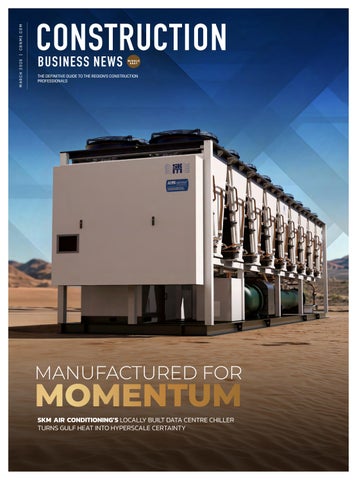
MOMENTUM SKM AIR CONDITIONING’S LOCALLY BUILT DATA CENTRE CHILLER TURNS GULF HEAT INTO HYPERSCALE CERTAINTY
ANANTARA SHARJAH RESIDENCES A NEW CHAPTER OF LUXURY EXPERIENCES BY THE SEA
Bringing luxury seaside living to Sharjah for the first time, owners at the Anantara Sharjah Residences enjoy access to the Anantara Sharjah Resort’s world-class amenities, including an infinity pool, five distinctive restaurants, an Anantara Spa and a state-of-the-art gym. As an investment, owners can enjoy the benefits of a rental management scheme operated by Anantara Hotels, Resorts & Spas, allowing them to maximize their returns when they are not resident in the property. To register your interest, visit arada.com LIFE IS A JOURNEY.
COVER STORY
32
A Chiller with Roots
32 COVER STORY
A CHILLER WITH ROOTS
With the GCC’s first locally manufactured data centre chiller, SKM Air Conditioning reframes Gulf heat as an engineering parameter, delivering hyperscale-grade continuity with industrial self-reliance, built and tested inregion.
40 HERITAGE REIMAGINED
THE CITY OF EARTH REIMAGINED
Khalid Al Malik, CEO of Dubai Holding Real Estate, on turning Dubai Design District into a waterfront neighbourhood that protects creative culture, widens opportunity, and raises the bar on sustainability and liveability
44 LAUNCH
NOOR KHUZAM: NORTH RIYADH’S NEXT ADDRESS
18 CONTRACTOR
THE COST BENEATH THE CONCRETE
Chris Arnott, Fugro’s Regional Business Line Director for Land in MEI, explores how earlystage ground insight can transform project economics and help Middle East developers move decisively from overruns to sustainable ROI
22 FM
ORDER MEETS EXCELLENCE
Muheel and SFG20 (UK) Forge Landmark Alliance to Elevate Maintenance Governance in Saudi Arabia
24 CONTRACTOR PRECISION UNDER PRESSURE
Construction Director Aidan Berry at ISG Middle East speaks to CBNME about delivering complex projects in live environments, balancing programme intensity with uncompromised quality, and why certainty has become the industry’s most valuable currency
28 INTERVIEW
CREATING ICONIC LIVING
Aditya Jain, Chief Development Officer at Chedi Hospitality, is redefining luxury hospitality through selective, long-term development
WWW.CBNME.COM
Hassan Allam Holding introduces Noor Khuzam, a new residential destination set to redefine North Riyadh’s urban rhythm, developed in partnership with Tilal Real Estate
46 IN CONVERSATION
25 YEARS OF SHAPING SKYLINES
Marking 25 years in the region, DSA Middle East’s Managing Director Peter Davison and Managing Director Tim Goodall reflect on a journey of sustained regional growth. From landmark hospitality and mixed-use developments to complex mega-projects, their story mirrors the region’s rapid transformation. They share insights on leadership, integrated delivery, and evolving client expectations. Together, they outline a future shaped by innovation, sustainability, and long-term partnerships.
52 SPECIALIST CONTRACTOR
SUPERVISORY CONTROL IN LARGESCALE INFRASTRUCTURE
Why early control architecture decisions define operational visibility and long-term resilience
54 CASE STUDY
DUBAI PROPERTY MARKET SHOWS RESILIENCE DESPITE SUPPLY SHIFTS
Gil Van Gelder, Director of Residential Brokerage at Espace Real Estate, notes that while Dubai’s residential market is experiencing segmentation, overall momentum remains strong
56 TALKING POINT
FROM BLOCKS TO FRACTIONS
Ben Crompton, Managing Partner at Crompton Partners, explores how fractional ownership and tokenisation are opening opportunities for a broader range of investors in the UAE
58 EXPERT INSIGHT GCC CONSTRUCTION OUTLOOK 2026: FROM AMBITION TO EXECUTION CERTAINTY 62 EDITOR’S CHOICE ONE TO WATCH
A flagship project that captures the very pulse of tomorrow, distilling the market’s direction and the quiet evolution of the built world into a single, resonant expression of vision and craft
50 LAUNCH INFRASTRUCTURE INVESTMENT AND ARBITRATION IN THE MIDDLE EAST Against the backdrop of unprecedented infrastructure development across the Gulf and wider Middle East, Cheryl Cairns and Karie Akeelah of Trowers & Hamlins examine how the New York Convention underpins cross-border dispute resolution
CONSTRUCTION BUSINESS NEWS ME | MARCH 2026 | 3
E V E R Y T H I N G T H AT O N E C O U L D IMAGINE FOR AN EXTRAORDINARY LIFE
Duplex
Spa
Lobby
Eywa Way of Water is a state-of-the-art residential community with only 65 exceptional waterfront residences, with a holistic wellness ecosystem, curating authentic experiences and best-in-class amenities few have dreamed of.
Contact us today: +971 54 308 6000 I
sales@byrevolution.com
E Y W A W O W . C O M
CEO Wissam Younane wissam@bncpublishing.net Managing Director Rabih Najm rabih@bncpublishing.net
SUBSCRIBE subscriptions@bncpublishing.net
Group Publishing Director Joaquim D'Costa jo@bncpublishing.net Editor-in-Chief Vibha Mehta vibha@bncpublishing.net Commercial Director Andrea Mocay andrea@bncpublishing.net Editorial Assistant Aya Zhang aya@bncpublishing.net Digital Reporter Reeba Asghar reeba@bncpublishing.net Creative Lead Christian Harb chriss@bncpublishing.net Junior Art Director Rizaldi Febrian
PO Box 502511 Dubai, United Arab Emirates P +971 4 4200 506 | F +971 4 4200 196 For all commercial enquiries, contact jo@bncpublishing.net T +971 50 440 2706 All rights reserved © 2025. The opinions expressed are solely those of the contributors. Construction Business News Middle East and its affiliated publications in the MENA region are exclusively licensed to BNC Publishing. No part of this magazine may be copied, reproduced, or transmitted in any form or by any means without prior written consent from the publisher. Printed by United Printing and Publishing | upp.ae
Marketing Executive Aaron Joshua Sinanbam aj@bncpublishing.net Multimedia Joel Amparo, Eduardo Buenagua, and Harton Otlang Contributors Ben Crompton, Gil Van Gelder, Maher Merehbi, and Andrei Iacobita
Images used in Construction Business News Middle East are credited when necessary. Attributed use of copyrighted images with permission. All images not credited courtesy Shutterstock.
CBNME.COM Keep up to date with all the latest news, features and much more on our website and social media platforms
8 | CONSTRUCTION BUSINESS NEWS ME | MARCH 2026
CBNME @CBNME CONSTRUCTION BUSINESS NEWS MIDDLE EAST
WWW.CBNME.COM
Lights the way, not the sky The Dark Sky luminaire head for the modular system bollard luminaires protects the night sky and nocturnal wildlife. Optionally available with BEGA BugSaver® technology to switch the colour temperature to an amber tone. Bollard tubes optionally available in sustainable Accoya® wood. bega.com/systembollards
8.– 13. 03. 2026
Frankfurt am Main Hall 3.0 · Stand C 91
Das gute Licht.
L E T T E R F RO M T H E E D I TO R
a series of moments that matter. The morning light through a window. A message that asks, “Are you safe?” The familiar voice that steadies you. The simple relief of arriving home. These aren’t grand milestones, yet they carry the full intensity of living. When plans become fragile, perspective changes. We realise how much we take for granted, not out of disregard, but because routine has a way of dulling gratitude. Uncertainty interrupts that comfort and reminds us that stability is not automatic, it is built, protected, and renewed. And so we begin noticing the smaller anchors that keep us upright. A shared meal. A kind exchange. Work continuing with purpose. Familiar streets that suddenly feel like a privilege. In moments like these, leadership matters. Not performative leadership, but the kind that reassures without inflaming, that acts without spectacle, and that keeps people informed with clarity. The UAE has long understood that calm is not passive, it is managed. Its reassurance is felt in its readiness, its communication, and its ability to maintain order while safeguarding a country made up of many nationalities, many languages, many lives. In uneasy hours, that steadiness becomes a form of protection in itself, a reminder that people are not left to navigate uncertainty alone.
In the Pause Between
U
ncertainty has a way of sharpening the world. It strips away the noise we normally hide behind and leaves us face-to-face with what is real, immediate, and quietly essential. In unsettled times, life stops feeling like a long runway and starts feeling like
10 | CONSTRUCTION BUSINESS NEWS ME | MARCH 2026
This is not a call for blind optimism, nor an attempt to dress difficult realities in pretty words. It is simply a recognition that positivity can be a choice and comfort can be a shared offering. If uncertainty intensifies life, then let it also refine us. Let it make us gentler with one another, more grateful for what is steady, and more attentive to the small things that quietly sustain us. Because when the world feels loud, it is often the simplest truths that hold us firm: safety matters, community matters, and home, when it is upheld with care, becomes more than a place. It becomes a promise.
Vibha Mehta
Vibha Mehta
Editor-in-Chief vibha@bncpublishing.net
vibhamehta01 @vibhamehta01
WWW.CBNME.COM
PROPERTIES solproperties.ae 800-765-1
Learn More
CBNME / REGIONAL NEWS
Palazzo Tissoli features resort-style amenities
TISSOLI HITS MAJOR MILESTONES FOR PALAZZO TISSOLI Tissoli has officially opened sales for Phase 2
T
issoli, the luxury real estate collective renowned for crafting world-class living environments, has announced three major milestones for its AED 1.2 billion flagship development, Palazzo Tissoli. Following the rapid 100% sell-out of Phase 1, Tissoli has officially opened sales for Phase 2 and appointed GRID Properties as its Strategic Development Manager,
reinforcing its commitment to delivering an architectural landmark of international calibre. Palazzo Tissoli, the first residential development in Ras Al Khaimah to be designed by the iconic Italian design house Pininfarina, has quickly established itself as one of the most coveted addresses in the Northern Emirates. The rapid sell-out of Phase 1 underscores the massive demand for branded, high-design residences on Al Marjan Island’s prime waterfront.
12 | CONSTRUCTION BUSINESS NEWS ME | MARCH 2026
Ensuring the project’s execution lives up to its ambitious vision, GRID has been appointed to oversee the delivery of Palazzo Tissoli with a focused and shared dedication to detail and quality as envisaged by Tissoli. Founded in 2019, GRID has rapidly grown into a powerhouse in the sector, with a portfolio exceeding $2.2 billion across 6.8 million square feet in the UAE and UK. Known for their philosophy of blending functionality with purpose, GRID’s appointment guarantees that the intricate Pininfarina design is
WWW.CBNME.COM
translated seamlessly into reality, with a targeted completion by Q2 2028. Pooja Rathore, COO of Tissoli, commented,“As we enter the execution phase and launch Phase 2, we’ve partnered with GRID, whose proven track record aligns perfectly with our commitment to excellence. The response from investors confirms that residents are seeking curated, meaningful living experiences. This collaboration is strategically planned to ensure Pininfarina’s ‘Italian DNA’ and Tissoli’s promise to create an elevated residential masterpiece is perfectly delivered from concept to completion. With GRID’s expertise in ideation, efficient and timely delivery, we are confident that this partnership will support us strategically in bringing this masterpiece to life.”
WWW.CBNME.COM
TO ACCOMMODATE THE HIGH DEMAND FROM GLOBAL BUYERS SEEKING AN ITALIAN-CRAFTED LIFESTYLE, PHASE 2 OFFERS A LIMITED COLLECTION OF FULLY FURNISHED STUDIOS, AND ONE- BEDROOM APARTMENTS FEATURING SWEEPING SEA VIEWS AND SIGNATURE PININFARINA INTERIORS. GRID views this partnership as a testament to their growing influence in the luxury sector. Shreen R Gupta, Founder & CEO stated: “At GRID, we view ourselves as builders of legacies. Our philosophy is rooted in creating spaces where functionality and purpose merge to enhance the lives of residents. We are honored to be appointed as the Development
Manager for Palazzo Tissoli. To work alongside Tissoli and a design legend like Pininfarina is a privilege, and we are committed to applying our expertise to ensure this project becomes a reality and is delivered in line with the vision set out by Tissoli and that sets a new benchmark for quality in Ras Al Khaimah.” The project draws inspiration from the natural mosaic of Ras Al Khaimah’s dunes and sea, requiring a high level of technical expertise to execute Pininfarina’s signature aesthetic. Palazzo Tissoli features resort-style amenities including the Serenity Spa, Vitality Studio, a 24-hour Café, the sunset-facing Skyline Lounge, and the signature Casa del Sigaro. With Phase 1 sold out and Phase 2 now launched, the project is firmly on track to redefine the skyline of the emirate.
CONSTRUCTION BUSINESS NEWS ME | MARCH 2026 | 13
CBNME / REGIONAL NEWS
OMNIYAT APPOINTS DUTCO AS MAIN CONTRACTOR FOR ENARA BY OMNIYAT
design excellence and long-term value. With ENARA now fully sold out, this next phase of construction reinforces the strong confidence the market has placed in this exceptional development.”
ENARA continues to progress steadily as construction enters the superstructure phase of the development
Designed to redefine the corporate environment, ENARA by OMNIYAT combines five-star hospitality-inspired amenities with sustainable, future-ready design. The tower will offer exclusive single-tenant floorplates, private lift access, landscaped terraces and advanced digital infrastructure, and has already achieved Platinum pre-certification for LEED, Platinum certification for WiredScore and SmartScore, the first triple-Platinum office building in the UAE. The building is also targeting WELL Building Platinum certification, further demonstrating OMNIYAT’s commitment to wellbeing in seeking the pinnacle of health accreditation for their buildings.
O
MNIYAT, the leading developer of Dubai’s ultraluxury real estate market, has announced a major construction milestone for its prestigious commercial development, ENARA by OMNIYAT. Following the completion of the enabling works, Dutco has been awarded as the main contractor for the project. Located in Marasi Bay, within the Burj Khalifa District, ENARA is OMNIYAT’s flagship ultra-luxury commercial tower and a cornerstone of the developer’s bold strategy to redefine premium workspaces in Dubai. Since its launch, the project received an exceptional market response and is now fully sold out, reflecting strong demand for Prime Grade A office space in one of the city’s most sought-after business destinations. Enabling works on the project are now complete, with 100 per cent of piling successfully completed. With the main works contract awarded and mobilisation now underway, ENARA continues to progress steadily as construction enters the superstructure phase of the development.
As part of OMNIYAT’s wider vision for Marasi Bay, ENARA reinforces the district’s transformation into Dubai’s most prestigious ultra-luxury waterfront destination, joining a portfolio of iconic developments including The Lana, VELA and VELA Viento. With construction progressing on schedule and strong momentum on site, ENARA by OMNIYAT is on track to become one of Dubai’s most distinguished commercial addresses, setting a new benchmark for Prime Grade A ultraluxury workspaces in the region.
ENARA by OMNIYAT combines five-star hospitality-inspired amenities with sustainable, future-ready design
OVER THE COURSE OF 2026, ALL PROVISIONAL SUM SUBCONTRACTOR PACKAGES ARE SCHEDULED TO BE AWARDED. THE STRUCTURE WILL RISE TO LEVEL 10, WHILE MEP AND FINISHES ARE EXPECTED TO PROGRESS UP TO LEVEL 5. FAÇADE WORKS ARE SET TO COMMENCE LATER IN THE YEAR, MARKING THE NEXT SIGNIFICANT MILESTONE IN BRINGING THE LANDMARK TOWER TO LIFE. Peter Stephenson, Co-Managing Director of OMNIYAT, said: “ENARA represents a defining moment in our commercial real estate strategy and in the evolution of Marasi Bay as a global business destination. The completion of enabling works and the appointment of Dutco as main contractor mark important milestones in our journey to deliver a world-class commercial tower that reflects OMNIYAT’s commitment to quality, 14 | CONSTRUCTION BUSINESS NEWS ME | MARCH 2026
WWW.CBNME.COM
WWW.CBNME.COM
CONSTRUCTION BUSINESS NEWS ME | MARCH 2026 | 15
CBNME / REGIONAL NEWS
SELECT GROUP PIONEERS SUSTAINABLE LIVING WITH INNOVATIVE PALM-BASED MATERIALS Select Group is advancing sustainable real estate in Dubai by integrating innovative, low-impact materials into its residential developments
S
elect Group, one of the emirate’s l e a d i n g p r e m i u m real estate developers, is advancing its approach to sustainable residential construction by incorporating innovative, low-impact materials across key projects. Delivered through its ongoing partnership with Engineering Contracting Company (ECC), the initiative demonstrates the company’s commitment to both environmental stewardship and occupant wellbeing.
THE MATERIAL INNOVATION ALIGNS WITH SELECT GROUP’S FOCUS ON CREATING HEALTHIER, WELLNESS-LED RESIDENTIAL COMMUNITIES. BY REDUCING INDOOR AIRBORNE EMISSIONS AND IMPROVING AIR QUALITY, PSB® SUPPORTS RESIDENTS’ LONG-TERM HEALTH AND COMFORT, REINFORCING THE COMPANY’S COMMITMENT TO SUSTAINABLE, FUTURE-READY LIVING ENVIRONMENTS.
Across its developments, approximately 3,000 cubic metres of Palm Strand Board (PSB®), supplied by UAE-based sustainable materials innovator DesertBoard, have been integrated into interior construction applications.
Ben Crompton, Managing Partner at Crompton Partners, said: “Select Group’s integration of PSB® reflects a thoughtful approach to both environmental impact and resident wellbeing. It’s a great example of how premium real estate can lead on sustainability while delivering tangible health benefits.” With sustainability increasingly shaping buyer expectations, Select Group’s adoption of low-emission, upcycled materials highlights its ambition to set new benchmarks in Dubai’s residential market, marrying ecological responsibility with high-quality, wellness-focused living.
The material innovation aligns with Select Group’s focus on creating healthier, wellness-led residential communities
PSB® is manufactured using upcycled agricultural palm waste, helping to sequester an estimated 34 million kilograms of CO₂e. It is also produced with a formaldehyde-free binding system, achieving a Super E0 rating, which significantly exceeds industry standards for low-emission building materials.
16 | CONSTRUCTION BUSINESS NEWS ME | MARCH 2026
WWW.CBNME.COM
DUBAI ADVANCES AED30BN TASREEF PROGRAMME WITH NEW DRAINAGE NETWORK EXPANSION The initiative aligns with the Dubai 2040 Urban Master Plan and national climate neutrality objectives
D
ubai Municipality has awarded contracts worth AED2.5 billion for five major projects under Phase Two of the Tasreef Programme, reinforcing Dubai’s long-term strategy to develop advanced and resilient stormwater infrastructure.
THE NEW PROJECTS WILL SERVE 30 KEY AREAS COVERING APPROXIMATELY 430 MILLION SQUARE METRES AND ARE DESIGNED TO SUPPORT AN ESTIMATED
The new package forms part of the wider AED30 billion Tasreef Programme
POPULATION OF THREE MILLION RESIDENTS BY 2040. THE ANNOUNCEMENT ALIGNS WITH THE DIRECTIVES OF HIS HIGHNESS SHEIKH MOHAMMED BIN RASHID AL MAKTOUM TO ENHANCE THE EFFICIENCY OF STORMWATER SYSTEMS AND ENSURE THE EMIRATE IS EQUIPPED FOR THE NEXT CENTURY OF GROWTH.
The contracts were signed with leading global infrastructure firms, including DeTech Contracting and China State Construction Engineering Corporation, alongside specialised consultancy companies. The package comprises three execution contracts and two contracts dedicated to the study and design of drainage systems in selected areas. Strategic, Phased Delivery The latest awards build on projects launched in April 2025 under Phase One of the Tasreef Programme, reflecting a structured and phased approach to strengthening stormwater infrastructure. The programme is designed to reduce flood risks, improve operational efficiency and sustainability, and enhance the overall quality of life across the emirate. The initiative also aligns with the Dubai 2040 Urban Master Plan and national climate neutrality objectives, reinforcing the emirate’s preparedness to address climate change and rapid urban expansion. Integrated and Future-Ready Network Among the key projects is the construction of a main drainage tunnel with a diameter of up to four metres, connecting communities along Sheikh Mohammed bin Zayed Road and Al Yalayis Road to the primary stormwater
network. The development will increase hydraulic capacity and operational flexibility while supporting sustainable growth along one of Dubai’s most dynamic development corridors. A further project includes the creation of an integrated drainage network extending more than 27 kilometres between Sheikh Zayed Road and Al Jamayel Road. Featuring advanced tunnels and network systems, the scheme will strengthen infrastructure resilience within a major industrial and logistics zone, support business continuity and reduce water accumulation risks. To enhance inland stormwater management, the programme also provides for a drainage tunnel and a modern pumping station along Dubai–Al Ain Road and Sheikh Zayed bin Hamdan Al Nahyan Street, alongside the development of a strategic stormwater collection lake. In addition, design contracts have been awarded for an integrated stormwater and groundwater drainage system in Al Marmoom and Saih Al Salam. The project will link the areas to the main drainage network along Al Qudra Road, supporting tourism and residential development while maintaining ecological balance. The new package forms part of the wider AED 30 billion Tasreef Programme, underscoring Dubai Municipality’s commitment to smart, resilient infrastructure built on advanced engineering solutions. The initiative further reinforces Dubai’s global standing in sustainability, infrastructure excellence and urban resilience.
CBNME / CONTRACTOR Chris Arnott, Fugro’s Regional Business Line Director for Land in MEI
The Cost Beneath The Concrete Chris Arnott, Fugro’s Regional Business Line Director for Land in MEI, explores how early-stage ground insight can transform project economics and help Middle East developers move decisively from overruns to sustainable ROI
18 | CONSTRUCTION BUSINESS NEWS ME | MARCH 2026
WWW.CBNME.COM
THE COST BENEATH THE CONCRETE
W
ith construction disputes in the Middle East among the highest-value globally, r e g u l a r ly exc e e d i n g AED 250 million, according to Arcadis’ Global Construction Disputes Report, the industry has reached a critical inflexion point. Conventional, conservative approaches to ground risk, designed around minimum compliance rather than informed decision making, are no longer sustainable in terms of cost, schedule, safety, or carbon footprint. A modest increase in early investment acts not only as insurance against uncertainty, minimising redesign, mitigating claims, and preventing avoidable overruns, but can also unlock value within the owners who achieve the best outcomes view ground intelligence not as an optional cost, but as a strategic safeguard. A modest, well-timed investment in early-stage ground intelligence can unlock exponential value across the project lifecycle. Timely access to high-quality, decision-grade subsurface insight reduces uncertainty, accelerates design, mitigates interface risk, and enables more predictable delivery, shifting projects from reactive cost control to proactive value creation. This interview with Fugro’s Regional Business Line Director, Chris Arnott, explores how Middle East construction can move from overruns to ROI by reframing ground risk as a value creation lever rather than a sunk cost. How is the industry’s perception of risk evolving, and why is ground risk becoming so central to project success? Across much of the Middle East, ground risk is still not consistently viewed as a central driver of project performance. In many projects, it remains treated as a technical or contractual matter rather than a strategic business risk. This underestimation is a key reason why unforeseen
WWW.CBNME.COM
ground conditions continue to drive delays, cost overruns, and disputes. That said, the market is beginning to evolve. A growing number of forward-thinking owners and developers are recognising that subsurface uncertainty lies at the heart of many downstream challenges affecting design efficiency, construction sequencing, safety, and overall ROI. However, this shift is uneven and not happening quickly enough across the industry. This creates a clear opportunity. Organisations that move earlier by treating ground intelligence as a strategic input rather than a compliance exercise gain a competitive advantage. By reducing uncertainty sooner, they make better- informed decisions, and achieve greater predictability across cost, execution, and sustainability. The real question for business leaders is whether they are already applying these emerging approaches, or whether they are leaving value on the table. How can early-stage ground risk assessment evolve into a strategic enabler of certainty and ROI? When undertaken early and comprehensively, ground intelligence becomes one of the highest value levers in the entire project lifecycle. Highfidelity models optimise design, streamline procurement, reduce rework, and accelerate decision making. Instead of functioning as a compliance step, early ground clarity becomes a strategic input, enabling teams to plan with confidence, reduce variability, and deliver more predictable outcomes. Owners often face pressure to minimise upfront costs. How can they balance this with long-term value creation? The key lies in shifting from cost-cutting to value creation. Reducing early investigation budgets may save fractions of a per cent of development CAPEX, but it can expose projects to far greater downstream risks. A modest increase in early investment acts not only as
CONSTRUCTION BUSINESS NEWS ME | MARCH 2026 | 19
CBNME / CONTRACTOR
The true cost of ground risk is uncertainty, not investigation
commenced, followed by claims and delays linked to unforeseen ground conditions. By reallocating an additional 0.5% of CAPEX into early, owner-led ground intelligence, uncertainty is reduced before tender. Contractors price more competitively, foundations are rightsized, claims are avoided, and schedules compressed, delivering net savings exceeding AED 20 million and returns of more than 10x on the incremental upfront investment. This is the real economics of ground risk: not the cost of investigation, but the value of certainty.
insurance against uncertainty, minimising redesign, mitigating claims, and preventing avoidable overruns, but can also unlock value within the owners who achieve the best outcomes view ground intelligence not as an optional cost, but as a strategic safeguard. What does the data show about ROI, and can you share an example? ROI is both measurable and compelling. A simplified example illustrates the economics. Consider a AED 370 million project where foundations account for approximately 20% of CAPEX. Under conventional practice, site investigation typically accounts for less than 0.5% of CAPEX and is undertaken late, leaving material residual uncertainty. EPC contractors price this uncertainty defensively, embedding overdesign and ground risk contingencies into their bids. In practice, this approach can add AED 15 million or more in concealed foundation cost, before construction has
20 | CONSTRUCTION BUSINESS NEWS ME | MARCH 2026
How are digital tools and AI transforming ground risk management? Digital technologies are transforming subsurface understanding at pace. Advanced geophysical techniques, combined with machine learning and dynamic 2D, 3D and even 4D modelling, are reshaping how ground conditions are characterised. Rather than relying on isolated boreholes and static reports, project teams can now operate from a shared, high-fidelity ground model that evolves throughout planning, design and construction. Today’s computing power, in combination with AI and ML-driven analytics, enables the integration of different data sets, current and historic or Geotechnical and Geophysical, can now be combined and interrogated at a scale and speed previously unattainable, significantly increasing the power of Geophysical methodologies well beyond the currently perceived capabilities. Ground risk remains a major cause of delays and disputes. Why is this challenge so persistent? Currently and historically, ground investigations have been treated as routine compliance exercises rather than strategic investments in project certainty, which have been too limited, too late, or too disconnected across disciplines. This mindset regularly leads to one, or a combination of conservative designs, unanticipated ground conditions, and
WWW.CBNME.COM
THE COST BENEATH THE CONCRETE
fragmented decision-making, creating fertile ground for delays, overruns, claims and disputes. The industry must shift from a culture of “minimum compliance” to one of “decision-grade” ground intelligence. Early engagement, broader coverage, continuous models, and integrated workflows are essential to breaking this long-standing cycle. What mindset shift is needed for stakeholders to see ground risk as an investment rather than a cost? Stakeholders must look beyond line-item budgets to the long-term value of certainty and optimisation. The real cost is not the investigation itself, it is the consequences of insufficient knowledge: re-work, delays, material waste, and safety exposure. When leaders recognise that robust ground intelligence reduces carbon footprint, optimises material use, and accelerates schedules, ground risk becomes a strategic investment in certainty, sustainability, and resilience. How can improved ground intelligence reduce carbon footprint during construction? High-quality subsurface data enables right-sized foundations, reduced excavation, and fewer materials, cutting the embodied carbon tied to concrete, steel, and earthworks. GroundIQ®’s minimally invasive approach also lowers site disturbance, logistics emissions, and waste. Better ground intelligence directly enables leaner, lowcarbon construction. Fugro was recognised as Engineering Firm of the Year, supported by the results delivered on a GroundIQ® project. What does this recognition signal about how the industry is evolving? Being named Engineering Firm of the Year, supported in part by the outcomes delivered through a GroundIQ® project, reflects a broader shift in how engineering excellence is defined in the region. Today, success is measured against higher standards that address increasing project complexity and rising owner expectations.
sustainable, and more resilient infrastructure across the full asset lifecycle. Closing thought The message for Middle East construction leaders is clear. Moving beyond minimum compliance is not simply about spending more on site investigation, it is about transforming how engineering is applied. We are talking about changing how engineering is applied.True value emerges when forward-thinking engineering judgment is paired with innovative, sometimes non-conventional methodologies, underpinned by digital, data-driven tools. Too often, engineering teams are constrained by conventional datasets that carry wide variability and limited confidence. The inevitable result is conservative design, inflated contingencies, and missed opportunities. The alternative is to actively engage the engineering brain: narrowing the envelope of ground uncertainty through broader coverage, integrated geotechnical and geophysical approaches, continuous digital models, and analytics that turn data into insight. This shift transforms subsurface risk from an accepted unknown into a manageable, predictable parameter. In doing so, it converts hidden opportunity costs into measurable commercial value. Simply put, the real cost of ground risk isn’t investigation, it’s uncertainty priced into everything that follows. Organisations that move from minimum compliance to decision-grade, innovative ground intelligence are not just reducing risk; they are systematically generating ROI measured in multiples, not margins.
The recognition signals a growing appreciation for engineering approaches that go beyond data collection to deliver integrated insight, early certainty, and measurable project outcomes. Importantly, this recognition is not about a single project or technology. It points to an industry evolution toward engineering-led decision-making, where robust subsurface intelligence plays a central role in enabling smarter, more
WWW.CBNME.COM
Turning subsurface uncertainty into strategic insight
CONSTRUCTION BUSINESS NEWS ME | MARCH 2026 | 21
CBNME / FM
Order Meets
Excellence
Muheel and SFG20 (UK) Forge Landmark Alliance to Elevate Maintenance Governance in Saudi Arabia
22 | CONSTRUCTION BUSINESS NEWS ME | MARCH 2026
WWW.CBNME.COM
ORDER MEETS EXCELLENCE
A
s Saudi Arabia accelerates one of the most ambitious built-environment transformations globally, the focus is rapidly shifting from construction scale to longterm asset performance, regulatory integrity, and lifecycle resilience. With giga-projects, mixed-use developments, and critical infrastructure reshaping the Kingdom’s urban landscape, stakeholders such as operators and asset owners are increasingly prioritising structured maintenance governance, measurable compliance, and internationally benchmarked operational standards to protect long-term asset value. In response to this evolution, Muheel Facilities Management has entered into a strategic partnership with SFG20, developed and maintained by BESA Publications Limited, to explore the structured adoption and localisation of globally recognised maintenance standards within the Kingdom of Saudi Arabia (KSA). THE AGREEMENT ESTABLISHES A COLLABORATIVE FRAMEWORK UNDER WHICH MUHEEL HAS POSITIONED ITSELF AS SFG20’S FIRST STRATEGIC DELIVERY PARTNER IN KSA AND THE GCC Focusing on embedding SFG20’s internationally recognised maintenance specification framework into Muheel’s operations—creating consistent, auditable maintenance regimes, stronger lifecycle governance, and clearer performance assurance for asset owners and operators. In subsequent phases, the partners will explore how SFG20 can be tailored to meet relevant Saudi requirements, including the SBC (Saudi Building Code), to support local compliance needs. By combining Muheel’s operational leadership in KSA, delivery capability, regional expertise, and commitment to quality and innovation with SFG20’s internationally benchmarked maintenance framework, the partnership aims to elevate FM governance and compliance standards across the Kingdom’s built assets. The collaboration will introduce SFG20-aligned, auditable, and outcomes-driven maintenance regimes supported by digitally enabled processes that enhance compliance
WWW.CBNME.COM
monitoring, performance visibility, and data-driven decision-making. The initiative will introduce UK-structured, locally governed maintenance models aligned with Saudi regulatory frameworks, strengthening compliance, operational transparency, safety, sustainable asset management, and long-term infrastructure resilience in support of Vision 2030. Through this strategic alliance, Muheel and SFG20 will also promote industry-wide awareness across KSA and advance joint market positioning and thought leadership that bridges international best practices with local regulatory requirements — supporting the development of a digitally enabled, standards-led FM ecosystem for the Kingdom’s future communities and critical infrastructure.
THIS PARTNERSHIP IS A PIVOTAL STEP IN MUHEEL’S VISION 2030 ROADMAP, BUILDING A DIGITALLY ENABLED, STANDARDS-LED OPERATING MODEL THAT DRIVES OPERATIONAL EXCELLENCE TODAY AND SUPPORTS A MORE SUSTAINABLE, RESILIENT FUTURE FOR COMMUNITIES AND CRITICAL INFRASTRUCTURE. Commenting on the strategic engagement, Muhammad Irfan Khokhar, CEO of Muheel, said: “This alliance represents a landmark milestone in strengthening maintenance governance and compliance standards across the Kingdom, marking a pivotal shift from rules-based to principle-led operations—where SFG20 is viewed not as a tick-box exercise, but as a strategic imperative that drives measurable value for both service providers and asset owners. At Muheel FM, we’re proud to lead by example. Our ambition is to deliver smarter, safer, more resilient facilities and raise the benchmark for integrated FM services in the region. This partnership marks a significant advancement in Muheel’s Vision 2030 journey, fast-tracking digital transformation, enhancing operational excellence, and strengthening our commitment to a more sustainable built environment through intelligent, compliant and datadriven asset management.” Kirsty Cogan, Managing Director of SFG20, commented: “KSA’s built environment is moving at pace from delivery to long-term performance. That shift demands maintenance governance that is structured, auditable, and outcomesled. Through our strategic partnership with Muheel in KSA and the wider GCC, we will help asset owners establish consistent, evidence-based maintenance regimes that strengthen assurance, support compliance, and protect lifecycle value.”
CONSTRUCTION BUSINESS NEWS ME | MARCH 2026 | 23
CBNME / CONTRACTOR
Aidan Berry Director of ISG Middle East
Precision Under Pressure Construction Director Aidan Berry at ISG Middle East speaks to CBNME about delivering complex projects in live environments, balancing programme intensity with uncompromised quality, and why certainty has become the industry’s most valuable currency
24 | CONSTRUCTION BUSINESS NEWS ME | MARCH 2026
WWW.CBNME.COM
PRECISION UNDER PRESSURE
D
elivery Shift The biggest shift has been the move from reactive delivery to proactive orchestration. Clients are no longer just looking for contractors to execute drawings; they expect partners who can de-risk complexity from the outset.
Projects are becoming increasingly technically integrated, particularly in sectors such as commercial, manufacturing, hospitality, and mixed-use developments. Digital infrastructure, sustainability targets, fast-track programmes and operational continuity requirements all intersect. That means the delivery model has to evolve. We’re seeing much earlier contractor involvement, deeper preconstruction engagement and more reliance on data-led decision-making. Digital coordination tools, advanced sequencing strategies and detailed programme modelling are no longer optional; they are essential to delivering certainty. There is also a greater emphasis on experience, which adds another layer of complexity. Speed vs Quality Speed should never come at the expense of control. The key is building certainty into the programme before you mobilise on site. For us, it starts with planning, rigorous preconstruction, detailed trade engagement and clear design responsibility matrices. When the early stages are done properly, the programme becomes more predictable.
coordinated. The balance comes from visibility; if you can see risk developing early, you can correct course without sacrificing quality. Ultimately, speed comes from clarity, not shortcuts. Expectation Gap Clients are absolutely right to demand programme certainty and cost transparency. The market is competitive, and business drivers are immediate, especially in the commercial and hospitality sectors, where time-to-revenue matters. Misalignment can occur around the impact of latestage design changes or compressed decision cycles. Even the best delivery teams need clear and timely direction to maintain momentum. There can also be an assumption that supply chains will simply absorb pressure. In reality, specialist trades and materials require early commitment, particularly when dealing with high-specification finishes or integrated technology systems. The most successful projects are those in which clients see delivery as a collaborative process, one in which risk and accountability are shared early rather than transferred downstream. Live Environment Logistics The Palm Jumeirah Mall Refurbished Extension is a strong example of where complexity fundamentally shaped our delivery approach. As the main contractor, we delivered extensive structural alterations, façade works, interior fit-out and major MEP upgrades while the mall remained fully
WE ALSO BREAK PROJECTS DOWN INTO CLEARLY DEFINED WORK PACKAGES WITH TRANSPARENT ACCOUNTABILITY. QUALITY CONTROL IS EMBEDDED THROUGH STRUCTURED INSPECTION REGIMES AND DIGITAL REPORTING TOOLS, NOT LEFT TO CHANCE AT THE END OF A PHASE. Parallel working streams are often necessary in fast-track environments, but they must be carefully
WWW.CBNME.COM
CONSTRUCTION BUSINESS NEWS ME | MARCH 2026 | 25
CBNME / CONTRACTOR
Palm Jumeirah Mall
project ultimately opened in line with the mall’s 2025 rebranding, demonstrating our ability to manage high-risk retrofit works and premium finishes within tight programme constraints. It reinforced a key lesson: in complex live environments, success depends on early planning, disciplined coordination and fully integrated delivery. Sequencing Strategy Working within an operational environment was one of the most demanding elements. Access restrictions, noise limitations and logistical constraints required meticulous planning. We introduced phased delivery zones and night-shift operations for particularly disruptive works. Detailed method statements and communication protocols were agreed with stakeholders to ensure minimal impact on adjacent occupants. Another challenge was integrating highend finishes alongside intensive technical installations. Precision tolerances were critical. We implemented enhanced quality inspections at interim stages rather than waiting for final sign-off, thereby reducing rework and protecting the programme.
operational. The scope included installing approximately 220 tonnes of steel tie-backs into the existing structure, slab and roof extensions, 16-metre-high blockwork partitions, 20,000 sq. ft of new façade works, high-end interior finishes and significant services upgrades. Because the mall was live throughout, traditional linear sequencing wasn’t viable.
WE IMPLEMENTED A CAREFULLY PHASED, ZONE-BASED STRATEGY, INTRODUCED NIGHT WORKS FOR DISRUPTIVE ACTIVITIES AND ENHANCED DIGITAL COORDINATION TO ALLOW STRUCTURAL, MEP AND ARCHITECTURAL PACKAGES TO RUN IN PARALLEL WITHOUT CONFLICT. Close collaboration with tenants and mall management was essential to maintain safety and minimise disruption. The
26 | CONSTRUCTION BUSINESS NEWS ME | MARCH 2026
Strong daily coordination between trade supervisors was essential. On projects of that complexity, communication becomes your most powerful tool. Risk Front-Loading Early coordination was pivotal to the project’s success. Before mobilisation, we invested significant time in detailed design reviews and structured coordination workshops with consultants and specialist subcontractors. By interrogating drawings thoroughly and resolving interface issues at the preconstruction stage, we reduced the likelihood of clashes and rework once on site. We also worked closely with the client team to secure early decisions on long-lead materials and specialist systems. Locking these elements down in advance mitigated procurement risk and gave the supply chain the confidence to commit to manufacturing and delivery timelines. A major focus was clearly defining scope boundaries and interface responsibilities between trades. On complex projects, delays often arise from grey areas between packages. By formalising those responsibilities early and
WWW.CBNME.COM
PRECISION UNDER PRESSURE
Jumeirah’s Mina A’Salam Hotel
maintain performance while providing more reliable availability. We also work closely with clients to secure early approvals for critical materials. Importantly, we maintain long-term relationships with specialist subcontractors rather than engage in transactional relationships. That continuity builds trust and responsiveness, which is invaluable in volatile market conditions. Future Lessons The consistent lesson is that complexity demands integration, not just technically, but culturally across the project team. E a r ly contractor involvement and proactive risk management are no longer enhancements; they are fundamental.
aligning sequencing strategies, we protected both quality standards and programme milestones. Supply Chain Resilience Supply chain resilience has become a strategic focus rather than an operational afterthought. We prioritise early market engagement and transparent dialogue with key trade partners. That allows us to understand capacity constraints and lead times before they become programme risks. Where appropriate, we consider alternative specifications that
We are also placing greater emphasis on the programme. Clients want visibility, not just milestones. Providing clear reporting and forward planning strengthens confidence and enables faster decision-making. In a market that continues to accelerate, certainty is the real currency. Finally, collaboration remains the differentiator. The projects that succeed are those where everyone, client, consultant, and contractor, shares ownership of outcomes.
OUR ROLE IS TO CREATE THAT CERTAINTY THROUGH PLANNING, PARTNERSHIP, AND DISCIPLINED EXECUTION. DUE TO THIS ACCELERATED MARKET POSITION, WE ARE ALSO LOOKING TO EXPAND OUR OFFERING BY TAKING ON IN-HOUSE SPECIALIST TRADES SUCH AS CIVIL, MEP AND JOINERY, TO GAIN BETTER CONTROL OF PROGRAMME AND QUALITY, WHILE STILL UTILISING OUR WIDE NETWORK OF SUPPLY CHAIN PARTNERS FOR MORE SPECIALISED TRADES.
WWW.CBNME.COM
CONSTRUCTION BUSINESS NEWS ME | MARCH 2026 | 27
CBNME / INTERVIEW
In partnership with Diriyah Company, Chedi Hospitality has launched The Chedi Residences Wadi Safar, a limited collection of 20 branded villas set within the cliffs of Diriyah’s Wadi Safar masterplan
LIVING
CREATING ICONIC
Aditya Jain, Chief Development Officer at Chedi Hospitality, is redefining luxury hospitality through selective, long-term development
28 | CONSTRUCTION BUSINESS NEWS ME | MARCH 2026
WWW.CBNME.COM
CREATING ICONIC LIVING
What excites you most about your new role as Chief Development Officer? What excites me most about this role is the opportunity to shape the next generation of landmark assets. Development sits at the intersection of brand, capital, design, and geography. It is the domain where long-term decisions are made, decisions that will define how The Chedi will be experienced 20 or 30 years into the future.
Aditya Jain, Chief Development Officer at Chedi Hospitality
My focus is on being intentional. Each signing represents a permanent statement of who we are and where we belong. That responsibility is both energising and humbling. How do you intend to shape Chedi’s long-term growth strategy? Our approach to growth is global in outlook, yet deliberately selective in execution. Just because a market presents itself does not mean it is the right fit. For us, expansion only makes sense when specific conditions align. The first is durability. We prioritise destinations with long-term relevance, places anchored in culture, natural significance, or established international appeal. If momentum appears speculative or short-lived, we step back. The second is brand resonance. The Chedi is defined by restraint and architectural clarity. We are not designed for every environment. If a market is driven by scale, density, or overt spectacle, it is unlikely to be the right fit. We perform best where calm, proportion, and discretion are valued. The third is alignment, both with the site and with our partners. The land must allow us to create a project with depth and integrity, and ownership must share a long-term vision for value creation. When either element is lacking, opportunities naturally fall away. In reality, many leads do not progress and that discipline is intentional. In practice, many potential leads do not progress, this discipline is intentional. Our strategy is not to expand rapidly, but to place The Chedi thoughtfully in
destinations where it can truly belong and endure over time. What key markets are you prioritising for development in the next 24 months? In the United States, we are evaluating specific gateway and resort markets where affluent travellers are seeking experiential luxury destinations where privacy, design, and service sophistication matter more than room count. In Southern Europe and the Mediterranean, the opportunity lies in heritage-driven locations where architecture and cultural context shape the guest experience. These markets reward sensitivity and
CBNME / INTERVIEW
The Chedi Residences Wadi Safar
a compelling visual narrative. However, the defining element is not height or amenity, it is structure. Density is deliberately controlled. Circulation and arrival are m e t i c u l o u s ly choreographed , and privacy is embedded vertically. In a highly competitive urban m a r ke t , restraint becomes differentiation. The project demonstrates how exclusivity can be engineered into the core of a building rather than applied superficially.
restraint, qualities that align closely with our brand’s DNA. We are also active in high-growth luxury corridors across the Middle East and parts of Asia, particularly within integrated mixed-use environments that combine residential, hospitality, and lifestyle components. In this context, maintaining brand discipline becomes highly critical. Which upcoming project best reflects your development philosophy — and why? Two projects illustrate our philosophy: Chedi Private Residences Sheikh Zayed Road and Chedi Niseko. While they differ in context and typology, both are unified by intent and approach. Chedi Private Residences is significant as the first standalone branded residence under The Chedi name. It is conceived not as a conventional high-rise, but as a collection of villas in the sky, comprising expansive two- to eight-bedroom residences and full-floor mansions elevated above one of Dubai’s most dynamic corridors. Features such as 270-degree panoramic views, the 60-metre lagoon-style pool integrated into the tower, and the rooftop infinity pool overlooking the skyline create
30 | CONSTRUCTION BUSINESS NEWS ME | MARCH 2026
Similarly, Chedi Niseko embodies our belief that the site should dictate the story. Set within one of the world’s most distinctive alpine environments, the project is shaped by its topography, climate, and cultural nuance. The architecture is designed to integrate seamlessly with the landscape rather than dominate it. Across both projects, the principle remains consistent: the site defines the narrative, the brand provides the guiding discipline, and execution protects longterm equity. Whether in a vertical urban setting or a mountain retreat, our objective is to create assets that are structurally distinctive, contextually grounded, and built to endure. In both cases, our role is not to apply a rigid brand template. Instead, we curate a refined interpretation of the environment. That balance between restraint and expression between identity and context defines our approach to development. What is your take on branded residences and their future in the region? Branded residences in the Middle East are entering their most exciting phase. The early years proved demand and the next phase will reward quality. Buyers today are not simply
WWW.CBNME.COM
SHAPING ENDURING LUXURY
seeking status; they are investing in permanence, governance, and operational sophistication. They want reliable service infrastructure, curated lifestyle programming, and brands that protect the long-term value of their assets. The region’s fundamentals remain exceptionally strong. Cities such as Dubai, Riyadh, and Doha are emerging as permanent hubs of global wealth migration, providing structural support for high-end branded living. But the brands that will thrive are those that approach residences as a long-term ecosystem, not a licensing exercise.
AT CHEDI, WE HAVE INVESTED IN A DEDICATED RESIDENTIAL PLATFORM WITH ITS OWN S E R VI C E S TA N D A R D S , DESIGN DISCIPLINE, AND OPERATIONAL FRAMEWORK. Chedi Muscat
This allows our partners to deliver a product that commands both premium positioning and enduring credibility. The opportunity in this region is significant, and we intend to be at the forefront of its next chapter. How will Chedi balance brand consistency with local cultural relevance in new destinations? The Chedi is defined by principles, not templates. Our core DNA, spatial clarity, refined materiality, and intuitive service remains constant. The way these principles are expressed must respond to the cultural and environmental context of each destination. In Europe, this may involve heritage-sensitive restoration; in the Middle East, it could take the form of sculptural modernity integrated with privacy considerations.; and in alpine environments, the emphasis shifts to warmth and topographical sensitivity.
WWW.CBNME.COM
This flexibility is not compromise, it is strength. It enables us to create assets that are both globally recognisable and authentically rooted in their local context. What role will sustainability play in your development roadmap? Sustainability is embedded from the earliest feasibility discussions. We carefully evaluate environmental impact, site sensitivity, long-term operational efficiency, and integration with local communities. Responsible land use and material choices are fundamental considerations, not afterthoughts. In today’s luxury market, accountability is paramount, and our development roadmap reflects this expectation, ensuring that every project is both
environmentally conscious and enduringly relevant. How do you define success for Chedi’s future pipeline under your leadership? Success is when a developer says: “This is the asset that defines our portfolio.” It entails delivering properties that achieve pricing strength, architectural distinction, and long-term brand equity. It means establishing a global network of Chedi destinations that are individually unique, yet collectively powerful. Ultimately, success is achieved when our partners regard The Chedi not merely as an operator, but as a strategic advantage.
CONSTRUCTION BUSINESS NEWS ME | MARCH 2026 | 31
A Chiller with Roots Words by: Vibha Mehta Multimedia: Joel Amparo, Eduardo Buenagua & Harton Otlang
With the GCC’s first locally manufactured data centre chiller, SKM Air Conditioning reframes Gulf heat as an engineering parameter, delivering hyperscalegrade continuity with industrial self-reliance, built and tested inregion.
From left to right: Ferose Ahamed Abdul Khader, Asim Ahmad Hashmi, Burhan Mahmoud Jaber, Riyas Backer Kothat, and Abdallah Faisal Al Khashashneh — the SKM Air Conditioning team whose collaboration and engineering expertise brought the GCC’s first locally manufactured data centre chiller to life
32 | CONSTRUCTION BUSINESS NEWS ME | MARCH 2026
WWW.CBNME.COM
A CHILLER WITH ROOTS
WWW.CBNME.COM
CONSTRUCTION BUSINESS NEWS ME | MARCH 2026 | 33
CBNME / COVER STORY
W
e went down to SKM’s Sharjah office on a bright winter morning, when the sun feels generous but the air still has an edge. The photoshoot came fi r s t , then a walk through the spaces where the work happens — not the glossy end of the story, but the part that decides whether a system holds up when the temperature doesn’t. Conversations moved quickly from pleasantries to specifics: lead times, testing, redundancy, recovery, and what ‘missioncritical’ actually means in the Gulf. What struck me was the seriousness around detail. This wasn’t framed as a headline moment; it was treated like an engineering decision the market is ready for. Data centres are expanding at pace, AI workloads are climbing, and cooling is no longer an accessory to infrastructure — it’s the infrastructure. In that context, a locally manufactured data centre chiller is not just a product; it’s a statement about capability, control, and speed-to-delivery. During the visit, I spoke to five key people from the SKM team to get a clearer, deeper read on the chiller and the thinking behind it. I met Asim Hashmi, VP of Applied Sales; Burhan Jaber, VP of Engineering & R&D; Abdallah Faisal, Product Manager for Chillers; Riyas Backer, Mechanical Engineer; and Ferose Ahamed, Sales Applied Director. Each of these gentlemen took time to explain their side of the work, share their perspective, and add context to the decisions that shaped the final unit, from how it was built for Gulf conditions to how it is tested, supported, and delivered as a mission critical system. Redefining Regional Capability The launch of the GCC’s first locally manufactured data centre chiller marks a structural shift in how the region approaches mission-critical infrastructure. For decades, critical cooling technology was largely imported. By engineering and manufacturing this solution locally, SKM Air Conditioning has strengthened the Gulf’s industrial capability
34 | CONSTRUCTION BUSINESS NEWS ME | MARCH 2026
Asim Ahmad Hashmi / Vice President of Sales Applied, Sales Applied
and demonstrated the depth of expertise within its own ecosystem. This milestone aligns directly with national industrial strategies such as the UAE’s ‘Make it in the Emirates,’ Saudi Arabia’s ‘Made in Saudi,’ and wider In Country Value programmes, reinforcing industrial self-reliance and digital sovereignty. Local manufacturing not only enhances supply chain resilience, but also lowers the carbon footprint linked to overseas sourcing. The ability to produce advanced cooling systems within the region strengthens the competitiveness and environmental responsibility of the Gulf’s digital economy. Asim Hashmi, VP of Applied Sales, says, “This chiller was engineered specifically
WWW.CBNME.COM
A CHILLER WITH ROOTS
not only innovative, but fully engineered, rigorously tested, and ready for mission-critical deployment. Burhan Jaber, VP of Engineering and R&D, highlights, “In short, the transformation occurred when market demand, field experience, and technical feasibility aligned, enabling SKM Air Conditioning to convert strategic ambition into a fully realized product engineered for the region’s most demanding data centre environments.” Engineering for Hyperscale Demands Hyperscale data centres operate continuously with zero tolerance for failure. The primary engineering challenge was maintaining stable cooling performance under extreme ambient conditions. In the Gulf, where summer temperatures can exceed 50°C, condensing pressures rise significantly, directly impacting efficiency and longterm component reliability. Designing a system capable of operating reliably at up to 55°C, without oversizing or sacrificing efficiency, required detailed thermal modelling and precise component selection.
Burhan Mahmoud Jaber / Vice President of Engineering and R&D Department
for the Gulf’s operating conditions. From high ambient temperatures to demanding uptime requirements, every component was selected and tested with the local environment in mind. We are not adapting a global product for the region. We are building a solution for the region, within the region.”
Integrating factory-fitted adiabatic cooling added further complexity. While it enhances performance in high ambient conditions, it requires precise control sequencing to ensure reliability and efficient water management. The Variable Primary Flow system also had to be engineered to optimise energy consumption while maintaining the redundancy standards typical of hyperscale environments. Abdallah Faisal, Product Manager for Chillers, shares, “Our focus was to maintain efficiency at high ambient temperatures without introducing unnecessary mechanical stress. Heat exchanger configuration, refrigerant flow
From Ambition to Roadmap The concept evolved from ambition into a fully executable engineering roadmap when extensive experience in designing air conditioning equipment, including data centre applications, converged with clear, data-driven demand for next-generation solutions. After supplying hundreds of CRAC units to data centres across the GCC and beyond, SKM recognised a decisive shift toward higher-density computing and liquid cooling requirements. That market signal, reinforced by proven engineering foundations, gave the team the conviction to move decisively from vision to execution. At that point, ambition translated into precise engineering specifications: selecting low-GWP refrigerant (R-1234ze(E)), integrating free cooling and adiabatic cooling technologies, and engineering a chiller platform capable of operating reliably in ambient temperatures of up to 55°C, specifically for GCC climates. The roadmap became truly executable once every design decision was validated against real geographic performance data, ensuring the solution was
Abdallah Faisal Al Khashashneh / Product Manager - Chiller, Engineering and R&D Department
WWW.CBNME.COM
CBNME / COVER STORY
management, and material selection were optimized for endurance. The system had to deliver s t a b l e, predictable performance in real operating conditions, not just in controlled testing environments.”
data centre consultants and operators, gathering direct feedback on real site challenges, maintenance constraints, and operational priorities. This ensured the engineering team was designing for realworld conditions rather than theoretical assumptions.
From a mechanical engineering perspective, refrigerant selection was equally critical. The use of R-1234ze(E) required extensive validation to balance environmental r e s p o n si b i li ty wi t h compressor compatibility and performance targets. Ac hi evi n g c e r t i fi e d efficiency while ensuring durability in dusty and high-humidity conditions introduced additional design considerations, p a r t i c u l a r ly for applications operating at high ambient and high leaving wate r temperatures.
Product d eve l o p m e n t converted these insights into defined technical specifications, balancing performance targets with practical application needs. Engineering teams focused on ensuring that the design, components, monitoring systems, and redundancy logic met missioncritical standards. At the same time, manufacturing optimised production workflows within local facilities to ensure repeatability, quality assurance, and reliable delivery timelines.
Riyas Backer, Deputy Director of Electrical E n gi n e e r i n g, adds, “In mission critical applications, the power and control system plays a central role in reliability. We built a robust electrical architecture with clear redundancy through an Automatic Transfer Switch and a UPS backed control panel, ensuring continuous monitoring a nd st a b l e syst e m response, even during brief power disturbances.” D eve l o pi n g this sophisticated system required extensive testing and fine-tuning. The chiller incorporates an advanced microprocessor-based control system with a 15.4” touchscreen, a batterybacked UPS for controller continuity, a swift restart
Riyas Backer Kothat / Deputy Director of Electrical Engineering, Engineering and R&D Department
feature enabling full load recovery in less than three minutes after a power cycle or alarm reset, integrated free cooling, an adiabatic system, an IEEE 519 compliant active harmonic filter reducing harmonics to below 5%, an inbuilt variable speed pump for flow regulation, and an Automatic Transfer Switch to ensure uninterrupted power. The core challenge was integrating all these advanced features into a single chiller, ensuring seamless performance, and delivering the system within the project schedule. Cross-Functional Precision The project was shaped by close alignment between commercial insight and technical execution. Sales teams translated hyperscale client requirements into clear performance expectations such as uptime resilience, environmental compliance, lead time flexibility, efficiency, and serviceability. Throughout the development process, they remained in continuous dialogue with
36 | CONSTRUCTION BUSINESS NEWS ME | MARCH 2026
Regular cross-functional design reviews brought these perspectives together, keeping the solution commercially viable without compromising t e c h ni c a l i n t e gri ty . By integrating client feedback directly into the engineering process, the traditional gap between market demand and factory execution was significantly reduced. The result is a system engineered for actual data centre environments, shaped by the operational realities of hyperscale operators in the GCC. Certification and Market Validation Certification played a pivotal role in ensuring market confidence and product credibility. The chiller was certified by AHRI 550/590 and 551/591 standards for both 50 Hz and 60 Hz configurations, independently validating its performance and efficiency under globally recognised certification protocols. Further strengthening its industry standing, the unit was acknowledged by MoIAT’s Industrial Technology Transformation Index, underscoring its alignment with advanced manufacturing standards. In addition, the adoption of a low-GWP refrigerant ensured compliance with leading environmental benchmarks, supporting
WWW.CBNME.COM
A CHILLER WITH ROOTS
regional Net Zero strategies and broader global sustainability commitments. Local Manufacturing Advantage In an era of explosive growth driven by AI and hyperscale demand, the data centre industry faces unprecedented challenges from global supply chain disruptions, extended component lead times, and geopolitical uncertainties. Local manufacturing—producing critical data centre equipment, components, and infrastructure closer to end markets— has emerged as a strategic imperative, delivering measurable improvements in reliability, lead times, and overall supply chain resilience. Local manufacturing significantly reduces procurement risk. Global supply chains for largetonnage chillers can involve long shipping cycles, customs delays, and exposure to geopolitical disruption. By producing within the UAE and KSA, reliability and quality control are enhanced, delivery timelines are more
precisely controlled with fewer external variables, installation planning becomes more predictable, and after-sales support is immediate. Local production also reduces carbon emissions associated with overseas transport, directly supporting the sustainability targets of the region and operators. From a lifecycle perspective, spare parts availability, technical support, and system upgrades become more agile. For hyperscale o p e ra t o r s where downtime costs are substantial, proximity to the manufacturer translates into operational confidence.
Ferose Ahamed Abdul Khader / Sales Applied Director, Sales Applied
WWW.CBNME.COM
Ferose Ahamed, Sales Applied Director, ex p la i n s , “ Fo r hyperscale operators, certainty is everything. Local manufacturing gives clients visibility and confidence, from production tracking to delivery and after sales support. It shortens lead times, reduces exposure to global
supply chain volatility, and allows us to work closely with operators during commissioning and beyond. That proximity translates into faster response and stronger long-term reliability.” Performance Differentiation From a performance standpoint, differentiation is shaped by how completely the system is integrated and validated before it reaches site. International manufacturers often design units to fit within shipping container dimensions to reduce logistics costs. These constraints can also lead to components such as adiabatic and free cooling extensions being supplied separately for field installation, without complete factory testing of the fully assembled system. SKM does not face such restrictions. The company builds the entire chiller, including all accessories required for final site performance, and fully performance-tests the complete unit at its facility. Its AHRI-certified performance testing laboratory validates operation up to 55°C ambient temperature. What It Changes Next Beyond the milestone itself, the launch establishes a foundation for further innovation in advanced CONSTRUCTION BUSINESS NEWS ME | MARCH 2026 | 37
CBNME / COVER STORY
cooling technologies across the Gulf. As AI workloads, edge computing, and digital transformation accelerate, cooling systems will need to handle higherdensity loads with greater efficiency. Local engineering capability opens the door to future developments in hybrid cooling systems, integration with renewable energy sources, and advanced digital monitoring through predictive analytics. It also encourages ecosystem development by strengthening local supply chains and technical talent pools:
MOST IMPORTANTLY, THE ACHIEVEMENT SIGNALS CONFIDENCE. THE REGION IS NO LONGER ONLY A CONSUMER OF ADVANCED THERMAL INFRASTRUCTURE. IT IS BECOMING A CREATOR.
This shift will shape the next generation of data centre cooling solutions, positioning the GCC not just as a digital hub, but as a manufacturing and engineering powerhouse capable of supporting that digital future from within.
38 | CONSTRUCTION BUSINESS NEWS ME | MARCH 2026
WWW.CBNME.COM
2026 RECOGNIZING INDIVIDUAL EXCELLENCE, CORPORATE STRENGTHS, AND PROJECT SUCCESS
DATE: APRIL 21 VENUE: FAIRMONT RIYADH st
Gold Sponsors
Nominate Now
FOR EDITORIAL OPPORTUNITIES
FOR SPONSORSHIP OPPORTUNITIES
Vibha Mehta
Joaquim D’Costa
Andrea Mocay
+971 58 6314145
+971 50 440 2706
+971 54 502 7927
vibha@bncpublishing.net
FACEBOOK.COM/CBNME
jo@bncpublishing.net
@CBNME
andrea@bncpublishing.net
CONSTRUCTION BUSINESS NEWS ME
WWW.CBNME.COM
CBNME / HERITAGE REIMAGINED
The City of Earth Reimagined Designed by Aedas for Diriyah Company, the 100-key Capella Diriyah Hotel is a contemporary interpretation of Najdi heritage. Rooted in history yet shaped for modern luxury, the project weaves architecture, landscape, light, and craftsmanship into an immersive hospitality experience in the birthplace of the Kingdom
40 | CONSTRUCTION BUSINESS NEWS ME | MARCH 2026
WWW.CBNME.COM
THE CITY OF EARTH REIMAGINED
L
ocated in the Northern District of Diriyah, Capella D i r i ya h redefines the dialogue between heritage and contemporary hospitality. Designed by Aedas as Design and Project Architect for Diriyah Company, the 14,168sqm, 100-key ultra-luxury hotel draws deeply from the architectural language of Najd while translating it into a refined modern experience. Diriyah — often described as “The City of Earth” — is home to the
WWW.CBNME.COM
UNESCO World Heritage Site of At-Turaif, the birthplace of the Kingdom and the foundation of its architectural identity. Rather than replicate historic forms, the design team, led by Global Design Principal Ignacio Gomez, distilled the essence of Najdi architecture: protection, continuity, material honesty, and spatial hierarchy.
while courtyards became centres of social interaction. Capella Diriyah reinterprets this solid-void rhythm through a contemporary lens. Organised around a carefully sequenced series of courtyards, the hotel transitions from vibrant public areas to intimate, private retreats, reflecting the layered social fabric of the region.
Najdi traditions carry a powerful narrative of enclosure and community. Solid earthen walls historically offered protection from climate and ensured privacy,
The architecture embraces the desert rather than creating a boundary from it. Framed views guide guests from calm interiors toward expansive horizons,
CONSTRUCTION BUSINESS NEWS ME | MARCH 2026 | 41
CBNME / HERITAGE REIMAGINED
reinforcing a continuous dialogue with the land. The patterns embedded within the stone façades interact dynamically with sunlight, casting shifting shadows that animate the building throughout the day. Light plays a central architectural role. The design follows the natural rhythm of the desert, from the intensity of midday sun to the soft glow of evening. Courtyards, architectural screens, and layered façades allow this transition to occur naturally, enriching the spatial experience. Geometric motifs inspired by Najdi craftsmanship introduce m ove m e n t and intricacy, remaining faithful to heritage while maintaining contemporary clarity. Recognising the exceptional clarity of the Saudi night sky, the hotel integrates d e d i c a t e d st a r ga z i n g spaces. Open-air terraces, balconies, and select suites with retractable roofs offer guests the opportunity to connect with the stars from the privacy of their rooms — an experience rooted in landscape and memory as much as luxury.
reinforces authenticity. Native planting shapes a sanctuary-like oasis — calm, restorative, and ecologically responsive. Sustainability is embedded in the project’s vision, with Capella Diriyah targeting LEED Gold and Mostadam Gold certification. This commitment underscores Aedas’ broader philosophy of balancing cultural c o n ti n u i ty wi t h e nvi ro n me n t a l responsibility, ensuring that architectural legacy aligns with long-term stewardship. As part of a global practice driven by local knowledge
and international c o ll a b o ra ti o n , Ae d a s brings together research, cultural understanding, and technical precision. At Capella Diriyah, this approach results in a hospitality destination that is immersive rather than iconic — defined not by spectacle, but by depth, craft, and connection. Capella Diriyah ultimately becomes more than a hotel. It is an architectural narrative shaped by earth, light, and memory — a contemporary sanctuary rooted in heritage and designed for the future of Saudi luxury travel.
Ignacio Gomez, Global Design Principal, Aedas
THE LANDSCAPE STRATEGY IS EQUALLY CONTEXTUAL. INSPIRED BY THE WADI AND ITS NATURAL CONTOURS, WAT E R F E ATU R E S CREATE A SENSORY JOURNEY THROUGH THE GROUNDS.
A grid of date palms provides dappled shade, while locally sourced stone
42 | CONSTRUCTION BUSINESS NEWS ME | MARCH 2026
WWW.CBNME.COM
WELCOME TO JOIN US International Trade Fair for Construction Machinery, Building Material Machines, Mining Machines and Construction Vehicles.
November 24 – 27, 2026 SNIEC, Shanghai, China
SHAPE THE INDUSTRY AND BE AN EXHIBITOR
Book Your Stand!
SCAN TO
EXHIBIT
Contact: Messe München GmbH
|
For further information, please visit: www.bauma-china.com
Tel: +49 89 949-11478
|
Email:info@bauma-network.com
Follow Us bauma CHINA
bauma CHINA
baumachina
Noor Khuzam takes shape in North Riyadh with 3,018+ homes across 228,000 sq m and an investment exceeding SAR 3.3 billion
Noor Khuzam: North Riyadh’s Next Address Hassan Allam Holding introduces Noor Khuzam, a new residential destination set to redefine North Riyadh’s urban rhythm, developed in partnership with Tilal Real Estate
44 | CONSTRUCTION BUSINESS NEWS ME | MARCH 2026
WWW.CBNME.COM
Noor Khuzam: North Riyadh’s Next Address
N
oor Khuzam has launched as one of the most significant new residential communities in North Riyadh, developed through Grova Developments, Hassan Allam Holding’s development arm, and Tilal Real Estate in partnership with the National Housing Company. The announcement was made during RESTATEX Riyadh Real Estate Exhibition 2026, held at the Riyadh International Convention & Exhibition Center from 11 to 14 February 2026, under the patronage of H.E. Majid bin Abdullah Al-Hogail, Minister of Municipalities and Housing.
Positioned as a fully integrated community, Noor Khuzam will deliver more than 3,018 residential units across over 228,000 sq m, backed by an investment value exceeding SAR 3.3 billion. The development aligns with Vision 2030 priorities, particularly around raising homeownership levels and supporting more sustainable urban growth. Sherif Sadek, CEO of Grova Developments, says the project is meant to translate delivery expertise into a fast-evolving market, adding that, “Noor Khuzam embodies the transfer of our development expertise to the Saudi market through a landmark project that aligns with the Kingdom’s ambitious urban development goals.” Location is one of the project’s key strengths. Noor Khuzam sits within Riyadh’s expanding northern corridor, close to King Khalid International Airport, Princess Nourah bint Abdulrahman University, Roshn Boulevard, Diriyah, and metro stations, strengthening both liveability and
WWW.CBNME.COM
investment appeal through connectivity. The masterplan balances open green spaces with amenities designed for daily use, including shared dining areas, a cinema, plazas and cafés, and community gathering zones. Sustainability and performance sit at the centre of the planning approach, with energy-efficient systems, green building standards, smart technologies, and pedestrian-friendly design shaping the residential environment. For Tilal, Noor Khuzam reflects a shift in what residential delivery must prioritise in North Riyadh, focusing on planning depth, quality of life, and relevance to Saudi family needs. Abdulrahman Al-Bassam, CEO of Tilal Real Estate, says, “Noor Khuzam is not just a residential project; it represents an urban vision with thoughtful planning, a balanced living experience, and high standards of sustainability and execution.” The project also reflects the continued pull of Saudi real estate for quality investment, supported by stronger regulation, rising investor confidence, and demand for integrated residential destinations. With Grova’s engineering and delivery capability combined with Tilal’s market depth and local insight, Noor Khuzam is positioned as a development designed to match Riyadh’s pace and the Kingdom’s longer-term urban goals, with Sherif adding that the team is working to deliver “an integrated residential community that brings the planning vision to life, enhances quality of life, and keeps pace with the rapid urban transformation taking place in Riyadh.”
CONSTRUCTION BUSINESS NEWS ME | MARCH 2026 | 45
CBNME / IN CONVERSATION
25 Years OF SHAPING SKYLINES
establish our reputation for delivering high-quality, experience-led environments that balance design excellence with technical robustness. From there, we expanded across sectors within the region and evolved into a fully integrated practice, supporting clients as Lead Design Consultants from feasibility and concept through to documentation, site supervision, and handover. We have also placed strategic focus on expanding our footprint within KSA and developing new relationships whilst continuing to strengthen our long-standing partnerships. At the same time, we continue to grow our presence in Oman and Egypt, in particular and other MENA markets, demonstrating our commitment to supporting the region’s evolving development priorities.
Marking 25 years in the region, DSA Middle East’s Managing Director Peter Davison and Managing Director Tim Goodall reflect on a journey of sustained regional growth. From landmark hospitality and mixed-use developments to complex mega-projects, their story mirrors the region’s rapid transformation. They share insights on leadership, integrated delivery, and evolving client expectations. Together, they outline a future shaped by innovation, sustainability, and long-term partnerships.
DSA has completed 25 years in the Middle East. What were the biggest milestones that shaped the practice’s regional identity? Reaching 25 years in the Middle East represents a journey built on long-term partnerships, consistent delivery, and an ability to evolve alongside the region’s ambitions. Having worked here for over two decades, I have witnessed the pace of transformation, with DSA growing in parallel. Our early foothold projects in the UAE, including the Madinat Jumeirah and the Old Town Downtown developments, were defining milestones. Both remain celebrated destinations and helped
How has the region’s rapid urban growth influenced the way DSA approaches design, delivery, and client expectations today? The pace of development across the Middle East has significantly reshaped how projects are delivered. Clients today expect partners who combine strong design thinking with technical certainty, speed of delivery, and commercial awareness. Having led complex projects from early feasibility through to site delivery, I’ve seen how critical it is to integrate design and technical thinking from day one. This has driven DSA to strengthen our integrated delivery model, supported by investment in digital design platforms, BIM, and data-informed workflows that allow teams to make more efficient, evidencebased decisions. There is also a much stronger emphasis on sustainability, user experience, and long-term operational value.
Madinat Jumeirah DSA’s first project in the Middle East
46 | CONSTRUCTION BUSINESS NEWS ME | MARCH 2026
You’ve led complex mega-projects across multiple sectors. Which project typologies do you feel have most defined your leadership journey? Large-scale mixedu se deve l o p me n t s , particularly involving luxu ry h o s p i t a li ty assets, have probably been the most defining. These projects require coordination across multiple disciplines, s t a ke h o l d e r s , and
WWW.CBNME.COM
25 YEARS OF SHAPING SKYLINES
delivery phases, which aligns closely with my leadership approach, empowering teams while maintaining clarity of vision and delivery focus. Mega-projects demand balance between design creativity, brand experience, and operational performance, which requires strong collaboration across design, technical, and commercial to be successful. A pro-active team approach, and also where we have the opportunity to support clients and partners from early vision stages through to successful on-site delivery, help to ensure such successful outcomes. DSA has undergone organisational updates recently. What was the strategic thinking behind this and what changes does it enable? Recent organisational updates at DSA reflect our forwardlooking strategy, ensuring we are structured to support our next phase of regional growth while remaining agile to market shifts. This strengthens leadership accountability and enables innovation, technical excellence, people development, and service diversification. Some key aspects in this have been the appointment of a new HR Director to support our talent development strategy, and a Work Winning Director who will further strengthen our business development focus and strategic pipeline management. In parallel, we are in the process of building a strong Interior Design department to deliver a more integrated service, particularly in technical documentation and delivery stages. Alongside this, we continue to invest in our technology and infrastructure, particularly in the utilisation of AI systems for increased automation and simplification. Integrating this with our current collaboration and workflow systems supports our goal if increased
cross-functional delivery, project tracking and knowledge sharing. We have recently achieved ISO 9001 & 14001 accreditation, reinforcing our commitment to international quality standards and delivery excellence. Our overarching objective is to ensure ongoing evolution, building a future-ready practice that can scale efficiently while maintaining a collaborative and empowering culture. What are your key priorities for the next 6–12 months and which sectors do you see driving DSA’s next growth phase? DSA’s immediate priorities are centred around strengthening delivery across our active portfolio, supporting our teams as we grow, and continuing to deepen client relationships across the region so that we firmly position ourselves as the architect of choice in an increasingly competitive market. The region is entering a new phase - more diversified, more sustainability driven, and more technologically ambitious. Design firms need to align with this and we must continue innovating, improving design to construction coordination with seamless, BIM-driven workflows and embracing smart building technologies. In terms of sectors, we are seeing strong momentum in luxury hospitality and branded residential destinations across the region. As well as this, an increasing population is driving lifestyle residential products where developers are looking for unique selling points that distinguish themselves from the rest and where end-user experience is key. DSA is known for delivering sustainable and innovative solutions. How do you ensure creativity remains strong while meeting tight timelines and budgets? At DSA, creativity drives everything we do, but we ensure projects remain commercially sustainable. By embedding design quality into our processes, we protect creativity even when timelines and budgets tighten. The strongest projects combine design ambition with technical clarity, early collaboration, and alignment with the client’s vision. We actively involve our clients in the creative journey, building confidence and mutual understanding of the overall creative vision. We place strong emphasis on knowledge sharing across teams and disciplines, allowing innovation to develop quickly while remaining grounded in deliverability. Just as importantly, we focus on empowering our teams because when people feel trusted and supported, creativity naturally strengthens. Furthermore, design reviews at fixed milestones facilitate design integrity being maintained through every stage. Guaranteeing that this is balanced with commercial realities is achieved through clarity, structure, early alignment on budgets and high-performance delivery systems.
Peter Davison, Managing Director DSA Middle East
WWW.CBNME.COM
CONSTRUCTION BUSINESS NEWS ME | MARCH 2026 | 47
CBNME / IN CONVERSATION
Over your 20-year journey with DSA, what would you describe as the most defining achievements that shaped the firm’s reputation? One of our most defining achievements has been expanding our regional footprint while maintaining consistent quality and delivery. Over my 20 years with DSA and experiences across the Middle East and North Africa, I’ve seen how critical it is not only to design ambitious projects, but to have the operational strength to deliver them. For 25 years, our presence in the Middle East has reflected this commitment. Our first regional office in the UAE enabled us to contribute meaningfully to the built environment, and we continue to strengthen our footprint across the emirates. In KSA, active since 2009, we have built strong relationships with major PIF entities and private developers, supported by our licensed AOR and engineering capabilities. DSA’s reputation is shaped by being both design-led and delivery-driven. We are a full multi-disciplinary practice, and more recently, we have integrated a dedicated Interior Design service, providing clients with a cohesive design solution under one roof. This combination of international collaboration and strong local execution has defined our growth and built longterm trust across the region.
lifecycle, particularly during transitions and ownership handovers, where we have extensive experience. Digital capability has also been key. Since 2009, we have delivered over 120 BIM projects and continue integrating AI-supported coordination tools to enhance efficiency, reduce risk, and improve decisionmaking across complex developments. This blend of technology, regional expertise, and in-house teams has allowed us to scale while remaining locally embedded. In the UAE, we have recently secured hospitality refurbishment and new mixed-use development project, while continuing to deliver construction site supervision across active projects. Demand is growing for both renovations and new-build developments, areas where DSA has strong expertise. In KSA, active site works continue at Qiddiya City, and we are also expanding into the Egyptian market, responding to rising hospitality demand. DSA has strengthened its regional presence. What has been the key driver behind this expansion strategy across the Middle East? The key driver has been aligning closely with national transformation agendas while building strong local partnerships. We have established operations with teams on the ground across key markets, supported by in-house design professionals, enabling us to tailor
DSA has built a portfolio of 500+ projects. What do you think has been the biggest driver behind this consistent growth? Golf Club & Academy, Qiddiya City Our biggest driver has been Multi-Disciplinary Lead Design Consultancy Services In conjunction with Pattersons our ability to combine international d e si gn standards with strong local execution, supported by long-term partnerships. When clients know they can rely on our team to deliver consistently, individual projects naturally evolve into long-term programmes of work. As a multi-disciplinary practice, we p rovide A rc hi t e c t u ra l D e si gn , Lead Consultancy, Design Management, AO R, Interior Design, and Site Supervision within an integrated framework. This enables continuity and accountability from inception to completion. We can also step in at any stage of the project 48 | CONSTRUCTION BUSINESS NEWS ME | MARCH 2026
WWW.CBNME.COM
25 YEARS OF SHAPING SKYLINES
long-term client trust from design through delivery? Successful relationships are built on transparency, professionalism, and shared goals. From the outset, we position ourselves as part of the client’s team, working collaboratively to align programme, cost, quality, and delivery expectations.
team structures to suit project scale and typology. Our regional expertise includes a deep understanding of Middle Eastern vernacular typologies, a u t ho r i ty fra mewo r ks , procurement routes, and local supply chains. Our strategy remains focused on strengthening our presence across the MENA region in a balanced and sustainable way. We position ourselves as the architects and delivery partner international firms need on the ground, combining collaboration with local operational strength.
Tim Goodall, Managing Director DSA Middle East
Across the wider Middle East, what shifts are you seeing in client expectations and project delivery requirements compared to previous years? Clients are increasingly seeking partners who can do more than design, they need firms that can lead, coordinate, and deliver with certainty. Demand is growing for integrated multidisciplinary consultancy, where architecture, engineering coordination, design management, digital modelling, and site supervision operate within one cohesive structure. At DSA, we are proud to have strengthened our position as a full-service delivery partner. There is also greater e m p h a si s o n s p e e d to market, long-term performance, and a d a p t a bi li ty . Many developments now form part of broader national or city-scale strategies rather than standalone projects, requiring deeper collaboration and structured delivery. Mature markets continue to prioritise quality and operational performance, creating a strong pipeline of opportunities. You strongly emphasise relationships as the foundation of success. How does DSA maintain
WWW.CBNME.COM
We prioritise clear communication and structured reporting throughout the project lifecycle, giving clients visibility on progress, risk, and decision-making. Our BIM coordination processes and digital tools further strengthen collaboration, while continuity in leadership and project teams reinforces trust and accountability.
In a region where projects often form part of long-term transformation programmes, this partnership mindset is essential. We remain proactive and solution-oriented, supporting clients through challenges and strengthening trust over time. DSA often collaborates with international design practices and specialist partners. How has this collaborative delivery model strengthened your competitive advantage in the Middle East? Relationships are a key strength for us, allowing us to combine international design thinking with strong local delivery expertise and regulatory knowledge in fast-evolving markets. DSA is a leading design and delivery Architect and Lead Design Consultant in the region. We have successfully partnered with internationally reputed design practices across complex developments through varying collaboration models. The challenges of working in the Middle East are rarely about design quality; they are more often about alignment in delivery expectations, programme timelines, operational dynamics, cashflow cycles, and establishing genuine longterm local engagement. DSA’s added value lies in deep local knowledge, on-the-ground presence, cultural understanding, and proven capability to navigate the realities of delivering projects in the Middle East. Our multi-disciplinary structure, licensed AOR capability, and site-based delivery teams ensure smooth stage transitions, technical compliance, and design ownership handovers. By combining international collaboration with regional execution strength, we remain the trusted delivery partner of choice across the Middle East.
CONSTRUCTION BUSINESS NEWS ME | MARCH 2026 | 49
CBNME / OP-ED
Infrastructure Investment And Arbitration In The Middle East Against the backdrop of unprecedented infrastructure development across the Gulf and wider Middle East, Cheryl Cairns and Karie Akeelah of Trowers & Hamlins examine how the New York Convention underpins cross-border dispute resolution
Cheryl Cairns, Partner in Trowers & Hamlins’ Dubai office and Head of the International Construction practice across MENA
E
nforcing Arbitral Awards in the Middle East: What the New York Convention Means for CrossBorder Infrastructure Projects The Middle East’s infrastructure boom has transformed the region’s skyline, but behind every megaproject lies a complex web of cross-border contracts, multinational stakeholders, and potential disputes. For investors, contractors, and legal teams navigating this landscape, understanding the New York Convention’s role in enforcing arbitral awards has become essential to managing risk and protecting investments. The Foundation of Cross-Border Dispute Resolution The Convention on the Recognition and Enforcement of Foreign Arbitral Awards, commonly known as the New York Convention, provides the backbone for
50 | CONSTRUCTION BUSINESS NEWS ME | MARCH 2026
international commercial arbitration. Adopted in 1958 and now ratified by over 170 countries, including all major Middle Eastern jurisdictions, the Convention creates a framework for enforcing arbitration awards across borders with relative ease compared to court judgments.
FOR CONSTRUCTION AND INFRASTRUCTURE PROJECTS IN THE REGION, WHERE CONSORTIUMS OFTEN I N V O LV E EUROPEAN CONTRACTORS, ASIAN SUPPLIERS, AND MIDDLE EASTERN DEVELOPERS, THIS MATTERS IMMENSELY. WHEN DISPUTES ARISE OVER DELAYED PAYMENTS, DEFECTIVE WORK, OR CONTRACT VARIATIONS, PARTIES TYPICALLY TURN TO ARBITRATION RATHER THAN LOCAL COURTS. THE NEW YORK CONVENTION ENSURES THAT AN AWARD ISSUED IN LONDON, PARIS, OR SINGAPORE CAN BE ENFORCED AGAINST ASSETS IN DUBAI, RIYADH, OR CAIRO. Regional Adoption and Implementation The Gulf Cooperation Council states have all acceded to the New York Convention, with the United Arab Emirates, Saudi Arabia, Bahrain, Qatar, Kuwait, and Oman joining between 1994 and 2008. This widespread adoption reflects the region’s commitment to attracting foreign investment by providing reliable dispute resolution mechanisms. However, adherence to the Convention varies across jurisdictions. The UAE, particularly through its Dubai International Financial Centre (DIFC) and Abu Dhabi Global Market (ADGM) courts, has developed a reputation
WWW.CBNME.COM
INFRASTRUCTURE INVESTMENT AND ARBITRATION IN THE MIDDLE EAST
for pro-arbitration and efficient enforcement procedures. Saudi Arabia’s recent arbitration law reforms signal similar ambitions, whilst Egypt’s enforcement record remains more unpredictable despite its long-standing Convention membership.
Convention shapes risk assessment and contract negotiation. When tendering for projects, contractors evaluate not just the commercial terms but also the enforceability of dispute resolution provisions.
Practical Implications for Investors For investors funding major infrastructure projects, the New York Convention provides crucial protection. When committing hundreds of millions to developments in emerging markets, investors need assurance that contractual rights can be enforced. The Convention offers this by allowing awards to be recognised and enforced with limited grounds for refusal.
Sophisticated contractors now routinely conduct enforcement due diligence before entering major contracts, examining the counterparty’s asset base, the governing law, the arbitral seat, and the likely enforcement jurisdictions. This analysis influences everything from bid pricing to payment security requirements.
This enforcement mechanism influences project structuring decisions. Investors routinely insist on international arbitration clauses in shareholder agreements, concession contracts, and financing documentation. The ability to obtain an enforceable award in a neutral venue, then execute against project assets or parent company guarantees across multiple jurisdictions, provides leverage that domestic litigation often cannot match. Recent high-value cases demonstrate this dynamic. International investors have successfully enforced substantial awards against state entities and private developers across the region, recovering on disputed claims related to project cancellations, expropriation, and payment defaults. Contractors’ Strategic Considerations For contractors, particularly international firms operating across multiple Middle Eastern markets, the New York
The Convention also affects claims strategy. Knowing that awards can be enforced across borders, contractors may pursue arbitration more readily than in purely domestic contexts. However, they must also navigate procedural requirements carefully as courts in the region have refused enforcement based on technical defects in arbitration agreements or procedural irregularities, even where substantive justice favoured the award creditor. Guidance for Legal Teams Legal teams advising on Middle Eastern infrastructure disputes must master both the Convention’s international framework and local enforcement nuances. This requires understanding each jurisdiction’s implementing legislation, judicial attitudes towards arbitration, and grounds for refusing recognition. Effective legal strategy begins at contract drafting. Ensuring arbitration clauses are “Convention-compliant” means using clear language, specifying a suitable arbitral seat, adopting recognised institutional rules, and avoiding formulations that local courts might interpret as optional or non-binding. During arbitration proceedings, legal teams should maintain enforcement in mind, ensuring procedural fairness, proper notice, and compliance with due process requirements that might later be scrutinised by enforcement courts. Postaward, teams must navigate local procedures efficiently, often requiring swift action to prevent asset dissipation whilst enforcement applications proceed. Looking Forward As the Middle East continues developing ambitious infrastructure programmes, from Saudi Arabia’s NEOM to Egypt’s New Administrative Capital, the New York Convention’s importance will only grow. Recent arbitration law reforms across the region suggest increasing alignment with international best practices, which should enhance enforcement predictability.
Karie Akeelah, Partner, Trowers & Hamlins
WWW.CBNME.COM
For all stakeholders in cross-border infrastructure projects, understanding how the New York Convention operates in practice across Middle Eastern jurisdictions represents not merely legal knowledge, but strategic commercial intelligence essential to successful project delivery and dispute management.
CONSTRUCTION BUSINESS NEWS ME | MARCH 2026 | 51
CBNME / SPECIALIST CONTRACTOR
SUPERVISORY CONTROL IN LARGE-SCALE INFRASTRUCTURE
Why early control architecture decisions define operational visibility and long-term resilience
A
cross the Gulf, large-scale infrastructure projects are expanding in scale and technical density, with transport networks, utilities and mixeduse developments integrating increasingly complex systems. As physical assets and digital control environments converge within delivery programmes, supervisory control decisions made during design shape how these environments perform long after handover. Here, Andrei Iacobita, Managing Director at infrastructure systems integrator IESYS, explains why supervisory control integration needs to be embedded early in project design rather than left to late-stage coordination. The supervisory layer in context At a technical level, programmable logic controllers (PLCs) manage deterministic control at the equipment level, responding to sensor inputs and executing defined logic in real time. Supervisory control and data acquisition (SCADA) platforms sit above this layer, aggregating data, presenting system-wide visibility and enabling coordinated oversight. In large infrastructure environments, this supervisory layer does more than monitor performance. It governs how information moves across systems, how events are prioritised during operation and how complex states are interpreted by control room teams. Where integration breaks down A recent PwC Middle East capital projects survey noted that “a significant 74% of respondents stated that capital project challenges have increased in complexity over the past decade”, reflecting the growing interdependence of systems in modern infrastructure programmes. This
52 | CONSTRUCTION BUSINESS NEWS ME | MARCH 2026
rising complexity places additional pressure on how supervisory platforms are specified during delivery. In practice, integration challenges rarely stem from the control hardware itself. They arise during project delivery, when separate packages are developed in parallel and supervisory integration is deferred until commissioning. Building systems and operational technology are often procured under separate scopes. Each may function correctly in isolation, yet without a coherent supervisory architecture, they do not operate as part of a unified operational framework. INDUSTRY RESEARCH INTO MAJOR CAPITAL PROJECTS HIGHLIGHTS THE RISKS OF FRAGMENTED DELIVERY. AS MCKINSEY NOTES, “MAJOR INFRASTRUCTURE PROJECTS CAN BE MARRED BY COST OVERRUNS AND WASTEFUL SPENDING, ARISING FROM SILOED SECTORS AND REGIONS THAT DO NOT SHARE DATA OR COORDINATE PLANNING.” When teams treat supervisory integration as a task to complete at the end of construction, visibility across assets remains limited and manual intervention increases during live operation. Architecture defined at the design stage Early-stage architecture decisions, therefore, carry longterm consequences. Determining how data is structured, where control logic resides and how redundancy is achieved influences not only commissioning but ongoing operational resilience. A centralised supervisory platform may provide unified visibility across multiple facilities, while distributed architectures may offer resilience through segmentation. The appropriate approach depends on scale, risk profile
WWW.CBNME.COM
SUPERVISORY CONTROL IN LARGE-SCALE INFRASTRUCTURE
and operational requirements. Design teams need to define that approach before systems are installed and interfaces multiply. Construction environments add further complexity. Interfaces between contractors, consultants and specialist vendors create multiple handover points. If project documentation does not clearly define supervisory integration requirements, inconsistencies develop over time. Data naming conventions diverge, alarm hierarchies lose alignment and reporting structures fragment. Rectifying these issues post-handover often requires reconfiguration of live systems, which introduces avoidable disruption. Operational visibility and resilience Where supervisory control is treated as an architectural backbone, infrastructure behaves differently under stress. Correlated data enables operators to understand root causes rather than isolated symptoms. Alarm management reflects system interdependencies rather than individual component alerts. During abnormal conditions, coherent supervision supports informed decision-making and reduces response time. This is particularly important in transport environments and other high-availability assets,
WWW.CBNME.COM
where downtime carries reputational and financial implications. Lessons fro m co m p lex environments Ex p e ri e nc e a c ro ss c o m p l ex infrastructure sectors reinforces this pattern. In airport environments, supervisory platforms coordinate baggage handling, screening i n t e r fa c e s a nd o p e ra ti o na l monitoring within a unified control framework. In intelligent traffic management systems, central platforms integrate field devices, communication networks and control centres to provide real-time situational awareness. In each case, the supervisory layer is not an overlay but the structure through which disparate systems operate as a single environment. As infrastructure programmes across the region continue to grow in ambition and scale, the density of control points will increase accordingly. Supervisory integration must therefore be considered alongside civil, mechanical and electrical design from the earliest stages of project planning. It shapes how information is shared across the asset and how long-term performance is maintained. Supervisory control is often described in software terms, yet its impact
Andrei Iacobita, Managing Director, IESYS
is architectural. Decisions made during design shape operational transparency, resilience and lifecycle cost. In large-scale infrastructure and construction environments, treating supervisory integration as foundational rather than peripheral enables projects to transition from completion to stable operation with clarity and confidence. CONSTRUCTION BUSINESS NEWS ME | MARCH 2026 | 53
CBNME / CASE STUDY
Dubai Property Market Shows Resilience Despite Supply Shifts
Gil Van Gelder, Director of Residential Brokerage at Espace Real Estate
Gil Van Gelder, Director of Residential Brokerage at Espace Real Estate, notes that while Dubai’s residential market is experiencing segmentation, overall momentum remains strong
However, the composition of that activity tells a more
important story than the headline figure. The off-plan segment is being shaped by the scale and pace of new launches, alongside structured payment plans that allow for phased capital commitment. Meanwhile, the completed secondary market is shaped by stock constraints, particularly across established vi l l a and t ow n h o u s e communities where resale supply remains limited. This distinction is critical when assessing pricing trends for 2026. After five years of sustained double-digit growth,
WITH 67% OF TRANSACTIONS CONCENTRATED IN THE OFFPLAN SEGMENT, DUBAI IS NO LONGER OPERATING AS A SINGLE UNIFORM MARKET. IT IS FUNCTIONING ACROSS TWO PARALLEL CYCLES.
54 | CONSTRUCTION BUSINESS NEWS ME | MARCH 2026
Written by Gil Van Gelder, Director of Residential Brokerage at Espace Real Estate, Edited by Reeba Asghar.
D
ubai opened 2026 with momentum. More than AED 55 billion in property transactions were recorded in January alone, representing a 56% year-on-year increase in value and a 21% rise in volumes. Early-year activity of that scale matters, it signals that liquidity has not paused at the start of the year and that capital allocation decisions, particularly at the prime end of the market, are progressing ahead of wider sentiment.
WWW.CBNME.COM
DUBAI PROPERTY MARKET SHOWS RESILIENCE DESPITE SUPPLY SHIFTS
a moderation in price growth is both healthy and welcome. Markets cannot compound at accelerated rates indefinitely. What we are witnessing is a transition from acceleration to normalisation. Normalisation does not imply cooling. It implies segmentation.
ROUGHLY 180,000 RESIDENTIAL UNITS ARE EXPECTED TO ENTER THE MARKET BETWEEN 2026 AND 2028, WITH APPROXIMATELY 85% OF THAT SUPPLY CONCENTRATED IN THE APARTMENT MARKET. That imbalance matters. Increased choice across mid-market apartment stock may moderate price growth within this segment. By contrast, villas, townhouses and genuine ultraprime assets remain structurally supply constrained, with limited supply continuing to shape pricing dynamics. Over the past five to six years, many purchasers adopted a wait-and-see approach, anticipating price softening that never materialised. As values continued to rise, hesitation has increasingly been replaced by earlier entry decisions. The data suggests that momentum is compressing decisionmaking timelines rather than elongating them, particularly among end-users seeking long-term roots in the region. The sustainability of that demand is underpinned by structural fundamentals rather than speculative leverage. Dubai Chamber recorded more than 71,800 new company registrations in 2025, bringing active membership close to 300,000. At the same time, the city’s population officially surpassed 4 million, one of the fastest expansion rates among global cities. Corporate growth translates into employment; employment into residency visas; and residency into housing demand. That chain is structural. International capital flows reflect the same trend. In the UK, ongoing tax and regulatory changes are accelerating relocation decisions across income brackets, from senior executives to mid-career professionals seeking long-term security and lifestyle advantages. Dubai’s fiscal clarity and policy stability make long-term planning more predictable. The shift is visible not only in transaction volumes, but in school expansion and permanent residency uptake. Prime and mid-market demand is therefore being driven largely by end-users and long-term capital, rather than short-term speculation. Against that backdrop, broader narratives predicting a correction overlook the granularity of what is occurring. If growth moderates in 2026, it is likely to do so in segments where supply is concentrated. That is materially different from a broad-based downturn. Transaction values are up more than 35% year-on-year as of mid-February, and volumes continue to rise, which does not align with systemic weakness. WWW.CBNME.COM
CONSTRUCTION BUSINESS NEWS ME | MARCH 2026 | 55
CBNME / TAKING POINT
FROM BLOCKS TO FRACTIONS Ben Crompton, Managing Partner at Crompton Partners, explores
Real estate has been universally hailed as one of the most reliable investment classes. It offers the promise of steady income, long-term capital appreciation, and comparatively lower risk. Yet, unlike shares, bonds, metals, or crypto, property comes with two significant hurdles: high entry costs and low liquidity. In an attempt to overcome these two issues, the market has been experimenting with a few different options, two of which are tokenisation and fractional ownership. Tokenisation is a blockchainbased approach. Ownership of a property is divided into multiple digital tokens. If we take the example of 1,000 tokens being issued, then each token will represent 0.1% of the ownership of the asset.
56 | CONSTRUCTION BUSINESS NEWS ME | MARCH 2026
Ben Crompton, Managing Partner at Crompton Partners
Written by Ben Crompton, Managing Partner, Crompton Partners. Edited by Reeba Asghar.
how fractional ownership and tokenisation are opening opportunities for a broader range of investors in the UAE
WWW.CBNME.COM
THAT PERFORMS PAINT
In theory, these can be bought at 0.1% of the value of a full property and traded quickly and efficiently.
like the NYSE, ADX or DFM, they can be sure of high levels of transparency.
Fractional ownership is very similar. A Fractional ownership platform identifies a property to purchase, and collects cash investors to purchase that property. The property is held by a special purpose vehicle (SPV) Superficially, they look similar, but in practice, they work differently. In highlighting their differences, it is best to consider the hurdles that need to be overcome and how each deals with it in their own way.
Companies cannot list on those exchanges without detailed accounts, disclosures and scrutiny, for the very good reason that retail investors may not be sophisticated enough to do the required research. When you buy fractions or tokens in a property, how much due diligence has been done on that asset? What are the disclosure requirements if something happens to the property? Also, if you’re looking to sell your token or fraction, how is it valued? If the market is very liquid with informed investors, then market valuations should be close to reality, but in thin markets accurate price assessments may be very difficult.
LEGAL OWNERSHIP OF THE REAL ESTATE ASSET IS THE FIRST ISSUE TO BE OVERCOME. FRACTIONAL OWNERSHIP DOES THIS BY THE ASSET BEING HELD BY THE SPV, AND THE INVESTORS ARE ITS SHAREHOLDERS. FOR TOKENISATION, THIS IS LESS CLEAR AND EVEN HAS ITS OWN NAME - THE “OFF-CHAIN ENFORCEMENT PROBLEM”. To be freely tradable, the token holders can’t be on the title deed, as it would need to be re-issued each time a trade was made. Dubai’s Virtual Assets Regulatory Authority (VARA) might step in and be the custodian of the asset here. Another method is to go down the SPV route and have the tokens represent shares in the same way as fractional ownership. Managing the asset is another area of complexity. Who finds tenants, collects rent, maintains the property, and distributes income? This is an issue that fractional ownership has dealt with effectively. The SPV owns the property and appoints a property manager, all under the supervision of the Fractional Ownership Platform. Tokenisation, however, raises questions - will the token holders vote on appointing a manager? Who supervises this company? When you invest in a company, the governance structure is already clear and in place, this is not the same for property. One of the selling points of both models is liquidity. Traditional property transactions can take months to complete, even with a buyer lined up. In theory, tokens and fractions can be traded more rapidly. In practice, fractional platforms often restrict trading to periodic “liquidity windows,” for example, once every six months, while token markets face a different challenge: thin secondary markets. Without buyers, the promise of liquidity may remain largely theoretical. Fractional ownership platforms often provide a mechanism for investors to vote to sell an asset if liquidity dries up, a level of clarity that token holders may not yet enjoy. Valuation, pricing, and transparency are also obstacles these new forms of investment need to overcome. When retail investors buy stocks and shares on a registered exchange
WWW.CBNME.COM
Investor protection and governance is vital. If either of these investment methods are to receive widespread adoption. Let us say for example that you as a fraction owner or token holder, do not receive your portion of the rent generated. What are your remedies? Again, this is a situation where the path for fraction holders is clear. There will be a shareholder agreement setting out your rights, and you will be able to bring a case in the competent court for your dividend. For token holders, it is less clear. Will there be a token holder’s agreement and what force will this have? Who will you sue for your funds? If we take a second scenario where you and the other token or fraction holders aren’t happy with the management of the unit. What will be your voting rights to change them, and who will be obliged to listen to a majority vote. Again with fraction holders this is clear, with Tokens less-so. The UAE is leading the way globally with tokenising real estate, but it has a lot of hurdles to grapple with. The idea of blockchain being a “distributed” ledger is most appropriate when secure transactions need to be made outside established methods of recording ownership. The UAE has robust ways to record ownership, and will also need to be able to record transfers of fractions and tokens accurately and timely. Integrating tokens or fractions will require careful coordination, particularly to apply transfer fees (2% in Abu Dhabi, 4% in Dubai) efficiently and transparently. Tokenisation and fractional ownership will not transform real estate into a liquid, instantly tradable asset overnight. Adoption will be gradual, and structural, legal, and market hurdles must be addressed. What these models do achieve, however, is accessibility. Investors who would otherwise be excluded from high-value real estate can now participate at lower entry points. As long as fractions and tokens can be bought and sold by non “professional” investors (those requiring AED 4,000,000 or more in investments), then it will open the market up to those with lower incomes who would otherwise be excluded from such a fantastic asset class.
CONSTRUCTION BUSINESS NEWS ME | MARCH 2026 | 57
CBNME / EXPERT INSIGHT
GCC Construction Outlook 2026: From Ambition to Execution Certainty By: Maher Merehbi
T
he GCC construction market is entering a defining new phase. The next wave of regional projects will be shaped not only by ambition, scale, or architectural vision, but by delivery excellence. Governments, investors, and developers are increasingly prioritising partners who can deliver with certainty, on time, on budget, and with full transparency. As financing conditions evolve and project complexity increases, 2026 will favour organisations that combine bold vision with disciplined execution. Reliability, capability, and trusted delivery are becoming the benchmarks of long-term success. Across the region construction activity remains strong, driven by national transformation
agendas, economic diversification, and sustained infrastructure investment. MARKET EXPECTATIONS HAVE MOVED B EYO N D A N N O U N C E M E N T- D R IVE N MOMENTUM TOWARDS PROVEN DELIVERY CAPABILITY. The defining measure of success is the ability to execute complex assets consistently, finance them responsibly, and maintain stakeholder confidence in the delivery. Delivery certainty as the true differentiator Execution reliability is emerging as the most valuable competitive advantage in the GCC
Yas Creative Hub, Abu Dhabi constructed by ACC Group
58 | CONSTRUCTION BUSINESS NEWS ME | MARCH 2026
WWW.CBNME.COM
GCC CONSTRUCTION OUTLOOK 2026: FROM AMBITION TO EXECUTION CERTAINTY
construction market. While iconic architecture and large-scale master plans remain central to national visions, consistent delivery performance is increasingly shaping business decisions. Project timelines must always be viewed through a broader strategic lens, where schedule discipline supports financing stability and revenue certainty. Contractors are being assessed not only based on technical capability but also based on their ability to protect programme outcomes and safeguard their clients’ investments through disciplined execution. In this environment certainty itself becomes a value proposition. Developers and public sector entities are prioritising partners with proven track records, recognising that reliable delivery strengthens investor confidence, supports long-term planning, and enables national development ambitions to be realised with resilience. Contractors are evolving into strategic partners Traditional procurement models focused primarily on cost-driven selection are no longer sufficient for the scale and complexity of GCC developments. Ambitious and sophisticated projects and large development programmes increasingly require early collaboration between clients, consultants, and contractors. Constructability input, sequencing strategy, logistics planning, and balanced risk allocation are moving upstream into design and planning phases, allowing execution realities to shape decisions before budgets and timelines are fixed. This collaborative approach improves certainty, enhances efficiency, and reduces delivery risk. Contractors that bring advisory insight, technical leadership, and integrated delivery expertise from the earliest stages are increasingly recognised as strategic partners. AS COLLABORATION AND LONG-TERM PE R FO R M A N C E G A I N I M P O RTA N C E , ORGANISATIONS THAT COMBINE EXECUTION STRENGTH WITH EARLY-STAGE VALUE CREATION WILL BE BEST POSITIONED TO DELIVER THE NEXT GENERATION OF COMPLEX DEVELOPMENTS. Financing literacy is reshaping what gets built Across the GCC, project viability is increasingly defined by bankability as much as approvals. Governments, developers, and lenders are applying stronger capital discipline, with greater emphasis on
governance, transparency, and risk management to reinforce delivery certainty and protect investments. Funding structures such as public-private partnerships, EPC plus financing models, export credit support, and blended finance are playing a growing role in shaping project pipelines. Contractors and developers who understand financing dynamics can better align delivery strategies with lender and investor expectations, improving project outcomes and reducing risk. In today’s market, understanding
Maher Merehbi, Chief Executive Officer, Arabian Construction Company Group
Gate Towers and Sun & Sky Towers, Al Reem Island, Abu Dhabi — constructed by ACC Group
CBNME / EXPERT INSIGHT
capital is becoming as important as understanding construction. Capital discipline replaces speculative expansion The GCC market is going through disciplined growth. Project pipelines remain substantial, and the construction industry has developed greater emphasis on quality, lifecycle value, and long-term performance. Phased delivery strategies are gaining momentum, allowing developers to manage risk while responding to demand patterns and funding realities. Decision-making is shifting away from short-term momentum toward asset performance and operational resilience. The implication is clear: disciplined and prudent growth dictates expansions and project developments. Prioritising controlled pipelines, riskadjusted returns, and sustainable delivery models will better position organisations to navigate future market cycles. Talent and productivity pressures intensify Talent availability is a pressing challenge in today’s market. Demand for experienced project leaders, engineers, and skilled labour continues to rise, while competition for talent intensifies across GCC markets. Strategic priorities such as retention, safety performance, and workforce development now need to align with operational considerations.
60 | CONSTRUCTION BUSINESS NEWS ME | MARCH 2026
Companies that invest in training, leadership development, and workforce stability have always achieved greater performance and gained measurable execution advantages. At the same time, productivity gaps will increasingly determine margin resilience. PROJECTS DELIVERED BY E XPE R I E N C E D T E A M S CONSISTENTLY OUTPERFORM THOSE AFFECTED BY HIGH TURNOVER OR FRAGMENTED LABOUR STRUCTURES. The stability of personnel is essential, and it directly supports the stability of execution. Technology and ESG face a credibility test Digital transformation and ESG remain central themes across the construction sector, but 2026 will bring a credibility test. Technology investments must demonstrate measurable site-level impact, improving productivity and efficiency, and enhancing safety outcomes rather than serving as presentation tools. Similarly, ESG is moving from narrative to measurable implementation. Governments, sovereign investors, and financiers are demanding auditable systems, transparent reporting, and tangible environmental performance. Companies unable to demonstrate real implementation may face friction in procurement and financing processes.
The market is moving beyond optics. Outcomes will define credibility. Regional expansion demands governance maturity As GCC-based contractors and developers expand into adjacent markets, governance maturity will prove to be a defining factor in long-term success. Institutional credibility, strong risk frameworks, and disciplined financing approaches allow an organisation to successfully scale beyond its home markets. Expansion strategies grounded in governance and delivery reliability will always outperform those driven purely by speed or opportunity. In an environment where stakeholders demand accountability, governance becomes a key enabler of sustainable growth. Looking ahead Reliability will define GCC construction leadership in 2026. In a market shaped by scale, complexity, and rising expectations, certainty is no longer a differentiator but a baseline expectation. Governments, developers, and investors are prioritising partners with proven execution discipline, strong governance, and transparent delivery. The companies that will lead the next phase of regional development are those that treat trust and execution as strategic assets. In the GCC, disciplined delivery will shape not only projects, but the region’s long-term built environment.
WWW.CBNME.COM
Gold Sponsor
Silver Sponsor
| JUNE 24TH | DUBAI
Where big moves get big applause — celebrating the builders behind the region’s boldest real estate
Nominate Now
FOR EDITORIAL
FOR SPONSORSHIP OPPORTUNITIES
VIBHA MEHTA +971 58 6314145
JOAQUIM D’COSTA +971 50 440 2706 jo@bncpublishing.net
vibha@bncpublishing.net
FACEBOOK.COM/CBNME
@CBNME
ANDREA MOCAY +971 54 502 7927 andrea@bncpublishing.net
CONSTRUCTION BUSINESS NEWS ME
WWW.CBNME.COM
CBNME / EDITOR’S CHOICE
ONE to
WATCH
A flagship project that captures the very pulse of tomorrow, distilling the market’s direction and the quiet evolution of the built world into a single, resonant expression of vision and craft
Baccarat Residences Saadiyat A l da r
B
accarat Residences Saadiyat presents 77 exclusive homes on Abu Dhabi’s cultural shoreline, spanning two- and three-bedroom residences, four-bedroom sky villas, and two signature penthouses. Each home channels Baccarat’s art de vivre, with the subtle presence of Baccarat crystal enriching the development’s central living
As the final launch within Saadiyat Grove, it offers a rare chance to own in one of the region’s most coveted new districts.
Framed by uninterrupted views of the Guggenheim Abu Dhabi, Louvre Abu Dhabi, and the Arabian Sea, the residences sit at the intersection of culture, coastline, and contemporary luxury.
Designed by Sou Fujimoto Architects in their first UAE residential development, the architecture draws from Saadiyat’s shoreline, forming two sculptural buildings that flow towards the horizon.
spaces.
62 | CONSTRUCTION BUSINESS NEWS ME | MARCH 2026
Residents are minutes from pristine beaches, the Saadiyat Beach Golf Club championship course, and world-class education at Cranleigh, NYU Abu Dhabi, and Berklee. Next door, the soon-to-open Saadiyat Grove will bring 60,000 sq m of luxury retail and dining.
WWW.CBNME.COM
Visit Our Website