DECEMBER 2025
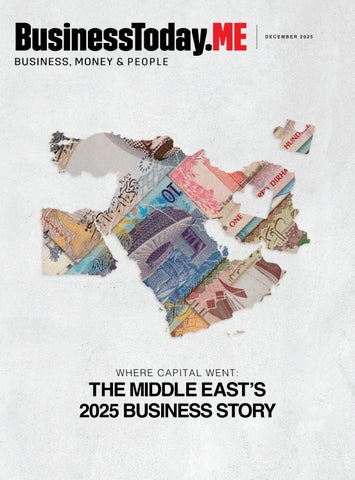
WHERE CAPITAL WENT:
THE MIDDLE EAST’S 2025 BUSINESS STORY
ANANTARA SHARJAH RESIDENCES A NEW CHAPTER OF LUXURY EXPERIENCES BY THE SEA
Bringing luxury seaside living to Sharjah for the first time, owners at the Anantara Sharjah Residences enjoy access to the Anantara Sharjah Resort’s world-class amenities, including an infinity pool, five distinctive restaurants, an Anantara Spa and a state-of-the-art gym. As an investment, owners can enjoy the benefits of a rental management scheme operated by Anantara Hotels, Resorts & Spas, allowing them to maximize their returns when they are not resident in the property. To register your interest, visit arada.com LIFE IS A JOURNEY.
DECEMBER 2025
CONTENTS 3 CONTENTS 10 EDITOR’S NOTE 11 NEWS
18 THE LEADER BEHIND THE WHEEL: Hussam Baghdadi, Chief Operating Officer, AW Rostamani Automotive
36 TRENDS Five Ways Agentic AI Is About to Change Everything 38 ECOMMERCE Secrets to a Seasonal Spike 42 COVER STORY
34 SUSTAINABILITY Enterprise and the Environment in MENA
@BIZTODAYME BUSINESS TODAY MIDDLE EAST
58
HOME AWAY FROM HOME
Why foreign hotels are checking into the UK.
48 INSURANCE Betting on Blockchain
50
REAL ESTATE
The Making of Diriyah
26 FINTECH Digital-Only Remittance Banks: How the UAE Is Re-Wiring Cross-Border Payments 30 Retail 30 RETAIL As children and maternity brand Babyshop celebrates its 50th anniversary, CEO Ruban Shanmugarajah shares how five decades of centering trust and safety is already defining the future roadmap for a new generation of families. s
BIZTODAYME
66 LUXURY High Tide, High Life 68 CARS Flagship Fury 70 FASHION “Celine Signature, To Give To Keep”
56 PROFILE Meet Rateel Alshehri Generation Alpha’s New Storyteller
72 LIFESTYLE Aesop Makes Waves in Jeddah with Its First Store 74 EXECUTIVE Atelio Appoints Joey M. Ghosn as Executive Director
BUSINESSTODAY.ME 9
SUITE TREAT Step into a world of opulence when you book a Suite at Raffles Doha. Experience the added luxury of QAR 750 credit to spend on dining in the hotel, and QAR 500 towards any Spa treatment. Children aged 12 and below are welcome to indulge in the enchantment of complimentary dining. Rates starting from QAR 3,500 per night
For reservations, please call +974 4030 7100 or email reservations.doha@raffles.com
Raffles Doha, Iconic Towers, Marina District, PO BOX 4747, Lusail, Qatar
EXTRAORDINARY PR IVATE PO O LS | 30+ AM E N ITI ES | PRI M E LO CATI O N S
Escape to a home where urban sophistication meets resort tranquility.
BU I LT FO R M O M E NTS THAT MAT TE R 800-SAMANA | WWW.SAMANADEVELOPERS.COM
D I S C OVER REFINED
living
*Ranking as per the H2025 1 sales volume data of property monitor for Dubai
CEO WISSAM YOUNANE | wissam@bncpublishing.net Managing Director RABIH NAJM | rabih@bncpublishing.net Group Publishing Director JOAQUIM D'COSTA | jo@bncpublishing.net Editor AYA ZHANG | aya@bncpublishing.net Digital Reporter REEBA ASGHAR | reeba@bncpublishing.net Business Development Director ANDY SOULAHIAN | andy.soulahian@bncpublishing.net Commercial Director ANDREA MOCAY | andrea@bncpublishing.net Creative Lead CHRISTIAN HARB | chriss@bncpublishing.net Junior Art Director IKA WAHYUNI Marketing Executive AARON JOSHUA SINANBAM | aj@bncpublishing.net Videographer EDUARDO BUENAGUA JOEL AMPARO Contributors AALIA MEHREEN AHMED MARTINA DI LICOSA JANE KHEDAIR PATRICIA CULLEN VIBHA MEHTA
SUBSCRIBE subscriptions@bncpublishing.net
PO Box 502511 Dubai, United Arab Emirates P +971 4 4200 506 | F +971 4 4200 196 For all commercial enquiries, contact jo@bncpublishing.net T +971 50 440 2706 All rights reserved © 2025. The opinions expressed are solely those of the contributors. Business Today Middle East and its affiliated publications in the MENA region are exclusively licensed to BNC Publishing. No part of this magazine may be copied, reproduced, or transmitted in any form or by any means without prior written consent from the publisher. Printed by United Printing and Publishing | upp.ae
Images used in Business Today Middle East are credited when necessary. Attributed use of copyrighted images with permission. All images not credited courtesy Shutterstock.
8 BUSINESS TODAY MIDDLE EAST | DECEMBER 2025
BIZTODAYME
BIZTODAYME
@BIZTODAYME
BIZTODAYME
BUSINESS TODAY MIDDLE EAST
BUSINESSTODAY.ME
Protecting the night sky BEGA pole-top luminaires with BugSaver® technology protect nocturnal fauna by reducing the color temperature from 3000 Kelvin to an amber color around 1800 Kelvin, which reduces the light attractive effect. The color temperature and output can be controlled dynamically. bega.com/bugsaver
Das gute Licht.
LETTER FROM EDITOR
A MOMENT TO
D
REFLECT
ecember invites reflection. It is the time of year when the pace slows just enough to allow perspective, when we can step back and consider what the months behind us have shaped. For the Middle East, 2025 was a constructive year. It was not without challenges, but it was a year in which businesses continued to move forward, deals were completed, and long-term projects took shape. It was a year that rewarded focus and patience, even as the global environment remained uncertain.
As attention turns to the year ahead, reflection naturally gives way to planning. The questions now are about direction, priorities, and how best to build on what has already been achieved. That sense of transition, between closing one chapter and preparing for the next, runs through this issue. We hope these pages offer perspective on the year just past and thoughtful insight for the one to come. Thank you for being part of the conversation, and we look forward to what 2026 will bring.
Aya Zhang Editor
aya@bncpublishing.net
10 BUSINESS TODAY MIDDLE EAST | DECEMBER 2025
Xiaoyue (Aya) Zhang xiaoyuezhangg
One-stop-shop Require formwork and scaffolding? Check out Doka’s extensive list of products and systems, which now includes scaffolding for a variety of applications. At Doka, our philosophy is to provide a broad range of services under one umbrella based on a growing demand for single-source solutions that adhere to the highest standards. /DokaMEA
/company/doka-middle-east-africa
meaapmarketing@doka.com | www.doka-me.com
/doka_mea
NEWS
ENERGY
UAE COMMITS $1 BILLION TO STRENGTHEN YEMEN’S ENERGY SECTOR The announcement was made during the UAE’s participation in the first Yemen National Energy Conference (YFNEC 2025).
12 BUSINESS TODAY MIDDLE EAST | DECEMBER 2025
F
ollowing the directives of President His Highness Sheikh Mohamed bin Zayed Al Nahyan, with the close follow-up by His Highness Sheikh Mansour bin Zayed Al Nahyan, Vice President, Deputy Prime Minister and Chairman of the Presidential Court, the UAE announced a commitment of $1 billion to support the development of the energy sector in Yemen. This initiative aligns with the UAE’s continuous efforts to advance sustainable development in Yemen, reflecting its steadfast commitment to providing a dignified life for the brotherly people of Yemen. The announcement was made during the UAE’s participation in the first Yemen National Energy Conference (YFNEC 2025), where Mohamed Hamad Al Zaabi, UAE Ambassador to the Republic of Yemen, participated. He affirmed
the UAE’s commitment to advancing the development of the sustainable energy sector and addressing the existing challenges, in addition to strengthening constructive partnerships between the public and private sectors and exploring future investment opportunities in Yemen. For his part, Salem bin Braik, Prime Minister of Yemen, commended the long-standing bilateral ties, and the UAE’s continuous support for the Yemeni people’s aspirations toward growth, development, and stability. The event witnessed broad international participation, including permanent member states of the UN and representatives from the Office of the UN Envoy to Yemen – as part of international collective efforts to meet the needs of the Yemeni people in the energy and electricity sectors and reinforce stability and prosperity for the brotherly people of Yemen.
This initiative aligns with the UAE’s continuous efforts to advance sustainable development in Yemen
SAMA GRANTS LICENSE TO MADD BALAS, EXPANDING SAUDI ARABIA’S CROWDFUNDING LANDSCAPE BUSINESS
The move reflects Saudi Arabia’s push to strengthen its financial ecosystem by supporting new digital financing models and broader financial inclusion. The Saudi Central Bank (SAMA) licensed “Madd Balas” company to provide debt-based crowdfunding solutions. With Madd Balas, there are now 14 licensed companies offering debt-based crowdfunding solutions in Saudi Arabia. This addition brings the total number of finance companies licensed by SAMA to 69 companies. According to a press release issued by the SAMA, this decision reflects the bank’s endeavor to support the finance sector, increase the efficiency of financial transactions, and promote innovative financial solutions for financial inclusion in Saudi Arabia.
DUBAI UNVEILS LARGEST BUDGET CYCLE IN ITS HISTORY
GOVERNMENT
The plan outlines a robust vision for growth and stability, reinforcing Dubai’s commitment to innovation, fiscal discipline, and enhanced quality of life. In his capacity as Ruler of Dubai, His Highness Sheikh Mohammed bin Rashid Al Maktoum, Vice President and Prime Minister of the UAE, has approved Law No. 15 of 2025 regarding the Government of Dubai’s general budget cycle for the fiscal years 2026-2028, and the Dubai Government’s general budget for the fiscal year 2026. The three-year budget cycle for 2026-2028 has been approved with a total expenditure of AED 302.7 billion and total revenues of AED 329.2 billion. This budget cycle, the largest in the emirate’s history, aligns with future ambitions to promote sustainable economic growth, enhance community well-being, and solidify Dubai’s reputation as a land of opportunity and innovation. During the implementation of the 2026–2028 cycle, Dubai’s Department of Finance (DOF) expects to achieve an operating surplus of up to 5% of the emirate’s projected GDP for 2026, further solidifying long-term fiscal sustainability.
BUSINESSTODAY.ME 13
NEWS ECONOMY
WORLD BANK REPORT FORECASTS UAE ECONOMY TO GROW BY 4.8% The World Bank says the UAE’s expanding digital capabilities and diversification efforts are fueling one of the strongest economic outlooks in the Gulf for 2025.
T
he latest edition of the Gulf Economic Update (GEU) – Fall 2025, released by the World Bank, forecasts that the UAE economy will grow by 4.8%. The report, titled “The Gulf’s Digital Transformation: A Powerful Engine for Economic Diversification,” confirms that the UAE continues to achieve strong, broad-based growth, with balanced contributions from both oil and non-oil sectors. Real GDP is projected to expand by 4.8% in 2025, and the UAE remains a leader in diversifying its export base. The report also projects economic growth of 3.8% for Saudi Arabia, 3.5% for Bahrain, 3.1 % for Oman, 2.8% for Qatar, and 2.7% for Kuwait. It highlights three main pillars: the evolution of economic diversification indicators over the past decade, tracking macroeconomic developments, and focusing on digital transformation. The report analysed the outcomes of economic diversification efforts in GCC countries over the last decade, noting moderate progress with promising indicators emerging in recent years. It also emphasised the rapid digital transformation in the Gulf and the accelerated adoption of artificial intelligence, 14 BUSINESS TODAY MIDDLE EAST | DECEMBER 2025
noting that all GCC countries have advanced telecommunications networks, with over 90% 5G coverage and affordable high-speed internet. Large investments in data centres and high-performance computing are enhancing AI readiness, with the UAE and Saudi Arabia standing out as regional and global leaders. This progress is supported by enabling ecosystems, including facilities and financing for projects and innovation, as well as government adoption of generative AI applications. Safaa El Tayeb El Kogali, World Bank Division Director for the Gulf Cooperation Council, stated that diversification and digital transformation are no longer optional but essential for long-term economic stability and prosperity. She added that the digital leap made by GCC countries is
remarkable, with strong infrastructure, growing computing power, and increasing AI-related skills enhancing the region’s potential for leadership and innovation, provided environmental and labour-market challenges are addressed proactively. The report also noted that women’s participation in STEM fields in the Gulf exceeds the global average, strengthening the region’s digital competitiveness. It recommended supporting SMEs in adopting AI to boost innovation, and implementing training programs to upskill the workforce and address labour-market gaps, to fully capitalise on the benefits of diversification and digital transformation.
The UAE’s economic outlook continues its upward trajectory
SAUDI ARABIA
Saudi GDP Grows 4.8% in Q3 2025 Strong performance across oil, non-oil, and government sectors contributed to Saudi Arabia’s continued economic momentum in the third quarter.
SUSTAINABILITY
Masdar And Tadweer Advance UAE’s First Commercial-Scale Waste-To-SAF Project The plant, to be located in Abu Dhabi, will convert approximately 500,000 tonnes of waste into SAF each year.
Saudi Arabia’s real GDP grew by 4.8 percent in the third quarter of 2025 compared to the same period last year, the General Authority for Statistics (GASTAT) revealed. All economic activities recorded year-on-year growth, with oil activities rising by 8.3 percent, nonoil activities by 4.3 percent, and government activities by 1.4 percent. Seasonally adjusted results showed real GDP rising by 1.4 percent compared with the second quarter of 2025. Oil activities increased by 3.3 percent, non-oil activities by 0.6 percent, and government activities by 1.1 percent on a quarterly basis.
Masdar and Tadweer Group signed a Joint Development Agreement (JDA) to advance the UAE’s first commercialscale Waste-to-Sustainable Aviation Fuel (SAF) project, a milestone initiative that will position Abu Dhabi at the forefront of global low-carbon fuel production. The plant, to be located in Abu Dhabi, will convert approximately 500,000 tonnes of waste into SAF each year. It will use a hybrid production pathway that combines renewable energypowered electrolysis to generate green hydrogen with waste gasification processes that convert syngas into aviation-grade fuel through established chemical conversion technologies. Once operational, the project will support multiple markets and strengthen Abu Dhabi’s role as a regional hub for SAF production. The initiative comes as the aviation sector—responsible for more than 18 percent of the UAE’s GDP in 2023, according to IATA—pursues aggressive decarbonisation pathways. BUSINESSTODAY.ME 15
NEWS
INTERNATIONAL RELATIONS
UAE AND RUSSIA STRENGTHEN STRATEGIC ECONOMIC PARTNERSHIP UAE and Russia officials met in Dubai to boost economic cooperation, strengthen bilateral ties, and support entrepreneurs across key sectors.
A
bdullah bin Touq Al Marri, Minister of Economy and Tourism, affirmed that the United Arab Emirates and the Russian Federation enjoy strategic relations built on mutual understanding and shared economic interests. This came during the 12th meeting of the Intergovernmental Russia–UAE Commission on Trade, Economic and Technical Cooperation, held in Dubai and co-chaired by Abdullah bin Touq Al Marri and Anton Alikhanov, Russian Industry and Trade Minister, with the participation of representatives from relevant government and private-sector entities from both sides. Bin Touq said, “The current session of the committee represents a new step towards building fruitful partnerships between the business communities and private sectors of both countries. It strengthens cooperation and provides support for entrepreneurs from both sides in a way that contributes to the growth and sustainability of their economies. Our cooperation focuses on new economic 16 BUSINESS TODAY MIDDLE EAST | DECEMBER 2025
sectors and priority areas that serve the mutual interests of the two countries.” He highlighted the important role of the committee in exploring promising opportunities within the business environments of both countries, outlining the enablers offered by the UAE’s business ecosystem, including flexible economic laws that allow 100 percent foreign ownership of companies and an advanced business environment covering more than 2,000 economic activities. The committee’s agenda included discussions on work plans and cooperation mechanisms in fields such as investment, energy, industry and innovation, food security and agriculture, education, transport and logistics, tourism, sports and culture, environmental protection, healthcare and several other areas. Both sides agreed to continue joint efforts to develop new mechanisms for economic cooperation in priority sectors and to support entrepreneurs from both countries, contributing to expanding the scope of economic collaboration between the UAE and Russia.
NOON MINUTES GOES AUTONOMOUS, OFFERING DRONE PARCEL DELIVERY FOR THE FIRST TIME AT DRIFTX
n
At DriftX, noon Minutes sent its fastest couriers skyward, unveiling fully autonomous drones that delivered orders in minutes.
oon Minutes, the on-demand quick-commerce service by noon, successfully carried out multiple fully autonomous drone deliveries during DriftX—an international exhibition for smart and autonomous technologies held as part of Abu Dhabi Autonomous Week. The demonstration, which required no human control, showcased the future of last-mile logistics and marked a major step toward making autonomous delivery a standard in the UAE. Visitors to the noon stand at DriftX were able to order products directly from a touchscreen and receive their deliveries by autonomous drone in under 15 minutes. Over the two-day event, noon completed more than 50 autonomous deliveries, from food to toys and personal care products, demonstrating its commitment to innovation and ongoing investment in next-generation technology that makes deliveries faster, smarter, and more sustainable. The activation was powered by the Technology Innovation Institute (TII), which provided the autonomy system; SteerAI, which supplied the fleet management software coordinating each flight; and LODD, which provided and monitored the drone hardware. This follows successful testing in late October, when a drone delivered a two-kilogram parcel from a noon Minutes mini-fulfilment centre to another mini fulfilment centre in Bani Yas in under four minutes. The project was conducted under the oversight of the General Civil Aviation Authority (GCAA), which is collaborating with the Advanced
Technology Research Council to define airspace regulations and develop advanced airspace management systems for the UAE. Ali Kafil-Hussain, noon’s Chief Business Officer, said, “We’re working hard to completely rethink delivery, making it faster and better for the planet. With the support of TII, SteerAI, and LODD, we’re bringing this vision to life. Our aim is: to set a new standard for delivery, ensuring everyone gets their order quickly and reliably, whether they live in the city center or in a remote area.” “TII’s AI-driven autonomy stack integrates advanced perception, decision-making, communication, localisation, and navigation to enable unmanned vehicles to operate quickly, precisely, and safely—changing the way we define mobility,” said Dr. Najwa Aaraj, the CEO of the Technology Innovation Institute. “Autonomous technology requires careful oversight and management to deliver impact,” said Michael Sonderby, the Acting CEO of SteerAI. “CoreConnect, our fleet management system, enables real-time mission planning, deployment, and tracking of any vehicle or drone, ensuring fast,
safe delivery. This milestone shows how integrated autonomous systems can drive real, scalable results.” “We are reimagining last-mile delivery to be faster and more sustainable for every customer,” Rashid Al Manai LODD CEO commented. “This partnership sets a new standard for sustainable, reliable delivery in the UAE. AI-powered coordination and autonomous systems will redefine how we move goods across cities.” Following this successful activation, noon and its partners are now working to move autonomous lastmile delivery from demonstration to industry standard. The next step is to enable customers to choose drone delivery directly within the noon app, complete with real-time tracking and full visibility as their parcels travel from noon’s warehouses to their doorsteps within the delivery standard of 15 minutes or less. This technology will also expand delivery access to areas that are difficult to reach through traditional methods—such as islands, farms, and new residential zones—helping noon Minutes deliver faster and more reliably to communities across the UAE.
TECH BUSINESSTODAY.ME 17
LEADERSHIP
“I’ve learned that titles don’t define leadership - responsibility does. The higher you rise, the greater your duty to create clarity, inspire growth, and empower others to lead.”
Hussam Baghdadi, Chief Operating Officer of AW Rostamani Group 34 BUSINESS TODAY MIDDLE EAST | DECEMBER 2025
THE LEADER BEHIND THE WHEEL:
Hussam Baghdadi, Chief Operating Officer, AW Rostamani Automotive
As AW Rostamani Automotive navigates one of the most transformative moments in the mobility sector, COO Hussam Baghdadi is steering the company with a leadership philosophy rooted in clarity, purpose, and human connection. BY WISSAM YOUNANE
I
n this exclusive Q&A, Hussam Baghdadi, Chief Operating Officer of AW Rostamani Group, reflects on the legacy he seeks to build—one rooted in resilience, integrity, and innovation—as he aligns the company’s automotive operations with the UAE’s vision for a sustainable, technology-driven mobility future. Q You’ve been with AW Rostamani
Automotive for more than three decades, rising from a sales consultant to Senior Director. How has this journey shaped your leadership philosophy? When I joined AW Rostamani Automotive in 1995, I had an enthusiasm for cars, but little experience in the industry. What I did have was curiosity, and that made all the difference. From my early days as a sales consultant to now leading the organisation, I’ve worked through nearly every stage of the customer and operational journey. That exposure grounded me in the realities of what makes our business thrive: people, trust, and service. My leadership philosophy was shaped by that foundation. I’ve learned that titles don’t define leadership - responsibility does. The higher you rise, the greater your duty to create clarity, inspire growth, and empower others to lead. Success in our industry is never a solo effort; it’s the collective strength of people who believe in a shared vision. That belief continues to guide how I lead today, with integrity, inclusivity, and a deep respect for the people who drive our progress.
Having overseen the transformation of multiple global brands under AWR, what do you see as the key leadership traits that have enabled you to guide teams through disruption and change? Q
In times of change, people don’t follow plans; they follow conviction. When disruption hits, teams look for steadiness, clarity, and empathy in equal measure. I’ve found that the most effective leaders are those who can be firm in direction yet flexible in approach. At AW Rostamani Automotive, we’ve navigated transformations: digital, economic, and structural, by focusing on transparent communication and a clear sense of purpose. My approach has always been to connect strategy with humanity: to make sure people understand why change is happening and how they are part of the journey. That combination of decisiveness and empathy builds resilience, and resilience is what ultimately sustains performance through uncertainty. Q The automotive industry is undergoing
rapid digital disruption. How is AW Rostamani Automotive harnessing AIpowered tools—such as predictive inventory management and smart stock planning—to transform dealership operations? AI has moved from being a futuristic idea to an operational backbone. In a business where timing, precision, and availability shape customer satisfaction, predictive intelligence is transforming the way we plan and respond. We see it as a strategic enabler that drives speed, accuracy, and smarter decision-making. Our new Parts Distribution Centre in Dubai Industrial City - the largest of its kind in the UAE - will bring predictive systems together under one roof, setting new standards for efficiency and responsiveness. Beyond automation, AI empowers our teams to focus on innovation and customer relationships while technology manages complexity. It’s how we’re building a smarter, more agile dealership model designed for the future of mobility. WWW.BUSINESSTODAY.ME 35
LEADERSHIP
“The sale is only the beginning of the relationship. What defines a brand is how it shows up after the transaction.” Q In your view, how will
AI-driven, data-powered decision-making redefine sales, after-sales, and marketing strategies across the UAE in the coming years? A AI is redefining what we mean by “knowing the customer.” Data now allows us to understand preferences, predict needs, and personalise engagement across every touchpoint, from the first click to post-purchase service. In sales, that means identifying how and when customers prefer to connect. In after-sales, it means anticipating service requirements before an issue arises. In marketing, it means focusing resources on what truly matters, not just what’s visible But data alone doesn’t create value interpretation does. That’s why we are using AI to build connected intelligence across functions, not silos. When sales, service, and marketing insights work in harmony, the result is an ecosystem that serves customers seamlessly and builds loyalty organically. Q With mobility increasingly
seen as a service rather than a product, how do you envision advanced technologies and AI reshaping the way customers interact with cars in the region? 36 BUSINESS TODAY MIDDLE EAST | DECEMBER 2025
A Mobility today is about access. Customers want freedom to choose, to switch, to personalise how they move. AI is enabling that flexibility by bridging digital discovery with physical experience. Our goal is to expand choice. Some customers value the pride of owning a Patrol or QX80; others prefer short-term leasing or subscription models for city driving. Technology allows us to serve both, intelligently and intuitively. AI deepens this by analysing behaviour and suggesting tailored solutions that make every interaction feel personal. The future of mobility will be about designing journeys that evolve with people’s lives. Q Today’s customers expect
seamless, frictionless journeys. How is AWR reimagining the onlineto-offline car buying experience?
A Today’s customer is better informed than ever. By the time they walk into a showroom, they’ve already done the research, compared models, and read reviews. Our role is to elevate the experience.We’ve reengineered our processes to make the digital-tophysical transition effortless. Whether it’s through online configuration tools, digital kiosks, or AI-driven lead tracking, every touchpoint connects seamlessly, but we never lose the human element. Technology makes the process faster; people make it meaningful.
That combination is where real customer satisfaction lives. Q What role does
personalisation and digitalfirst engagement play in strengthening trust and loyalty with customers? Personalisation is the modern form of respect. It tells the customer: we see you, we understand you, and we value your time. Our digital-first approach ensures that every interaction - from a service reminder to a product offer - is relevant and timely. By using data ethically and intelligently, we’re able to build trust over time. The result is loyalty that isn’t transactional, but emotional. Customers stay because they want to.
Beyond the sale, what are some of the postpurchase engagement initiatives you’re championing to build longterm relationships with customers? Q
A The sale is only the beginning of the relationship. What defines a brand is how it shows up after the transaction. We’ve invested in digital platforms that simplify ownership, from booking a service to tracking vehicle updates in real time. Our loyalty programs and community events extend that engagement beyond the workshop, into lifestyle, wellness, and purpose-driven initiatives. After-sales, to me, is a philosophy. It’s about staying present in the customer’s journey long after the handover, ensuring they always feel supported, appreciated, and connected.
AW Rostamani Group is a leading multi-sector family business in the Middle East, driven by a legacy of over seven decades.
Q Do you see sustainability
practices evolving into a competitive differentiator for automotive companies in the Middle East? A Sustainability has evolved from being a moral obligation to a business advantage. Customers are now choosing brands that reflect their values. In our region, we’re seeing an accelerated transition toward electric mobility, supported by national visions and policy frameworks. We see sustainability as part of innovation. Whether it’s through energy-efficient operations, EV adoption, or communitydriven initiatives, our aim is to create impact that’s both measurable and meaningful. Leadership today is measured by purpose aligned with progress, which becomes a true differentiator. Q The UAE has positioned
itself as a mobility and smart-city hub. How is AW Rostamani Automotive aligning with and contributing to this national vision? A The UAE’s vision for smart mobility is a masterclass in combining ambition with execution. It’s not just about futuristic ideas - it’s about building the infrastructure and ecosystem that make those ideas accessible to people. At AW Rostamani Automotive, we’re proud to play a role in that
transformation. From advancing EV adoption to integrating digital retail and service platforms, our initiatives are designed to make innovation tangible. We align our strategy with the national agenda so that every step we take contributes to the UAE’s broader journey toward smarter, more sustainable cities. Q With responsibility
across Nissan, INFINITI, and Renault, how do you approach bridging global OEM strategies with the unique needs of the local market? A Global automotive brands bring technological excellence and strong product portfolios, but success in the UAE depends on cultural intelligence, understanding how people here live, drive, and connect. Our role is to bridge the global and the local. We adapt global strategies from Nissan, INFINITI, and Renault to create experiences that resonate authentically with customers in this market. Whether it’s refining model mixes, tailoring communications, or enhancing aftersales service, we make sure every decision reflects both international quality and local relevance.
From your vantage point, what role can the UAE play in shaping the regional dialogue on the future of mobility and innovation? Q
A The UAE is leading in the mobility transformation. The nation’s investments in smart infrastructure, advanced regulation, and innovation ecosystems are setting a regional benchmark. Its ability to pilot new technologies and scale them effectively gives it both influence and credibility. The UAE doesn’t just talk about the future. That blend of vision and execution is what positions the country to shape the regional dialogue on mobility and innovation for years to come. Q Looking ahead, what
do you see as your most important legacy contribution—both within AW Rostamani Automotive and the wider automotive industry in the region? A Legacy, for me, will be measured in people as much as in projects. Within AW Rostamani, I want to be remembered for building resilient, values-driven teams that carry forward the culture of integrity and customer focus. Beyond the company, I hope my role is seen in how we helped align the automotive industry with the UAE’s wider vision of mobility - one that embraces technology, sustainability, and service as part of a single ecosystem. If I have contributed to preparing both the company and the industry to meet the future with confidence, that will be a legacy worth leaving. WWW.BUSINESSTODAY.ME 37
FINANCE
22 BUSINESS TODAY MIDDLE EAST DEC 2025
BREAKING THE GLASS LEDGER
Women chair 15.8% of board positions in 73 listed financial companies in the UAE. REPORT BY GRANT THORNTON AND HERIOT-WATT UNIVERSITY
BUSINESSTODAY.ME DEC 2025 23
FINANCE
H
eriot-Watt University and Grant Thornton published a detailed report on the representation of women in senior leadership roles across the UAE’s financial services sector. Entitled ‘Discovery Series 2025: Women transforming financial services’, the importance of this report lies in its role as an evidence-based benchmark for gender representation within one of the UAE’s most influential economic sectors. As the second edition of The Discovery Series, this report builds on the momentum of the 2024 report by deepening the analysis, expanding the scope of the data, and reinforcing the critical contributions women are making at board and senior leadership levels. The report highlights the contributions of senior female leaders across the UAE’s banks, investment firms, insurance and fintech companies, including board directors, Chief Risk Officers, and Heads of Internal Audit. As the UAE continues to build a resilient, diversified economy and reduce its reliance on oil, the financial services
sector plays a crucial role in driving non-oil Gross Domestic Product (GDP) and strengthening governance. In 2024, the UAE’s economy grew by 4% to AED 1.77 trillion, with the nonoil sector accounting for more than three-quarters of the GDP. Among key drivers of this growth is the financial industry, which contributed around 13.2% to the economy. Within the sector, risk and control functions, led by Chief Risk Officers (CRO) and Heads of Internal Audit (HIA), are essential to safeguarding its integrity and enabling sustainable growth. Women’s participation in these key areas not only enhances organisational resilience but also supports the national agenda for a balanced, transparent, and wellregulated financial system. The 2025 Discovery Series: Women transforming financial services report highlights both the representation of women in these pivotal roles and the opportunity to champion and accelerate women’s leadership across risk, audit, and control functions, thereby reinforcing the UAE’s longterm economic transformation. The report, led by Professor Dame Heather McGregor, Provost and Vice Principal of Heriot-Watt University Dubai, includes research analysing board and leadership data from the
24 BUSINESS TODAY MIDDLE EAST DEC 2025
Of the 60 companies where the HIA has been named, six (10%) have a female HIA, underscoring the need to strengthen gender balance within control functions.
2025 financial year across 73 publicly listed financial sector companies in the UAE. The report captures data on 539 board members across three main stock exchanges in the UAE: Abu Dhabi Securities Exchange (ADX), Dubai Financial Market (DFM), and Nasdaq Dubai. KEY FINDINGS FROM THIS REPORT ARE AS FOLLOWS: As of 1 September 2025, a total of 539 board members were identified by name and gender. Of the 539 listed board positions in the financial services sector, 85 (15.8%) are taken by women. This is higher than the UAE-wide average of 14.8% across all sectors, according to the 2025 GCC Board Gender Index, highlighting that the financial sector is slightly ahead in advancing women’s representation at the board level. Eight (11%) of the 73 companies have no woman on their board, indicating that while progress has been made across the sector, gender representation remains uneven. Out of 49 identified companies, only three (around 6%) have a female CRO, highlighting a gap in female representation in leadership roles in the risk function and the need for proactive measures and greater accountability.
Commenting on the release of the 2025 Discovery Series: Women transforming financial services, Hisham Farouk, CEO of Grant Thornton UAE said, “The UAE’s story is one of intentional progress – building a world class, innovation led economy with finance at its core. From capital markets and Islamic finance to a fast maturing fintech ecosystem and robust digital infrastructure, the financial sector is powering diversification, attracting global investment and creating skilled jobs. Yet true leadership is measured not only by growth, but by the prosperity of its people.” “The Discovery Series is a benchmark designed to help industry, regulators and boards track progress and actively close the leadership representation gap. We are thrilled to partner with Heriot-Watt University Dubai on this report, which highlights both the progress made and the work still ahead to ensure women have equal opportunity to lead,” he added. Emma Smalls, UAE Head of Business Risk Private Bank at HSBC Middle East, said, “The Discovery Series 2025 highlights both the progress and the opportunities that lie ahead for gender-balanced leadership in the UAE’s financial services sector. While we celebrate the growing representation of women on boards
and in senior roles, this report also showcases the need for continued focus on inclusive leadership across the ecosystem. By shining a light on organisations and individuals leading the way, we hope to inspire further action and accelerate the journey toward truly diverse and resilient governance.” Professor Dame Heather McGregor, Provost and Vice Principal of Heriot-Watt University Dubai, said, “Our intention in publishing the 2025 Discovery Series: Women transforming financial services was to provide a clear, evidence-based picture of gender representation at senior levels in the UAE financial sector. In partnership with Grant Thornton UAE, we aim to shed light on how women are shaping governance, risk, and reform from within, and to identify the organisations setting the benchmark for inclusive leadership. As one of the most progressive sectors in the UAE, the financial industry has a significant responsibility to champion gender equity.” “The findings aim to bring clarity, transparency and evidence-based visibility to a topic where strong sentiment exists, but accurate data is often lacking. The Chief Risk Officers and Heads of Internal Audit are an essential part of any financial organisation, and this study provides facts to inform action and change”, she added. Through this series, Grant Thornton and Heriot-Watt University hope to examine gender representation at senior levels in the sector, capturing both quantitative data and qualitative narratives, and providing sectorspecific insights into how women are shaping governance, risk and reform from within.
BUSINESSTODAY.ME DEC 2025 25
FINTECH
DIGITAL-ONLY REMITTANCE BANKS: HOW THE UAE IS RE-WIRING CROSS-BORDER PAYMENTS
26 BUSINESS TODAY MIDDLE EAST | DECEMBER 2025
The UAE is rewriting the rules for sending money abroad. With digital-only remittance licences and full foreign ownership now on the table, millions of expatriates could see faster, cheaper transfers while fintechs and global money-transfer giants race to stake their claim in the Gulf’s newly electrified payments landscape.
W
hen the Central Bank of the UAE issued a new Exchange Business Regulation, it quietly set the stage for one of the most significant shakeups to the Gulf’s financial sector in a decade. The regulation creates a brandnew digital remittance licence and allows up to 100% foreign ownership for firms that apply for it. For the broader public, that may sound technical. But for the region’s enormous expat population, which sends tens of billions of dollars home every year, this is a foundational shift that could change how cross-border money moves. The UAE’s exchange-house rules had previously been based on a framework written in 2014. Updating them effectively brings the country’s remittance sector into the era of fintech. The new rules also set a paid-up capital requirement of AED 25 million for certain licences, including digital remittance operators. This is a strong signal that the Central Bank wants serious,
well-capitalised entrants and not small or lightly funded players, especially as digital providers scale up. The scale of the opportunity explains the heightened scrutiny. The UAE alone generated approximately $38.5 billion in outbound remittances in 2023, placing it among the world’s largest remittance markets. That money comes primarily from expatriate workers and represents a stable financial lifeline for families in South Asia, Africa, the Philippines, and beyond. Marie Chowdhry, a partner at Pinsent Masons, summed up the strategic ambition behind the reforms: “The introduction of a dedicated digital remittance licence, paired with 100% foreignownership eligibility and an AED 25 million capital requirement, signals a bold move by the UAE to attract serious, globally minded fintechs.” Her interpretation underscores what the UAE is aiming for, a remittance ecosystem competitive enough to entice major international players, but robust enough to be tightly supervised. WWW.BUSINESSTODAY.ME 27
FINTECH
reported, a burden that falls hardest on low-income migrants. Digital-only remittance banks, which run on lower overhead and automated systems, could help reduce that cost.
Globally, remittances to low and middle-income countries reached an estimated $669 billion in 2023, according to the World Bank, which noted that despite slowing growth, remittances remain “resilient” and more reliable than many other private flows. For the Gulf, which is home to millions of migrant workers, these trends reinforce just how crucial the sector is. That’s why established names like MoneyGram, along with digital challengers such as Wise and Remitly, are targeting the Gulf’s remittance corridors. Market trackers show many of these firms already operate in the UAE or are eyeing expansion. In short, the competition is already intense, and the new licence is likely to accelerate it. For everyday users, the biggest impact could be cost. Sending money remains expensive. The global average fee for a $200 remittance was 6.2% in Q2 2023, the World Bank 28 BUSINESS TODAY MIDDLE EAST | DECEMBER 2025
But the Central Bank is not opening up the playing field without guardrails. Enforcement actions have sharply increased. Between March and June 2025, the CBUAE fined and penalised multiple exchange houses, including an AED 12.3 million sanction in June against six firms for antimoney-laundering failures. These crackdowns explain why the new regulation includes higher capital floors, more compliance oversight, and more granular licence categories. The Central Bank wants innovation, but not at the expense of stability. Market data illustrates why regulators want financially stable players. One payments brief showed a major shift: average transfer values in the UAE jumped about 75% from mid-2022 to mid-2023, even as the number of individual transfers declined. That means fewer transactions are accounting for larger dollar amounts, increasing the stakes and risks of any compliance failures. It also puts pressure on digital operators to maintain
liquidity and operational resilience. For global development agencies, the human side remains central. In a 2023 press release, Iffath Sharif, Global Director at the World Bank, emphasised that “during crises, migrants have weathered risks and shown resilience to support families back home.” Her colleague, economist Dilip Ratha, noted that for many developing countries, remittances are now larger than other private financial flows. This context matters: any disruption or innovation in Gulf remittances reverberates across entire economies abroad. Another layer to watch is infrastructure. The UAE is modernising its payment system. Those efforts will need to align with private remittance rails for digital-only banks to scale effectively. Technical fragmentation also persists across jurisdictions such as the Dubai International Financial Centre and the Abu Dhabi Global Market, each with separate licensing paths, which can complicate expansion plans for fintechs. Despite the complexity, the direction is unmistakable. For migrant workers, the reforms promise faster, cheaper, and more transparent
transfers. For fintechs and global money-transfer giants, the Gulf is emerging as a valuable and newly accessible battleground. And for regulators, the goal is to move from old-style exchange houses to bankgrade digital platforms that can handle billions in flows safely. By codifying digital-only licences, permitting full foreign ownership, and strengthening capital and anti-money-laundering rules, the UAE is signalling that the future of remittances in the Gulf is digital, competitive, and tightly supervised, a combination that could reshape how money travels from Gulf salaries to households around the world.
Martina Di Licosa is a business journalist specialising in consumer startups and financial technology. Based in New York City, she holds an MSc in Journalism from Columbia University. Her reporting focuses on the evolution of fintech, cross-border payments, and the ways innovation is reshaping financial services globally.
AWARDS February 6, 2026 Jumeirah Carlton Tower, London, United Kingdom
Nominate Now For Editorial Opportunities Vibha Mehta +971 58 631 4145 vibha@bncpublishing.net
For Commercial Opportunities Joaquim D’Costa +971 50 440 2706 jo@bncpublishing.net
Roma Arora roma@bncpublishing.net
www.GlobalRELeaders.com
WWW.BUSINESSTODAY.ME 29
RETAIL
BUILDING A BUSINESS OF RELATIONSHIPS As children and maternity brand Babyshop celebrates its 50th anniversary, CEO Ruban Shanmugarajah shares how five decades of centering trust and safety is already defining the future roadmap for a new generation of families. BY AALIA MEHREEN AHMED
I
n the little over fifty years that the regionally homegrown children and maternity retail brand Babyshop has been operational, while parenthood and the emotional and economic complexities that accompany it have evolved, what hasn’t changed is the visceral bond that defines parent-child relationships. So when Ruban Shanmugarajah took on the role of CEO at Babyshop in 2021, he was faced with a related dilemma. “My first thought was, ‘how do we preserve the heart of this brand while preparing it for its next era?’” he shares. “Babyshop has always been built on warmth and trust, and I did not want to lose that. But I was also looking at a generation of parents who are digital-first, globally influenced, and expecting brands to meet them where they are. My vision was to evolve Babyshop without losing its soul. Four years on, a few milestones stand 30 BUSINESS TODAY MIDDLE EAST | DECEMBER 2025
Ruban Shanmugarajah is the CEO of UAE-based children and maternity retail brand Babyshop; a role he has held since 2021
out. Our digital shift has been transformational, not just building e-commerce but creating a truly omni-channel brand where online and offline amplify each other. We have modernised our stores, sharpened our assortments, and made our collections more aspirational without ever losing accessibility. To me, the real win is that families today still recognise the Babyshop they trust, but they see it in a fresher, more relevant form.” Launched in 1973 in Bahrain under Landmark Group, one of the largest retail and hospitality conglomerates in the Middle East, Babyshop
today operates over 250 stores across MENA, Africa, Southeast Asia, and India. “Saudi Arabia and the UAE continue to be our biggest markets, but our expansion into Southeast Asia and India is particularly exciting,” Shanmugarajah adds. “Both regions have welcomed Babyshop with real enthusiasm. As for verticals, apparel remains our leading category, powered by our in-house brands and our ability to respond quickly to evolving style trends. Nursery, toys, and travel gear are also growing strongly, driven by conscious parenting, gifting, and the need for practical, highquality essentials. It is no longer
Babyshop was launched in 1973 in Bahrain under Landmark Group, and today operates over 250 stores across MENA, Africa, Southeast Asia, and India
about being just a children’s clothing retailer. Today, Babyshop is positioned as a complete partner in parenting, and that breadth of trust across categories is one of our greatest strengths.” Indeed, in addition to keeping up with a digitally transformed retail industry and changed consumer tastes, Shanmugarajah notes that there has been the added onus of fully understanding the psyche of the modern day parent. “Parents today are raising children in a very different world– they are far more informed, intentional, and discerning in their choices,” he notes. “Quality and safety are non-negotiables,
but they also want brands that simplify their lives, inspire them, and make everyday parenting easier. Parenting has become more planned, and expectations from retailers are higher than ever. At the same time, cultural values remain central in this region, and those traditions continue to shape how families make decisions. At Babyshop, these shifts have influenced every part of our operations. We have doubled down on product innovation, from design and fabrics to bringing in best-in-class features in quality and safety.” In turn, three tenets became paramount to Babyshop’s
Parents today are raising children in a very different world– they are far more informed, intentional, and discerning in their choices. Quality and safety are nonnegotiables, but they also want brands that simplify their lives, inspire them, and make everyday parenting easier. WWW.BUSINESSTODAY.ME 31
RETAIL
operations. “Parents told us what mattered: relevant products, better availability, and smoother omni-channel experiences,” Shanmugarajah says. “We listened, and then acted quickly: building sharper assortments, renovating stores, stepping up our marketing, and fine-tuning our supply chain. That agility has been key. The uplift is encouraging, but I do not see it as an end point. For me, it is a signal, proof that when we stay agile and in tune with families, growth follows. It gives us the confidence to double down on our next chapter: deeper omnichannel integration, expansion in emerging markets, and building even more depth across our categories.” In the midst of such parentcentric shifts, Babyshop has also had to keep an eye on how pop culture interests and
32 BUSINESS TODAY MIDDLE EAST | DECEMBER 2025
emotional intelligence of toddlers and children today are much different than that of previous generations. “Kids today are incredibly expressive– they want their clothes, toys, and even accessories to reflect who they are,” Shanmugarajah explains. “Our role is thus to give them that sense of individuality without fasttracking them out of childhood. That is where our research and design teams play a critical role. They take global fashion cues, then reinterpret them in ways that are playful, comfortable, and age-appropriate. Partnerships also matter here. We work closely with global names like Disney and Mattel, and more recently with anime and gaming properties, to create collections that excite children while delivering value for parents. It is about listening carefully and giving families what they aspire to buy, but doing so responsibly so the joy and innocence of childhood remain intact.”
As such, it is these strategies that have amalgamated into what “innovation” means to the brand today. “Our approach is to keep an eye on global innovations in these areas and be the first to bring them to market for parents in our region,” Shanmugarajah says. “Alongside that, we have introduced seamless technology in our stores to support customer journeys better, trialled new store layouts and formats to suit different shopping missions, and strengthened our omni-channel capabilities so parents can interact with us however they choose. Even in marketing and content, we are becoming sharper and more efficient to ensure that families see Babyshop as relevant at every touchpoint.The balance between innovation and cultural values lies in listening carefully and adapting thoughtfully. Not every global trend is right for this region, and we are conscious of that. Our role is to bring modernity, convenience, and inspiration in
The brand specialises in apparel, toys, nursery furniture, and baby gear
ways that feel authentic here, so parents see Babyshop as both forward-looking and deeply rooted in the values that matter to families. That is what keeps us both relevant and trusted.” But as much as Shanmugarajah’s leadership model has been forwardlooking, it has also, deeply, been reflective of the values that has allowed Babyshop to thrive for five decades in the region. “Loyalty is never instant; it is built slowly, over years, sometimes decades,” he notes. “For Babyshop, it has come from being present in people’s lives at the moments that matter most. Parents who once walked into our stores in the 80s are now returning with their grandchildren, and that generational bond is something I value deeply. At the heart of it is trust: trust that the product will last, that the pricing is fair, and that the brand understands families. What has
not changed in 50 years is our philosophy that we are not in the business of transactions; we are in the business of relationships. That mindset shapes how our teams show up every single day.” One such unchanged value has been Babyshop’s commitment to never compromise on quality and sustainability in favor of the fast fashion model. “This is where we have drawn a very firm line,” Shanmugarajah emphasises. “Parents should never have to
Loyalty is never instant; it is built slowly, over years, sometimes decades. For Babyshop, it has come from being present in people’s lives at the moments that matter most. Parents who once walked into our stores in the 80s are now returning with their grandchildren, and that generational bond is something I value deeply.
choose between affordability and safety. We design with longevity and wellbeing at the centre, from cotton-rich fabrics tested to international standards, to non-toxic finishes in our nursery ranges, to durability built into our travel gear. We back this up with action. For example, our nursery and travel ranges come with a two-year warranty. For a brand trusted by millions of parents over decades, this is more than a promise, it is a responsibility. And it is why quality and safety remain non-negotiable at Babyshop, regardless of price.” As Shanmugarajah now gears up for the final stretch of 2025 and the new year, it is this legacy that he hopes to continue honouring in leading a brand that has become deeply embedded in family life across the region. “Families trust us with some of their most important milestones, from the first crib to the first school bag, from birthdays to everyday essentials,” he says. “That level of trust is humbling. It is a privilege, but also a deep responsibility. It also sets the compass for our future. Every decision we make, whether growth, innovation, or partnerships, has to answer one question: are we making families’ lives better? If the answer is ‘yes,’ then it is the right path. That principle has carried us through 50 years, and it will keep Babyshop relevant for the next 50 and beyond.” WWW.BUSINESSTODAY.ME 33
SUSTAINABILITY
THE FUTURE OF SUSTAINABLE BUSINESS:
ENTERPRISE AND THE ENVIRONMENT IN MENA In a region rich with opportunity, companies are learning that doing good for the planet and society is now just as important as doing well in the market. BY JANE KHEDAIR
S u s ta i n a b i l i t y
I
n recent years, business leaders across the Middle East and North Africa have awakened to a simple yet profound truth: in tomorrow’s world, success will not be judged by profits alone. Enterprises will be measured by how deeply they reflect the needs of society and the natural world. A new research release from the World Economic Forum, in collaboration with Bain & Company, charts how MENA firms can navigate the mounting pressures of global sustainability expectations, pressures that are no longer optional, but essential. The WEF’s report, “Prioritising Sustainability in MENA: Mapping Critical Environmental Issues for Regional Businesses”, lays out a compelling roadmap. It warns that over the next two years, some 70 per cent of the global economy will be subject to mandatory sustainability reporting. In the same breath, it spotlights acute environmental risks, from water scarcity and biodiversity loss to emissions and waste, that 34 BUSINESS TODAY MIDDLE EAST | DECEMBER 2025
disproportionately affect our region. These twin dynamics mean that MENA entrepreneurs must reimagine their strategies. The region is at a crucial juncture. On one hand, its geography gives it unparalleled renewable energy potential, vast solar and wind capacity that can power not just domestic ambitions but regional leadership. On the other hand, many local businesses, especially SMEs, remain underprepared for the sustainability transition. A 2023 survey of MENA SMEs found that nearly two-thirds had little or no knowledge of energy efficiency or renewable technology. For founders in MENA today, sustainable entrepreneurship is not an optional add-on — it must be part of the foundation. Integrating environmental and social responsibility from the start is no longer virtue signalling; it is a strategic imperative. What does that look like in practice? First, founders must
begin with materiality: understanding what environmental or social issues genuinely matter for their sector and geography. Whether it’s water use for agri-tech ventures or emissions in logistics, the choice of focus must be relevant and credible. Next comes measurement and t r a n s p a r e n c y. Even before formal regulation kicks in, smart entrepreneurs will build the systems to monitor, report, and improve their environmental and social footprints.
Jane Khedair. Executive Director, Institute of Entrepreneurship and Private Capital (IEPC), London Business School
Financing is evolving, too. Green-linked loans, sustainability performance instruments, and impact investment are gaining traction globally, and MENA investors and banks are increasingly tuning into these tools. The WEF report highlights best practices already deployed in the region: green sukuk, sustainabilitylinked lending, and sector‐specific investment frameworks.
MENA has a few shining examples already. Large regional players like Majid Al Futtaim are pushing sustainable procurement and green bonds; Emirates Global Aluminium has launched lowcarbon aluminium initiatives; and energy incumbents are partnering on renewable buildouts. These examples set a higher bar and help shift norms for smaller firms.
But the product or business model itself must be rethought with sustainability in mind. From supply chains and procurement to energy usage and waste management, every link offers opportunities for innovation. Circular models, regenerative agriculture, modular design, local sourcing, these are not just ideals, they are pathways to resilience and differentiation. And of course, social inclusion must go hand in hand: hiring practices, local community engagement, fair wages and skills development cannot be afterthoughts.
strengthen the ecosystem. Entrepreneurs must not view policy as external, but as part of the system they help build. Advocacy, multi-stakeholder platforms, and coalition building will be as important as building a product.
Yet the challenges remain real: regulatory ambiguity, lack of expertise, upfront cost barriers, and limited access to green finances are all obstacles. To overcome them, founders must lean into collaboration, with governments, universities, NGOs, and peers, to share knowledge and co-create infrastructure and standards. Policymakers have a key role to play. Consistent regulation, transparent incentives, renewable energy rollout, carbon pricing, and support for green R&D all help
If this moment is seized, the rewards could be transformative. We may see the rise of “impact unicorns”, high-valuation businesses whose worth is tied both to market performance and net positive environmental and social impact. MENA’s integration into global value chains could deepen as sustainability becomes a criterion for partnerships and exports. And perhaps most vitally, a generation of businesses will emerge that are resilient to climate shocks, resource disruptions, and shifting consumer expectations. Looking ahead, it is clear that the next decade will test whether the region’s enterprises can reconcile economic ambition with ecological stewardship. For entrepreneurs in MENA, the question is no longer whether to pursue sustainability, it is how fast, how deeply, and how boldly. The future of business in this region demands that we build enterprises that do well by market metrics and do good in the broader sense. To borrow a phrase, I’ve shared before: today’s founders see that “motivation is often equally as much about doing good for society by giving back.” WWW.BUSINESSTODAY.ME 35
TRENDS
FIVE WAYS AGENTIC AI IS ABOUT TO CHANGE EVERYTHING Agentic AI is stepping out of the shadows and into the workforce, taking on decisions, tasks, and entire workflows. In 2026, these five shifts will redefine how the region gets things done. This article is provided by Yango Tech, a global technology company specialising in AI-driven solutions.
A
gentic AI is evolving from a support tool into a co-worker that can reason, act, and execute multi-step tasks. The MENA region is well-positioned for this shift due to its high service standards and national digital transformation agendas. The UAE already reports one of the world’s highest AI adoption rates, with 62% of organisations using AI in at least one function. In this climate, companies like Yango Tech are shaping how agentic systems operate in real enterprise environments, setting the stage for five trends that will define 2026.
1
VOICE BECOMES THE FRONT DOOR FOR SERVICES
Voice is gaining traction because it mirrors how people naturally communicate and reduces friction in service-heavy environments. The UAE’s linguistic mix makes this especially important, with customers shifting between Arabic and English and expecting tone and formality to feel culturally accurate. Organisations are adopting AI agents that interpret these cues and adjust language and intent in real time. Early uptake will come from banking, aviation, hospitality, government services, and insurance, where trust and speed matter most. As voice becomes a primary interface, conversational quality will be treated as a core element of customer experience. 36 BUSINESS TODAY MIDDLE EAST | DECEMBER 2025
2
GOVERNMENT BUILDS AI INTO ITS FOUNDATION
The UAE’s Digital Government Strategy is pushing public services toward greater speed, accuracy, and accessibility, accelerating the need for next-generation automation frameworks. Agentic AI is handling multi-step workflows that once required large teams, from citizen inquiries and document reviews to policy analysis and simplifying access to institutional knowledge. AI-driven search cuts document retrieval time by up to three times, while automated review systems reduce processing from days to minutes. As volumes rise across permits, licensing, and social services, governments are prioritising scalable, accurate systems. This marks a shift from reactive service delivery to
proactive, data-driven operations that anticipate citizens’ needs.
3
HEALTHCARE ADOPTS AGENTS FOR CLINICIAN EFFICIENCY Healthcare systems need faster decisions without compromising accuracy, yet only about three per cent of healthcare data is effectively used because legacy systems struggle to process multi-modal information at scale. Agentic AI helps close this gap by validating referrals, transcribing visits, summarising patient histories, checking diagnoses, and surfacing clinical trends with full auditability. These capabilities reduce manual data handling and free clinicians to focus on care. AI review tools have already cut processing
times from days to hours, and hospitals are now adopting agents that deliver consistent, scalable workflows across high-volume cases.
4
RETAIL AND LOGISTICS ACCELERATE AUTONOMOUS OPERATIONS With the MENA retail market expected to reach $1.4 trillion by 2032, retailers face growing pressure for faster replenishment, precise stock management, and accurate delivery windows. Agentic AI supports these needs by autonomously forecasting demand, adjusting orders, coordinating replenishment schedules, and optimising pricing. Offline retailers are also adopting computer vision to track
shelves and reduce stockouts, while e-commerce operators integrate agents into last-mile routing and warehouse planning. RouteQ, a Yango Tech solution, has demonstrated how AI can improve fleet utilisation by up to 20% and reduce fuel usage by 15%. These shifts signal the rise of autonomous retail and logistics environments that adapt continuously to real-time conditions.
5
HIGH-COMPLIANCE SECTORS ACCELERATE AGENTIC AI ADOPTION Financial services, energy, and utilities operate in environments where accuracy and compliance are central to performance. In financial services, AI assistants support onboarding, compliance workflows, anti-fraud
monitoring, credit decisioning, and tailored customer advisory, helping institutions meet regulatory expectations while improving efficiency. In energy and utilities, predictive maintenance, grid optimisation, and autonomous monitoring are becoming standard, with agents analysing realtime data to anticipate failures, manage consumption, and maintain service reliability. These sectors are prioritising agentic systems for consistency at scale, where precision is nonnegotiable. Organisations across the region are beginning to pair human judgement with AI-driven execution, creating faster and more resilient workflows. As 2026 approaches, the companies that act early will set new benchmarks for service quality and operational efficiency across the GCC. WWW.BUSINESSTODAY.ME 37
E-COMMERCE
SECRETS TO A SEASONAL SPIKE FedEx shares five smart ways online sellers can win the holiday rush.
38 BUSINESS TODAY MIDDLE EAST | DECEMBER 2025
O
nline sellers across the Middle East know the final quarter can define the year. Shoppers in the UAE and across the region start browsing early, buy steadily through global sales events, and then create a fresh wave of activity as the holidays approach. Recent Google-Visa research shows that in the lead up to holiday and peaksale period, shopper intent rises sharply across non-essential categories such as fashion, beauty, electronics, and lifestyle products. During this build-up, search volumes in these segments grew by around 10%, while spending rose 17% in the UAE. This increase in shopping activity raises expectations on delivery performance and puts more pressure on e-tailers to get every order right.
Zaid Khammash, Managing Director of Operations at FedEx Middle East, India Subcontinent, and Africa, sums it up: “Peak season is when consumer expectations rise, and businesses need to stay clear, consistent, and dependable. Consumers want quick delivery, clear updates, and confidence that their gifts will reach the right place at the right time. With early planning and the right logistics support, businesses can turn that seasonal pressure into an opportunity for real growth.” Even if your own plans are already in motion, there is still room to refine your approach and capture the shoppers who leave decisions to the last minute. These five steps will help convert more carts, reduce service issues, and strengthen loyalty long after the season ends. WWW.BUSINESSTODAY.ME 39
E-COMMERCE
EXTEND YOUR RETURN WINDOW Shoppers appreciate flexibility when buying gifts for colleagues, friends, and family. A longer return window helps reduce hesitation and encourages quicker checkout decisions. Consider at least 30 days during peak season. It signals confidence in your products and builds trust with new buyers. Keep it simple. Provide clear return labels and easy tracking so customers always know the location of their package. A smooth return experience often turns first-time shoppers into repeat customers.
ADD A PERSONAL TOUCH Gifting plays a big role across the region, and small thoughtful touches help an online store stand out. You do not need full customisation, which may slow fulfilment. Keep it fast and meaningful. Handwritten notes, festive cards, or branded gift boxes can elevate the unboxing experience without complicating operations.
BUILD TRUST THROUGH VISIBILITY For today’s online shoppers, visibility is as valuable as speed. They want to track their orders in real time and know exactly when to expect them. Businesses that offer clear, timely updates through the channel most convenient to the customer — whether email, text, or WhatsApp — give shoppers confidence that their purchases are on the way. Simple visual confirmations, such as picture proof of delivery, also helps build reassurance and trust. 40 BUSINESS TODAY MIDDLE EAST | DECEMBER 2025
LET YOUR DATA GUIDE YOUR FINAL PUSH The recent orders received already reveal what shoppers are responding to. Look at items gaining momentum, not only the established bestsellers. These trends often signal what will move fastest in December. Track add-to-cart rates, repeat purchases, and categories seeing rising search interest. Match those patterns with regional insights, especially strong demand in beauty, gifting accessories, and affordable lifestyle products.
OFFER FLEXIBLE, FAST DELIVERY OPTIONS Convenience drives online spending in categories like fashion, beauty, and electronics. Delivery options that balance competitive pricing with reliable three to four business days shipping to the US, Europe, and Asia Pacific markets, give shoppers more confidence at checkout. When the delivery timeline is clear and fits their needs, they are more likely to complete their purchase and return for future sales.
FINISH THE SEASON STRONG
Small adjustments can make a measurable difference. Give shoppers clarity when their orders arrive, keep gifting simple, and offer delivery options they can count on. These steps help lift conversions now and build repeat business into the new year.
WWW.BUSINESSTODAY.ME 41
COVER STORY
42 BUSINESS TODAY MIDDLE EAST | DECEMBER 2025
WHERE CAPITAL WENT:
THE MIDDLE EAST’S 2025 BUSINESS STORY In 2025, the Middle East did not chase growth for its own sake. Capital moved where strategy demanded, and the true story of influence was written in the decisions behind the deals.
I
n 2025, the Middle East’s business environment operated against a backdrop of global uncertainty. Growth in advanced economies slowed, financing conditions remained tight, and geopolitical tensions continued to shape capital flows. Yet despite these headwinds, deal activity across the region proved resilient.
BUSINESSTODAY.ME 43
COVER STORY
According to PwC analysis based on LSEG data, mergers and acquisitions in the Middle East rose to 271 deals in the first half of 2025, up from 228 a year earlier, even as global M&A activity declined. Early reporting from EY’s MENA M&A Insights 9M 2025 indicates that momentum held through the year, with nearly 650 transactions valued at approximately $69.1 billion, confirming that the trends driving H1 persisted across 2025. The data points to a region that continued to deploy capital actively, even as global markets grew more cautious. Beneath the headline figures, however, the pattern of investment points to a more selective and structured approach to capital deployment, shaped by who controlled capital, where it was directed, and the conditions attached to it.
Capital Availability Was Not the Constraint
One of the clearest signals from 2025 was that capital availability itself was not the primary limiting factor for deal activity in the Middle East. Sovereign wealth funds, state-backed institutions, large family offices, and regional corporations continued to commit capital across domestic and cross-border transactions. What shifted was not the presence of capital but the process surrounding its deployment. Financing conditions globally remained restrictive, with higher interest rates increasing the cost of borrowing and adding pressure on investment returns. As a result, investors across the region placed 44 BUSINESS TODAY MIDDLE EAST | DECEMBER 2025
greater emphasis on governance standards, cash flow visibility, and downside protection in evaluating opportunities. Market participants reported longer approval timelines, more detailed due diligence, and greater involvement from investment committees, particularly where sovereign or state-aligned capital was involved. These procedural dynamics reflected an environment in which investors sought clarity and alignment before deploying resources.
The Role of Sovereign Capital Became More Visible
Sovereign wealth funds played a central role in sustaining regional deal momentum. According to data from Global SWF, sovereign investors globally increased their domestic capital deployment to 38 per cent in the first half of 2025, up from an average of
27 per cent between 2020 and 2024. GCC-based funds followed a similar pattern. In the United Arab Emirates, ADQ allocated the majority of its capital (85 per cent) domestically, aligning investments with national priorities such as industrial development, supply chain resilience, and infrastructure. Across the region, sovereign capital increasingly acted as a strategic anchor, supporting transactions linked to energy transition, digital infrastructure, healthcare, and advanced manufacturing. This greater role for sovereign investors also influenced market behaviour. Transactions aligned with
national development agendas or long-term policy objectives were more likely to progress, while projects that lacked clear strategic or economic alignment faced greater scrutiny.
Sectoral Patterns Point to Selectivity
In 2025, capital flows were concentrated in a relatively narrow set of sectors. Assets tied to the energy transition, including renewables, grid infrastructure, and sustainable transport, continued to attract investment, supported by policy frameworks and long-term demand visibility.
Digital infrastructure, including data centres, cloud services, and cybersecurity, also featured prominently, reflecting their importance as foundational enablers of broader economic activity. At the same time, technology investments without clear revenue models or defensible economics faced a more challenging funding environment than in previous years. Infrastructure and logistics remained active areas for M&A, particularly where assets had regulated returns or sovereign backing. According to PwC data, healthcare, industrials, and energyBUSINESSTODAY.ME 45
COVER STORY
related services also contributed to deal volumes, demonstrating the ongoing focus on sectors aligned with diversification and localisation strategies across the Gulf Cooperation Council. Taken together, these patterns suggest that capital in 2025 favoured predictability and strategic relevance over rapid expansion or speculative growth.
Real Examples from the Market • In the UAE, one of the largest transactions of the period was the $2.2 billion divestment by e& of its stake in Khazna to Group 42 Holding and Khazna Data Center Holdings, illustrating ongoing interest in digital and data infrastructure. • In Saudi Arabia, Elm Company acquired Thiqah Business Services outright for approximately $907 million, a transaction aligned with Vision 2030 goals to localise technology and foster national champions. • In Egypt, deal activity rose significantly, with 86 transactions in the first half of 2025, compared with 48 a year earlier, underpinned by renewed IMF support and reforms aimed at attracting regional capital. 46 BUSINESS TODAY MIDDLE EAST | DECEMBER 2025
These examples demonstrate the breadth of activity outside headline sectors and highlight where deploying capital was both possible and strategically meaningful.
Family Offices and Institutional Discipline
Family offices continued to be important sources of capital in 2025, though the year highlighted differences in how they operated. Those with formal governance structures, professional investment teams, and clearly defined investment mandates were better positioned to participate in larger transactions and co-invest alongside sovereign and institutional partners. By contrast, less structured investment vehicles faced greater challenges in navigating increasingly formalised deal processes. This did not reflect a withdrawal of family capital, but rather a market environment that placed greater weight on process, accountability, and execution capability.
Capital Markets and Private Capital
Capital markets activity across the GCC remained active in 2025, although with nuances. According to the Kuwait Financial Centre’s Markaz report, the region recorded 24 initial public offerings (IPOs) raising approximately $3.4 billion in the first half of the year, a modest decline of about 6 per cent in proceeds compared to the same period in the prior year, when 23 listings raised $3.5 billion.
Saudi Arabia dominated the IPO landscape, accounting for around 85 per cent of total proceeds with offerings that collectively raised about $2.8 billion. The United Arab Emirates saw a single listing by software firm Alpha Data, which raised roughly $163 million, while Oman’s Asyad Shipping Company raised around $333 million. Key listings included the Flynas IPO, which raised approximately $1.1 billion and marked one of the largest offerings on the Saudi Tadawul exchange in 2025. Other notable IPOs, such as Umm Al Qura for Development and Construction and the Specialised Medical Company, also contributed to proceeds and reflected ongoing investor interest across sectors. Private equity and private credit remained active financing channels, although investors generally applied more conservative assumptions around leverage, valuations, and exit timelines. Direct lending by regional investors also increased, reflecting demand for yield visibility and structural protection.
What the Data Suggests
The combined evidence from deal volumes, sectoral flows, sovereign investment patterns, and capital market activity points to a market that remained active but increasingly selective and disciplined. Rather than signalling a retreat in capital, 2025 appears to have been characterised by a stronger emphasis on structure, governance, and longterm value creation. Capital continued
to move, but under tighter conditions and with clearer expectations around performance and risk.
Looking Ahead
As the region moves into 2026, these trends are likely to persist. Ongoing regulatory reforms, national transformation programmes, and
continued sovereign involvement are expected to support deal activity. At the same time, higher global financing costs and intensified competition for capital suggest that selectivity will remain a defining feature of the investment environment. For businesses and investors in
the Middle East, the story of 2025 is therefore not one of retreat but of recalibration. Activity endured, but the terms on which capital was deployed evolved. That evolution, though less visible than headline deal counts, may prove to be one of the year’s most significant developments. BUSINESSTODAY.ME 47
INSURANCE
Bruno Bertucci, CEO of Relm Insurance MENA
BETTING
ON
BLOCKCHAIN As blockchain reshapes finance, insurers face a new reality. Bruno Bertucci, CEO of Relm Insurance MENA, explains how the region is pioneering risk frameworks for a decentralised world and why understanding the technology is just the beginning.
48 BUSINESS TODAY MIDDLE EAST | DECEMBER 2025
As blockchain matures from a disruptive technology into critical financial infrastructure, what new risk philosophies do you believe the insurance industry must adopt to stay relevant? The insurance industry needs to start with something simple but often skipped: learn how the technology actually works. Early blockchain systems were controlled environments, so insurers treated them like any other software risk. Full decentralisation changed that by shifting control, incentives and failure points. A relevant philosophy now means building real fluency in decentralised networks and tokenomics, including
how voting rights, liquidity events and regulatory questions create exposures that do not match conventional equity models. Insurers that keep treating decentralised systems as familiar territory will misread the risk. Those that invest in understanding the technology, as Relm did early on, will stay ahead of the market.
In practice, insurance becomes a signal of reliability. It shows there is an independent party that has reviewed how the system works and is willing to absorb defined risks. That helps institutions enter web3 with clearer expectations and a level of trust that would not exist on code alone.
What does a future-native risk framework look like for decentralised economies, and how might it redefine trust for institutions entering the Web3 space?
The Middle East is emerging as a global hub for digital-asset innovation. What long-term structural advantages do you believe position the region to lead in building an insurable Web3 ecosystem?
A future-native framework starts with insurers working directly with the protocols that shape decentralised markets. Many large DeFi teams are already looking for ways to bring parts of their products into regulated environments, and they approach insurers to help them build cover that proves their systems are legitimate and insurable. This creates a model where insurers, founders and regulators work together on clear structures for how a protocol operates, who has authority to make changes and how users are protected when something breaks. That level of openness helps institutions understand how decisions are made and where accountability sits in a market that can otherwise feel anonymous.
Regarding the UAE specifically, the country has moved faster than most regions in shaping clear rules for digital assets. Earlier jurisdictions like Malta and Bermuda set the first examples, but regulators in the Gulf adapted those ideas, strengthened them and built their own regimes at a much quicker pace. They release new rules, update them often and stay close to the industry they oversee. A core advantage is that regulators in the region speak directly with founders and other stakeholders instead of forcing them into structures that do not fit the technology. They pull from traditional finance where it makes sense and leave space where new models need it. They also invest in dedicated teams to support this work, which gives them the capacity
to build an ecosystem rather than just supervise one. As the market grows, the next step is consistent enforcement. Some of that is already happening, including recent actions from Dubai’s digital courts related to TrueUSD. Clear consequences help insurers judge whether the rules have real weight, which is crucial when writing cover for high-value digital assets.
As decentralised technologies scale across industries, what role should insurance play in safeguarding economic stability, and how far should that responsibility extend in a borderless digital economy? Insurance can help stabilise decentralised systems by absorbing shocks that would otherwise hit users or operators directly. The challenge is setting clear limits so insurers provide reliability without becoming the backstop for every risk in the market. A practical approach focuses on points where technical decisions or governance actions create identifiable exposures. Insurers can cover those areas while leaving broader market cycles to play out. This keeps protection focused, fair, and aligned with how decentralised markets function. BUSINESSTODAY.ME 49
REAL ESTATE
The Making of
DIRIYAH
A conversation with Kiran Haslam, CMO of Diriyah Company, reveals the emotion, heritage, and quiet ambition behind Diriyah’s rebirth. BY VIBHA MEHTA
50 BUSINESS TODAY MIDDLE EAST | DECEMBER 2025
Kiran Haslam, CMO of Diriyah Company
T
here are interviews you remember for the information, and there are interviews you remember for how they made you feel. Speaking with Kiran Haslam, Chief Marketing Officer of Diriyah Company, belonged to the rare second kind. He greeted me with a warmth that felt almost like a pause in time. In a hall where screens blazed, and conversations overlapped in a constant hum, he brought an ease so gentle that the world around us seemed to soften. BUSINESSTODAY.ME 51
REAL ESTATE
There was something grounded in the way he stood. His smile was not performative but deeply genuine. His voice had a calm musicality that immediately steadied the moment. His gestures were delicate and unhurried, almost as if he were mindful of the space his words occupied. It is rare to meet someone whose presence alone can quiet the noise of a room. Kiran has that quality, a quiet luminosity that invites reflection. Before we spoke of development strategy or master plans, he created an atmosphere. A stillness filled the space between us. It became clear that this conversation would not dissect blueprints. It would wander through memory, meaning and the emotional architecture of a place that has shaped a nation. Then came the sentence that held everything together. “To be Diriyah, this is the greatest project I can think of, that I have seen, read about, or heard of existing on planet Earth today.” He said it gently. No drama. No performance. Just a truth he carried with conviction. In that moment, Diriyah transformed from a visionary development into something intimate and deeply rooted. A place felt rather than described.
A Land That Remembers
As Kiran spoke of Diriyah’s origins, his expressions changed almost imperceptibly. His voice softened. His gaze warmed. His hands moved with the tenderness of someone uncovering a cherished story. He 52 BUSINESS TODAY MIDDLE EAST | DECEMBER 2025
explained that storytelling in Diriyah is not a marketing exercise. It is an act of stewardship. “Storytelling just for the sake of it is boring,” he said quietly. “For us, authentic storytelling is who we are. It is the only way to explain what makes Diriyah, Diriyah.” He unfolded the history with reverence. The Banu Hanifa tribe settled along Wadi Hanifa sixteen centuries ago. The First Saudi State emerged in 1727 under Imam Mohammad Bin Saud. The land became the ancestral home of the Al Saud family. These are not dates to him. They are living layers of identity. This truth, he shared, guides the entire architectural language. Adobeinspired structures. Earth-toned facades. Courtyards that breathe. Walkways that invite pauses rather than rush. “We took that authenticity and unlocked an architectural blueprint,” he said. “A city that allows people to interact naturally. Not rushing past each other in traffic, but pausing to exchange values and ideas. That is how society forms. That is how a city breathes.” It became clear to me then. Diriyah is not being built; it is being
remembered. It is a return to origins, shaped with modern hands but ancient memory.
Leadership That Moves With Purpose
When the discussion shifted to leadership, there was emotion in his tone. Genuine emotion. He spoke of his colleagues with admiration that felt personal, not professional. “This passion is what unifies us,” he said. “You can sense immediately whether someone understands the opportunity here, whether they feel moved by Saudi culture’s warmth and generosity.” He described the immense gratitude he feels to be part of this moment in history. It was not the language of corporate pride. It was the language of someone who feels chosen by the work, not hired for it. Jerry Inzerillo, the visionary Group CEO of Diriyah Company, embodies this commitment. Decisions are not transactional. They are custodial. They ask not what can be built, but what should be honoured. Sustainability, too, is approached with intention rather than obligation. A quarter of the land is protected as a public realm. Every plant is native.
We are not just developing land. We are shaping a place that carries the memory of a nation.
Nurseries were built from scratch to grow species that no commercial supplier carried. He smiled when he spoke of it. “You cannot buy indigenous shrubs in nurseries,” he said. “So we built our own. That level of detail requires passion, and we have it.” BUSINESSTODAY.ME 53
REAL ESTATE
When Progress Finds Its Rhythm
There was a spark in his voice when he reflected on the past twelve months. “I will simplify it. What is not happening? It feels like everything is happening.” And Kiran meant it. Diriyah opened its first luxury hotel, Bab Samhan, which reached full occupancy for nearly three weeks straight. Global hospitality icons have joined the landscape: Raffles, Aman, Oberoi, Armani and more. Manazel Al Hadawi, their first unbranded residential community, opened Diriyah to families who had only admired it from afar. He outlined the scale almost as if he was still absorbing it himself. • Eighteen thousand five hundred homes. • Thirty-four hotels. • One point six million square metres of office space. • Over half a million square metres of retail and dining. Then there is the beauty. Zallal, the new dining district beside the Diriyah Art Futures Museum. The fully grassed Greg Norman golf course, sculpted with precision. The pedestrian network slowly stitches together heritage, lifestyle and community in a way that feels effortless and inevitable. “You can walk from the hotel to the museum to Bujairi Terrace to the UNESCO site,” he said with quiet pride. “The pedestrian journey is now truly coming alive,” Making a point that Diriyah is not progressing. It is blooming, layer by layer.
Looking Ahead to 2026
When he spoke of the future, his tone held anticipation but not urgency. “Two thousand twenty-six is acceleration,” he said. “Head down, deliver as much 54 BUSINESS TODAY MIDDLE EAST | DECEMBER 2025
Diriyah is not rising quickly or loudly. It is rising with respect. With calm confidence. With the quiet dignity of a place that knows exactly who it is.
as possible.” More than $27 billion in contracts has been awarded so far. Five billion in the past six months alone. Yet he spoke of it without boasting, as though the numbers were merely shadows of a much greater momentum. By the end of next year, the transformation will be remarkable. • The Ritz-Carlton branded residences will welcome their first residents. • The Oberoi-branded residences will rise. • Capella Hotel will open. • The Ritz-Carlton Hotel and Residences will welcome guests. • The Royal Equestrian and Polo facilities will take shape.
He shared all of this with the same calm that carried us from the beginning. Then he smiled and invited us to visit one of the openings before it was unveiled to the world.
A Legacy Carried Forward
Diriyah is not shaped solely by ambition. It is shaped by memory. By gratitude. By intention. It is a place where the past is not frozen but allowed to breathe into the present. It is a reminder that cities can be built with tenderness, not just efficiency. With reverence, not just capital. As our conversation came to an end, Kiran paused. His voice
lowered, as though offering a truth he did not want diluted. “We are not just developing land,” he said. “We are shaping a place that carries the memory of a nation.” There was a stillness after he spoke. A moment where the magnitude of that responsibility settled between us. Diriyah is not rising quickly or loudly. It is rising with respect. With calm confidence. With the quiet dignity of a place that knows exactly who it is. And perhaps that is what makes Diriyah unforgettable. It is a future growing from the roots of a past that refuses to be forgotten. A city built not simply to impress but to endure. A place that breathes. BUSINESSTODAY.ME 55
PROFILE
Rateel Alshehri MEET
Generation Alpha’s New Storyteller
Rateel Alshehri is only 14, but she’s already redefining youth leadership in Saudi Arabia, turning curiosity into a platform that’s capturing millions worldwide.
A
t just 14, Rateel Alshehri has done what many seasoned speakers dream of, captivating an audience of over 20 million viewers across more than 95 appearances in Saudi Arabia and globally. Her voice, calm yet fearless, has become one of the most recognisable among Generation Alpha audiences. “Curiosity is not a small thing,” she said recently during her opening speech at Biban Global Forum 2025 in Riyadh. “It’s what allows us to see the future before anyone else does.” Most recently, she took the stage to discuss AI & brand storytelling and how Gen Alpha creators are shaping the future of communication. With a growing social media base exceeding two million followers, she was invited to speak at prominent student and youth gatherings like the Cambridge Global Webinar 2025, where she drove purpose, and leadership, saying: “It’s okay not to know your purpose yet, you’ll find it by trying, not by waiting.” 56 BUSINESS TODAY MIDDLE EAST | DECEMBER 2025
This year, despite being only 14, Alshehri found herself nominated alongside some of the region’s most prominent creators at the Joy Awards, one of the Middle East’s most prestigious entertainment honors. As the youngest nominee in her category, her inclusion marked a rare moment in an industry typically reserved for adults. This serves as a reminder to young people across the region that ambition has no minimum age, and that their voices can, and should, occupy major stages. Her nomination underscores a growing belief that youth creators are not just inspiring their generation, but shaping the cultural narrative of the region. Across Saudi Arabia, Alshehri’s presence has grown steadily through collaborations with national institutions including the Ministry of Education, Ministry of Media, Ministry of Communications and Information Technology, Aramco, Monsha’at, and the Misk Foundation. Her national contributions include delivering a keynote on youth impact at the Ministry of Media’s Influencers Forum, sharing her journey and later moderating a landmark ‘Education & Innovation’ panel at Biban Forum 2024 and 2025; and opening a ceremony honoring entrepreneurial
Appointed as Ambassador of Future Industrialists and Ambassador of Future Pioneers, Rateel Alshehri represents the voice of Saudi Arabia’s new generation
universities. At the Misk Global Forum, she introduced Bill Gates on the main stage and moderated a key session, with a return appearance scheduled for 2025. She also joined the Middle East Campaign Conference to discuss AI, storytelling, and the future of brand identity, and presented a youth-driven view on experimentation and innovation during Entrepreneurial Encounters— an initiative by the Vision of Entrepreneurship Association. Internationally, Alshehri has carried the Saudi youth voice onto global platforms. At TEDx Amman 2025 in Jordan, she became the youngest host in the event’s history, leading a seven-hour program at the iconic Roman Theatre. She delivered the opening keynote at the “Let’s Innovate” Forum 2025 under the patronage of HRH Princess Sumaya bint El Hassan, highlighting creativity and originality among young innovators. At a Sustainability Summit in Abu Dhabi, she shared Gen Alpha’s perspective on sustainability, representing Saudi Arabia among global industry leaders. It’s this message of courage and community that defines Alshehri’s growing influence. Appointed as Ambassador of Future Industrialists and Ambassador of Future Pioneers, she represents the voice of Saudi Arabia’s new generation, one that is bold, collaborative, and unafraid to lead. Her podcast, Rateel Alpha Talk, has evolved from a curiosity-driven side project into a global platform that explores creativity, sustainability, and youth leadership, resonating deeply with young listeners from Riyadh to London. In one of her episodes, she hosted the Canadian Ambassador in Riyadh, and she was also invited by the U.S. Consulate in Jeddah to deliver a talk on the role and empowerment of Saudi girls, which
reflects the international community’s confidence in her voice, her message, and her role in representing the new generation. Her forum series, Meet & Inspire by Rateel, has brought together hundreds of Saudi teens, building what she calls ‘the Kingdom’s first healthy teen community for girls’. The events combine mentorship, creativity, and open dialogue, reflecting the social transformation underway under Vision 2030. From major industry events such as iktva 2025 to creative forums and tens of media appearances, Alshehri bridges business, innovation, and youth imagination, which are worlds rarely connected. She speaks the language of her generation, blending sincerity with a sense of purpose that’s difficult to ignore. As Saudi Arabia accelerates its transformation toward a knowledgedriven, innovation-led economy, Alshehri represents the rise of a new type of talent pipeline which is youth voices who are not waiting to join the future workforce. Beyond numbers and accolades, Alshehri’s impact lies in the spaces she opens up for conversation for connection. ‘We don’t wait to be leaders’, she says. ‘We just start, and learn as we go’. Her ability to translate complex topics like sustainability, AI, storytelling, and entrepreneurial mindsets into youth-driven insights has made her a uniquely valuable contributor to regional economic dialogue. As Saudi Arabia’s youngest global speaker, Alshehri embodies a truth that transcends age, and is a living proof that leadership begins with a voice, and sometimes, that voice belongs to a 14-year-old. BUSINESSTODAY.ME 57
EXPANSION
58 BUSINESS TODAY MIDDLE EAST | DECEMBER 2025
HOMEAway from HOME Why foreign hotels are checking into the UK. BY PATRICIA CULLEN
BUSINESSTODAY.ME 59
EXPANSION
s international travel rebounds and guest expectations evolve, a shift is underway in the UK hospitality landscape: foreign hotel brands are moving in - not with brash takeovers, but with carefully chosen investments grounded in heritage, location, and longterm value. Among them is JA Resorts & Hotels, the Dubai-based group making its UK debut with two Scottish properties. For CEO Ralph Porciani, a native of Dumbarton,
it’s both a strategic move and a personal return. But JA is far from alone. From luxury groups to boutique operators, global players are increasingly viewing the UK - notably Scotland - as a natural extension of their brand story. The draw? A blend of cultural cachet, loyal outbound travellers, and properties that offer character over conformity Why was the UK – particularly Scotland – chosen as the next chapter in JA Resorts & Hotels’ growth story?
The UK has long been one of our most important international markets, with many guests returning to our resorts in Dubai and the Indian Ocean year after year. Scotland, in particular, has always drawn travellers, both from within the UK and from the Middle East; thanks to its heritage, cooler climate, leisure offering, and natural beauty. This step was enabled by our parent company, Dutco Group, whose acquisition of Mar Hall and The Bruntsfield created the foundation for
Ralph Porciani, CEO of JA Resorts & Hotels
JA Resorts & Hotels to bring our operational expertise and guest-first philosophy to the UK. It felt both natural and sustainable: entering a destination our guests already value, while broadening our international footprint in a considered way. On a personal note, having grown up in Dumbarton and begun my career here, Scotland holds special meaning for me. Bringing JA’s ethos of authentic, nurturing hospitality back to a place so close to my own roots makes this chapter particularly rewarding. This move into the UK marks a major milestone. What made now the right time for JA Resorts & Hotels to expand beyond your traditional markets? Over the past four decades, JA Resorts & Hotels has evolved into an experienceled hospitality group with a portfolio spanning beach, mountain, city, and island stays. Heritage has always been central to our identity from JA Beach Hotel and JA Hatta Fort Hotel, both founded in 1981 and adding two storied Scottish properties continues that tradition. Dutco Group’s acquisition
60 BUSINESS TODAY MIDDLE EAST | DECEMBER 2025
From left to right: Alistair Bruce, General Manager of The Bruntsfield, Ralph Porciani, CEO of JA Resorts & Hotels and Andy Roger, Resort Director of Mar Hall Golf & Spa Resort
of Mar Hall and The Bruntsfield provided the foundation for JA to bring its operating expertise to the UK. This represents a natural extension of our journey: strengthening our position in key source markets such as the UK, Middle East, and the Americas, while entering a destination that speaks to travellers looking for distinctive and meaningful stays. This is not growth for its own sake, but careful expansion into places that align with our values. Our repositioning as an experience-led group has prepared us to steward heritage properties, established and newly added with the same respect, individuality, and authenticity that define our resorts worldwide.
The UK hospitality sector is both mature and highly competitive. What excites you most – and what challenges do you anticipate as a new entrant? The most exciting aspect is the opportunity to introduce JA’s philosophy of experience-led hospitality into a market where history and tradition already run deep. Both Mar Hall and The Bruntsfield carry distinct character, and the role of JA is to respect that individuality while refining service, enhancing guest journeys, and creating experiences that connect multigenerational travellers to nature, sport, wellness, culture, and to one another. The challenge is not simply about entering a mature
market, but about earning trust within it. That requires consistency, authenticity, and sensitivity to local nuances rather than applying a one-size-fits-all approach. By protecting the heritage of these properties while bringing in the strength of JA’s service ethos, the ambition is to add value in a way that feels natural, not imposed. Over time, that balance is what helps a new entrant stand apart. For other business leaders looking to expand internationally, what has been your biggest lesson so far in entering a new and competitive market like the UK? Every market has its own nuances, and the greatest
lesson is to listen before you lead. Scotland is close to my heart, I grew up in Dumbarton and began my career here - and I understand the importance of respecting the country’s strong sense of place. Preserving the unique history and character of Mar Hall and The Bruntsfield, while introducing JA’s global standards and service philosophy, has reinforced that staying true to identity matters most. Both guests and local communities connect more deeply when a property and destination’s authentic character is protected and celebrated. For JA, the role is to act as a custodian of these heritage properties while elevating them in a way that feels natural. Striking the right balance between local character and international expertise is what builds trust, and ultimately what ensures longevity in any new market. BUSINESSTODAY.ME 61
EXPANSION
Looking ahead, do you see the UK becoming a strategic hub for JA’s European expansion – or is this more of a selective, standalone investment?
62 BUSINESS TODAY MIDDLE EAST | DECEMBER 2025
For us, growth is approached with intention, always guided by destinations that align with JA’s vision and values. The UK is both a mature market and a natural gateway into Europe, making this step more than a single
investment. It provides a foundation in a region that is strategically important and culturally connected to JA’s future ambitions. The focus remains on expansion that is authentic and sustainable. The UK
marks the beginning of a new chapter, one that strengthens JA’s global presence while leaving the flexibility to explore further opportunities across Europe when the conditions align. Supported by Dutco
Mar Hall, part of JA Resorts & Hotels’ UK portfolio, blends heritage and hospitality
booking through to in-stay personalisation; allowing guests to engage on their own terms. Equally important is keeping the human connection at the heart of hospitality. Te c h n o l o g y should support, not replace, the warmth of service. With smart systems complemented by attentive teams, preferences can be anticipated and recognition delivered consistently, whether the stay is at Mar Hall, The Bruntsfield, or one of JA’s resorts in Dubai or the Indian Ocean. Sustainability will also remain part of this innovation agenda. With both UK properties already holding strong accreditations, data-driven tools will be used to reduce energy use and waste while maintaining comfort. The goal is simple: to build trust, make stays easier, and leave a lighter footprint.
Group’s long-term vision, this is a measured step forward that can create further opportunities in the future.
shifts in hospitality tech, how is JA planning to innovate within your new UK properties over the next 3–5 years?
With evolving guest expectations and rapid
Innovation is not about technology for its own
sake, but about enhancing the guest journey in ways that feel natural and meaningful. Over the next few years, seamless digital touchpoints will be introduced across the UK properties, from
ANALYSIS Ultimately, JA Resorts & Hotels’ expansion into the UK may carry personal weight for Porciani, but it also reflects a broader calculation playing out across the sector: the UK remains a prize market for global hospitality brands seeking both credibility and connection. In a landscape rich with history and visitor loyalty, the opportunity lies not in reinvention, but in restoration - with a modern lens. As international operators continue to look beyond their home turf, the UK’s appeal endures: stable, storied, and still full of potential.
BUSINESSTODAY.ME 63
LUXURY
HIGH Tide, HIGH Life Floating above turquoise seas, Buddha-Bar brings its iconic spirit to life in Dubai, transforming the way we experience luxury. BY VIBHA MEHTA
uddha-Bar Real Estate Development, in collaboration with Yieldhaüs, is redefining waterfront living with the launch of the region’s first-ever BuddhaBar Hotel and Floating Residences on Dubai’s World Islands, a visionary AED 3 billion development merging design, marine innovation, and the brand’s signature spirit of music, mood, and magic. Floating gracefully across the turquoise waters of The World Islands, the project embodies everything that defines Buddha-Bar — artistry, ambience, and an immersive sensory experience. Currently, one model unit of the Floating Residences has been completed, with the remaining 23 residences 66 BUSINESS TODAY MIDDLE EAST | DECEMBER 2025
under construction. Each of the 24 adjoining villas is being engineered with advanced marine technology, designed to glide above the water’s surface while coexisting in harmony with the surrounding ecosystem. Completion is on track for 2027, an ambitious milestone that reflects the project’s precision and pace. “Dubai has always been a city that embraces vision, scale, and creativity — and this project captures all three,” says Carlos A Matta, CEO, Buddha-Bar Hotel. “It’s not just a collection of homes or a hotel; it’s an experience carefully orchestrated to engage all the senses, reflecting the spirit of Buddha-Bar in every wave, light, and sound.”
CONSTRUCTION STRATEGY: BUILDING SERENITY ABOVE WATER At its core, the BuddhaBar Floating Residences project represents an intricate dance between engineering and artistry. The construction strategy integrates advanced marine engineering with sustainable design principles, ensuring that each structure remains stable, durable, and environmentally attuned. Every floating residence is anchored using a precisioncalibrated pontoon system designed to withstand wave dynamics and tidal variations while preserving the delicate marine ecosystem beneath.
The development team employs modular off-site fabrication, allowing components to be manufactured under controlled conditions for superior quality and reduced waste. These prefabricated modules are then assembled onsite using specialised marine cranes and precision alignment systems, a process that minimises environmental disruption and accelerates construction timelines. Careful material selection further underscores the project’s commitment to performance and longevity. From corrosion-resistant marine-grade steel to lightweight composite panels, every element is designed to endure coastal weather while maintaining a sense of
warmth and refinement. The result is a symphony of technical ingenuity and craftsmanship, a structure that floats effortlessly yet stands firmly as a testament to innovation. Each residence is conceived as a sanctuary rather than a structure. Over 200 specialists in architecture, engineering, and design have devoted more than 13,000 hours to perfecting the floating villas. Spanning 4,000 square feet across three levels, they feature a rooftop deck with a jacuzzi and dining lounge, a sea-level living space with floor-to-ceiling glazing, and an underwater suite framed by coral gardens. Optional Bentley Home furnishings, tactile woods, veined stone, and maritime glass complete the interior — a seamless blend of quiet
panoramic Gulf views, the opulence and oceanic calm. venue captures barefoot “Buddha-Bar Hotel and Mediterranean elegance Floating Residences at through the Buddha-Bar The World Islands is a lens. breakthrough for our brand,” The master plan balances says Nabil Souhail, Vice privacy with accessibility, President of Buddha-Bar orienting villas for sunset International. “This project and skyline views while is a convergence of our employing solar-optimised DNA – music, mood, and façades and passive magic – with next-level cooling. Every aspect, hospitality design. Guests from spatial zoning to will be transported into a new soundscapes, has been dimension of sensory luxury.” orchestrated to sustain both The destination will also tranquillity and exclusivity. feature the region’s first Official sales will Buddha-Bar Hotel with 162 launch in December keys, a floor of branded 2025, offering investors residences, and the signature an opportunity to own Buddha-Bar Beach, which part of an unprecedented is set to become the social development first unveiled heart of The World Islands. at the Arabian Travel Market Guests can expect sunrise 2025. Progress remains yoga, daytime brunches, and firmly on schedule, ensuring sunset sessions that dissolve that delivery meets the into nights curated by worldpromise of quality and class DJs. With landscaped innovation synonymous pools, private cabanas, and with the brand.
“Partnering on the launch of the first BuddhaBar Hotel and Floating Residences by BuddhaBar on The World Islands represents a defining moment for experiential real estate in the region,” adds Mohamad Issa, Founder of Yieldhaüs.“Our mission is to connect discerning investors with projects that transcend traditional property and become living works of art — and this collaboration perfectly embodies that philosophy.” From music to materials, the Buddha-Bar Floating Residences are more than a feat of design; they’re a composition of elegance, energy, and emotion. Every detail has been tuned to rhythm and restraint, creating a floating symphony that captures the essence of Dubai itself — bold, beautiful, and ever evolving. BUSINESSTODAY.ME 67
CARS
FLAGSHIP FURY
T
Toyota GAZOO Racing (TGR) and Lexus have officially unveiled the GR GT, GR GT3, and the Lexus LFA Concept.
OYOTA GAZOO Racing (TGR) and the Lexus brand held the world premiere recently of TGR’s GR GT and GR GT3 and Lexus’ Lexus LFA Concept – three models positioned as flagships in the manner of the Toyota 2000GT of yesteryear and the Lexus LFA. The GR GT, GR GT3, and Lexus LFA Concept were born from the conviction of Toyota 68 BUSINESS TODAY MIDDLE EAST | DECEMBER 2025
Motor Corporation (TMC) Chairman Akio Toyoda, aka Master Driver Morizo, that certain car-making skills must be preserved and passed on to the next generation. Together, the three models symbolise “Toyota’s Shikinen Sengu”. Shikinen Sengu is a traditional Japanese shrine ritual during which a Shinto* shrine’s core structures and elements are rebuilt every few decades. The
ritual involves not only rebuilding the shrine itself but also recrafting its furnishings and ceremonial garments housed within. As such, it serves as a platform for artisans of a wide range of traditional Japanese crafts― including architecture, blacksmithing, and weaving―to pass on their skills to the next generation. The three unveiled models are being
positioned as TMC’s flagship sports cars, in the footsteps of the Toyota 2000GT and Lexus LFA. They embody “Toyota’s Shikinen Sengu” through the making of sports cars by preserving and passing on to the next generation fundamental car-making skills and incorporating new technologies. All three are being developed together under a shared philosophy centred on three key elements: a
low centre of gravity, low weight with high rigidity, and the pursuit of aerodynamic performance.
GR GTA NEW FLAGSHIP PURSUING OVERWHELMING PERFORMANCE
The GR GT is a new flagship sports car that further advances TGR’s philosophy of making ever-better motorsportsbred cars. A diverse range of drivers, including Master Driver Morizo, professional drivers Tatsuya Kataoka, Hiroaki Ishiura, and Naoya Gamo, and in-house evaluation drivers, was involved in its development from the concept formulation stage. All aspects of development prioritised the driver’s perspective, starting with the driving position. Master Driver Morizo urged the development team onward with calls of “I want you to go all out,” and “I want you to push even further.” In response, those involved overcame an unprecedented number of challenges across every domain, from development to manufacturing, including the adoption of Toyota-first new technologies. Centred on front-engine, rear-wheel-drive vehicle packaging, the GR GT features a thoroughly low centre of gravity and adopts Toyota’s first all-aluminium body
frame for low weight with high rigidity, as well as styling that gives paramount priority to aerodynamics. Its power unit is a hybrid system that pairs a newly developed 4.0-liter, V8 twin-turbo engine and a single electric motor offering a maximum system output of 650 PS or greater and maximum system torque of 850 Nm or greater for overwhelming performance. The GR GT’s drivetrain uses a carbon-fibre torque tube and a transaxle layout. The rear-located transaxle is equipped with an 8-speed automatic transmission, a single electric motor, and a mechanical, limited-slip differential. The result is driving performance that is easy to handle for drivers of all skill levels and that enables drivers to fully interact with the car.
GR GT3A NEW FIA GT3-SPEC RACE CAR BUILT WITH A DRIVER-FIRST APPROACH
Based on the GR GT, the GR GT3 was engineered to compete in races worldwide. Created in accordance with FIA GT3 regulations―the top category for productionvehicle-based customer motorsports―it aims at being chosen by both professional and gentleman drivers who want to win, as well as being easy to drive for anyone behind the wheel. Its aluminium space-frame chassis, lowmount double wishbone suspension, and 4-liter, V8 twin-turbo engine are all drawn from the GR GT. Going beyond just aiming to make the GR GT3 a high-performance race car, TGR is also preparing to establish an optimal support system for customers competing
in international GT3 series races.
LEXUS LFA CONCEPT: SIGHTS SET ON BEING A TRUE BEV SPORTS CAR
Created to be a true battery electric vehicle (BEV) sports car that exceeds customer expectations, the Lexus LFA Concept is a concept model that, like the GR GT and GR GT3, was developed under a oneteam approach with Master Driver Morizo. It inherits and evolves the LFA’s spirit, pursuing a balance of styling and driving performance. By leveraging technology and car-making skills that must be preserved, Lexus is transforming the perception that BEV sports cars are still in their infancy and is taking on the challenge of shaping the future of carmaking.
BUSINESSTODAY.ME 69
to G
”
There are gifts, and then there are CELINE signatures.
70 BUSINESS TODAY MIDDLE EAST | DECEMBER 2025
es
ep
“C
Sign E N at LI t o Ke , t f i
ur
E
FASHION
S
tepping into CELINE’s new End-of-Year campaign feels like slipping into a world designed for those who adore beauty in its quietest, most deliberate form. The collection is called “Signatures to Gift, to Keep” and it instantly feels like an invitation to treat yourself to something unforgettable. Every piece seems to glow on its own, from the sculpted leather bags to the accessories that catch the light just enough to make you look twice. Nothing screams for attention. Everything whispers. The kind of whisper that stays with you long after you walk away. This season, CELINE celebrates the act of gifting in a way that feels personal. Whether it is for someone dear or for yourself, the pieces carry a sense of intention. The kind of intention that turns an item into a memory. CELINE creates a moment of pure elegance. Once you step inside, you wish it could last forever.
BUSINESSTODAY.ME 71
LIFESTYLE
AESOP MAKES WAVES IN JEDDAH WITH ITS FIRST STORE Where the Red Sea laps against the desert, Aesop’s first Jeddah store brings architecture, art, and design together in a space as unique as the city itself.
72 BUSINESS TODAY MIDDLE EAST | DECEMBER 2025
J
eddah rises from the Red Sea like a city drawn in water, where the shoreline curves and cuts with a rhythm all its own. It is in this dialogue of land and sea that Aesop finds its inspiration for its first store in the city, located at Red Sea Mall. Step inside, and the space unfolds like a carefully composed score. Two volumes converse in contrasts: one precise, linear, and structured; the other soft, curved, and fluid. Together, they form a space where stillness meets movement, where geometry dances with light, and where every corner invites discovery. The materials tell the story as much as the forms. Olivetinted micro-cement wraps floors, walls, and ceilings
in a gentle uniformity, while 90,000 hand-cut Trencadis mosaic fragments curve and shimmer, transforming angular material into flowing softness. Every detail was meticulously crafted, a dialogue of rhythm and precision that mirrors the city itself—its desert expanses meeting the restless sea. No two Aesop stores are alike, and the Jeddah location is a testament to that ethos. Here, design becomes an experience, architecture becomes art, and shopping becomes a moment to pause and appreciate the intersection of craft, material, and light. With this opening, Aesop continues its Middle East expansion, offering a space that is at once a boutique, a sanctuary, and a tribute to the city’s extraordinary natural and urban landscapes. BUSINESSTODAY.ME 73
EXECUTIVE
Ruggero Ottogalli, CEO of Atelio and Joey M. Ghosn, Executive Director of Atelio
Joey M. Ghosn takes the reins as Executive Director of Atelio, bringing his entrepreneurial drive and regional design expertise to steer the Dubaibased group into its next chapter of growth.
74 BUSINESS TODAY MIDDLE EAST | DECEMBER 2025
D
ubai-based Atelio, the region’s leading design group uniting Design Furniture, Art Curation, and Collectible Design, appoints Joey M. Ghosn as its new Executive Director. Lebanese Brazilian Ghosn studied Interior Architecture at the Lebanese American University before relocating to Dubai in 2016. Over the past years, he has built a wealth of experience in the design industry, representing leading names in the world of design. Ghosn joined Atelio (formerly Vivium Design) in 2023 as the Brand Director of Rimadesio. Within two years, he not only established the business in the region but also elevated Rimadesio UAE into one of the brand’s largest global accounts. With his entrepreneurial mindset, commercial acumen and deep understanding of
local and regional markets, Ghosn is well-placed to shape Atelio into its next phase of growth. In his new role as Executive D i r e c t o r, reporting directly to Atelio’s CEO Ruggero Ottogalli, Ghosn will fortify the company’s comprehensive “DAC” approach to interiors combining Design Furniture, Art Advisory and Collectible Design, expand Atelio’s network of partners and help consolidate the company’s existing portfolio of design brands, which includes Cassina, Kettal, Rimadesio and Giorgetti, by opening new monobrand stores in UAE and Saudi Arabia. “Every successful business is based on its people, and the commitment to make talents thrive and grow within the organisation. Joey has excelled in his previous position and will now play a crucial role in Atelio’s next
phase. His technical and relational skills will prove pivotal in the strategic consolidation of our growth, and I am proud to have him beside me in these exciting times.” said Ruggero. Ghosn will also work closely with Brand Directors to oversee sales and business development activities across the company’s monobrand showrooms. Talking about immediate plans in his new role, Ghosn said, “Exciting things are coming up in 2026: new showroom openings, a home for Atelio, and a dedicated space for THE A/P ROOM, our new curatorial platform for collectible design. In my new role, I’m focused on cementing Atelio as the reference for Design Furniture, Art Advisory, and Collectible Design - delivering in the UAE and beyond, All Things Beautiful.”
IMAGE COURTESY: VIVIUM
ATELIO APPOINTS JOEY M. GHOSN AS EXECUTIVE DIRECTOR
PROPERTIES solproperties.ae 800-765-1
Learn More
BUSINESSTODAY.ME 75