




5 Expansion of Port of Galway transformational for the city and region
5 Oscar Traynor Woods: Bridging the housing gap in north Dublin
7 LDA and O’Flynn Group to deliver 542 new homes in Dublin 12
10
Suir Engineering accelerates European growth with Slovak expansion
10 Equinix begins construction on new data centre in Dublin
11 Skills shortages risk slowing housing and infrastructure delivery
11 Ireland’s Construction ‘Super Cycle’: 5% growth forecast for 2026
14 Ireland’s tallest residential building taking shape
14 Oaklee delivers 39 new homes at Bentley Villas in Dún Laoghaire
15 M&ECA AGM 2026: A year of transition and transformation
16 Wilo Ireland appoints new technical solutions manager to expand water management services
16 C&F Quadrant appoints Damien Power as commercial technical manager
17 Jones Engineering appoints six directors across group companies
17 Patsy Supple appointed chairperson of CIF Cork branch
18 How the US-Iran War could impact your pension – David Granahan, CPAS
INTERVIEW
20 Ireland’s Concrete Revolution: Sisk and TCD unveil clinker-free future
28 Legacy living: Castlethorn’s Loughmore Wood
34 Building the future talent pipeline – Ferga Kane, Partner, EY Ireland
36 The Ultimate Toolbox Talk: Protecting your team from testicular cancer
37 Digital transformation advances as Build Digital launches 2025 annual survey results
38 Striking a balance to keep pace: Speeding up builds while remaining compliant
40 CPAC Modular leads the shift toward people-centred, high-performance workplaces
40 Planning Institute calls on the government to stop ‘tinkering’ with planning regulations
42 Digital delivery for Ireland’s infrastructure: The Irish BIM Mandate – Davitt Lamon, NSAI
44 Ireland’s offsite sector: A strategic national asset ready to deliver more –Denise Tuffy, Director of Specialist Contracting, CIF
46 MMC superhero: How MMC, powered by AI and automation, can save Ireland’s housing crisis – Paul Lynch, 8020 Consulting
51 Cork docklands to be an exemplar in shaping climate-ready cities
52 The Home Performance Pathway: A new sustainability roadmap for SME builders – Johanna Varghese, IGBC
55 The latest Products and Services announcements


CPAS is a construction industry specific pension provider. Whether you are an employer seeking to provide benefits for your employees or planning your own retirement, CPAS has the right solution for you. Our dedicated team are








PUBLISHER
Foundation Media Ltd
1 Northumberland Place, Dún Laoghaire, Co Dublin.
Tel: +353 (0)1 677 3157
EDITOR
Robbie Cousins robbie@foundationmedia.ie
DESIGN
Joanne Birmingham
CONTRIBUTORS
David Granahan, Ferga Kane, Robert Kennett, Davitt Lamon, Paul Lynch, Denise Tuffy, Johanna Varghese.
PRINTER
WG Baird Ltd
ADVERTISING SALES
Joe Connolly
joe@foundationmedai.ie
Tel: +353 (0)86 396 6158
ADVERTISING AND PROMOTIONAL OPPORTUNITIES
To advertise in Irish Construction News or on www.constructionnews.ie, or to request a ratecard or details of promotional opportunities, contact Joe Connolly at joe@foundationmedia.ie
CONNECT WITH US ON SOCIAL MEDIA LinkedIn: ConstructionNews.ie
SIGN UP FOR OUR E-NEWSLETTER
To get the latest news, articles and offers related to the Irish construction industry to your inbox sign up to our free e-newsletter at www.constructionnews.ie
ISSN 3088-6562 Vol 06 No 02
© All contents copyright Foundation Media Ltd
While every effort has been made to ensure that the information contained in this publication is correct, the publisher cannot not accept responsibility for any errors, omissions or discrepancies. Views expressed in this publication are not necessarily those of the publisher.

As the Irish construction industry continues to navigate a landscape defined by global volatility and pressing national targets, the twin themes of innovation and resilience have never been more critical. Recent escalations in international conflict, such as the US/IsraelIran war, have sent shockwaves through energy markets, with Brent crude prices soaring and diesel costs exceeding €2 per litre (at time of writing).
Such external pressures underscore the necessity for robust financial planning, particularly regarding construction sector pensions, where a retirement glidepath strategy remains an essential defence against market jitters. Yet, while geopolitical uncertainty looms, the domestic industry is demonstrating a remarkable capacity to adapt and evolve through technical excellence and forward-thinking collaboration.
In this issue of Irish Construction News, Sustainability is no longer a distant aspiration but a tangible, pourable reality.
The recent unveiling of Ireland’s first clinker-free geopolymer concrete marks a significant milestone in the journey toward a net-zero future. By repurposing biomass ash from a midlands power plant, this breakthrough technology - a result of collaboration between Trinity College Dublin and industry leaders like Sisk - offers the potential to slash carbon emissions by 70%.
The circular economy approach is being mirrored across the sector. The Irish Green Building Council’s new Home Performance Pathway provides a crucial stepping stone for SME builders, allowing smaller firms to access green finance and professionalise their sustainability credentials without the burden of excessive consultancy costs.
Efficiency is also being driven by a digital
revolution. The Irish BIM mandate has reached a pivotal moment with Milestone 6, bringing contractors into scope for major public works. Adopting international standards like ISO 19650 is not merely a technical exercise; it is the foundation for improved productivity and more reliable infrastructure delivery.
We see this efficiency in practice through the deployment of modern methods of construction (MMC). Projects like Castlethorn’s Loughmore Wood illustrate how timber frame technology and fabricfirst strategies can deliver high-spec, A-rated homes even within sensitive heritage landscapes.
Looking toward 2030, the integration of artificial intelligence and automation into the fabric of production and recruitment offers a step-change in capability. From computer vision systems enhancing site safety to generative AI optimising design, these digital superpowers are essential to addressing the housing crisis at scale.
By aligning the expertise of academia, the agility of SMEs, and the strategic direction of government mandates, the industry is not just building homes; it is constructing a more resilient, sustainable, and digitally advanced Ireland.
We look in-depth at all these subjects and much more across these pages.
Catch all the latest industry news and expert commentary. Don’t miss out—scan the QR code to join our community and subscribe to our free e-newsletter!
Robbie Cousins






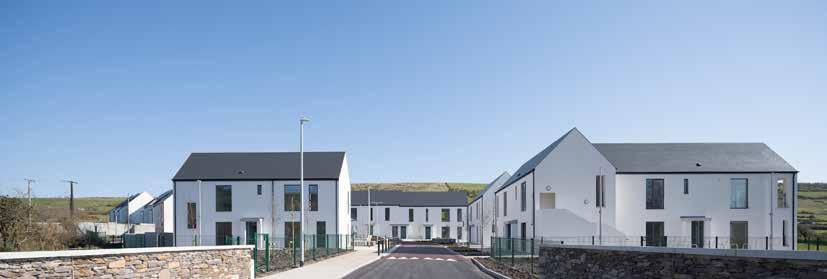


Leonard Cleary, Chief Executive, Galway City Council and Maurice O’Gorman, Chairperson, Port of Galway, have warmly welcomed the decision of An Coimisiún Pleanála to grant planning permission for the extension of the Port of Galwaymarking a once in a generation infrastructure milestone for Galway city and the wider west of Ireland. The decision will bring about transformational change in a key landmark in the heart of Galway city, enabling the relocation of port activity to deeper waters; release
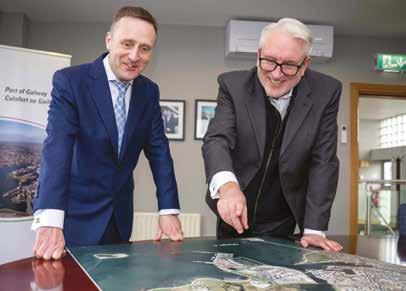
of the inner docklands for regeneration; and modern, safe and efficient port operations.
The development also creates opportunities for enterprise and jobs, tourism and maritime activity, and maritime security, delivering on objectives in the National Development Plan, Project Ireland 2040, and the National Planning Framework.
Galway Harbour Company is a wholly owned subsidiary of Galway City Council, with the port expansion identified as a priority project for Galway City Council in the Programme for Government.
Leonard Cleary said, “Galway city has a long-established identity as a maritime trading community, with quays at the centre of the city, extending from Claddagh to the Port of Galway. But the impact of this decision goes well beyond Galway city, with strategic importance at a European, national and regional level. The expansion of the port will enable Galway to remain a viable and competitive regional port, avoiding long-term decline – while also creating a space at the heart of the city for urban regeneration.”
Maurice O’Gorman explained, “This development will create deep-water commercial quays and marine infrastructure extending into Galway Bay. Approximately 27 hectares of reclaimed land will be developed for port and associated enterprise use, with a new marina, fishing facilities, port buildings, logistic infrastructure, emergency response facilities and maritime services infrastructure.”
Galway Harbour Company will now progress to the next phase of the project, including detailed design, procurement and financing, in line with the relevant national infrastructure guidelines and governance requirements.
The Minister for Housing, Local Government and Heritage, James Browne TD, and the Lord Mayor of Dublin, Councillor Ray McAdam, have officially launched the first cost-rental and social homes at Oscar Traynor Woods, Dublin 17.
Oscar Traynor Woods is a landmark new development by Dublin City Council delivering 850 A-rated new homes in partnership with Glenveagh and Clúid, which comprises a mixed tenure development of affordable purchase, cost rental and social homes.
The site is located in Coolock, Dublin 17 and is being delivered in phases. It will include new parks, community spaces, a multiuse games area and a number of retail and commercial spaces – all designed to build a sense of community, promote residents’ wellbeing, and encourage a genuinely sustainable way of life.
The first cost-rental and social homes in the Coyne Woods area of the scheme were officially opened, with the first residents having recently received the keys to their new homes. Overall, Coyne Woods comprises 64 new homes, which includes 24 social, 24 cost-rental and 16 affordable purchase homes. The make-up of these 64 homes consists of two studio apartments; 12 two-bed houses, 42 three-bed houses, four four-bed houses and four one-bed triplex homes.
Through the Affordable Purchase Scheme, Dublin City Council helps eligible households bridge the gap between their mortgage/ deposit and the market value of a home, in return for a percentage equity share. The 16 Oscar Traynor Woods homes will be offered at an average of 24% below open market value, with one-bedroom maisonettes costing between €254k and €308k.
Lord Mayor McAdam said, “Oscar Traynor Woods is not just bricks and mortar, it’s about building a community. Today marks the beginning of a new chapter for Dublin, where quality housing is matched with green spaces and amenities. I want to commend Dublin City Council, Clúid, and Glenveagh for their collaboration.”
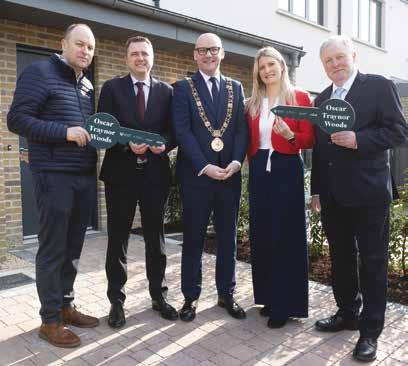
At the launch of Oscar Traynor Woods, Dublin 17, (l to r): Stephen Garvey, CEO, Glenveagh; Minister for Housing James Browne; Dublin Lord Mayor, Councillor Ray McAdam; Averil Power, CEO, Clúid; and Richard Shakespeare, CEO, Dublin City Council.
Minister Browne said, “This development demonstrates what can be achieved through partnership and leadership. Oscar Traynor Woods will deliver over 800 homes across social, affordable, and cost-rental tenures, providing security and affordability for hundreds of families. My priority remains accelerating housing delivery nationwide, and this project sets a benchmark for how we can do that.”
You build projects, lead teams and hit deadlines. Sorting out pensions, savings, investments and protection rarely makes it to the top of the list.
That’s where we help.
We work with construction professionals every day, taking the important financial jobs off the long finger and explaining the options in plain English.
So you can focus on what matters.
Start the conversation.
No jargon. Just facts.


The Land Development Agency (LDA) in partnership with the O’Flynn Group has announced plans to deliver 542 new homes in Dublin. The new A-rated apartments are being delivered as part of Southwest Gate, a landmark residential scheme on the Naas Road in Dublin 12.
The new Southwest Gate scheme is being developed by the O’Flynn Group and, when completed, will provide for 1,140 new homes along with additional uses such as a hotel, ancillary retail and commercial accommodation. A further three acres are also available for future development.
The project has been masterplanned by the O’Flynn Group, with an emphasis on creating a vibrant, sustainable community for future residents.
The first phase of 542 new homes is being delivered by the LDA and the O’Flynn Group through the Project Tosaigh homebuilder partnership initiative. This is where the LDA partners with private homebuilders, providing the financial stimulus required to ensure the construction and completion of new homes. The completed homes are then owned by the LDA and made available as Cost Rental homes or sold by the LDA in partnership with local authorities through affordable purchase schemes.
In this case, all 542 new homes will be made available as cost rental. Cost.
Separately, this phase of the development will also see O’Flynn Group deliver 52 social homes.
Southwest Gate has been carefully designed and planned to enhance both future residents’ lives and the wider community by combining modern city living with essential social infrastructure.
The development will be well-located with excellent connectivity to Dublin city centre. The Red Luas Line runs past Southwest Gate,

and the M50 and M7 are within easy reach. The area is also well-served by bus routes and high-quality cycling routes.
Southwest Gate is also located near other major LDA housing developments. The agency has secured planning permission to develop 383 new homes at Bluebell Waterways, which is located beside the Fifth Lock of the Grand Canal. It also recently acquired the Royal Liver site on the Naas Road, which has the potential to deliver over 1,200 new homes. The Royal Liver site is located opposite Southwest Gate.
The O’Flynn Group is actively engaged in several developments across the greater Dublin area and the Cork metropolitan region and remains committed to delivering high-quality housing solutions to meet the growing demand in these areas.
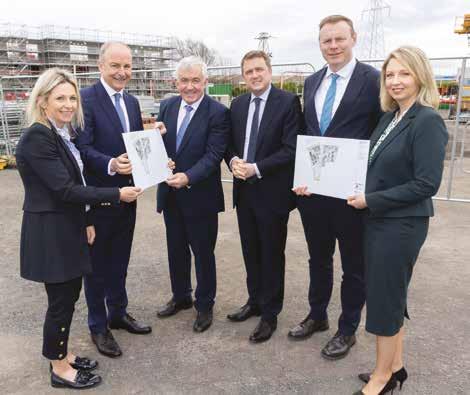
At the announcement, An Taoiseach, Micheál Martin, said, “This development at Southwest Gate is a significant step in increasing the supply of affordable and social housing in Dublin. Developments of this scale are essential to meeting demand and building sustainable communities in wellconnected locations.
“The government remains focused on accelerating delivery through record levels of investment in the provision of housing and a strong pipeline of projects nationwide. It is encouraging to see this site
developing at such pace, and I acknowledge the coordinated work of the LDA and its partners in bringing it forward.”
John Coleman, Chief Executive, LDA, commented, “This is a very welcome partnership between the LDA and O’Flynn Group. It will deliver a total of 542 new homes in a prime location as part of a wellplanned, sustainable and larger development that includes new facilities and amenities. All the homes will be built to the highest standards and residents will be able to enjoy a great quality of life at rents that are affordable. The LDA is pleased to be working with an experienced delivery partner in the O’Flynn Group, and we look forward to bringing these new homes to the market. Projects like Southwest Gate are playing an important role in addressing the pressing demand for affordable and secure rental accommodation in Dublin.”
Michael O’Flynn, Chairperson and CEO, O’Flynn Group, commented, “We are delighted to announce our partnership with the LDA in delivering our visionary plans for this development. We have a proven track record in delivering quality large-scale mixed-use developments, and we are excited to bring forward the first phase of 542 new homes in partnership with the LDA. This project will provide much-needed housing in Dublin city. We look forward to delivering on our vision and would like to thank our colleagues at the LDA for their hard work in bringing this partnership to fruition.”
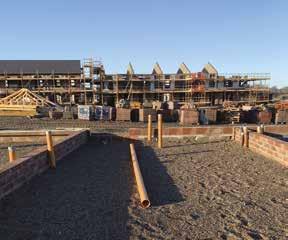
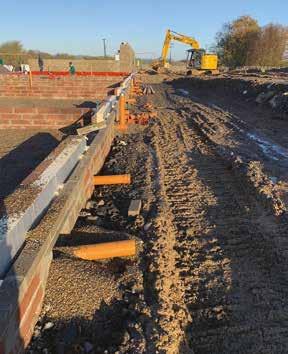
Munster Construction is currently on site on Riverwood, a new housing development in Thurles, Co Tipperary. The development consists of 127 homes and is a mix of duplexes, two-, three- and four-bedroom homes.
Site Manager Peadar O’Toole worked with Wavin Technical Representative Patrick Corrigan to select Wavin’s Sewer range on the development. Products used include WAJ’s, Wavin Tegra 600 and Wavin Sewer.
Speaking about his choice, Peadar said, “I decided early on in the project to use the Wavin Sewer range, and, on consultation with our Wavin representative, we made our selection and then worked with Uisce Éireann’s engineers for approval. We’ve been happy with the products themselves, which we knew would be Uisce Éireann-compliant, and the ease of installation.
“Wavin has been on hand with any technical help we’ve needed, and,

overall, the whole process has been very straightforward.”
Taking a closer look at the products used shows how efficiency on site, ease of installation and peace of mind that comes from product reliability and quality are key influencing factors:
Wavin has built on 40 years of inspectionchamber expertise with an enhanced Tegra 600 range. Certified to EN13598-2 and compliant with Irish Building Regulations Part H and Uisce Éireann requirements, the updated system offers a specification ready, long lasting solution for wastewater projects.
The range now includes seven flow profiles and 27 base variants, supporting 110mm to 315mm connections to give installers greater flexibility across varied site conditions. Key upgrades include a patented ball socket design offering 10° movement in all directions, improving tolerance for on-site misalignment and a chamfered, easy push fit shaft socket that reduces installation force and speeds up assembly. With a 100 year design life, the enhanced Tegra 600 delivers a durable, contractor friendly option for modern wastewater networks.
Wavin’s Access Junction (WAJ) has been Irish contractors no-1 choice for the past 45 years. Independently certified, it’s available in 10 flow profiles and complete with Wafix seals, a triple-layer captive seal, so you know that when a pipe is in, it’s in. The socket profile allows a high angle of deflection so there is more connection flexibility. There are also extras such as directional flow arrows to reduce the risk of installation errors.
Wavin’s PVC-U below-ground drainage system offers a comprehensive range in 110mm, 160mm, 244mm, 315mm, 400mm and 500mm sizes for gravity drainage and sewer installations. Fittings with a green seal feature RootSeal technology, which harmlessly repels tree roots to help prevent damage to the pipe system. Wavin Sewer also offers SN4 or SN8 pipe options and seamless integration with the Wavin Inspection Chamber ranges.
To speak to the Wavin team about your project needs, contact: projects.ie@wavin.com
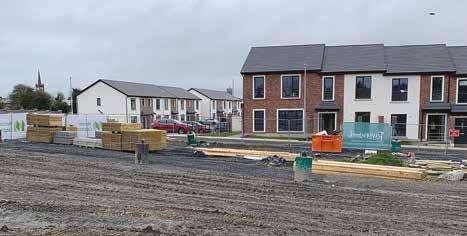


Suir Engineering has announced the opening of its new office in the Slovak Republic, marking a further expansion of its European operations.
Located in Košice in eastern Slovakia, the new office currently employs six senior engineers and will support the design and delivery of projects across the energy and renewables sectors throughout Europe. This strategic location provides Suir Engineering with a solid platform for future investment and expansion to meet growing international demand.
Suir Engineering will recruit talent from across European markets to support this growth.
Day-to-day operations will be led by long-serving Suir Engineering veteran Jozef Belusko, Engineering Director of EP&R (Energy, Power & Renewables), who commented: “It’s a privilege to lead this significant milestone in Suir Engineering’s European expansion. The country has firmly established itself as a centre of excellence for engineering, energy infrastructure and renewable projects.
“In Košice, we can leverage the Slovak Republic’s strong technical expertise and strategic European position to further drive

innovation in digital infrastructure. Opening a new office here will play a key role in Suir Engineering’s continued expansion across Europe, and I’m proud to be part of that journey.”
John Kelly, CEO, Suir Engineering, added, “Establishing a presence in the Slovak Republic enhances our ability to deliver complex engineering solutions at scale for our clients across Europe.
“At Suir Engineering, we are continually building on our strong foundation of excellence. Establishing a presence in a recognised engineering hub such as Slovakia is central to our growth and

innovation strategy. As an Irish company with an expanding European footprint, strengthening our connections in Slovakia is a significant milestone.”
Headquartered in Waterford, and with offices in Dublin, London, Stockholm, Copenhagen and Frankfurt, Suir Engineering has grown over 42 years to become one of Europe’s leading providers of high-voltage, electrical and instrumentation, and mechanical engineering services. It operates in three core sectors: life sciences, energy, power and renewables, and data centres.
Digital infrastructure company Equinix Inc has begun construction on a new data centre in Dublin.
DB7x, which will be located in Blanchardstown, will be sited close to two of Equinix’s existing data centres for enhanced connectivity. Equinix anticipates an investment of $78m (€66m) into the new high-performance data centre facility, plus an additional $14m (€12m) to support a retail IBX build-out.
Equinix retail IBX data centres provide enterprises with the digital infrastructure needed to digitally transform, manage AI workloads and scale critical services locally while connecting to their customers across Ireland and internationally.
Retail capacity at the data centre is scheduled to be available to enterprises from early 2028 and will directly support foreign direct investment (FDI) in Ireland, adding to the 200 FDI corporations that Equinix already provides digital infrastructure to in Ireland.
The new building, which will be 100% flexible to support the national grid, will require no additional grid power, as it will be constructed on an existing Equinix site and use the power already allocated to that facility.
Speaking about the announcement, Peter Lantry, Managing Director, Equinix, Ireland, said, “This is an exciting development for Equinix’s operations in Ireland, as we celebrate 10 years of being in Ireland, investing in its infrastructure and economy. This announcement strongly supports the government’s recently published Digital and AI Strategy, which outlines a path for keeping Ireland at the forefront of global digital innovation. It also reaffirms

Pictured announcing the construction of a new $92m data centre in Dublin are (l to r): Equinix’s Bruce Owen, President, EMEA; Adaire Fox-Martin, Global CEO; and Peter Lantry, Managing Director, Ireland.
our commitment to Ireland and its importance to businesses worldwide.
“This is positive news for the Irish economy. By expanding colocation capacity in Dublin, we will enable domestic and international enterprises to scale, innovate, and connect across Equinix’s global digital infrastructure platform with ease.”
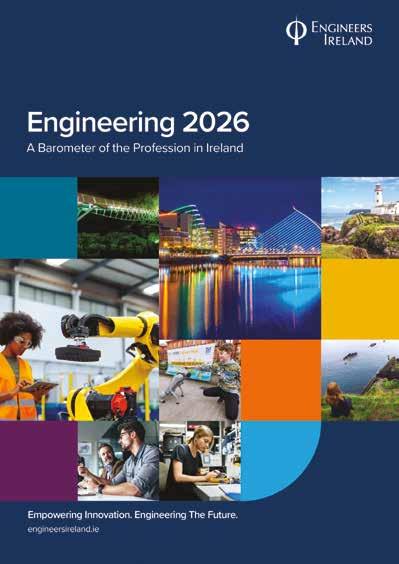
from Engineers Ireland warns that persistent skills shortages in engineering are constraining Ireland’s ability to deliver housing and critical infrastructure, with more than 40% of engineering employers saying it now takes between three and six months to fill roles.
‘Engineering 2026 – A Barometer of the Profession in Ireland’ shows that lengthy recruitment times are emerging as an obstacle to housing, energy, transport and water infrastructure delivery.
The report also highlights mounting concern within the profession over the condition of Ireland’s infrastructure. Just 17% of engineers rated overall infrastructure as good, while 41% described it as poor or inadequate. Housing emerged as the most acute weakness, with 47% of engineers considering housing infrastructure inadequate, the starkest negative assessment across all sectors measured.
The report warns that boosting housing supply will require not just faster construction, but enough engineering capacity to plan, design, and deliver developments, and to connect them to essential water, energy, and transport infrastructure.
Gender imbalances in perceptions of the profession were found to be a potential barrier to encouraging more women to become engineers and, thus, a barrier to growing the engineering workforce. When asked if they would consider pursuing engineering if changing career, women (40%) were twice as likely as men (21%) to disagree with the suggestion. Only about one in eight engineers in Ireland is a woman.
Men were also 29% more likely than women to respond positively when asked if a career in engineering was “suitable for people like them”.
Speaking about the results contained in Engineering 2026, Engineers Ireland’s Director General, Damien Owens, said: “With modular homes being suggested to increase the supply of housing to the rental market, it’s important to remember that these Modern Methods of Construction are not a shortcut around engineering capacity. To deliver homes at scale while maintaining quality, safety and sustainability, we must also invest in the engineers and infrastructure systems that underpin those developments from water and energy networks to transport and climate resilience.”
Ireland’s infrastructural ambitions are
achievable, but, without addressing capacity bottlenecks, the report warns that Ireland risks falling short on housing delivery and wider infrastructure goals, not for a lack of ambition, but for a lack of the people necessary to deliver it.
Ireland’s Construction ‘Super Cycle’: 5% growth forecast for 2026
Anew report from Goodbody indicates that Ireland’s construction sector has entered a multi-year “super cycle,” with output growth forecasted at 5% for 2026—double the western European average. This expansion is supported by a robust labour market, which saw employment reach 192,000 in Q4 2025, a 9.1% year-on-year increase.
For engineers and project managers, the focus shifts toward closing a 25% per capita infrastructure gap relative to EU peers. The €275bn National Development Plan (NDP) provides a massive capital pipeline, specifically targeting structural bottlenecks in water, transport, and the power grid.
The sector is increasingly driven by hyperscale activity (Amazon, Microsoft, Meta). Key metrics for the engineering community include:
• 76% projected rise in hyperscaler CAPEX by 2027.
• €5bn pipeline, contingent on resolving grid and utility capacity constraints.
• 50,000-unit annual housing target, requiring a sustained step-up in high-density residential delivery.
While AIB’s Construction PMI shows new orders at a four-year high, the “super cycle” will demand significant technical innovation to bypass current capacity limits in energy and water infrastructure.
With a commitment to sustainability, efficiency and reliability, leading heating technology manufacturer, Grant continues to deliver advanced solutions to the construction industry across Ireland. This includes significant investment in diversifying its product portfolio and enhancing services such as its Heating and Design Specification workflow.
In many new-build properties today, the success of a heating system is determined long before installation begins. Decisions made at the design stage directly influence the installation, commissioning and long-term system performance. Whether for one-off dwellings or multiunit developments, as projects expand and timelines remain tight, ensuring consistency at this stage is increasingly important to delivering efficient and future-proofed housing developments.
Having a clear and well-defined heating system design in place from the start can deliver measurable efficiencies on site, reducing late-stage design revisions. As housing developments grow, the ability to apply a standardised approach across multiple properties also helps streamline delivery and maintain alignment between design intent and on-site execution. Recognising the importance of this structured approach, Grant has enhanced its Heating Design & Specification Service through further investment in advanced digital design software.
Using the enhanced platform, Grant’s technical specialists carry out in-depth room-by-room heat-loss calculations, detailed sizing for radiators or underfloor heating systems and full pipework circuit layouts. Automated calculation processes help improve consistency across projects whilst reducing the time required to produce complete system specifications, enabling faster turnaround times and

improved overall project efficiency.
For project teams working across multi-unit developments or individual residential projects, the availability of clear and detailed design outputs supports more efficient coordination throughout the build process. Annotated schematics, layout drawings and material schedules provide a defined reference point for installers and contractors, helping to keep projects moving efficiently from first fix through to commissioning.

Supporting compliance with recognised industry standards, the service incudes heat-loss calculations produced in line with S.R. 50 and MCS requirements. This provides a consistent basis for demonstrating alignment with relevant building regulations and energy performance requirements across both new build and retrofit projects.
The structured design approach also supports the effective specification of modern heat pump systems such as the Grant Aerona R290 air-to-water air source heat pump. Available in five outputs from 4kW to 16kW, the Aerona R290 range provides flexibility across a wide variety of property types. It also achieves A+++ ErP ratings, with SCOPs of up to 4.88.
While the Aerona R290 heat pump can deliver flow temperatures of up to 75°C, correct system design ensures lower, more efficient operating temperatures are achieved. When systems are properly sized and specified from the outset, installers can work with solutions aligned to property demand, supporting consistent performance across developments.
By combining digital design capability with practical technical support, Grant’s Heating Design & Specification Service provides a structured approach to heating system delivery. As housing developments continue to scale and project timelines remain a key focus, having clearly defined, consistent and well-documented heating system designs in place from the outset supports more efficient delivery across all stages of construction. This approach not only supports compliance and efficiency but also helps reduce design risk and minimise delays during installation and commissioning.
Supporting both large-scale
developments and one-off homes, this approach ensures every system is designed, installed and commissioned to deliver consistent, long-term performance.
Scan the QR code or visit www.grant.ie for more information on Grant’s range of innovative heating solutions. Follow Grant on Facebook @GrantIRL, Instagram @grant_irl, LinkedIn @GrantEngineeringULC and YouTube @GrantEngineeringIE.

1. Submit planning drawings via heatpump@grant.ie or through Grant’s online Design & Specification Service form.
2. Grant Technical Specialists carry out in-depth heat-loss calculations to determine the heating demand for each room within the property.
3. Receive a fully integrated heating solution, including heat pump sizing, cylinder specification and heat emitter layouts.
4. Benefit from on-site commissioning support for all Aerona R290 heat pump installations, ensuring each system is correctly installed, configured and optimised for performance from day one.
5. Aftercare support through the Grant Service Network, with trained technicians located throughout Ireland.

- Designed for the Irish and UK Climate
- Innovative Technology
- Exceptional Performance
- Ultra-Low Noise Levels
- Outputs from 4kW – 16kW


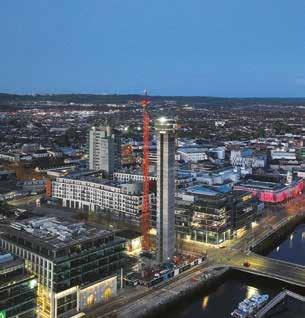
Cork is on track to reclaim the title of having Ireland’s tallest residential building as the main core of the 25-storey Railyard development, which now stands at over 85.5 metres, was completed on 28 March.
Specialist contractor Slipform UK poured over 1,700 cubic metres of concrete and tied over 225 tonnes of reinforcing steel.
Dan Sheehan, Contracts Manager with main contractor PJ Hegarty commented, “We are very pleased to have completed this important phase of the project safely and on schedule, which was the result of months of planning and collaboration across the project team. Cores 2 and 3, with a more traditional precast design, shall now commence.”
The project is located at the transition point between the historical city core and the new dockland development.
The Railyard also includes the renovation of the two listed buildings on site, namely Carey House and the former railway terminus building.
When fully constructed, the Railyard will be the tallest residential building in Ireland, designed by Henry J Lyons with input from specialist tallbuilding architect Richard Coleman of Londonbased City Designer.
The scheme is a collaborative partnership between Cork City Council, Clúid and JCD Group.


Approved housing body Oaklee has marked the delivery of 39 new homes at Bentley Villas in Dún Laoghaire with a walkthrough of the completed development, attended by project partners and key stakeholders. The event brought together those involved in the scheme’s delivery to view the finished homes and mark the completion of a development that is already welcoming residents.
Residents have already started moving in, with the scheme delivering much-needed high-quality sustainable homes in a well-

connected location.
The scheme offers 27 one-bed apartments, 11 two-bed apartments, and one three-bed apartment for general-needs social housing in Dún Laoghaire town centre.
Located close to public transport, services and local amenities, it reflects Oaklee’s commitment to meeting a range of housing needs while supporting sustainable communities.
Bentley Villas was delivered in collaboration with Bank of Ireland, the project’s main funder, alongside Dún Laoghaire-Rathdown County Council, the Housing Agency, the Department of Housing and developer KavCo. The scheme highlights the importance of strong partnership working between approved housing bodies, funders, local authorities and delivery partners in bringing new homes from concept to completion.
Welcoming partners to Bentley Villas, Oaklee CEO Sharon Cosgrove commented,
“At Oaklee, our purpose is to deliver homes that help people and communities live, thrive and prosper. Seeing these homes finished and occupied brings that purpose to life.
“The real achievement goes beyond construction and milestones; it is realised when residents move in, and a house becomes a home. Bentley Villas is already coming to life, and I want to thank Bank of Ireland, Dún Laoghaire-Rathdown County Council, KavCo, the Housing Agency, the Department of Housing, local councillors, and everyone who supported this project. It is a strong example of what can be achieved through collaboration and shared commitment.”
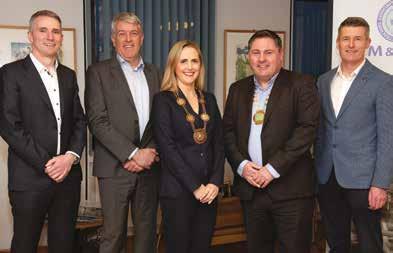
The Mechanical & Electrical Contractors Association’s 2026 AGM marked a historic milestone with the appointment of Joanne Cluxton as the first female president in the Association’s history. SINEAD CRONIN, Specialist Contracting, Construction Industry Federation, writes that from navigating complex new industrial relations agreements to addressing a cooling domestic market, the M&ECA is continuing to develop European markets to ensure stability.
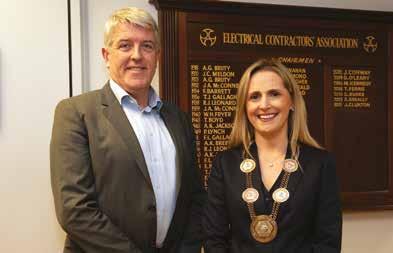
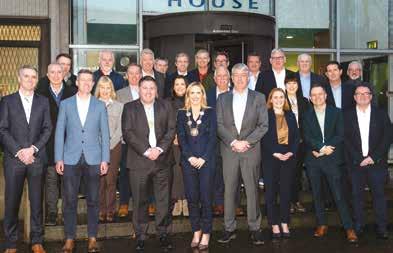
The Mechanical & Electrical Contractors Association (M&ECA) gathered at at the Construction Industry Federation’s (CIF’s) headquarters, Construction House, on Thursday 22 January for its AGM, an event that marked not only a review of a pivotal 2025, but also a historic milestone for the association. The M&ECA presidency officially passed from Paul Nicholls, Mechanical Engineering & Building Services Contractors’ Association (MEBSCA), to Joanne Cluxton, Electrical Contractors’ Association (ECA). Joanne Cluxton is the first female president in the ECA’s history and the first female president of the M&ECA.
She will be supported by Eamon Thornton, who continues in his role as vice president of the ECA, while Mark Hodson was elected president of MEBSCA and Darragh Martin was appointed vice president.
Industrial relations continued to dominate the agenda for both ECA and MEBSCA members. In 2025, the ECA successfully concluded pay agreements with the Connect Trade Union, introducing the eleventh year-out-of-time rate from September 2025, with further increments scheduled for early 2026.
The ECA also established a subcommittee to review apprentice pay for first- and second-year apprentices. A joint electrical SEO remains to be established in the industry. Should this be established, it is hoped it may pave the way for future progress on the long awaited mechanical SEO and pay harmonisation.
While 2025 was broadly successful for members, domestic activity slowed in Ireland, competitiveness intensified, and labour pressure eased slightly. Ireland’s construction output fell for eight consecutive months, though December’s Purchasing Managers’ Index (PMI) data hinted at stabilisation. Members continually report concerns about pipeline scarcity and the need to pursue export markets.
Many members report that the majority of their order books are made up of projects on mainland Europe, which ensures a more stable and predictable pipeline, and, by extension, business continuity.
The M&ECA looks forward to a productive and progressive year ahead under the leadership of Joanne Cluxton and Mark Hodson, with the support of Denise Tuffy, Director of Specialist Contracting at the Construction Industry Federation, and her team.
Participation, collaboration and collective expertise remain the cornerstone of M&ECA’s strength and success.
Paul Mannion has been appointed as the new technical solutions manager at Wilo Ireland to oversee the delivery of advanced water treatment and management services.
With more than 30 years of experience in the water management sector, Mannion’s career spans the restructuring of public water services in Ireland and includes extensive expertise in pumping station design, installation, onsite system assessment and energy auditing.
In his new role, he aims to work closely with contractors, equipping them with the technologies and support they need to deliver water treatment and management projects efficiently, sustainably and cost-effectively.
Paul Mannion said, “I am delighted to be joining the Wilo team and am very excited about the future as we expand our water management services. My experience across the sector has given me a clear understanding of what is needed at every stage of the supply chain to achieve the best results. I look forward to collaborating with contractors to deliver our shared ambition of advancing water management services.”
Ireland’s ageing water infrastructure continues to place increasing pressure on the country’s ability to meet rising demand. Paul will oversee the full suite of Wilo Ireland’s solutions designed to address these challenges.
Wilo’s FSM fine filter screens help remove grit, fibres and other small debris from wastewater, improving treatment efficiency while lowering maintenance and operational costs. Its aeration systems ensure stable and effective biological treatment by delivering optimal oxygen levels in activated sludge tanks. Meanwhile, vertical mixers generate strong, consistent basin flow, and, alongside pumps and circulation equipment, are powered by Wilo’s robust submersible motors, engineered for reliable performance even under demanding conditions.
Richard Swinburne, Managing Director, Wilo Ireland, said, “I am

thrilled to welcome Paul to Wilo Ireland. His depth of knowledge and experience make him an excellent fit for our organisation and our long-term objectives. Water is a finite resource; it doesn’t grow on trees.
“With the challenges posed by climate change and outdated infrastructure, effective water treatment and management must be a priority. At Wilo Ireland, we are committed to enhancing water services through environmentally conscious, efficiency-focused solutions.”
The expansion of Wilo’s water management services supports the company’s global sustainability goals, including its commitment to halving direct and energy-related greenhouse gas emissions by 2030.”

C&F Quadrant has announced the appointment of Damien Power as the company’s new commercial technical manager. He brings a wealth of industry experience and technical expertise to the role, where he will lead the engineering strategy and oversee the delivery of high-performance energy solutions.
With a proven track record in HVAC technical leadership, Power’s appointment reinforces C&F Quadrant’s commitment to providing market-leading expertise and innovative services to its clients.
Commenting on his appointment, Damien Power said, “I am incredibly excited to join the team at C&F Quadrant. The company has a stellar reputation for quality and innovation in the industry, and
I look forward to the challenge of building on that foundation. My focus will be on driving technical excellence and optimising our technical support systems to enhance the performance and sustainability of our HVAC energy solutions for our commercial customers.”
Emmet Duffy, Managing Director, C&F Quadrant, expressed his enthusiasm for the new appointment. “We are delighted to welcome Damien to the team. His deep understanding of the HVAC technical landscape and his strategic vision make him the perfect fit for this role. I am very much looking forward to working closely with Damien as we continue to evolve our offering and enter our next phase of growth.”
Six new senior leaders have been appointed across key Jones Engineering companies, reinforcing the group’s continued growth and leadership strength.
Jones Engineering has announced a number of senior leadership appointments across its group companies, marking a continued investment in strengthening its leadership capability. The newly appointed directors have played a key role in delivering complex engineering projects and supporting the business’s ongoing growth.
These appointments reflect the depth of talent across the group and reinforce Jones Engineering’s commitment to developing leadership from within.
The following appointments have been made across the group.
David Fox and Ken Mooney have been appointed directors of HA O’Neil Ltd.
Rob Collins has been appointed a director of O’Sheas Electrical.
Ralph Reynolds has been appointed a director of Irish Sprinkler.
Eoin Brown and Joe Lavin have been appointed directors of Patrick Lynch Ltd.
Commenting on the appointments,

Jones Engineering marks a continued investment in leadership and growth with six newly appointed directors across the group’s companies. The new directors are (l to r): Eoin Brown, Ralph Reynolds, Joe Lavin, Robert Collins, David Fox and Ken Mooney.
Stephen McCabe, CEO of Jones Engineering, said, “These appointments recognise the dedication, leadership and expertise that David, Ken, Rob, Ralph, Eoin and Joe have consistently demonstrated across our
business. Their contribution has been central to delivering complex projects for our clients across Europe, and they will continue to play a key role in supporting the Group’s ongoing growth.”
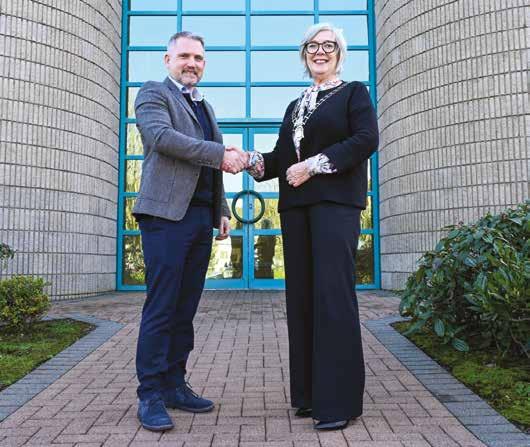
Patsy Supple, Director, Mavro Property Ltd, has been appointed as the new chairpeson of the Construction Industry Federation (CIF) Cork Branch. Outgoing chairperson Cian O’Mahony of Cumnor Building and Civil Engineering Contractors passed the chain at the organisation’s AGM held in Little Island. Patsy Supple is a Director at Mavro Property Ltd, with 35 years’ experience in the building and property sector.
Speaking at her first engagement since being appointed and addressing almost 300 guests, Patsy Supple said that construction in Ireland is facing many challenges as delivery of projects, particularly in housing, needs to be scaled up to meet the country’s needs.
“I would ask everyone in this roomwhether you are parents, grandparents, aunts, uncles or mentors - to encourage the young people in your lives to consider careers in this sector. I would particularly encourage you to inspire young women to join our industry. They remain one of our greatest untapped resources. If we ever think construction might not be a suitable career for women, then perhaps it is time for all of us to ask what changes we need to make to ensure that it is.”

Global conflict and skyrocketing energy costs have sent a chill through the markets, but is your pension actually at risk? DAVID GRANAHAN, Pension Consultant, CPAS, explores the resilience of global equities in the face of the US-Iran conflict and why a “retirement glidepath” is your best defence against short-term volatility.
Escalation in the Middle East is the latest conflict to influence financial assets. Despite wars like this casting a cloud of fear and uncertainty, it does not actually indicate whether asset prices will rise or fall. For all intents and purposes, the Russia-Ukraine War demonstrates that regional conflicts can cause short-term jitters that do not necessarily bring down global capital markets in the long run. Global equities (stock markets) have actually advanced since Russia invaded in 2022, as shown in the table below.
However, right now, we do not know whether the US-Iran conflict will last weeks, months or years. Or what long-term damage it could cause.
What we do know is that the Strait of Hormuz – a key transport route for one-fifth of the world’s oil and gas – has more or less come to a standstill. Oil tankers fear of being attacked, and marine insurers have begun cancelling policies altogether. To make matters worse, oil fields and refineries are now actively being targeted by both sides. This is bad news for major economies that rely on oil iports, including India, China, Japan, South Korea, and Europe.

Unsurprisingly, energy costs have skyrocketed here at home in Ireland, and based on current developments, prices at the pump will likely remain elevated for the foreseeable.
The price spike is untimely for EU member states, having just signed regulations to prevent the importation of Russian gas, with major fines for countries attempting to breach or circumvent the rules.
• Volatility in global stock markets
• Brent crude oil is up 50% since February.
• Diesel is over €2.00 per litre.
• Home heating oil prices are over €900 per 500L in some counties (80% increase from February)
• Tourism/travel industry hit (rising costs/travel fears)
Expect fluctuations until the market has clarity. With the exception of escalation toward a World War, which, to be clear, is NOT my base level expectation, volatility from geopolitical events is to be expected from time to time. While markets dislike uncertainty, they tend to rebound over the long term.
From a humanitarian point of view, we can only hope for a swift resolution, regardless of the effects on financial assets.
As for the here and now, businesses and consumers are going to feel the pinch, especially in construction. Originally, the government brought in temporary measures:
• €0.20 cut for diesel
• €0.15 cut for petrol
• €0.03 cut for home heating oil
• Rebate of up to €0.12 per litre for haulage companies (01 January 2026 to 30 June 2026)
• Extension of the means-tested fuel allowance payment
Following the fuel protests across the country, further supports will be taking effect:
• Further €0.10 reduction for diesel and petrol (effective 14 April to 31 July)

• €0.024 (2.4 cent) cut for green diesel
• Deferment of scheduled carbon tax increases
• Payments to haulage operators for March, April and May 2026 (provided average diesel price remains above €1.90)
• Payment supports for farming and agricultural contractors from March to July 2026.
The vast majority of pension scheme members are invested in a “multi-asset strategy.” As the name suggests, funds are invested in a broad range of assets across different industries and geographies. By design, this makes sure you have appropriate exposure to assets of many types that aim to:
1. Generate an investment return for your pension over the long run and
2. Spread risk so you are not overexposed to any one area of the market.
Put simply, it is a balancing act. The asset classes that perform well will counteract the asset classes that perform poorly. So, whether bonds, gold, oil, or technology stocks move up, down or sideways, the aim is to find an average return from the lot. All the while, managing downside risk.
Many pension funds provide a lifestyle investment strategy or ‘retirement glidepath’. Basically, your pension fund will be rebalanced in the run-up to retirement, reducing your exposure to volatility or “risk-on assets” and moving a chunk of it into “risk-off assets” or cash for your tax-free lump sum. The remaining pension pot will be invested based on your available drawdown options.
If you are approaching retirement, if you are within five years of retirement, it is important to know how your pension assets are invested, to ensure that you invested in a way that is appropriate for your post-retirement plans.
The CIF Pension Administration Services (CPAS) team are qualified Pension Consultants. We specialise in helping professionals in the construction sector and related industries. Our team can work with you to review your pension plans.
For more information, please contact David Granahan at d.granahan@cpas.ie
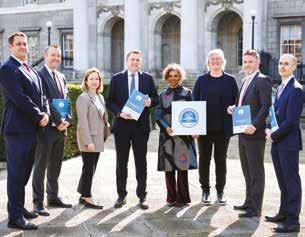
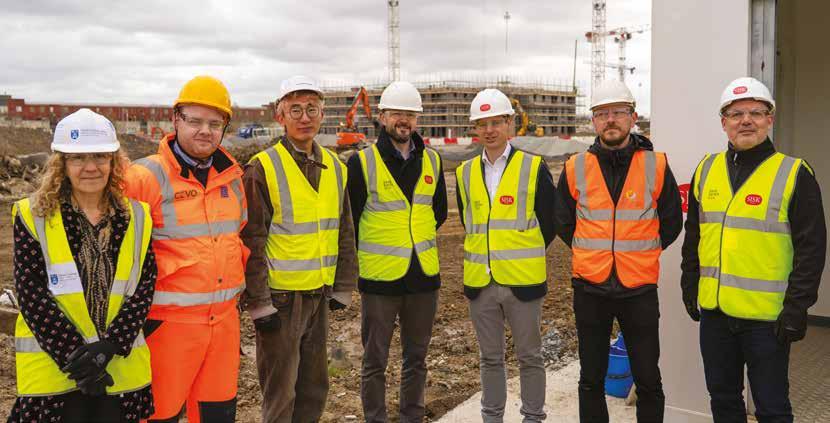
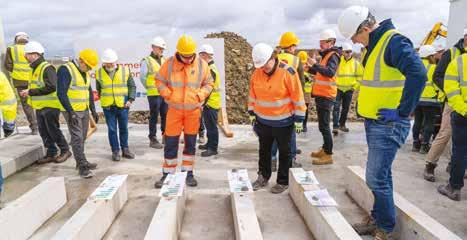
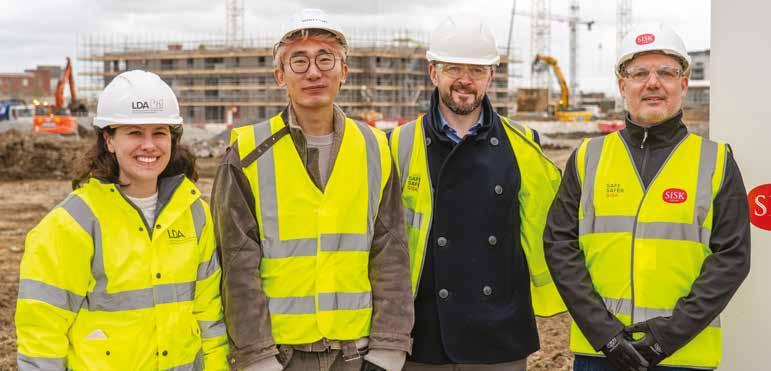
(L to r): Prof Sara Pavia, TCD; Colin Heffernan, Roadstone; Dr Zehao Lei, TCD; Colm McHugh, Construct Innovate; Ross Cullen, Sisk; Frank Finnerty, FLI Precast; and Juan A Morillas, Sisk.
Ireland’s journey toward a sustainable built environment just took a massive, clinker-free step forward. After attending a landmark demonstration at Sisk’s Cherry Orchard site, ROBBIE COUSINS writes about how a collaboration between Trinity College Dublin and industry leaders is moving geopolymer technology from lab to site – with the potential to slash carbon emissions by 70% and, with a circular economy approach, transform the nation’s biomass waste into the high-performance foundation of a greener future.
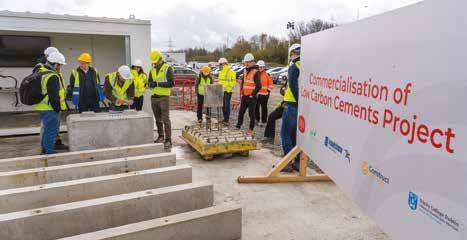
In a landmark moment for the Irish construction industry, March 2026 marked a significant leap toward decarbonising the built environment. At a demonstration event hosted by Sisk at their Land Development Agency (LDA) site in Cherry Orchard, Dublin, for the first time in Ireland, clinker-free geopolymer concrete—a material capable of reducing carbon emissions by up to 70% compared to CEM I—transitioned from the controlled environment of the laboratory to be presented on a construction site.
The event, attended by a number of key industry stakeholders, including representatives from Enterprise Ireland (EI), the National Standards Authority of Ireland (NSAI), Transport Infrastructure Ireland (TII), and Irish Concrete Federation (ICF), Construct Innovate and the LDA, Hines, IPUT, OPW and ARUP as well, showcased the results of a 20-month seed programme funded by Construct Innovate.
The project represents a powerhouse collaboration between Trinity College Dublin (TCD), Sisk, FLI Precast, Roadstone and Bord na Mona, all working toward a singular goal: turning biomass ash waste into high-performance infrastructure.
At the heart of this breakthrough is the work of Dr Zehao Lei and Prof Sara Pavia
from the Department of Civil Engineering at Trinity College Dublin. For many years, Prof Pavia has investigated the latent potential of waste materials. However, this project marks a strategic shift from using waste as a mere “filler” to using it as a primary binder.
Traditional concrete relies on Portland cement, a material whose production is notoriously carbon-intensive. The process involves burning limestone and shales at extremely high temperatures, releasing CO2 both from the fuels used and the chemical “decarbonation” of the rocks themselves.
During a technical presentation, Dr Lei explained, “With geopolymers, we don’t use any rocks. We don’t burn any rocks. We use waste. We activate that waste with a safe, composite activator to create a chemical reaction. This creates a binder that is not only sustainable but mechanically stronger and more durable than traditional options.”
The specific waste stream in focus is biomass ash, produced in vast quantities across Ireland as power plants shift away from peat and coal. Currently, Ireland produces over 20,000 tonnes of biomass ash annually, much of which is destined for In this instance, the ash involved was exhaust material from Bord na Mona’s Edenderry power station in the midlands. By repurposing this ash as a concrete ingredient, the industry could avoid at least 20,000 tonnes of CO2 emissions every






What is Guaranteed Irish House?
A trusted ecosystem of licenced businesses in the construction sector supporting each other in their supply chain.

year—an impact equivalent to removing thousands of cars from Irish roads.
While the chemistry of geopolymers has been understood for years, industrial adoption has been stalled by practical hurdles—primarily workability and setting times. To bridge the “lab-to-site” gap, the TCD team developed and patented two critical technologies.
The first is a bespoke biomass ash-based geopolymer formulation. By characterising the chemical composition, mineralogy, and particle size of the ash—sourced largely from the Edenderry power plant in the midlands for this research —the researchers optimised a mix that rivals the strength of CEM II or CEM III cements.
The second, and perhaps more crucial for site managers, is a specialised retarding system. Historically, geopolymers have been difficult to control once mixed, often setting too quickly for transport or placement. The new patented retarding system ensures the concrete remains workable and transportable in real-world conditions.
“This is about making low-carbon concrete usable at scale,” explained Prof Pavia. “Unlike many alternative materials that require entirely new processes, this system is designed to integrate within existing concrete production, transport, and placement infrastructure.”
For Sisk, hosting the demonstration was a natural extension of its Low Carbon Concrete Working Group’s agenda. Ross Cullen, Technical Director, at Sisk, emphasised that the company sees itself as a facilitator for innovation.
“We are neither a concrete specifier nor a supplier, but we are hearing the signals from our clients,” Cullen said. “They are asking for low-carbon options, and at present, our options are limited. We’ve been optimising mixes with ground granulated blast-furnace
slag (GGBS), but that isn’t a long-term solution for total decarbonisation.”
The demonstration at the Cherry Orchard site showed that geopolymer concrete could be handled by site crews without specialised training.
Roadstone demonstrated that the biomass ash-Portland cement blends could be mixed and poured like normal concrete, while FLI Precast displayed “Kelly blocks” and structural beams made with 100% cementfree geopolymer binders.
The project’s success was underpinned by Construct Innovate, Ireland’s national research centre for construction technology. Construct Innovate supported the project with funds from its seed funding programme.
Colm McHugh, Centre Manager, Construct Innovate, highlighted that the drive for these materials is being accelerated by looming European legislation.
“Between 2028 and 2030, we expect to see mandated carbon budgets on all types of construction projects,” McHugh explained. “This will focus the attention of everyone, from clients to subcontractors. Concrete, being such a carbon-intensive material, is front and centre of that focus.”
The 20-month seed programme served as a Pathfinder project. While the initial results are promising, the next phase will involve more rigorous testing on durability and long-term mechanical properties to provide the data required by the NSAI for official standardisation.
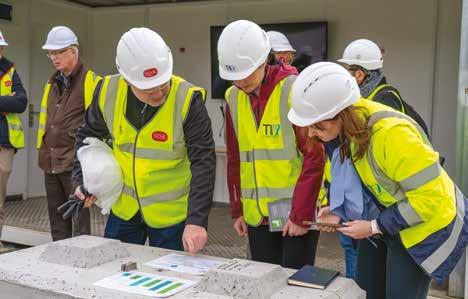
The demonstration event was a physical proof of concept. Attendees walked through the site to view a biomass ash concrete column poured by Roadstone and precast elements produced by FLI Precast. To the naked eye, the material looks and behaves
In 2026, your clients are demanding measurable sustainability actions...
We understand the pressures you face to design lower-carbon buildings to meet client and regulatory requirements.
In a world full of misleading green credential claims, there‘s often a lack of clarity when it comes to specifying low-carbon materials.
Pipelife Ireland has secured Environmental Product Declarations (EPDs) for its PVC, HDPE & MDPE Product Range — the first Irish‑made pipes to feature independently verified embodied‑carbon data.
When you specify Pipelife, you can do so with confidence. Our newly published Environmental Product Declarations (EPDs) provide transparent, independently verified data on environmental impacts across the entire product life cycle.
Pipelife supports your sustainability journey with high‑quality products and independently verified data you can trust.
Our EPDs will help you:
• Make informed product selection choices early.
• Justify product selections with verified documents.
• Meet your project sustainability targets.
• Enhance clarity with unambiguous, measurable environmental product data.



like the concrete the industry has used for a century. However, its chemical footprint tells a different story.
Prof Pavia noted that 80% of the biomass ash used is indigenous to Ireland, with the remaining 20% coming from sustainable overseas sources.
A high level of “localism” further reduces the carbon footprint associated with transport and supports the circular economy within the Irish midlands.
As the event concluded, the discussion turned to the “valley of death” between research and widespread adoption. Ross Cullen acknowledged that getting new materials specified into national standards is a complex process involving risk management.
“We need the experts, the NSAI and the data to ensure we can use these materials with confidence and reliability,” Cullen remarked. “Dialogue and debate are key. By bringing the research onto a construction site, we generate the momentum needed











It has been an exceptional couple of months for the CastleForms team. Following the successful launch of its groundbreaking ICF FireBlock (Patent Pending) system at the Irish Building Control Institute Conference and the MMC Ireland National Conference, the specialist firm has now secured national recognition after picking up a trophy at the prestigious Irish Building and Design Awards.
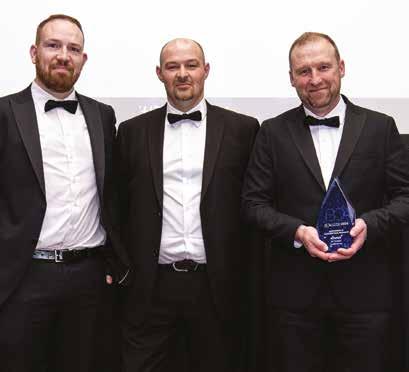
Competing in a highly contested category against some of the construction sector’s most ground-breaking products, ICF FireBlock was crowned the winner of the Innovation in Construction Products category. CastleForms success reflects the company’s commitment to developing pioneering solutions that enhance safety, sustainability and efficiency in modern construction.
Developed specifically to address one of the most critical challenges in modern insulated concrete formwork (ICF) construction, CastleForms latest breakthrough, ICF FireBlock – is a pioneering innovation within the ICF Therm range.
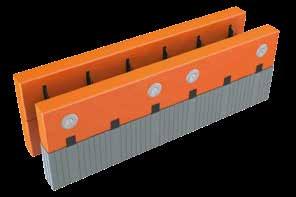
FireBlock redefines ICF construction by incorporating highdensity, non-combustible A1-rated mineral wool directly within standard ICF Therm blocks. Positioned at designated fire-stopping points as part of the wall construction, ICF FireBlock removes the need for retrospective fire-stopping measures.
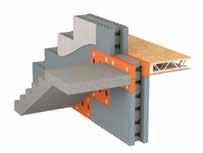
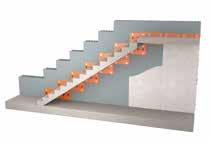
Multiple ICF FireBlock configurations are designed for various applications, including ICF external walls, ICF internal party walls and ICF stairwell enclosures ensuring full compartmentalisation strategies.
Combining robust protection, ease of installation and performance assurance, the system represents a major step forward in building confidence, compliance and long-term resilience. One of the defining benefits of ICF FireBlock is that fire protection is immediately visible throughout the build process. Architects, specifiers, contractors, fire consultants and building inspectors can confidently verify compliance during routine walk-throughs.
ICF FireBlock delivers a host of tangible performance and compliance benefits:
• Backed by extensive fire testing
• Supports compliance with fire safety regulations
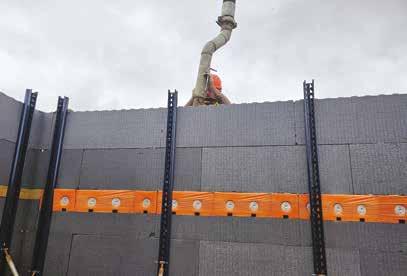
• High-density mineral wool fire-stop integrated into ICF Therm wall system
• Fully visible and verifiable installation throughout the build
• Eliminates reliance on hidden or post-installed fire-stopping measures
• Reduces risk of defects caused by poor workmanship or access limitations
• Multiple FireBlock configurations are designed for different fire stopping applications in external ICF walls, internal party ICF walls and stairwell ICF walls.
With ICF FireBlock installers can easily cut, pack and seal around services using the same mineral wool material keeping fire detail intact without compromising the design or service layout.
Installers love ICF FireBlock because there is no guessing, no hidden complexity. It is installed before the pour and visible after. It allows ICF Installers to get it right the first time.
“ICF FireBlock doesn’t just meet standards, it helps the whole team sleep better, knowing that once it’s in, it’s visible, continuous and unmissable.” Kevin Farrelly – ICF Installer
Set a new standard in fire safety with ICF FireBlock, contact our team today: Telephone: 057 8680684 Email: info@castleforms.com Website: www.castleforms.com
CastleForms delivers high-performance building solutions from the ground up. Trusted across the industry and engineered for modern construction, we provide advanced ICF walling, insulated foundation and render systems that set new benchmarks in performance.
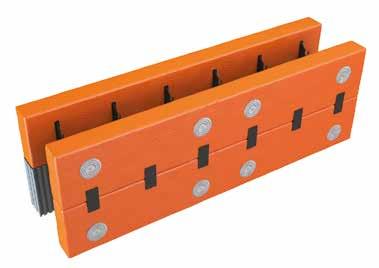
Combining Irish engineering expertise with global innovation, CastleForms is proud to launch ICF FireBlock (patent pending) at MMC Ireland – a major step forward in integrated fire protection.
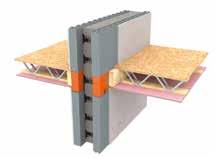
Supports compliance with current fire safety regulations - backed by extensive fire testing
High-density mineral wool fire-stop integrated into ICF Therm wall system
Fully visible and verifiable installation throughout the build
Eliminates reliance on hidden or post-installed fire-stopping measures
Reduces risk of defects caused by poor workmanship or access limitations
Multiple FireBlock configurations designed for different fire stopping applications in external ICF walls, internal party ICF walls and stairwell ICF walls
With a comprehensive portfolio of high-performance building systems, CastleForms supports robust construction, superior thermal performance and long-term durability – all from a single, trusted partner.

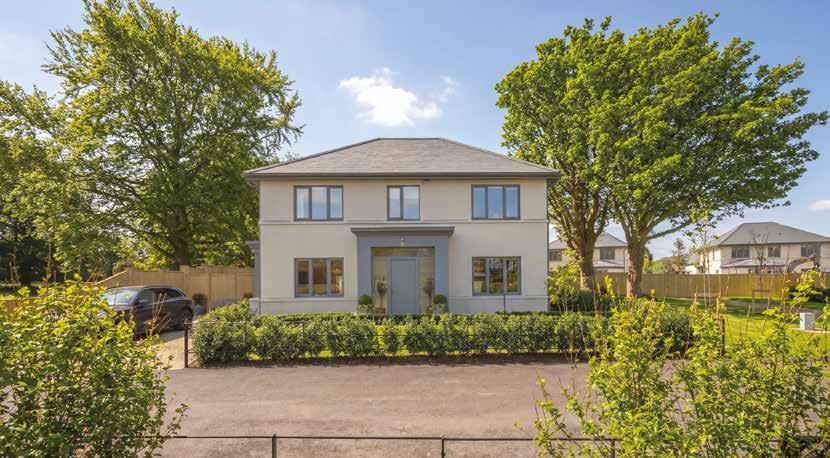
Set within the historic 12th-century Killeen Castle demesne, Loughmore Wood is a masterclass in the sensitive delivery of residential development by Castlethorn. By pairing MMC with a fabric-first sustainability strategy, the developer has integrated 22 high-spec,
A-rated homes into a sensitive protected woodland setting. From navigating complex rural infrastructure to maintaining seamless site logistics within an active golf resort, the project showcases Castlethorn’s ability to blend technical innovation with a deep respect for heritage landscape.
Loughmore Wood is a low-density residential scheme comprising 19 detached five-bedroom homes and three bungalows set within the historic demesne of Killeen Castle, Co Meath.
Positioned within a mature woodland context, the development forms part of the wider restoration and activation of the Killeen Castle estate, a site with origins dating back to the 12th century. The design approach centres on delivering contemporary family housing within a heritage landscape, with particular emphasis on how each home is carefully sited to respond to its immediate surroundings, optimising orientation, natural light, privacy and views across the tree-lined setting.
A considered material strategy underpins the architectural approach, with a restrained palette of durable, high-quality external finishes selected to complement the natural environment and reinforce a sense
of permanence. This focus on materiality, combined with attention to scale and layout, ensures the homes integrate cohesively within the wider estate. Each unit has been
configured to support modern patterns of family life, incorporating generous floor areas, open-plan kitchen and living spaces, dedicated study areas and separate

reception rooms. The overall scheme represents a measured approach to rural residential delivery, balancing architectural quality, environmental context and the evolving expectations of the trade-up housing market.
As Loughmore Wood is situated within Killeen Castle estate. There were a number of planning challenges in balancing the delivery of modern, A-rated homes with the preservation of the demesne’s heritage and natural woodland.
While the provision of A-rated homes represents a clear sustainability gain, the real challenge at Loughmore Wood was to ensure this was achieved without compromising the sensitive demesne landscape, mature woodland setting, and protected structures that define Killeen Castle. From the outset, the approach to both design and delivery was that energy efficiency and heritage protection were not competing priorities, but ones that had to work together. The result is a scheme in which highly efficient homes sit comfortably within and are informed by the Sylvan character of the wider estate.
Castlethorn is known for pioneering
Modern Methods of Construction (MMC). For this specific project of 22 high-end detached homes and bungalows, timber frame (TF) was the agreed approach. Early detailed design development with the preferred TF specialist leads to minimal/ zero quality and installation issues on site. This greatly reduced health and safety risks compared with traditional build approaches and helped deliver a faster programme, allowing Castlethorn to commence internal first- and secondfix trades in parallel with delivering the external envelope.
The delivery of Loughmore Wood demanded a carefully considered infrastructure strategy, shaped by the realities of a rural and historically sensitive setting. In this context, an infrastructurefirst approach was essential from the outset, with servicing treated as a core delivery workstream rather than an issue to be resolved later in the process.
The water supply is drawn from private wells and treated in an on-site treatment plant. This required early technical assessment and detailed coordination to ensure that water quality, treatment capacity, operational resilience and long-term compliance were fully addressed at design stage. By resolving these matters early, the development could proceed


on the basis of a clear and reliable servicing strategy, rather than being exposed to uncertainty around public network availability.
Engagement with ESB Networks was equally important. Given the reliance on on-site treatment infrastructure, it was critical to secure an appropriate and reliable power solution to support plant operations and associated site services.
This required proactive engagement on capacity, connection requirements and programme alignment so that utility provision supported, rather than delayed, delivery.
The key strength in Castlethorn’s approach was the integration of infrastructure planning into the wider



development programme. Rather than treating utilities as external dependencies, they were incorporated into the scheme’s sequencing and design from the beginning. This disciplined approach allowed the developer to bring forward serviced sites with greater certainty and to maintain control over programme and risk.
Loughmore Wood is a strong example of Castlethorn’s ability to deliver practical, robust infrastructure solutions in more constrained settings. It demonstrates the developer’s capacity to work closely with utility stakeholders, to manage nonstandard servicing arrangements with care and technical rigour, and to ensure that essential infrastructure is in place to support high-quality residential delivery from the outset.
The homes at Loughmore Wood achieve an A2 BER rating and are delivered in full compliance with NZEB (Nearly Zero Energy Building) standards, underpinned by a robust fabric-first approach. This prioritises minimising heat loss at source before reliance on mechanical systems. The building envelope incorporates highperformance insulation throughout, with typical U-values achieved.
A continuous air-tightness strategy is central to this approach, using proprietary membranes and tapes at all critical junctions, including window and door openings, service penetrations, and
structural interfaces.
Target air permeability is typical, with on-site testing undertaken to validate performance. The emphasis was on maintaining continuity of the air barrier layer across the full envelope. Thermal bridging is addressed through careful detailing at all junctions, which becomes particularly critical in the larger fivebedroom detached units where increased surface area can amplify heat loss.
Accredited Construction Details are adopted and enhanced where required, with insulated cavity closers, thermally broken lintels, and continuous insulation at floorto-wall and wall-to-roof interfaces.
Ground floor junctions incorporate perimeter insulation to minimise ψ-values, while eaves-level detailing ensures uninterrupted insulation continuity.
The heating strategy was centred on a Firebird air-to-water heat pump system, selected as an efficient and future-proofed solution aligned with the performance of the building fabric.
The system extracts renewable energy from the external air to provide both space heating and domestic hot water. While powered by electricity, it operates at a high level of efficiency, typically achieving a coefficient of performance (COP) in excess of 3, meaning it can deliver multiple units of heat for every unit of electricity consumed.
In practical terms, this translates into lower running costs relative to traditional oil or gas systems, particularly when combined with the high levels of insulation and airtightness delivered across the scheme. The system provides consistent, even heat output, improving internal comfort compared to conventional on-off heating cycles, and is fully compatible with underfloor heating and modern radiator systems.
From an operational perspective, the absence of combustion and on-site fuel storage reduces maintenance requirements and eliminates risks such as carbon monoxide emissions.
Environmentally, the system produces no direct on-site emissions and supports broader decarbonisation objectives, particularly as electricity supply increasingly comes from renewable sources. It also contributes positively to the homes’ overall BER performance.
From a site and civil engineering perspective, sustainability extends beyond the individual dwelling. In addition to mature tree retention, the scheme incorporates Sustainable Urban Drainage Systems to manage surface water and protect local waterways. Measures such as permeable paving, attenuation features, and controlled discharge systems are designed to replicate natural drainage patterns and reduce run-off rates.
Landscaping and open-space planning also support informal biodiversity corridors, helping maintain ecological continuity across the site.
Overall, the development reflects a coordinated integration of building fabric, services engineering, and site design, with energy performance, environmental impact, and long-term durability addressed in a cohesive and technically robust manner.
Managing construction within an active golf resort requires a highly controlled and carefully sequenced approach.
At Killeen Castle, the team recognised from the outset that the continued operation of the resort, and the quality of the guest experience, had to be protected throughout the construction period.
This was achieved through rigorous planning of the construction programme, with the most disruptive activities carefully timed and coordinated to minimise impact on the resort’s day-to-day operations. Particular attention was given to separating construction activity from guest areas, maintaining safe and discreet access arrangements, and ensuring that works progressed in a way that respected the estate’s overall setting and ambience.
Noise and dust were managed through standard best-practice controls, but, more importantly, through disciplined site management and sequencing.
Heavy vehicle movements were tightly controlled, with defined haul routes, managed delivery schedules and strict onsite supervision to reduce interference with resort traffic and operations.
The key strength demonstrated at Killeen Castle was not simply the ability to build in a constrained environment, but also to

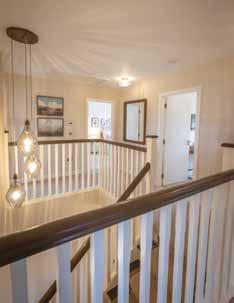
do so while preserving the functionality, presentation, and character of a highquality live destination. That experience reflects a practical understanding of how to deliver significant development works in sensitive, operational settings with minimal disruption.
The procurement strategy adopted at Loughmore Wood was informed by the same underlying principles that guide Castlethorn’s larger-scale developments, but with a level of calibration to reflect scale, programme and market conditions.
A central strength is the depth and continuity of the developer’s supply chain. It highlights long-established relationships with key suppliers and subcontractors, many of whom have worked alongside Castlethorn for decades. These are not transactional arrangements; they are embedded partnerships built on consistent delivery, shared standards and mutual understanding of programme requirements. Critically, these partners operate across multiple Castlethorn sites at any given time, providing workflow continuity and facilitating coordinated procurement
planning.
In a period of material cost volatility, this continuity becomes a material advantage. It enables earlier engagement with suppliers, improved visibility on lead times, and a greater degree of cost certainty than would typically be available through spot procurement. It also allows the developer to aggregate demand across projects where appropriate, securing more stable pricing and prioritised allocation of materials.
At Loughmore Wood, while the scale is more modest than a large urban scheme, such as its Kellystown development in Dublin 15, the same supply chain infrastructure was leveraged. The difference lies in how it is deployed.
Procurement packages were sequenced to suit a more contained programme, with a focus on maintaining momentum on site while avoiding unnecessary exposure to price fluctuation. The established relationships meant that flexibility could be introduced where needed, without compromising on quality or delivery timelines.
In practical terms, this approach reduces risk rather than eliminating it.
Market volatility cannot be controlled, but it can be managed through early planning, trusted delivery partners and consistency of pipeline. That is where Castlethorn believes that experience across multiple active sites provides a tangible advantage, allowing it to maintain programme certainty and build quality even in less stable market conditions.
Castlethorn’s approach to handover has evolved in response to the increasing technical complexity of modern homes, particularly in relation to energy systems, ventilation and integrated technologies.
The developer recognises that the success of these systems is ultimately dependent on the homeowner’s understanding and
confidence in using them.
Each purchaser is provided with a comprehensive, development-specific ‘Homeowner Manual’, tailored to the particular systems and specifications within their home.
This is not a generic document, but a practical guide that reflects the exact configuration of heating, ventilation, fibre connectivity and EV infrastructure in place.
However, the manual is only one component. Castlethorn’s emphasis is on a highly customer-centric handover process.
At key handover, finishing foremen play a central role, working directly with residents to walk through their home in detail. This includes on-site demonstrations of heating and ventilation systems, guidance on optimal settings, and clear explanations of how the various elements interact.
Castlethorn recognises that familiarity develops over time, so this support does not end on the day of handover. It provides follow-up engagement and, where required, repeat visits to ensure residents are comfortable operating their systems and are achieving the intended performance outcomes.
The result is a structured but personal approach that combines clear documentation with hands-on guidance. It ensures that homeowners are not simply given a technically advanced home, but are supported in using it effectively from the outset and as their understanding develops.
Loughmore Wood stands as a compelling case study in disciplined, “technical-first” development. By navigating the logistical complexities of an active resort and the infrastructure demands of a rural site, Castlethorn has proven that modern efficiency and historical integrity are not mutually exclusive.
The project does more than just deliver high-spec, A-rated housing; it provides a blueprint for how the industry can leverage MMC and deep supply chain partnerships to breathe new life into Ireland’s most sensitive heritage landscapes.
Developer & Main Contractor: Castlethorn
Assigned Certifier: O’Mahony Pike
PSDP: Integrated Risk Solutions
Architect and Design Certifier: O’Mahony Pike
M&E Consultant: Delap & Waller
Civil and Structural Engineer: Barrett
Mahony Consulting Engineers
Landscape Architect: TBS Ltd - The Big Space Ltd
Globe Logistics, Park, Naas, Co Kildare.
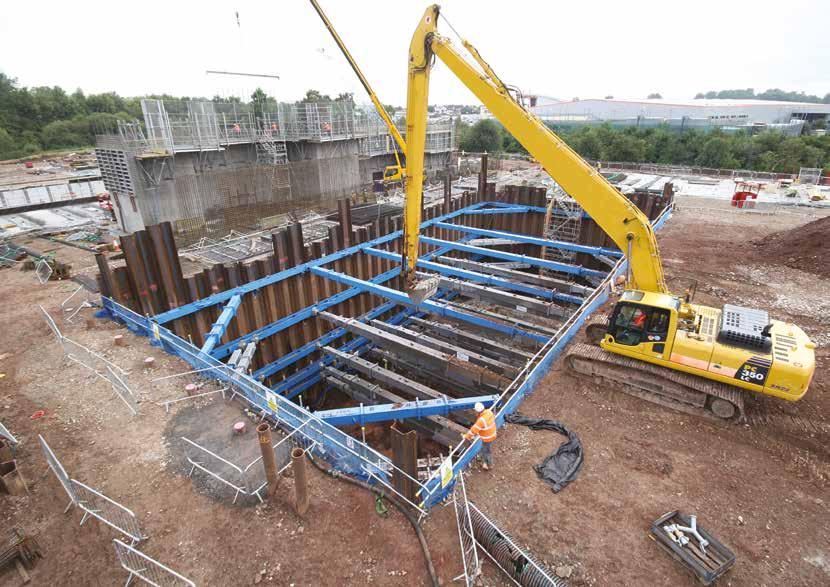
Temporary works supplier
MH International recently announced the expansion of its operations with the opening of a depot in Portlaoise – a major move for the company. Here, we talk with WAYNE FISHER, International Business Development Director at MH International, to learn more about the move, what it means for the business, and how they will support the Irish construction industry.
The opening of the new Ireland depot marks an exciting time for MH International. Can you tell us more about what this means for the company?
WF: “It’s certainly a landmark moment! Already since joining MH International, I’ve seen incredible momentum as we work towards our goal of becoming a globally trusted construction partner, building lasting relationships through exceptional delivery and innovation. The opening of the Portlaoise depot is just the latest example of this in action.
“As a major investment for us as a company, I think the move serves to demonstrate our commitment to growth and to supporting the Irish construction and infrastructure sectors. It’s an exciting next step for us as a business.”
Q) WHY DID MH INTERNATIONAL DECIDE TO OPEN A NEW DEPOT IN IRELAND?
WF: “We already had a strong presence in the Irish market, but by opening this dedicated depot, we’re starting a new
chapter as a company.
“Our decision to establish a strong physical presence and base in Ireland comes in response to a period of sustained business growth across the entire region, as well as an increasing demand for specialist temporary works solutions. It’s my belief that this depot will allow us to provide faster and more tailored support to both new and existing customers in the region, elevating our service levels and forging stronger relationships with customers.”
Q) HOW WILL THE NEW DEPOT BENEFIT THE INDUSTRY?
WF: “Our aim is to help our customers build with confidence. While the temporary works equipment is obviously an essential part of this, we believe that on-hand support and working with our customers at each stage of their project is just as important.
“Having a centralised hub in Ireland not only ensures quicker site deliveries and easier access to our comprehensive portfolio of temporary works solutions, but

it also means customers can readily access localised support and a first-class service. With a dedicated ‘on the ground’ sales and support team, customers can benefit from our end-to-end service offering, spanning
Fisher, International Business Development Director at MH International
in-house design, supply, installation and real-time monitoring.
“It’s a really exciting time, both for us at MH International but also our customers.”
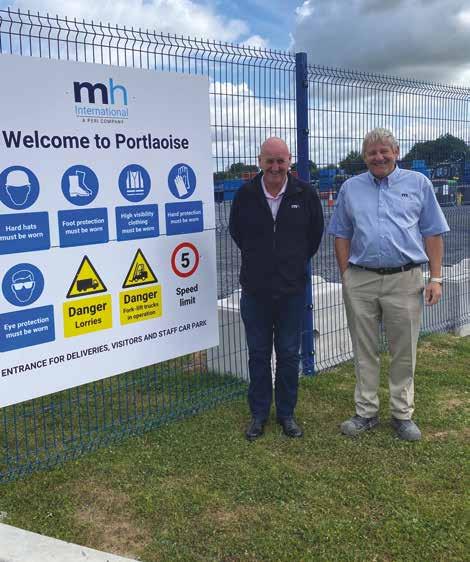
Keenan, Sales Manager, MH International; and Alan Doyle, Depot Manager, MH International.
“This depot will allow us to provide faster and more tailored support to bothnew and existing customers in the region,”
IRELAND’S CONSTRUCTION SECTOR IS REACHING A BUSY POINT, WITH SIGNIFICANT INVESTMENT INTO NEW AND UPGRADED INFRASTRUCTURE PLANNED. HOW CAN MH INTERNATIONAL SUPPORT THIS?
WF: “There’s a lot of investment currently being made into Ireland’s built environment and infrastructure. For example, the National Development Plan 2018-2027 sets out Ireland’s largest ever investment in public infrastructure, with 10 National Strategic Outcomes (NSO) and a total estimated investment of €116bn over the period.
“While temporary works is often the unsung hero of the construction industry, it really does have an integral role to play in the safe delivery of all these landmark projects. With over 60 years of engineering experience, including working on major projects across the building, utilities and transport sectors, we are well placed to support contractors with these proposed works.”
Q) CAN YOU INTRODUCE US TO THE MH INTERNATIONAL IRELAND TEAM?
WF: “We have a number of experienced professionals working within our Ireland team, including Gary Keenan, who will be heading up our Regional Sales team, where we now have operational material ready for hire.
“Our dedicated team is also reinforced by a strong engineering support base, with Nik Arhipovs onboard as our new Design Lead, further strengthening our technical capabilities.”
Speak to the MH International team about your upcoming projects at https://mh.international/ie/contact-us

As Ireland strives to meet ambitious housing and infrastructure targets, traditional methods are no longer enough. FERGA KANE, EY Ireland Partner and Infrastructure and Real Estate Sector Lead, examines how the fusion of AI technology with industry expertise can solve the talent shortage, enhance site safety, and redefine construction for a new generation of digital-native professionals.
Earlier this year, a report produced by Property Industry Ireland highlighted the scale of the talent shortage faced by the Irish construction industry. The report predicted a requirement of between 95,000 and 110,000 additional workers in the coming years just to meet government infrastructure and housing targets.
At the same time, 20% of the industry’s 177,000-strong workforce is expected to retire within the next decade.
This challenge is by no means unique to Ireland, and it is estimated that Europe will need over two million additional construction workers by 2030.
The Irish industry, with the support of government agencies, is making significant efforts to bridge the talent gap through a variety of initiatives. However, at a time of near-full employment in the economy, the challenge of expanding the construction workforce by more than 60% in a relatively short period of time will likely be too great to be met by recruitment and training efforts alone.
New thinking and indeed new technology will be required.
Foremost among those technology solutions will be artificial intelligence (AI). However, while there is broad acceptance that AI has a part to play in helping the industry increase output, it must be understood that it is not in any way a replacement for people, it is an enabling tool that can enhance productivity, make processes more efficient, make the sector more attractive to a wider range of workers, and in turn help to mitigate skills and labour shortages.
Traditionally, the construction sector has been slow to adopt new technologies. The capacity of AI and advanced technologies to enhance efficiency in construction, however, is no less than it is in any other sector.
Modern Methods of Construction (MMC) are often referred to as evidence of technological progress in the industry,
including modular panels, premanufacturing and digital design (BIM). While MMC has existed in various forms for decades, its adoption in Ireland has been far more gradual than in other parts of Europe and Asia.
That must not be the case with AI. The technology must be adopted at pace and its full potential needs to be understood. While it’s easy to say that AI can’t be used to speed up bricklaying or concrete pouring, the advancement in automation technologies has led to an increased use in on-site construction - such as robotic bricklaying and welding robots, but the scope for AI applications in other aspects of construction is vast.
AI can already be used to support project scheduling, resource management and supply chain management to ensure that materials arrive when needed, assisting the planning and design processes, site health and safety management and reporting, and the predictive maintenance of buildings and infrastructure assets post construction, to
name but a few applications.
In an industry increasingly characterised by large, complex projects and tight delivery timelines, AI also offers an opportunity to better manage complexity by analysing vast volumes of data, identifying patterns and flagging potential issues earlier in the process. As anyone who works in the industry knows, this can be incredibly valuable from both a time and cost perspective.
This is not about removing people from decision making, but about freeing skilled professionals from repetitive tasks so they can focus on higher value work that depends on experience, judgment, and collaboration. Beyond efficiency, AI also has the potential to deliver meaningful benefits for safety and wellbeing across construction sites. Technologies such as computer vision and predictive analytics are already being used internationally to monitor high risk activities, identify unsafe conditions and reduce the need for workers to operate in hazardous environments. By lowering exposure to risk and supporting earlier intervention, AI can play a role in making construction a safer, more sustainable career over the long term.
Experience from across the sector suggests that successful adoption of AI is not driven by technology alone, but by progress across three interconnected areas: mindset, skillset and toolset. An open and collaborative mindset is essential to build trust and encourage people to engage with new ways of working. At the same time, organisations must invest in the skills required to work effectively alongside AI, while ensuring the right tools and frameworks are in place to support practical implementation. Focusing on one without the others will limit the benefits AI can deliver for both individuals and the wider industry.
While AI obviously has the potential to ease current and future labour shortages, its adoption and utilisation will be critically dependent on people within the industry having the skills to do so. In common with many other industries, the construction sector currently faces a shortage of these skillsets, and organisations must act quickly to close this gap.
Importantly, this is not simply a question of introducing new “AI skills”, nor does it apply only to management roles.
Bridging the skills gap through reskilling Many roles across construction – from site supervision and technical specialists to planners and project managers – will evolve. As AI takes on more routine, time consuming tasks, people at different levels of an organisation will increasingly be required to interpret outputs, apply judgement,

validate recommendations and work more collaboratively across disciplines. The future workforce will therefore be defined by hybrid skillsets that combine technical, digital and domain expertise.
In the first instance, the most immediate opportunity lies in reskilling the existing construction workforce. The industry already has deep technical and practical expertise across sites, projects and disciplines. The focus should be on equipping those experts with the skills needed to work effectively alongside AI, enabling them to apply their judgement, experience and knowledge in new ways. This is about building on what already exists, rather than starting from scratch.
If processes and ways of working are changing as a result of AI, it will also be necessary to support people in pivoting towards new or adapted roles. Ultimately, organisations that succeed will be those that invest not only in training, but in clear communication, engagement and trust, ensuring people understand why change is happening and feel supported through it.
This type of transition requires careful change management and sustained investment in learning, rather than one off training initiatives. Entry-level recruits will likely already be familiar with AI and use it instinctively as part of their everyday work approach. However, their effectiveness will still depend on gaining a strong grounding in construction specific knowledge, standards and practices. A meeting of minds is required. Existing members of the construction workforce
will need to be encouraged to share their industry knowledge and expertise with their younger colleagues, who in turn can pass on their AI capabilities. This combination can be very powerful. The fusion of AI skills with industry-specific knowledge will almost inevitably lead to the development of new and as yet unidentified use cases, which can further enhance efficiency and productivity. When people understand the art of the possible, exciting things tend to happen.
We should not take younger workers’ AI skills for granted. If AI is to become part of the construction workforce skillset of the future, it needs to be intentionally embedded across construction education and training pathways now. This includes not only university courses such as architecture, engineering and quantity surveying, but also apprenticeships and construction trade education, where AI can increasingly support safer working practices, productivity and decision making on site.
The need for learning will not end at entry level. As AI continues to develop, continuous upskilling will become a permanent feature of working life in construction. Employers will need to create environments where learning is ongoing and embedded into day to day activity, ensuring skills remain relevant across entire careers.
There is also a need for the industry to broaden its appeal to potential recruits beyond the traditional construction disciplines. The construction workforce of the future is likely to include people with background and skills in data analysis, digital systems and AI working alongside established construction professionals. The time to start building that workforce is now.
For apprentices and early career professionals, this shift also means construction careers are becoming broader and more dynamic, combining technical expertise with digital, analytical and problem solving skills, and offering the opportunity to work on complex projects that shape how communities, infrastructure and cities are planned and delivered.
Fortunately, the healthy pipeline of projects is such that the industry should be very attractive to ambitious young people with those skills. The National Development Plan will see an investment of €275bn over the next 10 years, while the government has set a target of 300,000 homes to be built within the next few years.
With that level of activity and investment on the way, this could be an opportunity for the industry to take a leap forward by adopting AI and other advanced technologies which will both improve efficiency and help to address labour and skills shortages now and well into the future.
The construction industry workforce is predominantly male, which means testicular cancer is an issue that your teams need to be aware of. Movember, the men’s health charity, is running a health campaign called ‘Know Thy Nuts’ to raise awareness and educate men about the risks

they face with testicular cancer. It is the number one cancer in young men aged 15–34 in Ireland.
• Testicular cancer is the number one cancer in men aged 15–34 in Ireland
• The survival rate is 95% when caught early. Early detection makes an enormous difference
• A recent global study found that 62% of young men didn’t know how to selfexamine. That is nearly two-thirds of the men most at risk
• Testicular cancer is one of the few cancers that men can check for themselves. Awareness is the simplest intervention available.
Movember is asking every man to take action for their health and to do it regularly. The message is simple: know what’s normal for your body, check regularly, and act quickly if something doesn’t feel right.
• Check regularly — once a month is enough. Get familiar with how things normally look and feel.
• Know the signs — a lump, swelling, heaviness, or any change in size or shape.
• See your GP — if something doesn’t feel right, don’t wait. Get it checked. Early action saves lives.
Movember is asking companies to share their free Digital Toolkit on internal channels. The toolkit is packed with resources covering:
• Understanding the facts about testicular cancer
• How to carry out a self-check
• Next steps — when and how to visit your GP if something doesn’t feel right
Share it in your internal channels, in your team WhatsApp group, in a safety briefing, or at a toolbox talk. You never know, it could reach one more person, and it could even save a li
To learn more, visit https://ie.movember. com/men-s-health/ testicular-cancer or scan the QR code

CES Power, a leading provider of temporary power solutions across Europe, the UK and the USA, has completed the acquisition of three Irelandbased businesses - GH Energy Rental Ltd, Event Power and Purecore. The acquisition supports CES Power’s global growth strategy, targeting sustained year-on-year revenue growth.
Together, the three new businesses will significantly enhance CES Power’s existing fleet of generators, lighting towers, transformers, distribution boards, cabling infrastructure and specialist power management systems, making it the largest power fleet in the UK and Ireland. This expanded capability will increase capacity to deliver complex, multi-site projects across both the events and industrial sectors.
All three business colleagues will join CES Power as part of the acquisition, increasing the headcount in the UK and Europe, further strengthening the business’s in-market expertise and operational delivery capability. This expanded presence in the UK and Ireland will also enhance its ability to deliver consistent, scalable solutions
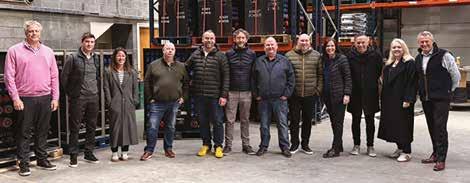
for international clients operating across multiple territories.
As specialists in temporary power generation and distribution for live events, broadcast and industrial projects, GH Energy Rental Ltd, Event Power and Purecore will bring decades of deep sector expertise in delivering critical engineering support, infrastructure and specialist power solutions which will further cement CES Power’s integrated service offering to customers.
Ailsa Webb, division president UK/Europe of CES Power, said, “We have ambitious plans to continue growing our presence
across the UK and Europe, and these acquisitions are an important step in scaling our capability in Ireland.
“GH Energy Rental Ltd, Event Power and Purecore have built strong reputations and long-standing customer relationships. Their technical expertise, high-quality equipment and experienced teams align closely with our strategy to deliver reliable, engineering-led temporary power solutions at scale.
The acquisitions add two Dublin-based operations and one in Portlaoise to CES Power’s growing European network, extending geographic coverage and on-theground support across Ireland.
The fourth annual Build Digital survey reveals an Irish construction sector transitioning from experimental adoption to pragmatic, operational-led transformation. Fueled by the national BIM mandate and a drive for efficiency, the 2025 results—now accessible via an interactive dashboard—highlight significant progress in design and planning, while signalling the industry’s next major hurdle: Embedding digital integration across the entire project lifecycle.
Digitalisation across Ireland’s construction and built environment sector continues to progress, as highlighted by the release of the latest Build Digital 2025 Annual Survey results, now available through the 2025 Annual Survey Results Dashboard. Now in its fourth year, the survey has become an established benchmark for tracking digital adoption in Ireland, with four consecutive years of data enabling clearer insight into sector-wide trends, maturity, and impact.
The 2025 findings show that digital transformation is being driven primarily by pragmatic operational imperatives, with organisations focused on improving efficiency and the quality of project delivery rather than pursuing disruptive innovation. This reflects a shift from early-stage adoption towards more structured and outcomedriven implementation.
Alongside this, the survey confirms that the Irish Building Information Modelling (BIM) mandate is a key external driver of adoption, with 72.2% of respondents identifying the mandate as a key motivator, alongside strong influence from client and project partner demand. These external factors are playing a critical role

in accelerating adoption across the sector, reinforcing the influence of policy and procurement in shaping digital behaviours.
A continued focus on early-stage digital deliverables is evident, with experience concentrated in areas such as capturing and representing information, planning and design, and simulation and quantification. However, more advanced uses of BIM—particularly those extending into construction delivery, operations, and information integration—remain less widespread, highlighting an ongoing challenge in achieving full lifecycle adoption.
Despite these challenges, the survey highlights a positive trend: The introduction of BIM and formalised information management practices is driving improved
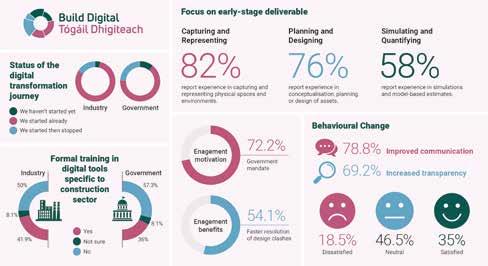

behaviours within project teams, supporting better collaboration even where broader capability gaps remain.
The 2025 Annual Survey Results Dashboard provides enhanced access to these insights, enabling industry stakeholders to explore the findings in greater depth and supporting more informed, evidence-based decisionmaking.
Commenting on the results, Dr Clare Eriksson, Build Digital Director, said, “The findings reinforce that digital transformation across the built environment and construction sector is now well established, but it is being driven by practical, operational needs rather than ambition alone. The challenge ahead is to build capability—ensuring that organisations are supported to move beyond early-stage adoption and embed digital approaches across the full project lifecycle.”
As the sector continues to evolve, the survey underscores that while adoption is now embedded, the next phase of digital transformation will depend on strengthening capability, extending adoption across the project lifecycle, and supporting more consistent implementation of structured information management practices.
Turn to page 42 to learn more about the Irish BIM Mandate Scan the QR code to access the full survey results

ROBERT KENNETT,
Product Manager, Kiwa Building Products, discusses how the twin challenges of ensuring safe, compliant construction and supporting the growing pace of innovation in building products can be met in the rapidly expanding Irish market.
Ireland continues to cement its status as one of Europe’s strongest economies, with many sectors across the country thriving as never before.
Prominent among these is the construction industry, with a recent report from AL Goodbody, entitled ‘Investing in Irish Construction & Materials’, suggesting the sector is enjoying unprecedented growth – and that more is set to come.
Indeed, Euroconstruct is forecasting a 5% increase in output for 2026 for the sector, which represents double the average in western Europe.
The Goodbody report also reveals new orders at a four-year high, and employment in construction having grown to 192,000 in Q4 2025 - a 9.1% year-on-year increase - and that the sector is set to enter a multi-year ‘super cycle’ which will see unprecedented funding for infrastructure, and significant steps undertaken to address the undersupply of housing.
These sentiments were echoed in the AIB Ireland Construction PMI for February 2026, which forecast a highly optimistic outlook for the next 12 months, with all construction sub-sectors either stable or on the rise. Meanwhile, the latest forecast from CIS predicts that project starts under €100m will rise by 11% in 2026 and a further 10% in 2027. For residential starts, this will be a 10% increase in 2026 and a further 5% in 2027.
Housing is, of course, a critical issue as demand continues to spiral. The Irish government has set a new annual target of 50,000 units nationwide, with VAT cuts and tax deductions on apartment construction providing further incentives and opportunities for constructors.
The government has recognised that innovative approaches will be needed to meet the demand for new homes across the country. That means the use of modern methods of construction (MMC), which can help address issues associated with traditional construction, such as the availability of skilled labour and delays caused by poor weather.
The government’s MMC Action Plan, launched last year, promotes the use of MMC to accelerate delivery, reduce waste, and support sustainability within the sector.
Indeed, the role of MMC is now widely acknowledged as integral to the success of Ireland’s construction sector by leading organisations such as the Association of Consulting Engineers in Ireland (ACEI), which also points to multiple benefits, including speed of delivery, cost-effectiveness, sustainability, and adaptability to future needs.
And recent government research - the National Economic and Social Council’s study entitled ‘Boosting Ireland’s Housing Supply: MMC, and the Department of Housing’s Standardised Design Approaches’ study – both assert that the harnessing of

The public is receptive as well, with 70% of those surveyed in a recent Amárach Research study believing that MMC homes “will help towards or provide the answer to” the housing crisis.
It is certainly true to say that MMC has come a very long way in recent years and is far removed from the perception held by some of previous off-site construction methods, such as ‘prefab’ builds, and the stigma that surrounds them.
Innovations in materials and design continue to gather pace, with the potential to deliver major performance improvements alongside the expected reductions in construction times and costs. In Ireland, many companies continue to make major advances in the design, manufacture and supply of new, modular building solutions for housing, education and commercial projects.
However, a key challenge lies in ensuring the quality and compliance of the new and innovative materials and systems being developed through MMC.
The government, developers, and of course the end user –whether a business or private individual – need assurance that the final build will be safe, durable and fit for purpose.
The EU Construction Products Regulation (CPR) stipulates CE marking for building components and the nearly zero-energy building (nZEB) standards under the Energy Performance of Buildings Directive apply to both modular and traditional construction. Meanwhile, Ireland still requires full planning permission for permanent modular homes, though reforms are easing rules for smaller units below 45 sq metres.
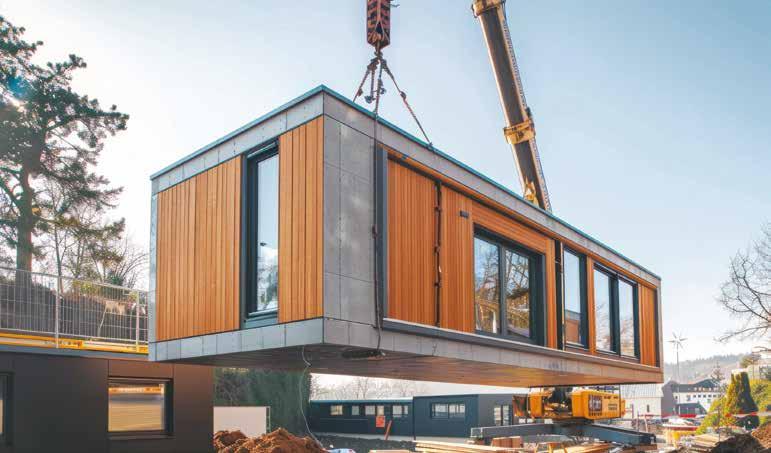
However, as innovation in this sector is happening at such a pace, gaining the required confidence in the product’s fitness for purpose poses a potential roadblock to approval and, therefore, to the adoption and integration of these new technologies on construction projects.
One way of establishing the fitness for purpose for construction products and systems is through Agrément assessment - the third-party technical assessment scheme for innovative building products and systems, which is aligned with current building regulations in Ireland, and provides independent assurance of product performance, safety and regulatory compliance.
Traditionally, when seeking Agrément, MMC manufacturers have had limited options, applying only to the National Standards Authority of Ireland (NSAI). However, these applications for Agrément can sometimes take an extended timescale – sometimes multiple years. This, of course, limits the ability for products to be used on new builds and so leads to potential delays in meeting targets and providing vital homes and other required buildings.
It also creates uncertainty in product development planning, delaying market entry and limiting manufacturers’ ability to respond rapidly to market demand.
Challenges with the existing system have highlighted the need for an alternative, competitive certification service that can meet the sector’s evolving needs.
A different route, offering a speedier turnaround in certification with the same level of assurance on quality, is now available through Kiwa Agrément Ireland, part of global certification group Kiwa, allowing MMC manufacturers, along with other construction product manufacturers, to bring compliant solutions to market more quickly.
Drawing on its global capabilities, substantial resources and technical expertise, Kiwa Agrément Ireland’s fully transparent and collaborative certification process operates with the same transparency and technical rigour as the existing NSAI service, while significantly reducing the certification timescale once the required data has been submitted. The service is available
to manufacturers based in Ireland, as well as any companies supplying the Irish construction market.
In addition to speed, the service delivers efficiency gains by allowing both UK and Irish Agrément projects to be combined through a single certification provider. This improves process visibility, reduces duplication and supports more successful product launches.
The process entails an initial consultation to define the certification scope; submission of documents; technical assessment and review of test data; and then approval and publication of the certificate in a searchable database. The service extends to ongoing partnerships for renewals and Clone Agrément applications.
The success of the process has been amply demonstrated recently by two major MMC manufacturers in Ireland.
Procon Modular, a modular building system manufacturer, used Kiwa’s certification route to bring its off-site manufactured building system to the Irish market. The collaborative testing and assessment process offered by Kiwa enabled a much faster route to certification and market release for Procon’s modular building systems, which are designed for schools, purpose-built student accommodation and healthcare projects.
Meanwhile, Mauerwall, an innovative cladding system developed by Mauer, also rapidly achieved Irish Agrément certification thanks to Kiwa’s support. Designed for timberframe, steel-frame, and masonry construction, the system delivers an external brick appearance with faster installation times, supporting quicker project completion without compromising architectural variation or low embodied carbon in new homes and commercial buildings.
Enabling manufacturers to achieve compliance efficiently and without unnecessary delays represents a positive step forward. Faster access to certification not only supports innovation, but it also increases product choice across the construction supply chain and helps ensure the industry can continue to fulfil the country’s ambitious national building and retrofit targets.
For more information about Kiwa Agrément Ireland, please visit https://www.kiwa.com/gb/en-gb/services/certification/kiwaagrement-ireland/
CPAC Modular, Ireland’s leading modern methods of construction (MMC) main contractor, is championing a new approach to workplace design—one that places employee wellbeing, productivity and retention at the heart of the built environment.
Speaking at a recent industry event, CPAC Modular’s head of business development, Gavin Fox, highlighted the growing challenges facing organisations across Ireland and Europe: ageing building stock, rising sustainability requirements, and a widespread shift back toward officebased work. These pressures, he noted, are driving demand for workplaces that are collaborative, flexible and designed around human needs.
“Buildings designed decades ago were never intended for the way people work today,” Fox said. “When spaces don’t support people, productivity drops and organisations lose talent. But when we design intentionally, the built environment becomes a powerful tool for wellbeing and performance.”
Research shows that poor indoor environmental quality contributes to stress, absenteeism and job dissatisfaction.
Conversely, well designed spaces—featuring natural daylight, strong ventilation, good acoustics and flexible layouts—deliver measurable improvements in mood, cognition and concentration. A recent study at CBRE’s Amsterdam headquarters demonstrated the impact of human centric lighting, with employees reporting increased energy, improved accuracy and higher overall wellbeing.
As hybrid work evolves, CPAC Modular emphasises that offices must now offer a “commute-worthy” experience, providing opportunities for connection, collaboration and personalised working.
Sustainability remains central to CPAC Modular’s approach. With construction and buildings responsible for 39% of global carbon emissions according to the World Green Building Council, offsite construction offers a lower carbon alternative—reducing waste, vehicle movements and embodied carbon while enabling faster delivery.
Recent projects delivered by CPAC Modular, including Ireland’s first permanent modular built school in Lucan, Dublin, demonstrate how MMC can meet today’s needs while allowing for future adaptation.

The Irish Planning Institute (IPI) has called on the government to stop “tinkering” with planning regulations and give the system time to show results over a two-to-three-year period.
The representative body for professional planners across the island of Ireland said the political system needed to recognise that housing and infrastructure delivery “takes time”.
Gavin Lawlor, President, IPI, has cautioned that there are no “quick fixes” or “game changers” to speed up the planning system in Ireland.
He said, “The reality is that the real game changers don’t show results for two or three years. Housing delivery, infrastructure provision, climate action and placemaking are often framed as issues that can be solved through single policy changes or procedural shortcuts. As planners, we know this is rarely the case.
“You have to make the change, have faith in it, and stop constantly tinkering and pulling it apart again. Too often, pressure to accelerate delivery produces the opposite effect,” he added.
The IPI president has also warned that
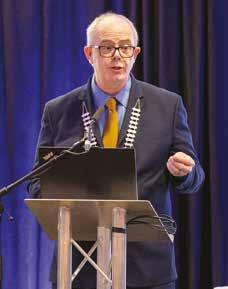
recent actions taken to circumvent the planning process, including elements of the new Critical Infrastructure Bill and exempted developments, are not acts of “reform”, but of “regression”.
In response, the IPI has called on the government to publish the draft guidelines for exempted development regulations and to open a consultation process with
professional planners and the public. Lawlor said the time has passed for press releases and announcements, and that the government must now work to finalise these measures and allow the planning system to get to work.
“When it comes to reform, much of the recent discussion has been around exempted development,” Gavin Lawlor said. “Much of what we hear proposed makes sense. However, some of the kites being flown risk ignoring legitimate concerns – both from planners and communities. These include concerns around amenity, access, water and wastewater provision, and possibly opening up the floodgates to enforcement complaints and investigations.”
“Some of the commentary about accelerating infrastructure and speeding up planning by circumventing the planning system is an oxymoron. To bypass planning altogether is not reform; it is regression. Planning serves communities, not individuals. Infrastructure, housing and growth inevitably benefit the many more than the few, and Ireland has become increasingly uncomfortable with that trade off.”

As a social enterprise, we create employment opportunities for people rebuilding their lives after prison or addiction, helping individuals gain skills, confidence, and sustainable work.
Builder Cleans
Grounds
Every Clean Slate job helps create opportunity. Through paid employment and on-the-job training, we support people to:
Rebuild work histories
Develop practical skills
Gain stability and routine
Move toward long term employment
For many of the people we employ, a job means far more than a pay cheque. It represents a real chance to move forward. GET IN
Enabling Works Ahead of Trades
linkedin.com/company/clean-slate-property-services Deep & Office Cleaning
As Ireland moves toward its 2030 goal of a fully digitalised construction sector, the BIM mandate is transforming from a policy objective into a practical reality for public works. With Milestone 6 now bringing contractors and supply chains into scope for projects over €10m, the focus shifts to the international standards underpinning this change. DAVITT LAMON, Head of Building Information Modelling (BIM), NSAI, explores the evolution of the ISO 19650 series, the benefits of formal certification, and why industry participation in the current public consultation is vital for shaping the future of digital delivery in Ireland.
The Irish BIM mandate now forms part of the government’s wider strategy to digitalise the construction sector by 2030. In practice, it uses public procurement to help drive that change across a market where the public sector represents at least 25% of construction activity.
The rollout began in January 2024, when BIM requirements were first introduced for consultants engaged on public works projects valued above €100m. The published adoption timeline then set out a phased expansion over four years, extending those requirements to lowervalue projects and, in time, to contractors and the wider supply chain. By 01 January 2026, the process had reached Milestone 6, bringing contractor and supply chain requirements into scope for projects above €10m.
At the centre of the mandate is a clear set of core requirements. Where BIM requirements are included in public works, they draw on the ISO 19650 series, alongside Uniclass, IFC and ICMS, giving public projects a more consistent and standardised framework for digital delivery.
This matters because digital delivery is now closely tied to better consistency, stronger productivity and improved outcomes across public sector projects. It is also increasingly relevant to the national challenge of delivering infrastructure and housing in a more efficient, transparent and reliable way.
At the heart of the mandate is ISO 19650, the international series of standards for managing information throughout the life of a built asset. It provides a structured framework for organising and digitising information about buildings and civil engineering works, including information management using BIM.
Its importance lies in the fact that information management is not simply a technical exercise. It provides a clear

Davitt Lamon,
Head of Building Information Modelling (BIM), NSAI.
and standardised way to manage how information is created, shared, and maintained, helping teams work more consistently and collaboratively throughout the project lifecycle.
This matters because better information supports better delivery. A standardsbased approach underpins consistency, strengthens collaboration and helps projects to be delivered more efficiently and effectively, giving clients greater confidence in the processes behind digital delivery.
In the Irish context, this is especially significant as public bodies and their supply chains respond to the BIM mandate. A more structured approach to information management helps lay the foundation for stronger productivity, improved decisionmaking and better outcomes across infrastructure and housing delivery.
Attention now turns to the proposed revisions to ISO 19650 Parts 1 and 2. These drafts mark the first proposed updates to the series since the first editions were published in 2018, and they are now moving through international review and
public consultation. At this stage, they remain proposals only, and the current editions still stand until any revised versions are formally agreed and published.
For Part 1, the direction of travel is towards a clearer and more usable framework. The draft places greater emphasis on the whole life of the asset, gives more prominence to the purpose of information, simplifies terminology, and reorganises the text into a more logical structure. It also aims to align more clearly with related information management standards and with the wider ISO 19650 series.
For Part 2, the proposed change is more structural. Instead of focusing solely on the delivery phase, the revised draft sets out a single information management process that applies across the asset lifecycle. Under the proposal, the existing processes in Parts 2 and 3 are brought together into a unified nine-step process, while Part 3 is reshaped to provide implementation guidance.
For many organisations, this does not mean starting again from scratch. Much of the day-to-day activity around information production remains familiar, but the draft introduces a clearer structure and a shift in language towards information management and information production. Taken together, the proposed revisions aim to make the standard easier to follow, easier to explain and better suited to whole-life digital delivery.
With the proposed revisions now out for comment, the focus shifts from awareness to participation. The public consultation is open through Your Standards Your Say at www.nsainep.ie, where the draft versions of ISO/DIS 19650-1 and ISO/DIS 19650-2 are available to read and review. Both drafts are listed on the portal with a closing date of 05 May 2026.
The consultation gives Irish stakeholders a direct route into the standards process, allowing them to review the drafts and
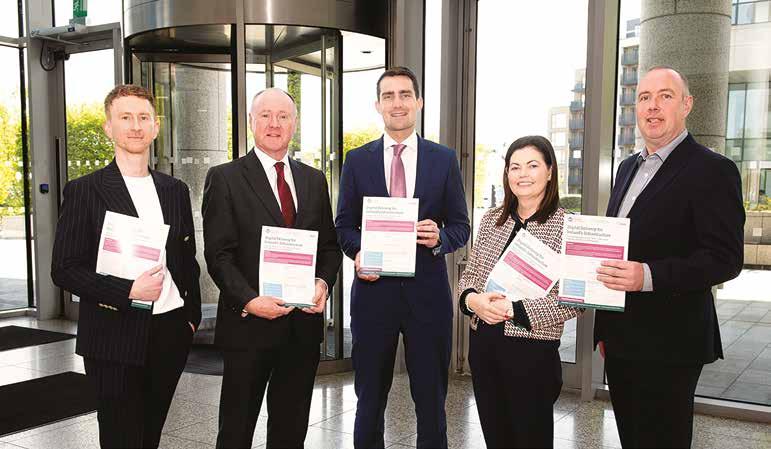
submit comments that can help inform Ireland’s input to the relevant standards bodies.
For Irish industry, that creates a timely opportunity. Rather than waiting for revised standards to arrive, organisations can now help shape the direction of the final text and ensure that the Irish experience of implementation is reflected in the international discussion.
That wider discussion came into focus on 22 April 2026, when NSAI, Build Digital and the Infrastructure Division of the Department of Public Expenditure, Infrastructure, Public Service Reform and Digitalisation (DPER) jointly hosted Digital Delivery for Ireland’s Infrastructure at NSAI’s offices in Dublin. The half-day event was designed to bring together standards experts, certified organisations and public sector leaders to explore how ISO 19650 is evolving and how it can be applied in practice across public infrastructure delivery.
The programme was structured to move from policy and standards into practical delivery. It opened with a welcome from NSAI and an introduction from Build Digital and the Infrastructure Division, before moving into a session on the proposed revisions to ISO 19650 Parts 1 and 2. An open forum then gave attendees the chance to raise questions and discuss the implications of the draft changes.
The second half of the morning turned to implementation. Sessions on practical pathways to ISO 19650 certification and the delivery of the Irish BIM mandate brought the discussion back to what these standards mean in real project settings, including public works. That gave the event
a clear purpose: not simply to explain what was changing, but to connect consultation, certification and adoption in a way that was directly relevant to organisations working across Ireland’s built environment.
Certification also emerged as one of the clearest ways for organisations to move from awareness of ISO 19650 into practical implementation. At NSAI, certification is positioned as a formal, third-party assessment of an organisation’s ability to manage information in line with ISO 19650-2. The process moves from application and readiness assessment through audit, review and annual surveillance, helping organisations show that their information management processes are being applied in practice.
Its value is increasingly backed by evidence. Irish research on organisations certified under a national ISO 19650-2 scheme found that 69% reported improved consistency and quality in project documentation, while 69% also pointed to it giving them a more structured approach to continuous improvement.
That helps explain why certification featured so strongly at the event. It was presented not as an end in itself, but as part of a broader commitment to quality, transparency and continuous improvement. The discussion also pointed to the practical supports that can help organisations on that journey, including Information Management Plans and additional guidance resources developed by Build Digital to support more consistent implementation of ISO 19650 and the Irish BIM mandate in real project settings, including public works.
The event also highlighted the continuing collaboration among NSAI, Build Digital and the Infrastructure Division of DPER, bringing together policy direction, standards leadership and practical implementation support. That work has already produced discounted BIM standards packs and the recently published Information Manager (BIM) Role Profiles report, helping to improve access to standards and strengthen clarity around information management roles in practice. Looking ahead, Build Digital said the findings of its annual industry survey would soon be published as an interactive dashboard on its website, providing a further snapshot of digital transformation across Ireland’s construction and built environment sector. To learn more about this turn to page 37 ‘Digital transformation advances as Build Digital launches 2025 annual survey results’.
The message from the event is clear: now is the time for industry to have its say on the proposed revisions, to strengthen adoption of the standards, and to embed better information management in practice across housing and infrastructure delivery.
Those wishing to contribute can access the draft standards and submit comments through Your Standards Your Say at www.nsainep.ie (or scan the QR code) until 05 May 2026, while organisations interested in certification can find further information at www.nsai.ie/BIM.

With ambitious national targets looming, Ireland’s homegrown offsite manufacturing industry is no longer an “emerging” sector—it is a proven, high-tech solution waiting for the green light. DENISE TUFFY, Director of Specialist Contracting, Construction Industry Federation, writes that by providing the industry with clear pipelines and visibility, the government can unlock a faster, greener, and more productive future for Irish infrastructure.
Ireland’s construction landscape is evolving rapidly, shaped by new demands, ambitious national targets, and a growing emphasis on sustainability and productivity. Amid this transformation, a sector that stands out as a strategic national asset with the capacity, capability, and readiness to deliver more: Ireland’s indigenous 3D volumetric offsite manufacturing industry.
For more than a decade, Irish companies have been quietly building world-class expertise in offsite construction. These are homegrown manufacturers, many based in regional communities, who have invested heavily in digitalisation, lean processes, and highly-skilled workforces. Their factories operate to exacting standards, producing precision-engineered buildings that can be delivered faster, safer, and with significantly reduced environmental impact.
This is not an emerging sector — it is an established one, and it is ready to scale.
Ireland’s offsite manufacturers have demonstrated time and again that they can deliver high-quality buildings at speed. The Department of Education’s long-standing use of off-site solutions is a testament to this. Schools delivered through 3D volumetric manufacturing have shown how effective the model can be: minimal disruption to students, rapid installation during school holidays, and consistent quality across every project.
These successes highlight a broader truth — Ireland already has the expertise, infrastructure, and capacity to deliver more public buildings through offsite methods. The sector now needs to be fully utilised.
Ireland faces significant challenges and opportunities across education, healthcare, housing, and climate action. Offsite manufacturing is uniquely positioned to support these national priorities.

– Speed of delivery helps meet urgent infrastructure needs.
– Reduced waste and lower carbon output support Ireland’s climate commitments.
– Predictable, factory-controlled processes improve productivity and reduce risk.
– Regional employment strengthens communities outside major urban centres.
These benefits align directly with the government’s ambitions for a more modern, efficient, and sustainable construction sector.
A recent capacity survey among members of the Smart Offsite Association (SosA) revealed that Irish volumetric manufacturers currently have significant unused production capacity. This is not a sign of weakness — it is a sign of readiness. The infrastructure is in place. The people are trained. The factories are operational. The sector is poised to take on more work immediately.
Unlocking this potential requires one key ingredient: visibility.
Multi-annual planning and clear pipelines allow companies to invest confidently in people, technology, and innovation. This is true across all areas of construction, but it is particularly
important for manufacturing-based industries where consistency is essential.
Ireland has an opportunity to build on the success of the education frameworks and extend the benefits of offsite manufacturing to other areas where speed, safety, and minimal disruption are critical — such as healthcare, housing and community facilities.
International models, including those in the UK, demonstrate how targeted frameworks can support the growth of volumetric manufacturing while delivering exceptional value for the public sector. Ireland does not need to replicate these models exactly, but they offer useful inspiration for how industry and government can work together to create long-term, strategic programmes of work.
Unlocking the full potential of Ireland’s offsite sector means recognising it as a strategic national asset — one that supports regional economies, advances sustainability goals, and strengthens Ireland’s construction capability for the future.
It means building on what already works, fostering collaboration, and ensuring that the sector’s proven strengths are fully harnessed to meet the country’s evolving needs.
Ireland’s 3D volumetric manufacturers are ready. The opportunity now is to put this national asset to work.
To learn more about the Smart Offsite Association, visit www.cif.ie/association/ smart-off-site-association
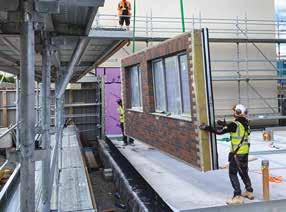
The Irish Electrical Benevolent Association (IEBA) is hitting a major milestone this year, and they aren’t planning on letting it pass quietly. To celebrate their silver jubilee, the organisation has announced that their annual Charity Winter Ball will be a high-energy tribute to 25 years of industry support.
The IEBA has secured a headline act that knows exactly how to get a crowd on its feet. ABBAesque, widely recognised as Ireland’s premier tribute band, will be taking centre stage.
With a career spanning over 21 years and a staggering schedule of more than 150 sell-out shows annually, ABBAesque has earned their reputation as the most successful tribute act in the country. Their performance promises to bring the perfect blend of nostalgia, showmanship, and infectious energy to the Jubilee celebrations.
While the music will undoubtedly be a highlight, the heart of the evening remains the IEBA’s mission. For 25 years, the charity has provided a vital safety net for members of the Irish electrical industry and their families during times of hardship.
The silver jubilee IEBA Winter Ball serves as both a celebration of that legacy and a critical fundraising platform to ensure the IEBA can continue its work for the next 25 years.
Expect a night of sequins, classic hits, and meaningful contributions. Whether you’re a ‘Dancing Queen’ or just looking to support

a fantastic cause, the IEBA Winter Ball is shaping up to be the industry’s must-attend event.
Ready to say “Thank You for the Music”? Make sure to secure your tickets early—if ABBAesque’s track record is any indication, this is one show that won’t have empty seats for long.
Date: Friday, 20 November 2026
Venue: The Intercontinental Hotel, Dublin 4
For tickets, email Áine Higgins at aine.higgins@irisheba.ie
The Minister for Enterprise, Tourism and Employment, Peter Burke, was at Dublin port to mark the delivery of new cold-chain infrastructure. The port has signed an eight-year licence agreement with Doyle Shipping Group (DSG) to operate new reefer gantries positioned on four purpose-built steel frames at the DSG container terminal on Alexandra Quay East, also known as the ‘common user area.’
Reefer gantries are elevated steel structures in container terminals that supply electrical power to stacked refrigerated containers (‘reefers’). The new installations, constructed by Wills Bros, will provide 140 built-in power outlets, allowing containers to be plugged in and maintained at a controlled temperature. This is critical for temperature-sensitive cargo such as food imports and exports. Units can be safely stacked up to five high, saving space and improving terminal efficiency. A new substation is being constructed alongside the facility to power the expanded capacity.
This investment in LoLo reefer infrastructure enhances refrigerated container handling at Dublin port, supporting growing customer demand. It strengthens the port’s ability to protect temperature-controlled goods – such as dairy products, meat, fish, fruit, beverages or pharma – helping ensure perishable cargo remains cold, or heated, while in port.
Cormac Kennedy, Head of Commercial and Programme Management Office, Dublin Port Company, said, “We are delighted to work with Wills Bros, Doyle Shipping Group and our port team to complete this project. It is one of a number of key projects underway to enhance the customer experience at Dublin port. We
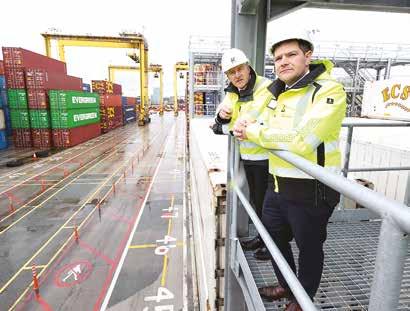
Dublin Port Company CEO Barry O’Connell with Peter Burke, Minister for Enterprise, Tourism and Employment, marking the delivery of new refrigerated container infrastructure at Dublin Port.
currently have 12 projects on site, with a further 23 across feasibility and design stages projects in train, ranging from Ireland’s largest maritime construction project at Berths 52/53 to operational upgrades such as the recent improvements to electronic signposting across the port and these reefer facilities.”


As Ireland’s housing deficit widens and traditional building methods struggle to keep pace, PAUL LYNCH of 8020 Consulting argues that a radical shift is required. By combining MMC with the “superpowers” of AI and automation, the industry can overcome labour shortages and soaring costs to deliver the sustainable, high-quality homes the nation desperately needs.
Ireland is in the grip of a housing emergency. With a government target of 300,000 new homes by 2030 set out under the original ‘Housing for All’ plan, and delivery consistently falling short, the construction sector faces a nearsuperheroic challenge.
Labour shortages, soaring material costs, planning delays, and an over-reliance on traditional building methods have created a perfect storm that conventional construction simply cannot weather alone.
Enter Modern Methods of Construction (MMC), an umbrella of innovative approaches, from volumetric modular housing and panelised systems to hybrid off-site manufacture, that are already proving their worth on projects across Europe and beyond. If the housing crisis demands a hero, MMC is ready to wear the cape. But every superhero needs a
superpower. For MMC, that superpower is artificial intelligence (AI) and automation.
This article explores why MMC is Ireland’s best hope for meeting its housing targets, how it stacks up against traditional construction, and how AI and automation can amplify its impact to genuinely transformative effect.
The numbers tell a stark story. Ireland needs to deliver approximately 50,000 homes per year to meet demand, a figure that has rarely been approached, let alone exceeded, in recent years. The Central Statistics Office (CSO) reports that completions in 2025 reached just over 36,284 units, leaving a gap of nearly 14,000 homes annually. Meanwhile, population growth, net inward migration, and the continued dissolution of multigenerational households are intensifying demand year on year.
The traditional construction model,
bricklayers, site labourers, trades sequenced across months or years, cannot bridge this gap at pace. The sector is already experiencing a skills deficit of approximately 50,000 workers, according to the Construction Industry Federation (CIF), and the pipeline of new entrants is insufficient to meet demand. Something structurally different is needed.
• 300,000 homes needed by 2030 (Housing for All)
• ~36,284 completions in 2025 — a deficit of ~14,000 per year
• 50,000+ construction worker shortfall (CIF, 2024)
• Construction costs up 35% since 2019
MMC VERSUS TRADITIONAL CONSTRUCTION: THE CASE FOR CHANGE
Traditional construction has served
“If MMC can be the superhero of construction, then AI and automation can be its superpower.”
Ireland well for generations. It is familiar, flexible on site, and deeply embedded in the cultural and commercial fabric of the industry. But in a crisis, familiarity is not enough. MMC offers a fundamentally different delivery model, one built around factory manufacturing, predictability, and scale.
Perhaps the most compelling advantage of MMC is speed. A traditionally built home typically takes 12 to 16 months from foundation to handover. A modular or panelised home, with components manufactured off-site in parallel with groundworks, can be completed in as little as seven to 10 months. On large-scale social housing schemes, this compression is even more pronounced and is expected to deliver 30–40% faster than comparable traditional builds.
Factory-controlled environments eliminate many of the variables that plague traditional site work, such as weather delays, inconsistent workmanship and material waste. Components manufactured under controlled conditions to precise tolerances result in better thermal performance, higher air-tightness ratings, and lower defect rates.
Research consistently shows MMC buildings outperforming traditional equivalents on snagging and post-handover defects. For social housing providers and local authorities in Ireland, this means lower lifecycle costs and better tenant outcomes.
One of the persistent frustrations of traditional construction is cost overruns. Estimates routinely underestimate the real cost of a project, with unforeseen ground conditions, supply chain disruptions, and weather delays conspiring to push final accounts well above budget.

Paul Lynch
MMC, by contrast, offers a high degree of cost certainty. Because the majority of work is done in a factory to a defined scope, pricing is more predictable, and variations are fewer. This is not just convenient; in the context of government-backed affordable housing programmes, it is essential. Developers and housing bodies cannot responsibly commit to schemes when costs are unknowable.
Ireland has committed to a 51% reduction in greenhouse gas emissions by 2030 under its Climate Action Plan, and the built environment is a significant contributor to national emissions.
MMC offers a demonstrably greener path. Factory manufacturing generates significantly less waste than site-based construction, some estimates suggest 80% less material waste. Off-site production also enables tighter integration of insulation, airtightness membranes, and building services, resulting in homes that are easier to heat and cheaper to run. For a country committed to near-zero energy building standards, MMC is not just a faster way to build, it is a better one.
The construction skills shortage is not going to be resolved quickly. Training a new generation of site operatives takes years. MMC, however, allows a different labour model: skilled factory workers, many of whom can be trained more quickly in controlled environments, replace a proportion of traditional site trades. A smaller, more highly skilled site crew, performing installation and finishing rather than the full spectrum of construction work, can deliver more homes with fewer people. This is not about replacing workers; it is about deploying
them more effectively against an urgent need.
If MMC is the superhero of construction, then AI and automation are its superpowers. The factory-based nature of MMC creates a uniquely fertile environment for the application of digital technologies, and the results, when deployed, are nothing short of transformational.
Traditional site-based construction is inherently resistant to automation. The unpredictability of ground conditions, the variability of manual trades, and the open-air nature of the work make it extraordinarily difficult to introduce robots or algorithms in any meaningful way. A factory floor is entirely different. It is a controlled, repeatable environment where precision machinery, machine learning systems, and automated workflows can be deployed at scale, and where the gains compound over time.
The power of AI begins before a single component is manufactured. Generative design tools, AI systems that can produce and evaluate thousands of design options against a given set of constraints, are already being used by progressive MMC manufacturers to optimise structural layouts, maximise unit yields on challenging sites, and minimise material use.
In an Irish context, where brownfield sites often come with complex geometries and planning constraints, this capability is particularly valuable. Rather than a design team spending weeks manually iterating on a layout, an AI can surface the optimal solution in hours.
On the factory floor, robotic fabrication is already a reality in leading MMC facilities. Automated CNC machinery cuts structural timber panels and steel frames with submillimetre precision, eliminating human error and waste. Robotic arms install insulation, fix sheathing boards, and even apply finishes, at speeds no human team can match and with a consistency that reduces quality control overhead. The next generation of Irish MMC factories must be built with automation at their core.
Building Information Modelling (BIM) and digital twin technology allow every component of a building to exist as a
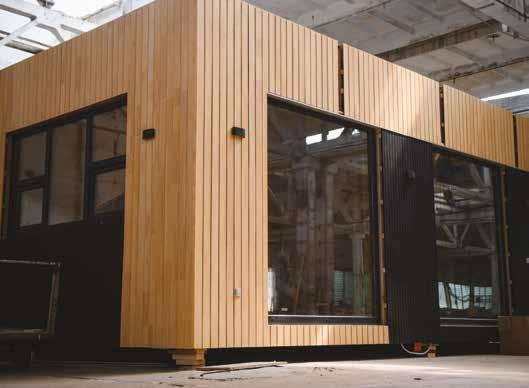
live, data-rich virtual object before it is ever manufactured. For MMC, this is transformative.
A digital twin of a modular housing scheme can be used to simulate construction sequencing, identify clashes between services and structure, and optimise installation programmes, all before ground is broken. AI can interrogate this data in real time during manufacture, flagging deviations from specification and ensuring that what leaves the factory matches exactly what was designed. On site, augmented reality tools powered by the same models can guide installation crews with pinpoint accuracy.
One of the hidden costs of traditional construction is the unpredictability of the supply chain. Materials arrive late, in wrong quantities or with specification errors — and each incident has a knock-on effect across the programme. AI-powered supply chain management tools can analyse historical demand patterns, supplier lead times, and project pipelines to predict material requirements weeks or months in advance. For MMC factories running at volume, this means near-elimination of production downtime caused by material shortfall. In an environment where every day of delay represents homes unbuilt, this capability has direct social value.
The benefits of AI do not end at the factory gate. On site, computer vision systems can monitor installation progress in real time, comparing actual work to the programme and alerting project managers to emerging delays. The same systems can track worker movements and identify unsafe behaviours before they result in accidents, a critical capability in a sector where Ireland’s
Health and Safety Authority (HSA) continues to record concerning levels of construction fatalities. Drone-based site surveys, powered by AI photogrammetry, can produce accurate as-built records in minutes, supporting quality sign-off and future maintenance.
Imagine Ireland in 2030: A network of large-scale MMC manufacturing facilities, strategically located near motorway junctions and port infrastructure, producing panelised and volumetric homes around the clock. Each factory is powered by renewable energy and generates nearzero waste. On the factory floor, robotic arms cut, assemble, and finish structural components while AI systems continuously monitor quality and adjust production parameters in real time.
Design teams work with generative AI to optimise schemes for specific sites in a fraction of the time previously required. Digital twins of every project are live from day one of design, allowing planners, housing bodies, and contractors to interrogate programme, cost, and quality data in real time.
On site, installation crews work with augmented reality overlays that guide them through each connection with precision, reducing errors, rework and risks.
The result? A construction sector that can credibly deliver 50,000 homes per year, on programme, on budget, and to a sustainability standard that meets Ireland’s climate commitments. A sector that can absorb and deploy the workforce it has, rather than being perpetually paralysed by the workers it lacks. A sector in which quality is designed in, not inspected in, where defects are caught by algorithms in the factory, not by snag lists six months after handover.
This is not science fiction. The technology exists. The need is urgent. What is required is the collective will of the government, industry, and the financial sector to invest, to reform, and to embrace a new way of building.
MMC is Ireland’s construction superhero. AI and automation are its superpowers. The housing crisis is the villain. The time to act is now.
Ireland’s housing crisis is one of the defining social and economic challenges of this generation. The consequences of failure, homelessness, emigration, economic stagnation and social inequality are too grave to be addressed by incremental improvements to the status quo.
MMC offers something the traditional sector cannot: A step change in delivery speed, quality, predictability, and sustainability. It is not a silver bullet, no single intervention is, but it is an essential component of any credible strategy to house the people of Ireland at the scale and pace required.
And when AI and automation are woven into the fabric of MMC production, the result is not just better construction, it is a genuine transformation of what the industry is capable of. Faster, smarter, safer, and more sustainable: That is the promise of MMC, turbocharged by the digital revolution.
Ireland has a choice. It can continue to rely on methods that have demonstrably failed to meet demand. Or it can back the superhero, and give it the superpower it needs to win.
Paul Lynch is the CEO at 8020 Consulting, where he advises business leaders on digital transformation and the strategic adoption of artificial intelligence. With a background in offsite construction, Paul brings a practical, data-driven approach to helping organisations navigate disruption, comply with evolving regulations, and capture measurable value from emerging technologies. He has a particular focus on AI in highly regulated sectors, including construction, where he works with clients to build sustainable capability and competitive advantage.
To learn more, visit www.8020consulting.ie or email Paul at Paul@8020consulting.ie
Considerate Constructors Scheme (CCS) has launched a strengthened, modernised checklist and scoring model, introducing a clearer and more consistent framework for assessing responsible construction across the UK and Ireland.
This evolution of the CCS checklist, guided by extensive consultation with contractors, monitors, clients, and subject-matter experts, and further strengthened through testing in a pilot project, introduces 24 defined themes aligned with CCS’s three pillars of Community, Environment, and Workforce.
The CCS is replacing its 27-question structure with a percentage-based system to ensure equal weighting and transparency across more than 7,300 annual site assessments.
Starting May 5, 2026, an updated Code and digital platform will streamline participation for all contractors.
Desiree Blamey, Managing Director, CCS, describes the change as an “evolution” that remains 90% familiar while providing a more consistent, evidence-based framework for the entire industry.
Beyond simple compliance, this update aligns with client expectations, public sector priorities and wider industry needs. It also strengthens alignment with recognised industry frameworks, including clearer links to environmental and social criteria widely used in BREEAM assessments.
The checklist has also been designed with an ISO-ready structure, with themes and expectations that mirror the approach used, making it easier for organisations to align CCS evidence with existing quality, environmental and health and safety accreditations.
A sharper focus on skills, employment standards and workforce pathways reflects the sector-wide skills challenge, while strengthened mental-health expectations –including Lighthouse Charity information visible on every site – reinforce CCS’s commitment to wellbeing.
New UV protection guidance supports safer outdoor working when UVI levels are greater than 3, and clearer expectations for supply chain collaboration help align subcontractors, suppliers and
clients around consistent standards.
Practical, behaviour-focused expectations on harassment and inclusivity set a stronger baseline for respectful, fair and professional working environments.
• A clearer structure
• 24 themes grouped under Community, Environment and Workforce
• Each theme supported by clear, outcome-focused expectations
• Plain-language guidance designed to support both major contractors and SMEs
• Percentage-based scores replace the previous out-of-45 system
• Every expectation scored as not met, partially met or fully met
• Minimum conformance baselines introduced
• More meaningful differentiation between sites, enabling continuous improvement
NEW PRIORITY ACTIONS
• Mental health support
• Skin cancer awareness
• Environmental incident readiness
• Right-to-work verification
• Supply chain collaboration
• Skills gap and employment standards
• Social value measurement and reporting
• Innovations and Best Practices now submitted year-round
• Additional points influence National Site Awards (not core site scores)
– Best Practice: +2%
– Innovation: +4%
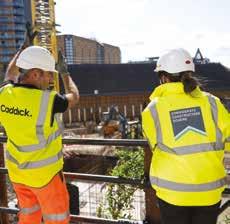
Accompanying the checklist update is a major upgrade of CCS’s digital tools:
A new Visit Preparation Tool
Replacing the former self-assessment, this digital checklist provides:
• In-platform guidance aligned to every theme
• E-learning lookup for priority actions
• Improved project and value inputs
• ISO certification capture
• A new Improvement Opportunity Library
• Enhanced usability for SMEs and supply chain partners
From May, monitors will use a redesigned reporting template offering:
• Granular theme-level scoring
• Clear summaries of improvement opportunities
• Consistent evidence-based assessments
CCS is also updating its product portfolio to better support organisations of all shapes and sizes, including:
• Enhanced registration pathways for SMEs, supply chain partners and maintenance contractors
• A refreshed Multi-Site Programme
• The return of Ultra Sites, with increased monitoring and enhanced support
• An upgraded CCS Portal with modern infrastructure, improved organisational visibility, role-based access control and optional SSO integration
• From 2027, CCS will also launch upgraded banners, van stickers and digital assets to support clearer, more consistent industry communication[DB1]
To help organisations prepare, CCS is offering:
• Updated guidance for every theme
• Printable site-ready resources
• Scoring explainers
• A series of webinars for contractors, clients, site managers and organisations.
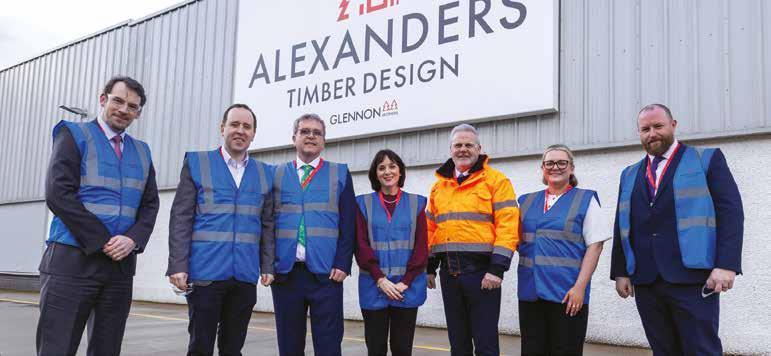
During a recent visit to Glennon Brothers’ £18m Alexanders Timber Design facility in Scotland, the Minister of State responsible for Housing, Local Government and Planning, John Cummins, highlighted the critical synergy between commercial forestry and sustainable housing. As Ireland strives to meet ambitious climate and construction targets, the ‘forest-to-front-door’ model offers a blueprint for reducing emissions while accelerating the delivery of highquality, timber-frame homes.
Forestry has a key role to play in helping Ireland meet its housing needs and climate change targets. This was the central message highlighted during a visit by John Cummins, to the £18m state-of-the-art Alexanders Timber Design in Irvine, North Ayrshire, part of Irish-owned Glennon Brothers.
The visit to the timber frame home manufacturing facility was held as part of the government’s St Patrick’s Day global outreach programme this year. It highlighted the need for a more joinedup approach to forestry, sawmilling, and the use of locally sourced timber in construction. Using homegrown timber helps meet housing demand, lock away carbon, reduce embodied emissions and strengthen the domestic supply chain.
The facility showcased Glennon Brothers’ integrated forest-to-front-door model using advanced robotics, digital design systems and precision engineering. Much of the timber used in the manufacturing process is sourced from forests within a 70-mile radius, processed at Glennon Brothers’ sawmill in nearby Troon and then converted into timber
frame homes at the Irvine facility for housing developments across Scotland’s central belt.
Mike Glennon of Glennon Brothers spoke with Minister Cummins about the need for more commercial forests in Ireland to meet future demand for construction-grade timber, alongside wider action to address bottlenecks in housing delivery across planning, infrastructure and skills.
Mike Glennon said, “With just 2,500 hectares planted in 2025, against a government target of 8,000 hectares and climate change target of 16,000, Ireland must increase forest cover to avoid significant EU penalties. At present, only 30% of planting is suitable for housebuilding, limiting the supply of timber needed for the construction sector.
“As an Irish company with deep roots in Longford and major operations across Ireland and Scotland, Glennon Brothers is continuing to invest in the capacity, skills and manufacturing needed to support greater use of homegrown timber in construction.”
Speaking during the visit, Minister Cummins said, “Scotland and Ireland have built a strong reputation for innovation in timber frame construction and modern methods of housebuilding, and facilities such as Alexanders Timber Design show how this expertise can help deliver sustainable homes at scale.
“I recently visited off-site construction facilities, and it is great to see innovation driving increased housing delivery.
Last year, Ireland saw a 20% increase in output to 36,000 homes, and 70% of all scheme houses delivered were via MMC, predominantly timber frame construction.
“I want to compliment Glennon Brothers for the work they are doing in Scotland and in Ireland. This facility demonstrates how we can connect forestry, processing and modern methods of construction to build a more resilient housing system that meets the needs of our growing population”
Established in Longford in 1913, Glennon Brothers is a third-generation Irish timber business with major operations in both Ireland and Scotland. The company operates across timber processing, timber frame home manufacturing and energy, with sites in Longford, Fermoy and Enniskillen, alongside its Scottish operations. Glennon Brothers continues to invest in timber frame manufacturing capacity in Ireland, through Dempsey Timber Engineering in Longford, and in Scotland, through Alexanders Timber Design.
In 2025, the company opened its £18m Alexander Timber Design facility in Irvine, North Ayrshire, a state-of-the-art timber frame manufacturing plant producing sustainable building systems using homegrown Scottish timber.
Glennon Brothers’ recent acquisition of the Pontrilas Group, one of the UK’s leading independent sawmill and packaging businesses, has further strengthened the group’s position in the UK market, bringing total headcount to around 1,400 and combined revenues to €430m.
Cork City Council is using Cork docklands - one of Ireland’s largest urban regeneration projects - to show how Ireland’s cities can grow in ways that work with nature, not against it.
The local authority recently hosted a nature-based solutions (NbS) docklands tour and collaborative workshop for representatives from Cork City Council and Dublin City Council.
David Joyce, Director of Emergency Services and Climate Action at Cork City Council, opened the event by saying that as cities grow, we need smarter ways of designing them.
David Joyce commented, “NbS allow us to manage water, reduce flood risk and create better public spaces, all in one integrated approach. What we are integrating in Cork’s docklands shows how this thinking can be embedded from the very beginning of a major development.”
The day began with a cycle tour of the Cork docklands, one of the largest urban regeneration projects currently underway in Ireland. The docklands, which span some 147 hectares on both sides of the river Lee, are being transformed into a new city quarter with homes, jobs, parks and sustainable transport links. Participants explored how nature-based features are already being built into the redevelopment, including rain gardens, permeable paving, new tree planting and sustainable drainage systems (SuDS), which are all designed to slow and absorb rainfall before it reaches underground pipes, reducing flood risk while creating greener, more attractive streets and public spaces.
In a city shaped by water, managing surface water is essential. By planning for this from the outset, Cork is ensuring that climate resilience forms part of the foundation of future growth.
The tour was followed by a collaborative workshop, which focused on how to make this joined-up approach standard practice.
The session was led by Brendan Gordon of KPMG, who guided participants through a dynamic design-thinking process aimed at turning ideas into practical action.
Representatives from housing, water, transport, planning and climate services examined how projects can take a whole-systems approach, linking water management, biodiversity, housing delivery and public realm design from the very beginning of development.
Brendan Gordon said, “The level of engagement for NbS is extremely encouraging. When you bring together

Niall Ó Donnabháin,
Director of
Services Planning and Integrated Development Cork City Council; Roy O’Connor, Senior Engineer, Dublin City Council’s Protection of Waterbodies Office, and Lorcan Griffin, Senior Executive Planner, Cork City Council.
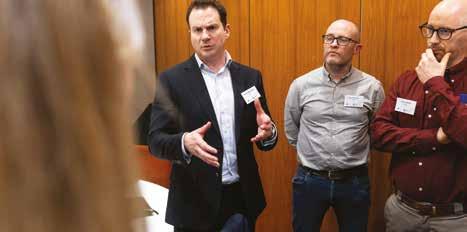

people from different sectors and create a structured space to collaborate, you can see how powerful that collective approach becomes.
“This workshop was designed to focus on how we move forward together and embed NbS into projects from day one.”
Roy O’Connor, Senior Engineer with Dublin City Council’s Protection of Waterbodies Office, emphasised the importance of collaboration between the two cities.
“Cork and Dublin are working closely together to align our thinking and delivery
models,” Roy O’Connor said, “This is about sharing knowledge and ensuring that NbS are embedded into development projects from the outset. If we get that right, we are shaping more resilient cities for generations to come.”
Michael Goan, Sustainability Lead with the Land Development Agency, said, “Embedding sustainable drainage and green infrastructure from the beginning makes developments stronger, more attractive and better prepared for the future. Collaboration between cities and agencies is key to making that happen.”
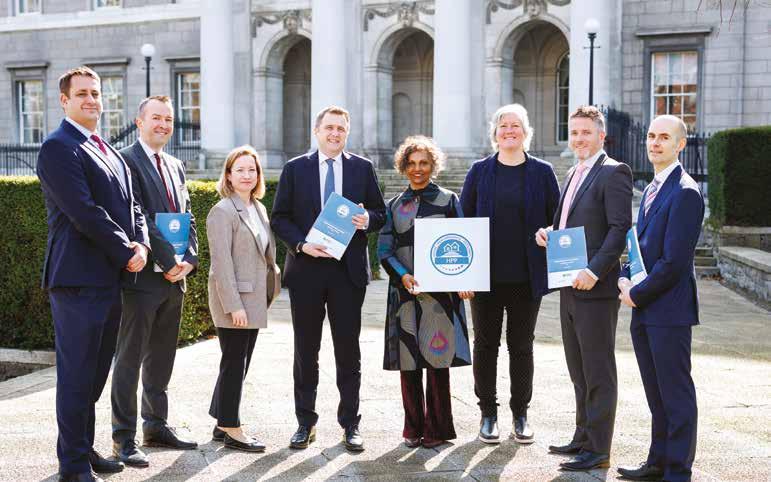
JOHANNA VARGHESE, Director of Programmes, Irish Green Building Council, introduces the Home Performance Pathway, a streamlined sustainability certification designed to bridge the green gap for SME builders. By offering an accessible three-step route to highperformance housing, the Pathway unlocks green finance opportunities and builds the technical skills necessary to meet Ireland’s ambitious 2030 climate targets.
The Irish Green Building Council (IGBC) has introduced the Home Performance Pathway (HPP), an entry-level sustainability certification for new homes. Designed as a stepping stone in the pathway to delivering environmentally sustainable homes, it offers a clear route toward the more advanced Home Performance Index (HPI). HPI is already the industry standard with over 30,000 homes registered.
The Pathway was developed after several recommendations. Home Building Finance Ireland (HBFI) and AIB developed green finance offerings in 2022, which used HPI certification. From this, they provided helpful feedback, noting, in particular, that the certification exceeded the capacity of the smaller home-builder. Additionally, some SME home builders found that cost margins did not allow for consultant fees, with much of the work in family firms carried out in house.
Tailored specifically for the SME market, the HPP encourages small-scale home builders to formalise their sustainability efforts through an achievable three-step process towards a qualification in building skills for HPI certification.
The HPP system has 12 indicators organised in straightforward steps,
supporting homebuilders in constructing high-performance and healthy homes. At the end of this process, SME home builders progress to the national certification HPI, which has 35 indicators for homebuilders to fulfil.
Figure 1 - HPP’s three steps and 12 indicators
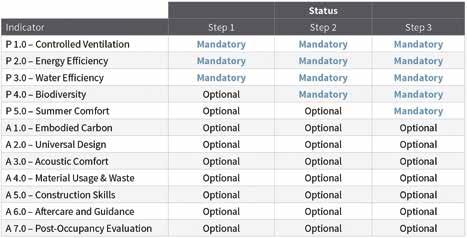
The government is committed to delivering 300,000 homes by 2030 and to reducing emissions 51% by the same date. HPP will enable SME developers to qualify for lower-cost development finance, helping to accelerate the delivery of sustainable homes across the country. The IGBC created the HPP to bridge a critical gap: providing smaller residential projects with a simpler, accessible certification pathway that financial agencies could use for green loans, especially relevant as SMEs account for over 80% of the sector’s turnover.
Through engagement with members of the Irish Home Builders Association (IHBA) and the Construction Industry Federation (CIF), the HPP was designed as a three-step progressive pathway with 12 indicators to guide builders from business-as-usual construction toward the full sustainability spectrum of the HPI certification with 35 indicators.


Johanna Varghese, Director of Programmes, IGBC.
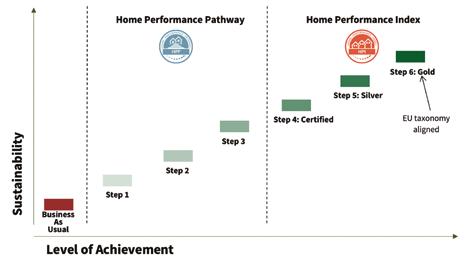

The HPP certification has 12 indicators, with mandatory indicators to be fulfilled depending on the achievement level chosen.
For example, if a homebuilder registers for the achievement level Step 1, the mandatory indicators are: controlled ventilation, energy efficiency, water efficiency, plus an additional indicator of their choice.
Whereas, if a homebuilder decides on achievement level Step 3, the mandatory indicators include those in Step 1, plus biodiversity, summer comfort, and an additional five indicators of their choice.
HPP certification is awarded on a projectwide basis, where a project is defined by the approved planning permission. This structured approach enables smaller homebuilders to build technical skills while qualifying for lower-cost green development finance from major lenders like AIB, Bank of Ireland, and HBFI.
Living in a certified sustainable HPP home means improved health, comfort and wellbeing for occupants, plus reduced utility bills and long-term operational costs. Certified homes also offer higher property values for owners and provide
a competitive advantage for investors in a market focused on energy security and sustainability.
The HPP was developed by the IGBC in conjunction with AIB, Bank of Ireland, the CIF, IHBA, Irish Planning Institute (IPI), Ardcairn Capital, HBFI, the Housing Agency and Ritterwald.
It was funded by Construct Innovate, Ardcairn Capital and HBFI.
The Home Performance Pathway represents a vital shift in Ireland’s construction landscape, proving that sustainability is not a luxury reserved for large-scale developers. By removing the barriers of high consultancy costs and complex administrative burdens, SME builders are provided with a pragmatic toolkit to professionalise their green credentials.
As the industry strives to meet the state’s ambitious 2030 targets, the HPP serves as more than just a certification; it is a gateway to competitive financing, technical growth, and the delivery of superior-quality homes.
For the small-scale builder, the message is clear: the pathway to high-performance housing is now open, accessible, and ready for implementation.
The HPP Technical Manual can be accessed at https://homeperformanceindex.ie or scan the QR code to download it
For more information, email hpi@igbc.ie or call John Fingleton at IGBC on 01 681 5862.
To contact Johanna Varghese, email johanna@igbc.ie

The European Investment Bank (EIB) is providing a €100m loan to Dolmen Solar Ltd, a holding company of Power Capital Renewable Energy, to support the construction of four utility-scale solar projects in counties Clare, Wicklow, Wexford, and Tipperary. Representing a total investment of €260m, these schemes will generate approximately 367 GWh of clean electricity annually, enough to power 79,900 households and prevent 114,000 tonnes of carbon emissions.
This landmark transaction marks one of Ireland’s largest solar investments to date and is the first to be funded on a pure project finance basis.
Ioannis Tsakiris, Vice President, EIB, noted that the partnership strengthens Ireland’s energy security while contributing to the national target of 80% renewable electricity by 2030.
He commented, “This new partnership with Power Capital builds on more than €1.238bn of EIB clean energy investment in Ireland over the last decade and shows how we can work with experienced Irish developers to deliver REPowerEU on the ground.
“This landmark transaction demonstrates that large-scale solar projects can attract long-term, non-recourse financing when backed by robust support mechanisms and experienced developers.”
Power Capital CEO Justin Brown described the financing as a major vote of confidence that will create skilled rural jobs
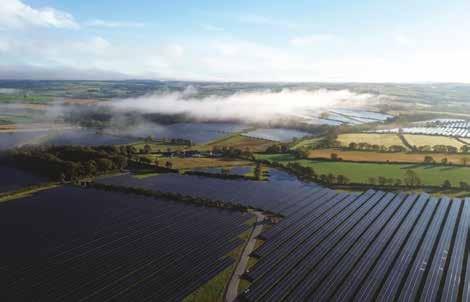
and accelerate the transition to a low-carbon power system.
Justin Brown commented, “This financing enables the delivery of four strategically located solar projects that will supply clean, affordable electricity to homes and businesses, create skilled jobs in rural communities, and further strengthen Power Capital’s position as one of Ireland’s leading independent power producers.”
Minister for Climate Darragh O’Brien welcomed the investment, highlighting that it signals a shift in perception regarding Ireland’s suitability for solar power.
Minister O’Brien said, “This is a very welcome €260m investment, spread across
Clare, Tipperary, Wicklow and Wexford, which will boost clean electricity generation right across the country, reduce our reliance on imported energy and support delivery of our 2030 climate targets.
“The European Investment Bank is playing a key role as a long term partner for Ireland’s energy transition, and today’s announcement is an important milestone in scaling up renewable power on our grid.”
By reducing reliance on imported energy and fostering local contracting opportunities, the project serves as a significant milestone in scaling up the Irish renewable grid through long-term international partnership.
Wienerberger to deliver the world’s first commercial-scale hydrogen-fired brick kiln
Wienerberger UK & Ireland has successfully secured government-backed funding that will enable its landmark hydrogen kiln project at its brickworks in Denton, Greater Manchester, to proceed - marking a major step towards the decarbonisation of the UK’s heavy clay manufacturing industry.
Backed through the UK government’s Industrial Energy Transformation Fund (IEFT), the funding will partly support a £6m conversion programme that will transition the site’s existing natural-gas-fired brick kilns to run on 100% green hydrogen. This breakthrough will make Denton the world’s first commercial-scale hydrogen-fired brick plant.
The project includes the retrofit of two tunnel kilns, replacing 224 natural-gas-powered burners, installing new hydrogen supply infrastructure, and upgrading electrical and control systems, without altering the structural integrity of the existing kilns.
The target is for one kiln to be fully operational, or for both kilns to be partially converted to hydrogen firing, by autumn 2027. The complete transition to 100% hydrogen firing across the entire site is scheduled to commence in autumn 2028.

STIXX Duct Tape from the SP Group hits shelves this month, just as trades and homeowners gear up for the busy spring project season. It’s a heavy-duty option that meets the strength requirements of both professionals and DIY enthusiasts.
STIXX Duct Tape is engineered for demanding construction, repair, and maintenance applications. Its cloth-reinforced backing and tough outer layer are built to withstand rigorous indoor and outdoor use.
Key performance features include:
• 27-strand mesh backing for enhanced tear resistance and structural strength
• High tensile strength, delivering reliability comparable to established heavy-duty tapes
These attributes make it ideal for tasks such as:
• Sealing polythene sheeting, scaffolding covers, and protective membranes
• Reinforcing joints and seams on insulation boards, vapour barriers, and temporary protection solutions
• Repairing tarpaulins, sheeting, and temporary site coverings
• Bundling and securing materials, including pipes and cables
DIYers and builders can now pick up STIXX Duct Tape at their nearest builders’ merchant across Ireland. It is available in three colour variants:
• Black – Great for general repairs and all-purpose applications
• White – Great for indoor or lighter-material applications
• Silver – Great for reflective or industrial-grade uses
Roll sizes include:
• 50 mm × 50 m – Suitable for smaller
tasks and general repairs
• 75 mm × 50 m – Ideal for wider coverage on larger surfaces
SP Group is an award-winning supplier of temporary protection products with more than 35 years of experience supplying scaffolders, contractors, and builders in the UK, Ireland and the rest of the EU.
Enhancing the versatility of its product range, Ansell has introduced Calico – a slim, modern architectural wall light.
Designed for residential and hospitality applications, the luminaire is CCT selectable at 2700K, 3000K, and 4000K, providing
warm or low-level lighting to create an inviting atmosphere.
Manufactured for simple installation, the CCT switch is conveniently located on the product, allowing installers to easily access the colour temperature prior to mounting the luminaire.

Offering excellent design flexibility, the product features a 350° installation angle around the connection point and is available with either centre or end connection, and in two distinct lengths, allowing installers to choose between a 600mm or 900mm luminaire.
Mark Abbott, Managing Director, Ansell Lighting, said, “We’re delighted to expand our portfolio and continue to deliver products that focus on the ease of installation. The Calico wall light is a versatile product, allowing for installation in a variety of environments and creating different atmospheres.”

For more information visit www.ansell-lighting.com
EU Commissioner Wopke Hoekstra recently visited Ecocem’s flagship facility in Dunkirk, France, signalling a pivot toward industrial decarbonisation as a pillar of European competitiveness. As the EU advances the Industrial Accelerator Act (IAA), the visit underscores the importance of breakthrough technologies like Ecocem’s ACT cement for achieving climate neutrality without sacrificing economic strength.
The Dunkirk plant is undergoing a €50m expansion to produce ACT, a low-carbon technology that can reduce emissions by up to 70%. By 2026, the site will produce 300,000 tonnes of ACT cement annually, adding to its existing 700,000-tonne low-carbon output. This expansion is a key component of Ecocem’s broader €220m investment strategy to scale green cement across Europe by 2030.
The timing is critical, as Ireland—home to Ecocem’s headquarters—prepares to assume the presidency of the Council of the European Union. Ireland has already led the way by mandating a 30% reduction in clinker content for public procurement. Integrating such low-carbon materials into the Critical
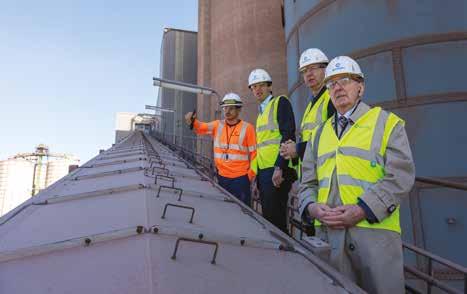
Commissioner
as a “first-of-a-kind” proof that industrial decarbonisation is possible today.
Ecocem CEO Donal O’Riain echoed this
sentiment, urging the EU to provide scale-up funding to ensure that cleantech innovations achieve maximum impact this decade. Through such collaborations, Europe aims to secure both its climate objectives and its global industrial leadership.
FAIN Group has announced financial results for 2025, with total net revenue climbing to €256.9m. This growth has been significantly bolstered by the group’s performance in Ireland. The FAIN Group’s continued expansion is being driven by a focused international growth strategy, with Ireland playing a key role in its long-term
development. It strengthened its position in Ireland with the acquisition of Accel Lifts in December of last year, marking a significant expansion for the Spanish-owned company and making Ireland its first No. 1 market globally.
In Ireland, FAIN generated revenue of €18.9m, now managing more than 3,000

units nationwide and contributing to over 8,600 serviced units across the FAIN Ireland portfolio.
The group’s Irish success is a cornerstone of its broader international strategy, which now accounts for 40% of total revenue. By focusing on acquiring and transforming local businesses, FAIN Ireland has strengthened its service delivery across maintenance and modernisation.
Michael Kelly, General Manager, FAIN Ireland, noted that the company has built massive momentum, utilising the group’s global scale and expertise to compete at the highest level while investing heavily in the Irish workforce and infrastructure.
Global CEO Miguel Gómez highlighted Ireland as a vital market for long-term investment, citing the successful integration of 134 acquisitions across Europe as a blueprint for continued local growth.
Since 2021, FAIN Group has more than doubled its revenue, with international EBITDA now representing 25% of total earnings. With a workforce that has expanded by 26% to support this scale, FAIN remains committed to delivering highquality, reliable lift services and mobility solutions across the Irish landscape.














sisk.com