irish construction news M A G A Z I N E
D I G I T A L
constructionnews.ie
S O C I A L
July/August 2026
ISSN 3088-6562 Vol 06 No 04
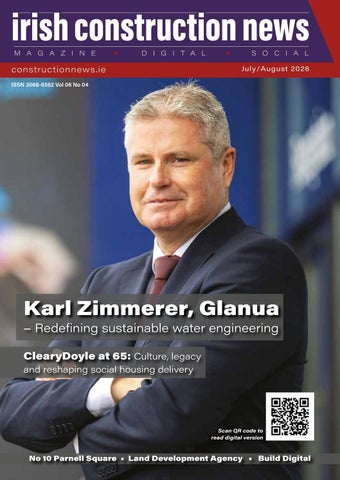
Karl Zimmerer, Glanua – Redefining sustainable water engineering ClearyDoyle at 65: Culture, legacy and reshaping social housing delivery
Scan QR code to read digital version
1
No 10 Parnell Square • Land Development Agency • Build Digital
irish construction news July/August 2026
Follow the QR code link to book your place
Designing the future of construction RIAI CPD Network Provider: CPAC Modular | CPD Points: 1 Structured CPD Point
CPAC Modular Limited, Dunshaughlin, Co. Meath, A85 FX60, Company Reg. No. 143846
cpacmodular.com/CPD/
irish construction news M A G A Z I N E
D I G I T A L
constructionnews.ie
S O C I A L
July/August 2026
NEWS 5 5
Construction costs surge as sector warns of delivery risks EFCA report calls for a new approach to strengthen Europe’s water resilience 6 Green light for essential works: Nine megaprojects fast-tracked under new Critical Infrastructure Act 9 London Irish Centre appoints Sisk to build £38m Camden home 12 Davy trims housing targets to 44,00 for 2026, citing commencement bottlenecks 12 Cairn strengthens its leadership team with five senior appointments
6 NEWS
FINANCE
14 Understanding retirement isn’t the problem, but affording it might be – Stephen Lawless, CPAS.
INTERVIEW
16 Building a Legacy: ClearyDoyle at 65 – John P Doyle and Brian Byrne, ClearyDoyle 23 How Glanua is shaping the future of bio-resources and water infrastructure – Karl Zimmerer, Glanua
CASE STUDY
26 No 11 Parnell Square: A masterclass in Georgian restoration and modernisation
OPINION
23 INTERVIEW
40 SECTOR FOCUS
32 “Architects must lead the MMC shift, not follow it” – Rory Ryan, Director at Ryan + Lamb Architects 34 Passivhaus at scale: From niche standard to mainstream housing delivery – Simon Bell, HLM Architects
SECTOR FOCUS
36 Champions of quality: How the ICWCI safeguards standards in Irish construction 38 New white paper from RS warns of data centre ‘commissioning cliff’ 40 LDA Progress Report: LDA to deliver over 13,000 new homes between now and 2030 43 Irish development land sales reach €239m in Q2 43 Award-winning Alfa Electrical champions apprenticeships 44 Priority Construction leads the way with Build Digital Information Management Plans 46 From hard hats to smart sites: How AI is creating the intelligent construction site – Paul Lynch, 8020 Consulting 49 Guaranteed Irish Construction Forum 2026 – Building Infrastructure at Pace 49 Finalists announced for 2026 Octabuild Builders Merchant Excellence Awards 50 EDC launches “EDC 2030” strategy to triple revenue 50 Further consolidation in built environment as AtkinsRéalis completes TOBIN acquisition 50 Irish engineering company Whitewater Group invests €3m in Spanish expansion
SUSTAINABILITY
52 IGBC launches new website as knowledge hub for sustainable built environment 53 Irish construction sector warned built environment risks missing 2030 climate targets 53 Building for biodiversity: Why nature-rich housing is Ireland’s best investment 54 Waterman Moylan partners with Hometree to support woodland restoration in Ireland
54 SUSTAINABILITY
PRODUCTS AND SERVICES 55 The latest Products and Services announcements
irish construction news 1 July/August 2026
Main Contractor
|
Design & Build
|
CSA Contractor
Globe Logistics Park, Naas, Co. Kildare
|
Fit-Out
Woodlands Grove, Blackrock, Dublin
Sruthán Sléibhe, Ballybeg, Dingle
Rás an Mhuillín, Macroom, Co. Cork
Cork 2 irish construction news
|
July/August 2026 www.visioncontracting.ie
Dublin
Hilton Hotel Extension, Charlemont, Dublin
|
Limerick
|
Kerry info@visioncontracting.ie
E D I TO R I A L
PUBLISHER Foundation Media Ltd 1 Northumberland Place, Dún Laoghaire, Co Dublin. Tel: +353 (0)1 677 3157 EDITOR Robbie Cousins robbie@foundationmedia.ie DESIGN Joanne Birmingham CONTRIBUTORS Stephen Lawless, Rory Ryan, Simon Bell, Paul Lynch PRINTER WG Baird Ltd ADVERTISING SALES Joe Connolly joe@foundationmedai.ie Tel: +353 (0)86 396 6158 ADVERTISING AND PROMOTIONAL OPPORTUNITIES To advertise in Irish Construction News or on www.constructionnews.ie, or to request a ratecard or details of promotional opportunities, contact Joe Connolly at joe@foundationmedia.ie CONNECT WITH US ON SOCIAL MEDIA LinkedIn: ConstructionNews.ie SIGN UP FOR OUR E-NEWSLETTER To get the latest news, articles and offers related to the Irish construction industry to your inbox sign up to our free e-newsletter at www.constructionnews.ie ISSN 3088-6562 Vol 06 No 04 © All contents copyright Foundation Media Ltd While every effort has been made to ensure that the information contained in this publication is correct, the publisher cannot not accept responsibility for any errors, omissions or discrepancies. Views expressed in this publication are not necessarily those of the publisher. The contents of this publication are copyright. No part of this publication may be reproduced or transmitted in any form or by any means mechanical, electronic (including photocopying) or digital without the prior consent of the publisher.
From the editor I reland’s construction sector kicked off the second half of 2026 on strong footing, delivering a welcome surge of momentum following a challenging second quarter. The headline AIB Ireland ‘Construction Purchasing Managers’ Index’ rebounded sharply to 53.0 in July from June’s weak reading of 45.4, firmly signalling a return to expansion. Crucially, total activity expanded across all three monitored subsectors simultaneously for the first time in 15 months. While commercial activity spearheaded this surge, the wider market was bolstered by long-awaited returns to growth in both residential building and civil engineering. Reflecting this renewed vigour, employment expanded for the ninth consecutive month as main contractors scaled up workforce capacity and increased reliance on subcontractors. Although input cost inflation softened to a five-month low, persistent supply-chain friction remains a key hurdle. Nevertheless, rising new orders and robust business confidence point toward a promising recovery taking root statewide. In this issue of Irish Construction News, we examine the core drivers behind this shifting pace. We speak directly with Karl Zimmerer, Managing Director of Glanua Group and EY Entrepreneur of the Year 2026 finalist, about Glanua’s growing cutting-edge water and wastewater treatment services alongside the company’s ambitious global expansion plans. Turning our focus to public residential delivery, we assess the Land Development Agency’s progress toward its target of delivering over 13,000 new homes by 2030, while highlighting where its next major development projects will break ground. Heritage, business longevity, and modern adaptation also feature prominently. Southeast-based main contractor ClearyDoyle celebrates 65 years in business in 2026.
Joint managing directors John P Doyle and Brian Byrne discuss the core principles underpinning the company’s ethos and outline how the business continues to evolve into an agile contracting enterprise meeting dynamic client demands. On the urban renewal front, we visit No 11 Parnell Square – the new home of the Irish Heritage Trust, Poetry Ireland and the Irish Landmark Trust – where a major transformation successfully blended sustainable upgrades with sensitive historic building conservation. On the technology front, Priority Construction has become one of a growing number of contractors outside the big players to achieve NSAI BIM certification, proving that digital transformation is not reserved solely for industry giants. By leveraging Build Digital’s free, stepby-step Information Management Plans, small- to medium-sized contractors now have a practical blueprint to refine internal processes and maintain a competitive edge as public-sector BIM mandates expand. We also feature regular commentary from AI expert Paul Lynch and the Irish Green Building Council, alongside comprehensive news and opinions from across the industry. Catch the latest updates – scan the QR code to join our community and subscribe to our e-newsletter Robbie Cousins
irish construction news 3 July/August 2026
I’ll sort it. Later... You build projects, lead teams and hit deadlines. Sorting out pensions, savings, investments and protection rarely makes it to the top of the list. That’s where we help. We work with construction professionals every day, taking the important financial jobs off the long finger and explaining the options in plain English. So you can focus on what matters. It’s time to move retirement planning up the snag list. Start the conversation. No jargon. Just facts.
Visit milestoneadvisory.ie
T: 01-4068020 E: info@milestoneadvisory.ie www.milestoneadvisory.ie 4 irish construction news July/August 2026
Milestone Advisory DAC t/a Milestone Advisory is regulated by the Central Bank of Ireland Milestone Advisory is an operating division of CPAS
NEWS
Construction costs surge as sector warns of delivery risks
C
onstruction costs are steadily rising, with 96% of firms anticipating further hikes driven by soaring labour and material expenses, according to the CIF Q2 2026 Construction Outlook Survey. Based on responses from 138 companies, 94% reported raw material price increases early this year. Construction Industry Federation (CIF) Chief Executive Andrew Brownlee noted that while firms remain cautiously optimistic, cost pressures and structural constraints threaten infrastructure and
Andrew Brownlee, Chief Executive, Construction Industry Federation.
housing delivery. He urged immediate reforms, particularly in public works, where low margins and heavy bureaucracy currently deter participation—nearly half of the surveyed firms did not engage in public contracts last quarter. Despite flat recent orders, expectations for future project pipelines remain positive, led by civil engineering and specialist contracting. Meanwhile, employment remains stable, with 22% of firms planning to hire. Export activity also provided a bright spot, showing positive turnover growth.
EFCA report calls for a new approach to strengthen Europe’s water resilience
T
he European Federation of Engineering Consultancy Associations (EFCA) has released a new Future Trends Report, ‘Engineering the Resilience and Sustainable Development of the European Water Infrastructure’.
The report highlights growing threats to Europe’s water systems, including extreme weather (droughts and floods), deteriorating infrastructure, rising demand, and emerging security risks. To ensure long-term resilience, EFCA advocates integrating engineering expertise, digital tools, and naturebased
solutions—supported by updated regulations, quality-based procurement, and long-term investment. EFCA President Inés Ferguson stressed the urgency of action. She commented, “Europe’s water sector needs a profound change to confront extreme climate, increasing water demands and ageing infrastructure designed for very different conditions. Water resilience requires new systems that integrate engineered reliability with ecological adaptability and data-driven management. Consulting Engineers are the best placed to design, implement, and monitor these systems, and EFCA members stand ready to collaborate with public administrations in delivering the solutions that meet today’s social, industrial, and environmental demands.” Emmanuelle Frénéat, Chair, EFCA’s Future Trends Committee, highlighted the need for a new engineering approach. She said, “Water resilience is no longer just an environmental issue – it is both an engineering and a governance challenge. Moreover, it is a strategic imperative for Europe’s security, competitiveness and quality of life. Solutions exist, and European engineers are ready to provide them. The challenge now is to implement them at the scale and speed required.” EFCA calls for immediate, close collaboration between policymakers, public authorities and consulting engineers to rapidly scale sustainable water solutions across the continent. Scan the QR code to download the report
irish construction news 5 July/August 2026
NEWS
Green light for essential works: Nine megaprojects fast-tracked under new Critical Infrastructure Act
I
rish contractors are set to see a significant shift in project delivery timelines following its announcement that nine flagship transport, water and energy schemes have been officially designated as critical national infrastructure. The move – spearheaded by Minister for Public Expenditure, Infrastructure, Public Service Reform and Digitalisation Jack Chambers TD under the Critical Infrastructure Act 2026 – places these high-value public projects at the “top of the queue” for statutory approvals, licences, and public-sector decision-making. For main contractors, civil engineering firms and specialist supply chains operating across Ireland, the legislation promises to cut through statutory inertia, clear bureaucratic bottlenecks, and streamline the preconstruction phase.
WHAT THIS MEANS FOR TIER 1 AND CIVIL ENGINEERING CONTRACTORS
The designation places a mandatory legal obligation on all State and statutory bodies— including An Coimisiún Pleanála (ACP), the Environmental Protection Agency (EPA), the Maritime Area Regulatory Authority (MARA) and local authorities – to prioritise these nine schemes above standard project applications. Key operational impacts for the contracting sector include: • Parallel statutory approvals: Public bodies are now legally required to run licensing, environmental assessments and consent processes concurrently rather than sequentially • Accelerated condition discharge: Postplanning conditions and local authority sign-offs must be processed with dedicated technical and administrative resources. • Reduced procurement & preconstruction delays: By placing statutory decisions on a fast track, project timelines are expected to compress significantly between contract award and ground-breaking.
PLANNING SPEED AND MEETING COMMITMENTS Minister Chambers emphasised that the reform is designed to align planning speed with Ireland’s capital commitments: “The designation of these projects demonstrates the government’s determination to break through inertia, slash project timelines and accelerate the delivery of the infrastructure that our people,
6 irish construction news July/August 2026
WATER & ENVIRONMENTAL ENGINEERING •
•
•
Minister for Public Expenditure, Infrastructure, Public Service Reform and Digitalisation Jack Chambers. communities and businesses urgently need. The focus is on energy, transport and water infrastructure because this is the infrastructure we need to accelerate if we are to achieve all of our other national priorities, particularly housing.”
PRIORITY PROJECT BREAKDOWN
The inaugural list targets Ireland’s most complex strategic builds, addressing systemic bottlenecks in civil grid connections, bulk water supply, and metropolitan mass transit.
TRANSPORT & HEAVY CIVIL WORKS • •
•
MetroLink: High-capacity urban rail line linking Swords, Dublin Airport and Dublin city centre. Cork Area Commuter Rail Programme: Major track, signalling and station infrastructure expansion across metropolitan Cork. Galway City Ring Road: Multi-modal bypass scheme aimed at relieving urban congestion in the west.
Water Supply Project for the Eastern and Midlands Region: Major pipeline and intake infrastructure delivering longterm security to the Greater Dublin Area and Midlands. Greater Dublin Drainage Project (GDD): Mega-wastewater facility designed to unlock housing capacity. While planning permission from ACP is already in place, the project will now see accelerated handling for pending MARA maritime consents and EPA discharge licences. Limerick (Bunlicky) Wastewater Treatment Plant: System upgrade and bioresource centre build to support regional growth.
ENERGY GRID INFRASTRUCTURE • •
•
North-South 400 kV Interconnector: Strategic cross-border overhead line scheme to reinforce system reliability. Moneypoint 400 kV Series Capacitor Project: Grid stabilisation build aimed at accelerating renewable integration (currently designated for priority determination at An Coimisiún Pleanála). Letterkenny 110 kV Redevelopment: Transmission network modernisation in the Northwest.
LOOKING AHEAD FOR THE SUPPLY CHAIN
This initial wave represents the first phase of the government’s Accelerating Infrastructure Action Plan. Further designation orders will be brought forward at regular intervals throughout the year. For main contractors preparing tenders and assembling joint ventures, the legal requirement for state agencies to allocate dedicated technical resources to these projects provides greater program certainty, clearer delivery schedules, and reduced exposure to holding-cost risks during preconstruction phases. Metrolink.
It’s pretty black and white Always check for gas pipelines before you break ground
Visit www.gasnetworks.ie/dig
irish construction news 7 July/August 2026
8 irish construction news July/August 2026
NEWS
London Irish Centre appoints Sisk to build £38m Camden home
S
isk has been named main contractor for the redevelopment of the London Irish Centre, backed by significant funding from the Irish government and private donors. The London Irish Centre (LIC) has announced the appointment of Sisk as the main contractor for the approximate £36m to £38m redevelopment of its historic home at 50–52 Camden Square. Construction is scheduled to begin in January 2027, with the new facility expected to open in early 2029— marking the next chapter for an institution that has served the Irish community in Britain for over 70 years.
LONDON IRISH CENTRE
Founded in 1955 to provide employment, accommodation support, and social connection for newly arrived Irish immigrants, the LIC is the oldest and largest Irish centre in Britain. Today, it functions as both a crucial welfare anchor and a vibrant cultural venue. In 2025 alone, the Centre welcomed 55,000 visitors for live events and cultural programming, assisted more than 3,000 individuals with casework, secured £4.4m in unclaimed benefits for community members, and served 10,000 meals to vulnerable clients. High-profile patrons include singer Ed Sheeran and television personality Dermot O’Leary. Despite its history, the existing site no longer meets modern standards of accessibility, sustainablity or functionality. Following a strategic review by the Board of Trustees, the organisation commissioned Coffey Architects to design a purposebuilt complex over three floors. The redevelopment will retain the original threestorey façade while expanding the Murray Street terrace from two to three storeys. The new building will feature London’s first dedicated Irish theatre, a two-tiered 400-seat (600-standing) multi-purpose performance space, a 130-seat studio theatre and cinema, and a heritage and archive centre. Additional amenities include a public library housing over 7,000 Irish literary works, modern community and enterprise spaces, accessible welfare facilities, a multilevel bar, dedicated creative studio spaces, and banqueting capacity for up to 250 guests.
PROJECT MILESTONE
The project milestone follows a visit to the Centre by Neale Richmond, Minister of State at the Irish Department of Foreign Affairs and Trade. The government has allocated
Minister of State at the Irish Department of Foreign Affairs and Trade Neale Richmond (centre), Rosaleen Blair, Chair, London Irish Centre, and other dignitaries, during his visit to the London Irish Centre. €6.75m toward the redevelopment, including a recent €3.4m grant – the largest single investment ever made in an Irish diaspora organisation. Rosaleen Blair, Chair of the London Irish Centre, commented: “Today’s announcement is a huge milestone, which follows almost ten years of careful planning. In Sisk, we have engaged a world-class builder to deliver a world-class home that matches the aspirations of the Irish diaspora in Britain. To date, we have secured pledges covering a meaningful proportion of the estimated £36-38 million redevelopment cost, an extraordinary demonstration of confidence by our donors. As we prepare for this exciting transformation, our task going forward is to secure the remainder of this total, which is vital in underwriting our future.” Ger Hayes, Managing Director of Sisk Construction UK, added: “We are extremely proud to have been selected as main contractor and to be entrusted with the construction of the new London Irish Centre in Camden. The charity has provided a unique welfare hub for Irish diaspora in London for over 70 years. Together, with the team at LIC we will create a modern facility
that celebrates this heritage and provides a lasting legacy for future generations.” Neale Richmond emphasised the strategic importance of the investment: “The London Irish Centre remains a dynamic support, welfare and cultural hub for the Irish in Britain. Our continued investment supports the ongoing delivery of these vital services and cultural activities. I was delighted to meet the team at the Centre this week and see the ambitious plans they have for the future. The government has allocated €6.75m to the redevelopment, including our most recent grant of €3.4m, which was the largest single investment ever made in an Irish diaspora organisation. This support reflects the commitments set out in Global Ireland 2025 and our new Diaspora Strategy to deepen our engagement with Irish communities overseas. The new centre will provide a welcoming and inclusive space for many more generations of Irish diaspora.” Outline planning permission was granted in September 2020. Following a pause during the pandemic, the project team reconstituted in 2023, securing final planning consent and the Section 106 agreement in May 2024. The formal tender process launched in late 2025 and concluded with Sisk’s appointment.
irish construction news 9 July/August 2026
PIPELIFE
Pipelife launches indoor R290 heat pump designed for Irish apartments
P
ipelife Ireland is launching a new indoor monoblock heat pump this July that it says has been designed from the ground up for the realities of Irish apartment construction and stress-tested to reflect how such buildings are actually built, rather than idealised lab conditions. The Inova indoor heat pump houses the fan, coil, compressor and expansion valve in a single unit installed entirely within the dwelling, drawing and exhausting air via ducts. It runs on R290 (propane), the ultralow global warming potential refrigerant, with a fully sealed charge of just 450 grams, keeping it within the limits for indoor installation. Safety features include a gas separator to prevent refrigerant entering the water circuit, and an internal gas sensor that ramps the fan to 100 per cent to dissipate any leak to outside. But the detail likely to catch the eye of building services engineers is how the unit was tested. All of Pipelife’s published performance figures are predicated on the unit sitting 10 metres from an external wall, with three 90-degree bends in the ductwork, a deliberately punishing worstcase scenario. If we could be a little less specific, engineers will design to 10m if they know it can. Good design is to reduce the distance, but if required we can go up to 10m. We can enforce that it has been stress tested to the realities of Irish apt design. “Nobody’s going to put a heat pump on an external wall — architects have to balance daylight regulations along with everything else, so they won’t have the space to do it,” said [Eoghan Considine, Specification Manager], of Pipelife Ireland. He contrasted this with the industry habit of publishing fan curves measured on a bench: “This is everything at a worst-case scenario, not a best-case scenario. We restricted the unit — we stress-tested it.” The unit delivers 3.2 kW of heating capacity [3.2KW at 35C, 3.14 at 55C,
10 irish construction news July/August 2026
SCOP of 4.7 at 35C, datasheet attached.], is app-enabled, and is tested to EN 14825, with EN 16147 hot water performance data also available. It pairs with a separate hot water cylinder, pre-plumbed at Pipelife’s Little Island facility in Cork, with an inline version to follow that will visually read as a single column. Keeping the cylinder separate was a conscious wholelife decision, Considine said: cylinders typically outlast heat pumps, so the heat pump -- or individual components such as the fan or compressor, all accessible from the front of the unit -- can be replaced without disturbing the store. It also makes it far easier to manoeuvre the equipment through a finished apartment block. Equally deliberate is what the Inova doesn’t do. Unlike exhaust air heat pumps, it makes no attempt to combine heating and ventilation, and its performance is not dependent on warm extract air, or on occupants leaving wall vents open. “The best heat pumps on the market just function as heat pumps. The best ventilation systems just function as ventilation systems,” said Considine. “Why combine things to make them a little bit worse?” Pipelife instead pairs the unit with its own MEV or MVHR systems, supplied as complete packages including ductwork — an approach it says is cost-competitive with combined exhaust air units, while allowing each system to be specified, commissioned and serviced on its own merits. For passive house apartment schemes, the company argues the Inova opens up a simpler route: a conventional monoblock heat pump strategy plus MVHR, at a lower cost than compact combined heat pumpventilation units, and using a heating approach familiar to Irish contractors. The launch draws on considerable experience. Pipelife has been supplying heat pumps to the Irish market since 2009, with more than 10,000 units sold, alongside a fast-growing mechanical ventilation business. The Inova was developed to Pipelife’s own specification with its manufacturing partner, informed by the company’s combined knowledge of heat pumps and ventilation, Irish apartment design guidelines and F-gas regulations. “Restrictions have driven innovation,” said Considine. The heat pump also lands amid a wider sustainability push at the group, part of Wienerberger’s Pipelife division, which manufactures in 28 countries. The Cork operation -- an amalgamation of indigenous firms Quality Plastics, Cork Plastics and MFP -- used 7,000 tonnes of recycled material in 2025, with plans to more than double this to 15,000 tonnes
by 2030. The company has published seven environmental product declarations to date, and aims to have EPDs for everything it manufactures by 2028, with a group target that 75 per cent of products manufactured or sold support net zero construction. The company buys 100 per cent renewable electricity, with on-site solar generation planned. Servicing of the Inova is carried out entirely from within the apartment, supported by installer training held fortnightly in Dublin and Cork, and the unit will ship with a dedicated plain-English homeowner manual alongside the engineering documentation.
SOMETHING NEW IS COMING…
Designed for the Future. Built to Perform. Designed specifically for Irish apartments R290 heat pump with a capacity of 3.2kw Connected by 150mm round ducting or 220mm x 90mm flat pack ducting Flexible design – position up to 10m from the outside wall Fully app enabled Comes with a 200ltr pre-plumbed cylinder
Another Game Changer from
Discover our full service portfolio at
irish construction news 11 www.pipelife.ie July/August 2026
NEWS
Davy trims housing targets to 44,00 for 2026, citing commencement bottlenecks
S
tockbroking firm Davy has lowered its 2026 housing completion forecast to 44,000 units, down from its previous projection of 50,000, citing a sharper-than-expected slowdown in recent residential commencements. In its latest economic commentary, the broker warned that Ireland’s structural housing deficit is set to persist until at least
2035, with output failing to keep pace with demographic demand. The firm stated: “While supply is improving, it is still expected to remain well below underlying demand, leaving a housing shortfall of circa 210,000 by 2035 even with output up to 75,000 a year by then.”
KEY HOUSING HIGHLIGHTS • • •
2026 Output Target: Revised down to 44,000 completions (from 50,000). 2027 Projections: Output expected to edge lower to 42,000 homes. Supply Gap: Davy confirmed projected delivery remains “well below our estimate of overall requirements,” signalling prolonged market tightness for the construction sector.
BROADER ECONOMY SHOWS STRONG FUNDAMENTALS
Despite headwinds in residential delivery, Davy upgraded its broader macroeconomic forecasts, pointing to underlying strength across national income, consumer activity, and state balance sheets.
It highlighted that the Irish economy is persistently beating forecasts, with real GNI – the CSO’s tailored measure of domestic economic activity – now projected to grow by an average of 5.1% annually through 2028. The broker attributed this momentum to solid productivity, robust foreign direct investment, expanding infrastructure and homebuilding, rapid population growth, and a tight, durable labour market. These fundamentals place Ireland’s real per-capita growth in the top 10% of developed nations. However, Davy warned that standard Gross Domestic Product (GDP) metrics will remain erratic due to swings in pharmaceutical exports, projecting another overall contraction for GDP this year before rebounding in 2027 and 2028. For the construction and development sector, the commentary underscores a clear dynamic: robust economic fundamentals and state capital backstops exist to fund buildout, but getting projects off the ground fast enough to meet long-term demand remains the industry’s defining hurdle.
Cairn strengthens its leadership team with five senior appointments
C
airn has announced five senior leadership appointments, further strengthening the capabilities that will support the company’s continued growth and long-term ambitions. The appointments span finance, communications, legal, procurement & commercial and digital transformation, reflecting Cairn’s continued investment in the leadership capability needed to support a growing business. They are being made during a period of significant momentum for the business, with Cairn’s housing output increasing by 60% year-on-year in the first half of 2026. The appointments to key roles are: Elaine O’Brien, Director of Finance & Treasury, has built an international career in commercial finance, with senior finance and commercial leadership roles across listed and multinational businesses, including Grafton Group and L’Oréal. Olivia Buckley, Director of Communications, joins Cairn with a strong track record in strategic communications and reputation management, having held senior roles with Aer Lingus, Banking & Payments Federation Ireland and the Irish Tax Institute. Zoe Ennis, Head of Legal, has advised complex organisations on legal and commercial matters across both private practice and in-house leadership roles. Her experience includes Arthur Cox and Amazon Web Services, where she served as Senior Investment and Acquisition Manager. Sean Gavin, Director of Commercial & Procurement, has spent more than two decades leading commercial and operational teams in residential development. His career includes senior leadership roles with Berkeley Group in the UK and most recently Managing Director (South) at London Square. Hazel McGuinness, Director of IT & Digital Transformation, has led digital and business transformation programmes across multiple
12 irish construction news July/August 2026
Pictured (l to r): Elaine O’Brien, Director of Finance & Treasury; Olivia Buckley, Director of Communications; Zoe Ennis, Head of Legal; Madeleina LoughreyGrant, Chief Strategy & Sustainability Officer; Sean Gavin, Director of Commercial & Procurement; and Hazel McGuinness, Director of IT & Digital Transformation. industries, including roles with Org Group (Abtran), AbbVie and Lakeland Dairies, specialising in digital innovation, data strategy and enterprise change. Announcing the appointments, Cairn Chief Strategy & Sustainability Officer Madeleina Loughrey Grant, who also leads People and Talent in the company, said, “As Cairn continues to grow, attracting exceptional people is one of the most important investments we can make. I’m delighted to welcome Elaine, Olivia, Zoe, Sean and Hazel to the team. Each brings outstanding perspectives and leadership experience that will complement the strong talent we already have across the business.”
DATA CENTRES
WE’RE ENGINEERED FOR THIS.
WHEN UPTIME ISN’T NEGOTIABLE EXPERIENCE ISN’T OPTIONAL
designergrp.com irish construction news 13 July/August 2026
PENSIONS
Understanding retirement isn’t the problem, but affording it might be CPAS Pension Consultant STEPHEN LAWLESS examines why high participation rates aren’t translating into retirement security in Ireland, arguing that closing the pension gap requires tackling everyday affordability rather than relying on policy fixes alone.
R
ecently, when scrolling on my phone, an ‘Irish Times’ article popped up on my news feed, highlighting a recent report by Royal London. The report shows that Irish workers, on average, believe they will need €40,860 pa to enjoy a comfortable retirement. It reminded me of another piece of research from 2024, the ‘Irish Retirement Living Standards’ (IRLS) report produced by KPMG. This report established that a comfortable retirement, for a couple, was an annual expenditure of approximately €43,200. I was struck by the remarkably similar conclusions of the workers surveyed by Royal London and the analysis completed by KPMG in 2024. It made me wonder if workers are aware of what they need to live comfortably in retirement, then why are pension rates in Ireland so poor?
WHAT DOES A COMFORTABLE RETIREMENT ACTUALLY LOOK LIKE?
Set out in the 2024 IRLS report, a comfortable retirement is the ability to take holidays, enjoy hobbies, maintain health insurance and deal with unexpected costs that arise. A 30-year-old earning €61,908 a year (the minimum salary needed to produce the target retirement income of €40,859) would need to save €1,135 per month to secure that level of retirement income. This is assuming they will also receive their full state pension. Wait until age 40, and it jumps to €1,754 per month. And these figures assume a retirement at 66 years of age. Yet, according to a survey completed by Royal London in March 2025, almost 72% of respondents hoped to retire between the ages of 50 (38%) and 60 (34%). The earlier retirement people aspire to, the wider the gap becomes between what they need in retirement and what they are currently saving to fund it.
IRELAND’S PENSION PROBLEM ISN’T PARTICIPATION
KPMG highlighted that Ireland’s net voluntary pension replacement rate is just 36%, compared with an EU average of 68%. In other words, for every €100 earned during working life, Irish private pensions
14 irish construction news July/August 2026
A large proportion of respondents without pensions simply reported that they had “never got around to it”. As a nation that will always opt to “do it later”, we understand what is needed and how to get there but find it difficult to do it.
A NEED FOR HONEST CONVERSATIONS
Stephen Lawless, Pension Consultant, CPAS. replace just €36 in retirement income and see heavy reliance on the state pension. One of the more surprising findings from the KPMG report is that Ireland’s participation rate in voluntary pension plans is comparatively high, at 66%. Participation exceeds levels seen in several European countries. And this was before Auto-Enrolment was introduced. The issue increasingly appears to be not whether people save, but whether they save enough. The low replacement rate data suggests many Irish pension savers are contributing at levels that will not generate the retirement incomes they aspire to achieve.
WHY AREN’T PEOPLE SAVING MORE?
The answer is no surprise: the cost of living. When non-pension holders were asked why they had not established a pension, affordability was the most spoken-about issue. Among those aged 45 to 54, 55% said they could not afford a pension. Similar concerns were evident across all surveyed. Cost-of-living pressures for older participants in KPMG’s research were a prominent discussion. Rising energy bills, healthcare costs and insurance premiums all contribute to the diminishing ability to save. Just as significant was the role of inertia.
The reality is that none of this information is new. Policymakers know Ireland’s pension replacement rates lag European norms, that workers struggle to contribute enough to private pensions, and that affordability remains one of the greatest barriers to long-term saving. Auto-Enrolment is a welcome step and should help with the inertia experienced by some. However, there is a danger in assuming that increasing participation alone will solve Ireland’s retirement savings challenge. Faced with rising housing costs, childcare expenses, energy bills and everyday living costs, retirement saving is now a luxury. If the government is serious about improving retirement outcomes, the conversation cannot stop at pension policy. They must also address the broader costof-living pressures that prevent households from building adequate retirement savings in the first place. Until more workers have the capacity, Ireland’s retirement income challenge will remain as much a cost-of-living issue as it is a pensions issue.
HERE TO HELP YOU NAVIGATE YOUR WAY.
The CIF Pension Administration Services (CPAS) team are qualified Pension Consultants. We specialise in helping professionals in the construction sector and related industries. Our team can work with you to review your pension plans. For more information, please contact Stephen Lawless at s.lawless@cpas.ie
BUILDING SECURE PENSIONS CPAS is a construction industry specific pension provider. Whether you are an employer seeking to provide benefits for your employees or planning your own retirement, CPAS has the right solution for you. Our dedicated team are here to support you, whether you are starting your business, growing your business, or planning for your future. For more information, please get in touch today. info@cpas.ie or T 01 407 1400
www.cpas.ie
! e m n a c S
Construction Workers Sick Pay Trust
construction news 15 Milestone Advisory DAC t/a Milestone Advisory is regulated byirish the Central Bank of Ireland. July/August 2026
INTERVIEW
Pictured (l – r): John P Doyle, Joint Managing Director, ClearyDoyle; Eugene Cleary, Co-Founder, ClearyDoyle; Mai Doyle (wife of the late John Doyle – Co-Founder, ClearyDoyle); James Lennon, Financial Director, ClearyDoyle; and Brian Byrne, Joint Managing Director, ClearyDoyle.
Building a Legacy: ClearyDoyle at 65 As ClearyDoyle marks its 65th anniversary, Joint Managing directors Brian Byrne and John P Doyle speak to ROBBIE COUSINS about their company’s “family-first” workplace culture, navigating industry capacity constraints, championing homegrown timber innovation and steering the firm toward 2030.
A
s ClearyDoyle Construction marks its 65th anniversary this year, the contractor stands as a compelling study in resilience, innovation, and peoplecentred leadership, over the generations. Operating primarily across the east and south east, the firm has more recently become a specialist in the efficient delivery of quality low-energy social housing, Design & Build (D&B) schemes, high-end private restorations and conservation work. Led by joint managing directors Brian Byrne and John P Doyle, ClearyDoyle’s guiding philosophy is deceptively simple: family comes first, and the company comes second. In an industry often defined by high-pressure deadlines, skilled labour shortages, and tight margins, ClearyDoyle has cultivated a workplace culture rooted in emotional investment, diversity and genuine goodwill. From navigating historical downturns with complete financial integrity to introducing homegrown Irish timber into modern housing frameworks, the company’s trajectory reflects both a respect
16 irish construction news July/August 2026
for its founding legacy and a clear vision for 2030 and beyond.
A PEOPLE-FIRST PHILOSOPHY
When new employees walk through the doors at ClearyDoyle, the initial orientation sets a distinct tone. Rather than beginning with corporate KPIs or productivity metrics, Joint Managing Director Brian Byrne initiates a straightforward conversation about priorities. “My opening statement to any new employee tends to be along the line of ‘When you’re with ClearyDoyle, your family is first and working at ClearyDoyle is second’. If a member of the team’s personal life is not right, they are not going to be right for the work. We place family and the wellbeing of the person at the forefront of our approach to support our people. We take this holistic approach as we see it as the true investment in our people. “At ClearyDoyle, we view employee investment as a dual responsibility covering financial reward and emotional wellbeing.” John P Doyle highlights the genuine
workplace support given to employees. “Investing in our people means supporting emotional wellbeing in addition to financial compensation. Obviously, people are paid well for the work they do, but fundamentally it is about ensuring they are happy within their own lives.” This culture directly impacts recruitment and retention. In an industry where qualified personnel are continuously targeted by recruiters, candidates frequently choose ClearyDoyle based on wordof-mouth reputation. Byrne recalls an interview with a recent recruit, “She told us she had checked ClearyDoyle out with five different people. Every single one told her the same thing. Her abiding question at the end was simply: ‘Why wouldn’t I work for ClearyDoyle?’ To me, wearing the badge and logo brings genuine pride. In the south east of the country on every road you drive or every area you enter, you see completed buildings left behind over the past 65 years. That built legacy is something anyone who has worked for ClearyDoyle should be proud of.”
INTERVIEW LEGACY
Marking 65 years in business is a milestone achieved by few regional Irish contractors. Founded by Eugene Cleary and John Doyle (John P Doyle’s father), the firm’s original core values and approach to work – site cleanliness, high presentation, respect for staff and subcontractors, and construction quality – remain central to daily operations. During company-wide town hall meetings held several times a year, the leadership team reference the standards set by the founders. “The vision and ethos of the original founders still exist as a practical guide for what we are doing today,” notes John P Doyle. “Even though the business has evolved, those core principles remain deeply relevant.”
RECONNECTING BEYOND THE PAYROLL
The strong sense of community within the workforce extends beyond active employment. Former employees and retirees have organised an independent network to schedule regular get-togethers and informal reunions. “Staff who have left the company or retired set up their own independent group to organise ClearyDoyle get-togethers,” explains Brian Byrne. “They organised it entirely themselves. To see retired staff keeping that connection alive under the name of John Doyle and Eugene Cleary is remarkable. You simply don’t see that too often in corporate life.” To celebrate the 65-year milestone, the company is hosting a series of events over the year, including a recent summer barbecue at the exclusive Newbay House Hotel in Wexford. The event welcomed current employees, former colleagues, their partners and children, and it featured activities for families, with overnight accommodation for those travelling. John P Doyle reflects on the impact of these gatherings: “Companies hold standard Christmas parties to give a little back, but this turned out to be far more personal. People brought their partners and children. The goodwill generated from an event like that pays back tenfold, when it comes to retaining staff.”
• • • • • •
(ClearyDoyle’s largest recurring client by volume and value) Dún Laoghaire-Rathdown County Council Wicklow County Council Wexford County Council Waterford City and County Council Kilkenny County Council Clúid Housing Association
THE EVOLUTION OF DESIGN & BUILD FRAMEWORKS
Since transitioning towards formal D&B delivery frameworks around 2020, ClearyDoyle has refined its technical capabilities. Public sector clients provide exemplar designs and performance requirement schedules, leaving the contractor to optimise structural design, environmental efficiency and buildability. John P Doyle outlines how the delivery model has matured: “If you compare where we are in 2026 versus 2020, we had only begun formal D&B delivery. Sustainability was a phrase many in construction struggled to define practically. Today, we actively lead client design discussions. On recent schemes, we introduced sustainable alternatives, such as homegrown Irish timber, directly to the table through collaborative partnerships.” By leveraging Modern Methods of Construction (MMC) – including panelised timber frames, light-gauge steel, and precision precast concrete – ClearyDoyle now completes 70% to 80% of structural work off-site. This shift reduces site wastage, minimises neighbourhood disruption, accelerates housing handovers and improves Building Energy Ratings (BERs).
SUSTAINABLE INNOVATION
A notable achievement in ClearyDoyle’s recent portfolio is the Deansrath residential housing project in South Dublin. The scheme served as a flagship demonstration of homegrown Irish timber utilisation in public housing delivery. Building on the success of Deansrath, ClearyDoyle has integrated low-carbon,
Irish-sourced timber into subsequent D&B developments, even where specifications initially defaulted to imported materials. “On our next D&B projects following Deansrath, homegrown timber wasn’t explicitly specified in the client brief,” notes Doyle. “We brought the proposal to the table ourselves to lower the carbon footprint and support local supply chains. The client welcomed the initiative.”
PRIVATE SECTOR DISTINCTION
Beyond large-scale social housing frameworks, ClearyDoyle maintains a highend commercial, industrial, restoration and private estate portfolio. The company’s reputation for quality often leads to direct, negotiated private contracts rather than competitive tenders.
THE CROKE PARK PERSPECTIVE
While demand for housing across Ireland remains high, construction contractors navigate systemic delivery challenges. Brian Byrne and John P Doyle identify utility connection delays and national labour constraints as primary bottlenecks that can have significant effects on project schedules. To illustrate national trade capacity limitations, Brian Byrne offers a perspective on Ireland’s total construction workforce: “Consider the national picture: on a major match weekend at Croke Park, two sold-out games bring in roughly 160,000 to 170,000 spectators. That crowd size roughly matches the total construction workforce across the island of Ireland – around 170,000 people. Those 170,000 workers are tasked with building everything for a population of 7.3 million people: civil infrastructure, housing, schools, hospitals, and data centres.” The ClearyDoyle team are fully aware that as total site headcount cannot scale indefinitely, contractors must find efficiency through digital tools, off-site prefabrication and modern construction methods, but they must continue finding new pools from which to draw staff.
SOCIAL HOUSING & LOCAL AUTHORITY DELIVERY
Over the past decade, ClearyDoyle has adapted its business model to match evolving government capital spending priorities. Residential schemes – specifically D&B social and affordable housing contracts – now account for the vast majority of the company’s workload. The company works closely with local authorities and approved housing bodies (AHBs), including: • South Dublin County Council
Homeville, Knocklyon, Dublin, residential project used native timber supplied by Coillte.
irish construction news 17 July/August 2026
High-Performance from the Ground Up
ICF FireBlock (Patent Pending) Integrating A1-rated mineral wool into standard ICF Therm Walls for advanced visible and verifiable fire protection.
Engineered for the future of construction, CastleForms delivers advanced Insulated Concrete Formwork (ICF) walling, insulated foundation and render systems that set new benchmarks in performance. Setting a new standard in integrated fire protection, our NSAI and Kiwa certified solutions combine exceptional structural strength, outstanding thermal efficiency and full regulatory compliance.
ICF Therm Wall Combining structural strength, thermal efficiency, and rapid installation in one high-performance system.
Build with Confidence – Build with CastleForms A comprehensive portfolio of high-performance building systems, all from a single, trusted partner.
Raft Therm Delivering insulated foundations and floors with U-values as low as 0.1W/m²K in one seamless step.
Safer by Design – Engineered to Perform www.castleforms.com info@castleforms.com
18 irish construction news July/August 2026
NSAI Irish Agrément certification covers the Irish market, with KIWA certification covering the UK.
Soltherm Amalgamating insulation, reinforcement and a durable render finish into one complete external walling solution.
INTERVIEW Creagh residential scheme in Gorey, Co Wexford, a Design & Build project for Wexford County Council
contractor in Ireland, the best commercial contractor and the leading restoration specialist. We don’t chase every sector or just follow the money. We focus on delivering high quality so our clients know they are in safe hands.” This strategy relies on building direct relationships with clients based on performance rather than corporate entertainment. “We don’t play golf or bring clients to corporate matches,” Byrne continues. “ClearyDoyle has been around for 65 years without needing corporate entertainment. We will keep paddling our own canoe.” John P Doyle concludes by reiterating the company’s long-standing positioning statement: “Our aim has always been straightforward: to be recognised as the contractor of choice for public and private clients alike. By prioritising our people, maintaining high build quality, and treating partners with respect, we ensure that legacy continues.”
IN CONCLUSION
DIVERSITY IN ACTION
Addressing national labour shortages requires expanding the talent pool. While women represent roughly 11% of the overall Irish construction sector workforce, women account for 21% of total staff at ClearyDoyle. Female professionals at ClearyDoyle hold key positions across technical, operational and managerial disciplines: • Purchasing management (100% femaleled procurement team) • Quantity surveying & commercial management • Site engineering & project management • Data analytics & operations
ATTRACTING A NEW GENERATION
ClearyDoyle conducts career outreach in secondary schools across the south east to introduce young women to construction professions. Brian Byrne highlights the need to increase awareness of technical career paths like quantity surveying among students and career guidance counsellors: He comments, “When my daughter chose to study quantity surveying, her school career guidance teacher didn’t even know what a quantity surveyor was. Since then, I’ve spoken at local schools, and four more young women from that same school have entered quantity surveying degree programmes. Construction offers long-term careers right here in Ireland. We need to communicate that early to students.” ClearyDoyle also provides internship
opportunities for students from institutes of technology and universities across the south east, and it supports continuous professional development (CPD) for junior staff.
THE ROAD TO 2030
ClearyDoyle maintains a balanced core operational structure designed to navigate market cycles. With approximately 70 to 73 direct employees on the payroll (including 24 female professionals) and an additional 130 to 180 specialist trade subcontractors active daily, the company manages 200 to 250 wage packets every week. This operational model provides the scale required to execute complex housing schemes while maintaining direct oversight of site safety, workmanship and project delivery.
BECOMING IRELAND’S “CONTRACTOR OF CHOICE”
Looking ahead toward its 70th anniversary in 2031, ClearyDoyle’s leadership remains focused on controlled, sustainable growth. Rather than chasing turnover volume across unfamiliar sectors, the firm aims to deepen its expertise in D&B residential schemes, commercial developments and heritage restorations. When asked where he sees the business by 2030, Brian Byrne summarises the ambition: “I want us to be regarded as the best at what we do. I want ClearyDoyle to be the top Design & Build residential
As ClearyDoyle celebrates 65 years of business, its experience offers useful lessons for the broader Irish construction industry. By demonstrating that commercial growth and a family-first workplace culture can go hand in hand, joint managing directors Brian Byrne and John P Doyle have positioned the firm as a steady, progressive force in Irish building delivery. By combining MMC, low-carbon sustainable practices, a diverse technical workforce, and a clear operational focus, ClearyDoyle continues to build communities and deliver homes across Ireland.
CLEARYDOYLE MILESTONES & KEY METRICS
History: 65 years of continuous operations Core Delivery Focus: Social Housing (D&B), Commercial, Conservation & Restoration Primary Geographic Reach: South Dublin, Dún Laoghaire-Rathdown, Wicklow, Wexford, Waterford, Kilkenny. Direct Workforce: 73 direct employees (including 24 women) Daily On-Site Operational Scale: 200250+ personnel across site networks weekly Female Representation: 21% (Nearly double the national construction industry average of 11%) Off-Site Production Quantum: Over 70%-80% MMC on key projects Key Public Clients: South Dublin County Council, Dún LaoghaireRathdown County Council, Clúid Housing.
irish construction news 19 July/August 2026
GRANT
Integrated Hot Water Storage: A Critical Consideration for Modern Heat Pump Projects
A
s the construction industry continues its transition towards low-carbon buildings, the focus on heat pump technology has intensified. However, while much attention is given to the performance of the heat pump itself, the supporting components within the heating system can have an equally significant impact on overall efficiency. Among these, hot water storage is becoming an increasingly important consideration for developers, specifiers and contractors seeking to deliver highperforming, future-ready homes. With the introduction of its new Quick Recovery Cylinder range, Grant is highlighting the importance of taking a whole-system approach to heating design, where every component is engineered to work together to maximise efficiency, simplify installation and deliver reliable long-term performance.
LOOKING BEYOND THE HEAT PUMP
The success of a heat pump installation depends on far more than the heat pump unit alone. As low-temperature heating systems become the standard for new build homes and retrofit projects alike, the specification of compatible system components is essential to achieving the levels of performance expected under today’s building regulations and sustainability targets. The hot water cylinder plays a fundamental role within this system. Recovery times following periods of high hot water demand, heat transfer efficiency and insulation performance all influence how effectively the heat pump operates. Selecting a cylinder specifically designed for low-temperature heat pump applications enables the system to perform more efficiently while ensuring occupants continue to benefit from a reliable supply of domestic hot water.
THE VALUE OF AN INTEGRATED HEATING SYSTEM
As modern homes increasingly incorporate technologies such as heat pumps, solar PV, battery storage and smart energy controls, the need for integrated system design has never been greater. Rather than viewing each product as a standalone component, the industry is increasingly recognising the benefits of specifying complete heating solutions where heat pumps, hot water cylinders and controls have been developed to operate
20 irish construction news July/August 2026
together. For consultants, specifiers and contractors, this integrated approach provides several practical advantages. Compatibility between components is assured from the outset, specification becomes more straightforward, and installation and commissioning can be completed more efficiently. Reducing potential compatibility issues also helps minimise delays during project handover while supporting consistent long-term system performance.
PURPOSE-DESIGNED FOR LOWTEMPERATURE HEATING
Recognising the specific demands of heat pump installations, Grant has developed its new Quick Recovery Cylinder range specifically for low-temperature renewable heating systems, rather than adapting conventional hot water cylinder designs. At the heart of the range is an optimised internal heat exchanger, with carefully engineered coil length, construction and surface area designed to maximise heat transfer from the heat pump, including the Grant Aerona R290 range. This enhanced heat exchange enables faster hot water recovery while supporting efficient operation across the entire heating system. High-performance insulation further contributes to system efficiency by reducing standing heat losses, helping maintain stored water temperatures while lowering overall energy demand.
SUPPORTING BETTER BUILDING PERFORMANCE
As developers continue to deliver homes that meet increasingly demanding energy performance standards, every element of the building services specification contributes towards overall operational efficiency. A cylinder capable of transferring heat effectively enables the heat pump to operate at lower flow temperatures while still delivering consistent domestic hot water. This supports improved seasonal efficiency, reduced energy consumption and enhanced occupant comfort - key considerations as the industry works towards delivering lower-carbon, future-ready housing. With greater integration between renewable technologies becoming standard practice, ensuring that every component complements the wider heating system is becoming an essential part of good building design rather than an optional extra.
Grant Aerona R290 air-to-water air-source heat pumps.
SUPPORTING THE INDUSTRY
Alongside product development, Grant continues to support construction professionals throughout the delivery of renewable heating projects. Its free Heating Design & Specification Service provides guidance during the design stage, while technical assistance during installation and commissioning helps ensure systems are correctly configured for optimum longterm performance. As heat pump adoption continues to accelerate across both new-build and retrofit sectors, taking a whole-system approach to specification will become increasingly important. By considering hot water storage as an integral part of the overall heating strategy, construction professionals can help deliver buildings that achieve higher levels of efficiency, reliability and long-term performance. Follow Grant on LinkedIn @ GrantEngineeringULC, Facebook @ GrantIRL, and Instagram @grant_irl. You can also subscribe to Grant on YouTube @ GrantEngineeringIE. Grant QR Cylinder Range.
The smarter choice for heat pump systems Introducing the new Grant Quick Recovery cylinder range - designed and manufactured by Grant for seamless integration with the Grant Aerona R290 heat pump. Designed to support efficient low-temperature heating performance. - Rapid heat recovery - Optimised for low-temperature systems - Smart pre-plumbed options available - Seamless Aerona R290 heat pump integration - Backed by Grant technical support
Discover the QR Cylinder Range
www.grant.ie
irish construction news 21 July/August 2026
Shape the future of water, with a career that grows with you. At Glanua, we’re tackling some of the biggest challenges in water and wastewater engineering and we’re growing fast.
We’re hiring: Opportunities available across engineering, technical, operational and business support functions.
Whether you’re starting out or looking to take the next step, we offer clear career pathways - from apprenticeships and graduate programmes to senior project management roles.
Why join us? • Excellent career progression – grow from Engineer to Project or Contract Manager • Be part of a company that’s expanding across Ireland and the UK • Work on projects that support local communities and the environment
Apply today and grow your future with Glanua. www.glanua.com/careers 22 irish construction news July/August 2026
INTERVIEW
How Glanua is shaping the future of bio-resources and water infrastructure With an international order book outperforming forecasts and staff headcount heading towards 1,000, Glanua’s trajectory is exceeding all initial targets. ROBBIE COUSINS catches up with Group Managing Director Karl Zimmerer to discuss how the company is bridging the engineering skills gap, expanding into mainland Europe and the USA, and redefining sustainable water and wastewater management.
W
hen I last interviewed Karl Zimmerer in 2024, we discussed Glanua’s growth trajectory, having established a strong and respected foothold in the water, wastewater and industrial services sectors. Reassessing the landscape nearly two years on, the pace of momentum has not merely been sustained, it has accelerated significantly. Driven by a combination of strategic acquisitions, an international recruitment network, bespoke leadership development and an unwavering commitment to treating sustainability as a primary commercial advantage, Glanua is rapidly scaling its operations across Ireland, the United Kingdom, and continental Europe, with a new office location opening soon in the USA. In a sector undergoing intense development and transformation – shaped by tightening environmental directives, rising infrastructure demands and pressing net-zero targets – Glanua has positioned itself in that market at the forefront of modern environmental solutions. By expanding its operational footprint and pioneering advanced capabilities in sustainable bio-resource management, the company is proving that sustainable engineering can serve as a catalyst for longterm commercial growth.
REDEFINING SCALE AND STRATEGIC GROWTH
Glanua’s expansion strategy has evolved dynamically to keep pace with fast-moving market demands across both municipal and industrial sectors. Supported by a robust strategic financing partnership with Rabobank, the group has enhanced its original organic growth plans through targeted, high-impact acquisitions in key high-growth regions and specialised sectors. Karl Zimmerer opens by saying, “Our strategy internally has always been very well-defined, with an enduring focus on being an enhanced, total end-to-end solutions provider for water, wastewater and broader environmental needs,” he explains. “Previously, we had set out a clear organic growth plan targeting approximately €400m over its lifecycle. What has changed is that we have enhanced that
that original €400m target,” Zimmerer emphasises. “We have secured an extremely healthy multi-sector international order book for the coming years, underpinned by multi-year framework programmes. Now, the operational focus is firmly on scaling, execution and delivering efficiently across every project in our pipeline.”
THE BIO-RESOURCE IMPERATIVE AND THE CIRCULAR ECONOMY
Karl Zimmerer, Group Managing Director, Glanua. organic trajectory by integrating strategic acquisitions in high-growth sectors and regions where immediate opportunities present themselves.” This multi-faceted growth model has enabled Glanua to deepen its longstanding relationships with major municipal entities, including Uisce Éireann in Ireland, alongside Thames Water, Yorkshire Water and United Utilities in the UK. Simultaneously, the company has aggressively expanded its industrial portfolio, delivering complex engineering and process solutions for leading global brands in the food, beverage, dairy, life sciences and pharmaceutical sectors. “Supported by our strong strategic financing partnership with Rabobank, we’ve been able to tweak and optimise our approach,” Zimmerer notes. “We are leveraging deep-seated relationships with major municipal entities while simultaneously expanding across the food, beverage, dairy and life science sectors in the UK, Ireland, and now in other European countries.” The result of this strategic integration is an order book that has expanded well beyond original forecasts, backed by longterm multi-year framework contracts that ensure sustained commercial visibility. “With the acquisitions we’ve made and the building blocks now in place, our growth trajectory is set well in excess of
A major catalyst in Glanua’s recent evolution is its expanded focus on bioresource management. This has been driven by the strategic acquisitions of Marches Biogas, strengthening the group’s anaerobic digestion and biomethane capabilities and Aqua Operations, enhancing its operations and maintenance expertise. Together, these acquisitions have enabled Glanua to build a fully integrated, end-to-end capability spanning the design, delivery, operation and regulatory management of water, wastewater and bio-resource infrastructure. As environmental policy across Ireland, the UK and Europe increasingly prioritises the diversion of brown-bin food waste, organic sludges and agricultural feedstocks away from landfills, advanced anaerobic digestion (AD) systems have moved to the centre of modern environmental infrastructure. “To understand bio-resource management, you have to look at the traditional end-products of wastewater treatment,” Karl Zimmerer says. “In the municipal sector, for instance, a primary byproduct is sewage sludge. Historically in Ireland, much of this went to landfill, with agricultural reuse only occurring under specific treatment conditions.” Modern AD transforms what was once considered a costly waste burden into a high-value energy resource. By upgrading raw biogas into grid-quality biomethane, facilities can generate clean energy to offset internal power requirements or export biomethane directly into national gas grids. “A highly effective treatment method for municipal and industrial sludge is anaerobic digestion,” Zimmerer continues. “A major byproduct of the AD process is biogas, which can be upgraded to biomethane. This biomethane can either
irish construction news 23 July/August 2026
INTERVIEW
Upgade works at Ballymore Eustace, the largest water treatment plant in Ireland. The ICE award-winning Ballycotton wastewater treatment plant.
power the treatment facility directly or be injected into the national gas grid, yielding a significant return on investment when managed correctly.” Beyond renewable energy production, Glanua’s bio-resource management framework emphasises full resource recovery, including the capture and purification of industrial co-products, such as green CO2 for use in commercial food and beverage manufacturing. “Through our acquisition of Marches Biogas nearly 12 months ago, alongside our broader operations business over the past two years, we have brought comprehensive operational, maintenance and regulatory oversight capabilities under our roof,” Zimmerer notes. “Furthermore, the environmental landscape is shifting. Diverting brown-bin food waste and agricultural feedstocks away from landfills and into AD plants is a major policy driver in Ireland and the UK. “We are using sustainability as a genuine competitive advantage,” Zimmerer stresses. “It has to be more than just words or standard accreditations on a wall. We can treat generated biomethane to an exceptionally high standard for grid injection, while capturing co-products like green CO2 for reuse in industrial food production. Whether providing sustainable energy back to heavy industry or supporting data centres seeking alternative power and cooling water solutions, bioresource management seamlessly bridges our core water treatment expertise with circular economy demands.”
24 irish construction news July/August 2026
BRIDGING THE TALENT GAP
While project pipelines and market opportunities continue to expand, the engineering and construction sectors across Europe face persistent, systemic labour shortages. For Glanua, supporting this growth means investing in people at every stage of their careers, from graduates and apprentices through to future leaders, while selectively recruiting internationally where specialist experience is in short supply. The root causes of today’s engineering skills shortage in Ireland trace back to the severe economic downturn of 2008–2009. During that period, university intake for civil, mechanical and environmental engineering plummeted as career guidance trends shifted students away from the built environment. “In Ireland, we are still feeling the structural hangover of the 2008–2009 economic crash,” Zimmerer explains. “Back then, guidance counsellors routinely steered school-leavers away from engineering and construction. To put that in perspective, certain local universities that graduated 120 engineers in 2008 saw that figure plunge to just seven by 2014. “This historic drop in university graduates created a pronounced demographic deficit in today’s labour market, specifically affecting the availability of mid-career professionals with 10 to 15 years of practical industry experience. “Fast forward to today: when the industry desperately needs professionals with around 10 years of experience – the contract managers and senior project leaders who run complex infrastructure projects – that
mid-tier demographic simply isn’t there in standard market volumes,” Zimmerer observes. “It is undoubtedly one of our greatest day-to-day challenges, but Glanua is tackling it proactively through internal development and structured international recruitment.” To solve this challenge, Glanua has established dual pathways: accelerating early-career talent through structured internal advancement while tapping into international markets to recruit. “We invest heavily in our workforce from the time they join us.Alongside a robust graduate programme, we co-developed a structured Future Leaders Programme with an industry-leading external consultancy. We recently completed our first rotation, and the outcomes have been phenomenal.” To complement its internal leadership pipeline, Glanua looked internationally, undertaking a dedicated recruitment initiative in the Philippines three years ago that successfully integrated 34 engineering professionals into its workforce. Building on that success, the company is currently carrying out a second international recruitment phase to add another 40 engineers to its operations. “Three years ago, we brought over 34 highly qualified engineering professionals from the Philippines, which proved to be a resounding success across every discipline,” Zimmerer reflects. “We are currently in the middle of a second round, welcoming approximately 40 more professionals in the coming months.” For Glanua, international recruitment is about much more than filling job roles. The company has developed a comprehensive relocation and integration programme, supporting employees and their families with accommodation, practical relocation assistance and settling into their new communities. These combined workforce initiatives have laid the groundwork for rapid headcount growth, driving Glanua toward major organisational scale. “When people choose to move halfway across the world, we have a responsibility to support them. We help them find accommodation and settle into their local communities. We’re incredibly proud of the diverse workforce we’ve built. We have colleagues from over 20 different nationalities and it really adds to the company culture. Our workforce currently stands at around 650 people, and we expect that to reach 750 by the end of this year, eventually climbing past 1,000 over the next couple of years,” Zimmerer highlights. “Maintaining a strong, cohesive culture as we scale is essential, and our senior executive team remains heavily focused on this. “One of the things I’m most proud
INTERVIEW
Anaerobic digestion plant at Foxholes Farm, UK, delivered by Marches Biogas. of is seeing people join us early in their careers and grow into leadership roles. Creating those opportunities, while building an inclusive culture where people feel supported and valued, is every bit as important as winning new projects.”
LISBON ENGINEERING HUB AND EUROPEAN DELIVERY ECOSYSTEM
To maintain high technical standards and ensure agility across its European contracts, Glanua established a dedicated engineering hub in Lisbon, Portugal. The centre provides specialised design, BIM process engineering and digital delivery support across all group divisions. Selecting Lisbon was a deliberate move, driven by Portugal’s strong technical education system, high concentration of skilled engineering graduates and close cultural alignment with Irish business practices. “The Lisbon office is a prime example of solving resource constraints while tapping into exceptional technical talent,” explains Karl Zimmerer. “Glanua has long held deep ties with Portuguese educational institutions and engineering professionals. There is a natural cultural alignment between Irish and Portuguese working styles; the workforce there is mobile, highly qualified, and possesses top-tier technical capabilities.” Starting as a strategic support office, the Lisbon engineering hub has rapidly expanded into a vital delivery engine for complex multi-disciplinary projects across Europe. “We currently have over 20 senior engineering professionals across various disciplines operating out of our Lisbon hub, with plans to add another 15 by the end of the year,” Zimmerer notes. “Rather than operating as a localised island, the Lisbon team works as an integrated design and delivery engine for complex projects across Ireland, the UK and mainland Europe.” The hub’s cross-border scope encompasses diverse, high-value engineering contracts across multiple European markets: • Pharmaceutical wastewater treatment: High-spec effluent treatment systems designed for complex pharmaceutical
Karl Zimmerer (back, centre) is one of the 24 shortlisted finalists in the 2026 EY Entrepreneur Of The Year Ireland programme. manufacturing facilities in Ireland and Europe. • Industrial food and beverage infrastructure: Advanced process water and biological wastewater management plants in the Netherlands, Germany and Denmark. • Data centre water solutions: Sustainable, high-capacity cooling water and process treatment solutions tailored for energyintensive data centres. • Municipal framework support: Technical engineering and digital modelling supporting major utility investments across Ireland and the UK. “Right now, they are actively supporting major pharmaceutical wastewater projects, industrial food manufacturing plants in the Netherlands, Germany and Denmark, as well as high-tech water solutions for data centre applications,” Zimmerer adds.
SUSTAINABILITY AS A COMMERCIAL ADVANTAGE IN AN ERA OF CHANGING REGULATION
As environmental standards tighten across Europe, commercial and industrial enterprises face growing pressure from regulators and consumers. Issues such as emerging chemical contaminants, microplastics removal and carbon neutrality mandates are reshaping how organisations approach water and wastewater management. Rather than viewing these evolving standards as operational burdens, Glanua positions technical compliance as a central commercial driver that protects clients against future regulatory risks. “Clients are coming to us asking not just ‘How do we treat this wastewater?’ but ‘How do we meet upcoming 2030 and 2050 environmental mandates while reducing our operational energy spend?’” Zimmerer states. “Industrial clients – whether a dairy processor, a pharmaceutical giant or a municipal utility - are facing unprecedented
regulatory shifts. Beyond standard effluent limits, there is a looming wave of strict legislation surrounding microplastics, forever chemicals like PFAS and tight carbon accounting metrics.” To address these challenges, Glanua incorporates advanced treatment technologies into its designs, including on-site peroxide generation, high-efficiency anaerobic digestion and closed-loop water reuse systems, enabling facilities to significantly lower their environmental footprint while optimising energy consumption. “By integrating innovative technologies, such as advanced onsite peroxide generation, high-efficiency anaerobic digestion and circular water-reuse systems, we enable clients to solve immediate compliance obligations while de-risking their operations against future regulatory changes,” Zimmerer explains. “Whether we are converting industrial process waste into grid-ready biomethane or delivering closed-loop cooling systems for energyintensive facilities, our goal remains the same: providing total, future-proofed environmental solutions.”
LOOKING AHEAD
Glanua’s ongoing transition from a regional engineering specialist to an international total-solutions provider highlights the impact of clear, disciplined strategy combined with technical innovation. With strong financial backing from Rabobank, a growing workforce targeting 1,000 employees and an expanded operational presence spanning Ireland, the UK, and, more recently, mainland Europe and the USA, the company is well prepared for its next phase of growth. As industrial sectors and municipal utilities adapt to stricter climate frameworks and resource demands, Karl Zimmerer’s vision ensures Glanua remains a trusted partner in building sustainable, circular infrastructure for the future.
irish construction news 25 July/August 2026
CASE STUDY
No 11 Parnell Square: A masterclass in Georgian restoration and modernisation ROBBIE COUSINS writes about how the Irish Heritage Trust in partnership with Poetry Ireland/ Éigse Eireann, and a specialist team, delivered an A3 BER rating, sustainable energy solutions and seamless universal access in the 300-year-old Georgian townhouse at No 11 Parnell Square, Dublin.
T
he official opening of No 11 Parnell Square in early 2026 marked a transformative chapter for Ireland’s architectural and cultural landscape. Following a comprehensive €5.5m conservation and refurbishment project led by McCullough Mulvin Architects, the early 18th-century Georgian townhouse now serves as a shared headquarters for Poetry Ireland/Éigse Éireann, the Irish Heritage Trust and the Irish Landmark Trust. While celebrated for establishing a new civic home for literature and heritage – housing facilities such as the new Seamus Heaney Poetry Library and the historic former Dublin County Council Chamber – the true triumph of No 11 Parnell Square lies in its engineering and technical execution. Balancing historical integrity with 21st-century environmental standards, the project team achieved an exceptional A3 Building Energy Rating (BER). This case study explores how rigorous conservation principles and modern sustainability requirements were integrated into a unified building strategy, demonstrating that historic urban assets can meet the highest operational, accessibility, and environmental standards without losing their historic soul.
PROJECT OVERVIEW
Originally constructed around 300 years ago, No 11 Parnell Square is a Protected Structure of significant historical, architectural and cultural importance. Over its long history, the townhouse has served multiple functions, notably at one stage housing the chamber of Dublin County Council. The core brief required converting this grand townhouse into a functional, accessible headquarters and public amenity for three distinct organisations, each with unique operational, public and archival archival requirements. Bridging these needs while upholding strict conservation standards demanded a multi-layered design strategy that transformed key heritage spaces into versatile public venues, administrative suites, and secure archival facilities.
PROCUREMENT STRATEGY
Because the primary funding stemmed
26 irish construction news July/August 2026
No 11 Parnell Square, Dublin. from the Urban Regeneration and Development Fund (URDF), the project strictly adhered to Irish public procurement rules. Procurement was conducted via the eTenders portal using a Most Economically Advantageous Tender (MEAT) evaluation. The chosen contract vehicle was the Public Works Contract CF5 (Employer Design), the standard for public projects in which design is fully developed by the employer’s consultant team. CF5 kept design risk with the employer side, which was essential given the sensitive nature of McCullough Mulvin’s conservation specifications. Bourke Builders was awarded the contract
CASH FLOW AND REPORTING STANDARDS
Public and philanthropic funding requires high standards of governance. Brendan Merry & Partners (BMP) acted as quantity surveyor and employer representative, issuing 17 comprehensive monthly cost reports over a 21-month period. These reports were reviewed by the project steering committee and made available to funding bodies. Monthly interim payment recommendations formed the formal
drawdown profile, creating an auditable paper trail.
PROJECT GOVERNANCE
From the outset, a project Steering Committee was established consisting of representatives of the Stakeholders: Irish Heritage Trust, Poetry Ireland/Éigse Éireann and the government department. At monthly meetings, the Steering Committee were appraised of progress on site. The contingency was treated as a strictly controlled project resource. Every variation required initial assessment by BMP and formal authorisation by the steering committee before instructions were issued to the site. Through such strict control, the project reached Substantial Completion in March 2026 within its overall planned budget and timeline.
CONSERVATION IN PRACTICE: MATERIALS, FABRIC AND HERITAGE PRESERVATION
Conservation at No 11 Parnell Square focused on retaining as much original fabric as possible, using traditional materials, and making all modern interventions reversible.
CASE STUDY
ENVELOPE WORKS: ROOF AND BRICKWORK
Executing works on a tight urban footprint along Parnell Square presented logistical constraints. The envelope works involved two primary conservation tasks: • Roof replacement: Removing modern overhead alterations and re-roofing using traditional slate, lead flashing, and timber details. • Façade repointing: Repairing the redbrick front elevation using lime-based mortars matched in colour, aggregate, and joint profile to the original Georgian brickwork. Working directly adjacent to busy public footpaths and live urban traffic required careful scaffold management, dust containment, and material deliveries.
OFF-SITE RESTORATION OF VICTORIAN FURNITURE
The Council Chamber and Secretary’s Office contain important Victorian furniture, including the original boardroom table and seating. To prevent site damage during major structural works, these items were tendered separately from the main contract as a specialist subcontract package. A specialist conservator removed the furniture to an off-site workshop and the restored pieces were re-installed in the Council Chamber late in the construction programme.
SUSTAINABILITY AND ENVIRONMENTAL PERFORMANCE: THE PATH TO A3 BER Achieving an A3 BER in a 300-year-old Georgian Protected Structure is a notable engineering feat. Standard modern builds achieve A-ratings using thick external wall insulation and airtight vapour barriers. However, applying impermeable materials to historic solid-brick walls traps moisture, causing interstitial condensation, timber rot and masonry spalling. To deliver low operational carbon while protecting the building’s fabric, M&E consultants JV Tierney and mechanical sub-contractors Phoenix Mechanical adopted a fabric-first strategy using breathable materials: • Breathable mineral wool insulation – Installed within internal void spaces and ceiling zones. Mineral wool allows moisture vapour to pass through the wall assembly, preventing trapped dampness. • Window restorations – Original timber sash windows were refurbished, reweighted, and draft-sealed. Improved glazing was integrated into the sashes to cut heat loss while preserving original profiles. • Passive measures & LED – Natural ventilation strategies were retained, and 100% high-efficiency LED lighting was specified throughout.
BIVALENT HEATING SYSTEM
At the heart of the building’s mechanical system is a bivalent heating configuration designed to balance low carbon emissions with reliable heating during peak cold
irish construction news 27 July/August 2026
CASE STUDY
The historic fomer Dublin County Council Chamber.
The Seamus Heaney Poetry Library. periods. Supplied by Hevac, the system pairs two distinct heat sources: • Primary Load (Air-source heat pumps) – High-efficiency Clivet air-source heat pumps (ASHPs) handle the steady-state base heating demand for most of the year and preheat domestic hot water. • Peak Load (Condensing gas boilers) – Two De Dietrich condensing gas boilers, arranged in a cascade kit, step in during extreme winter temperatures when outdoor air heat pump efficiency drops.
BUILDING MANAGEMENT SYSTEM
This system is managed by an integrated building management system (BMS) and sub-metering network that optimises plant operation based on outdoor temperatures,
28 irish construction news July/August 2026
room occupancy and live energy tracking. By allowing heat pumps to supply baseload heating, the bivalent setup delivers significant carbon and operational savings compared to traditional gas systems, while providing the high water temperatures needed for traditional radiator circuits.
RELATIONSHIP BETWEEN CONSERVATION AND SUSTAINABILITY
The project highlights how heritage conservation and modern environmental performance can support one another. Rather than treating sustainability as an additive layer, the design team used heritage constraints to drive cleaner engineering solutions.
RESOLVING COUNCIL CHAMBER COMPARTMENTATION AND FIREPROOFING
The clearest example of this dynamic occurred in the first-floor Council Chamber. The room features two competing historic elements: a delicate timber parquet floor on the first floor and an intricate Victorian low-relief fibrous plaster ceiling (featuring neo-Tudor pierced quatrefoils and a classical cornice) directly below it on the ground floor. Standard floor compartmentation involves lifting floorboards from above, clearing original pugging, and fitting fire insulation between the joists. However, lifting the historic parquet floor was ruled out due to the risk of irreversible damage. At the tender stage, the design included
CASE STUDY an active water-mist suppression system to protect the floor void. However, during early site works in mid-2025, technical reviews highlighted two major issues with this approach: • The required water storage tanks, pump sets and pipework would consume scarce plant space, competing directly with the new M&E and heat pump equipment. • Distributing pressurised water pipes above fragile plaster ceilings posed a risk of leaks to the historic fabric. The design team pivoted to a traditional, structural alternative. They carefully removed some damaged lath and plaster ceiling on the ground floor, fitted firerated board and insulation between the timber joists from below, and reinstated the ceiling using traditional lath-and-plaster techniques with original salvaged laths. This bottom-up method had multiple benefits: • The parquet floor remained completely untouched • It achieved full passive fire compartmentation between floor levels without relying on mechanical pumps • It freed up plant space needed for the bivalent heat pump infrastructure • It yielded a significant cost reduction compared to the misting system. The net savings allowed other conservation works to be completed that otherwise would not have proceeded.
Entrance hall staircase
REVERSIBLE SERVICES ROUTING AND UNIVERSAL ACCESSIBILITY
Introducing modern mechanical, electrical and plumbing services into Entrance hall. low-relief plaster rooms required non-destructive routing strategies. All M&E routes used existing voids identified during pre-construction surveys. The guiding principle was full reversibility, ensuring that any modern The Eavan Boland Room. cable, pipe or LED fixture can be removed in the future without damaging the original plaster or woodwork. Achieving universal accessibility presented similar challenges. Historically, Georgian townhouses were designed with steps at entry points and narrow multi-story layouts. Main contractor Bourke Builders installed two lift systems: • A primary internal lift running through non-historic secondary voids to serve all four floors, including the Seamus Heaney Poetry Library, and • An external platform lift to the front lightwell to provide step-free access from street level.
irish construction news 29 July/August 2026
CASE STUDY
These circulation upgrades were approved under alternative compliance pathways for Protected Structures. This provided stepfree public access while leaving the original timber-lined chambers, decorative joinery, and floor surfaces intact.
•
TECHNICAL PERFORMANCE AND KEY TAKEAWAYS The delivery of No 11 Parnell Square offers practical lessons for the refurbishment of complex historic buildings. • Embrace a bivalent heating strategy: Pairing air-source heat pumps with condensing gas boilers allows heat pumps to meet base loads while boilers handle extreme peaks. This delivers substantial carbon emission reductions without over-sizing equipment in historic plant rooms. • Prioritise passive fabric-first interventions: Use vapour-permeable, natural materials, such as mineral wool insulation and slimline secondary
30 irish construction news July/August 2026
•
glazing, to boost energy efficiency while allowing walls to breathe and preventing dampness. Leverage conservation to solve engineering constraints: Passive, traditional methods, such as reinstating lath and plaster ceilings from below, can often meet fire safety needs more costeffectively and reliably than complex active mechanical systems. Ensure rigorous monthly financial governance: Maintain detailed monthly cost reports across mixed public and philanthropic funding streams to prevent budget surprises, protect contractor cash flow, and satisfy funding compliance requirements.
IN CONCLUSION
The successful revival of No 11 Parnell Square shows that heritage conservation and modern environmental performance can work hand in hand. By combining a fabric-first approach with a bivalent
heat pump system, McCullough Mulvin Architects, Brendan Merry & Partners, Bourke Builders, and JV Tierney transformed a 300-year-old Georgian townhouse into an energy-efficient (A3 BER), fully accessible public facility. As Ireland works toward urban regeneration and carbon reduction goals, No 11 Parnell Square provides a useful template. It demonstrates that historic buildings do not need to be exempted from modern performance standards. Through careful design, traditional craftsmanship, and flexible engineering, historic structures can be adapted to serve future generations while retaining their original character.
PROJECT TEAM
Client: Irish Heritage Trust in partnership with Poetry Ireland/Éigse Eireann, (Head of PMO: Peter Kirk) Lead Architect: McCullough Mulvin Architects Quantity Surveyor and Employer Representative: Brendan Merry & Partners Main Contractor: Bourke Builders M&E Engineering contractor: JV Tierney Mechanical Subcontractor: Phoenix Mechanical
C l e a r y D oy l e ce l e b ra t i n g 6 5 ye a rs i n b u s i n e ss Excellence in NZEB & A-rated Homes | Turnkey Design & Build. ClearyDoyle partners with Local Authorities and Approved Housing Bodies to deliver turnkey, A-rated social and affordable housing across Leinster and the South East. Powered by Lean construction and six decades of contracting experience, we bring complete budget certainty and speed to every development. • Proven NZEB Performance: High-efficiency, low-carbon homes built for long-term durability. • Single-Point Accountability: Seamless Design & Build management from site clearance to handover. • Lean Cost Control: Streamlined workflows that protect public housing budgets.
Phone: +353 (0)53 912 6000
|
www.clearydoyle.com
|
info@clearydoyle.com
OPINION
Recently completed first‑of‑its‑kind modular built simulator training centre for Irish Rail in Dublin by CPAC Modular.
“Architects must lead the MMC shift, not follow it”
Far from stifling creativity or reducing design to basic prefabs, modern methods of construction offer architects unprecedented precision, speed and design freedom. RORY RYAN, Director at Ryan + Lamb Architects, outlines why the profession must master the language of MMC at concept stage.
M
odern methods of construction (MMC) are often spoken about as if they are a radical departure from traditional practice. In reality, most architects are already using MMC without realising it. From pointcloud surveys to drone mapping, from external cladding systems to digitally coordinated components, MMC is woven through contemporary architectural workflows. Yet despite this, a deep misunderstanding persists across the industry, and it is holding back progress at a time when Ireland urgently needs faster, higher-quality and more predictable delivery of buildings. I lecture annually for the RIAI on professional practice, and every year I see the same pattern: architects are curious about MMC, but hesitant. Some believe it limits creativity. Others assume it is synonymous with prefabs. Many simply don’t know where to start. But the truth is this: MMC is not a threat to architectural design. It is an opportunity — one that becomes exponentially more powerful when embraced early in the design process.
32 irish construction news July/August 2026
ARCHITECTS ARE ALREADY USING MMC, THEY JUST DON’T KNOW IT
One of the biggest misconceptions is that MMC begins and ends with volumetric modules. In fact, MMC spans seven categories, and most architects are using Categories 2, 3, 6 & 7 and may not realise that it’s MMC. Amongst the various categories are ICF, pods, nonstructural assemblies, 3D printing, point cloud surveys, drone scans, and factory-made components; all are MMC. Even something as familiar as a window is, in essence, an MMC product. It is designed, engineered, manufactured in a controlled environment and delivered to site for installation. The difference today is the sophistication of the digital tools that support it. Understanding this broader definition is essential. It reframes MMC not as a niche alternative, but as a continuum of construction methods that architects already rely on.
OPINION THE REAL BARRIER: A LACK OF UNDERSTANDING
Across the industry – not just among architects – there remains a fundamental lack of understanding about what MMC can achieve. The confusion between modular or MMC and prefabs is a perfect example. This lack of understanding leads to resistance. Recently, during a presentation, I was asked whether a project constructed with insulated concrete forms (ICF) required a thermal model to demonstrate performance. The reality is that it doesn’t – there are predictable performance characteristics built into the product – it is CE certified, and by its nature, it is more likely to be built correctly than on-site traditional construction. The lack of understanding is evident with designers who fear MMC will limit design freedom. I see it in public bodies that continue to procure buildings in ways that make MMC almost impossible to meet the tender requirements, leaving MMC companies unable to offer an alternative to traditional construction during the tender process. The problem is not MMC. The problem is that too many people are looking at the process from the end rather than the beginning.
EARLY ENGAGEMENT IS EVERYTHING
If there is one message I want architects to take from my experience, it is this: MMC only works when it is considered early. I illustrated this in a recent lecture with a project where we were asked, very late in the process, to explore volumetric delivery. Planning permission had already been granted. To make the design viable in volumetric form, we would have needed to change the building significantly, triggering a new planning application. At that point, the opportunity was lost. Had MMC been considered at concept stage, the building could have been delivered in four units, with a build time of three months on site instead of nine. That is the scale of impact early engagement can have. Architects must therefore shift their mindset. Instead of asking “Can this project be MMC?” halfway through the process, the question should be asked on day one. Not every project will suit volumetric construction, but many will benefit from panelised systems, hybrid approaches, or factorycontrolled components. The earlier these decisions are made, the more design freedom – not less – the architect retains.
CREATIVITY THRIVES WITHIN MMC – WHEN YOU UNDERSTAND THE SYSTEM
One of the most persistent myths is that MMC stifles creativity. In my experience, the opposite is true. Take schools, for example: A long, linear classroom block is ideal for volumetric delivery. The central spaces – entrance halls, gyms, multiuse rooms – may be better suited to panelised or traditional construction. The result is a hybrid building that is efficient, highquality, and still architecturally expressive. We recently designed a school where resource rooms project into the circulation space, creating sheltered nooks and quiet corners for students. These moments of humancentred design are entirely compatible with MMC. The key is understanding the system’s constraints and designing within them – just as the Bauhaus pioneers did when they reimagined reinforced concrete a century ago. MMC is not a limitation. It is a design language. And like any language, fluency unlocks creativity.
QUALITY, CERTAINTY, AND THE FACTORY ADVANTAGE
The factory environment is where MMC truly shines. In traditional construction, quality can vary dramatically depending on who is on site on any given day. Insulation may be installed by someone with little training. Weather delays can derail programmes. Materials can be damaged or poorly fitted. In a factory, none of this applies. Components are assembled in
Rory Ryan, Director, Ryan + Lamb Architects. controlled conditions, often using digital data rather than drawings. Waste can be reduced & Six Sigma standards can be developed. For clients, the benefits are clear: cost certainty, programme certainty, and consistent quality. For architects, it means fewer unknowns and more time spent on design rather than firefighting.
THE FUTURE: PRIVATE SECTOR LEADERSHIP AND SMARTER PROCUREMENT
Local authorities want quality and cost certainty, but current procurement models often work against MMC. Frameworks are frequently based on outdated templates, without consideration for MMC’s requirements. As a result, some of the most capable MMC providers cannot even bid. The private sector, by contrast, is moving faster. Developers who once dismissed MMC are now embracing it after experiencing the unpredictability of traditional construction: the blocklayer who doesn’t show up, the concrete truck that arrives late, the six days lost in a two-week period with no contractual recourse. MMC solves these problems. And, as more private clients adopt it, public bodies will follow.
WHERE ARCHITECTS SHOULD BEGIN
My advice to architects who are curious but unsure where to start is simple: visit the factories. You can attend lectures, read articles, and study case studies, but nothing compares to seeing MMC in action. Walk the assembly line. Watch a module being finished. See how digital design & BIM integrates with manufacturing. Speak to the people who build these systems every day. Once you see MMC up close, the opportunities become obvious, and the misconceptions fall away. This article was originally published as part of CPAC Modular’s ‘Built Smarter - Industry Briefing’. series. In the series, the feature writers have full editorial control to speak on any topic they choose in relation to MMC. To read further articles, visit www.cpacmodular.com
irish construction news 33 July/August 2026
OPINION
Passivhaus at scale: From niche standard to mainstream housing delivery SIMON BELL, Director, HLM Architects, writes that Passivhaus is moving from a niche self-build trend into mainstream Irish housing delivery, offering developers a proven, cost-effective route to meeting impending zero-emission standards without compromising quality.
P
assivhaus might have once been seen as a niche standard associated with self-build homes and sustainability pioneers, but that perception is finally changing. Across Ireland, developers, housing providers and public sector bodies are increasingly recognising that Passivhaus is not just about reducing energy use and costs but is a proven way to deliver healthier and more comfortable buildings. I believe Passivhaus is becoming mainstream at exactly the right time. Ireland faces the dual challenge of increasing housing delivery while meeting ever-more ambitious carbon reduction targets. And that’s while residents are grappling with volatile energy costs and cost-of-living issues. Combined, these challenges make building performance more important than ever.
Large-scale developers like these are making these decisions based on viability, delivery certainty, ESG commitments and long-term value. This demonstrates a growing confidence that the standard can be delivered commercially at scale. Many of these developments will ultimately be socially affordable and sold to approved housing bodies and social housing providers. The benefits are lower energy bills, improved indoor air quality, stable year-round temperatures and reduced risk of condensation and mould. All of this delivers significant social value. The buildings certified over the last 30 years have also been shown to perform in line and at times slightly better than the modelling, giving everyone the confidence that the standard is both reliable and robust.
REGULATION IS MOVING CLOSER
Whenever Passivhaus is discussed, there is often a cost concern, perhaps because historically cost uplifts of 10% to 15% were regularly quoted. Those figures date back a decade or more, when the industry was approaching Passivhaus from a standing start. Today’s market has moved on, as has the training, and many Passivhaus measures are already closer to standard practice. There are more professionals experienced in the design and the construction phase, and awareness among subcontractors is higher. The challenge usually is more to do with confidence. When teams undertake their first Passivhaus project, they are learning new processes and identifying risks. By the second and third projects, much of that uncertainty has disappeared. Experience from across the sector shows that as delivery teams become more familiar with the standard, costs reduce and efficiencies improve.
The direction of travel in regulation is driving wider use of Passivhaus. Ireland’s existing Near Zero Energy Building (NZEB) requirements are already higher than many other markets, and now the European Union has shifted its focus towards Zero Emission Buildings (ZEBs), placing even greater emphasis on reducing operational energy demand. The most effective way to achieve zeroemission buildings is to reduce the amount of energy required in the first place, and Passivhaus has always been based on that principle. Developed in Germany and refined over more than three decades, the standard is based on robust building physics and proven performance. Contrary to sustained belief, it isn’t risky or particularly innovative. It is simply a rigorous comfort, quality and energy standard that consistently delivers what it promises.
THE MARKET IS COMMITTING
Cairn Homes, one of Ireland’s largest residential developers, has already delivered a number of their apartment developments to the Passivhaus standard, and HLM Architects (HLM) are currently supporting them to deliver 20 apartment blocks to the Passivhaus Standard.
34 irish construction news July/August 2026
CONFIDENCE IS THE REAL CHALLENGE
GOOD DESIGN MAKES PASSIVHAUS AFFORDABLE
There can be a misunderstanding that Passivhaus requires expensive technology, when really, it’s about good design. Building orientation, efficiency of layout, detailing and high-performance fabric all influence energy demand, so getting those
fundamentals right early in the design process can dramatically reduce the effort required later. The projects that increase in cost are often those where Passivhaus is introduced after planning consent has been secured, or after key design decisions have already been made. When that happens, teams may need to compensate through additional insulation or other interventions that increase cost. But when Passivhaus is considered from the beginning, optimisation becomes much more straightforward. That doesn’t mean creating boring buildings. It simply means understanding the relationship between form, energy performance and cost, and making informed decisions as early as possible.
ULTIMATELY A QUALITY STANDARD
Many people assume Passivhaus requires fundamentally different construction techniques, but the reality is much simpler. The most critical element is airtightness, which is not difficult to achieve, but requires consistent attention to detail throughout the construction process. If airtightness issues emerge at the end of a project, rectifying them can be disruptive and expensive. Successful teams encourage an open culture where mistakes can be admitted and rectified as they occur. Another aspect that sometimes concerns contractors is the level of evidence required. Passivhaus projects involve documenting how the building has been assembled, supported by photographs, records and regular reviews throughout construction. While it introduces a greater degree of rigour, this certification provides confidence that the completed building has been
OPINION
Simon Bell, Director, HLM Architects.
DELIVERING HOUSING QUICKLY WITHOUT COMPROMISING QUALITY constructed and therefore performs as designed addressing the performance gap that has challenged construction for decades. As consumers, we have often accepted a difference between how buildings are designed to perform and how they perform once occupied. We would never accept that from a car or most other products we buy, yet it has become normal in housing. Passivhaus challenges that accepted assumption by focusing on measurable outcomes and verified performance.
WHERE MMC FITS INTO THE PICTURE
Modern methods of construction (MMC) can also play an important role, although not all MMC approaches offer the same advantages for Passivhaus delivery. While industry discussion can focus on volumetric or 3D construction, these systems can introduce additional challenges around airtightness and thermal bridging at the junctions where modules are connected. However, these challenges can be overcome with careful design and quality control. Other forms of MMC, including panelised systems, offsite-manufactured components such as bathroom pods, can align particularly well with Passivhaus principles by improving consistency, quality assurance and factory-controlled production. When combined effectively, MMC and Passivhaus can support higher levels of quality control, greater predictability and more consistent delivery outcomes.
THE COMMERCIALS OF WHOLE LIFE COST
The commercial case for Passivhaus is even stronger when you consider whole life cost –
and reduced energy consumption is only one part of this. When building fabric is better protected from moisture and temperature fluctuations, it’s less susceptible to early degradation and replacement cycles are reduced, which gives greater certainty around building performance. It’s important to note that Passivhaus was developed as a standard to be cost effective, to achieve a balance between best possible performance and a sensible price point. It’s not about going above the standard, or overengineering and over-spending. There’s also the long-term resilience question. While a building designed to Passivhaus today may still require adaptation for whatever climate we may face in the future, that adaptation will be less than a typical building. In fact, we can test the building in the model using different climates and what adaptations might be required in the future.
A TIPPING POINT FOR IRELAND
Ireland has built a strong knowledge of Passivhaus over the last 20 years. At one stage, I believe the country had more trained Passivhaus designers per square kilometre than anywhere else in the world. Major residential developers are entering the market, housing providers are beginning to collect operational performance data and the Land Development Agency (LDA) are promoting higher expectations around energy performance and quality. When residents report lower energy bills, improved comfort and better overall living conditions, as has happened elsewhere, it’s likely other developers will follow.
There is a concern that higher performance standards could slow housing delivery, but this doesn’t need to be the case. Passivhaus requires a collaborative approach, but there’s no reason for it to significantly extend programmes when delivered by experienced teams. If the objective is to build low-cost, lowquality housing as quickly as possible, then Passivhaus is unlikely to fit that model. But if the aim is to deliver homes that perform well, last longer and provide better outcomes for occupants, then Passivhaus is part of the solution. My best advice to developers, local authorities and housing providers is to engage with the Passivhaus community, including the Passivhaus Association of Ireland, and learn from those who have already delivered successful schemes, as this will reassure most concerns. I also strongly recommend the excellent training available for contractors, which can be applied across all kinds of projects, not just Passivhaus ones. Passivhaus is no longer a niche standard. It is becoming a proven route to delivering the quality, performance and resilience that future housing demands.
ABOUT THE AUTHOR Simon Bell is a director of HLM Architects, a certified Passivhaus designer and board member of the Passivhaus Association of Ireland. He has worked on projects across the UK and Ireland and further afield and leads HLM’s team of Passivhaus designers working on education and residential projects across the UK and Ireland.
irish construction news 35 July/August 2026
S E C TO R F O C U S
Champions of quality: How the ICWCI safeguards standards in Irish construction Independent oversight ensures the structural integrity of building projects, regulatory compliance and client value. Across Ireland, Institute of Clerks of Works and Construction Inspectorate inspectors combine historical vigilance with practical trade expertise to maintain uncompromised standards.
F
rom its 13th-century origins to its current role at the heart of modern site supervision, the Institute of Clerks of Works and Construction Inspectorate remains the gold standard for independent quality control. It examines the Institute’s vital mission and the professionals dedicated to upholding construction excellence across Ireland. In an era when modern construction is defined by rapid technological innovation, stringent regulatory frameworks, and tight project schedules, the demand for uncompromised on-site quality has never been higher. At the centre of this mission is the Institute of Clerks of Works and Construction Inspectorate (ICWCI), the premier professional body dedicated to maintaining excellence in construction through rigorous, independent inspection.
A HERITAGE BUILT ON VIGILANCE
The job title “Clerk of Works” is believed to derive from the thirteenth century, when “Clerics” in holy orders were considered more literate than their fellows and were left to plan and supervise the works associated with the erection of churches and other religious property. By the nineteenth century, the role had expanded to cover most building works, and the Clerk of Works was drawn from experienced tradesmen possessing a wide knowledge and understanding of the building process. To unite an otherwise isolated profession, the organisation was founded in 1882. Over the past 140+ years, the organisation evolved continuously: • 1882: Formed as The Clerk of Works Association. • 1903: Became the Incorporated Clerks of Works Association of Great Britain. • 1947: Incorporated as The Institute of Clerks of Works of Great Britain. • 1982: Celebrated its centenary year. • 2003: Marked the centenary of incorporation. • 2009: Adopted its current title, The Institute of Clerks of Works and Construction Inspectorate GB Inc., reflecting modern site supervision roles.
DUBLIN CHAPTER AND THE IRISH CONTEXT
The Dublin Chapter of the Institute of Clerks of Works and Construction Inspectorate GB Inc was formed on 09 November 2006. It was set up by two lecturers from TU Dublin, who were former tradesmen, alongside a practising Clerk of Works who wanted to be associated with a professional institute featuring members in many
countries worldwide. Initially operating as a meeting centre, the founders went through a rigorous process to achieve full recognition as a chapter. Today, the Chapter has over 50 members throughout Ireland across various membership grades, including students from TU Dublin construction courses. Demonstrating its strong international standing, the Chapter had the honour of seeing one of its founding members elected as president of the overall Institute for a two-year term.
THE UNCOMPROMISING ROLE OF THE SITE INSPECTOR
The role of a Clerk of Works is to represent the client in a construction project, conducting detailed inspections of work in progress to ensure works are executed in strict accordance with contract documents. This responsibility involves monitoring the quality of workmanship, compliance with construction drawings and specifications, compliance with building regulations, verifying that materials meet specified standards and checking health and safety compliance. Inspectors compile records of weather, site progress and emerging issues, producing regular reports for their employer. The Clerk of Works traditionally came from a trade background, having served many years on construction sites where they encountered complex situations requiring careful attention. Often described as “the poacher turned gamekeeper,” they were tradesmen with immense pride in their craft who wanted to ensure standards were maintained so the building trades did not regress. To this day, the role rests on the incumbent’s impartiality in achieving value for money for the client rather than the contractor, through detailed site inspections. Although modern trends often replace the traditional title with “Site Inspector” or “Quality Coordinator,” the core requirement remains as strong as ever. The Institute has many members working with Irish local authorities and housing associations to monitor public construction projects. Driven by their motto “Potestate, Probitate et Vigilantia (Ability, Integrity and Vigilance)”, members ensure compliance, safety, and structural integrity across Ireland’s built environment. The current Dublin Chapter chairperson is Liam Murphy MICWCI, and the secretary is Liam Driscoll FICWCI To contact or learn more about the Dublin Chapter of the Institute of Clerks of Works and Construction Inspectorate GB Inc, email icwci. dublin.ire@gmail.com or visit www.icwci.org
ICWCI members at its 20th anniversary reception in the Oak Room in The Mansion House, Dublin, earlier this year.
36 irish construction news July/August 2026
E RK
A M R
E E M
T
OU Y T
RDS, Dublin: 18-19 Nov 2026
Infrastructure • Services • Solutions DataCentres Ireland combines a dedicated exhibition and multi-streamed conference to address every aspect of planning, operating and managing your Data Centre, Server/ Comms room and Digital storage solutions – Whether internally, outsourced or in the Cloud.
Entry to ALL aspects of DataCentres Ireland is FREE • Market Overview
DataCentres Ireland is the largest and most complete event in the country. It is where you will meet the key decision makers as well as those directly involved in the day to day operations.
• Power Sessions
EVENT HIGHLIGHTS INCLUDE:
• Resilience and Operational Readiness
• Regional Developments • Updating Legacy Data Centres • Renewable Energy
Multi Stream Conference
• Standby Generation
25 Hours of Conference Content International & Local Experts 60+ Speakers & Panellists
Invest the time... Benefit from the experience
140+ Exhibitors Networking Reception
Ticket & Registration Sponsor
Lanyard Sponsor
Bag Sponsor
For the latest information & to register online visit
www.datacentres-ireland.com
irish construction news 37 July/August 2026
S E C TO R F O C U S
New white paper from RS warns of data centre ‘commissioning cliff’ A new white paper from RS Ireland warns that data centre operators are creating unnecessary operational risks by overlooking maintenance, repair and operations supply chain strategies, as rapid expansion leaves critical gaps between facility handover and live management.
R
S Ireland, part of RS Group, has published a new white paper highlighting that many data centre operators could be exposing themselves to unnecessary operational risk by underestimating the importance of maintenance, repair and operations (MRO) supply chain strategy. A spotlight on data centres… How MRO is central to their future explores the expanding role of MRO within modern data centres, as the sector expands to meet growing demand for AI, cloud computing and digital infrastructure. It incorporates commentary and insights from data centre professionals, combined with survey responses gathered in partnership with the Data Centre Alliance (DCA), from 74 professionals across the UK and Ireland.
FALLING OFF THE ‘COMMISSIONING CLIFF’
The white paper covers a variety of themes shaping the future of data centre operations. These include the ‘commissioning cliff’ – the gap between completed facility handover and shift to live operations – where MRO planning
38 irish construction news July/August 2026
often hasn’t been sufficiently embedded. This operational risk pitfall, where spare parts planning is delayed, supplier relationships under-established and procurement processes reactive, is one many new facilities end up defaulting to, according to the white paper. Will Boylan, who works in market intelligence and analysis for RS Ireland, said: “Ireland continues to play a pivotal role in Europe’s digital infrastructure, with data centres supporting cloud services, AI workloads and international connectivity. As Irish data centre operators continue to invest in resilience and operational efficiency, effective maintenance strategies are becoming increasingly important throughout the asset lifecycle. “However, this is an industry growing at pace. The priority and focus is on building capacity, getting planning permission, getting the facility built and online. The ongoing management is something that gets pushed to the back of people’s minds. Rapid expansion tends to leave gaps around resource and capability, with engineers often ill-prepared for operational issues that may develop, and procurement
professionals who haven’t yet got up to speed with what a procurement strategy needs to look like.”
IRELAND’S EVOLVING DATA CENTRE ECOSYSTEM
Tom Parlon, Chair, Irish Data Centre Supplier Alliance (IDCSA), said: “Over the past decade and more, a world-class data centre supply chain ecosystem has developed in Ireland. From design and delivery to technical services and engineering, Irish companies have grown into global leaders in their field. “As the data centre sector continues to grow and mature, new operational challenges will undoubtedly arise, providing further opportunities for Irish supply chain firms which have a proven track record in this sector for innovation and problem solving. “The white paper published by RS Ireland highlights how the data centre sector requires complex and multilayered supply chain networks to operate efficiently, which helps support Irish companies and drive economic activity across the country. It is further evidence of why it is crucial
S E C TO R F O C U S for Ireland to maintain a supportive environment for data centre investment.”
INDUSTRY BENCHMARKS: HIGH DOWNTIME RISKS AND SPEED OVER PRICE
Supporting research included within the white paper indicates there is significant variation in how organisations approach MRO planning: • Nearly half of operators either have no formal MRO strategy or are unsure whether one exists • 77% say identifying the correct replacement part contributes to longer restoration times • When assessing MRO suppliers, speed of delivery was rated as very important by 82 per cent of respondents, product availability considered very important by 71% and supplier responsiveness scored 80%. Price ranked lowest of the five criteria, with just over half (51%) considering it very important • 62% believe their operations are exposed by limitations in regional supplier coverage
FROM LINEAR SUPPLY CHAINS TO CONNECTED REGIONAL WEBS
The white paper also advises that operators should avoid pursuing traditional linear supply chains and focus on building supply ‘webs’, as new data centre capacity expands beyond Dublin into regional locations. This means connected networks of suppliers, regional stock locations and shared data. This will help multi-site operators understand where inventory is located
and how quickly it can reach each site, to improve availability and support resilience across multiple sites. Regional coverage should be a primary consideration in MRO supplier evaluation.
SOLVING THE SPARES DISCOVERABILITY BOTTLENECK
Another key theme is the discoverability challenge. Finding the right part is becoming as important as having it, but the research revealed identifying critical replacement components remains a significant operational challenge. The white paper suggests that rather than relying on generic product catalogues, operators should look to develop facilityspecific critical spares frameworks, aligned to installed assets and operational risk. The white paper offers practical insights for data centre operators, and highlights why organisations should treat their maintenance supply chains as a strategic business function rather than simply an operational necessity.
STRATEGIC MRO INTEGRATION AS THE BLUEPRINT FOR UPTIME
Will Boylan concluded by saying: “Operators should look to work with trusted suppliers – people who have strong governance within their own supply chain and relationships with trusted brands and OEMS, as well as strong ESG credentials. Combined, all these things can help organisations in this space maintain uptime.” As data centre expansion accelerates to power the next generation of cloud and AI infrastructure, technical resilience can no longer be decoupled from supply chain maturity. The findings from RS Ireland make it clear that treating maintenance, repair, and operations as an afterthought creates critical operational vulnerabilities—particularly during the high-risk transition from construction to live operations. Operators that bridge the “commissioning cliff” by transitioning from reactive procurement to predictive supply webs, facilityspecific spares frameworks, and strategic vendor partnerships will protect their uptime, maximise asset lifecycles, and secure a decisive competitive edge in an increasingly demanding market.
irish construction news 39 July/August 2026
S E C TO R F O C U S
Barracksfield West , Naas, where LDA has launched another 25 A-rated affordable homes.
LDA Progress Report: LDA to deliver over 13,000 new homes between now and 2030 as total pipeline increases to more than 28,000 The Land Development Agency’s 2026 mid-year update suggests it is on track to deliver over 13,000 new homes by 2030, with its total project pipeline expanding to 28,000 units. Backed by €2.9bn in assets and a planned €1.5bn capital deployment for 2026, the state agency is rapidly scaling up output through direct delivery and its Project Tosaigh initiative.
T
he Land Development Agency (LDA) has published its 2026 midyear progress update, confirming that the state agency is on track to deliver at least 13,000 new homes between 2026 and 2030. This target builds upon the 3,215 homes already completed by the agency since 2022, bringing projected cumulative delivery to approximately 16,500 homes by 2030. By that time, an estimated 35,000 people are expected to reside in LDAprovided housing. The agency’s total project pipeline comprises more than 28,000 new homes, supported by land control or development rights spanning approximately 30,000 home plots across Ireland. Active construction is underway at over 20 sites, totalling more than 6,500 homes, with additional site starts scheduled in the near term. Financially, the LDA has reached a milestone four years after its enabling legislation took effect. Total balance sheet assets stood at just over €2.9bn as of June 2026, comprising land, homes under construction, and completed residential developments. This asset base positions the agency among the largest real estate
40 irish construction news July/August 2026
entities in Ireland by balance-sheet scale. Capital investment in housing projects for 2026 is projected at approximately €1.5 bn, marking one of the largest annual capital deployments in the Irish residential sector. Rental income from completed units and the transferred National Asset Management Agency (NAMA) NARPS portfolio reached nearly €25m in the first six months of 2026, providing an income stream to service borrowings for future development. The projected delivery trajectory positions the LDA to become one of the state’s largest home builders by output volume, alongside publicly listed housebuilders such as Cairn Homes and Glenveagh Properties.
HOUSING DEMAND DRIVERS
During a briefing on the performance update, LDA Chief Executive Officer John Coleman outlined the economic backdrop and underlying demand factors shaping national housing requirements. Ireland’s national employment level is near 3 million, contributing to sustained residential demand across all major urban centres. Long-term demographic
projections indicate that the national population will exceed 6 million by 2040, continuing a historical trend of rapid population growth relative to European averages. Housing availability functions directly as an economic enabler. Urban regions such as Cork and Galway require a continued supply of housing to support employment growth and sustain major regional employers, including multinational technology companies. High-density residential developments in these locations, including apartment completions delivered for the first time since 2008, are essential to maintaining regional economic competitiveness.
MARKET PRICE TRENDS AND AFFORDABILITY
Recent statistical indicators reflect a moderation in the rate of growth for home purchase prices and market rents, attributable in part to increased residential completions across the sector. However, income growth over the past decade has lagged behind compound increases in rents and purchase prices, widening the overall affordability gap.
S E C TO R F O C U S MULTI-YEAR DEVELOPMENT LEAD TIMES
Addressing the operational realities of residential development, John Coleman emphasized that housing delivery involves extended lead times that are not immediately visible in annual completion figures. Large-scale projects typically require multi-year lead times to progress through masterplanning, public consultation, statutory planning approvals, procurement, and physical construction. John Coleman commented, “Largescale housing development takes time, and delivery output is only the visible expression of a big iceberg that lies beneath the surface.” Using the LDA’s Shanganagh project (600 homes) as an operational case study, Coleman noted that the development required six years from project inception to final completion, including a 30-month physical construction phase. This timeline was achieved without experiencing judicial reviews or legal challenges, representing an optimal delivery schedule for schemes of similar scale.
DELIVERY MODELS
The LDA executes its mandate through two core operational pathways: Direct Delivery on acquired or State-transferred lands, and partnership funding through the Project Tosaigh initiative.
DIRECT DELIVERY
Under the direct delivery model, the LDA acquires land plots, manages design and masterplanning, secures planning consents, hires main building contractors through public tender, and retains the completed properties for long-term management, primarily as Cost Rental accommodation. To enhance efficiency across its direct delivery pipeline, the LDA has implemented a standardised residential design approach. While building facades and external finishes are varied to match local site contexts, internal layouts, wall types, window schedules and structural configurations are standardised across developments. The LDA has published these standardised design specifications in an open-source format to support technical design efficiency across local authorities and State housing entities. Despite broader economic volatility and construction sector inflation, the LDA’s standardised design framework has achieved cost efficiencies in tender pricing. Direct construction through LDA-managed procurement is currently proving lower in cost per unit than acquiring completed developments from private housebuilders.
John Coleman, CEO, Land Development Agency.
PROJECT TOSAIGH
While direct delivery constitutes a growing proportion of future output from 2026 onwards, the LDA continues to deploy its Project Tosaigh funding initiative to secure short-term supply. Project Tosaigh was created to address private-sector market viability challenges, particularly regarding multi-unit apartment developments. Due to elevated construction costs and financing constraints, private-market apartment construction in Ireland— outside luxury units or emerging sharedequity arrangements—remains largely dependent on State backing. Through Project Tosaigh, the LDA provides forward funding to credible housebuilders holding sites with existing planning permissions, unlocking stalled developments and bringing them into the public housing stock as Cost Rental homes.
STRATEGIC LAND ASSEMBLY
The LDA’s development land bank includes State land transfers, local authority partnerships, and targeted private market land acquisitions.
STATE LAND UTILISATION AND CHALLENGES
Initial State land transfers centred on lower-hanging fruit—surplus public land holdings or underutilised State properties. Prominent examples include: • Dundrum Central Mental Hospital (Dundrum Central): A site dating to 1852 where perimeter boundary walls were removed to open the land for a development of nearly 1,000 apartments, currently under active construction. • Kilbarry IDA Site, Cork: Industrial lands re-allocated for approximately 1,400 residential units. • Leopardstown Racecourse: Repurposing underutilised surface car
parking to yield over 800 residential units through design and planning stages. • The Mint, Sandyford: Re-allocation of State lands following operational relocation. State land assembly, however, presents inherent operational challenges. Many candidate sites contain active State operations—such as bus depots, hospital facilities, rail yards, or active administrative infrastructure—requiring complex relocation logistics and interagency negotiations before land can be released for housing.
MAJOR STRATEGIC MASTERPLANNING PROJECTS
To secure land capacity beyond initial State transfers, the LDA has expanded its focus toward strategic land assembly and market acquisitions: • Lissenhall (North County Dublin): The LDA has assembled over 200 acres surrounding the designated Metrolink terminus, with the capacity to deliver approximately 6,000 homes integrated with high-capacity public transit infrastructure. • Clongriffin (North Dublin): The LDA executed a strategic market acquisition for a large-scale land package LDA’s Shanganagh project, a 600-homes operational case study.
irish construction news 41 July/August 2026
S E C TO R F O C U S
•
•
surrounding Clongriffin DART station with potential for 4,500 homes. The land was acquired at an average plot cost of €19,000 per unit. Relative to an overall apartment delivery cost of approximately €400,000 per unit, land accounted for under 5% of total development expenditure. Construction is underway on site, with initial phases comprising over 400 homes and a subsequent start planned for 700 units. City Edge Regeneration: In Dublin’s southwest industrial corridor, the LDA has secured sites—including the Royal Liver site—to deliver 3,500 homes either under active construction or near commencement, supporting the regeneration of underutilised industrial zones into vibrant, mixeduse communities. Regional Cities: The LDA has driven apartment delivery in Cork and Galway (e.g., Crown Square, Galway), unlocking high-density urban residential development in regional hubs where private development had stalled post-2008.
BALANCE SHEET SUSTAINABILITY
The LDA’s mid-year progress update highlights a significant increase in the Agency’s financial capacity and capital deployment capabilities. Total balance sheet assets reached €2.9bn at the end of June 2026, driven by ongoing capital deployment into land acquisition, design, and physical construction. The LDA’s total asset base is expanding at a rate of approximately €1.5bn per year. Capital spending on housing projects for 2026 is projected to hit €1.5bn. This figure represents the highest annual capital expenditure on residential construction by any public or private entity in Ireland since prior to 2008.
REVENUE GENERATION AND SELF-SUSTAINING MODEL
Rental income from completed residential properties and the transferred NARPS housing portfolio totalled nearly €25m for H1 2026. Income generation is projected to scale as additional completed units are handed over and leased to tenants. Financial projections indicate that the LDA will achieve operational break-even in 2026, transitioning to net positive operating returns in subsequent years as rental revenues compound. This growing asset base and predictable rental cash flow allow the Agency to leverage its balance sheet to secure debt financing, creating a self-sustaining funding loop to finance ongoing residential development.
42 irish construction news July/August 2026
CAPITAL ALLOCATION AND DEBT STRUCTURING
To support the expansion of LDA operations, the government has increased its committed equity capital allocation fivefold, rising from an initial €1.25bn allocation to €6.25bn, drawn in scheduled tranches of €500m. To diversify its funding sources, the LDA is in the process of establishing the following external debt facilities: European Investment Bank (EIB): Financial advisors have been appointed to structure a long-term debt facility with the EIB, with substantial progress anticipated in late 2026. Commercial Pillar Banks: The Agency is establishing corporate credit facilities with domestic commercial banks to complement State equity and debt financing.
CONSTRUCTION CAPACITY
The deployment of State capital through the LDA supports broader capacity across the domestic construction sector. Approximately 6,000 main contractors, subcontractors, and trade workers are currently employed across active LDA construction sites, alongside 300 direct LDA staff members. Continuous capital deployment helps retain skilled labour, technical expertise, and contractor capacity within the domestic market, mitigating the industry contraction experienced during past economic downturns. Tenant satisfaction & social impact The primary social tenure provided by the LDA is Cost Rental housing, designed to offer long-term tenure security at discounted rental rates.
COST RENTAL SCALE AND AFFORDABILITY
To date, the LDA has completed 2,367 Cost Rental homes. Under statutory guidelines, Cost Rental rates are set at a minimum discount of 25% below prevailing openmarket rents in the surrounding area. The income generated directly covers long-term facility management, site maintenance, and debt servicing costs, removing speculative profit margins from the rental pricing structure.
TENANT SURVEY FINDINGS
Results from a mid-2026 survey of residents living in LDA Cost Rental developments show high tenant satisfaction levels. A summary of the results found that 94% of respondents described their living experience in an LDA Cost Rental home as “excellent”, “very good”, or “good”. 94% of tenants stated they would recommend a Cost Rental home in their development to a friend, with 69% indicating they were “very likely” and 25% “likely” to do so. Rent collection rates across the portfolio
LDA Parkwest, Dublin, development in partnership with Harcourt Developments. remain exceptionally high, supporting the financial sustainability of the Cost Rental model.
POLITICAL OUTLOOK & STRATEGIC IMPERATIVES (2026–2030)
Political leadership and agency executives have emphasised the expanding role of the LDA within Ireland’s national housing strategy. Housing Minister James Brown said, “We are seeing an uptick in the delivery of homes and momentum is quite literally building across the sector. What has been critical to the momentum we are now seeing is the LDA’s work. It has ramped up, and it has responded to the housing challenge. “I have fully backed the Agency with a multi-billion-euro funding package and recently expanded its remit to enable it to deliver more homes and unlock additional opportunities. I want them to drive on, getting on with the job and using the expertise they have now to masterplan for the future of communities across the country. Getting onto sites and getting shovels in the ground so we can get keys into people’s hands.”
LONG-TERM OUTLOOK
As the LDA reaches operational maturity, its strategic focus is expanding from initial unit delivery to masterplanning sustainable, integrated communities. At the press briefing, CEO John Coleman highlighted that the Agency will increasingly assemble large land parcels to deliver private homes and State-backed Starter Homes alongside Cost Rental and social housing. By utilising public land holdings, executing disciplined private land acquisitions, and establishing sustainable debt financing, the LDA is positioned as a primary, long-term driver of residential development in Ireland through 2030 and beyond.
S E C TO R F O C U S
Irish development land sales reach €239m in Q2
R
esidential land accounted for almost two-thirds of all transactions The Irish development land market recorded transactions worth €239.1m during the second quarter of 2026, more than double the value recorded in the same period last year, according to the latest Development Land Market report from Savills Ireland. The increase was driven by several large-scale strategic acquisitions, despite an overall reduction in the number of deals completed. Thirteen transactions completed during the quarter, the lowest quarterly total since Q1 2024, while 134.5 acres changed hands, representing a 62% decline in land volume compared with Q2 2025. However, two significant transactions accounted for the majority of market activity – the acquisition of Merchants Yard, Dublin 3, for a reported €90m by Live Nation, and the €70m sale of lands at Edmondstown, Dublin 16, to D/Res. Residential land remained the dominant sector, accounting for almost two-thirds of all transactions. Residential land sales reached €131.1m, up 51% year-on-year, reflecting continued confidence in the
long-term fundamentals of Ireland’s housing market. Commercial transactions accounted for 23% of deals, while industrial represented the remaining 14%. Dublin continued to dominate activity, accounting for 54% of all transactions and €211.4m in deal value. Residential sites with planning permission continued to command a significant premium, averaging €2.1m per acre, compared with €1.4m per acre for unzoned or unapproved sites. John Swarbrigg, Director, Development Land Agency at Savills Ireland, said: “While the number of transactions fell during the quarter, that doesn’t tell the full story. Q2 was characterised by a small number of significant strategic acquisitions which demonstrate that well-located, high-quality development opportunities continue to attract substantial capital. “Residential land remains the backbone of the market, underpinned by strong housing demand and ongoing supply constraints. Developers and investors remain selective, but there is clear appetite for sites that can deliver homes at scale, particularly where planning risk is reduced.
John Swarbrigg, Savills Ireland. “Looking ahead, financing costs and geopolitical uncertainty may continue to influence the pace of activity. However, Ireland’s long-term housing requirements and population growth mean the fundamentals supporting demand for development land remain firmly in place.”
Award-winning Alfa Electrical champions apprenticeships as the future of Ireland’s electrical industry
A
ward-winning Dublin contractor Alfa Electrical has reaffirmed its commitment to developing the next generation of skilled electricians, stating that international recognition of technical careers reflects their vital role in building Ireland’s workforce. The renewed emphasis in the UK on valuing “the hard hat as much as the graduation cap” reinforces an equally relevant conversation in Ireland, where demand for skilled tradespeople continues to grow. Founded by co-managing directors Brian Moran and Ronan Howard, Alfa Electrical has built its success on the apprenticeship model. Both began their careers as electrical apprentices before travelling to Australia and later returning to complete a management buyout of the company where they trained. Over 20 years, they have grown Alfa Electrical into a leading electrical services firm employing approximately 100 people with an annual turnover exceeding €12m. Earlier this year, the company won Residential Project of the Year (Large) at the Electrical Awards Ireland 2026 for its work on The Residence at College Square, Dublin. Alfa Electrical is committed to making these opportunities accessible to everyone. Women currently account for 13% of its apprentices—double the national average—challenging traditional perceptions of the profession. Brian Moran said: “As former apprentices, we’ve always believed that apprenticeships deserve recognition alongside any other career pathway. They provide rewarding careers with real opportunities for progression. We need to continue challenging the perception that university is the only route to success.”
Ronan Howard and Brian Moran of Alfa Electrical. Investing in the industry’s future, Alfa Electrical is building a purpose-built training facility at its Ballymount headquarters and plans to recruit 100 apprentices over the next three years. Ronan Howard added: “Creating opportunities for the next generation is one of the most important investments we can make. Our own careers began through apprenticeships, so we understand the opportunities they create. We’re particularly proud that women make up 13% of our apprentices, showing that positive change is possible when employers actively invest in an inclusive workplace.”
irish construction news 43 July/August 2026
S E C TO R F O C U S
Priority Construction leads the way with Build Digital Information Management Plans Priority Construction’s successful NSAI BIM certification proves that digital transformation isn’t just for industry giants. By leveraging Build Digital’s free, step-by-step Information Management Plans, small to medium contractors now have a practical blueprint to strengthen internal processes and stay competitive as public sector BIM mandates expand.
P
riority Construction has become the first Irish organisation to achieve BIM certification through NSAI using the Information Management Plans developed by Build Digital, marking an important milestone for both the company and Ireland’s wider digital construction programme. The achievement demonstrates Priority Construction’s commitment to structured information management, digital delivery and continuous improvement. More importantly, it provides a practical example of how Irish construction companies can use the free resources developed by Build Digital to strengthen their internal processes and prepare for the expanding BIM requirements under the Capital Works Management Framework. Build Digital developed its Information Management Plans to help organisations move from an interest in BIM and digital construction to a clearly defined and implementable approach. The plans support organisations in establishing how information will be created, managed, reviewed, exchanged and maintained across projects.
A PRACTICAL MILESTONE FOR IRISH CONTRACTORS
Rather than treating BIM as a software exercise, the Information Management Plans provide templates for key ISE 19650-2documents that define processes, responsibilities and decision-making structures required to manage information effectively. Priority Construction adopted the Build Digital templates as part of its preparation for BIM certification with NSAI. While the process required the company to carefully examine its existing practices, the Priority Construction team found that the Information Management Plans were logical, sensible and straightforward to complete once they began working through the detail.
FOCUS ON PROCESS, NOT COMPLEX SOFTWARE This is an important finding for other construction organisations that may be hesitant about starting
44 irish construction news July/August 2026
Capping works by Priority Construction were carried out using GPS-enabled dozers and intelligent excavators, all made possible as a result of the contractor’s BIM ISO 19650 certification.
their digital transformation journey. BIM implementation can sometimes appear complicated, particularly when organisations encounter unfamiliar terminology, standards and technical requirements. Priority Construction’s experience demonstrates that a structured template can make the process significantly more manageable. The Build Digital plans allowed Priority Construction to consider its objectives, resources, technology, responsibilities and implementation requirements in an organised manner. The result was not simply a document created to meet a certification requirement, but rather a practical framework that can support the company’s ongoing project delivery.
DEMYSTIFYING THE DIGITAL JOURNEY
Priority Construction’s decision to align its business with the Build Digital Information Management Plans also reflects considerable forward thinking. The BIM requirements within the Capital Works Management Framework are being introduced progressively across public works projects. As the applicable project-value threshold reduces and BIM requirements extend to a broader range of contracts, contractors will increasingly need to demonstrate that they have appropriate information management systems, processes and competencies in place. Organisations that wait until a tender requires evidence of BIM capability may find themselves attempting to introduce
new processes under significant time pressure. Priority Construction has taken the opposite approach by preparing its systems and people in advance.
FUTURE-PROOFING FOR PUBLIC SECTOR TENDERS
This proactive investment should provide the company with a marked advantage when competing for future work, particularly public-sector projects delivered through the Capital Works Management Framework. Its NSAI certification provides independent assurance that the company has established and documented its approach to BIM and information management. For clients, this provides additional confidence in Priority Construction’s ability to manage project information consistently and under controlled conditions. Clients engaging with the company can be assured that its approach is aligned with the best-practice guidance developed through Build Digital and with the direction of travel for public works delivery in Ireland.
REAL-WORLD BENEFITS BEYOND COMPLIANCE
Effective information management has benefits throughout the project lifecycle. Clear requirements, defined responsibilities, and controlled information exchanges can reduce ambiguity, limit duplication, and support better coordination among clients, designers, contractors, and the wider supply chain. These processes can also contribute
S E C TO R F O C U S to improved decision-making, greater transparency and a more reliable project record. Priority Construction’s achievement is therefore significant beyond the certification itself. It shows that digital transformation is not limited to Ireland’s largest contractors or to organisations with extensive specialist resources. With clear leadership, structured guidance and a willingness to examine existing processes, companies can make meaningful and measurable progress. Connor McCarthy, Information Manager, Priority Construction, commented: “The Build Digital resources and templates have been very important in getting Priority Construction over the line with certification. The Information Management Plans videos and guidance have been essential, setting us on a clear path to meeting the Irish BIM Mandate when it reaches the threshold for the projects we typically bid for. Furthermore, there is a lot of good practical advice available on the Build Digital website regarding BIM adoption. “The BIM Mandate is going to be a major challenge for the whole industry, and I feel that Build Digital’s resources have put Priority Construction in a good spot to meet the changes. Robert Moore, Build Digital Project Lead, said, “We specifically designed the Information Management Plans to be compliant with ISO 19650. This makes them a very suitable approach for organisations preparing for BIM certification through NSAI. The intention was always to provide Irish organisations with practical templates that translate the requirements of the standard into something that can be applied within their own business.”
“The Build Digital resources and templates have been very important in getting Priority Construction over the line with certification. The Information Management Plans videos and guidance have been essential, setting us on a clear path to meeting the Irish BIM Mandate BUILT BY THE INDUSTRY, FOR THE INDUSTRY when it reaches For Build Digital, the certification is also a strong validation of the programme’s focus on producing practical, industry-ready the threshold for supports. Build Digital was established to enable the adoption and implementation of digital construction in Ireland. Its the projects we Information Management Plans were created to remove some of the uncertainty organisations face when deciding how to typically bid for.” – Connor McCarthy, Information Manager, Priority Construction
begin or formalise their BIM journey.
A PROVEN ROADMAP FOR SMES The fact that Priority Construction has successfully used these templates as the foundation for NSAI BIM certification demonstrates that these resources can support organisations through a recognised, independently assessed process. Priority Construction has set a valuable
Robert Moore, Build Digital Project Lead. precedent for the Irish construction industry. By adopting the Build Digital Information Management Plans and achieving NSAI certification, the company has positioned itself not only to respond to today’s requirements, but to compete confidently as digital information management becomes an increasingly important part of project procurement and delivery. Its experience sends a clear message to the wider industry: when examined and completed in detail, structured information management planning is logical, sensible and achievable. Priority Construction has taken that step early, giving the company, its project partners and its clients a strong foundation for the future of digitally enabled construction in Ireland.
IN CONCLUSION
Priority Construction’s milestone strips away the intimidation surrounding BIM certification for SMEs. As digital mandates continue to roll out across Ireland’s construction sector, waiting for a public tender deadline to force your hand is a risk no contractor needs to take. By leveraging Build Digital’s free, industry-backed resources today, small and medium contractors can convert potential compliance headaches into a distinct competitive advantage—proving that structured digital transformation is logical, achievable, and well within reach for the entire industry. To learn more about free resources available from Build Digital, visit www. buildigital.ie or scan the QR code to access the Build Digital resources portal
irish construction news 45 July/August 2026
S E C TO R F O C U S
From hard hats to smart sites: How AI is creating the intelligent construction site Artificial intelligence, computer vision, drones and digital twins are accelerating the transition towards intelligent construction operations. PAUL LYNCH of 8020 Consulting explores how these technologies can provide Irish contractors with real-time visibility of progress, quality, safety and productivity, enabling projects to be managed proactively rather than reviewed retrospectively.
A
cross most major construction projects in Ireland, there remains a significant disconnect between the complexity of site operations and the quality of management information available to decision-makers. Construction sites are highly dynamic environments where hundreds of interconnected activities take place simultaneously. Multiple subcontractors, materials, equipment, inspections and design inputs must be coordinated daily to maintain programme momentum and commercial performance. Despite this complexity, a significant proportion of project information continues to be captured, consolidated and reported through largely manual processes. Progress is reviewed in meetings. Site photographs are stored in digital folders. Quality inspections are documented separately. Programme updates rely on inputs from numerous work packages and stakeholders. By the time a consolidated view reaches senior management, conditions on site may already have changed. The result is a critical management challenge: project teams are frequently making operational and commercial decisions based on information that is already out of date, limiting their ability to proactively manage risk, productivity, cost and programme performance. Advances in artificial intelligence (AI),
46 irish construction news July/August 2026
computer vision, connected devices, drones and digital twin technology are now creating an opportunity to fundamentally transform how construction projects are monitored, controlled and optimised. When real-time data from site cameras, sensors, connected equipment and project systems is combined, AI can continuously analyse site activity, compare actual performance against the plan, identify emerging risks and prompt intervention before issues escalate. The result is the emergence of the intelligent construction site: an operating model in which real-time information is continuously converted into actionable insight, enabling faster decision-making, stronger project controls and improved delivery outcomes. Importantly, this is not about replacing people or creating fully autonomous construction projects. Construction remains a highly complex, relationshipdriven industry requiring experience, judgement and collaboration. The objective is to equip site teams with a live operational picture while automating many of the routine monitoring, reporting and inspection activities that consume valuable management time. The increasing focus on AI adoption across the Irish construction sector reflects a broader market shift. AI is moving beyond experimentation and becoming an increasingly important contributor to productivity,
competitiveness and project delivery performance. The next phase of construction technology is therefore not simply about predicting what might happen. It is about enabling real-time visibility and control over what is happening now.
REAL-TIME OPERATIONAL VISIBILITY
The foundation of the intelligent construction site is visibility. Fixed cameras, mobile devices, environmental sensors, access-control systems and connected equipment can generate a continuous stream of operational data. AI then processes that information and highlights the activities, exceptions and risks requiring management attention. Rather than relying solely on site walks, progress meetings and manual reporting, project leaders can access a live view of site operations. Digital platforms can identify active work zones, monitor labour and equipment utilisation, track logistics movements and highlight planned activities that have not commenced as expected. On a major residential development, for example, project teams could view which units have reached key milestones, where external works are falling behind programme and whether material deliveries are aligned with construction sequencing requirements. On a data centre, pharmaceutical or advanced manufacturing project, similar systems can identify congestion, access constraints and clashes between mechanical, electrical and civil activities before they affect productivity. The strategic value is not surveillance. The strategic value is operational insight. Where are resources waiting for work to become available? Which plant items are underutilised? Where is congestion reducing productivity? Are materials arriving at the appropriate time? Is work progressing in accordance with the planned sequence? These questions directly influence project performance, productivity and margin.
S E C TO R F O C U S Historically, answers have relied heavily on experience, observation and management intuition. Real-time monitoring allows teams to make decisions using objective operational data.
COMPUTER VISION: CONVERTING SITE ACTIVITY INTO ACTIONABLE INSIGHT
Construction projects generate vast quantities of visual information. However, much of that information remains unstructured and underutilised. Computer vision changes this dynamic by enabling software to interpret images and video content. Instead of merely capturing an image of a wall, room or service installation, the system can potentially identify the asset, determine its location, assess its stage of completion and compare it against programme data, design information or BIM models. This creates a significantly more objective approach to progress measurement. Traditional progress tracking often relies on subjective assessments of percentage completion. Computer vision enables installed components and completed work areas to be identified automatically, creating a more consistent and verifiable measurement process. Walls, windows, ceilings, ductwork, pipework, cable containment and other building elements can be recognised and tracked, subject to system capability and data quality. The resulting information can be displayed through dashboards, floor plans or digital models, providing project teams with a shared understanding of performance and progress. For contractors operating under demanding programme constraints, this capability can be particularly valuable. Delays in one package frequently create downstream impacts across several trades. Identifying these issues early enables management teams to reallocate resources, resequence work and implement corrective actions before delays become embedded within the programme. The result is greater programme certainty, improved resource utilisation and enhanced delivery performance.
INTELLIGENT QUALITY MANAGEMENT
Progress only creates value when work is delivered to the required quality standard. Quality management remains one of the most resource-intensive aspects of project delivery. Specialist personnel frequently spend significant time carrying out inspections, documenting defects, capturing photographic evidence and managing corrective actions. AI will not replace professional judgement. However, it can significantly improve consistency,
traceability and early detection. Images captured through cameras, mobile devices, drones and robotic scanning systems can be compared against design requirements, BIM models, historical inspections and predefined quality standards. Potential defects can be highlighted automatically, including missing installations, incorrect positioning, incomplete finishes or visible damage. The system can also maintain a complete digital audit trail, showing when a defect first appeared, where it is located and whether corrective action has been taken. Fire-stopping installations provide a useful example. Because these elements often become concealed during construction, maintaining accurate evidence of inspection and compliance is critical. Intelligent inspection systems can link photographs, location data, approvals and installation records directly to the relevant section of the building model. The same principles can be applied across façades, reinforcement, mechanical and electrical services, roofing systems, insulation and residential finishes. The objective is not to generate more data. The objective is to identify issues earlier, reduce rework and minimise the cost and disruption associated with correcting defects after completion.
DRONE-ENABLED PROJECT INTELLIGENCE
Drones have evolved rapidly from specialist surveying tools into practical platforms for project monitoring and operational intelligence. Regular drone surveys can capture aerial imagery, video, thermal information and three-dimensional site data without disrupting operations. By flying consistent routes on a scheduled basis, contractors can create an objective and repeatable record of project progress. AI can then compare each survey against programme milestones, design information and previous site conditions to identify changes, progress trends and emerging risks. This is particularly valuable on largescale housing developments, infrastructure projects, renewable energy schemes and industrial facilities. Applications include earthworks measurement, stockpile monitoring, logistics management, façade inspection and progress verification. For funders and clients, drone reporting provides an independent view of project status. For contractors, it strengthens evidence for valuations, programme discussions and commercial decisionmaking. The real value, however, lies in transforming visual data into management information. Rather than reviewing hundreds of photographs manually, project
Paul Lynch, 8020 Consulting. teams receive actionable insights on what has changed, what has been completed and where intervention may be required.
AUTONOMOUS EQUIPMENT AND AUGMENTED WORKFORCES
One of the most visible developments in construction technology is the emergence of autonomous and semi-autonomous plant and equipment. Manufacturers are increasingly developing excavators, bulldozers, drilling rigs and compaction equipment capable of working directly from digital designs while recording completed outputs. Machine control technologies can guide operators with greater accuracy, while more advanced systems automate specific tasks under human supervision. Robotic solutions are also being deployed for layout marking, scanning, drilling, material movement and inspection activities. The strongest use cases currently exist within controlled and repeatable environments where clearly defined tasks can be executed safely and consistently. For Ireland’s construction sector, this is particularly relevant given continuing labour and skills shortages. Autonomous equipment will not remove the need for skilled personnel. Instead, it allows experienced people to manage greater output, focus on higher-value activities and reduce time spent on repetitive tasks. Additional benefits include improved accuracy, increased productivity and reduced exposure to hazardous working environments. The likely operating model for the foreseeable future is humansupervised autonomy, where machines perform structured tasks while experienced professionals remain responsible for planning, oversight and critical decisionmaking.
irish construction news 47 July/August 2026
S E C TO R F O C U S THE DIGITAL TWIN: A SINGLE SOURCE OF PROJECT TRUTH
The technologies described above become substantially more powerful when integrated through a digital twin. Unlike a traditional 3D design model, a digital twin is a living representation of the project that evolves continuously using information from the site. The design model defines what should be built. The programme defines when it should be built. Commercial systems define what it should cost. Site technologies reveal what is actually happening. The digital twin brings these data sources together within a single operational environment. Project teams can access a consolidated view of planned versus actual progress, quality status, environmental conditions, inspections, defects, design information and upcoming work activities. This creates a common operating picture for everyone involved in delivery. More importantly, it supports action. If progress falls behind in one area, the potential impact on downstream activities can be assessed immediately. If environmental conditions exceed predefined parameters, alerts can be generated automatically. If critical equipment becomes unavailable, affected activities can be identified quickly. Beyond project delivery, digital twins create significant long-term value by supporting commissioning, facilities management, asset maintenance and future refurbishment activities. They establish a digital thread that connects design, construction and operational performance throughout the lifecycle of the asset.
FROM PREDICTIVE ANALYTICS TO ACTIVE PROJECT CONTROL
Much of the construction industry’s early focus on AI centred around prediction. Which projects may experience delays? Which packages are likely to exceed budget? Which activities are creating the greatest risk? These remain important questions. The intelligent construction site, however, moves beyond predictive analytics and towards active project control. The operating model becomes: • The site continuously generates live data. • AI converts data into operational insight. • Actual performance is compared against the plan. • Risks, defects and deviations are identified. • Management interventions are prioritised. • Outcomes are measured and refined. This creates a continuous feedback loop
48 irish construction news July/August 2026
that significantly shortens the time between an issue occurring, being identified and corrective action being implemented. In an industry where small delays can quickly compound into significant programme and commercial impacts, that speed of response has considerable strategic value.
THE IMPLEMENTATION CHALLENGE
The intelligent construction site cannot be created simply through technology investment. Successful implementation depends on several foundational capabilities. First, organisations require reliable programme, design and project-control information. AI cannot measure performance effectively against inaccurate or outdated baselines. Second, information standards must be applied consistently. Common naming conventions, work breakdown structures and reporting frameworks are essential if data is to be connected across multiple systems. Third, accountability must be embedded within project governance. Insight only creates value when ownership for action is clearly defined. There are also important considerations around data protection, cybersecurity, worker engagement and responsible AI deployment. Organisations must ensure that technology adoption is transparent, proportionate and aligned with clear operational objectives. Most importantly, site teams must trust the outputs. AI should enhance professional judgement rather than operate as an opaque black-box solution disconnected from site reality.
WHY THIS MATTERS FOR IRISH CONSTRUCTION
The emergence of the intelligent construction site has important implications for the Irish construction sector. 1. More Predictable Project Delivery: Real-time visibility enables earlier identification of programme risks and supports proactive intervention before delays become embedded. 2. Better Utilisation of Scarce Skills: Automating routine monitoring and reporting allows engineers, surveyors, project managers and safety professionals to focus on higher-value decision-making activities. 3. Improved Quality and Reduced Rework: Earlier defect identification reduces waste, lowers rework costs and improves project outcomes. 4. Stronger Governance and Accountability: A comprehensive digital record supports reporting, valuations, compliance, claims management and
stakeholder confidence. Ireland faces an unprecedented requirement to deliver housing, infrastructure, energy and technically complex industrial projects while operating within significant resource constraints. Improving construction productivity is therefore not simply a technology challenge, it is a national competitiveness and delivery challenge.
STRATEGIC IMPLICATIONS: FROM REACTIVE MANAGEMENT TO DATA-DRIVEN DELIVERY
The opportunity for Irish contractors extends far beyond the deployment of individual technologies. The real value lies in creating an integrated project-control environment where progress, quality, productivity, safety and commercial performance are managed through a single, trusted source of information. The organisations that successfully develop this capability will be positioned to deliver projects more predictably, utilise resources more effectively and improve margins within an increasingly competitive marketplace. The transition to the intelligent construction site is therefore not primarily a technology initiative. It is a business transformation programme focused on improving visibility, strengthening decision-making and enhancing project delivery performance. The concept of a fully autonomous construction site may still be some distance away. However, the journey starts with something much more practical and immediately achievable: creating a site that continuously measures, understands and communicates its own performance. Organisations that begin with a focused use case, establish strong governance and progressively connect data across the project lifecycle will move beyond managing projects through retrospective reporting. They will begin operating projects through real-time insight, proactive intervention and data-driven control.
ABOUT THE AUTHOR
Paul Lynch is the CEO of 8020 Consulting, advising business leaders on digital transformation and AI adoption. Drawing on a background in offsite construction, he takes a practical, data-driven approach to helping organisations in regulated sectors comply with evolving rules and turn emerging technologies into measurable competitive advantages. To learn more, visit www.8020consulting.ie or email Paul at Paul@8020consulting.ie
S E C TO R F O C U S
Guaranteed Irish Construction Forum 2026 – Building Infrastructure at Pace
T
he Guaranteed Irish Construction Forum 2026 is set to be an unmissable event for senior leaders across the Irish built environment, taking place at PlatformX, KPMG’s cutting-edge innovation hub at Harbourmaster Place, Dublin 1. The forum is designed as a dynamic and interactive experience, bringing together Ireland’s construction and infrastructure elite to listen to and engage with a distinguished panel of industry experts. This year’s gathering will explore the vital theme: “Building Infrastructure at Pace Using Trusted Supply Chains”. The event will delve into the most critical issues facing the sector today, focusing on how Ireland can accelerate major development while strengthening resilience, sustainability, and economic growth through trusted local supply networks. The Forum serves as a vital platform for high-level idea exchange, strategic networking, and the forging of meaningful partnerships that will drive industry progress for years to come. Brid O’Connell CEO, Guaranteed Irish, said: “Bringing Government and industry leaders together, this forum creates space for honest conversations on what must change to deliver Ireland’s infrastructure ambition faster, sustainably and with confidence.”
A LEGACY OF EXCELLENCE
Guaranteed Irish Construction Forums have a strong track record of attracting leading voices and delivering impactful,
actionable content. This year’s attendees can expect nothing less than equally impactful discussions and a stellar roster of speakers. The 2026 proceedings will feature opening remarks from Carmel Logan of KPMG, alongside Minister for Transport, Climate, Environment and Energy, Darragh O’Brien TD. This year’s expert panel includes: • MC Sarah Carey – Columnist, Irish Independent, and Strategic Communications Specialist • David Kelly – CEO, Gas Networks Ireland • Alasdair Henderson – Executive Director, BAM Ireland • Michael Hynes – CEO, Evara • Niall O’Connor – Managing Director, Kingspan Insulation; and • Paul O’Neill – Co-Head of Infrastructure
& Head of Infrastructure Strategy and Commercial Advisory, KPMG Ireland Following the panel debate, guests will have ample opportunity to network with fellow industry professionals, exchange perspectives, and forge strategic connections
GET INVOLVED
Mark your calendars now! The Guaranteed Irish Construction Forum 2026 is an essential date for anyone invested in the future of Irish construction and national infrastructure To learn more and book your place, scan the QR code or visit www.guaranteedirish.ie
Finalists announced for 2026 Octabuild Builders Merchant Excellence Awards
T
he finalists for the 2026 Octabuild Builders Merchant Excellence Awards have been officially revealed, following a record-breaking number of entries from across the island of Ireland. A total of 22 builders’ merchants are competing across eight categories, alongside nine Rising Star and 23 Unsung Hero nominees. Celebrating four decades of recognising trade performance, the awards benchmark operational standards across key industry pillars—including digital integration, customer service, and environmental sustainability. The shortlist highlights merchants making significant strides in modernising supply chains, improving energy efficiency within their operations and expanding their offerings of sustainable materials and MEP-adjacent solutions. Contenders for the Sustainable Business Excellence Award include Chadwicks (Galway and Robinhood Road), JP Corry (Springfield Road), and Stakelums Home & Hardware (Thurles). Independent judges Phil Derby and Steve Collinge noted that merchants are actively investing in store infrastructure, digital capabilities and technical expertise to support evolving building regulations and trade demands.
Speaking on behalf of the eight Octabuild members – Bostik, Etex Ireland, Glennon Brothers, Grant Engineering, Gyproc, Irish Cement, Keystone and Kingspan Insulation – Octabuild Chairperson Mike Glennon said: “The response to the 2026 Awards has been phenomenal, with a record number of submissions received – the highest in the history of the Octabuild Builders Merchant Excellence Awards. That level of participation speaks volumes about the pride, ambition and commitment that exist across our industry. “It has also been hugely encouraging to see the strong level of engagement with our new award categories, particularly the Unsung Hero Award, which has shone a light on the remarkable people working behind the scenes in builders’ merchants across the island. “These awards are about celebrating excellence and recognising the people and businesses that continue to strengthen our industry. Congratulations to all of this year’s entrants and we look forward to celebrating with the builders’ merchant community in the Round Room at the Mansion House in October.” Organised by Octabuild members, the winners will be announced on 01 October 2026 at the Mansion House in Dublin.
irish construction news 49 July/August 2026
S E C TO R F O C U S
EDC launches “EDC 2030” strategy to triple revenue
E
ngineering Design Consultants (EDC) has unveiled its ambitious EDC 2030 growth strategy, setting out a roadmap to triple company revenue by 2030 and solidify its position as a leading sustainable MEP engineering consultancy across Ireland and the UK. Building on a workforce that has grown over 120% since 2020 to 125 employees across Ireland, the UK, and Turkey, the strategy will drive significant further recruitment in engineering, sustainability,
digital delivery, and leadership. The plan responds directly to evolving market demands, including building decarbonisation, digital advances, project complexity, and emerging sectors like mission-critical infrastructure and modern methods of construction (MMC). Over 88% of EDC’s revenue stems from repeat business across the residential, commercial, healthcare, education, life sciences, and infrastructure sectors. To steer this next growth phase, EDC has established
EDC executive leadership team and advisory board.
a new executive leadership team (ELT), led by CEO Richard O’Farrell alongside executive directors Robert Higgins, Sara Steele, Gareth Murphy and Richard Coughlan. Additionally, EDC appointed an advisory board to provide strategic guidance, featuring Chair Brian Cremin, CEO, 3SIXTY; Anne O’Leary, Growth advisor; and Michael Fenlon former ELT Member at Etex Group. Speaking about EDC 2030, Richard O’Farrell said, “EDC 2030 gives us a clear framework for where we are going, how we intend to grow, and the type of company we want EDC to be over the next decade. The construction and engineering sectors are changing rapidly. Clients are demanding more technical certainty, greater sustainability expertise, stronger digital delivery and better collaboration across projects. Our responsibility is to evolve ahead of that demand while continuing to protect the culture and values that brought us to this point. This strategy is ultimately about building a stronger business for our clients, our people and the wider industry.” Founded in 2003, EDC operates across Ireland and the UK. With offices in Cork, Dublin, Galway, Midwest, London and Istanbul, EDC delivers integrated engineering solutions across a diverse range of sectors.
Further consolidation in Ireland’s built environment as AtkinsRéalis completes TOBIN acquisition
I
n a significant move for Ireland’s engineering and built environment sectors, AtkinsRéalis has acquired Galway-headquartered Patrick J Tobin & Co Ltd (TOBIN). AtkinsRéalis has operated in Ireland for more than 25 years, delivering major programmes across transport, water, energy and the built environment. With headquarters in Dublin and offices in Cork, Galway and Dundalk, the acquisition of TOBIN further enhances its capacity to support Ireland’s ambitious infrastructure pipeline. TOBIN, founded in 1952, has a 70year legacy of delivering major projects across Ireland. Headquartered in Galway, the firm employs around 200 people across five offices, including Dublin, Castlebar, Limerick and Sligo. Its multidisciplinary expertise spans civil and structural engineering, water and utilities, environmental and planning services, transport and quantity surveying.
50 irish construction news July/August 2026
Completed on 06 July 2026, the acquisition marks a major milestone in AtkinsRéalis’ national growth strategy. For building services engineers and
infrastructure specialists across the country, this consolidation signals a serious boost to local technical capability and project delivery capacity.
Picture (l to r: Mike McNicholas, CEO, UK & Ireland, AtkinsRealis; Ciaran McGovern, Managing Director, TOBIN; and Martina Finn, Managing Director, Ireland, AtkinsRéalis.
S E C TO R F O C U S
Irish engineering company Whitewater Group invests €3m in Spanish expansion
I
rish water engineering company Whitewater Group has marked a major step in its European expansion with a ground-breaking ceremony for a new €3m production facility supporting the delivery of water treatment and cooling infrastructure for data centre projects across Europe. The new Alpha 2 facility in Tomelloso, Castilla-La Mancha, Spain, will expand Whitewater Group’s engineering, manufacturing and off-site modular delivery capability. The development represents the largest investment by a foreign-owned company in the region and the first phase of Whitewater Group’s wider growth plan for Spain. The company plans to develop Tomelloso as a centre of excellence for engineering, off-site manufacturing and modular delivery, supported by future development in Zaragoza and the wider Aragón region. Alpha 2 will be Whitewater Group’s second production facility in Tomelloso, operating alongside its existing Alpha 1 facility. The development will add more than 3,000 sq metres of industrial production space, together with offices, warehousing, outdoor storage and specialist crane infrastructure. The expanded facility will increase Whitewater Group’s capacity to deliver largescale water treatment and cooling systems for critical data centre infrastructure across Europe. It will also enable the company to advance a first-of-its-kind off-site manufactured modular approach within the business. Water treatment and cooling systems will be engineered, fabricated, assembled and tested in a controlled manufacturing environment before being transported to client sites for final installation and commissioning. This approach is designed to improve safety, quality control, programme certainty and delivery efficiency, while reducing construction activity and complexity on project sites.
Ground breaking ceremony at Alpha 2 site in Tomelloso.
Pictured (l-r): Alberto Cisterna, Enterprise Ireland; Eoin Gilsenan, Whitewater Group; Emiliano García-Page Sánchez, President, Castilla-La Mancha; Begoña Villacís, Spain DC; John Knowles, Executive Director, Whitewater Group; and Patrick Harty, Enterprise Ireland Spain. Whitewater Group is an Irishheadquartered engineering company specialising in water treatment and cooling infrastructure for data centres and other critical industries. It employs more than 250 people internationally, with approximately half of its global workforce now based in Spain. The ground-breaking ceremony followed the traditional Spanish “primera piedra” format and included the signing of the official commencement of works document and the placement of symbolic items into a time capsule representing Ireland, Spain, Castilla-La Mancha and the day of the event. Guests included Emiliano García-Page, President of the Regional Government of Castilla-La Mancha; Javier Navarro, Mayor of Tomelloso; Begoña Villacís, Executive Director of Spain DC, the Spanish Data Centre Association; and representatives from Enterprise Ireland Spain. Speaking at the ceremony, John Knowles, CFO of Whitewater Group, said: “Alpha 2 is an important milestone in Whitewater Group’s international growth. This
€3m investment reflects our long-term commitment to Spain and strengthens our ability to support clients delivering critical data centre and industrial infrastructure across Europe. “Our ambition is to develop Tomelloso as a centre of excellence for engineering, offsite manufacturing and modular delivery. By engineering, assembling and testing systems before they reach site, we can provide greater certainty in quality, safety and project delivery. “This is the first phase of a wider development plan for Whitewater Group in Spain, with further growth planned in Zaragoza and across the Aragón region.” Construction has now formally commenced, with the development programme continuing into 2027. Once operational, Alpha 2 will increase Whitewater Group’s European manufacturing capacity and strengthen its position as a specialist delivery partner for engineered water treatment and cooling infrastructure across the data centre, pharmaceutical and industrial sectors. Whitewater Group provides engineering, manufacturing, installation, commissioning and lifecycle support services across Europe. Whitewater Group employs more than 250 people internationally, with operations in Ireland and Spain. Its expanding Spanish operations include production and engineering facilities in Tomelloso, together with offices in Madrid and Zaragoza. The Alpha 2 development forms the first phase of a wider investment plan intended to strengthen the company’s European engineering, offsite manufacturing and modular delivery capabilities.
irish construction news 51 July/August 2026
S U S TA I N A B I L I T Y
IGBC launches new website as knowledge hub for sustainable built environment
T
he Irish Green Building Council (IGBC) has launched a redesigned website, positioning the new platform as a central knowledge hub for everything related to green building in Ireland. The revamp of the IGBC’s website comes as demand grows across the construction and engineering sectors for clear, reliable information on sustainability and decarbonisation in the built environment. With regulatory pressure increasing and more developers, contractors, engineers and design teams seeking to embed sustainable practices into their projects, IGBC says the new site was built to make trusted knowledge easier to find and use.
CONTENT ORGANISED BY THEMATIC AREA
One of the most significant changes is how content is structured. Previously, publications, guides, project case studies, news and events were somewhat separate across the site. Now, all resources are tagged by thematic area, making it far simpler for users to locate exactly what they need. The five thematic areas are: • Circularity • Carbon emissions • Health and wellbeing • Climate adaptation and resilience • Biodiversity This tagging system means a user researching, for example, embodied carbon can pull together relevant guides, case studies, news articles and upcoming events on that topic in one place, rather than searching the site section by section.
NEW AI TOOL ANSWERS QUESTIONS USING IGBC CONTENT ONLY A standout feature of the new platform is the integration of an AI-powered tool designed to answer user questions directly. Unlike general AI assistants, this tool draws exclusively from IGBC’s own content, meaning answers are grounded in material the organisation has vetted and published itself. For industry professionals, this offers a quick way to get accurate, sector-specific answers without having to scan multiple documents, while still being confident the
52 irish construction news July/August 2026
information reflects IGBC’s own guidance and standards. The process is simple: users type their question into the search bar. If a user is looking for a specific document, topic, or acronym (for example, HPI), they can switch to Classic Search and search using relevant keywords.
BUILT FOR EVERY DEVICE
The new website has also been built with a responsive design, meaning it functions smoothly across desktop, tablet and mobile devices. This is a practical improvement for professionals working on-site or moving between meetings, who need to access guidance or resources on the go rather than only at a desk.
PERSONALISED DASHBOARDS FOR MEMBERS
IGBC members enrolled on the website also gain access to a new private dashboard. This personal space allows users to: • Save content for later • Personalise their profile • Set and change their specific interests
The dashboard effectively tailors the website experience to each member’s priorities.
A STEP FORWARD FOR INDUSTRY-WIDE KNOWLEDGE SHARING
The new website is an important step in making sustainability knowledge more accessible across the construction industry. In this way, the IGBC aims to support professionals at every level, from those new to green building principles to specialists seeking guidance. As the construction sector continues to adapt to tighter environmental regulations and rising expectations around sustainable building practices, resources like this are likely to play an increasingly important role. A centralised, reliable source of information can help reduce duplication of effort, improve consistency in how sustainability principles are applied, and support better-informed decision-making across projects of all sizes. To learn more, visit www.igbc.ie
S U S TA I N A B I L I T Y
Irish construction sector warned built environment risks missing 2030 climate targets
I
reland’s construction and retrofit sector faces unprecedented demand to accelerate building upgrades following a stark warning from the Climate Change Advisory Council (CCAC). While greenhouse gas emissions from the built environment fell in 2025, the advisory body cautioned that structural progress remains dangerously off pace to meet legally binding 2026–2030 targets. The built environment accounts for 12.5% of Ireland’s total emissions. Residential emissions dropped by an estimated 5% last year, with commercial and public buildings recording a 3.5% decline. However, the CCAC noted these gains were largely driven by a warmer-than-average winter rather than systemic industry shifts. Environmental Protection Agency (EPA) projections show the residential sector is on track to breach its second carbon budget (2026–2030) by 22%, or five million tonnes of equivalent. The commercial sector fares worse, projected to exceed its limit by over 62%. For contractors and developers, the
Alex White, Chair, Climate Change Advisory Council. figures signal an urgent requirement to scale up operations. Although SEAI-supported B2-or-better retrofits grew 20% in 2025 to reach 26,300 homes, the cumulative total of 84,000 since 2019 falls far short of the
State’s 120,000 target. Similarly, heat pump installations reached nearly 4,400 units in 2025, but the total since 2019 stands at just 18,580—only 41% of the original target. Calling for urgent enabling policy and legislation, CCAC Chairperson Alex White said: “As long as Ireland remains heavily dependent on fossil fuels to heat homes and buildings, our households, businesses and public services will remain exposed to global price volatility.” Social housing retrofits represent a major immediate focus for local contractors. Local authorities must now upgrade 5,000 homes annually – double the 2025 rate – to meet the 2030 target of 36,500 units. The CCAC also called for the immediate publication of the delayed National Building Renovation Plan, a regulatory framework for district heating, and expanded solar integration. Furthermore, future construction specifications must incorporate climate resilience measures, including flood mitigation, enhanced thermal regulation, and improved water efficiency to prepare the nation’s building stock for extreme weather.
Building for biodiversity: Why naturerich housing is Ireland’s best investment
A
landmark literature review, coreleased by the Irish Green Building Council and Natural Capital Ireland, makes a compelling social, environmental, and economic case for embedding biodiversity in new residential developments across Ireland. Supported by the National Parks and Wildlife Service and the
Department of Housing, Local Government and Heritage, the report demonstrates that integrating nature into housing is a strategic investment in long-term community resilience, rather than merely an added cost. As Ireland races to meet urgent housing demands alongside climate and biodiversity crises, traditional hard-engineering solutions are proving increasingly inadequate. Conventional infrastructure can exacerbate climate risks, such as severe flooding, and increase carbon emissions. In contrast, Nature-based Solutions (NbS) – such as sustainable drainage systems, urban wetlands, mature tree preservation, and green roofs – offer a dual solution by combining climate mitigation with longterm adaptation. Key findings from authors Karl Byrne and Deirdre Lane highlight the wideranging advantages of nature-rich design: • Multifunctional resilience: NbS effectively mitigate flood risks, capture carbon, and cool urban microclimates while simultaneously strengthening biodiversity and restoring local ecosystems. • Enhanced wellbeing & Desirability: Neighbourhoods that prioritise green spaces consistently foster
stronger social cohesion, support better mental and physical health outcomes, and boast higher long-term community desirability. • Lifecycle cost efficiency: While traditional grey infrastructure degrades over time, living infrastructure often becomes more robust, cost-effective, and valuable as ecosystems mature. Despite these proven returns, the report identifies a major market imbalance: a mismatch between who pays and who benefits. Private developers typically absorb the upfront planning, installation, and land costs, whereas the substantial economic, health, and environmental rewards are longterm, widely distributed, and enjoyed by society as a whole. Addressing this disconnect is vital for Ireland’s sustainable growth. By providing robust evidence on the true value of natural capital, this research serves as a pivotal guide for policymakers, planners, and builders to design nature-positive residential developments that deliver lasting value for people, nature, and the economy. The report can be accessed at www.naturalcapitalireland.com/igbcliterature-review
irish construction news 53 July/August 2026
S U S TA I N A B I L I T Y
Waterman Moylan partners with Hometree to support woodland restoration in Ireland
W
aterman Moylan has announced that it has entered into a partnership with Hometree, the west of Ireland-based nature restoration organisation working to protect and regenerate the country’s remaining native woodlands. Through afforestation, conservation, ecosystem restoration and education, they are helping to strengthen biodiversity while deepening connections between communities and the natural environment. Hometree was founded with a vision to rebuild and sustain resilient ecosystems, with a particular focus on native temperate rainforest. While as much as 80% of Ireland was once covered in native wildwood, today it is one of the most deforested countries in Europe. Hometree is working to help change that. Waterman Moylan’s support will contribute to initiatives at the Cnocán Bán landholding in Connemara, where the charity has acquired a 280-acre farm in a remote valley, traditionally used for sheep farming. Since taking ownership of the site, Hometree has worked closely with the local community to carry out ecological surveys and develop a targeted habitat restoration strategy. Alongside delivering 30,000 native trees across Ireland, including Scots pine, willow and alder, the charity is also helping to restore and protect Ireland’s ancient oceanic forests through its Wild Atlantic Rainforest Project. Led by CEO Matt Smith, Hometree’s work is rooted in community partnership, bringing together education, collaboration and volunteering to restore native woodlands and support climate action across Ireland. Commenting on the partnership, Smith said: “The restoration of Ireland’s Wild Atlantic Rainforest, one of Europe’s rarest and most distinctive ecosystems, is a long-term undertaking that depends on strong partnerships and sustained investment. Support from Waterman Moylan will help us advance critical restoration work, protecting biodiversity, strengthening ecosystem resilience and supporting the recovery of native woodlands for future generations.” Paul O’Connell, Managing Director, Waterman Moylan, said: “We are very excited to support Hometree’s work and contribute to making a meaningful difference in land regeneration. Our partnership reflects a shared commitment to addressing biodiversity loss and climate change in a practical, communityfocused way. Waterman Moylan is known for delivering landmark projects across Ireland such as College Square, Clerys Quarter and Capital Dock, three flagship mixed-use development projects.
54 irish construction news July/August 2026
PRODUCTS AND SERVICES
MH International strengthens and expands its Ireland sales team
M
H International, the global temporary works supplier, has expanded the sales team at its new Portlaoise depot with the appointment of James O’Brien as Sales Manager. O’Brien brings over 15 years’ experience within Ireland’s temporary works industry, including for some of the country’s leading civil engineering and construction contractors. The latest appointment comes on the back of MH International cementing its presence in Ireland with the opening of a dedicated depot in Portlaoise, enabling the supplier to elevate its service levels and forge stronger relationships with its customers, both new and existing. In his new role, he will be responsible for growing MH International’s market presence across Ireland and building new business relationships, in addition to delivering product training, technical presentations and on-site support. Speaking about his appointment, James O’Brien said: “Having spent many years working with contractors across Ireland, I am excited to use those relationships and my industry experience to help grow the MH International brand and support customers with market-leading monitoring, shoring, bridging and temporary works solutions. For me, the emphasis is on building long-term partnerships and providing both practical solutions and excellent customer service, not just simply supplying equipment. “Already, MH International has a strong reputation for innovation, quality, and customer support, having established itself as a market leader across the UK and Europe. Joining the business at an exciting stage of its growth in Ireland is a fantastic opportunity.” Wayne Fisher, International Business Development Director, MH International, added: “I’m delighted to be welcoming James to our sales team, part of the continued commitment to supporting Ireland’s construction and infrastructure sectors. The opening of the
Pictured (l -r): Gary Keenan, Sales Manager; Wayne Fisher, International Business Development Director; and James O’Brien, Sales Manager, MH International. dedicated depot earlier in 2026 marked the start of a new chapter, and I’m looking forward to seeing how expanding the sales team will push this further still, enabling us to roll out our end-to-end service offering to even more customers.” With a focus on engineering and service excellence, MH International provides engineered, bespoke temporary works solutions across the civil infrastructure, residential, commercial, health and technology sectors on a global basis.
WAVIN bolsters leadership team with commercial director appointment
L
eading drainage and plumbing manufacturer Wavin has announced the appointment of Maxine Cornelius as its new Commercial Director for the UK and Ireland as it continues to bolster its senior team. Wavin has appointed Maxine Cornelius to lead its UK and Ireland sales operations, with a clear brief to strengthen support for merchants and installers. Overseeing the full building and infrastructure range, she will focus on delivering cohesive customer engagement and a commercial strategy designed to help the trade grow sustainably. Alongside her UK responsibilities, a key area of focus for Cornelius will be developing the Wavin Ireland business, working closely with the Wavin Ireland sales team, led by Declan Conlon, Sales Director, Wavin Ireland. Maxine Cornelius joins from City Plumbing, one of the UK’s largest builders’ merchants, bringing extensive merchant-side expertise. During her time as managing director for sales in the business, she played a pivotal role in driving growth and commercial performance.
Commenting on the appointment, Maxine Cornelius said: “I’m thrilled to be joining Wavin, an organisation whose purpose and values closely align with my own. I’m particularly excited to work with our merchant partners in the UK and Ireland, continuing to build upon the strong relationships the team has built over the years. I look forward to working with the sales team to deepen these collaborations, drive growth, and deliver even greater value with our partners.” Dan Scott, Vice President for Wavin’s Northern Europe business unit, added: “Maxine brings a wealth of experience to the sales team at Wavin. Her previous roles on the merchant side of the construction supply chain give her a distinct edge, and I’m confident this valuable insight and experience will help to drive a meaningful impact across all areas of the business. Her appointment continues to enhance our team of expert leaders, putting us in a strong position to serve our customers, communities, and colleagues across the UK and Ireland.”
Maxine Cornelius, Commercial Director, UK and Ireland, Wavin.
irish construction news 55 July/August 2026
PRODUCTS AND SERVICES
Dornan expands direct hiring with dedicated Trades & Labour recruitment function
D
ornan has expanded its direct hiring capability with the introduction of a dedicated Trades & Labour recruitment function, reinforcing the company’s continued investment in attracting skilled people as it continues to grow across Ireland, the UK, and Europe. The new function forms part of Dornan’s Talent Acquisition team and provides a dedicated point of contact for skilled trades and labour professionals interested in
building their careers with the company. The initiative is designed to strengthen direct engagement with candidates, enhance the recruitment experience, and support Dornan’s growing portfolio of projects. The appointment of a Trades & Labour Manager represents the next step in Dornan’s evolving recruitment strategy. Working alongside the company’s existing recruitment channels, the role will focus on building relationships with prospective
employees and providing a clear route into opportunities across Dornan. Commenting on the announcement, Micheál O’Connor, Group Managing Director at Dornan said: “As our business continues to grow, so too does the importance of building lasting relationships with the people who deliver our projects. Bringing our trades and labour recruitment in-house was a natural progression for Dornan. It allows us to engage directly with candidates, introduce them to our culture and values from day one, and provides a clearer pathway into long-term careers with Dornan. “This investment reflects our commitment to developing our workforce and ensuring people joining Dornan understand not only the opportunities available today, but the opportunities to grow with the business in the years to ahead.” Individuals interested in joining Dornan can contact the company’s dedicated Trades & Labour Manager, Shirley Kealy, at Shirley. Kealy@dornangroup.com, or visit the Dornan careers page to learn more about current and upcoming opportunities. Trades & Labour
In northern Europe, summer looks different, but the pressure on buildings is just as real
A
cross Northern Europe, the UK, Ireland and the Baltic region, buildings have historically been designed with one primary purpose: keeping heat in. However, increasingly frequent summer heatwaves are testing these structures. Properties built strictly for warmth retention now face overheating, creating a crucial market shift where buildings must perform year-round—staying efficient through long winters while remaining comfortable during hotter summers. This dual requirement makes modern heat pumps an essential investment. Unlike traditional heating systems, heat pumps provide both winter heating and summer cooling through a single setup, eliminating the need for two separate pieces of equipment while lowering emissions and energy bills. For specifiers and installers, this transforms the standard conversation from simple boiler replacement to year-round building readiness. The push for electrification is accelerating across the region. Space and water heating accounted for 77.6% of household final energy consumption in the EU in 2023, making heating decarbonization central to climate policy and energy affordability. In Nordic nations like Norway, Finland, and Sweden, heat pumps already cover 40% to 60% of total heating needs, proving that electric systems operate reliably in cold climates when properly specified. In markets like Ireland, where gas dependence and retrofit complexities dominate, success relies on matching the right system design and controls to the property. As Enrique Vilamitjana, Managing Director of Panasonic HVAC Europe, notes: “In Northern Europe the headline has been heating, but summers are changing the brief. Customers increasingly want systems that are dependable in the cold and able to cool when they need to,
56 irish construction news July/August 2026
without running two sets of equipment. Heat pumps answer that, and they do it while cutting emissions and running costs. The industry’s role is no longer just to replace a boiler; it is to help buildings become ready for the whole year.” With the IEA confirming that heat pumps are three to five times more efficient than fossil-fuel boilers, regulatory and market pressures are aligning. Moving forward, the most resilient properties will be those equipped for efficiency, comfort, and performance across every season. To explore Panasonic’s complete HVAC&R solutions, visit aircon. panasonic.eu.
www.constructionnews.ie irish construction news cons truc tionn ews ISSN 3088-6562 Vol 06
Keep up to date with all the latest Irish construction news, features and much more on our website
S O C I A L
D I G I T A L
E M A G A Z I N
July/ Augu st 2026
.ie
No 04
, Glanua Karl Zimmerer water engineering able – Redefining sustain
Culture, legacy l housing delivery and reshaping socia
ClearyDoyle at 65:
constructionnews.ie
and social media platforms
Scan QR code to read digital version
1
No 10 Parnell Squa
irish construction news
re • Land Developm
Digital ent Agency • Build
July/August 2026
Scan QR code to sign up for free E-newsletter
@constructionnews.ie
Scan QR code to subscribe to Irish Construction News
Constructionnews.ie
Constructionnews.ie
Creating infrastructure of significance
Talk to us today to see how we can deliver your infrastructure project, working with you on innovative practices and realistic delivery planning.
sisk.com/sectors/infrastructure
With a group turnover of over €2.6bn, we have the size, scalability and experience to support the creation of your project.