SYSTEM RULES
Read these first!
1.0 INTRODUCTION
Brief Border Wars Volume II is a volume of four small games for two players exploring short border conflicts between countries during the first half of the 20th Century. Players represent the local military leaders of these respective governments. The time covered by an entire game may represent days to months, depending on events within the game. These system rules form the common framework for play. Each game has an exclusive rules set that will give specification and qualification to these rules and add or subtract rules and mechanics to fit the particular historical conflict.
Passages and phrases in italics provide explanation, rationale, extra detail, clarification, or “color” commentary by the designer.
1.1
General Course of Play
The play of each game is divided into a number of Game Turns. Each Game Turn is divided into several Phases. See 4.0 for the Sequence of Play. In general terms, both players will draw a number of cards from a common deck of Action Cards, then will expend them alternately to conduct different activities with their counters on the map. The game will end in the Final Phase of the final Game Turn, at which time play stops and players determine victory (see 8.0).
2.0 GAME COMPONENTS AND CONCEPTS
This volume comes with a set of counters for each of the four games, four maps of the general region where the conflicts took place, a common set of cards, these system rules, four sets of exclusive rules, and twelve dice. If any of these parts are missing or damaged, please contact the publisher: Compass Games LLC PO Box 271 Cromwell, CT 06416 USA
Phone: (860) 301-0477
E-Mail: support@compassgames.com
Online game support is available. Visit us on the Web: https://compassgames.com

You can also use the QR code above or the URL below to reach us online: https://linktr.ee/compassgames
2.1 Counters
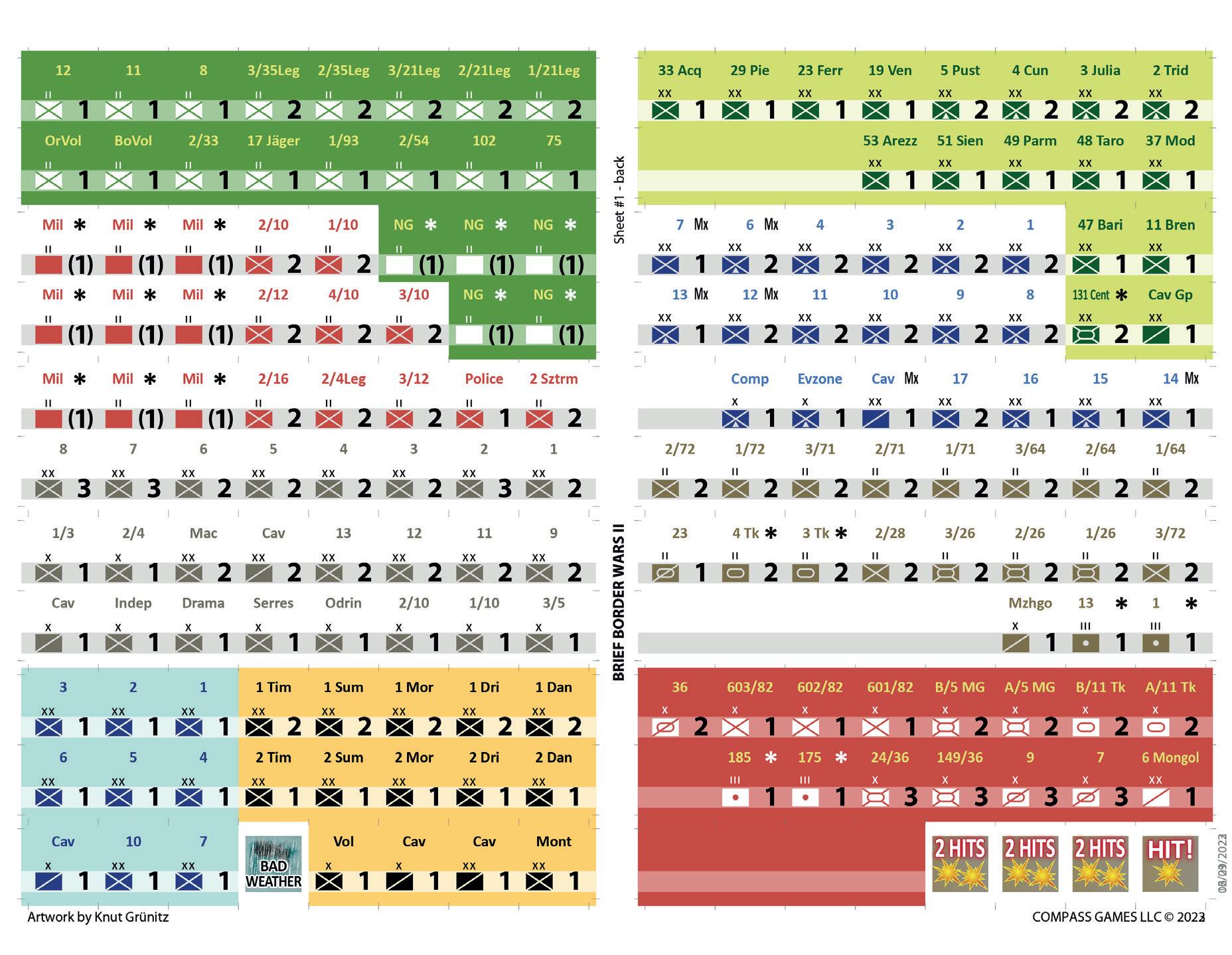
Each game has a set of cardboard counters. They represent military formations and are deployed and moved on the map. These are called “units” and each one has the following information on it:
• Type symbol. This will tell you what type of formation the counter represents. Ground units have a “box symbol” denoting their troop type. Air units have the silhouette of an aircraft representing the majority of plane types in that group.
• Combat Factor. Each unit has a Combat Factor (CF) printed underneath its symbol. This is the number of d6 it will roll during combat (6.2). The reverse side of each ground unit has a differently colored
stripe, to denote that it has been disrupted and cannot attack (however, it can defend itself). Players will also note that some units have a lower CF when they are disrupted. Air units have a blank back to show they cannot do anything while disrupted.
• Nationality. Units in the game are colored to distinguish them by nationality.
• Identification. Units in the game will usually have a distinctive formation number, or an abbreviated title. See the Identification Chart (2.2) in each game’s exclusive rules.
2.2 Type and Identification Chart
See the Type and Identification Chart (2.2) in each game’s exclusive rules.
2.3 Maps and Displays
2.31 Map. The map depicts the general region where the conflict took place. During play, units move from one area to another (see 6.1) and conduct combat within them (see 6.2).
• All map areas contain a circle symbol that contains smaller symbols denoting Woods (icon of tree), Mountain (icon of hill) or Urban terrain (black upper half of circle). These are used to denote rough or closed ground that aids the defender in combat. See legend on each map for the key to this and other symbols.
• Each circle symbol is marked with a Victory Point value, which will be awarded to one player if they control it at the end of the game (see 8.0 for definitions).
2.32 Displays. Each side also has one or more boxes labelled “Rear Area” which represents off-map or otherwise inviolable military bases, logistical sites and garrisons. Units will move from the Rear Area to areas on the map. Units may not move or retreat into friendly or enemy Rear Area boxes. Each Rear Area box also has one smaller section within it marked “Damaged Units.” Units that have been damaged in combat are placed here and must be moved out of it into the Rear Area by die rolls or play of Special Action cards (7.0, 6.31) In some games, a unit in the Damaged Units box is not actually damaged but will take a variable amount of time to reach the front; see exclusive rules.
2.4 Game Concepts
• Damage: A unit that takes significant casualties or leadership losses is damaged and is placed in the Damaged Units section in the Rear Area Box. Units recover from this state through use of Special Action cards (6.31) or die rolls in the Final Phase (7.0). Some units in some games are not damaged but are eliminated instead; see the exclusive rules for exceptions.
• Disruption: A unit may be disrupted for a variety of reasons, usually as a result of combat. It is flipped over to show its reverse side. A disrupted ground unit may move but cannot attack; a disrupted air unit cannot do anything. Units recover from this state through use of Special Action cards or die rolls in the Final Phase (7.0).
3.0 SETTING UP THE GAME
• Players agree which of the four games they will play. One player will be the “designated player” (see the exclusive rules for the game). Give the six white Special Action cards to the designated player. Give the six grey Special Action Cards to the other player. Take the deck of 42 Action Cards, shuffle them and put them in a stack in a mutually convenient place on the table.
• Sort the unit counters out by nationality and place them as directed in the setup instructions for the specific game. Numbers in the instructions generally refer to the formation markers on the unit counters (see 2.2 in game exclusive rules).
• Place the Game Turn marker in the “1” space on the Turn Record Track on the map.
4.0 SEQUENCE OF PLAY
Each Game Turn is organized into the following Phases, performed in order. The body of the rules explain what to do in each Phase.
• Card Selection Phase
• Card Play and Resolution Phase
• Final Phase
• (start next Turn with the Card Selection Phase)
The printed Sequences of Play are specific to each game and contain references to rules changed or added to that particular game.
5.0 CARD SELECTION PHASE
One player (it doesn’t matter who) draws six cards from the top of the deck. Without looking at them, the player gives the WHITE cards to the designated player, and the GREY cards to the other player. If a Random Event card was drawn at this time, resolve it now per the Random Events Chart at the end of each game’s exclusive rules. Players then examine their hands of cards in secret and frown while planning what they will do during the following Phase.
This mechanism represents the ebb and flow of command and control, communications and unit command efficiency. It is unlikely, but possible, that sometimes one player will get all the cards and the other player none. Reflect that everyone has a bad day sometimes and that this event is nearly equally probable for either player, so it could have just as easily been you. In fact, the odds of you getting all of them on a future turn have just risen. Meanwhile, you can still play whatever Special Action cards you happen to have in hand (6.3). Note: Special Action cards are NOT part of player hands and cannot be lost to Random Events.
6.0 CARD PLAY AND RESOLUTION PHASE
Players will play one card each in alternating sequence, beginning with the player who has the most Action Cards (the designated player wins ties). Cards are discarded after playing. The cards have differing effects depending on their icon and number:
• Action Cards have two values marked on them: one for movement (with a photograph of soldiers) and one for combat (with an icon of a rifle). They have values of 1 to 8. Players use the Movement value of a card to move up to an equal number of units (see 6.1) or the Combat value to have up to an equal number of their units attack enemy units in the areas where they are located (see 6.2).
• An Action Card must be played for one, and only one, of its two values: players may not “mix and match” movement and combat on the same card.
• Cards marked “SPECIAL” are Special Action cards. Players start the game holding all six of these, and may play one of these cards instead of one of the newly drawn cards in the Card Play and Resolution Phase. Special Action cards have several functions, see 6.3
• Cards marked “RANDOM EVENT”, when drawn from the deck, denote that an unforeseen event has occurred. After the two players have taken their respective cards, one player (it doesn’t matter who) rolls 1d6 on the Random Events Chart found in the game’s exclusive rules and implements the result as directed. Players then proceed with the Card Play and Resolution Phase.
Passing. A player may Pass instead of playing a card. In this case nothing happens and the other player may now play a card, or Pass. If both players pass in succession the Card Play and Resolution Phase is over. Players discard any remaining Action Cards and move to the Final Phase. Special Action Cards are not part of a player’s hand and are not discarded at this time.
6.1 Movement
When a player plays a Movement card, they may move a total number of ground or air units on or onto the map up to the value of the card (so, 1-8 units). A ground unit may move from one area to an adjacent area, or from the Rear Area box to an adjacent area on the map. An air unit may move any distance on map, or from the Rear Area box to any area on the map. The exclusive rules to a game may modify these parameters.
6.11. Movement limits and exceptions
• A given unit may move only once per Movement card (it may move more than once per Game Turn, though).
• A ground unit that is in an area with an undisrupted enemy ground units may not move out of that area. (Some games may have exceptions to this rule.)
• A unit may generally not enter an enemy Rear Area Box. There may be other restrictions or variations on unit movement (e.g. units may not enter countries not involved in the conflict). See the game’s exclusive rules.
6.12 Moving from the Rear Area. Units may move from the Rear Area box onto areas on the map. Certain games may have rules specifying exactly how this is done. Generally, a Rear Area Box is considered to be adjacent to any and all map areas it touches. Air units moving from the Rear Area Box may move to any area on the map.
6.2 Combat
Playing an Action Card for its Combat value will allow a player to engage in combat in up to all areas where their units are co-located with enemy units, with a total number of friendly units up to the value of the card (so, 1-8 units). The player who played the card is called the Attacker, and the other player is the Defender, no matter what the overall strategic situation. Combat is voluntary on the part of the Attacker, that is, they do not have to have combat in all eligible areas. If the Attacker decides to have combat in a given area, they will designate the ground units involved on both sides (the Defender may, through having air units present or a Reaction Move, also add to the number of defending units: see 6.3). Only undisrupted units may attack, and a given unit may attack only once per Combat card (it may attack more than once per Game Turn, though).
6.21 Combat procedure. The following procedure is followed in each area where the Attacker wishes to have combat. Remember the total of attacking units determined by the value of the Combat card played is the total for all ground and air units in all areas, not per area.
• Pre-Combat Step.
{ The Attacker designates an area where combat will occur; this is called the Battle area. The Attacker designates all ground units on both sides that will participate in the combat in the Battle area. They may designate fewer than the total number of Attacker or Defender units in the area (and may have to do this depending on the number of undisrupted Attacker units and the value of the Combat card played).
{ The Attacker may also designate undisrupted Attacker air units that are either already in the Battle area or are added from their Rear Area box, up to the number of designated attacking ground units. Air units may not attack ground units on their own. Instead, each air unit may assist attacking ground units in its area by adding 1d6 per air unit (regardless of their CF), up to the number of friendly ground units involved, after all air-to-air combat is resolved. Again, remember that the total Combat value of the card played is the total of all ground and air units that may attack in all Battle areas, not per Battle area.
{ The Defender may now add to the battle any friendly air units that were already in the Battle area, up to the number of friendly defending ground units designated by the Attacker.
{ At this time, the Defender may also play a Special Action card for a Reaction Move. The Move may consist of either moving undisrupted air units from the Rear Area box to the Battle area, up to the number of designated defending units in the area, or adding a total of up to 2 undisrupted ground units to the designated defending units, from the Battle area itself or moving into the area from 1 or 2 adjacent areas. See 6.32
• Air-to-Air Combat Resolution Step.
After both players have committed all air units desired to combat in the Battle area, they will conduct air-to-air combat as described in 6.22 if fighter aircraft are present on one or both sides.
• Ground Combat Resolution Step.
Both players simultaneously roll a number of d6 equal to the total Combat Value of the units in their designated groups. The defender adds dice for each terrain symbol in the area (+1d6 for each Woods or Mountain symbol, +2d6 for each Urban symbol). Both sides will add +1d6 for each air unit that survived air-to-air combat undisrupted (regardless of the CF of the air unit). A “5” or “6” on a d6 scores a hit.
{ The player inflicting the hits decides which involved enemy ground units receive how many hits. Air units do not receive hits in this step. The Attacker allocates hits scored on enemy units before the Defender does. What happens next is determined by whether the suffering unit was attacking or defending, and/or was disrupted or undisrupted at the time the hits were inflicted.
{ An undisrupted defending unit that receives at least 1 hit, but less than its CF of hits, is potentially disrupted. If the Defender wishes, the unit may stay and be disrupted (flip the unit over to show its striped side), or it may retreat (see 6.23) and stay undisrupted. An undisrupted defending unit that receives equal to or more than its CF of hits, but less than twice its CF, must be disrupted and may retreat. An undisrupted defending unit that receives twice its CF of hits or more is damaged and is placed in the Damaged Units box.
{ A disrupted defending unit that receives at least 1 hit, but less than its CF of hits, must retreat (see 6.23) and remains disrupted. A disrupted defending unit that receives equal to or more than its CF of hits is damaged and is placed in the Damaged Units box.
{ An attacking unit that receives at least 1 hit, but less than its CF of hits, is disrupted. An attacking unit that receives equal to or more than its CF of hits is damaged and is placed in the Damaged Units box. Attacking units may not retreat.
{ A unit that is placed in the Damaged Units box is placed there in its undisrupted state.
6.22 Air to Air combat. If fighter air units (that is, an air unit marked “F”, see 2.2 in each game’s exclusive rules) are present in an area with enemy air units, then the fighter units may engage enemy air units in combat before ground unit combat is resolved. Each player with fighter air units present rolls a number of d6 equal to the total CF of their fighter air units simultaneously. A “5” or “6” on a d6 scores a Hit. The player inflicting the hits decides which enemy air units receive how many hits.
An air unit that receives at least 1 hit, but less than its CF of hits, is disrupted and returns to its Rear Area box, face down to show its disrupted (blank) side.
• An air unit that receives equal to or more than its CF of hits is damaged and is placed (face up) in the Damaged Units box. (Note: aircraft with a CF of 0 are especially fragile as they are unarmed. If they take even 1 Hit, they are Damaged.)
• Any air units that survived the air-to-air combat undisrupted may assist their ground-pounder comrades, each adding 1d6 to the total dice rolled by their side (regardless of the air unit’s CF). Note: unlike ground units, air units do not retreat in air-to-air combat.
Note: Aircraft with CF 0 are especially fragile as they are unarmed. If they get even 1 Hit, they are Damaged.
6.23 Retreats. In a retreat, a given ground unit will leave the Battle area and enter an adjacent area. A retreating unit cannot retreat into a space with undisrupted enemy units in it.
• Undisrupted defending units may retreat if the Defender chooses. Defending disrupted units must retreat.
• Attacking units may not retreat.
• A unit may not retreat off the map or into a Rear Area Box.
• A unit that must retreat and cannot is damaged instead.
• Certain games may alter or suspend this rule for certain units or situations. See the exclusive rules for that game.
6.24 Exploitation. If at the end of a given battle all Defender units in the Battle area have been disrupted or damaged, any Attacker mechanized type units involved in the battle that are still undisrupted may move into one adjacent area. See the exclusive rules for the game for any variations or limitations.
6.3 Special Action Cards
A player playing a Special Action card may use it in a number of ways. A Special Action card may be played when it is that player’s turn to play a card, or when permitted by the rules. Special Action cards are discarded after use.
6.31 Repairing and refitting units. A player may do the following by playing a Special Action card:
• undisrupt ALL disrupted ground units in any ONE area on the map, or
• undisrupt ALL disrupted air units currently in the Rear Area box, or
• move ALL units (ground and air) in the Damaged Units section into the Rear Area Box.
6.32 Reaction Move. At the end of the Pre-Combat Step, the defender may play a Special Action card to make a Reaction Move. This may take one of two forms:
• Air: a number of undisrupted air units up to the number of designated defending units in the Battle Area may be moved from the Rear Area Box to the Battle area (this may trigger air-to-air combat); OR
• Ground: a total of up to 2 undisrupted ground units may join the designated defending units, from the other units in the Battle area or from up to 2 adjacent areas (that is, 2 from 1 area, or 1 each from 2 areas). In the latter case, the units move from the adjacent areas into the Battle area; they may not move from adjacent areas if there are undisrupted enemy ground units in their original area. The Rear Area box is not considered an area from which units may Reaction Move.
6.33 Other. Certain games may add other functions for Special Action cards: see the exclusive rules.
7.0 FINAL PHASE
When both players have played and discarded all the drawn and Special Action cards they are willing or able to, or if both players have Passed in succession (and so discarded their remaining drawn cards), the Game Turn enters the Final Phase. If this is the final Game Turn, the game now ends and players determine Victory (see 8.0). If not, then:
• All air units return to their respective Rear Area boxes.
• Units may recover from disruption or damage. Each disrupted or damaged ground or air unit checks individually for recovery by rolling 1d6. On a “5” or “6” a disrupted unit is undisrupted, or a damaged unit is moved from the Damaged Units section into the Rear Area Box. The designated player rolls first. The owning player may choose the order in which their units are rolled. Exclusive game rules may modify or limit this.
Advance the Game Turn marker to the next higher numbered space on the Turn Record Track. Proceed with the new Game Turn’s Card Selection Phase.
8.0 GAME END AND VICTORY
The game ends at the end of the Final Phase of the seventh Game turn. To determine victory, players examine each area on the map that is marked with a Victory Point (VP) value. One player is awarded the VP for an area if they are the only one with an undisrupted ground unit in it. The player will score a grade of victory depending on their total VP. See the exclusive rules for that game for any additional sources or adjustments of VP.
9.0 SPECIAL RULES
9.1 Each game will have a set of exclusive special rules to reflect the specialized nature or abilities of certain units in the game, as well as some optional rules players may use to address play balance. However, the following rules may be implemented for any of the games, by recommendation or mutual agreement of the players:
9.11 General organizational ability. Have one side or the other start with fewer than 6 Special Action cards. Take as many of these out as players may mutually agree to, but the player so deprived will be given 1 Victory Point in compensation for every 2 cards removed (round up).
9.12 Formation agility. Do not allow one or either player to make Reaction Moves (6.32)
9.13 Intelligence advantage. Have one player place their hand of Action Cards face up (so the other player knows what kind of cards they have, but not necessarily what order they will be played).
9.14 Poorly trained staff. A player affected by this rule may use Action cards normally, but only for the larger of the two values marked on the card (yes, this rule has a strong effect on play – occasionally a player will be able to only move when they would also like to fight, or vice versa).
9.15 Skilled Guerrillas. If all attacking units in a battle are Irregulars, and all designated defending units are non-Irregulars, then the Defender does not add dice for terrain symbols in the Battle area.
10.0 DESIGNER’S NOTES
Here the designer (that’s me) will say something in the exclusive rules to each game about the historical conflict, and the decisions on how aspects of that conflict were incorporated into the game design.
The general system used in this “quad” of games is a development of one used in a game I designed in 2016 called The Little War, on the brief
frontier war between Hungary and Slovakia in March, 1939. For its basic mechanics this game used a deck of ordinary playing cards: one side got the two red suits while the other got the black ones; one suit was Movement and the other was Combat, with the values from 1 (Ace) to 10; face cards were Special Action cards and the two Jokers were Random Events. I have kept that structure in this game, which uses a total of 54 cards, but the primary values have been placed on a bell curve with values of 4 to 8, and secondary values of 1 to 3. The movement and combat systems are largely the same. In fact, you could go a step backwards and use a deck of ordinary playing cards in playing any of these games, but keep in mind card values would be quite variable and you could encounter turns in which you had ability to move, but not to fight, or vice versa (though you could still use Special Action cards).
Cards and chaos: The two sides have the same number of potential moves and/or combats in the Action Cards in the deck. A large part of the randomness in the game is in how and when they come out. The armies in these games are poor quality, disorganized, second or third-string forces in impromptu conflicts and this game mechanic underlines that. Players represent overall commanders and they are in the role of chaos managers, in a way that most wargames don’t ask them to be. For my part, I’ve noted that people are willing to blame their defeats on the cards, but their victories are always due to their clever planning and skill!
Certainly not all players react the same way to chaos in their games, and this may be too much for some. So, rather than suggest this quad of games is not for them, I can suggest a non-random way for them to play: Take out the 2 Random Event Cards. Each player starts the game with all of their 20 Action Cards and 6 Special Action cards in hand. Each turn each player will play a total of up to 3 cards (no more) of their choice from their deck, one at a time alternately, beginning with the designated tie-winning player. Some cards will be left over as each player will play up to 21 of their 26 cards in the course of a 7 turn game. This could also be done with a deck of ordinary playing cards, as above. A workable way to play, rather dull, not respectful of chaos and not the point I wanted to make in these designs at all. But it works. Ho hum.
Brief Border Wars II: as the title implies, this is a direct sequel to Brief Border Wars, a set of four small games designed by me and released together in one box by Compass Games in mid-2020. The four conflicts in the first volume ranged from 1969 to 2006. When I suggested to the publisher that I was interested in doing a second set of four small games on this type of conflict they were enthusiastic and thought a set of pre1945 titles might be popular.
After preliminary research and discarding quite a few “possibles” I chose the four conflicts in the present volume because they largely fit the same selection criteria I had set for the first volume:
• a definite beginning and end to the fighting, the shorter the better;
• limited aims by the combatants – that is, no wars of annihilation;
• definite political or logistical restraints on the conflict’s size and duration; and
• a postwar geography largely unchanged from the prewar configuration.
In the case of Nomonhan and the Italo-Greek War, both of these conflicts portray the initial phase of the fighting. In Nomonhan, the game covers the first 10 or 12 days in July 1939 when the Japanese forces had their best chances of forcing the Soviets back to the banks of the Halha river thus cementing their claim to their interpretation of the border. In Greece, the game goes from the initial Italian invasion in October to the end of December 1940, at which time the Greek counteroffensive had not only thrown the Italians back but also had entered Albania at several points. In both cases there was a definite break in the fighting while both sides built up their strength and returned to battle later.
—Brian Train, 15 September 2020
Unit receives # of hits
Less than CF
> CF but less than 2x CF
Combat Results Table
Attacker unit
Undisrupted: may retreat; disrupted if no retreat Disrupted: must retreat Disrupted
Undisrupted: disrupted and may retreat Disrupted: damaged Damaged
2x CF or more Damaged Damaged
Air to Air Combat
< CF disrupted place face down in Rear Area Box
> CF damaged place face up in Damaged Units box
CREDITS
Series and Scenario Design: Brian Train
Graphic Design and Layout: Knut Grünitz
Playtesting / Proofing / Editing, volume II: Howard Davies, Robert Seater, Jack Stalica
EXAMPLE OF COMBAT (using Nomonhan 1939)
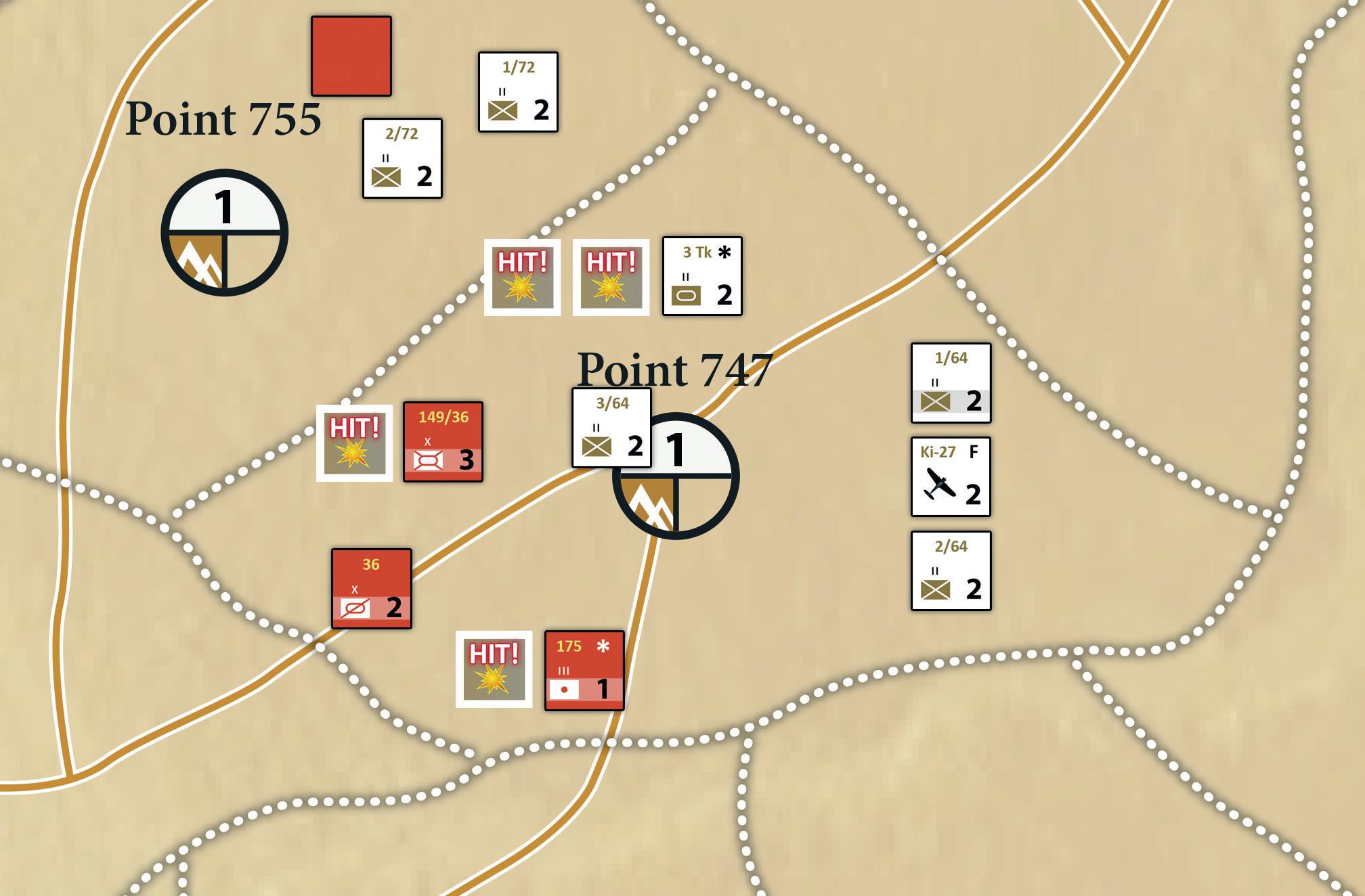
The Japanese player plays an Action Card for its Combat value of “7”. In Point 747 (an area with Mountain) there are 3 Japanese infantry and 1 tank battalions (all CF 2) and 1 Ki-27 fighter air unit (CF 2), with 3 undisrupted Soviet units (149/36 motorized infantry with CF 3, 36 light tank with CF 2, and the 175 artillery with CF 1). All units are undisrupted and in supply (see the game’s exclusive rules).
The Japanese player designates 2 infantry battalions to take on the 36 light tank unit (per the game’s exclusive rules, he cannot designate the artillery unit unless all other Soviet units in the area are also designated). The Soviet player plays a Special Action card to do a Reaction Move of 1 air unit from the Rear Area box, an I-15/16 fighter unit (CF 2), to join the designated defending unit (he cannot whistle up more than 1 unit, since only 1 unit is defending).

Because there are fighter units present, there is air-to-air combat.
The Japanese player rolls 2 dice for his fighter and gets 2 hits.
The Soviet player rolls 2 dice for his fighter and gets no hits.
The Japanese player inflicts 2 hits on the enemy air unit, damaging
the I-15/16 fighter. The Soviet fighter is placed in the Damaged Units section.

Now for ground combat. The Japanese player rolls 5 dice (2 for each infantry battalion, +1 for the fighter air unit) and the Soviet player rolls 4 dice (2 for the light tank unit, 1 for the artillery unit which provides defensive support even if it is not a designated unit, 1 for the Mountain icon). The Japanese player rolls 2 hits, the Soviet player rolls 1 hit. The Japanese player inflicts hits first: he
places both hits on the light tank unit, which is equal to or more than the unit’s CF of “2”, but less than twice, so the unit must be disrupted and may retreat (however, the Soviet player does not retreat). The Soviet player got 1 Hit and inflicts it on one of the infantry battalions. This is less than the battalion’s CF of “2” so it is disrupted (because it is an attacking unit, it may not retreat).

So far 3 Japanese units have attacked (2 ground and 1 air), leaving 4 combat values remaining on the card. The Japanese player decides to conduct a battle with 2 infantry battalions in the adjacent area of Point 755 for some reason (probably to illustrate this example, so we won’t detail it). Two left on the card, now. The Japanese player returns to Point 747, and decides to take a chance. He declares an attack with the remaining infantry battalion that hasn’t attacked yet and the tank battalion, designating all 3 Soviet units as defenders (he can include the artillery unit if he does this). He rolls 4 dice and the Soviet player rolls 7 dice (3 for the 149/36 motorized, 2 for the 36 light tank, 1 for the
artillery and 1 for the Mountain icon). The Japanese player again gets 2 hits, and the Soviet player also gets 2 hits. The Japanese player inflicts 1 hit on the 149/36 motorized and the other hit on the artillery unit (he can do this because the 36 light tank is disrupted; see game’s exclusive rules). The 149/36 motorized does not retreat so it is disrupted. The artillery unit received hits equal to its CF (= 1) so it is disrupted and may retreat (it doesn’t).
The Soviet player inflicts both hits on the attacking tank battalion; this is equal to the unit’s CF of 2 so the unit is damaged (however, per the game’s exclusive rules, the unit is removed from the game. instead).
BRIEF BORDER WARS VOLUME 1
Errata and Clarifications for owners of Volume 1
Not this game!
All maps
• There is no terrain map legend. The terrain icons for Woods and Mountain are clear enough; as most have guessed, the icon for Urban terrain is a black half-circle above those icons in the small “rosette” in each land map area.
Football War
• Setup: (clarification): El Salvador player chooses areas adjacent to the border for initial placement, and each area chosen must include at least two units. Therefore the player may set up in at most five areas with their 11 beginning units (or up to six areas if including the optional armored unit).
• Player aid: per the system rules, an Urban area always gives +2d6 for the defender.
Operation Attila
• Setup: Cypriot forces, read ELDYK instead of GRK; the Cypriot unit that sets up in the Damaged Units box should be EE (not ER). Turkish forces read KTA, not TRK (later research uncovered the Turkish language acronym).
• 6.12: All Cypriot and Turkish irregular units may move from the Rear Area to any areas on Cyprus that are either empty or contain a friendly unit.
Third Indochina War
• Player aid card: per the system rules, an Urban area always gives +2d6 for the defender. The last bullet of Combat Resolution should read, “Damaged Chinese units go to Damaged Units box in Rear area of their Front”; 6.21 in the exclusive rules has it correct.
• Map note and clarification: some players have noted that all areas within Vietnam contain the Urban terrain icon, in addition to the Woods or Mountain icon (or both). This reflects the extraordinarily closed and rugged terrain along the Vietnamese border where the fighting within the areas centers on taking or holding the towns and cities astride the few, constricted roads (whence the supply rules in the game and the road-bound nature of the special Chinese units). I didn’t want to confuse things by saying, “OK, in Third Indochina War only, Woods is worth +3, and in the other games, it’s worth +1,” when I already had this additional defense modifier on hand. Yes, this makes the game a hard slog for the Chinese, but historically they did not do very well at all, which is why you can add or subtract optional rules to adjust or play the alternate Chinese plan scenario.
Second Lebanon War
• Setup: The reference to placing the three leftover Irregular units anywhere in Lebanon is actually two Rocket units and one Irregular unit.