BREAKTHROUGH RUSSIA
1.0 Introduction
Breakthrough Russia (“BR”) is a strategic/operational game covering The Eastern Front in World War II from the initial Axis attack on the Soviet Union in the summer of 1941 (Operation Barbarossa) to the Battle of Kursk (Operation Citadel) in the summer of 1943. BR is designed as a twoplayer game but lends itself easily to solitaire play. The Soviet player commands the armed forces of the Soviet Union. The Axis player commands the German, Italian, and German Minor Allied armed forces.
2.0 Definitions
ACRT – Air Combat Results Table. The ACRT is used to resolve air combat using two 6-sided dice.
Air Redeployment – At the end of a player’s Exploitation Segment, he may move up to two Air Support Units from friendly-controlled airbases to any other friendly-controlled airbases within twice their printed air range.
Air Superiority – The player with the largest number of air combat factors in a battle hex.
Air Support Units (ASUs) – Air power in BR is abstractly represented by ASUs. ASUs assist ground units in combat. An ASU’s combat factor is added to the total number of attacking or defending ground combat factors.
Airbase – ASUs are based in cities or constructed airbases. The term “airbase” applies to both.
Armor Superiority – In any ground combat, the side with the largest number of ARM factors engaged is said to have armor superiority.
Attrition Option – Attrition Options cost 4 RPs (Axis) or 3 RPs (Soviets). The phasing player may move all his units in the Movement Segment and attack up to two targets in the Combat Segment. ECUs may not conduct Exploitation Movement or Combat under an Attrition Option.
Automatic Victory (AV) Attacks – If the phasing player has obtained 8:1 or greater odds against an adjacent enemy unit in either the Movement or Exploitation Segments, the attack counts as movement, not combat.
Axis Powers – Germany and Italy are the Axis Powers.
Axis Minor Allies – Finland, Hungary, Slovakia, and Romania are Axis Minor Allies. Spanish, Turkish, Vichy French, Croatian, Bulgarian, and RLA units obtained via Axis Variants are also treated as Axis Minor Allies.
Axis Minor Allies’ National Capitals - Finland’s capital is Helsinki. Hungary’s capital is Budapest. Romania’s capital is Bucharest. If the Axis player has achieved the Ukrainian variant, Kiev is considered the capital of Ukraine.
Frontier – Hexes within the Soviet Union bordering Finland, East Prussia, Poland, Hungary, and Romania are Axis-Soviet frontier hexes.
Battle Hex – Any hex under attack by enemy units is a battle hex.
Combat Factor – A numerical indication of the relative combat value of a unit.
Combat Results Table (CRT) – The CRT is used to resolve ground combat using two 6-sided dice.
Contact – An inconclusive combat result. Neither side inflicted any damage on the other. All ground combat units engaged remain in place.
Control – A player controls a hex if either he has a ground combat unit in that hex, or his units were the last ones to occupy or pass through it.
An unoccupied hex is considered friendly-controlled if it was in a friendly ZOC at the start of a turn. If an unoccupied hex is within both friendly and enemy ZOCs, it is controlled by neither side.
Hexes that were enemy-controlled at the beginning of the Phasing Player’s turn remain enemy-controlled during the enemy player’s turn. However, at the conclusion of the enemy player’s turn, unoccupied hexes which have been
placed OOS by the Phasing Player become controlled by the Phasing Player.
Defensive Air Support (DAS) – An ASU may add its combat factors to those of any friendly defending ground unit or units within air range.
Depleted unit – A full strength two-step unit that has suffered one hit on the CRT is considered depleted and flipped to its reversed side. A depleted unit which suffers a second loss point is eliminated. Some units have only one step. Such units are eliminated if they suffer any point losses on the CRT.
DRM – Die-roll modifier. A number added to or subtracted from a die roll
Exploitation Capable Units (ECUs) – Units that can move and fight during the Exploitation Segment. Air, armored, armored infantry, cavalry, and self-propelled artillery are all ECUs.
Exploitation Supply – ECUs that have moved or advanced after combat in the Exploitation Segment (only) remain in supply until the end of the owning player’s next Combat Segment.
Force Pool – The total potential number of units a player has at his disposal – including both built and unbuilt units.
Fortress Garrison – A unit or stack of units occupying a fortress hex, including the fortress unit itself.
Ground Combat Unit – Infantry, armored infantry, armor, cavalry, artillery, self-propelled artillery, and partisans are all ground combat units. ASUs, fortifications, and fortresses are not.
Industrial Centers (ICs) – Armaments manufacturing centers which govern the creation of Production Factors (see below). Each turn, each player draws one Production Tile for each IC.
MPs – Movement Points. Each ground combat unit has a certain number of MPs indicated on the lower right quadrant of the unit counter. ASUs have a number in the lower right quadrant of the unit counter, indicating the unit’s range.
Offensive Air Support (OAS) – An ASU may add its combat factors to those of any friendly attacking ground unit or units within the air range.
Offensive Option – An Offensive Option costs 6 RPs (Axis) or 5 RPs (Soviets). All the phasing player’s units may move in the Movement Segment and attack during the Combat Segment. ECUs may move and fight again in the Exploitation Segment.
OOS – Out of supply.
Pass Option – A Pass Option costs the Axis player 2 RPs, and the Soviet player 1 RP. A player may move all his units but not attack any enemy units in the Combat Segment, nor conduct Exploitation Movement or Combat.
Phasing Player – The player whose turn it is.
Railhead – A railhead acts as a terminal point for units moving by rail.
Resource Points (RPs) – RPs are the currency of the game. RPs are used to activate units for movement and combat, to repair depleted units, to rebuild previously eliminated units, or to build new ground combat units, fortifications, and fortresses.
Resource Production Tiles (RPTs) – RPTs are drawn each turn, one for each friendly-controlled IC. Each side initially has 24 RPTs. Axis RPTs are numbered 0-3; Soviet RPTs are numbered 1-4.
Steps – Basic measurement of a unit’s strength. Most units have two steps: a full-strength step and a depleted step. A narrow body of water, crossable by ferry. In BR, the Straits of Kerch can be crossed either via regular movement or by rail for an additional cost of 1 MP.
Supply Line – an unbroken chain of contiguous hexes, traced from a unit to a supply source. Supply lines cannot be traced through enemy ZOC unless the units tracing the supply line are in Exploitation Supply. Supply lines may be of any length.
Supply Source – The point of origin for the food, fuel, and ammunition necessary to support a nation’s armed forces. The west edge of the board is the supply source for German and Italian units. Home country capitals are supply sources for Axis Minor Allied units. The eastern edge of the map
board and the northern edge east of Leningrad are supply sources for the Soviets.
Terrain Effects Chart (TEC) – The TEC describes the impact of terrain on movement and combat.
Turn - The game is played in turns. Each seasonal time interval consists of an Axis player turn and a Soviet player turn. The two together comprise one full seasonal game turn. The Axis player always moves first.
Turn Record Track (TRT) – The game’s method of measuring time. Each turn is one season.
Zones of Control (ZOCs) – Ground units exert a ZOC, which includes the six hexes surrounding that ground unit. ZOCs affect both movement and combat.
3.0 Setup and Initial Control
Before starting the game, each player sets up his units on the map board per the locations indicated on the Setup Card. The Soviet player sets up first. Some units included in the game do not appear at start. Set them aside – they will enter the game as reinforcements or appear as a result of optional rules or variants. Reinforcements and their arrival date are shown on the game’s turn record track.
The Axis player initially controls all hexes west of the Nazi-Soviet border, other than Swiss and Swedish hexes. Turkey is neutral, although it may enter the war via a variant. Persia is neutral.
Syria, Iraq and Kuwait are Western Allied controlledneither side may enter their hexes. The Soviet player initially controls all hexes east of the Nazi-Soviet border.
4.0 Playing Pieces
The playing pieces in the game (referred to as units) are described below:
Armor (ARM) – ARM units are ECUs. They may move and fight twice each turn: they move and fight during the Movement and Combat Segments and move and fight again during the Exploitation Segment.
CBR (Can’t Be Rebuilt) ARM – Soviet 1-factor ARM units have a circled “X” marker on them. The “X” indicates that these units may not be rebuilt once lost.
Cavalry (CAV) – CAV units are ECUs. Like ARM units, CAV units may move and fight twice each turn: move during the Movement Segment, fight during the Combat Segment, and move and fight again during the Exploitation Segment. Like ARM units, CAV units move faster than infantry but can navigate difficult terrain better than ARM units.
Infantry (INF) – Infantry units may move only during the Movement Segment and fight only in the Combat Segment. Thus, they are less mobile than armor units. Infantry units have less combat power per unit than armor or artillery units but are cheaper to produce.
Security INF – Lightly-armed INF units established for rear-area security purposes. Security INF may stack with each other but not with any other Axis units.
Artillery (ART) – Artillery provides additional firepower, both in attacking and defending. ART units do not count towards stacking limits (See Section 9 Stacking).
(Optional) Self-Propelled Artillery (SPA)Function just like regular artillery, but as ECUs, they may move and fight during the Exploitation Segment. SPA units do not count towards stacking limits (See Section 9 Stacking).
(Optional) Partisans (PART) – Partisans may not attack but may return fire (with a +2 modifier) if attacked by enemy units.
Armored Infantry (ARM INF) – ARM INF are ECUs. They also known as Motorized (if Soviet) or Panzer Grenadiers (if German). ARM INF units move as fast as armor units and may participate in Exploitation Movement and Combat.
Air Support Units (ASUs) – ASUs are ECUs. ASUs may assist in AV attacks, provide support for ground battles and may attack (counterair) enemy ASUs. After any air-to-air combat against intercepting ASUs, the owning player adds the combat value of any surviving ASUs to those of any friendly ground units involved in that battle.
ARM, CAV, INF, ARM INF, PART, SPA, and ART units are all ground combat units. They may engage in ground combat, which is resolved on the Combat Results Table (CRT). Most ground units have two steps. If a two-step unit takes a hit on the CRT, it is flipped over to its depleted side. If the unit has only one step, it is eliminated if it takes a hit.
There are two types of game pieces that cannot move or attack, but provide benefits to defending units:
Fortifications – Fortifications provide defensive benefits. Fortifications add their combat value to the defender’s die roll on the CRT.
Fortifications (and the units in them) cannot be forced to retreat – they may only be depleted or eliminated. The fortification unit itself may not be depleted or eliminated unless all other units in the fortification hex have been eliminated.
Fortifications may be built in any supplied clear or forest hex. Fortifications must be built in hexes containing one or more friendly ground units. However the ground unit or units need not remain in the hex after the fortification has been built.
Existing Soviet fortifications (only) may be upgraded to fortresses by spending 1 RP to replace the fortification with a fortress marker. Fortifications may be built in enemy ZOCs.
Nationality and Armor Superiority DRMs (See Sections 13.2.2, Nationality DRM and 13.2.3, Armor Superiority DRM) do not apply when firing into (or out of) fortification hexes. Attacking units suffer an (adverse) one-column shift to the left when firing into fortification hexes. Double the attacker’s losses when attacking fortifications during Exploitation Combat.
Defending units in fortifications (including the fortification counter itself) shift one column right when returning fire, provided all the defending units are firing from the fortification hex.
Fortification units may not move and may fire only when attacked. Ground combat units in a fortification may attack,
but they do so without including the fortification’s own combat factors.
The counter mix limits the total number of fortifications on the board at any one time. A player may not build more than two fortifications in any one turn.
Fortresses – Fortresses function much like fortifications do, and the same conditions governing fortification construction also apply to fortresses. However, ZOCs do not extend into or out of fortresses.
The Axis player may not build fortresses.
The Soviet player begins the game with one fortress in Sevastopol. The counter mix limits the total number of fortresses on the board at any one time.
A player may not build more than one fortress per turn.
The Soviet player may not voluntarily remove a fortress – once built it remains in place until enemy ground units occupy its hex, after which it is permanently removed from the game. Fortresses may be built on any supplied clear terrain hex at a cost of 3 RPs.
The Soviet player (only) may upgrade a fortification to a fortress by spending 1 RP to do so. The Soviet player may place a fortification in a hex and upgrade it to a fortress in the same turn. Fortresses (and the units in them) cannot be forced to retreat – they may only be depleted or eliminated. The fortress unit itself may not be depleted or eliminated unless all other units in the fortress hex have been eliminated.
Nationality and Armor Superiority DRMs (See Sections 13.2.2, Nationality and 13.2.3, Armor Superiority) do not apply when firing at fortresses.
Fortresses may not move and may fire only when attacked. Attacking units suffer an (adverse) 2-column shift to the left when firing into fortress hexes. Defending units in fortresses (including the fortification counter itself) receive a 2-column shift to the right when returning fire, provided all the defending units are firing from the fortress hex. Double the attacker’s losses when attacking fortresses during Exploitation Combat.
Ground combat units in fortresses may attack, but they do so without including the fortress’ own combat factors. Fortress units may not move and may fire only when attacked.
Elite Units – The German SS ARM, GD ARM INF, and the Soviet Guards units (both INF and ARM) are elite units. They do not count towards stacking limits.
5.0 The Map
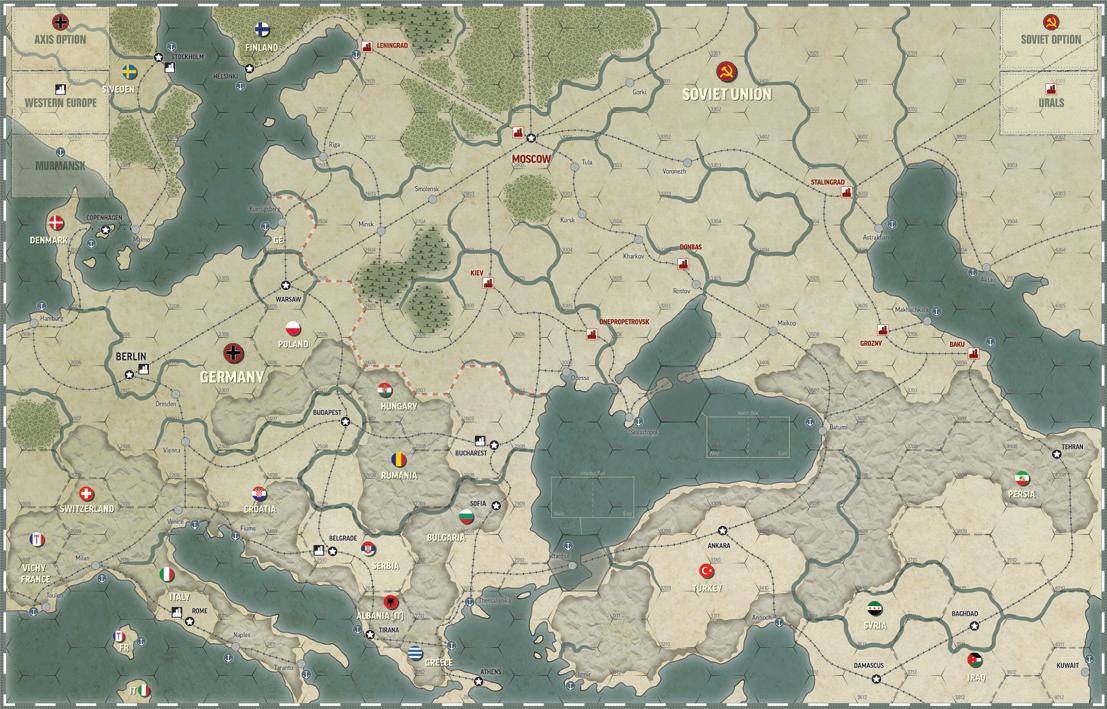
The map board covers Eastern and Southeastern Europe and the Soviet Union in 1941. A hexagonal grid has been superimposed on the map to regulate movement and combat. There are off-map boxes (such as the Urals Box) for player convenience.
6.0 Air Support Units (ASUs)
6.1 Using ASUs - ASUs must be based in cities or (optional) airbases. Each city has a basing capacity of one ASU. ASUs do not count towards stacking limits (See Section 9.0 Stacking). ASUs may assist the owning player’s ground units in combat, provided the battle hex is within the air unit’s range. ASUs are never required to fly offensive missions and are never required to intercept enemy air missions.
6.2 Air Missions – ASUs may fly ground support, AV support, and counter-air missions.
To conduct an air mission, one or more of the phasing player’s air units within range of a battle fly to the target hex.
One or more of the non-phasing player’s ASUs may respond by intercepting the phasing player’s ASUs. The phasing player may counter-counter intercept; the nonphasing player may counter-counter-counter intercept and
so on until neither side has any additional air units within range. If a ground support mission is intercepted, players conduct air combat prior to conducting ground combat. ASUs which have survived air combat may add their combat factors to ground units’ combat factors. Ground combat losses may not be assigned to ASUs.
6.3 Limitations on Air Missions – There is no limit on the number of ASU factors that can support a ground attack in the Combat and/or Exploitation Segments. However, the total number of ASU factors assigned to any battle may not exceed the total printed value of all ground combat factors engaged.
For example, if a Soviet 3-3 ASU flew DAS for a 2-3 Soviet INF under attack by Axis ground units, only two of the ASUs combat factors could be included when the Soviet INF unit returns fire.
ASUs may fly only two ground support missions per game turn, one in either the Axis or Soviet Combat Segments and again during either the Axis or Soviet Exploitation Segments.
Thus, if a German ASU flew a ground support mission during the Axis player’s Combat Segment, and again during the Axis player’s Exploitation Segment, that same ASU would be unable to intercept any Soviet attacks made during either the Soviet player’s Combat or Exploitation Segments of the same turn. Neither AV [see Section 12.7, Automatic Victory (AV)], nor counter-air missions (see Section 6.5, Counter-air Missions) count towards the twomission limit on ground support missions.
6.4 Air to Air Combat – Ignore asterisked results on the CRT unless conducting a counter-air mission (see below). Air units conduct air-to-air combat prior to participating in ground combat. ASUs fire at each other, phasing player first. Surviving ASU factors are added to their respective ground unit combat factors.
6.5 Counter-Air Missions – ASUs may conduct counter-air missions against enemy air units on the ground. Counter-air combat takes place in the target airbase hex.
Airbases are assumed to be protected with flak: on an asterisked result, one attacking air unit is depleted due to flak; on a double-asterisked result, one attacking air unit is eliminated.
Flak has no range, it’s automatic and it’s part of the hex. The defender may choose to intercept enemy ASUs in the target hex or decline to intercept and stay on the ground. If he chooses the former, ignore the asterisked results and apply ACRT results normally. If he chooses the latter,
defending air units may not fire back at attacking ASUs. However, the attackers suffer any adverse asterisked results.
Air Combat Results Table (ACRT)
# Of Factors
Combat Example: Counter-air
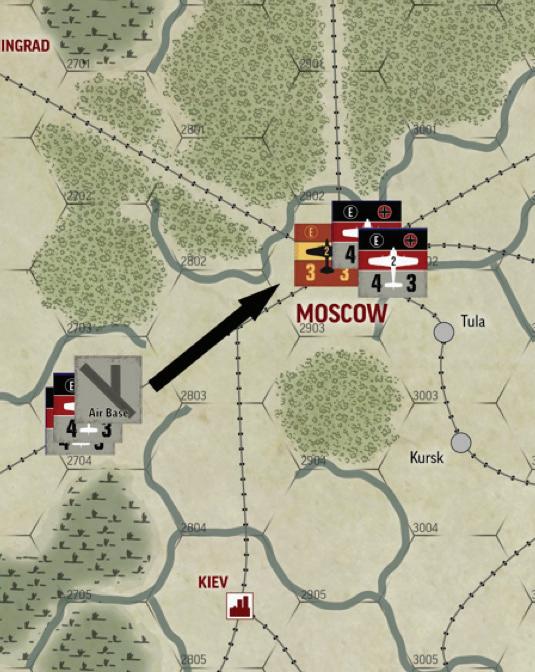
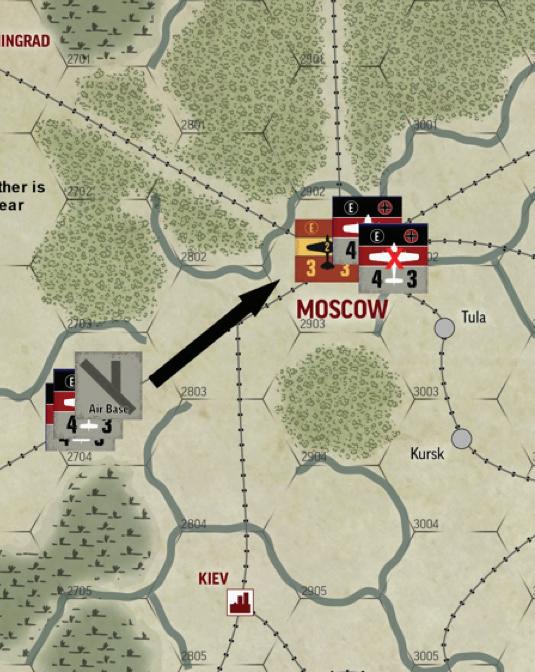
The Soviet player, heavily outnumbered, chooses to stay on the ground. Moscow, as it’s a city, is also an airbase which has intrinsic flak. Flak fires before the Axis air units can attack the Soviet ASU.
The Axis player assigns two ASUs to a counter-air mission against the Soviet ASU based in Moscow. It’s Spring 1942 and the weather is clear.
In a remarkably bad roll for the Axis, the attackers roll a “12.” The double-asterisked result on the ACRT eliminates one Axis air unit. The surviving Axis ASU fires on the “46” column of the ACRT.
Luck is not with the Axis this turn: the Axis player rolls an “11,” modified to a “9” due to air nationality. A “9” is a miss. The surviving Axis ASU will return to base. The Soviet ASU is undamaged.
6.6 ASUs in Combat - ASUs may not attack (or defend against) ground units all by themselves – they affect ground combat only by assisting attacking or defending ground units. The total number of ASU factors attacking or defending a battle hex may not exceed the total number of ground combat factors attacking or defending the hex. Ground units may not attack ASUs.
If a friendly ground unit moves into a hex occupied only by an enemy ASU, the ASU is immediately depleted and must fly to the nearest friendly city or airbase within twice its normal range. The ASU is eliminated if there is no such city or airbase within twice its printed range.
6.7 Air Nationality DRM – From the Summer 1941 turn through the Fall 1942 turn, the Axis player receives a (beneficial) -2 DRM on the ACRT. Conversely, the Soviet player suffers an (adverse) +2 DRM on the ACRT during those turns. From Winter 1942 through the Summer 1943 the DRMs on the ACRT are -1/+1.
6.8 Effect of Air Superiority – The player with the largest number of ASU combat factors over a battle hex has air superiority over the hex. If a player has air superiority, he obtains a (favorable) one-column shift to the right on the CRT when attacking. If his opponent has air superiority, the attacking units suffer an (adverse) one-column shift to the left on the CRT. After air-to-air combat, if both sides have an equal number of air combat factors in the target hex, neither side achieves air superiority.
7.0 Sequence of Play (SOP)
7.1 Following the SOP - Each player must follow the SOP on his turn. The Axis player follows the SOP on the Axis player’s turn. The Soviet player follows the same steps on the Soviet player’s turn.
Steps in the SOP - The abbreviated version of the SOP is as follows:
1. Initial Supply Check and Admin Segment (Receive RPs, Choose Options, and Builds)
2. Axis Movement Segment
3. Axis Combat Segment
4. Axis Exploitation Segment
5. Soviet Movement Segment
6. Soviet Combat Segment
7. Soviet Exploitation Segment
8. Supply Segment
9. End Segment
Refer to the SOP Card for details about which actions are taken in what order.
8.0 Zones of Control (ZOCs)
8.1 ZOCs and Ground Combat – Generally, a ground combat unit exerts a ZOC into the six hexes adjacent to it. ZOCs do not extend into or out of fortresses. Ground units may (but are not required to) attack enemy units after moving into an enemy-controlled ZOC (See Section 13.0, Combat). A non-ECU ground unit must stop when entering an enemy ground unit’s ZOC. It may not move any further during the Movement Segment. ECUs moving during the Exploitation Segment may move through enemy ZOCs but must pay one additional MP for entering each enemy ZOC they enter.
ECUs may enter ZOCs in the Movement Segment for an additional +2 MPs.
8.2 ZOCs and ASUs - ASUs do not exert ZOCs. ZOCs do not extend into impassable hexes, such as all-sea hexes, across all-sea hex sides, or into neutral countries.
9.0 Stacking
9.1 Stacking Limits – The players may place up to two ground combat units of any strength, plus one full-strength 1-factor unit of any type in the same hex. This is called stacking. ART units, (optional) SPA units, (optional) PART units, (optional) airbases, ASUs, fortifications, and fortresses do not count towards stacking limits.
However, only one ART or SPA unit may be placed in a single hex. Ground combat units in Breakthrough hexes may temporarily over-stack, but such over-stacking must be cured by the end of the phasing player’s next Exploitation Segment or be eliminated (see Section 13.10, Breakthroughs).
Fortifications may not be stacked with fortresses.
9.2 Applying Stacking Limits - Stacking limits must be observed when units are initially produced, at the end of the Movement Segment, the Combat Segment, and the Exploitation Segment.
A hex containing friendly ground combat units may move through other friendly-controlled hexes, including those containing other friendly units, provided stacking limits are observed at the end of the Movement Segment.
The same principle applies during the Exploitation Segment. Ground units may over-stack on Breakthrough hexes (see Section 13.10, Breakthroughs).
Stacking limits do not apply to off-map boxes like Unbuilt Units Boxes.
9.3 Elite and Siberian Units – German SS ARM and Soviet Guards INF and ARM units do not count towards stacking limits. Soviet Siberian units are not elite units; however, Siberian units initially appear at zero construction cost. If these units are depleted or eliminated, the Soviet player incurs normal construction costs to repair or rebuild them. [Designer’s Note: Siberian units appear at zero initial cost since they are not new or substantially rebuilt units. They represent existing Soviet formations transferred from the Far East.]
10.0 Production
10.1 Producing Resource PointsProduction is governed by the number of Industrial Center (ICs) a player controls. Before starting each game, RPTs are placed face-down off the map board. Each player begins the game with 24 RPTs, but there is no RPT draw on Turn 1: there are no units to build, the Axis player receives a free offensive option, and the Soviets receive a free attrition option. In each game turn, starting with Turn 2, a player draws one Resource Point Tile (RPT) for each IC he controls.

At the start of the game, the Axis player has a total of 6 ICs, one IC in each of the following locations: Stockholm, Berlin, Rome, Bucharest, Belgrade, and the Western European Box. Bucharest counts as a German IC, to reflect Romania’s oil production. Stockholm also counts as a German IC, which reflects Swedish iron ore shipments to Germany. The Western Europe Box represents industry captured during the German conquest of Western Europe in 1940. The Soviets begin the game with 8 ICs, one IC in each of the following locations: Stalingrad, Leningrad, Moscow, Kiev, Dnepropetrovsk, Donbas, Grozny, and Baku. Note that the Donbas IC is a region, not a city, and Urals Box does not count since Soviets must first place IC there via evacuation. The Soviets will also receive RPs via Lend-Lease, representing Western Allied aid to the Soviet Union (see Section 10.4 Lend-Lease).
10.2 RPTs – The Axis player’s initial RPTs are numbered 1 to 3. Each turn beginning with the Spring 1942 turn, the Axis player adds one 0-factor RPT to his face-down RPT pool, to reflect the steady decline in the Wehrmacht’s capabilities in the East.
Initial Soviet RPTs are numbered 1-3. Each turn beginning with the Spring 1942 turn, the Soviet
player adds one 4-factor RPT to his face-down RPT pool. The RPT draw determines the total number of RPs available to a player on his turn. Thus, if the Soviet player controlled 8 ICs at the beginning of a turn, he would draw 8 RPTs. If he drew two 1s, three 2s, two 3s, and a 4, he could use 18 RPs during the current game turn.
Each player must disclose the results of his RPT draw to his opponent. Players should keep track of their RP level during their player turns via the RP Track. Any RPs left over at the end of each game turn are discarded.
The Axis player may never receive more than 18 RPs from his RPT draw; the Soviet player may never receive more than 20 RPs from his RPT draw.
10.3 Using RPs - RPs are used in several ways. Players use RPs to purchase Pass, Attrition, or Offensive Options, to repair depleted units, build newly arrived units, and to rebuild previously eliminated units.
The RP cost of the above activities is indicated on the Production Table:
ASUs, SPAs, ( Optional Air Transport
Railheads, Airbases, 1-factor ground combat units, ( Optional ) Soviet INF Upgrades
The production charts refer to steps, not to combat factors. For example, building or rebuilding a two-step INF unit costs the Axis player 3 RPs. A two-step, 3-factor INF costs the Soviet player 2 RPs.
Players are not required to rebuild whole units: if the Soviet player did not have enough RPs to completely rebuild a previously eliminated 4-5 ARM (which would require 3 RPs),
he could rebuild the unit on its depleted side at a cost of only 2 RPs.
OOS units may not be repaired. Units eliminated solely due to being OOS (as opposed to being eliminated in combat) cost double their normal construction cost to rebuild. OOS units which were eliminated in combat are rebuilt normally.
A player can build either newly available units or previously eliminated ones, or repair units which have depleted. Units which have been eliminated via a Target Surrender result on the CRT may not be rebuilt.
10.4 Lend Lease - The Soviet player may draw one extra RPT from Fall 1941 through Fall 1942, and two from Winter 1942 through Summer 1943, to reflect Allied Lend-Lease shipments to the Soviet Union.
10.5 Soviet Mobilization – The Soviet player receives 4 bonus RPTs and two free fortifications on the Fall 1941 turn (See Section 18.2, Workers and Peasants Mobilized).
10.6 Evacuated ICs – The Soviet player may voluntarily move the Kiev and Dnepropetrovsk ICs to the Urals Box on any turn, regardless of whether the Axis player has captured these IC hexes.
The Soviets roll once (1d6) for each of these ICs. On a 1-4, the IC is successfully evacuated; on a 5-6, the evacuation fails, and the IC must remain in place.
The Moscow, Stalingrad, and Leningrad ICs may be evacuated only if one or more Axis ground units capture their respective city hexes, provided the city’s defenders were in supply. In that event, those ICs may be evacuated on a 1-3. On a 4-6, the evacuation fails. If an evacuation attempt fails, it may not be attempted again.
OOS ICs may not be evacuated.
OOS ICs are not depleted or eliminated due to being OOS, they simply suspend production until they are either captured or placed back in supply.
Evacuated ICs begin normally producing two turns after evacuation. For example, if the Soviets evacuate the Kiev and Dnepropetrovsk ICs on the Summer 1941 turn, they could begin normally producing on the Winter 1941 turn. The Grozny, Donbas, and Baku ICs may never be evacuated.
Whenever an Axis ground combat unit captures any other Soviet IC hexes, the Soviet player immediately rolls one die (1d6) die to determine whether the industry in that hex has been evacuated to the Urals Box. On a 1-3, the IC has been
successfully evacuated to the Urals. On a 4-6, the IC has been captured and may begin production for the Axis two turns later.
Either player may, at his option, destroy an IC provided he has at least one ground combat unit in the IC hex.
10.7 Captured ICs - Soviet ICs may be captured. The Axis player does not draw RPTs for captured ICs. Captured ICs each produce 1 RP per turn for the Axis. This production level may not be increased.
10.8 Placing New and Rebuilt Units - Newly produced or rebuilt German units appear in, or adjacent to Berlin. Newly produced or rebuilt Axis Minor Ally units are placed at their respective national capitals. Newly produced or rebuilt Italian units are placed in Rome. Siberian units and the two strongest Soviet units (measured by combat factors) produced each turn must appear in the Urals Box. All other newly produced Soviet units may be placed in any friendlycontrolled supplied hex, even if the hex is in any enemy ZOC. Depleted units may be repaired wherever they happen to be located on the map, provided they are in supply. Fortifications and fortresses may be placed on any supplied friendly-controlled clear or forest hex occupied by a friendly ground combat unit, even if that unit is in a ZOC.
11.0 Selecting Options
11.1 Option Types - The phasing player may move all, some, or none of his units during his player turn. Each turn, as player may choose one of three options: Pass, Attrition, and Offensive.
11.2 Pass - Under a Pass Option, a Player may move all his units but not attack any enemy units.
11.3 Attrition - Under an Attrition Option all ASU and ground units may move and fight during the Movement and Combat Segments, respectively. However, friendly units may not move or fight during the Exploitation Segment.
11.4 Offensive - If the phasing player chooses an Offensive Option, ground and air units may move during the Movement Segment and fight during the Combat Segment. ECUs may move and fight again during the Exploitation Segment.
Pass
O ensive
Attrition
Kiev
Moved to Urals
12.0 Moving Units
12.1 Movement and ZOCs – During the Movement Segment, ECUs (only) may move into and through enemy ZOCs for an additional +2 MPs per hex. Non-ECU units must stop when they enter an enemy ZOC in the Movement Segment. During the Exploitation Segment, ECUs may move through enemy ZOCs for an additional +1 MP for each hex in one or more enemy ZOCs. ASUs are unaffected by ZOCs and may fly over them at will.
Ground combat units may not enter all-sea hexes or neutral countries. Refer to the TEC terrain-related restrictions on movement. Friendly units in enemy ZOCs may attack adjacent enemy units.
12.2 Rail Movement - Ground combat units may move an unlimited number of hexes by rail during the Movement Segment. Ground units
may entrain at any city or railhead at no MP cost (See Section 13.4, Railheads below). It costs 1 MP to entrain on other rail hexes.
Units moving by rail: a) may not move into or through enemy ZOCs, although friendly ground combat units negate enemy ZOCs for this purpose; b) may not enter any enemy hex occupied by PART units (See Optional Rule 20.4, Soviet Partisans); c) must move along a friendly-controlled contiguous chain of rail line hexes; and d) must end their rail movement in a city or railhead (See Section 12.4 Railheads below).
Both before and after rail movement ground combat units may move normally: a ground unit could move to a rail line, entrain, move to a city or railhead, detrain and continue normal movement. Units may not move by rail during the Exploitation Segment. The Axis player may move two units by rail each game turn. The Soviet player may move four units by rail each game turn.
Any ground units placed in the Urals or Western Europe
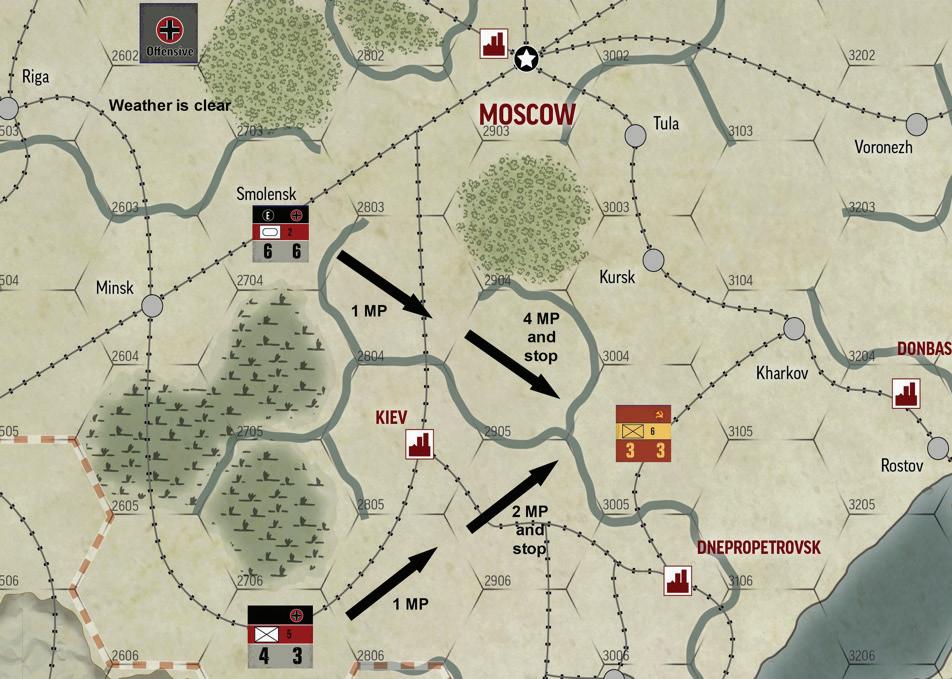
The Axis player moves an ARM and an INF unit adjacent to a Soviet 3-3 INF.
Boxes must use rail movement to come onto the board. Axis units move to and from the Western Europe Box by rail via hex 1906 (Hamburg). Soviet units move to and from the Urals Box by rail via hex 3802.
12.3 Reserves and Reserve Movement – At the end of the Movement Segment of Offensive Option turns (only), the phasing player may place up to four ECUs (only) in Reserve. Units to be placed in Reserve may not attack enemy units in the Combat Segment. Reserves must begin the Exploitation Segment adjacent to the ground combat units which have achieved a Breakthrough. A Reserve unit may move, at zero MP cost, to a Breakthrough hex and participate in Exploitation Movement after doing so. (See Section 13.10 Breakthroughs).
12.4 Railheads - A railhead functions in the same manner as a city hex for rail movement: units moving by rail must end their rail move
either in a city or a railhead. Players may build railheads at a cost of 1 RP per railhead.
12.5 ASU Movement - Air units may change base prior to normal movement in both the Movement and Exploitation Segments. This process is called staging.
An air unit may stage from one supplied friendly-controlled base to any other supplied friendly-controlled base up to twice its range. After staging, an ASU may assist the phasing player’s AV attacks and ground attacks, flying from its base to the target hex and returning to base when the battle is over.
Under an Offensive Option, ASUs may move and fight in both the Movement Segment and the Exploitation Segment.
12.6 Effects of Terrain on Movement – Ground units may always move one hex in the Movement Segment, regardless of any terrain considerations. Except on Snow turns (when swamps are frozen and treated as clear terrain), ECUs other than CAV units must stop when entering swamp hexes and
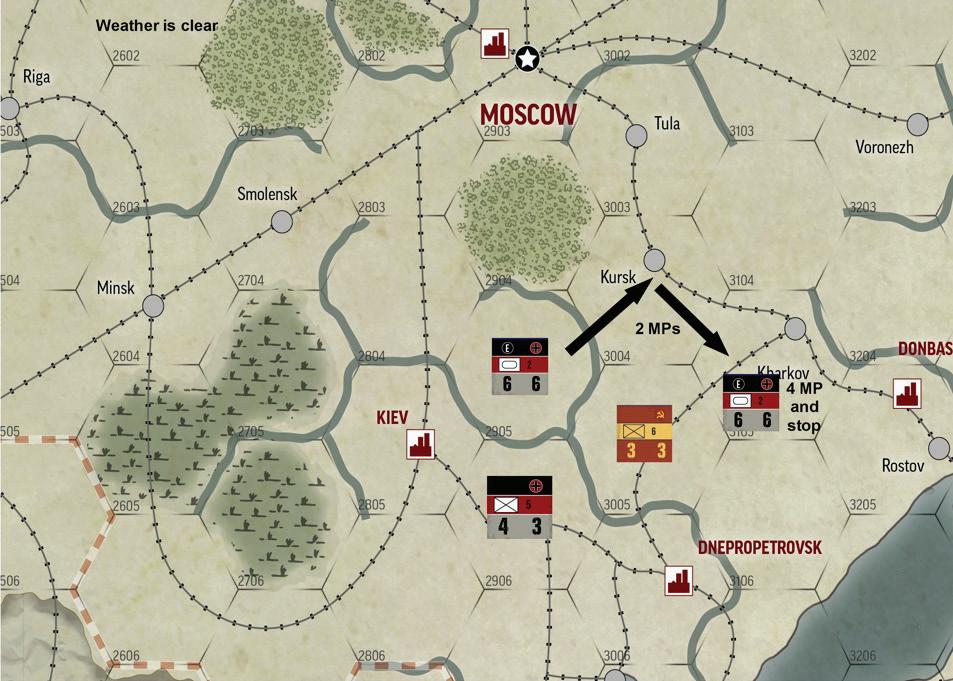
During the Exploitation Segment, the Axis player outflanks the Soviet 3-3 INF, moving through Kursk and into Kharkov.
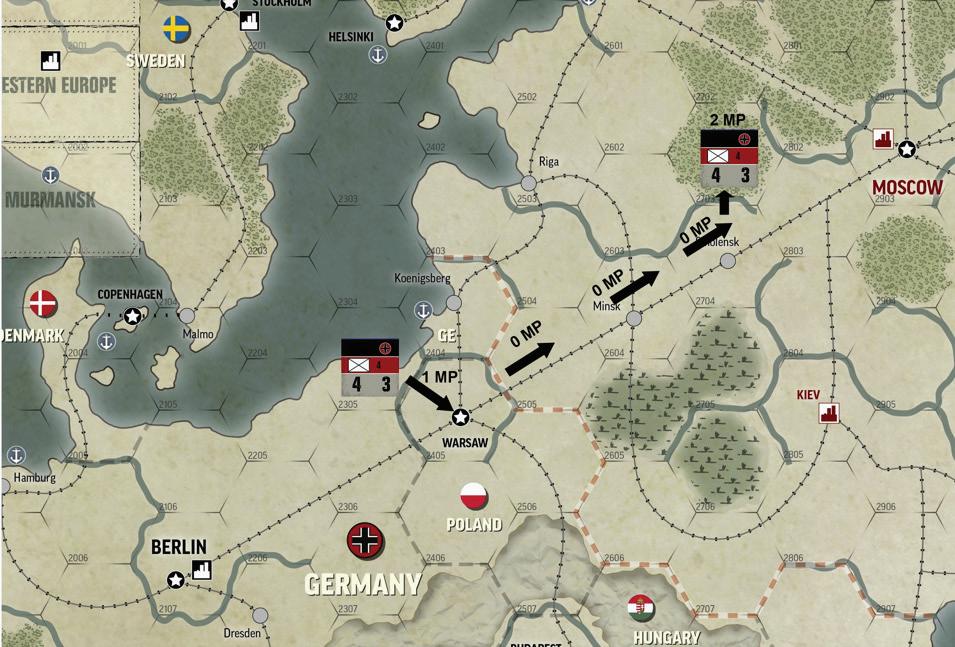
The Axis player uses rail movement to bring an INF unit closer to the front. The German 4-3 INF moves into Warsaw. Entraining in Warsaw costs nothing, since Warsaw is a city. The German INF moves along the rail line at zero MP cost. Detraining in Smolensk also has zero cost, as Smolensk is also a city. The German INF expends one more MP to move into forest hex 2703 for a total of 2 MPs expended in this move. The 4th INF could move one additional hex if desired, but chooses to halt in hex 2703.
may move only one hex per turn through swamps. ART units may not enter swamp hexes. See TEC for details on terrain effects.
12.7 Automatic Victory (AV) – During both the Movement and Exploitation Segments, the phasing player may automatically eliminate enemy ground units in an adjacent clear terrain hex if the ratio of attacking ground combat factors to defending ground combat factors is 8:1 or greater. Defending units are eliminated without a die roll on the CRT. AV attacks count as part of movement, not combat. All the ground units conducting an AV must attack from the same hex. Only ECUs may conduct AV attacks. Defending units in forest, swamp, mountain, fortification, or fortress hexes are not subject to AV attacks, nor are units attacked exclusively across river hex sides.
ASUs may assist ground units in conducting AVs, although no more than one ASU may assist each AV attack. An ASU may only assist one AV attack per Segment. Units conducting AV attacks pay an additional +1 MP to enter the target unit’s hex. AV attacks may not be conducted under Pass or Attrition Options.
12.8 Straits – The 2 straits on the map, the Kerch and the Istanbul straits, are bifurcated into Eastern and Western halves. Units move from one side to the other with a +1 MP movement penalty. Attackers across straits suffer an adverse one-column shift to the left; defenders receive a beneficial one-column shift to the right. A unit in the West box has a ZOC extending into the East box and vice-versa, as well as to adjacent hexes on their side of the strait box. See TEC.
13.1 Combat is Voluntary – Ground combat units are not required to attack adjacent enemy units, regardless of whether they are in one or more enemy ZOCs.
Each attack must be conducted against a single hex, and all defending units in the hex defend as a single entity. In any order, the phasing player announces and resolves his attacks, including any OAS assigned to those attacks. The non-phasing player may allocate DAS in response to the phasing player’s attacks. Combat is resolved on the CRT.
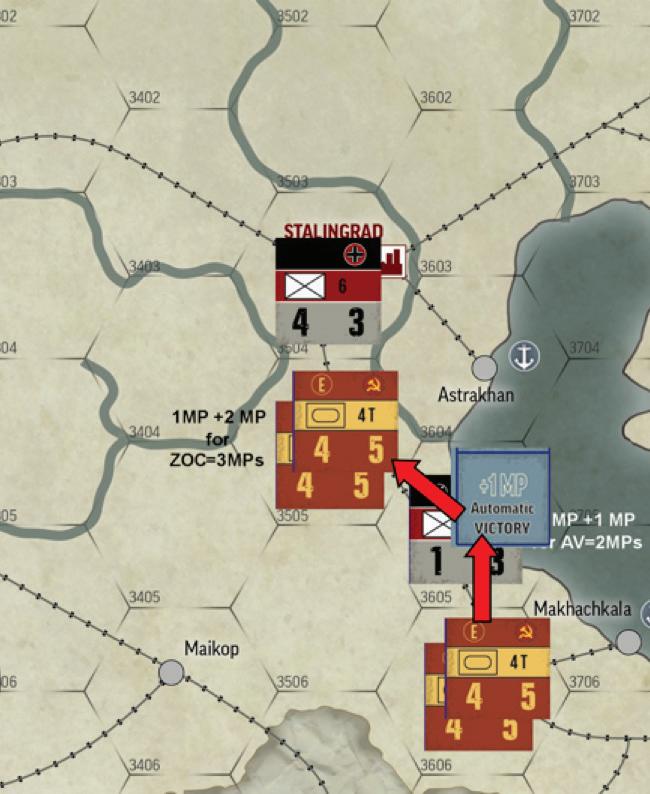
Assume clear weather. In the Movement Segment, two Soviet 4-5 ARM units AV a German 1-factor Security INF unit. Odds are 8-1, so the defending unit can be eliminated as part of movement, not combat.
The Soviets pay 1 MP to enter the 3rd Security’s hex, +1 MP to conduct the AV. The Soviet ARM units still have 3 MP’s left. They continue moving into hex 3505; the MP cost of doing so is 2 MPs (Movement Segment cost of entering the ZOC exerted by the German 4-3 INF in Stalingrad) +1 more for hex 3505 itself.
Thus the Soviet ARMs have moved as far as they can move during the current Movement Segment. If the Soviets chose to do so, the two 4-5 ARM units could attack the German 6th Army in Stalingrad during the Combat Segment.
If the Soviets chose an Offensive Option on the current turn, their two 4-5 ARMs could move again during the Soviet player’s Exploitation Segment.
13.2 Column Shifts and DRMs
The die roll on the CRT may be modified by air superiority, nationality, and/or exploitation effects.
13.2.1 Air Superiority – The player with air superiority over a target hex receives a beneficial one-column shift on the CRT – one column shift to the right if the phasing player has air superiority, or one column shift to the left if the defender does (See Section 6.8, Effect of Air Superiority).
13.2.2 Nationality - From the Summer 1941 turn through the Fall 1942 turn, during both Combat and Exploitation Combat, the Axis player receives a (beneficial) -1 DRM on the CRT.
Conversely, the Soviet player suffers an (adverse) +1 on the CRT during both Combat and Exploitation Combat on those turns.
From Winter 1942 through Summer 1943, the DRMs on the CRT are -0/+0. The nationality DRM does not apply if more than half the ground combat factors involved are Italian or German Minor Allied factors.
Nationality DRMs also do not apply when firing at (or firing from) fortification of fortress hexes.
13.2.3 Armor Superiority – The player with the larger number of ARM factors engaged receives a (favorable) -1 DRM when attacking. Conversely, the side with the fewest ARM combat factors engaged suffers an (adverse) +1 DRM when firing.
The DRM applies both to Combat and Exploitation Combat. If ARM factors engaged on both sides are equal, neither side has Armor Superiority. In that case, the DRM does not apply.
The phasing player may choose not to avail himself of the Armor Superiority DRM in a battle. If he does so, he may assign first losses to any of his engaged ground combat units. However, in any battle where he makes this choice, one of his ARM units must take the first depletion.
The Armor Superiority DRM does not apply in the Combat Segment or the Exploitation Segment if any of the defending units is in a city, IC, fortification, fortress, swamp, forest, or mountain hex.
13.3 Taking and Inflicting Losses - In the Combat Segment, the phasing player rolls first. Losses on the CRT are expressed in the number of depletions. For example, a “2” on the CRT means the enemy units in the target hex suffer two hits (aka depletions).
When a unit takes a hit, flip it over to its depleted side. If the unit takes a second hit, it is eliminated.
After the phasing player has fired, the non-phasing player selects a target hex and returns fire; the selected hex must be one of the hexes from which the attacker fired.
Excess hits (hits in excess of the total number of steps in the target hex) are ignored.
Firing is assumed to be simultaneous, so losses are not assigned until both sides have fired.
If a player makes use of the Armor Superiority DRM, one of his ARM units must absorb the first depletion inflicted by his opponent (Exception: In a counterattack, all losses are absorbed by one unit; see Section 13.5, Counterattacks).
13.4 Who May Attack and Be Attacked - Ground units may attack adjacent enemy ground units. Fortifications and fortresses may not attack adjacent enemy units, but may return fire when attacked.
A ground combat unit may only attack one enemy-occupied hex once per Combat Segment. (Note: AV attacks do not count as an “attack” under this paragraph, as AV attacks are part of movement, not combat).
Any number of ground combat units may participate in a single attack. If more than one enemy unit occupies a target hex, the defenders in a target hex must be treated as a unitary whole. The attacker may not assign some of his units to fire at one enemy unit and others to fire at a different enemy unit in the same hex.
With one exception, defending units in a single hex fire, and are fired upon, as a unitary whole. The one exception is counterattacks (see Section 13.5 Counterattacks).
13.5 Counterattacks – If the phasing player rolls a natural “11” or “12” on the GCRT, the phasing player inflicts no depletions. Instead, the non-phasing player fires at one of the phasing player’s attacking ground units (owning player’s choice). Double the non-phasing player’s combat factors. When firing, the nonphasing player’s target is not treated as a unitary whole. Instead, all losses from a counterattack must be assigned to the one target unit.
Excess hits are ignored. For example, the Axis player rolls a natural “11,” and a Soviet counterattack inflicts 3 depletions on an attacking German 4-3 INF. This unit has only two steps, so it is eliminated, and the excess hit is ignored. Column shifts and DRMs do not apply to counterattacks. If the non-phasing player himself rolls a “CA,” there is no counterattack to a counterattack. In that case, the result is a Contact, and the battle is over.
13.6 Determining Winners and Losers
- The side suffering the smallest losses is considered the winner. If losses are equal, a tie goes to the Axis player from Summer 1941 to Fall 1942 inclusive; a tie goes to the Soviets after Fall 1942. However, if neither player has inflicted any hits on his opponent, the result is a “Contact”: neither player advances or retreats.
Defending units may not advance after combat, even if they won the battle.
13.7 Retreats – In general, defeated units must retreat two hexes after losing a battle during the Combat Segment. However, units in fortifications and fortresses are not required to retreat. The owning player determines the path of retreat. Defeated Soviets units must retreat towards their supply sources, which are the eastern edge of the board, on or north of hex 4006 inclusive; the northern edge of the board, east of hex 2701 inclusive.
Example of Play: Breakthrough
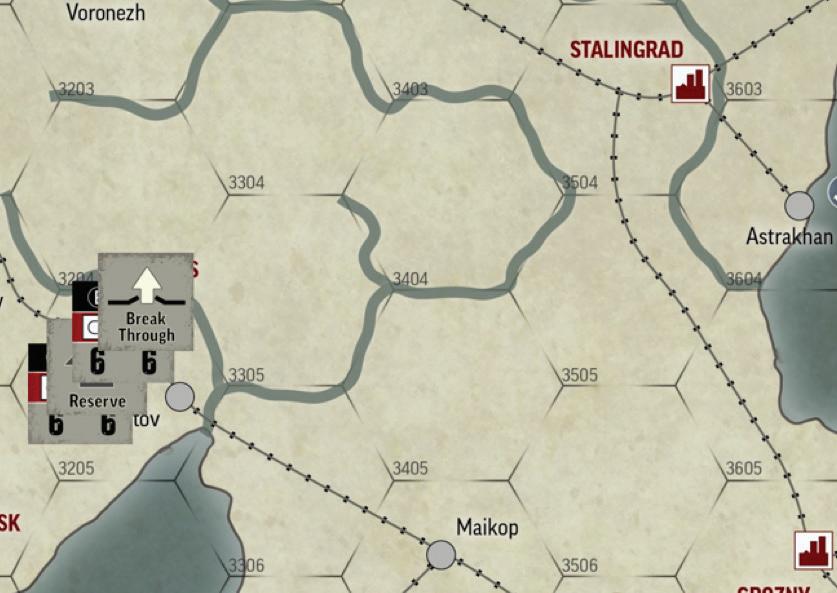
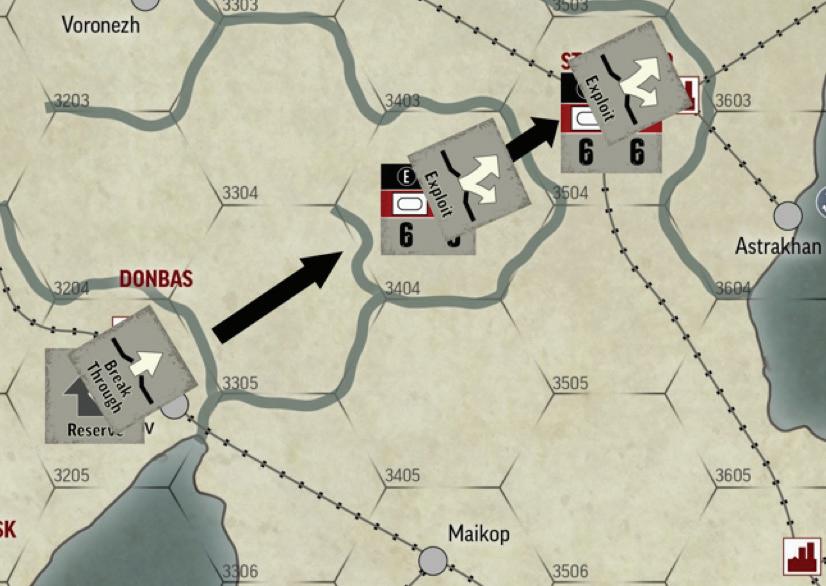
The Axis player has achieved a Breakthrough at Rostov during the Combat Segment. The weather is clear. The Axis player has chosen an Offensive Option for the turn. One of the victorious attackers, a 6-6 ARM unit, moved into the hex formerly occupied by a (now eliminated) Soviet unit. Another 6-6 ARM unit, which was in Reserve on a hex adjacent to the attackers, also moves into the hex.
The Axis player would prefer to move both of his 6-6 ARM units directly into Stalingrad, but must establish a chain of exploiting ARM units, each link in the chain not more than 2 hexes from either the Breakthrough hex, or another exploiting ECU. In this case, the German 3rd Panzer only goes as far as hex 3404; the 1st Panzer may then continue on into Stalingrad.
Defeated Axis units must retreat towards their supply sources, which are Berlin and Rome (for German and Italian units, respectively), or towards their national capitals (for Axis Minor Allied units).
Defeated units may not retreat towards an enemy supply source, even if they have a clear path of retreat in that direction. They are eliminated if forced to do so. Units may retreat through enemy ZOCs, provided friendly ground units occupy them. Otherwise, units forced to retreat through enemy ZOCs are eliminated.
13.8 Advance After Combat - Victorious attacking ground units may advance one hex after combat during the Combat Segment. The hex occupied must be vacated by the defeated enemy unit(s). Except on Snow turns (when they are frozen), ECUs may not advance after combat into swamp hexes.
13.9 Effects of Terrain on Combat – See TEC.
13.10 Breakthroughs – If the phasing player has successfully attacked a hex occupied by enemy ground combat units during the Combat Segment, he may achieve a Breakthrough in the target hex.
Breakthroughs may not be achieved against enemy units in swamp or mountain hexes.
At least one ARM unit must participate in an attack to create a Breakthrough.
OOS units cannot create Breakthroughs.
The phasing player may stack up to five ground combat units (including up to 2 Reserve units) in the Breakthrough hex (See Section 12.3 Reserves and Reserve Movement above). The five-unit limit is absolute – a player may not place any additional units in a Breakthrough hex even if those units would not ordinarily count towards stacking, such as elite and/or ART units.
All the ECUs in a Breakthrough hex, including over-stacked units may attack during the Exploitation Segment (see below).
ECUs moving beyond the Breakthrough hex are subject to normal stacking limits. The temporary over-stacking in Breakthrough hexes allowed under this section must be cured by the end of the Exploitation Segment (see below), or the over-stacked units are eliminated.
ECUs can conduct Exploitation Movement even if the owning player did not achieve any Breakthroughs during the Combat Segment.
14.1 Exploitation Movement and Combat – Only ECUs in regular supply at the beginning of the Exploitation Segment may conduct Exploitation Exploit Movement and Combat.
ECUs conducting Exploitation Movement move at their printed MP allowance -1 MP
ECUs may move into and through enemy ZOCs during the Exploitation Segment. These units pay +1 MP to enter each enemy ZOC.
Defending units are subject to AV attacks during Exploitation Movement. Double the attacker’s losses when attacking fortifications or fortresses during Exploitation Combat.
ECUs may move into swamp hexes during Exploitation Movement. However, exploiting ECUs must stop at the first swamp hex they move into, and move no further during the current turn.
14.2 Axis Exploitation Segment – There is no Axis Exploitation Segment under a Pass or an Attrition Option. However, if the Axis player chose an Offensive Option, his ECUs (only) may move and fight again in Exploitation Segment.
Surviving defeated units must retreat 3 hexes after Exploitation Combat. After all defeated units in the target hex have been eliminated or forced to retreat, victorious ECU attackers may advance up to 2 hexes after Exploitation Combat. The first hex must be the hex vacated by the defeated unit(s).
14.2.1 Chain of Exploiting ECUs - The phasing player is not required to conduct Exploitation Movement out of Breakthrough hexes, but if he does, he must have a chain of exploiting ECUs. Each exploiting ECU must be within two hexes of either the breakthrough hex or another exploiting ECU from the same breakthrough.
Exploiting ECUs that moved more than two hexes must duplicate the movement path of the previous unit exploiting
14.0 Exploitation Segment
Break Through
from the same breakthrough hex, and then move no more than two additional hexes beyond the previous ECU in the chain. The chain created by the movement of exploiting armor may not be broken by advances after Exploitation Combat. The elimination of exploiting ECUs in combat after Exploitation Movement, has no adverse effect on other exploiting ECUs, even if their elimination breaks the chain.
Combat Example - It is the Summer 1942 turn. The Axis player has obtained a Breakthrough at Rostov. One Axis ECU plus one Reserve ARM unit exploit out of the Breakthrough hex. Assume there are no Soviet units in the direct path of hexes from Rostov to Stalingrad. The Axis player would like to move both of his exploiting ECUs into Stalingrad during Exploitation Movement. But he cannot do so since Stalingrad is three hexes from Rostov. Therefore, the Axis player moves one of his exploiting ECUs two hexes from the Breakthrough hex, and the second one the one additional hex into Stalingrad.
14.2.2 Over-stacking - Over-stacking in Breakthrough hexes must be cured by the end of advance after Exploitation Combat or else the over-stacked units are eliminated.
14.2.3 Post-Exploitation Air Redeployment - At the end of his Exploitation Segment, a player may use air redeployment to move up to two ASUs and two airbases from any friendlycontrolled clear terrain hexes to any other friendly controlled clear terrain hexes within twice their printed air range.
Air redeployment does not count as a mission. ASUs may air redeploy to bases in enemy ZOCs, provided the airbase is occupied by a friendly ground unit. Airbase units may redeploy through enemy ZOCs, provided they are occupied by friendly units, and provided the destination hex is occupied by friendly units.
14.3 Soviet Exploitation Segment – If the Soviet player chose a Pass or an Attrition Option, skip this step – there is no Soviet Exploitation Segment. If he has chosen an Offensive Option, the Soviet player conducts his Exploitation Segment in the exact same manner as the Axis Player - his ECUs may move and fight a second time in the same turn.
Combat Example – It is Fall 1941. The weather is Clear. The Axis player has moved one 6-6 armor unit and one 4-3 infantry unit adjacent to Kiev. One 4-3 Axis ASU based in Minsk flies to Kiev to assist in the Axis ground attack on that city.
The Soviet player has two 3-3 infantry units in Kiev and one 3-3 ASU based in Dnepropetrovsk.
The Soviet player has two 3-3 infantry units in Kiev and one 3-3 ASU based in Dnepropetrovsk.
The Axis player announces his attack.
The Soviet ASU flies from its base to Kiev and intercepts the incoming Axis air unit. Air combat is resolved first. The Axis 4-3 ASU fires at the Soviet 3-3 ASU and rolls on the “4-6” column of the ACRT. He gets a “6,” modified to a “4” for Air Nationality, inflicting two hits. The Soviet ASU will be eliminated, but not before it has a chance to return fire.
The Soviet player rolls on the “1-3” column on the ACRT, and gets an “8,” modified to a “10” for Air Nationality, which is a miss. The Soviet ASU is eliminated. The Axis 4-3 ASU will assist the Axis ground attack.
The Axis player has 14 combat factors (10 ground combat factors and 4 ASU combat factors), so he refers to the “13-15” column on the CRT. However, since he has air superiority, he will roll on the “16-18” column on the CRT. He also receives a -1 DRM for Nationality. He rolls an “8,” modified to a “7” scoring two hits.
The Soviet player suffers two ground unit depletions. He can assign them as he chooses: one hit may be assigned to each of the infantry units, or both to one of the defending infantry units, which would eliminate it.
But the Soviet player fires back before losses are assigned. He has 6 combat factors engaged, so he refers to the “4-6” column on the CRT. However, the Axis player has air superiority, so the Soviet player suffers an (adverse) one-column shift to the left. He also suffers a +1 DRM for Nationality and another +1 because the Axis player has Armor Superiority.
Thus, the Soviet player rolls on the “1-3” column on the CRT with an (adverse) total DRM of +2. He rolls a “3,” modified to a “5,” which inflicts one depletion on the Axis player.
The Soviet player now flips both of his 3-3 INF units to their depleted sides.
The Axis player flips his 6-6 ARM unit to its depleted side.
The Soviet player lost this battle, so he must retreat his surviving infantry units two hexes. The victorious (but depleted) 4-6 Axis ARM and the Axis 4-3 INF advance one hex into Kiev.
Because the Axis attack included an ARM unit, Kiev is a Breakthrough hex (see Section 13.10 Breakthroughs). The Axis ASU flies back to Minsk.
The eliminated Soviet ASU is placed in the Unbuilt Soviet Units Box.
If he chose an Offensive Option, the Axis ARM unit in the Breakthrough hex and the Minsk-based Axis ASU may move and fight again the Exploitation Segment. If he does so, he will receive a -2 DRM versus any Soviet unit or units he fights during Exploitation Combat: -1 for Nationality, and -1 for Armor Superiority.
15.1 Checking Supply - Supply lines are checked at the beginning of the Initial Supply and Production Segment, during the Combat Segment, and again during Exploitation Segment.
In general, air and ground units must be able to trace a supply line, free of enemy ZOCs from the hex they occupy back to a supply source.
Berlin is the source of supply for German units. Rome is the source of supply for Italian units. Home country capitals are supply sources for Axis Minor Allied units. The eastern edge of the map board and the north edge on and east of hex 2701 (inclusive) are supply sources for the Soviets. Supply lines may be of any length.
15.2 Tracing Supply Lines – Generally, if a unit cannot trace a supply line free of enemy ZOCs, it is out of supply (OOS). An exception applies to Breakthrough hexes, and ECUs exploiting out of them. Units in Breakthrough hexes, and any ECUs exploiting out of them, are said to be in Exploitation Supply. These units treated as being in supply from their current Exploitation Segment until the end of their next Combat Segment. Exploiting units must be placed back in regular supply by the end of their next Combat Segment, or else they will be eliminated.
The Axis player obtains a Breakthrough in the Summer 1941 Combat Segment. Assume he has one 4-3 INF, one Reserve ARM, two other ARM units, and one ARM INF in a Breakthrough hex. The ARM and ARM INF units conduct Exploitation Movement from the Breakthrough hex. The INF in the Breakthrough hex and the exploiting ARM/ARM INF units are treated as in supply throughout the Soviet player’s Summer 1941 turn, and throughout the Axis player’s Fall 1941 Movement and Combat Segments. The Axis player must be able to trace regular supply lines supply for these units by the end of the Axis Player’s Fall 1941 Combat Segment, or they will be eliminated OOS. When tracing supply to Berlin, the path can go through any friendly-controlled hex, in any country.
15.3 Out of Supply (OOS) Units – Players check supply at the beginning of their player turn and the end of it. Supply for ECUs that exploited on the previous game turn is checked at the end of the Combat Segment.
by the stack.
If a friendly ASU is OOS at the end of a player’s turn, it is immediately depleted and must fly to the nearest friendly city within twice its printed range.
OOS units that were OOS at the beginning of a player’s turn are eliminated if they cannot trace a supply line at the end of it.
For example, an Axis attack during the Summer 1941 turn has placed a Soviet 4-5 ARM OOS. The Soviet player must re-establish a normal supply line to this unit by the beginning of the End Segment of the Summer 1941 turn, or the Soviet 4-5 ARM will be eliminated OOS.
A Soviet attack on the Winter 1941 turn has placed a German 6-6 ARM OOS. The Axis player must re-establish a normal supply line to this unit by the end of the Axis player’s Spring 1942 turn, or the German 6-6 ARM will be eliminated OOS.
15.4. OOS Fortresses - The exception to Section 15.3 above applies to ground units in fortresses. An OOS fortress garrison suffers one depletion at the end of the Second Supply Check Segment –that’s one depletion per hex, not one depletion per unit. OOS ground units in a fortress do not have their defense strength halved. OOS units may not be repaired.
Note: Fortifications and fortresses are depleted or eliminated only after all units inside of them have been eliminated.
15.5 ICs and Supply - ICs must be in supply to produce RPs. If an IC cannot trace a supply line at the beginning of the phasing player’s turn, it may not produce any RPs on the current turn. An IC may resume production when the owning player has re-established a supply line to it.
OOS units may not move but may attack adjacent enemy units. OOS units attack and defend at half their printed value (round down), Rounding is by the individual unit, not
16.1 Weather Table
The Axis player rolls for weather on Fall, Winter, and Spring turns:
conditions apply to Soviet ground units other than Siberian units. Neither Axis nor Soviet ASUs may conduct any missions, nor may they redeploy.
The Axis player may not choose an Offensive Option on Arctic turns, even if he has the RPs to pay for one. During the Initial Supply Check and Admin Segment on Arctic Winter turns, the Axis player must deplete two ARM, two INFs, and two ASU, due to insufficient preparation for extreme weather conditions.
16.5 Weather Effects on Rail Movement – Rail movement is unaffected by mud, snow, or Arctic conditions.
17.0 Victory
16.2 Weather Effects of Mud – All INF and ART units incur a -1 MP, and ECUs incur a -2 MP movement penalty during both the Movement and Exploitation Segments on Mud weather turns.
16.3 Weather Effects of Snow – On Snow turns, all Mud weather effects apply to all Axis and Soviet ground units other than Siberian units.
In addition, rivers and swamps are considered frozen and treated as clear terrain. ECUs may advance after combat into swamps on Snow turns. All ASUs lose 1 MP from their air range on Snow turns.
Normal air superiority column shifts do not apply on Snow turns, nor may ASUs redeploy.
The Axis player suffers an (adverse) two-column shift to the left when firing on both the CRTs on Snow turns. The Soviet player receives a (beneficial) two-column shift to right when firing on both the CRTs on Snow turns.
The Axis player draws two fewer RPTs and the Soviet player draws two additional ones on Snow turns. During the Initial Supply Check and Admin Segment on Winter Snow turns, the Axis player must deplete one ARM, INF, and ASU, due to insufficient preparation for severe conditions.
16.4 Arctic Weather – Under Arctic conditions, Axis INF and ART units lose 2 MPs and Axis ECUs lose 3 MPs. All Snow
The Axis player wins the game if Leningrad, Moscow, Grozny, and Stalingrad are all occupied by Axis ground units at the conclusion of the End Segment of any game turn. The Soviet player wins if he controls Leningrad, Moscow, Stalingrad, Grozny, Riga, Kiev, Dnepropetrovsk, and Sevastopol at the conclusion of the End Segment of any game turn. The game is a draw if neither player has achieved the above victory conditions by the end of the Summer 1943 turn.
18.0 Special Rules
18.1 Axis Initial Surprise – In addition to any other column shifts which may apply, all Axis ground and counter-air die rolls on the ACRT and the CRT receive a (favorable) one column shift to the right when firing on the Summer 1941 turn.
All Soviet units suffer an (adverse) one column shift to the left on both combat tables when firing on that turn. Axis ASUs counter-airing Soviet ASUs do not suffer from asterisked flak results on the ACRT on the Summer 1941 turn. There is no RPT draw on the Summer 1941 turn: the Axis player automatically receives an Offensive Option; the Soviet player automatically receives an Attrition Option. The Axis player also receives 2 bonus RPTs on the Fall 1941 turn.
18.2 Workers and Peasants Mobilized – The Soviet player receives 4 additional RPTs and two free fortifications on the Fall 1941 turn, to reflect Soviet mobilization of labor and industry, the call-up of Soviet reserves, and the conscription of civilian labor for building defensive works. Soviet mobilization is a one-time event and has no effect on future Soviet production.
SNOW
18.3 Axis Minor Allies – The Hungarian army may not stack with Romanian army units.
An Axis Minor Ally immediately surrenders whenever a Soviet ground unit occupies the Minor Country’s capital. Unless the players are using Optional Rule 20.12, Aggressive Finland, the Finnish army may only make one attack per calendar year, and may not fire in conjunction with German or other Axis Minor Ally units. The Finnish Army may not move more than three hexes from Finland. Soviet ground units’ combat factors are doubled when firing at any hex where more than half the Axis combat factors are Italian or Axis Minor Allied factors; the Soviets do not receive this benefit when attacking the Finnish Army.
18.4 Axis Recovery – After the Wehrmacht’s traumatic experience in the Winter of 1941-1942, it recovered to launch a second major effort to destroy the Soviets in the Summer of 1942. Accordingly, the Axis player receives three bonus RPTs on the Summer 1942 turn.
The Axis player also receives two bonus RPTs on the Summer 1943 turn, to reflect the German buildup for Operation Zitadelle.
18.5 Free Siberian Units – Soviet Siberian units are received at zero initial cost. These units are not actually newly-created units – they represent transfers from the Soviet Far East. If these units are eliminated or depleted, they are rebuilt or repaired at normal construction costs.
19.0 Optional Variants
To increase replayability, players may wish to use variants. Variant cards are placed face-down off to the side of the board, just as they do with RPTs. The card draw is free on the Summer 1941 turn; afterwards, players pay one RP for a variant draw. Each player may draw one variant card each Summer turn.
Each card is numbered. After drawing a variant card, a player rolls one die. On a 1-3, the player succeeds and receives the variant. If he rolls a 4-6, or the variant cannot yet be played, he fails and the variant is returned face down to the variant deck. After a successful draw, if a variant card indicates that it is a one-time event, remove it from
the variant deck after playing it. If not, return the card, face-down, to the variant deck (or chit pool if using chits). If the variant takes place on a future turn, a player may save it and play it when it becomes available.
The provided variant chits may be used instead of cards. The number refers to the variants indicated below:
19.1 Axis Variants
#1 General Vlasov’s Army – The Axis player may build two 1-3 infantry units of the Russian Liberation Army, provided the Axis player controls Riga, Minsk, Kiev and Dnepropetrovsk.
RLA units may be built at a rate of one per turn and may be built in any Axis-controlled IC. RLA units may be rebuilt if eliminated.
Playable: one time; Summer 1942 or later.
#2 Ukrainian Nationalists – The Axis player may build one 2-3 Ukranian infantry unit, provided he controls Kiev. The unit must be built in Kiev. It may be rebuilt if eliminated.
Playable: one time; Fall 1941 or later.
#3 Motorization – Germany increases output of trucks and halftracks. Germany may exchange one 4-3 infantry army for one 4-6 Panzer grenadier (armored infantry) unit. Armored infantry may move and fight during the Exploitation Segment like armor units can.
Playable: one time; on any turn.
#4 Spanish Volunteers – Spanish dictator Francisco Franco sends anti-Communist volunteers to join the crusade against Bolshevism. The Axis player receives one 1-3 Spanish infantry. The unit appears in the Western Europe Box and moves by rail from there onto the board.
Playable: one time; Spring 1942 or later.
#5 Rail Conversion – Germany assigns more construction units to railroad maintenance in occupied Europe and (in the Soviet Union) to converting Soviet-gauge railroads to European gauge. The Axis player may move one additional unit each turn by rail.
Playable: two times; Fall 1941 or later.
#6 Siege Artillery – Germany sends more large caliber siege guns to the East. Germany adds one 10-2 ART to its force pool. This unit costs the
same as regular ART but may only fire at fortifications or fortresses. Playable: one time; Spring 1942 or later.
#7 Tigers and Panthers – Germany experiences fewer teething troubles in its Tiger and Panther tank programs. German 8-6 armor unit early.
Playable: one time; Fall 1942 or Winter 1942.
#8 Turkey Joins the Axis – Turkey decides to enter the war against their traditional Russian enemies. Turkey becomes an Axis Minor Ally. Place two Turkish 4-3 infantry units anywhere in Turkey.
Playable: one time; any time, but only if Sevastopol is Axis-controlled.
#9 Vichy Volunteers – Anticommunist volunteers from Vichy France join the crusade against Bolshevism. Add one 1-3 INF to Axis force pool. If eliminated, this unit must be rebuilt in the Western Europe Box and comes onto the board by rail.
Playable: one time; Spring 1942 onward.
#14 Second CSIR – Mussolini authorizes a second expeditionary corps (Corpo di Spedizione in Russia) to be sent to the East. Add one 2-3 Italian INF to the German force pool.
Playable: one time; any turn before Fall 1942.
#15 Urals Bomber – Germany abandons accident-prone He-177 and embarks on major four-engine long-range bomber program. The Axis player may build two strategic bombers, at a cost of 4 RPs each. Each SB may roll one die (1d6) per turn; a “1,” “2,” or “3” indicates how many RPs are lost by the Soviet player; a “4” or a “5” are a miss; and the SB is eliminated (due to Soviet flak and local fighters) on a “6.” Playable: one time, Summer 1942 onward.
#16 POW Labor – Germany puts millions of Soviet POWs to work rather than starving them to death in POW cages. Add two 5-factor RPTs to the Axis RPT pool.
Playable: one time, Fall 1941 onward.
#10 Winter Preparation – Germany makes better preparations for winter campaigning. Axis player now suffers only a loss of 1 RPT on winter turns and a one-column shift to the left when firing on Winter turns. Soviet player only receives a one-column shift to the right on Winter turns.
Playable: one time; Winter 1941 or Winter 1942.
#11 Self-Propelled Artillery – Germany develops Hummel and Wespe self-propelled artillery. Like other artillery, the SPA unit does not count towards stacking limits. However, the SPA unit can move and fight in the Exploitation Segment.
Playable: one time; Spring 1943 onward.
#12 Hiwis – Soviet turncoats assist German forces. Germany may repair one infantry unit each turn at Soviet expense.
Playable: two times; on any turn.
#13 Swedish Volunteers – Sweden permits active German recruiting of Swedish anti-communist volunteers. Add one 2-6 SS ARM INF (unbuilt) to the German force pool.
#17 Tank Production – Germany addresses its low tank production. Reduce the cost of building/repairing Axis ARM units by 1 RP
Playable: one time; Spring 1942 onward.
#18 Balkan Minor Allies – Croatia and Bulgaria declare their support for the Reich. Add one 1-3 Croatian INF and one 2-3 Bulgarian INF to Axis force pool. The units may operate only in Bulgaria, Greece, and Yugoslavia.
Playable: one time; any turn after the Soviets have played Soviet Variant #5, Tito’s Yugoslav Partisans.
#19 Reza Shah Sides with the Axis – Tensions with both Britain and the Soviet Union lead Persian ruler Reza Shah to resist Anglo-Soviet pressure and throw in his lot with the Axis. Add one 1-3 and one 2-3 INF to the Axis force pool. Persian units may operate in Persia and the Soviet Union. Playable: Summer 1941 onward.
Playable: one time; on any turn before Fall 1942. This unit appears in Stockholm and must be rail moved (technically railed + ferried) from there.
#20 Italy Develops Heavy Tanks – Italy responds to reports on the Soviet T-34 by developing its own heavy tanks and sends them to the Eastern Front. The Axis player receives one 2-6 Italian ARM at zero initial cost.
Playable: Summer 1943.
19.2 Soviet Variants
#1 Recruits from the Gulags - Soviets free thousands of “enemies of the people” from gulags on condition they join the Red Army. Soviets receive one 2-3 infantry at zero cost, although they pay normal construction cost if the unit is eliminated and rebuilt. This unit appears in the Urals Box and enters the board by rail.
Playable: two times, on any turn.
#2 Building Socialism – Workers’ output increases with the imposition of 12-hour days, seven days a week. The Soviet play receives 3 bonus RPs. Return this card to the Variant deck after playing.
Playable: any number of times; on any turn.
#3 Digging In – Soviets receive two free fortifications this turn. Place on any Sovietcontrolled clear terrain hex.
Playable: two times; on any turn.
#4 Transfers from the Far East – Stalin orders the Far Eastern Soviet army to stand down on the Manchurian border. The Soviet player receives one 4-5 armored unit and one 3-3 infantry. These units are received at zero cost, but normal construction costs apply if they are eliminated and rebuilt. They appear in the Urals Box and enter the board by rail.
Playable: one time; on any turn.
immediately and permanently remove one 4-3 ASU from his force pool. Playable: one time; Summer 1942 or later.
#8 Industrial Evacuation – The Soviet player may relocate the Leningrad and Moscow ICs to the Urals, at a cost of 1 RP each. An IC must be in supply to be evacuated.
Playable: one time; on any turn.
#9 Women Comrades – Soviet women join the armed forces in non-combat jobs, freeing up men to fight in combat units. Soviets may rebuild two 3-3 INF units at zero cost.
Playable: two times; on any two consecutive turns.
#10 Queen of the Battlefield – Stalin pronounces artillery to be the queen of the battlefield and orders higher priority for artillery production. Add one 5-3 artillery to Soviet force pool. Playable: one time; Spring 1942 onward.
#11 Mobile Artillery – Soviets develop Katyusha truck-mounted rockets and self-propelled artillery units. Add one 3-5 self-propelled artillery unit to Soviet order of battle. This unit cost the same as infantry or artillery but may move and fight during the Exploitation Segment.
Playable: one time; Spring 1942 onward.
#5 Tito’s Yugoslav Partisans – (Available only if using Optional Rule 20.4 Soviet Partisans)Soviets may build one 1-3 partisan in Yugoslavia. This unit may only operate in Yugoslavia and Greece. It appears on any hex within two hexes of Belgrade. Playable: one time, on any turn.
#12 Logistics – Soviets improve logistical support for their armies. Reduce the cost of Soviet options for the rest of the game: Attrition Options now cost 2, and Offensive Options now cost 4. Playable: one time; on any turn.
#13 Blocking Units – In any one battle each turn where defeated Soviet units have been forced to retreat, the surviving unit(s) are eliminated instead. However, the Axis player suffers one additional depletion as Soviet units fight to the death.
#6 Soviet Cities Besieged – Soviets mobilize local militias to mine and booby-trap approaches to Soviet cities. On the current turn and all future turns Soviet defenders receive +2 combat factors when returning fire from any friendly-controlled city hex in the Soviet Union. Playable: one time; on any turn.
#7 Air Defense over the Reich – Western Allied bombing forces Germany to devote more resources to air defense. The Axis player must
Playable: once per turn, immediately after rolling for any battle on the CRT; beginning on any turn.
#14 RAF to the Rescue – Churchill, worried about an imminent Soviet collapse, authorizes sending an entire RAF unit to aid the devastated Red Air Force. Soviets receive one 4-3 British ASU at zero initial cost. If this unit is depleted or eliminated, the Soviets pay normal construction costs to repair or rebuild it. The Axis player receives no air nationality DRM in any air
battle where 50% or more of the air combat factors engaged are British.
Playable: any turn from Summer 1941 through Spring 1942.
#15 Soviet Infantry Upgrades – Once per turn beginning Winter 1942, the Soviet player may exchange two fully-supplied 2-3 Soviet INF units for one 4-3 Soviet INF. Each upgrade costs 1 RP. The units to be exchanged may not be in an enemy ZOC. Playable: Winter, 1942 onward.
#16 Soviet Armor Upgrades – Once per turn beginning Winter 1942, the Soviet player may exchange one fully-supplied 4-5 ARM unit for one 5-5 ARM. Each upgrade costs 2RPs. The units to be exchanged may not be in an enemy ZOC.
Playable: Winter, 1942 onward.
#17 Aircraft Production – Soviets accelerate and expand production of improved aircraft designs. Add two 4-3 ASUs (unbuilt) to Soviet force pool. Playable: one time; Winter 1942 onward.
#18 Flak Production – Soviets beef up flak production and airbase defenses. Add +1 to all Axis counter-air die rolls on the ACRT.
Playable: two times; from Fall 1942 onward.
#19 Weatherized Red Army – The Red Army adapts its tanks and non-armored vehicles to severe winter conditions. Soviet ECUs now only suffer a -1 MP on Snow and Arctic weather turns.
#20 Soviets on the Alert – Stalin heeds warnings from Churchill and his own spies about the Barbarossa buildup. Soviet units on full alert on the Summer 1941 turn. The Axis player still receives extra RPTs on the Summer 1941 turn. Axis player ignores all beneficial CRT special shifts but DRMs still apply. Soviet airbases may fire flak. Soviet air units may intercept Axis ASUs.
20.0 Optional Rules
20.1 Ports – Under this optional rule, players may trace supply by sea, from one friendlycontrolled port to another, provided the supply line can be eventually traced by land to a supply source.
Units whose only supply line is traced through a port suffer an (adverse) one-column shift to the left when firing.
Sea supply lines to ports may be interdicted by ASUs within air range of the port. Friendly ASUs may intercept sea supply interdictions; the supply is considered cut only if the interdicting ASUs win the air battle over the target hex. Sea supply interdictions do not count towards the two ground support missions limit imposed by the standard rules.
20.2 Stockpiling Supply – Under the standard rules, all unused RPs are discarded at the end of each game turn. Under this optional rule, a player may retain up to 50% (round down) of his unused RPs and use them on the following turn. Players should use the Resource Point Track to monitor their RP levels.
20.3 Murmansk Box – From Fall 1941 onward, the Axis player may assign an ASU to the Murmansk Box to try to interdict Western Allied Lend-Lease shipments to the Soviets, regardless of which option he may choose that turn. The ASU may be either full-strength or depleted. The Axis player may move an ASU to the Murmansk Box prior to the Soviet RPT draw. Each time the Soviet player draws a Lend-Lease RPT chit, the Axis player may roll one die for each chit. On a 1-3, the RPs attributable to that chit are lost. On a 4-6, the Axis interdiction fails. Axis player receives a (favorable) -1 DRM on Summer turns, and an (adverse) +1 on winter turns.
ASUs assigned to the Murmansk Box return to base at the end of their turn and may not perform any other missions on the turn they are assigned to convoy interdiction.
20.4 Soviet Partisans – The Soviet player may create two partisan units, at a cost of 1 RP each. Only one partisan per turn may be created.
Partisans may be created in any Axis ZOC or Axis-controlled hex in the Soviet Union but may not be created in Axis-occupied hexes.
Partisans may move through enemy ZOCs during the Movement Segment – they pay no MP penalty for doing so. Partisans may not attack but may return fire if attacked. They may not be repaired – partisan units are eliminated if they take a hit in combat.
Partisans need not trace supply lines – they are always in supply.
Axis units may not move by rail through partisan-occupied hexes. Soviet partisans may not operate outside the Soviet Union.
Partisans do not exert ZOCs.
20.5 Hidden Soviet Resources – The Soviet player need not disclose the results of his RPT draw and option selection to the Axis player during the Initial Supply Check, Production and Weather Segment. He may wait until the beginning of the Soviet Movement Segment to disclose the results of his RPT draw and option selection. He pays for his option selection only upon disclosure.
20.6 Sea Movement – During the Movement Segment, each player may move one ground unit per turn from one friendly-controlled port to another, provided no enemy units are adjacent to either the embarkation or debarkation ports.
20.7 Transfers from the Med – After Rommel takes Tobruk, Germany transfers the Afrika Korps and its air support from the Med to the Eastern Front.
Axis player loses his 2-3 Italian INF (sent to North Africa to replace transferred German units) but receives one 4-6 ARM and one 2-3 ASU. These unit appear in Naples on the Summer 1942 turn.
20.8 Initial Cost of Italian and Axis Minor Allied Units
Under this optional rule, Romanian, Hungarian, and/or Italian reinforcements are received at zero initial cost. However, if they are depleted or eliminated, the Axis player pays normal construction costs to repair or rebuild them.
20.9 Airbases
Under the standard rules, only cities may function as airbases. This convention removes a layer of realism for simplicity’s sake. Alternatively, players may wish to build airbases to facilitate air operations. Both sides may build airbases at a cost of 1 RP/base, at a rate of up to two per turn. One ASU may be based at each airbase.
Airbases are automatically eliminated and returned to the force pool if occupied by an enemy ground combat unit. They may not be repaired. Airbases may only be built on clear or forest hexes. They may be built in enemy ZOCs, provided that a friendly unit occupies the airbase hex. They may be placed in cities, in which case two ASUs may be based in the city/airbase hex. The number of airbases each side may build is limited by the counter mix. All airbases are assumed to have flak.
A Player may build a new airbase by dismantling (removing) an existing airbase and placing a new one in an eligible hex.
20.10 Air Supply – Under this optional rule, up to two Axis ground combat units which would otherwise be OOS may be supplied by air. If two ground units are to be supplied, they must occupy the same hex. They must be within the air transport unit’s range.
Air supply missions may not be conducted on Snow or Arctic weather turns.
The air supply unit may be intercepted over the target hex by enemy ASUs; conversely, they may also be escorted by friendly ASUs. If intercepted, an unescorted air supply unit is automatically eliminated. If escorted, the supply mission only succeeds if the Axis player wins the air battle and the air transport unit survives.
The air transport unit has no combat value and is eliminated if depleted. Air supply missions do not count towards the two-mission limit imposed by the standard rules.
20.11 Free Soviet Initial Setup – Under this optional rule, the Soviet player may set up his initial forces anywhere within the Soviet Union.
20.12 Aggressive Finland – Under this optional rule, the Finnish Army may attack Leningrad (or any other Soviet-occupied hex) within three hexes of Finland.
20.13 German Manpower Drain – Under this optional rule, the Axis player loses some German manpower each turn, regardless of any other outcomes on the CRT. Losses are based on the overall intensity of the Soviet war effort.
On any Soviet Attrition Option turn, the Axis player must deplete one German INF unit; on any Soviet Offensive Option turn, the Axis player must deplete two German INF units.
Depletions are taken during the End Segment and must be taken from supplied German INF units only. The Axis player chooses which German INF units to deplete, but if possible, depletions must be taken from German INF units in Soviet ZOCs.
20.14 Syria and Iraq – Hexes in Syria and Iraq are not ordinarily playable in the Standard game. However, in the unlikely event that both Persia and Turkey join the Axis, the designer recommends making Syria and Iraq playable hexes.
Designer’s Notes
Breakthrough Russia has several ancestors.
The first is Avalon Hill’s old game from the 1960’s, Stalingrad. I played the game as a boy and loved it. Unlike Avalon’s Hill’s Afrika Korps, the game didn’t center around one hex (Tobruk). Instead, players had a huge front and lots of units to work with.
Another ancestor is GMT’s A World at War. In that game, air and naval units engage in combat by firing at each other, rather than using a combat odds-ratio table.
Yet another relation is Canvas Temple’s WW2 Deluxe, which features a simultaneous-firing system like AWAW as well as army-level units and large hexes.
Of course, my own design, The War: Europe 1939-1945 had an influence – BR players will quickly pick up on the similarity between Resource Production Tiles in BR and the Logistical Effort chits in TW: Europe.
John Edwards’ The Russian Campaign remains a classic – so much so that Compass Games recently released a reprint of it.
So why play BR instead of some of the titles I’ve named above? Stalingrad may be fun, but it’s dated. For one thing, the title is a misnomer since the game is about the entire Eastern Front, not just Stalingrad. There’s no Exploitation Segment, so armored breakthroughs just don’t happen. AWAW is a fine game, but it’s a tour de force: big rulebook,
highly realistic but also highly complex. And it covers all of WWII, not just the Eastern Front.
WW2 Deluxe is far less complex than AWAW, but it also covers all of WWII in Europe, not just the Eastern Front. The rules are poorly organized and there are far too many ambiguities in them.
My own TW: Europe is a big strategic game. IMHO, it’s less complex than AWAW, although much more so than WW2 Deluxe. But in any case, TW: Europe has all sorts of features (such as diplomacy, espionage, extensive naval and naval-air rules) that just don’t belong in an Eastern Front game. The Russian Campaign is a great game, but I wanted to move away from odds tables in favor of a simultaneous firing system. I also wanted an army-level game with the granularity of Decision Games’ Totaler Krieg (now called Axis Empires), rather than a corps-level system. However, I didn’t want TK’s combat system.
I could go on - after all, there are lots of Eastern Front games out there. But in essence, the rationale behind Breakthrough Russia is that I couldn’t find an Eastern Front game with everything I wanted in a single package, so I designed my own. I hope you enjoy the result! Good gaming to you,
Ernie