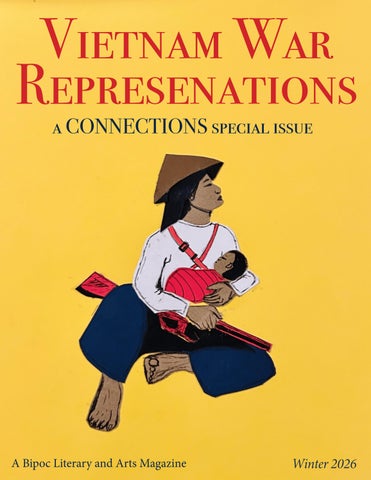
Vietnam War Represenations
Special Issue Introduction
This special issue of Connections features work by students enrolled in my course AAPI/ENG 142a Vietnam War Representations in Fall 2025. As part of an assignment guided by our university’s astute archivist Chloe Gerson, these students spent many hours exploring memos, letters, flyers, news reports, photographs, and other artifacts from the University Archives and Special Collections. They learned about the university community’s multivocal responses to the Vietnam War from the second half of the 1960s through the early 70s, the period when the antiwar movement reached its feverish pitch, followed by Washington’s decision to withdraw from the country. In the following pages, the students construct narratives from the objects they have selected and craft their own creative responses. We witness here a deep conversation across many generations of students, faculty, and administrators—a heartening Brandeisian connection from one anxious, divisive historical moment to another. Above all, the work presented burnishes a legacy of critical and empathetic thinking that holds all of us accountable for our institution’s mission of social justice.
Why this assignment now?
In a straight line crossing North America, Antarctica, Europe, and Asia, a figurative bird departing from Usdan Student Center would have to fly more than 8,760 miles to arrive in Ho Chi Minh City, Vietnam. This country on the other side of the world last held Americans in thrall on April 30, 1975 through televised images of U.S. troops withdrawing in ignominious defeat from Saigon—Ho Chi Minh City’s former self. At the start of Fall 2025 when I was preparing lessons for this course, I contemplated the difficult task of sketching anew this war and its aftermath to a new generation of students at Brandeis. The vast distances in space and time posed at once an advantage and a challenge. A library’s worth of historiography, literature, films, and visual arts have emerged, featuring a wide range of perspectives on the war in the past half century. Once, a course
like this would only include texts that center the U.S. veteran as the protagonist who struggles to retain his soul in the fog of war and moral quagmire. Now, we appreciate the war as a postcolonial struggle between North and South Vietnamese, the conflicted attitudes toward the North’s victory, the South Vietnamese refugee exodus, the complex cultural politics of the Vietnamese diaspora, and more. The Vietnam War in discourse has evolved from a contentious part of American history to an explosive node of global currents of which the U.S. is—powerful, certainly— but one among many.
The richness of learning materials comes with hindsight. Nonetheless, teaching about a war that took place far away a long time ago requires confronting the challenge of unfamiliarity that may discourage many. As an instructor, I count on my students’ curiosity and imagination to bridge the inevitable gaps between the subject matter and their own lives. These elements lie largely beyond a teacher’s control, and one never knows exactly how a student will react to the materials. Yet, I found myself overestimating the foreignness of it all: the disturbances of wars abroad suffuse our contemporary moment as they did then. As student activists back then drew on the civil rights movement to orient their intervention, the students in this course readily articulate their understanding of the Vietnam War in relation to ongoing, devastating conflicts in the Middle East and elsewhere.
The archives thus offer more than mere objects of curiosity from pre-Internet times. If you look patiently, you will find ordinary people doing extraordinary things together with courage and fortitude. Then as now we find disappointment in our leaders, local and national, and realize that we must not delegate our future to others.
My students and I would like to thank the Connections editors, Gretchen Wang and Meghan Dodge, for their generosity and hard work. Many thanks to Chloe Ballew for the original art for the covers. We hope this special issue will inspire its readers with a snapshot of what Brandeis was like during a tumultuous time, what it is like now, and a glimpse of what it can be.
Howie Tam Assistant Professor of English
January 2026
Letter from the Editors
Dear Reader,
We come to you with an issue slightly different from our usual publications. In collaboration with Professor Tam of the AAPI department and the students of his Fall 2025 class, Vietnam War Representations, this special issue puts into print these students’ creative work throughout the semester, a synthesis of history and original works reflecting and responding to archival materials from Brandeis students of the Vietnam War era.
Eastern Tide, the Brandeis Asian American Student Association (BAASA)’s literary magazine, was founded alongside BAASA by students in response to the Vietnam War. BAASA published a document, “Asian American Views on the War,” as commentary on the unfolding discussion on campus and globally, and this inspired Eastern Tide, the first literary magazine created on the Brandeis campus. Eastern Tide would continue to be published, in limited print, throughout the 1980s, until eventually terminating in the 1990s.
Some time in the late 2010s, a former member of Eastern Tide asked that current students revive the literary magazine and create a space for Asian American creators. Thus, Connections was born as a continuation of Eastern Tide and the history it symbolizes. Though, in response to our changing global environment, we have since expanded our scope to a BIPOC Literary and Arts Magazine, we continue to remain in touch with our roots.
This year marks the sixth year of Connections’ revitalization, six years of bringing the Asian American and BIPOC community together to share our creative work and claim our identity. Through our art, we can create commentary and conversation; through our conversation, we can create community and connection. As we move forward, we hope to continue honoring the students who fostered this community before us, connecting with our history and origins, and growing the creative environment for BIPOC creators at Brandeis.
We thank you for picking up this edition of Connections, and we hope that you enjoy learning how we continue to respond and connect with Brandeis student history in the present.
With much love,
Gretchen and Meghan
Mission Statement
Connections aims to create a multicultural network of BIPOC artists and writers and illuminate their voices. We are committed to fostering a community where Brandeis students feel empowered and can claim their identities proudly. We hope to be a safe space for students of varying identities and experiences to share their stories, beccause we believe it is our connections that allow us to heal and move forward.


Editorial Team
Co-Editors-in-Chief
Gretchen Wang ‘26
Meghan Dodge ‘27
Cover Artist
Chloe Ballew ‘28
Special thanks to Professor Howie Tam for coordinating and advising this edition of Connections.
Connections Members
Jessica Lin ‘26, Creative Director
Anusha Koshe ‘26, Senior Advisor
You Lin ‘28, Social Media Chair
Irene Wu ‘28
Jessie Pan ‘28
Dorothy Ko ‘29
Lan Lan Wang ‘29
Justin Gao ‘29
Qiutong Lin ‘29
I. Voices Across a Divided Campus: Intergenerational Responses to the Vietnam War at Brandeis
II. Anti-Vietnam War Strategies by American Students
III. Higher Education, Complicity, and Reckoning with the American War Machine
IV. Words to Our Peers V.
i. Voices Across a Divided Campus: Intergenerational Responses
to the Vietnam War at Brandeis
Lily Chafe, Anh-Thu Pham, Chloe Ballew, Maya Schulman
A Dialogue in Pieces
Lily Chafe, Anh-Thu Pham, Chloe Ballew, and Maya Schulman

This collage was made as a response to the varied perspectives we saw through the primary sources we examined in the Brandeis Archives. The main source this collage interacts with is the draft dodger letter written by a man criticizing Brandeis students for evading the draft during the Vietnam War. By combining lines of this letter with snippets from pro-peace posters, this collage operates as a conversation of its own. This is where our focus of intergenerational communication and disconnect can really be seen. In putting these differing opinions and approaches together in one piece the viewer is forced to confront these speakers and what they have to say. The format is reminiscent of newspaper headlines and article clippings, mirroring the fragmented and competing messages someone living through this moment might have encountered on a daily basis.
The focus we explored in the Archives was intergenerational communication and disconnect in relation to the Vietnam war. We looked at responses to the war from students, faculty, administration, and others, analyzing letters and posters in order to compare and contrast the different perspectives. Through this we were able to trace the different ways each generation communicated and spread their messages, revealing both moments of understanding and points of conflict. The scope of our research remained on primary sources from Brandeis itself, illustrating how this range of perspectives was revealed through the lens of a small college campus. The following five sources are organized chronologically, spanning from 1967 to 1970, in the midst of increasing American involvement in the Vietnam War.
Sources 1 and 2: “FAST FOR VIETNAM” and “STATEMENT BY
THE BRANDEIS AD HOC COMMITTEE FOR VIETNAM”
The first document was made on slightly yellowed, typical letter sized paper. It was typed in a dark purple ink. Written at the top in a similarly colored purple pen was “FAST FOR VIETNAM — WED, FEB 8 TO FRI, FEB 10.” The letter begins with descriptions of what is happening in Vietnam, followed by an explanation of why the fast is happening. The fast was intended to help people realize some of the pain the thousands of people struggling to eat in Vietnam were feeling. The letter ends stating there would be an organizational meeting in the Feldberg Lounge and that the fast would begin with everyone gathering at the Three Chapels on Brandeis campus. The letter is signed off by the Brandeis Ad Hoc Committee for Vietnam, with Steve Schwartz, a Brandeis student, and Barbara Brandt, a professor in the Sociology Department, listed as people to contact for more information.
The second document was written on the same type of paper and with the same purple ink. The title of the letter reads: “STATEMENT BY THE BRANDEIS AD HOC COMMITTEE FOR VIETNAM” dated February 10, 1967—the final day of the fast. The letter is signed off by Stephen Schwartz, the same student from the initial letter who went by “Steve.” While only his name is included it is stated that the letter is written to represent over 100 students and faculty members of Brandeis University. The letter explains that this group had just successfully completed the three day nation-wide fast described in the previous document. The body of the letter describes the group’s disapproval of the actions being taken in Vietnam, calling it “reprehensible on moral grounds.” The letter ends with several requests from the government including an extension of the Tet cease fire and sending troops home.


Both letters were written to include visceral descriptions of the events in Vietnam that demonstrate both the education of the letter writers but also the passion that was felt by this group. The letters are concise and immediately to the point, as they were likely intended to be easily passed around to spread awareness of this event. These letters show an allyship between students and faculty both advocating for the war to end. This fast is also representative of a common form of peaceful protest during this time. While the fast was a nationwide event, these
letters show how such events were carried out within the environment of a small campus. According to the Brandeis Registrar, in 1967 Brandeis had a student body of only 1,961 students, so by including the fact over 100 students and faculty members attended this fast goes to show the effectiveness of the initial letter in conveying the message and encouraging participation.
Source 3: Draft Dodger letter
This source is a handwritten letter sent from a Texas resident to the president of the University. Attached to the letter is a clipping from the sender’s local newspaper which details a poll run by The Justice. The poll found that seventy percent of Brandeis seniors would dodge the draft if called for service and four students would go so far as to flee the country to avoid the service.
The letter itself questioned the efficacy of both The Justice’s poll and their local newspaper’s fact reporting, even sending a quarter along with their letter and requesting a copy of The Justice to verify the existence of the poll. Throughout the letter, the sender questioned how and why students would have such intense antiwar sentiments, even implying that being against the war was the same as being against America.


Source 4: “Brandeis Peace Action Coalition”
This is a memorandum written by the Brandeis Peace Action Coalition, which was an ad hoc group formed at Brandeis, most likely consisting of both students and faculty members. It is printed on toned craft paper, and its sides are slightly worn with small tears. The piece of paper was likely reused, as there is unrelated text on the other side. This may indicate a resource scarcity, or a hurried manner in which this was typed or printed.
This memorandum was not just tacked up, but it was “issued”, implying that it was likely given to members of the administration as a means of communicating the actions that were going to be taken by the coalition.
The subject of the memorandum talks about a moratorium on Friday the 21st in lieu of classes to engage in anti-war protest. This was to be followed by a strike the following Monday and Tuesday which is stated as well. Their stated purpose is to allow students to engage in anti-war activities, show solidarity, and demonstrate to students the importance of striking in protest.
While the speaker of this document is that of a faculty member, it reflects and amplifies the student voice, in that this coalition was recognized by the student council. It is also in support of a moratorium created for student action and
involvement, creating a space and environment for students to safely engage in antiwar involvement. Through this event, and subsequently this document, students become empowered and encouraged towards anti-war thinking and activism.

Source 5: “President’s Newsletter No. 1, July 1970”
This source is the first of many issues of the President’s Newsletter, a source meant to update alumni and adults with connections to Brandeis University about activities on campus. These alumni and parents of students are referred to as the ‘Inner Family’. The newsletter opens with university president Charles I. Schottland taking pride in Brandeis’s decision to stay open and continue holding classes, even though other universities closed or cancelled classes to protest the US’s involvement in the Vietnam War. He then proceeds to outline the three main points he will discuss in the newsletter: the student anti-war protests, Brandeis’s commencement ceremony, and the school’s budget for the 1970-1971 school year. When discussing protests around college across the country, Charles I. Schottland uses neutral language, even when referencing the Kent State University shootings. He describes the student protests at Brandeis as being peaceful, saying that the student protesters made a point of protesting the US government rather than the university itself. Schottland does not voice his own opinion on the war
here, instead describing the student protesters’ activities, and explaining that students were free to engage in the protest activities or not.
Schottland accommodated the student protesters at Brandeis by allowing them to get extensions on assignments missed due to involvement in the protests. However, he also stopped the National Strike Information Center from continuing their work on campus. This organization made up of student and faculty volunteers collected information about student protests around the country to spread awareness of the scope of the protests to others. When people started to believe that the National Strike Information Center was directly supported by Brandeis, Schottland told the group to stop their operations to keep the university a politically neutral party. Schottland’s explanation of this, which is reflected in the language and tone of the rest of the newsletter, is that while students are free to express themselves politically, Brandeis University itself must stay neutral and cannot endorse certain groups or beliefs in a way that may potentially be unfair to others with differing beliefs.
Schottland continues to talk about Commencement, writing about how other universities have cancelled their commencement ceremonies to protest the war. Other universities that did not cancel their ceremonies had students walk out or skip the commencement. In consideration of this, Schottland discussed commencement with the senior class and reached a compromise where they would keep the ceremony similar to in past years, but with some modifications. Schottland ends the newsletter with a summary of his points about the protest, commencement, and annual budget, expressing his gratitude and hope that Brandeis students will continue to strive for change in nonviolent ways.
Works Cited
1. Schwartz, Stephen et al., “Fast For Vietnam”, University Alumni: Harris Gleckman (box 33)
2. Schwartz, Stephen, “STATEMENT BY THE BRANDEIS AD HOC COMMITTEE FOR VIETNAM”, University Alumni: Harris Gleckman (box 33)
3. Draft Dodger letter (Sachar→ Kane; Sachar Presidential, box 5 folder H)
4. Brandeis Peace Action Coalition, “In response to Nixon’s genocidal decision…” (Student Affairs, box 6)
5. Schottland, Charles I., “President’s Newsletter No. 1, July 1970”, (Office of the President, box 157)
6. “Spring Offensive for peace freedom justice”, Gordon Fellman papers, box 3
7. “Spring Anti-War Games” Gordon Fellman papers, box 3
Lily Chafe is a senior at Brandeis University majoring in English and Philosophy with a minor in Legal Studies. In her free time, she enjoys reading and creative writing.
Maya Schulman is a junior majoring in Psychology. She loves reading, writing, and nature.
Anh-Thu Pham is a recent graduate of Brandeis University.
Chloe Ballew is a current student at Brandeis University.
ii. Anti-Vietnam War
Strategies by American Students
Jordan Li, Cindy Marin, Bayley Sandler, Ian McGriff
Different Schools, Common March Against Vietnam War
Jordan Li, Cindy Marin, Bayley Sandler, and Ian McGriff

We noticed that multiple documents at the Brandeis University Archives spoke about students physically traveling to places - places as far as D.C. - to protest against the Vietnam War. Students from other schools in addition to Brandeis University, of course, did the same thing, likely to the same protests. The unifying
effect of protesting against the war did not happen just within the Brandeis University campus but also between schools. We found the common alliance that could form between undergraduate students from disparate parts of the U.S. that were physically removed from each other incredibly moving and powerful. We attempted to capture the unifying alliance of disparate colleges to protest against the Vietnam War in our comic strip with two schools.
Document Used: “Vietnam Peace Action”
Upon examination of the “Vietnam Peace Action”, the paper’s condition immediately shows its age, but it also tells how well it has been kept. The sheet shows minimal ink bleeding, mostly likely due to the fact that the paper was printed double sided. With the passage of time, the ink spread lightly through the fibers, softening the visibility of some of the letters, without completely making the text unreadable. This very faint blurring, alongside with the slight yellowness the paper is starting to develop, is a sign of just aging rather than something like poor handling of the paper. Despite this wear, the paper is firm and intact, quite similar to a piece of paper you hold today. It still holds its structure upon touching, indicating that it was made of durable material and has spent many years in a safe environment. Its overall condition represents the passage of time and the importance placed on preserving a historical record of Brandeis activism during the Vietnam era.

In contrast, the “Workers, Students, and the War in Vietnam” document has aged far less well. There are extremely noticeable drink stains on the paper, possibly coffee, indicating heavy use or perhaps a casual setting in which it was
read or discussed. The ink is more faded on this sheet as well, possibly because of its age, but also because of light or moisture. Unlike the “Vietnam Peace Action” paper, this document seems to be made from a cheaper or thinner stock of paper, due to it feeling more brittle and fragile to the touch. The uneven coloration and the wrinkled surface suggest deterioration caused by time and lower quality of original materials. Such differences in preservation reveal how the physical state of archival materials can reflect their use, purpose, as well as their social context. Some preserved as formal records, others bearing the marks of active circulation and grassroots involvement during a tumultuous period in American history.
Although the document does not mention specific high schools, today we know the various ways students were able to take action. The students who wore armbands and participated in marches demonstrated that the goals of this document could be fulfilled; however, the school is not the only place where the war can be opposed. The theme of community extends beyond a school setting and into the local society. In addition to the students, the anti-war movement would also include the townspeople in public spaces. The document details how the Vietnam War affected all aspects of people’s lives and encouraged student involvement in other areas of the community. Consequently, these actions could reach groups of people who — similarly to the high school students — feel disconnected from the Vietnam War. With time, this process could influence neighboring towns to take similar actions to express their anti-war stance.
The “Vietnam Peace Action” centers on how high school students should organize themselves to promote an anti-war sentiment. The document begins by recognizing the struggles of such organization efforts: students felt the war was not part of their generation, many were apolitical, and those with strong beliefs felt powerless in the system. Regardless, there was a call for action that only the high school students could undertake themselves. Student engagement against the war could have shifted the younger generation’s stance to a more passionate one. Through this document, the war is portrayed as a conflict that people can challenge and openly oppose. The students would not only address the government but the school administration as well. “Vietnam Peace Action” ensures that before they move outside of their community, they understand how the educational system attempts to suppress any reference to the war. If they were to develop their plan of action, the students must navigate the limitations on free speech and assembly within schools.
Document Used: “Workers, Students, and the War in Vietnam”
A second document in the Brandeis University Archives and Special Collection titled “Workers, Students, and the War in Vietnam” captures the antiwar and anti-draft sentiment among college students during the Vietnam War. The document is a series of memos opposing the Vietnam War draft. The year in which this document was written is unknown. However, anti-war protests among college students intensified when exceptions to the draft were lifted for them, making this event a likely cause for the students’ memos.
The first memo is titled “The Draft Hearings in Washington.” Draft Hearings were legal proceedings against those who dodged the draft and those who engaged in anti-war demonstrations. One of which took place on May 8th of an unknown year. At this draft hearing, the workers and students from the Boston area made their voices heard. This initial memo outlined the core argument of the workers and students. They wrote, “[United States] want to be able to get lots of men quickly so that they can keep escalating the war, maybe invade North Vietnam soon.” This cohort of students and workers from Boston were of the belief that, should the draft continue, the war would simply escalate, culminating with the invasion of North Vietnam. They are arguing that the draft is not to prevent communism from spreading across Southeast Asia, but for American war accolades. However, as the workers and students went on to say, it is not the responsibility of the people to fight a losing battle that the government started.

The memo entitled “What The War Is About” educates its audience about the National Liberation Front, the Vietcong, who are enemies to the United States. It explains that the Vietcong are peasant workers who are fighting for economic and political sovereignty against colonialism from the United States. A primary factor for the U.S.’ involvement with the Vietnam War was ignorance by the political higher-ups of Vietnam’s history that was behind its rise of communism. With their memo, the students try to remedy this ignorance by educating the public on who the Vietcong are and their motivations
in the war. Describing the Vietcong as merely peasants and workers with family generates sympathy for the enemy. In addition, framing the war from the Vietcong perspective as trying to drive off colonialism and create political and economic independence paints the United States government as the bad guys. Humanizing and portraying the Vietcong as the good guys were the strategies the students used in this memo to rally anti-draft sentiment among the public.

The ensuing memo titled “In Whose Interest Is this War” continues the usage of these strategies for the same effort. It describes the war as being fought by America to benefit corporations and rich business owners - that they are trying to establish control over Asian labor and economic resources. The memo attempts to further paint the U.S. involvement with the war in a negative light in order to cultivate anti-draft sentiment. It proclaims that the U.S. government only has selfish financial motivations for the war and that the war only benefits rich business owners and not the general public. The portrayal so far of American government and corporations as greedy colonizers and oppressors align with the disillusionment in government by the New Left that was the major player in America’s anti-war movement.
The final memo is entitled “Workers, Students, and the War”. The memo attempts to rally workers to join the anti-war movement by highlighting their power and capacity to end the war and by highlighting how the war is negatively affecting workers. The former gives agency and a feeling of “we can make a difference” to workers. The latter strategy creates urgency for workers to join the movement. Interestingly, most American workers might not have actually had antiwar sentiment as “most unions strongly opposed antiwar demonstrations” (Foner, pg. 1009) so the student’s memo might have been geared toward changing their minds to gain their support.
The final memo is simply called, “Workers, Students, and the War,” reflecting the title of the document as a whole. This last section details that the workers and the students hold a lot of power as the largest population of ideal soldiers, men who
are aged 18 through 22. The logic behind these two populations banding together lied in their symbiotic relationship, traced in this memo. They wrote, “Working people produce all the wealth in this country including the wealth which makes it possible for students to spend their time studying in schools which workers built.”
Works Cited
1. Foner, Eric. Give Me Liberty!: An American History. W.W. Norton & Company, 2017.
2. Vietnam Draft Hearings Committee. “WORKERS, STUDENTS, AND THE WAR IN VIETNAM.” Boston, MA.


My name is Jordan Li. I’m a junior majoring in Psychology and Theatre Arts. A fun fact about me is that I got to spend the recent summer of 2025 studying acting at the Stella Adler Conservatory of Acting in New York City.
My name is Cindy Marin, and I’m a senior majoring in Comparative Literature and East Asian Studies. My favorite aquarium is the Okinawa Churaumi in Japan!
My name is Bayley Sandler. I am a Junior, majoring in American Studies and English with a minor in Near Eastern Judaic Studies. I am an avid movie watcher!
Hi, I’m Ian McGriff, I’m 17 years old, majoring in biology, I am a freshman, and I love playing the piano and making music in my free time.
iii. Higher Education, Complicity, and Reckoning with the American War Machine
Connor Gustafson, Aparna Packer, Thu Pham, Coco Trentalancia
Introduction
Connor Gustafson, Aparna Packer, Thu Pham, Coco Trentalancia
Institutions of higher education across the United States responded to the Vietnam War in dramatically different ways, from offering direct or indirect support for the war effort to becoming centers of vocal opposition. The war provoked intense conflict on campuses, culminating in tragedies such as the Kent State shootings, where students engaged in anti-war protests were shot and killed by the National Guard. Students at Brandeis University led a fervent anti-war movement, and though there has historically been hesitation for administrators to act in times of political discourse, the faculty and administration of Brandeis ultimately expressed solidarity, often at the cost of professional and institutional risk. Drawing on archival evidence from Brandeis, this project examines student protests, faculty statements, administrative actions, and inter-university collaborations to interrogate the role of higher education in both enabling and resisting state violence. Though Brandeis University, like many institutions of higher education, was structurally complicit in the Vietnam War through its links to state power, the moral urgency of the war pierced through bureaucratic detachment. Students, faculty, and even administrators confronted their shared humanity and civic duty, redefining what it meant for a university to act with consciousness. In doing so, they revealed the university as a space where moral responsibility can disrupt neutrality and transform complicity into resistance.
Stephen (Steve) Golin was a MA & Ph.D student at Brandeis University. He received his MA in 1967 and Ph.D in ‘68 with the Department of History. Despite having a successful career as a faculty member at Kansas State University and Bloomfield College, publishing numerous books and being a highly regarded professor by his students, he is perhaps most well known to the Brandeis community for his effort in the anti-war movements during the 60s; however, his commitment to human-rights activism tracks into his emeritus work on the Israel-Palestine conflict. A photograph taken during the graduation ceremony of ‘66 captures him being dragged away by police officers for refusing to cease circulating anti-war pamphlets. We wanted our project to depict the internal turmoil these students must have felt while being painted as traitors to America. We were particularly drawn to the photograph of Golin. His awkward facial expression, his rigid body, him being a graduate student seems to suggest a sort of out-of-place-ness from the hippy dippy flower child protesters the 60s are most
often known for. He does not seem like a contrarian radical figure who just wants to see the establishment fail. This is clearly an uncomfortable moment for him, as face-to-face confrontation often is for the intellectual sort, let alone one which devolves into physical violence. The Boston Public Library has a series of frames leading up to the physical climax showcased in the photo we were offered from the archives. The way one plainclothes cop approaches him, then in the next frame another one, and then another, and they surround him suggest an intense building tension. They try to intimidate him, trick him, but he refuses. We do not imagine him confrontational, but his clearly delineated set of moral principles can find him in these uncomfortable situations. I wanted to render this effect in a work of flash fiction.
Amid resistance in the late 1960s, Brandeis faculty members came together to stand in solidarity with students and protesters nationwide. They expressed support for three points within the movement: political oppression in the United States, American military activity in Southeast Asia, and the complicity of the academic community in the latter items. This final point is particularly striking as faculty were not only opposing the war but also publicly acknowledging the University’s entanglement in the U.S. War Machine. Such action disrupted traditional hierarchies between students/faculty and faculty/administrators, with professors aligning themselves with youth-led movements rather than institutional authority. While not explicitly mentioned here, many universities at the time—and in our present moment—have economic ties to the military industrial complex. Despite being presented as sanctuaries to cultivate critical thought and meaningful engagement with the broader world, universities both then and now have been sites of suppression, especially when movements are challenging their financial sources. The Brandeis faculty recognized the role that institutions of higher education play in both guiding future generations to be moral and engaged contributors to the global community and in maintaining spaces where the freedom to challenge status quo and imagine new worlds is preserved. These members refused to stand by and allow an economically and politically powerful, U.S.-based institution to become complicit in a genocidal war effort. This stance reinforced the moral obligations of institutions of higher education to push towards positive change through knowledge, rather than forsaking values of justice and silently endorsing harm.
The Brandeis administration was staunchly in favor of keeping the administration open and a free space for students to engage in free speech. The act of closing the university, would instead, demonstrate a weak stance, and send a message that the university is not equipped to handle discourse. In a statement by
President Charles I. Schottland in 1970, he wrote to members of the community that he was adamant about making the Brandeis a place that is “conducive to both scholarly pursuits and orderly dissent.” Furthermore, this letter emphasizes that there were a wide array of opinions and stances on how the protest had effected students, on both sides of the spectrum. On one hand, there was a desire for students to have the university cooperate with the protest; however, it is imperative to recognize that there were also students who did not bother with acknowledging the protests. They did not want it to have an impact on their lives. This dichotomy is still present today in our institution and spans across a multitude of topics and contemporary issues. As we know, we have various levels of participation in student engagement when it comes to protests and demonstrations. It is evident that there are both pros and cons when it comes to our current administration providing us with the space to speak freely. The statement also suggested that faculty suggested to their students who are eager to join the protests, that they too, should continue to complete their assignments. This may not be applicable in the University today because of increased crackdown on student protest and national attempts at censorship.
Responses to the war were not isolated to individual institutions; there was cross-campus administrative collaboration to present a strong and cohesive anti-war positionality. A letter from There was a letter from 1969 written by the president of Haverford College, President John R. Coleman, to Brandeis University administrator Morris Abram reveals an organized effort among private university presidents to issue a joint statement calling for a rapid U.S. withdrawal from Vietnam. Coleman’s letter, dated October 2nd, 1969, emphasizes that while universities themselves “will take no position as institutions on the Vietnam War”, their leaders as private citizens had a moral duty to speak out. The attached “Statement on Vietnam,” dated October 1st, 1969, was signed by presidents from institutions such as Swarthmore, Princeton, MIT, and Bryn Mawr. Abram added his own signature on October 3rd, signaling Brandeis’s participation in this network of academic dissent. This cross-institutional collaboration demonstrates how higher education leaders navigated the tension between institutional neutrality and moral conviction during wartime. While students and faculty protests embodied resistance, these letters reveal that administrative voices also contributed to the national antiwar dialogue. Today, the exchange reminds us that universities can model ethical leadership and solidarity across institutional boundaries, using shared moral authority to question violence while upholding academic independence.
As we can see through these archival pieces, there was a reckoning with
the war that engaged individuals within and beyond institutions. There was an element of shared humanity and responsibility as people with the privilege and power that comes with education and moral responsibility as citizens within a country propelling the war effort brought forth their efforts into community. Various overlapping identities merging national and occupational privileges paved the way for new forms of positionality and engagement. These actions were a bold statement for their times, and even in our current moment as institutions remain complicit in harm. However, we must hold institutions and their leaders to higher standards and ensure that they do not remain complicit. The efforts, for example, of President Schottland refusing to allow the institution to be neutral and expressing his own non-neutrality as a leader and citizen within the U.S. war machine is a step that universities must continue to uphold and expand on in order to continue moving away from the embedded harm that is caused when the ideals education are only used in theory and not in practice. The lessons learned from Vietnam are still present today, especially within Brandeis University and other academic institutions. We are facing multiple global challenges and crises, and universities are in the unique position to be able to address these issues through a mode of reckoning that underscores critical thinking and truth telling. If universities fail to uphold this central mission, they are complicit in the central violence enabling these realities.
From Silence to Record

Above is a compilation of the excerpts we used from the Brandeis Archives. They span different topics regarding Brandeis student, administration, and faculty reactions to the war, as well as cross institutional conversations with various university presidents.
When Silence Teaches
It’s a peaceful morning in the suburbs. Professor Smith listens to the faint sounds of birds chirping and watches the cars drift by as he packs his bags for work. He heads out the door and picks up the newspaper sitting on his front step. The title reads: “Street Clashes Go On in Vietnam, Foe Still Holds Parts of Cities; Johnson Pledges to Never Yield.” The front page captures an image with two men: one man’s arm outstretched holding a gun aimed at the other’s temple. It’s 1968. The United States has maintained a military presence across Southeast Asia for 18 years, with the violent occupation escalating drastically since 1965. This is one of the many violent newspapers he has seen.
The images on the news bear into his mind; the burning rice fields, the cries of families, the Vietnamese and American bodies scattered across the landscape. He forces himself to look away from the horror and look back out at the tranquil terrain in front of him. The neighbor’s sprinkler clicks rhythmically, morning sunlight spilling over trimmed hedges and driveways. The contrast feels unreal. How can this serenity coexist with such violence?
He makes his way to his car. His keys feel numb in his hand and his stomach is tight. He forces himself to review his lesson plan for the day. He thinks of how easily peace becomes invisible privilege. Comfort lulls people into believing that violence far away is somehow not their concern. “It doesn’t affect us” is just an excuse used to ease ourselves. As a sociologist, he teaches his students about power, inequality, and moral responsibility. Lately, those words have begun to feel heavier and more dangerous.
At the university, flyers litter the bulletin boards: “Fast for Vietnam” “End the U.S. Occupation” “U.S. Out of Vietnam” “Unite Against the War” “Peace Now.” Students are gathered in clusters throughout the halls, their faces electric with both energy and fear. Some of the professor’s own students are out there. The same ones who stayed after class to talk about Weber and Marx, now shouting through megaphones about imperialism and death.
As the professor walks toward his class, he spots a memo slipped under the office door. It’s from the Dean’s office. “Faculty are reminded to remain neutral in matters of political controversy,” it reads. “The University must uphold academic integrity and avoid public positions.” Resigned, he sighs to himself and proceeds into his room.
Neutral. The singular word feels heavy. Neutrality is a privilege of those who can afford to close their eyes.
The administration had warned faculty not to join the demonstrations. Several professors who signed anti-war petitions have already been called into closed-door meetings. Professor Smith knows the risk. His position isn’t permanent and speaking out could cost him his job, his stability, even his future. But what is the purpose of teaching sociology if not to confront injustice when it stares him in the face? What good is theory if it crumbles in the face of reality? What use are these lessons if they never leave the classroom? Universities speak of knowledge and progress, but are hiding behind comfort, claiming integrity. How can he call himself an educator at all? Education was never meant to preserve the world; it was meant to challenge it, to imagine what could be.
He thinks to himself: To stay silent now would not make me an educator, but an accomplice. How can I claim to cultivate an environment of thought and empathy, to herald the values of higher education, but remain silent as suffering rages? How can an institution devoted to truth excuse its own complicity in harm? To be an educator is not to blindly serve an institution, but to serve the people within and beyond it. These administrators may answer to policy, reputation, and money, but teachers answer to humanity itself. Classrooms are meant to be spaces of care, imagination, and reckoning, where compassion can take shape in thought and action.
Professor Smith looks back down at the newspaper as he sits in his office. The same photo from the morning—the man’s face frozen with a gun pressed to his temple. He is young; close in age to his students. The dean’s memo lies next to the photo, burning into him. For a moment, the two papers blur together, merging until they feel like parts of the same violence.
Hands trembling, he tears up the memo and throws away the pieces.
Outside, through his window, the faint sound of chanting drifts across the quad. He looks down at the photo once more. This time, he refuses to look away. The images are etched into his brain, minute by minute. Paper in hand, he leaves his desk and walks towards the sound.
“When Silence Teaches” imagines this statement from Brandeis faculty in support of student protestors and against the complicity of the academic community in violence from the perspective of a professor battling with their position within a university and as an educator.

The War Abroad, The War at Home?

This collage depicts a Brandeis student who was arrested for protesting the Vietnam War at a graduation. The newspaper articles around him reflect the ways in which the war surrounded every aspect of people’s lives and the invisibilized violence that so often accompanies the efforts of war machines became more and more present, to the point where it was impossible to ignore. The horrors were
publicly displayed, and students led the charge to put a stop to the United States’ perpetuation of deep harm. In spite of the glaring need for this to stop, protesters were met with opposition and forcefully stopped. These images demonstrate the jarring apathy that impeded acts of humanity and compassion aimed at putting an end to overwhelming brutality.
Stephen Golin
Tensions were high this Spring. Graduation always seems to devolve into arguments as the day embodies the joy and the sorrow a product of the past decades. In terms of progress, for a better life, we see it exposed bare on the podium for evaluation and ridicule. Perhaps, in the back of everyone’s minds, it is not what it was chalked up to be. Hush now.
Here we find Stephen Golin circulating pamphlets outside the venue. He has a strict notion of right and wrong. Well reasoned and thought to the limits of his imagination, as most intellectual sorts tend to do. We find it ever malleable, always vulnerable to ridicule, ready to be toppled at the first reason, yet his matrix of morals is governed by a steadfast order permeating each part of his life. This is a man who would sooner reject earthly comforts than knowingly engage in hypocrisy: a theatrical rendition of claim and evidence. We might consider this a reason he chooses to pursue a Doctorate of Philosophy in philosophy. One fit for the monastic type. Living up to a moral standard you yourself establish is hard work. Much harder than subscribing to doctrine. Because if you fail, you can readily interpret the doctrine to your benefit. You aren’t offered such respite when you fail yourself. Worst of all is deceiving yourself, as if you still trudge under the yoke you fasten for yourself. It’s barren grounds for spiritual corruption.
He is well dressed, classically academic in tweed, and his slightly awkward oration wins over the hearts of people: he is not a plastic salesman selling tupperware. One sees his humanity and can guess only a genuine greater good could bring him out of his comfortability. A part of his commitment to his morals framework is to pass out pamphlets to everyone who passes him. We see him hailing over younger or older siblings of the graduates. “Please consider taking one.” He looks over to the next lot in the crowd. “Tell your friends.” He moves like a bumble bee in a patch of clovers. Rambling on to a group of fathers with receding hairlines, “Would you fellas like some pamphlets?” “I’m all set.” “No worries. Have a nice day.” He is approached by a man with gray hair in an equally gray suit: “Lets see what you got here.” “Of course. Would you like a couple to pass them on?” “Sure. Let’s actually see them all.” “Each one’s the same mister. I can’t give them all but how many people are in your group?” “Hey Tony,” the man yells out to another, grabbing his attention, and motioning him over. “What’s the matter?” “Here you go, sir.” “Kid’s passing out pamphlets?” “Pamphlets huh? Do you have permission?”
“Permission? You don’t need permission to participate in student activities on campus.” “Oh so you’re a student huh?”
Stephen begins to suspect these men, but his moral conviction in stride with his legal right refuses him to shyly move inward. “Well I’ll tell you what. We have a U.N. Ambassador here. You know that, right? He’s giving the commencement address.” “Yes, sir.” Another man in a suit joins them. “What do you suppose he would say if he found out the school which invited him to speak encourages antipatriotic ideals?” “Freedom of speech, sir. We have a right to protest the America the President is forming.” And another joins them, snatching a pamphlet from Stephen’s hands. A man he hadn’t noticed from behind him says, “Hah.” Another says, “Wise guys like you piss me off.” Stephen takes a step back to observe the six men, all in suits, surrounding him. “I’ll tell you what. Hand over the pamphlets and we’ll let you get out of here. It’s graduation day. It’s a celebration day. Don’t ruin this for them.” “I’m sorry mister but I will not. We have the right to orderly protest. I am not causing a disturbance--” “But you are. If you refuse to leave, we are placing you under arrest. Come with us, son.” He is silent. They spur him onward, but his feet of lead anchored him to the ground, plunging his backside down into the pavement. Two of the plainclothed officers hoist him up. The pamphlets crumple under the folds of his sweaty palm. His legs go limp again. Their lot is sown. They will have to carry the burden, all the dead weight produced in the conflict, if they wish to arrest him.
Works Cited
1. Giroux, Henry A. University in Chains: Confronting the MilitaryIndustrial-Academic Complex. Routledge (Taylor & Francis), 2007. DOI: 10.4324/9781315631363


Connor
Gustafson
- Graduate student
- English Literature & Letters
- Big rock guy & nature adjacent activities
- From Connecticut
Thu Pham
- Sophomore
- Economics & Business Major
- I love fiber arts, especially knitting and sewing!
- I’ve played squash for 8 years and my team went to nationals.
Coco Trentalancia
- Junior
- Education major with minors in AAPI and NEJS Studies
- I am from New York City!
- I love playing tennis and listening to Taylor Swift
Anonymous
iv. Words to Our Peers
Bree Bui, Erica Lee, Lucia Thomas, Maxwell Weisz
From Blue Ink to Digital Noise: A Response Written Fifty Years Later
Bree Bui
FAST FOR VIETNAM Flyer: Item Description

The “Fast for Vietnam” flyer is printed on aged, off-white paper that, while clearly old, remains sturdy and manageable with bare hands. The main text is printed in blue ink and reads as an announcement calling on all Brandeis students to participate in a voluntary fast to protest the Vietnam War. Across the top, the words “FAST FOR VIETNAM” and the dates of the planned protest (Wednesday, February 8th to Friday, February 10) are handwritten in blue pen. This handlettered title, written in all capital letters, gives the flyer a sense of urgency, immediacy, and command, suggesting that it is prepared and circulated quickly in advance of the protest.
The document is issued by the Brandeis Ad Hoc Committee to Vietnam, an organization formed by Brandeis students to organize campus actions and discussions opposing the war. The committee expresses opposition to U.S. military involvement and concern for the suffering of Vietnamese civilians.
At the bottom of the flyer, two names, Steve Schwartz and Barbara Brandt, appear alongside their addresses and phone numbers beneath the line “For further information contact.” They are likely members and organizers of the committee behind the protest. The intended audience of the flyer is their fellow students, peers who, like them, are privileged to debate the war from the relative safety of campus while remaining anxious about the draft’s looming reach. The flyer invites participation through empathy and self-sacrifice, urging students to fast as both a symbolic protest and a form of spiritual alignment with those suffering abroad.
Student Response
Dear Members of the Brandeis Ad Hoc Committee to Vietnam,
My name is Bree Bui, and I am a senior at Brandeis University in the year 2025 studying Business, Legal Studies, and AAPI Studies. I came across your flyer “Fast for Vietnam,” in the archives, and its blue ink faded a little but its message is still striking. I was struck by how direct and personal it felt. You were not just making a political statement; you were trying to convince your fellow peers to care, to act, and to feel responsibility for something thousands of miles away. Additionally, you were addressing directly to your peers, not the Government with lines like “We ask you to join us in a voluntary fast…” and “Those who wish to participate…”.
Including your names, addresses, and phone numbers showed how urgent this cause was to you, but it also revealed the privilege and bravery behind your openness. You were able to publicly attach your identities to your protest, which is something that is far less common today, especially with the internet’s risks, systemic risks, and a weaker sense of community overall in the country at the moment.
What stood out to me was the balance between privilege and fear. As students, you had the safety to think critically and promote awareness of injustice from the protection of campus, yet many of you were still living under the threat of being drafted. The line in your flyer: “In fact we are privileged or deferred. While we sit and eat this barbarism is perpetuated by others sent in our place.” captures that
moral tension perfectly. This dual reality gave your protest a kind of sincerity that is hard to imagine today. Divisiveness among Americans is at an all-time high, “news” can be generated by robots, and academic institutions now more often discourage students from expressing discontent with their government’s participation in and funding of the deaths of innocent civilians abroad. This is a sharp contrast to how Brandeis once responded to your protests, when such action was recognized rather than suppressed.
Sincerely,
Bree Bui
A Brandeis student in the year 2025
Piano to Forte, Poco a Poco: Growing Into Your Voice
Erica Lee
Brandeis Students and Faculty Denounce U.S. Involvement in the Vietnam War: Item Description

The document entails a statement from the Brandeis Ad Hoc Committee for Vietnam on February 10, 1967. The committee name in all caps and the date are printed at the top on the same line. The statement is composed of three paragraphs, followed by a point of contact for the committee in the bottom right corner, Stephan Schwartz. Underneath his name in separate lines are the committee name, “Brandeis University,” the university’s address information (Waltham, Mass. 02138), and a phone number (893-9256). The document is overall in good condition. The purple ink is mostly clean and legible, save for a handful of faded letters and grammatical corrections. The grayish-white paper itself is mostly unblemished
except for a few diagonal marks running along the left side.
The committee begins by stating that they represent more than 100 Brandeis University students and faculty who are participants in a recent nationwide threeday fast over concern about the government’s involvement in Vietnam. Following this, they state that by the United States’ hand, many atrocities are being committed. They speak of the mutilation of women and children and the destruction of land. It is because of such products of the war that the committee feels that they are “totally reprehensible on moral grounds” and are thus the reason for their objection to the United States’ involvement. In fact, they further emphasize that it is the United States’ actions that are shaping a “self-defeating undertaking” by depleting resources, killing young men, and stifling dissent. These “incomprehensibly brutal actions” are also harming the people of Vietnam. In closing, they call for an extension of the four-day Tet cease fire, an end of the bombings, and withdrawal of American troops. In doing so, they hope that the government “can begin on a rational policy” that will help the Vietnamese people live in “peace and prosperity.”
This statement seems to address not only the Brandeis community, but the United States government. Following the fast, in which it allows students to reflect on their privilege and the suffering in Vietnam, this statement largely turns the reader’s attention to an agent involved in such suffering: the United States. In addition, they do not specifically single out the government as the sole culprit. In fact, they include phrases such as “in our name” and “our role in Vietnam.” In this way, the students acknowledge that they also have a responsibility and for them, it means speaking up against the war. But, the tone of the document reflects the students growing frustration about the war and the mounting deaths of the fellow younger generation, which they regard as not rational.
Student Response
Dear Members of the Brandeis Ad Hoc Committee for Vietnam,
My name is Erica Lee and I will be graduating from Brandeis University next year in the spring of 2026. I am currently taking a course surrounding literature on the Vietnam War. We are halfway through the semester, but I feel that finding your statement in the university archives along with countless others was the most valuable experience for me. As someone who was born several decades after the end of the Vietnam War, it has always felt like a war far removed from me. The experience can almost be akin to a person listening to music from their parents’
childhood – trying to hear and craft an imagination of what it was like back then. After finding your statement, it’s almost as if I can hear the distant voices humming in harmony, steadily crescendoing into an expansive choir.
Growing up as a cellist playing in orchestras since elementary school, I’ve learned that every voice in the orchestra matters. When I was little, I was always scared of being called out by the conductor if I made a mistake. If you made an audible mistake, the conductor would undoubtedly whip around to send a reproachful glare. The conductor might even call on your section to play the same excerpt again by yourselves or stand by stand so you’d hope you’d play it correctly the second time. In fear of such humiliation, I often found myself trying to play quieter than my fellow cellists. But if you play an instrument, you’d know that this method doesn’t create a good tone. If you suppress your playing, the natural sound of the instrument cannot sing. Expression of music requires everything from careful control of technique to whole-body expression. In the end, you embody the instrument and the instrument becomes your voice.
One aspect of your statement that drew me in was the way the statement was crafted. There were several times in your statement that I felt oriented the issue as something that was a reflection of the war as a responsibility of everyone, whether they were actively involved or not. Notably, phrases such as “in our name,” “our role,” “our young men,” and “our incomprehensibly brutal actions” stood out. As a student, I feel that it can be easy to fall into a lull of living in a safe bubble. On campus, students attend classes, work on projects, grumble about homework, study for exams, or fret about their future careers. It is a privilege to have such worries. But as in an orchestra, it turns out that whether you have family fighting overseas or not, or whether you play first violin or timpani, you have your own responsibility. This is something that I have been trying to come to terms with lately in my musical career as well as in my personal life. I hope that in the near future, I too will be able to fully embody my own voice as you all did many years ago.
Sincerely,
Erica Lee Class of 2026
Lucia Thomas
WBRS-FM Editorial: Item Description

The WBRS-FM Editorial document is three paragraphs in blue print on a yellowing single sheet of paper. In the upper left corner is a splattering of red ink. The document is dated October 7, 1969 but the year is printed over itself and is hard to read. A signature in blue ink runs crooked over the date. A black check mark hovers above the WBRS title. At the bottom of the page is the WBRS logo in large blue and green letters. 91.7 is the station to tune in for listeners. Under the large all caps letters reads “The Radio Voice of Brandeis University.”
Above the logo, about three fourths up the page, are two spaces for signature. One is labeled for “Program Director” and the other is for “News Director.” Both have signatures above them. The program director signature is in green ink and its letters have straying ends and vowels that push closely to one another. The news
director signature is in black ink and has sloping lines that point toward the edge of the page.
Within the three short paragraphs that make up this editorial document are a call for a protest on October 15, 1969. The protest is in opposition to the Vietnam War which the document claims is “stalemated.” The letters of the document grow blurry in the middle and all of the periods are hollow. The ending paragraph speaks of the President at the time, Richard Nixon. The writer strongly disagrees with his stance on the war and calls for a “cure of the disease,” which is the fighting in Vietnam.
Student Response
Dear reader,
My name is Lucia Thomas. I am a senior at Brandeis University studying Creative Writing and Journalism.
On October 15 2025 I awoke just after the sun came up and took a run along the Charles River. Leaves were falling but the last bit of summer heat still lingered in Waltham, MA. As geese squawked on the banks of the water, I thought of my two younger siblings back home in California and of my brother closest in age studying abroad in Argentina. I fantasized about cooking Thanksgiving dinner together and wrestling on the beach like we’d done as kids.
I returned to my apartment and my good friend came over for breakfast. Her and I sat on my porch and chatted between sips of honey sweetened coffee. We spoke of classes, mutual friends, and our plans for the future. We were overwhelmed by the amount of opportunity and openness in our futures. We sighed and turned our gaze to the great oak tree that towers over my porch. She and I watched a couple of squirrels run its limbs and chuckled at the simple life of a rodent.
On October 15 1969 our peers, who are pushing eighty years old now, were protesting the Vietnam War. The editors of WBRS-FM, Brandeis’ radio station, had signed and distributed a document outlining their call for students and others to embark on a moratorium which would halt their daily lives as a means of voicing their concerns surrounding bloodshed overseas. The writers of this letter had been protesting the war since they entered Brandeis University and would leave college with another six years of warfare to come. 30,000 Americans died in their time at Brandeis along with what they claim to be an uncountable number of Vietnamese.
I imagine the young men who wrote this document waking in the morning
and sipping coffee on a porch in Waltham. The sun is out. The day is clear. They walk inside and turn on the television. American troops are burning villages, men their age and younger are laid out in body bags by the hundreds, and American politicians are performing speeches claiming America is winning the war and bringing a better future to Vietnam. The men sit across from one another. They discuss the future. How many more will die? Will my friends and family come home? What will be left for Vietnam and its people when this war finally ends?
The editors of the WBRS-FM may have also considered their fortune. They were young men gaining an education in New England while millions of their peers learned to kill and die in a jungle most of them couldn’t point out on a map before they got on the plane over there. They signed a letter in protest while a buddy from their hometown humped the valleys of Vietnam.
I expect they thought of their peers overseas in these scenarios. Killing, dying, mourning, hurting, missing. The men at home’s emotions sat in an oven warming and baking into ideas and eventually thoughtful actions like the protest they called to action. The men overseas were thrown into a fire.
My brother, the one in Argentina, is eighteen years old. He is tall with broad shoulders and green eyes. His unsymmetrical face makes him look meaner than he is. He appears akin to many of the black and white photos of young men in the jungle. It is not hard to imagine his gaze under a helmet trudging through Vietnam growing mean and skittish. Instead, he calls me up every few weeks to detail his adventures and all the people he is learning to trust and understand. His exposure to the world is making him kinder, smarter.
I sat with my friend on October 15 2025 and did not think of war or what my brother would look like in a flak jacket or consider halting my daily life in protest. Perhaps I should have thought of these things as there is no shortage of killing today.
I imagine the editors of WBRS-FM who called for protest as old men in 2025 watching my friend and I sit on my porch and fret about all the big things in our lives that are really very small. They chuckle at our simple life.
Best, Lucia Thomas Class of 2026
When Refusal Becomes Inheritance
Maxwell Weisz
We Won’t Go Statement: Item Description

On a white page with the faded presence of ink passed from one aged paper to this one, this piece of paper simply titled “We Won’t Go Statement” is as it sounds in its name, a statement declaring that the signee of this statement will refuse to serve if drafted. Written with a typewriter, some letters barely visible due to inadequate amounts of ink, and some others crossed out or written over by other letters. This statement explicitly declares its purpose at the top, stating that this is intended to be signed by draft-aged men and to state their refusal to participate in the United States military if drafted. Further saying that these draftees refusing service have come to the conclusion that, due to the history and nature of
the Vietnam war, it would be against their moral conscience to participate in the war effort. They make the signature’s purpose even more apparent in the second paragraph, ending the statement with a paragraph declaring their “intention in signing this statement” is to bring together fellow draft-aged men that share their beliefs, and to turn their personal refusal into a political statement opposing the war.
Following the two paragraph statement declaring the intentions of the signee, there is the space for two signatures separated by a dashed line crossing the page. Seemingly intended to be passed out, trying to gather signatures of fellow likeminded men who wanted to make their refusal more than a personal choice but political protest. This has the space for the person’s university status, name, location during summer and winter of 1967-68, telephone number, and home address, etc. The year this statement was written becomes clear in the space for filling signatures, 1967. This is only three years after the beginning of draft service for Vietnam in 1964. With no signatures on this statement it seems like this would be copied many times and passed around, but this specific copy of the statement remains almost pristine in the university’s archives for decades.
Student Response
Dear Brandeis Students of Draft Age,
My name is Maxwell Weisz, I am a Junior studying Applied Mathematics at Brandeis in the year 2025. I spent some time examining the fragments of history left behind by your generation being kept in the University’s archives. While I will hopefully never understand the full extent of your fear of being drafted into a pointless war, I believe some things have really not changed all too much in terms of pointless wars and profiteering off of them. However, your bravery to stand up for what you believe is right was not in vain.
Your commitment to refusing draft service was a decision that along with other’s refusals sent a message drawing attention to the anti-war movement, and eventually contributing to the end of draft service for the military. This statement brought the anti-war message home to many young people, it personally connected them with the war so they could no longer ignore it. The harsh reality that they, or a loved one, could be sent at any moment half way across the world to fight in a pointless war had to be at the very least nerveracking, and the statement forced them to see this reality.
Some people see refusing the draft as cowardly, I could not disagree
more. Refusing the draft, knowing full well the consequences of facing a felony conviction and up to five years of prison, takes a lot of bravery. People think that because your name was randomly chosen and you are fortunate enough to be able bodied, you should be forced to go fight in a war that you do not, nor does anyone else, truly believe in. I do not see those men who accepted their draft notice as cowards, I believe that they were not warned, that if they had really thought about what this war was for and knew what they would be participating in, many would have changed their minds. This statement takes a decent amount of background knowledge to understand the reasoning behind refusing to serve. It takes the privilege of being educated. So I do not blame those who got shipped out not knowing what they would be participating in. But I do greatly appreciate your commitment to use your privilege, to pass out this statement and get as many people as you could to refuse service, to decline participation in a violent extension of the United States war machine.
While pointless wars wage on and the military industrial complex still enriches itself, we still look back on your protests and draw inspiration from your fight against these very same issues. As long as this continues, I do not see the memory of your protests fading, and I do not see the spirit behind your fight fading either.
Sincerely, Maxwell Weisz Class of 2027
Works Cited
1. Brandeis Ad Hoc Committee for Vietnam. FAST FOR VIETNAM. 1967, University Alumni: Harris Gleckman (box 33), Waltham, MA. Typescript. Brandeis University. Accessed 6 Nov. 2025.
2. Brandeis Ad Hoc Committee for Vietnam. STATEMENT BY THE BRANDEIS AD HOC COMMITTEE FOR VIETNAM. 1967, University Alumni: Harris Gleckman (box 33), Waltham, MA. Typescript. Brandeis University. Accessed 6 Nov. 2025.
3. WBRS-FM Editorial Team of 1969. WBRS-FM Editorial. 1969, WBRS editorial, October 1969 (Office of the President box 177), Waltham, MA. Typescript. Brandeis University. Accessed 6 Nov. 2025.
4. We Won’t Go Statement. 1967, University Alumni: Harris Gleckman (box 33), Waltham, MA. Typescript. Brandeis University. Accessed 6 Nov. 2025.


Briana Bui is a senior in the class of 2026 majoring in business and double minoring in AAPI studies and legal studies. Outside of school, she enjoys cooking, music, and traveling. She is one of the co-presidents of Brandeis Pre-Law Society and is planning to pursue a career in law.
Erica Lee is a senior of the class of 2026 majoring in biology. Outside of academics, she enjoys playing the cello and running. Erica has played the cello since first grade and is one of the co-presidents of the Brandeis Running Club. She is currently trying to pursue a career in medicine.
My name is Lucia Thomas and I will be graduating in May of 2026 with a degree in creative writing and journalism. My road to Brandeis has not been direct. I grew up on a flower farm in Corrolitos, CA with three younger siblings and knew from a young age that I wanted to leave California to experience another aspect of the country. I began my college career running cross country and track at Rhodes College in Memphis, TN. From there, I did a semester of publication internships in New York City, NY. I loved the East Coast and decided it was time to leave Memphis. Before deciding on a new route, I worked on a horse ranch in New Zealand for a couple months. After that experience, I arrived at Brandeis and have been exceptionally happy with my decision.

Maxwell Weisz is currently a Junior expecting to graduate in Winter 2026, and majoring in Applied Mathematics. Outside of academics he enjoys skateboarding around and learning new tricks.
v. Assemblage - Picnic in War
Miles Hupert & Mikey Terrenzi
Assemblage - Picnic in War
Miles Hupert and Mikey Terrenzi


When analyzing the Vietnam War from our own perspective, we can see a story of the powerful and the powerless. This was not a choice made for the students, but one of conscious action: to band together, across the country, and send a message for freedom, against hate, and for unity. We saw a story of the elite, administrative, or political taking advantage of those below them. They were not just in universities, but young men across the country, sent to their deaths by those wilfully ignorant of their lives. We saw those in power dining on the lower classes that were served to them. Lower classes were unable to exert their influence to dodge the draft. We have taken this small concept as a seed and, through our exploration of the Brandeis Archives, evolved it to the project we now have.
On a walk through a trail in the woods, a picnic table seems carefully set with seven plates. Three plates on one side, three on the other, one last at the head, inviting the onlookers to sit and dine. Forks and knives flanking ceramics with collaged and décollaged scraps of photos and newspapers. Away from campus, far from the hustle and bustle of academics, images of the war, the protests, and headlines pasted on our plates, a reminder of how we eat and what we eat. This was an integral choice of ours, to depart from the perception that we are specifically writing just as students within a university, but instead from the universal perspective of a young person anywhere. When the audience glances upward from the grass and towards our piece itself, they would gaze upon a fine dining set, the stark white of the plates, however, replaced with a miasma of colors. Upon the plates are paper-maché newspapers, flyers, FBI files, warnings, meeting times, and much more ephemera from the time of the Vietnam War. Selected from color, content, and composition, these images, letters, and decontextualized words reassemble on the plates to create cohesive narratives of human struggle during the time of war. Red lines of subjects and power burst through the monotonous tan tones of newspaper clippings and archived images. Images of protests and organizations manifest themselves among piles of papers haphazardly collected together. Messages urging their fellow students that “MANPOWER MAKES WAR”, to “REPEAL THE DRAFT” as well as more formal papers drafted as joint treaties for peace “between the people of the United States, South Vietnam & North Vietnam.”
Seven plates made up with forks and knives rest in front of the audience, almost as if packing paper has stuck to the ceramic glaze. Soft, polished silverware flanks the paper in front of us; we are ready to eat. Of course, if food touched the plates the paper would quickly dissolve, turn to mush, and be illegible. Yet the plates are more so in service of a symbolic meal, one that is being dined upon
by others outside of the table. If we look at the strike posters, the resistance, the messaging, the internalization, and the connectivity of the movement against U.S. imperialism, we see an unclear narrative. Yes, united against imperialism, there was clarity, but the movement was not an organized, well-oiled machine destined to topple the American government. Rather, students quickly scrawled data on letters to be sent away from Worcester to Washington. Marches and demonstrations during the Alumni Weekend, student protests rousing applause and cheers, even Student Union strikes in the name of humanity, all were organized with pen and paper, maybe at lunch or dinner. Nationally, the movements were disjointed and uncoordinated, yet the voices were powerful and numerous enough that such dislocation could not stop their message.
If we think of dislocation as an artistic language, we pose two questions: how should we express such student unity across this linguistic chaos? Furthermore, how should we, while looking back, transcribe the organizational difficulties into a visual medium? When considering the organization and the language of disjointment, we considered visual mediums across painting, sculpture, and even the written word. We believed that the humanity behind the strike, behind the hunger, behind the academics, would best be represented across multitudes. Rather than one piece, we knew a series of pieces were better at expressing the totality and sum of the work of the strike committee. But rather than expressing the work as identical parts of a whole composition, we knew that the student voices were not just unique and multilayered but had different secondary goals to the strike as well. The Black Panthers, Cuba, the Working Class struggle, all were part of the Brandeis initiative of the strike that the draft of Southeast Asia encompassed.
This multilayer expression of human justice could only be expressed in a language of three dimensionality, but how does one render a three-dimensional image with a two dimensional image and an a-dimensional medium such as text. We turned to decollage for this dilemma. As decollage relies on the layering and further layering of paper and ephemera, we consider this act as a true form of revelation. In our process of peeling back paper, we reopen the archives in a process of tearing to uncover. Uncovering the archives as a process of decollage permits us to explore the somatic elements of the archives in a more cathartic way. Taking inspiration from Bao Ninh, this catharsis in creation manifests itself through the feathered edges of letters, posters, and treaties as ridges and rifts through which the nation battled on the college campus.
Brandeis, as a steward of this history, conserves and keeps this history within itself. Through the plates, we desire to see the history not only exhumed
from the past, but also presented as a visual experience to the viewer. By utilizing the vast archive at our disposal, our job became that of an intimate and intensely meaningful selection of materials. Using surveys scrawled on scrap paper or typed into ledgers, we see two sides of a story unfolding into one as the student body converged with that of the faculty. We saw a constantly moving timeline as sentiment towards the president’s actions darkened. We found ourselves particularly drawn to the ephemera of the Brandeis movement. Acts by the students, such as directions for proper protesting found on “Please Do Not Disturb” signs for past exams. Ephemera from the other side emerged as well, notecards by administrators noting where to quell such protests, how to counter-organize, and who is responsible.
Archival Materials
1. Brandeis Related Documents (continued), Sub-Series 5, Box: 4. Gordon Fellman papers, 03-MWalB00024A. Brandeis University.
2. Contact addresses and phone numbers: nationwide, undated, Folder 12, Box: 4, Folder: 12. Gordon Fellman papers, 03-MWalB00024A. Brandeis University.
Joint Peace Treaty, undated, Folder 1, Box: 5, Folder: 1. Gordon Fellman papers, 03-MWalB00024A. Brandeis University.
3. May Day protest: logistics and organization, undated, Folder 19, Box: 4, Folder: 19. Gordon Fellman papers, 03-MWalB00024A. Brandeis University.
4. National Peace Action Coalition fliers, undated, Folder 5, Box: 5, Folder: 5. Gordon Fellman papers, 03-MWalB00024A. Brandeis University.
5. NSIC questionnaire, undated, Folder 27, Box: 4, Folder: 27. Gordon Fellman papers, 03-MWalB00024A. Brandeis University.
6. “Repression...” poster, undated, Folder 11, Box: 5, Folder: 11. Gordon Fellman papers, 03-MWalB00024A. Brandeis University.


Miles Hupert is a senior studying English with a minor in Education. He aims to become a high school English teacher after college, and loves reading and spending time with friends.
Michael ‘Mikey’ Terrenzi is a senior studying French and Art History. They would like to become a professor and archaeological historian after graduate school. Currently Mikey enjoys filling walls with photos and drawings and pictures their friends make.
Contributors
FromthestudentsofAAPI/ENG142aVietnamWarRepresentationsinFall 2025
Chloe Ballew
Briana Bui
Lily Chafe
Connor Gustafson
Miles Hupert
Erica Lee
Jordan Li
Cindy Marin
Ian McGriff
Anh-Thu Pham
Thu Pham
Bayley Sandler
Maya Schulman
Michael ‘Mikey’ Terrenzi
Lucia Thomas
Coco Trentalancia
Maxwell Weisz