GLOBAL EDITION
SEPTEMBER 2026
www.highereducationdigest.com
FEATURING INSIDE
FEATURING INSIDE
Agnes Bosanque Dean of School, Billy Blue College of Design, Torrens University Australia
Professor Ashley Braganza Professor of Organizational Transformation, Brunel Business School
Dr. Lindsay Davis Director of BBA Admission, SMU Cox School of Business
Sophia Duan Associate Dean, Research and Industry Engagement, La Trobe Business School
Michelle Trudgett Deputy Vice-Chancellor, Vice-President Indigenous Leadership, Western Sydney University
Tony Jan Professor of IT and Director of AI Research Centre, Torrens University Australia
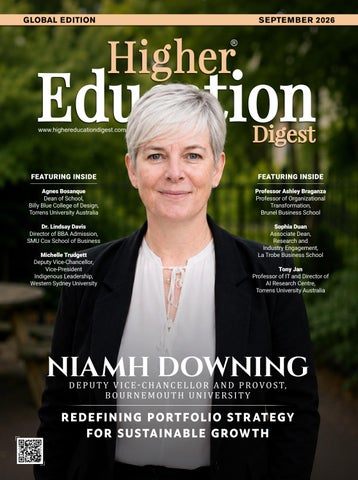
NIAMH DOWNING D E P U T Y V I C E - C H A N C E L L O R A N D P R O V O S T, BOURNEMOUTH UNIVERSITY
R E D E F I N I N G P O RT F O L I O S T R AT E GY F O R S U S TA I N A B L E G ROW T H Higher Education Digest September 2026
1
2
Higher Education Digest September 2026
3
Higher Education Digest September 2026
September 2026
Managing Editor Sarath Shyam
4
Consultant Editors Dr. John Andrews Naomi Wilson Emma James Stanly Lui Andrew Scott Joseph Alex Creative Consultants Charlie Jameson Edwards Gonzalez Branding & Marketing Partnerships Jennifer Anderson Lucy Jones Alice Smith Anna Elza
Free Subscription
Higher Education Digest September 2026
Vol - 8 Issue - 9
Free Subscription www.highereducationdigest.com International Partnerships Americas Europe Middle East & Africa Asia-Pacific
admin@highereducationdigest.com
Follow Us On
www.linkedin.com/company/ highereducationdigest www.facebook.com/HigherEducationDigest
Higher Education Digest www.highereducationdigest.com is a global knowledge sharing digital platform published by Connecta Innovation Private Limited. All rights reserved. The opinions expressed in the content and pictures provided are those of the authors. They do not purport to reflect the opinions or views of Connecta Innovation Private Limited or any of its members and we do not assume any responsibility. The publisher does not assume any responsibility for the advertisements, its content, pictures, and all representation of warranties made in such advertisements are those of the advertisers and not of the publisher. Higher Education Digest www.highereducationdigest.com is a Free Subscription and Free-to-read digital platform strictly not for sale and has to be strictly for internal private use only. Publisher does not assume any responsibility arising out of anyone modifying content and pictures, printing a copy of this digital platform in any format and in any country and all matters related to that.
MANAGING EDITOR’S NOTE
What Comes After the Degree
A
university degree was once seen as a relatively straightforward bargain: study a subject, earn a qualification, enter a profession, and build a career around it. That bargain is becoming harder to recognise. Careers now bend, overlap, pause, restart, and sometimes disappear altogether. Technology is reshaping occupations, employers are redefining skills, and graduates are entering a world in which what they learned yesterday may need to be supplemented tomorrow. Perhaps the more interesting question, then, is not whether universities are preparing students for the jobs of today, but whether they are preparing them for the working lives of tomorrow. This is something I have often reflected on while speaking with educators and professionals across different parts of the world. The strongest graduates are not necessarily those who can remember the most information. They are often the ones who can ask better questions, learn unfamiliar things, work across disciplines, communicate clearly, and remain curious when the answers are not obvious. The scale of the challenge is significant. The World Economic Forum’s Future of Jobs Report 2025 estimates that 39% of workers’ existing skill sets will be transformed or become outdated
between 2025 and 2030. That places a responsibility on universities that extends beyond curriculum design. It calls for a deeper conversation about what higher education is ultimately meant to cultivate. Our cover story this month offers a compelling perspective on that conversation. Niamh Downing, Deputy Vice-Chancellor and Provost at Bournemouth University, brings more than two decades of experience spanning institutional strategy, curriculum and portfolio transformation, organisational change, and international partnerships. Her journey, which began in adult and community education, offers an especially valuable lens through which to consider how universities can remain relevant while helping learners build the capacity to keep learning. This issue explores that larger landscape through thought-provoking articles, interviews, and insights from across higher education. Together, these perspectives examine the changing expectations placed on institutions, educators, leaders, and learners. The degree still matters. But perhaps its greatest value is no longer simply what it qualifies someone to do. It may be what it teaches them to become: curious enough to keep learning, adaptable enough to keep moving, and thoughtful enough to navigate whatever comes next. Enjoy reading.
Sarath Shyam
Higher Education Digest September 2026
5
CONTENTS
6
10 COVER STORY Higher Education Digest September 2026
INDUSTRY PERSPECTIVE
EMPOWERING STUDENTS TO FOSTERING A CULTURE OF FIND THEIR RIGHT FIT DATA LITERACY Dr. Lindsay (Ray) Davis, Gracia, DirectorSusan of BBAMetzger Admission, Senior Associate Director SMU Cox School of Business of Data Literacy, Northeastern University
26
ACADEMIC VIEW
18
EMPOWERING REFLEXIVE GRADUATES FOR THE AI ERA
7
Professor Ashley Braganza, Professor of Organizational Transformation, Brunel Business School
EMPOWERING INDIGENOUS EXCELLENCE IN HIGHER EDUCATION Michelle Trudgett, Deputy Vice-Chancellor and VicePresident Indigenous Leadership, Western Sydney University
34
Higher Education Digest September 2026
CONTENTS
ACADEMIC VIEW TRANSFORMING DESIGN EDUCATION THROUGH EXPERIENTIAL PRACTICE Agnes Bosanque, Dean of School, Billy Blue College of Design, Torrens University Australia
8
48
CULTIVATING FUTURE-READY STUDENTS THROUGH AI Tony Jan, Professor of IT and Director of AI Research Centre, Torrens University Australia
TRANSFORMING HOW HUMANS AND AI WORK TOGETHER Sophia Duan, Associate Dean Research and Industry Engagement, La Trobe Business School
Higher Education Digest September 2026
42
54
9
Higher Education Digest September 2026
10
Higher Education Digest September 2026
NIAMH DOWNING D E P U T Y V I C E - C H A N C E L L O R A N D P R O V O S T, BOURNEMOUTH UNIVERSITY
R E D E F I N I N G P O RT F O L I O S T R AT E GY F O R S U S TA I N A B L E G ROW T H Professor Niamh Downing is Deputy Vice-Chancellor and Provost at Bournemouth University and will shortly join LSBU Group as Chief Commercial Officer, Portfolio Strategy and Business Development. Over more than two decades across education, she has led institutional strategy, curriculum and portfolio transformation, organisational change and international partnerships. She has held senior roles at Bournemouth University, Canterbury Christ Church University, Corndel, Regent’s University London and Sheffield Hallam University. She is Professor of Environmental Humanities, a trustee and governor at Horsham Learning Alliance Multi-Academy Trust, and is currently writing a book on adaptive organisations. Recently, in an exclusive interview with Higher Education Digest, Niamh shared insights into how her journey began in adult and community education in Cornwall as a family literacy officer and adult education centre leader before moving into senior roles at Bournemouth University, Canterbury Christ Church, Corndel, Regent’s and Sheffield Hallam over two decades. On AI, she sees its biggest value not in replacing judgement but in removing administrative load to free time for human relationships, requiring deep AI literacy across disciplines while remaining thoughtful about uneven adoption and environmental costs. Looking ahead to her appointment as Group Chief Commercial Officer for Portfolio Strategy and Business Development at LSBU Group, she is excited to connect portfolio strategy across schools, colleges and universities to create lifetime learning pathways and make the Group more than the sum of its parts, advising future women leaders to think in systems, learn finance properly, and keep adapting themselves. The following excerpts are taken from the interview.
Higher Education Digest September 2026
11
12
Every journey starts with a first step. What first drew you into the world of education and institutional leadership, and how did that early experience shape the way you lead today? I didn’t arrive in higher education by a straight line. I started in adult and community education in Cornwall, first as a family literacy officer, then running an adult education centre. I taught in further education and ran an archive education programme before eventually finding my way into universities. That gave me a very direct view of what education can do for someone whose opportunities have been constrained. I have carried that with me. As you become more senior, it is surprisingly easy for education to become abstract: strategies, structures, metrics and business cases. I try to keep asking what those things will actually mean for the people we serve. If the learner has disappeared from the conversation, something has usually gone wrong. The link between education and employability is under more scrutiny than ever. How do you see universities and colleges proving their value to students and employers over the next five years? We need to stop treating employability as something that we only measure at the end of a qualification and start treating it as a principle of educational design. In an AI-enabled world, access to knowledge alone is no longer enough. What increasingly matters is what graduates can do with knowledge: the skills, judgement, adaptability and attributes they develop, and their ability to apply them to unfamiliar
Higher Education Digest September 2026
problems. That is part of the value proposition not only for graduates, but for their families and communities, for employers and ultimately for UK economic prosperity. All of them, in different ways, are investors in education and have a stake in the value it creates. That also means rethinking the relationship with industry. Universities often ask employers to navigate different doors for recruitment, apprenticeships, curriculum, research, knowledge exchange and professional education. I think the future is a much more strategic relationship: a single front door through which we understand an organisation’s challenges and connect it to the full capability of the institution. Done well, employers help shape relevant education while universities connect them to talent, research and innovation. That creates better opportunities for students and a much clearer line from education and knowledge creation through to productivity, innovation and economic growth. AI is reshaping curriculum, assessment and student support. What trends in AI do you think will most affect commercial and academic strategy? The shift I think about most isn’t simply what AI does to curriculum content, it’s what it allows us to spend our time doing. Universities have large numbers of professional services and academic colleagues doing the complex work under the hood that makes the student experience possible. Used well, AI can take some of that administrative and transactional load away, giving people more time for the conversations and human relationships that make the greatest difference to students. The same principle applies to assessment, curriculum design and
13 Done well, employers help shape relevant education while universities connect them to talent, research and innovation student support: the opportunity is not to replace human judgement, but to use better tools so that we can exercise more of it where it matters. That requires sophisticated AI literacy across disciplines and professional practice, rather than a bolt-on module or a new piece of software. We also have to acknowledge the tensions. Adoption will be uneven, some colleagues and students are understandably cautious, and the environmental cost of increasingly intensive AI use has to be part of our decision-making. I am sceptical of anyone in education who says they have this
completely worked out. The institutions that do well will be those that can experiment, learn and adapt while remaining thoughtful about where AI genuinely adds value. Portfolio strategy is critical for financial sustainability. How can universities balance academic mission with market demand when designing new programmes? I don’t think academic mission and market demand are in tension as often as portfolio
Higher Education Digest September 2026
conversations assume. We create the tension when we treat them as separate conversations. Good portfolio strategy starts with the whole proposition: what is this education for, who needs it, what value will it create for learners and employers, what distinctive academic capability do we bring to it, and can we deliver it sustainably? Market data is essential, but it doesn’t make those decisions for you. You still need academic judgement and insight into future industry shifts. The test I like is whether the same proposition can survive scrutiny by an academic board, a finance committee and an industry advisory group. If it only makes sense to one of them, it probably isn’t a sustainable proposition. Leadership is often shaped by people who inspire us. Who has had the greatest influence on how you think about leadership and why? My dad has probably influenced my understanding of leadership more than anyone. He devoted his career to supporting people experiencing homelessness and addiction, including building a clinical detox service and leading the charity he helped to found. What stayed with me wasn’t the job title or the organisation he built, though. It was watching someone do work that mattered, consistently, over decades. He taught me that leadership isn’t really about making the proclamation; it’s about doing the work that makes the proclamation true. I’ve encountered plenty of people who are good at describing an ambition and fewer who can deliver the difficult work of making it happen. I have learned to value the latter.
14
Higher Education Digest September 2026
The institutions that do well will be those that can experiment, learn and adapt while remaining thoughtful about where AI genuinely adds value
We all need fuel to keep going. What book, quote, or idea has stayed with you throughout your career? Oscar Wilde writes in De Profundis: “Most people are other people. Their thoughts are someone else’s opinions, their lives a mimicry, their passions a quotation.” Wilde was never one to resist a good quip, but there is something in this one that resonates with how I think about education and leadership: the importance of thinking for yourself rather than simply reproducing received opinion. That matters for education, because we need graduates who can question, interpret and exercise judgement, and who can reshape the world around them, not only fit into it. This matters in leadership too. Leaders need space to think, to challenge assumptions and sometimes to question the direction everyone else is travelling in. And in an age of AI, when plausible answers can be generated almost instantly, that capacity for independent critical judgement becomes more important, not less. What are some of your passions outside of work? What do you like to do in your time off? I love spending time outdoors, as well as cooking, reading, and spending time with my adult children and their partners, who constantly inspire me. Cycling, running and outdoor swimming are good antidotes to spending too much time in meetings. I’m also writing a book about adaptive organisations, although whether that counts as time off is debatable. Writing something for a wider audience is a very different discipline from academic writing or producing university strategies, and I’m enjoying learning how to do it.
Higher Education Digest September 2026
15
Learn the financial side properly: judgement without financial literacy doesn’t survive contact with a board
16
Congratulations on your upcoming appointment as Group Chief Commercial Officer where you’ll be leading portfolio strategy across the University, Colleges, and Academies. What are you most excited about stepping into this new portfolio across LSBU Group? What excites me is the scale of the opportunity. Very few organisations can think about their portfolio all the way from school, through college and university, to postgraduate and professional education. That means we can ask a much bigger question than “what courses should we run?” and instead tackle the challenge of what a genuinely connected education system looks like for a learner over a lifetime. LSBU Group already has an ambitious answer to that in its Connecting strategy. I’m excited about translating that ambition into real pathways: connecting portfolio strategy with industry needs, making it easier for learners to move through the Group, join at different stages of their educational journey, and creating new opportunities for growth. The really compelling idea is that the different parts of the Group can become more
Higher Education Digest September 2026
than the sum of their parts. That’s a distinctive proposition, and I’m looking forward to helping make it real. What advice would you give to the next generation of women leaders aiming for executive roles in higher education? Learn to think in systems, not just in the area you happen to lead. Understand how academic decisions connect to people, money, technology, regulation and operations. Learn the financial side properly: judgement without financial literacy doesn’t survive contact with a board. I would also say don’t wait until you feel completely ready. I’ve watched extremely capable women assume they need to meet every requirement before putting themselves forward, while others are much more comfortable learning in public. And when you take on bigger leadership roles, keep being willing to change yourself. If you’re asking an organisation to adapt but regard your own ways of thinking and working as fixed, you’ll eventually become part of the problem you’re trying to solve.
17
Higher Education Digest September 2026
ACADEMIC VIEW
Empowering Reflexive Graduates for the AI Era Professor Ashley Braganza, Professor of Organizational Transformation, Brunel Business School
18
Ashley Braganza is Professor and Chair of Business Transformation at Brunel University of London, and Founder and Co-Director of its Centre for AI: Social and Digital Innovation. He created the UK’s first non-technical MSc in AI Strategy and hosts The AI Adoption Podcast, whose guests have included parliamentarians, chief executives and AI start-up founders. A Fellow of the British Academy of Management, he has published over 100 papers and three books, and has completed more than 50 transformation projects with FTSE 100 companies, UN agencies and public bodies. Recently, in an exclusive interview with Higher Education Digest, Professor Ashley Braganza shared insights from a career built on transformation, from discovering self-direction during his MBA to founding Brunel’s Centre for AI: Social and Digital Innovation and creating the UK’s first non-technical MSc in AI Strategy. On AI, he believes universities and companies must shift from supplying static skills to cultivating “constantly-reflexive” graduates who can learn, unlearn, and relearn in real time as work changes. His advice to emerging leaders is to master tenacity: brilliance opens doors, but it is persistence through ambiguity and setbacks that actually delivers change. The following excerpts are taken from the interview.
Higher Education Digest September 2026
19
Change is not a single event you survive, it is a capability you build and keep exercising for as long as you want to stay relevant
Higher Education Digest September 2026
20
What was the defining moment that set you on this trajectory of transformation? Looking back, it was my MBA at Strathclyde Business School. I arrived expecting to acquire a set of management techniques. Instead, I discovered something far more valuable: myself. It was the first time I understood that I could set my own boundaries and then push past them, that no one else was going to set my goals or decide how far I could go. That was mine to determine. It sounds simple, but it was genuinely transformational. Up to that point, like many people, I had allowed the ambitions others held for me to shape my direction. Strathclyde was where I took hold of my own trajectory. I realised I could build the skills and the confidence I needed, and that the responsibility for doing so rested with me. It was an act of selfdiscovery in the sense of seeing my then self clearly and deciding who I wanted to become. That experience awakened the need to keep testing myself, to keep pushing at the edge of what I think I am capable of. That restlessness has never left me. Every role I have taken on since, in academia and in business, has really been another expression of it. What part of your current role energizes you most, and why does it still feel like meaningful work? Engaging with people, especially with senior leaders who are wrestling with real problems. I founded Brunel’s Centre for AI in 2018, and as its Co-Director I spend much of my time with executives, policymakers and students who are all facing the same question from very different vantage points, namely, what
Higher Education Digest September 2026
Transformation and leadership are not, in reality, a sequence of inspiring moments. They are long, often unglamorous work, full of setbacks and long stretches where nothing seems to move
does artificial intelligence actually mean for societies, organisations, and people and how do we preserve human dignity, values and equity as these technologies become ubiquitous? AI is one of the most pressing and challenging issues of our time. It is moving faster than our conceptual models can keep up with, which makes it endlessly interesting. I love working alongside academic colleagues to tease apart the assumptions, to challenge and overturn the conventional ways of thinking that no longer serve us. There is real intellectual pleasure in that. And the part that gives the work its meaning is helping people make sense of it all, guiding someone from a position of anxiety or confusion to one of clarity and confidence, whether that person is a chief executive or a first-year student. Watching people move from bewilderment to genuine understanding in a fast-changing field makes it meaningful rather than merely busy work. Looking five years ahead, what single shift will most redefine how universities and companies collaborate on talent? The balance of power between supply and demand. For most of their history, universities taught students and then supplied their graduates to employers, with employers having little or no say in taught content. Curriculum design and delivery sat almost entirely with the university. That is changing. In the next five years, employers will exert far more influence from the demand side. They will specify, much more precisely than before, the hard and soft skills they want in the people they recruit, and they will look to universities to supply graduates who meet their needs. Will that relationship becomes genuinely collaborative
is, to my mind, still an open question. Employers may prove very demanding in terms of their expectations of universities, and the interesting tension is whether universities will be in a position to push back, or simply have to acquiesce. There is a second shift running alongside it, which is the changing expectations of students themselves. In the UK, students may become more powerful still, choosing very deliberately where they spend their tuition fees according to which university meets their needs most exactly. They will expect the levels of service they receive from any other provider, because they increasingly see knowledge, the core product of every university, becoming a commodity with Large Language Models at their fingertips. Universities that understand this early will be the ones that thrive. How will the definition of “work-ready graduate” change by 2031, and what should institutions do now? I think the very phrase “work-ready graduate” will become redundant, because the nature of work itself is changing fundamentally under the influence of AI and robotics. Preparing someone for jobs makes little sense when those jobs may not exist five years from now. The phrase I believe will gain currency by 2031 is the constantly-reflexive graduate. That, for me, is the only enduring capability, the one that will see current and future graduates succeed. As each successive wave of change arrives, be it economic, technological or social, it will be the graduates who can perceive the trends early and learn to ride them, rather than be knocked over by them, who flourish. Note that I say reflexive rather than reflective.
Higher Education Digest September 2026
21
Reflection looks back and makes sense of the past, whereas, reflexivity is the capacity to adjust yourself, your behaviours, actions, mindset, in real time, as you live through an event and while conditions change around you. Institutions’ strategies follow directly from that. We need to stop designing curricula around static bodies of knowledge and start deliberately cultivating adaptability, teaching students how to learn, unlearn and relearn, and building the confidence that will enable them to keep doing so throughout their working lives. The universities that will remain attractive are the ones that treat reflexivity itself as a graduate attribute worth developing and assessing.
22
What’s one shift in governance or quality frameworks you believe will move from “pilot” to “mandatory”? For me, the clearest candidate is the assurance of responsible AI use, moving from something institutions pilot voluntarily to something accreditation bodies and quality frameworks require as a matter of course. At present, most universities are still experimenting, with policies here, working groups there and guidelines enforced to differing degrees. Within a few years I expect regulators and accreditors to ask institutions to demonstrate, formally, ways in which AI is embedded and governed in teaching and assessment, and how they assure the integrity of the qualifications they award in an AI-saturated environment. The same logic applies to AI literacy as a graduate outcome. Evidencing that graduates can use these tools capably and critically is, today, considered innovative. In a few years these skills will become an expected standard against which programmes are judged. Institutions
Higher Education Digest September 2026
would be wise to build the governance and the evidence base now, while it is still a source of distinction, rather than scrambling to retrofit it once it becomes a requirement. What book, film, or thinker outside your field has most influenced how you approach people and change? This may surprise people, but the figure who has shaped my thinking most is Madonna. She is a living example of someone able to reinvent herself, over and over again, across four decades, and to do so while performing at the very highest level every single time. I do not admire novelty for its own sake. It is the discipline underneath it, the consummate professionalism, and the willingness to let go of a formula that is still working in order to become something new. Most people and most organisations struggle enormously with that. They cling to things made them successful long after these has stopped serving them. Reinvention is uncomfortable because it asks you to risk your reputation and start again as a beginner. Madonna reminds me that sustained relevance is not an accident. It is a deliberate, repeated act of transformation, backed by real craft and hard work. Change is not a single event you survive, it is a capability you build and keep exercising for as long as you want to stay relevant. What kind of work makes you lose track of time, and what does that tell you about your core strengths? Starting something up and seeing it thrive years later completely absorbs me. That might be a new role or an idea that has not been done before. I have been fortunate to hold many
the challenge is to bring order and direction to something that does not yet exist. Give me a wellestablished, smoothly running operation and I will want to change it. Yet give me something that has never been attempted, and I come alive. Creation, rather than administration, is where I do my most instinctive work.
Preparing someone for jobs makes little sense when those jobs may not exist five years from now
positions that were “firsts” that meant building things from a blank sheet, with no template to follow and no well-worn path to tread. Founding Brunel’s Centre for AI was one of those. It began with a handful of people and a tiny budget and had to be imagined into existence. Creating the UK’s first non-technical AI Masters was another as was launching The AI Adoption Podcast. In each case there was no map and that’s energising. The blank page does not frighten me; it excites me. I am at my best in ambiguity, at the very front end of things, where
What is your biggest goal? Where do you see yourself in five years from now? I think of goals as mountains. You may have climbed many tall peaks, and once climbed, they are behind you. They belong to the past. The mountain that matters is the one you have not yet imagined climbing, the one that appears on the horizon and simply has to be faced. That, for me, is always the biggest and most exciting challenge. My biggest goal is, in a sense, still out there waiting for me in the future, as yet unnamed. I am wary of pinning myself too precisely to where I will be in five years’ time, because the most exciting climbs are the ones I cannot see from here. I can say with some certainty that there will be another mountain, and that not knowing its dimensions yet keeps, in part, the whole endeavour worthwhile. What’s one unglamorous skill in transformation or leadership that you wish more young talent would master early? Tenacity. It is one of the least discussed qualities in leadership, and the one I wish more young talent would master early. Transformation and leadership are not, in reality, a sequence of inspiring moments. They are long, often unglamorous work, full
Higher Education Digest September 2026
23
24
of setbacks and long stretches where nothing seems to move. The exciting launch is the easy part. It is the willingness to keep going long after the initial energy has drained away that actually delivers change. It is working through plateaus, scepticism and the inevitable moments when it would be far easier to give up. I have led major change programmes with senior teams across large organisations, and the ones that succeeded were rarely the cleverest ideas. Rather, they were
Higher Education Digest September 2026
the ones someone had the sheer persistence to see all the way through. My advice to anyone starting out is to build that muscle deliberately by learning to be comfortable with discomfort, and to keep taking the next step when the outcome is still uncertain. Brilliance opens doors, but tenacity carries you through them. It is the quiet, stubborn quality that, in the end, separates those who talk about change from those who actually achieve it.
25
Higher Education Digest September 2026
INDUSTRY PERSPECTIVE
Empowering Students to Find their Right Fit Dr. Lindsay (Ray) Davis, Director of BBA Admission, SMU Cox School of Business
26
Hi Lindsay. Every leader starts somewhere that shapes their lens on the world. Looking back to your first role in admissions and education, what moment taught you the most about connecting people to opportunity? One of my earliest lessons came as a firstyear admission counselor at a college fair. I remember having a lightbulb moment when I realized that every student in the room had a different “best college.” That sounds obvious now, but as a 22-year-old who had just gone to work for my alma mater because it was my best college, it genuinely shifted my perspective. That experience taught me that connecting people to opportunity is equal parts matching
and storytelling, equal parts idealism and realism. Of course, you want every student to leave your table excited about SMU. But if a student tells you she wants to be a nurse, the responsible thing isn’t to convince her she could somehow piece together that path at an institution without a nursing program. Instead, it is to help her understand the broader landscape of higher education and connect her with the institutions that could best help her achieve her goals. That lesson has stayed with me throughout my career: leadership is about helping people identify the opportunities that are right for them, not directing them toward a predetermined destination.
Leadership is about helping people identify the opportunities that are right for them, not directing them toward a predetermined destination
Higher Education Digest September 2026
Dr. Lindsay Davis serves as Director of BBA Admission at SMU Cox, where she oversees undergraduate enrollment strategy and recruitment. She holds an Ed.D. and M.Ed. from Southern Methodist University and degrees in Theatre and Entrepreneurial Management from Texas Christian University. A recipient of SMU’s M Award, the university’s highest honor, Lindsay recently completed her term as President of the Junior League of Dallas. Her professional and volunteer work focuses on expanding access to opportunity, strengthening nonprofit organizations, and helping individuals and communities thrive. Recently, in an exclusive interview with Higher Education Digest, Lindsay shared insights into her journey from first-year admission counselor to Director of BBA Admission at SMU Cox. She reflected on the lesson that connecting people to opportunity is about matching and storytelling, not pushing a preset path. On trends, she sees “fit” and campus culture becoming as important as GPA and test scores for talent identification, while AI’s role is strengthening business fundamentals and judgment rather than replacing them. Looking ahead, she plans to keep helping Cox attract exceptional students and expand her service to nonprofits, focusing on building things that last through collective effort. The following excerpts are taken from the interview.
27
Higher Education Digest September 2026
28
As Director of BBA Admission, your role is part strategist, part storyteller, part advocate. Which part of the job lights you up most each day? Earlier in my career, my answer would have been storytelling. I loved working directly with students and watching them light up as they began to see how a university could be a great fit for their goals, talents, and aspirations. After more than 15 years in enrollment management, though, I’ve developed a real appreciation for strategy. I love looking at the bigger picture: identifying trends, understanding what’s driving them, determining where
Higher Education Digest September 2026
we should adapt, and finding opportunities to influence outcomes. Every admission cycle brings a new set of challenges, a new enrollment goal, and a fresh opportunity to solve complex problems. What makes the work especially rewarding is that strategy is actually what shapes storytelling and makes advocacy possible. In my role, I have the opportunity to shape the strategy that empowers my team to connect students with opportunities every day. And if I’m completely honest, it doesn’t hurt that I’m highly competitive. Give me a goal, and I will do everything I can to help my team achieve it.
Admissions has shifted dramatically post-pandemic, with test-optional policies and new ways to evaluate fit. What trend do you think will most reshape how schools identify talent in the next 5 years? This is a fun question for me because I studied test-optional admission policies during my doctoral program, long before the pandemic accelerated their adoption. While testing policies will continue to evolve, and we’ve already seen some institutions return to testrequired admission, I don’t think test scores are the trend that will most reshape talent identification over the next five years. What I think will become increasingly important is the concept of fit. Academic indicators like high school GPA and standardized test scores remain valuable predictors of student success, but students are making enrollment decisions based on more than academic offerings alone. They want to know how a campus feels. Do they see themselves there? Do they connect with the students, the culture, and the surrounding community? There is research suggesting that something as simple as visiting a campus on a rainy day
can influence a student’s likelihood of enrolling. That may sound surprising, but it highlights an important reality: people make decisions based on both data and experience. One publication recently described SMU as a “vibe school,” and while that phrase made me smile, there’s truth behind it. Students are looking for places where they can thrive academically and personally. Over the next five years, I think talent identification will increasingly become a two-way process. Institutions will continue evaluating academic preparation and potential, while students will place even greater emphasis on finding environments where they feel a genuine sense of belonging. The schools that succeed will be the ones that can effectively connect those two pieces. The line between undergraduate and lifelong learning is blurring. How do you see the role of a BBA evolving as careers change faster? As careers continue to evolve, I believe the value of a BBA will become even stronger. The half-life of technical knowledge is shrinking. The tools, technologies, and business practices students encounter throughout their careers
The combination of business education, career development, and a strong foundation in the liberal arts helps students develop both technical skills and the adaptability needed to navigate change throughout their careers
Higher Education Digest September 2026
29
30
will continue to change at an increasingly rapid pace. But the foundational principles of business remain remarkably consistent. Organizations will always need leaders who can solve problems, communicate effectively, make sound decisions, and create value. What’s changing is how we prepare students to apply those fundamentals in a rapidly evolving environment. At SMU Cox, our faculty members work closely with industry leaders to ensure our curriculum reflects emerging trends and prepares students for careers that may not even exist yet. Artificial intelligence is a great example. We offer specialized opportunities for students who want deep technical expertise, but we also believe every business student should understand how to use AI thoughtfully and responsibly within their chosen field. As technology evolves, our focus is on helping students develop the judgment to use it effectively, not simply teaching them how to use today’s tools. Technology will continue to change, but the most important part of the AI feedback loop is still the biological brain. I also think one of the greatest strengths of the BBA experience at SMU Cox and most business schools is a connection to the broader university. The combination of business education, career development, and a strong foundation in the liberal arts helps students develop both technical skills and the adaptability needed to navigate change throughout their careers. The line between undergraduate education and lifelong learning may be blurring, but that’s exactly why a strong undergraduate experience matters. The goal is to prepare students for what lies well beyond their first job; to continue learning, adapting, and leading for decades to come.
Higher Education Digest September 2026
You’ve been recognized by Junior League 40 Under 40 and now People Newspapers 20 Under 40. Our readers would love to know the secret mantra behind your success. I don’t know that I have a secret mantra, but I do have a guiding belief: build things that last, and don’t try to build them alone. Whether it’s a program, a partnership, a scholarship fund, or a team culture, I’ve always been more interested in creating sustainable impact than pursuing individual recognition. The most meaningful accomplishments in my career have been the result of talented people coming together
around a shared purpose. I’ve been fortunate to learn from incredible mentors, work alongside remarkable colleagues, and lead teams willing to tackle ambitious goals. If there’s a secret, it’s that lasting impact is almost always a collective effort. You have a background in theatre and entrepreneurial management. Is there a book, play, or story that still guides how you see the world? One book that has profoundly shaped how I see the world is The Art of Gathering by Priya Parker. Her central premise is that bringing
people together is a skill, and that meaningful gatherings don’t happen by accident. They happen through intentionality. That idea resonated deeply with me, both professionally and personally. I found the book so impactful that I asked the entire Junior League of Dallas Board and Leadership Council to read it, and it transformed how we thought about engaging our members. Priya later spoke at our Milestones Luncheon, and I had the opportunity to facilitate our conversation on stage. Her work reinforced something I have come to believe throughout my career: whether you’re leading a nonprofit organization, building a university community, or helping students find the right college for them, people are looking for connection, purpose, and belonging. After all, in admissions we’re essentially inviting students to join a four-year gathering. On the theatre side, Parade has always stayed with me. Although it is set in 1913, its themes of justice, corruption, public opinion, and the influence of media feel remarkably relevant today. It is a reminder that while technology and society evolve, human nature often changes much more slowly. Community service is a throughline for you, from Junior League to local boards. What’s one small act of giving back that brings you the most joy? One of the things I enjoy most is being able to share a specialized skill that can help an organization solve a problem. Sometimes the most meaningful acts of service occur when your experience happens to align perfectly with someone else’s need. For example, I recently worked with an organization that wanted to establish
Higher Education Digest September 2026
31
a scholarship program using funds they had worked hard to raise. Because of my background in scholarship administration and higher education, I was able to help them think through the application process, selection criteria, and award structure. It wasn’t a large project, and it didn’t take very long, but it was exactly the kind of support they needed at that moment. Those opportunities bring me a great deal of joy because they remind me that service doesn’t always mean starting from scratch. Sometimes it means taking knowledge you’ve gained over the course of your career and using it to help another organization advance its mission.
32
Dallas has such a strong sense of place. What’s your favorite spot in the city that reminds you why you serve here? If I had to choose one place, it would be Fair Park. Few places in Dallas tell the story of our city so completely. It has a rich history of bringing together people from different backgrounds, neighborhoods, and experiences, and it continues to serve as a gathering place for our community today. I’ve had the opportunity to engage with Fair Park in several different ways over the years. Through the Dallas Mayor’s Back to School Fair, I’ve seen thousands of local students and families come together to prepare for the school year. Through my involvement with FIFA World Cup planning efforts, I’ve seen how the park can serve as a stage for events that connect Dallas to the world. And just across the street sits Irma Rangel Young Women’s Leadership Academy, where I once
Higher Education Digest September 2026
Some of the most rewarding experiences of my career have come from helping mission-driven organizations strengthen their impact, and I hope to do even more of that in the years ahead
participated in Principal for a Day and was reminded of the extraordinary potential of Dallas students. What I appreciate most about Fair Park is that its history, like Dallas itself, is not without complexity. Yet because of the work of civic leaders, including trailblazers like Juanita Craft, it has become a place that belongs to everyone. When I think about why I serve, I think about places like Fair Park. They remind me that building a stronger city is ultimately about creating opportunities for people from all walks of life to come together and thrive. What is your biggest goal? Where do you see yourself in 5 years from now? I’ve never been someone who plans my career around a specific title five years in the future. What has consistently motivated me is the opportunity to do meaningful work, solve interesting problems, and contribute to organizations I care about. I genuinely love what I do. In the years ahead, I hope to continue helping SMU Cox attract and support exceptional students, while adapting to the ever-changing landscape of higher education. One of the things I enjoy most about enrollment management is that every year presents a new challenge. The students change, the market changes, and the strategies evolve. There’s always something new to learn. Now that my term as Junior League of Dallas President has concluded, I’m also excited to continue serving nonprofit organizations in ways that leverage my professional expertise. Some of the most rewarding experiences of my career have come from helping mission-driven organizations strengthen their impact, and I hope to do even more of that in the years ahead.
If there’s a common thread, it’s this: five years from now, I hope to be doing more of what I love, helping people and organizations thrive. For students reading this who feel unsure about their path, what’s one practical step you’d tell them to take this year? If there’s one practical step I would encourage students to take this year, it’s to experience colleges in person whenever possible. Visit the campus. Walk around. Sit in the student center. Pay attention to how the place feels. Students often focus on majors, rankings, and admission statistics, all of which provide some value. But they’re also choosing a place where they’ll live, learn, and grow for four years. The location, culture, and overall environment are just as important as the academic program. I often tell students to identify their vibe. Do you want to be in a large city or a college town? What kind of campus community feels most comfortable to you? Where can you picture yourself thriving? If visiting campus isn’t possible, look for opportunities to connect with the institution closer to home. Many colleges and universities, including SMU, host events around the country where prospective students can meet admission staff, alumni, current families, and sometimes even current students. It’s not quite the same as being on campus, but it can provide valuable insight into whether a school feels like the right fit. The students who are happiest with their college decision are usually the ones who look beyond what a school offers and take the time to understand what it feels like to be there.
Higher Education Digest September 2026
33
ACADEMIC VIEW
Empowering Indigenous Excellence in Higher Education Michelle Trudgett, Deputy Vice-Chancellor and Vice-President Indigenous Leadership, Western Sydney University
34
Professor Michelle Trudgett is a Wiradjuri scholar, executive leader and Deputy Vice-Chancellor Indigenous Leadership at Western Sydney University. Recognised as one of Australia’s leading researchers in Indigenous higher education, she has built a national reputation for advancing Indigenous student success, leadership and workforce development. She is leading the development of Western Sydney University’s Indigenous Centre of Excellence, a landmark Indigenous-led initiative supported by $78.5 million from the NSW Government. A Board Member of the GO Foundation, Professor Trudgett has received numerous honours, including the National NAIDOC Scholar of the Year Award. Recently, in an exclusive interview with Higher Education Digest, Michelle shared insights into her professional journey rooted in a powerful ‘light bulb’ moment in the classroom that revealed education’s impact across generations. On AI and digital equity, she emphasized that technology is only as inclusive as the access and voices behind it, calling for digital empowerment led by Indigenous perspectives. Looking ahead, her focus is on the opening of the $78.5 million Indigenous Centre of Excellence, a landmark Indigenous-led initiative she believes will change lives for generations. Her message to young Indigenous leaders is to back yourself, lead with authenticity, and build a legacy that makes people and systems stronger. The following excerpts are taken from the interview.
Higher Education Digest September 2026
35
Universities will need to demonstrate genuine partnerships with Indigenous communities and create environments where Indigenous students can thrive, graduate and move into meaningful careers
Higher Education Digest September 2026
36
Hi Michelle. Every leader’s journey starts with a defining moment. What was the earliest experience in your life or education that first made you realize you wanted to work in Indigenous education and leadership? I remember teaching a class of Indigenous students at Macquarie University many years ago and witnessing what I often describe as a ‘light bulb’ moment across the room—that moment when someone realises they have learnt something important and their understanding has shifted. Watching that happen was incredibly powerful. In that moment, I realised the profound impact that education can have, not only on individuals but also on their families, communities and future generations. I understood that through education I had the opportunity to influence lives in meaningful ways, and that responsibility has stayed with me throughout my career. Being able to share knowledge, create opportunities and support people to achieve their aspirations is a privilege that I never take for granted, and it continues to
drive my commitment to Indigenous education and leadership today. As Deputy Vice-Chancellor Indigenous Leadership, you hold a unique mandate. What part of the role energizes you most? What energises me most is the opportunity to walk alongside Indigenous students and staff as they pursue their goals and realise their potential. There is nothing more rewarding than seeing people thrive, celebrating their achievements, and helping to create an environment where they feel a genuine sense of belonging and possibility. At Western Sydney University, we have built a strong Indigenous community that feels very much like an extended family. I am incredibly proud of what we have achieved together and of the talent, leadership and strength demonstrated by our students and staff every day. Being part of their journeys, witnessing their successes, and seeing the impact they have within our university and beyond is what fills my cup and inspires me to keep doing this work.
The goal should not simply be digital inclusion, but digital empowerment—ensuring Indigenous peoples have the opportunity to influence how AI is developed and used for the benefit of our communities
Higher Education Digest September 2026
Higher education is facing rapid change globally. What do you see as the single biggest shift in how universities will engage with Indigenous students and communities in the next 5 years? One of the most significant shifts I anticipate is that Indigenous student recruitment and success will become a much greater strategic priority for universities across Australia. While universities operate within enrolment caps, Indigenous student places remain uncapped, allowing institutions to enrol as many Indigenous students as they can attract. At the same time, the increasing constraints being placed on international student numbers are creating significant pressures across the sector. As a result, I believe we will see universities invest more effort, resources and attention into engaging Indigenous students and communities than ever before. This has the potential to create exciting opportunities, but it also raises important questions about equity across the sector. Wealthier institutions, particularly those with greater capacity to offer scholarships and targeted programs, may be well positioned to strengthen their recruitment efforts and attract larger numbers of Indigenous students. The challenge will be ensuring that regional, newer and less well-resourced universities are not left behind. Ultimately, success cannot be measured by recruitment alone. Universities will need to demonstrate genuine partnerships with Indigenous communities and create environments where Indigenous students can thrive, graduate and move into meaningful careers. I hope the Australian Tertiary Education Commission plays an active role in
supporting institutions through this transition and ensuring that increased competition for Indigenous students translates into better outcomes for Indigenous peoples, rather than simply reshaping market dynamics within the sector. Workforce capability is critical. What skills and mindsets will universities need to develop in staff to truly deliver on Indigenous leadership and selfdetermination? The most important shift universities need to make is moving beyond seeing Indigenous people solely through a diversity lens and genuinely recognising the expertise, leadership, knowledge systems and strategic value that Indigenous staff bring to higher education. Too often, institutions focus on increasing Indigenous representation without fully appreciating the unique perspectives and capabilities Indigenous people contribute to teaching, research, leadership, community engagement and governance. To genuinely support Indigenous leadership and self-determination, university staff need to develop cultural humility, the ability to listen deeply, and a willingness to share power and decision-making. This requires recognising that Indigenous people are experts in our own lives, communities and knowledge systems, and ensuring we have meaningful influence over the policies, programs and decisions that affect them. Universities must also be realistic about the challenges of building an Indigenous workforce. Indigenous Australians make up just 3.8 per cent of the national population, and Indigenous people with university
Higher Education Digest September 2026
37
qualifications are highly sought after across every sector. For too long, universities have searched for a mythical ‘unicorn’ candidate who can meet every expectation placed upon Indigenous staff. Instead, institutions need to invest in developing talent, creating clear career pathways, supporting leadership development and fostering environments where Indigenous staff can thrive. Ultimately, self-determination is not something universities can deliver on behalf of Indigenous people. It requires institutions to create the conditions where Indigenous voices are heard, respected and empowered to lead. The universities that succeed will be those that view Indigenous leadership not as a compliance requirement, but as a source of strength, innovation and institutional excellence.
38
The risk of digital exclusion is real. What must universities do to ensure AI does not widen the gap for Indigenous students and communities? Universities must begin by recognising that AI is only as inclusive as the infrastructure, access and opportunities that underpin its use. If students do not have reliable internet access, appropriate devices, digital literacy skills, or confidence in using new technologies, then AI risks amplifying existing inequalities rather than reducing them. This issue was highlighted in the 2024 report First Nations Digital Inclusion in Western Sydney by researchers at Western Sydney University, which demonstrated that digital exclusion remains a significant challenge for many Indigenous people. The findings remind us that before we can fully realise the benefits of emerging technologies such as AI, we must
Higher Education Digest September 2026
address the barriers that prevent equitable participation in the digital world. Most importantly, Indigenous voices must be at the centre of conversations about AI. The technology is evolving rapidly and has enormous potential to transform education, research and society. However, if Indigenous perspectives, knowledges and priorities are absent from its development, there is a real risk that historical inequities will be reproduced in new ways. The goal should not simply be digital inclusion, but digital empowerment—ensuring Indigenous peoples have the opportunity to influence how AI is developed and used for the benefit of our communities. Leaders are often shaped by what they read, watch, and listen to. What book, artwork, or story has had the deepest influence on your thinking and why? One of the stories that has influenced me most is that of my Pop, my Dad’s father, who was an Aboriginal man from the small town of Warren in New South Wales. He loved Rugby League and, during the mid-20th century, he played, captained and coached his local team. At a time when racism was commonplace, he faced the challenge of not only leading a football team but also earning the respect of players who may never have expected to take direction from an Aboriginal man. What has always inspired me is the way he led. He understood people. He took the time to get to know his teammates, build trust, and united them around a common goal. Rather than leading through authority alone, he led through respect, relationships and shared purpose.
39 Leadership is not about authority or status; it is about bringing people with you, inspiring them to believe in a shared vision, and creating an environment where others can flourish
To me, it is a powerful lesson in leadership. When you are faced with challenges or barriers, success is often less about position and more about your ability to bring people together, understand what motivates them, and create a sense of collective purpose. I think about my Pop and his example often in my own role. People matter. Relationships matter. Teams matter. And when people work towards a common goal, remarkable things can happen.
If you could invite three people, living or from history, to a dinner to talk about education and justice, who would they be and why? I would invite Professor Maryann Bin-Sallik AO, Dr Charles Perkins and Nelson Mandela. Professor Maryann Bin-Sallik AO would be at the top of my list because she was not only a pioneering leader in Indigenous higher education, but also a dear friend and mentor.
Higher Education Digest September 2026
40
Maryann broke down barriers, being the first Indigenous person to gain a Doctorate from Harvard University. She dedicated her career to creating opportunities for Indigenous students and scholars. I learned so much from her wisdom, generosity and unwavering commitment to Indigenous education, and I would welcome the opportunity to hear her reflections once again. Dr Charles Perkins was a visionary leader who understood the power of education to drive social change. Through his activism, public service and advocacy, he challenged systemic racism and fought for a more just Australia. His courage and determination continue to inspire Indigenous leaders across the country. Nelson Mandela demonstrated extraordinary leadership in the pursuit of justice, equality and reconciliation. His belief that education is one of the most powerful tools for changing the world resonates deeply with me. What is your biggest goal? Where do you see yourself in 5 years from now? At the moment, my biggest goal is to see the Indigenous Centre of Excellence (ICOE) | Western Sydney University open its doors. A few years ago, we were successful in securing $78.5 million from the New South Wales Government to establish this landmark Indigenous-led facility. More than just a building, it will be a beacon for learning, innovation, community and opportunity. I genuinely believe it will change lives—not only for those who walk through its doors, but for future generations of Indigenous peoples. As for where I see myself in five years, I am less focused on a specific title or position and more focused on purpose. Wherever I am, I hope to be in a role that continues to advance
Higher Education Digest September 2026
education, create opportunities for others, and contribute to meaningful social change. Education has the power to transform lives, families and communities, and I cannot imagine a more rewarding mission than being part of that work. Many young Indigenous students are considering careers in academia and leadership. What is the first piece of advice you would give them as they start out? My first piece of advice would be to back yourself and give it a go. Careers in academia can be challenging, but they are also incredibly rewarding. It is a rare privilege to spend your days working alongside some of the brightest minds in the country—and often the world—while contributing to knowledge that can make a real difference. If it is something you are passionate about, don’t let self-doubt stand in your way. When it comes to leadership, the best leader is the authentic one. Don’t try to be someone you’re not. Be true to your values, your beliefs and your instincts. People respond to authenticity, and they can usually tell when it is missing. Leadership is not about authority or status; it is about bringing people with you, inspiring them to believe in a shared vision, and creating an environment where others can flourish. I also believe the best leaders focus on building a legacy rather than building themselves. You want to leave a role knowing the people, culture and systems are stronger because you were there. And while leadership certainly comes with its challenges, it should also bring joy. Never underestimate the importance of creating positive environments, celebrating successes and having a lot of fun along the way.
41
Higher Education Digest September 2026
ACADEMIC VIEW
Transforming Design Education through Experiential Practice Agnes Bosanque, Dean of School, Billy Blue College of Design, Torrens University Australia
42
Professor Agnes Bosanquet is Dean of Billy Blue College of Design at Torrens University, Australia. A higher education leader, educator and researcher, she has an interdisciplinary background spanning media and cultural studies, education and the creative industries. As Dean, she leads design and creative technology disciplines with a strong emphasis on industry engagement, interdisciplinary collaboration, and real-world impact. Her academic work focuses on learning and teaching in higher education, with particular interests in academic development, professional identity, and the evolving role of creative disciplines within contemporary universities. She has published on academic practice, early career development, and curriculum and pedagogy, contributing to international conversations on the future of higher education. Recently, in an exclusive interview with Higher Education Digest, Agnes shared insights into how her non-linear pathway from media and cultural studies teaching to leading design education programs shaped her belief that teaching is scholarly, relational and reflective. She views AI as shifting educators from knowledge delivery to enabling students to demonstrate learning with and without AI, making experiential learning, connection and imagination more critical than ever. She advises aspiring academics to ask meaningful questions and build communities of like-minded peers. The following excerpts are taken from the interview.
Higher Education Digest September 2026
43
With AI embedded in everyday practice, the educator’s role shifts further toward enabling students to demonstrate their learning with and without AI
Higher Education Digest September 2026
44
Hi Agnes. Your career spans teaching, research, and senior academic leadership. What first drew you to the field of learning and teaching in higher education? My pathway into learning and teaching in higher education wasn’t linear. I sometimes describe it as a game of snakes and ladders! It was shaped by changing disciplines, different roles, and career interruptions that have made me aware of the unevenness of educational and academic journeys for many people. When I first started teaching in media and cultural studies, I was still a student myself. I remember nervously standing in front of my first class and wanting to teach well, but I didn’t yet understand pedagogy or learning. I sought support from the university’s learning and teaching centre and a passion for academic development was born. I was inspired to undertake a Masters in higher education, which helped me find a language for what I had been doing intuitively. I came to see teaching as scholarly, relational and reflective, and I approach leadership in the same way. You’re passionate about strengthening teaching quality and supporting staff. What part of that mission motivates you most each day? Connecting with colleagues motivates me every day. As Dean, my role is to create the conditions where teaching, learning and research can thrive. This is a focus of strategic work across a whole institution, but it also happens through ordinary moments. In the coming weeks, I am looking forward to our Faculty Showcase, where academics present teaching, research and design work in progress; ‘Dean’s office
Higher Education Digest September 2026
Looking ahead, my focus is on continuing to learn and to challenge myself, while contributing meaningfully to those around me
hours’ which are a drop-in Q&A sessions; Design Pedagogy reading group, which has been reading collaboratively for almost two years; and mentoring sessions. I enjoy how these conversations unfold without a formal agenda. What motivates me most is paying attention to whether people feel supported, whether they have time to think, and whether uncertainty can be shared rather than hidden. That relational, ongoing work is what makes the role meaningful. AI tools are now in every classroom and staff workflow. As an academic leader, how do you see the role of educators changing over the next 5 years? For a long time, educators have been making sense of knowledge with students, rather than
45 delivering it. This reflects Vygotsky’s social constructivism. With AI embedded in everyday practice, the educator’s role shifts further toward enabling students to demonstrate their learning with and without AI. This requires close attention to how students think, experiment, and create, rather than assuming that access to information is enough for learning. Educators notice where students are, adapt in the moment, and create environments where students feel able to explore what they don’t yet understand. Liminality is part of the process. In many cases, students and teachers will be learning together. Experiential learning is more important than ever! In my context of design education, it has long been understood that learning
happens through making, critique, iteration, and practice. In many ways, learning to work with AI is similar. Higher education is being reshaped by technology, policy, and student expectations. What’s the biggest shift you expect in teaching and learning by 2030? Reading the tea leaves is tricky! I am optimistic that we will see an extended understanding of higher education across the life course, rather than something confined to a particular stage. If learning is ongoing, then relationships with educators—mentorship, dialogue, and communities of practice—become central. Institutions will increasingly need to sustain those relationships over time.
Higher Education Digest September 2026
For some time, higher education has been shaped by efficiency, scale, and delivery. But what is becoming clearer in an AI-enabled environment is that learning depends on connection: between students and teachers, between peers, and between ideas and experience. A shout out to some teachers doing this well: for example, Eddie Woo in making mathematics accessible, and Amanda White in accounting. They build engagement, confidence, and sustained connection to a discipline for the public.
46
Supporting academic staff development is core to your role. What’s one skill every educator should build for the next decade? If I had to choose one skill for educators to cultivate, it would be imagination. It grows through practices such as conversing, reading, creating, and reflecting. By imagination, I mean the ability to remember what it is like not to know something, to create spaces where learning can happen, to recognise different perspectives and meet students where they are.
Imagination is a relational capacity, grounded in empathy, attention and reflection. Our imaginative superpower is asking questions: What does learning offer, who is it for, and how might it support students not just now, but into the future? In an uncertain contexts, imagination helps us resist defaulting to familiar or dominant patterns, and enables inclusive learning environments. The Slow Academic suggests a different pace. What’s your favorite quote or mantra about learning, time, or purpose? Academics often focus their research on something they find challenging, and that is true for my writing as a ‘slow academic’. The core idea is: take care how you spend your finite time and energy. The greatest gift I can give anyone, whether a member of my family, a friend, a colleague or a student, is my attention and care. I often come back to Mary Oliver’s line: “What is it you plan to do with your one wild and precious life?” (I also return to her poem ‘I did think, let’s go about this slowly’).
In an uncertain contexts, imagination helps us resist defaulting to familiar or dominant patterns, and enables inclusive learning environments
Higher Education Digest September 2026
I practice this through what I call my infinite daily goals. Every day I plan to do the same four things, whether a workday, weekend or holiday: join an interesting conversation, eat something good, spend time outdoors, and enjoy reading. I have maintained those daily goals for over five years! A slow approach, for me, is about holding onto what matters most and is ongoing through times of pressure and urgency. You write about academic life and co-lead a MOOC. Which book, article, or thinker has most influenced your approach to teaching? If I had to choose one book, it would be Teaching to Transgress by bell hooks (1994), the purposefully lower case pen name of Gloria Jean Watkins. Its central idea—education as the practice of freedom—continues to shape how I think about teaching. hooks reflects on her own educational experiences in classrooms that opened up possibilities—spaces of joy and connection—and those that reinforced obedience and exclusion. As a university student, she became aware of “the kind of teacher I did not want to become.” Her vision of classrooms as engaging, communal, and intellectually alive has stayed with me. That remains a powerful guiding question: what kinds of learning spaces are we creating? What is your biggest goal? Where do you see yourself in 5 years from now? I hope I am still practising my infinite daily goals! I want to continue shaping environments where teaching, scholarship, leadership and creative practice can coexist. I’m motivated
by work that involves complex problems, trusted relationships, and developing others’ capabilities. Looking ahead, my focus is on continuing to learn and to challenge myself, while contributing meaningfully to those around me. Aspiring academics often feel pulled between research and teaching. What advice would you give someone trying to build an integrated career? My career hasn’t always felt integrated in the moment, but looking back, teaching and research have consistently informed one another. It’s easier to make a career trajectory look intentional retrospectively; along the way, it can feel messy! It can be helpful to think of teaching and research as ways of engaging with questions that matter to you. Many of my research ideas have emerged from teaching and conversations with colleagues. Collaboration has been central—whether in projects, partnerships, or initiatives like the Contemporary Approaches to University Teaching MOOC, which brings together the voices and experiences of educators across institutions and disciplines. (We are currently looking for a new home for the MOOC after it was impacted by the closure of Canvas Free for Teacher). My advice to early career academics is to stay with questions that feel meaningful and actively seek out conversations and collaborations. Finding or building a community of like-minded peers—through writing groups, professional networks, special interest groups, or informal collaborations—can make a significant difference over time.
Higher Education Digest September 2026
47
ACADEMIC VIEW
Cultivating Future-Ready Students through AI Tony Jan, Professor of IT and Director of AI Research Centre, Torrens University Australia
48
Professor Tony Jan is an academic executive in artificial intelligence and digital engineering with over 25 years of leadership experience across the University of Technology Sydney, Melbourne Institute of Technology, and Torrens University Australia. He has led large-scale technology and AI portfolios, connecting research excellence, curriculum innovation, and industry engagement in pursuit of institutional growth and academic excellence. Professor Jan has received multiple awards, including the SEI Global Academic Excellence Award (2024) and Torrens University Leadership Award (2022), and is a Fellow of Engineers Australia. Recently, in an exclusive interview with Higher Education Digest, Tony shared insights into how his 25+ year journey from childhood fascination with AI to leading technology and AI portfolios across multiple universities shaped his mission to build scalable academic ecosystems. He spoke about the shift from AI as imagination to AI as a collaborator in classrooms and research, stressing that by 2030 universities must move beyond knowledge recall to teaching debate, critical reasoning, and human-AI collaboration. Looking ahead, Tony’s focus is on transforming higher education for the AI era by integrating research, teaching, employability, and industry engagement to prepare graduates and expand access, while urging the next generation of leaders to stay curious and translate new knowledge into lasting impact. The following excerpts are taken from the interview.
Higher Education Digest September 2026
49
Universities pursue research and teaching excellence, but they also need to scale and remain sustainable in order to continue creating impact
Higher Education Digest September 2026
50
Hi Tony. You have 25+ years of leadership experience across multiple universities and academic institutions. What first sparked your passion for artificial intelligence and digital engineering in higher education? As a great fan of 2001: A Space Odyssey and Isaac Asimov’s The Last Question since childhood, I actually believed conversational AI already existed when I was growing up in the 1980s. It was therefore a bit of a let-down to realise in the 1990s that these AIs did not really exist, except perhaps in a few specialised research laboratories. It was a long wait to see AI gradually come to life. By the late 1990s and early 2000s, I was excited that there were finally opportunities to contribute, in my own small way, to this fascinating transition of AI from imagination into reality.
Since then, having witnessed multiple waves of technological disruption over 25 years through mobile technologies, the Internet, social media, AI, and now conversational AI, the journey has been both fascinating and rewarding. What continues to inspire me is the pursuit of new knowledge through research, the translation of that knowledge to teaching for younger generations to benefit, and connecting emerging AI and digital technologies to help graduates succeed in their careers—often going far beyond anything I could have imagined for myself. You’re passionate about building scalable, high-impact academic ecosystems. What part of that mission energizes you most in your current role? Higher education is uniquely positioned to explore new knowledge through research,
The AI development is current and live, therefore it is difficult to predict its future, but the general consensus is that AI is not likely to replace human expertise but boost human capabilities beyond the current limits
Higher Education Digest September 2026
translate those discoveries for the next generation of professionals through teaching, and then support their growth throughout their careers through a well-developed academic ecosystem. Universities pursue research and teaching excellence, but they also need to scale and remain sustainable in order to continue creating impact. Across multiple institutions, I have helped build such ecosystems, contributing to substantial and sustained growth of an additional 2,000–4,000 student enrolments while maintaining high academic quality and above-world-standard research performance. What energises me most is seeing research, education, graduate success, and institutional growth reinforcing one another to create lasting impact for students, universities, and society. I am proud to be part of that journey. AI is moving from research labs into every industry and classroom. What’s the biggest shift you expect in how universities teach digital engineering by 2030? In the new era of AI, knowledge is becoming readily available in many different forms. As a result, expertise based purely on knowledge itself may not thrive as well as it once did. Rather, the ability to debate, challenge, compare, and rationalise among different options and viewpoints, including those offered by AI, will become an increasingly important capability. As a result, learning and assessment may gradually shift towards more open discussion and debate amongst competent human experts who are also able to use AI effectively. In many ways, the value may no longer lie in simply
knowing the answer, but in understanding why one answer may be better than another. AI is reshaping how we teach, research, and manage universities. As an academic executive, how do you see the role of university leaders changing in the next 5 years? AI, particularly in its descriptive and predictive forms, has already been widely adopted across universities. Examples include identifying students at risk, supporting student success initiatives, and analysing program performance to inform decision-making. The next phase is being driven by generative AI, which is increasingly becoming a capable collaborator and adviser to human professionals. Drawing on experience leading large technology and AI portfolios, I believe university leaders will need to seamlessly integrate established AI capabilities that support operational excellence with emerging generative AI technologies that can assist academics, researchers, and professional staff in their daily work. Ultimately, the challenge is not simply adopting more AI, but using it thoughtfully to improve decision-making, reduce administrative burden, and allow staff to focus more on teaching, research, innovation, and student success – more human work. Staff and faculty worry AI will replace parts of teaching and research. What message do you think leaders owe their academic teams about AI and the future of work? The AI development is current and live, therefore it is difficult to predict its future, but the general consensus is that AI is not likely
Higher Education Digest September 2026
51
52
to replace human expertise but boost human capabilities beyond the current limits. Having experienced the transition across multiple universities, I have seen how online technology expanded academic presence beyond the traditional classroom or lecture hall, which was often limited to accommodating 20–100 students in physical attendance. Online education extended learning across campuses, regions, and sometimes countries where permitted by governance. AI technology may similarly reduce unnecessary burdens on academics while amplifying their skills and knowledge to be transmitted to a much larger audience, perhaps beyond what we can currently imagine. A university is considered large if it hosts 100,000 students, but perhaps a future megauniversity may educate 500,000 students using advanced technologies that amplify human capabilities. Does this also imply lower education costs and greater access? The future is uncertain but it remains a very exciting and interesting space to continue monitoring. You’ve built academic ecosystems across disciplines. Which book, paper, or thinker has most influenced your approach to education and innovation? I was largely inspired by the late Professor Lotfi Zadeh, who dedicated his life to fuzzy logic and human-like computing. Whilst my own research is not in fuzzy logic, many of his early papers imagining future intelligent machines were fascinating and allowed a young scholar to dream about what might one day be possible. Later in my career, many seminars, papers, and discussions inspired me to continue exploring probabilistic reasoning, and more
Higher Education Digest September 2026
Whether through leadership, research, or institutional development, I would like to contribute on a larger scale and help shape how universities respond to the opportunities and challenges presented by AI
recently federated learning in support of physics-informed AI, leading to research and industry collaborations with organisations such as NVIDIA and other major technology partners. Looking back, what influenced me most was not any single technology, but the willingness of researchers such as Professor Zadeh to think beyond current limitations and imagine what future generations might build, and perhaps be part of that journey through research and teaching. I believe education and innovation often begin with that same willingness to explore possibilities that do not yet exist, driven by curiosity and a lifelong hunger for learning. AI and digital engineering are intellectually demanding fields. What’s your favorite way to switch off and recharge outside of work? My off time usually involves playing sports with my kids. In addition, I always find it fascinating to watch TV or YouTube series about the cosmos. The vast expanse of our observable Universe and its unknown limits, if there are any, always brings the realisation of how insignificant we are on this tiny dot in empty space. Whilst acknowledging that and finding comfort in it, it also reminds me how unique humans are and how remarkable our education systems are, even among the living creatures on Earth. It brings relaxation and happiness to know that we are part of such highly intelligent beings, perhaps one of quite unique beings in this vast universe. So besides martial arts and basketball games, learning about the cosmos itself helps me switch off, recharge, and perhaps even provides a form of meditation.
What is your biggest goal? Where do you see yourself in 5 years from now? My biggest goal is to continue contributing to the transformation of higher education in the AI era. We are living through one of the most significant technological shifts in modern history, and universities have an important responsibility to prepare graduates, create new knowledge, and help society adapt to these changes. Over the next five years, I hope to continue building and scaling strong academic ecosystems that integrate research, education, employability, and industry engagement. Whether through leadership, research, or institutional development, I would like to contribute on a larger scale and help shape how universities respond to the opportunities and challenges presented by AI. What advice would you give to the next generation of leaders in tech education? My advice to the next generation of leaders in technology education is to remain curious and maintain a lifelong hunger for new knowledge, as part of our academic obligation as well as personal pursuits. Be passionate about translating new research knowledge into teaching (not only for classes but for society at large), integrating employability into curriculum, and connecting research, teaching, and industry engagement to build sustainable educational ecosystems that support future generations of leaders. We are living through a remarkable period of technological change, and there has perhaps never been a more exciting time to learn, innovate, and contribute.
Higher Education Digest September 2026
53
ACADEMIC VIEW
Transforming How Humans and AI Work Together Sophia Duan, Associate Dean Research and Industry Engagement, La Trobe Business School
54
A/Prof Sophia Duan is Associate Dean (Research and Industry Engagement) at Business School, La Trobe University. As a senior academic leader, she provides strategic direction for the School’s research, research training and industry engagement. Her academic work focuses on technology adoption, digital transformation, digital work and humanAI collaboration, advancing responsible and inclusive digital futures. Her insights feature in media worldwide. Named one of Australia’s Top 25 Analytics Leaders in 2022, she was featured in the 2023 Women in Leadership - Analytics Leaders and was a finalist for AI Academic/ Researcher of the Year at the 2025 Australian AI Awards. Recently, in an exclusive interview with Higher Education Digest, Sophia shared insights from a journey that began with digital technologies and evolved into understanding why organizations, people, and technology succeed or fail together. Sophia believes AI is moving from tool to teammate, and the next decade of leadership will be about designing human-AI teams built on informed trust, accountability, and stronger human capability. Looking ahead, she is focused on studying how roles, trust and identity shift as AI becomes more agentic, with the goal of enabling collaboration that improves productivity while protecting inclusion and wellbeing. Her advice to future researchers is to start with problems that matter, engage with practice early, and build the ability to move confidently between theory and real-world change. The following excerpts are taken from the interview.
Higher Education Digest September 2026
55
The PhD should remain intellectually demanding, but it should also prepare researchers to apply their expertise across industry, government, and the community
Higher Education Digest September 2026
56
Hi Sophia. Every academic leader starts with a question they couldn’t stop exploring. What was the first research problem that made you realize technology, people, and organizations are deeply connected? I came to research with a technical background in digital technologies, so I initially focused on the technology itself: how it worked, what it could do, and how its performance could be improved. My perspective began to broaden during my doctoral research, when I explored why organisations did not adopt promising technologies even when the business case appeared compelling. I found that the answer rarely lay in the technology alone. Leadership, trust, organisational culture, and people’s readiness to change often mattered more. Over the past 20 years, that question has evolved from why organisations adopt technology, to how individuals use it, and most recently, to how humans collaborate with AI. The technology continues to change, but the fundamental challenge remains: creating value depends on the interaction between technical capability, human behaviour, and organisational context. You lead research, research training, and industry engagement at the School. How do you balance academic rigor with the need for practical, timely impact? I see academic rigour and practical impact as mutually reinforcing. Rigour gives research credibility, engagement gives it relevance. Strong research advances knowledge while helping industry, government, and communities
Higher Education Digest September 2026
understand complex problems, improve practice, and create meaningful change. Across the School, where appropriate, we encourage researchers to engage with partners early so that real-world priorities inform the research question. Partners help define the problem, researchers retain independence over how it is investigated and interpreted. We also work across different time horizons, providing
The technology continues to change, but the fundamental challenge remains: creating value depends on the interaction between technical capability, human behaviour, and organisational context
timely insights, frameworks, or prototypes while deeper investigation and peer-reviewed publication continue. Not every project will create immediate practical outcomes. Some of the most important research takes time. The goal is to create an environment in which original academic contribution and real-world value strengthen one another. Research training is evolving. How should PhD and early-career researcher programs change to prepare people for impact beyond academia? Research training must recognise that academia is no longer the only or even the most common destination for research graduates. The PhD should remain intellectually demanding, but it should also prepare researchers to apply their expertise across industry, government, and the community. Real-world engagement should be integrated into research training rather than treated as an optional addition. Industry PhDs, placements, co-supervision, and partner-led projects expose researchers to different priorities, constraints, and timelines. They also teach candidates how to translate a complex practical problem into rigorous research without compromising academic independence. We should also broaden how research achievement is recognised. Publications remain important, but so are policy influence, adopted frameworks, new tools, improved organisational practices, and lasting community partnerships. The goal is to develop researchers who can move confidently between theory and practice, translating rigorous evidence into meaningful change wherever their careers take them.
AI is moving from tool to teammate in organizations. How should academic and industry leadership evolve to guide human-AI collaboration? As AI becomes more agentic, leaders need to design the team, not simply deploy the technology. This means deciding which tasks can be delegated to AI, where human judgement remains essential, how decisions can be challenged, and who is accountable when something goes wrong. AI can contribute analysis and recommendations, but responsibility for the consequences remains human. Leaders should build informed trust by helping employees understand AI’s capabilities and limitations, involving them in its design and evaluation, and making it safe to question its outputs. Industry provides real-world settings for testing human-AI collaboration, while academia contributes independent evidence and critical inquiry. Success should be measured not by how much work AI performs, but by whether it improves judgement, strengthens human capability, and creates better outcomes. The future of work is hybrid, digital, and AI-assisted. What skills will be most critical for the workforce of 2030? I would summarise the most critical skills as the 5 Cs: communication, critical thinking, curiosity, collaboration, and creativity, with adaptability connecting them all. Communication will be essential for working across cultures, locations, disciplines, and human-AI teams. Critical thinking will help people evaluate AI-generated information and exercise sound judgement. Curiosity will drive continuous learning, while collaboration will increasingly involve working with both people and intelligent
Higher Education Digest September 2026
57
systems. Creativity will enable people to frame new problems and use technology to create value. Adaptability will allow them to apply these capabilities as technologies, roles, and workplaces continue to evolve. The workforce of 2030 will be distinguished by its ability to adapt and combine technological capability with the qualities that make human contribution valuable.
58
If you had one week with no emails, no deadlines, and no meetings, how would you spend it to recharge and get inspired? I would spend the week enjoying the simple, deeply human parts of life: being with my family, sharing unhurried meals, exploring somewhere new, and having conversations without watching the clock. My 12-year-old often reminds me that she would like more of my time, and she is also an unexpected source of inspiration. Her curiosity and the way she sees the world often challenge my assumptions and help me notice things from a different perspective. Time with family would allow me to slow down, recharge, and reconnect with what matters most. As technology becomes more present in our lives, these ordinary human moments keep me grounded and remind me of what makes life meaningful. Your research spans technology adoption, digital work, and human-AI interaction. Which area are you most excited to explore further in the next 5 years? I am most excited by the changing dynamics of human-AI collaboration: how people and AI will work together as these systems become
Higher Education Digest September 2026
more capable and agentic. This is not simply about dividing tasks between humans and machines but about understanding how roles, trust, decision-making authority, skills, and accountability evolve over time. I am particularly interested in the ‘identity’: how people understand their role, expertise, and value when AI begins performing tasks that were previously central to their work. Over the next five years, I will study these dynamics in real organisational settings and develop evidence-based approaches that enable human-AI collaboration to improve productivity and decision-making while strengthening human capability, inclusion, and wellbeing. Careers in research and academia rarely follow a straight path. What advice would you give to someone starting out who wants to do impactful, practice-driven research? Start with a problem that matters, not simply a method or publication target. Spend time with the practitioners and communities who experience that problem, listen to how they understand it, and translate it into a rigorous research question. Think about impact from the beginning: who will use the findings, what could change, and how stakeholders can be involved. Build trusted relationships and learn to communicate beyond academic journals. Seek mentors and collaborators with different perspectives, and remain open to unexpected opportunities. Most importantly, be patient. Impactful research is rarely linear, it is built through curiosity, integrity, resilience, and many meaningful contributions over time.
59
Higher Education Digest September 2026
60
Higher Education Digest September 2026