Executive Vice President, President of the Board of Digital Trust Business, Swisscom
Gunjan Aggarwal Head - Data & Analytics, Averitas Pharma
Katherine Boiciuc Regional Chief Technology and Innovation Officer, Oceania, EY
FEATURING INSIDE
Linda Powell Former Enterprise Deputy Chief Data Officer, BNY Mellon
Martin Lewit Senior Vice President Corporate Development, Head of Nisum Latin America, Nisum
Venkat B Head, Electric Vehicle (EV) and Automotive, TCS
July 2026
Creative Consultants
Charlie Jameson
Louis Bernard
Managing Editor
Sarath Shyam
Branding & Marketing Partnerships
Jennifer Anderson
Monica Davis
Jessica Edword
Consultant Editors
Dr. John Andrews
Emma James
Andrew Scott
Sabrina Samson
Editorial Enquiry admin@cxooutlook.com
Naomi Wilson
Stanly Lui
Steve Hope
Keith Alexander
Anna Elza
Stephen Donnell
Susan Miller
Partnerships Enquiry admin@cxooutlook.com
Asia-Pacific International Partnerships admin@cxooutlook.com
CXO Outlook www.cxooutlook.com is a global knowledge sharing digital platform published by Connecta Innovation Private Limited. All rights reserved. The opinions expressed in the content and pictures provided are those of the authors. They do not purport to reflect the opinions or views of Connecta Innovation Private Limited or any of its members and we do not assume any responsibility. The publisher does not assume any responsibility for the advertisements, its content, pictures, and all representation of warranties made in such advertisements are those of the advertisers and not of the publisher. CXO Outlook www.cxooutlook.com is a Free Subscription and Free-to-read digital platform strictly not for sale and has to be strictly for internal private use only. Publisher does not assume any responsibility arising out of anyone modifying content and pictures, printing a copy of this digital platform in any format and in any country and all matters related to that.
Beyond Intelligence: The Human Edge That Endures
Artificial intelligence is rapidly becoming one of the defining forces of modern business. It writes, predicts, analyzes, automates, and even creates. With each passing day, another task once considered uniquely human finds its way onto a machine’s capability list. Yet, amid this remarkable technological progress, I find myself returning to a simple question: if algorithms can master intelligence, what will distinguish the organizations that truly lead?
The answer, I believe, lies not in technology itself, but in humanity. Throughout my conversations with business leaders over the years, one observation has remained remarkably consistent. The companies that leave a lasting impact are rarely remembered for having the latest tools alone. They are remembered for leaders who inspire trust, teams that collaborate with purpose, and cultures that encourage people to innovate without fear of failure. Research continues to reinforce this reality, with studies showing that organizations built on high levels of trust consistently outperform their peers in engagement, innovation, and long-term performance.
As AI reshapes industries, these human qualities are becoming even more valuable because they cannot simply be programmed or replicated.
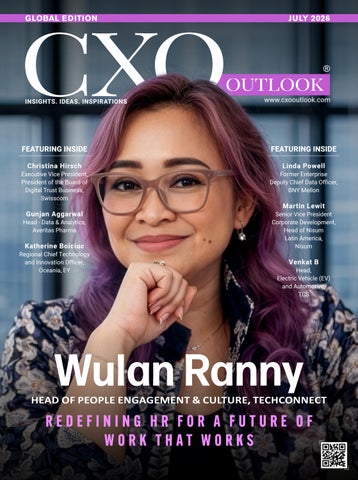
This perspective resonates strongly with our cover story featuring Wulan Ranny, Head of People Engagement & Culture at TechConnect. With more than two decades of experience in unlocking human potential, Wulan offers a refreshing view of the future of leadership and HR. Rather than positioning artificial intelligence and human intelligence as competing forces, she argues that the future belongs to organizations
that allow them to complement one another. Her insights on emotional intelligence, employee well-being, and purpose-driven leadership offer a compelling roadmap for leaders navigating this new era.
Beyond our cover story, this edition of CXO Outlook brings together a diverse collection of interviews, expert perspectives, and thought-provoking articles exploring leadership, innovation, strategy, and the evolving world of business. Each contribution reflects a different dimension of how organizations are adapting to an increasingly dynamic future.
As you turn these pages, I hope you will look beyond the latest technological breakthroughs and reflect on the qualities that truly define exceptional leadership. Technology will continue to evolve at an extraordinary pace, but empathy, judgment, resilience, creativity, and meaningful human connection will remain timeless competitive advantages. Those who invest in both innovation and people will not simply adapt to the future. They will help shape it.
Enjoy Reading.
Sarath Shyam
38
Kindness Is Not just a Soft Skill. It’s a Leadership Advantage
Linda Powell, Former Enterprise Deputy Chief Data Officer, BNY Mellon
Empowering Trust in the Digital Age
Christina Hirsch, Executive Vice President & President of the Board of Digital Trust Business, Swisscom
16
24
Empowering Women in the Age of AI
Katherine Boiciuc, Regional Chief Technology and Innovation Officer, Oceania, EY
HEAD OF PEOPLE ENGAGEMENT & CULTURE, TECHCONNECT
REDEFINING HR FOR A FUTURE OF WORK THAT WORKS
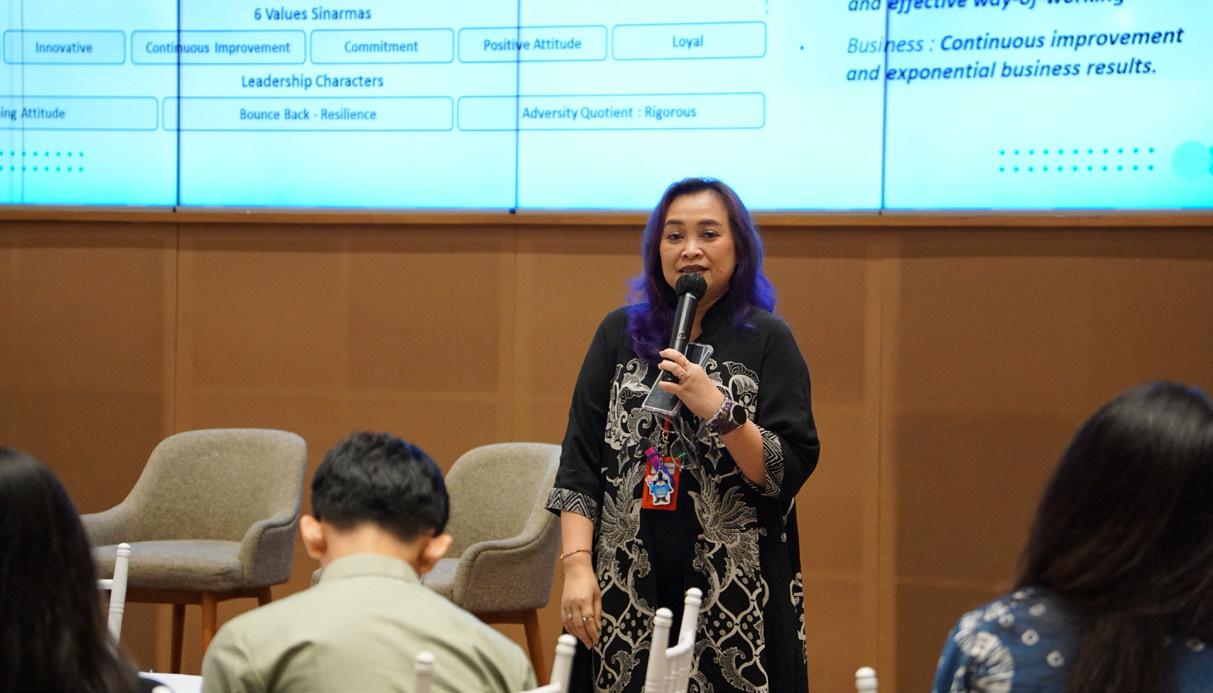
Wulan Ranny is a People Whisperer, Culture Crafter, and HR Rebel with 24+ years of experience, building legacies and unlocking human potential. As Head of People Engagement & Culture, consultant, podcaster, and speaker, she spreads contagious happiness and radical collaboration. She is a Co-Founder of AhensiexAhensi and Secretary General of PMSM Indonesia. Her life mantra: “There’s no finish line when you’re running on purpose”.
Recently, in an exclusive interview with CXO Outlook Magazine, Wulan shared insights into the future of HR, emphasizing that the industry is entering a new era where intelligence and humanity must coexist. She stressed the importance of prioritizing employee wellbeing and mental health by embedding it into the rhythm of work, rather than treating it as an initiative. She also emphasized the critical role of emotional intelligence in HR leadership, allowing leaders to interpret insights with nuance and respond with empathy. As a prolific podcaster and speaker, Wulan’s favorite topic is helping people grow into their fullest version, and she’s excited about how AI can support this journey. The following excerpts are taken from the interview.
Hi Wulan. As HR continues to evolve, what emerging trends do you believe will shape the future of the industry?
HR is entering a new era where intelligence and humanity must coexist. We’re moving from a support function into a strategic powerhouse, and AI is accelerating that shift. As my CHRO leader mentioned and highlighted, “AI is helping HR teams move beyond administrative tasks toward strategic decision-making.” This means predictive talent analytics, real-time performance insights, and unified people data will become foundational.
But the real trend is deeper: HR will be expected to anticipate workforce needs, not just respond to them. The future belongs to HR
leaders who can blend data-driven insights with empathy, intuition, and cultural understanding; it will be the strategic engine that anticipates what people need before they ask for it.
How can HR leaders prioritize employee well-being and mental health?
Well-being becomes meaningful when it’s embedded into the rhythm of work, not treated as an initiative. Intelligent tools can help us detect patterns of burnout or disengagement early, but the heart of well-being still lies in human connection. AI can give us visibility, but leaders must create the psychological safety that allows people to speak honestly about their
struggles. When we combine insight-driven HR with compassionate leadership, we build an ecosystem where people feel supported, not monitored.
What’s the importance of emotional intelligence in HR leadership, and how can leaders cultivate it?
You see, that everything now moves at a fast speed, in a world where AI provides the data, and emotional intelligence provides the discernment.
It’s what allows HR leaders to interpret insights with nuance and respond in ways that honor the human experience.
I do believe that emotional intelligence becomes even more critical as we adopt AIpowered platforms that offer “faster insights for leadership decisions.”
Leaders cultivate it by practicing selfawareness, listening without rushing to solve,
The future belongs to HR leaders who can
blend datadriven
insights with
empathy, intuition,
and cultural understanding; it will be the strategic engine that anticipates what people need before they ask for it
and being willing to sit with complexity. Technology can guide decisions, but emotional intelligence ensures those decisions land with empathy.
You’re a prolific podcaster and speaker - What’s your favorite topic to discuss, and why?
My favorite topic is helping people grow into their fullest best version. I’m always energized by conversations about how individuals can unlock their potential, elevate their skills, and transform their lives through intentional learning and self-awareness. What excites me even more today is how AI and data-driven insights can support that journey.
Intelligent tools give us visibility into strengths, patterns, and opportunities that people may not see in themselves, and that creates a powerful foundation for growth. It resonates with the principle that said: “the future of
work is not about replacing people, it’s about empowering them.”
For me, these discussions matter because transformation is never just technical — it’s deeply personal. When someone discovers what they’re capable of, everything shifts. And being part of that process is one of the greatest privileges of my work.
How
do you prioritize self-care and maintain a work-life balance?
For me, balance is something I practice, not something I perfect. I try to be intentional about where I place my energy, whether I’m leading a complex discussion at work or being fully present with my children and my furbaby (my dogs i mean ;) at home.
But I’m also human — there are days when I forget to put a stop for myself, when I push too hard, or when I only realize I’m tired after I’ve crossed the line. Those moments remind me that vulnerability isn’t a weakness; it’s a signal to pause and recalibrate. Over time, I’ve learned that self-care isn’t a reward at the end of a long week, it’s a discipline that allows me to show up with clarity, compassion, and strength, and I am still learning to be more disciplined with it
If you could have dinner with any historical figure, who would it be and why?
A very interesting topic! Hmm … If I could choose, maybe Maya Angelou. I love her! Her ability to turn lived experience into wisdom
and her mastery of storytelling have always inspired me. I imagine she would speak about resilience, dignity, and the courage to rise — lessons that feel timeless, especially in a world
Intelligent tools give us visibility into strengths, patterns, and opportunities that people may not see in themselves, and that creates a powerful foundation for growth
navigating rapid transformation. And you know that conversation will take long hours for us ;)
What’s something on your bucket list that you’re excited to tackle soon?
Hmm, another interesting question. I dream about building another version of myself — an AI-powered “Ranny 2.0,” that can be a partner, a counterpart, and a helping hand for people who want to grow.
I love the idea of creating an intelligent companion that reflects the way I think, the way I encourage, and the way I help others unlock their potential. It feels fun, a little futuristic, and deeply aligned with my purpose.
If I can build something that supports people on days when they need clarity, confidence, or simply someone to walk with them through their learning journey, then that would be a dream come true.
It’s my way of extending myself beyond the limits of time and geography — so more people can feel empowered, guided, and seen. Again, my journey in learning AI and technology is still super far! But I will keep that in my bucket list for sure.
Empowering Trust in the Digital Age
Christina Hirsch, Executive Vice President & President of the Board of Digital Trust Business, Swisscom
Hi Christina. The tech industry is rapidly evolving - What are the most significant trends shaping the industry today?
AI and Digital Sovereignty have a neck-toneck race, with digital sovereignty gaining momentum particularly fast. It is a wake-up call for Europe to become more innovative again and move beyond its comfort zone. We don’t need to re-invent everything, but we do need to be clear about which components are truly critical. AI Enables much faster development – even when rebuilding key elements becomes necessary.
At the same time, Digital Trust has already become a real business with established models and double-digit year-on-year growth across Europe.
While the technologies themselves are still underrepresented in public debates, trust as a broader concept has gained significant attention, especially in customer experience and technology design.
RegTech is another important driver, translating regulatory and compliance requirements directly into technology, user experience, and processes. As complexity
While the technologies themselves are still underrepresented in public debates, trust as a broader concept has gained significant attention, especially in customer experience and technology design
Christina Hirsch has a track record in growing businesses and driving innovation. She started her career at innovation labs and moved along with the maturity of her projects to product and portfolio management as well as various leadership roles across sales, partner- and key account management. Driving change and transformation has been a constant throughout her career. Today, Christina is responsible for building and scaling the ‘Digital Trust’ business at Swisscom on a European level, with a focus both on organic growth and M&A. Recently, in an exclusive interview with CXO Outlook Magazine, Christina shared insights into the rapidly evolving tech industry, highlighting AI and Digital Sovereignty as the most significant trends shaping the industry today. She stressed the need for transparency and accountability in AI systems, suggesting that metadata and AI can help understand the trustworthiness of digital information. As a leader, she believes in continuously expanding one’s comfort zone, trusting people, and spreading positive energy. Christina also shared her thoughts on the impact of AI on leadership, encouraging leaders to prepare themselves and their teams for the changes ahead by working with AI hands-on. The following excerpts are taken from the interview.
continues to rise, many companies struggle to keep up — and this is where we support them with both expertise and technology. Finally, quantum technologies and satellite networks are key developments to watch.
As a leader in Digital Trust, what’s your vision for the future of trust in tech, and how can organizations prioritize it?
Our vision is ‘building the internet of trust’making online interactions as trustworthy as those in the physical world. At the core are three questions: Who am I dealing with? Will I get what I expect? And what’s the risk if I don’t?
It’s important to remember that mass adoption of the internet is still relatively young. While it has brought tremendous progress, anonymity and low risk of consequences have
also enabled manipulation and problematic behavior.
Embedding trust means addressing these three questions consistently, complying with regulatory standards through RegTec and translating them into technology and processes. Equally important is excellence in customer experience – a field I care deeply about. Trust technologies improve digital experiences by removing friction, whether that’s eliminating paper-based signatures or avoiding unnecessary travel just to close and sign a deal.
As AI becomes more pervasive, what’s the key to ensuring transparency and accountability in AI systems?
I have a track record dealing with metadata and recommendation engines and a nerdy passion
for both topics. So, two thoughts from this perspective:
Metadata provides an abstraction and classification layer for digital information. It helps indicate the trustworthiness of sources, add context, identifiers and make content more transparent.
Recommendation engines, as early forms of AI, identify patterns such as ‘users who did this also did that’. These patterns can be anonymized and have reduced risks on privacy since the trigger is always item based.
Bringing the two roots together, AI can help us better understand what we are consuming: What is reliable information, what is advertising or entertainment, and why certain content is shown to us. With AI, it will become easier to distinguish trustworthy from questionable information.
I often compare this to food: when I buy a can of tomato soup, the ingredients tell me whether it is made from tomatoes or sugar and
colored water. I can then decide accordingly. The same logic will apply to a more transparent, smarter internet.
As someone who’s passionate about people, performance, and trust, what’s the most important quality you think leaders should have?
For me, the most important quality in leadership is continuously expanding the comfort zone. Never become too satisfied with yourself: keep learning, listening, experimenting. I’ve changed roles every couple of years, often because I deliberately put an expiry date on myself as soon as I got too comfortable. At the same time, I brought my experience and fresh thoughts to a different role and made space for new energy. Trust and positivity are equally important. Trust that most people try to do the right thing. If someone has a different view or reacts in an unexpected way, I try to understand what they might be seeing that I don’t. Delegate as
Trust technologies improve digital experiences by removing friction, whether that’s eliminating paperbased signatures or avoiding unnecessary travel just to close and sign a deal
Never become too satisfied with yourself: keep learning, listening, experimenting
I like to think of AI as a very young, extremely smart team member: incredibly fast, but still dependent on the information it has access to and limited experience.
Don’t be blinded by simplicity and speed.
AI is as good as the data it has access to and the statistical distribution of the data. It is a mirror, based on information it has available. While access to information and insights becomes easier, context, interpretation, judgment, creativity, and intuition remain firmly human responsibilities.
AI is a huge opportunity to eliminate administrative and rule-based work and to
focus more on what really matters: working with people, making decisions and building new things together. And yes, for roles that rely mainly on filtering information or repeating instructions, AI can be a strong invitation to reflect on one’s own value and strengths. There is still time to adapt — and it requires courage to do so.
What’s your favorite book or resource on leadership, and why do you recommend it?
Wow, there are so many. I love reading and collecting impulses wherever I find them.
The last one that had a strong impact on me was ‘The dark pattern’ by Guido Palazzo and Ulrich Hoffrage. They worked on ethics long before ESG became a boardroom topic. The book offers a fascinating, and at times unsettling, analysis of the behavioral patterns behind major business scandals, but also highlights so-called “white patterns” that help counteract them. It shows how much influence leaders have on both failure and success, especially when it comes to culture and acceptable behavior.
As a constant source of inspiration, I also subscribe to Harvard Business Review in print. It regularly gives me food for thought, and reading on paper is simply more relaxing for me.
What’s the most important advice you would give to leaders looking to leverage AI to drive business growth and innovation?
Use your own brain and your personality. Don’t blindly follow the herd, common opinions, or technology itself. Dare to think independently, weigh different perspectives, and form your
Be the director of your own movie, shape what is yours and write your own story
own view. Be the director of your own movie, shape what is yours and write your own story.
I would like to share a personal example: My father is a patent attorney. When I was growing up, we could hear him mumble when he dictated his work onto tapes that secretaries later typed. Precision was critical, since even a small typo could invalidate a patent.
When he brought home a computer in the early 1990s, I was supposed to write my school papers on it and hated it, because it crashed quite a lot. I really wished the typewriter back. He saw the potential I couldn’t see yet and so I learned to master PCs quite fast. His patent attorney office grew significantly. It created more value and new jobs.
So that’s my message to leaders today: stay positive, keep learning, identify your strengths, look for the impact you can make, overcome obstacles, embrace change - and don’t cling on what feels comfortable.
Trust that there is always more to discover, and the next opportunity is just around the corner.
Wa n t t o S e l l o r fi n d
I nve s t o rs f o r yo u r
B u s i n e s s ?
Empowering Women in the Age of AI
Katherine Boiciuc, Regional Chief Technology and Innovation Officer, Oceania, EY
Hi KB. As technology continues to evolve, what emerging trends do you believe will shape the future of industries?
I think there are two big shifts happening at once.
The first is that AI is becoming part of everyday life. Our EY AI Sentiment Index
shows that AI is increasingly showing up in ordinary, practical decisions, from navigation and learning to financial planning and health information. That is what will shape industries most deeply over the next few years.
The second is that this shift is driving a more serious conversation about the infrastructure behind it. As AI use becomes
The industries that respond well will be the ones that understand where AI adds value, where human judgment still matters, and where the boundaries need to remain clear
Katherine Boiciuc, also known as KB, is the EY Chief Technology and Innovation Officer for the Oceania region. KB helps clients gain the most from innovative technology like generative AI and advanced computing. She uses her experience as a futurist to lead innovations at EY and guide EY clients on how to adopt new technologies ahead of their competitors. Prior to EY, KB has more than two decades of experience and is one of Australia’s go-to professionals on tech. She’s led global teams to deliver services at Telstra and more recently has been advising Australia’s next generation of CXOs as a Director at Maximus.
Recently, in an exclusive interview with CXO Outlook Magazine, Katherine shared insights into the emerging trends shaping industries, highlighting the increasing presence of AI in everyday life and the growing importance of infrastructure conversations around data, energy, and compute capacity. She emphasized the opportunities for women’s empowerment and leadership in tech, noting that AI is changing the definition of strong leadership to prioritize judgment, communication, and ethical reasoning. As a keynote speaker, she’s passionate about discussing the shift in responsibility that comes with technology adoption and the importance of emotional intelligence in leadership. The following excerpts are taken from the interview.
more embedded, questions around data, energy, compute capacity, and national capability become more important. Australia is starting to think more clearly about what kind of AI infrastructure it wants to build, and on what terms.
The industries that respond well will be the ones that understand where AI adds value, where human judgment still matters, and where the boundaries need to remain clear.
How do you see AI and technology influencing women’s empowerment and leadership?
AI is changing the definition of what strong leadership looks like.
As these technologies become more common, the qualities that stand out are not only technical. Judgment, communication, ethical reasoning, and the ability to guide people through complexity are becoming more visible and more important.
That creates real opportunity for women. Leadership is no longer defined as narrowly as it once was, and that opens space for more people to shape how technology is introduced, governed, and understood.
As a woman in tech, what’s the most empowering moment you’ve experienced in your career?
For me, the most empowering moments have not been the public ones. They have been the quieter moments where I have known I could trust my own judgment and use my outside voice to ask more from the leaders around me. That might mean asking the harder question in the room, holding a position when
it matters, or resisting the pressure to move too quickly. It can feel incredibly difficult, but I have found that asking for the space, time and attention needed to do something properly is almost always worth it.
Over time, those moments have come to mean more. They remind me that confidence is not about certainty. It is about being clear on what matters.
You’re an experienced keynote speaker, what’s your favourite topic to discuss, and why?
I’m most drawn to conversations about what technology asks of leaders.
There is plenty of interest in the tools themselves, and understandably so. What I find more compelling is the shift in responsibility that comes with them. How leaders make decisions, how they communicate change, and how they carry accountability in a much faster-moving environment.
That is where the deeper conversation sits for me. In the standard of leadership it requires. I’m always interested in leaders who can combine clarity, empathy and momentum without losing sight of people.
What’s the importance of emotional intelligence in leadership, and how can leaders cultivate it?
Emotional intelligence matters because change is always personal before it is organisational.
People experience technology shifts through their own sense of confidence, relevance and security. They want to understand what is changing, what it means for them, and whether they can trust the direction of travel.
Leaders develop emotional intelligence by paying close attention, listening properly, communicating plainly, and recognising that clarity is a form of care
Leaders develop emotional intelligence by paying close attention, listening properly, communicating plainly, and recognising that clarity is a form of care.
If you could have dinner with any historical figure, who would it be and why?
I’d choose Grace Hopper because she helped make computing more usable and more accessible, and that feels deeply relevant to the moment we’re in now.
I’d love to ask how she pushed through resistance to such a big shift in thinking, and what she would make of today’s AI models.
In many ways, her legacy is a reminder that the most important breakthroughs are
not only about capability. They are also about making progress more usable for people.
What’s something on your bucket list that you’re excited to tackle soon?
I’m excited by the idea of helping more people feel capable and confident in a world shaped by AI. My personal mission is to inspire 100,000 Australian women to career pivot into an AI career and Australia needs 200,000 more AI workers by 2030.
There is still a wide gap between using these tools and really understanding them. Closing that gap matters, because confidence changes how people participate. It changes whether they feel passive in the face of change, or able to engage with it on their own terms.
Electrifying the Road to Sustainability
Venkat B, Head, Electric Vehicle (EV) and Automotive, TCS
Hi Venkat. As a leader in the automotive and EV sectors, what drives your passion for driving growth and transformation?
My passion for driving growth and transformation in the automotive and EV sectors comes from a moment early in my career that completely reshaped how I viewed
this industry. I still remember standing on the floor of a major automotive plant more than a decade ago—watching thousands of moving parts, people, and processes come together with almost orchestral precision. At that moment, I realized that mobility wasn’t just about machines. It was about human progress, about how societies connect, how cities breathe, and
What fuels me today is the privilege of standing at the intersection of these once - in - a - century shifts—electrification, AI, autonomy, and energy ecosystems—all converging faster than anyone predicted
Venkat B is a strategic growth executive who has spent 22+ years at the forefront of mobility, technology, and sustainable innovation. From building advanced engineering programs to steering major OEMs and EV disruptors toward electrification and AI-powered ecosystems, he has consistently led organizations into the next era of transformation. His career reflects a passion for innovation, global impact, and purpose-driven leadership. He is dedicated to helping industries transition responsibly into the future—through visionary partnerships, disruptive thinking, and technology that elevates both business and society.
Recently, in an exclusive interview with CXO Outlook Magazine, Venkat shared insights into his passion for driving growth and transformation in the automotive and EV sectors, emerging trends shaping the industry, balancing innovation with operational efficiency, and his proudest accomplishment. He also stressed the need for leaders to balance innovation with operational efficiency and customer satisfaction by anchoring innovation to clear business and customer outcomes. Looking back, he is proud of helping EV and mobility organizations align technology innovation with sustainability and long-term business value. The following excerpts are taken from the interview.
how innovation can fundamentally change the rhythm of everyday life.
Years later, when I first partnered with an emerging EV disruptor, I felt that same spark— only amplified. Instead of watching a well-oiled legacy process, I was watching a blank canvas. No playbook. No constraints. Just possibility. I saw brilliant engineers debating battery chemistry next to software architects designing cloud-native mobility platforms. It was clear that the industry was about to be reimagined, not incrementally, but exponentially.
That was the moment I knew I wanted to spend my career at the frontier of this transformation.
What fuels me today is the privilege of standing at the intersection of these once-in-acentury shifts—electrification, AI, autonomy, and energy ecosystems—all converging faster than anyone predicted. Every day feels like an opportunity to help write the next chapter of mobility.
My passion is shaped by three powerful forces:
Impact that outlives the project.
Whether I’m helping an OEM rethink its software architecture or supporting a greenfield EV startup in building its first engineering organization, I am driven by the knowledge that these decisions will shape the products, experiences, and sustainability standards of the next decade.
The thrill of building what’s never existed.
I’ve always been drawn to white-space challenges—new digital platforms, new operating models, new AI-powered ecosystems.
Creating the blueprint, aligning the vision, and guiding teams through ambiguity is where I find real purpose.
People at the center of transformation. Technology doesn’t transform industries— people do. Some of my most meaningful moments have come from mentoring talent, watching teams unlock breakthrough ideas, and seeing organizations evolve into highperformance cultures that innovate with courage.
At its core, what drives me is the belief that mobility has the power to elevate societies. We are not just designing vehicles; we are designing cleaner cities, safer roads, smarter energy networks, and more sustainable futures. To play a role in shaping that arc of progress is something I consider both a privilege and a responsibility.
As technology continues to evolve, what emerging trends do you believe will shape the future of the industry?
As technology continues to evolve, three converging trends will significantly shape the future of the automotive and mobility industry.
First, the shift to software-defined vehicles and digital platforms.
Vehicles are increasingly becoming intelligent, upgradable software platforms rather than static physical products. Over-the-air updates, connected services, and cloud-native architectures are enabling faster innovation cycles and new, recurring revenue models. This evolution is compelling OEMs to rethink product lifecycles, talent strategies, and ecosystem partnerships.
Balancing innovation with operational efficiency and customer satisfaction requires leaders to move away from “either - or” thinking and adopt a disciplined, outcome - driven approach
Second, the pervasive role of artificial intelligence across the value chain.
AI is moving from experimentation to enterprise-scale deployment. It is transforming engineering, manufacturing, supply chains, and customer experiences through predictive maintenance, intelligent factories, advanced driver assistance, and personalization. Generative AI, in particular, is accelerating product development, enhancing design efficiency, and improving decision-making by turning data into actionable intelligence.
Third, the convergence of electrification with the broader energy and sustainability ecosystem.
Electrification is no longer just about replacing the powertrain. EVs are becoming integral components of a larger energy landscape involving battery intelligence, smart charging, grid integration, and sustainability platforms. This convergence is creating new business models and partnerships across mobility, utilities, and clean-energy providers.
Together, these trends represent more than technological change—they are redefining how companies create value, compete, and collaborate. Organizations that successfully integrate digital, AI, and energy strategies will be best positioned to lead in the next phase of industry transformation.
How can leaders balance innovation with operational efficiency and customer satisfaction?
Balancing innovation with operational efficiency and customer satisfaction requires leaders to move away from “either-or” thinking and adopt a disciplined, outcome-driven approach.
First, innovation must be anchored to clear business and customer outcomes.
The most successful leaders don’t innovate for experimentation’s sake. They align innovation priorities tightly to strategic objectives— whether improving customer experience, reducing cost-to-serve, increasing reliability, or unlocking new revenue streams. When
innovation is explicitly tied to customer value and measurable KPIs, it naturally reinforces operational efficiency rather than competing with it.
Second, resilience comes from modern, scalable operating models.
Operational efficiency today is driven by digital foundations—cloud platforms, modular architectures, automation, and data-driven processes. These capabilities enable organizations to innovate faster while maintaining stability at scale. Leaders who invest in platform-based models allow teams to experiment at the edges without disrupting core operations.
Third, customer feedback must be embedded into execution, not treated as a checkpoint.
Continuous customer insight—through data, analytics, and real-time feedback loops— ensures that innovation efforts translate into tangible improvements in experience. This helps organizations prioritize what truly matters to customers and quickly course-correct when initiatives don’t deliver expected value.
Finally, culture and governance are critical enablers.
High-performing organizations empower crossfunctional teams with clear decision rights, agile funding models, and accountability for outcomes. Leaders play a key role in setting the tone—encouraging experimentation, while also insisting on rigor, transparency, and operational discipline.
In essence, the balance comes from treating innovation as a managed capability—not a side
activity—and making efficiency and customer satisfaction integral measures of innovative success
Looking back at your career, what accomplishment are you most proud of, and why?
When I look back on my career, the accomplishment I’m most proud of is helping EV and mobility organizations align technology innovation with sustainability and long-term business value—especially at moments when the industry itself was redefining what success looks like.
One experience that stands out involved working closely with an EV and mobility partner at a critical inflection point. They were
When I look back
on my career, the accomplishment
I’m most
proud of is helping EV and mobility organizations align technology innovation with sustainability and long - term business value—especially at moments when the industry itself was redefining what success looks like
under pressure to innovate rapidly—scaling electric platforms, modernizing digital systems, and meeting aggressive sustainability targets— while still operating within the realities of legacy processes, cost constraints, and heightened customer expectations.
Rather than approaching this as a pure technology transformation, we anchored the journey around a broader purpose: enabling sustainable mobility at scale. That meant bringing together EV platform engineering, softwaredefined architecture, data and analytics, and operational efficiency into a single, cohesive roadmap. Just as importantly, it meant aligning leadership and teams around why these changes mattered—not only for speed to market, but for environmental impact, customer trust, and longterm competitiveness.
Progress came through practical innovation. We focused on building scalable digital platforms, embedding intelligence into EV operations, and enabling smarter decisionmaking across the value chain—from product development to energy optimization. Over time, the organization moved beyond firefighting immediate challenges to confidently driving its innovation agenda forward, with sustainability embedded into how decisions were made, not treated as an afterthought.
What I’m most proud of is seeing those teams emerge stronger and more futureready—capable of innovating continuously, delivering measurable sustainability outcomes, and responding quickly to evolving market dynamics. Across my career, this theme has repeated itself: when technology, innovation, and sustainability are aligned with clear business intent, transformation becomes enduring rather than episodic.
That’s the impact I value most—helping EV and mobility leaders turn complexity into opportunity and build foundations that support both innovation and a more sustainable future.
If you could have dinner with any historical figure, who would it be and why?
I would choose Leonardo da Vinci. He had an unparalleled ability to bridge art, science, engineering, and imagination—qualities that define true innovators even today.
Da Vinci was a visionary who saw the world not just as it was, but as it could be. I’d love to understand how he nurtured such a multidisciplinary mindset, how he balanced curiosity with discipline, and how he approached problems that had no precedent. In many ways, today’s era of AI, electrification, and intelligent systems echoes his belief that innovation happens at the intersection of different fields.
What’s something on your bucket list that you’re excited to tackle soon?
A personal goal I’m excited about is traveling through Japan—not just as a tourist, but to immerse myself in its culture of precision, craftsmanship, and continuous improvement. Japan has always inspired me both professionally and personally, and I’d love to explore how those principles show up in daily life, engineering, technology, and leadership.
I’m also planning to dedicate more time to mentoring early-career professionals and building a structured platform to guide next-generation leaders in mobility, AI, and sustainable innovation. Helping shape future talent is something I deeply care about and want to accelerate in the coming years.
Empowering Healthcare through Data-Driven Decisions
Gunjan Aggarwal, Head - Data & Analytics, Averitas Pharma
As healthcare continues to evolve, what emerging trends do you believe will shape the future of the industry?
Healthcare is moving from intuition-led to intelligence-led decision making. The next decade will not be defined by more data, but by better decisions made from it. We are entering an era where AI, real-world evidence, and connected data ecosystems are fundamentally reshaping how healthcare operates. The shift is from reactive care to predictive and preventive models, where interventions happen earlier and with greater precision. At the same time, the lines between
commercial, medical, and patient engagement are dissolving into a more unified, insightdriven system.
What will truly differentiate organizations is not access to technology, but the ability to operationalize intelligence responsibly. The winners will be those who can combine data, trust, and speed to deliver outcomes that matter.
What’s the importance of patientcentric solutions in driving business growth and innovation?
If you are not built around the patient, you are building in the wrong direction.
When organizations genuinely anchor their strategies in patient needs, everything changes, from product design to engagement models to access strategies
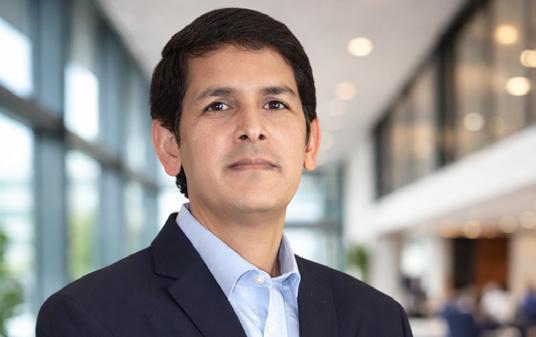
Gunjan Aggarwal is a strategic data and AI leader with over two decades of experience driving commercial transformation across the pharmaceutical, healthcare and consulting. She specializes in leveraging data, real-world evidence, and advanced analytics to inform go-tomarket strategy, enhance HCP engagement, and optimize patient access and outcomes. She has led multimillion-dollar transformation initiatives at the intersection of commercial, medical, and digital functions, influencing enterprise decision-making at scale. Her work focuses on enabling more precise targeting, improving omnichannel effectiveness, and translating data into measurable business growth and patient impact.
Gunjan has built and led high-performing global teams, partnering closely with business leaders to align analytics with strategic priorities across brands and portfolios. A recognized industry voice, she is an active member of Women Business Leaders (WBL) and a strong advocate for empowering women in leadership. She is passionate about shaping the future of healthcare through responsible AI, data-driven decision-making, and patient-centric innovation. Recently, in an exclusive interview with CXO Outlook Magazine, Gunjan shared insights into the emerging trends shaping the future of healthcare, highlighting the shift from intuitionled to intelligence-led decision making and the importance of patient-centric solutions. She emphasized the role of AI, real-world evidence, and connected data ecosystems in driving growth and innovation, while also advocating for empowering women in business and leadership. The following excerpts are taken from the interview.
Patient-centricity is often spoken about, but rarely operationalized at scale. When organizations genuinely anchor their strategies in patient needs, everything changes, from product design to engagement models to access strategies. It leads to better adherence, stronger outcomes, and ultimately more sustainable growth.
Innovation becomes sharper when it is grounded in lived experiences rather than assumptions. In my work, I have seen that when patient insights are embedded into decision-making, it creates alignment across functions and unlocks opportunities that would otherwise remain invisible. Growth in healthcare today is not just about expanding reach, but about deepening relevance.
As a member of WBL and strategic advisor to several organizations, what drives your passion for empowering women in business?
Talent is universal. Opportunity is not.
That gap is what drives me, and it is deeply personal. Throughout my career, I have seen incredibly capable women hesitate to step forward, not because they lack ability, but because they lack visibility, sponsorship, or the right ecosystem. Too often, potential is present, but the pathways to grow and lead are not equally accessible.
Empowerment, to me, is not about encouragement alone. It is about building environments where women are not just included, but truly heard, valued, and positioned to influence outcomes. It is about creating structures where they can lead with confidence and clarity, not hesitation.
When you see the impact of disease up close, you understand that behind every data point is a person, a family, and a story
Organizations that bring diverse voices into decision-making are not just more inclusive, they are more effective. Women bring a unique combination of resilience, empathy, and strategic thinking that strengthens leadership and drives better outcomes.
Through my work with WBL, HBA and other platforms, I focus on building networks, sharing perspectives, and creating spaces where women can see what is possible and step into it. Because when women rise, they do not rise alone, they reshape the system around them.
You’ve lost a loved one to cancer, how does that personal experience influence your work in healthcare?
That experience fundamentally changed how I view my work. It moved healthcare from being a professional domain to something deeply personal and urgent. When you see the impact of disease up close, you understand that behind every data point is a person, a family, and a story. It has made me more intentional about focusing on outcomes that truly matter and not losing sight of the human side of what we do. It also reinforces the importance of speed, access, and innovation in areas like oncology, where time is critical. That perspective stays with me in every decision, reminding me why this work matters.
As an avid reader and storyteller, what’s your favorite book or author that inspires your approach to strategy and transformation?
I am particularly drawn to books that explore human behavior and decision-making. One that has stayed with me is Thinking, Fast and Slow by Daniel Kahneman. It offers a powerful
lens on how people process information, make choices, and respond to complexity. In strategy and transformation, understanding these cognitive patterns is essential because decisions are rarely purely rational. The book has influenced how I think about designing systems, communicating insights, and driving change within organizations. It reminds me that successful transformation is as much about people as it is about processes or technology.
If you could have dinner with any historical figure, who would it be and why?
I would choose someone like Florence Nightingale. She was not only a pioneer in healthcare but also one of the earliest advocates of using data and statistics to drive better outcomes. Her ability to combine compassion with analytical rigor is something I deeply admire. She transformed an entire system by challenging the status quo and grounding her work in evidence. That intersection of empathy, data, and impact is incredibly relevant even today.
What’s something on your bucket list that you’re excited to tackle soon?
I am increasingly interested in creating platforms that enable learning and connection at scale, particularly in the areas of data literacy, AI, and leadership. One of the things I am excited about is building more structured initiatives that help professionals, especially women, navigate their careers with greater clarity and confidence. Beyond that, I also look forward to spending more time on writing and sharing experiences, because storytelling has the power to influence and inspire in ways that data alone cannot.
Kindness Is Not just a Soft Skill. It’s a Leadership Advantage
Linda Powell, Former Enterprise Deputy Chief Data Officer, BNY Mellon
“Three things in human life are important: the first is to be kind; the second is to be kind; and the third is to be kind.” —Henry James
Kindness is often framed as a personal virtue but in business it is something more consequential. Kindness is a performance driver.
Several years ago, I led the design of a major initiative and began gathering feedback before launch. The most technically capable colleague I could consult was also the one I avoided because she was routinely dismissive and abrasive. Rather than engage, I sought
input from others. This increased the delivery time marginally and unfortunately limited my colleague’s influence in the organization, since I was not alone in my avoidance.
This dynamic is common—and deeply misunderstood. Unkind behavior is not just a cultural issue; it is an operational issue.
The Hidden Cost of Unkind Leadership Leaders often tolerate high performers who deliver results despite cruel or insensitive behavior. The assumption is that output compensates for interpersonal friction. In practice, the opposite is often true.
Linda F. Powell has over 30 years of experience in the finance industry including commercial banking, banking supervision, and economic research. She spent most of her career with the Federal Reserve System covering regulatory reporting, bank examination, and economic research in addition to data management. She was the Chief Data Officer at the Treasury Department’s Office of Financial Research and the Consumer Financial Protection Bureau. In 2018 she joined Citibank as the Global Head of Data Governance & Data Reporting and in 2021 she joined BNY as the Deputy Chief Data Officer. She is currently the Principal at Green Fee Consulting. Her experience covers data operations, data governance, data platform design and implementation, data architecture, and analytics / data science. Linda’s data management initiatives were instrumental during the 2008/2009 financial crisis and she led the interagency initiative for the Legal Entity Identifier (LEI/GLEIF). She has published several papers on the topics of data standards, metadata, and data strategy. She has a B.A. in Economics from Rutgers University and an M.S. in Quantitative Finance from George Washington University.
When people feel safe to contribute without fear of embarrassment or retaliation, they share ideas, innovate, challenge assumptions, and surface risks earlier
Studies by McKinsey, Harvard Business School, National Institute of Health, and Psychology Today show that kindness is an essential element of effective leadership. When individuals are perceived as harsh, critical, or uncaring:
• Trust is eroded
• Employee stress and absenteeism increase
• Productivity and collaboration are reduced
• Creativity and Performance decline
The result is organizational drag less visible than missed targets, but equally damaging.
Research reinforces this. Google’s Project Aristotle identified psychological safety as
the most important factor in high-performing teams. When people feel safe to contribute without fear of embarrassment or retaliation, they share ideas, innovate, challenge assumptions, and surface risks earlier.
Kindness is not the entirety of psychological safety, but it is one of its primary enablers.
Kindness Is Not Weakness
A persistent misconception is that kindness requires lowering standards or avoiding difficult conversations. In reality, kindness demands the opposite. Kindness is not about making people feel good in the moment. It is about acting in their long-term interest with honesty and respect.
Kindness is not a ‘nice to have’. Leaders who ignore it are not driving results; they are eroding them
That includes delivering hard messages:
• Addressing underperformance
• Challenging flawed thinking
• Making unpopular decisions
The distinction lies in how those messages are delivered.
Leaders who are perceived as kind do not avoid truth; they communicate it with privacy, clarity, respect, and intent to help. Leaders who are perceived as unkind often deliver similar messages, but in ways that trigger defensiveness, reduce trust, and hinder future openness.
People rarely remember your words. They remember how your words made them feel.
Why Kindness Drives Performance
The studies noted above have consistent findings. Environments that foster respect, empathy, and trust see measurable gains in:
• Collaboration and innovation
Teams contribute more freely and build on one another’s ideas.
• Speed and decision quality
Information flows more quickly and more completely.
• Retention and engagement
Employees are more likely to stay and invest discretionary effort.
• Health and productivity
Lower stress environments correlate with higher sustained performance.
In contrast, environments marked by fear or hostility suppress contribution and increase cognitive and emotional burden. People spend energy managing risk rather than solving problems.
What Kindness Looks Like in Practice
Kindness in leadership requires consistency. Especially under pressure.
Four practices are foundational:
1. Deliver difficult feedback directly and privately
Respect is demonstrated not by avoiding hard conversations, but by handling them with discretion and care.
2. Regulate tone and emotional response
Calm, measured communication increases the likelihood that feedback is heard rather than resisted.
3.
Lead with curiosity
Assume there is context you do not yet understand. Asking questions before forming conclusions signals respect and often reveals better solutions.
4.
Align intent with impact
Well-intended feedback delivered poorly erodes trust. Effective leaders ensure that how they communicate reinforces, not undermines, their purpose.
Kindness is a Strategic Imperative
Poor strategy and weak execution are not the only barriers to high performance. Unknowable opportunity costs exist when everyday interactions discourage contribution and limit collaboration. Kindness is not a ‘nice to have’. Leaders who ignore it are not driving results—they are eroding them.
The most effective leaders understand that sustained performance depends not only on what their teams do, but on the environment in which they do it. They build cultures where people are willing and able to contribute their best.
In the long run, organizations do not outperform their culture. And culture is shaped, daily, by how leaders choose to show up.
Transforming Businesses with Data-Driven Innovation
Martin Lewit, Senior Vice President Corporate Development & Head of Nisum Latin America, Nisum
As the tech industry continues to evolve, what emerging trends should leaders prioritize to stay competitive?
Leaders should prioritize the technologies that are moving from experimentation into operating reality. I think today that starts with agentic AI: systems that do not just generate content or surface insights, but can plan,
decide, and execute multistep work within defined guardrails. That matters because the conversation is shifting from “how do we use AI?” to “which parts of the business should AI actually run or co-run?” Agentic AI is one of the most important emerging enterprise shifts, because it can change AI from a tool into a new operating layer.
Innovation becomes sharper when it is grounded in lived experiences rather than assumptions
Martin Lewit is the SVP of Growth & Corporate Development and Head of Nisum Latin America at Nisum, a global consulting partner specializing in digital commerce and evolution. In this role, he leads the company’s growth eff orts and expansion into new markets, seeks to forge strategic partnerships, and accelerates business development across the U.S. and Latin America. With a focus on innovation, channel alliances, and M&A, Martin is driving Nisum’s next chapter of growth by aligning strategy, marketing, sales, and technical pre-sales under one cohesive vision. Martin is passionate about helping organizations embrace digital transformation, AI, and data-driven innovation to deliver tangible business impact. His work spans advising enterprises on customer engagement, omnichannel commerce, and supply chain optimization, while also championing emerging technologies such as agentic AI and digital twins.
Recently, in an exclusive interview with CXO Outlook Magazine, Martin shared insights into the emerging trends in technology, key considerations for M&A transactions, and the importance of adaptability in driving sustainable growth and innovation. He emphasized the significance of agentic AI, multimodal AI, and data governance in enabling organizations to respond with agility while maintaining governance and traceability. Martin also highlighted the essential skills and competencies required to develop and implement Agentic AI systems, including technical expertise, data management, integration, and governance. The following excerpts are taken from the interview.
Women bring a unique combination of resilience, empathy, and strategic thinking that strengthens leadership and drives better outcomes
From there, a key focus should be multimodal AI embedded into workflows. The real advantage goes beyond access to model and agent development. Companies need to integrate intelligence into customer journeys, software delivery, operations, and decisionmaking in ways that feel native to the business.
Just as important is the data, governance, and architecture layer behind all of this. Most organizations are no longer limited by curiosity; they are limited by fragmented data and operating models that make scale difficult.
Beyond AI itself, I would watch closely how it accelerates adjacent areas like automation, robotics, and edge intelligence, where digital decision-making begins to shape physical operations in real time.
Ultimately, technology is not a differentiator. What separates the organizations that get ahead is intentionality: being clear about where these
technologies create leverage, how they transform the business model, and what outcomes they are meant to drive.
What are the key considerations for organizations when evaluating M&A transactions, and how can they ensure successful integration?
Before anything else in an M&A process, organizations need to be honest about what drives the process and if there is strategic fit. Financial performance matters, but it should not be the starting point. The more important question is whether the acquisition meaningfully advances the company’s direction, whether by opening a new market, adding a critical capability, accelerating innovation, or strengthening customer relevance. If that logic is not clear from the beginning, strong financials alone will not make the deal successful.
Culture is another area where many transactions lose value quietly. Often, the issue is not the strategy itself, but the fact that the two organizations never fully align on how they make decisions, collaborate, lead teams, and create value. Leaders need to understand what makes the acquired company effective in the first place and be careful not to erode that advantage through heavy-handed integration.
Operational compatibility also deserves early attention. Technology platforms, delivery models, governance structures, and go-tomarket approaches all shape how quickly value can be realized. You can’t resolve every issue before close, but you need a realistic integration roadmap that minimizes disruption for customers and employees.
One of the most overlooked points is that integration planning should begin well before the transaction closes. Companies that wait until after signing to think seriously about integration often lose momentum and create unnecessary uncertainty. The organizations that capture value most effectively are the ones that treat integration as a structured transformation program.
Ultimately, successful M&A comes down to a combination of strategic clarity, cultural respect, and disciplined execution. In the end, deals create potential, but integration is what creates value.
How does Agentic AI enable organizations to respond with agility while maintaining governance and traceability?
AI is quickly becoming a tool for execution, not just analysis. Agentic AI allows intelligent agents to evaluate options, make decisions, and take action across systems without requiring someone to manually drive every step. For organizations managing complex, high-volume processes, that represents a meaningful shift in how work gets done.
But that kind of agility does not happen by simply deploying a model. To implement agentic AI properly, organizations need the right foundation: reliable data, clear architecture, and strong governance. Without those elements, autonomy creates inconsistency rather than value. Governance matters not only to control how agents operate, but to define where they should operate, what authority they have, and how their actions align with business rules, compliance, and risk tolerance.
In practice, this means an agent can handle what used to be a long sequence of human tasks, from gathering information to evaluating alternatives, deciding, and even acting. What once required significant coordination, and time can now be compressed into a more fluid and responsive process.
What makes this powerful is that organizations do not have to trade control for speed. These systems can work within guardrails such as approval thresholds, policy rules, escalation paths, and compliance requirements. And because they operate through structured workflows and system integrations, every action can be traced. Leaders can see what the agent evaluated, why it made a decision, and how the outcome unfolded. That traceability is what makes autonomy viable in a real enterprise setting.
I’m convinced this is what makes agentic AI more than hype. Done well, it allows organizations to move faster while remaining disciplined, auditable, and aligned with business intent.
What are the key skills and competencies required to develop and implement Agentic AI systems?
The first thing to say is that building agentic AI inside an organization is difficult. It is not a single capability you can buy or a model you can simply deploy. It requires multiple competencies to come together at the same time, and that is where many organizations underestimate the challenge.
The technical foundation matters, of course. You need people who understand large language models, reasoning frameworks, orchestration, and how agents behave across
complex workflows. But just as important is the data layer. Agentic systems cannot operate consistently without clean, structured, machinereadable data. If the data foundation is weak, the system may look promising in a demo, but it will struggle in production.
Integration is another critical capability. An agent that cannot connect to the systems where work happens is just generating output, not creating value. Real value requires expertise in APIs, enterprise architecture, workflow orchestration, and secure system design so that agents can operate across business processes in a controlled way.
Governance is equally essential. Once a system can act autonomously, organizations need clear accountability, auditability, monitoring, and guardrails that reflect real business and risk requirements.
And then there is the human side, which is often the hardest part. Organizations need product thinkers who understand where autonomy creates value, leaders who can identify the right use cases, and change agents who can help teams adapt to new ways of working.
The companies will be the ones that recognize early that agentic AI is a crossfunctional transformation challenge requiring technical depth, strong governance, operational discipline, and leadership maturity.
What’s the most important quality you look for in a team member or colleague?
The quality I value most in a team member or colleague is integrity. Over the years, working across countries, cultures, and very different business environments, I’ve come to see that
I am increasingly interested in creating platforms that enable learning and connection at scale, particularly in the areas of data literacy, AI, and leadership
trust is the foundation of every strong team. When people are honest, transparent, and grounded, when they say what they think and honor their commitments and work without personal agendas, you can work through almost any challenge together. Without that, everything becomes harder.
Closely behind that is execution. I have a lot of respect for people who are willing to roll up their sleeves, stay close to the problem, and move things forward. Ideas matter, but results come from the people who keep going when the work becomes difficult or messy. I’ve seen too many good strategies stall because nobody translated them into action.
In many ways, that is how I think about team building more broadly. I often come back to four principles: collaboration, execution, automation, and focus. Collaboration, because the best outcomes come from people and functions working together rather than in silos. Execution, because ideas only matter if they are delivered. Automation, because teams should always look for ways to scale impact intelligently. And focus, because in a world full of noise, knowing what not to do is often as important as knowing what to do.
What’s something on your bucket list that you’re excited to tackle soon?
I’d love to say something very sophisticated here, but honestly, I would love to see Argentina play in the next World Cup in the stadium. If I’m allowed to really stretch the bucket list, maybe even see them in the final. Getting tickets may be harder than implementing agentic AI strategies, but hope is part of the fun.
Beyond that, what excites me most is helping to shape Nisum’s transformation for the AI era. We’re at a moment where companies are not just adopting new tools, but rethinking how they operate, how they serve customers, and how they create value. Being part of that kind of reinvention is something I find genuinely energizing.
So, one bucket-list item is pure passion, and the other is about building the future. Both feel worth chasing.
What advice would you give to organizations looking to drive sustainable growth and innovation in the tech industry?
My advice would be to build for adaptability, not just scale. In technology, conditions change too quickly for organizations to rely on static plans. The companies that grow sustainably are the ones that stay curious, move with intention, test quickly, and are willing to adjust when reality changes.
Innovation also has to be tied to execution. Real progress happens when teams are empowered to test ideas, bring them to market, learn from the outcome, and improve. Today this has become easier, faster and cheaper! Sustainable growth comes from building a culture where experimentation is normal and execution is disciplined.
I would also emphasize investing in people. Technology evolves fast, but talent is what allows an organization to keep evolving with it. The strongest companies are the ones that continuously develop their teams, expand digital skills, and create environments where people can grow along with the business.
And finally, there has to be purpose behind the growth. The companies that last are solving problems that matter and creating value that is meaningful to customers. When you combine adaptability, execution, talent development, and a clear sense of purpose, you create the foundation for growth that is both innovative and durable.